Payment Control Decisioning: Hold, Repair, Reject, Release and Return
A financial-crime control does not finish when a screening engine creates an alert. The bank still has to decide what to do with the payment. That sounds obvious, but it is one of the places where payment processing, sanctions law, AML policy, scheme rules, operations and customer communication become dangerously easy to mix together. A payment may be held while a sanctions match is investigated, repaired because a required party attribute is missing, rejected because a technical or legal condition is not met, released after a false positive is resolved, or returned after the payment has already been accepted or settled. In some sanctions cases, none of those words is sufficient because the law requires the bank to block or freeze property rather than simply send the payment back.
The most useful mental model is therefore not a single status field. It is a disposition model built on three different questions. First, what is the payment's processing state? Second, what is the financial-crime control state? Third, what legal or scheme action is permitted or required at that point in the payment lifecycle? A payment can be technically valid but legally blocked. It can be operationally held but not yet rejected. It can be released from a sanctions queue and later returned for an entirely different business reason. If those concepts are collapsed into one status such as REJECTED, the bank loses the ability to explain what actually happened and why.
This distinction matters for every audience involved in the control. Operations needs a queue and a deadline. Compliance needs a defensible legal and policy basis. Product teams need predictable customer outcomes. Architects need state transitions that cannot accidentally bypass screening. Developers need deterministic rules for retries and timeouts. Testers need scenarios that prove the right payment version was screened. Investigators need the original instruction, any repaired version, the list and rule configuration used at decision time, and the reviewer rationale. Audit and regulators need to reconstruct the complete path without relying on memory.
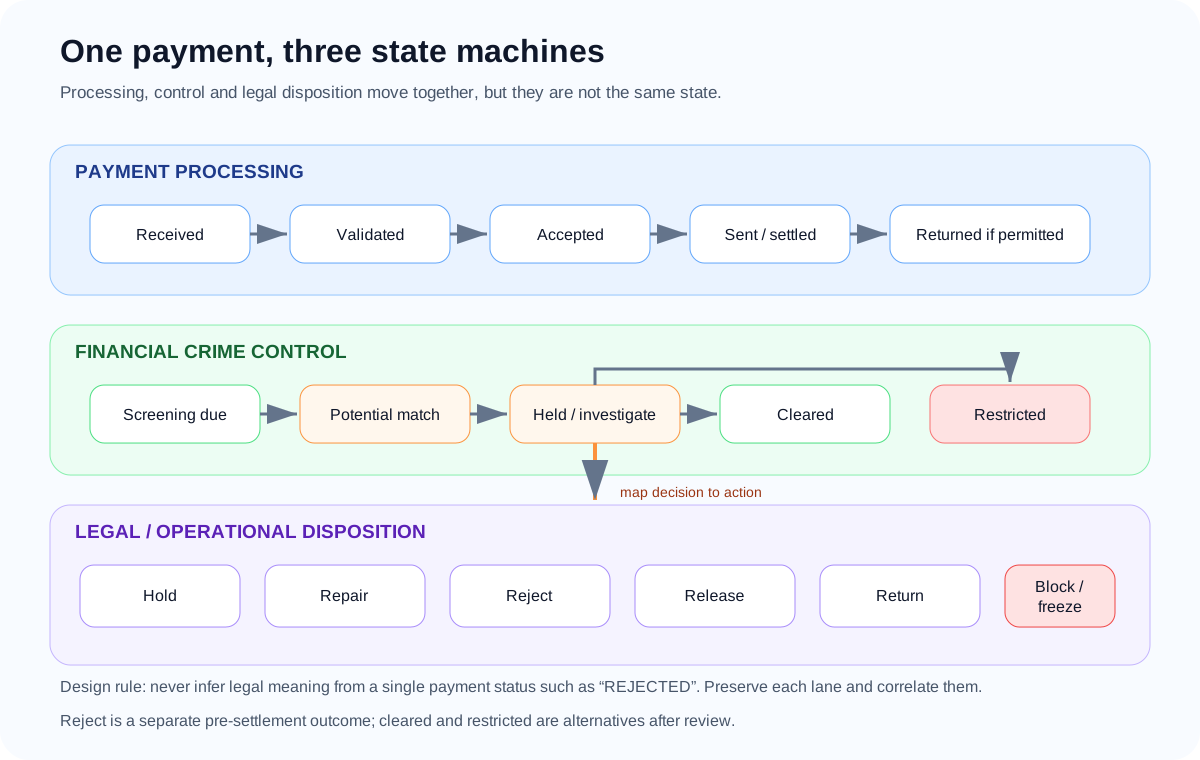
The six words do not mean the same thing
Hold is usually a temporary control state. It means the bank has paused progression because it cannot yet safely decide whether the payment may continue. A hold may be triggered by a sanctions alert, a missing mandatory data element, a fraud signal, an AML escalation, a request for additional information, a legal instruction, or an operational dependency. A hold is not itself proof of wrongdoing. It should have a clear owner, reason code, start time, expiry or escalation rule, and evidence trail. An indefinite hold with no decision path is not a mature control; it is an unresolved risk moved into a queue.
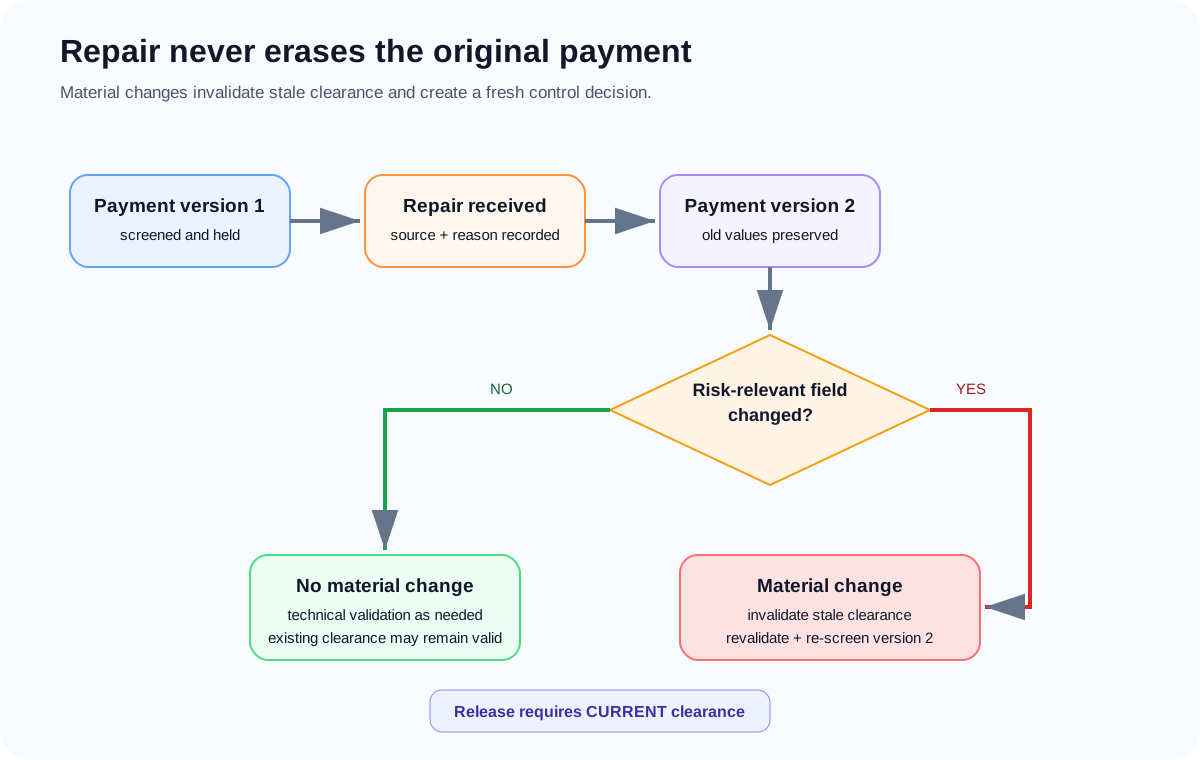
Repair means changing or completing payment data so that the instruction can be processed correctly. Repair can be legitimate and necessary. A customer or upstream bank may have omitted a structured address component, used an invalid identifier, or supplied a field that does not satisfy a scheme or network rule. But repair is also a control-sensitive action because changing names, addresses, bank identifiers, purpose text or party roles can change the sanctions-screening result. A good design therefore never treats repair as a harmless clerical edit. The original version must remain preserved, the repair source and author must be recorded, and a material repair must trigger the appropriate validation and re-screening before release.
Reject is a refusal to accept or continue processing an instruction in its current form. The reason can be technical, scheme-related, policy-based or legal. Those categories should not be merged. A message can be rejected because its structure is invalid, because a required data element is missing, because the receiving institution cannot process the instruction, or because applicable law prohibits the transaction but does not require the property to be frozen. The precise meaning depends on the payment rail and legal regime. The U.S. OFAC framework provides a useful jurisdiction-specific example: where a transaction is prohibited but there is no blockable interest, the transaction may have to be rejected rather than blocked. That distinction is not a universal global rule and should never be copied blindly into another jurisdiction.
Release means the control that prevented progression has been resolved and the payment is allowed to continue. Release is an affirmative decision, not merely the absence of a hit. The evidence should show which payment version was cleared, which alerts were considered, which lists and rules were applied, whether any licences or exemptions were relevant, who made the decision and at what time. Where the payment has been materially altered after an earlier clearance, the bank should not reuse the old clearance as though nothing changed.
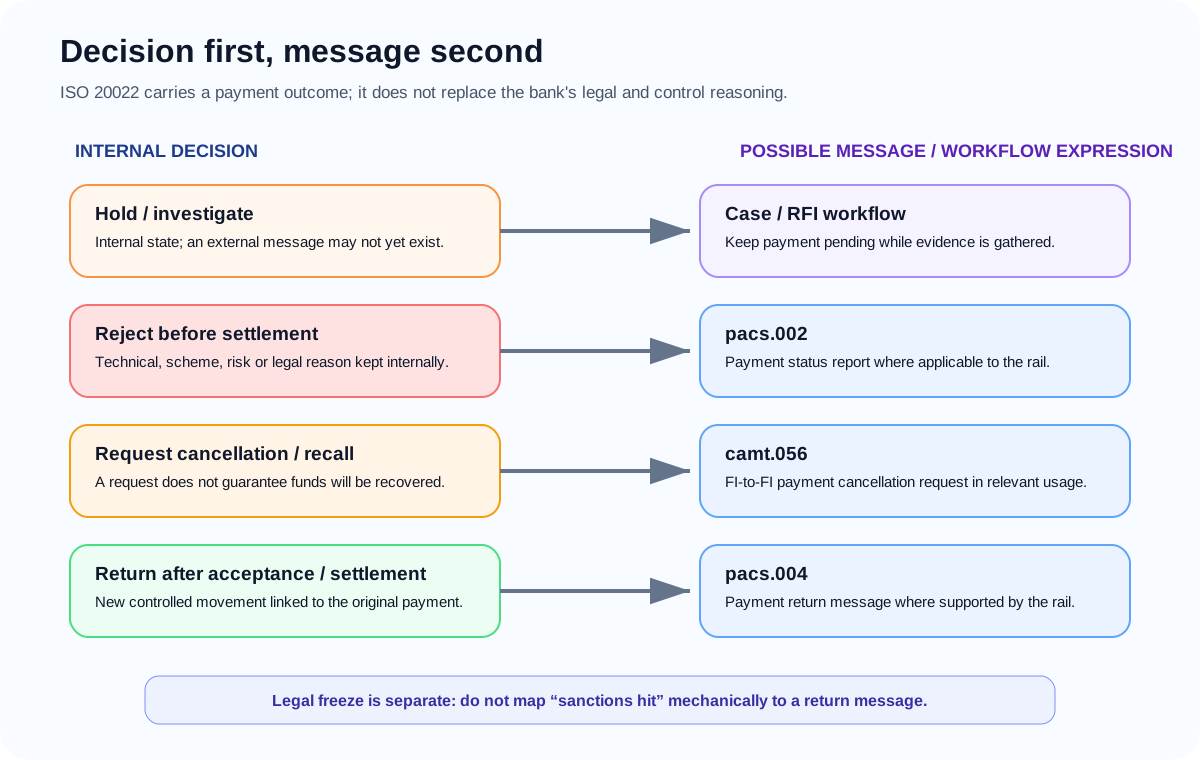
Return is normally a post-acceptance or post-settlement movement of funds back through the payment chain, subject to the rules and message set of the relevant rail. It is different from a rejection that prevents an instruction from progressing in the first place. In ISO 20022 environments, a pacs.004 is commonly used for payment return use cases, while a pacs.002 is a payment status report and a camt.056 is a cancellation request. Those message names are helpful anchors, but they do not by themselves determine the legal or operational meaning. The scheme usage guideline, settlement state and bilateral context still matter.
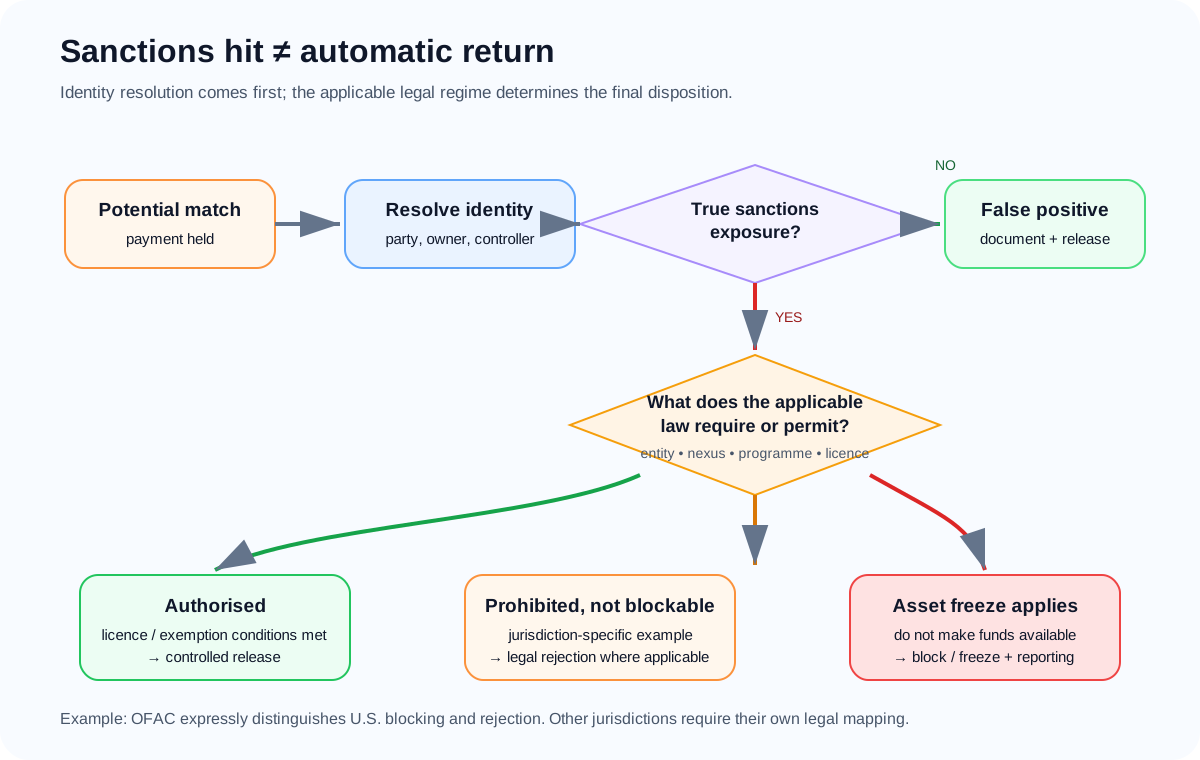
Finally, block or freeze must remain conceptually separate from all five. In targeted financial sanctions, applicable law can require funds or other assets in which a designated or blocked person has an interest to be frozen and not made available. Returning the funds to the sender may itself make funds available to a prohibited party or otherwise breach the legal requirement. The correct action therefore depends on the sanctions programme, ownership and control rules, jurisdictional nexus, any applicable licence or exemption, and the facts of the payment. This is why a sanctions queue cannot be designed as a generic release-or-return workflow.
Start with applicability, not with the button label
A bank should never begin payment decisioning with the question, “Which button should the analyst click?” The first question is, “Which obligation applies to this payment at this point in the chain?” The answer depends on the bank legal entity, booking location, payment currency, correspondent route, customer relationship, parties, product, sanctions nexus, payment rail, message role and local law. A global policy can define minimum principles, but the executable decision must be mapped to the legal entities and jurisdictions that are actually involved.
The Financial Action Task Force provides the global AML/CFT standards baseline rather than transaction-level law. Its Recommendations, amended through June 2026, are intended to be implemented by jurisdictions in ways adapted to their legal and financial systems. Recommendation 16 is especially relevant because payment transparency affects the ability of institutions to identify parties, retain information through the payment chain and apply risk-based controls when information is incomplete. FATF strengthened Recommendation 16 in June 2025 and has stated that countries are expected to be ready to implement the revised changes by the end of 2030. In June 2026 FATF consulted on implementation guidance, including misdirected-payment controls and newer payment methods. Those developments are important for design planning, but they should not be presented as though every bank already has the same binding 2030 rule in force today.
Wolfsberg's 2023 Payment Transparency Standards and its 2024 roles-and-responsibilities guidance are useful industry references because they emphasise that payment transparency is shared across a chain of payment service providers with different roles and different information. They also help prevent a common control mistake: assuming that an intermediary should somehow reconstruct customer data it never possessed, or that an initiating institution can delegate away the quality of the information it placed into the chain.
Sanctions introduce a different decision problem. In the United States, OFAC expressly distinguishes blocking from rejecting. If sanctions require blocking, the relevant property is frozen in accordance with the applicable regulations. If a transaction is prohibited but there is no blockable interest, the transaction may instead be rejected. OFAC also requires U.S. reporting of blocked and rejected transactions within specified timelines. These are U.S. requirements, not a global template. In the United Kingdom, OFSI guidance focuses on obligations arising under UK financial sanctions, including asset freezes, prohibitions on making funds or economic resources available and reporting duties. In the European Union, restrictive measures similarly can require asset freezes and prohibit making funds available to listed persons, while EBA guidelines set expectations for internal policies, procedures and controls, including for payment service providers performing transfers. The legal vocabulary overlaps, but the exact action must come from the law that applies to the institution and transaction.
The practical design principle is simple: legal disposition, payment status and customer communication are separate outputs of one controlled decision. The analyst should not infer legal meaning from the payment rail's status code, and the payment engine should not infer customer wording directly from an internal sanctions reason code.
Where the decision sits in the payment lifecycle
Payment control decisioning can occur before acceptance, after acceptance but before settlement, after settlement, or during an investigation into a completed payment. The available actions narrow as the payment progresses. Before acceptance, the bank may have time to validate, request repair or reject. After acceptance but before irrevocable settlement, there may be a window to hold, investigate, cancel or reject depending on the rail. After settlement, the bank cannot pretend the payment never happened; it may have to use return, recall, recovery, account restriction or investigation processes instead.
That timing is especially important for instant payments. A control designed for batch wires may assume that a reviewer has several minutes or hours. An instant-payment rail may provide only seconds before finality. In that environment, the bank has to decide which controls must complete synchronously, which information can be assessed in real time, what happens if a screening service is unavailable, and which risks require a hard stop rather than degraded processing. A system that silently fails open because a sanctions screening dependency timed out can create legal exposure. A system that always fails closed may protect against one risk while causing large-scale customer harm and scheme breaches. The fallback decision therefore has to be approved in advance and mapped to the actual obligation, not improvised during an outage.
Batch and correspondent payments create a different problem. There may be multiple institutions between the originator's and beneficiary's banks, and each institution may see a different subset of data. A hold at one institution does not necessarily mean the customer bank knows the same facts. Requests for information may take hours or days. Cut-off times can be missed. FX positions may move. Liquidity may be reserved. Fees may accrue. The bank therefore needs a way to distinguish a risk hold from an operational repair queue and to manage the financial consequences of the delay.
Securities, treasury and trade-related payments add further context. A payment message can be only one leg of a broader transaction. Returning the cash leg without understanding the associated security delivery, trade document, guarantee or FX position can create new operational and legal problems. The control should therefore know enough about the source product to route the decision to the right owner.
A strong hold is time-bound, owned and explainable
The purpose of a hold is to create decision time without losing control of the payment. That requires more than changing a status to HOLD. The system should capture the trigger, the payment version, the control reason, the legal or policy basis category, the queue, the owner, the hold start time, the next review time and the maximum permitted ageing before escalation. Where the hold is linked to a sanctions potential match, the bank should also preserve the list entry and screening result as they existed at the time.
Hold queues should be prioritised by more than amount. A low-value payment involving a potential sanctions true match may be more urgent than a high-value payment awaiting a routine address correction. Factors can include legal deadline, settlement cut-off, sanctions programme, match strength, customer vulnerability, fraud risk, instant-payment finality, correspondent dependency, value date, scheme SLA and the availability of evidence. The queue should surface the reason for priority so analysts do not learn to game a black-box score.
Ageing is a control risk in its own right. An alert that was appropriate to hold for thirty minutes can become a customer conduct issue after two days if nobody owns the next step. Stale holds can also create duplicated instructions when customers resend payments because they do not understand the delay. That can produce the worst possible combination: the original payment is later released and the resubmitted payment also settles. Good operations therefore link the hold to duplicate-detection, customer-service visibility and controlled communication.
Not every hold permits the same customer explanation. A bank may be able to say that a payment is undergoing routine compliance checks, but AML or sanctions confidentiality rules can limit what may be disclosed in particular circumstances. Customer communication templates should therefore be driven by approved legal and compliance categories, not free text written by an analyst under pressure.
Repair is a new payment version, not an eraser
Repair is where strong payment architecture and strong financial-crime architecture meet. A badly designed repair screen can let an operator overwrite the original instruction, remove a screening-relevant string and resubmit the payment with no reliable history. A well-designed process creates a new version linked to the original, records exactly what changed and why, and sends the repaired version through the controls that are relevant to those changes.
The bank should classify repairs by materiality. A formatting change that does not alter the identity or meaning of a party may require technical revalidation but not necessarily a full control rerun. A change to debtor name, creditor name, address, account identifier, agent BIC, ultimate party, country, remittance purpose or regulatory field can materially affect screening or monitoring and should be treated accordingly. The classification should be policy-driven and testable. It should not depend on an operator remembering which fields “usually matter.”
The source of repair matters as much as the field. If the customer supplied corrected data through an authenticated channel, that is different from an operations user guessing a missing town from an address string. If an upstream bank responds to a formal request for information, the response should be linked to the payment and preserved. If a vendor enrichment engine suggests a structured address, the confidence score and original data should remain available. A repair is evidence only when the bank can explain who supplied it and why the bank trusted it.
The deferred Swift CBPR+ address change illustrates the point. Swift originally planned structured or hybrid address enforcement for 14 November 2026, but its 27 August announcement deferred SR2026 payments changes. As of this audit on 2 October 2026, the replacement address-enforcement timetable still requires confirmation; it is separate from the deferred 12 June 2027 release described in Swift's 21 September update. Banks preparing for it need repair and data-quality processes that can fix legitimate formatting deficiencies without disguising the original information or weakening screening. Once the relevant validation rules take effect, non-compliant messages can fail network validation; data-quality repair should therefore be addressed at source while production rejection rules remain tied to the confirmed timetable.
Reject is an outcome category, not one universal reason
Payment platforms often use REJECT as though it were self-explanatory. It is not. A good control model stores at least the reason family separately from the status. Technical syntax rejection, scheme-rule rejection, account-status rejection, sanctions legal rejection, internal risk-policy rejection and customer-cancelled instruction should not all produce the same evidence trail or customer wording.
This distinction becomes important during investigations. Suppose a bank says a payment was “rejected by sanctions.” An auditor will ask whether the transaction was prohibited under an applicable sanctions regime, whether a designated person had an interest in the funds, whether the legal outcome should instead have been a block, which entity in the chain made the determination and whether required reporting was completed. If the only evidence is a generic reject code, the bank cannot answer those questions reliably.
A rejection should preserve the original instruction and the reason that applied at the decision point. If the customer repairs the payment and sends it again, that should normally be a new instruction or a controlled new version depending on the rail and product design, not an invisible resurrection of the old rejected item. Otherwise the bank may accidentally bypass controls that were designed to run only on newly accepted messages.
Release should prove why the payment became safe to process
Release is often treated as the simplest action because the payment moves forward. In reality, it is the decision most likely to be scrutinised after a bad outcome. The bank should be able to demonstrate what concern caused the hold, what evidence resolved it, which payment version was cleared and whether the release was automatic or manual.
For a sanctions false positive, the evidence may include date of birth, nationality, address, corporate registration information, ownership data, vessel IMO number or other identifiers that distinguish the payment party from the listed person. For a missing-data case, release may follow receipt of a complete and credible response from an upstream institution. For a fraud control, release may follow beneficiary verification or customer confirmation. For an AML monitoring escalation, the answer may be more complicated because suspicion reporting and transaction execution are not always the same legal question. The bank should not assume that filing or considering a SAR/STR automatically creates a universal right or duty to stop the payment; local law and policy must govern.
Release authority should be proportionate. A low-risk formatting repair may be released automatically after deterministic validation. A potential sanctions true match may require specialist review and legal escalation. Some decisions may require dual approval. The workflow should enforce those rights, record overrides and prevent an analyst from approving their own high-risk exception where segregation of duties is required.
A release also needs a time boundary. If a payment was cleared yesterday but resubmitted today after a list update or party-data change, the old clearance may no longer be valid. The system should define when a clearance expires and what events invalidate it.
Return is a new money movement with its own risk
Returning funds can feel like the safest possible answer because the bank is “sending the money back.” That intuition can be wrong. A return is itself a movement of value. It may route through different institutions, create new sanctions exposure, affect a frozen account, reveal investigation information or be prohibited under the same regime that caused the original concern.
A post-settlement return should therefore be screened and controlled according to the applicable policy. The return message should preserve enough reference data to connect it to the original payment. Operations should know whether fees may be deducted, whether the amount must be returned in full, how FX differences are handled, and which party receives the funds. Those details are rail-specific and should not be generalised across every scheme.
ISO 20022 helps by providing distinct message families. A pacs.004 is designed for payment returns. A camt.056 can be used to request cancellation of a payment, while a camt.029 can carry an investigation response in relevant usage contexts. A pacs.002 reports payment status. The existence of these messages does not mean every bank uses them identically or that they replace scheme rules. They should be treated as structured carriers of business meaning, not as the business decision itself.
Where a sanctions regime requires funds to remain frozen, the bank should not generate a return simply because an operations procedure says “sanctions hit = return.” The legal disposition must win over the generic payment procedure.
Keep three state machines separate
One of the strongest architecture patterns is to maintain separate but correlated state histories for payment processing, financial-crime control and investigation case management.
The payment state might progress through received, validated, accepted, sent, settled, rejected or returned. The exact states depend on the rail and internal architecture. The control state might progress through screening requested, potential match, held, information requested, cleared, prohibited, blocked or released. The case state might progress through opened, assigned, investigating, escalated, decisioned and closed. These are different processes. Forcing them into one status creates ambiguity and makes race conditions much harder to control.
Consider a payment that has been accepted by the channel and is technically valid. A sanctions engine returns a potential match, so the control state becomes held. An investigation case opens. The customer-service platform may still show the payment as pending. If the match is cleared, the control state becomes released and the payment continues to settlement. If the match is confirmed and the applicable regime requires blocking, the control state becomes blocked, the payment workflow stops, the case remains open for reporting, and the customer communication follows the approved legal path. No single status value can represent all of that safely.
This separation also makes retries safer. A screening adapter may retry after a timeout. The payment orchestration engine may receive duplicate callbacks. A case platform may be temporarily unavailable. Each event should be idempotent and correlated to the same payment version. A duplicate clear response must not release a later repaired version that was never screened.
Data and system touchpoints
Payment control decisioning normally spans more systems than the analyst sees on screen. The original instruction may start in mobile banking, corporate file upload, API, branch, treasury platform or correspondent channel. It passes through validation, enrichment and payment orchestration. Party and account data may be added from customer master data, KYC platforms, reference-data services, BIC directories, sanctions lists or fraud services. Screening requests and responses may be handled by specialist engines. Holds may be represented in a payment hub, case manager or both. Final accounting entries sit in ledger systems. Reporting may flow to sanctions authorities, FIUs or internal governance platforms.
The bank should therefore define a canonical evidence object for every disposition. At minimum, it should identify the payment and payment version, the original source, relevant message identifiers, parties and agents as screened, control trigger, screening request and response IDs, list and rule versions, repair history, decision code, decision rationale, actor, timestamps, approvals, outbound payment status and any case or regulatory report references.
Identifiers should be correlated rather than substituted for one another. InstrId, EndToEndId, TxId, UETR, internal payment ID, screening request ID, case ID, settlement reference and ledger reference each serve different purposes. Investigators often fail when one platform assumes another platform's identifier is globally unique or when identifiers are regenerated during repair without preserving the parent-child relationship.
Event time also needs care. A sanctions list update may arrive at 10:03, screening may start at 10:04, an analyst may release at 10:11 and settlement may occur at 10:12. If systems record only local timestamps without time-zone or clock-quality controls, the bank may be unable to prove whether the relevant designation was effective when the decision was made. Event records should use consistent time semantics and preserve source timestamps where needed.
Customer communication is part of the control
A technically correct disposition can still fail if the customer is told the wrong thing. A customer whose payment is awaiting a routine address correction needs different communication from a customer whose funds are frozen under sanctions. A customer whose instant payment failed technical validation needs a different explanation from one whose bank is conducting an investigation that must remain confidential.
Templates should therefore be mapped to communication categories, not raw internal codes. They should be reviewed for legal restrictions, tipping-off risk, consumer-protection expectations, accessibility and operational accuracy. Staff should know when they may provide a factual status such as “payment pending compliance review” and when they must escalate questions rather than improvise.
Customer impact also belongs in management information. Banks should measure hold ageing, duplicate resubmissions, false-positive release time, rejected-payment repair rates, return rates, complaints and avoidable customer contacts. These are not merely service metrics. They help reveal whether a financial-crime control is producing unintended harm or whether poor upstream data is repeatedly pushing good customers into manual queues.
Roles and decision rights
The first line usually owns the payment process and execution controls, but the exact operating model varies. Payment operations may manage routine repairs and scheme rejects. Sanctions operations may investigate list matches. Fraud teams may decide whether an instant payment should be stopped. AML investigators may assess suspicious patterns and reporting obligations. Compliance defines policy and provides oversight. Legal interprets difficult sanctions or confidentiality questions. Technology builds the workflow. Product owns customer journeys and service outcomes. Treasury may need visibility where holds affect liquidity or FX. Internal audit independently tests design and operation.
Decision rights should be written at the level at which they can be implemented. “Compliance approves high risk” is too vague. The procedure should state which disposition categories require specialist approval, which thresholds require dual control, which overrides are permitted, who can release a sanctions hold, who can instruct a return, who owns a timeout, and who receives an escalation if the payment will miss its cut-off.
Outsourcing does not remove accountability. If an external operations provider reviews sanctions alerts or performs payment repairs, the bank still needs standards for training, evidence, quality sampling, access control, incident management, change notification and audit rights. A vendor decision must be reconstructable in the bank's own evidence environment.
Mini case study: a repaired creditor address after a sanctions alert
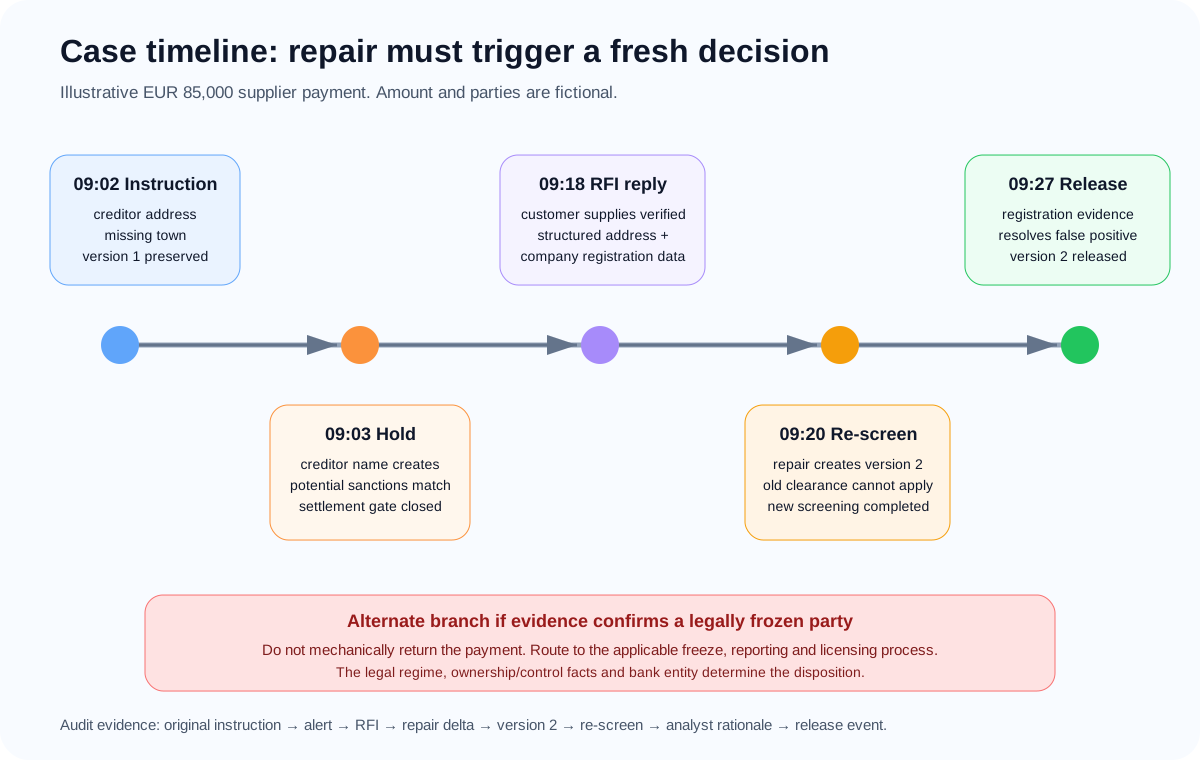
Consider an illustrative cross-border customer payment of EUR 85,000 from a manufacturing company to a long-standing supplier. The payment arrives through a corporate API as an ISO 20022 instruction. The creditor name produces a potential sanctions match because it resembles the name of a listed company. The creditor postal address is incomplete: country is present, but town is missing. The payment hub places the item in a compliance hold before settlement.
The analyst first confirms that the screening engine used the creditor name, account, country and available address, and that the potential match is not simply a technical validation error. The KYC profile shows that the customer's supplier relationship is genuine but does not independently resolve the creditor identity. Operations therefore requests additional information through the approved channel instead of guessing the missing town.
The customer provides a corrected structured address and supporting invoice information. The bank records the response as a new payment-data version. Because the repair changes screening-relevant party information, the system does not reuse the original clearance state. It reruns validation and sanctions screening on the repaired version. The new screening result, together with a registration number available from the customer documentation, distinguishes the supplier from the listed entity. The sanctions analyst records the false-positive rationale and releases that specific payment version.
The payment then proceeds to the correspondent chain. Suppose instead that the new evidence showed that the creditor was owned by a designated person under an applicable asset-freeze regime. The workflow would not simply switch to “return.” It would route to the legal disposition required by that regime, including any blocking, reporting or licensing process. The same payment-processing platform can therefore support very different outcomes only if legal decisioning remains separate from technical status.
The case also illustrates why auditability matters. Months later, a reviewer should be able to reconstruct the original instruction, the potential match, the request for information, the customer response, the repaired version, the second screening result, the list version, the analyst rationale and the release event. If the system merely shows the final clean address and a final status of SETTLED, the bank has lost the evidence that demonstrates the control worked.
Common failure modes
The first failure mode is status collapse. One field is used for technical, financial-crime and settlement outcomes. Nobody can later tell whether REJECTED meant invalid XML, sanctions prohibition, fraud decision or customer cancellation.
The second is repair without versioning. Operators overwrite the original payment. Screening is rerun, but the bank cannot show what information caused the original alert or who changed the data.
The third is release after material change without re-screening. A payment is cleared, then a party field is repaired, but the system assumes the previous clearance is still valid.
The fourth is return used as a universal safe outcome. Operations returns funds even where the applicable sanctions regime requires freezing, or where returning value to the sender creates a new prohibited movement.
The fifth is stale holds. An alert enters a queue with no escalation timer. Cut-offs pass, customers resend payments and duplicate risk increases.
The sixth is silent fallback. A screening service times out and the orchestration engine proceeds because “availability” was prioritised over the compliance requirement. Fallback behaviour must be designed and approved before the outage.
The seventh is message-code overconfidence. Teams assume that sending a pacs.004 proves a legally correct return or that a pacs.002 rejection code fully explains the control decision. Message semantics and legal decisioning are related but not interchangeable.
The eighth is weak customer wording. Front-line staff reveal too much about a sanctions or AML investigation, or tell the customer a payment is “blocked” when it is only awaiting routine data repair.
The ninth is missing decision evidence. The payment was handled correctly, but list version, rule version, payment version, analyst rationale or approval record cannot be recovered. A control that cannot be evidenced later will be difficult to defend.
What a learner should take away
Payment control decisioning is the bridge between detection and action. The strongest design does not ask an analyst to choose from five attractive buttons. It determines which obligations apply, preserves the payment and evidence state, separates temporary control status from legal disposition, and only then executes the appropriate payment action.
Hold should buy controlled decision time. Repair should create a traceable new version. Reject should state why the instruction cannot proceed. Release should prove why the concern was resolved. Return should be treated as a new controlled money movement. Block or freeze should remain a legally distinct outcome where applicable sanctions require it.
For business analysts and architects, the key question is whether the state model can represent reality without ambiguity. For compliance, it is whether legal requirements are correctly mapped to decision rights. For operations, it is whether queues, cut-offs and customer communication are manageable. For developers and testers, it is whether every material change triggers the right controls and every callback is idempotent. For investigators and auditors, it is whether the complete evidence chain can be reconstructed later.
Swift timetable source, checked 2 October 2026: Structured-address migration extension and 21 September release update. The deferred release includes exceptions/investigations messages on 12 June 2027; structured-address enforcement timing remains separately governed: https://www.swift.com/news-events/news/swift-accepts-community-request-extend-structured-address-migration-iso-20022-payment-messages
Operational deep dive: from screening outcome to payment action
The base chapter separated the payment state, the financial-crime control state and the legal disposition. This deep dive takes that model into the operating detail that causes most production failures: timing, ownership, state transitions, message handling, queues, re-screening, settlement boundaries and evidence. The objective is not to prescribe one universal workflow. Payment rails, sanctions regimes and bank operating models differ. The objective is to show the control questions that must be answered in any implementation.
The control starts before the alert
A payment-control workflow is only as reliable as the data and routing that reach it. If a channel drops the ultimate debtor, truncates a creditor address, converts a BIC incorrectly or maps an intermediary bank into the wrong ISO 20022 role, the downstream sanctions engine may produce a perfectly consistent decision on the wrong data. The operational design should therefore treat payment validation, financial-crime screening and disposition as one evidence chain even when different platforms perform each step.
The bank should know which version of the payment was accepted from the customer, which enrichments were added internally, which fields were normalised, which party roles were passed to screening and which message was eventually sent to the next institution. A decision is not fully explainable if the analyst can see only the enriched payment while the customer's original instruction has been overwritten.
This is particularly important in ISO 20022 because the richer data model creates more potential screening inputs. Debtor, creditor, ultimate parties, initiating party, agents, addresses, account identifiers, remittance information and regulatory fields may all carry risk-relevant information. The bank does not need to screen every field identically, but it should have an approved field-coverage model that says which elements feed which controls and why.
Wolfsberg's payment-transparency work is useful here because it frames transparency as a chain responsibility rather than merely a message-format requirement. The institution initiating the payment flow has particular responsibility for the quality of information it places into that flow, while intermediaries can only act on the information and role they actually have. That distinction should be reflected in exception handling. An intermediary may need to hold or request information, but it should not invent customer facts to make the payment processable.
Pre-acceptance validation and the first decision boundary
The cleanest point to reject an instruction is often before the bank has accepted it for execution. A channel can validate mandatory fields, scheme rules, account permissions, cut-off eligibility and basic data quality before creating a payment that downstream systems regard as accepted. That reduces the number of cases in which operations later has to explain why an apparently accepted instruction cannot proceed.
Pre-acceptance controls should distinguish correctable validation errors from non-correctable outcomes. If a corporate file contains an invalid country code, the channel may be able to reject the record immediately with a clear validation reason. If a party produces a sanctions potential match, however, the bank may need to accept the instruction into a controlled hold state so that specialist review can occur without the customer repeatedly resubmitting the same payment.
The contract with the customer matters. Some products define the point at which an instruction is considered received or accepted, and local payment-services law may impose timing or notification obligations from that point. Product and legal teams should therefore define payment-state language carefully. A screen saying “payment accepted” should not be used merely because the channel wrote the instruction to a database.
For business analysts, this means acceptance criteria should identify the precise event that marks customer receipt, technical acceptance, control hold, execution acceptance and settlement. These are often five different moments even if the legacy system exposes only two statuses.
Synchronous and asynchronous screening
Financial-crime controls can run synchronously in the payment path or asynchronously in a separate workflow. Both patterns can be valid. The risk lies in failing to understand the timing consequence.
Synchronous screening prevents the payment from progressing until the control has responded. This pattern is common where a sanctions decision must be made before funds leave the institution. It offers strong execution control but introduces latency and dependency risk. The payment hub needs timeout rules, retry behaviour, duplicate protection and an approved degraded-mode response. The sanctions service must scale with peak payment volumes rather than average volumes.
Asynchronous screening can improve throughput where the payment rail or product allows a hold state while investigation continues. The payment is persisted, a screening event is emitted and the payment waits for a decision event. This pattern can make operations easier because screening can be retried independently. It also creates race conditions if the payment engine has another path that can advance the payment before the control event arrives.
The safest architecture uses an explicit release gate. Regardless of whether screening is synchronous or asynchronous, the payment cannot move past a defined execution boundary until the required control state is satisfied. The release gate should check the current payment version, not merely whether any earlier version has a CLEARED record.
Screening result is not yet the final disposition
A screening engine normally returns a technical or risk result, not the full legal decision. It may classify a name as no match, potential match, likely match or true match. It may return a score and matched list entries. The bank still has to determine whether the list applies to the legal entity processing the payment, whether ownership or control rules extend to an unlisted party, whether an exemption or licence applies and what action is required.
That separation prevents screening logic from becoming an accidental legal rules engine. Matching technology is good at comparing data. Legal applicability can depend on facts outside the payment: entity location, citizenship, currency clearing path, product type, programme scope, ownership aggregation, licence conditions or the effective time of a designation. Some of those facts can be automated, but the model should remain explainable.
The analyst user interface should therefore show the payment facts, matched list data, connected customer and ownership information, applicable policy or legal rule category and any prior false-positive history without obscuring which source provided each fact. A previous false-positive disposition can support efficiency, but it should not become an indefinite whitelist where identifiers have changed or the sanctions entry has been updated.
Hold ownership and queue design
A hold queue needs a service model, not merely a worklist. Every held payment should have an owner and an ageing clock. The owner may be sanctions operations, payment operations, fraud, AML investigations, trade operations or another specialist team depending on the trigger. Transfers between queues should preserve the original hold reason and show the hand-off time so ageing does not restart invisibly.
Priority should be risk-aware and time-aware. A payment about to miss a clearing cut-off deserves operational attention, but urgency must not pressure analysts into releasing unresolved sanctions risk. A mature queue model separates business urgency from risk severity so leaders can see both dimensions. It can then escalate a payment that is both high-risk and close to a settlement deadline without pretending those are the same concept.
Queues should also distinguish “waiting for customer,” “waiting for correspondent,” “waiting for legal interpretation,” “waiting for list-provider clarification,” “system retry” and “analyst review.” Otherwise backlog MI can show thousands of open items without identifying the real constraint.
A queue with strong service-level targets but weak decision quality is dangerous. Average turnaround time can improve while false releases increase. Management information should therefore pair timeliness with quality-review results, rework, complaints, post-release escalations and root-cause categories.
Request for information and payment repair
When information is missing, the bank needs to decide whether it can be obtained and whether it is appropriate to pause the payment while doing so. FATF's payment-transparency standards and Wolfsberg guidance support the broader principle that payment participants should preserve meaningful originator and beneficiary information and apply risk-based procedures where required information is absent. The exact obligation and deadline depend on the implementing jurisdiction and payment role.
An RFI should identify what information is required without disclosing more than is necessary about the control concern. Requests should be linked to the payment and case, timestamped and routed through authenticated channels. Responses should be preserved as evidence. Free-form email copied into a case note is weaker than a structured response linked to the source institution and payment reference.
When the response results in repair, the bank should compare the old and new values field by field. A change matrix can drive re-screening. For example, a corrected town may affect geographic screening and entity resolution. A changed creditor name clearly affects name screening. A changed agent BIC affects route and financial-institution screening. A change only to a customer-visible narrative label may not affect sanctions screening but could still require scheme validation.
The repair process should not allow operators to remove information simply because it causes an alert. If a bank receives ABC Trading LLC / Crimea Branch and an operator changes it to ABC Trading LLC to make the screening score fall, that is not repair. It is suppression of risk-relevant data. The system should preserve deleted as well as added values and make sensitive changes visible in QA.
Material-change re-screening
A material-change policy should be explicit. The payment service should not attempt to infer materiality from whether the screening score changed after repair, because by then the control has already been rerun. Instead, a configuration table should classify which fields and transformations invalidate earlier screening clearance.
The design can be simple: if a configured risk-relevant field changes after the most recent successful screening request, the release gate marks the clearance stale and requires a fresh decision. If the screening service is unavailable, the payment remains in the appropriate hold state according to approved fallback rules. The control should never silently rely on the stale clearance.
Versioning makes this testable. Payment version 1 receives screening decision A. Repair creates version 2. The release gate checks whether decision A applies to version 2. If not, screening request B is required. This is much safer than a mutable payment record plus a single screeningStatus column.
Rejection before settlement
A pre-settlement rejection can arise from many sources. The sending bank may reject a customer instruction before it enters the external rail. A correspondent may reject an incoming interbank instruction. A market infrastructure may reject a message because it violates the usage guideline. A sanctions control may determine that a legally prohibited transaction should not proceed. Each scenario needs its own reason model and evidence.
Where ISO 20022 is used, pacs.002 can convey a payment status and reason in applicable flows. It should not be treated as the legal case record. The case record must still explain whether the rejection was technical, compliance-related, fraud-related or caused by some other business rule. External reason codes are often deliberately less detailed than internal control reasons because customer and counterparty communications must not disclose sensitive information.
The bank should define whether a rejected instruction may be corrected and resubmitted. If it may, the resubmission must not bypass the control that caused the original rejection. Duplicate-detection rules should recognise that a legitimate corrected resubmission can resemble a duplicate while still requiring new screening.
Sanctions block or freeze versus rejection
The U.S. OFAC model is a useful example because it makes the distinction explicit. OFAC guidance states that where sanctions require blocking, property must be frozen in accordance with the relevant regulations; where a transaction is prohibited but there is no blockable interest, the activity may instead need to be rejected. OFAC also requires reports of blocked and rejected transactions within its U.S. regulatory framework. A global bank should encode those rules only for entities and transactions to which they apply.
EU and UK financial sanctions use their own legal frameworks but similarly include asset-freeze and no-funds-availability obligations. A bank therefore needs an outcome such as LEGAL_FREEZE or equivalent that cannot be confused with ordinary payment return. The ledger treatment, customer communication, regulatory reporting and release authority for frozen funds can be completely different from a technical reject.
Licences and exemptions add another branch. A sanctions potential match does not automatically mean the payment must be frozen if an applicable licence authorises the activity and all conditions are met. The bank should retain the licence reference, scope assessment, expiry date, conditions and approval evidence. A general licence should not be treated as a blanket waiver without checking its terms.
Release controls
Release should be bound to the resolved concern. A sanctions release decision should document why the match is false or why the transaction is authorised. A missing-data release should document what information was obtained and why it is sufficient. A fraud release should document the risk resolution. A technical release should document successful validation.
High-risk manual release should require appropriate entitlements. The user who performed the repair should not necessarily be able to approve the same payment where segregation of duties is required. Emergency access should be logged and independently reviewed.
Automatic release also needs evidence. If a deterministic rule clears a payment because the date of birth and country clearly exclude the sanctions list entry, the system should store the rule version and the decisive attributes. Otherwise the bank cannot later explain why the machine released the payment.
A payment should never be released merely because a hold timer expired. Expiry should trigger escalation, not an implicit allow decision, unless the legal and risk owners have explicitly designed a time-based fail-open rule for a control where that is permissible. Sanctions controls often require the opposite approach.
Post-settlement return, recall and recovery
After settlement, the vocabulary changes. A bank may request cancellation or recall, initiate a return where scheme rules permit, recover funds from a beneficiary account, restrict an account, contact another institution or open an investigation. Those are not interchangeable.
In ISO 20022, pacs.004 supports payment return messaging and camt.056 supports cancellation requests in relevant payment flows. Swift's exceptions-and-investigations migration is moving the industry toward more structured case handling around these workflows. The message still does not create a right to recover funds. Settlement finality, scheme rules, account balances, beneficiary consent, fraud-reimbursement rules and legal orders can determine what is actually possible.
A return should carry the correct original-payment references so the sender can reconcile it. Internal systems should link the return to the original transaction while preserving a separate accounting identity for the new movement. If only the amount and beneficiary are copied, investigations later struggle to distinguish a true return from an unrelated credit.
Customer communication and tipping-off boundaries
Operations teams often want a single reason phrase to show customers. That can be unsafe. A routine technical reject can be explained precisely. A missing address may be explained as a data requirement. A sanctions hold may require more limited wording. An AML investigation may have confidentiality or tipping-off restrictions that vary by jurisdiction.
The customer-service interface should therefore expose an approved communication category rather than the raw analyst narrative. It can show whether the customer may take corrective action, whether a payment can be resubmitted, whether the bank will contact them, and whether the matter must be escalated to specialist support. Free-text internal notes should remain internal.
The bank should test communication across mobile, web, call centre and relationship-manager channels. A payment that shows pending in mobile but rejected in the call-centre tool creates confusion and repeated instructions. Consistent status wording is a control against duplication as much as a service improvement.
Reconciliation and completeness
A payment-control environment should reconcile the population, not just individual cases. For every in-scope payment that required screening, the bank should be able to prove that a screening request was created, a response or controlled exception was received, the decision applied to the correct payment version and the release gate behaved accordingly.
Useful completeness checks include payments released with no screening decision, screening responses with no payment, holds with no active case, returns with no original-payment link, repairs performed after clearance with no subsequent re-screen, and blocked funds with no regulatory-reporting record where one is required. These controls detect silent integration failures that queue metrics can miss.
Daily reconciliation is not enough for every rail. Instant payments may require near-real-time monitoring for orphaned control events because the operational window is measured in seconds. Batch payments may tolerate end-of-cycle reconciliation if the release gate itself is synchronous and strong. The frequency should match the failure consequence.
Operational hand-off to investigations
Not every held payment becomes an AML investigation, but some do. A sanctions true match, repeated missing payment data from the same correspondent, unusual repair behaviour or a fraud-linked beneficiary can create wider relationship concerns. The payment case should therefore support escalation into a financial-crime investigation without forcing analysts to rebuild the evidence manually.
The hand-off should include the original and current payment versions, customer and counterparty identifiers, relevant screening hits, repair history, communications, payment-chain institutions, linked transactions and the reason for escalation. Investigation and payment operations can then diverge: the payment may be blocked, rejected, released or returned while the broader customer investigation continues under separate governance.
This separation matters because the execution decision and the suspicion decision are not always the same. A transaction can be legally processable yet suspicious enough to investigate and report. A transaction can be prohibited by sanctions even if the customer behaviour does not meet an AML suspicion threshold. Systems should allow those conclusions to coexist.
Management information that reveals control health
Volume alone is weak MI. A control owner should understand how many payments are held, why they are held, how long they age, what proportion are false positives, how many require repair, which fields drive repair, which corridors or counterparties generate repeated data-quality issues, how many releases need override, how many returns follow earlier releases, and how many customer complaints or duplicate resubmissions result.
Quality metrics should sit beside throughput. Examples include decision reversals, QA error rate by disposition type, re-screen omissions after material repair, incorrect communication, misapplied sanctions programme, missing approval, and incomplete evidence. Root cause should distinguish people, process, data, system, vendor and policy defects.
Senior management should be able to see whether operational pressure is changing risk behaviour. If release rates rise sharply when queues are large, that is a useful challenge signal. If a specific correspondent creates high volumes of missing party data, relationship management may need to intervene rather than simply adding analysts to the repair team.
A practical operating principle
The most robust payment-control workflow is deliberately conservative about state and deliberately precise about evidence. It does not assume that a screening result is a legal answer, that a repair is harmless, that a rejection means the same thing on every rail, or that returning funds is always safe. It treats every action as a controlled transition tied to the payment version, the applicable obligation and the point in the settlement lifecycle.
That discipline creates operational efficiency as well as compliance quality. When statuses are clear, queues can be routed correctly. When repairs are versioned, re-screening can be automated. When external message codes are separated from internal reason codes, customer communication becomes safer. When returns are linked to original payments, reconciliation improves. And when the evidence chain is complete, investigations and audits stop depending on manual reconstruction from scattered systems.
Advanced practice: requirements, architecture, testing and assurance
Payment control decisioning becomes difficult when the bank tries to express legal obligations, scheme rules and operational judgement as software. The strongest delivery teams do not begin with screens or reason-code lists. They begin with invariant control outcomes: the payment must not pass a required control gate without an applicable decision; a material repair must invalidate stale clearance; a legal asset freeze must not be converted into an ordinary return; and every manual or automated action must be reconstructable from evidence.
This supplement turns those principles into delivery artefacts for business analysts, architects, developers, testers, control owners and assurance teams.
Translate policy into decision tables
Policy statements such as “sanctions hits must be investigated before payment” are directionally correct but too vague to build. A decision table forces the team to define the facts that change the outcome.
Typical inputs include the bank legal entity, sanctions nexus, matched list or programme, match status, ownership or control result, applicable licence or exemption, payment stage, settlement finality, payment rail, product, customer type, payment version, repair materiality and whether required information is complete. The outputs can then include control state, payment action, required approval, customer communication category, regulatory reporting flag and evidence requirement.
The table should explicitly include unknown states. Real payments frequently arrive before every fact is known. If an ownership determination is pending, the system should not force the analyst to choose either “blocked” or “clear.” It should support a temporary hold with a defined escalation path. An architecture that has only binary outcomes will encourage users to select the least-wrong status simply to move the item out of the queue.
Decision tables are particularly useful for jurisdictional differences. The U.S. OFAC example can be encoded in the U.S. entity rule set without turning “block vs reject” into a global rule. EU and UK asset-freeze rules can be mapped separately. The bank can then maintain a global canonical disposition model while allowing local legal rules to determine which dispositions are valid.
Define canonical disposition codes separately from rail codes
External payment rails have their own status and reason codes. Internal controls should not depend directly on those external values. A canonical model can use categories such as:
CONTROL_HOLDDATA_REPAIR_REQUIREDCONTROL_CLEAREDLEGAL_REJECTLEGAL_FREEZETECHNICAL_REJECTPOST_SETTLEMENT_RETURNCANCELLATION_REQUESTEDMANUAL_ESCALATION
The precise names are less important than the separation of meanings. A mapping layer converts the internal disposition into the appropriate external message or channel status for the relevant rail. This prevents a scheme code change from rewriting the bank's financial-crime policy.
The mapping should also be versioned. Swift and other payment networks change usage guidelines over time. For example, Swift's target CBPR+ profile removes fully unstructured postal addresses, but its 27 August 2026 announcement deferred the earlier 14 November 2026 enforcement plan. Rule deployment must use the subsequently confirmed timetable. A bank should be able to update rail validation and reason-code mapping without altering the historical meaning of cases decided under an earlier release.
Model payment versions explicitly
A payment object should have an immutable identity and one or more versions. Each version should contain the risk-relevant party, account, agent and remittance data as it existed when screened. A repair creates a new version rather than rewriting the old one.
The screening decision should reference the payment version ID. The release gate should require a valid clearance for the current version. If version 3 is current and the latest clearance belongs to version 2, the payment remains held until the required controls for version 3 complete.
This pattern solves several common defects at once. It prevents stale clearance after repair. It preserves audit evidence. It allows investigators to compare what changed. It gives testers a clear assertion. And it supports deterministic rollback if a repair is later found to be incorrect.
Versioning should include automated transformations as well as manual edits. Transliteration, address structuring, BIC enrichment, name normalisation and field mapping can all change the data presented to a screening engine. The bank should know whether the screened value was raw customer data, an enriched value or a normalised representation.
Create a material-change matrix
Not every field change should trigger the same response. A material-change matrix links field categories to required downstream actions.
A creditor-name change would normally invalidate name-screening clearance. A creditor-country change can affect sanctions, AML and geographic-risk controls. A BIC change can alter the correspondent route and agent screening. A change to an ultimate beneficiary can fundamentally change the payment parties. A formatting-only change may require message validation but not a full sanctions rerun if the semantic value is unchanged.
The matrix should be approved by control owners and implemented as configuration, not buried in code. It should include the source of change as an input where needed. A system-generated normalisation from lowercase to uppercase is different from an operator replacing one legal name with another.
Testing should prove both positive and negative cases: material changes trigger the required controls, while harmless formatting changes do not create unnecessary customer delay.
Design the release gate as a hard control
A release gate should evaluate a small set of non-negotiable conditions before allowing the payment to progress. Those conditions may include:
- current payment version is technically valid;
- all required financial-crime controls for that product and route have completed;
- no active legal freeze or unresolved prohibition exists;
- required approvals are present;
- any material repair after clearance has been re-screened;
- the decision has not expired because of a list update, payment amendment or time limit;
- no higher-priority event has placed the payment back on hold.
The gate should be idempotent. Repeating the same valid release event should not create duplicate payment execution. A late callback from an earlier screening request should not override the current state. Event sequencing and version checks are therefore part of financial-crime control, not merely technical hygiene.
Treat timeout and outage behaviour as policy
Dependencies fail. Screening engines time out. List services become unavailable. Case systems go down. Payment hubs experience network partitions. The bank must know what happens before the incident occurs.
For each dependency, define the detection threshold, retry strategy, maximum wait, queueing behaviour, operator visibility, escalation owner and whether processing may continue in degraded mode. The answer can differ by control. A non-critical enrichment service may have a safe fallback. A mandatory sanctions check may require fail-closed behaviour until an approved alternative control is available.
Fallback should be tested in production-like conditions. It is not enough to prove that the system can display an outage banner. The test should show that payments cannot bypass the release gate, that retries are idempotent, that queued payments are recovered in order, that stale screening responses are ignored and that operations can identify the affected population.
After recovery, reconciliation should prove that every payment processed during the incident received the required control treatment. If a degraded mode was used, the bank may need a targeted lookback depending on the nature of the control and applicable policy.
Acceptance criteria for hold handling
A well-written user story for payment hold should contain observable outcomes. For example:
Given an in-scope payment version awaiting mandatory sanctions screening, when the screening service returns a potential match, then the payment must enter a controlled hold state before the configured execution boundary, retain the screening request and matched list entry, display the hold reason to authorised operations users, start the appropriate ageing clock and prevent downstream settlement until an authorised disposition is recorded.
The same story should cover negative and failure paths. If the screening callback is duplicated, no duplicate case should be created. If the analyst closes the case without a permitted disposition, the release gate should remain closed. If the payment is materially repaired while held, the current screening decision should become stale. If the payment is cancelled by the customer where cancellation is still legally and operationally allowed, the hold evidence should still be retained.
Acceptance criteria for repair
Repair stories should identify who may edit which fields and the evidence required. A strong criterion is that the system preserves the original value, new value, source, operator, timestamp and reason for every repair. Risk-relevant changes should automatically create a new payment version and trigger the configured revalidation and re-screening controls.
The test suite should include misleading “almost harmless” changes. A town may be added without changing country. A transliterated name may change spelling. An intermediary BIC may be corrected. An ultimate creditor may be added after an RFI. The objective is to prove that the materiality logic reflects control policy rather than only obvious field differences.
The system should also prevent unsupported repair. If required customer or counterparty information is absent, operations should not be able to populate it from memory merely to satisfy validation. Where controlled enrichment is permitted, the source and confidence must remain visible.
Acceptance criteria for reject and freeze
The key test is whether the system distinguishes payment rejection from legal asset freezing.
A legal-reject scenario should stop execution, preserve the original instruction, apply the correct internal reason category, produce the rail-appropriate external status where applicable and create any required jurisdiction-specific report. The system should not accidentally move the funds into a blocked-property ledger unless the legal rule requires it.
A legal-freeze scenario should prevent both onward payment and an ordinary return where the applicable regime requires the property to remain frozen. Accounting should move or mark the funds according to the bank's approved blocked-property process. Only users with the correct authority should be able to release frozen property, and any licence-based release should require evidence of the relevant authorisation and conditions.
Testing should include a control designed for one jurisdiction being presented with a payment processed by a different legal entity. The expected result should prove that the bank applies the correct jurisdictional rule set rather than whichever rule happened to be configured first.
Acceptance criteria for release
A release should be specific to the concern and the payment version. The system should capture the resolved-alert rationale and the evidence relied upon. High-risk releases should enforce maker-checker or specialist approval where policy requires it.
Test cases should cover a false-positive sanctions match, a licensed transaction, a repaired data gap, an expired clearance, a list update after initial clearance and a payment whose customer data changes while the case is open. The important assertion is not just “payment released.” It is that the release was valid for the exact facts that existed at execution time.
Acceptance criteria for return and cancellation
A return is a new controlled movement linked to the original payment. Testers should verify original-reference propagation, amount handling, currency treatment, fees, sanctions screening, accounting entries and customer communication according to the rail and product.
Cancellation requests should be tested separately from returns. A camt.056 request can ask another institution to cancel a payment, but the request does not guarantee recovery. The receiving institution may already have settled or credited the funds. The internal workflow should therefore distinguish cancellation requested, cancellation accepted, cancellation rejected, funds recovered and return completed where those states are relevant.
Test the boundaries, not only the happy path
A mature test pack includes temporal and concurrency cases because many real defects occur between events rather than within one rule.
One case should simulate a sanctions list update between initial screening and settlement. Another should repair a party after clearance while a release callback is already in flight. Another should deliver a duplicate screening response after the payment has been cancelled. Another should create two customer resubmissions while the original is held. Another should delay the case-system response beyond the payment cut-off. Another should send a return after the beneficiary account has become subject to a new restriction.
These scenarios expose whether the architecture actually models time and versioning or merely stores final statuses.
Data lineage requirements
The BA should document the source-to-control lineage for every material field. A lineage entry can state that Creditor/Nm comes from the customer API payload, is normalised by the payments canonicalisation service, is transmitted to the screening adapter, and appears in the outbound pacs.008. If the screening engine receives a different value from the outbound message, the bank should know why.
Lineage should include truncation rules. Legacy interfaces can still reduce rich ISO 20022 data to shorter fields internally. If the sanctions engine sees only the first 35 characters of a name that is later sent in full, the bank has a control-coverage issue even though the external message is compliant.
Data quality metrics should therefore monitor completeness, validity and preservation across internal hops, not only at channel entry.
Entitlements and segregation of duties
Disposition rights are privileged actions. Roles should be granular enough to prevent broad payment-operations access from becoming unrestricted compliance override authority.
Typical permissions can separate repair, routine release, sanctions release, legal freeze, return initiation, return approval, customer-communication override and policy-configuration change. Emergency or break-glass access should be time-limited, logged and independently reviewed.
Role design should also consider outsourced teams and follow-the-sun operations. A vendor analyst may be allowed to triage potential matches but not release high-risk cases. A local compliance officer may approve a jurisdiction-specific licence. The system should support these boundaries without forcing teams to share credentials or work around the workflow.
Quality assurance and sampling
QA should sample by risk and disposition, not just randomly. A sample population should include high-risk manual releases, legal rejects, freezes, material repairs, aged holds, overrides, licence-based decisions, returns after compliance alerts and cases handled during system degradation.
Reviewers should ask whether the payment version was correct, the applicable rule set was identified, evidence was sufficient, the decision was consistent with policy, communication was appropriate and downstream actions were completed. A technically correct final status with incomplete evidence should still be treated as a control weakness.
QA outcomes should feed tuning. If repeated repairs are caused by one corporate channel or one correspondent, the bank should fix the upstream data problem. If analysts repeatedly misclassify block versus reject, the policy or workflow may be too ambiguous. If false positives cluster around one transliteration pattern, screening tuning may be required.
Management information and risk appetite
The most useful MI explains where control pressure is building. Metrics can include hold population and ageing, repairs by field and source, release rate, true-match rate, legal reject count, freeze count, returns after control intervention, override frequency, duplicate resubmissions, customer complaints, missed cut-offs, queue transfers and system-degradation events.
Trend analysis should compare decision quality with workload. If QA errors rise when backlog exceeds a threshold, management can see the capacity risk. If customers repeatedly resend held payments, the bank can improve communication and duplicate handling. If one legal entity shows unusually high reject rates, jurisdictional configuration should be reviewed.
Risk appetite should specify which residual risks may be accepted and by whom. It should not permit business urgency to override a mandatory legal prohibition. Where policy allows discretion, the evidence should show the accountable decision-maker and rationale.
Change governance
Any change to payment messages, screening fields, sanctions lists, routing, payment-rail connectivity, address formatting, customer channels, case systems or decision rules can affect this control. The change process should therefore include a financial-crime impact assessment.
Swift Standards Release 2026 is a practical example. The deferred structured/hybrid address change can affect validation, repair volumes and data presented to screening. Separate current-profile testing from target-profile readiness and use the confirmed effective date. Testing should confirm that new address mappings do not drop risk-relevant text, that rejected messages receive appropriate customer handling, and that operations can distinguish network validation failures from sanctions or AML holds.
A migration from a legacy MT-derived internal model to richer ISO 20022 data should also review field coverage. It is possible to become externally ISO 20022-compliant while still screening only the truncated legacy representation internally. Architecture review should prove end-to-end data preservation.
Realistic assurance case: a release race condition
Consider an illustrative payment held after a sanctions potential match. The analyst obtains new company-registration evidence and records a false-positive decision on payment version 4. At almost the same moment, operations repairs the creditor address, creating version 5. The screening engine is called for version 5, but an older release event for version 4 arrives first.
A weak implementation stores only screeningStatus=CLEAR and releases version 5. A strong implementation checks that the release event references version 4 while the current executable version is 5, marks the event as stale and keeps the payment held until version 5 receives its own valid decision.
This is not an exotic technical edge case. It is exactly the kind of concurrency problem that appears in distributed payment platforms under operational pressure. The control requirement is therefore a version match at the release gate, not merely “screening must be clear.”
What independent assurance should be able to prove
An independent reviewer should be able to select any payment from the population and answer, without relying on analyst memory: what instruction was received; which payment version was executed; what controls were required; what data each control saw; whether any repair occurred; whether clearance remained valid after repair; who decided the disposition; which legal or policy rule supported it; what external payment message represented the action; what customer communication was sent; and whether any regulatory report, return or follow-up case was completed.
If the bank cannot answer those questions consistently, the weakness is not merely documentation. It means the control architecture does not reliably connect detection, decision and execution.
Swift timetable source, checked 2 October 2026: Structured-address migration extension and 21 September release update. The deferred release includes exceptions/investigations messages on 12 June 2027; structured-address enforcement timing remains separately governed: https://www.swift.com/news-events/news/swift-accepts-community-request-extend-structured-address-migration-iso-20022-payment-messages
References and further reading
The chapter distinguishes global standards, industry guidance, payment-network usage rules and binding jurisdiction-specific sanctions requirements. The links below were reviewed for this topic on 20 September 2026. Banks should still use the law, rulebook and approved policy applicable to the specific legal entity and payment rail.
Global AML/CFT and payment-transparency standards
- Financial Action Task Force, The FATF Recommendations, as amended June 2026: https://www.fatf-gafi.org/en/publications/Fatfrecommendations/Fatf-recommendations.html
- Financial Action Task Force, FATF updates Standards on Recommendation 16 on Payment Transparency, 18 June 2025: https://www.fatf-gafi.org/en/publications/Fatfrecommendations/update-Recommendation-16-payment-transparency-june-2025.html
- Financial Action Task Force, Public consultation on guidance to increase payment transparency, 24 June 2026: https://www.fatf-gafi.org/en/publications/Fatfrecommendations/R16-Public-Consultation-June-2026.html
- Wolfsberg Group, Payment Transparency Standards 2023: https://wolfsberg-group.org/resources/legacy/136
- Wolfsberg Group, Guidance on Payment Transparency: Roles and Responsibilities, published 16 December 2024: https://wolfsberg-group.org/news/81
- Wolfsberg Group, Guidance on Sanctions Screening: https://wolfsberg-group.org/news/19/
ISO 20022, Swift and payment-message context
- ISO 20022, Message definitions and standards resources: https://www.iso20022.org/iso-20022-message-definitions
- Swift, ISO 20022 usage guidelines for cross-border payments, covering pacs.002, pacs.004 and camt.056 message families: https://www.swift.com/de/node/228821
- Swift, ISO 20022 for Financial Institutions, including the post-November-2025 CBPR+ migration context: https://www.swift.com/es/node/310120
- Swift, Standards Releases. Earlier migration background; the November 2026 timetable is superseded by the later release announcement: https://www.swift.com/standards/standards-releases
- Swift, ISO 20022 in bytes for payments: Call-to-action for November 2026. Earlier migration background; the November 2026 timetable is superseded by the later release announcement: https://www.swift.com/ru/node/310589
- Swift, Transforming exceptions and investigations, on the 2026 transition toward structured cancellation and investigation workflows: https://www.swift.com/news-events/news/transforming-exceptions-and-investigations
United States sanctions examples
- U.S. Department of the Treasury, Office of Foreign Assets Control, FAQ 5: Sanctions compliance steps and block versus reject outcomes: https://ofac.treasury.gov/faqs/5
- U.S. Department of the Treasury, Office of Foreign Assets Control, FAQ 36: When a transaction should be rejected rather than blocked: https://ofac.treasury.gov/faqs/36
- U.S. Department of the Treasury, Office of Foreign Assets Control, FAQ 49: Reporting blocked and rejected transactions: https://ofac.treasury.gov/faqs/49
United Kingdom and European Union sanctions controls
- UK Government, Office of Financial Sanctions Implementation, UK financial sanctions general guidance: https://www.gov.uk/government/publications/financial-sanctions-general-guidance/uk-financial-sanctions-general-guidance
- European Banking Authority, Final guidelines on internal policies, procedures and controls to ensure implementation of Union and national restrictive measures, including PSP and CASP transfer controls: https://eba.europa.eu/publications-and-media/press-releases/eba-issues-final-guidance-internal-policies-procedures-and-controls-ensure-implementation-union-and
- Council of the European Union, Types of sanctions the EU adopts, including asset freezes and prohibitions on making funds available: https://www.consilium.europa.eu/en/policies/sanctions-different-types/
Swift timetable source, checked 2 October 2026: Structured-address migration extension and 21 September release update. The deferred release includes exceptions/investigations messages on 12 June 2027; structured-address enforcement timing remains separately governed: https://www.swift.com/news-events/news/swift-accepts-community-request-extend-structured-address-migration-iso-20022-payment-messages