Sanctions Regimes and Bank Obligations
Financial sanctions are legal restrictions imposed by governments and international bodies to pursue foreign-policy, national-security, counter-terrorism, non-proliferation, human-rights and other objectives. For banks, sanctions are not simply a list-screening exercise. Obligations can attach to named persons, entities, governments, sectors, countries, vessels, aircraft, goods, services, securities, debt instruments, ownership relationships, transaction purposes and routes.
The most important operational principle is that sanctions obligations are jurisdiction- and regime-specific. A global bank cannot safely apply one universal rule to every legal entity, branch, currency and transaction. The applicable rule may depend on which bank entity is acting, which persons are involved, where the activity occurs, what currency or clearing route is used, what product is offered and whether a licence, exemption or authorisation applies.
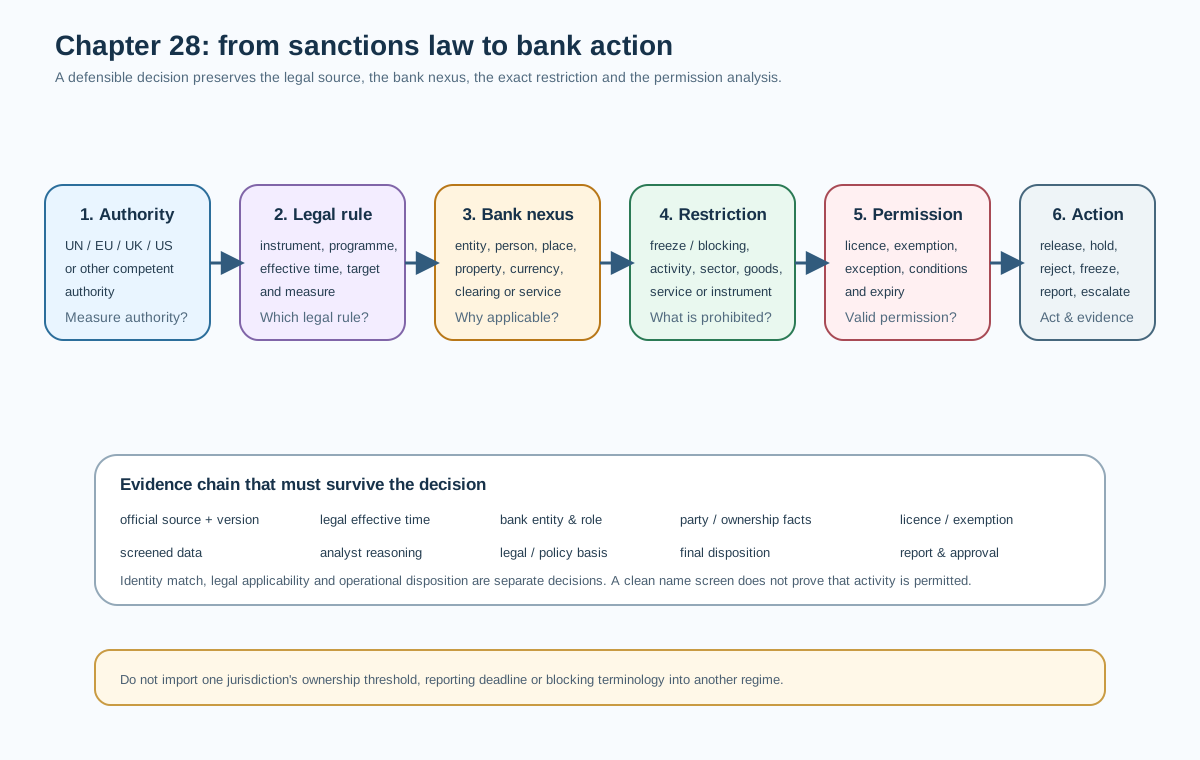
Sanctions are different from AML
AML is generally risk-based and suspicion-driven. Sanctions can create legal prohibitions even when there is no suspicion of money laundering. A customer may have a legitimate source of wealth yet still be subject to an asset freeze. Conversely, suspicious activity can create AML concern without any sanctions nexus.
Banks should share relevant data across AML and sanctions controls, especially customer identity, beneficial ownership, transaction parties and payment data, while preserving separate legal decision logic. A sanctions true match is not automatically an AML suspicion finding, and an AML alert is not automatically evidence that a sanctions prohibition applies.
Who imposes sanctions
Sanctions can be imposed by the United Nations Security Council, national governments and regional bodies such as the European Union. Member States implement UN measures through domestic or regional law. The EU also adopts autonomous restrictive measures. The United Kingdom operates sanctions under its domestic framework, and the United States administers multiple sanctions programmes through authorities including OFAC.
A bank should maintain a jurisdiction map that identifies which authorities matter to each legal entity and activity rather than assume that every list applies identically everywhere.
Current-source checkpoint for 2026
Sanctions source architecture is itself a control. As of 15 September 2026, the UN Security Council Consolidated List states that its current version was last updated on 4 September 2026 and explicitly warns that inclusion on the consolidated list does not mean every person is listed under one regime or subject to identical measures. The regime and applicable Security Council measure still matter.
FATF's Recommendations were amended in June 2026. Recommendation 6 was updated to align targeted financial sanctions related to terrorism and terrorist financing with the humanitarian exemptions contained in relevant UN Security Council resolutions. For banks, this reinforces an important control principle: sanctions implementation must preserve lawful humanitarian pathways where the applicable framework provides them rather than turning a geographic alert into an automatic refusal.
In the EU, the EBA's Guidelines on internal policies, procedures and controls for the implementation of Union and national restrictive measures apply from 30 December 2025. They include wider governance expectations and specific expectations for payment service providers and crypto-asset service providers. Those guidelines do not replace the underlying EU or national legal acts; they help financial institutions organise governance and control implementation.
OFAC published an updated introductory guide on 1 June 2026. It is useful training material, but live US decisions still require the relevant statute, executive order, regulation, programme guidance, licence or exemption. This same hierarchy principle applies in every jurisdiction: training and vendor data support the decision, but the authoritative legal source controls it.
United Nations sanctions
The UN Security Council maintains a Consolidated List of individuals and entities subject to measures imposed under different sanctions regimes. The fact that names appear in one consolidated list does not mean that all measures or listing criteria are identical. Each regime has its own resolutions, committee and applicable measures.
Banks should therefore preserve the regime or programme context associated with a list entry rather than treat the name alone as the legal rule. They should also distinguish the UN measure from the domestic or regional legal instrument through which the bank is required to act.
European Union restrictive measures
EU sanctions can include asset freezes, restrictions on making funds or economic resources available, travel restrictions, arms embargoes, import/export controls, restrictions on financial services and sectoral measures. The EU has many different regimes, including UN-derived and autonomous measures.
A bank operating in the EU should identify the specific legal instrument and applicable prohibition rather than rely only on a vendor's generic “EU sanctioned” label. The Commission's EU Sanctions Map and consolidated financial-sanctions data are useful operational resources, while EUR-Lex and the Official Journal provide the authoritative legal acts.
United Kingdom financial sanctions
OFSI implements UK financial sanctions. UK guidance explains that sanctions can apply not only to designated persons but also, where relevant, to entities owned or controlled directly or indirectly by them.
The UK Sanctions List is the source for UK designations following the closure of the old OFSI Consolidated List on 28 January 2026. Banks must therefore ensure data sourcing and rescreening processes use current official sources and do not continue treating the withdrawn list as a live designation source.
United States sanctions
OFAC administers multiple sanctions programmes. Some are broad and geographically oriented; others are targeted at categories such as terrorism, narcotics trafficking, proliferation, cyber activity or transnational criminal organisations.
OFAC explicitly states that it does not maintain a single simple list of “countries you cannot deal with.” The scope varies by programme and prohibition. OFAC also maintains non-SDN lists whose restrictions can differ from full blocking measures, so a match must be tied to the relevant list, programme and rule.
Legal entity matters
A banking group can contain subsidiaries, branches and affiliates incorporated or located in different jurisdictions. The sanctions rules applicable to one entity may differ from another.
The bank should identify which entity owns the customer relationship, which entity executes the transaction, which branch or staff member acts and which infrastructure is involved. Group policy can impose a stricter common standard, but the decision record should still distinguish a legal prohibition from an internal risk-appetite choice.
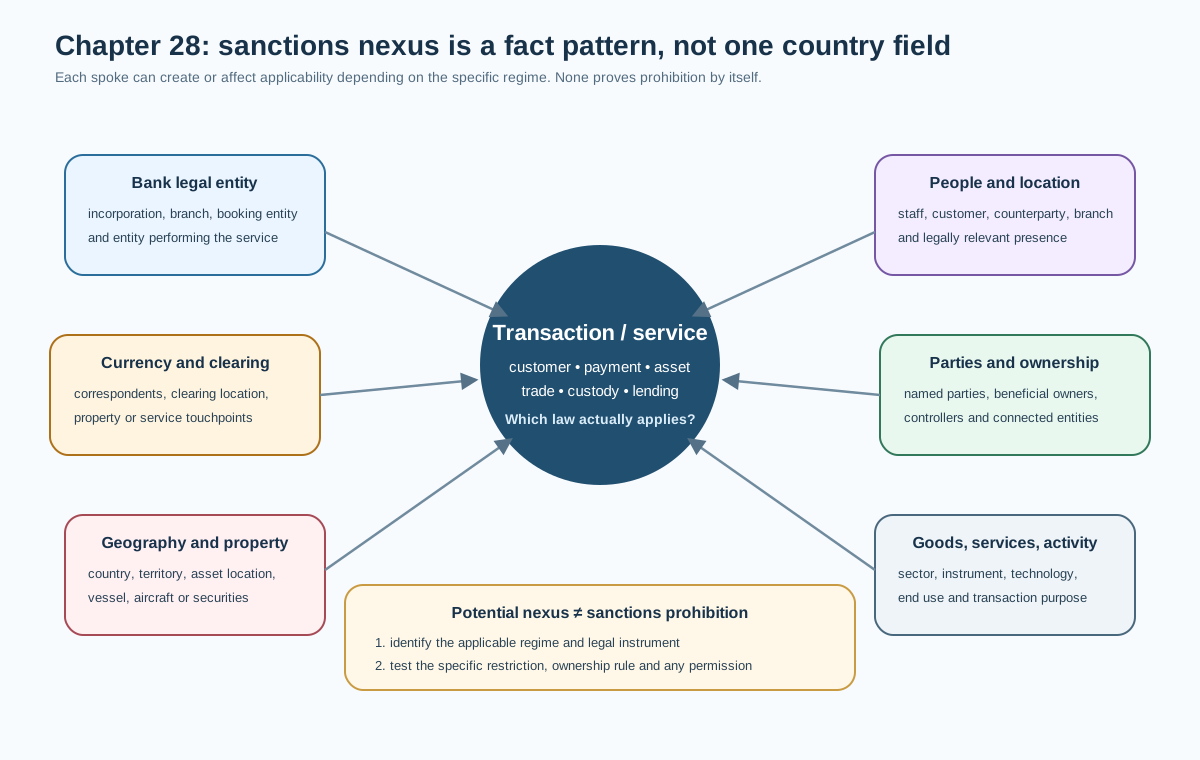
Currency and clearing nexus
Currency can create legal or operational exposure because a payment may clear through institutions subject to particular sanctions laws. However, banks should not reduce sanctions applicability to currency alone.
For example, a USD payment that clears through the United States can create a US jurisdictional touchpoint that needs to be analysed under the relevant OFAC programme. That does not mean every USD payment is prohibited or that OFAC applies “globally” without a nexus. The complete assessment can include legal entities, persons, location, clearing route, goods, services, counterparties, property interests and applicable law.
Customers and connected parties
Sanctions screening can extend beyond the named customer. Beneficial owners, controllers, directors, signatories, trustees, settlors, beneficiaries or other connected parties may matter depending on the regime and product.
The bank's customer data model should therefore support structured relationships rather than store relevant parties only in free text.
Payments
Payment screening can involve debtor, creditor, agents, ultimate parties, addresses, remittance information and other fields. The data actually available differs by payment rail and message format.
ISO 20022 can improve structure, but only if fields are populated, preserved and mapped correctly through screening and case-management systems. A richer message standard does not compensate for missing or incorrectly mapped source data.
Trade and sanctions
Trade sanctions can restrict goods, technology, services, transport, financing or particular sectors. A payment may look ordinary while the underlying trade is restricted.
Banks involved in trade finance can have more visibility into goods and shipping data than banks processing ordinary payments. Requirements should reflect actual visibility and should not imply that a payment-only bank can classify goods or determine end use from data it does not possess.
Vessels and aircraft
Some sanctions measures target vessels or aircraft, or transactions can involve sanctioned owners, operators or routes. Screening may therefore need identifiers beyond names, such as IMO numbers or other asset identifiers where relevant.
Names can change; persistent identifiers can improve accuracy. A vessel identifier is still only one fact in a broader legal and transactional assessment.
Asset freezes
An asset-freeze regime can require funds or economic resources of designated or covered persons to be frozen and can restrict making funds or economic resources available to them.
The operational action must be based on the applicable law. “Freeze,” “block,” “hold,” “reject” and “return” are not interchangeable terms.
Blocking and rejecting
Different regimes can require different outcomes. Some transactions may need to be blocked or frozen; others may be rejected or not processed. The precise outcome depends on legal authority, transaction type and jurisdiction.
Systems should represent these as distinct statuses with accountable decision owners. As one jurisdiction-specific example, OFAC distinguishes blocked property from prohibited transactions that have no blockable interest and therefore must be rejected or not processed. That US distinction should not be copied as a universal vocabulary for every sanctions authority.
Temporary holds
A temporary operational hold while a potential match is investigated is not the same as a legal asset freeze. This distinction matters for customer communication, accounting, reporting and audit evidence.
A case-management status should therefore say what has happened operationally and separately record whether a legal freezing or blocking obligation has actually been established.
Licensing and authorisations
Sanctions frameworks often contain licences, exemptions or authorisations that permit activity otherwise restricted. OFAC issues general and specific licences; other authorities have their own mechanisms.
A bank should not assume that the existence of a licence automatically covers its transaction. Scope, conditions, dates, parties, value limits where relevant, recordkeeping and reporting obligations must be checked.
Humanitarian activity
Humanitarian exceptions, exemptions and licences can be especially important in sanctioned or conflict-affected regions. Banks should avoid blanket de-risking where law permits legitimate humanitarian activity.
The 2026 FATF update to Recommendation 6 reinforces this point for targeted financial sanctions related to terrorism and terrorist financing by aligning the standard with relevant UN humanitarian exemptions. The control challenge is still transaction-specific: the bank must identify the applicable legal basis and test whether the conditions are met.
Sectoral sanctions
Some sanctions restrict specific sectors, debt or equity instruments, goods, services or financing without imposing a full asset freeze on every party.
List screening alone cannot identify all sectoral restrictions. Product, instrument, maturity, ownership, activity and transaction purpose may matter.
Country-related measures
Some regimes include broad country or territory restrictions; others are narrowly targeted. “Country risk” and “sanctions prohibition” should not be confused.
A country can be high risk for AML without being subject to broad sanctions, and a targeted sanctions programme can apply to persons located anywhere.
Ownership and control
A listed person may own or control an unlisted entity that is nevertheless subject to sanctions restrictions under the relevant regime. Ownership and control tests differ among jurisdictions.
Banks should not create one global percentage rule and apply it blindly. OFAC's 50 Percent Rule is a useful US-specific example: entities directly or indirectly owned 50 percent or more in the aggregate by one or more blocked persons are treated as blocked under that rule. OFAC also states that control alone, without the required ownership, does not automatically make an entity blocked under the 50 Percent Rule, although other programme provisions or designations may still matter. UK and EU ownership/control analysis follows different legal tests and should be implemented separately.
List updates
Sanctions lists change frequently. New designations, removals, aliases and identifier updates should flow through controlled data processes.
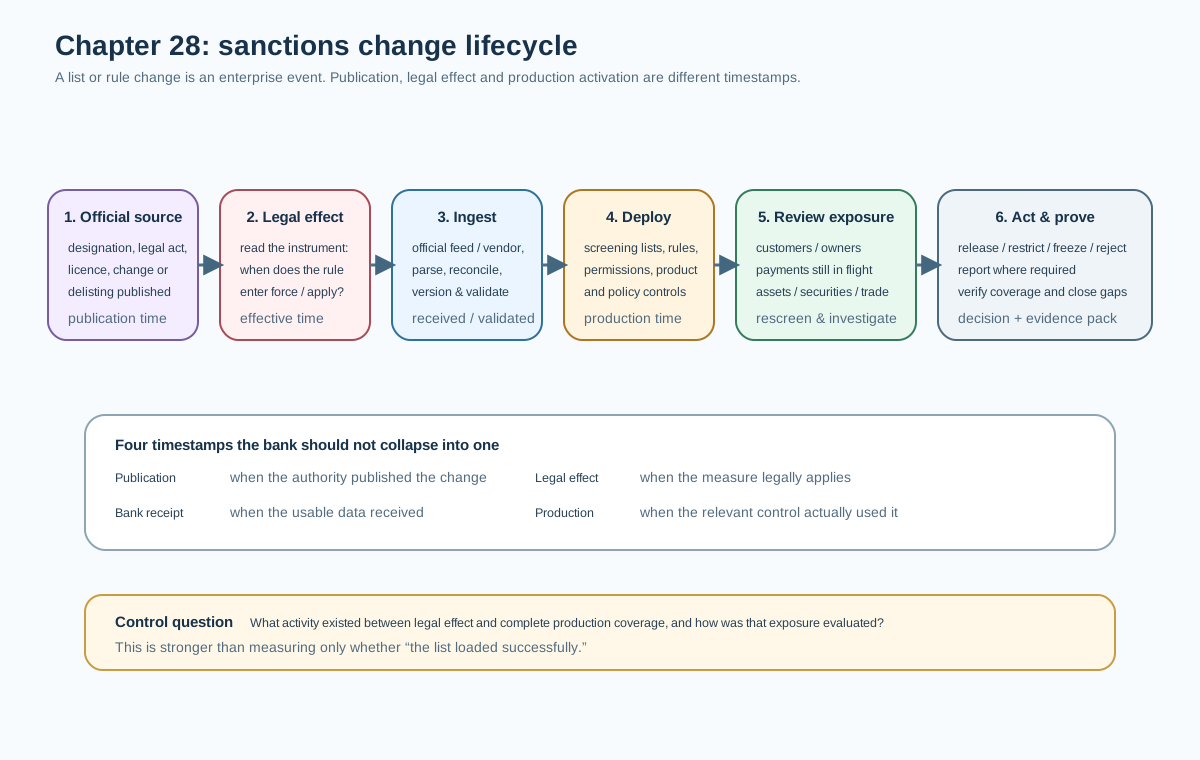
The bank needs source validation, ingestion, reconciliation, testing, rescreening and evidence that the correct list or rule version was applied. Publication time, legal effective time, vendor availability, bank ingestion and production activation should be stored as different timestamps where they differ.
Scenario: unlisted company owned by a designated person
A customer company does not appear on a sanctions list. Due diligence identifies a designated person in the ownership chain.
The bank must apply the ownership/control test of the relevant regime. It should not assume that “not on the list” means “not restricted,” and it should not import another jurisdiction's ownership threshold simply because it is familiar.
Scenario: targeted programme
A payment involves a person in a country that is not comprehensively sanctioned, but the person is designated under a counter-narcotics programme.
Geography does not remove the restriction. Targeted sanctions follow the person or entity according to the applicable law and the measure under which the person was designated.
Scenario: sectoral restriction
A bank is asked to purchase a security issued by a company that is not blocked but is subject to a restriction on certain debt or equity transactions.
A basic name-screening control may not be enough. Instrument attributes, dates, ownership and transaction type can matter.
Scenario: humanitarian payment
An aid organisation sends funds to a conflict-affected country involving local partners. A sanctions alert is generated because of geographic exposure.
The bank should determine whether a prohibition exists, whether an exemption, exception or licence applies and whether all conditions are met rather than reject automatically.
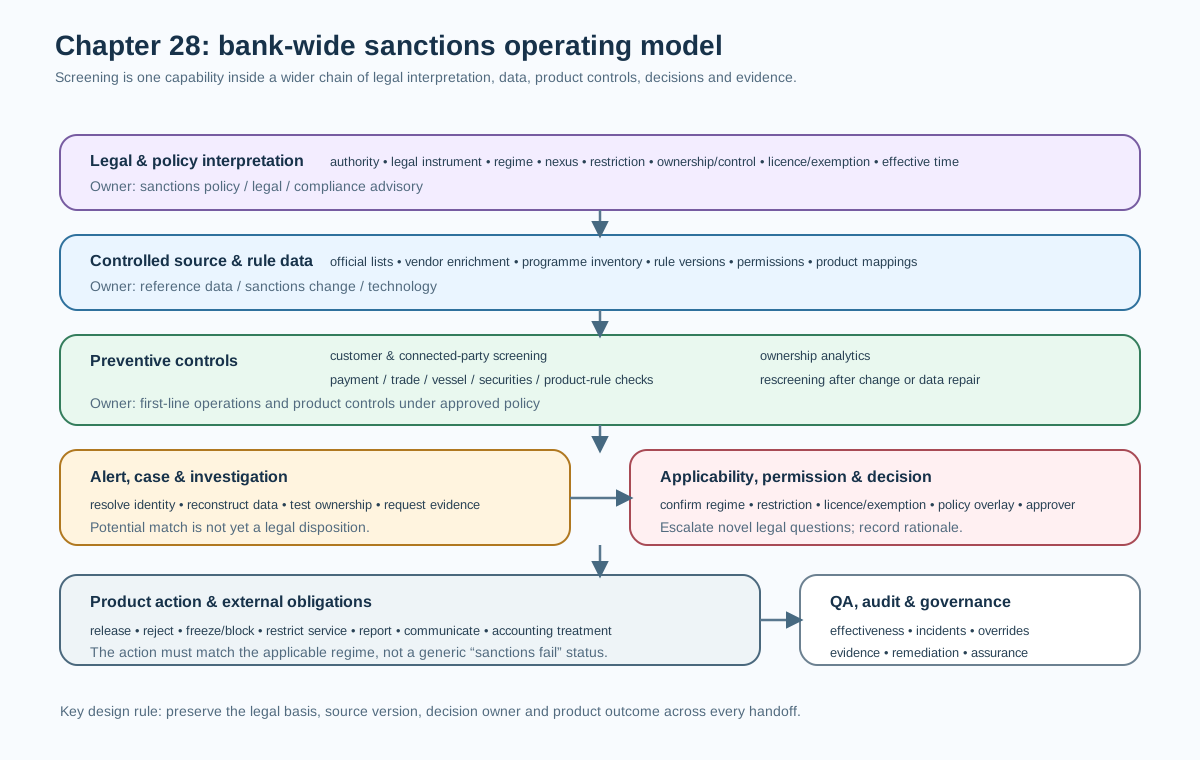
Sanctions operating model
A mature operating model separates legal and policy interpretation, list and rule management, customer screening, payment screening, trade and asset screening, ownership/control analysis, alert investigation, licensing, reporting, quality assurance, technology operations and governance.
Decision rights should be explicit, and every handoff should preserve the data and legal basis needed by the next control.
First line and second line
Business and operations teams may own execution of controls, while sanctions compliance provides policy, interpretation, oversight and challenge. Internal audit provides independent assurance.
The exact model differs by bank, but accountability should not disappear between teams. Legal specialists should be involved where the applicable law or licence interpretation exceeds an analyst's authority.
Data lineage
A sanctions decision should be reconstructable. Which list version was used? Which legal instrument and rule version applied? Which customer or payment fields were screened? Were names normalised or transliterated? Was data repaired? Was rescreening performed? Who released, rejected, restricted or froze the item?
Audit evidence matters because sanctions decisions can have significant legal consequences.
Screening-engine limitations
A screening engine produces candidate matches. It does not decide legal applicability by itself. Matching thresholds, transliteration rules, tokenisation and list data all affect results.
Human or rules-based decisioning must interpret the match in context. A true identity match and a final legal disposition are separate decisions.
False positives
Common names, incomplete identifiers and spelling variation create false positives. Closing alerts efficiently is important, but a false-positive process must still preserve enough evidence to show why the candidate was not the listed party.
Past false-positive decisions should not be reused blindly after an alias, date of birth, ownership relationship or list record changes.
Escalation
Complex ownership, uncertain jurisdiction, possible licences, sectoral restrictions or conflicting regime outcomes should escalate to appropriate sanctions/legal specialists.
Analysts should not improvise legal interpretations from generic training material.
Reporting
Authorities can require reports of blocked or frozen assets, rejected transactions, breaches or other information. Deadlines, formats and triggering events differ.
The bank should map reporting obligations by jurisdiction and event type. As a US-specific example, OFAC's current reporting framework requires blocking and rejection reports covered by 31 C.F.R. Part 501 to be submitted within 10 business days of the action. That deadline is not a global sanctions-reporting rule.
Customer communication
Banks need clear communication processes that do not disclose protected information or make incorrect legal statements. “Payment under compliance review” is different from telling a customer that they are sanctioned.
The message should also distinguish a legal prohibition from a bank policy decision where doing so is appropriate and permitted.
Business analyst view
A BA should model authority, programme, legal instrument, effective time, legal entity, list entry, party, ownership relationship, payment, product, restriction, licence or exemption, alert, identity decision, legal-applicability decision, disposition, report and evidence separately.
Requirements should state which jurisdictional logic applies and what happens when data is incomplete, a rule changes mid-journey, a licence expires, or multiple applicable regimes produce different outcomes.
Testing
UAT should include true matches, false positives, aliases, transliteration, ownership cases, list additions and removals, rule changes, licences, sectoral restrictions, customer rescreening, payment repair, in-flight transactions during a change and manual overrides.
Negative tests are as important as positive tests. The same party should also be tested under different restriction types so the system does not convert every true match into one universal action.
Control effectiveness
Effectiveness measures can include official-change-to-production latency, screening coverage, match quality, ownership-analysis quality, aged alerts, licensing errors, reporting timeliness, data defects, outage backlog, rescreening completion and post-event incidents.
Alert counts alone are not enough.
Common mistakes
Common mistakes include treating sanctions as AML, treating every regime as a name list, using one country list for all sanctions, applying one ownership threshold globally, confusing temporary holds with freezes, treating a true match as a universal blocking instruction, and assuming a licence applies without checking conditions.
Learning checkpoint
A reader should be able to explain why sanctions are legal restrictions rather than merely risk indicators, identify major authorities and types of measures, distinguish list-based and activity-based restrictions, explain why jurisdictional nexus matters, describe operational outcomes such as hold, freeze, block, reject and release, and design evidence-rich sanctions controls.
References and further reading
- United Nations Security Council — Consolidated Sanctions List: https://main.un.org/securitycouncil/en/content/un-sc-consolidated-list
- Financial Action Task Force — The FATF Recommendations, amended June 2026: https://www.fatf-gafi.org/en/publications/Fatfrecommendations/Fatf-recommendations.html
- Financial Action Task Force — June 2026 update to Recommendation 6 on humanitarian assistance: https://www.fatf-gafi.org/en/publications/Fatfrecommendations/update-recommendation-6-june-2026.html
- European Commission — Overview of EU sanctions and related resources: https://finance.ec.europa.eu/eu-and-world/sanctions-restrictive-measures/overview-sanctions-and-related-resources_en
- European Banking Authority — Guidelines on internal policies, procedures and controls to ensure implementation of Union and national restrictive measures: https://www.eba.europa.eu/publications-and-media/press-releases/eba-issues-final-guidance-internal-policies-procedures-and-controls-ensure-implementation-union-and
- Office of Financial Sanctions Implementation — UK financial sanctions general guidance, updated 12 May 2026: https://www.gov.uk/government/publications/financial-sanctions-general-guidance/uk-financial-sanctions-general-guidance
- UK Government — UK sanctions collection and current UK Sanctions List resources: https://www.gov.uk/government/collections/uk-sanctions
- U.S. Treasury OFAC — Introduction to the Office of Foreign Assets Control, published 1 June 2026: https://ofac.treasury.gov/recent-actions/20260601
- U.S. Treasury OFAC — Sanctions Programs and Country Information: https://ofac.treasury.gov/sanctions-programs-and-country-information
- U.S. Treasury OFAC — Entities Owned by Blocked Persons (50 Percent Rule): https://ofac.treasury.gov/faqs/topic/1521
- U.S. Treasury OFAC — Blocking and Rejecting Transactions: https://ofac.treasury.gov/faqs/topic/1601
- U.S. Treasury OFAC — Filing Reports with OFAC: https://ofac.treasury.gov/faqs/topic/1606
Educational note: sanctions rules can change without the learning material changing at the same time. Live decisions require the current legal instrument, official designation source, applicable licence or exemption and the bank's authorised legal/compliance interpretation for the relevant entity, jurisdiction and transaction.
Deep dive: converting sanctions law into bank controls
The difficulty of sanctions compliance is not recognising that sanctions exist. It is converting changing legal restrictions into operational rules that work across legal entities, countries, products, payment rails and time zones. A mature programme therefore needs a traceable chain from legal authority to policy, rule, system, alert, decision and evidence.
Build the jurisdiction matrix
For each bank legal entity, record incorporation, branch locations, employees, customer base, products, currencies, clearing relationships and relevant sanctions authorities. The result is not a legal opinion by itself; it is the operating map that tells teams where legal interpretation is needed.
A payment processed by one entity can involve another group entity or correspondent, so the matrix should support multiple touchpoints.
Legal obligation to system rule
A legal rule may say that funds or economic resources must not be made available to a designated person. The bank then needs to identify which products can make value available, which customer relationships are covered, what data identifies the person and what operational action is required.
That translation should be documented rather than hidden in screening-engine configuration.
Programme inventory
Maintain a controlled inventory of sanctions programmes with authority, legal instrument, effective date, geographic scope, designated populations, activity restrictions, licences, exemptions, reporting requirements and affected bank entities.
The inventory supports regulatory change and audit.
Change-management exercise
A sanctions authority adds a new designation at 14:00. The bank should know when the vendor receives it, when internal lists update, when customer rescreening starts, when payment screening uses the new record and how exceptions are monitored.
List update is an end-to-end process, not merely a file download.
Customer rescreening
When a list changes, existing customers and relevant connected parties may need rescreening. The bank should manage large alert volumes without weakening legal coverage.
Prior false-positive decisions can be reused only when the underlying identifiers and list record remain sufficiently unchanged and policy allows it.
Payment screening timing
Screening can occur at initiation, repair, payment hub, correspondent gateway or other points depending on architecture. The bank should know which data is available at each stage and whether a downstream change requires rescreening.
For instant payments, latency matters. For batch payments, controls may have more time but much greater volume.
Customer screening versus event screening
Customer screening protects the relationship lifecycle. Event screening protects specific transactions or activities. The same party can be clear at onboarding and become designated later.
A mature design treats sanctions as continuous control rather than one-time KYC.
List-source governance
Official sources are legally important, while commercial list providers can improve normalisation, aliases and distribution. Banks should reconcile vendor content to relevant official sources and understand the vendor’s update process.
Name matching
Names can vary through spelling, transliteration, initials, word order and aliases. Matching algorithms need enough flexibility to detect variants without overwhelming operations.
Threshold tuning should be validated against known list records and false-positive populations.
Identifier matching
Dates of birth, nationality, address, passport, company number, IMO number and other identifiers can resolve candidate matches. Missing identifiers should lower confidence, not automatically create a false match or false clearance.
Payment repair
A repaired name or address can change sanctions meaning. The bank should preserve original and amended values and define when screening is rerun.
Licence workflow
A licence should be represented as structured data: authority, licence type, reference, valid dates, covered parties, permitted activities, limits, conditions, reporting obligations and evidence.
Analysts should not rely on an attachment without extracting the decision-relevant conditions.
Humanitarian scenarios
Humanitarian transactions can be legally permitted under exemptions or licences. The bank should design a pathway for these cases rather than block them simply because they involve a sanctioned geography.
The evidence may include organisation identity, programme purpose, counterparties, licence/exemption basis and transaction scope.
Conflicting outcomes
A global transaction can be permissible under one regime and restricted under another. The bank needs a governance path for legal conflict and group-policy decisions.
The system should record which regime drove the final action.
Blocking accounting
If assets are legally blocked or frozen, operational systems may need dedicated accounts, restrictions, interest treatment, statement logic and reporting.
Sanctions is therefore connected to core banking and accounting, not only screening.
Rejected transaction handling
Rejected transactions should retain original payment data, screening evidence, decision rationale, reporting status and customer communication.
Do not discard the record simply because settlement did not occur.
Corporate actions
Securities products create additional sanctions events such as dividends, coupons, redemptions, rights issues and corporate actions. A frozen security position can still generate income requiring controlled treatment.
Product teams need sanctions-specific operating procedures.
Third-party systems
Screening vendors, payment processors, custodians and correspondents can perform controls, but outsourcing does not remove the bank’s accountability for its own obligations.
Service-level agreements should include list timeliness, rule changes, evidence access, incidents and audit rights.
Correspondent banking
A correspondent bank can receive a payment already screened by the originator but still has its own sanctions obligations. Reliance assumptions should therefore be explicit and legally grounded.
Data lineage exercise
Select one blocked payment and trace every data field used in the decision back to source. Confirm the list version, match result, analyst decision, legal rationale and reporting evidence.
If the bank cannot reconstruct the decision later, the control is not fully auditable.
BA acceptance criteria
Test designation addition, deletion, alias update, ownership change, payment repair, licence introduction, licence expiry, system outage, duplicate alert, urgent manual payment and cross-border branch processing.
Quality assurance
QA should check that analysts distinguish potential match, true match, legal nexus and final action. A true identity match can still require a separate applicability analysis depending on programme and activity.
Final deep-dive test
A strong learner should be able to trace sanctions law into a controlled operational rule, explain where customer and payment screening differ, manage list updates and licences, preserve evidence and recognise that sanctions compliance is an enterprise operating model rather than a screening-tool configuration.
Advanced practitioner layer: turning sanctions law into a bank-wide operating model
The difficult part of sanctions is rarely recognising a famous designated name. The difficult part is deciding which rule applies to a particular bank entity, customer, product, payment, asset or service at a particular time, then proving that the bank translated that rule into the correct operational action. This is why experienced sanctions teams think in terms of legal nexus, restriction type, data visibility, decision rights and evidence, not just screening hits.
A useful way to test any sanctions control is to ask six questions in sequence. Which authority and legal instrument may apply? Which bank legal entity or person creates the nexus? What person, asset, geography, sector, service or activity is restricted? What data can the bank actually see at the decision point? What action is legally or policy-required? What evidence must survive so that the decision can be reconstructed later? If a requirement cannot answer those questions, it is usually too vague for production use.
Case lab: one payment, several possible legal nexuses
Assume a Nordic corporate customer instructs a EUR payment from an EU bank entity to an Asian supplier. The supplier is not listed. The payment is routed through an intermediary in another jurisdiction. The goods are industrial components and the customer’s invoice contains only a broad description.
A weak control design asks whether the supplier name matches a list and, if not, releases the payment. A mature design first identifies the bank entity making the payment and therefore the legal framework that unquestionably applies to the bank. It then considers whether other nexuses arise through persons, branches, currencies, routing, services or counterparties. It checks ownership and control, the destination and end-use information available to the bank, any sectoral or goods-related restrictions, and whether the route introduces another institution that may have its own legal obligations.
The bank must also separate what it knows from what it does not know. A payment message normally cannot prove the export-control classification of industrial components. If the bank is not providing trade finance and does not hold the commercial documents, the control should not pretend otherwise. It can use the available payment and customer context, apply escalation triggers, and request information when required. Accurate scope is a mark of a strong sanctions programme.
Legal obligation versus group policy
Global banks often adopt internal policies that are stricter than the minimum legal obligation in one jurisdiction. That can be a legitimate risk-management choice, but the case record should distinguish the two. “Legally prohibited” and “outside group risk appetite” are not interchangeable outcomes.
This distinction affects customer communication, regulatory reporting, management information, legal challenge and historical lookback. If a payment was declined only because of a global policy, the bank should not later report that it was legally required to block the funds unless that conclusion is independently correct.
A good data model therefore stores at least the applicable authority, legal regime, bank entity, legal-rule identifier, policy-rule identifier, disposition and rationale separately.
Regime inventory as controlled data
A sanctions regime inventory should be more than a spreadsheet maintained by one specialist. In a mature bank it becomes controlled reference data used by policy, screening, payment operations, trade finance, securities, legal, technology and reporting teams.
For each regime, useful fields include authority, legal instrument, effective date, affected bank entities, restriction types, designation sources, ownership/control rules, licensing mechanism, reporting requirements, products affected, geographic scope, relevant identifiers and change history. The inventory should be effective-dated so that the bank can explain what rule existed when a historical decision occurred.
The objective is not to automate legal interpretation blindly. It is to make legal interpretation traceable into operational requirements.
Source hierarchy and list governance
Official legal instruments and official designation sources are the authoritative anchor. Commercial data providers can add significant value by distributing list changes quickly, normalising names, linking aliases and enriching identifiers, but the bank should know what came from the authority and what came from the vendor.
As of the September 2026 review date for this curriculum, the United Nations Security Council Consolidated List continues to bring together individuals and entities subject to measures under multiple Security Council regimes, but the measures and listing criteria are regime-specific. In the United Kingdom, the UK Sanctions List is the current designation source; OFSI guidance was updated in 2026 after the former OFSI Consolidated List closed. These are useful reminders that source architecture itself can change.
A production process should detect missed downloads, malformed files, duplicate records, unexpected drops in record count, stale timestamps and failed deployment. It should also preserve the source version used for each screening decision.
Designation change is an enterprise event
When a new designation is published, the effect can propagate far beyond the sanctions screening engine. Customer populations may need rescreening. Ownership graphs may need reverse searches to identify entities owned or controlled by the new target. Payments already in flight may require review. Securities or custody positions may be affected. Accounts or assets may need restrictions. Reports may be due. Customer-service teams may receive calls. Treasury and accounting may need to treat frozen funds differently.
The change event should therefore have a controlled lifecycle: official publication, source ingestion, validation, production deployment, population rescreening, exposure identification, operational action, reporting, management escalation and evidence closure.
A useful operational metric is not simply “list loaded successfully.” A stronger metric measures time from official effective event to production availability and, where relevant, time to completion of the affected customer and exposure review.
Scenario: designation while a payment is in flight
A payment was screened at 10:00 and passed. At 10:07 a sanctions authority publishes a designation relevant to one beneficiary. The payment is still queued and has not settled.
There is no universal answer that can be written into a generic training rule because legal effect, timing and rail mechanics vary. The bank does, however, need an explicit policy for this situation. The architecture should know when the list changed, whether queued payments are automatically re-screened, what constitutes the legally relevant execution point, and who can stop or release the item.
This is especially important in high-speed payment systems. “It already passed screening” is not a complete control argument if the material legal facts changed before execution.
Scenario: sanctioned geography but permitted activity
A humanitarian organisation sends funds connected to a jurisdiction that is subject to significant sanctions. The geographic rule creates an alert. None of the parties is a confirmed designated person, and the transaction may fall within an exemption or authorisation.
A weak process rejects the payment because the country appears on a high-risk table. A mature process identifies the specific legal restriction, checks the applicable humanitarian permission, confirms parties and purpose, verifies any required conditions, documents the basis and then reaches the appropriate decision.
This is important both legally and ethically. Over-broad de-risking can disrupt legitimate activity even where the sanctions framework deliberately allows it.
Scenario: true identity match but activity-specific restriction
A bank confirms that a payment counterparty is the same legal entity as a name on a sanctions list. That identity conclusion does not by itself tell the analyst the final disposition. Some list entries are associated with full blocking or asset-freeze measures; others are connected with narrower restrictions.
The next question is which programme and legal measure apply. The case workflow should therefore distinguish identity decision from legal applicability decision and from operational disposition.
This separation prevents a common design error where the screening tool’s “true match” button automatically forces one universal action.
Blocking, freezing, rejecting and declining
Banks often use these words loosely, but system design should not. A temporary compliance hold is an internal operational state. A legal asset freeze or block can create duties around control of property, account restrictions and reporting. Rejection can mean the bank does not process a transaction. A customer relationship may also be declined under policy even where no legal freeze exists.
Each status should have a clear owner, entry criteria, permitted transitions, accounting treatment, customer-communication rule and reporting consequence.
A state model can prevent operational mistakes. For example, a payment that is merely held for investigation should not be moved into a frozen-assets ledger before a legal conclusion is reached. Conversely, a legally frozen asset should not be released simply because an operational alert aged beyond a service target.
Licences and permissions as structured controls
A licence or authorisation should be modelled as more than a PDF attachment. Important fields can include issuing authority, reference number, covered parties, permitted activity, date range, value limits, conditions, reporting duties, documentary evidence and expiry.
The system should check the permission against the transaction rather than simply suppress the sanctions alert. A customer-specific licence may not cover another group company. A permission for humanitarian goods may not cover unrelated services. A licence valid today may expire before a future payment date.
A useful acceptance test is to load a valid licence, an expired licence, a licence for the wrong party, and a licence whose activity scope does not cover the proposed transaction. The application should not treat all four as equivalent.
Ownership and control handoff
Screening a legal name cannot detect every sanctions exposure. A newly designated individual may own or control entities that are not named on any sanctions list. The sanctions operating model should therefore connect list updates with ownership data.
For customer entities, the bank may have detailed KYC/KYB information. For an external payment beneficiary, the bank may have much less information. Requirements should reflect that difference rather than assume the same ownership intelligence exists at every control point.
Where ownership analysis is possible, the conclusion should identify the designated person, ownership or control path, applicable regime, calculation or legal rationale, source evidence and effective dates.
Product-specific obligations
A bank-wide policy must translate differently across products. Deposit accounts can require account restrictions and treatment of incoming funds. Payments need real-time or near-real-time disposition logic. Securities and custody may involve coupons, dividends, redemptions and corporate actions. Trade finance can expose goods, vessels, ports and documentary information. Lending can involve drawdowns, repayments, collateral and guarantors.
A sanctions requirement that says only “block sanctioned activity” is too broad to build. Product owners and compliance specialists should define concrete events and data points for each product.
Correspondent banking and independent obligations
An originating bank may screen a payment, yet an intermediary or beneficiary bank may still stop it because that institution has its own sanctions obligations, policy and information. Correspondent screening is not simply duplicated work; different banks may have different legal nexuses and see different data.
This is why requests for information and payment-return messages should be linked to the original transaction and preserved as part of the sanctions evidence chain. A payment can reveal an issue only after another institution asks a question.
Bank architecture: where sanctions decisions live
A useful target architecture separates several capabilities: official-source and vendor-list ingestion; reference-data screening; transaction screening; ownership/control analytics; rule evaluation for geography, products and activity; licence management; investigation and case management; legal/compliance decisioning; reporting; and evidence storage.
These capabilities do not have to be one application. What matters is that the handoffs are explicit. Data should not silently change between payment capture, screening, repair and settlement. Case management should receive enough context to understand which field matched and which rule fired. Reporting should use the final legal disposition rather than infer it from a technical status.
Resilience and sanctions-control outages
Sanctions controls are preventive, so outages require a pre-agreed contingency model. The bank should define which services can queue, which require manual review, what volume can realistically be handled manually, which low-risk activity may have alternative controls, and who can authorise an emergency operating mode.
The contingency should be tested. A document that says “manual sanctions checks will be performed” is not credible if the bank processes hundreds of thousands of time-critical transactions and has no manual capacity.
The incident record should capture outage start, affected systems, payment populations, fallback used, backlog, post-restoration rescreening and any regulatory or management notification.
Historical reconstruction and lookbacks
Sanctions programmes change, lists change and ownership changes. If a regulator asks whether the bank processed transactions for an entity before it was identified as covered by a designation, the bank needs historical data.
A robust lookback capability requires versioned customer data, ownership relationships, payment records, sanctions-list versions, rule versions and screening decisions. Current-state databases alone may not answer a historical question correctly.
This is one reason effective dating is essential in sanctions data architecture.
Practitioner exercise: write a defensible decision note
Consider a corporate customer with a clean list-screening result. One beneficial owner is a designated person under one regime and owns a minority share. The bank entity is in another jurisdiction. A proposed transaction involves a restricted sector, but the customer says its activity falls within a licence.
A weak note says: “Sanctions hit reviewed. Licence provided. Approved.”
A defensible note identifies the bank entity and applicable regimes; describes the designated owner and ownership/control analysis; states whether the sectoral restriction applies to the proposed activity; identifies the licence, authority, dates, parties and conditions; explains any residual uncertainty; names the decision authority; and records the final disposition and reporting requirement. The objective is not longer prose for its own sake. It is a chain of reasoning another qualified reviewer can reproduce.
Business analyst requirements that prevent hidden risk
For sanctions change, requirements should specify effective time as well as publication time and ingestion time. For screening, identify which source fields are screened and what transformations occur. For ownership, specify direct, indirect and regime-specific aggregation logic. For licences, require structured scope and effective dates. For payment repair, define when rescreening is mandatory. For manual overrides, require reason, authority, timestamp and immutable audit history.
Non-functional requirements matter too. Define list-update latency, screening availability, peak-volume behaviour, investigation service levels, evidence retention and recovery objectives. A sanctions control can be logically correct but operationally ineffective if it cannot process the real workload.
Final practitioner checkpoint
A sanctions specialist, BA or product owner should be able to take one real transaction and trace it from legal authority to bank entity, customer and counterparty data, screening and rule checks, ownership analysis, licence assessment, operational disposition, reporting and evidence. They should be able to distinguish a list match from a legal prohibition, a temporary hold from a legal freeze, a legal obligation from a group-policy decision, and a source-data limitation from a true absence of risk.
That end-to-end traceability is what turns sanctions compliance from a collection of screening tools into a defensible control framework.
Practitioner close: from sanctions rule to executable bank control
A sanctions framework becomes operational only when the bank can translate a legal restriction into a decision that a customer, account, payment, trade, custody or markets system can actually enforce. The strongest final test for this chapter is therefore not whether the learner can list sanctions authorities. It is whether they can take a new legal measure, identify who and what it affects, map the relevant bank products and data, implement a controlled decision path, and later prove that the bank acted at the right time.
Change-management case: a new designation at midday
At 12:03 an authority publishes a new designation. The bank receives an external data-provider update at 12:07, validates it at 12:09 and activates the new list version at 12:12. Customer rescreening completes at 12:18. A payment for a potentially affected party entered the bank at 12:05, passed screening using the previous list version and remains queued until 12:20.
A weak operating model asks only whether the list feed was loaded. A mature model reconstructs the entire timeline: legal effective time, official publication, provider availability, bank ingestion, production activation, original screening, rescreening, payment execution and any operational hold. The legal and policy team should have defined in advance how pending transactions are treated when a designation becomes effective after an earlier screen but before execution.
This timeline also creates measurable control objectives. “List loaded within SLA” is useful, but the bank should also understand exposure-to-control time: how long an effective legal change existed before all relevant customer and transaction populations were evaluated.
Change-impact assessment across products
A designation can affect much more than current-account payments. The designated person may hold deposits, custody assets, securities, loans, credit facilities, trade-finance instruments, guarantees or interests in entities that are not themselves named on a list.
A sanctions-change playbook should therefore ask which product systems hold customer, asset or counterparty exposure. Customer screening may discover the person. Ownership analytics can identify companies owned or controlled under the relevant regime. Custody systems may need to restrict corporate actions or asset movements. Lending systems may need to stop drawdowns or evaluate repayment handling. Trade-finance systems may need to stop document processing. Treasury may need to identify direct or indirect market exposure.
The exact legal consequence varies, but the architecture should make enterprise exposure discoverable.
Case lab: one group, different bank legal entities
A banking group has subsidiaries in the UK, EU and another jurisdiction. A customer relationship is booked in one entity, payments are processed by a shared service, and a trade-finance guarantee is issued by another entity.
A global policy can establish common minimum controls, but legal applicability must still be assessed by entity and activity. The shared screening platform should preserve which bank legal entity is acting. A rule outcome should not simply say SANCTIONS_FAIL; it should identify the relevant regime, nexus and restriction or policy basis.
This design matters when a group chooses a policy stricter than local minimum law. The bank should be able to say whether a transaction was legally prohibited for that entity, prohibited because another legal nexus applied, or declined because group risk appetite was stricter. Those distinctions are important for customer communications, regulatory reporting and challenge.
Case lab: asset freeze versus activity restriction
Two counterparties produce sanctions alerts. Counterparty A is subject to an asset-freeze measure. Counterparty B is subject to a narrower capital-market restriction applicable only to certain financing activity.
If the screening system converts both alerts into the same automatic block, it can create both legal and customer-outcome errors. Identity matching should identify the target; legal-rule evaluation should determine the restriction; product logic should determine whether the proposed activity falls within that restriction; and disposition should follow from that analysis.
The bank therefore needs separate concepts for target identity, programme/restriction, activity applicability and operational action.
Humanitarian permissions and over-compliance risk
Sanctions frameworks can include humanitarian exceptions, exemptions or general licences. Banks need controls that can recognise these permissions without treating them as blanket clearance.
Suppose an established humanitarian organisation sends funds into a conflict-affected jurisdiction. Geography and parties generate alerts. The sanctions analyst confirms that the activity may fall within a humanitarian permission, but the permission has conditions concerning parties, purpose, records or reporting.
The correct system response is not “whitelist the charity forever.” The permission should be stored with scope, dates, relevant parties, conditions and evidence. Each transaction can then be assessed against that scope. This supports lawful humanitarian activity while maintaining sanctions control.
Over-compliance also deserves governance. A bank that rejects every transaction associated with a sanctioned geography can disrupt legitimate activity and may fail to distinguish targeted measures from comprehensive restrictions. Accurate legal scoping is therefore part of effective compliance, not a relaxation of it.
Licences: treat conditions as data
A sanctions licence can be customer-specific, activity-specific or more general. The bank should capture issuing authority, reference, covered persons, allowed activity, currency or value conditions if relevant, effective period, reporting obligations and documentary requirements.
Consider four apparently similar cases: a valid licence covering the exact transaction; an expired licence; a licence issued to another group company; and a licence that covers humanitarian goods but not the professional service being purchased. A system that stores only licence_present = true cannot distinguish them.
The licence object should therefore be evaluated like a rule, not used as a manual alert-suppression attachment.
Sanctions nexus is not a single country field
Legal nexus can arise through bank entity, persons, location, services, property, currency, routing or other facts depending on the regime. A system that uses one country_of_payment value as its universal sanctions decision is too crude.
The practical design is to collect relevant facts and apply regime-specific logic. The facts remain reusable; the legal interpretation is versioned. This makes it possible to change rules without rewriting historical customer data.
Operations case: funds arrive after an account is restricted
An account is subject to a legal freeze. A new incoming payment arrives. Operations must know whether funds may be credited but frozen, rejected, returned or handled differently under the applicable regime. The answer cannot be invented by the payment engine.
Requirements should therefore define treatment of incoming funds, outgoing funds, interest, fees, standing orders, card activity, cash access and internal transfers for each relevant legal restriction. Accounting and customer-facing status should align with the legal state.
A simple account flag can be insufficient if different transaction types have different permitted treatments.
Securities and corporate actions
Sanctions exposure can arise through securities holdings, dividends, coupon payments, redemptions, rights issues, corporate actions or trading. The bank may need to identify the issuer, beneficial owner, intermediary and asset itself.
A designated security issuer does not always create the same consequence as a designated account holder; the applicable rule matters. Custody and markets systems should therefore consume sanctions decisions at the correct object level rather than rely entirely on customer-name screening.
Trade-finance visibility
Trade finance can expose the bank to applicants, beneficiaries, issuing or confirming banks, vessels, ports, goods and service restrictions. The bank may hold commercial documents that an ordinary payment processor never sees.
Sanctions architecture should take advantage of product-specific data while being honest about its limitations. A trade-finance sanctions review can assess information in documents it actually holds; a retail payment screen should not claim equivalent goods or end-use visibility.
Governance of legal-rule changes
When legal counsel or sanctions policy interprets a new measure, the interpretation should become a controlled requirement. The implementation chain can include legal analysis, policy decision, rule specification, data requirement, technology configuration, test evidence, approval, deployment and post-implementation validation.
Versioning matters. If the interpretation changes later, investigators should still know which rule was active for an earlier decision.
A rule catalogue can contain authority, programme, legal citation, restriction category, affected products, data inputs, decision logic, effective dates, owner, approval and test cases. This improves traceability without attempting to replace legal judgement with code.
Testing the operating model
Sanctions testing should include legal and operational boundary conditions. Test a designation before and after effective time. Test a payment already queued when the list changes. Test the same customer under two bank legal entities. Test a valid and expired licence. Test an activity-specific restriction where the party is a true identity match but the proposed activity is outside scope. Test a legal asset freeze and a policy-only decline. Test an ownership exposure discovered after the designated person is added to the list.
For every scenario, verify not only the case decision but the real product outcome: account restricted, payment stopped or released, asset state updated, report generated where required and evidence retained.
Audit evidence pack
A mature sanctions decision can be reconstructed from an evidence pack containing the original customer or transaction data, sanctions source and version, match details, ownership/control evidence, legal regime and rule version, licence or exemption analysis, analyst decision, approvals, operational action and reporting status.
A second qualified reviewer should be able to understand why the bank acted without relying on the memory of the original analyst. This is a useful quality standard for both manual and automated sanctions decisions.
Final 60-minute practitioner test
A learner should be able to receive a hypothetical sanctions change and build the bank response from end to end: identify authority and effective time; determine legal entities and products affected; update lists or rules; rescreen customers and ownership relationships; evaluate in-flight activity; apply licences or exemptions correctly; distinguish legal prohibition from policy choice; align case state with account, payment, custody and trade systems; and retain enough evidence for regulatory reconstruction.
If the learner can do that, they understand sanctions as a bank operating model rather than merely a list-screening exercise.
Practitioner masterclass: making sanctions decisions defensible
Sanctions work becomes reliable when analysts can answer five questions in sequence: which legal regime is relevant, what party or activity is covered, what evidence establishes the match or nexus, what legal restriction follows, and what operational action implements that restriction.
Exercise: true name match, wrong programme assumption
A beneficiary is a confirmed identity match to a listed person. Do not stop at the match. Identify the programme, legal authority, bank entity and transaction activity. A true identity match is a critical fact, but the decision still needs the correct legal basis.
Exercise: legal entity map
Take a payment initiated by a customer of an EU subsidiary, processed through a UK branch and settled in USD through a U.S. correspondent. Map every relevant sanctions touchpoint. The exercise demonstrates why global banks need a nexus model rather than a single list.
Exercise: licence
A customer presents a licence permitting specific payments up to a limit and before an expiry date. Design the controls that ensure only covered activity is released and required reporting is completed.
Evidence map
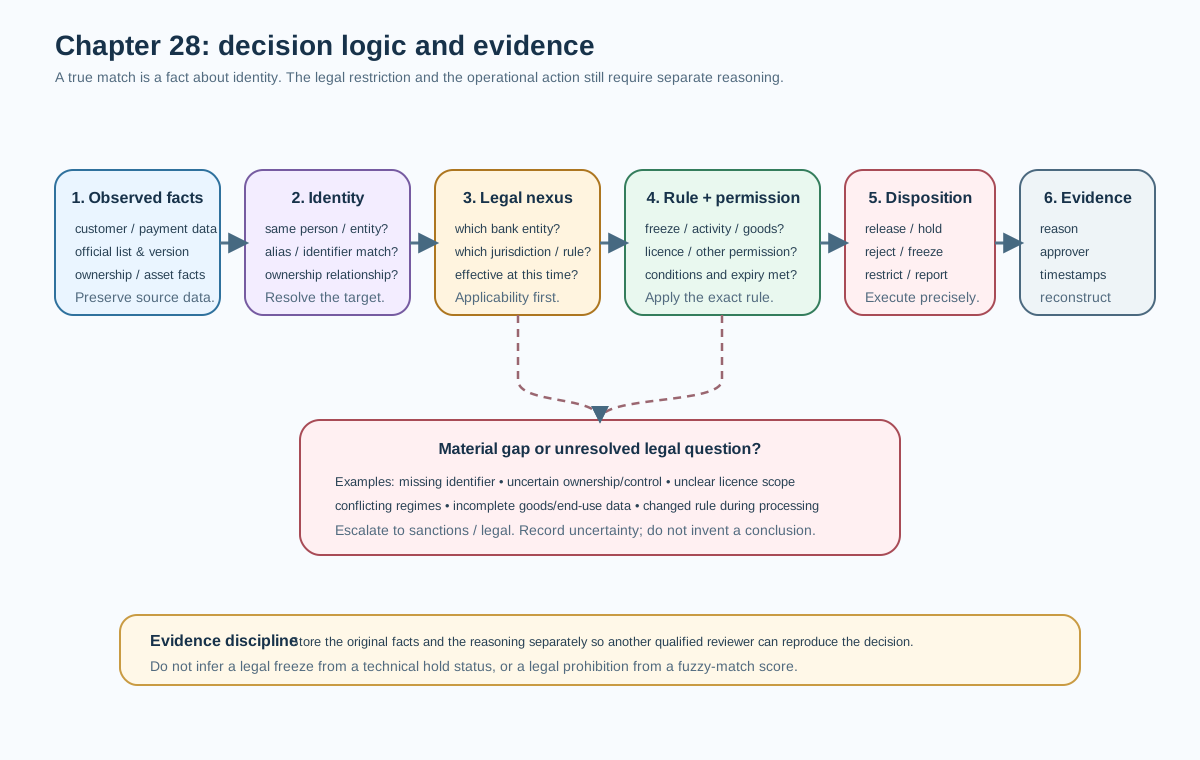
Outage exercise
The screening service becomes unavailable for 20 minutes. Decide which payment types stop, which queues are created, which manual controls are permitted and how replay/rescreening occurs after recovery.
A sanctions control needs a failure mode, not only a happy path.
Customer communication exercise
Draft operational statuses for “under review,” “rejected,” “blocked/frozen” and “released.” Ensure front-line staff do not use a legal term that is not supported by the decision.
QA test
Review ten released alerts. Confirm that the analyst resolved identity, programme and legal applicability—not merely that a fuzzy-match score fell below a threshold.
Final practitioner test
A strong learner should be able to take a sanctions event from official authority through list/rule ingestion, match investigation, legal applicability, operational action, reporting and audit evidence without confusing AML suspicion with sanctions prohibition.
60-minute mastery extension: sanctions regimes and bank obligations
This extension is designed to make the chapter a minimum 60-minute guided learning experience. Spend around 25 minutes on the core lesson and diagrams, 15 minutes on the nexus cases, 10 minutes on regime mapping and 10 minutes on the final sanctions test.
Sanctions compliance begins with legal nexus
Sanctions are legal restrictions created by competent authorities. The first professional question is not "is this customer risky?" but which sanctions regime applies to this bank, legal entity, person, transaction, asset or activity? Jurisdictional nexus can arise through incorporation, location, nationality or persons involved, currencies, services, routing, ownership, control and other legal connections depending on the regime.
Global banks often choose group-wide policies that exceed local legal minimums, but the case record should still distinguish a legal requirement from an internal risk decision. This distinction matters for customer communication, regulatory reporting, audit and future legal review.
Sanctions are broader than name lists
List screening is important but sanctions can also restrict sectors, securities, debt or equity, services, trade in particular goods, vessels, aircraft, geographic areas or specified activities. An entity can therefore have a clean name-screening result while a transaction remains prohibited or restricted because of its ownership, purpose or activity.
The control environment needs both screening and rule-based legal analysis. A name-matching engine cannot decide whether a particular service, maturity, instrument or trade activity is permitted.
Worked case: multinational payment
A European legal entity of a global bank processes a USD payment between two non-US companies through a correspondent chain that includes a US bank. One party has a complex ownership structure and the goods relate to a controlled sector.
The bank should identify which regimes may apply through its own entity and the transaction's nexus. It should assess designated parties, ownership/control, activity restrictions, goods/services and any licences or exemptions. The result may differ by entity and role. The analysis should not simply say "OFAC applies globally" or "EU bank means only EU rules matter."
Programme differences
Sanctions programmes can change rapidly and can use different legal mechanisms. Some focus on named persons and entities, some impose broader geographic or sectoral restrictions, and some include licensing frameworks or humanitarian exceptions. Banks therefore need programme-level rule data, not just one consolidated list.
The system should preserve the authority, programme, source version, effective date and legal basis used for a decision. When rules change, historical cases need to remain reproducible.
Licences, exemptions and authorisations
A prohibited or restricted activity can sometimes be authorised by a general licence, specific licence, statutory exception or other permission depending on the regime. A licence should not be treated as a generic "whitelist." The bank must verify scope, parties, activity, value, dates, conditions, reporting obligations and expiry.
Licence data should be controlled and effective-dated. A payment released under an expired or inapplicable licence can create a serious breach.
Sanctions and AML are different
A sanctions restriction can apply even when funds are entirely legitimate and there is no suspicion of money laundering. Conversely, suspicious activity can exist without any sanctions nexus. The same ownership, payment and customer data can support both controls, but the legal tests and outcomes remain distinct.
Systems should therefore avoid one generic financial-crime status. A customer can be high AML risk but not sanctioned. A payment can be legally prohibited while the customer is otherwise legitimate.
Regime-mapping exercise
Choose four regimes relevant to a global bank—such as UN-derived obligations as implemented locally, US, EU and UK measures. For each, record the competent authority, legal entities in scope, list/source, ownership/control approach, licensing route, reporting obligations and operational disposition rules. Do not assume identical ownership tests or reporting deadlines.
The exercise is about mapping differences rather than memorising every programme.
Sanctions-change exercise
Assume an authority designates a new entity at 14:00. The bank must receive the source update, validate it, load it, test ingestion, rescreen relevant customers/parties, screen new payments and manage any potential exposure. The control should record publication time, legal effective time, source version, load time and failures.
A delay between legal effect and production control is an operational risk that requires governance. "Daily list update" is not enough if the applicable legal expectation or the bank's assessed risk requires faster action.
Governance and escalation
Potential matches, ownership questions, licensing issues and complex nexus cases need clear escalation to sanctions specialists and legal where appropriate. Relationship managers can provide customer context but should not override legal restrictions. Operations can execute holds or releases but should not invent legal interpretations.
Final sanctions test
Explain why each statement is inaccurate: "clean name screen means permitted"; "sanctions are just AML"; "one ownership threshold works globally"; "licence means customer is safe"; "every sanctioned-country payment must be blocked"; and "group policy is the same as law." Rewrite each into a precise sanctions question.
A strong learner should finish able to identify nexus, distinguish list and activity restrictions, understand licensing and keep legal sanctions decisions separate from AML risk judgement.
United Nations sanctions in banking practice
UN Security Council measures bind Member States under the UN framework, but a bank normally experiences the operative obligation through the domestic or regional legal framework that applies to it. The implementation mechanism is not identical everywhere. Some jurisdictions maintain their own official designation sources; others give effect through directly applicable regional law or other legal instruments. A bank should therefore monitor both the relevant UN regime and the implementing law rather than assume that every UN listing creates the same bank action at the same timestamp in every jurisdiction.
The practical consequences are threefold. First, the bank should record the UN regime, the applicable implementing instrument and its legal effective time, and should measure any delay before its production controls reflect that legally effective position. Second, Security Council committee material and other official UN reporting can provide useful evasion, shipping, procurement and network context for control design, but intelligence material is not itself a substitute for the operative legal rule. Third, UN measures provide an international baseline that may sit alongside autonomous national or regional measures, so an investigator must know which instrument actually creates the bank's obligation.
Resolution-specific knowledge matters where the bank has relevant exposure. The DPRK regime, for example, contains measures that reach beyond individual names and can affect trade, vessels and financial activity. The Iran proliferation framework also demonstrates why programme status must be treated as live reference data: relevant UN measures were re-applied in September 2025. Control design should therefore treat programme status, designations and implementing-law changes as monitored data rather than static training content.
European Union implementation mechanics
EU restrictive measures can be implemented through directly applicable Council Regulations, while Member State competent authorities handle important licensing, reporting and enforcement functions. A bank operating across EU states therefore needs both the EU legal act and the correct national competent-authority pathway. A derogation or authorisation available under an EU measure may require an application to the relevant national authority, and penalties and enforcement processes are also shaped by the applicable legal framework.
The Official Journal and EUR-Lex are the authoritative sources for EU legal acts, but publication time is not automatically the same as legal effective time. The regulation or amending act specifies when it enters into force or applies. Some measures take effect on publication, others on the following day or another specified date or time. Production controls should therefore store publication timestamp and legal effective timestamp separately and use the latter for decision logic. Pending-transaction rescreening should be tied to the legally effective rule rather than to an assumed same-day convention.
The EBA's Guidelines on internal policies, procedures and controls for the implementation of Union and national restrictive measures apply from 30 December 2025. They strengthen the governance and control expectations around restrictive measures, including specific guidance for payment service providers and crypto-asset service providers. These guidelines complement rather than replace the underlying EU and national sanctions instruments.
EU sectoral and country measures can also create reporting, licensing and enforcement interactions with Member State authorities. A centralised compliance function should therefore maintain Member State overlays where needed instead of assuming that every operational detail is uniform merely because the underlying EU prohibition is common.
United Kingdom practice after the Sanctions Act
The UK's sanctions framework under the Sanctions and Anti-Money Laundering Act 2018 includes financial sanctions implemented and enforced through OFSI. Reporting duties for relevant firms, ownership/control analysis, licensing and enforcement must be read from current UK legislation and guidance for the particular regime and fact pattern. A bank's breach-detection workflow should keep sanctions reporting distinct from SAR/STR or other law-enforcement processes because they have different legal bases, recipients and confidentiality rules.
The UK Sanctions List became the only source for all current UK sanctions designations when the former OFSI Consolidated List closed on 28 January 2026. Screening, reference-data and rescreening procedures should therefore point to the current official source, while historical cases should retain the source that was actually used at the time.
OFSI general licences can authorise defined activity subject to conditions and reporting or recordkeeping requirements. Their existence does not turn the relevant party into a permanent whitelist entry. Licence handling needs structured scope, effective dates, parties, activity, conditions, evidence and expiry controls.
United States architecture: programmes, authorities and reach
US sanctions practice derives from statutes, executive orders, regulations and programme-specific authorities administered principally by OFAC, with export-control and other measures administered by other US agencies operating alongside them. For banks, the important architectural point is that OFAC sanctions are not one universal prohibition. Some authorities require blocking, some prohibit activity without creating a blockable property interest, some are sectoral or activity-specific, and licences or exemptions can alter the outcome.
OFAC's current reporting framework under 31 C.F.R. Part 501 requires applicable blocking and rejection reports within 10 business days of the action. This is a US-specific requirement, not a universal sanctions deadline. OFAC's 50 Percent Rule is equally jurisdiction-specific: entities directly or indirectly owned 50 percent or more in the aggregate by one or more blocked persons are considered blocked under that rule, while control alone below that ownership threshold does not automatically block an entity under the 50 Percent Rule. Other programme provisions and designations can still matter.
US-dollar clearing through the United States can create a US jurisdictional touchpoint in an otherwise non-US payment, so a non-US bank using a US correspondent should assess the relevant OFAC programme and facts. This does not mean that OFAC law applies to every non-US transaction merely because USD is mentioned. The control design should identify the actual US person, US property, US clearing, service or other legally relevant nexus and then test the programme-specific rule.
US persons and entities subject to US jurisdiction may have primary sanctions obligations beyond a single transaction route. Foreign persons can also face direct prohibitions when they cause or conspire to cause a US person to violate sanctions, evade sanctions, or when a specific programme reaches their conduct. Secondary-sanctions exposure is a different concept: it can create designation or other consequences for certain non-US conduct even where the actor is not itself subject to a primary blocking rule. Banks should keep these concepts separate in policy and case records.
Regime change management: when programmes transform
Sanctions programmes change through designation waves, delistings, programme expansions and contractions, licence issuance and revocation, and occasional fundamental transformation such as broad sanctions being lifted while targeted measures remain. Each change type triggers a defined control response that should be proceduralised rather than improvised.
Designation changes can require source ingestion, customer and connected-party rescreening, ownership reverse searches, review of payments still in flight, account or asset restrictions, reporting and management escalation. Delistings require equal discipline: removal under one programme does not necessarily remove restrictions under another programme, and property already frozen under a legal rule may require a specific release process.
Programme transformations demand broader response: rule-engine changes for geography and activity logic, customer-communication preparation, staff briefing, training updates and regression testing. The Syria transition in US sanctions is a useful example of why a bank should not retain a static country hard block after the governing programme changes; live treatment must be based on the current authorities and remaining targeted measures. Wind-down or temporary authorisations need expiry controls and transaction planning within the authorised period.
Change governance assigns ownership for monitoring official sources, assessing impact, approving policy and rule updates, communicating internally, deploying technology changes and verifying implementation. A sanctions-change log should record the official source, publication and effective times, bank interpretation, affected products and entities, implementation actions, deployment evidence and post-change validation.
Multi-regime conflict: operating where programmes disagree
Global banks routinely face transactions that are lawful under one potentially relevant regime but prohibited under another regime that actually applies to the bank or transaction. The practical rule is not to adopt a reflexive "most restrictive jurisdiction in the world" approach. Instead, identify every regime that is legally applicable, determine each rule and permission accurately, then ensure the bank does not take an action prohibited by any regime to which it is subject.
Conflict analysis follows a structured sequence: identify every potentially relevant regime through entity, persons, location, clearing, property, geography, parties, goods and services; determine legal applicability with specialist input for novel questions; identify each applicable restriction; assess licences, exemptions or authorisations in each applicable regime; and document the combined disposition. Customer communication should explain the operational outcome without disclosing protected information or making unsupported legal claims.
Standing legal positions for recurring patterns, approved and reviewed on a defined cycle, prevent unnecessary re-analysis while keeping the bank responsive to rule changes. Novel conflicts require an escalation path that is fast enough for the payment or product timetable and has a defined interim handling state.
Correspondent USD-nexus: a worked control case
A European bank processes US-dollar payments for corporate customers trading with counterparts in jurisdictions subject to US sectoral and targeted measures but not broad country-wide prohibitions. A review finds USD-denominated payments for industrial goods routed through US correspondent accounts. The goods may be export-controlled and the end users create additional concern, although no payment party is an SDN.
The analysis sequences through each potentially applicable framework. EU measures apply to the bank as an EU operator and must be tested against the actual goods, end users, sector and legal acts. US measures require analysis of the US clearing nexus, the particular OFAC programme and any relevant export-control rules administered by the competent US authority. UN-derived measures are considered through the applicable implementing law. Each framework's conclusion should be recorded independently before being combined into the final disposition.
For the fictional case, assume specialist classification confirms that a particular item is controlled under an applicable EU measure and requires authorisation that the customer has not obtained. Also assume the US correspondent route creates a US touchpoint requiring additional sanctions and export-control analysis. The immediate outcome is an operational hold while the applicable legal requirements are resolved. Future compliant business may require the appropriate authorisation, improved pre-transaction data and clearer routing controls. The lesson is not that every "dual-use-adjacent" good needs a licence; it is that classification and end-use questions must be resolved by the correct legal and technical process when the actual item and facts trigger them.
EU supervisory convergence and the AMLA timetable
AMLA is an AML/CFT authority, not a general EU sanctions authority. Its creation is still relevant to financial-crime governance because it is building a more convergent AML/CFT supervisory system and common risk-assessment methodology across the EU. However, the timing must be stated accurately: in 2026 AMLA is running preparatory data collection and calibration; the first selection of entities for ongoing direct supervision takes place in 2027; direct supervision of selected financial institutions starts in 2028.
Banks should therefore not describe themselves in 2026 as already under AMLA's ordinary direct supervision unless a specific legal mechanism actually applies. For sanctions-control implementation in the EU, the more direct anchors are the relevant EU sanctions legal acts, Member State competent authorities and, for financial institutions, the EBA restrictive-measures guidelines that apply from 30 December 2025. AMLA can still affect the wider quality of AML/CFT governance, data and supervisory convergence, and those capabilities often support sanctions controls operationally, but the legal mandates should not be blurred.
Preparation for stronger EU-wide supervision is still sensible. Banks can maintain control inventories, issue and remediation logs, governance evidence, data lineage and effectiveness metrics continuously rather than assembling them only for an examination. The same evidence discipline benefits sanctions, AML/CFT and operational-risk assurance even where the responsible authority differs.
Delisting implementation: unblocking without error
Delisting events, whether individual or programme-wide, require implementation discipline symmetric to designation handling. Premature release can breach another still-applicable restriction, while delayed release can harm customers and create complaints or legal challenge.
The delisting workflow verifies scope first: which programme removed the party, which restrictions lift as a consequence, and which other programmes, sectoral measures, export controls or asset-specific restrictions continue to apply. For material exposures, legal or sanctions-policy confirmation should precede system action where the interaction exceeds operations-team authority.
System implementation should remove or amend the designation across all relevant screening layers and reference-data caches in a controlled manner. Pending-transaction queues are reviewed for items held on the affected basis rather than mass-released without assessment. Customer restrictions imposed during designation are reassessed. Seeded testing should confirm that the delisted party no longer alerts on the removed basis while genuinely restricted parties continue to do so.
Authoritative anchors
- UN Security Council Consolidated List: https://main.un.org/securitycouncil/en/content/un-sc-consolidated-list
- FATF Recommendations, amended June 2026: https://www.fatf-gafi.org/en/publications/Fatfrecommendations/Fatf-recommendations.html
- FATF Recommendation 6 humanitarian update, 23 June 2026: https://www.fatf-gafi.org/en/publications/Fatfrecommendations/update-recommendation-6-june-2026.html
- European Commission sanctions overview: https://finance.ec.europa.eu/eu-and-world/sanctions-restrictive-measures/overview-sanctions-and-related-resources_en
- EBA restrictive-measures guidelines: https://www.eba.europa.eu/publications-and-media/press-releases/eba-issues-final-guidance-internal-policies-procedures-and-controls-ensure-implementation-union-and
- OFSI general guidance: https://www.gov.uk/government/publications/financial-sanctions-general-guidance/uk-financial-sanctions-general-guidance
- UK sanctions collection and UK Sanctions List resources: https://www.gov.uk/government/collections/uk-sanctions
- OFAC Introduction guide, published 1 June 2026: https://ofac.treasury.gov/recent-actions/20260601
- OFAC 50 Percent Rule: https://ofac.treasury.gov/faqs/topic/1521
- OFAC blocking and rejecting guidance: https://ofac.treasury.gov/faqs/topic/1601
- OFAC filing reports guidance: https://ofac.treasury.gov/faqs/topic/1606
- AMLA direct-supervision timetable: https://www.amla.europa.eu/faqs_en
Knowledge check
Use these questions after completing the chapter. Answer them from the legal and operating logic in the lesson rather than from memory of a particular sanctions list.
-
A customer and beneficiary both screen clear. Why can the transaction still require sanctions review?
-
What is the difference between a legal sanctions obligation and a bank’s internal group policy, and why must the case record distinguish them?
-
A sanctions authority publishes a new designation after a payment passed screening but before settlement. What control questions must the bank answer before deciding whether the payment can continue?
-
Why should an identity match, legal-applicability decision and operational disposition be stored as separate decision steps?
-
What evidence should be retained to reconstruct a sanctions decision months later?
-
Why is a licence or exemption not the same as a generic whitelist?
Answer guide
A clean name screen does not rule out ownership/control exposure, geographic or sectoral restrictions, prohibited services or goods, activity-based restrictions, or another legal nexus. Legal obligation and group policy must remain separate because reporting, customer communication, audit and challenge depend on whether the bank was legally required to act or chose a stricter internal position. An in-flight designation requires the bank to know the designation’s legal effect and timing, the payment’s execution/settlement stage, whether re-screening applies and which decision owner can stop or release the item. Identity, legal applicability and disposition are different questions; combining them can cause a true match under a narrow restriction to trigger the wrong action. Reconstruction should preserve authority, programme, legal source, list/rule version, bank entity, parties, ownership/nexus evidence, screened data, licence/exemption analysis, decision, action, timestamps and approver. A permission must be tested for issuing authority, parties, activity, dates, limits, conditions and reporting requirements.
Glossary
Asset freeze / block — A legal restriction on dealing with funds or economic resources under the applicable sanctions regime; it is not the same as a temporary operational hold.
Designation — The formal act by which an authority places a person, entity, vessel or other subject under specified sanctions measures.
Economic resources — Assets other than funds that may be used to obtain funds, goods or services, as defined by the relevant legal framework.
Legal nexus — The connection that makes a sanctions regime relevant to a bank, person, transaction, asset or activity, such as bank entity, location, person, service, currency/routing or other legally relevant fact.
Programme / regime — The legal sanctions framework under which restrictions are imposed; different programmes can create different consequences even within the same authority.
Operational hold — A temporary internal state while a potential issue is investigated. It does not by itself mean that property is legally frozen.
Reject — A transaction outcome in which the bank does not process the payment or activity. Whether rejection is the legally correct action depends on the applicable regime.
Licence / authorisation — Permission issued under a sanctions framework allowing specified activity that would otherwise be restricted, subject to scope and conditions.
Exemption / exception — A legally defined category of activity that is outside or carved out from a restriction when its conditions are met.
List version — The exact sanctions-list content and effective state used for a screening event; preserving it supports historical reconstruction.
Legal applicability — The decision on whether the relevant sanctions rule actually applies to the matched person, transaction, asset or activity.
Disposition — The final operational outcome, such as release, reject, freeze/block, restrict service, escalate or report, based on the legal and policy decision.
References and further reading
Use primary legal and regulatory sources for live sanctions decisions. The materials below are learning anchors; sanctions programmes, designations, licences, exemptions and guidance can change quickly, so the operative legal instrument and current official source always take priority.
- United Nations Security Council — Consolidated Sanctions List: https://main.un.org/securitycouncil/en/content/un-sc-consolidated-list
- Financial Action Task Force — The FATF Recommendations, amended June 2026: https://www.fatf-gafi.org/en/publications/Fatfrecommendations/Fatf-recommendations.html
- Financial Action Task Force — June 2026 update to Recommendation 6 on humanitarian assistance: https://www.fatf-gafi.org/en/publications/Fatfrecommendations/update-recommendation-6-june-2026.html
- European Commission — Overview of EU sanctions and related resources: https://finance.ec.europa.eu/eu-and-world/sanctions-restrictive-measures/overview-sanctions-and-related-resources_en
- European Banking Authority — Guidelines on internal policies, procedures and controls to ensure implementation of Union and national restrictive measures: https://www.eba.europa.eu/publications-and-media/press-releases/eba-issues-final-guidance-internal-policies-procedures-and-controls-ensure-implementation-union-and
- UK Office of Financial Sanctions Implementation — UK financial sanctions general guidance, updated 12 May 2026: https://www.gov.uk/government/publications/financial-sanctions-general-guidance/uk-financial-sanctions-general-guidance
- UK Government — UK sanctions collection and current UK Sanctions List resources: https://www.gov.uk/government/collections/uk-sanctions
- U.S. Treasury OFAC — Introduction to the Office of Foreign Assets Control, published 1 June 2026: https://ofac.treasury.gov/recent-actions/20260601
- U.S. Treasury OFAC — Sanctions Programs and Country Information: https://ofac.treasury.gov/sanctions-programs-and-country-information
- U.S. Treasury OFAC — Entities Owned by Blocked Persons and the 50 Percent Rule: https://ofac.treasury.gov/faqs/topic/1521
- U.S. Treasury OFAC — Blocking and Rejecting Transactions: https://ofac.treasury.gov/faqs/topic/1601
- U.S. Treasury OFAC — Filing Reports with OFAC: https://ofac.treasury.gov/faqs/topic/1606
- Wolfsberg Group — Sanctions Screening Guidance: https://wolfsberg-group.org/resources/legacy/53
Accuracy note — reviewed 15 September 2026: the UK Sanctions List is the current source for UK sanctions designations following closure of the former OFSI Consolidated List on 28 January 2026. FATF amended Recommendation 6 in June 2026 to align the standard on terrorism-related targeted financial sanctions with relevant UN humanitarian exemptions. OFAC's 50 Percent Rule, blocking/rejection terminology and Part 501 reporting deadlines are U.S.-specific examples and must not be applied as universal sanctions rules. Always check the current legal instrument, official designation source, licence or exemption and the bank legal entity's applicable obligations before making a live decision.