Narcotics, Arms and Organised Crime Typologies
Drug trafficking, illicit arms trafficking and organised crime generate proceeds that can move through cash, trade, remitters, front companies, professional money-laundering networks, virtual assets, property and ordinary banking products. The bank rarely sees the underlying crime directly. It sees customers, transactions, businesses, counterparties, devices, trade flows and payment messages. The professional task is therefore to identify financial patterns that are inconsistent with legitimate economic activity, connect them to credible intelligence where available and avoid turning typologies into unsupported accusations.
UNODC's World Drug Report 2026 documents continuing changes in global drug markets, including record or near-record indicators in several cocaine and amphetamine-type-stimulant measures using the latest available reporting data. FATF, INTERPOL and UNODC also continue to emphasise following illicit profits and the laundering infrastructure that serves organised crime. For banks, the durable lesson is not to hard-code one drug-market statistic into controls: predicate offences create value, while laundering networks adapt the way that value is collected, settled, converted and integrated.
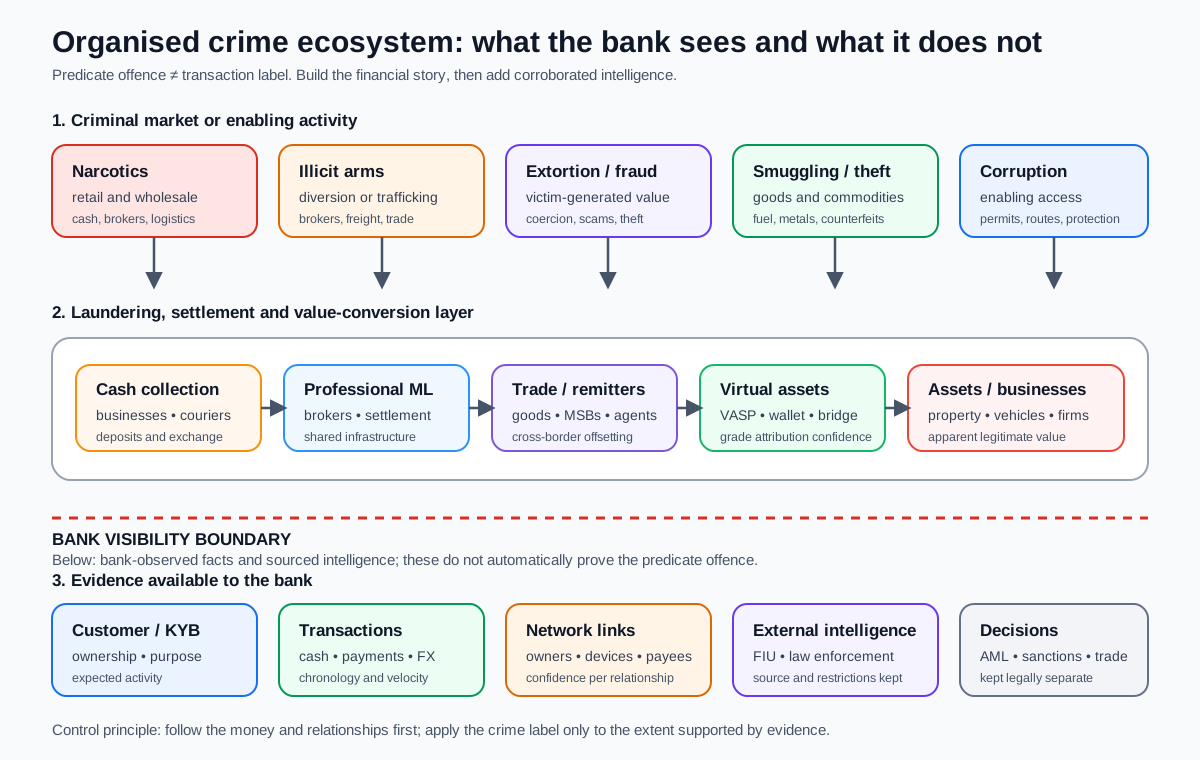
Drug trafficking as a predicate offence
Drug trafficking can generate cash and electronic proceeds at different points in the supply chain. Retail distribution can create cash-heavy income, while wholesale activity may involve larger cross-border settlements, trade, remitters or professional laundering networks.
A bank should not equate cash, remittances or certain geographies with narcotics trafficking. The relevant question is whether the activity makes sense for the customer and whether credible evidence or intelligence links the flow to crime.
Cocaine, synthetic drugs and changing markets
Drug markets evolve. UNODC's 2026 reporting shows continued change in cocaine manufacture, seizures and trafficking patterns and in amphetamine-type-stimulant markets. Financial-crime controls should therefore avoid relying on fixed typology assumptions that become stale.
Monitoring should focus on reusable financial behaviours: unexplained cash, rapid movement, third-party funding, common beneficiaries, front businesses, trade anomalies, cross-border settlement and networks of related accounts.
Cash collection
Street-level drug sales can create fragmented cash that needs consolidation. Criminal networks may use cash-intensive businesses, couriers, money service businesses or cash deposits.
A cash-intensive business is not suspicious merely because it deposits cash. The investigation should compare declared business model, turnover, card receipts, seasonality, tax or merchant information where available, deposit locations and subsequent movement.
Professional money laundering
Organised crime may outsource laundering to specialist networks. These networks can serve multiple criminal groups and may use underground banking, hawala and other similar value-transfer arrangements, cash couriers, trade, shell companies, virtual assets and settlement accounts.
FATF's September 2026 work on professional money laundering stresses that underground banking and hawala-like systems can also have legitimate uses and vary substantially by jurisdiction and operating model. The bank should therefore identify the actual customer, provider, licensing or registration position where applicable, settlement pattern and network evidence rather than treating the transfer method itself as criminal.
The bank may see apparently unrelated customers using common beneficiaries or intermediaries. Network analysis can be more useful than a single-account view.
Specialist networks can sell laundering services to multiple crime groups; shared payout points, settlement accounts or intermediaries can therefore become useful cross-customer signals when the links are corroborated.
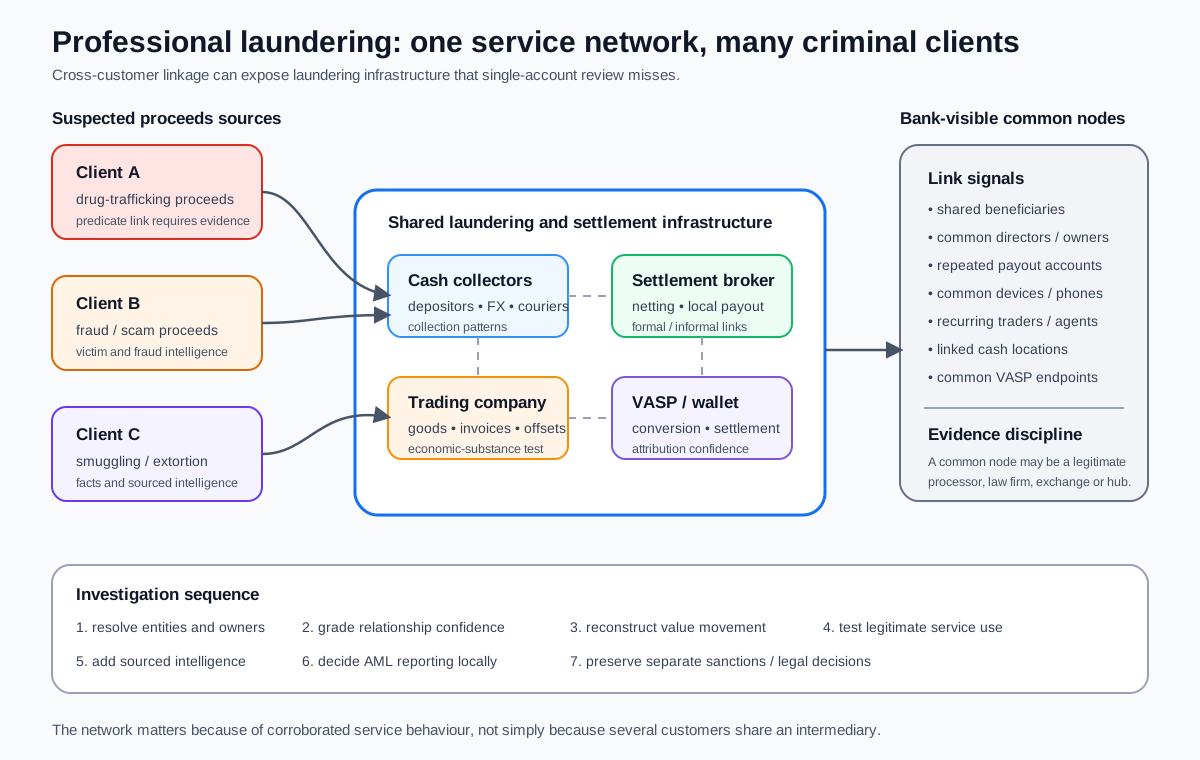
Trade-based settlement
Criminal proceeds can be settled through trade rather than direct cash movement. Goods may be over- or under-invoiced, imported or exported through related companies, or used to offset obligations between brokers.
Banks should reconstruct the economic story and avoid assuming every unusual price or route proves laundering.
Front businesses
Restaurants, transport companies, wholesalers, construction firms, import-export businesses and other real companies can be used as fronts. A front company may have genuine employees and customers while also processing illicit value.
This makes economic-substance analysis more important than a simple “real company versus shell company” distinction.
Money service businesses and remitters
MSBs can be legitimate, regulated businesses providing essential remittance services. Their high transaction volume and pass-through nature can resemble laundering patterns.
A bank should understand licensing or registration where applicable, ownership, agents, corridors, settlement, customer model and controls. Sector risk should not become automatic suspicion.
Virtual assets
Organised crime can use virtual assets to transfer or store value. Legitimate customers also use them. Banks should combine customer profile, counterparty, source, destination, wallet or provider intelligence and transaction behaviour rather than treat crypto exposure as proof of illicit activity.
Arms trafficking
Illicit arms trafficking can involve brokers, logistics companies, freight, shipping, procurement networks, front companies, cash, trade finance and cross-border payments. The underlying goods may be hidden behind vague descriptions or routed through intermediaries.
The UN Firearms Protocol sits within the United Nations Convention against Transnational Organized Crime framework and addresses illicit manufacturing and trafficking in firearms, parts, components and ammunition. Domestic implementation, licensing and enforcement differ, so a bank should not assume that one country's firearms or export-control rule applies globally.
Banks should distinguish sanctions, export-control, firearms-control and AML questions. A restricted-goods issue can create a legal or policy control outcome separate from money-laundering suspicion.
Dual-use complexity
Some goods can have civilian and military uses. The presence of dual-use goods does not itself establish illicit arms trafficking.
Trade, sanctions and export-control specialists may need to assess product classification, end user, destination and licensing, while AML teams assess financial behaviour and potential proceeds.
Organised crime structures
Organised crime groups are not always hierarchical. They can operate as flexible networks connecting suppliers, brokers, transporters, cash collectors, money launderers and facilitators.
Financial graphs should therefore avoid assuming one “kingpin” structure. Different nodes can perform different functions.
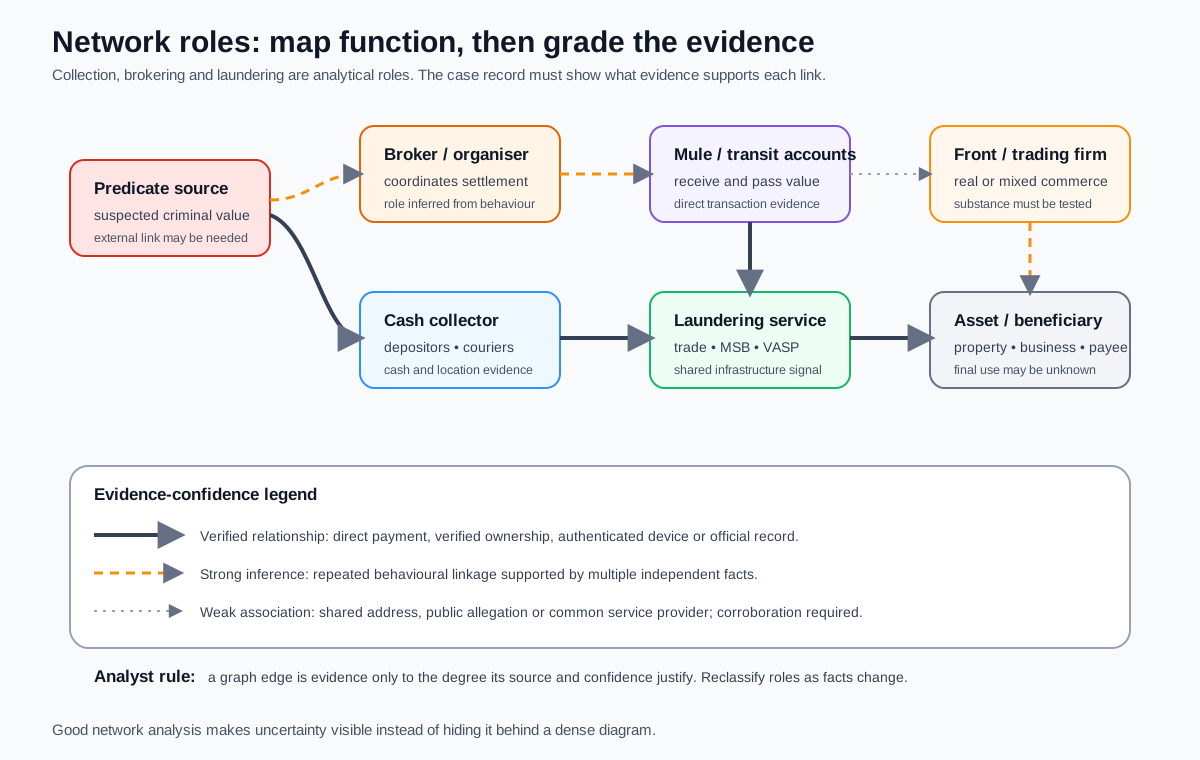
Human smuggling and trafficking links
Organised crime can span drug trafficking, migrant smuggling, human trafficking, fraud and other offences. Financial flows may overlap through the same laundering infrastructure.
Banks should not infer the underlying crime solely from a transaction pattern. The same rapid movement or cash consolidation can arise from several predicate offences.
Extortion and protection payments
Criminal groups may generate proceeds through extortion. Payments can appear as cash, transfers, “security” fees or business expenses.
The bank may see the proceeds only when they are aggregated or invested. Customer vulnerability and law-enforcement intelligence may matter.
Kidnapping and ransom
Ransom payments can create urgent and complex financial flows. Sanctions, terrorist-financing, criminal-law and reporting considerations can overlap depending on the recipient, jurisdiction and facts.
Banks should involve appropriate legal, sanctions, financial-crime and operational specialists rather than treat the event as a routine payment. Whether a payment can be processed, must be reported or requires law-enforcement engagement is jurisdiction-specific.
Fuel, commodities and organised theft
Organised crime can monetise stolen fuel, metals, vehicles, goods and other commodities. Proceeds may be disguised through legitimate trading businesses.
The financial pattern should be assessed against customer activity and available external information.
Corruption as an enabler
Organised crime often depends on bribery or corruption to secure routes, permits, protection or access. Payments to public officials or intermediaries may therefore appear in the financial chain.
PEP status is not proof. A factual investigation examines relationship, purpose, timing and evidence.
Cross-border networks
Cross-border movement can create multiple banks, currencies and legal systems. No single institution may see the entire chain.
Payment transparency, lawful information sharing, FIU reporting and law-enforcement cooperation can help connect fragments.
Correspondent banking
Correspondent banks may see only the financial-institution and payment-message layer, not the underlying customer relationship. Respondent due diligence and payment-data quality therefore matter.
A correspondent should not claim it has the same visibility as the originating bank.
Scenario: cash consolidation network
Several small businesses deposit cash and transfer funds to the same wholesaler. The wholesaler then sends large transfers abroad to trading companies.
The pattern could represent a legitimate franchise or distribution network. The bank should examine ownership, commercial relationships, invoices, expected turnover and external intelligence before drawing conclusions.
Scenario: remitter settlement
A licensed remitter receives cash and bank transfers from many customers and sends large settlement payments to overseas partners. Generic pass-through monitoring creates thousands of alerts.
The better control compares volume, corridors, agents, counterparties and changes against the expected remittance model.
Scenario: arms-broker risk
A trading company pays a logistics intermediary for “industrial equipment” shipped through multiple countries. External intelligence suggests the intermediary has links to illicit arms procurement.
The bank should escalate to sanctions/export-control or other relevant specialist teams and AML specialists, preserve available trade and payment data and avoid making unsupported claims about the goods without evidence.
Scenario: organised fraud laundering
Fraud proceeds from hundreds of victims flow to personal accounts, then to several businesses and finally to overseas accounts and virtual-asset platforms.
The bank should connect fraud intelligence with AML network analysis and distinguish direct victim payments from downstream laundering nodes.
Transaction-monitoring design
Useful patterns can include rapid pass-through, common beneficiaries, cash consolidation, sudden turnover changes, third-party funding, cross-border corridors, related corporate networks, merchant anomalies and virtual-asset conversion.
Scenario design should be segment-aware. A logistics company and a salary account should not share the same behavioural baseline.
Intelligence-led monitoring
Organised-crime detection benefits from law-enforcement feedback, FIU typologies, fraud intelligence and external risk information. Controls should be capable of incorporating new indicators without treating every intelligence hit as a final conclusion.
Entity resolution
Aliases, company names, addresses, phones, devices, directors and beneficial owners can connect apparently separate customers.
Relationship confidence matters. Common service-provider addresses or shared household devices can create legitimate links.
Payment lineage
Investigators should be able to connect original instruction, payment processing, settlement, return or recall, booking and case records. Cross-system identifiers reduce manual reconstruction.
Customer due diligence
High-risk sectors may require stronger understanding of ownership, business purpose, expected turnover, counterparties and countries. The level of due diligence should be proportionate and tied to identified risk.
Business analyst view
A BA should model predicate offence intelligence, customer, account, payment, counterparty, business, device, external intelligence, alert, case and suspicious report as related but distinct objects.
Requirements should define how fraud, sanctions, trade and AML teams share evidence without collapsing their decision rights.
Evidence discipline
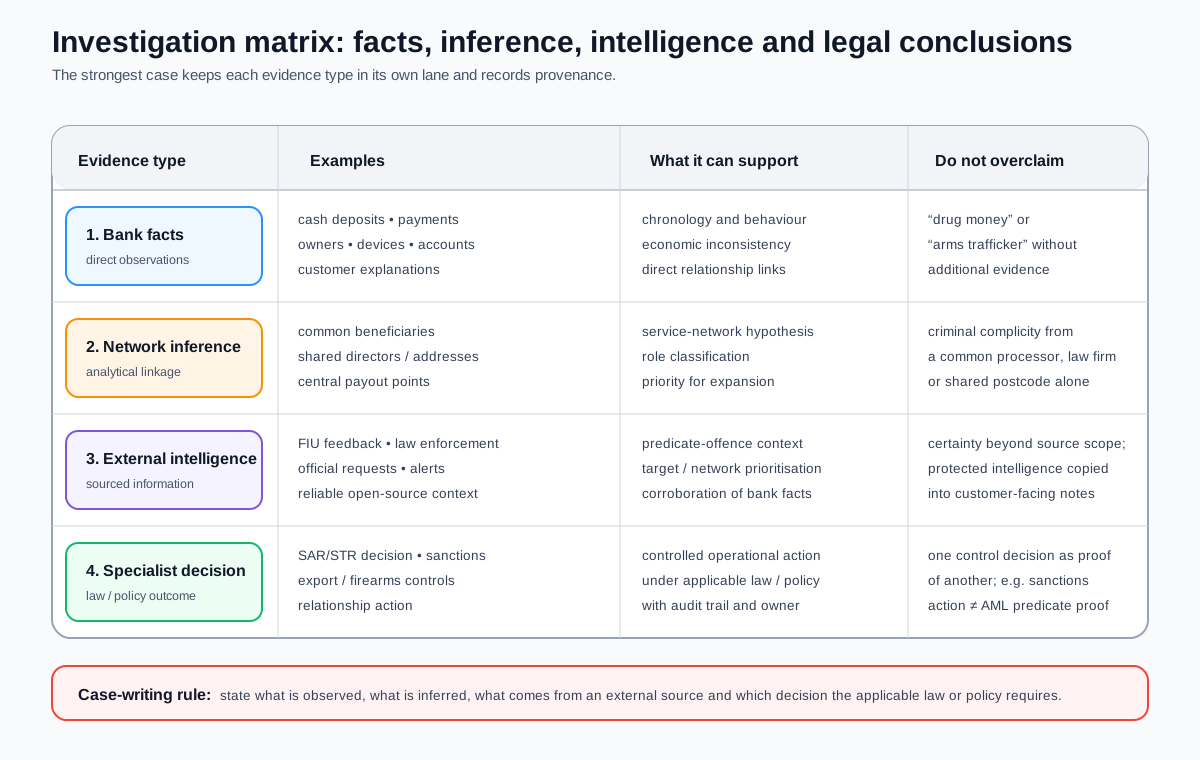
A transaction pattern can be consistent with organised crime but rarely identifies the predicate offence by itself. Analysts should describe facts first and use typology labels carefully.
“Multiple cash deposits followed by transfers to common offshore beneficiaries” is stronger than “drug money laundering” unless there is evidence connecting the activity to narcotics.
Quality assurance
QA should test for demographic or geographic stereotyping, overuse of typology labels, weak relationship evidence and failure to consider legitimate business models.
Metrics
Useful measures include network detection quality, known-case coverage, time to connect linked accounts, false-positive concentration, intelligence feedback and data-quality defects.
Common mistakes
Common mistakes include assuming all cash-heavy activity is drug-related, treating remitters as inherently suspicious, confusing sanctions/export-control breaches with AML suspicion, and inferring a specific predicate crime from generic laundering behaviour.
Learning checkpoint
A reader should be able to explain how narcotics, illicit arms and organised crime create proceeds, describe laundering through cash, trade, remitters, professional networks and virtual assets, understand the limits of a bank’s visibility, distinguish predicate-offence intelligence from transaction evidence and design controls that are risk-based rather than stereotyped.
References and further reading
- UNODC — World Drug Report 2026 search and findings: https://data.unodc.org/wdr2026search
- UNODC — Organized Crime Knowledge Database, including UNTOC and its Protocols: https://whatson.unodc.org/whatson/en/knowledge/knowledge-database_organized-crime.html
- United Nations Treaty Collection — Firearms Protocol text: https://treaties.un.org/doc/source/recenttexts/18-12_c_e.pdf
- UNODC — Global Study on Firearms Trafficking 2020: https://www.unodc.org/documents/data-and-analysis/Firearms/2020_REPORT_Global_Study_on_Firearms_Trafficking_2020_web.pdf
- FATF — The FATF Recommendations, amended June 2026: https://www.fatf-gafi.org/en/publications/Fatfrecommendations/Fatf-recommendations.html
- FATF — Investigating Professional Money Laundering, Underground Banking, and the Use of Hawala and Other Similar Service Providers, 3 September 2026: https://www.fatf-gafi.org/en/publications/Methodsandtrends/pml-underground-banking-hawala-hossps.html
- INTERPOL — Organized crime: https://www.interpol.int/Crimes/Organized-crime
- INTERPOL — Operation Orca XI: illicit firearms and drug trafficking in the Americas, 26 May 2026: https://www.interpol.int/News-and-Events/News/2026/Over-3-300-illegal-firearms-56-tonnes-of-drugs-seized-in-operation-in-the-Americas
Educational note: drug, arms, organised-crime, export-control and suspicious-reporting laws vary by jurisdiction. Typologies are analytical aids, not proof of a specific predicate offence.
Deep dive: following organised-crime proceeds through banking systems
Organised-crime investigations are strongest when analysts avoid jumping from a financial pattern to a specific predicate offence. Drug trafficking, arms trafficking, extortion, fraud and smuggling can all produce similar laundering behaviours. The bank should reconstruct the money flow first and connect it to predicate-offence intelligence only where evidence supports that connection.
Cash-to-network progression
A common pattern begins with fragmented cash or victim-generated funds, moves through collection accounts or businesses, consolidates into larger values and then crosses borders or converts into other assets. The exact sequence varies and should not be forced into a rigid model.
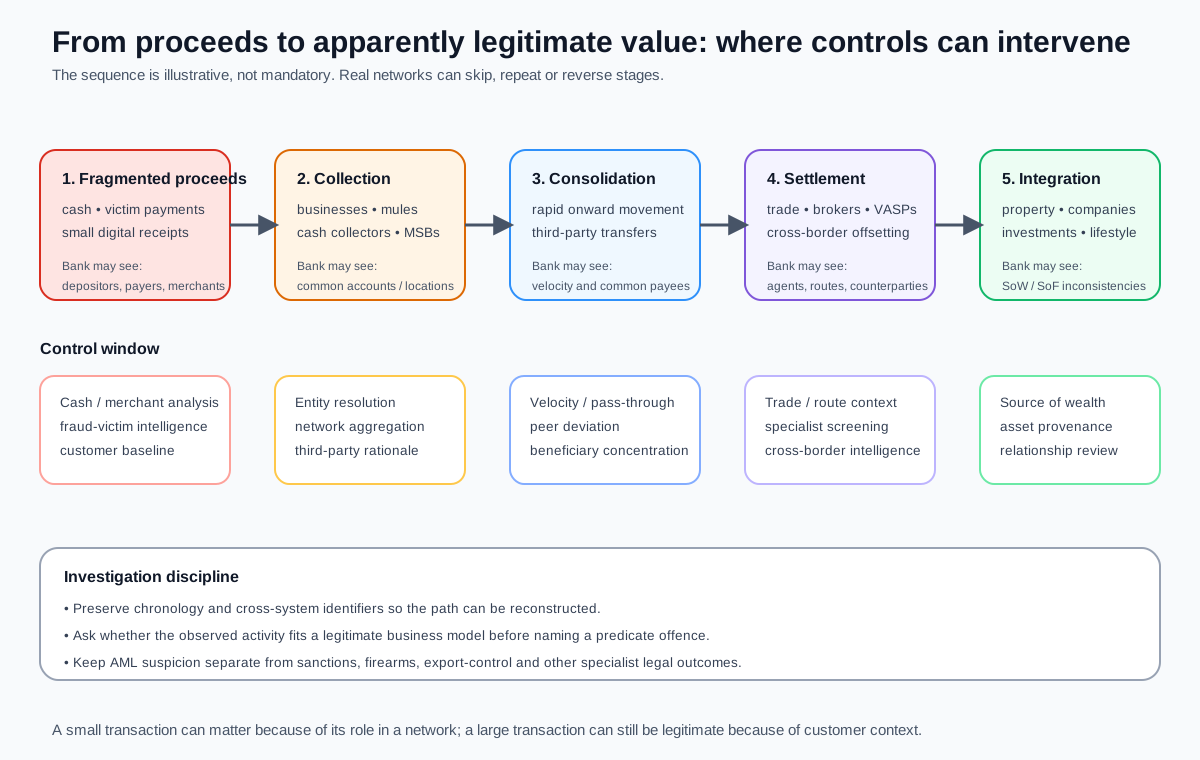
Retail versus wholesale narcotics proceeds
Retail drug sales can create many small cash transactions. Wholesale trafficking can create larger settlements through brokers, trade or professional launderers. Monitoring should therefore avoid one universal “drug proceeds” scenario.
The customer segment, transaction size, channel, geography and counterparties all affect the expected pattern.
Professional laundering network exercise
Five unrelated customers deposit cash and transfer funds to two small businesses. Those businesses send large payments to an overseas trading company. None of the individual accounts alone proves organised crime.
Network analysis should identify common beneficiaries, ownership, devices, cash patterns and customer relationships. External intelligence can then determine whether the network connects to a known criminal group.
Underground settlement
Professional launderers can settle obligations between networks without moving the original criminal cash across borders. A broker in one country pays a beneficiary locally while another broker settles the debt through trade, bank transfer or other value movement.
This can make the bank payment look disconnected from the predicate crime. Analysts should understand the possibility of net settlement without assuming every informal-transfer pattern is criminal. FATF's September 2026 work on underground banking, hawala and other similar service providers explicitly recognises that such systems can also meet legitimate remittance and value-transfer needs.
Trade and organised crime
Criminal groups can use trading businesses to move value through goods, invoices and related-party payments. A legitimate import-export company can also have exactly those features.
The differentiator is economic credibility: goods, prices, counterparties, ownership, volumes and route should tell a coherent story.
Front-company analysis
A front company can have genuine revenue. Investigators should compare known legitimate turnover with total financial activity. If cash deposits materially exceed plausible sales and unexplained cross-border payments follow, the discrepancy deserves review.
Counter-narcotics sanctions overlay
Some drug traffickers and networks can also be targeted by sanctions authorities. OFAC, for example, administers United States counter-narcotics sanctions authorities. Other jurisdictions use different legal instruments and designation frameworks.
A confirmed sanctions nexus can create blocking, rejection, reporting or other mandatory action under the particular law or programme that applies. That legal outcome is separate from whether the bank also has an AML suspicion and separate again from any decision to identify a narcotics predicate offence in an AML report.
Arms and procurement networks
Illicit arms procurement can involve intermediaries, freight, trading companies, specialised equipment and payments through multiple jurisdictions. Goods may be described broadly or routed through third countries.
Banks should preserve trade and payment data and involve export-control, firearms-control or sanctions specialists where the underlying goods, parties or destination raise concern.
End-user uncertainty
A company can purchase dual-use equipment legitimately. Concern increases where end user, destination, goods classification or intermediary role is unclear and the commercial explanation does not resolve the uncertainty.
Do not infer arms trafficking merely because an item could have military use. The UN Firearms Protocol, conventional-arms rules, export controls and proliferation-financing controls have different scopes and should not be collapsed into one generic weapons-risk conclusion.
Logistics-company exercise
A logistics company receives payments from multiple trading companies and pays freight providers and agents. This can be ordinary business. If the same company also receives funds from personal accounts, uses vague payment descriptions and shares ownership with sanctioned or otherwise high-risk entities, the risk picture changes.
Cash courier interaction
Physical movement of cash can sit outside ordinary bank transaction data until it is deposited or exchanged. Banks may see border declarations, deposit behaviour or money-service transactions depending on jurisdiction and product.
The absence of an electronic origin does not itself prove criminality.
Criminal proceeds and property
Organised-crime proceeds can later appear in property, vehicles, luxury assets or businesses. Source-of-wealth analysis may need to trace present assets back to earlier capital.
A current legitimate rental income stream does not necessarily explain the original purchase funds.
Virtual-asset conversion
Virtual assets can be used as one step in a wider laundering network. Bank investigators should link fiat funding, exchange transfers, customer profile and downstream activity rather than treat blockchain activity as a separate world.
Vendor wallet labels require confidence and provenance.
Corruption and protection
Organised crime can use bribery to secure transport routes, avoid enforcement or influence officials. Payments to agents or consultants around licences, customs or procurement events can therefore matter.
PEP connections are risk factors, not conclusions.
Human trafficking and smuggling overlap
Organised networks may operate across multiple crime types. Similar bank accounts or companies can receive proceeds from several predicates.
This is another reason to avoid writing “drug laundering” unless the case actually supports that predicate.
Intelligence fusion
Law-enforcement notices, FIU feedback, fraud reports, sanctions data and internal AML cases can all contribute to organised-crime detection. Each source should retain provenance, date and confidence.
Protected intelligence should be access-controlled.
Investigation chronology
Create a timeline of deposits, transfers, withdrawals, account openings, ownership changes and known external events. Chronology can reveal whether accounts were created together, activated after a trigger or used sequentially.
Network-role classification
Classify observed roles as collection account, consolidation account, business front, broker, cash-out point, beneficiary or unknown. These are analytical roles, not legal labels.
Analysts should be able to revise the role as evidence changes.
Customer explanation
A customer may give a legitimate business explanation. Test it against independent evidence where proportionate. If a wholesaler claims cash receipts from customers, merchant, tax or invoice data may support or contradict the claim.
BA data model
Useful objects include customer, account, transaction, cash event, merchant, business, beneficial owner, device, payment beneficiary, virtual-asset provider, trade document, external intelligence and network case.
Relationships should include confidence and effective dates.
Scenario governance
A rule detecting cash deposits followed by international transfers can create high noise. Segment by business type, historical cash usage, account age, geography and known business relationships.
Known organised-crime cases should be used for back-testing, but controls should also be tested against legitimate edge cases.
QA exercise
Review ten cases labelled “organised crime.” Ask what evidence supports the predicate label. If the answer is only “cash and overseas transfers,” rewrite the narrative to reflect the actual evidence.
Final deep-dive test
A strong learner should be able to follow proceeds through collection, consolidation, settlement and asset conversion; use network analytics without overclaiming; distinguish sanctions, firearms-control and export-control outcomes from AML suspicion; and connect a predicate offence only when credible evidence supports it.
Advanced practice: organised-crime proceeds, criminal markets and professional laundering
The cases in this supplement are fictional training examples; they do not allege misconduct by actual customers.
Organised-crime cases challenge banks because the institution normally sees finance rather than the underlying criminal market. A payment can be connected to narcotics, arms trafficking, extortion, corruption, smuggling or another offence, yet the transaction pattern may look similar across predicate crimes. Advanced investigation therefore starts with the financial behaviour and adds predicate-crime context only when reliable evidence supports it.
Case 1: cash collection linked to narcotics proceeds
A small chain of convenience stores deposits substantially more cash than peer businesses in the same region. The customer explains that cash sales have increased because nearby competitors closed. Merchant-card turnover is stable, inventory purchases have not increased and branch staff observe repeated deposits by people who are not employees.
Within a day of deposit, much of the cash funds payments to a wholesale trading company. The trader then pays several overseas counterparties. Law-enforcement information later links two frequent depositors to narcotics distribution.
The bank should not conclude that every store sale is criminal or that every payment to the trader launders drug proceeds. The investigation should map depositors, amount and timing, store economics, trader relationship, ownership and downstream payment purpose. The official intelligence materially strengthens the case but should remain source-labelled.
A strong suspicious report can describe the cash pattern, customer inconsistency, linked depositors and movement to the trader without claiming facts outside the bank's evidence.
Case 2: professional laundering through an apparently legitimate trader
A commodity trader has hundreds of normal transactions and credible customers. Several unrelated bank customers begin making transfers to the trader that do not fit their own businesses. The trader then makes payments abroad to counterparties unrelated to those customers.
The trader could be providing settlement services in addition to genuine commerce. That possibility becomes more significant if cash, third-party payments, common beneficiaries and circular flows appear across cases.
Professional money launderers can embed illicit settlement within legitimate businesses. The control challenge is to identify the subset of anomalous activity rather than declare the whole trading company criminal.
FATF's September 2026 report on professional money laundering, underground banking and hawala-like systems reinforces the need to identify service networks that move value for multiple criminal clients.
Case 3: illicit arms concern inside lawful defence trade
A corporate customer manufactures components used in civilian and defence products. Payments include governments, licensed distributors and large industrial groups. A monitoring rule flags transfers involving a higher-risk jurisdiction and the word "weapons" in remittance information.
This is not enough to infer illicit arms trafficking. Lawful defence trade can involve controlled goods, export licences, end-use certificates and government counterparties. The AML analyst should coordinate with sanctions and export-control specialists where relevant.
Suppose, however, that a newly incorporated intermediary with no visible defence experience begins receiving high commissions, shares ownership links with the customer's procurement officer and routes payments to an opaque offshore company. That financial pattern can create corruption or laundering concern independent of whether the underlying goods are legally controlled.
The case should keep legal questions distinct: export-control compliance, sanctions, bribery/corruption and AML suspicion can overlap but require different evidence and decision owners.
Case 4: criminal-market proceeds moving through virtual assets
A customer with modest salary receives repeated third-party transfers and moves them to several virtual-asset providers. Analytics indicate exposure to wallets associated with an online illicit marketplace and to a mixer.
The bank should assess the reliability and confidence of the wallet attribution. If the exposure is indirect or probabilistic, the narrative should say so. Customer explanation, transfer timing, payer relationships and provider risk still matter.
FATF red-flag guidance identifies anonymity-enhancing services, unusual transaction patterns, P2P activity and source-of-funds inconsistencies as relevant factors. None is a standalone conviction.
Case 5: extortion proceeds disguised as business revenue
A security-services company receives payments from small businesses throughout one city. The owner says the payments are service subscriptions. Several payers tell the bank or police they were coerced into paying for "protection."
The bank can identify the financial receipts and customer profile but should rely on credible external information before characterising the underlying conduct as extortion. AML analysis can examine whether revenue is mixed with legitimate business income, whether value moves to owners or related companies and whether the company has genuine operating activity.
This case illustrates why front-company analysis and predicate-crime intelligence often intersect.
Case 6: criminal proceeds and real estate
An individual linked through official intelligence to organised crime purchases property through a company. Funding comes partly from a regulated mortgage and partly from several private loans. The mortgage is not evidence that the transaction is legitimate; it simply explains one funding source.
The investigator should identify company beneficial ownership, private lenders, lender capacity, historical wealth and whether the customer's legitimate income can support the equity and debt service. Property professionals, lawyers and lenders may each see only part of the chain.
The SAR/STR should distinguish official intelligence from the bank's own financial reconstruction.
Predicate-offence labels should be evidence-led
A recurring weakness in financial-crime education is using words such as "drug dealer," "arms trafficker" or "organised-crime group" before the evidence justifies them. Banks frequently operate on suspicion and may not know the exact offence.
A better case structure is:
- describe customer and expected activity;
- identify the unusual financial behaviour;
- explain relevant relationships and ownership;
- add credible official or open-source intelligence with provenance;
- state which predicate offence is suspected, if any;
- explain why the financial activity remains suspicious.
This is both more accurate and more useful to an FIU.
Professional money laundering infrastructure
Professional laundering can include cash collectors, money-service businesses, underground bankers, traders, company formation specialists, virtual-asset brokers, corrupt professionals and property intermediaries. A single network can combine several methods.
Banks should therefore look for service-provider indicators across cases: common beneficiaries, common companies, directors, devices, cash deposit locations, traders, virtual-asset providers or professional intermediaries. Cross-customer analysis can reveal infrastructure that one account cannot.
The presence of a common professional does not prove complicity. A large law firm, exchange or logistics provider can legitimately appear across many customers. Link rarity, role and corroborating evidence matter.
Cash couriers and physical movement
Criminal proceeds can be physically transported before entering another financial institution. A bank may encounter this through cash deposits, foreign-exchange activity or accounts used by businesses involved in transport or trading.
Border declaration rules vary by jurisdiction. A bank should not teach one country's cash declaration threshold as a universal rule. Instead, investigators should consider whether cash activity is consistent with the customer and whether reliable information indicates undeclared or illicit movement.
Trade settlement and criminal markets
Trade can settle value for organised-crime groups without a direct cross-border payment from the original criminal client. Goods can be over- or under-invoiced, phantom shipments created, or legitimate traders used to offset obligations.
The bank should assess its actual visibility. A payment bank may not see shipping documents. A trade-finance bank may see documents but cannot physically verify every shipment. The investigation should identify what evidence is available and avoid claiming more.
Corruption as an enabler
Organised crime can depend on corrupt officials, customs staff, licensing bodies or private-sector employees. Payments to politically exposed persons or government-linked intermediaries can therefore be relevant, but PEP status is not evidence of corruption.
Analysts should look for unexplained commissions, related-party ownership, payments disproportionate to services, contract timing, cash or assets inconsistent with known income and credible intelligence about the underlying decision.
Arms trafficking, sanctions and proliferation financing
Illicit arms trafficking is not the same as proliferation financing. PF concerns financing related to proliferation of weapons of mass destruction and associated obligations under FATF Recommendation 7 and relevant UN sanctions. Conventional arms can also be subject to sanctions, export controls or domestic licensing.
A bank should route the issue according to the applicable legal framework rather than use all weapons-related risk under one label. AML suspicion can coexist with sanctions or export-control concerns without being identical to them.
Small-value organised-crime networks
Retail criminal markets can generate many low-value transactions. A network of small dealers or collectors may not produce one obvious large alert. Customer-level and network-level aggregation can reveal repeated common beneficiaries, cash-out points or settlement accounts.
Threshold-only monitoring can miss this. Models can examine payer diversity, rapid consolidation, peer-group deviation and links to known cases while controlling for legitimate high-volume retail activity.
Geographic and corridor risk
Certain corridors may have higher exposure to narcotics trafficking, smuggling, conflict or organised crime. Geography should inform risk but not become a decision by itself. Legitimate businesses, migrant families and charities use the same corridors.
Controls should combine geography with customer purpose, transaction behaviour, counterparties, ownership and intelligence.
Law-enforcement information and tipping-off controls
Official information can materially change a bank's assessment, but it may be confidential. Case systems need role-based access and provenance so protected intelligence is not copied casually into customer-facing notes or communications.
Customer contact during an investigation should be designed with local tipping-off rules in mind. Those rules vary, so global training should state the principle without inventing one universal procedure.
Scenario engineering for organised crime
A useful scenario should target observable finance rather than a crime label. For example:
Hypothesis: an account may be collecting criminal cash when deposit volume materially exceeds plausible business activity, deposits are made by unrelated third parties, and value is rapidly moved to external counterparties inconsistent with the customer's declared business.
This is better than a rule called "drug trafficking alert" because the bank cannot usually infer drugs from transaction data alone.
Investigation network map
For a complex case, map:
customer → accounts → cash depositors → companies → beneficial owners → professional intermediaries → trade counterparties → virtual-asset providers → downstream beneficiaries → properties or investments.
For each edge, record evidence source and date. Mark verified ownership separately from shared address or public allegation. This prevents the network diagram from implying certainty that does not exist.
FIU/SAR/STR narrative quality
A strong report should give authorities actionable identifiers: names, accounts, transaction references, dates, values, companies, beneficial owners, relevant counterparties and explanation of the suspicious pattern. It should state official intelligence carefully and avoid speculation presented as fact.
If the predicate offence is unknown, say so. The value of the report lies in the financial intelligence and the bank's reason for suspicion, not in guessing a crime category.
BA and architecture exercise
A system supporting organised-crime investigations should be able to connect customer, account, legal entity, beneficial owner, transaction, cash event, device or channel signal, trade relationship, virtual-asset exposure, fraud report, external intelligence and case. Links should be effective-dated and source-labelled.
The platform should also support network-level cases spanning multiple customers while retaining individual customer risk decisions and reporting status. This avoids losing the infrastructure view when accounts are closed separately.
Final professional standard
Typology knowledge should make investigators ask better questions. It should never become a shortcut from "cash," "crypto," "defence," "high-risk country" or "commodity trader" to a criminal conclusion. The best analysis follows the money, establishes ownership and relationships, uses intelligence responsibly, tests legitimate explanations and reports the evidence at the level the bank can actually support.
Practitioner close: narcotics, arms and organised-crime typologies without overclaiming the predicate offence
The cases in this supplement are fictional training examples; they do not allege misconduct by actual customers.
Banks rarely receive a transaction labelled “drug proceeds” or “illegal arms payment.” The institution usually observes financial behaviour and customer relationships, while law enforcement or other intelligence may provide information about the suspected predicate offence. A high-quality AML investigation therefore separates what the bank can prove from its own data from what external intelligence suggests and from what the analyst infers.
This distinction matters because many organised-crime typologies resemble legitimate commerce. Cash-intensive businesses, international trade, logistics, precious metals, virtual assets and family-owned companies all serve lawful economies. The objective is not to label a sector criminal; it is to identify behaviour that does not fit the customer’s legitimate economic story or that connects to credible criminal intelligence.
Case lab: narcotics proceeds entering a cash business
A convenience-store customer has always made cash deposits. Over several months, deposits increase sharply without corresponding evidence of increased turnover, appear at branches outside the trading area, and are followed by rapid transfers to unrelated companies. Some deposit activity occurs shortly after other individuals make deposits into associated accounts.
The bank does not need to prove that the physical cash came from narcotics sales to identify an AML concern. The investigation can document unexplained cash growth, geographic inconsistency, linked accounts, pass-through behaviour, ownership, counterparties and customer explanation. If law-enforcement information later connects one party to narcotics trafficking, that intelligence can be incorporated with clear provenance.
A suspicious-activity narrative should not say “customer is a drug trafficker” unless there is a proper basis for that statement. It can say that activity is inconsistent with the stated business and presents indicators associated with laundering of cash-generated criminal proceeds.
Case lab: wholesale cash and professional laundering
A network of companies receives high volumes of cash or cash-equivalent value and makes cross-border payments described as wholesale trade. Several companies share directors, addresses or agents, while their stated business activities differ. Funds move among the entities before leaving the country.
This may indicate professional laundering infrastructure, but the network could also represent a genuine trading group. Investigators should map ownership, company age, business licences where relevant, trade counterparties, invoicing, tax or financial information available through due diligence, payment purpose and the source of cash.
Professional laundering is a hypothesis strengthened by repeated service to apparently unrelated criminal proceeds, use of controlled settlement infrastructure or other credible evidence. Complexity alone is not enough.
Arms and defence trade: lawful industry versus illicit trafficking
Defence and dual-use industries are heavily regulated but include substantial legitimate trade. A payment to an arms manufacturer is not proof of illegal arms trafficking. The bank should distinguish legal defence commerce, sanctions or export-control questions, proliferation-financing risk and laundering of proceeds from illicit arms activity.
Where the bank provides trade finance and holds relevant documents, it may see goods descriptions, end users, shipping routes, licences or counterparties. Where the bank only processes a payment, visibility can be much narrower. The AML control should not pretend to classify controlled goods from a generic payment description.
If a transaction raises sanctions, export-control or proliferation-financing concerns, those should be routed to the appropriate specialist control rather than described generically as money laundering.
Case lab: logistics company with unusual counterparties
A logistics customer begins receiving payments from companies unrelated to its known routes and sends funds to suppliers in jurisdictions outside its normal operations. Payment narratives are vague and ownership information shows a new shareholder linked to another high-risk network.
The investigation should ask whether the customer expanded legitimately, whether the new shareholder changed strategy, whether contracts and counterparties fit a real logistics business, and whether payment volume aligns with operational scale. The risk comes from unexplained change and network context, not the logistics sector itself.
Extortion and protection money
Organised criminal groups can generate proceeds through extortion, protection payments or illegal taxation. The financial footprint may be fragmented and may use cash, personal transfers, merchant accounts or intermediaries.
A bank may identify repeated payments from local businesses to the same individuals or companies, but that pattern can also reflect legitimate shared suppliers, landlords or community services. External intelligence, payment references, customer interviews and network relationships can help distinguish the hypotheses.
Analysts should avoid contacting customers in ways that could create safety risks or interfere with law-enforcement activity. Escalation procedures should accommodate sensitive intelligence.
Corruption as an enabling mechanism
Organised crime can depend on corrupt officials, facilitators or professional enablers. Payments to politically exposed persons or public officials can therefore appear in the wider network.
PEP status is not evidence of corruption. The relevant questions concern unexplained benefits, timing, contractual purpose, relationship to licences or enforcement decisions, intermediaries and whether the payment makes commercial sense.
The AML case can link corruption indicators to the organised-crime hypothesis without assuming guilt from status alone.
Real estate and high-value assets
Criminal groups may place or preserve value through property, vehicles, precious metals, jewellery, art or other assets. A purchase itself can be legitimate. Concern grows when funding is inconsistent with known wealth, uses unexplained third parties, involves opaque companies or is followed by transactions that appear designed to return value in a more legitimate-looking form.
Investigators should distinguish the asset transaction from the source-of-funds and source-of-wealth questions. A property sale can explain the immediate incoming payment while leaving the historical acquisition of the property unresolved.
Virtual assets in organised-crime networks
Virtual assets can be used for legitimate investment, commerce and remittance as well as criminal settlement. Bank-side evidence may include transfers to VASPs, customer explanation, linked accounts and transaction timing. Blockchain analytics can add exposure and path information where available.
Indirect wallet exposure should be interpreted carefully. A customer sending to an exchange that later interacts with criminal infrastructure is not automatically participating in the crime. Distance, attribution quality, customer control and transaction context matter.
Cash couriers and physical movement
Physical movement of currency can reduce the bank’s visibility until funds are deposited, converted or transmitted. Indicators such as deposits across multiple locations, use of third parties and rapid international movement can support investigation, but none proves a cash-courier scheme alone.
Banks should focus on the financial facts they observe and combine them with reliable intelligence where available.
Trade as settlement infrastructure
Organised crime can use over- or under-invoicing, phantom shipments, multiple invoicing, third-party payments or commodity trading to move value. Banks often have incomplete visibility. A trade-finance bank may see documents; a correspondent processing one payment may not.
The case narrative should therefore distinguish observed anomalies from assumptions about the underlying shipment. Where evidence is insufficient to confirm a trade-based method, the analyst can state that the activity is consistent with a trade-based laundering hypothesis without presenting it as proven.
Low-value activity and network significance
Individual organised-crime transactions do not always have high values. Recruitment payments, courier expenses, bribes, account testing and operational costs can be small. Network position can be more informative than transaction size.
Monitoring and investigation should therefore consider repeated counterparties, clusters, temporal patterns and links to known risk rather than depend only on high monetary thresholds.
Geography and criminal intelligence
Geography can help prioritise risk, but “high-risk country” is too crude for many organised-crime cases. Risk may concentrate in a city, border, port, trafficking corridor or local criminal network. Conversely, criminal proceeds can move through major low-risk financial centres.
External law-enforcement or FIU information can materially strengthen an investigation. The bank should record the source, date, restrictions on use and exact entity or activity it concerns. Intelligence should not be generalized beyond what it actually says.
Network model and evidential weight
A network can include customers, beneficial owners, counterparties, devices, addresses, merchants, companies and external intelligence. Each link should have an evidential type. A verified ownership relationship is stronger than a shared postal address. A direct payment is different from a two-hop connection through a common counterparty.
Investigators should be able to explain why the network matters. A visually dense graph is not a substitute for reasoning.
Sanctions and proliferation-financing distinctions
A criminal group can also include sanctioned persons or proliferation-financing actors, but the controls are legally different. A sanctions prohibition can apply without AML suspicion, while AML suspicion can exist with no sanctions nexus. Proliferation-financing analysis can involve procurement networks and dual-use goods rather than ordinary organised-crime proceeds.
Case orchestration should connect relevant information while preserving separate legal decisions and reporting pathways.
Practitioner case-writing standard
A strong narrative should describe the customer’s expected activity, what changed, relevant owners and counterparties, transactional pattern, network evidence, customer explanations, external intelligence, alternative legitimate hypotheses and the basis for escalation or closure.
Avoid statements such as “transactions show narcotics trafficking” when the banking evidence only supports unexplained cash and network behaviour. Precision strengthens the case rather than weakening it.
BA and monitoring checkpoint
A BA should model customer, beneficial owner, company, account, payment, cash event, geography, trade relationship, device or channel where lawfully available, external intelligence, alert, investigation and decision. Scenario design should combine factors such as unexplained cash, pass-through velocity, network concentration, ownership change and unusual trade relationships rather than rely on a single criminal-sector keyword.
Testing should include legitimate cash businesses, lawful defence trade, high-risk logistics, false-positive shared addresses, law-enforcement intelligence, small-value network activity and cases where the predicate offence cannot be proven from bank data.
Final practitioner checkpoint
The learner should be able to investigate financial behaviour associated with narcotics, illicit arms and organised crime while remaining disciplined about evidence. They should distinguish lawful high-risk sectors from criminal use, avoid overclaiming the predicate offence, integrate credible intelligence, understand network roles and keep AML, sanctions, export-control and proliferation-financing conclusions separate.
Practitioner masterclass: organised-crime investigations without stereotype-driven conclusions
Organised-crime typologies are useful because they help analysts recognise patterns, but they become dangerous when used as labels without evidence. The bank should reconstruct the money and relationships first, then identify which criminal hypothesis is actually supported.
Exercise: cash collection
Practice exercise — work through this before reading on. Three convenience stores make unusually high cash deposits and transfer funds to the same wholesaler. Build two explanations: a legitimate purchasing network and a criminal cash-consolidation network. Identify what evidence would distinguish them.
The exercise teaches that the transaction pattern alone is not enough.
Exercise: professional laundering
Practice exercise — work through this before reading on. Eight unrelated customers transfer to two businesses that then send funds abroad. Map the network, ownership, devices, transaction references and customer histories. Decide which links are verified, inferred or weak.
Exercise: arms-procurement risk
Practice exercise — work through this before reading on. A trading company pays for industrial equipment through an intermediary in a third country. External intelligence suggests the intermediary may support illicit procurement. Separate the AML question from the export-control and sanctions questions and identify which specialist owns each decision.
Exercise: counter-narcotics designation
A payment beneficiary is a true match to a person designated under a counter-narcotics sanctions programme. The sanctions outcome is driven by law. Any AML investigation into proceeds is separate and should not be treated as the reason for the sanctions action.
Case-writing test
Practice exercise — work through this before reading on. Replace “customer is laundering drug money” with a factual narrative that describes cash deposits, counterparties, onward movement and external intelligence. Add the predicate label only if evidence supports it.
Model design
Practice exercise — work through this before reading on. For a network model, test legitimate high-connectivity businesses such as payment processors, wholesalers and marketplaces. High centrality is not automatically criminal.
BA exercise
Practice exercise — work through this before reading on. Design a case model linking fraud, organised-crime intelligence, sanctions designation, account network and payments. Preserve separate decision states for AML, fraud and sanctions.
Final practitioner test
A strong learner should be able to follow organised-crime proceeds across cash, trade, remitters, businesses and virtual assets; recognise when intelligence supports a specific predicate offence; avoid demographic and geographic stereotyping; and coordinate AML, sanctions, fraud, trade and legal specialists without collapsing their roles.
Mastery extension: narcotics, arms and organised-crime typologies
This extension develops commercial-plausibility testing, network investigation and sensitive account decisions. All worked cases are fictional training examples. The chapter reading estimate covers the assembled substantive prose; independently completing the exercises requires additional time that depends on the learner.
Organised crime is a network, not a single transaction type
Organised criminal groups can generate proceeds from narcotics, weapons trafficking, extortion, smuggling, fraud, counterfeit goods and other offences. They can move value through cash, front businesses, remitters, trade, property, virtual assets, professional money launderers and ordinary bank accounts. The financial footprint therefore depends on the crime, geography and laundering infrastructure rather than on one universal pattern.
Banks should avoid assuming that cash, a particular country or a trade sector proves organised crime. The relevant evidence comes from transaction behaviour, ownership, network relationships, victim or law-enforcement intelligence, business plausibility and unexplained movement of value.
Worked case: cash proceeds through businesses
Several small retail businesses under common ownership deposit cash well above their declared turnover. Funds move between the businesses, then to a wholesale company and finally to overseas trading entities. Some of the companies have genuine operations.
The presence of real business activity does not eliminate laundering risk. Investigators should compare cash deposits with merchant/acquiring data, expected sales, tax/accounting information where available, ownership, related-party transfers and supplier/customer relationships. The conclusion should describe unsupported financial behaviour rather than label the businesses criminal fronts without evidence.
Worked case: professional money-laundering network
Ten unrelated customers receive funds from different suspected criminal sources. They send money to three companies that appear independent but share beneficial owners and directors. Those companies use a mixture of trade payments, cash withdrawals and virtual-asset purchases before funds reach overseas destinations.
The key analytical skill is network reconstruction. Account-level rules can generate ten separate alerts; graph analysis can show common nodes. Relationship confidence still matters. Shared ownership is stronger than a common postcode. A common payment processor may be legitimate. The network should be interpreted rather than merely visualised.
Narcotics proceeds
Drug trafficking can produce significant cash and cross-border value flows, but banks rarely witness the predicate offence directly. Useful signals can include cash activity inconsistent with business profile, mule networks, rapid movement, remitters, trade, property and criminal-intelligence links. A case should focus on the observed financial pattern and verified intelligence.
A low-value transaction should not be dismissed merely because organised crime is imagined as high value. Networks can deliberately fragment activity.
Arms and weapons-trafficking exposure
Weapons-related financial crime can overlap with sanctions, export controls, proliferation-financing controls and organised crime. Payments for legitimate defence or sporting-goods activity can also be lawful. The bank needs accurate customer purpose, counterparties, goods/service information where available and appropriate specialist escalation.
An AML risk score should not substitute for legal sanctions or export-control analysis.
Cash, remitters and underground settlement
Organised-crime networks can use money-service businesses or informal transfer systems for speed and geographic reach. Those mechanisms also serve legitimate customers. The bank should understand the direct customer's licensing/registration where required, business model, agents, corridors, settlement accounts and transparency rather than treating the channel itself as criminal.
Logistics and trade
Criminal networks can hide value in apparently normal trade or logistics transactions. Import/export companies, freight businesses and warehouses can be legitimate and still be exploited. Monitoring should compare customer profile, counterparties, routes, values, ownership and payment behaviour rather than relying on sector labels.
Corruption and facilitation
Organised crime can depend on corrupt officials, compromised employees or professional facilitators. Payments to consultants, agents or officials can therefore matter, but PEP status or intermediary involvement is not proof. Investigators should establish relationships, timing, commercial rationale and evidence.
Network-analysis exercise
Practice exercise — work through this before reading on. Construct a graph with criminal-proceeds sources, cash businesses, remitters, trading companies, beneficial owners, accounts, devices and overseas destinations. Mark each link as verified, strongly inferred or weakly inferred. Then identify which nodes are central and which links, if removed, would materially change the hypothesis.
This exercise teaches that a network score is only as reliable as entity resolution and source data.
Scenario-design exercise
Practice exercise — work through this before reading on. Design one monitoring hypothesis for organised-crime proceeds without naming the predicate offence. For example: multiple cash-intensive businesses under common ownership depositing materially above expected turnover and rapidly transferring to common overseas beneficiaries. Define data, thresholds, segmentation, false-positive challenge cases and alert payload.
Then ask whether the same scenario would unfairly flag legitimate franchise groups or treasury structures. Add contextual controls accordingly.
Case-writing discipline
Prefer factual language: "Five entities under common beneficial ownership received cash deposits materially above expected turnover and transferred 87% of funds within 24 hours to the same three beneficiaries." Avoid unsupported statements such as "drug money" unless credible external evidence establishes that link.
Final evidence test
Practice exercise — work through this before reading on. For each signal—cash intensity, remitter use, shared beneficial owner, high-risk corridor, trade payments, virtual-asset conversion, law-enforcement request and negative media—state whether it is a fact, risk factor, intelligence source or conclusion and what further evidence is needed.
A strong learner should finish able to understand organised crime as a connected financial ecosystem while keeping predicate-offence allegations, sanctions decisions and AML suspicion properly separated.
Worked case: precursor chemicals in legitimate trade clothing
A corporate customer, a mid-sized chemical distributor with eight years of banking history, begins importing significantly increased volumes of three dual-use precursor chemicals alongside its established product lines. The goods are lawful industrial chemicals with widespread legitimate applications, and the customer's documentation is complete: supplier contracts, safety-data sheets, transport records and end-user declarations naming domestic manufacturing buyers. Within six months, import volumes for the three chemicals increase sixfold while the established product lines remain flat, and payments to two new overseas suppliers account for an illustrative 70 percent of the customer's outbound transfers.
Precursor diversion for synthetic-drug manufacture can create serious organised-crime and public-safety exposure. Commercial plausibility should be tested alongside document authenticity and completeness. The investigation starts with demand-side plausibility: the named domestic end-users' credible consumption capacity, verified against their size, sector and production processes, compared with the volumes the distributor claims to supply them. An apparent sixfold mismatch could reflect stock building, new contracts, an incorrect demand baseline, diversion or fictitious sales. Each explanation should be tested against dated orders, inventory, deliveries and the buyers' actual consumption capacity.
Supply-side analysis examines the new overseas suppliers: their manufacturing capacity and reputation, the commercial rationale for the distributor switching supply, pricing relative to established sources, and payment terms. Below-market pricing from unknown suppliers, prepayment demands inconsistent with the trade relationship's maturity, and routing through jurisdictions associated with precursor diversion each add weight. Product-mix analysis asks why these three chemicals specifically: their joint utility in synthetic-drug production, assessed against the distributor's historical product expertise, distinguishes opportunistic diversion from coincidental growth. A distributor entering unfamiliar pharmaceutical or fine-chemical supply needs a credible explanation for its product selection and capabilities. Legitimate diversification remains possible; product overlap with illicit synthesis is a contextual risk factor requiring corroboration.
In this fictional case the demand test fails decisively: the named end-users confirm order volumes at a fraction of claimed supply, one named buyer denies any relationship, and warehouse records support inventory accumulation far beyond credible storage turnover. The bank assesses the applicable suspicious-reporting threshold, any legal prohibition or relevant order, and authorised temporary controls without assuming that concern alone creates a power to freeze funds. Any specific controlled-substance obligation must be established for the bank's role and jurisdiction. Lawful FIU or law-enforcement channels can support urgent public-safety escalation, while relationship decisions and a portfolio review follow the evidence. The control lesson is to test demand as well as paperwork: complete documentation is valuable but cannot resolve a material contradiction in underlying commercial activity. Product-mix surveillance can reveal concerns that payment review alone misses.
Cash-courier networks: physical movement, financial traces
Despite digitalisation, organised crime continues moving physical cash across borders through couriers, and the banking system sees the traces at both ends: structured withdrawals and deposits, cash-intensive front businesses with anomalous volumes, travel patterns correlated with cash events, and funnel accounts consolidating for courier collection. Courier-network investigation joins these fragments through timing, geography and human-network analysis rather than through payment chains that deliberately avoid the banking system in transit.
The analytical method works backwards from cash events to organisation. Deposit-timing analysis identifies consolidation rhythms suggesting scheduled collections. Geographic analysis connects withdrawal locations, travel records where lawfully available, and border-crossing patterns to corridor identification. Denomination and packaging intelligence from cash-handling operations, where the bank's own cash centres observe vacuum-sealed bundles, uniform denominations or currency straps from other institutions, provides physical corroboration that monitoring data alone cannot. Human-network analysis connects the depositors, account holders, travellers and business owners through shared addresses, devices, vehicles and associations.
Response coordination with law enforcement is closer than in typical money-laundering cases because courier interdiction is a physical operation dependent on timing intelligence. The bank's role is precise, lawful information provision through proper channels, careful account treatment that avoids alerting targets during active operations, and parallel financial investigation that maps the network behind the couriers. Where lawful and appropriate, the bank can coordinate account-action timing with authorities to avoid compromising an operation. It retains responsibility for its own legal duties, protective controls and account decisions; coordination cannot override a binding order or delay statutory reporting. Neither a request to keep an account open nor the absence of such a request removes the need for documented bank approval and review.
Extortion proceeds: laundering coercion into revenue
Extortion and protection-money proceeds enter the banking system disguised as legitimate business revenue, and their detection depends on recognising coercion economics rather than transaction anomalies alone. The characteristic pattern shows businesses in vulnerable sectors, hospitality, construction, retail, logistics, making regular payments to entities providing no verifiable service, often described as security, consulting or brokerage. Amounts follow coercion logic rather than market pricing: round figures, sudden imposition on previously untroubled businesses, simultaneous onset across businesses in a locality, and escalation following resistance.
Victim identification is the investigation's most sensitive dimension, because the paying businesses are victims rather than suspects and heavy-handed inquiry can endanger them. Analysis should proceed from data rather than confrontation: payment-pattern commonalities across supposedly independent businesses, recipient-entity substance examination, service-delivery verification, and geographic clustering. Where patterns indicate area-wide extortion, law-enforcement engagement through proper channels takes precedence over customer contact, and the safety implications of any account action must be assessed explicitly. Closing a victim's account for receiving extortion pressure compounds the harm; the control objective is evidence preservation and victim protection alongside network investigation.
Recipient-side analysis examines the extortion infrastructure: entities with no employees or premises receiving service income from multiple unrelated businesses, rapid onward movement to organisers, and connections to known organised-crime figures or entities through ownership, association or financial links. The laundering dimension arises as extortion proceeds merge into apparently legitimate business income of front entities or fund lifestyle expenditure; source-of-wealth analysis for recipient principals who display wealth inconsistent with any legitimate activity provides corroboration. A report should describe the observed payment pattern and grounds for suspecting extortion or laundering, distinguishing verified facts from allegations and inference. Victim-safety handling belongs in the case record; the bank need not prove both offences before applying the local reporting threshold.
Defence-trade diligence: lawful industry, illicit diversion risk
Lawful defence and dual-use-adjacent trade can create complex customer-diligence questions because the same goods, customers and corridors serve legitimate national-security purposes and criminal diversion simultaneously. Banks serving this sector need diligence standards that neither criminalise lawful defence commerce nor wave through procurement networks. The foundation is end-user and end-use verification proportionate to the goods' sensitivity: government and established prime-contractor end-users with verifiable programmes present fundamentally different risk from opaque intermediaries naming sensitive destinations.
Intermediary analysis is decisive. Procurement agents, brokers and distributors between manufacturer and declared end-user must demonstrate substantive function: technical expertise, logistics capability, financing role or market access that explains their margin. Intermediaries without a credible commercial function can indicate diversion risk, particularly where they were recently formed, operate from jurisdictions disconnected from the trade corridor, or obscure their principals. Ownership analysis extends to identifying state, military or intelligence connections of intermediaries and end-users, assessed against sanctions, export-control and corruption frameworks simultaneously.
Licence verification provides independent grounding: export licences, end-user certificates and government-to-government programme documentation should be verified with issuing authorities where mechanisms exist, and inconsistencies between licence scope and observed transactions treated as immediate review triggers. Diversion indicators include order quantities inconsistent with declared programmes, delivery routing through transhipment points associated with diversion, after-sales-service arrangements that provide continued access to controlled technology, and payment structures involving third-country intermediaries without commercial logic. The bank's sector appetite, approval authorities and specialist resourcing should reflect the reality that defence-trade diligence cannot be performed competently as an occasional adjunct to general corporate banking.
Worked case: the broker between lawful and illicit
A bank's trade-finance desk receives a letter-of-credit application from a metals-trading customer for the export of precision machine tools to an illustrative Central Asian destination, with end-use declared as civilian manufacturing. The goods value, an illustrative 2.4 million, is unremarkable for the customer's established trade. A sanctions and export-control review, triggered by the goods' technical specifications rather than the parties, identifies the machine tools as potentially controlled dual-use items capable of contributing to military programmes. The named end-user is a civilian industrial company incorporated eighteen months ago with no verifiable manufacturing footprint, and the freight forwarder has previously appeared in an industry advisory on diversion-risk routing.
Arms-broker and procurement cases occupy the difficult ground between lawful defence-adjacent commerce and illicit trafficking, and the investigation must hold both possibilities open while testing each. The goods analysis comes first: classification against control lists through technical assessment, since dual-use determination depends on specifications, performance thresholds and potential applications rather than on marketing descriptions. A machine tool lawful for civilian sale becomes controlled where its precision, automation or scale crosses defined thresholds, and the bank should escalate technical uncertainty relevant to its own financing decision, role and legal exposure. Customer or exporter classifications can inform that review but may need corroboration. The exporter's classification and licensing duties remain distinct from the bank's obligations; not every bank must independently classify every traded product.
End-user verification follows: the civilian industrial company's existence, premises, workforce, production history and technical capacity to use the declared goods are tested through commercial intelligence, registry data and, where available, official end-user certificate verification. A recently formed entity with no manufacturing footprint ordering precision equipment inconsistent with any demonstrable production programme warrants corroborated diversion-risk investigation. Intermediary analysis examines the broker's role: this customer has historically traded metals, not machine tools, and the shift into unfamiliar controlled-adjacent goods without demonstrated expertise suggests brokering on behalf of undisclosed principals rather than genuine trade diversification.
Routing and finance analysis completes the picture. The proposed shipment routes through two transhipment points associated with diversion activity, adding cost and delay without commercial justification. Payment terms show third-party funding from an entity unconnected to the declared trade, and the economics leave the customer a thin margin inconsistent with the compliance risk it supposedly assumes voluntarily. In this fictional case the accumulated evidence supports suspected procurement diversion. Specialists establish the applicable sanctions and export-control rules, legal nexus, licences and any bank-specific prohibition before determining whether a hold or refusal is required or otherwise authorised. AML reporting follows the local threshold and deadlines independently. Any additional export-control report or authority engagement depends on the applicable framework and lawful channel. Relationship review extends to similar goods shifts in the wider trade portfolio; suspicion is not itself a universal freezing power.
The control lesson is that goods expertise must trigger review independently of party screening: clean parties trading controlled goods to opaque end-users through diversion routing is precisely the pattern party screening misses. Trade desks need goods-classification awareness sufficient to recognise potential control-list relevance and escalate for technical assessment, with the escalation path fast enough for commercial timeframes and rigorous enough for the stakes. The companion chapters on proliferation financing, export controls and goods screening develop the full control architecture; this chapter's contribution is recognising the broker pattern at the typology level.
Kidnap, ransom and extortion-payment controls
Known or suspected kidnap-for-ransom and extortion payments create urgent, sensitive decisions. The demand and surrounding facts still require verification, including consideration of fraudulent ransom claims. Ransom payments may be lawful and necessary to preserve life, negotiated through specialist responders, and funded through the victim's family or employer accounts with the bank's knowledge. The bank's role combines assessment of whether payment is lawful with evidence preservation, reporting and investigation, coordinated with authorities where appropriate through lawful channels. A life-preserving purpose does not override applicable sanctions or other prohibitions; legal specialists must establish any available exception or licence and its conditions. United States OFAC restrictions and licensing are jurisdiction-specific, not a global ransom-payment rule.
Operational handling requires pre-defined procedures rather than improvisation, because ransom cases unfold under extreme time pressure with distressed customers. Procedures should designate decision authorities available outside business hours, define verification standards for ransom demands that balance speed with fraud prevention, since false ransom claims exploit real disappearances, specify law-enforcement coordination protocols respecting the family's wishes and jurisdictional requirements, and establish evidence-preservation measures for the payment chain. Staff handling ransom cases need specialist briefing: standard fraud-prevention scripts challenging the customer about unusual payments are inappropriate and potentially dangerous where the customer acts under duress with explicit instructions not to involve the bank.
Post-payment investigation follows the funds as a priority organised-crime case, since ransom proceeds fund further criminality and the payment chain often reveals network infrastructure. Tracing should begin promptly using authorised recall, preservation and information-sharing channels. Contact with other institutions must respect confidentiality, data-sharing limits and restrictions on disclosing suspicious reports. The victim family's ongoing banking needs require sensitive handling: victim status should not automatically trigger account closure or unnecessary restrictions, and the family may need a dedicated contact. Required legal restrictions still apply; monitoring and account access are separate decisions based on lawful authority and the circumstances. Reporting captures the predicate kidnapping or extortion alongside the laundering, with victim-safety handling reflected throughout the case record and information-sharing calibrated to avoid endangering victims or operations.
Fuel smuggling and subsidy-arbitrage networks
Fuel smuggling exploits price differentials created by subsidies, taxation and sanctions: subsidised fuel purchased cheaply in one jurisdiction sells at multiples across the border, sanctioned oil moves through obscured chains to willing buyers, and tax-evaded fuel undercuts legitimate distributors domestically. Fuel smuggling can generate substantial proceeds, with banking traces through transport operators, storage facilities, border-area cash businesses, complicit distributors and the professional facilitators managing cross-border settlement.
Route and logistics analysis provides the investigative foundation: fuel movements inconsistent with licensed distribution chains, transport capacity exceeding legitimate supply contracts, border-crossing patterns clustered at weak-control points, and storage facilities with throughput inconsistent with their commercial footprint. Price analysis identifies subsidy-arbitrage economics: unusually low retail or procurement prices can prompt checks of supply, tax treatment and margins, but discounts, inventory valuation, subsidies and data errors must be considered before inferring illicit sourcing. Counterparty analysis examines the fuel supply chain for opacity: intermediaries adding margins without a credible function can warrant investigation. Brokers may legitimately operate without storage or transport assets, so contracts, expertise, risk assumed and services delivered matter.
Corrupt border, customs, regulatory or law-enforcement facilitation can support fuel smuggling, but official complicity is not a necessary feature of every network. PEP and associate analysis around smuggling corridors, lifestyle analysis for officials controlling relevant checkpoints and licensing, and corporate analysis identifying official-linked interests in transport and storage companies each contribute. Possible sanctions exposure requires identification of the applicable regime, parties, ownership or control rules, commodity restrictions and legal nexus. A geographical or smuggling-risk association alone does not establish a sanctions prohibition. Confirmed applicable restrictions require their own response alongside the AML investigation. The bank's sector controls for fuel distribution, transport and border-area cash businesses should incorporate smuggling-route intelligence with corridor-specific monitoring, since generic cash-business scenarios miss the logistics and pricing signatures that distinguish smuggling infrastructure from legitimate trade.
Counterfeit goods and the convergence economy
Counterfeit production and distribution, spanning pharmaceuticals, electronics, luxury goods and industrial components, generates organised-crime proceeds through manufacturing, logistics and retail networks that may overlap with other trafficking. Shared consolidators, routes, facilitators or financial infrastructure can be useful leads, but overlap between narcotics, counterfeits and smuggled commodities must be demonstrated rather than assumed. The banking traces concentrate in manufacturing payments, mould and packaging procurement, e-commerce and social-media sales proceeds, and the wholesale-cash networks supplying complicit retailers. Counterfeit pharmaceuticals add a public-safety dimension warranting priority treatment equivalent to other harmful commodities.
Distribution-pattern analysis identifies the characteristic signatures: retail pricing materially below legitimate wholesale cost, product volumes inconsistent with authorised distribution, online sellers with rapid account cycling evading platform enforcement, and wholesale suppliers without manufacturer authorisation. Manufacturing-input analysis examines procurement of packaging, labels and components inconsistent with any legitimate production: hologram and security-label purchases by unauthorised entities, pharmaceutical-excipient orders from non-pharmaceutical companies, and electronics-component orders mismatched to the buyer's stated business. These inputs can also serve legitimate third-party manufacturing or authorised distribution, so capacity, contracts and authorisations should be checked. The convergence assessment tests shared infrastructure across commodity types and grades the evidence for any broader criminal network.
Illicit tobacco trade: tax, distribution and laundering risk
Illicit tobacco, including counterfeit cigarettes, genuine products diverted from legal supply chains, and illicit whites manufactured for smuggling, can generate organised-crime proceeds. The scale, margins and enforcement response vary by market and should not be ranked against narcotics without current, comparable evidence. The banking traces run through distributors, logistics operators, retail outlets selling below-tax-price product, and the cash-intensive wholesale networks supplying them. Tax differentials between jurisdictions create the arbitrage economics: product purchased or manufactured cheaply sells at multiples across borders while remaining below legal retail prices, creating potential incentives for illicit supply; demand and profitability still depend on local conditions.
Distribution-pattern analysis identifies the characteristic signatures: retail outlets with tobacco sales volumes inconsistent with their size and location, cash purchases from distributors without documentation, brands inconsistent with licensed distribution in the jurisdiction, and pricing uniformly below tax-paid levels. Distributor analysis examines licensing, supply sources, warehouse throughput and customer bases: distributors supplying unlicensed retailers, handling brands they are not authorised to distribute, or operating high-volume cash businesses without commensurate compliance infrastructure can warrant investigation of local licensing, supply and tax requirements. None alone proves illicit-trade participation. Cross-border dimensions add smuggling-route analysis through transport records, border-area cash patterns and free-zone transit anomalies.
The organised-crime assessment tests whether the tobacco activity connects to a wider criminal portfolio. Shared logistics or financial infrastructure may link other offences, but the evidence must support each proposed connection. Tobacco-case investigation should therefore map the full network rather than treating tobacco offences as isolated regulatory violations, with any intelligence sharing subject to legal authority and confidentiality. Reporting describes the evidence and suspected offences at the applicable local threshold rather than claiming proven guilt. Relationship decisions consider the distributor's wider business and available lawful controls.
Authoritative anchors
UNODC organised crime: https://www.unodc.org/unodc/en/organized-crime/intro.html
INTERPOL organised crime: https://www.interpol.int/Crimes/Organized-crime
FATF Recommendations: https://www.fatf-gafi.org/en/publications/Fatfrecommendations/Fatf-recommendations.html
2026 practitioner enhancement: organised crime typologies without treating the predicate offence as a banking label
Narcotics trafficking, illicit arms activity and organised crime can generate or move substantial value, but banks rarely see a payment labelled with the underlying offence. They see customers, accounts, companies, cash, trade, remittances, virtual assets and counterparties. The analyst's job is therefore to identify suspicious financial behaviour and connect it to credible intelligence where available, not to infer a specific predicate offence from transaction shape alone.
Proceeds can enter through many channels
Drug-trafficking proceeds can involve cash, cash-intensive businesses, money-service businesses, trade, property, companies, virtual assets and professional laundering networks. Organised-crime groups may use different methods in different jurisdictions depending on access, enforcement pressure and commercial opportunities.
The control model should therefore avoid a narrow "drug money equals cash" assumption. Cash remains important, but digital fraud, online marketplaces, virtual assets and cross-border settlement can coexist with traditional cash collection.
UNODC's World Drug Report 2026 shows why typology logic must be refreshed rather than tied permanently to one route or product. Its current findings describe continuing changes in cocaine manufacture, seizures and trafficking and in amphetamine-type-stimulant markets. These are threat-context inputs, not ready-made bank thresholds.
Cash collection and consolidation
Large criminal networks can collect cash in one location and settle value elsewhere through brokers, trade or underground banking. The bank may see cash deposits by multiple people, transfers among apparently unrelated businesses, payments to remitters or commodity traders, or settlement flows that do not correspond to the customer's declared activity.
FATF's 3 September 2026 work on professional money laundering, underground banking, hawala and other similar service providers is relevant because specialist networks can service multiple criminal groups. FATF also stresses that these value-transfer systems vary by region and sophistication and can serve legitimate remittance and transfer needs. Repeated use of common intermediaries is therefore a signal to investigate, not a criminal conclusion.
Trade and commodity channels
Trade can help move or disguise proceeds through over- or under-invoicing, phantom shipments, related-party transactions or goods that store value. Narcotics proceeds may be settled through otherwise legitimate import/export businesses. Arms-related activity can also intersect with firearms law, export controls, sanctions and proliferation concerns.
These control areas must remain distinct. A trade irregularity can create AML concern; a controlled or prohibited item can create export-control or sanctions implications; illicit firearms trafficking has its own domestic and international legal framework; proliferation financing has its own risk framework. Analysts should not use "arms" or "dual use" as shorthand for criminality without understanding the lawful trade and the applicable regime.
Illicit arms versus lawful defence and weapons trade
The global defence and regulated weapons industries include legitimate governments, licensed companies, brokers and financial institutions. Payments connected to military, security or sporting goods are not automatically suspicious. Risk can arise from unlicensed or unauthorised activity, diversion, sanctioned parties, deceptive end users, corruption, false documentation or unexplained intermediaries.
The UN Firearms Protocol supplements the United Nations Convention against Transnational Organized Crime and establishes an international criminal-justice framework for illicit manufacturing and trafficking in firearms, their parts, components and ammunition. It does not replace domestic firearms, export-control or sanctions law. Where the bank has relevant trade information, specialist teams may need to assess goods, end users, licences and jurisdictions while AML teams assess ownership, source of funds, payment behaviour and suspected laundering.
Corruption and organised crime
Organised criminal groups can rely on bribery, corrupt facilitators, front companies and professional enablers. This means PEP, corruption, beneficial-ownership and organised-crime analysis can overlap.
PEP status is not evidence of corruption. The bank should look for unexplained payments, intermediaries, shell structures, contracts without clear substance, unusual commissions, cash or wealth inconsistent with known sources and credible external intelligence.
Professional enablers and money-laundering services
Organised crime can outsource laundering to professional networks that provide companies, accounts, cash collection, trade settlement, underground banking, virtual-asset conversion or property investment. A single customer may therefore be only one node in a service network.
Graph analysis can identify common beneficiaries, directors, addresses, brokers, exchange providers or cash-out points. Link strength matters: shared professional-service addresses or commodity hubs can be legitimate. The investigator should grade confidence and seek corroboration.
Virtual assets and online markets
Virtual assets can facilitate legitimate investment and payments and can also be used in illicit markets or laundering. Relevant indicators can include exposure to known illicit services, anonymity-enhancing tools, unusual peer-to-peer movement, rapid conversion, offshore or weakly supervised providers and behaviour inconsistent with the customer profile.
Blockchain analytics should be treated as an intelligence source with methodology and confidence, not as automatic proof that the customer committed the underlying offence.
Narcotics typologies and small-value activity
Not every narcotics-related network produces obvious large transactions. Retail distribution can create repeated low-value cash or digital payments that later consolidate. Monitoring at customer and network level can reveal patterns that single-transaction thresholds miss.
The bank should still consider innocent explanations such as legitimate retail, marketplace or cash-intensive business activity. Network and customer context are what turn raw signals into a meaningful investigation.
Cross-border corridors and partial visibility
Organised crime often spans jurisdictions, while each bank sees only part of the chain. Correspondents and intermediaries may know payment-route information without knowing the underlying customer. Beneficiary banks may see receiving-account behaviour. Ordering banks know their customer but may not see downstream movement.
Preserving originator, beneficiary, agent, account and remittance data improves later investigation. Richer payment data can help structure this information, but message richness cannot substitute for customer knowledge, beneficial ownership or external intelligence.
Law-enforcement and FIU information
Official requests, FIU feedback, typology alerts and law-enforcement intelligence can materially change the interpretation of otherwise ordinary transactions. Such information should be access-controlled, source-labelled and handled according to confidentiality requirements.
Analysts should distinguish official intelligence from open-source allegations. A case should state what is known and what is suspected rather than converting an intelligence lead into an unsupported factual assertion.
Operational investigation workflow
A strong organised-crime review starts with the bank-visible event, builds a transaction chronology, identifies customers and related entities, maps beneficial ownership and counterparties, checks cash, trade, remittance and virtual-asset links, expands the network, incorporates credible external intelligence and tests legitimate explanations. The final decision should be based on the applicable suspicious-reporting threshold and local law, not on whether the analyst can name the exact predicate offence.
False-positive discipline
Cash, cross-border trade, virtual assets, precious commodities, defence-sector activity and remittances all have substantial legitimate use. Typology knowledge should sharpen questions, not create stereotypes. The strongest investigation explains the inconsistency in the customer's behaviour and the evidence supporting concern.
References and further reading
-
FATF — The FATF Recommendations, as amended June 2026: https://www.fatf-gafi.org/en/publications/Fatfrecommendations/Fatf-recommendations.html
-
FATF — Investigating Professional Money Laundering, Underground Banking, and the Use of Hawala and Other Similar Service Providers, 3 September 2026: https://www.fatf-gafi.org/en/publications/Methodsandtrends/pml-underground-banking-hawala-hossps.html
-
FATF — Methods and trends resources: https://www.fatf-gafi.org/en/topics/methods-and-trends.html
-
UNODC — World Drug Report 2026 search and findings: https://data.unodc.org/wdr2026search
-
UNODC — United Nations Convention against Transnational Organized Crime knowledge resources: https://whatson.unodc.org/whatson/en/knowledge/knowledge-database_organized-crime.html
-
United Nations Treaty Collection — Firearms Protocol text: https://treaties.un.org/doc/source/recenttexts/18-12_c_e.pdf
-
UNODC — Global Study on Firearms Trafficking 2020: https://www.unodc.org/documents/data-and-analysis/Firearms/2020_REPORT_Global_Study_on_Firearms_Trafficking_2020_web.pdf
-
INTERPOL — Organized crime: https://www.interpol.int/Crimes/Organized-crime
-
INTERPOL — Operation Orca XI, firearms and drug trafficking in the Americas, 26 May 2026: https://www.interpol.int/News-and-Events/News/2026/Over-3-300-illegal-firearms-56-tonnes-of-drugs-seized-in-operation-in-the-Americas
-
FATF — Virtual Assets Red Flag Indicators of Money Laundering and Terrorist Financing, 14 September 2020 (historical indicator guidance, not a new 2026 obligation): https://www.fatf-gafi.org/en/publications/Methodsandtrends/Virtual-assets-red-flag-indicators.html
-
United States OFAC — Counter Narcotics Trafficking Sanctions (apply the relevant programme and US nexus): https://ofac.treasury.gov/sanctions-programs-and-country-information/counter-narcotics-trafficking-sanctions
-
United States OFAC — Basic Information on sanctions and licensing (jurisdiction-specific restrictions and authorisations): https://ofac.treasury.gov/faqs/topic/1501