List-Based, Country, Sector and Activity Restrictions
A sanctions programme can restrict more than a name. Some measures target listed persons and entities. Others restrict entire categories of activity, particular countries or territories, economic sectors, financing, debt or equity, goods, technology, services, vessels or other conduct. This is why sanctions compliance cannot be reduced to “screen the name and release the payment if there is no hit.”
The correct operating question is: what legal restriction applies to this activity, to which parties, under which jurisdiction, and what evidence does the bank need to make the decision?
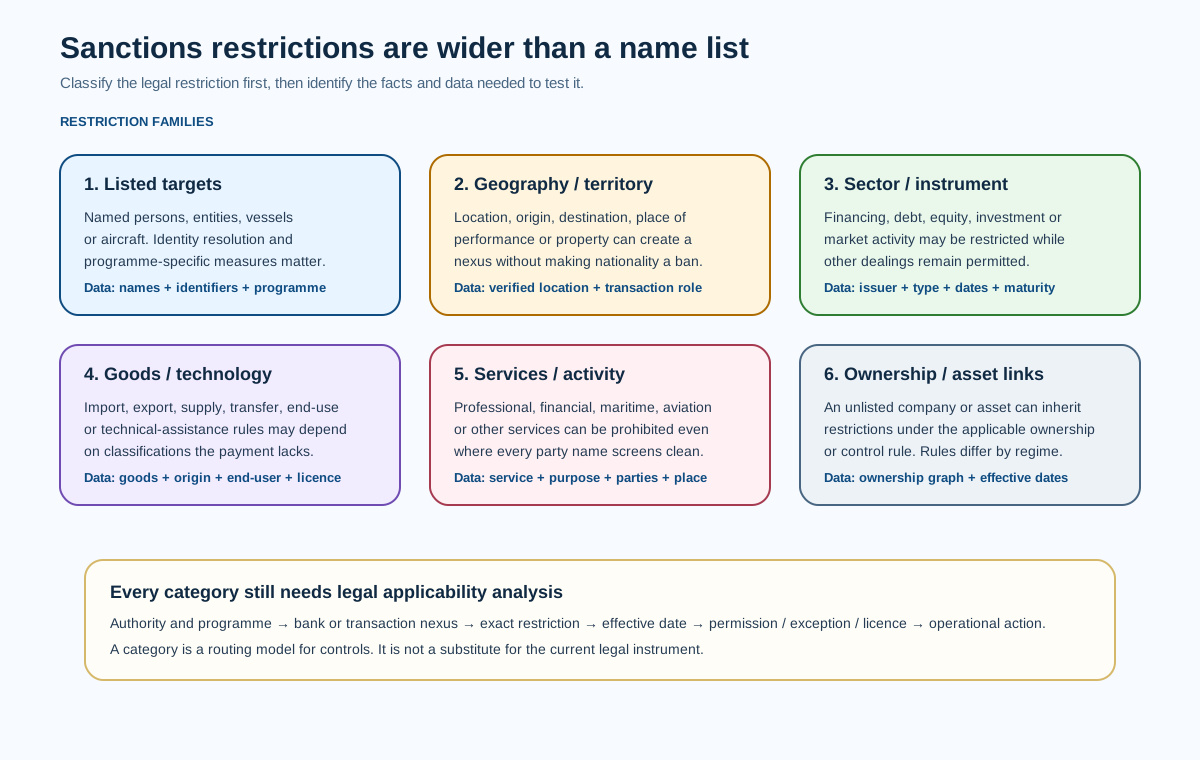
List-based sanctions
List-based measures target identified persons, entities, vessels, aircraft or other subjects. A screening engine compares customer or transaction data with official or vendor-curated list data and produces candidate matches.
A name hit is not automatically a true match. Analysts need identifiers such as date of birth, nationality, address, registration number, programme tag or other contextual data.
Why a clean name screen can still miss a restriction
A transaction can be prohibited even when no party name appears on a list. Examples include sectoral restrictions, prohibitions relating to particular goods or services, territorial restrictions, dealings with owned or controlled entities, or financing restrictions attached to an activity.
Banks need rules that assess the transaction itself, not only the names inside it.
Five restriction families survive clean name screens: sector, goods, territory, ownership and financing.
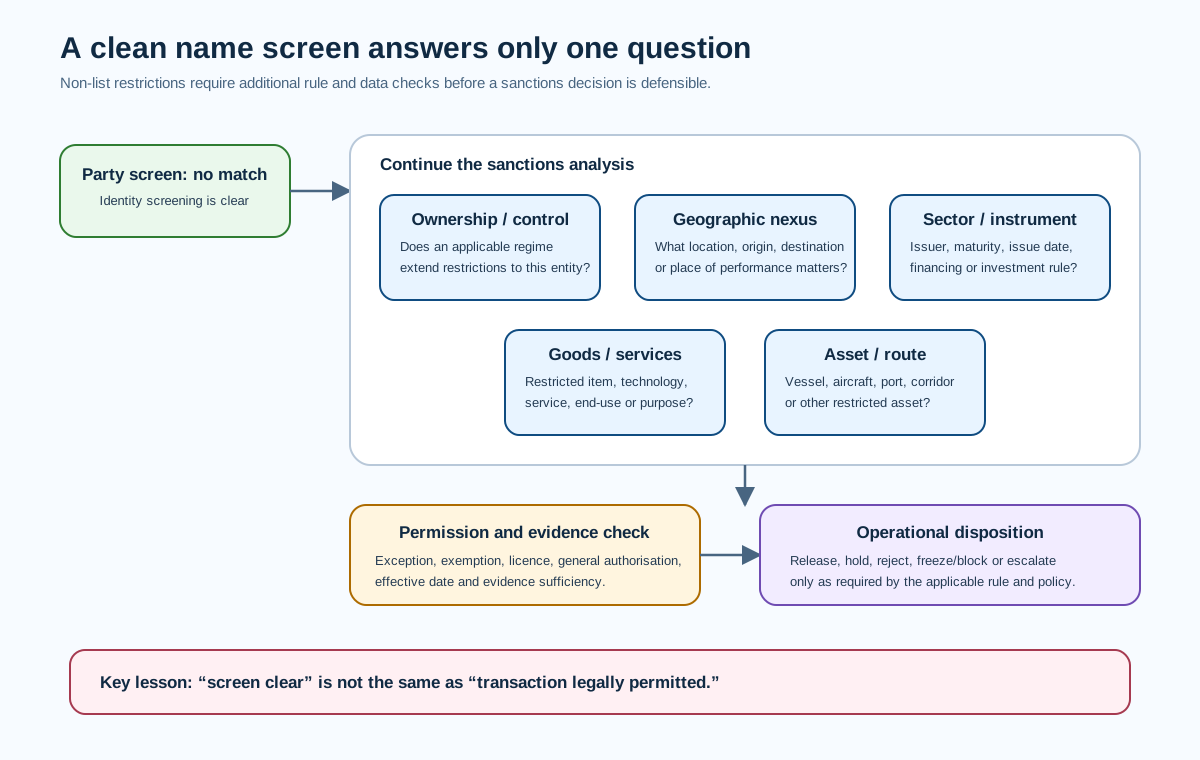
Country and territory restrictions
Some sanctions programmes impose broad restrictions connected to a country or territory. Others impose targeted measures only against certain parties or sectors within that country.
OFAC specifically warns that there is no single universal U.S. “country list” because programme scope varies. Banks should avoid maintaining simplistic country labels that imply every transaction to a jurisdiction has the same legal outcome.
Geographic nexus
A country can matter because a party is located there, goods originate there, a service is provided there, an asset is held there or the transaction otherwise falls within a particular programme.
Address information in payment messages can therefore matter, but address alone may not establish legal nexus. Analysts should understand which field is being relied on and why.
Sectoral sanctions
Sectoral sanctions can restrict transactions involving particular industries or financing instruments without imposing a full asset freeze.
The EU describes sectoral measures as including economic and financial restrictions such as import/export controls, restrictions on banking services and arms embargoes. U.S. programmes can also impose instrument- or activity-specific restrictions.
Debt and equity restrictions
Some sanctions restrict dealing in certain debt or equity of specified entities or sectors. The relevant attributes can include issuer, maturity, issue date, instrument type, ownership and transaction date.
A payment-screening engine designed only for names cannot reliably enforce this kind of rule.
Banking-service restrictions
Measures can restrict access to particular financial services, capital markets, correspondent services, investment services or other banking activity.
A bank should map product and service codes to sanctions rules where necessary rather than depend on manual analyst memory.
Goods and technology restrictions
Sanctions and export controls can restrict the sale, supply, transfer, financing or facilitation of specified goods or technology. Dual-use items can require specialist classification.
The payment alone may not reveal enough information. Trade-finance documents, customer declarations, customs classifications or specialist review may be necessary.
Service prohibitions
Some regimes restrict professional, technical, financial or other services. The customer may be permitted generally but the service requested may be prohibited.
This demonstrates why customer-screening clearance is not a lifetime permission for every transaction.
Maritime restrictions
Vessels, ports, cargo, ownership, flag, ship-to-ship transfers and route can create sanctions exposure. Vessel names can change, so identifiers such as IMO numbers can be valuable.
Banks processing maritime trade should retain available vessel data and understand whether screening occurs at booking, document review, payment or all relevant stages.
Aviation restrictions
Aircraft and aviation-related services can also be restricted. Tail numbers, owners, operators and routes may matter.
A customer name alone may not reveal the risk.
Energy-sector restrictions
Energy sanctions can involve commodities, price caps, services, financing, shipping or specific companies. The exact control depends on the regime.
Commodity description, origin, transport, insurer, vessel and contractual terms can become relevant.
Arms embargoes
Arms embargoes can prohibit supply, sale or transfer of arms and related material, and may also restrict financing or technical assistance.
A bank should coordinate sanctions, export-control and trade-finance expertise rather than attempt to decide every goods-classification issue inside AML operations.
Activity-based prohibitions
A sanctions rule may prohibit facilitation, making funds available, providing financing or performing another specified activity even where the immediate transaction party is not itself listed.
The bank therefore needs a concept of activity and purpose in its control architecture.
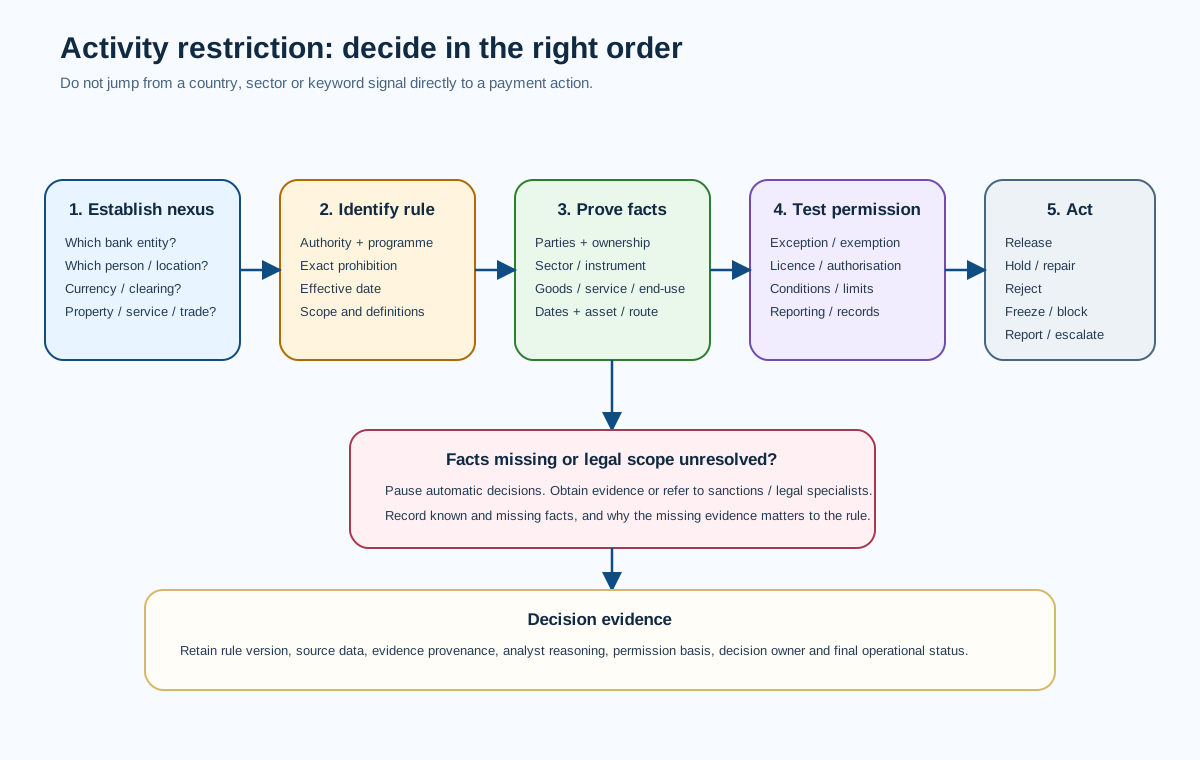
Ownership and control
An unlisted entity can be restricted because it is owned or controlled by a designated person under applicable law.
This is a major reason why “no list hit” does not equal “no sanctions exposure.”
Aggregation differences
Ownership aggregation rules differ among regimes. Analysts should not combine the interests of separate designated persons unless the relevant legal framework requires it or other control facts make that necessary.
The system should identify the legal rule being applied rather than hard-code an unexplained percentage calculation.
Programme tags
List data often includes programme identifiers. The programme context matters because the associated restrictions can differ.
The same person can be designated under more than one authority, and not every list has the same legal consequence.
Customer screening versus transaction screening
Customer screening identifies relevant parties at onboarding and during the relationship. Transaction screening evaluates specific payments, trades or other events.
A customer can pass onboarding screening and later initiate an activity that is restricted because of destination, goods, counterparty or new ownership information.
Geography in payment messages
Addresses, country codes, bank locations and routing information can inform sanctions controls. Data quality is critical.
A bank should distinguish the customer’s address from the transaction destination, intermediary-bank location and ultimate-party location.
Free text and purpose
Remittance information can reveal restricted goods, locations or activity. It can also be incomplete or misleading.
NLP or keyword controls can support detection but should not be treated as definitive legal classification.
Trade documentation
Invoices, bills of lading, letters of credit and transport documents can reveal goods, ports, vessels and counterparties.
Document review should use structured extraction where possible but preserve original documents and evidence.
Scenario: listed party
A payment beneficiary is a confirmed match to a person subject to an asset freeze. The bank applies the legal outcome required by the relevant regime and completes reporting or other obligations.
This is the most straightforward sanctions case, but not the most common source of complexity.
Scenario: unlisted entity in restricted sector
A company is not designated but operates in a sector subject to financing restrictions. The transaction involves a prohibited instrument.
A name screen alone would miss the issue. Product and instrument data are necessary.
Scenario: country but no prohibition
A customer pays a legitimate supplier in a jurisdiction associated with a targeted sanctions programme. Neither party is designated, the activity is not prohibited and no relevant ownership issue exists.
The correct decision may be to process the transaction after appropriate checks. Country association is not itself proof of prohibition.
Scenario: restricted goods
A customer payment references specialised industrial equipment. Trade documentation indicates the item may fall within a restricted category for the destination.
The bank should escalate to the appropriate specialist, verify classification and licence status and preserve evidence.
Scenario: licence
A transaction would otherwise be prohibited, but the customer provides a licence. Analysts should verify authority, validity, scope, parties, dates, limits and reporting conditions.
A licence reference is not enough by itself.
Scenario: vessel exposure
A trade payment involves a vessel whose name changed recently. The IMO number links it to a listed vessel.
This shows why persistent identifiers matter.
Screening architecture
A mature sanctions platform combines party screening, ownership analysis, geographic rules, product rules, instrument rules, trade data and licence logic.
Not every bank needs one system for all of these, but the control framework should make the handoffs explicit.
Rule inventory
Sanctions rules should be traceable to legal obligations. For each rule, the bank should know authority, jurisdiction, affected entities, product scope, effective date, logic, decision and evidence.
This supports regulatory change management.
List maintenance
Official list updates should be sourced, validated and reconciled. Vendor files can add useful normalisation but should not replace understanding of the official source.
Rescreening should be triggered according to policy when list or customer data changes.
Sector classification
Sectoral controls depend on accurate classification of customers, issuers, products and activities. A generic industry code may be insufficient where sanctions definitions are narrower or broader than standard commercial taxonomies.
Analysts should know the source and quality of the classification.
Product taxonomy
Payments, deposits, securities, lending, trade finance, custody, FX and investment services can have different sanctions implications.
A global product taxonomy can help map legal restrictions to system capabilities.
Data quality
Missing addresses, truncated names, stale ownership, incomplete instrument attributes and poor goods descriptions weaken sanctions controls.
Data quality should be managed as a control dependency, not only as an IT issue.
Payment repair
If payment data is changed during repair, screening may need to be repeated. Original and amended values, user, timestamp and reason should be retained.
Business analyst view
A BA should model restriction type, programme, legal entity, party, country, sector, product, instrument, goods/service, vessel/aircraft, licence, alert and decision separately.
Acceptance criteria should test combinations, not only simple true-name matches.
UAT examples
Testing should include clean party but prohibited activity, designated owner but unlisted company, targeted country with permissible activity, valid licence, expired licence, vessel alias, repaired payment and sectoral instrument restriction.
Investigator guidance
Analysts should document the exact rule they are applying. “Country sanctioned” is often too vague. Better case notes identify the relevant programme and restriction.
Governance
Complex cases should escalate to sanctions compliance or legal specialists. Front-line analysts should not be required to interpret ambiguous legislation alone.
Metrics
Useful metrics include list-update timeliness, rule coverage, false-positive rate, aged cases, licence-processing errors, geographic-data quality, ownership-analysis backlog and post-event breaches.
Common mistakes
Common mistakes include assuming sanctions are only name lists, treating every country association as prohibited, failing to screen ownership, relying on one sector code, ignoring product or instrument attributes and treating a customer’s onboarding clearance as permission for all future activity.
Learning checkpoint
A reader should be able to distinguish list-based, geographic, sectoral, instrument, goods/service and activity restrictions; explain why no name hit does not guarantee permissibility; describe how product and trade data support sanctions decisions; and design controls that map legal rules to operational evidence.
Reference links
- OFAC — Sanctions Programs and Country Information: https://ofac.treasury.gov/sanctions-programs-and-country-information
- OFAC — Why there is no single OFAC country list: https://ofac.treasury.gov/sanctions-programs-and-country-information/where-is-ofacs-country-list-what-countries-do-i-need-to-worry-about-in-terms-of-us-sanctions
- European External Action Service — Types of EU sanctions: https://www.eeas.europa.eu/eeas/sanctions-what-types_en
- Council of the EU — Types of sanctions: https://www.consilium.europa.eu/en/policies/sanctions-different-types/
- UN Security Council — Consolidated Sanctions List: https://main.un.org/securitycouncil/en/content/un-sc-consolidated-list
Educational note: sectoral, country, trade and activity restrictions are highly regime-specific and change frequently. Apply current official rules and bank legal interpretation.
Deep dive: screening names is only one layer of sanctions control
A bank can have excellent list screening and still miss a prohibited transaction if the restriction is based on sector, instrument, goods, services, territory or activity. This is why sanctions architecture needs both party screening and rule-based transaction controls.
Build a restriction matrix
For each programme, map restriction type, affected parties, geography, products, instruments, goods/services, effective date, licences and required action. The same programme can contain several different restrictions.
A well-designed matrix prevents the organisation from turning a complex legal regime into one red/green country flag.
Country-rule exercise
A payment goes to a supplier in a jurisdiction subject to targeted sanctions but not a comprehensive embargo. The supplier is not listed, ownership is clear and the goods are permitted.
The correct result may be release. A country flag should trigger the right checks, not predetermine the outcome.
Sectoral-instrument exercise
A securities desk proposes to buy newly issued debt of a company subject to a sectoral financing restriction. The company itself is not blocked.
Name screening alone does not solve the problem. The bank needs issuer, instrument, issue date, maturity and transaction type.
Goods restriction exercise
A trade-finance customer imports specialised machine tools. The destination and product description indicate possible export-control or sanctions restrictions.
The bank should route the case to goods-classification specialists where required. AML investigators should not invent a tariff or dual-use classification.
Service prohibition exercise
A customer asks the bank to provide a service prohibited for a particular jurisdiction or sector. The customer may be unsanctioned, but the service itself can be restricted.
Product entitlement controls can therefore be part of sanctions compliance.
Vessel risk
A vessel changes name but retains the same IMO number. A name-only screen can miss the continuity.
Persistent identifiers should be stored and screened where available.
Port and route risk
A route through a sanctioned or restricted port can matter depending on the regime and activity. The bank should distinguish physical route from payment route and identify which is legally relevant.
Sector data quality
Customer industry codes often exist for credit or marketing rather than sanctions. They may be too broad or stale.
Where sectoral sanctions matter, the bank should define a sanctions-relevant classification source and refresh process.
Instrument master data
Securities restrictions require accurate issuer, ISIN or equivalent identifier, issue date, maturity, currency and ownership information. A sanctions engine cannot compensate for bad instrument data.
Trade-data lineage
Goods descriptions may be captured in the trade platform but never sent to the sanctions rules engine. This creates a coverage gap even if the bank “has the data” somewhere.
The BA should trace data end to end.
Payment-purpose text
Free text can identify restricted activity, but keyword rules are noisy. “Oil” can refer to permitted products, internal descriptions or unrelated words. NLP can prioritise review but should not be the final legal decision.
Ownership interaction
An activity may appear permitted until ownership analysis reveals a designated owner. Conversely, an entity can be unlisted and not owned by a designated person but still subject to sectoral or activity restrictions.
These are independent control dimensions.
Licence interaction
A licence can override a prohibition only within its scope. The restriction matrix should therefore support exception logic without deleting the underlying rule.
Audit should show that the transaction was prohibited by default and released because a valid authorisation applied.
Effective dates
Sanctions measures can take effect immediately or include wind-down periods. Rule engines need effective-from and, where relevant, expiry dates.
Historical lookbacks should use the rules applicable at the transaction date, not today’s rule only.
Customer-level restrictions
Some customer relationships may need product restrictions even when the account itself remains open. For example, certain financing or investment services may be unavailable while ordinary permitted transactions continue.
The customer master should support granular restrictions rather than only “active/blocked.”
Payment-level restrictions
A customer can be permitted generally but one payment can be prohibited because of counterparty, destination, goods or purpose.
Customer status should therefore not override event-level screening.
Scenario library
Maintain scenarios for party-list match, sanctioned ownership, sectoral instrument, restricted goods, prohibited service, valid licence, humanitarian exception, vessel match, geographic restriction and no-prohibition high-risk country.
Each scenario should state expected evidence and outcome.
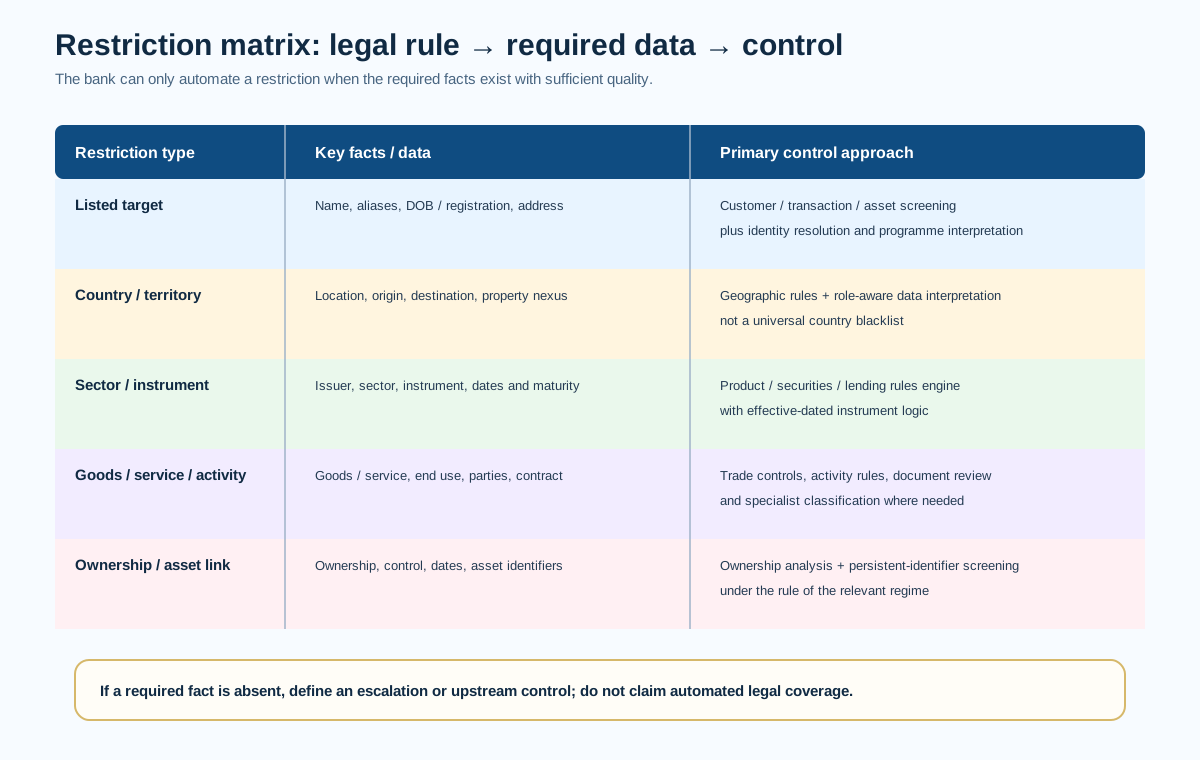
Rule change management
When legal text changes, compliance should assess which rule definitions, data fields, products, procedures and tests are affected. The evidence chain should show legal source → interpretation → requirement → implementation → testing.
UAT design
A sanctions UAT pack should include both positive and negative cases. Testing only obvious listed names gives false confidence.
Include clean names with prohibited activities and listed-party names in transactions that fall outside a specific rule where legally relevant, so the system’s logic is tested rather than merely its matching capability.
Quality assurance
QA should review whether analysts state the actual restriction. “High-risk country” is not a sanctions rationale. “Transaction would provide prohibited financing under Programme X unless Licence Y applies” is more precise.
Final deep-dive test
A strong learner should be able to identify the legal restriction dimension before looking at a screening result, explain why party and activity controls are independent, trace the data needed for sectoral and trade restrictions and test both prohibited and permitted cases.
Sectoral financing restrictions inside payment and securities flows
Sectoral sanctions often restrict dealings in specific debt, equity or financing connected with designated sectors rather than blocking the parties outright. A bank that screens only names will process a prohibited new bond subscription for an unlisted issuer without any alert firing. The control therefore needs instrument-level data: issuer identity, instrument type, issue date, maturity or tenor, currency, transaction type (primary subscription, secondary trade, coupon, redemption, corporate action) and the capacity in which the bank acts. Each element answers a different legal question, and a case file that omits any of them cannot support a release decision with confidence.
New issuance versus secondary trading versus servicing
Most sectoral financing restrictions distinguish between new instruments and existing holdings, and between acquiring exposure and merely servicing it. A coupon payment on a pre-restriction bond, a secondary-market sale that reduces exposure, and a fresh subscription at issuance can each attract a different legal outcome under the same programme. Operations teams should therefore capture the lifecycle event type explicitly rather than recording every securities movement as a generic trade. Corporate-actions processing deserves the same discipline: a dividend, stock split or consent solicitation on restricted securities is a separate decision point, and routing it through standard straight-through processing without a restriction check collapses a legal decision into an administrative one.
Maturity and tenor arithmetic the bank must evidence
Where a restriction turns on maturity thresholds, the bank needs auditable date arithmetic, not analyst estimation. The case record should show the instrument maturity date, the calculation basis (issue date versus settlement date as the programme requires), the resulting tenor, and the system or manual source of each date. Data-quality controls matter here because securities reference data can carry conflicting maturity values across vendors, and corporate actions such as taps, reopenings or maturity extensions can change the answer after the first review. A restriction decision taken on stale reference data is difficult to defend, so periodic re-validation of open positions against current reference data belongs in the operating procedure.
Prohibited services hidden inside ordinary payments
Sectoral and activity restrictions frequently extend beyond goods and financing into services such as insurance, reinsurance, shipping, brokering, technical assistance or financial services connected with restricted activity. A premium payment to an insurer, a freight payment to a carrier, or a fee to a broker can each constitute the prohibited service where the underlying exposure is restricted. Payment operations should therefore join the payment purpose and remittance data with the underlying commercial context held elsewhere in the bank: the trade-finance file, the insurance policy schedule, or the shipping documents. A payment that looks like an ordinary service fee in isolation may be the exact dealing the restriction targets.
Worked mini-case: refinancing that changes the restriction answer
A corporate borrower subject to a sectoral financing restriction seeks to refinance existing debt with a new facility of longer tenor arranged by the bank. Name screening is clean because the borrower is not a blocked party. The correct analysis starts with the restriction matrix: does the programme prohibit new debt above a stated maturity, and does arranging or participating in the facility count as a prohibited dealing. The bank then assembles instrument evidence: existing facility maturity and repayment terms, proposed facility tenor and signing date, the bank's role (arranger, lender, agent, adviser), and any licence or wind-down provision that could authorise the transaction. If the new tenor crosses the restricted threshold and no licence applies, the transaction must not proceed regardless of the customer relationship or the commercial rationale. The file should record the matrix reference, the tenor calculation, the role assessment and the escalation outcome so that a later reviewer, auditor or supervisor can reconstruct the decision without re-investigating the transaction.
Wind-down provisions need calendar control
Programmes sometimes permit a limited period to wind down pre-existing activity. Wind-down is a timetable, not a general permission: it typically covers defined contract types, requires activity to be consistent with orderly termination, and expires on a fixed date. Banks should diary every wind-down deadline with an owner, a pre-expiry review point, and a hard stop that prevents settlement after expiry without fresh legal approval. The most common failure is operational drift, where a servicing team continues processing routine payments under an expired provision because no system or person owned the calendar. A simple register of live wind-down positions, reviewed at each governance forum until closure, prevents this class of breach.
Correspondent handling of sectorally restricted flows
A correspondent bank that processes a payment connected with another institution's restricted-sector customer faces its own restriction question, not merely a customer-service question. The correspondent should assess whether processing, clearing or settling the payment constitutes a prohibited dealing under the programmes applicable to it, which may differ from those applicable to the respondent. Where the payment reference indicates restricted-sector goods, financing or services, the correspondent needs an escalation path that does not depend on the respondent volunteering a full commercial file. Standard responses include requesting the underlying commercial context, holding the payment within the permitted timeframe while the assessment completes, and declining to process where the dealing would breach the correspondent's own obligations. Each step should preserve message data, timestamps and the rationale so the decision trail survives later scrutiny.
Advanced practitioner layer: sanctions beyond the list
The strongest sanctions programmes are built around a simple discipline: do not confuse who is restricted with what activity is restricted. A list-based designation may be central to one case, while another case may turn on geography, sector, debt maturity, securities, services, goods, technology, maritime activity or a licence condition. The bank therefore needs a restriction model that is richer than a screening result.
A useful practitioner framework is to classify each sanctions obligation across five dimensions: the authority and programme; the persons or assets covered; the prohibited or restricted activity; the nexus that makes the rule relevant to the bank; and the evidence needed to determine whether the proposed activity falls inside or outside the restriction. This makes complex legal rules implementable without pretending that legal interpretation is only a technology problem.
Case lab: clean names, restricted activity
A corporate customer instructs a payment to a supplier whose legal name, beneficial owners and directors do not match any relevant sanctions list. The customer is purchasing specialist engineering services connected to a sector subject to activity restrictions in a particular jurisdiction.
A pure name-screening control returns “clear.” That result is technically correct but operationally incomplete. The bank still needs to determine whether the service itself is prohibited or restricted, whether the bank is providing a prohibited financial service or facilitation, whether a licence or exemption applies, and what information is necessary to support the decision.
The lesson is important: a clean screen answers only the question that was screened. It does not certify the transaction as sanctions-compliant.
Restriction taxonomy for a bank
A practical restriction taxonomy can include asset freezes and blocking measures; prohibitions on making funds or economic resources available; country or territorial restrictions; sectoral financing restrictions; debt or equity restrictions; investment restrictions; import and export restrictions; professional or financial-service restrictions; maritime or aviation measures; arms embargoes; goods and technology controls; restrictions involving specified government bodies; and programme-specific activity prohibitions.
The taxonomy is not a replacement for law. Its purpose is to route legal obligations into product controls and case workflows. Each category should link back to the legal source and effective date.
Geographic sanctions are not a binary country flag
Banks often inherit simplistic “sanctioned country” indicators. These can be useful as routing signals but unsafe as legal conclusions. A country may be associated with broad restrictions, targeted restrictions, region-specific measures or particular government bodies, while other ordinary activity remains lawful.
The system should therefore record what the geographic rule actually means. Does it concern persons located in the territory, goods originating there, services supplied there, government ownership, a particular region, a port, or another defined nexus? A generic country flag should trigger the relevant rule set, not substitute for it.
Case lab: address versus actual nexus
A beneficiary payment contains an address in a sanctioned or restricted jurisdiction, but the beneficiary is incorporated and operating elsewhere. The address belongs to a branch, forwarding agent or historic registration record.
The bank should not automatically conclude that the transaction is prohibited. The analyst should determine what the address represents, which geographic restriction is relevant, and whether the applicable rule turns on location, residence, place of performance, origin of goods or another fact.
This case also shows why screening systems should expose the matched field. “Country alert” is insufficient if nobody can tell whether the country came from beneficiary address, intermediary bank, debtor address or free-text remittance information.
Sectoral sanctions require product and instrument data
Sectoral sanctions can be particularly difficult because the target entity may be known and lawful to deal with for some purposes while specific financing or investment activity is prohibited. The restriction may depend on instrument type, issue date, maturity, service, transaction date or another attribute.
A bank needs a rule engine or product control capable of evaluating those attributes. A screening tool that sees only the issuer name cannot determine whether a particular security or loan falls within the prohibited category.
For securities, useful data can include issuer, ISIN or other instrument identifier, instrument class, issue date, maturity, currency and transaction type. For lending, drawdown date, tenor, borrower, guarantor and purpose may matter. The exact fields depend on the legal rule.
Case lab: restricted debt
A customer asks the bank to purchase debt issued by an entity subject to a sectoral financing restriction. The entity is not subject to a full asset freeze. The proposed security falls within the maturity and date conditions described by the applicable restriction.
A system that treats all sanctions hits as “block everything” is wrong. A system that releases because the entity is not fully blocked is also wrong. The correct decision depends on the specific instrument and activity restriction.
The case record should therefore contain both the entity match and the instrument-rule evaluation.
Goods, technology and export-control overlap
Sanctions controls can overlap with export controls, but the two legal disciplines should not be collapsed into one generic “restricted goods” process. A bank may need specialist trade or export-control expertise to classify goods, technology, end-use and licensing requirements.
Where the bank holds trade documents, it can use invoice descriptions, tariff codes, bills of lading, certificates, vessel data and customer declarations as evidence. Where it processes only an ordinary payment, its visibility may be far narrower.
Requirements should state what the bank can actually observe and when an information request is necessary. A payment-monitoring rule should not claim that it verifies technical export-control classification from a vague remittance string.
Service restrictions and invisible risk
Services can be difficult because they may not produce a physical-goods trail. A payment description such as “consultancy,” “legal services,” “software support” or “engineering” may be too broad to determine whether a service restriction applies.
Banks need customer and product context. For higher-risk activity, additional fields such as service category, end user, contracting party, jurisdiction of performance and licence basis may be required. The data model should support these facts rather than force analysts to store them only in free-text case notes.
Maritime restrictions: persistent identifiers matter
Vessel names and flags can change. IMO numbers provide a more persistent identifier for many commercial vessels. Where maritime sanctions risk is material, screening should use available persistent identifiers alongside names, owners, operators, ports and route information.
A vessel match is still not automatically a legal conclusion. The bank should determine whether the vessel itself is designated, whether ownership or control is relevant, whether a port or service is restricted, and whether the transaction involves prohibited trade.
Case lab: renamed vessel
A trade payment references a vessel name that does not appear on the bank’s sanctions list. Trade documents include an IMO number. The IMO number corresponds to a vessel that was designated under a previous name.
A name-only screening architecture misses the exposure. A richer asset model identifies the persistent identifier and creates the correct investigation path.
This is also a data-lineage issue: the bank should record where the IMO number came from, whether it was extracted from a document or supplied in structured data, and what list version was used.
Aviation and other asset-based restrictions
Aircraft, digital assets, securities and other identifiable assets can also be subject to restrictions or connected to designated parties. The general design principle is the same: identify the asset, preserve reliable identifiers, link it to parties and activity, and evaluate the relevant legal rule.
A universal name-screening model is insufficient for asset-based sanctions.
Ownership and control can transform a clean party into a restricted party
An unlisted company may still fall within restrictions because of ownership or control by a designated person under the applicable regime. This creates an important handoff between KYC/KYB, sanctions screening and transaction controls.
The bank should not permanently cache “customer clear” if ownership can change. Event-driven ownership updates and designation changes should trigger re-evaluation.
For external counterparties where ownership data is limited, the bank should define risk-based research and escalation criteria. It should not pretend to have the same visibility as it has for its own customer.
Case lab: multiple possible restrictions
A payment involves an unlisted company in a sensitive sector, a vessel associated with a high-risk route, and goods described broadly enough to raise concern. None of these facts alone proves a sanctions breach.
The correct approach is to decompose the case. First resolve list and ownership exposure. Then assess the sector rule. Then assess goods or services. Then assess vessel or route restrictions. Finally evaluate any licence or exemption. Each conclusion should have its own evidence and legal basis.
This prevents analysts from turning several weak indicators into one unsupported statement such as “sanctions risk confirmed.”
Activity controls and the importance of purpose
Many sanctions rules concern the provision of financing, services, investment or support for a specified activity. Purpose data therefore matters. Yet payment-purpose fields are often incomplete, customer-entered or too generic.
A mature control treats purpose as evidence with a confidence level. High-risk cases may require corroboration from invoices, contracts, trade documents, product records or customer statements. The system should distinguish stated purpose from independently verified purpose where that distinction matters.
Keyword controls: useful but limited
Keyword and NLP-based controls can identify terms associated with restricted locations, goods, sectors or entities. They can help route cases, especially in free-text payments or trade documents. But they generate both false positives and false negatives.
A keyword such as a city name may refer to an address, vessel, port or unrelated narrative. A prohibited item may be described using a commercial term that never appears in the bank’s keyword list. Keyword matching should therefore be treated as a detection layer, not a final legal classifier.
Programme tags and legal consequences
Sanctions data often carries programme identifiers. Those tags should flow into investigation because different programmes can create different restrictions. The same person may appear under several authorities or programmes.
A case workflow that displays only “matched sanctions list” strips away information that may be essential to legal interpretation. Analysts should see authority, programme, source record, identifiers, publication/effective date and relevant restriction category.
Licensing and exemptions
Licences, general permissions, statutory exceptions and humanitarian provisions can change the outcome of an otherwise restricted activity. These should be integrated into rule evaluation rather than treated as manual afterthoughts.
The analyst should verify that the permission is issued by the relevant authority and covers the bank entity, parties, activity, dates and conditions. Conditions can include recordkeeping or reporting obligations that survive even when the transaction is permitted.
Product map: where non-list restrictions appear
Payments can reveal parties, geography, intermediaries and narrative. Trade finance can reveal goods, vessels, ports and documents. Securities can reveal issuer and instrument attributes. Lending can reveal borrower, purpose, tenor and collateral. Custody can create corporate-action events. Treasury and markets products can involve securities, derivatives and counterparties.
Each product should therefore have a sanctions-control map showing which restriction types can arise and which data is available to evaluate them.
This avoids forcing every sanctions problem into the payment screening engine.
Data model for activity-based sanctions
Useful entities include authority, programme, legal instrument, restriction, product, party, asset, geography, sector, goods/service classification, transaction, licence and decision. Relationships should be effective-dated.
The model should also capture evidence provenance. If a sector classification comes from customer KYC, external reference data or analyst research, that source matters. If a goods code was supplied by the customer rather than independently validated, the case should say so.
Rule testing: positive, negative and boundary cases
UAT for sanctions restrictions should include more than obvious prohibited cases. Test a listed party with no applicable activity restriction; a clean party with prohibited goods; a country alert where the activity is permitted; a sectoral entity with an allowed instrument; a sectoral entity with a prohibited instrument; a valid licence; an expired licence; a vessel alias; a renamed vessel linked by IMO; and a transaction where required evidence is missing.
Boundary tests are particularly important for dates, maturity thresholds, ownership percentages and licence validity. Off-by-one errors can create real legal exposure.
Decision evidence and case writing
Case notes should identify the exact restriction considered. “High-risk country” or “sanctions concern” is not enough. A reviewer should be able to see the authority, programme, relevant legal restriction, facts relied on, unresolved facts, licence analysis, decision owner and operational action.
Where the bank concludes the activity is permitted, that conclusion should be evidence-based too. A defensible release decision is part of sanctions effectiveness; effectiveness is not measured by how many transactions the bank stops.
Metrics that reveal real control health
For activity-based sanctions, useful measures include number of cases triggered by non-name rules; proportion of alerts requiring specialist classification; stale sector or ownership data; vessel-identifier completeness; licences approaching expiry; payment repairs that changed sanctions-relevant fields; rule deployment latency after legal change; and quality-assurance findings where analysts applied the wrong restriction category.
False-positive rate remains relevant, but it is only one measure. A control can have a low false-positive rate and still miss whole categories of prohibited activity.
Final practitioner checkpoint
A learner should be able to take a transaction with no name hit and still identify whether sanctions analysis is required. They should be able to distinguish list-based, geographic, sectoral, instrument, goods, service, maritime and activity restrictions; explain what data each requires; identify the bank’s visibility limits; evaluate ownership and licence issues; and produce a decision record tied to the exact rule rather than a generic risk label.
That is the practical difference between sanctions screening and sanctions compliance.
Practitioner close: deciding whether a clean name is still a prohibited transaction
This chapter becomes bank-grade when the learner can analyse a transaction that has no designated-name hit and still determine whether sanctions controls need to intervene. Many difficult sanctions cases turn on the activity, sector, instrument, geography, service, asset or licence rather than the identity of a listed person. The practical discipline is to decompose the facts instead of treating “sanctions” as one generic risk flag.
Decision framework: person, place, product, purpose and permission
A useful operational framework begins with five questions.
Person: Are any relevant parties designated, owned or controlled by designated persons, or otherwise covered by a restriction?
Place: Does a territorial, geographic or location-based restriction apply to the customer, counterparty, goods, service, performance, asset, route or another relevant fact?
Product: Does the legal rule target a financial instrument, financing type, investment, service, technology, commodity or other product characteristic?
Purpose: Is the proposed activity itself prohibited or restricted, even if all parties are unlisted?
Permission: Does a licence, exemption, general authorisation or statutory exception permit the activity, and are its conditions satisfied?
This is not a substitute for legal advice. It is a structure for collecting the facts that legal and sanctions teams need.
Case lab: unlisted entity in a restricted sector
A corporate customer wants to purchase a new debt instrument issued by an unlisted entity operating in a sector subject to sanctions restrictions. The issuer passes name screening. The relevant legal measure, however, restricts certain financing activity involving entities that meet defined criteria.
The bank needs instrument data: issuer, instrument type, issue date, maturity, transaction date and any other attributes specified by the legal rule. Customer screening cannot answer this question because the restriction is attached to the activity and instrument rather than a full asset freeze on the issuer.
The trading or securities platform should therefore invoke a rule that uses product attributes as well as party identity. The case record should preserve both the entity result and the instrument-rule result.
Case lab: permitted transaction in a high-risk geography
A payment concerns a jurisdiction associated with significant sanctions measures. The payment is for a type of activity that is not prohibited under the applicable measure, and no relevant party is designated or covered by ownership/control rules.
A simplistic country rule may reject the transaction. A mature control identifies the specific legal restriction and determines whether the transaction falls within it. If the bank’s group policy nevertheless chooses not to support the activity, that should be recorded as a policy decision rather than inaccurately described as a legal prohibition.
This distinction protects decision quality and prevents the term “sanctioned country” from becoming a substitute for legal analysis.
Territorial details can change the answer
A country-level flag can also be too broad when a measure applies to a specific region or territory. Addresses and location data therefore need enough precision to identify the relevant place. At the same time, analysts should understand data limitations. A customer-entered city or free-text address can be misspelled, historical or unrelated to the economic location of the activity.
Where geography changes the legal outcome, the bank may need corroborating information rather than rely on one address string.
Case lab: professional-service restriction
A bank customer pays an overseas firm for consulting. No party appears on a sanctions list. The jurisdiction and customer sector create concern because the applicable regime restricts certain professional services to specified recipients or locations.
The payment description “consultancy” is insufficient to decide the case. The bank may need to understand the type of service, recipient, place of performance, contracting entity, end user and whether any licence or exemption applies.
This demonstrates a key limitation of transaction screening: a keyword can route the case, but it cannot replace the factual and legal analysis of the service.
Product restriction data should not live only in case notes
If the bank repeatedly needs to determine instrument maturity, sector classification, service type or goods category, those facts should be captured in structured product or transaction data where feasible. Requiring analysts to retype the same information into free-text notes increases inconsistency.
A rule-friendly data model can include restriction category, sector, instrument type, issue date, maturity, activity type, goods/service code, asset identifier, geography and permission reference. Structured data improves automation while the final legal decision can still require human judgement.
Goods restrictions and trade-finance evidence
Trade-related sanctions can concern goods, technology, end use, destinations, vessels or ports. A trade-finance bank may hold invoices, transport documents, certificates and shipping information. It should use the information it genuinely has.
Consider a payment for industrial equipment. The invoice description is broad and does not establish whether the item is restricted. The bank should not invent a technical classification from a payment narrative. Where the product requires specialist export-control classification, the case can be routed to the appropriate expert or the customer may need to provide supporting documentation according to the bank’s process.
The important control principle is visibility discipline: do not claim the bank screened facts that were never available to it.
Dual-use goods and proliferation concerns
Some goods and technologies can have civilian and military applications. Sanctions, export controls and proliferation-financing controls may overlap, but they remain distinct analytical frameworks.
A dual-use concern can trigger specialist review even when no designated party appears. The bank should connect relevant intelligence while preserving separate conclusions: whether the transaction is prohibited under sanctions, whether an export-control licence is required, whether proliferation-financing indicators create AML/CFT concern, and what operational action follows.
Maritime case: vessel name changes
A trade transaction references a vessel by a current name that does not match the screening list. The vessel’s IMO number links it to a previous identity associated with sanctions concerns.
This case illustrates why persistent identifiers matter. Names, flags and operators can change. Where the product captures IMO numbers, sanctions controls can compare both name and identifier.
The investigator should still determine the actual legal measure: Is the vessel designated? Is its owner or operator restricted? Is a port or service prohibited? Does the transaction involve a covered cargo or activity? Vessel identity is a starting point, not the whole conclusion.
Aviation and other identifiable assets
The same principle can apply to aircraft, securities, digital-asset addresses and other assets that have stable or semi-stable identifiers. A bank should model the asset and the relevant legal relationship rather than force every case into a person-name match.
An asset can be restricted because it is specifically listed, because it is owned or controlled by a covered person, or because the activity involving it is prohibited. Those are different legal paths.
Sector classification needs provenance
If the bank decides that a customer or counterparty belongs to a restricted sector, it should know where that classification came from. Customer-declared industry, registry code, commercial data and analyst research can disagree.
The case should preserve source and effective date. A company that changed business activities may have an outdated industry code. Conversely, a holding company can own businesses in a restricted sector without its own name clearly revealing the exposure.
A sector flag is therefore evidence to evaluate, not a self-proving legal fact.
Case lab: ownership changes the restriction
An unlisted company appears outside the scope of a targeted restriction based on name alone. Research shows that it is owned by a designated entity under the relevant regime.
The bank should connect ownership/control analytics to product and activity rules. The consequence may be a full asset-freeze treatment or another restriction depending on the regime. The system should show which legal path created the result rather than present the company as if it were separately named on the official list.
This distinction matters for audit and future list changes.
Case lab: one transaction triggers several control families
A corporate customer pays for industrial equipment shipped through a sensitive port. The beneficiary is unlisted. A vessel has a sanctions-related alert, the goods description is potentially dual-use, and the customer’s ownership recently changed.
The right approach is not to combine these facts into a vague “high sanctions risk” score. Decompose them:
- resolve beneficiary and ownership exposure;
- resolve vessel identity and relevant measure;
- determine whether goods or technology require specialist classification;
- assess geographic or port restrictions;
- identify any licence or exemption;
- separately consider AML or proliferation-financing indicators where relevant.
The final disposition is stronger because each risk question has evidence and an accountable decision owner.
Keyword and NLP controls: routing rather than judgement
Banks often screen free text for sanctioned locations, vessels, sectors, goods or services. This can be useful, but language is ambiguous. A place name can be a street, person or company name. An industrial term can describe an unrestricted product. A prohibited item can be hidden behind a generic invoice description.
Keyword and NLP models should therefore generate review candidates or enrich risk assessment. Their performance should be tested with both true-risk and legitimate examples. Tuning should document what detection sensitivity changes, not just how many alerts disappear.
Activity rules need effective dating
Restrictions can change quickly. A transaction permitted yesterday may be prohibited today; a licence can expire; an instrument can become relevant based on issue date or maturity; a grandfathering provision can apply only to contracts signed before a cut-off.
Rule engines should store effective dates and, where necessary, reference the transaction, contract, issue or settlement date relevant to the legal measure. Historical investigation should apply the rule that existed at the time, not today’s configuration.
Case lab: licence scope boundary
A customer provides a licence authorising specified goods to a named counterparty through a defined period. The proposed transaction involves the same counterparty but a different service after the licence expiry date.
The presence of a genuine licence should not suppress the case. The system or analyst should check party, activity, dates, conditions and reporting obligations. Scope mismatch is exactly the kind of boundary condition UAT should test.
Product-control map
For payments, sanctions-relevant facts can include parties, agents, geography, purpose and routing. For securities, issuer and instrument attributes can be decisive. For lending, borrower, guarantor, tenor, purpose and drawdown can matter. For trade finance, goods, vessels, ports and documents add context. For custody, asset movements and corporate actions create events. For markets, derivatives and settlement counterparties can introduce additional restrictions.
The programme should map restriction types to product capabilities instead of trying to make one payment-screening engine solve every problem.
Operational disposition must match the restriction
A system should distinguish temporary hold, legal block or freeze, rejection, return, restricted service, licence-controlled release and policy decline. The correct state depends on the rule and product.
If a true identity match is subject only to a narrow activity restriction, the bank should not automatically freeze every asset unless the law requires it. Conversely, a full asset-freeze obligation should not be implemented merely as a declined payment if the bank is required to control property already in its possession.
Testing the non-list control framework
A robust UAT pack should include:
- clean parties with prohibited activity;
- high-risk geography with permitted activity;
- true list match with activity-specific restriction;
- restricted instrument and nearly identical permitted instrument;
- service description too vague to decide without further information;
- vessel alias linked by IMO;
- unlisted entity caught through ownership;
- valid, expired and wrong-scope licences;
- goods data unavailable in an ordinary payment but available in trade finance;
- rule effective-date boundary;
- policy-only decline distinguished from legal prohibition.
For each case, verify both reasoning and downstream product outcome.
Final 60-minute practitioner test
A learner should be able to examine a transaction with no name hit and still identify every sanctions question that matters. They should know when geography is only a routing signal, when sector and instrument data are essential, when goods or service classification requires specialist evidence, when ownership transforms an apparently clean counterparty, how licences change the outcome and why keywords or payment messages cannot certify legal permissibility.
That capability is what turns sanctions screening into real sanctions compliance.
Practitioner masterclass: deciding what is actually restricted
The analyst’s first task is not to search for a name. It is to identify the legal restriction that could apply. Once the restriction is clear, the analyst can determine which parties, data and evidence matter.
Exercise: targeted country programme
A payment goes to a supplier in a country associated with a targeted sanctions programme. The supplier is not listed and the activity is permitted. Explain why “country appears in sanctions programme” is not the same as “all transactions prohibited.”
Exercise: sectoral debt
A non-blocked issuer is subject to restrictions on certain financing instruments. Build the fields required for decisioning: issuer, programme, issue date, maturity, instrument type, transaction date and customer role.
Exercise: restricted service
The customer is not listed but requests a professional or financial service prohibited under a particular regime. Decide which product entitlement and customer-data controls should prevent the service.
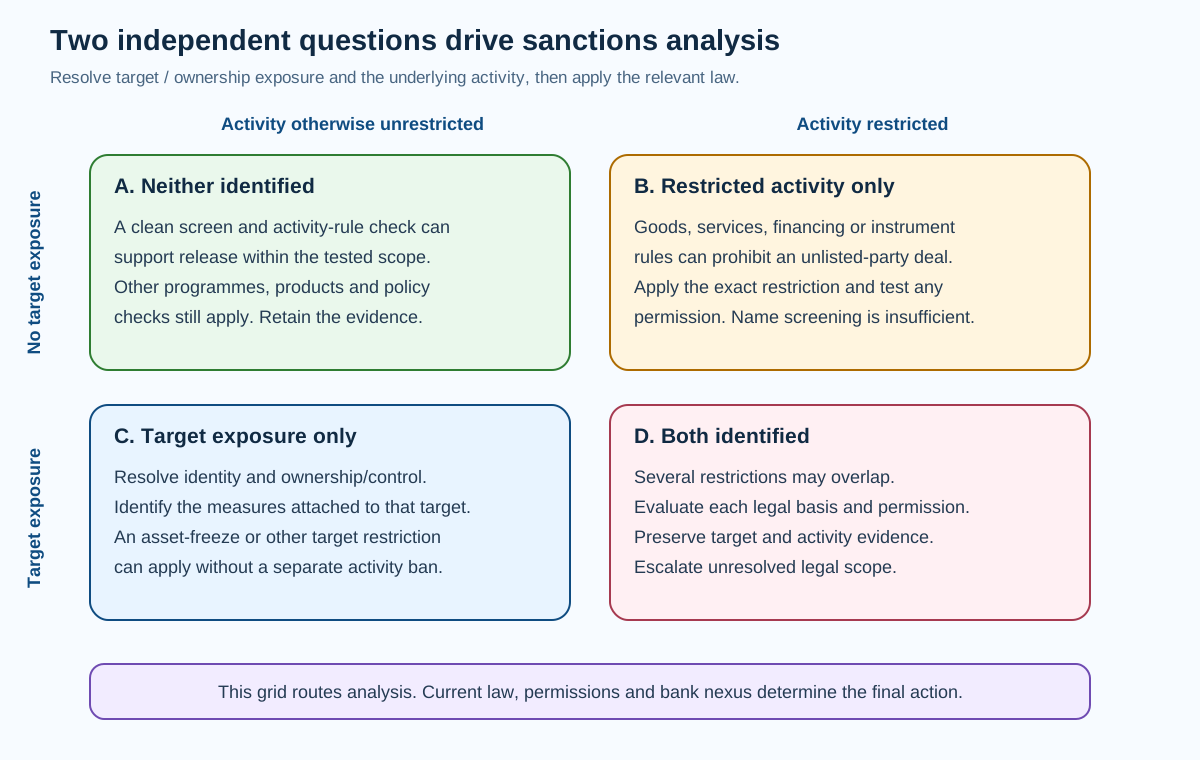
Decision grid
Exercise: vessel alias
A vessel name does not match the list, but its IMO number matches a listed vessel. Explain why asset identifiers need to be treated differently from fuzzy name matching.
Exercise: valid humanitarian authorisation
A payment involving a sanctioned geography is covered by an applicable humanitarian authorisation. Identify the evidence, conditions and reporting checks required before release.
BA acceptance criteria
Test scenarios where the name screen is clean but the activity is prohibited, where the country is high risk but activity is permitted, and where a licence changes the outcome. These cases prove the rules engine is doing more than list matching.
Final practitioner test
A strong learner should be able to identify whether the relevant restriction is party-based, ownership-based, geographic, sectoral, instrument-based, goods/service-based or activity-based, and then explain exactly which data and legal rule drive the bank’s decision.
60-minute mastery extension: list-based, country, sector and activity restrictions
This extension is designed to make the chapter a minimum 60-minute guided learning experience. Spend around 25 minutes on the core material and diagrams, 15 minutes on the restriction-classification cases, 10 minutes on the rules-engine exercise and 10 minutes on the final legal-outcome test.
List screening is only one layer
List-based sanctions identify named persons, entities, vessels, aircraft or other targets. Other restrictions can apply because of country or territory, sector, instrument, service, goods, technology, end use or another activity. A bank can therefore receive a clean screening result and still face a prohibited or restricted transaction.
This is why sanctions controls should combine identity screening with structured rule logic and specialist review. A fuzzy-match engine cannot determine whether a particular securities transaction, service or trade flow is allowed.
Country restrictions are not all identical
The phrase "sanctioned country" is often too broad. Some regimes impose comprehensive restrictions on a territory; others target specific persons, sectors, goods or activities associated with a country. The bank should identify the exact programme and rule rather than convert geography into a universal block flag.
A customer's nationality or residence also does not automatically mean every transaction is prohibited. Legal restrictions can depend on location, property interests, designated parties, goods/services, ownership/control and other programme-specific facts.
Worked case: clean parties, restricted activity
A customer and counterparty both pass list screening. The transaction finances a service to a sector subject to restrictions under a regime applicable to the bank. The legal question is therefore activity-based, not identity-based.
The bank needs structured information about service type, sector, country and any relevant dates or contract terms. If this information exists only in free-text remittance, automated control will be weak. Some cases will require manual or specialist interpretation because payment messages do not contain enough detail to decide legal scope.
Sectoral restrictions
Sectoral measures can restrict certain financing, securities, debt, equity, services or transactions without freezing every asset of every company in the sector. The bank should not treat sectoral exposure as equivalent to a full blocking designation unless the applicable rule requires that outcome.
Controls need attributes beyond names: issuer, ownership, instrument type, issue date, maturity, transaction type, sector and relevant programme. This is especially important in capital-markets and trade contexts.
Goods and service restrictions
Sanctions and export-control regimes can restrict particular goods, technology or services. Banks often do not have perfect goods data, especially in ordinary payment processing. Trade-finance products can provide richer documentation. Controls should reflect actual visibility and route complex goods/end-use questions to appropriate sanctions or export-control specialists.
A payment bank should not claim it verified goods simply because an invoice was provided.
Rule-engine exercise
Design a sanctions rules object with fields for authority, programme, restriction type, legal entity, effective date, end date if any, country/territory, target party, sector, instrument, service, goods category, ownership/control rule, licence/exemption and disposition. Then define which payment/customer data fields each rule needs.
The exercise should reveal data gaps. If the rule depends on instrument maturity but the payment platform does not receive maturity, the control cannot truthfully claim automated compliance with that rule. A manual or upstream control may be required.
Effective dating and historical reproducibility
Sanctions programmes change quickly. A transaction permitted yesterday can be prohibited today, or a licence can change the treatment. Historical cases should preserve the rule version and list version used at the time of decision.
Do not overwrite historical legal basis when the current programme changes. Auditors and authorities need to understand the decision against the law and data that applied at that time.
Geographic data quality
Country restrictions can be weakened by poor addresses, free-text location, transliteration or missing ports and place names. Structured addresses and reliable country codes help, but they also require governance. A country inferred from an IP address is different from a verified legal address. Systems should preserve source and confidence.
Scenario: correspondent payment
An intermediary bank sees originator, beneficiary, correspondent banks and limited remittance information. A sector or activity restriction may depend on facts the intermediary cannot observe. The bank should apply the controls required for its role and available data, escalate where information is insufficient and avoid pretending that screening has validated the entire underlying trade.
Final legal-outcome test
For each situation, state whether the primary control is identity screening, geographic restriction, sector/activity rule, goods/end-use review, ownership/control analysis or licence handling: named designated party; clean-name entity 60% owned by a designated person where the relevant regime applies an ownership rule; payment to an unrestricted company for a restricted service; securities transaction subject to programme-specific terms; shipment involving controlled goods; humanitarian payment under a relevant authorisation.
The professional habit is to ask what exactly is restricted and under which legal rule. A clean list result is necessary in many workflows but is never a universal permission to proceed.
Arms embargoes: scope, services and brokering
Arms embargoes can extend beyond physical weapons shipments. Depending on the legal instrument, measures may cover arms and related materiel, technical assistance, training, financing, financial services, brokering or other support. The breadth matters because banks can encounter arms-embargo risk through financing, payment and service channels rather than by handling the physical goods themselves. A payment for apparently civilian goods to a defence-linked counterparty, financing for a dual-capable logistics company or services to an intermediary arranging defence transactions can therefore require programme-specific analysis.
Brokering activity deserves separate attention because some regimes regulate arranging, negotiating or facilitating military-goods transactions. Whether a particular broker, bank or transaction is in scope depends on the applicable jurisdiction, the persons bound by the measure, the goods or services involved and the wording of the relevant legal act. Banks should identify customers whose business model includes brokering and use business-purpose, corridor, goods and counterparty information to route relevant cases for specialist review. A bank should not infer a universal extraterritorial brokering prohibition merely because military goods do not physically touch the bank's jurisdiction.
Some embargo frameworks contain exceptions, exemptions or licensing routes for defined purposes, which can include humanitarian, protective or international-organisation activity. The conditions are regime-specific and may require prior authorisation, notification, recordkeeping or other evidence. Staff need enough embargo literacy to recognise potential military-connection indicators and escalate for specialist assessment rather than clearing or prohibiting an activity based only on its civilian appearance.
Luxury-goods prohibitions: programme-specific goods and thresholds
Some sanctions programmes restrict exports, imports or supply of defined luxury goods such as vehicles, watches, jewellery, fashion products, spirits or other high-value consumer goods. Definitions, destinations, value thresholds and exceptions vary materially by programme and legal instrument. Banking exposure can arise through trade finance, merchant payments, intermediaries and logistics flows, but a bank should not create one global "luxury goods" prohibition rule.
Transaction analysis can focus on the intersection of goods description, value, destination and parties where an applicable measure exists. Third-party intermediaries, personal shoppers, freight forwarders and free-zone hubs can complicate the evidence chain. Where a restriction contains value thresholds, invoices close to a threshold or values inconsistent with credible market information may justify additional evidence under the bank's policy. The legal decision must still use the actual classification and valuation rule of the relevant programme.
Aviation-service restrictions: service scope must come from the rule
Some sanctions programmes restrict aviation-related goods or services in addition to listed aircraft. Depending on the regime, relevant activity can include maintenance, repair, spare-parts supply, insurance, leasing, navigation, handling or financing. Banks encounter this risk through aviation-finance portfolios, maintenance-company customers, parts traders, lessors and payment flows, but each service must be tested against the actual programme rather than against a generic aviation blacklist.
Spare-parts analysis can require item classification, end-user information and intermediary-chain review. Maintenance, lease, insurance or handling payments may need specialist assessment when the serviced aircraft, operator, route or underlying activity is within the scope of a particular prohibition. Sublease and wet-lease structures can distance the operator from the bank's direct customer, which makes ownership, operator and asset identifiers important evidence. The control objective is to determine whether the particular service is covered, not to assume that every service connected to a high-risk aviation counterparty is prohibited.
Oil price-cap mechanics for bankers
The G7+ oil price-cap arrangements for Russian-origin seaborne oil are a useful example of activity- and service-based sanctions. Participating jurisdictions implement the mechanism through their own legal rules, and covered maritime transport or related services can be permitted or prohibited depending on the relevant price-cap conditions, service-provider tier, evidence and current guidance. The legal perimeter and cap level can change, so a bank should use the current rule applicable to its entity and activity rather than hard-code a historic amount or one jurisdiction's process globally.
Attestation and price-information requirements illustrate why activity restrictions need evidence beyond party names. Where the applicable framework or bank role requires attestations, ancillary-cost information or other price evidence, the control should define who must provide it, when it must be obtained, what is retained and what anomalies require escalation. Market-price comparison can be useful as a risk or reasonableness check where policy calls for it, but it should not be described as a universal legal test unless the relevant rule says so.
The price-cap example illustrates the broader principle: a name-screening algorithm cannot by itself determine whether a conditional service restriction is satisfied. Banks need content-aware controls tied to current legal requirements, role-specific data availability and documented evidence standards.
Gold, diamonds and restricted-origin commodities
Some sanctions measures prohibit imports, exports or related services involving gold, diamonds or specified minerals from particular origins. In banking, the control challenge is proving origin and transaction substance rather than treating the commodity name itself as sufficient. Gold-origin analysis can use refinery or assay information, chain-of-custody evidence, supplier capability, shipping data and pricing as corroborative evidence where relevant. Implausible sourcing or unexplained intermediaries can justify additional review but do not, by themselves, establish a sanctions breach.
For rough diamonds, Kimberley Process documentation can form part of the evidence set where applicable, but it should not be treated as conclusive sanctions clearance. Certification scope, sanctions origin rules, possible mixing or misdeclaration and the bank's actual visibility still need to be considered. Trader and corridor analysis can identify newly formed intermediaries, unexplained volume growth, third-party settlement or routing that warrants enhanced review under the bank's risk framework.
Professional-service prohibitions: the advisory perimeter
Some modern sanctions measures restrict defined professional or business services, which can include accounting, auditing, business consulting, legal advisory, engineering, IT or other specified categories depending on the programme. Banking implementation therefore faces a classification problem: a customer's marketing label or a payment description such as "consultancy" may not reveal whether the actual service falls inside the legal definition.
Customer and transaction review can focus on service providers with material exposure to jurisdictions, sectors or persons covered by relevant restrictions. Engagement descriptions, counterparties, revenue sources, place of performance and end users can become important evidence. When a new service prohibition affects existing relationships, any wind-down period, exception or licensing route must be taken from the applicable legal instrument or official authorisation. Banks should not assume that a general licence or wind-down window exists merely because another programme used one.
Rescreening triggers for restriction-scope change
Restriction scope changes, new sectoral measures, expanded goods lists, tightened thresholds or newly covered services can require more than list rescreening because the change may alter which existing customers, positions and transactions are restricted without adding a new name. The affected population must be identified through rule-impact analysis using sector classification, goods or service data, geography, product holdings, ownership networks and open transactions.
Scope-change response should be effective-dated. Announced future changes allow controlled preparation; immediate-effect changes can require accelerated implementation. Back-book review may need to examine outstanding facilities, securities positions, service relationships and pipeline transactions that the amended rule newly captures. Whether grandfathering, wind-down, servicing or divestment is permitted is a legal question under that specific measure and must not be inferred from generic sanctions practice.
Verification through seeded testing and coverage reconciliation should prove that the changed rule reached every affected control point. Partial implementation across channels or legal entities is a characteristic risk when sanctions rules change quickly.
Debt, equity and the maturity dimension
Some sectoral debt and equity restrictions turn on precise maturity, issuance-date or instrument-type conditions. Specific programmes have historically used maturity thresholds measured in days, but the threshold and legal effect vary by directive, programme and vintage and can change over time. A bank should therefore calculate tenor from the relevant transaction terms and current rule rather than encode a universal 14-day or 30-day assumption.
Issuance-date cut-offs can also distinguish instruments or transactions differently across programmes. Pre-existing instruments are not automatically permitted to run unchanged, and servicing, secondary trading, refinancing or amendments may each have separate treatment. Maturity extensions, principal increases, borrower substitutions or other modifications can require legal analysis of whether the transaction creates new prohibited activity. Trading, lending and custody systems need instrument-level rule flags and effective dates rather than a single issuer-level "sanctioned" status.
Maritime-service prohibitions: insurance, classification and beyond
Sanctions can target parts of the maritime support ecosystem, including insurance, classification, flag-registry services, bunkering, port services, ship management, crewing, finance or other services. Which services are restricted, and for which vessels, cargoes, routes or persons, depends on the applicable legal measure. Banks encounter this risk through premium and claims payments, trade finance, vessel finance and customers providing maritime services.
Insurance, classification, registry, bunkering or port-service payments should therefore be tested against the relevant vessel, voyage, cargo and programme where the bank has sufficient data and the rule is in scope. A clean service-provider name does not clear a prohibited underlying service, but a high-risk voyage also does not automatically make every related service unlawful. Persistent vessel identifiers, ownership/operator data, ports and cargo information support the analysis, while role-specific information gaps should be escalated rather than filled by assumption.
Technology-transfer controls in banking data
Technology-transfer restrictions can cover controlled software, technical data, cloud-computing services, technical assistance or other intangible support depending on the programme and export-control framework. Banks may see service-fee payments, R&D funding, cloud subscriptions or consulting arrangements without receiving the technical information needed for legal classification.
Controls should therefore reflect the bank's actual visibility. Where risk and policy justify enhanced review, relevant evidence can include counterparty identity, customer capability, purpose, destination, end user, contractual scope and any specialist classification or licence. The bank cannot inspect an intangible technology transfer in the same way as a shipment of physical goods, so it should avoid claiming technical classification from vague payment text. Correspondent or reseller chains can further obscure the end user and may require a defined information-request or escalation route.
Investment prohibitions: new versus existing exposure
Some investment restrictions distinguish new investment or new commitments from certain existing positions, servicing or wind-down activity. The distinction is programme-specific. Loan originations, facility increases, securities subscriptions, fund investments or direct-investment transactions may therefore need effective-date and purpose analysis, but a bank should not assume that existing exposure can always be serviced or divested without restriction.
Fund structures can add look-through complexity where the legal rule reaches underlying investments or covered persons. The bank's own proprietary activity and customer-facilitation activity may also be treated differently depending on the applicable measure. Coupon, dividend, corporate-action, secondary-trading, drawdown, repayment or divestment processing should follow the precise prohibition and any current licence, exception or authorisation rather than a generic "existing exposure is allowed" rule.
Authoritative anchors
FATF Recommendations, amended June 2026: https://www.fatf-gafi.org/en/publications/Fatfrecommendations/Fatf-recommendations.html
United Nations Security Council Consolidated List: https://main.un.org/securitycouncil/en/content/un-sc-consolidated-list
OFAC sanctions programmes and country information: https://ofac.treasury.gov/sanctions-programs-and-country-information
OFAC additional sanctions lists, including the SSI List: https://ofac.treasury.gov/other-ofac-sanctions-lists
UK financial sanctions general guidance: https://www.gov.uk/government/publications/financial-sanctions-general-guidance/uk-financial-sanctions-general-guidance
EU types of sanctions: https://www.consilium.europa.eu/en/policies/sanctions-different-types/
European Commission sanctions overview: https://finance.ec.europa.eu/eu-and-world/sanctions-restrictive-measures/overview-sanctions-and-related-resources_en
European Commission oil price-cap guidance, updated 24 August 2026: https://finance.ec.europa.eu/publications/oil-price-cap_en
Boundary case: incomplete activity data
A sanctions rule may depend on purpose, end user, instrument characteristics or service type while the payment contains only generic text. The correct control outcome is not to invent missing facts or automatically classify the activity as prohibited. The bank should follow its defined escalation process, obtain proportionate evidence where required, and record what was known, what remained unknown and why the final legal or policy decision was reached. Data insufficiency is itself a controlled state, not evidence of innocence or guilt.
Current-source control design: from sanctions rule to executable bank control
A sanctions policy becomes operational only when the bank can translate a legal restriction into a control that knows which bank entity is in scope, which facts matter, which evidence is acceptable, which permissions can change the outcome and what operational action follows. That translation is especially important for country, sector and activity restrictions because many of them cannot be decided by a name-screening engine.
A useful starting point is to separate the control model into five linked objects: the legal source, the restriction predicate, the permission, the evidence and the decision. Keeping these objects separate makes requirements clearer, testing more realistic and regulatory change easier to manage.
1. Legal-source object
The legal-source object records where the obligation comes from. At minimum, it should identify the authority, programme or regime, legal instrument or official measure, the bank legal entity or other nexus to which the rule applies, the publication or version reference, effective date and any end date or superseding measure known to the bank. The purpose is not to reproduce legislation inside the rules engine. It is to make every automated or manual rule traceable to a controlled legal interpretation.
This matters when several sanctions regimes touch the same transaction. A group policy may decide to apply a particular control more broadly than the minimum legal requirement, but the system and procedure should distinguish that policy choice from the legal basis. That distinction improves auditability and prevents staff from presenting an internal risk-appetite decision as though it were a universal legal prohibition.
2. Restriction-predicate object
The predicate describes what must be true for the restriction to apply. A list-based predicate may depend on identity and programme. A geographic predicate may depend on origin, destination, location of property or place of performance. A sectoral predicate can depend on issuer, sector, transaction type, instrument, issue date or maturity. A goods or services predicate may depend on product classification, end use, end user, destination and the service actually being provided.
The predicate should therefore use typed facts rather than one broad field such as sanctionsRisk = high. A high-risk signal can be useful for routing, but it cannot explain why a legal rule matched. For a business analyst, the requirement should say which source field supplies each fact, how it is transformed, whether the fact is mandatory and what happens when it is missing.
3. Permission object
Restrictions may have exceptions, exemptions, licences, general authorisations or other permissions. Their legal form varies by jurisdiction and programme, so the bank should model them as controlled objects rather than as free-text analyst notes. Useful attributes can include issuing authority, permission type, identifier, covered persons or activities, valid-from and valid-to dates, conditions, thresholds, reporting duties, documentary requirements and any usage limits.
A permission is not simply a green flag. The control needs to prove that the transaction satisfies the permission's conditions. If a licence covers a defined purpose or beneficiary class, the evidence must support that purpose or class. If an authorisation expires, the system should not continue to rely on it because a static reference remained attached to a customer record.
4. Evidence object and provenance
For non-list restrictions, evidence quality is often the difference between a defensible decision and an assumption. The control should preserve the fact itself and its provenance. A verified customer address, payment-country code, invoice description, shipping document, instrument master record, beneficial-ownership record and analyst-entered conclusion are not equivalent sources.
Evidence attributes can include source system, source document, capture time, effective date, verification status, confidence or reliability classification, who supplied the evidence and which transformation produced the value used by the rule. This is particularly important when geography is inferred, when goods descriptions are normalised or when ownership relationships change over time.
The bank should also define evidence freshness. Some information is stable; other information can become stale quickly. A vessel operator, beneficial owner, customer business model, licence or transaction purpose can change. An old data value should not silently satisfy a current legal rule simply because the field is populated.
5. Decision and execution object
The legal assessment and the operational payment action should be related but distinct. A rule may produce a result such as potential restriction, restriction confirmed, permission potentially applicable, permission validated, insufficient evidence or not in scope. The payment or customer platform then maps the approved result to an operational disposition such as release, hold, repair, reject, freeze or block, report, restrict the relationship or escalate.
This separation prevents a common architecture error in which the detection rule itself directly performs an irreversible action without preserving the legal reasoning. It also allows the same legal conclusion to produce different operational handling across payment rails or products where timing, settlement state and legal duties differ.
Worked example 1: clean names, restricted service
A corporate customer pays a foreign company for a professional service. Neither party matches a sanctions list. The customer and counterparty are therefore identity-clear, but the bank has not yet answered whether the service is restricted under a regime applicable to its legal entity.
The control first identifies the relevant bank nexus and programme. It then needs the service type, recipient, place of performance, purpose and effective date. If the payment narrative says only consulting, the evidence may be insufficient for automatic clearance where the rule distinguishes different service categories. The correct system outcome can be insufficient evidence → specialist review, not an invented conclusion based on a vague keyword. If a valid authorisation or exception is relevant, its conditions are checked before final disposition.
Worked example 2: sectoral instrument restriction
A securities transaction involves an issuer that is not subject to full asset-freeze measures but is covered by a sectoral restriction. The legal rule depends on the instrument type, transaction date and other programme-specific terms. A customer-screening engine that sees only the issuer name cannot decide the transaction.
The bank needs instrument-master data, issuer mapping, relevant dates and the current effective-dated rule. If the rule changes, the impact analysis should identify open orders, existing holdings, financing arrangements and any pending corporate actions that may require review. Regression testing should include instruments just inside and just outside the legal boundary so that date or tenor logic is not assumed to work from a single positive example.
Worked example 3: geographic restriction with ambiguous address data
A payment contains a beneficiary address that could refer to a restricted territory, but the structured country code points to a wider state and the free-text locality is incomplete. The bank should not silently choose whichever interpretation produces the desired outcome. The rule should identify which geographic fact is material, the evidence hierarchy for resolving conflicts and when manual review is required.
Testing should include transliteration, abbreviations, postal-code variations, shared place names and deliberately conflicting structured and unstructured data. The objective is not to block every ambiguous payment. It is to ensure that the control detects uncertainty where uncertainty changes the legal conclusion.
BA acceptance criteria for non-list restrictions
A useful acceptance criterion describes more than the happy path. It should prove that the applicable legal entity and programme are selected correctly; that each rule is effective-dated; that mandatory facts come from defined systems; that missing material facts create an explicit outcome; that permissions are conditional and expiry-aware; that the reason code identifies the rule that fired; and that the final decision preserves evidence, timestamps and decision ownership.
Negative testing is equally important. A company from a high-risk country should not be blocked merely because of nationality if the applicable rule does not prohibit the activity. A clean name screen should not bypass an activity restriction. A sectoral restriction should not automatically be treated as a full asset freeze. A licence should not authorise transactions outside its scope. These negative cases protect customers from over-blocking while demonstrating that controls understand the legal perimeter rather than reacting to broad risk labels.
Regulatory change and impact populations
When authorities amend a country, sector or activity restriction, the change process should identify which control objects, data fields and populations are affected. A list update may require rescreening names. An activity-rule change may instead require a query across customer industries, securities positions, trade products, open payments, service relationships, vessels, goods classifications or geographic exposure.
The impact population should therefore be derived from the changed legal predicate. The bank should record which population was assessed, how it was selected, which items were reviewed and how exceptions were handled. This avoids the false comfort of saying "rescreening completed" when the legal change did not add a name at all.
Testing the control as a decision system
A mature test pack covers positive, negative, boundary, missing-data, stale-data, conflicting-data and permission cases. It should also test rule precedence when several restrictions overlap, version transitions on the effective date and historical reconstruction after the rule has changed. Where the control depends on an upstream classification, such as goods or service type, the test should validate the interface and provenance rather than assume the upstream value is correct.
Performance and resilience matter too. A real-time payment control may have only seconds to decide whether it can release, hold or reject. The architecture should define what happens if a rules service, list feed, ownership service or reference-data source is unavailable. A fail-open or fail-closed behaviour should never be accidental; it should be approved against the applicable legal and operational risk and tested in degraded-mode scenarios.
The practical lesson
Country, sector and activity sanctions controls are strongest when they behave like versioned legal-decision systems, not extended name-screening filters. The legal source tells the bank why a rule exists. The predicate tells it which facts matter. The permission object explains when an otherwise restricted activity may proceed. Evidence provenance shows why the facts can be trusted. The decision object records the conclusion and allows the operational platform to execute the correct action.
That model gives compliance specialists, operations teams, business analysts, architects, developers, testers and auditors a common language. It also creates a safer response to uncertainty: when a required fact is absent or legal scope is unresolved, the system can escalate the precise question instead of manufacturing certainty from incomplete data.
For current legal anchors and official guidance used for this topic, see the chapter's References and further reading supplement.
Knowledge check
-
Why can a transaction be prohibited even when every party name screens clear?
-
What is wrong with using one global “sanctioned country” flag as the final legal decision?
-
A customer wants to buy debt issued by an entity subject to a sectoral restriction. Which non-name data can become essential to the decision?
-
Why should keyword or NLP detection of a goods, service, port or geography term route a case rather than decide it automatically?
-
What is the control difference between an ordinary payment and a trade-finance transaction when assessing goods or vessel risk?
-
What should the bank verify before relying on a licence, exemption or other permission?
Answer guide
Sanctions can restrict geography, sectors, instruments, financing, services, goods, technology, vessels, assets or specific activities without a listed-party match. A country flag is only a routing signal because programmes differ in scope and can be territorial, targeted or activity-specific. Sectoral cases can depend on issuer, instrument type, issue date, maturity, transaction date, product and other attributes defined by the legal rule. Keywords and NLP can identify candidates, but language is ambiguous and the underlying legal fact still needs evidence. Trade finance may hold invoices, transport documents, goods descriptions, ports and vessel identifiers that an ordinary payment bank does not possess; controls must not claim visibility the bank never had. Permissions must be checked for the correct authority, parties, activity, dates, value/scope, conditions and reporting obligations.
Glossary
List-based restriction — A restriction linked to a specifically designated or listed person, entity, vessel, aircraft or other subject.
Activity-based restriction — A prohibition or limitation that depends on what is being done rather than only on who the parties are.
Sectoral sanction — A restriction targeting specified economic sectors, financing, investment or other defined activity without necessarily imposing a full asset freeze on every entity in the sector.
Territorial restriction — A sanctions measure tied to a specified country, territory or region under the wording of the relevant legal instrument.
Instrument restriction — A rule affecting debt, equity, securities or another financial instrument based on attributes such as issuer, maturity, issue date or transaction type.
Goods / technology restriction — A rule limiting supply, transfer, financing or facilitation of specified goods or technologies; specialist export-control analysis may also be relevant.
Service restriction — A prohibition or limitation on providing a specified professional, technical, financial or other service.
Persistent identifier — An identifier less likely to change than a name, such as an IMO number for a vessel, which can improve asset identification.
Programme tag — A label showing the sanctions programme or legal authority associated with a list record; it can be important because consequences differ by programme.
Effective date — The point at which a legal rule, designation, licence or other restriction becomes applicable.
Visibility discipline — The practice of limiting conclusions to information the bank actually possesses and can evidence at the relevant control point.
Permission scope — The parties, activity, dates, limits and conditions covered by a licence, exemption or authorisation.
References and further reading
Sanctions restrictions must be interpreted from the current legal instrument and official authority guidance. A list result alone does not establish whether a country-, sector-, instrument-, goods-, service- or activity-based restriction applies, and a geographic association is not a universal prohibition flag.
- Financial Action Task Force (FATF) — The FATF Recommendations, as amended June 2026: https://www.fatf-gafi.org/en/publications/Fatfrecommendations/Fatf-recommendations.html
- United Nations Security Council — Consolidated Sanctions List, updated 4 September 2026. The UN expressly notes that the consolidated list combines different regimes and that the measures applicable to each entry come from the relevant sanctions committee: https://main.un.org/securitycouncil/en/content/un-sc-consolidated-list
- U.S. Treasury OFAC — Sanctions Programs and Country Information. OFAC explains that its programmes can be comprehensive or selective: https://ofac.treasury.gov/sanctions-programs-and-country-information
- U.S. Treasury OFAC — Where is OFAC's Country List? OFAC states that it does not maintain one universal list of countries with which U.S. persons cannot do business because programme scope varies: https://ofac.treasury.gov/sanctions-programs-and-country-information/where-is-ofacs-country-list-what-countries-do-i-need-to-worry-about-in-terms-of-us-sanctions
- U.S. Treasury OFAC — Additional Sanctions Lists, including the Sectoral Sanctions Identifications List. The SSI List is distinct from the SDN List and the relevant directives define the associated prohibitions: https://ofac.treasury.gov/other-ofac-sanctions-lists
- UK Office of Financial Sanctions Implementation — UK financial sanctions general guidance, updated 12 May 2026. The guidance covers scope, restrictions, ownership and control, reporting, exceptions and licensing, while directing users to the current legislation and regime-specific guidance: https://www.gov.uk/government/publications/financial-sanctions-general-guidance/uk-financial-sanctions-general-guidance
- UK Government — UK sanctions collection, including the UK Sanctions List, trade and transport sanctions and current regime-specific statutory guidance: https://www.gov.uk/government/collections/uk-sanctions
- Council of the European Union — Types of sanctions the EU adopts, last reviewed 27 July 2026. The Council distinguishes targeted asset freezes and travel bans from sectoral economic and financial measures such as trade, finance, transport and energy restrictions: https://www.consilium.europa.eu/en/policies/sanctions-different-types/
- European Commission — Overview of EU sanctions and related resources, including legal acts, consolidated financial-sanctions data, the EU Sanctions Map and national competent authorities: https://finance.ec.europa.eu/eu-and-world/sanctions-restrictive-measures/overview-sanctions-and-related-resources_en
- European Banking Authority — Guidelines on internal policies, procedures and controls for implementation of Union and national restrictive measures, including specific expectations for payment service providers and crypto-asset service providers: https://www.eba.europa.eu/publications-and-media/press-releases/eba-issues-final-guidance-internal-policies-procedures-and-controls-ensure-implementation-union-and
- European Commission — Oil price cap guidance, updated 24 August 2026. This is a useful current example of an activity- and service-based restriction that cannot be resolved by name screening alone: https://finance.ec.europa.eu/publications/oil-price-cap_en
- Wolfsberg Group — Sanctions Screening Guidance. This is retained as an industry-practice supplement to, not a substitute for, the legal instruments and official authority material above: https://wolfsberg-group.org/resources/legacy/53
Accuracy note — reviewed 15 September 2026: sanctions outcomes are regime-, nexus-, activity- and date-specific. A clean name screen is not legal clearance of the underlying activity, while a country, sector or asset signal is not by itself proof that an activity is prohibited. Identify the authority and programme, applicable legal nexus, exact restriction, relevant ownership/control rule, product or activity, effective date and any applicable exception, exemption, licence or general authorisation before deciding the operational outcome.