Sanctions Interdiction Operations and Time-Critical Payment Decisions
Sanctions screening produces its hardest operational decisions when the payment clock is already running. A cross-border transfer may be approaching a clearing cutoff. An instant credit transfer may settle in seconds. A correspondent cover payment may already have moved. A trade document may expire the same afternoon. A vessel may be waiting for a port payment before sailing. At the same time, the screening alert may still be ambiguous: a similar name, an uncertain ownership chain, incomplete address data, a licence that needs interpretation, or a possible jurisdictional nexus that has not yet been established.
Interdiction operations is the discipline that connects those two realities. It is not simply the act of putting a payment into a sanctions queue. It is the controlled process of identifying what can still be stopped, preserving that leverage where the applicable law, scheme rules and bank policy permit it, resolving the legal and factual question quickly enough to matter, executing the correct disposition in the payment and funding systems, and proving afterwards that the decision actually took effect.
The central lesson is simple but important: a screening candidate, an operational hold and a legal asset freeze are three different things. A screening candidate is a signal requiring investigation. An operational hold is a bank or scheme processing state used to prevent further movement while a question is resolved, where that mechanism is legally and operationally available. A freeze or block is a legal consequence under an applicable sanctions regime. Treating those concepts as interchangeable creates both legal risk and customer harm.
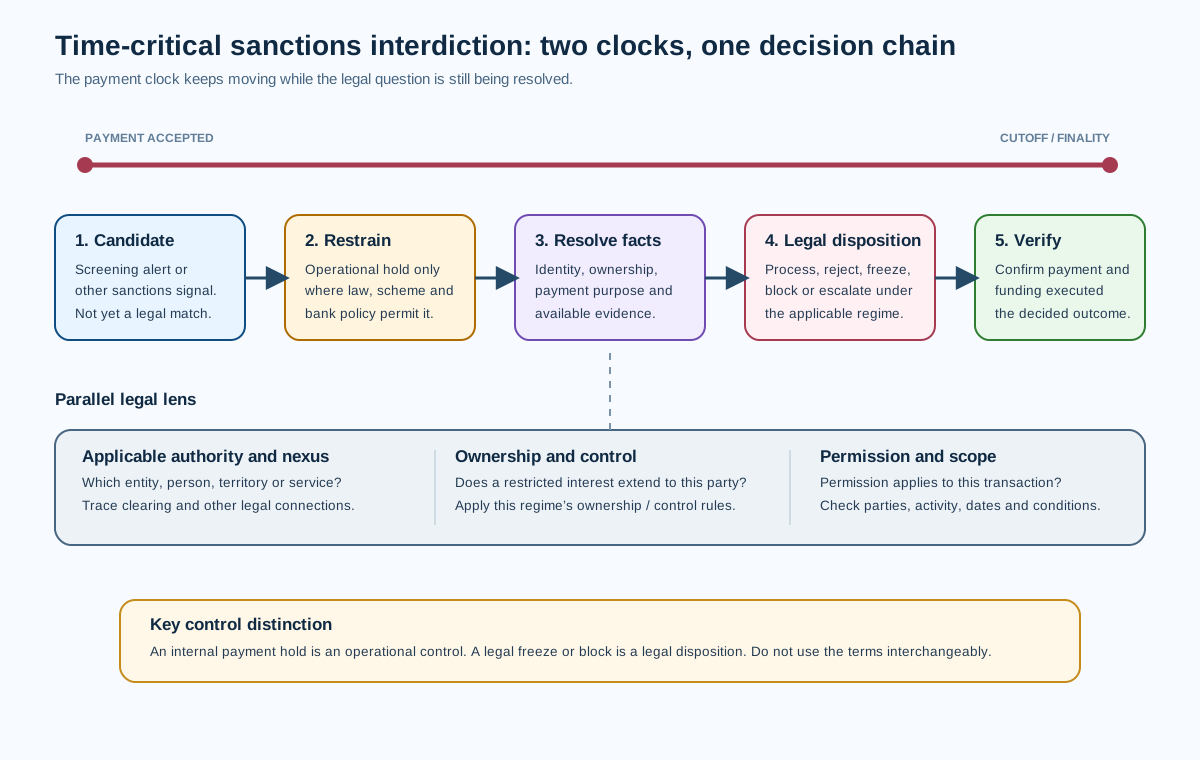
The timeline above is the mental model for the whole chapter. The payment has its own clock. The legal analysis has its own sequence. Good interdiction design makes those two tracks meet before the bank loses the ability to act.
The legal decision and the operational clock are different things
A bank should never let a case-management status become a substitute for legal analysis. A payment may show SANCTIONS HOLD, but that label does not answer the questions that determine the final outcome. The bank still needs to know which sanctions authority and programme may apply, what creates the relevant nexus, whether the party is actually the listed or otherwise restricted person, whether an ownership or control rule extends restrictions to an unlisted entity, whether the activity itself is prohibited, and whether an exemption, general licence, specific licence or other authorization changes the result.
The United States provides a useful example of why disposition vocabulary matters. OFAC distinguishes between blocking and rejecting. Where the applicable OFAC rules require property to be blocked, the property must be frozen in accordance with those rules. A transaction can instead be prohibited without containing a blockable interest; in that situation the activity may need to be rejected or not processed rather than blocked. OFAC also makes clear that authorizations and exemptions must be considered and that sanctions programmes differ. That is a U.S.-specific legal framework, not a universal global decision tree.
The United Kingdom uses its own legislation and OFSI guidance. Asset-freeze prohibitions, prohibitions on making funds or economic resources available, reporting obligations, exceptions and licensing must be assessed against the relevant UK regulations and the facts of the case. The European Union similarly requires analysis of the relevant EU restrictive measures and legal acts. A multinational bank therefore needs a jurisdiction-and-programme decision model rather than a global blocked=true switch.
This distinction changes system design. Case tools should preserve at least the candidate status, temporary processing status, legal regime, legal conclusion, disposition authority, permission or licence basis, payment-system action and reporting state separately. If those are collapsed into one field, a later investigator cannot tell whether the payment was merely paused, legally frozen, rejected because the service was prohibited, returned for a non-sanctions reason, or released because the apparent match was disproved.
The operational question is therefore: what action can the bank lawfully and technically take while the legal question is being resolved? Some rails allow a payment to remain pending. Some schemes impose strict response windows. Some transactions have not yet reached a point of irrevocability. Others have settled already. The answer must be designed in advance, not invented during a live alert.
Hold mechanics that actually prevent settlement
A temporary operational restraint is useful only if it stops the relevant value movement. One of the most dangerous control failures is the decided-but-not-executed hold: an analyst correctly prevents release in the case tool while another payment path, repair process, batch engine, cover-payment process or contingency route continues toward settlement.
Effective hold architecture begins with a path inventory. The bank maps every route through which the affected instruction or its funding can move: the primary payment engine, repair queues, duplicate or replay handling, batch extraction, correspondent forwarding, cover payments, nostro funding, liquidity sweeps and backup processing. Each path needs an enforceable control point and a way to confirm that the current hold state has propagated to it.
The design should be granular enough to avoid unnecessary harm. If one supplier payment in a large corporate file is under review, the preferred architecture is usually item-level containment rather than freezing an entire payroll or supplier batch simply because the legacy file processor lacks granularity. Where the technology cannot do that, the limitation should be explicit, tested and governed, with a controlled manual extraction process if policy allows it. The deficiency itself becomes a technology requirement rather than a permanent excuse for over-broad customer disruption.
Repair is a particularly sensitive path. An operator should not be able to amend a sanctions-relevant field and thereby cause a held payment to re-enter straight-through processing as if it were new and clean. Relevant repairs should preserve the restraint, trigger rescreening where appropriate and require the right approval before release. The same principle applies to failover: a payment moved to a contingency route during an outage must carry its control state with it.
Funding also matters. A principal instruction can be correctly held while a cover payment or liquidity process has already placed economic value at a correspondent. That is not merely a technical inconvenience. It can change the bank's exposure and the available recovery actions. Treasury and sanctions operations therefore need a common view of principal-payment state, cover-payment state and nostro reality.
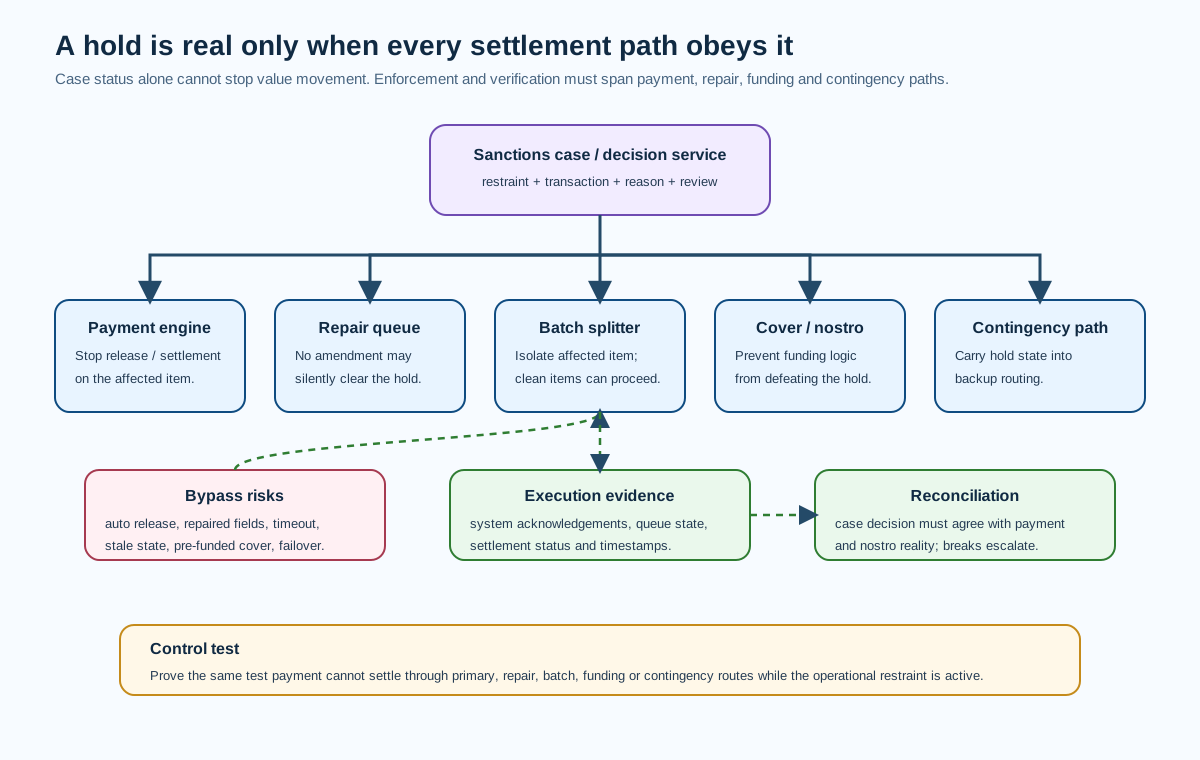
The architecture should produce evidence, not only status. A reviewer should be able to see when the restraint was placed, which systems acknowledged it, whether any leg had already passed a finality point, what happened to cover funding, who later authorized release or another disposition, and whether settlement and nostro records agree with the case outcome.
Expedited triage without turning a candidate into a conclusion
Time pressure changes the sequence of investigation, not the standard of legal accuracy. The analyst starts with the facts most likely to resolve the candidate quickly: strong identifiers, exact entity details, date and place of birth, registration numbers, vessel identifiers, ownership evidence, the relevant programme, the transaction's jurisdictional connections and any known permission or licence. Weak similarities should not receive the same weight as strong identifiers merely because the cutoff is close.
Where applicable law, scheme mechanics and bank policy permit a temporary operational restraint, a sufficiently credible candidate can be restrained while the remaining analysis continues. That is a control choice within an approved framework, not a universal sanctions rule. If the rail cannot pause, or a specific legal framework prescribes a different control model, the bank needs a legally reviewed fallback that says what happens under ambiguity, outage and timeout conditions. The fallback should be explicit enough that two competent analysts facing the same facts do not improvise opposite actions.
The case record should distinguish facts from assumptions. “Name resembles listed alias” is a fact about the match. “This is the listed entity” is a conclusion that requires supporting evidence. “The transaction falls within a prohibition” is a separate legal conclusion. “The bank must block” is a disposition conclusion. Keeping those steps visible makes rapid decisions more defensible and helps quality assurance identify exactly where an error occurred.
Coverage must match the payment service. A bank that offers continuous payment rails cannot depend on a sanctions decision model available only during local business hours. Follow-the-sun teams, on-call specialists, delegated authorities and legally approved decision playbooks may be needed. The point is not to create a heroic 24-hour manual operation around every alert. It is to make sure the control architecture and staffing model reflect the hours during which value can move.
Decision rights under deadline pressure
Interdiction becomes slow when every protective action requires senior approval and becomes dangerous when every analyst can make every legal disposition. A mature operating model separates delegated operational authority from legal disposition authority.
Sanctions operations can be delegated to place temporary restraints within defined conditions. Sanctions advisory and legal functions establish how programmes, nexus, ownership and permissions are interpreted and which questions require escalation. Payment operations execute the chosen payment action. Treasury manages cover and liquidity implications. Senior governance owns risk acceptance, unresolved structural gaps and major incidents. Quality assurance and audit test whether the process behaves as designed.
Maker-checker controls also need context. A second review can improve quality, but a serial approval chain that exceeds the rail's available window is not a control. Banks can use pre-authorised rapid second-review arrangements, parallel evidence collection or clearly scoped emergency decision rights. Retrospective QA can test whether the decision was sound, but it cannot pretend a legal freeze or settled payment never occurred. Corrections, releases, licensing or unblocking must follow the lawful process applicable to that situation.
Decision documentation can remain concise under pressure while still being reconstructable. The record should capture the candidate, decisive matching or disconfirming evidence, applicable legal framework, any permission relied upon, deadline or finality position, authority used, final action and execution evidence. Long prose is not the objective. A complete decision trail is.
Payment rails, cutoffs and settlement finality
There is no single “payment cutoff.” Every rail has its own processing stages, business-day conventions, finality model, return mechanics and operational dependencies. Correspondent payments can have internal bank cutoffs, correspondent cutoffs and market-infrastructure deadlines. Batch clearing gives different intervention opportunities from real-time clearing. Securities and trade flows can introduce their own settlement events. The bank's sanctions procedures should therefore consume maintained rail data rather than depend on analyst memory.
Finality is equally important. A payment may be operationally difficult to recover without necessarily being legally or technically identical to every other “irrevocable” payment. Post-settlement options can include scheme procedures, recalls, returns, legal orders, beneficiary-institution cooperation or other mechanisms depending on the rail and jurisdiction. The correct statement is that finality can materially reduce unilateral recovery options and make prevention more important; it does not mean every settled payment has literally no possible recovery route.
Triage should use time-to-finality alongside candidate strength and consequence. A high-confidence candidate approaching finality requires immediate attention. A weak name-only candidate with more time can be investigated without unnecessary disruption. A weak candidate with almost no time requires the pre-approved fallback for that rail, not an analyst's personal preference for “always release” or “always hold.”
Cutoff data is itself controlled reference data. Scheme changes, correspondent arrangements, holidays and processing changes can make old calendars dangerous. Owners should maintain the source, effective date and validation of cutoff information just as carefully as sanctions list data when that information drives alert priority.
Instant payments: there is no universal transaction-screening model
Instant payments expose a common conceptual mistake: assuming that because settlement is fast, every jurisdiction must require a sanctions name screen on every transaction immediately before execution. That is not a globally valid rule.
In many environments, a bank may use pre-execution transaction controls because the applicable sanctions regime, supervisory expectations, its risk assessment, payment data and scheme design make that control useful or necessary. Those controls have to fit within the rail's latency budget. They also need a legally approved outage and ambiguity strategy, because a screening service that simply times out during a real-time payment creates a decision problem rather than making the legal obligation disappear.
The European Union's rule for in-scope euro instant credit transfers demonstrates why architecture must be traced to law. Regulation (EU) 2024/886 inserted Article 5d into the SEPA Regulation. For targeted financial restrictive measures, payment service providers offering instant credit transfers must verify whether their own payment service users are subject to those measures immediately after new measures or amendments enter into force and at least once every calendar day. During execution of the instant credit transfer, the payer's PSP and payee's PSP are not to perform an additional payer/payee verification for those targeted financial restrictive measures beyond that Article 5d customer screening. The rule expressly leaves other restrictive measures and EU AML/CFT obligations outside that limitation.
That design moves an important control from the transaction moment to the customer population for this specific legal scope. It does not mean an EU PSP can ignore sanctions generally, and it does not mean every other country or payment rail should copy the model. It means architects, BAs and compliance teams must avoid writing a generic requirement such as “all instant payments shall screen payer and payee against all sanctions lists before execution.” The requirement should instead identify the authority, measure type, customer or transaction population, control point, frequency, effective-time trigger, exception and evidence.
EBA restrictive-measures guidance also needs to be read together with this statutory model rather than used to recreate an additional Article 5d payer/payee check during execution. For banks working across regions, the practical architecture may therefore contain different control paths for EU in-scope instant credit transfers, other EU restrictive measures, non-EU payments and internal group-policy controls.
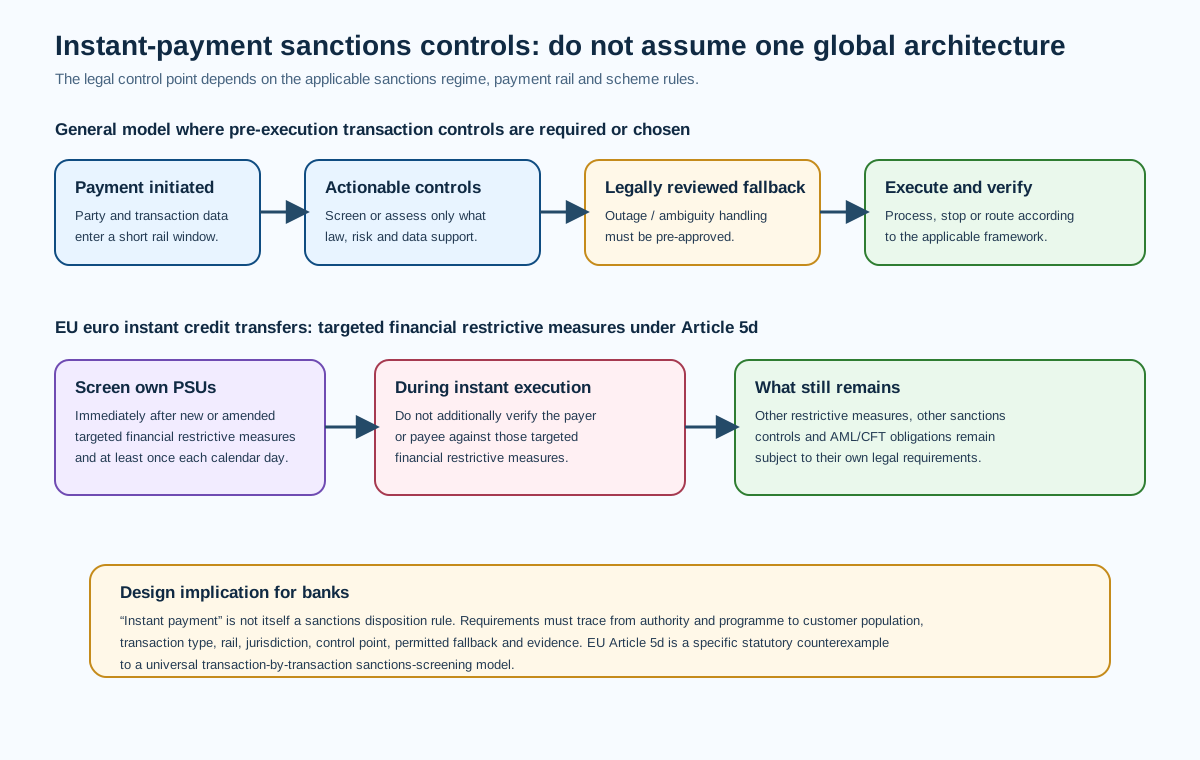
This is why a global payment hub needs more than a single screening toggle. It needs policy-aware orchestration capable of determining which control applies to which transaction, which customer populations must already have been screened, what evidence proves that screening occurred, and what happens when the legal or technical control is unavailable.
Correspondent banking and multi-leg payments
Cross-border interdiction often spans several institutions and more than one movement of value. The customer payment, correspondent instruction and cover funding can progress at different speeds. An intermediary may see different data from the ordering institution. A downstream bank may have already acted before the originating bank resolves its alert. The end-to-end case therefore needs transaction identifiers, agents, settlement legs and status events, not merely a copy of the original payment message.
When a bank needs another institution's assistance, precise identification matters. The UETR, payment references, dates, currencies, amounts, debtor and creditor information and relevant agent details help the recipient locate the correct transfer quickly. Contact directories and escalation paths should be tested before an incident. A recall initiated to an obsolete mailbox after settlement is not an effective recovery control.
Information sharing must stay within applicable confidentiality, privacy and tipping-off constraints. The bank should transmit enough information to allow the other institution to identify and act on the transaction without disclosing intelligence or internal analysis that it is not permitted or appropriate to share. Where law enforcement or an FIU is already involved, communication sequencing may need explicit guidance.
Multi-leg transactions create an additional risk: partial execution. If one currency leg, cover leg or related payment settles while another remains held, the commercial transaction has entered an exception state that requires explicit exposure analysis. Systems should link the legs and display the earliest cutoff or finality point across the set.
Nostro and treasury evidence
Nostro reconciliation provides an independent check on whether an interdiction decision worked in financial reality. If the case says a payment was held but the correspondent account shows the debit, the control failed regardless of the case status. If a recall succeeded, the corresponding return credit and value date should be visible. If the principal payment was stopped but cover funding moved, the bank needs to understand the actual economic position.
During major designations or incidents, intraday visibility can be more useful than waiting for end-of-day reconciliation. Operations and treasury can monitor held queues, released items, cover positions and unusual settlement breaks. Breaks should be reason-coded so that timing differences are separated from genuine control failures.
Treasury automation needs the same control awareness as the payment engine. Liquidity sweeps, prefunding and cover generation should not undermine a sanctions restraint simply because the treasury platform has not received the latest payment status. That integration is a classic BA and architecture requirement: identify the authoritative state, propagation mechanism, latency expectation, failure handling and reconciliation evidence.
Trade, vessels and commercial deadlines
Trade and maritime payments introduce deadlines that are commercially real but legally irrelevant to whether a prohibition applies. Letter-of-credit expiries, demurrage, port windows, perishable cargo and vessel schedules can create intense pressure to release a transaction. That pressure should accelerate evidence gathering, not lower the legal standard.
A good expedited process brings the right evidence forward. For a vessel, stable identifiers and authoritative ownership or registration information can resolve a name collision far faster than arguing about the customer's commercial urgency. For goods, clear product classification, end-use, end-user and licence information may be decisive. For ownership questions, the structure and source quality matter more than repeated requests for generic corporate documents.
Banks should avoid embedding invented universal SLAs such as “all vessel alerts must be resolved in forty minutes.” A bank can maintain internal service targets based on its products and risk, but those targets should be labelled as operational commitments, not regulatory deadlines unless a specific law or rule actually creates one.
Incident response when interdiction fails
A missed interdiction can arise from different causes: the candidate was not detected, detection came too late, the hold did not reach every system, the wrong legal conclusion was reached, an approver was unavailable, a contingency path bypassed controls, or the payment had already crossed the relevant finality point. Root-cause analysis should identify which control layer failed because the remedies are different.
Recovery and investigation often need to run in parallel. Payment operations may pursue the rail's recall or recovery options while sanctions teams determine legal exposure, scope related activity and prepare any required reporting. Technology teams preserve logs. Treasury checks settlement and cover movements. Relationship teams manage customer communication within legal constraints. Legal and compliance teams decide how the relevant authority should be engaged.
The bank should not promise itself that good remediation guarantees lenient regulatory treatment. Different authorities have different enforcement frameworks, and every case turns on its facts and law. Some authorities expressly consider compliance-programme quality, cooperation, voluntary disclosure or remediation as factors in enforcement or penalty decisions. Those factors can matter, but they are not a safe harbour. The operational reason to remediate well is to stop recurrence and provide a complete, truthful account of what happened.
A strong incident record therefore preserves the chronology: when the restriction became legally relevant, when the bank received or activated the necessary data, when the payment entered processing, when the candidate appeared, what the bank knew at each decision point, what systems did, when settlement occurred, what recovery steps followed and what structural fix was implemented.
Data, architecture and testing requirements
For a business analyst, the most useful requirement set starts with traceability. Every control should map from legal or policy obligation to product and rail, required data, control point, decision state, system action, evidence and test case. Generic requirements such as “system shall comply with sanctions” or “system shall stop suspicious payments” are not testable.
Payment-state design should distinguish at least initiated, screening-pending, operationally restrained, investigation-pending, legally blocked or frozen where applicable, rejected or not processed, released, settled, recalled, returned and manually corrected states. Not every institution will use those exact labels, but the state model should make illegal transitions impossible. A repair operator should not move a legally blocked item to released. A timeout should not silently turn review pending into process. A failover should not forget the existing restraint.
Testing should include positive, negative and failure cases. Positive tests prove a legally relevant candidate is detected and the required disposition executes before the applicable control point. Negative tests prove a similar but distinguishable party can proceed without unnecessary harm. Failure tests cover screening outage, stale list data, delayed hold propagation, repair bypass, batch granularity, cover-payment release, unavailable approver, cutoff change, contingency routing and inconsistent status between case, payment and nostro systems.
The test oracle must come from the applicable requirement, not from today's system behaviour. If the current platform accepts a transaction during an outage, that does not make acceptance the expected result. The expected result must be derived from the legally reviewed fallback for that jurisdiction, product and rail.
Customer impact and conduct under sanctions pressure
Sanctions controls can cause serious customer consequences even when the customer is completely legitimate: delayed salaries, missed house purchases, expiring trade documents, exchange-rate losses, stranded vessels or reputational damage with counterparties. Those consequences do not justify processing a prohibited transaction, but they do justify precise controls, rapid investigation and clear communication.
Customer communication should explain what the bank can lawfully say. A vague “technical problem” can be misleading if the bank knows the payment is under compliance review, while too much detail can create legal or investigative problems. Templates should therefore be reviewed for the relevant jurisdiction and case type. Operational teams also need a path for vulnerable or high-impact cases without allowing commercial status to change the legal outcome.
False-positive reduction is part of customer protection. Better identifiers, structured payment data, list quality, ownership data, suppression governance and model tuning reduce unnecessary holds. The objective is not to maximize the number of stopped payments. It is to stop the payments that must not proceed while allowing lawful payments to move with the least avoidable friction.
Practical mini case: a cross-border supplier payment approaching cutoff
Consider a fictional corporate payment of EUR 480,000 sent to a long-standing supplier. The beneficiary name produces a close sanctions candidate twenty-five minutes before the correspondent's release cutoff. The debtor's history is consistent, but the beneficiary's registered address has recently changed and the payment message contains no registration number.
The bank's orchestration service places a temporary operational restraint because that action is permitted under the bank's legally approved process for this rail. The analyst confirms that the alert relates to an OFAC-listed entity but first checks whether an OFAC nexus exists for the processing entity and transaction rather than assuming the list alone controls the outcome. The analyst compares the listed entity's registration details, aliases, ownership and location with customer and independent data. A registration number obtained from the customer's invoice and verified against a reliable registry proves that the beneficiary is a different legal entity with a similar trading name.
The payment is released before the correspondent cutoff. The case records the distinguishing identifiers, the legal applicability assessment, the release authority and the payment-engine acknowledgement. The analyst also notices that the same false candidate has occurred three times because the beneficiary master lacks a registration identifier. A data-quality change is raised so the verified identifier becomes available to future reviews.
Now change one fact. Suppose the registration evidence instead confirms that the beneficiary is the listed entity. The next step is not automatically “block everywhere.” The bank applies the sanctions regime actually relevant to the transaction, checks whether any authorization or exemption applies, and executes the disposition that framework requires. Under a U.S. OFAC scenario that may mean blocking where a blockable interest exists, or rejecting a prohibited transaction without a blockable interest. A UK or EU scenario requires its own legal analysis. The same screening evidence can therefore lead to different operational actions because the law, nexus and permissions differ.
This case captures the professional habit the chapter is trying to build: move quickly, but never let urgency collapse candidate, match, applicability and disposition into one decision.
What good looks like
A mature interdiction capability can answer five questions at any moment. What is the current payment and funding state? What deadline or finality point matters? What evidence supports or disproves the sanctions candidate? Which legal framework and permission analysis determines the final disposition? Has the payment, treasury and reconciliation estate actually executed that disposition?
When those answers are available from joined data and clear decision rights, sanctions operations become controlled payment operations rather than crisis management. When they are scattered across spreadsheets, inboxes, case notes and unlinked systems, every urgent alert becomes a fresh improvisation.
The goal is not speed by itself. It is correct, lawful and provable action before the bank loses the ability to act.
Operational deep dive: hold systems, cutoff intelligence and recovery mechanics
The base chapter separates a screening candidate, a temporary operational restraint and the final legal disposition. This deep dive turns that distinction into systems design. Its focus is not on inventing one universal sanctions workflow, but on building a payment-control estate that can apply the right workflow for each jurisdiction, sanctions measure, product and rail.
Hold-system design and coverage verification
A temporary operational restraint begins as a decision state but succeeds only when the payment estate enforces it. The design process starts by mapping every route the payment or its funding can take: primary processing, repair, duplicate and replay handling, batch processing, cross-border forwarding, cover generation, nostro funding, liquidity sweeps, manual operations and contingency routing.
For each path, the bank should define the authoritative hold state, propagation mechanism, maximum propagation latency, acknowledgement, failure behaviour and release authority. The key test is end to end: a payment restrained in the case tool must not settle through another route while that state remains valid. If a route cannot enforce the state, the limitation should be visible in architecture and risk governance rather than buried in an operations note.
Coverage tests should attempt realistic bypasses. Modify a held beneficiary name in repair. Replay a held message after a timeout. Split a batch. Fail over to a backup engine. Generate cover before the principal payment is released. Trigger an automatic liquidity sweep. A control that works only on the primary happy path is not an interdiction control.
State synchronization also needs versioning. A case decision made at 10:14 and propagated at 10:15 should retain those timestamps. If the payment engine last refreshed at 10:10, the bank should be able to see that it is stale. Release should be equally controlled; removing a restraint in one system must not leave another engine permanently blocked, and a delayed release message should not be mistaken for a new sanctions event.
Cutoff intelligence as controlled reference data
Time-critical triage depends on accurate payment timing. Cutoff data should therefore be treated as controlled operational reference data with an owner, source, effective date and validation process. Relevant inputs can include scheme submission times, correspondent-specific cutoffs, currency holidays, maintenance windows, internal release times and known finality points.
Triage should prioritize by time-to-relevant-control-point rather than simple queue order. A high-confidence case close to finality can require immediate specialist attention, while a weak candidate with a longer window can receive fuller investigation without unnecessary disruption. The prioritisation rule does not change the sanctions law; it determines which case receives scarce attention first.
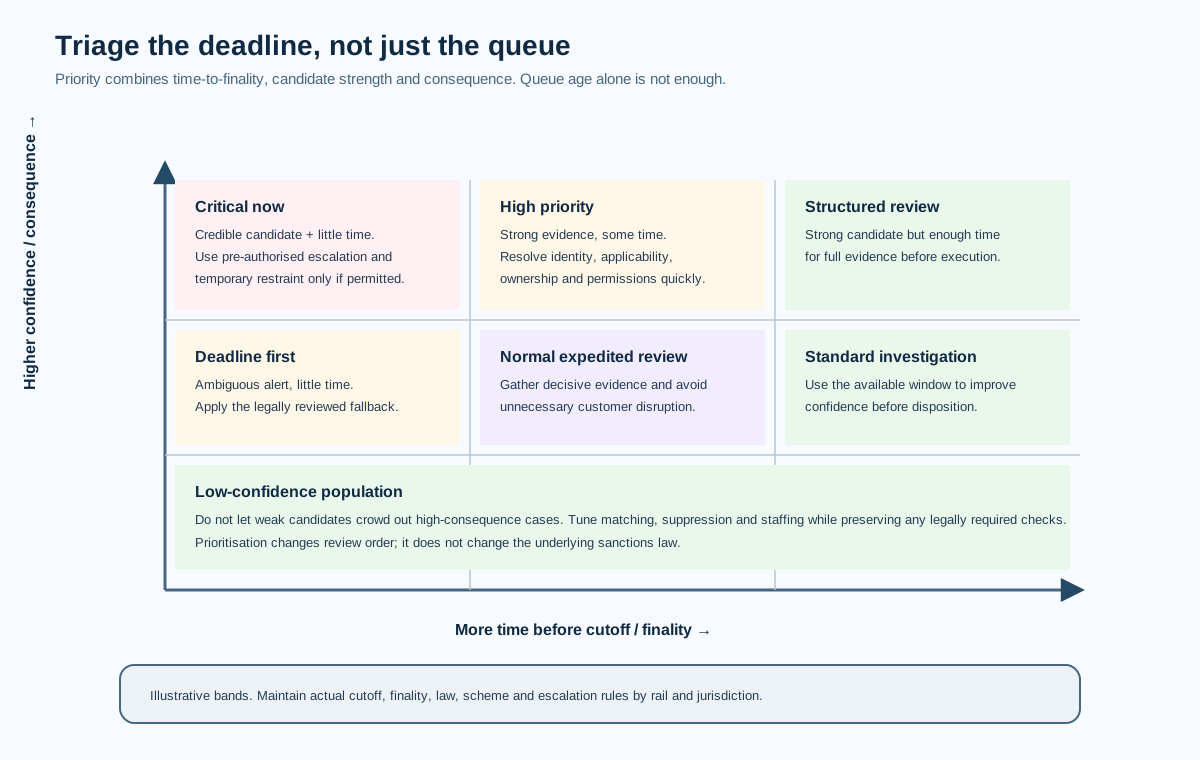
Banks should be careful with labels such as urgent, critical and breach. A missed internal target is not automatically a legal breach. Conversely, a transaction can meet the bank's internal SLA and still violate sanctions law if the underlying legal analysis or system execution was wrong. Metrics should therefore separate operational timeliness, legal outcome and customer impact.
Cutoff-change governance matters because stale timing data can misdirect the queue. A correspondent changing its local cutoff, a scheme extending operating hours or a holiday-calendar error can make the bank believe it has more time than it does. The cutoff service should feed the same change-management process as other production reference data, with testing after material changes.
Finality mapping: design from the rail, not from a slogan
“Instant,” “real-time” and “irrevocable” are useful business descriptions but insufficient requirements. A finality map should document the actual rail states: when the bank can stop the instruction, when the clearing system accepts it, when interbank settlement becomes final, what return or recall mechanisms exist, whether the beneficiary institution can cooperate after settlement and what legal or scheme powers may affect recovery.
This matters because sanctions prevention and recovery are not binary. Some rails allow the sending bank to cancel before a defined point. Some permit returns but not unilateral reversals. Some provide recall messages whose success depends on the receiving institution. A court order or authority action may create options outside ordinary scheme processing. The control design should state what the bank can actually do at each state instead of assuming “settled means impossible” or “recall means reversible.”
For rails with very limited post-settlement leverage, preventive controls become more important. But the preventive control itself still has to be the one required or appropriate for the jurisdiction. The EU Article 5d framework for in-scope euro instant credit transfers is a good example: for the targeted financial restrictive measures within that provision, the law uses customer screening after new or amended measures and at least daily and does not add payer/payee verification during execution. A finality map must therefore sit next to an obligation map; finality alone cannot tell the bank which sanctions check to perform.
Control-service outage and degraded-mode design
A screening outage is not one problem. A sanctions-list feed may fail while the matcher remains healthy. The matching engine may fail while recent customer-screening status remains available. An ownership provider may be unavailable while direct list screening works. A case tool may be down while the payment engine remains capable of enforcing a restraint. Each failure removes a different control capability.
The continuity model should classify the failed component, identify the affected obligation and product population, and select only legally approved fallback actions. Possible designs include queuing, local screening against a validated copy, alternate service routing, controlled manual review, transaction suspension or another product-specific fallback. Processing and reviewing later is not a default right; rejection is not universally required either. The lawful answer depends on the control and rail.
For a continuous service, degraded mode should have a defined start time, approval, maximum duration, monitoring and exit condition. Once the primary service returns, the bank should reconcile the population processed during degradation and perform any required rescreening or lookback. The evidence should show which data version and control path each transaction used.
Testing must include stale-success scenarios, not just visible outages. A service returning HTTP 200 with yesterday's sanctions data can be more dangerous than a hard failure because normal processing may continue. Integrity controls, source timestamps, hashes where supported and list-version checks can distinguish technical availability from control validity.
Recall operations and recovery readiness
Post-settlement recovery requires precision. Playbooks should identify the rail, transaction identifiers, receiving institution, contact channel, applicable scheme message or process, escalation route and evidence needed to support the request. UETR is especially useful in cross-border payment chains where available because amount and date alone may be insufficient to locate the correct transfer quickly.
Contact data should be tested. A list of generic mailboxes stored in a procedure does not prove recovery readiness. Simulation can verify whether after-hours contacts answer, whether the recipient can locate the transaction and whether internal teams know who may authorize the request.
Recovery metrics should be interpreted carefully. A high recall-success rate may reflect benign operational errors rather than sanctions incidents. A low rate in one corridor may result from finality, counterparty behaviour or process weakness. The metric is useful for understanding leverage, but not as a substitute for legal compliance.
Multi-leg and cross-currency transactions
A commercial transaction can create several linked settlement legs. A cross-currency payment may involve FX execution, principal transfer, cover funding and downstream beneficiary settlement. Those components may have different systems, cutoffs and finality points.
The bank should model the transaction as a relationship of legs rather than isolated instructions. A restraint on the principal payment should identify whether an FX trade has already executed and whether a cover leg exists. If one leg settles while another remains restrained, the case moves into a partial-execution state requiring explicit exposure analysis. A single paymentStatus field is rarely enough.
Pre-conversion controls may be appropriate for higher-risk flows because executing FX can create market and settlement consequences even if the principal payment is later stopped. But the requirement should be justified by the applicable product, law and risk assessment. A universal “sanctions must clear before every FX conversion” rule can be as misleading as a universal “screen every instant payment” rule.
Repair-bypass resistance
Repair workflows are designed to fix data and continue processing, which is exactly why they can undermine sanctions restraints. The control principle is that a sanctions-relevant amendment should change the data, not erase the history.
The platform should preserve original and amended values, the operator, timestamp, reason and existing control state. Relevant field changes should trigger the necessary rescreening or re-evaluation. If the payment was temporarily restrained, the repair path should not release it unless the authorized sanctions decision flow approves the release.
Testing can simulate punctuation changes, transliteration changes, beneficiary-address edits, agent changes and remittance-text repair. The expected result is not that every repair creates a new alert. It is that the control state and audit trail remain coherent and that any change capable of affecting the sanctions decision receives the right re-evaluation.
Analytics can also identify abnormal behaviour: operators with unusually high repair-to-release rates, repeated amendments immediately before cutoffs, or fields changing systematically toward forms less likely to match. These are investigation leads, not automatic proof of evasion or misconduct.
Queue analytics and capacity
Deadline operations need different metrics from ordinary case management. Useful views include time remaining to the relevant cutoff, cases awaiting legal advice, cases restrained but not yet acknowledged by payment systems, cases with cover already released, and recovery actions awaiting counterparty response.
Capacity planning can use historical arrival patterns and triage duration to identify periods with elevated deadline risk. It should avoid pretending the model can predict sanctions breaches with certainty. The practical objective is to know when the operation is likely to lose decision time and to activate extra capacity before the queue collapses.
Surge procedures should define which work can be automated or deprioritised without weakening required controls. Low-confidence nuisance alerts may be routed differently from high-confidence candidates if the risk model and applicable requirements support it. Specialist questions can be batched where appropriate. Repeated candidates with verified distinguishing identifiers can be handled through governed suppression rather than repeatedly consuming urgent-review capacity.
Contingency-path enforcement
Backup processing deserves the same sanctions design as primary processing. A failover path activated only during incidents is often the least exercised and most likely to carry stale configuration or incomplete integration.
The contingency inventory should state which sanctions controls remain equivalent, which degrade, what data is available, whether operational restraints propagate and what compensating controls apply. Switching to the contingency path should trigger verification that existing restrained payments remain restrained. Returning to the primary path should reconcile decisions made during the outage.
A bank should test this with production-like simulations. Place a test restraint, fail over, repair the payment, attempt release, restore the primary system and verify all states agree. The result is stronger evidence than a design diagram claiming both systems consume the same API.
Practitioner checkpoint
A practitioner completing this deep dive should be able to explain the difference between legal obligation mapping and rail-finality mapping; design a temporary operational restraint that survives repair, batch, funding and contingency paths; build cutoff-aware triage without inventing legal deadlines; define a lawful degraded-mode strategy; and specify the evidence needed to prove the payment and funding systems executed the final decision.
The quality test is not whether the workflow sounds fast. It is whether the bank can reconstruct a real case and show that the right legal decision reached the right control point before the relevant payment state changed.
Advanced practice: worked interdiction cases
The cases below are fictional. Amounts, deadlines and operating choices are illustrative and are not regulatory thresholds. Their purpose is to show how a bank separates a screening candidate from legal applicability and then from payment execution under time pressure. Real cases turn on the actual sanctions regime, nexus, payment rail, scheme rules, permissions and the bank's approved procedures.
A useful discipline runs through every case: establish the payment clock, preserve lawful intervention capability where available, resolve the decisive facts, determine the legally required disposition, execute it in every relevant payment and funding path, and preserve evidence showing what happened. The same alert can produce different outcomes in different jurisdictions because sanctions rules are not globally interchangeable.
Case 1: the instant payment and the dangerous search for one universal answer
A fictional bank receives an instant-payment candidate seconds before the rail's response window closes. The beneficiary name resembles an alias on a sanctions list, but the message contains no strong secondary identifier. The tempting training answer is to say that the bank should either reject every ambiguous payment or accept every low-confidence candidate and review it afterwards. Both answers are unsafe because neither starts with the applicable legal and scheme framework.
Consider two different control environments. In the first, the institution operates a rail and jurisdiction where its approved sanctions framework uses pre-execution transaction screening and where the payment can lawfully be stopped or rejected before settlement. The bank's runbook defines how matching confidence, corroborating identifiers, legal nexus, permissions and rail timeout interact. If an unresolved candidate meets the bank's legally reviewed threshold for temporary restraint or non-processing, the system follows that path. If the candidate is clearly disqualified, the payment proceeds. An outage or low-confidence fallback is not an analyst improvisation; it is a pre-approved control decision grounded in that jurisdiction and rail.
Now consider an in-scope euro instant credit transfer in the European Union for the specific targeted financial restrictive measures covered by Article 5d of the SEPA Regulation as amended by Regulation (EU) 2024/886. For that scope, the control architecture is different. PSPs offering instant credit transfers screen their own payment service users immediately after new or amended targeted financial restrictive measures enter into force and at least once every calendar day. During execution of the instant transfer, the payer's and payee's PSPs do not perform an additional payer/payee verification for those targeted financial restrictive measures. Other restrictive measures and AML/CFT obligations remain governed by their own requirements.
That EU example is deliberately included because it breaks the simplistic rule that “instant payment means sanctions screen every payer and payee in real time.” A BA writing one global requirement would create a design conflict with the specific EU rule. The correct requirement model identifies the authority, restriction type, customer or transaction population, control point, frequency, allowed intervention and evidence.
The lesson is not that post-event review is always acceptable, nor that transaction screening is always mandatory. The lesson is that there is no universal sanctions disposition based only on matching confidence and payment speed. Legal applicability and rail-specific control design come first.
Case 2: the batch file with one affected item
A corporate file contains 4,200 salary and supplier payments with an illustrative total value of EUR 18 million. One supplier payment for EUR 145,000 produces a credible candidate shortly before the file submission cutoff. The legacy batch engine supports only whole-file release or whole-file hold.
The bank uses a temporary operational restraint because its approved process allows it while the candidate is resolved. At the same time, technology and operations assess whether the single payment can be extracted safely from the file. They do not describe the whole batch as “frozen property”; the current state is an operational containment action while legal analysis continues.
Suppose item-level extraction is possible through a controlled process. The clean items are validated and released while the candidate remains isolated. The investigation then confirms the beneficiary is a restricted entity. The sanctions team determines which regime and nexus apply, checks ownership and any relevant authorization, and then executes the legal disposition required by that framework. In one jurisdiction that might require an asset freeze or block; in another fact pattern a prohibited transaction might instead be rejected or not processed. The training point is to avoid turning “true match” into a globally universal verb.
The structural remediation is clear. Item-level disposition becomes a funded system requirement. The interim extraction procedure receives maker-checker controls, reconciliation and audit evidence. Customer communication is designed so payroll or other clean payments are not unnecessarily delayed simply because the bank's technology lacks granularity.
Case 3: the vessel payment before a sailing window
A port-disbursement payment is due for a vessel scheduled to sail later that day. The vessel name resembles a sanctioned vessel, but the IMO number, flag and tonnage supplied by the agent appear inconsistent with the listed record. Commercial teams emphasise demurrage and the risk of missing the sailing window.
The sanctions team uses the commercial deadline to prioritise the review, not to lower the evidence standard. Stable vessel identifiers are checked against reliable sources. Former names, ownership, management and relevant voyage information are reviewed where necessary. The second reviewer focuses on the decisive differences rather than reproducing the entire first review.
If the identifiers establish that the vessel is not the listed vessel and no other sanctions concern remains, the payment can be released under the bank's process. If the evidence instead confirms the listed vessel or another restriction, the applicable sanctions regime determines what action is required. No universal “forty-minute rule” is taught. A bank may set internal service targets, but commercial urgency does not create a legal deadline and should never be presented as one.
A good post-case action is to improve reference data. If a verified IMO number or other stable identifier can be stored and reused appropriately, future alerts may be resolved faster without weakening screening.
Case 4: the payment that settled before the bank understood the ownership chain
An overnight payment settles. During the morning, new ownership information shows that the beneficiary may have been subject to restrictions through an ownership or control rule. The bank now has two urgent tasks: understand the legal exposure and determine whether any recovery option remains.
Payment operations use the rail's available recall or return mechanisms and contact the beneficiary institution with precise payment identifiers. Sanctions investigators reconstruct the ownership position at the relevant time, determine which regime and nexus apply, and assess whether the payment was actually prohibited. Treasury verifies settlement and cover movements. Technology preserves logs and the exact data used by the screening and ownership services.
These tracks run in parallel because recovery prospects can deteriorate with time while legal analysis requires care. The bank does not claim that a recall is guaranteed. Nor does it claim that good remediation guarantees a favourable enforcement result. In some regimes, cooperation, voluntary disclosure, compliance-programme quality or remediation can be relevant enforcement factors, but the outcome depends on the applicable law and facts. The reason to respond quickly and transparently is to limit harm, meet legal obligations and prevent recurrence.
Root-cause analysis may identify stale ownership data, a missed event trigger, incomplete group structure, weak data lineage or a calculation defect. The remedy is then structural: improve change detection, ownership recomputation, effective dating and validation, and test the repaired control with historical and synthetic cases.
Case 5: payroll pressure and the danger of all-or-nothing thinking
A corporate file contains thousands of employee salary payments and one supplier payment with a strong sanctions candidate. The payroll cutoff is close. Holding the entire file could affect many employees, but releasing the candidate item could create sanctions exposure.
The correct operating response is to separate the legal question from the technology limitation. The candidate item receives the appropriate temporary processing treatment available under the approved framework. Operations attempt safe file splitting or item extraction. Clean salary payments are released only after integrity checks confirm that the extraction did not change amounts, beneficiaries or totals. The affected supplier item remains under investigation.
If investigation confirms a restricted party or prohibited activity, the bank applies the legal disposition required by the relevant regime rather than using “block” as a generic synonym for every sanctions outcome. The incident becomes evidence for investing in item-level batch control and for testing payroll-specific fallback procedures before the next urgent case.
The customer-impact lesson matters. Sanctions compliance does not require avoidable harm to unrelated customers when the bank can isolate risk precisely. Precision is part of a strong control design.
Case 6: weekend instant-payment surge
A fintech customer's weekend payment volume rises sharply during a promotional campaign. At the same time, the bank sees more first-time beneficiaries and higher-risk corridors. The instant rail continues continuously, but specialist staffing is thinner outside normal business hours.
The bank activates a pre-defined surge plan. That plan does not invent new legal powers. It changes how capacity and risk signals are managed within existing requirements: higher-risk cases are prioritised, known benign patterns are separated from genuinely new behaviour, automated controls are monitored for latency, and on-call specialists handle pattern-level questions that could affect a large population of payments.
If a particular rail or jurisdiction requires a specific processing fallback during control degradation, that fallback governs. If the legal framework does not permit processing without the required control, commercial pressure and queue volume do not create an exemption. Conversely, the bank should not invent an unnecessary transaction hold where the applicable rule deliberately places the control elsewhere, as with the specific EU Article 5d customer-screening model for in-scope targeted financial restrictive measures.
After the surge, the bank compares predicted versus actual demand, control latency, alert quality, missed or late cases and staffing capacity. Continuous payment services need continuous control capability, but that capability may combine customer screening, real-time transaction controls, automated restriction logic and specialist escalation differently across products and jurisdictions.
Case 7: the nostro-funding trap
A principal cross-border payment is restrained for sanctions review, but an automated cover process has already funded the relevant correspondent position. Treasury later sweeps the balance into general nostro liquidity. The case tool shows “held,” yet the economic position is more complicated than that label suggests.
The investigation reconstructs the sequence: when the cover instruction was generated, when it settled, when the principal hold was placed, whether the cover can be identified or recalled, and whether any subsequent use of the nostro position changes the exposure. The sanctions analysis then applies the relevant legal framework to the actual movement of value rather than assuming the principal instruction tells the whole story.
The control repair is integration. Higher-risk payments may need hold-aware cover generation. Treasury needs timely payment-state data. Nostro reconciliation needs to identify inconsistencies between case decisions and settlement reality. Where earmarking is technically impossible because liquidity is fungible, the limitation should be documented and addressed in the control design rather than hidden behind the principal payment status.
Case 8: a screening alert during a control-service outage
A screening service becomes unavailable while payments continue to arrive. Operations asks whether it can simply “process and screen later.” That question cannot be answered by technology alone.
The approved continuity design should already classify the affected controls and rails. Some products may be queued safely. Some may use a validated local or degraded control set. Some may need rejection or suspension because processing without the required control is not legally or operationally acceptable. Other flows may sit within a framework where sanctions control is performed against a customer population rather than each transaction, changing what the outage actually affects.
The continuity decision therefore starts with obligation mapping. Which sanctions control is unavailable? Is it legally required at that exact transaction point? Does another valid control satisfy the obligation? What does the scheme permit? Is the control outage affecting a sanctions list, ownership service, transaction-screening engine or merely a non-critical enrichment source? The answer determines the safe fallback.
Once service is restored, the bank performs reconciliation and any required rescreening or lookback. It also measures the outage's control impact, not just uptime. A service that was technically available but returned stale or incomplete results can be more dangerous than a visible outage because operations may continue believing the control is effective.
Case 9: jurisdiction mismatch in a global payment hub
A global hub receives a payment involving a customer booked in one legal entity, a currency cleared through another jurisdiction and an intermediary bank in a third. A screening candidate appears against a party on one authority's list but not another's. A simplistic global engine marks the transaction BLOCKED before anyone has determined which rules apply.
The correct analysis separates group policy from law. The bank identifies all relevant nexuses and legal entities, determines which regimes apply to which participant or service, checks any ownership or sectoral restrictions and identifies whether group policy is intentionally stricter than local law. If group policy prohibits the transaction, the customer outcome should be recorded as a policy decision rather than falsely described as a legal asset freeze.
Architecture should support multiple obligations on the same payment without collapsing them. A transaction can be legally permitted in one entity, prohibited in another path, and outside the scope of a third regime. Routing, currency and agent changes may alter the nexus. This is why sanctions decisioning belongs in orchestration with explicit policy and legal context rather than a single global list-match flag.
Case 10: the repaired beneficiary name
A payment alerts on a beneficiary. A repair operator notices that removing punctuation and expanding an abbreviation makes the name conform to the customer's invoice and also removes the screening alert. The operator believes the repair is harmless and resubmits the payment.
This is a classic bypass risk. The issue is not that every repair is suspicious. It is that sanctions-relevant changes should not erase the history or the control state. The repaired data should be rescreened, the original value preserved, the reason for amendment recorded and any existing operational restraint carried forward until the authorized decision process releases it.
Testing should deliberately simulate this pattern. A held test payment should remain contained when name, address, remittance or agent fields are changed, unless the approved workflow explicitly authorizes release after the required review. Repair-volume analytics can also identify operators or paths with unusually high repair-to-release rates.
What these cases teach together
Time-critical sanctions operations are not a race to choose a verb. They are a race to preserve correct decision capability while the payment system moves. The professional sequence is always to understand the rail, understand the legal framework, distinguish the candidate from the legal conclusion, use only the intervention mechanisms that are lawfully and operationally available, and then verify what happened in settlement reality.
The strongest organisations do not rely on analysts to remember these distinctions in the final seconds before a cutoff. They encode them into jurisdiction-aware requirements, payment-state models, authority matrices, fallback rules, tested system controls and evidence that can be reconstructed after the event.
Practice close: the interdiction operator's playbook
This section turns the chapter into practical routines for analysts, shift supervisors, payments operations and delivery teams. The routines are deliberately framed as operational controls rather than universal legal rules. Every live disposition still depends on the sanctions regime, nexus, payment rail, scheme rules, permissions and the bank's approved decision authority.
The countdown routine
Treat each time-critical alert as two linked problems: a legal decision and an operational countdown. First establish what deadline actually matters. That may be an internal release time, a correspondent cutoff, a clearing-system submission point, a scheme response window or a finality point. Record the source of that timing and do not turn an internal SLA into a legal deadline.
Next establish what the bank can still do. If the applicable law, scheme design and bank policy permit a temporary operational restraint, apply it within delegated authority when the candidate meets the defined threshold. If that mechanism is unavailable, use the legally reviewed fallback for the specific rail. Do not invent “always accept,” “always reject” or “always hold” rules during an incident.
Then work the decisive facts first. Strong identifiers, legal entity details, ownership and control evidence, relevant geography, payment purpose, applicable programme and licence or exception information normally matter more than a long narrative. A name-only alert should remain a candidate until corroborating evidence supports a conclusion.
The final minutes belong to execution, not merely analysis. The chosen action must reach every relevant payment and funding path and be acknowledged. After the deadline, complete the evidence package, verify settlement and nostro state, record the authority used and initiate any required reporting or recovery action.
A five-question shift checklist
Before closing or handing over a time-critical case, the operator should be able to answer five questions in plain language. What is the current payment and funding state? Which deadline or finality point matters? What evidence proves or disproves the candidate? Which legal framework and permission analysis determines the disposition? What system evidence proves the decision was executed?
If one of those answers is missing, the case is not operationally complete merely because the queue status says closed.
Exceptions that change the playbook
A payment rail may not provide a pause state. A sanctions control service may fail. A customer may submit a large batch containing one affected item. An instant-payment framework may locate a particular sanctions control at customer screening rather than transaction execution. A correspondent may already have settled a cover leg. These are not reasons to abandon the control model; they are reasons the model needs explicit exception paths.
Outage fallback deserves special attention. Processing without a control is only an option where the applicable law, scheme requirements and approved risk framework permit it. Some flows may be queued, some rejected or suspended, some processed using a validated local control, and some may not depend on the unavailable service at that transaction point. The fallback must identify the exact control that failed rather than treating every “screening outage” as the same event.
The EU Article 5d model for in-scope euro instant credit transfers is a useful reminder. For the targeted financial restrictive measures within that provision, the statutory control is periodic and event-driven screening of the PSP's own payment service users, and payer/payee verification is not repeated during execution of the instant transfer. A global operations manual therefore cannot safely say that all instant payments everywhere must be transaction-screened for targeted financial sanctions in the same way.
Shift supervision and handover under pressure
Handover should preserve momentum instead of forcing the next analyst to reconstruct the case. The outgoing record should include the decisive evidence, unresolved questions, applicable legal framework, current payment and funding state, exact deadline or finality point, actions already taken, escalation contacts and the next required decision.
Supervisors should manage deadline-weighted workload rather than simple alert counts. Ten low-confidence cases with two hours remaining are not operationally equivalent to one strong candidate with a settlement point approaching. Dashboards should therefore show time remaining, candidate confidence, customer or legal consequence, analyst ownership and pending escalation rather than only queue age.
Fatigue is a real control issue in sustained high-pressure operations. Release bias can appear when reviewers clear ambiguous cases to reduce queue pressure; hold bias can appear when reviewers escalate everything to avoid personal responsibility. Maker-checker design, mandatory disconfirmation for high-consequence cases, sensible shift rotation and QA sampling can reduce both behaviours.
Failure scenarios and their remedies
A decided hold that does not stop settlement is an execution-coverage failure. Remedy it with end-to-end testing across primary, repair, batch, funding and contingency paths.
A strong candidate that misses the cutoff behind routine low-value alerts is a prioritisation failure. Remedy it with maintained rail calendars and deadline-aware queue logic.
A payment that waits for an unavailable approver is a decision-rights failure. Remedy it with delegated authorities, deputies and after-hours arrangements that are tested rather than merely documented.
A repaired payment that loses its sanctions state is a workflow-integrity failure. Remedy it with hold-state persistence, rescreening on relevant changes and technical prevention of unauthorized release.
A recall sent to an obsolete contact with incomplete identifiers is a readiness failure. Remedy it with tested rail-specific playbooks, current contact directories and precise transaction identifiers.
A repeated miss caused by the same root cause is a governance failure. Remedy it with owned remediation, retesting and senior visibility until the structural weakness is closed.
Tester and data-analyst view
Testing should reproduce the conditions that make interdiction hard. Seed a strong candidate just before a cutoff and verify that the approved process handles it within the remaining window. Amend a held payment in repair and prove it cannot bypass the control. Route a held payment through contingency processing. Release a cover payment before the principal and test whether the monitoring catches the inconsistency. Simulate list or screening-service failure and verify the product-specific fallback.
Negative tests are equally important. A similar name with strong distinguishing identifiers should be resolved without unnecessary customer harm. A clean item in a mixed batch should be releasable when item-level controls support it. A payment outside a particular jurisdictional nexus should not be falsely described as legally frozen merely because group policy prevents processing.
Data analysts should monitor the denominators behind the operation: what proportion of in-scope payments enter review, how many are restrained, how many are released after false-positive resolution, how many breach internal cutoffs, how often hold-state propagation fails, how often repair changes cause rescreening, how many recovery attempts succeed and how performance varies by rail, corridor and operating hour. Metrics without those denominators can make a rising alert count look like worsening sanctions risk when it may simply reflect volume growth or tuning changes.
Decision fatigue and bias under deadline pressure
Time pressure magnifies cognitive shortcuts. Confirmation bias causes an analyst to lock onto the first explanation. Automation bias causes the reviewer to accept a machine score without independent assessment. Commercial-pressure bias can make a high-value customer appear more credible than the same evidence would justify for anyone else. Defensive escalation can move every difficult decision upward until the payment clock expires.
Countermeasures should be built into the workflow. High-consequence cases can require a short disconfirmation step: what evidence would prove this is not the listed party, or would show that the apparent legal nexus does not apply? Escalations should state the precise question that requires specialist judgement rather than transferring the whole case upward. QA should compare machine recommendations with human outcomes and look for reviewers who almost never override automation or who show unusual release or hold patterns.
Performance management should not reward raw closure counts. An analyst who closes twice as many cases by accepting weak reasoning may look productive until a missed interdiction reveals the hidden cost. Timeliness, evidence quality, correct disposition and customer impact belong in the same performance conversation.
Multi-team coordination under deadline pressure
Serious interdiction cases often involve sanctions operations, legal, payments, treasury, technology, relationship management and sometimes fraud or AML teams. Coordination is faster when each team knows its decision right before the incident.
Sanctions operations owns triage and evidence gathering. Sanctions advisory or legal resolves programme and legal-boundary questions. Payment operations executes the authorized payment action. Treasury manages cover and liquidity implications. Technology restores failed controls and preserves logs. Relationship teams manage customer communication. Senior incident leadership resolves priority and resource conflicts without substituting commercial judgement for legal analysis.
Joint exercises should test this coordination with realistic deadlines and unavailable people. A tabletop where everyone is present at 10 a.m. does not prove a weekend instant-payment process works. Exercises should include stale contact details, a delayed legal response, a contingency route, a repair change and inconsistent case-versus-settlement status so the team learns how to detect and resolve the handoff failures that real incidents expose.
BA acceptance criteria for interdiction features
A requirement is not complete because it says the platform can “hold sanctions payments.” The BA should specify the state transition, triggering authority, affected payment legs, propagation targets, permitted repairs, expiry or review behaviour, batch granularity, contingency behaviour, audit fields and reconciliation evidence.
For example, an operational-restraint feature should prove that a held transaction cannot be released by a timeout, repair amendment, batch retry, replay, failover or treasury sweep unless the approved decision path authorizes it. A release should capture who authorized it, the legal or false-positive basis, timestamp, payment-engine acknowledgement and any downstream rescreening. A legal freeze or block should use a distinct state and permission model from a temporary operational hold.
Instant-payment requirements should be jurisdiction-aware. The BA should never write “screen payer and payee against sanctions before every instant payment” without tracing the requirement to the actual law and rail. In the EU Article 5d context, requirements need to represent event-driven and at-least-daily PSU screening for targeted financial restrictive measures and the specific rule against additional payer/payee verification during execution, while preserving other applicable restrictive-measure and AML/CFT controls.
Operational close
The most useful operator habit is to keep asking whether the bank still has leverage. Can the payment still be stopped? Has a cover leg already moved? Is the candidate strong enough to justify the approved temporary treatment? Which legal regime actually controls the final decision? Has the action reached every system? What evidence will prove that tomorrow?
That discipline prevents two opposite failures: releasing because the clock feels uncomfortable, and holding because uncertainty feels safer. Good interdiction is neither aggressive nor permissive. It is precise, lawful, fast enough for the rail and verifiable after the fact.
Masterclass: governing interdiction as scheduled operations
Interdiction fails organisationally when deadline performance depends on individual heroics. A good analyst cannot compensate for a hold that does not reach the payment engine, a stale cutoff calendar, an unavailable legal authority, a cover-payment path outside the control design or a recall directory nobody has tested. The governance objective is therefore to turn urgent sanctions handling into a designed operating capability with clear ownership, evidence and readiness.
Owning the interdiction capability
A named senior owner should have a cross-functional view of the capability rather than owning only the sanctions case queue. The scope includes candidate handling, operational-restraint design, legal decision rights, payment and funding execution, cutoff data, contingency procedures, recovery readiness, incident response and assurance.
Coverage mapping should show, for each material payment rail and operating period, which sanctions controls apply, where they operate and who can make the required decisions. This exposes gaps that are easy to miss in policy documents: a continuous payment rail with business-hours specialist support, a contingency route that does not inherit hold status, a treasury process that releases cover before sanctions disposition, or a batch service that cannot isolate one affected payment.
The owner also needs a mechanism for legal change. Sanctions programmes, payment rules and supervisory expectations change at different speeds. A new designation may require customer rescreening immediately under one framework while a payment-scheme change may alter the processing window months later. Requirements should preserve the source, effective date, impacted population, control point and implementation evidence for each change.
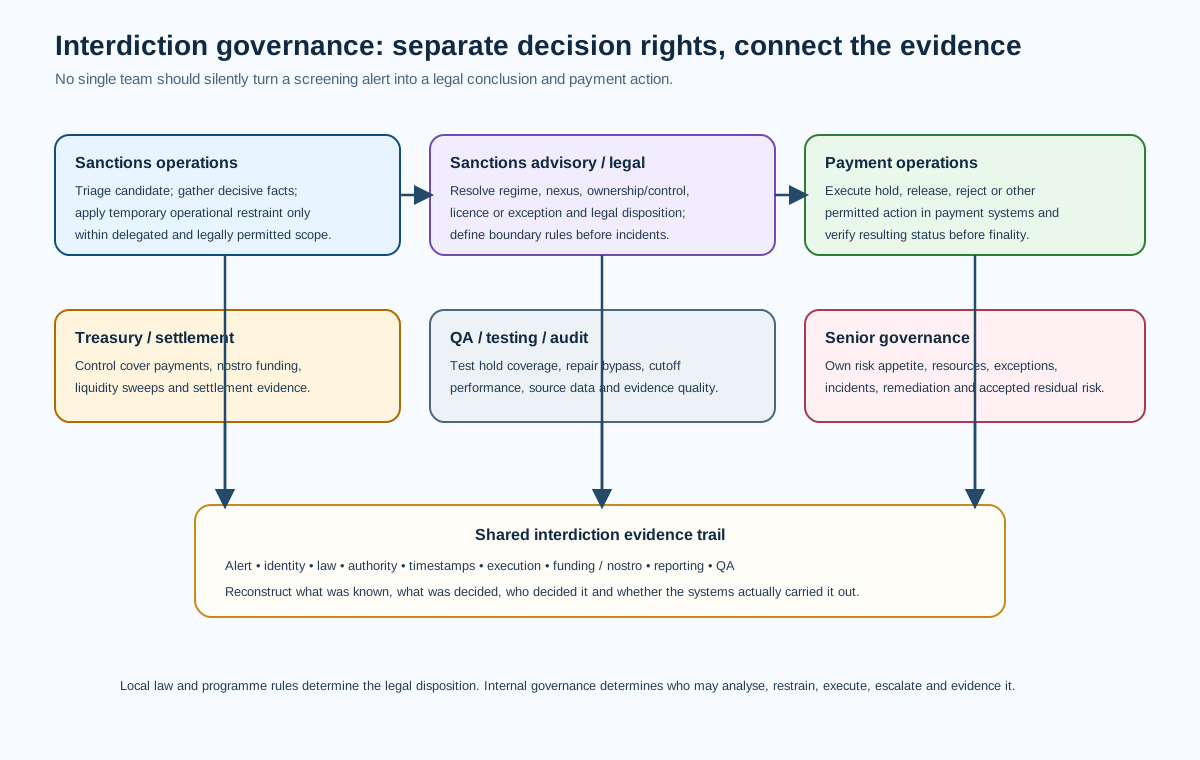
Investment economics without false precision
Interdiction investment competes with visible revenue initiatives, so control owners need more than qualitative statements about importance. They can quantify operational exposure without inventing a probability of a regulatory penalty.
Useful measures include the number and value of payments reaching review close to finality, hold-propagation failures, cutoff misses, repair-bypass defects, time to resolve high-confidence candidates, recovery attempts, recovery outcomes and the volume of customer-impacting false positives. These measures can support business cases for item-level batch control, faster identity data, better ownership services, continuous staffing, hold-aware treasury integration or resilient screening infrastructure.
The model should be transparent about uncertainty. Historical near misses do not predict future enforcement penalties with mathematical precision. Recall success on one corridor may not generalise to another. A technology improvement that reduces alert latency does not by itself prove a legal violation would have occurred without it. Governance should use quantified operational evidence to compare control options, not to manufacture a false “expected sanctions loss” number that appears scientific but rests on unsupported assumptions.
Readiness testing and simulation
Readiness requires more than a policy walkthrough. Simulations should force the organisation to operate under the conditions that break real controls: an alert close to cutoff, a specialist who does not answer, a repair amendment, a payment-system failover, a screening-service outage, a cover payment already released and conflicting information from a correspondent.
Each exercise should test both speed and decision quality. Fast but legally wrong is a failure. Correct analysis after finality may also be an operational failure if the bank had an obligation and practical ability to act earlier. The review should identify whether delay came from detection, data gathering, legal analysis, approval, system execution or cross-team coordination.
Exercises should also respect jurisdictional differences. An EU euro instant credit transfer within the Article 5d targeted-financial-restrictive-measures framework should not be tested against a fictional universal rule requiring an additional payer/payee sanctions check during execution. The exercise should test whether the bank's own payment service users were screened at the required event-driven and daily control points and whether other applicable sanctions or AML/CFT controls operated as designed. Other rails should be tested against their own requirements.
Findings need owners, dates and retesting. A recurring tabletop observation such as “after-hours legal contact unclear” is not evidence of readiness improvement until the contact model has changed and a later exercise proves it works.
Assurance across deadline operations
Independent assurance should test the operating chain, not only the wording of procedures. Hold coverage can be tested by attempting release through primary, repair, replay and contingency paths. Cutoff prioritisation can be tested with synthetic alerts placed at different points in the queue. Authority availability can be checked through exercises. Payment and nostro records can be reconciled against sanctions decisions to identify decided-but-not-executed outcomes.
Thematic assurance is particularly valuable for global banks. Comparing the same control across booking centres or rails can reveal that one location uses a legally scoped temporary hold while another treats every sanctions candidate as blocked property, or that one instant-payment service understands the EU Article 5d model while another has retained an obsolete transaction-screening assumption.
Evidence for assurance should preserve what the bank knew at the time. A later ownership database update cannot silently rewrite the historical case record. A screen result should retain the list version or source state used for the decision. A payment action should retain the instruction and acknowledgement timestamps. That reconstructability is essential when a regulator, auditor or internal investigation asks why a transaction was released, stopped or reported.
Regulatory and supervisory context without claiming a universal trend
Authorities can examine interdiction through different legal and supervisory lenses. OFAC's U.S. guidance distinguishes match assessment, authorization or exemption analysis, blocking and rejecting, reporting and recordkeeping. OFAC's Framework for Compliance Commitments also describes components of a sanctions compliance programme and explains that OFAC may consider those components when evaluating apparent violations and resolving investigations.
The UK framework is different. OFSI guidance requires firms to look to the specific UK legislation, understand asset-freeze and related prohibitions, comply with reporting duties and use exceptions or licences only where the relevant conditions are met. OFSI's enforcement guidance sets out its own case-assessment and penalty approach. The EU has its own restrictive-measures legal acts and EBA supervisory guidance for institutions in scope.
These examples support a governance principle, not a promise about outcomes. A well-designed compliance programme, voluntary disclosure, cooperation or remediation may be relevant factors under some enforcement frameworks, but none guarantees leniency. A bank should never tell senior management that strong remediation will “earn” a particular result. The purpose of good governance is lawful compliance, transparent evidence and recurrence prevention.
Connecting neighbouring chapters
Interdiction sits between detection and legal disposition. Payment sanctions screening produces candidates. Name matching and ownership analysis help determine whether the candidate is valid. Jurisdiction and nexus analysis determine which restrictions may apply. Licensing chapters explain permissions. Blocking, rejecting, freezing and reporting explains the legal outcomes under relevant regimes. Payment transparency and investigation chapters provide the data needed to reconstruct the transaction.
Those boundaries should appear in architecture. A screening engine should not be the final legal decision service. A case system should not own settlement truth. A payment engine should not reinterpret sanctions law. Treasury should not be invisible to payment restraints. Each component owns a specific state or decision and supplies evidence to the others.
Capability benchmarking
Peer and industry benchmarking can be useful if metrics are comparable. Hold-execution completeness, time-to-decision, cutoff breaches, recovery performance, false-positive impact and control-service resilience are more meaningful than a generic “sanctions maturity score.” Business mix matters: an institution dominated by domestic batch payments has a different deadline profile from a global correspondent bank or an instant-payment provider.
Wolfsberg sanctions-screening guidance is useful as an industry benchmark because it stresses risk-based programme design, the distinction between a screening alert and a confirmed sanctions risk, data integrity, testing, governance and the need to place screening where the information is actionable. It should be labelled as industry guidance rather than legislation.
Benchmarking should lead to specific questions. Does the bank know every path through which a held payment can settle? Does it distinguish temporary operational restraint from legal blocking? Can it prove its Article 5d customer screening where applicable? Does it know which rails have weak recovery options? Can it reconstruct a decision using the data available at the time? A benchmark that cannot drive a control change is mostly presentation.
Vendor dependency
Interdiction often depends on vendor list feeds, matching engines, case tools, payment gateways, communication services and ownership data. Vendor dependency should therefore be mapped by control impact rather than generic IT criticality.
A matching-engine outage can prevent alert creation. A list-feed failure can leave screening technically available but stale. A case-tool outage can remove decision workflow while the payment engine continues. A vendor change to data schema can silently drop identifiers. Contracts and operational procedures should address notification, service levels, data integrity, testing, incident support and access to evidence relevant to the control.
Fallback planning should be explicit. Which controls can run locally? Which payments can queue? Which products must stop? Which customer-screening state remains valid? Which manual process is approved and for how long? The answer will differ by jurisdiction and rail, so “vendor unavailable = process and review later” is not an acceptable universal continuity plan.
Exit planning matters too. A bank unable to extract suppression rules, list mappings, decision history or tuning data from a vendor may be unable to change providers without losing evidence or recreating sanctions risk. Portability is therefore a financial-crime control consideration, not merely a procurement preference.
Senior-governance questions
Senior committees do not need to adjudicate individual name matches, but they should understand whether the capability is genuinely ready. Useful challenge questions include whether all 24/7 services have matching control coverage, whether payment and treasury systems honour the same restraint state, whether any rail uses a legally different screening model, whether untested contingency paths exist, whether false-positive customer harm is measured, and whether major remediation is funded and independently retested.
The most mature governance discussion is not “How many sanctions alerts did we close?” It is “Can we prove that the correct legal decision reached the payment and funding systems before it mattered, across every material rail and operating condition?” That question connects compliance, operations, technology and customer impact in one control story.
Knowledge checks with explained answers
1. A sanctions candidate appears seconds before an instant-payment response window closes. The name match is low confidence and there are no corroborating identifiers. What is the correct disposition?
There is no universally correct disposition from those facts alone. First identify the applicable sanctions regime, legal nexus, payment rail, scheme rules and the bank's legally approved fallback. In a framework that requires or uses pre-execution transaction sanctions controls, the approved procedure may permit a temporary restraint, rejection, another non-processing outcome or a specifically governed fallback depending on the evidence and law. In contrast, for the targeted financial restrictive measures covered by Article 5d of the EU SEPA Regulation for in-scope euro instant credit transfers, the statutory design uses event-driven and at-least-daily screening of each PSP's own payment service users and does not add payer/payee verification for those targeted measures during execution. The lesson is that payment speed and match confidence do not create a global sanctions rule.
2. A batch file with 4,200 payments contains one credible sanctions candidate shortly before cutoff, and the system supports only file-level disposition. What should happen?
Use the approved temporary processing treatment available for that rail while the candidate is resolved, and assess controlled item-level extraction or file splitting so unrelated clean payments are not unnecessarily disrupted. The candidate item then receives the legal disposition required by the applicable sanctions regime after identity, nexus, ownership and permission analysis. The structural fix is item-level control capability with tested interim extraction procedures. A true match does not mean the word “block” is globally correct; some regimes and fact patterns require blocking or freezing, while others may require rejection, non-processing or another action.
3. A vessel payment is commercially urgent because a sailing window closes soon, but the name match is contradicted by IMO number, flag and tonnage. How should triage proceed?
Use the commercial deadline to prioritise evidence gathering, not to reduce the evidence standard. Stable identifiers, ownership, former names and authoritative vessel data should be checked quickly. If reliable distinguishing evidence establishes that the vessel is not the listed vessel and no other restriction applies, the payment may be released under the approved process. No universal vessel-review SLA should be inferred from the example; internal service targets are not legal deadlines unless a specific rule creates one.
4. A payment settles before new ownership evidence shows that the beneficiary may have been restricted through an ownership or control rule. What does incident response prioritise?
Run recovery and legal investigation in parallel. Payment operations use available scheme, correspondent or legal recovery mechanisms; sanctions investigators reconstruct ownership and legal applicability at the relevant time; treasury confirms settlement and cover movements; technology preserves the data and logs used by the original decision. Cooperation, disclosure and remediation may be relevant factors under some enforcement frameworks, but they do not guarantee a particular regulatory outcome. The control objective is to limit harm, meet reporting duties and remove the root cause.
5. Repair operators can amend sanctions-relevant fields and cause a held payment to re-enter straight-through processing. What is the control failure and remedy?
The failure is hold-state and workflow integrity. A temporary operational restraint should survive relevant repairs until the authorized decision process changes the state. Relevant amendments should be rescreened, original values preserved, changes and actors logged, and unauthorized release technically prevented. Testing should deliberately attempt repair-based bypass across primary and contingency paths.
6. Recall contacts are stale and transaction identification is imprecise during a live recovery attempt. What structural improvements are needed?
Maintain rail-specific recovery playbooks, current contact directories with after-hours reachability, precise payment identifiers such as UETR where available, and escalation routes tested through simulations. Measure outcomes by rail and corridor without assuming a recall request guarantees recovery. Weak recovery capability should inform preventive-control investment and incident planning.
Glossary of working terms
Interdiction is the operational capability to prevent, contain or respond to sanctions-relevant value movement before or after settlement according to the applicable legal framework and payment mechanics.
Screening candidate is a possible match or other sanctions signal requiring investigation. The candidate itself is not proof of a legal match or prohibited transaction.
Temporary operational restraint is a processing state used by a bank or payment system to prevent further movement while a question is resolved, where law, scheme rules and policy permit. It is not automatically a legal asset freeze.
Legal freeze or block is a legal disposition under an applicable sanctions framework. The conditions, treatment of property and reporting obligations depend on the relevant regime.
Reject or do not process describes a transaction that must not proceed but is not necessarily treated as blocked property. OFAC, for example, distinguishes blocking from rejecting under U.S. sanctions; other regimes use their own legal terminology.
Cutoff management is the maintenance and use of rail-specific timing information so cases can be prioritised by the point at which intervention becomes difficult or impossible. An internal cutoff is not automatically a legal deadline.
Finality describes the point and legal or scheme conditions under which a transfer becomes final. It can materially limit unilateral recovery, but post-settlement options differ by rail, jurisdiction and counterparty cooperation.
Recall is a post-release or post-settlement recovery request or mechanism. Its availability and effect depend on scheme rules, transaction state, law and the receiving institution; it is not a guaranteed reversal.
7. A cover payment funds the nostro position before the principal payment is restrained. What failed?
The sanctions control design did not include the funding path. The bank should reconstruct cover timing, nostro settlement, sweep activity and any remaining recovery options, then assess the legal exposure against the actual movement of value. Remediation can include hold-aware cover generation, shared payment-state data with treasury, stronger nostro reconciliation and explicit design for fungible liquidity where simple earmarking is not possible.
8. A global payment hub marks every sanctions candidate as BLOCKED regardless of legal entity, currency or jurisdiction. Why is this dangerous?
It collapses screening, policy and law into one state. The hub should identify the relevant legal entity and nexuses, applicable sanctions programmes, ownership or activity restrictions, licences or exceptions and any separate group-policy rule. A group policy may be stricter than local law, but the system should label that outcome honestly rather than describing every policy refusal as legally blocked property.
9. Weekend instant-payment volumes surge while specialist staffing is thin. What should the bank do?
Activate the approved surge and continuity model rather than inventing new sanctions rules under pressure. Prioritise material risk, monitor control latency, use on-call expertise for pattern-level decisions and follow the jurisdiction- and rail-specific fallback for any control degradation. Continuous payment services need continuous control capability, but that capability does not mean the same transaction-screening step applies to every jurisdiction. The EU Article 5d targeted-financial-restrictive-measures model is a clear example of a different control point.
10. How should regulatory and supervisory expectations influence interdiction assurance?
Build evidence that can withstand the relevant authority's questions without claiming one universal supervisory checklist. U.S. OFAC guidance, UK OFSI rules and guidance, EU restrictive measures and EBA supervisory expectations differ in legal scope and terminology. Across those differences, assurance should be able to show what the bank screened, what data and legal framework it used, how it distinguished an alert from a valid match, what disposition was chosen, whether payment and funding systems executed it, what reporting followed and how failures were remediated.
Final knowledge check
The chapter is understood only if the reader can explain why these statements are all true at the same time: a sanctions alert is not a legal conclusion; an internal hold is not automatically a legal freeze; instant-payment sanctions controls are not globally identical; settlement finality changes operational leverage but does not by itself determine the legal obligation; and the strongest control is the one that connects legal applicability to actual payment and funding execution with evidence.
References and further reading
Sanctions interdiction is governed by the law that applies to the bank, transaction, parties and activity, together with the actual mechanics of the payment rail. The sources below are used in this chapter as jurisdiction-specific law or guidance, global payment-system context or industry practice. They should not be combined into a fictional single global rulebook.
United States: OFAC
- U.S. Treasury, Office of Foreign Assets Control — FAQ 5: assessing sanctions matches and determining whether to block, reject or proceed, updated 9 September 2026: https://ofac.treasury.gov/faqs/5
- U.S. Treasury, Office of Foreign Assets Control — FAQ 36: blocking and rejecting transactions: https://ofac.treasury.gov/faqs/36
- U.S. Treasury, Office of Foreign Assets Control — FAQ 49: reporting blocked and rejected transactions: https://ofac.treasury.gov/faqs/49
- U.S. Treasury, Office of Foreign Assets Control — A Framework for OFAC Compliance Commitments: https://ofac.treasury.gov/recent-actions/20190502_33
- U.S. Treasury, Office of Foreign Assets Control — Sanctions Programs and Country Information: https://ofac.treasury.gov/sanctions-programs-and-country-information
OFAC's materials are U.S.-specific. In particular, its distinction between blocking and rejecting and its reporting deadlines should not be described as globally applicable sanctions law.
United Kingdom: OFSI
- UK Government, Office of Financial Sanctions Implementation — UK financial sanctions general guidance, updated 12 May 2026: https://www.gov.uk/government/publications/financial-sanctions-general-guidance/uk-financial-sanctions-general-guidance
- UK Government — How to use exceptions and licences to comply with sanctions, updated 23 April 2026: https://www.gov.uk/guidance/how-to-use-exceptions-and-licences-to-comply-with-sanctions
- UK Government, OFSI — Financial sanctions enforcement and monetary penalties guidance, updated 9 February 2026: https://www.gov.uk/government/publications/financial-sanctions-enforcement-and-monetary-penalties-guidance/financial-sanctions-enforcement-and-monetary-penalties-guidance
- UK Government — UK sanctions collection and current UK Sanctions List resources: https://www.gov.uk/government/collections/uk-sanctions
OFSI guidance repeatedly requires users to refer to the specific up-to-date UK legislation and facts. The chapter therefore does not turn UK asset-freeze, licensing or reporting concepts into universal rules.
European Union: restrictive measures and instant payments
- EUR-Lex — Regulation (EU) 2024/886 on instant credit transfers in euro, including Article 5d on screening payment service users for targeted financial restrictive measures: https://eur-lex.europa.eu/eli/reg/2024/886/oj/eng
- EUR-Lex — Regulation (EU) No 260/2012, as amended, containing the SEPA framework into which Article 5d was inserted: https://eur-lex.europa.eu/eli/reg/2012/260/2024-04-08/eng
- European Banking Authority — Guidelines on internal policies, procedures and controls to ensure implementation of Union and national restrictive measures: https://www.eba.europa.eu/activities/single-rulebook/regulatory-activities/anti-money-laundering-and-countering-financing-terrorism/guidelines-internal-policies-procedures-and-controls-ensure-implementation-union-and-national
- European Commission — Overview of sanctions and related resources: https://finance.ec.europa.eu/eu-and-world/sanctions-restrictive-measures/overview-sanctions-and-related-resources_en
- European Commission — Frequently asked questions on asset freezes and the prohibition to make funds or economic resources available, published/updated 6 May 2026: https://finance.ec.europa.eu/publications/asset-freeze-and-prohibition-provide-funds-or-economic-resources_en
- European Commission — Clarification of requirements in the Instant Payments Regulation: https://finance.ec.europa.eu/publications/clarification-requirements-instant-payments-regulation_en
Article 5d is especially important for this chapter. For the targeted financial restrictive measures within its scope, PSPs offering instant credit transfers verify their own payment service users after new or amended measures enter into force and at least once every calendar day, while the payer's and payee's PSPs do not perform an additional payer/payee verification for those measures during execution of the instant credit transfer. The provision does not disapply other restrictive measures or EU AML/CFT requirements.
Global standards and industry practice
- Committee on Payments and Market Infrastructures / IOSCO — Principles for financial market infrastructures, including settlement finality and operational-risk principles: https://www.bis.org/cpmi/publ/d101a.pdf
- Financial Action Task Force — The FATF Recommendations: https://www.fatf-gafi.org/en/publications/Fatfrecommendations/Fatf-recommendations.html
- Wolfsberg Group — Sanctions Screening Guidance: https://wolfsberg-group.org/resources/legacy/53
- Wolfsberg Group — Payment Transparency Standards 2023: https://wolfsberg-group.org/resources/correspondent-banking/136
Wolfsberg material is industry guidance, not legislation. It is useful here for risk-based screening design, alert investigation, data integrity, testing, governance and the principle that screening controls should be placed where the information is sufficiently actionable.
Accuracy note — reviewed 17 September 2026: sanctions programmes, licences, payment-scheme rules, settlement windows, reporting duties and instant-payment requirements can change. Before acting on a live case, use the current legal instrument and competent-authority guidance for the relevant jurisdiction and the current operating rules for the specific payment rail. This chapter is educational material, not legal advice.