Screening List Data, Update Governance and Rescreening
Screening is often described as a matching problem, but matching only works if the reference data behind it is current, complete, correctly interpreted and routed to the right control. A bank may have an excellent fuzzy-matching engine and still fail if a newly designated party never reaches production, an alias is dropped during parsing, a PEP record is treated like a sanctions prohibition, an adverse-media hit is promoted to a legal fact, or a customer population is omitted from rescreening. The control therefore starts before the matching algorithm. It starts with the legal or risk source, the data supply chain, the transformation rules and the governance that can prove what version of what data was used for each decision.
This chapter treats list and screening-reference data as a controlled production supply chain. It explains how a bank maps legal authorities and risk sources, acquires official and commercial data, preserves provenance, normalises records without destroying meaning, validates releases, distributes versions to screening services and triggers proportionate rescreening. It also shows why sanctions, politically exposed person data and adverse-media intelligence must share some engineering disciplines while remaining different in legal meaning and customer outcome.
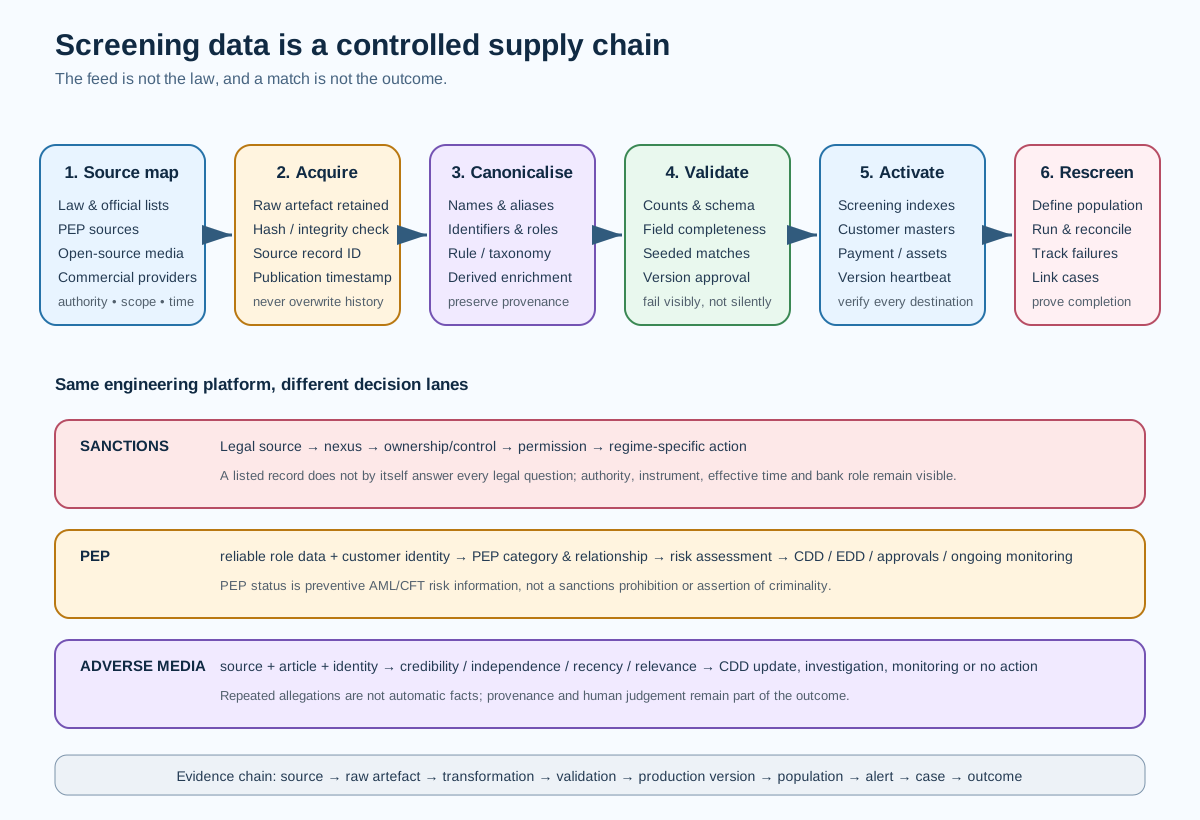
The central principle is simple: the feed is not the law, and a match is not the outcome. A sanctions feed helps operationalise a legal restriction; it does not determine every question of legal applicability by itself. A PEP data provider helps identify people who may require additional AML/CFT measures; it does not turn a PEP into a prohibited customer. An adverse-media service helps surface potentially relevant information; it does not convert an allegation into a verified fact. The bank needs an architecture that preserves those distinctions from source to case decision.
Three data classes that must not collapse into one
Sanctions data is the most legally sensitive class. A designation or other restrictive measure may create asset-freeze, funds-availability, transaction, service, sectoral or other obligations depending on the authority, legal instrument, entity, territorial or personal nexus, ownership or control rules, licences, exceptions and effective date. Machine-readable lists are an essential operational source, but the legal position ultimately comes from the applicable legal framework. This is particularly important in the European Union, where the European Commission's consolidated financial-sanctions data is an operational resource while the Official Journal contains the authentic legal acts, and in the United Nations system, where Security Council measures are implemented by Member States under the relevant resolutions and domestic or regional legal frameworks.
PEP data serves a different purpose. FATF Recommendation 12 and related guidance require additional preventive measures for relevant PEP relationships, but FATF is explicit that PEP status is preventive and should not be interpreted as meaning the person is involved in criminal activity. External commercial databases can help identify PEPs, family members and close associates, but FATF does not make the use of such databases a substitute for customer due diligence. A PEP status change should therefore route to risk assessment, senior-management approval where required, source-of-wealth or source-of-funds work where applicable, and enhanced ongoing monitoring according to the relevant framework and risk. It should not route automatically to a sanctions-style reject, freeze or block outcome.
Adverse-media data is different again. It is an intelligence and customer-risk input assembled from open sources, commercial datasets or internal research. The key questions are identity, source quality, independence, recency, relevance, corroboration and whether the information changes the customer's risk profile or creates suspicion. An adverse-media allegation may justify further due diligence, escalation or investigation; it is not an authoritative designation. The data model should therefore retain the underlying source, publication date, allegation category, entity-resolution confidence and review status rather than flattening the result into a binary badPerson flag.
These distinctions matter technically. A shared screening platform may ingest all three classes, but the record should carry a dataClass, authorityOrSource, legalOrRiskBasis, effectiveFrom, effectiveTo, sourcePublicationTime, ingestionTime, version, provenance, confidence where relevant, and an outcomePolicy that sends sanctions, PEP and adverse-media matches into different decision workflows. The common platform can share entity resolution, matching, case management and audit logging without sharing legal conclusions.
Start with authority and source mapping, not a vendor catalogue
The bank's source inventory should begin with the regimes and obligations relevant to each legal entity, branch, product and transaction type. For US sanctions data, OFAC's Sanctions List Service is the primary application used to deliver OFAC sanctions list files and supports the SDN and consolidated non-SDN data, search and customised datasets. For UK designations, the current state changed materially on 28 January 2026: the UK Sanctions List is now the only source for all UK sanctions designations and the former OFSI Consolidated List is no longer updated. For EU restrictive measures, the Commission maintains consolidated financial-sanctions data, but the bank should retain the link to the underlying legal act because the Official Journal is authoritative. For UN sanctions, the Security Council Consolidated List brings together listed individuals and entities, while the relevant sanctions committee and Member-State implementation determine the specific measures that apply.
The inventory should capture more than a URL. It needs the legal authority or risk source, publication channel, machine-readable formats, human-readable fallback, notification mechanism, expected update behaviour, authentication or access requirements, technical schema, change archive, effective-time convention, internal owner and contingency route. Where the authority publishes hashes or signatures, as OFAC does for many sanctions-list files, the bank can use them as an integrity check that the downloaded artefact has not changed since publication. Where the authority publishes an archive of changes rather than historic full snapshots, the bank should understand that limitation and preserve its own received versions if point-in-time reconstruction is required.
Commercial vendors sit downstream of this authority map. They can aggregate multiple regimes, enrich aliases, standardise data, maintain PEP datasets and adverse-media taxonomies, and reduce integration complexity. They do not replace the bank's need to know which legal or risk source the record came from, when it changed and whether the vendor transformation preserved the meaning. A provider feed is an operational source; it is not automatically the legal authority.
Legal effectiveness, publication and feed arrival are different clocks
A robust design stores separate timestamps for the legal or policy event, source publication, bank detection, vendor availability, ingestion, validation, production activation and rescreening completion. These times can coincide, but the architecture must not assume they do. A prohibition can become legally effective before a bank's vendor sends a file. A data provider can publish an update after the underlying legal act. A PEP change can be discovered from a reliable source before a commercial database is refreshed. An adverse-media article can be published instantly but require identity resolution before it can affect a customer decision.
For sanctions, the control objective is to implement applicable changes with the speed required by the relevant legal framework and the bank's exposure, while retaining enough validation to avoid corrupting production data. FATF uses the concept of freezing without delay in the targeted-financial-sanctions context, but that should not be converted into a fictional universal number of minutes for every bank and every sanctions update. EU, UK, US and other regimes have their own legal mechanics, and some measures involve restrictions that are not name-list asset freezes at all. The correct engineering goal is a documented, risk- and obligation-aligned latency model with escalation when the bank cannot meet it.
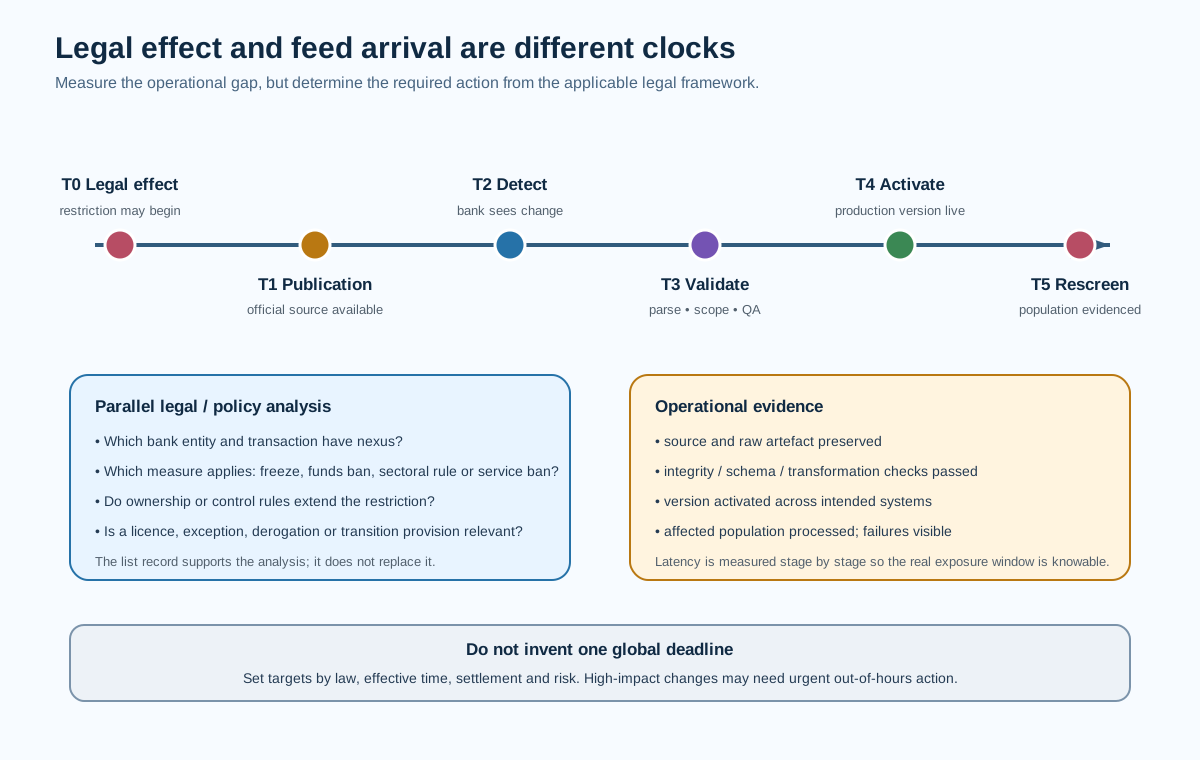
The diagram deliberately shows two things at once. First, operational latency should be measurable from authoritative event to protection, not simply from vendor delivery to database load. Second, the timeline does not itself decide what the bank must do. Legal applicability, ownership or control rules, permissions and the bank's role still determine the required disposition.
Ingestion: preserve meaning before optimising matching
Ingestion transforms heterogeneous source records into a canonical model. Parsers need to handle XML and CSV schema evolution, encoding changes, multilingual scripts, optional fields, nested aliases, identifier types, vessel and aircraft records, digital-asset addresses and other source-specific structures. The transformation layer should preserve the raw source artefact and source record identifier so that every canonical record can be traced back to what the authority or provider actually published.
Field mapping needs domain ownership rather than being treated as a purely technical exercise. A programme field may affect legal-routing logic. A weak alias label may affect how an OFAC record is matched. A date-of-birth range is not the same as an exact date. An IMO number should not be normalised like a customer account number. A PEP role needs the public function, country, role dates and relationship type where available. An adverse-media item needs the publisher, publication date, source URL, allegation category, language, subject identity and review status. Flattening all of these into generic name-and-comment fields makes the screening engine easier to integrate but destroys information investigators need to make defensible decisions.
Enrichment must remain distinguishable from authority-provided data. Transliteration variants, phonetic encodings, vendor entity links and internal network relationships can improve detection, but they should be marked as derived attributes with their generating rule or provider. An investigator should be able to see whether an alias came from the authority, the data vendor, the bank's transliteration engine or an internal case. This provenance becomes particularly important when a match is challenged or when a false-positive pattern is traced to over-aggressive enrichment.
Change classification drives the downstream action
Not every update has the same control consequence. A new sanctions designation may require immediate implementation under an applicable regime and can create a need to identify existing customers, assets, payments or positions. An alias or identifier amendment may justify targeted historical rescreening because previously cleared records may now match. A sanctions programme amendment can change legal scope without adding a name and may therefore require rule-engine, product or geography logic rather than only name rescreening. A delisting or variation can require controlled relief after checking whether other authorities or programmes still restrict the same person or activity.
PEP changes have a different trigger model. A newly identified PEP, change in public function, family or close-associate relationship, or information showing a person has left office can require customer-risk reassessment and ongoing-monitoring changes under the applicable AML/CFT framework. It does not create a sanctions disposition merely because the same screening engine generated the alert. Adverse-media changes may require re-evaluation where reliable new information is material to customer risk, but the bank should not repeatedly reopen a relationship for duplicate syndicated articles that add no new fact. Change classification therefore needs both content type and significance.
A practical event object can carry changeType, dataClass, affectedAuthority, sourceVersion, legalEffectiveTime where applicable, materiality, affectedFields, proposedPopulation, requiredBy, owner and evidenceStatus. That event becomes the unit that list operations, screening, KYC, investigations and technology can coordinate around.
Version governance and point-in-time reconstruction
Every production release should have an immutable version identifier linked to the raw source, transformation logic, enrichment version, validation results, activation time and destination systems. Screening decisions should be able to identify which list or reference-data version they used. Without that linkage, the bank cannot answer a basic retrospective question: Would this customer or payment have matched the data that was available to us at the time?
Historical reconstruction also needs care because official sources differ in what they retain. OFAC provides archives of changes but explains that it does not maintain historic full versions of its active sanctions lists. That makes the bank's own version preservation important where investigation, audit or legal retention needs require point-in-time reconstruction. The bank should not infer that every authority offers the same historical facilities.
Version incidents include partial release across systems, failed propagation to customer masters, stale caches, inconsistent indexes, rollback after a bad vendor file and cases where the user interface displays one version while the matching service uses another. Monitoring must therefore verify content and version, not only that a scheduled job returned success.
Quality assurance independent of the feed producer
Quality assurance should be independent enough to challenge both internal pipeline teams and external data providers. Useful controls include record-count and change-count reconciliation, source-to-canonical sampling, schema validation, field-population monitoring, hash verification where provided, seeded-match testing, negative testing, character-distribution checks for encoding corruption, and cross-system version reconciliation. The objective is not to prove that every record has been manually inspected. It is to produce defensible evidence that the transformations are complete, accurate and operating as designed.
The Wolfsberg Group's sanctions-screening guidance is useful here as industry guidance rather than law. It stresses accurate, reliable, current and relevant screening lists, list-management governance, data integrity, timely updates and independent testing. The European Banking Authority's guidelines on implementation of Union and national restrictive measures, applying from 30 December 2025, provide an EU-specific supervisory benchmark for policies, procedures and controls. Neither source should be misrepresented as a universal statutory rule for every institution; each is used according to its status and scope.
Error classification helps assign remediation correctly. A source publication may itself contain incomplete information. A vendor may mis-transform it. The bank's parser may drop a field. A distribution service may fail to deliver the correct version to one screening engine. A matching configuration may ignore the delivered identifier. A rescreening job may omit a portfolio. The case should identify which layer failed because screening failed is too vague to prevent recurrence.
Vendor management and fallback
Vendor due diligence should test coverage against the bank's authority map, measured update performance, transformation quality, enrichment value, resilience, auditability, change-notification practice and exit capability. Service levels can be useful, but a contractual latency promise is not evidence that the bank has met a legal obligation. The bank should retain monitoring that independently measures when the authoritative change occurred, when the vendor made it available, when the bank activated it and what population was rescreened.
Fallback design should reflect criticality. Some banks maintain direct integrations for key official sanctions sources and use vendors for aggregation and enrichment. Others use a primary vendor with authoritative-source verification and a tested secondary path for critical regimes. The important point is that provider failure should not make the bank blind to applicable restrictions. Fallbacks need defined activation criteria, provenance controls and later reconciliation so that temporary direct-source processing does not create an undocumented parallel version of truth.
Vendor coverage also needs separate treatment for PEP and adverse-media data. Because FATF does not treat commercial PEP databases as sufficient by themselves, the bank should combine provider data with customer information and other reliable sources appropriate to its risk model. Adverse-media vendors need source-quality, duplication, language, identity-resolution and taxonomy testing, because high article volume can create large operational burden without improving risk understanding.
Rescreening is a scoped control, not a universal full-database command
Rescreening should answer three questions for each trigger: what changed, which population could the change affect, and what evidence proves that population was processed? A new designation may justify broad rescreening of relevant customers and assets under the applicable programme. An alias addition may require targeted lookback across parties whose names could now match. A programme-scope change may require transaction, product or geography logic rather than an all-name scan. A customer-data change may trigger individual rescreening. A PEP status change may trigger CDD review for related customers. Material adverse-media intelligence may trigger case-specific or risk-based review rather than population-wide blocking.
The rescreening scope should be grounded in applicable legal obligations, affected data, the bank's control design, customer and asset populations, transaction lifecycle and risk appetite. Full base rescreening after every change sounds conservative but can be both inefficient and misleading. It can consume capacity on unaffected populations while delaying the customers and assets that actually need urgent review. Conversely, overly narrow delta logic can miss historic relationships that only become detectable after an alias, identifier or ownership change. The decision therefore needs a documented population rationale, not a slogan.
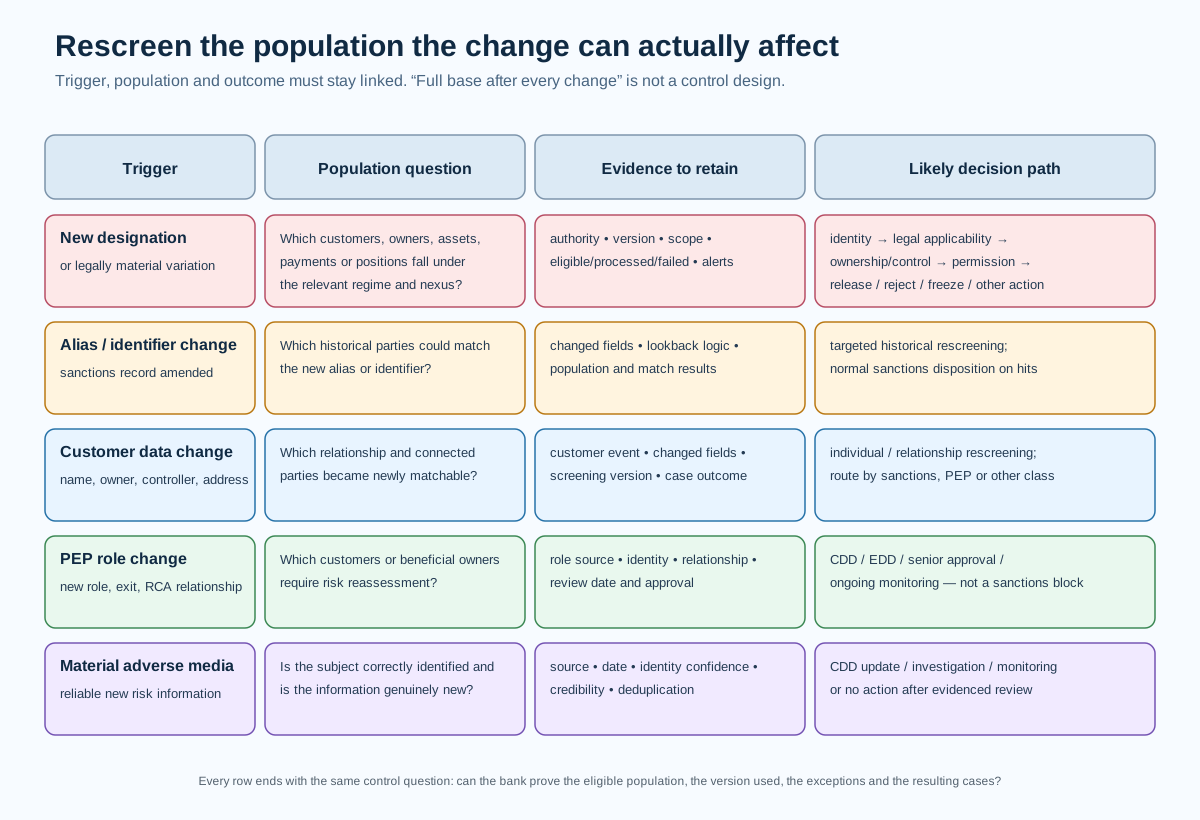
Completion evidence should record the source version, change event, population definition, number of records in scope, exclusions with rationale and approval, execution status, alerts generated, failures or unprocessed records, downstream case status and completion timestamp. Management information should use total eligible populations as the denominator or explicitly disclose exclusions. A 99% complete figure that silently excludes an unintegrated legacy portfolio is not evidence of effective rescreening.
Operations, cases and customer impact
List and screening-data operations sit between technical release management and financial-crime decisioning. A production update can create thousands of alerts, customer restrictions, payment holds, asset-management implications and relationship-manager questions. Surge plans therefore need operations capacity, legal and compliance escalation, technology support, business communication and customer-treatment guidance, not simply a faster data loader.
Customer impact cuts both ways. Late implementation can permit activity that should have been restricted. Incorrect or over-broad implementation can hold lawful payments, restrict a non-matching customer, apply PEP measures as if they were sanctions, or damage a customer because unverified adverse media was treated as fact. A mature control therefore measures both missed-risk outcomes and unnecessary intervention. Quality means legally and risk-appropriately correct decisions, not simply more alerts or more blocks.
Alert-to-case design should preserve the reason for the hit. A sanctions match needs the authority, programme, list record, ownership or control context and relevant legal-routing information. A PEP match needs identity confirmation, role and relationship type, risk assessment and applicable CDD workflow. An adverse-media match needs the article or source, identity evidence, allegation category, source credibility and corroboration status. Shared case-management tooling should present these different evidentiary needs instead of forcing investigators through one generic alert template.
The UK 2026 single-list change as a migration lesson
The UK transition is a useful example because it demonstrates why authority-side publication changes are technology changes for banks. The steady-state position since 28 January 2026 is that the UK Sanctions List is the only source for all UK sanctions designations; the former OFSI Consolidated List is no longer updated. Banks that previously consumed both sources had to redirect integrations, reconcile identifiers, test matching equivalence, update procedures and retire stale source references.
Dual-running can be appropriate during a planned migration window, but it should not be described as the current UK operating model after the old source has closed. The lasting lesson is broader: when an authority changes a file format, publication endpoint, schema, identifier model or list architecture, the bank should treat it as a controlled source migration. That means impact analysis, parallel validation where appropriate, cutover criteria, rollback planning, seeded-match testing and evidence that all consuming systems now point to the intended source.
OFAC's launch of the Sanctions List Service in May 2024 provides another example of the same engineering reality. OFAC described SLS as the primary application for delivering sanctions list files and data, and subsequent technical notices documented changes such as redirected download locations and XML namespace adjustments. These events show why parsers, endpoints and schemas need change governance even when the legal sanctions programme itself has not changed.
When authorities disagree: preserve each legal strand
A global bank will encounter people and entities listed by one authority and not another, different alias content, different ownership and control tests, and different programme scope. The data layer should preserve those differences rather than merge them into a fictional global designation. Record linkage can show that two authority records refer to the same real-world party, but each record should retain its authority, legal basis, effective date and restriction metadata.
The decision layer should then assess which regimes are legally relevant to the bank entity, customer and transaction. Group policy may choose broader restrictions than minimum local law, but that should be labelled as policy or risk appetite. The earlier idea of applying a universal union principle as if every global list automatically binds every bank is unsafe. The correct architecture separates legal applicability, group policy, investigative intelligence and customer-risk treatment while allowing one entity-resolution graph to support all four.
Delisting divergence makes this especially important. If one authority removes a party while another retains the designation, only the affected legal strand changes. The bank must reassess whether remaining regimes or group policy still restrict the relationship, update only the appropriate rule and communicate the result accurately. One delisting event is not automatically a global clearance.
BA, architecture and testing requirements
For a business analyst, the core requirement is traceability from source to outcome. Every data source should have an owner, legal or risk basis, schema, change trigger, effective-time rule, ingestion path, validation control, destination, rescreening rule and evidence artefact. Acceptance criteria should test not only the happy path but alias additions, delistings, source outages, malformed data, duplicate records, character-set changes, partial downstream propagation, PEP role changes, adverse-media duplication and rollback after a defective release.
Architects should separate raw source storage, canonical entities, source-specific records, derived enrichment and decision policy. A useful design keeps immutable raw artefacts, a versioned transformation layer, a canonical reference-data store, an event stream for changes, screening indexes optimised for matching, and evidence storage linking decisions to versions. That allows a parser or enrichment rule to be changed without losing the original publication and supports replay when a historical lookback is required.
Testers need seeded positives and negatives for each data class. Sanctions tests should prove listed persons, aliases, identifiers and programme tags reach the intended engines and that non-applicable lists do not create unsupported legal outcomes. PEP tests should prove role changes lead to the correct CDD workflow without sanctions-style blocking. Adverse-media tests should prove duplicates and low-quality sources can be filtered or reviewed according to policy without hiding genuinely material information. Failure-mode tests should interrupt feeds, corrupt one field, delay one destination and exclude one portfolio to confirm monitoring detects the defect and the bank can quantify the affected population.
Mini case study: a Friday designation, a PEP update and a vendor outage
Assume a bank receives three events on the same evening. An authority publishes a new sanctions designation relevant to one of the bank's booking entities. A commercial provider marks the beneficial owner of a corporate customer as a PEP after a change in public function. At the same time, the primary screening-data vendor suffers an outage and cannot deliver its normal consolidated feed.
A weak operating model treats all three as list updates and waits for the vendor. A strong model separates them. The sanctions team verifies the authoritative source and applicable legal position, invokes the tested fallback path, preserves the source artefact and hash or equivalent integrity evidence where available, builds the canonical record, validates it and activates the relevant screening path. Rescreening is scoped to the affected legal entity, programme and populations, with expansion if the new identifiers justify broader historical review. Any alerts are sent to sanctions disposition with the authority and source version attached.
The PEP change follows a different path. The bank confirms identity and role, determines the relevant customer relationships, and routes them to the applicable risk-based PEP workflow. No funds are frozen merely because PEP status changed. The vendor outage matters operationally, but it does not transform the PEP event into a sanctions event or eliminate the bank's CDD responsibilities.
When service is restored, operations reconcile the vendor feed against the fallback records, confirm that downstream systems hold consistent versions and close the incident only after affected populations are accounted for. The case record can then show, for each event, the source, legal or risk basis, timing, transformation, decision path and customer impact. That is the standard a bank should aim for: not one giant screening list, but a governed evidence chain from authoritative or reliable information to the right control outcome.
What good looks like
A mature screening-data capability can answer, without reconstructing the story manually: which authorities and risk sources apply; which version each engine used; what changed; when the bank detected and activated it; whether any provider transformed the record; which populations were rescreened and why; which records failed; what alerts and cases were produced; what customer actions followed; and whether the final outcome was a legal restriction, AML/CFT risk treatment, investigation decision or internal policy choice.
That evidence is the real product of list-data governance. The files and APIs are only inputs. The bank's obligation is to turn changing external information into controlled, explainable and appropriately scoped decisions without losing the distinctions that make those decisions lawful and fair.
Operational deep dive: parsers, latency, provenance and reconstruction
The base chapter established the legal and risk distinctions behind sanctions, PEP and adverse-media reference data. This deep dive moves into engineering practice: how to detect source drift, preserve provenance, validate enrichment, measure update latency without inventing universal deadlines, and reconstruct historical decisions when an investigator or supervisor asks what the bank knew at a particular time.
Parser testing against changing publication formats
Reference-data parsers fail less often because XML or CSV is intrinsically difficult than because assumptions age silently. Authorities change namespaces, schemas, endpoints, field lengths and publication methods. OFAC's move to its Sanctions List Service is a useful example: SLS became OFAC's primary application for delivering sanctions list files and subsequent technical notices documented changes to hosted endpoints and XML namespaces. A parser that only proves it can consume today's sample is therefore not a durable control.
A resilient test corpus should include historical files from multiple format eras, original scripts, long names, missing optional fields, multiple aliases, dates expressed as ranges, vessel and aircraft identifiers, digital-asset addresses and malformed or unexpected records. Mutation tests can deliberately reorder fields, insert nulls, expand text lengths or alter encodings. The expected behaviour is not necessarily accept everything; it is to avoid silent loss. A record that cannot be transformed safely should be quarantined with visible operational impact, not dropped while the batch reports success.
Production telemetry should complement pre-release testing. Record counts, field-population ratios, character distributions, new enumerated values, schema changes and parse exceptions can reveal defects that availability monitoring misses. The bank should be able to distinguish file not received, file received but not parsed, file parsed with exceptions, file transformed but failed validation and file validated but not activated. Those states drive different exposure assessments.
Provenance and integrity
Every canonical record should link back to the raw source artefact and source record identifier. Where an authority provides integrity hashes, the bank can validate the downloaded file against the published value and store that verification result. OFAC currently publishes SHA-256, SHA-384 and SHA-512 values for supported sanctions-list files as a content-assurance measure. Other sources may use different methods or none, so the architecture should treat integrity verification as source-specific rather than assume one global standard.
Provenance should survive enrichment. If a transliteration engine generates a name variant, the record should show that the variant is bank-derived. If a commercial provider links two entities, the relationship should identify the provider and methodology or confidence where available. If an investigator creates an internal watchlist entry, that entry should not later appear as if it came from an authority. Provenance lets reviewers understand why a match occurred and lets engineers remove or recalibrate one enrichment layer without rewriting source history.
Enrichment validation and false-positive economics
Enrichment is useful only when it improves detection or investigation enough to justify the noise it creates. Transliteration variants, phonetic encodings, alias expansion and entity-resolution links should be evaluated on labelled test populations containing known matches and realistic non-matches. A bank can measure incremental true-match capture, additional alert volume, analyst time and false-positive concentration by language, geography or customer segment.
This is especially important when the same platform carries PEP or adverse-media data. Over-aggressive PEP relationship expansion can label remote connections that policy does not treat as family members or close associates. Adverse-media entity resolution can attach an allegation to the wrong person when names are common. Enrichment should therefore be tuned by data class and use case rather than one universal fuzzy-matching configuration.
Latency engineering without fictional universal deadlines
List-data teams need measured update latency, but the target should come from applicable obligations, business exposure and control design rather than an invented industry stopwatch. The useful timeline begins at the earliest authoritative event relevant to the control, then records source publication, bank detection, retrieval, transformation, validation, distribution, engine activation and rescreening completion. A vendor's delivery timestamp is only one point in that chain.
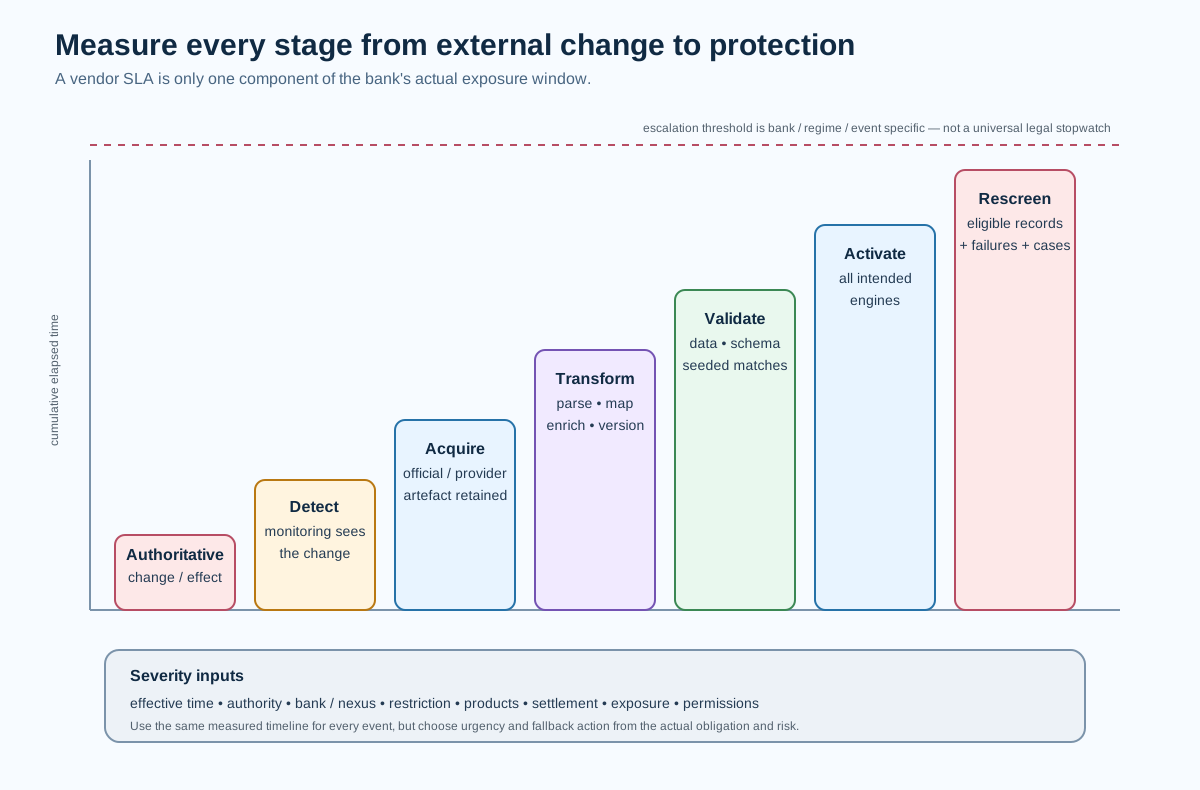
Some changes deserve highly accelerated handling because applicable targeted financial sanctions may require action without delay and the bank may operate continuously settling products. Other changes, such as metadata corrections with no effect on matching or legal scope, may follow a lower-severity path. The change classifier should therefore assign severity from legal effect, materiality, affected populations, settlement timing and data impact. The bank can then set service objectives for each class and escalate breaches transparently.
Parallel processing can reduce latency during major designation waves, but validation should not be discarded simply for speed. Critical checks such as file integrity, schema validity, record-count reasonableness and seeded-match verification can be automated and run in parallel. Where a bank chooses a staged release or emergency path, the decision, compensating controls and follow-up testing should be recorded explicitly.
Point-in-time reconstruction
Investigators eventually ask questions that current list data cannot answer: what record existed on the screening date, which aliases were present, what legal programme tag was associated with the record, and which matching configuration was active? Point-in-time reconstruction requires immutable source versions, transformation and enrichment versions, production-activation timestamps and decision-level version references.
Official archives vary. OFAC explains that it maintains archives of changes but does not maintain historic full versions of its active sanctions lists. A bank that needs full as-at reconstruction therefore has a reason to retain its own received artefacts and canonical versions subject to applicable retention, privacy and legal-hold rules. The same design principle applies to PEP and adverse-media data, but retention needs may differ because personal-data and licensing constraints can be different from sanctions-list data.
Reconstruction should be tested periodically rather than assumed. A test can select a historical case date, rebuild the relevant source and canonical versions, replay the screening configuration and compare the result with the recorded decision. Differences may be legitimate if later data improved identity understanding, but the bank should be able to explain them.
Cross-system consistency
A correct central list is not enough if product systems consume different versions. Payment screening may be current while a customer-master restriction flag is stale, or a securities platform may hold an old programme mapping. Version heartbeat controls should therefore show which release each consuming service has activated. Where direct version identifiers cannot be propagated, reconciliation can compare record hashes, counts or seeded checks across destinations.
This control becomes particularly important for delistings and amendments, where inconsistent propagation can create both legal risk and customer harm. A stale system can continue blocking activity that another service has correctly released. Conversely, one system can remove a restriction prematurely while another authority or programme still applies. Cross-system reconciliation should therefore verify both data version and rule version.
Testing the rescreening population
Rescreening tests should confirm population selection as well as matching. A technically successful job can process every record it was given while the selection query omits a migrated portfolio, dormant accounts, beneficial owners or one legal entity. Testers should reconcile the eligible population against independent customer or asset inventories, test exclusion logic and verify that failed records remain visible until resolved.
Trigger testing should cover new designations, alias additions, identifier changes, delistings, programme-scope changes, PEP role changes, adverse-media events and customer-data changes. Expected outcomes differ by trigger. That is the point: a good test pack proves the system routes information to the right control rather than merely generating an alert.
AI-assisted transformation: useful, but never source authority
Machine-learning or language-model techniques can help classify changes, extract identifiers from narratives, detect anomalous field patterns or suggest mappings for a new schema. They should not be allowed to silently rewrite source meaning. High-impact transformations need validation, confidence thresholds, human approval where appropriate, model-performance monitoring and deterministic fallback.
For example, an extraction model may identify an aircraft registration or a corporate associate in a designation narrative. That can enrich investigation, but the extracted relationship should retain the source passage and model-derived status. The model should not promote an inferred associate into an official designated-person record. The same discipline applies to adverse-media summarisation: models can assist triage, while human decisioning and source evidence remain necessary for consequential customer outcomes.
Practitioner checkpoint
A strong practitioner should be able to draw the full evidence path for any screening-data change: authoritative or reliable source, raw artefact, integrity check, transformation, enrichment, validation, version, destination, trigger, population, alert, case and outcome. If any link is implicit, unowned or impossible to reconstruct, the control is not yet mature enough for confident reliance.
Advanced practice: worked screening-data cases
The cases below are fictional and designed to test the part of screening that sits before and around the matching engine. Each case asks the same questions: what changed, which source is authoritative or reliable for that change, what population could be affected, what immediate action is justified, what evidence is still missing, and which downstream outcome is legally or risk-appropriately available. The examples deliberately mix sanctions, PEP and adverse-media data because many banks use overlapping screening technology while the legal and customer outcomes remain very different.
Case 1: an alias addition reveals a previously invisible customer
An authority adds two aliases to a person who has been designated for several years. The bank's vendor ingests the amendment correctly and the current screening engine starts matching the new aliases immediately. During change review, however, a data analyst notices that one alias is identical to a former name held in the customer master for a beneficial owner onboarded three years earlier. The customer had cleared every prior rescreen because the alias did not exist in the bank's reference data at those times.
The first mistake would be to call this a historical screening-engine failure. The engine could not match reference data that did not exist. The second mistake would be to rescreen the entire bank automatically without first understanding scope. The change event should identify the affected authority, programme, record, alias type and applicable bank entities. Operations can then define a retrospective population capable of matching the added aliases, including relevant customers and connected parties, and expand to historic transactions or assets where the legal framework, product and risk justify it.
Any resulting alert still requires identity resolution and sanctions disposition under the applicable regime. If the beneficial owner is the designated person and an ownership or control rule affects the customer, the outcome may extend beyond that person's own account. If the match is false, the record should close with evidence and the alias change should remain searchable for future screening. Completion evidence links the source amendment, list version, rescreening population, alerts, decisions and any reporting or remediation.
The control lesson is that some reference-data changes are inherently retrospective. Alias, identifier and ownership updates can make old relationships newly detectable. The bank needs a change-classification rule that asks whether historical populations may be affected rather than treating every update as a forward-only data load.
Case 2: a parser succeeds technically while corrupting names
A source expands the use of non-Latin scripts and the bank's parser continues to return successful job codes. Four months later, an investigator notices garbled characters in a list record. Engineering discovers that one normalisation step silently removed characters outside an assumed range, damaging original-script names and some transliterations. Availability monitoring remained green because the files were fetched, parsed and published on schedule.
The immediate task is to establish scope. The bank compares raw source artefacts with canonical records, identifies affected versions and fields, and tests whether the corrupted records would have matched realistic customer and payment data. Because the raw publications were retained, engineers can rebuild the records without relying on memory or vendor screenshots. Affected screening populations can then be replayed against corrected data, with resulting alerts handled under normal sanctions disposition rather than automatically treated as breaches.
The root cause is not merely Unicode. The control design measured pipeline availability but not content integrity. Repair therefore adds schema-drift alerts, character-distribution monitoring, field-population checks, source-to-canonical sampling and seeded-match testing. Parser regression packs retain historical formats and scripts so that future software changes prove backward compatibility.
The lesson is that a green job is not evidence of good list data. Content integrity has to be measured separately from technical completion.
Case 3: the primary vendor is unavailable during a material sanctions change
A sanctions authority publishes a material change relevant to one of the bank's legal entities while the primary list-data provider is experiencing an outage. The bank can see the official publication but the normal enriched feed, change classification and downstream distribution service are unavailable.
A weak response waits for the provider because the vendor is our source. A stronger response starts from the authority map. Sanctions legal or advisory confirms that the change is relevant and identifies the operative legal instrument, effective time and permissions or exceptions that matter. The list-data team retrieves the authoritative data through its tested fallback path, preserves the raw artefact and integrity evidence where available, converts it through an approved emergency transformation, validates the key identifiers and publishes an emergency version to the affected screening services.
Rescreening scope follows the actual change and bank exposure. It may include relevant customers, beneficial owners, assets, pending payments or positions, but the bank does not claim that one universal population is legally required for every designation. If the fallback cannot support one product or booking centre, that limitation becomes an explicit incident scope with compensating controls or escalation rather than disappearing from completion reporting.
When the provider returns, operations reconcile the commercial feed with the emergency version and investigate discrepancies before declaring the incident closed. The provider remains useful for aggregation and enrichment, but the case demonstrates why it cannot be confused with the legal authority.
Case 4: a new PEP is routed into the sanctions workflow
A commercial database marks the beneficial owner of a corporate customer as a PEP after the person takes a prominent public function. The shared screening platform raises an alert. A poorly designed workflow labels all reference-data hits watchlist matches and automatically restricts payments until operations clears the case.
That outcome is wrong because the data class and control objective have been lost. FATF PEP measures are preventive AML/CFT measures, not a statement that the person is sanctioned or criminal. The bank should first confirm identity and the public function using reliable information, determine whether the relevant legal framework treats the person as a foreign, domestic or international-organisation PEP and identify any family-member or close-associate implications. The case then moves into the applicable CDD or EDD process, including senior-management approval, source-of-wealth or source-of-funds work and enhanced ongoing monitoring where required by law or policy.
The bank may decide that other facts create a separate reason to restrict the relationship, but that decision needs its own legal, contractual or risk basis. The PEP flag itself is not a sanctions disposition. Technology should therefore carry a data-class field and route PEP matches to a PEP assessment workflow with different states, evidence requirements and customer communications from sanctions cases.
The lesson is that shared matching technology should not produce shared legal outcomes.
Case 5: adverse media multiplies without adding new evidence
An adverse-media provider generates twenty-six hits about a customer in three days. Most are syndicated copies of one article alleging procurement misconduct. The customer's name is common, several articles omit identifying details and one outlet later corrects part of the story. A rule based solely on hit count would escalate the customer sharply and may trigger unnecessary restrictions.
The investigation de-duplicates the articles to the underlying sources, resolves identity, distinguishes original reporting from republication, checks dates and corrections, and assesses the quality and independence of the sources. The question is whether the information is relevant and credible enough to change the customer's financial-crime risk assessment or create grounds for further investigation. The absence of a conviction does not automatically dismiss reliable allegations, but an allegation also does not become fact because many websites repeat it.
The data model preserves the underlying publication, source, date, allegation category, entity-resolution confidence and review outcome. If the information changes customer risk, the bank can perform additional due diligence or monitoring. If it contributes to suspicion under the applicable reporting framework, the appropriate investigation and reporting process can follow. None of those outcomes should be represented as sanctioned.
The lesson is that adverse-media screening quality is driven by provenance and judgement, not raw article volume.
Case 6: a Friday designation tests the operating model
A relevant authority publishes a designation late on Friday. The bank has weekend payment activity and limited but not zero sanctions support. The legal team first establishes the applicable effective time, the bank entity and services affected, and whether any licence, exception or transition provision is relevant. Operations then follows the bank's pre-defined severity model: high-impact changes can invoke on-call data engineering, sanctions decision support and targeted rescreening; lower-impact amendments can follow the documented standard path if that still meets the applicable obligation and risk requirement.
The important distinction is between preparedness and a fictional universal clock. Some targeted financial sanctions frameworks use without delay concepts and some bank products settle continuously, so a Monday-only control model can be inadequate for material exposures. But it would also be inaccurate to teach that every Friday list amendment legally requires the same staffing pattern or that any Monday discovery is automatically a violation. Coverage should be proportionate to applicable law, business activity and exposure, with escalation when the bank cannot meet its own documented control standard.
Post-event review measures publication-to-detection, detection-to-activation and activation-to-rescreening completion, then examines any transactions or assets in the exposure window. Findings drive staffing, automation and fallback improvements based on evidence rather than criticism of the individual who happened to be on call.
The lesson is that operational readiness should be designed around real legal and settlement timing, not office hours, while still respecting jurisdiction-specific requirements.
Case 7: one authority delists while two others do not
A person is removed from one authority's sanctions list but remains listed under two other regimes relevant to parts of the banking group. The data pipeline correctly records the delisting, yet a relationship manager sees a generic delisted event and tells the customer that all restrictions have ended. One product system removes a block while another retains it because the systems consume different authority-specific rules.
The correct approach preserves each legal strand. The bank confirms which legal entities and transactions were affected by the delisting, reassesses the remaining listings and ownership or control implications, checks any group-level risk policy, and then updates only the outcomes supported by that analysis. Cross-system reconciliation verifies that each product is applying the intended authority and policy position before customer communication is finalised.
This is also a data-modelling lesson. A canonical entity can link multiple authority records, but the system should never replace those records with one global sanctionsStatus. The entity can be delisted under one authority and remain restricted under another. Group policy can be stricter than local legal minimums, but policy needs its own label and approval trail rather than masquerading as universal law.
The lesson is that entity resolution can be global while legal applicability remains authority and nexus specific.
Practitioner close
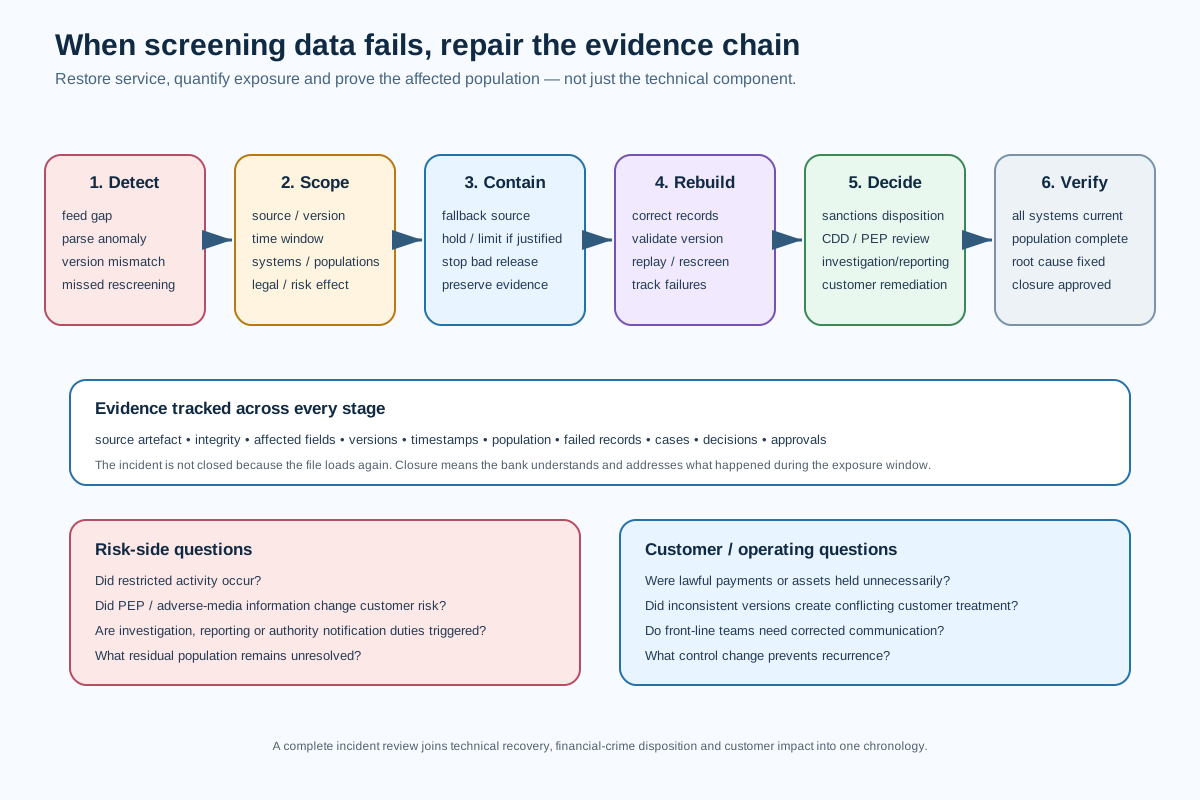
Across all seven cases, the matching algorithm is only one component. Effective control depends on source authority, provenance, change classification, versioning, population scoping, data-class-specific workflows and evidence that the intended population actually reached a defensible decision. The useful incident question is therefore not Did the list load? It is What changed, what did it mean, who could it affect, what did we process, what decisions followed, and can we prove the chain end to end?
Practice close: the screening-data operator's playbook
The daily job is not download lists and run screening. It is to maintain a traceable chain from changing external information to current internal controls. Operations therefore needs routines that can show what changed, which legal or risk source it came from, whether the change was transformed correctly, which systems activated it, what rescreening was required and whether every affected population completed.
Daily operating rhythm
Start with source health and open change events. Confirm that expected authoritative and provider channels are available, identify new publications or feed versions, classify each change by data class and significance, and record the relevant source timestamp. High-impact sanctions changes may require accelerated handling, while low-impact technical amendments can follow the standard path. PEP and adverse-media changes route through their own risk workflows rather than borrowing sanctions severity automatically.
Before release, verify the controls appropriate to the source: file integrity where supported, schema and parse health, record-count or delta reasonableness, transformation checks, programme or taxonomy mapping, and seeded screening for representative changed records. After release, verify activation at each consuming service instead of stopping at the central data store. A successful ingestion job is incomplete evidence if one screening engine, customer master or product platform still uses the prior version.
For rescreening, record the trigger and population explicitly. The operator should be able to state why a population is in scope and why any material population is excluded. Completion reporting includes failed records, skipped items and downstream alert status rather than counting only successfully processed rows.
Weekend and out-of-hours readiness
Sanctions authorities can publish material changes outside a bank's normal office day while some financial products continue to transact. Coverage should therefore reflect the applicable legal framework, business activity and exposure. A bank with continuous high-risk settlement may need stronger out-of-hours implementation capability than a business with no relevant activity until the next working day.
The playbook should define severity criteria, on-call contacts, decision authorities, approved fallback sources, emergency transformation controls, manual or automated compensating actions and escalation when the bank cannot meet its expected standard. The objective is readiness proportionate to real exposure, not a claim that every list amendment has one universal legal deadline.
Source and vendor incidents
When an official source is temporarily unavailable, operations should not improvise a substitute without provenance. The source inventory should identify approved fallbacks and cached material, the maximum acceptable staleness for the use case, and reconciliation steps after service returns. Where a vendor is unavailable but an authoritative sanctions source remains accessible, a tested direct-source fallback may be appropriate for critical changes. PEP and adverse-media continuity can require different approaches because their providers may add proprietary research rather than simply retransmitting official data.
Vendor defects need evidence. Record the affected file or version, fields, programmes or data classes, affected destinations and exposure window. Correct data from the vendor is only the start of recovery: the bank still needs to confirm re-ingestion, activation, rescreening and disposition of resulting alerts. Contractual escalation does not substitute for internal control ownership.
Customer and business communication
Reference-data incidents can create customer harm as well as financial-crime exposure. A stale restriction may hold lawful activity after a delisting. A misclassified PEP can be treated as prohibited. An adverse-media false match can lead to unnecessary review or account friction. Communication should therefore explain the customer's operational position accurately without revealing information that must remain confidential or tipping off a suspicious-activity investigation.
Relationship managers need a usable status such as sanctions legal review pending, PEP CDD review, adverse-media investigation, or data incident under correction; one generic watchlist issue encourages incorrect promises and inconsistent treatment. Senior management needs exposure, affected populations, customer impact, remediation progress and residual risk rather than parser detail alone.
Failure scenarios to rehearse
A useful control exercise deliberately introduces failures that normal happy-path testing does not reveal. Examples include a source changing schema without notice; a parser dropping non-Latin characters; a vendor omitting one national regime; a release reaching payment screening but not customer screening; an alias addition requiring historical review; a rescreening query excluding a migrated portfolio; a PEP update being routed to a sanctions block; an adverse-media provider duplicating one story dozens of times; and an emergency rollback leaving one consuming system on the wrong version.
For each scenario, teams should prove detection, scope assessment, containment, recovery, population replay and evidence closure. The exercise is successful only if teams can identify the affected customers, assets or transactions and explain the legal or risk decision path, not merely restore the service.
BA acceptance criteria
A business analyst translating this capability into requirements should require source-to-outcome traceability. A change event must retain source authority or provider, data class, source record, change type, source timestamp, applicable legal or risk context, canonical version, validation status and affected destinations. Rescreening must retain population logic, exclusions, job status, failures, generated alerts and completion evidence. Alert workflow must preserve the data class so sanctions, PEP and adverse-media matches cannot collapse into one decision type.
Acceptance tests should include positive, negative and failure-mode scenarios. Positive tests prove a relevant new designation reaches the right engines and generates the expected alert. Negative tests prove non-applicable data does not create an unsupported legal restriction. Failure tests prove the bank detects a partial distribution, malformed record or excluded population and can quantify the resulting exposure window.
Metrics that reveal rather than conceal
Useful metrics include source-to-detection latency, detection-to-activation latency, distribution-version consistency, parse exceptions, failed validation counts, provider discrepancy rates, rescreening eligible versus processed population, rescreening failures, alert backlog created by major changes, false-positive concentration by data class and time to resolve material incidents. Percentages should disclose their denominator and exclusions.
A management report saying rescreening 99% complete is weak if the denominator omits a legacy portfolio. A report saying 98,420 of 99,120 eligible parties processed; 700 failed because one legacy source was unavailable; all 700 are under compensating control with owner and deadline is operationally useful because it exposes the residual risk.
Closure discipline
An incident or major change should close only when the bank has verified the intended version across destinations, completed the required rescreening or documented unresolved scope, dispositioned material alerts, assessed customer and reporting impacts, recorded root cause and confirmed structural remediation where needed. Enhanced monitoring may continue after formal incident stand-down if the risk justifies it.
The final evidence pack should let an independent reviewer reconstruct the event without interviewing the people who handled it. That is the operating standard: current data, correct routing, scoped rescreening, visible exceptions and an evidence chain strong enough to survive staff changes, audit and supervisory challenge.
Masterclass: governing the screening-data supply chain
Screening-data management becomes fragile when technology owns feeds, operations owns rescreening, compliance owns policy and procurement owns the vendor, yet nobody owns the evidence chain end to end. Strong governance does not move every task into one team. It makes the interfaces, decision rights and accountability explicit enough that a source change cannot disappear between functions.
End-to-end ownership
A named control owner should maintain the authority and source map, minimum data requirements, quality standards, update and rescreening policy, critical vendor expectations and escalation model. Technology can own pipeline engineering; operations can own daily execution; sanctions and AML advisory can own legal and policy interpretation; relationship and product teams can own customer actions; independent assurance can test effectiveness. The control owner ensures the pieces operate as one system.
Coverage maps should show, by bank entity and product, which sanctions authorities are legally relevant, which PEP and adverse-media sources support CDD, which feeds populate which platforms and which populations are rescreened after which events. This map should distinguish law from group policy. A group may choose to apply a broader risk restriction than local law requires, but the data and decision record should identify that as internal policy rather than rewrite the underlying legal position.
Governance forums need evidence, not comfort metrics
Senior forums should receive metrics that reveal exposure: late source changes, version divergence, failed or incomplete rescreening populations, recurring parser defects, vendor discrepancy trends, unresolved customer impact, high false-positive concentrations and material exclusions. All scheduled jobs ran or 99% complete can create false confidence if the schedule is too slow or the denominator excludes a legacy population.
Material incidents should have a clear decision log showing what was known at each point, what interim controls were chosen, who accepted residual risk and what evidence was required for closure. This chronology is valuable because later hindsight can make an uncertain incident look obvious. Good governance records the decision that was reasonable on the evidence available, then records how that decision changed when new information arrived.
Vendor governance without outsourcing accountability
Third-party providers can add major value through sanctions aggregation, PEP research, adverse-media collection, transliteration and entity resolution. Their involvement increases the need for provenance rather than reducing it. The bank should know which source underlies each vendor record, how quickly material updates are normally incorporated, which enrichments are proprietary, how corrections work and what happens when the service fails.
Vendor selection and migration should test content and control equivalence, not only API compatibility. A new provider can deliver syntactically perfect records while dropping a national regime, changing alias classifications, reducing transliteration coverage or using a different PEP taxonomy. Parallel sample comparison, source reconciliation and seeded detection tests should therefore be part of cutover evidence. Procurement may negotiate the contract, but sanctions and AML control owners need authority to reject a migration that materially weakens control coverage.
Exit planning matters because list and intelligence data can become structurally embedded in customer decisions. The bank needs to understand licensing rights for historical vendor data, how it will preserve audit evidence, whether identifiers are portable and how active cases will continue if the provider relationship ends.
Three lines and independent assurance
First-line teams operate the process and own the quality of their execution. Second-line financial-crime functions define and challenge the control framework, review legal and risk implications and monitor effectiveness. Internal audit or another sufficiently independent assurance function tests the chain end to end. The precise organisational model differs by bank and jurisdiction, but separation of operation, oversight and independent challenge should be clear enough that the team measured on release speed is not the only team judging release quality.
An end-to-end assurance sample can begin with an official change and trace it through raw receipt, transformation, validation, production version, destination activation, rescreening population, alert, case and final outcome. A second sample can work backwards from a customer decision to prove which reference-data version and policy produced it. These two directions catch different failures: forward tracing finds distribution gaps; backward tracing finds weak decision provenance.
Investment decisions should be tied to observable control outcomes
Screening-data infrastructure competes with other bank priorities, so investment cases need measurable outcomes rather than dramatic but unquantifiable claims about breach probability. Useful measures include reduced source-to-activation latency for high-priority changes, fewer production data defects, improved population coverage, lower version divergence, better true-match capture in seeded tests, reduced duplicate adverse-media workload or faster historical reconstruction during investigations.
Build-versus-buy decisions should include concentration risk, internal engineering capability, vendor enrichment value, ongoing validation cost, data-licensing restrictions and fallback feasibility. Hybrid designs are common: a bank may rely on a vendor for broad aggregation while independently monitoring critical authoritative sources and retaining direct-source fallback for high-impact sanctions changes. The right answer depends on the bank's footprint and risk, not an industry slogan that in-house is safer or vendors are always better.
The canonical data model is a control decision
A canonical screening record should not be designed only for matching speed. It should preserve enough semantics for investigators and downstream rules to understand what the source meant. A practical model separates the real-world entity from each source-specific assertion about that entity. The entity layer may hold stable identifiers and resolved relationships; the source-record layer holds authority, programme, designation or role, source identifiers, dates, aliases and source-specific restriction or risk information. Derived attributes sit in a third layer with their own provenance.
This separation solves several problems. If the EU, UK and US publish records for the same company with different aliases, the bank can link the records without pretending the programmes are legally identical. If a PEP provider and a sanctions authority both refer to the same individual, entity resolution can recognise the person while keeping the PEP role and sanctions designation as separate facts. If adverse media alleges misconduct about that same individual, the article can join the entity graph without becoming an official list attribute.
Effective dating should apply to relationships as well as records. Beneficial owners change, PEP functions begin and end, close-associate relationships can evolve, and sanctions programmes can be amended. A relationship table that stores only current state makes historical screening reconstruction unreliable. Owner from 2024 to 2025 is materially different from owner today, particularly when an investigator asks whether an ownership threshold was met on a historical payment date.
The model should also distinguish source confidence from match confidence. An authority-provided passport number may be a high-quality source attribute; the bank's match to a customer is a separate inference. An adverse-media article may be a reliable publication but still refer to a different person with the same name. Conflating these dimensions produces false certainty in case workflows.
Current-source migrations should be treated as controlled change
The UK move to a single designation source illustrates how an external publication change can become an internal programme. Since 28 January 2026, the UK Sanctions List is the only source for all UK sanctions designations and the former OFSI Consolidated List is no longer updated. A bank relying on the old feed needed more than a URL change. It had to prove that identifiers, names, aliases, regime tags and downstream matching behaviour remained correct after cutover.
A migration plan should inventory every consumer, including systems that do not look like screening engines. Customer-master restriction flags, payment hubs, securities platforms, trade systems, case-management tools, reporting extracts and operational dashboards can all cache list-derived data. Parallel validation should compare source coverage and seeded matches, while stale-reference searches identify procedures or scripts still pointing to retired files. Cutover is complete only when dependent systems and operating documents are consistent.
The same discipline applies when an authority changes schema or delivery technology without changing substantive sanctions law. OFAC's SLS rollout demonstrated that automation can be affected by endpoint and XML changes. Engineering should monitor official technical notices and treat authority-side format changes as third-party dependencies in the bank's change calendar.
EU and UN data require legal context around the list
For EU sanctions, the Commission's consolidated financial-sanctions data is operationally useful, but the Official Journal is the authentic source for adopted legal acts. The system should therefore be able to link a list record to the relevant regime and legal basis instead of treating the consolidated file as a self-contained rulebook. A name record may identify the target, while separate legal logic determines the exact prohibition, ownership treatment, exception or competent-authority process.
The UN Security Council Consolidated List creates a similar architectural lesson for a different legal structure. The UN explains that the consolidated list combines names across different sanctions regimes and that the criteria and measures are not the same for every listed name. Member States implement the relevant measures. A global bank should therefore preserve the UN regime and permanent reference data while also mapping the national or regional implementation applicable to each bank entity.
This matters during list-data reconciliation. Two records can look identical at name level while the legal route differs materially. Data governance should resist the temptation to simplify those differences away merely because one common screening index is easier to operate.
PEP lifecycle governance needs more than a database refresh
PEP data changes require both reference-data engineering and customer-risk policy. The system should capture the prominent public function, country or organisation, role dates, whether the subject is the PEP or a family member or close associate, the source of that determination and the provider or bank confidence where relevant. Local law and policy determine how long former-PEP treatment continues and which measures apply; the reference-data platform should not hard-code one global post-office period unless that is deliberately mapped by jurisdiction.
When a customer becomes a PEP, the workflow should identify all relevant customer relationships and connected parties, confirm identity and update the risk assessment. Where the applicable framework requires senior-management approval, source-of-wealth or source-of-funds measures or enhanced ongoing monitoring, the case should generate those tasks explicitly. When a person leaves office, the workflow should reassess rather than automatically delete the PEP flag at midnight, because risk can persist after the public role ends.
Quality assurance should test false positives and false negatives in relationship mapping. Common surnames, political families and translated names can create over-linkage. Conversely, a provider may miss a close associate or newly appointed official. The bank should know how vendor corrections are received and how a corrected PEP relationship propagates into customer review.
FATF's position is important for governance: external databases can assist, but they are not sufficient by themselves and FATF does not require their use as the sole method of PEP identification. That means vendor service levels cannot become the bank's whole PEP control framework.
Adverse-media governance is an information-quality problem
Adverse-media pipelines often generate more data than sanctions and PEP feeds combined. The control can become ineffective if volume replaces judgement. The bank should distinguish original journalism, official statements, court or regulator publications, syndicated copies, blogs, social-media claims and low-quality aggregation. It should record publication time, source, language, article link or retained evidence where licensing permits, allegation category and entity-resolution confidence.
De-duplication is a control requirement, not just an efficiency feature. Twenty copied articles should not create twenty independent pieces of evidence. Clustering should retain the earliest or best source and show how other publications relate. Material new facts should reopen or update the case; repeated unchanged coverage may not.
Taxonomy design also matters. Categories such as fraud, corruption, sanctions evasion, organised crime, trafficking or regulatory misconduct need definitions precise enough for analysts to use consistently. A generic negative news category is too broad for risk routing. At the same time, a taxonomy with hundreds of overlapping labels can create false precision and inconsistent decisions. Governance should test inter-analyst agreement and periodically simplify categories that do not change outcomes.
For consequential decisions, human review should have access to the underlying source and identity evidence. Summaries generated by vendors or AI can assist triage but should not be the only evidence supporting customer exit, enhanced monitoring or suspicious-activity escalation.
Rescreening architecture should expose the denominator
A rescreening service should treat population definition as a first-class object. The job record should contain the trigger, legal or risk basis, eligibility query or snapshot, number of eligible records, exclusions, reason codes, version applied, start and finish time, failed records, retry status, generated alerts and downstream case references. This turns population scope into auditable data rather than a line in a procedure.
The service should also make idempotency explicit. Re-running the same version against the same population should not create duplicate cases unless policy intentionally requires it. A unique event or job identifier can link retries and prevent operations from mistaking technical reruns for new risk events.
Large banks may prioritise high-risk segments within a broad population for operational reasons, but prioritisation should not silently redefine eligibility. The job can show 100,000 eligible; 15,000 priority tranche completed first; remaining 85,000 in standard tranche rather than report the first tranche as full completion. This distinction is important during major designation waves when alert capacity is constrained.
BA and architecture acceptance criteria
Requirements should be testable in business language. Examples include: every screening result can display the source authority or provider and production version; every sanctions record can link to its regime and source identifier; every PEP record can distinguish the PEP from family members and close associates; every adverse-media hit can display the underlying source and publication date; every rescreening job can show the eligible denominator and failed records; every destination can report which reference-data version it activated; and every manual override records user, time, reason and approval where required.
Failure-mode criteria matter just as much. If a source file changes schema, the system should reject or quarantine unsafe records and raise an operational alert rather than silently truncate. If one downstream engine misses a release, version reconciliation should detect it. If a rescreening job cannot access a legacy portfolio, the job should remain incomplete or show the exclusion explicitly. If a PEP event is sent to a sanctions disposition state, the workflow should reject the invalid transition. If an adverse-media provider returns an article without enough identity data, the case should show uncertainty rather than auto-link the allegation.
Architecture should support replay. When a parser is fixed or a vendor supplies corrected history, the bank should be able to reconstruct affected versions and rerun the defined population without manual spreadsheet joins. Replay capability converts data-quality incidents from ad hoc investigations into controlled remediation.
Testing at four layers
Unit tests validate parsers, mappings, normalisation and change-classification logic. Integration tests validate source-to-canonical and canonical-to-screening interfaces. End-to-end tests seed customers, payments or assets and prove the expected alert and case result. Operational tests simulate feed outages, partial releases, backlogs and staff handovers.
Test data should include multilingual names, weak and strong aliases where the source distinguishes them, exact and approximate dates, duplicate identifiers, vessel and aircraft data, crypto addresses, PEP role start and end dates, family and close-associate relationships, syndicated adverse-media clusters and common-name false positives. A good pack tests both detection and restraint: it proves the bank catches relevant records without treating every risk signal as a legal prohibition.
Independent validation should examine the assumptions behind the tests. If every seeded sanctions case uses exact names, the bank has not tested transliteration. If every PEP case comes from one country, relationship rules may be untested elsewhere. If adverse-media tests use only English, language coverage remains unknown. Coverage should follow the bank's actual customer and payment footprint.
Metrics for the control owner
A balanced metric set covers currency, quality, coverage, operations and customer impact. Currency metrics include source-to-detection and detection-to-activation latency by severity. Quality metrics include parse exceptions, mapping defects, provider discrepancies and seeded-test failures. Coverage metrics include eligible rescreening population, processed records, failures, exclusions and destination-version consistency. Operations metrics include alert surge, case ageing and incident recovery. Customer-impact metrics include wrongful holds, corrected restrictions and complaints linked to screening-data defects.
Metrics should be trended and segmented. An average update latency can hide a long tail of delayed small regimes. Overall false-positive rates can hide a PEP data source that creates disproportionate noise in one market. The aim is to find where the control degrades, not to produce one green number for a committee pack.
Acquisition and portfolio migration
Mergers and platform migrations create screening-data risk because customer populations move between different source maps, matching configurations and rescreening schedules. Due diligence should identify coverage differences, unresolved list-data incidents, excluded populations, vendor dependencies and historical-version retention before migration design is finalised.
During integration, the bank should be able to prove which platform owns each population at every stage. Parallel controls may be necessary during cutover, but duplicate screening should be reconciled so that teams understand which result governs. Before legacy systems are decommissioned, historical evidence needed for investigations and audits should be migrated or retained in accessible form.
Skills and succession
The control often relies on a small number of people who understand source schemas, vendor behaviour and historic workarounds. That concentration is an operational risk. Runbooks should record not just commands but rationale: why one alias type is handled differently, why one authority requires a separate mapping, why a rescreening query excludes a product and who approved that choice.
Cross-training, paired incident response and periodic recovery exercises test whether the process can operate without one specialist. Succession is successful when another qualified person can explain the control and execute it, not when documentation merely exists.
Final governance test
A governance forum should be able to ask five questions and receive evidence-backed answers: Which external changes currently matter to this bank? Which production versions implement them? Which populations were affected and rescreened? What exceptions or failures remain? Which customer, legal, investigation or policy outcomes followed?
If those answers require several days of manual reconstruction, the organisation may have functioning components but not yet a governed screening-data capability. The aim is not perfect centralisation. It is traceability, accountable decision rights and enough independence to challenge the supply chain before a missed restriction or unnecessary customer block exposes the weakness.
Knowledge checks with explained answers
1. An authority adds aliases to a long-designated person. No new designation occurred. Is forward ingestion enough?
Not necessarily. The new aliases can make previously cleared customers or connected parties newly detectable. The bank should assess which historical populations could now match, define a proportionate rescreening scope and retain completion evidence. The answer is not automatically rescreen the entire bank; scope depends on the authority, affected data, legal relevance, control design and population.
2. Every parser job has completed successfully for six months. Is ingestion quality assured?
No. Technical completion does not prove content integrity. A parser can silently drop characters, fields or records while returning success. Quality assurance should include source-to-canonical reconciliation, field-population and character checks, schema-drift monitoring and seeded screening proving that transformed records remain matchable.
3. Why keep legal-effective time, source-publication time and production-activation time separately?
Because they answer different questions. Legal-effective time helps determine when a restriction applies. Source-publication time shows when the authority made information available. Production-activation time shows when the bank's control began using the new version. The gaps help reconstruct exposure and control performance; none of the timestamps should be assumed to equal the others.
4. The bank uses a respected commercial sanctions-data vendor. Can the vendor become the legal authority?
No. The vendor is an operational source and may provide valuable aggregation and enrichment, but sanctions applicability comes from the relevant legal framework and authoritative designation or legal publication. The bank should preserve provenance so that a vendor record can be traced to the authority and underlying legal strand.
5. A PEP database flags a customer. Should the sanctions engine block the relationship?
Not because of PEP status alone. FATF treats PEP measures as preventive AML/CFT controls, not an assertion of criminality or a sanctions prohibition. The bank should confirm identity and role, apply the relevant risk-based PEP measures under applicable law and policy, and route the case through CDD or EDD rather than a sanctions disposition unless a separate sanctions basis exists.
6. An adverse-media provider returns twenty articles. Does the hit count prove higher risk?
No. The bank should de-duplicate syndication, resolve identity, assess source quality, recency and relevance, and determine whether the information changes customer risk or creates grounds for investigation. Repetition of the same allegation is not the same as independent corroboration.
7. What is the key denominator for rescreening completion?
The eligible population, with exclusions visible and justified. A percentage calculated only over records that successfully entered the job can conceal unintegrated portfolios or failed records. Completion evidence should show eligible, processed, failed, excluded and alert-generating populations separately.
8. A material sanctions change is published late Friday. Must every bank follow the same weekend response?
No universal staffing or minute-based rule can be inferred from the publication time alone. The bank must identify the applicable legal requirement, effective time, affected entity and products, settlement activity and exposure. Some targeted financial-sanctions obligations and continuous-settlement products can require rapid out-of-hours action, so the operating model should provide proportionate on-call or fallback capability. The key is demonstrable readiness against the bank's actual obligations and exposure.
9. One authority delists a person while two others retain designations. What should the data model show?
It should preserve each authority-specific record. The canonical real-world entity may link all three records, but the system should not collapse them into one global sanctioned or cleared status. Legal applicability and group policy are assessed separately for the bank entity and transaction.
10. Why retain raw source artefacts and transformation versions?
They support point-in-time reconstruction. Investigators, auditors and supervisors may need to know what the authority or provider supplied, how the bank transformed it and which version a screening decision used. Without the raw source and versioned logic, later reconstruction can become guesswork.
Glossary of working terms
Authoritative sanctions source: the official legal or designation publication relevant to a sanctions regime. A commercial data feed can operationalise it but does not replace the underlying authority.
Operational source: a provider, API, file distribution or internal service used to deliver screening data. It may aggregate or enrich authoritative and risk sources.
Data class: the category that determines how reference data should be interpreted and routed, such as sanctions, PEP, adverse media or an internal risk list.
Provenance: evidence of where a record or attribute came from, including source authority or provider, source record, publication time and whether an attribute was official, vendor-enriched or bank-derived.
Delta processing: handling changed records rather than rebuilding the complete data set for every update. Delta processing still needs controls for historical implications such as alias additions and corrected identifiers.
Version governance: immutable identification of source, canonical, enrichment and production versions, with activation timestamps and decision linkage supporting reconstruction.
Rescreening: applying changed reference data or changed customer data to a defined existing population. The scope should be justified by the trigger, applicable requirements and control design rather than assumed universally.
Content-integrity verification: testing that received and transformed data remains complete and accurate enough for the intended control, separate from monitoring whether the pipeline was technically available.
Cross-system consistency: evidence that each intended consuming platform has activated the correct data and rule version.
PEP screening: identification of persons who may fall within PEP, family-member or close-associate categories for AML/CFT risk treatment. It is not a sanctions outcome by itself.
Adverse-media screening: use of reliable open-source or commercial information to identify potentially relevant negative information for risk assessment or investigation. Allegations require identity and credibility assessment.
Point-in-time reconstruction: rebuilding the source data, transformation, screening configuration and decision context that existed at a historical time.
References and further reading
Screening-reference data should be anchored to the status of each source. Legal instruments and official designation sources determine sanctions applicability; PEP and adverse-media sources support AML/CFT risk assessment; commercial providers aggregate and enrich data but do not replace the bank's obligation to understand the underlying authority, source quality and decision rule.
Sanctions lists, legal sources and data delivery
- U.S. Treasury, Office of Foreign Assets Control — Sanctions List Service. OFAC states that SLS is its primary application for delivering sanctions list files and data: https://ofac.treasury.gov/sanctions-list-service
- U.S. Treasury, Office of Foreign Assets Control — Formal Launch of New OFAC Sanctions List Service Application, 6 May 2024: https://ofac.treasury.gov/recent-actions/20240506_33
- U.S. Treasury, Office of Foreign Assets Control — Hash Values for OFAC Sanctions List Files. OFAC publishes SHA-256, SHA-384 and SHA-512 values for supported list files as content-assurance aids: https://ofac.treasury.gov/specially-designated-nationals-list-sdn-list/hash-values-for-ofac-sanctions-list-files
- U.S. Treasury, Office of Foreign Assets Control — Archive of Changes to OFAC's Sanctions Lists. OFAC notes that it maintains change history but not historic full versions of its active lists: https://ofac.treasury.gov/specially-designated-nationals-list-sdn-list/archive-of-changes-to-the-sdn-list
- U.S. Treasury, Office of Foreign Assets Control — Advanced Sanctions List Standard FAQs: https://ofac.treasury.gov/sdn-list-data-formats-data-schemas/frequently-asked-questions-on-advanced-sanctions-list-standard
- UK Government — UK sanctions. Updated 30 March 2026; since 28 January 2026 the UK Sanctions List is the only source for all UK sanctions designations: https://www.gov.uk/government/collections/uk-sanctions
- UK Government — The UK Sanctions List with current search and downloadable data: https://www.gov.uk/government/publications/the-uk-sanctions-list
- Office of Financial Sanctions Implementation — UK financial sanctions general guidance, updated 12 May 2026: https://www.gov.uk/government/publications/financial-sanctions-general-guidance/uk-financial-sanctions-general-guidance
- European Commission — Overview of sanctions and related resources, including the consolidated financial-sanctions list and EUR-Lex. The Commission notes that consolidated data reflects officially adopted texts and that EUR-Lex provides access to the legal acts: https://finance.ec.europa.eu/eu-and-world/sanctions-restrictive-measures/overview-sanctions-and-related-resources_en
- European Union Open Data Portal — Consolidated list of persons, groups and entities subject to EU financial sanctions. The dataset provides XML/CSV distributions; only the information published in the Official Journal is authentic: https://data.europa.eu/data/datasets/consolidated-list-of-persons-groups-and-entities-subject-to-eu-financial-sanctions?locale=en
- United Nations Security Council — United Nations Security Council Consolidated List. The list was last updated 4 September 2026 when reviewed; the UN explains that Member States implement the measures specific to each listing and that listing criteria differ by sanctions regime: https://main.un.org/securitycouncil/en/content/un-sc-consolidated-list
Governance and screening-control guidance
- European Banking Authority — Guidelines on internal policies, procedures and controls to ensure the implementation of Union and national restrictive measures. The amending Guidelines apply from 30 December 2025: https://eba.europa.eu/publications-and-media/press-releases/eba-issues-final-guidance-internal-policies-procedures-and-controls-ensure-implementation-union-and
- Wolfsberg Group — Sanctions Screening Guidance. Industry guidance covering reference data, list management, data integrity, update timeliness and independent testing; it is not legislation: https://wolfsberg-group.org/resources/legacy/53
- Financial Conduct Authority — Firms have improved but must do more to prevent sanctions breaches, 28 May 2026. The FCA identifies screening and other control weaknesses observed in its sanctions work: https://www.fca.org.uk/news/press-releases/firms-have-improved-must-do-more-prevent-sanctions-breaches
PEP and adverse-media risk data
- Financial Action Task Force — Guidance: Politically Exposed Persons (Recommendations 12 and 22). FATF explains that PEP measures are preventive, not an assertion of criminality, and that external databases are neither sufficient by themselves nor mandated as the only means of identification: https://www.fatf-gafi.org/en/publications/Fatfrecommendations/Peps-r12-r22.html
- Financial Conduct Authority — FG25/3: Treatment of politically exposed persons, finalised 7 July 2025 and revised 15 July 2025. UK-specific guidance on proportionate and risk-based treatment of PEPs, relatives and close associates: https://www.fca.org.uk/publications/finalised-guidance/fg25-3-treatment-politically-exposed-persons
- European Banking Authority — Revised Guidelines on ML/TF risk factors. The guidance discusses reliable and independent open-source information and adverse media as risk information within CDD/EDD, rather than as a sanctions-style prohibition: https://eba.europa.eu/publications-and-media/press-releases/eba-publishes-final-revised-guidelines-money-laundering-and
- Financial Conduct Authority — Firms' customer due diligence processes and controls: our findings, 8 April 2026. UK supervisory observations on CDD, EDD and ongoing due-diligence controls: https://www.fca.org.uk/publications/good-and-poor-practice/firms-customer-due-diligence-processes-and-controls-our-findings
Accuracy note — reviewed 17 September 2026: list endpoints, file formats, technical schemas, notification channels, legal measures and supervisory expectations can change. For sanctions, verify the current legal act and authoritative designation source relevant to the bank entity and transaction rather than treating a commercial feed as law. For PEP and adverse-media data, verify identity, source quality and the applicable AML/CFT framework before changing a customer outcome.