Export Controls, Restricted Goods and End-Use Risk
Export controls are rules governing the export, re-export, transfer, brokering or technical assistance associated with particular goods, software and technology. The legal answer can depend on what the item or activity is, where it is going, who is involved, what the end-user will do with it, and which jurisdiction's rules apply. A product can be perfectly lawful for one customer and destination but require an authorisation for another. An item can also be outside a published control list yet still become subject to an end-use or end-user restriction under the applicable law.
For a bank, the most important starting point is to avoid pretending that export control is simply another sanctions-name-screening problem. Party screening can identify some restrictions, but it cannot tell the bank whether a machine tool falls within a technical control entry, whether software functionality crosses a performance threshold, whether an unlisted item is caught by an end-use rule, or whether a claimed authorisation actually covers the proposed movement. Those questions often require the exporter, technical specialists, export-control advisers or the competent authority.
The second starting point is equally important: a bank does not automatically inherit every legal duty imposed on an exporter simply because it finances or processes the payment for an export. The bank's legal obligations depend on the law that reaches the bank, the bank entity and people involved, the service being provided, the items or activities in scope, and the bank's knowledge. Some frameworks expressly reach financing or support. Others primarily regulate exporters, brokers, providers of technical assistance, carriers or other defined actors, while the bank may still have contractual, risk-management, sanctions, AML/CFT or proliferation-financing reasons to ask questions. The control design must therefore begin with legal scope rather than with a universal bank rule.
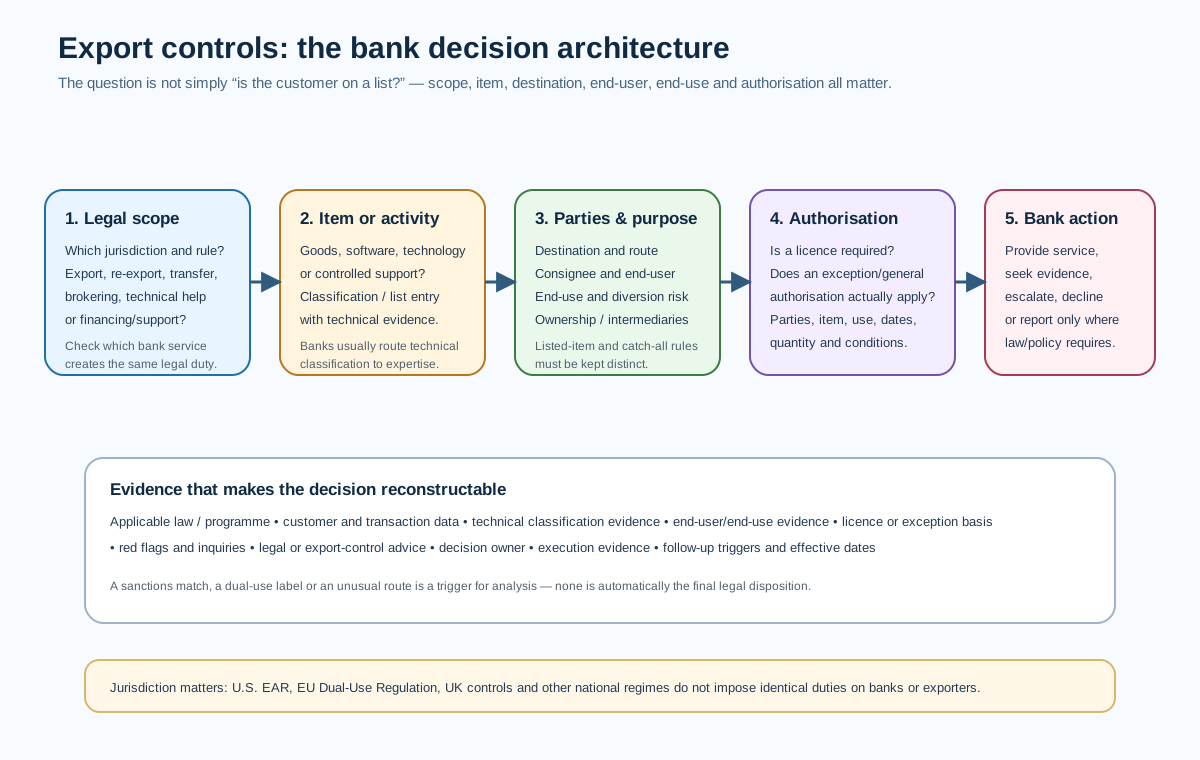
A five-question mental model
A practical way to analyse export-control risk is to ask five questions in sequence.
1. Which law and activity are actually in scope? Identify the relevant bank entity, exporter or other actor, countries involved and the activity being performed. Export, re-export, in-country transfer, transit, trans-shipment, brokering, technical assistance, technology release and financing can be defined differently across legal systems. An analyst should never jump directly from a high-risk country or technical keyword to a legal conclusion.
2. What is the item, software, technology or support activity? Technical classification may determine whether a control-list licence is required. In the United States, an item subject to the Export Administration Regulations may have an Export Control Classification Number or be designated EAR99. In the European Union, Annex I to Regulation (EU) 2021/821 contains the common list of dual-use items, while Member States can also have national measures. The United Kingdom maintains its own strategic export-control lists and end-use controls. Defence articles can fall under separate military-control regimes such as the U.S. International Traffic in Arms Regulations. These structures are related, but they are not interchangeable.
3. Who, where and for what end-use? End-user, end-use and destination controls can create licensing requirements independently of the item's ordinary classification. The ultimate consignee, intermediate parties, ownership and control, route, installation site, programme connection and expected use can all matter. A seemingly ordinary electronic component can become sensitive because of the user or application; a highly capable dual-use item can remain lawful when properly licensed for a legitimate civilian use.
4. Is there an authorisation, exception or other permission? If an authorisation is required, the bank needs to understand what evidence it is relying on. A licence is not a generic safe-conduct document. It can be limited by item, party, destination, end-use, quantity, value, date, reporting requirement or other condition. Different regimes also use different authorisation models and terminology.
5. What does this mean for the bank's service? The bank then decides what it may and will do: proceed, seek evidence, route for specialist review, decline a service, restrict a relationship, or make a report where the applicable law requires one. A commercial or risk-based pause is not the same thing as a legal asset freeze, and an export-control concern does not automatically produce the sanctions outcomes “block” or “reject.”
That separation is essential for business analysts and architects. A single restricted=true field cannot safely represent technical classification, sanctions designation, end-use concern, export-licence status and bank disposition. They have different evidence, owners, effective dates and legal consequences.
Why export controls exist
Export controls are part of a wider national and international security architecture. Multilateral arrangements such as the Wassenaar Arrangement, Nuclear Suppliers Group, Australia Group and Missile Technology Control Regime support convergence around categories of sensitive goods and technologies. Participating states implement commitments through their own laws, control lists and licensing systems. The multilateral list or guideline therefore provides important context, but the legally binding requirement for a transaction normally comes from the applicable national or regional regime.
United Nations Security Council resolution 1540 provides an important global foundation in the non-proliferation area. It requires States to establish and maintain appropriate effective national controls to prevent the proliferation of nuclear, chemical and biological weapons and their means of delivery. Those measures include export, transit, trans-shipment and re-export controls, end-user controls, and controls on providing funds and services related to relevant exports and trans-shipments, including financing that would contribute to proliferation. The resolution is binding on States; banks experience its effect through domestic implementation and other directly applicable law, not through an assumption that one identical private-sector rule exists everywhere.
This matters because the financial-crime and export-control disciplines overlap without being the same. FATF's proliferation-financing standards focus on risks connected to targeted financial sanctions and the financing of proliferation. FATF's 2025 report on complex proliferation-financing and sanctions-evasion schemes also describes procurement networks, front companies, intermediaries, maritime activity and dual-use sourcing. It is valuable intelligence for a bank, but FATF does not replace the export-control authority or technical control list.
Control lists and classification: technical facts drive the answer
Control lists classify goods, software and technology by technical characteristics and policy reason. An analyst may encounter computing performance, materials, tolerances, frequency ranges, sensing capability, encryption characteristics, manufacturing precision, chemical properties or other parameters that are impossible to determine reliably from a short invoice description.
The bank should therefore design for classification literacy rather than amateur classification. Relationship managers, payment analysts and trade-finance examiners need to recognise when the description is too vague, when a product belongs to a sensitive category, when stated specifications sit close to a known threshold, when a customer claims a classification inconsistent with the product, or when the destination and end-use make the classification especially consequential. The control then routes the case to appropriate expertise.
Exporter classifications, commodity codes and customer declarations are useful evidence, but they are not always equivalent to an official classification ruling or a complete legal analysis. The degree of independent verification should be proportionate to the bank's role, legal exposure and red flags. The U.S. Bureau of Industry and Security's “Know Your Customer” guidance is particularly instructive on this point: absent red flags, the EAR does not generally impose an affirmative duty on exporters to go behind customer representations merely for the sake of suspicion, but when red flags are present they should be investigated rather than ignored. Banks should not transform that U.S.-specific guidance into a universal verification rule; the broader lesson is to make escalation evidence-driven.
Control lists also change. On 14 September 2026 the European Commission adopted a further update to the EU dual-use control list in Annex I of Regulation (EU) 2021/821, aligning it with relevant 2025 multilateral decisions. Adoption of a delegated act and legal entry into force are separate stages, so operational change teams must track the act through scrutiny and publication rather than activate draft or adopted-but-not-yet-applicable content as if it were already binding. Effective-dated reference data and legal-change governance are therefore part of export-control architecture, not administrative housekeeping.
End-user and end-use controls: classification is not the whole story
A common mistake is to assume that an item outside the main control list is automatically unrestricted. Many export-control systems contain end-user or end-use controls that can require authorisation for otherwise unlisted items in defined circumstances.
The U.S. EAR illustrates this clearly. Part 744 contains end-user and end-use based controls, including restrictions related to specified nuclear, missile, chemical and biological weapons activities and other defined end-users and end-uses. BIS guidance states that an end-use or end-user requirement can apply even when an item is EAR99 and would not otherwise need a licence based on classification and destination. General Prohibition Ten also matters to financial institutions because it can prohibit financing or servicing an item subject to the EAR with knowledge that an EAR violation has occurred, is about to occur, or is intended to occur. BIS published financial-institution-specific best-practice guidance in October 2024 focused on this risk.
The EU has its own architecture. Regulation (EU) 2021/821 governs exports, brokering, technical assistance, transit and transfer of dual-use items. It includes Annex I list controls as well as end-use controls for certain non-listed items, including proliferation-related circumstances and cyber-surveillance human-rights concerns. Member States can also adopt specified national measures. The United Kingdom likewise operates list-based controls plus WMD and military end-use controls under UK law. Current UK guidance explains that otherwise non-listed items can become licensable when the statutory end-use conditions are met. The triggers are not identical to U.S. Part 744, so a bank must not convert “catch-all” into one global rule.
For the bank, end-use risk appears through combinations of evidence: a customer whose normal business does not explain the product, a distributor unable to identify ultimate users, routing through unnecessary intermediaries, last-minute changes to the consignee, a technical specification inconsistent with the declared civilian application, a small company ordering industrial capacity far beyond its apparent needs, or an end-use certificate that cannot be corroborated. None is proof by itself. The purpose of controls is to recognise when apparently ordinary trade requires a better explanation.
Diversion: the real commercial transaction may differ from the declared one
Diversion occurs when goods or technology are redirected from the declared destination, end-user or end-use. Procurement networks often create plausible commercial layers rather than obviously illegal transactions. A manufacturer may sell to a distributor, which sells to another trader, which arranges shipment through a third country, while the ultimate programme never appears on the first invoice.
Useful analysis therefore combines several lenses. Routing economics asks whether the shipping path makes commercial sense. Intermediary functionality asks what each company actually contributes. Ownership and control analysis tests whether supposedly independent entities are connected. Volume and capability analysis asks whether the quantities and performance fit the declared business. Payment behaviour looks for split payments, unusual third-party funding, sudden corridor changes or counterparties with no obvious role. Document consistency compares invoices, purchase orders, bills of lading, licences and end-use evidence for contradictions.
The bank should resist the temptation to label every trans-shipment hub or intermediary as suspicious. Global trade legitimately uses distributors, free zones, freight forwarders and multiple banks. The better question is whether the structure has a coherent commercial explanation and whether the evidence supports the declared end-user and end-use.
Export authorisations and what a bank can reasonably verify
Export-authorisation systems differ by jurisdiction. The EU, for example, provides individual, global, national general and EU General Export Authorisations within its legal framework. The UK uses instruments including standard individual export licences and other licence types. The U.S. EAR uses BIS licences and defined License Exceptions, among other mechanisms. Defence trade may involve separate authorities.
When the bank relies on an authorisation to provide a service, verification should answer the questions that matter to that reliance: is the document or electronic record authentic enough for the bank's purpose; does the issuer match the relevant authority; are the goods or technology within scope; do the exporter, consignee, end-user and destination match; is the authorisation effective for the date and quantity; and are there conditions relevant to the bank's service?
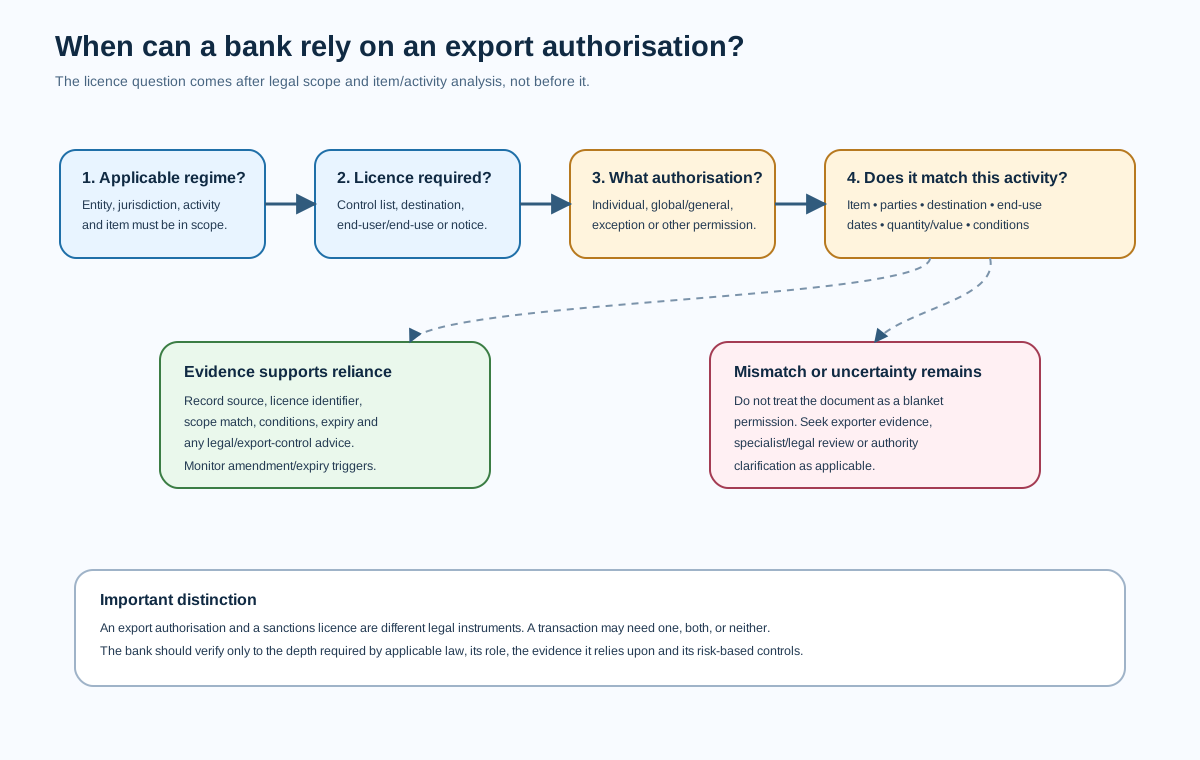
The answer is not that every bank must independently authenticate every export licence in every payment. Open-account payment processing may contain almost no goods detail and may be governed by a different control model from documentary trade finance. A bank issuing or confirming a trade-finance instrument may have richer documentary visibility. A lender financing the purchase of specialised equipment may have covenants and information rights. Control design must therefore reflect the product and the bank's actual information rather than inventing visibility the bank does not possess.
Export authorisations also must be kept distinct from financial-sanctions licences. The same transaction can sit at the intersection of both regimes, but permission under one does not automatically satisfy the other. The system should store the legal basis and scope of each permission separately.
The bank's role under U.S. EAR: a useful but jurisdiction-specific example
The U.S. EAR provides one of the clearest examples of why financial institutions cannot ignore export controls. BIS's October 2024 guidance for financial institutions focuses on General Prohibition Ten, which prohibits financing or otherwise servicing an item subject to the EAR with knowledge that a violation has occurred, is about to occur or is intended to occur. BIS recommends risk-based controls including onboarding and ongoing screening, customer certifications in defined circumstances and post-transaction review for red flags. Importantly, the guidance does not say that every export-related payment should be real-time screened against every technical-control dimension.
For a global bank, the lesson is twofold. First, U.S.-linked entities and activity need a clear EAR applicability model because the EAR can reach exports, re-exports and transfers outside the United States in circumstances defined by its scope rules, and certain U.S.-person support activities have their own controls. Second, those U.S. rules should not be presented as the world's export-control law. An EU or UK bank may have different direct legal duties for the same commercial chain, even while its risk programme uses similar red flags.
A robust policy therefore maps bank legal entities, booked products, involved staff, currencies only where legally relevant, customer locations, item jurisdiction, payment route and service type to the export-control rules that can actually apply. Legal nexus is a data requirement.
Intangible technology transfer: no container is required
Technology can move without a physical shipment. Software downloads, source-code access, cloud repositories, engineering support, remote troubleshooting, design files, research collaboration, training and secondments can transmit controlled know-how or software. The applicable legal terminology varies.
The U.S. EAR uses the specific concept of a deemed export for certain releases of technology or source code to a foreign person in the United States. Other legal systems regulate intangible transfers and technical assistance through their own definitions and rules. Calling every remote technical interaction a “deemed export” is therefore inaccurate outside the relevant U.S. context.
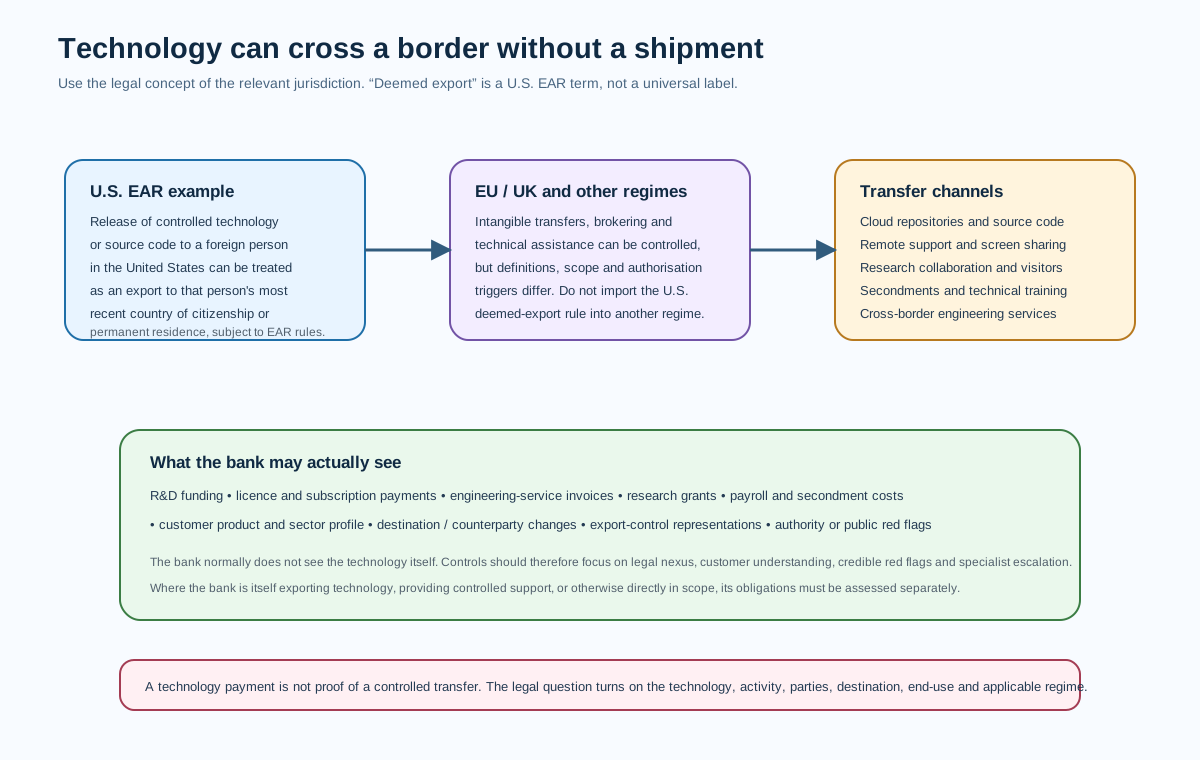
A bank usually sees indirect evidence rather than the controlled technology itself. It may see R&D funding, engineering-service payments, software subscriptions, research grants, payroll for secondees, licence fees or a customer profile showing work in a sensitive sector. Those signals can justify questions when combined with legal nexus and credible red flags. They do not prove that controlled technology was transferred.
The bank can also be an exporter in its own right. Cross-border deployment of security technology, source code, cryptographic products or technical support between group entities may create separate export-control questions for the bank's technology and procurement functions. Customer controls do not replace the bank's own corporate export-compliance obligations where they apply.
Re-exports, foreign-made products and U.S.-origin content
Re-export analysis is another area where terminology must remain jurisdiction-specific. The U.S. EAR can apply to certain foreign-made items outside the United States because they contain controlled U.S.-origin content above applicable de minimis thresholds or because a foreign-produced direct product rule applies. The relevant thresholds and rules vary by item, destination, end-user and specific EAR provision. They are technical legal calculations, not generic banking rules.
A bank should not attempt to calculate U.S.-content percentages from an invoice unless its role genuinely requires that analysis and it has reliable evidence and specialist support. The practical control is to recognise situations in which U.S.-origin technology, advanced manufacturing equipment, semiconductors or supply-chain representations make re-export scope material, then obtain exporter or specialist evidence sufficient for the bank's decision.
EU and UK regimes also control re-export-related, transfer, brokering or circumvention activity through their own legal mechanisms, but they do not simply copy the EAR's de minimis and foreign-produced direct product rules. A global control taxonomy should therefore identify the legal regime, not just the generic label reexport.
Military and proliferation-sensitive end-use
Military end-use controls are highly jurisdiction- and destination-specific. It is unsafe to maintain one permanent global list of countries and assume the same rule applies to all goods and all banks. U.S. EAR Part 744 contains multiple end-use and end-user controls with different destination scopes and definitions. UK guidance updated in May 2026 explains the UK's military end-use controls and the circumstances in which non-listed items can require an export licence, including risk of diversion to relevant entities in embargoed destinations. The EU Dual-Use Regulation has its own catch-all architecture.
For bank analysis, military connection is therefore evidence to evaluate rather than a conclusion. Relevant facts can include the end-user's ownership, defence contracts, facility, technical capability, procurement role, product specification and the declared application. A university, manufacturer or state-owned enterprise can conduct legitimate civilian work alongside military activity. The question is whether the applicable legal test is met for the specific item and transaction.
Proliferation-sensitive end-use demands particular care because apparently mundane components can support nuclear, missile, chemical or biological programmes. Here the export-control chapter intersects directly with the course's proliferation-financing chapter. UN Security Council resolution 1540, FATF proliferation-financing work, national end-use controls and specialist technical intelligence should be connected without being collapsed into one rule.
Emerging technology without chasing headlines
Advanced computing, semiconductor manufacturing, quantum technologies, biotechnology and other emerging capabilities receive frequent policy attention and can be subject to rapidly changing controls. The danger for a bank is to hard-code media labels such as “AI chip” or “quantum” as if they were legal classifications.
Control systems should instead store authoritative control entries, parameters, effective dates, destinations and end-user/end-use rules. Analysts need enough product literacy to recognise that a transaction may involve controlled technology and to route it to expertise. Technical teams need versioned rule data so that a product cleared under yesterday's threshold is not assumed clear forever.
The September 2026 EU control-list update is a useful example of why this matters. The Commission adopted changes reflecting more recent multilateral decisions, but operations must distinguish adoption, publication, entry into force and any national implementation layer. A regulatory-change workflow should identify affected customers, products, corridors and open transactions before the effective date, test rule changes and preserve evidence of which version was applied.
Brokering, transit and trans-shipment
Export controls can also apply to brokering, transit or trans-shipment. Regulation (EU) 2021/821 expressly covers brokering, technical assistance, transit and transfer within its scope. UK law has controls for trade and brokering activities. UNSCR 1540 specifically calls for national export and trans-shipment controls over proliferation-sensitive items. Again, the precise legal duty is national or regional.
Banks may encounter brokering risk through customers whose business is arranging deals between overseas parties, receiving commissions without taking title to goods, or coordinating financing while other firms handle logistics. That activity can be entirely legitimate. The risk rises when the broker obscures the ultimate end-user, repeatedly routes through unnecessary jurisdictions, changes documentation after shipment, or avoids ordinary commercial questions.
Transit and trans-shipment data can be useful because diversion often becomes visible in route changes. Yet logistics is complex: vessels change, hubs are used for consolidation, free zones support legitimate distribution, and documents can be reissued for ordinary reasons. The control should identify unexplained inconsistency, not criminalise complexity.
Data and system touchpoints
A bank cannot manage export-control risk with one screening engine. The relevant data is spread across customer and transaction systems.
KYC/KYB can hold business activity, products, countries, ownership, expected counterparties and export-compliance information. Trade-finance platforms may contain goods descriptions, invoices, bills of lading, letters of credit, guarantees, licences and end-use certificates. Payment systems contain parties, banks, amounts, currencies, purpose and remittance data but often little technical product information. Lending systems may hold equipment descriptions, supplier contracts and covenants. Case systems should connect alerts to customer, payment, trade document, legal advice and technical evidence. Reference-data services need effective-dated control lists, restricted-party data and jurisdiction rules.
The architecture should preserve distinctions between facts and decisions. For example:
declared_item_classificationis a customer or exporter assertion;verified_classificationis a specialist conclusion with evidence and effective date;end_use_concernis an analytical finding, not a sanctions match;export_authorisation_statusidentifies the licence or exception basis;sanctions_dispositionbelongs to a separate legal decision where sanctions also apply;bank_service_decisionrecords what the bank actually did and why.
This separation makes testing possible. A tester can verify that a high-risk goods description routes to specialist review without forcing every such case to fail. An auditor can reconstruct whether the licence used was valid on the transaction date. A BA can define how an expired authorisation propagates to open trade facilities without pretending it freezes unrelated customer funds.
Detection and monitoring
Detection should use the information the bank genuinely possesses. In documentary trade finance, content-based rules may flag controlled or ambiguous goods descriptions, high-risk technical terms, unusual consignee changes, inconsistent invoices or licence references. In open-account payments, network and behavioural methods may be more effective: new counterparties in diversion-sensitive corridors, payments inconsistent with the customer's business, rapid growth in technology procurement, third-party funding, repeated round-value equipment payments or previously unseen logistics intermediaries.
The U.S. BIS financial-institution guidance and KYC red-flag material provide concrete examples for EAR risk, including the principle that abnormal circumstances should be investigated rather than ignored. FATF's 2025 proliferation-financing work adds useful network and intermediary indicators. These sources should inform scenario design, but model governance must record which indicator comes from which framework and whether it creates a legal requirement or only a risk signal.
False positives are inevitable. A hospital may buy sophisticated equipment. A university may collaborate internationally. A manufacturer may route through a free zone because its distributor is there. A good case process asks for the missing explanation and closes cleanly when evidence supports legitimate activity.
Alert to case to decision
An export-control alert should normally become a case when the bank needs facts or specialist judgement that cannot be resolved automatically. The case should identify the trigger, legal nexus, item or activity, parties, destination, end-use, available classification evidence, authorisation basis and any sanctions or PF overlap.
The investigator then separates three questions:
- Is the export-control concern factually credible? Resolve identity, goods, route and purpose.
- Does applicable law reach the activity or bank service? Obtain legal/export-control interpretation where needed.
- What bank action follows? Execute only the disposition supported by law and policy.
Depending on jurisdiction and facts, the outcome may be proceed, proceed with conditions, request more evidence, decline or terminate service, notify an authority, submit an AML report where separate suspicious-activity criteria are met, or take sanctions action if a sanctions prohibition independently applies. The existence of an export-control red flag does not automatically create a SAR/STR obligation in every jurisdiction and does not automatically create an asset freeze.
Practical case: specialised electronics through a distributor
Consider a fictional corporate customer that normally imports industrial automation equipment. It begins sending larger payments to a new distributor in a regional trading hub. Invoice descriptions say “electronic modules,” but one purchase order includes a model number associated with high-performance components. The distributor is not on a sanctions or export-control list, and the destination itself is not comprehensively restricted. A screening-only control would likely clear the payments.
The transaction-monitoring team notices three changes: payment volume has increased sharply; the distributor is outside the customer's normal supply chain; and remittance references correspond to goods categories appearing in a current export-control red-flag advisory. The case is escalated to trade/export-control specialists.
The bank does not decide from the model number alone that the goods are controlled. It asks the customer for the manufacturer, technical classification, ultimate consignee, end-user and intended application. The customer supplies an exporter classification and purchase documentation. The exporter states that the items are subject to the EAR and provides the ECCN, but the end-user information is inconsistent across documents. The legal/export-control team therefore focuses on the end-user and end-use question rather than reclassifying the electronics itself.
Additional verification establishes that the named end-user is a legitimate civilian manufacturer, but a second entity appearing in shipping instructions is a procurement intermediary previously identified by an authority as presenting diversion risk. The exporter confirms that it has paused shipment and is engaging the competent authority. The bank's payment has not yet been released.
The bank's final service decision depends on its own applicable law and evidence. A U.S.-linked institution would assess General Prohibition Ten and any other EAR requirements relevant to its financing/service. Another bank entity may have different direct export-control exposure while still deciding under policy not to facilitate the transaction until the exporter resolves the issue. If sanctions or AML concerns also arise, they are analysed under their own legal tests.
The learning point is the chain of reasoning: the alert identified a credible export-control concern; classification evidence narrowed the problem; end-user inconsistency made diversion the real issue; exporter and authority evidence improved the factual picture; and the bank's disposition followed its own legal nexus rather than a generic “dual-use equals block” rule.
Failure modes to avoid
Export-control programmes fail in recognisable ways. One is party-screening substitution, where a clear name-screening result is treated as proof that the goods and end-use are lawful. Another is technical overreach, where non-specialist analysts make confident classifications from vague invoice descriptions. A third is customer-assertion dependence, where an end-use certificate is accepted despite contradictory routing or volume evidence. A fourth is jurisdiction collapse, where U.S. EAR concepts such as ECCNs, de minimis content or deemed exports are taught as global rules. A fifth is sanctions/export-control conflation, where export concerns are converted into freeze/block outcomes without a sanctions legal basis.
Other failures are architectural. A licence can expire while a trade facility remains active because the date is stored only in a PDF. A list update can go live in one screening platform but not another. A payment case can be closed without linking the trade-finance investigation that already resolved the same goods. A customer can change product line without triggering KYC review. These are BA, data and operating-model problems as much as compliance problems.
What good looks like
A mature bank does not attempt to become a customs authority. It knows when export controls are relevant, knows which legal regime may apply to its own service, can identify reliable technical and customer evidence, escalates genuine ambiguity to appropriate specialists, and keeps export-control, sanctions, AML and fraud decision logic connected without confusing them.
The control environment should be able to answer four audit questions years later: what did the bank know, what rule did it apply, what evidence did it rely on, and what did it actually do? If those answers are clear, current and reconstructable, the institution is far better placed to support legitimate trade while avoiding facilitation of controlled or diverted activity.
Operational deep dive: classification routing, authorisation evidence and bank controls
The base chapter establishes the legal boundaries. This deep dive turns them into an operating model for banks. The central design principle is that a bank should be able to recognise export-control relevance without asking ordinary payment or trade-finance staff to become engineers, customs officials or export-control lawyers. The control succeeds when the right facts reach the right specialist before the bank makes a service decision.
Classification ambiguity: route it, do not improvise it
Technical classification is often the hardest part of a controlled-goods case because commercial documents are written to sell and ship products, not to prove a legal classification. A short description such as “precision grinder”, “network appliance”, “sensor module” or “laboratory pump” may omit the very technical parameter that determines whether the item appears on a control list.
The first-line control should therefore define routing triggers. Examples include specifications close to a known threshold, military or aerospace terminology, advanced semiconductor or manufacturing equipment, specialised materials, nuclear-related equipment, high-performance electronics, sensitive chemicals, controlled software or technology, or any situation in which the customer-provided classification conflicts with the apparent product capability. Those triggers do not prove that the item is controlled. They identify cases where the bank should avoid unsupported clearance.
The next question is who can resolve the issue. Depending on the bank and case, evidence may come from the exporter or manufacturer, an official classification decision, internal export-control specialists, qualified external technical advisers or the competent authority. A good case record distinguishes the source of the classification from the bank's own conclusion about whether that evidence is sufficient for its service. An exporter declaration can be credible evidence without becoming an official ruling merely because it appears on company letterhead.
Time pressure must not silently change the evidential standard. A documentary credit approaching expiry, a vessel nearing port or a same-day payment deadline creates operational urgency, but not a new legal classification. The bank should have pre-agreed escalation channels for urgent technical questions, transparent customer communication and defined authority for declining or pausing a service where that is lawful and necessary. It should not label every commercial pause a “legal hold” or “freeze.”
Authorisation evidence: what exactly are we relying on?
Where an export or other controlled activity requires permission, the bank should define what it needs to see before relying on that permission. The answer varies by product and jurisdiction. A trade-finance bank examining a documentary presentation may reasonably have more authorisation evidence than a correspondent bank processing an ordinary credit transfer.
A useful verification model has four elements. First is provenance: does the document, portal result or electronic record credibly originate from the relevant authority? Second is scope: does it cover the actual item, exporter, consignee, end-user, destination and activity? Third is time: was it effective for the proposed movement or service and has it expired, been suspended or amended? Fourth is conditions: are there quantity, reporting, end-use, re-export or other limitations relevant to the bank's reliance?
The bank should avoid inventing a universal duty to authenticate every licence. The question is narrower: if the bank's decision depends on the licence, what evidence is sufficient and who is authorised to say so? The answer should be documented in product procedures and tested with cases in which documents are expired, altered, out of scope or genuine but irrelevant to the activity being financed.
A well-designed system stores structured licence metadata alongside the original evidence: issuer, identifier, legal regime, licence or authorisation type, covered parties, destination, item or classification reference, effective and expiry dates, conditions, verification source, reviewer and decision date. This allows expiry and amendment to trigger review rather than leaving the information buried in an attachment.
The U.S. EAR and financial institutions: General Prohibition Ten
The U.S. EAR deserves specific operational treatment because BIS has published guidance directed at financial institutions. General Prohibition Ten can prohibit financing, forwarding or other servicing of an item subject to the EAR with knowledge that a violation has occurred, is about to occur or is intended to occur. Under the EAR, “knowledge” is broader than an admission by the customer; it can include awareness of a high probability and deliberate avoidance of facts.
BIS's October 2024 financial-institution guidance therefore recommends risk-based due diligence and ongoing review rather than indiscriminate technical screening of every payment. It discusses screening customers against relevant U.S. government lists, obtaining customer certifications in appropriate circumstances, identifying export-evasion red flags and reviewing transactions where risk warrants. If a financial institution learns information indicating a probable EAR violation involving the same customer or counterparties, it needs procedures to investigate before providing further covered services.
This framework should be encoded as U.S.-specific legal logic, not as the global bank standard. A European or Asian bank entity with no relevant EAR nexus may have a different direct legal position, even if its group risk policy chooses to apply some of the same red-flag controls. Conversely, a non-U.S. bank can still encounter EAR exposure where the facts bring an item or service within U.S. jurisdiction. The correct architecture is applicability first, red-flag analysis second, disposition third.
Know-your-customer red flags without self-blinding
BIS Supplement No. 3 to Part 732 gives practical examples of export red flags and explains the principle of not deliberately avoiding relevant information. Its examples include purchases inconsistent with the customer's needs, unusual resistance to normal installation or service, or equipment configurations inconsistent with the claimed destination. Those examples are valuable because they show what makes a transaction abnormal rather than merely technical.
A bank should translate such indicators into its own data reality. A trade-finance platform may see model numbers, quantities, consignee changes and bills of lading. A payment hub may see only payer, beneficiary, banks, amount, country and short remittance text. A lending system may know the equipment being financed and supplier. Controls should not claim to screen technical specifications in a channel where those specifications never arrive.
Red flags also need context. A distributor buying more than its own apparent consumption may be entirely normal if it resells to dozens of customers. A university buying specialised laboratory equipment may have a legitimate research programme. A new freight route may reflect congestion or cost changes. The purpose of a red flag is to create a question that can be resolved, not to convert uncertainty into presumed illegality.
Intangible technology and research relationships
Technology-transfer cases require a different evidence model from physical trade. There may be no bill of lading, customs declaration or shipping route. The bank may instead see software licence fees, research grants, engineering-service invoices, cloud subscriptions, secondment payments or acquisitions of technology companies.
For U.S. EAR cases, the deemed-export rules can make certain releases of controlled technology or source code to foreign persons in the United States legally significant. EU and UK rules control intangible technology transfer and technical assistance through different provisions and definitions. Case templates should therefore require a legal-regime field before the analyst uses terms such as “deemed export.”
Customer risk assessment for technology-intensive companies can examine whether the customer has an export-compliance function, understands its products and controlled technology, uses access controls, has a process for licensing questions and can identify its important foreign collaborations. This is risk evidence, not proof that the customer is or is not compliant. Where the bank is directly financing a specific research or technology-transfer activity, more transaction-specific evidence may be justified.
Transit, trans-shipment and free zones
Transit and trans-shipment can be legally relevant because many national regimes control defined movements through their territory, and because diversion frequently uses intermediate jurisdictions. UNSCR 1540 calls on States to establish export and trans-shipment controls over proliferation-sensitive items. The EU Dual-Use Regulation expressly covers transit in defined circumstances, while national regimes set their own implementation and enforcement detail.
A bank should analyse route changes in commercial context. Additional ports, free zones or freight forwarders can reflect ordinary logistics. Risk increases when the route is materially more expensive or slower without explanation, documents change the consignee during transit, goods descriptions become less specific, the customer resists identifying the ultimate end-user, or several intermediaries add no apparent function. The strongest cases typically involve a cluster of indicators rather than a single trans-shipment point.
For BA and data design, route history matters. Storing only the final country loses the evidence that a transaction repeatedly moves through the same intermediary or that the declared end-user changes after financing approval. Effective controls need event history: original route, amendments, party changes, document versions and who approved them.
U.S. re-export scope, de minimis and foreign-produced direct product rules
The U.S. EAR can apply to foreign-made items outside the United States under detailed rules concerning U.S.-origin content and foreign-produced direct products. These are specifically U.S. legal concepts and are often oversimplified in banking discussions.
A de minimis analysis can require identifying controlled U.S.-origin content in a foreign-made item and applying the threshold relevant to the destination and content. Some destinations or items have special treatment, and certain content is not eligible for de minimis treatment in the same way. Foreign-produced direct product rules can bring specified foreign-produced items within the EAR because of the U.S. technology, software or plant/equipment used in their production and the relevant destination, end-user or other conditions.
A bank rarely has enough supply-chain engineering data to perform those calculations independently. The practical control is to recognise when the issue could matter and obtain sufficiently reliable exporter, manufacturer or specialist analysis. A customer statement that “less than 25 percent is U.S. content” should not be treated as a universal safe threshold because the applicable percentage and calculation rules can differ materially.
Control architecture for product teams
A product owner building export-control functionality should start by identifying the decisions the system must support rather than building one generic “export-control check.” A useful case object can contain:
| Data object | Why it matters |
|---|---|
| Legal applicability | Which regime, bank entity, activity and date are in scope |
| Item evidence | Description, model, exporter classification, control entry and source |
| Party graph | Exporter, purchaser, consignee, end-user, intermediaries and ownership |
| Route | Origin, transit, trans-shipment and ultimate destination |
| End-use | Declared purpose, supporting evidence, red flags and verification |
| Authorisation | Licence/exception type, scope, dates, conditions and evidence |
| Bank disposition | Proceed, conditions, escalate, decline, report or other action |
| Audit trail | Reviewer, advice, evidence version, execution result and follow-up trigger |
The data model should preserve uncertainty. classification_status = pending_specialist_review is safer than forcing a false binary. export_control_concern = true should not automatically set sanctions_block = true. The same customer can have a legitimate export authorisation while still generating an AML alert for unrelated behaviour. Joined data does not mean joined legal outcomes.
Testing the control
Positive testing should include genuine risk patterns: a relevant restricted party, an end-use rule triggered by otherwise unlisted goods, a licence that does not cover the actual end-user, a customer whose goods classification changes after a list update, and an EAR-linked financial service with unresolved red flags. Negative testing should include legitimate dual-use trade, valid general authorisations, ordinary free-zone distribution, benign research collaboration and changes in route with documented commercial reasons.
Failure-mode testing is just as important. What happens when the control-list feed is delayed? Can the case system represent “cannot determine” without treating it as “clear”? Does an expired licence generate review across all open facilities or only the trade transaction where it was first uploaded? If the technical specialist changes a classification, do related customer and transaction cases receive the update? Can the bank reconstruct which legal rule version was applied to a transaction six months later?
Practitioner checkpoint
A strong practitioner should be able to explain why an export-control alert is not a sanctions match, why classification and end-use are separate questions, when a bank needs specialist rather than frontline judgement, why U.S. EAR General Prohibition Ten matters to financial institutions, and why deemed export, de minimis content and foreign-produced direct product rules must be labelled as U.S.-specific concepts. The practitioner should also be able to design a case and data model that preserves the evidence chain from trigger to final bank action without claiming information the bank never possessed.
Advanced practice: worked export-control cases
The cases below are fictional. Values, companies, technical specifications and outcomes are illustrative. They are designed to teach the reasoning process, not to prescribe a universal legal result. Real export-control decisions depend on the law applicable to the exporter, bank and other actors, the exact item or activity, destination, end-user, end-use, knowledge standard and authorisation. Where the case mentions the U.S. EAR, EU Dual-Use Regulation or UK controls, that jurisdictional label is deliberate.
Case 1: the machine tool just below a technical threshold
A corporate customer asks the bank to finance two high-precision machine tools for a new manufacturing line. The invoices describe them as civilian equipment. The stated precision falls just below a control-list threshold identified by the customer's exporter, but the manufacturer's public catalogue shows optional configurations with higher capability under the same product family. The buyer is a recently formed engineering company in a non-sanctioned jurisdiction. No party matches a sanctions or export-control list.
A weak control would clear the case because every name-screening check passed. Another weak control would decide that the machine is controlled merely because the model family can be configured to a higher specification. The right first step is to separate the questions.
The bank confirms which entity is exporting, which legal regime governs the export, and what configuration will actually be delivered. It asks the customer for the exporter classification and technical configuration. A specialist checks whether the exporter evidence is internally consistent and whether the ordered options affect the relevant control parameter. At the same time, the bank reviews the end-user and stated application because end-use restrictions can matter even where the item itself is not on a control list.
The exporter provides a documented classification showing that the delivered configuration is outside the listed entry and explains how the controlled option is technically disabled. The end-user supplies contracts and production plans consistent with the declared civilian business. There are no contradictory route or ownership indicators.
The bank can then document why the evidence is sufficient for its own service. It does not issue an “uncontrolled goods certificate” of its own. It records the source of the technical conclusion, the applicable legal framework, the bank's reliance and any condition relevant to the financing. If the customer later seeks financing for the higher-capability option, that becomes a fresh control event.
The lesson is that configuration matters, but threshold proximity is a reason for competent review rather than a reason for automatic refusal.
Case 2: software functionality changes after onboarding
A software-company customer has sold industrial simulation tools for several years. At onboarding the product was described as general engineering software. A new release adds functionality that can model processes used in sensitive manufacturing. Subscription payments continue to arrive from the same distributors and universities as before, so transaction behaviour looks normal.
The control trigger comes from customer-product monitoring rather than a payment-screening alert. The relationship team learns about the new release during an annual review and routes the change to export-control specialists. They do not assume that the new functionality is controlled. They ask the customer how it has classified the software, which jurisdictions it distributes from, where users are located, how controlled functionality is enabled, and what licensing analysis it has performed.
If U.S. EAR-controlled software is involved, the legal analysis may include whether the software is subject to the EAR, its ECCN or EAR99 status, destination and end-use/user rules, and any licence or License Exception. If the relevant exporter is in the EU, the analysis instead begins with Regulation (EU) 2021/821, the applicable Annex I entry or end-use rules and the relevant authorisation framework. A UK exporter would apply UK legislation and guidance. The bank's control should preserve those distinctions.
Assume in this fictional case that the exporter identifies a subset of functionality that requires an authorisation for defined destinations. It has implemented technical entitlement controls so affected users cannot receive that functionality until the licence position is resolved. The bank verifies the evidence needed for its own risk decision and continues ordinary payments that are outside the controlled activity while routing payments connected to the affected sales for enhanced review.
The learning point is that product evolution can change export-control relevance without changing customer names or payment patterns. KYC, product data and transaction controls therefore need feedback loops.
Case 3: the distributor and the probable diversion chain
A bank customer exports electronic components and receives payments from a distributor in a regional trading hub. The components are not obviously military and the distributor is not listed. Over six months, however, volumes rise sharply, shipment destinations change after invoicing, and new freight forwarders appear. The customer also begins accepting third-party payments from companies with no clear commercial role.
In a U.S. EAR context, these facts can matter under BIS's Know Your Customer guidance because abnormal circumstances can create red flags that should be investigated. If the bank is providing financing or servicing involving items subject to the EAR, General Prohibition Ten may become relevant where the bank has knowledge that an EAR violation has occurred, is about to occur or is intended. The bank therefore cannot treat its initial clean screening result as permanently dispositive.
The case team maps the distributor, freight forwarders, payers and ultimate consignees. It asks the exporter for item classifications, shipment data and end-user information. Several invoices are supported by credible civilian end-users, but a subset cannot be reconciled: the stated consignee differs from shipping instructions, the ultimate user cannot be contacted through independent channels, and the third-party payer shares directors with an intermediary previously identified in a public export-evasion advisory.
The bank does not need to prove a criminal procurement network before managing its own service. It needs to determine the legal and policy implications of the information it now possesses. U.S.-linked entities assess GP10 and any other applicable EAR provisions; other bank entities assess their own law and policy. AML reporting is considered separately under the relevant suspicious-activity standard rather than assumed solely because an export-control red flag exists.
The lesson is that knowledge accumulates across transactions. Systems and investigators need network and historical visibility so that facts learned in one payment are available when the next payment arrives.
Case 4: UK military end-use concern involving non-listed equipment
A UK exporter sells underwater survey equipment to a commercial distributor in a third country. The equipment is not on the UK strategic export-control list according to the exporter. The destination itself is not subject to a comprehensive embargo. During due diligence, however, the bank discovers that the distributor has a long-standing supply relationship with the military of an embargoed destination and has previously installed similar equipment on naval vessels.
Current UK guidance is important here because the UK's military end-use controls can apply to otherwise non-listed items in defined circumstances. The exact trigger depends on the statutory control, whether the exporter has been informed or is aware of the relevant end-use facts, the embargoed destination and, for the enhanced control, the relevant-consequence test. The bank should not convert “possible military use” into a universal licence rule.
The bank asks the exporter whether it has engaged the Export Control Joint Unit and what end-user/end-use information has been provided. The exporter shows that it sought End-User Advisory Service guidance and is awaiting a decision on whether a licence is required. The bank's trade-finance product permits the transaction to remain unexecuted while required documents are incomplete, so the bank does not need to invent a legal “freeze.” It communicates the documentary and compliance requirement and waits for the customer's regulatory position to be resolved.
If ECJU later informs the exporter that a licence is required, the bank records that fact and checks the licence evidence before relying on it. If ECJU does not require a licence, the bank still assesses any independent sanctions or AML concerns on their own facts.
The learning point is that catch-all controls are legal tests, not slogans. Country, end-user, end-use and authority communications matter more than generic “military-adjacent” labels.
Case 5: EU dual-use goods under a general authorisation
An EU-based customer regularly exports specified telecommunications equipment to a destination covered by an EU General Export Authorisation. The bank's trade-finance team sees an authorisation reference on the invoice and initially treats it as sufficient evidence. A later review finds that the customer has changed the product configuration and added an end-user that was not part of the original transaction profile.
The EU regime under Regulation (EU) 2021/821 includes EU General Export Authorisations, global and individual authorisations and national general authorisations within the relevant legal framework. General authorisation does not mean unconditional trade. Eligibility, registration or notification requirements, destination, item scope and other conditions can matter.
The bank therefore asks a narrower question: does the evidence on which this bank service relies still match the actual export? The exporter supplies its internal classification, the applicable EUGEA, evidence of registration where required and an explanation of how the new configuration remains within scope. The new end-user is independently verified and no end-use restriction is identified.
The bank can continue the facility on that evidence while recording the authorisation basis and change trigger. It does not need to reproduce the exporter's entire regulatory compliance programme. If the product configuration moves into a different control entry or the destination changes outside the authorisation, the bank's workflow should force reassessment rather than copying forward the old authorisation status.
The lesson is that general authorisations still have boundaries, and structured effective-dated metadata is more reliable than a permanent “licensed customer” flag.
Case 6: research collaboration and intangible technology
A university customer receives a large research grant for advanced materials work with several overseas institutions. The project is described publicly as fundamental research, but one workstream is sponsored by an industrial partner involved in defence manufacturing. Payments include research equipment, overseas researcher travel, cloud-compute charges and specialist engineering consultancy.
The bank should not assume that a defence-connected collaboration is controlled, nor should it treat “academic research” as automatically exempt. The relevant exporter or research institution must determine whether any controlled technology is being transferred and what exclusions, exemptions or authorisations apply under its jurisdiction. U.S. rules concerning technology releases and deemed exports differ from EU and UK intangible-transfer and technical-assistance rules.
The bank's role is driven by its product and legal exposure. A general grant receipt may create little transaction-specific visibility. A loan explicitly financing specialised equipment or a payment for engineering services to a sensitive end-user can create much more. The relationship team therefore obtains the university's export-control contact, the project's legal/export-control assessment and enough information to understand which payments fall inside or outside the sensitive workstream.
In this fictional case the university has already segmented access to controlled technical data, obtained specialist advice and restricted one work package pending an authorisation decision. The bank records that governance evidence and focuses monitoring on material changes: new overseas collaborators, new controlled equipment, changes in project scope or a regulator notification. It does not independently adjudicate the scientific classification from grant descriptions.
The learning point is that intangible transfer risk often sits in customer activity rather than payment text. Relationship knowledge, product context and specialist escalation are therefore essential.
Case 7: a bank's own technology transfer
Export-control programmes can become too customer-focused. Consider a global bank deploying a security platform from one group entity to data centres and support teams in several countries. The deployment includes source code, encryption functionality, remote technical support and access by engineers of different nationalities.
No customer transaction is involved, yet export-control questions may still exist depending on the technology, countries, legal entities and applicable law. The bank's technology, procurement and legal teams therefore need an internal export-compliance process separate from customer screening. In a U.S. context, the analysis may include EAR scope and technology-release rules. In an EU or UK context, different controls on technology transfer or technical assistance may apply.
The correct architecture links software-asset management, source-code repositories, identity and access management, supplier contracts, deployment pipelines and legal approvals. A release process that checks sanctions lists but never identifies controlled technology is incomplete. Equally, a rule that blocks every cross-border code deployment because it “might be an export” is unworkable and legally crude.
The learning point is that the bank can be a regulated exporter or technology provider itself. Customer financial-crime controls do not discharge internal corporate export-control obligations.
Case 8: licence expiry during a long-running facility
A bank finances a twelve-month equipment-supply programme. At origination the exporter provides a valid authorisation covering the named goods, destination and end-user. Six months later the licence expires, but the trade facility remains open and new drawdowns continue because the licence PDF is stored in the original credit file rather than as structured data.
The issue here is not complex legal interpretation. It is control architecture. The bank's decision relied on an authorisation with an effective period, but the expiry date was not connected to the facility workflow. The next drawdown therefore inherited a stale approval.
A mature design records authorisation dates and scope in structured form, creates advance review triggers, links the record to all dependent facilities and transactions, and requires a fresh decision after expiry or amendment. The customer can then provide renewal or other evidence before the next financing event. If the applicable law permits continued activity under a transition or other provision, that basis must be separately documented rather than assumed from the expired document.
The learning point is that legal accuracy can fail through data design even when the original decision was correct.
Case 9: conflicting sanctions and export-control permissions
A corporate customer proposes a shipment of industrial equipment to a company that is not itself designated but operates in a jurisdiction subject to targeted sanctions. The exporter has an export authorisation for the equipment. The relationship manager concludes that the export licence “clears the transaction.”
That conclusion is unsafe because export-control and sanctions permissions answer different legal questions. The export authorisation may show that the competent export-control authority permits movement of the item under specified conditions. It does not necessarily authorise financial services prohibited by a separate sanctions regulation, nor does a sanctions licence necessarily satisfy export-control licensing requirements.
The bank therefore maps both regimes independently: item and end-use permissions on the export-control side; party, ownership/control, activity and financial-service restrictions on the sanctions side. The final service decision uses both analyses. The systems store the two permissions separately, including their legal bases, dates and conditions.
The learning point is that permission under one regime is not a universal permission slip.
Case 10: when evidence stays inconclusive
A customer requests payment for electronic components routed through a distributor with onward sales to several markets. The components are not clearly controlled from the information available. Volumes are high relative to the distributor's known business, the ultimate end-users are only partly identified and one shipping document changes the destination after the payment instruction is created.
The bank asks for clarification. The customer provides some credible evidence but cannot resolve the final destination of a portion of the goods. The applicable bank entity has no basis to call the funds legally frozen, and the bank has not established that the goods are prohibited. Yet the uncertainty is material to the service and the customer has not met the bank's reasonable information requirements.
The correct response depends on product mechanics, contract, law and risk appetite. The bank may be able to decline or defer the specific service while evidence is unresolved; another product may have different execution obligations. Specialist/legal advice determines whether any export-control prohibition reaches the bank. AML and sanctions reporting are assessed separately.
The learning point is that “inconclusive” is a legitimate analytical state. Good controls do not manufacture certainty simply because an operational system demands a binary answer.
Practice close: the export-control analyst's playbook
This section turns the chapter into a repeatable bank workflow. It is designed for trade-finance examiners, payments investigators, relationship teams, business analysts, architects and testers. The playbook deliberately avoids one common mistake: treating every export-control concern as a product-classification problem. Classification matters, but end-user, end-use, destination, legal nexus and financing/support rules can independently drive the result.
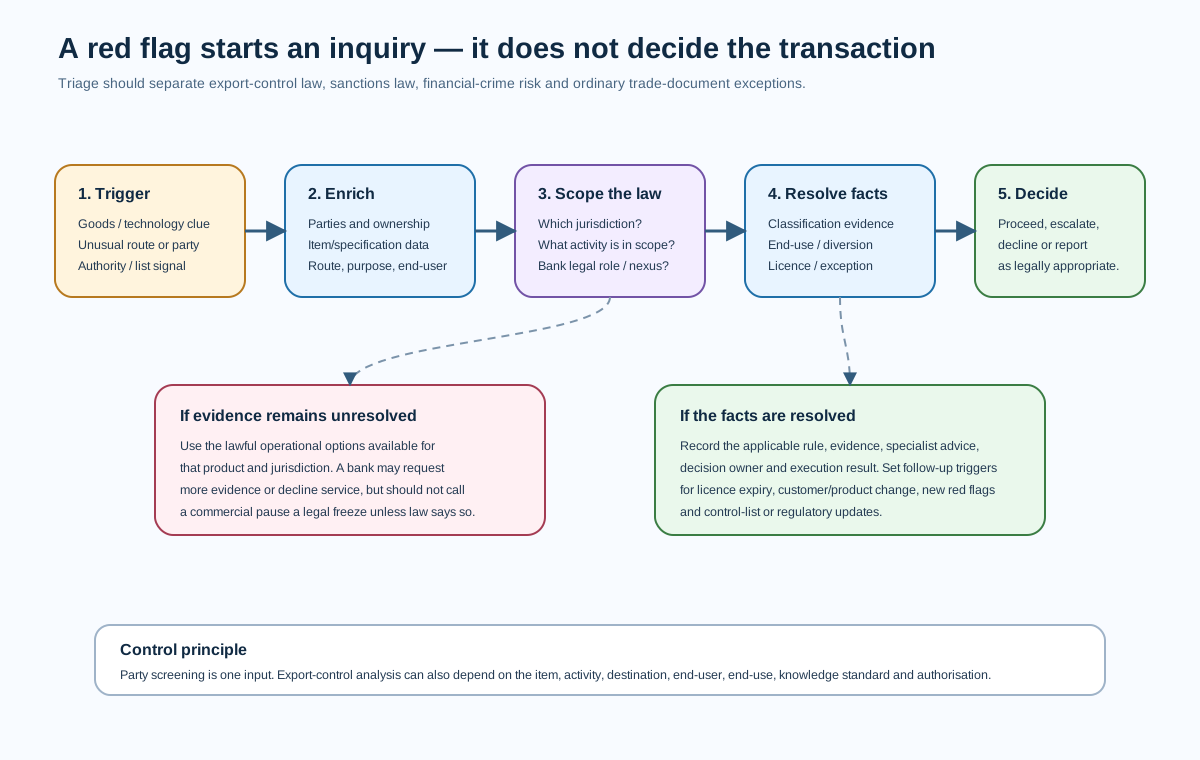
The triage sequence
The first step is to preserve the trigger exactly as it arrived. Was it a goods description, a technical parameter, an authority advisory, an unusual end-user, a route change, a customer statement, an export-control list hit, a licensing inconsistency or a network pattern? Recording the original trigger prevents the case from drifting into a generic “high risk” label that loses the reason it exists.
The second step is enrichment. Identify the exporter, purchaser, intermediate consignee, ultimate consignee or end-user where available; establish origin, destination and route; collect the item description and classification evidence; obtain the customer's stated end-use; and identify any licence or exception being relied upon. The information needed depends on the product. Documentary trade finance may provide detailed goods records; an open-account payment may provide almost none.
The third step is legal scope. Which regime is relevant? Which bank entity and people are involved? Is the issue an export, re-export, in-country transfer, brokering service, technical assistance, technology release, transit movement or financing/support activity? If U.S. EAR scope is material, does General Prohibition Ten or another provision apply to the bank's service? If the exporter is in the EU or UK, what do those rules require from the exporter and what direct duty, if any, reaches the bank? The purpose is to avoid borrowing a rule from the wrong jurisdiction.
The fourth step resolves the factual question with the right expertise. Technical classification goes to competent technical/export-control reviewers. End-use concerns are tested with customer and independent evidence. Licence reliance is checked against the actual activity and dates. Contradictions are documented and followed up. Analysts should be able to say “not yet determined” rather than choosing an answer merely to satisfy a system field.
The fifth step is the bank decision. Proceed, proceed with conditions, seek more information, escalate, decline, or report only where the law and bank policy support that outcome. If execution is temporarily deferred, the record should say why and under what authority. It should not describe a risk-based or contractual pause as a statutory freeze unless the applicable law actually imposes one.
Customer communication during review
Export-control cases are difficult for customer-facing teams because the customer may understand the product better than the bank while the bank understands its own legal and risk obligations better than the customer. The conversation should therefore be specific about the evidence required without pretending that the bank has already made a technical conclusion.
A good information request can ask for the manufacturer's product description, technical classification, export jurisdiction, intended destination, consignee, ultimate end-user, end-use, licence or exception basis and any official classification or authority correspondence. It should explain the deadline and the consequence of not providing the information. It should avoid accusatory language such as “prove this is not military” where the actual question is narrower.
If the customer disputes the bank's understanding, there should be a route to specialist review. This is especially important with technical classifications, because a relationship manager or payments analyst should not overrule a manufacturer or specialist on engineering parameters without competent evidence. Equally, customer expertise does not require the bank to accept unsupported assertions where red flags remain.
The customer-impact record should distinguish unavoidable legal or control requirements from avoidable process delay. If a case spent two days waiting for an internal queue even after the required evidence was available, that is an operating-model problem, not “compliance taking time.” Metrics should expose that difference.
Evidence standards by decision type
Not every case needs the same documentation. A routine payment with no credible export-control nexus should not require an engineering dossier. A high-consequence case involving sensitive technology and an uncertain end-user should not be closed on a one-line customer email.
A useful tiering model is:
| Decision type | Evidence expectation |
|---|---|
| Routine clear | Existing customer/product profile and no unresolved red flag |
| Clear after inquiry | Customer explanation plus corroborating transaction/product evidence |
| Technical boundary | Exporter/manufacturer classification and specialist review, with applicable control-list version |
| Licence reliance | Permission source, scope, dates, parties, item/end-use match and relevant conditions |
| Adverse service decision | Clear factual record, legal/policy basis, decision owner and execution evidence |
| Reportable matter | Jurisdiction-specific reporting basis and preserved supporting evidence |
The table is not a universal legal standard. It is an operating model for ensuring that the strength of the evidence is proportionate to the consequence of the decision.
BA acceptance criteria
A business analyst translating the policy into system requirements should demand explicit states rather than vague flags. Useful acceptance criteria include:
- A case can record classification unknown, customer-declared, specialist-confirmed, officially classified or another controlled evidence state without forcing binary controlled/uncontrolled logic.
- Every legal conclusion stores the jurisdiction, legal basis, effective date and reviewer.
- Export-control authorisation records store scope and expiry and can trigger review of dependent facilities or transactions.
- Sanctions status is separate from export-control status. An export-control concern does not automatically invoke a sanctions block/reject workflow.
- End-user and end-use concerns can exist even when the item is EAR99, unlisted under another regime or otherwise outside an ordinary list-based licensing requirement.
- The system preserves source documents and versions so later reviewers can reconstruct the evidence used at the decision date.
- A customer/product change can reopen export-control review without waiting for the next periodic KYC date.
- A reviewer can link related payments, shipments, trade instruments and customer cases so knowledge is not lost across channels.
- A temporary operational status includes a reason, owner and expiry/review point; it cannot silently become indefinite.
- Execution evidence proves that the approved outcome was actually implemented in the payment, trade or lending system.
Testing scenarios
Testing should prove both protection and proportionality. Positive scenarios can include a listed end-user, an otherwise unlisted item caught by an end-use restriction, a licence whose end-user does not match the transaction, an expired authorisation, a routing change that reveals a new ultimate destination, and an EAR-linked financial service where credible red flags remain unresolved.
Negative scenarios should include legitimate dual-use goods with a valid authorisation, an ordinary distributor using a free zone for documented commercial reasons, a university buying sensitive-looking equipment for a verified civilian programme, a technology customer whose product update remains outside the relevant control entry, and a shipment whose route changes because of port congestion. These scenarios prevent the control from becoming “dual-use equals suspicious.”
Jurisdiction tests are essential. Feed the same commercial scenario through a U.S., EU and UK legal-applicability model and verify that the system does not produce identical legal text merely because the facts look similar. The purpose is not to make the outcomes artificially different; it is to prove that each outcome is reached through the right legal rule.
Failure-mode tests should cover stale control-list data, unavailable party-screening services, missing goods information, conflicting customer and manufacturer classifications, licence-verification service outage, case-system latency, duplicate alerts and a rule update becoming effective during an open transaction. For each failure, the product owner should know the lawful degraded-mode behaviour rather than improvising it during an incident.
Metrics that reveal control quality
Volume metrics such as “number of export-control alerts” say little about quality. Better measures include the percentage of relevant cases reaching specialist review, disagreement or overturn rates on technical decisions, age of unresolved high-consequence cases, percentage of licence-dependent facilities with structured expiry data, repeat red flags from customers whose earlier cases were closed without remediation, and execution errors where a correct case decision was not reflected in the transaction system.
False-positive and customer-impact measures belong beside risk metrics. If a rule flags nearly every payment containing the word “software,” the control is not mature. If technical cases remain in frontline queues because specialist capacity is insufficient, the problem is resourcing and routing. If the same item receives different conclusions across legal entities without a jurisdictional reason, the determination library or governance model needs attention.
Determination libraries and institutional memory
A determination library can turn expensive technical reviews into reusable knowledge, but only if it is effective-dated and evidence-aware. The library should record the item or product family, technical parameters, legal regime, control-list version, conclusion, specialist source, assumptions and expiry or review trigger. It should never convert an old determination into permanent truth.
When control lists change, impacted library entries need review. A previous conclusion can remain valuable as historical evidence while being marked superseded for new decisions. Analysts should be able to see both the current view and the reasoning that applied when an earlier transaction was processed.
Libraries also help identify inconsistency. If two specialists classify materially identical configurations differently, the issue deserves reconciliation rather than averaging. If a customer repeatedly presents items just below thresholds with changing model descriptions, the history itself becomes a risk signal even if each individual determination remains technically outside the list entry.
Independent assurance
Assurance should sample the full decision chain, not merely confirm that screening ran. For a classification case, re-performance should ask whether the right technical evidence was obtained and whether the correct control-list version was used. For an end-use case, assurance should test whether contradictory evidence was investigated. For a licence case, it should test scope and effective dates. For an adverse decision, it should verify execution across all affected systems.
A useful assurance question is: could another competent reviewer reconstruct the bank's decision from the record without asking the original analyst what they remember? If the answer is no, the control is too dependent on personal memory.
Closing checklist
Before closing an export-control case, confirm that the trigger has been resolved rather than merely described; legal applicability has been identified; technical questions were handled by competent people; end-user and end-use evidence is proportionate to risk; any authorisation relied upon actually covers the activity; sanctions and AML questions were assessed separately where relevant; the bank decision has a clear owner; customer communication is accurate; execution is evidenced; and future triggers such as licence expiry, product change or regulatory update are captured.
The result should be a defensible bank decision, not a declaration that the bank has certified the export. That distinction keeps the control accurate, practical and aligned to the institution's real role.
Masterclass: governing export-control competence bank-wide
Export-control capability fails when technical knowledge sits in one trade-finance team while payments, lending, relationship, technology and operations teams encounter the same risk without knowing when to escalate. The answer is not to train everyone as an export-control specialist. It is to distribute the right level of literacy, define decision rights and preserve evidence so that complex questions reach competent reviewers.
Role-calibrated competence
Frontline and relationship teams need trigger recognition. They should understand that goods, software, technology, end-user, end-use, destination and authorisation can matter; that a clean sanctions screen does not settle an export-control question; and that they must not deliberately avoid relevant customer information. They should know where to route a case and what evidence to preserve.
Trade-finance and payments operations need stronger process literacy. They should understand which fields and documents the bank actually receives, how party and route changes affect a case, how export-control cases connect to sanctions and AML workflows without becoming the same decision, and how to execute a specialist outcome accurately. They do not need to make unsupported technical classifications.
Export-control and legal specialists own legal applicability and interpretation. Their role includes identifying the relevant jurisdiction and activity, distinguishing list-based from end-use/user controls, understanding financing or support provisions where they reach the bank, assessing authorisation evidence and defining the legal basis for the bank's disposition.
Technical specialists own engineering or scientific questions. They interpret specifications, configuration, software functionality and control-list parameters. Their analysis should state assumptions and the version of the relevant control list. The bank should be able to distinguish a technical opinion from a legal conclusion even when both are needed in the same case.
Business owners remain responsible for customer and product decisions within the legal and risk framework. They should not override legal prohibitions, but they should own questions such as whether the relationship remains within appetite, whether a product can support the required control, and how customer impact is managed.
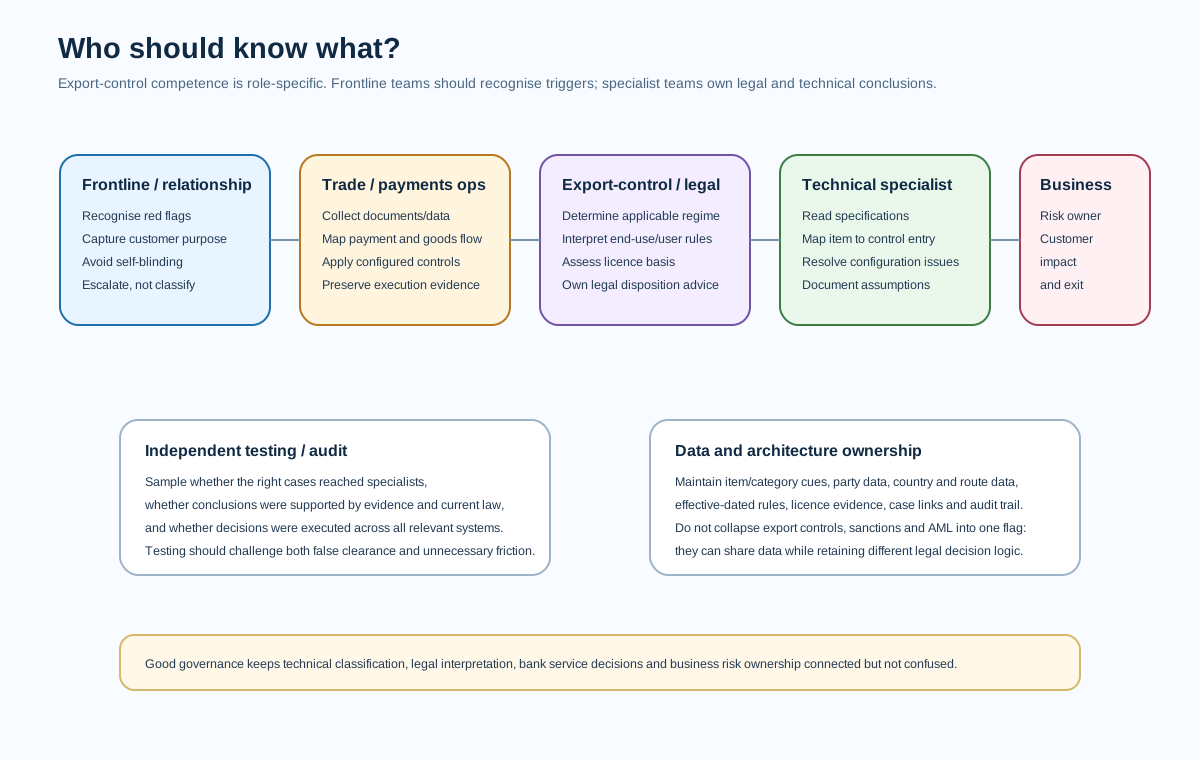
Governance forums and decision rights
A mature operating model defines which decisions need which authority. Routine clearances based on established evidence can sit with trained operations. Technical boundary questions route to specialists. Novel legal questions or conflicts between regimes go to export-control/legal advisory. High-impact relationship decisions may require senior business and compliance governance. The escalation path should be explicit enough that commercial urgency cannot shop for a more convenient answer.
Decision records need to show who owned the conclusion. A case saying “Compliance approved” is too vague if three teams reviewed different dimensions. The record should distinguish technical classification, legal applicability, authorisation assessment, sanctions conclusion, AML reporting decision and final bank service decision. That separation also helps internal audit test the correct control owner.
Technology-sector customer strategy
Technology-intensive customers can change export-control relevance faster than ordinary periodic KYC cycles. Semiconductor, advanced manufacturing, aerospace, research, biotechnology, cybersecurity and other sectors may introduce new products, capabilities, collaborators or destinations that change the legal analysis.
The bank therefore needs event-driven triggers. Examples include a new controlled product line, acquisition of a company with sensitive technology, entry into a new destination, material change in customer export-compliance governance, an authority notification, new end-users in sensitive sectors, or significant changes in the customer's payment and shipping network. The purpose is not to subject every software company to the same enhanced due diligence. It is to identify the customers for whom product and end-use knowledge materially affects the bank's risk.
Customer programme maturity is relevant evidence. A well-resourced export-compliance function, documented classification process, clear licensing governance and credible handling of red flags can support the bank's understanding. But maturity is not a legal safe harbour. A sophisticated customer can still make a mistake, and a small customer can still operate compliantly.
Authority engagement without promises about enforcement
Banks may need to engage export-control authorities for guidance, reporting, licensing-related clarification or potential violations, depending on jurisdiction and circumstances. U.S. BIS, UK ECJU and EU Member State competent authorities have different roles and procedures. The institution should know who can contact an authority, how legal privilege or confidentiality is handled, how commitments are recorded and how follow-up actions are tracked.
Voluntary disclosure, cooperation and remediation can be relevant under some enforcement frameworks, but they should never be described internally as guaranteeing leniency or “earning” a favourable outcome. Authorities decide cases under their own law, policies and facts. The defensible bank position is to detect issues promptly, preserve evidence, obtain legal advice, engage appropriately and complete remediation because those are sound compliance practices, not because an outcome has been promised.
Independent assurance
Independent testing needs enough export-control expertise to challenge the control rather than merely confirm that a checklist was completed. Sampling should emphasise boundary cases, sensitive destinations, end-use concerns, licence reliance and situations where the bank's legal nexus is contested.
For a classification sample, assurance should test whether the evidence actually supports the conclusion and whether the correct control-list version was used. For a diversion case, it should test whether contradictory routing or end-user information was resolved. For a licence case, it should test the scope and dates. For a U.S. EAR-related financial service, it should test whether GP10 risk and knowledge were assessed where appropriate. For an EU or UK case, it should verify that U.S. concepts were not applied automatically.
The assurance objective is not to prove that no controlled item can ever pass through a bank-financed trade chain. No realistic bank can make that absolute claim. The objective is to provide reasonable, evidenced confidence that the institution has identified its legal exposure, designed proportionate controls, escalated credible red flags and executed decisions consistently.
Metrics that management can use
Useful metrics separate effectiveness from activity volume. Examples include:
- technical-review overturn or disagreement rates;
- age of unresolved high-consequence cases;
- percentage of licence-dependent facilities with structured expiry data;
- cases reopened because new information changed the end-user or end-use assessment;
- repeat control failures by customer or corridor;
- execution errors where a correct case outcome was not implemented;
- percentage of alert scenarios supported by data actually present in the channel;
- customer delay attributable to internal queueing rather than external evidence or legal review.
Management information should also highlight legal-change readiness. If a control-list update becomes effective next month, governance should know which products, customers and rules are affected, whether reference data is ready, whether tests passed and whether open cases require reassessment.
Horizon scanning
Export-control change is continuous. Multilateral arrangements update lists; national and regional authorities implement those changes on different timetables; emerging technologies create new policy measures; courts and enforcement actions clarify interpretation; and geopolitics can change destination or end-user restrictions rapidly.
Horizon scanning should therefore produce actionable, effective-dated requirements rather than newsletters. A change record should identify the source authority, adopted date, publication date, entry-into-force or applicability date, jurisdictions affected, business impact, systems and data affected, customer population, required testing and accountable owner.
The European Commission's 14 September 2026 adoption of a new update to the EU dual-use control list is a good example. The operational question is not merely “new EU list published in the news.” Teams need to follow the delegated act through the legal process and activate rule changes when the applicable act enters into force. Similar discipline is needed for BIS Federal Register changes, UK Notices to Exporters and other jurisdictional updates.
Connecting neighbouring controls
Export controls, sanctions, AML/CFT and proliferation-financing controls share data and intelligence but have different legal decisions. A procurement company may be unlisted yet create an export-control end-use concern. A sanctioned entity can create a financial-sanctions prohibition even if the goods themselves are uncontrolled. A suspicious payment network can justify AML investigation without proving an export-control violation. A PF typology can expose dual-use procurement that then requires specialist export-control analysis.
The architecture should therefore create shared case context but preserve separate outcomes. That is the governance pattern that allows different specialists to work from the same facts without collapsing every risk into one generic “financial crime” flag.
Final governance test
Senior management should be able to ask a case team five questions and receive precise answers: Which law applies to this bank service? What item or activity is relevant? What do we know about the destination, end-user and end-use? What authorisation or exception is relied upon? Who made the bank decision and what evidence was executed?
If those answers are clear, versioned and reconstructable, the control is functioning as a real operating model rather than a collection of screening tools.
Knowledge checks with explained answers
1. A machine is below a control-list threshold, but the end-user and route create credible diversion concerns. Does the technical classification clear the transaction?
No. Classification and end-user/end-use analysis are different questions. An item can fall outside a listed entry yet still be affected by an end-use or end-user rule under the applicable jurisdiction. The bank should identify the legal regime, resolve the end-user/end-use facts and decide what that means for its own service. It should not call the goods prohibited merely because the route is unusual, and it should not treat a technically uncontrolled classification as a universal clearance.
2. Why is “dual-use” not the same as “prohibited”?
Dual-use describes goods, software or technology capable of civilian and military or other sensitive applications. Whether an export needs authorisation depends on the actual control entry, destination, end-user, end-use, legal regime and available permissions. Much dual-use trade is legitimate and routinely authorised. The control problem is to identify the facts that make the particular transaction licensable or prohibited, not to stigmatise the product category.
3. An exporter provides a self-classification. Must the bank independently reclassify the item?
Not as a universal rule. The bank should decide what evidence it needs for its own legal and risk position. Exporter or manufacturer classifications can be important evidence. Where credible red flags, configuration ambiguity or a high-consequence use make the classification material, specialist or official evidence may be needed. The U.S. BIS Know Your Customer guidance is particularly clear that red flags should be investigated while also explaining that, absent red flags or another EAR requirement, exporters are not generally expected to go behind every customer representation simply for the sake of inquiry. That is U.S.-specific guidance, but it illustrates evidence-based escalation.
4. What does General Prohibition Ten mean for a U.S. EAR-linked financial institution?
General Prohibition Ten can prohibit financing, forwarding or other servicing of an item subject to the EAR with knowledge that an EAR violation has occurred, is about to occur or is intended to occur. BIS published specific financial-institution guidance in October 2024 recommending risk-based controls and red-flag review. The bank must first determine whether the EAR and GP10 are relevant to its facts; it should not export that U.S. rule to every legal entity globally.
5. Is a “deemed export” any remote transfer of technology?
No. “Deemed export” is a specific U.S. EAR concept concerning certain releases of technology or source code to foreign persons in the United States. EU, UK and other systems have their own rules for intangible technology transfer and technical assistance. The practical risk can look similar, but the legal terminology and tests differ.
6. Why can a licence be genuine but still insufficient?
Because a genuine authorisation can be outside the scope of the actual transaction. The item, exporter, consignee, end-user, destination, quantity, dates or end-use may differ, or a condition may not be met. The bank should verify the aspects on which its decision relies rather than treating the existence of any licence document as blanket permission.
7. Does an export-control concern automatically mean the bank should freeze or block funds?
No. A legal asset freeze or block normally arises from the applicable sanctions or other law, not from the mere existence of an export-control red flag. The bank may have lawful operational or contractual options to defer or decline a service while it resolves evidence, depending on product mechanics and jurisdiction, but it should describe those accurately. Sanctions, export controls and AML reporting should be assessed under their own legal tests.
8. Why are U.S. de minimis and foreign-produced direct product rules dangerous to teach as global concepts?
Because they are features of the U.S. EAR's extraterritorial scope. Other jurisdictions have their own re-export, transfer, brokering and circumvention rules, but they do not automatically copy the EAR's U.S.-origin content calculations or foreign-produced direct product rules. A global bank system must record the applicable regime rather than store one universal “re-export threshold.”
9. A UK exporter is shipping non-listed civilian equipment, but there is evidence that it may be diverted to a military end-user in an embargoed destination. Why can this still require review?
Current UK military end-use controls can apply to otherwise non-listed items in defined circumstances. The legal trigger depends on the specific UK rules, whether the exporter has been informed or is aware of relevant facts, the destination and, where applicable, the relevant-consequence test. The correct response is to follow UK legislation and ECJU guidance rather than assume that all non-listed items are automatically licence-free.
10. What is the most useful BA design principle for export-control cases?
Keep facts, legal analyses and outcomes separate. Store the item evidence and its source; end-user/end-use concerns; the applicable jurisdiction and rule; authorisation evidence; sanctions results; AML conclusions; and the final bank service decision as distinct objects or states. This makes the case auditable and prevents one risk signal from automatically generating the wrong legal outcome.
Glossary of working terms
Dual-use item: goods, software or technology capable of civilian and military or other sensitive applications. Legal classification depends on the applicable control list and definitions.
Control list: an authoritative list of goods, software or technology subject to defined export-control requirements. Multilateral regimes influence many national lists, but national or regional implementation provides the binding rule.
ECCN: Export Control Classification Number used under the U.S. EAR for items described on the Commerce Control List. It is a U.S. classification concept, not a global code.
EAR99: a U.S. EAR designation for items subject to the EAR but not specifically described on the Commerce Control List. EAR99 does not mean “uncontrolled everywhere”; end-user, end-use, destination and other EAR restrictions can still apply.
End-user: the person or entity ultimately using the item, as defined by the applicable regime and transaction. It should not be confused automatically with the purchaser, consignee or freight forwarder.
End-use control / catch-all control: a rule that can impose licensing or other requirements based on the intended use, end-user or other specified circumstances even when an item is not on the ordinary control list. Scope varies by jurisdiction.
Diversion: redirection of goods, software or technology from the declared destination, end-user or end-use to another party or purpose. Diversion analysis commonly examines routing, intermediaries, documentation, ownership and commercial plausibility.
Export authorisation: permission under the applicable export-control regime, such as an individual, global or general authorisation or a licence/exception under another system. Scope and conditions matter.
Deemed export: a U.S. EAR concept for certain releases of controlled technology or source code to a foreign person in the United States. It should not be used as a generic label for all intangible transfers.
Re-export: export of an item from one foreign country to another, with legal significance defined by the applicable regime. Under the U.S. EAR, re-export rules interact with EAR scope, U.S.-origin content and foreign-produced direct product rules.
General Prohibition Ten: a U.S. EAR prohibition relevant, among other things, to financing or servicing items subject to the EAR with knowledge that an EAR violation has occurred, is about to occur or is intended to occur.
Red flag: an abnormal circumstance suggesting that the declared end-user, end-use, destination, item classification or transaction structure may be inaccurate or incomplete. A red flag is a trigger for inquiry, not proof of a violation.
Technical assistance: support such as technical instruction, advice, training or services that may be controlled under defined export-control regimes. The exact legal definition differs by jurisdiction.
Trans-shipment: transfer of goods from one means of transport to another during movement to the ultimate destination. It can be entirely legitimate but is relevant where route changes or intermediaries indicate diversion.
Bank service decision: the institution's operational decision about whether and how to provide a product or execute a transaction after legal, risk and evidence assessment. It should not be confused with an export licence determination made by the competent authority.
References and further reading
Export-control conclusions must be tied to the law and control-list version applicable to the item, activity, parties, destination and date. The sources below were reviewed for this chapter on 17 September 2026. They are authoritative starting points, not substitutes for transaction-specific legal or technical advice.
United States
- U.S. Department of Commerce, Bureau of Industry and Security — Export Administration Regulations (EAR): https://www.bis.gov/regulations/ear
- BIS — Part 732: Steps for Using the EAR, including Supplement No. 3, “Know Your Customer” Guidance and Red Flags: https://www.bis.gov/regulations/ear/732
- BIS — Part 744: Control Policy, End-user and End-use Based: https://www.bis.gov/regulations/ear/744
- BIS — Guidance on end-user and end-use controls and U.S. person controls: https://www.bis.gov/licensing/guidance-on-end-user-and-end-use-controls-and-us-person-controls
- BIS — Guidance for financial institutions on best practices for compliance with the EAR, 9 October 2024: https://www.bis.gov/press-release/bis-issues-guidance-financial-institutions-best-practices-compliance-export-administration-regulations
- BIS — Identify red flags, including export-evasion guidance and links to Supplement No. 3 to Part 732: https://www.bis.gov/enforcement/identify-red-flags
- U.S. Department of State, Directorate of Defense Trade Controls — Defense trade controls / ITAR resources: https://www.pmddtc.state.gov/ddtc_public
European Union
- EUR-Lex — Regulation (EU) 2021/821 setting up a Union regime for the control of exports, brokering, technical assistance, transit and transfer of dual-use items, consolidated version current from 15 November 2025: https://eur-lex.europa.eu/eli/reg/2021/821/2025-11-15
- European Commission, Trade and Economic Security — Exporting dual-use items, explaining the EU control list, end-use controls and authorisation types: https://policy.trade.ec.europa.eu/help-exporters-and-importers/exporting-dual-use-items_en
- European Commission — 2026 update of the EU Control List of Dual-Use Items, adopted 14 September 2026. Operational teams should track the delegated act through scrutiny, publication and entry into force rather than treating adoption alone as legal applicability: https://policy.trade.ec.europa.eu/news/2026-update-eu-control-list-dual-use-items-2026-09-14_en
- EUR-Lex — 2026 information note on Member State measures under Regulation (EU) 2021/821: https://eur-lex.europa.eu/eli/C/2026/2595/oj/eng
United Kingdom
- UK Government / Export Control Joint Unit — UK strategic export controls: https://www.gov.uk/guidance/uk-strategic-export-controls
- UK Government / ECJU — Military end-use controls, updated 19 May 2026: https://www.gov.uk/guidance/military-end-use-controls
- UK Government / ECJU — End-use controls applying to WMD-related items, including technical help: https://www.gov.uk/guidance/end-use-controls-applying-to-wmd-related-items-including-technical-help
- UK Government / ECJU — Export controls: dual-use items, software and technology: https://www.gov.uk/guidance/export-controls-dual-use-items-software-and-technology-goods-for-torture-and-radioactive-sources
- UK Government / ECJU — Standard individual export licences (SIELs), updated 23 April 2026: https://www.gov.uk/guidance/standard-individual-export-licences-siels
Global non-proliferation and risk context
- United Nations Security Council 1540 Committee — Frequently Asked Questions on resolution 1540 (2004), including national export, transit, trans-shipment, re-export, end-user, financing and transport controls: https://www.un.org/en/sc/1540/faq.shtml
- United Nations Security Council 1540 Committee — Resolution 1540 fact sheet: https://www.un.org/en/sc/1540/1540-fact-sheet.shtml
- FATF — Complex Proliferation Financing and Sanctions Evasion Schemes, 20 June 2025: https://www.fatf-gafi.org/en/publications/Financingofproliferation/complex-proliferation-financing-sanction-evasion-schemes.html
- Nuclear Suppliers Group — Guidelines for transfers of nuclear-related dual-use equipment, materials, software and related technology (INFCIRC/254, Part 2): https://www.nuclearsuppliersgroup.org/index.php/en/guidelines/nsg-guidelines/guidelines-part-2
Accuracy note — reviewed 17 September 2026: export-control lists, country/end-user restrictions, licensing requirements, end-use controls and enforcement guidance change frequently. The EU Commission adopted a 2026 Annex I update on 14 September 2026, but adoption is not the same as entry into force. For live activity, confirm the current legally effective text, national implementation where relevant, competent-authority guidance and transaction-specific technical/legal analysis before relying on a conclusion.