Retail and Mule Account Red Flags
Retail-account monitoring looks simple until a bank tries to do it well. Millions of legitimate customers receive irregular income, split household expenses, move money between their own accounts, support relatives, use digital wallets, travel, change jobs, receive refunds, buy property, sell assets, invest, withdraw cash and adopt new payment channels. Many of those behaviours can resemble financial-crime typologies when viewed without context. At the same time, organised fraud and money-laundering networks deliberately use ordinary-looking retail accounts because normal retail activity provides cover.
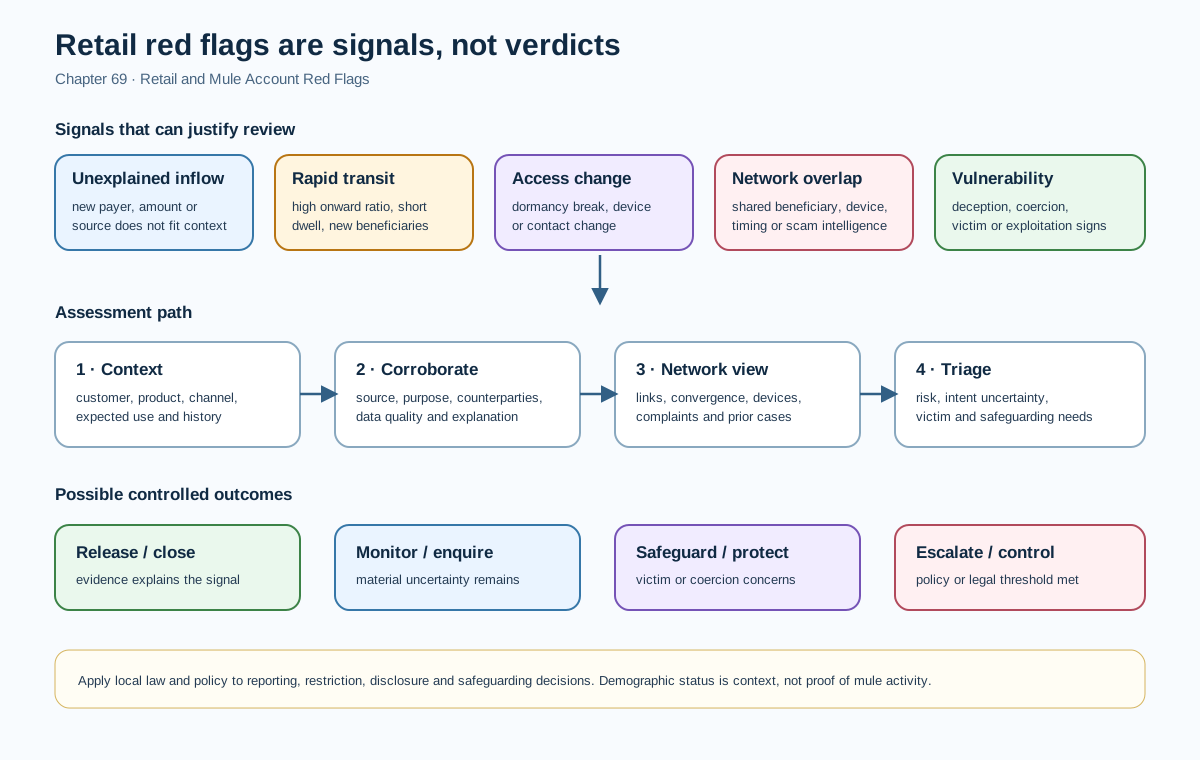
The practical objective is therefore not to build a catalogue of suspicious-looking transactions and treat every match as wrongdoing. A red flag is a reason to ask a better question. The bank needs to understand the customer, the source and destination of funds, timing, velocity, device and channel context, linked counterparties, vulnerability indicators and the quality of the underlying data before deciding what the signal means.
Money mules make this especially important. A mule may be knowingly participating, recklessly allowing an account to be used, deceived through a job or romance story, coerced, or otherwise exploited. Those possibilities can produce similar payment patterns but require very different operational responses. The bank still has to protect itself and the financial system from illicit flows, yet it should avoid turning proximity to crime into automatic proof of criminal intent.
A useful mental model is:
signal → context → corroboration → network view → customer/victim assessment → decision → feedback.
The signal may be a sudden credit, fast onward transfer, dormant-account activation, unusual cash activity, new device, new beneficiary, repeated transfers from unrelated parties, rapid conversion to virtual assets or a manual referral from a branch or fraud team. Context asks whether that behaviour fits the customer and product. Corroboration checks whether an explanation is supported by independent facts. The network view asks whether the account is connected to other activity the analyst cannot see from a single-customer screen. Customer and victim assessment considers coercion, scam victimisation and vulnerability. The decision then follows the bank's policy and the applicable legal framework, with feedback improving controls and customer data.
The global-standard and regulatory context
FATF provides the global AML/CFT framework, but it does not prescribe one universal retail-monitoring rulebook. Its Recommendations require a risk-based approach, ongoing customer due diligence and suspicious transaction reporting through national implementation. The detail of reporting thresholds, account restrictions, information-sharing permissions, tipping-off rules, fraud reimbursement and customer protections varies by jurisdiction. A global bank therefore needs a common control philosophy supported by local legal mapping rather than one workflow presented as law everywhere.
The 2025 revisions to FATF Recommendation 1 strengthened the emphasis on proportionality, and the 2025 FATF guidance on financial inclusion explains why overly blunt controls can drive customers away from the formal financial system without necessarily improving financial-crime outcomes. This matters directly to mule monitoring. Students, recent migrants, gig workers, older customers, people using remittance corridors and customers with thin credit histories can display patterns that are unusual for a traditional salaried benchmark but entirely legitimate for their circumstances. Segment context should improve detection, not become a demographic shortcut.
The United States provides useful examples of red-flag guidance but those examples remain U.S.-specific. FinCEN's 2020 advisory on imposter scams and money mule schemes describes how people can be recruited through employment, romance and other deceptive narratives. FinCEN's August 2025 advisory on Chinese money-laundering networks includes examples of money mules whose stated occupations did not fit large unexplained transaction volumes. These are useful detection ideas, not global legal tests.
Australia provides another practical example. AUSTRAC and Fintel Alliance have published guidance on the exploitation of international students as money mules, with the public guide updated in March 2026. The guidance stresses combinations of behavioural and financial indicators and the need to consider suspicious matter reporting under the Australian framework when suspicion is formed. It should not be read as saying that student status itself is suspicious.
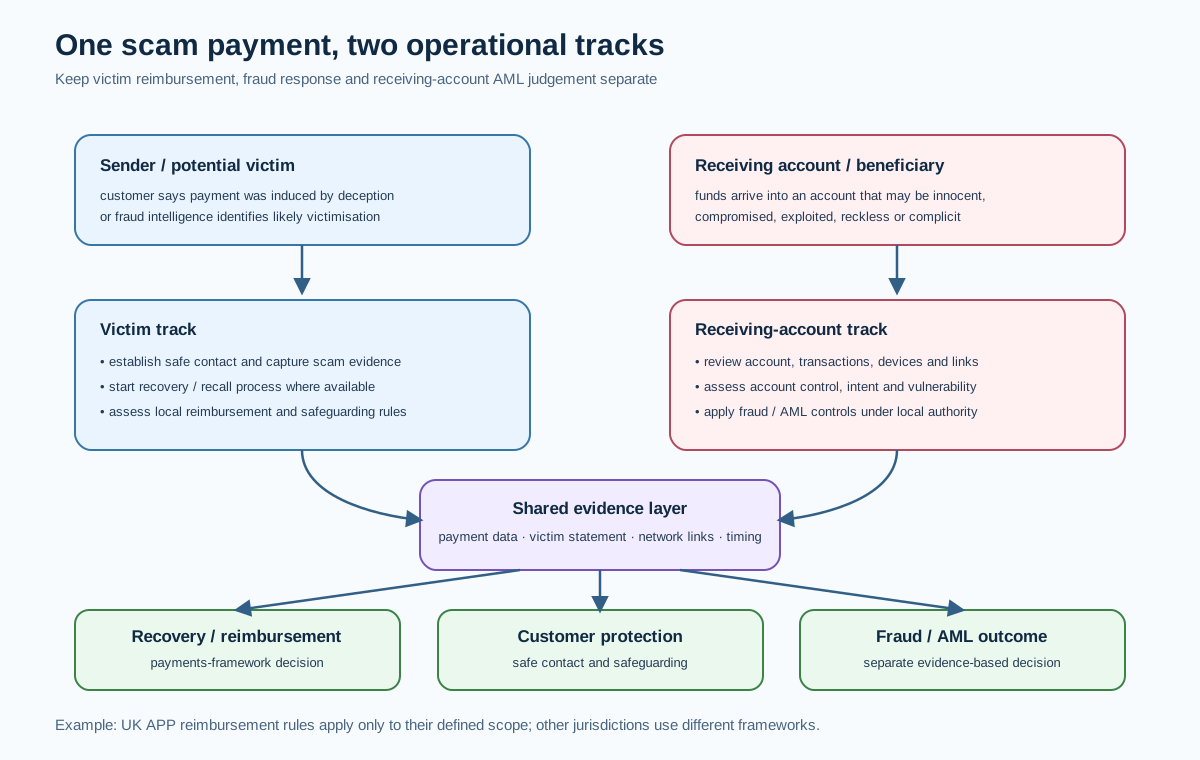
The United Kingdom illustrates why fraud-response and AML-response logic must be separated carefully. The Payment Systems Regulator's APP fraud reimbursement requirement applies to in-scope Faster Payments scam claims and sets a specific UK reimbursement framework. That framework does not become a global AML rule and it does not determine whether a receiving customer is a money mule. A bank may therefore have several parallel questions: should a victim be reimbursed under the applicable payments framework, can funds be recovered, does the receiving account require fraud restriction, does the activity raise money-laundering suspicion, and does any safeguarding action apply?
Wolfsberg's 2024 and 2025 statements on monitoring for suspicious activity are also useful because they encourage institutions to think beyond isolated transaction rules. Customer behaviour, customer attributes, transactions and other information can be combined to improve detection. For retail mule risk, this broader view is often more informative than a single amount or velocity threshold.
Red flags are combinations, not verdicts
A retail red flag is strongest when several independent facts point in the same direction. A single large incoming payment may be a salary bonus, property sale, family transfer, investment redemption or criminal proceeds. A fast outward payment may be a house purchase, emergency transfer, tax payment, investment or mule transit. A new device may be a replacement phone or an account-takeover signal. A student may receive support from several relatives or may be recruited as a mule. The control becomes more useful when it can distinguish these possibilities.
A strong alert therefore explains the combination that caused concern. For example: a newly opened account receives payments from multiple unrelated individuals; most value leaves within hours; the outward beneficiaries overlap with accounts already linked to scam complaints; the customer's stated occupation and expected account use do not explain the turnover; and device intelligence links the account to several other recently opened accounts. That combination is materially different from simply saying "student received a large credit."
The same discipline applies to closures. An analyst should not write "false positive because salary" merely because an employer-looking name appears in the payer field. The reviewer should understand whether the payer is credible, the amount and frequency fit the employment story, the customer has other unexplained activity, and the onward use of the funds is coherent with the account profile.
Sudden credits and source plausibility
Unexpected credits deserve attention when the source, amount, frequency or timing does not fit what the bank reasonably understands about the relationship. The goal is not to prove the customer's entire economic life. It is to test the material inconsistency that created the alert.
A salary claim may be corroborated through payer information, payment references, recurring timing and other employment evidence available to the bank. A property-sale explanation may be tested against the counterparty, completion timing and documentation where a proportionate review requires it. Family support may be plausible even when it varies month to month, particularly for students, new arrivals and customers supporting relatives across borders. A government payment should be assessed against the actual programme and available payment identifiers rather than rejected because it is unusual for the account.
The first significant credit into a new relationship is a special case because historical behaviour is thin. The bank should not treat the lack of history as suspicion by itself. Instead, it can ask whether the incoming funds are consistent with the onboarding story, whether the source is identifiable, whether linked accounts or devices suggest coordinated onboarding, and whether the value immediately leaves through channels associated with higher risk.
A common control failure is over-reliance on occupational averages. Income benchmarks can help identify implausibility, but they are not proof. Commission income, self-employment, inheritance, family transfers, sale of assets and one-off compensation can produce legitimate values far outside salary averages. Good investigation uses benchmarks as prompts for corroboration rather than as substitute evidence.
Rapid onward movement and dwell time
Money-mule accounts are often used to receive funds and move them onward quickly, creating distance between the predicate offence and the organiser. FinCEN, AUSTRAC, Europol and other public authorities repeatedly describe rapid onward movement as an important indicator in appropriate contexts. The operational mistake is to turn "fast" into a fixed universal threshold.
Dwell time is most useful when combined with other facts. Analysts can look at how long value remains in the account, how much is retained, whether the outward payments preserve round amounts, whether several incoming senders converge on the same beneficiaries, whether the customer has a credible reason for pass-through behaviour and whether the pattern repeats.
Some legitimate customers also move funds quickly. A person may transfer salary to a savings provider on payday, move money between their own banks, pay a solicitor after a property completion, fund an investment account or send money to family shortly after being paid. The difference often lies in the relationship between source, purpose, beneficiary and repeated behaviour rather than speed alone.
For system design, the useful features include credit_timestamp, debit_timestamp, dwell_duration, retained_value, counterparty_novelty, beneficiary_overlap, source_count, outbound_count, device_id, channel, cash_indicator and a reliable customer/account identifier. Those features need lineage back to source systems so investigators can understand what they mean and testers can prove that calculations survive currency conversion, reversals, chargebacks and duplicate events.
Scam proceeds require two views at the same time
An APP scam or other fraud creates at least two important banking views. The sending customer may be a victim who needs fraud support, recovery action and possibly reimbursement under the applicable local framework. The receiving account may be innocent, compromised, exploited or complicit. A bank that sees only one side can mishandle the other.
The fraud-response team may need to act quickly because funds can be dispersed across multiple accounts or converted into cash or virtual assets. The AML or financial-crime team may need a broader view of linked accounts, counterparties, devices and earlier alerts. Customer-service or safeguarding teams may need to establish safe contact with a victim. Legal and compliance teams may need to interpret local reporting, disclosure and account-action rules.
These actions should be coordinated without assuming that a fraud complaint automatically proves money laundering by the recipient. A complaint is important evidence, but identity errors, account takeover, compromised credentials and subsequent innocent transfers are possible. The receiving institution should apply its own legal and policy framework to the available facts.
In the UK, the PSR reimbursement regime creates defined obligations for in-scope APP scam claims under Faster Payments. Those reimbursement rules should be represented in product and case systems as a separate decision domain from AML suspicion and receiving-account culpability. Other jurisdictions may have different reimbursement models or no comparable mandatory framework.
Dormant and low-activity account reactivation
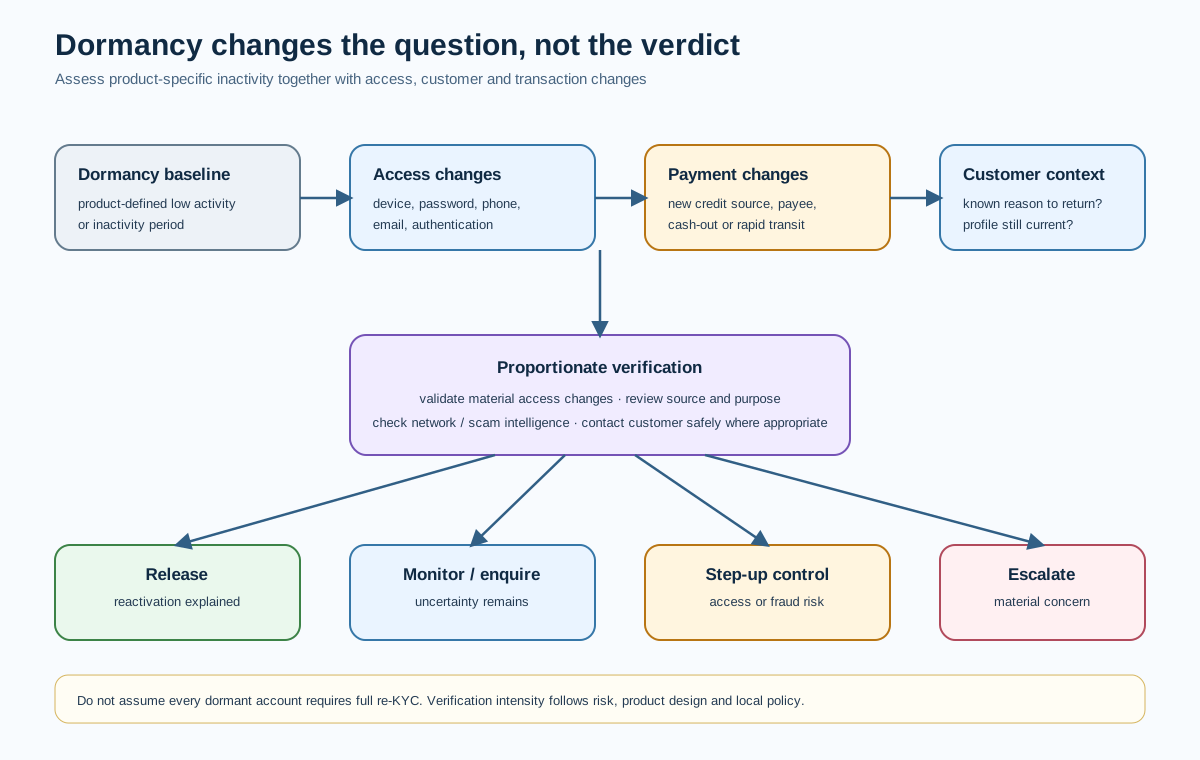
A dormant or very low-activity account can become useful to criminals because it may have a long history, established identity records and existing payment capability. Reactivation is therefore worth monitoring, but "dormant account used again" is not automatically suspicious. Customers return from travel, resume studies, change residence, receive old refunds, reactivate savings and reopen financial activity for many legitimate reasons.
The bank should define dormancy in product terms rather than use one global number. A current account, prepaid wallet and savings product can have very different expected activity. When activity resumes, useful questions include whether authentication details changed, a new device appeared, contact details changed shortly before the payment, new beneficiaries were created, limits were changed, unusual credits arrived and value moved onward rapidly.
Where risk is elevated, the response may involve step-up authentication, contact-detail verification, customer contact, additional review or temporary control under local policy. The intensity should reflect the combination of signals, customer impact and applicable legal authority. Re-verification is not automatically required for every dormant account and should not be presented as a universal rule.
Cash activity in retail accounts
Cash remains relevant in retail AML monitoring because it can provide an entry point for criminal proceeds, yet cash use varies substantially by customer, country and community. The existence of cash activity is not a red flag by itself.
Useful analysis can include deposit frequency, amount distribution, branch or ATM location, relation to expected occupation or business activity, third-party deposits where the institution can identify them, and the relationship between cash credits and later transfers. Repeated cash deposits followed by rapid electronic movement may be more informative than either behaviour viewed alone.
Structuring or smurfing concerns require particular care. Threshold-proximate activity can be an indicator where it appears designed to avoid reporting or control thresholds, but analysts should not infer intent simply because amounts fall below a threshold. The pattern, frequency, source, customer explanation, branch spread and other evidence matter. Local reporting rules also differ, so scenario documentation should identify which legal or policy threshold it is designed to support.
Cash controls should be tested for customer impact. Some older customers, cash-paid workers, market traders, small merchants and recent arrivals use cash more heavily than digitally native salaried customers. Segmentation can reduce unnecessary alerts while preserving aggregate detection across branches and accounts.
Money-mule networks and account-level signatures
A mule network can be invisible when each account is reviewed separately. The receiving account may see only two or three credits and one outward transfer, while the wider bank portfolio shows dozens of accounts receiving from overlapping victims, using common devices, forwarding to common beneficiaries and activating in a similar time window.
Network analysis therefore complements account monitoring. Useful links can include shared devices, phone numbers, addresses, email domains, introducers, beneficiaries, cash-out points, exchange destinations, IP ranges, payee details and transaction timing. Each link has a different evidential strength. A shared home address can be normal for a family or student household. A public IP address can represent a university, workplace or shared network. A reused device across unrelated identities may be more significant, but even that should be interpreted with support, branch or assisted-digital scenarios in mind.
Graph analytics can help investigators see convergence and common infrastructure, but they do not determine culpability automatically. The system should preserve why two nodes are linked, when the link was observed, the source system, confidence or quality indicators and whether the relationship is direct or inferred. Without this metadata, a colourful network graph can create more confidence than the underlying evidence deserves.
Distinguishing complicit, reckless and exploited customers
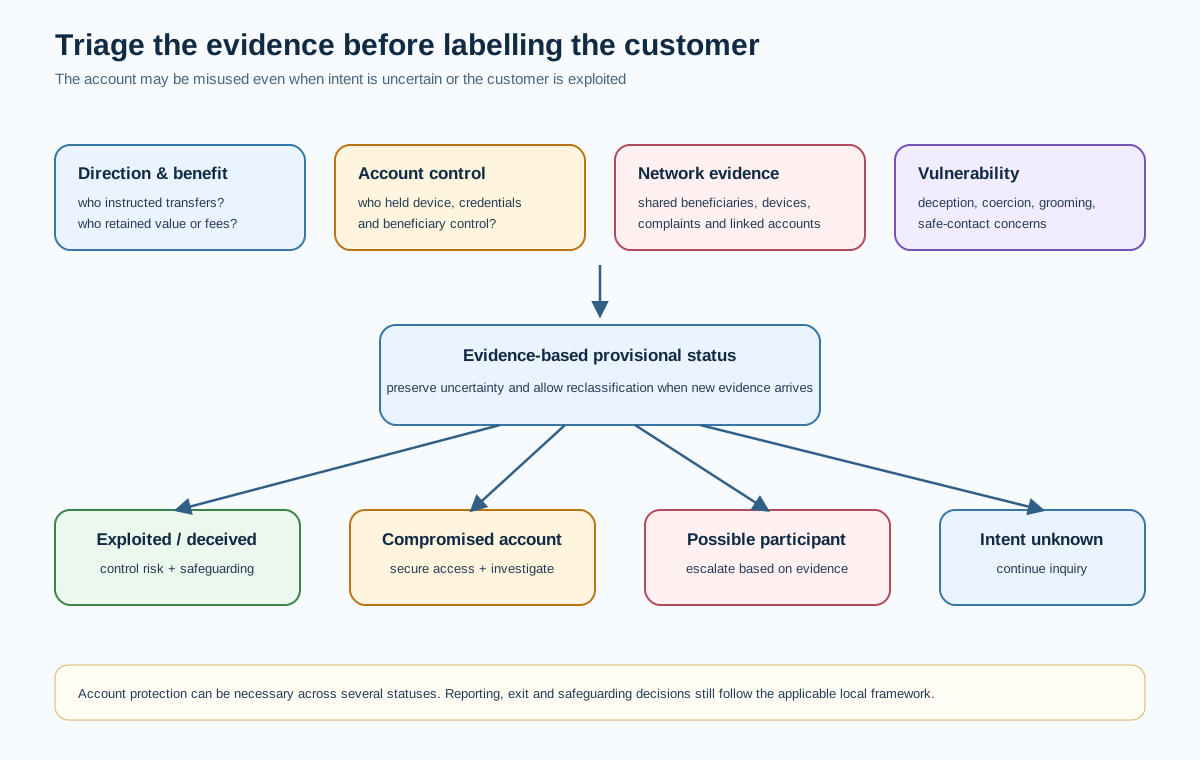
Banks often need to decide what to do before they know exactly why a customer moved the money. The customer may have been paid to use the account, may have ignored obvious warning signs, may have believed a fake employer, may be acting under coercion, or may be a scam victim who was instructed to forward funds. Those categories can evolve as new evidence arrives.
The investigation should focus on observable facts: who initiated the relationship, what the customer was told, who controlled the device, whether the customer retained a fee, whether instructions were received from another party, whether several accounts show identical behaviour, whether the customer is still being contacted by a controller, and whether vulnerability or coercion indicators are present.
A practical case model should allow a provisional status such as possible mule - intent unknown rather than force an early binary label. That protects analytical integrity and makes reclassification auditable when further evidence arrives.
Safeguarding does not mean ignoring financial-crime risk. A deceived or coerced mule account may still need payment controls to stop further laundering. The difference is that customer communication, account access, referral and exit decisions should consider exploitation and local legal requirements rather than treating every mule pattern as deliberate criminal participation.
Students, gig workers, migrants and other segments
Certain populations appear frequently in mule-prevention material because criminals target vulnerability, financial pressure, digital familiarity or limited local knowledge. That does not make those populations inherently suspicious.
AUSTRAC's international-student money-mule guidance is a useful example of this distinction. It identifies recruitment and transaction indicators while explicitly framing the issue as exploitation of vulnerable people. A bank can use that material to design combinations such as newly opened account + unexplained third-party credits + rapid onward movement + recruitment-related customer explanation. It should not create a rule that says student = high risk.
Gig workers can receive irregular payments from multiple platforms and move money rapidly for expenses. New arrivals may establish remittance corridors soon after onboarding. Shared accommodation can create repeated addresses or IPs. Family support can produce multiple third-party credits. These behaviours become more meaningful when combined with destination risk, unexplained value, common infrastructure, customer statements and other evidence.
Fairness testing should therefore examine whether a rule produces disproportionate customer friction without improving risk detection. That is not a claim that every jurisdiction has a specific AML "fairness examination" requirement. It is sound control design, supported by FATF's proportional risk-based approach and by general conduct, data-protection and discrimination obligations that may apply locally.
Older customers and financial exploitation
Older customers may appear in retail-mule investigations as fraud victims, victims of caregiver abuse or, in some cases, unwitting money mules. FinCEN's 2022 elder financial exploitation advisory and the 2024 U.S. interagency statement provide practical examples of behavioural and transaction indicators, but they are U.S. guidance and should be scoped as such.
Useful bank signals can include a sudden change in normal beneficiaries, unusual large withdrawals, a new person speaking for the customer, unexplained transfers to strangers, repeated payments after scam warnings, or a customer appearing confused about transaction purpose. Branch staff and call-centre staff may observe information that transaction data cannot show.
Customer contact needs care. A trusted contact, mandate holder or joint account holder may be helpful or may be part of the concern. The bank should use its local safeguarding, privacy and authority framework rather than assume that contacting a relative is always appropriate. Where there is immediate risk of harm, escalation routes should already be defined so front-line staff are not inventing safeguarding procedures during a live event.
Wallets, prepaid products and virtual-asset off-ramps
Mule behaviour is not limited to current accounts. Stored-value wallets, prepaid products, remittance accounts and virtual-asset services can all move illicit value. The relevant features depend on the product.
For wallets and prepaid products, investigators may need funding source, load method, device, wallet-to-wallet transfers, cash-out location, linked instruments and beneficiary relationships. For transfers to a virtual-asset service provider, the bank should avoid assuming that crypto use is suspicious. The important questions are whether the transfer is consistent with the customer profile, whether scam indicators are present, whether the destination provider is permitted or restricted under local policy, whether funds arrive and leave rapidly, and whether the bank has other intelligence indicating mule or fraud activity.
Where blockchain analytics are available, their scores should be treated as decision-support evidence rather than infallible ground truth. Address attribution can be uncertain, services can change ownership, and risk labels may be based on probabilistic clustering. The case file should preserve what the tool actually reported and when.
Data and system touchpoints
Retail mule detection cuts across more systems than transaction monitoring alone. A mature design may use:
- core account and ledger transactions;
- payment initiation and beneficiary data;
- fraud and scam complaints;
- digital-channel authentication and device signals;
- customer and KYC data;
- card, wallet, cash and remittance events;
- previous alerts, cases and reports;
- linked-account and counterparty data;
- customer-service and branch referrals;
- external intelligence that the bank is legally permitted to use.
The architecture problem is not simply collecting all available data. The bank must know which source is authoritative, when the data becomes available, how identifiers are matched, how corrections and reversals behave, which fields may be used for which purpose, and how investigators can reproduce the state of evidence that existed at decision time.
Real-time fraud controls and post-event AML controls may share features but have different latency and decision requirements. A beneficiary-risk score used before an instant payment may need a response in milliseconds or seconds. A retrospective mule-network model can use richer data after settlement. Requirements should not assume that the same service can satisfy both without explicit performance and availability design.
From alert to case to investigation
A retail alert should be converted into a case when the concern requires a wider evidence set, multiple events, linked accounts or specialist judgement. The case should preserve the original trigger rather than replace it with a generic label.
A practical investigation normally asks:
- What exactly triggered the alert?
- Is the underlying data complete and correctly attributed?
- What does the bank know about the customer and expected use?
- Which incoming sources and outgoing destinations matter?
- Is the pattern new, repeated or linked to other customers?
- Are fraud complaints, device links or external intelligence relevant?
- Is the customer potentially a victim, exploited intermediary or knowing participant?
- What action is permitted or required under the relevant jurisdiction and policy?
The outcome may be closure, continued monitoring, customer contact, fraud controls, payment action, account restriction, relationship review, safeguarding referral, case expansion, law-enforcement response or suspicious transaction reporting. Not every jurisdiction uses the same terminology or threshold. The platform should therefore capture the legal entity and jurisdiction controlling the decision.
Reporting also needs separation from internal labels. A mule suspicion may contribute to a SAR, STR or SMR where the applicable threshold is met, but filing does not prove criminal guilt. Equally, an account restriction may be needed for fraud prevention before an AML reporting decision is complete. Workflow design should allow those decisions to proceed in parallel where policy permits.
Roles and governance
Retail mule control is shared work. Fraud teams often see scams and beneficiary intelligence first. AML teams may own suspicious activity assessment and reporting. KYC teams maintain customer context. Digital and security teams own device and authentication signals. Payments operations can support recalls, holds and interbank messages. Customer-service teams handle victim interaction. Product owners and engineers control the journeys and data. Legal and compliance interpret local obligations. Model, rules and data-governance teams test whether detection behaves as designed.
Clear ownership prevents common gaps. If fraud closes a claim but no intelligence reaches AML, the receiving network may continue. If AML identifies a mule account but the fraud engine never receives the beneficiary risk, the same account may keep receiving victim payments. If a case identifies a device cluster but onboarding controls do not consume that intelligence, the organiser can create replacement accounts.
Governance should therefore review outcomes across the lifecycle: detection quality, alert ageing, false-positive causes, linked-network discovery, customer harm, fraud losses, recovery performance, reporting quality, rule/model changes, data-quality incidents and recurring root causes. Volume alone is a poor measure of effectiveness.
BA, architecture and testing considerations
A business analyst should require more than "detect mule accounts." The requirement needs the signal, data, comparison period, segmentation, exclusions, enrichment, case outcome and customer-action boundary. For example, rapid onward movement should define whether the logic applies to individual credits, aggregate inbound value, net value, internal transfers, own-account transfers, refunds, reversals and multi-currency activity.
Architects should separate source-event time from processing time and posting time. Mule patterns can disappear if events are ordered incorrectly. Duplicate payment events can create false velocity. Missing beneficiary identifiers can hide network convergence. Device identifiers may rotate or be unavailable on certain channels. Account mergers and customer-master changes can break historical linkage if effective dates are not retained.
Testing should cover positive, negative, boundary and failure scenarios. Positive cases can use synthetic or approved historical data representing mule patterns. Negative cases should include legitimate fast-moving scenarios such as own-account sweeps, property completions, gig income and family remittances. Boundary tests should examine threshold edges, currency conversions and time zones. Failure tests should cover delayed data feeds, duplicate events, stale customer data, device-service outages and unavailable network enrichment.
Production testing should not rely on secretly injecting fake suspicious activity into live customer queues. Safer assurance methods include synthetic data, controlled lower-environment scenarios, governed historical replay, shadow-mode comparison and carefully designed non-customer test accounts where local policy permits. Any testing method that touches live decisioning needs explicit governance because false restrictions and reporting contamination can create real customer and regulatory risk.
Common failure modes
One failure mode is single-signal thinking: a student, new device, cash deposit or rapid transfer is treated as a conclusion rather than a prompt for context.
Another is network blindness: each account looks small, but common beneficiaries, devices and timing reveal coordinated movement.
A third is victim blindness: the bank identifies illicit flow but fails to recognise that a customer was deceived or coerced.
A fourth is data confidence without lineage: analysts see a risk score but cannot identify the source facts, model version or missing data behind it.
A fifth is control fragmentation: fraud, AML, payments, onboarding and customer-service teams each hold part of the story and no workflow combines it.
A sixth is over-restriction: the bank reacts to uncertainty by blocking legitimate customers without a proportionate basis, creating complaints, exclusion and workarounds that reduce visibility.
A seventh is under-reaction: apparently low-value retail activity is closed repeatedly even when network links show organised misuse.
The best control is therefore not the most aggressive one. It is the one that converts weak signals into reliable context, protects victims, identifies networks, records uncertainty honestly and applies the right action under the right legal framework.
Operational deep dive: velocity, networks, devices and evidence quality
Retail mule detection improves when the bank stops treating each alert as a self-contained transaction problem and instead asks how value, identities, devices and counterparties behave over time. The analytical challenge is to create useful evidence without converting correlation into accusation.
First-credit analysis for thin-history relationships
A new account can receive a large legitimate payment on its first day. It can also be opened for the specific purpose of moving criminal proceeds. The lack of prior history therefore increases uncertainty rather than proving risk.
A strong first-credit review starts with the source. Is the payer identifiable? Does the payment reference support the customer's explanation? Is the credit consistent with the declared purpose of the account? Did the customer receive several unrelated credits immediately after onboarding? Did the same device or contact detail appear in other recently opened accounts? Did the customer create beneficiaries before the first incoming payment arrived? Did most of the value leave immediately?
The bank should avoid a rigid rule such as "first credit above X = suspicious." Product, segment and jurisdiction matter. A young professional moving an existing salary account, a student receiving education funding and a recently arrived family receiving relocation money can all generate legitimate first-credit patterns outside ordinary salary bands.
Where the explanation is material to the decision, corroboration should use reliable information that the bank is permitted to obtain. The objective is not unlimited documentary collection. It is to resolve the inconsistency proportionately.
Dwell-time and pass-through analysis
Dwell time measures how long received value remains available in an account before leaving. It becomes more informative when combined with value retention and destination analysis.
Suppose an account receives four incoming payments from unrelated individuals and forwards 95% of the combined value to one new beneficiary within two hours. That pattern is more concerning than a single transfer made two hours after salary. If several accounts show the same pattern and converge on the same beneficiary, the network evidence strengthens further.
Useful derived features include:
- time from each material credit to related debit;
- percentage of credit value forwarded within defined windows;
- number of unique incoming senders;
- number of unique outgoing beneficiaries;
- concentration of outgoing value;
- repeated round-value forwarding;
- retained fee or small balance pattern;
- own-account versus third-party destinations;
- cash or virtual-asset conversion following receipt.
The matching logic matters. A debit cannot always be mapped cleanly to a specific credit because account balances are fungible. Systems should therefore state whether they use first-in-first-out assumptions, rolling windows, balance-floor logic, aggregate inflow/outflow ratios or another method. Analysts should not be shown a precise "dwell time" if the underlying attribution is only approximate.
Beneficiary convergence and network expansion
A common mule-network signature is convergence: many sending accounts route value toward a smaller set of beneficiaries, wallets, cash-out points or service providers. The reverse can also occur, with one source dispersing value across many receiving mules.
Graph analysis helps reveal these structures, but network expansion needs stopping rules. If an investigator expands every counterparty recursively, the graph quickly includes innocent merchants, employers and payment platforms. A controlled expansion policy can prioritise strong links such as repeated direct payments, shared devices, common verified contact details or known scam complaints, while treating weaker links as context rather than case membership.
A bank should record both the relationship and the reason for it. shared_device = true is not enough. The case should retain device identifier, dates observed, channels, confidence, whether the device is customer-owned or assisted-service infrastructure, and whether the same identifier is known to be unstable.
Device and digital-channel evidence
Device intelligence can be valuable because organised onboarding may reuse phones, emulators, browser profiles, IP infrastructure or contact details across multiple identities. Yet device evidence is easy to overstate.
Families share tablets. Students use campus networks. Customers replace phones. Mobile operating systems reset advertising identifiers. Fraudsters use device farms and emulators. Branch staff or assisted-digital journeys may legitimately interact with multiple customers from shared infrastructure. Device evidence therefore needs channel context.
Architecture should separate durable identifiers from transient ones and document how confidence is calculated. Where fingerprinting vendors combine dozens of signals into one device ID, model and vendor governance should explain known collision rates, refresh behaviour, data retention and limitations. A reviewer should understand whether "same device" means exact hardware identity, probable browser fingerprint or a weaker network-based match.
Privacy and data-protection requirements vary by jurisdiction. Device data should be collected and retained under an appropriate legal and policy basis, with access limited to the intended control purpose. A useful fraud signal does not override privacy law.
Peer groups and segmentation
Peer comparison can reduce false positives when customers with genuinely similar behaviour are grouped together. It can also create hidden bias when the grouping is too broad or uses proxies that produce unfair outcomes.
A good peer group is defined by behaviourally relevant factors such as product mix, account age, payment-channel use, expected turnover and geography where legitimately relevant. Demographic status should not become a shortcut for suspicion. A student account, for example, may be compared with other thin-history low-balance accounts for some features, but "student" alone should not create a higher mule score.
Small segments require special care. Percentiles and anomaly scores become unstable when the reference population is tiny or rapidly changing. The system should expose population size and model confidence, and reviewers should have a fallback path where peer analytics are unreliable.
The 2025 FATF financial-inclusion guidance is relevant here because proportionality and inclusion are part of sound risk-based control. A bank that solves false positives by excluding whole customer groups has not necessarily improved its financial-crime framework.
Data lineage and control reproducibility
A retail-mule control can fail even when the detection logic is conceptually good. Missing payment events, stale customer profiles, duplicate messages, broken currency conversion or incorrect beneficiary identifiers can change the result materially.
For each feature, the bank should know the source system, source field, transformation, effective timestamp, refresh frequency, allowed null behaviour and reconciliation control. If counterparty_novelty depends on twelve months of history, testing should prove that migrated customers actually have that history available. If rapid_outflow_ratio excludes internal transfers, the rule should define how own-account ownership is resolved across legal entities and brands.
Historical replay is especially useful when changing a rule or model. The bank can compare old and new logic on the same past population, examine alerts gained and lost, and sample both groups. That is safer and more informative than judging a change solely by how much it reduces alert volume.
Wolfsberg's 2025 statement on transition and validation is useful for this kind of innovation because it emphasises controlled transition, balancing model risk with financial-crime risk and explainability. It is industry guidance, not a binding global rule, but it provides a practical framework for modern monitoring change.
What good evidence looks like
Evidence quality is stronger when the analyst can distinguish observation from inference. "Customer received £8,000 from three unrelated senders" is an observation. "Customer is a mule" is an inference. "Two of the senders later submitted scam claims" is additional evidence. "The customer said the transfers were payment for online work but could not identify the employer and forwarded nearly all value to a beneficiary also used by four other linked accounts" is a more complete evidential picture.
This separation improves QA, reporting and customer communication. It also makes later reclassification possible. If law enforcement or another institution later provides information, the bank can see which earlier decision was based on limited evidence rather than assume the earlier analyst missed an obvious fact that was not available at the time.
Advanced practice: scam response, victim protection and cross-institution intelligence
Retail mule risk sits at the boundary between AML, fraud, payments, customer protection and law enforcement. Mature operations need to coordinate those functions without assuming that one team's decision automatically answers the others' legal questions.
Dual-track scam response
A useful operating model separates two tracks that share evidence.
The victim track focuses on safe customer contact, payment recovery, fraud claim handling, safeguarding and any reimbursement process that applies locally. The receiving-account track focuses on whether the beneficiary account is compromised, exploited, complicit or otherwise linked to illicit activity. Both tracks may feed AML investigation, but their decisions are not interchangeable.
For example, a sending bank may decide that an APP scam claim is reimbursable under a local payments framework. That does not establish criminal intent by the receiving customer. Conversely, a receiving bank may identify strong mule indicators even where no reimbursement claim has yet arrived. The case platform should therefore store fraud claim status, reimbursement status, beneficiary investigation status and AML reporting status separately.
UK APP reimbursement as a jurisdiction-specific example
The UK Payment Systems Regulator's APP fraud reimbursement protections have applied to in-scope Faster Payments scam cases since 7 October 2024. The current public PSR guidance explains the maximum claim amount, claim handling expectations and treatment of vulnerable consumers.
This is useful educationally because it shows how customer-protection rules can interact with financial-crime operations. It must remain clearly scoped to the UK regime. Banks operating elsewhere need their own legal and scheme mapping, and even UK institutions should use the current PSR and Pay.UK rules rather than a training chapter as the operating source of truth.
Operationally, a reimbursement claim can generate intelligence for the receiving institution: victim narrative, beneficiary details, payment time, scam type and any recovery request. That intelligence should enter the receiving bank's control process through an authorised channel. It should not be copied into unrelated systems without regard to privacy, confidentiality and scheme rules.
Cross-institution mule intelligence
Mule networks often span several institutions. Public-private partnerships and law-enforcement operations such as Europol's European Money Mule Action demonstrate the value of information sharing, but the legal gateway for sharing varies substantially.
A bank should document what can be shared, with whom, for what purpose, under which law or scheme rule, and how data quality is controlled. Some jurisdictions provide explicit fraud or AML information-sharing mechanisms; others rely on law enforcement, FIUs, payment schemes or consent-based arrangements. A global policy should not assume that a mechanism available in one country can be exported worldwide.
Shared intelligence is useful only when identifiers are precise. A phone number with country code, device identifier with source and timestamp, bank account identifier, wallet address, beneficiary name or scam reference should be normalised so the receiving institution can match it. Free-text statements such as "linked to mule network" are difficult to operationalise without the underlying evidence.
Victim and exploited-mule safeguarding
A bank can protect the system and still recognise exploitation. FinCEN's money-mule material, AUSTRAC's student-mule guidance and other public-sector sources all describe people being recruited through deceptive narratives. That means an investigator should be alert to customers who may be both a financial-crime risk channel and a victim.
Safe contact matters. If a controller has access to the customer's phone or email, a normal outbound message may alert the controller or place the customer at risk. Banks should therefore use existing safeguarding procedures and specialist teams rather than improvise communication in the case queue.
The same caution applies to relatives and trusted contacts. A family member may be supportive, neutral or part of the exploitation. Local policy should define when another person can be contacted and what information can be disclosed.
Older customers and scam-linked mule behaviour
FinCEN's elder financial exploitation guidance provides a U.S. example of why fraud monitoring should consider both transaction behaviour and customer interaction. Older customers may be tricked into transferring funds directly to scammers, may allow access to a trusted person who misuses the account, or may be persuaded to receive and forward funds from other victims.
A bank should not use age as an automatic risk flag. Instead, it can combine a marked behavioural change with new beneficiaries, unusual transaction purposes, repeated scam warnings, branch or call-centre observations and other evidence. Where a customer appears to be a victim, financial-crime escalation and safeguarding can proceed together.
Student and new-arrival prevention
Students and recent arrivals are frequently targeted because criminals can offer apparently easy work, exploit financial pressure or take advantage of unfamiliarity with local banking rules. AUSTRAC's public guide is particularly valuable because it frames student money muling as exploitation risk and provides observable indicators rather than demographic conclusions.
Prevention can include customer education during relevant journeys, staff awareness of recruitment stories, links between fraud complaints and onboarding analytics, and rapid escalation where several accounts show coordinated patterns. University or community partnerships can be useful where legally and operationally appropriate, but they should focus on education and safeguarding rather than sharing customer information casually.
Recovery, restriction and relationship decisions
Payment recovery, account restriction and relationship exit are separate control decisions. A bank may ask another institution to return or hold funds, may temporarily restrict a receiving account under fraud policy, may escalate an AML case, and may later decide whether the relationship can continue. Each action needs its own authority and audit trail.
This separation prevents a common design error in which one generic mule=true flag automatically triggers every downstream consequence. A robust platform instead captures evidence, confidence, decision owner, legal entity, jurisdiction, effective time and reason code for each action.
Management information
Useful management information should show more than the number of mule accounts closed. Banks can examine scam complaints linked to receiving accounts, time from complaint to action, value recovered, repeat use of previously flagged beneficiaries, network cases identified, alert ageing, customer appeals, safeguarding referrals, data-quality incidents and rule/model changes.
Metrics need interpretation. A rise in detected mule accounts may mean worsening criminal activity, better detection or both. A fall may mean successful prevention or weaker coverage. Governance should combine quantitative trends with sampled case quality and typology intelligence before drawing conclusions.
Practice close: BA requirements, acceptance criteria and testing
A retail-mule control is only useful if the requirements are precise enough for engineers to build, testers to challenge and investigators to understand. Vague statements such as "detect suspicious rapid movement" create inconsistent implementations and poor auditability.
BA checklist
For each detection capability, define the business question first. Examples include: "Does this account receive funds from several unrelated parties and move most of the value to a common beneficiary within a short period?" or "Has a previously low-activity account changed device, contact data and beneficiary behaviour shortly before receiving scam-linked funds?"
Then document the data and logic needed to answer it:
- customer and account identifiers;
- products and channels in scope;
- incoming and outgoing transaction types;
- reversals, refunds and own-account transfers;
- time window and event-time definition;
- currency conversion method;
- counterparty and beneficiary identifiers;
- device or channel features where permitted;
- segmentation or peer-group logic;
- exclusions and their rationale;
- enrichment from fraud complaints or network intelligence;
- alert priority and case-routing rules;
- customer-action boundaries;
- jurisdiction-specific reporting and restriction rules.
Requirements should state uncertainty honestly. If beneficiary identity is inferred from free text rather than a stable identifier, that limitation belongs in the design and test evidence.
Acceptance criteria
Strong acceptance criteria are observable. For example:
- the control aggregates eligible incoming value using event timestamps, not batch-processing timestamps;
- own-account transfers are excluded only when ownership is confirmed by the customer master, not name similarity;
- a reversal removes the related amount from velocity calculations without deleting the original audit event;
- network links preserve source, timestamp and link type;
- analysts can see which transactions and features caused the alert;
- the case can record
intent unknownwithout forcing a witting/unwitting conclusion; - fraud, AML and safeguarding outcomes remain separate fields;
- customer restrictions require the authorised workflow rather than being triggered directly by an analytical score.
An acceptance criterion such as "system identifies mules" is not testable and should be rejected.
Test design
Positive testing should use synthetic data, approved historical cases or controlled test accounts to reproduce known patterns: multiple third-party credits, rapid onward transfer, beneficiary convergence, device reuse and repeated scam-linked receipts.
Negative testing is equally important. Include own-account sweeps, salary-to-savings transfers, property completions, student funding, gig income, family remittances, legitimate cash-heavy customers and customers replacing devices. A control that catches only positive scenarios but creates unreasonable friction for ordinary behaviour is not ready.
Boundary testing should cover exact threshold edges, midnight and daylight-saving transitions, time-zone conversions, partial reversals, multiple currencies, duplicate messages, delayed postings and same-day account ownership changes.
Failure-mode testing should cover missing device data, delayed fraud-complaint feeds, unavailable graph enrichment, stale customer profiles and duplicate transaction events. The system should fail predictably rather than silently producing apparently precise scores from incomplete inputs.
Do not seed fake suspicious activity into live customer queues casually
Ground-truth testing is valuable, but secretly inserting artificial suspicious transactions or alerts into live operational queues can contaminate reporting, customer controls and performance measures. Safer approaches include synthetic lower-environment scenarios, governed historical replay, shadow-mode detection, controlled non-customer test accounts and QA exercises based on anonymised historical cases.
If live-environment testing is necessary for a specific control, it should have explicit approval, known test identifiers, suppression of unintended customer/reporting consequences, reconciliation and post-test cleanup. The objective is to test the system, not to create artificial financial-crime records that later reviewers mistake for real history.
Historical replay and challenger analysis
When changing a mule-detection rule or model, replay the old and new versions over the same historical period. Review alerts gained, alerts lost and changes in priority. Sample both sides. A volume reduction is not automatically an improvement if the lost population contains meaningful risk.
Where labels are imperfect, use several outcome signals rather than treating one disposition as truth. Fraud complaints, confirmed account takeover, law-enforcement feedback, prior SAR/STR/SMR decisions, customer explanations and QA findings can all contribute, subject to legal and policy constraints.
Fairness and customer-impact testing
Test whether rules create excessive friction for legitimate segments. This does not mean lowering controls for a protected group. It means asking whether the same risk can be detected with more relevant features and fewer demographic proxies.
For example, a rule built around "student + multiple credits" is poor design. A stronger rule might use account age, unrelated payer count, rapid value forwarding, beneficiary convergence and shared infrastructure, while student status is used only for safeguarding or contextual review where appropriate.
Track complaints, appeals, restriction duration, repeat information requests and cases where legitimate activity repeatedly triggers the same rule. Those outcomes can reveal poor segmentation or data quality even when the rule is technically functioning.
Investigator usability testing
Analysts should participate in UAT. They need to see the alert trigger, relevant transactions, customer profile, prior alerts, network links, device evidence and uncertainty markers without opening ten disconnected applications.
A visually impressive graph is not enough. Test whether analysts can answer: why are these two accounts linked, when was the link observed, how reliable is it, and what source supports it? If the interface cannot answer those questions, the graph may increase confirmation bias.
Regression pack
Maintain a reusable regression pack for the control. It should contain representative positive and negative scenarios, data-quality defects, known edge cases and key customer-impact cases. Re-run it after changes to payment ingestion, customer master, device service, graph engine, currency conversion, case management or fraud integration.
Retail mule detection depends on the joined system. A change outside the monitoring engine can break the control just as easily as a change to the detection rule itself.
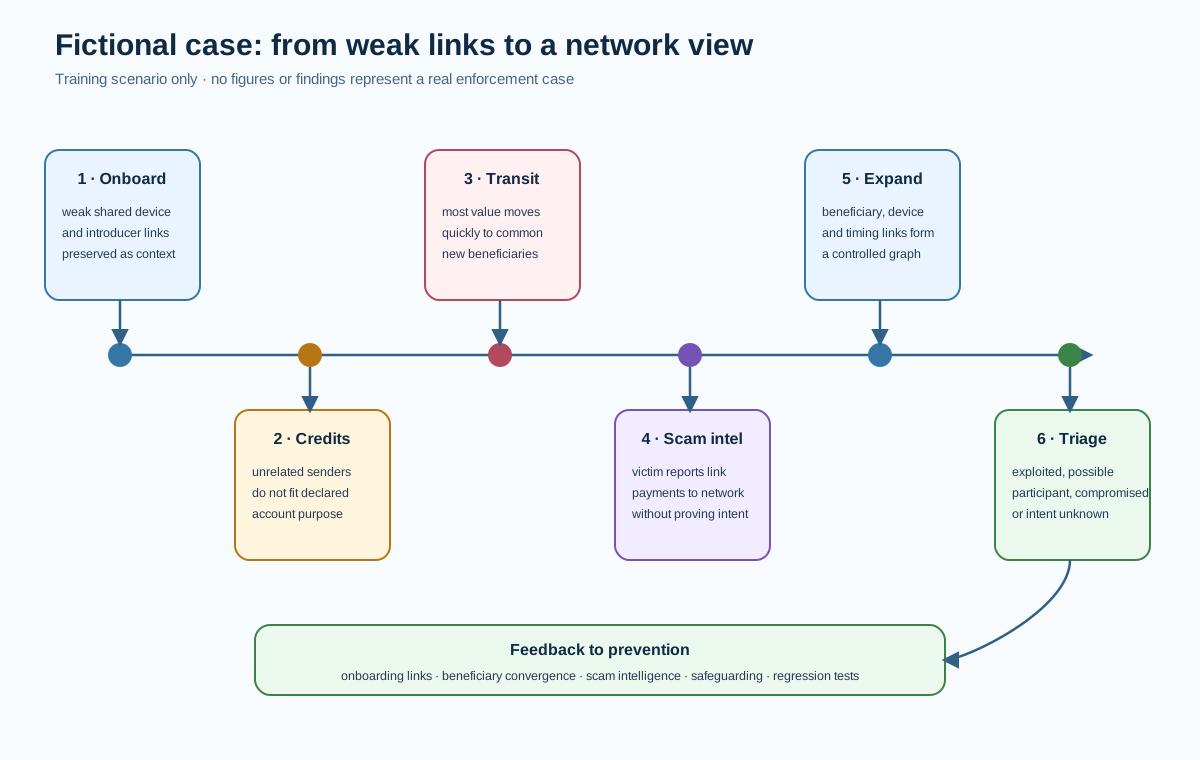
Masterclass: a fictional student-mule network investigation
The following scenario is fictional and designed only for training. The amounts, people and institutions are invented. The control lessons are based on publicly described money-mule patterns from AUSTRAC, FinCEN, Europol and other authorities, but the case is not a disguised account of any real enforcement action or supervisory finding.
Stage 1: apparently ordinary onboarding
A bank opens several retail accounts over three weeks for young adults living in different parts of the same city. The customers pass the bank's standard identity checks. Most declare study or part-time work. Individually, none of the applications appears exceptional.
What the onboarding screen does not show clearly is that four applications used devices associated with the same small cluster of network and browser characteristics. Two customers entered the same introducer-style text in an optional referral field. The overlaps are weak enough that they should not block onboarding automatically, but they are worth preserving as network context.
The lesson is that onboarding analytics should retain explainable links without converting them into guilt. Shared infrastructure can be legitimate, especially for students, families and communal accommodation.
Stage 2: first unusual receipts
Within the next month, three accounts receive credits from unrelated individuals. The payment references vary. One customer says the payments relate to online work. Another says a friend asked for help receiving money because their own account was temporarily unavailable. A third does not respond immediately to contact.
The credits are not suspicious because of age or student status. Concern increases because the stated account purpose does not explain the payer diversity and because the money begins to leave quickly.
The monitoring system should preserve the source accounts, timestamps, values, customer explanations and any scam complaints associated with the incoming payments. It should not summarise the situation merely as "unusual credits."
Stage 3: rapid onward movement
Most incoming value is transferred to two new beneficiaries within several hours. Small amounts remain in the receiving accounts. A fourth account, previously low activity, begins using one of the same beneficiaries after a device change and contact-detail update.
This is the point where account-level review becomes insufficient. The common beneficiaries, similar timing and earlier onboarding links justify network expansion. The investigator should still verify whether any apparent links are caused by common merchants, payment service providers or shared legitimate infrastructure.
Stage 4: scam intelligence arrives
The fraud team receives two APP scam reports from sending customers. One report names a beneficiary account already in the network. The second relates to another account that paid the same onward beneficiary.
Fraud operations begins recovery activity under the relevant payment process. AML investigators receive the permitted intelligence and expand the case. Customer-service staff are told that some receiving customers may themselves be exploited and that communications should not presume criminal intent.
In a UK Faster Payments context, an in-scope victim claim would also enter the PSR reimbursement process. That reimbursement assessment remains separate from the AML judgement about the receiving accounts.
Stage 5: customer triage
One customer provides messages showing a fake online-job recruiter instructing them to receive and forward payments while keeping a small fee. Another admits understanding that the arrangement was "not normal" but continued after warnings. A third says a romantic partner controlled the transfers and still has access to the phone. The evidence therefore supports different risk and safeguarding responses.
The bank can use provisional classifications:
- exploited or deceived customer;
- possible knowing participant;
- compromised account;
- intent still uncertain.
Those labels should remain reviewable. Account controls may still be needed across all four cases to stop further misuse, but customer communication and relationship decisions can differ.
Stage 6: investigation and reporting
The case team assembles the relevant transaction chronology, customer context, network links, fraud complaints, device evidence and customer statements. Whether a SAR, STR or SMR is required depends on the applicable jurisdiction and legal threshold. The training case does not assume one universal filing rule.
If reporting is required, the narrative should separate facts from inference. It can state which payments were received, how quickly funds moved, which beneficiaries overlapped, what the customer said and which scam reports were linked. It should avoid unsupported conclusions about organised-crime membership unless the evidence supports them.
Law-enforcement contact, account restriction and relationship exit also follow local authority and policy. The bank should not claim that every mule-pattern customer must be closed. An exploited customer may need protection and controlled restoration of service; a knowing participant may justify a very different outcome.
Stage 7: control improvement
The most valuable output of the case is not the number of accounts closed. It is what the bank learns.
Onboarding can improve how weak shared-infrastructure links are retained. Monitoring can add beneficiary convergence to rapid-movement logic. Fraud complaints can feed receiving-account risk faster. Case management can support intent unknown and safeguarding statuses. Customer education can address fake-job recruitment. QA can sample whether analysts over-weight student status.
The case also identifies test scenarios for future releases: first credits, rapid value forwarding, dormant-account reactivation, common beneficiaries, device changes and fraud-intelligence ingestion. That closes the loop from investigation back to prevention.
Questions for practitioners
A business analyst should ask which fields and events are needed to reconstruct this case. An architect should ask how low-latency fraud signals and slower AML network analytics exchange information. A tester should ask which legitimate student or gig-economy scenarios could accidentally satisfy the same rule. An investigator should ask what evidence supports each network link. A product owner should ask how controls protect victims without turning a weak analytical association into automatic account closure.
Those questions are more useful than asking whether the system "caught the mule." The real control objective is to recognise the pattern, understand the people and value movement, apply the correct local actions and improve the system from the evidence learned.
Knowledge check and glossary
Use these questions to test whether the chapter's logic is understood as controlled reasoning rather than a list of suspicious-looking behaviours.
Does a large unexpected credit prove money laundering? No. It creates a question about source, purpose, customer context and later movement. The strength of the concern comes from corroborated inconsistencies and linked indicators, not amount alone.
Why is rapid onward movement important? Mule accounts are often used as transit points, so short residence time can be useful evidence. It should be combined with payer diversity, retained value, destination pattern, repeated behaviour and customer explanation because legitimate customers can also move money quickly.
What is dwell time? A measure of how long received value remains in an account before related outward movement. Because money is fungible, the calculation method must be documented; some implementations use aggregate windows rather than one-to-one credit/debit matching.
What makes a network link strong? Repeated direct payments, common beneficiaries, reliable shared devices, coordinated timing and multiple independent attributes can strengthen a link. A shared address or public IP by itself can be weak because legitimate households, campuses and workplaces share infrastructure.
Is student status a mule red flag? Not by itself. Public authorities have documented student exploitation, but good control design looks for recruitment, payment and network indicators. Demographic status should not substitute for evidence.
Can an exploited mule still require account controls? Yes. Protecting a customer from exploitation does not mean allowing the account to continue moving criminal proceeds. The bank may need controls while also using safeguarding and proportionate communication.
Does a fraud reimbursement decision prove the recipient is a mule? No. Reimbursement, fraud investigation and AML suspicion are separate decision domains. They can share evidence but should retain their own legal and policy criteria.
When is dormant-account activity concerning? When reactivation combines with material changes such as new devices, changed contact details, new beneficiaries, unusual incoming funds and rapid onward movement. Dormancy alone is not proof of compromise or mule use.
How should cash activity be assessed? Through customer context, deposit and withdrawal pattern, source, branch or ATM geography, third-party involvement and relation to later transfers. Amounts near a reporting threshold can be relevant, but intent should not be inferred from one threshold-proximate transaction.
Why are fraud complaints valuable to AML? They can identify scam-linked receiving accounts, counterparties and timing that would not be visible from transaction monitoring alone. The information should enter AML through an authorised and auditable sharing path.
What should a graph tell an investigator? Not only that two nodes are connected, but why they are connected, when the link was observed, which source produced it and how reliable the relationship is.
Why separate event time from processing time? Mule detection often depends on velocity. If delayed or batched events use processing timestamps, the system can create or hide rapid-movement patterns incorrectly.
How should a bank test a mule rule? With synthetic or approved historical positive cases, legitimate negative cases, boundary conditions, data failures and customer-impact scenarios. Changes should also be replayed historically where practical to understand alerts gained and lost.
Should fake suspicious alerts be inserted secretly into production? No. That can contaminate customer decisions, reporting records and performance measures. Use controlled testing methods and explicit governance for any live-environment assurance.
What does intent unknown achieve? It prevents an early analytical signal from being converted into an unsupported accusation. The status can be revised when customer statements, device evidence, network links or external intelligence change the picture.
What does proportionality mean here? The intensity of review and control should match the identified risk while respecting the applicable framework. It does not mean ignoring risk, and it does not justify broad exclusion of customer groups.
Glossary
Money mule: a person or account used to receive and move illicitly obtained funds for another party. The person may be knowing, reckless, deceived or coerced; the legal characterisation depends on facts and jurisdiction.
Mule herder / recruiter: a person or network that recruits, directs or controls mules. Public law-enforcement material uses different terms, so case systems should preserve the actual evidence rather than rely on labels alone.
Pass-through activity: incoming value that is forwarded onward with limited retention. It may be legitimate or suspicious depending on purpose, customer type and surrounding evidence.
Dwell time: time value remains in an account before onward movement, calculated using a documented attribution method.
Beneficiary convergence: multiple sending accounts or payments directing value to a common beneficiary or small beneficiary set.
Counterparty novelty: whether a payer or beneficiary is new to the customer within a defined historical period.
Dormancy break: renewed activity after a defined low-activity or inactive period. Product-specific rules should define what counts as dormant.
Safeguarding: operational measures intended to protect a potentially vulnerable or exploited customer, applied under local policy and legal authority.
APP scam: authorised push payment scam in which a victim is deceived into authorising a payment. Reimbursement rules differ by jurisdiction.
Network expansion: controlled investigation of linked accounts, counterparties or infrastructure beyond the original alert.
Link confidence: an assessment of how reliable a relationship between two entities is, based on link type, source quality and corroboration.
Historical replay: running changed detection logic against a past population to compare outcomes with an earlier version.
Shadow mode: operating new detection logic without allowing it to trigger customer or regulatory action, so performance can be compared safely before production activation.
Own-account transfer: movement between accounts belonging to the same customer or beneficial owner. Ownership should be resolved through reliable customer data rather than name matching alone.
Victim-mule overlap: a situation in which a person who is exploited or defrauded also moves funds for a criminal actor, creating both safeguarding and financial-crime concerns.
References and further reading
The sources below are public materials used for this chapter. Jurisdiction-specific guidance is identified as such and should not be treated as a universal legal rule.
Global standards and monitoring effectiveness
- Financial Action Task Force (FATF), The FATF Recommendations: https://www.fatf-gafi.org/en/publications/Fatfrecommendations/Fatf-recommendations.html
- FATF, Guidance on Financial Inclusion and Anti-Money Laundering and Terrorist Financing Measures (2025): https://www.fatf-gafi.org/en/publications/Financialinclusionandnpoissues/guidance-financial-inclusion-aml-tf-measures.html
- Wolfsberg Group, Statement on Effective Monitoring for Suspicious Activity (2024): https://wolfsberg-group.org/resources/general/168
- Wolfsberg Group, Statement on Effective Monitoring for Suspicious Activity, Part II: Transitioning to Innovation (2025): https://wolfsberg-group.org/resources/195/202
Money mules, scam proceeds and network indicators
- FinCEN, Advisory on Imposter Scams and Money Mule Schemes Related to Coronavirus Disease 2019, FIN-2020-A003 (United States): https://www.fincen.gov/resources/advisories/fincen-advisory-fin-2020-a003
- FinCEN, Advisory and Financial Trend Analysis on Chinese Money Laundering Networks (United States, 28 August 2025): https://www.fincen.gov/news/news-releases/fincen-issues-advisory-and-financial-trend-analysis-chinese-money-laundering
- AUSTRAC / Fintel Alliance, Combating the exploitation of international students as money mules (Australia; page updated 30 March 2026): https://www.austrac.gov.au/industry-and-business/education-and-resources/publications-and-resources/combating-exploitation-international-students-money-mules
- National Crime Agency, Money Mules (United Kingdom): https://www.nationalcrimeagency.gov.uk/moneymuling
- Europol, European Money Mule Action 9: 1,013 arrests and 10,759 money mules identified (2023): https://www.europol.europa.eu/media-press/newsroom/news/paper-trail-ends-in-jail-time-for-1-013-money-mules
Retail monitoring, customer risk and suspicious activity
- Federal Financial Institutions Examination Council, BSA/AML Manual Appendix K: Customer Risk versus Due Diligence and Suspicious Activity Monitoring (United States): https://bsaaml.ffiec.gov/manual/Appendices/12
- UK Financial Conduct Authority, Financial Crime Guide: https://handbook.fca.org.uk/handbook/fcg
Victim protection and scam reimbursement examples
- FinCEN, Advisory on Elder Financial Exploitation, FIN-2022-A002 (United States): https://www.fincen.gov/resources/advisories/fincen-advisory-fin-2022-a002
- FinCEN and U.S. financial regulators, Interagency Statement on Elder Financial Exploitation (4 December 2024): https://www.fincen.gov/resources/statutes-regulations/guidance/interagency-statement-elder-financial-exploitation
- Payment Systems Regulator, APP fraud reimbursement protections (United Kingdom): https://www.psr.org.uk/information-for-consumers/app-fraud-reimbursement-protections/