Corporate and Trade Finance Red Flags
Corporate and trade-finance monitoring is difficult for a simple reason: legitimate business is complicated. Companies can have layered ownership, dozens of suppliers, central treasury teams, payment-on-behalf-of arrangements, agents, distributors, factoring providers, trade-finance facilities, unusual seasonal peaks and cross-border payment routes that look far more complex than an ordinary retail account. The same features can also be exploited to move illicit value, disguise beneficial ownership, justify payments with misleading trade documents or create distance between the person controlling the money and the party visible to the bank.
The job of a bank is therefore not to treat complexity as suspicious. It is to understand the customer's commercial model well enough to recognise when activity stops making sense. A strong corporate red-flag control asks whether a counterparty, payment, product, trade document or route fits what the bank knows about the customer and then looks for corroborating evidence before reaching a conclusion. The red flag is a reason to ask a better question, not a shortcut to an accusation.
This distinction is consistent with the FATF and Egmont Group approach to trade-based money-laundering risk indicators. Their guidance makes clear that indicators are not conclusive on their own. A single indicator may have a reasonable commercial explanation, while several connected indicators can justify closer examination. The same principle should govern corporate transaction monitoring more generally.
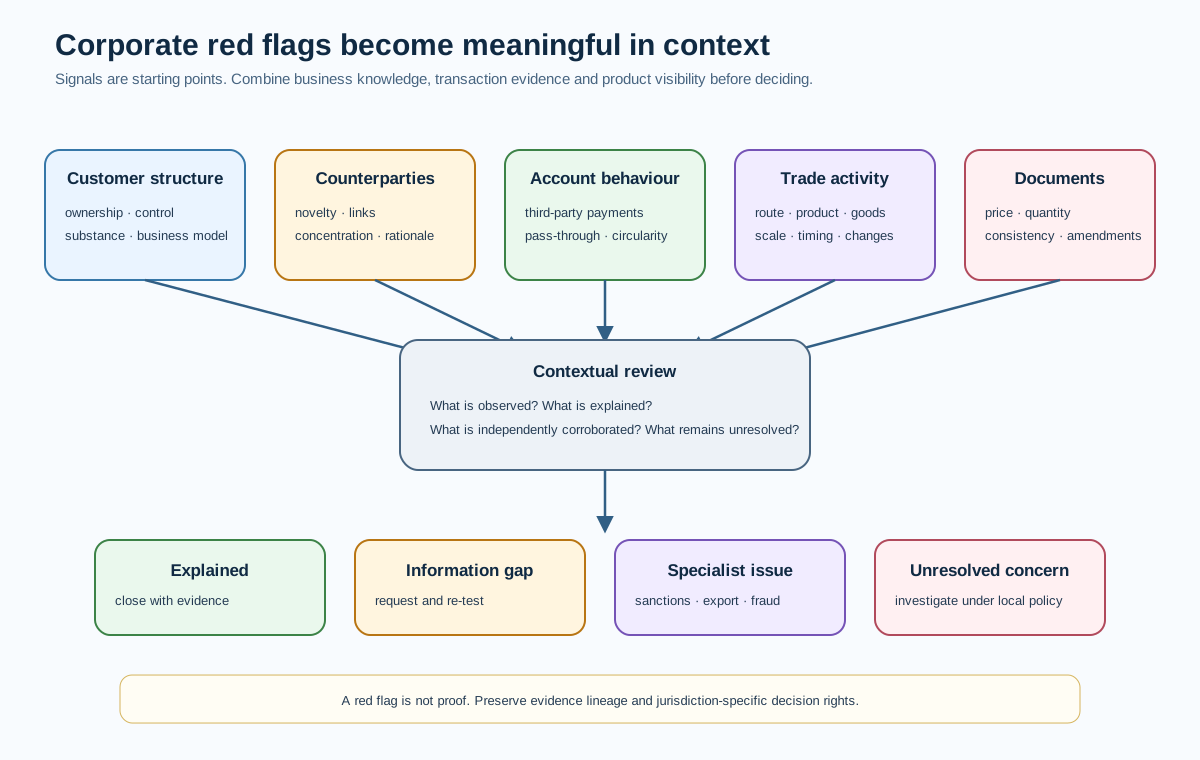
The practical mental model: baseline, deviation, corroboration, decision
A useful way to structure corporate monitoring is as four linked questions.
Baseline: What does the bank reasonably expect from this customer? This includes the customer's industry, ownership and control, operating geographies, products, payment corridors, transaction scale, principal counterparties or counterparty types, funding sources and, where relevant, the kinds of goods or services it buys and sells.
Deviation: What changed or does not fit? A new country, unusual payer, unfamiliar product, sudden increase in value, unexplained third-party funding, circular movement, new trade route, document discrepancy or transaction outside the customer's stated business can create a reason for review.
Corroboration: Can the difference be explained with reliable evidence? A genuine acquisition, cash-pooling arrangement, new distribution agreement, seasonal import cycle, factoring programme or project contract may explain activity that initially looks unusual. The evidence should be proportionate to the risk and, where material, supported by sources beyond a bare customer assertion.
Decision: What remains unresolved after reasonable review? The bank may close the alert, request more information, increase monitoring, refer the issue to sanctions, fraud, export-control or another specialist function, open an AML investigation, consider local suspicious-activity reporting obligations or review the relationship under its own risk appetite and legal framework.
The discipline is important because the same fact can support different decisions. A supplier in a higher-risk jurisdiction may increase AML risk but not be prohibited. A listed party may create a sanctions issue even where the payment pattern is commercially ordinary. A forged invoice can create fraud risk before the bank has formed an AML suspicion. The case system should preserve these distinctions rather than collapse them into one generic financial-crime label.
Why corporate monitoring begins with business understanding
A transaction-monitoring scenario is only as useful as the expectation against which it compares behaviour. Retail monitoring often has large peer groups and relatively standard products. Corporate customers are more heterogeneous. A wholesaler, manufacturer, technology company, charity, property developer, holding company and shipping business can all move similar amounts for very different reasons.
At onboarding or periodic review, the bank should understand the customer's legal form, beneficial owners and controllers as required by applicable policy, principal activities, expected products, key operating countries, likely payment corridors and expected account use. For trade-active customers, additional information may include the nature of goods, principal suppliers and buyers, use of documentary credits or collections, freight or logistics arrangements and whether the customer operates through agents, distributors or related entities.
The point is not to collect an unlimited dossier. It is to create a usable baseline that later controls can compare with observed activity. A bank that records a company only as "general trading" has learned very little. If that customer begins sending large cross-border payments for specialised industrial components, the monitoring team cannot tell whether the activity is normal, a legitimate business expansion or a material change that should have triggered review.
Business understanding should also be versioned. A corporate customer can change materially after onboarding. Acquisitions, new shareholders, market expansion, project contracts, restructuring and economic shocks can alter the relationship. Monitoring should distinguish a genuine business evolution from an unexplained change rather than forcing every customer to remain permanently inside its original onboarding profile.
Corporate structure and substance as risk signals
Complex legal structures are not inherently suspicious. Groups may use holding companies, subsidiaries, joint ventures, special-purpose entities and treasury companies for legitimate legal, tax, funding, regulatory and operational reasons. The control question is whether the structure is understandable and whether the entities appear to perform the roles attributed to them.
FATF/Egmont TBML indicators include features such as unusually complex structures, mass-registration addresses, entities with little apparent business activity, nominee-style management, business lines inconsistent with trade activity and newly established or reactivated entities conducting unexpectedly large volumes. These should be treated as prompts for proportionate verification, not universal definitions of a shell company.
A bank can test substance through converging evidence. Depending on the relationship and risk, that might include registration records, financial statements, tax or licensing information where lawfully available, staff and premises, operating expenditure, contracts, commercial counterparties and evidence that the company actually performs the activity it describes. A holding company can legitimately have few employees. A startup may have low revenue and a small physical footprint. A special-purpose vehicle may exist for a narrow transaction. The investigation should ask whether the facts fit the entity's stated purpose rather than applying one template to every corporate form.
Counterparty novelty and relationship networks
New counterparties are normal in business, but a material new supplier, buyer, payer or intermediary can be an important event when it changes the customer's risk profile. The review should ask whether the counterparty fits the customer's industry, whether the relationship has a credible commercial purpose, whether payment terms are plausible and whether ownership or control links create additional context.
Network analytics can help identify shared directors, beneficial owners, addresses, devices, telephone numbers, bank accounts, agents or corporate-service providers. These links are investigative leads, not proof of common control or collusion. A registered office can host many unrelated companies. A director can serve multiple entities professionally. A shared IP address can arise from an outsourced service. The value comes from combining the link with other facts, such as payment behaviour, timing, common counterparties or inconsistent customer explanations.
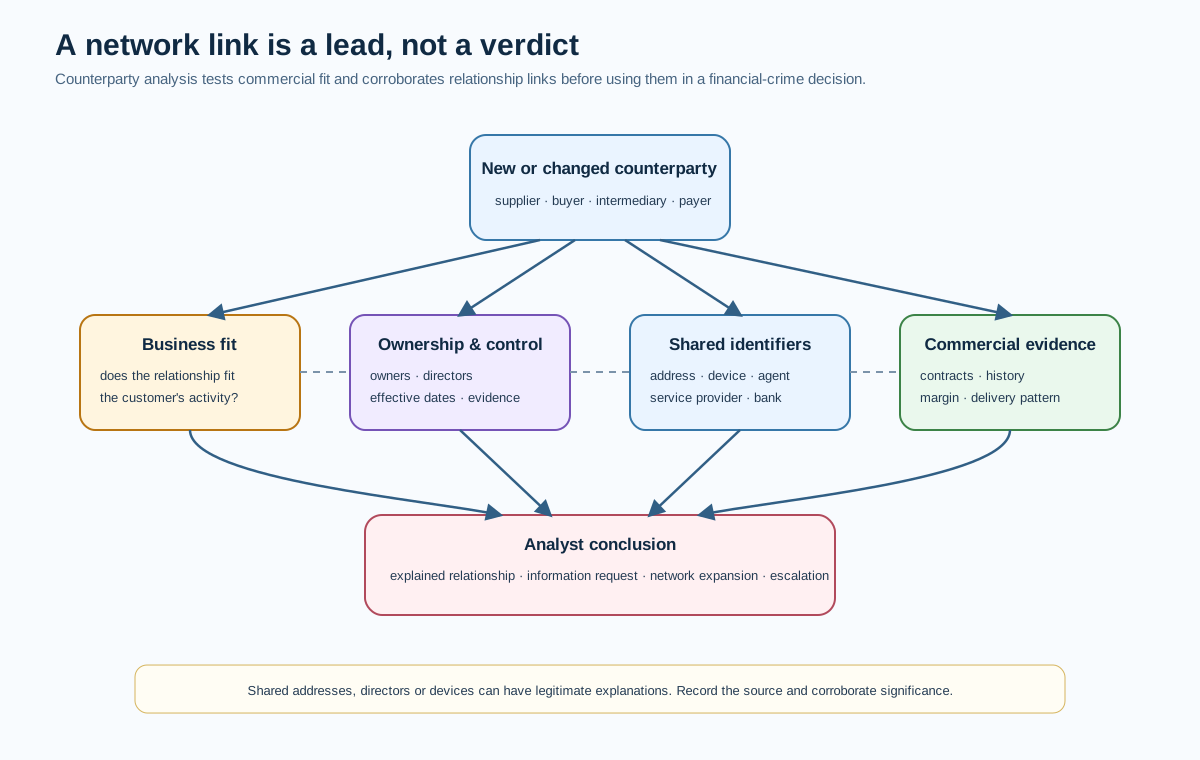
Concentration also needs context. A manufacturer may legitimately rely on one critical supplier. A distributor may have one dominant buyer. A project company may receive nearly all its revenue from one contract. Concentration becomes more meaningful when it is combined with weak commercial rationale, unexplained ownership links, pass-through behaviour or activity inconsistent with the customer's business.
Third-party payments and unexplained payers
Payments made by or to a party that is not obviously connected to the underlying transaction deserve attention because they can obscure who is providing or receiving value. FATF/Egmont indicators include payments made by apparently unrelated third parties and transactions routed through accounts that appear to function mainly as transit points.
There are also many legitimate reasons for third-party payment. A parent company may pay on behalf of a subsidiary. A treasury centre may settle obligations for group entities. An insurer, factor, guarantor or financing provider may make payment. Marketplace and payment-service models can place an intermediary between the commercial buyer and seller. The analyst therefore needs to understand the role rather than apply a blanket prohibition.
A good review links the payer or payee to the contract, invoice, group structure or financing arrangement, checks whether the relationship was expected, and looks for consistency across similar transactions. Repeated third-party payments with changing explanations or no visible relationship to the trade are stronger indicators than a single well-documented payment-on-behalf-of arrangement.
Vague purpose and activity outside the business model
Vague business descriptions weaken control effectiveness. "Consulting," "investment," "general trading" and "business services" can cover legitimate activity, but they may be too broad to explain why particular counterparties, products or corridors are used. Monitoring should not penalise the wording alone. Instead, it should test whether observed behaviour can be connected to a credible economic activity.
Examples of meaningful mismatch include a domestic services company suddenly processing large volumes of commodity imports, a small retailer receiving payments on behalf of unrelated businesses, a consulting firm using documentary trade products for physical goods it has never handled, or an industrial customer beginning to send value to virtual-asset businesses without a clear business reason. Each example could still have a legitimate explanation, but the change should be understood and, where material, reflected in the customer's profile.
Product selection can be especially informative. A customer's use of letters of credit, guarantees, supply-chain finance, foreign-exchange products or correspondent services may reveal a change in business model before transaction values alone do. Product data should therefore be available to monitoring and case teams where permitted, rather than leaving investigators to infer activity from payment records after the fact.
Circular and rapid pass-through activity
Value that leaves a customer, moves through several parties and returns to the original customer or a related network can indicate layering or artificial trade. Yet circular-looking flows are also produced by legitimate cash pooling, central treasury, intercompany lending, securities settlement, factoring and payment-on-behalf-of arrangements.
The right approach is to reconstruct the flow and test its commercial rationale. Investigators can examine timing, value retention, counterparties, ownership links, agreements, accounting treatment and the operational purpose of each leg. A legitimate treasury arrangement should normally be explainable through group structure, documented authority and consistent accounting. An unexplained chain that preserves value through connected entities without obvious economic purpose warrants deeper examination.
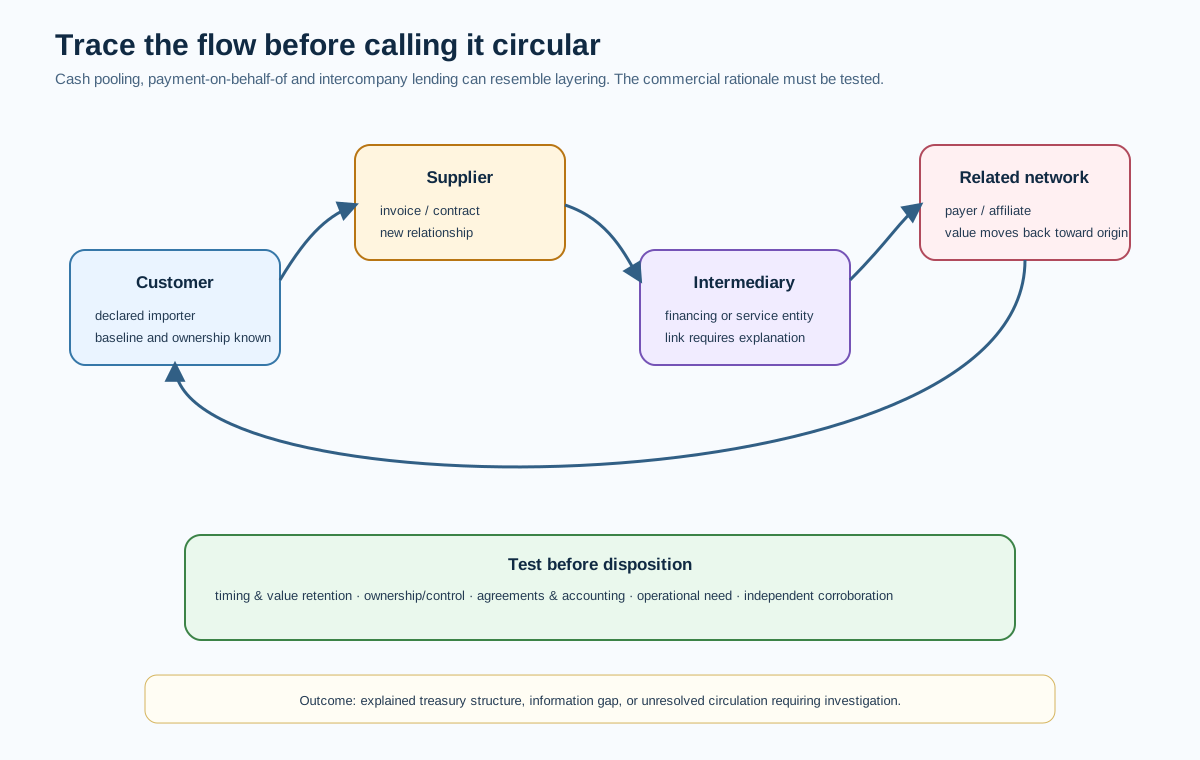
Round amounts, fast onward movement and return flows can strengthen a pattern, but none should be treated as a universal criminal signature. Corporate payments often use rounded contractual amounts, and treasury operations can move very quickly. The case needs combined evidence.
Where trade-finance red flags differ from ordinary account monitoring
Trade finance adds a physical-commerce layer. The bank may be handling a documentary credit, collection, guarantee, supply-chain-finance facility, trade loan or open-account payment. Each product gives the bank different visibility and responsibilities. The parties can include applicant, beneficiary, buyer, seller, issuing bank, advising bank, confirming bank, reimbursing bank, freight carrier, insurer, agent and correspondent institutions.
That complexity creates opportunities to misstate the goods, price, quantity, quality, origin, destination or parties involved. It can also create genuine information gaps. A payment bank may see a payer, beneficiary, amount and short remittance text but no invoice or shipping document. A trade-finance bank may have detailed documents but limited information about activity outside the financed transaction.
Controls should be designed around the bank's actual role. The FFIEC BSA/AML Manual, for U.S. institutions, explicitly distinguishes the due diligence and monitoring expected according to the bank's role in a trade transaction. The broader design lesson is useful internationally: do not assume every bank in the chain can verify the same facts.
Trade-document inconsistencies
FATF/Egmont indicators identify inconsistencies across contracts, invoices and other trade documents, vague goods descriptions, documents that appear missing or altered, repeated amendments and differences between the described goods and available information about quantity, quality or value.
A useful review compares fields rather than trusting the visual appearance of a document. Party names, invoice references, goods description, quantity, currency, amount, delivery terms, beneficiary details, route and dates can be compared across contract, invoice, transport document, payment instruction and the customer's profile where those records are available.
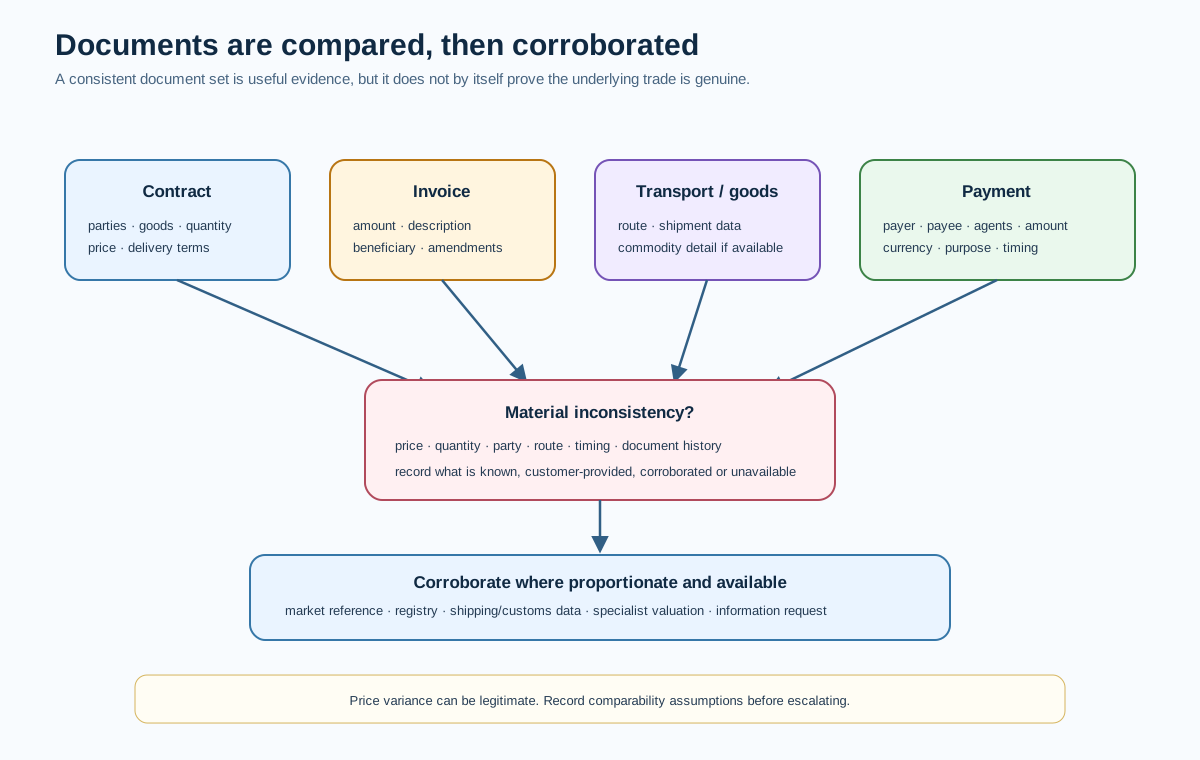
Document consistency still does not prove the trade is genuine. Two colluding parties can create matching documents. Conversely, legitimate trade often contains discrepancies caused by amendments, partial shipments, different units of measure, exchange-rate movements or operational corrections. The analyst should identify the material inconsistency, ask whether it can be reasonably explained and seek independent corroboration where proportionate.
Pricing and quantity anomalies
Over-invoicing, under-invoicing, multiple invoicing and misrepresentation of quantity or quality are well-known TBML methods. The challenge for a bank is that price is often difficult to assess. Bespoke machinery, branded goods, warranty, freight, insurance, financing terms, commodity grade and bundled services can make two apparently similar transactions economically different.
A price benchmark should therefore be treated as an investigative comparison, not an automatic valuation. The bank should record the source, comparability assumptions and materiality of the difference. Where technical characteristics drive value, specialist knowledge may be required. A bank should avoid writing requirements that imply a public commodity database can determine the correct price of every manufactured good.
Quantity anomalies can be tested through available invoices, packing information, transport documents or customs data where lawful and accessible. The control should distinguish data that the bank has independently corroborated from data merely supplied by the customer.
Duplicate financing and visibility limits
The same invoice or receivable can potentially be used to obtain financing more than once. A bank can identify duplicates inside its own platforms if invoice identifiers, parties and amounts are captured consistently. Detecting financing of the same receivable across unrelated banks is much harder because the institution may not have market-wide visibility.
A requirement should not promise cross-bank detection unless an authorised registry or information-sharing mechanism exists. Instead, the architecture should document the visibility boundary, match duplicates within accessible data, preserve relevant document identifiers and use external mechanisms only where available and legally permitted.
This is a recurring principle in financial-crime design: the control should be explicit about what it can know. Hidden data gaps create false confidence.
Goods, routes and jurisdiction context
Unusual routing can become a red flag when goods move through several jurisdictions without a clear commercial reason, especially when the route increases opacity or contradicts the customer's normal supply chain. Legitimate explanations can include trans-shipment hubs, bonded warehouses, free-trade zones, consolidation centres, sanctions-related rerouting, freight availability or customer delivery requirements.
Goods can also create a separate legal issue. Certain goods, software or technologies may be controlled for export depending on classification, destination, end user or end use. That determination is not the same as AML monitoring. If the case raises a possible export-control concern, it should be referred to the bank's relevant trade-control, sanctions or legal specialists under the applicable jurisdiction.
For example, U.S. institutions may use guidance from FinCEN and the Bureau of Industry and Security when identifying possible export-control evasion. That material is useful as a U.S.-specific control reference, not as a universal legal obligation for banks in every country.
Monitoring design: combine several weak signals safely
Corporate detection often works better through a combination of signals than through one hard threshold. A new counterparty, transaction size increase, changed country, shared address, rapid onward movement and vague purpose may collectively create a stronger case than any one feature alone.
Scenario design should still remain explainable. The bank needs to know which facts caused the alert, which data source supplied them, what threshold or model version applied and what customer baseline was used. Analysts should be able to distinguish a rule-based fact such as "first payment to counterparty" from an inferred network relationship or model score.
Monitoring should also avoid circular logic. A customer should not be labelled high risk because it generated many alerts if those alerts were created by a poorly calibrated rule that simply reuses the high-risk label. Inputs, detection logic and outcomes should be governed separately.
Data and system touchpoints
A corporate red-flag case can draw data from many systems: onboarding and KYC platforms, beneficial-ownership repositories, customer risk-rating engines, core accounts, payment hubs, trade-finance platforms, document stores, sanctions-screening services, customer relationship systems, external registries and case management.
The architecture should capture lineage across those sources. Important fields include customer and account identifiers, legal entity identifiers where available, owners and controllers with effective dates, counterparty identifiers, payment references, product type, amounts and currencies, timestamps, document identifiers, invoice references, trade route, goods description where captured, screening outcomes and prior case history.
Effective dates matter. If an ownership link changed after a transaction, the investigator needs to know what was true at the time of the event. If a scenario threshold changed, quality assurance should be able to reconstruct which version produced the alert. If an external source was refreshed after the transaction, the case should distinguish information available at decision time from later intelligence.
Data quality needs its own controls. Missing country, truncated counterparty names, inconsistent legal-entity identifiers, duplicate customer records or poorly mapped trade documents can weaken detection. A high-quality scenario cannot compensate for missing input data.
From alert to case to investigation
An alert should identify the specific reason for review. The analyst then enriches the customer, counterparties, transaction history, documents and network context as appropriate. If the activity is explained, closure should document the evidence. If key facts remain unresolved, the matter can be escalated into a case with a defined investigation question.
The investigation should build a timeline, identify the value flow, map relevant parties and ownership relationships, compare activity with the customer profile, document information requests and record alternative explanations. The objective is not to prove a criminal offence. It is to determine whether the bank has a reasonable basis for its next action under local law and policy.
Suspicious-activity or suspicious-transaction reporting rules differ by jurisdiction. The decision threshold, reporting route, deadline, confidentiality restrictions and permitted customer communication must therefore come from the applicable legal framework and bank procedure. Training material should not present a U.S. SAR rule, UK SAR process or another national framework as globally universal.
Where sanctions, fraud or export-control issues also arise, the case should use controlled specialist hand-offs. Parallel decisions can exist for the same transaction.
Roles and governance
The first line owns customer relationships, product operation and many of the data inputs that define expected activity. Relationship managers can provide commercial context but should not be able to close a financial-crime concern simply because they know the customer well.
Financial-crime operations triage alerts and build cases. Specialist trade teams interpret product mechanics and documents. Sanctions and export-control specialists assess applicable restrictions. Fraud teams address deception and customer-harm issues. Second-line compliance defines policy, challenges control design and oversees material risk. Data, technology and model or rules-governance teams maintain the systems that make decisions reproducible. Internal audit independently assesses whether governance and controls operate as intended.
Clear decision rights are essential. The owner of a transaction-monitoring scenario is not automatically the owner of a sanctions legal conclusion. The owner of a trade product is not automatically authorised to decide whether an AML report should be filed. A case workflow should show who made each decision and under which authority.
Common failure modes
One failure mode is treating complexity as guilt. This produces excessive information requests, customer friction and de-risking without improving detection.
Another is trusting paperwork too readily. A complete invoice pack can still be misleading if parties collude. Material facts should be corroborated where risk and feasibility justify it.
A third is overpromising external verification. Banks may not have direct access to customs, shipping, tax or market-wide financing data. Systems should represent unavailable evidence honestly.
A fourth is poor separation of risk domains. AML, sanctions, fraud, credit and export-control concerns can overlap but require different decisions.
A fifth is data without lineage. A case can contain dozens of enriched attributes but still be weak if nobody can show where the data came from, when it was effective or how it affected the decision.
A sixth is static customer knowledge. Corporate businesses change. If KYC and monitoring are not connected through event-driven updates, the bank compares current activity with an obsolete business profile.
Customer and operational impact
Corporate investigations can interrupt payroll, supplier settlement, goods release, credit availability and contractual deadlines. Trade products can be time sensitive, and a poorly designed hold can create demurrage, missed shipment windows or reputational damage. That does not mean controls should be weakened; it means decisions need clear service levels, escalation routes and customer-communication rules.
Information requests should be specific. Asking a customer for an entire trade file when the unresolved question is the role of one third-party payer wastes time for both sides. Good case design identifies the precise gap and requests evidence relevant to that gap.
Where the bank applies restrictions or exits a relationship, the action should follow the applicable legal framework, contract, risk appetite and governance. An unusual transaction is not itself a reason to deny service indefinitely.
BA, architecture and testing considerations
A business analyst should translate each red flag into a testable requirement. "Detect suspicious trade" is not sufficient. A stronger requirement might specify how a first-time counterparty is identified, which history period is used, what enrichment is performed, what data gaps are surfaced, which threshold is configurable and which evidence is displayed to the analyst.
Architecture should avoid one monolithic financial-crime score where possible. Store observable facts, derived features, rules or model outputs and analyst decisions separately. This makes it possible to change detection logic without rewriting historical evidence.
Testing should include positive, negative and data-quality scenarios. Positive cases can combine genuinely inconsistent documents or unexplained third-party payments. Negative cases should include legitimate cash pooling, factoring, payment-on-behalf-of, shared-service centres, seasonal imports and business pivots. Data-quality tests should prove that missing documents or identifiers create an explicit degraded-data outcome rather than a false low-risk result.
For changes to scenarios, governed historical replay and synthetic test data are safer and more reproducible than placing realistic suspicious patterns into uncontrolled live customer populations. Regression tests should confirm both risk coverage and legitimate-customer outcomes.
Mini case: a new supplier and an unexplained payment link
A long-standing industrial customer imports pumps and components. The bank understands its normal suppliers, currencies and corridors. The customer starts using a newly incorporated supplier in another jurisdiction for a specialised pump order. The invoice value is materially above a public reference for broadly comparable equipment.
The analyst does not conclude that the trade is over-invoiced. The customer provides specifications showing corrosion-resistant material, engineering support and an extended warranty that explain part of the difference. The remaining premium is documented for further review.
A later payment instruction directs part of the proceeds to an entity described as the supplier's financing affiliate. Registry information shows that the affiliate and supplier share a director and registered address. That link is recorded, but not treated as proof of misconduct.
The payment history then reveals that the affiliate has sent funds to another company which previously paid the customer for consulting services. Two of those historic payments are supported by contracts and project evidence. A third payer has no apparent relationship to the project, shares a director with the overseas supplier and the amended payment instruction directs part of the proceeds to another company at the same registered address.
The case should not collapse into "invoice fraud confirmed." The first two payers and the route may be reasonably explained. The unexplained third-party funding and connected payment destination remain material. The investigator expands the network around that portion of the flow, refreshes KYC for the changed business activity and assesses escalation under local AML policy. If export-control or sanctions concerns also arise from the goods or destination, those are referred separately to the appropriate specialists.
That is what good red-flag analysis looks like: preserve the legitimate explanation where evidence supports it, isolate the unresolved facts, and escalate only the part of the case that remains concerning.
Key takeaways
Corporate and trade-finance red flags work when the bank understands the business well enough to recognise meaningful deviation. Complexity, cross-border activity, shell-like features, third-party payments, circular flows, unusual routes and document discrepancies are signals that require context, not proof of crime.
The strongest investigation combines customer knowledge, ownership and counterparty relationships, account behaviour, trade-product data, document consistency and external corroboration where available. It also respects the bank's role and visibility: not every institution can verify every physical-trade fact.
Most importantly, the control must preserve decision boundaries. AML suspicion, sanctions applicability, export-control concerns, fraud, credit risk and customer-exit decisions may arise from the same facts, but they are not the same decision. Clear data lineage, specialist hand-offs, proportionate escalation and well-reasoned case narratives turn red flags into defensible financial-crime controls.
Operational deep dive: evidence quality, bank visibility and commercial verification
The base chapter explains how corporate and trade-finance red flags become meaningful only when they are tested against the customer's real business. This deep dive focuses on the evidence problem underneath that judgement. Corporate cases often contain many data points but surprisingly little reliable proof. An invoice can be internally consistent and still describe a transaction inaccurately. A corporate registry can identify legal ownership without proving who exercises practical control. A payment chain can look circular while representing a legitimate treasury arrangement. The investigator therefore needs an evidence model that separates what the bank directly knows, what the customer states, what an independent source confirms and what remains an inference.
Build an evidence hierarchy rather than a document pile
A strong case file distinguishes source quality. Core banking records, authenticated payment messages, the bank's own KYC records and system timestamps are first-party evidence of what the bank received or processed. Customer-supplied contracts, invoices, packing lists and explanations are relevant but should not be treated as independent corroboration merely because they appear formal. Registry extracts, customs information where lawfully available, shipping records, reputable market-data sources and verified counterparty information can provide external corroboration. Intelligence from another financial institution or authority may be valuable, but its permitted use, confidentiality and reliability must be understood before it is converted into a customer decision.
The distinction matters because trade-based money-laundering guidance from FATF and the Egmont Group repeatedly stresses that risk indicators are not conclusive. A discrepancy, unusual route or new counterparty can justify closer review without establishing criminal conduct. Investigators should write conclusions in the same disciplined way. "The invoice price is higher than a comparable public reference" is an observed comparison. "The transaction is over-invoiced to launder money" is a hypothesis that requires more evidence. Keeping observation and inference separate reduces both false accusation and weak escalation.
Know what the bank can actually see
Trade-finance visibility depends on the product and the bank's role. An issuing bank under a documentary credit may receive a richer document set than a bank processing an open-account payment. A confirming bank, advising bank, reimbursing bank or correspondent may have different documents and different relationships with the underlying parties. FFIEC guidance for U.S. institutions makes this role distinction explicit, and the principle is useful more broadly: controls should be proportionate to the information and responsibility the institution actually has.
This prevents an architecture mistake in which one global scenario assumes every payment contains contract value, commodity detail, vessel information and ultimate beneficial ownership. Some rails carry only party, amount, account, agent and remittance data. Some trade platforms hold invoices and transport documents outside the payment hub. A practical monitoring design therefore links data sources where permissible, records when information is absent and routes cases to product specialists when the available payment data cannot answer a trade question safely.
Commercial-substance verification without pretending to be an auditor
Corporate substance can be assessed through converging evidence: employee footprint, premises, tax or registration records where available, operating expenses, supplier and customer relationships, website history, industry presence and transaction behaviour. None of these is a universal legal test for whether a company is a "shell." A legitimate holding company, special-purpose vehicle or early-stage business can have few staff and limited premises. The objective is to determine whether the observed activity is coherent with the entity's stated role.
Investigators should therefore ask proportionate questions. Does the customer have the capacity to perform the business it describes? Are payment volumes plausible for that model? Are counterparties connected through owners, directors, addresses, devices or service providers, and if so, is there a legitimate group or commercial explanation? Does the entity retain a commercial margin or merely transmit value? Are changes in activity supported by new contracts, acquisitions, funding rounds or operational expansion?
Network analytics helps organise these questions but does not replace them. A shared registered address may indicate a corporate-services provider rather than common control. A common director may be a professional nominee or a genuine group link. A shared device or IP address may reflect an outsourced treasury service. Graph links are investigative leads whose meaning must be established by context.
Price and quantity checks: useful, but easy to overstate
FATF and Egmont identify material inconsistencies between contracts, invoices, goods descriptions, quantities, values and market conditions as useful TBML indicators. That does not mean a bank can determine a single "correct" price for every shipment. Bespoke machinery, quality differences, freight, insurance, warranty, financing terms, Incoterms, commodity grade, scarcity and bundled services can legitimately change price.
A defensible price check records the benchmark source, the comparability assumptions and the range rather than presenting a web search as valuation proof. Where the difference is material and unexplained, the right outcome may be specialist review, additional documents or an information request. Expert valuation is appropriate when the bank's decision depends materially on technical characteristics it cannot assess internally.
Quantity and shipment checks have similar limitations. Bills of lading, airway bills and warehouse receipts can support review, but access to authoritative transport or customs data varies by jurisdiction and product. A bank should not design a control that silently treats unavailable external data as "verified." The status should distinguish confirmed, customer-provided, externally corroborated and unavailable.
Payment behaviour can reveal what documents do not
The transaction layer often provides the most useful corroboration. A supposed importer whose payments repeatedly go to unrelated third parties, a supplier that receives trade proceeds and rapidly sends much of the value back to connected companies, or an entity whose foreign-transfer volumes are inconsistent with declared import activity can justify deeper review. FATF/Egmont indicators specifically include transit-account behaviour, third-party payments, inconsistencies between trade activity and account activity, and circular routing without obvious economic purpose.
The analytical challenge is to preserve legitimate corporate arrangements. Centralised treasury, cash pooling, intercompany lending, factoring, payment-on-behalf-of structures and shared-service centres can all produce flows that resemble layering. The case should therefore test governance, agreements, accounting treatment, group ownership, purpose and value retention before deciding that a circular or pass-through pattern is unexplained.
Control hand-offs must preserve the original evidence
A corporate case can trigger several specialist domains at once. An unusual counterparty can raise AML concern; a listed or owned/controlled party can raise sanctions concern; a sensitive good can raise export-control concern; forged documents can raise fraud concern; and weakened borrower economics can raise credit risk. These domains may use overlapping evidence but have different legal tests and decision rights.
The case platform should preserve one evidence package while recording distinct decisions. The AML investigator should not label a transaction "sanctions prohibited" without sanctions determination. The sanctions team should not infer money laundering merely from a list match. The fraud team may stop a payment for customer protection even where AML suspicion has not been formed. This separation supports better auditability and avoids one risk label being reused as a shortcut for another.
What quality assurance should test
Quality assurance should test reasoning, not only whether fields were completed. A reviewer should be able to reproduce which facts triggered the case, which evidence was independently corroborated, which alternative explanations were considered, what data gaps remained, and why the final outcome was proportionate. Where a case was closed, the explanation should show why the red flag was reasonably resolved rather than merely state "business as usual." Where a case was escalated, the narrative should distinguish observed facts from hypotheses.
The best control environment also feeds recurring weaknesses back into design. If investigators repeatedly cannot access trade documents held in another platform, that is a data-integration problem. If reviewers cannot interpret guarantee or supply-chain-finance mechanics, that is a capability problem. If a scenario generates large volumes of legitimate cash-pooling alerts, that is a calibration problem. Treating every weakness as an analyst-performance issue prevents the bank from correcting the actual cause.
Advanced practice: instrument-aware controls and jurisdiction-specific hand-offs
Corporate and trade-finance monitoring becomes more reliable when controls reflect how each product works. A documentary credit, collection, guarantee, supply-chain-finance facility and open-account payment do not expose the bank to the same documents, parties or decision points. The control should therefore start from the product lifecycle rather than from one generic "trade red flag" rule applied everywhere.
Documentary credits
A documentary credit gives the bank a structured transaction with defined parties and a document presentation. Document examination determines whether a presentation complies with the credit and applicable rules; it does not automatically establish that the underlying commerce is genuine. Financial-crime controls can add contextual checks without confusing those functions: compare applicant and beneficiary profiles with the customer's business, identify material document inconsistencies, review unusual amendments, assess routing and higher-risk jurisdictions, and escalate unusual pricing or goods descriptions where the bank has sufficient information.
The control should record which check belongs to documentary processing and which belongs to financial-crime review. That distinction matters operationally. A document can comply with the credit and still trigger a financial-crime question, while a technical document discrepancy can be commercially waived without implying money laundering.
Collections, guarantees and open-account trade
Documentary collections usually give the bank less payment undertaking than a documentary credit, but the institution may still see invoices and transport documents. Controls should focus on the information actually available and the customer's transaction profile.
Guarantees and standby instruments require a different lens. The bank should understand the underlying obligation, applicant, beneficiary, amount, tenor and commercial purpose to the extent required by policy and risk. An unusual claim does not by itself prove abuse; the case should assess whether the obligation and parties are coherent and whether there are connected fraud, sanctions or AML concerns.
Open-account trade can provide the least structured trade data inside the payment itself. Here, customer baselines, counterparty history, payment purpose, account behaviour and linked trade platforms become more important. The 2019 Wolfsberg/ICC/BAFT Trade Finance Principles include guidance for open-account trade and financial-institution trade loans precisely because risk management has to work beyond documentary-credit workflows.
Supply-chain finance and receivables
Supply-chain-finance structures can introduce invoice duplication, fictitious receivables, buyer-supplier collusion or concentration risk, but none should be assumed merely from programme complexity. Controls can verify buyer and supplier identities, monitor unusual changes in invoice volume or payment behaviour, identify repeated or inconsistent invoice identifiers where data permits, and investigate credit notes, disputes or sudden concentration changes that contradict the programme's normal commercial pattern.
Cross-financier duplicate financing is especially difficult because one bank may not have visibility of another bank's receivables. Requirements should not claim that a local system can "detect duplicates across the market" unless an authorised registry or information-sharing mechanism actually exists. The correct design records the visibility boundary and uses external sources only where legally and operationally available.
Sanctions and export-control hand-offs
Trade activity can raise sanctions or export-control issues as well as AML concerns. Those questions require their own legal analysis. A party may be restricted because it is designated or owned/controlled under an applicable sanctions regime. Goods or technology may be subject to export controls based on classification, destination, end user or end use. The bank should route those questions to specialists rather than turn a behavioural red flag into a legal conclusion.
Jurisdiction matters. U.S. institutions, for example, may use FinCEN and Bureau of Industry and Security guidance when considering export-control evasion indicators. EU institutions operate under EU restrictive measures and the evolving EU AML framework. Since 1 January 2026, AMLA has assumed the EU-level AML/CFT mandates previously held by the EBA; existing EBA AML/CFT guidelines remain in force until replaced. None of those frameworks should be presented as a universal rule for every bank.
Ongoing monitoring and change triggers
Corporate monitoring should be sensitive to meaningful change: new owners, new jurisdictions, new products, unfamiliar counterparties, a sharp change in transaction scale, new trade corridors or a move into goods outside the customer's known business. The threshold for action should be risk based and documented. A fast-growing legitimate company can change dramatically without misconduct, while a long-established company can be repurposed rapidly for abuse.
A robust event model links KYC refresh, transaction monitoring and product controls. A material new supplier may trigger counterparty enrichment; a new ownership layer may trigger beneficial-ownership review; a new sanctioned nexus may trigger specialist screening; and a change in goods or destination may trigger trade-control review. The platform should capture the event, the policy rule that caused the review, the evidence collected and the resulting risk decision.
Decision design for business analysts and architects
Requirements should avoid ambiguous outputs such as trade_risk = high. A better data model stores the observed indicator, source, event time, entity or transaction affected, confidence in the linkage, policy or scenario version, analyst disposition and any specialist referral. That allows the same factual event to support different decisions without losing lineage.
A useful decision state model distinguishes: no material concern after review; information request pending; enhanced monitoring; product or payment restriction under local policy; specialist sanctions/export-control/fraud referral; AML investigation; local suspicious-reporting consideration; and relationship review. The permitted sequence and deadlines depend on the jurisdiction, product and bank policy.
Testing should then prove both sides of the control. Positive scenarios should detect genuine contradictions such as unexplained third-party payments, repeated inconsistent documents or circular flows with no credible purpose. Negative scenarios should clear legitimate cash pooling, factoring, shared-service payments, seasonal imports and genuine business pivots when supporting evidence is present. Good testing measures whether the control reaches the right reasoned outcome, not merely whether an alert fires.
Practice close: requirements, acceptance criteria and test evidence
A strong corporate-red-flag control is easiest to judge when requirements are expressed as evidence and outcomes rather than as broad instructions to "monitor unusual activity." The delivery team should be able to point to the data, rule, review step and decision record that makes each control testable.
BA checklist
The customer baseline should identify legal entity, beneficial ownership and control as required by policy, business activity, expected products, main geographies, expected counterparties or counterparty types, anticipated volumes and material trade characteristics. Requirements should state which attributes are mandatory, which are optional because they may not exist for every customer, and how changes are versioned over time.
Counterparty requirements should define how first-time or materially changed counterparties are identified, what enrichment is available, and how ownership, address or service-provider links are represented without treating a link as proof of common control. Transaction requirements should capture amount, currency, payer, payee, agents, account, purpose or remittance data, timestamps and payment status with enough lineage to reconstruct what the control saw at decision time.
Trade requirements should identify the source of invoice, contract, transport, goods, route, pricing and product data. If those elements live in separate trade platforms, the integration and fallback behaviour should be explicit. A payment system should not create a false "verified" flag simply because a trade document was unavailable.
Case requirements should preserve the trigger, evidence, alternative explanations, information requests, specialist referrals and final rationale. The record should be reproducible for quality assurance and audit.
Acceptance criteria that prove useful behaviour
An acceptable first-counterparty control can identify a new material counterparty from historical relationship data, retrieve available enrichment, show any relevant network links with source and timestamp, and allow the analyst to document a legitimate commercial explanation without forcing escalation.
An acceptable circular-flow control can link related transactions across the defined time window, show how value moved and returned, and distinguish a documented group-treasury arrangement from an unresolved circulation pattern. The analyst should be able to see which relationship links are confirmed and which are inferred.
An acceptable trade-document control can compare fields actually available from the transaction and document systems, surface material inconsistencies and display the source document or structured field used. It should not fail silently when documents or external data are unavailable.
An acceptable case disposition requires a reason tied to evidence. "False positive" without explanation is not enough. Closure should state what resolved the concern; escalation should state what remains unexplained and what specialist or reporting path applies.
Test design without contaminating production
Functional testing should use synthetic transactions, governed historical replay or controlled test accounts rather than injecting realistic suspicious transactions into live customer populations without explicit governance. Scenarios should cover both detection and legitimate complexity.
Positive tests can include an invoice amount that conflicts materially with the underlying contract, a third-party payment inconsistent with the customer model, a circular flow through connected entities without documented treasury purpose, or a newly active company processing volumes far beyond its expected profile. Negative tests should include legitimate central treasury, payment-on-behalf-of arrangements, factoring, multinational shared-service centres, seasonal commodity trading and startup growth supported by credible evidence.
Data-quality tests should remove or delay critical fields deliberately. The expected result should be an explicit degraded-data state, not a confident low-risk decision. Replay tests should verify that scenario-version changes produce explainable differences and that historic decisions remain reconstructable using the rules and reference data effective at the time.
Performance testing matters because network enrichment and document retrieval can add latency. For real-time payment controls, teams must know which checks can occur pre-execution and which belong to post-event monitoring. For trade finance, longer review windows may permit richer verification, but product deadlines and customer commitments still need to be designed into queues and service levels.
Quality and fairness checks
Sampling should include closures as well as escalations. Reviewers should test whether analysts considered credible commercial explanations and whether similar evidence receives similar treatment across sectors and customer types. A higher-risk jurisdiction or complex corporate structure may justify stronger review, but it should not substitute for evidence about the actual customer or transaction.
Management information should therefore track more than alert volume. Useful measures include data completeness, unresolved information requests, age of material cases, quality-review outcomes, recurring root causes, specialist referral outcomes and the extent to which scenario changes reduce known noise without losing demonstrated risk coverage. The goal is a control that is explainable, proportionate and improvable.
Masterclass: a fictional machinery-import case
This is a fictional training scenario designed to show how several weak signals can become meaningful only after they are connected. No company, amount, regulatory finding or enforcement outcome in the case represents a real event.
A medium-sized industrial importer has banked with the institution for several years. Its historical profile is credible: regular machinery and spare-parts purchases from a small set of European and Asian suppliers, predictable seasonal peaks and payments broadly consistent with its declared turnover. The account has not previously generated material financial-crime concerns.
The customer then introduces a newly incorporated overseas supplier. A documentary credit is requested for specialised pumps. The first shipment documents are internally consistent, but the invoice value appears materially higher than a public reference range for broadly comparable equipment. That difference is not treated as proof of over-invoicing because the bank does not yet know the exact specification, warranty, freight terms or bundled services.
The analyst records the price difference as an unresolved indicator and asks for the detailed specification and underlying purchase contract. The documents explain part of the premium: the pumps are corrosion-resistant, include engineering support and have a longer warranty. The concern narrows rather than disappears.
A later amendment changes part of the payment instruction to an entity in a third jurisdiction. The customer says the entity is the supplier's financing affiliate. Registry research shows that the affiliate and supplier share an address and a director. That linkage is relevant, but it does not establish wrongdoing; it may be a genuine group-finance arrangement.
The bank then identifies an account-behaviour pattern that changes the case. Funds received by the affiliate are followed by transfers to another company that has previously paid the importer as an unrelated "consulting client." The amounts are not exact reversals, but the timing and network relationship suggest that value may be returning toward the customer's wider network. The analyst maps the flow, records which links are confirmed and which are inferred, and compares the pattern with the customer's stated business.
The importer provides evidence that two historic consulting payments were legitimate engineering services. That evidence resolves part of the network. A third payment remains unexplained and is inconsistent with the stated relationship. The case therefore avoids two common errors: it does not label the entire trade chain criminal because of connected entities, and it does not close the case merely because some of the customer's explanation is valid.
The investigator refreshes the relevant KYC information, examines the new supplier relationship, tests the commercial rationale for the payment amendment and reviews other transactions involving the connected entities. If local policy and law support an AML escalation, the unresolved facts are documented for that process. If the goods, destination or parties separately raise sanctions or export-control issues, those questions are routed to the appropriate specialists rather than being decided by the AML case alone.
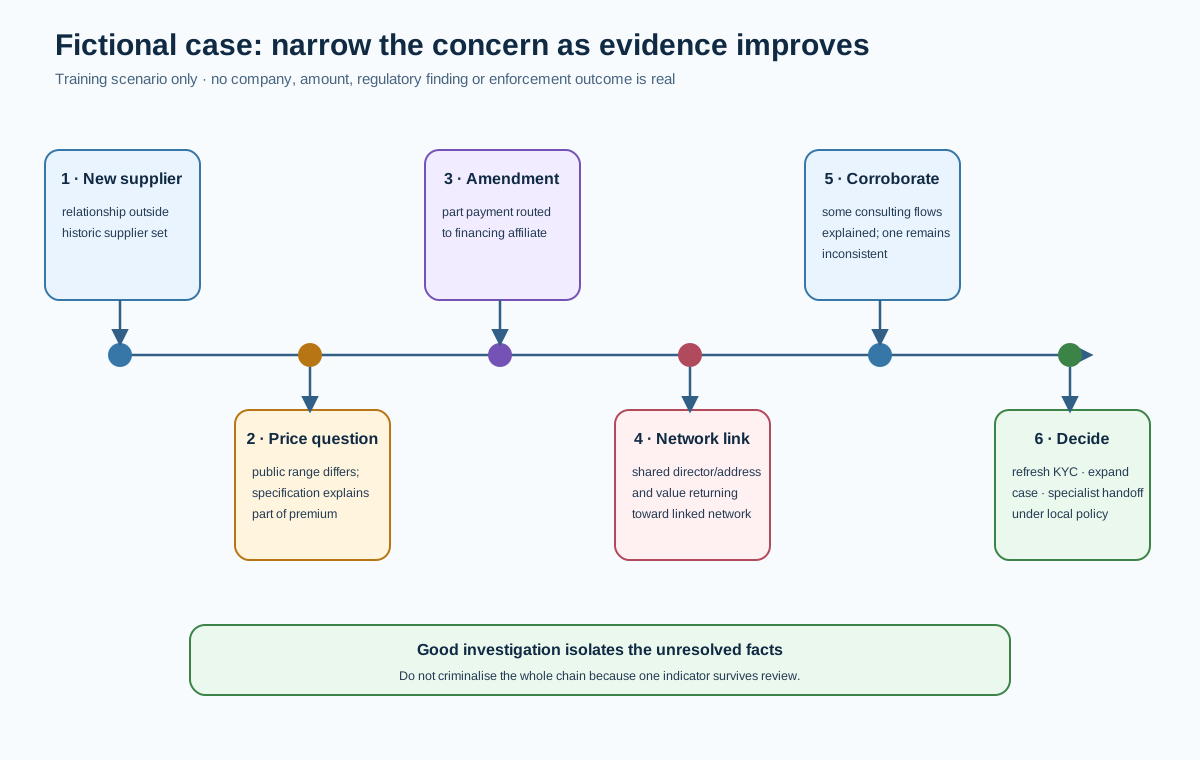
The lesson is not that expensive goods, offshore affiliates or circular-looking payments are inherently suspicious. The lesson is how to reduce a complex case to testable propositions. What does the bank know? What did the customer explain? What was independently corroborated? Which part of the explanation remains inconsistent with observed behaviour? The final decision should be based on that unresolved evidence, scoped to the bank's role and the applicable jurisdiction.
For delivery teams, the same case becomes a test pack. The customer baseline must be versioned; supplier novelty must be detectable; ownership and address links need source metadata; the trade platform must expose document fields or declare them unavailable; transaction lineage must permit network reconstruction; and the case system must preserve the sequence of information requests and decisions. A control that cannot reproduce those facts cannot support a defensible investigation even if it generates large numbers of alerts.
Test an amendment without losing the earlier decision
Extend the fictional case with a beneficiary amendment after the initial document review. The importer supplies a revised invoice naming a different receiving company, while the commercial description and amount remain unchanged. This is not proof of wrongdoing. It is a new fact that should be connected to the earlier review rather than silently replacing it. The analyst should establish the claimed relationship between the two companies, the commercial reason for the amendment, the reliability of the evidence and which institution or specialist can resolve remaining uncertainty.
The implementation test should preserve both invoice versions, the original payment instruction, the amended instruction and the review performed against each. A screen that displays only the latest invoice cannot demonstrate what the earlier reviewer actually considered. A payment-status update should not automatically close the separate information request. Likewise, an amendment that never becomes an executed payment should not be counted as a second completed transaction in the investigation timeline.
For this proposed test, acceptance means that another reviewer can reconstruct the sequence and understand the basis for the final outcome. It does not mean the software automatically approves or rejects every beneficiary amendment. The appropriate action still depends on the actual product, evidence, bank authority and applicable controls.
Knowledge check and glossary
Why is a corporate red flag not a conclusion? Because complexity, new counterparties, cross-border routes and document discrepancies can arise in legitimate commerce. The indicator should trigger proportionate inquiry; suspicion or a legal restriction requires additional evidence and the applicable decision process.
What is the most useful starting point for corporate monitoring? A reliable customer and business baseline. Without expected activity, products, geographies and counterparties, the bank cannot distinguish meaningful deviation from normal commercial change.
What does a shared director or registered address prove? Usually only that two entities are linked through a director or address. The link may be commercially innocent, a professional-services arrangement or part of common control. Its significance requires corroboration.
Why can price checking be difficult? Goods may differ in quality, specification, warranty, freight, insurance, financing and bundled services. A benchmark is an investigative comparison, not automatically a valuation conclusion.
Why should bank role be recorded in trade cases? Because different banks in a trade transaction see different parties and documents. Controls should reflect the institution's actual visibility and responsibility rather than assume universal access to the full trade chain.
How should circular payments be assessed? Reconstruct the flow, ownership and timing; compare value retention; and test for documented treasury, cash-pooling, intercompany lending or payment-on-behalf-of arrangements before treating the pattern as unexplained.
When should AML hand off to sanctions or export-control specialists? When the concern depends on legal restrictions relating to a party, ownership/control, goods, technology, destination, end user or end use. Those are distinct determinations even when the same evidence triggered the AML review.
What should a closure narrative contain? The trigger, evidence reviewed, alternative explanation, corroboration and reason the concern was resolved. A bare "false positive" is not a defensible conclusion.
What should a good negative test include? Legitimate complex activity such as cash pooling, factoring, shared-service payments, seasonal imports or a documented business pivot. A control should demonstrate that it can clear legitimate complexity as well as detect concerning patterns.
Glossary
Business baseline: the bank's documented understanding of expected customer activity used as the comparison point for ongoing monitoring.
Commercial substance: evidence that an entity performs the economic role it claims, assessed proportionately through operations, people, premises, financial activity and counterparties.
Counterparty enrichment: additional information used to understand a payer, payee, supplier, buyer or intermediary beyond the raw transaction record.
Circular flow: value that moves through a chain and returns toward its origin or related network. It is an indicator requiring commercial-rationale testing, not proof of laundering.
Document discrepancy: an inconsistency within or between contracts, invoices, transport records, payment data or other trade information.
Open-account trade: trade in which goods or services are supplied and payment occurs under commercial terms without a documentary credit governing payment.
Pass-through activity: funds moving through an account with limited retention. Its significance depends on the customer's legitimate business model.
Trade-based money laundering (TBML): laundering value through trade transactions or trade processes, including manipulation of price, quantity, quality, goods or documentation; the precise legal treatment depends on jurisdiction.
Visibility boundary: the limit of information a particular bank, product or system can access and reasonably verify.
Specialist hand-off: a controlled referral from the originating case to another domain such as sanctions, export controls, fraud, credit or legal without losing evidence lineage.
References and further reading
Global standards and trade-based money-laundering guidance
- Financial Action Task Force (FATF), The FATF Recommendations, current consolidated standards: https://www.fatf-gafi.org/en/publications/Fatfrecommendations/Fatf-recommendations.html
- FATF and Egmont Group, Trade-Based Money Laundering: Risk Indicators (2021): https://www.fatf-gafi.org/content/dam/fatf-gafi/reports/Trade-Based-Money-Laundering-Risk-Indicators.pdf
- FATF and Egmont Group, Trade-Based Money Laundering: Trends and Developments (2020): https://www.fatf-gafi.org/content/dam/fatf/content/Trade-Based-Money-Laundering-Trends-and-Developments.pdf
- The Wolfsberg Group, ICC and BAFT, Trade Finance Principles (2019): https://wolfsberg-group.org/resources/legacy/54
Supervisory and jurisdiction-specific material
- US Federal Financial Institutions Examination Council, BSA/AML Examination Manual: Trade Finance Activities: https://bsaaml.ffiec.gov/manual/RisksAssociatedWithMoneyLaunderingAndTerroristFinancing/17
- US Federal Financial Institutions Examination Council, BSA/AML Examination Manual: Appendix F, Money Laundering and Terrorist Financing Red Flags: https://bsaaml.ffiec.gov/manual/Appendices/07
- US Financial Crimes Enforcement Network, Advisory FIN-2010-A001: Trade-Based Money Laundering: https://www.fincen.gov/resources/advisories/fincen-advisory-fin-2010-a001
- US Bureau of Industry and Security, Know Your Customer Guidance and Red Flags: https://www.bis.gov/enforcement/identify-red-flags
- European Banking Authority, Guidelines on ML/TF Risk Factors, consolidated version: https://www.eba.europa.eu/sites/default/files/document_library/Publications/Guidelines/2023/EBA-GL-2023-03/1061654/Guidelines%20ML%20TF%20Risk%20Factors_conslidated.pdf.pdf
- Authority for Anti-Money Laundering and Countering the Financing of Terrorism (AMLA), EBA and AMLA complete handover of AML/CFT mandates (19 January 2026): https://www.amla.europa.eu/eba-and-amla-complete-handover-amlcft-mandates_en