False Positives and Analyst Judgement
A financial-crime alert is a question raised by a control. It is not a finding of guilt, a conclusion that a transaction is suspicious, or proof that the control is working well merely because it generated a large queue. This distinction is the starting point for understanding false positives and analyst judgement.
When a monitoring rule, model, screening process or behavioural control identifies activity for review, the bank still has to decide what the signal means in context. The same pattern can represent ordinary customer behaviour, an explainable change in circumstances, poor data, an overly broad scenario, a duplicated detection, a genuine risk indicator, or a combination of several of those things. The analyst's job is to convert an automated or manual signal into an evidence-based disposition without treating the alert itself as the answer.
The phrase false positive is useful but easy to misuse. In a simple classification problem, a false positive means the system predicted a positive condition that is known to be absent. Financial-crime monitoring is rarely that clean. A closed alert is not necessarily a mathematically proven "true negative" because the bank often cannot observe the ultimate truth about the customer's conduct. Likewise, filing a suspicious activity report, suspicious transaction report or suspicious matter report does not establish that a crime occurred. It records a suspicion or legally defined reportable concern under the applicable jurisdictional framework. Investigators therefore need to distinguish operational labels from ground truth.
A more useful banking mental model is this:
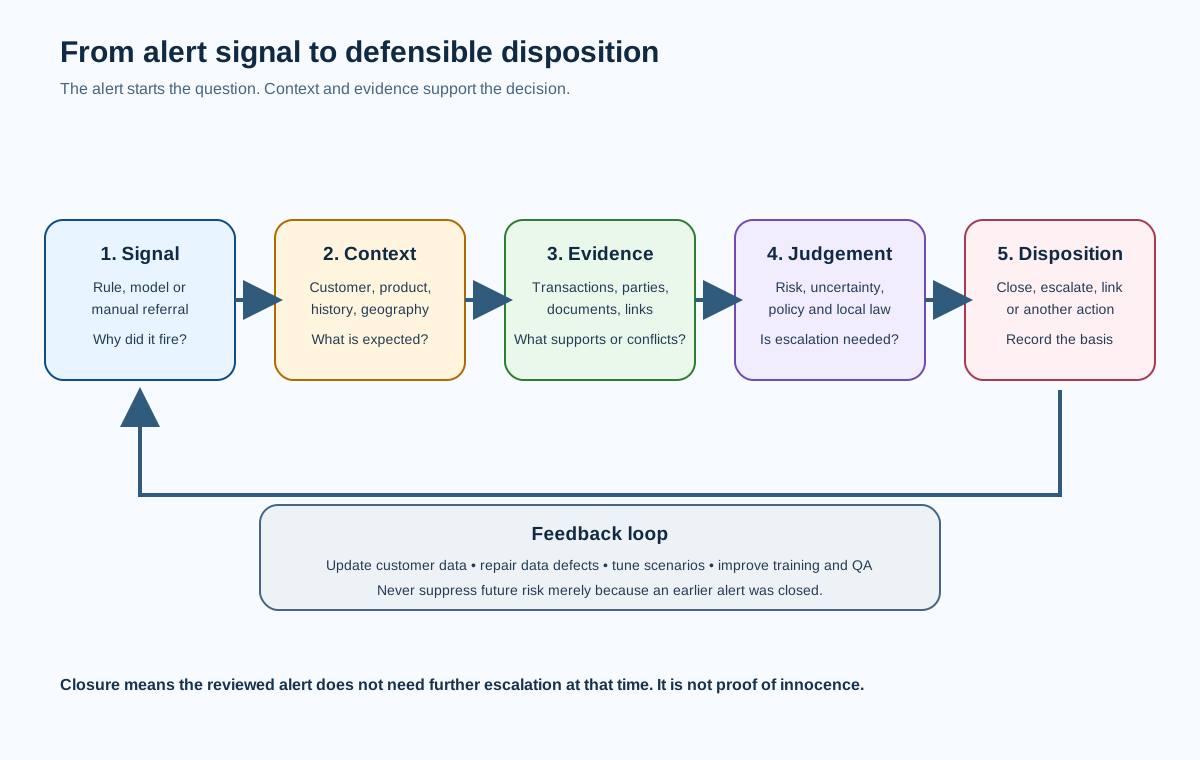
signal → context → evidence → judgement → disposition → feedback.
The signal may be generated by a transaction-monitoring scenario, sanctions or watchlist screening, behavioural analytics, customer-risk changes, fraud intelligence or a manual referral. Context explains who the customer is, what activity was expected, which products and channels are involved, and whether the observed behaviour fits the relationship. Evidence includes relevant transactions, counterparties, KYC information, source-of-funds information where appropriate, device or channel data, earlier alerts, previous investigations, customer contact where policy permits, external information and any other facts reasonably available to the analyst. Judgement weighs that evidence against the risk and the applicable policy or legal threshold. The disposition records what should happen next. Feedback then improves customer data, detection logic, training, operating procedures and risk understanding.
Why false positives matter to a bank
A bank does not improve its financial-crime programme simply by reducing the number of alerts. A low alert volume can mean efficient targeting, but it can also mean weak coverage. A high alert volume can reflect broad risk coverage, but it can also indicate poorly calibrated thresholds, duplicate rules, weak customer segmentation or incomplete data. The objective is therefore not "fewer alerts" in isolation. It is to create monitoring that identifies useful risk signals while enabling analysts to spend their time on the activity that most needs human attention.
This matters operationally because analyst capacity is finite. If large numbers of low-value alerts consume investigation time, higher-risk cases can age unnecessarily. Supervisors and internal audit functions therefore tend to care about the whole control chain: risk assessment, scenario coverage, data completeness, thresholds or model design, alert generation, case investigation, quality assurance, escalation, reporting and governance. The FCA's enforcement action against Metro Bank is a useful reminder that a transaction-monitoring programme can fail before an analyst even sees an alert. A defect in the data feed meant transactions were not presented to the monitoring system as intended. The lesson is broader than that case: alert quality depends on upstream completeness as much as downstream judgement.
False positives also affect customers. An unnecessary payment hold, repeated request for information, account restriction or delayed transaction can cause real harm. At the same time, prematurely clearing genuinely suspicious activity can expose customers, the bank and the financial system to harm. Good judgement therefore has to balance speed, evidence, proportionality and risk. It is not a choice between "customer experience" and "compliance"; a well-designed control environment tries to protect both.
The cost dimension is equally important. Repeated manual review of the same explainable pattern is a sign that knowledge is not flowing back into the control environment. If a legitimate payroll cycle, treasury sweep, seasonal cash pattern or merchant settlement arrangement repeatedly generates the same alert, the bank should ask whether the customer profile, segmentation, scenario logic or data enrichment can be improved. That does not mean creating an exemption merely because the customer complains or the alert is inconvenient. It means understanding why the control is producing the signal and whether the current design remains proportionate to the risk.
What a false positive actually is
A useful operational definition is: an alert that, after proportionate review of relevant available information, does not require further financial-crime escalation under the bank's applicable policy and jurisdictional obligations.
That definition is deliberately cautious. It does not say the customer is "clean" or that the bank has proven nothing improper occurred. It says that the alert, assessed with the information reasonably available and the institution's decision framework, did not meet the threshold for further action at that time.
The phrase also needs to be separated from similar concepts. In sanctions screening, a false positive often has a more literal identity-matching meaning: the screened party is not the listed person or entity. In transaction monitoring, the alert is usually behavioural, so the question is whether the activity can be reasonably explained or whether suspicion remains. In fraud controls, a genuine customer transaction can be a false positive relative to a fraud model, yet the same activity could still raise a separate AML question. A single enterprise platform should therefore avoid collapsing all these outcomes into one generic falsePositive=true field without preserving the control type and decision basis.
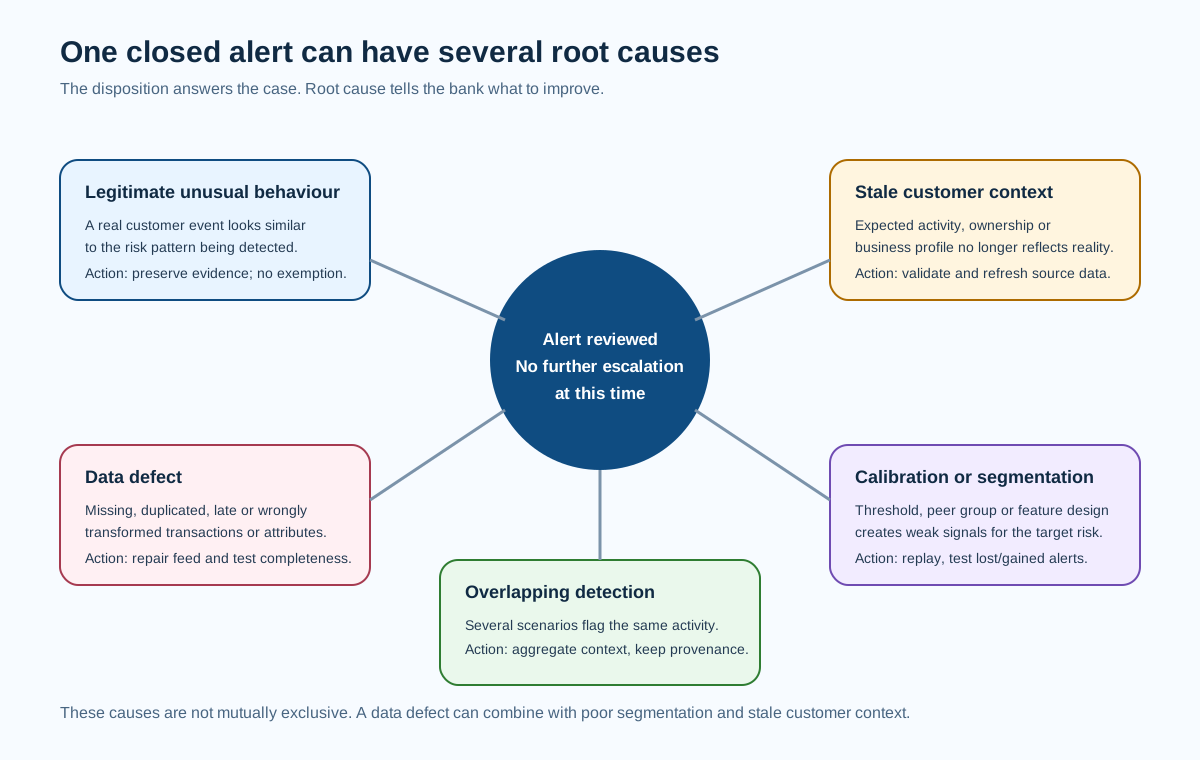
Another distinction is between a false positive caused by legitimate behaviour and an avoidable alert caused by control weakness. The first may be unavoidable because some legitimate activity resembles suspicious activity. The second may arise because customer segmentation is stale, a scenario threshold is poorly calibrated, data is duplicated, a currency conversion is wrong, counterparties are misclassified, or several rules detect the same event independently without intelligent aggregation. Both can end in closure, but they imply different remediation actions.
The regulatory and global-standard context
There is no universal global rule saying every alert must have the same investigation narrative, the same evidence checklist or the same closure code. FATF sets global standards around risk-based AML/CFT controls, customer due diligence, ongoing monitoring and suspicious transaction reporting, but jurisdictions implement those principles differently. Banks therefore need a global control philosophy with local legal mapping rather than one workflow falsely presented as law everywhere.
FATF's 2025 changes to Recommendation 1 reinforced proportionality within the risk-based approach and clarified the role of simplified measures in lower-risk situations where permitted by the applicable framework. That matters for alert operations because proportionality should influence the intensity of review. A low-risk, well-understood recurring pattern does not necessarily require the same investigative depth as a complex high-risk cross-border network. Proportionality does not mean lowering standards or ignoring alerts. It means matching the control response to identified risk while preserving the ability to escalate when new information changes the picture.
The United States provides a useful example of why local requirements must be described accurately. In October 2025, FinCEN and the federal banking agencies published FAQs clarifying suspicious activity reporting requirements. Among other points, the guidance states that the Bank Secrecy Act does not require or expect a financial institution to document its decision not to file a SAR. FinCEN noted that institutions had previously been encouraged, but not required, to document such decisions; an institution may still choose to do so under its own policies and controls, and a short, concise statement can be sufficient depending on the circumstances. A global bank should therefore not teach staff that U.S. law universally requires a long "no SAR" narrative for every closed alert.
Australia illustrates a different formulation. AUSTRAC's guidance, updated in September 2026, says that when a reporting entity concludes there are no reasonable grounds for suspicion it may choose to make a written record of the reasons. If uncertainty remains, further monitoring or investigation may be appropriate. If reasonable grounds for suspicion are formed, the suspicious matter report must be submitted within the applicable timeframe. The important operational lesson is that the legal threshold is not created by the alert; it is formed through assessment of the facts and circumstances under the Australian framework.
Other jurisdictions use their own statutory tests, reporting processes, confidentiality rules, timeframes and supervisory expectations. For that reason, the case platform should capture the jurisdiction and legal entity governing the decision, not merely the geographic location of a customer or transaction.
Analyst judgement is controlled professional reasoning
Judgement does not mean personal preference. In a mature programme, judgement is exercised within a framework: defined risk factors, access to relevant information, documented escalation criteria, training, quality assurance, peer or senior review where appropriate, and legal or compliance guidance for difficult cases.
The analyst begins by understanding the alert's detection logic. What exactly caused the alert? Which transactions or behaviours contributed? What threshold or model feature was crossed? Which period was evaluated? Was the customer compared with their own history, a peer group, a static threshold or a combination of signals? If the analyst cannot understand why the alert exists, the review is already weakened.
Next comes customer and relationship context. The analyst asks whether the activity fits the customer's known business, occupation, products, expected geographies, typical counterparties, account purpose and previous behaviour. Context should not become a shortcut such as "long-standing customer, therefore low risk." Long relationships can still change. Equally, a first-time pattern is not suspicious merely because it is new. The task is to explain the difference between expectation and observation.
Transaction context then adds detail. Timing, amount, direction, frequency, counterparties, currencies, channels, payment references and velocity can be relevant. For corporates, the relationship between payment activity and business model may matter more than a single transaction amount. For retail customers, sudden changes in inflow source, rapid onward movement, new beneficiaries or cash behaviour may be important depending on the scenario. For instant payments, the bank may have only seconds for preventative fraud controls, whereas AML investigation can occur after settlement unless a separate legal restriction requires intervention.
External and historical information can materially change the judgement. Previous alerts, linked accounts, prior customer explanations, sanctions or PEP status, adverse information, law-enforcement requests and earlier SAR/STR/SMR history may all be relevant subject to legal and confidentiality controls. The system should make these relationships discoverable without encouraging analysts to copy earlier conclusions blindly.
Customer contact can also form part of the evidence where policy permits and where doing so does not create tipping-off or other legal risk. A customer's explanation should neither be accepted automatically nor dismissed automatically. Its value depends on plausibility, consistency with independent data, documentation, the customer's risk profile and the nature of the concern. For example, an explanation that a large transfer reflects a property sale can become more credible when the counterparty, timing and available documentation align; it remains weak if the payment path and documentation contradict the story.
Building a defensible closure
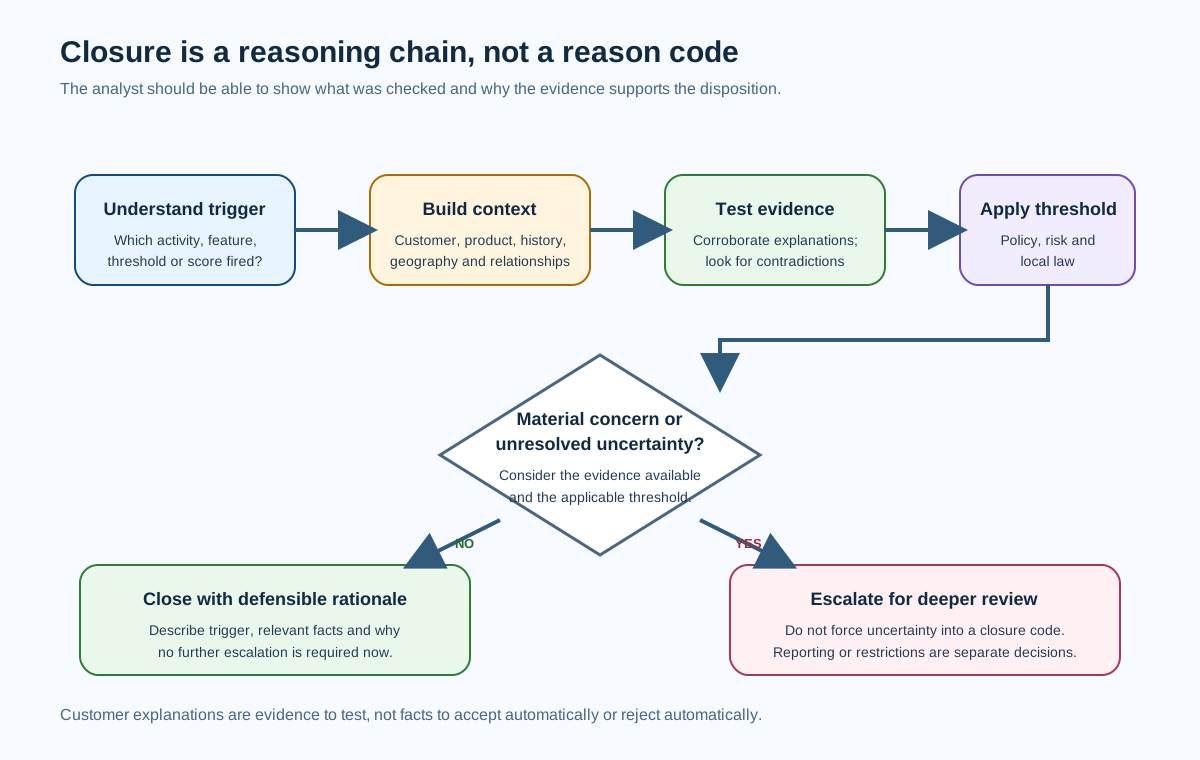
A strong closure answers three practical questions: what triggered the alert, what relevant facts were checked, and why those facts support the disposition. The amount of narrative needed should be proportionate to risk, complexity, policy and jurisdiction. A simple recurring pattern may need a concise rationale. A complex multi-account case may need a structured chronology and explicit comparison with the suspected typology.
A closure should avoid unsupported absolutes. Phrases such as "customer is legitimate," "no money laundering," or "all activity is normal" are often stronger than the evidence permits. Better reasoning describes what was observed and why the available information did not support further escalation at that time. The same applies to phrases such as "false positive due to salary." The reviewer should be able to understand which credits were identified, why they were consistent with salary or another legitimate source, whether onward movement was expected, and whether other risk indicators were present.
A useful reasoning sequence is:
- identify the alert trigger and relevant period;
- establish the customer and product context;
- review the transactions or behaviour that created the signal;
- consider relevant previous activity and connected parties;
- investigate material inconsistencies rather than explaining them away;
- compare the facts with policy, typology indicators and local escalation/reporting thresholds;
- record the decision in a form another qualified reviewer can understand;
- escalate when material uncertainty remains or the applicable threshold is met.
The sequence is not intended to force every alert into eight mandatory fields. It is a way to test whether the reasoning is complete.
Bias and inconsistency in analyst decisions
Human judgement introduces strengths that rules cannot provide, but it also introduces variability. Two analysts can review the same facts and give different weight to customer explanations, prior activity or risk indicators. Good governance therefore tries to reduce unjustified variability without turning analysts into checklist operators.
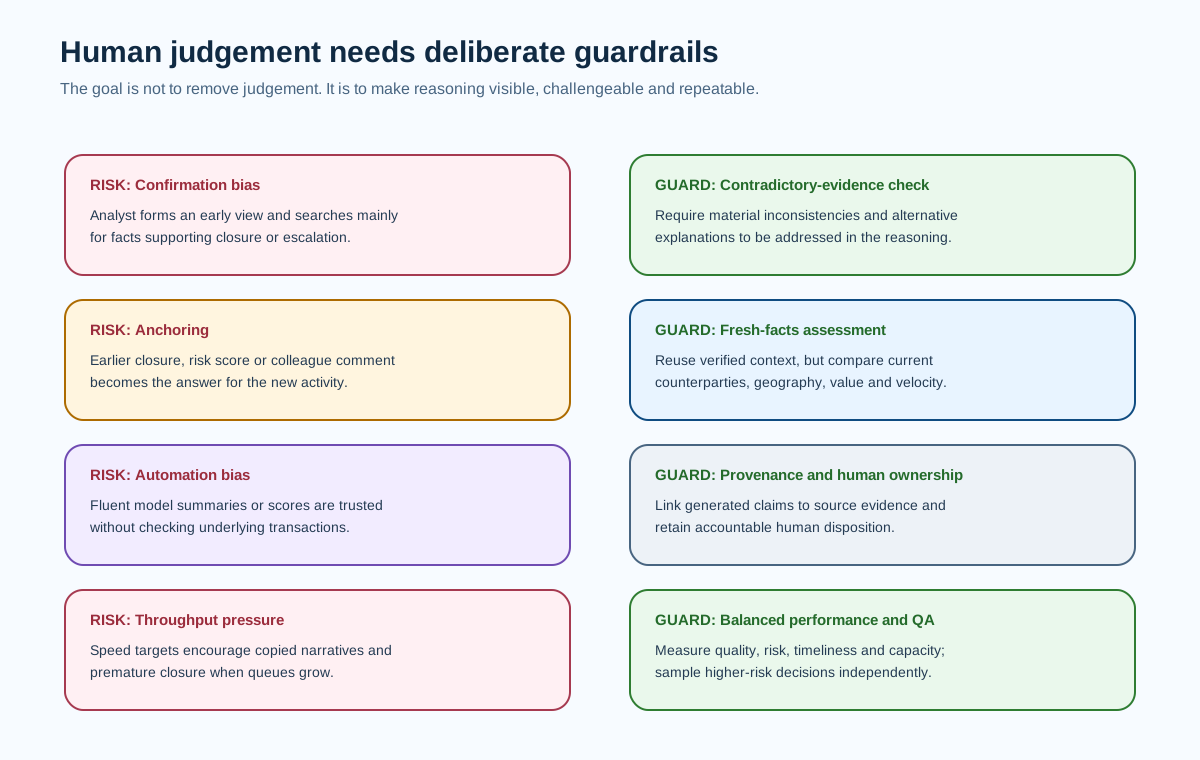
Confirmation bias is one risk. An analyst may decide early that an alert is harmless and then seek facts supporting closure while ignoring contradictions. The opposite can happen when a customer is already high risk: the analyst may interpret every unusual event as suspicious without testing a plausible legitimate explanation. Anchoring occurs when an earlier alert disposition, risk score or colleague's comment overly influences the current assessment. Automation bias occurs when an analyst assumes that a model score or generated summary is correct because it came from a system.
Controls against bias include clear decision criteria, structured evidence fields, access to contradictory information, targeted quality assurance, peer challenge for selected cases, periodic calibration exercises and analysis of outcome patterns. Some institutions also use masked or second-review exercises in training or quality testing to understand whether analyst identity, business line or customer segment is influencing outcomes. Such techniques need to be designed carefully so that necessary risk context is not accidentally removed from live decisioning.
AI-assisted investigation creates another layer. Summarisation, entity extraction, transaction clustering and narrative drafting can reduce repetitive work, but they do not transfer accountability from the bank to the model. The bank still needs data governance, access controls, validation, explainability appropriate to the use case, monitoring for drift or systematic error, human review and auditable decision ownership. A generated explanation that sounds confident but cites the wrong transactions is worse than a slower manual note because it can make weak reasoning appear authoritative.
Quality assurance: checking reasoning, not just formatting
Quality assurance should ask whether the disposition was supported by the evidence available at the time. A QA reviewer can examine whether the analyst understood the alert, checked relevant customer information, considered material transactions and counterparties, addressed contradictions, applied the correct policy or local threshold, preserved confidentiality, and documented the outcome clearly enough for reconstruction.
A mature QA programme is risk-based. It may combine random sampling with targeted sampling of higher-risk cases, new analysts, new scenarios, unusual closure codes, rapid closures, overridden model outputs, repeat alerts or cases near escalation thresholds. The sampling method should be transparent enough for governance to understand what the QA result represents. A very high QA score based only on easy cases can be misleading.
QA findings should also distinguish error types. A missing formatting field is not equivalent to a missed material risk indicator. Severity classification helps management understand whether the issue is procedural, evidential, analytical or potentially regulatory. Root-cause analysis can then determine whether the remedy is coaching, data repair, scenario redesign, system change, workload intervention or policy clarification.
Independent assurance remains separate from first-line quality checking. Operations may perform maker-checker controls and team QA. Compliance oversight may challenge design and outcomes. Internal audit may assess whether the control framework is designed and operating effectively. The precise allocation depends on the institution's operating model, but ownership should be explicit so that everybody does not assume somebody else is checking the same risk.
Metrics: why a low false-positive rate is not the goal by itself
Alert programmes need metrics, but the wrong metric can drive the wrong behaviour. A simple "false-positive rate" can be useful for describing workload, yet it is not a standalone measure of effectiveness because the denominator depends on how the bank defines alerts and closures. A programme can lower its apparent false-positive rate by suppressing many alerts, but that says nothing about what it stopped detecting.
Wolfsberg's work on effective monitoring encourages institutions to think more broadly about monitoring outcomes and, where appropriate, measures such as precision and recall. Precision asks what proportion of selected or alerted items are genuinely useful according to the institution's outcome definition. Recall asks how much of the relevant risk population the control detects. In financial crime, neither measure is perfectly observable because ground truth is incomplete. Labels such as SAR filed, account exited or alert closed are proxies, not proof of criminal or non-criminal activity. That limitation should be explicit in model and control governance.
Other useful measures can include alert ageing, cases per investigator, repeat-alert rates, escalation rates, QA severity, rework, data-quality exceptions, scenario coverage, time to disposition, customer-contact frequency, downstream case conversion, lookback findings and the proportion of alerts attributable to known data or configuration problems. The bank should interpret these together rather than ranking analysts simply on closure volume.
Productivity targets need particular care. If analysts are rewarded mainly for closing alerts quickly, the programme can unintentionally create pressure to under-investigate. If they are rewarded only for escalation, it can create the opposite distortion. Balanced performance management focuses on quality, risk management, timeliness and adherence to process, with quantitative throughput used as capacity information rather than a substitute for judgement.
False positives as a control-design feedback loop
The best use of closure data is not to celebrate that an alert was closed; it is to learn why the alert was generated and whether the control can improve safely.
Suppose a scenario repeatedly alerts on transfers between accounts owned by the same corporate group. The first question is not "can we suppress all internal transfers?" It is whether the bank can reliably identify beneficial ownership, account relationships and legitimate treasury structures. If those data are high quality, segmentation or enrichment may reduce avoidable noise. If ownership data are incomplete or stale, suppression could create a blind spot.
Similarly, repeated alerts on a seasonal cash business may indicate that the customer's expected activity profile needs updating. But a profile should not be changed merely to make alerts disappear. The business or KYC process should validate whether the seasonal pattern is genuine and whether the revised expectation remains reasonable for the customer's industry and risk.
Scenario tuning therefore needs controlled change management. Proposed changes should state the problem, affected population, expected benefit, financial-crime risk, test design, historical back-testing or replay results, impact on alert populations, approval, implementation date and post-implementation monitoring. For models or machine-learning approaches, versioning and validation need to reflect the institution's model governance and the financial-crime risk of delayed improvement. Wolfsberg's 2025 Part II statement is useful here because it frames transition and validation, model risk balanced with financial-crime risk, and explainability as important components of responsible innovation.
Data and system touchpoints
False-positive reduction often fails when treated only as an analyst-training problem. Many root causes are architectural.
The monitoring platform may depend on core account data, payment messages, customer master data, KYC attributes, legal-entity relationships, risk ratings, sanctions data, merchant or product classifications, exchange rates, device intelligence and reference data. If any feed is incomplete, delayed or incorrectly transformed, the alert can be misleading. A scenario using transaction amount in base currency, for example, can behave badly if foreign-exchange conversion is missing or duplicated. A peer-group model can produce poor comparisons if industry codes are wrong. A customer profile can appear inconsistent because an upstream KYC change was never propagated.
The case-management layer also matters. Analysts need to know which scenario fired, what data window was evaluated, which transactions contributed, which rule or model version applied and what customer information was effective at that time. Without temporal versioning, a later KYC update can make an old decision impossible to reconstruct accurately.
Lineage should therefore connect source system → transformation → monitoring feature → alert → case → evidence → decision. For important decision attributes, the bank should be able to explain where the data came from and when it was effective. This is particularly important when tuning is challenged months later or a regulator asks why a scenario did or did not generate alerts for a historical period.
Deduplication is another architectural issue. Two scenarios can legitimately detect different aspects of the same activity, but forcing analysts to review identical evidence in separate cases may add little value. Case aggregation can link related signals while preserving scenario provenance. The design must avoid hiding the fact that several independent risk indicators fired; aggregation should improve context, not erase evidence.
From alert to case, investigation and reporting
Not every alert needs to become a full investigation. A bank can use staged decisioning provided the stages are risk-based, controlled and consistent with legal obligations. A first-level review may resolve a simple explainable alert. A higher-risk alert may move directly to a case. Multiple related alerts may be grouped into one investigation. A sanctions or fraud event may require immediate action under a separate control path.
Where suspicion remains after proportionate review, the analyst should escalate rather than stretch the evidence to fit a closure code. Escalation can lead to enhanced investigation, compliance review, customer restriction, account-exit consideration, law-enforcement engagement, sanctions action or regulatory reporting depending on the facts and jurisdiction. These are separate decisions. Filing a SAR/STR/SMR does not automatically require account closure, and account closure does not itself prove reportable suspicion. Policy and legal mapping should preserve those distinctions.
Confidentiality requirements also shape the workflow. Staff must avoid disclosing the existence of a suspicious-activity report where applicable law prohibits it. Customer communication templates should therefore be designed so operational teams can ask legitimate questions or explain service delays without revealing protected reporting decisions.
Customer impact and proportionality
A false positive becomes visible to a customer when it causes friction: a payment is delayed, documents are requested, an account is restricted, onboarding is paused, a card is blocked or a relationship manager asks questions. Some friction is necessary to manage risk. Poorly designed friction is repetitive, unexplained internally, inconsistently applied or disconnected from the actual risk signal.
Customer impact should be measured alongside control effectiveness. Banks can examine hold duration, repeated requests for the same evidence, complaint volumes, vulnerable-customer outcomes, abandonment and operational errors. These metrics should not be used to override legal obligations, but they help identify controls that are creating unnecessary harm.
Proportionality is especially important for financial inclusion. FATF's 2025 updates emphasise a risk-based approach that permits and encourages simplified measures in lower-risk situations where appropriate. Blanket de-risking can push legitimate customers away from regulated financial services without necessarily reducing system-wide risk. Alert operations should therefore distinguish between activity requiring stronger scrutiny and activity that is merely unfamiliar.
Roles and governance
The monitoring product owner or control owner is responsible for ensuring the control has a defined purpose, risk coverage and operating model. Financial-crime operations owns timely, evidence-based alert handling. Compliance or second-line financial-crime risk functions set or challenge policy, risk appetite and escalation standards. Data and technology teams maintain reliable feeds, lineage, system performance and change control. Model or analytics teams manage scenario or model development, validation and monitoring according to the institution's governance framework. Business and relationship teams can supply customer context but should not be able to override financial-crime decisions merely for commercial convenience.
Governance forums should look beyond queue size. They need to understand risk coverage, alert quality, capacity, data issues, significant QA findings, model or rule changes, customer impact, overdue cases, repeat-alert populations, emerging typologies and unresolved dependencies. Decisions should have named owners and due dates because persistent "known issues" can become structural weaknesses if everybody assumes they are temporary.
What a business analyst should specify
A business analyst working on alert and case-management change should translate policy into testable behaviour. Useful requirements include the exact alert trigger data, customer and transaction fields available to reviewers, time windows, linked-account relationships, evidence attachments, reason codes, escalation paths, jurisdiction flags, confidentiality controls, audit history, maker-checker rules, QA sampling attributes and management-information fields.
The BA should also specify negative requirements: an analyst must not be able to overwrite source transaction data; a reopened case must preserve the previous decision; changes to a closure code must be historically traceable; model-generated text must not be stored as analyst-authored reasoning without provenance; a customer-facing user must not see SAR/STR/SMR-protected information; and a scenario-tuning release must not silently change the meaning of historical metrics.
Acceptance criteria should test both legitimate and suspicious patterns. Testing only that an alert fires is incomplete. The team should verify that the correct transactions appear, customer data are current for the relevant date, duplicate events are handled properly, thresholds use the correct currency and time zone, cases preserve evidence, QA can reconstruct the decision, and post-change populations remain within expected risk tolerances.
Synthetic and historical replay data are particularly valuable for testing. Where production-like data are used, privacy and confidentiality controls must be respected. Purpose-built test cases can demonstrate that legitimate behaviours clear appropriately and higher-risk typologies escalate. Controlled shadow testing can compare a proposed rule or model with the current one before production activation without injecting fictional customer behaviour into live investigative queues.
Failure modes to watch for
Several failure patterns recur across institutions:
- closure codes become shortcuts rather than conclusions;
- analysts copy earlier narratives without rechecking current facts;
- customer explanations are accepted without corroboration or rejected without reason;
- thresholds are tuned to hit a desired alert volume rather than a risk objective;
- duplicate scenarios create parallel work with no aggregation;
- stale KYC data make legitimate behaviour appear anomalous;
- missing transactions make a customer's pattern appear less risky than it is;
- QA concentrates on grammar while missing analytical weaknesses;
- productivity targets encourage superficial review;
- AI summaries hide incorrect data extraction behind fluent language;
- system changes alter monitoring populations without version-controlled evidence;
- "false positive" is treated as proof of innocence rather than an operational disposition.
These failures have different remedies. Some need coaching; some require data repair; some require policy clarification; some require scenario redesign; some require stronger governance. A mature programme diagnoses the cause rather than repeatedly telling analysts to "be more careful."
Mini case: a recurring corporate transfer pattern
Consider a mid-sized logistics company that operates accounts in three countries. A transaction-monitoring scenario alerts because several large transfers move from an operating account to another entity with a similar name shortly after incoming customer receipts. The first alert is reviewed and closed because the receiving company is identified as a wholly owned treasury subsidiary and the transfers match a documented cash-pooling arrangement.
Two weeks later the same scenario fires again. A weak process would copy the previous narrative and close immediately. A stronger analyst first confirms that the ownership relationship is still current, the beneficiary account is the same, the values remain consistent with the cash-pooling purpose, and no new high-risk geography or third-party activity has appeared. The analyst then notices that the monitoring system does not recognise group ownership because the legal-entity relationship is stored in a KYC platform that is not available to the scenario.
The alert can reasonably be closed under the bank's policy if the evidence supports the legitimate treasury explanation, but the work should not end there. The repeated alert becomes a control-design issue. The monitoring team evaluates whether validated group-relationship data can enrich the scenario. The proposal is tested against historical data to ensure it would reduce repeated internal cash-pool alerts without suppressing transfers to unrelated third parties or hiding changes in beneficial ownership. The KYC data owner is included because stale ownership data would create a new risk if the enrichment were trusted blindly.
A month later the pattern changes: funds move to a newly added external company before being transferred onward to a jurisdiction not previously associated with the customer. Because the analyst can see the previous cash-pooling pattern and the new deviation, the control now creates useful contrast. The case is escalated for deeper review rather than being closed merely because earlier alerts were false positives.
The lesson is that a defensible false-positive decision can improve the next decision. Closure evidence, customer context and tuning feedback should make the control environment more intelligent without creating permanent exemptions from future scrutiny.
Practical takeaways
False-positive management is not an exercise in driving alert numbers down. It is the discipline of turning noisy signals into reliable, explainable and proportionate decisions while protecting the bank's ability to detect genuine risk.
The analyst's judgement is strongest when the system makes the trigger clear, the relevant context is available, contradictory evidence is visible, local legal thresholds are understood, decisions are independently tested, and repeated noise is fed back into data and detection design. The control owner should be able to explain not only how many alerts were closed, but why they were generated, why the closure logic was reasonable, what the programme learned, and how it knows that efficiency changes did not create blind spots.
A useful final principle is simple: close the alert only when the evidence supports closure; change the control only when testing shows the change preserves or improves risk coverage.
Operational deep dive: finding the cause of alert noise
Closing an alert explains the individual case. Improving the programme requires a second question: why did the control generate this alert in the first place? If that question is never asked, an institution can employ more analysts every year while the same avoidable noise continues to arrive from the same upstream causes.
A useful root-cause model separates the alert into four layers: customer context, source data, detection logic and case orchestration. An individual alert can have problems in more than one layer.
Customer-context noise
Customer-context noise occurs when the observed activity is legitimate but the monitoring platform has an incomplete or outdated picture of the relationship. Examples include a customer who changes employment, a business that opens a new operating market, a corporate group that introduces centralised treasury, or an account that legitimately becomes more active after a dormant period. The transaction itself may be correct and the scenario may be working exactly as designed; the problem is that expected activity was not refreshed or transmitted to monitoring.
The remedy is not to let analysts invent a new expected profile while closing an alert. The correct customer process should validate the changed circumstances and update the authoritative customer record. That record should then flow through controlled integration into downstream monitoring. Otherwise one analyst's closure narrative becomes an unofficial data source that other systems cannot use or govern.
Data-quality noise
Data-quality noise arises when the control sees an inaccurate, incomplete or badly transformed version of reality. A payment can be duplicated; a transaction type can be mapped incorrectly; a customer-risk rating can arrive late; a counterparty country can be derived from the wrong field; a corporate relationship can be absent; a currency conversion can use the wrong rate; a reversal can be counted as a new debit. These defects can create both false positives and false negatives, which is why a noise-reduction initiative must never assume data errors only waste analyst time.
Data controls should therefore measure completeness, validity, timeliness and reconciliation between source and monitoring populations. For material feeds, teams should be able to answer: how many records left the source, how many arrived, how many were rejected, which transformations occurred, and whether any business-day or time-zone boundary changed the population. Metro Bank's FCA case demonstrates why this matters: the monitoring control was weakened because transaction data were not fully fed into the system. The failure was not simply an analyst-quality problem.
Detection-logic noise
Detection-logic noise is generated when a rule, threshold, segmentation method or model produces too many weak signals for the risk it is intended to detect. A static threshold can treat a small retailer like a multinational corporate. A velocity rule can ignore payday or month-end effects. A peer model can compare businesses with very different operating patterns because the underlying industry classification is too broad.
Tuning should start from the scenario's risk hypothesis. If the scenario is intended to identify rapid movement of unusual incoming funds, the team should test which features actually distinguish that risk from ordinary cash-management behaviour. Simply raising the amount threshold until workload falls is not a risk-based methodology. Historical replay, labelled investigation outcomes, typology analysis and subject-matter review should be combined, acknowledging that investigation outcomes are imperfect labels rather than unquestionable truth.
Orchestration and duplication noise
Several controls can identify the same activity for legitimate reasons. A large transfer may trigger a customer-deviation scenario, a high-risk-geography scenario and a rapid-movement scenario. The bank may want all three signals, but it does not necessarily need three analysts to reconstruct the same transaction history independently.
Good orchestration links the signals into a richer case while preserving provenance: each contributing scenario remains visible, including its version, score or trigger. Deduplication that deletes one signal because another fired can remove useful context. The design objective is one coherent investigation with all relevant evidence, not one surviving alert.
Closure-code design
Closure codes are useful for management information only if their meaning is stable and analysts can apply them consistently. Codes such as "activity consistent with profile," "customer explanation corroborated," "duplicate alert," "data issue," "internal transfer" or "scenario calibration issue" can support root-cause analysis, but they should not replace the narrative reasoning where reasoning is required by policy.
Too many codes create confusion. Too few codes hide important differences. A practical hierarchy can separate the decision outcome from the root cause. For example, CLOSED_NO_ESCALATION can be the disposition while LEGITIMATE_EXPECTED_ACTIVITY, DATA_DEFECT, DUPLICATE_SIGNAL or CONTROL_CALIBRATION describes why the alert was generated. That lets monitoring teams analyse avoidable noise without treating the root-cause label as a legal conclusion.
Reason codes also need effective dating. If a taxonomy changes, historical reports should still be interpretable. A dashboard that silently remaps old codes into new categories can create false trend movements.
Measuring precision without pretending labels are perfect
Precision can be useful when the institution defines what a "useful alert" means. The positive outcome might be escalation to investigation, a material risk finding, a SAR/STR/SMR decision, customer-risk change or another outcome appropriate to the control. The choice changes the metric, so governance should record it explicitly.
Recall is harder because the bank does not know every instance of illicit activity within its customer base. Proxy testing can use known cases, law-enforcement feedback, lookbacks, quality sampling, red-team or typology simulations, historical confirmed events, and synthetic examples. Each method has limitations. A mature validation report explains those limitations rather than publishing a single percentage as if the unseen risk population were fully known.
The Wolfsberg Group's 2025 work on effective monitoring is useful because it frames innovation around effectiveness, transition and validation rather than a simple comparison of old and new alert volumes. A new model can legitimately generate a different population if it improves the institution's ability to identify meaningful financial-crime risk. The bank still needs evidence that the change does not create unacceptable blind spots.
Capacity and ageing
High false-positive volume becomes a risk issue when queues age faster than analysts can resolve them. Capacity management should therefore connect incoming volume, handling time, analyst availability, risk priority, legal or policy deadlines, quality rates and backlog age. A raw "alerts per analyst" figure is not enough because cases vary in complexity.
Queue design should prioritise material risk without allowing lower-priority items to remain indefinitely untouched. Escalation rules for ageing, surge capacity, cross-training and temporary workload controls should be defined before a backlog crisis occurs. If the bank changes thresholds solely because it lacks staff, that operational constraint should be transparent in governance rather than disguised as risk tuning.
Repeat-alert analysis
Repeat alerts are particularly valuable diagnostic material. A customer who triggers the same explainable pattern month after month may indicate stale KYC, a missing relationship attribute or a scenario that does not learn from known context. Conversely, repeated closure can create dangerous familiarity. A new counterparty, changed geography, increased velocity or altered ownership can turn a previously explained pattern into a genuinely different risk.
The case platform should therefore show previous alerts while forcing the current event to be assessed on current facts. The analyst should be able to reuse verified context, not blindly inherit the earlier conclusion.
Seasonality and event-driven behaviour
Legitimate behaviour is not always stable. Payroll, tax deadlines, school fees, agricultural cycles, tourism, retail holidays, insurance renewals, dividend periods and corporate reporting dates can change transaction volumes sharply. A well-segmented scenario can include seasonality where evidence supports it, but "seasonal" should not become a universal explanation for any periodic spike.
Testing can compare the customer's current activity with both recent history and equivalent periods in earlier years where data quality permits. For new customers with limited history, peer information may be useful but should be interpreted cautiously because peer groups can hide important differences in size, geography and business model.
Cross-scenario feedback
A false positive in one scenario can reveal a weakness in another. For example, a customer may repeatedly trigger a cash-deposit rule because their business classification is wrong. Correcting the classification changes the expected behaviour for several scenarios, not just the one alert under review. Root-cause remediation should therefore identify every control and downstream report that consumes the affected attribute.
This is where data lineage becomes operationally valuable. When a source field changes, teams can identify which monitoring features, segments, dashboards and case views depend on it. Without lineage, each control owner discovers the impact separately, often after inconsistent outputs appear.
Validity, back-testing and controlled experimentation
Before a tuning change reaches production, it should be tested against representative historical populations and designed examples. The test should compare old and proposed detection, review the alerts lost and gained, examine high-risk segments separately, and identify whether known material cases would still have been captured. Aggregate volume reduction alone is not sufficient evidence.
Where machine learning is used, training and evaluation sets should be separated appropriately, leakage controlled, features documented and drift monitored. Explainability should be sufficient for the bank to understand why the system selects cases and to investigate materially unexpected outcomes. The degree of formality depends on the institution's risk and model-governance framework, but a production decision should always have an accountable owner.
What good root-cause governance looks like
A strong monthly or quarterly monitoring forum can examine the largest avoidable-noise populations, major data defects, repeated customer patterns, scenario overlaps, QA findings and customer-impact issues. Each material item should end with one of four outcomes: accept as unavoidable risk-based noise, improve customer data, repair data or system processing, or redesign/tune the detection control. The decision and rationale should be recorded.
That turns false-positive analysis from a queue-management exercise into control engineering. The important question is no longer "how quickly did we close the alert?" but "what did this alert teach us about the customer, the data, the detection logic and the operating model?"
Advanced practice: judgement governance, coaching and responsible automation
Analyst judgement becomes reliable when the organisation treats it as a controlled capability rather than an individual talent. The bank needs people who can reason through ambiguity, but it also needs a system that makes good reasoning repeatable: training that reflects real risks, access to relevant evidence, clear escalation routes, quality feedback, sustainable workload and technology that assists without silently replacing accountability.
Calibration without forcing artificial uniformity
Calibration sessions are useful when several analysts review the same historical or synthetic case independently and then compare their reasoning. The purpose is not to force identical wording. It is to expose where people interpret policy, evidence or escalation thresholds differently.
A good calibration case contains enough ambiguity to reveal judgement. Reviewers can discuss which facts mattered, which additional information they would obtain, what would change the outcome and which jurisdictional rule or internal policy governs the final decision. If one analyst closes because the customer is low risk while another escalates because of unexplained rapid movement, the training value lies in examining how each weighed those facts.
Calibration results should feed back into procedures. If the same ambiguity recurs across teams, rewriting the guidance can be more effective than repeatedly coaching individual analysts. Where the issue involves legal interpretation, compliance or legal specialists should clarify the applicable position rather than leaving teams to develop informal local rules.
Coaching from evidence, not from throughput rankings
Analyst coaching should distinguish between knowledge gaps, reasoning weaknesses and operational constraints. A reviewer who misses linked-account activity may need system training. A reviewer who sees the links but fails to question them may need analytical coaching. A reviewer who consistently leaves cases incomplete because the queue is overloaded may be experiencing a capacity problem rather than a competence problem.
Scorecards therefore need balance. Timeliness matters because aged alerts can weaken risk response, but speed alone is not a quality measure. Escalation rate is informative, but a high escalation rate is not automatically good and a low rate is not automatically bad. QA results are useful, but only if samples are representative and severity is understood. Coaching should use case evidence and patterns across time, not one isolated metric.
Senior review and decision rights
Not every alert needs a second reviewer. Mandatory dual review of all alerts can consume capacity without improving outcomes. Risk-based maker-checker rules can reserve senior approval for higher-risk cases, unusual overrides, sensitive customers, sanctions-related intersections, material customer restrictions, selected reporting decisions or other categories defined by policy.
Decision rights must also be clear when financial-crime operations, business teams and compliance disagree. A relationship manager can provide commercial and customer context but should not be able to compel an analyst to close an alert. Compliance may own certain escalation or reporting decisions. Legal may advise on interpretation. Operations may own evidence gathering and case preparation. The case record should show who made the final decision and under which authority.
Workload as a control variable
Analyst judgement deteriorates when workload exceeds the time needed for a reasonable review. Backlogs can create shortcuts: copied narratives, overreliance on previous closures, incomplete linked-account review and superficial customer-context checks. Capacity management is therefore part of control design.
Forecasting should consider expected alert volumes by scenario and segment, average complexity, seasonality, new-product launches, staff absence, training time, QA requirements and surge events. A change programme that improves detection but doubles high-complexity alert volume without resourcing the investigation function is incomplete.
When backlogs occur, governance should decide how to manage them transparently. Risk prioritisation, temporary redeployment, controlled overtime, scenario-specific remediation and senior escalation can all be appropriate depending on circumstances. What should not happen is an undocumented lowering of investigation quality simply to make the queue disappear.
Outsourcing and offshoring
Banks sometimes use shared-service centres or third parties for alert review. Outsourcing changes who performs the work but does not remove the bank's accountability for the control. Requirements should define access to customer data, confidentiality, jurisdiction restrictions, training, quality standards, escalation routes, audit rights, subcontractor controls, business continuity and data retention.
A third party also needs enough customer and transaction context to make the decision expected of it. If commercial restrictions prevent the provider from seeing information that an internal analyst would need, the operating model should not pretend the two reviews are equivalent. The bank can instead limit the provider to triage or evidence preparation while reserving material decisions for an appropriately informed internal function.
Testing analyst decision support
Changes to case screens, risk summaries, investigation tools and AI-assisted features should be tested like control changes, not ordinary productivity enhancements. A system that rearranges information can change judgement by making some evidence more prominent and other evidence harder to find.
Usability testing should therefore ask whether analysts can identify the alert trigger, find relevant historical activity, distinguish source data from generated summaries, recognise missing information, understand linked parties and locate the applicable procedure. Negative tests should deliberately include contradictory facts so the interface does not nudge reviewers toward the easiest closure.
Synthetic and historical test cases
Training and change validation should use controlled synthetic cases, anonymised or appropriately governed historical cases, replay environments and shadow testing. Fictional transactions should not be injected into live investigative queues merely to see whether analysts notice them, because that can contaminate operational records, create customer-risk confusion and complicate auditability.
Where an institution uses controlled production testing, it should be explicitly governed, safely segregated, labelled, reversible and designed so it cannot trigger inappropriate customer action or regulatory reporting. Most learning objectives can be achieved more safely in a dedicated test or training environment.
Synthetic cases should test more than obvious suspicious behaviour. They should include legitimate high-velocity commerce, genuine family transfers, payroll changes, corporate cash pooling, seasonal businesses and unusual but well-documented one-off events. This prevents testing from teaching analysts that every unusual pattern should escalate.
AI and machine-assisted analysis
AI can support alert review in several ways: summarising transaction histories, extracting entities, clustering counterparties, generating timelines, retrieving procedures, proposing investigation questions and drafting a narrative for human review. Each use case has a different risk profile.
The system should preserve source provenance so the analyst can move from a generated statement back to the transactions or documents supporting it. Generated text should not obscure uncertainty. If the model cannot determine whether two names refer to the same party, it should not silently merge them. If data are missing, the output should say so rather than invent a plausible explanation.
Human review needs to be meaningful. Requiring an analyst to click "approve" after a machine-generated closure is not meaningful if the workflow hides the underlying evidence or creates throughput expectations that discourage challenge. Controls should monitor override rates, error patterns, drift, unsupported statements and differential impact across customer segments.
Model or tool changes also need versioning. An investigation completed with model version 4.2 should remain reconstructable after version 5.0 is deployed. The bank should know what inputs were used, what output was produced, how the analyst interacted with it and what final decision the human made.
Avoiding automation bias
Automation bias is especially dangerous when generated outputs sound fluent. An analyst may trust a confident summary even when one important payment is omitted. Training should therefore include deliberately imperfect machine outputs so reviewers practise checking sources rather than assuming the system is correct.
The institution can also design structural guards. Source evidence can be shown next to generated claims. High-risk conclusions can require explicit confirmation of supporting facts. The system can highlight when a model output conflicts with authoritative customer data. QA can sample machine-assisted cases separately to identify whether human reviewers are challenging the tool appropriately.
Fairness and customer impact
Financial-crime controls can affect access to essential services. An unusual transaction by a newly arrived migrant, cash-intensive small business, charity or customer with irregular income should be assessed on evidence and risk rather than stereotypes. Fair treatment does not require identical controls for every customer; it requires risk factors that can be explained and defended.
Monitoring design should examine whether certain segments experience repeated friction because data quality is poor or segmentation is crude. The remedy may be better information and more precise controls, not simply turning detection off. Complaints, repeated document requests, payment-hold duration and account-restriction patterns can provide useful signals of unnecessary friction.
FATF's strengthened emphasis on proportionality and simplified measures in lower-risk contexts provides an important policy backdrop. Risk-based control does not mean zero friction, but it does argue against blanket treatment when the evidence supports differentiation.
Change governance for noise reduction
Every material false-positive reduction initiative should state four things clearly:
- what risk the control is designed to detect;
- which alert population is being changed and why;
- how testing demonstrates that useful detection is preserved or improved;
- how post-implementation monitoring will identify unintended loss of coverage.
The governance pack should show not only aggregate alert reduction but also the lost-alert population, high-risk segments, known cases, data dependencies, QA impact and customer outcomes. If the team cannot explain what disappeared, it cannot confidently claim the change improved efficiency.
A practical acceptance framework
For a BA, architect or control owner, a proposed alert-optimisation change is not ready until the following can be answered:
- Is the source data complete and reconciled?
- Is the risk hypothesis explicit?
- Can the old and new logic be versioned and reproduced?
- Has historical replay examined both gained and lost alerts?
- Have high-risk customer and geography segments been analysed separately?
- Have known material cases been tested where appropriate?
- Are analysts shown enough evidence to understand the new output?
- Are customer-impact changes understood?
- Are QA and management-information definitions updated?
- Is there an owner for post-release monitoring and rollback?
This framework keeps false-positive reduction connected to financial-crime risk rather than treating it as a simple cost programme. The most successful optimisation is not the one that removes the most alerts; it is the one that removes the least useful work while preserving or improving the bank's ability to identify meaningful risk.
Practice close: delivery checklist and acceptance criteria
This section converts the chapter into practical requirements for a bank implementing or changing alert review, case management or monitoring optimisation. The aim is to make the operating model testable before production rather than discovering weaknesses through backlogs, complaints or regulatory challenge.
Alert generation and provenance
Every alert should preserve enough information to reconstruct why it was created. At minimum, the case should identify the control or scenario, version, execution time, evaluation window, customer or account population, triggering transactions or features, relevant threshold or score, and source-system identifiers. If a model contributes to the decision, the institution should preserve the information necessary under its model and financial-crime governance to understand the output later.
Acceptance criteria:
- A reviewer can identify the exact scenario or model version that generated the alert.
- Triggering transactions can be traced back to authoritative source records.
- Reversals, duplicates and rejected transactions are represented according to documented business rules.
- Currency conversion and time-zone logic can be reproduced.
- Historical alerts remain understandable after a scenario version changes.
- Missing or late source feeds create visible control exceptions rather than silently reducing the monitored population.
Customer and relationship context
The alert screen should provide the relevant customer context without presenting profile data as unquestionable truth. Analysts need effective-dated risk rating, KYC status, customer type, expected activity where available, key products, ownership or connected-party relationships where relevant, geography, previous alerts and material investigation history. Access to sensitive information must follow legal, privacy and confidentiality controls.
Acceptance criteria:
- Customer data displayed for a historical case can be tied to the version effective at the time or clearly distinguished from current data.
- Linked-account and legal-entity relationships show their source and status.
- Analysts can distinguish verified attributes from customer-declared or inferred attributes where the data model supports that distinction.
- A previous closure can be viewed as context but does not auto-populate the current disposition.
Investigation workspace
The investigation workspace should help the analyst test competing explanations rather than simply fill fields. Transaction filtering, timelines, counterparty aggregation, related-account views and document access can reduce mechanical work, but the interface should preserve evidence provenance.
Acceptance criteria:
- Analysts can move from an alert summary to the underlying transactions without losing context.
- Generated summaries link back to source evidence.
- The platform can show relevant earlier alerts without copying their closure decision automatically.
- Contradictory or missing evidence can be recorded explicitly.
- Escalation can occur without requiring the analyst to select a false closure code first.
Closure and escalation design
Disposition codes should describe the outcome clearly. Root-cause codes can separately describe why the alert was generated. The workflow should not imply that a closed alert proves innocence or that an escalated case proves criminal conduct.
Acceptance criteria:
- Outcome and root-cause fields are separate where both are needed.
- Closure reason taxonomies are versioned and reportable historically.
- Mandatory narrative or evidence requirements are driven by policy, risk, complexity and jurisdiction rather than an inaccurate universal legal claim.
- Local reporting thresholds are mapped to the appropriate legal entity and jurisdiction.
- Reopening a case preserves the original decision and creates a complete audit trail.
- A later SAR/STR/SMR decision can be linked to the investigation without exposing protected information to unauthorised users.
U.S. documentation rule test
For a U.S. BSA/SAR process, requirements should reflect FinCEN's October 2025 clarification that the BSA does not require or expect a financial institution to document every decision not to file a SAR. A bank may choose to document those decisions under its own policies and controls. System requirements must therefore distinguish internal policy from legal requirement.
Test scenario: a U.S. alert is closed without SAR filing. Confirm the platform applies the institution's approved documentation standard but does not label a long no-SAR narrative as a FinCEN requirement. If the institution uses a concise rationale, confirm it is sufficient for the internal control design and remains auditable.
Australian reasonable-grounds test
For an Australian process, the workflow should reflect AUSTRAC's current approach. If the initial assessment finds no reasonable grounds for suspicion, a written record may be made. If suspicion remains but more information is needed, ongoing monitoring or further investigation may be appropriate. Once reasonable grounds for suspicion are formed, the applicable reporting timeframe should be triggered and should not be delayed merely to complete additional enhanced due diligence.
Test scenario: an analyst sees unusual cash deposits but initially lacks enough context. The case remains open for proportionate investigation. New facts establish reasonable grounds for suspicion. Confirm the reporting clock and escalation path activate according to the configured Australian obligation rather than continuing as an ordinary alert indefinitely.
Quality assurance
QA needs evidence that both decisions and control design are working. Sampling should cover ordinary closures, higher-risk cases, new analysts, selected rapid closures, unusual reason codes, overrides, repeat alerts and other risk-based populations. The exact sampling method belongs to institutional governance rather than a universal formula.
Acceptance criteria:
- QA can reconstruct which data and procedure version the analyst used.
- Findings distinguish administrative defects from analytical or material risk defects.
- QA results can be analysed by scenario, team, segment and root cause without exposing restricted information inappropriately.
- Corrective actions have owners, due dates and evidence of closure.
- The system preserves both first-line disposition and QA outcome.
Scenario tuning and release testing
A tuning release should be evaluated against historical and designed cases before activation. Testing must include the alerts that disappear, not just the alerts that remain.
Acceptance criteria:
- Old and proposed logic run against a representative historical population.
- Gained and lost alert populations are quantified and sampled for risk review.
- High-risk segments and known material cases are separately examined where appropriate.
- Synthetic or governed historical scenarios test both suspicious and legitimate behaviour.
- Shadow testing can compare outputs without injecting fictional cases into live operational queues.
- The release has documented approval, rollback and post-implementation monitoring.
Data-quality and reconciliation tests
Monitoring completeness should be tested independently of alert quality. A system can have excellent analysts and still fail if transaction populations are incomplete.
Acceptance criteria:
- Source-to-monitoring record counts reconcile within defined rules.
- Rejected or malformed records are visible and recoverable.
- Delayed feeds trigger operational alerts.
- Transformations affecting amount, currency, country, customer ID or transaction type are tested with positive and negative examples.
- Case data can be traced to source systems through documented lineage.
AI-assisted review tests
Where AI or machine assistance is introduced, it should be treated as a controlled decision-support capability.
Acceptance criteria:
- Generated claims can be traced to source evidence.
- The model is prevented or discouraged from inventing missing facts, with uncertainty visible to the analyst.
- Access controls prevent the model from retrieving information the analyst is not entitled to view.
- Material changes are versioned and validated.
- Reviewers can override the output and must own the final decision.
- QA separately samples machine-assisted cases for unsupported statements, omissions and automation bias.
Customer-impact tests
A control change should be evaluated for customer friction as well as alert volume.
Acceptance criteria:
- The bank can measure payment holds, repeated information requests, account restrictions or other relevant interventions caused by the control.
- Vulnerable-customer procedures are preserved where applicable.
- Customer-facing messages do not reveal protected suspicious-activity reporting information.
- A lower-risk legitimate scenario can complete without unnecessary repeated friction while higher-risk evidence still escalates.
Regression pack for topic 68
A strong regression pack should include at least these behavioural cases:
- a legitimate recurring payroll or treasury pattern that the analyst can explain with evidence;
- a previously explained pattern that changes materially and should now escalate;
- an alert caused by a duplicate transaction feed;
- an alert caused by stale customer segmentation;
- two overlapping scenarios that should aggregate into one coherent investigation while preserving both triggers;
- a customer explanation that is corroborated independently;
- a plausible customer explanation contradicted by transaction evidence;
- an AI-generated summary containing an intentionally omitted material transaction, used in a controlled test to verify human challenge;
- a historical scenario-replay comparison showing which alerts are lost and gained after tuning;
- a jurisdictional reporting test proving that the correct local decision path is applied.
The completion criterion is not merely that the system can close alerts. It is that the bank can demonstrate, with evidence, that the correct information reached the control, the analyst could reason through it, the disposition was governed appropriately, and subsequent tuning did not trade away meaningful risk coverage for a prettier queue statistic.
Masterclass: when repeated closures become a risk signal
The following case is fictional and designed for training. It does not describe a real bank, customer or regulatory finding. The facts are intentionally realistic so that the reasoning can be practised without presenting invented statistics or enforcement outcomes as fact.
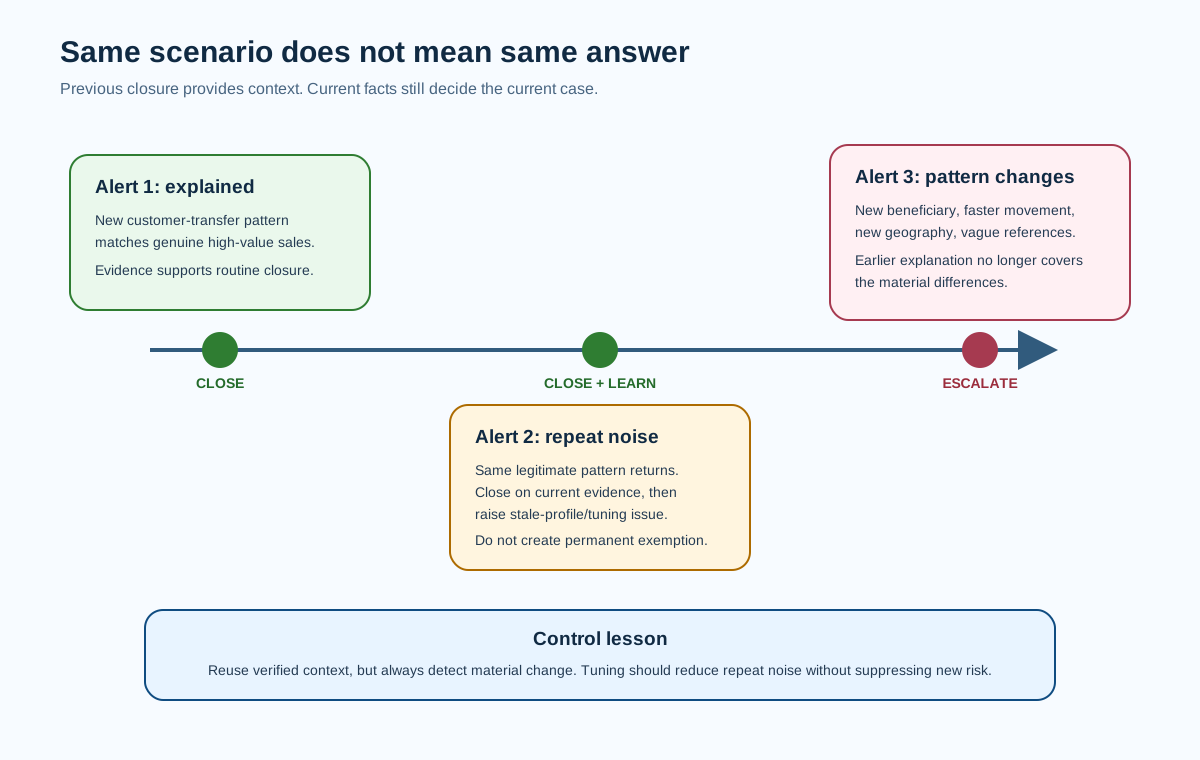
The customer
Northbridge Home Supplies Ltd is a medium-sized online and wholesale retailer. It has banked with Example Bank for several years and uses current accounts, merchant acquiring and domestic credit transfers. Its KYC profile states that most revenue comes from card settlements and wholesale customers. The company also has a documented relationship with a logistics provider and a separate account used for payroll and taxes.
The customer is not rated high risk. That fact is relevant context but not an exemption from monitoring. Its expected activity includes frequent merchant credits, supplier payments, payroll, tax payments and occasional transfers between its own accounts.
Alert one: unusual incoming credits
A monitoring scenario identifies a cluster of incoming transfers from several individuals followed by payments to a known supplier. The amounts are larger than the customer's usual person-to-business receipts but small relative to total monthly turnover.
The analyst first reviews the alert trigger and confirms the transactions were correctly selected. The customer profile describes retail and wholesale sales, so individual customer payments are not inherently inconsistent. The analyst checks remittance information and sees references to high-value home renovation orders. Merchant-acquiring data also shows that the business has begun selling custom kitchen packages, which explains why some customers use bank transfers instead of cards for larger purchases.
The analyst does not close solely because the explanation sounds plausible. The review confirms that the incoming payers are not immediately receiving funds back, the payments are consistent with invoicing patterns available in the bank's records, the outbound supplier is established, and there is no unexpected geography or rapid cash withdrawal. Under the institution's policy, the available facts support closure without escalation.
The case note records the trigger, the change in product mix, the evidence supporting the explanation and the fact that no additional material indicators were identified. It does not state that the customer is "cleared of money laundering." It states that the reviewed activity did not require further escalation at that time.
Alert two: the same pattern returns
Three weeks later, the same scenario fires. Several of the same kinds of individual credits are present. A weak workflow would copy the first closure and finish quickly. A stronger analyst treats the earlier review as context, not as the decision.
This time the analyst confirms that the new payments still align with customer sales and that the supplier relationship remains consistent. The pattern is again closed, but the investigator records a control-design observation: the business model has changed enough that the monitoring system is repeatedly treating a now-established sales channel as anomalous.
The financial-crime operations team sends the observation to the monitoring-control owner. The customer-data team also receives a request to confirm whether the revised sales pattern should be reflected in the authoritative KYC or customer-behaviour profile. The monitoring team does not create an immediate exemption. It first checks how many customers would be affected, whether the profile attribute is reliable and whether an enrichment could reduce repeat alerts without hiding genuinely unusual person-to-business flows.
Alert three: a familiar shape with unfamiliar facts
A month later the scenario fires again. At first glance it resembles the earlier cases: incoming transfers from individuals followed by outbound payments. The difference appears in the counterparties.
Several credits come from people whose names were not previously associated with customer sales, and the funds move within hours to a newly added corporate beneficiary. The beneficiary is not the established supplier. Remittance information is vague. The outbound transfers are split across several payments and one route passes through a country not previously connected with the customer's business.
The analyst checks whether the new beneficiary has a plausible commercial relationship with Northbridge. The relationship manager can confirm only that the customer recently mentioned exploring overseas sourcing. The bank's records do not yet contain evidence describing the new supplier, expected volumes or commercial purpose.
A customer explanation is sought through the permitted business process. Northbridge states that the beneficiary is a purchasing intermediary for a new overseas product line. That explanation is possible, but it is not yet corroborated. The transaction pattern also differs from the earlier legitimate explanation in several material ways: speed of onward movement, new geography, new counterparty, vague payment references and lack of an established sourcing relationship.
The decision point
The analyst now has two competing stories.
One story is legitimate expansion. A retailer can introduce a new supplier, enter a new market and receive bank-transfer payments from customers. The other story is that the account is being used to collect third-party funds and move them quickly through an intermediary with limited transparency.
The analyst should not decide by counting indicators mechanically. The task is to assess whether the available evidence reasonably explains the activity under the bank's policy and whether the applicable local suspicion or escalation threshold has been met.
The earlier closures do not answer the question because the material facts have changed. In fact, the earlier cases are useful precisely because they create a baseline: the bank knows what the previously explained pattern looked like and can identify the deviations.
The case is escalated for enhanced investigation. That escalation is not a declaration that a crime occurred. It is recognition that the first-level review can no longer reasonably explain the activity with the evidence available.
Enhanced investigation
The investigator expands the review period and examines related accounts, counterparties and transaction flows. Several points become relevant.
First, the new corporate beneficiary receives payments from other unrelated businesses at the bank. That does not prove misuse, but it suggests the intermediary has a broader role than the customer's initial explanation implied.
Second, some of the individual incoming payers to Northbridge do not have payment references consistent with product orders. One payer previously transferred funds to another business that was investigated for scam-related activity. Again, this is contextual evidence, not proof.
Third, customer documents supplied for the new sourcing arrangement contain inconsistencies between invoice descriptions and payment references. The investigator seeks clarification rather than assuming the documents are fraudulent.
Fourth, the customer's overall sales remain substantial and the majority of activity still appears consistent with its established retail business. That prevents the investigation from collapsing into an assumption that the entire relationship is illegitimate.
The investigator builds a timeline separating ordinary activity from the new pattern, identifies the transactions most relevant to the concern, records the gaps that remain, and applies the jurisdiction-specific reporting framework. The ultimate reporting decision is made by the authorised function under bank policy. This training case deliberately does not prescribe a universal SAR, STR or SMR outcome because the legal threshold and facts required for reporting differ by jurisdiction and because a classroom example should not pretend that one outcome is mandatory everywhere.
What the case teaches about false positives
The first two alerts were not wasted merely because they were closed. They established a known legitimate pattern and exposed a customer-data or scenario-calibration issue. That information improved the third review because the analyst could compare the changed behaviour against something already understood.
The case also shows why a "previously closed" flag is dangerous if used as an automatic suppression rule. A transaction pattern can remain visually similar while important underlying facts change. The monitoring platform should let reviewers reuse verified context while still exposing changes in counterparty, geography, speed, amount, ownership or product use.
What the case teaches about analyst judgement
Good judgement does not mean finding one perfect fact. It means combining evidence, identifying contradictions, understanding what is known and unknown, and knowing when the uncertainty has become too material for routine closure.
The first analyst was right to close the earlier activity because the evidence supported the explanation. The later analyst is also right to escalate because the new facts no longer fit that explanation cleanly. Consistency therefore does not mean producing the same outcome every time; it means applying the same disciplined reasoning to the facts that exist at that time.
What the case teaches about system design
A system supporting this investigation should make the change visible. The analyst should be able to see prior alerts and dispositions, but also a comparison of new and historical counterparties, geographies and velocities. The customer-profile change should have an effective date. The new beneficiary should not inherit the risk interpretation of the old supplier merely because both are categorised as corporate counterparties.
The case also demonstrates why reason codes need care. The earlier alerts might have a root cause such as CUSTOMER_PROFILE_NOT_UPDATED, while the disposition is CLOSED_NO_ESCALATION. The later case should not be forced into that same root cause simply because the scenario is the same.
What the case teaches about quality assurance
A QA reviewer examining the first alert should ask whether the analyst validated the sales explanation, not whether the reviewer personally would have escalated any unusual person-to-business credit. When examining the third alert, QA should ask whether the analyst noticed and addressed the new facts rather than merely checking that all mandatory form fields were completed.
If several analysts had repeatedly copied the original narrative after the activity changed, that would be a material quality concern. If the system interface encouraged copying by pre-populating the old closure as the new decision, the root cause would extend beyond individual performance into workflow design.
What the case teaches about tuning
The control owner may still decide to improve the scenario after reviewing the repeated legitimate alerts. Any proposed change should be tested against the third pattern as well as the first two. A rule that suppresses all similar customer credits after one legitimate review could accidentally remove the very alert that later reveals changed behaviour.
Historical replay can test whether a better segmentation or customer-profile feature reduces the known repeat noise while preserving sensitivity to new beneficiaries, unexpected geography or rapid movement. The tuning objective is not to make Northbridge disappear from monitoring forever. It is to distinguish ordinary activity from meaningful deviation more intelligently.
Closing reflection
A false positive is most useful when it improves the next decision. The closure should preserve enough evidence to explain what was understood, the control framework should learn why the alert was generated, and future analysts should be able to see both the legitimate baseline and the changes that matter.
That is the practical difference between a clearance factory and a risk-management function. One counts closed alerts. The other turns each reviewed alert into better customer understanding, better controls and better judgement.
Knowledge check and glossary
Use these questions to test whether the distinction between alert generation, suspicion, closure and control improvement is clear.
Knowledge check
1. Does a transaction-monitoring alert mean the bank has found suspicious activity?
No. An alert is a signal requiring review. The bank still has to assess the customer, transactions, relevant context and applicable decision framework. Depending on the facts, the alert may be closed, escalated, linked to another case or handled through another control path.
2. Is every closed alert a proven true negative?
No. Financial-crime teams rarely know ultimate ground truth for every customer event. A closure normally means that, based on the relevant information reasonably available and the bank's policy, the alert did not require further escalation at that time. It should not be interpreted as proof that no wrongdoing occurred.
3. Is a SAR, STR or SMR filing proof that crime occurred?
No. These reports communicate suspicion or another legally defined reporting basis under the applicable jurisdiction. Authorities determine how the information is used. Reporting outcomes can be useful monitoring labels, but they are not perfect ground truth for model training or control validation.
4. What is wrong with a closure note that says only “activity consistent with profile”?
It may be too vague to show which activity was reviewed, what profile information was relevant, how the comparison was made or whether contradictory facts were considered. The necessary detail depends on risk, complexity, internal policy and jurisdiction, but another qualified reviewer should be able to understand the reasoning.
5. Must every U.S. decision not to file a SAR have a detailed narrative because the BSA requires it?
No. FinCEN's October 2025 FAQs clarify that the BSA does not require or expect a financial institution to document a decision not to file a SAR. An institution may choose to document such decisions under its own policies and controls. Requirements should distinguish internal policy from law.
6. What happens under current AUSTRAC guidance when an entity concludes there are no reasonable grounds for suspicion?
AUSTRAC says the entity may choose to make a written record of the reasons. If suspicion remains but reasonable grounds have not yet been established, further monitoring or investigation may be appropriate. Once reasonable grounds are formed, the applicable suspicious matter reporting obligation and timeframe apply.
7. Why can reducing false positives create risk?
Because an optimisation change can suppress useful detection along with weak alerts. Every tuning exercise should examine the alerts lost as well as those retained, test higher-risk populations and known cases where appropriate, and monitor the effect after implementation.
8. Why is a low false-positive rate not sufficient proof of an effective monitoring programme?
The rate depends on how alerts and closures are defined. A programme can lower the rate simply by generating fewer alerts, including potentially useful ones. Effectiveness needs broader evidence such as risk coverage, data completeness, quality outcomes, tuning validation, recall proxies, customer impact and investigation usefulness.
9. How should previous closed alerts be used?
As context, not as an automatic answer. Previous alerts can establish a legitimate baseline or show recurring issues, but the current activity must be assessed against current facts. Changes in counterparty, geography, amount, velocity, ownership or product use can alter the risk materially.
10. Why should fictional test cases normally stay out of live investigation queues?
Because they can contaminate operational records, confuse customer-risk decisions and create audit problems. Synthetic and historical replay, dedicated training environments and controlled shadow testing usually provide safer ways to test analyst and system behaviour. Any production testing should be explicitly governed and safely segregated.
11. What is automation bias?
Automation bias is the tendency to accept a system or model output too readily because it appears authoritative. In financial-crime investigations, this can occur when an analyst trusts a generated summary, model score or previous automated decision without checking the underlying evidence.
12. What is the difference between a disposition code and a root-cause code?
A disposition describes what happened to the alert or case, such as closed or escalated. A root-cause code describes why the alert was generated or why it became avoidable noise, such as stale customer data, duplicate signals or a data defect. Keeping them separate improves governance and tuning analysis.
13. When should customer explanations be accepted?
Not automatically and not never. Their evidential value depends on plausibility, consistency with independent data, the customer's risk, documentation, transaction behaviour and the concern being investigated. The analyst should test the explanation proportionately.
14. What should QA assess beyond grammar and mandatory fields?
QA should assess whether the analyst understood the trigger, reviewed relevant evidence, addressed contradictions, applied the correct decision framework, escalated appropriately and left a reconstructable rationale. Material analytical failures should be distinguished from minor administrative defects.
15. What is the central BA requirement for a monitoring change?
Traceability. The BA should be able to connect risk objective, source data, detection logic, alert, evidence, disposition, QA, management information and change testing so that the bank can prove what the control did and why.
Glossary
Alert — A signal generated by a rule, model, screening process, behavioural control or manual referral that requires defined follow-up. It is not itself a conclusion of suspicion.
Case — A structured investigation record that may contain one or more alerts, evidence, linked parties, analyst actions, decisions and audit history.
False positive — In this chapter's operational sense, an alert that does not require further financial-crime escalation after proportionate review of relevant available information. The term should not be confused with mathematically proven ground truth.
True positive — A term sometimes used for alerts that identify relevant risk or lead to escalation. In AML work, the meaning must be defined because escalation or reporting does not prove criminal conduct.
Disposition — The recorded outcome of an alert or case, such as closure, escalation, referral or another governed action.
Root cause — The underlying reason an alert became avoidable noise or a control produced an undesirable outcome, such as stale data, duplicate processing, segmentation weakness or calibration error.
Precision — The proportion of selected items that meet a defined useful-positive outcome. The outcome definition and limitations of labels should be documented.
Recall — The proportion of relevant positives detected by a control. In financial crime, true recall is often difficult to know because the full illicit population is unobservable, so institutions use carefully governed proxies and testing.
Calibration — The process of assessing and adjusting thresholds, features, rules or decision criteria so a control performs appropriately for its intended risk purpose.
Historical replay — Running proposed logic against historical data to compare populations and outcomes before production change.
Shadow testing — Running a proposed control or model alongside the current process without allowing the proposed output to drive live customer or regulatory decisions unless explicitly governed.
Quality assurance (QA) — A structured review of investigation or operational decisions to test adherence, reasoning and control effectiveness.
Maker-checker — A control in which one person prepares or makes a decision and another performs a defined review or approval, usually applied according to risk rather than automatically to every alert.
Automation bias — Excessive reliance on automated output, even when contradictory evidence exists.
Data lineage — Traceability from original source data through transformations and monitoring features to alerts, cases and decisions.
Reasonable grounds for suspicion — A jurisdiction-specific legal concept. Under current AUSTRAC guidance, it is an objective standard based on the facts, circumstances and information available. It should not be treated as a universal global definition.
SAR / STR / SMR — Common jurisdictional names for suspicious activity, transaction or matter reports. Requirements, thresholds, confidentiality rules and deadlines differ by jurisdiction.
Proportionality — Applying measures that appropriately correspond to identified risk while effectively mitigating it, consistent with the applicable legal and policy framework.
References and further reading
The chapter uses the following public sources. Jurisdiction-specific material should be read in the context of the law, regulated entity and effective date that apply to the institution.
Global standards and monitoring effectiveness
- Financial Action Task Force (FATF), The FATF Recommendations: https://www.fatf-gafi.org/en/publications/Fatfrecommendations/Fatf-recommendations.html
- FATF, FATF updates Standards and consults on guidance to better promote financial inclusion, 25 February 2025: https://www.fatf-gafi.org/en/publications/Fatfrecommendations/update-standards-promote-financial-conclusion-feb-2025.html
- FATF, Guidance on Anti-Money Laundering and Terrorist Financing Measures and Financial Inclusion, 2025: https://www.fatf-gafi.org/en/publications/Financialinclusionandnpoissues/guidance-financial-inclusion-aml-tf-measures.html
- Wolfsberg Group, Statement on Effective Monitoring for Suspicious Activity, Part I: Moving Beyond Automated Transaction Monitoring: https://wolfsberg-group.org/resources/general/168
- Wolfsberg Group, Statement on Effective Monitoring for Suspicious Activity, Part II: Transitioning to Innovation: https://wolfsberg-group.org/resources/195/202
United States
- Financial Crimes Enforcement Network (FinCEN), Frequently Asked Questions Regarding Suspicious Activity Reporting Requirements, issued 9 October 2025: https://www.fincen.gov/resources/statutes-regulations/guidance/frequently-asked-questions-regarding-suspicious-activity
- FinCEN, Frequently Asked Questions Regarding the FinCEN Suspicious Activity Report (SAR): https://www.fincen.gov/resources/frequently-asked-questions-regarding-fincen-suspicious-activity-report-sar
- FinCEN, Suspicious Activity Report Supporting Documentation: https://www.fincen.gov/resources/statutes-regulations/guidance/suspicious-activity-report-supporting-documentation
- Federal Financial Institutions Examination Council (FFIEC), BSA/AML Examination Manual: https://bsaaml.ffiec.gov/manual
Australia
- AUSTRAC, Suspicious matter reports, updated 9 September 2026: https://www.austrac.gov.au/industry-and-business/obligations-and-guidance/your-amlctf-program/reporting-us/suspicious-matter-reports
- AUSTRAC, How to monitor your customers, ongoing customer due diligence guidance: https://www.austrac.gov.au/industry-and-business/obligations-and-guidance/your-amlctf-program/customer-due-diligence/ongoing-customer-due-diligence/how-monitor-your-customers
United Kingdom and control-system examples
- Financial Conduct Authority (FCA), FCA fines Metro Bank £16m for financial crime failings, first published 12 November 2024 and updated 5 December 2025: https://www.fca.org.uk/news/press-releases/fca-fines-metro-bank-16m-financial-crime-failings
- FCA, Final Notice: Metro Bank plc (2024): https://www.fca.org.uk/publication/final-notices/metro-bank-plc-2024.pdf
- FCA, FCA fines HSBC Bank plc £63.9 million for deficient transaction monitoring controls: https://www.fca.org.uk/news/press-releases/fca-fines-hsbc-bank-plc-deficient-transaction-monitoring-controls
How to use these sources
FATF and Wolfsberg provide global-standard and industry-framework context but do not replace local law. FinCEN and FFIEC material applies to the relevant U.S. regulatory framework. AUSTRAC guidance explains Australia's suspicious-matter and ongoing-monitoring expectations. FCA enforcement examples illustrate why data completeness, scenario governance and monitoring-system controls matter in practice; they should not be treated as universal legal rules for institutions outside the United Kingdom.