Remittance, Purpose and Regulatory Data
A payment can contain the correct debtor, creditor, amount and currency and still leave an important question unanswered: what is the payment for, what commercial information travels with it, and is any authority-specific information required for this particular transaction? Those questions are related, but they are not the same question and they are not answered by one generic “purpose” field.
In real payment platforms, several different data families often get grouped together in conversation. A corporate user may type an invoice reference into remittance information. A payment scheme may carry a transaction-purpose code. A service may use a category-purpose value to influence processing. A jurisdiction may require regulatory reporting data for certain cross-border transactions, currencies, customer types or thresholds. If a bank flattens those concepts into one internal field, it eventually loses meaning. The problem usually appears later, when operations cannot tell which value came from the customer, compliance cannot tell which rule made a field mandatory, investigators cannot reconstruct a repair, or a downstream system receives a code without the context needed to interpret it.
The practical mental model is therefore: commercial context, payment purpose, processing category and regulatory reporting are separate data domains that can coexist on the same payment. Each has a different source, meaning, consumer and governance requirement. A strong bank preserves those distinctions from the customer channel through the payment hub, screening and monitoring controls, external message, correspondent or clearing chain, posting, reporting and investigation archive.
This chapter focuses on how banks should understand and control that information. It uses ISO 20022 terminology because ISO 20022 is now the dominant structured language for cross-border payment instructions and is also widely used by domestic and instant-payment infrastructures. However, ISO 20022 itself is a messaging standard, not a global financial-crime law. FATF payment-transparency standards, CPMI harmonisation work, Swift CBPR+ usage rules, domestic legislation, payment-system rules and a bank's own policy sit at different layers. They need to be connected without being confused.
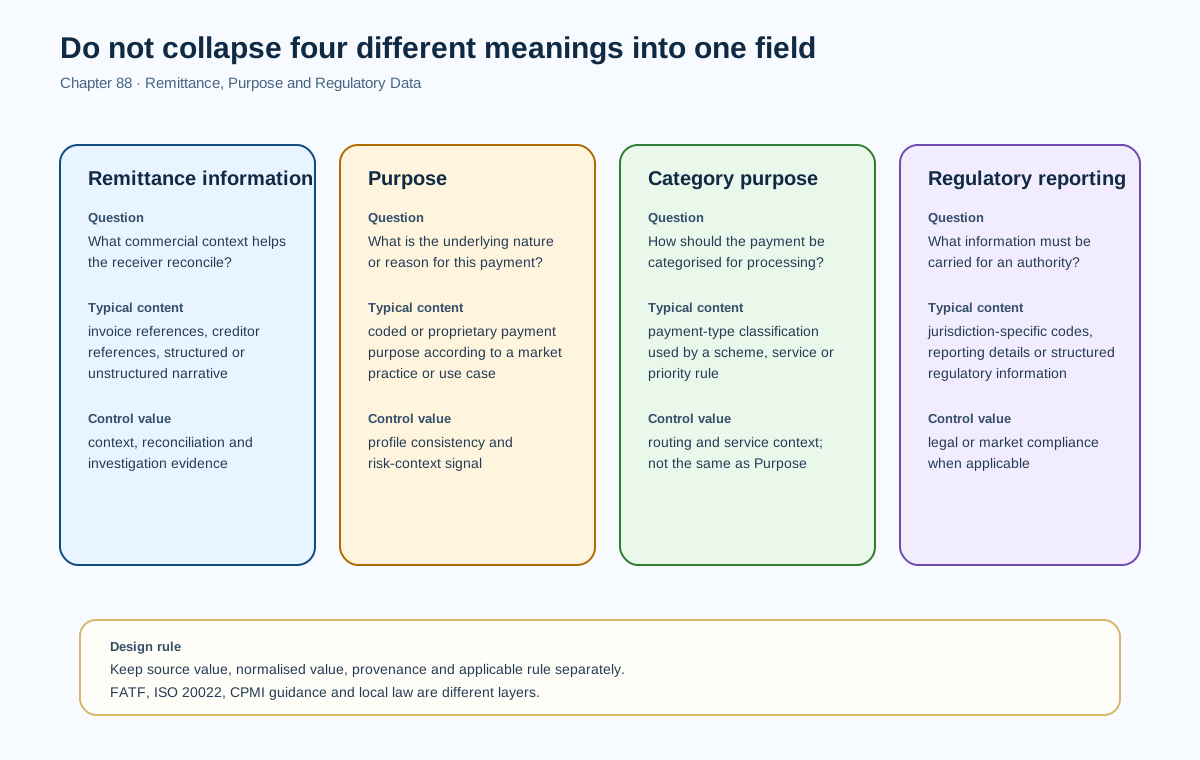
The four data families that banks must keep separate
The first data family is remittance information. Its primary job is to carry information that helps the receiving side understand or reconcile the payment. That can include an invoice number, creditor reference, contract reference, order number or narrative supplied by the payer. In ISO 20022, remittance information can be structured or unstructured depending on the message, implementation and market practice. From a financial-crime perspective it can provide useful context, but it is not inherently a regulatory declaration and should not be treated as one.
The second family is transaction purpose. Purpose describes the underlying reason or nature of a payment according to the relevant code set or market practice. Some schemes, countries or banking products use purpose codes extensively; others may not require them for every transaction. Purpose can help with risk understanding because it gives a declared explanation of economic activity, but the field is only as useful as its semantics, code governance and customer journey. A generic value selected merely to get through a mandatory screen does not become reliable evidence simply because it is structured.
The third family is category purpose. In ISO 20022, Category Purpose is part of payment-type information and is conceptually distinct from transaction-level Purpose. Market infrastructures or services can use category purpose to identify a high-level category relevant to processing, service levels or product behaviour. The exact allowed values and effects depend on the implementation. It is a serious modelling mistake to map category purpose and transaction purpose into one field called purposeCode, because downstream teams can no longer tell whether the value describes economic intent or processing classification.
The fourth family is regulatory reporting data. This is the information carried to satisfy requirements imposed by an authority or implemented through a market practice for a particular payment context. Applicability can depend on jurisdiction, legal entity, customer type, resident/non-resident status, currency, amount, corridor, payment purpose, product, reporting authority and effective date. There is no safe global rule such as “all cross-border payments require the same regulatory code.” A global bank needs a jurisdiction-aware applicability model.
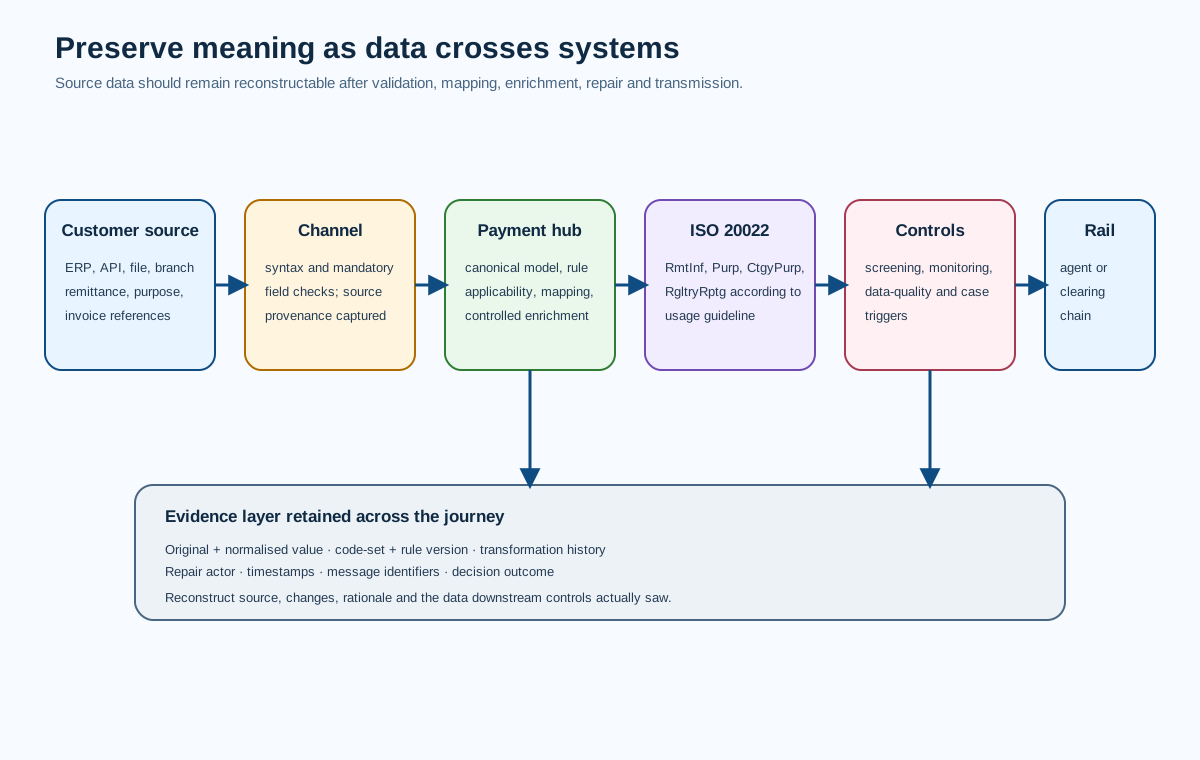
These distinctions matter because the values can disagree without automatically proving wrongdoing. A customer might send “INV 45021” as remittance information, select a legitimate purpose code for purchase of goods, and also provide a regulatory classification required by the sending jurisdiction. Those three pieces of information describe different aspects of the same payment. If the invoice later proves unrelated to the beneficiary, that inconsistency may become a risk signal, but the inconsistency has to be investigated in context. A purpose mismatch is evidence to understand, not a verdict.
Why this matters to financial crime rather than only payments operations
Remittance and purpose data sit in an unusual position. They can be operationally mundane and financially revealing at the same time. Operations teams see them because they affect repair, reconciliation and customer queries. Financial-crime teams care because they can help explain why value is moving, whether the explanation fits the customer's profile and whether the narrative is consistent with parties, geography, amount, product and observed behaviour.
Consider a wholesale customer that normally pays European component suppliers. A new payment is sent to a trading company in another region with a purpose indicating professional services, while the remittance text refers to industrial equipment and the customer profile describes no consultancy activity. None of those facts alone establishes money laundering or sanctions evasion. Together, however, they give an investigator a reason to ask whether the payment's economic story is coherent. The investigation might find a legitimate equipment broker with an unusual invoicing arrangement. It might find a data-entry error. Or it might uncover an intermediary being used to obscure the true goods or end user. The control value comes from correlation, not from a single keyword.
Remittance information is also useful when investigators need to link transactions. Repeated invoice references, contract numbers, customer-entered descriptions or creditor references can help reveal that apparently separate payments belong to one commercial arrangement. But those values are not guaranteed to be unique, truthful or stable. They should therefore be treated as contextual evidence and combined with party identifiers, amounts, dates, accounts, UETR or other transaction references, customer profile and documentary evidence.
Purpose data can support transaction monitoring and case prioritisation when the bank knows what the code means and how it was obtained. A customer-selected code may have different evidential weight from a code automatically derived by the bank from a product type. A code supplied by an upstream correspondent may have different provenance again. If the monitoring platform receives only the final code and not its source, the analyst may interpret bank-generated enrichment as a customer declaration. That can create false confidence.
Regulatory reporting data can be especially important because missing or invalid values may have consequences beyond AML monitoring. Depending on the jurisdiction and payment context, the bank may need to repair the payment, reject it, request information, report it separately, or prevent processing until required information is available. Those outcomes must come from the applicable rule, not from a generic global playbook.
The regulatory and standards landscape
FATF Recommendation 16 is the global standard most closely associated with payment transparency. FATF agreed revisions to Recommendation 16 in June 2025 and, in June 2026, opened consultation on guidance supporting implementation of the strengthened standard. FATF's focus is ensuring that appropriate originator and beneficiary information accompanies payment transfers and that institutions can identify and manage missing or incomplete required information. The detailed obligations are implemented through national or regional frameworks.
That distinction matters here because FATF Recommendation 16 should not be cited as a universal rule requiring every payment to contain a purpose code, invoice narrative or a particular ISO 20022 RgltryRptg element. FATF establishes payment-transparency expectations; local law, scheme rules and market practice determine additional fields and how they apply. A bank that incorrectly labels a domestic exchange-control code as a “FATF requirement” makes both its legal mapping and its change process harder to govern.
The Committee on Payments and Market Infrastructures, working with the Payments Market Practice Group, has developed harmonised ISO 20022 data requirements for cross-border payments under the G20 programme. The report was updated on 26 February 2026. CPMI describes those harmonisation requirements as guidance designed to increase consistency and interoperability, not as regulation. The updated framework allows flexibility for adoption through the end of 2027.
The CPMI technical annex is highly relevant because it distinguishes the ISO 20022 elements rather than treating them as one narrative block. In the cross-border customer-credit-transfer model, the annex addresses Purpose, Regulatory Reporting and Remittance Information separately. It also notes that cross-border customer payments may need purpose, regulatory reporting or tax information to meet local jurisdictional requirements and that, once such data is present, preserving it through the payment chain is important for interoperability and transparency.
The same technical annex also illustrates why structured remittance has operational value. It supports richer reference and document information than a short free-text line can carry. But richer data brings governance duties: the bank has to know which elements it supports, what it passes onward, what is truncated by legacy interfaces and what personal or commercially sensitive information is being stored and exposed to users or controls.
Swift's CBPR+ environment is another layer. The coexistence period for MT and ISO 20022 cross-border payment instructions ended on 22 November 2025. Swift emphasises that richer structured data should not be lost or truncated across the end-to-end chain, particularly where data quality affects compliance and payment processing. Banks that still rely on conversions, legacy internal formats or contingency processing therefore need controls that identify semantic loss rather than assuming that a technically valid conversion preserved all meaning.
Finally, ISO 20022 itself provides the message definitions and business components. Current official message definitions continue to evolve. A bank should therefore pin its implementation to the correct market-usage guideline and message version instead of copying a field definition from a different release and assuming it applies identically. Market practice can constrain an element that the base ISO schema technically allows.
Remittance information: commercial context with control value
Remittance information exists because a payment needs to be matched to a commercial obligation. A beneficiary receiving hundreds of credits needs to know which invoice, subscription, claim, salary file, tax obligation or contract each credit relates to. Without that information, the payment may settle correctly while the commercial process still fails.
Unstructured remittance is the familiar free-text narrative. It is flexible and easy for humans to enter, but that flexibility creates ambiguity. Abbreviations, local-language text, punctuation, customer-specific codes and inconsistent formats make machine interpretation difficult. A bank should not design a financial-crime control that assumes every word in unstructured remittance has a fixed legal meaning.
Structured remittance allows particular references and document details to be placed in defined elements. That can improve reconciliation and analytics because a creditor reference can be distinguished from a free-text note. The improvement is not magical: the structure is useful only if the customer supplies the correct value, the channel validates it sensibly, mappings preserve it, and downstream systems understand it.
For financial-crime work, both forms can be useful. A narrative such as “consulting fee” may support a customer's declared business model, or it may conflict with a customer that has no consulting activity. An invoice reference repeated across unrelated beneficiaries may be worth exploring. A sudden switch from specific invoice references to vague “services” narratives may be meaningful when combined with other changes in counterparties and geography. But none of these patterns should be treated as inherently suspicious without context.
A common failure is over-screening narrative text with crude keyword logic. Ordinary commercial descriptions can contain place names, surnames, product names and abbreviations that resemble sanctions-list entries. Screening all free text without field-aware logic can generate large false-positive volumes. Conversely, deciding that remittance text is “only narrative” and excluding it entirely can remove genuinely relevant information. The solution is field-aware control design: know which data is customer-supplied, how reliable it is, what screening policy applies and how analysts see the original context.
A second failure is silent sanitisation. Some payment systems remove special characters, transliterate text or shorten a narrative to fit a downstream field. Those transformations may be technically necessary, but the original value should remain recoverable. If an investigator only sees the sanitised string, it may be impossible to prove what the customer actually submitted.
Transaction purpose: a declared reason, not a truth machine
Purpose data becomes valuable when its semantics are well governed. A code can be more consistent than free text because systems can validate it against an allowed list. It can support routing, reporting, analytics, risk segmentation and customer experience. Yet a purpose code is still a declaration or classification, not independent evidence that the underlying activity is genuine.
A bank should know exactly where the purpose value comes from. Did the customer select it from a list? Did an API client submit it directly? Did the bank derive it from the product? Did a correspondent provide it? Was it mapped from a legacy local code to an ISO 20022 external code? Was it changed during repair? Those provenance questions determine how much evidential weight the value deserves.
Code-set governance is equally important. External code sets can change. Local regulatory codes can be replaced or redefined. A value that was valid last year may no longer be accepted, or its meaning may have changed. The payment platform should therefore validate code values against the version and effective date that apply to the transaction, not simply against today's list.
Financial-crime controls can use purpose data in several ways. Monitoring can compare declared purpose with customer segment, occupation or industry. Investigators can compare purpose with remittance, invoice documentation and counterparty activity. Risk models can treat certain purpose categories as contextual features when supported by policy and calibration. What they should not do is equate “high-risk purpose” with “suspicious transaction” or treat an ordinary code as proof of legitimacy.
For example, a corporate customer that declares a payment as “goods” while remittance and invoice records describe consultancy needs explanation. A reasonable first hypothesis may be a coding mistake, especially if the customer routinely uses one default value. If the same customer repeatedly uses benign purpose codes while paying unrelated intermediaries for goods linked to higher-risk sectors, the pattern becomes more significant. The distinction is between one inconsistent field and a behaviour pattern.
Category purpose is not the same thing
Category Purpose often becomes a modelling casualty because its name sounds similar to Purpose. In ISO 20022 it sits within payment-type information and can be used by a payment service or scheme to identify a category relevant to processing. Implementations may use it to support service-specific handling, prioritisation or product logic.
The financial-crime lesson is not that category purpose is inherently risky. It is that semantic precision matters. If a payment hub receives CtgyPurp and Purp, both should be represented distinctly. A downstream warehouse or case platform that exposes only one purpose column risks losing information and creating misleading analytics.
Testing should explicitly cover this distinction. A payment containing both fields with different legitimate values should retain both. A mapping from a local channel to ISO 20022 should not populate transaction purpose from category purpose merely because the source system has only one generic field. Where an exact mapping does not exist, the design should record the limitation rather than invent equivalence.
Regulatory reporting data: applicability is the control
Regulatory reporting data cannot be implemented safely as a static set of mandatory fields for “international payments.” The real control is the applicability decision. Before the system can decide whether data is missing, it must know whether the requirement applies to this transaction.
An applicability matrix may need to consider the bank legal entity, booking location, sending and receiving jurisdiction, account residency, debtor or creditor residence, currency, amount threshold, product, payment rail, customer type, purpose, transaction date and authority. The exact dimensions depend on the rules being implemented. Some rules can be evaluated at initiation; others depend on data only known after routing or FX conversion.
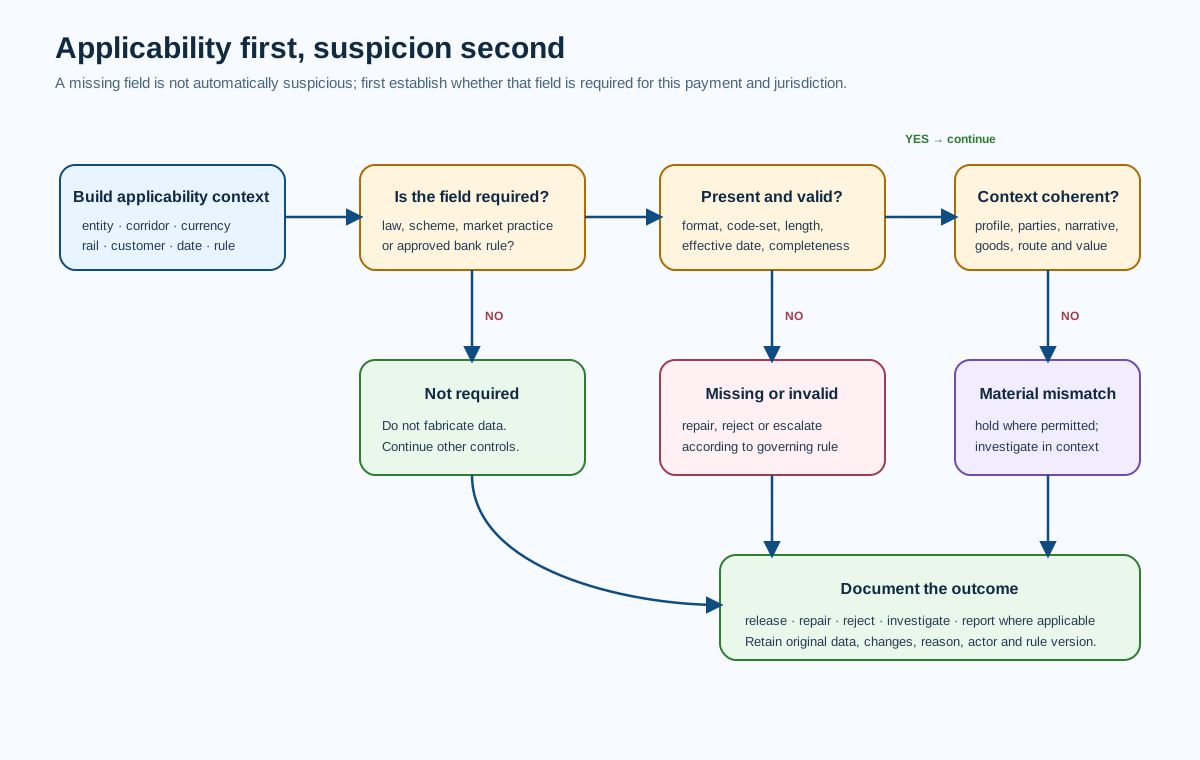
The matrix also needs effective dating. Regulations and code lists change. A transaction initiated on one date and processed on another may need a defined rule about which date controls applicability. Without an effective-date model, historical reprocessing and investigations can produce the wrong answer because the system evaluates an old payment using today's rules.
A good regulatory-data service returns more than yes/no. It should be able to explain which rule fired, which fields are required, which values are permitted, what source supports the rule, what effective period applies and what action is required if data is missing or invalid. That explanation becomes evidence for operations and audit.
A bank should also separate collection from reporting. The payment message may carry regulatory information, while a separate reporting process sends a return to an authority. These are related but not identical obligations. The payment system needs to know whether its responsibility is to carry data, validate it, block processing, create an event for a reporting platform, or all of those things.
Building an end-to-end control architecture
A mature architecture starts at the customer channel. The channel should collect only the data relevant to the payment context and should explain required fields in language the customer can understand. If the bank displays a list of opaque codes with no guidance, customers will choose defaults simply to proceed, and the resulting “structured” data may be less reliable than a well-designed narrative.
Channel validation should distinguish syntax from semantics. Syntax asks whether a field is populated, follows the expected format, length and code set. Semantic validation asks whether the field makes sense in the payment context. A code can be syntactically valid yet inconsistent with the chosen product or jurisdiction. Not every semantic mismatch should block a payment, but it should be visible to the relevant control.
The payment hub should maintain a canonical representation that keeps the four data families separate. It should preserve the raw customer value alongside normalized or enriched forms. When a code is mapped, the source code, target code, mapping version and timestamp should be retained. When a narrative is transliterated or sanitised, the original should remain available for authorised users and investigations.
Screening and monitoring controls should consume the fields deliberately rather than indiscriminately. Sanctions-screening policy may define whether and how remittance information is screened. Transaction monitoring may use purpose as a contextual feature. Regulatory-data validation may run before routing. Each control should know whether it is consuming raw customer data, bank enrichment or downstream-translated data.
External messaging is then generated according to the applicable usage guideline. A field available in the generic ISO 20022 schema may be restricted, mandatory, conditional or unused in a particular market. The bank's message builder must therefore apply the correct market rule, not merely schema validation.
On the receiving side, the bank must be prepared for data supplied by another institution. That data may use an external code set or local practice different from its own customer channels. The receiving bank should avoid rewriting source information merely to fit internal screens. Normalisation can be performed for analytics while retaining the original message and provenance.
Finally, all transformations and decisions need to feed the evidence layer. Investigators should be able to see what the customer submitted, what the bank added, what went into the external message, what was received from the correspondent or clearing system, and what the controls saw at the time of decision.
Data-quality controls that matter
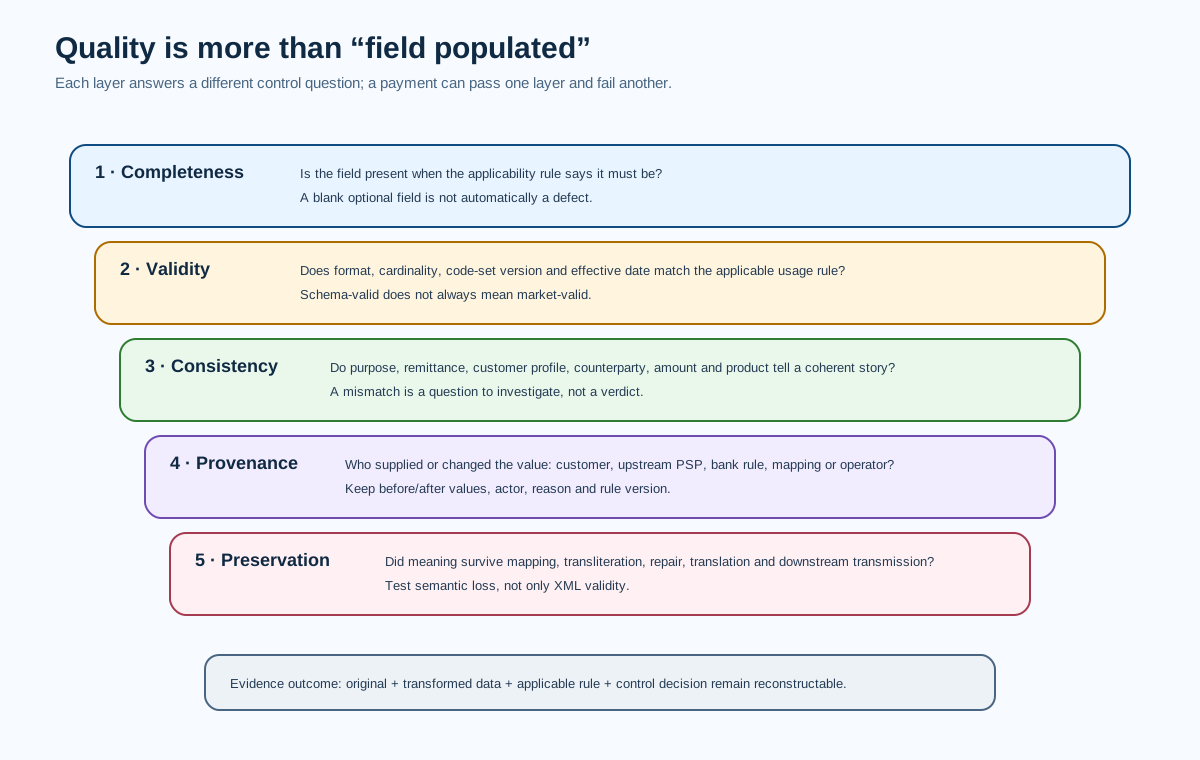
Data quality is not one metric. For this topic, at least five dimensions matter: completeness, validity, consistency, provenance and preservation.
Completeness asks whether information that should be present is present. The phrase “should be” is critical: it must come from the applicability model. A blank optional field is not a data-quality defect simply because the platform supports it.
Validity asks whether a value meets the technical and code-set rules. A regulatory code may have the right format but be expired for the payment date. A purpose code may exist in the ISO external list but be excluded by a particular scheme. Validation therefore needs context.
Consistency asks whether related data tells a coherent story. The declared purpose, remittance, customer profile, beneficiary, goods information and payment amount need not match word-for-word, but material contradictions can deserve review. This is where financial-crime analytics can add value without turning every mismatch into an alert.
Provenance asks where the value came from and who changed it. A customer-supplied narrative, bank-generated categorisation and analyst-entered repair should never become indistinguishable. Provenance is essential when a regulator asks whether the bank knew a fact before or after a payment was released.
Preservation asks whether the meaning survives transformations. A value can be valid at entry and still be damaged by truncation, character conversion, field mapping or message translation. End-to-end testing has to compare source and target meaning, not only verify that the target message is syntactically valid.
Repair, enrichment and the danger of changing the evidence
Payment repair is necessary when required information is missing or malformed. It also creates risk because a person or automated service changes the payment after initiation.
A repair workflow should preserve the before-and-after values, reason, actor, time and authority to make the change. If an operator changes a regulatory code after calling the customer, the case should show that the new value came from customer clarification. If a system maps a local code automatically, the mapping rule should be identifiable. If compliance instructs that a payment cannot proceed until a field is corrected, that decision should be linked to the payment lifecycle.
The dangerous pattern is silent enrichment: the bank inserts a plausible value to make the transaction pass validation without evidence that the value is correct. This can create false regulatory reporting and hide weak customer data. A bank may legitimately derive some fields from authoritative internal data, but the derivation should be governed and labelled as bank-generated.
Repair also affects screening. If a narrative or purpose field changes after an initial sanctions or financial-crime check, the bank needs to know whether the change requires rescreening or re-evaluation. That decision should be rule-based and auditable. Otherwise, an operator may unknowingly release a payment based on a control result that applied to an earlier version of the data.
Monitoring and detection: how to use context without overclaiming
Purpose and remittance data work best as contextual features. They can help explain or prioritise a pattern already visible in parties, value, velocity, geography, customer profile or network relationships.
Useful monitoring questions include whether declared purpose has changed materially from the customer's established activity; whether one purpose is used across many economically different counterparties; whether remittance references repeat across seemingly unrelated beneficiaries; whether narrative and structured purpose consistently conflict; and whether regulatory classifications repeatedly require manual override. None of those should be encoded as “suspicious = true.” They are hypotheses for investigation.
Natural-language processing can help classify large volumes of narrative, but model outputs require governance. A model may be good at grouping invoices and salaries while performing poorly on abbreviations, multilingual text or sector-specific language. The system should retain the original text, model version, confidence and downstream use. Human analysts need to know when a case reason came from a model rather than a deterministic rule.
Keyword controls are particularly prone to false positives. A term can be a person's name, a location, a product brand or a benign abbreviation. Field context and entity resolution matter. If the bank screens narrative for sanctions or other prohibited activity, tuning should be based on documented policy and tested data, not on a growing list of alarming words.
The inverse problem also matters: vague text should not be automatically treated as evidence of concealment. “Invoice,” “services,” “family support” or “loan” can all be legitimate descriptions. The question is whether the description is sufficient for the product and consistent with the wider activity. Where more information is needed, the bank should ask a focused question rather than invent suspicion from brevity alone.
Alert, case and investigation outcomes
When a data issue becomes a financial-crime alert, the case should clearly distinguish data-quality concern from behavioural concern. A missing required regulatory field may be an operational exception with no suspicion. A repeated pattern of misleading purpose codes across high-risk counterparties may be an investigative concern. Combining both into one generic “payment data alert” makes outcomes hard to analyse.
An investigator should reconstruct the source and transformation chain. What did the customer enter? Was the value changed by the channel? Did the hub map it? Did a repair operator alter it? What value was screened? What value reached the correspondent? What regulatory rule was active? Were related payments handled the same way? That chronology often determines whether the issue is customer behaviour, system defect or control failure.
Outcomes can include release, repair, rejection, request for information, escalation to sanctions or AML specialists, customer due-diligence refresh, monitoring tuning, technology defect, policy clarification or suspicious-activity reporting where the applicable legal threshold is met. The decision to file a SAR/STR or equivalent report is governed by local law and should never be inferred solely from a purpose-code mismatch.
Where a bank identifies a systemic mapping defect, the response should go beyond closing individual alerts. It may need a lookback to determine which historical payments were affected, whether required data was lost, whether screening used incomplete information and whether regulatory reporting needs correction. Change governance then needs to prevent recurrence.
Roles and governance
Business teams own the customer proposition and often the quality of data collected at source. They should understand the consequences of poor journey design, including default codes that customers select without reading, free-text prompts that invite meaningless input and product rules that collect unnecessary sensitive information.
Payments product owners and operations teams own much of the execution process. They need clear rules for validation, repair, rejection and escalation. Operations should not be expected to interpret complex jurisdictional obligations from memory; the system and procedures should surface the applicable rule and evidence.
Financial-crime compliance defines how remittance and purpose information contributes to screening, monitoring and investigation. It should challenge both over-control and under-control. Screening every narrative field with maximal fuzziness can be as poor a design as ignoring potentially relevant information altogether.
Legal and regulatory specialists interpret jurisdiction-specific obligations. Their decisions should feed a controlled rule inventory with effective dates and source references. A spreadsheet emailed to operations is not a sustainable global applicability engine.
Data owners define semantics, lineage and quality metrics. Architects and engineers implement the canonical model, mapping, event history and interfaces. Testers prove that the design works across normal, exceptional and historical scenarios. Internal audit and second-line assurance test whether governance is actually operating rather than merely documented.
A useful governance forum reviews recurring data defects by root cause. If most errors come from one channel, the fix is probably not more operations staff. If a large number of customers repeatedly choose the same catch-all purpose code, the customer journey or code list may be the problem. If one correspondent strips structured remittance, the bank needs an interoperability response. Management information should therefore connect defect volumes to causes and remediation owners.
BA, architecture and testing considerations
For a business analyst, the most important requirement is to convert vague statements such as “purpose code mandatory for cross-border” into testable conditions. The requirement should state the governing jurisdiction or scheme, payment types in scope, legal entities, currencies or corridors, customer segments, field semantics, code source, effective date, validation behaviour, repair permissions, downstream mapping and evidence to retain.
Architects should avoid a single generic field for all purpose-like information. A canonical model should hold the ISO 20022 semantic element, source system, source value, normalized value, code-set/version, provenance, confidence where derived, effective rule and transformation history. That may appear more complex than a flat schema, but it prevents ambiguity later.
Interface contracts should define what happens when the target cannot carry the source value. Silent truncation is unacceptable for risk-relevant data. The interface may need to reject, route to repair, store the full value externally with an allowed reference mechanism, or apply an approved mapping. The correct choice depends on market rules and security requirements.
Testing should include more than positive examples. Boundary cases should include a field that becomes mandatory on an effective date, an old code used after expiry, a code valid globally but excluded by a scheme, multilingual remittance, a narrative longer than a legacy target permits, structured remittance with multiple references, purpose inconsistent with customer profile, category purpose accidentally mapped into transaction purpose, a repair that changes a screened field, and a downstream translation that loses data.
Regression testing should use golden-message comparisons. For selected transactions, teams should compare the source instruction, internal canonical record, outgoing ISO 20022 message, control payload, archived evidence and downstream reporting. The objective is to prove semantic preservation, not merely XML validity.
Operational testing should simulate service failure. If the regulatory-rule service is unavailable, does the bank fail safe, queue the transaction, apply a controlled cached rule set or allow processing? The answer depends on the obligation and risk appetite, but it must be designed in advance. A generic “continue on error” pattern is not acceptable where the missing service determines whether legally required data is present.
Mini case: when three valid-looking fields tell different stories
A fictional manufacturing company, Northstar Components Ltd, normally pays suppliers in Europe for electronic parts. It initiates a USD 480,000 cross-border payment to Meridian Trade Services, a new beneficiary in another region. The payment contains an invoice reference in structured remittance, a transaction purpose corresponding broadly to business services, and regulatory data that satisfies the sending jurisdiction's required format. All three fields are syntactically valid.
The payment is not stopped because a keyword is “bad.” Instead, a contextual monitoring rule notes several changes together: the beneficiary is new, the amount is larger than the customer's typical payments, the remittance reference follows the pattern used for physical-goods invoices, and the declared purpose differs from the customer's usual goods-related activity. The case receives moderate priority rather than an automatic suspicious verdict.
The investigator reviews the original channel payload and confirms that the customer supplied both the invoice reference and the purpose value. The bank did not derive them. The regulatory code was added by a rules service based on jurisdiction and transaction type; it therefore says nothing about whether the customer's stated economic purpose is truthful.
A customer query produces the purchase contract. Meridian is acting as a procurement broker for specialised machinery, and the invoice references a legitimate supplier arrangement. The purpose code was selected incorrectly by the customer's treasury operator because the channel description for two adjacent codes was unclear. Independent company information and historical account activity support the explanation. There is no separate sanctions issue and no other suspicious pattern.
The payment is released after the required operational and compliance checks. The case is closed as a data-quality/customer-journey issue, not suspicious activity. The bank changes the channel wording, updates the customer's payment template and creates a product backlog item to prevent the same ambiguous code selection. The investigation therefore improves the control without creating an unsupported allegation.
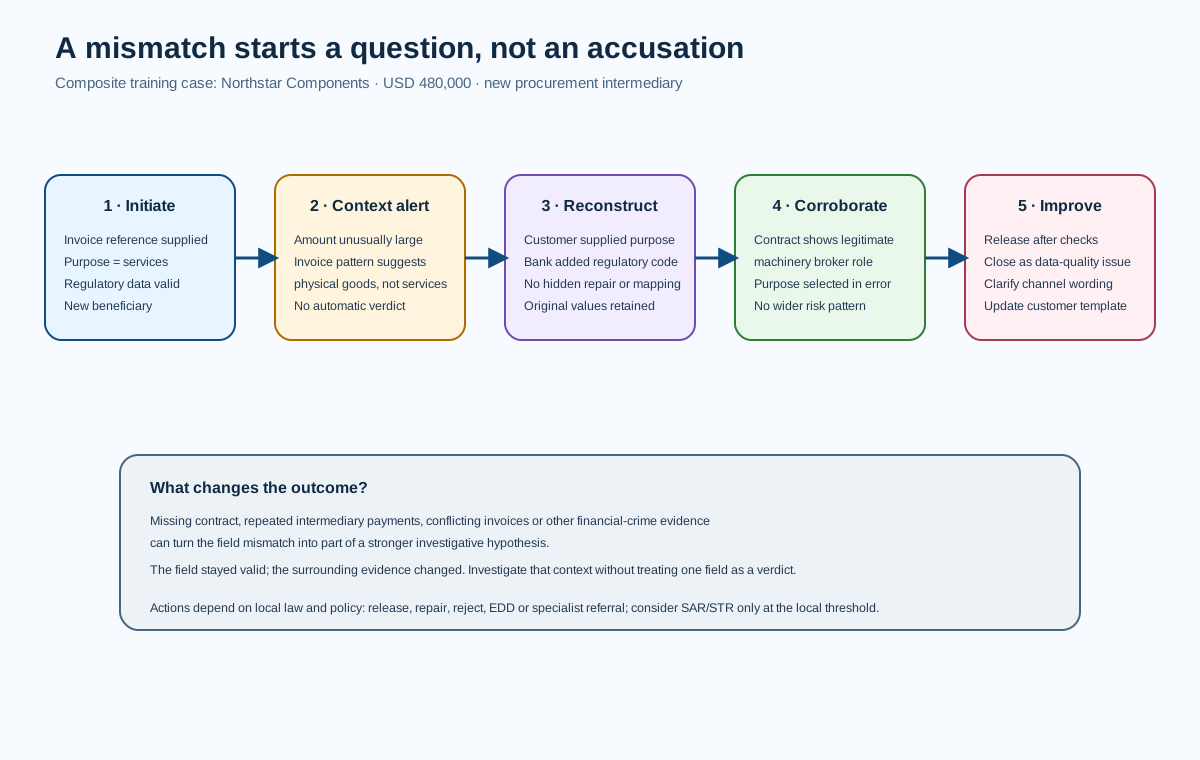
Now change one fact. Suppose the contract cannot be produced, Meridian has no evident connection to machinery procurement, the customer has made six similar payments through different intermediaries, and the remittance references map to invoices containing inconsistent goods descriptions. The same initial data mismatch now sits within a materially different evidence set. The case may require enhanced review, sanctions or trade-finance expertise, customer-risk reassessment and potentially suspicious-activity reporting under the applicable jurisdiction. The field did not become more suspicious; the evidence around it changed.
That distinction is the core lesson of this chapter. Remittance, purpose and regulatory data are useful because they add meaning to the payment. Their value depends on correct semantics, provenance, jurisdiction-aware rules and disciplined investigation. Structured data improves the bank's ability to reason, but it does not replace judgement.
Practical takeaways
A strong bank can answer five questions for any risk-relevant payment-data element: what does this field mean, who supplied it, which rule made it relevant, how did it change on the journey, and what did the control or analyst do with it? If any of those answers depends on guesswork, the architecture is incomplete.
The biggest design error is semantic collapse. Remittance, Purpose, Category Purpose and Regulatory Reporting may all appear near one another in a payment model, but they answer different questions. The biggest governance error is treating an implementation rule as a universal law. The biggest investigative error is treating a mismatch as a verdict. The biggest technical error is losing source data during transformation.
The objective is not to force every payment to carry more fields. It is to carry the right data for the right payment, preserve it accurately, use it proportionately, and retain enough evidence to explain the bank's decision later.
Deep dive: making payment context trustworthy across real bank systems
The base chapter separated remittance information, transaction Purpose, Category Purpose and Regulatory Reporting. This deep dive follows those data elements through the messy parts of a bank: corporate channels, mapping layers, code sets, screening engines, reporting rules, correspondent chains, repairs, analytics and investigations. The aim is not to memorise XML paths. It is to understand what has to remain true when the same economic payment is represented differently by several systems.
Start with semantic ownership, not XML
A recurring delivery mistake is to begin with the target ISO 20022 message and ask, “Which source field can populate this element?” That can lead to technically valid but semantically wrong mappings. The safer sequence is to define the business meaning first, identify the authoritative source, decide when the value is applicable, and only then map it to the message element required by the target market practice.
For remittance information, the authoritative source is often the initiating customer or an upstream business application acting on the customer's behalf. A corporate may produce an invoice reference in an ERP system, send it through host-to-host connectivity, and expect it to reach the beneficiary unchanged enough for reconciliation. If the bank transforms that invoice reference into a generic narrative, the payment may still settle but the customer outcome has degraded. If an investigation later tries to match the payment to an invoice, the lost structure becomes a control problem as well as a service problem.
For Purpose, the source can vary. A retail user may select a code in a mobile channel. A corporate API may provide an external purpose code directly. A bank might derive a purpose category for internal analytics. Those are not equivalent. The data model should carry provenance such as customer supplied, upstream PSP supplied, bank derived, mapped from local code, or analyst repaired. The labels do not need to be visible in the ISO 20022 message, but they need to be available internally.
For Category Purpose, the owner may be the product or payment service because the value can affect the type or processing of the payment. A service rule should not be mistaken for the customer's declared economic reason. If a payroll service populates a category used for salary processing, that classification may be reliable as a product fact even if the free-text remittance is vague. Conversely, it should not automatically be reused as a transaction-purpose declaration in a jurisdiction that expects a different code set.
For Regulatory Reporting, the owner is usually a rules framework informed by legal, regulatory or market-practice interpretation. The customer may supply some underlying facts, but the bank needs to know why the data is required and which authority or rule it serves. That is why regulatory data should be connected to a rule identifier and effective date rather than represented as unexplained text.
The applicability matrix is a product in its own right
A global payment platform often has hundreds of combinations of legal entity, customer location, account location, currency, payment rail and destination. Regulatory reporting requirements can vary across those combinations. Hard-coding conditions inside channel screens or message-builder code creates a maintenance problem because the same rule gets duplicated in several places.
A better model is a centrally governed applicability service or rules component. It receives the payment context and returns a decision. The context may include sending bank entity, booking entity, debtor and creditor residence where known, account jurisdictions, currency, amount, product, rail, direction, customer type, purpose category and execution date. The output can identify required data elements, allowed code values, validation severity, customer prompt, downstream message mapping and exception action.
The exact dimensions must come from the rule. There is no benefit in adding every possible attribute to every decision. What matters is that the rule can be explained. If operations receive an error saying regulatory data missing, they should be able to see that the payment is in scope because of a specific combination such as legal entity, currency, destination and amount, and that the rule is effective from a defined date.
Versioning is essential. Consider a requirement that changes on 1 January. A payment created on 31 December, approved on 2 January and settled on 3 January forces the bank to decide which event date determines applicability. The answer may differ by rule. The system should not infer one global principle. Instead, the rule definition should state which timestamp or business date governs it. Historical lookbacks should evaluate the rule that was in force at the relevant time, not today's configuration.
Rule deployment also needs four-eyes governance where appropriate. A change to a regulatory code set can reject thousands of valid payments or allow invalid ones. The change process should include source evidence, legal or policy approval, implementation, test cases, effective date and rollback planning. Emergency regulatory changes need the same evidence even if the release path is accelerated.
Code sets: small lists with large consequences
Structured codes are attractive because they appear deterministic. Yet code sets introduce their own lifecycle. A value can be added, deprecated, renamed or restricted by a market practice. A local jurisdiction can publish its own list. A bank may need to map local values to internal canonical categories for analytics without changing what is transmitted externally.
The data model should therefore avoid storing only the code. It should know the code-set identifier and version or effective period. SALA without the context of which list and usage rule is incomplete evidence. The user interface should also display understandable descriptions while transmitting the approved code. If the description changes, historical records should still show what the user saw when selecting the value where that matters to evidence.
Default values are dangerous. A customer journey that preselects the first purpose code can generate high apparent data completeness and low actual information quality. The bank may then build monitoring models on a field that reflects user-interface design rather than customer behaviour. Product analytics should check concentration by channel and customer segment. If one generic code dominates unexpectedly, the right response may be to redesign the journey, not to tune monitoring around the noise.
Mapping tables deserve the same governance as rules. Suppose a legacy channel sends local code 05, the canonical model maps it to SERV, and the outgoing market practice expects another external code. Each mapping should have a documented semantic basis. A many-to-one mapping can legitimately lose granularity; if it does, the original source value should remain available. A one-to-many mapping should not be guessed without additional context.
Remittance information and invoice context
Structured remittance can create a strong bridge between payments and commercial documents. Creditor references, invoice identifiers and related remittance elements can enable automated accounts-receivable matching. For financial-crime investigations, that same structure can help a reviewer test whether payment activity corresponds to the claimed business.
The bank should still be careful about evidential assumptions. An invoice reference proves that a reference was supplied; it does not prove that the invoice exists or is genuine. A customer can reuse references, make typographical errors or send a reference belonging to another entity. If the risk context justifies investigation, the analyst may need to obtain or validate the underlying document rather than treating the structured field as independent corroboration.
Invoice data also creates privacy and commercial-confidentiality questions. The richer the remittance content, the more likely it is to contain names, account references, medical or legal descriptions, employee identifiers or sensitive commercial terms. The bank should apply data-minimisation, access-control and retention principles appropriate to its legal environment. “ISO 20022 can carry it” is not the same as “every system and user should see it.”
A practical architecture can separate operational display from investigation retrieval. Customer-service users might see the information needed to answer payment queries, while financial-crime investigators can retrieve the full original message under role-based controls. Data warehouses can mask unnecessary personal text while retaining fields required for approved analytics. Those decisions should be documented in the data catalogue.
Unstructured remittance: useful, noisy and easy to damage
Free text remains common because businesses need flexibility. The bank should assume that it will contain abbreviations, multilingual text, internal shorthand and punctuation. Screening, search and analytics tools need to be designed accordingly.
Character conversion can alter meaning. Accents may be removed, non-Latin text transliterated, unsupported symbols stripped, or repeated spaces normalised. A legacy interface may enforce a shorter field length than the source. If transformations are necessary, the bank should preserve the original and log the transformation. This allows investigators to distinguish what the customer wrote from what a screening engine saw.
Truncation is particularly important. Imagine that a 140-character legacy target receives a longer structured or unstructured narrative. If the first 140 characters are retained and the rest discarded, a beneficiary reference or relevant party name may vanish. The target message could remain syntactically valid while the economic context is incomplete. End-to-end test cases should deliberately place meaningful data near field boundaries to detect this problem.
The 2026 CPMI harmonisation work is useful here because it promotes consistent treatment of ISO 20022 data across cross-border payments. Its technical annex distinguishes unstructured and structured remittance and is designed to reduce interoperability gaps. But the harmonisation requirements remain guidance; a bank still needs to implement the market practices and legal requirements that actually govern its payment flows.
Translation risk after the end of CBPR+ coexistence
The end of Swift's MT/ISO 20022 coexistence for cross-border payment instructions on 22 November 2025 reduced one major source of data loss, but it did not eliminate translation risk inside banks. Many institutions still have legacy applications, local formats, data warehouses and downstream controls built around older field structures. Some traffic may also use contingency or translation services during the transition away from legacy processing.
A bank can therefore be ISO 20022-compliant at its network edge while losing semantics internally. An API may accept structured remittance, convert it into a flat legacy record, then reconstruct an ISO 20022 message later. The outgoing XML may look rich but contain data reconstructed from a poorer internal representation. The architecture team needs to inspect the full path rather than the network adapter alone.
A useful control is a semantic-loss register. For each interface, document which source elements have no exact target equivalent, which are truncated, which are concatenated, which are derived, and which are omitted by design. Rate each limitation by operational and compliance impact. This creates a visible migration backlog and allows compliance teams to decide whether compensating controls are needed.
Purpose mismatches as contextual indicators
A purpose mismatch can be generated in many benign ways. The customer can choose the wrong code. A recurring payment template can retain an old value. A local-to-global mapping can be coarse. A product can populate a default. A corporate can use one payment to settle multiple commercial obligations that do not fit neatly into one code.
Because of those causes, a purpose mismatch works better as an investigative feature than as a standalone suspicion rule. The control can score the mismatch alongside customer risk, counterparty novelty, geography, transaction size, velocity, product, account age and documentary context. The combination may justify review even though no single element would.
The monitoring model should also distinguish rare from persistent mismatch. One incorrect code followed by normal activity suggests a different hypothesis from systematic use of benign codes across many payments to counterparties inconsistent with the customer's business. Investigators should be able to see historical distribution of purpose values for the customer and peer group without being told that peer deviation is inherently suspicious.
False positives can also arise when a bank compares different semantic layers. If internal analytics compares Category Purpose to transaction Purpose and flags disagreement, it may simply be measuring two fields that were never expected to match. Data dictionaries and lineage are therefore part of model risk management.
Regulatory reporting is not the same as suspicious-activity reporting
The phrase “regulatory reporting” can cause confusion because financial-crime teams also file suspicious-activity reports. In the ISO 20022 payment context, RgltryRptg is a message data component that can carry information required for regulatory reporting according to the relevant payment context. It is not the same thing as a SAR, STR or equivalent financial-intelligence report.
A payment might contain regulatory reporting data and never generate a financial-crime case. Conversely, a payment with no applicable RgltryRptg requirement can still be suspicious. Systems, procedures and training should keep those concepts separate.
Where a jurisdiction uses payment data to support foreign-exchange controls, balance-of-payments reporting, tax or other official requirements, the bank should document which process owns each obligation. The payment message may be the transport mechanism for some information; a separate regulatory-reporting platform may generate an authority return. Reconciliation between the payment population and reporting population can be a key control.
A useful reconciliation asks: for every payment that the applicability engine marked reportable, did the required data reach the outgoing message and, where necessary, the separate reporting process? Conversely, were payments reported that were not actually in scope? Both under-reporting and over-reporting can indicate rule or data defects.
Screening design: field-aware, provenance-aware
Sanctions screening often raises the question of whether remittance information should be screened. The answer depends on the bank's policy, sanctions regimes, product, field semantics and screening architecture. It is not useful to proclaim one universal rule.
A field-aware engine knows that a debtor name is different from a narrative string. It can apply different matching logic and alert thresholds. A person name in a party element can be compared with aliases and identifiers; the same sequence of characters in an invoice description may need more contextual handling. Treating every field identically creates noise.
Provenance adds another dimension. Customer-supplied narrative may be more relevant to certain evasion patterns than a bank-generated standard phrase. A repair operator's text can be screened after the change if policy requires it. A code description automatically rendered by the UI should not be mistaken for customer language.
When a hit occurs, the case should retain both the screened representation and the original source. An investigator may need to understand whether transliteration or truncation created the match. Tuning decisions should be based on field-specific false-positive analysis, not aggregate alert volumes alone.
Monitoring design: features with explainable meaning
Transaction-monitoring teams can derive useful features from purpose and remittance data, but each feature needs a business meaning. Examples include new purpose category for customer, purpose frequency concentration, purpose-counterparty inconsistency, repeated remittance reference across beneficiaries, rapid change in narrative pattern, or manual regulatory-code override rate.
Before deployment, the team should ask whether the feature measures customer behaviour or bank processing. A high override rate may indicate suspicious customer data, but it may also indicate that the channel is not collecting the field correctly. If the bank cannot separate those causes, the model can escalate internal defects as customer risk.
Model validation should test language and segment bias. Narrative classifiers trained on English corporate payments may perform poorly on retail remittances, multilingual data or short abbreviations. If a model assigns risk based on narrative, validation should examine error rates by relevant segments and ensure human reviewers understand the limitations.
Explainability matters operationally. An alert reason saying “purpose anomaly score 0.87” is less useful than showing that the customer historically used goods-related purposes, this payment used a services purpose, the beneficiary is new, and the invoice reference format changed. The analyst can then test a real hypothesis.
Investigation chronology and evidence
When purpose or remittance becomes relevant to an investigation, chronology is often decisive. The case should reconstruct at least the following events where available: customer creation or submission, channel validation, bank enrichment, payment-hub transformation, sanctions or AML screening, any repair, external message creation, status response, settlement, post-event monitoring and customer or correspondent queries.
Each event should identify the data version. A case that displays only the latest repaired value can misrepresent what the bank knew at the time of an earlier decision. Event-sourced or versioned payment records are therefore highly valuable for financial-crime evidence.
Suppose a payment originally contained the narrative “equipment spares,” was screened and held, then an operator changed the narrative to “invoice 9921” after receiving customer clarification. If the final record shows only “invoice 9921,” a reviewer cannot tell why the original control fired. The correct evidence package shows both versions, the reason for the change, who authorised it and whether the payment was rescreened.
The same principle applies to regulatory data. If a code was added after a repair, the case should not imply that it accompanied the original instruction. Regulators and auditors often care about timing because it distinguishes preventive control from post-event remediation.
Repair and override controls
Repair access should be role-based. Not every operations user should be able to modify every risk-relevant field. Some values may be customer-correctable; others may require evidence or specialist approval. The permission model should reflect the potential consequence of the change.
Overrides need reason codes that are meaningful enough for analysis. OTHER should not become the dominant category. Free-text rationale can supplement, but not replace, structured reasons. Management information should show override rate, user, field, corridor, customer segment and outcome so control owners can identify patterns.
Four-eyes approval may be justified for high-impact changes, such as changing a regulatory classification on a high-value payment after an exception or changing a field that affected a sanctions disposition. The requirement should come from policy and risk, not be applied mechanically to every low-risk correction.
Automated enrichment should be governed similarly. A rules engine can be more consistent than a person, but an incorrect mapping can affect every payment. The bank should test changes with representative historical data and monitor post-release exception rates.
Customer experience and proportionality
Data requirements affect customers. Asking for a complex regulatory code on every payment creates friction, encourages random selections and increases support calls. A better journey applies rules dynamically and asks only for data that is actually relevant.
Where the bank already knows an authoritative fact, it may be appropriate to derive it rather than ask the customer again. For example, residence or account attributes may be sourced from customer master data if the governing rule permits that approach. The UI should distinguish customer declarations from bank-known information, and the audit trail should show the source.
Error messages matter. “Invalid regulatory information” is not actionable. A good message explains what information is needed without exposing sensitive screening logic. For corporate APIs, machine-readable error codes should be stable and accompanied by clear developer documentation.
Customer-support teams should be able to explain why information is required at a practical level, but they should not improvise legal interpretations. Procedures and knowledge articles need to align with the same applicability rule set used by the platform.
Data minimisation and access
Richer payment data can create a temptation to retain everything everywhere. That is poor architecture. Financial-crime usefulness does not remove privacy, secrecy and data-protection obligations.
The bank should map which systems need full narrative or structured remittance, which can operate on derived attributes, and which should receive masked or minimised data. A transaction-monitoring feature store might need a purpose category and anomaly features but not the full invoice text. A case investigator may need controlled access to the original message when reviewing a material alert.
Retention periods should be governed according to applicable law and bank policy. Payment evidence may need to be retained for regulatory, AML, dispute or audit purposes, but one universal retention period should not be invented without jurisdictional analysis. The data catalogue should identify the record class and approved retention basis.
Testing the rule engine
A robust test pack for regulatory applicability should be table-driven. Each case specifies inputs, expected applicable rule, required fields, allowed codes and expected action. Boundary values are particularly important: amount exactly at a threshold, one unit below and above; payment just before and after an effective time; resident versus non-resident; domestic versus cross-border; customer versus financial-institution transfer.
Negative tests should prove that the bank does not demand data when the rule is out of scope. Over-collection is a defect because it creates customer friction and can contaminate reporting.
Historical regression tests should replay payments from before a rule change using the historical rule version. This proves that the platform can reconstruct past decisions. If the architecture always evaluates the newest rule, historical audits will be unreliable.
The rule service should also be tested for failure. If it times out, does the channel stop initiation, use a controlled cache, route to manual review or proceed? The fallback must be explicitly approved because the service may determine whether the bank has information required before processing.
Testing mapping and semantic preservation
Schema validation only proves that XML is well formed and conforms to a schema. It does not prove that the right source value populated the right element.
Mapping tests should therefore trace individual values end-to-end. Start with a known customer instruction containing structured remittance, transaction Purpose, Category Purpose and regulatory data. Capture the canonical record. Generate the outgoing message. Capture the screening payload. Receive the downstream acknowledgement or report. Compare each representation against expected semantics.
Use values that expose mapping errors. Make Purpose and Category Purpose deliberately different so accidental substitution is visible. Use a long remittance string with a meaningful reference near the end. Use non-Latin characters if the supported channel permits them. Use a code that is valid in one code-set version and invalid in another. Use multiple regulatory reporting entries where the market practice allows them.
Mutation testing can be powerful: intentionally drop or alter one field in an interface and confirm that the monitoring or data-quality control detects it. This proves that the control can identify real defects rather than simply reporting green status in a healthy environment.
Testing financial-crime controls
For screening, construct cases that demonstrate field-aware behaviour. A listed-party name in a party field should follow the bank's expected matching workflow. The same token inside an invoice reference should not automatically behave identically unless policy says it should. Verify that analysts can see the source field and original value.
For transaction monitoring, test both true risk patterns and benign mismatches. A new purpose code for a customer changing business model can be legitimate. A repeated benign code across complex, inconsistent intermediary payments may warrant review. The test objective is not to force one outcome; it is to verify that the model supplies enough context for a reasonable decision and that the decision remains explainable.
For case management, verify version history. The analyst should be able to see data before and after repair. Attachments and customer responses should link to the payment without overwriting source values. Escalation to sanctions, trade-finance or AML specialists should preserve the same evidence chain.
Quality assurance and management information
Quality assurance should sample both decisions and data lineage. A case can have a correct final decision but weak evidence. Conversely, a system can preserve excellent lineage while analysts apply inconsistent judgement. Both dimensions matter.
Useful QA questions include: Did the reviewer distinguish source data from bank enrichment? Did they cite the applicable rule when treating a field as mandatory? Did they avoid assuming that a purpose mismatch alone was suspicious? Was the repair justified and rescreened where required? Did the case conclusion reflect the complete customer and transaction context?
Management information should not celebrate completeness without measuring usefulness. A dashboard showing 99% purpose-code population may hide the fact that 80% of customers select one default. More informative metrics include unknown/default-code concentration, override rate, repair rate, truncation incidents, mapping exceptions, repeated mismatches, source-system defect rate and time to remediate systemic issues.
MI should be segmented enough to find root causes. A problem may be isolated to one channel, correspondent, country corridor or version of a mapping service. Aggregate global figures can hide it.
A worked example: the payment that looked like a sanctions problem but was a mapping defect
A fictional bank receives a corporate payment instruction through a legacy host-to-host file. The corporate supplies a local purpose code meaning “purchase of machinery” and a remittance reference containing an invoice number. The bank's old channel maps the local purpose into a generic internal field.
A new payment hub release introduces separate canonical fields for Purpose and Category Purpose. During migration, the legacy mapping mistakenly sends the local transaction-purpose code into Category Purpose. The outgoing ISO 20022 message also carries a default transaction Purpose used by the product for testing. Both codes are technically valid.
The sanctions and AML controls see a high-value payment to a new intermediary. The narrative mentions industrial equipment. The default Purpose appears inconsistent with the customer's business, and a rule creates an alert. An inexperienced analyst might conclude that the customer intentionally supplied misleading purpose information.
A mature investigation checks provenance. It finds that the customer never supplied the default value. The canonical data lineage shows that the payment hub generated it and that the original local code was mapped to the wrong semantic field. Other customers using the same legacy channel show the same pattern.
The bank closes the customer-specific suspicion hypothesis, raises a severity-rated technology defect, identifies all payments processed since the mapping release, and evaluates whether affected payments require rescreening, regulatory-data correction or customer communication. It corrects the mapping, adds a regression test where Purpose and Category Purpose intentionally differ, and monitors the defect population until remediation is complete.
This example shows why data lineage is a financial-crime control. Without it, a bank can misattribute its own system defect to customer behaviour and miss the actual control weakness.
A second worked example: apparently valid codes masking inconsistent behaviour
Now consider a different fictional customer, a small electronics wholesaler. For months it sends modest payments to known suppliers with specific invoice references and goods-related purposes. Over two weeks it sends eight much larger transfers to newly incorporated consulting companies in three jurisdictions. Every payment uses a valid professional-services purpose code and simple remittance such as “advisory fee.”
There is no syntax error, missing regulatory field or sanctions hit. Yet the combination of value, beneficiary novelty, business mismatch and repeated generic purpose is inconsistent with the customer's profile. The monitoring case therefore asks for commercial rationale and supporting documents.
The customer provides nearly identical consultancy agreements with inconsistent dates and no clear deliverables. Public information shows the beneficiaries have minimal operating presence. Funds are rapidly onward-transferred after receipt according to information available through the bank's network or subsequent investigation. The purpose code remains technically valid, but it is no longer persuasive evidence of legitimacy.
Depending on the jurisdiction, evidence and bank policy, the case may lead to enhanced customer review, payment restrictions, suspicious-activity reporting or other actions. The important point is that the bank reached that conclusion through the total evidence, not because a particular code was labelled “bad.”
Architecture blueprint for implementation
A bank designing this capability can think in seven components. The source layer captures customer and upstream data. The canonical payment model preserves distinct semantics. The applicability service determines which regulatory or market requirements apply. The validation service checks syntax, code-set version and required combinations. The financial-crime controls use selected fields for screening, monitoring and investigation. The message adapter applies the correct market usage guideline. The evidence store preserves raw, transformed and decided states.
Those components can be implemented as microservices, shared libraries or functions within a payment hub. The technology pattern matters less than the contractual boundaries. Every component should have a documented input, output, version, owner, error behaviour and audit event.
An event bus can help distribute data changes, but events should identify the payment version and event type. A generic paymentUpdated event without field-level context can cause downstream controls to process stale or ambiguous data. Where risk-relevant fields change, the event should allow subscribers to decide whether re-evaluation is required.
The evidence store should be tamper-resistant in the practical governance sense: authorised corrections should create new versions rather than silently alter historical records. Access should be logged. The system should support reconstruction without giving every analyst unrestricted access to all raw customer data.
What to put in a BA requirement
A strong requirement for remittance or purpose data includes the semantic definition, source, allowed formats, applicability rule, code set and version, market usage guideline, transformation rule, validation action, repair permission, downstream consumers, audit evidence and test examples.
For example, instead of writing “Purpose mandatory for international payments,” a requirement might state that for a named product and corridor, where a specific local rule or scheme usage guideline applies from a defined effective date, the channel must collect one value from an approved code set; the bank must preserve the customer-selected source value; the hub must map it to the target semantic element; invalid values must produce a specified error; manual overrides require a documented reason; and the original and final values must be available to investigations.
That level of precision makes development and testing possible. It also prevents teams from accidentally globalising a local requirement.
What to put in an architecture decision record
An architecture decision record should explain why the canonical model separates Purpose, Category Purpose and regulatory reporting, how provenance is represented, how legacy mappings are handled, which system is authoritative for applicability, and what happens when a target interface cannot carry the source value.
It should document trade-offs. Preserving every raw payload indefinitely may be unnecessary or legally problematic; storing only normalized values may be insufficient for evidence. The chosen design should balance auditability, privacy, performance and operational need within applicable law.
What to put in a test strategy
The test strategy should cover unit validation, mapping, scheme conformance, cross-system integration, end-to-end semantic preservation, financial-crime control behaviour, repair/rescreen scenarios, historical rule versions, negative applicability, failure modes, performance and mobile/customer-channel usability.
Performance testing matters because complex applicability logic runs in the payment path. A rule service that adds unacceptable latency can cause timeouts or bypass pressure. Cache design, resilience and observability should be tested under expected peaks and controlled failure.
Observability should expose rule-service errors, mapping failures, rejected codes and truncation events without logging excessive sensitive payment data. Technical telemetry and customer payment evidence have different purposes and access requirements.
Closing mental model
When working with remittance, purpose and regulatory data, ask three layers of questions in order.
First, semantics: what does this data mean, and who supplied it? Second, applicability: why is it required or useful for this payment, under which rule or market practice and on which date? Third, control use: how is it validated, preserved, screened, monitored, investigated and evidenced?
Most serious delivery failures occur when a team jumps directly to the third question. It builds a control around a field whose meaning or legal applicability was never made precise. A well-designed bank starts with semantics and rule scope, then builds the technology and financial-crime control around that foundation.
Advanced practice: control design, acceptance criteria and investigation discipline
The chapter becomes operational only when teams can convert the semantics into deterministic delivery decisions. This advanced section turns the concepts into a practical control framework for a bank payment platform.
Control objective and control boundaries
A useful control objective is: for every payment in scope, collect, preserve and transmit the remittance, purpose and regulatory data required by the applicable rule or market practice; keep the meaning and provenance of each field distinct; and route material gaps or inconsistencies to an evidenced outcome without inventing customer information.
That objective deliberately avoids saying that every payment must contain every field. It also avoids making financial-crime suspicion the default outcome for a data defect. The control has three boundaries: determine applicability, validate/preserve data, and use material inconsistencies as context for investigation where appropriate.
A control inventory should distinguish preventive and detective controls. Preventive controls include dynamic mandatory-field rules, code-set validation, market-message validation, repair permissions and rescreen triggers. Detective controls include post-event data-quality reconciliation, mapping-loss detection, override monitoring, purpose-profile analytics and quality-assurance sampling.
The two types reinforce each other. Preventive controls stop known invalid states. Detective controls identify issues that deterministic validation cannot see, such as a valid purpose code that is repeatedly inconsistent with customer behaviour or a mapping defect that produces syntactically valid messages.
Acceptance criteria for an applicability service
The applicability service should return a reproducible answer. For the same payment context and the same rule version, it should produce the same result. The output should identify the rule ID, version/effective date, fields required, validation severity, permitted values or code set, and expected exception behaviour.
A business acceptance test should prove at least these behaviours:
- A payment in scope receives the required-field rules and code set expected for its entity, corridor, currency, product and effective date.
- A payment outside scope is not forced to provide the data merely because the field exists in ISO 20022.
- Boundary amounts and effective dates behave according to the rule definition.
- Historical replay uses the historical rule version where required for reconstruction.
- Service failure follows an approved fallback rather than silently treating required fields as optional.
- The decision can be reconstructed from retained inputs and rule metadata.
The fallback deserves special attention. If a cached rule set is allowed, teams need to define maximum age, invalidation and what happens when a regulatory change is effective immediately. If the payment must queue, operations need visibility and customer messaging. If the product rejects the transaction, the error must be specific enough to support repair without exposing internal risk logic.
Acceptance criteria for the canonical data model
The canonical record should not expose one generic purpose attribute. At minimum, it should represent remittance, transaction Purpose, Category Purpose and regulatory reporting separately, with enough metadata to preserve source and transformation.
For each externally supplied risk-relevant value, the platform should retain the original value or an immutable link to the raw instruction. For mapped codes, it should retain source code, target code and mapping version. For derived values, it should identify the derivation source. For manual changes, it should retain old value, new value, actor, reason and timestamp.
A useful test deliberately supplies conflicting but valid values. Purp may say one legitimate thing while CtgyPurp reflects a service category. If the canonical model stores only one value after processing, the test fails even though the outgoing message might pass schema validation.
Acceptance criteria for message construction
The message adapter should validate against the correct market usage guideline, not merely the generic ISO 20022 XSD. It should apply the message version configured for the rail and execution date. If a source element is unsupported by the target, the adapter must follow a documented treatment rather than silently discard it.
For cross-border ISO 20022 payment instructions, regression tests should compare the source semantic value with the outgoing representation. The same test should be run after library upgrades, code-set updates and market-release changes because a technically correct schema upgrade can change permitted cardinality or validation rules.
The bank should maintain golden examples for important flows. A golden example is not only XML. It includes source instruction, canonical object, rule decision, outgoing message, screening/monitoring payload and expected archive record. That allows engineers and compliance teams to see whether an apparently small mapping change altered control meaning.
Acceptance criteria for repairs
Repair should be treated as a new payment-data version. If a risk-relevant field changes, the platform should evaluate whether dependent validations or controls must run again. The dependency can be explicit: changing debtor or creditor data may trigger party screening; changing remittance may trigger narrative screening under the bank's policy; changing regulatory data may re-run applicability and reporting validation.
The repair UI should display the original value and identify whether the field was customer supplied, bank derived or previously repaired. Permissions should prevent users from changing values outside their role. Where an operator needs information from the customer, the evidence of that clarification should be linked to the repair.
A negative test should attempt to overwrite the original value without creating history. The action should be blocked or versioned. Another test should change a screened field and verify that the prior green screening result is not incorrectly reused.
Control analytics without creating false suspicion
Purpose and narrative analytics need an explicit hypothesis. An alert should say what changed or conflicted. Examples are “new declared purpose inconsistent with established corporate activity” or “same invoice reference observed across unrelated beneficiaries.” An alert should not simply say “bad purpose.”
Features should be labelled by provenance. A customer-selected purpose can support a different hypothesis from a bank-derived purpose. A code generated by an applicability service should never be presented to an investigator as proof of what the customer claimed.
Thresholds and scores should be calibrated with known legitimate behaviour. A multinational customer can have a much wider range of purposes than a small local retailer. Peer grouping can help, but it should not replace understanding of the customer's own expected activity.
Case-review checklist
When a payment-data mismatch enters a case, the investigator should reconstruct the following sequence:
- the original customer or upstream instruction;
- the exact values and semantic fields supplied;
- any mapping, normalisation or enrichment performed by the bank;
- the applicability rule and code-set version in force;
- what values screening and monitoring actually consumed;
- repairs, overrides or customer clarifications;
- related payments and customer-profile context;
- evidence supporting or contradicting the stated commercial rationale; and
- the final decision, including whether the issue was customer behaviour, a system defect, an operational error or an unresolved financial-crime concern.
This checklist prevents a common analytical error: treating the final payment record as if it were the original instruction.
Decision quality and escalation
A data mismatch can end in several legitimate outcomes. It can be corrected as an operational defect, released after customer clarification, rejected because a mandatory requirement cannot be satisfied, escalated to a product or data owner, or investigated further because the wider evidence indicates potential financial crime.
Suspicious-activity reporting remains a separate legal decision. The bank should apply the reporting threshold and confidentiality rules of the relevant jurisdiction. The fact that a payment used an unexpected purpose code is not by itself a substitute for that legal analysis.
A systemic data defect should trigger a control-issue process. The bank should identify start date, affected population, affected fields, impacted controls, customer consequences and remediation. Where the defect may have impaired sanctions screening, AML monitoring or regulatory reporting, the appropriate specialists should assess lookback or correction needs.
Management information that exposes control health
Useful MI distinguishes source problems from processing problems. At minimum, control owners may need to see required-field failure rates, invalid-code rates, manual repair/override rates, mapping exceptions, truncation or semantic-loss incidents, dominant/default purpose values, repeated data-quality issues by customer/channel, and time to remediate systemic defects.
Metrics should be interpreted carefully. A rise in repairs may reflect deteriorating customer data, but it can also reflect a newly tightened validation rule. A fall in alerts may reflect better data or a broken interface. Release notes and rule changes should therefore be visible alongside trends.
Ready-for-production questions
Before releasing a change involving these fields, the delivery team should be able to answer: Which semantic field changed? Which market/jurisdictional rule does it serve? What is the authoritative source? Does the source preserve provenance? Which mappings change? Which controls consume the value? Does repair require re-evaluation? What historical records are affected? Which tests prove end-to-end preservation? What MI will show if the change fails in production?
If those questions have clear evidence-backed answers, the bank is treating payment context as controlled data rather than decoration. That is the standard needed for remittance, purpose and regulatory information to support both efficient payments and defensible financial-crime outcomes.
References and further reading
The chapter uses the following public sources. Learners should always apply the law, regulation, payment-system rules and approved bank policy relevant to the legal entity, jurisdiction, currency, corridor and effective date of the payment.
- FATF Recommendations, last updated June 2026 — global AML/CFT/CPF standards, including Recommendation 16 on payment transparency. FATF standards are implemented through national or regional frameworks and do not make every ISO 20022 purpose or remittance element globally mandatory.
- FATF Plenary outcomes, 17–19 June 2026 — confirms the 2026 work on guidance supporting the strengthened Recommendation 16 standard.
- CPMI, Harmonised ISO 20022 data requirements for enhancing cross-border payments, updated report, 26 February 2026 — current harmonisation framework and adoption horizon; CPMI describes the requirements as guidance rather than regulation.
- CPMI technical annex to the updated harmonised ISO 20022 data requirements — detailed cross-border data model covering Purpose, Regulatory Reporting, Remittance Information and related ISO 20022 elements.
- ISO 20022 official message definitions — official catalogue of message definitions and schemas. Implementations should use the message version and market usage guideline applicable to their rail.
- ISO 20022 repository — official business-model and message repository.
- Swift, ISO 20022 for Financial Institutions — cross-border ISO 20022 implementation information, including the end of the MT/ISO 20022 coexistence period on 22 November 2025 and the importance of preserving rich payment data.
- Swift, MT to ISO 20022 conversion — current information on contingency conversion after the end of coexistence and the operational need to manage conversion validation and exceptions.
- Wolfsberg Group, Payment Transparency Standards — industry standards on payment transparency across payment chains; they should be read alongside applicable law and payment-system rules.
For jurisdiction-specific purpose codes, exchange-control data, tax data or regulatory reporting, use the responsible authority's current rulebook rather than assuming another country's requirement applies globally.