Data Quality and Structured Address Risk
A postal address in a payment message can look like a minor piece of contact information. In a bank, it is much more than that. Address data can help distinguish two people with the same name, provide geographic context for sanctions and AML controls, explain where a business operates, support payment transparency, help an investigator reconstruct what the bank knew at the time of a transaction, and determine whether a message satisfies the usage rules of a particular payment community. If the address is poor, the damage is rarely confined to one field. It can create avoidable screening alerts, hide useful context, cause payment repairs or rejection, weaken investigation evidence and make it harder to prove how a decision was reached.
The central idea of this chapter is simple: good address data is not merely an address in the correct XML tag. It is accurate, sufficiently complete for the applicable use, semantically faithful to the real-world party, traceable to a source, and preserved correctly as it moves through systems. A perfectly formatted but invented town is bad data. A genuine address trapped in one free-text line may contain useful information but be difficult for machines to interpret consistently. A correctly structured address can still be wrong if a mapper places the customer’s branch address where the beneficiary’s residence was expected. Data quality therefore has to be understood as a chain of meaning, not a syntax exercise.
A practical mental model: five questions about every address
When analysts, product owners or engineers discuss address quality, conversations often become too technical too early. A better starting point is to ask five business questions.
Whose address is it? A debtor, creditor, ultimate debtor, ultimate creditor, initiating party, bank agent, beneficial owner or another connected party can each have address data. The same person or company may also have a registered address, residential address, principal place of business, mailing address or correspondence address. Those are not interchangeable merely because all of them are valid addresses.
Where did the address come from? It may have been collected during KYC, supplied by a corporate in a payment file, entered by a retail customer when adding a beneficiary, obtained from a trusted directory, migrated from a legacy database, or inferred by a structuring tool. Provenance changes how much confidence the bank should place in the value and who is responsible for correcting it.
What does the address mean? A country code, town, street, building number and postcode are semantic facts. They are not just strings. GB is different from the characters “GB” embedded in a narrative. London in a Town Name element is different from a parser guessing London from “EC3R 7NE”. The bank should preserve the distinction between supplied fact, validated fact and derived inference.
What rule applies to this payment? ISO 20022 defines message structures, but a message community such as CBPR+, a domestic high-value system, a bank’s corporate channel or a local regulation can impose its own usage rules. FATF Recommendation 16 sets international payment-transparency standards, while jurisdictions implement legal requirements through their own laws and regulations. A bank should not convert one network’s format rule into a claim that every bank everywhere has the same legal obligation.
What happens if the data is weak? The answer may be accept, warn, repair, request better data, route for review, reject before submission, or continue while recording a quality exception. The right outcome depends on the applicable scheme or network rule, legal obligation, customer channel, risk, timing and whether the bank can correct the data without changing its meaning.
Those five questions keep the topic grounded. They also expose why a universal addressValid = true/false flag is usually too crude for a bank-grade design.
Structured, hybrid and unstructured addresses
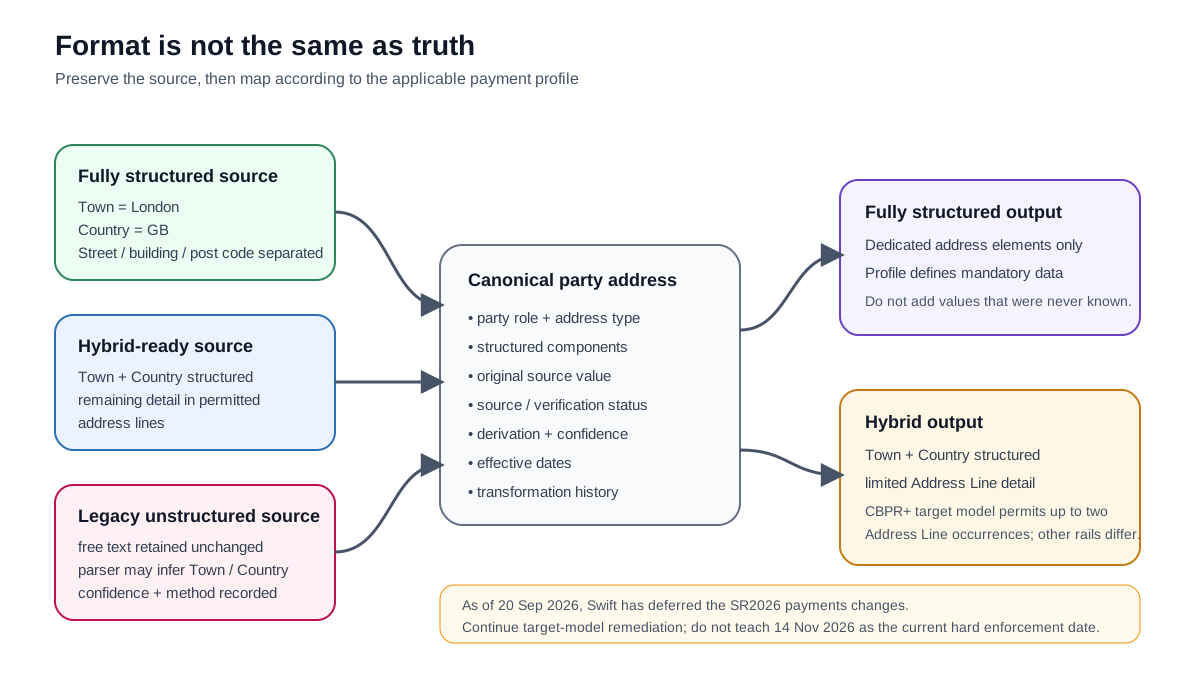
ISO 20022 provides dedicated postal-address elements such as country, town name, post code, street name and building number. A fully structured address places the relevant components into their dedicated data elements. A hybrid address combines mandatory structured components with limited free-text address lines where the usage rules permit this. A fully unstructured address puts most or all address information into free-text lines without separating core components into dedicated fields.
The distinction matters because machines can make more reliable use of explicit components. If country is present in a dedicated field, a validation service can check whether it is a permitted ISO country code. A screening engine can use country as a separate disambiguating attribute. A routing or regulatory engine can compare country with other payment facts. An investigator can search all payments involving a particular geography without first reverse-engineering a narrative string. Structured data does not make the information true, but it makes the meaning more explicit and controllable.
Hybrid data is an important compromise. Real-world addresses are messy. Street conventions vary widely, not every country uses post codes, some regions rely on local administrative units rather than western-style street numbering, and transliteration may be necessary when systems cannot carry the original script. A rigid model that assumes every address looks like a London or New York address can create worse data by forcing people to invent values. A good implementation therefore uses structure where the information is genuinely known and permitted, while preserving remaining address detail without fabricating semantics.
For CBPR+ payment messages, Swift’s published structured-address material has described Town Name and Country as the minimum structured components for structured or hybrid postal addresses, with up to two Address Line occurrences permitted in the hybrid model. That is a CBPR+ usage context, not a statement that FATF or ISO itself imposes the same field-level rule on every payment in every jurisdiction.
The important September 2026 timing update
This topic has a time-sensitive implementation detail that deserves careful treatment. Earlier Swift material described 14 November 2026 as the date on which fully unstructured postal addresses would cease to be accepted under the SR2026 CBPR+ changes. Banks built programmes, customer communications and testing plans around that milestone.
On 27 August 2026, however, Swift announced that it had accepted community requests for more time and would defer all SR2026 payments changes, including the structured-address change. Swift said it would consult banks, central banks, payment market infrastructures, market-practice groups and corporates and provide an updated timing and approach by December 2026 at the latest. That newer announcement supersedes the earlier November-enforcement position for current planning purposes.
The practical lesson is not “stop the programme”. The target model remains valuable and the direction toward richer structured data has not disappeared. Banks should continue customer-data remediation, channel upgrades, mapping corrections and testing because the same weaknesses affect screening, transparency and operations today. But a current training chapter must not tell learners that 14 November 2026 is still an unconditional live-network enforcement date. Implementation dates are part of control design and must be governed like any other changing requirement.
This is also a useful example of why requirements should record source, publication date, effective date and status. A static requirement saying “unstructured address rejected after 14 November 2026” becomes misleading the moment the governing body changes the timetable.
ISO 20022 is a semantic model, not a complete compliance policy
ISO 20022 provides a common modelling approach, a data dictionary and message definitions. It enables a payment community to represent parties and addresses in structured ways. It does not decide by itself which address a particular customer must provide, how a bank verifies that address for KYC, when a payment must be rejected, or which sanctions law applies.
This distinction matters in delivery projects. Developers may see an XSD cardinality such as optional and conclude that the field is optional in all circumstances. Compliance may see a regulatory requirement for originator information and conclude that the XML schema should always make the element mandatory. Both conclusions can be wrong. The effective requirement is usually the combination of the base ISO message, the market or network usage guideline, local law and regulation, bank policy, product rules and the facts of the transaction.
A mature architecture therefore has an applicability layer rather than embedding every rule into one schema. Schema validation answers whether a message conforms to the technical structure. Business validation answers whether required information is present for the specific product, corridor and community. Financial-crime controls answer whether the information creates or resolves risk. Those checks can use the same data while serving different purposes.
FATF Recommendation 16 and payment transparency
FATF Recommendation 16 is the global standard most closely associated with transparency of information accompanying payments. FATF revised Recommendation 16 in June 2025 and in June 2026 consulted on guidance to support implementation. FATF has said countries are expected to be ready to implement the strengthened standard by the end of 2030. The standard is implemented through national or regional legal frameworks; FATF itself is not a payment-network operator and does not directly configure a bank’s XML validation.
For address quality, the important principle is that payment information should support identification and traceability of relevant parties. Better structured data can make that information more useful to banks and authorities. It can improve the ability to distinguish parties and follow value across a chain. It should not, however, be described as though FATF globally mandates one exact CBPR+ postal-address syntax. That would confuse an international AML/CFT standard with a network implementation profile.
The distinction is especially important for multinational banks. A group standard may choose a common high-quality address model, while legal entities still need jurisdiction-specific interpretation of the information they must collect, transmit, retain and make available. The common data model can be global; legal applicability remains local.
CPMI harmonisation and the direction of cross-border data
The Committee on Payments and Market Infrastructures updated its harmonised ISO 20022 data requirements for cross-border payments in February 2026. The report is part of the G20 cross-border payments programme and is intended to reduce fragmentation in how ISO 20022 is implemented. CPMI describes the harmonisation requirements as guidance for payment system operators and participants rather than regulatory requirements.
The postal-address requirement in that model uses Country and Town Name as common minimum structured information, with additional structured details where available and possible, and allows limited free-form Address Line information in the harmonised model. This direction closely reflects the broader industry objective: preserve enough structured information to improve interoperability and machine use without pretending that every country has identical addressing conventions.
For a bank, the value of the CPMI work is architectural as much as regulatory. If corporate channels, payment hubs and domestic rails all use incompatible address conventions, information is repeatedly lost or repaired. Harmonisation reduces the number of transformations and makes controls more portable. The implementation still has to respect each rail’s actual rulebook.
Why address quality matters to sanctions screening
Sanctions screening is often described as name screening, but real investigations rarely depend on a name alone. Address, country, date of birth, nationality, registration number and other identifiers can help decide whether a name hit is the listed party or an innocent namesake. Better address structure allows those attributes to be compared more consistently.
Suppose an outgoing payment names a beneficiary ALPHA TRADING LLC. A screening engine generates a potential match to a listed Alpha Trading entity. The payment record says only Free Zone Bldg 4 Dubai UAE in one line. An analyst can read it, but an automated disambiguation service may not reliably distinguish town, country and building detail. If the same data is correctly represented as TwnNm = Dubai, Ctry = AE plus other address components, the screening platform can compare the location explicitly against list data and customer records.
Structured data can reduce avoidable noise, but it should not be oversold. A sanctioned party can use a false address. Two unrelated businesses can legitimately share an office building. Sanctions lists can contain incomplete or outdated addresses. A country match may increase relevance in one case and mean almost nothing in another. Address should therefore be one piece of identity resolution, not an automatic true-match or false-positive rule.
There is another subtle risk: bad structuring can make screening worse. If a legacy parser takes GEORGIA from a free-text line and incorrectly places it in Country as GE when the text referred to the US state of Georgia, the newly structured field can create a false geographic conclusion. The bank has converted ambiguous text into precise-looking misinformation. Any automated structuring process therefore needs provenance and confidence controls.
Why address quality matters to AML monitoring and customer risk
Transaction monitoring can use geographic information to understand whether activity is consistent with a customer’s profile, product and expected corridors. Address data can contribute to that understanding, particularly when combined with account location, counterparty information, IP or device signals, merchant data, shipping information and transaction purpose.
A payment to a counterparty with an address in a higher-risk jurisdiction may justify additional context under a bank’s risk model. It does not by itself prove suspicious activity. The customer may have a legitimate supplier there, the address may be a head-office location unrelated to where the goods are delivered, or the payment may be routed through a multinational group. Monitoring should use the address as contextual evidence rather than convert geography into guilt.
Address reuse can also reveal relationships. Multiple apparently unrelated beneficiary accounts using the same unusual residential address may be worth investigating in a mule-network or fraud context. Corporate entities sharing the address of a legitimate company-formation agent may be entirely normal. The value lies in pattern plus context, not a simplistic “same address equals network” rule.
Why address quality matters operationally
Poor address data can become a payments problem before it becomes a financial-crime problem. A channel may accept information that the payment hub cannot map. A hub may populate a technically valid pacs.008 that violates the relevant usage guideline. An intermediary can return a payment because required party information is missing. Operations staff may repair the record manually and unintentionally alter its meaning. The result is delay, customer frustration, higher cost and a fragmented audit trail.
A bank should distinguish several types of exception. A technical format defect means the data cannot be represented according to the message or usage rule. A completeness defect means required information is absent. A semantic defect means the value is present but appears inconsistent or implausible. A provenance defect means the bank cannot show where a critical value came from. A financial-crime concern means the information contributes to sanctions, AML, fraud or another risk decision. Those categories may overlap, but they should not be collapsed into one generic repair queue.
The difference affects authority. Operations may be allowed to reformat an address without changing its meaning. They should not invent a missing country because a town “probably” belongs there. Compliance may decide that an ambiguous address requires investigation. Customer service may need to contact the originator for correction. A scheme validator may reject a message even where the customer itself is low risk. Clear categories prevent teams from solving the wrong problem.
Data quality dimensions that matter
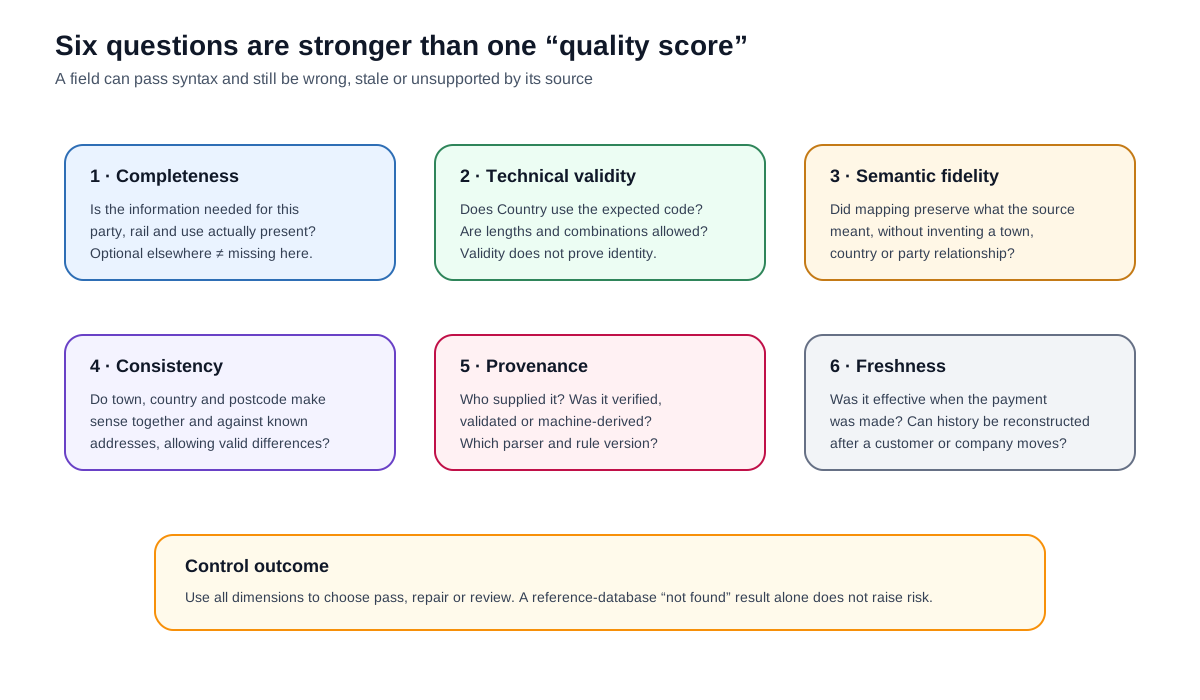
Address quality is best assessed across several dimensions rather than with one percentage score.
Completeness asks whether the data needed for the applicable purpose is present. The required set can vary by rail and use case.
Validity asks whether a field follows its technical domain: for example, whether a country value is a recognised code where the profile requires a code. Validity does not prove truth.
Semantic fidelity asks whether the structured field preserves what the source actually meant. A parser that moves apartment information into Town Name can produce valid XML with poor fidelity.
Consistency asks whether related facts agree or whether there is a reason for the difference. A country in the payment instruction may differ from a country in KYC because one is the beneficiary’s business location and the other is a registered office. The control should detect the difference without assuming it is an error.
Provenance records who supplied the value, which source system held it, whether it was verified, whether it was derived, and what transformation produced the outgoing value.
Freshness asks whether the information is still appropriate for the use. A verified address from many years ago may remain legally valid, or it may be stale after a customer moved. Event-driven KYC and customer-maintenance processes matter because payment quality cannot permanently compensate for obsolete master data.
The source-to-payment lifecycle
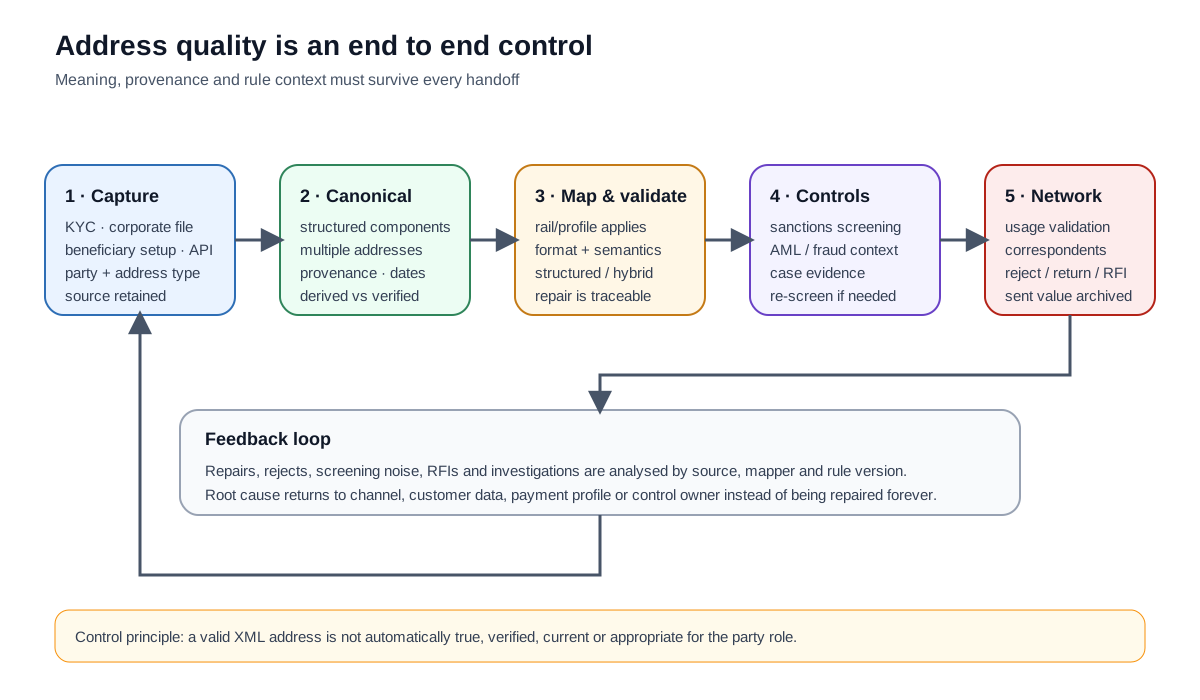
A well-designed bank treats address quality as an end-to-end lifecycle.
The first stage is capture. Retail onboarding, corporate onboarding, branch servicing, beneficiary maintenance, file-upload channels and APIs may all collect address information. Each channel should know which address type it is asking for and which components it can capture. A generic single-line address field creates downstream ambiguity that no ISO 20022 mapper can fully fix.
The second stage is customer or counterparty master data. Here the bank should store address components, type, source and relevant verification status in a canonical model. The canonical record should not be limited by one payment rail’s current field lengths. If the master model truncates data to fit an old message format, richer information can never be recovered later.
The third stage is payment initiation. The payment may use the bank’s customer master, data supplied in the individual instruction, or both. A corporate may provide the beneficiary address even though the beneficiary is not the bank’s customer. That externally supplied value should not silently become “verified KYC data” merely because it passed through the bank.
The fourth stage is mapping and validation. The payment hub or adapter converts canonical facts into the target message. Here the bank applies market-profile rules, checks mandatory combinations and records any transformation. Transliteration, abbreviation and permitted hybrid formatting should be controlled and reproducible.
The fifth stage is screening and monitoring. Financial-crime services use the payment representation and, where architecture permits, richer master data. The control should know which version it screened. If an operations repair changes a screened party attribute materially, the transaction may need to be re-screened under policy.
The sixth stage is network and correspondent processing. Downstream institutions receive the transmitted data, not necessarily all information held internally by the sending bank. That makes preservation of required party information important to transparency across the chain.
The seventh stage is investigation and feedback. Alerts, RFIs, returns, rejected payments and investigation findings should feed recurring data problems back to product, channel and data owners. Otherwise operations repairs the same defect thousands of times while the source remains broken.
Source, verification and derivation must stay distinct
One of the most important control principles is to avoid upgrading the status of data merely because software transformed it. Imagine that a corporate sends 10 Market Rd, Manchester M1, UK in one free-text line. A parser identifies Manchester as Town Name and GB as Country with high confidence. The transformation may be useful, but the bank should preserve the facts that the customer supplied the original text and the town/country values were machine-derived.
If the corporate’s original address was itself sourced from a supplier master, the bank generally does not have the same assurance as it has for its own KYC-verified customer address. That does not make the data unusable. It means the data model and audit trail should express different provenance.
A useful record therefore distinguishes values such as source = corporate payment file, derivation = NLP structuring, confidence = high, validation = syntactic pass, and verification = not independently verified by bank. This prevents downstream users from interpreting “structured” as “verified”.
Swift has made an NLP-based address-structuring model available to help infer Town and Country from legacy unstructured content. Its own material describes confidence scores and diagnostic outputs. That is the right conceptual pattern: inference can accelerate remediation, but confidence and review matter. The output should not be treated as an unquestionable source of truth.
Normalisation is not the same as changing meaning
Banks routinely normalise names and addresses: converting case, standardising country codes, removing harmless punctuation, transliterating scripts, or expanding well-understood abbreviations. Normalisation is useful when it makes equivalent data comparable without changing the underlying identity.
Semantic transformation is different. If software converts Congo into a country code without knowing whether the customer meant the Republic of the Congo or the Democratic Republic of the Congo, it is making a substantive assumption. If it converts a post office box into the street address of a corporate registry office, it changes the location represented. If it replaces an address supplied for a beneficiary with the bank’s own address because a fallback lookup failed, it can corrupt payment transparency.
The rule for designers is straightforward: deterministic format transformations should be separated from inferential transformations. Inferential steps need confidence, exception handling and evidence. Where ambiguity can affect a legal, sanctions or payment decision, a human or authoritative source may be required.
Address types and the danger of the “best available address”
Customers can have several legitimate addresses. A company may be incorporated in one jurisdiction, operate from another office and receive mail at a third. A person can have residential and correspondence addresses. Payment and KYC systems therefore need an address type rather than one anonymous address record.
Using the “best available address” sounds pragmatic but can hide a control failure. The best address for delivering a letter may not be the address that a payment-transparency rule expects. A registered address may be useful for legal-entity identification while an operating address better explains commercial activity. The correct choice depends on the business meaning and applicable rule.
Architecture should therefore allow multiple addresses with type, effective dates and provenance, and the payment mapping should explicitly state which address type is selected for which party role and product. That decision is a requirement, not an implementation detail.
P.O. boxes, rural addressing and inclusion
Address-quality programmes can unintentionally exclude legitimate customers if they treat one country’s address convention as universal. Some people and businesses rely on P.O. boxes because street delivery is not available or normal in their market. Rural customers may use locality descriptions rather than numbered streets. Informal settlements may not have conventional postal addresses. Digital services may serve customers whose official identity documents use location descriptions unfamiliar to international validation vendors.
The Wolfsberg Payment Transparency Standards say P.O. boxes should generally be avoided as the sole address except where no alternative exists because of market practice or limitation and where supported by local regulation. The important operational point is proportionality and context. A bank should not invent a street address to satisfy a data-quality score, nor reject legitimate customers solely because a third-party validation database expects a western format.
Address controls should support financial inclusion by recognising valid local conventions while still meeting the bank’s actual legal and network obligations. Exception categories should distinguish “valid local form” from “missing information” and “suspected manipulation”.
Country, town and postcode consistency checks
Cross-field checks can catch errors, but they need careful design. A postcode format may be strongly associated with a country, yet not every jurisdiction uses postcodes. A town can exist in multiple countries. A multinational company can legitimately use a registered-office country different from the transaction’s commercial geography. Country codes can change after geopolitical events, and territories may have distinct code treatment.
A quality service can therefore assign evidence rather than issue simplistic truth statements. For example: country code is technically valid; postcode pattern is inconsistent with that country; town-country pair is not found in the reference dataset; source was customer-supplied; no authoritative validation performed. An operations or customer workflow can then decide what to do.
Reference data itself needs governance. Version, supplier, update date and coverage should be known. If a validation vendor has poor coverage for a particular region, the bank should not convert “not found” into “invalid address”.
Transliteration and character-set risk
Cross-border payments can move between systems with different character capabilities. Names and addresses may be transliterated from non-Latin scripts, stripped of diacritics or abbreviated to fit legacy constraints. The transformation can affect screening because two spellings that are equivalent in one language may look different to a matching engine.
Where possible, the bank should preserve the original value alongside any transliterated value rather than overwriting it. Screening architecture should be designed with the matching engine’s capabilities in mind. Investigators should be able to see what the customer entered, what the bank stored and what was transmitted.
A good audit trail answers three questions: what was received, what transformation occurred, and what was actually screened and sent. Without that lineage, teams can spend hours debating an alert that was created by a mapper rather than by the customer’s data.
Decisioning: pass, repair, review or reject
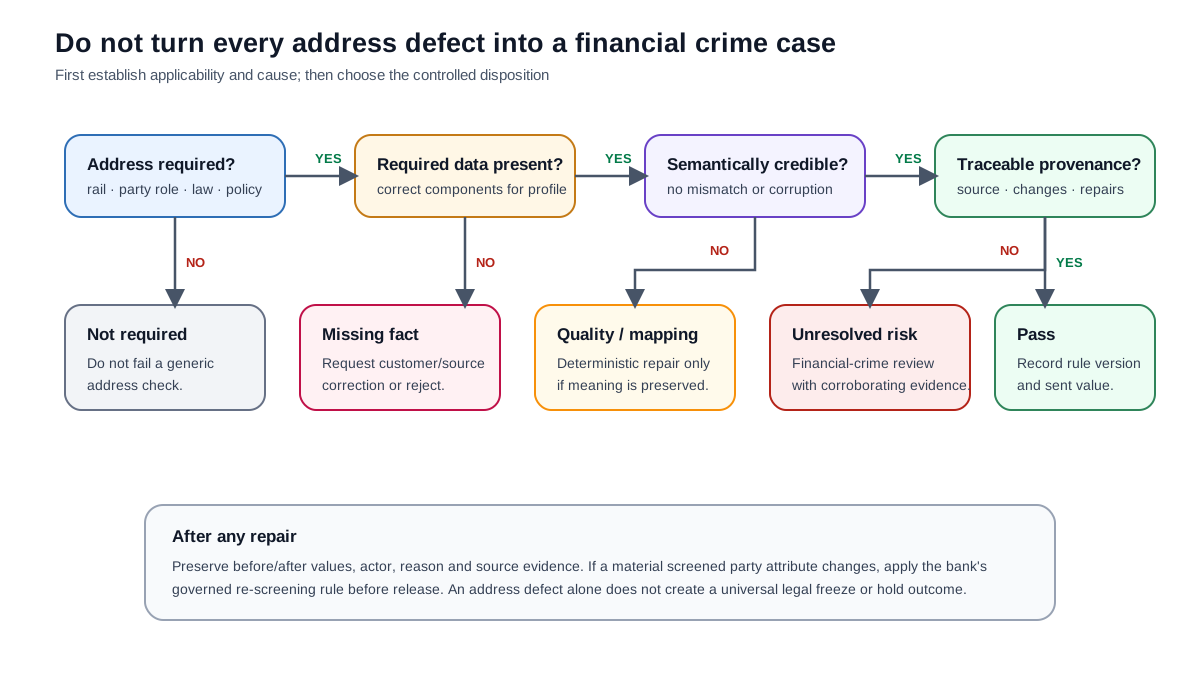
A data-quality finding should lead to a controlled outcome. The decision begins with applicability: was the information required for this party and this payment under the relevant profile? If not required, absence is not automatically a defect. If required, is it present and technically valid? If present, is there a semantic or provenance concern that cannot safely be resolved automatically?
A pass is appropriate where applicable requirements are met and no material concern exists. A format repair may be appropriate for a deterministic transformation that does not change meaning and is allowed by policy. A customer repair requests corrected information from the initiating party when a substantive fact is missing or ambiguous. A financial-crime review is appropriate where the data contributes to sanctions, AML or fraud concern. A reject may be required when the message cannot satisfy a network or scheme rule, a legal prohibition applies, or policy does not allow the transaction to proceed with the unresolved defect.
The bank should not use “hold” as a universal answer. Some payment systems do not permit indefinite delay. Some sanctions regimes require blocking or freezing under specific conditions; a mere address-quality defect does not create that legal outcome. Product, legal and scheme context determines the available actions.
Repairs and the obligation to preserve evidence
Manual repair is a high-risk point because an employee can turn incomplete source data into a cleaner-looking message. A good repair interface shows the original value, proposed change, reason code, user, timestamp and downstream impact. It prevents staff from silently replacing information without evidence.
Repairs should be classified as non-semantic or semantic. Removing duplicate spaces or converting a country name to the equivalent approved code can often be non-semantic. Choosing which of two possible countries the customer intended is semantic. Semantic repairs generally need stronger evidence and may require customer contact.
Where a material party attribute changes after sanctions screening, the architecture should determine whether re-screening is required before release. That requirement must be explicit. Otherwise a payment can be screened using one address and transmitted using another while the audit log misleadingly shows only one “screening passed” status.
Governance and ownership
Address quality crosses traditional organisational boundaries. KYC owns parts of customer data, payments owns message construction, financial crime owns some uses of the data, technology owns transformation services, data governance sets enterprise standards, operations manages exceptions, and product teams control customer channels. If every team assumes somebody else owns the end-to-end outcome, defects persist.
A workable governance model assigns at least four responsibilities. The data owner defines the meaning and quality expectation for the canonical address. The source owner controls capture and correction in the originating system. The payment-profile owner defines how the address is mapped for each rail. The control owner defines how screening, monitoring and exception decisions use the information. Large banks may use different job titles, but the responsibilities still need to exist.
Management information should focus on actionable causes rather than vanity percentages. Useful views include exceptions by source channel, missing town/country by customer segment, parser low-confidence rates, manual repairs by field, downstream rejects by rule, repeat defects by corporate file originator, and screening alerts where address quality prevented reliable disambiguation. Metrics should be interpreted against volume and coverage; a low exception rate can simply mean a control is not detecting problems.
Data and system touchpoints
For a business analyst, the chapter becomes practical when the address is followed through real components. A typical chain can involve onboarding, customer master, CRM, beneficiary store, corporate file gateway, API layer, payment capture, payment hub, sanctions screening, transaction monitoring, ISO 20022 adapter, network gateway, case management, data lake and archive.
At every boundary, ask whether the system can carry all source components; whether it changes them; whether it knows the party role and address type; whether it preserves provenance; whether it truncates; whether it transliterates; and whether downstream systems receive the pre- or post-repair version.
A common defect is field collapse: a rich source address enters a legacy interface that exposes only three 35-character lines. The next system later “restructures” those lines into ISO 20022, but the original semantic separation has already been lost. The project should fix the earliest constraining interface where feasible instead of treating the final ISO mapper as a magic recovery point.
Another defect is data substitution. If the creditor address is missing, a mapper may use the creditor bank’s address, the corporate’s own address or a generic country value to satisfy a technical rule. The XML may validate while payment transparency is degraded. Negative tests must specifically look for this behaviour.
Alert, case and investigation use
When an address-related screening alert reaches an analyst, the interface should expose more than the outgoing XML. The analyst may need the customer or beneficiary master record, source address, structured output, transformation history, list entry, other identifiers and previous decisions. If those facts live in different systems, the case-management integration should fetch or link them.
An investigator should distinguish at least three hypotheses. The address may genuinely support a match. It may be innocent data that helps disambiguate a false positive. Or the address discrepancy may be caused by a bank-data defect. The third hypothesis is often missed because analysts understandably focus on the customer and transaction rather than internal transformation logic.
If an internal defect affected many payments, one case can become a control incident. The bank may need a lookback to determine which payments were screened with corrupted geography, whether any decisions need reassessment, and whether downstream reports or customer communications were affected. Data-lineage capability makes that analysis much faster.
Practical case: the false geography created by a mapper
Consider a corporate customer in the United Kingdom paying a long-standing supplier in the United States. The corporate’s beneficiary master contains:
450 Peachtree Street, Atlanta, Georgia 30308, United States.
A legacy file passes the address as free text. During ISO 20022 structuring, a poorly designed parser detects the token Georgia and maps it to Country GE, while placing Atlanta in Town Name. The payment is technically well-formed. A screening and country-risk service now sees a beneficiary in Georgia rather than the United States, generating a geography-based review and causing the payment to miss a time-critical cut-off.
The operations analyst initially asks the customer to “correct the beneficiary country”. The customer responds that the data in its ERP is correct. A second-line investigator compares the original file, canonical beneficiary record and outgoing pacs.008 and identifies the transformation defect. The bank corrects the mapping, re-screens the payment with Country US, releases it under normal policy and records the incident as a data-quality defect rather than customer misconduct.
The important outcome is not only the repaired payment. The bank queries historical messages processed by the same parser logic, identifies other US addresses containing the word Georgia, validates whether country was misclassified, and performs a risk-based lookback where screening outcomes could have been affected. The parser is changed so ambiguous geographic tokens require stronger evidence and confidence is retained as metadata. Regression tests are added for Georgia the country, Georgia the US state and other ambiguous place names.
This case shows why structured data is not automatically better data. Structure magnifies whatever semantics the transformation assigns. Good governance makes the transformation explainable and reversible.
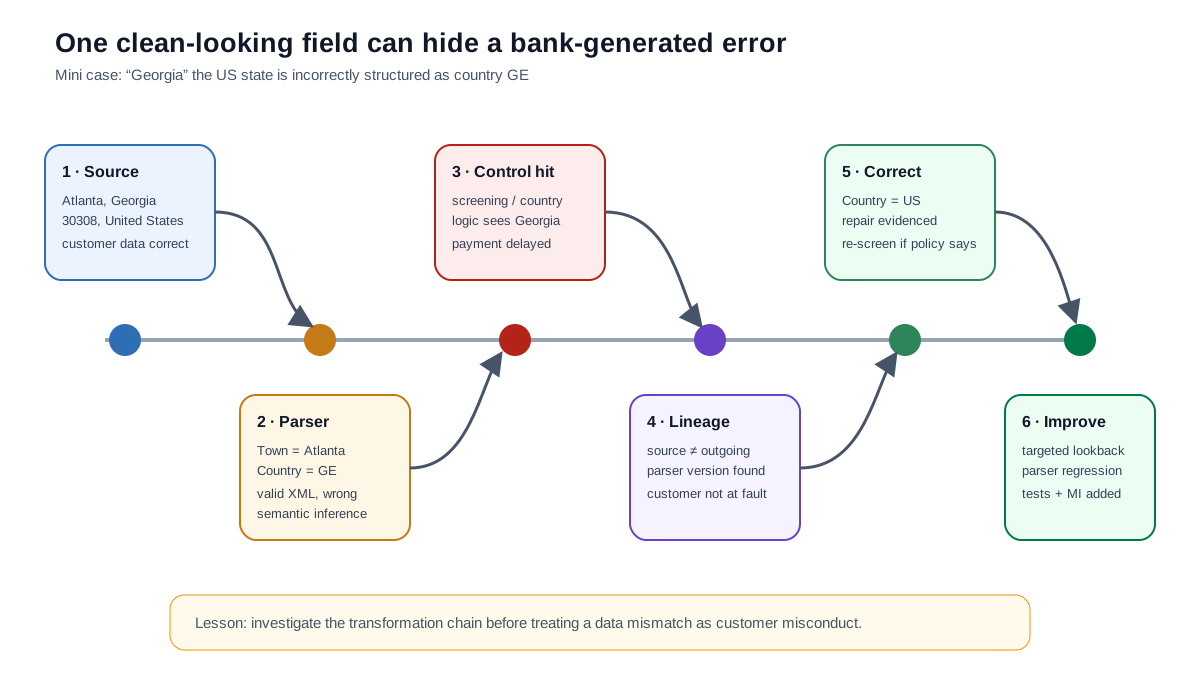
What a business analyst should specify
A strong requirement does not say only “support structured addresses”. It states the business meaning and control behaviour. The BA should define which party roles can carry an address, which address types are valid sources, which components are stored canonically, which fields are customer-supplied or derived, which payment profiles require which components, and what happens when data is missing or inconsistent.
Acceptance criteria should cover both successful and unsuccessful paths. A fully structured valid address should pass. A permitted hybrid address should preserve structured Town and Country while retaining allowed Address Line information. A legacy unstructured value should follow the current transition policy rather than an obsolete hard-coded deadline. A low-confidence parser result should not silently become authoritative. A semantic repair should preserve the original and trigger the required approval or re-screening. An address that is not required should not fail merely because a generic validator expects one.
The BA should also define audit evidence: source system, source value, canonical value, transformation version, applicable profile version, validation result, repair history, screened value, transmitted value and final decision. This evidence is invaluable when a customer challenges a rejection or an auditor asks why a payment was released.
Architecture considerations
Architecturally, address quality works best when responsibilities are separated. A canonical party-data service should represent meaning. An applicability or rules service should determine which data is required for a given payment profile. A validation service should check syntax and cross-field quality. A transformation service should map canonical data to target messages. Screening and monitoring services should consume the appropriate representation and preserve the link back to source.
That separation avoids embedding regulations and network rules into every channel. If Swift changes a timetable, as it did in August 2026, the bank should be able to update the relevant payment-profile rule without redesigning KYC. If a local instant-payment system adopts a different address requirement, the same canonical data can support it through a different profile.
Versioning is essential. A payment created under profile version A should remain explainable after profile version B is deployed. Cases and audit logs should record the rule version that produced the decision. Reference-data versions and parser versions matter for the same reason.
Testing the control properly
Testing should start with realistic address diversity rather than a small set of clean English examples. Include short and long addresses, multiple scripts, diacritics, missing postcodes, rural localities, P.O. boxes where legitimate, apartment and building details, corporate registered addresses, ambiguous towns, territories and countries with different conventions.
Positive tests confirm that valid structured and hybrid examples map correctly for each supported payment profile. Negative tests verify required fields, invalid codes, duplicates and prohibited combinations. Semantic tests check that the correct party and address type are used. Mutation tests deliberately swap country, town or party roles to prove that controls detect meaningful corruption. Lineage tests verify that every transformation is traceable. Screening tests confirm that repaired material attributes are re-screened where policy requires it.
Resilience testing matters as well. What happens if the address-validation vendor is unavailable? Can the bank continue with local deterministic checks? Does it fail open or fail closed, and is that decision appropriate for the rail and risk? What if the NLP structuring service returns no confident result? The fallback should be designed before production, not improvised during an outage.
Finally, test effective dates and rule changes. A requirement whose enforcement date can be deferred must be driven by configuration or a governed rule version rather than buried in code. The August 2026 Swift change is an ideal regression scenario: the system should be able to move from a planned hard rejection on 14 November 2026 to the newly announced extension without corrupting customer data or abandoning remediation work.
Failure modes to watch for
Several failure patterns recur in banks. The first is treating XML validity as data quality. The second is treating “structured” as “verified”. The third is forcing every country into one address template. The fourth is losing original data during transliteration or truncation. The fifth is repairing data after screening without re-evaluating the control outcome. The sixth is using an obsolete implementation date after the external standard changes. The seventh is measuring success only by the percentage of populated fields rather than whether the values are meaningful and traceable.
Another failure is excessive enrichment. Teams sometimes assume that more data is always better and append third-party location information that the payment did not contain. This can create privacy issues, confuse the source of truth and produce inconsistent decisions. Enrichment should have a defined purpose, lawful basis where required, source and confidence. It should not silently rewrite customer facts.
Customer impact
Data-quality programmes are visible to customers when they are poorly designed. A corporate may receive repeated requests to correct data that is already correct in its ERP because the bank’s mapper is wrong. A retail customer may be unable to add a legitimate beneficiary because the form requires a postcode in a country that does not use them. A cross-border payment may be delayed while operations manually rebuild an address the bank already holds in KYC.
Good design moves quality controls as close as practical to the point of capture. A corporate file validator can explain which beneficiary fields need correction before the payment enters time-critical processing. A retail form can use country-aware prompts. A bank can offer migration reports showing which stored beneficiaries need remediation. Clear feedback is better than a generic “invalid address” error.
At the same time, customer convenience cannot justify fabricating information. If a required substantive fact is absent, the right customer experience may be a precise request for the missing data rather than an invisible guess by the bank.
Key takeaways
Address quality sits at the intersection of customer data, payment transparency, ISO 20022, sanctions screening, AML monitoring and operations. The most reliable model separates syntax from semantics, provenance from verification, global standards from network rules, and customer facts from machine inference.
Structured and hybrid addresses can improve machine readability and interoperability, but their value depends on truthful source data and controlled transformation. FATF Recommendation 16 provides the global payment-transparency context; CPMI provides harmonisation guidance; ISO 20022 provides the semantic/message framework; Swift and other payment communities define their own usage requirements; jurisdictions determine binding legal obligations.
As of 20 September 2026, banks should also recognise that Swift’s earlier November 2026 enforcement plan for SR2026 payments changes has been deferred following its 27 August 2026 announcement. The sensible response is to continue remediation while governing the effective date correctly.
The strongest bank control can always answer: whose address is this, where did it come from, what did it mean, what rule applied, what changed, what was screened and sent, and why did the bank decide to proceed or stop.
References and further reading
- Financial Action Task Force, The FATF Recommendations, current version updated June 2026: https://www.fatf-gafi.org/en/publications/Fatfrecommendations/Fatf-recommendations.html
- Financial Action Task Force, Public consultation on guidance to increase payment transparency, 24 June 2026: https://www.fatf-gafi.org/en/publications/Fatfrecommendations/R16-Public-Consultation-June-2026.html
- Committee on Payments and Market Infrastructures, Harmonised ISO 20022 data requirements for enhancing cross-border payments – updated report, 26 February 2026: https://www.bis.org/publications/harmonised-iso-20022-data-requirements-enhancing-cross-border-payments-updated-report
- ISO 20022, Message Definitions: https://www.iso20022.org/iso-20022-message-definitions
- ISO 20022, e-Repository: https://www.iso20022.org/iso20022-repository/e-repository
- Swift, Swift accepts community request to extend structured address migration for ISO 20022 payment messages, August 2026: https://www.swift.com/zh-hans/node/310680
- Swift, Unstructured address data is being removed. Are you ready? (useful for the target structured/hybrid model; its original November 2026 timing is superseded by Swift’s August 2026 extension announcement): https://www.swift.com/standards/iso-20022/removal-unstructured-address
- Swift, The Swift AI address structuring model: https://www.swift.com/ja/node/310322
- The Wolfsberg Group, Payment Transparency Standards: https://wolfsberg-group.org/resources/legacy/136
Operational deep dive: address meaning, provenance and control evidence
The base chapter established that structured address data is valuable only when its meaning survives the full payment journey. This deep dive moves into the operating detail: how a bank should model addresses, control transformations, use them in financial-crime decisioning and investigate defects without confusing data quality with customer suspicion.
Start with a canonical party model, not an XML template
A common implementation mistake is to design the customer or beneficiary database directly around the fields of one payment message. That creates an architecture in which the current rail dictates what the bank is capable of knowing. When the market practice changes, or another rail needs richer information, the bank discovers that important semantics were never stored.
A canonical party model should represent the business facts independently from a specific message version. At minimum it should be capable of holding multiple addresses, address type, structured components, free-text residue where genuinely needed, effective dates, source, verification or validation status, and transformation history. The canonical model can then be mapped to CBPR+, a domestic high-value payment, an instant-payment message, a card-related process or a regulatory extract according to each profile.
This matters because payment messages are views of data, not necessarily the master truth. A pacs.008 may carry one postal address because that is what the payment profile permits or requires. The customer-data platform may hold several addresses with richer provenance. An investigator should be able to move from the transmitted view back to the underlying records without assuming they are identical.
Address type is a business attribute
Consider a company with a registered office in Dublin, a trading office in London and a correspondence address at its external accountant. All three can be legitimate. A field called customerAddress is therefore ambiguous before any ISO 20022 mapping begins.
The data model should identify why an address exists. Typical types include registered office, principal place of business, residential, correspondence, mailing or temporary address. Banks may use different taxonomies according to jurisdiction and customer type. The important point is not the label itself but that the downstream process knows what it is using.
A sanctions-screening process may use all known addresses for identity resolution. A payment-transparency profile may require a particular party address. A credit process may care about residence. A tax-reporting process may use a tax residence rather than a postal location. If those uses are collapsed, apparently inconsistent addresses create false exceptions or, worse, the bank transmits a technically valid but semantically wrong location.
Requirements should therefore state the selection logic explicitly. “Populate creditor address from customer master” is insufficient. A better requirement identifies the party role, eligible address types, priority where several are current, treatment of missing values, and whether the bank may use customer-supplied transaction data instead of master data.
Source is not the same as authority
Every address should have provenance. That sounds like a data-governance concern, but it directly affects financial-crime judgement.
An address entered by a bank employee after inspecting an accepted identity document may have one assurance level. A corporate-supplied beneficiary address in a pain.001 file has another. An address taken from a public company register may be authoritative for registration but not necessarily for the customer’s operating location. An address inferred from an NLP model has yet another status.
The system should preserve those distinctions rather than replace them with one verified boolean. Verification itself needs context: verified against what, on what date, for which purpose and by which process? A country code validated against an ISO code set has been technically validated, not verified as the party’s true country.
In investigation screens, provenance can prevent unnecessary escalation. If an analyst sees that a suspicious country was not customer-supplied but was created by a known parser version with a history of misclassification, the next step is different from a case where the customer deliberately changed an address immediately before a high-risk payment.
Represent derived values honestly
Banks increasingly use reference data and machine learning to structure legacy addresses. That is sensible. Large institutions may have millions of beneficiary records stored in formats created long before ISO 20022 rich data became operationally important. Manual remediation of every record is unrealistic.
The control problem begins when a derived value loses its derived status. A parser may infer Town Name and Country from a free-text line. If that output is written back into the master database as though the customer supplied and verified it, the bank loses the ability to distinguish inference from fact.
A safer model records the original text, extracted structured values, method or model version, confidence, relevant diagnostics and whether a person confirmed the result. The outgoing payment can use the derived values when policy permits, but the audit trail remains honest.
Confidence should influence workflow rather than become a decorative percentage. High-confidence deterministic extraction may be eligible for automated use. Medium-confidence results may be queued for data remediation or customer confirmation. Low-confidence results should not be silently promoted. The thresholds themselves require testing by country and address pattern; one global threshold can perform very differently across scripts and geographies.
The difference between validation and verification
Address-validation vendors can check whether a location is syntactically plausible or appears in postal/reference datasets. This can improve data quality, but it does not prove that the party actually lives or operates there.
For example, a service can confirm that 55 Mark Lane, London EC3R 7NE is a plausible UK address. It cannot, by that fact alone, establish that the creditor is located there. Conversely, a genuine rural address may not appear in a commercial vendor’s dataset and should not automatically be classified as false.
The control design should use precise language. Validation can mean format, code-set or reference-data checks. Verification can mean confirmation against evidence accepted under the bank’s KYC or other process. The exact terms can vary by institution, but mixing them creates policy and audit confusion.
Country inference deserves special caution
Country is a powerful attribute because so many controls consume it: sanctions screening, country risk, correspondent-routing rules, regulatory reporting and monitoring scenarios. That power makes erroneous inference dangerous.
A legacy address might contain a town shared by several countries, a regional name that looks like a country, a country’s former name, or a state/province identical to another country name. “Georgia” is the classic example, but it is far from the only one. “Congo” can refer to more than one state. “Victoria” can be a place name in multiple countries. Abbreviations such as CA can refer to California, Canada in informal usage, or something else depending on context.
A structuring engine should combine signals rather than seize the first recognisable token. Postcode patterns, telephone country code, existing customer profile, other address components and trustworthy reference data can increase confidence. Yet the system should avoid circular reasoning: if the payment country was already wrong, using it as the main evidence to validate the inferred country simply reinforces the error.
Where the country drives a material restriction or high-risk decision, the bank should be able to show the evidence behind it. That is particularly important where the result could lead to a payment rejection, sanctions escalation or customer restriction.
Town names are not unique identifiers
Town Name is useful as a structured minimum in several payment-data models, but it is not a global unique location key. Many towns share names across countries, and spelling varies. Some localities are commonly written in multiple languages or transliterations. Administrative boundaries change over time.
A quality control should therefore evaluate Town Name in context. It can compare town and country, but “not found in reference dataset” should normally be a quality signal rather than an automatic fraud or AML conclusion. Coverage and update frequency of the reference dataset matter.
Where a bank uses geocoding, latitude and longitude can support operational or fraud analysis, but geocoded outputs should remain derived attributes rather than replacing the customer’s supplied address. Precision should also be handled carefully: a postcode centroid is not the same as a verified physical location.
Postcodes are useful but not universal
Postcode checks are attractive because they are easy to automate. They can identify obvious format inconsistencies and improve address normalisation. They are also a common source of over-engineered rejection logic.
Not every country uses a postcode, and some use them only in parts of the territory. Formats change. Corporate mail-routing conventions can differ from residential formats. A global postalCode mandatory rule is therefore poor design unless the particular scheme, country or product genuinely requires it.
A country-aware validator is better. It can know when postcode is expected, optional or unavailable, while still permitting a legitimate local address. This is a good example of a broader principle: data quality means fit for purpose, not maximum population of every possible field.
P.O. boxes need context, not slogans
Financial-crime policies sometimes treat P.O. boxes as inherently suspicious. That is too simplistic. They can reduce transparency if used as the only location when a physical address should be available, but in some markets they are a normal or necessary way of receiving mail.
The Wolfsberg Payment Transparency Standards provide a useful balanced approach: address information should be sufficient to identify clearly the party’s location, and having only a P.O. box should generally be avoided except where no alternative exists because of market practice or limitations and where local rules support that outcome.
A bank can turn that principle into a risk-sensitive process. If a business operates in a jurisdiction where P.O. boxes are routine, the bank may record both the P.O. box and another business-location attribute where available. If a newly formed company suddenly replaces a known operating address with only a P.O. box before unusual cross-border activity, the change can become contextual evidence. The P.O. box itself is not the suspicion; the pattern may be.
Address change is an event worth preserving
Historical addresses matter. An investigator looking at a payment from six months ago should see the address that was effective at that time, not only today’s current record. Overwriting addresses destroys temporal context.
Effective dating enables several useful controls. A bank can identify payments occurring shortly after a material address change. It can understand whether a sanctions match involved an address known at the time. It can reconstruct what information was sent to another bank. It can investigate whether multiple customers converged on the same address during a mule-account campaign.
This does not mean every address change is suspicious. People move and companies relocate. The value lies in combining time with other evidence. Event-driven KYC may also require review under local policy when material customer facts change.
Avoid hidden fallback substitution
Legacy payments architecture often contains “helpful” fallback logic developed when straight-through processing was prioritised over data semantics. If a party address is missing, the system may insert the account-servicing branch address, bank head-office address or a country inferred from the IBAN. These fallbacks can make old message formats pass while corrupting party transparency.
Such logic should be catalogued during ISO 20022 migration. Every default and enrichment rule needs a business owner and rationale. If the bank no longer accepts the semantic compromise, the fallback should be removed and the source process fixed.
The hardest fallbacks are those nobody knows exist. They can sit in ETL code, message brokers, mainframe exits, vendor adapters or spreadsheet-based operations procedures. Golden-message testing and end-to-end field lineage are often the only reliable way to expose them.
Lineage across payment systems
A practical lineage record follows each critical address component through the chain. For Country, for example, the record might show:
Corporate file AddressLine3 = "UNITED STATES" → file parser country candidate = US → canonical beneficiary country = US → pacs.008 Cdtr/PstlAdr/Ctry = US → screening request country = US → outbound network message country = US.
If an analyst later sees GE instead, the lineage can identify where the change occurred. Without component-level lineage, teams compare screenshots from multiple systems and guess.
Lineage should include version information. A mapping rule can change between two payments with identical source data. A reference-data update can alter the interpretation of a town. A parser model can produce different confidence after retraining. Recording versions allows incidents and lookbacks to be scoped precisely.
Truncation is a financial-crime issue when meaning is lost
Banks migrating from legacy MT or proprietary formats can underestimate truncation because the outgoing ISO 20022 message itself has richer capacity. The problem may occur earlier. A corporate host-to-host channel, internal MQ interface or customer master may still constrain address lines.
Truncation can remove the very component that disambiguates a sanctions alert. It can cut off a country or building number. It can merge lines in a way that defeats a parser. The architecture should identify the narrowest point in the end-to-end path, not merely confirm that the final XML supports more characters.
Where legacy coexistence remains inside the bank, semantic preservation should be tested explicitly. A translation that produces technically valid messages but loses material information is not a successful migration.
Transliteration: preserve both representations where possible
Screening and customer servicing may benefit from transliterated address values, particularly across scripts. But transliteration can be non-unique. Different systems can transliterate the same name or locality differently.
Where the architecture allows, retain the original-script data and the transliterated representation with a relationship between them. The bank can then screen using methods appropriate to its engine and show investigators both forms. Overwriting the original with one transliteration removes evidence and may make future matching worse.
The same principle applies to abbreviations. Normalising Street and St can help comparison, but the source should remain recoverable. Auditability is easier when normalisation is additive rather than destructive.
Screening should consume context without becoming dependent on perfection
Sanctions screening needs sufficiently good data, but the payment system cannot assume every address will be perfect. Screening engines should be robust to missing or imperfect secondary attributes while using structured data to improve precision when available.
A sensible design separates candidate generation from identity resolution. Name similarity may create a candidate. Country, town, date of birth, registration number and other attributes then help assess it. If address data is weak, the result may require more investigation rather than automatic clearance.
This is safer than a hard rule such as “different country equals false positive”. Listed-party data can be incomplete, parties can move, and sanctions ownership/control analysis can involve entities not themselves listed. Address is evidence, not an absolute exclusion unless the bank has a narrowly defined and validated rule appropriate to the list and entity type.
Monitoring should understand address provenance
Transaction monitoring can use structured geography to identify unusual corridors or networks. But if the geography is machine-inferred from low-quality text, the monitoring model should not treat it as equivalent to verified customer information.
An advanced feature store can carry source and confidence alongside the geography. Scenario logic or machine-learning features can then distinguish beneficiary_country_customer_supplied, beneficiary_country_bank_verified, and beneficiary_country_inferred. This reduces false precision and allows investigators to understand why a risk score moved.
The same principle is useful for graph analytics. Shared addresses can help connect accounts, but the graph should know whether the match is exact, normalised, inferred or merely a common building. Otherwise an office tower can create thousands of meaningless connections.
Data quality exceptions should feed case management selectively
Not every malformed address belongs in an AML case-management system. Flooding financial-crime analysts with simple format errors wastes specialist capacity. A bank should route exceptions according to cause and impact.
Technical defects can go to payment repair. Customer-master defects can go to data remediation. Network-rule failures can be returned to the channel. Potential sanctions matches or suspicious geographic patterns belong in financial-crime workflows. A repeated internal mapping defect may go to technology incident management and control governance.
The workflows should still be linked. If payment operations discovers that a repair changes a screened attribute, the financial-crime control must be triggered. If compliance discovers a systemic data defect during an investigation, the issue should be raised with the source owner rather than closed as a one-off alert.
RFI handling and address evidence
A correspondent or beneficiary bank may send a request for information asking for clearer originator or beneficiary details. Address quality affects the bank’s ability to respond quickly and consistently.
The RFI team should retrieve the authoritative or appropriately sourced record, not reconstruct an address from memory or copy a possibly corrupted outbound message. The response should distinguish information held about the bank’s own customer from information merely supplied by that customer about a third-party beneficiary.
If the bank discovers that it transmitted a malformed or wrong address, the incident may need escalation according to policy. The response process should preserve what was originally sent and what corrected information is now available. Rewriting history makes later investigations harder.
Privacy and data minimisation
Richer payment data can improve transparency, but address information is personal data for individuals and can be sensitive in context. Banks should apply applicable privacy, confidentiality and banking-secrecy requirements to collection, access, retention and sharing.
Data minimisation does not mean removing information required for a lawful payment or financial-crime control. It means being clear about purpose and avoiding uncontrolled replication. A screening platform may need the relevant address components; a broad analytics environment may not need every full residential address in plain text for every user.
Access controls should reflect role. Investigators may need full context. Developers generally need representative test data rather than real customer addresses. Test environments should use synthetic or appropriately protected datasets consistent with policy.
Effective-date governance
The August 2026 Swift extension demonstrates why rules engines need temporal governance. An implementation can be technically correct on one date and wrong a month later because the industry timetable changed.
Each external requirement should record at least the source, version, announcement date, intended effective date, current status and owner. Where the external body has deferred a change, the bank should retain the future target model while changing enforcement behaviour in a controlled release.
This avoids two opposite mistakes. One is enforcing an obsolete deadline and rejecting valid payments. The other is interpreting a deferral as cancellation of the strategic data-quality objective and stopping remediation. Good governance separates target-state design from current enforcement.
A worked investigation: when customer data and payment data disagree
A bank onboards a technology company with a verified registered address in Singapore and a principal operating office in Bengaluru. The customer later sends a supplier payment whose debtor address is populated from a legacy corporate channel as the Bengaluru office, while the bank’s customer master uses the Singapore registered address for one KYC view.
A new reconciliation control detects the country difference and creates an exception. A poorly designed process could call the payment “inconsistent with KYC” and escalate it as potential evasion. A better process first asks whether both addresses are valid and what address type the payment profile expects.
The analyst finds that the corporate has supplied its operating address consistently for years, the Singapore registered address remains valid, and the bank’s channel contract permits the customer-supplied operating address. There is no unexplained location change and no sanctions or transaction-monitoring concern. The exception is therefore a data-model alignment issue, not suspicious activity.
The bank updates its canonical model to hold both address types explicitly and adjusts the validation rule so the payment address is compared against all eligible current addresses rather than one generic KYC address. The case is closed with evidence, and the change reduces future false exceptions without weakening transparency.
This example matters because data-quality controls can themselves create financial-crime noise when the bank’s semantic model is too simple. Better structure should reduce ambiguity, not manufacture it.
Investigation checklist for practitioners
When address data becomes relevant to an alert or payment exception, an experienced analyst works through a sequence rather than jumping to a conclusion:
- Identify the party and address type involved.
- Retrieve the original source value and current canonical record.
- Determine whether the address was customer-supplied, bank-verified, externally sourced or machine-derived.
- Review transformations, transliteration, truncation, repair and mapping versions.
- Check the payment profile and rule version that applied at the time.
- Compare the address with sanctions-list or other risk information using additional identifiers.
- Decide whether the issue is technical, customer-data, financial-crime or a combination.
- Preserve the rationale and route any systemic defect to the correct owner.
The checklist is deliberately evidence-led. Address anomalies can be meaningful, but they are also common products of international data complexity. The job is to explain the anomaly before assigning intent.
Control evidence an auditor should be able to see
A mature control leaves evidence beyond a green dashboard. The bank should be able to show its address-data standard, supported country conventions, mapping specifications, external profile versions, validation rules, exception workflows, parser governance, sampling results, defect trends and change approvals.
For a selected payment, an auditor should be able to trace source to outgoing message. For a selected screening alert, the auditor should see the data the engine actually consumed. For a selected repair, the auditor should see before and after values and whether re-screening occurred. For a selected rule change, the auditor should see why and when it was deployed.
That evidence demonstrates control effectiveness much better than a statement that “99% of addresses are populated”. Population is only the beginning; meaning and traceability are the real control objectives.
Advanced practice: remediation, architecture, testing and assurance
Address-data quality becomes difficult at scale because the bank is not fixing one field in one message. It is changing customer masters, beneficiary stores, channels, corporate file specifications, APIs, payment hubs, screening interfaces, operations procedures and external message profiles at the same time. Advanced practice is therefore less about knowing the XML and more about controlling a multi-system migration without losing meaning.
Treat remediation as a data programme, not a November cutover
The August 2026 Swift extension is a useful test of programme maturity. A deadline-driven programme may be tempted to slow down because immediate network rejection has been deferred. A value-driven programme continues because the underlying defects still create screening, transparency and operational problems.
The business case should therefore separate mandatory external readiness from internal data-quality benefit. External readiness concerns the date on which a payment community enforces a format or usage rule. Internal benefit concerns lower repair volumes, better screening precision, better investigation evidence, reusable canonical data and reduced transformation risk. The second category does not disappear when the first date changes.
A remediation roadmap can continue in controlled waves: stop creating new unstructured records where practical, improve capture for new beneficiaries, structure high-volume corporate data, remediate the highest-risk or highest-value legacy populations, and progressively tighten validation. The external enforcement date can be changed without throwing away the work.
Inventory the real estate before designing the fix
Banks often underestimate the number of places where addresses live. A discovery exercise should include retail and corporate onboarding, CRM, KYC platforms, customer information files, beneficiary stores, standing-order systems, ERP integration, host-to-host/SFTP channels, APIs, branch applications, payment hubs, sanctions interfaces, fraud platforms, data warehouses and operational spreadsheets.
For each source, record owner, customer segment, address type, current structure, character set, field lengths, country coverage, source authority, volume, update mechanism and downstream consumers. This inventory reveals where the same “address” actually represents different things.
The inventory should also identify transformation points. A field can be structured in the source and become unstructured in an interface, then be restructured later. Remediating only the final message adapter leaves that loss in place. The best intervention point is usually the earliest point where meaning is available and controllable.
Segment legacy populations instead of treating them uniformly
Not all legacy address records deserve the same remediation method. A high-volume corporate that sends thousands of payments daily through a stable ERP should be engaged directly and given specifications, validation reports and testing support. A retail beneficiary used once three years ago may be better remediated when the customer next uses it. A bank-owned customer address should normally be corrected through customer-data governance rather than a payment parser.
Segmentation can consider source, usage frequency, value, risk, customer relationship, corridor and confidence of automated structuring. The purpose is not to assign suspicion; it is to choose an efficient remediation path.
A useful programme distinguishes at least four populations: clean structured records, clean hybrid-ready records, legacy records that can be transformed with high confidence, and ambiguous records requiring customer or human resolution. Metrics should show movement between populations rather than one misleading global “percentage structured”.
Design a quality service with explainable outputs
A central address-quality service can reduce duplication across channels, but it should return more than pass/fail. A useful response can contain normalised components, validation findings, provenance, confidence, detected ambiguity, applicable profile result and recommended action.
For example, the service might return that Country GB is syntactically valid, Town Name London is present, postcode pattern is consistent with GB, two Address Lines are within profile limits, source is customer-supplied, no independent address verification was performed, and the record is eligible for the CBPR+ hybrid target model. That is a much richer result than valid=true.
The service should not become a hidden policy engine for every jurisdiction. Profile-specific mandatory rules can live in a separate applicability layer. This separation allows the same address-quality capability to support multiple rails while each rail retains its governed requirements.
Version the rule that produced the answer
Every quality result should be reproducible. Record the validation-rule version, address-reference-data version, parser/model version and payment-profile version. If the output changes next month, teams can explain why.
Versioning becomes essential during a transition. A payment submitted in September 2026 should be assessed under the rules effective in September, not whatever rules happen to be current when an auditor reviews it in December. If Swift publishes a revised structured-address timeline by December 2026, the bank can introduce a new profile version while retaining the historical decision basis.
Configuration should have maker-checker or equivalent change controls where the consequences are material. A single developer should not be able to change a country-validation rule in production without traceable approval, testing and rollback.
Business-analysis requirements that prevent later ambiguity
For each address-bearing party role, the BA should define a source-of-data matrix. Rows can represent debtor, creditor, ultimate debtor, ultimate creditor and agents. Columns can show eligible source systems, address type, verification status, whether transaction-supplied data can override master data, and the mapping to each target rail.
The BA should also specify transformation classes. Deterministic formatting may include case conversion, punctuation treatment and country-code normalisation. Inferential transformation includes extracting a town from free text or choosing a country from contextual clues. The requirements should state which transformations can be automated, which require a confidence threshold, which need review, and which are prohibited.
Exception outcomes need equal precision. “Route to manual review” is not enough. Which team receives it? What information is displayed? Can the payment wait within scheme timing? What evidence can the reviewer use? What changes may the reviewer make? Does a material change require re-screening? Who can release? What status goes back to the channel?
Acceptance criteria for structured and hybrid data
Acceptance criteria should be written as business scenarios rather than only schema statements.
A fully structured address with Country and Town Name plus permitted additional components should map without introducing Address Line where the target profile prohibits it. A valid hybrid address should retain structured Country and Town Name and only the number of free-text lines allowed by the profile. The mapper should not duplicate Town Name into Address Line if the profile prohibits duplication.
Where a source provides no address because the applicable profile does not require one for that party, the message should not fail a generic address check. Where an address is required but Country is absent, the system should apply the governed remediation or rejection path rather than guess from IBAN, BIC or currency unless an explicitly approved enrichment rule permits that use.
If an NLP parser derives Country with confidence below the configured threshold, the value should not be silently written as verified master data. The original input and derived output must remain traceable. If operations changes Country after screening, the test should verify the required re-screening behaviour.
Golden-message testing
Golden messages are curated examples whose expected source data, canonical representation, outgoing XML and control outcomes are all known. They are particularly effective for address migrations because one test can expose a subtle mapping change across several systems.
A golden set should include common markets and difficult markets. It should cover addresses with and without postcodes, building names, apartment numbers, P.O. boxes, long locality names, diacritics, non-Latin scripts, territories, multinational registered offices and local formats that do not resemble western street addresses.
For each example, store the expected semantic components and the expected target profile. Tests should compare meaning, not only text. If a harmless formatter changes ROAD to Rd, that may be acceptable. If a mapper moves Georgia into Country GE for an Atlanta address, the test must fail.
Golden sets should be governed because they become part of the control evidence. When a market practice changes, expected results change through reviewed updates rather than quietly adapting the test to whatever the code now does.
Mutation testing finds semantic defects normal tests miss
Mutation testing deliberately corrupts one element to prove the control detects it. Swap debtor and creditor addresses. Replace Country with a valid but inconsistent code. Move Town Name into Address Line. Truncate the last line. Remove provenance. Change an address after screening. Duplicate structured fields in a hybrid Address Line.
These tests are powerful because ordinary positive tests can pass even when the system is fragile. A mapper may handle clean examples perfectly while failing when fields are missing or reordered. Mutation testing probes the assumptions.
The expected result should be specific. Some mutations should be rejected technically, some should create a quality exception, some should trigger re-screening, and some should be allowed because the field is genuinely optional for that profile. The test proves not only detection but correct disposition.
Cross-system contract testing
In modern banks, address components cross APIs and events between independently deployed services. Contract testing should ensure that country, townName, addressType, source and other fields retain meaning as schemas evolve.
A dangerous change is making a field optional in one API because a team no longer uses it, without realising downstream screening relies on it. Another is changing a country representation from ISO code to free text. Schema registries and consumer-driven contract tests can catch such breaks before production.
Event-driven architecture adds versioning challenges. If a customer-address event is replayed, downstream systems should understand the schema version and effective date. Replaying an old event should not accidentally overwrite a newer verified address.
Reconciliation between source, screened and sent data
A mature control periodically reconciles what the bank received, what it screened and what it transmitted. This can be sample-based or automated according to volume and architecture.
For critical party attributes, reconciliation can detect unexpected transformations. If 1% of creditor countries differ between source and sent messages, the reason should be explainable: perhaps approved normalisation from country name to code. Unexplained differences are potential defects.
Screening reconciliation is equally important. A bank may screen the canonical record before a later mapper changes the outgoing message. If those stages are not compared, a material discrepancy can remain invisible. The aim is not to make all representations textually identical; it is to ensure semantic changes are intended and controlled.
Observability should identify causes, not only failures
Production monitoring should show where defects originate. Useful dimensions include channel, customer segment, corporate sender, country, message type, party role, mapper version and validation reason.
If unstructured-address exceptions spike after a channel release, the pattern points to a regression. If one corporate accounts for a large share of missing Town Name values, targeted customer engagement may solve the issue. If a particular country has high “reference not found” rates, the validation dataset may have poor coverage rather than customers providing bad data.
Operational dashboards should separate source defects from transformation defects. Holding customers responsible for bank-generated errors damages relationships and hides the real control weakness.
Avoid arbitrary quality thresholds
A bank may decide that a certain percentage of addresses must be structured or that a low-confidence parsing rate must stay below a tolerance. Such metrics can support governance, but the threshold should have a rationale tied to risk, operational capacity or external readiness.
This chapter deliberately does not invent universal percentages. There is no globally correct “95% address quality” target. A bank with 99% syntactically complete data can still have a serious semantic defect in the remaining high-risk population. A smaller defect concentrated in a sanctions-sensitive corridor may matter more than a larger harmless formatting issue.
Risk-weighted views and defect severity are therefore more useful than one headline number.
AI and machine-learning governance for address structuring
Address parsing is a good use case for machine learning because patterns are complex and multilingual. It is also a good example of why model governance matters even when the model is not making a credit or sanctions decision directly.
The model can influence Country and Town Name, which in turn can influence screening and payment acceptance. The bank should therefore understand training and reference data, coverage, known limitations, performance by market, confidence calibration, change process and fallback.
Human review should focus on uncertain or high-impact cases rather than blindly rechecking every high-confidence result. Sampling can validate automated performance. Drift monitoring should detect when customer populations or address conventions change.
Swift’s address-structuring model illustrates useful design principles by returning confidence and diagnostic information. Banks using that or any similar tool should integrate those outputs into their own governance rather than stripping them away and keeping only the inferred value.
Model outputs must not become customer facts by accident
One architectural anti-pattern is writing parsed values back to the customer master with no provenance. This creates a feedback loop: future payments use the inferred value as though it were authoritative, the model later validates itself against the value it previously created, and investigators lose the original source.
A better design stores derived address components in a governed layer or marks them explicitly. If the customer later confirms them, their status can change with evidence. The distinction between inferred and confirmed is valuable long after the migration project ends.
Fallback design when validation services fail
External address-validation or geocoding services can be unavailable. A bank should decide in advance which checks are essential for the payment to proceed and which can degrade safely.
A fallback may retain deterministic local checks such as schema validation, recognised country-code validation and mandatory-field combinations while temporarily skipping non-critical reference enrichment. High-risk or ambiguous cases may still route to manual review. The correct design depends on network rules, legal obligations and the role of the service.
The fallback should never invent values simply to preserve availability. If a required substantive field is missing, an outage of the enrichment service does not create permission to guess it.
Resilience tests should simulate service timeout, stale reference data, partial responses and contradictory sources. Operations should know when degraded mode is active and how to identify payments processed during the period for later review if necessary.
Change control after an external standard update
When an external body changes a deadline or usage rule, the bank should execute a controlled impact assessment. Identify affected rule configurations, channel validations, customer communications, test packs, operations procedures and deployment plans. Determine which changes are postponed, which remain strategically useful and which would become incorrect if deployed as originally designed.
The August 2026 Swift announcement is a textbook example. A bank may keep producing structured or hybrid addresses voluntarily while disabling a planned hard rejection tied to 14 November 2026. Corporate remediation can continue. Test environments can continue. Documentation must state that the network enforcement date is pending further Swift governance.
This approach avoids a binary project mentality. Standards programmes are long-lived capabilities, not one-night cutovers.
Testing country-specific address conventions
A global test pack should be designed with regional expertise. Examples should include markets where address order differs, where house numbers follow the street name or precede it, where administrative areas are significant, where postcodes are absent, where non-Latin scripts are common and where P.O. boxes are routine.
Testers should verify that the system does not require irrelevant fields merely because they exist in the ISO model. They should also test that free-text residues in hybrid addresses do not repeat structured Town or Country in ways prohibited by the relevant profile.
Accessibility and usability matter at capture. Mobile forms should not force users through dozens of fields if the country’s normal address can be captured clearly with fewer. Corporate APIs should provide precise validation errors that identify the party and field rather than returning a generic message rejection.
Testing sanctions-screening interaction
A dedicated test set should prove how address quality affects name screening. Use controlled synthetic names that generate candidates and vary only the address evidence. Confirm that a matching country can support prioritisation without creating an automatic true match. Confirm that a non-matching country does not automatically clear where other identifiers strongly support the listed party unless the bank has explicitly validated such an exclusion rule.
Test repairs as well. If Country changes from GE to US after the first screening, confirm whether policy requires a new screening request and that the case log shows both results. If Town Name is merely capitalised differently with no semantic change, confirm that the system does not create unnecessary duplicate alerts.
The purpose is to validate the entire decision chain, not only the address service.
Testing transaction-monitoring interaction
For monitoring, create scenarios where the same payment looks different depending on provenance. A beneficiary country derived with low confidence should not necessarily carry the same risk weight as a verified customer country. A genuine address change combined with new counterparties and rapid international transfers may be more meaningful than an address change alone.
Graph tests should include common office buildings and company-formation addresses to ensure shared-location features do not create enormous false networks. Conversely, deliberately shared unusual residential addresses across synthetic mule accounts can prove the graph can surface a meaningful cluster.
Model and scenario documentation should state how address features are used, what limitations exist and what analysts are expected to corroborate.
Operational capacity and repair economics
Poor address data has a measurable operational cost. Every manual repair consumes staff time, can threaten a payment cut-off and creates opportunity for human error. But the answer is not to automate every repair regardless of certainty.
A remediation business case can compare the cost of source correction with repeated downstream handling. If one corporate creates thousands of repair items because its ERP exports unstructured beneficiary data, solving the source interface may pay back quickly. If an old retail beneficiary is rarely used, on-use remediation may be cheaper.
Operations data can therefore guide programme sequencing. The highest repair volume is not always the highest financial-crime risk, but both dimensions help determine priority.
Customer migration strategy
Corporate customers need practical support. A bank can provide field specifications, examples, pre-validation tools, test windows and defect reports. Communications should distinguish bank-specific requirements from network requirements and clearly reflect current dates.
After the August 2026 extension, customer communications should avoid two extremes: telling clients nothing has changed, or continuing to threaten automatic November rejection as though the extension never happened. A better message explains that the target structured/hybrid model remains, that the industry timeline is being revised, and that early remediation reduces later disruption.
Retail customers need a different approach. Forms should gather the minimum accurate information needed, use country-aware labels and avoid jargon such as PstlAdr/TwnNm. Where saved beneficiaries need remediation, the bank can prompt the customer when they next pay rather than forcing mass re-entry without context.
Incident management for systemic address defects
A systemic mapping defect can become a control incident. The response should contain the defect, identify affected transactions, determine which attributes were corrupted, assess financial-crime and payment impact, fix the root cause and decide whether a lookback is needed.
Scoping depends on lineage. If the bank knows that parser version 3.2 misclassified only records containing a specific pattern between two deployment dates, the lookback can be targeted. Without versioned lineage, teams may have to examine an unnecessarily broad population.
The incident assessment should consider whether screening decisions were affected, whether payments were wrongly rejected or delayed, whether incorrect data was transmitted to other institutions, and whether any regulatory or customer notification is required under applicable rules. Those consequences are jurisdiction and fact specific and should not be assumed automatically.
Root-cause taxonomy
A consistent taxonomy makes defects actionable. Categories can include source missing, source ambiguous, source stale, invalid code, unsupported local convention, parser inference error, mapping error, truncation, transliteration issue, address-type selection error, unauthorised repair, outdated profile rule and reference-data coverage gap.
Closing an exception without a root-cause category loses learning. Over time, the taxonomy shows whether the bank has a customer-data problem, a technology problem or a policy problem.
The taxonomy should remain small enough to use reliably. Hundreds of near-duplicate reason codes create false precision and poor reporting.
A realistic migration case
A global bank has three corporate initiation routes. API clients already send structured beneficiary addresses. The newer pain.001 file service supports structured and hybrid data. A legacy host-to-host format carries four free-text lines. The bank’s payment hub converts all three into ISO 20022 before sanctions screening and CBPR+ submission.
Initial MI shows the majority of unstructured output originates from 40 large corporates using the legacy service. Rather than run every payment through an opaque parser indefinitely, the bank offers those customers a migration pack and test environment. During the transition, a structuring service converts high-confidence records and routes ambiguous cases to pre-payment repair.
Testing discovers that several corporate beneficiary masters contain US state names in the final address line. The first parser version interprets Georgia as the country. Because provenance and confidence are retained, testers identify the pattern before production. The model is adjusted to use postcode, country wording and other contextual signals, and the golden-message suite is expanded.
When Swift announces the August 2026 extension, the bank changes the planned external rejection date in its profile configuration. It does not roll back the new canonical model or customer migrations. It updates customer communications, keeps voluntary structured/hybrid output, and revises the cutover plan pending Swift’s next governance update.
Months later, the bank has fewer repairs, more consistent screening inputs and a smaller legacy population even before mandatory enforcement resumes. The programme succeeded because it was designed as data modernisation rather than a single deadline response.
What good assurance looks like
Second-line or control assurance should sample the whole chain. Select source records and trace them to transmitted messages. Select outbound messages and trace them back to source. Select manual repairs and verify authority and re-screening. Select low-confidence automated transformations and confirm disposition. Select countries with unusual address conventions and test whether controls behave fairly.
Assurance should also challenge the metrics. If management reports 100% Country population, sample whether the countries are plausible and correctly sourced. If the parser claims very high accuracy, examine performance by region rather than only the global average. If exception volumes fall sharply, determine whether source quality improved or a validation rule was accidentally disabled.
The objective is evidence that the control works in reality, not a polished dashboard.
Production readiness checklist
Before strengthening address enforcement for a rail, the bank should be able to demonstrate several things: current external requirements and dates are understood; source systems can capture the necessary information; legacy populations have a remediation path; mappings preserve meaning; screening and monitoring receive the intended representation; repair authority is defined; re-screening logic is tested; customer communication is accurate; fallback behaviour is approved; and audit evidence can reconstruct the decision.
None of these items requires every address in the bank to be perfect. They require the institution to know where its risks are and control them deliberately.
Final practitioner perspective
Structured address programmes sit at an unusual intersection. They are standards projects, data projects, payments projects and financial-crime projects at the same time. Treating them as only one of those things creates blind spots.
The strongest implementation preserves semantics from source to network, recognises local address diversity, separates technical validation from verification, uses inference transparently, and connects defects to the right operational workflow. It can adapt when an external deadline changes because rules are versioned rather than hard-coded. It can explain a screening alert because provenance is visible. It can improve customer experience because errors are caught near capture rather than after settlement cut-off.
That is the practical meaning of address-data quality in a modern bank: not cleaner-looking XML, but trustworthy party information that remains understandable wherever the payment travels.
References and further reading
These sources were reviewed for this chapter on 20 September 2026. They are public, authoritative sources for the standards, message models and market-practice context discussed above. Network guidance and international standards should always be read together with the law, regulation and approved policy applicable to the bank's legal entity and payment product.
Global payment-transparency standards
- Financial Action Task Force, The FATF Recommendations, current version updated June 2026: https://www.fatf-gafi.org/en/publications/Fatfrecommendations/Fatf-recommendations.html
- Financial Action Task Force, Public consultation on guidance to increase payment transparency, 24 June 2026. This explains the implementation work for the strengthened Recommendation 16 and FATF's expectation that countries be ready by the end of 2030: https://www.fatf-gafi.org/en/publications/Fatfrecommendations/R16-Public-Consultation-June-2026.html
- Financial Action Task Force, Outcomes FATF Plenary, 17–19 June 2026, including the payment-transparency guidance consultation: https://www.fatf-gafi.org/en/publications/Fatfgeneral/outcomes-fatf-plenary-june-2026.html
Cross-border ISO 20022 harmonisation
- Committee on Payments and Market Infrastructures, Harmonised ISO 20022 data requirements for enhancing cross-border payments – updated report, published 26 February 2026. CPMI explicitly describes these harmonisation requirements as guidance rather than regulatory requirements: https://www.bis.org/publications/harmonised-iso-20022-data-requirements-enhancing-cross-border-payments-updated-report
- CPMI, Harmonised ISO 20022 data requirements for enhancing cross-border payments technical material, including the common minimum postal-address model: https://www.bis.org/cpmi/publ/d218.pdf
ISO 20022 message model
- ISO 20022, Message Definitions and catalogue, for current approved message definitions, schemas and Message Definition Reports: https://www.iso20022.org/iso-20022-message-definitions
- ISO 20022, e-Repository, covering the Data Dictionary and Business Process Catalogue: https://www.iso20022.org/iso20022-repository/e-repository
- ISO 20022, Frequently asked questions, including the important point that implementation depends on the requirements of the user community rather than an ISO certification authority: https://www.iso20022.org/faq
Swift structured-address implementation
- Swift, Swift accepts community request to extend structured address migration for ISO 20022 payment messages, August 2026. This is the current timing source used in this chapter: https://www.swift.com/zh-hans/node/310680
- Swift, Unstructured address data is being removed. Are you ready? This remains useful for the structured and hybrid target model, including Town Name and Country as the minimum structured components, but its original November 2026 enforcement timetable must be read together with Swift's later August 2026 extension announcement: https://www.swift.com/standards/iso-20022/removal-unstructured-address
- Swift, ISO 20022 milestone for November 2026: Unstructured addresses to be removed. This earlier planning material is retained as historical/target-model context and is superseded on timing by the August 2026 extension: https://www.swift.com/news-events/news/iso-20022-milestone-november-2026-unstructured-addresses-be-removed
- Swift, The Swift AI address structuring model, describing NLP-based extraction/inference, confidence scores and diagnostic information for legacy address remediation: https://www.swift.com/ja/node/310322
Industry payment-transparency practice
- The Wolfsberg Group, Payment Transparency Standards, including expectations on CDD-derived party information, sufficient address information and structured or hybrid formatting where possible: https://wolfsberg-group.org/resources/legacy/136
How to use these sources
The FATF material provides the international AML/CFT payment-transparency standard and implementation direction. CPMI provides harmonisation guidance for cross-border ISO 20022 usage. ISO 20022 provides the common message and data model. Swift material defines CBPR+ network implementation and timing for its community. Wolfsberg provides industry practice guidance. None of these sources should be converted into a universal legal rule without checking the jurisdiction, legal entity, payment rail, customer type and effective date that actually apply.