UETR, EndToEndId and Payment References
Payment identifiers look small on a message, but they carry a disproportionate amount of operational and control value. A bank may process the same economic payment through a customer channel, an internal payment hub, an interbank instruction, a correspondent account, a clearing system, a screening engine, a sanctions case, a return workflow, a customer statement and an investigation platform. Each system can generate its own reference. If the bank cannot understand how those references relate to one another, the payment becomes harder to trace precisely when accuracy matters most.
The central idea in this chapter is therefore simple: a payment reference is not merely a label; it is part of the evidence chain. Different identifiers have different owners and different scopes. UETR is designed to provide a globally unique reference for a payment transaction across the interbank journey. EndToEndId is assigned from the initiating side to identify the transaction from the customer-to-customer perspective and is intended to remain unchanged through the end-to-end chain. Other references, such as InstructionId, TxId, MsgId, PmtInfId, clearing references and account-servicer references, identify narrower objects or processing legs.
A strong bank architecture does not flatten these identifiers into one generic paymentReference field. It preserves their meaning, origin, scope, effective value and relationship to the payment event. That distinction supports customer servicing, operations and reconciliation, but it also matters to financial crime. Investigators need to know whether two alerts relate to the same payment, whether a return really corresponds to the original transfer, whether a payment was repaired and resent, whether a cover leg belongs to the underlying customer transfer, and whether a suspicious chain of payments shares a customer-generated reference or only a bank-generated processing identifier.
This chapter explains those distinctions in practical banking terms. It does not treat Swift market practice, ISO 20022 design or CPMI harmonisation guidance as criminal law. Legal obligations for payment transparency, sanctions, AML reporting, retention and investigations remain jurisdiction-specific. The identifiers discussed here are technical and market-practice mechanisms that can help a bank meet those obligations more reliably when they are implemented with clear governance and evidence.
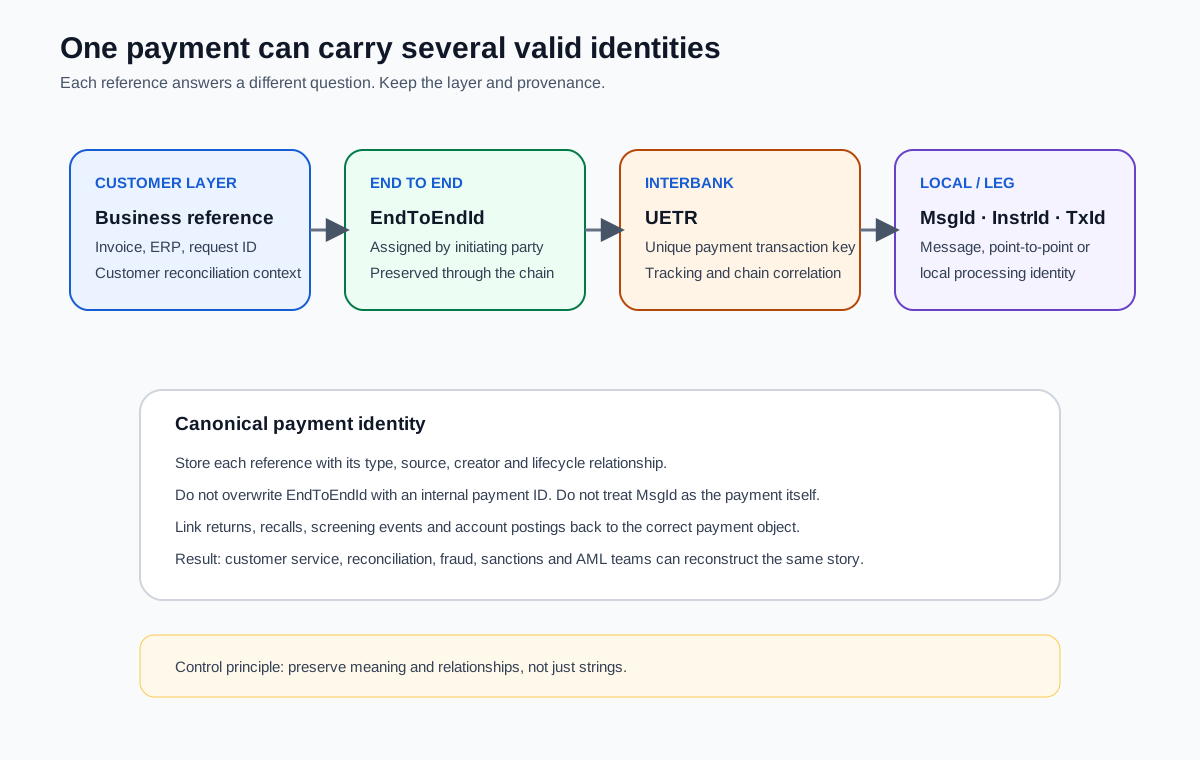
The mental model: one payment, several reference layers
The easiest way to understand payment references is to imagine one cross-border customer payment moving through several layers.
At the customer instruction layer, the initiating customer may provide its own business reference. A corporate might use an invoice number, treasury deal identifier or enterprise-resource-planning payment ID. In ISO 20022 initiation messages such as pain.001, the initiating side can also populate structured payment identifiers. Those values are important for the customer’s own reconciliation and may be expected to survive into downstream reporting.
At the end-to-end transaction layer, EndToEndId identifies the transaction from the initiating party’s perspective. ISO 20022 defines it as an identification assigned by the initiating party and intended to be passed unchanged through the full end-to-end chain. That makes it useful for linking initiation, interbank processing, account reporting and beneficiary-side reconciliation. It is not necessarily globally unique across the world, because uniqueness depends on how the initiating party creates it. A poorly governed corporate could accidentally reuse the same EndToEndId. A bank therefore should not treat EndToEndId alone as proof that two records are the same economic payment.
At the interbank transaction layer, UETR provides a globally unique transaction reference for payment tracking. Swift made UETR mandatory in specified MT payment messages from Standards MT Release 2018 and required intermediaries to pass an existing UETR unchanged along the transaction chain. In ISO 20022, UETR appears as a dedicated payment-identification element in relevant message structures. It is particularly valuable for tracking and correlating a payment as it moves between financial institutions.
At the instruction or message layer, references such as InstrId, MsgId and TxId identify narrower objects. InstrId is normally point-to-point between an instructing and instructed party. MsgId identifies the message itself. TxId can identify a transaction on the interbank chain, depending on message and market practice. PmtInfId can identify a payment-information block within a customer initiation. Clearing systems and account servicers can assign additional references when the payment enters their own processing domain.
The important design principle is that these identifiers are complementary, not interchangeable. A message can be new while the underlying payment remains the same. A payment can be returned while keeping references to the original transaction and adding a new return identifier. A cover settlement message can represent a different interbank settlement instruction while still needing correlation to the underlying customer transfer. A case-management record can create its own case ID while retaining all original payment identifiers as evidence.
Why financial-crime teams should care about identifiers
Financial crime controls do not usually trigger because a UETR is suspicious. The risk comes from what the identifiers allow the bank to reconstruct.
Suppose sanctions screening stops a pacs.008. The initial alert contains the debtor, creditor, agents, amount and UETR. Operations later repair an address and resubmit the payment. If the repaired message is treated as a completely unrelated object, the screening platform may create a fresh alert without linking it to the first decision. An analyst reviewing the second alert could miss the fact that the same payment was previously stopped, changed and resubmitted. Correct reference correlation lets the bank preserve the chain of events and ask whether the repair was legitimate data correction or an attempt to remove a problematic data element.
The same logic applies in AML investigations. A suspicious customer may send a series of payments with different UETRs but a recurring EndToEndId pattern or repeated remittance reference. That does not prove criminal behaviour, but it can help an investigator discover that payments were generated from the same upstream process, invoice, merchant workflow or orchestration service. Conversely, several system records may share the same UETR because they are different events in the lifecycle of one transfer, not multiple transfers. Counting those records as separate transactions would distort velocity and value calculations.
Fraud investigations also depend on correct correlation. An authorised-push-payment scam can generate a customer initiation, beneficiary confirmation, instant or cross-border payment, recall attempt, return and reimbursement case. The evidence is fragmented unless a common identity layer connects those events. Investigators must distinguish a reference assigned by the victim’s channel, a UETR assigned for the interbank payment, a beneficiary-bank reference, a recall case ID and a return transaction ID. The control question is not “which reference is the correct one?” but “what does each reference identify, and how do the objects relate?”
This is why payment-reference governance belongs in financial-crime architecture. Traceability is a prerequisite for reliable lookbacks, sanctions evidence, transaction-monitoring lineage, suspicious-activity narratives, customer complaints and regulator responses.
UETR: what it is and what it is not
The Unique End-to-End Transaction Reference, usually written as UETR, is designed to identify a payment transaction uniquely across the interbank journey. Swift’s introduction of mandatory UETR in relevant FIN payment messages from 2018 extended traceability beyond institutions participating directly in Swift gpi. If an intermediary receives a payment with a UETR, the existing UETR is expected to continue with the payment rather than being replaced casually.
The practical control value is continuity. A payment hub can store the UETR as a persistent key and use it when querying tracker information, handling investigations, linking status confirmations, processing returns and reconciling records received from correspondents. That key becomes especially useful when other details such as local transaction IDs change from one bank to the next.
But UETR has boundaries. It does not by itself identify the customer, prove the legitimacy of the payment, establish the purpose of funds, confirm sanctions clearance or show whether a beneficiary account exists. It is a reference, not a risk verdict. A criminal payment and a legitimate payment can both have perfectly valid UETRs.
It is also wrong to assume that every payment rail worldwide uses UETR in the same way. ISO 20022 is a message standard, while market infrastructures and schemes define their own usage guidelines. CPMI’s harmonised ISO 20022 requirements encourage consistent use of key data for cross-border payments, but CPMI explicitly describes those requirements as guidance rather than regulation. Individual domestic rails may support UETR, map it differently during transition, make it optional in a particular message, or use another primary transaction identifier. The bank must therefore maintain a rail-by-rail reference matrix rather than one universal rule.
A further control issue is uniqueness and duplicate handling. If UETR is intended to represent a single payment transaction, reusing one UETR for two independent payments can cause tracking and duplicate-detection problems. ISO 20022 Request-to-Pay best-practice material illustrates this clearly: a payment request that results in two partial payments should not simply cause the same UETR to be reused for both outgoing pacs.008 messages. Each payment transaction needs its own identity, while a separate request or EndToEndId relationship can preserve the business link.
EndToEndId: the customer-facing continuity reference
EndToEndId serves a different purpose. ISO 20022 describes it as an identification assigned by the initiating party to identify the transaction and passed unchanged through the end-to-end chain. The field is valuable because the initiating customer and the receiving side can use a common reference even though the payment passes through several banks.
In corporate banking this matters enormously for reconciliation. A corporate may generate an EndToEndId from its enterprise resource planning system, include it in a pain.001, expect it to appear in downstream interbank messages where applicable, and later reconcile it from camt.053 or camt.054 account reporting. The beneficiary may also use it to match the incoming credit to an invoice or receivable.
For financial crime, the same continuity can provide context. If an investigator sees multiple payments carrying the same business reference, the pattern may help identify a shared commercial relationship or operational source. Yet the investigator must not assume that EndToEndId is globally unique. A corporate may use a weak generation algorithm, recycle references after a period, populate a default value, or supply a non-meaningful placeholder where a market practice permits one. The bank’s matching logic should therefore use EndToEndId with amount, currency, parties, dates and other references rather than as a single universal key.
The field also should not be overwritten merely because an internal platform prefers its own transaction ID. If a payment hub needs a separate internal identifier, it should create that identifier alongside the original EndToEndId. Replacing the customer reference destroys continuity and weakens reconciliation. The same principle applies to translation and transformation: the bank should preserve source values and record the mapping rule used to populate the target message.
Other references that matter
A reliable payment model usually carries more than UETR and EndToEndId. Several related identifiers need clear meaning.
InstructionId is generally a point-to-point reference between an instructing party and an instructed party. If Bank A sends an instruction to Bank B, the reference can help those two parties discuss that instruction. It should not be assumed to remain the same when Bank B sends a new instruction to Bank C.
MsgId identifies the message. A single payment can therefore have different message IDs at different stages. A pacs.008 message, a subsequent pacs.002 status response, a camt.056 cancellation request and a pacs.004 return are separate messages even if they relate to the same underlying payment.
TxId identifies a transaction within the relevant message or interbank chain according to the applicable message definition and market practice. It can be useful for reconciliation, but banks should document when it is generated and whether it is preserved, translated or replaced across systems.
PmtInfId can identify a payment-information group in a customer initiation. In a bulk pain.001, one payment-information block may contain several transactions. The payment-information ID therefore has a different granularity from the individual EndToEndId.
Clearing systems, account servicers and internal platforms may generate further identifiers. These references are not inferior merely because they are local. They can be critical for settlement reconciliation, statement matching and evidence retrieval. The architecture problem is to retain the relationship between local references and the broader payment identity.
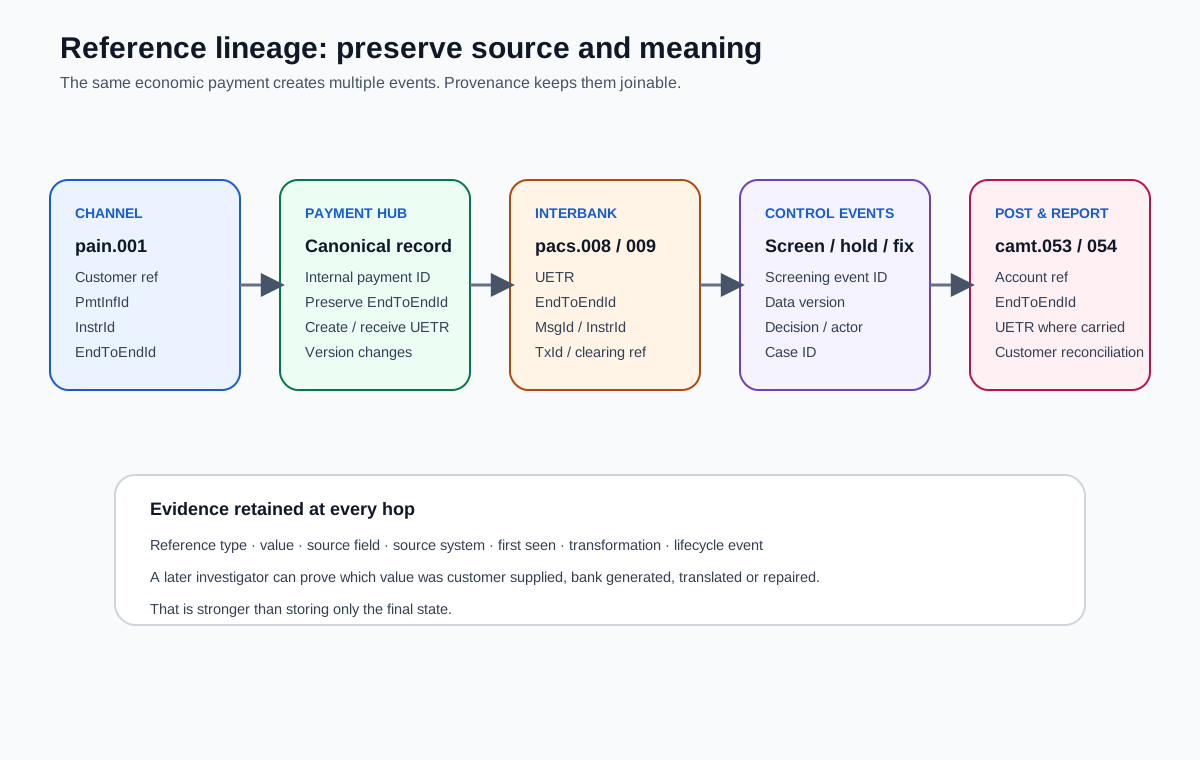
A reference model for the payment lifecycle
A useful bank data model treats payment identity as a set of related objects rather than one flat row.
The business transaction represents the customer’s economic instruction: pay this beneficiary this amount for this purpose. It may have a customer reference, invoice reference and EndToEndId.
The payment execution represents the bank’s processing of that instruction. It may have an internal payment ID and a UETR.
The message instance represents a particular ISO 20022 or other network message. It has a message ID and technical metadata such as sender, receiver, creation time and message type.
The instruction leg represents a point-to-point step between financial institutions or between a participant and a clearing system. It can have an InstructionId, TxId, clearing reference and settlement details.
The lifecycle event represents status, hold, repair, release, rejection, recall, return, cancellation, posting or reporting. Each event needs a timestamp, actor, reason and link back to the relevant payment object.
The case represents an investigation or exception. It has a case ID but should retain the payment identity set rather than copying only one reference into free text.
This model supports one-to-many relationships. One customer instruction can produce several execution attempts if the first is rejected before settlement. One payment can generate many lifecycle events. One payment can also generate a return transaction that has its own identifiers while pointing back to the original payment. A bulk initiation can contain many individual payments. A cover payment arrangement can create an underlying customer payment and a separate cover settlement leg that need to be correlated without being treated as the same message.
Banks that ignore these relationships often create false duplicates. For example, a monitoring engine may ingest both a pacs.008 and a camt.054 credit notification and count them as two transfers because both contain the same amount. A better design recognises that one is the payment instruction and the other is a reporting event for the same payment.
UETR and cover payments
Cover payments are a good test of whether the identity model is mature. In a cover method, the customer transfer information and the settlement movement can travel through different message paths. Market practice requires the cover payment to remain traceable to the underlying customer transfer. In the MT world, Swift specified that the UETR of an MT 202 COV should be the same as the UETR of the underlying customer credit transfer. In ISO 20022, the bank must implement the applicable CBPR+ and PMPG guidance for pacs.009 COV and related customer-transfer information.
For financial-crime teams, this correlation is essential. The screening engine may see a customer transfer with debtor and creditor information while the settlement engine sees a financial-institution transfer moving funds between correspondents. If those records cannot be joined, investigators can lose visibility over how customer activity settled. Conversely, if the join logic is too loose, unrelated treasury payments can be associated incorrectly with customer transfers.
A robust design therefore uses the prescribed references and message relationships, not amount-and-date matching alone. Amounts can repeat. Dates can change because of time zones or value-date conventions. Correspondent chains can introduce fees. Reference-aware correlation produces stronger evidence.
Returns, recalls and cancellations
A returned payment is not the same object as the original payment. The return represents a new movement of funds reversing or sending back value. It therefore needs its own return identification while carrying enough original-payment information to show what is being returned.
This distinction matters for sanctions and AML analysis. If an incoming payment is credited and later returned because the beneficiary account is closed, investigators may need to know whether the return went back through the expected route and whether the parties remained the same. A new UETR or transaction identity for the return does not break traceability if the return message carries the required original references. What matters is that the bank can traverse from return to original and back again.
Cancellation and recall flows are different again. A camt.056 is a request to cancel or recall an earlier payment; it is not proof that funds were recovered. The request needs to reference the original payment accurately. In 2026, Swift is also moving exceptions, investigations and cancellation workflows further into ISO 20022-based case management, with staged adoption through 2027. Banks should therefore avoid hard-coding investigation logic around legacy free-text MT references when the operating model is moving toward structured case and cancellation messages.
A financial-crime case should preserve the distinction between “recall requested,” “recall accepted,” “return received,” “customer reimbursed” and “payment cancelled before settlement.” These states have different evidential meaning.
Reference preservation during repair
Payment repair is one of the highest-risk moments for reference integrity because a human or automated process changes the message after initial creation.
A repair may be legitimate. An operator might correct a malformed postal address, supply a missing clearing code or repair a beneficiary name. But the bank must decide which identifiers are immutable and which can legitimately change. Replacing a UETR or EndToEndId during a routine repair can split one payment into two apparent histories. On the other hand, if a rejected instruction is abandoned and a genuinely new payment is created, reusing the old UETR may create a duplicate or misleading chain.
The correct rule depends on the lifecycle state and market practice. Architecture should therefore expose a controlled operation such as repair existing payment, resubmit existing payment, create replacement payment or create new customer instruction, rather than allowing arbitrary field editing. Each operation should have defined reference behaviour.
Financial-crime controls also need rescreening logic. If a repair changes a screening-relevant field, the bank should not rely blindly on the earlier screening result. The updated message may need to be screened again according to bank policy and applicable sanctions requirements. The case history should show both versions, the fields changed, the reason, the user or service that made the change and the resulting control decisions.
Duplicate detection and the danger of simplistic keys
Duplicate detection protects customers from double payment and banks from operational loss, but simplistic reference logic can create both false positives and false negatives.
A rule that blocks any repeated EndToEndId can be too aggressive because some initiators reuse values or use a non-unique placeholder. A rule that blocks only repeated UETRs can miss a customer accidentally resubmitting the same payment with a newly generated UETR. A rule based only on amount, account and date can block legitimate recurring payments.
Good duplicate control combines identifiers with contextual attributes and understands lifecycle state. It asks whether the same customer instruction has already been accepted, whether a previous attempt was rejected before execution, whether the second message is a legitimate retry, whether the payment is a partial payment, and whether an upstream system intentionally generated a new transaction.
This is also relevant to fraud. Attackers may intentionally alter non-essential fields to evade exact-match duplicate controls. A bank should therefore distinguish technical duplicate detection from behavioural fraud detection. References are valuable features, but they are not the entire fraud model.
Payment transparency and Recommendation 16
FATF Recommendation 16 deals with transparency of information accompanying payments. FATF revised Recommendation 16 in June 2025 and expects jurisdictions to implement the strengthened standard by the end of 2030. FATF’s June 2026 draft guidance consultation focused on practical implementation issues such as misdirected-payment checks, newer payment methods and data-protection considerations.
The important point for this chapter is that Recommendation 16 is about information on the parties and payment, not about mandating one specific commercial tracking reference such as UETR for every jurisdiction and rail. UETR and structured ISO 20022 references can support traceability, but banks should not misstate Swift market practice as a FATF legal requirement.
A global bank should therefore maintain two separate mappings. The first maps legal and regulatory payment-transparency obligations by jurisdiction, entity, product and payment type. The second maps technical references and message fields by rail and market practice. The control design links the two but does not collapse them.
Screening and monitoring use of references
Screening engines primarily evaluate parties, locations, institutions, goods, vessels, narrative text and other risk-relevant data. References still help in three ways.
First, they support alert correlation. Multiple screening events for the same payment can be grouped, preventing duplicate analyst effort and preserving the history of repairs or rerouting.
Second, they support decision lineage. If a payment was screened at initiation, again after repair and again at an intermediary, the bank can record which payload and reference set produced each decision.
Third, they support lookback and retrospective analysis. When a party is newly designated or new intelligence emerges, investigators can retrieve related payments using UETR, EndToEndId and other references, then expand through account and counterparty relationships.
Transaction monitoring uses references differently. A UETR can help de-duplicate multiple events representing one payment. EndToEndId can help identify recurring upstream business references. Clearing and account-servicer references can join settlement and statement data. None should replace customer, account, counterparty and behavioural features; they improve the integrity of the transaction graph.
Data lineage: preserve source, transformation and interpretation
A reference is only trustworthy if the bank knows where it came from.
Consider an incoming pacs.008 where the UETR was generated upstream, the EndToEndId came from the initiating customer, and an internal hub created its own payment ID. The screening engine receives a normalised JSON payload. If that payload labels all four identifiers as transactionReference, an investigator later cannot know which value was customer-supplied and which was bank-generated.
A better canonical model stores at least the reference type, value, source message, source field, source system, creator where known, first-seen timestamp, current status and relationship to the payment object. If a translator mapped a value from an MT field into an ISO 20022 element, the transformation should be identifiable. If an enrichment service generated a missing internal key, the enrichment should be distinguished from source data.
This matters after the November 2025 end of CBPR+ MT/ISO 20022 coexistence. Swift now expects cross-border payment instructions in ISO 20022 within CBPR+ scope, with specific exceptions and contingency arrangements. Rich structured data can improve traceability only if banks stop flattening it back into legacy generic fields internally.
CPMI’s February 2026 updated harmonisation requirements reinforce the broader principle: consistent ISO 20022 implementation is necessary to reduce fragmentation in cross-border payments. Those requirements are guidance for operators and participants, not regulation, but they provide a useful architecture benchmark for preserving data meaning end to end.
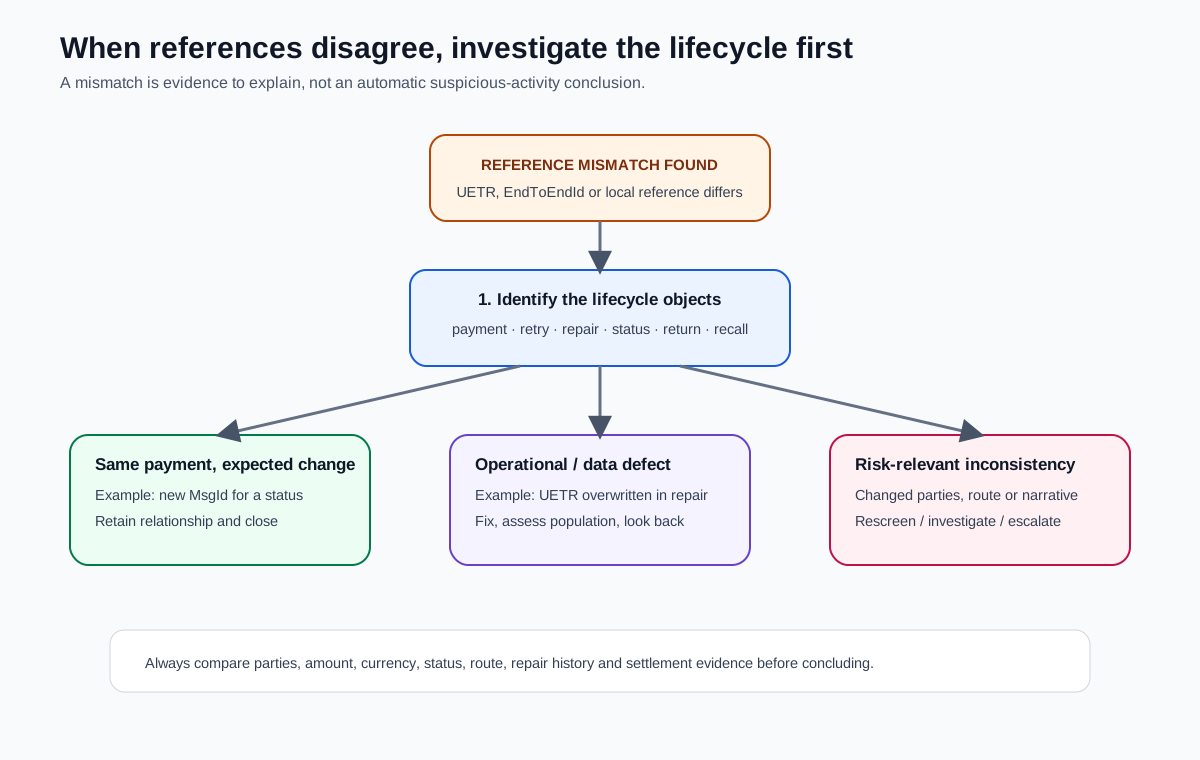
Investigation workflow when references disagree
A mismatch between references should trigger analysis, not an automatic suspicion conclusion.
An investigator first establishes the expected lifecycle. Was this one payment moving through several systems, a replacement after rejection, a split payment, a return, a cover payment or an unrelated transaction? The answer determines whether reference reuse is expected.
Next, the investigator compares immutable and local identifiers. If the UETR changed between two messages that should represent the same interbank payment, the bank needs to understand why. If the EndToEndId changed between initiation and downstream reporting, the investigation should check whether a transformation rule, customer correction or system defect caused the difference. If only MsgId changed, that may be completely normal because a new message instance was created.
Then the investigator examines the payload changes. A reference mismatch combined with changed beneficiary details or altered remittance text is more significant than a mismatch caused by a harmless internal replay identifier. The reviewer should see the full before-and-after record rather than only the latest state.
Finally, the outcome is classified. It may be an operational defect, data-quality issue, customer error, scheme-rule breach, fraud indicator, sanctions-evasion concern or simply correct lifecycle behaviour. The case narrative should explain the reasoning rather than using “reference mismatch” as a conclusion by itself.
Operational ownership
Payment-reference integrity crosses several teams.
Channels and corporate-file teams own capture of customer identifiers and should avoid generating meaningless defaults without governance. Payment hubs own canonical mapping and should preserve identifiers through orchestration. Network and correspondent teams own market-practice compliance for interbank messages. Clearing and settlement teams own local references and reconciliation. Financial-crime technology teams own the way references enter screening and monitoring platforms. Operations teams own repair and exception handling. Investigators depend on all of those systems to reconstruct evidence.
Data governance therefore needs a named owner for each reference type. That owner should know where the value originates, whether it must be unique, whether it should remain unchanged, which systems can modify it, how long it is retained and which downstream controls consume it.
Second-line compliance does not need to own UETR generation. It should challenge whether weak reference handling creates financial-crime blind spots. Internal audit can test whether a sample payment can be reconstructed across channel, hub, network, screening, posting and case systems without manual guesswork.
Management information that actually helps
Useful management information should go beyond the percentage of payments containing a UETR.
A mature dashboard can show duplicate-UETR rates, EndToEndId preservation rates, unmatched return rates, reference mismatches after repair, failed joins between payment and screening systems, payments requiring manual correlation, investigation cases with missing original references, and incidents where a reference defect affected customer servicing or regulatory evidence.
The trend matters more than an isolated count. A rise in unmatched returns after a payment-hub release may indicate a mapping regression. A sudden increase in duplicate EndToEndIds from one corporate may indicate a customer ERP configuration change. A cluster of UETR changes at one interface may reveal incorrect retry behaviour.
Metrics should also distinguish data quality from risk. A duplicate reference is not itself money laundering. The control objective is to make the underlying payment history reliable enough for risk teams to interpret correctly.
Customer impact
Customers notice reference failures even when they never hear the terms UETR or EndToEndId. They experience delayed investigations, “payment not found” responses, duplicate debits, missing invoice reconciliation, unexplained returns and long complaint journeys.
For corporate customers, loss of EndToEndId can create large reconciliation workloads. Treasury teams may receive credits but fail to match them automatically to invoices. For retail customers, poor correlation can delay a recall or reimbursement because operations cannot locate the interbank payment quickly. For correspondent-bank clients, broken UETR handling can make payment tracking unreliable.
The best architecture therefore treats reference integrity as both a control requirement and a service-quality requirement. Faster tracing helps compliance and customers at the same time.
What a business analyst should specify
A business analyst should avoid requirements such as “the system must support payment references.” That is too vague to test.
The requirement set should define which reference types exist, which message fields populate them, who creates them, whether they are mandatory in each rail, how uniqueness is checked, which values must be preserved, how retries behave, how repairs behave, how returns link to originals, how cover messages correlate, how references are exposed to screening and monitoring, and how evidence is retained.
The BA should also create a message-and-lifecycle matrix. Rows can represent pain.001, pacs.008, pacs.009 COV, pacs.002, pacs.004, camt.056, camt.029, camt.053 and camt.054 as relevant to the bank. Columns can show UETR, EndToEndId, InstrId, TxId, MsgId, original references and local references. Each cell records whether the reference is created, copied, optional, mandatory, transformed or not applicable under the relevant market practice.
That matrix becomes a powerful common artefact for architects, developers, testers, operations and investigators.
What architects and developers should protect
Architects should make the payment identity model explicit. A canonical payment object should not discard source references even if downstream systems use one primary key. Event stores should preserve historical values rather than overwrite them. APIs should distinguish customer references from interbank references. Retry logic should know whether it is replaying the same message, resending the same payment or creating a new payment.
Developers should treat reference generation as controlled functionality. UETR generation must follow the applicable syntax and uniqueness requirements. Validation should reject malformed identifiers where the message or market practice requires it. Logging should avoid exposing customer-sensitive data unnecessarily, but reference keys can often be used to correlate technical events safely when access controls are appropriate.
Idempotency is especially important. An API retry caused by a network timeout should not accidentally create a second payment because the calling system did not receive the first response. The idempotency key, business instruction ID and eventual UETR may be different values with different purposes. Architecture must keep those purposes separate.
What testers should prove
Testing should cover much more than a happy-path pacs.008.
Positive tests should prove that UETR and EndToEndId survive all expected transformations, that downstream account reporting exposes the correct references, that screening and monitoring records can be linked to the payment, and that returns and recalls identify the original transaction correctly.
Boundary tests should cover bulk files, repeated EndToEndIds, partial payments, rejected instructions, retries, duplicate submissions, changed value dates, multi-currency routes, cover payments and multiple intermediaries.
Negative tests should deliberately corrupt or remove references where the scheme or message requires them, attempt duplicate UETRs, break the correlation between cover and underlying transfers, and alter references during repair. The expected outcome should be explicit: reject, hold, repair, alert, log or route to investigation depending on the condition.
Resilience tests should simulate timeout and replay scenarios. A payment hub must not generate a new UETR every time a network retry occurs if the retry is still the same payment. Conversely, a genuinely new payment created after a terminal rejection should not inherit an old UETR merely because the customer reused an EndToEndId.
Evidence tests should prove that a reviewer can reconstruct the chain from the retained data without privileged access to production databases or ad hoc SQL.
The control objective in one sentence
The objective is not to maximise the number of references stored. It is to maintain accurate, explainable and durable linkage between the customer instruction, interbank payment, settlement events, control decisions and subsequent investigations.
When UETR, EndToEndId and related references are governed according to their actual meaning, they become one of the strongest foundations for payment traceability. When they are flattened, overwritten or reused carelessly, the bank loses evidence even though every individual system may still appear to be processing successfully.
Operational deep dive: how reference integrity survives real payment processing
The base chapter separated UETR, EndToEndId and local payment references by purpose. This deep dive moves into the harder operational questions: what happens when a payment is split, retried, repaired, translated, returned, reported or investigated across several systems that each have their own idea of identity.
The practical challenge is that banks rarely have one end-to-end platform. A corporate channel may create one internal ID, a payment hub another, a sanctions engine a screening event ID, a correspondent gateway a network message ID, a clearing system a settlement reference and a case-management tool a case number. Those identifiers are all legitimate, but they describe different things. A control fails when the bank loses the relationship between them.
Identity should be modelled as a graph, not a single key
A useful architecture starts from relationships.
A customer instruction can contain one or many payment transactions. Each transaction can result in one or more execution attempts. An execution attempt can generate one or more messages. A message can produce status events, repairs and responses. A settled transaction can later generate a return, investigation or recall. Each object may have one or more references.
This means a canonical identity store should support links such as:
- customer instruction to individual payment transaction;
- payment transaction to EndToEndId and customer references;
- payment execution to UETR;
- execution to pacs.008 or pacs.009 message instances;
- message instance to MsgId and InstrId;
- settlement leg to clearing-system reference;
- payment to screening, monitoring and fraud decisions;
- original payment to return, recall or investigation case;
- case to every relevant event and data version.
The point is not to build an unnecessarily complex graph database. A relational model can work perfectly well. The control requirement is that relationships are explicit and queryable. If an investigator enters a UETR, the system should be able to find the original customer instruction, EndToEndId, account postings, screening history, status messages, any repair event and any related return. If the investigator starts with a statement reference instead, the same payment history should still be discoverable.
A common anti-pattern is to use the latest system’s reference as the master key and discard earlier values. That makes the newest system easy to operate but destroys historical traceability. Another anti-pattern is to concatenate several references into one free-text field. The values survive physically but lose their type and provenance. A strong model stores each value with a reference type and relationship.
Source provenance is part of the evidence
Two identical strings can have very different meaning depending on who created them.
Suppose EndToEndId = INV-78441 appears on an incoming payment. If the value came from the initiating corporate’s ERP, it can provide useful business context. If a translator generated it because the source message had no equivalent usable reference, the evidential meaning is different. If an operations user manually entered it during repair, that is different again.
For this reason, reference metadata should include source message, source field, source system, creation or first-seen time, creating party where known, and whether the value was received, generated, enriched or manually changed. A bank does not need to expose all of that to every user, but the information should exist for reconstruction.
Versioning matters too. If an operator repairs a payment and changes a reference that policy allows to change, the old value should remain historically available. Investigators must be able to answer what the screening engine saw at 10:05, what the payment hub contained at 10:12 and what the final outgoing message contained at 10:20. Storing only the final state can make a legitimate repair look suspicious or conceal an inappropriate alteration.
UETR generation and preservation
UETR is most useful when its lifecycle rules are deterministic.
For a new interbank payment transaction, the responsible application generates or receives a UETR according to the applicable market practice. When the same payment passes through intermediaries, the existing UETR should remain associated with that transaction. A network timeout does not by itself mean a new payment exists. The sending system may need to retry transmission while preserving the same business execution and reference.
By contrast, a terminal rejection can lead the originator to create a new payment. Whether that new payment should receive a new UETR depends on whether it is truly a new transaction rather than a technical retry. This distinction should be encoded in workflow state rather than left to operator judgement.
The bank also needs controls for malformed or duplicate UETRs. Syntactic validation can catch invalid values. Duplicate detection can identify when a UETR already exists in the relevant population. But the response should consider lifecycle context. A second event carrying the same UETR may be expected because it is a status update or return reference to an original transaction. A second independent outgoing payment with the same UETR is a different problem.
The design therefore needs an object-type-aware uniqueness rule, not a database constraint that simply rejects every repeated appearance of the string.
EndToEndId continuity and corporate reconciliation
EndToEndId is often more meaningful to corporate customers than UETR because it can originate in their own payment process.
Consider a corporate paying 2,000 suppliers from one pain.001 file. The file can contain payment-information groups and individual credit-transfer transactions. The corporate may assign one EndToEndId per supplier payment. When the bank executes those transactions, downstream reporting should preserve enough reference continuity for the corporate to match debits and statuses back to the ERP instruction.
If an internal hub replaces all EndToEndIds with its own IDs, the bank may still settle every payment correctly but break automated reconciliation. Operations then receive avoidable queries. The financial-crime consequence appears when investigators or fraud teams also cannot join the customer instruction to the interbank transfer without manual research.
A different problem occurs when the corporate sends the same EndToEndId on many payments. The bank should not silently assume those are duplicates. Some customers use poor reference-generation practices or fixed values. The correct response is to combine the reference with customer identity, instructed amount, currency, beneficiary, date, source file and other context. The bank can also raise data-quality feedback to the customer without blocking legitimate payments solely because the reference is weak.
The relationship between EndToEndId and UETR
EndToEndId and UETR can both appear on the same transaction, but they should answer different questions.
EndToEndId helps answer: which customer-level transaction is this?
UETR helps answer: which interbank payment transaction is this across the network journey?
In many ordinary credit transfers there will be a one-to-one relationship between the two. That can tempt teams to treat them as substitutes. The edge cases show why that is unsafe.
A customer payment can fail before interbank execution and be re-created. The initiating customer may reuse the same EndToEndId while the bank creates a new UETR for the new execution. A request-to-pay can result in more than one partial payment; each executed payment needs its own transaction identity while the business reference may connect them to the same request. A return has its own transaction identity while referring back to the original payment. A bulk file can contain many EndToEndIds while one file-level reference applies to the group.
The bank therefore should record the cardinality rather than assume permanent one-to-one mapping.
Payment status messages and reference correlation
Status messages are another source of confusion. A pacs.002 can report the status of an earlier interbank payment instruction. The status message has its own MsgId while also carrying references to the original payment. A monitoring platform that indexes only the status message’s ID can lose the relationship to the actual transfer.
The same principle applies to customer status reporting such as pain.002. The bank should preserve the hierarchy: file or message status, payment-information status and transaction status. A single rejected transaction within a large file should not make every transaction appear rejected.
From a financial-crime perspective, status changes can be meaningful. A payment held for sanctions review, rejected because of data quality, released after investigation and later returned creates a sequence of events. The UETR and original payment references allow investigators to reconstruct that sequence. The status code alone does not explain why the decision happened, so case and screening identifiers must also be linked.
Returns and original transaction references
pacs.004 is a payment return. A return should not be modelled as simply changing the original payment’s status to “reversed.” Money actually moves back, and the return is a separate transaction with its own processing lifecycle.
At the same time, the return must retain sufficient reference to the original payment. An operations user should be able to open the return and navigate directly to the original customer transfer. An investigator should be able to see why the payment was returned, which party initiated the return, whether the amount changed because of charges or FX, and whether the funds followed the expected route.
Unmatched returns deserve attention because they can indicate broken mapping, missing source data, or in some cases unusual routing. The first response is not to label them suspicious. The bank should attempt deterministic matching using original references, UETR, EndToEndId, original TxId, original amount, currencies, parties and dates. Only after understanding the operational facts should financial-crime judgement begin.
A mature return process records the confidence of the match. A deterministic original-reference match is stronger than a heuristic amount-and-date match. Investigators should know which method was used.
Recall and cancellation references
A recall request is another message about an existing payment rather than a new customer payment. The control objective is to reference the original precisely enough that the receiving bank can act without ambiguity.
If the original UETR or transaction references are missing, staff may resort to searching by amount, date and beneficiary. That is slower and riskier, especially for high-volume correspondents. In fraud cases, minutes can matter because funds may be moved onward rapidly.
The migration of Swift exception, investigation and cancellation processes toward structured ISO 20022 case-management messages increases the importance of clean reference data. Banks should design their case platforms so that a cancellation request, investigation question and final outcome all remain linked to the payment object rather than being stored as isolated correspondence.
Cover payments require two views of the same economic story
In a cover payment, the underlying customer credit transfer and the interbank cover movement can travel separately. The customer-facing message carries party information needed for transparency and screening. The cover leg moves settlement funds through correspondent accounts.
The bank needs to correlate the two without confusing their roles. A sanctions engine may screen the customer transfer, while a nostro reconciliation engine processes the cover movement. If the cover arrives without an identifiable underlying transfer, operations may create an exception. If the underlying customer transfer arrives without expected cover, liquidity and settlement teams may investigate.
Reference correlation allows both sides to agree that they are looking at the same economic payment. Swift’s MT market practice explicitly required the UETR of an MT 202 COV to match the underlying customer credit transfer. ISO 20022 CBPR+ and PMPG guidance continues the broader principle that cover and underlying information must remain appropriately linked. Banks should implement the current usage guidelines applicable to their messages rather than extrapolating an old MT rule mechanically to every ISO flow.
Screening-event lineage
A single payment can be screened several times.
At initiation, the bank may screen debtor and creditor data. After enrichment, a routing bank or correspondent can be added and agent screening may occur. A manual repair can trigger rescreening. A sanctions list update may trigger retrospective rescreening. The payment can then be screened again on return.
Each screening event should be attached to the payment identity and to the exact data version screened. The case record should capture the screening engine event ID, rules or list version where relevant, timestamp, result and disposition. UETR can help correlate the events, but it should not be the only join key because pre-network screening may happen before a UETR exists.
This is why the canonical model needs both a persistent internal payment ID and external references. The internal ID can connect the full lifecycle; UETR and EndToEndId preserve external continuity.
Transaction monitoring and de-duplication
Transaction monitoring platforms often ingest data from several sources: payment instructions, core-account postings, clearing confirmations, card processors and data warehouses. If the platform lacks reference-aware de-duplication, one economic transfer can appear several times.
That can inflate customer velocity, distort peer comparisons and create false alerts. The opposite problem also exists: overly aggressive de-duplication can merge two genuine payments because the customer reused an EndToEndId.
A good design uses a hierarchy of identifiers and context. Where UETR is available and appropriate, it is a strong interbank key. EndToEndId adds customer-level context. Internal payment IDs and posting references connect ledger events. Amount, currency, account and timestamps help validate the relationship.
The matching algorithm should preserve evidence of how records were joined. Investigators need to know whether the platform made a deterministic or probabilistic match.
Reference integrity during format translation
Translation can happen at customer channels, gateways or legacy interfaces. The risk is that a rich source model is collapsed into a narrower target and then rebuilt later with guessed values.
During the MT-to-ISO 20022 coexistence period, translation rules had to preserve what could be mapped while acknowledging structural differences. That coexistence ended for CBPR+ payment instructions in November 2025, although certain user categories and contingency arrangements remain. The lesson remains relevant because banks still translate between proprietary internal models, ISO 20022 and domestic scheme formats.
A translation layer should never silently invent a source-originated reference. If a required target field must be generated technically, the system should mark it as generated. If a source reference cannot be represented, the loss should be known and, where material, surfaced as an exception or data-quality metric.
The bank should also avoid using free-text remittance fields as a dumping ground for references that have dedicated structured fields. That makes downstream machine processing less reliable and can interfere with screening of narrative information.
Idempotency, retries and duplicate payment risk
Modern payment APIs make retry behaviour especially important.
A client sends a payment request and the bank processes it successfully, but the API response is lost. The client retries. If the bank does not recognise the retry as the same request, it may create a second payment with a new UETR. That is a financial loss and customer-harm risk.
The solution is usually an idempotency mechanism or stable client instruction identifier at the API boundary. That idempotency key is not automatically the same as EndToEndId or UETR. It serves a technical contract: repeated submission of the same request within the agreed scope should not create duplicate execution.
Architecture should document how the idempotency key maps to customer instruction, internal payment ID, EndToEndId and eventual UETR. When the bank legitimately creates a new payment after a previous one failed terminally, the workflow should make that explicit so duplicate controls do not suppress it incorrectly.
Partial payments and split settlement
Partial payment scenarios prove why a payment request and a payment transaction need separate identity.
If a corporate requests 100 units and the payer sends 30 now and 70 later, those are two payment transactions. They should not share a UETR simply because they satisfy one request. A request reference can connect both payments to the same business obligation, while each payment keeps its own transaction identity.
The same reasoning applies to split settlement caused by liquidity or scheme design. A bank should know whether the split is visible to the customer, whether it creates separate interbank transactions, and which reference is expected to remain common. Financial-crime monitoring should avoid summing or de-duplicating incorrectly because two legs share a business reference.
Batch processing and hierarchy
Bulk corporate payments create a natural hierarchy of references.
A pain.001 file has a message ID. It may contain one or more payment-information groups, each with a PmtInfId. Each credit-transfer transaction can have its own InstrId and EndToEndId. The bank then creates interbank payment messages and UETRs for executed transactions.
Operational tools should expose that hierarchy. If a customer asks about one beneficiary payment, staff should not need to search only at file level. If the whole file failed validation, the system should not generate misleading per-transaction execution records.
For financial-crime controls, bulk files also require care because sanctions screening may operate both at file ingestion and transaction level. The case system needs to show whether one hit affected one transaction or the entire batch, and which references were used when the file was repaired and resubmitted.
Reference overwrite as a control defect
Overwriting deserves special attention because it can be invisible.
A legacy database may have one REFERENCE column. The channel writes EndToEndId into it. The payment hub later writes its internal transaction ID into the same column. The network gateway then writes UETR. Every system thinks the field is populated, yet earlier identities are lost.
This is a classic data-lineage defect. The fix is not to choose a better single reference. The fix is to redesign the model so each reference has its own semantic type and the relationships are retained.
A similar defect occurs when an operations user edits the displayed reference without the platform storing previous values. If the edit is necessary, the system needs immutable history showing who changed what and why.
The investigation question is always “same payment or related payment?”
When two records share a reference, the investigator should ask whether they are the same payment event, different events in the same payment lifecycle, or separate payments related by a business process.
A pacs.008 and its pacs.002 status are different messages about the same payment. A pacs.008 and a pacs.004 are different transactions linked as original and return. Two partial payments can be separate payments linked to one request. A customer retry after a network timeout may be the same intended payment. A new instruction after a terminal rejection may be a new payment even if the customer reuses the same EndToEndId.
This mental model prevents two common investigation mistakes: counting lifecycle events as multiple suspicious transfers, and collapsing genuinely separate payments into one because a customer reference happens to match.
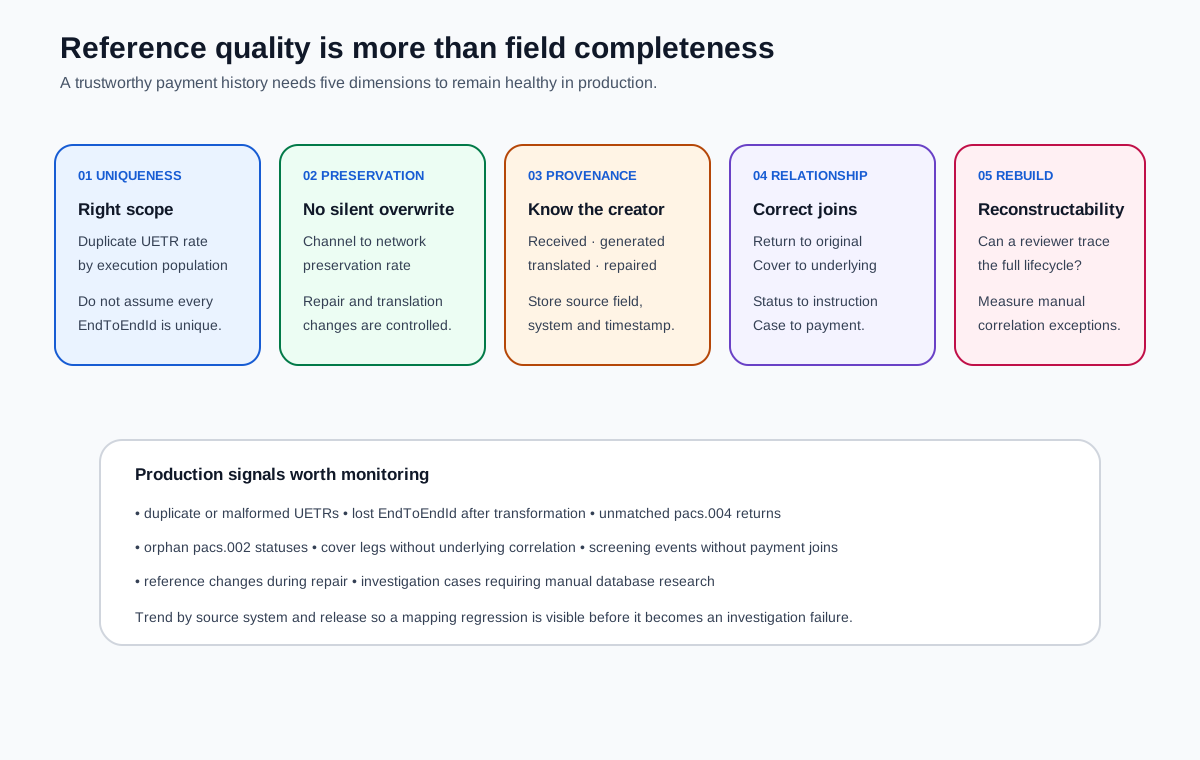
Quality controls that make reference data trustworthy
Reference quality should be tested through several dimensions.
Uniqueness asks whether a reference that is supposed to be unique actually is unique within its intended scope.
Preservation asks whether values meant to survive end to end remain unchanged through internal systems and external hops.
Provenance asks whether the bank knows who or what created the value.
Relationship integrity asks whether originals, returns, recalls, cover legs and status messages are linked correctly.
Reconstructability asks whether an independent reviewer can rebuild the payment history from retained evidence without relying on staff memory.
A bank can measure these dimensions with automated controls. Examples include duplicate-UETR monitoring, EndToEndId preservation checks between channel and outgoing payment, unmatched-return reporting, orphan status-message detection, cover-to-underlying correlation rates and failed joins between payment and screening data.
The metrics should have tolerances and ownership. A zero tolerance may be appropriate for certain malformed mandatory identifiers, while customer-generated EndToEndId duplication may need a risk-based data-quality threshold rather than payment rejection.
Data retention and privacy
Reference data can look harmless, but some customer references may contain personal or commercially sensitive information. A customer might embed an invoice number, employee identifier or case number in a reference. Access and retention therefore should follow the bank’s data-protection and record-retention framework.
The control objective is not to retain every technical log forever. It is to retain enough evidence for legal, regulatory, operational and investigation needs for the applicable period. Logs should use access controls, and production troubleshooting tools should avoid exposing unnecessary customer data.
When sharing references with external correspondents or investigators, staff should understand which values are safe and necessary to disclose. UETR is designed for payment tracking, but an internal case ID may reveal nothing useful externally and should not replace the actual payment identifiers.
Governance of change
Reference handling often breaks during migrations because teams focus on message validation rather than lifecycle semantics.
A new payment hub can produce valid pacs.008 messages while losing the customer EndToEndId in its internal database. A data-lake migration can preserve every field but change join logic so returns no longer match originals. A scheme upgrade can make a field mandatory and cause emergency defaulting that undermines meaning.
Change governance should therefore require a reference-impact assessment. The project should identify every reference created, consumed, transformed and reported; compare old and new behaviour; define backward compatibility; test historical reconstruction; and confirm that financial-crime systems still receive the expected keys.
A cutover plan should also consider in-flight payments. Payments initiated before migration but returned after migration still need to correlate. Maintaining only the new reference model can strand older transactions.
Operational playbook for a mismatch
When operations sees a reference mismatch, a disciplined sequence helps avoid both overreaction and underreaction.
First, identify the message types and lifecycle states. Second, retrieve the full reference set from both records. Third, compare parties, amount, currency, dates and route. Fourth, inspect transformation and repair logs. Fifth, decide whether the records are the same payment, related payments or unrelated. Sixth, determine whether the mismatch is expected market-practice behaviour, data-quality defect, operational error or risk signal. Seventh, correct or escalate according to the appropriate owner.
If the mismatch affected sanctions screening, monitoring coverage or customer reporting, the issue may require lookback. That decision should be based on population impact, not only the one case that exposed the defect.
The strongest teams use these incidents to improve controls. They convert a manually discovered pattern into automated monitoring so the next occurrence is detected earlier.
Advanced practice: delivery, controls and testing
Reference integrity becomes difficult when a bank changes channels, payment hubs, network gateways, screening platforms or reporting systems. The advanced practitioner therefore treats payment identity as a controlled data capability rather than a one-time ISO 20022 mapping exercise.
Build a reference contract before building interfaces
A useful delivery artefact is a reference contract. For every identifier, the contract states its business meaning, creator, format, uniqueness scope, mutability, lifecycle, mandatory or optional status by message, and downstream consumers.
For example, the contract can state that EndToEndId is received or assigned at the initiating side, is intended to remain unchanged through the end-to-end chain, and is consumed by reconciliation and customer reporting. UETR is generated or received for the interbank payment transaction, preserved according to the applicable market practice and consumed by tracking, operations and investigations. MsgId identifies a particular message instance and can therefore legitimately change when a new message is created.
The contract should also specify negative rules. A payment hub must not replace EndToEndId with its own internal key. A repair screen must not allow an operator to edit UETR unless the lifecycle operation explicitly requires a new transaction. A return process must not use amount and date as the only link to the original when structured original references are available.
These rules give developers and testers observable behaviour instead of vague statements about “supporting references.”
Canonical data model and API design
A canonical model should expose typed references as a collection or structured object, not one generic string. A practical schema can include referenceType, referenceValue, scope, sourceMessage, sourceField, sourceSystem, creationMethod, firstSeenAt, validFrom, validTo and relationship to the payment object.
The bank does not need to expose all metadata on every API. The important point is that the platform can recover it when needed. A customer-facing API may return EndToEndId and bank transaction ID. An operations API may also expose UETR, TxId and clearing reference. An investigation API may expose the full lineage plus historical versions.
API contracts should document idempotency separately. A caller-supplied idempotency key is a technical mechanism to prevent duplicate creation on retry. It should not be silently copied into UETR or EndToEndId unless that reuse is deliberately designed and compliant with the relevant semantics.
Requirements for retries and replays
Retries are one of the best tests of whether the identity model is correct.
A transport retry of the same outbound message should not create a new payment. A replay from an event store should not generate a fresh UETR. A manual resubmit after a temporary network failure may still be the same execution. A new customer instruction after a final rejection can be a new payment even if many business attributes are identical.
The system therefore needs explicit state. Developers should not infer “new versus same” from whether the API call happened twice. The orchestration layer should know whether it is retrying a message, retrying an execution, creating a replacement execution or creating a new business transaction.
Test cases should force each state and verify the expected reference behaviour.
Reference-aware sanctions and AML architecture
Financial-crime platforms should receive the internal payment identity plus the external references relevant to investigations. If only UETR is supplied, pre-network screening events can be difficult to join because UETR may not yet exist. If only the internal payment ID is supplied, external correspondent queries can be difficult to reconcile.
A good event payload therefore includes a stable internal payment ID and the current set of typed references. Screening decisions should point back to the exact payload version. Monitoring data should retain enough reference data to de-duplicate lifecycle events without collapsing separate payments incorrectly.
Where a repair changes screening-relevant information, the event model should create a new screening event tied to the same payment. The previous screening result remains part of history. This is stronger than overwriting an alert status because it proves what the bank knew at each point in time.
Testing matrix for a real programme
Positive-path testing should cover customer initiation through outgoing pacs.008, tracking, account posting and reporting. It should prove that EndToEndId remains consistent, UETR is valid and preserved, and downstream systems can search using either value.
Lifecycle testing should cover accepted, rejected, pending, held, repaired, released, cancelled, returned and recalled states. Each state should verify which references remain the same and which new identifiers are created.
Cover-payment testing should prove that the customer transfer and cover settlement can be correlated correctly and that treasury transactions are not accidentally joined to unrelated customer transfers.
Bulk testing should use pain.001 files containing multiple payment-information groups and many transactions. The test should demonstrate that file-level, group-level and transaction-level references do not become confused.
Duplicate testing should cover repeated EndToEndIds, repeated UETRs, repeated client API requests, network retries and deliberate duplicate payments. The expected outcome should differ according to the scenario rather than relying on one universal duplicate rule.
Return testing should prove that pacs.004 records retain original transaction references and that operations can move directly from the return to the original payment. Negative tests should remove or corrupt those references and verify controlled exception handling.
Investigation testing should start with a UETR and require the tester to retrieve all linked events, then start with an account-servicer reference and do the same. If traceability works only from one preferred key, the model is incomplete.
Data-quality controls
Reference controls should run continuously in production, not only during project testing.
Examples include syntactic validation of UETR, duplicate-UETR monitoring within the relevant transaction population, EndToEndId preservation checks between channel and downstream messages, orphan pacs.002 detection, unmatched pacs.004 returns, missing links between screening events and payments, and sudden changes in reference-generation patterns by customer or source system.
The bank should distinguish blocking controls from monitoring controls. A malformed mandatory network identifier may justify rejection before transmission. A reused customer EndToEndId may be better handled as a data-quality observation because immediate rejection could disrupt legitimate customers. Control severity depends on the field’s semantics and the applicable scheme rules.
Migration and cutover risk
Migration projects must preserve both forward and backward traceability. A payment created in the old platform can be returned after the new platform goes live. If the new system cannot interpret old references, operations will be forced into manual matching.
Cutover design should therefore migrate or expose enough historical identity data to service in-flight and post-event activity. A reference translation table may be needed temporarily. The bank should test payments initiated before cutover and investigated, returned or reported after cutover.
This is especially relevant after the November 2025 end of the main CBPR+ coexistence period. Many banks still have legacy internal systems even though cross-border network instructions are now ISO 20022. A project that modernises only the external message while keeping a flattened internal model does not realise the traceability benefit.
Current 2026 change context
Swift deferred SR2026 payments changes on 27 August 2026, superseding the earlier 14 November 2026 timetable. Structured-address enforcement requires a separately confirmed date. Swift's 21 September update scheduled the deferred release covering Tracker and exceptions/investigations messages, among other areas, for 12 June 2027; that date must not be assumed to apply to address enforcement. This chapter is not about address structure, but the change illustrates why data lineage and reference integrity must be tested together: a payment may be rejected or repaired because of party-data validation, and the bank still needs to preserve the identity of the payment through that exception path.
CPMI’s February 2026 updated harmonised ISO 20022 requirements continue to encourage consistent cross-border data implementation through end-2027. They are not binding law, but they are a useful benchmark for architecture and interoperability.
FATF’s strengthened Recommendation 16 was agreed in June 2025, with implementation expected globally by end-2030. The payment-transparency obligations should be implemented through local law and regulation. UETR and EndToEndId can support traceability, but neither should be described as a universal FATF-mandated field.
Acceptance criteria for architecture sign-off
A strong design should be able to demonstrate that every payment reference has a defined meaning and owner; source values are never silently overwritten; external and internal references remain linked; retries cannot create duplicate payments accidentally; returns and recalls can identify originals deterministically; screening events are tied to exact payment versions; historical reference values remain auditable; and an investigator can reconstruct the payment without ad hoc database research.
That is the point at which payment-reference handling becomes a control capability rather than a formatting feature.
Swift timetable source, checked 2 October 2026: Structured-address migration extension and 21 September release update. The deferred release includes exceptions/investigations messages on 12 June 2027; structured-address enforcement timing remains separately governed: https://www.swift.com/news-events/news/swift-accepts-community-request-extend-structured-address-migration-iso-20022-payment-messages
Practice close: prove the payment can be reconstructed
The practical test for this chapter is simple: choose one real payment pattern in a test environment and prove that a reviewer can follow it from customer instruction through interbank execution, screening, settlement, reporting and any later exception without guessing which reference belongs to which object.
Reviewer exercise
Start with a UETR from an outgoing pacs.008. Find the bank’s internal payment ID, the original EndToEndId, the source customer instruction, message ID, settlement reference, screening events and account posting. Then reverse the exercise: start from the customer’s EndToEndId and reach the same interbank and control history.
Repeat the exercise for a returned payment. The reviewer should be able to identify the return as a separate transaction, retrieve its own identifiers and navigate directly to the original transfer. If the team has to match manually on amount and date even though structured original references exist, the control is weaker than it should be.
Run the same test on a repaired payment. Confirm that historical values remain available, that the repair reason and actor are recorded, and that risk-relevant changes triggered the appropriate rescreening or control action.
Acceptance criteria for delivery teams
A chapter-level implementation can be considered sound when the team can demonstrate all of the following in evidence rather than only in design documents:
- UETR, EndToEndId, InstrId, TxId, MsgId and relevant local references are stored with distinct meanings rather than flattened into one field.
- Values intended to remain unchanged are preserved through transformations and repairs according to the applicable market practice.
- Retries and replays do not create unintended duplicate payments or replacement UETRs.
- Returns, recalls and status messages retain reliable links to original transactions.
- Cover-payment and underlying customer-transfer records can be correlated deterministically where the flow requires it.
- Screening and monitoring events are linked to the exact payment and data version they evaluated.
- Investigators can search from more than one reference and reach the same lifecycle history.
- Historical values and reference changes are auditable.
- Customer reporting preserves the references needed for reconciliation.
- Production monitoring detects duplicate, missing, malformed and orphaned reference conditions with named owners.
Common misconceptions
A valid UETR does not mean a payment is legitimate. It means the transaction can be referenced consistently.
The same EndToEndId on two records does not prove they are duplicate payments. The initiating party controls that value and may reuse it.
A different MsgId does not prove a different payment exists. New messages in the same lifecycle normally have their own message identity.
A return is not merely a status change on the original transfer. It is a related movement that should retain its own identity and original-payment references.
FATF Recommendation 16 does not make UETR a universal legal requirement. Payment-transparency law, scheme rules, ISO 20022 message semantics and Swift market practice must be kept distinct.
Final takeaway
Payment identifiers are most valuable when they let different teams tell one consistent story. The customer sees a transaction, the payment hub sees an execution, the network sees messages, the correspondent sees settlement, compliance sees screening events and operations sees exceptions. UETR, EndToEndId and the surrounding reference set provide the joins that turn those separate views into a defensible payment history.
When those joins are governed well, investigations become faster, reconciliations become cleaner, duplicate detection improves and financial-crime evidence is stronger. When they are overwritten or misunderstood, the bank can lose traceability even though every individual system reports that processing succeeded.
Masterclass: the payment that looked like three different transactions
This fictional case brings the chapter together. The figures and institutions are invented, but the processing pattern is realistic.
A European corporate customer submits a cross-border supplier payment for EUR 240,000 through a host-to-host channel. Its ERP creates EndToEndId = INV-884219. The bank’s channel creates an internal instruction ID and passes the transaction into the global payment hub. The hub validates the payment, allocates its internal payment ID and creates a UETR for the outgoing interbank transfer.
The payment requires an intermediary correspondent. The outgoing pacs.008 passes sanctions screening with no confirmed match and is sent. Several minutes later, the intermediary returns a negative status because the creditor-agent routing data is invalid. The bank’s operations team repairs the routing information and resubmits the transaction.
The incident becomes difficult because the legacy repair application generates a second UETR instead of preserving the first transaction identity. At the same time, it keeps the original EndToEndId. The sanctions platform now contains two screening records. The payment hub shows one customer payment with two execution attempts. The correspondent gateway shows two UETRs. The corporate sees one debit and one EndToEndId.
Later that day the beneficiary bank asks for clarification because its records show the second UETR, while the ordering bank’s customer-service team searches using the first UETR from the original acknowledgement. Staff initially conclude that the payment was sent twice.
Step 1: establish the object hierarchy
The investigator should not start by deciding which UETR is “right.” The first question is what actually happened.
There was one customer instruction. It carried one EndToEndId. There was an initial interbank execution attempt that failed before final settlement. Operations then repaired the route and created another interbank execution attempt. The bank’s defect was that the repair path did not preserve or clearly relate the transaction identity according to the intended workflow.
The investigator maps the records as one business instruction with two execution attempts. The first attempt has UETR A and a rejected status. The second attempt has UETR B and proceeds to settlement. Both are linked to the same EndToEndId and internal customer instruction, but they are not the same message instance.
That distinction prevents a false duplicate conclusion.
Step 2: verify whether value moved twice
Next, the investigator checks settlement and account-posting evidence rather than relying on message counts.
The customer account shows one final debit. Nostro reconciliation shows one settled outgoing movement. The first interbank attempt never reached settlement. The second attempt settled successfully. There is therefore no evidence of double payment.
This is an important lesson for transaction monitoring. If the monitoring platform ingested both outgoing pacs.008 attempts as completed transfers, it could overstate the customer’s activity by EUR 240,000. Reference correlation must be combined with lifecycle status so rejected attempts are not counted as settled payments.
Step 3: review the screening history
The first screening event was based on the original route. The second screening event included a different creditor agent because operations repaired the routing data.
The bank therefore should not discard the second screening event as a duplicate. The repaired route introduced new financial-institution data that legitimately required screening. The correct evidence chain contains both screening events, the data versions, the reasons for the repair and the final dispositions.
If the case platform kept only the latest screening result, an auditor could not prove what was checked before and after repair. If it treated both events as unrelated payments, analysts could not see that the second arose from the same customer instruction.
Step 4: assess whether the reference change is merely operational or creates control risk
The immediate cause is a repair-workflow defect, not evidence of money laundering or sanctions evasion. But the defect has financial-crime implications.
Changing UETR without clear linkage can fragment sanctions evidence, confuse correspondent queries, weaken payment tracking and make lookbacks incomplete. If the defect affects many payments, the bank may have a population-level data-lineage issue.
The investigator therefore raises a control defect rather than a suspicious-activity conclusion. Technology owners perform a lookback to identify how many repaired payments received replacement UETRs and whether the original and replacement attempts remained linked in screening and monitoring systems.
Step 5: design the remediation
The target workflow distinguishes four operations explicitly: technical retransmission of the same message, retry of the same payment execution, repair of an existing payment, and creation of a genuinely new payment.
For each operation, the reference contract defines whether UETR, EndToEndId, internal payment ID and message ID remain the same or change. The repair screen no longer generates a UETR independently. The payment hub owns the lifecycle decision and supplies the correct references downstream.
The sanctions platform receives the persistent internal payment ID plus UETR and EndToEndId. A new screening event after repair is tied to the same payment history. Operations can open either UETR and see both execution attempts. Customer service can search using EndToEndId or the current UETR and reach the same payment record.
Step 6: test the fix under stress
Testing includes a rejected routing scenario, a network timeout, a manual repair, a duplicate customer submission and a new instruction created after final rejection.
The network timeout must not create a second payment. The routing repair must preserve the intended identity relationship and trigger rescreening where risk-relevant data changed. The duplicate customer submission must be caught through idempotency and contextual duplicate logic. The genuinely new payment must receive a new transaction identity even if the customer reuses its EndToEndId.
The team also tests a return received several days later. The return must link to the settled execution, not the failed first attempt.
What each role should learn from the case
Operations learns that changing a routing field is not merely a message-repair action; it can affect tracking and screening evidence.
Compliance learns not to equate multiple UETRs automatically with multiple suspicious payments. Lifecycle context matters.
Business analysts learn to specify reference behaviour for every state transition rather than only the happy path.
Architects learn that the internal payment identity must persist independently of external network references.
Developers learn that retry and repair semantics must be controlled centrally.
Testers learn to verify settlement, screening and reference lineage together.
Investigators learn to start from the object hierarchy and value movement before drawing conclusions from identifiers.
The case demonstrates the wider principle of this chapter: identifiers create control value only when the bank knows exactly what each one identifies and preserves the relationships through every exception path.
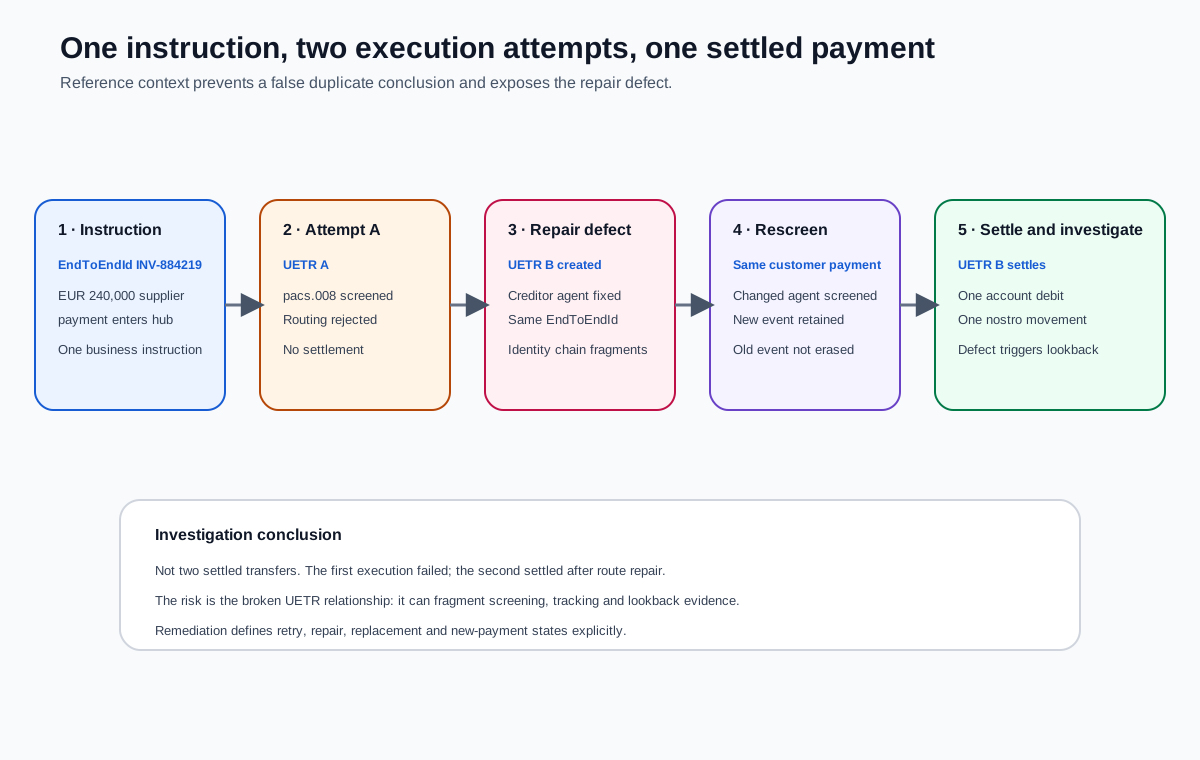
References and further reading
These sources support the chapter's treatment of payment transparency, ISO 20022 identifiers, UETR, CBPR+ processing and investigation traceability. Scheme and market-practice material should always be read together with the law, regulation and internal policy applicable to the bank and payment.
Global standards and payment transparency
- Financial Action Task Force, The FATF Recommendations (current consolidated standards, updated June 2026): https://www.fatf-gafi.org/en/publications/Fatfrecommendations/Fatf-recommendations.html
- Financial Action Task Force, Public consultation on guidance to increase payment transparency, 24 June 2026, explaining the strengthened Recommendation 16 implementation work and end-2030 readiness expectation: https://www.fatf-gafi.org/en/publications/Fatfrecommendations/R16-Public-Consultation-June-2026.html
- Committee on Payments and Market Infrastructures, Harmonised ISO 20022 data requirements for enhancing cross-border payments – updated report, 26 February 2026: https://www.bis.org/publications/harmonised-iso-20022-data-requirements-enhancing-cross-border-payments-updated-report
- Committee on Payments and Market Infrastructures, Harmonised ISO 20022 data requirements for enhancing cross-border payments – original/final report: https://www.bis.org/publications/harmonised-iso-20022-data-requirements-enhancing-cross-border-payments-final-report
ISO 20022 identifiers and message definitions
- ISO 20022, Message definitions and official repository entry point: https://www.iso20022.org/iso-20022-message-definitions
- ISO 20022, e-Repository: https://www.iso20022.org/iso20022-repository/e-repository
- ISO 20022 Registration Authority, Request-to-Pay best practices for linking a payment request to a customer credit transfer, including the distinction between UETR and EndToEndId in partial-payment scenarios: https://www.iso20022.org/sites/default/files/2020-11/RTPG_BestPractices_Linking_Request_for_Payment_to%20Customer_Credit_Transfer_November2020.pdf
Swift UETR, tracking and CBPR+ market practice
- Swift, Standard MT Release 2018 – mandatory changes in category 1 and category 2, describing mandatory UETR use for specified MT payment messages and preservation through the transaction chain: https://www.swift.com/de/node/165681
- Swift, Universal confirmations, covering payment confirmation and tracking options using the transaction's unique tracking code: https://www.swift.com/fr/node/310006
- Swift, CBPR+ self-attestation, current message families and application-readiness expectations for ISO 20022 cross-border payments: https://www.swift.com/cbpr-self-attestation
- Swift, ISO 20022 for Financial Institutions, including the end of the main CBPR+ MT/ISO 20022 coexistence period and the importance of preserving rich payment data: https://www.swift.com/es/node/310120
- Swift, Standards Releases. Earlier migration background; the November 2026 timetable is superseded by the later release announcement: https://www.swift.com/standards/standards-releases
- Swift, Transforming exceptions and investigations, describing the 2026 onward transition of payment cancellation and investigation processes toward structured ISO 20022 case management: https://www.swift.com/news-events/news/transforming-exceptions-and-investigations
- Swift Payments Market Practice Group, Cover Payments Market Practice Guidance, version 4, February 2024: https://www.swift.com/sites/default/files/files/pmpg-cover-payments-market-practice-guidance-v4-february-2024.pdf
Related 2026 implementation context
- Swift, ISO 20022 in bytes for payments: Call-to-action for November 2026. Earlier migration background; the November 2026 timetable is superseded by the later release announcement: https://www.swift.com/ru/node/310589
- Swift, Removal of unstructured address data. Earlier migration background; the November 2026 timetable is superseded by the later release announcement: https://www.swift.com/standards/iso-20022/removal-unstructured-address
The chapter intentionally distinguishes global standards, ISO message semantics, Swift market practice and jurisdiction-specific legal obligations. None of the technical references above should be treated as a substitute for the bank's current legal interpretation or applicable scheme rulebook.
Swift timetable source, checked 2 October 2026: Structured-address migration extension and 21 September release update. The deferred release includes exceptions/investigations messages on 12 June 2027; structured-address enforcement timing remains separately governed: https://www.swift.com/news-events/news/swift-accepts-community-request-extend-structured-address-migration-iso-20022-payment-messages