Regulatory Breach, Self-Disclosure and Enforcement Response
A regulatory breach becomes dangerous to a bank twice: first when the underlying control fails, and again when the institution handles the discovery badly. A screening rule may have been configured incorrectly, a suspicious-activity report may have been filed late, a customer population may have missed enhanced due diligence, a sanctions restriction may have been applied incorrectly, or an AML reporting obligation may have been missed. The original failure matters. What happens after discovery matters just as much because delay, poor evidence, inconsistent regulator communication, weak remediation or an attempt to minimise the problem can deepen the regulatory and operational consequences.
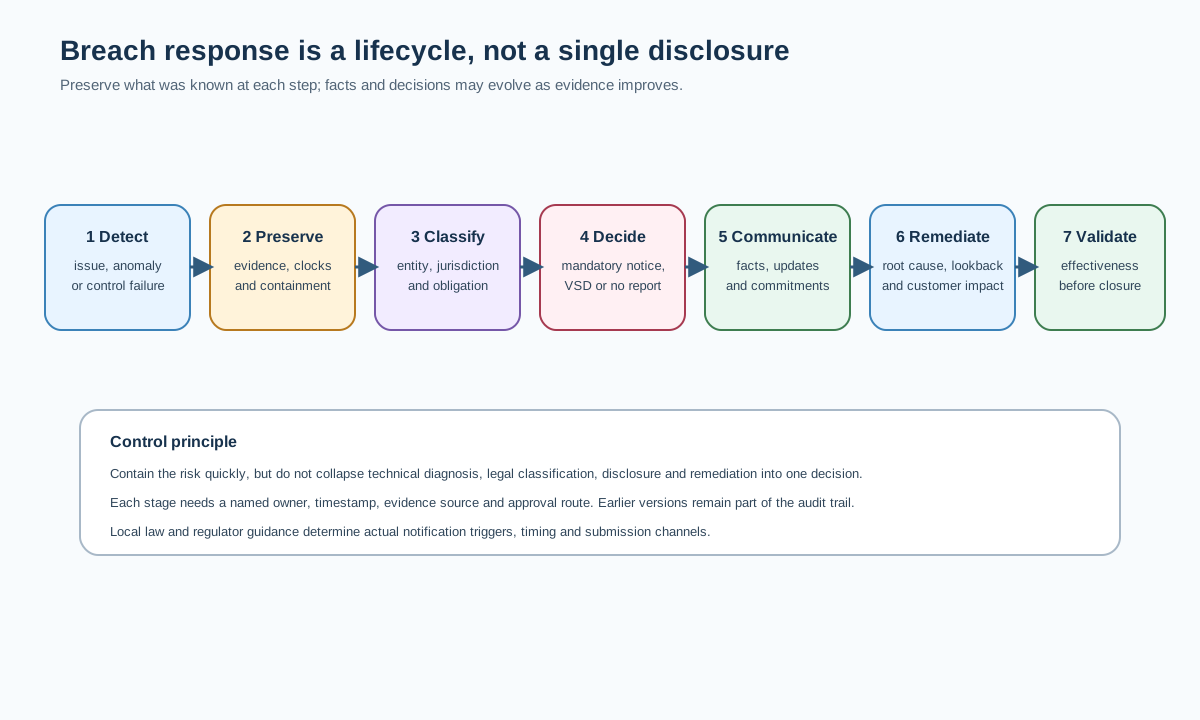
The simplest mental model is detect, preserve, classify, decide, communicate, remediate, validate. Detect what appears to have gone wrong. Preserve the evidence before systems or people change it. Classify the issue against the correct legal entity, jurisdiction and obligation. Decide what containment, notification or voluntary disclosure is required. Communicate facts consistently as they become known. Remediate both the immediate defect and its root causes. Finally, validate that the fix is effective before declaring the issue closed.
This is not the same as deciding whether to file a SAR or STR. A regulatory breach concerns possible non-compliance by the institution, its people, systems or controls. A SAR or STR concerns suspicious activity that may need to be reported to a financial intelligence unit. The two can coexist, but neither automatically triggers the other. A sanctions breach, an AML programme deficiency, a late regulatory filing and a suspicious customer transaction can each have different authorities, deadlines, confidentiality requirements and decision owners.
What counts as a regulatory breach?
Banks need more precision than a single red breach flag. A control deficiency means a control is missing, poorly designed or not operating as intended. A policy exception means an internal standard was not followed. A near miss means a failure could have produced non-compliance or harm but did not. A suspected breach means the available evidence indicates that a legal, regulatory, licence, order or other binding requirement may have been breached but the facts are not yet sufficiently established. A confirmed breach is a conclusion reached under the bank's approved legal and compliance process that the relevant requirement was not met.
These labels matter because they drive different actions. A policy exception may require management approval and remediation without external reporting. A system defect may demand immediate containment even before legal classification is complete. A suspected breach may already trigger a notification rule in one jurisdiction, while another regime may permit a fuller fact-finding exercise before a voluntary disclosure decision. The bank should therefore store both the facts and the current classification, including who made the classification, when, under which rule set and what evidence was available at that time.
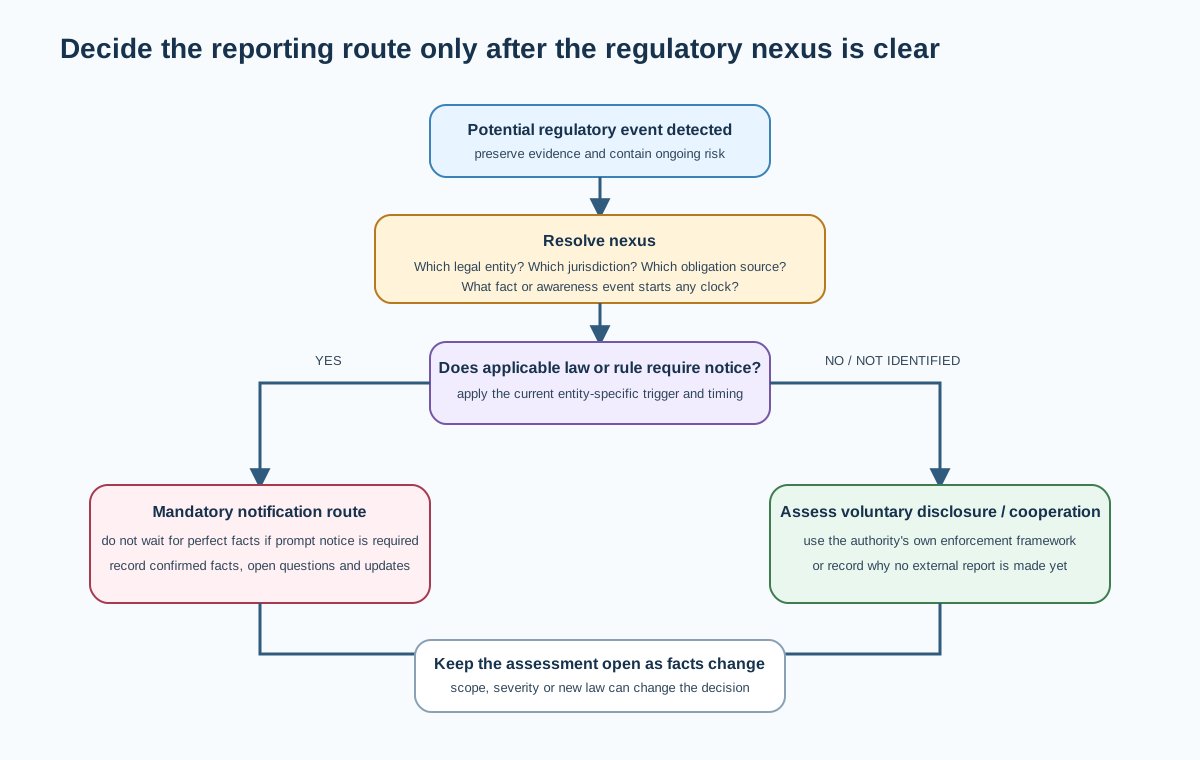
The obligation source also matters. Financial-crime controls can sit under primary legislation, regulations, regulator rules, licence conditions, supervisory directions, court orders, sanctions regulations, scheme or market rules, formal undertakings and institution-specific commitments. A global policy cannot safely flatten all of these into one universal notification threshold. The institution must resolve the affected legal entity and jurisdiction before applying a deadline or disclosure standard.
Global standards do not create one global self-reporting rule
FATF establishes international standards for AML, counter-terrorist financing and counter-proliferation financing. Recommendation 35 requires countries to have proportionate and dissuasive sanctions for failures to comply with relevant AML/CFT requirements. FATF's supervision and enforcement guidance also emphasises effective, risk-based supervision and proportionate remedial and enforcement action. Those standards are important context, but they do not create a single worldwide rule that every bank must self-report every control failure to a regulator within one common timeframe.
Domestic and regional law determines the actual notification duty. In the United Kingdom, for example, FCA Principle 11 requires firms to deal with regulators in an open and cooperative way and to disclose appropriately matters of which the regulator would reasonably expect notice. FCA SUP 15 then contains specific notification requirements, including immediate notification for defined categories such as significant breaches of certain rules. That is a concrete UK regulatory obligation; it should not be copied into a global process as though it applied unchanged to every entity.
The United States provides a different example. FinCEN's BSA enforcement statement encourages covered financial institutions to voluntarily and promptly report violations and to cooperate candidly and completely with investigations. OFAC separately encourages voluntary self-disclosure of apparent sanctions violations and treats qualifying disclosure as a mitigating factor under its enforcement framework. OFAC guidance says an initial notification may be followed by a sufficiently detailed report and generally expects that fuller report within 180 days. Those are specific features of the U.S. sanctions and BSA enforcement context, not global deadlines.
UK financial sanctions provide another model. OFSI's current enforcement guidance distinguishes mandatory reporting obligations from voluntary disclosure. It rewards prompt, complete voluntary disclosure and ongoing cooperation through a potential discount, while also explaining that a person may make an early disclosure before the full factual picture is complete. Again, the point is not the discount percentage itself; the design lesson is that the bank must know whether a report is mandatory, voluntary, already requested by the authority, or part of a separate investigation, because those categories can produce different legal and enforcement consequences.
Australia illustrates the range of supervisory responses. AUSTRAC can use civil penalty proceedings, infringement notices, remedial directions, external audits and enforceable undertakings depending on the circumstances. Public AUSTRAC matters also show that remediation can be independently tested before a supervisory undertaking is closed. The broader lesson is that an enforcement response is not synonymous with a fine. Supervisors can require evidence, external assurance, restrictions, remediation or ongoing reporting, depending on their legal powers.
The first hours after discovery
The first operational objective is not to write a perfect regulator letter. It is to prevent the situation getting worse and preserve what the bank knows. If a sanctions screening configuration omitted a data field, operations may need an emergency configuration fix or additional manual control. If an AML reporting interface failed, the bank may need to restore the feed, secure the failed message population and prevent records from being overwritten. If an onboarding rule was misapplied, new onboarding may need a temporary control while the affected historical population is identified.
Containment must be proportionate. Stopping all payments or onboarding across a bank because one issue is poorly understood can create customer harm and operational risk without improving compliance. Equally, continuing business as usual because the precise population is not yet known can increase exposure. A good incident lead defines an interim control with an owner, start time, scope, monitoring and explicit exit criteria.
Evidence preservation begins at the same time. Teams should secure relevant configuration versions, release records, alert or case data, logs, screenshots where appropriate, source files, regulatory submissions, emails or approvals that form part of the decision record, and a clear chronology of what people knew when. Data should be collected in a controlled evidence repository rather than scattered through personal mailboxes and spreadsheets. The objective is not forensic theatre; it is the ability to reconstruct the event honestly months later.
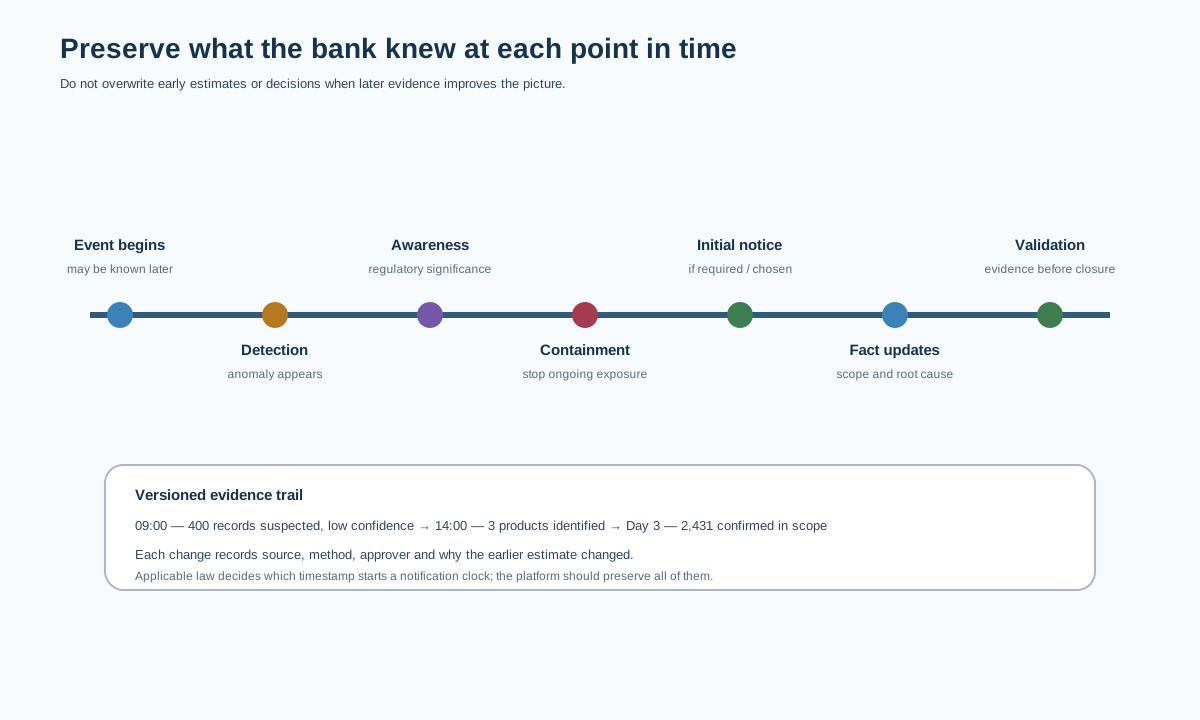
A crucial timestamp is awareness. Notification rules often depend on when the firm became aware of, discovered, or had information reasonably suggesting a problem. Banks therefore need a defensible chronology: when the anomaly first appeared, when someone recognised it as potentially significant, when compliance or legal was engaged, when the scope changed and when any regulator was notified. Backdating the clock to the earliest raw data point or delaying it until senior management formally labels the event a breach can both be wrong. The applicable rule and facts decide the relevant trigger.
Classifying the event before deciding disclosure
A useful classification record answers several questions in parallel. Which legal entity operated the affected control? Which customers, products, channels and countries are in scope? Which law, rule, licence condition or supervisory commitment may apply? Was the issue ongoing when detected? Could prohibited or suspicious activity have passed through the gap? Is customer harm possible? Is the issue isolated, repeated or systemic? Is a mandatory notification or reporting rule potentially triggered? Are other regulators, FIUs, sanctions authorities or law-enforcement bodies relevant?
The bank should also separate control impact from outcome impact. A screening control can be materially deficient even if a lookback later finds no prohibited transaction. Conversely, a small configuration error can produce a serious outcome if it allowed a prohibited payment. Reporting and enforcement assessments should therefore consider both the weakness and its consequences rather than assuming no loss or no identified suspicious activity means no regulatory significance.
Materiality is not only about money. Duration, number of affected customers, repeat occurrence, senior management awareness, weakness in governance, implications for systems and controls, regulatory reporting accuracy, vulnerable customer impact, and the speed with which the issue was detected and corrected can all matter. FCA SUP 15, for example, explicitly points to factors such as potential financial loss, frequency, systems-and-controls implications and delays in identifying or rectifying certain breaches. Other jurisdictions use different tests. The bank needs jurisdiction-specific criteria, not one global score that pretends legal judgement can be automated.
Mandatory notification, voluntary disclosure and regulator engagement
The disclosure decision should be recorded as a legal and regulatory determination, not as a public-relations choice. The decision file should identify the authority, the obligation or disclosure regime, the facts known, unresolved questions, the decision owner, the deadline or expected timing, the proposed scope of the initial communication and any required approvals.
Where notification is mandatory, the bank should not wait for perfect facts if the relevant rule expects prompt or immediate notice. An initial notification can clearly distinguish confirmed facts from preliminary estimates and explain what the bank is still investigating. Where a disclosure is voluntary, the institution should evaluate the applicable enforcement policy and the value of early, complete cooperation without assuming that voluntary disclosure automatically eliminates enforcement risk.
Regulator communication needs one source of truth. Different teams should not provide conflicting populations, dates or explanations to different authorities because each used a different spreadsheet. The breach case should maintain versioned facts, open questions, approved external statements, information requests, responses, commitments and due dates. If a number changes, the record should explain why it changed and which evidence supports the new figure.
No one should make optimistic commitments just to make a meeting easier. A remediation date given to a regulator becomes a governance obligation that the bank should track with the same seriousness as the underlying issue. If new facts make a commitment unrealistic, the safer approach is early escalation and a transparent revised plan rather than silent slippage.
Technology and data architecture
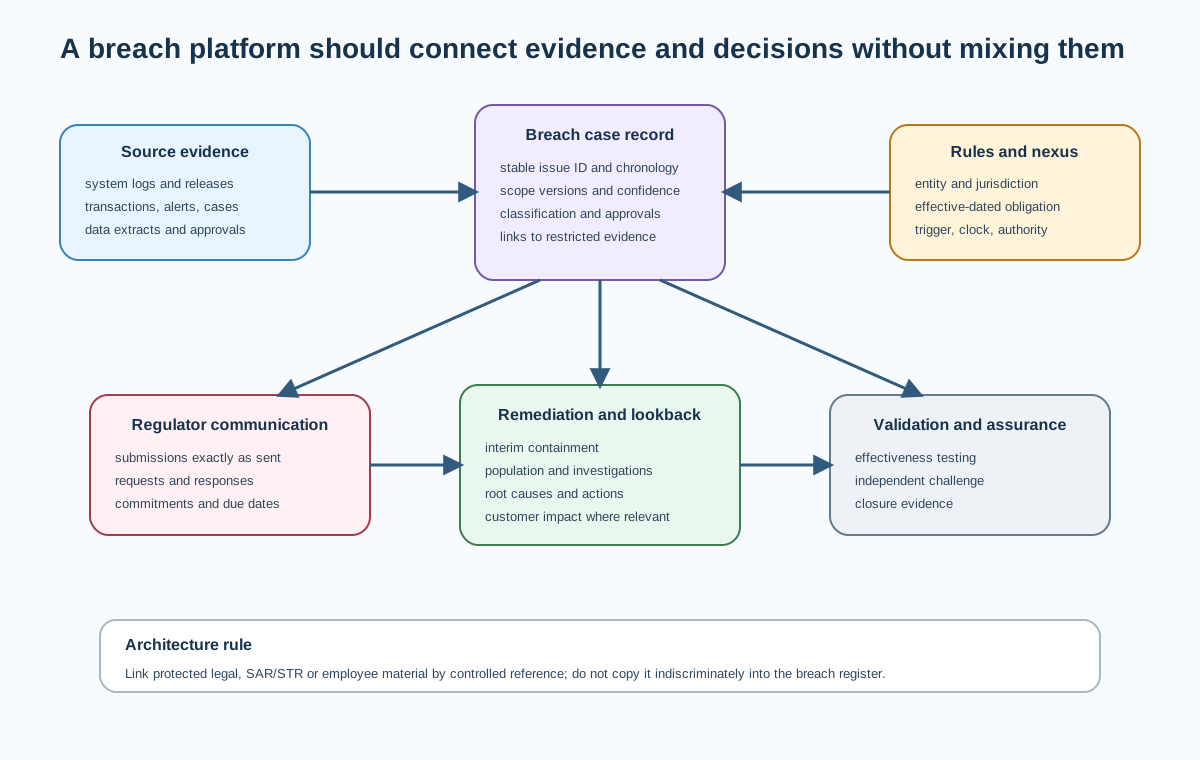
A bank-grade breach register needs more than free-text notes. At minimum it should carry a stable issue ID; affected legal entity; jurisdiction; obligation source; business, product and control owner; detection and awareness timestamps; current classification; severity; affected period; population estimate and confidence; related customer, transaction or case references where appropriate; interim controls; notification decisions; regulator contacts; disclosure versions; remediation actions; commitments; validation status; and closure approvals.
The design should support versioned scope. Early in an investigation the bank may believe 400 customers are affected; a later data lineage review may reveal 3,700. Overwriting the first number destroys the chronology. Store each material scope change with timestamp, reason, calculation method and evidence source. The same principle applies to root-cause conclusions and regulatory assessments.
Access control also matters. Breach files can contain privileged legal advice, sanctions information, SAR-related material, customer data and sensitive regulatory correspondence. Access should follow need-to-know principles, with clearly separated factual evidence and legal advice where the bank's legal framework requires it. Labelling every document "privileged" does not create privilege, and privilege rules vary by jurisdiction, so the workflow should support legal classification rather than hard-code an assumption.
The architecture should link, not duplicate, related cases. A regulatory breach may have a linked AML investigation, sanctions case, customer-remediation workstream, technology incident and audit issue. Those records can have different confidentiality and ownership rules. A relationship layer lets governance see the whole event without copying protected content into every system.
Root cause is more than the failed step
A weak root-cause analysis says, "an analyst made an error" or "a rule was misconfigured." A strong analysis asks why the system allowed that error to reach production, why the monitoring did not detect it earlier and why governance did not recognise the exposure. The causes may sit in requirements, data lineage, maker-checker controls, test coverage, change management, vendor configuration, staffing, training, ownership, risk acceptance or monitoring.
Root-cause analysis should distinguish the trigger, the proximate cause and the systemic cause. A software release may trigger the event. A mapping defect may be the proximate cause. Weak ownership of regulatory data requirements and inadequate regression testing may be the systemic causes. Fixing only the mapping can restore today's service while leaving the organisation vulnerable to the same class of failure in the next release.
A remediation action should state the control outcome, owner, due date, dependency, evidence required for completion and how effectiveness will be tested. "Update procedure" is not enough. The bank should be able to demonstrate that the revised procedure is embedded in workflow, staff know how to use it, system behaviour matches it, exceptions are visible and the control operates over a meaningful period.
Enforcement response as a programme, not a legal letter
Once a regulator opens an investigation or formal supervisory process, the bank needs a coordinated response. Legal and regulatory affairs may manage formal correspondence, but operations, compliance, data, technology, risk and business teams usually own much of the evidence and remediation. A central response office can maintain requests, deadlines, document production, factual consistency, action ownership and governance decisions.
Enforcement powers vary widely. Possible outcomes can include no further action, supervisory findings, remediation requirements, independent reviews, audits, undertakings, licence or business restrictions, public censure, civil monetary penalties, court proceedings or referral to other authorities. The chapter deliberately avoids presenting this as a universal ladder because different authorities have different mandates and legal thresholds.
Cooperation should never mean guessing. If the regulator asks a question and the bank does not yet know the answer, the record should say so, explain what is being done to establish the facts and provide a controlled update. Fast but inaccurate answers can damage credibility more than a carefully explained evidence gap.
The bank also needs a clear process for regulator data requests. Every production should have an owner, source systems, extraction logic, quality checks and a retained copy of exactly what was sent. Reproducing a past regulatory submission from a live database months later is risky because the underlying data may have changed.
Customer and operational impact
Breach response often creates downstream customer effects. A sanctions or KYC control gap may lead to re-screening, document requests, payment delays, temporary restrictions or account review. A reporting or monitoring defect may require a lookback over historical transactions. A conduct-related financial-crime issue may require customer remediation or compensation under local rules. These actions should be governed separately from the decision to notify the regulator.
Customer communication is especially sensitive. The bank should explain operational requirements clearly without disclosing protected investigation information or creating tipping-off risk where relevant. Front-line scripts need to be reviewed for the specific scenario. A generic "compliance review" response may be appropriate in one context and misleading in another.
Capacity planning matters too. A large lookback can create thousands of cases and overwhelm operations. If the bank responds by lowering review quality or creating unmanaged backlogs, remediation can generate a second control failure. The remediation plan should therefore model volumes, skills, service levels, quality assurance and escalation thresholds before cases are released to operations.
Governance and decision rights
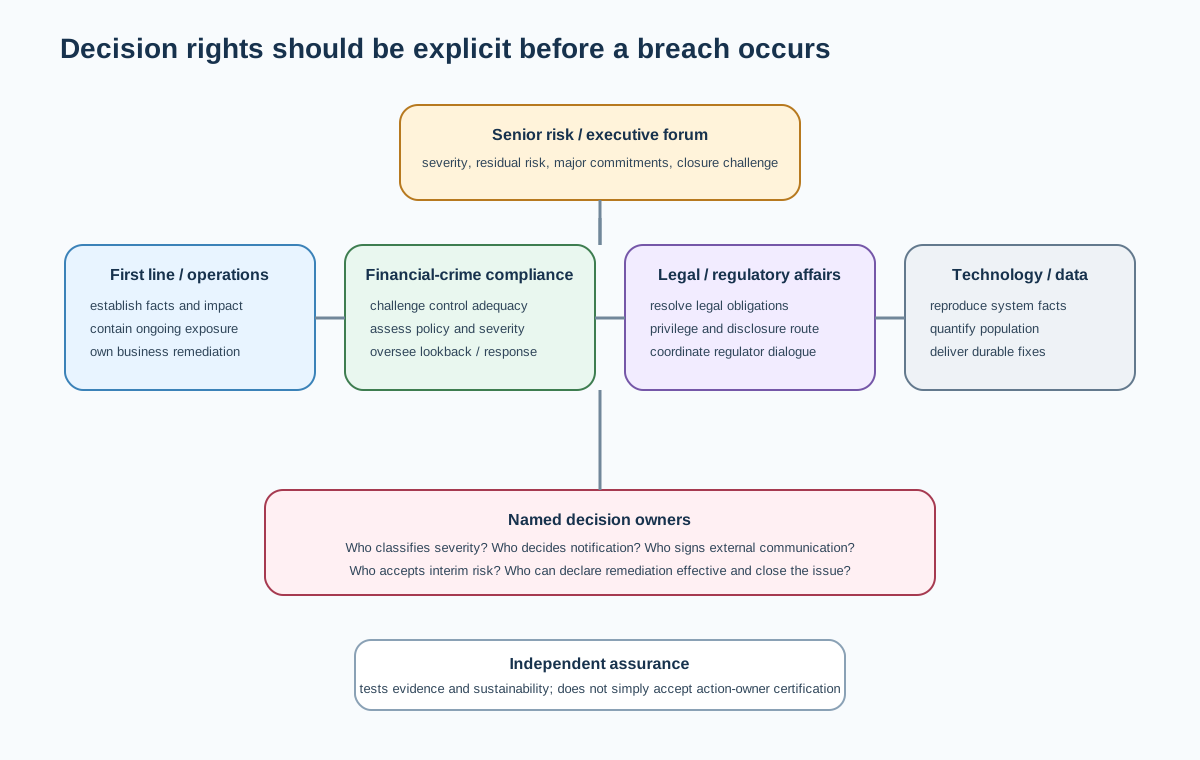
The first line generally owns the business process and immediate correction. Financial-crime compliance owns or challenges policy interpretation and control adequacy. Legal advises on legal obligations, privilege and enforcement posture. Regulatory affairs or equivalent teams coordinate supervisory communication. Technology and data teams establish facts about systems and populations. Senior management or a designated committee owns material risk decisions and regulator commitments. Internal audit or another sufficiently independent function may later validate remediation, depending on the issue and governance framework.
The exact RACI differs by bank, but ambiguity is dangerous. The breach record should identify who can classify severity, who decides notification, who approves a voluntary disclosure, who signs regulator correspondence, who accepts interim residual risk and who can close the issue. A committee that merely "notes" a serious problem without a named accountable executive does not create effective governance.
What business analysts, architects and testers should demand
For a business analyst, the most important requirement is that the process can be reconstructed. Requirements should define event sources, mandatory data fields, jurisdiction and legal-entity mapping, timestamps, decision states, approvals, evidence links, notification clocks, exception handling, versioning, regulator communication records, remediation dependencies and closure criteria. A vague requirement such as "system must support regulatory breaches" is not testable.
Architects should avoid a design where every business unit keeps its own issue spreadsheet. A central breach capability does not mean one monolithic application, but it does require common identifiers, controlled interfaces, consistent timestamps, reliable evidence retention and a governance view across linked systems. Architecture should also account for data residency and confidentiality when cross-border teams work on the same event.
Testing must go beyond the happy path. Test a defect discovered on a weekend where a local notification clock starts before the global team is online. Test an issue initially assigned to the wrong legal entity. Test a population estimate that triples after a source-data reconciliation. Test simultaneous notification obligations to two authorities. Test a regulator request that arrives while remediation is in flight. Test case access when one attachment is legally restricted. Test duplicate incidents that later prove to share one root cause. Test a remediation action that is marked complete but fails effectiveness testing.
The most important negative test is whether the platform allows someone to close a material breach while an open regulator commitment, overdue remediation action or failed validation still exists. Closure controls should be explicit and auditable.
Mini case study: the screening field that disappeared
Assume a global bank releases a payment-screening change for one legal entity. A mapping defect means a secondary party identifier is no longer passed to the sanctions screening engine for a subset of cross-border payments. The primary party names are still screened, so the defect is not obvious in daily operations. Six weeks later, a quality reviewer notices that the field is absent from sampled screening payloads.
The bank first preserves the relevant message payloads, mapping specifications, release evidence and configuration history. It activates an interim repair so new payments include the field. Compliance, legal, payments operations and technology establish the affected legal entity, time window, products and payment population. They do not label every historical payment a sanctions breach; instead they separate the control deficiency from any prohibited transaction outcome.
A lookback re-runs the affected population through the corrected screening logic. Potential matches are investigated under normal sanctions procedures. In parallel, legal and regulatory specialists assess applicable reporting and disclosure requirements for the jurisdictions involved. If UK financial sanctions reporting duties apply to the facts, those duties are assessed under the relevant UK rules and OFSI guidance. If U.S. sanctions exposure exists, the bank separately evaluates the OFAC framework. The teams do not use one regulator's deadline or mitigation policy as a proxy for the other.
The root-cause review finds that the data field was optional in the interface schema even though policy treated it as required when present in the source message. Regression tests checked message acceptance but not field-level screening coverage. The remediation therefore changes the schema contract, adds mandatory data-quality monitoring, creates field-coverage regression tests, strengthens release approval and adds control MI showing screening-field completeness by payment type.
Regulator communications, where required or chosen, describe what is confirmed, what remains under investigation, the interim containment and the timetable for the lookback. Later updates explain scope changes rather than silently replacing earlier numbers. Closure occurs only after the corrected interface operates successfully for an agreed period and an independent reviewer confirms that the new coverage and change controls are effective.
The case shows the central lesson of this chapter: a credible breach response is not a confession document. It is an evidence-led operating process that protects the bank, customers and financial system by establishing facts quickly, meeting applicable duties, correcting the weakness and proving that the correction lasts.
References and further reading
The detailed source list for this chapter is maintained in the accompanying references section. It uses current public material from FATF, the FCA, FinCEN, OFAC, OFSI and AUSTRAC. Jurisdiction-specific guidance is presented as an example of that regime, not as a global rule.
Operational deep dive: from discovery to defensible disclosure
The hardest part of regulatory breach management is rarely recognising that something looks wrong. The difficulty is moving from an incomplete signal to a defensible regulatory position while operational clocks are running, customer activity continues and the factual scope is still changing. A mature bank therefore treats breach response as a controlled investigation with legal, regulatory, data and operational workstreams that share one chronology.
Build the chronology before debating materiality
A breach team should start with time, not adjectives. Record when the underlying event began if known, when a control first failed, when data first showed the problem, when a person recognised that the issue could be regulatory, when compliance or legal was informed, when containment started and when the regulator was contacted. These are different moments. Their significance depends on the applicable regime.
This chronology prevents a common failure: teams arguing for hours about whether an issue is "material" before agreeing what happened. Materiality depends on facts such as duration, population, outcomes, legal entity, customer impact and whether the weakness is isolated or systemic. If those inputs are unstable, the materiality conclusion must be explicitly provisional.
The chronology should also record knowledge state. At 09:00 the bank might know that one interface failed. At 13:00 it may learn that three products share the same component. At 18:00 a data query may show that only one legal entity was affected. Each major fact change should be captured because regulators commonly ask not only what the bank knows now but what it knew when it made earlier decisions.
Resolve the legal entity and obligation map
Global banks often organise operationally by product or platform while regulation attaches to legal entities and jurisdictions. A central sanctions engine can screen payments for several branches and subsidiaries. A transaction-monitoring platform can generate alerts for multiple regulated entities. A single technical defect can therefore create several regulatory assessments.
The breach case should map each potentially affected entity to the relevant obligation source. A practical mapping record contains the entity, regulator or authority, applicable rule or law, activity in scope, trigger for notification or disclosure, timing requirement, required submission channel, decision owner and any confidentiality or privilege considerations. The purpose is not to make operational staff interpret law. It is to make legal and compliance interpretation executable and auditable.
Do not infer jurisdiction solely from customer residence, payment currency or hosting location. Those facts can matter, but regulatory nexus is normally more complex. Entity incorporation, branch status, regulated activity, transaction route, sanctions jurisdiction, customer relationship and staff location can all be relevant. Legal judgement should resolve the nexus; the system should preserve the facts needed for that judgement.
Separate three questions that teams often mix together
First ask: Did a control fail? This is a design and operating-effectiveness question. A required field may have been omitted, a review may have been late, or a monitoring scenario may not have run.
Second ask: Did the failure cause or permit a prohibited or reportable outcome? A control gap may have existed without any prohibited transaction, while a small error can produce a serious prohibited outcome. Lookbacks and transaction analysis help answer this second question.
Third ask: Does the institution have a notification or disclosure obligation, or a reason to make a voluntary disclosure? This is a jurisdiction-specific regulatory and legal question. It can be triggered by the control failure itself, by the outcome, by the significance of the issue, by a regulator's rules, or by a separate reporting regime.
Keeping these questions separate prevents a dangerous shortcut: "no bad transaction found, therefore no breach". Supervisors assess systems and controls as well as outcomes. It also prevents the opposite shortcut: "a control failed, therefore every transaction during the period was a legal breach". The evidence must support the actual conclusion.
Triage severity with evidence, not labels
An internal severity model can help prioritise resources, but it should not replace the legal notification test. A useful model considers at least the regulatory obligation, duration, affected population, customer or market harm, prohibited-activity exposure, repeat occurrence, systemic implications, management awareness, data reliability and containment status.
Severity can change. A low-volume incident may become serious when the same root cause is found in another product. A large population may prove less significant if the affected field was not legally required and no control objective was compromised. Every severity change should identify the new evidence that justified it.
Senior governance should be alerted early when uncertainty itself is material. If the bank cannot reliably quantify the population because source-data lineage is broken, the inability to establish scope is a risk signal. Management should not wait for a confident number before recognising that the control environment may be weak.
Design the notification clock register
One breach can create several clocks. The FCA may have one notification requirement, a sanctions authority another, a FIU filing rule another, and a contractual or supervisory commitment a fourth. A breach workflow therefore needs a clock register rather than one generic due date.
Each clock should record the rule source, triggering event, trigger timestamp, calculation method, timezone, deadline, owner, status and evidence of submission. If the trigger is disputed, record the competing interpretations and the approved legal conclusion. Do not silently move the clock because a new team takes ownership.
Testing should include weekends, holidays and daylight-saving changes where relevant. It should also test an event discovered by a regional office before the central compliance team starts work. A platform that assumes all deadlines are end-of-day UTC can produce a regulatory miss even when every human follows the system correctly.
Initial notification is not the final investigation report
Where a regime expects immediate or prompt notification, the bank may need to contact the authority before the full population and root cause are known. The initial communication should clearly separate four things: confirmed facts, current estimates, unresolved questions and actions already taken. It should avoid speculative language presented as fact.
Later updates should be version-controlled. If the affected population falls from 5,000 to 1,200 because duplicates were removed, explain the reconciliation. If the root cause changes from "vendor defect" to "bank configuration error", explain what new evidence produced the change. Regulators generally expect facts to mature; unexplained inconsistency is the problem.
OFSI's current UK sanctions guidance is a useful example of this principle. It says prompt disclosure can in many circumstances begin with an initial report before a fuller account follows, while still expecting complete and proactive cooperation. OFAC similarly permits an initial notification followed by a detailed report for a qualifying voluntary self-disclosure. These are regime-specific examples, but they illustrate why a global workflow must support staged disclosure rather than a single one-time submission.
Preserve regulator communications as controlled records
Every formal submission, email, meeting note, information request and commitment should be linked to the breach case. The record should show who approved the communication, what evidence supported it and which version was sent. If the authority provides oral guidance in a meeting, the bank should document the understanding and, where appropriate, confirm it through the agreed communication channel.
A commitment tracker should distinguish regulator requests from bank promises. A regulator may ask for a report by a date; the bank may separately promise to complete a remediation milestone. Both matter, but they have different origins and approval requirements. Missing either because it sat only in a meeting note is avoidable.
The same discipline applies when several regulators are involved. A global response team can coordinate facts, but each authority may have different powers, confidentiality rules and expectations. Cross-regulator consistency does not mean identical wording; it means the factual core is reconciled and differences are deliberate and explainable.
Evidence production and data reproducibility
Large breaches often require data extracts: affected customers, payments, alerts, cases, screening hits, filing populations or control logs. Every material extract should be reproducible. Record the source system, query or transformation logic, extraction time, filters, version and quality checks. If manual adjustments are made, identify them explicitly.
This is especially important where the regulator asks the bank to reproduce a number months later. A query run against today's database may not recreate the historic state because customer attributes, sanctions lists, case dispositions or data-retention processes have changed. Where feasible, preserve the exact dataset or an immutable evidence package used for the submission.
Data reconciliation should connect source counts to reported counts. For example, 12,000 payment records may become 11,400 unique transactions after duplicates are removed, then 1,900 in-scope transactions after legal-entity and date filters, then 47 investigation cases after risk criteria are applied. A reviewer should be able to follow that funnel rather than accept a final number with no lineage.
Remediation must cover detectability
A bank that fixes the broken control but does not improve detection has learned only half the lesson. Root-cause remediation should therefore ask why the original monitoring, quality assurance or management information failed to spot the issue. If a screening data field disappeared for six weeks, field-completeness monitoring could have detected the problem on day one. If SAR submissions were rejected silently, acknowledgement monitoring should have surfaced the failure.
Detection controls need thresholds and ownership. A dashboard nobody reviews is not a control. Define who receives the exception, how quickly it must be assessed, what constitutes escalation and how closure is evidenced. This is often where a breach programme moves from reactive issue management to preventative control design.
Independent validation and issue closure
Completion and effectiveness are different. An action to deploy a new rule is complete when the rule is in production. It is effective only when testing shows that the rule operates as intended, receives complete data, produces the expected decisions and is monitored sustainably.
Material breach remediation should therefore have closure evidence proportionate to the risk. That may include sample testing, data-quality results, control performance over time, management information, training completion, procedure implementation, audit or independent review. Regulators sometimes require an external reviewer or specific assurance route; other issues may be validated internally under the bank's framework.
The closure paper should answer a simple challenge: what evidence proves that the original failure could not recur unnoticed in the same way? If the answer is only "the team confirmed it is fixed", the evidence is too weak.
What good operational discipline looks like
A strong breach process can tolerate uncertainty without losing control. It records facts before conclusions, preserves versions, resolves jurisdiction before applying deadlines, distinguishes mandatory reporting from voluntary disclosure, contains the risk without unnecessary customer harm, provides regulators with accurate staged updates, converts root causes into specific remediation and requires independent evidence before closure.
That discipline protects more than regulatory relationships. It gives architects clear system requirements, investigators reliable evidence, operations executable procedures, senior management a truthful risk view and auditors a reconstruction trail. Most importantly, it stops a single control failure from becoming a second failure in governance and response.
Advanced practice: designing breach response as a controllable bank capability
A mature breach-management process is not a compliance inbox. It is a cross-bank capability that has to work under pressure, across legal entities, with incomplete facts and with enough control discipline to survive regulatory examination later. Advanced practice therefore focuses on decision rights, data lineage, workflow states, testing and the quality of remediation evidence.
Treat breach management as a state machine
A useful technology design has explicit states rather than one free-text status. An event may begin as under assessment, move to suspected breach, then to confirmed breach or control deficiency only. In parallel, the external-reporting state may be not assessed, mandatory notification identified, voluntary disclosure under consideration, initial notice submitted, updates in progress and regulatory response closed.
Remediation should have its own lifecycle: containment active, root cause established, actions approved, implementation in progress, effectiveness testing, validated and closed. Keeping classification, external reporting and remediation separate prevents one workflow action from accidentally implying another. Filing a regulator notice does not mean root cause is complete. Fixing the system does not mean the regulator has closed the matter.
Transitions need controls. A material case should not move to closed if an open regulator commitment exists. A notification state should not be set to not required without the approved rationale and decision owner. A suspected breach should not be downgraded merely because the business has fixed the defect. Workflow rules should enforce evidence, not replace legal judgement.
Build a jurisdiction rules service, not hard-coded deadlines
Global banks change faster than static workflow logic. Rules are amended, regulators change forms, sanctions programmes evolve and legal entities gain or lose permissions. A robust architecture therefore separates regulatory rules from the case-management engine.
The rules service can hold the authority, jurisdiction, regulated entity type, obligation source, event trigger, notification timing, submission channel, escalation owner and effective dates. The case system calls that service using facts from the event. Human legal or compliance interpretation remains necessary where the rule depends on materiality or judgement, but the platform can still prevent obvious failures such as applying a UK rule to a non-UK entity or using an expired version of a notification requirement.
Effective dating is critical. If a breach occurred over eight months and the regulation changed halfway through, the system must preserve which rule version applied to which period. The same applies to sanctions enforcement policies. A current penalty discount policy may differ from the policy in force when the underlying conduct occurred. The case file should therefore distinguish the law governing conduct, the reporting rule governing the current disclosure and the enforcement policy currently used by the authority.
Design for privilege and confidentiality without creating black holes
Breach investigations often involve legal advice. They can also touch SAR/STR confidentiality, sanctions investigations, personal data and employee conduct. Access control must be granular enough to protect sensitive material while still allowing operational teams to do their work.
One practical design is to separate the factual evidence record from restricted legal analysis. The factual record contains system logs, configurations, transaction populations, chronology, remediation evidence and approved business facts. Legal advice is referenced through restricted documents or workspaces. That architecture helps the bank preserve a usable operational record without unnecessarily distributing legally sensitive advice.
Do not assume that placing a lawyer on every email makes the material privileged. Privilege tests vary by jurisdiction and context. The system should capture classification and access decisions made by legal counsel rather than generate them automatically.
SAR or STR information needs particular care. A regulatory breach investigation might discover that transaction monitoring did not generate expected alerts, but the breach file should not become an uncontrolled copy of suspicious-activity reports. Links and controlled references are safer than duplicating protected content across issue-management tools.
Quantify uncertainty explicitly
Management dashboards often present precise numbers even when the underlying scope is provisional. A breach programme should instead record confidence. An early population estimate might be 2,000 to 3,500 records, medium confidence because one archive has not yet been reconciled. Later it may become 2,431 confirmed in scope, high confidence after lineage checks.
This improves decision-making. Senior leaders can see whether exposure is increasing because the problem is growing or because measurement is improving. Regulators can also understand why numbers change. Uncertainty becomes a controlled fact rather than something hidden until the team feels comfortable.
The same principle applies to root cause. A case may initially have a working hypothesis, then a validated proximate cause, then a broader systemic cause. Store these as separate evidence-backed stages. Avoid writing a confident root cause before technical investigation is complete simply because governance wants an answer.
Connect breach response to change management
Many financial-crime breaches begin with change: a new product, platform migration, vendor upgrade, sanctions-list feed change, data-model change, rule release or process centralisation. The breach programme should therefore feed lessons into change governance.
If a defect arose because an optional API field carried mandatory screening information, the remediation should update interface standards and regression testing across comparable integrations. If an onboarding policy changed without corresponding workflow changes, regulatory change management should be strengthened. If a vendor configuration was accepted without independent validation, vendor governance and release evidence may need redesign.
The objective is to prevent a narrow fix. A high-quality issue record asks, "Where else could this control pattern exist?" That question turns one event into enterprise learning.
Enforcement response needs its own operating rhythm
When a regulator starts formal enforcement or a deep supervisory review, the case can generate hundreds of requests, interviews, document productions and remediation commitments. Running this through ad hoc email creates inconsistent answers and missed deadlines.
A response office should maintain a master request register. Each item needs a regulator reference, request wording, due date, owner, source systems, reviewers, approval status and evidence of delivery. Dependencies should be visible: a data extract may need technology, data privacy and legal review before submission. Late-risk items should escalate before the deadline, not after it.
The response office should also maintain a factual issues log. If one workstream says the defect began in March and another says April, the inconsistency should be resolved before either figure appears in external communication. This is not about scripting witnesses; it is about ensuring that shared facts come from shared evidence.
Commitments need stronger governance than ordinary project milestones. A date promised to a regulator should have accountable executive sponsorship, dependency monitoring and escalation criteria. Delivery teams should know when a commitment has regulatory status so they do not casually move it in a project plan.
Testing strategy for breach-management platforms
Trigger and clock testing
Seed events with different detection and awareness timestamps. Verify that the system starts the correct jurisdictional clock and preserves the original trigger even if severity changes later. Test timezones, public holidays and events discovered after local business hours. Test a rule change with an effective date inside the event window.
Legal-entity testing
Create one technical incident affecting several entities and prove that the platform creates separate obligation assessments where needed. Test a shared service that supports a branch and a subsidiary. Verify that regulator routing follows the regulated entity, not the technology owner's location.
Scope-version testing
Load an initial population estimate, then replace it with a reconciled population. The earlier version must remain visible with its source and timestamp. Reports should display the latest approved scope while retaining the history.
Disclosure-decision testing
Test mandatory notification, voluntary disclosure and no-notification outcomes. Each should require the appropriate evidence and approval. A voluntary disclosure should not be represented as mandatory merely because the authority encourages it. A mandatory notification should not be delayed because the voluntary-disclosure committee has not met.
Regulator-communication testing
Create an initial notice, a corrected update and a final report. Verify version control, approvals and exact copies of what was sent. Test an authority information request that changes the case's due-date profile. Test two regulators with different submission channels and confidentiality restrictions.
Remediation and closure testing
Try to close the case with an overdue action, failed validation, open regulator commitment and unresolved customer remediation. The system should block or strongly control closure according to policy. Test a remediation action that is technically deployed but has not accumulated enough operating evidence to prove effectiveness.
Access-control testing
Verify that operational investigators can see factual evidence but not restricted legal advice unless authorised. Test downloads, exports, search results and notifications, not only the main case screen. Sensitive content leaking into an email notification can defeat otherwise strong access controls.
Management information that tells the truth
Useful breach MI includes open cases by severity and age, cases awaiting legal or notification decisions, notification deadlines, regulator commitments at risk, containment ageing, remediation slippage, repeat root causes, validation failures and customer-remediation backlogs. It should also show how long the bank takes from detection to recognition, recognition to containment, containment to notification decision and remediation completion to independent validation.
Those intervals reveal organisational weaknesses. A bank may fix technology quickly but take too long to decide whether a regulator needs notice. Another may notify promptly but leave interim manual controls in place for months. A dashboard focused only on total open issues hides these different risks.
Repeat root cause is especially important. If several incidents stem from incomplete source-to-control data lineage, treating them as separate local problems wastes the evidence. Governance should aggregate recurring themes and fund enterprise remediation where appropriate.
Quality assurance of disclosure packs
Before a material external submission, quality assurance should challenge facts, not merely spelling. Does the population reconcile to source data? Are dates internally consistent? Is the affected legal entity correct? Does the narrative distinguish confirmed facts from assumptions? Are root-cause statements supported? Do proposed remediation dates match approved plans? Does the submission accidentally include protected material that should not be sent through that channel?
The reviewer should also ask whether the bank has described the control objective fairly. An overly narrow narrative can look defensive if later evidence shows the wider issue was already foreseeable. An overly broad narrative can unnecessarily admit matters that the evidence does not support. Precision is better than either minimisation or exaggeration.
Independent validation should test sustainability
A remediation reviewer should reproduce the control from source to outcome. For a screening defect, that might mean tracing a sample source message through enrichment, screening payload, match logic, alert handling and audit logs. For a reporting failure, it might mean reconciling source events to submitted regulatory records and acknowledgements. For KYC, it might mean sampling the remediated customer population and testing how exceptions are handled.
Validation should include negative tests. It is not enough to prove correct data passes. Test missing fields, malformed inputs, delayed feeds, duplicate messages, service outages and manual overrides. The original breach often exposes precisely the conditions that happy-path testing ignored.
The validator should have enough independence to challenge the action owner. Independence does not always mean external consultancy; it means the closure decision is not simply self-certified by the team whose work is being tested, unless the bank's risk framework expressly allows that for low-risk issues.
Advanced design principle: preserve the difference between facts and decisions
Facts can change because new evidence emerges. Decisions can change because facts or legal interpretation change. A strong breach system records both. It never rewrites yesterday's decision as though today's knowledge existed at the time.
That historical honesty is one of the most important qualities in regulatory response. It lets the bank explain why an initial notification used an estimate, why severity was raised later, why the disclosure route changed or why a remediation plan was expanded. Regulators do not expect institutions to know the future. They do expect institutions to act responsibly with the information they have and to update their position when the evidence changes.
Practice close: challenge the breach process before a regulator does
A strong learner should be able to examine a breach file and decide whether the process is controlled, even without knowing the final regulatory outcome. The questions below turn the chapter into practical review criteria for compliance, operations, technology, business analysis and testing teams.
Review the event record
Start with the chronology. Can you identify the underlying event period, detection time, awareness time, containment start, first compliance or legal escalation, notification decision and each external communication? If several dates are uncertain, does the file say so explicitly? A chronology that appears only in narrative paragraphs is hard to test; important timestamps should also be structured fields.
Next review the legal-entity mapping. Does the file identify the regulated entity responsible for the affected activity rather than only the platform owner? If a shared service supports several entities, is there a separate regulatory assessment for each where needed? Can the reviewer see which rule or obligation source was considered and which version was effective at the relevant time?
Then review scope. Does the case distinguish transaction universe, potentially affected population, confirmed in-scope population and any population requiring investigation? Are changing counts versioned and reconciled? A single unexplained number is not enough for a material event.
Finally examine containment. Is the interim control specific, monitored and owned? Does it reduce the actual risk without creating disproportionate customer or operational harm? Is there an exit criterion, or has a temporary manual process quietly become permanent?
Challenge the disclosure decision
Ask what kind of external reporting decision was made. Was notification mandatory under an identified rule, a voluntary disclosure under a published enforcement framework, a prudential or conduct notification, a sanctions report, or no external notification at that point? These categories should not be mixed.
If the decision was no notification, the rationale should still be recorded for a material case. It should identify the facts considered, applicable rule, decision maker and review trigger. New facts can change the conclusion, so the workflow should reopen the assessment when scope, severity or legal interpretation changes materially.
If notification was required promptly, ask whether the team waited unnecessarily for a complete root-cause report. A well-designed process can send an accurate initial notice that states what is known and what remains under investigation. Conversely, an early notice should not present preliminary estimates as final facts.
If a disclosure was voluntary, check that the bank did not describe it as voluntary when the authority had already compelled the information or another legal duty made reporting mandatory. Published enforcement policies such as those of OFAC or OFSI define voluntary disclosure in their own terms. The bank must apply the relevant regime, not a generic label.
Test the evidence chain
Pick one important fact in the regulator communication and trace it back to source evidence. If the letter says the defect began on 12 March, can you find the release or system evidence? If it says 2,431 records were affected, can you reproduce the population logic? If it says no prohibited transactions were identified, can you see the lookback methodology and investigation results supporting that conclusion?
A good file should allow this trace without relying on the memory of one employee. Critical calculations, extracts and evidence packages should be retained with source, version and quality checks. Where a live database changes over time, preserve enough information to reconstruct what was sent externally.
Now trace a changed fact. If a population figure was updated, is the prior version still visible? Is the reason for the change recorded? Version history is not an embarrassment; it is evidence that the bank learned more as the investigation progressed.
Review root cause and remediation
Challenge whether the stated root cause merely repeats the symptom. Rule did not run, analyst error or mapping field missing describes what happened, not necessarily why the control environment allowed it.
A useful root-cause analysis should examine requirements, data, process, technology, governance, staffing, training, change management, third parties and monitoring as relevant. It should also ask why detection controls did not identify the issue earlier.
For each remediation action, require an observable control outcome. Update policy should become something testable: the revised policy is approved, workflow is aligned, staff are trained, exceptions are captured and sample testing shows the procedure is followed. Fix interface should include regression tests, field-level data monitoring and failure handling, not only a production deployment ticket.
Closure should require effectiveness evidence. A newly implemented control may need to operate for a defined period before the bank has enough evidence to conclude it is sustainable. For high-severity issues, independent validation may be necessary under policy or supervisory expectation.
BA acceptance criteria
A breach-management capability should, at minimum, support the following outcomes:
- A stable breach ID links factual evidence, entity assessments, disclosures, remediation and assurance without copying restricted material unnecessarily.
- Detection, awareness, classification and notification timestamps are stored separately and cannot be silently overwritten.
- Jurisdiction and legal-entity assessments use effective-dated rules or documented human decisions.
- Population estimates are versioned with calculation method, evidence source and confidence.
- Mandatory notification, voluntary disclosure and no-notification decisions are distinct states with appropriate approvals.
- Every external submission is retained exactly as sent and linked to its approval record.
- Regulator requests and bank commitments have owners, due dates and escalation rules.
- Closure is blocked or escalated when remediation, customer action, regulator commitments or effectiveness testing remain open.
- Access controls cover exports, attachments, notifications and search results, not only the main case page.
- Management information shows ageing, deadlines, repeat root causes, validation failures and commitment risk rather than only case volumes.
Test scenarios delivery teams should run
Test an issue discovered Friday evening in a jurisdiction with a prompt notification expectation. Test the same technical defect across two legal entities with different regulators. Test a scope estimate that changes after reconciliation. Test a regulator request for historic data that has since been amended in the live source system. Test a disclosure that must be corrected because an early assumption proves wrong.
Test an incident where no prohibited transaction is found but the control weakness is systemic. Test the reverse: a narrow defect with a serious prohibited outcome. Test a breach case that links to a SAR or STR process without exposing protected report content. Test a voluntary sanctions disclosure under one regime while another jurisdiction has a mandatory reporting duty.
Test remediation closure after a fix has been deployed but before monitoring has produced sufficient evidence. Test a reopened issue where the same root cause appears in another product. Test employee departure so case ownership and regulator commitments transfer correctly. Test a major platform migration while an enforcement remediation programme is still active.
Misconceptions to remove
"Every control issue must be self-reported immediately everywhere." False. Notification duties and voluntary disclosure frameworks are jurisdiction and regime specific. The bank needs a controlled assessment, not a universal slogan.
"If no suspicious transaction was found, there was no regulatory breach." False. Supervisors can take action over deficient systems and controls even where a specific illicit outcome is not identified.
"Voluntary disclosure means no penalty." False. It may be a mitigating factor under some enforcement frameworks, but the authority retains its statutory powers and considers the overall facts.
"Fixing the defect closes the breach." False. The bank may still need lookback, customer remediation, reporting, root-cause work, regulator engagement and effectiveness validation.
"A regulator notification is the same as a SAR or STR." False. They serve different legal purposes, are made to different authorities and can have different confidentiality requirements.
"Legal privilege can be created by marking a document privileged." False. Privilege depends on applicable law and facts. Systems should support legal classification and restricted access rather than manufacture a blanket assumption.
Final learner check
Before moving on, you should be able to explain the full operating story without using vague language: what failed, who was affected, which entity and obligation mattered, what was done immediately, what evidence established scope, whether external reporting was mandatory or voluntary, how regulators were kept informed, what caused the failure, how remediation addressed the systemic causes and what evidence proved the control was sustainable.
If any of those steps cannot be answered from the case record, the breach process is not yet strong enough.
Masterclass: a cross-border monitoring defect becomes a regulatory event
This case study is fictional but built from common banking control patterns. It is designed to show how the same technical defect can create different regulatory questions across entities without assuming that one jurisdiction's rules apply everywhere.
Day 0: the anomaly
A quality analyst in a European operations centre reviews a sample of transaction-monitoring alerts and notices that certain international corporate payments have no counterparty-country enrichment. The missing enrichment matters because several monitoring scenarios use it to adjust risk. The payments themselves were processed correctly and no evidence yet shows that suspicious transactions were missed.
The analyst raises a production incident. Technology initially treats it as a data-quality defect. Compliance asks a different question: when did the field disappear, which scenarios depended on it, which legal entities used those scenarios, and could the defect have reduced detection coverage? That question changes the event from an IT issue into a potential financial-crime compliance issue.
Hours 1 to 6: contain without overreacting
The platform team confirms that a release six weeks earlier changed the mapping of a country field for one payment type. A temporary enrichment rule can restore the field for new transactions within hours. Operations validates sample outputs before the rule is enabled.
The bank does not suspend all international payments. That would create substantial customer and liquidity disruption without evidence that processing itself is unlawful. Instead, it restores the missing enrichment, adds daily field-completeness monitoring and creates an enhanced review queue for relevant high-risk activity until the retrospective analysis is complete.
At the same time, the breach lead opens one enterprise incident with linked entity assessments. Evidence is preserved: release tickets, code versions, mapping documents, test results, monitoring-scenario configurations, source data and the first quality-review findings.
Day 1: scope becomes more complicated
The central monitoring platform serves three regulated entities: a UK bank, a U.S. branch and an Australian subsidiary. The same technical change affected all three, but not identically. The UK entity used counterparty-country enrichment in four scenarios. The U.S. branch used it in two. The Australian subsidiary had already moved one relevant scenario to a newer model that sourced country data elsewhere.
The breach team therefore avoids saying "one global AML breach". It creates separate obligation assessments linked to the same technology incident. Each assessment has its own legal and compliance owner, regulator mapping and notification analysis.
Data specialists initially estimate that 1.8 million transactions passed through the affected payment type. That figure is not the breach population; it is the universe for analysis. After filtering for the affected scenario versions and legal entities, the potentially impacted population falls materially. The case record preserves both numbers and explains the filters rather than replacing the first estimate silently.
Day 2: notification decisions diverge
For the UK entity, compliance and legal assess FCA Principle 11 and the relevant SUP 15 requirements. They examine the significance of the systems-and-controls issue, the six-week duration, the potential impact on monitoring and how quickly it was identified and contained. The bank records the rule analysis and makes the notification decision under the UK framework.
For the U.S. branch, BSA specialists evaluate the matter under applicable U.S. requirements and supervisory expectations. FinCEN's public enforcement statement encourages voluntary and prompt reporting of BSA violations, but that policy is not automatically treated as a mandatory disclosure rule for every control issue. The U.S. team distinguishes legal duties from enforcement-cooperation considerations.
For Australia, the local team assesses the AML/CTF obligations applicable to the subsidiary and the expectations of AUSTRAC. The enterprise case provides the technical facts, but the Australian regulatory conclusion is owned locally under Australian law and policy.
The governance committee receives one consolidated briefing with three jurisdiction columns. This makes the common root cause visible without pretending the regulatory outcome is identical.
Days 3 to 10: the lookback
The retrospective work does more than re-run transactions through today's scenarios. Investigators reconstruct the scenario versions that should have applied during the defect period. They confirm what data existed at the time, which scenarios consumed the missing field and how the field changed scenario behaviour.
A data pipeline builds a reproducible population. Source counts are reconciled to monitoring inputs, duplicates are removed, entity and date filters are applied, and transactions are re-evaluated under the corrected logic. Potentially missed alerts are created in a controlled lookback queue with clear labelling so they do not contaminate ordinary production metrics.
Some lookback alerts close as explainable activity. A smaller number require full investigation. If any investigator reaches a suspicion threshold under the relevant jurisdictional framework, the SAR or STR decision is managed in the normal protected process. The breach case records that linked suspicious-activity processes exist but does not copy confidential report content into a broad issue-management system.
Week 2: the root cause expands
The first technical explanation was "mapping defect introduced by release". That is correct but incomplete. Further review finds four control weaknesses.
The interface contract treated the country field as optional even though risk models expected it for this payment type. Regression testing validated message processing but did not test field-level monitoring coverage. The release approval focused on platform availability rather than financial-crime control impact. Finally, management information showed scenario alert volumes but did not show completeness of key input attributes.
The remediation plan therefore has four layers: correct the mapping, strengthen data contracts, add control-impact regression testing, and implement input-quality monitoring with accountable review. The bank also searches for similar optional-but-control-critical fields elsewhere rather than assuming the problem is unique.
Week 3: regulator questions arrive
One authority asks how the bank determined the affected population. Another asks why daily alert-volume monitoring did not identify the defect. A third asks for the governance approval for the release.
The response office assigns each request an owner and deadline. Data extracts use the same approved reconciliation logic as the internal lookback. Where the bank does not yet have a complete answer, the response states that clearly and gives the evidence work under way. Teams do not guess simply to meet an internal drafting deadline.
A population figure changes after a duplicate transaction identifier is found in an archive. The bank issues an updated figure with an explanation of the reconciliation difference. Because earlier versions were preserved, the change is easy to explain.
Month 2: remediation is deployed
The new data contract rejects or routes incomplete records according to approved fallback rules. Regression tests trace representative payments from source message through enrichment, monitoring and alert creation. Management information now measures completeness of control-critical attributes by entity and product.
Training is updated for release managers so financial-crime control dependencies must be assessed when shared data fields change. That action matters because the root cause included governance, not only code.
Month 3: closure is challenged
The programme team wants to close the issue because all technology actions are delivered. Independent validation refuses. One dashboard control has only operated for five business days, which is not enough evidence to show that exception escalation works sustainably. The case remains open until the agreed operating-evidence period is complete and sample exceptions have been followed through to resolution.
This is a healthy outcome. Closure is based on effectiveness, not project completion.
What the case teaches
The first lesson is that a technical incident and a regulatory breach are related but not identical. Technology establishes what failed. Legal and compliance teams decide what that failure means under each applicable regime.
The second lesson is that scope is evidence, not a headline number. Transaction universe, affected population, missed-control population and suspicious-outcome population are different measures. A regulator should be able to see how the bank moves from one to another.
The third lesson is that disclosure is a process. An early regulator notification may be appropriate before the bank knows every fact. Later updates should be controlled, transparent and reconciled.
The fourth lesson is that strong remediation fixes the system that allowed the failure to survive. Correcting one mapping field would have restored service but would not have addressed weak data contracts, insufficient regression testing, missing control-impact governance or poor input-quality monitoring.
The final lesson is that the credibility of an enforcement response comes from evidence quality. A bank that can reproduce its facts, explain its changing conclusions, show accountable decisions and prove remediation effectiveness is in a stronger position than one that produces polished narratives unsupported by data.
References and further reading
These sources support the chapter's global-standard context and the jurisdiction-specific examples. They should not be treated as one combined global rulebook: the applicable legal entity, jurisdiction, obligation and effective date must be resolved for each real event.
Global AML/CFT supervision and enforcement
- Financial Action Task Force, The FATF Recommendations: https://www.fatf-gafi.org/en/publications/Fatfrecommendations/Fatf-recommendations.html
- Financial Action Task Force, Guidance for a risk-based approach: effective supervision and enforcement by AML/CFT supervisors of the financial sector and law enforcement: https://www.fatf-gafi.org/en/publications/Fatfrecommendations/Rba-effective-supervision-and-enforcement.html
- Financial Action Task Force, Methodology for assessing technical compliance and effectiveness (see Recommendation 35 on proportionate and dissuasive sanctions): https://www.fatf-gafi.org/content/dam/fatf-gafi/methodology/FATF-Assessment-Methodology-2022.pdf
The FATF supervision and enforcement guidance predates later amendments to the FATF Standards, including the 2025 revisions to Recommendation 1. FATF itself says it should be read together with the current Recommendations and newer guidance.
United Kingdom: FCA notification framework
- Financial Conduct Authority, Principles for Businesses, Principle 11: Relations with regulators: https://handbook.fca.org.uk/handbook/PRIN/2/1.html
- Financial Conduct Authority, SUP 15: Notifications to the FCA: https://handbook.fca.org.uk/handbook/SUP/15/
- Financial Conduct Authority, SUP 15.3: General notification requirements: https://handbook.fca.org.uk/handbook/SUP/15/3.html
SUP 15 contains specific UK notification rules and timing. These requirements are used in the chapter only as a UK example and are not presented as universal standards.
United States: BSA enforcement and sanctions self-disclosure
- Financial Crimes Enforcement Network, FinCEN Statement on Enforcement of the Bank Secrecy Act, 18 August 2020: https://www.fincen.gov/news/news-releases/fincen-statement-enforcement-bank-secrecy-act
- Financial Crimes Enforcement Network, Enforcement Actions: https://www.fincen.gov/news/enforcement-actions
- U.S. Department of the Treasury, Office of Foreign Assets Control, Self Disclosure: https://ofac.treasury.gov/disclosure
- U.S. Department of the Treasury, Office of Foreign Assets Control, FAQ 13: reporting possible violations and voluntary self-disclosure: https://ofac.treasury.gov/faqs/13
- U.S. Department of the Treasury, Office of Foreign Assets Control, Economic Sanctions Enforcement Guidelines, Appendix A to 31 CFR Part 501: https://ofac.treasury.gov/media/7566/download?inline=
- U.S. Department of the Treasury, Office of Foreign Assets Control, OFAC launches Voluntary Self-Disclosure Portal, 6 February 2026: https://ofac.treasury.gov/recent-actions/20260206_33
United Kingdom: financial sanctions reporting and enforcement
- HM Treasury / Office of Financial Sanctions Implementation, Financial sanctions enforcement and monetary penalties guidance: https://www.gov.uk/government/publications/financial-sanctions-enforcement-and-monetary-penalties-guidance/financial-sanctions-enforcement-and-monetary-penalties-guidance
- Office of Financial Sanctions Implementation, New and updated enforcement framework, 29 January 2026: https://ofsi.blog.gov.uk/2026/01/29/new-and-updated-enforcement-framework-a-message-from-giles-thomson-director-of-ofsi/
- Office of Financial Sanctions Implementation, Sanctions compliance in practice: lessons from OFSI's Bank of Scotland penalty, 23 February 2026: https://ofsi.blog.gov.uk/2026/02/23/sanctions-compliance-in-practice-lessons-from-ofsis-160000-bank-of-scotland-penalty/
- UK Government, The U.S. and UK economic sanctions authorities: a comparative overview, July 2026: https://www.gov.uk/government/publications/the-us-and-uk-economic-sanctions-authorities-a-comparative-overview/the-us-and-uk-economic-sanctions-authorities-a-comparative-overview
Australia: enforcement and remediation examples
- AUSTRAC, Consequences of not complying: https://www.austrac.gov.au/industry-and-business/obligations-and-guidance/consequences-not-complying
- AUSTRAC, AUSTRAC deems Perth Mint free from enforceable undertaking, 22 July 2025: https://www.austrac.gov.au/news-and-media/article/austrac-deems-perth-mint-free-enforceable-undertaking
- AUSTRAC, AUSTRAC orders audit of Airwallex for suspected AML/CTF compliance failures, 22 January 2026: https://www.austrac.gov.au/news-and-media/media-release/austrac-orders-audit-airwallex-suspected-amlctf-compliance-failures
- AUSTRAC, AUSTRAC launches civil penalty proceedings for missed compliance reports, 11 December 2025: https://www.austrac.gov.au/news-and-media/media-release/austrac-launches-civil-penalty-proceedings-missed-compliance-reports
How to use these sources
Use the FATF material to understand the international expectation for effective supervision and proportionate, dissuasive enforcement. Use the regulator and sanctions-authority sources to understand how notification, voluntary disclosure, cooperation, remediation and enforcement operate in their own jurisdictions. For production decisions, always verify the current law, rule, licence condition, supervisory direction and approved bank policy that applies to the affected entity and event.