Law-Enforcement Requests, Production Orders and Account Monitoring Orders
A bank can receive a police request for information, a compulsory court order requiring historical records, an order requiring continuing information about activity on an account, a subpoena, a request to keep an account open while an investigation continues, or another legally defined demand from a competent authority. These instruments may look similar to an operations team because all of them arrive as “law-enforcement work”. They are not interchangeable. The legal basis, the bank’s discretion, the data that may be disclosed, the period covered, the deadline, the confidentiality rules and the consequences of non-compliance can all be different.
The safest mental model is therefore authority → instrument → scope → preservation → extraction → review → secure production → evidence → closure. Before anyone searches customer data, the bank should know who is asking, what legal power or voluntary basis is being relied on, which bank legal entity has been addressed, which people or accounts are in scope, what period is covered, what information is requested, whether the request is retrospective or continuing, when and how the response must be delivered, and what restrictions apply to internal or customer communication.
This chapter uses the United Kingdom’s Proceeds of Crime Act 2002 investigation powers as the clearest worked example because the terms production order and account monitoring order are defined there. It then compares selected United States mechanisms to show why global banks must not build one universal “police request” workflow around a single country’s terminology. FATF provides the global outcome: competent authorities should have powers to obtain necessary records and information for money-laundering, terrorist-financing and predicate-offence investigations. Domestic law determines how those powers are exercised against a bank.
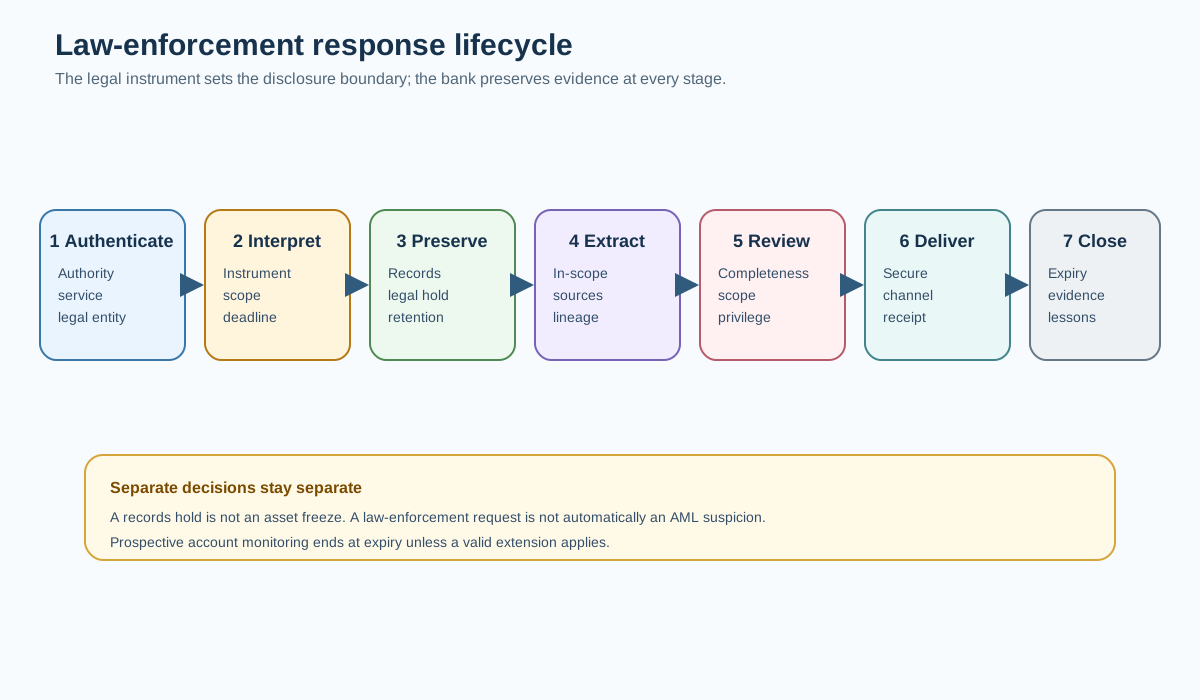
The first distinction: cooperation is not one legal state
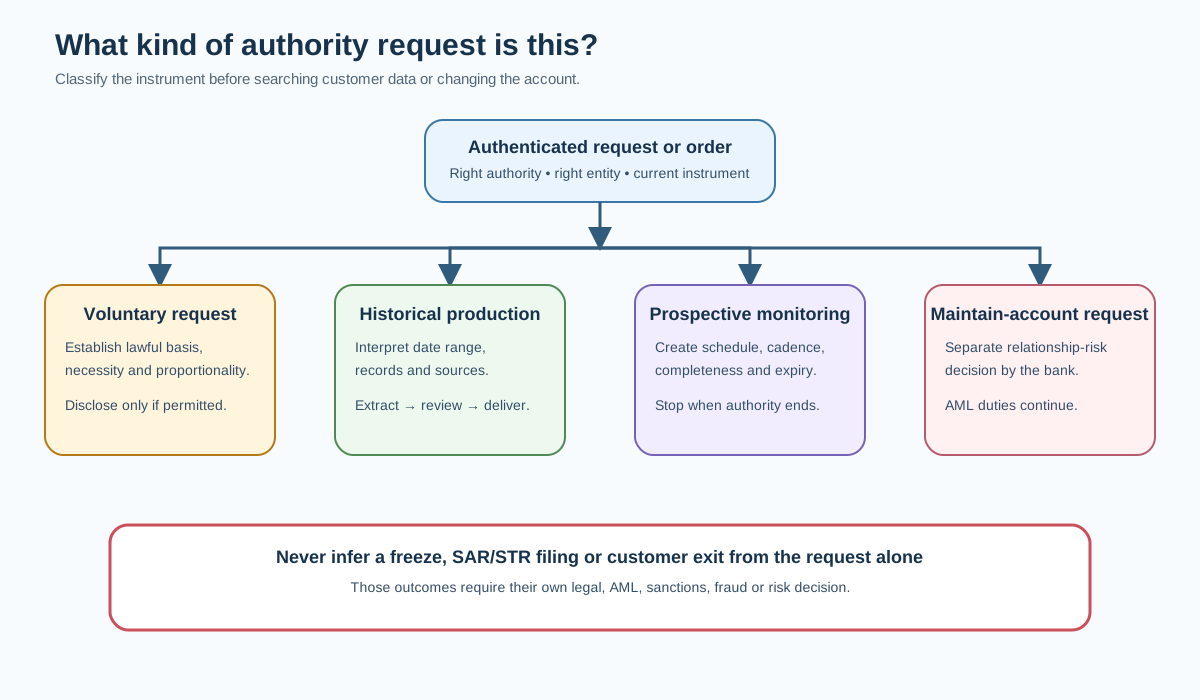
Banks often use an internal umbrella term such as “law-enforcement request” or “authority request”. That is useful for routing but dangerous for decisioning. An informal request may ask whether the bank is willing and legally permitted to share information. A production order or subpoena may compel the bank to produce specified records. An account monitoring order may require information to be supplied prospectively during a defined period. A preservation notice or legal hold may require evidence to be retained so it is not deleted. A request that an account remain open may ask the bank to avoid closing a relationship because closure could disrupt an investigation. None of those automatically means the account should be frozen, the customer should be exited, a suspicious-activity report should be filed, or the customer has committed an offence.
That distinction matters operationally because severe errors often come from attaching the wrong consequence to the right document. A bank receives an order for statements and blocks the customer’s funds even though no freezing power has been invoked. A bank receives a request to maintain an account and assumes that ordinary AML monitoring can be switched off. A bank receives an account monitoring order and treats it as permission to disclose every document the bank holds. A customer-service agent notices a restricted case flag and tells the customer that “the police are looking at your account”. Each error begins with a failure to separate the legal instrument from the operational action.
A mature bank therefore has an instrument classification step before production begins. The classifier should not rely only on the document title. It should identify the issuing authority, statutory or other legal basis, court or reference number where applicable, date of issue, service date, recipient legal entity, subject identifiers, scope, relevant accounts or products, requested data, lookback or monitoring period, deadline, delivery method, confidentiality terms, amendment or variation mechanism, and named authority contact. Legal or specialist law-enforcement liaison teams should resolve ambiguity before disclosure where time permits.
Global standard: what FATF expects of competent authorities
FATF Recommendation 31 is directed primarily at countries and competent authorities, not at banks as a single universal procedural rule. Its purpose is to ensure that authorities investigating money laundering, terrorist financing and associated predicate offences can obtain necessary documents and information and use compulsory measures to obtain records held by financial institutions and others. FATF also expects authorities to have access to investigative techniques and timely information needed to identify and trace criminal property.
For a bank, the practical implication is indirect but important. Financial institutions should expect domestic systems to contain mechanisms through which authorised bodies can require records, identify customers and accounts, or obtain transaction information. The bank’s duty, however, comes from the applicable domestic law, order, subpoena, warrant, regulatory requirement or other lawful mechanism. A bank should not answer a local legal question merely by saying “FATF requires this”. FATF explains the international control objective; the instrument served on the bank explains the actual obligation.
This distinction becomes especially important in a multinational group. A parent bank may receive an inquiry referring to a customer of a subsidiary in another jurisdiction. The group may have the data technically, but technical access does not by itself establish a lawful basis to disclose it from one entity or country to another. The response team must identify which entity was served, where the records are held, which secrecy or privacy rules apply, whether an international cooperation mechanism is required, and whether a group entity can lawfully transmit the information to the responding entity.
United Kingdom worked example: production orders under POCA
The Home Office’s April 2024 Code of Practice issued under section 377 of the Proceeds of Crime Act 2002 describes a production order as a court order requiring a person or institution, including a financial institution, to produce material or allow access to it within the period specified by the order. Bank statements are a straightforward example, but the concept is wider than statements alone if the statutory conditions and the order’s scope are satisfied.
The code explains that an appropriate officer applies to the court and must satisfy the applicable statutory requirements. Among other things, the requested material must be likely to be of substantial value to the investigation and obtaining it must be in the public interest, having regard to the benefit to the investigation and the circumstances in which the respondent holds it. Those are matters for the applicant and the court. The bank should not redesign the test after service. Its task is to validate the order, understand what it requires, identify any legitimate legal issue such as privilege or scope ambiguity, and comply within the order as advised by its legal function.
Section 345(5), as reflected in the 2024 code, provides a seven-day period for production unless the judge sets a different period in the circumstances. That does not mean every production order worldwide has a seven-day deadline, or even that every POCA order served on a bank will say seven days. The order must be read. The code expressly contemplates shorter or longer periods where justified, including where urgency requires faster production or the volume of records makes seven days impracticable.
The same code makes a practical point that banking teams sometimes overlook: when the required material is held electronically, it may need to be produced in visible and legible form, and care should be taken not to delete or corrupt the underlying material. From a bank-engineering perspective, this is why a controlled extraction is preferable to an analyst manually copying data from a production screen. The bank should be able to show which source was queried, which filter was applied, what period was extracted, whether reversals and corrections were included, when the extract was generated, and whether any source failed.
Legal professional privilege is another boundary that must not be flattened into an ordinary data-quality rule. The 2024 code states that material subject to legal professional privilege is protected from access under these investigation powers, subject to the limited legal framework described in the code. A bank receiving a broad demand that may capture legal-advice material should route the question to legal counsel rather than let an operations user decide privilege based on a filename or email sender. Conversely, ordinary contractual confidentiality is not a reason to ignore a valid compulsory order. The bank needs legal interpretation, not a generic “customer confidentiality” objection.
Account monitoring orders are prospective, not just bigger production orders
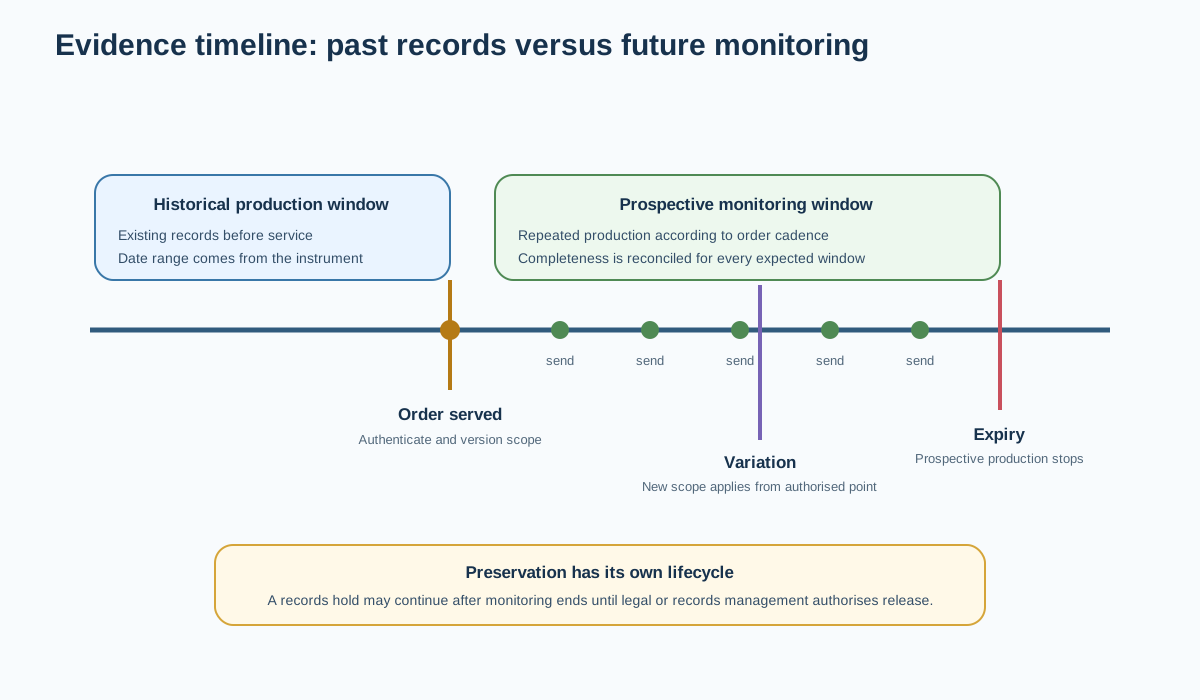
A production order is normally understood operationally as requiring material that exists or can be produced within a specified scope. An account monitoring order under the UK POCA framework is different because it can require a financial institution to provide account information during a specified future period. The 2024 Home Office code states that the period can be up to 90 days and that the order specifies the manner and time or times at which the information must be supplied.
The 90 days are a maximum, not a default. The code tells applicants to consider and justify the duration required. It also tells them to consider whether the information could instead be obtained through a production order. That difference should be visible in bank systems. A historical production request can often be fulfilled through one controlled extraction and response package. An account monitoring order may need an active schedule or event-driven process that repeatedly supplies in-scope information until expiry, variation or discharge.
The order can relate to all accounts held by the specified person at the named institution, certain types of accounts, or particular accounts, depending on what the court ordered. The bank must not silently broaden that scope just because its customer master shows related products. If the order names a current account but not a credit card or investment account, the response team should not infer that every relationship is automatically included. Equally, if the order lawfully covers all accounts held by the specified person, the bank should not limit the search to the one account number appearing in an operations ticket.
The Home Office code gives an example in which provision within 24 hours of transactions may be reasonable, but it expressly frames this as an example and recognises practicability. It also encourages law enforcement to contact the financial institution before application to discuss transaction types and the reporting process. A bank should therefore model the cadence from the actual order, not hard-code a universal “24-hour account monitoring SLA”.
The technical design needs at least four dates: issue/service date, monitoring start, monitoring end and each required delivery deadline. It also needs versioning. If an order is varied on day 20 to narrow the requested fields, add an account or change the delivery cadence, the workflow must preserve what applied before and after the variation. Overwriting the case with the latest scope destroys the evidence needed to explain earlier responses.
A legal hold is not an asset freeze
When a request is received, the bank may need to preserve records so normal retention jobs, archive rotation or customer-data lifecycle processes do not delete them before lawful production. Internally this is often called a legal hold, preservation hold or records hold. The hold applies to information and evidence, not automatically to the customer’s funds.
An asset freeze is a different legal and operational control. It can arise under sanctions law, a restraint or freezing order, fraud protections, court process or other applicable authority. A production order asking for historical records does not by itself create a right to prevent the customer from using their account. Likewise, an account monitoring order is designed to obtain account information; it should not be implemented as a payment block unless another legal basis requires that action.
This is a critical architecture boundary. The law-enforcement case platform can send a preservation instruction to records management without sending a restriction instruction to the core banking system. If a separate freeze or restriction is required, that should be represented as a separate authority, decision and lifecycle with its own start, scope, approver and release condition. Combining the two under one status such as LEGAL_HOLD = TRUE invites accidental customer harm.
Intake and authentication: do not begin with the customer search
The first operational question is not “does this customer exist?” It is “is this a genuine, authorised request addressed to the right legal entity?” Criminals can impersonate police officers, regulators, courts or government agencies. Even genuine requests can be misdirected to the wrong company in a banking group.
A controlled intake should capture the sending channel and independently verify it against approved authority contact details where required. The team should record the authority, office, named officer or official, official contact information, legal basis, court details if applicable, order or reference number, date, method of service and the legal entity named as respondent. Authentication should not depend solely on calling the phone number printed on an unsolicited document.
The workflow should then determine whether service is valid for the recipient entity and whether the recipient actually controls the requested records. A banking group may operate a retail bank, payments company, broker-dealer, card issuer and branch network under related branding. The customer may think of them as one bank; the law may not. Legal entity resolution is therefore part of request handling, not corporate housekeeping.
If the request is voluntary rather than compulsory, the bank also needs to establish a lawful basis for any disclosure. In the UK, the Information Commissioner’s Office explains that data protection law permits necessary and proportionate sharing with law-enforcement authorities where the appropriate lawful basis and any additional conditions are met. A court order or legal obligation may compel sharing; a non-compulsory request requires a separate lawfulness assessment. “The police asked” is not itself a complete data-protection analysis.
Translating the document into a machine-readable scope
After authentication, the most important operational act is converting the legal text into a structured scope record. The record should not replace the source document; it should make the obligation executable while preserving a link to the original.
A useful scope record identifies the subject names and identifiers, customer or company registration information where provided, relevant accounts or account classes, products, legal entities, currencies, requested information categories, historical start and end dates, prospective monitoring period if any, delivery cadence, deadline and timezone, file format, transmission channel, contact details, confidentiality constraints, privilege or legal-review flags, and amendment history. It should also identify whether the request seeks records, answers to questions, ongoing transaction information or simply confirmation of account relationships.
Names alone are weak keys. John Smith, Mohammad Ali or a common company name can match several customers. A request may include date of birth, address, national identifier, company number, account number, telephone number or another attribute. The bank should use the full identifier set to resolve the subject while preserving uncertainty. If two customers remain plausible and the order is not clear, the correct action is escalation for clarification, not disclosure of both “just in case”.
For corporate subjects, the bank should distinguish the named legal entity from connected directors, beneficial owners, subsidiaries and counterparties. An investigation may concern a group, but the disclosure scope is still controlled by the legal instrument. Customer-linkage data can help the bank locate in-scope accounts where the order permits it; it should not be used to expand the order beyond its terms.
Data sources: the bank is larger than the core ledger
A request for “account information” or “records relating to transactions” can touch many systems. Depending on product and scope, relevant sources may include customer master and KYC/KYB stores, current and historical account ledgers, payment hubs, SWIFT or ISO 20022 archives, card authorisation and clearing systems, digital-channel logs, beneficiary records, standing orders, direct debits, cash transactions, trade-finance platforms, treasury systems, lending subledgers, CRM, call recordings, document repositories, fraud cases, financial-crime cases and historical archives.
The legal-response team should not assume that the operational screen is the system of record. A current account screen might show posted transactions but omit rejected payments, original remittance data, historical addresses, deleted beneficiaries or pre-migration records. Whether those items are in scope depends on the request, but the bank must know the source landscape well enough to answer correctly.
Source mapping is therefore a control asset. For each product family, it should identify systems of record, history retained, archive location, timezone, transaction-status semantics, identifier mappings, migration dates and known limitations. When a source platform changes, the law-enforcement response inventory should be updated just as transaction-monitoring lineage would be updated. Otherwise an order spanning a migration date can silently miss half the requested history.
The extraction process should preserve original transaction identifiers where available and make reversals, returns, cancellations and corrections understandable. A payment that appears once as a debit and later as a return should not be turned into two unrelated events by a poorly designed export. Similarly, value date, booking date, transaction timestamp and settlement date should not be collapsed into one date column unless the semantics are genuinely the same.
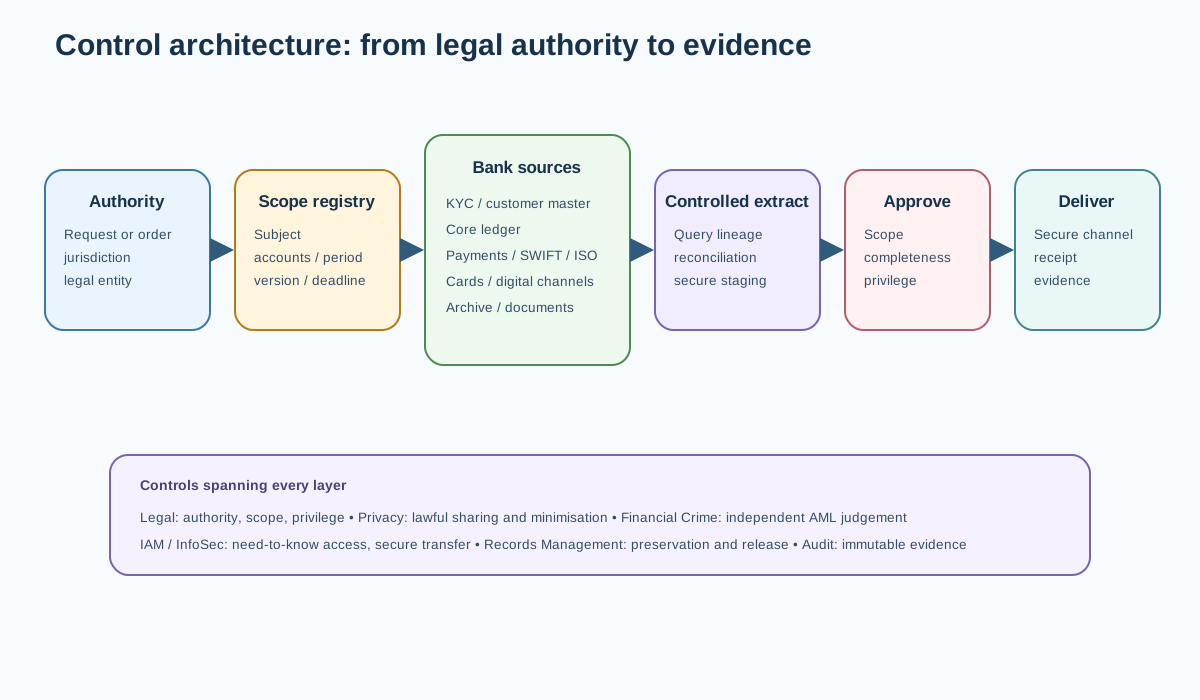
Historical production and prospective monitoring need different engines
A one-off historical request can usually be represented as a query over a closed time range. The query can be executed, quality checked and packaged. Prospective monitoring is an ongoing obligation. It needs a scheduler or event process that knows when the monitoring period starts, what events qualify, how frequently information must be sent, how missed runs are detected, and when the process stops.
This difference matters for resilience. If a daily account-monitoring extract fails on Saturday and is discovered Monday, the bank should know exactly which transactions were missed and how to backfill them. A simple task status of “complete” is not enough. The control should reconcile expected periods or qualifying events against successful production packages.
Timezones are a common source of avoidable failure. An order covering 1 June through 30 June may not mean the same thing if the bank’s ledger stores UTC, the customer operates in New York, the responding entity is in London and a payment platform timestamps events in local processing time. The case should record the interpretation applied, ideally based on the order and legal guidance, and extraction logic should be testable at day and daylight-saving boundaries.
Ongoing monitoring also creates change-management risk. An account can be renumbered, migrated, closed and reopened, or replaced by another account. The order may or may not follow those changes automatically. The bank needs a defined escalation rule when product changes affect scope. Technology should detect the change; legal or specialist teams should decide what the instrument requires.
Quality review before anything leaves the bank
The production package needs a review stage that is distinct from extraction. Technical completeness asks whether all intended sources ran and whether record counts reconcile. Legal-scope review asks whether the package contains what was ordered and not unrelated material. Privacy review may be relevant where third-party data is included. Privilege review may be required where legal communications could be captured. Operational review confirms dates, accounts and file formats. These are different questions and should not be collapsed into one checkbox.
Over-production is not harmless. A bank that sends an entire customer file when the lawful request asks for two months of specified transactions may disclose unnecessary personal or commercially sensitive information, create privacy risk and make the authority’s analysis harder. Under-production is equally serious because it can frustrate an investigation and expose the bank to legal or supervisory consequences. The target is accurate, complete in-scope production.
Where the bank transforms source data into a response format, it should preserve enough lineage to reconstruct the transformation. A CSV may be perfectly acceptable where the order requests it, but the bank should know which source fields populated each output field, how codes were translated, how dates were formatted, and whether narrative text was truncated. “We exported what the screen showed” is weak evidence months later.
Cryptographic hashes can be useful for file-integrity checking in a controlled process, but this chapter does not treat hashing as a universal legal requirement. The required evidential and delivery standard depends on the instrument, jurisdiction and authority process. The general control principle is reproducibility: the bank should be able to show what it produced, when, from which sources, under which scope and through which channel.
Secure delivery and acknowledgement
Law-enforcement responses contain highly sensitive data. Sending them through ordinary email or uncontrolled shared drives creates obvious risk. The bank should use authority-approved secure channels, encrypted transfer mechanisms or other controlled delivery methods supported by its legal and security framework. Recipient identity and destination should be validated independently where necessary, particularly if delivery instructions change mid-case.
The response record should capture package identifier, generation time, approver, delivery time, recipient or endpoint, transmission method, acknowledgement where available and any authority feedback or rejection. A failed upload or bounced secure message is not successful compliance merely because the bank generated the file before the deadline.
If a response must be corrected, the bank should avoid silently replacing the original package. Correction history should show what changed and why. That protects both the authority and the bank from later confusion about which data was relied on.
Confidentiality, customer contact and the need-to-know principle
A law-enforcement case should normally be visible only to teams that need the information to perform their role. The exact legal restrictions vary by instrument and jurisdiction. Some processes impose explicit non-disclosure obligations; others may permit or even require customer notice; still others create circumstances where notice can be delayed or prohibited. The bank must therefore derive the communication rule from the instrument and applicable law rather than from a universal “never tell the customer” policy.
The United States illustrates why this matters. The federal Right to Financial Privacy Act contains different pathways for government access to financial records, and grand-jury subpoenas sit under a specific exception framework. DOJ material describes circumstances in which notification restrictions apply, including certain grand-jury situations and court-ordered delayed notice. That is not the same as saying every U.S. subpoena is automatically secret. The bank’s case record should capture the actual notification restriction and its legal basis.
Front-line customer service does not need the investigative detail. It needs safe handling instructions. For example, a case may route account-closure requests or privacy-access requests to a specialist team without revealing why. Staff should not invent explanations that are false or disclose protected information. Where customer communications are necessary, legal, privacy and financial-crime teams should provide approved wording appropriate to the instrument and jurisdiction.
Tipping-off rules related to suspicious-activity reporting are also separate from secrecy obligations attached to law-enforcement process. They can overlap in a case, but the bank should record each basis independently. That avoids the common mistake of calling every confidentiality restriction “tipping off”.
Law-enforcement interest does not replace the bank’s AML judgement
A request from law enforcement is a strong contextual signal, but it is not automatically proof of criminality. The customer may be a witness, victim, counterparty or person whose records are relevant to an investigation without being accused of wrongdoing. Even where the subject is under investigation, a bank should not treat the request itself as a conviction.
The information may legitimately trigger an internal AML review under the bank’s risk-based procedures. That review should consider the customer profile, transactions and other intelligence and then decide whether suspicion exists under the applicable reporting regime. The SAR or STR decision remains the bank’s regulated decision unless local law provides otherwise. Similarly, sanctions screening, fraud controls, safeguarding measures and account restriction decisions keep their own legal and policy bases.
The United States provides a useful example. FinCEN’s guidance on law-enforcement requests to maintain accounts says that when law enforcement asks a financial institution to keep an account open, the ultimate decision remains with the financial institution under its standards and guidelines. If the bank does keep the account open, its Bank Secrecy Act obligations, including suspicious-activity reporting requirements, continue. This is an important control principle beyond the U.S. example: cooperation with investigators must not create a blind spot in ordinary financial-crime controls.
The bank should also avoid reflexive exit. Closing an account immediately after learning of law-enforcement interest can destroy visibility or interfere with an investigation. On the other hand, maintaining a high-risk account can expose customers and the bank to harm. The decision needs specialist governance, documented consideration of any law-enforcement request, and clear ownership of residual risk.
U.S. 314(a) requests are not UK account monitoring orders
FinCEN’s Section 314(a) process allows eligible law-enforcement agencies, through FinCEN, to ask financial institutions to locate accounts and transactions of persons who may be involved in terrorism or significant money laundering. Operationally, this is a search and information-sharing mechanism. It should not be mapped in a global taxonomy as if it were the same legal instrument as a UK POCA account monitoring order.
A good global platform therefore separates business capability from legal instrument. The capability might be authority subject search, historical record production, prospective account information production, preservation, or account-maintenance request. The legal instrument then records whether that capability is being exercised under UK POCA, U.S. Section 314(a), a subpoena, a court order or another local authority. This design permits shared technology without inventing a fake global law.
The same principle applies to vocabulary. “Production order” can mean different things in different legal systems. The UI should show the local legal name, not force every country into the UK label. Data models can use a neutral internal type plus jurisdiction-specific subtypes and legal citations.
Cross-border requests and group data
Law-enforcement investigations are frequently cross-border while banking records are distributed across legal entities and cloud or regional data platforms. An authority in one country may seek records concerning transactions processed elsewhere. The bank must distinguish where the customer relationship sits, which entity controls the records, where data is stored, and which legal mechanism permits disclosure.
Mutual legal assistance, FIU cooperation, supervisory gateways and direct domestic powers are different channels. A local branch should not assume that a request from an overseas police officer can be fulfilled merely because the branch can technically see the data. Equally, a global privacy team should not assume that cross-border data can never be supplied. The lawful route depends on jurisdiction, entity and instrument.
Operationally, cross-border cases need a jurisdiction map, local counsel or policy escalation where required, and controlled hand-offs between group entities. The case platform should retain which entity disclosed which records under which authority. This is particularly important when a central operations hub performs extraction on behalf of several regulated entities. Central processing does not eliminate local legal accountability.
Amendments, variations and expiry
Orders change. An authority may narrow the date range, add an account, correct a subject identifier, change the response cadence or obtain a court variation. The case system should treat each change as a versioned event, not a free-text note.
For UK production orders and account monitoring orders, the 2024 Home Office code notes that compliance time limits are expressly set out in the order and that a respondent seeking variation of those limits needs to apply to the court. That is an example of why an operations team cannot casually agree a new deadline over the phone and assume the legal obligation changed. Any revised instruction should be validated under the applicable legal process.
Expiry should also be explicit. Prospective monitoring must stop when the order expires unless a valid extension or new order applies. Continuing to send customer data after expiry is not “being helpful”; it can become an unauthorised disclosure. A robust control therefore has an automated stop date plus human confirmation of extensions.
Roles and governance
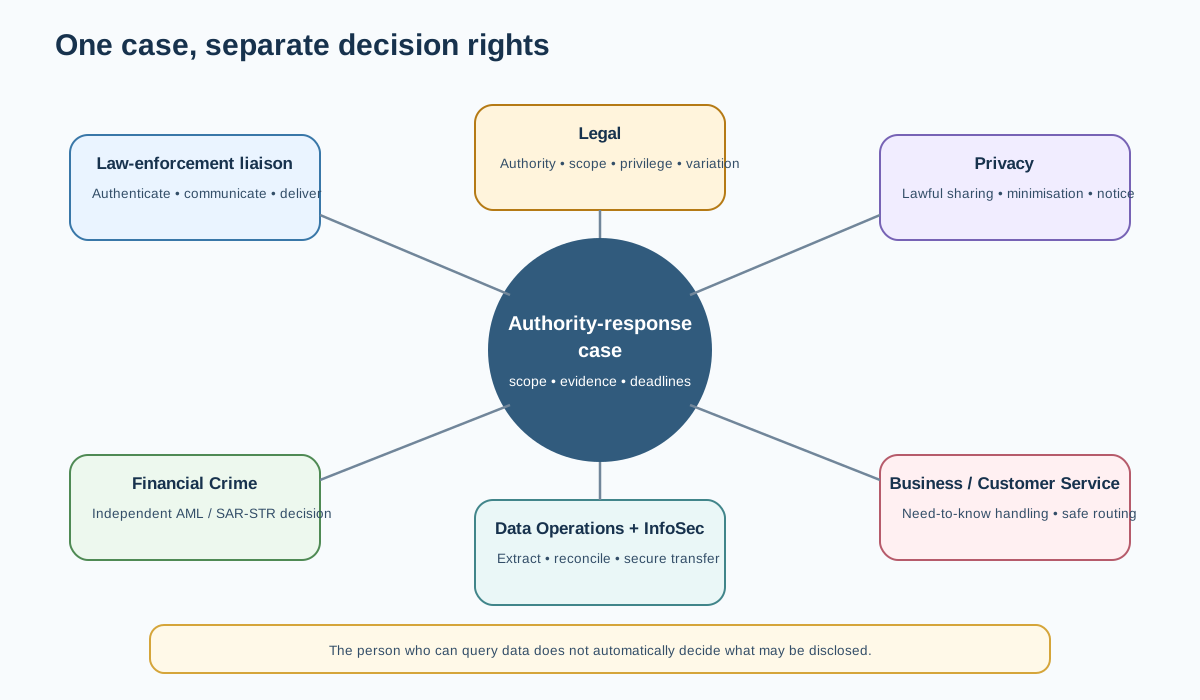
The law-enforcement liaison or specialist investigations team usually owns intake, authentication and authority communication. Legal interprets compulsory powers, privilege, scope disputes and variations. Privacy advises on lawful data sharing and minimisation where relevant. Financial crime decides how external law-enforcement information affects internal AML risk and reporting. Data or operations teams extract records. Information security governs secure transfer. Business teams may supply product context. Customer service follows need-to-know handling instructions rather than independently discussing the request.
Those roles can vary by bank, but decision rights must be unambiguous. The person who can run a query should not automatically decide what may legally be disclosed. The person who speaks to law enforcement should not silently modify the data specification. The AML investigator should not reinterpret the court order. Segregation is not bureaucracy for its own sake; it prevents one person from turning uncertainty into an unauthorised disclosure or missed legal obligation.
Management information should measure more than volume. Useful measures include request age, deadline risk, overdue items, source failures, scope clarifications, court variations, production corrections, delivery failures, unauthorised disclosure incidents, account-monitoring missed intervals, legal-entity routing errors, privilege escalations and recurring data gaps. A high closure count can hide poor quality if cases are being closed with incomplete production.
Governance should also review recurring structural issues. If every order involving card data requires manual reconstruction, that is a data capability problem. If every cross-border case is delayed because legal entities cannot be resolved, that is an entity-data problem. If customer-service staff repeatedly disclose restricted case information, that is an access and training problem. The value of the control is not only responding to each order; it is improving the bank’s ability to respond accurately next time.
What a strong control looks like
A strong bank can receive an authority request, authenticate it, identify the correct legal entity and legal instrument, translate the scope into structured data, preserve relevant records, locate all in-scope sources, extract records reproducibly, review the package for legal scope and completeness, deliver it securely, record acknowledgement, manage amendments and ongoing monitoring, and close the case only when the obligation has ended. It can do that without freezing funds merely because police are interested, without disabling AML monitoring, without over-disclosing unrelated customer information and without exposing the investigation to staff who do not need to know.
For business analysts and architects, the lesson is that this is not a document-upload feature. It is a controlled orchestration capability joining legal interpretation, entity resolution, data lineage, retention, event scheduling, secure exchange, case management and audit evidence. For investigators and operations, the lesson is that speed matters but defensibility matters just as much. For product owners and senior management, the lesson is that cooperation with law enforcement is a real banking service obligation with customer, legal, operational and financial-crime consequences.
The question that should survive every design review is simple: can the bank prove that it disclosed exactly what it was lawfully required or permitted to disclose, to the right authority, from complete in-scope sources, at the right time, while preserving every separate AML, privacy, sanctions and customer-protection decision? If the answer depends on one analyst’s memory or an uncontrolled spreadsheet, the control is not yet mature.
Operational deep dive: turning a legal instrument into a defensible data response
The legal document tells the bank what authority is being exercised. The difficult operational work begins after that. A bank must translate words written for a court, investigator or prosecutor into a repeatable data operation without quietly changing the meaning of the order. This is where business analysis, data architecture, operations and quality assurance become part of financial-crime control.
A mature response process separates six objects that are often mixed together in weak implementations: the source instrument, the interpreted scope, the preservation instruction, the data-extraction job, the production package, and the evidence record. The source instrument remains authoritative. The interpreted scope converts it into executable fields. Preservation protects relevant records from routine deletion. Extraction collects the records. The production package is what actually leaves the bank. The evidence record proves what happened. If one object is used as a substitute for all the others, the bank loses traceability.
The source instrument should never be reduced to a ticket summary
Operations teams naturally want a concise work item. A summary such as “provide statements for Jane Doe, January to June” is useful, but it cannot replace the order itself. The legal document may define the person differently, include multiple accounts, require supporting transaction details, contain confidentiality restrictions, set a precise deadline or distinguish between production and access. A work ticket can omit exactly the clause that later becomes important.
The case platform should therefore retain the original document as immutable evidence and store a structured interpretation alongside it. The interpretation needs an owner and timestamp. If legal advice changes the interpretation, the system should create a new version rather than overwrite history. A reviewer should be able to reconstruct which scope was active when each production package was generated.
This is especially important for account monitoring orders because the obligation persists over time. A variation may change the cadence, account population or information required while the order remains active. Versioned scope lets the scheduler apply the right rule to the right period.
Entity resolution comes before customer resolution
In global banking, a request can be addressed to a brand name while the data sits across several legal entities. The first resolution problem is therefore which regulated or incorporated entity is the respondent? Only after that should the bank resolve the customer, accounts and products.
A useful entity map links brand, branch, subsidiary, booking entity, product entity, processor and data controller or other relevant roles. It also records which team is authorised to respond for each entity. The map should not be inferred from technology ownership. A central data lake may hold records for many group companies, but possession of a copy does not necessarily make the central entity the lawful respondent.
Customer resolution then uses the identifiers in the request. Matching should preserve confidence rather than hide it. Exact account number plus date of birth may create high confidence. A common name and old address may create several candidates. The workflow should allow “ambiguous subject” as a legitimate state and route it for clarification. Sending records for multiple candidates to avoid missing the right person is not sound control.
Corporate cases require extra care. A request naming a company does not automatically include directors’ personal accounts, beneficial owners’ unrelated accounts or every subsidiary. Relationship graphs can help the bank understand the customer and locate potentially relevant records, but legal scope decides what may be produced.
Build a source-of-record matrix before the first urgent case
Law-enforcement production becomes slow when the bank discovers its own data landscape during the deadline. A source-of-record matrix should already exist for each product and information type. For current accounts it might identify the customer master, core ledger, payment archive, statement engine and digital-channel history. For cards it may identify account master, authorisation, clearing, chargeback, token and merchant data. For trade finance it may include documentary images, guarantees, SWIFT traffic and workflow events.
The matrix should answer practical questions: how much history is online, where older records are archived, which timestamp is authoritative, how product migrations are represented, whether deleted beneficiaries remain available, how reversals appear, how account renumbering is mapped and which team owns access. Known gaps should be visible before a case relies on them.
Data lineage should extend to the response file. If transaction_date in an exported CSV is derived from a ledger posting timestamp, that definition should be documented. If amount signs are normalised, currency codes translated or status codes expanded into text, the transformation should be reproducible. It is dangerous for an analyst to manually “clean up” a response without leaving an audit trail.
Historical production should be query-reproducible
For a closed historical period, the bank should be able to reproduce the extraction. That does not mean rerunning it must always yield an identical result if source corrections legitimately occurred later. It means the bank can identify the query logic, source version or relevant snapshot, parameters, run time and transformation rules used for the original response.
An extraction record should capture at least the case identifier, scope version, source systems, query or job version, parameters, run time, record counts, errors, retries and output identifier. If the bank uses a managed data platform, job logs can provide much of this evidence automatically. If the extraction is manual, the control burden increases because the analyst’s steps must be documented explicitly.
Record-count reconciliation is useful but should not become false assurance. “12,540 rows exported” proves very little by itself. Better reconciliation compares the response population with independent expected totals where possible: number of account statements expected, number of ledger days, payment-event counts, source partitions processed, or account inventory in scope. The appropriate method depends on the data requested.
Prospective account monitoring is a scheduled control
An account monitoring order creates a different engineering problem because the bank must continue to provide information during a future period. The control needs a schedule and a completeness ledger.
Suppose an order requires qualifying transaction information every business day for 45 days. The system should create 45 expected production windows or another equivalent schedule. Each window moves through states such as pending, extracted, reviewed, delivered, acknowledged or exception. If a window is missed, an alert should be generated. If no transactions occurred, the system should know whether the order requires a nil response or simply no package; that behaviour should come from the instrument and authority instructions.
Event-driven production can be even more demanding. If the order requires information within a specified period after a transaction, a batch job that runs once overnight may not be sufficient. Architects need to determine whether the obligation can be met from existing event streams, payment systems or change-data capture. Where no real-time capability exists, the bank should not pretend a manual workaround is equivalent; the operational feasibility should be raised during the legal/authority dialogue when appropriate.
The system also needs an automatic end condition. Expiry should stop production. A valid extension or replacement order should create a new authority event. Staff should not continue monitoring “until someone says stop” because that creates unlawful over-disclosure risk.
Monitoring order is not transaction monitoring
The words are confusing. Account monitoring order in the UK POCA context is an investigative order to provide account information over a period. Transaction monitoring is the bank’s AML detection control for identifying unusual or suspicious activity. They can operate on the same account but serve different purposes.
The account-monitoring workflow may consume transaction events to satisfy the order. The AML monitoring engine independently evaluates transactions under the bank’s scenarios, models and rules. Law-enforcement interest can be an input to an internal risk review if policy permits, but the order should not be implemented by simply adding the customer to an AML “high risk” list and hoping alerts provide the required information.
Likewise, AML alerts are not a substitute for the order’s reporting cadence. A customer could make entirely ordinary transactions that never trigger an AML alert but still fall within the account information the order requires the bank to supply.
Preservation needs product-aware retention controls
Records can be lost through more than deletion. A statement system may retain PDFs but not the raw transaction narrative. A payment archive may retain final messages but discard an enriched screening copy. A digital platform may rotate device telemetry after 90 days. A data lake may rewrite partitions during schema migration. Preservation needs to understand the information type and its lifecycle.
When a preservation requirement applies, the bank should identify relevant repositories and suspend or override normal destruction for the in-scope evidence according to legal and records-management advice. The hold should have a case identifier, start date, owner, scope and release condition. Releasing the hold should be controlled because keeping material indefinitely can also breach retention principles.
Preservation should not become unlimited copying. Creating multiple uncontrolled local extracts increases security and privacy risk. The preferred design preserves records in governed systems or a controlled evidence store with access logging.
Third-party and cloud systems do not remove accountability
Banks increasingly rely on payment processors, card platforms, SaaS case tools, cloud archives and fintech partners. A request may cover data that the bank is legally responsible for but does not physically host. Contracts and operational procedures should therefore support lawful retrieval within realistic deadlines.
The bank should know which vendor holds which data, how emergency access works, what export formats are available, whether historical data is retrievable after contract termination and how a legal hold is communicated. A vendor’s standard support SLA is not necessarily compatible with a court deadline.
Where vendors operate across borders, legal and privacy teams may need to consider where records are accessed or transferred. The response team should not send the law-enforcement order directly to a vendor unless that is part of an approved process; the order may contain sensitive investigative information and the bank may remain responsible for controlling its disclosure.
Quality assurance should test the actual disclosure boundary
A technical QA team often asks whether the export runs. A legal-response QA function must ask whether the export is correct for this order. That requires positive, negative and boundary testing.
Positive tests confirm that clearly in-scope accounts, dates and transaction types are included. Negative tests confirm that unrelated customers, products and dates are excluded. Boundary tests focus on the first and last second of the date range, timezone conversion, accounts opened or closed during the period, amended orders, migrated products, joint accounts and duplicate identifiers.
For ongoing monitoring, tests should include failed source feeds, delayed events, duplicate events, amendments during the period, an expiry at midnight, account renumbering and a source-system migration. The test should prove not only that the system detects the failure but that it can recover without double-disclosing records.
Secure staging should be separate from secure delivery
Extraction results often need to be staged before review. The staging area should be case-controlled, encrypted, access-restricted and subject to retention rules. Analysts should not move files to desktops or personal cloud drives merely because the authority’s portal accepts a simple upload.
After approval, delivery should use the channel authorised for the case. The delivery endpoint, recipient and package should be bound together in the audit record. If an officer emails new bank details or asks for an alternative upload link, the change should be authenticated. Social engineering risk is real precisely because staff expect unusual urgent requests in this domain.
A delivery acknowledgement can be valuable, but not every authority process provides one. The bank should distinguish “successfully transmitted” from “acknowledged by authority” rather than forcing both into one completed status.
Response corrections need controlled lineage
A bank may discover after submission that a source failed, a date filter was wrong or an amended order was missed. The correction process should begin with impact assessment: what was omitted or incorrectly included, which response packages were affected, whether an authority deadline has been breached, whether unauthorised data was disclosed, and whether legal, privacy, operational-risk or regulatory escalation is required.
The bank should preserve the original package, create a corrected package with a new identifier, explain the correction through the approved authority channel and link both packages in the case. Deleting the original from internal records makes the audit trail worse.
Recurring corrections are management information. If three cases miss the same legacy platform, the problem is not three analyst mistakes; it is a source-coverage control defect.
Minimum architecture for a bank-grade solution
A scalable implementation normally needs an authority and instrument registry, authenticated intake, case orchestration, legal-scope versioning, subject and entity resolution, source inventory, extraction services, preservation/records-management integration, secure staging, review and approval, delivery connectors, ongoing-monitoring scheduling, exception management and immutable audit logging. It should integrate with financial-crime case management without turning law-enforcement process into an AML alert subtype.
The architecture should support a small urgent request without requiring a major project, but it should also handle thousands of recurring requests without depending on spreadsheets. The common design principle is separation with traceability: legal interpretation stays separate from data execution, data execution stays separate from approval, and each is linked through the same case and scope version.
When that separation is present, the bank can answer the questions an auditor, court, regulator or internal legal reviewer will eventually ask: Who validated the request? What did it require? Which sources were searched? What was preserved? What exactly was disclosed? Who approved it? Was it delivered on time? What changed during the case? When did ongoing production stop? Without those answers, speed alone is not a successful law-enforcement response control.
Advanced practice: jurisdiction, confidentiality and decision boundaries
The difficult cases are rarely difficult because a bank cannot export a statement. They are difficult because several legal and control questions arrive together: the request comes from another country, the customer uses more than one group entity, the order includes third-party data, a product was migrated during the relevant period, the customer contacts the bank while production is under way, and financial-crime teams want to know whether law-enforcement interest changes the relationship decision. Advanced practice means separating those questions rather than solving all of them with one “restricted case” flag.
One global workflow, many local legal instruments
A multinational bank benefits from a common operating model but should resist a universal legal taxonomy. The common model can standardise intake, authentication, entity resolution, deadlines, preservation, extraction, review, delivery and evidence. The legal instrument should remain jurisdiction-specific.
In the United Kingdom, the POCA framework provides named investigative powers including production orders and account monitoring orders. In the United States, a bank may encounter grand-jury subpoenas, judicial or administrative process, FinCEN Section 314(a) requests or written requests from law enforcement to maintain an account. Other jurisdictions use different powers and terminology. Even similar names can have different tests, notice rules and appeal or variation routes.
A good case platform therefore stores a neutral capability such as HISTORICAL_RECORD_PRODUCTION or PROSPECTIVE_ACCOUNT_INFORMATION together with attributes for jurisdiction, statute, instrument name, issuing authority and legal citation. The capability drives workflow mechanics; the local instrument drives legal treatment. This avoids building twelve duplicate systems while also avoiding the fiction that one country’s law applies globally.
UK production order: operational boundaries that deserve explicit requirements
For the UK POCA production-order example, the 2024 Home Office code gives several details that should be translated into bank requirements rather than left in legal training material.
First, the order may require production of material or access to material. Those are not identical outcomes. A bank response process should record which mode applies. Second, the code states that the normal seven-day period under section 345(5) can be changed by the judge. Therefore the case system needs a deadline field from the actual order, not a fixed seven-day timer. Third, electronic material must be available in visible and legible form, reinforcing the need for governed exports rather than screenshots where richer source data exists.
Fourth, privilege is a real scope boundary. Legal professional privilege questions belong to legal counsel. An extraction workflow can identify likely legal-material repositories or communications for review, but it cannot adjudicate privilege through a keyword rule. Fifth, if the bank cannot comply with the time limit, the 2024 code explains that variation of the time limit for a production order is a court matter. An operations team cannot “renegotiate” the legally binding deadline merely through an informal conversation.
These details illustrate a broader BA principle: legal text should be decomposed into data requirements, workflow states, deadline logic, approval rules and exception routes. A requirement such as “system supports production orders” is too vague to test.
UK account monitoring order: duration, cadence and scope are separate controls
An account monitoring order can run for a period up to 90 days, but the maximum is not the standard duration. The order specifies the period, manner and timing of information provision. The bank therefore needs separate fields for monitoring duration and delivery cadence. A 60-day order could require daily information, weekly information or another court-specified schedule.
The scope may identify all accounts held by a specified person at the named financial institution, certain account descriptions or particular accounts. Subject resolution and product discovery should therefore be driven by the order. If the order lawfully covers all accounts, limiting production to the single account that triggered the investigation would be under-production. If it names one account, expanding to every connected account can be over-production.
The bank should also distinguish a transaction-information feed from a complete account statement. “Account information” is defined within the legal framework, and the order should specify what is required. Technology teams should not assume that because the existing export template contains twenty fields, all twenty may be sent in every case.
Voluntary law-enforcement requests require their own gate
Not every request arrives with compulsory process. The ICO’s guidance for organisations in the UK explains that the UK GDPR and Data Protection Act 2018 permit necessary and proportionate data sharing with law-enforcement authorities where an appropriate lawful basis exists. A court order or legal obligation may compel disclosure; a voluntary request still requires the organisation to establish lawfulness.
This is a useful control distinction. The intake workflow should have a branch for COMPULSORY versus VOLUNTARY_OR_DISCRETIONARY. Compulsory does not mean “no review”; the bank still validates authenticity, scope and applicable safeguards. Voluntary does not mean “refuse”; it means the bank must identify the lawful basis, necessity and proportionality under applicable law and policy before disclosure.
The requestor’s urgency should not bypass this gate. A genuine emergency may be covered by specific legal or vital-interest provisions, but the case should record the basis actually used. “Urgent police request” is an operational description, not a legal basis.
U.S. Section 314(a): subject search rather than prospective monitoring
FinCEN describes Section 314(a) as a process through which eligible federal, state, local and certain foreign law-enforcement agencies, via FinCEN, can ask financial institutions to locate accounts and transactions of persons who may be involved in terrorism or significant money laundering. For a global bank, the important lesson is classification.
A 314(a) request is not simply the American name for an account monitoring order. Its purpose and operating process are different. The bank’s U.S. workflow should follow the current FinCEN rules, secure channel and response instructions applicable to participating institutions. The global platform can reuse subject matching, case logging and evidence capabilities without importing UK POCA concepts such as the 90-day account-monitoring maximum.
This separation also helps training. An analyst transferring between London and New York should learn the local instrument, not assume familiar words carry over.
U.S. subpoenas and notification: avoid the “all subpoenas are secret” myth
U.S. federal law illustrates why confidentiality rules must be attached to the specific process. DOJ material on the Right to Financial Privacy Act distinguishes judicial subpoenas, administrative process and federal grand-jury subpoenas. Federal grand-jury process has a specific statutory framework, and certain circumstances prohibit or delay customer notification. Other processes can carry different notice rules.
The bank should therefore capture any non-disclosure, delayed-notice or customer-notification requirement as a structured case attribute backed by legal review. Staff should not apply a global rule that every subpoena is secret or, equally dangerously, that customers are always entitled to immediate notice.
Access controls can use this attribute. A case with a strict non-disclosure condition may hide investigative detail from business users while still allowing a customer-service workflow to route account questions safely. The UI can show “refer to specialist team” without exposing the authority, subject or nature of investigation.
Requests to maintain an account are not commands to ignore risk
FinCEN’s 2007 guidance remains useful for understanding a common operational tension. If law enforcement asks a U.S. financial institution to maintain an account that might otherwise be closed, FinCEN says the institution should seek a written request and that the final decision to maintain or close the relationship remains with the institution under its own standards. The guidance also reminds institutions that BSA/AML recordkeeping and suspicious-activity reporting obligations continue.
The request should therefore be modelled as an input to the relationship decision, not an override of AML governance. A specialist committee or designated senior owner may weigh law-enforcement interest, customer harm, fraud exposure, sanctions risk, legal duties and the bank’s risk appetite. The rationale should be documented.
The same architecture should distinguish a request to keep an account open from an account monitoring order. One concerns the relationship decision; the other concerns supplying account information. A case can contain both, but they are separate authorities and workstreams.
Cross-border group case: do not let centralisation erase entity boundaries
Consider a bank with a UK subsidiary, an EU payments entity and a U.S. branch. A UK order is served on the UK subsidiary concerning a corporate customer. The payments entity processes some transfers; a U.S. branch holds a separate account for the customer’s parent company. The group data lake contains all three.
A weak response searches the data lake for the corporate name and exports every match. A stronger response begins with the respondent entity and scope of the UK order. It maps which data belongs to the UK customer and which records are merely visible centrally. If records from another entity are required, legal determines whether they are within the respondent’s possession or control and whether cross-border disclosure is lawful or another cooperation route is needed. The platform records each entity decision.
The operational team can still use a central extraction service. The service should take an approved entity-and-scope token as input rather than an unrestricted customer name. This is a useful example of policy enforcement through architecture: the system makes the lawful boundary executable.
Joint accounts and third-party information
Joint accounts create a recurring disclosure question because records about the in-scope subject also contain information about another account holder. Payment records also contain counterparties who are not subjects of the request. The bank cannot solve this by deleting every third-party field; doing so may make the requested record unintelligible. Nor should it send unrelated data without considering scope.
The response policy should define how third-party information is handled under each instrument and jurisdiction, with legal/privacy escalation for ambiguous cases. Where the order requires transaction details, counterparty information may be inherently part of the record. Where it asks only for confirmation that an account exists, a full transaction export would be excessive.
Data minimisation should therefore be interpreted in context: provide the information lawfully required or permitted for the investigative purpose, not “the smallest file possible” and not “everything the bank knows”.
Historical customer data and identity changes
Investigations frequently concern periods when the customer’s identity data, ownership or account structure differed from today. A current KYC profile may show a new address, new directors or a changed legal name. If the bank produces only current data, it can create a false historical picture.
The source inventory should identify systems that preserve effective-dated customer attributes. Response logic should be able to retrieve the identity or ownership context applicable during the requested period where in scope. For migrated data, mappings from old customer IDs and account numbers to current identifiers should be retained.
This is especially important when law enforcement supplies an old identifier. The bank’s subject resolver should search historical aliases and identifiers under controlled rules instead of returning “no match” because the live customer master changed.
Case confidentiality inside analytics environments
A sophisticated bank may want to analyse law-enforcement request data to improve controls. That creates a secondary-use question. The fact that a customer is the subject of an investigation can itself be highly sensitive. Copying case labels into a general analytics lake, developer environment or machine-learning feature store can expand access far beyond the operational need-to-know group.
Analytics should therefore use approved de-identified or aggregated data where possible. Where case-level data is necessary, access, purpose and retention should be explicitly governed. Production engineers do not need customer names to measure response latency or source failure rates.
The same principle applies to test data. QA teams should use synthetic subjects and transactions unless a controlled production-like test is authorised. A screenshot of a real subpoena pasted into a defect ticket is a serious control failure.
Emergency and out-of-hours operating model
Law-enforcement work does not arrive only during business hours. Banks should define which requests require 24x7 intake, who can authenticate urgent authorities, how legal advice is reached, which data sources can be accessed out of hours and what happens when a dependency is unavailable.
An emergency process should not mean bypassing evidence. The minimum viable case still needs requester authentication, legal basis, scope, decision owner and a record of what was disclosed. If verbal instructions are accepted under a lawful emergency process, the workflow should require later written confirmation where policy or law requires it.
Resilience tests should simulate weekend service, unavailable archives, failed secure portals and urgent amendments. It is better to discover that the archive vendor has no Sunday support in a test than while a court deadline is running.
Governance challenge questions
Senior governance should periodically ask questions that expose whether the process really works. Can the bank identify every active prospective monitoring obligation today? Can it prove no order continued producing data after expiry? Can it reconstruct the exact source coverage for a response sent six months ago? Can it identify which cases relied on a manual legacy extract? Can it demonstrate that customer-service users cannot see protected investigative detail? Can it show that law-enforcement interest did not automatically create an AML filing or account closure without independent decisioning?
Those questions are more useful than asking only how many requests were completed. They test whether the control protects investigations, customers and the bank at the same time.
Practice close: requirements, controls and tests that make the chapter buildable
A chapter on legal process is useful only if delivery teams can turn it into operating requirements. The following practice material converts the principles into testable bank capabilities without pretending that one jurisdiction’s law is universal.
Business requirements that should exist before development starts
The first requirement is classification. The platform must allow an authorised user to record the jurisdiction, respondent legal entity, issuing authority, local instrument type, compulsory or discretionary nature, statutory or other legal basis, case/reference number, service date, deadline, requested period, ongoing-monitoring period where applicable, delivery cadence, confidentiality treatment and authority contact. Mandatory fields should vary by instrument rather than forcing irrelevant data into every case.
The second requirement is scope versioning. A case must support one or more effective-dated scope versions. Each version records the subjects, identifiers, accounts or account classes, products, information categories, historical date range, prospective period, production cadence and output instructions that apply. The platform must preserve earlier versions after an amendment or court variation.
The third requirement is source traceability. Every response package must identify the source systems and extraction jobs that contributed data. A reviewer must be able to tell whether customer, ledger, payment, card, trade, digital or archived data was expected and whether each source completed successfully.
The fourth requirement is separation of action types. A preservation hold, customer-account restriction, asset freeze, AML case, fraud case, prospective law-enforcement monitoring obligation and request to maintain a relationship must be separate objects or clearly separate states. One action may trigger another through a controlled decision, but no action should be inferred automatically from the label “law enforcement”.
The fifth requirement is secure production. The platform must support controlled staging, review, approval, delivery and acknowledgement evidence. Changes to recipient details or delivery channels require revalidation. A response cannot be marked complete merely because a file exists.
The sixth requirement is expiry control. Prospective data production must stop automatically at the authorised expiry unless an approved extension or replacement instrument is recorded. Expiry should generate a closure task, not an assumption that all related preservation or AML work also ends.
Acceptance criteria for a historical production request
A well-written user story might say: As a law-enforcement response analyst, I need to create a controlled historical production from an authenticated order so that the bank provides complete in-scope records and can later reconstruct exactly what was disclosed.
Acceptance criteria should prove that the system can authenticate and record the instrument, resolve the respondent entity, capture the scope, map the subject to the correct customer, select only approved sources, exclude out-of-scope dates and products, preserve extraction logs, require the appropriate review, generate a package identifier, record secure transmission and link any correction to the original package.
Negative criteria matter equally. The system should refuse to close the case if a mandatory source failed without an approved exception. It should not allow a user without legal-response permission to download the production package. It should not permit an expired scope version to drive a new extraction. It should not silently replace a package after delivery.
Acceptance criteria for prospective account information
Prospective monitoring requires a schedule. Given an active order, the system must calculate or record expected delivery windows according to the order. Each window should have a state and deadline. If data is due and the extraction does not complete, the system should raise an exception before the legal deadline where possible.
An amendment should affect only the period for which it is effective. If scope version 2 begins on 15 June, a rerun for 10 June should still use version 1. This is an important regression test because poorly designed systems apply the latest rule retrospectively.
The end date must be enforceable. A test should demonstrate that no event after expiry is included unless a new valid authority record is present. Another test should demonstrate that a valid extension prevents premature termination without changing already completed production evidence.
Data test pack
The test data should contain more than a happy-path current account. Include two people with the same name, an old address, a renamed company, a joint account, an account opened inside the requested period, an account closed before service but active during the historical period, a product migrated between platforms, a payment reversed after posting, a transaction crossing midnight UTC, a foreign-currency account, an account renumbered during migration, and a customer with a separate group-entity relationship that is not in scope.
Positive tests prove the required person, account and dates are found. Negative tests prove the lookalike customer, unrelated subsidiary, post-expiry events and out-of-scope products are excluded. Boundary tests exercise the exact first and last timestamp, daylight-saving changes where relevant, inclusive/exclusive date interpretation, and amendment effective time.
Source-failure tests are essential. Simulate a missing archive partition, a stale customer-ID mapping, an unavailable card feed and a successful job that returns zero rows unexpectedly. The platform should distinguish a genuine nil result from an extraction failure. Independent reconciliation is what catches “green but empty”.
Confidentiality and access tests
Create users representing law-enforcement liaison, legal, privacy, AML investigators, data operations, relationship managers, customer service and developers. Verify that each role can see only what it needs. A data engineer may need a technical extraction specification without seeing the investigation narrative. Customer service may need a routing instruction without seeing that an order exists. Legal may need the original instrument and privilege questions. AML may need permitted intelligence but not unrestricted authority correspondence.
Test customer contact. If a restricted case is active, a normal user should not receive a screen message such as “customer under police investigation”. The wording should be neutral and route the interaction to the correct specialist process. Logs should show who accessed sensitive case detail.
Test exports too. Access restrictions are meaningless if a user can download the entire case into an unrestricted spreadsheet. Production-package download, print and share controls should align with information-security policy.
Legal-entity and cross-border tests
Create a customer with relationships in two group entities. Serve the test order on only one. Confirm that the source-discovery process does not automatically disclose the second entity’s records. Then create an approved legal decision that permits an additional dataset and verify that the scope change is explicit and auditable.
A separate test should show that a central service centre can execute a query on behalf of the respondent entity without becoming the legal decision maker. The audit trail should record the respondent entity, execution team and approval owner separately.
Operational controls checklist
Before a response leaves the bank, the case owner should be able to answer: Is the requester authenticated? Is the correct legal entity responding? Is the instrument valid and current? Is the subject resolution confident? Is the scope interpreted and versioned? Are all required sources complete? Are dates, currencies and timezones understood? Has privilege or another legal issue been escalated where relevant? Has out-of-scope data been excluded? Has the response been approved by the required owner? Is delivery secure and validated? Is the production evidence retained? Is the next action or expiry known?
For an active account monitoring order, add: Is every expected production window accounted for? Have missed or delayed windows been escalated? Are amendments applied from the correct effective point? Is the stop date automated? Has any account migration or renumbering been assessed?
Management information that reveals risk rather than activity
Useful MI includes the number of active compulsory orders by jurisdiction and entity, cases approaching deadline, overdue responses, active prospective monitoring obligations, source exceptions, scope variations, corrected productions, secure-delivery failures, privilege escalations, cross-border legal escalations, unauthorised-access incidents and cases affected by system migration.
Quality MI should measure first-time-right production, completeness defects found before delivery versus after delivery, recurring source gaps and the age of unresolved exceptions. Volume by authority can help capacity planning, but it does not prove control effectiveness.
Five questions for a design review
- Can the platform represent the legal instrument without forcing it into another country’s terminology? If not, the data model is too legal-system-specific.
- Can we reconstruct the exact scope and source coverage of a package sent six months ago? If not, the evidence model is weak.
- Can prospective production stop automatically and prove that it stopped? If not, the bank has over-disclosure risk.
- Can an AML decision remain independent from the law-enforcement response? If not, investigation interest is being confused with suspicion or guilt.
- Can customer-facing staff handle an enquiry safely without seeing the protected case? If not, need-to-know design is incomplete.
Knowledge check
A UK POCA account monitoring order lasts 90 days by default. True or false? False. The 2024 Home Office code describes a maximum period of 90 days and says the required period should be considered and justified. The actual order governs the bank’s obligation.
A production order automatically freezes the customer’s funds. True or false? False. Production of records and restriction of assets are separate legal and operational actions unless another authority creates the restriction.
If law enforcement asks a bank to keep an account open, can AML monitoring stop to avoid disturbing the investigation? No. In the U.S. example, FinCEN expressly reminds institutions that applicable BSA/AML obligations continue. Other jurisdictions require their own legal analysis, but investigative cooperation should not be treated as a blanket waiver of financial-crime controls.
Is a FinCEN Section 314(a) request the U.S. equivalent of a UK account monitoring order? No. Both involve law-enforcement information needs, but they are different legal mechanisms with different purposes and operating rules.
Should every law-enforcement case be visible to the relationship manager? No. Access should follow need-to-know, legal and policy requirements. Front-line teams can receive safe routing instructions without seeing protected investigative detail.
Glossary
Production order: a legally defined order requiring production of, or access to, specified material. The exact meaning and procedure depend on jurisdiction. In this chapter, the detailed worked example is the UK POCA framework.
Account monitoring order: under the UK POCA example, an order requiring a financial institution to provide specified account information for a defined period and at the times or in the manner stated in the order, subject to the statutory maximum.
Preservation or legal hold: a control preventing in-scope records from routine destruction while a legal or investigative requirement applies. It is not the same as freezing customer funds.
Scope version: an effective-dated structured interpretation of the subjects, accounts, data, period, cadence and delivery requirements applicable to a request or order.
Respondent entity: the legal person or institution to which the compulsory process or request is addressed and which must be distinguished from other companies in the same banking group.
Production package: the specific set of files or information approved and transmitted to the authority in response to an instrument.
Need-to-know: access principle limiting sensitive investigative information to people whose role genuinely requires it.
314(a): a U.S. information-sharing process administered by FinCEN through which eligible law-enforcement agencies can ask financial institutions to locate accounts or transactions associated with specified subjects under the applicable rules.
The practical standard is straightforward: legal authority determines the bank’s disclosure boundary; architecture makes that boundary executable; operations prove it was followed; and financial-crime judgement remains separately accountable.
Masterclass: the order that crossed a migration weekend
The following case is fictional. It combines realistic control problems to show how a bank should reason through a law-enforcement order without treating illustrative facts as law.
Northbridge Bank plc receives a UK account monitoring order concerning Alder Components Ltd, a long-standing corporate customer. The order is served on the bank’s UK legal entity on 4 May. It requires specified transaction information for two named accounts for 45 days, with information to be supplied each business day by the time stated in the order. The order also identifies the company by registration number and registered address. It does not order funds to be frozen, does not require the bank to close the relationship and does not state that every company connected to Alder is in scope.
The law-enforcement liaison team authenticates service, records the court and order details, and creates a scope version. Legal confirms the respondent entity and interprets the two account numbers and required transaction fields. The case is marked need-to-know. Customer service sees only an instruction to route certain account-status queries to a specialist team; it cannot see the authority, order or investigative narrative.
The first data problem
One account is an operating account on the bank’s current core platform. The second is an older foreign-currency account due to be migrated to a new ledger on 18 May. The bank’s account-monitoring service is already integrated with the current platform but not the legacy currency platform.
A weak team might solve this by asking an analyst to download the old account every morning. Northbridge instead treats the gap as a controlled manual dependency. The case scheduler creates an expected daily delivery event. For the legacy account, a designated operations user runs a saved extraction under dual control, records source row counts and uploads the file to the controlled staging area. The daily production cannot move to “ready” until both account feeds have reconciled.
The manual workaround is still risky, so the case is escalated to technology. Engineers build a temporary automated feed from the legacy platform and test it before the migration weekend. The change is case-specific in urgency but implemented through ordinary release and access controls; nobody is given unrestricted production access simply because law enforcement is involved.
Migration changes identifiers, not legal scope
On 18 May the foreign-currency account migrates. The account number presented to customers remains the same, but internally the ledger account identifier changes. The migration also changes timestamp storage from local London time to UTC.
The monitoring service initially sees no transactions for the new internal identifier. Its completeness control catches the issue because the account registry says the account is active but the expected event stream is empty while a separate settlement feed shows activity. The case moves to exception rather than silently sending a nil result.
Engineering traces the problem to the old identifier filter. Legal confirms that the court order is scoped by the customer-facing account, so the migration does not remove the account from scope. The mapping table is updated through controlled configuration, and missed transactions are backfilled. The production record identifies the late package and links it to the incident.
This is a critical lesson: legal scope and technical identifiers are different layers. A migration cannot be allowed to narrow a court order by accident.
A transaction creates a separate AML question
During the monitoring period, Alder receives several incoming payments from a new overseas distributor and transfers most of the funds to a supplier in another jurisdiction. The pattern is not prohibited merely because it occurs while an account monitoring order exists. The bank’s ordinary transaction-monitoring system independently generates an alert because the activity is materially different from the customer’s expected profile.
The AML investigator is permitted under bank policy to know that a relevant law-enforcement case exists, but does not simply copy the order into a suspicious-activity narrative and declare the customer criminal. The investigator reviews KYC, invoices available to the bank, payment history, counterparties and the new activity. The bank makes its SAR/STR decision under the applicable legal and policy standard. That decision is stored in the AML case, linked to but distinct from the law-enforcement order.
Meanwhile the law-enforcement production team continues sending the account information required by the order. It does not withhold ordinary transactions because they are “not suspicious”, and it does not add the AML investigator’s internal analysis unless the legal instrument and disclosure route lawfully require such material.
The authority narrows the information requirement
Midway through the 45 days, the investigating officer obtains a variation that changes the information required after a specified date. The original scope remains relevant to earlier production; the new scope applies prospectively from the effective point in the variation.
Northbridge creates scope version 2. The scheduler links future expected deliveries to version 2 while preserving all packages created under version 1. The extraction service stops populating two fields that are no longer required. The bank does not edit or delete older responses merely to make the case look consistent.
A testing rule checks that the variation cannot become active before the authorised effective time. Another rule checks that active production will stop automatically when the order expires unless a valid extension is recorded.
The customer calls on day 31
A director notices that an ordinary payment is under a separate fraud review and calls the relationship manager, asking whether “the police have contacted the bank”. The relationship manager cannot see the law-enforcement case. The CRM displays a generic instruction to route sensitive legal or authority enquiries to the specialist team.
The specialist team considers the instrument, applicable confidentiality restrictions, legal advice and the reason for the customer’s contact. It does not disclose the existence of the account monitoring order. It also does not falsely tell the customer that no authority has contacted the bank. Customer communication is handled under approved wording and the separate fraud review continues on its own merits.
This separation protects the investigation without turning every customer interaction into deception.
Closure is an active control
At the end of day 45, the order expires. The case system verifies that every expected production window has either a delivered package or a documented exception resolved through the agreed process. It confirms the final package, records authority acknowledgement where available, disables the prospective feed and releases the case-specific monitoring configuration.
Records subject to legal preservation are not automatically deleted merely because prospective production ends. Records management and legal determine when the preservation hold can be released. The AML case also continues according to its own lifecycle; expiry of the law-enforcement order does not automatically close an internal financial-crime investigation.
The post-case review identifies two lessons. First, source migrations must trigger a law-enforcement-response impact assessment whenever active orders depend on the affected data. Second, the account registry and settlement reconciliation were more valuable than a simple job-success check because they detected a silent “green but empty” feed.
Why this case matters
Nothing in the case depends on dramatic criminal evidence. The risk comes from ordinary bank complexity: legal-entity boundaries, old platforms, identifier changes, timezone conversion, scope variation, customer contact, AML overlap and expiry. That is exactly why law-enforcement response should be engineered as a control system rather than left as specialist correspondence.
A bank passes this test when it can cooperate lawfully and quickly while still proving each independent decision. The order explains what must be produced. Data lineage explains where it came from. The audit trail explains what was sent. AML governance explains any suspicious-activity decision. Customer controls explain how confidentiality was preserved. Records management explains what was retained. No single status tries to stand in for all five.
References and further reading
The sources below are public, authoritative materials used for this chapter. Local legal teams should confirm the currently effective law, court order and regulator or authority guidance before a bank applies any jurisdiction-specific requirement in production.
Global standard
-
Financial Action Task Force, The FATF Recommendations, as amended June 2026. Recommendation 31 and the assessment methodology describe the investigative powers countries should make available to competent authorities, including compulsory measures to obtain records held by financial institutions.
https://www.fatf-gafi.org/en/publications/Fatfrecommendations/Fatf-recommendations.html -
Financial Action Task Force, FATF Assessment Methodology. The methodology expands the technical-compliance criteria for Recommendation 31, including access to documents, compulsory production, search, witness statements and evidence.
https://www.fatf-gafi.org/en/publications/Mutualevaluations/Assessment-methodology-2022.html
United Kingdom: POCA production and account-monitoring powers
-
UK Home Office, Investigations: Code of Practice issued under section 377 of the Proceeds of Crime Act 2002, accessible version, April 2024, updated 9 May 2024. This is the principal source used for the chapter’s UK production-order and account-monitoring-order examples, including the seven-day production-order starting point subject to judicial variation, account monitoring for a court-specified period up to 90 days, scope, service, privilege and record-keeping considerations.
https://www.gov.uk/government/publications/investigations-code-of-practice-issued-under-section-377/investigations-code-of-practice-issued-under-section-377-of-the-proceeds-of-crime-act-2002-accessible -
Attorney General’s Office, Code of Practice issued under section 377A of the Proceeds of Crime Act 2002, amended code in force from 26 April 2024. It applies to prosecutors in England, Wales and Northern Ireland exercising relevant POCA investigation powers and illustrates why authority role and jurisdiction must be identified rather than assumed.
https://www.gov.uk/government/publications/attorney-generals-code-of-practice-issued-under-section-377a-of-the-proceeds-of-crime-act-2002 -
UK Government, Request for mutual legal assistance in criminal matters: guidelines for authorities outside of the UK. The guidance explains international judicial-cooperation routes and includes account-monitoring-order mechanisms for eligible external requests, reinforcing that overseas requests should follow the applicable legal cooperation route.
https://www.gov.uk/government/publications/mla-guidelines-for-authorities-outside-of-the-uk/request-for-mutual-legal-assistance-in-criminal-matters-guidelines-for-authorities-outside-of-the-uk-accessible-version
United Kingdom: data protection and law-enforcement sharing
- Information Commissioner’s Office, Sharing personal data with law enforcement authorities. The ICO explains the distinction between proactive sharing, a law-enforcement request and disclosure compelled by a court order or legal obligation, together with the need for an appropriate lawful basis and proportionate sharing.
https://ico.org.uk/for-organisations/uk-gdpr-guidance-and-resources/data-sharing/sharing-personal-data-with-law-enforcement-authorities/
United States: information requests, subpoenas and account-maintenance requests
-
Financial Crimes Enforcement Network, Support of Law Enforcement. FinCEN describes Section 314(a) requests as a mechanism through which eligible law-enforcement agencies, via FinCEN, can ask financial institutions to locate accounts and transactions associated with specified subjects.
https://www.fincen.gov/resources/law-enforcement/support-law-enforcement -
Financial Crimes Enforcement Network, Section 314(a). Current FinCEN entry point for the 314(a) information-sharing process and related law-enforcement materials.
https://www.fincen.gov/resources/section-314a -
Financial Crimes Enforcement Network, Requests by Law Enforcement for Financial Institutions to Maintain Accounts, FIN-2007-G002. The guidance explains that a law-enforcement request to keep an account open does not transfer the relationship decision to law enforcement and does not suspend applicable BSA/AML monitoring, recordkeeping or suspicious-activity reporting obligations.
https://www.fincen.gov/resources/statutes-regulations/guidance/requests-law-enforcement-financial-institutions-maintain -
U.S. Department of Justice, Rights and Duties of Financial Institutions under the Right to Financial Privacy Act framework. The material explains that institutions may have duties to assemble requested records and may also have grounds to challenge vague or unduly burdensome process, depending on the instrument.
https://www.justice.gov/archives/jm/criminal-resource-manual-419-rights-and-duties-financial-institutions -
U.S. Department of Justice, Grand Jury Subpoena Exception. This source explains the distinct federal grand-jury framework under the Right to Financial Privacy Act and why grand-jury process should not be treated as interchangeable with every other subpoena or request.
https://www.justice.gov/archives/jm/criminal-resource-manual-423-grand-jury-subpoena-exception -
U.S. Department of Justice, Prohibiting Banks from Notifying Customers of Grand Jury Subpoenas. The guidance describes specific circumstances in which customer notification may be prohibited or delayed, supporting the chapter’s principle that confidentiality rules must be derived from the actual instrument and law rather than a universal assumption.
https://www.justice.gov/archives/usam/criminal-resource-manual-426-prohibiting-banks-notifying-customers-grand-jury-subpoenas
These references intentionally separate global standards from domestic legal mechanisms. A bank should not treat a FATF Recommendation, a UK POCA order, a U.S. 314(a) request and a federal subpoena as if they imposed the same operational or customer-notification requirements.