Lookback, Remediation and Historical Data Correction
A financial-crime control can fail quietly for months before anyone understands the size of the problem. A transaction-monitoring scenario may have excluded one product. A sanctions-screening feed may have dropped an address field. A customer-risk model may have used stale ownership data. An alert queue may have been closed under the wrong procedure. When the weakness is discovered, fixing the control today is only half the job. The bank also has to ask a harder question: what happened while the control was not working as intended?
That question is the purpose of a lookback.
A lookback is a structured retrospective review of a defined historical population to determine the effect of a known or suspected control weakness. The output is not simply a list of old cases. A good lookback establishes the affected period and population, reconstructs the best available historical evidence, applies an approved review method, identifies missed or incorrect outcomes, completes any required customer, reporting or control actions, and leaves enough evidence for an independent reviewer to understand how the bank reached closure.
Remediation is broader. It is the programme that removes the root cause, addresses the historical consequences, verifies that the repaired control works, and closes the issue only when residual risk is understood and accepted by the right authority. Historical data correction is one part of that programme. It repairs inaccurate or incomplete data while preserving the distinction between what the bank knew then and what the bank knows now.
Those distinctions matter. A bank should not rewrite history so that an old customer record looks as if the corrected information had always been present. Nor should it treat the discovery of a historical weakness as proof that every transaction in the affected period was suspicious. The objective is evidence-based reconstruction and proportionate review, not retrospective certainty.
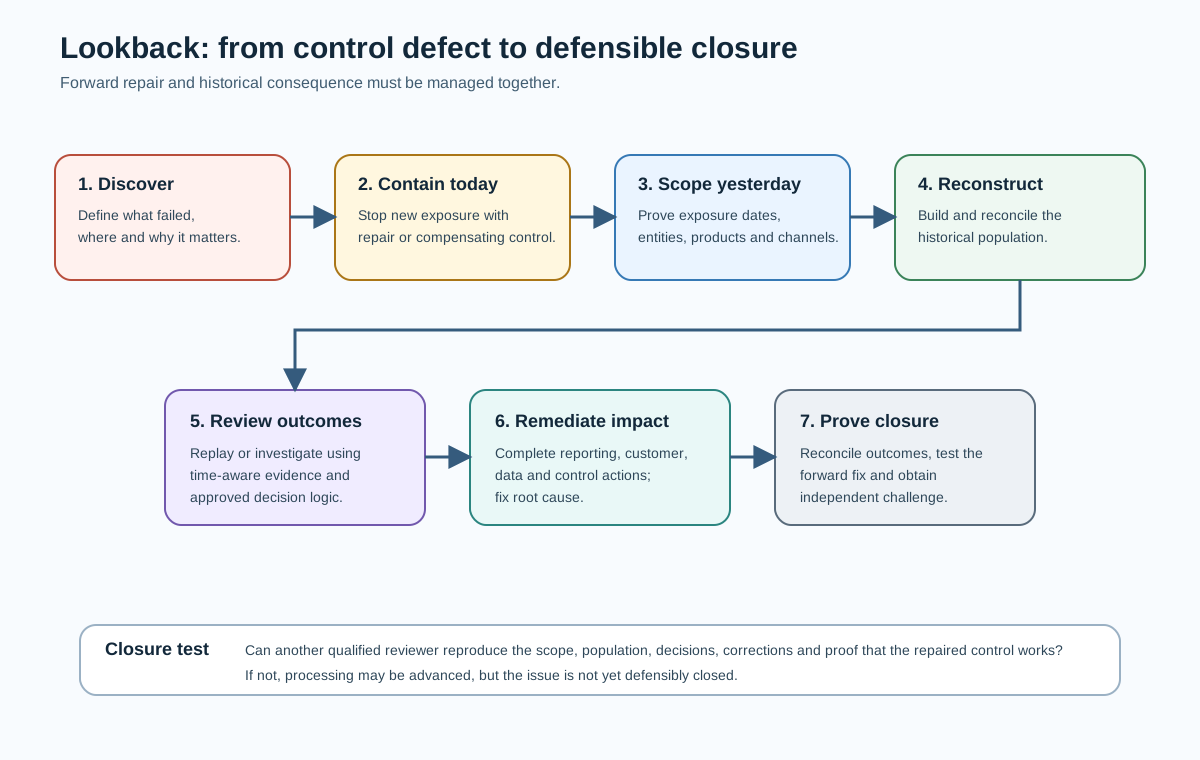
The simplest mental model: today, yesterday and proof
The easiest way to reason about remediation is to separate three workstreams.
Today is containment and forward repair. The bank stops the defect from causing new exposure. That may mean correcting a rule, repairing a data feed, introducing a compensating control, restricting a product, increasing manual review or changing an operating procedure. Containment is not the same as permanent remediation, but it reduces the chance that the historical problem continues while the programme is being designed.
Yesterday is the lookback. The bank determines how far back the defect existed, which customers or transactions could have been affected, what information was available at each relevant time, and which cases require re-performance or additional investigation. The bank may discover missed alerts, incorrect customer risk ratings, incomplete sanctions decisions, late or missing suspicious-activity reports, or no material impact at all. The answer must come from evidence, not from the severity of the original finding.
Proof is assurance. Management must demonstrate that the root cause is fixed, the historical population was complete enough for the stated objective, the review method was applied consistently, errors were handled, reporting and customer actions were completed, and the repaired control continues to operate. A programme that closes thousands of cases but cannot prove population completeness or explain its review logic is not a strong remediation.
This three-part model also prevents a common governance mistake. The team that repairs the forward control should not silently decide that no historical review is necessary simply because the current system now works. Conversely, a large retrospective review should not distract management from fixing the control that created the issue.
A lookback is not automatically required for every defect
There is no single global rule saying that every AML/CFT or sanctions weakness must generate a fixed-period lookback. FATF sets global standards for risk-based AML/CFT programmes, internal controls and independent testing, but the precise remediation action depends on the facts, the applicable law, the supervisor, the legal entity and the type of failure. In some jurisdictions a regulator or enforcement order may expressly require an independent historical review. In other cases the bank may decide internally that a back-book analysis is necessary to understand impact.
The decision should therefore be reasoned. Relevant questions include how serious the defect was, when it began, whether it affected a preventive or detective control, what population could have escaped review, whether legal filing or blocking obligations may have been missed, whether the bank can reconstruct the necessary data, and whether sampling can answer the question safely. A low-impact documentation defect may need targeted correction rather than a full transaction replay. A monitoring failure that excluded an entire payment channel for years may require a much broader response.
Recent U.S. enforcement actions illustrate the point without turning U.S. practice into a global rule. FinCEN's August 2026 action against UBS Financial Services required a third-party lookback to identify suspicious transactions that went undetected because of identified BSA/AML failures. FinCEN's 2024 action involving TD Bank also described an independent historical transaction analysis, commonly called a SAR lookback, as part of remediation. The OCC has used similar requirements in enforcement orders where suspicious-activity monitoring failures created historical uncertainty. These are jurisdiction-specific enforcement examples, not a universal lookback template.
The broader lesson is global: once a material control weakness is known, management needs a defensible method to determine historical impact and to show that corrective action is effective.
Start with the defect, not with a date range
Weak programmes often begin with a sentence such as “review the last two years.” That sounds decisive but may have no relationship to the actual defect. A defensible scope begins with a defect statement.
A good defect statement explains what was expected, what actually happened, why the difference matters, which systems or processes were involved, and the earliest and latest dates for which the failure might have affected outcomes. For example:
A mapping change deployed on 14 March 2024 stopped populating intermediary-bank country information into the transaction-monitoring feature store for cross-border corporate payments. Four scenarios used that feature in combination with customer risk and corridor risk. The defect was detected on 3 February 2026 and contained on 5 February 2026.
That statement is far more useful than “monitoring issue.” It gives the lookback team a technical event, affected data element, product population, scenario dependency and potential exposure period to test.
The beginning of the lookback window should normally be linked to evidence about when the defect started. That might be a release date, configuration change, vendor upgrade, data-source migration, model deployment, operating-procedure change or the earliest date on which testing shows the control ceased to perform. Where the exact start date cannot be proved, the bank should use a conservative and documented assumption or expand the window until evidence supports a boundary.
The end date is equally important. It should normally reflect effective containment, not the date the issue was logged. If a defect was discovered on Monday but the repaired feed did not become reliable until Friday, the historical population may need to run through Friday. If a temporary manual control was introduced before the permanent fix, the team should evaluate whether that control genuinely reduced the historical exposure and whether it was complete enough to create a new boundary.
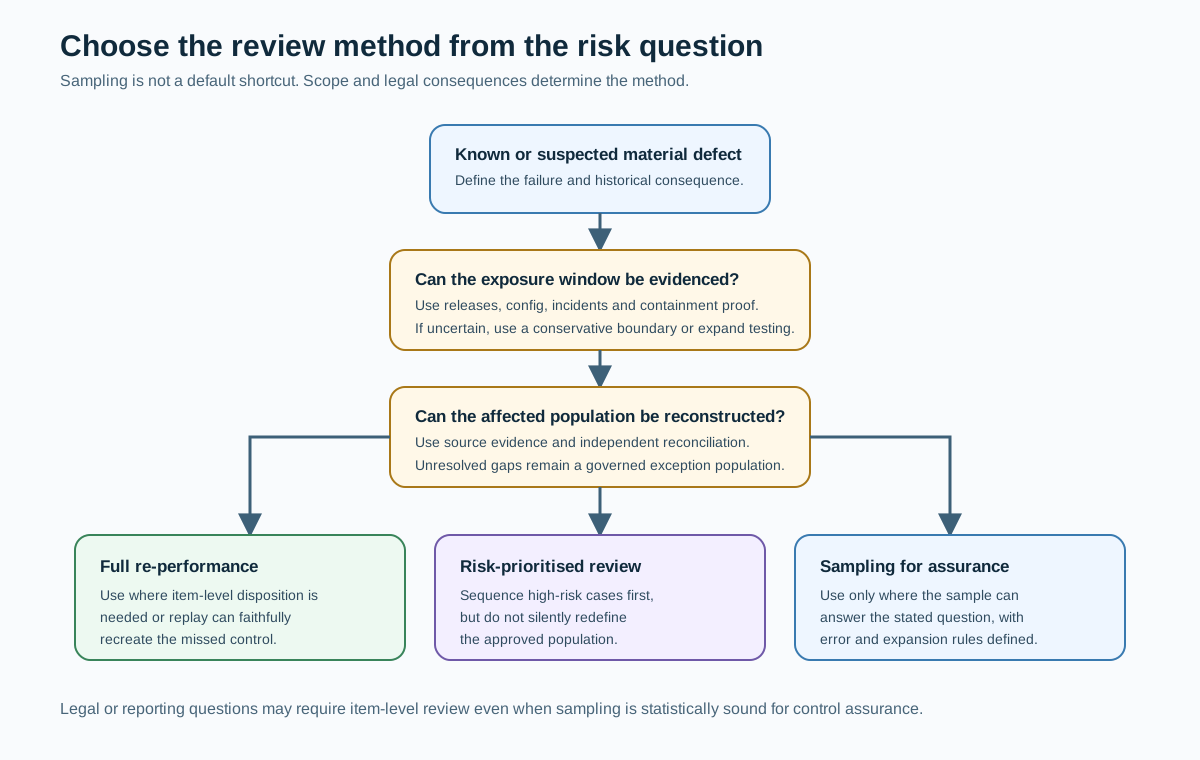
Define the remediation population precisely
The word population is one of the most important words in a lookback. It means the complete set of records that could be relevant to the defect under the approved scope. A population can be transactions, customers, alerts, cases, screening decisions, counterparties, files, legal entities or a combination of these.
The population definition should be reproducible. “High-risk payments” is not enough. A better definition states the legal entities, products, channels, currencies, transaction types, date boundaries, source systems, inclusion rules and exclusions. Where the defect involves a data element or scenario, the team should show how the affected records were identified from source data rather than relying only on the downstream system that was already known to be defective.
This creates a useful principle: do not prove completeness using only the system whose completeness is in doubt.
If a transaction-monitoring engine failed to ingest certain messages, an extract from that engine cannot establish the full transaction population. The bank may need to reconcile against payment hubs, core banking ledgers, card processors, trade systems, SWIFT archives, clearing files or accounting records. If customer files were misclassified, the source may be onboarding and master-data history rather than the current customer-risk table.
Population completeness should be evidenced through control totals and reconciliations. Useful checks include record counts by day and product, value totals, source-to-target counts, rejected-record counts, duplicate detection, missing identifiers, sequence gaps and comparison with financial or operational totals. The exact control depends on the system, but the objective is constant: prove that the dataset used for remediation corresponds to the risk population that management says it reviewed.
Where the population cannot be reconstructed completely, that is not a reason to invent completeness. The gap becomes a risk fact. Management may need alternative evidence, an expanded review, conservative assumptions, customer restrictions, external data, additional reporting analysis or regulatory engagement depending on the context.
Full re-performance, prioritisation and sampling are different tools
Not every lookback has to process every historical record in exactly the same way. The review method should match the question.
Full re-performance is appropriate where every item may carry a legal or material risk and the control can be recreated reliably. Re-screening a defined sanctions population against the relevant historical rule set may require item-level treatment, although sanctions law and list-history reconstruction can make the design complex. Re-running transaction-monitoring scenarios over a complete historical dataset can also be useful when the defect was technical and the rule logic is known.
Risk-based prioritisation can be appropriate when the population is large and the bank needs to sequence work according to potential harm. High-risk customers, material values, high-risk corridors, known typologies, previously escalated relationships or cases linked to law-enforcement interest may be reviewed first. Prioritisation affects order; it should not quietly redefine the approved population unless governance explicitly changes scope.
Sampling is useful when the objective is to estimate an error rate, validate a control, or decide whether a population needs expansion. It is dangerous when used as a convenient substitute for a review that actually requires item-level disposition. Sampling design should state the population, sampling method, confidence objective where statistical inference is intended, handling of exceptions, expansion rule and why the method answers the remediation question. “We checked 50 files and they looked fine” is not a methodology.
A programme can use all three approaches. For example, it may fully re-run a defective scenario, risk-prioritise the resulting alerts, and use independent sampling to test analyst decision quality.
Reconstruct the historical facts, not today's customer
A difficult problem in any back-book review is time. Current customer data can be very different from historical data. Ownership changes. Directors change. addresses change. Risk ratings change. Sanctions lists change. Transaction-monitoring rules change. A customer who is high risk today may not have been high risk under the approved framework two years ago, and a party designated today may not have been designated at the historical transaction date.
The lookback therefore needs a time-aware evidence model.
At minimum, the reviewer should be able to distinguish the event date, the date on which the bank originally received or created information, the effective date of a later correction, and the date on which the remediation team learned the new fact. This does not mean the bank must ignore later intelligence. Later information can be highly relevant to an investigation. It means the case record should show which facts are retrospective context and which facts were available at the time of the original decision.
For sanctions, historical list status and the law applicable at the relevant time can be decisive. For KYC, the relevant question may be whether the bank had sufficient customer information under the rule and risk framework then in force. For suspicious-activity analysis, later information may change how historical transactions are interpreted, but filing obligations and timing are jurisdiction-specific and should be assessed under current legal and compliance guidance.
The design goal is reproducibility. Another qualified reviewer should be able to understand why the remediation team reached its conclusion using the evidence and rules that the methodology said would apply.
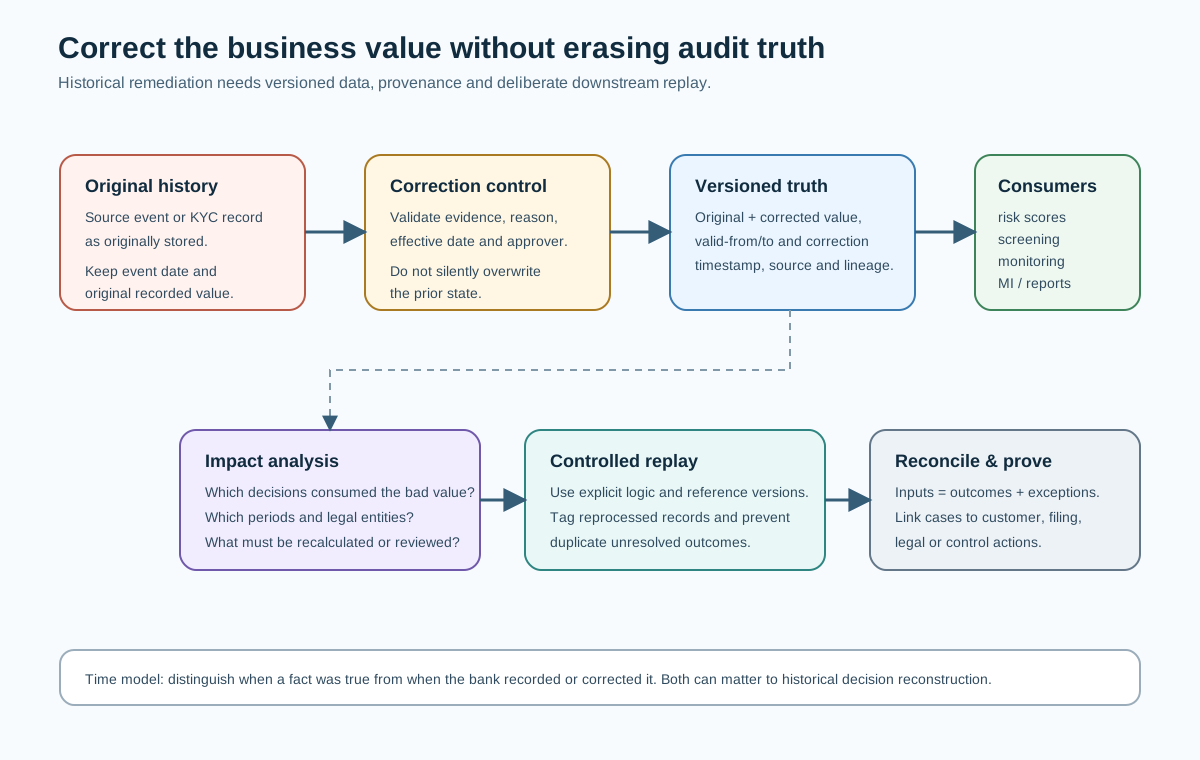
Historical data correction needs two truths
Correcting a bad field sounds simple until the field has already fed risk scores, screening, monitoring, customer communications, regulatory reports and management information. A bank may need to correct the operational value while retaining evidence of the original value and the reason it changed.
That creates two truths:
- business-effective truth — the value that should be used going forward or for the relevant historical period; and
- audit truth — the record of what value existed, when it existed, who or what changed it, why it changed and which downstream processes were affected.
Mature data models support this explicitly. They may use effective-from and effective-to timestamps, version identifiers, correction reason codes, source lineage, approval status and immutable audit events. The exact implementation differs, but silent overwrite is weak because it destroys the ability to reconstruct original decision conditions.
Historical correction also needs impact analysis. If beneficial ownership was corrected, should the customer risk rating be recalculated? Should sanctions screening be re-run? Should transaction-monitoring scenarios that use customer risk be replayed? Did any regulatory report or internal MI consume the old value? Did downstream data warehouses cache it? Did an external vendor receive it? A remediation that fixes the master record but leaves incorrect derived decisions untouched is incomplete.
The relationship with SARs, STRs and sanctions reporting
A lookback can discover activity that should have received a different financial-crime outcome. That does not create one universal reporting response.
Suspicious-activity reporting regimes differ by jurisdiction. The reporting threshold, deadline, form, confidentiality rules, continuing-activity expectations and role of the MLRO or nominated officer are not identical across countries. A historical review may identify activity that requires a late or supplemental filing, but the conclusion must follow the applicable local law and policy. The chapter therefore uses “SAR/STR” as a generic label for suspicious-activity reporting, not as one global process.
Sanctions outcomes are even more dependent on legal context. A retrospective review may identify a payment involving a party or activity that was restricted under the law applicable at the time. The bank may need legal analysis of designation dates, ownership or control rules, licences, blocking or freezing obligations, rejection rules, reporting duties and whether the bank still holds affected property. A current name match is not enough to establish a historical breach.
The same discipline applies to customer remediation. A historical risk-rating error may require enhanced due diligence, relationship restrictions or exit consideration, but the bank should not assume that a data defect automatically means the customer was engaged in financial crime. Control failure and customer misconduct are separate questions.
Lookbacks are operational programmes, not just investigations
A large remediation can involve thousands or millions of records, multiple legal entities and teams across compliance, operations, data, technology, audit and external vendors. That scale creates operational risks of its own.
Work allocation must preserve consistent methodology. Analysts need controlled procedures, training, examples and escalation routes. Case tools need reason codes that are meaningful enough to support quality review. Evidence repositories need retention and access controls. Queue design should prevent high-risk cases from being buried behind low-risk volume. Productivity targets should not reward premature closure.
Quality assurance should test both analyst decisions and programme mechanics. A correct case decision does not prove the population was complete. A perfect extract does not prove analysts applied the policy correctly. A strong programme therefore separates at least four assurance questions: Was the population right? Was the methodology right? Were individual cases decided correctly? Were resulting actions completed?
Independent testing has an important role. FATF Recommendation 18 expects financial institutions to maintain AML/CFT programmes that include an independent audit function. The FFIEC BSA/AML manual, in the U.S. banking context, specifically describes independent testing of suspicious-activity monitoring and the completeness and accuracy of supporting information-technology sources, systems and processes, and it expects deficiencies and corrective actions to be tracked. Those sources do not prescribe one global lookback method, but they reinforce the principle that remediation needs evidence beyond the team that built the fix.
Root cause and historical impact must stay connected
A lookback can become a factory that produces thousands of retrospective case decisions without fixing the problem that created them. Root-cause analysis prevents that.
The root cause may be technical, such as a failed mapping, an unmonitored product or a version-control defect. It may be procedural, such as unclear escalation criteria. It may be organisational, such as capacity constraints or split accountability. It may be data-related, such as missing customer attributes or inaccurate country enrichment. Often there are several contributing causes.
The historical review should feed the root-cause analysis. If missed cases cluster in one product or region, that may reveal a broader design weakness. If reviewers repeatedly cannot reconstruct historical evidence, the problem may extend beyond the original monitoring defect into data retention and lineage. If a repaired rule generates unexpected volumes when replayed, model calibration or customer-risk segmentation may also need review.
Likewise, root-cause findings should shape the lookback. If the defect existed in a common integration component, limiting the historical review to the first product where the issue was noticed may be unsafe. A good programme asks which other systems reused the same code, mapping, vendor configuration or source data.
The evidence timeline is part of the control
A remediation file should preserve the chronology of the issue: when the defect was introduced, when it first created exposure, when indicators appeared, when it was detected, when management was notified, when containment became effective, when historical review began, when corrective actions were deployed, and when assurance testing confirmed effectiveness.
This chronology matters because different dates answer different questions. A regulator may ask why the bank did not identify the issue earlier. An auditor may ask whether containment really stopped new exposure. A business owner may ask whether a customer decision was based on corrected information. A data team may need to know which model version consumed an old value.
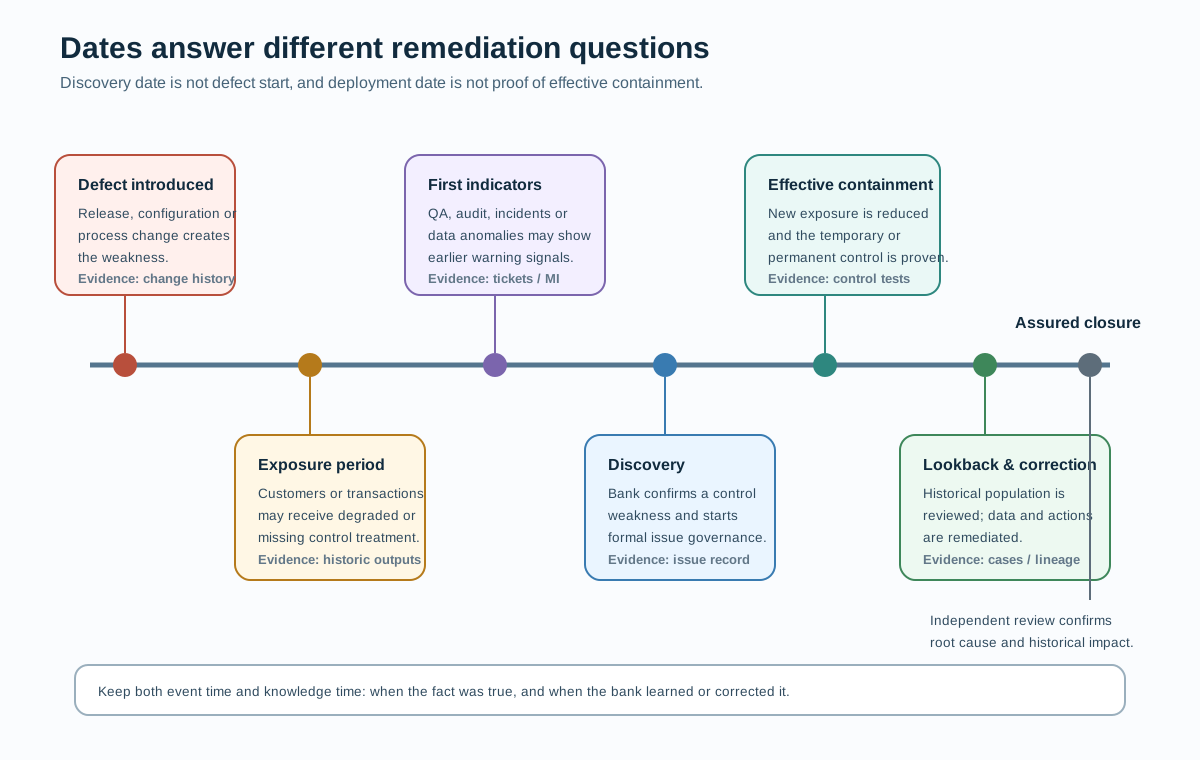
The timeline should come from verifiable records where possible: deployment logs, incident tickets, data-quality alerts, model approvals, case-system timestamps, meeting decisions, regulator correspondence, extract hashes and implementation evidence. Reconstructed dates should be marked as estimates rather than converted into false certainty.
Governance: who can say the issue is closed?
Issue closure is a risk decision, not an administrative status change.
The business or first-line control owner normally owns remediation delivery. Financial-crime compliance interprets policy, challenges scope and assesses risk. Data and technology teams prove repairs and lineage. Operations execute historical review and customer or case actions. Legal advises on jurisdiction-specific obligations. Regulatory-affairs teams may coordinate commitments and communications. Independent assurance tests whether the solution works as described. Senior management or a board committee may oversee material programmes depending on severity and governance.
No single diagram can prescribe every bank's three-lines model, but the accountability question is universal: who has authority to accept the evidence that the defect, historical impact and residual risk are adequately addressed?
The closure pack should contain enough evidence to answer that question. Typical components include the final defect statement, root-cause analysis, approved scope, population-completeness evidence, methodology, quality results, exception log, historical outcomes, customer and reporting actions, forward-fix testing, independent assurance, unresolved residual risks, and any external commitments.
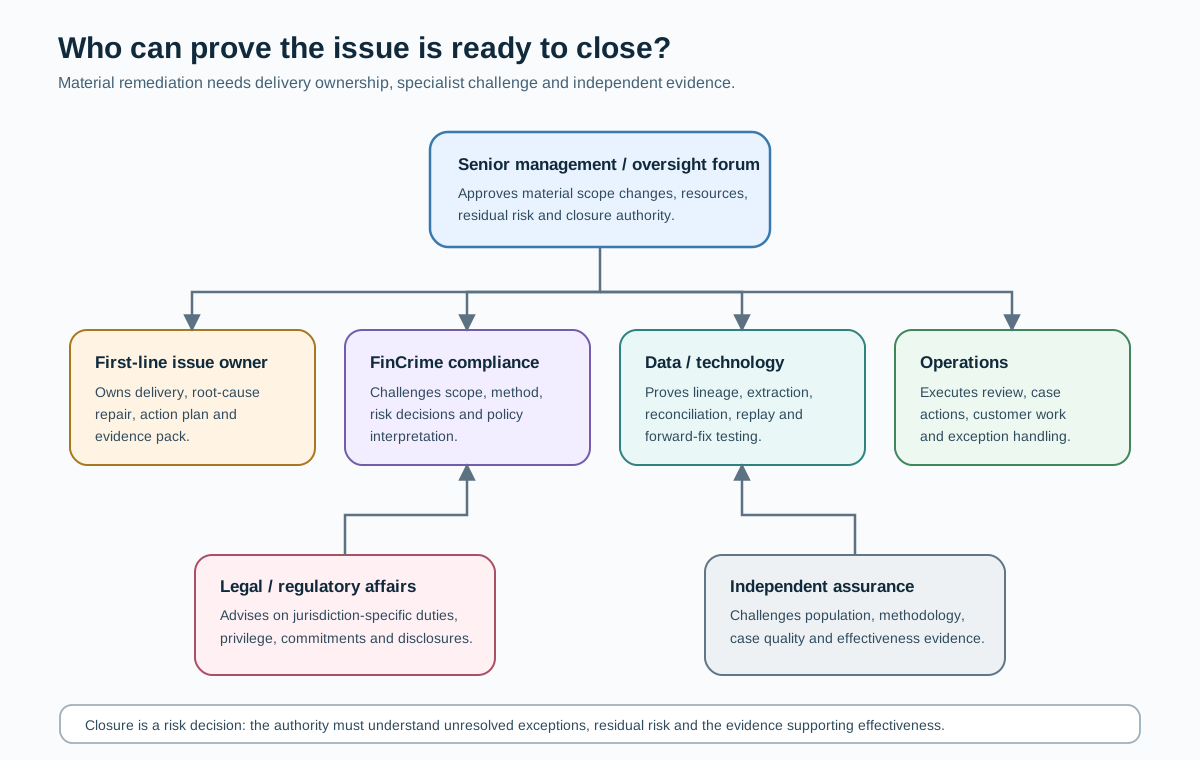
What good looks like for a business analyst or architect
For a business analyst, the hardest requirement is rarely “build a lookback screen.” It is translating an uncertain historical problem into testable rules.
A good requirements pack identifies the defect and objective, the authoritative source systems, the time model, inclusion and exclusion rules, deduplication logic, customer and transaction identifiers, historical rule or model versions, decision taxonomy, escalation conditions, evidence to retain, approval requirements, downstream actions, reporting needs and reconciliation controls. Every important rule should be explainable with an example.
Architects should pay particular attention to reproducibility. Large historical reviews often require temporary data stores, replay environments, archived rule versions, secure analyst tooling and controlled interfaces to production systems. The solution should preserve lineage from source record to remediation case and from case outcome to final action. Temporary remediation platforms still handle sensitive data and should meet the bank's security, access, retention and audit requirements.
Testers need more than happy paths. They should prove boundary dates, timezone handling, duplicate messages, cancelled and returned payments, historical customer versions, missing source records, late-arriving data, corrected fields, multiple legal entities, reruns, interrupted batches, partial failures and reconciliation after restart. They should also test that the same record is not silently reviewed twice or omitted because identifiers changed.
Mini case: a missing field in cross-border monitoring
Consider a composite example. A bank discovers that an integration deployed eighteen months earlier stopped sending intermediary-bank country data into the feature store used by four transaction-monitoring scenarios. The payment hub still holds the full messages, and settlement was unaffected. Monitoring, however, evaluated a weaker dataset.
The bank first contains current exposure by restoring the mapping, validating the feed and increasing manual review for the affected cross-border channel. It then establishes the likely defect start date from deployment records and proves the containment date through source-to-target testing.
The lookback team constructs the population from payment-hub records, not the monitoring engine, because the engine's input completeness is the issue under review. It reconciles daily counts and values to operational totals, removes technical duplicates while preserving payment events, and maps each transaction to the customer and risk profile effective at the time.
The scenarios are replayed using a controlled historical version of the logic with the restored country attribute. The replay generates additional alerts. Those alerts are risk-prioritised, but none are automatically treated as suspicious. Analysts review customer context, payment purpose, counterparties, related activity and later intelligence under an approved methodology. A small number of cases are escalated for jurisdiction-specific SAR/STR consideration. Separately, the bank evaluates whether any sanctions implications exist; the answer is not assumed from the AML alert outcome.
Root-cause analysis finds that the original deployment test checked message delivery but not semantic completeness of every feature consumed downstream. The permanent remediation therefore adds field-level lineage, source-to-target completeness controls, regression tests for scenario dependencies and release gates requiring monitoring-owner sign-off. Independent testing verifies both the repaired feed and a sample of historical case decisions.
This case demonstrates the full concept. The objective was not merely to “review eighteen months.” It was to identify the affected historical population, reconstruct the missing input, re-perform the relevant control, handle outcomes under applicable obligations, repair the root cause and prove that the same failure should be detected much earlier in future.
The practical test for completion
Before calling a lookback complete, ask seven questions.
Can the bank explain exactly what failed and when? Can it prove the historical population used for review? Can it distinguish original historical facts from information learned later? Can it show that the review method answered the risk question rather than merely processing volume? Can it evidence every material customer, reporting and control action that followed? Can it demonstrate that the root cause is fixed and operating effectively? Can an independent reviewer reproduce the reasoning without relying on the memories of the project team?
If the answer to any of those questions is uncertain, the issue may be operationally advanced but not yet defensibly closed.
Operational deep dive: proving the historical population
The most dangerous sentence in a lookback is “we reviewed the affected records” when nobody can prove what “affected” means or whether all relevant records were present. Historical remediation becomes defensible only when the population is defined from the defect, reconstructed from reliable sources and reconciled independently of the failed control.
This deep dive focuses on that discipline: scope, data reconstruction, replay design, exception handling and evidence quality.
From defect hypothesis to testable scope
A remediation programme normally begins with incomplete knowledge. The issue may have been found through audit, a regulator, a production incident, a whistleblower, quality assurance, model validation or a customer case. Early statements are therefore hypotheses, not facts. “The monitoring system missed transactions” may later turn into a much narrower problem involving one legal entity, one payment type and one version of an enrichment service. It can also widen if the same defective component was reused elsewhere.
The scope process should make this uncertainty visible. A useful sequence is:
- state the known failure and the evidence supporting it;
- identify assumptions that remain unproven;
- map every system, product and process that depended on the failed component;
- test the earliest and latest possible exposure dates;
- define the provisional population;
- validate that population against independent source evidence; and
- set explicit rules for expanding or narrowing scope when new facts emerge.
Scope governance matters because projects naturally try to stabilise their workload. Once analysts, vendors and budgets are mobilised, there is pressure to keep the original boundary even when evidence changes. A mature programme treats scope as controlled but revisable. Expansion decisions are documented with the same seriousness as the original approval. Narrowing is permitted only where evidence demonstrates that the excluded records could not have been affected.
A lookback should also separate control exposure from case outcome. If a sanctions-screening field was missing for 200,000 payments, all 200,000 may belong to the control-exposure population even though only a very small subset later requires investigation. If a KYC rule failed to trigger enhanced review for a segment, the population is the relationships that could have missed the trigger, not only the customers later judged high risk.
That distinction helps management understand why a large historical population does not imply widespread criminal activity. It reflects uncertainty created by the control weakness.
The exposure window is an evidence problem
The start date should be supported by technical or procedural evidence. Release-management records, configuration history, source-code changes, vendor version logs, workflow deployments, policy effective dates and data-quality metrics can all help. Where historical telemetry is weak, the team may need to test archived outputs before and after candidate dates until it can bracket the defect.
The end date should reflect when the relevant control became effective again. A code deployment does not automatically prove containment. The team should demonstrate that the repaired field arrived completely, the repaired scenario executed, the analyst workflow received its output and compensating controls were removed only after their exit criteria were met.
Timezone and business-day boundaries deserve attention. A global payments platform can record the same event in local time, UTC, clearing-system time and accounting date. If the defect began with a midnight release in one region, a simple date filter may include or exclude the wrong transactions. Requirements should specify timestamp semantics rather than relying on a date label.
The programme should retain the rationale for the chosen window. A later reviewer should not need to reverse-engineer why 1 April was selected instead of 31 March.
Build the population from authoritative sources
A common failure is using the downstream application as both the evidence of a defect and the source of the historical population. If a monitoring engine omitted transactions, its database cannot prove which omitted transactions existed. If a screening gateway truncated names, its stored values cannot prove the original names.
The team should map the business event to the best available authoritative sources. For payments this may include channel records, payment-hub events, SWIFT or ISO 20022 messages, clearing files, core-account postings, card-processor files, correspondent statements and ledger entries. For customer remediation it may include onboarding records, KYC master data, beneficial-ownership history, document repositories, screening archives and relationship-management systems.
No source is automatically perfect. Even a core ledger may represent financial posting rather than all attempted transactions. A payment hub may include rejected and cancelled instructions that never posted. A messaging archive may contain technical duplicates. The population design therefore needs a clear event model: what exactly counts as the unit under review?
For a transaction-monitoring lookback, the unit may be a settled payment, an attempted instruction or a logical customer transaction composed of multiple technical events. For sanctions, rejected or blocked attempts may be as relevant as settled transactions. For KYC, the unit may be a customer relationship at a particular review date. The method should say so explicitly.
Reconciliation is how completeness becomes evidence
A population extract is not complete because an engineer says the query ran successfully. Completeness needs independent control evidence.
Useful reconciliation layers include:
- record counts by source, date, entity and product;
- monetary totals where the population represents value-bearing events;
- unique business identifiers and duplicate rates;
- sequence or message-gap checks;
- rejected and error-record counts;
- null rates for fields relevant to the defect;
- comparison with accounting or settlement totals where conceptually appropriate;
- source-to-target transformation counts;
- confirmation that late-arriving records were incorporated; and
- documented explanation for every material variance.
Not every control applies to every dataset. The aim is not to create a ritual checklist; it is to challenge the ways records could be lost, duplicated or transformed incorrectly.
A strong extract is also immutable enough for audit. The programme should preserve the query or extraction logic, source-system versions, extraction time, file or table identifiers, row counts and a cryptographic hash or equivalent integrity control where the bank's tooling supports it. If the population is refreshed, the old version should remain traceable and the difference should be explained.
Historical joins are often harder than the extract
The transaction population may be straightforward while the customer context is not. Historical case review often requires joining a transaction from one date to customer attributes, ownership, product status, account relationships, country risk, risk ratings or screening results that were effective at that time.
Current-state tables are dangerous because they overwrite history. If a customer changed address twice, a lookback should not automatically assign today's address to all earlier activity. If beneficial ownership changed, the investigator may need both the ownership effective at the transaction date and later ownership information that changes the broader risk interpretation.
This is where temporal data design becomes important. Useful patterns include versioned records, effective-from and effective-to dates, event-sourced history, slowly changing dimensions or dedicated historical snapshots. The technical pattern matters less than the capability: the programme must be able to say which version of a fact it used and why.
Where no reliable historical version exists, the programme should mark the limitation and decide how to compensate. Options may include archived documents, regulatory filings, third-party data snapshots, manual reconstruction or a conservative review assumption. Reconstructing a fact from later evidence is different from proving what the bank knew at the time, and the case file should preserve that distinction.
Replaying a monitoring control
When a defect affected automated transaction monitoring, teams often propose a historical “re-run.” Re-running is useful only if the bank defines what is being reproduced.
At least four versions can matter:
- the historical production logic that should have run at the time;
- the actual defective logic that did run;
- the repaired logic now in production; and
- any current enhanced logic that did not exist historically.
A lookback aimed at identifying transactions missed because of a specific defect often starts by recreating the logic that should have operated, with the missing input restored. Using today's completely redesigned model may produce alerts for reasons unrelated to the historical defect. That can still be valuable intelligence, but it should not be confused with defect-impact measurement.
Version control therefore belongs in the methodology. Scenario code, thresholds, reference data, customer-risk inputs and model configuration should be identified. If exact historical logic cannot be reproduced, the programme should document the approximation and assess whether it biases the review.
Replay also needs deterministic processing controls. Batch restarts, partial failures, duplicate alerts, time-window state, rolling aggregates and sequence-dependent features can change output. Testers should prove that re-running the same controlled dataset under the same version produces the expected result, or understand why it does not.
Screening lookbacks have a different time problem
Sanctions and watchlist screening cannot be treated as ordinary transaction monitoring. A retrospective review may require reconstructing which lists, restrictions, ownership rules, licences and legal measures applied at the relevant time and to the particular legal entity processing the activity.
Current lists alone are not enough. A party designated after a historical payment may be important intelligence but does not automatically mean the payment breached sanctions when processed. Conversely, a party may have been designated at the time and later delisted. Historical list data and effective dates matter.
Name screening also depends on what data was available. If the defect was truncation, the team needs the original untruncated party data from the payment or customer source. If the defect was an outdated list, the team may need archived list versions and evidence of when the correct update should have become effective under the bank's process.
The operational outcome can differ by regime. Freeze, block, reject, prohibit, report and licence concepts are jurisdiction-specific. The lookback should route potential historical sanctions issues to qualified sanctions and legal review rather than allowing a generic AML remediation team to infer the legal result.
KYC remediation is usually relationship based
A KYC lookback may arise because beneficial owners were not identified correctly, periodic reviews were overdue, risk ratings used wrong factors, source-of-wealth evidence was insufficient, or enhanced due diligence was not performed for a defined segment.
The unit of work is often the customer relationship, but transactions still matter. The programme may need to determine what the bank should have known at onboarding or review, repair current customer data, then examine historical activity because the corrected profile changes how transaction behaviour should be interpreted.
This creates a sequence problem. If the bank corrects the current risk rating first, analysts must not assume that the higher current rating proves historical suspiciousness. The corrected rating may instead identify which historical transactions deserve closer review. Relationship remediation and transaction review should therefore be linked but analytically separate.
Customer contact also needs governance. Asking for missing documents can alert the customer to an internal review or create confusion where the bank is simultaneously investigating suspicious activity. Local legal restrictions, tipping-off concerns, customer-treatment standards and exit decisions require approved procedures rather than improvised analyst communications.
Historical data correction should never erase the control failure
Remediation teams are often measured on the number of records “fixed.” That can encourage direct database overwrites. The more defensible design preserves both the original and corrected states.
A correction record should identify the business key, original value, corrected value, source of correction, reason, approver where required, effective date, correction timestamp and downstream systems that need replay. For sensitive fields such as beneficial ownership, legal entity status, country, customer type or date of birth, provenance is as important as the corrected value.
Where a corrected value should have been effective historically, the data model may need a valid-time correction while still preserving transaction-time history showing when the bank actually learned and processed the update. This is a classic bi-temporal problem. Not every bank uses formal bi-temporal databases, but the conceptual distinction is valuable: when was the fact true, and when did the bank record it?
Derived data should be considered separately. If a source field changes, dependent risk scores, scenario features, screening results, MI and regulatory reports may need recalculation or assessment. A data lineage map helps the programme identify those consumers before closure.
Exceptions are part of the population, not outside it
Historical datasets contain missing records, corrupt files, unparseable messages, orphan accounts, merged customers and records without stable identifiers. A weak programme drops these items into an “exceptions” spreadsheet and counts the main population as complete.
A strong programme treats exceptions as a governed sub-population. Each exception has a reason, owner, risk classification and resolution route. Management information shows ageing and value. High-risk unresolved items are escalated. Closure criteria state what evidence is acceptable when perfect reconstruction is impossible.
Exceptions can also expose a second control weakness. If thousands of historical messages cannot be matched to customers, the problem may be broader than the original monitoring defect. The remediation governance should be able to create a new issue or expand the existing one rather than hiding the finding to protect project scope.
Quality assurance should test decisions and mechanics
Case QA answers whether analysts applied the methodology correctly. Programme QA answers whether the machinery around the analysts was reliable.
Case QA may review evidence selection, risk reasoning, disposition codes, escalation, documentation and required actions. Programme QA may test extracts, reconciliations, rule versions, workflow routing, access controls, duplicate handling, failed batches, exception ageing and downstream action completion.
Sampling for QA should reflect the risk of error. Purely random samples can measure overall quality but may under-represent rare high-risk outcomes. A combined approach can use random sampling plus targeted sampling of high-risk, borderline, manually overridden, reopened and regulator-sensitive cases. The methodology should avoid double-counting targeted samples when calculating a statistical error rate.
Errors should feed back into training and scope. If a decision defect is systemic, rework may need to extend beyond the sampled cases. If one analyst group applies a standard differently, calibration should occur before more volume is processed.
Closure requires outcome reconciliation
At the end of a lookback, the programme should reconcile the original population through every outcome. If 500,000 records entered the process, management should be able to explain how many were excluded under approved logic, how many produced alerts, how many were closed, escalated, reported, corrected, customer-remediated or still unresolved. Counts should add up.
Outcome reconciliation should also cover downstream actions. A decision to file a report is not complete until the applicable filing process records the action. A decision to refresh KYC is not complete until the customer record is updated or the relationship outcome is resolved. A sanctions escalation is not complete because a case status says “legal review”; the final disposition must be captured.
For material programmes, independent assurance should challenge the whole chain from defect statement to closure evidence. That is the point at which the bank can move from “we processed the lookback” to “we can demonstrate what happened, what we corrected and why the residual risk is acceptable.”
Advanced practice: designing remediation that survives challenge
A remediation programme is strongest when it is designed backward from the questions an independent reviewer will ask. What exactly failed? How did the bank determine historical impact? How do we know the population was complete? Why was this review method appropriate? What did the bank do with adverse findings? How do we know the permanent fix works? What evidence supports closure?
Those questions turn remediation from a volume-processing exercise into a control discipline.
Separate the issue into four layers
Material financial-crime findings often become confusing because several problems are discussed under one issue title. A practical way to organise the work is to separate four layers.
Layer 1: control design. Was the control conceptually capable of managing the risk? A transaction-monitoring framework may have excluded a material product by design. A customer-risk model may have omitted a required risk factor. A screening process may have no control for ownership or control relationships where the applicable sanctions framework required that analysis.
Layer 2: control implementation. Was the approved design built correctly? A rule can be well designed but receive incomplete data. A screening engine can be correctly configured while the upstream party name is truncated. A KYC procedure can be sound while the workflow lets analysts bypass mandatory fields.
Layer 3: control operation. Did people and systems operate the implemented control consistently? Backlogs, overrides, poorly documented closure, untrained analysts, missed escalations and capacity constraints belong here.
Layer 4: historical consequence. What outcomes were affected during the period of weakness? This is where the lookback sits. Historical consequence should not be assumed from the severity of the control defect; it has to be determined.
This layering helps root-cause analysis and prevents teams from fixing only what is easiest. If the defect is an upstream data issue, tuning downstream scenarios is not a root-cause fix. If the issue is analyst capacity, a new model may not solve the operational failure.
Impact assessment should be explicit
Before a full lookback is launched, the bank normally performs an impact assessment. The objective is to estimate the potential breadth and seriousness of historical exposure well enough to choose containment, scope and governance.
A useful impact assessment considers:
- affected legal entities and jurisdictions;
- products, channels and customer segments;
- control type: preventive, detective, reporting or governance;
- duration and uncertainty of the defect period;
- transaction or customer volume;
- whether high-risk sectors, geographies or counterparties were involved;
- whether legal or regulatory reporting could have been missed;
- whether the bank can reconstruct historical data reliably;
- prior findings, repeat issues or enforcement commitments; and
- whether customer harm, sanctions exposure or law-enforcement impact may have occurred.
The result is not a mathematical truth. It is a decision document that supports scope and prioritisation. Banks should avoid creating a pseudo-precise severity score where the underlying evidence is weak. Narrative reasoning and explicit uncertainty are often more defensible than a formula that hides assumptions.
Containment must be testable
“Manual control introduced” is not sufficient evidence of containment. The temporary control should have a defined population, frequency, owner, procedure, escalation route, capacity model and effectiveness check.
If a defective payment-monitoring feature is repaired temporarily through a daily exception report, the bank should prove the report receives all relevant payments, that analysts review them within the required operational window, that alerts are escalated consistently and that unresolved items are visible to management. If volume exceeds manual capacity, management must decide how to reduce risk rather than treating the existence of a spreadsheet as containment.
Temporary controls also need exit criteria. They should not disappear simply because a permanent release was deployed. The programme should validate the permanent control over an agreed period or transaction volume, compare outputs where useful, then formally retire the temporary process.
Remediation populations should be version controlled
Large lookbacks often create several population versions. The first extract is refined, duplicates are removed, source gaps are repaired, scope expands, or additional legal entities are added. Without version control, analysts can work on different definitions and management reporting becomes unreliable.
Each population version should have a unique identifier, extraction logic, source references, date, control totals and reason for change. If records are added or removed, the delta should be traceable. Case systems should link work items to the population version from which they originated.
This sounds administrative, but it prevents serious problems. Without versioning, the bank may close an issue after reviewing 100,000 cases even though a later corrected extract contained 104,000. The missing 4,000 can disappear between project reporting and technical reconciliation.
Sampling needs a question before it needs a sample size
Sampling is often discussed as if selecting a percentage is the main decision. The real question is what the bank is trying to infer.
If the bank wants to estimate an analyst error rate, probability sampling may be appropriate. If it wants to validate that a rare but severe customer segment received proper review, targeted sampling may be more useful. If it wants to prove that every transaction potentially subject to a historical sanctions prohibition was assessed, sampling may not answer the legal question at all.
The sampling plan should state the population, objective, selection method, expected inference, treatment of strata, confidence or precision where statistical inference is intended, handling of discovered errors and expansion rule. It should also distinguish statistical conclusions from targeted review findings.
A common mistake is mixing a random sample with manually selected high-risk cases, then reporting the combined error rate as if it were statistically representative. Another is selecting only closed cases and ignoring work that remained unresolved or was excluded by automation. The sampling frame itself must be challenged.
Root-cause analysis should follow the dependency chain
Financial-crime systems are dependency-heavy. A monitoring scenario may depend on customer-risk data, country enrichment, payment parsing, reference tables, batch orchestration and case workflow. A failure at any point can appear downstream as a “scenario issue.”
A practical root-cause method traces the business decision backward through those dependencies:
decision outcome → case workflow → detection logic → features and reference data → transformations → source systems → change and governance controls.
For each layer, ask what should have prevented the failure, what should have detected it and why those controls did not work. This avoids stopping at the first visible technical error.
For example, a field mapping may be the immediate cause. The deeper control failures may include no data contract, no source-to-target reconciliation, no regression test for mandatory scenario inputs, no production data-quality alert, and no release sign-off from the monitoring owner. Remediation should address the chain, not only the field.
Treat data lineage as a financial-crime control
Data lineage is sometimes left to architecture teams, but it directly affects AML and sanctions control effectiveness. A bank should know which source fields feed a customer-risk score, a screening decision or a transaction-monitoring scenario, how the values are transformed and which controls detect loss or corruption.
For lookbacks, lineage also shows where historical correction must propagate. If an address-country field is corrected in customer master data, downstream copies in a feature store, screening cache, data lake and reporting mart may remain wrong. The remediation design should identify whether each consumer needs correction, recalculation, replay or merely annotation.
Lineage should include business meaning, not only table names. Two systems can both have a country_code field while one means customer residence and another means counterparty-bank location. A technically successful mapping can still be semantically wrong.
Business analysts can improve lineage by defining critical data elements with clear descriptions, source ownership, valid values, effective dating, transformation rules and control expectations. Testers can then verify both value movement and meaning.
Build replay as a controlled capability
Historical reprocessing can create its own risks. Running years of data through a production monitoring engine can overload capacity, duplicate alerts, alter live state or mix historical and current cases. Mature banks therefore separate the replay environment or introduce controlled replay modes.
A replay design should consider:
- frozen code or model version;
- historical reference data;
- deterministic batch windows;
- segregation from live queues;
- unique replay identifiers;
- idempotency on restart;
- duplicate suppression rules;
- compute and storage capacity;
- case routing and priority;
- reconciliation of inputs and outputs; and
- controlled promotion of cases requiring production action.
If a temporary platform is used, security and privacy requirements still apply. Historical remediation datasets can contain years of customer and transaction information. Access should be limited to the approved purpose, and retention or deletion should follow the bank's data-governance and legal requirements.
Distinguish correction from reinterpretation
Historical remediation can discover a fact that changes current understanding without proving that the original decision was wrong under the information available at the time. This distinction is particularly important for adverse media, beneficial ownership, sanctions designations and customer risk.
Suppose a beneficial owner is identified in 2026 and evidence shows the person actually controlled the company since 2023. The customer master record may need a historical effective-date correction. But the audit record should still show that the bank did not identify that owner until 2026. Any assessment of whether the bank's earlier CDD was adequate is a separate control question.
Similarly, a counterparty designated in 2026 may justify review of earlier activity for intelligence or broader risk reasons, but the later designation does not retroactively create the same sanctions prohibition unless the applicable legal framework says so. The remediation process should preserve legal effective dates and avoid retrospective assumptions.
Customer remediation needs its own risk design
A lookback can lead to customer contact, enhanced due diligence, restrictions, transaction holds, relationship exit or restoration of wrongly applied controls. These actions can cause material customer impact.
The programme should define who approves customer actions, how urgent risks are prioritised, what communications are permitted, how vulnerable customers are handled where relevant and how complaints are routed. Financial-crime teams should coordinate with customer-service and conduct teams without revealing confidential investigation information that local law or policy protects.
If the bank discovers that a customer was incorrectly classified or restricted because of bad data, remediation should also consider customer detriment. Financial-crime control is not only about detecting missed risk; it includes correcting over-control and inaccurate decisions where the evidence supports that conclusion.
Metrics should measure risk reduction, not activity alone
Lookback dashboards often celebrate throughput: cases opened, cases closed, analysts onboarded. Those figures are useful for capacity management but weak indicators of remediation quality.
A stronger dashboard combines delivery, quality and risk metrics. Examples include population reconciliation status, unresolved source gaps, high-risk case ageing, QA error rates by decision type, scope changes, reopened cases, downstream action completion, outstanding customer remediation, forward-control defect rates, temporary-control exceptions and independent-testing findings.
Management should also see whether the programme is creating new risk. A growing QA rework rate, increasing analyst turnover, unexplained population deltas or persistent failed batches can undermine confidence even when closure volume is high.
Acceptance criteria for a remediation platform
A business analyst can convert the control principles into concrete acceptance criteria. The following examples are deliberately testable rather than aspirational.
Population traceability: Every remediation case must reference a population version and stable business identifier. The system must retain the source extract identifier and inclusion reason.
Historical context: Reviewers must be able to distinguish data effective at the event date from information added during remediation. Corrected values must retain provenance and correction timestamps.
Decision evidence: A case cannot be closed without an approved disposition, mandatory rationale fields, evidence references and completion of required escalation steps.
Rerun safety: Reprocessing the same controlled input with the same logic version must not create duplicate unresolved cases. Restart after a partial batch failure must reconcile processed and unprocessed records.
Outcome completeness: The platform must reconcile population records to final dispositions and identify records in exception, pending or failed states.
Action linkage: Where a case outcome requires SAR/STR consideration, sanctions/legal review, KYC refresh, customer action or control remediation, the originating case must retain a link or auditable confirmation of completion.
Access and audit: Privileged changes to population, decision logic or case outcome must be logged with user, timestamp and reason. Access must follow approved role segregation.
These criteria can be adapted to local architecture without embedding jurisdiction-specific legal rules in a generic platform.
Testing should include deliberate failure
A credible remediation programme tests more than ordinary processing. It should deliberately simulate missing source files, late-arriving data, duplicate records, incorrect timezone conversion, broken joins, analyst override, unavailable reference data, partial batch completion, queue overload and failed downstream actions.
The purpose is to prove that failure becomes visible. A system that works only when every dependency behaves perfectly is not suitable for high-stakes historical remediation.
Reconciliation controls should detect a dropped file. Monitoring should show a failed batch. The workflow should prevent closure when mandatory downstream action is incomplete. Supervisory override should be visible in audit logs. Incident procedures should say who can pause processing and who can approve restart.
Independent assurance should challenge closure evidence
Independent testing should not merely repeat a sample of analyst cases. It should challenge the assumptions that made the programme possible.
A strong assurance review may inspect the defect chronology, scope rationale, extraction logic, population reconciliations, rule versions, data lineage, sampling design, case-quality results, exception management, customer and reporting actions, forward-fix testing and governance approvals. It should also assess whether the programme followed its own methodology when pressure increased.
The most useful assurance finding is not “the project completed 98 percent of cases.” It is a conclusion about whether the bank has reasonably addressed the historical risk created by the defect and whether the repaired control is demonstrably effective.
That is the standard remediation teams should design for from the beginning.
Practice close: challenge the remediation before you close it
Lookback work can look impressive because the volumes are large. Thousands of cases, hundreds of analysts and detailed dashboards can create a sense of control even when the basic evidence is weak. The final skill in this chapter is therefore challenge: can you test the programme's claims without being distracted by throughput?
Ten reviewer questions
Use these questions when reading a remediation paper, designing a backlog or reviewing an audit finding.
1. What exactly failed? The defect should identify the expected control, the actual behaviour, the affected dependency and why the difference matters. “AML issue” or “data quality problem” is not enough.
2. What proves the exposure period? Start and end dates should be connected to implementation, incident, configuration or control evidence. A standard two-year or five-year window may be operationally convenient but is not automatically evidence-based.
3. Where did the population come from? If the failed monitoring or screening system is the only source used to construct the population, ask whether omitted records could be invisible by definition.
4. How was population completeness challenged? Look for control totals, source-to-target comparisons, duplicates, rejects, late-arriving records and explanation of material variances.
5. Which historical versions were used? Customer data, scenario thresholds, sanctions lists, risk ratings and reference data can all change. The methodology should say which version applies and why.
6. What does an alert or match mean? It is a review trigger, not automatic proof of suspicion, sanctions exposure or customer wrongdoing.
7. What happens when evidence is missing? Exceptions should remain visible with owners and resolution rules. Missing data should not disappear through an exclusion code that management never sees.
8. How are downstream actions proved? An escalation decision is not the same as a completed filing, KYC refresh, customer restriction, data correction or legal disposition.
9. What fixed the root cause? The answer should go beyond the visible symptom. Ask what preventive and detective controls now identify the same class of failure earlier.
10. Who independently challenged closure? The delivery team can provide evidence, but material remediation normally needs independent assurance or equivalent challenge under the bank's governance model.
BA acceptance criteria that expose weak design
The following examples can be adapted into user stories or test cases.
AC01 — scope traceability
Given a remediation case, when a reviewer opens the case metadata, then the system must show the population version, source extract identifier, inclusion reason and relevant exposure-period rule.
AC02 — historical and corrected values
Given a data field corrected during remediation, when the correction is approved, then the original value, corrected value, effective date, correction timestamp, source, reason and approver must remain auditable according to the bank's data-governance model.
AC03 — population reconciliation
Given a batch imported for remediation, when processing completes, then input records must reconcile to created cases, approved exclusions, duplicates, exceptions and failed records with no unexplained difference.
AC04 — idempotent replay
Given the same controlled historical input and the same rule version, when a failed batch is restarted, then the platform must not create duplicate unresolved cases or lose records already processed successfully.
AC05 — mandatory action completion
Given a case outcome that requires a linked follow-up action, when a user attempts to close the case, then closure must be prevented or formally excepted until completion evidence or an approved alternative disposition is recorded.
AC06 — versioned methodology
Given a methodology change during the programme, when new cases are assigned, then each case must retain the methodology version applied, and governance must define whether previously completed cases require rework.
AC07 — temporal evidence
Given a historical transaction, when an analyst reviews customer context, then the interface must distinguish information effective at the event date from information learned or corrected later.
AC08 — exception visibility
Given a record that cannot be reconstructed, when it moves to exception status, then the record must remain in management reporting with reason, risk level, owner and ageing until resolved or explicitly accepted.
AC09 — auditability of override
Given an analyst or supervisor override, when the decision changes, then user, timestamp, prior state, new state and rationale must be retained.
AC10 — closure evidence
Given a remediation programme reaching closure, when the control owner seeks approval, then the evidence pack must include population completeness, historical outcomes, root-cause fix, effectiveness testing, open exceptions and independent challenge.
Test scenarios worth running
A strong test pack should include more than ordinary successful cases.
Run a transaction exactly on the start boundary and one exactly outside it. Test events crossing midnight in different timezones. Insert a duplicate technical message with the same business identifier. Drop a source file and prove reconciliation catches it. Deliver a late file after a batch has closed and verify the population delta is visible. Change a customer identifier after a merger and test whether historical transactions still link correctly. Use a corrected beneficial-owner record whose effective date predates the correction timestamp and verify both dates survive. Interrupt a replay halfway through and restart it. Create an outcome requiring a downstream action, then make that downstream service fail. Attempt to close the case anyway.
These tests are valuable because they target the points where large remediation programmes lose evidence: boundaries, joins, restart logic, version history and hand-offs.
Misconceptions to avoid
“A lookback is just rerunning the rules.” Not necessarily. The programme also needs population proof, historical context, investigation, downstream action and assurance.
“If the control failed, every affected customer is high risk.” No. A control failure creates uncertainty about outcomes; it does not establish customer misconduct.
“Today's sanctions list tells us whether an old payment was prohibited.” Not by itself. Historical legal status, designation dates, ownership/control analysis and applicable jurisdiction matter.
“A statistically clean sample proves every legal obligation was satisfied.” Sampling can answer some assurance questions but cannot replace item-level treatment where the objective requires it.
“Fixing the source data fixes all downstream decisions.” Only if dependent calculations, controls and reports are deliberately assessed and replayed where necessary.
“Closing every case means the remediation is complete.” Case closure is only one workstream. Root cause, forward effectiveness, exception resolution and independent assurance also matter.
“Historical correction should make the old record look right.” A corrected business value may be needed, but audit history should still preserve what existed before the correction and when the bank learned the new fact.
Knowledge check
Why is a payment hub often a better population source than the monitoring engine in a monitoring-ingestion defect? Because the payment hub may hold the business events that should have entered monitoring, including records the defective downstream engine never received. Using only the failed engine can make omitted activity invisible.
What is the difference between prioritisation and population scope? Prioritisation decides which items are reviewed first. Scope defines which items belong to the remediation. High-risk prioritisation should not silently remove lower-risk records from scope unless governance explicitly changes the methodology.
Why retain both effective date and correction timestamp? The effective date says when a fact applies in the business world. The correction timestamp says when the bank actually recorded or learned the correction. Both can matter for reconstructing historical decisions and testing control adequacy.
When can a later sanctions designation matter to earlier transactions? It can be useful intelligence and may trigger investigation, but it does not automatically create the same historical legal prohibition. The applicable regime, designation and legal effective dates must be analysed.
What does independent testing add after the project has QA? QA normally tests delivery and case quality within the programme. Independent testing can challenge the underlying scope, population, methodology, control effectiveness and closure evidence from outside the remediation team's delivery accountability.
Final takeaway
Lookback, remediation and historical data correction are ultimately about making uncertainty manageable. A bank discovers that a control did not work as intended. It cannot change the past, but it can reconstruct the affected population honestly, review the historical risk proportionately, correct data without erasing evidence, complete required actions, repair the root cause and prove that the new control works.
The strongest programmes are not the ones that claim perfect historical knowledge. They are the ones that make assumptions visible, reconcile what can be proved, escalate what cannot, and leave a decision trail that another qualified person can follow.
Masterclass: an eighteen-month monitoring gap from defect to closure
This masterclass uses a composite bank case to show how lookback, remediation and historical data correction fit together. The facts are illustrative, but the control problems are realistic: an upstream data defect, incomplete monitoring, uncertainty about historical impact, pressure to process a large population, jurisdiction-specific reporting questions and a permanent fix that must be proved rather than asserted.
The purpose is not to teach one regulator's enforcement method. It is to show the reasoning a global bank needs when a material financial-crime control has failed.
The discovery
A regional corporate bank processes cross-border payments through a central payment hub. The hub sends a normalised event to a financial-crime feature service. The feature service enriches the transaction with customer risk, counterparty country, intermediary-bank country, product, amount history and corridor information before four transaction-monitoring scenarios execute.
During a routine data-quality review, an analyst notices that the intermediary-bank-country field is almost always blank for payments originating from one legacy corporate channel. The payment messages themselves contain the information. The blank field therefore appears to be an integration problem rather than missing customer data.
Technology investigation traces the issue to a channel migration eighteen months earlier. During migration, an XML path changed. The payment hub preserved the field, but the transformation into the monitoring feature service continued using the old path. Unit tests confirmed that the message reached the feature service; they did not validate the semantic content of every field. Production monitoring had no control comparing mandatory feature completeness by channel.
The four affected scenarios did not stop running. They evaluated transactions using the remaining features. This is important: the bank did not have a simple “monitoring on versus monitoring off” failure. It had degraded detection capability. Some transactions still generated alerts; others may not have reached the same score without the missing corridor information.
The first 48 hours: contain before calculating the whole past
The programme does not wait for a perfect eighteen-month impact analysis before reducing current risk.
Technology restores the field mapping in a controlled emergency release. The monitoring owner verifies source-to-target values on production-like messages and then on live transactions. Operations introduces a temporary daily exception report comparing payment-hub records with monitoring-feature records for the legacy channel. The report highlights missing or inconsistent intermediary-bank country values, and a specialist team reviews those exceptions.
The bank also freezes non-essential changes to the four affected scenarios until the historical methodology is defined. This prevents later confusion about which rule version should be replayed.
Containment governance records the exact time the repaired mapping became effective and the date on which the temporary reconciliation control achieved stable coverage. The issue team does not use the incident-log date as the lookback end date. It uses evidence of effective containment.
At this stage senior management receives a provisional impact assessment. The bank knows the defect affected one channel and four scenarios. It does not yet know how many alerts were missed or whether suspicious-activity reporting was affected. Management therefore receives ranges and uncertainties rather than a false count.
The defect statement
The remediation team writes a controlled defect statement:
From the legacy corporate-channel migration on 14 August 2024 until effective containment on 6 February 2026, intermediary-bank country was not populated into the financial-crime feature service for cross-border payments initiated through that channel. Four transaction-monitoring scenarios used the field as one input. Payment processing and settlement retained the original intermediary-bank data. The defect may have reduced detection scores and therefore may have prevented some transactions from generating alerts.
The statement intentionally avoids saying that “all payments were unmonitored.” That would be inaccurate. It also avoids saying “no suspicious activity was reported” because other controls may have generated alerts.
The defect statement becomes the anchor for population logic, root-cause analysis, testing and regulatory communications.
Determining whether the problem is wider
Before building the historical population, architecture teams search for reuse of the same transformation component. Two additional channels use the feature service but map the intermediary field through different adapters. Historical data-quality analysis confirms those fields were populated at expected rates. A securities-payment flow uses the same XML utility but a different message structure; targeted testing shows no equivalent defect.
This dependency review is important. If the programme had assumed that the first observed channel was the only affected channel, it could have closed the wrong scope.
The bank documents the evidence supporting exclusion of the other channels. Exclusion is not based on product ownership saying “we have not seen a problem.” It is based on field completeness and source-to-target tests.
Building the historical transaction population
The monitoring engine is not used as the primary source because its feature input is precisely what failed. The payment hub becomes the transaction source. The team extracts every cross-border transaction initiated through the affected channel during the exposure period, including completed, returned and rejected events according to the approved event model.
The extraction uses a stable payment identifier and event status. Technical retries are preserved initially because removing them too early could hide legitimate payment-event history. Deduplication rules are applied only after the business event model is agreed.
The team reconciles daily transaction counts and settled values to channel operations and accounting control totals where the measures are conceptually comparable. It compares hub message counts with archive counts and investigates days with material differences. One weekend shows a gap caused by an archived-file ingestion failure. The file is recovered and the population version is incremented.
The final population is frozen as version 3.2 with the extraction query, source snapshot identifiers, row count, financial control totals, known exclusions and a file integrity hash. Version 3.1 is not deleted. The difference between versions is documented.
This is what “population completeness” looks like in practice: not certainty by assertion, but a chain of reconciliations and resolved exceptions.
Reconstructing historical customer context
The scenarios also use customer risk. The bank's current customer table cannot be joined directly because some relationships changed risk category during the eighteen months.
The data team therefore reconstructs risk ratings effective at each transaction date from the customer-risk history store. Where a history record is missing, the transaction enters an exception population. The programme uses archived review records to reconstruct the rating where possible and records whether the reconstructed value is proven or inferred.
Later intelligence is kept separately. An analyst reviewing a 2024 payment may see adverse media published in 2026. The methodology allows that information to inform current risk understanding but requires the analyst to distinguish it from information that existed at the 2024 decision date.
This prevents two errors: pretending the bank knew later information earlier, and ignoring later intelligence that can legitimately change how a historical pattern is understood today.
Which scenario version should be replayed?
During the exposure period, two of the four scenarios changed thresholds. One scenario was materially redesigned six months before discovery. A naive re-run using today's configuration would therefore generate alerts that could never have existed under the historical control design.
The methodology divides the lookback into rule-version periods. For each period, the bank reconstructs the approved scenario logic that should have run at that time with the intermediary-bank-country field correctly populated. Threshold versions, customer-risk input versions and country reference data are identified.
The programme also performs a second analytical run using current intelligence for selected high-risk cases. That run is clearly labelled supplementary current-risk analysis rather than historical control re-performance. Keeping those objectives separate prevents the bank from overstating what the original defect caused.
Replay is executed in an isolated environment. Historical alerts receive a remediation identifier and cannot enter live customer queues automatically. Input counts, output counts, failed records and duplicate events are reconciled for every batch.
The alert population is not the suspicious population
Replay generates substantially more alerts than the defective historical execution did. The project steering committee initially describes them as “missed suspicious transactions.” Compliance corrects the language immediately.
An alert means the transaction met detection criteria. It does not mean the activity was suspicious, reportable or unlawful.
Analysts therefore review the replay alerts using a controlled methodology. They consider customer profile, business purpose, counterparties, transaction history, related accounts, payment narratives, prior alerts and relevant external information. Where the evidence is insufficient, the case is escalated rather than forced into a binary closure.
The methodology contains separate decision codes for no concern, explainable unusual activity, further investigation, SAR/STR consideration, customer due-diligence refresh and sanctions/legal escalation. This prevents one disposition from carrying several meanings.
Reporting outcomes are routed by legal entity
The bank operates through legal entities in several jurisdictions. A central remediation team performs initial investigation, but suspicious-activity reporting decisions are not centralised into one global legal conclusion.
Each potential reporting case is routed to the responsible local MLRO or equivalent reporting function under the bank's jurisdiction-specific framework. The programme provides a standard evidence pack but does not impose one filing threshold or deadline across all entities.
Some cases result in late or supplemental SAR/STR filings under applicable local rules. Others are closed after review. The programme captures the reporting decision and evidence of completion without exposing confidential report content to staff who do not need it.
This separation is essential. A global bank can standardise workflow and evidence while still respecting local legal responsibilities.
A sanctions escalation appears inside the AML lookback
One replay alert involves payments to a company whose ownership chain is connected to a party later identified in a sanctions investigation. The AML analyst does not decide that the historical payments breached sanctions.
The case is transferred to sanctions specialists. They reconstruct designation dates, ownership information, the law applicable to the processing entity, payment dates and any relevant licences or exceptions. The later intelligence is important, but the legal analysis remains time-specific.
This is a good example of why remediation taxonomies matter. The issue began as a transaction-monitoring defect. The historical review generated information relevant to another control domain. The bank creates the necessary sanctions case without collapsing AML suspicion and sanctions applicability into the same decision.
The project finds a second problem: incomplete historical risk data
During reconciliation, the team discovers that a small group of customers has no reliable historical risk-rating version for part of the exposure period. The current record exists, but the prior version was overwritten during an unrelated customer-data migration.
The programme does not silently use the current rating. The affected records become a formal exception population. Data governance investigates the migration, and the remediation committee evaluates alternative evidence such as archived KYC reports and approval records.
The missing history becomes a separate data-control issue because it affects more than this lookback. That creates additional work and an uncomfortable governance discussion, but it is the correct outcome. A lookback is not successful if it hides new weaknesses to protect its closure date.
Root cause expands beyond one bad mapping
The technical error is obvious: the XML path was wrong. The root-cause review goes further.
The migration programme had no critical-data-element contract between the payment hub and the feature service. Automated tests verified message transmission but not field-level semantic completeness. Transaction monitoring did not own a production control for expected population rates of critical features by channel. Release governance did not require a downstream financial-crime impact assessment for the changed message structure. Data lineage existed at a high architectural level but did not identify the scenario dependency on the field.
The permanent remediation therefore includes several measures:
- field-level source-to-target reconciliations for critical monitoring features;
- schema and semantic validation in the integration pipeline;
- regression tests linked to scenario dependencies;
- production alerts for abnormal null and distribution rates;
- a data contract with ownership and escalation rules;
- monitoring-owner sign-off for material upstream message changes; and
- lineage linking critical source fields to downstream controls.
This is materially stronger than changing one XPath and closing the issue.
Testing the permanent fix
Technology testing verifies the corrected mapping across relevant message variants. Data-quality testing verifies completeness and valid country-code distributions. Scenario regression testing proves that the field affects detection as designed. End-to-end testing confirms alert creation, case routing and audit logging.
The bank also performs negative tests. Domestic transactions that should not carry intermediary-bank country are not rejected merely because the field is blank. Payments legitimately lacking the field under defined message conditions are handled through explicit logic rather than counted as defects.
For several weeks, the temporary reconciliation control compares hub and feature-service values. Stable results and independent testing support retirement of the temporary control.
Quality assurance reveals decision inconsistency
The first QA cycle finds that two analyst teams treat the same type of corporate treasury flow differently. One routinely escalates; the other closes with weak documentation.
The programme pauses new allocations for that scenario, calibrates the teams using shared cases, clarifies the methodology and re-reviews a risk-based population of decisions already completed. QA error metrics are reported transparently rather than hidden as “training observations.”
This is an important lesson: throughput pressure can turn a technically sound lookback into an inconsistent investigation programme. Quality findings should be able to trigger rework and methodology change.
Governance and regulator interaction
The issue is material enough that the bank's regulatory-affairs function coordinates communications with relevant supervisors. The bank distinguishes confirmed facts from estimates, reports material scope changes and avoids promising a closure date before population validation is complete.
This approach reflects the broader lesson visible in public enforcement actions: regulators often care not only about the original control failure but also about whether management identified, escalated and remediated it promptly and effectively. FinCEN's 2026 UBS Financial Services action explicitly criticised delayed remediation of previously identified monitoring weaknesses and required a third-party lookback. The case is U.S.-specific, but the management lesson travels well: repeated promises without demonstrable corrective action can become part of the problem.
The steering committee therefore tracks evidence of remediation, not only milestones. Each commitment has an owner, due date, proof requirement and independent challenge where appropriate.
Closure pack
After the historical review is substantially complete, the bank prepares a closure pack. It includes:
- final defect and root-cause statements;
- exposure-period evidence;
- approved population definition and version history;
- source-to-target and control-total reconciliations;
- replay methodology and rule versions;
- analyst procedure and training evidence;
- QA methodology, error rates and rework results;
- exception population and resolution;
- SAR/STR and sanctions escalation completion evidence at an appropriate confidentiality level;
- customer-remediation outcomes;
- permanent-fix design and test evidence;
- temporary-control retirement evidence;
- independent assurance conclusions;
- outstanding residual risks and their owners; and
- status of supervisory or audit commitments.
The closure authority does not receive a simple statement that “100 percent of cases are complete.” It receives evidence showing what was reviewed, what was found, what changed and why the bank believes the historical and forward-looking risks are controlled.
What the case teaches
This case is useful because the original technical error was small. One field mapping failed. The consequences, however, touched monitoring logic, historical data, customer context, reporting governance, sanctions escalation, data lineage, testing, operations and regulatory assurance.
That is typical of material financial-crime remediation. The visible defect is often the start of the investigation, not the full issue.
The best programmes therefore keep five questions connected from discovery to closure:
What failed? Describe the control defect precisely.
Who or what could have been affected? Prove the historical population rather than guessing it.
What actually happened? Reconstruct evidence and make case decisions without treating alerts as guilt.
What must be corrected now? Complete reporting, customer, data and control actions under the applicable framework.
Why will the failure not recur unnoticed? Repair the root cause and prove the new control through testing and independent assurance.
A remediation that can answer those questions with evidence is far more valuable than one that merely finishes a large queue.
References and further reading
These public sources support the chapter's treatment of AML/CFT internal controls, independent testing, historical transaction review, remediation, data quality and supervisory expectations. Jurisdiction-specific enforcement actions are included as practical examples only; they should not be read as universal legal rules.
Global standards and bank risk management
- FATF, The FATF Recommendations — Recommendation 18 covers internal controls, compliance arrangements, training and independent audit within AML/CFT programmes: https://www.fatf-gafi.org/en/publications/Fatfrecommendations/Fatf-recommendations.html
- FATF, Risk-Based Approach Guidance for the Banking Sector, October 2014 — banking-sector guidance on identifying, assessing and understanding ML/TF risk and applying proportionate controls: https://www.fatf-gafi.org/content/dam/fatf-gafi/guidance/Risk-Based-Approach-Banking-Sector.pdf.coredownload.pdf
- FATF, Methodology for Assessing Technical Compliance with the FATF Recommendations and the Effectiveness of AML/CFT/CPF Systems — current methodology page, including updates to the assessment framework: https://www.fatf-gafi.org/en/publications/Mutualevaluations/Fatf-methodology.html
- Basel Committee on Banking Supervision, Basel Consolidated Guidelines: Abuse of financial services, AFS10 Anti-money laundering and counter-terrorist financing — current consolidated guidance on integrating ML/TF risk into bank risk management: https://www.bis.org/committees/bcbs/basel-consolidated-guidelines/module/afs/10
- Basel Committee on Banking Supervision, Basel Consolidated Guidelines: Risk data — entry point to BCBS expectations relevant to risk-data aggregation and data governance: https://www.bis.org/committees/bcbs/basel-consolidated-guidelines/module/rma/10
U.S. examination guidance on testing, systems and corrective action
- FFIEC, BSA/AML Independent Testing — describes risk-based independent testing, evaluation of suspicious-activity monitoring, IT sources and processes, and tracking of deficiencies and corrective actions: https://bsaaml.ffiec.gov/manual/AssessingTheBSAAMLComplianceProgram/03
- FFIEC, BSA/AML Independent Testing Examination Procedures — examination procedures for testing monitoring methodology, alert management, SAR decisioning and program adequacy: https://bsaaml.ffiec.gov/manual/AssessingTheBSAAMLComplianceProgram/03_ep
- FFIEC, Risk-Focused BSA/AML Supervision — explains use of risk assessment, prior findings, management responses and independent testing in examination planning: https://bsaaml.ffiec.gov/manual/ScopingAndPlanning/02
- FFIEC, BSA/AML What's New — records current manual changes, including the February 27, 2026 updates: https://bsaaml.ffiec.gov/whatsnew
Public enforcement examples involving lookbacks and remediation
- FinCEN, FinCEN Assesses Historic $125 Million Penalty Against UBS Financial Services Inc. for Recidivist BSA Violations, August 3, 2026 — describes delayed remediation and a required third-party lookback for transactions that went undetected: https://www.fincen.gov/news/news-releases/fincen-assesses-historic-125-million-penalty-against-ubs-financial-services-inc
- FinCEN, FinCEN Assesses Record $1.3 Billion Penalty against TD Bank, October 10, 2024 — describes an independent historical transaction analysis or SAR lookback as part of remediation: https://www.fincen.gov/news/news-releases/fincen-assesses-record-13-billion-penalty-against-td-bank
- OCC, Cease and Desist Order Against Bank of America for BSA Deficiencies, December 23, 2024 — describes required corrective action, independent assessment and lookback reviews: https://www.occ.treas.gov/news-issuances/news-releases/2024/nr-occ-2024-140.html
- OCC, Civil Money Penalty and Termination of Consent Order Against Rabobank, N.A., February 7, 2018 — describes an independent historical transaction and account review that resulted in additional SAR filings: https://www.occ.treas.gov/news-issuances/news-releases/2018/nr-occ-2018-15.html
- OCC, Civil Money Penalty Against U.S. Bank National Association, February 15, 2018 — describes transaction-monitoring deficiencies and a lookback required under a prior consent order: https://www.occ.treas.gov/news-issuances/news-releases/2018/nr-occ-2018-17.html
UK and European supervisory examples
- FCA, Santander UK fined for repeated anti-money laundering failures, December 9, 2022, updated December 5, 2025 — illustrates the supervisory consequences of prolonged AML control weaknesses and ineffective remediation: https://www.fca.org.uk/news/press-releases/fca-fines-santander-uk-repeated-anti-money-laundering-failures
- FCA, Commerzbank London fined over anti-money laundering failures, June 17, 2020 — describes repeated failure to take reasonable and effective steps to fix identified AML weaknesses: https://www.fca.org.uk/news/press-releases/fca-fines-commerzbank-london-37805400-over-anti-money-laundering-failures
- FCA Handbook, FCG 1.1 What is the Financial Crime Guide? — current FCA guidance context for financial-crime systems and controls and the status of FCG guidance: https://handbook.fca.org.uk/handbook/fcg1/fcg1s1
- FCA Handbook, FCG 3 Money laundering and terrorist financing — practical UK guidance on AML systems and controls: https://handbook.fca.org.uk/handbook/fcg3
- European Banking Authority, EBA strengthens AML/CFT supervision in the EU through revised Guidelines, December 16, 2021 — risk-based supervisory framework and follow-up expectations in the EU context: https://www.eba.europa.eu/publications-and-media/press-releases/eba-strengthens-amlcft-supervision-eu-through-revised
How to use these sources
FATF and Basel sources provide the global standards and risk-management foundation. FFIEC, FinCEN and OCC material is specific to the United States. FCA material is specific to the United Kingdom, and EBA material reflects the EU supervisory framework applicable at the time of publication. Banks should always map a remediation decision to the law, regulator, legal entity, product and effective date that actually apply to the case.