Proliferation Financing and Dual-Use Risk
Proliferation financing is one of the hardest financial-crime risks for a bank to understand because the money itself can look ordinary. A payment may come from a legitimate company, pass through established banks, refer to apparently normal industrial goods and contain no obvious criminal language. The risk can sit in the purpose behind the transaction, the ownership of a counterparty, the end user of a product, the route through which goods or value are moving, or an attempt to breach or evade targeted financial sanctions connected to weapons-of-mass-destruction programmes.
The subject therefore sits at the intersection of financial sanctions, customer due diligence, trade finance, correspondent banking, payment screening, transaction monitoring, export-control awareness and intelligence-led investigation. It is not simply “sanctions screening with a different label.” A bank may face a direct legal prohibition because a designated person is involved, but it can also face a broader risk that apparently legitimate customers, intermediaries or transactions are being used to support procurement, logistics, technology transfer or revenue generation connected to proliferation-sensitive activity.
This chapter builds a practical model for understanding that risk without turning bankers into weapons engineers or customs officers. The objective is to show what a bank can realistically know, which facts matter, where controls should sit, how legal and risk-based obligations differ, and how an investigator can combine customer, payment, trade and network information into a defensible decision.
A central principle runs through the entire chapter: dual-use does not mean prohibited, and unusual does not mean proliferation financing. Many dual-use goods and technologies have completely legitimate civilian purposes. The job of the bank is to understand the applicable legal framework, identify meaningful risk signals, apply proportionate controls and escalate where the available evidence cannot safely explain the activity.
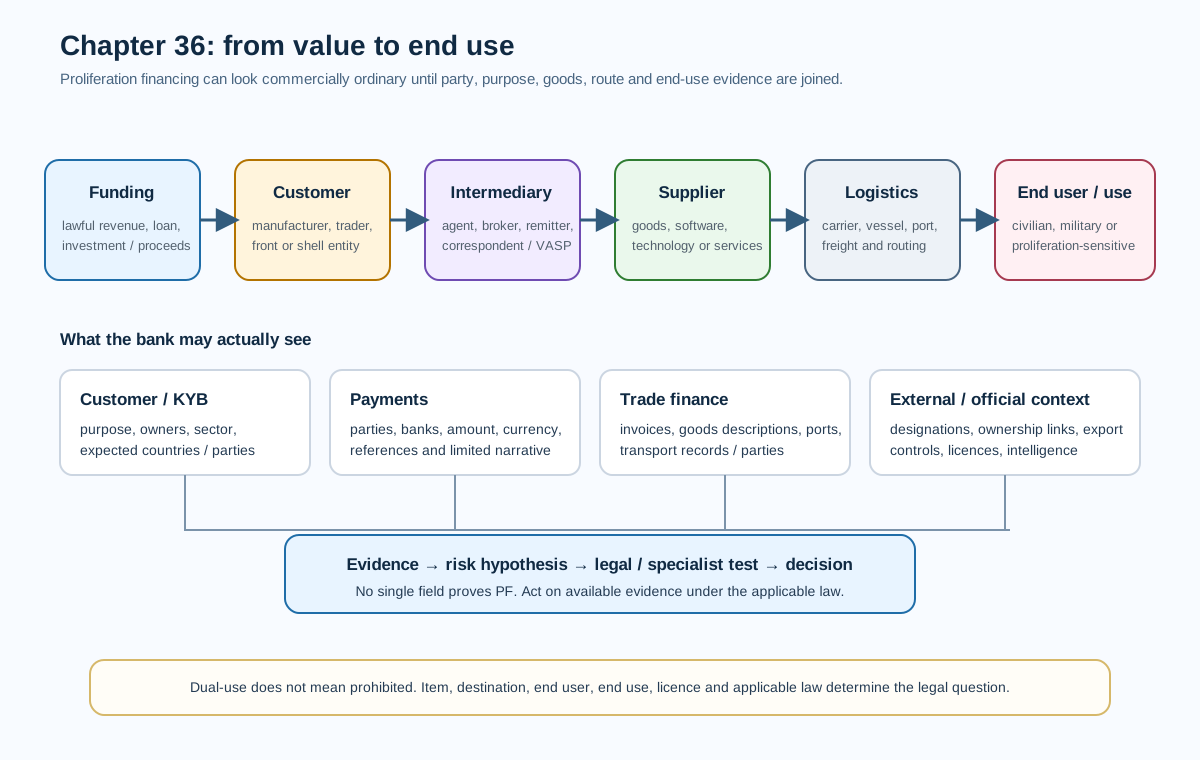
The simplest mental model
The easiest way to understand proliferation financing is to separate three questions.
First, what capability is ultimately being supported? At the highest level, proliferation concerns nuclear, chemical, biological or radiological weapons and their means of delivery, together with related programmes, materials, goods, software, technology, expertise and procurement networks. A bank normally does not determine whether a particular technical item can build such a capability. That is a specialist export-control or governmental judgement. But the bank can identify when the customer, goods description, counterparties, ownership, destination or payment behaviour creates a reason to ask more questions.
Second, what value or financial service enables the activity? The value may be a direct payment for goods. It may also be a loan, guarantee, insurance arrangement, trade-finance instrument, correspondent payment, foreign-exchange conversion, investment, cash movement, virtual-asset transfer or revenue generated through commercial activity. Proliferation networks need finance not only to buy sensitive items but also to maintain companies, move funds, pay intermediaries, charter transport, acquire ordinary components and support the broader procurement chain.
Third, what legal or risk framework applies? FATF Recommendation 7 focuses on targeted financial sanctions required by relevant United Nations Security Council resolutions. FATF Recommendation 1 and its interpretive note require countries, financial institutions and other covered sectors to identify, assess and understand risks of potential breach, non-implementation or evasion of proliferation-financing targeted financial sanctions and to take proportionate mitigating measures. Domestic laws then translate those international standards into binding obligations. Export-control law, trade sanctions and other national measures can create additional restrictions beyond the FATF framework.
That means a bank must avoid a common mistake: treating proliferation financing as one universal legal rule. The global standard sets the architecture. The binding prohibition, reporting obligation, licensing route and enforcement consequence depend on the jurisdiction, legal entity, transaction, parties and activity involved.
Proliferation financing is not the same as money laundering
Money laundering normally concerns criminal proceeds: value generated by an offence and then concealed, moved, converted or integrated. Proliferation financing can involve proceeds of crime, but it does not have to. A company can use apparently legitimate commercial revenue to purchase restricted goods or support a prohibited programme. The financial flow may therefore look economically ordinary even when the ultimate use is prohibited.
This difference matters operationally. A transaction-monitoring scenario designed mainly to detect laundering patterns such as rapid pass-through activity, structuring or unexplained cash may not detect a procurement payment from a well-capitalised industrial company to a long-standing overseas supplier. The proliferation concern may come instead from a newly discovered ownership link, the nature of the goods, an unusual end user, a sanctioned jurisdictional nexus, a freight route, a trade document or an intelligence update.
A suspicious-activity framework also cannot replace sanctions controls. If applicable law requires funds or assets to be frozen without delay, a bank cannot wait until an AML investigator becomes suspicious. Conversely, the absence of a sanctions match does not prove that a transaction has no proliferation risk. A procurement network may use unlisted companies, intermediaries or apparently ordinary commercial structures.
The two disciplines therefore need shared information but different decision logic. AML asks whether activity may represent criminal proceeds or another reportable suspicious activity under local law. Proliferation-financing sanctions analysis asks whether a targeted financial-sanctions prohibition, ownership/control rule or other relevant restriction applies. Broader proliferation-risk management asks whether the bank understands and can mitigate exposure to customers, products, geographies and transactions that could support or evade prohibited proliferation activity.
Proliferation financing is not the same as terrorist financing
Terrorist financing is primarily concerned with funds or assets made available for terrorist acts, terrorists or terrorist organisations under the applicable legal framework. Funds may be lawful or unlawful in origin. Proliferation financing is concerned with financing connected to the development, acquisition, manufacture, possession, transport, transfer or use of weapons of mass destruction and related delivery systems, as defined and implemented under relevant national and international frameworks.
The controls can overlap. Both can involve targeted financial sanctions, opaque ownership, international transfers, intermediaries and complex networks. Both can require banks to freeze assets or avoid making funds available to designated persons where applicable. But the target activity, legal instruments, risk indicators and sector exposures can be different.
For a business analyst or architect, the practical lesson is not to build one generic financialCrimeFlag field. The system needs enough information to distinguish terrorism-related sanctions, proliferation-related sanctions, other sanctions programmes, AML suspicion and fraud risk because each can lead to different legal actions, reporting routes, confidentiality requirements and customer outcomes.
Dual-use goods: ordinary purpose, sensitive potential
The phrase dual-use describes items, software or technology that can have both civilian and military or proliferation-sensitive applications. The category is broad. Industrial machinery, electronics, materials, laboratory equipment, chemicals, navigation technology, sensors, specialised software and many other products can have legitimate commercial uses while also being controlled because of potential strategic or military application.
A dual-use classification does not automatically make a transaction illegal. Whether an export, supply, service or financing arrangement is permitted depends on the applicable export-control and sanctions rules, the item, destination, end user, end use, licence status and other facts. The same item may be unrestricted in one transaction and controlled in another.
This distinction is important because banks can create severe customer harm if they treat a technical keyword as proof of prohibited activity. A manufacturer may legitimately purchase advanced pumps, measuring equipment or specialised alloys. A university may import laboratory equipment. A hospital may procure technology that appears on a controlled-goods list but is authorised for medical use. The control challenge is to identify where additional understanding is required, not to classify every industrial transaction as suspicious.
Banks also have different visibility depending on the product. A trade-finance bank examining invoices, bills of lading, letters of credit and shipping documents may see specific goods descriptions and counterparties. A retail bank processing a customer credit transfer may see only payer, beneficiary, banks, amount, currency, address and a short remittance narrative. Requirements should reflect what the bank actually receives rather than assume every payment contains export-control data.
The FATF framework: Recommendation 1 and Recommendation 7
FATF strengthened its Standards in October 2020 so that proliferation-financing risk assessment and mitigation became an explicit part of the risk-based framework. Its 2021 guidance explains that countries, financial institutions, designated non-financial businesses and professions and virtual-asset service providers should identify and assess the risk of potential breaches, non-implementation or evasion of proliferation-financing targeted financial sanctions and take measures proportionate to those risks.
This is an important nuance. FATF does not require a bank to predict every possible form of weapons procurement in the world. The risk-assessment obligation is connected specifically to the implementation and evasion risk around targeted financial sanctions relating to proliferation financing. Institutions may have broader obligations under domestic sanctions, export-control, trade-finance or criminal law, but those should be identified separately rather than attributed inaccurately to FATF.
Recommendation 7 is more direct. It requires countries to implement targeted financial sanctions to comply with relevant United Nations Security Council resolutions on the prevention and disruption of proliferation financing. The interpretive note focuses on freezing without delay the funds or other assets of designated persons and entities and ensuring that funds or other assets are not made available to or for their benefit, subject to the applicable legal framework and authorised exemptions.
The FATF Recommendations current in 2026 also reflect the re-application in September 2025 of relevant UN Security Council resolutions relating to Iran. FATF stated on 29 October 2025 that Recommendation 7 is applicable to the current Security Council resolutions applying targeted financial sanctions relating to proliferation, including the re-applied Iran-related resolutions. For a global bank, that development is a reminder that sanctions rulebooks cannot be treated as static configuration. Legal change must trigger controlled policy review, list updates, jurisdiction mapping, rescreening and testing.
The United Nations framework
The United Nations Security Council provides the international legal foundation for important counter-proliferation measures. Resolution 1540 (2004) is especially significant because it requires States to establish controls intended to prevent non-State actors from developing, acquiring, manufacturing, possessing, transporting, transferring or using nuclear, chemical or biological weapons and their means of delivery. It is broader than a bank-screening rule and sits within a wider national framework covering legislation, border controls, export controls and related measures.
For banks, the most directly operational UN measures arise through targeted financial sanctions and other financial restrictions implemented by Member States. The DPRK sanctions regime overseen by the Security Council Committee established pursuant to resolution 1718 (2006) contains extensive measures covering designated persons and entities, financial services, correspondent relationships, trade, vessels, goods and other activities. The exact obligations for a bank are implemented through the law applicable to that bank.
The key design lesson is that the UN list or committee page is not itself the bank’s complete operating procedure. A bank should know which domestic or regional law gives effect to the measure, which legal entities are subject to it, what ownership or control tests apply, what exemptions or licences may exist and how reporting must be performed.
A global sanctions platform therefore needs a source-to-obligation model: UN resolution or designation, domestic implementation, bank policy, control rule, operational decision and evidence. If any layer is missing, teams can mistake a policy label for a legal conclusion.
The current Iran and DPRK context
Two country contexts appear frequently in public counter-proliferation frameworks: the Democratic People’s Republic of Korea and Iran. They should not be reduced to generic “high-risk country” labels because the legal architecture and applicable measures differ.
For the DPRK, the 1718 Committee maintains sanctions measures covering designated persons and entities, financial restrictions, prohibited goods, vessels and other activities. The Committee’s current public material also shows that financial measures can extend beyond simple name screening, including restrictions intended to prevent financial services or support that could contribute to prohibited programmes or sanctions evasion.
For Iran, the legal landscape changed materially in September 2025 when specified UN Security Council resolutions were re-applied under the process associated with resolution 2231. FATF publicly confirmed in October 2025 that this change affects the scope of Recommendation 7. Banks must rely on the law and official sanctions implementation applicable to their jurisdictions rather than assume that an old policy memo still reflects the current state.
This chapter does not attempt to provide a transaction-level legal opinion for either jurisdiction. That would be unsafe because sanctions measures, designations, licences and national implementation can change. The professional approach is to maintain current official sources, controlled legal interpretation and a process for rapid operational change.
Where proliferation risk appears in a bank
Proliferation risk does not belong to one queue. It can enter through the customer relationship, a payment, a trade-finance product, a correspondent relationship, a securities transaction, an insurance or guarantee product, a foreign-exchange conversion, a merchant or commercial account, a virtual-asset relationship or another service that moves value or supports trade.
Customer risk can arise when a company operates in sectors associated with sensitive technology, has opaque ownership, uses nominee structures, has unexplained links to high-risk jurisdictions, or changes its business model in a way that no longer fits the onboarding profile. None of those facts proves wrongdoing. They indicate where the bank may need stronger evidence.
Product risk varies. Trade finance can create visibility into goods and shipping but also increases the complexity of document review. Correspondent banking can expose a bank to underlying parties it does not directly onboard. Instant payments compress decision time. Private banking and corporate banking may involve complex ownership and cross-border structures. Virtual assets can introduce different counterparties and transparency challenges. Securities and capital-markets activity can create exposure through ownership, financing or investment relationships.
Channel risk also matters. A relationship originated through an intermediary may give the bank less direct information. API-based or embedded-finance channels may move customer data through several parties. Manual trade processes can create document inconsistency. Digital onboarding can make corporate evidence easier to collect but also easier to falsify or reuse if controls are weak.
The correct risk assessment therefore looks at the combination of customer, product, geography, channel, transaction, goods and network context rather than attempting to create one “proliferation score” from nationality alone.
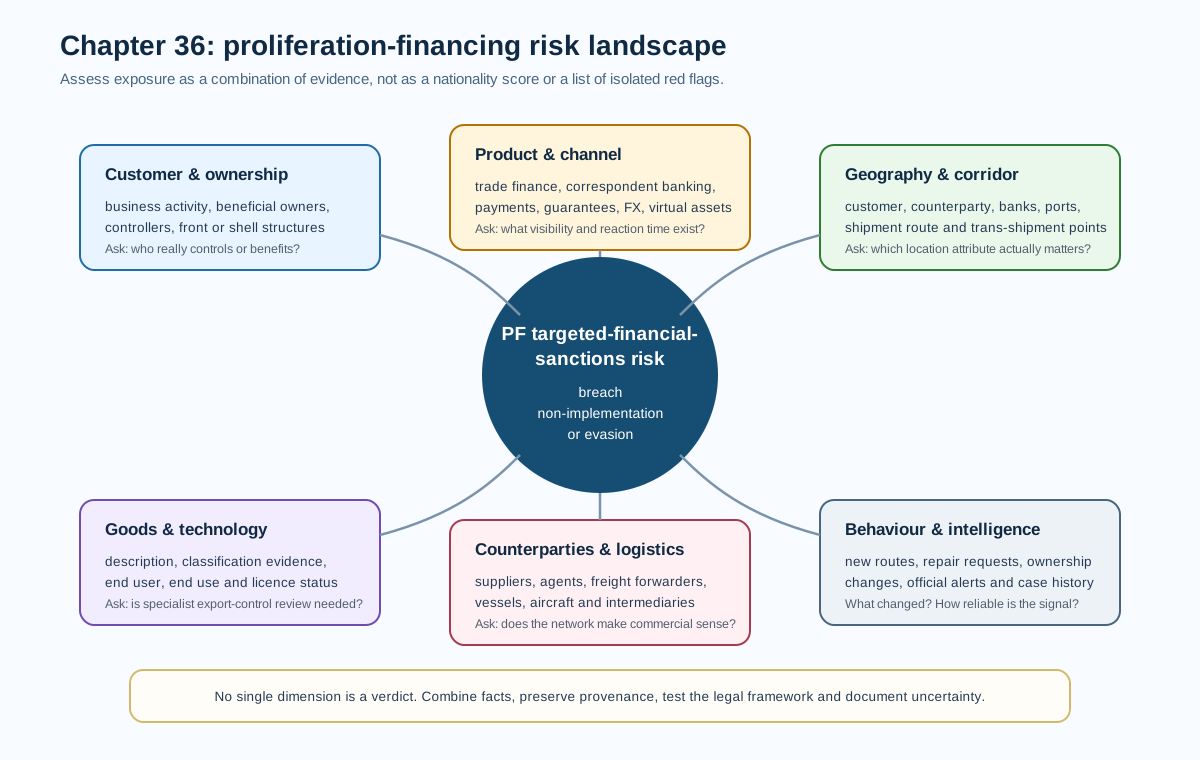
Customer and KYB controls
Strong proliferation controls start with ordinary customer understanding. A bank that does not know what a company actually does will struggle to recognise when activity changes in a meaningful way.
For a corporate customer, the bank should understand the legal entity, beneficial ownership and control, directors and authorised persons, business activity, main products or services, expected customers and suppliers, operating geographies, expected payment corridors and transaction profile to the extent required by risk and policy. For a manufacturer or trader, sector and product information can be especially relevant. A vague category such as “general trading” may be insufficient where the customer is active across multiple high-risk jurisdictions and specialised goods.
The purpose is not to turn KYC into an engineering catalogue. It is to create enough structured context for later controls. If the customer says it sells consumer electronics domestically but later begins paying companies described as industrial-equipment exporters in unfamiliar jurisdictions, the monitoring and relationship teams should be able to see that mismatch.
Event-driven review is particularly important. Changes in ownership, directors, suppliers, countries, business activity or expected turnover can alter risk. A newly designated owner or counterparty can require urgent action. A sanctions-list update can require rescreening. A customer that starts using freight forwarders or intermediaries not previously seen may deserve contextual review if other risk indicators are also present.
Evidence quality matters more than document quantity. A certificate of incorporation shows legal existence; it does not explain commercial purpose. An invoice shows that two parties created a document; it does not independently prove the underlying transaction. Good due diligence combines documentary evidence, structured customer information, independent sources and observed account behaviour.
Beneficial ownership and control
Proliferation-financing networks can use legal entities and intermediaries, which makes ownership and control analysis important. The bank should identify the ownership and control relationships required by applicable KYC and sanctions policy and preserve them in a form that can be rescreened.
This is not only about a percentage threshold. Sanctions ownership and control tests differ across legal regimes. Some frameworks have explicit ownership thresholds; some consider control through other means; aggregation rules can differ. The bank should not encode one global percentage and call it a universal legal rule.
For financial-crime architecture, an ownership graph should capture the entity, owners, percentage where relevant, control relationship, effective dates, evidence source and confidence or verification status. If the ownership changes, the old relationship should remain historically reconstructable. An investigator reviewing a transaction from six months ago may need to know who owned the company at that time.
Screening should also distinguish the named customer from connected parties. A company can be unlisted while a relevant owner or controller is designated or otherwise restricted. Conversely, a common name match to a director should not automatically contaminate the company without identity resolution and legal analysis.
A good system therefore separates entity matching from legal applicability. First determine whether the connected party is actually the listed person. Then determine whether the applicable ownership/control rule affects the customer or transaction. Then determine the required operational action. Collapsing those stages into one sanctioned = true flag makes both false positives and legal errors more likely.
Geography and corridor risk
Geography matters, but it should be used intelligently. A country can present higher proliferation risk because of sanctions exposure, known procurement activity, trans-shipment patterns, weak export controls, proximity to sanctioned regimes, or sector-specific trade relationships. Yet geography alone does not establish a prohibited transaction.
FATF guidance encourages risk assessment and proportionate mitigation rather than automatic exclusion. The UK’s public proliferation-financing risk material, for example, highlights the potential use of neighbouring or intermediary jurisdictions in transactions connected to sanctioned regimes. That does not mean every customer in those jurisdictions is suspicious. It means the bank should understand the corridor, customer activity, counterparties, goods and economic rationale.
For a payments team, geographic data can be fragmented. The customer address may be in one country, the beneficiary bank in another, an intermediary bank in a third and the underlying goods destination somewhere else. Trade finance may hold the port of loading, port of discharge, carrier and consignee while the payment hub sees none of that information.
A useful architecture therefore does not claim to have one universal “country of transaction.” It stores multiple geographic attributes with clear meaning and lineage. Investigators should know whether a risk score came from customer residence, incorporation, counterparty address, bank location, shipping route, IP location or another source.
Payments and the limits of message data
Payment screening is an important proliferation-control surface because it can identify designated parties, restricted banks or other sanctions-relevant data before value is released. But payment data has limitations.
A cross-border customer credit transfer may contain debtor and creditor names, accounts, addresses, financial institutions, ultimate parties, remittance information and identifiers. ISO 20022 can provide richer structure than older formats, but only if the data is populated accurately and preserved through the chain. A payment message rarely contains a complete description of the underlying goods, end user or export licence.
This means payment screening should not pretend to solve trade-risk questions that the message cannot answer. A keyword engine may identify a term that deserves review, but it cannot reliably determine technical end use from a short remittance line.
At the same time, payment data can reveal useful context. New or unusual counterparties, repeated transfers to entities linked by ownership, payments inconsistent with the customer’s sector, unexplained intermediaries, multiple small payments connected to a larger procurement relationship, or a sudden change in corridors can support investigation when combined with other information.
Payment identity must be preserved. The case should link back to the original instruction, screening result, repaired data, release or rejection decision and final settlement status. If a beneficiary name was manually changed during repair, the investigator should be able to see both the original and amended values and who made the change.
Trade finance provides more context—and more responsibility
Trade finance can provide a bank with richer information because letters of credit, collections, guarantees and documentary trade products may involve invoices, transport documents, goods descriptions, counterparties, ports and other commercial details. That additional visibility can make proliferation risk easier to identify, but only if the bank uses the information consistently.
A trade-finance control should understand the parties to the transaction, their roles, the goods description available to the bank, countries and routes, financing structure, shipment information and any applicable sanctions or export-control concerns within the bank’s responsibility. The bank may use specialist screening or goods-risk tools, but those tools should support rather than replace judgement.
A common failure is false precision. An invoice description such as “industrial parts” may be too vague to classify. A tariff or HS code can help but is not necessarily the same as an export-control classification. A bank should not infer that a product is controlled merely because a keyword resembles a sensitive item. Where the available information is insufficient and risk is material, the right action may be to request clearer documentation or escalate to trade-compliance specialists.
The commercial context matters too. Does the buyer normally purchase this type of product? Does the seller appear to operate in the relevant industry? Is the quantity plausible for the customer’s business? Do the values and payment terms make sense? Are there unexplained changes in consignee, route or documentation? These questions are not proofs of proliferation financing. They help determine whether the transaction is coherent enough to proceed or whether specialist review is needed.
Correspondent banking and nested visibility
Correspondent banks process transactions for respondent banks and often do not have a direct relationship with the underlying customer. That creates a structural information gap.
A correspondent should understand its respondent relationship through risk-based due diligence: ownership, licensing, business model, customer base, geographies, products, AML and sanctions controls, nested relationships and the nature of expected activity. The objective is not to re-perform KYC on every underlying customer. It is to understand whether the respondent’s control environment and transaction population create risk the correspondent can manage.
Proliferation risk can become relevant where a respondent serves trade-intensive sectors, higher-risk corridors or customers with exposure to sanctioned regimes. Payment-screening alerts may also reveal parties or banks that were not visible during onboarding.
A correspondent bank should avoid two extremes. One is blind reliance on the respondent: “their customer, their problem.” The other is unrealistic duplication: attempting to obtain full KYC on every underlying party. The mature approach uses respondent due diligence, transaction controls, escalation, requests for information where justified, and relationship governance when the respondent cannot provide adequate information or control assurance.
The same principle applies to nested relationships. If the correspondent learns that its respondent is providing access to other financial institutions, it should understand that exposure to the degree required by policy and risk because the effective transaction chain can be longer than the immediate bilateral relationship suggests.
Freight, vessels and logistics information
Proliferation-related sanctions and export-control risk can intersect with shipping and logistics. Public UN material on the DPRK regime shows that vessels, shipping activities, cargo and transport-related restrictions can form part of the sanctions framework. Banks involved in trade finance or maritime payments may therefore need to consider vessel and port information where it is available and relevant.
The practical challenge is data quality. Vessel names can change, transliteration can vary and different ships can have similar names. Persistent identifiers such as IMO numbers can improve accuracy where available. Port names may be abbreviated. A freight forwarder can appear in the payment while the actual carrier sits in a trade document. Data should be matched by role and source rather than dumped into one text field.
Operationally, a vessel or logistics alert should be treated as a candidate requiring analysis. The bank should confirm identity, determine the relevant restriction, review transaction timing and role, and escalate where legal interpretation is required. It should not assume that every historical association with a high-risk port or vessel proves a current prohibition.
For system design, this is another example of why temporal data matters. A vessel’s name, ownership, flag, operator or sanctions status can change. An investigator needs to know the facts that applied when the shipment and payment occurred.
Virtual assets and alternative value movement
Virtual assets can appear in proliferation-financing risk assessments because they can move value across borders and involve different intermediaries from traditional banking. FATF’s proliferation-financing guidance applies its risk-assessment expectations to virtual-asset service providers as well as financial institutions and designated non-financial businesses and professions.
For a bank, the relevant question is usually not “crypto equals proliferation risk.” That would be inaccurate. The question is whether the bank’s customer relationship, transfers to or from virtual-asset service providers, counterparty information, sanctions exposure and observed behaviour create a risk that requires additional review.
Banks should also avoid assuming that blockchain transparency eliminates customer-risk questions. Public ledger data can be useful, but attribution can be uncertain and different services have different levels of customer information. Specialist analytics can support investigation but should be treated as one evidence source, with methodology, confidence and limitations understood.
The same evidence principles apply as elsewhere: preserve the transfer, customer profile, relevant blockchain or provider information, sanctions-screening result, analyst reasoning and final decision. A vendor risk score without underlying explanation should not be the sole basis for a serious customer action.
Building a proliferation-financing risk assessment
A bank’s proliferation-financing risk assessment should begin with exposure, not with a catalogue of red flags. What customers, sectors, products, legal entities, geographies, payment corridors and trade services could plausibly create exposure to proliferation-related targeted financial sanctions or evasion risk? What information does the bank have at each control point? Which parts of the business have richer goods or end-user data, and which see only financial messages?
The next step is to identify threats and vulnerabilities. Threats can include sanctioned procurement networks, designated persons, state-linked revenue generation, attempts to acquire restricted goods, or intermediaries supporting prohibited activity. Vulnerabilities can include weak beneficial-ownership data, poor screening coverage, inability to identify trade goods, stale sanctions lists, inconsistent country data, insufficient respondent due diligence, fragmented case systems or lack of staff expertise.
Then assess existing controls. Does customer onboarding collect usable sector information? Are relevant connected parties screened? Are sanctions list updates reconciled? Can trade systems screen vessels and goods where required? Do monitoring systems receive trade or customer context? Can a potential match be held safely? Is there a defined escalation route to sanctions and trade specialists? Are legal interpretations versioned?
Finally, assess residual risk and decide mitigation. Mitigation can include enhanced due diligence, tighter product scope, stronger screening, additional transaction review, specialist approval, improved data, relationship restrictions or exit where risk cannot be managed. The response should be proportionate to the actual exposure.
A high-quality assessment also records uncertainty. If the bank has low visibility into underlying goods for a particular payment product, that is a control limitation to be managed, not hidden by assigning a precise score.
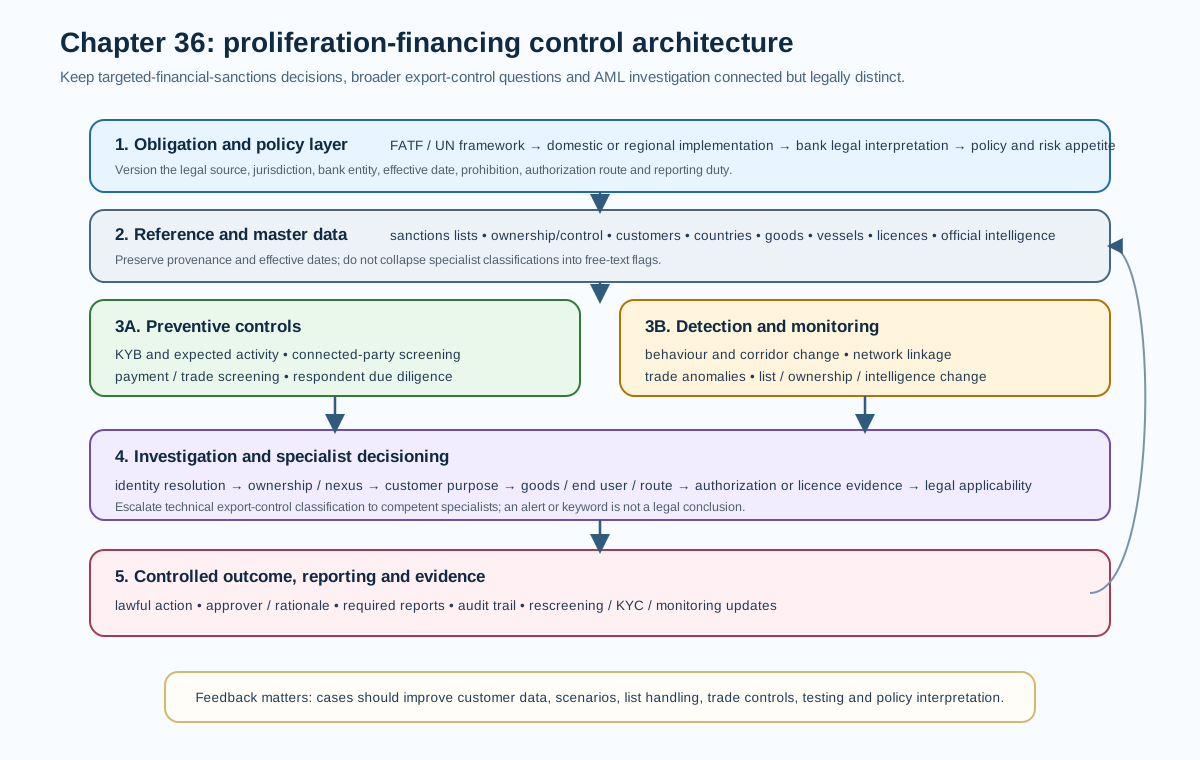
Control architecture: prevent, detect, investigate, decide
A useful way to design proliferation controls is as a connected architecture rather than a single screening engine.
Preventive controls establish who the bank will serve and under what conditions. Customer and beneficial-ownership due diligence, product eligibility, country restrictions, trade-product rules and contractual requirements sit here.
Screening controls compare relevant customers, connected parties, payments, banks, vessels or other data against sanctions and watchlist sources according to policy. List governance, matching, transliteration and ownership logic determine whether the control is reliable.
Monitoring and intelligence controls look for changes or patterns that may not be visible from a single list match. This can include unusual trade relationships, new corridors, rapid changes in counterparties, network connections or internal/external intelligence relevant to proliferation risk.
Investigation controls bring the information together. A case should connect customer, ownership, payment, trade documents, screening candidates, counterparties, prior alerts, intelligence and decisions.
Decision controls translate analysis into an operational state: release, continue with enhanced monitoring, request information, refuse a product, hold a payment, reject a transaction, freeze or block assets where legally required, exit a relationship or file a report under the applicable framework.
Governance and assurance sit across all layers. Without policy ownership, model validation, list reconciliation, quality assurance, audit and management information, an apparently sophisticated technical control can fail silently.
Screening design
Screening for proliferation-related sanctions uses many of the same technical foundations as other sanctions screening: authoritative list sourcing, data normalisation, aliases, transliteration, matching thresholds, identifiers, ownership/control relationships, rescreening and case management. The important difference is programme and legal context.
A candidate match should retain the authority, sanctions regime, list entry, identifiers, matching fields, list version and time of screening. Analysts need to know whether they are reviewing a DPRK proliferation designation, an Iran-related designation, another sanctions programme or a general watchlist entry because the legal consequence can differ.
Customer screening should occur at onboarding and at events defined by policy, including list updates and relevant customer changes. Payment screening should run at the point required by the bank’s control design. Trade systems may need additional screening of vessels, banks, counterparties, goods descriptions or other data depending on the product and applicable rules.
List update governance is critical. The bank should record when an official source changed, when the vendor or internal list was received, when it was loaded, whether the load reconciled, whether affected customers were rescreened and whether any failures occurred. A fast screening engine using yesterday’s incomplete list is not an effective control.
Screening also needs coverage testing. If beneficial owners are collected but never sent to the screening service, policy and technology are misaligned. If non-Latin names are transliterated differently across onboarding and payments, the bank may create blind spots or excessive false positives.
Monitoring and red flags
There is no single transaction pattern that proves proliferation financing. Useful monitoring combines several types of information and looks for activity that is inconsistent, opaque or linked to known risk.
Examples can include a customer whose payment counterparties suddenly shift into sectors or geographies unrelated to its stated business; a trading company with repeated payments involving multiple intermediaries and no clear commercial purpose; a company that receives revenue from one business line and rapidly redirects value to unrelated industrial suppliers; transactions involving counterparties connected through ownership to designated or high-risk networks; or trade activity where documentation, goods description, customer profile and payment behaviour do not fit together.
Other indicators can come from the goods and logistics context available to trade-finance teams: vague product descriptions where greater specificity would normally be expected, unusual changes in consignee or end user, inconsistent shipping and invoicing information, or a transaction that requires repeated clarification because the parties cannot explain the commercial chain. These are reasons to investigate, not conclusions.
The most dangerous red-flag framework is a checklist that allows analysts to say “three indicators equals suspicious.” Context matters. A global distributor may legitimately use many intermediaries. A manufacturer may change suppliers because of market disruption. A customer may route through a regional hub for ordinary logistics reasons.
Monitoring should therefore generate a hypothesis and identify what evidence would confirm or weaken it. The system can prioritise; the investigator decides what the facts mean.
Data relationships matter more than keywords
Keyword screening has a role, especially in trade-finance review, but proliferation risk is often relational. The same beneficial owner may control several companies. A customer may pay multiple counterparties that share an address, director, website or bank account. A supplier may be unlisted but connected to an entity identified in reliable official information. A company’s payment network may change after a designation.
Graph analytics can help surface these relationships, but it must be used carefully. Shared addresses can be common in corporate-service centres. Shared phone numbers can reflect an accountant. A freight forwarder may legitimately appear across many customers. The system should show why entities are linked and distinguish verified relationships from inferred ones.
For a data model, useful entities can include customers, legal entities, beneficial owners, controllers, directors, accounts, payments, counterparties, banks, vessels, ports, goods references, trade documents, virtual-asset providers, sanctions entries, cases and external intelligence records. Each relationship should have source, effective date and confidence where appropriate.
Data lineage is also a control. If a goods description is normalised or translated, preserve the original. If a party name is repaired in a payment, preserve both values. If a company ownership record changes, retain history. If an external intelligence source is withdrawn or corrected, record that change rather than silently rewriting the past.
From alert to case
A proliferation-related alert can originate from customer screening, payment screening, transaction monitoring, trade screening, an internal referral, a sanctions-list update, a law-enforcement request, an FIU communication or another intelligence source. The triage process should identify what kind of alert it is before applying a workflow.
A name-screening candidate requires identity resolution and legal applicability analysis. A trade anomaly requires commercial and documentary understanding. A behavioural alert requires comparison with expected activity and related transactions. An external intelligence referral may require restricted handling and specialist access.
A full case should bring together the relevant sources rather than force the analyst to reconstruct them manually. The case should show who the customer is, how ownership and control are structured, what activity was expected, which transaction or relationship triggered review, which counterparties are involved, what sanctions or trade information is relevant, what evidence has been obtained and what remains uncertain.
The investigator should write hypotheses carefully. “Customer is financing weapons” is almost never an appropriate starting statement based on a transaction alert. A defensible formulation is narrower: “The purpose and counterparties of these industrial-equipment payments are inconsistent with the customer’s known business, and one counterparty is linked through verified ownership to an entity subject to applicable proliferation-related sanctions. Further review is required to determine legal applicability and transaction purpose.”
This language separates fact, inference and decision.
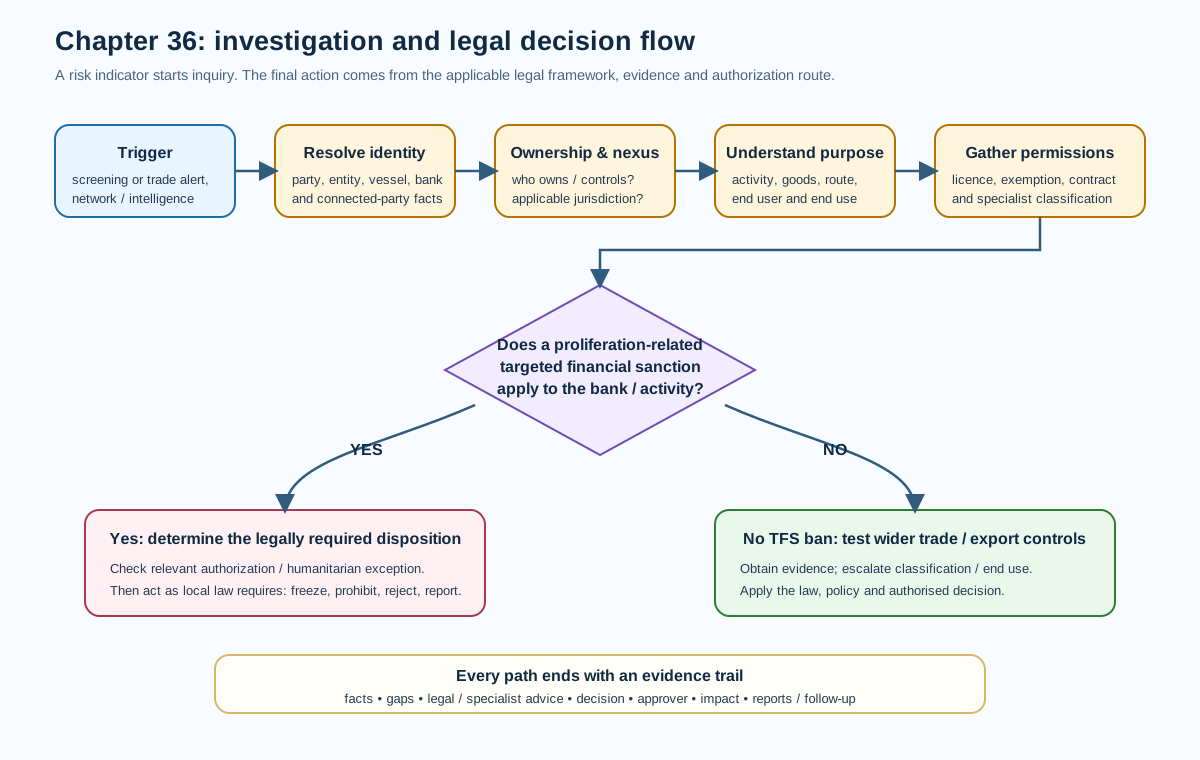
Investigation questions that matter
An investigator should begin by defining the trigger. Was the alert caused by a designated name, an ownership relationship, a country rule, a trade indicator, a monitoring pattern or external intelligence? That determines which evidence is relevant.
Then establish the customer context. What does the customer do? How long has the relationship existed? What products are used? Which countries and counterparties were expected? Has ownership or management changed? Have prior reviews raised similar issues?
For the transaction, identify the parties and their roles. Who is paying? Who receives value? Are agents or intermediaries involved? What is the stated purpose? Does it fit the customer’s business? If trade documents are available, do they support the payment amount, parties, goods and route? If the transaction is part of a sequence, what happened before and after it?
For sanctions analysis, determine whether a party is actually the listed person or entity, whether an ownership/control rule extends the restriction, which legal regime applies, whether the bank has a jurisdictional nexus and whether a licence, exemption or authorisation could be relevant. Complex questions should go to the appropriate sanctions or legal specialist.
For proliferation risk beyond an immediate list match, assess whether the overall facts create an unexplained connection to sensitive goods, high-risk procurement activity or sanctions evasion. The bank should not attempt to make technical weapons determinations outside its expertise. It should identify what it knows, what it does not know and which specialist or authority may need to decide.
Decision outcomes
A case can end in several different ways, and systems should not collapse them into “clear” or “block.”
A false positive means the screened party is not the listed person or entity. The evidence supporting that conclusion should be retained so future alerts can be resolved consistently where policy permits.
A true identity match does not by itself answer every legal question. The analyst still needs to determine whether the applicable prohibition affects the transaction or relationship, whether ownership/control rules are relevant and whether an exemption or licence applies.
An unresolved potential match may require the payment or activity to remain in a controlled review state while additional information is obtained, depending on policy and law.
A prohibited transaction may need to be rejected or not processed. Property subject to an asset freeze may need to be frozen or blocked according to the applicable legal framework. Those actions are not interchangeable.
A transaction may be lawful but still raise AML suspicion or broader customer-risk concern. In that case, the bank may file a suspicious transaction or activity report under local law, enhance monitoring, refresh KYC, restrict a product or consider relationship exit independently of the sanctions decision.
A risk assessment may also conclude that the activity is legitimate and within appetite after evidence is obtained. Closing a case is not control failure when the reasoning is sound.
Reporting and information sharing
Reporting obligations vary by jurisdiction and event. A sanctions authority may require reports of frozen assets, rejected transactions, breaches or other specified events. An FIU may receive suspicious transaction or activity reports. Export-control or customs authorities may have separate channels. Law-enforcement requests can create additional obligations.
A global case system should therefore store reporting jurisdiction, authority, report type, trigger, due date, submission reference, submission date and any confidentiality restrictions. Hard-coding one global “SAR deadline” or “sanctions report” field is poor design.
Information sharing also requires governance. Group-wide financial-crime teams may want to connect a customer in one country with a counterparty in another, but data-protection, bank-secrecy and suspicious-reporting confidentiality rules can restrict what may be shared and with whom. The architecture should support lawful segmentation, access controls and audit trails.
Where public-private partnerships or FIU feedback provide typology information, the bank should translate the intelligence into risk assessment, detection and training without copying sensitive material into systems that do not have the required access controls.
Roles and governance
Proliferation-financing control is inherently cross-functional. The first line owns customer relationships, products and operational execution. Trade-finance teams understand documentary flows. Sanctions operations handle screening and interdiction. Financial-crime investigations connect behaviour and network information. Compliance sets or interprets policy and challenges implementation. Legal advises on difficult obligations. Technology and data teams make the controls executable. Internal audit provides independent assurance.
The exact organisational model varies, but decision rights must be clear. Who can release a payment after a potential proliferation-related match? Who decides whether a licence applies? Who approves onboarding of a higher-risk industrial customer? Who owns the proliferation-financing risk assessment? Who reports to the regulator or sanctions authority? Who can change a screening threshold?
A strong governance forum should see more than alert volume. It should understand material exposures, control failures, list-update delays, unresolved high-risk cases, data gaps, trade-screening coverage, false-positive burden, legal changes, overdue remediation and themes emerging from investigations.
Senior management should also understand the difference between risk appetite and legal prohibition. A bank can decide not to offer a particular high-risk product even where lawful. It cannot use risk appetite to override a binding sanctions prohibition.
Operational and customer impact
Proliferation controls can delay payments, interrupt trade, freeze assets, require additional documents and affect access to banking. Because the consequences can be severe, operational precision matters.
A temporary hold while an alert is investigated is not the same as a legal asset freeze. A request for more information is not an accusation. A customer operating in a sensitive sector is not automatically suspicious. Customer communication should be accurate and approved, especially where disclosure could compromise an investigation or breach legal restrictions.
The bank should measure legitimate-customer impact. How long do higher-risk trade reviews take? How many payments are held for weak keyword matches? How often are customers repeatedly asked for the same information? Are small exporters disproportionately delayed because their invoices use generic descriptions? Do relationship managers know what evidence is actually needed?
Improving customer outcomes does not mean weakening controls. Better structured onboarding, clearer document requests, reliable list matching, risk segmentation and access to specialist reviewers can reduce unnecessary friction while improving detection quality.
The strongest control is often the one that asks a precise question early rather than a vague question late.
System and architecture considerations
A bank rarely has one proliferation-financing platform. Customer data may sit in KYC systems; ownership in corporate-data platforms; payments in hubs; sanctions screening in a specialist engine; trade documents in documentary-trade systems; transaction monitoring in an analytics platform; vessels and goods data in third-party tools; cases in another application; and reporting in local regulatory solutions.
The architecture therefore depends on identifiers and evidence. Customer ID, legal-entity ID, account ID, payment ID, trade transaction ID, screening alert ID and case ID should be linkable. If systems rely on names as the primary join, investigators will make avoidable errors.
Synchronous and asynchronous controls must also be explicit. Sanctions screening may need to occur before a payment is released. Behavioural monitoring may occur after posting. Trade review can be part of a pre-transaction approval. List-update rescreening can run asynchronously but still require rapid handling of positive matches.
Failure behaviour needs design. If the screening service is unavailable, does the payment queue, route to a contingency service or enter manual review? If the transaction-monitoring feed fails, how will the bank reconcile and replay missed events? If a list load is incomplete, who stops or limits processing? If a case platform is unavailable, how are legal deadlines protected?
Logs should preserve operational evidence without exposing sensitive case or suspicious-report content to broad technical access. Security and privacy controls are part of financial-crime architecture, not an afterthought.
Business analyst requirements
A business analyst should translate policy into event, data, rule, state, decision and evidence.
A weak requirement says: “The system shall check proliferation financing.” That is not testable.
A better customer-screening requirement might state: when a legal-entity customer or relevant connected party is created or materially changed, the KYC service must send the required identity attributes to the sanctions-screening service using the legal entity’s applicable programme set; a potential match must create a review case, preserve the list version and matching fields, and prevent activation where policy requires until the case reaches an approved disposition.
A payment requirement might state: before release to the external payment rail, the payment hub must provide the required debtor, creditor, agent, address and remittance data to the sanctions-screening service; a refer outcome must place the payment in a non-final controlled state; operations must be able to see the original payment and screening evidence; the final release, rejection or block decision must be returned with a reason code and decision owner.
A trade requirement might state: for products in scope, the trade platform must preserve original goods descriptions, counterparties, transport information and relevant document identifiers; screening or specialist-review outcomes must link to the trade transaction and related payments; missing mandatory risk information must create an exception rather than silently bypass the control.
The BA should also capture jurisdiction logic explicitly. “If sanctioned, block” is not enough. Which authority? Which legal entity? Which programme? What ownership rule? What licence logic? Which operational state? Which report?
Data requirements and lineage
Important attributes should have defined source, owner, format, quality rule and effective date. For customer data, that can include legal name, aliases, incorporation country, business sector, beneficial owners, controllers and expected activity. For payments, it can include parties, accounts, institutions, addresses, amount, currency, purpose and identifiers. For trade, it can include buyer, seller, applicant, beneficiary, goods description, invoice, transport document, vessel, port and transaction reference where available.
Lineage should answer how each attribute reached the control. Was the debtor name entered by the customer, enriched from KYC, repaired by operations or derived from another system? Was a vessel identifier supplied in a trade document or obtained from a vendor? Was the ownership relationship verified or inferred?
This matters because false confidence is dangerous. A system can show a perfectly formatted country code that came from a poor-quality default. An investigator needs provenance, not just presentation.
Historical reconstruction is equally important. If a customer’s business sector was updated after an alert, the case should still show what the bank knew at the time. If a sanctions entry gained a new alias, a retrospective review may need to identify transactions that occurred before the alias was available. Versioned data makes those questions answerable.
Testing proliferation-financing controls
Testing should cover legal logic, matching, data, operational state and end-to-end evidence.
For customer screening, test direct designated parties, close-name false positives, aliases, non-Latin names, beneficial owners, indirect ownership chains, ownership changes and list updates. Confirm not only that an alert appears but that the correct programme and legal-entity context reaches the case.
For payments, test debtor and creditor matches, agents, ultimate parties, repaired names, missing addresses, message transformations, returns and reversals. Confirm the payment cannot accidentally leave a hold state before the required decision.
For trade, use realistic but non-sensitive test data covering ordinary goods, vague descriptions, potentially controlled categories, route changes, vessel identifiers and document amendments. The goal is to prove escalation and evidence handling, not to teach evasion techniques.
For resilience, test list-source failure, incomplete list loads, screening-service outage, delayed KYC updates, transaction-feed gaps and case-platform unavailability. Reconciliation should prove that nothing silently skipped the control.
For model or analytics controls, test explainability, false positives, false negatives using approved synthetic scenarios, drift monitoring, threshold changes and rollback. A model update should not be promoted solely because it reduces alert volume.
For reporting, test jurisdiction, authority, deadline calculation, mandatory fields, attachments, acknowledgements and confidentiality controls.
Failure modes
One failure mode is sanctions-only thinking. The bank screens names correctly but has no process for broader trade or customer-risk indicators. The result is legal list compliance without meaningful risk understanding.
Another is trade-only thinking. Trade teams review documents carefully, but related account payments or ownership changes sit in separate systems and are never connected.
One global ownership rule is another serious weakness. Applying a single threshold to every sanctions regime can produce both over-blocking and under-blocking.
Stale official sources create obvious risk. A list provider can fail, a file can be partially loaded or a new programme can be mapped incorrectly. Reconciliation and source-version evidence are essential.
Keyword overreach can flood operations with harmless industrial terms. Analysts then learn to close alerts mechanically, which reduces attention when a meaningful combination of indicators appears.
Missing end-user context is common in payment processing. The bank may simply not have the information. The right response is not to invent it; the risk assessment should recognise the visibility limitation and determine whether another control or product restriction is necessary.
Poor handoffs can separate sanctions, AML, trade and fraud teams. One team may see a suspicious ownership link while another sees unusual payments, but no case combines them.
Weak time logic can produce false conclusions. A company may have become designated after an earlier transaction. The historical review must distinguish what was prohibited at the time from what is known today.
Uncontrolled spreadsheets are another practical risk. Specialist decisions, licence details or blocked-asset records kept outside governed systems can create inconsistent action and audit gaps.
Mini case study: industrial exporter with a changing network
Consider a fictional customer, Horizon Process Systems Ltd, a mid-sized manufacturer of industrial fluid-control equipment. The company has banked with Northbridge Bank for six years. Its customers are mainly food-processing, pharmaceutical and water-treatment companies. Its KYC profile shows two long-standing beneficial owners, domestic manufacturing facilities and routine exports to several established markets.
For years, account activity is consistent with that profile. The company receives payments from known customers and pays component suppliers, freight companies and payroll. It also uses documentary trade products for some overseas shipments.
A change begins gradually. Horizon adds a new distributor, East Meridian Trading, incorporated in a jurisdiction the bank classifies as medium risk. The first transactions are small and commercially plausible. Three months later, East Meridian becomes one of Horizon’s largest counterparties. Payments are made through two different banks and the stated end customers change several times.
None of that is automatically suspicious. Distributors grow. Banks change. End customers can vary.
The first meaningful control event occurs when a sanctions-list update generates an ownership-related alert on a company connected to one of East Meridian’s directors. The name itself is not a direct match. The screening analyst confirms that the director is a different individual from the designated person and closes the alert as a false positive. That decision is correct based on the available identity data.
Two weeks later, the trade-finance team reviews a letter-of-credit amendment for a Horizon shipment. The goods description is broader than usual, the consignee has changed and the new end user is not one previously disclosed in the customer relationship. The shipment remains within a category that has many legitimate civilian uses, so the trade analyst does not treat it as prohibited. However, because the transaction combines a new end user, a revised route and a high-value increase, the analyst refers it for enhanced review under policy.
The financial-crime investigator now has two separate events: a previously closed sanctions candidate and a trade referral. The investigator does not reopen the false-positive identity conclusion simply because another alert exists. Instead, the analyst reviews the wider network.
KYC confirms Horizon’s ownership is unchanged. Payment history shows that East Meridian has recently begun paying through an additional financial institution. Public corporate records show that East Meridian shares an address with several trading companies. That fact is not suspicious on its own because the address belongs to a corporate-services provider. The investigator also sees that the new consignee has little public information and that Horizon’s relationship manager cannot explain why the distributor changed the end user.
The bank asks Horizon for the commercial contract, clearer goods description, intended end use, end-user information and relevant export documentation that the customer is expected to hold. Horizon responds promptly. The documents explain part of the change: the distributor is consolidating orders for several industrial customers. But the end-user certificate identifies a different company from the consignee, and the customer cannot initially explain the discrepancy.
At this stage, the investigator writes a narrow risk hypothesis: the transaction chain is not sufficiently understood to establish that the goods, parties and end use are consistent with the customer’s stated activity and the bank’s sanctions and trade-risk requirements. The analyst does not state that Horizon is financing a weapons programme.
The case is escalated to the bank’s sanctions and trade-compliance specialists. They review the applicable sanctions programmes, ownership data, destination, available goods information and customer-provided export documentation. No direct designated-party match is identified, but the combination of end-user uncertainty and jurisdictional exposure requires the transaction to remain in specialist review until the customer resolves the discrepancy.
Horizon eventually provides independent evidence showing that the consignee is a logistics operator acting for the end user and that the export is authorised under the relevant national framework. The specialist team validates the evidence and approves the transaction. The payment and trade instrument are released. No suspicious report is filed because the remaining facts are reasonably explained under the bank’s applicable framework.
The case is still valuable. It reveals that Horizon’s expected-counterparty profile has become stale. The relationship team updates KYC. The trade platform is changed so that consignee and end-user fields are captured separately. A screening rule that had treated them as one generic “party” is corrected. The bank also adds a requirement that material changes in end-user information during trade amendments create an event-driven review for defined higher-risk transactions.
This outcome illustrates good financial-crime control. A false positive remained a false positive. A trade anomaly was not treated as proof. The customer was given a chance to provide evidence. Specialists made the legal and trade decision. The bank learned from the case and improved its data model.
BA and architecture acceptance criteria from the case
The case above can be translated into practical acceptance criteria. The trade system should store applicant, beneficiary, consignee and end user as separate roles where the product captures them. Amendments to those roles should be versioned. Relevant parties should be screened according to policy, and screening results should link to the trade transaction rather than exist only in a separate sanctions tool.
The case platform should allow the investigator to see customer ownership, previous screening candidates, payment activity, trade documents and related-party information without losing the original source. A closed false-positive screening alert should remain visible as historical context but should not automatically be reclassified.
A payment or trade item in specialist review should have a controlled state that prevents accidental release. The state should record who placed the hold, the reason, start time, service-level expectation and authorised roles for release. The customer channel should use approved wording that does not make unsupported accusations.
Once the transaction is released, downstream systems should receive the final status and reason code. If the customer risk profile changes, that update should propagate to monitoring and future due diligence. If the case identifies a data-quality issue, it should create a traceable remediation item rather than remain hidden in narrative notes.
Management information and control effectiveness
A proliferation-financing dashboard should not be a count of “PF alerts.” Leaders need to understand where exposure and control weakness actually exist.
Useful information can include customers in higher-risk sectors or geographies, trade transactions referred for specialist review, proliferation-related sanctions candidates, true matches or confirmed restrictions, ageing of unresolved cases, list-update timeliness, rescreening completion, data-quality exceptions, ownership-screening coverage, trade-document completeness, respondent-bank exposures and themes from investigations.
Quality metrics are equally important. How many cases were closed because information was unavailable? How often did analysts rely on vague customer explanations? Do quality-assurance reviews find inconsistent application of ownership rules? Are the same counterparties generating alerts across multiple customers without network review? Are false positives concentrated in a particular transliteration or data-normalisation pattern?
Outcome metrics should be interpreted carefully. A low number of confirmed proliferation cases does not prove controls are ineffective; the underlying activity is relatively specialised and serious cases may be rare. Conversely, a huge alert population does not prove strong coverage. Effectiveness is shown by a coherent risk assessment, reliable legal implementation, appropriate detection, strong evidence, timely decisioning, controlled customer impact and the ability to demonstrate that known risks are covered.
Quality assurance, audit and model governance
Quality assurance should test both case reasoning and control process. Reviewers should confirm that analysts distinguished facts from inference, used the correct sanctions programme, checked relevant identifiers, considered ownership where required, recorded evidence and obtained specialist approval for complex legal decisions.
Internal audit should look beyond alert handling. It can assess whether the proliferation-financing risk assessment is complete, whether policy reflects current FATF and domestic requirements, whether list governance is effective, whether customer and trade data reach screening, whether model changes are controlled, whether exceptions are approved and whether management receives useful information.
Where machine learning or graph analytics are used, model governance should define purpose, training or reference data, validation, limitations, performance measures, explainability and human oversight. A model that identifies “high-risk procurement networks” can create serious consequences if its relationships are poorly explained.
Change governance is especially important because sanctions and export-control frameworks can change quickly. New designations, legal amendments or updated official guidance should trigger impact assessment, configuration change, testing, deployment and evidence. Emergency changes may need faster governance, but they should not bypass governance entirely.
Practical review checklist for project teams
When a bank launches or changes a corporate, trade or cross-border product, the project team should ask a connected set of questions.
Which customer types and sectors are in scope? Which countries and counterparties can they reach? Does the product expose the bank to goods, shipping or end-user information? Which sanctions programmes and legal entities apply? Which parties must be screened? Is beneficial ownership available to the screening service? What happens when a list changes? Can the product place an instruction into a controlled review state? Which team decides a complex trade or proliferation issue? What evidence must be retained? Which customer message is shown during review? How are returns, cancellations and amendments handled? What reconciliation proves that no event bypassed the control?
Those questions should be answered before go-live, not after the first alert.
A good design also states what the system cannot know. If the payment rail does not carry goods or end-user data, document that limitation. If a trade platform cannot screen historical vessel ownership, do not imply that it does. Control transparency is stronger than false assurance.
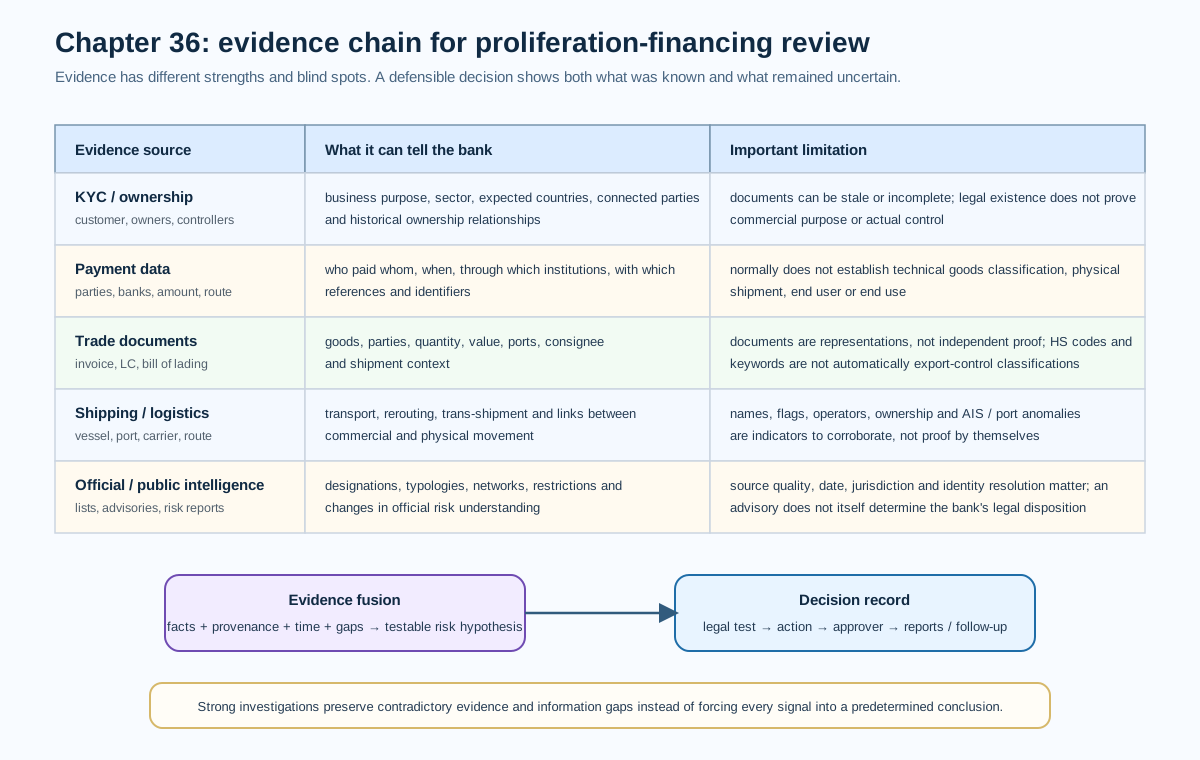
Final professional judgement
The hardest part of proliferation-financing control is resisting simplistic conclusions.
A designated-party match can create a direct legal issue, but a name similarity is only a candidate until identity is resolved. A dual-use item can be entirely legitimate, but a lawful-looking commercial payment can still require specialist review when the end user, ownership or destination is not understood. A high-risk country can justify stronger due diligence, but nationality alone is not evidence of wrongdoing. A clean sanctions screen can remove one concern while leaving an AML or trade-risk concern unresolved.
Professionals should therefore keep four layers separate.
The fact layer records what the bank actually knows: customer data, ownership, payments, documents, counterparties and authoritative list information.
The risk layer explains why those facts may matter: exposure to a higher-risk sector, unusual activity, unclear end use, opaque ownership or a sanctions-evasion indicator.
The legal layer determines whether a prohibition, asset freeze, licensing condition or reporting requirement applies under the relevant jurisdiction.
The operational layer turns the decision into a controlled state: onboard, continue, hold, release, reject, freeze, restrict, report, exit or another authorised outcome.
When systems and teams preserve those layers, proliferation-financing control becomes explainable and testable. When they collapse them, banks either miss risk or harm legitimate customers.
Final takeaway
Proliferation financing matters because modern weapons programmes and procurement networks can depend on ordinary financial infrastructure. Banks may see only fragments of the underlying activity, but those fragments can still be important when connected correctly.
The bank’s role is not to prove the technical design of a prohibited programme. It is to understand its customers and products, implement applicable targeted financial sanctions, assess and mitigate proliferation-financing risk, use available trade and payment information intelligently, investigate meaningful inconsistencies and escalate difficult legal or technical questions to the right specialists.
Dual-use risk makes this discipline especially sensitive. Many controlled or sensitive technologies also support legitimate civilian activity. Strong control is therefore not maximum blocking. It is accurate jurisdiction mapping, good customer understanding, reliable list and ownership data, proportionate trade and transaction review, defensible investigation, correct legal disposition and complete audit evidence.
For business analysts, architects, developers and testers, the lesson is concrete: every proliferation-control requirement should identify the event, data, legal context, decision state, evidence and exception path. For investigators and compliance teams, the lesson is equally concrete: distinguish what is known from what is suspected, and distinguish risk from prohibition.
That is how a bank can protect the financial system without pretending that every industrial payment is a weapons-financing case.
References and further reading
- Financial Action Task Force, The FATF Recommendations (current standards; Recommendation 1 and Recommendation 7 are particularly relevant): https://www.fatf-gafi.org/en/publications/Fatfrecommendations/Fatf-recommendations.html
- Financial Action Task Force, Proliferation Financing topic page: https://www.fatf-gafi.org/en/topics/proliferation-financing.html
- Financial Action Task Force, Guidance on Proliferation Financing Risk Assessment and Mitigation (June 2021): https://www.fatf-gafi.org/content/dam/fatf-gafi/guidance/Guidance-Proliferation-Financing-Risk-Assessment-Mitigation.pdf.coredownload.inline.pdf
- Financial Action Task Force, Update: Re-application of UN Security Council Resolutions related to Iran (29 October 2025): https://www.fatf-gafi.org/en/publications/Fatfgeneral/Update--Re-application-of-UN-Security-Council-Resolutions-related-to-Iran.html
- United Nations Security Council, 1540 Committee fact sheet — resolution 1540 (2004): https://www.un.org/en/sc/1540/1540-fact-sheet.shtml
- United Nations Security Council, Committee established pursuant to resolution 1718 (2006): https://main.un.org/securitycouncil/en/sanctions/1718
- United Nations Security Council, 1718 Designated Vessels List and applicable measures: https://main.un.org/securitycouncil/en/sanctions/1718/materials/1718-Designated-Vessels-List
- HM Treasury, National risk assessment of proliferation financing (23 September 2021): https://www.gov.uk/government/publications/national-risk-assessment-of-proliferation-financing
- HM Revenue & Customs, Anti-money laundering guidance for supervised businesses (updated July 2026; UK-specific implementation example): https://www.gov.uk/hmrc-internal-manuals/anti-money-laundering-guidance-for-supervised-businesses
- Office of Financial Sanctions Implementation, UK financial sanctions general guidance (updated 12 May 2026; UK-specific): https://www.gov.uk/government/publications/financial-sanctions-general-guidance/uk-financial-sanctions-general-guidance
Focused 60-minute depth: proliferation financing and dual-use risk
This focused supplement keeps the chapter inside the sixty-minute CI window while preserving the practical learning points. Proliferation financing reviews need a different rhythm from ordinary sanctions screening because the risk may sit in the combination of customer purpose, goods description, route, counterparty, end user, ownership and payment behaviour. A single field may look acceptable; the joined picture may still suggest that finance is supporting controlled goods, dual-use technology or procurement activity.
The first discipline is to connect financial-crime review with trade, export-control and sanctions knowledge without pretending that one team can solve everything alone. Relationship managers understand customer purpose and expected activity. Trade operations see invoices, transport documents and goods descriptions. Sanctions teams understand targeted restrictions and ownership questions. Investigators assemble evidence and explain why concern is or is not reasonable. A safe operating model gives each team a clear point to contribute and preserves the evidence trail so the final decision does not depend on informal memory.
The second discipline is to treat dual-use ambiguity carefully. Dual-use goods and technology can have lawful civilian uses and unlawful military or weapons-related uses. That means the bank should avoid crude assumptions, but it should also avoid accepting vague explanations where the customer, counterparty, route or goods description creates concern. Useful review asks whether the economic purpose is credible, whether the customer profile supports the transaction, whether counterparties and locations are consistent with stated activity, and whether requested changes reduce transparency.
The third discipline is to make escalation practical. A reviewer should know when to pause processing, when to request additional information, when to involve sanctions or trade specialists, when to escalate to the MLRO or equivalent reporting function, and when legal or regulatory advice is needed. The case file should record the facts reviewed, the uncertainty that remains, the decision made, the approver and any follow-up controls. If the matter is reported or restricted, confidentiality and tipping-off controls become part of the operating process rather than an afterthought.
A good delivery team tests this chapter with scenarios that include clean trade, incomplete goods descriptions, unusual routing, ownership complexity, inconsistent end-use information, adverse media, vessel or port concerns and payment repair requests. The goal is not to make every scenario suspicious. The goal is to prove that the bank can identify what it knows, what it does not know, who owns the decision and what evidence will still be available when the decision is reviewed later.
Knowledge check
-
Why is proliferation financing not simply another name for money laundering?
-
What specific risk does FATF Recommendation 1 require covered private-sector entities to assess in the proliferation-financing context?
-
What does FATF Recommendation 7 require countries to implement, and why should a bank keep that obligation separate from broader export-control or activity restrictions?
-
Why does the description “dual-use” not mean that a transaction is prohibited?
-
What visibility difference exists between an ordinary cross-border payment and documentary trade finance when assessing goods, end users and shipping information?
-
Why should a bank avoid treating a keyword, HS code or broad industrial description as a technical export-control classification?
-
How can beneficial ownership, front companies and intermediaries contribute to proliferation-financing or sanctions-evasion risk without proving the underlying offence?
-
What should a case narrative say when the bank has unexplained proliferation-sensitive risk indicators but cannot establish a prohibited end use?
Answer guide
Money laundering normally concerns criminal proceeds, while proliferation financing can use apparently legitimate funds and commercial activity to support prohibited programmes or evade proliferation-related targeted financial sanctions. FATF Recommendation 1 focuses on identifying and assessing risks of potential breach, non-implementation or evasion of proliferation-financing targeted financial sanctions connected to Recommendation 7. Recommendation 7 requires implementation of relevant UN-targeted financial sanctions; broader export controls, trade prohibitions and activity restrictions can arise from other UNSCR or national/regional legal frameworks and should not be mislabelled as the same FATF obligation. Dual-use items have legitimate civilian as well as sensitive applications, so legality depends on item, destination, end user, end use, licensing and applicable law. Trade finance often has documents, goods, vessel and route data that an ordinary payment does not. Banks should route technical classification to appropriate specialists rather than infer it from vague payment text. Ownership networks and intermediaries can obscure designated or sensitive relationships but remain evidence to investigate, not proof by themselves. Case writing should separate observed facts, risk hypothesis, information gaps, specialist/legal assessment and final disposition.
Glossary
Proliferation financing (PF) — Financing connected to the proliferation of weapons of mass destruction and relevant targeted financial sanctions frameworks; the precise legal definition and obligations depend on applicable standards and law.
Weapons of mass destruction (WMD) — Nuclear, chemical or biological weapons and associated delivery systems within the relevant international counter-proliferation framework.
FATF Recommendation 7 — FATF standard requiring countries to implement proliferation-related targeted financial sanctions in accordance with relevant UN Security Council resolutions.
Proliferation-financing risk under Recommendation 1 — Risk of breach, non-implementation or evasion of proliferation-related targeted financial sanctions referred to in Recommendation 7.
Targeted financial sanctions (TFS) — Measures requiring designated funds or assets to be frozen and preventing funds or other assets from being made available to or for the benefit of designated persons/entities under the applicable framework.
Dual-use item — Goods, software or technology with legitimate civilian uses that can also have military or proliferation-sensitive applications.
End user — The person or entity expected ultimately to receive or use goods, technology or services.
End use — The intended application or purpose for which goods, technology or services will be used.
Export-control classification — Specialist legal/technical classification used to determine whether an item or technology is subject to export-control restrictions; a payment bank normally should not infer it from a keyword alone.
Procurement network — A group of companies, intermediaries, financiers, logistics providers or individuals involved in acquiring goods, services or technology.
Front company — A legal entity that can conduct genuine or apparent business while being used to conceal another party, purpose or transaction; its presence requires evidence-based analysis.
Trans-shipment — Movement of goods through an intermediate jurisdiction or transport point before final destination; it is common in legitimate trade and can also be exploited for evasion.
Trade visibility — The set of commercial, goods, transport and counterparty information the bank actually receives for a trade product.
Evidence fusion — Combining customer, ownership, payments, trade, sanctions, logistics and credible intelligence while preserving the source and limitations of each.
Risk hypothesis — A testable explanation for why observed facts may indicate sanctions evasion or proliferation risk; it is not a statement that the underlying offence has been proven.
References and further reading
Proliferation-financing controls should distinguish FATF's proliferation-related targeted-financial-sanctions framework from broader export-control, trade, goods, technology and activity restrictions that arise under United Nations, national or regional law. The sources below are deliberately separated by legal status and jurisdiction. A bank should use the law applicable to its own legal entity and transaction, supported by current specialist legal or trade-control interpretation where required.
Global standards and United Nations framework
- Financial Action Task Force (FATF), The FATF Recommendations, as amended June 2026: https://www.fatf-gafi.org/en/publications/Fatfrecommendations/Fatf-recommendations.html
- FATF, Proliferation Financing topic page: https://www.fatf-gafi.org/en/topics/proliferation-financing.html
- FATF, Guidance on Proliferation Financing Risk Assessment and Mitigation (2021): https://www.fatf-gafi.org/content/dam/fatf/documents/reports/Guidance-Proliferation-Financing-Risk-Assessment-Mitigation.pdf
- FATF, Complex Proliferation Financing and Sanctions Evasion Schemes (20 June 2025): https://www.fatf-gafi.org/en/publications/Financingofproliferation/complex-proliferation-financing-sanction-evasion-schemes.html
- FATF, Update: Re-application of UN Security Council Resolutions related to Iran (29 October 2025): https://www.fatf-gafi.org/en/publications/Fatfgeneral/Update--Re-application-of-UN-Security-Council-Resolutions-related-to-Iran.html
- United Nations Security Council, 1540 Committee — General Information: https://www.un.org/en/sc/1540/about-1540-committee/general-information.shtml
- United Nations Security Council, 1540 Committee — Security Council Resolutions, including Resolution 2663 (2022): https://www.un.org/en/sc/1540/resolutions-committee-reports-and-SC-briefings/security-council-resolutions.shtml
- United Nations Security Council, 1718 Committee — DPRK sanctions measures: https://main.un.org/securitycouncil/en/sanctions/1718
Export-control examples that illustrate the separate legal layer
These are jurisdiction-specific examples, not global bank rules. They are useful for understanding why a payment-screening or sanctions decision should not be confused with technical export-control classification.
- European Union, Regulation (EU) 2021/821 establishing the Union regime for exports, brokering, technical assistance, transit and transfer of dual-use items, consolidated version 15 November 2025: https://eur-lex.europa.eu/legal-content/EN/TXT/?uri=CELEX%3A02021R0821-20251115
- U.S. Bureau of Industry and Security (BIS), Export Administration Regulations, Part 744 — End-user and End-use Based Controls: https://www.bis.gov/regulations/ear/744
- UK Export Control Joint Unit, Export controls: dual-use items, software and technology: https://www.gov.uk/guidance/export-controls-dual-use-items-software-and-technology-goods-for-torture-and-radioactive-sources
UK proliferation-financing and sanctions context
- HM Treasury, National risk assessment of proliferation financing (23 September 2021): https://www.gov.uk/government/publications/national-risk-assessment-of-proliferation-financing
- UK Office of Financial Sanctions Implementation, UK financial sanctions general guidance: https://www.gov.uk/government/publications/financial-sanctions-general-guidance/uk-financial-sanctions-general-guidance
Accuracy note — reviewed 17 September 2026: FATF Recommendation 1 requires assessment and mitigation of risks of potential breach, non-implementation or evasion of proliferation-related targeted financial sanctions referred to in Recommendation 7. Recommendation 7 concerns relevant UN proliferation-related targeted financial sanctions. FATF confirmed on 29 October 2025 that the Iran-related Security Council resolutions re-applied on 27 September 2025 fall within the current Recommendation 7 scope. Resolution 2663 (2022) extended the mandate of the UN 1540 Committee through 30 November 2032, with the first comprehensive review under that mandate to be held before December 2027. The current UN 1718 Committee page illustrates that the DPRK framework includes financial, goods, transport and other restrictions, but the exact bank obligation is implemented through the law applicable to the institution. EU Regulation 2021/821, U.S. EAR Part 744 and UK ECJU guidance are examples of distinct export-control regimes and must not be presented as universal requirements. Dual-use status alone does not establish prohibition; item, destination, end user, end use, licence or authorization status and applicable law determine the legal question. FATF's 2025 typology report highlights use of intermediaries, obscured beneficial ownership, virtual assets and maritime or shipping channels as current sanctions-evasion patterns, while still requiring evidence-based, risk-focused analysis rather than treating any single indicator as proof.