Vessels, Ports, Trade Routes and Evasion Patterns
Maritime sanctions risk is difficult because a bank usually does not see a ship sailing across the ocean. It sees financial traces: a payment for freight, bunkering, insurance, cargo, chartering, agency services, port fees, commodities or a trade-finance instrument. The vessel may appear only in an invoice, bill of lading, remittance field, sanctions-data feed or external intelligence source. Yet the legal and sanctions exposure can depend heavily on the vessel, its owner, operator, flag, cargo, route, ports, counterparties and services being provided.
This means maritime sanctions controls cannot be reduced to “screen the ship name.” Vessel names can change. Flags can change. Ownership can change. Operators and charterers can differ from owners. A vessel may be listed by its IMO number, and the IMO number is generally the more stable identifier. A non-listed vessel can still be connected to a restricted activity or designated owner. A listed vessel can appear in a payment without the payment necessarily containing a clean vessel-name field. Trade routes can be indirect and involve transshipment, ship-to-ship transfers, intermediaries and third-country service providers.
At the same time, maritime activity is full of legitimate complexity. Automatic Identification System gaps can occur for operational or safety reasons. Ship-to-ship transfers are widely used in lawful trade. Vessels change flags, managers and names for legitimate commercial reasons. Multi-port routes can reflect normal logistics. A bank therefore needs a disciplined evidence model that distinguishes a risk indicator from a legal conclusion.
The objective of this chapter is to show how a bank can combine vessel identity, port and route data, ownership and control, cargo and service information, payment context, sanctions lists and external intelligence to make a defensible decision. It also explains where the bank’s visibility ends and when specialist maritime, sanctions, trade-finance or legal review is required.
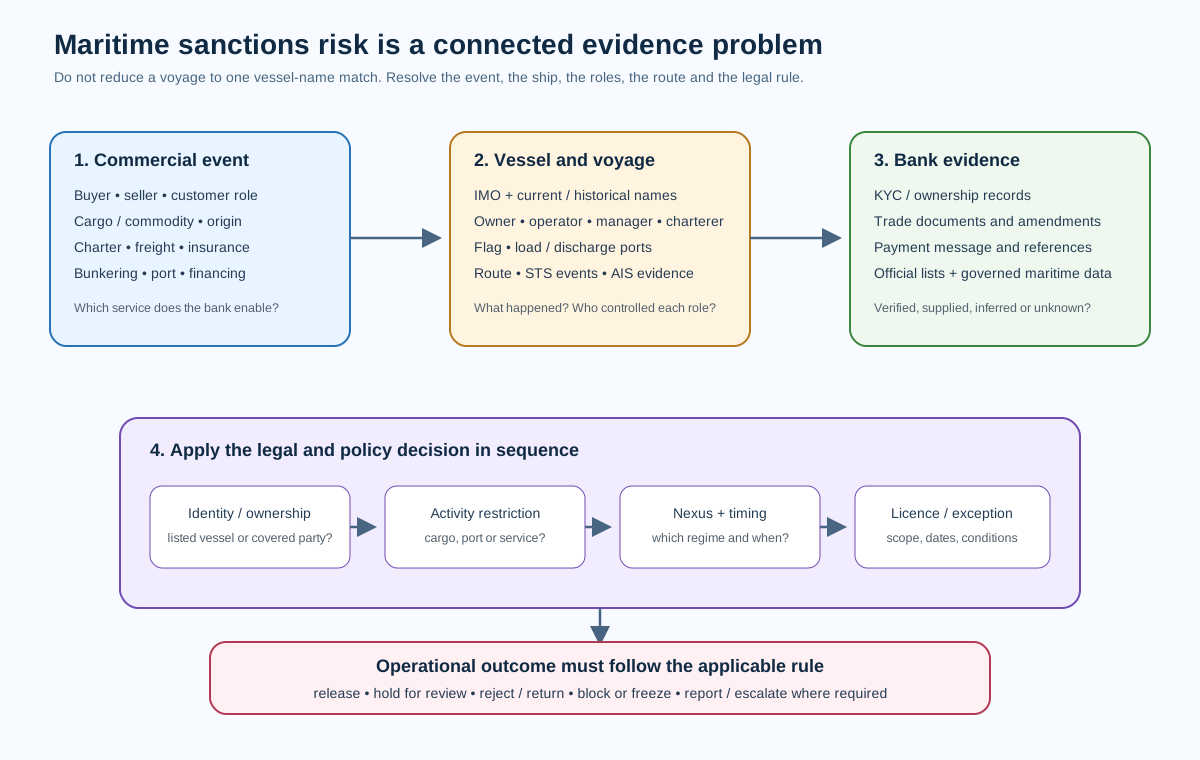
The maritime transaction is a network, not a line
A maritime shipment can involve a seller, buyer, commodity trader, shipowner, technical manager, commercial manager, charterer, sub-charterer, broker, freight forwarder, port agent, terminal operator, bunker supplier, insurer, protection-and-indemnity club, classification society, flag state, port state, bank and multiple correspondent banks. One legal entity may own the vessel while another operates it and another charters it.
For sanctions purposes, the relevant exposure can sit anywhere in this network. A designated shipowner may affect dealings with the vessel. A non-designated ship may be engaged in a prohibited service. A port may be subject to restrictions. The cargo may fall under a trade or energy restriction. Insurance or financing may be prohibited even when the physical voyage is not. The payment route can introduce another sanctions nexus.
A bank should therefore avoid a single vesselRisk flag. The data model should preserve roles. Owner is not operator. Operator is not charterer. Charterer is not cargo owner. Port agent is not necessarily the beneficiary of the underlying trade. If these roles are collapsed, investigations become ambiguous and automated controls can generate poor decisions.
Vessel identity
The vessel name is useful but not sufficient. Ships can change names during their operating life, and transliteration or abbreviations can produce variations. The IMO ship identification number is designed to remain associated with the ship even when name, flag or ownership changes and is therefore a critical maritime identifier where available.
Other identifiers can include Maritime Mobile Service Identity, call sign, flag, year of build, vessel type and registration information. These should be used as supporting attributes, not treated as equally permanent. MMSI and call sign can change with flag or radio registration. The flag itself can change.
Screening systems should therefore weight identifiers intelligently. A name similarity with a different IMO number is a very different case from a matching IMO number with a changed vessel name. Analysts should be able to see both current and historical vessel names.
The bank should also preserve the source and timestamp of vessel data. Maritime data is dynamic. An ownership record from twelve months ago may be useful historical evidence but unsafe as a current fact.
Ownership, operator and control
Vessel ownership can involve special-purpose companies, ship managers and group structures. Single-ship companies are common and are not inherently suspicious. The challenge is to determine whether a sanctions ownership or control rule applies and whether the entity responsible for the relevant activity is restricted.
The legal analysis should be regime-specific. A bank should not assume that one jurisdiction’s ownership threshold or control test applies globally. It should identify the relevant sanctions authority, the designated person, the ownership chain, the effective date and the legal rule used.
Operationally, the bank may need to distinguish registered owner, beneficial owner, technical manager, ISM manager, commercial operator and charterer. Commercial data providers can help, but their data should have provenance and effective dates. An analyst should not write “owned by sanctioned person” merely because a vendor score says “linked.”
Where ownership is unclear, the correct conclusion can be “ownership unresolved and escalated” rather than a false assertion.
Flag and flag hopping
The flag state is the jurisdiction under whose laws the vessel is registered. Flag changes are a normal part of maritime commerce. They can also appear in sanctions-evasion typologies where vessels repeatedly reflag, use false or fraudulent registration claims or move between registries after sanctions exposure.
The risk indicator is therefore not “changed flag = evasion.” The stronger pattern is unexplained or repeated flag changes combined with other facts such as ownership changes, AIS anomalies, suspicious ship-to-ship transfers, inconsistent documentation or known sanctions intelligence.
False-flag claims can be particularly important because a vessel may claim registration that the relevant flag administration does not recognise. Banks are not expected to independently authenticate every vessel registry, but high-risk cases can be escalated to specialist sources.
A maritime investigation should record current flag, former flags where relevant, source and date. Historical context can explain why different documents use different registration details.
Ports
Ports can matter because they are geographic nodes in the shipment and can themselves be subject to restrictions or targeted measures. A vessel can call at a port that is associated with sanctioned trade, a restricted jurisdiction or known circumvention activity. Some sanctions frameworks also impose service restrictions involving specified ports, terminals or maritime infrastructure.
A port call is not automatically prohibited. The legal question depends on the applicable regime, cargo, vessel, parties, services and timing. A port can serve both restricted and ordinary commercial activity.
Banks should avoid encoding “high-risk port = reject.” Port data can be used as a risk indicator that contributes to a broader assessment. Where the law specifically prohibits transactions or services involving a named port, the rule should identify the legal source and effective date.
Port names also require data quality controls because the same port may appear under city name, terminal name, UN/LOCODE, transliteration or local spelling.
Trade routes
A route describes more than origin and destination. It can include load port, discharge port, transshipment points, ship-to-ship transfer locations, storage terminals and land or rail segments. Money and goods can travel through different countries.
A bank should not expect the payment path to mirror the physical route. A buyer in one country can pay a seller in another while goods are shipped from a third and financed through a bank in a fourth. That can be completely legitimate.
Risk increases when route complexity lacks commercial explanation, conflicts with sanctions or export-control rules, conceals origin, or repeatedly uses intermediaries associated with evasion. The analysis should therefore ask why the route exists rather than assume indirect routing is suspicious.
Route assessment is particularly useful when combined with customer profile and commodity. An established trader using a normal commodity hub presents a different risk picture from a newly incorporated company using an unusual chain of ports without a clear business rationale.
Ship-to-ship transfers
Ship-to-ship, or STS, transfers allow cargo to move between vessels at sea or in designated areas. They are common in legitimate petroleum and bulk commodity operations. They can also be used to obscure cargo origin, destination or vessel involvement.
A sanctions investigation should therefore treat STS activity as context. Questions can include location, timing, counterpart vessel, cargo, declared purpose, documentation and whether the transfer is consistent with ordinary trade for the customer or commodity.
An STS transfer near a major hub is not proof of evasion. A series of transfers involving sanctioned or high-risk vessels, AIS irregularities, ownership changes and inconsistent cargo documentation is more meaningful.
Banks often do not receive STS data in the payment message. It may come from trade documents or external maritime-intelligence providers. That limitation should be documented.
Automatic Identification System data
AIS broadcasts vessel identity, position and related navigation information. It is valuable for maritime awareness but is not infallible. Signals can be unavailable, switched off, manipulated, spoofed, misconfigured or affected by coverage limitations.
A gap in AIS transmission can therefore be a risk indicator but not conclusive proof that a vessel intentionally concealed its location. Analysts should consider voyage context, area, duration, satellite coverage, vessel type and other evidence.
Manipulation can include location spoofing or identity anomalies. These issues usually require specialist maritime analysis rather than a bank analyst independently deciding that the vessel falsified its position.
If a bank uses a commercial AIS-risk score, the case should preserve the underlying evidence where possible and the provider’s explanation. A score without context is not a legal fact.
Voyage history and historical reconstruction
Sanctions decisions can depend on what occurred at a particular time. A vessel may have changed owner, flag or name after the transaction. A port may have been designated after a voyage. A sanctions measure may have taken effect during an ongoing contract.
Systems therefore need historical reconstruction. The analyst should be able to answer: what was the vessel called on the transaction date, who owned or operated it then, what sanctions measures were in force then, where did it call and what did the bank know at that time?
This is especially important for audit and regulatory review. Current data cannot simply overwrite historical facts.
Effective dating should apply to vessel identity, ownership, flag, designations, licences and policy rules.
Cargo and commodity
The same vessel can carry different cargoes across voyages. Sanctions risk can arise from the cargo itself, its origin, destination, price, end-user or associated services. Energy, coal, metals, luxury goods, arms, dual-use items and other commodities can be subject to specific restrictions depending on the regime.
A payment narrative that says “freight” may not identify the cargo. Trade-finance documentation may provide richer details. The bank should understand what information is actually available before claiming control coverage.
Commodity classification can involve HS codes, product descriptions, invoices, certificates or specialist data. HS code helps describe goods but does not alone determine sanctions legality. Legal restrictions can use different definitions.
The stronger control model links commodity information with route, customer business, counterparties and legal rules.
Origin and destination masking
Sanctions evasion can involve efforts to disguise where goods originated or where they are ultimately going. Documentation, transshipment, relabelling or intermediate storage can make a shipment appear connected to a different jurisdiction.
Banks should be alert to inconsistent origin information across invoice, certificate of origin, bill of lading, vessel history and customer explanation. The correct response is to investigate inconsistency rather than immediately declare origin falsification.
A customer may have a legitimate reason for re-export or transshipment. The bank should ask whether the explanation and documents support the commercial story.
The strongest cases usually combine several inconsistencies, not one formatting difference.
Documentary integrity
Bills of lading, invoices, charter parties, certificates, packing lists and other trade documents can provide important evidence. They can also be amended, issued electronically, contain errors or reflect different stages of a transaction.
A document’s existence does not prove the underlying fact. An invoice proves that an invoice was created. A bill of lading provides evidence about carriage but still needs to be interpreted within the transaction.
Banks should preserve original and amended versions and avoid overwriting documents. Investigators should note whether a fact was independently verified or merely customer-provided.
Document metadata, inconsistent dates, duplicate numbers or unexplained changes can be relevant, but should be assessed carefully.
Maritime service providers
Sanctions can apply not only to buying or selling cargo but also to services such as transport, insurance, brokering, financing, bunkering, port services or technical assistance. The exact restrictions vary by regime.
A bank can therefore face exposure even where its customer is not the cargo buyer or seller. A shipping agency, insurer or fuel supplier can be providing a restricted service.
Customer onboarding should capture the customer’s maritime role. A company described generically as “logistics” may in fact be a vessel manager, chartering broker or bunker supplier. That distinction can affect screening and monitoring.
The institution should map legal restrictions to business activities, not only to party names.
Shadow-fleet risk
The term “shadow fleet” is widely used in current sanctions policy, particularly in relation to Russia-linked oil trade and sanctions circumvention. It can refer to vessels and supporting networks used to evade restrictions, obscure ownership, bypass price-cap or service rules, or continue trade outside ordinary compliance expectations.
The term is not a single legal category with one universal consequence. A vessel may be specifically listed, subject to service restrictions, linked to a designated person, or merely assessed by a data provider as higher risk. The bank must identify the actual legal basis.
As of July 2026, the European Union had placed more than 670 vessels on its Russia-related vessel list according to official EU material, and later 2026 measures expanded restrictions to parts of the shadow-fleet support ecosystem. This is a good example of a rapidly changing area where static spreadsheets quickly become unsafe.
A bank should use current authoritative lists and controlled vendor updates and should preserve the list version used in each decision.
The oil price-cap context
The Russian oil price-cap framework introduced complex maritime-services and attestation controls involving coalition jurisdictions. The detailed rules, price levels, permitted services and implementation arrangements can change.
For banking education, the important lesson is architectural: the legality of a maritime service may depend not only on the party and commodity but also on price, service type, documentation, voyage and jurisdiction. A screening engine that only checks names cannot evaluate such restrictions.
Banks involved in payments or financing connected to covered services may need attestations or other evidence under applicable rules. The exact obligation should be obtained from current competent-authority guidance.
Do not hard-code historical price-cap details into a generic global sanctions rule without effective dates.
Vessel designation and list screening
Some sanctions authorities designate vessels directly. The vessel record may include name, IMO number, flag and other identifiers. Screening should use all reliable attributes, especially IMO where available.
A payment mentioning a listed vessel can require review even if the payment parties are not themselves listed. Conversely, a vessel-name similarity without identifier confirmation can be a false positive.
Aliases and historical names matter. Screening data should retain them without treating every old name as a separate vessel.
A strong case shows the candidate vessel, identifiers compared, authoritative source, list date, transaction role and legal consequence.
Screening ports and locations
Port and location screening can be more difficult than person screening because geographic names are ambiguous. A city name can appear in a customer address without representing a prohibited trade route. A port can share a name with the surrounding city. Free-text remittance fields can mention places for unrelated reasons.
Controls should therefore use field context where possible. A portOfLoading field is more informative than the same text in a customer address. Structured data reduces false positives.
Where source systems lack structured port data, the bank should acknowledge the limitation rather than claim full route screening.
Data lineage should show how port data is extracted, normalised and screened.
Payment screening in maritime trade
Payment screening can identify listed parties, vessels or geographic terms present in the instruction. It is a preventive or interdiction control with limited context.
The bank should avoid overloading payment screening with every possible maritime risk. Complex route, cargo and ownership analysis may require a trade or investigation platform. If every maritime keyword causes an immediate payment stop, operational noise can become unmanageable.
The design should distinguish hard legal interdiction rules from risk-based referrals. A confirmed listed vessel under an applicable prohibition is different from a generic mention of a high-risk port.
Decision latency also matters because payment cut-offs and settlement can occur while a maritime investigation is still open.
Transaction monitoring and maritime patterns
Post-event monitoring can identify recurring patterns that one payment does not show. Examples include repeated payments to changing ship-management companies, unusual use of maritime agents, rapid changes in counterparties, repeated payments connected to high-risk voyages, or activity inconsistent with the customer’s known fleet or trading business.
These scenarios need customer segmentation. A shipping company naturally pays port agents and bunker suppliers; the same pattern in an unrelated consulting company would be different.
Transaction monitoring should use structured maritime data only where reliable. A poor-quality vessel tag can create false network connections.
Investigators should be able to drill from the alert to the underlying payment and source data.
Correspondent banking and maritime payments
A correspondent bank may see a cross-border payment containing only limited narrative information. The respondent may hold the shipping documents. This information asymmetry is normal.
Where a payment raises a significant sanctions question, the correspondent can use a request-for-information process subject to legal and operational constraints. The request should be focused: vessel, IMO, goods, purpose, parties or underlying customer information as appropriate.
Repeated opaque or poorly answered maritime payments can become relevant to correspondent-risk management, but the bank should avoid assuming that every incomplete message reflects evasion.
The quality of payment transparency should be considered alongside the respondent’s controls and risk profile.
Trade finance and documentary credits
Trade finance can expose vessel name, bill of lading, ports, cargo and counterparties. Screening can occur at several events: issuance, amendment, document presentation, payment, reimbursement or settlement.
This creates version-control challenges. A letter of credit may be issued without a vessel name and later amended or presented with transport documents. Screening should occur when new risk-relevant information becomes available.
The case needs to preserve which document version was screened and what decision was made. A release decision at issuance should not be treated as permanent clearance for all future amendments.
The same principle applies to guarantees and documentary collections.
Freight forwarders and intermediaries
Freight forwarders and logistics providers can legitimately organise multi-modal routes and use subcontractors. Their involvement can make the payment chain different from the physical shipment chain.
A bank should understand whether the customer routinely uses the intermediary and whether the intermediary’s role is documented. A new unexplained intermediary in a sensitive transaction can be a useful risk indicator.
Ownership screening and adverse intelligence may be relevant. But the presence of a freight forwarder is not suspicious by itself.
This is another area where customer profile improves monitoring quality.
Deceptive shipping practices
Public sanctions advisories have described practices such as AIS manipulation, ship-to-ship transfers, false flags, vessel-name changes, ownership changes, falsified documents and indirect routing. These are useful typologies, but the bank should use them as hypotheses rather than labels.
For each indicator, ask what innocent explanations exist and what corroborating evidence is available. An AIS gap plus name change plus ownership transfer plus unusual STS activity has a different evidential weight from one temporary AIS gap.
The institution should also consider whether it has the capability to interpret the maritime data reliably. Specialist providers and trained investigators can reduce false conclusions.
A typology is most valuable when it directs enquiry rather than automatically determines guilt.
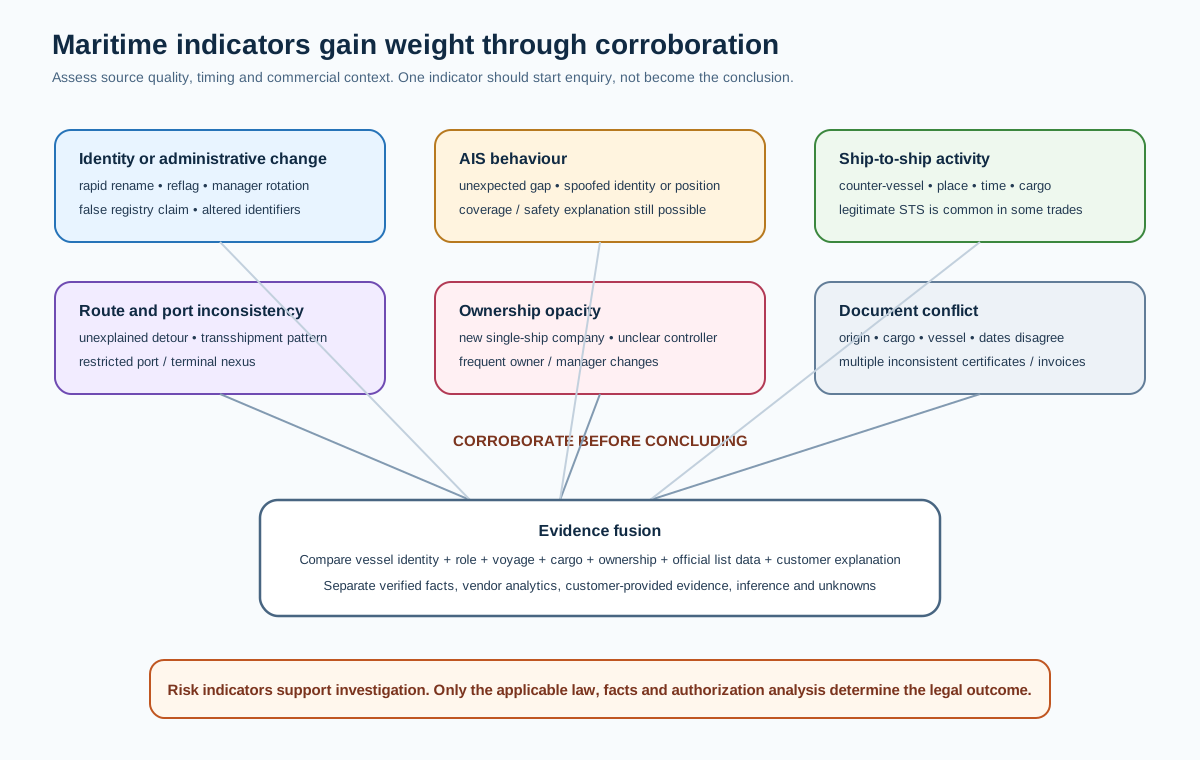
Change of ownership around designation
A vessel may be sold before or after a sanctions designation. The timing can matter. A genuine sale can change legal exposure; a nominal transfer can be designed to preserve control while obscuring ownership.
Banks should avoid assuming that every sale after designation is sham. The investigation should assess buyer, seller, consideration, management, control, timing and relevant legal rules.
Effective-dated ownership data is essential. A static “current owner” field is insufficient for historical review.
Legal specialists may need to determine whether a transfer is valid under the applicable sanctions regime.
Renaming around designation
A listed or high-risk vessel may change name. This makes IMO screening important. A new name does not create a new physical ship.
Screening data should retain historical names so that older documents and payments remain searchable. Analysts should be able to see when each name was used.
A name change alone is not an evasion conclusion. Commercial rebranding and ownership changes can result in legitimate renaming.
The combination with other indicators determines risk.
Reflagging and registry data
Reflagging can be routine. It can also be used to seek a less restrictive registry or disguise continuity. Banks using maritime data should maintain current flag and recent flag history where relevant.
If a data provider flags a registration as potentially false, the analyst should preserve that source and confidence. It may require confirmation from official registry information or specialist intelligence.
Systems should not equate flag nationality with beneficial ownership. A vessel registered in one jurisdiction can be owned and operated elsewhere.
This distinction is important for country-risk models.
The role of insurers and P&I clubs
Insurance is central to maritime commerce. Sanctions can restrict insurance or reinsurance services for certain trades, vessels or parties. A bank may process premium, claim or reimbursement payments connected to those services.
The insurer may have its own vessel and voyage due diligence, but the bank cannot simply assume another regulated institution has resolved every sanctions question. At the same time, duplicating technical maritime analysis without information can create poor outcomes.
Risk-based reliance on counterpart controls should be governed, not informal.
The bank should understand the transaction purpose and whether the relevant service is permitted under applicable law.
Bunkering
Bunker fuel payments can expose vessel name, supplier, port and voyage information. Certain sanctions frameworks can restrict providing bunkering or related services to specified vessels or activities.
A bunker supplier serving hundreds of vessels will naturally transact with maritime agents and ports. Monitoring should be calibrated to its business model.
If a vessel becomes designated between order and delivery, the bank may need urgent sanctions review. Effective-dated list updates and event triggers are therefore important.
Licence or authorisation conditions may also apply.
Port-agent payments
Port agents often collect or disburse funds for multiple local services. Payment beneficiaries may therefore differ from the shipowner or charterer.
This can create false assumptions in monitoring. A payment to a local agent does not necessarily mean the agent economically benefits from the underlying voyage.
Investigators should identify the role, underlying vessel and service where relevant. Structured reference fields can improve linkage.
Third-party settlement should be understood, not automatically labelled suspicious.
Scenario: vessel name but no IMO
A trade-finance document identifies a vessel name that is similar to a listed ship but provides no IMO number. The analyst should compare vessel type, flag, route, ownership and available maritime data before concluding identity.
If two vessels share or resemble the same name, the case remains unresolved until sufficient identifiers are available. A payment should not be legally frozen merely because a name string is similar unless the legal and operational criteria for action are satisfied.
The case should state which identifiers were unavailable and whether further information was requested.
This is the maritime equivalent of name-screening discipline for people.
Scenario: suspicious route change
An established oil trader historically uses a predictable set of ports. A new shipment changes to an indirect route and includes an STS transfer with a newly introduced vessel. The payment is routed through a new intermediary.
The bank should establish commercial rationale, cargo, counterparties, vessel identities, ownership, applicable sanctions and any service restrictions. Market conditions or port congestion may explain the route. If the combined facts indicate circumvention risk, the matter can be escalated.
The correct narrative is “route and counterparties materially differ from expected activity and remain unexplained” rather than “customer is evading sanctions” unless evidence supports the latter.
Scenario: AIS gap
A vessel’s AIS data shows a twelve-hour gap near a sensitive area. The customer provides port records and a technical explanation. External data shows no contradictory voyage evidence.
The bank may document the explanation and close the concern depending on risk. An AIS gap does not automatically prove concealment.
Now change the facts: the gap coincides with an STS transfer reported by credible intelligence, the counterpart vessel is sanctioned and cargo documentation changes origin. The combined evidence creates a materially different case.
This scenario illustrates why risk indicators must be combined.
Scenario: listed vessel after payment initiation
A payment is initiated before a vessel is added to an applicable sanctions list but has not yet settled when the designation becomes effective. The bank needs a rule for the relevant legal time and operational state.
The decision may depend on when the prohibition takes effect, when the bank holds or controls the property, and the applicable jurisdiction. Legal and sanctions specialists should determine the action.
The system should preserve designation effective time, payment status and decision time.
This is why sanctions-list latency can create material operational risk.
Scenario: vessel delisted
A previously listed vessel is removed from an applicable sanctions list. Delisting does not mean every historical alert should be deleted or that all related transactions are automatically acceptable.
The bank should update screening data, assess any continuing restrictions, retain historical evidence and determine whether previous account or payment restrictions can be lifted.
Audit records should show that the vessel was listed at the relevant historical time if that was the case.
Do not rewrite history to reflect only the current list state.
Scenario: cargo versus vessel risk
A vessel is not listed and ownership is clear, but the cargo is prohibited under an applicable trade restriction. The transaction can still be prohibited even though vessel screening is clean.
Conversely, permitted cargo can be carried on a vessel subject to service restrictions. The risk can sit in different objects.
This is why vessel screening is one control, not the entire maritime sanctions programme.
The case should identify exactly which object triggers the legal restriction.
Scenario: port restriction
A payment finances a voyage involving a port subject to a specific transaction or service restriction. The customer argues that the vessel only called for emergency repairs.
The bank should examine the scope of the restriction and any exception or licence. An emergency or safety exception may exist in some regimes but should not be assumed.
The legal decision should be tied to the exact rule and facts.
This is a good test of the licence-management process.
Sanctions nexus
The bank must identify which sanctions regimes apply. Nexus can arise from the bank legal entity, customer, currency, persons involved, payment route, clearing bank, location, goods, service or another legally relevant connection.
A U.S.-dollar payment can introduce U.S. financial-system involvement, but the precise legal analysis depends on the facts and should not be reduced to “USD = OFAC applies everywhere.” A UK entity applies UK law. EU entities apply applicable EU and national implementation. Other jurisdictions have their own frameworks.
Global policy can set risk standards beyond strict legal minimums, but policy should be labelled as policy rather than presented as statutory law.
This distinction is critical in customer communication and audit.
Decision rights
Maritime sanctions cases can involve several teams. Screening operations can resolve simple identity false positives. Trade specialists can interpret documents. Maritime specialists can assess vessel data. Sanctions legal specialists can determine applicability. Operations execute the payment or trade action.
The case system should record each decision separately. One analyst should not select “sanctions cleared” merely because the vessel name is not listed if cargo or route restrictions remain unresolved.
Escalation criteria should be clear. Examples include confirmed vessel match, unresolved ownership, credible evasion intelligence, prohibited cargo indicator, high-risk STS pattern or conflict between documents and vessel history.
Decision ownership should be visible for audit.
Data architecture
A mature data model includes vessel, IMO, current and historical name, flag, registered owner, beneficial owner where available, operator, manager, charterer, cargo, bill of lading, shipment, port, voyage, STS event, sanctions designation, licence, customer, counterparty, payment, correspondent, investigation and decision.
Relationships should be effective-dated. A vessel can have different operators across voyages. A company can own several ships. A shipment can use several vessels. A payment can settle multiple invoices.
Do not force this into a flat customer table. Graph relationships are often more natural.
Provenance and confidence should be stored for external maritime intelligence.
ISO 20022 and maritime information
ISO 20022 improves structured party and payment information, but it is not a maritime data standard. A pacs.008 can identify debtor, creditor, agents, addresses and remittance information but will not necessarily contain vessel, cargo or voyage data.
Banks should avoid claiming that ISO 20022 alone solves maritime sanctions screening. Where vessel information appears in remittance or structured references, it can help, but richer trade data usually comes from other systems.
The architecture should link payment identifiers to trade-case identifiers so an investigator can retrieve the wider context.
Original message data should remain available after enrichment.
Screening-engine design
A vessel-screening engine should support IMO and other identifiers, historical names, aliases, list-program tags and effective dates. It should distinguish a vessel object from a person or company.
Matching thresholds may differ because IMO exact match is stronger than fuzzy name match. The engine should not downgrade an exact IMO match merely because the current vessel name differs from the sanctions-list name.
Conversely, a high fuzzy-name score with conflicting IMO should not be automatically treated as the same ship.
The system should expose the evidence to the analyst rather than hide the match logic behind one score.
External data providers
Maritime-intelligence vendors can provide ownership, AIS, voyage, port, STS and risk data. Their output can be valuable but should be governed like any other material control input.
The bank should understand data sources, refresh frequency, confidence levels, identifier logic, historical coverage and known limitations. Vendor change should trigger testing.
A risk label such as “dark fleet” or “suspected spoofing” is an analytical output, not an official designation unless the source is an authority.
Case writers should attribute the source and avoid converting vendor terminology into legal fact.
Data quality
Common data-quality problems include missing IMO, misspelled vessel names, outdated owner data, duplicated vessel records, port-name ambiguity, missing cargo descriptions and unmatched shipment-payment identifiers.
Data-quality controls should measure both completeness and accuracy. Filling a field with guessed data can be worse than leaving it blank.
Where a vessel name is extracted from free text, the system should preserve the original text and extraction method.
False confidence is a serious sanctions risk.
Model and analytics governance
Some banks use machine learning or graph analytics to identify maritime anomalies. Models can help prioritise but require governance.
Features such as AIS gaps, STS frequency, flag changes or ownership churn can correlate with evasion but also with legitimate activity. Training data can contain biased labels. Model drift can occur as sanctions regimes and commercial routes change.
Human review should understand why a case was prioritised. A black-box score should not automatically freeze a payment.
Validation should test both detection and customer harm.
Control timing
Maritime risk information can arrive at different times. Vessel and route data may not be known at payment initiation. Trade documents may arrive later. A designation can occur after a contract is signed. AIS data can update during the voyage.
Controls therefore need event-driven rescreening. Relevant events can include vessel nomination, document presentation, ownership change, list update, voyage change, licence expiry and settlement.
The correct control is not always “screen once at onboarding.”
Timing should be part of the requirements.
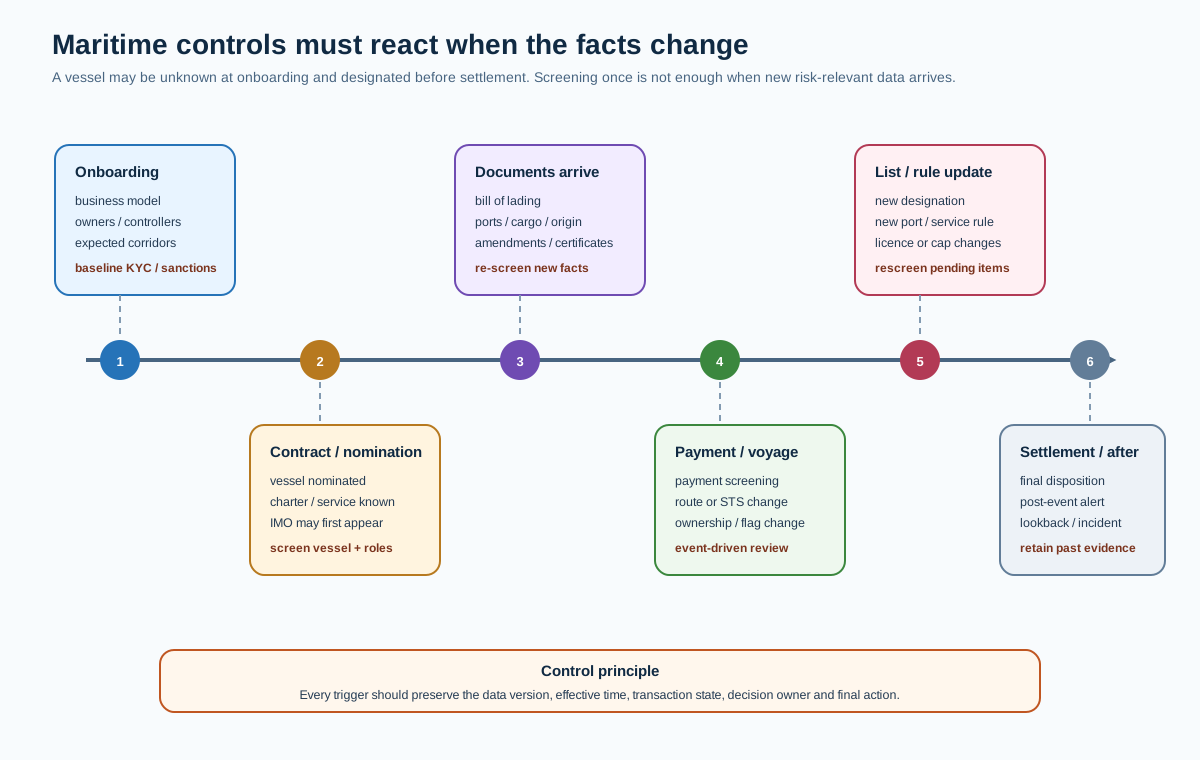
Holds and payment operations
A potential maritime sanctions concern can require a temporary operational hold while the bank investigates, depending on legal authority and payment stage. That hold is not automatically a legal freeze.
Systems should distinguish HELD_FOR_REVIEW, REJECTED, RETURNED, BLOCKED/FROZEN, RELEASED and other relevant states. The legal basis should accompany the state.
If a payment is already settled, the response differs from pre-settlement interdiction. The bank may need incident assessment, reporting and remediation rather than pretending the transaction can be retroactively stopped.
Operational vocabulary matters.
Repair and data enrichment
A payment can be repaired because a name, address or reference is incomplete. Repair should not erase the original data that triggered screening.
If vessel information is added during investigation, the system should mark it as enrichment and record the source. Screening can then be rerun on the enriched data.
Analysts should know which version of the payment was actually sent to clearing or correspondent systems.
This supports defensible audit trails.
Returns and reversals
A returned maritime payment can still require sanctions analysis. “Return to sender” is not automatically authorised under every regime.
The bank should link the return to the original payment and preserve the original sanctions reason. If funds are blocked or frozen, movement may be restricted.
Reversals, recalls and refunds should not be used to bypass the decision process.
The case should show final fund state.
Customer communication
Customer communication should be accurate and avoid revealing protected internal information. If a payment is under review, the bank should not necessarily tell the customer that a vessel is sanctioned unless the legal and policy framework permits and the identity is confirmed.
A temporary delay should not be described as a legal freeze if it is not one.
Operational teams need approved language for maritime holds, requests for information and final outcomes.
Consistency reduces conduct and legal risk.
Record retention
Maritime cases can be revisited years later because designations, investigations or enforcement actions develop over time. The bank should retain relevant payment data, trade documents, vessel identifiers, sanctions-list version, external intelligence, analyst notes, legal decision and final action according to applicable retention rules.
The record should allow another reviewer to reconstruct why the bank acted as it did based on information available at the time.
Screenshots alone are weak evidence because they may not show source or version.
Structured audit data is preferable.
Quality assurance
QA should test whether analysts over-rely on vessel name, whether IMO was checked, whether ownership was effective-dated, whether AIS anomalies were treated as hypotheses, whether cargo and service restrictions were considered, and whether the correct legal regime was applied.
QA should also review false positives to identify tuning opportunities. If common vessel names generate repeated noise, identifier logic may need improvement.
Missed cases should be analysed for data gaps and control design, not only analyst error.
The objective is sustainable control improvement.
Management information
Useful metrics can include vessel-alert volumes, true-match rate, IMO availability, aged maritime cases, list-update latency, ownership-data age, number of cases requiring RFI, repeated customer route anomalies, QA error rate and time to legal decision.
Metrics should distinguish preventive screening from post-event monitoring. A low true-match rate can reflect effective filtering or excessive noise; context matters.
Management information should help decide where to improve data, tuning, staffing or policy.
It should not reward blocking more payments for its own sake.
BA requirements
A business analyst should map the full object and event model before writing screens. Which system holds vessel name? Where does IMO come from? When is the vessel nominated? Which trade document contains ports? Does the payment engine receive that information? How are ownership updates sourced? Which system stores the legal decision?
Requirements should define matching logic, data lineage, event triggers, holds, escalation, manual override, audit history, list updates and release.
Edge cases are essential: vessel rename, reflag, ownership change, missing IMO, duplicate vessel name, list update during payment, delisting, licence expiry, split shipment, STS transfer, returned payment and post-settlement discovery.
A strong requirement also tests legitimate complexity so the control does not become a blanket maritime blocker.
Tester view
Testing should include exact IMO matches, fuzzy name-only matches, historical aliases, conflicting identifiers, list additions and removals, ownership changes, port aliases, STS events and data-provider outages.
The tester should verify not only alert generation but final payment state and audit evidence.
Negative tests are important. A legitimate vessel with the same name as a listed vessel but different IMO should be resolvable without repeated customer disruption.
Historical reconstruction should be tested after data changes.
Developer and architect view
Architecture should separate sanctions-list master data from dynamic maritime intelligence. Official designations need controlled ingestion and high integrity. Vendor voyage and risk data can update more frequently and may carry probabilistic attributes.
The system should support entity resolution without conflating vessels and companies. It should preserve effective dates and source lineage.
APIs should use stable identifiers where possible and avoid matching only on display name.
Failure modes should be explicit: stale list, unavailable vendor, missing vessel data and delayed ownership feed.
Internal audit view
Internal audit can test whether the maritime sanctions control has a documented risk assessment, approved data sources, current lists, governed vendor models, clear legal decision rights, effective holds and complete evidence.
Sampling should include both alerts and transactions that did not alert to assess coverage.
Audit should challenge whether the institution claims more control than the data supports. If open-account payments do not contain vessel information, the control description should not imply universal vessel screening.
Transparent limitations are better than overstated assurance.
Practical investigation sequence
Start by defining the transaction and the bank’s role. Identify customer, payment, service and legal entity. Then establish the vessel and identifiers. Map ownership, operator and charterer where relevant. Reconstruct route and ports. Understand cargo and service. Check current and historical sanctions data. Review external intelligence. Determine applicable legal nexus. Then decide whether the case is a false positive, risk-based escalation or legally restricted activity.
The order matters because it prevents an early risk label from becoming the conclusion.
Facts should be separated from interpretation. “AIS unavailable for twelve hours” is a fact from a data source. “Deliberate concealment” is an interpretation requiring evidence.
The final case should explain what the bank actually did.
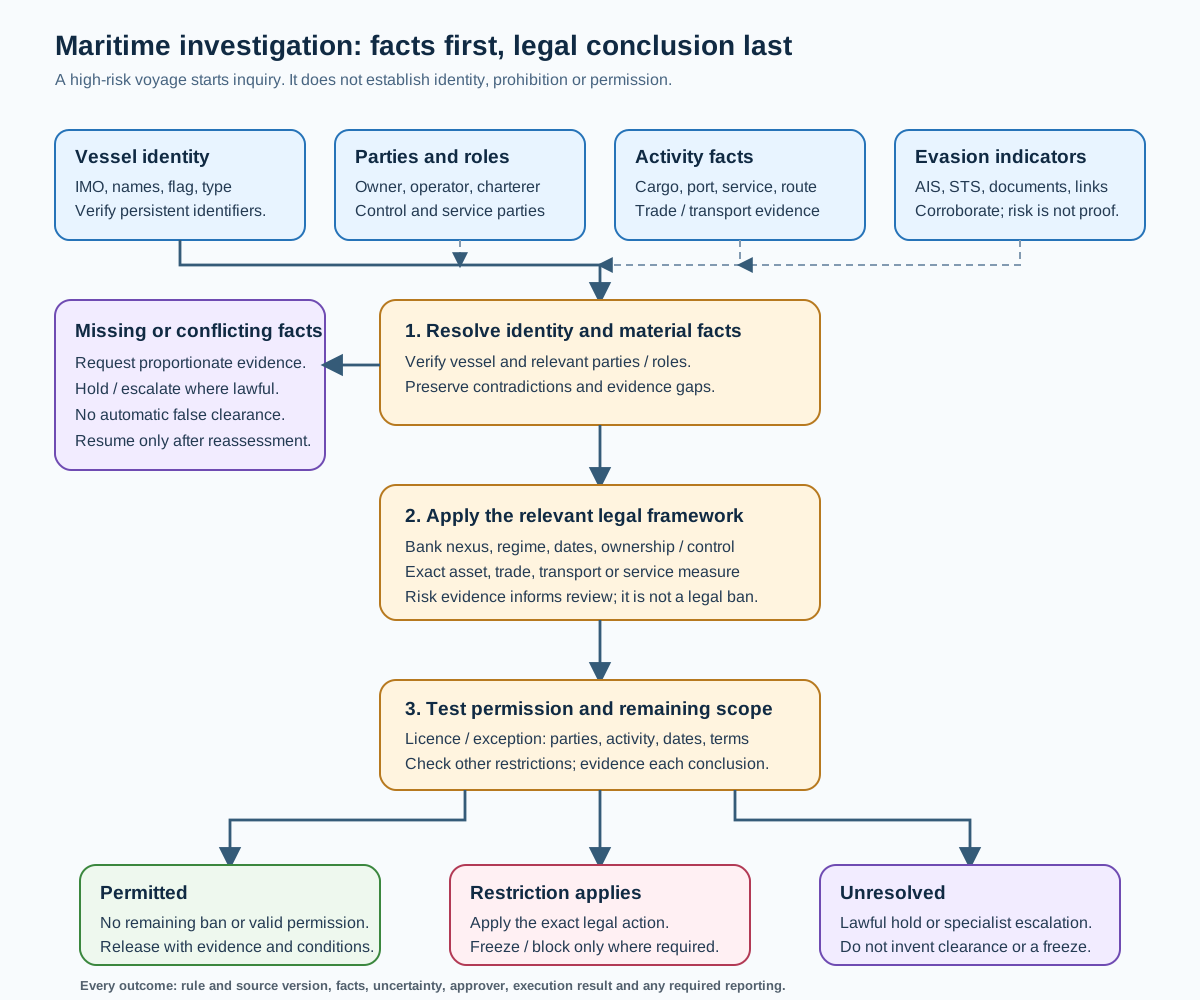
Worked case: renamed tanker
A corporate customer pays freight charges connected to tanker Ocean Star. Screening finds a listed tanker with the historical name Ocean Star, but the current payment documentation shows a different IMO number.
The analyst should not treat the name alone as identity. Check the listed vessel’s IMO, current and former names, vessel type and history. If the customer’s vessel has a different valid IMO and no relevant ownership or service restriction, the candidate can be closed with evidence.
If the IMO instead matches the listed vessel despite the new name, the name change does not remove the sanctions issue.
This case demonstrates why identifier hierarchy matters.
Worked case: complex STS chain
A commodity customer purchases oil through a trader. The cargo moves from Vessel A to Vessel B in an offshore STS transfer and then to Vessel C before reaching the final destination. None of the vessels is directly listed, but Vessel B has a recent ownership change and several AIS anomalies.
The bank should establish whether the trade falls under any relevant commodity, service or price restrictions; whether the vessels or owners are sanctioned; whether documentation supports the route; and whether the customer’s explanation is commercially plausible.
The chain is not automatically illegal. If credible intelligence and legal analysis indicate circumvention, the bank can take the required action.
The case should identify which fact triggered which control.
Worked case: listed port ecosystem
A logistics company pays a port agent at a location newly subject to an applicable transaction ban. The customer argues that the vessel only needs emergency repairs.
The bank should identify whether the restriction covers the port or service, whether an exception exists, whether a licence is required and which legal entity is processing the payment.
Operations should not rely on a generic “emergency” comment without legal review where the rule requires more.
The licence or exception decision should be recorded separately from the payment-screening identity decision.
Worked case: shadow-fleet data-provider alert
A vendor labels a vessel as part of a “shadow fleet” based on ownership opacity, age, flag changes and trading pattern. The vessel is not on the authority’s sanctions list.
The bank should treat the label as risk intelligence, not official designation. Depending on policy and transaction context, the case can be escalated for enhanced review.
If a legal restriction applies because of the voyage, service or ownership, that separate legal basis should be documented.
This avoids turning vendor analytics into de facto sanctions law.
Worked case: post-settlement discovery
A payment for maritime insurance settles. Two days later the bank learns that the insured vessel was designated before settlement but the list update failed to load into the screening engine.
The institution should preserve the transaction, establish list effective time and system-failure timeline, contain any remaining exposure, obtain legal advice on reporting or disclosure, investigate impacted populations and remediate the control failure.
It should not edit the historical record to make it look as though the transaction was stopped.
This is both a sanctions incident and a technology-control incident.
Designation timing and the pending-payment population
A designation that takes effect while maritime payments are already in flight creates a distinct control question: which pending transactions must be re-examined, and against what effective time. A cross-border freight payment can sit queued, batched or awaiting documents for days, and list data can change during that window. The bank should define, before it happens, whether pending and queued populations are re-screened when a new designation, port restriction or service measure becomes effective, who owns that decision, and how the re-screening is evidenced.
The evidence trail matters because the legal question usually turns on timing: what the list said when the bank acted, which version of the list the engine applied, and when the update actually loaded. An analyst who clears a payment against a morning list version without knowing that an afternoon designation names the vessel has not made a defensible decision, even if the morning screen was performed correctly. This is why screening evidence should record the list version and load time alongside the match reasoning, and why payment operations need a defined path for pausing releasable items when a material list change lands during the settlement window.
Where a payment has already settled before the designation took effect, the issue shifts from prevention to containment and advice: preserve the record, assess follow-on exposure such as related voyages, sister vessels under the same control, or recurring charter payments, and seek legal guidance on any reporting or disclosure obligation. The objective is a controlled response grounded in the effective date, not a retrospective rewrite of a decision that was correct on the information available at the time.
Final learning test
A learner should be able to explain why vessel name is weaker than IMO for identity, why ownership and operator roles must be separated, how flag and AIS data should be interpreted cautiously, why STS transfers are not inherently suspicious, how cargo and service restrictions can matter even with a clean vessel screen, and how route information interacts with payment data.
The learner should be able to reconstruct a maritime transaction from customer to payment to vessel to voyage and identify which parts are verified, inferred or unknown.
They should also be able to explain the difference between official sanctions designation, ownership-based legal exposure, service restriction, vendor risk label and AML suspicion.
Finally, they should be able to design a bank control that is accurate about its data limitations and uses specialist escalation rather than pretending every sanctions question can be solved by a name-screening algorithm.
Authoritative references
- OFAC — Sanctions Programs and Country Information: https://ofac.treasury.gov/sanctions-programs-and-country-information
- OFAC — Consolidated sanctions FAQs: https://ofac.treasury.gov/faqs/all-faqs
- UK OFSI — UK financial sanctions general guidance, updated 12 May 2026: https://www.gov.uk/government/publications/financial-sanctions-general-guidance/uk-financial-sanctions-general-guidance
- EU Council — EU sanctions against Russia: questions and answers: https://www.consilium.europa.eu/en/policies/sanctions-against-russia-explained/
- EU Council — 21st Russia sanctions package, 23 July 2026: https://www.consilium.europa.eu/en/press/press-releases/2026/07/23/21st-package-of-sanctions-eu-hits-russian-energy-financial-services-and-crypto-hard/
- FATF — Complex Proliferation Financing and Sanctions Evasion Schemes, June 2025: https://www.fatf-gafi.org/en/publications/Financingofproliferation/complex-proliferation-financing-sanction-evasion-schemes.html
- UN Security Council — DPRK 1718 Sanctions Committee: https://main.un.org/securitycouncil/en/sanctions/1718
Educational note: maritime sanctions, service restrictions, price-cap measures, trade controls and licensing conditions change frequently and differ by jurisdiction. Apply current competent-authority rules and specialist legal interpretation to actual transactions.
Advanced practice: maritime sanctions from payment evidence to voyage reconstruction
Maritime sanctions investigations become genuinely useful when the bank can reconstruct the commercial event rather than simply collect vessel-risk indicators. The investigator should be able to explain who contracted with whom, what was being transported, which vessel carried it, who owned and operated that vessel at the relevant time, where the cargo was loaded and discharged, which services the bank financed, what restrictions were in force, and what evidence supports each statement. That reconstruction is what turns scattered shipping data into a defensible sanctions decision.
Reconstructing the commercial chain
Start with the bank customer and the service the bank is providing. A commodity trader paying freight has a different relationship to the vessel from a shipowner paying insurance or a bunker supplier receiving payment. The bank should identify the customer role before interpreting the vessel data. The same ship name can be relevant for completely different legal reasons depending on whether the payment concerns cargo purchase, charter hire, insurance, port services, repair, fuel, financing or another service.
Then identify the contractual chain. The cargo buyer and seller may not be the charterer. A voyage charter can involve a shipowner and charterer while a separate commodity contract governs the goods. A freight forwarder or port agent can receive funds on behalf of several service providers. This is normal commercial complexity. The investigator’s job is to separate roles rather than treat every connected party as an economic beneficiary.
The transaction narrative should therefore state roles explicitly: “Customer A, the charterer, instructed a payment to Port Agent B for services associated with Vessel C, IMO X, on Voyage Y.” That is far more useful than “payment linked to vessel C.”
Voyage reconstruction
A voyage should be reconstructed as a time sequence. Record vessel position and port calls where reliable, load port, discharge port, transshipment, ship-to-ship activity, changes in destination and relevant timestamps. Then compare the physical route with documents and payment timing.
Payment and cargo routes do not need to match. A European buyer can pay an Asian seller through a London bank for goods loaded in the Middle East and discharged in Africa. That structure can be entirely legitimate. The question is whether the route and counterparties make commercial sense and comply with applicable restrictions.
When AIS data conflicts with documents, do not automatically choose one source as truth. Determine source quality, timestamp, coverage and whether the apparent conflict can be explained by reporting delay, port-area coverage or document timing. Material unexplained conflict should be escalated.
Vessel identity under change
A robust vessel record should be historical. The investigator may encounter three names for the same vessel across contract, bill of lading and current maritime database. The IMO number normally provides the best stable anchor, but even IMO data should be checked against authoritative or well-governed sources.
Name, flag, MMSI, call sign, registered owner, manager and operator should be effective-dated. This allows the bank to reconstruct identity at the transaction date. A vessel renamed after the voyage should not make the historical transaction appear to involve the new name at that time.
This historical model is also essential for list screening. If a sanctions authority lists the vessel under an old name but the IMO matches, the bank should not miss the exposure. Conversely, two ships with the same or similar name should not be merged merely because textual matching is high.
Ownership and operator analysis
Maritime ownership is often structured through single-ship companies. A special-purpose company owning one vessel and little else is not inherently suspicious. That structure is common in shipping. The relevant question is who owns or controls the company, who operates the vessel and whether any applicable sanctions rule extends restrictions through those relationships.
Registered owner, ultimate beneficial owner, technical manager, ISM manager and commercial operator can all differ. Some maritime databases infer or aggregate these roles. The case should retain the original role labels rather than flatten everything into “owner.”
Where the bank relies on a commercial provider, store provider, retrieval time and confidence. If legal analysis depends on ownership, material uncertainty should be resolved through specialist review rather than a low-confidence vendor relationship.
Charter-party risk
Chartering creates another layer of complexity. A vessel can be time-chartered or voyage-chartered to a party different from the owner. The charterer can control commercial employment without owning the ship. Sanctions measures can restrict services to particular vessels or persons even where ownership is clean.
A bank financing or paying charter hire should therefore identify charterer and contractual relationship where relevant. If the vessel becomes designated during the charter period, the bank may need to assess future payments, existing obligations, licence availability and whether property is blocked or merely a service is prohibited.
Contractual obligation does not itself override sanctions law.
Cargo-origin investigation
Origin can be difficult to establish. Seller location, invoice address and port of loading are not always the legal origin of goods. Commodity origin can require certificates, production information, customs documents or other evidence.
Where sanctions target goods of a particular origin, the bank should avoid assuming origin from beneficiary country. If a commodity is loaded at a transshipment hub, earlier voyage history and documentation may matter. At the same time, the bank should not claim fraud simply because origin evidence is incomplete.
A defensible conclusion might be: “The documents provided do not independently establish origin, and available voyage information is inconsistent with the stated source. The matter was escalated for sanctions/trade review.” That is precise and evidence-based.
Price and service restrictions
Some maritime sanctions regimes combine party restrictions with commodity or service conditions. Oil-price-cap frameworks are a prominent example: service providers can be permitted to provide certain services only when specified conditions and documentation are met under the applicable rules.
For bank design, the lesson is broader than any one current price. A sanctions rule can depend on value, commodity, contract, attestation, vessel and service. Those attributes belong in a rule model with effective dates. Do not embed a historical price or policy assumption permanently in application code.
If an authority changes the rule, the bank should update the structured rule and associated evidence requirements, not rewrite old cases.
Ship-to-ship evidence
An STS event should include both vessels, location, time window and source. If one vessel is listed, the legal question becomes more urgent. If neither is listed, the event can still be relevant to origin or evasion analysis.
Repeated STS activity should be interpreted relative to vessel type and commodity. Tankers may legitimately use STS operations frequently. A control based on count alone will generate poor alerts.
Analytics should therefore segment by vessel type, route and trade pattern and look for changes or combinations rather than one universal threshold.
AIS analytical limitations
AIS is an operational safety and tracking system, not an infallible sanctions database. Terrestrial reception gaps, satellite coverage, equipment failures and operational practices can affect data. Deliberate manipulation also occurs.
A bank using “dark activity” or spoofing indicators should understand the vendor methodology. Does the alert indicate no signal received, a physically implausible position, identity duplication, or a vendor inference? Those are different phenomena.
The case should preserve the underlying reason code. “AIS risk high” is not sufficient for a legal decision.
Port and terminal specificity
A port can include multiple terminals. Sanctions can sometimes refer to named infrastructure, while the surrounding city remains available for other activity. Geographic reference data should therefore support port, terminal, city, country and coordinate objects where needed.
Free-text place-name screening can create false positives. A structured port-of-loading field with UN/LOCODE or another governed identifier is more reliable.
Where a trade system collects ports but the payment system does not, the architecture should link the payment to the trade case rather than duplicate or truncate the port data into remittance text.
Maritime ownership change case
A tanker is sold three weeks after a sanctions advisory identifies its former owner as part of an evasion network. The buyer is a newly incorporated company in another jurisdiction; technical management and crew remain unchanged.
This pattern deserves review but does not prove the sale is sham. Examine purchase consideration, corporate ownership, management agreement, financing, registration change and whether effective control actually changed. If the vessel is directly listed, the designation remains relevant regardless of commercial sale unless the competent authority delists or law otherwise changes the result.
The investigator should distinguish “sale occurred” from “sanctions exposure ended.”
Port-call case
A vessel calls at a restricted port because of a mechanical emergency. A service provider invoices the customer for repairs. Depending on the sanctions regime, emergency or safety exceptions may exist, but they must be verified.
The bank should establish the exact service, port, dates and legal provision. If an exception applies automatically, record the basis. If a licence is needed, route accordingly.
Emergency language from the customer is evidence to assess, not automatic authorisation.
Correspondent request-for-information case
A correspondent bank sees a payment with a vessel name and a high-risk maritime term but no IMO or cargo data. Instead of asking a generic “provide all shipping documents,” it can request focused information: vessel IMO, role, cargo, loading/discharge ports, and whether the payment is linked to a specific voyage.
Focused RFIs improve response quality and reduce operational burden. The respondent should preserve the relationship between RFI, original payment and final disposition.
Repeated RFIs for the same missing information can reveal a payment-transparency or customer-data design gap.
Sanctions-list update case
A vessel is added to an applicable sanctions list during a voyage. The bank has an open trade-finance exposure, future charter payments and a pending reimbursement.
The impact assessment should identify all affected products and assets rather than only queued payments. Customer relationships, guarantees, collateral, securities and insurance-related payments may need review depending on the legal framework.
This is why sanctions change management needs enterprise-wide inventory and linkages.
Management information beyond alert counts
A mature maritime programme should know the percentage of relevant transactions with reliable IMO, the age of ownership data, time from list update to production screening, time to specialist decision, repeat RFI causes, number of historical-alias matches, maritime-vendor availability and QA error themes.
Alert count alone does not measure control quality. A reduction in alerts can mean improved matching or lost data. Management needs denominator and coverage information.
Audit reconstruction exercise
Select a historical maritime case and reconstruct it using only retained evidence. Can the reviewer identify vessel, IMO, ownership at the time, route, cargo/service, payment, list version, licence, analyst reasoning and final action? If any conclusion depends on a webpage or vendor record that has since changed, was the relevant historical snapshot preserved?
A programme that cannot reconstruct historical maritime decisions is vulnerable even if today’s data is excellent.
Practitioner conclusion
Maritime sanctions control is strongest when it is precise about identity, role, time and source. The best investigator does not collect the largest number of red flags. They reconstruct the event, understand what the bank actually knows, identify the applicable rule and explain exactly why the operational action follows. That discipline is what makes a complex shipping case educationally useful and regulator-defensible.
60-minute mastery extension: vessels, ports, trade routes and evasion patterns
The core chapter is intentionally broad because maritime sanctions risk is not solved by a vessel-name lookup. Use this mastery layer to practise the evidence and decision sequence. A good study plan is about 30 minutes on the chapter and four diagrams, 15 minutes on the maritime cases below, 10 minutes on control and data design, and 5 minutes on the final judgement test.
Case 1 — same name, different ship
A payment narrative names Ocean Star. Screening returns a listed vessel with that name, but the trade document shows an IMO number that belongs to another vessel. The analyst should resolve the vessel by stable identifiers, current and historical names, vessel type, flag and ownership. A fuzzy name match is a candidate, not proof of identity.
Write the closure reason so another reviewer can reproduce it: candidate vessel, compared IMO numbers, source of vessel data, list version and final conclusion. Do not simply write “false positive — different vessel.”
Case 2 — renamed vessel, same IMO
Now reverse the facts. The vessel currently has a new name but the IMO number matches a listed vessel’s historical record. The rename does not create a new physical vessel. The sanctions analysis should proceed on the confirmed vessel identity and applicable legal rule.
The learner should explain why historical aliases and effective-dated vessel data matter more than display name alone.
Case 3 — AIS gap without corroboration
A vessel has a twelve-hour AIS gap near a sensitive region. There is no other adverse information and the customer provides consistent port and voyage documentation. The gap is a risk signal, not proof of deliberate concealment.
Now add an offshore ship-to-ship transfer with a designated counter-vessel, inconsistent cargo-origin documents and a recent ownership change. The combined evidence materially changes the case. This exercise teaches cumulative evidential weight.
Case 4 — STS transfer in normal commodity trade
A tanker conducts a ship-to-ship transfer at a common commercial hub. The customer is an established commodity trader and the vessel, owners and cargo are not restricted. A good control should permit legitimate STS activity rather than create an automatic sanctions conclusion.
Ask what the bank actually knows: vessel identity, location, counterpart ship, cargo, customer business and legal framework. If some data comes only from a maritime vendor, record the source and confidence.
Case 5 — clean vessel, prohibited cargo
The ship and every named party screen clean, but trade documentation indicates that the cargo itself is prohibited for the destination under the applicable sanctions regime. Vessel screening has worked correctly and is still insufficient.
The learner should identify the object that creates the legal restriction: cargo/activity rather than vessel. This demonstrates why party, vessel, trade and service controls are separate layers.
Case 6 — listed vessel but permitted activity under licence
A vessel is designated but the transaction is claimed to be covered by a valid licence or authorisation. Identity resolution remains necessary, and the match should not be suppressed. The bank should assess licence scope, parties, dates, conditions and reporting before executing the permitted action.
A whitelist is not the legal permission. The case should retain both designation and licence evidence.
Case 7 — designation after nomination
A vessel is nominated for a trade transaction on Monday and is added to the relevant sanctions list on Wednesday before payment settlement. The trade-finance system had screened the vessel only at nomination.
Design the event that should trigger rescreening. The bank needs current list data, effective time, trade/payment state and clear decision ownership. This is an event-driven control problem, not merely an analyst problem.
Case 8 — post-settlement miss
A maritime insurance payment settles. The next day the bank discovers that the vessel was already designated but a list-update failure prevented screening. Build the incident response: preserve historical payment, identify list effective time, contain exposure, assess regulatory reporting or disclosure, perform impact/lookback analysis, repair the feed and prove remediation.
Do not alter the old payment record to make the control appear successful.
Maritime evidence matrix
Create columns for vessel name, IMO, flag, registered owner, beneficial owner, operator, manager, charterer, cargo, load port, discharge port, STS event, AIS anomaly, sanctions designation, licence, payment, customer profile and external intelligence. Mark each as verified, customer-provided, vendor-provided, inferred or unknown.
Then ask which facts are needed for the actual legal decision. Not every field is mandatory for every payment. The objective is proportionate evidence, not unlimited investigation.
Data-quality challenge
Test these failures: missing IMO; recycled vessel name; stale owner data; duplicate vessel records; port alias; ambiguous city/port name; wrong voyage linked to the payment; maritime provider unavailable; vessel renamed during open case; flag changed; and list record updated with a new alias.
For each failure, decide whether the transaction can continue, requires referral, or must be held because a legally critical fact is unresolved. The answer should depend on materiality and legal obligation.
Control architecture exercise
Map seven components: official sanctions list, maritime master, ownership service, trade-finance data, payment data, maritime intelligence and case/legal decision service. Define identifiers joining them. IMO should be treated as a stable vessel key where available, while names remain searchable historical attributes.
Add effective dates to ownership, flag, name, designation and licence. Then demonstrate how an investigator reconstructs a voyage six months later without current data overwriting history.
BA acceptance criteria
Write acceptance criteria for: exact IMO match; same-name/different-IMO false positive; historical alias match; missing IMO; vessel added to list after nomination; vessel delisted before later transaction; ownership change; STS event; AIS gap; prohibited cargo with clean vessel; licensed activity involving listed vessel; returned payment; maritime-vendor outage; and post-settlement discovery.
Every criterion should specify source data, screening result, decision owner, payment/trade state and evidence retained.
Final practitioner test
The learner should be able to explain why IMO normally carries more identity weight than name; why owner, operator and charterer are different roles; why flag change, STS activity and AIS gaps are risk indicators rather than automatic evidence of evasion; why cargo or service restrictions can make a clean vessel screen insufficient; and why current/historical maritime data must be effective-dated.
Finish with one scenario: “Unlisted tanker, recent rename, valid IMO, opaque owner, two AIS gaps, normal STS location, commodity subject to conditional service restriction, third-country payer.” The correct response is a structured evidence and legal assessment—not a vendor risk score converted into a legal conclusion.
Authoritative anchors
OFAC sanctions programmes and current lists: https://ofac.treasury.gov/sanctions-programs-and-country-information
UK OFSI financial sanctions general guidance: https://www.gov.uk/government/publications/financial-sanctions-general-guidance/uk-financial-sanctions-general-guidance
EU Council — sanctions against Russia explained: https://www.consilium.europa.eu/en/policies/sanctions-against-russia-explained/
UN Security Council DPRK sanctions: https://main.un.org/securitycouncil/en/sanctions/1718
Knowledge check
-
Why is a vessel name a weaker identity anchor than an IMO number when the IMO number is available and reliable?
-
Why should AIS gaps, flag changes or ship-to-ship transfers be treated as indicators rather than automatic proof of sanctions evasion?
-
What is the difference between vessel owner, operator, manager, charterer, cargo owner and payment counterparty, and why do those roles matter?
-
Why can a bank processing an ordinary payment have much less maritime visibility than a bank financing documentary trade?
-
What should an investigator do when a vessel changes name, flag or manager during a transaction lifecycle?
-
Why is a high-risk port or route not equivalent to a legally prohibited port or route?
-
How can sanctions, export controls, proliferation financing and AML all use maritime information without becoming one combined legal decision?
-
What evidence should be preserved when a transaction is escalated because of a maritime-evasion pattern?
Answer guide
Vessel names can change and be reused, while IMO numbers are designed as persistent identifiers for many commercial ships and can help link historical names. AIS gaps, flag hopping and ship-to-ship transfers all have legitimate operational explanations; risk emerges from context, timing, location, ownership, cargo, documentation and other evidence. Vessel roles matter because legal restrictions can attach differently to the owner, operator, service provider, cargo or transaction party. Documentary trade may provide bills of lading, ports, cargo descriptions and vessel identifiers that an ordinary payment message does not contain. Identity and relationship data should be effective-dated so the case reflects the vessel and parties at the relevant time. A risky geography is a signal; legal prohibition depends on the actual sanctions measure. Maritime facts can feed several control families, but each must retain its own legal question and decision owner. Evidence should include vessel identifiers, names, ownership/management data, route/port facts, source and timestamps, trade/payment data, list version, documentation and analyst rationale.
Glossary
IMO number — A persistent ship identification number assigned under the IMO ship identification scheme to eligible vessels; it can remain stable when a vessel changes name or flag.
AIS — Automatic Identification System used to transmit vessel identity and navigational information; data can be incomplete, unavailable or manipulated and should be interpreted in context.
Flag state — The state whose flag the vessel is entitled to fly and under whose registry it operates.
Flag hopping — Repeated changes of vessel flag or registry; this can occur legitimately but can become an evasion indicator in context.
Ship-to-ship (STS) transfer — Transfer of cargo directly between vessels at sea; common in legitimate shipping but also potentially relevant to evasion analysis depending on circumstances.
Vessel owner — The legal or beneficial owner of the vessel; ownership can differ from the company operating or managing it.
Operator / manager — The party responsible for operational or technical management of the vessel under the relevant commercial arrangement.
Charterer — A party that hires or contracts for use of a vessel or its capacity under a charter arrangement.
Port of loading / discharge — Locations where cargo is loaded onto or discharged from a vessel; these can differ from payment-party locations.
Trans-shipment — Movement of cargo through an intermediate vessel, port or location before reaching final destination.
Shadow fleet — A policy and enforcement term commonly used for vessels or networks employed to transport sanctioned or restricted commodities while using opaque ownership, services or deceptive practices; use the term only with source/context rather than as an automatic legal category.
Deceptive shipping practice — Behaviour intended or suspected to conceal vessel identity, cargo origin/destination, ownership, route or sanctions nexus; individual indicators require contextual assessment.
Maritime services — Services such as shipping, brokering, insurance, financing, flagging, classification or other support that can become relevant under specific sanctions regimes.
Route anomaly — A routing pattern that differs from expected commercial behaviour and may justify review but is not proof of prohibited activity.
Maritime evidence chain — Traceable record linking vessel identity, roles, route, cargo/trade information, payment, sanctions data, investigation and final decision.
References and further reading
Maritime sanctions evidence must be read in context. Vessel identity, ownership and management, flag, route, port, cargo and services can all matter, but an AIS gap, flag change, ship-to-ship transfer or indirect route is not by itself proof of sanctions evasion. The legal outcome depends on the applicable regime, the bank's nexus and role, the facts at the relevant time, and any licence or exception.
- International Maritime Organization — Integrated IMO Identification Number Scheme: https://www.imo.org/en/ourwork/iiis/pages/imo-identification-number-schemes.aspx
- International Maritime Organization — Maritime security FAQs, including SOLAS AIS operating requirements: https://www.imo.org/en/ourwork/security/pages/faq.aspx
- UK Office of Financial Sanctions Implementation — Financial sanctions guidance for maritime shipping: https://www.gov.uk/government/publications/financial-sanctions-guidance-for-maritime-shipping/financial-sanctions-guidance-for-maritime-shipping
- UK Office of Financial Sanctions Implementation — UK Maritime Services Ban and Oil Price Cap Industry Guidance, updated 15 January 2026: https://www.gov.uk/government/publications/uk-maritime-services-ban-and-oil-price-cap-industry-guidance/uk-maritime-services-ban-and-oil-price-cap-industry-guidance
- UK Office of Financial Sanctions Implementation — Oil Price Cap advisory on fabricated or falsified certificates of origin, 21 November 2024: https://www.gov.uk/government/publications/ofsi-advisories/oil-price-cap-opc-advisory-evasion-linked-to-product-origin-manipulation-through-fabricated-and-falsified-certificates-of-origin-co
- U.S. Treasury OFAC — Guidance to Address Illicit Shipping and Sanctions Evasion Practices, 14 May 2020: https://ofac.treasury.gov/recent-actions/20200514
- U.S. Treasury OFAC — Sanctions Compliance Guidance for the Maritime Shipping Industry, issued 31 October 2024: https://ofac.treasury.gov/recent-actions/20241031
- U.S. Treasury OFAC — Guidance for Shipping and Maritime Stakeholders on Detecting and Mitigating Iranian Oil Sanctions Evasion, 16 April 2025: https://ofac.treasury.gov/recent-actions/20250416
- U.S. Treasury OFAC — Maritime shipping services guidance index: https://ofac.treasury.gov/additional-ofac-resources/ofac-information-for-industry-groups
- Council of the European Union — EU sanctions against Russia: questions and answers, including the current shadow-fleet vessel measures: https://www.consilium.europa.eu/en/policies/sanctions-against-russia-explained/
- Council of the European Union — 21st sanctions package, 23 July 2026: https://www.consilium.europa.eu/en/press/press-releases/2026/07/23/21st-package-of-sanctions-eu-hits-russian-energy-financial-services-and-crypto-hard/
- Financial Action Task Force — Complex Proliferation Financing and Sanctions Evasion Schemes, June 2025: https://www.fatf-gafi.org/en/publications/Financingofproliferation/complex-proliferation-financing-sanction-evasion-schemes.html
- United Nations Security Council — DPRK sanctions and the 1718 Committee: https://main.un.org/securitycouncil/en/sanctions/1718
Accuracy note — reviewed 17 September 2026: IMO confirms that the IMO ship identification number remains unchanged through the life of a ship even when its flag, name, ownership or type changes. OFSI explicitly notes that flag changes, ship-to-ship transfers and some AIS disablement can have legitimate explanations, so context and corroboration matter. OFSI also identifies AIS manipulation, false or fraudulent documents, irregular routes and opaque ownership or management changes as relevant evasion indicators. The Council of the EU states that, as of 23 July 2026, more than 670 vessels were on its Russia-related shadow-fleet list; the 21st package added 41 vessels and expanded the scope to vessels supporting the shadow fleet through services such as bunkering. These are jurisdiction-specific examples, not universal maritime rules. Oil-price-cap levels, licences and service restrictions can change and must be checked against the current competent-authority material before a live decision.