Blocking, Rejecting, Freezing and Reporting
When a sanctions concern becomes sufficiently established, the bank must translate legal restrictions into an operational action. This is where terminology becomes critical. Blocking, freezing, rejecting, returning, holding and reporting are not interchangeable words. They can have different legal consequences, accounting treatment, customer communication rules and reporting obligations.
A sanctions operating model should therefore begin with the applicable law and then map it to precise system actions. The same payment or asset can receive different treatment depending on the sanctions regime, legal entity, currency, location, ownership/control analysis and available licence or exception.
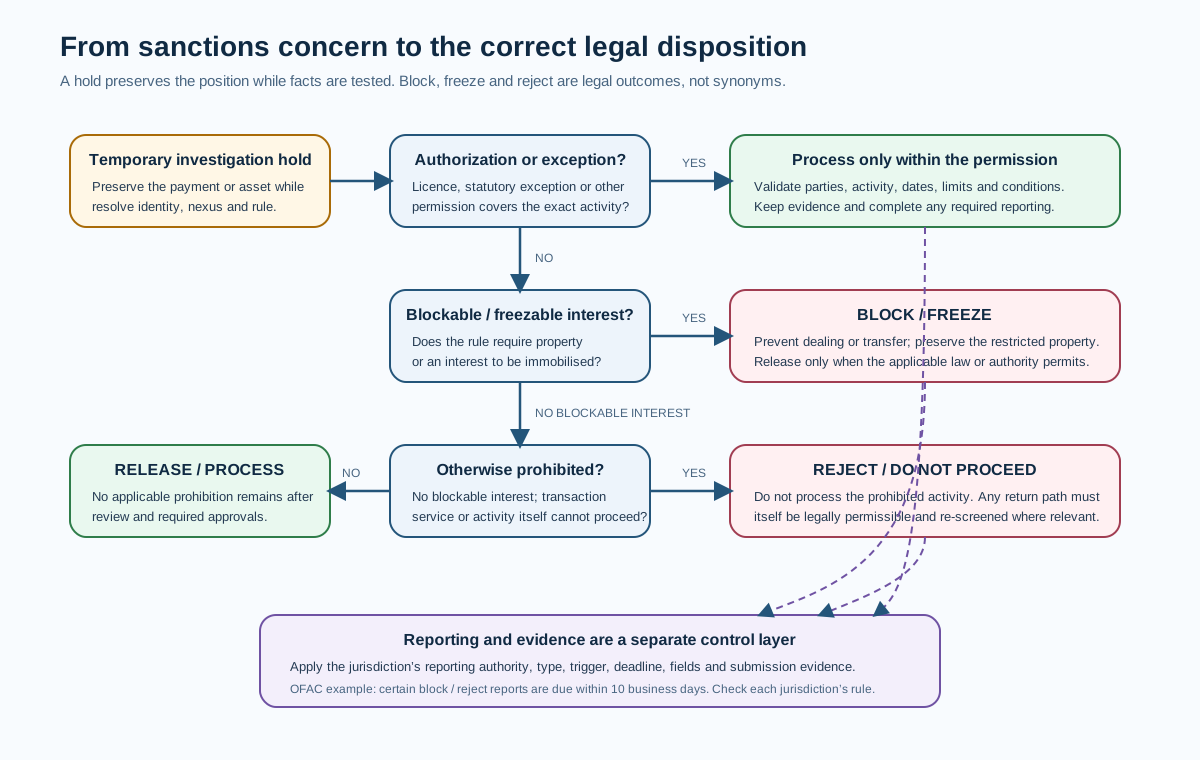
Temporary hold
A temporary hold is an operational state used while the bank investigates. It preserves the status quo while analysts determine whether the alert can be cleared or whether a legal restriction applies.
A hold should have a defined owner, reason, start time and escalation path. It should not silently become a permanent freeze without legal basis.
Legal blocking or freezing
Blocking or freezing generally means that funds or economic resources are immobilised because applicable sanctions law requires them to be made unavailable for dealing, transfer or use. The exact legal terminology differs by regime.
The bank should identify the legal authority, affected property, effective time and any reporting requirements.
Rejecting a transaction
A rejection means the bank does not process a transaction and does not necessarily take possession of blocked property. Under some regimes, rejection rather than blocking can be the required outcome for certain prohibited transactions.
The operator should never assume “sanctions = freeze everything.”
Returning a payment
Returning funds to the sender can be appropriate in some situations, but not if returning would itself make funds available to a prohibited party or otherwise breach restrictions.
A return should therefore be screened and legally assessed like any other payment movement.
Refusing onboarding or service
A bank may be unable to establish a relationship with a sanctioned party or may decide not to provide a restricted service. Refusal is different from freezing already-held assets.
Systems should distinguish pre-relationship refusal from post-designation asset handling.
Asset freeze scope
An asset freeze can cover more than cash. Securities, deposits, custody assets, dividends, interest, economic resources and other property may be affected depending on the regime.
A bank should map sanctions obligations across products, not only payments.
Ownership and control
Unlisted entities can become subject to restrictions because of ownership or control by designated persons under the applicable legal regime.
Disposition teams therefore need access to ownership evidence, not just the list hit.
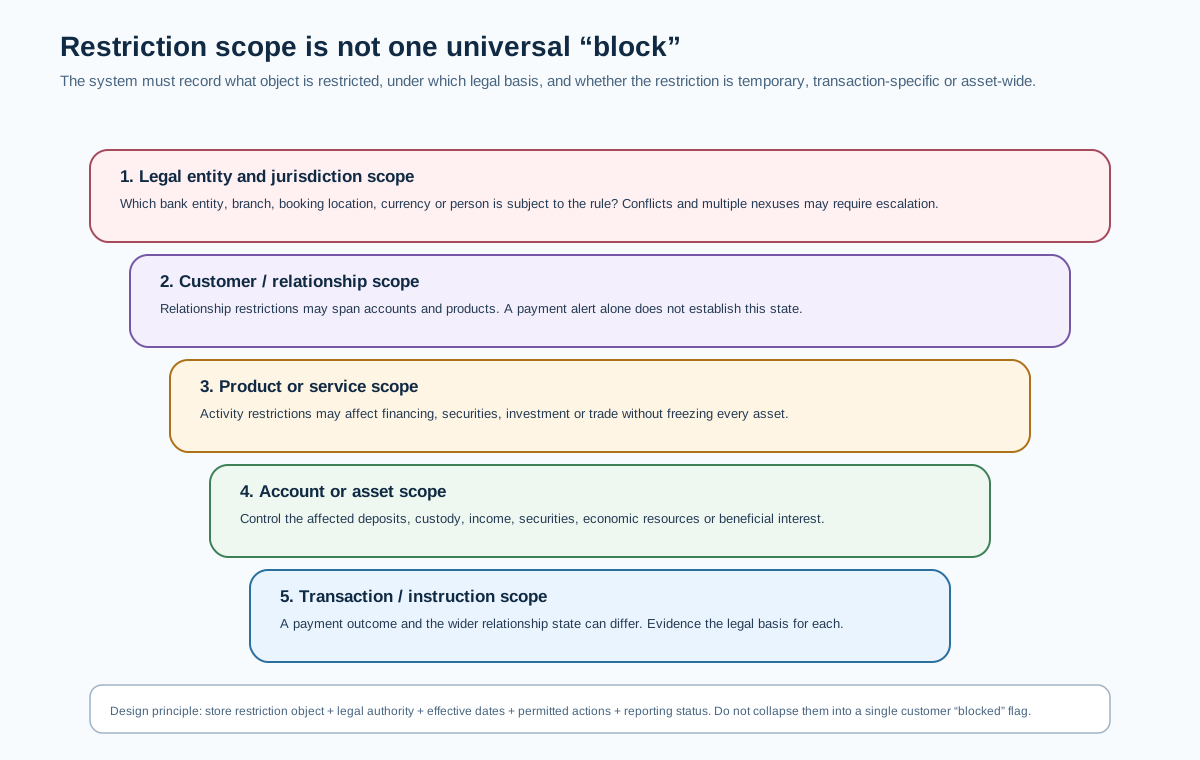
Account-level versus transaction-level action
A payment can be restricted while the customer relationship itself remains legally permissible, or a customer can be fully blocked so that all relevant assets require controls.
The system should support different scopes of restriction.
Product restrictions
Sectoral or activity-based sanctions can prohibit specific financing, securities, services or maturities rather than all dealings with a party.
The disposition must therefore reflect the actual prohibition.
Licences and exceptions
A transaction that would otherwise be prohibited may be permitted by a general licence, specific licence, statutory exception or humanitarian authorisation depending on the regime.
The bank should capture the authority, conditions, validity period, permitted parties and evidence that the transaction falls within the permission.
Licence conditions
Licences can contain reporting, recordkeeping, value, date or activity conditions. A bank should not reduce a licence to a yes/no flag.
The operational process should test the relevant conditions before release.
Expiry and revocation
Licences can expire, be amended or revoked. A permitted activity today may not remain permitted tomorrow.
Systems should support effective dates and revalidation.
Reporting obligations
Sanctions authorities can require reports on blocked property, rejected transactions, suspected breaches or other events. Reporting requirements differ significantly across jurisdictions.
The bank should maintain a reporting matrix by legal entity and regime.
OFAC context
In the United States, OFAC administers multiple sanctions programmes and distinguishes blocked property from other prohibited transactions. Banks should use current OFAC regulations, guidance and reporting requirements for the relevant programme.
The presence of an SDN or entity blocked under the 50 Percent Rule can create blocking obligations, while other non-SDN restrictions can require different treatment.
UK context
UK financial sanctions are implemented through regulations under the Sanctions and Anti-Money Laundering Act 2018 and administered in part by OFSI. The UK Sanctions List is now the current source for UK designations, and OFSI guidance explains asset freezes, ownership/control, reporting and licensing.
A bank should not apply OFAC terminology as though it were UK law.
EU context
EU restrictive measures are implemented through EU regulations and can impose asset freezes, prohibitions on making funds available, sectoral restrictions and other measures.
Legal interpretation should follow the applicable EU regulation and national competent-authority framework.
Multi-jurisdiction conflict
A global payment can touch several jurisdictions and bank entities. One regime can prohibit activity that another permits.
The operating model should identify which legal entities, currencies, persons and locations create jurisdictional nexus and route conflicts to legal/compliance escalation.
Customer notification
Customers may ask why funds are unavailable. Communication should be legally reviewed and consistent with policy.
The bank should distinguish sanctions confidentiality from AML tipping-off rules; they are not identical concepts.
Accounting treatment
Blocked or frozen assets may require specific ledger treatment, segregation or reporting. A temporary investigation hold should not be accounted for as though a legal freeze has been imposed.
Finance and operations should understand the distinction.
Interest, dividends and income
Frozen assets can continue to generate interest, dividends or other income. The legal treatment of that income depends on the regime.
A bank should ensure corporate actions do not accidentally make restricted value available.
Securities and corporate actions
Coupon payments, redemptions, rights issues, dividends, mergers and other corporate actions can create sanctions questions even when no payment-screening alert appears in the ordinary payments system.
Custody and asset-servicing teams therefore need sanctions controls too.
Joint accounts
A designated person can hold assets jointly with another person. The legal effect can differ by jurisdiction and structure.
Analysts should follow applicable ownership and asset-freeze rules rather than release a proportion automatically.
Omnibus and pooled accounts
Omnibus structures can contain assets for many underlying clients. A sanctions restriction affecting one beneficial owner creates operational challenges in identifying and immobilising the relevant interest.
Good books and records are essential.
Correspondent banking
An intermediary bank may block or reject a payment even when the originating bank saw no issue. The return or investigation message should preserve the reason and transaction linkage where legally permissible.
Correspondent agreements should not override sanctions law.
Payment repair
A payment held for sanctions review should not be “repaired” merely to make the alert disappear. Changes to names or fields require legitimate operational rationale and audit evidence.
Any material repair should trigger appropriate re-screening.
Release after false positive
When an alert is cleared, the release action should be linked to the analyst decision. The system should record who released the item, when, and on what evidence.
A payment should not be manually released outside the sanctions case workflow without controlled exception handling.
Blocking after settlement
Sometimes a sanctions issue is discovered after a payment has settled. The bank should follow the applicable legal and incident-management process, including reporting and remediation where required.
Post-event detection does not automatically mean the same action as a pre-settlement match.
Breach management
A sanctions breach can require immediate containment, legal assessment, regulator notification, root-cause analysis and remediation.
The bank should preserve evidence of when the issue was known and what actions were taken.
Voluntary self-disclosure
Some authorities consider voluntary disclosure in enforcement. Whether and how to disclose is a legal/compliance decision.
Operations should ensure incident facts are accurate before senior decision-making.
Recordkeeping
Sanctions decisions can be reviewed years later. Records should preserve list data, legal analysis, licences, transaction details, ownership evidence, communications and reports according to applicable retention requirements.
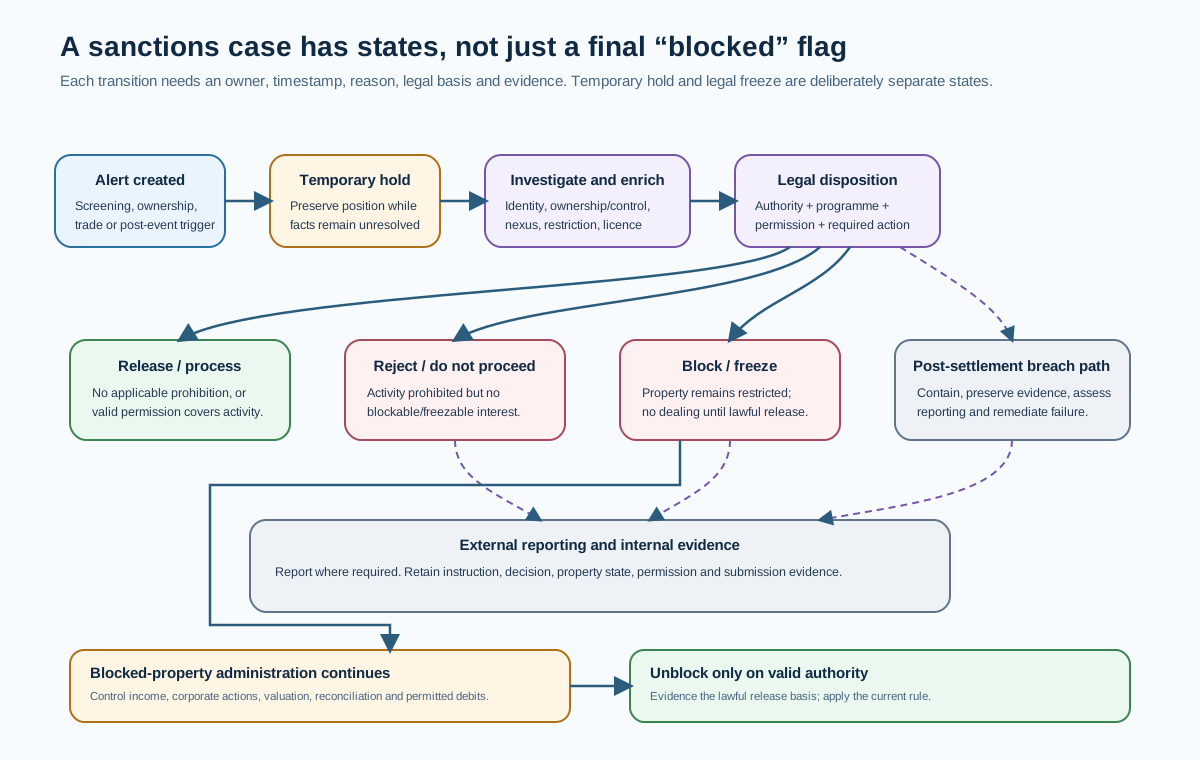
Case state model
A mature system can represent states such as alert created, held, investigating, escalated, false positive, release approved, legal block/freeze, reject, return, reported and closed.
Each transition should have owner and timestamp.
Scenario: SDN payment
A payment beneficiary is confirmed as an SDN. The sanctions team determines the applicable OFAC rule and whether the bank has possession of blocked property. The bank follows the legally required disposition and reporting process rather than simply labelling the payment “rejected.”
Scenario: UK owned entity
A UK bank identifies that an unlisted entity is owned or controlled by a designated person under the UK regulations. The bank assesses the asset-freeze implications and reporting requirements using the current UK legal framework.
Scenario: sectoral restriction
A customer is not fully blocked but is subject to restrictions on certain debt or equity transactions. The bank must evaluate the specific instrument and activity instead of freezing all customer funds automatically.
Scenario: licence
A payment would otherwise be prohibited but falls within an applicable general licence, subject to conditions. The bank verifies the conditions, records the authority and processes according to the licence.
Scenario: false-positive release
A payment was held because the beneficiary name matched a listed person. Investigation proves the beneficiary is different. The analyst clears the alert and the payment is released with a complete audit trail.
Scenario: blocked asset income
A frozen securities position generates a dividend. Asset-servicing controls identify that the income must also be handled according to the applicable sanctions regime rather than credited freely to the customer.
Scenario: return risk
A correspondent rejects a payment and sends it back. Before crediting or forwarding the returned funds, the bank reassesses whether the return path itself involves a restricted party.
Business analyst view
A BA should model legal basis, restriction type, affected party, asset, transaction, hold, disposition, licence, report and case separately. The system should not store every action as a generic “block.”
Acceptance criteria should include partial asset restriction, licence expiry, joint ownership, corporate actions, failed reporting, post-settlement detection, return flow and legal-entity conflict.
Developer view
Developers should ensure state transitions are controlled and idempotent. A payment should not be released twice or both rejected and blocked because two asynchronous services update the same case.
Audit events should be immutable enough to reconstruct decision history.
Tester view
Testers should cover every legal disposition path and ensure terminology displayed to users matches the underlying state.
Negative tests should verify that temporary holds do not generate blocked-property reports and that true blocks cannot be released without authorised override.
Operational resilience
Sanctions disposition is a critical control. If the case system or reporting interface fails, the bank needs contingency procedures that preserve legal restrictions.
Business continuity should prioritise high-risk pending items.
Metrics
Useful metrics include hold ageing, false-positive release time, blocked or frozen value, rejected transactions, reports filed, licence usage, post-event breaches, manual overrides and disposition errors.
A low blocked-value metric is not necessarily good or bad without context.
Common mistakes
Common mistakes include using “block” for every stopped payment, automatically returning prohibited funds, treating a temporary hold as a legal freeze, ignoring licences, applying OFAC terminology globally, failing to control corporate actions and allowing payment repair to bypass re-screening.
Learning checkpoint
A reader should be able to distinguish hold, release, reject, return, block and freeze; explain why legal basis determines disposition; describe licensing and reporting; and design an auditable sanctions case lifecycle across payments, accounts and assets.
Reference links
- OFAC — Sanctions Programs and Country Information: https://ofac.treasury.gov/sanctions-programs-and-country-information
- OFAC — Sanctions List Service: https://ofac.treasury.gov/sanctions-list-service
- OFSI — UK financial sanctions general guidance: https://www.gov.uk/government/publications/financial-sanctions-general-guidance
- UK Government — UK sanctions collection: https://www.gov.uk/government/collections/uk-sanctions
- European Commission — EU sanctions overview: https://finance.ec.europa.eu/eu-and-world/sanctions-restrictive-measures_en
Educational note: the legal meaning of blocking, freezing, rejecting, reporting and licensing is regime-specific. Always apply current legislation, competent-authority guidance and the bank's legal-entity obligations.
Operational deep dive: converting sanctions law into controlled bank actions
Disposition is where legal interpretation becomes system state. A bank can have excellent screening and still fail if the payment hub, core ledger, custody platform or reporting process does not apply the required action correctly.
Legal-to-system mapping
For each regime and product, map legal concepts to operational states. Define what “hold,” “block,” “freeze,” “reject,” “return,” “restrict” and “report” mean in the actual systems. Prevent the same code from carrying several legal meanings.
Asset inventory
Identify which products can hold funds or economic resources: current accounts, deposits, securities, custody, cards, loans, wallets and other assets. Sanctions control should not stop at payments.
Restriction scope
Record whether the restriction applies to the customer, a particular account, a specific asset, one payment or one activity. This prevents over-blocking and under-blocking.
Licence object
Model licences as structured records with authority, legal basis, reference, permitted parties, activity, limits, conditions, effective date, expiry and evidence. A PDF attached to a case is not enough for automated control.
Corporate actions
Test dividends, coupons, redemptions, maturities and rights issues involving frozen assets. Asset servicing can create value movements outside ordinary payment screening.
Accounting reconciliation
Reconcile sanctions case state with ledger status. If a case says “frozen” while the ledger is freely available, the control has failed. If a temporary hold is recorded as frozen property, external reports can be wrong.
Reporting workflow
External reports should link directly to the underlying case, party, asset and legal basis. Store filing time, authority, acknowledgement and amendments.
Post-settlement incident
For a transaction discovered after settlement, preserve timestamps and determine containment, reporting and remediation. Do not rewrite the historical record to make it look as though the payment was stopped.
Release controls
Release from a temporary hold should require an authorised decision. Release from a legal freeze can require a licence, delisting or other legal authority. These are different permissions.
Return controls
Before returning funds, assess the recipient and legal effect. A return is still a transfer of value and can itself be prohibited.
Multi-regime conflicts
Where US, UK, EU or other regimes produce different results, escalate under the bank's legal-entity and nexus framework. Do not resolve conflict by applying whichever rule is easiest operationally.
Audit test
Sample blocked, rejected and released items. Verify legal basis, list version, ownership analysis, payment/asset status, reporting and customer communication. Confirm the operational action actually matched the recorded decision.
Practitioner checkpoint
A mature sanctions-disposition control makes legal basis, scope, system action, licensing, reporting and accounting reconciliation visible in one chain of evidence.
Advanced practitioner layer: turning a sanctions decision into the correct operational action
A sanctions programme can fail even when screening and investigation are accurate if the final legal decision is translated into the wrong operational state. A payment that should be blocked can be rejected. Property that should remain frozen can be released. A temporary investigation hold can be reported as blocked property. A permitted transaction can be stopped because operations treats every sanctions match identically.
The control objective is therefore not simply to “stop sanctioned transactions.” It is to map the applicable legal restriction to the exact asset, product, transaction and bank legal entity, execute the correct action, submit any required report and prove that the system outcome matched the legal decision.
Build a legal-to-operational disposition matrix
For every relevant sanctions regime, a bank should maintain controlled guidance that links legal concepts to product actions. Useful dimensions include authority, programme, bank legal entity, restriction type, affected person or property, product, whether the bank holds property, applicable licence or exemption, required operational state, reporting requirement and decision authority.
The matrix should not be one universal table saying match = block. Full asset-freeze programmes, sectoral measures, service prohibitions, investment restrictions and country/activity rules can require different outcomes.
The legal interpretation remains owned by sanctions/legal specialists. The matrix makes that interpretation executable by operations and technology.
A temporary hold is not a legal conclusion
During investigation, a bank may need to prevent a payment from settling or an account action from completing. The temporary hold exists because the bank does not yet know the final legal outcome.
The hold should have a reason code, owner, start time, SLA, escalation path and permitted transitions. It should not trigger blocked-property accounting or regulatory reporting unless and until the applicable legal conclusion requires those actions.
This distinction is especially important in systems that use technical status names such as BLOCKED. A technical payment status can mean “stopped from processing,” while a compliance system uses “blocked” to mean legally immobilised property. Interface mappings should avoid ambiguous terminology.
OFAC blocking and rejecting are different actions
OFAC guidance distinguishes situations where property must be blocked from situations where a transaction is prohibited but there is no blockable interest, so the activity should be rejected or not proceed. OFAC also identifies transactions that may proceed because no relevant nexus exists or because an exemption, general licence or specific licence authorises the activity.
This is operationally significant. If blocked property comes into a U.S. person's possession or control, simply returning it to the sender can be wrong because the return is another dealing in blocked property. Conversely, treating every prohibited activity as blocked property can create incorrect accounting and reporting.
The case workflow should therefore capture both the legal basis and whether the bank has possession or control of property in which a blocked person has an interest.
OFAC reporting timing must be coded precisely
OFAC states that reports of blocked property and rejected transactions under 31 C.F.R. §§ 501.603 and 501.604 are due within 10 business days of the action. That deadline is a specific U.S. rule, not a universal sanctions-reporting standard.
The system should calculate the correct due date using the event date and applicable business-day logic, identify the required report type and preserve the submission acknowledgement. Manual spreadsheet reminders create unnecessary operational risk.
The report should also remain linked to the underlying payment, asset, party, list record and decision. A compliance report that cannot be reconciled to the actual blocked/rejected event is difficult to defend.
Annual blocked-property reporting is a different obligation
In the United States, OFAC also requires annual reporting of blocked property under its rules and current instructions. That is separate from the event-driven block report. A bank should not assume that filing the initial report completes all future obligations for the property.
Blocked-asset inventory should therefore support periodic or annual regulatory reporting, valuation where required, changes in asset form, interest or income, unblocking events and reconciliation to the general ledger or custody platform.
The control owner should be able to answer how many blocked assets exist, where they are held, which legal authority applies and whether the regulatory inventory agrees with books and records.
Frozen property needs a durable asset record
A sanctions case may begin with a payment, but blocked or frozen property can remain on the bank's books for years. The case alert alone is not a sufficient asset-management record.
A durable blocked-asset object can include legal owner, beneficial interest, account or custody location, asset type, amount or quantity, currency, valuation basis, programme, designation, effective date, reporting references, licence status, interest/income treatment and release authority.
Changes should be effective-dated. If securities convert into cash through a corporate action, the bank must preserve the relationship between the original blocked asset and the new form of property.
Interest-bearing requirements and accounting design
OFAC guidance for blocked funds includes requirements relating to interest-bearing accounts and commercially reasonable interest in relevant circumstances. Product and finance teams should therefore understand that a blocked cash balance may need more than a status flag.
Accounting architecture should distinguish customer available balance, blocked balance, investigation hold and other restrictions. Interest accrual, fees and statement presentation need policy and legal analysis.
A generic account frozen = yes field can be insufficient if the bank must identify which portion of an account is affected and how subsequent credits or earnings are treated.
Incoming credits after an asset freeze
A designated customer's account may receive new funds after the freeze becomes effective. The bank should know whether those funds also become subject to the applicable restriction and how they are booked and reported.
The workflow should not depend on a human noticing each incoming credit. Account-level restriction rules, payment screening and blocked-asset accounting should work together so that new value is treated consistently with the legal framework.
The same principle applies to dividends, coupons, refunds or other amounts generated by blocked property.
Corporate actions create sanctions events
Securities and custody products can generate value without an ordinary payment instruction: dividends, coupons, redemptions, stock splits, rights, mergers, tender offers or distributions. If the underlying asset or owner is restricted, asset-servicing processes must know how to treat the event.
This is why sanctions coverage cannot stop at the payment hub. Custody, brokerage, investment and securities operations need product-specific controls and access to sanctions restrictions.
Testing should include a blocked security paying a dividend, a redemption producing cash, and a corporate action changing the identifier or form of a blocked holding.
Joint and pooled structures require careful scoping
Joint accounts, omnibus custody, pooled vehicles and client-money structures can contain interests belonging to several parties. A sanctions restriction affecting one person can create difficult questions about the portion or interest subject to restriction.
The bank should not invent a proportional release rule. Applicable law and specialist interpretation determine how the property must be treated. Operational systems must be capable of restricting an identified interest without corrupting records for unaffected clients where the legal/product structure permits.
Good books and records become a sanctions control dependency.
Rejecting is not returning
A bank may decide not to process a prohibited transaction. That does not automatically mean that funds already received can be sent back through the same route. A return is a new movement of value and can involve current sanctions facts, intermediaries or a blocked party.
Before returning, the bank should assess whether it has possession/control of blocked property, whether the return is legally authorised and whether current screening identifies new issues. Payment-system design should not treat reject and return as synonyms.
This is particularly important in correspondent banking where a downstream bank may reject an instruction and funds move through several institutions before reaching the originator.
Post-settlement discovery requires incident logic
A sanctions concern may be discovered after settlement because of a delayed list update, data defect, ownership information, correspondent message or later investigation. The bank cannot simply rerun the original pre-settlement action.
The case should identify when the relevant legal fact became effective, what the bank knew at each time, whether the transaction should have been controlled, whether assets remain within reach, and which reporting or remediation obligations apply.
Incident management should preserve chronology. “Payment to sanctioned party” is not enough; a regulator may need to understand whether the designation occurred before or after settlement and when the bank received or loaded the information.
Licence handling belongs in the disposition workflow
A general or specific licence can authorise activity that would otherwise be prohibited. The licence should not be an attachment used to manually override the case.
Structured fields can include authority, licence type, reference, covered parties, activities, dates, value limits, conditions and reporting duties. The transaction should be evaluated against those conditions before release.
If a licence expires, is amended or reaches a value limit, future transactions should not continue under an old approval. A controlled licence repository can generate expiry events and support audit.
Exceptions and exemptions need legal provenance
Not every permission is called a licence. Some regimes contain statutory exceptions or exemptions. The case should identify the exact legal basis rather than use a generic licensed = yes flag.
This matters because the documentation, conditions and reporting expectations can differ. It also helps distinguish a legal permission from a bank risk-appetite exception, which is a completely different concept.
Customer communication should match the known state
During a temporary review, saying “your funds are frozen by law” can be inaccurate. After a legal freeze, saying “technical delay” can also be misleading. Communications should reflect the actual state while respecting legal, security and confidentiality constraints.
Sanctions communication also should not be confused automatically with AML tipping-off restrictions. The relevant legal framework and bank policy determine what may be disclosed.
Front-line teams need approved wording and escalation routes so they do not improvise legal explanations.
Reporting architecture should support multiple authorities
A global bank can have OFAC, OFSI, EU/national competent authority and other jurisdiction-specific reporting obligations. One generic regulatory report object is often too weak.
Useful fields include authority, jurisdiction, legal entity, report type, trigger, event date, due date, submission date, acknowledgement/reference, attachment/evidence and confidentiality classification.
The reporting engine should derive obligations from the legal decision, not infer them from a technical payment status. A payment held for review should not automatically create a blocked-property report.
Case-to-payment-to-ledger reconciliation
A powerful sanctions control reconciles three domains: the compliance decision, the transaction outcome and the accounting/asset state. If the case says legal block but the payment settled, there is a critical incident. If the payment is technically stopped but no blocked asset exists, the accounting system should not report frozen property.
Reconciliation can check high-impact cases daily or near real time. Exceptions should route to a team with authority to contain and investigate.
This control also identifies asynchronous-system failures where one platform updates and another does not.
Idempotency and conflicting system messages
Sanctions cases frequently interact with payment hubs, account platforms, screening services and regulatory reporting. Duplicate messages or retries can cause dangerous actions if state transitions are not idempotent.
A release command should not release an item twice. A late technical retry should not overwrite a legal freeze. Competing services should not produce both reject and block outcomes without controlled resolution.
Developers should model legal states explicitly and use immutable audit events or equivalent controls so the sequence can be reconstructed.
Manual override is a high-risk control
There may be rare circumstances where authorised specialists need to correct or override a system state. Overrides should record the previous state, new state, user, authority, reason, evidence and approval.
An operations user should not be able to change a sanctions disposition merely to clear a queue. High-impact overrides should be included in QA and management reporting.
Emergency operational procedures should preserve the same principles even if normal tooling is unavailable.
Resilience and outage behaviour
If case management is unavailable, blocked property must not become available merely because the workflow is down. If the reporting interface fails, deadlines must still be tracked. If the payment hub cannot receive a sanctions decision, the fallback should be predefined.
Business continuity should distinguish preventive controls from post-event processes. For a time-critical payment, queueing or rejecting may be operationally possible while manual review may not be scalable. For a blocked-asset inventory, durable restrictions must survive application restarts and failover.
Contingency testing should include restoration and reconciliation, not only the outage period.
Quality assurance after true sanctions events
Confirmed restrictions are relatively rare in many institutions and should be used as learning events. A post-event review can ask whether screening was timely, evidence was sufficient, legal interpretation was documented, the correct disposition was executed, accounting was correct, reports were on time, customer communication was appropriate and related exposures were identified.
Failures should produce traceable remediation. A bank should not celebrate “true match detected” if the payment was accidentally released or reporting was late.
Practitioner conclusion
The sanctions decision is not complete until the operational reality matches it. World-class control means the bank can trace legal authority to case decision, payment/account/asset state, ledger treatment, regulatory reporting and eventual release or continuing restriction. Precision in words becomes precision in money movement.
Practitioner close: disposition and reporting case labs
The cases below test whether the learner can move from a sanctions finding to the correct operational state without treating every stopped transaction as the same event.
Case lab: payment contains blocked property
A U.S. bank confirms that the beneficiary is an SDN and determines that funds in its possession are property in which the blocked person has an interest. The operating action is not simply “reject the payment.” Under the relevant OFAC framework, the bank must handle the property as blocked, maintain the required books and records, and submit the applicable report within the required timeframe.
The case should identify the official list record, programme, legal basis, transaction amount, date of block, account or ledger location, reporting due date and submission reference. Downstream payment status should reconcile with the blocked-asset record.
Case lab: prohibited activity but no blocked interest
A U.S.-nexus transaction involves a prohibited sector or jurisdictional activity, but no blocked person's property is involved. The correct OFAC outcome can be reject/do not proceed rather than blocking property, depending on the applicable programme.
The case should therefore not create a blocked-asset balance merely because the word “sanctions” appears in the disposition. The rejected-transaction report, if required, should be linked to the original instruction and legal reason.
This case is useful for testing whether systems distinguish rejected transaction from blocked property.
Case lab: payment held while identity is unresolved
A beneficiary produces a strong name candidate but the analyst lacks sufficient identifiers. The payment is placed on temporary hold while an RFI is sent.
At this stage there is no legal blocked-property conclusion. The case should not file a blocked-property report or move the funds into a blocked ledger solely because the investigation has not finished.
If the candidate is later cleared, the release should reference the analyst decision. If identity is confirmed and the applicable regime requires a freeze/block, the state should transition formally and trigger the required downstream controls.
Case lab: valid licence with conditions
A transaction would otherwise be prohibited, but the customer relies on a valid authorisation. The permission covers the parties and activity but imposes a value ceiling and requires periodic reporting.
The bank should validate remaining value, effective dates and conditions before release. The case should record the specific permission and any resulting reporting task. Future transactions should consume or reference the same controlled licence record rather than depend on an analyst remembering prior approval.
A test should confirm that a payment exceeding the remaining limit does not inherit the earlier release automatically.
Case lab: licence expires between initiation and execution
A future-dated transaction is initiated while a licence is valid, but the permission expires before execution. Whether the transaction remains permitted depends on the licence terms and applicable law.
The system should not assume that approval at initiation remains valid forever. Effective-date controls should identify the relevant transaction date and route uncertainty to specialist review.
This scenario demonstrates why licences should be structured data with dates rather than static PDF attachments.
Case lab: correspondent returns a payment
A downstream correspondent stops a transaction for sanctions reasons and sends funds back. The originating bank should not assume the return is automatically safe. Current parties, routing and sanctions facts must be assessed, and the bank must determine whether it is now holding blocked property or whether the return can be credited.
The original UETR or other rail identifier should link the outbound payment, correspondent message and returned funds so investigators can reconstruct the sequence.
Case lab: designation after settlement
A payment settles at 09:00. The beneficiary is designated at 13:00 with no retroactive legal effect. A later review finds the historical transaction.
The bank should distinguish a payment made before designation from a prohibited transaction after designation. A retrospective screening hit is not proof of a historical breach.
The case record should show designation effective time, payment execution/settlement time and legal analysis. Time logic prevents false breach reporting.
Case lab: designation was effective but bank list load was late
A designation becomes effective before a payment settles, but an internal list-feed failure means the screening engine does not receive the update until later. The payment processes.
This is a potential control incident. The bank needs legal assessment, containment, exposure identification, reporting where required and root-cause remediation. The incident should record official publication/effective time, bank ingestion time, screening event, settlement time and discovery.
The correct response is more than reopening the payment alert; list-governance failure can affect an entire screened population.
Case lab: frozen securities generate income
A custody account contains securities subject to an applicable asset freeze. A dividend is paid. Operations must understand whether the income is also restricted and how it should be booked under the relevant regime.
The asset-servicing platform should prevent an automatic credit into an unrestricted available balance if that would breach the freeze. The case and ledger should retain the link between the restricted holding and the income event.
Case lab: corporate action changes the asset
A frozen bond is redeemed into cash. The security identifier disappears from the position, but the economic value remains. A sanctions control that watches only the original security can lose the restriction.
The corporate-action process should transfer the restriction to the resulting cash or other asset according to the applicable law and preserve the lineage. This is an important UAT scenario for custody and investment platforms.
Case lab: joint account with designated person
A designated person is one holder of a joint account. The bank should not invent a simplistic rule that only a fixed percentage is frozen or that the non-designated holder may freely withdraw the rest.
Specialist legal analysis must determine the effect under the applicable regime and account structure. The system needs the flexibility to restrict the relevant property without destroying ownership records.
Case lab: customer requests explanation
A customer asks why a payment is unavailable while the sanctions review is unresolved. Front-line staff should use approved wording that accurately reflects a compliance review without stating that the customer or beneficiary is legally sanctioned before that conclusion exists.
If a legal freeze is later confirmed, communications may change according to law and policy. The customer-service script should therefore depend on case state rather than a generic sanctions flag.
Case lab: regulatory reporting interface fails
The bank blocks property and the reporting deadline is approaching, but the normal regulatory reporting interface is unavailable. Business continuity should preserve the legal deadline through an approved alternate route and record the incident.
The control is not complete merely because the transaction is safely frozen. Timely reporting and acknowledgement are separate obligations.
Case lab: duplicate asynchronous commands
A sanctions case sends a block command to the payment/account platform. A technical retry arrives after an authorised correction has moved the case to another state. If messages are not versioned or idempotent, the late command can reinstate an incorrect restriction or create duplicate ledger entries.
State-changing interfaces should carry unique event IDs, case/version context and controlled conflict handling. Legal states should not be determined by whichever message arrives last.
Case lab: manual release outside workflow
An operations user can release a held payment directly in the payment hub without resolving the sanctions case. Even if this ability is intended for technical exceptions, it creates a serious bypass risk.
The design should either prevent such release while a sanctions restriction is active or require an authorised override linked to the case. Monitoring should identify any mismatches between case status and payment outcome.
UAT disposition matrix
Testing should include at least: temporary hold followed by release; temporary hold followed by legal block; prohibited transaction rejected without blocked property; blocked-property accounting; valid and invalid permissions; licence expiry; incoming credits to a restricted account; blocked-asset income; corporate action; return flow; post-settlement discovery; reporting failure; manual override; and conflicting asynchronous updates.
For every scenario, testers should verify four things: the compliance decision, the payment/account/asset state, the accounting state and the regulatory reporting state. Passing only the case workflow is not enough.
Final practitioner test
A learner has mastered this chapter when they can explain why hold, block/freeze, reject, return and decline are different; identify when the bank is actually holding restricted property; recognise that reporting rules are jurisdiction-specific; explain why licences require condition checking; and prove that the legal decision controlled the actual movement and accounting of value.
Practitioner masterclass: sanctions disposition and reporting
The professional challenge is translating legal analysis into the exact operational action. Every case should answer four questions: what legal rule applies, what property or activity is affected, what system action is required and what evidence/reporting must follow.
Exercise 1 — hold versus freeze
A payment is paused for investigation. Explain why the ledger and case system must show a temporary hold rather than a legal freeze until the legal determination is made.
Exercise 2 — reject versus block
Compare a transaction prohibited from processing with property that must be blocked or frozen. Define the operational differences in payment status, ledger state and reporting.
Exercise 3 — licence
A general or specific licence authorises activity subject to conditions. Build a checklist for scope, parties, value, dates, conditions, reporting and expiry.
Exercise 4 — corporate action
A frozen securities position receives a dividend. Determine how the income should be controlled and why ordinary payment screening may not be enough.
Exercise 5 — returned payment
A correspondent sends a rejected payment back. Assess the return leg before releasing funds and preserve the original reason and transaction linkage.
Exercise 6 — post-settlement breach
A sanctions concern is discovered after settlement. Build the incident timeline, containment, legal assessment, external reporting and remediation evidence without rewriting the historical payment record.
BA acceptance criteria
Test account-level and transaction-level restriction, licence expiry, joint ownership, return flow, manual override, corporate actions, reporting failure and release from freeze under legal authority.
Final test
The learner should be able to distinguish every sanctions disposition state, connect it to legal basis and prove that the actual payment or asset state matches the recorded decision.
60-minute mastery extension: blocking, rejecting, freezing and reporting
This extension is designed to make the chapter a minimum 60-minute guided learning experience. Spend around 25 minutes on the core chapter and diagrams, 15 minutes on the disposition cases, 10 minutes on licence/reporting design and 10 minutes on the final payment-and-asset-state test.
Operational words must match the legal action
Sanctions operations often use words such as hold, reject, return, block and freeze. These terms are not interchangeable. A hold is usually a temporary operational state while the bank investigates. A reject means an instruction is not processed under the applicable rule. A return sends value back through an appropriate payment process. Blocking or freezing generally restricts dealing with property or funds under the applicable sanctions law. Exact terminology and legal mechanics differ by regime.
The bank should therefore record both the operational payment state and the legal basis. A system status of BLOCKED without explaining whether it means a temporary queue hold, an OFAC blocking action or another legal restriction is dangerous.
Worked case: payment held, then released
A cross-border payment triggers a potential sanctions match. Operations place the payment on a temporary hold while analysts compare identifiers. The candidate is resolved as a false positive and the payment is released.
The payment was never legally frozen. The audit trail should show hold start/end, candidate, evidence used, analyst decision and release. Customer communication should not describe the funds as frozen if no legal freeze occurred.
Worked case: reject versus freeze
A payment involves a prohibited transaction under an applicable programme, but the facts and regime require the bank to reject rather than take possession of blocked property. In another case, the bank holds funds in which a blocked person has an interest and the applicable law requires the property to be blocked/frozen.
These outcomes differ operationally. Rejection can return or refuse the transaction subject to the legal framework. A freeze/block generally requires the institution to prevent dealing with the property and maintain it under restriction until authorised release. Reporting and ledger treatment also differ.
The system should not let analysts choose among these dispositions based only on preference; the action must follow the applicable legal rule and specialist decision.
Account, payment and asset scope
A sanctions decision can apply to a specific payment, an account, a securities position, a customer's property or a service. The scope should be explicit. Restricting one outbound payment does not automatically mean every customer account is legally frozen, and freezing property does not necessarily mean every permitted service must cease if law/licence allows otherwise.
Systems should record the object under restriction and link it to the legal decision.
Licences, exceptions and permissions
A general or specific licence can authorise activity that would otherwise be restricted, but only within its scope and conditions. Capture issuing authority, licence identifier, relevant parties, permitted activity, currencies or values if applicable, validity dates, conditions, reporting requirements and evidence of review.
Licence expiry should be an active control event. A payment-processing system should not continue using an authorisation after expiry simply because a static whitelist remains enabled.
Frozen assets and income
Frozen securities or accounts can generate interest, dividends or corporate-action proceeds. Those subsequent values can themselves become restricted property under the relevant regime. A sanctions operating model therefore needs asset-level and lifecycle controls, not just payment screening.
Corporate actions, maturities, redemptions, fees and income should be assessed under the applicable rules and licences. Ordinary straight-through processing can create risk if restricted asset states are not propagated to downstream systems.
Return and reversal case
A payment is rejected by a correspondent and returns to the originating bank. The return should remain linked to the original transaction and reason. If sanctions restrictions affect the funds or parties, the bank must assess the return leg rather than assume "return to sender" is automatically permitted.
This is also important for investigations: original instruction, rejection message, return message, booking entries and final account state should be reconstructible.
Post-settlement discovery
Sometimes a sanctions issue is identified after a payment has settled—for example because a designation was applied, data was missing or screening failed. The bank should preserve the historical transaction exactly as it occurred, establish a timeline, contain any remaining exposure, obtain legal/sanctions assessment, determine external reporting or self-disclosure obligations where applicable, and remediate the control failure.
Do not rewrite the old record to make it appear the payment was blocked. Auditability requires the bank to show the failure and response truthfully.
Reporting
Sanctions reporting obligations differ by authority, programme, entity and event. Reporting can relate to blocked/frozen property, rejected transactions, breaches, licence use or other required information. Deadlines and forms are jurisdiction-specific.
A global platform should therefore store reporting jurisdiction, authority, report type, trigger date, due date, submission reference, submitted date and evidence. Hard-coding one universal deadline is inaccurate.
Disposition-matrix exercise
Create rows for: false-positive candidate; unresolved potential match; confirmed identity but no applicable legal restriction; transaction prohibited and reject required; property must be frozen/blocked; licence authorises release; payment already settled; returned payment; restricted securities income. For each, define payment/asset state, decision owner, customer communication, reporting requirement and audit evidence.
The matrix should make clear that identity, legal applicability, operational action and external reporting are four separate but linked stages.
BA acceptance criteria
Test payment-level hold, account-level restriction, asset freeze, partial release under licence, licence expiry, joint ownership, return flow, reversal, corporate action, interest credit, manual override, screening outage, post-settlement discovery and legal release from freeze. Confirm that every state change records who, when, why and legal basis.
Final payment-and-asset-state test
Explain the difference between: hold and freeze; reject and return; freeze and account closure; confirmed sanctions identity and blocked property; licence and whitelist; historical settled payment and current restricted asset; sanctions report and SAR/STR.
A strong learner should finish able to translate sanctions legal analysis into the exact operational state of the payment or asset, preserve evidence and report to the correct authority without using ambiguous terminology.
Interest, income and corporate actions on blocked property
Blocked accounts continue accruing interest and blocked securities continue generating dividends, coupons and corporate-action entitlements, each requiring treatment consistent with the freeze: income credits to blocked accounts remain blocked, with systems configured to prevent interest payments from creating releasable balances through rounding, threshold or sweep logic errors. Corporate actions on blocked securities, dividends, splits, rights issues, mergers and restructurings, must be processed into blocked holdings without creating transferable value: election decisions made to preserve value rather than realise it, entitlements credited to blocked positions, and subscription rights exercised only where authorised and funded from blocked sources within licence permissions.
The operational complexity concentrates in automated corporate-action and income-processing systems designed for fungible holdings: blocking flags must propagate through event processing, income allocation, tax withholding and corporate-action election workflows without manual intervention per event, since volume makes case-by-case handling unreliable. Tax treatment of blocked income follows the jurisdiction's rules with blocked-tax-payment mechanics where the framework requires tax settlement from blocked funds under licence; the tax function needs sanctions-awareness sufficient to route these cases correctly rather than processing refunds or payments that breach the freeze. Recordkeeping must show the blocked-property ledger continuously reconciled with custody and accounting systems, since drift between blocked records and actual holdings indicates the freeze is failing silently.
Omnibus and pooled-account segregation mechanics
Blocking within omnibus and pooled structures, where designated and non-designated interests commingle in shared accounts, requires segregation mechanics that protect the freeze without unlawfully restricting innocent parties. The design distinguishes legal segregation, identifying and separately recording the blocked interest within the pool, from operational segregation, restricting the corresponding value from movement while permitting legitimate activity in the remainder. Where precise attribution is possible through sub-accounting or transaction tracing, the blocked interest is quantified and ring-fenced with the methodology documented. Where attribution is uncertain, conservative treatment protects the freeze while urgent legal analysis resolves the quantification, since under-blocking creates breach exposure while over-blocking creates customer-harm and legal-challenge exposure that must also be managed.
Participant communication in omnibus structures requires careful calibration: non-designated participants need assurance about their unaffected interests without disclosure of the designated party's position beyond legal requirements, and the designated party receives only legally approved communication. Fund administrators, custodians and brokers in the chain each need instruction reflecting their role, with the blocking bank verifying downstream implementation rather than assuming instruction equals compliance. Partial-pool blocking should be exercised and tested before live need arises, since first-time segregation under incident pressure produces errors in both directions.
Breach discovery, containment and remediation
Sanctions breaches, transactions executed in violation of applicable restrictions, are discovered through monitoring, audit, customer disclosure, counterparty notification or regulatory inquiry, and the response quality determines the regulatory and reputational consequences as much as the breach itself. Immediate containment stops ongoing exposure: suspending the implicated flows, preserving the transaction state, identifying related pending items, and preventing automated processing from compounding the breach through interest, corporate actions or onward transfers. Evidence preservation runs parallel: complete transaction records, screening history, decision documentation and communications secured under legal hold before routine retention or system processes alter them.
Root-cause analysis distinguishes control-design failure, where no control addressed the breach pattern; control-operation failure, where designed controls did not execute through data, timing or human error; and control-evasion, where deliberate circumvention defeated functioning controls. Each cause drives different remediation: design gaps require new controls with testing and approval, operation failures require data, process or resourcing fixes with verification, and evasion requires investigation of the circumvention method with control-hardening and potential reporting of the evading party. Analysis must resist the comforting conclusion of isolated human error where systemic conditions enabled it: an analyst bypass always implicates the supervision, tooling and workload context that permitted the bypass.
Voluntary self-disclosure decisions follow jurisdiction-specific frameworks with legal advice mandatory: OFAC's framework credits disclosure with penalty mitigation, OFSI's enforcement approach weighs cooperation and disclosure, and EU member-state regimes vary in their disclosure incentives. The disclosure record must be complete, accurate and timely, since partial or delayed disclosure damages credibility more than the underlying breach in many enforcement assessments. Remediation tracking with senior ownership and verification evidence closes the incident, and lessons feed control improvement across the programme rather than remaining within the incident team.
Multi-currency and cross-border blocking coordination
Blocking multi-currency exposures and cross-border positions requires coordination across booking locations, currencies and legal entities that incident pressure makes difficult without preparation. Currency dimension: blocking must capture all currency balances and currency-contingent exposures including FX forwards, swaps and options referencing restricted parties, with valuation methodology defined for reporting and reconciliation. Conversion prohibitions must be encoded to prevent blocked-value transformation through FX dealing, including indirect conversion through multi-leg structures. Interest-rate and cross-currency positions need specialist assessment where close-out or continuation decisions carry sanctions implications.
Cross-border dimension: the same customer relationship spans booking centres subject to different sanctions regimes with potentially conflicting blocking obligations, and the group response must satisfy each applicable regime without breaching others. Coordination protocols designate the lead decision forum, information-sharing permissions across entities respecting data-protection and tipping-off constraints, implementation sequencing across time zones, and consolidated reporting to each competent authority in its required form. Pre-agreed protocols with tested communication channels prevent the fragmentation where each centre acts on partial information with inconsistent timing.
Systems must support coordinated blocking through entity-wide restriction propagation: a blocking decision in one booking centre must flow to all relevant systems globally within defined timeframes, with completion verification rather than assumed transmission. Standing data governance ensures designated-party flags apply consistently across customer, account, securities and counterparty masters in every system, since inconsistent masters produce the characteristic failure of blocked funds moving through unflagged channels while the primary relationship shows correct restriction.
Account-versus-transaction action in complex portfolios
Complex customer portfolios combine transactional flows, asset holdings, credit facilities, guarantees, derivatives and service arrangements that respond differently to sanctions events, and disposition must address each element rather than applying a single action label. Transaction flows stop or continue per the applicable restriction with licence assessment per flow type. Asset holdings freeze with income and corporate-action treatment as detailed above. Credit facilities require drawdown-stop analysis distinguishing committed from uncommitted facilities with legal advice on contractual obligations versus sanctions prohibitions. Guarantees and standby instruments need beneficiary, purpose and draw-risk assessment since these contingent exposures crystallise unpredictably. Derivatives require close-out versus continuation analysis under the applicable derivatives and sanctions rules.
Sequencing matters: immediate prevention actions on payments and transfers precede the considered treatment of complex positions, and interim restrictions preserve the position while specialist analysis proceeds. Customer communication must address the portfolio comprehensively rather than per-product fragments that confuse and alarm: a single coordinated communication explaining the overall position with product-specific details, delivered through approved channels with legal review. Relationship-team briefing precedes customer communication so that front-office responses align with the decided position rather than improvising under pressure.
Licence-expiry and revocation contingency
Licences authorising otherwise prohibited activity create time-bounded permissions whose expiry or revocation returns the activity to prohibited status, often with immediate effect and pipeline transactions in flight. Contingency planning treats every licence-reliant position as temporary by design: licence registers with expiry alerting at multiple horizons, pipeline-transaction planning within remaining validity, renewal-application timelines with submission deadlines preceding expiry by the authority's processing margin, and wind-down procedures for non-renewal scenarios. Revocation readiness addresses the harder case of premature termination: immediate activity cessation procedures, in-flight transaction treatment, customer communication prepared in template form, and exposure quantification available on demand.
Systems must encode licence time-boundedness rather than treating licences as permanent attributes: automated expiry alerting, validity-period enforcement in payment and screening systems, and renewal-workflow tracking with escalation for approaching deadlines. Manual licence tracking through spreadsheets and diary reminders fails at scale and under personnel change; the licence register is a control system with data quality, access control and audit trail equivalent to other sanctions infrastructure. Expired-licence transactions are breaches like any other, and the control standard must reflect that equivalence rather than treating expiry as administrative oversight.
Annual blocked-property reporting and reconciliation discipline
US blocking practice includes the Annual Report of Blocked Property requirement, compelling holders to report blocked positions with prescribed content and timing, and equivalent periodic-reporting obligations exist across frameworks with varying cadence and detail. Compliance requires systematic position inventory rather than incident-driven recollection: complete blocked-property registers maintained continuously with valuation methodology defined for illiquid and volatile holdings, reconciliation between sanctions records, custody positions and general-ledger balances on a defined cycle with break investigation, and reporting-preparation workflows beginning well before deadlines with review and approval commensurate with filing significance. Late, incomplete or inaccurate blocked-property reporting compounds the original restriction management with reporting-violation exposure, and the control standard must reflect that filings attest to the integrity of the entire blocking operation.
Reconciliation discipline extends beyond periodic reporting to continuous position integrity: daily or intraday blocked-balance verification for active portfolios, corporate-action and income-allocation completeness checks proving no blocked value leaks through automated processing, and system-migration reconciliation proving blocked positions transfer intact across platform changes. Break-resolution procedures distinguish timing differences resolving naturally from genuine discrepancies requiring investigation, with ageing thresholds escalating unresolved breaks to senior attention. Independent verification through internal-audit or second-line testing of blocked-position completeness, sampling the customer and securities masters for unflagged designated interests, provides the assurance that self-reported reconciliation cannot.
Securities entitlements and intermediated holdings
Blocked securities held through intermediated chains, global custodians, central securities depositories and nominee structures, require entitlement-preservation mechanics that maintain the blocked interest through layers the bank does not directly control. Instruction propagation ensures blocking directions flow downstream to sub-custodians and intermediaries with acknowledgement tracking rather than assumed compliance: each layer confirms implementation with position evidence, and unconfirmed instructions escalate through defined timeframes. Corporate-action election through chains must preserve blocked status at every layer, with election instructions specifying blocked-account crediting and downstream confirmations evidencing correct treatment.
Voting-rights treatment for blocked securities follows programme-specific rules distinguishing frozen economic interest from suspended governance rights, with proxy-voting systems configured to prevent blocked-position voting except where specifically authorised. Lending and collateral-use prohibitions must propagate through securities-lending programmes and collateral-management systems that routinely mobilise holdings: automated programme-exclusion for blocked positions with pre-trade eligibility checks prevents the characteristic failure of blocked securities lent through programme automation while the custody record shows correct restriction. Income-collection chains need equivalent attention where withholding agents, paying agents and intermediaries handle blocked income before it reaches the bank's blocked account, with each handoff verified rather than assumed.
Rejected-payment re-initiation and circumvention detection
Rejected transactions frequently return as re-initiated payments with altered details testing whether modified presentation evades the restriction: changed remittance narratives removing geographic references, restructured payment chains routing through additional intermediaries, split amounts avoiding threshold-triggered review, substituted parties with ownership links to the original subjects, and re-characterised purposes describing identical underlying activity in permissible language. Re-initiation monitoring joins rejected transactions with subsequent payment activity through party, amount-pattern, corridor, purpose and infrastructure matching, flagging probable circumvention attempts for enhanced review rather than processing resubmissions as novel instructions.
Response to detected circumvention escalates beyond transaction disposition to relationship and reporting action: attempted evasion following rejection demonstrates knowledge and intent that transforms the risk assessment of all connected parties, triggering relationship review, expanded lookback for prior successful evasions using the same methods, and reporting that captures the evasion attempt alongside the underlying restriction. Customer communication in circumvention cases follows legal advice with heightened tipping-off awareness, since alerting evaders to detection methods compromises both the investigation and future detection. System design should link rejection records with screening rules so that known circumvention patterns, stripped narratives, specific intermediary insertions, automatically attract enhanced scrutiny on recurrence.
Funds-transfer recordkeeping as sanctions evidence
Funds-transfer recordkeeping obligations, requiring originator and beneficiary information collection, transmission and retention, provide the data foundation on which payment sanctions screening depends, and recordkeeping failures manifest as screening failures downstream. Collection-point controls verify originator-information completeness at instruction capture with rejection or enhanced due diligence for deficient instructions rather than downstream repair. Transmission integrity preserves information through format conversions, correspondent forwarding and batching with completeness measurement by channel and counterparty. Retention architecture maintains transfer records searchable and linkable through applicable periods with legal-hold extension where investigation requires.
Deficient-transfer handling procedures define the response to incoming transfers lacking required information: request-for-information issuance with defined timeframes, processing restrictions pending receipt, and rejection or enhanced review where information remains outstanding. The procedures must balance straight-through-processing efficiency with the principle that the bank cannot screen what it does not hold: systematic acceptance of information-deficient transfers from particular correspondents indicates relationship-level tolerance requiring escalation rather than transaction-level exceptions repeated indefinitely. Recordkeeping-examination readiness maintains evidence of collection, transmission and retention compliance with metrics demonstrating performance rather than policy assertion.
Blocked virtual assets and digital holdings
Virtual-asset holdings connected to designated persons or sanctioned activity present blocking mechanics that differ fundamentally from account-based freezes: control depends on private-key custody rather than ledger entries, on-chain value moves permissionlessly regardless of the bank's internal restrictions, and valuation volatility complicates reporting and reconciliation. Where the bank custodies virtual assets, blocking implementation must secure private-key control preventing any outward transfer while preserving the assets' existence and value: wallet-level restriction with multi-signature governance ensuring no single actor can move blocked holdings, staking and yield-protocol disconnection preventing automated value transformation, and fork and airdrop policies determining how protocol-level value accrual to blocked addresses is treated.
Where the bank encounters designated-connected virtual-asset activity through customer transactions rather than custody, the response combines transaction disposition with intelligence development: rejecting or blocking fiat legs within the bank's control, blockchain-tracing the virtual-asset movements for investigation and reporting, and engaging virtual-asset service providers holding connected funds through lawful channels for preservation. Address-screening integration with transaction monitoring provides ongoing detection for designated-address interaction, with screening-list virtual-asset identifiers ingested and matched systematically rather than handled as specialist manual checks. Reporting captures both the sanctions dimension and the virtual-asset typology intelligence for FIU and law-enforcement use.
Reporting to multiple authorities without contradiction
Sanctions events frequently trigger reporting obligations to several authorities simultaneously: the sanctions administrator for blocking and breach reports, the FIU for suspicious-activity reporting, law-enforcement for criminal intelligence, prudential supervisors for control-failure notification, and foreign authorities where cross-border activity engages their jurisdiction. Each report serves distinct purposes under different legal frameworks with varying content requirements, deadlines, confidentiality constraints and liability protections, and the reporting strategy must satisfy all without contradiction or unlawful disclosure.
Coordination starts from obligation mapping per event type: which reports are mandatory versus discretionary, their respective triggers, deadlines, recipients, content requirements and confidentiality rules. Narrative consistency across reports must be managed deliberately: the same factual core presented appropriately for each recipient without material contradiction, since inconsistent accounts across authorities destroy credibility and may create separate disclosure issues. Timing sequencing respects the shortest deadline while ensuring accuracy: premature inaccurate filing to meet one deadline undermines all subsequent reporting, while delayed comprehensive filing breaches deadline obligations. Legal review of multi-authority reporting packages before submission prevents the characteristic failures of contradictory narratives, missed recipients and unlawful disclosures, with the review itself documented as evidence of reasonable care.
Testing the disposition machinery end to end
Disposition controls require end-to-end testing that exercises the full chain from alert generation through investigation, decision, system implementation, customer communication and reporting, since component testing of individual systems misses the handoff failures where disposition errors concentrate. Test-scenario design covers each disposition type with realistic cases: true-match blocking with multi-currency positions, rejection with re-initiation attempts, false-positive release with allow-list governance, licence-conditioned processing with condition monitoring, and breach scenarios testing discovery and remediation. Each scenario specifies expected system states at every stage, enabling verification that decisions propagate correctly through payment engines, custody platforms, customer masters and reporting systems rather than stopping at case-closure in the workflow tool.
Regression discipline reruns disposition scenarios after every relevant change: screening-engine updates, payment-platform migrations, custody-system releases, reference-data changes and procedure revisions each trigger defined test execution with results reviewed before production deployment. Production-verification sampling complements pre-deployment testing: live disposition cases sampled for implementation completeness, verifying that decided actions actually executed across all affected systems with timing evidence. The characteristic and catastrophic failure is decided-but-not-implemented disposition, where case records show correct decisions while funds move or restrictions lapse unexecuted, and only end-to-end verification spanning case management and processing systems detects it before incidents do. Verification results should feed management reporting with failed-verification incidents treated as control findings requiring root-cause analysis and tracked remediation, since each represents a disposition the bank believes effective but has not proven so. Failed verifications affecting time-critical dispositions should trigger immediate manual confirmation of the underlying actions, because testing that discovers unexecuted blocks or releases has found live exposure requiring same-day containment.
Authoritative anchors
OFAC: https://ofac.treasury.gov/
UK financial sanctions general guidance: https://www.gov.uk/government/publications/financial-sanctions-general-guidance/uk-financial-sanctions-general-guidance
EU Sanctions: https://finance.ec.europa.eu/eu-and-world/sanctions-restrictive-measures_en
Visual control checkpoint: licences and exceptions
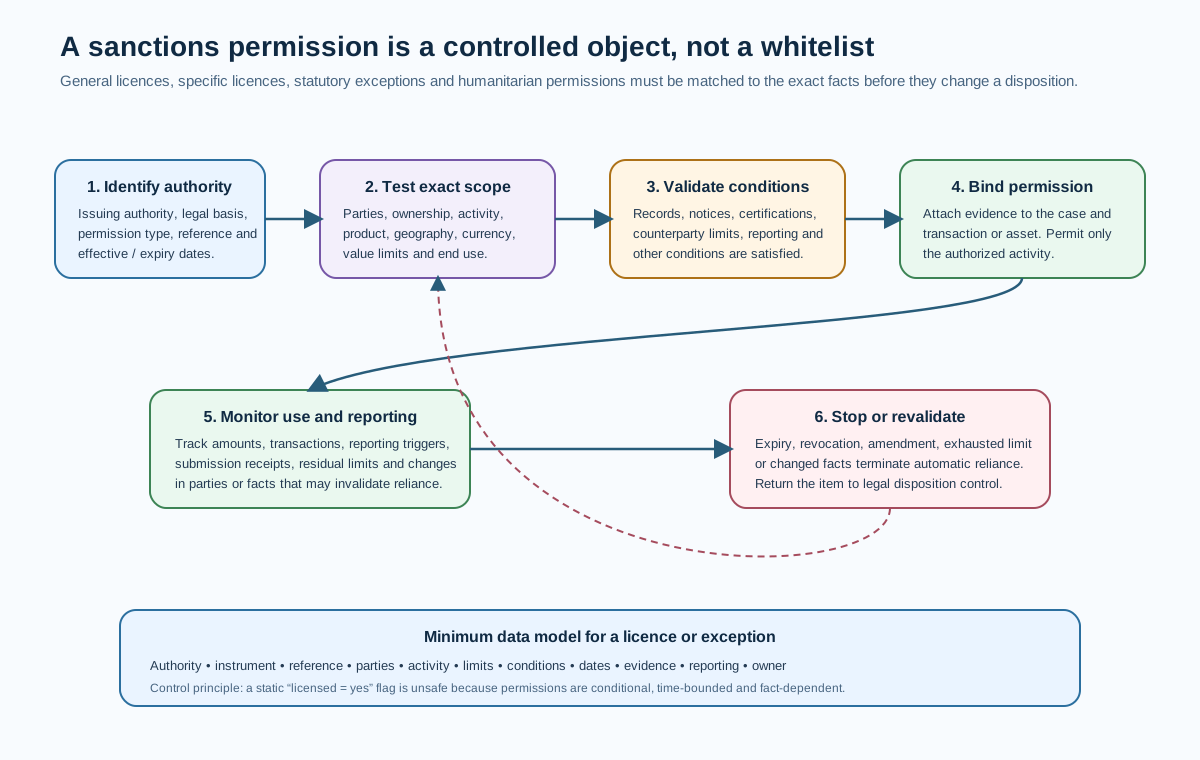
A licence should be treated as a structured legal permission with conditions, effective dates, reporting and evidence requirements—not as a permanent yes/no override. The operating control should revalidate the permission whenever material facts or the licence itself changes.
Boundary cases: preserving the correct legal state
A customer cancels while a payment is held
A customer asks to cancel a payment that is already under sanctions review. Cancellation does not automatically answer the sanctions question. If the bank is holding property in which a blocked person has an interest, simply returning or releasing funds may itself be restricted. Operations should route the cancellation request through the existing sanctions decision rather than treating customer cancellation as a technical reversal.
A licence is valid but the bank's policy remains stricter
An authority-issued licence can make an otherwise prohibited activity legally permissible, but the bank can still have a separate risk-appetite or product-policy decision not to support the transaction where lawful to do so. The case should record these conclusions separately. “Legally permitted under licence” and “approved under bank policy” are not the same statement.
The legal decision changes after new evidence
A case can move from temporary hold to release and later be reopened if authoritative new information shows that the original facts were incomplete. Historical state transitions should remain immutable. The bank should record the new evidence, new decision and any post-event remediation instead of overwriting the original release as though it never occurred.
Reporting and disposition can have different owners
The team deciding that property must be frozen may not be the team that submits the regulatory report or manages the frozen-asset inventory. Workflow should create accountable downstream tasks and reconcile their completion. A legally correct freeze with a missed report or unrecorded asset remains a control failure.
Knowledge check
-
What is the difference between a temporary sanctions hold and a legal block or asset freeze?
-
Why can a prohibited transaction require rejection rather than blocked-property treatment?
-
Under current OFAC reporting rules, how quickly must blocked-property and rejected-transaction reports generally be filed after the action?
-
Why must a return payment be reassessed rather than treated automatically as a harmless reversal?
-
What additional control problems arise when frozen securities generate dividends, coupons or redemption proceeds?
-
Why should a licence be modelled as structured data rather than a simple yes/no override?
-
What should case-to-settlement-to-ledger reconciliation prove?
-
A designation is discovered after settlement. Which timestamps must be reconstructed before deciding whether a breach occurred?
Answer guide
A hold is an operational state used while facts are investigated; a block/freeze is a legal restriction on property under the applicable regime. Some prohibited activities involve no blocked person's property, so OFAC or another regime may require the transaction not to proceed rather than create blocked property. OFAC requires relevant blocked and rejected reports within 10 business days under its current reporting framework. A return is a new movement of value and can itself involve restricted parties or property. Income and corporate actions can transform frozen property into new forms that must remain controlled. Licences have authority, parties, scope, dates, limits, conditions and reporting duties. Reconciliation should prove that the compliance decision, payment outcome and accounting/asset state agree. Post-settlement analysis needs designation/legal effective time, list ingestion time, screening time, execution/settlement time and discovery time.
Glossary
Temporary hold — An internal operational stop while the bank investigates; it is not by itself a legal freeze.
Block / asset freeze — A legal restriction preventing dealing with specified funds, assets or economic resources under the applicable sanctions framework.
Reject / do not proceed — A disposition in which a prohibited transaction or activity is not processed without necessarily creating blocked property.
Return — A new movement of value back toward the sender or another party; it can require its own sanctions assessment.
Blocked property — Property in which a blocked person has an interest and that must be treated according to the applicable legal regime.
Frozen-asset inventory — The durable record of restricted assets, ownership, location, value, legal basis, reports, licences and changes over time.
General licence — A permission issued by an authority that authorises a defined class of transactions or activities when its conditions are met.
Specific licence — An authority-issued permission for defined parties or activity, usually requiring case-specific application or approval.
Exemption / exception — Activity that the legal framework excludes or carves out from a prohibition subject to its terms.
Disposition matrix — Controlled mapping from legal rule and factual context to required operational action.
Case-to-settlement reconciliation — Control proving that a sanctions case decision matches the actual transaction execution or settlement outcome.
Blocked-asset accounting — Ledger and asset-servicing treatment that keeps legally restricted property unavailable while preserving accurate books and records.
Regulatory report — A filing to the competent sanctions authority triggered by a defined event such as blocking, rejection, breach or frozen-asset reporting.
Idempotency — System behaviour ensuring that duplicate state-change messages do not execute the same financial or legal action more than once.
Override — An authorised change to a system or case state that must retain reason, authority, evidence and audit history.
References and further reading
Blocking, freezing, rejection, reporting and licensing are jurisdiction- and programme-specific. The operational action must follow the current legal instrument and competent-authority guidance rather than a generic internal use of the word “block”. The sources below were checked on 15 September 2026.
- U.S. Treasury OFAC — FAQ 5, including the BLOCK / REJECT / PROCESS decision sequence and the requirement to check the specific sanctions programme before acting: https://ofac.treasury.gov/faqs/5
- U.S. Treasury OFAC — FAQ 9, meaning and scope of blocked property: https://ofac.treasury.gov/faqs/9
- U.S. Treasury OFAC — Blocking and Rejecting Transactions, including FAQ 36 on prohibited transactions with no blockable interest and FAQ 32 on holding blocked funds: https://ofac.treasury.gov/faqs/topic/1601
- U.S. Treasury OFAC — Filing Reports with OFAC, including FAQ 49 on the 10-business-day reporting requirement under 31 C.F.R. §§ 501.603 and 501.604 and FAQ 50 on annual blocked-property reporting: https://ofac.treasury.gov/faqs/topic/1606
- U.S. Treasury OFAC — OFAC Reporting System: https://ofac.treasury.gov/ofac-reporting-system
- UK Office of Financial Sanctions Implementation — UK financial sanctions general guidance, updated 12 May 2026: https://www.gov.uk/government/publications/financial-sanctions-general-guidance/uk-financial-sanctions-general-guidance
- UK Government — Reporting information to OFSI, including frozen assets and suspected breaches: https://www.gov.uk/guidance/suspected-breach-of-financial-sanctions-what-to-do
- European Commission — Asset freeze and prohibition to provide funds or economic resources, updated 6 May 2026. This FAQ is specific to the cited Russia/Belarus legal framework and should not be treated as a universal EU rulebook: https://finance.ec.europa.eu/publications/asset-freeze-and-prohibition-provide-funds-or-economic-resources_en
- European Commission — Overview of EU sanctions and related resources: https://finance.ec.europa.eu/eu-and-world/sanctions-restrictive-measures/overview-sanctions-and-related-resources_en
- FATF — June 2026 update to Recommendation 6 on targeted financial sanctions and humanitarian exemptions: https://www.fatf-gafi.org/en/publications/Fatfrecommendations/update-recommendation-6-june-2026.html
Current-law checkpoints
Under current OFAC guidance, blocking and rejection are different outcomes. Blocking applies where the applicable U.S. sanctions authority requires property or an interest in property to be frozen; rejection applies where the transaction or activity is prohibited but there is no blockable interest. OFAC also states that blocked property is frozen rather than confiscated, title remains with the owner, and release normally requires OFAC authorization. These are U.S.-specific mechanics and terminology.
OFAC’s current reporting guidance states that reports of blocked property and rejected transactions required by 31 C.F.R. §§ 501.603 and 501.604 are due within 10 business days of the action. That deadline must not be copied into UK, EU or other-jurisdiction procedures as a global standard.
OFSI’s UK general guidance, updated 12 May 2026, states that where an asset freeze applies the funds or economic resources are frozen immediately by the person in possession or control of them; ownership does not transfer to OFSI. Relevant firms have reporting duties that are framed in UK regulations and commonly require reporting as soon as practicable, while certain relevant-institution events must be reported without delay. From 2025 onward, UK persons holding reportable frozen assets as at 30 September are also subject to the annual frozen-asset reporting timetable described in the current guidance. From 28 January 2026, the UK Sanctions List is the only source for UK sanctions designations.
EU asset-freeze obligations must be read from the applicable EU regulation and related competent-authority material. The European Commission’s 6 May 2026 asset-freeze FAQ is a useful current source for the Russia/Belarus framework, but it is not a substitute for checking the legal instrument that applies to a different EU sanctions regime.
FATF sets international targeted-financial-sanctions standards, but it does not create one universal bank disposition vocabulary, one reporting deadline or one licensing workflow. Humanitarian exemptions and other authorisations must be implemented according to the relevant UN, regional and domestic legal framework.