Post-Event Traceability and Audit Trail
A payment can settle successfully and still leave the bank unable to explain what happened. The customer instruction may have been changed during repair, the screening engine may have received a different representation from the outbound message, a sanctions list may have changed later that day, an operations analyst may have released an alert after reviewing additional evidence, and the accounting entry may carry a reference that is not obviously connected to the original payment. Months later, an investigator, auditor, regulator or law-enforcement request can force the institution to answer a deceptively simple question: what did the bank know, what did it do, and why did it do it at that time?
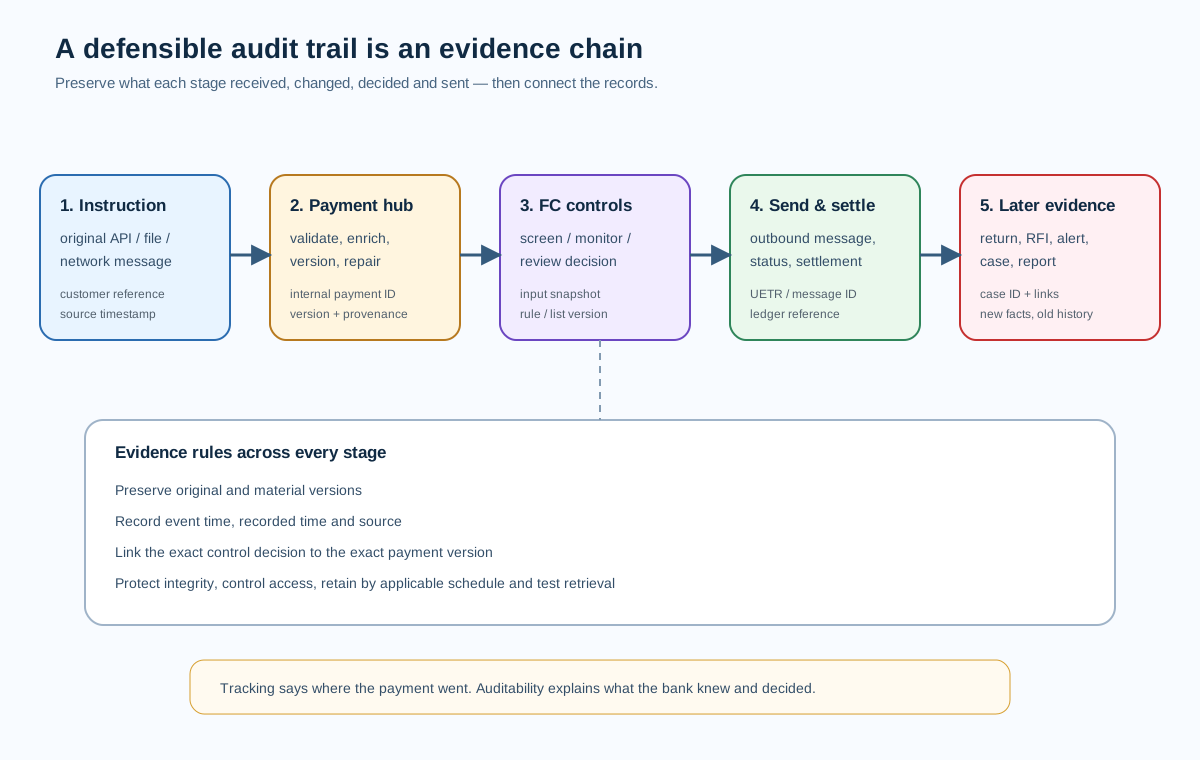
Post-event traceability is the capability to answer that question without guessing. It is broader than payment tracking and broader than storing a final message. A tracker can show that a transfer moved from Bank A to Bank B. An audit trail must be able to reconstruct the material states of the transaction and the controls around it: the instruction as received, the data as enriched, the message as constructed, the population sent to screening, the screening result, any repair or override, the version that was released, the route and settlement outcome, the accounting impact, and any later case, investigation or report.
The central mental model is an evidence chain. Every material event should leave enough durable evidence for another competent person to recreate the chronology and understand the decision. That does not mean every technical log should be retained forever, or that a bank should keep every transient debug event. It means that records necessary for legal obligations, financial-crime controls, investigation, dispute handling and control assurance must be identifiable, protected from inappropriate alteration, retrievable and connected by dependable identifiers.
This chapter distinguishes three ideas that are often mixed together. Payment tracking tells users where a payment is in its lifecycle. Data lineage explains where a data value came from and how it changed. Decision auditability explains which facts, rules, list versions, users and approvals produced a control outcome. A strong financial-crime operating model needs all three, but they are not interchangeable.
Why traceability matters to financial crime teams
Financial-crime decisions are often time-dependent. A sanctions analyst may release a potential match because the date of birth and country do not correspond to the listed person. An AML investigator may close an alert because the transfer is consistent with a documented acquisition. A payment operations user may repair a malformed address using customer-provided evidence. Each decision can be reasonable at the time and impossible to defend later if the supporting evidence is lost.
The problem becomes sharper when reference data changes. A person can be designated after a payment has completed. A customer risk rating can change after an investigation. A transaction-monitoring rule can be recalibrated. A sanctions vendor can update aliases or identifiers. If the case platform simply displays today's customer profile, today's list and today's rule configuration, a reviewer may mistake current information for the information available when the original decision was made. A defensible audit trail therefore preserves or reconstructs the relevant as-of state.
Traceability is also essential when a control fails. Suppose a customer payment should have been screened but was not. The root cause might be a channel mapping defect, a queue outage, an excluded message type, an adapter failure, a bad routing rule or a replay problem. Investigators need more than the final payment record. They need the technical and business evidence that shows whether the payment entered the expected screening population, which version of the data was passed, whether the control responded, and whether processing continued despite the missing response. Without that evidence, the bank cannot reliably determine the affected population or perform a credible lookback.
There is a customer dimension as well. A payment held for sanctions review can affect salary, medical, trade or treasury obligations. If the bank later tells a customer that a payment was delayed or rejected, support teams need an explanation consistent with what actually occurred and with confidentiality constraints. Poor traceability creates contradictory messages: operations sees one reason code, the channel displays another, the case tool contains a third explanation, and the general ledger merely shows a reversal. Good traceability does not mean exposing sensitive financial-crime logic to customers; it means that internal teams share a coherent underlying record from which lawful customer communication can be derived.
Global standards: record keeping and reconstruction
FATF Recommendation 11 provides an important global standard-setting anchor. The FATF methodology states that financial institutions should be required to maintain necessary records on domestic and international transactions for at least five years following completion of the transaction. It also states that records should be sufficient to permit reconstruction of individual transactions and that CDD information and transaction records should be available swiftly to competent authorities upon appropriate authority. FATF standards are implemented through national or regional law, so the operational retention period and exact scope for a bank must come from the laws and rules applicable to its legal entities, products and locations rather than from a single global configuration.
FATF Recommendation 16 adds the payment-transparency dimension. Its purpose is not to create a universal technical audit-log specification, but to ensure that relevant originator and beneficiary information accompanies transfers and that responsibilities are clear across the payment chain. FATF strengthened Recommendation 16 in June 2025. In June 2026 it consulted on implementation guidance and reiterated that countries are expected to be ready for the strengthened standard by the end of 2030. A bank operating in 2026 therefore needs to separate current binding local obligations from future international-standard implementation work.
The distinction matters in requirements. A statement such as “retain every payment record for five years because FATF says so” is incomplete. The better requirement identifies the applicable legal entity, jurisdiction, product, record category, start event for the retention clock, any longer local period, legal-hold rules, permitted deletion and evidence owner. FATF gives the international baseline; local law turns that baseline into an enforceable duty.
Payment transparency also intersects with market-practice guidance. The Wolfsberg Group's 2023 Payment Transparency Standards emphasise the importance of preserving meaningful debtor and creditor information across payment chains and recognise that participants have different visibility depending on their role. That is directly relevant to post-event reconstruction: an intermediary institution should preserve what it actually received and transmitted rather than later implying it had access to information that was never in its part of the chain.
Jurisdiction matters: two examples of why one retention rule is unsafe
The United States illustrates why a global bank should not hard-code one period or threshold and label it universal. The FFIEC BSA/AML Manual describes U.S. funds-transfer recordkeeping requirements, including five-year retention of specified records and particular requirements for transfers of $3,000 or more. Those obligations arise from U.S. regulation and are not a global threshold for all wire transfers.
U.S. sanctions recordkeeping has a different current position. OFAC extended certain recordkeeping requirements from five years to ten years, with the final rule effective 21 March 2025. OFAC also expects organisations investigating a potential sanctions match to maintain complete and accurate records of the steps taken and the information relied upon. A multinational bank therefore cannot safely assume that an AML record-retention rule, a sanctions record-retention rule and a local payment-scheme archival rule all share the same duration or trigger date.
Other jurisdictions can impose different requirements. The correct global design is a retention policy engine or controlled schedule, not a magic constant in application code. Records should be classified by legal entity, jurisdictional nexus, record type, product and relevant obligation. The architecture should also support legal holds so material evidence is not automatically deleted while litigation, regulatory investigation or another authorised preservation requirement is active.
What must be reconstructable
A useful audit trail begins by defining the questions it must be able to answer. For a payment with a financial-crime control touchpoint, the bank should usually be able to establish the following chain of facts, subject to applicable law and the institution's control design.
First, what did the customer or upstream institution instruct? The bank should preserve enough of the original instruction to establish the parties, accounts or identifiers, amount, currency, requested execution information, remittance or purpose data, and other material content. For an API, this may mean an accepted request payload plus relevant authentication and request metadata. For a file channel, it may include the file identity and item identity. For an inbound interbank message, it includes the message as received or a legally acceptable representation of it.
Second, what did the bank add or change? Payment processing routinely enriches and transforms data. A BIC can be derived from routing. A customer master can supply an address. A payment hub can normalise a country code. Operations can repair a field. None of these changes is automatically problematic. The auditability requirement is to distinguish source values from derived, enriched or manually corrected values and retain the provenance of material changes.
Third, what exactly reached the financial-crime control? A sanctions service may screen a canonical party object rather than the literal ISO 20022 message. A transaction-monitoring engine may receive only posted transactions after settlement. A fraud service may consume device and behavioural signals unavailable to sanctions operations. The audit trail should identify the actual control input, not assume that “the payment was screened” proves every message element was evaluated.
Fourth, which control configuration was applied? For sanctions, this can include list or data-set version, screening engine or matching configuration, policy scope and time of execution. For transaction monitoring it can include rule or model version, thresholds, feature values, segmentation and any suppression or exclusion logic. The objective is not necessarily to archive every vendor binary. It is to retain enough version and configuration evidence to reproduce or explain the decision.
Fifth, what happened to the alert or decision? The evidence should capture the system disposition, human review where applicable, evidence consulted, reason code, narrative, approvals, escalation, override and timestamp. An override should not overwrite the original result. It should create a new event that shows who changed the disposition and why.
Sixth, what payment version was released to the next stage? If a field changed after screening, the bank needs to know whether policy required the altered payment to be screened again. This is one of the most important design controls in payment hubs because a control can be technically successful and still protect the wrong version of the payment.
Finally, what was the downstream outcome? Settlement, rejection, return, cancellation, booking, reversal, recall, investigation and reporting can all create later events. A defensible chain connects these events without pretending they are one transaction record in one database.
An audit trail is a linked set of records, not one giant log
Large banks rarely have a single source of truth for the entire payment lifecycle. The customer channel owns the instruction. The payment hub owns orchestration. A sanctions platform owns screening evidence. A fraud platform owns behavioural signals. A gateway owns network messages. A clearing or settlement platform produces status. Core banking or ledger systems own customer posting. A case platform owns investigation workflow. An archive may preserve messages. Data platforms provide analytical history.
Trying to copy every detail into one “master audit table” can create new problems: duplicated sensitive data, unclear ownership, stale copies, inconsistent retention and a database too large to use operationally. A more robust architecture uses authoritative records plus stable correlation. Each system preserves evidence for the events it owns, and a traceability layer or reconstruction service knows how to connect them using identifiers and lineage metadata.
The design should therefore answer two questions separately. Where is the authoritative evidence? and how can it be found? A screening case can remain authoritative in the screening system while the payment hub stores the case identifier, screening transaction identifier, decision status and a hash or version reference to the screened data. An investigation platform can store the payment identifier, UETR and source-system references rather than duplicating the entire payment estate.
This approach also helps data minimisation. Investigators need access to relevant evidence, but not every application should copy all KYC documents, sanctions list content and message payloads indefinitely. Referencing authoritative evidence under controlled access can reduce unnecessary proliferation of personal data while maintaining reconstructability.
Correlation identifiers: useful, necessary and easy to misunderstand
Modern payment flows contain many identifiers. An ISO 20022 payment may carry InstrId, EndToEndId, TxId, UETR and clearing-system identifiers. The bank itself can create an internal payment identifier, orchestration identifier, screening request identifier, booking reference, message identifier and case identifier. A return or investigation message may refer to an earlier transaction through yet another set of fields.
No single identifier should automatically be described as “the audit trail”. The UETR is extremely useful for tracking a cross-border payment through the Swift ecosystem, and Swift introduced it to support end-to-end tracking. It does not by itself identify every internal enrichment, sanctions list version, analyst decision or ledger posting. Similarly, EndToEndId is intended to support end-to-end business identification, but it can be unavailable, reused incorrectly by upstream parties or represented differently across legacy systems.
A strong correlation model supports many-to-one and one-to-many relationships. One customer file can contain hundreds of payment items. One payment can generate several outbound messages after repair or retry. One customer transaction can create a cover payment and an underlying customer payment. A return can relate to a settled payment. A single investigation can include multiple linked transactions. Flattening these relationships into “one payment equals one ID” produces broken lineage as soon as an exception occurs.
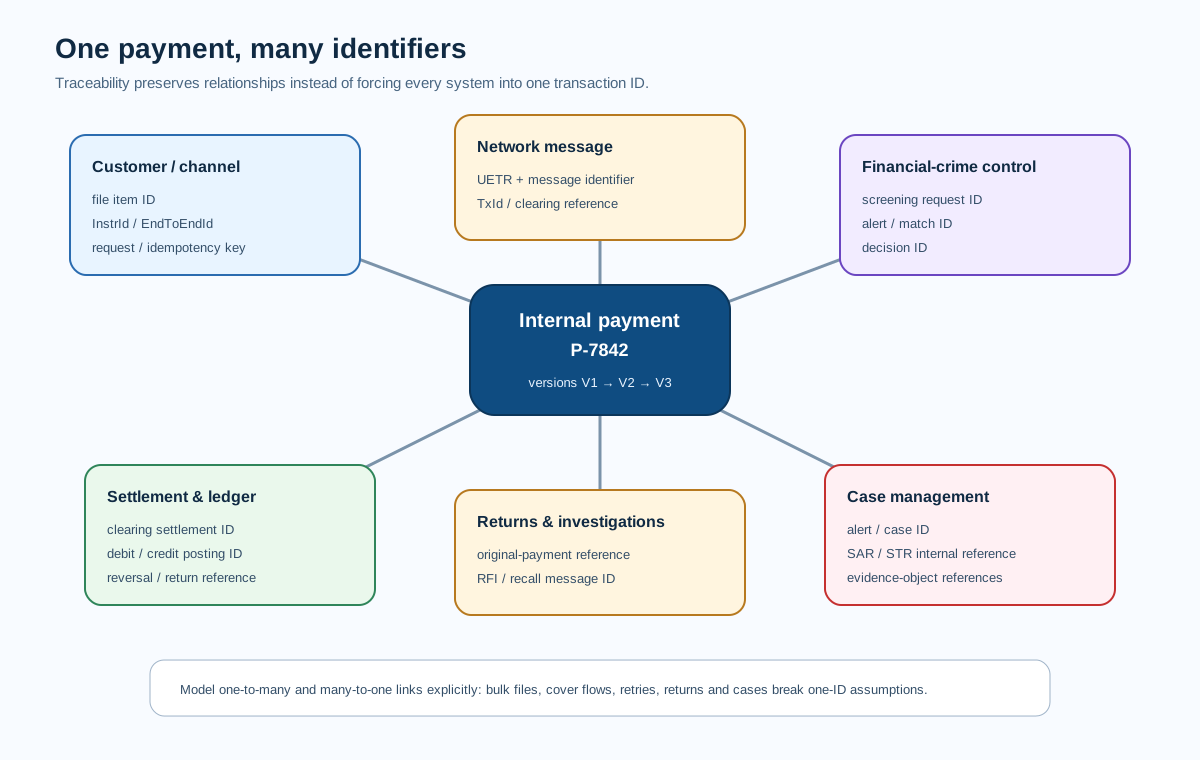
The practical data model should record the identifier type, value, source system, effective timestamp and relationship to other identifiers. It should also distinguish identity from correlation. Two records sharing an identifier may refer to the same payment event, while two different identifiers can still relate to the same economic transaction. Matching logic should never silently merge transactions solely because one non-unique reference happens to be equal.
Time is part of the evidence
A chronology is only reliable if timestamps have defined meaning. Payment systems commonly record customer initiation time, channel acceptance time, value date, requested execution date, screening start and end time, analyst decision time, gateway send time, network acknowledgement time, clearing acceptance time, settlement time, booking time and case creation time. These are not interchangeable.
Every material timestamp should have a documented semantic definition and timezone. Systems should use synchronised clocks appropriate to their environment and preserve the source timestamp where an external event supplies one. A downstream data warehouse should not replace the original event time with its ingestion time and later present the result as if it described when the payment actually happened.
Ordering becomes especially difficult in distributed systems. An event can arrive late. A retry can be processed after the original request. A message broker can redeliver an event. A data lake can receive a case update before a delayed payment status event. The audit trail therefore needs both event time and, where relevant, processing or ingestion time. Sequence numbers, message identifiers or idempotency keys can help establish ordering when timestamps alone are insufficient.
For financial-crime teams this matters because a decision can depend on what was known before release. If a sanctions-list update was loaded at 14:05 and a payment was screened at 14:02, a later reviewer should not assume the 14:05 list applied unless a rescreen occurred. The same principle applies to customer-risk changes, model versions and new adverse information.
Reproducible screening evidence
A sanctions alert is most defensible when another authorised reviewer can understand why it was generated and why it was closed or escalated. The evidence bundle should identify the screened subject and attributes, the list record or candidate that matched, the screening time, relevant list-data version, matching or policy configuration, score or match basis where used, disposition, analyst reasoning and supporting evidence.
The word reproducible needs care. Some modern screening engines use proprietary algorithms, changing vendor data and probabilistic techniques that may not reproduce an identical score years later if rerun against today's platform. The practical objective is decision reproducibility: preserve enough inputs and configuration metadata to explain the historical outcome and, where required, recreate the material logic using archived or versioned components. A screenshot alone is weak evidence because it may omit hidden fields, configuration and machine-readable context.
False-positive suppression also needs traceability. If the bank applies a whitelist, good-guy record, historical false-positive decision or other suppression mechanism, the audit trail should show which suppression rule was active, who approved it, its scope and expiry or review logic. Otherwise a future investigator can see that no alert existed without being able to tell whether the payment never matched or whether a match was suppressed.
Transaction monitoring and post-event evidence
AML transaction monitoring often operates after booking or settlement, so its audit trail has a different shape. The monitoring engine should preserve the feature values or sufficiently reconstructable inputs that caused an alert, the rule or model version, segmentation, thresholds, related transactions and customer-risk context relevant to the decision. Investigators should be able to identify which payments or postings contributed to the alert and how those records map back to original payment information when needed.
A common failure is feature drift in a data pipeline. A rule may say “high-risk geography,” but the geography used by the model might come from beneficiary bank country rather than beneficiary residence. If lineage is not documented, investigators can think they are reviewing one risk dimension while the system is using another. The audit trail should therefore connect monitoring features to their source definitions and transformations.
Case decisions also need a stable evidential boundary. When an investigator adds notes, attaches documents, links transactions or changes a disposition, the system should retain authorship and timestamp. Corrections should be possible because investigators make mistakes, but correction should not erase history. The preferred pattern is versioned or append-only event history with a clear current state, not an immutable typo that can never be fixed and not an editable text box with no record of previous values.
Immutability does not mean “never change anything”
The word immutable is often used loosely in control discussions. A bank does not need to prohibit every correction to every record. It needs to prevent inappropriate alteration of evidence and preserve material history. If a customer address is corrected, the current customer record should become accurate. The audit history should still show the previous value where legally and operationally appropriate, the correction event, source, actor and time.
An append-only event store can be useful because new events describe changes rather than rewriting old events. Write-once storage can be suitable for some archives. Cryptographic hashes can help detect alteration. Database temporal tables or version histories can support reconstruction. None of these technologies proves compliance by itself. Access control, retention, monitoring, backup, restore testing and governance determine whether the evidence remains trustworthy.
Hashing also has limits. A hash can show that a stored payload differs from a previously hashed payload, provided the original hash itself is trustworthy. It does not prove that the payload was truthful when first captured. Nor does it preserve data that was never stored. The control goal is therefore integrity plus provenance, not cryptography for its own sake.
Material changes and the need to re-screen
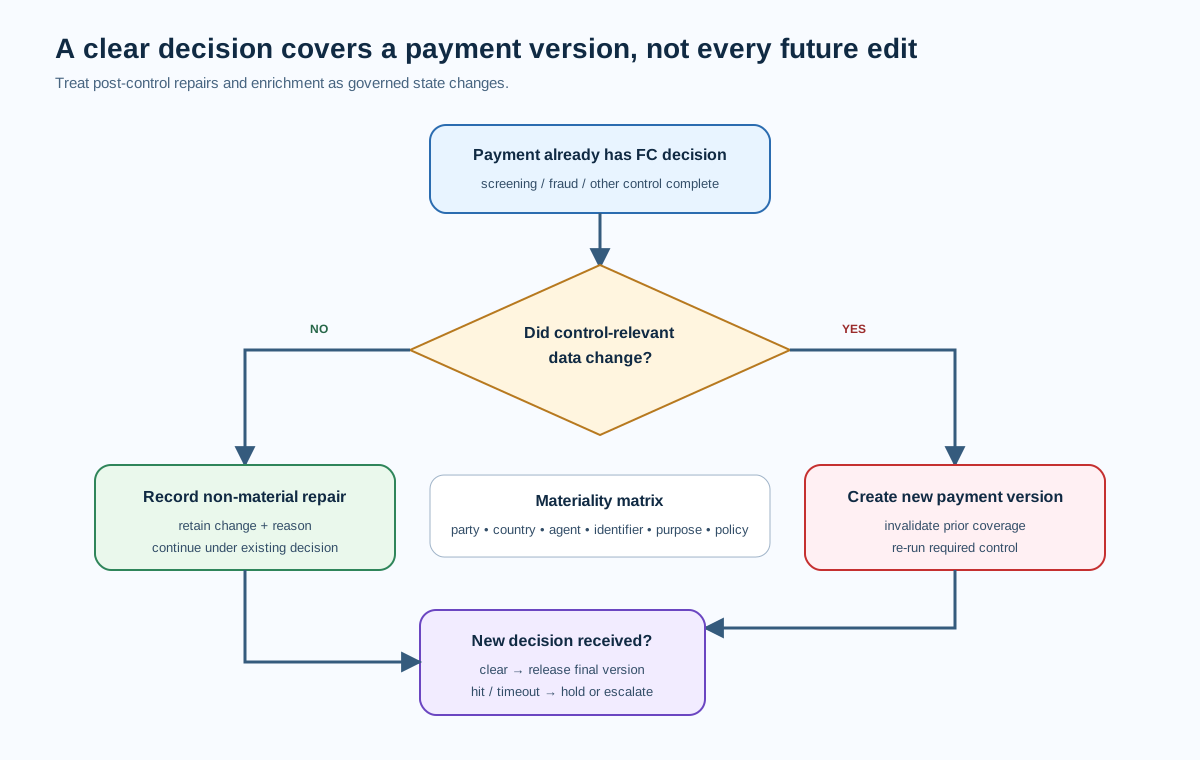
One of the hardest payment-control questions is what to do when data changes after a financial-crime control has already run. Not every change needs a new screen. Formatting a postal code, normalising case or adding a non-risk operational reference may not change sanctions risk. Replacing a creditor name, changing an ultimate debtor, altering country information or changing an intermediary can be material.
The bank should define a controlled material-change matrix. Each field or transformation is classified by whether it can affect screening, monitoring, fraud or another control. When a material value changes after a control decision, the orchestration layer should either re-run the relevant control or route to an approved exception process. The decision should be deterministic enough to test.
This is especially important for manual repairs. Operations users should not be able to change a party name after sanctions clearance and immediately release the payment without a control response. The repair screen can guide the user, but the reliable safeguard belongs in orchestration: compare the control-relevant representation before and after repair and enforce the required re-evaluation.
Evidence quality: completeness, accuracy, integrity and retrievability
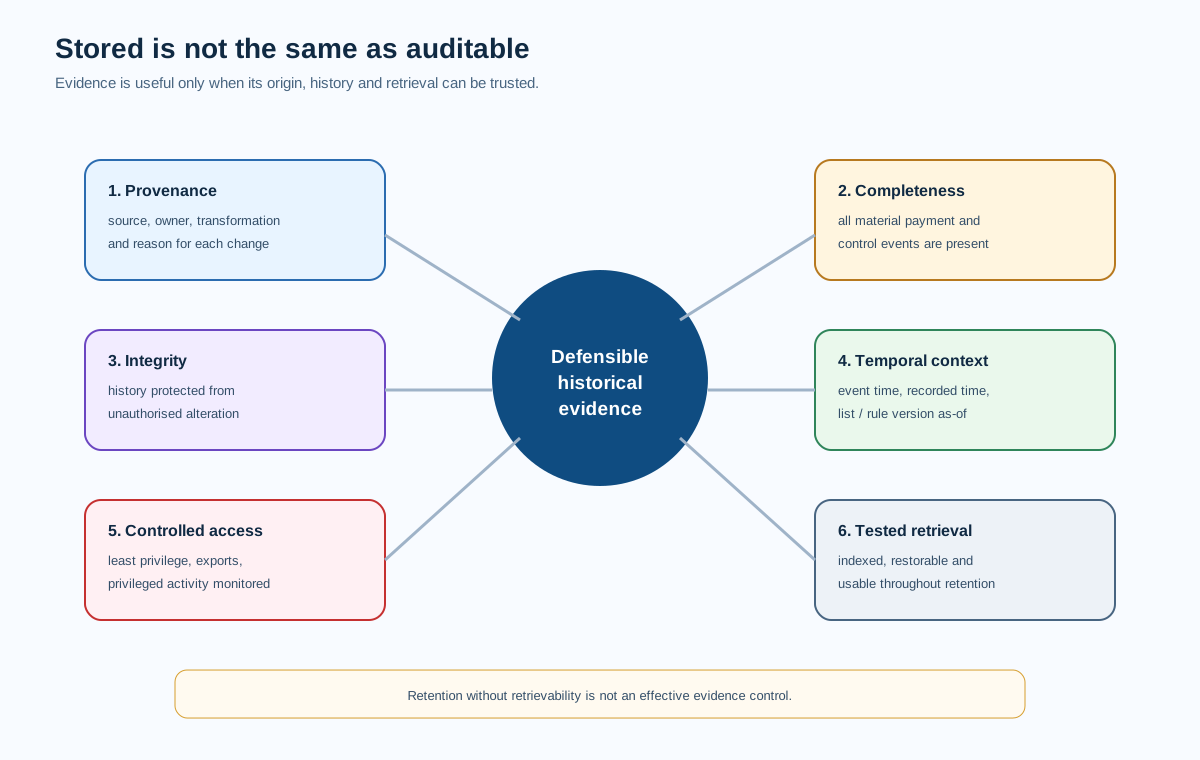
A traceability control can fail even when records technically exist. Useful evidence must be complete enough for the purpose, accurate enough to support the decision, protected from unauthorised alteration and retrievable within the timeframe required by operations, investigation or competent authority.
BCBS 239 is not an AML recordkeeping law, and its direct applicability is specific to the prudential context described by the Basel Committee. It is nevertheless a valuable data-governance benchmark for large banks because it emphasises governance, data architecture, accuracy, integrity, completeness, timeliness and adaptability. The Basel Committee's recent implementation work also highlights data lineage as the traceability of data from origin to final use and notes the difficulty created by legacy systems and distributed data estates.
Financial-crime teams can apply the same discipline without misrepresenting BCBS 239 as a sanctions rule. If a control relies on debtor country, for example, the bank should know the authoritative source, transformation steps, validation rules, consumers, known limitations and reconciliation. If an investigator relies on a list-screening snapshot, the archive owner should know how quickly that snapshot can be retrieved and whether the restoration process has been tested.
Availability is often overlooked. A ten-year retention requirement has little value if a retired archive needs three weeks of manual engineering to restore one message. Retention architecture should include retrieval service levels, indexing, migration strategy and periodic restore tests. When platforms are decommissioned, evidence must be migrated with metadata and integrity preserved, or the bank can lose auditability while believing it has met a storage requirement.
Retention and deletion are both controls
Financial institutions often focus on keeping records and under-design deletion. Indefinite retention can create privacy, security, cost and legal risks. A mature control has a lifecycle: create, classify, retain, protect, retrieve, place on legal hold where required, and dispose when the applicable schedule permits.
The retention schedule should distinguish message evidence, customer records, screening evidence, case files, suspicious-activity reports or equivalents, sanctions block/reject records, operational logs and technical telemetry. These categories can have different legal bases and durations. Local privacy and data-protection requirements can also affect how records are stored, accessed and deleted. Financial-crime necessity does not remove the need for purpose limitation and access control.
Deletion should be evidenced. The bank should be able to show which policy authorised disposal, which population was affected, whether legal holds were checked, whether deletion completed across replicas or archives where required, and how exceptions were handled. This is particularly important after migrations because “deleted from the application” may not mean deleted from every copied data store.
Access to audit evidence
Sensitive evidence should not be universally visible. Sanctions investigations, AML cases, customer identity documents and law-enforcement requests can require restricted access. The traceability design should therefore include role-based or attribute-based access, segregation of duties, privileged-access monitoring and confidentiality controls.
The person who can change a sanctions case configuration should not necessarily be able to erase its audit history. Production support may need technical access without seeing full customer case notes. Investigators may need customer and transaction data without infrastructure administration rights. Auditors may require read-only access or controlled extracts. These boundaries should be testable and periodically reviewed.
Access itself can be part of the audit trail. For especially sensitive case evidence, the bank may need to know who viewed, exported or modified records. Export functions deserve particular attention because an authorised user can bypass application controls by downloading case data to unmanaged locations if governance is weak.
Reconciliation proves the trail is complete
Traceability cannot rely solely on the assumption that logging works. Banks should reconcile key populations. For sanctions screening, compare expected screenable payment events with screening requests and responses. For message archival, compare sent and received network messages with archived message identifiers. For case systems, compare alerts generated with cases created or dispositions returned. For ledger posting, reconcile payment outcomes with expected accounting events.
The objective is not always one-to-one matching. Retries, batches, cancellations and aggregation can make valid relationships one-to-many or many-to-one. Reconciliation rules should reflect the business model and classify known exceptions rather than forcing false equality. What matters is that unexplained breaks become visible and owned.
A useful control metric is orphaned evidence: records that exist in one stage but cannot be linked to the expected prior or subsequent stage. An outbound message with no payment-hub lineage, a screening response with no originating request, or a case with no linked alert can indicate an architecture defect, data loss or incorrect correlation. Orphans should be investigated proportionately and recurring causes fixed.
Mini case study: reconstructing a repaired cross-border payment
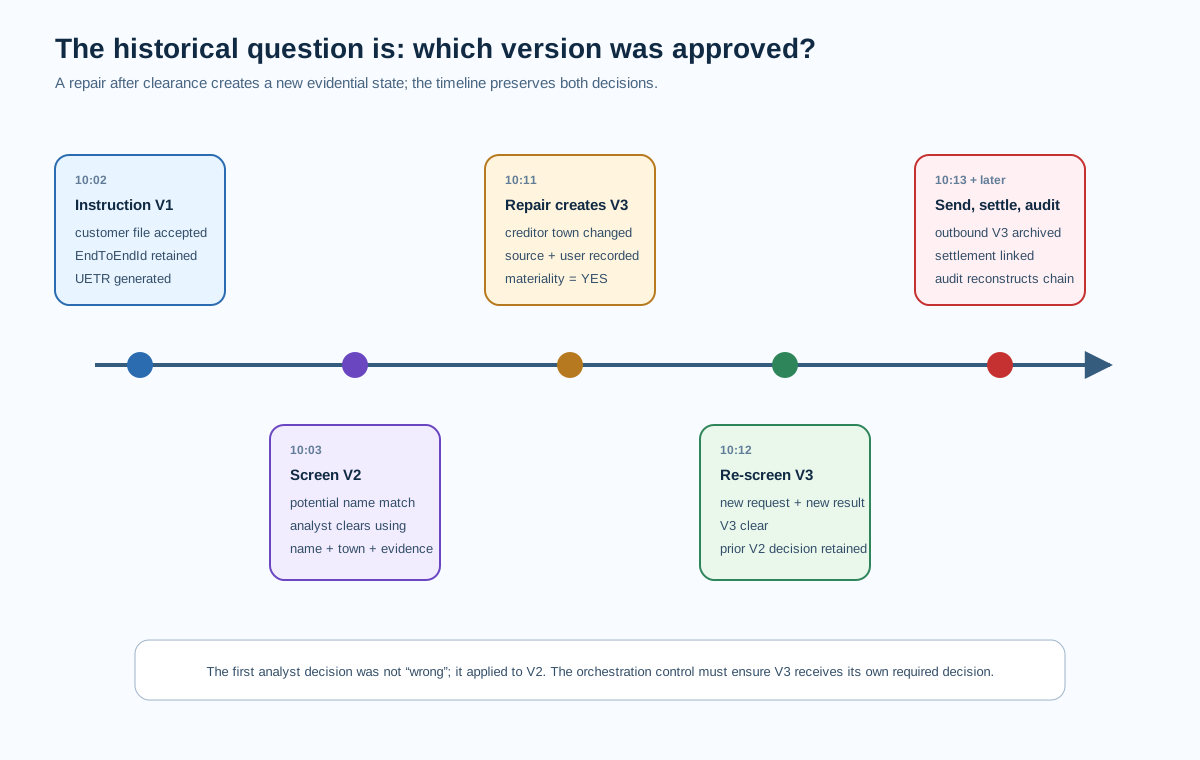
Consider a corporate customer sending a EUR cross-border payment to a new supplier. The customer submits the instruction through a host-to-host file. The payment hub creates internal payment ID P-7842, preserves the customer's EndToEndId, generates a UETR and enriches the creditor agent from routing data. The outbound party data is sent to the sanctions engine before release.
The screen produces a potential match on the creditor because the supplier name resembles a listed entity. The analyst reviews the list record, customer instruction, supplier registration information and address, then closes the match as a false positive. The case system returns a release decision to the payment hub.
Before the network message is sent, operations discovers that the creditor town was mapped incorrectly from the customer's file. The user repairs the town using the original invoice and the customer's confirmed master data. At first glance this looks harmless: the name and account have not changed. But the town was one of the attributes used by the sanctions analyst to distinguish the supplier from the listed entity.
A weak system would release the payment because the sanctions status is already “clear”. A strong system computes that a screening-relevant attribute changed after the decision. It creates a new payment version, preserves the original and repaired values, records the source and operator, and sends the revised party object for re-screening. The second screen returns no material match. The payment is released and the exact outbound pacs.008 version is archived with its UETR and internal payment ID.
Six months later, internal audit selects the payment. The reviewer can reconstruct the original file item, enrichment, first screening request and result, analyst decision, manual repair, reason the repair triggered re-screening, second result, network message and settlement confirmation. The reviewer does not need to trust a narrative written after the fact; the chronology is supported by linked evidence.
The case shows why auditability must be designed into orchestration. The important control was not “keep logs”. It was recognising that the second payment state was materially different from the state previously approved and making the evidence chain prove that the correct version was screened.
Roles and ownership
Payment traceability crosses organisational boundaries, so ownership needs to be explicit. The payment product or platform owner owns the business lifecycle and ensures identifiers, states and repair events are designed coherently. Financial-crime control owners define what evidence is required for sanctions screening, AML monitoring and investigation. Data owners define critical data elements, lineage and quality. Technology teams implement event capture, storage, correlation, access control and resilience. Operations teams follow controlled repair and exception procedures. Records-management and legal teams translate retention and legal-hold obligations. Information security protects sensitive evidence. Second-line compliance and risk challenge control design and outcomes. Internal audit independently assesses whether the combined control is effective.
No team should be able to say “the evidence is in another system” without knowing which system, owner and retrieval path applies. A RACI can help, but a control inventory should go further by naming the authoritative record, retention owner, reconciliation, key dependencies, failure response and evidence used to prove operation.
Management information that reveals control weakness
A dashboard showing “99.9% of payments logged” sounds reassuring but can hide the one class of payment that matters. Management information should therefore segment traceability by product, rail, legal entity, channel and control path where material. Useful measures include missing-correlation events, late or absent screening responses, material repairs after screening, re-screen failures, orphaned archive records, unreconciled message counts, case-linkage failures, retrieval failures, evidence-access exceptions and aged remediation items.
Trend and root cause are more valuable than isolated counts. If missing screening links rise after a payment-hub release, the issue may be a regression. If archive retrieval fails only for one retired platform, the risk is migration-related. If manual repairs repeatedly trigger re-screening for the same field, the upstream mapping should be fixed rather than adding analyst capacity.
Metrics also need denominators. “Fifty payments missing an archive reference” means something different out of one thousand than out of fifty million. Severity matters too. An issue affecting non-risk metadata should not be presented as equivalent to a missing sanctions decision. Management information should support prioritisation rather than simply accumulate red indicators.
Failure modes worth designing for
Several failure patterns recur in real implementations.
Final-state-only storage keeps only the latest payment representation. Investigators cannot see what changed, when it changed or which version was controlled.
Screenshot evidence captures a user interface but not the underlying data, list version or configuration. It is difficult to search, compare or reproduce.
Uncontrolled manual repair lets users change screening-relevant fields after clearance without re-screening.
Identifier breakage occurs when format conversion generates a new reference without preserving the relationship to the original. Returns and investigations then become hard to connect.
Log success without business success records that an API call returned HTTP 200 but does not prove the screening service produced a valid business decision.
Silent retry duplication produces several screening records or payment messages without a clear idempotency key and leaves investigators uncertain which one was authoritative.
Clock ambiguity mixes local time, UTC and processing time, creating an apparently impossible chronology.
Archive without retrieval satisfies storage monitoring but fails when evidence is actually requested.
Shared mutable notes allow analysts to edit a conclusion without retaining previous versions or authorship.
Configuration amnesia preserves the transaction but not the rule, model or list version that generated the historical outcome.
Excessive retention copies sensitive evidence into analytics and support systems beyond justified periods, increasing exposure and making deletion inconsistent.
These failures are useful for testing because they convert “audit trail” from an abstract non-functional requirement into observable behaviours.
What a business analyst should specify
A strong requirement set begins with events and evidence rather than screens. For each material payment state, define the event, producer, consumer, identifier, timestamp semantics, mandatory evidence, retention class and error handling. Then define which fields are control-relevant and which changes trigger re-screening or another control.
Requirements should distinguish original, current and outbound values. A field called creditorName is insufficient if the bank needs to prove whether it came from the customer, KYC, a repair or an external enrichment. Consider attributes such as sourceSystem, sourceEventId, effectiveTime, recordedTime, version, changedBy, changeReason and evidenceReference where appropriate.
Acceptance criteria should include reconstruction. Give a tester an internal payment ID and require the system to retrieve the original instruction, versions, screening events, repair history, outbound message, settlement outcome and linked case within the designed access model. Test one normal payment, one repaired payment, one rejected payment, one retry, one return and one historical payment restored from archive.
The BA should also document jurisdictional variability. Retention period, reporting requirements, thresholds and disclosure rules should come from controlled obligation mapping. A global feature should support configuration by legal entity or product rather than embedding a U.S., EU or other local rule into a universal workflow.
Architecture and engineering considerations
Event-driven architectures can provide excellent traceability when event schemas are governed and correlation is consistent. They can also produce fragmented evidence when services emit incompatible identifiers and events can be edited or dropped without reconciliation. Define an event taxonomy and minimum envelope containing event type, event ID, business identifier, source, timestamp, version and correlation references.
Idempotency is part of auditability. A retried request should not create an unexplained second payment or second screening decision. Where retries legitimately create new events, the relationship to the original attempt should be explicit. Message brokers should have dead-letter and replay controls that preserve the original event identity and record the replay action.
API logging should avoid indiscriminate storage of secrets and sensitive payloads. Authentication tokens, credentials and unnecessary personal data should not be written merely because “more logs are better”. Where full payload retention is required, use a controlled evidence store with appropriate encryption, access, retention and monitoring rather than general application logs.
Data warehouses and lakes can support investigations and lookbacks, but their transformation pipelines must preserve lineage. Analytical copies should not silently become the authoritative audit source unless governance, timeliness and completeness support that role. A lake that receives data once per day cannot prove what a screening engine saw at payment-release time unless it stores the relevant historical snapshot.
Testing the evidence chain
Testing should prove both presence and trustworthiness. Positive tests confirm that expected events and links are created. Negative tests remove or corrupt an identifier and verify that reconciliation detects the break. Mutation tests alter a screening-relevant field after clearance and confirm that re-screening is enforced. Replay tests resend an event and verify idempotent handling. Late-event tests change arrival order. Access tests verify that unauthorised users cannot view or alter evidence. Retention tests validate expiry and legal hold. Restore tests retrieve historical records from archive rather than merely checking that a backup job completed.
Testing should also verify semantic correctness. An archive can contain a field called screeningTimestamp while actually storing message-send time. A case link can exist but point to a different retry. The test team should compare evidence against known ground truth for seeded scenarios.
Production monitoring should continue the same principles. Reconciliation, missing-event alerts, retention-policy failures, unauthorised access and archival restore health should be observable. A control that is tested once before launch and never monitored can degrade as systems, volumes and message formats change.
Practical takeaway
Post-event traceability is the bank's ability to tell the historical truth of a payment and its controls. It connects payment transparency, data lineage, screening evidence, case history, settlement and record keeping without pretending that one identifier or one database contains the whole story.
The strongest implementations preserve original and changed states, identify exactly what each control saw, record the configuration and evidence behind decisions, connect systems through stable correlation, reconcile populations, protect sensitive history and test retrieval. They also respect jurisdictional differences in retention and reporting rather than turning one country's rule into a global assumption.
For financial-crime teams, the value appears when something goes wrong. A clear evidence chain makes a sanctions lookback bounded, an AML investigation faster, a customer complaint coherent, a control failure diagnosable and a regulatory request answerable. The work therefore belongs in the payment architecture from the start, not as an archive project after implementation.
Operational deep dive: reconstructing the payment as the bank actually processed it
The base chapter established the evidence-chain principle. This deep dive moves closer to implementation: what a bank should preserve at each payment stage, how ISO 20022 identifiers help without becoming false “single sources of truth”, how screening and investigation evidence should be versioned, and how teams prove the trail remains complete through retries, transformations, outages and platform migrations.
Start with business events, not application logs
Application logs are useful diagnostics, but they are a poor starting point for a financial-crime audit trail. A log line such as screening completed does not establish which parties were screened, which payment version was used, which list data was active or what disposition came back. Logs are also commonly rotated, sampled, reformatted or moved to observability platforms with retention periods designed for technology support rather than regulatory recordkeeping.
A better design begins with business events. Examples include PaymentInstructionAccepted, PartyEnriched, PaymentVersionCreated, ScreeningRequested, ScreeningDecisionReceived, PaymentRepaired, PaymentReleased, NetworkMessageSent, SettlementConfirmed, PaymentReturned, AlertCreated and CaseClosed. The names are illustrative; what matters is that the event describes a business fact rather than an implementation detail.
Each event should carry or reference a minimum evidence envelope: a unique event identifier, business payment identifier, event type, source system, event time, recorded time, payment version where relevant, actor or service identity, correlation references and a schema version. The payload then contains the facts needed for that event. A screening event, for example, should identify the screening request and decision rather than copy every payment attribute into every event.
This architecture supports reconstruction because events retain chronology and ownership. It also creates an explicit contract between teams. The payment platform can change internally without forcing the investigation platform to parse arbitrary text logs, provided the evidence events remain governed.
Preserve original, canonical, control and outbound representations
A cross-border payment can have several legitimate representations. The customer may submit a proprietary JSON API instruction. The payment hub converts it to a canonical internal model. The sanctions adapter creates a screening request. The gateway serialises an ISO 20022 pacs.008. A correspondent or clearing system may later send a status or return message. Treating any one of those representations as “the transaction” loses important context.
Four states are particularly useful to preserve or make reproducible.
The original instruction establishes what was received from the customer or upstream institution. This is important for disputes, repair analysis and determining whether the bank introduced a data defect.
The canonical payment state establishes how the bank interpreted the instruction after validation and enrichment. If the bank has a payment hub, this is often the best place to model party roles, accounts, agents, identifiers and provenance consistently across rails.
The control representation establishes what a sanctions, fraud or other decision service actually evaluated. This can differ from both the original and the outbound message. The screening adapter may concatenate address fields, add customer-master aliases or exclude non-screenable technical fields. That representation is central to explaining why a match did or did not occur.
The outbound representation establishes what left the bank. For CBPR+ this may be the actual ISO 20022 payload accepted by the network. For another rail it may be a different standard or proprietary instruction. If the outbound state differs materially from the screened state, the bank needs evidence showing why the difference was permissible or why a subsequent control was performed.
The point is not to create four unrestricted copies in every database. The bank can retain some representations in authoritative archives and store references, hashes or version identifiers elsewhere. The design objective is that an authorised reviewer can obtain the relevant historical states and prove their relationship.
Build a payment-version model explicitly
Many audit problems are really version problems. A payment starts at version 1, enrichment creates version 2, manual repair creates version 3, and an outbound formatting step creates version 4. If systems overwrite the same row, later teams see only version 4 and cannot determine which version the screening decision applied to.
A practical version model records paymentId, versionId, parent version, creation time, change source and change reason. The delta between versions should be obtainable. For control-relevant fields, the platform can calculate a fingerprint of the normalised values used by the control. When a later version changes that fingerprint, orchestration knows the previous decision cannot automatically be assumed to cover the new state.
Versioning is especially useful for manual repair. The user should see the field being changed, the source of the corrected value and whether the change will trigger revalidation or re-screening. The system should record the user, timestamp and reason. Free-text reason alone is not enough; structured reason codes make control monitoring and root-cause analysis possible, while a short narrative can provide context.
Automated enrichment should be versioned too. A BIC-directory update or customer-master refresh can change a value without a person touching the payment. If enrichment happens after the financial-crime decision, the same material-change logic should apply regardless of whether the actor was human or machine.
Use identifiers as a graph
ISO 20022 provides several identifiers with different purposes. InstrId can identify an instruction between parties. EndToEndId can carry a business reference across the payment journey. TxId can identify a transaction between instructed and instructing agents. UETR supports unique tracking across applicable cross-border Swift payment flows. Network and clearing infrastructures can introduce further identifiers. Internally, the bank commonly has payment, message, screening, booking and case identifiers.
The audit model should therefore resemble a graph rather than a single key-value table. A node represents a payment, message, control request, settlement event, ledger entry or case. An edge records the relationship: generatedFrom, screens, settles, returns, reverses, investigates, supersedes or another governed relation.
This matters in cover payments and returns. A cover flow can involve related customer and cover messages. A return can create a new payment instruction linked to an earlier settled payment. A recall request may not itself move value. A bulk file can create hundreds of payment transactions. A single investigation can span several payments. Graph-style correlation preserves those differences rather than forcing every record into the same transactionId column.
Identifiers also need provenance. An EndToEndId entered by a customer is different from an internal ID generated by the bank. A UETR received from an upstream institution should normally be preserved according to the applicable network flow rather than silently regenerated. If a legacy conversion creates a substitute reference, the mapping to the original should be durable and testable.
The screening evidence snapshot
For sanctions screening, the historical evidence should answer five questions.
Who or what was screened? Preserve the subject type and the attributes supplied to the engine: name, address components, country, identifier, date of birth, vessel identifier or other relevant data according to the control.
Against what data? Record the watchlist or data-set version sufficiently to establish the sanctions information available at the time. Where a vendor distributes frequent incremental updates, the bank may record a vendor release identifier, ingestion batch and effective time rather than copying the entire list into each payment record.
With what configuration? Record the policy or matching configuration version. This can include thresholds, algorithm profile, transliteration options, field weightings or list scope where they affect the outcome. Proprietary vendor internals may not be fully exposed, but the bank should retain the configuration it controls and the vendor release information it relies upon.
What candidates and decision resulted? Keep the relevant match candidates, score or basis where available, automated disposition, any human decision, evidence consulted and final action.
What happened next? Link the decision to the payment version that was released, blocked, rejected, held or repaired.
The snapshot should be machine-readable enough for lookbacks. If a new designation is published, a bank may need to identify historical transactions involving that subject. Searchable structured attributes are far more useful than thousands of screenshots.
List timing and “as-of” reconstruction
Sanctions lists and reference data change through the day. The evidence model should distinguish the time an authority published a change, the time a vendor made it available, the time the bank ingested it and the time a screening decision executed. These timestamps can differ legitimately.
The bank's control obligation is governed by applicable law and policy, not by an abstract demand that every system know every designation at the exact same millisecond. Nevertheless, the institution should be able to explain its list-update process, service levels, exceptions and which data set was active for a historical decision.
A post-event review should therefore avoid the common mistake of re-running a 2024 payment against a 2026 list and claiming the original bank should have generated the same alert. A current-list lookback can be useful to identify historical exposure, but it is a different question from whether the control operated correctly at the original time.
Payment statuses and financial-crime statuses are separate dimensions
A payment can be technically accepted while financially held. It can be screened clear but rejected by the network. It can settle and later become part of an AML investigation. Audit schemas become confusing when one status field attempts to represent all of these facts.
Use separate state dimensions. The payment-processing state can represent accepted, validated, queued, sent, settled, rejected, returned or cancelled. The financial-crime state can represent not required, pending, potential match, clear, escalated, blocked or another policy-specific outcome. The case state can represent open, awaiting information, escalated, closed or reported. The exact vocabulary depends on the bank, but separation prevents impossible interpretations.
Status history should retain transitions, not only the current state. A payment that was held for forty minutes and later released should not look as if it was always clear. That elapsed hold time matters for customer impact, operational service levels and control evidence.
Reconciliation patterns that work
A bank can test audit-trail completeness by reconciling populations across stages.
For outbound sanctions screening, start with the set of payments that policy says should be screened. Reconcile to screening requests. Reconcile requests to responses. Reconcile clear or approved responses to released payment versions. Reconcile released versions to outbound network messages. Differences are not automatically defects: cancellation, timeout, duplicate suppression or manual escalation may explain them. Every difference should fall into a recognised reason category or an investigation queue.
For inbound processing, reconcile network messages received to payment records created, expected screens executed, bookings or rejections produced, and any holds resolved. For post-event AML monitoring, reconcile eligible booked transactions to monitoring ingestion, rule/model evaluation and alert/case creation where triggered.
These reconciliations should use independent evidence where possible. If the payment hub both emits and counts the screening request, an internal bug could make both records wrong in the same way. Comparing payment events with the screening platform's received-event ledger provides stronger assurance.
Handling timeouts and unavailable controls
Outages expose whether traceability is truly part of control design. Suppose the sanctions engine does not respond within the payment rail's processing window. The bank needs a predefined outcome based on applicable law, policy and product risk: hold, reject, queue, fail closed, use an approved resilient service or another controlled path. The audit trail must record the timeout, fallback route, decision authority and eventual outcome.
A dangerous design records only the final release after service recovery. That hides the fact that the normal control was unavailable. Outage events should be reportable so risk owners can quantify affected payments, response times and any degraded control mode.
If asynchronous processing is used, the bank must also prevent a late response from incorrectly changing an already final payment state. A delayed clear response relating to an obsolete payment version should not release a later repaired version. Correlation and version checks protect against this race condition.
Retries, duplicates and idempotency
Retries are normal in distributed payments. Network timeouts do not necessarily mean the first request failed; the response may simply have been lost. If the payment platform sends the same screening request again with a new identifier, the case platform can create duplicate alerts. If it resends a payment without a stable idempotency key, the bank can create a duplicate transaction.
The audit trail should distinguish business retries from new business events. A retry of the same screening request should refer to the original business decision context. A repaired payment is a new version and may require a new screen. A returned payment is a new transaction related to an earlier one. The system should not infer these relationships from timing alone.
Test packs should inject duplicate events, repeated API calls and delayed acknowledgements. The expected result is not merely “no duplicate payment”. It is a comprehensible evidence history showing that a duplicate was detected, which request was authoritative and what happened to the duplicate attempt.
Returns, recalls and investigation messages
Post-event traceability becomes most valuable when the original payment is no longer the only message in the story. A return, cancellation request, recall, request for information or investigation message can arrive later and may be processed by different systems.
The bank should map these messages back to the original economic transaction using the identifiers provided by the relevant scheme or network and internal correlation. The mapping should preserve uncertainty. If an operations user manually associates an RFI with a payment because an identifier is missing, the manual linkage should be recorded as an assertion with author and evidence rather than silently written as if it were system-proven.
For financial-crime investigations, later messages can materially change understanding. A correspondent response may identify an ultimate party that was not visible initially. A return reason can indicate account closure. A fraud recall can reveal that previously ordinary activity involved a scam. The case platform should be able to add this later evidence without rewriting the historical fact that the original payment was processed with less information.
Ledger and settlement evidence
Financial-crime investigators frequently need to know not only whether a payment message was sent but whether value actually moved. Message status, settlement status and customer-account posting are related but different facts. The audit chain should connect them.
For example, an outbound message can be accepted by a network, then rejected by the receiving institution, while the customer debit is reversed. A sanctions decision can block funds before outbound settlement. A return can create a separate credit later. Investigators should be able to distinguish these scenarios because suspicious activity, sanctions exposure and customer impact depend on actual value movement.
Ledger references should therefore be part of the correlation graph, but the ledger should not be expected to store the entire financial-crime case. The payment evidence service can link payment version, settlement instruction, debit/credit entry and reversal using authoritative identifiers.
Migration is an audit-trail event
Replacing a payment hub, screening platform or archive is one of the highest-risk moments for historical traceability. Migration projects often focus on open transactions and current customer data while treating historical evidence as a storage problem to be solved later.
A credible migration inventory identifies each evidence class, retention requirement, authoritative source, volume, indexing method, legal holds, access model and target. Historical identifiers must remain searchable. Relationships between payment, screen, case and ledger records must survive. If some legacy data cannot be migrated, the residual archive needs a supported retrieval route for the remainder of its retention period.
Migration testing should sample complete historical stories, not isolated tables. Select a normal payment, a repaired payment, a sanctions alert, a return and an investigated transaction. Reconstruct each case before migration and after migration and compare the material evidence. This detects relationship loss that row-count reconciliation can miss.
Archive design and restore testing
An archive is effective only if records can be retrieved accurately and within required timeframes. Store enough indexing metadata to locate records by the identifiers and party attributes authorised users are likely to have. Encrypt evidence at rest and in transit. Protect keys and privileged access separately. Monitor retrieval and export.
Backups protect against data loss; they are not automatically a searchable regulatory archive. Restoring an entire database backup to find one payment can be impractical and slow. Retention architecture should distinguish operational evidence stores, immutable or protected archives, backups and analytical copies.
Restore tests should be scheduled. The test begins with a realistic request such as a UETR, customer identifier or case reference and measures whether the authorised team can obtain the complete evidence chain. Record missing links, time taken, access problems and integrity checks. Fix recurring weaknesses before a real regulatory request creates the first full end-to-end test.
A practical canonical evidence model
A simple conceptual model can support many implementations:
Payment represents the economic instruction and stable internal identity.
PaymentVersion represents each material state of the instruction, including source and change reason.
Message represents an inbound or outbound network, scheme or channel message and stores message type, message identifier, payload reference and transmission evidence.
ControlExecution represents a sanctions, fraud, AML or other control invocation and links to the payment version evaluated.
ControlDecision represents automated and human dispositions, supporting evidence and approval.
SettlementEvent represents clearing or settlement outcome.
LedgerEvent represents customer or internal accounting effects.
Case represents an investigation grouping and links one or more payments, alerts and external information requests.
EvidenceObject represents documents, snapshots, external responses or archived payloads under controlled access.
Relationship links these objects with a governed type and source.
The model can be implemented relationally, through event stores, graph technology or a combination. The technology is secondary to the semantics. Every team should agree what each object means, which system is authoritative, how versions work and how retention applies.
What “good” looks like in an incident
Imagine a screening adapter defect is discovered on Monday morning. For four hours on the previous Friday, ultimate-creditor data was omitted from outbound screening requests for one payment route. With strong traceability the bank can identify the adapter release, query all affected payment versions, prove which messages carried an ultimate creditor, compare those messages with the corresponding screening snapshots, isolate the exact population where the field was missing, re-screen that population against the appropriate current or historical data according to the investigation objective, and link remediation decisions back to each original payment.
With weak traceability the bank knows only that “some payments may have been affected”. Teams query several databases, disagree about identifiers, cannot tell whether the screening engine received the final version, and build spreadsheets to approximate the population. The difference is not cosmetic. It determines how quickly the institution can contain risk, notify governance, assess legal obligations and demonstrate a credible response.
That is the operational purpose of post-event traceability: turn uncertainty after an event into a bounded, evidence-led reconstruction rather than an institutional memory exercise.
Advanced practice: governance, assurance, investigations and delivery controls
Traceability becomes credible only when the evidence chain is governed as a control, not treated as a by-product of technology. This section turns the architecture into operating practice: control ownership, investigation standards, legal and privacy boundaries, testing patterns, management information and realistic scenarios where a bank has to prove what happened after the event.
Define the control objective precisely
“Maintain an audit trail” is too vague to test. A stronger control objective is: for each in-scope payment, the bank can reconstruct material payment states and financial-crime decisions from initiation through final outcome, identify the exact data and control configuration used at each decision point, and retrieve retained evidence within the applicable legal and operational timeframe.
That statement can be decomposed into measurable control assertions.
Completeness asks whether all in-scope events are represented. Accuracy asks whether the evidence reflects what actually happened. Integrity asks whether records are protected from unauthorised alteration. Temporal accuracy asks whether event and decision times are meaningful. Correlation asks whether events can be linked to the correct payment and case. Reproducibility asks whether a reviewer can explain the historical control decision. Retrievability asks whether evidence can be obtained when needed. Retention compliance asks whether records remain available for the correct period and are disposed of lawfully afterwards.
These assertions make testing and assurance far stronger than a binary check that a logging function is enabled.
Build a control dependency register
Post-event traceability depends on several components that can fail independently. The payment platform produces versions and identifiers. The sanctions service stores screening evidence. A message gateway preserves network payloads. An archive retains historical records. An identity service proves user actions. A time service supports reliable timestamps. A case platform stores human decisions. Data pipelines make evidence searchable.
A control dependency register should identify each dependency, owner, service expectation, failure mode, monitoring and fallback. If the archive is unavailable, can active investigations use the operational message store temporarily? If the screening vendor cannot provide historical list-version data, what alternative evidence is retained locally? If the identity platform rotates user IDs after employees leave, can historical actions still be attributed to the correct person?
Dependencies should be mapped to material evidence rather than infrastructure names. “Kafka cluster A” may change during architecture modernisation, while the requirement “preserve ordered payment-version events and replay evidence” remains stable. This makes control design resilient to technology change.
Separate legal recordkeeping from operational observability
Engineering teams often assume observability data can serve as the legal archive because logs already contain useful details. That can work for selected records if governance supports it, but the two purposes have different design pressures.
Operational observability favours high-volume telemetry, short retention for noisy events, aggregation and rapid search for recent incidents. Legal or regulatory evidence favours controlled retention, durable metadata, access restrictions, integrity, predictable retrieval and documented disposal. A trace or metric can be sampled without harming engineering monitoring; sampling a legally required transaction record is a different matter.
The architecture should explicitly classify which observability events are evidential and which are merely diagnostic. Evidential records move into a governed store or are retained under an appropriate evidence policy. Diagnostic logs can follow technology retention schedules. This prevents both under-retention and the opposite problem of preserving every debug payload for years.
Evidence minimisation and privacy
Financial-crime recordkeeping can require retention of sensitive information, but “compliance” is not a reason to replicate personal data everywhere. A traceability design should preserve what is necessary for the applicable obligation and control purpose while limiting copies and access.
Tokenisation or reference-based designs can help. A traceability index may store a customer identifier and evidence-object reference rather than full identity documents. Case users retrieve the authoritative document only when permitted. Hashes can verify integrity without exposing payload content, although they do not replace the underlying record when the record itself must be retained.
Privacy teams should be involved in retention schedules, cross-border storage, data-subject handling where applicable, access logging and disposal. The exact legal balance differs by jurisdiction. Requirements should therefore describe purpose and obligation rather than asserting that AML or sanctions law universally overrides all privacy constraints.
Legal hold and preservation
A scheduled deletion process must stop when an authorised legal hold or regulatory preservation requirement applies. The evidence platform needs a mechanism to identify held objects and prevent deletion across primary archives, relevant replicas and migration processes.
Legal hold should be controlled. A hold has an authority, scope, start date, owner and release process. Indefinite manual flags with no owner create over-retention. Equally, a hold stored only in a spreadsheet can be missed when an archive lifecycle job runs.
Testing should simulate a record reaching normal expiry while under hold, confirm that disposal is blocked, then release the hold and verify that the normal lifecycle resumes under approval. If historical data has been migrated, the test should include both old and new locations.
Investigator workflow: reconstruct before concluding
When an investigator receives a historical payment, a useful sequence is:
- Establish the stable internal payment identity and collect external references such as UETR and
EndToEndIdwhere available. - Reconstruct the payment-version chain and identify which version actually left the bank or settled.
- Identify all financial-crime controls executed against each relevant version.
- Retrieve control inputs, outputs, list/rule/model versions and human decisions.
- Check repairs, overrides, fallbacks and timeouts.
- Link settlement and ledger outcomes so the investigator knows whether value moved.
- Add later evidence such as returns, recalls, RFIs, fraud notifications or customer contact without overwriting the original chronology.
- Record the investigation conclusion with references to evidence objects rather than relying only on narrative.
This approach reduces hindsight bias. The investigator distinguishes what was known at the time from what became known later. Both are important, but they answer different questions.
Lookbacks: current-risk search versus historical-control validation
A current-risk lookback asks whether historical transactions involved a party or pattern that is concerning based on information available now. For example, a newly designated entity may cause the bank to search historical payments for earlier exposure.
A historical-control validation asks whether the bank's control operated as designed and required at the original time. That analysis should use the applicable historical configuration and information set where possible.
Mixing the two can produce false conclusions. A payment that does not match a 2023 sanctions list but matches a 2026 designation can be relevant to current risk assessment without proving a 2023 screening failure. Conversely, if the 2023 list already contained the party and the bank's historical screening snapshot shows the party was omitted from the request, that is evidence of a historical control gap.
Lookback tooling should therefore let investigators choose the purpose, data set and time basis deliberately.
Current payment-transparency developments affect future evidence needs
Payment transparency is evolving, so auditability should not be frozen around current message fields. FATF's strengthened Recommendation 16, agreed in June 2025, is intended to improve consistency and transparency of information accompanying cross-border payments. FATF's June 2026 consultation on implementation guidance confirms the end-2030 expectation for countries to be ready to implement the strengthened standard. Those changes should be tracked as international standards and then translated into binding local requirements as jurisdictions implement them.
The CPMI's updated harmonised ISO 20022 data requirements, published in February 2026, are also relevant. CPMI describes them as non-regulatory harmonisation requirements and encourages implementation by end-2027. Their value for traceability is practical: more consistent use of structured payment data makes it easier to preserve party roles, identifiers and context through systems and across institutions.
A future-proof audit model should therefore preserve semantics, not only raw field names. If an ISO 20022 release changes a path or market practice changes usage, the bank should still be able to map a historical UltimateDebtor, agent or purpose concept into the canonical evidence model.
Message standard upgrades require lineage testing
ISO 20022 migrations are often tested for schema validity and straight-through processing. Traceability needs an additional test dimension: does the bank preserve evidence equivalence through the upgrade?
Take a party-address change. An older implementation may store free text, while a newer message uses structured or hybrid address components. The migration test should prove how the old and new representations map into the canonical party model, what screening sees, which source values are preserved, and how an investigator later distinguishes original from enriched components.
The same applies to message identifiers and status flows. A new scheme release can introduce richer status reasons or new investigation messages. Data contracts and archives should be version-aware so an old message can still be parsed and searched after the parser has moved to a newer schema.
A reliable design stores message type and schema or usage-guideline version with the payload or evidence metadata. Parsing code used for historical retrieval should be backwards compatible or the original representation should remain viewable in a safe form.
BA requirements that expose weak design early
Business analysts can test architecture quality by asking concrete questions during refinement.
“Show me how I prove which creditor name the sanctions engine screened after an operations repair.”
“Which timestamp tells me when the decision occurred, and which tells me when the event reached the archive?”
“If the screening API times out and the request is retried, how do I know which response controlled release?”
“If a payment is returned two days later, how does the return connect to the original debit and original UETR?”
“If the sanctions vendor changes its list today, can I explain yesterday's decision using yesterday's list version?”
“If we retire this payment hub next year, how will investigators retrieve records until their retention period expires?”
“If an analyst corrects a case note, can I see both the correction and the original?”
“What prevents a support administrator from deleting or altering evidence?”
These questions are more useful than asking whether “audit logging is enabled”. They force teams to identify authoritative evidence, versions, correlation, access and retention.
Acceptance criteria for a repaired payment
A repaired-payment story can be written with explicit criteria:
- Given a payment has passed sanctions screening, when a user changes a configured screening-relevant field, then the platform creates a new payment version and does not overwrite the screened version.
- The repair event records original value, new value, reason, evidence source, actor and time.
- The platform marks the prior screening decision as not covering the new version.
- A new screening request references the new payment version.
- The payment cannot reach network release until the required new decision is obtained or an authorised exception path completes.
- Both decisions remain retrievable and are linked to the versions they evaluated.
- The outbound message is linked to the final approved version.
- Reconciliation can prove that the final outbound version had the required financial-crime decision.
Those criteria are testable, technology-neutral and directly connected to risk.
Acceptance criteria for a historical retrieval
A second story can test evidence retrieval:
- Given an authorised reviewer supplies a historical UETR within the applicable retention period, the traceability service can locate the bank's internal payment identity or clearly report that the institution was not a participant in the payment.
- The reviewer can retrieve inbound or original instruction evidence, material payment versions, financial-crime control executions, outbound message evidence, settlement status and linked cases available to the bank's role.
- Each material event displays source, event time and recorded time.
- Access is read-only unless the user has an explicit case-management role.
- Export is controlled and auditable.
- Evidence unavailable because another institution owned that part of the payment chain is identified as unavailable rather than shown as blank internal data.
The final point matters. Traceability should not create the illusion of end-to-end omniscience. A correspondent only has evidence for what it received, created and observed.
Test matrix: normal, exception and failure paths
A serious test pack should include more than a happy-path payment.
Normal path: instruction, enrichment, screening, release, network send, settlement and ledger posting all correlate.
Potential sanctions match: alert, analyst evidence, disposition and payment action are linked.
Manual repair: control-relevant change creates a new version and required re-screen.
Non-material repair: configured cosmetic change is recorded but does not trigger unnecessary control execution.
Timeout: screening service does not respond; approved fallback or fail-safe behaviour is evidenced.
Retry: duplicate technical request does not create an unexplained second business decision.
Cancellation: customer cancels before release; evidence shows why no outbound settlement exists.
Network reject: bank released the payment but downstream network rejected it; payment and financial-crime statuses remain distinct.
Return: a later return message links to the original settled payment and corresponding ledger events.
Case linkage: an AML alert created after settlement can retrieve original payment and screening history.
Archive restore: an old payment no longer present in operational databases can still be reconstructed.
Migration: identifiers and relationships remain intact across platform replacement.
Access control: unauthorised users cannot view sensitive case evidence or alter historical records.
Clock skew: deliberately offset or late-arriving events do not produce a false chronology without warning.
Partial data loss: one evidence object is missing and reconciliation detects the orphan instead of silently producing an incomplete “complete” history.
Quality assurance should sample stories, not screenshots
A QA reviewer should select complete payment stories and reconstruct them independently. Sampling should cover legal entities, payment rails, channels, high-risk products, manual repairs, alerts, returns and historical archives. The reviewer compares source evidence with the case narrative and asks whether the decision could be understood without informal knowledge from the original analyst.
Quality findings should distinguish severity. A missing UI display label may be low impact if the machine-readable evidence is intact. A missing link between an outbound payment and the screening decision can be serious because the bank cannot prove the released version was controlled. The classification should consider legal obligation, financial-crime exposure, affected population, duration and compensating controls.
QA results should feed change. Repeated correlation failures indicate architecture debt. Repeated weak analyst narratives indicate training or case-design issues. Repeated archive delays indicate operational resilience weakness. Traceability is valuable because it exposes these patterns across teams.
Management information and risk appetite
Senior management does not need every event identifier. It needs evidence that the control remains effective. Useful reporting can include:
- percentage of in-scope payments with complete expected control correlation;
- unreconciled payment-to-screening exceptions by age and materiality;
- number and value of material post-screen repairs and re-screen outcomes;
- archive retrieval success and time to retrieve;
- evidence-integrity or unauthorised-access incidents;
- outstanding migration or legacy-platform traceability gaps;
- overdue remediation actions;
- lookback populations created because of control defects;
- recurring root causes by system, channel or message type.
Targets should be risk-based. A bank may tolerate a small number of quickly resolved non-material telemetry gaps while having near-zero tolerance for an inability to prove sanctions screening on released cross-border payments. Risk appetite should reflect that distinction.
Scenario 1: an apparent sanctions miss that was actually a list-timing question
A regulator asks about a payment to Entity Z processed at 13:58. Entity Z appears on a sanctions list later that afternoon. A current rerun now produces a strong match.
The bank reconstructs the evidence. The payment was screened at 13:56 against vendor list package L-1042, which the bank had ingested successfully at 13:45. The competent authority's designation was published at 14:12, the vendor distributed the update at 14:24, and the bank ingested it at 14:30 within the control's approved update service level. The payment settled at 14:01.
This does not automatically resolve every legal question; applicable sanctions law and effective timing must be reviewed by the appropriate legal/compliance team. But the audit trail prevents a false technical conclusion. The payment did not “miss a name that was on the active list” if the evidence proves the designation was not yet in the active data set. The institution can separately assess whether any later freeze, reporting, lookback or other obligation applies.
Scenario 2: the screening decision was valid, but the payment changed afterwards
A customer sends a payment to Nova Industrial Trading LLC. Screening clears the party. An operations analyst later receives a repair instruction and changes the creditor to Nova Industrial Trading FZE along with a different country address. The platform sends the modified payment without re-screening because the case status remained CLEAR.
The post-event audit trail shows exactly what failed: screening execution S-1 linked to payment version 2, repair event R-1 created version 3, and outbound message M-1 linked to version 3. No screening execution links to version 3. Reconciliation identifies the orphaned control requirement.
This is stronger evidence than discovering that the case was “clear”. The case itself was correct for version 2. The orchestration control was wrong because it treated a decision as payment-wide instead of version-specific. Remediation should therefore include the material-change gate, affected-population lookback and testing, not criticism of the original sanctions analyst.
Scenario 3: transaction monitoring cannot explain a model alert
An AML model flags rapid cross-border pass-through behaviour. Six months later an investigator challenges why one transfer counted as high-risk geography. The model feature store retained only the final score, and the current customer record shows a different country from the one used historically.
A mature evidence design preserves the feature value, feature definition/version and source lineage used by the model. The investigator can see that the historical feature came from beneficiary-bank country, not beneficiary residence. That may reveal a model-design weakness, but at least the decision is explainable. Without feature evidence, the team can neither defend nor improve the model reliably.
This example shows that audit trail applies beyond sanctions and payments. Any automated financial-crime decision that materially affects customers or investigation prioritisation benefits from versioned input and configuration evidence.
Scenario 4: archive retrieval fails during a law-enforcement request
A competent authority lawfully requests records for a payment processed seven years ago. The bank's retention schedule requires the relevant record to remain available. The old payment platform was decommissioned three years earlier and data was moved to cold storage.
The archive catalogue shows the object exists, but restoration fails because the decryption key was not migrated during an infrastructure change. The bank has technically “retained” encrypted bytes but cannot retrieve the information.
This is a control failure. Remediation is not simply to rerun a backup job; the institution needs to assess affected evidence, restore key-management capability if possible, identify alternative sources, evaluate notification or escalation obligations and improve archive restore testing. The scenario demonstrates why retrievability belongs in the control objective.
Governance when a defect is found
A traceability defect should enter the bank's issue-management process with clear scope. Immediate questions include:
- What evidence or control is affected?
- Which legal entities, products, rails, dates and payment populations are in scope?
- Does the defect prevent reconstruction, or only make retrieval slower?
- Could the defect have affected a financial-crime decision, or only post-event evidence?
- Are customer outcomes affected?
- Is a lookback needed?
- Are regulators, FIUs, sanctions authorities or other competent authorities potentially relevant under applicable local obligations?
- What compensating evidence exists?
- Who accepts residual risk while remediation is underway?
The answers should be documented without prematurely claiming that no risk exists merely because no known bad transaction has been found. Control effectiveness is about capability, not only detected loss.
Change governance
Every material change to payment fields, screening adapters, message formats, list providers, control rules, case platforms, archives or identifier mappings should assess traceability impact. A change can preserve functional processing while breaking historical reconstruction.
Architecture review should therefore include an evidence-impact section. Which event schemas change? Do old events remain parseable? Are identifiers preserved? Does the screening fingerprint change? Is the archive schema backwards compatible? Will retention labels survive migration? Does the change create a new copy of sensitive evidence? Are reconciliation rules updated?
Release testing should include at least one complete trace from instruction to final outcome. After deployment, production reconciliation should confirm that event counts and correlation remain within expected ranges.
Final advanced-practice principle
A bank does not need to store everything everywhere. It needs to preserve the right evidence, in the right authoritative place, for the right period, with the right relationships and controls. That distinction prevents both extremes: fragile systems that cannot reconstruct decisions and uncontrolled archives that accumulate sensitive data without purpose.
When traceability is designed correctly, post-event work changes character. Investigators spend less time hunting for fragments. Compliance can separate historical facts from hindsight. Engineers can isolate control defects to a specific transformation or version. Auditors can sample complete stories. Management can quantify gaps. Most importantly, the bank can demonstrate that its financial-crime decisions were based on identifiable information and governed processes rather than institutional memory.
References and further reading
These sources support the chapter's recordkeeping, payment-transparency, data-lineage and sanctions-evidence discussion. FATF, CPMI and Basel material should be read as international standards or supervisory guidance in their stated scope; binding duties for a particular bank come from the law, regulation, scheme rules and supervisory requirements applicable to its legal entity and activity.
Global AML/CFT standards and payment transparency
- FATF, The FATF Recommendations, current consolidated edition updated June 2026: https://www.fatf-gafi.org/en/publications/Fatfrecommendations/Fatf-recommendations.html
- FATF, Methodology for Assessing Technical Compliance with the FATF Recommendations and the Effectiveness of AML/CFT/CPF Systems. Recommendation 11 assessment criteria cover transaction reconstruction, retention and availability to competent authorities: https://www.fatf-gafi.org/en/publications/Mutualevaluations/Fatf-methodology.html
- FATF, Updates to Recommendation 16 on Payment Transparency, June 2025: https://www.fatf-gafi.org/en/publications/Fatfrecommendations/update-Recommendation-16-payment-transparency-june-2025.html
- FATF, Public consultation on guidance to increase payment transparency, 24 June 2026, including the end-2030 implementation expectation for the strengthened Recommendation 16: https://www.fatf-gafi.org/en/publications/Fatfrecommendations/R16-Public-Consultation-June-2026.html
- Wolfsberg Group, Payment Transparency Standards 2023: https://wolfsberg-group.org/resources/legacy/136
- Wolfsberg Group, Publication of the updated Payment Transparency Standards, 26 October 2023: https://wolfsberg-group.org/news/50
ISO 20022, cross-border data consistency and tracking
- Committee on Payments and Market Infrastructures, Harmonised ISO 20022 data requirements for enhancing cross-border payments – updated report, 26 February 2026. CPMI describes the harmonisation requirements as non-regulatory and encourages implementation by end-2027: https://www.bis.org/publications/harmonised-iso-20022-data-requirements-enhancing-cross-border-payments-updated-report
- CPMI, Harmonised ISO 20022 data requirements for enhancing cross-border payments – original report, October 2023: https://www.bis.org/publications/harmonised-iso-20022-data-requirements-enhancing-cross-border-payments-original-report
- ISO 20022, Message definitions and official standard resources: https://www.iso20022.org/iso-20022-message-definitions
- Swift, ISO 20022 for financial institutions, including the importance of preserving party data through the end-to-end cross-border chain: https://www.swift.com/standards/iso-20022
- Swift, Swift GPI, background on UETR-enabled cross-border payment tracking and payment confirmations: https://www.swift.com/our-solutions/swift-gpi
Risk data lineage and evidence quality
- Basel Committee on Banking Supervision, Principles for effective risk data aggregation and risk reporting (BCBS 239), 9 January 2013: https://www.bis.org/publications/201301-guidelines-principles-effective-risk-data-aggregation-and-risk-reporting
- Basel Committee, Implementation of the Principles for effective risk data aggregation and risk reporting (BCBS 239 Principles), 6 January 2026. The report discusses data lineage as traceability from origin to final use and the continuing challenge of distributed and legacy data estates: https://www.bis.org/publications/implementation-principles-effective-risk-data-aggregation-and-risk-reporting-bcbs-239-principles
United States examples used for jurisdiction-specific recordkeeping
- FFIEC BSA/AML Examination Manual, Funds Transfers Recordkeeping. This source describes the U.S. funds-transfer recordkeeping and Travel Rule framework, including the $3,000 threshold and five-year record retention in the cited U.S. regulations: https://bsaaml.ffiec.gov/manual/AssessingComplianceWithBSARegulatoryRequirements/09
- FFIEC BSA/AML Examination Manual, Funds Transfers Recordkeeping – examination procedures: https://bsaaml.ffiec.gov/manual/AssessingComplianceWithBSARegulatoryRequirements/09_ep
- U.S. Treasury Office of Foreign Assets Control, Final Rule to Extend Recordkeeping Requirements, effective 21 March 2025, extending specified OFAC recordkeeping requirements from five to ten years: https://ofac.treasury.gov/recent-actions/20250320
- OFAC FAQ 5, updated 9 September 2026, How to determine whether a transaction is a valid sanctions match, including the expectation to retain complete and accurate records of match investigation steps and information relied upon: https://ofac.treasury.gov/faqs/5
Practitioner note
The examples in this chapter are illustrative and are designed to explain control architecture. Retention periods, payment-information requirements, reporting deadlines, sanctions actions and disclosure restrictions must always be validated against the law and approved policy applicable to the relevant legal entity, jurisdiction, product and transaction at the time of the event.