Sanctions and AML Data Gaps in Payments
A payment can be technically valid and still be financially opaque. The message may pass schema validation, the amount may settle correctly and every system may report a successful transaction, while the information needed to understand the people, institutions and purpose behind the payment has been weakened somewhere in the journey. A debtor name may have been truncated. A creditor address may have been reduced to free text. An ultimate debtor may have disappeared in a format conversion. An intermediary institution may have been mapped to a generic agent field. A purpose code may be replaced by a vague narrative. A structured ISO 20022 party record may arrive at the screening engine as one flattened string. None of those failures changes the amount being transferred, but each can change what sanctions screening or AML monitoring is able to see.
That is why payment data quality is a financial-crime control issue rather than only a messaging or operations issue. Sanctions screening depends on attributes that help determine whether a party, institution, vessel, location or other relevant element could be subject to a restriction. AML monitoring depends on enough context to judge whether activity is plausible for the customer and whether the observed pattern deserves investigation. Investigators need identifiers and provenance to reconstruct the payment after the event. Regulators and auditors need evidence of what information the bank actually received, what it changed, which version was screened and why a decision was made.
The central mental model for this chapter is simple: a downstream control can only reason over the information that survives upstream processing. Rich data captured at onboarding is useless to a payment screen if the payment platform does not retrieve it. Rich information present in an inbound ISO 20022 message is useless if a transformation layer drops it. A sophisticated screening engine cannot compensate for a missing party. A transaction-monitoring model cannot infer a true payment purpose reliably from an empty or generic field. The bank therefore has to manage both the financial-crime control and the data supply chain that feeds it.
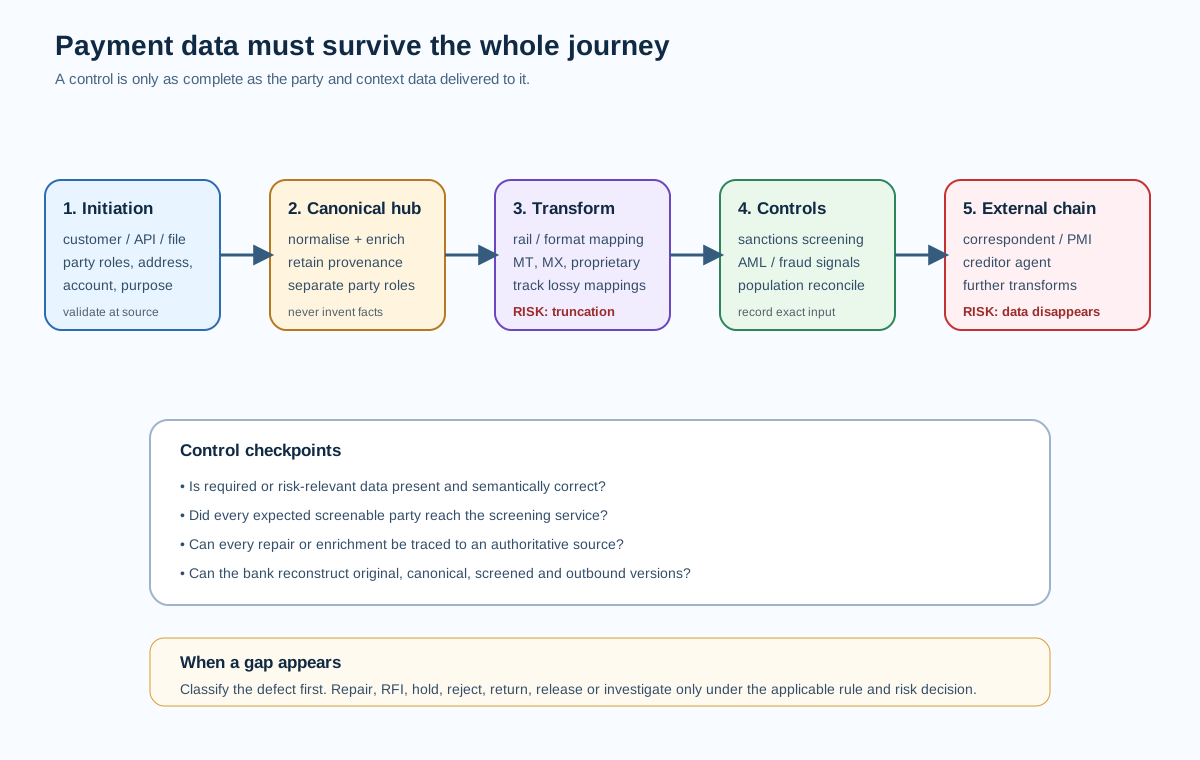
A data gap is more than an empty field
The phrase data gap is often used too narrowly. Teams sometimes reserve it for a mandatory field that is blank. In real payment processing, a gap can arise even when every mandatory field is populated.
An absence gap is the obvious case: required or risk-relevant information is simply not present. Examples include a missing debtor address, missing beneficiary name, absent account identifier or missing intermediary agent where the payment route requires one.
A truncation gap appears when the source had more information than the target can carry or the implementation chooses a shorter representation. A long legal name may lose the distinctive words at its end. A remittance narrative may be shortened. Several address components may be compressed into one line. Truncation is particularly dangerous when the removed portion contains the attribute that would have distinguished an innocent party from a sanctioned or suspicious one.
A semantic gap occurs when data exists but is placed in the wrong meaning. A corporate legal name may be stored as an address line. A beneficiary bank may be represented as the beneficiary. An ultimate party may be collapsed into the immediate account holder. A country code may describe the bank rather than the customer, but a downstream rule interprets it as customer residence. Systems can process syntactically valid data while humans and controls misunderstand what it represents.
A transformation gap appears when a message is converted between formats, versions or internal models and not all source meaning survives. This can occur during legacy-to-ISO 20022 migration, ISO 20022-to-legacy translation for a downstream system, proprietary channel mapping, scheme conversion, message repair, data-warehouse loading or case-management ingestion. A transformation may be necessary and legitimate; the control question is whether material information was lost, altered or made ambiguous.
A provenance gap exists when the bank cannot tell where a value came from. An address may appear complete, but was it supplied by the customer, taken from KYC, enriched from a reference-data provider, inserted manually by operations or inferred by a system? Provenance matters because not all sources have the same evidential weight. A manually added country cannot safely be treated as if it were a verified KYC attribute unless the workflow records that distinction.
A timeliness gap occurs when the data was once correct but is no longer current. Ownership, address, customer status, sanctions designations, beneficial ownership and correspondent relationships can change. A perfectly structured stale record can mislead as easily as an incomplete one.
A visibility gap exists when the information is present somewhere in the bank but not available to the control that needs it. The payment hub may hold an ultimate debtor, while the sanctions service receives only debtor and creditor. A monitoring platform may receive account transactions but not payment-message party data. An investigator may see an alert but not the original message. This is a common architecture problem because teams equate “the bank has the data” with “the control received the data”. Those are different statements.
Finally, an intentional transparency failure can occur when information is deliberately omitted, altered or placed so that another participant is less able to detect it. That possibility is serious, but it should not be assumed merely because data is poor. Legacy limitations, customer error, channel constraints, mapping defects and legitimate repairs are far more common explanations. A sound control detects the weakness first and investigates intent only when evidence supports that question.
Why sanctions screening and AML monitoring need different things
Sanctions screening and AML monitoring are often grouped under “financial crime”, but a payment data gap affects them in different ways.
Sanctions screening is usually concerned with whether relevant names and attributes correspond to designated or otherwise restricted parties, entities, locations, vessels, sectors or activities under the legal regimes applicable to the bank and transaction. A name alone may produce many false positives. Date of birth, country, address, identifier, nationality, place of birth, registration details, vessel identifiers or other attributes may help determine whether a potential match is actually the listed subject. If those distinguishing attributes are absent, a bank may see more false positives, spend more time investigating or, more dangerously, fail to recognise a true match because the screened population itself is incomplete.
AML transaction monitoring asks a different question: does the activity, considered together with the customer and broader pattern, create a reason for further review? Monitoring may use amount, velocity, product, channel, counterparty, geography, purpose, expected behaviour, peer-group behaviour and prior history. Missing purpose or counterparty data can make an unusual payment appear ordinary. Conversely, poor data can generate noisy alerts that investigators repeatedly close because the system does not provide enough context. The result is not only operational cost. Persistent noise can desensitise reviewers and hide genuinely important activity in the queue.
There is also an investigation difference. A sanctions alert can require a time-critical legal decision before funds are released, depending on the applicable regime. An AML alert may be investigated after processing, depending on local law, risk and the bank’s control design. Some payment-transparency obligations themselves require decisions about whether to execute, reject, suspend, request information or otherwise manage a transfer with missing information. Those decisions are jurisdiction-specific. A global platform therefore cannot safely encode one universal outcome for every missing field.
The practical implication is that a bank should not create one generic financialCrimeDataQuality = fail flag and assume the problem is solved. The data-quality service should identify which data is weak, why it is weak, which controls consume it and which legal or policy decisions are affected.
The global standard: FATF Recommendation 16
FATF Recommendation 16 provides the global standard-setting context for payment transparency. FATF standards are addressed to countries and are implemented through national and regional legal frameworks; they are not themselves a substitute for the law binding a particular bank. That distinction matters when designing a global control because local scope, thresholds, exemptions, verification requirements and permitted actions can differ.
FATF revised Recommendation 16 in June 2025. FATF explained that the changes are intended to increase the safety and security of cross-border payments by clarifying responsibilities in the payment chain, standardising information requirements and supporting tools that protect against fraud and error. The revised standard also places explicit emphasis on ensuring information remains available through the payment chain. FATF stated that the changes will come into effect by the end of 2030. A bank planning payment modernisation in 2026 therefore has two responsibilities: comply with the legal obligations that apply now and build with enough flexibility to meet the revised international standard as jurisdictions implement it.
This timing point is important. Teams should not label every 2025 Recommendation 16 change as a current statutory obligation everywhere. Nor should they ignore it because domestic implementation may be later. The correct architecture approach is to maintain an obligation register with effective dates, jurisdiction, legal entity, product scope and control impact. Requirements that are standards today may become binding locally later, and systems built now may still be operating when that happens.
The broader principle is durable: payment transparency depends on reliable originator and beneficiary information and on responsible handling by participants throughout the chain. The control objective is not simply “fill the message”. It is to preserve enough accurate, intelligible and retrievable information for payment participants to perform their legal and risk responsibilities.
Wolfsberg’s practical transparency principle
The Wolfsberg Group’s 2023 Payment Transparency Standards are useful industry guidance because they focus on what payment service providers can realistically do across complex payment chains. Wolfsberg highlights that the debtor agent, intermediary agents and creditor agent have different visibility and responsibilities. It also warns that payment structures such as remittance aggregation, payment processors and highly intermediated chains can limit what downstream institutions see.
A particularly useful principle is that payment service providers should not omit, delete or alter debtor or creditor information for the purpose of avoiding detection. Legitimate changes should be connected to correcting errors or enhancing details for settlement and transparency. That distinction helps operational teams. A repair is not suspicious merely because a field changes. The concern is whether the change is authorised, evidence-based, traceable and consistent with the actual party or transaction.
Wolfsberg also explains why limited transparency can constrain sanctions screening and monitoring by downstream PSPs. This is a crucial point for architects: an intermediary cannot screen a party it never receives. A beneficiary bank cannot monitor the original payment context if the chain delivers only an aggregated settlement instruction. The institution still has responsibilities under applicable law, but control design must be grounded in the information actually available to its role in the payment chain rather than assuming perfect end-to-end visibility.
ISO 20022 improves the container, not necessarily the truth
ISO 20022 is a major opportunity for financial-crime controls because it can carry richer and more structured data than many legacy formats. Party roles can be explicit. Address elements can be structured. Ultimate debtor and ultimate creditor can be represented separately from immediate debtor and creditor. Agent chains and payment identifiers can be represented consistently. Remittance, purpose and regulatory information can be carried in defined components.
But ISO 20022 does not make bad data good by itself. A structured field can contain an incorrect value. A mandatory element can be populated with meaningless filler. A bank can capture a rich pacs.008 and then flatten it before screening. Two institutions can use optional components differently. A channel can provide only a fraction of the data that the payment message later permits. ISO 20022 gives the industry a better information model; institutions still need governance to populate and preserve it correctly.
The CPMI’s harmonised ISO 20022 data requirements for cross-border payments address this interoperability problem. The updated report published in February 2026 explains that inconsistent implementation can reduce the benefits of ISO 20022 and encourages consistent adoption of a common set of data requirements by end-2027. CPMI is explicit that these harmonisation requirements are not regulatory requirements. For a bank, they should therefore be treated as important cross-border market-practice guidance and an architecture target, not misrepresented as law.
The difference between a standard, a market-practice requirement, a scheme rule and a legal obligation should be visible in requirements documentation. It determines who can approve an exception, what effective date applies and what evidence is needed if the bank cannot comply immediately.
Structured addresses: a current operational example
Postal addresses show how a seemingly technical data change becomes a financial-crime issue. Swift’s CBPR+ community is removing fully unstructured postal addresses from cross-border payment messages. Swift's target model uses structured or hybrid addresses, with town and country in designated fields at minimum where required, subject to documented exceptions and the continuing use of a BIC for an agent where applicable. Swift deferred the earlier 14 November 2026 enforcement plan on 27 August 2026, so banks must confirm the replacement timetable and maintain distinct current and target rule versions.
The benefit is not cosmetic. Separating town, country, street, postal code and other components makes data easier to validate, compare and screen. A sanctions engine can use country and town as explicit attributes instead of trying to parse a free-text address. Entity-resolution logic can compare like with like. Investigators can see which component disagrees with KYC. Operations can measure missing-country rates without building fragile text parsing.
The transition also introduces risk. A customer channel that still captures one free-text address must transform it. If the transformation guesses the country from a postal code, the bank needs to know that the value was inferred. If a corporate host-to-host file provides an address in a local convention, mapping logic must not invent a town simply to satisfy a message constraint. If a legacy downstream system cannot store all structured components, the bank should retain the original structured version and make any reduction visible.
This is the general rule for payment-data modernisation: never improve schema compliance by silently reducing evidential truth.
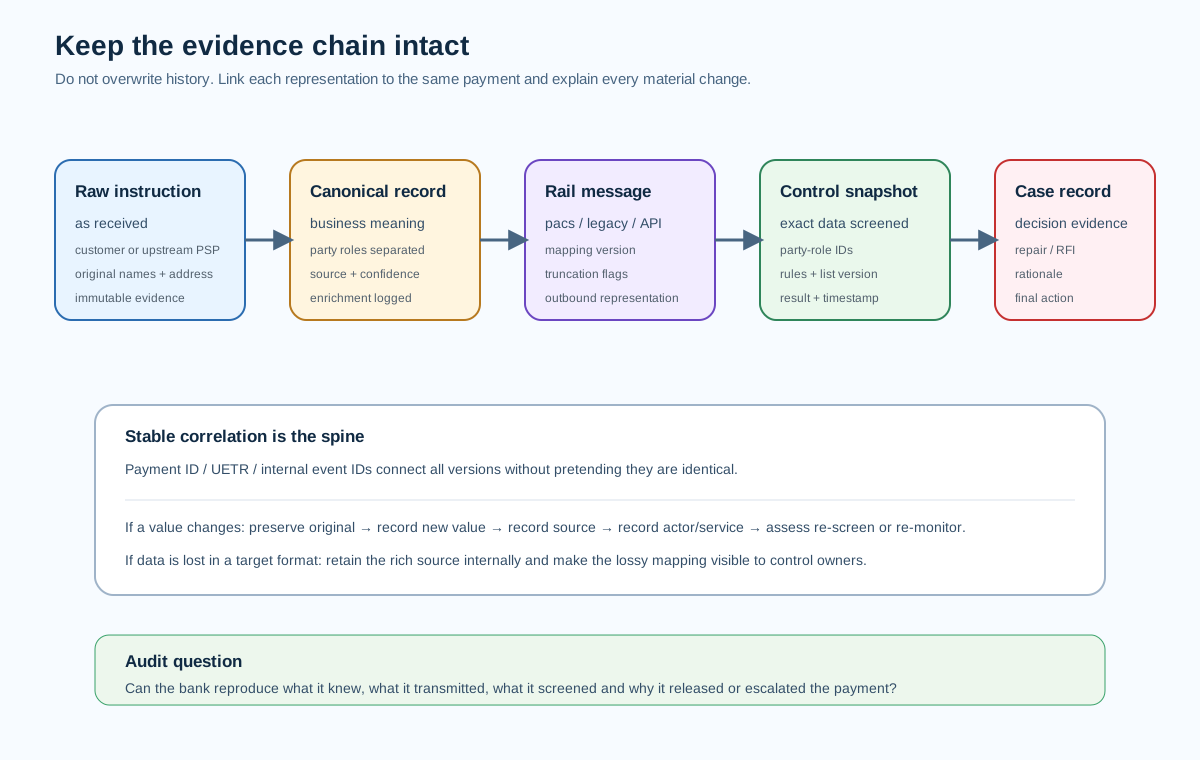
Where data gaps appear in the payment lifecycle
A payment starts before the interbank message. The earliest data-quality control may sit in a mobile app, corporate portal, API, file-upload channel, branch screen or host-to-host interface. If the customer journey allows “N/A” in a meaningful party field, the payment hub receives technically populated but useless data. If the API contract does not distinguish debtor from ultimate debtor, no downstream transformation can recreate the missing role reliably.
At initiation, the bank should validate fields it is responsible for collecting and distinguish hard validation from risk-based checks. Not every optional field should block a payment. A control catalogue should identify which elements are legally required for a particular route, which are scheme or market-practice requirements and which are additional risk data used internally.
At enrichment, the bank may add information from customer master data, account records, BIC directories, country reference data, sanctions-relevant ownership information or product context. Enrichment can improve control effectiveness, but it also creates provenance risk. Downstream users must know whether a value came from the payment instruction or from the bank’s own records.
At canonicalisation, many banks map channel-specific inputs into an internal payment model. This is a critical control point because it determines which concepts the bank can preserve across rails. A weak canonical model often has one name, one address and one bank field. A stronger model distinguishes party role, party identifier, account, agent role, source, verification status, effective time and message origin.
At message construction, the bank maps the canonical record into the scheme or network format. Field-length limits, multiplicity, character sets and usage rules matter. Any loss should be identified before the message leaves the bank. If a target rail cannot carry a risk-relevant attribute, the design should state whether it is retained internally, transmitted through another permitted mechanism or unavailable to downstream parties.
At screening, the bank should know exactly which version of the data was screened. Screening an enriched internal party record is not the same as screening the outbound message. Both can be useful, but audit evidence must not confuse them. If the outbound payment later differs from the screened representation, the bank needs controls to decide whether re-screening is required.
At intermediation, another institution may transform or enrich the payment. Correspondent chains can introduce additional agents, change routing or translate message formats. The receiving bank should not assume that every upstream participant had identical visibility. A downstream transparency control may need to look for missing or malformed information relative to the bank’s role and the applicable rules.
At beneficiary processing, the creditor agent may compare received information with its own account-holder records, perform screening, monitoring or fraud checks, and decide whether a data gap requires repair, inquiry, rejection, execution or escalation under the applicable framework.
At post-event monitoring and investigation, the bank needs enough preserved history to reconstruct the payment as it was at each control point. A data lake containing only the final normalised record is insufficient if the original message contained information that was later changed.
The data domains that matter most
The exact required data depends on payment type and legal framework, but several domains repeatedly matter to financial-crime controls.
Party identity includes names, legal names, aliases where relevant, customer identifiers and entity identifiers. Names should be associated with an explicit role: debtor, ultimate debtor, creditor, ultimate creditor or another connected party. A screening engine should not treat those roles as interchangeable because the legal and investigative significance can differ.
Account and transaction identifiers include account numbers, IBANs, proprietary account references, UETR, EndToEndId, transaction identifiers and related case references. These are not substitutes for party identity, but they make tracing, deduplication, replay control and investigation correlation possible.
Address and geography can support identification and risk context. Country, town and structured address elements help differentiate names and understand geographic exposure. Teams should distinguish the address of a party from the location of a bank, branch, device or transaction. Using the wrong geography in a sanctions or AML rule can create misleading results.
Financial-institution and agent data identifies debtor agent, creditor agent, intermediaries, correspondents and reimbursement institutions. BICs and other identifiers help connect institutions consistently, but architecture should retain role as well as identifier. A bank appearing as an intermediary has a different meaning from the same bank appearing as creditor agent.
Purpose, remittance and regulatory information can explain why value is moving. It can also be weak, coded inconsistently or customer-entered. A narrative such as “invoice” is not strong evidence of commercial purpose by itself. Monitoring and investigation should use it as one source among others.
Ultimate-party data can be particularly important in structures where the account holder is not the economic party behind the payment. It can improve transparency, but only if captured accurately and used consistently. A missing ultimate party is not automatically a breach; the question is whether the payment structure and applicable rules require or reasonably support that information.
Trade, vessel or goods context may be relevant to sanctions and proliferation-financing controls for certain products, but ordinary customer credit transfers do not necessarily carry detailed trade data. Requirements should reflect the product’s genuine visibility rather than pretending every payment contains a bill of lading or commodity code.
Missing information is a risk signal, not a verdict
One of the most damaging control mistakes is to convert every data-quality failure into a suspicion verdict. A missing town can be caused by an old customer interface. A truncated company name can result from a legacy character limit. A blank purpose may be permitted on a domestic rail. An unknown intermediary can appear because dynamic routing selected a correspondent late in processing.
The bank should first classify the defect. Is the field mandatory under the applicable rule? Is it present but malformed? Was it lost inside the bank? Did it arrive from an upstream institution in poor form? Is the missing information material to a screening result or monitoring conclusion? Can the bank obtain it from an authoritative source? Is there evidence that the omission was deliberate?
Only then should the control decide what to do. This separation is important for both fairness and effectiveness. Treating all defects as suspicious creates false positives and customer friction. Treating all defects as harmless operations issues can create sanctions or AML blind spots.
Repair must never become invention
Payment repair is legitimate when it corrects a known error using reliable evidence. It becomes dangerous when operations staff invent values to make a message pass validation.
Suppose a payment requires a country in a structured address and the customer supplied only “Springfield”. A repairer should not select a country because the currency is USD. If the customer master record contains a verified current address, policy may permit enrichment from that source; if so, the system should record the source and the original missing value. If the information cannot be established reliably, the transaction should follow the appropriate exception path rather than being cosmetically completed.
The same principle applies to names. Removing punctuation or normalising case for screening may be reasonable. Replacing an unfamiliar legal name with a familiar trading name without evidence changes identity. Transliteration can help screening across scripts, but the transliterated version should supplement, not silently overwrite, the original where the system can retain both.
A mature repair workflow therefore captures original value, corrected value, correction reason, evidence source, user or service making the change, timestamp and any resulting re-screen or re-monitoring action.
Legal scope: three examples, not one global rule
The global framework becomes concrete only through jurisdiction-specific implementation.
In the European Union, Regulation (EU) 2023/1113 establishes information requirements for transfers of funds and certain crypto-assets. The EBA’s Travel Rule Guidelines, applicable from 30 December 2024, explain measures PSPs and intermediary PSPs should use to detect missing or incomplete information and procedures for managing affected transfers. That is an EU framework. A bank should not apply its exact procedural expectations globally unless policy deliberately adopts them as a higher internal standard and legal review confirms that doing so is appropriate.
In the United States, the BSA funds-transfer recordkeeping and Travel Rule framework has its own scope and thresholds. The FFIEC manual explains, among other things, that for funds transmittals of USD 3,000 or more the transmittor’s financial institution must include specified information in the transmittal order under the cited US rules. That is not the FATF USD/EUR 1,000 threshold, and it illustrates why global applications need jurisdiction-aware rules rather than hard-coding one number.
For cross-border market practice, CPMI and Swift requirements may influence the data a bank must support operationally even where the source is not legislation. A Swift CBPR+ formatting rule can affect whether a payment is accepted by a network or participant. A CPMI harmonisation target can shape architecture. Those sources matter, but their authority should be labelled correctly.
Data quality and sanctions false negatives
False positives receive much attention because they are visible. A sanctions screening engine produces an alert, an analyst reviews it and the workload is measurable. Data gaps create another risk: a false negative, where the system does not generate an alert that it might have generated with complete or correctly structured data.
Consider a designated individual with a common name. The payment contains only an abbreviated surname and no country or date-of-birth context. Depending on the screening configuration, the system may generate too many broad matches or none that crosses the threshold. Another example is a legal entity whose distinctive suffix or second name is truncated in a format conversion. The original channel record might have produced a useful match, while the outbound message does not.
This is why sanctions model validation should include input-data testing, not only algorithm testing. A perfect matcher fed the wrong population is not an effective control. Validation should sample whether expected party roles are present, whether text normalisation preserves meaningful tokens, whether identifiers reach the engine, whether structured addresses are mapped correctly and whether message transformations change match outcomes.
Data quality and AML monitoring blind spots
AML monitoring is often even more dependent on joining payment data to other bank data. A transaction record showing amount, account and date may support velocity scenarios, but it cannot explain who the counterparty is or whether a new geography has appeared. If payment-message data and account-posting data are separated, the monitoring platform may see only a ledger entry with a generic description.
The strongest design creates stable identifiers that connect the customer, account, payment instruction, interbank message, settlement event and case. Monitoring can then use the attributes relevant to the scenario while investigators can retrieve the richer payment record when needed.
A data-quality defect should also be visible as a feature or confidence indicator. If beneficiary country is unavailable, a geography-based scenario should not quietly treat the value as “low risk”. The scenario might route the transaction differently, lower confidence, create a data-quality exception or use another approved attribute. The key is to make uncertainty explicit rather than converting missing data into a normal value.
Alert, case and investigation outcomes
A payment-data gap can lead to several different operational outcomes. The correct one depends on legal requirements, payment rail, risk, timing and the bank’s role.
A defect may be repaired automatically from an authoritative internal source. It may be repaired manually with controlled evidence. The bank may request information from the customer or another PSP. A payment may be held, rejected, returned or released, depending on the applicable regime and the nature of the defect. The bank may process the payment but create a post-event review. Repeated poor-quality messages from another institution may trigger correspondent relationship governance rather than treating each transaction as an isolated problem. A defect combined with other indicators may contribute to an AML investigation or sanctions escalation.
These outcomes should not be conflated. “Rejected for missing required information” is not the same as “rejected because a party is sanctioned”. “Held pending repair” is not the same as “frozen under an asset-freeze obligation”. Status codes, customer communications and case records should preserve those differences.
Customer and operational impact
Data-quality controls can protect the bank while still harming customers if badly designed. A payment may be delayed because a corporate file uses an old address format. A beneficiary may not receive salary or supplier funds on time. An instant-payment journey may fail without enough time for manual repair. Repeated requests for information can frustrate customers who already supplied the data elsewhere in the bank.
Good control design therefore fixes problems as far upstream as possible. If 20% of repair cases originate from one channel that still sends unstructured addresses, improving that channel is better than hiring more investigators. If a corporate customer repeatedly omits required data, the bank may provide validation feedback before submission rather than reject after processing starts. If a correspondent repeatedly sends deficient messages, relationship management and second-line compliance may need to address the pattern through governance.
Customer impact should be measured alongside financial-crime risk. Useful metrics include rejection rate caused by data defects, average repair time, repeat defect rate by source, customer contacts required, false-positive impact and the proportion of exceptions resolved automatically from trusted sources.
A realistic mini case: a party disappears in translation
A corporate customer in Country A instructs its bank to pay an equipment supplier in Country C. The bank’s corporate channel captures the legal debtor, an ultimate debtor belonging to the same group, the creditor, structured addresses, invoice reference and purpose. The payment hub creates a rich ISO 20022 representation. Because one downstream sanctions component still relies on a legacy interface, an adapter flattens the debtor information into a short string and omits the ultimate debtor entirely.
The outbound interbank ISO 20022 message is constructed later from the canonical payment record and contains both debtor and ultimate debtor. The legacy screening service, however, screened only the flattened debtor. It did not see the ultimate debtor that will appear in the outbound message.
During a post-release control review, data lineage identifies the inconsistency. The issue is not that the payment necessarily involved a sanctioned party. The issue is that the bank cannot prove that every relevant outbound party was screened before execution. The team therefore treats it as a control-coverage defect.
Operations and compliance first assess the individual payment. The ultimate debtor is screened using the original authoritative data and no match requiring escalation is found. The bank records the retrospective check and determines whether any incident reporting is required under its internal and jurisdictional framework.
The technology team then assesses population impact. It identifies all payments that used the same adapter during the affected period, compares parties present in the canonical record with parties delivered to screening and performs controlled retrospective screening where required. The fix changes the interface contract so that all relevant party roles are sent to the screening service. A reconciliation control is added: before release, the system compares the set of screenable outbound parties with the set acknowledged by the screening service. A mismatch blocks release or routes to an exception according to approved policy.
The lesson is deeper than “add ultimate debtor”. The same architecture can fail with addresses, intermediary agents, vessel data, purpose or identifiers. The durable control is to define the screening population, prove it reached the engine, preserve the version screened and reconcile that against the payment released.
What a strong control environment looks like
A strong bank can answer five questions for any material payment-data element.
First, what does this field mean? The data dictionary defines its business semantics, not only its XML path or database column.
Second, where did it come from? Provenance connects the value to the customer, KYC record, reference source, upstream PSP or manual repair.
Third, what changed it? Transformations are versioned, tested and traceable.
Fourth, which controls used it? Screening, fraud, AML monitoring, routing and reporting dependencies are known.
Fifth, what happened when it was weak? The bank has a risk-based exception process with legal and policy rules, not an informal operations workaround.
When those answers are available, payment transparency becomes an engineered capability rather than a hopeful assumption. The remaining deep dive examines where ISO 20022 transformations fail in practice, how data defects alter control outcomes and how to prove coverage with testing and reconciliation. Swift timetable source, checked 2 October 2026: Structured-address migration extension and 21 September release update. The deferred release includes exceptions/investigations messages on 12 June 2027; structured-address enforcement timing remains separately governed: https://www.swift.com/news-events/news/swift-accepts-community-request-extend-structured-address-migration-iso-20022-payment-messages
Operational deep dive: where payment data is lost and how controls detect it
The base chapter established the core principle: sanctions and AML controls cannot use information that has disappeared, changed meaning or become inaccessible. This deep dive follows the technical journey in more detail. The purpose is not to turn compliance staff into message engineers. It is to help payment, compliance and technology teams recognise the failure patterns that create invisible control weakness.
The first mistake: validating syntax and assuming the data is good
Payment platforms commonly apply several validations before a message is accepted. XML must be well formed. Mandatory elements must be present. Codes must come from allowed lists. Field length and multiplicity rules must be satisfied. Scheme-specific usage rules may also be checked. These controls are essential, but they answer a narrow question: can this message be processed according to the technical specification?
Financial-crime controls need a broader answer: does the message contain meaningful, correctly attributed and sufficiently trustworthy information for the bank’s control responsibilities?
A debtor name of UNKNOWN may satisfy a character rule. A town name of CITY may satisfy an XML schema. A remittance field containing PAYMENT may be valid. A party address copied from an agent address may be structured. Technical validation alone will not tell the bank that the business meaning is poor.
For that reason, mature payment-quality controls operate at several layers. Schema validation protects technical processing. Market-practice validation protects consistency with scheme rules. Business validation checks plausible semantics and source relationships. Financial-crime data-quality controls assess whether the attributes needed by screening, monitoring or investigation are usable. The layers should share evidence, but one should not be represented as proof of another.
Mapping risk during MT, MX and proprietary coexistence
Migration to ISO 20022 is rarely a single cutover. Banks often run mixed estates for years: ISO 20022 at the external edge, legacy formats inside, proprietary API models in channels, older databases in screening or monitoring, and reporting stores built around previous message concepts. The financial-crime risk therefore sits less in the XML itself than in the mappings between models.
A source system may represent one free-text ordering-customer concept while ISO 20022 distinguishes debtor, debtor account, ultimate debtor and debtor agent. A one-to-many transformation cannot be solved safely by copying one source value into every destination role. That can create false transparency: the output looks richly populated but actually repeats information that the source never distinguished.
The reverse mapping is equally important. A rich ISO 20022 message may contain multiple structured parties and agents, but a downstream legacy interface may have space for only one customer name, a few address lines and one bank. If the adapter discards the ultimate party or intermediary agent without raising a quality condition, downstream screening coverage is narrower than the message suggests.
During coexistence, teams should classify every mapping as one of four types: one-to-one preservation, where the same concept and value are retained; normalisation, where representation changes but business meaning is intended to remain the same; enrichment, where a new value is added from another authoritative source; and lossy transformation, where the target cannot carry all source information or the implementation deliberately reduces it.
Lossy mappings are not automatically unacceptable. Some rails or legacy components genuinely have constraints. The problem is an unknown lossy mapping. If the architecture knows that data is being lost, it can decide whether to retain the source internally, route around the limitation, compensate with another control or accept a documented residual risk. If nobody knows, there is no deliberate control decision.
Field overflow and truncation
Truncation can change screening outcomes in subtle ways. Consider a legal entity named NORTH EASTERN INDUSTRIAL DEVELOPMENT AND TRADING COMPANY LIMITED. A legacy interface that keeps only the first 35 characters may remove words that distinguish the entity from another organisation. A different adapter might keep the last 35. A screening tool may tokenise both versions differently. The resulting match score is not simply “lower quality”; it can be materially different.
Address truncation has similar effects. A country may appear at the end of a free-text line and be removed. A vessel name may be retained while an IMO number is lost. A long intermediary-bank identifier may be shortened. A corporate group name may lose a legal suffix that entity resolution uses.
The safe approach is not “never truncate”, because target formats sometimes impose real limits. It is to control truncation explicitly. The transformation should know which source characters were removed, preserve the complete source record, apply documented prioritisation rules and test whether truncation changes sanctions match outcomes for representative data. Where a risk-relevant identifier is available, structured identifiers are generally more robust than relying on increasingly compressed free text.
Character sets, transliteration and normalisation
International payments operate across scripts and naming conventions. A bank may receive names in Latin, Cyrillic, Arabic, Chinese or other scripts. Screening engines may generate or consume transliterations. Channels may restrict characters. Legacy formats may replace unsupported characters. Accents may be removed. Punctuation and spacing may be normalised.
Normalisation is necessary, but the original representation should be retained whenever the architecture permits. Transliteration is not a perfect reversible operation. The same name can have several valid Latin representations. If a transliterated string silently replaces the original, investigators may lose useful identity evidence and re-screening under improved matching logic becomes harder.
A robust model stores the original value, script or language metadata where available, normalised search form and generated transliterations as separate representations. Screening services can use several forms while the case record shows what the payment actually contained.
Misusing free text as a substitute for structured data
A common migration shortcut is to put information somewhere visible rather than in the semantically correct element. Operations may insert an ultimate party into remittance text. A channel may concatenate name and address into one line. A repairer may put a missing country in an instruction field. Humans can sometimes understand the result, but machines often cannot.
The risk is greatest when downstream controls are configured against specific structured elements. A sanctions service may screen debtor name and ultimate-debtor name but not arbitrary remittance text. A geography rule may read a structured country element but ignore country words buried in an address line. A transaction-monitoring model may receive structured purpose codes but not full narrative.
This is why “the data is in the message somewhere” is not an adequate acceptance criterion. Requirements should specify the business concept, the permitted source, the target element and the consumers that rely on it.
Bundling, aggregation and settlement transparency
Not every payment leg represents one underlying customer transfer. Payment processors, money-service businesses, card schemes and other PSP models can aggregate many transactions into a settlement movement. The settlement instruction may legitimately identify the PSPs or merchants rather than every underlying payer. Wolfsberg’s Payment Transparency Standards discuss these structures and the resulting limitations in downstream visibility.
The control response is not to force every underlying customer into a message that does not support the model. Instead, the bank should understand what transparency is expected for that payment type, which participant holds the underlying data, what information can be obtained if needed and how monitoring responsibilities are divided.
This distinction prevents two opposite errors. One is to assume that an aggregated settlement payment gives a correspondent full customer-level transparency when it does not. The other is to label the absence of every underlying payer as a defect when the applicable framework permits the model. Architecture, compliance and correspondent-banking teams need a shared view of the payment model before they can judge the data.
Cover payments and correspondent chains
Correspondent banking creates another transparency challenge because the customer-payment flow and settlement flow can involve different messages and institutions. The bank needs to understand which message carries originator and beneficiary information, how cover-payment transparency is maintained and which intermediaries can see which data.
A data-control design should not assume that every participant sees the same message. It should define the bank’s role: ordering institution, intermediary, reimbursement institution, beneficiary institution or correspondent servicing another PSP. The relevant controls and available data differ by role.
A useful assurance exercise takes a real cross-border transaction and reconstructs the information visible to each participant at each hop. The output often reveals gaps that system-level testing misses: the sending bank may have full KYC and purpose information, the payment message may carry a subset, an intermediary may see only the transmitted message, and the beneficiary bank may combine the message with its own customer record. Financial-crime controls should be assessed against the information each institution actually receives, not against the richest source available anywhere in the chain.
Instant payments compress the decision window
Instant payment schemes create a special operational problem: the time available to identify and resolve a data gap may be seconds. A traditional cross-border payment might tolerate a manual repair queue; an instant rail often cannot.
That makes prevention upstream more important. Customer and API validation should catch defects before initiation. Reference data should be available with low latency. Screening input should use a pre-agreed canonical model. Fallback behaviour for data-quality or screening-service outages should be deterministic and approved before an incident.
The bank should also distinguish between defects that must prevent processing and defects that can be handled through post-event review under the applicable framework. That decision cannot be guessed by engineers during an outage. It needs legal and compliance mapping to rail rules and local regulation.
An instant payment also demonstrates why a manual “repair everything” strategy does not scale. If the bank expects investigators to fix data after every failed automated check, the control will either breach the payment SLA or create pressure to override exceptions. Good design reduces the number of exceptions reaching the time-critical path.
Screening population reconciliation
One of the strongest controls a bank can implement is a reconciliation between who appears in the payment and who was screened.
For each relevant payment type, policy and sanctions specialists define the population of parties and data elements expected to be screened. The payment platform creates that population from the canonical record or outbound message. The screening service receives the records and returns a response that identifies what it evaluated. Before payment release, or through an approved equivalent control where timing differs, the bank verifies that the expected population and screened population align.
The comparison can detect several failure classes: a party dropped by an adapter; a repeated party deduplicated incorrectly; a field that failed serialisation; a screening service that rejected one party record but returned an overall success; a message modified after screening; a late route change that introduced a new intermediary; or enrichment that changed a material attribute after the control decision.
The reconciliation should be designed around business identity, not only message count. Five XML nodes do not necessarily mean five distinct screenable subjects, and one party may have several representations. The control needs stable correlation IDs and clear role semantics.
Screening match quality and missing attributes
Sanctions matching commonly uses names plus secondary attributes. Missing data changes both sensitivity and workload. A common name without date of birth or country may produce numerous potential matches. Overly aggressive tuning to suppress the noise can increase false-negative risk. Conversely, a very broad threshold can generate so many alerts that operations become overloaded.
Data-quality remediation is therefore part of screening optimisation. Instead of tuning the matcher around persistently poor inputs, the bank should ask whether upstream data can be improved. Structured address migration, better customer master data, reliable entity identifiers and accurate party roles can reduce ambiguity without weakening the screening threshold.
Quality metrics should connect input quality to outcomes. Examples include alert rate by data-completeness band, confirmed-match or escalation rate by source channel, analyst handling time for records missing country or date of birth, and false-positive rate before and after a structured-data improvement. Those metrics show whether a data programme is actually improving control effectiveness rather than merely increasing field population.
AML scenario confidence and missing data
AML monitoring should treat missing features carefully. In rules engines and statistical models, a null value can be ignored, converted to zero, assigned a default category or imputed from other data. Each choice has a risk meaning.
Suppose a scenario scores cross-border payments to higher-risk jurisdictions. If beneficiary country is missing, assigning DOMESTIC or LOW_RISK is unsafe. Treating every null as HIGH_RISK may be equally unhelpful if the field is routinely absent on a product where another reliable geography exists. The model design should define a specific missing-data state and, where appropriate, use alternative approved attributes or a lower-confidence outcome.
For model-governed monitoring, feature lineage should show which source field feeds the scenario, how it is transformed, how missing values are handled and what happens if the upstream schema changes. A field renamed during a payment-platform migration can silently break a scenario if change governance focuses only on whether payments still settle.
RFI as an evidence mechanism, not a universal repair service
When an institution genuinely needs missing information, a request for information may be appropriate. But RFIs should not become a substitute for fixing chronic data defects. If every payment from a correspondent is missing the same required attribute, repeatedly asking operations to send an RFI treats the symptom and leaves the structural weakness in place.
The bank should distinguish transactional resolution from source remediation. The transaction may need an immediate decision. Separately, the recurring defect should be attributed to a channel, customer, correspondent, translator or system owner and tracked until fixed. Relationship governance may be necessary where another PSP persistently provides poor payment transparency.
RFIs also need data-minimisation discipline. Ask for information material to the risk question and permitted by the applicable legal framework. Do not use every payment-data gap as a reason to demand a full customer due-diligence file from another bank.
Immutable originals and reconstructable decisions
A strong investigation record preserves at least four logical layers: the original inbound or customer instruction as received; the canonical internal representation used by payment processing; the exact control input and control result used for screening or monitoring decisioning; and the outbound or final processed message, plus any repair, inquiry or decision events.
These layers need not live in one database, but they should be correlated and retrievable. If the bank stores only the final repaired message, it cannot prove what was originally missing. If it stores only raw messages, investigators may struggle to understand how transformations affected them. Both raw evidence and interpretable lineage matter.
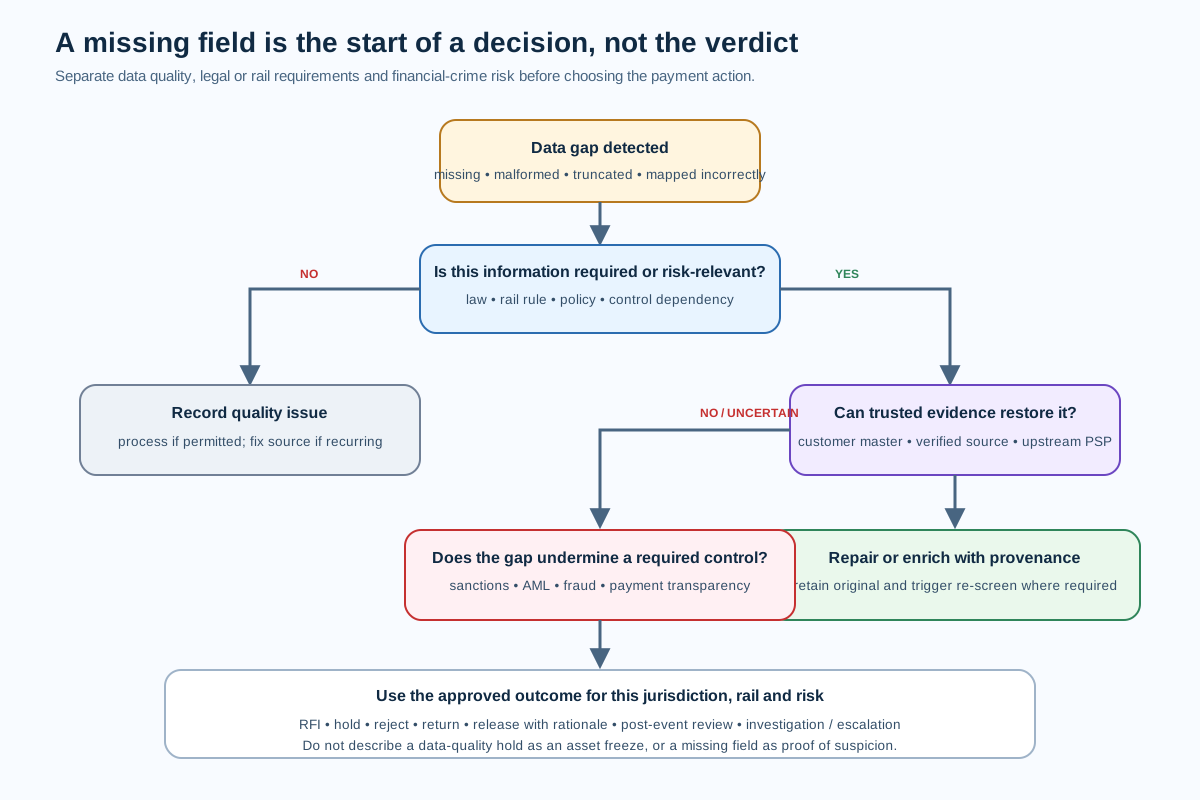
The decision model for a payment-data defect
A practical workflow starts by identifying the defect and source. Then it asks whether the information is required by the applicable law, regulation, scheme or bank policy for this payment and role. It asks whether the missing information can be restored from an authoritative source without guessing. It asks whether the gap affects a sanctions, AML, fraud or other control decision. It considers timing and payment-rail constraints. Finally, it routes to the approved action.
Possible actions include automatic repair, manual repair, request for information, hold, reject, return, release with documented rationale, post-event review or relationship-level escalation. A sanctions alert or legal prohibition may create a separate decision path; the data-quality workflow should not disguise a sanctions freeze as a generic repair status.
Decision rules should be versioned. If a jurisdiction changes its travel-rule requirements or a rail changes address rules, the bank should be able to identify which payments were evaluated under the previous rule and when the new rule took effect.
Measuring quality as a control, not a dashboard exercise
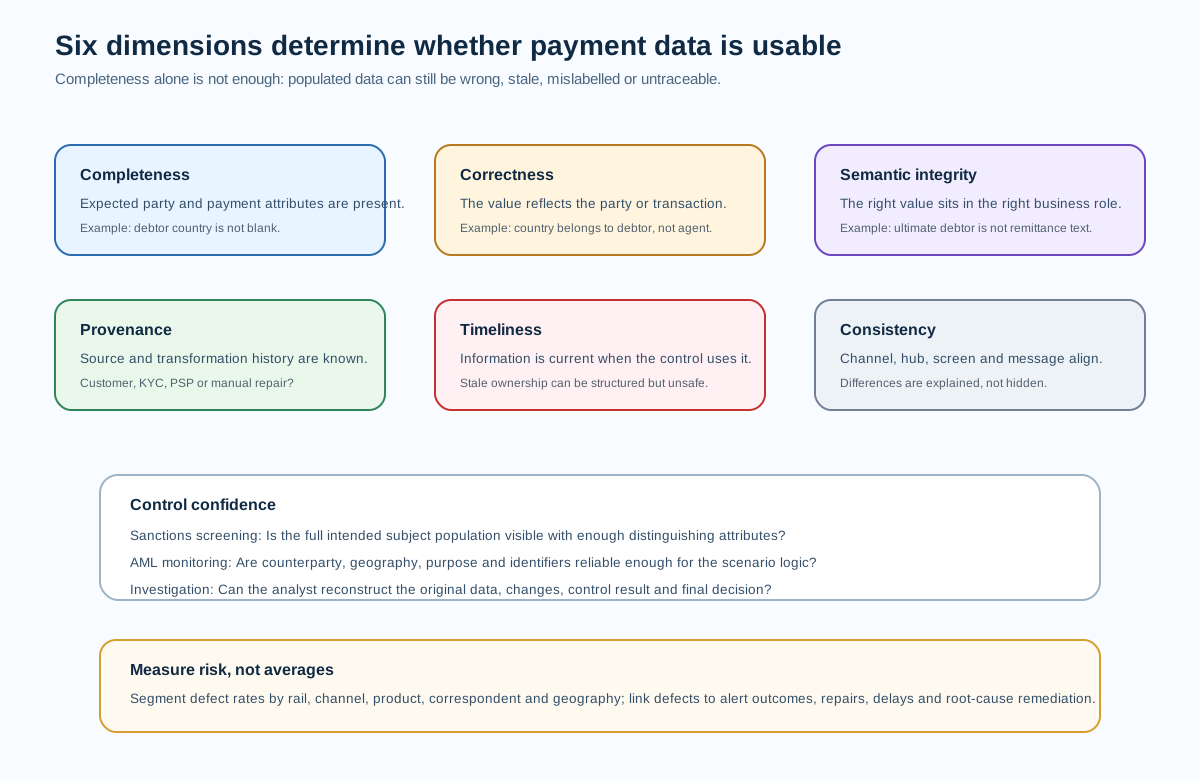
A useful payment-data quality framework measures dimensions that have direct control meaning.
Completeness asks whether expected elements are present. Correctness asks whether they reflect the real party or transaction to the extent the bank can establish it. Semantic integrity asks whether values sit in the correct business role. Provenance identifies the source and transformation history. Timeliness asks whether information is current when used. Consistency compares representations across channel, customer master, payment message and control platforms.
A percentage alone can hide risk. “98% address completeness” sounds strong, but the 2% missing could all sit in a high-risk correspondent corridor. The metric should therefore support segmentation by product, rail, geography, channel, customer type, correspondent, data owner and control consequence.
Root-cause categories that lead to action
Every material data-quality exception should be attributable where possible. Useful root-cause categories include customer input, channel design, reference data, customer-master weakness, payment-hub mapping, message translation, screening interface, external correspondent, scheme limitation, manual repair and unknown.
The purpose of categorisation is not reporting neatness. It allocates remediation. A channel problem belongs with the product and channel owner. A transformation defect belongs with payment technology. Repeated correspondent omissions require relationship and compliance governance. Poor KYC enrichment belongs with customer-data owners. Unknown causes should shrink over time as observability improves.
A mini forensic example: the screening result changed after a migration
A bank migrates corporate cross-border payments from a proprietary format to ISO 20022. Before migration, the screening adapter concatenated legal name and all address lines into one search string. After migration, the new adapter sends structured name, town and country separately. Alert volumes fall markedly in the first week.
The fall could be good news: structured attributes may reduce false positives. It could also signal missing data. The bank does not assume either explanation.
Control assurance selects a matched sample of pre- and post-migration payments. It reconstructs the same customer and counterparty pairs, compares canonical records, screening inputs and matcher results. The review finds that country is correctly structured and some noise has genuinely disappeared. It also finds that an optional second name line used by several corporate customers was not mapped into the new screening contract. For most customers that line was immaterial, but for a subset it contained a distinctive legal-name component.
The migration team corrects the mapping, identifies affected payments and performs risk-based retrospective screening according to the bank’s incident framework. Testing adds an assertion that all non-empty source name components either reach screening or are explicitly documented as non-screenable. Monitoring is added to compare source-to-screening token counts for unusual drops.
This case shows why control migration requires outcome comparison, not just message-schema testing. A technically successful release can change screening behaviour materially.
What the deep dive should leave you able to ask
When reviewing any payment architecture, ask: What is the richest authoritative source? Which representation becomes canonical? Which mappings are lossy? Which party roles and attributes are consumed by sanctions screening? Which are consumed by AML monitoring? What happens to nulls? What happens after repair? Can the bank reconstruct the exact version screened? Can it identify a message modified after screening? Are recurring upstream defects fixed at source? Can quality metrics be segmented by risk rather than averaged away?
Those questions move payment transparency from a policy statement into a testable control system. The advanced-practice section now turns them into architecture, requirements, testing and governance artefacts.
Advanced practice: architecture, requirements, testing and governance
A mature payment-transparency programme is not a campaign to populate more fields. It is an engineered control capability that can prove which payment information was expected, which information arrived, how it changed, what the financial-crime controls consumed and what happened when quality was insufficient. This section turns that objective into delivery artefacts for product owners, business analysts, architects, developers, testers, operations, compliance and assurance teams.
Start with a canonical party and payment model
A bank with many channels and payment rails needs an internal model that is richer than the narrowest rail it supports. Otherwise every new integration is forced to inherit the limitations of the oldest system.
The canonical model should represent parties separately from accounts and agents. A debtor is a party. A debtor account is the account used in the payment. A debtor agent is the financial institution servicing that account for the payment. An ultimate debtor may be another party with an economic relationship to the transfer. The same separation applies on the creditor side. Intermediary agents and reimbursement relationships should have explicit roles rather than being placed in a generic bank list.
Each important attribute should carry more than a value. Where practical, the model should retain source, verification or confidence status, effective time, original representation and transformation history. That does not mean every XML element needs a miniature data-governance system. It means risk-relevant changes should be reconstructable.
For example, creditorCountry = DE tells a screening engine one fact. A stronger internal record can also show that the country came from the customer’s payment instruction, was not verified against KYC because the creditor is not the bank’s customer, was mapped from a structured address element and was unchanged before screening. If operations later repairs the value to AT, the case history shows why and from which evidence.
The canonical model should also support identifiers without treating them as interchangeable. BIC identifies an institution in a particular context. IBAN identifies an account. LEI identifies a legal entity. UETR traces a payment. An internal customer ID identifies a relationship inside the bank. Mapping all of them into identifier without type and issuer destroys meaning.
Build a control dependency register
For every material data element, the bank should know which controls depend on it. This is a practical bridge between data governance and financial-crime governance.
A dependency register might show that debtor name feeds sanctions screening, payment investigations and transaction-monitoring counterparty analysis. Debtor country may feed sanctions context, high-risk geography monitoring and regulatory reporting. UETR may feed traceability and investigation correlation but not sanctions matching. Remittance purpose may feed monitoring and investigation but should not be treated as verified economic truth.
The dependency register allows change teams to perform impact analysis. If a channel changes the way it populates creditor address, the team can identify all screening, monitoring, fraud, reporting and investigation consumers rather than testing only the payment hub. If a data warehouse removes a field to reduce storage, the impact on retrospective investigations becomes visible before implementation.
This is especially important for optional ISO 20022 elements. “Optional in the schema” does not mean “irrelevant to every control”. The bank can choose to populate and use optional information because its products or risk model need it. Conversely, it should not invent optional information merely because a downstream system prefers a populated field.
Define data contracts between systems
A screening interface should be governed like a financial control, not merely an API integration. The contract should state which party roles are transmitted, which attributes are mandatory for that interface, how nulls are represented, maximum lengths, character handling, transliteration rules, identifier types, deduplication behaviour and the correlation mechanism for responses.
The contract should also define failure semantics. If one of six parties cannot be serialised, does the service reject the whole request, return a partial result or silently omit the record? A technically “200 OK” response is not sufficient if one required party was never screened. Response design should let the payment platform reconcile expected and evaluated subjects.
For asynchronous screening, the contract should define idempotency and replay. A retry must not create duplicate uncontrolled decisions. If a payment changes after screening, the platform needs a rule for whether the previous result remains valid. Changes to amount may matter differently from changes to party identity; the policy should define materiality rather than leaving it to developers.
Monitoring interfaces need similar discipline. They should identify whether a transaction event is final, reversed, returned or corrected; which party and geography fields are authoritative for the scenario; and how corrections are propagated. A monitoring engine trained on stale pre-repair data can reach different conclusions from an investigator looking at the final payment.
Separate hard validation, soft validation and financial-crime exceptions
Not every poor-quality field should stop a payment. A useful design uses several levels.
Hard validation rejects data that cannot be processed or violates a mandatory rule for the route. Examples can include invalid code format or a required element that is absent.
Soft validation accepts the instruction but flags a quality concern that can be corrected, enriched or monitored. Examples include an unusual address pattern or low-confidence purpose description.
Financial-crime exceptioning evaluates whether the defect undermines a sanctions, AML or other control sufficiently to require an action such as hold, RFI, escalation or enhanced review.
Keeping these levels distinct improves customer communication. A customer should not be told “sanctions issue” when the real problem is a malformed address. It also improves management information because teams can see whether failures are technical, market-practice, regulatory or risk-based.
Requirements that a BA can actually test
Weak requirement: “The system shall ensure complete payment data.”
Strong requirement: “For outbound cross-border credit transfers on Rail X, before release, the payment service shall confirm that debtor and creditor name, account identifier where applicable, and country/town address elements required by the active Rail X usage rule are present in the canonical record; it shall preserve source provenance; it shall send the configured sanctions-screening population with stable party-role identifiers; and it shall route any mismatch between expected and screened population to exception status FC-DQ-03 without releasing the payment.”
The second requirement is longer, but it is testable. It defines scope, timing, fields, source record, screening dependency, exception code and release behaviour.
A good requirements pack should answer:
- Which payment types and legal entities are in scope?
- Which obligation, scheme rule, market practice or internal policy drives each field requirement?
- What effective date applies?
- What is the authoritative source?
- Can the value be enriched, and from where?
- What transformations are permitted?
- Which control consumers rely on the field?
- What constitutes a material change after screening?
- What exception state applies when the field is unavailable?
- Who can override the exception, under what authority, and what evidence is retained?
- What customer or counterparty communication is permitted?
- What happens on timeout or service outage?
This structure prevents a common delivery failure where compliance provides a policy paragraph, technology guesses the implementation and operations discovers the ambiguity only after go-live.
Acceptance criteria for payment-data integrity
Acceptance criteria should prove behaviour, not merely field presence.
For preservation, take a source payment containing a long legal name, structured address, ultimate debtor, multiple agents, purpose and identifiers. Assert that each configured concept appears in the canonical model with the correct role and provenance. Assert that the outbound representation follows the rail’s rules. Assert that any lossy mapping is flagged and logged.
For screening, assert that the expected party population equals the service acknowledgement population. Change an ultimate-party name after the first screen and verify that the payment cannot use the stale result where policy requires re-screening. Introduce a serialisation failure for one party and verify that the platform does not interpret a partial response as full clearance.
For repair, remove a country from the instruction and provide a verified customer-master country. Test both a policy-permitted enrichment and a case where the master data is stale or inapplicable. Ensure the system records source and reason and does not overwrite the raw instruction.
For monitoring, send a payment with beneficiary country missing. Verify the scenario treats the value as missing or uses the approved alternative source rather than silently defaulting to a low-risk country. Correct the value later and verify the monitoring and case history remain coherent.
Build a golden payment-data test set
Regression testing becomes much stronger when the bank maintains a controlled set of representative payments with known expected transformations and control outcomes. The set should include more than “happy path” messages.
Useful examples include:
- short and very long personal and corporate names;
- names with punctuation, accents and non-Latin scripts;
- structured, hybrid and intentionally defective addresses;
- debtor and ultimate-debtor combinations;
- multiple intermediary agents;
- identifiers such as BIC, IBAN, LEI and UETR in correct and incorrect roles;
- cover and serial correspondent patterns;
- payments with meaningful and vague remittance information;
- legitimate aggregation or settlement models;
- high-risk but legitimate corridors;
- known sanctions-test names supplied under controlled test conditions;
- null, malformed, duplicated and late-enriched fields.
The expected result should cover message output and financial-crime control input. If a future release changes either unexpectedly, the regression suite identifies it before production.
Negative testing: prove that bad data fails safely
Positive testing proves the system accepts correct payments. Negative testing proves it fails safely when assumptions break.
Remove one party from the screening request while keeping the payment message valid. Send an invalid country code from the channel. Send a legal name longer than the screening interface allows. Place the creditor address into the debtor role. Duplicate the same party under two roles. Change the route after screening so that a new intermediary appears. Retry an asynchronous screen until responses arrive out of order. Make the enrichment service unavailable. Return a partial screening response. Send a repaired payment whose raw source disagrees with the corrected value.
For each case, the expected outcome should be explicit: block, repair, route to exception, re-screen, use approved fallback or process with a recorded warning. “System error” is not a sufficient expected result for a regulated control path.
Evasion testing without teaching evasion
Control testing should also ask whether a determined actor could exploit predictable data weaknesses. The aim is defensive: prove that common manipulations do not quietly remove a subject from screening or monitoring.
Test spacing, punctuation and transliteration variants that the screening engine is expected to handle. Test data placed in unexpected fields. Test names split across components. Test repeated use of generic purpose descriptions. Test whether a customer can submit a message that is technically valid but causes an important party to be classified as an unscanned role.
These tests should be conducted in controlled non-production environments using approved test data. Results feed mapping fixes, validation and detection tuning rather than being turned into operational instructions for bypassing controls.
Change control for ISO 20022 releases and market-practice updates
ISO 20022 schemas and market-practice rules evolve. Banks should not assume that a payment implementation completed once is permanently correct.
A standards change should trigger impact assessment across channel validation, canonical model, mapping, screening contracts, monitoring features, case-management rendering, archival and reporting. The team should identify whether a new element creates additional transparency, whether an existing element becomes mandatory under a market practice, and whether any downstream system will drop it.
Swift’s removal of fully unstructured postal addresses from CBPR+ is a good 2026 example. The change affects customer channels, corporate files, APIs, payment hubs, screening, repair workflows and customer communications. A bank that updates only its outbound XML mapping may technically meet one network requirement while still losing structured information in an internal legacy screen.
CPMI’s updated 2026 harmonised ISO 20022 requirements provide another reason for coordinated change. They are not regulation, but they are designed to reduce cross-border fragmentation. Architecture teams should compare their canonical model and usage conventions with the harmonised direction and document where local or product-specific constraints remain.
Operational ownership and queue design
A data-quality exception queue should not be a dumping ground between payments operations and compliance. Each exception category needs an owner, service target appropriate to the payment type, decision authority and escalation path.
Operations can resolve documentary or source-supported repairs within approved boundaries. Sanctions specialists decide potential-match issues. AML investigators evaluate suspicious patterns. Payment product teams own recurring channel or format defects. Correspondent relationship managers address persistent upstream transparency problems. Data owners remediate master-data weakness. Technology teams correct mappings and interface defects. Second-line compliance sets policy and challenges effectiveness rather than manually clearing every operational error.
Queue design should preserve the payment clock. A cross-border batch payment and an instant payment cannot share an identical manual SLA. Prioritisation should consider legal deadline, settlement deadline, customer impact, sanctions risk, transaction value and the ability to recover or return funds later.
Management information that leads to decisions
A useful dashboard answers not only “how many exceptions?” but “where is transparency degrading and what are we doing about it?”
Track defect rate by channel, rail, message type, correspondent and customer segment. Track repeat defects, ageing, repair source, override rate and cases where missing data affected screening or monitoring. Track population-reconciliation failures. Track transformations that are intentionally lossy. Track customer impact such as delays and rejects. Track root-cause closure and recurrence after remediation.
Then connect those metrics to governance thresholds. A sudden rise in missing beneficiary country after a release should trigger incident assessment. A correspondent whose required-data defect rate remains above an approved threshold may require relationship review. A channel responsible for most repairs should generate a product backlog, not merely a larger operations team.
Quality assurance should replay the evidence chain
QA reviewers should sample from both cleared and escalated payments. Looking only at alerts misses false negatives created by missing data.
For a sample payment, the reviewer should retrieve the original instruction, canonical record, transformation history, screening input, screening result, outbound message and any repair or case events. The reviewer checks that the right parties were evaluated, that information was not silently lost, that repairs were evidence-based and that the final decision matched policy.
The sample should include clean payments because a control can fail invisibly while producing no alert. It should include different channels and rails because quality can vary sharply by source. It should also include payments around system releases, translation changes and rule updates where defect risk is higher.
Quality findings should distinguish individual reviewer error from systemic design error. If several analysts consistently miss the same attribute because the case screen hides it, training alone is not the correct remediation.
Governance across first line, second line and audit
First line owns the payment process and the operation of controls. That includes channel design, payment data, exceptions, screening execution and remediation of operational defects. Second-line financial-crime compliance defines requirements, interprets risk, challenges control design and reviews whether residual risk is acceptable. Internal audit independently assesses governance and control effectiveness according to its mandate.
Data governance, architecture and information security cut across those lines. Payment transparency can fail because nobody owns a shared data element. The governance model should therefore assign named data owners and control owners, not only system owners.
Senior committees should receive exceptions that require risk decisions: material unresolved screening coverage, repeated counterpart-bank defects, overdue remediation, significant customer-impact trade-offs or known architecture limitations that cannot be fixed within normal delivery.
Resilience and degraded-mode behaviour
Data-quality and screening services can fail. The bank needs a pre-agreed degraded mode rather than improvisation.
If a reference-data service is unavailable, can the payment use a last-known-good cached dataset, and for how long? If the screening service is unavailable, is the rail queued, rejected or processed under an approved fallback? If the canonical enrichment pipeline is delayed, does the payment proceed without enrichment? If the audit store is unavailable, can the bank release a payment without preserving evidence?
There is no universal answer. The correct behaviour depends on applicable law, payment scheme, product and risk appetite. The design requirement is that the answer exists before the outage, is tested and is observable. A silent fallback that drops controls to keep throughput green is a serious design weakness.
Case study: a correspondent payment with missing originator geography
A regional corporate bank sends a cross-border payment through a global correspondent. The payment contains the originator’s full legal name and account but the address arrives as two free-text lines with no reliably parsed country. The beneficiary is a manufacturing company in another jurisdiction. The amount and commercial purpose are plausible for the originator’s known business. No party name produces a sanctions match requiring escalation.
The correspondent’s transparency control flags the missing originator country because the payment type and applicable processing framework expect usable originator information. The bank does not label the originator suspicious. It places the payment in the appropriate exception state and reviews the raw message, route and correspondent profile.
The analyst sees that the originator address line ends with a city name common to two countries. Inferring the country would be unsafe. The bank requests the missing information through its approved correspondent process. The sending bank responds with the country and confirms that its legacy corporate channel has not yet migrated to the structured address model. The response is linked to the payment and the relevant party is re-screened with the new attribute. No sanctions concern emerges and the payment is released within the applicable operational window.
The important control work begins after the transaction. Management information shows that the same sender bank generated dozens of similar exceptions. Correspondent management opens a remediation action with the respondent institution. The bank’s financial-crime data team measures the population and identifies whether any prior transactions require review under its risk-based framework. Product and compliance teams agree an interim monitoring threshold and a date by which the upstream quality issue should be resolved.
Two months later, exception rates fall sharply after the respondent upgrades its address capture. QA samples old and new payments and confirms that country and town now arrive in structured elements and reach the screening engine unchanged. The action closes with evidence rather than with an email saying “fixed”.
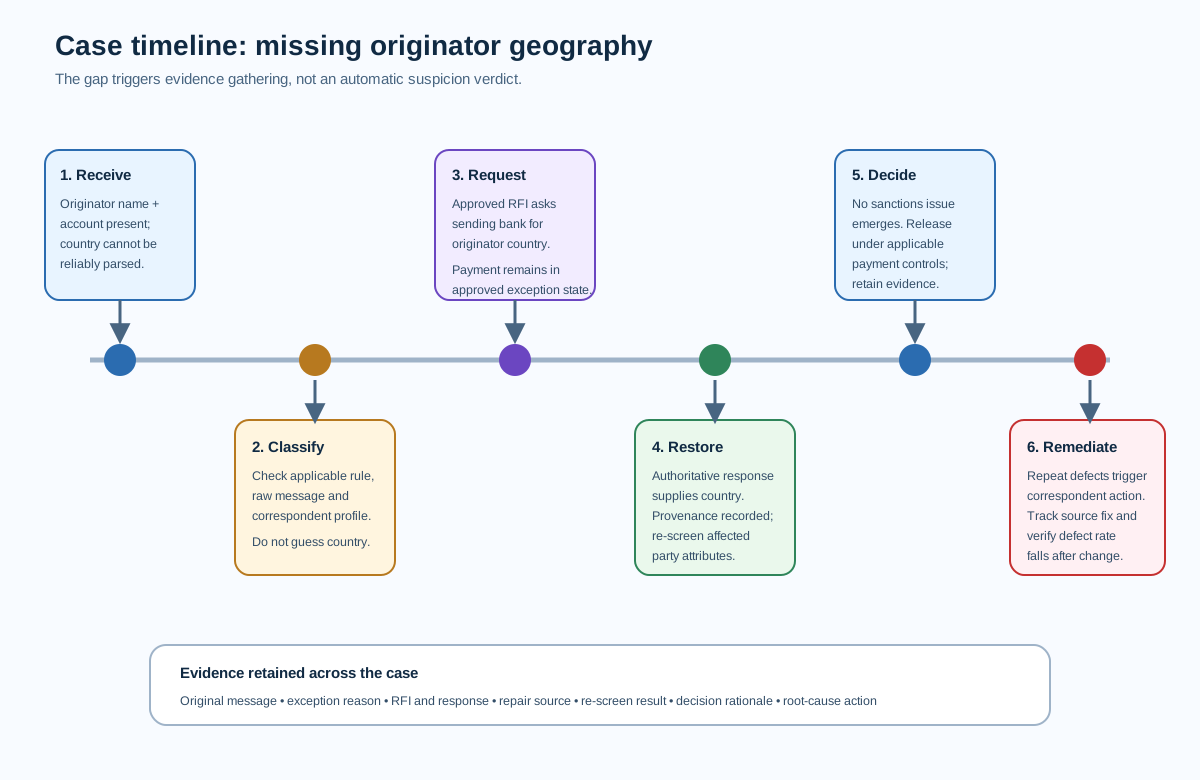
What success looks like
A high-quality implementation produces a payment that is transparent enough for each participant’s lawful role, keeps the original evidence, makes transformations explicit and prevents downstream controls from silently operating on a reduced population. It distinguishes technical validity from financial-crime usefulness. It fixes recurring defects at source. It tells operations exactly what they may repair and tells compliance exactly where judgement is needed. It lets testers prove that bad data fails safely. It lets investigators reconstruct the event months later.
Most importantly, it avoids two false comforts: that ISO 20022 automatically guarantees good data, and that a green screening response automatically proves every relevant party was screened. Payment transparency is achieved only when data, control and evidence remain connected from initiation through final outcome.
References and further reading
These are the authoritative public sources used for this chapter. FATF standards, CPMI harmonisation work, industry standards and national or regional law have different legal status; learners should always map the source to the jurisdiction, legal entity, payment product and effective date that apply to their bank.
Global standards and cross-border payment data
- Financial Action Task Force (FATF), The FATF Recommendations, current consolidated version: https://www.fatf-gafi.org/en/publications/Fatfrecommendations/Fatf-recommendations.html
- FATF, FATF updates Standards on Recommendation 16 on Payment Transparency, 18 June 2025: https://www.fatf-gafi.org/en/publications/Fatfrecommendations/update-Recommendation-16-payment-transparency-june-2025.html
- Bank for International Settlements / Committee on Payments and Market Infrastructures (CPMI), Harmonised ISO 20022 data requirements for enhancing cross-border payments – updated report, 26 February 2026: https://www.bis.org/publications/harmonised-iso-20022-data-requirements-enhancing-cross-border-payments-updated-report
- CPMI, Harmonised ISO 20022 data requirements for enhancing cross-border payments – final report, 17 October 2023: https://www.bis.org/publications/harmonised-iso-20022-data-requirements-enhancing-cross-border-payments-final-report
- ISO 20022, Message definitions: https://www.iso20022.org/iso-20022-message-definitions
Payment transparency and operating practice
- The Wolfsberg Group, Payment Transparency Standards 2023: https://wolfsberg-group.org/resources/legacy/136
- The Wolfsberg Group, Guidance on Payment Transparency – Roles and Responsibilities: https://wolfsberg-group.org/resources/general/200
- Swift, Unstructured address data is being removed. Are you ready?: https://www.swift.com/standards/iso-20022/removal-unstructured-address
- Swift, ISO 20022 standards information: https://www.swift.com/standards/iso-20022
Jurisdiction-specific examples used in the chapter
- European Union, Regulation (EU) 2023/1113 on information accompanying transfers of funds and certain crypto-assets: https://eur-lex.europa.eu/eli/reg/2023/1113/oj
- European Banking Authority, Guidelines on information requirements in relation to transfers of funds and certain crypto-assets transfers under Regulation (EU) 2023/1113: https://www.eba.europa.eu/activities/single-rulebook/regulatory-activities/anti-money-laundering-and-countering-financing-terrorism/guidelines-information-requirements-relation-transfers-funds-and-certain-crypto-assets-transfers
- FFIEC, BSA/AML Examination Manual – Funds Transfers Recordkeeping and Travel Rule: https://bsaaml.ffiec.gov/manual/AssessingComplianceWithBSARegulatoryRequirements/09
How to use these sources
FATF Recommendation 16 supplies the international standard-setting framework but does not by itself replace binding domestic or regional law. The CPMI harmonisation requirements are explicitly non-regulatory guidance intended to reduce fragmentation in cross-border ISO 20022 implementation. Wolfsberg material is industry guidance. Swift material describes network and community standards relevant to its services. The EU and US sources above are jurisdiction-specific examples and should not be treated as universal rules.