PEPs, Family Members and Close Associates
A politically exposed person is not a person whom the bank has found to be corrupt. The term describes someone who is or has been entrusted with a prominent public function and who may therefore be exposed to a particular form of financial-crime risk: the possibility that public authority, access, procurement influence, licensing power, state resources or political networks could be abused for private benefit. FATF is explicit that PEP measures are preventive rather than criminal and should not be interpreted as meaning that every PEP is involved in criminal activity.
That distinction is the starting point for a sound bank control. A PEP flag is a risk fact, not an adverse finding. It changes the questions the bank must ask and, depending on the applicable framework, can trigger additional measures such as senior-management approval, establishing source of wealth and source of funds, enhanced or proportionate ongoing monitoring, and closer attention to family or known close-associate relationships. It does not by itself justify refusing an account, terminating a relationship, treating a customer as suspicious, or filing a report.
PEP rules also cannot be implemented safely from one universal checklist. FATF provides the global standard, but national and regional law determines the binding definition, the treatment of domestic and foreign PEPs, the precise family and associate scope, how long former-PEP measures continue, which approvals are required and how the institution must document its decision. The United Kingdom, United States and Australia provide useful examples precisely because their approaches are not identical. A global bank therefore needs a common control architecture with jurisdiction-specific rule packs, not a single legal conclusion hard-coded for every customer worldwide.
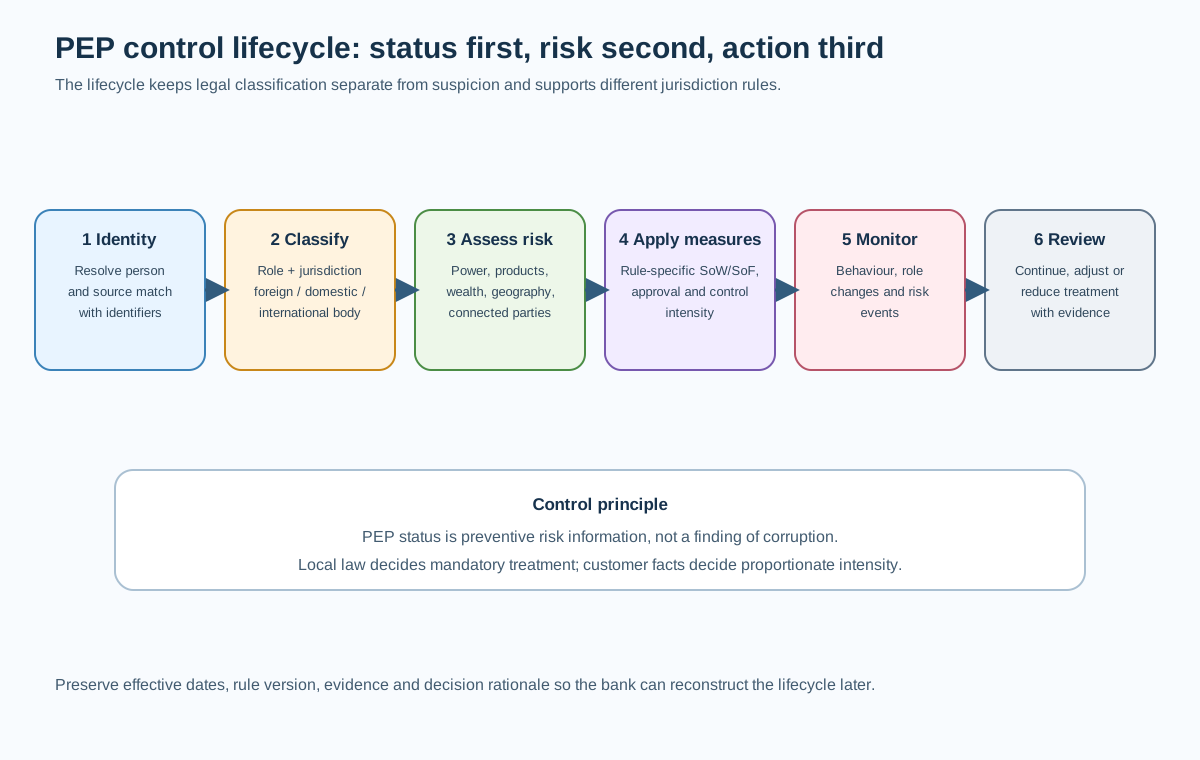
A practical mental model: status, risk and action are three different things
A useful way to avoid poor PEP decisions is to separate three layers.
Status asks whether the person falls within the applicable legal or policy definition. The bank establishes the public function, jurisdiction, dates, family or close-associate relationship where relevant, and the evidence supporting that classification. A vendor label is an input, not the final legal conclusion.
Risk asks what the relationship actually exposes the bank to. Two customers can both be PEPs and present very different risk. The analysis may consider the nature and seniority of the function, control over public funds, procurement or licensing influence, jurisdictional context, products and services used, expected transaction patterns, ownership structures, credible adverse information, source-of-wealth complexity, use of intermediaries, and the strength of independent corroboration.
Action asks what measures are required by the applicable framework and what additional controls are proportionate to the identified risk. The answer may include senior approval, stronger source-of-wealth and source-of-funds work, enhanced monitoring, shorter review cycles or specialist review. In another jurisdiction or lower-risk domestic-PEP context, the same control categories may be applied with different intensity. The bank should preserve the distinction between what law requires, what policy requires and what the individual risk assessment justifies.
This separation matters for architecture. A system should not reduce the entire subject to pep=true. At minimum, the data model should preserve the PEP type, role, public body, jurisdiction, effective dates, source and confidence of the classification, relationship type if the person is a family member or close associate, risk assessment, rule set applied, approval state, source-of-wealth and source-of-funds evidence state, review date and status-change history. The legal rule version should be reconstructable so that an investigator or auditor can understand why a decision was made at that time.
FATF Recommendation 12: what the global standard actually says
FATF Recommendation 12 is the global reference point. For foreign PEPs, financial institutions are expected, in addition to normal customer due diligence, to have systems to determine whether the customer or beneficial owner is a PEP, obtain senior-management approval for establishing or continuing the relationship, take reasonable measures to establish source of wealth and source of funds, and conduct enhanced ongoing monitoring.
For domestic PEPs and persons entrusted with a prominent function by an international organisation, FATF uses a risk-based construction. Institutions should take reasonable measures to determine whether a customer or beneficial owner is such a person and, where there is a higher-risk business relationship, apply the additional measures associated with foreign PEPs. Family members and close associates are brought into the Recommendation 12 framework, but the exact legal definition and implementation still depend on local law.
The practical lesson is important. It is inaccurate to teach that every domestic PEP everywhere must automatically receive exactly the same treatment as every foreign PEP. It is equally inaccurate to assume domestic PEPs are harmless. The bank needs a defensible route from the applicable legal definition to a customer-specific risk assessment and then to the correct measures.
FATF guidance also emphasises that PEP classification should not become stigma. The bank is managing exposure to possible abuse of prominent public functions, not making a moral judgment about the customer. This affects tone, service design, data quality and customer communication as much as compliance mechanics.
Foreign, domestic and international-organisation PEPs
The three broad categories are conceptually simple but operationally demanding.
A foreign PEP is a person entrusted with a prominent public function by a foreign country. Examples commonly include heads of state or government, senior politicians, senior government, judicial or military officials, senior executives of state-owned corporations and important political-party officials. The list is illustrative rather than a substitute for the applicable definition. The key concept is prominence and public function, not job-title keyword matching.
A domestic PEP is a person entrusted with a prominent public function within the institution's relevant domestic framework. Local law determines the exact positions. Banks should avoid expanding the category casually to every public-sector employee. Over-broad classification creates customer harm, overwhelms specialist queues and dilutes attention from genuinely prominent functions.
An international-organisation PEP is a person entrusted with a prominent function by an international organisation, typically involving senior management or comparable decision-making authority. Ordinary or middle-ranking employees are not automatically included merely because they work for an international institution.
The same individual can move between categories over time. A minister may become an ambassador, join the leadership of an international organisation, leave office, return to politics or become associated with state-owned enterprises. Effective-dated role history is therefore more useful than a static label.
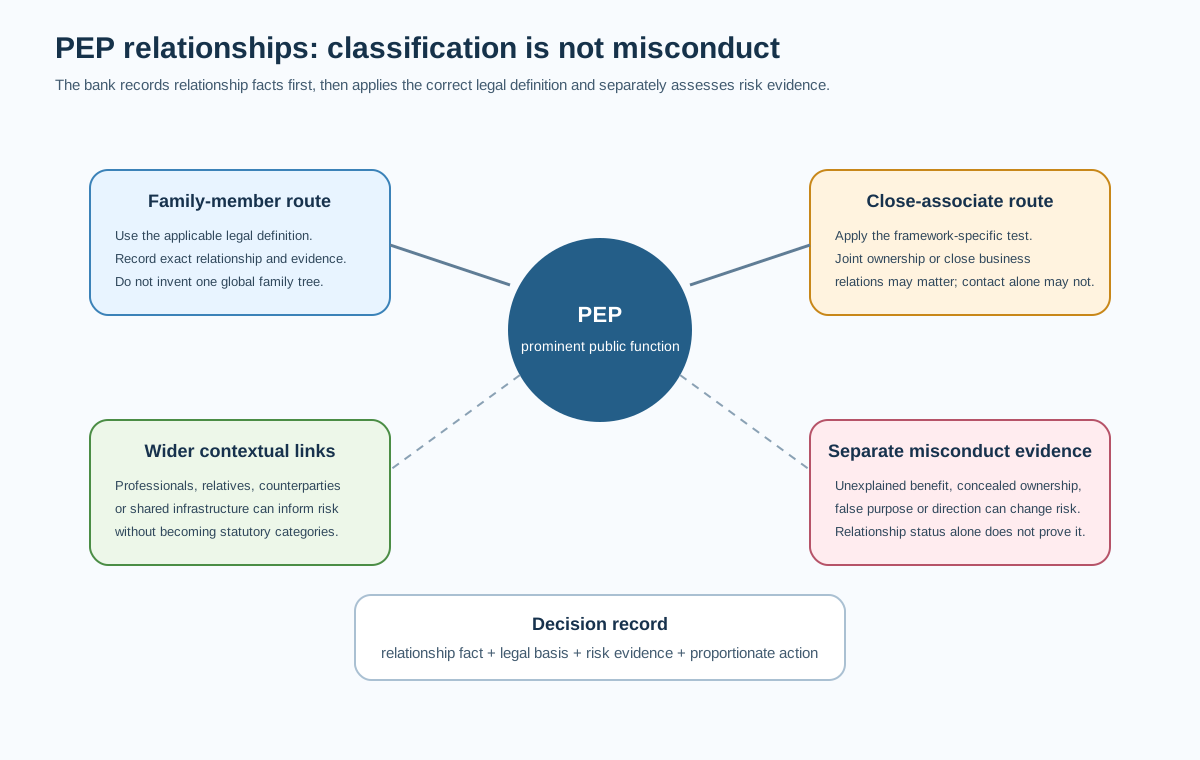
Family members: do not invent a universal family tree
Family-member treatment exists because proceeds or benefits of corruption may be held, transferred or enjoyed through people close to the PEP. But a bank should not invent a global definition such as “spouse, children, parents and siblings everywhere.” FATF provides the principle; national frameworks define the covered family relationships and can differ materially.
For example, the current UK regime defines family members for its own Money Laundering Regulations and the FCA tells firms not to expand PEP, family-member or close-associate definitions beyond what the law requires. Australia has its own statutory and rules-based definitions. A global bank therefore needs jurisdiction mapping rather than a family list copied from one market and applied worldwide.
Operationally, the bank should distinguish a legally in-scope family member from a relative who is simply relevant to the broader customer-risk assessment. The distinction affects data protection, screening coverage, treatment, approval and customer communication. A distant relative may be relevant because funds move through a jointly controlled company, but that does not automatically make the person a statutory family member under every regime.
Family connection also does not prove influence or misconduct. The correct control question is what legal treatment follows from the relationship and what additional facts affect risk. Shared assets, common beneficial ownership, unexplained transfers, dependence on the PEP, public-contract benefits or use of the relative as an intermediary may increase concern. Independent employment, transparent wealth and no meaningful financial connection may point in another direction. The analysis must remain evidence-led.
Close associates: the definition matters more than intuition
“Close associate” is another term that is easy to over-expand. Friendship, professional contact or appearing in the same photograph is not a universal legal test. Depending on the jurisdiction, the concept can include people with joint beneficial ownership, close business relations, or ownership of structures known to have been established for the benefit of a PEP. The institution must use the applicable definition and document the facts supporting the classification.
Banks often discover relevant associates through corporate ownership records, directorships, shared investments, transaction counterparties, trusts or other legal arrangements, professional relationships, credible public information and customer disclosure. Network analysis can help reveal connections, but the technology should preserve the difference between an observed link and a legally significant close-associate conclusion.
That distinction is especially important when lawyers, accountants, wealth managers, consultants or business partners appear around a PEP. Professional involvement is not inherently suspicious. The bank should understand the role, the commercial purpose, the authority exercised and any flow of benefit. It should not describe professional advisers collectively as “enablers” without evidence that a particular person is facilitating misconduct.
Source of wealth and source of funds: what the bank is trying to establish
Source of wealth explains how the customer accumulated overall wealth. Source of funds explains where the money used in a particular relationship or transaction comes from. PEP controls often require or justify greater attention to both because corruption proceeds can be disguised as business income, investment returns, gifts, dividends, consulting fees, property sales or family wealth.
The bank should start with the economic story rather than a document checklist. If a senior public official declares significant pre-office entrepreneurial wealth, the institution should understand the business, ownership, sale proceeds, tax or financial records where appropriate, and whether the scale is plausible. If wealth comes from investments, the bank should understand the capital base and the investment history. If a spouse or family business is material to the wealth story, the bank should understand that source rather than simply accepting the family-member label as explanation.
Independent corroboration should be proportionate to risk and feasible in the jurisdiction. Public registries, audited accounts, reliable corporate records, official asset declarations where lawfully available, property records, sale agreements, tax evidence supplied legitimately by the customer, bank records and reputable external information can all contribute. No single document is automatically decisive. The objective is a coherent evidence chain that explains the material wealth and the funds entering the relationship.
A discrepancy is a question, not a verdict. There can be innocent explanations for incomplete registries, valuation differences, inherited assets, private-company wealth or family support. Analysts should document what is known, what remains uncertain and what further evidence is proportionate. Suspicion arises from the totality of facts under the applicable reporting framework, not from PEP status or one unexplained field alone.
Senior-management approval: legal trigger, governance control and decision quality
Senior approval is a core feature of the FATF foreign-PEP framework and appears in many national implementations, but the precise trigger and who qualifies as senior management differ. The system should therefore route approval according to the applicable rule rather than assuming every PEP relationship worldwide requires the same committee.
Approval should be substantive. The decision maker should see the PEP classification, role and jurisdiction; risk assessment; source-of-wealth and source-of-funds conclusion; material adverse information; ownership and connected-party context; products requested; expected activity; unresolved issues; proposed controls; and the reason the relationship is acceptable or unacceptable within risk appetite.
The approval record should distinguish three questions: is the relationship legally permissible; are mandatory measures complete; and is the residual risk acceptable to the institution? This makes later review far stronger than a signature with no analytical record.
Commercial value should not decide the control conclusion, but neither should the PEP label automatically cancel a viable relationship. Senior governance exists to make proportionate decisions with clear accountability.
Domestic PEP proportionality: the UK illustrates why local rules matter
The United Kingdom is a useful contemporary example. Since 10 January 2024, the UK legal framework requires the starting point that domestic PEPs, and their family members and known close associates, are treated as presenting a lower level of risk than non-domestic PEPs unless other risk factors indicate otherwise. The FCA's final guidance FG25/3, published in July 2025, reinforces a proportionate and risk-based approach and warns firms against over-expanding definitions or imposing disproportionate information demands.
That does not mean UK domestic PEPs are outside the regime. It means the enhanced measures are to be applied with lower intensity where the legal lower-risk starting point and the facts support that conclusion. A high-risk domestic PEP can still require more intensive measures. The important lesson for a global bank is that “domestic” does not have one universal operational meaning.
The United States illustrates a different implementation. US agencies have stated that the Bank Secrecy Act customer-due-diligence rule does not create a regulatory requirement or supervisory expectation for unique, additional due-diligence steps solely because a customer is considered a PEP. US banks are expected to apply risk-based CDD commensurate with the facts and circumstances. A global policy that automatically imports the full FATF foreign-PEP control package as a claimed US legal requirement would therefore be misleading.
Australia provides another current example. AUSTRAC's guidance, updated in July 2026, distinguishes foreign, domestic and international-organisation PEPs and sets out different triggers for additional measures. Foreign PEPs receive specified enhanced treatment, while some measures for domestic or international-organisation PEPs depend on high ML/TF risk. Again, global architecture must support variation rather than erase it.
PEP screening and identification technology
Commercial PEP databases are useful but are not legal authorities. Their value lies in aggregation: names, aliases, roles, dates, relationships and public-source information across many jurisdictions. Their weaknesses include update latency, inconsistent role coverage, duplicate identities, missing local positions, transliteration problems and vendor-specific family or associate definitions.
A good identification process combines customer declaration, reliable public sources, third-party data where appropriate, onboarding information and event-driven rescreening. It uses names together with dates of birth, nationality, role, jurisdiction and other identifiers to resolve matches. Analysts should be able to distinguish a vendor candidate from a confirmed customer classification.
For architecture, preserve the source record and effective dates. If a customer became a minister on 5 May, the bank should be able to establish when the source learned it, when the bank ingested it, when matching occurred and when controls changed. That timeline supports data-quality analysis and incident review.
False positives matter because PEP screening involves common names and public figures with limited identifiers. Suppression or whitelisting should be identity-specific and evidence-based, not a permanent name-level exclusion that could hide a different person later. Changes in key identifiers or source data should be able to trigger re-evaluation.
Transaction monitoring: focus on behaviour, not the word PEP
PEP risk does not require a separate suspicious-transaction universe. Many relevant behaviours are familiar AML patterns interpreted in a corruption context: transactions inconsistent with known wealth, payments from public contractors, unexplained transfers through family or associated companies, use of opaque structures without a credible purpose, sudden wealth following appointment, unusual cash or asset purchases, or flows connected to procurement and licensing decisions.
Monitoring should use the customer profile and known public function to create context. A minister responsible for infrastructure and a customer receiving unexplained transfers from infrastructure contractors presents a different analytical picture from the same payment to a customer with no public role. The control should enrich the alert; it should not mechanically declare corruption.
Instant payments and other fast rails create timing constraints, but PEP status is generally different from sanctions interdiction. A PEP is not a prohibited person merely because of the classification. Banks should not build real-time payment rejection logic that treats PEP status as equivalent to a sanctions designation. Where the transaction creates other legal or risk concerns, the applicable control determines whether a hold, reject, review or post-event investigation is appropriate.
Alert, case, investigation and reporting outcomes
When a monitoring alert involves a PEP or PEP-connected person, the case should bring together the public-function context, customer profile, ownership, family or associate facts, source-of-wealth evidence, source of the transaction, counterparties, adverse information and relevant historical activity. Investigators should test plausible explanations rather than begin from the assumption that political exposure proves corruption.
A useful investigation chronology asks: what public function existed at the time; what authority or influence did it carry; what economic event explains the money; who benefited; what independent evidence supports the explanation; is there a connection to public expenditure, licensing or state assets; and does the activity fit the customer's established wealth and business profile?
If suspicion is formed, reporting follows the applicable SAR/STR framework. PEP status itself is not the reporting trigger. The case record should separate the reason for suspicion from the reason enhanced due diligence was performed. That distinction improves legal defensibility and analytical quality.
Former PEPs and declassification: avoid the universal stopwatch
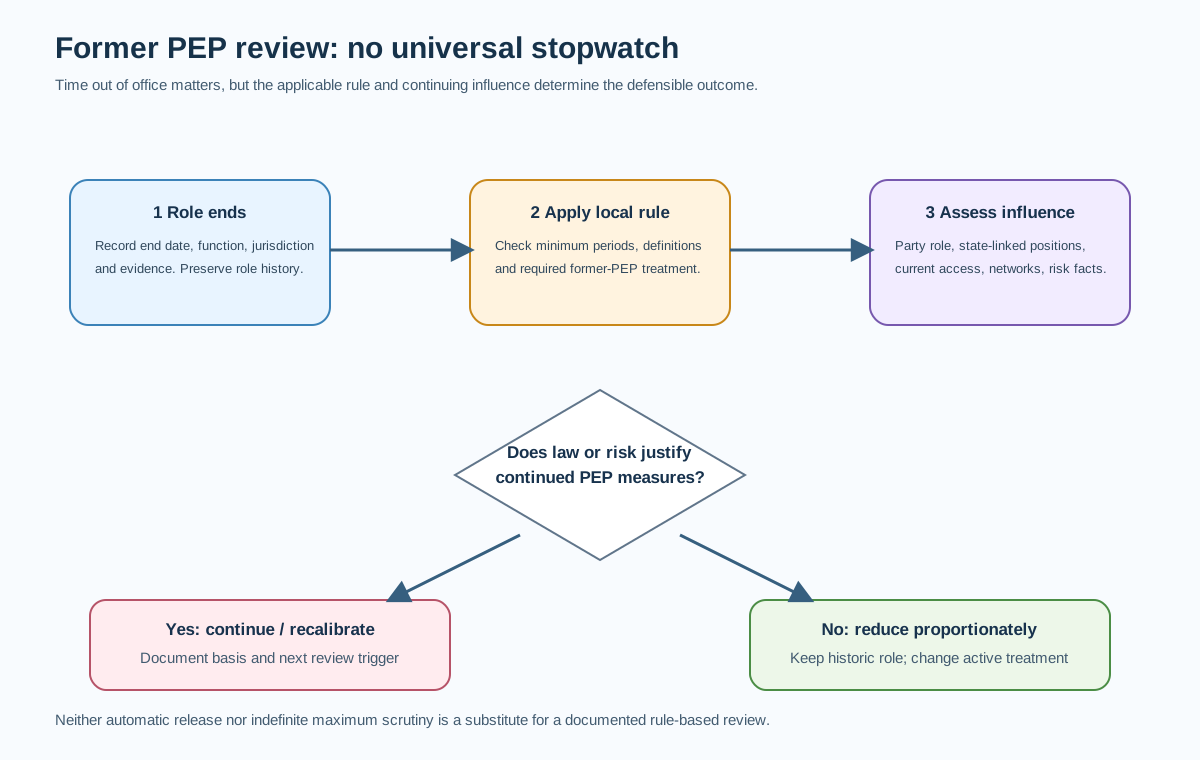
Former-PEP treatment is one of the most frequently over-generalised parts of PEP training. There is no single global number of months after which every former PEP can be “declassified.” FATF guidance supports a risk-based approach that considers continuing influence rather than a mechanical global cut-off. National law can specify minimum periods or other requirements.
The bank should therefore capture the date the prominent function ended and apply the relevant jurisdictional rule. The review may consider continuing political influence, ongoing control over state-linked entities, party leadership, close connections to current decision makers, the persistence of relevant family or business networks, the customer's products and activity, and any unresolved corruption concerns. Time is evidence, but it is not the only evidence.
The opposite error is to keep someone classified indefinitely merely because they once held office. Where local law permits declassification and the facts support reduced exposure, controls should be reduced proportionately. FCA guidance is especially clear that firms should review PEP status promptly after public office and avoid disproportionate treatment.
Customer communication and fair treatment
PEP controls can feel accusatory if badly explained. Legitimate public officials and their families may repeatedly be asked for personal wealth information, experience delayed payments or account opening, and receive vague explanations. Poor communication can turn a preventive AML control into unnecessary financial exclusion.
Where disclosure is legally permitted, the bank should explain what information is required, why it is relevant, what form of evidence can satisfy the request, and what timeframe applies. The request should be tailored. Asking every PEP for the same extensive document pack regardless of risk is not evidence of a strong control; it may be evidence that the bank has not designed a risk-based process.
Staff should also know what they must not disclose. If a suspicious-activity report has been or may be filed, tipping-off and confidentiality rules may restrict communications. Those restrictions come from the applicable reporting regime, not from PEP status itself.
BA and architecture requirements
A business analyst designing PEP capability should model at least these entities separately: person, customer, public function, public body, jurisdiction, role period, PEP category, family relationship, close-associate relationship, beneficial-ownership relationship, source evidence, classification decision, risk assessment, mandatory measures, approval, source-of-wealth assessment, source-of-funds assessment, monitoring profile, review and declassification decision.
Rules should be effective-dated and jurisdiction-aware. A change in UK PEP treatment, Australian AML/CTF rules or another local framework should be deployable without overwriting historical decisions. The platform should answer which rule version classified the customer on a given date.
Requirements should distinguish vendor ingestion from customer classification. A third-party record may say “PEP,” but the bank needs match resolution and legal scoping before applying a customer outcome. Likewise, a vendor's family connection must not silently become the institution's legal family-member classification unless it fits the relevant definition.
Case tooling should present source evidence and uncertainty clearly. Analysts need to see which facts are verified, alleged, stale or conflicting. Decision fields should not force certainty where the evidence remains unresolved.
Testing the PEP control
Testing should include positive, negative, boundary and change scenarios.
Positive cases should confirm that genuinely in-scope foreign PEPs, domestic PEPs and international-organisation PEPs are identified and routed according to the correct jurisdictional rules. Family and associate cases should test the actual legal definitions rather than invented extended-family logic.
Negative cases should confirm that ordinary public-sector employees, similarly named people, unrelated professionals and people outside the legal family or associate definition are not automatically classified. This is as important as detection because over-classification creates customer harm and destroys alert precision.
Boundary cases should test recent appointments, former PEPs, dual roles, acting appointments, state-owned-enterprise roles, changes in jurisdiction, family relationship changes and disputed vendor records. Jurisdiction tests should prove that UK domestic lower-risk treatment, US risk-based CDD and Australian rules do not collapse into one global action.
Data-lineage testing should verify that role dates, source updates, match decisions, approvals and review triggers survive system migration and can be reconstructed historically. Rescreening tests should prove that a new appointment or material role change reaches affected customers and beneficial owners within the designed service level.
Mini case: the infrastructure minister's sibling
Consider a fictional corporate customer owned by the sibling of an infrastructure minister. The customer wins several public contracts after the minister takes office. The bank's PEP vendor identifies the family connection, but that alone does not prove corruption.
The analyst first confirms whether the sibling falls within the family-member definition applicable to the booking entity and customer relationship. Next, the bank reviews the customer's business profile, ownership, contract history, expected turnover and source of funds. It compares the new public-sector revenue with the customer's prior operating capacity and obtains evidence about the tenders and delivery activity where proportionate.
Suppose the contracts were competitively awarded, pricing is commercially plausible, staff and equipment support delivery, payments follow invoicing and there is no unexplained transfer to the minister. Those facts may support continued banking with the enhanced measures required by the applicable framework and a monitoring profile reflecting public-contract exposure.
Now change the facts. The company has no meaningful staff, tender documentation is inconsistent, contract revenue is immediately transferred to entities controlled by the minister's household, and explanations for those entities conflict with registry records. The family connection has become part of a broader evidence pattern. The bank may need deeper investigation, escalation and a suspicious-activity reporting assessment under local law. The trigger for that outcome is the evidence pattern, not the sibling relationship by itself.
That is the core discipline of PEP control: identify the legal status correctly, understand the real corruption exposure, apply the measures required by the relevant framework, and make evidence-led decisions without either stigma or complacency.
Operational deep dive: making PEP controls work in a real bank
The base chapter separates PEP status, customer risk and control action. This deep dive turns that principle into an operating model. The difficult work is not putting a flag on a customer record. It is maintaining an effective-dated view of prominent public functions, resolving identity correctly, applying the right jurisdictional rule, understanding source of wealth and source of funds, keeping family and associate relationships within lawful scope, and carrying the resulting context into monitoring, investigations and review.
Identification is a data problem before it becomes a compliance decision
Banks usually identify potential PEP exposure from several sources: customer declarations, commercial PEP databases, official publications, public registries, reliable open sources, onboarding information and event-driven screening. These sources answer different questions. A commercial vendor may be excellent at aggregating appointments and aliases but may use its own family or associate taxonomy. An official gazette may be authoritative about an appointment but contain little identity data. Customer disclosure may be timely but incomplete. A good architecture preserves source provenance instead of flattening all sources into one undifferentiated PEP=yes field.
For each candidate match, the institution should be able to record the name supplied by the source, aliases, date of birth or other identifiers where available, the public function, public body, jurisdiction, role start and end dates, source publication date, ingestion date, match decision, reviewer and evidence. That allows the bank to distinguish four events that are often confused: the person was appointed; the information became publicly available; the bank received the information; and the bank classified its customer. The gaps between those dates are useful control metrics.
Matching should combine names with corroborating identifiers. Transliteration, reordered names, honorifics, patronymics and inconsistent dates create genuine challenges, especially for cross-border political figures. A common name match is not enough for a consequential classification. Conversely, a minor spelling difference should not defeat identification where date of birth, nationality, role and other facts strongly align.
Vendor suppression must be narrowly designed. If an analyst clears one customer because the date of birth proves the person is not the minister appearing in the database, the suppression should attach to that resolved identity and evidence. A global suppression of the name itself could hide a later true match.
From vendor category to legal classification
A bank should never assume the vendor's taxonomy is identical to the applicable legal definition. The operating sequence should be: resolve the identity; establish the public-function facts; determine which jurisdictional rule governs the customer relationship; apply that definition; then record the bank's classification and required measures.
This matters for state-owned enterprises, sub-national officials, political-party functions and international organisations, where definitions differ. It also matters for family and close associates. One provider may label a broad set of relatives as PEP-connected for informational purposes. The booking entity may have a narrower statutory family definition. The wider relationship can still be relevant to risk, but legal treatment should be based on the applicable rule rather than the provider label.
The rules engine should therefore support effective-dated jurisdiction packages. A rule package can define the PEP categories, in-scope public functions, family-member relationships, close-associate tests, approval requirements, source-of-wealth or source-of-funds obligations, monitoring expectations and former-PEP treatment. Policy may choose to apply stricter internal controls than law requires, but the system and procedures should label that honestly as policy rather than presenting it as a universal statutory obligation.
Risk assessment should explain the exposure
Once status is established, the analyst should assess the actual risk. Useful factors include the power attached to the public function, access to budgets or state assets, procurement or licensing influence, the strength of institutions in the relevant jurisdiction, credible corruption allegations, the customer's product set, ownership complexity, transaction corridors, use of intermediaries, source-of-wealth plausibility and the degree to which public and private interests intersect.
The analysis should avoid crude country determinism. A public official in a jurisdiction with strong institutions can still present meaningful corruption risk, while a PEP from a higher-risk jurisdiction may have transparent, independently verified wealth and a simple banking relationship. Country risk is one factor among several.
Position power should be analysed from what the role can actually do. A title can understate or overstate influence. A technical procurement official may shape specifications or scoring without signing the final contract. A ceremonial office holder may have prestige but little access to public resources. The control objective is to understand the opportunity for misuse, not to rank job titles socially.
Source-of-wealth work: build a coherent economic history
For PEP relationships where the applicable framework or customer risk requires enhanced source-of-wealth work, the analyst should construct an economic history rather than merely collect documents. The history normally identifies the main wealth-generating events, their timing, the entities involved, approximate scale, ownership and the evidence supporting each material source.
If wealth predates public office, that timing can be highly relevant. A credible pre-office business sale supported by corporate records, sale documentation and subsequent investment history can explain substantial wealth. If material wealth appears only after access to procurement, state assets or licensing authority, the bank needs to understand the legitimate economic explanation more carefully.
Business wealth should be tested for substance. Audited statements, tax records where lawfully obtained, operating history, employees, customers, premises, contracts and independent registries may help. The goal is not to prove every unit of currency ever earned. It is to reach a reasonable and risk-proportionate understanding of the material wealth supporting the relationship.
Lifestyle information can be relevant but must be used carefully. Publicly verifiable property or major assets can help test whether declared wealth is broadly coherent. Analysts should not rely on speculative social-media impressions or create false precision around asset values. A perceived mismatch should lead to questions and corroboration, not an automatic corruption conclusion.
Source of funds then connects the overall wealth story to the particular money entering the account or transaction. A customer may have legitimate wealth but still send funds from an unexplained third party. Conversely, a well-documented transaction may not resolve an unexplained overall fortune. Both dimensions matter.
Family and associate analysis without guilt by association
Family-member and close-associate controls exist because value and influence can move through relationships. They do not justify treating an entire social network as suspicious.
The first step is legal scope. Does the person meet the family-member or close-associate definition relevant to this relationship? The second is factual context. What economic relationship exists? Is there joint ownership, financial dependence, shared control, benefit, intermediary activity or another fact relevant to corruption exposure? The third is risk action. What measures are required or proportionate?
Network analytics can help identify shared entities, directorships, addresses, counterparties or ownership links. The technology should label observed relationships separately from inferred or legally classified relationships. A shared address may reflect a family home, corporate-service provider or coincidence. A joint company is a stronger fact but still needs economic context. Investigators should be able to see the source and confidence of each edge in the graph.
Data protection and privacy rules also matter. The bank should have a lawful basis and defined purpose for collecting relationship data, retention periods aligned with applicable law and controls over sensitive information. “PEP risk” is not a licence for limitless intelligence gathering.
Monitoring design: enrich generic scenarios with PEP context
Many PEP-related risks appear through ordinary AML scenarios rather than a special “PEP transaction” pattern. Relevant examples can include unexplained payments from state contractors, value moving through family-owned companies, rapid asset purchases after appointment, unusual transfers involving public-sector counterparties, unexplained third-party funding or transactions inconsistent with verified wealth.
A useful monitoring design enriches alerts with the customer's public function, role dates, related entities, known public-contract exposure, verified wealth sources and current risk assessment. This helps analysts ask the right questions. A payment from a construction company means something different when the customer controls infrastructure procurement than when the customer works in an unrelated ceremonial role.
The system should not treat PEP status like a sanctions prohibition. A PEP match does not normally mean a payment must be blocked or rejected merely because of the status. Sanctions, fraud, AML and PEP controls may interact, but their legal consequences are different and should remain distinct in decision logic.
Alert-to-case investigation
A PEP case should reconstruct the economic and political context at the time of the activity. The investigator may need to answer:
- What public function did the person hold on the transaction date?
- What decisions, budgets, assets or licences could that role influence?
- What is the stated economic purpose of the transaction?
- Who are the counterparties and who ultimately owns or controls them?
- Does the transaction fit verified source of wealth, source of funds and expected behaviour?
- Is there a credible connection to public procurement, state assets, licensing or another influence channel?
- What innocent explanation is plausible, and what evidence supports or contradicts it?
The final case conclusion should separate unresolved risk from reportable suspicion. Where the legal threshold for a SAR or STR is met, the report should describe the suspicious facts and relevant PEP context. The PEP label itself is not the suspicious activity.
Former PEPs: effective dating and continuing influence
Former-PEP controls need two separate clocks. The first is legal: the jurisdiction may impose a minimum period or particular treatment after a person leaves office. The second is risk: influence can persist beyond the minimum period, or it may genuinely decline.
The data model should record the role-end date and any later decision to reduce PEP treatment, with the rule version and evidence. Risk indicators can include continued party leadership, advisory influence, control of state-linked entities, close connections to current office holders, unresolved corruption allegations, family succession or ongoing access to public resources. None is mechanically decisive; they inform the assessment.
The process should also permit proportionate reduction. Keeping a former public official under maximum scrutiny indefinitely without a legal or risk basis creates unfair treatment and wastes specialist capacity. The FCA's current UK guidance is particularly clear that firms should review status promptly after public office and treat domestic PEPs, relatives and close associates proportionately.
US, UK and Australian implementation examples
The comparison below is useful for global design because it shows why one universal rule is unsafe.
FATF global standard. Recommendation 12 establishes additional measures for foreign PEPs and a risk-based approach for domestic and international-organisation PEPs. Family members and close associates are within the framework. FATF also stresses that these are preventive measures, not an assertion of criminality.
United Kingdom. The Money Laundering Regulations require PEP controls, and current FCA guidance FG25/3 reflects the legal starting point that domestic PEPs, their family members and known close associates should be treated as lower risk than non-domestic PEPs unless other risk factors indicate otherwise. Enhanced measures still apply, but proportionately. Firms are also told not to define PEPs, relatives or close associates more broadly than required by law.
United States. The 2020 joint agency statement led by FinCEN clarifies that the US CDD rule does not create unique additional due-diligence steps merely because a customer is considered a PEP. Banks should use risk-based CDD commensurate with the facts and circumstances. That is different from claiming FATF's foreign-PEP measures are directly a standalone US legal checklist.
Australia. AUSTRAC guidance updated 29 July 2026 sets out foreign, domestic and international-organisation PEP definitions and differentiated obligations. Foreign PEPs are subject to specified additional requirements, while certain additional measures for domestic and international-organisation PEPs depend on the customer being high ML/TF risk. The guidance is a current practical example of jurisdiction-specific implementation.
BA acceptance criteria
A robust PEP capability should allow the business analyst to write testable acceptance criteria such as these:
- The platform can store multiple public-function records for one person with effective dates and source provenance.
- A vendor candidate does not become a confirmed customer PEP classification without identity resolution and jurisdiction-rule evaluation.
- The applicable rule set is determined from booking entity, customer context and effective date, with policy overlays stored separately from legal requirements.
- Family and close-associate classifications identify the relationship type, evidence and legal basis rather than relying on a generic relationship flag.
- Senior-approval workflows receive the risk assessment and evidence needed for a substantive decision.
- Source-of-wealth and source-of-funds evidence is linked to conclusions and can be refreshed without overwriting historical records.
- Monitoring receives PEP context without converting PEP status into an automatic payment block.
- Former-PEP review is triggered by role-end events and applies jurisdiction-specific minimums plus risk assessment.
- Every classification, override, approval and declassification decision is audit-trailed with user, timestamp, rule version and rationale.
- Customer-service channels can explain proportionate information requests without exposing confidential SAR/STR information.
Testing and assurance
Testing should include known-positive PEP populations, hard false positives, recent appointments, role changes, former officials, corporate customers with PEP beneficial owners, family and associate boundary cases, transliteration variants and jurisdictional differences. It should verify both detection and non-detection. A control that catches every possible public connection by classifying too broadly is not necessarily effective.
Quality assurance should review analytical reasoning, not only document presence. A file with every required attachment can still be weak if the economic story is incoherent. Conversely, a lower-risk domestic PEP file may properly contain fewer intrusive requests if the applicable framework and risk assessment support that proportionality.
Management information should therefore distinguish population size, match volumes, false-positive rate, appointment-to-identification latency, overdue reviews, source-of-wealth exceptions, approval turnaround, declassification backlog, QA findings and significant control incidents. Metrics should be interpreted together; reducing false positives by simply lowering sensitivity would not be a genuine improvement.
The mature operating model is one in which PEP status is accurately identified, legal scope is explicit, enhanced measures are proportionate, evidence is traceable and investigators can understand the customer's public-function context without assuming wrongdoing. That is what turns a politically sensitive label into a defensible banking control.
Advanced practice: worked PEP cases
The cases below are fictional and use illustrative facts. They are designed to test reasoning, not to prescribe a legal outcome. In a live case, the institution must apply the law and regulatory guidance relevant to the booking entity, customer and transaction, and should never treat PEP status, family connection or a professional relationship as proof of corruption.
Case 1: the minister with substantial pre-office wealth
A serving infrastructure minister applies for private-banking services. The customer says most wealth came from a technology company sold several years before entering politics. The bank receives the sale agreement, historic company accounts, evidence of tax paid in the relevant jurisdiction and subsequent portfolio statements. The material broadly supports the declared wealth story.
The customer is a foreign PEP for the bank's booking entity, so the applicable framework requires the institution to apply the additional measures relevant to that category. The analyst does not stop at the PEP label. The source-of-wealth review tests whether the scale and timing of the business sale plausibly explain the current portfolio, whether later inflows have a coherent source and whether any important holdings remain unexplained.
During review, the bank also finds media reports alleging that companies linked to former business partners won public contracts after the minister entered office. The reports are credible enough to investigate but are not findings of guilt. The analyst identifies the connected entities, checks whether the customer owns or benefits from them, reviews relevant transactions and asks targeted questions where appropriate. If no financial or ownership link is found and the wealth remains independently corroborated, the bank may be able to continue the relationship with the enhanced measures and monitoring required by its framework. If new evidence instead shows undeclared beneficial interests and unexplained payments from contractors, the case would require deeper investigation and possible suspicious-activity reporting assessment.
The lesson is that good PEP control can reach a favourable conclusion. Enhanced scrutiny is not a predetermined adverse outcome; it is a method for obtaining enough evidence to understand the risk.
Case 2: the mayor's sibling and public contracts
A construction company owned by the sibling of a city mayor seeks a larger working-capital facility after winning several municipal contracts. The family relationship is confirmed. The first question is whether the sibling falls within the applicable legal family-member definition for the bank. The second is what the business facts show.
The company existed for ten years before the mayor took office. It has employees, equipment, prior private-sector customers and audited accounts. The municipal tenders were open, several competitors bid, pricing is close to market benchmarks and payments follow completed milestones. These facts do not eliminate corruption risk, but they provide a coherent commercial explanation for the revenue.
Now change the evidence. The company was dormant until shortly after the election, has few employees, outsources almost all delivery to unexplained related parties, wins repeated non-competitive awards and transfers a significant share of receipts to entities associated with the mayor's household. That pattern would justify much deeper inquiry. The investigator would want to understand beneficial ownership, tender processes, contractual performance, the reason for onward payments and whether the recipient entities provide genuine services.
The analytical point is not that “a mayor's sibling winning contracts is suspicious.” The point is that political proximity changes the corruption-risk context in which procurement and money-flow evidence is evaluated.
Case 3: a former head of government
A former head of government left office several years ago and asks the bank to reduce PEP-related controls. The customer has no current public title, transactions have remained consistent with the known profile and no new adverse information has appeared.
A weak process would use either of two shortcuts: remove PEP treatment solely because a fixed internal number of years has elapsed, or retain maximum treatment indefinitely because the customer once held high office. A better process begins with the applicable former-PEP rule and then considers continuing influence.
The review finds that the customer no longer holds party leadership, has no formal advisory role, no state-owned enterprise position and limited contact with current office holders. Long-standing private investments explain current income. If local law allows treatment to be reduced and the risk assessment supports it, a proportionate declassification or reduced-control decision may be reasonable.
In a different scenario, the former leader still controls the governing party, relatives hold senior political posts, connected businesses continue to receive state concessions and the customer acts as an informal adviser on major appointments. Those facts support continued concern even though the formal office ended. The institution should document why continuing influence remains relevant and review again at an appropriate interval.
The lesson is that time is one factor. Legal requirements and continuing influence determine the actual decision.
Case 4: the state-owned enterprise executive
A chief executive of a state-owned energy company has personal investments in logistics and hospitality companies. Whether the executive falls within the relevant PEP definition depends on the applicable framework, so the analyst first resolves legal scope rather than assuming every state-company employee is a PEP.
The wealth review shows that the investments were acquired before the executive joined the state enterprise and were disclosed under local conflict-of-interest rules. The logistics company does not contract with the state employer. That evidence may support a straightforward risk conclusion.
If, however, a company beneficially owned by the executive begins receiving large contracts from the state enterprise, the bank should understand the procurement arrangement, declarations and recusal process, commercial substance and flows of benefit. A documented recusal is useful evidence but is not automatically conclusive if transaction data show that the executive continues to benefit from contracts within their sphere of influence.
A financial institution is not a procurement regulator. It does not need to prove a breach of public-sector rules before considering AML risk. It does need a reasonable, evidence-based understanding of the money entering its relationship and should escalate unexplained patterns under its normal investigation and reporting framework.
Case 5: the consultant who previously served government
A consultant previously worked as a senior political adviser and now provides government-relations services. Former public service does not automatically mean the person's current consultancy income is corrupt. Nor does professional access to public officials by itself establish a close-associate relationship with every official contacted.
The bank should understand the current role, clients, fee model and source of funds. Fixed fees for documented policy research, stakeholder mapping and regulatory advice may be straightforward. Success fees tied to government contract awards, opaque third-party payments or money routed through companies with no evident service would deserve more attention, particularly if the consultant remains closely connected to officials able to influence those awards.
The analyst should test service substance using contracts, invoices, deliverables and customer explanations appropriate to risk. The bank should avoid claiming that every consultant, lawyer, accountant or adviser around a PEP is a “professional enabler.” Professional services are common and legitimate. The concern arises from evidence that a service relationship is being used to transfer value, hide ownership or facilitate misuse of public influence.
Case 6: the PEP beneficial owner behind a corporate customer
A manufacturing company seeks trade-finance facilities. Its direct directors are not politically exposed, but beneficial-ownership analysis identifies a natural person who is a senior foreign public official. The customer's industry, products and payment corridors are otherwise conventional.
This illustrates why PEP controls should not be limited to retail customers. FATF Recommendation 12 specifically refers to determining whether a customer or beneficial owner is a PEP. The institution therefore applies the relevant foreign-PEP measures to the relationship while still assessing the company as a business.
Source-of-wealth work focuses on how the PEP acquired the ownership interest and whether the investment scale is plausible. Source-of-funds work focuses on the funds supporting the company and the facility transactions. Monitoring should understand expected suppliers, buyers, countries and volumes. The existence of a PEP beneficial owner should enrich this context, not replace it.
If the company later starts receiving unexplained payments from ministries connected to the beneficial owner's function, investigators have a meaningful corruption-risk hypothesis to test. If instead it continues ordinary manufacturing activity with transparent customers and independently verified funding, the relationship may remain manageable under enhanced controls.
Case 7: a close associate identified through joint ownership
A customer is not a public official and has no family connection to one. Corporate records show, however, that the customer jointly owns an investment vehicle with a serving PEP. Under the relevant local definition, that joint beneficial ownership makes the customer a known close associate.
The bank should record the legal basis for that classification and understand the investment vehicle. It should not infer that the customer acts as the PEP's nominee merely from joint ownership. The analyst reviews capital contributions, governance, distributions and the commercial purpose of the venture.
If both partners invested documented personal funds, rights are proportionate, the vehicle owns transparent assets and there are no unusual payments, the evidence may support continuation with the required PEP-connected controls. If the customer contributed little capital but holds assets entirely for the PEP's benefit, receives instructions from the PEP and cannot explain the structure, a different risk conclusion may follow.
This is the practical difference between relationship evidence and misconduct evidence. The former can trigger PEP treatment; the latter requires additional facts.
Case 8: domestic PEP treatment across jurisdictions
A global bank has two customers who are domestic PEPs in their respective booking jurisdictions. One is booked in the United Kingdom and the other in a country whose local law requires domestic PEPs to receive the same additional measures as foreign PEPs.
The customers may look similar, but the legal routing is not identical. For the UK customer, the current legal starting point is that domestic PEPs and their family members and known close associates present lower risk than non-domestic PEPs unless other factors indicate otherwise. The firm still applies the relevant enhanced measures, but with lower intensity where appropriate. For the second customer, the local rule may require a different level of treatment.
A single global domesticPEPAction=EDD_HIGH rule would therefore be poor architecture. The customer record should hold the status; the jurisdictional rule engine should determine mandatory treatment; the risk model should determine proportionate intensity within that framework.
Case 9: disputed PEP classification
A customer complains that the bank has classified them as a PEP because a data provider lists them as a member of an advisory council. The customer states that the council is honorary and has no public decision-making authority.
The correct response is not to defend the vendor automatically. The bank should examine the applicable PEP definition and the actual function. If the role does not meet the legal or policy threshold, the classification should be corrected and downstream controls updated. The vendor record can be challenged through the institution's data-quality process.
This case matters because false PEP attribution can lead to intrusive information requests, account delays and reputational harm. High-quality PEP controls must be capable of saying “not a PEP” with the same evidential discipline used to confirm a true match.
Case 10: PEP status plus a sanctions match
A serving official is a confirmed PEP and later becomes subject to a sanctions designation. The two control frameworks now overlap, but they must not be collapsed.
Before designation, PEP status meant preventive AML measures and risk-based monitoring. After designation, the relevant sanctions law may impose asset-freeze, prohibition, reporting or other obligations. The sanctions decision is driven by the designation and applicable sanctions regime, not by PEP status. The case system should preserve both classifications and their distinct legal consequences.
This separation helps operations act correctly. A PEP payment is not normally blocked merely because of PEP status; a sanctions-controlled payment may require immediate legal action. Conflating the two creates both customer harm and sanctions risk.
What these cases should teach
Across all ten cases, the same discipline appears repeatedly:
- establish the facts and identity;
- determine the PEP, family or close-associate classification under the applicable framework;
- assess the actual corruption and money-laundering risk;
- apply mandatory and proportionate controls;
- understand source of wealth and source of funds where required;
- monitor behaviour in context;
- investigate evidence rather than status;
- report suspicion only when the applicable legal threshold is met; and
- review classification and intensity when roles, law or risk change.
PEP controls are strongest when they are both rigorous and fair. Over-treatment is not a sign of maturity, and under-treatment is not a sign of good customer service. The professional standard is a documented, jurisdiction-aware and evidence-led decision that can be explained to compliance, operations, audit, supervisors and, where disclosure is permitted, the customer.
Practice close: the PEP analyst's playbook
This practice section converts the chapter into a repeatable working method for analysts, relationship managers, product teams, operations and reviewers. The objective is not to create the largest possible PEP file. It is to make the right classification, apply the correct legal or policy measures, understand the customer well enough to manage corruption risk, and preserve evidence showing why the decision was proportionate.
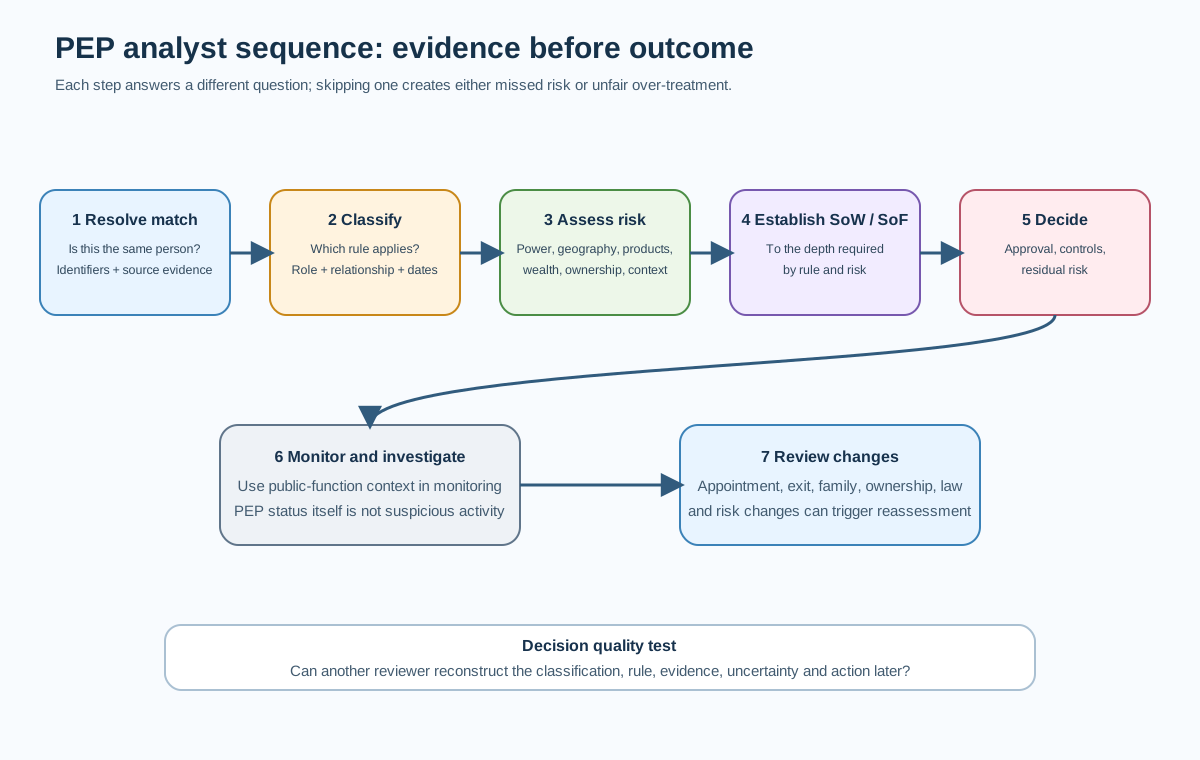
Step 1: confirm the person, not just the name
Begin with identity resolution. Record the source that generated the PEP candidate, then compare the available identifiers with the bank's customer data. Name similarity alone is rarely enough for a consequential decision. Use date of birth, nationality, role, jurisdiction, public body, role dates and other reliable identifiers as available.
If evidence conflicts, preserve the conflict. Do not convert uncertainty into a positive match merely because the vendor record has a high match score. Equally, do not clear a plausible match because one non-authoritative field differs. Escalate unresolved identity questions according to policy.
Step 2: establish the public function and applicable definition
Once identity is resolved, document the actual public function and its effective dates. Then determine which law, regulation and internal policy applies to the customer relationship. Ask whether the person is a foreign, domestic or international-organisation PEP under that framework.
For family members and close associates, document the exact relationship and the legal or policy basis for treatment. A vendor's broad relationship tag is not enough. Keep wider contextual links available for risk analysis without silently turning them into statutory classifications.
Step 3: assess actual risk
Build the risk assessment from the function and the relationship, not from prestige. Consider what the role can influence: budgets, procurement, concessions, licences, appointments, state-owned companies, judicial outcomes or other public resources. Add the customer's products, countries, ownership structures, expected activity, source of wealth, source of funds, use of intermediaries, credible adverse information and the strength of independent corroboration.
Do not use country scores as a substitute for judgement. They can inform context but cannot establish the integrity of an individual customer. A lower-risk domestic PEP may justify lighter intensity where the law allows it; a domestic PEP with significant procurement power and unexplained wealth may justify substantially more work.
Step 4: identify mandatory and proportionate measures
Separate mandatory measures from discretionary risk controls. This is particularly important in global banks.
For a foreign PEP under the FATF model, senior-management approval, reasonable measures to establish source of wealth and source of funds, and enhanced ongoing monitoring are core additional measures. Domestic and international-organisation PEP treatment is risk-based under FATF and can be implemented differently in national law. The US, UK and Australia illustrate these differences.
The case record should therefore state the rule applied and why. Avoid phrases such as “PEP policy requires EDD globally” unless that is genuinely the institution's internal policy, and if so label it as policy rather than a universal legal obligation.
Step 5: make source-of-wealth work analytical
Start with the material wealth story. What generated the wealth? When? Through which companies, investments, inheritance or other sources? What independent evidence exists? Which elements remain uncertain?
Ask for evidence that answers the risk question. If the customer's wealth clearly predates public office and is well documented, repeated demands for irrelevant recent records may add burden without improving understanding. If significant wealth appeared after the customer gained authority over procurement or licences, more targeted corroboration may be justified.
Treat discrepancies as investigation points. Record the customer's explanation, corroborating evidence, contradictory evidence and remaining gap. Do not use the phrase “unexplained wealth” as a conclusion until the bank has defined what is genuinely unexplained after reasonable inquiry.
Step 6: obtain approval that contains a decision
Where senior approval is required, provide the approver with enough information to decide. A good pack is concise but analytical: classification, public function, key risk factors, source-of-wealth and source-of-funds conclusion, relevant connected parties, products, material adverse information, unresolved issues, proposed controls and residual-risk conclusion.
The approver should record why the relationship is acceptable, acceptable with conditions or outside risk appetite. A signature without reasoning is weak evidence of governance.
Step 7: monitor the relationship in context
Monitoring should connect transactions to what the bank knows about the customer's function and economic profile. Relevant context might include expected investment income, known companies, public-contract exposure, countries, family-owned businesses and normal transaction size.
A PEP flag should enrich alerts rather than create an automatic suspicion outcome. Analysts should test whether the transaction makes economic sense and whether the public-function context changes the hypothesis.
Step 8: investigate and report on evidence
When a case escalates, write the chronology. Identify the public function on the relevant date, the transaction, the counterparties, the economic explanation, the ownership or family links, supporting evidence and contradictions. Consider legitimate alternatives.
If the institution reaches the applicable suspicion threshold, make the SAR or STR assessment under local law. PEP status explains context; it is not the reporting trigger.
Step 9: review status when circumstances change
PEP controls are event-driven as well as periodic. New appointment, promotion, role exit, a material family or ownership change, new adverse information or a material shift in activity can require reassessment.
For former PEPs, apply the jurisdictional rule and then assess continuing influence. Avoid both automatic time-based release and indefinite treatment without evidence. Record the role-end date, the review decision and any trigger that should reactivate stronger controls.
Customer communication checklist
Where legally permitted, good communication should tell the customer what information is needed, why the request is relevant, which evidence alternatives can be accepted and what the expected process is. Avoid accusatory wording. A PEP request should not imply that the customer is suspected of corruption.
Where suspicious-activity confidentiality or tipping-off restrictions apply, staff must follow those rules. Customer-service scripts should be designed with compliance and legal input so frontline staff do not accidentally reveal protected investigative information.
Common failure modes
PEP equals high risk automatically. This confuses status with risk and can contradict jurisdiction-specific treatment. Repair it by separating classification, risk assessment and control action.
Vendor says PEP, therefore customer is PEP. This skips identity and legal scope. Repair it with match resolution and jurisdiction-rule evaluation.
Family tree expands forever. This creates privacy and fairness problems. Repair it by distinguishing the statutory family definition from wider contextual relationships.
All advisers are treated as close associates. Professional contact is not enough. Repair it by applying the actual close-associate definition and understanding economic relationships.
Source-of-wealth becomes document accumulation. Large files can still contain no coherent economic explanation. Repair it with a wealth narrative, material-source mapping and independent corroboration.
PEP status blocks payments. PEP is not the same as sanctions. Repair decision logic so sanctions, AML, fraud and PEP controls keep distinct legal consequences.
Former PEPs are cleared by one global stopwatch. Jurisdictions differ and influence can persist. Repair it through effective-dated legal rules and continuing-influence assessment.
Former PEPs are never cleared. Indefinite treatment without legal or risk basis is also poor control. Build proportionate review and documented reduction where appropriate.
Tester scenarios
A useful test pack should include at least these scenarios:
- A true foreign PEP with a transliterated name and matching date of birth.
- A false positive sharing the PEP's name but not the date of birth or nationality.
- A UK domestic PEP with no additional higher-risk factors, proving the lower-risk starting point is respected.
- A UK domestic PEP with significant additional risk factors, proving intensity can increase.
- A US customer appearing in a PEP vendor, proving US risk-based CDD is not misrepresented as an automatic separate EDD rule.
- An Australian foreign PEP, proving the current AUSTRAC foreign-PEP requirements route correctly.
- A corporate customer with a PEP beneficial owner.
- A family relationship that is in scope in one jurisdiction but not another.
- A vendor-defined associate who does not meet the booking entity's legal close-associate definition.
- A former PEP whose role ended but whose continuing influence remains material.
- A former PEP whose risk has genuinely reduced and who should receive proportionate declassification.
- A PEP who is later sanctioned, proving the sanctions control activates separately.
Data-quality questions for operations
Operations should be able to answer: How old is the PEP source record? Which jurisdictions have weak source coverage? How long does it take a new appointment to reach the bank? How many candidate matches are unresolved? How many overrides lack sufficient evidence? How many former-PEP reviews are overdue? Which relationships lack completed source-of-wealth work where the rule requires it?
These questions convert PEP control from policy into measurable production capability. A mature bank knows not only how many PEPs it has, but how confident it is in the classification, whether required measures are complete and how quickly important changes reach customer controls.
Analyst close
Before closing a PEP review, ask five final questions. Have I classified the person under the correct rule? Have I assessed the actual risk rather than the title? Have I established the material wealth and funds to the depth required? Have I documented why the controls are proportionate? Could another analyst reconstruct this decision later from the evidence?
If the answer to all five is yes, the file is doing what a PEP control should do: protecting the bank and financial system from corruption risk without treating public service or political proximity as wrongdoing in itself.
Masterclass: governing PEP risk across a global bank
PEP control is often described as a KYC activity, but its hardest failures are governance failures. A global bank can have good screening technology and still make poor decisions if legal rules are flattened into one global checklist, commercial teams can bypass enhanced review, source-of-wealth work is reduced to document collection, former-PEP reviews are never performed, or nobody owns data-quality gaps between vendors and customer systems.
The governance model should therefore answer four questions: who owns the global standard, who translates it into local legal requirements, who owns the customer decision, and who independently tests whether the control works.
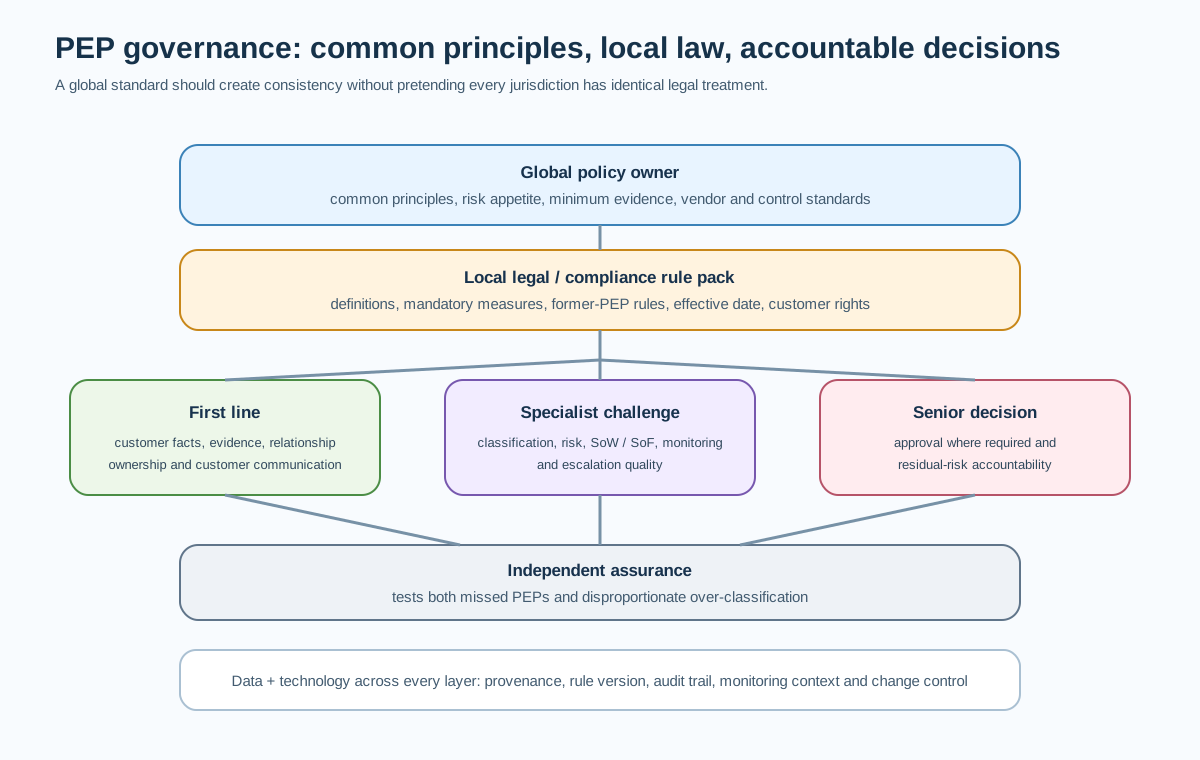
Global standard, local rule, customer decision
The global policy owner should set common principles: accurate identification, no presumption of criminality, clear distinction between status and risk, proportionate source-of-wealth and source-of-funds work, appropriate senior oversight, ongoing monitoring, fair customer treatment, and evidence retention. This provides consistency without pretending that every jurisdiction has identical law.
Local compliance and legal functions should map those principles into effective-dated rules. That mapping should identify the legal definition of PEP, family member and close associate; treatment of foreign, domestic and international-organisation PEPs; mandatory approval; source-of-wealth and source-of-funds requirements; monitoring obligations; former-PEP rules; customer-communication constraints; and relevant record-retention requirements.
The first line then owns the customer relationship and gathers the information needed to make the assessment. Specialist financial-crime teams challenge classification, risk assessment and enhanced measures. Senior management approves relationships where required. Independent assurance tests whether the control operates as designed.
The important design point is that no layer should silently rewrite another. A global policy can be stricter than local law, but it should say so. A local rule should not be mistaken for a global FATF requirement. A customer-risk decision should not be presented as a legal prohibition if it is actually the bank's risk-appetite choice.
Governance over definitions
Definition governance deserves its own control because over-broad classification can be as operationally damaging as missed PEPs. The bank should maintain a controlled catalogue of covered functions and relationship definitions by jurisdiction, with legal sign-off and effective dates.
Changes should enter through regulatory-change management. When law or supervisory guidance changes, the bank should identify affected customer populations, update rules, test the change, rescreen or reassess where required, and preserve evidence of the old and new treatment. The UK's January 2024 change to the starting risk treatment of domestic PEPs and the FCA's 2025 final guidance are a good example of why hard-coded assumptions become obsolete.
Vendor governance
Third-party PEP data should be governed like other material financial-crime data. Due diligence should assess geographic coverage, role coverage, update frequency, relationship definitions, source provenance, identifier quality, correction process and service levels. The bank should not rely only on contractual claims of “global coverage.”
Coverage testing can use official appointments and known populations to measure whether the provider captures relevant roles in material jurisdictions. Match-resolution data can show whether particular sources create excessive false positives. Appointment-to-ingestion latency can reveal whether newly appointed officials remain undetected too long.
When customers dispute a classification, the bank needs a process to review its own decision and, where appropriate, challenge vendor data. A customer should not be trapped indefinitely by an incorrect third-party record simply because the bank cannot change the vendor database immediately.
Commercial pressure and escalation
PEP relationships can involve high-profile customers, government connections or substantial balances. Governance must ensure that commercial importance does not reduce control quality. Relationship managers should be able to advocate for legitimate customers and provide context, but they should not be able to waive required measures or suppress material risk information.
Escalation routes should protect staff who raise concerns. High-value or sensitive relationships may justify specialist committees, but committee size is not a substitute for decision quality. The record should identify the evidence, uncertainty, dissent if material, conditions imposed and residual-risk rationale.
At the same time, “independence” should not become automatic rejection. A control function that refuses every PEP is avoiding risk rather than managing it and can create unfair financial exclusion. Governance should test both excessive leniency and excessive restriction.
Risk appetite
A bank's risk appetite can set boundaries around certain customer types, products or jurisdictions, but PEP risk appetite should be written carefully. Statements such as “no PEPs” can be operationally ambiguous and may conflict with fair-treatment expectations or the institution's public-service customer base. More useful appetite statements identify the circumstances the bank is unwilling to accept, such as inability to establish required source of wealth, unresolved beneficial ownership, prohibited sanctions exposure, or corruption-risk indicators that cannot be mitigated.
Metrics should show whether the appetite is working. Useful measures include confirmed PEP population, unresolved candidates, high-risk PEP relationships, overdue reviews, source-of-wealth exceptions, approval ageing, former-PEP review backlog, customer complaints linked to PEP treatment, material QA findings and significant control incidents.
Customer fairness as a control objective
Fair treatment is not separate from financial-crime effectiveness. Over-classifying relatives, repeatedly asking for irrelevant documents, giving no explanation for long delays or keeping former PEPs under indefinite enhanced treatment can damage legitimate customers and distract specialist resources from real risk.
The UK's FCA has made this point especially visible through its PEP review and FG25/3 guidance. Firms are expected to use the minimum definitions required by law, consider the actual level of risk and make information requests proportionate. Those expectations are UK-specific in legal form but illustrate a broader control principle: intrusive AML measures should have a clear purpose.
Complaint data should feed control improvement. A cluster of complaints about one screening rule or one onboarding desk may identify a design problem earlier than periodic audit.
Independent assurance
Assurance should test more than whether a PEP flag exists. A strong review sample asks:
- Was identity resolved correctly?
- Did the role meet the applicable definition?
- Was the family or associate relationship legally in scope?
- Was the risk assessment evidence-based?
- Were mandatory measures complete?
- Was source of wealth understood rather than merely documented?
- Was senior approval substantive where required?
- Was ongoing monitoring calibrated to the relationship?
- Was former-PEP treatment reviewed when the role ended?
- Was the customer treated proportionately?
Assurance should also test negative cases: people who should not have been classified, customers whose PEP treatment should have been reduced, and vendor errors that the institution failed to correct. These cases reveal whether the bank has confused conservatism with control quality.
Technology governance
Technology changes can alter PEP outcomes without changing policy. A new matching algorithm, vendor, transliteration library, customer master, data mapping or case-management workflow can change who is identified and how quickly. Material changes should therefore receive financial-crime impact assessment and regression testing.
Model-like components should be explainable enough for operations to understand why a candidate appeared. The institution should monitor false negatives through back-testing against known populations and false positives through match-resolution data. Threshold changes should be approved and documented.
Rule engines must be effective-dated. If the legal treatment of domestic PEPs changes on a specified date, the system should not simply overwrite history. Auditors and investigators may need to reconstruct the rule that applied when an older decision was made.
Data lineage and audit trail
For each significant PEP decision, the bank should be able to reconstruct the chain from source data to outcome. That includes the external source, ingestion event, customer match, role classification, applicable rule, risk assessment, evidence collected, approvals, monitoring configuration, later role changes and eventual declassification or continued treatment.
This lineage is valuable during regulatory examinations, customer complaints, internal investigations and remediation. It also allows the bank to identify systemic problems. If a vendor feed failed for two days, lineage can identify the customers whose appointments may have been missed and support targeted replay.
Cross-functional ownership
PEP capability touches onboarding, KYC operations, private banking, corporate banking, payments, screening, transaction monitoring, investigations, data management, compliance, legal, technology, customer service and audit. Governance should make interfaces explicit.
KYC owns accurate customer and relationship data. Screening owns candidate generation and technical matching. Specialist compliance owns policy interpretation and challenge. Relationship teams own customer engagement. Monitoring and investigations use PEP context but should not assume suspicion. Technology owns availability and data lineage. Legal advises on local definition and confidentiality questions. Audit independently tests the framework.
Without clear interfaces, failures are passed between teams: screening says the vendor provided the record, KYC says the relationship manager supplied the data, the relationship manager says compliance approved it, and compliance says technology applied the rule. A control map should make one owner accountable for each decision and handoff.
Governance close
The mature global PEP framework is neither the strictest possible nor the lightest possible. It is the most defensible: legally scoped, risk-based, evidence-led, technically traceable and fair to legitimate customers. It can explain why two PEPs receive different treatment, why two jurisdictions apply different legal rules, why a former PEP remains enhanced or is declassified, and why a particular information request was necessary.
That is what senior management, supervisors and customers ultimately need from the control: not a large PEP population, but reliable decisions about real corruption risk.
Knowledge checks with explained answers
1. Does PEP status mean the customer is suspected of corruption?
No. FATF describes PEP measures as preventive rather than criminal. PEP status identifies exposure to a type of risk arising from a prominent public function. Suspicion must come from facts and circumstances that meet the applicable reporting threshold, not from the status itself.
A strong analyst therefore keeps three things separate: legal PEP classification, customer-risk assessment and suspicious-activity determination.
2. Must every domestic PEP worldwide receive exactly the same enhanced measures as every foreign PEP?
No. FATF Recommendation 12 applies the additional foreign-PEP measures to domestic and international-organisation PEP relationships where the relationship is higher risk. National implementation can differ. The UK, United States and Australia illustrate materially different approaches.
A global bank should use jurisdiction-specific rules and effective dates rather than a single universal action table.
3. A vendor labels a customer's cousin as a PEP family member. Is that enough to apply the bank's legal family-member treatment?
No. The bank must apply the family-member definition relevant to the applicable legal and policy framework. The vendor relationship can still be useful context, but it should not silently become a statutory classification.
This distinction protects both control accuracy and privacy. Wider relatives may matter because of transactions, ownership or influence, but that is a separate risk-analysis question.
4. What is the difference between a close-associate fact and evidence of misconduct?
A close-associate fact establishes that a relationship meets the applicable definition or is relevant to the PEP risk assessment. It does not prove that the associate is a nominee, money launderer or corruption facilitator.
Evidence of misconduct requires additional facts such as unexplained benefit flows, concealed ownership, false commercial explanations or other indicators. The bank should never substitute relationship mapping for investigation.
5. Why should a bank establish source of wealth for a PEP when required by the applicable framework?
Because source of wealth helps the bank understand how the customer's overall economic position was created and whether it is coherent with known legitimate activity. For corruption risk, timing can be particularly important: wealth accumulated before public office may have a different explanation from sudden unexplained accumulation after access to public resources.
The goal is reasonable, risk-proportionate understanding supported by evidence, not perfect proof of every historic unit of wealth.
6. Is source of wealth the same as source of funds?
No. Source of wealth explains the customer's overall wealth. Source of funds explains the origin of the money used in a specific relationship or transaction.
A customer can have a well-established fortune but receive one transaction from an unexplained third party. Conversely, one well-documented transfer does not necessarily explain a large overall fortune.
7. A UK domestic PEP has no other material risk factors. What is the current starting point?
Under the current UK framework, domestic PEPs, their family members and known close associates should be treated as presenting a lower level of risk than non-domestic PEPs unless other risk factors indicate otherwise. Enhanced measures remain relevant but should be applied with lower intensity where appropriate.
This is a UK rule and supervisory expectation, not a universal FATF rule for every country.
8. Does US federal BSA/AML law require banks to perform a unique set of additional due-diligence steps solely because a customer is considered a PEP?
The 2020 joint US agency statement says no. The US CDD rule does not create a regulatory requirement or supervisory expectation for unique, additional PEP due-diligence steps merely because of that label. Banks should conduct risk-based CDD commensurate with the facts and circumstances.
A US bank may still choose additional controls under its risk management framework, and other legal obligations can apply to particular facts. The important point is not to misstate internal policy as a universal US legal requirement.
9. How does current Australian guidance distinguish foreign from domestic and international-organisation PEPs?
AUSTRAC's guidance updated in July 2026 sets specific additional requirements for foreign PEPs and makes some additional measures for domestic or international-organisation PEPs dependent on the customer being high ML/TF risk. The exact Australian statutory and rules-based provisions must be applied to the customer relationship.
This again demonstrates why a global bank needs local rule packs.
10. Should a bank automatically block a payment because one party is a PEP?
No. PEP status is not the same as a sanctions designation. PEP controls are generally preventive AML/CFT measures involving due diligence, approval, monitoring and risk management. A payment hold or block requires its own legal or policy basis.
If the person is also sanctioned, the sanctions framework may create separate prohibitions or asset-freeze obligations. Systems should preserve both classifications rather than merging them.
11. A former minister left office five years ago. Can the bank automatically remove PEP treatment because five years have passed?
Not from FATF alone. Former-PEP treatment must follow the applicable jurisdictional rule and consider continuing influence where the framework requires or permits that assessment. Some jurisdictions specify minimum periods or particular treatment; FATF does not create one universal global stopwatch.
Time is relevant, but so are continuing political roles, state-linked positions, material connections to current officials and other risk facts.
12. Can the bank keep a former PEP under maximum enhanced treatment forever just to be safe?
That can also be poor control. If local law permits reduced treatment and the risk has genuinely declined, indefinite enhanced treatment may be disproportionate and unfair. The bank should review the status and document the basis for continuing or reducing measures.
13. What should senior management actually approve?
Where approval is required, senior management should approve a reasoned relationship decision, not simply a PEP label. The approval pack should explain classification, public function, key risks, source-of-wealth and source-of-funds conclusions where relevant, products, unresolved issues, proposed controls and residual risk.
A signature without reasoning is weak governance evidence.
14. Why should family and close-associate definitions be controlled as reference data?
Because definitions differ across jurisdictions and can change. Hard-coding one family tree or one associate test across the bank risks both under-compliance and over-classification.
Controlled reference data allows legal changes to be effective-dated, tested and linked to historical decisions.
15. What is the most important negative test in PEP screening?
Proving that the system does not classify the wrong person. False positives can arise from common names, incomplete identifiers, broad vendor definitions and stale records. Negative testing should include name collisions, out-of-scope public roles, unrelated professionals and relationships that do not meet the applicable family or close-associate definition.
A high-quality control must be able to say both “this is the PEP” and “this is not the PEP” with evidence.
Glossary
Politically exposed person (PEP): an individual who is or has been entrusted with a prominent public function under the applicable framework. PEP treatment is preventive and does not imply criminality.
Foreign PEP: a person entrusted with a prominent public function by a foreign country under the relevant definition. FATF Recommendation 12 applies additional measures to foreign PEP relationships.
Domestic PEP: a person entrusted with a prominent public function domestically under the applicable framework. FATF applies a risk-based approach, and national treatment varies.
International-organisation PEP: a person entrusted with a prominent function by an international organisation, usually at senior-management or comparable decision-making level as defined by the relevant framework.
Family member: a person connected to a PEP through a family relationship included in the applicable legal or policy definition. The exact family scope is jurisdiction-specific.
Close associate: a person meeting the relevant legal or policy close-associate test. Depending on the framework, this can involve joint beneficial ownership, close business relations or ownership of a structure established for a PEP's benefit. Mere social or professional contact is not automatically enough.
PEP candidate: a possible match generated by a source or screening system before identity resolution and legal classification are complete.
PEP classification: the bank's documented conclusion that a person falls within a specified PEP, family-member or close-associate category under an identified rule or policy.
Source of wealth (SoW): the origin of a person's overall accumulated wealth.
Source of funds (SoF): the origin of the specific funds used in a relationship or transaction.
Enhanced ongoing monitoring: more intensive or focused monitoring applied where required or justified by the applicable PEP framework and risk assessment. The exact intensity should be proportionate.
Continuing influence: influence that may remain after a person leaves a prominent public function. It is relevant to former-PEP assessment but should be evaluated under the applicable legal framework rather than assumed indefinitely.
Declassification: an operational term for reducing or ending PEP-specific treatment when the relevant legal and risk conditions permit. It does not erase the historic role record.
Rule version: the effective-dated legal or policy configuration used to determine PEP classification and required measures at a specific time.
Relationship provenance: evidence showing where a family, ownership, business or associate relationship came from, how reliable it is and when it was last verified.
Residual risk: the risk remaining after required and proportionate controls are applied. Senior approval, where required, should consider whether that residual risk is acceptable within the bank's risk appetite.
References and further reading
PEP controls sit within a global standard but are implemented through national and regional law. The sources below were used to verify the chapter's distinction between foreign, domestic and international-organisation PEPs, proportionate treatment, family and close-associate scope, source-of-wealth and source-of-funds measures, and current jurisdiction examples. Live customer decisions should always use the law and regulatory guidance applicable to the relevant entity and date.
- Financial Action Task Force (FATF) — Guidance: Politically Exposed Persons, Recommendations 12 and 22: https://www.fatf-gafi.org/en/publications/Fatfrecommendations/Peps-r12-r22.html
- Financial Action Task Force (FATF) — The FATF Recommendations: https://www.fatf-gafi.org/en/publications/Fatfrecommendations/Fatf-recommendations.html
- UK Financial Conduct Authority — FG25/3: Treatment of politically exposed persons, finalised guidance published 7 July 2025 and updated 16 July 2025: https://www.fca.org.uk/publications/finalised-guidance/fg25-3-treatment-politically-exposed-persons
- UK Financial Conduct Authority — 2024 multi-firm review and expectations for fair and proportionate PEP treatment: https://www.fca.org.uk/news/press-releases/FCA-calls-on-firms-to-improve-treatment-of-PEPs
- US Financial Crimes Enforcement Network (FinCEN) and federal banking agencies — Joint statement on BSA due diligence requirements for customers who may be considered PEPs, 21 August 2020: https://www.fincen.gov/news/news-releases/agencies-issue-statement-bank-secrecy-act-due-diligence-requirements-customers
- AUSTRAC — Politically exposed persons, current guidance last updated 29 July 2026: https://www.austrac.gov.au/industry-and-business/obligations-and-guidance/your-amlctf-program/customer-due-diligence/politically-exposed-persons-pep
- AUSTRAC — Enhanced customer due diligence: https://www.austrac.gov.au/industry-and-business/obligations-and-guidance/your-amlctf-program/customer-due-diligence/enhanced-customer-due-diligence
Accuracy note — reviewed 17 September 2026: PEP definitions, domestic-PEP treatment, family and close-associate scope, approval requirements and former-PEP treatment differ by jurisdiction. FATF's standard should not be presented as though every detailed requirement has identical direct legal effect in every country. The current UK lower-risk starting point for domestic PEPs is UK-specific; the US joint agency statement confirms a different risk-based CDD approach; and AUSTRAC's July 2026 guidance reflects Australia's current implementation.