Beneficial Ownership and Control Chains
A company can be the bank's customer, but a company is not the human being who ultimately benefits from or controls it. Beneficial-ownership work is the discipline of moving through the legal structure until the bank understands the relevant natural persons behind the customer and the ways in which control can be exercised. That sounds simple until the customer has several holding companies, different classes of shares, nominee arrangements, a trust in the chain, voting agreements, investors in different jurisdictions or a person who directs the business without owning a large percentage of it.
The safest mental model is structure first, legal test second, evidence third, decision fourth. First map the legal and control structure as facts. Then apply the beneficial-ownership definition and thresholds that actually govern the relevant customer, product, booking entity and jurisdiction. Then verify the important facts using sources whose reliability is understood. Only after those steps should the bank conclude who must be identified, verified, screened, risk assessed or escalated.
That sequence matters because there is no single worldwide "25 percent rule" that a global bank can safely apply to every case. FATF provides the international standards and a broad natural-person concept, but national and regional implementation determines the binding identification tests, thresholds, fallback mechanisms, exemptions and verification duties. Corporate-register concepts can also differ from AML customer-due-diligence concepts. Sanctions ownership and control tests can differ again. Tax, accounting and prudential definitions of control serve different purposes. A good data model keeps those conclusions separate instead of storing one universal ubo=true flag and allowing every downstream control to infer the same legal meaning.
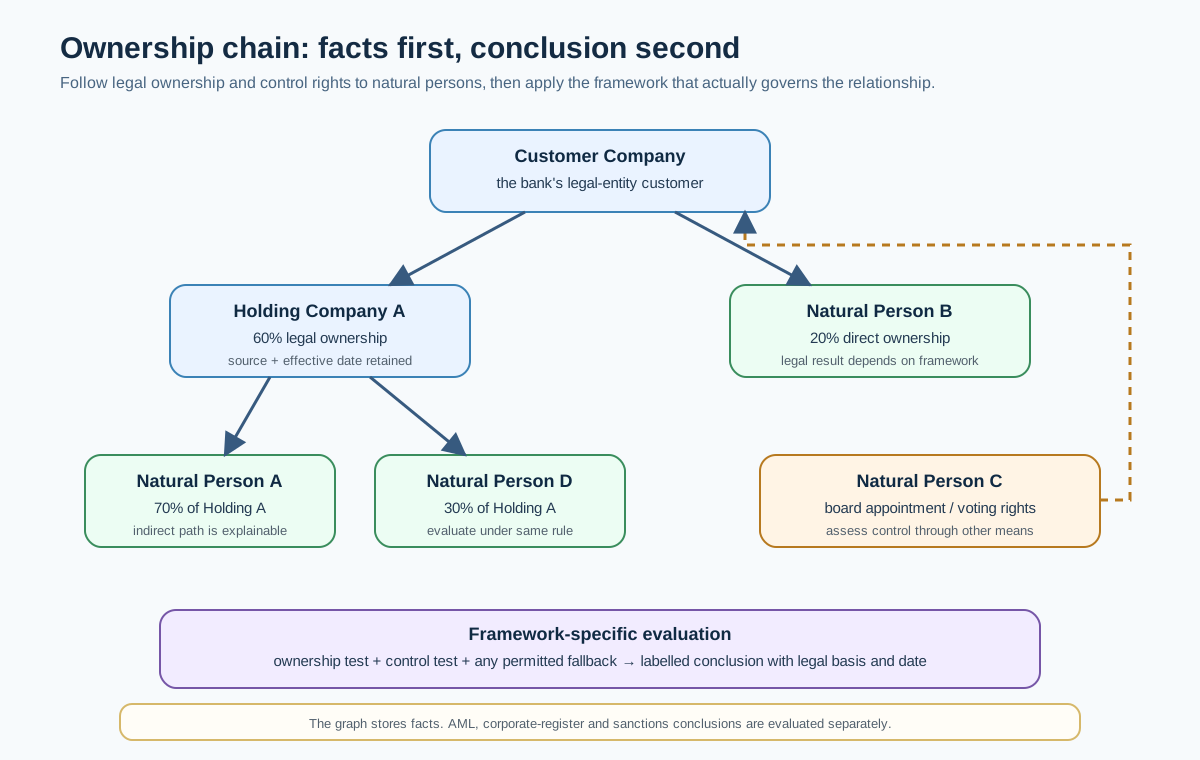
Why beneficial ownership matters in a bank
Banks need to know who stands behind a legal-entity customer because legal persons can separate legal title, economic benefit and practical decision-making. That separation is legitimate and essential to modern commerce, but it can also be exploited to conceal criminal proceeds, corruption, sanctions exposure, tax crime, fraud or the person actually directing an account. FATF's strengthened Recommendation 24 framework is aimed at making adequate, accurate and up-to-date beneficial-ownership information available to competent authorities and promotes a multi-pronged approach rather than reliance on a single source.
For a bank, ownership information feeds several controls at once. Customer risk assessment uses the owners' locations, activities, political exposure and other relevant risk factors. Sanctions screening needs the identities of connected persons, although sanctions attribution must still use the applicable sanctions regime rather than the AML beneficial-ownership threshold. Transaction monitoring uses ownership relationships to understand related-party flows and apparently unrelated counterparties. Credit and fraud teams may need the same corporate graph for different reasons. Investigators use historical ownership to reconstruct who controlled the customer when a suspicious transaction occurred. Operations need reliable authority data so instructions come from people entitled to act.
A weak ownership process therefore creates a chain of downstream weaknesses. The customer may be risk rated against the wrong people, screening may omit a relevant controller, related-party payments may look external, periodic review may miss a change in control, and an investigator may be unable to explain why the bank believed a particular natural person stood behind the entity at a specific date.
FATF's global framework and the local-law boundary
FATF Recommendations 10, 24 and 25 provide the central international architecture. Recommendation 10 deals with customer due diligence by financial institutions. Recommendation 24 addresses transparency and beneficial ownership of legal persons. Recommendation 25 addresses legal arrangements such as trusts. FATF's 2023 guidance on legal persons emphasises access to adequate, accurate and up-to-date information and explains why combining information from companies, public authorities, registries or alternative mechanisms can be more effective than relying on one source alone. FATF's 2024 guidance separately develops the risk-based approach for legal arrangements.
Those standards do not create a single operating threshold for every bank in every country. A threshold that appears in one national AML rule, one corporate register or one future regulatory framework should not be copied into a global policy as if it were a FATF universal. The United Kingdom's People with Significant Control regime, for example, uses specified company-law conditions including more than 25 percent of shares or voting rights, rights to appoint or remove a majority of directors, and certain significant-influence or control tests. That is a UK corporate-transparency regime. Australia currently uses a 25-percent-or-more ownership concept together with control concepts in AUSTRAC guidance under its framework. The United States has its own CDD Rule definition and, importantly, FinCEN granted account-opening exceptive relief on 13 February 2026 so covered financial institutions may, if they choose to use the relief, avoid repeating beneficial-owner identification and verification at every new account opening when specified conditions are met.
The United States also changed its Corporate Transparency Act reporting regime materially. FinCEN's August 2026 final rule made permanent exemptions for U.S. companies from BOI reporting and limited the federal reporting regime to certain foreign entities registered to do business in the United States, with further relief for U.S. persons. That public reporting regime is not the same thing as the bank's CDD duties. A training chapter that says "all U.S. companies report their beneficial owners to FinCEN" is therefore wrong as of September 2026.
The European Union is another timing-sensitive example. Regulation (EU) 2024/1624 is in force, but its general application is from 10 July 2027. Its detailed beneficial-ownership rules should therefore not be presented as if they are already the day-to-day EU-wide operating standard in September 2026. Banks must continue to apply the law currently applicable to their legal entities while preparing for the future framework.
The practical rule for analysts and architects is simple: store the legal source, framework, effective date and conclusion together. If the threshold or definition changes, the bank should be able to identify affected customers and recompute conclusions rather than relying on an undated ownership label.
Start by separating legal ownership from beneficial ownership
Legal ownership is usually easier to observe. A shareholder register may show that Holding Company A owns 70 percent of Operating Company B. That fact does not yet identify the natural person behind the chain. Holding Company A may itself be owned by another company, a trust, a partnership or several investors. The bank needs to follow the relevant chain far enough to apply the applicable beneficial-ownership test and understand control through other means where required.
The ownership graph should record each node and relationship rather than only the final names. Useful data includes the legal entity identifier or registration number, jurisdiction, entity type, ownership percentage where meaningful, voting rights, share class, date from which the relationship applies, source of evidence, verification status and any control right that does not follow the percentage. Historical end dates matter as much as current start dates because investigators often ask an "as at" question months or years later.
An ownership chain is not always a simple tree. Cross-holdings can create loops. Different branches can converge on the same person. A trust or foundation can interrupt ordinary share-based logic. Joint ventures may allocate important veto rights to a minority partner. A lender may have protective covenants that are not control, or exceptionally broad rights that require legal analysis. The graph should preserve the facts and let the applicable methodology decide their significance.
Ownership thresholds are legal triggers, not a theory of reality
Thresholds are useful because they create a consistent point at which an ownership interest becomes relevant under a particular rule. They are dangerous when analysts treat them as proof that everyone below the number is irrelevant. A person can exercise control through voting agreements, appointment rights, reserved matters, contractual rights or other means even without meeting an ownership threshold. Conversely, a minority protection right does not automatically make its holder a beneficial owner; the nature, scope and context of the right matter.
The bank should therefore distinguish at least three questions:
- Does a natural person meet the applicable ownership-interest test?
- Does a natural person meet an applicable control-through-other-means test?
- If the framework permits or requires a fallback because no natural person can be identified under those tests after reasonable measures, what person must be recorded and how must that fallback status be labelled?
The third question is especially important. Some frameworks use a senior managing official or comparable person as a fallback after prescribed steps. That person should not automatically be described internally as the "true UBO". A fallback record is evidence that the framework's fallback route was used; it is not proof that the senior manager ultimately owns the entity.
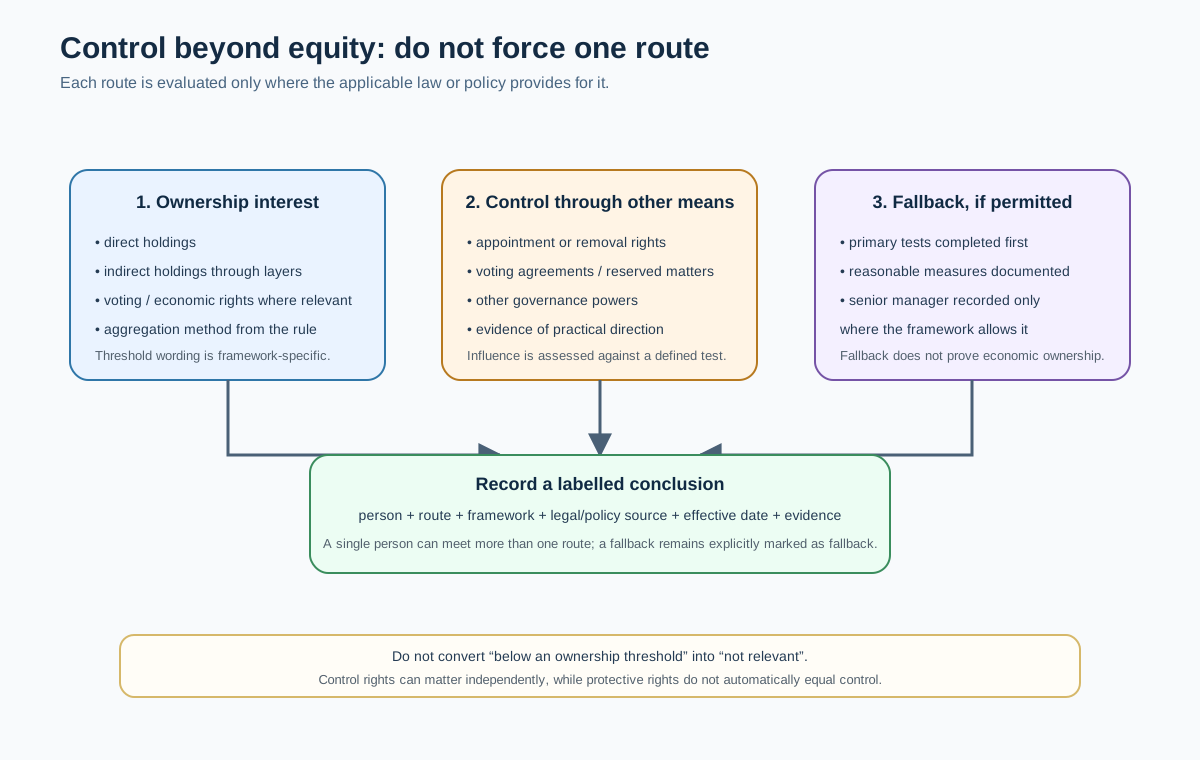
How indirect ownership calculation works
Where the applicable rule requires indirect ownership calculation, multiplication across a chain is a useful mathematical tool. If Person P owns 60 percent of Holding A and Holding A owns 50 percent of Customer B, P's indirect economic interest through that path is 30 percent. If P has another qualifying path into Customer B, the framework may require interests to be aggregated. The exact method, treatment of joint interests and threshold comparison must follow the applicable rule rather than a bank-invented universal formula.
This is where a graph engine helps. It can enumerate paths, multiply percentages, aggregate qualifying paths under configured rules and show an explainable calculation. But the engine should not turn a mathematical result into a legal conclusion without the rule version that makes that result relevant. A 24.9 percent result may be below one ownership threshold, above another, or irrelevant if a control test is already satisfied. An analyst should be able to see both the math and the legal reasoning.
Testing should include simple direct ownership, multiple indirect paths, circular holdings, changes in effective dates, different classes of voting rights and situations where the person has control rights without a large economic interest. Boundary cases are useful because they expose rounding errors and assumptions hidden in the algorithm. The system should use exact or suitably precise arithmetic and should never round a position upward merely to create a beneficial-owner result.
Control through other means
Control is the area where checklist thinking breaks down. The bank is trying to establish whether a natural person has a relevant ability to direct or influence the entity under the applicable framework. Evidence can come from constitutional documents, shareholder agreements, voting arrangements, appointment and removal rights, reserved matters, powers of attorney, financing documentation and observed governance behaviour.
A veto is not automatically control. Many minority investors receive protective rights designed to prevent fundamental changes without giving them day-to-day direction. A board seat is not automatically control. A family relationship is not automatically concerted action. A major lender is not automatically a controller. The analysis needs a defined legal or policy test and enough evidence to explain why the observed rights or behaviour meet it.
At the same time, formal ownership can understate reality. A person may own a small stake but retain the right to appoint management, direct important decisions or act through nominees. A founder may retain reserved powers after transferring most economic ownership. A partnership agreement may allocate management to a general partner with little economic capital. The bank should capture those facts instead of forcing every structure into a shareholding model.
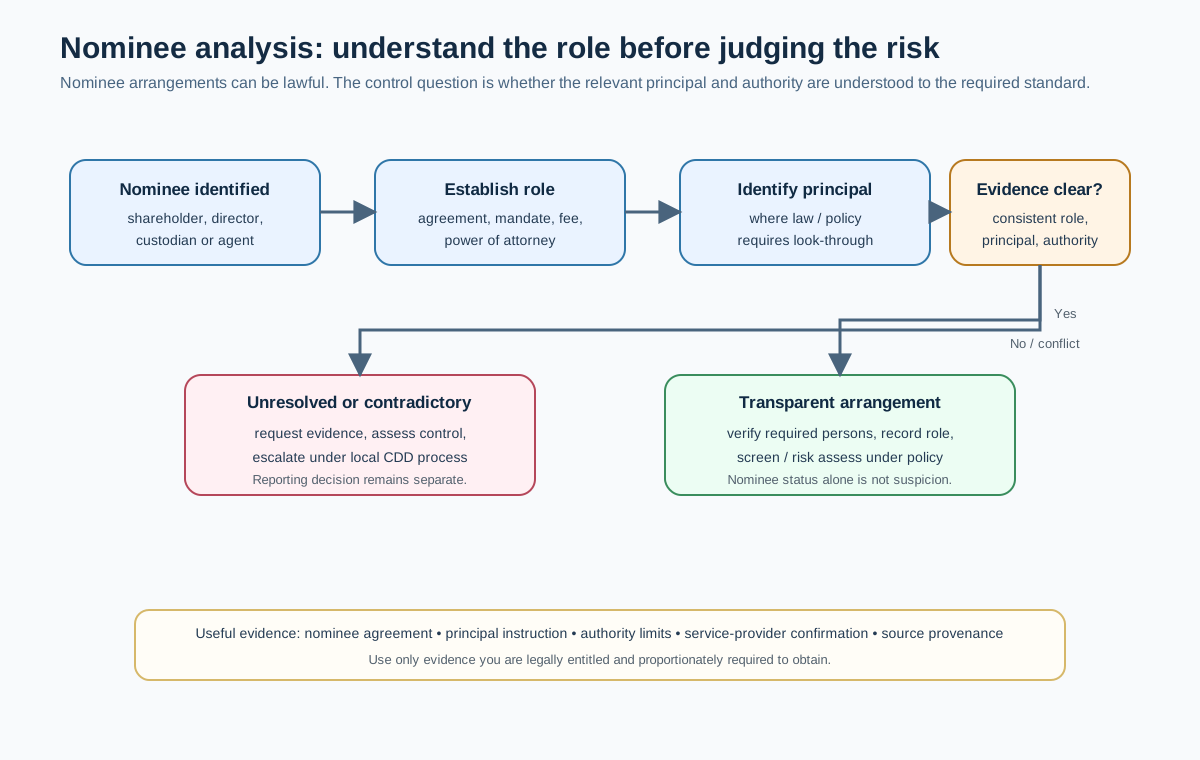
Nominees: a role to understand, not a verdict
Nominee shareholders and directors exist for legitimate reasons, including administration, custody, professional services, privacy within lawful boundaries and transaction structuring. The presence of a nominee is therefore not itself evidence of money laundering or concealment. The financial-crime question is whether the bank can establish the principal, relevant control and economic interest to the standard required for the relationship.
Useful evidence can include the nominee agreement, declarations of trust or agency, instructions from the principal, powers of attorney, fee arrangements, regulated service-provider records and corroborating corporate documents. If the nominee is acting for several clients, that pattern may confirm a professional-service role rather than imply criminality. Concern rises when the arrangement is misrepresented, relevant principals cannot be established, documents conflict, a person appears to exercise undisclosed control, or the arrangement lacks a credible explanation in the broader customer context.
Banks should also avoid assuming that a regulated corporate-service provider's involvement eliminates risk. Regulation and supervision are relevant evidence, not a substitute for the bank's own duties. Conversely, a bank should not demand unnecessary disclosure beyond its lawful need merely because the structure is unfamiliar. Proportionate verification and data minimisation can coexist.
Registers are valuable evidence, not automatic truth
Beneficial-ownership and corporate registers can substantially improve customer due diligence, especially when data is searchable, timely and subject to identity or filing controls. They also have limitations. Some are self-reported. Some identify legal shareholders rather than the AML beneficial owners the bank needs. Some have access restrictions. Some lack complete historical records. Some allow company information to be filed before meaningful verification. The bank should understand what a particular register proves and what it does not prove.
The best operating model is multi-source rather than register-blind or register-dependent. Customer declarations can explain the structure. Official registries can confirm legal existence, officers and filed ownership. Constitutional documents can show voting or appointment rights. Regulated-professional evidence can support specific relationships. Commercial data providers can speed discovery but need provenance and freshness controls. Open-source information can reveal inconsistencies but should be assessed for source quality. Behavioural evidence can become important when formal records conflict with who actually directs the relationship.
Where two credible sources disagree, the answer is not to choose whichever source carries the higher internal rank automatically. The bank should understand why they differ. One may be stale. One may describe legal ownership while another describes beneficial ownership. A recent transaction may not yet be reflected in a registry. A customer may have supplied inaccurate information. The discrepancy itself becomes a case-management item with an owner, evidence request, decision and audit trail.
The United Kingdom illustrates why date matters. Companies House began mandatory identity verification for directors and PSCs from 18 November 2025 with a transition period, and its guidance continued to evolve during 2026. That improves the evidential environment but does not transform every Companies House field into a bank-level AML conclusion. The bank must still apply its own legal obligations and customer-risk procedures.
Listed companies, regulated funds and other potentially simplified structures
Some jurisdictions or bank policies provide exemptions, modified identification routes or reliance possibilities for specified listed companies, regulated entities or other categories. These are not globally interchangeable. A subsidiary of a listed company should not automatically inherit an exemption just because the parent is publicly traded. The bank should identify the actual legal basis and conditions applying to the customer.
For listed groups, practical verification often focuses on confirming the listing, the regulatory market, the chain from the customer to the listed parent and any other material branch of ownership or control that falls outside the relief. For funds, the relevant parties may include the fund, manager, general partner, trustee, investors or controllers depending on legal form and the applicable framework. "Look through every investor" and "never look through a regulated fund" are both poor universal rules.
A strong process therefore has an entity-type decision table maintained by legal and policy owners. The table does not replace judgement. It tells analysts which rules to apply, what evidence is needed and when specialist review is required.
Partnerships, trusts, foundations and similar arrangements
Not every customer has shareholders. Partnerships can allocate economic rights and management rights differently. Trusts separate settlor, trustee, beneficiary and sometimes protector roles. Foundations may have founders, councils, beneficiaries or purpose-based governance. FATF treats legal persons and legal arrangements in separate recommendations for good reason.
This chapter focuses on ownership and control chains, while the dedicated trusts and legal-arrangements chapter goes deeper into those forms. The immediate lesson is that a share-percentage field cannot represent every structure. The customer model needs typed relationships: owns, votes, appoints, acts_as_trustee, is_settlor, is_protector, is_beneficiary, manages, controls_by_other_means, and similar concepts appropriate to local law and the bank's policy.
Relationship types should be effective-dated and sourced. If the bank later learns that a protector obtained a power to remove trustees on 1 March, an investigator reviewing a January payment should not be shown the March control structure as if it existed earlier.
Sanctions ownership and control must stay separate
A common implementation error is reusing AML beneficial-ownership logic to decide sanctions attribution. That can be wrong. Sanctions regimes can have their own ownership thresholds, aggregation approaches and control tests. Even where a percentage looks familiar, the legal rule may not be the same.
The correct architecture is to reuse the facts while keeping the legal evaluations separate. The corporate graph can store who owns what, which voting rights exist and which person has appointment powers. The AML engine can evaluate those facts under AML CDD rules. The sanctions engine can evaluate the same facts under the relevant sanctions regime. The results should retain framework labels, legal basis, effective dates and evidence.
This separation also supports change. If a sanctions authority changes its interpretation, the bank can recompute sanctions conclusions without corrupting the AML customer record. If AML law changes, screening history remains understandable.
Data model and system touchpoints
Beneficial-ownership data typically touches onboarding, KYC case management, screening, customer master data, document management, legal-entity data, transaction monitoring, investigations and reporting. A bank architecture that stores the ownership structure only as a PDF diagram creates unnecessary operational risk because downstream systems cannot query or recompute it.
A useful graph model records nodes for natural persons, legal persons and legal arrangements, and edges for ownership and control relationships. Each edge should have a relationship type, percentage or rights where relevant, start and end dates, source, verification status and provenance. Conclusions should be separate objects: beneficial-owner conclusion under Framework A, PSC conclusion under Framework B, sanctions attribution under Regime C.
The case-management layer should record unresolved gaps and contradictions. For example, registry shareholder differs from customer declaration is an issue, not a new owner until investigated. The system should allow an analyst to retain both source assertions, record which was accepted, and explain the reasoning.
For APIs and data warehouses, lineage matters. A screening hit on a beneficial owner should be traceable back to the person record, relationship edge and source used when the person was added to the screened population. If the relationship later ends, historical alerts should still be reconstructable.
Event-driven review and keeping the graph current
Ownership information decays. Shares are transferred, mergers occur, founders die, investors enter or leave, voting agreements change, funds restructure and companies are taken private. Periodic review is useful, but event-driven updates are often more important.
Potential triggers include customer notification, corporate-registry changes, new directors or PSCs, merger and acquisition announcements, credit restructurings, changes in transaction behaviour that reveal previously unknown related parties, credible adverse information and sanctions developments affecting connected persons. The trigger should start a proportionate review of the affected branch of the graph and, where necessary, the broader customer risk assessment.
The bank should not infer a new beneficial owner merely from one transaction or one media article. Such information is a lead. It should prompt evidence gathering and, where justified, a change to the verified graph. This distinction between assertion and verified fact is fundamental to data quality.
What happens when ownership cannot be satisfactorily established
The answer depends on the applicable legal framework, the point in the customer lifecycle and the bank's policy. Some frameworks specify that customer due diligence must be completed before or within defined circumstances around establishing a relationship. Some permit limited timing flexibility subject to conditions. Some specify fallback identification routes after reasonable measures. Banks may also impose risk-based restrictions while information remains unresolved.
The analyst should avoid turning uncertainty itself into an accusation. A complex structure can be legitimate. A registry discrepancy can be administrative. A customer can misunderstand a document request. The question is whether the bank has enough reliable information to meet its obligations and understand the relationship. If not, the case should be escalated under the relevant procedure, with legal or compliance input where required.
Likewise, opacity or inconsistency does not automatically create a reportable suspicion. Suspicious-transaction or suspicious-activity reporting tests are jurisdiction-specific and require the relevant suspicion standard to be considered. Ownership problems can contribute to suspicion, but they do not substitute for the legal reporting analysis.
Practical mini case: the founder no longer owns the majority
Consider a fictional software company opening a corporate account. The founder owns 18 percent. Two venture funds own 31 percent each. Employees and smaller investors hold the balance. A simple ownership-threshold screen may identify no natural person through the two fund stakes without further analysis. The constitutional documents also show that the founder can appoint two of five directors and has a consent right over the sale of core intellectual property.
The bank should not jump to either of two conclusions: "the founder is the beneficial owner because the founder runs the company" or "the founder is irrelevant because the founder owns only 18 percent." It maps the funds, applies the applicable look-through or entity-type rules, identifies the relevant natural persons or permitted relief, and separately analyses whether the founder's governance rights amount to control under the applicable framework.
Suppose the bank verifies that each venture fund is managed independently and that no individual investor meets the relevant beneficial-ownership test through those holdings. Legal review concludes that the founder's particular rights are protective and do not amount to control under the applicable customer-due-diligence rule. The bank records that reasoning rather than forcing a natural person into the record. If the framework requires a fallback senior managing official after reasonable measures, that record is explicitly labelled as fallback. If it does not, the bank follows its local process.
Now change one fact: a shareholder agreement gives the founder the unilateral right to appoint three of five directors. The control analysis may change even though the founder's 18 percent economic ownership did not. That is why the graph must store governance rights and not only percentages.
BA, architecture and testing considerations
For a business analyst, beneficial ownership is a requirements problem with legal variability. Requirements should state which framework is being implemented, how entity type determines the route, what source data is mandatory, which ownership calculations apply, how control-through-other-means is assessed, whether a fallback exists, and how the conclusion is explained. Avoid requirements such as "identify all UBOs above 25 percent" without jurisdiction, definition and effective date.
For architects, the central pattern is fact graph plus rule-specific conclusions. Facts should be reusable; legal outcomes should remain scoped. Effective dating, versioned rules, explainability and evidence lineage are not optional extras if the bank must reconstruct historical decisions.
For testers, the strongest packs include direct ownership, indirect ownership through several layers, duplicate paths to the same person, circular holdings, different voting and economic rights, minority appointment rights, transparent nominee arrangements, unresolved nominee arrangements, listed-company cases, trusts in a chain, effective-date changes and rule-version changes. Negative tests should confirm that the system does not label an owner solely because a percentage was rounded, does not inherit a listed-parent exemption automatically, and does not convert an AML beneficial-owner result into a sanctions block without the sanctions rule being evaluated.
Key takeaways
Beneficial ownership is not a hunt for a universal percentage. It is a disciplined process for understanding the natural persons who ultimately own or control a customer under the framework that actually applies. The bank starts with a complete, effective-dated structure, applies jurisdiction-specific legal and policy tests, verifies material facts through a multi-source approach, records control rights beyond equity and keeps conclusions labelled by framework.
Registers improve the evidence base but do not eliminate the need to understand what they prove. Nominee arrangements require transparency and analysis, not automatic suspicion. Fallback senior-manager records must not be mislabelled as true ownership. Sanctions attribution must remain legally separate. When information conflicts or cannot be established, the bank escalates the uncertainty under its procedures rather than inventing certainty.
That approach is more demanding than filling a UBO field. It is also far more useful: one well-governed ownership graph can support customer risk, screening, monitoring, investigations, audit and regulatory explanation without collapsing different legal concepts into one misleading answer.
Operational deep dive: building an ownership graph that can survive challenge
Beneficial-ownership work becomes difficult when the bank has to move from a customer-supplied organisation chart to a reproducible conclusion. The analytical discipline is not simply "look through until you reach a person". It is to construct an effective-dated graph of ownership and control facts, understand which legal test applies, evaluate the reliability of evidence, preserve unresolved conflicts, and produce a conclusion that another reviewer can reconstruct later.
A strong process keeps three layers distinct. The fact layer records entities, people, legal arrangements and relationships. The evidence layer records where each fact came from and how it was verified. The conclusion layer records what a specific rule or policy says those facts mean. Keeping those layers separate prevents a registry filing, a customer declaration or a calculation result from silently becoming a legal conclusion without analysis.
Construct the graph before applying thresholds
Start with the customer legal person. Identify its direct legal owners and the rights attached to those interests. For every owner that is itself a legal person or arrangement, continue the relevant branch until the framework's identification requirement can be applied. Do not stop simply because a holding company is incorporated in a familiar jurisdiction or because a commercial database presents an ultimate-owner field. The bank needs the underlying path and source evidence if the conclusion is to be explainable.
A useful edge record contains:
- source node and target node;
- relationship type, such as legal ownership, voting rights, appointment right, trust role or other control right;
- percentage or scope where relevant;
- effective-from and effective-to dates;
- evidence source and retrieval date;
- verification state;
- analyst confidence or unresolved-conflict state where the operating model uses such fields.
Natural-person, legal-person and legal-arrangement nodes should be typed differently. That allows the rule engine to handle a corporate shareholder differently from a trust, foundation, partnership or nominee relationship.
Circular ownership deserves explicit treatment. If Entity A owns part of Entity B, B owns part of C and C owns part of A, a naive traversal can loop indefinitely or produce inflated percentages. The graph engine should detect cycles, stop repeated traversal and route the structure for specialist methodology where the standard calculation does not produce an obvious answer. A circular structure can have legitimate commercial origins; the presence of a loop is a complexity signal, not proof of concealment.
Indirect ownership calculations need rule versioning
Multiplying percentages across a chain is mathematically straightforward but legally incomplete. Suppose Person P owns 80 percent of HoldCo A, which owns 40 percent of Customer B. The path produces a 32 percent indirect economic interest. Whether that makes P a beneficial owner depends on the rule being applied. Another framework may look at control over A, voting rights in B, cumulative interests through multiple paths, or a different threshold.
Therefore a calculation service should return facts and intermediate workings, not only ubo=true. A defensible result can show:
P -> 80% of A -> A owns 40% of B -> calculated indirect interest 32% -> evaluated under Framework X, version Y, effective date Z.
If P also owns 10 percent of B directly, the framework may require aggregation of the relevant interests. The system should show both paths and the aggregation method rather than replace the graph with one number.
Boundary testing matters. Test just below, exactly at and just above the applicable threshold because legal wording can distinguish "more than", "25 percent or more" and other formulations. Never round an economic interest for threshold purposes unless the rule expressly provides a rounding method. A 24.96 percent position should not become 25 percent because the UI displays one decimal place.
The same discipline applies when rules change. Historical investigations need the method that was applicable at the time of the event, while current KYC refresh needs the rule now in force. Effective-dated rule configuration makes both possible.
Do not combine different jurisdictions into a fictional global threshold
A global banking group may need several beneficial-ownership conclusions for the same customer because different legal entities and services are subject to different rules. The solution is not "use whichever threshold is strictest everywhere" unless the bank has deliberately adopted that as an internal policy and has assessed the legal and customer consequences. A stricter internal identification policy may be operationally sensible in some contexts, but it should be labelled as bank policy rather than misrepresented as the law of every booking centre.
The rules catalogue should therefore contain jurisdiction, regulated entity, entity type, trigger, threshold where relevant, control test, fallback route, exemptions or modified treatment, evidence expectations, effective dates and legal-source references. Business requirements can then say which catalogue entry applies to a customer decision.
This is particularly important across AML and sanctions. The same ownership graph can be reused, but a sanctions regime's ownership and control test should be evaluated separately from the AML customer-due-diligence test. A bank should not copy an AML percentage into sanctions interdiction simply because the number looks familiar.
Register strategy: understand the evidence before relying on it
Registers differ in what they contain, who files the information, whether identity is checked, how quickly changes appear, whether historical records are available and what access restrictions apply. A bank should maintain a source profile for material registries rather than assuming all official registers have equal evidential strength.
The source profile can answer five questions:
- What legal concept does the register capture: shareholders, directors, persons with significant control, beneficial owners or something else?
- Who is responsible for filing the data?
- What verification or validation occurs before or after filing?
- How current is the information and how are changes recorded?
- What access, data-protection or permitted-use restrictions apply?
The United Kingdom's Companies House PSC regime, for example, is a corporate-transparency framework with its own statutory conditions and identity-verification developments. Those records can be highly useful, but a bank still applies the AML rules binding on it. Australia provides another example where AUSTRAC guidance expressly addresses beneficial ownership and control under the Australian framework. Neither example creates a universal global rule.
The United States requires extra care because two separate concepts are often confused in training material. FinCEN's CDD Rule continues to require covered financial institutions to identify and verify beneficial owners of legal-entity customers under that rule, subject to applicable exceptions and the February 2026 account-opening exceptive relief. Separately, the Corporate Transparency Act BOI reporting regime was narrowed materially; as of August 2026 U.S. companies are exempt from BOI reporting and only specified foreign entities registered to do business in the United States remain within the revised federal reporting framework. A bank architecture must not treat the federal BOI database and bank CDD duties as identical obligations.
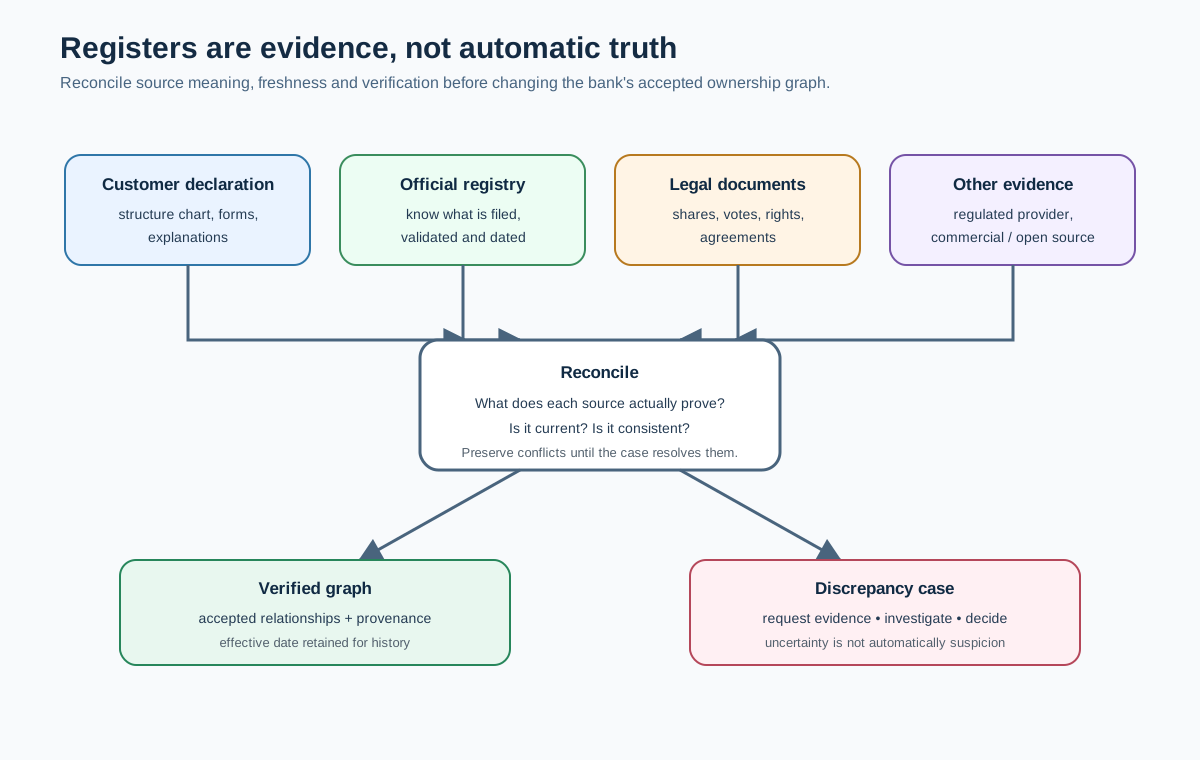
Source reconciliation is a case-management process
When the customer declaration, registry, constitutional documents and commercial data all agree, the process is simple. The interesting cases are disagreements.
Imagine that the customer declares Person A as a 60 percent owner, the company register still shows Person B, and a signed share-transfer agreement dated two days ago shows the transfer from B to A. The right response is not "the registry wins because it is official" or "the latest document wins because it is newer". The bank determines the legal effectiveness of the transfer, whether registration is constitutive or merely declaratory in that jurisdiction, whether the transfer document is authentic, and whether further evidence is needed. Until resolved, the graph can retain competing assertions with status rather than overwriting one source.
This is where good KYC platforms differ from flat customer-master tables. The platform should allow an analyst to record source claims, discrepancies, requests for evidence, decisions and rationale. The verified relationship becomes effective only when the decision is made to accept it under the defined process.
Control through other means needs evidence, not intuition
Control analysis is often the least automated part of beneficial ownership because constitutional rights and practical influence do not reduce neatly to percentages. Banks can still make the analysis structured.
A control assessment can group evidence into categories such as appointment and removal rights, voting arrangements, reserved matters, management authority, powers of attorney, contractual rights and observed decision-making. The framework then defines which facts are relevant and what legal or specialist review is required.
Avoid shortcut rules. A right to veto the sale of all assets may be a protective minority right in one context or part of a wider control package in another. A director with a small shareholding may be the operational leader without meeting the legal beneficial-owner test. A founder with extensive reserved powers may meet a control test even after transferring most shares. Facts must be evaluated under the applicable definition.
Observed behaviour can corroborate formal documentation, but it should be used carefully. If all strategic banking instructions come from a person not shown in the corporate documents, that discrepancy deserves investigation. It does not automatically prove legal control. The bank should establish why that person is directing instructions, whether authority has been delegated and whether formal records are incomplete or inaccurate.
Nominee arrangements: trace principal and authority without presuming wrongdoing
A nominee arrangement should trigger understanding, not accusation. The bank needs to know whether the nominee acts for another person, what authority the nominee has, and whether the underlying principal or controller must be identified under the applicable framework.
Documents can include nominee agreements, declarations of trust, agency agreements, custody records, powers of attorney and service-provider confirmations. The bank can also compare instruction patterns with the declared arrangement. A professional nominee serving many unrelated companies may be consistent with a corporate-service business. The concern is not the number of appointments by itself; concern arises when the role is concealed, evidence is contradictory, the principal cannot be established where required or the arrangement is inconsistent with the customer's stated purpose.
Where access to principal information is lawfully restricted, the bank should follow its legal and policy process. It should not improvise a claim that commercial confidentiality is always invalid, nor assume confidentiality automatically defeats customer-due-diligence obligations. The issue should be resolved through the framework governing the relationship, with legal input where necessary.
Senior managing official fallback: label what happened
Some beneficial-ownership frameworks provide a fallback route when, after prescribed reasonable measures, no natural person is identified through ownership or control. The exact mechanics differ. Where a senior managing official or comparable person is recorded as a fallback, systems should capture a distinct reason code such as fallback_senior_manager rather than presenting the person as if verified ultimate ownership had been established.
This distinction matters operationally. Screening may still need the person's identity, but risk analysis should understand that the structure did not produce a natural-person owner under the primary tests. Investigators should not later infer that the bank had evidence the senior manager economically owned the company.
A fallback route also should not become an easy way to stop investigating. The case record should show the reasonable measures taken, why they did not identify a natural person and why the fallback was permitted under the applicable rule.
Effective dating and ownership changes
An ownership graph without dates is unreliable for investigations. Every relationship should have an effective period where known. A share transfer, merger, appointment right or trust-role change can alter the relevant beneficial owners even if the customer legal entity remains unchanged.
Change detection can come from customer notifications, registry feeds, periodic review, corporate actions, relationship-manager knowledge, adverse information or investigation findings. Each trigger should create a controlled review rather than silently overwriting master data.
For example, if a sanctions alert arises on 15 September and the connected person sold the relevant interest on 1 August, the bank needs to know whether the sale was legally effective, whether any control continued and which sanctions rule applies. The current graph alone cannot answer that question. Historical edges and source evidence can.
Data quality and graph completeness
Graph completeness is not "every node has a name". A structure can be fully populated with legal entities while still not answering the relevant natural-person ownership or control question. Useful completeness metrics distinguish:
- known legal-owner chain;
- natural-person identification completed under applicable ownership test;
- control-through-other-means assessment completed;
- required fallback applied and labelled where permitted;
- unresolved branches or contradictions;
- evidence freshness.
These metrics help operations manage work without pretending unresolved cases are complete. They also help technology teams understand why one global completion percentage can be misleading.
Architecture pattern: facts, assertions and conclusions
A mature implementation can represent three object types:
Facts are accepted relationships supported by evidence: A owns 40 percent of B from a stated date.
Assertions are source claims not yet accepted: Customer says P controls B; registry says Q remains shareholder.
Conclusions are rule-specific outcomes: P is a beneficial owner under Framework X; Q is a PSC under UK company law; R is treated as owned or controlled under Sanctions Regime Y.
This separation makes explainability much stronger. It also allows new rules to be run against existing facts without rewriting the corporate graph.
Testing ownership engines
Testing should cover more than arithmetic happy paths. A robust pack includes:
- multiple direct and indirect ownership paths to the same natural person;
- exactly-at-threshold and near-threshold cases using the wording of the relevant rule;
- voting rights different from economic rights;
- appointment rights with minority ownership;
- circular ownership;
- ownership through a trust or foundation;
- nominees with transparent principals and nominees with unresolved principals;
- listed-company or regulated-entity relief where local rules permit it;
- senior-manager fallback where the framework permits it;
- changes in ownership effective dates;
- a rule change requiring historical and current results to differ;
- one graph evaluated separately for AML and sanctions.
Expected results need expert sign-off. A system matching its old production output is not evidence of correctness if the old logic was wrong.
Practitioner checkpoint
A reviewer should be able to answer these questions from the file without relying on memory: What is the full ownership and control structure? Which framework was applied? Which version and effective date? Which natural persons met which test? What evidence supports each critical relationship? Were control rights assessed separately from share percentages? Was a fallback used? Were any discrepancies unresolved? When should the graph be reviewed again?
If those answers are visible and traceable, the ownership conclusion is capable of supporting screening, customer-risk assessment, monitoring, investigations and audit. If they are hidden inside an unexplained UBO field, the bank has a data point but not a defensible control.
Advanced practice: worked ownership cases
The cases below are entirely fictional with illustrative holdings. Each demonstrates ownership analysis distinguishing genuine complexity from concealment engineering: the structure, evidence assembled, alternatives tested, outcome with reasoning, and control lesson. Real cases turn on actual registries and framework requirements.
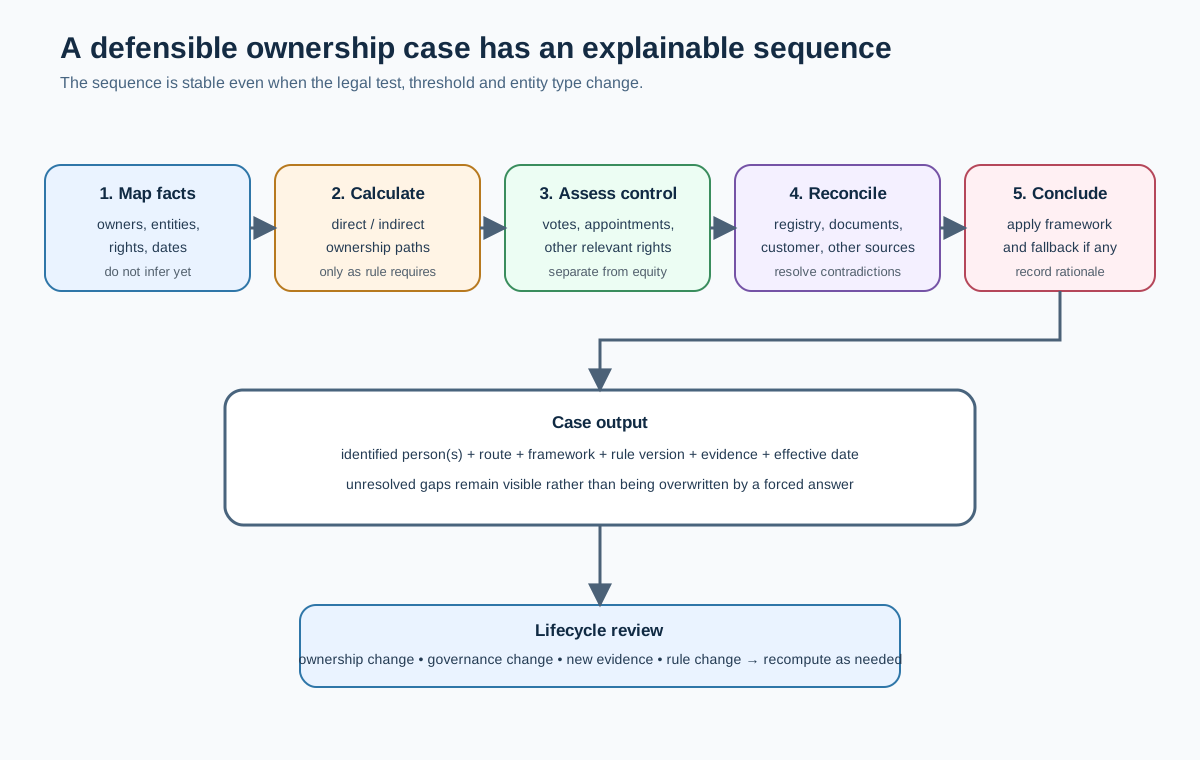
The pattern above structures every case: complete structure mapping with governance rights, multi-source verification with reliability calibration, alternative-hypothesis testing, and attribution conclusion with monitoring conditions. Refer back to it as each case proceeds.
Case 1: the consultancy with forty owners and one controller
A management-consultancy company presents forty shareholders each holding between 1 and 5 percent, with directors drawn from junior staff and a managing director holding 3 percent equity while directing all operations, client relationships and financial decisions. Registry filings show clean dispersed ownership with no individual approaching identification thresholds, yet transaction authorisation, client-contract negotiation and banking instructions all flow exclusively through the managing director whose lifestyle substantially exceeds 3-percent economic interest. The company processes an illustrative 8 million annually in advisory fees from government-adjacent clients with contract-award timing correlating to the managing director's political connections rather than competitive procurement outcomes.
Control-analysis methodology looks past arithmetic dispersion to direction evidence: instruction-pattern review establishing exclusive operational control, compensation analysis revealing profit extraction through salary and bonuses disproportionate to equity while minority shareholders receive nominal dividends, and client-relationship attribution showing contract origination entirely dependent on the managing director's personal networks without institutional business-development capability. Associate-coordination assessment examines shareholder relationships revealing family members, former colleagues and service-provider nominees holding fragmented stakes that aggregate to controller-aligned majority when combined through concert analysis that individual-position review misses structurally. In this fictional case evidence supports de-facto sole control with fragmented ownership engineered specifically below identification thresholds, triggering enhanced requirements with true-controller identification, politically-exposed assessment for the managing director, and monitoring focused on government-contract revenue dependence.
The lesson is that dispersed ownership with concentrated direction indicates control engineering rather than democratic capitalism where small companies lack institutional reasons for forty-shareholder fragmentation: arithmetic thresholds initiate inquiry without limiting it, and control analysis must follow direction evidence to human sources regardless of equity distribution designed to defeat percentage-based procedures. Monitoring rules derived from the case capture fragmentation-with-concentration signatures combining shareholder-count anomalies with instruction-centralisation patterns for the wider SME portfolio where similar engineering hides beneficial ownership behind compliant-looking dispersed registers.
Case 2: the trust with a protector who decides everything
A discretionary family trust holds an illustrative 25 million in investment portfolios with a licensed trust company as trustee, three adult beneficiaries from the settlor family, and an independent protector empowered to appoint and remove trustees, consent to distributions and direct investment strategy. The protector, a long-standing business associate of the settlor with no family relationship, exercises distribution vetoes regularly while approving investment reallocations proposed by an adviser sharing office infrastructure with the protector's own businesses. Trustee minutes record unanimous resolutions following protector recommendations without independent deliberation documented anywhere across five years of administration.
Protector-power analysis examines constitutional provisions with control-indicator assessment distinguishing administrative oversight from substantive direction: appointment-removal powers combined with distribution consent and investment direction constitute comprehensive control regardless of trustee legal ownership that protector decisions override functionally in every material respect. Behavioural confirmation through resolution-pattern review establishes de-facto direction beyond constitutional potential, with trustee independence assessment revealing nominal fiduciary presence without substantive governance contribution that genuine trust administration requires through documented deliberation and occasional disagreement evidencing independent judgement. Associate-network mapping connects protector business interests to trust investment destinations with circular-flow indicators suggesting self-dealing behind fiduciary facades.
In this fictional case assessment attributes control to the protector with full EDD-equivalent verification including source-of-wealth analysis and associate-network mapping, plus trustee-governance remediation requirements with independent deliberation standards and protector-power constraint amendments. The outcome demonstrates control-limb application to trust structures where protector dominance supersedes trustee legal ownership functionally: constitutional labels never determine control conclusions that behavioural evidence must support independently. The lesson generalises to all fiduciary structures where legal ownership and effective direction diverge systematically: trustee, nominee and corporate-director titles describe legal positions while control analysis examines who decides through instruction patterns, veto exercise and economic-benefit flows that titles obscure behind professional respectability examinations must penetrate routinely rather than exceptionally.
Case 3: the joint venture with deadlock as control
A manufacturing joint venture splits equity equally between a multinational subsidiary and a local partner with board composition mirroring shareholding plus an independent chair holding casting votes on deadlocked matters. Reserved matters requiring unanimous consent encompass budgets, asset disposals, financing and senior appointments, effectively granting each partner veto power over strategic decisions regardless of equal equity suggesting shared control without dominance. Operational management contracts assign day-to-day direction to the local partner with performance benchmarks and reporting obligations to the venture board that meets quarterly with perfunctory oversight documented in brief minutes.
Negative-control analysis recognises mutual veto arrangements as concurrent control where both partners exercise control-relevant influence simultaneously rather than attributing direction solely to the operationally active partner that activity analysis favours misleadingly. Unanimous-consent scope evaluation determines control breadth: budget vetoes confer financial direction, disposal vetoes confer asset control, and appointment vetoes confer personnel influence that combined constitute comprehensive negative control exceeding the affirmative-direction powers either partner holds individually. Deadlock-resolution mechanics with casting-vote provisions allocate ultimate decision authority that control analysis must weigh alongside veto rights, since independent-chair casting votes theoretically break deadlocks while practical chair selection and voting patterns may entrench one partner's dominance behind procedural neutrality.
In this fictional case assessment attributes joint control to both partners with full verification for each, plus monitoring triggers for governance-change events altering the control balance through chair replacement, reserved-matter amendment or operational-contract renegotiation. The lesson is that equal-equity joint ventures concentrate control-analysis complexity in governance mechanics that percentage-focused procedures dismiss as balanced without examining veto scope, deadlock resolution and operational delegation that determine actual influence distribution. Financing banks must assess venture control comprehensively rather than lending against the familiar multinational partner's share in isolation while local-partner influence over operations, procurement and government relations determines venture behaviour more decisively than equity arithmetic suggests to credit committees unfamiliar with negative-control concepts.
Case 4: the fund with invisible investors
An investment fund customer with 200 limited partners operates master-feeder structures across three jurisdictions with nominee investors, fund-of-funds positions and parallel vehicles sharing portfolio exposure. Look-through analysis for the bank's financing facility reveals 30 percent of commitments from investors whose identities sit behind nominee administrators declining disclosure beyond regulatory-status assurances, feeder-fund layers adding two intermediaries between underlying investors and the bank-visible position, and side-letter arrangements granting three investors advisory-committee positions with consent rights over investments exceeding defined thresholds. The fund manager asserts institutional-quality governance with audited financials and independent administration supporting transparency claims that structural opacity contradicts functionally.
Layered look-through methodology penetrates each intermediation level with materiality-proportionate verification: nominee-administrator disclosure demands with escalation consequences where confidentiality claims block sanctions and crime-risk assessment that no commercial interest overrides legally; feeder-fund manager transparency requirements with underlying-investor identification for material positions; and side-letter governance analysis identifying consent-right holders exercising control-relevant influence regardless of economic-interest percentages that formal ownership understates systematically. In this fictional case enhanced requirements produce partial transparency with two nominee administrators disclosing underlying investors revealing clean profiles, while one administrator's continued refusal triggers exposure caps with conditional facility continuation pending disclosure deadlines.
The outcome demonstrates graduated response calibrating pressure to opacity persistence: cooperative transparency earns continued business with verification conditions, while refusal faces quantified exposure limits with exit preparation where deadlines pass unmet. The lesson is that fund-intermediation depth never attenuates control analysis: designated-connected investors two layers removed exercise identical economic influence as direct holders, and control assessment follows economics rather than counting layers that structuring adds specifically to defeat superficial look-through stopping at first intermediary level. Financing documentation should establish transparency requirements at origination with contractual enforcement mechanics rather than discovering opacity mid-facility where leverage has diminished alongside borrower distress that transparency disputes compound unhelpfully.
Case 5: the state-connected minority with golden-share powers
A telecommunications operator with mixed ownership includes a 15 percent state shareholding carrying golden-share veto rights over asset disposals, merger activity and foreign-ownership changes, plus board-appointment rights for two directors including the audit-committee chair, and regulatory-licence conditions requiring government approval for strategic decisions beyond standard sector oversight. The remaining ownership disperses across institutional investors and public float with no other holder above 8 percent. Transaction monitoring flags procurement contracts awarded to entities connected to government officials with pricing premiums suggesting influence monetisation behind commercial processes.
State-influence assessment distinguishes commercial state investment from strategic control through governance-power analysis: golden-share veto scope evaluation determining whether blocking rights cover routine commercial matters indicating operational control or genuinely strategic national-interest questions justifying narrow veto retention; board-representation influence measuring audit-chair positioning enabling financial-oversight direction beyond nominal governance participation; and licence-condition analysis testing whether regulatory approvals function as commercial gatekeeping conferring de-facto direction over business decisions nominally left to management. Procurement-pattern analysis correlates contract awards with official connections independently of ownership assessment, since influence monetisation operates through commercial channels that equity analysis misses entirely while constituting the primary corruption vector in state-connected enterprises.
In this fictional case assessment supports control-influence findings warranting enhanced monitoring with procurement-transparency requirements, related-party transaction disclosure with independent fairness opinions for material contracts, and senior-approved conditional relationship continuation distinguishing commercial state participation from strategic control requiring restrictive treatment. The lesson is that minority state ownership with special rights demands governance-power analysis exceeding arithmetic assessment by orders of magnitude: golden shares, board positioning and licence leverage concentrate influence disproportionately to equity that percentage-focused procedures clear routinely while control reality operates through channels equity analysis never examines. Financing and relationship decisions must reflect governance-power conclusions with covenant structures addressing state-influence risks explicitly rather than standard commercial terms assuming private-sector governance dynamics that state participation fundamentally alters.
Case 6: the club-deal consortium with hidden anchor
An acquisition financing opportunity involves a bidding consortium for logistics infrastructure with six members contributing equity unevenly: two infrastructure funds with 25 percent each, a pension fund with 20 percent, a family office with 15 percent, a sovereign vehicle with 10 percent, and a management vehicle with 5 percent plus operational control through service agreements. The financing bank must assess consortium-level sanctions and crime-risk exposure before committing an illustrative 400 million in arranged facilities, with member transparency varying from fully disclosed institutional investors to the management vehicle whose ultimate beneficiaries sit behind two intermediary holding companies in different jurisdictions.
Member-level assessment applies differentiated verification depth matching transparency and risk: institutional funds with regulated-manager oversight and audited reporting receive streamlined verification with constitutional-document review confirming governance mechanics; the family office undergoes wealth-origin analysis with source corroboration proportionate to commitment size; the sovereign vehicle faces state-influence assessment distinguishing commercial investment from strategic control with governance-independence evidence; and the management vehicle with layered intermediaries receives full look-through with principal identification mandatory regardless of minority economic interest given operational-control concentration that equity percentages understate decisively. Intermediary-functionality analysis tests whether holding layers serve tax, liability or regulatory purposes with documented rationale versus opacity provision lacking commercial justification beyond concealment that verification must expose through purpose-evidence demands.
In this fictional case intermediary analysis reveals one holding layer domiciled in a secrecy jurisdiction without operational substance, staff or commercial rationale beyond ownership distancing, with formation timing coinciding with adverse-media emergence around the ultimate principal that standard verification would have surfaced through timely screening the bank performs on identified persons only after look-through compels disclosure. The outcome conditions facility progression on intermediary simplification with direct-holding restructuring and full principal verification, demonstrating that financing leverage enforces transparency standards effectively where relationship persuasion alone fails against determined opacity. The lesson is that consortium financing provides structural leverage for ownership transparency that relationship banking lacks in retrospect: pre-commitment verification requirements with disbursement conditions achieve disclosure that post-closing inquiry requests as favour without leverage, and financing documentation should embed transparency covenants with information rights surviving closing into monitoring periods where ownership evolution continues beyond initial verification snapshots.
Case 7: the dividend-stripping owner with layered exits
A corporate borrower with layered ownership across four jurisdictions proposes dividend recapitalisation distributing an illustrative 30 million to shareholders following profitable trading periods, with financing bank approval required under facility covenants for distributions above defined thresholds. Ownership mapping shows ultimate beneficiaries including two family trusts with protector structures, a charitable foundation receiving 10 percent of distributions, and a management participation vehicle with leaver provisions affecting ownership on employment termination. Dividend-timing analysis reveals distribution proposals accelerating ahead of anticipated regulatory changes affecting withholding treatment, while beneficiary-level assessment identifies one trust protector with adverse-media connections to politically exposed networks requiring enhanced review before distribution approval enables value transfer potentially constituting reportable activity.
Distribution-substance analysis distinguishes legitimate profit extraction from value-stripping preceding distress or enforcement: financial-sustainability testing ensuring post-dividend capital adequacy with covenant-headroom verification, historical-distribution benchmarking comparing proposed payouts against established patterns with deviation justification, and use-of-proceeds analysis tracing distributed value to beneficiary deployment rather than circular return suggesting artificial profit inflation. Protector-influence evaluation examines distribution-approval mechanics where protector consent governs trustee distributions, testing whether adverse-connected protectors direct value flows that dividend mechanics legitimise procedurally while substantively channelling funds to influence networks. Foundation-beneficiary analysis verifies charitable deployment with programme-expenditure review distinguishing genuine philanthropy from reputation-laundering where scandal-adjacent wealth funds visible charity offsetting enforcement narratives.
In this fictional case protector-adverse findings combined with accelerated timing ahead of regulatory change produce conditional approval with enhanced distribution monitoring, independent fairness assessment for valuation-dependent elements, and reporting evaluation where influence-network indicators meet suspicion thresholds. The outcome demonstrates distribution-oversight value beyond credit protection: dividend covenants serve financial-crime control where distribution mechanics move value to opaque beneficiaries that ownership analysis identifies but transaction monitoring misses within approved-facility activity operating beneath suspicion thresholds calibrated for third-party payments rather than shareholder distributions that insider positioning renders lower-scrutiny by default. The lesson generalises to all value-extraction events where insiders move bank-financed value to connected parties: distribution covenants need financial-crime assessment triggers alongside credit metrics, since value leaves through approved channels most efficiently where controls examine creditworthiness without questioning destination legitimacy that ownership-aware review provides uniquely.
Case 8: token-governance control in crypto entities
A venture-capital customer holds significant governance-token positions representing 18 percent of circulating supply with delegation arrangements concentrating a further 12 percent voting power under customer direction across decentralised-finance protocols managing treasuries valued at an illustrative 200 million in digital assets. Traditional equity-ownership analysis maps poorly onto token-governance structures where voting power, economic interest and operational control distribute across mechanisms that corporate-share frameworks never contemplated: token-weighted voting with delegation protocols, multi-signature treasury operations requiring customer cryptographic participation, and proposal thresholds enabling agenda control below majority positions through voter-apathy exploitation that active minorities leverage systematically.
Assessment adapts ownership-control methodology to tokenised governance with mechanism-specific analysis: aggregated voting-power computation combining direct holdings with delegation arrangements producing 30 percent directional control evaluated against control-indicator frameworks for governance influence rather than equity thresholds designed for corporate shares; treasury-operation assessment examining multi-signature participation as operational control over asset movements independent of voting percentages, since transaction execution requires cryptographic participation that veto power parallels functionally; and proposal-power analysis testing agenda-setting influence where proposal thresholds permit customer-initiated governance actions shaping protocol direction disproportionately to economic stake. Co-investor attribution follows ownership chains into token holdings with equivalent aggregation logic applied to equity structures, while development-team funding analysis addresses influence over protocol direction through financial dependency paralleling corporate financing-control patterns.
In this fictional case combined assessment supports control-influence findings warranting enhanced requirements with governance-participation conditions, delegation-transparency obligations and treasury-transaction review triggers, rather than binary blocked-or-clear treatment that token-governance complexity cannot support meaningfully. The lesson is that ownership methodology must evolve with asset tokenisation: governance tokens, delegation protocols and multi-signature operations allocate real control through mechanisms corporate-share analysis never examines, and banks with digital-asset exposure need token-governance assessment capability developed deliberately through methodology adaptation rather than improvised when first cases arrive demanding immediate conclusions without analytical foundations that advance preparation would have established routinely.
Case 9: the sports-club acquisition with layered funders
A private client acquires controlling interest in a professional sports club through layered acquisition vehicles funded by declared personal wealth supplemented with third-party loans from entities in jurisdictions with opacity characteristics. The acquisition price of an illustrative 180 million reflects competitive bidding with supporter and media scrutiny adding reputational dimensions alongside financial-crime assessment obligations. League ownership tests require fit-and-proper disclosure partially completed with funding-source declarations that league review accepts provisionally pending enhanced scrutiny the bank must conduct independently regardless of sporting-authority conclusions that commercial and reputational considerations influence differently from financial-crime standards.
Funder-structure analysis penetrates layered acquisition financing with lender-identity verification, funding-source tracing for third-party loans, and control-right assessment examining veto provisions, conversion rights and governance influence attached to financing that equity percentages understate decisively. Declared-wealth verification tests personal-funding capacity through source-of-wealth analysis independent of acquisition narratives that funding-gap realities contradict where declared means cannot support equity contributions without undisclosed co-funders participating behind layered structures. Media and supporter scrutiny provides open-source intelligence supplementing formal verification with investigative reporting on bidder backgrounds that confidential banking channels lack, treated as leads requiring corroboration rather than conclusions supporting adverse action independently.
In this fictional case lender analysis reveals third-party loans originating from entities connected to undisclosed business partners with veto rights over club asset disposals embedded in financing covenants, constituting negative control unreflected in equity arithmetic that facility progression must address through covenant removal and lender substitution. The outcome demonstrates financing-leverage enforcement of transparency standards effectively where relationship persuasion alone fails against determined opacity maintained through sporting-prestige narratives discouraging sceptical inquiry. The lesson is that high-profile acquisitions concentrate reputation and sanctions risk in structures designed partly for prestige optics rather than transparency: sporting-asset ownership demands substance testing equivalent to any complex acquisition with media scrutiny treated as intelligence complementing rather than substituting for verification discipline that financing documentation must enforce through transparency covenants with information rights surviving closing into monitoring periods.
Case 10: the cooperative with captured governance
A worker cooperative with 300 nominal members seeks expanded credit facilities supporting agribusiness operations with democratic governance structures documented through bylaws, elected boards and member-assembly minutes spanning a decade. Lending analysis reveals board composition unchanged for eight years with elections returning identical slates unopposed, member-assembly attendance below 5 percent with proxy harvesting concentrated in management hands, and financial decisions including related-party contracting with manager-owned suppliers approved unanimously without recorded debate. Beneficial-ownership analysis for the borrowing entity must identify who actually controls cooperative resources behind democratic formalities that substantive governance abandoned years before current facility requests.
Capture-evidence methodology examines democratic-substance indicators distinguishing genuine collective governance from managed facades: electoral competitiveness with candidate diversity and campaign activity, assembly deliberation quality with dissent records and amendment history, and related-party transaction scrutiny with independent fairness assessment that captured boards waive routinely. Management-compensation analysis reveals extraction levels inconsistent with cooperative principles through salary benchmarking against comparable agribusiness roles, related-party contract margins inflating costs systematically, and lifestyle indicators for key managers exceeding legitimate compensation by multiples suggesting value diversion behind governance formalities. Member-awareness assessment through sampled interviews distinguishes informed consent from manufactured apathy where information suppression prevents meaningful participation that democratic structures require substantively beyond procedural compliance.
In this fictional case evidence supports governance capture with value extraction warranting enhanced requirements including independent board representation, related-party transaction prohibitions and forensic audit with member-communication transparency, escalating to facility refusal with reporting where capture indicators meet suspicion thresholds for abuse-of-position offences. The lesson is that democratic legal forms require substantive-governance verification equivalent to corporate control analysis: bylaws and elections prove procedural compliance while saying nothing about actual direction that participation metrics, deliberation quality and related-party patterns reveal reliably. Cooperative and mutual structures deserve the same control scepticism as any concentrated-influence arrangement where formal diffusion masks operational centralisation that ownership analysis must penetrate regardless of legal-form prestige that democratic labels confer misleadingly where capture hollows substance entirely.
Practice close: the ownership analyst's playbook
Beneficial-ownership analysis is easiest to operate when the reviewer follows a consistent sequence but remains conscious that the legal test changes by jurisdiction, entity type and purpose. The playbook below is therefore a working method, not a substitute for applicable law or bank policy.
1. Classify the customer and the framework
Start with legal form and booking context. Is the customer a company, partnership, fund vehicle, foundation or another form? Which bank legal entity is onboarding or servicing it? Which customer-due-diligence framework applies? Are there specific rules, exemptions or modified approaches for the entity type? Record the legal or policy source and effective date before applying a threshold.
This step prevents a common error: starting with a familiar percentage and then trying to fit the customer into it. The correct order is framework first, calculation second.
2. Build the factual structure
Map direct owners, intermediate entities, natural persons and legal arrangements. Add voting rights and other governance rights where they differ from economic ownership. Record relationship dates and evidence sources. If information conflicts, retain the competing assertions until resolved instead of silently choosing one.
Do not treat a customer-supplied chart as verified merely because it looks professional. Equally, do not reject it merely because it is customer supplied. It is one evidence source to be reconciled with registries, constitutional documents, regulated-professional evidence and other reliable information appropriate to the case.
3. Calculate ownership where the rule requires it
For indirect holdings, show the path and the arithmetic. Aggregate only where the applicable framework requires aggregation. Preserve enough precision to avoid rounding across a legal boundary. If ownership is circular or the methodology is unclear, route the case to the appropriate specialist rather than forcing a result from a formula designed for a simple tree.
4. Assess control separately
Ask whether any natural person meets an applicable control-through-other-means test. Review appointment rights, voting arrangements, reserved matters, powers of attorney and other relevant rights. Use observed behaviour as corroborating evidence where appropriate, but do not turn operational prominence into legal control without the framework supporting that conclusion.
A founder, chief executive, lender, family member or adviser may be influential without being the beneficial owner under a particular rule. Conversely, a person with limited economic ownership may meet a control test. Document the facts and the rule rather than relying on labels.
5. Verify and reconcile evidence
Assess what each source actually proves. An official register can be authoritative for a filed legal fact while still not answering the bank's AML beneficial-ownership question. A commercial database can speed discovery but may be stale or derived from the same public filing the bank already checked. A constitutional document may be decisive for voting rights but say nothing about whether those rights are exercised in practice.
Where sources disagree, create an issue with an owner and resolution path. Explain the difference, request additional evidence where needed, and document the final conclusion. A discrepancy can be benign, material or suspicious depending on context; it is not automatically any one of those things.
6. Use fallback mechanisms only where the framework allows them
If the applicable rules provide a fallback after reasonable measures fail to identify a natural person through ownership or control, follow the prescribed route and label the result accurately. If a senior managing official is recorded, store the fallback reason. Do not present that person as if the bank proved ultimate ownership.
This distinction is important for screening, investigations and audit because downstream users otherwise infer more certainty than the KYC file contains.
7. Keep AML and sanctions outcomes separate
Reuse the ownership graph, not the legal conclusion. AML beneficial ownership, corporate-register status, sanctions ownership/control, accounting control and tax ownership can produce different answers from the same facts. Systems and procedures should show which framework generated each conclusion.
If a sanctions question arises, apply the relevant sanctions regime. Do not transfer an AML threshold into a sanctions decision automatically.
8. Decide the customer outcome proportionately
Once ownership analysis is complete, feed the result into the relevant customer-risk and approval process. If material information cannot be established, follow the legal and policy procedure for incomplete CDD. Possible outcomes can include additional evidence requests, specialist review, risk-based restrictions, delayed onboarding where permitted, refusal or exit, depending on the framework and circumstances.
Unresolved ownership information is not by itself a universal SAR or STR trigger. Reporting decisions must apply the suspicion test and confidentiality rules of the relevant jurisdiction.
9. Define review triggers
Ownership is not static. Set event-driven triggers appropriate to the relationship: changes in shareholders or PSC information, mergers, acquisitions, trust-role changes, new voting agreements, changes in directors, credible adverse information, sanctions developments, or customer notifications. Periodic review remains useful, but it should not be the only mechanism for discovering a material ownership change.
Analyst failure modes worth testing
Threshold-only thinking. The reviewer finds no person above a percentage and stops. The remedy is a separate control assessment and the applicable fallback logic.
Register-as-truth thinking. The reviewer copies an official filing into KYC without asking what the register verifies. The remedy is source profiling and multi-source reconciliation.
Universal-25-percent thinking. A threshold from one jurisdiction or register becomes global policy by habit. The remedy is a versioned rules catalogue with jurisdiction and purpose.
Nominee-equals-suspicion thinking. A lawful professional arrangement is treated as criminal merely because a nominee exists. The remedy is principal and authority analysis with evidence-led escalation.
Listed-parent shortcut. A subsidiary is treated as exempt because the parent is listed. The remedy is to identify the exact exemption or modified-treatment rule and its scope.
Current-graph-only thinking. An investigator uses today's owners to analyse last year's transaction. The remedy is effective-dated relationships and historical reconstruction.
AML-to-sanctions leakage. The AML UBO result is reused directly as a sanctions attribution decision. The remedy is shared facts with separate rule-specific conclusions.
BA acceptance criteria
A beneficial-ownership service is not ready merely because it can store names and percentages. Useful acceptance criteria include:
- each ownership or control relationship has a source and effective date;
- direct and indirect ownership paths are explainable;
- the applied framework and rule version are stored with the conclusion;
- percentage calculations do not rely on display rounding;
- control-through-other-means can be recorded without inventing an ownership percentage;
- fallback records are distinguishable from identified owners;
- conflicting source assertions can coexist until resolved;
- historical structures can be reconstructed;
- AML and sanctions conclusions are separate even when they use the same graph;
- every person passed downstream for screening can be traced to the relationship and conclusion that placed them in scope.
Testing scenarios
Test with a simple owner, two-layer holdings, multiple paths to the same person, circular holdings, different voting and economic rights, a transparent nominee, an unresolved nominee, a trust in the chain, a listed parent, a rule-version change and an ownership change effective between two transactions. For every scenario, expected results should identify not only the person but the reasoning and legal basis.
Also test negative outcomes. A person just below a threshold should not be pushed above it by rounding. A board member should not be labelled a beneficial owner solely because they are a board member. A senior managing official fallback should not appear as verified economic ownership. A Companies House PSC result should not automatically become the bank's AML or sanctions conclusion without applying the appropriate framework.
Governance and escalation
Difficult cases need a defined escalation path. The analyst should know when to involve KYC policy, financial-crime compliance, legal, sanctions specialists, tax or product experts. The trigger can be methodological uncertainty, unresolved ownership, conflicting legal opinions, unusual control rights or a material customer-impact decision.
Escalation should preserve both the facts and the disagreement. If the relationship team believes a right is merely protective and compliance believes it amounts to control, the file should record the competing interpretation, legal source, decision authority and rationale. That record is more useful than a final field with no explanation.
Practitioner close
A good ownership file allows a new reviewer to answer, without calling the original analyst: who legally owns the customer, who may control it through other means, which natural persons were identified under which framework, what evidence supports the conclusion, whether a fallback was used, what remains unresolved, and when the result should be revisited.
That is the standard to aim for. Beneficial ownership is not a data-entry exercise. It is an evidence-based, legally scoped explanation of the human ownership and control behind a customer.
Masterclass: governing beneficial-ownership analysis bank-wide
Beneficial-ownership quality is an organisational capability, not just an analyst skill. A bank can employ excellent reviewers and still produce inconsistent conclusions if legal definitions are spread across local procedures, thresholds are hard-coded differently in several systems, source reliability is not documented, and downstream teams cannot tell whether a person was identified for AML, sanctions, corporate-register or another purpose.
The governance objective is therefore to make ownership conclusions reproducible. The bank should know which framework was applied, which facts were used, how those facts were verified, which rule version produced the conclusion, who approved exceptions and how changes are propagated through the customer lifecycle.
Methodology ownership
A named methodology owner should maintain the bank's beneficial-ownership framework across affected customer segments and booking entities. That owner does not replace local legal accountability. Instead, the role coordinates the common method: graph construction, evidence standards, source handling, control-through-other-means analysis, fallback labelling, change triggers and data requirements.
A rules inventory should show where local requirements diverge. For each supported jurisdiction or regulated entity, it should identify the legal source, entity types in scope, ownership test, control test, any fallback mechanism, modified treatment or exemptions, effective date and review owner. Where the bank adopts a stricter internal policy than local law, the inventory should say so explicitly rather than calling that policy a legal requirement.
This is particularly important when policies mention 25 percent. The number appears in several regimes, but it is not a globally universal AML rule and it is not a universal sanctions rule. A bank-wide methodology can standardise how thresholds are represented without pretending the thresholds themselves are identical everywhere.
Legal interface
Ownership questions often cross from operations into legal interpretation. The governance model should define which questions analysts can resolve through documented methodology and which require legal input. Examples include unusual voting arrangements, disputed control rights, trust or foundation structures outside standard playbooks, unclear exemption scope and changes in law that affect existing customers.
Legal referrals are more effective when they contain a complete graph and a precise question. "Who is the UBO?" is often too broad. A stronger referral says: "Person A owns 18 percent, can appoint three of five directors under clause 12, and has a veto over sale of core assets. Does this meet the control-through-other-means test under the rule applicable to Booking Entity X on this date?"
The advice should be linked to the case and, where it establishes a reusable interpretation, translated into methodology or rules with an effective date. This avoids the same question being answered differently by different teams months later.
Source governance
The bank should maintain profiles for important corporate and beneficial-ownership data sources. A source profile can record whether information is official or commercial, what legal concept it represents, whether identity or filing validation occurs, normal update latency, historical availability, permitted uses and known limitations.
Source governance prevents two opposite errors. One is over-reliance: treating an official register as incontrovertible AML truth. The other is under-use: forcing every customer to reproduce information already available from a reliable source when the legal framework permits appropriate reliance or corroboration.
Vendor data needs similar controls. The bank should know whether a commercial provider originates information or republishes public filings, how entities are matched, how frequently records update and how conflicts are represented. A vendor's "ultimate owner" field should not become a legal conclusion without understanding its methodology.
Technology governance
A scalable ownership platform should separate facts from rule-specific outcomes. The fact graph stores people, entities, arrangements and relationships. Rule engines evaluate those facts under particular frameworks. Case management handles unresolved evidence, exceptions and decisions. Screening and monitoring receive the people and relationships that their own controls require.
Change management is critical. When a legal threshold, fallback rule or exemption changes, the bank should be able to identify which customers were evaluated under the old version and determine whether recomputation or review is required. Configuration changes should pass test packs before production deployment, with results reviewed by methodology and legal owners where material.
Explainability is a control requirement. For a conclusion, the platform should be able to show the ownership path, calculation, control facts, source evidence, framework, rule version and decision date. A black-box graph algorithm that cannot explain why it identified a person creates audit and operational risk even if its overall detection performance appears strong.
Data governance and historical reconstruction
Ownership data should have clear stewardship. Identity data belongs to a person or entity master, relationship data belongs to the ownership graph, source documents belong to evidence management, and legal conclusions belong to the rule/case layer. Copying the same percentage into several applications creates drift when ownership changes.
Historical reconstruction should be tested explicitly. An investigator asking who controlled the customer on a past date needs the relationships and rules that applied then. Current ownership cannot substitute for historical ownership. Effective dating, rule versioning and evidence retention should therefore be part of the architecture baseline rather than later audit enhancements.
Quality assurance
QA should sample more than file completeness. Reviewers should test whether the correct framework was selected, ownership paths were complete, percentages were calculated correctly, control rights were assessed independently, sources were reconciled, fallbacks were labelled accurately and conclusions were passed downstream correctly.
Sampling can deliberately include complex or high-impact cases, but governance should avoid assuming that complexity itself proves higher financial-crime risk. A layered multinational group can be legitimate and well governed. A simple private company can conceal control. The aim is to test analytical quality across the range of structures the bank serves.
Useful quality indicators include the rate of unresolved ownership cases, ageing of evidence requests, percentage of cases overturned by QA, rule-version exceptions, data conflicts by source and timeliness of event-driven ownership updates. These are control-health indicators, not targets to optimise mechanically. A lower escalation rate is not automatically better if analysts are failing to escalate difficult cases.
Capability development
Analysts need more than a course on percentage calculations. Development should include legal-form recognition, graph reasoning, evidence assessment, control rights, source limitations, effective dating, jurisdiction differences and clear writing. Worked cases should include situations where the correct answer is "no person identified under the ownership test; control analysis required" or "fallback used" rather than forcing every scenario to end with a conventional UBO.
Senior specialists should review novel structures and turn repeatable lessons into methodology. This reduces dependency on individual memory and helps new analysts understand why a conclusion was reached rather than copying precedent without its legal context.
Governance across neighbouring controls
Beneficial ownership sits upstream of screening, customer risk, monitoring and investigations. Interfaces should be explicit.
Screening needs to know which connected persons to screen and under what policy. Sanctions specialists need the factual graph but apply sanctions-specific attribution rules. Transaction monitoring may use related-party edges to contextualise payments. Investigators need historical relationships and evidence. Customer-risk engines may use owner risk attributes, but should not double count the same risk simply because it appears at several nodes in a chain.
Those interfaces should be documented in data contracts. If an ownership conclusion changes, downstream systems should receive the change with effective date and reason. Where a previous screening decision relied on an old relationship, the audit trail should remain intact.
Supervisory and audit readiness
A bank should be able to demonstrate its method without relying on a few exemplary files. Methodology documents, legal-source inventories, test evidence, source profiles, QA results, exception records and change logs should collectively show how the control works.
When a supervisor or auditor challenges a specific conclusion, the answer should be evidence-led: here is the structure, here are the rights, here are the sources, here is the applicable rule, here is the calculation, here is the reason for the conclusion, and here is what changed later. That is stronger than saying the analyst followed a checklist or that a vendor system marked the person as a UBO.
Masterclass close
The mature operating model treats beneficial ownership as a governed data-and-decision capability. It does not flatten every jurisdiction into one threshold, does not confuse public registers with bank CDD duties, does not make sanctions conclusions from AML labels, and does not lose history when ownership changes.
The goal is consistency without false uniformity: common graph and evidence disciplines, combined with rule-specific legal conclusions. That design gives the bank something more valuable than a populated UBO field. It gives every downstream control an explainable and reconstructable view of who stood behind the customer, under which framework, at the relevant point in time.
Knowledge checks with explained answers
These checks are designed to test reasoning rather than memorisation. The correct outcome in a live bank always depends on the legal framework, entity type, evidence and effective date.
1. A company has many small shareholders and a managing director who owns only a small stake but appears to make every important decision. Can the analyst conclude immediately that the managing director is the beneficial owner?
No. The pattern is a reason to assess control through other means, not proof of a legal conclusion. The analyst should examine constitutional rights, appointment powers, voting arrangements, delegated authority and other relevant evidence under the applicable framework. Operational prominence can corroborate a control analysis, but a person's importance to the business does not by itself establish beneficial ownership.
2. Why is a 25 percent threshold not a safe global rule?
Because thresholds and definitions are created by specific legal frameworks. A 25-percent concept appears in several jurisdictions and transparency regimes, but the wording, calculation method, scope, treatment of control and fallback mechanisms can differ. Sanctions ownership and control tests can also differ from AML customer-due-diligence tests. A bank may choose a common internal identification policy in some contexts, but it should label that as policy rather than universal law.
3. What should a bank do when a customer declaration and an official register disagree?
Treat the disagreement as a fact to resolve. Determine what each source represents, how current it is and what verification occurs. Obtain additional evidence where needed, preserve both source assertions until the discrepancy is resolved, and document the conclusion. The official register may be highly reliable for a filed fact without necessarily answering the bank's AML beneficial-ownership question.
4. Does a nominee shareholder automatically indicate concealment or suspicious activity?
No. Nominees can be used legitimately for custody, administration, professional services and other lawful reasons. The bank should understand the nominee's role, identify the relevant principal or controller where the applicable framework requires it, and resolve inconsistencies. Concealment concerns arise from evidence such as undisclosed principals, contradictory documents or unexplained control, not from the word "nominee" alone.
5. A person holds 18 percent of shares but can appoint a majority of the board. What should the analyst do?
Apply the framework's control-through-other-means test. The person's economic ownership may be below an ownership threshold while appointment rights may create a separate control conclusion. The analyst should record both facts and the legal reasoning rather than inventing an ownership percentage that represents the governance right.
6. Why must a senior managing official fallback be stored separately from an identified owner?
Because a fallback can be used under some frameworks after required reasonable measures fail to identify a natural person through the primary ownership or control tests. Recording the senior manager may satisfy a defined fallback route, but it does not prove that the person ultimately owns the entity. Separate status prevents downstream teams from treating fallback as verified economic ownership.
7. Can a subsidiary be treated as exempt from beneficial-owner identification just because its parent is listed on a stock exchange?
Not automatically. The analyst must identify the actual exemption, relief or modified-treatment rule applicable to the customer and its scope. Some regimes provide specific treatment for listed entities or their subsidiaries; others impose conditions. The parent's listing is a relevant fact, not a universal exemption.
8. How should indirect ownership be calculated across a simple chain?
Where the applicable rule uses indirect economic ownership, multiply the percentages along the relevant path and aggregate paths only as that framework requires. For example, 80 percent of a holding company that owns 40 percent of the customer produces a 32 percent indirect economic interest through that path. The calculation does not by itself decide legal beneficial ownership; the result is evaluated under the applicable rule.
9. Why must the ownership graph be effective-dated?
Because investigations and screening often ask who owned or controlled the customer at a past time. If the system stores only today's structure, it can misattribute historical transactions. Effective dates on relationships and rule versions allow the bank to reconstruct the structure and applicable conclusion as at the relevant date.
10. Why should AML and sanctions ownership conclusions be separated?
They serve different legal purposes and may use different thresholds, aggregation methods and control tests. The bank can reuse the same verified ownership and governance facts, but it should run the appropriate AML or sanctions rule separately and preserve the framework label with each conclusion.
11. A trust appears in the ownership chain. Should the bank just multiply the trust's percentage like another company?
No. Trusts and similar legal arrangements have role-based concepts involving settlors, trustees, beneficiaries, protectors and other controllers depending on the framework. The bank should apply the legal-arrangement methodology rather than force a shareholding model onto a structure that does not work that way.
12. Does unresolved ownership information automatically require a SAR or STR?
No universal rule says that it does. Incomplete or contradictory ownership information can contribute to suspicion, but reporting obligations depend on the local legal suspicion standard and the facts of the case. The bank must separately decide whether the reporting threshold is met while also following its CDD procedure for unresolved ownership.
13. What changed in the United States during 2026 that makes old training material risky?
FinCEN granted account-opening exceptive relief on 13 February 2026 from the requirement to identify and verify a legal-entity customer's beneficial owners at every new account opening under specified conditions, while leaving foundational CDD requirements in place. Separately, FinCEN's August 2026 final rule made permanent major reductions in Corporate Transparency Act BOI reporting, including exemption of U.S. companies. These two regimes should not be confused.
14. Why should EU Regulation 2024/1624 be date-labelled in September 2026 training?
Because the regulation is in force but generally applies from 10 July 2027. Its future harmonised beneficial-ownership rules are important for implementation planning, but they should not be presented as if they are already the current operating rules for every EU customer in September 2026.
Glossary of working terms
Beneficial owner: a natural person who ultimately owns or controls a customer under the applicable legal framework. The detailed test, threshold and fallback mechanics are framework-specific.
Legal owner: the person or entity holding legal title to an interest. Legal ownership can differ from ultimate beneficial ownership.
Direct ownership: an ownership interest held in the customer without another ownership entity between the holder and the customer.
Indirect ownership: an ownership interest held through one or more intermediary entities or arrangements. The method for calculating and aggregating indirect interests must follow the applicable rule.
Control through other means: a framework-specific route to control that does not depend only on ownership percentage. Relevant facts can include voting arrangements, appointment rights or other governance powers.
Ownership graph: a structured representation of people, entities, arrangements and the ownership or control relationships between them.
Effective dating: storing when a relationship or rule becomes effective and, where applicable, when it ends, so historical conclusions can be reconstructed.
Source assertion: a statement supplied by a source, such as a customer declaration or registry filing, which may require verification or reconciliation before it becomes an accepted fact.
Provenance: information showing where a data point came from, when it was obtained and how it was transformed or verified.
Fallback senior managing official: a person recorded under a framework's fallback mechanism after prescribed steps fail to identify a natural person through primary ownership or control tests. The status should not be confused with proven ultimate ownership.
Nominee: a person or entity holding a role or interest on behalf of another. Nominee arrangements can be lawful; the bank's task is to understand the principal and control where the applicable framework requires it.
PSC: a Person with Significant Control under the United Kingdom corporate-transparency regime. PSC status is a UK company-law concept and should not be assumed to equal every bank AML or sanctions conclusion.
Beneficial ownership register: a public-authority or other official mechanism holding beneficial-ownership information under a jurisdiction's transparency regime. Coverage, verification, access and legal effect vary.
Rule version: the specific configuration or legal interpretation applied for a defined period. Versioning allows current and historical ownership conclusions to be distinguished.
Control conclusion: the result of applying a defined legal or policy control test to the verified facts. It should be stored with framework, evidence and effective date.
Discrepancy: a difference between sources or assertions that requires assessment. A discrepancy is neither automatically benign nor automatically suspicious.
Final check
Before closing an ownership review, ask whether the file clearly separates facts, evidence and legal conclusions. If another reviewer cannot tell which framework was used, why a person was identified, how the ownership path was calculated, whether control was assessed and whether any fallback was used, the record is not yet strong enough even if every mandatory field contains a value.
References and further reading
Beneficial-ownership analysis must be tied to the framework that actually governs the customer relationship. The sources below support the global concepts and jurisdiction examples used in this chapter; they do not create one universal threshold or one universal operating procedure.
Global standards
- Financial Action Task Force (FATF) — The FATF Recommendations, including Recommendations 10, 24 and 25: https://www.fatf-gafi.org/en/publications/Fatfrecommendations/Fatf-recommendations.html
- FATF — Guidance on Beneficial Ownership of Legal Persons (Recommendation 24), 10 March 2023: https://www.fatf-gafi.org/en/publications/Fatfrecommendations/Guidance-Beneficial-Ownership-Legal-Persons.html
- FATF — Guidance on Beneficial Ownership and Transparency of Legal Arrangements (Recommendation 25), 11 March 2024: https://www.fatf-gafi.org/en/publications/Fatfrecommendations/Guidance-Beneficial-Ownership-Transparency-Legal-Arrangements.html
- FATF — Beneficial Ownership topic page, linking current FATF material: https://www.fatf-gafi.org/en/topics/beneficial-ownership.html
United States
- FinCEN — CDD Rule FAQs, updated 6 May 2026, including the 13 February 2026 Account Opening Exceptive Relief Order: https://www.fincen.gov/resources/statutes-and-regulations/cdd-rule-faqs
- FinCEN — FinCEN Issues Exceptive Relief to Streamline Customer Due Diligence Requirements, 13 February 2026: https://www.fincen.gov/news/news-releases/fincen-issues-exceptive-relief-streamline-customer-due-diligence-requirements
- FinCEN — Beneficial Ownership Information Reporting, including the August 2026 final-rule status of Corporate Transparency Act BOI reporting: https://www.fincen.gov/boi
United Kingdom
- Companies House — People with significant control (PSCs), current guidance updated 30 July 2026: https://www.gov.uk/guidance/people-with-significant-control-pscs
- Companies House — Verify your identity for Companies House, including mandatory identity-verification implementation from 18 November 2025: https://www.gov.uk/guidance/verify-your-identity-for-companies-house
- Department for Business and Trade / Companies House — Statutory guidance on significant influence or control, published 4 March 2026: https://www.gov.uk/government/publications/people-with-significant-control-2026-company-statutory-guidance/statutory-guidance-on-the-meaning-of-significant-influence-or-control-over-companies-in-the-context-of-the-register-of-people-with-significant-contr
European Union
- EUR-Lex — Regulation (EU) 2024/1624, including the beneficial-ownership transparency chapter. The regulation generally applies from 10 July 2027: https://eur-lex.europa.eu/legal-content/EN/TXT/?uri=CELEX:32024R1624
- EUR-Lex — Summary of Regulation (EU) 2024/1624, including application timing: https://eur-lex.europa.eu/legal-content/EN/LSU/?uri=CELEX:32024R1624
Australia
- AUSTRAC — Determining ownership and control structures, current Australian guidance on beneficial ownership and control: https://www.austrac.gov.au/industry-and-business/obligations-and-guidance/additional-guidance/determining-ownership-and-control-structures
Accuracy note — reviewed 17 September 2026: thresholds, control tests, fallback mechanisms, register access, exemptions and verification duties vary by jurisdiction and purpose. In the United States, bank CDD obligations and Corporate Transparency Act BOI reporting are separate regimes. In the European Union, Regulation (EU) 2024/1624 is in force but generally applies from 10 July 2027. Confirm the law and policy applicable to the relevant bank entity and customer before making a live decision.