Adverse Media and Reputation Risk
Adverse media is public information that may help a bank understand financial-crime risk around a customer, beneficial owner, controller or another relationship-relevant party. It can include reporting about alleged or proven fraud, corruption, money laundering, terrorist financing, sanctions evasion, organised crime, tax crime, trafficking or other conduct that is relevant to the bank's risk assessment. It can also include official enforcement releases, court records, company-registry material, insolvency information and other reliable open sources. The important word is may. A news result is a signal to assess, not a verdict about a person.
That distinction is the foundation of a defensible adverse-media control. A customer can appear in negative reporting because a court convicted them, because a regulator published findings, because journalists are investigating an allegation, because a political opponent made a claim, because a social-media campaign went viral, or because a different person happens to share the same name. Those situations are not equivalent. A bank needs a method that separates identity from namesake, fact from allegation, independent corroboration from repetition, financial-crime relevance from general controversy, and current risk from stale history.
Adverse-media screening is also not the same thing as sanctions screening. Sanctions screening normally tests parties or data against legally relevant designation sources and may lead to actions required by applicable sanctions law. Negative-news screening is typically an input into customer understanding and risk-based due diligence. It does not by itself create a universal legal duty to freeze, reject, exit, file a suspicious report or treat a customer as high risk. The required response depends on the applicable legal framework, the bank's policies, the reliability and relevance of the information, and any bank-held evidence developed through investigation.
The Financial Action Task Force does not create a standalone global requirement that every customer be continuously screened against all media. FATF's risk-based guidance for banks gives verifiable adverse-media searches as an example of an enhanced due-diligence measure that can help inform an individual customer risk assessment. The Wolfsberg Group's public Negative News Screening FAQs make the same practical point from an industry perspective: there is no single universally agreed approach, negative-news screening should be risk-based rather than zero tolerance, and a financial institution may decide that the same level of screening is not necessary in every circumstance. European guidance goes further in some contexts by identifying adverse media as a customer-risk factor and asking firms to assess whether allegations are reliable and credible. Local law and supervisory expectations therefore matter.
A useful mental model is:
signal -> resolve identity -> understand the source -> understand the allegation -> test relevance -> decide proportionately -> monitor for change
The bank's job is not to decide whether a newspaper is "true" in the abstract. Its job is to make a controlled financial-crime decision from imperfect public information while preserving the difference between what the source says, what the bank can verify, what the customer says, what the bank observes in its own data, and what the applicable framework requires.
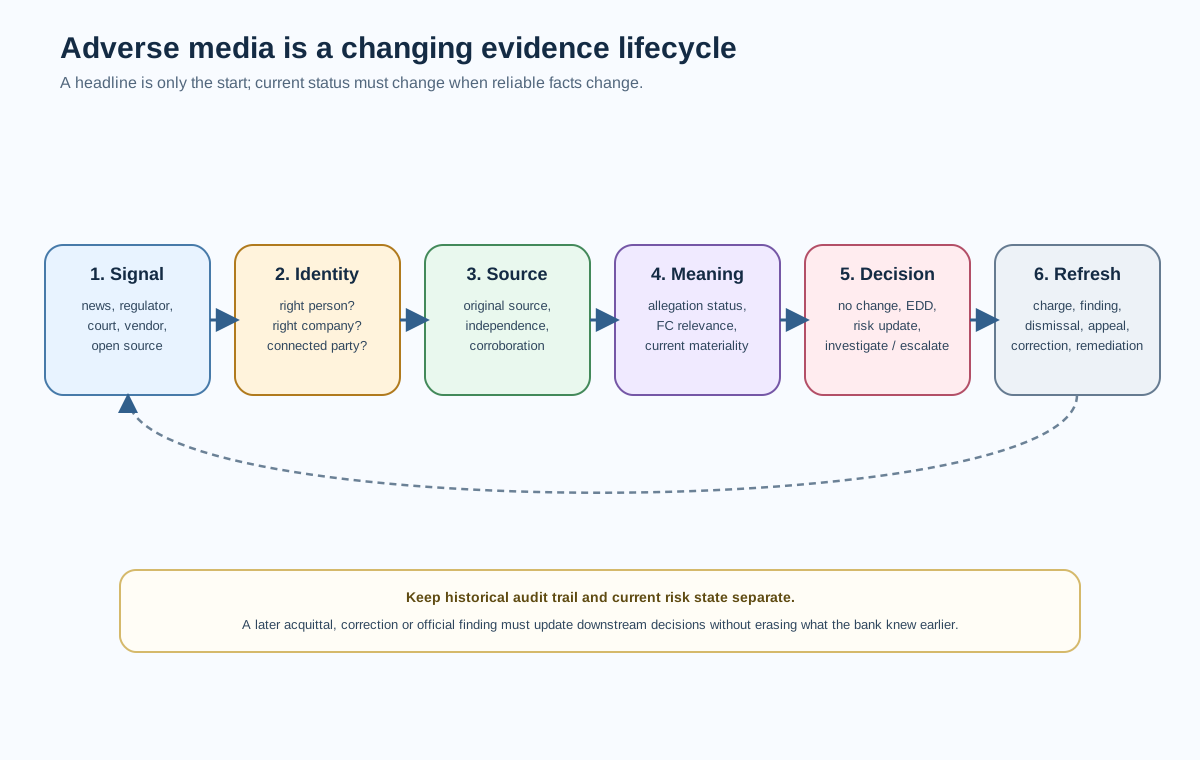
What adverse media can and cannot tell a bank
Negative reporting can reveal information that normal KYC documents do not. A certificate of incorporation does not show that a company is under investigation for procurement fraud. A passport does not show that its holder has been publicly linked to a corruption network. A beneficial-ownership declaration does not necessarily reveal that a controlling shareholder is the subject of a regulatory action in another country. Public-source research can therefore strengthen customer understanding, especially where enhanced due diligence is appropriate.
But adverse media has serious limitations. News availability differs dramatically by country and language. Some jurisdictions have strong independent investigative journalism; others have restricted press environments, weak court transparency or political control over outlets. Commercial databases can give useful structure but may preserve old allegations after their outcome has changed. Search engines can surface sensational material before more reliable sources. Social media can expose genuine misconduct early, but it can also amplify misinformation, impersonation and coordinated reputation attacks. A bank that treats all public information as equally reliable will produce both false positives and false confidence.
The correct question is therefore not "is there negative news?" It is "what does this information actually establish, about whom, from which source, at what stage, and with what relevance to the financial-crime risk of this relationship?"
A strong record distinguishes at least five things:
- Identity confidence. Is the subject actually the customer or a relevant connected party?
- Source quality. Is the source official, independent, attributable, current and capable of being checked?
- Allegation status. Is this an allegation, charge, finding, conviction, acquittal, dismissal, settlement, appeal, investigation or commentary?
- Financial-crime relevance. Does the matter relate to risks the bank is expected to assess, or is it unrelated controversy?
- Current significance. What has happened since the original report, including remediation, later findings, exonerating information or further conduct?
Those fields should be separately stored where systems allow. Collapsing them into one adverse_media = true flag destroys the reasoning needed for fair and auditable decisions.
Regulatory and standards context
Adverse-media practice sits inside broader customer due-diligence and risk-based frameworks rather than one universal global rule.
FATF Recommendation 10 requires customer due diligence and ongoing due diligence according to the applicable risk framework. FATF's banking-sector risk-based guidance illustrates that enhanced due diligence can include additional searches such as verifiable adverse-media searches. That wording is important. It positions the search as one possible EDD measure used to inform risk assessment; it does not turn a press result into a legal finding or prescribe a universal screening frequency for every customer.
The Wolfsberg Group's 2022 Negative News Screening FAQs are useful because they address the operational questions banks actually face: which subjects should be screened, when, against what sources, how far back to search, how to manage languages, how to configure matching, how to evaluate vendor coverage and how to retain traceability. Wolfsberg also expressly states that negative-news screening should not be a zero-tolerance process and that institutions may reach different risk-based conclusions depending on their jurisdiction, customers and control framework.
The European Banking Authority's ML/TF Risk Factors Guidelines identify adverse media or other relevant sources as factors that may inform a customer-risk assessment. They tell firms to consider reliability and credibility, including the quality and independence of the source and persistence of reporting, and caution that the absence of a conviction does not automatically dispose of a credible allegation. That does not mean an allegation should be treated as guilt. It means the analyst must assess the information rather than use "no conviction" as an automatic clearance rule.
In the United Kingdom, the legal treatment of information about criminal allegations and proceedings has an additional data-protection dimension. ICO guidance explains that UK criminal-offence data includes allegations and proceedings, not only convictions, and that processing such data requires the relevant UK GDPR/DPA 2018 conditions and safeguards. Public availability does not remove those requirements. The UK position is a useful illustration of why a global bank cannot assume that "it is on the internet" is a sufficient legal basis for unrestricted collection, retention or reuse.
The FCA's 2026 wealth-management survey also noted that some firms did not check adverse media and described those gaps as making it harder to identify higher-risk clients and meet financial-crime duties. That is a current UK supervisory observation about a sector, not a universal global rule that every institution must screen every person in the same way.
Australia provides another useful risk-based comparison. AUSTRAC's current CDD guidance requires enhanced measures to be targeted, proportionate and effective for the customer's particular ML/TF risk. Open-source information may support that understanding, but the legal triggers and required measures come from the Australian framework, not from a global negative-news checklist.
For a multinational bank, the practical architecture is therefore global methodology plus local rule packs. The global methodology can define source assessment, identity resolution, materiality, evidence capture and governance. Local legal and privacy teams define what may be collected, which customer populations must or should be searched, retention rules, disclosure limits, decision rights and any mandatory EDD or reporting consequences.
Identity resolution comes before allegation assessment
The first operational problem is not credibility. It is identity.
A screening engine may return an article about "A. Rahman" or "John Smith" with limited identifiers. A vendor profile may associate a date of birth that came from a secondary source. A translated article may transliterate the same name in several ways. A corporate name may have changed after a merger. A director may share a name with a public official or convicted individual. If the bank has not established that the subject of the story is actually the party under review, deeper analysis of the allegation is wasted and potentially harmful.
Entity resolution should use all lawfully available corroborating attributes that are relevant to the case: date of birth, nationality, residence, employer, company registration number, role, ownership relationships, known associates, location, historical names and time period. The standard is not "match every field" because public reporting is often incomplete. The standard is to make an evidence-based identity judgement and document uncertainty.
The system should distinguish at least these outcomes:
- confirmed or highly confident match;
- probable match requiring further evidence;
- unresolved match where information is insufficient;
- false positive or different person;
- duplicate of an already assessed event.
A name-only match should not silently become a customer-risk factor. Where a temporary control is used while identity is unresolved, the policy should specify when that control is legally and operationally permissible, its maximum duration, the escalation route and how customer harm is managed. Negative news is not a sanctions list and should not inherit sanctions-style interdiction logic by default.
Source reliability is multidimensional
Banks often try to solve source reliability by creating a simple hierarchy: official source good, large newspaper good, social media bad. That is too crude. A source may be reputable but wrong in a particular story. An official allegation may still be contested. A small local outlet may have superior access to local facts. A major newspaper may be repeating a wire story. Ten articles may all trace back to one original allegation and therefore provide no independent corroboration.
A better source assessment asks:
- Is the publisher identifiable and accountable?
- Is the original author or issuing authority known?
- Does the item cite documents, named witnesses, court records or official findings?
- Can the key facts be verified from another independent source?
- Are later corrections, appeals or updates visible?
- Is the material original reporting or repetition?
- Does the source have a relevant conflict of interest or advocacy position?
- Is the reporting environment subject to censorship, political capture or other known distortion?
- Is the information current enough for the decision being made?
Source motivation should be considered but should not decide the case. A partisan outlet can publish true facts; an apparently neutral outlet can publish weak reporting. A short seller can identify genuine accounting issues while holding an economic interest in a price fall. A company's commissioned expert can provide valid evidence while having an incentive to defend the company. The analyst should test the underlying evidence rather than converting motive into automatic credibility or discredit.
Allegation status must be recorded precisely
One of the most damaging mistakes in adverse-media work is status compression. "Linked to fraud" can mean convicted of fraud, charged with fraud, named in a civil claim, investigated, criticised in an audit, mentioned by a witness, accused anonymously online or confused with somebody else. Those are different facts.
The assessment record should preserve the procedural stage and the source that supports it. Useful statuses include:
- public allegation with no confirmed official action;
- official investigation or inquiry;
- charge or indictment;
- regulatory notice or administrative proceeding;
- regulatory or court finding;
- conviction or judgment;
- settlement or consent order, with the exact nature of any admissions and findings;
- appeal pending;
- acquittal, dismissal, withdrawal or closure;
- correction, retraction or reliable exculpatory information.
The outcome should then be interpreted under local law and policy. A conviction does not create one universal global customer treatment. The nature of the offence, legal restrictions on use of conviction data, time elapsed, rehabilitation framework, product exposure and current behaviour can all matter. Equally, an acquittal or dismissal should be reflected accurately and promptly, but it does not necessarily erase every independent fact around the relationship. The bank should remove or correct inaccurate adverse attributes and then assess any remaining reliable information on its own merits and under applicable retention rules.
A settlement without admission is another area where sloppy reasoning causes error. The bank should not infer guilt merely from the amount paid, nor treat a no-admission clause as automatic exoneration. The useful questions are what the official order actually says, whether factual findings were made, what conduct was alleged or established, what remediation was required, whether later reviews confirmed improvement, and what relevance remains to the current relationship.
Credibility, relevance and materiality are separate questions
After identity and source assessment, the analyst needs to distinguish credibility from relevance.
A highly credible article about an unrelated personal dispute may have no meaningful financial-crime relevance. A moderately sourced allegation about corruption in procurement may be highly relevant to a corporate customer's business model and geography. A confirmed environmental regulatory breach may matter to another risk framework but not necessarily to AML customer risk unless the facts also indicate bribery, fraud, illegal proceeds or another financial-crime connection.
A defensible adverse-media methodology therefore evaluates at least four dimensions:
Credibility: how strongly does the evidence support that the reported event or allegation exists?
Identity: how confidently does it relate to the customer or relevant connected party?
Financial-crime relevance: how closely does it connect to ML/TF, proliferation financing, fraud, corruption, sanctions evasion, predicate offences or another in-scope risk?
Materiality/current significance: how important is it now given severity, recency, repetition, remediation and the nature of the banking relationship?
These dimensions should not be converted into false mathematical precision unless the model is demonstrably calibrated. A score can support consistency, but analyst reasoning must remain visible. The customer-risk model should also avoid double-counting the same fact, for example giving separate high weights to "adverse media", "regulatory action" and "fraud allegation" when all three fields describe the same event.
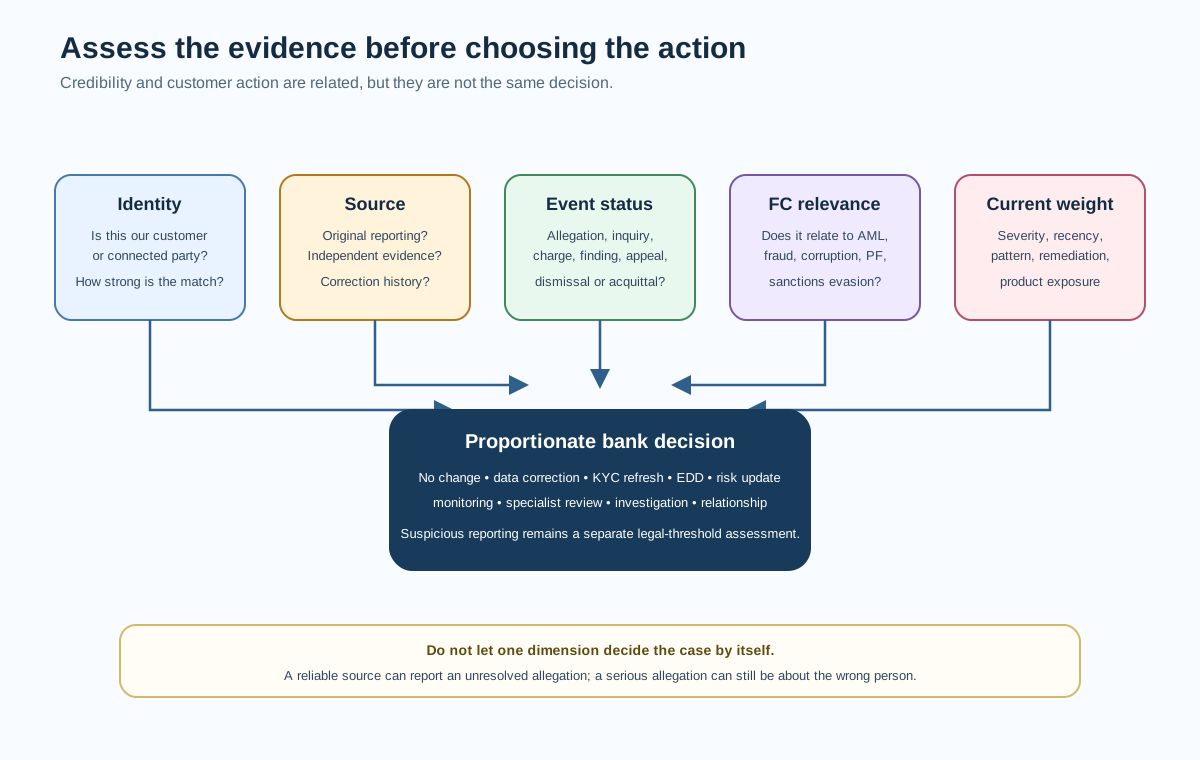
From screening alert to customer-risk decision
An automated tool may create an alert, but the alert is only the beginning. A mature workflow normally includes:
Triage. Is the result new, duplicate, obviously irrelevant or clearly a false identity match?
Entity resolution. Is the subject the customer, beneficial owner, controller, authorised signatory or another party relevant under policy?
Source verification. Can the original publication be accessed and its date, author, provenance and key claims captured?
Event classification. What type of event is it and at what legal or procedural stage?
Relevance analysis. Why does the event matter, if at all, to the specific relationship and product exposure?
Corroboration and contrary evidence. What independent evidence supports or weakens the reported claim?
Customer or relationship context. Where lawful and appropriate, what evidence already held by the bank or provided through due diligence changes the analysis?
Decision. Does the finding justify no change, a KYC update, enhanced due diligence, revised customer risk rating, closer monitoring, specialist escalation, relationship restriction or exit consideration under applicable policy?
Reporting assessment. Is there bank-held information that reaches the applicable threshold for a suspicious transaction/activity report or other regulatory report? Media coverage alone should not substitute for the statutory test.
Lifecycle tracking. What event should reopen the decision: new official action, later dismissal, appeal outcome, remediation evidence, new reporting or a material change in customer behaviour?
That last step matters because adverse information changes. A good system does not only detect negative events; it also detects material changes to them.
Lifecycle management: new facts must change old conclusions
A screening programme can be technically excellent at discovering allegations and still be unfair and ineffective if it never updates them.
Every material adverse-media record should carry a review state and an effective date. The analyst should know what evidence supported the original assessment and what event would change it. Examples include an investigation closing, charges being filed, a court issuing a judgment, an appeal succeeding, a regulator publishing a final order, a source retracting the story, a vendor correcting the subject identity, or independent remediation being verified.
A later acquittal or dismissal should not sit beside the original allegation as if nothing changed. The record needs an explicit status update, and systems that consumed the old risk factor need to receive the new status. That may mean changing a risk rating, closing an enhanced-review task, removing an inaccurate vendor attribute, or preserving a limited historical note only where lawful, necessary and relevant.
Similarly, a conviction should not be described as "permanent enhanced measures" by default. Local law may impose restrictions on the processing or use of criminal-offence data, rehabilitation or spent-conviction rules may apply, and the bank still needs to understand the relationship-specific relevance. The key is accurate history plus current risk, not permanent punishment or forced forgetting.
Data protection, privacy and fair process
Adverse-media controls process information about real people, sometimes about highly sensitive allegations. Public availability does not eliminate privacy obligations.
In the UK, for example, ICO guidance states that criminal-offence data includes allegations, investigations and proceedings as well as convictions. Processing requires a lawful basis plus the additional conditions applicable to criminal-offence data. Similar or different restrictions may exist elsewhere. A global bank therefore needs jurisdiction-aware rules for collection, purpose, retention, access, sharing and deletion rather than one worldwide data policy based solely on whether information is public.
Accuracy is especially important. The bank should preserve the original source, the date accessed, the exact procedural status, identity confidence and any later correction. Vendor summaries should not overwrite the underlying evidence. Where policy permits the customer to provide information, the analyst should evaluate it rather than treating denial as proof of risk or cooperation as proof of innocence.
Customer notification is not a universal adverse-media rule. In some situations transparency, complaint handling or data-protection rights may require information to be provided; in others disclosure may be limited by law, confidentiality or anti-tipping-off rules. The correct design is to route communication through the applicable legal and customer-treatment framework, not to promise every subject advance notice of an adverse-media assessment.
Automated decisioning also requires jurisdiction-specific analysis. The UK Data (Use and Access) Act 2025 changed the framework for significant solely automated decisions and introduced/retained safeguards such as information, representations and human intervention in relevant cases. Other jurisdictions have different rules. Operationally, banks should still avoid allowing a vendor hit or model score to become an unexplained consequential customer action. Human review, reason codes and the ability to correct identity or factual errors are strong control design even where not mandated in identical terms everywhere.
Systems and data architecture
Adverse-media controls often fail not because analysts cannot judge allegations but because the technology loses context.
A useful adverse-event data object should keep separate fields for:
- subject identifier and subject type;
- relationship to customer;
- identity-match confidence and corroborating identifiers;
- source URL or source reference;
- publisher and publication date;
- date first detected by the bank;
- language and translation provenance where relevant;
- allegation/event category;
- procedural status;
- source-quality assessment;
- independent corroboration links;
- financial-crime relevance;
- severity/materiality;
- customer-risk impact;
- decision and rationale;
- reviewer and approver;
- next review trigger/date;
- current status and effective date;
- privacy/retention classification;
- links to KYC, monitoring or investigation cases.
This structure supports auditability and prevents the common mistake of storing only a vendor profile ID and a free-text analyst comment. It also makes downstream integration safer. Transaction monitoring can consume a reasoned risk signal rather than raw news noise; periodic review can see what changed; investigations can distinguish public allegations from bank evidence; model validation can test false-positive rates by source and event type.
Screening design: who, when and how much
A risk-based programme should answer scope explicitly rather than allow vendor defaults to become policy.
Who is screened? Customers only, or also beneficial owners, controllers, directors, trustees, settlors, beneficiaries, authorised signatories and other connected parties? The answer should follow the relationship and legal framework, not "more is always safer."
When? Onboarding, periodic review, event-driven review, continuous monitoring, or a combination? High-risk populations may justify more frequent monitoring than lower-risk populations. Continuous screening can improve timeliness but can also multiply duplicates and operational noise if delta logic is weak.
How far back? Different event types may warrant different look-back periods, but retention and rehabilitation rules can constrain use of older data. One universal historical horizon is rarely defensible.
Which sources and languages? Coverage should reflect customer and geographic exposure. English-only screening of a global portfolio creates a measurable blind spot.
What matching logic? Name similarity must be combined with identifiers and entity-resolution rules. The tuning objective is not the lowest possible false-positive rate; it is an effective balance between missed relevant events and review volume.
What happens on system failure? If continuous adverse-media monitoring is unavailable, the bank should know whether onboarding can continue, whether high-risk reviews require manual fallback and how the outage is recorded. This is a service-resilience question, not an excuse to treat the control as optional whenever tooling fails.
Language, translation and geographic bias
The same adverse-media standard cannot be applied mechanically across information environments.
Translation can change meaning around negation, allegation, legal status and attribution. "Questioned", "charged", "suspected", "convicted" and "wanted for questioning" can be mistranslated into one generic negative label. Machine translation can support triage, but consequential decisions may require a qualified human or reliable local interpretation where the distinction is material.
Media freedom also affects what the absence of reporting means. No article in a restricted press environment does not prove a clean risk profile. Conversely, a highly competitive media market may produce extensive reporting about allegations before facts are settled. Coverage metrics should therefore describe visibility, not pretend to measure actual misconduct prevalence.
Political context deserves the same caution. An opposition source is not false merely because it is partisan, and a state-linked source is not true merely because it is official. Analysts should assess evidence, independence, corroboration and context without using political alignment as a proxy for truth.
Social media and emerging information
Social media can provide useful early warning but should normally sit at a different evidentiary level from a court judgment, official enforcement notice or independently corroborated investigative report.
Useful questions include whether the original account is identifiable, whether the allegation contains checkable facts, whether multiple posts are genuinely independent, whether there is evidence of coordinated amplification, whether credible journalists or authorities later corroborate the matter, and whether the bank's own customer or transaction data provides relevant evidence.
Virality is not corroboration. Ten thousand reposts of one unsupported claim remain one unsupported claim. Equally, low reach does not make a documented local report unimportant. The screening design should capture provenance so analysts can see whether apparent multi-source confirmation is actually one story copied across many outlets.
Adverse media as an investigation lead, not the investigation conclusion
Public information can generate valuable hypotheses for transaction monitoring and investigation. A report alleging bribery through agents may prompt an investigator to examine payments to consultants, high-risk jurisdictions, round-value transfers or unexplained third-party flows. A fraud allegation may suggest looking for refunds, chargebacks, pass-through behaviour or victim-linked payments. A trafficking report may point investigators toward known businesses, locations or network relationships.
But the case narrative must distinguish what comes from public sources from what the bank has observed. A suspicious-activity decision should be based on the applicable legal threshold and the totality of available information, not on the fact that a journalist used the word "fraud". The bank should be able to show how the external signal was corroborated, contradicted or left unresolved by customer and transactional evidence.
This distinction is especially important for investigators writing regulatory reports. The report should not present media allegations as bank-verified fact unless the bank has actually verified them. Source attribution and uncertainty are part of good evidential writing.
Reputation risk is related but not identical
A customer can create reputation risk even when there is no financial-crime allegation, and a financial-crime concern can exist even when there is little public controversy. Combining the two into one adverse-media score creates confused governance.
Financial-crime assessment asks whether public information changes the bank's understanding of ML/TF, proliferation, sanctions-evasion, fraud, corruption or predicate-offence risk. Reputation-risk assessment asks whether a lawful relationship creates unacceptable franchise, stakeholder or strategic consequences under the bank's risk appetite. Those questions can inform each other, but the decision rights should be clear.
A controversial but lawful sector should not automatically be labelled an AML problem simply because it attracts criticism. Conversely, a low-profile customer with credible criminal allegations should not escape enhanced financial-crime analysis because the story has little media attention. Separate labels and governance keep both disciplines honest.
Roles and governance
A mature operating model has clear ownership across business, KYC operations, financial-crime compliance, legal/privacy, technology/data and independent assurance.
The first line owns accurate customer data, relationship context and implementation of required customer actions. Screening operations triage and resolve alerts according to standards. Financial-crime specialists define methodology, challenge complex credibility and relevance decisions, and govern exceptions. Legal and privacy teams define jurisdiction-specific restrictions on collection, use, disclosure and retention. Data and technology teams own matching, source ingestion, lineage, resilience and change controls. Independent assurance tests whether the control works in practice, including false negatives, false positives, stale events and quality of analyst reasoning.
Governance metrics should not stop at alert volume and SLA. Useful measures include:
- true-match and false-attribution rates;
- duplicate alert rate;
- age of unresolved high-materiality findings;
- percentage of material events with a defined next-review trigger;
- source and language coverage gaps;
- proportion of events later changed by court/regulatory outcome;
- vendor correction turnaround;
- analyst decision overturn rates;
- cases where downstream systems retained stale risk after an event was corrected;
- model performance by language, entity type and source class.
A high closure rate can be a bad result if analysts are clearing complex allegations superficially. Quality measures need to test reasoning and evidence, not only throughput.
BA, architecture and testing considerations
For a business analyst, adverse-media requirements must be expressed as decision logic rather than slogans such as "screen all customers daily".
Requirements should define population scope, trigger events, source classes, matching attributes, duplicate logic, procedural statuses, risk categories, decision rights, evidence fields, review SLAs, local legal variants, notification rules, retention, downstream interfaces and reporting metrics. Every important rule should have a business rationale and an effective date.
Architects need to preserve provenance. The system should not overwrite the original event when its status changes; it should version the assessment so a reviewer can reconstruct what the bank knew at each point in time. Vendor data, original-source data and bank conclusions should be distinguishable. Local privacy restrictions may require data segmentation or purpose controls.
Testing should include more than obvious positive hits. A useful suite covers:
- a true match with strong corroborating identifiers;
- a common-name false positive;
- a translated article where legal status changes meaning;
- ten copied articles that trace to one source;
- an allegation later followed by dismissal;
- a regulatory action with a later remediation update;
- a source retraction;
- a vendor profile that remains stale after the underlying event changes;
- a high-risk customer whose relevant local-language media is absent from the primary vendor;
- a model outage requiring defined manual fallback;
- a customer risk score that must not double-count one event through several attributes.
Negative testing is equally important. A system should not create consequential action merely because a name and a negative keyword co-occur. It should not confuse a victim or witness with an offender. It should not treat a PEP article as a sanctions match. It should not convert an acquittal into a new negative event without context. It should not preserve inaccurate identity attribution after correction.
Mini case: one headline, three different bank outcomes
Assume a bank screens three customers named "Ravi Kumar" and finds a credible newspaper report stating that a Ravi Kumar was charged with procurement fraud involving public contracts.
For Customer A, date of birth, employer, director role and city all align with the person in the article. The bank confirms an official charging document. This is a strong identity match and an official procedural event. The bank updates KYC, assesses corruption/fraud relevance, considers EDD and monitoring changes, and separately assesses whether bank-held transaction information meets any reporting threshold. The charge is recorded as a charge, not a conviction.
For Customer B, only the name matches. Age, employer and location are inconsistent. The alert is closed as a different person and the disambiguating identifiers are stored so the same article does not repeatedly trigger needless review.
For Customer C, identity initially appears to match, but the bank discovers that the article was corrected two days later because the publication had confused two directors with similar names. The correction is captured as part of the same event lineage. Any temporary risk change based on the initial report is reversed through the controlled update process, and the bank checks that downstream systems no longer consume the inaccurate adverse attribute.
The headline was identical. The outcomes differ because adverse-media control is evidence handling, not keyword reaction.
Key takeaways
Adverse media is most useful when treated as structured, changing intelligence rather than a permanent blacklist. The strongest programmes separate identity, source quality, allegation status, relevance and materiality; maintain provenance; update decisions when facts change; and apply local legal and privacy rules.
Three safeguards prevent most serious failures. First, never let a name match become an allegation attribution without entity resolution. Second, never let an allegation become a fact without preserving its procedural status and source quality. Third, never let an old decision survive unchanged when reliable new information materially changes the event.
Used that way, negative-news screening becomes a practical extension of risk-based customer due diligence. Used as a zero-tolerance reputation filter, it creates noise, unfair customer outcomes and poor evidence. The control succeeds when it helps the bank understand risk more accurately, not when it finds the largest possible number of negative articles.
Operational deep dive: source engineering, event lineage and decision controls
The base chapter established the core discipline: an adverse-media result is a public-information signal, not a verdict. This deep dive turns that principle into an operating model that analysts, business analysts, architects, developers, testers and control owners can implement without losing source provenance or jurisdictional nuance.
Start with the control objective
The control objective is not to find every negative sentence on the internet. It is to identify public information that is materially relevant to financial-crime risk, resolve whether it relates to the bank's customer or another in-scope party, assess the evidence with appropriate scepticism, and feed a reasoned result into customer-risk and investigation processes.
That objective matters because a screening programme can look impressive while failing substantively. A vendor may generate millions of alerts, an operations team may close them within SLA, and dashboards may show strong throughput. None of those metrics proves that relevant adverse information is found, attributed to the right person, assessed consistently or updated when the facts change. Effectiveness must be tested against known events, false-attribution cases, later resolutions and downstream outcomes.
The Wolfsberg Group's Negative News Screening FAQs are useful here because they focus on practical control design rather than pretending one universal screening model exists. They discuss population scope, frequency, media sources, look-back periods, alert filtering, languages, traceability and solution evaluation. A bank can use those dimensions as design questions while still applying its own legal and regulatory requirements.
Source engineering begins with exposure, not vendor catalogue size
Source coverage should start from the bank's customer and geographic exposure. A bank with customers across Southeast Asia, the Gulf, Latin America and Europe cannot credibly describe an English-language global news feed as complete merely because the vendor markets it as international.
A source inventory should distinguish at least:
- official regulatory and enforcement publications;
- court or tribunal information where lawfully accessible;
- credible general news media;
- local and specialist trade publications;
- public company filings and registries;
- investigative-journalism sources;
- public NGO or intergovernmental reporting where relevant;
- social-media or other emerging sources used primarily for lead generation.
Each class has a different purpose. Official sources can confirm procedural events or findings but usually do not cover every emerging concern. General media may identify risk earlier but can contain attribution and verification problems. Specialist media can provide strong sector context but may be narrow. Social media can reveal a new allegation quickly but usually needs stronger corroboration before consequential customer action.
Coverage testing should use known-event backtesting. Select historical events relevant to the bank's customer base and ask whether the configured sources would have detected them, how quickly, in what language and with what identity data. Missed events provide evidence of a control gap. This is more useful than counting the number of publications in a vendor catalogue because catalogue size does not prove coverage quality for the bank's actual risk exposure.
Source reliability should be explainable, not mystical
Many banks use labels such as Tier 1, Tier 2 or Tier 3 source without defining why. That creates false consistency: two analysts may use the same tier but reach it for different reasons.
A better assessment records observable factors. The analyst can consider whether the source is accountable, whether the original author or authority is known, whether supporting documents are cited, whether the report distinguishes allegation from fact, whether corrections are published, whether the source is independent of the subject, whether multiple outlets have genuinely independent reporting, and whether the reporting environment creates particular censorship or manipulation risks.
No one factor should dominate. An official source is not automatically proof of guilt if it is announcing an investigation. A politically aligned outlet is not automatically unreliable if it publishes verifiable documents. A respected global newspaper can still repeat a weak wire story. A local investigative outlet can be highly valuable where it has direct access to records unavailable internationally.
The EBA's ML/TF Risk Factors Guidelines give a useful regulatory example by asking whether adverse-media reports are reliable and credible and pointing to the quality and independence of the source and persistence of reporting among the relevant considerations. The guidelines also say that absence of a conviction alone may not be enough to dismiss allegations. The lesson is analytical: neither "no conviction" nor "many articles" should become a shortcut around evidence assessment.
Repetition is not corroboration
One of the most common design defects is counting article volume as if it were independent evidence. Modern news distribution makes that dangerous. A single original story can be copied by syndication services, translated automatically, summarised by blogs and repeated on social media until a screening engine returns hundreds of apparently separate hits.
The data model should therefore capture an origin or source-family concept where possible. Articles that materially derive from the same original source should be clustered. Independent corroboration should mean that another source has separately verified material facts, obtained different documents, cited different witnesses or reported an official development.
This is important for both risk and fairness. Over-counting repetition can convert a weak allegation into an apparently overwhelming body of evidence. Under-counting genuine independent reporting can hide a developing pattern.
Event lineage is the centre of the architecture
Adverse-media systems should model an event through time rather than storing disconnected hits.
Consider a corruption allegation. On day one, a newspaper reports an accusation. Three months later, a prosecutor announces an investigation. Six months later, charges are filed. A year later, one charge is dismissed and another proceeds. Later still, there may be a conviction, acquittal, settlement, appeal or regulatory remediation outcome.
Those are not six unrelated adverse-media alerts. They are stages in one evolving event lineage. The bank should be able to reconstruct what it knew at each stage, which assessment was current, and why a customer-risk decision changed or did not change.
An event record should therefore carry:
- stable event identifier;
- subject identifier and relationship to the customer;
- original source and publication date;
- procedural/event status;
- status effective date;
- superseded status where relevant;
- identity confidence;
- source assessment;
- financial-crime relevance;
- materiality/current significance;
- analyst conclusion and rationale;
- downstream actions and systems notified;
- next review trigger;
- retention/privacy classification.
The architecture should not delete history simply because a status changes. It should preserve history while ensuring that current decisioning consumes the current status. That is the difference between auditability and stale risk.
The analyst sequence
A consistent workflow helps reduce both overreaction and under-reaction.
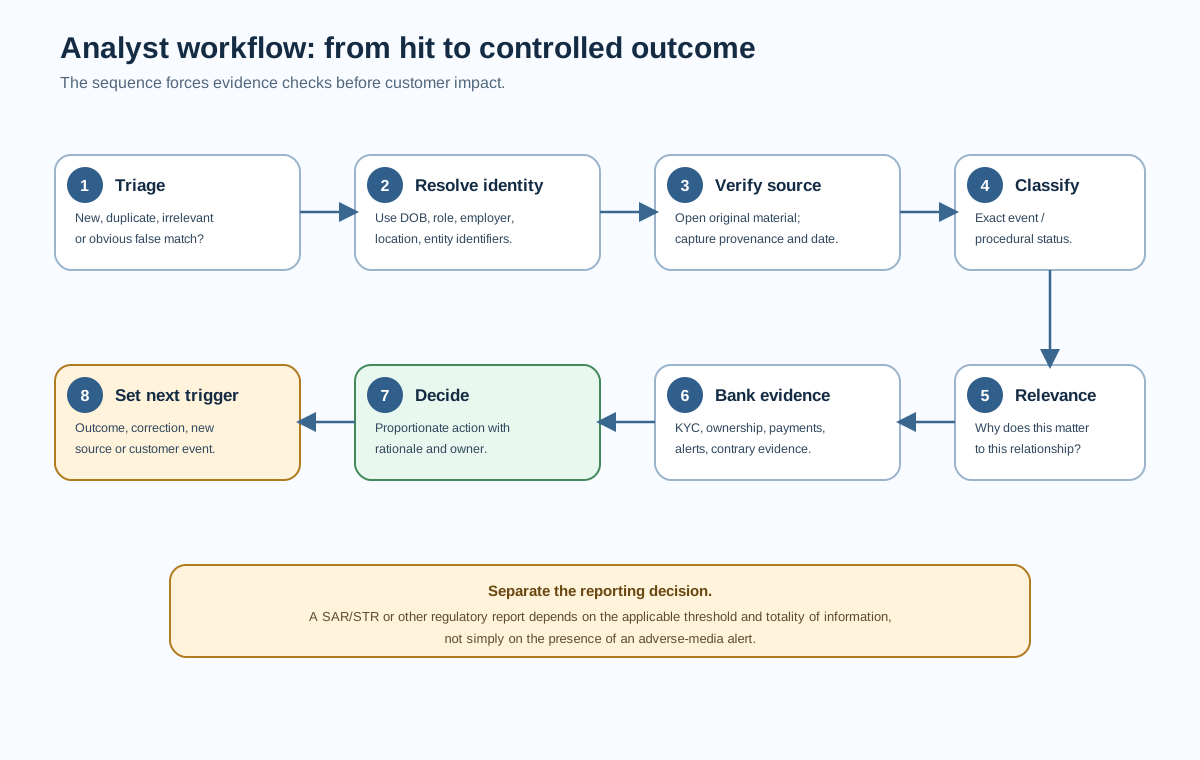
1. Triage the result
Determine whether the result is new, a duplicate, clearly irrelevant or obviously a different person. This stage should remove noise without making substantive customer-risk conclusions.
2. Resolve identity
Use corroborating attributes available under policy. If identity is unresolved, record uncertainty explicitly. A system should not silently convert a probable match into a confirmed adverse attribute.
3. Verify the source
Open the original material where possible rather than relying only on a vendor summary. Capture publication date, publisher, author or authority, source URL/reference and any cited primary documents.
4. Classify the event correctly
Record allegation, investigation, charge, regulatory notice, finding, conviction, settlement, dismissal, acquittal, appeal or other status accurately. Do not flatten all procedural stages into "criminal involvement."
5. Test relevance
Ask why the event matters to this relationship. A fraud allegation against a director may be highly relevant to invoice finance; a minor unrelated civil dispute may not be relevant to AML customer risk at all.
6. Seek corroboration and contrary evidence
Look for independent supporting information and material evidence that weakens the allegation. The objective is not to prosecute or defend the customer; it is to understand risk accurately.
7. Connect to bank-held data
Customer profile, ownership, products, payments, monitoring alerts and previous investigations can either reinforce or weaken the public-source hypothesis. Preserve the distinction between external reporting and internal evidence.
8. Decide proportionately
Possible outcomes include no change, data correction, KYC refresh, enhanced due diligence, customer-risk reassessment, monitoring change, specialist escalation, relationship restriction consideration or exit consideration according to policy and law. A finding should not be forced into an adverse action merely because an alert exists.
9. Assess reporting separately
A suspicious activity/transaction report depends on the applicable legal threshold and the totality of information. Public allegations can contribute to suspicion, but an adverse-media hit is not itself a universal reporting trigger.
10. Set the next trigger
Define what would change the assessment: official action, court outcome, source correction, customer evidence, remediation verification, new related reporting or a change in bank-observed activity.
Credibility does not need a fake universal ladder
Banks often want a five-grade credibility scale. Such a scale can support consistency, but it becomes dangerous if labels imply legal meaning that they do not have.
Instead of saying "Grade 1 equals conviction and requires enhanced measures," define grades around evidence strength and decision confidence. For example:
- documented official outcome: an official source confirms the procedural status or finding;
- strongly corroborated reporting: multiple independent reliable sources or underlying documents support material facts;
- credible but unresolved allegation: a reliable source presents specific, checkable allegations but material facts remain unresolved;
- weak or uncorroborated lead: limited source quality, little specificity or no independent support;
- discredited or wrong attribution: reliable evidence shows the allegation or identity attribution is materially incorrect.
Even then, the grade does not determine the action automatically. Identity, relevance, local law, customer risk and current circumstances still matter. The grade answers "how much confidence do we have in this information?" It does not answer "what must the bank do?"
Automation should triage and organise, not manufacture certainty
Natural-language processing can help identify names, event types, dates and risk categories from large volumes of text. Entity-resolution models can combine customer attributes with article information. Duplicate clustering can group syndicated stories. Translation models can surface non-English content. Those capabilities can reduce manual effort significantly.
But model outputs need controlled semantics. A classifier confidence of 0.92 is not 92% certainty that the customer committed a crime. It may only mean the model is highly confident that the article discusses a fraud allegation. That distinction should be clear in data dictionaries, user interfaces and training.
Model validation should be segmented by language, customer type, entity type and event class. A tool can perform well overall while failing badly on corporate aliases, Arabic transliteration, East Asian names or small local-language sources. Validation should therefore measure precision, recall and identity-attribution quality in the populations where the bank actually uses the tool.
Human review remains valuable for consequential financial-crime decisions even where local law permits a greater degree of automation. Jurisdictional law must be checked separately. In the UK, for example, the Data (Use and Access) Act 2025 changed the framework around significant solely automated decisions and associated safeguards. The practical control lesson is not "automation is prohibited"; it is that consequential decisions need lawful design, explainability, correction routes and whatever human-intervention safeguards the applicable framework requires.
Translation is an evidential control
Translation should be treated as part of evidence quality, not a convenience feature.
Legal and procedural terms are particularly vulnerable. A machine translation that turns "questioned by police" into "accused", "administrative penalty" into "criminal conviction" or "charges dismissed" into "case closed" can materially change customer-risk interpretation.
Where translation is material to a consequential decision, the bank should know:
- which engine or human translator produced the translation;
- whether the original text is retained;
- whether key legal terms were validated;
- whether the translator understands the jurisdiction's procedural terminology;
- whether a second review is required for high-impact decisions.
Testing should include known difficult examples, not only fluent mainstream-language articles.
Court and regulatory records need procedural literacy
Official sources are valuable because they can confirm status, but they still require interpretation.
A charging document is not a conviction. A regulator opening an investigation is not a final finding. A consent order may contain factual findings, admissions, no-admission language or a mixture. A civil judgment is not necessarily a criminal proceeding. An appeal can change the finality or significance of an earlier result.
Analysts should be trained to record what the official source actually establishes and avoid importing legal conclusions from a media headline. Where legal meaning is unclear and material, specialist legal input is a control, not a weakness.
The same applies to historical information. In some jurisdictions convictions can become spent or subject to use restrictions. In the UK, criminal-offence data is specially regulated and includes allegations as well as convictions. Global policy should therefore allow local retention and use rules to override a generic "keep forever" screening record.
Resolution handling should correct data, not rewrite history
When an event changes, the bank needs two things simultaneously: an accurate historical audit trail and a correct current risk state.
If a customer was charged and later acquitted, the bank should not delete the historical fact that a charge occurred if lawful retention and audit needs require it. But it should also not continue representing the customer as currently charged or convicted. The current status must show the acquittal, and downstream systems should stop consuming an outdated risk flag unless separate current evidence justifies continued treatment.
If an article is corrected because the subject was misidentified, the identity attribution should be removed from the customer and the correction propagated to downstream systems. Keeping the original false match as a live risk signal merely because it once triggered an alert is poor data governance.
If a regulator confirms remediation after an enforcement action, the bank should assess what the remediation changes rather than using a binary "cleared" or "permanent high risk" rule. Remediation can reduce current significance without erasing historical facts.
Fair treatment without inventing universal customer rights
A strong control should give customers a route for factual correction and complaint handling where applicable, but the exact disclosure and challenge rights differ by jurisdiction and situation.
The bank should not promise universal advance notification of every adverse-media finding. Doing so may conflict with confidentiality, investigation integrity, anti-tipping-off provisions or local privacy rules. Instead, policy should define when a customer can be contacted for information, what can be disclosed, who approves the communication and how legal restrictions are checked.
Where a customer provides contrary evidence, analysts should evaluate it on quality rather than source. A customer document is not automatically self-serving and worthless; nor is it automatically conclusive. The same evidence principles apply.
Fairness monitoring also needs care. Analysing false-positive or adverse-outcome differences across populations can be useful, but creating or using protected-characteristic proxies may itself raise privacy or discrimination-law issues. Such testing should be designed with legal/privacy governance and use the minimum data necessary. The objective is to identify control bias, not to create a new uncontrolled sensitive-data set.
Vendor governance
A vendor can provide data and technology, but the bank remains responsible for how vendor output affects its decisions.
Vendor due diligence should test:
- coverage by geography and language;
- source inclusion/exclusion method;
- latency from publication to alert;
- identity-resolution approach;
- duplicate handling;
- correction and deletion processes;
- ability to preserve original source references;
- translation method;
- model changes and release governance;
- data residency and privacy controls;
- service resilience;
- auditability and export of assessment history.
Known-event testing is particularly powerful. Give vendors a controlled set of historical events and measure whether they detect the right subject, correct event, original source and later resolution. A vendor that detects allegations but misses later exoneration creates a predictable stale-risk problem.
Contracts should support correction and audit rights, but contractual language does not replace control testing. If the vendor says "data is provided as is," the bank still needs a process that prevents unverified vendor data becoming an unexplained customer action.
BA acceptance criteria
Business requirements for adverse-media systems should be testable. Examples include:
- A screening result cannot be promoted to a confirmed subject match without either defined corroborating attributes or a documented specialist override.
- The user interface must display the original source, publication date and current event status separately from vendor summary text.
- Copied articles from the same source family must be identifiable so article count is not treated as independent corroboration.
- The assessment must capture financial-crime relevance separately from source credibility.
- The event model must support status changes without overwriting previous versions.
- When a false identity match is confirmed, the corrected identifiers must be available to prevent repeat attribution.
- When an event status changes, configured downstream customer-risk interfaces must receive the new effective status.
- A suspicious-reporting decision must require a separate rationale and cannot be automatically generated solely because an adverse-media alert exists.
- Jurisdiction-specific retention and disclosure rules must be effective-dated and testable.
- Model or vendor-rule changes must be regression-tested against known-event and known-false-positive populations.
Testing the control as a system
Unit testing individual matching rules is not enough. End-to-end scenarios should test the complete chain from source ingestion to customer outcome.
A useful scenario starts with a local-language report about a corporate director. The system ingests the article, translates it, resolves the director to a customer, clusters copied versions, creates an event, and routes it to review. The analyst identifies that the article reports an official investigation, not a conviction, and records moderate current relevance because the allegation concerns procurement fraud in a product area where the customer uses trade finance. A later regulator update closes the investigation without action. The system creates a new event state, routes it for reassessment, updates the customer-risk input, and preserves the historical audit trail. The test passes only if every downstream state reflects the new outcome correctly.
Another scenario should use a common-name collision. A model produces a high name similarity score, but date of birth, employer and geography conflict. The system must support a false-match disposition and prevent the same source from repeatedly creating a live customer risk flag.
A third scenario should test a source retraction. If the source removes or corrects the story, the bank should not silently lose evidence of why it once acted, but it should also not continue presenting the retracted claim as current. Both audit history and current accuracy must survive.
Practitioner checkpoint
A practitioner should be able to explain why adverse-media control is not just search technology. It is a joined system of source coverage, identity resolution, procedural-status accuracy, risk relevance, local legal rules, human judgement, event lineage and downstream data correction.
The most important operational test is simple: when the facts change, does the bank's decision change in a controlled way? If the answer is no, the programme is not managing intelligence; it is accumulating permanent labels.
Advanced practice: worked adverse-media cases
The cases below are fictional and exist to test reasoning. They do not create universal legal outcomes. Real decisions depend on identity, source quality, the applicable legal and privacy framework, the customer's products and activity, the bank's risk appetite, and any bank-held evidence that corroborates or weakens the public information.
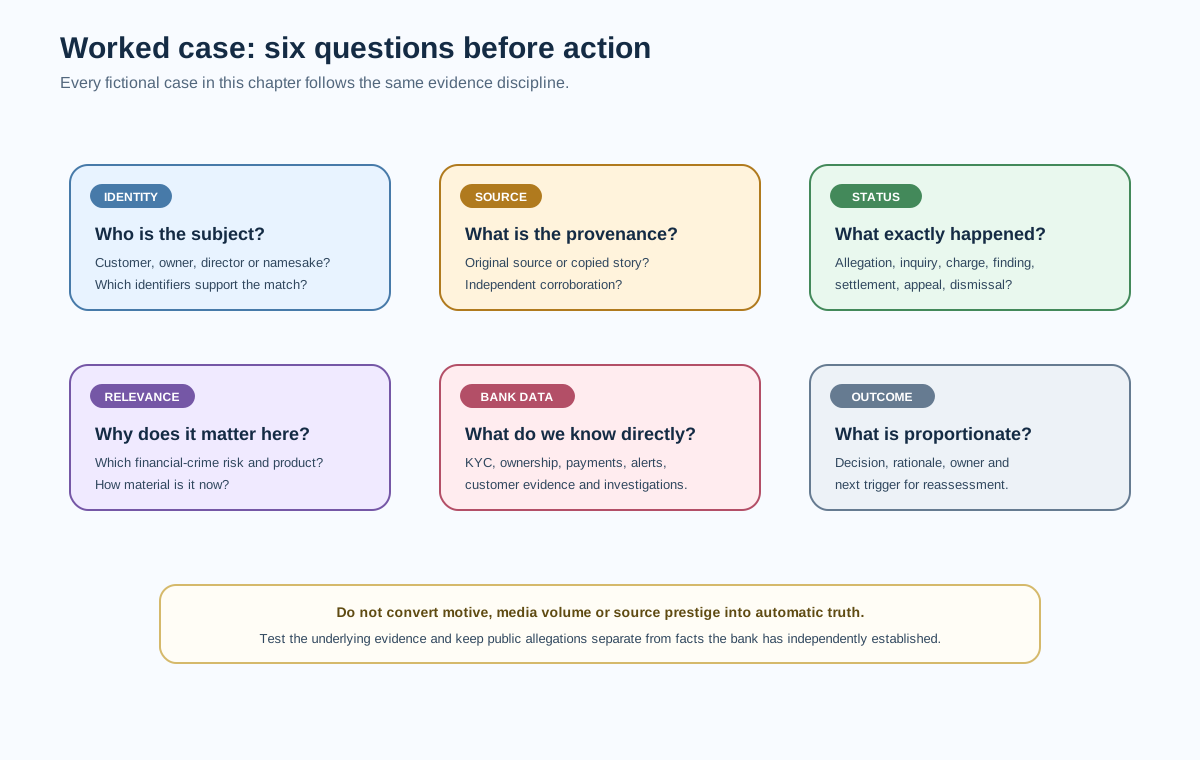
The diagram is deliberately evidence-first. A case does not progress from "bad headline" to "adverse action." It progresses from signal to identity, from identity to source and event status, from there to relationship relevance and bank evidence, and only then to a proportionate decision with a defined review trigger.
Case 1: the historical fraud conviction
A corporate customer's director appears in a reliable court record showing a fraud conviction from several years earlier. The original screening record calls the person "high risk permanently" and applies enhanced monitoring to every product. The customer has since built a legitimate business with audited accounts and no new adverse findings.
The first review question is legal and jurisdictional. Can and should the bank continue processing and using this conviction information in the way the old record assumes? Rehabilitation and spent-conviction rules differ by jurisdiction, and data-protection restrictions may apply. The analyst therefore cannot start from a global assumption that a conviction means permanent enhanced due diligence.
The second question is risk relevance. The historic offence involved invoice manipulation. That may be directly relevant if the customer uses invoice finance, trade finance or receivables products, but less directly relevant to a simple operating account. The product context matters.
The third question is current evidence. The analyst reviews ownership, financial statements, payment behaviour, previous alerts and any later official information. A long clean period does not mathematically cancel the history, but neither should history be allowed to override all current evidence forever.
A defensible outcome might retain the historical fact where lawful, remove the unsupported "permanent high risk" label, and apply product-specific controls only where current policy and risk justify them. Another jurisdiction or fact pattern could justify a different decision. The control lesson is that history, current risk and legal permission are separate questions.
Case 2: corruption allegations in a politically polarised media environment
A businessperson connected to public procurement is accused of contract-rigging by several opposition-oriented outlets. The articles contain specific contract numbers and allege inflated prices. Most of the stories trace back to one investigative piece. No court or regulator has published an outcome.
The wrong response would be either "opposition source, therefore false" or "many articles, therefore corroborated." The analyst maps the source family and discovers that most outlets are repeating one original investigation. Article count therefore adds little independent evidential weight.
The underlying facts can still be tested. Procurement records are checked where lawfully available. Contract values are compared with official award information. Ownership links, intermediaries and related parties are reviewed. The bank also checks whether its own transaction data shows unusual payments to agents, public officials, connected companies or unexplained third parties.
If public records materially contradict the central allegation and no independent corroboration appears, the bank may decide not to change the customer risk rating while keeping a review trigger for new official or independently verified information. If bank transactions independently reveal suspicious patterns, the case may escalate even though the media evidence remains unresolved.
The lesson is that political context affects how evidence is assessed, not whether evidence matters.
Case 3: the common-name collision
A retail customer is matched to reports about an organised-crime conviction. The name is identical and age appears similar. An automated workflow has already proposed a relationship restriction.
The analyst compares date of birth, residence, employment history and known locations. The convicted person is eleven years older, lived in another region and was imprisoned during a period when the bank customer was continuously employed elsewhere. The screening result is a namesake collision.
The immediate control requirement is data correction. The false attribution should be removed from the customer-risk input, the disambiguating identifiers should be retained where lawful and useful to suppress repeat false matches, and any consequential action based solely on the mistaken match should be reversed through the bank's normal remediation and complaint framework.
Whether compensation, apology or other customer remediation is required depends on local law, contract terms and the harm caused; it should not be asserted as one automatic global consequence. The operational lesson is more universal: name similarity is not identity evidence.
The incident should also become a testing case. If a system allowed a name-only match to reach a consequential action without required corroborating identifiers or specialist review, that is a design defect, not merely an analyst mistake.
Case 4: a regulatory settlement without admission
A corporate subsidiary previously settled an AML enforcement matter. The official order contains detailed control deficiencies but the settlement states that the firm did not admit or deny specified allegations. Several years later the customer presents evidence of remediation and clean subsequent regulatory reviews.
The analyst should not use the size of the settlement as a proxy for guilt and should not treat no-admission language as proof that nothing happened. The most reliable material is the official order itself: what findings or agreed facts are stated, what obligations were imposed, what remediation was required, and what later official or independently verifiable evidence shows about remediation.
The bank then assesses relevance to the current relationship. A historic control failure at a subsidiary may matter differently from proven fraud by the parent. Ownership changes, management changes, subsequent examinations and product exposure can all alter current significance.
A time-bound enhanced review may be reasonable while remediation is verified, followed by normalisation if evidence supports it. Another case could justify continued elevated risk. The key is that the decision is tied to documented facts and current relevance rather than the legal form of the settlement alone.
Case 5: a viral social-media accusation
A commercial customer becomes the subject of viral posts alleging investment fraud. Thousands of accounts repeat the claim. There is no official action and no established media outlet has independently reported the allegations. Some posts include screenshots, but their provenance is unclear.
Virality increases operational urgency because the story may develop quickly, but it does not increase evidential quality by itself. The analyst identifies the earliest available posts, checks whether the screenshots can be verified, looks for independent victim reports or official notices, and checks whether the apparent amplification is organic or coordinated.
The bank may use the signal to ask a limited set of risk questions or increase review attention where policy permits, but it should not label the customer a fraudster or file a suspicious report solely because the allegation is popular online. If the bank's own data shows unusual investor receipts followed by rapid outward transfers inconsistent with the stated business model, that independent evidence changes the case materially.
The lesson is to treat social media as lead-generating information with provenance risk, not as a lower-cost substitute for evidence.
Case 6: investigative reporting followed by official inquiry
A reputable investigative consortium publishes a detailed report alleging procurement fraud involving a corporate customer. The report cites leaked documents and named counterparties but some source material cannot be independently accessed. The customer denies the allegations. Four months later, an authority publicly confirms that it has opened an inquiry.
The initial article was neither a conviction nor a trivial rumour. Its specificity, the consortium's track record, the documents cited and later independent reporting gave it meaningful credibility, but important facts remained unresolved. The bank recorded the allegation accurately and defined explicit review triggers rather than making a binary guilt/innocence decision.
The later official inquiry changes the event status. It provides independent confirmation that an authority considers the matter worthy of investigation, but it still does not establish wrongdoing. The bank refreshes its risk assessment, tests whether customer payments map to the named intermediaries and contracts, and decides whether EDD, monitoring changes or relationship restrictions are proportionate under its policy.
If bank-held evidence reaches the applicable suspicion threshold, reporting is considered on that basis. The suspicious-report decision is documented separately from the adverse-media rating so reviewers can see which facts came from journalism, which came from the authority and which came from the bank's own records.
Case 7: dismissed charges but stale vendor data
A founder was charged with fraud fifteen years ago. The charges were later dismissed. A commercial risk database continues to display the original charge prominently and has not linked the dismissal. A periodic review therefore presents the case as unresolved.
The analyst verifies the dismissal from an authoritative record. The internal event state is updated, and the vendor is asked to correct its profile through the vendor's formal challenge process. The bank also checks whether any downstream risk score or monitoring rule is still consuming the old "charged" status.
The correct response is not automatically "delete all history" and not "keep the adverse flag forever." The bank follows local data-retention rules, keeps whatever audit history is lawful and necessary, and ensures the current customer-risk state accurately reflects the dismissal. Any separate reliable current evidence is assessed on its own merits.
This case illustrates why negative-news programmes need resolution detection as much as allegation detection.
Case 8: short-seller report with an economic interest
A short-selling research firm publishes allegations of accounting fraud about a listed corporate customer while disclosing that it holds a position that benefits if the share price falls. The customer issues a rebuttal and points to its external audit.
The source's financial interest matters because it can affect incentives, but it does not prove the allegations are false. The customer's economic interest in defending itself also does not prove the rebuttal is false. The bank therefore focuses on testable claims.
Related-party allegations can be checked against ownership records. Revenue-recognition concerns may be compared with later audited filings or regulatory statements. The bank's own exposure, collateral position and payment flows can be reviewed independently of the public dispute.
The outcome may be that some claims are substantiated, some are not, and the original report was directionally useful but overstated. Adverse-media systems need to support that kind of mixed conclusion rather than forcing every event into "true" or "false."
What these cases teach
The cases differ, but the control logic is consistent:
- identity must be established before attribution;
- source count is not the same as independent corroboration;
- procedural status must be preserved accurately;
- motive affects source assessment but does not decide truth;
- customer-risk impact depends on relationship relevance and current evidence;
- bank-held evidence should be distinguished from public allegations;
- legal, privacy and rehabilitation rules can change what data may be used and for how long;
- reporting thresholds are assessed separately from media labels;
- later outcomes must update the current risk state.
An adverse-media programme is strongest when it can explain why one headline changed a customer decision while another did not. That explanation should be reproducible by another reviewer using the same facts and framework, not dependent on how alarming the headline sounded on the day it was published.
Practice close: the adverse-media analyst's playbook
This playbook converts the chapter into repeatable work. It is intentionally evidence-led. A screening vendor can find public information, but the bank must decide whether the information relates to the right person, whether it is reliable enough to matter, what it means for the relationship, and what action is proportionate under the applicable framework.
The minimum evidence pack
A completed material adverse-media assessment should normally allow another reviewer to answer these questions without reconstructing the case from scratch:
- Who is the subject and how is the subject connected to the customer?
- What identifiers support the identity match?
- What is the original source, publication date and language?
- Is the material original reporting, an official record or repetition of another source?
- What exactly is alleged or established?
- At what procedural stage is the matter now?
- What independent evidence supports or weakens the report?
- Why is the matter relevant to the bank's financial-crime risk assessment?
- What bank-held evidence was considered?
- What decision was made, by whom, and under which policy/rule set?
- What event should reopen the assessment?
If those questions cannot be answered, the record may show workflow completion but not analytical quality.
Triage without accidental decisioning
Triage should remove obvious noise, not decide the customer's fate.
A result can be closed quickly when it is clearly a duplicate, unrelated topic or demonstrably different person. A result should move to deeper review when identity is plausible, the event is relevant and source quality cannot be resolved through simple checks. Operations procedures should define when specialist escalation is required, especially for high-impact customers, serious allegations, difficult legal status or uncertain identity.
Avoid language such as "confirmed adverse" before the event is actually assessed. A better workflow vocabulary separates screening hit, possible subject match, confirmed subject match, material event, risk-impacting event and closed/no impact. The words used in status fields shape how downstream teams interpret the information.
Questions for identity resolution
When the name is common or article detail is thin, ask:
- Does date of birth align?
- Does nationality or residence align?
- Does the employment or directorship history align?
- Do company registration details align?
- Are the named associates or counterparties consistent with known customer relationships?
- Is the event location plausible for this person?
- Does the timeline fit?
- Are aliases, former names or transliterations relevant?
An unresolved identity match should remain unresolved. The analyst should not fill missing evidence with intuition simply because the article is serious.
Questions for source assessment
Ask what the source actually adds.
A regulator's final order can establish that an enforcement action occurred and specify findings or obligations. A court filing can establish a procedural event. A newspaper can provide investigative context but may depend on confidential sources. A copied article adds little independent corroboration. A social-media post may be useful as an early lead but can be manipulated easily.
The analyst should identify the best available original source and distinguish it from summaries. Where a source cites an official document, the official document should be reviewed where practicable rather than relying on the journalist's characterisation alone.
Questions for materiality and relevance
Not every negative event belongs in the AML customer-risk model.
Ask:
- Does the matter relate to an in-scope financial-crime risk?
- Is the subject the customer, a beneficial owner, controller or another party that policy says matters?
- How serious is the alleged or established conduct?
- How recent is it and what has happened since?
- Is there repetition or a pattern?
- Has there been credible remediation?
- Does the customer's product set create direct exposure to the typology?
- Does bank transaction or KYC data corroborate the concern?
- Would the outcome be different if the same event had no media attention but the bank knew the underlying facts directly?
That last question is a useful bias check. Media prominence should not substitute for risk relevance.
Decision menu
A mature framework needs more than clear and exit.
Depending on the facts and applicable rules, possible outcomes can include:
- false match / no customer impact;
- duplicate or already assessed event;
- monitor for defined trigger with no present risk change;
- refresh specified KYC information;
- collect additional evidence through EDD;
- change customer-risk factors or rating;
- apply product-specific monitoring;
- escalate to financial-crime specialist or legal/privacy review;
- consider relationship restriction or exit under policy;
- open an investigation based on the totality of information;
- assess suspicious reporting under the applicable legal threshold;
- correct or remove stale/inaccurate data.
No one outcome should be attached automatically to a source class. A regulator's announcement of an investigation can be highly reliable as evidence that an investigation exists while still being insufficient to establish misconduct.
Communication and customer contact
Relationship managers often want to tell the customer exactly what the bank has found. Compliance teams sometimes respond with the opposite extreme and refuse all contact. Both positions can be wrong.
The communication plan should answer:
- Is customer contact needed to obtain information?
- What can legally and safely be disclosed?
- Could disclosure create tipping-off or investigation-integrity concerns?
- Are privacy or customer-rights notices required?
- Who is authorised to conduct the conversation?
- What evidence should be requested without over-collecting?
- How will contrary evidence be assessed?
The bank should not assume a universal right to confront the customer with every allegation, nor a universal right to keep every decision secret. Local law and case context decide.
Failure modes to test explicitly
1. Name-only attribution
Failure: A common name is treated as a confirmed customer match.
Control: Require corroborating identifiers or documented specialist judgement before risk impact.
2. Article-count inflation
Failure: Ten copied articles are treated as ten independent confirmations.
Control: Cluster source families and identify the original reporting chain.
3. Status compression
Failure: Investigation, charge and conviction all become "criminal involvement."
Control: Store procedural status as a controlled field with effective date and source.
4. Stale adverse history
Failure: A dismissal, acquittal, correction or remediation outcome never reaches the customer-risk system.
Control: Maintain event lineage and downstream update controls.
5. Social-media overreaction
Failure: Virality is treated as corroboration.
Control: Assess provenance, independence, specificity and external/bank-held corroboration.
6. Vendor-summary dependence
Failure: Analysts never access the original source and rely on compressed vendor text.
Control: Preserve and review original source material for material cases where practicable.
7. Suspicious-report automation
Failure: A negative-news label automatically creates a SAR/STR decision.
Control: Require a separate reporting assessment against the applicable legal threshold and the totality of information.
8. Reputation/AML conflation
Failure: A controversial but lawful business is given an AML risk rating because it attracts criticism.
Control: Separate financial-crime relevance from reputation-risk appetite and use the right governance forum.
QA sampling strategy
Quality assurance should sample more than closed alerts randomly.
Useful samples include:
- high-impact adverse events that produced no risk change;
- cases that produced relationship restrictions or exits;
- common-name matches;
- local-language results;
- cases relying heavily on social media;
- events later followed by acquittal, dismissal or official correction;
- cases where the analyst overrode a vendor classification;
- customer complaints about adverse-media treatment;
- alerts closed unusually quickly;
- events with multiple copied sources;
- decisions where the customer-risk rating changed more than once.
QA should re-perform identity, source and relevance reasoning rather than only check that required fields are populated.
Model and vendor testing
Where NLP, entity resolution or automated classification is used, test the model against realistic adverse-media populations.
Positive tests should include genuine matches across aliases, transliteration and corporate name changes. Negative tests should include victims, witnesses, namesakes, similarly named companies and articles where a negative keyword appears but the customer is not accused of wrongdoing.
Translation tests should focus on legal-status terms. Duplicate tests should include syndicated stories. Lifecycle tests should include later corrections and outcomes. Vendor migration tests should verify that old assessment history, suppression decisions and event lineage survive a platform change.
Reviewer calibration
Adverse-media judgement cannot be reduced entirely to fixed rules, so reviewer calibration matters.
Calibration sessions should use fictionalised or appropriately governed historical examples and ask reviewers to classify identity confidence, source quality, procedural status, relevance and recommended next step. Differences should be discussed at the reasoning level, not simply resolved by majority vote.
Inter-reviewer metrics can help identify drift, but a low disagreement rate is not automatically good if everyone has adopted the same weak practice. Calibration needs an expert reference standard grounded in policy and legal requirements.
Management information that actually matters
Operational dashboards should show more than alert count and SLA.
Useful indicators include:
- alerts per screened population, by source and language;
- duplicate rate;
- confirmed subject-match rate;
- false-attribution rate;
- high-materiality case ageing;
- percentage of material cases with defined lifecycle triggers;
- vendor correction volume and turnaround;
- downstream data-correction failures;
- analyst overturn rate in QA;
- source coverage gaps found through known-event testing;
- number of cases where later official outcomes changed the original risk assessment.
Metrics should be interpreted carefully. A falling alert rate may indicate better tuning or a broken feed. A rising true-match rate may indicate better targeting or excessive filtering that misses important lower-confidence leads.
Outsourcing without outsourcing accountability
A managed service can perform search, triage or even preliminary assessment, but the bank still needs to know what methodology is used and how that output affects customer decisions.
Contracts and oversight should cover source coverage, change notification, analyst training, quality control, access to evidence, data protection, correction handling, model changes, resilience, audit rights and exit/data portability. Bank-side sampling should independently test provider quality.
The operating model should also define which decisions cannot be delegated. A provider may classify a result as material, but relationship exit, suspicious reporting, privacy exceptions or high-impact customer restrictions may require bank-controlled decision rights.
Final practitioner checklist
Before closing a material adverse-media case, confirm:
- identity attribution is supported;
- the original source is captured where practicable;
- procedural status is precise;
- copied stories are not misread as independent corroboration;
- financial-crime relevance is explicit;
- contrary evidence has been considered;
- bank-held evidence is distinguished from public information;
- the action is proportionate and policy-based;
- local privacy/retention/disclosure requirements have been considered where relevant;
- suspicious reporting, if considered, has its own legal-threshold rationale;
- a next-review trigger exists for unresolved material events;
- downstream systems will receive later corrections or outcomes.
The best adverse-media analyst is not the person who escalates the most negative stories. It is the person who can show, clearly and reproducibly, what the information means, what it does not mean and why the bank's response is justified.
Masterclass: governing adverse-media intelligence bank-wide
Adverse-media screening becomes a bank control only when the organisation can explain what it is trying to detect, which populations are in scope, how source quality is assessed, how decisions differ by jurisdiction, and how errors are corrected. Buying a negative-news database is not the same as operating a defensible control.
The governance challenge is unusually broad because the control sits across customer due diligence, privacy, technology, data quality, model risk, vendor management, investigations, relationship management and reputation risk. A weak design often fails at the interfaces rather than inside the screening engine itself.
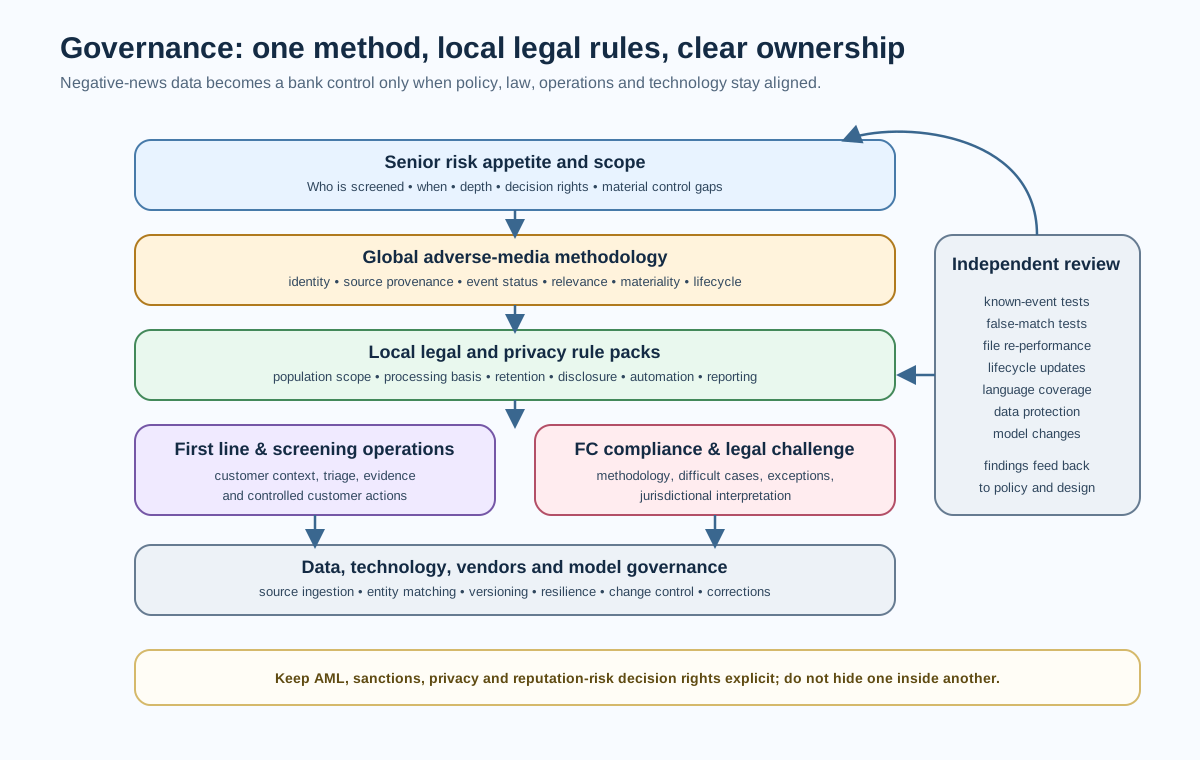
Global methodology, local legal rule packs
A multinational bank can standardise the analytical method without pretending that every jurisdiction imposes the same legal duties.
The global methodology can define common concepts such as identity confidence, source provenance, event status, financial-crime relevance, materiality, analyst rationale, lifecycle updates and quality assurance. It can also define minimum evidential expectations and escalation principles.
Local rule packs then determine how those concepts are applied legally. They may specify which customer populations are screened, what data may be processed, whether criminal-offence information receives special protection, retention periods, customer communication limits, local EDD expectations, reporting rules, escalation authorities and whether particular automated processing is permitted.
This separation prevents two common errors. The first is global overreach, where a rule derived from one jurisdiction is presented as universal. The second is local fragmentation, where every country invents a completely different methodology and the bank loses comparability and central oversight.
Rule packs should be effective-dated. When law or supervisory guidance changes, the bank should be able to show which rule applied to a decision made six months earlier and which rule applies today. That is especially important where data-retention, automated-decision or criminal-offence-data frameworks change over time.
Who owns the control
Ownership should be explicit.
The business or first line owns accurate customer context and implementation of agreed customer actions. KYC or screening operations own alert handling within defined procedures. Financial-crime compliance owns or challenges the methodology, materiality framework, specialist escalations and policy exceptions. Legal and privacy functions define jurisdiction-specific boundaries on collection, use, disclosure and retention. Technology and data teams own source ingestion, entity matching, lineage, resilience and controlled change. Vendor management owns contractual oversight but should not be treated as the control owner merely because a third party supplies the tool. Independent assurance tests whether the combined system works in practice.
A useful governance principle is that no function should be able to hide a decision inside another function's label. A business exit decision should not be disguised as an AML requirement if the real reason is reputation appetite. A data-retention decision should not be described as a compliance preference if privacy law determines it. A vendor configuration should not become policy just because operations cannot change it easily.
Risk appetite and scope decisions
The senior forum should approve the core scope questions that materially affect effectiveness and customer impact:
- which customer and connected-party populations are screened;
- at what lifecycle stages;
- which populations receive continuous monitoring versus point-in-time searches;
- what source classes are accepted for alert generation;
- which languages and jurisdictions are covered directly or through fallback processes;
- how unresolved identity matches are handled;
- when adverse-media information can affect customer-risk ratings;
- which decisions require specialist or senior approval;
- when a finding belongs in financial-crime governance versus reputation-risk governance.
Scope should reflect risk exposure and applicable obligations. "Screen everyone continuously against everything" may sound conservative but can create a volume of low-quality alerts that weakens review quality. Conversely, very narrow screening can miss material risk. The bank should be able to explain the trade-off with evidence from testing and operational capacity.
Vendor governance as a control discipline
A vendor can improve reach and efficiency, but vendor output should be treated as sourced data that the bank evaluates, not as a substitute for judgement.
Due diligence should test the vendor's source universe, source selection criteria, language coverage, identity-resolution method, duplicate clustering, correction process, translation approach, model change governance, latency, resilience, data-protection controls and ability to preserve original-source references.
Known-event testing should be part of selection and ongoing oversight. The bank can provide a governed set of historical events with known subjects and outcomes and measure whether the vendor:
- detected the event;
- matched the correct subject;
- preserved the original source;
- distinguished allegation from official outcome;
- handled aliases and transliteration;
- identified a later dismissal, acquittal or correction;
- avoided attributing the event to a known namesake.
A provider that excels at detecting allegations but routinely misses their later resolution creates a systematic bias toward stale adverse information. A provider with excellent English-language performance but weak local-language coverage may be unsuitable for parts of the customer portfolio even if its global headline metrics look strong.
Contract terms should support audit, correction, change notification and data portability, but contractual rights only have value if the bank exercises them.
Model governance and matching risk
Adverse-media platforms increasingly use machine learning for entity resolution, article classification, sentiment, event extraction, translation and duplicate clustering. Those models can be useful, but governance should focus on what each output actually means.
A high model confidence that an article discusses corruption is different from confidence that the article's subject is the bank customer. A high name-match score is different from a legal conclusion that the person committed the reported conduct. A sentiment score is not a measure of financial-crime risk.
Model documentation should therefore map output fields to allowed decisions. Validation should be segmented by relevant populations such as language, entity type, transliteration pattern and source category. Threshold changes should be regression-tested against known true matches and known false matches. Material model changes should be versioned so the bank can explain why an alert population changed.
Where law imposes specific safeguards around automated decisioning, those safeguards must be implemented through the applicable local rule pack. Even where such law does not apply, consequential customer actions should have clear reason codes and correction routes so a data or identity error can be repaired.
Privacy and information governance
Adverse-media control is unusual because the bank often processes information that is publicly visible yet legally sensitive.
The fact that information appears in a news article does not mean the bank can retain it forever, use it for any purpose or distribute it across the enterprise without restriction. In the UK, for example, criminal-offence data includes allegations and proceedings as well as convictions and is subject to additional conditions under the UK GDPR/DPA 2018 framework. Other jurisdictions have different categories and rules.
Governance should define:
- purpose limitation;
- access controls;
- source-data versus analyst-conclusion separation;
- retention and deletion logic;
- correction mechanisms;
- cross-border data-transfer controls;
- handling of particularly sensitive information;
- restrictions on downstream reuse;
- audit evidence for why processing was necessary and proportionate.
The data model should make these rules technically enforceable where possible. A free-text case note copied into multiple downstream systems is much harder to correct or delete than a structured event with effective dates and controlled interfaces.
Separation from sanctions and suspicious reporting
Senior governance should actively prevent adverse-media control from inheriting sanctions logic accidentally.
Sanctions controls may require legally prescribed blocking, freezing, rejection or reporting depending on the regime. Negative-news screening normally informs customer risk and investigation. A public allegation does not become a sanctions match because it concerns a sanctioned country, and a media report naming a designated person should not be used as a substitute for the legally relevant designation source.
Suspicious reporting is also a separate decision. Public information can contribute to suspicion, but a SAR/STR decision depends on the applicable statutory test and the totality of information. The case system should therefore record an adverse-media assessment and a suspicious-reporting assessment as linked but distinct decisions.
This separation improves both legal accuracy and auditability.
Reputation-risk governance
Reputation risk overlaps with adverse media but should not quietly take over the AML framework.
A lawful customer may create franchise or stakeholder concerns because of controversial activities, public campaigns or association risks. Those concerns may be legitimate business-risk questions, but they are not automatically ML/TF risk factors. If the bank chooses not to serve a lawful customer for reputation reasons, the decision should be owned transparently under the correct risk appetite.
Conversely, a customer with credible financial-crime concerns should receive appropriate AML attention even if the story has little public visibility. Media prominence is not the risk measure.
A joint forum can help when both risks are present, but the decision record should show which concern drove which action.
Crisis governance for high-profile cases
A major adverse-media event can develop faster than normal KYC review cycles. A large customer may be named in a corruption investigation, a senior executive may be arrested, or allegations may spread globally within hours.
Crisis procedures should define activation thresholds and temporary governance without changing the evidential standard. A rapid assessment can label uncertainty explicitly rather than forcing a final conclusion before facts are available.
The crisis team may include financial-crime compliance, business leadership, legal, communications, credit, sanctions where relevant, operations and senior management. It should answer:
- What is confirmed and by whom?
- What remains allegation or speculation?
- Which legal entities and products are exposed?
- Is any immediate legal prohibition triggered?
- Does bank-held activity require investigation?
- What customer actions, if any, are proportionate now?
- What must be reported to regulators or authorities under applicable rules?
- What communications can be made internally and externally?
- What event will trigger the next decision point?
Crisis speed must not erase source attribution. Senior management should see clearly which statements are official facts, media claims, customer assertions and bank findings.
Assurance that tests effectiveness rather than paperwork
Independent assurance should test adverse-media operations end to end.
Useful assurance methods include:
Known-event testing. Could the configured control detect material historical events relevant to the portfolio?
Known-false-match testing. Does it correctly reject common-name and similar-company collisions?
File re-performance. Can an independent reviewer reproduce the analyst's identity, source, relevance and disposition reasoning?
Lifecycle testing. When a case changes from allegation to dismissal, finding, conviction, acquittal or correction, does the current customer-risk state change appropriately?
Source and language coverage testing. Are material local-language events being missed?
Downstream lineage testing. Can the bank trace which adverse event influenced a risk rating, monitoring rule or investigation?
Model-change testing. Did a tuning or model release alter recall or false-positive rates materially for specific customer populations?
Data-protection testing. Are retention, access and correction rules applied in accordance with local requirements?
Assurance findings should distinguish control-design weakness from execution error. Repeated analyst mistakes may indicate unclear policy, poor interface design or impossible workload rather than individual performance problems.
Management information and board reporting
Senior reporting should answer whether the control is effective, not merely busy.
A useful dashboard can show:
- customer populations screened by risk tier;
- source/language coverage gaps;
- material event volumes by event status;
- confirmed identity-match and false-attribution rates;
- duplicate/source-family rates;
- aged unresolved high-materiality cases;
- vendor correction performance;
- later outcomes that changed previous risk decisions;
- QA overturn rates;
- outage and fallback incidents;
- downstream correction failures;
- model performance changes after releases.
The board or senior committee does not need every alert detail. It does need visibility of decisions that affect risk appetite, material control gaps, significant customer-impact failures and investment choices.
Change management
Changes to source feeds, matching logic, vendor products, local law or customer-risk models can all affect adverse-media outcomes.
A controlled change should document the reason, expected impact, affected population, testing evidence, effective date and rollback plan. Regulatory or legal change should update local rule packs. Vendor source changes should trigger coverage assessment. Matching-threshold changes should be tested against known true and false matches. A new customer-risk interface should be tested for double-counting and stale-event consumption.
The principle is simple: if a change can alter who is labelled adverse, how their risk is rated or what action the bank takes, it belongs in controlled change governance.
What good governance looks like
A well-governed adverse-media programme can answer five questions clearly:
- Why does the bank screen this population in this way?
- How does it know the information is about the right subject and what the source actually establishes?
- How does it translate public information into a proportionate financial-crime decision without turning allegations into facts?
- How are jurisdiction-specific legal, privacy and reporting requirements applied?
- How are mistakes and later outcomes propagated through every downstream system that consumed the original assessment?
If the programme can answer those questions with evidence, adverse media becomes a useful component of customer risk management. If it cannot, the bank may have a sophisticated search engine but not a mature control.
Knowledge checks with explained answers
These questions test the reasoning model rather than one jurisdiction's legal checklist.
1. A negative-news database returns a high-confidence match to a customer name. Is that enough to change the customer risk rating?
No. A high tool score may indicate name similarity or article relevance, not confirmed identity or misconduct. The reviewer should resolve the subject using available corroborating identifiers, understand what the source actually reports, classify the procedural status, and assess financial-crime relevance before changing the customer-risk state. The system should preserve the difference between vendor confidence, identity confidence and bank conclusion.
2. Ten websites report the same corruption allegation. Does that make the allegation strongly corroborated?
Not necessarily. The ten articles may all derive from one original story. The reviewer should identify source lineage and ask whether any outlet independently verified material facts, obtained different documents, cited a separate authority or developed original reporting. Repetition can increase visibility without increasing evidential strength.
3. An official authority announces that it has opened an investigation into a customer. What does that establish?
It reliably establishes that the authority has announced an investigation, assuming the source is authentic and the subject identity is correct. It does not establish guilt or a final finding. The bank should record the procedural status accurately and assess the event's relevance and any proportionate EDD or monitoring response under applicable policy.
4. A customer was charged with fraud but is later acquitted. Should the original event disappear completely?
The current customer-risk state must reflect the acquittal accurately, and inaccurate or stale adverse attributes should be corrected across downstream systems. Whether historical information may or should be retained depends on applicable law, privacy/retention rules and legitimate audit needs. Separate reliable facts can still be assessed on their own merits. The right model is accurate event lineage plus correct current status, not automatic permanent retention or automatic deletion in every jurisdiction.
5. Can adverse media by itself trigger a suspicious transaction/activity report?
There is no universal rule that a negative article automatically requires a report. Public information can contribute to suspicion, but the reporting decision should be assessed separately against the applicable legal threshold and the totality of available information. Case records should distinguish public allegations from bank-held evidence and explain the reporting rationale.
6. Why is social-media virality not equivalent to corroboration?
Because thousands of reposts can originate from one unsupported claim or coordinated campaign. Reviewers should examine provenance, independence, specificity and later verification. Social media can be valuable as early-warning intelligence, but consequential action normally requires a stronger evidential basis and the applicable policy response.
7. A short seller publishes detailed fraud allegations while holding a position that benefits from a price fall. Should the report be discarded because the source has a financial motive?
No. Source incentives are relevant to reliability assessment but do not determine whether the underlying claims are true or false. The analyst should test specific claims against independent evidence, official records, later filings and bank-held information. The customer's own rebuttal should be tested with the same discipline because it also comes from an interested party.
8. Why should sanctions screening and adverse-media screening remain separate in systems and procedures?
They answer different questions and can have different legal consequences. Sanctions controls test legally relevant designation and restriction data and may require blocking, freezing, rejection or reporting depending on the regime. Adverse-media screening generally informs customer-risk understanding and investigation. A media allegation should not inherit sanctions-style interdiction logic unless an independent sanctions rule actually applies.
9. What is the most important reason to model adverse information as an event with versions rather than a permanent flag?
The facts change. An allegation can become an official investigation, charge, finding, dismissal, acquittal, settlement, correction or retraction. Versioned event lineage lets the bank preserve audit history while ensuring current decisioning uses the current status. A permanent Boolean flag loses both procedural accuracy and the ability to correct stale risk.
10. A screening programme has excellent SLA performance but a high rate of later identity corrections. Is the control performing well?
No. Fast closure can coexist with poor entity resolution. Management information must test decision quality, including false-attribution rate, QA overturns, known-event detection, lifecycle updates and downstream corrections. Throughput is an operational measure, not proof of control effectiveness.
11. Is a conviction automatically a permanent high-risk customer classification?
No universal rule should be assumed. The bank must consider the nature and relevance of the offence, applicable law, any rehabilitation or spent-conviction framework, current behaviour, product exposure and bank policy. The conviction should be recorded accurately where lawful, but the customer-risk consequence should be reasoned and jurisdiction-aware rather than permanent by default.
12. Can the bank process any public allegation simply because it is already on the internet?
Not necessarily. Public availability does not remove data-protection, criminal-offence-data, purpose-limitation, retention or local privacy requirements. The UK is one example where allegations and proceedings can fall within specially regulated criminal-offence data. Other jurisdictions use different rules, so global programmes need local legal rule packs.
Glossary of working terms
Adverse media / negative news screening — the use of public-source information to identify facts or allegations that may be relevant to customer financial-crime risk. It is an input to assessment, not a finding of guilt.
Original source — the first or primary identifiable publication, authority or record supporting the event rather than a later summary or copied article.
Source family — a group of articles that materially derive from the same original reporting. Source-family analysis prevents repeated copies from being mistaken for independent corroboration.
Independent corroboration — material supporting information developed independently of the original source, such as another authority, separate documentary evidence or genuinely original reporting.
Identity confidence — the bank's assessment of how strongly available identifiers support that the subject of the public information is the customer or another in-scope connected party.
Procedural status — the current legal or official stage of an event, such as allegation, investigation, charge, finding, conviction, settlement, appeal, dismissal or acquittal.
Financial-crime relevance — the connection between an event and risks that the bank's AML/CFT, sanctions-evasion, fraud, corruption or predicate-offence framework is intended to assess.
Materiality/current significance — the present importance of an event considering severity, recency, repetition, remediation, product exposure and other current evidence.
Event lineage — the versioned history linking an adverse event through changing stages and outcomes so the bank can preserve audit history while using the correct current state.
False attribution — a screening result incorrectly attached to a customer or connected party, often through name collision, weak identifiers or poor entity resolution.
Lifecycle trigger — a defined event that requires reassessment, such as official action, a court outcome, a correction, new independent reporting, verified remediation or a material change in customer behaviour.
Risk-based screening — a screening design where population, timing, depth and response are proportionate to relevant risk and applicable requirements rather than applying one zero-tolerance approach universally.
Negative-news vendor — a third-party provider of public-source content, profiles, matching, classification or workflow functionality. Vendor output remains subject to bank governance and validation.
Known-event testing — testing source and system coverage against historical events whose subjects and outcomes are known, used to measure whether the control would have detected and represented them correctly.
Known-false-match testing — testing against cases where similar names or entities are known not to be the relevant subject, used to assess false attribution and entity-resolution quality.
Current-state correction — the controlled update of customer-risk and downstream systems when an adverse event's identity, status or material facts change.
Reputation risk — potential harm to franchise, stakeholder confidence or strategic position. It can overlap with financial-crime risk but should not be treated as identical to AML risk.
References and further reading
Adverse-media practice sits inside broader risk-based customer due diligence, local privacy law and institution-specific policy. The sources below were used for this chapter. They should be read in their own jurisdictional and temporal context; none creates one universal worldwide adverse-media rule by itself.
Global standards and industry guidance
-
Financial Action Task Force (FATF) — Guidance for a Risk-Based Approach: The Banking Sector. The enhanced-due-diligence examples include additional searches such as verifiable adverse-media searches used to inform customer risk assessment: https://www.fatf-gafi.org/content/dam/fatf-gafi/guidance/Risk-Based-Approach-Banking-Sector.pdf.coredownload.pdf
-
Financial Action Task Force (FATF) — The FATF Recommendations. Use the current Recommendations as the global AML/CFT baseline and distinguish FATF standards from each jurisdiction's implementing law: https://www.fatf-gafi.org/en/publications/Fatfrecommendations/Fatf-recommendations.html
-
Wolfsberg Group — Negative News Screening FAQs (11 May 2022). Practical risk-based guidance covering scope, sources, materiality, screening configuration, alert management, governance, languages and solution evaluation; it expressly notes that there is no single universally agreed NNS approach: https://wolfsberg-group.org/news/publication-of-the-negative-news-screening-faqs/
-
Wolfsberg Group — Negative News Screening FAQs resource page: https://wolfsberg-group.org/resources/legacy/118
European Union
-
European Banking Authority — Final revised Guidelines on money laundering and terrorist financing risk factors, published 1 March 2021. The guidelines discuss adverse media as a customer-risk factor and the need to assess reliability and credibility rather than treating allegations mechanically: https://www.eba.europa.eu/publications-and-media/press-releases/eba-publishes-final-revised-guidelines-money-laundering-and
-
European Banking Authority — Final Report on Guidelines on revised ML/TF Risk Factors (EBA/GL/2021/02): https://www.eba.europa.eu/sites/default/files/document_library/Publications/Guidelines/2021/963637/Final%20Report%20on%20Guidelines%20on%20revised%20ML%20TF%20Risk%20Factors.pdf
United Kingdom
-
Financial Conduct Authority — Wealth management survey report – 2026. The FCA reports that some surveyed firms do not check adverse media and states that such gaps can make it harder to identify higher-risk clients and suspicious activity. This is a current UK sector supervisory finding, not a universal global screening rule: https://www.fca.org.uk/data/wealth-management-survey-report-2026
-
Information Commissioner's Office — What is criminal offence data? UK guidance explaining that criminal-offence data can include allegations, investigations and proceedings as well as convictions: https://ico.org.uk/for-organisations/uk-gdpr-guidance-and-resources/lawful-basis/criminal-offence-data/what-is-criminal-offence-data/
-
Information Commissioner's Office — What are the rules on criminal offence data? UK guidance on lawful basis, Article 10 and DPA 2018 conditions for processing criminal-offence data: https://ico.org.uk/for-organisations/uk-gdpr-guidance-and-resources/lawful-basis/criminal-offence-data/what-are-the-rules-on-criminal-offence-data/
-
Information Commissioner's Office — Data Use and Access Act 2025: data-protection changes. Current summary of changes to significant solely automated decision-making and safeguards such as information, representations, human intervention and contesting decisions: https://ico.org.uk/about-the-ico/what-we-do/legislation-we-cover/data-use-and-access-act-2025/the-data-use-and-access-act-2025-duaa-summary-of-the-changes/data-protection/
Australia
-
AUSTRAC — Enhanced customer due diligence. Current Australian guidance that ECDD measures should be targeted, proportionate and effective for the customer's particular ML/TF risk and duration: https://www.austrac.gov.au/industry-and-business/obligations-and-guidance/your-amlctf-program/customer-due-diligence/enhanced-customer-due-diligence
-
AUSTRAC — Ongoing customer due diligence and transaction monitoring. Use alongside ECDD guidance when designing event-driven and ongoing customer review processes: https://www.austrac.gov.au/industry-and-business/obligations-and-guidance/your-amlctf-program/customer-due-diligence
Accuracy note — reviewed 17 September 2026: adverse-media screening, use of public information, processing of allegations or criminal-offence data, automated decisioning, customer communication, retention and suspicious-reporting obligations differ by jurisdiction and can change. The chapter therefore separates global risk-management principles from jurisdiction-specific legal requirements. Live customer decisions should be checked against the law, supervisory guidance and bank policy applicable to the relevant legal entity and customer relationship.