Payment Sanctions Screening
Payment sanctions screening examines parties and other risk-relevant data in a payment to determine whether processing the transaction could breach applicable sanctions. It is one of the most time-sensitive controls in banking because the screening decision often sits directly in the payment path. A weak design can create legal exposure; an over-sensitive design can stop thousands of legitimate payments and damage customers.
The essential principle is that payment screening is not simply customer screening repeated at transaction time. The payment contains a wider set of parties, institutions, addresses, remittance information and routing data, and the applicable legal nexus can depend on the bank entity, currency, location, correspondent path, designated-party involvement, goods or services, and programme-specific restrictions.
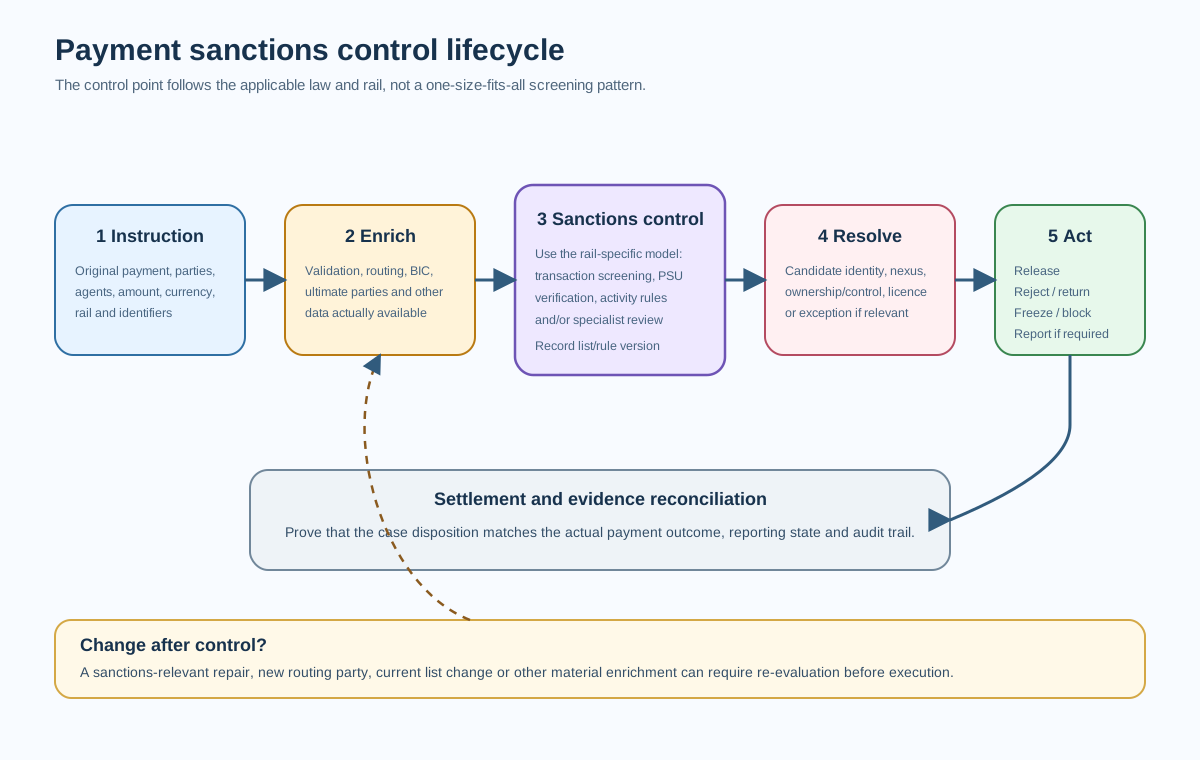
Where payment screening sits
Screening can occur at several stages: customer channel, payment hub, correspondent gateway, clearing interface or other processing point. A bank should know exactly which payment rails and message flows are screened and at which stage.
A control that screens outbound SWIFT payments but not inbound instant payments has a coverage gap. A control that screens only the customer-facing instruction but loses enriched intermediary data later can also miss relevant information.
Payment parties
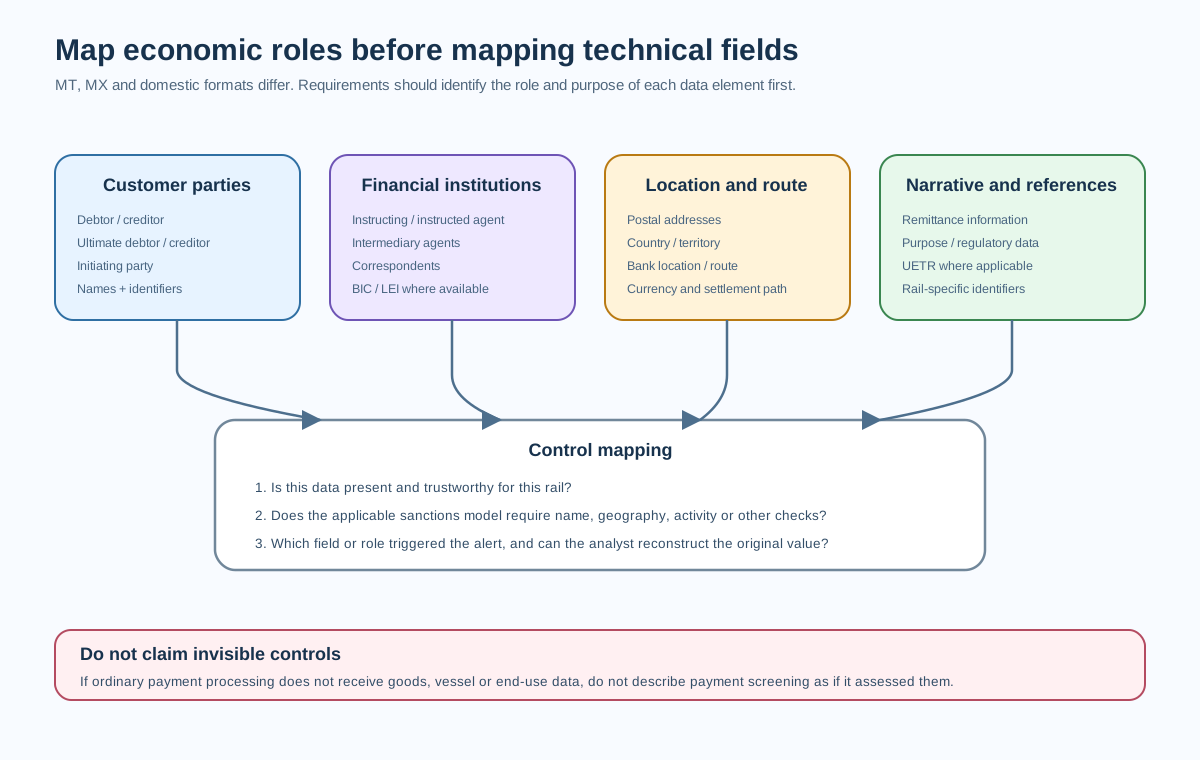
Depending on message type, relevant fields can include debtor, creditor, ultimate debtor, ultimate creditor, instructing agent, instructed agent, intermediaries, correspondent banks, account-with institutions, ordering customer, beneficiary customer and other parties.
The exact fields differ by rail and message standard. Requirements should therefore be message-aware rather than say “screen all names.”
ISO 20022 and structured data
ISO 20022 can carry richer structured party and address information than many legacy formats. That can improve screening, but only if fields are populated, mapped and preserved correctly.
A bank migrating from MT to MX should test whether names, addresses, ultimate parties, agents and identifiers arrive in the screening engine in the intended form. Rich data that is truncated before screening does not improve control quality.
Legacy payment formats
Legacy messages may contain free-text fields, abbreviations and compact party information. Screening logic needs to recognise that the same party can appear in several fields or in narrative text.
Historical assumptions should not simply be copied into new message formats. Field semantics matter.
What should be screened
Payment screening can consider party names, financial institutions, addresses, vessel or aircraft references, remittance text, free-form instructions and other data depending on risk and legal obligations.
The bank should not indiscriminately screen every word. That creates unnecessary noise. Each screened field should have a risk rationale.
Name matching in payments
Payment names are often shorter or less complete than KYC records. A beneficiary may be entered as “Mohd A Rahman” while a list record contains a longer transliterated form. Companies may use trading names.
Fuzzy matching helps, but payment screening must balance detection with throughput. Thresholds should be governed and tested against realistic payment data.
Payment addresses
Addresses can create country or geographic risk signals. They can also be incomplete or formatted inconsistently.
An address match should not be treated automatically as a designated-party match. However, address data can help resolve names and identify geographic restrictions.
Structured address migration should therefore be tested for sanctions impact as well as payment-format compliance.
Financial institution screening
Banks and intermediaries in the payment chain can themselves be subject to sanctions or restrictions. The payment engine should preserve institution identifiers such as BIC where relevant.
A clean customer and beneficiary do not guarantee the route is permissible if an intermediary creates a prohibited nexus.
Country and territory restrictions
Some programmes impose broad geographic or territorial restrictions; others are highly targeted. Banks should not use a single “sanctioned country” flag as a universal rule.
The legal question can depend on origin, destination, residence, location of goods, service, currency, bank entity and programme wording.
Sectoral and activity restrictions
A payment involving no listed party can still be prohibited or restricted because it finances a prohibited activity, debt instrument, service, investment, sector or trade.
Name screening alone cannot identify every such restriction. Banks need complementary product, trade and legal controls.
Goods and trade context
For trade-related payments, invoice, goods, vessel, port, end-user or export-control information can matter. Ordinary payment screening may not have all that data.
The bank should be precise about visibility. A payments team should not claim it screened goods that were never supplied to the system.
Payment holds
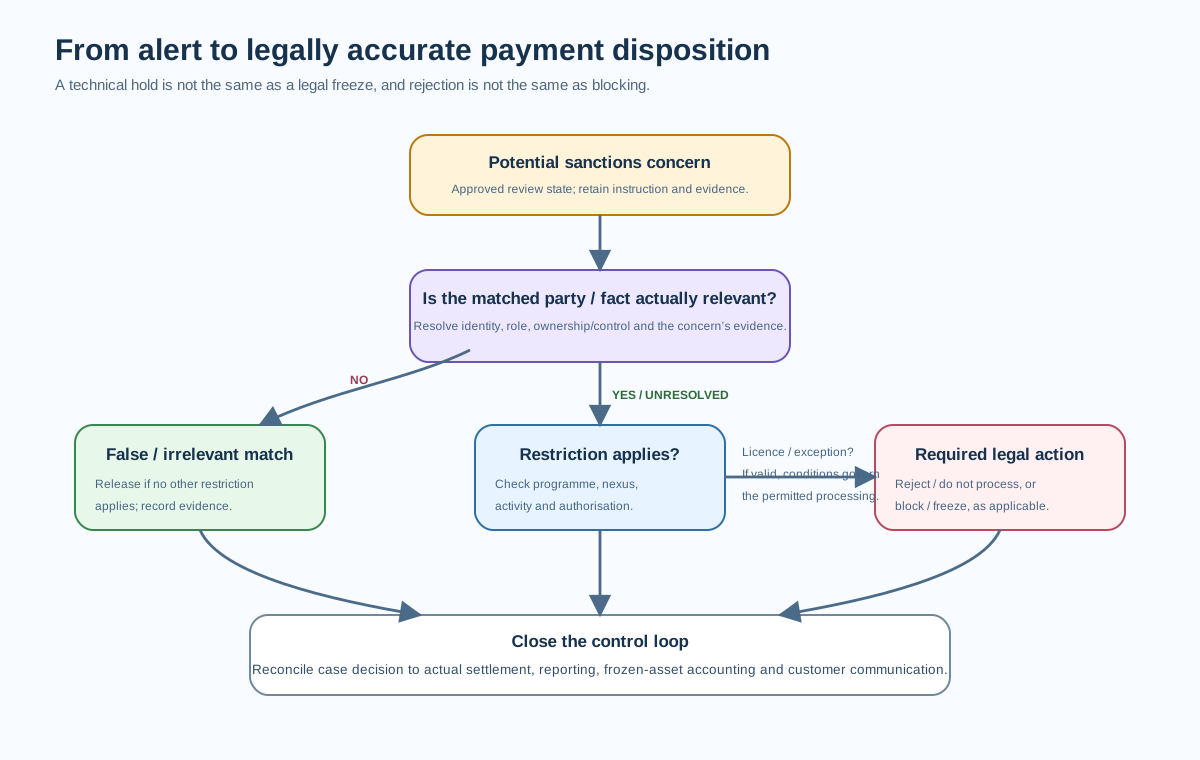
A potential sanctions match may trigger a temporary operational hold while the alert is investigated. This is not automatically the same as legally blocking or freezing funds.
Systems should distinguish “held pending review” from “blocked/frozen under law.” That distinction matters for accounting, customer communication and reporting.
Repair and re-screening
Payments can be repaired when fields fail validation or require correction. If a name, address, account or intermediary changes, the payment may need re-screening.
A mature design preserves the original value, amended value, user, timestamp, reason and screening events.
Screening sequence
The sequence can matter. If the payment is enriched after an early screening step, the bank should determine whether later enrichment creates new information requiring screening.
Likewise, a payment returned or repaired may re-enter the process and should not bypass controls because an earlier screening event already exists.
Potential match investigation
Payment analysts begin with the matched field and sanctions record. They compare available payment data with official or approved sanctions information.
Because payment data can be thin, the analyst may need KYC data, customer relationship information, correspondent details or an RFI. The objective is to reach a defensible payment disposition within the available time.
False positive in a payment
A false positive can be cleared when evidence shows the payment party is not the listed person. Closure reasons should be specific enough to support later review.
Repeated false positives can sometimes be reduced through good-list rules or customer-specific controls, but these need governance because an overly broad suppression can hide a future true match.
Potential true match
If the match cannot be safely cleared, escalation should occur according to the sanctions operating model. Legal, compliance or specialist sanctions teams may determine the applicable regime and disposition.
The analyst should not release a payment merely because no customer AML concern exists.
Block, reject or return
Different sanctions regimes can require different outcomes. In some cases funds must be blocked or frozen; in others a transaction may be rejected or otherwise not processed. A return can itself require screening and legal assessment.
Operational terminology should therefore map to legal concepts rather than use “blocked” as a generic word for every stopped payment.
Reporting
Certain sanctions events require reporting to a competent authority. Reporting obligations vary by jurisdiction, legal entity and event type.
The bank should capture enough evidence to support the report: party, payment, sanctions record, legal basis, amount, currency, action and relevant timestamps.
Customer communication
A held or rejected payment creates immediate customer questions. Communications should be accurate and compliant with legal restrictions.
The bank should avoid misleading wording such as “technical error” when the real issue is sanctions review if policy and law permit a more accurate message. At the same time, staff should not disclose protected investigative information.
Correspondent banking
Correspondent chains complicate payment screening because each institution sees different data. An intermediary bank can identify a sanctions concern that the originating bank did not detect.
Requests for information, rejection messages and return flows should preserve transaction identifiers and evidence.
UETR and traceability
For SWIFT gpi or applicable cross-border flows, UETR can help link screening, payment status, correspondence and investigations. It is not a universal identifier for all payment rails.
A BA should therefore define rail-specific identifiers rather than make UETR mandatory everywhere.
Instant payments
Instant payments create severe time pressure. Controls may need to decide within seconds, while sanctions law remains fully applicable.
This increases the importance of high-quality data, efficient matching, pre-screened customer information and escalation design. Institutions should not quietly weaken legal controls simply to meet scheme latency targets.
Batch payments
Corporate bulk files can contain many beneficiaries. The bank must define whether screening occurs per underlying transaction and how partial failures are handled.
A single potential match should not necessarily obscure the status of every other payment unless the processing model or law requires it.
Duplicate alerts
One payment can generate multiple alerts from the same party appearing in different fields. Case grouping can reduce analyst repetition while preserving which field triggered each alert.
The system should avoid collapsing distinct legal issues into one unexplained alert.
List updates during processing
A payment may enter the bank before a list update and remain pending when a new designation becomes effective. The operating model should define how in-flight payments are handled when sanctions data changes.
Time of designation, screening and settlement can all matter.
Screening failures
If the screening engine is unavailable, the bank needs a defined contingency. Options can include queueing payments, manual screening or controlled service restriction depending on risk and architecture.
“Continue and screen later” can be unacceptable for preventive sanctions controls unless explicitly supported by legal and policy analysis.
Vendor screening services
External screening technology can support scalability, but the bank remains accountable for coverage and configuration.
Service-level agreements should include availability, list-update timeliness, incident reporting and data protection.
Scenario: name hit in beneficiary
An outbound payment matches a designated individual’s name. Date of birth is unavailable in the message. KYC shows the beneficiary is a longstanding corporate supplier with different ownership and location.
The analyst uses the available evidence to clear the match and records the reasoning.
Scenario: unlisted owned entity
The beneficiary company is not listed but is owned by a designated entity under the applicable regime. A clean name screen is not sufficient; ownership analysis changes the outcome.
Scenario: prohibited activity without name hit
A transaction finances a restricted activity even though no party is listed. Screening alone cannot solve the problem; product or trade controls must identify the restriction.
Scenario: repair after screening
A beneficiary name is corrected after a payment failed format validation. The new value creates a sanctions match. The system should re-screen the payment and preserve both versions.
Scenario: instant payment alert
An instant transfer creates a high-confidence alert. The system routes it to a real-time decision service. If the alert cannot be safely resolved within the scheme window, the payment should follow the bank’s defined legal and operational fallback rather than be automatically released.
Business analyst view
A BA should map payment object, party roles, screening event, candidate match, hold, repair, decision, settlement status, return and report. Requirements should state which fields are screened for each message type and rail.
Acceptance criteria should include missing data, list update during processing, repair, duplicate alerts, system outage, batch partial failure, return flow and intermediary-bank rejection.
Data lineage
Investigators should be able to see the original payment instruction, transformation, enrichment and screened representation. If a field was truncated or transliterated, that transformation should be explainable.
A control is only as good as the data reaching it.
Metrics
Useful metrics include screening latency, hold duration, list-load timeliness, false-positive rate, true matches, payment value held or blocked, release errors, repair-triggered rescreening and screening outages.
Throughput must not become the only success measure.
Common mistakes
Common mistakes include screening only customer names, ignoring intermediaries and ultimate parties, treating all holds as legal blocks, failing to re-screen repairs, assuming a clean list result means an activity is permitted, and applying the same field logic to every payment rail.
Learning checkpoint
A reader should be able to map sanctions screening across the payment lifecycle, identify risk-relevant message data, distinguish temporary hold from legal block or freeze, explain why repair and re-screening matter, and design a payment-screening control that is both legally defensible and operationally workable.
Reference links
- OFAC — Sanctions List Service: https://ofac.treasury.gov/sanctions-list-service
- OFAC — Sanctions List Search Tool: https://ofac.treasury.gov/sanctions-list-search-tool
- UK Government — UK sanctions collection: https://www.gov.uk/government/collections/uk-sanctions
- OFSI — UK financial sanctions general guidance: https://www.gov.uk/government/publications/financial-sanctions-general-guidance
- FATF — Recommendation 16 and payment transparency materials: https://www.fatf-gafi.org/en/publications/Fatfrecommendations/recommendation-16-payment-transparency.html
Educational note: payment screening, blocking, rejecting, freezing and reporting obligations are jurisdiction- and programme-specific. Apply the rules relevant to the bank legal entity, payment route and sanctions nexus.
Operational deep dive: sanctions screening inside the payment engine
Payment screening is effective only when the bank knows exactly which transaction populations, message fields and processing states are controlled. A diagram of the payment flow should identify where screening occurs, where enrichment happens, where repairs can change data and which system owns the final disposition.
Coverage matrix
Build a matrix by payment rail, direction, message type, legal entity, channel and currency. For each row, identify screened fields, screening stage, fallback behaviour, re-screening triggers and evidence retained. This exposes silent gaps such as inbound flows screened differently from outbound flows or instant payments using a separate engine.
ISO 20022 field lineage
For MX flows, trace debtor, creditor, ultimate parties, agents, postal addresses, account identifiers and remittance from source message to screening request. If the engine receives only flattened text, document the loss of structure.
MT-to-MX migration testing
Migration testing should compare legacy and new-message outcomes using the same economic payment. A migration that passes schema validation can still weaken sanctions control if aliases, addresses or intermediary fields are mapped differently.
Repair governance
Any repair to screened party data should preserve old value, new value, reason, user and timestamp and should trigger re-screening when the change is sanctions-relevant. A repair screen should not become an informal way to suppress alerts.
Real-time architecture
Instant-payment controls need deterministic fallbacks. If the screening engine or case service is unavailable, the institution should know whether the transaction is queued, rejected, routed to contingency or otherwise controlled. The fallback should not be invented during an outage.
Screening latency
Measure end-to-end screening latency, not only algorithm execution time. Queueing, enrichment, network calls and analyst handling can all affect payment completion.
Correspondent-chain visibility
An intermediary bank may see originator or beneficiary data differently from the sending bank. The control should preserve UETR or other rail-specific identifiers so a later rejection or RFI can be linked to the original instruction.
Return and recall flows
A return is a new movement of value and should be assessed under applicable sanctions rules. Do not assume a returned payment is automatically safe because it reverses an earlier transaction.
Batch-payment handling
For a file of 10,000 payments, the design should state whether one sanctions alert stops the entire file or only the affected transaction. The decision depends on architecture, scheme rules and policy.
Screening of free text
Free-text screening can identify risk hidden in remittance or instruction fields but can create extreme noise. Define which fields are screened and why. Generic words and addresses may require different matching logic from names.
Vessel and trade-related data
Where vessel names, IMO numbers, ports or goods data enter the payment context, clarify whether the ordinary payment-screening engine handles them or whether a specialist trade-sanctions control does. Avoid claiming end-to-end coverage where the data is not available.
Payment-status integrity
A sanctions decision and payment status should not drift apart. A payment marked blocked in the case tool but released in the payment hub is a serious control failure. Reconciliation should compare case dispositions with actual settlement outcomes.
Duplicate alerts
One payment can trigger several candidate matches. Grouping improves analyst efficiency, but the system must preserve each matched field and list record so evidence is not lost.
In-flight list update
If a new designation becomes effective while a payment is pending, define whether and when pending populations are re-screened. This is especially important for queued cross-border payments and delayed settlement.
Post-event testing
Sample settled transactions and verify that they passed through the expected screening control with the correct list version. This proves operating effectiveness beyond configuration documents.
Practitioner checkpoint
A world-class payment-screening control can demonstrate population coverage, field lineage, latency, repair re-screening, outage handling, case-to-settlement reconciliation and legally precise disposition across every supported payment rail.
Advanced practitioner layer: payment sanctions screening across real payment architecture
Payment sanctions screening sits at an uncomfortable intersection: legal restrictions can be absolute or highly specific, while payment processing is engineered for speed, availability and straight-through processing. The control succeeds only when the bank understands which transactions are in scope, which data is available at each processing stage, when screening occurs, what can change after screening, and how the legal decision controls settlement.
The most dangerous design is one that says “payments are screened” without being able to draw the exact flow. A mature bank should be able to trace one instruction from channel or file intake through validation, enrichment, sanctions screening, repair, routing, clearing or correspondent handoff, settlement, return and reporting, showing where sanctions-relevant data is created or changed.
Screening coverage is a population question
The bank should maintain a coverage matrix by legal entity, payment rail, direction, message family, channel, currency and processing platform. Outbound cross-border wires, inbound wires, instant transfers, domestic credit transfers, corporate bulk files, internal book transfers, returns and manual payments can follow different technology paths.
A statement such as “all SWIFT payments are screened” is insufficient if one internal service creates SWIFT instructions after an upstream decision point, or if inbound messages use a different gateway. Coverage should be proven from production populations, not inferred from architecture slides.
Reconciliation can compare processed transaction counts to sanctions-screening event counts, adjusted for documented exclusions. Unexpected gaps should create control exceptions.
Customer screening and payment screening solve different problems
Customer screening asks whether a customer or connected party is subject to sanctions restrictions across the relationship lifecycle. Payment screening evaluates the specific event and the wider set of parties and data carried in that transaction.
A fully screened customer can send money to a newly designated beneficiary. A payment can involve an intermediary bank, ultimate party, vessel, address or remittance reference that is not part of customer KYC. Conversely, repeatedly screening the bank’s own known customer name inside every payment does not remove the need for customer rescreening.
The controls should share data but preserve their different purposes.
Map party roles, not just fields
Payment messages can contain debtor, creditor, ultimate debtor, ultimate creditor, initiating party, instructing agent, instructed agent, intermediary agents and other roles. The exact semantics vary by message type and rail.
A sanctions requirement should describe which role is screened and then map that role to concrete fields for each message format. This is safer than saying “screen field 50” or “screen all party fields,” because formats change and the same economic role may move to a different technical field.
The analyst workstation should also show the role. A match on the debtor’s bank is different from a match on the ultimate beneficiary even if both are represented as names.
ISO 20022 improves structure, not legal certainty
ISO 20022 can provide structured party names, postal addresses, agents, ultimate parties and identifiers. This can improve sanctions controls, but ISO 20022 does not itself detect sanctions exposure. The value exists only when data is populated correctly, preserved through transformations and sent to the screening engine with its semantics intact.
A migration programme should compare the same economic payment in legacy and ISO 20022 representations. It should verify party coverage, field length, structured-address handling, remittance mapping, agent identifiers and any conversion into flat screening strings.
Schema-valid MX is not proof of equivalent sanctions coverage.
Transformation and truncation risk
A source message can hold a long legal name and detailed address while an internal legacy interface accepts fewer characters. If the screening engine receives the truncated representation, the detection result may differ from what the original message would have produced.
The bank should document the screened representation and preserve the original. Where transformations are unavoidable, testing should include names whose discriminating terms appear near truncation boundaries.
This is especially important during coexistence periods where MT, MX and proprietary formats are transformed several times before settlement.
Structured addresses and screening logic
Structured postal addresses can improve geographic identification, but screening logic should distinguish country, town, street and free-text address lines. A country match is not the same as a party-name match.
Where a payment contains several addresses—debtor, creditor, ultimate party, agent—the alert should show which address created the concern. Otherwise investigators can make incorrect assumptions about the actual sanctions nexus.
A migration from free-text to structured addresses should be regression-tested because tokenisation and country extraction can materially change alert volumes.
BIC, LEI and account identifiers
Institution identifiers such as BIC can help identify financial institutions in a payment chain. LEIs may be available in some contexts. Account identifiers help link transactions and customers. These identifiers can support resolution but should not be treated as universally present or universally sanctions-relevant.
Requirements should state which identifiers are available by rail. A system should not reject a legitimate payment because an optional identifier is absent unless policy explicitly requires it.
Screening before and after enrichment
Payments often gain data as they progress. Routing logic can add intermediary institutions. FX processing can create settlement legs. payment repair can change names or addresses. Correspondent routing may be selected after initial validation.
If sanctions-relevant information is added after screening, the bank should determine whether re-screening is required. The safest design identifies a final sanctions-relevant data boundary: after that point, any material change triggers a new screening event.
This principle is more robust than assuming that one early screen remains valid regardless of downstream enrichment.
Repair is a controlled data change
A repair operator may correct a beneficiary name, BIC, address or account. Those changes can change the sanctions result. Therefore repaired fields should be classified as sanctions-relevant or not, and relevant changes should automatically trigger re-screening.
The audit trail should preserve original value, repaired value, user, reason, timestamp, prior screening result and new screening result. The payment should not return to straight-through processing until the new result is resolved.
Manual editing should never function as an informal way to bypass a sanctions alert.
Case lab: repair creates a true candidate
A payment initially contains AL NOOR TRD LLC and screens clear. Repair obtains the full legal name from the customer and changes it to a name that closely matches a sanctioned entity. The payment must be re-screened. The earlier clear result applies to the earlier data, not the corrected instruction.
A system that stores only the final payment hides how the risk emerged. Keeping both versions makes the decision reconstructable.
Correspondent banking and partial visibility
Each bank in a correspondent chain can see different information and can have different sanctions nexuses. An originating bank may know its customer well but have limited information on the beneficiary. An intermediary may receive structured agents and remittance data but no underlying commercial documents.
A downstream rejection does not automatically prove the originator’s control failed. It creates new information that should be assessed and linked to the original transaction.
Requests for information, return messages and sanctions-related correspondence should retain rail-specific identifiers so operations can reconstruct the chain.
UETR: useful where applicable, not universal
For SWIFT gpi and relevant cross-border flows, the Unique End-to-end Transaction Reference can help link payment status, correspondent events and investigations. It should not be designed as a mandatory identifier for every payment rail.
A BA should define a transaction-correlation model that uses UETR where available and the correct scheme or internal identifier elsewhere.
Returns are new sanctions-relevant events
A return moves value and can involve changed routing or current sanctions facts. The bank should not automatically release a return because it “undoes” a prior payment.
A designation may have occurred after the original settlement. An intermediary may have changed. The returning institution itself may create a new nexus. The return should therefore follow the bank’s defined sanctions assessment for that rail.
Recalls and requests for return of funds
A recall request is not itself settlement, but the eventual return or payment can create sanctions implications. Case management should link the original transfer, recall request, investigation and any return movement.
Where fraud operations, AML investigations and sanctions teams interact, each should preserve its own legal decision. “Fraud confirmed” does not answer whether returning funds is permitted under sanctions law.
Fraud, AML and sanctions handoff
The same payment can trigger fraud detection, sanctions screening and AML monitoring. The controls should share relevant facts without collapsing outcomes.
A sanctions true match is not proof of money laundering. An APP scam is not automatically a sanctions event. AML suspicion does not by itself create a legal asset freeze. Case orchestration should allow one transaction to carry several independent control states.
This is particularly important when fraud teams want to return funds quickly but sanctions review is unresolved.
Instant payments: speed does not remove legal obligation
Instant-payment schemes can require near-real-time responses. The bank therefore needs low-latency screening, high-quality data and deterministic fallback behavior. It should not simply raise thresholds until alerts fit within the scheme clock.
Where a potential match cannot be resolved in time, the payment should follow a pre-defined legal and scheme-compatible disposition. Depending on architecture and rules, that may involve not executing, rejecting or another controlled outcome. The exact answer is jurisdiction- and scheme-specific.
The control design should identify which decisions can be automated and which require human review.
Instant-payment false-positive engineering
Repeated common-name alerts can undermine real-time processing. Banks can improve performance through better identifiers, pre-screened customer/reference data, precise matching logic and narrow suppression controls. The solution should not be a broad “ignore this name” rule.
Any real-time suppression should have the same governance principles as customer-screening good-guys: specific scope, evidence, approval, effective date and re-evaluation after list or party changes.
Case lab: instant payment and high-confidence alert
An instant transfer beneficiary closely matches a designated individual and the payment contains little additional identifying data. The engine cannot safely clear the match within the scheme window.
A mature design invokes the predefined fallback. It does not release merely to meet latency and investigate later unless the legal/policy framework explicitly supports that model—which may be inappropriate for preventive sanctions controls.
The case outcome and scheme response should remain linked.
Batch and bulk payments
Corporate bulk files can contain thousands of underlying transactions. Screening should normally preserve transaction-level results even if the bank receives one file. The architecture must define what happens when one item alerts.
Some platforms can release clean items while holding the affected payment; others may hold the entire batch. The chosen design should reflect scheme rules, operational capability and policy rather than an accidental file-processing limitation.
The customer should receive accurate status at the appropriate level so that one sanctions review does not masquerade as a technical failure of unrelated payments.
Case lab: one alert in a 10,000-item file
A payroll or supplier file contains 10,000 payments, one of which generates an unresolved sanctions alert. If architecture supports item-level control, the 9,999 clean payments may continue while the one payment is held or rejected according to the bank’s process. If the platform can only control the file as a whole, that is a material operational limitation that should be visible to product and compliance governance.
The lesson is that sanctions design interacts with payment-file architecture.
List change while a payment is in flight
A payment can pass screening and then remain queued, repaired, warehoused for a future value date or delayed at a correspondent. If a new designation becomes effective during that period, the bank needs an explicit rescreening policy.
Future-dated payments are particularly relevant. Screening only at initiation can be insufficient if execution occurs days later. A mature system can rescreen at an appropriate pre-execution point using current sanctions data.
The policy should identify the legally and operationally relevant event, not rely on a generic “screen once” rule.
Screening-service outage and resilience
If the sanctions engine fails, the payment platform should not invent behavior. The bank should predefine responses by rail and risk: queue, reject, route to an approved alternate service, or use a realistic manual control where feasible.
The contingency must consider capacity. Manual review may be viable for a small number of high-value wires but impossible for tens of thousands of instant payments per hour.
After recovery, reconciliation should identify transactions processed, queued, manually screened or otherwise affected during the outage and determine whether retrospective action is necessary.
Case-to-settlement reconciliation
A sanctions case can say “blocked” while a technical payment status says “settled.” That discrepancy is a critical control incident. The bank should reconcile legal disposition with actual payment outcome.
Useful checks compare final case status, payment-hub status, clearing/settlement confirmation, returned funds and reporting state. High-risk mismatches should be escalated immediately.
This makes sanctions effectiveness measurable beyond alert closure.
Blocking, freezing, rejecting and operational holds
Payment systems often use a generic status such as BLOCKED. Compliance systems should be more precise. A temporary hold pending review is not automatically a legal block or asset freeze. A rejection means the transaction was not processed. A return moves funds back. Legal freezing can create separate asset-accounting and reporting obligations.
Status translation between case management and payment engines should be documented. One technical status may map to several legal states, and careless mapping can create incorrect regulatory reports.
Analyst evidence under payment time pressure
Payment investigators should see the original instruction, screened representation, matched field, party role, list record, source/version, identifiers, customer context, prior alerts, ownership intelligence where available, payment route and any repair history.
The workstation should make thin data obvious. If date of birth is unavailable for a beneficiary, it should say “not available,” not display an empty field that can be misread as a mismatch.
Case notes should explain the identity conclusion and the legal disposition separately.
Trade and vessel data: be honest about visibility
A trade-finance system may know vessel IMO, ports, goods description and commercial documents. An ordinary account-to-account payment may know none of these. Banks should not claim that payment sanctions screening controls all trade sanctions simply because it scans remittance text.
Where payment text contains meaningful vessel, port or goods information, rules can route it for specialist review. But the control statement should match actual data visibility.
Post-event testing
Operating-effectiveness testing can sample settled payments and prove that each passed the expected sanctions control with the correct list version. It can also replay historical transactions through controlled test configurations to assess whether rule changes would alter detection.
Samples should include different rails, directions, repairs, batch payments, instant transfers and returned transactions. This verifies the end-to-end process rather than only engine configuration.
Metrics that matter
Useful metrics include transaction-population coverage, screening latency by rail, list-version freshness, alerts per million payments, false-positive rate by field/role, repair-triggered re-screening, future-dated rescreening, held-payment ageing, outage duration, fallback volumes, case-to-settlement mismatches, return-screening coverage and quality-assurance overturns.
High throughput is not evidence of effective screening if relevant fields never reached the engine.
Business analyst acceptance criteria
A strong UAT pack should include outbound and inbound payments; MT and MX equivalents; ultimate parties; intermediary agents; structured and unstructured addresses; truncation; late enrichment; beneficiary repair; BIC change; instant-payment alert; batch partial failure; return; future-dated payment; designation after initial screening; list-load delay; screening outage; duplicate alerts; good-guy suppression; correspondent rejection; and a legal block reconciled to settlement state.
For each test, verify original data, screened representation, screening event, alert, case decision and actual payment outcome. A test is incomplete if it stops at “alert generated.”
Final practitioner checkpoint
A learner should be able to draw the sanctions control across a real payment architecture, identify exactly which roles and data are screened, explain why ISO 20022 structure helps but does not magically solve sanctions, define re-screening after repair or enrichment, design safe instant and batch behavior, handle returns and correspondent events, preserve separate fraud/AML/sanctions outcomes and prove that the final legal disposition controlled the actual settlement.
That end-to-end control is the real standard for payment sanctions screening.
Practitioner close: payment screening from instruction to final settlement
The final test of payment sanctions screening is not whether an engine generated an alert. It is whether the bank can prove that every relevant payment population reached the control, the right transaction data was screened at the right time, any material data change triggered the right re-screening, and the final sanctions decision controlled what actually happened to the money.
Coverage reconciliation by rail
A bank processes outbound cross-border wires, inbound wires, instant payments, domestic batch credit transfers, internal book transfers and returns. Several platforms are involved. The sanctions team says “all payments are screened,” but each rail has a different technical path.
A bank-grade control maps each rail, direction, legal entity, channel and message format to a screening event. Daily reconciliation can compare payment populations with screening populations, allowing for documented exclusions. Missing items should be exceptions requiring explanation.
This matters because an architecture diagram can be correct while a new channel or fallback path silently bypasses the screening interface.
Case lab: same payment, different message representations
A corporate customer submits a payment through a proprietary API. The payment hub converts it to ISO 20022 and a downstream gateway creates another representation for an external network. The source instruction contains a full beneficiary name, structured address, ultimate creditor and detailed purpose.
The screening service receives a flattened string that truncates the name and omits the ultimate party. The MX file itself is schema-valid, but sanctions coverage is weaker than the source data would allow.
Testing should therefore compare source data, internal canonical representation, screening request and outbound message. Message migration is a data-lineage exercise, not merely a syntax exercise.
MT/MX coexistence and parity testing
During migration, economically identical payments can travel as MT or MX depending on route, counterparty capability or system. The bank should build parity cases that represent the same debtor, creditor, agents, addresses and remittance data in each format and compare screening outcomes.
Differences are not automatically defects—MX may legitimately carry richer structure—but material loss of a screened party or identifier needs assessment. Transformation and transliteration rules should be documented.
Ultimate parties can matter
A payment may contain both immediate and ultimate debtor or creditor information. The bank should decide which roles are in scope for screening under its legal and policy framework and ensure those roles reach the engine.
A control statement should use business roles rather than hard-code one message field. This survives message-version changes and makes requirements understandable to compliance, operations and technology teams.
The case tool should tell analysts which role matched. “Name match in payment” is too vague when the same instruction contains several parties.
Case lab: late routing adds an intermediary
An outbound payment is screened early and passes. Routing then selects an intermediary bank that was not present in the original screening request. If the intermediary creates sanctions relevance, the initial screen is no longer the complete view.
The architecture should identify downstream enrichment that can add sanctions-relevant data. Where material information changes, an appropriate re-screening point should exist before execution.
This principle also applies to FX settlement legs, correspondent selection or other downstream transformations where new parties or jurisdictions are introduced.
Repair and maker-checker governance
A payment alerts because the beneficiary name is incomplete or malformed. Operations contact the customer and repair the name. The new value may strengthen the match or clear it.
The payment should be re-screened using the repaired data. The system should preserve old value, new value, reason, user, time and approval where required. The original alert should remain linked to the new screening event.
Repair should never allow an operator to edit a string merely to force a lower match score. Quality assurance can target cases where sanctions-relevant repairs are followed by immediate release.
Case lab: future-dated corporate payment
A corporate payment is initiated on Monday for execution Friday. It passes sanctions screening on Monday. A beneficiary becomes designated on Wednesday.
If the bank screens only at initiation, Friday execution can occur against stale sanctions facts. A mature design identifies future-dated or warehoused payments and rescreens at a point close enough to execution to apply current lists and rules.
The exact screening timing should be defined by the bank’s legal analysis, architecture and scheme obligations, but the system should not assume that an old clear result remains valid indefinitely.
Inbound payments and account restrictions
Inbound screening can create a different operational problem from outbound screening. Funds may already have arrived through a clearing or correspondent chain when the receiving bank identifies a sanctions issue.
The bank should define how incoming funds interact with account restrictions, legal freezes, rejection/return rules and reporting obligations. A payment engine cannot infer these legal states from a generic sanctions_hit flag.
The case-management result and account state should be coordinated so that a legally frozen account cannot accidentally make newly credited funds available.
Returns and sanctions facts can change
A return is not merely the reverse of the original transaction. It is a new movement of value occurring at a new time, possibly through a different route and under changed sanctions facts.
Suppose the original payer becomes designated after the first payment. Automatically returning funds without review can create a new sanctions problem. The return workflow should therefore invoke the applicable sanctions control rather than inherit the original transaction’s clear status.
Fraud recall with unresolved sanctions alert
A beneficiary receives scam proceeds. Fraud operations want to return funds urgently to the victim bank. At the same time, sanctions screening identifies a credible match involving one relevant party.
The bank should preserve separate control decisions. Fraud confirmation does not override sanctions law; sanctions concern does not erase the fraud case. Orchestration should prevent automated return until the sanctions question is resolved under the appropriate framework.
This is a practical example of why fraud, AML and sanctions states should be linked but not collapsed.
Instant payments and deterministic fallback
Instant-payment services cannot depend on ad hoc manual decisions when a screening component fails. The architecture should define what happens if the list service, matching engine, case service or network connection is unavailable.
Possible responses depend on scheme and legal constraints, but they must be pre-approved. The bank should know whether a payment is prevented from executing, rejected, queued where the scheme permits, or processed through an approved alternate control.
A fallback that exists only on a PowerPoint is not operational resilience. It should be tested under realistic peak volumes.
Screening latency budget
The matching engine may complete in 50 milliseconds while the total sanctions-control path takes 800 milliseconds because of enrichment, network calls and queueing. For time-critical payments, end-to-end latency is the meaningful measure.
The bank can break the latency budget into ingestion, validation, enrichment, screening, rule evaluation, case routing and disposition. Performance testing should include peak load and degraded dependencies.
The objective is to meet scheme performance without weakening detection thresholds simply to gain speed.
Batch case: partial versus whole-file control
A corporate file contains 5,000 payments and two generate unresolved sanctions alerts. If the platform supports item-level control, the bank may be able to hold or reject only the affected payments while processing clean items. If architecture can control only the entire file, the customer impact can be much larger.
The product decision should be explicit. Sanctions requirements should state the unit of control—file, batch or transaction—and ensure downstream accounting and status messages match that choice.
Correspondent RFI and later evidence
An intermediary bank requests more information about a transaction after the originating bank released it. The RFI may concern a party or purpose that was unclear in the original message.
The originating bank should link the RFI to the original payment using UETR where applicable or another stable correlation identifier. Customer response, subsequent return and any new sanctions investigation should remain part of one evidence chain.
A downstream bank asking a question does not prove the payment was prohibited, but it can reveal information that changes the originating bank’s assessment.
Suppression in transaction screening
Repeated false positives can tempt banks to create broad payment-screening suppressions. This is particularly risky because a transaction string can refer to different real parties over time.
Where suppression is used, it should be narrowly defined using reliable discriminators and governed with approval, expiry and change triggers. A rule such as “ignore beneficiary name X” can suppress a future true match if the same text later refers to another party.
Transaction suppressions should therefore be reviewed differently from customer-specific false-positive decisions.
Case-to-settlement reconciliation
The ultimate operating-effectiveness check compares the sanctions case result with real settlement. Examples of critical exceptions include:
- case says legally blocked but payment settled;
- payment was rejected but case says released;
- account is frozen in the sanctions platform but available in the core ledger;
- payment is held indefinitely after a false positive was cleared;
- return completed without the required sanctions review.
These exceptions bridge compliance and payment operations. They are often more informative than alert-count metrics.
Regulatory evidence and timestamps
For each payment decision, useful evidence can include original instruction, transformed screening representation, list version, rule version, matched field and role, alert time, analyst action, repair history, final disposition, payment status, settlement confirmation and reporting evidence.
Timestamps should use consistent time standards and preserve sequence across systems. In an instant-payment investigation, a few seconds can materially change the story.
Performance and effectiveness testing
Testing should combine functional and non-functional scenarios. Functional cases include designated party, clean party, ownership exposure, repaired data, future-dated payment, return and valid licence. Non-functional cases include peak batch, instant-payment load, delayed list service, screening outage and case-service timeout.
A system that detects the right match but cannot operate under production volume is not an effective preventive control.
Final 60-minute practitioner test
A learner should be able to choose one real payment rail and trace the sanctions control from source instruction through all transformations to final settlement. They should identify every screened role, explain where data can be lost or added, define re-screening after repair or late enrichment, handle future-dated and returned payments, design instant and batch fallbacks, preserve separate fraud/AML/sanctions decisions and prove that the final case disposition matches what happened to the funds.
That end-to-end trace is the practical standard for payment sanctions screening.
Practitioner masterclass: payment sanctions screening
Take one payment from initiation to settlement and identify every point where sanctions-relevant data can be created, transformed, enriched, repaired or lost. The exercise is valuable because most control failures happen between systems rather than inside the matching algorithm itself.
Exercise 1 — ISO 20022 lineage
Trace debtor, creditor, ultimate parties, agents, addresses and remittance from the original instruction to the screening payload. Mark any truncation or flattening.
Exercise 2 — payment repair
A beneficiary name is changed after format repair. Define when re-screening must occur and which old/new values must be retained.
Exercise 3 — instant payment outage
The screening API is unavailable for 90 seconds. Define the fallback behaviour without silently weakening preventive sanctions controls.
Exercise 4 — correspondent rejection
An intermediary rejects a payment for sanctions reasons. Link the return to the original transaction, preserve the reason and determine whether the return leg itself requires screening.
Exercise 5 — activity restriction
No party is listed, but the transaction funds a prohibited service. Explain why name screening cannot solve the case and which specialist control must intervene.
QA test
Sample settled payments and prove that the expected screening event, list version and disposition exist. Compare case state with actual settlement state.
Final test
The learner should be able to map sanctions control across payment rails, explain data lineage and repair, distinguish hold from block and design safe fallback behaviour for real-time processing.
60-minute mastery extension: payment sanctions screening
This extension is designed to make the chapter a minimum 60-minute guided learning experience. Spend about 25 minutes on the core chapter and diagrams, 15 minutes on the payment-control cases, 10 minutes on message/data lineage and 10 minutes on the final screening-sequence test.
Payment screening asks who, where and what is involved before value moves
Payment sanctions screening is not simply a beneficiary-name check. Depending on the payment rail, message and available data, relevant elements can include debtor, creditor, ultimate parties, account owners, instructing and instructed agents, intermediaries, addresses, remittance text, purpose, vessels, ports, goods or trade references. The bank should screen and assess the data required by its applicable sanctions obligations and risk framework without pretending to know information the payment never carries.
The screening population can also differ by payment type. A domestic retail payment, cross-border correspondent payment, securities payment and trade-finance transaction expose different data and legal questions. Requirements should therefore be rail- and message-aware rather than based on one universal payment template.
Worked case: payment repaired after screening
A customer initiates a cross-border payment. The original beneficiary name produces a sanctions candidate. Operations discover a data-format issue and repair the name using customer documentation. The repaired value no longer produces the same candidate.
The bank must preserve the original name, repaired name, reason, user, timestamp and relevant evidence. A material repair should trigger any required re-screening; it should not simply overwrite the original data. Later investigators should be able to reconstruct what the screening engine saw at each stage.
This is an important BA requirement: original payment data is evidence. Enrichment and repair can improve processing but should not destroy history.
Screening across a correspondent chain
A cross-border transfer can be screened by the originating bank, intermediary banks and the beneficiary bank, each under its own legal obligations and with its own view of the payment. One institution may see richer customer data than another. The fact that an upstream bank released a payment does not remove a downstream bank's obligations.
The bank should also avoid stating that one screening event "cleared the payment globally." Each institution makes its own decision based on applicable regimes, role and available data.
ISO 20022 payment transparency
ISO 20022 can support richer structured party and address data. That can improve screening and investigations when fields are populated and preserved. Richer standards do not automatically guarantee richer control data: mappings can truncate names, flatten structured addresses or omit ultimate-party information.
For accuracy, distinguish FATF Recommendation 16's strengthened standard from implementation timing. FATF agreed revisions in June 2025, consulted on implementation guidance in June 2026 and has indicated global readiness is expected by the end of 2030. Banks should therefore treat the strengthened standard as an implementation programme whose exact binding date depends on the applicable jurisdiction and payment ecosystem, rather than implying every revised element is already uniformly in force.
Message-lineage exercise
Select a payment and trace debtor, creditor, ultimate debtor/creditor where applicable, agents, addresses, remittance, purpose and identifiers from channel to payment engine, screening service, clearing/correspondent gateway and archive. Record transformations, truncation and repairs.
Then ask whether screening results can be reproduced using the original list version and payment data. If not, the audit trail is incomplete.
Screening outage
If a payment-screening service is unavailable, the fallback cannot be improvised during the incident. The bank should have approved contingency behaviour based on legal requirements, product, value, timing and risk. Some flows may stop; some may route to manual review; some may have defined controlled contingency procedures.
Every contingency payment should remain identifiable for any required later review or rescreening. System availability is therefore part of sanctions control effectiveness.
Return and reversal flows
Returning funds is itself a movement of value. A payment rejected or returned because of sanctions concern should not be assumed safe merely because value is moving back toward the originator. The applicable restrictions, property interests and legal instructions should be assessed for the return leg.
Systems need links between original transaction, reject/return reason, subsequent messages and final asset state.
Addresses and geographic screening
Address screening can help identify restricted geographies, but address quality varies. Free text can include cities, regions or transliterated names; structured addresses can be incomplete; country inferred from an IP address is different from a verified party address. Controls should preserve data source and confidence.
A country keyword in remittance text should trigger contextual review where relevant, not automatically prove that a restricted party or territory is involved.
Payment-control exercise
Design the sequence for an outbound cross-border payment: customer entitlement → fraud controls → sanctions screening → repair/enrichment if needed → rescreening → payment release → clearing/correspondent processing → booking → post-event monitoring. Identify which step owns a temporary hold and which specialist decides a true sanctions disposition.
Then adapt the sequence for an instant domestic payment and a trade-finance payment. The differences should be explicit.
Final screening-sequence test
For each scenario—candidate on debtor, candidate on intermediary bank, restricted geographic address, repaired beneficiary, vessel name in remittance, payment return, screening-service outage and post-settlement designation—state the immediate control action, data needed and evidence that must be preserved.
A strong learner should finish able to explain where payment sanctions screening operates, which data matters, why repairs and returns require control, and why payment transparency and sanctions legal analysis cannot be reduced to one name comparison.
Field-level screening maps for legacy and ISO 20022 formats
Effective payment screening starts from precise knowledge of which message fields reach the engine in what form, and this mapping must be built per format rather than assumed universal. Legacy MT formats concentrate party information in free-text fields with limited structure: field 50 variants for ordering customers with inconsistent subfield use, field 59 for beneficiaries without structured breakdown, and field 70 remittance information carrying narrative text that may include sanctioned-party references, vessel names or geographic indicators invisible to party-name screening. The screening map for each MT type specifies the fields extracted, the parsing applied to free-text content, the truncation points where downstream limits cut data before screening, and the character-set handling affecting transliterated names.
ISO 20022 migration transforms the mapping exercise from text parsing to structured-data utilisation, but only where implementation preserves structure end to end. Structured debtor, creditor, ultimate-party and agent elements with dedicated name, address and identifier subfields enable precise field-weighted screening far superior to flattened-text matching. Postal-address structure supports geographic-risk analysis without the false positives of free-text country-name matching. Purpose codes, remittance structured elements and regulatory-reporting blocks each carry screening-relevant content where populated. The critical control question for every migration is preservation: which structured elements survive each transformation between source instruction, payment-hub processing, correspondent forwarding and screening-engine input, with truncation, flattening and field-dropping identified and remediated rather than discovered through incidents.
Hybrid-operation periods, where legacy and ISO formats coexist across corridors and counterparties, demand dual-format screening maps with equivalence testing proving that identical economic payments screen equivalently regardless of format. Format-driven detection differences are control defects, not acceptable variance, and regression packs containing format-paired test cases should run continuously through migration programmes. Character-set and transliteration handling needs explicit specification per format, since the same name in different encodings or transliteration standards produces different match outcomes unless normalisation is designed and tested deliberately.
Repair-queue governance: preventing the bypass factory
Payment repairs, corrections to fields failing validation or requiring amendment, create sanctions risk wherever repaired payments re-enter processing without proportionate rescreening. Mature repair governance treats every repair touching screened data as a screening event: name, address, account, intermediary or amount changes trigger rescreening automatically, with the original values, amended values, repair reason, authoriser and timestamp preserved immutably in the case record. Repairs to non-screened fields proceed without rescreening delay, but the screened-versus-unscreened field classification must be designed conservatively, since repair operators under time pressure will route changes through whichever path processes fastest.
The bypass risk is behavioural as much as technical: repair queues become the path of least resistance for pushing through payments that screening would hold, whether through innocent efficiency-seeking or deliberate evasion. Segregation between repair authorisation and screening disposition prevents operators from repairing away alerts: repairs on held payments require sanctions-team concurrence, with the concurrence recorded and the rescreening outcome documented. Repair-pattern analytics detect the signatures of bypass behaviour: repeated repairs converging toward screenable forms, repair volumes concentrated on held payments, specific operators with anomalous repair-to-release rates, and repairs systematically removing geographic or vessel references. These analytics belong in the sanctions QA suite rather than general operations reporting, since their significance is control-specific.
Straight-through-processing optimisation must respect repair-governance boundaries: proposals to auto-repair and release defined failure types require sanctions-impact assessment proving the auto-repaired fields cannot carry sanctions significance, with approval and monitoring rather than operations-only implementation. Every STP expansion narrows human visibility, and the sanctions function must hold veto rights over expansions affecting screened data flows.
Instant-payment screening under hard time constraints
Instant-payment schemes compress the screening-to-disposition cycle into seconds with irrevocability removing the recovery options available in batch and deferred-settlement systems. The architectural response combines pre-positioned intelligence with deterministic real-time logic and rapid post-event processes. Pre-positioned controls include beneficiary risk scoring from historical and network data, customer-level velocity and behavioural limits calibrated to instant-payment fraud and sanctions typologies, and allow-list treatment for verified recurring beneficiaries that reduces friction without reducing protection. Real-time screening executes party, geographic and list matching within the scheme timeout with deterministic fallback behaviour for engine or data-feed unavailability: defined queuing with customer communication, defined rejection with reason coding, or defined acceptance with immediate enhanced post-event review, approved in advance with regulatory alignment where schemes mandate specific fallback treatment.
Post-event processes handle what real-time logic cannot resolve: alert investigation on settled instant payments with recovery pursued through scheme recall mechanisms where available, pattern analysis across instant-payment populations detecting networks invisible in single transactions, and customer-contact strategies for information gathering that respect tipping-off constraints. Recall effectiveness in instant-payment schemes depends on receiving-institution cooperation speed and scheme-rule support; the bank should measure its recall performance by corridor and counterparty institution, concentrating preventive controls where recovery proves structurally weak.
Scheme-rule compliance adds a dimension absent from correspondent screening: scheme participation mandates specific screening, timing and reporting behaviours with contractual consequences for failure. The bank's scheme-compliance mapping should specify each obligation, its implementation, and its monitoring, with scheme-attestation processes supported by control evidence rather than assertion. New-scheme onboarding must include sanctions-control design from inception rather than retrofitting after launch volumes expose gaps.
Pre-validation and beneficiary intelligence as prevention
The cheapest sanctions alert is the one never generated because the payment was validated before instruction. Pre-validation controls verify beneficiary details, including sanctions-screening pre-checks where the framework permits, account-existence confirmation, and format validation at the point of capture in digital channels. Customer-facing validation must balance prevention with tipping-off and data-protection constraints: pre-checks that disclose screening logic or list content to the instructing customer create evasion and information risks, so validation responses should confirm usability without explaining reasoning. Internal pre-validation, invisible to the customer, carries no such constraint and should be comprehensive.
Beneficiary intelligence accumulated across the bank's payment history provides the richest preventive signal: beneficiaries with verified clean histories, established commercial relationships and consistent transaction patterns justify streamlined treatment, while first-time beneficiaries in high-risk corridors with no verifiable commercial footprint warrant enhanced scrutiny before first payment. Beneficiary-risk tiers should drive differentiated processing paths with defined evidence requirements per tier, updated dynamically on behaviour change rather than fixed at first assessment. Shared-industry beneficiary intelligence, where lawful sharing mechanisms exist, extends the bank's history with consortium knowledge of mule, fraud and sanctions-evasion beneficiaries.
Payment-purpose verification completes the preventive layer for higher-risk payments: purpose codes, invoice references and supporting documentation checked for consistency with the customer profile and corridor before execution rather than investigated after alert. Purpose-based queuing, where defined high-risk purposes route to enhanced review pre-execution, prevents the settlement-before-investigation failures that characterise weak instant-payment and batch-processing controls. The preventive layer's effectiveness is measurable in alert-rate reduction for covered populations, investigation-time reduction from richer pre-execution data, and recovery-action reduction as fewer problematic payments settle.
Correspondent-chain screening responsibilities
Correspondent banking distributes payment-screening responsibility across institutions that each see partial information, and the resulting coverage depends on explicit allocation rather than assumed redundancy. Originator-bank responsibilities centre on complete and accurate originator-information inclusion per applicable funds-transfer recordkeeping and travel-rule frameworks, with the FATF's strengthened Recommendation 16 raising transparency expectations through the decade's end. Intermediary-bank responsibilities include preserving transmitted information intact through forwarding chains rather than degrading to respondent-level detail, screening per the intermediary's own obligations and risk assessment, and responding to information requests from downstream institutions investigating alerts. Beneficiary-bank responsibilities cover beneficiary verification, beneficiary-side screening and the investigation of alerts arising on receipt.
Message-quality enforcement makes these responsibilities operational rather than aspirational: completeness measurement by respondent with scoring and reporting, defect thresholds triggering enhanced requirements with deadlines, and relationship consequences for persistent stripping or template narratives. Cover-payment transparency deserves specific attention where MT202COV-style structures or their ISO equivalents separate settlement from underlying-transfer information; the control must join cover and underlying data for screening purposes rather than screening settlement messages stripped of originator context. Nested-correspondent scenarios, where respondent banks serve downstream institutions whose customers originate the flows, extend the responsibility chain another step with the same preservation and screening logic applied recursively.
Information-request cooperation between correspondents determines investigation quality for cross-border alerts: standardised request formats, defined response timeframes, escalation for non-responsive respondents, and the treatment of persistent opacity as a relationship-risk finding rather than a data-quality footnote. The cooperative infrastructure should be established through relationship agreements and industry channels before incidents require it, since cold outreach during time-critical investigations fails reliably.
UETR and end-to-end traceability in investigations
Unique End-to-end Transaction References provide the thread connecting payment fragments across institutions, formats and investigations, but only where banks preserve and utilise them systematically. Investigation procedure should mandate UETR capture for every cross-border payment under review, UETR-based inquiry to correspondents rather than amount-and-date descriptions that match multiple transactions, and UETR linkage in case records joining related messages, recalls, returns and reports into single traceable chains. gpi tracking data, where available, adds settlement-status visibility that focuses investigation on the funds' actual position rather than assumed flows.
Traceability gaps arise where UETRs are stripped in format conversions, omitted from legacy-message processing, lost across batching and netting, or simply ignored by investigators untrained in their use. Each gap type needs systematic remediation: format-mapping preservation requirements, batching-linkage standards maintaining end-to-end references through aggregation, and investigator training making UETR-first methodology reflexive. Recall and return effectiveness depends directly on traceability precision: receiving institutions act faster and more accurately on UETR-identified requests than on descriptive approximations, and the time saved translates into recovered funds in dissipation races.
Duplicate and related-alert grouping
Single payments frequently generate multiple candidate alerts across screened fields, parties and list records, and naive queueing presents each candidate as a separate case, multiplying workload while fragmenting evidence. Intelligent grouping consolidates payment-level candidates into single investigations preserving each matched field, list record and score within the grouped case, so that analysts assess the payment holistically rather than clearing fragments sequentially. Grouping logic must be transparent and conservative: over-grouping that merges genuinely distinct issues obscures risk, while under-grouping preserves the fragmentation the design aims to eliminate. Grouped-case documentation shows every constituent candidate with its disposition reasoning, preventing the characteristic failure where grouped alerts are closed on the weakest candidate's evidence while stronger candidates ride along unexamined.
Cross-payment grouping extends the logic to related transactions: payments sharing originators, beneficiaries, vessels, invoices or infrastructure may represent single underlying activity requiring joined investigation rather than parallel casework. Relationship-case structures link grouped payments to customer-level assessment where patterns indicate systematic behaviour, escalating from transaction disposition to relationship action where warranted. Grouping-effectiveness measurement tracks analyst-time savings, evidence-completeness scores for grouped versus ungrouped handling, and the rate at which grouping surfaces connections that fragmented review missed, demonstrating that efficiency gains accompany rather than trade against quality.
Statements, advices and camt-message screening touchpoints
Account-statement and advice messages, camt.052, camt.053 and camt.054 in ISO 20022 environments with legacy equivalents, carry counterparty and narrative detail that transaction-screening may miss where the original payment screened elsewhere or before information enrichment. Statement-level screening review catches the sanctions-relevant content arriving through reporting channels rather than payment instructions: counterparty names in entry details, remittance information expanded beyond instruction-time data, and charges and fee narratives identifying intermediaries invisible at instruction stage. The control design question is whether statement content feeds screening systematically or remains unexamined reporting data, with systematic treatment requiring defined extraction, matching and disposition procedures proportionate to the incremental coverage gained.
Investigation-report and status messages, pacs.002 payment-status reports with their reason codes and supplementary details, similarly carry sanctions-relevant information about rejected, returned and held payments across correspondent chains. Status-reason analysis identifies counterparties and corridors generating sanctions-driven rejections elsewhere in the chain, providing intelligence about exposure the bank's own screening has not yet encountered directly. Return-reason codes indicating sanctions action by other institutions should trigger review of the underlying customer relationship and similar pending flows, since another institution's rejection is risk information about shared counterparties rather than merely a processing exception. Message-type coverage mapping should inventory every message type the bank sends and receives for sanctions-relevant content with defined treatment per type, preventing the assumption that instruction screening covers the full message estate. Coverage gaps discovered through mapping, message types carrying party or narrative detail without defined screening treatment, enter the remediation backlog with risk-rated priority rather than remaining as accepted unknowns, since unexamined message content represents screening scope the bank cannot evidence. Mapping reviews should recur on defined cycles and after every payments-platform change, because message estates evolve continuously through scheme updates, vendor releases and corridor additions that silently alter screening coverage. Review findings should feed the payments-change governance process directly, so that coverage impacts are assessed before changes deploy rather than discovered through post-implementation incidents. Change proposals affecting screened message flows should carry sanctions-impact sign-off as a mandatory gate.
Authoritative anchors
FATF Recommendations: https://www.fatf-gafi.org/en/publications/Fatfrecommendations/Fatf-recommendations.html
FATF Recommendation 16 consultation, June 2026: https://www.fatf-gafi.org/en/publications/Fatfrecommendations/R16-Public-Consultation-June-2026.html
OFAC: https://ofac.treasury.gov/
UK sanctions guidance: https://www.gov.uk/government/collections/uk-sanctions
Visual control checkpoint: where screening actually occurs
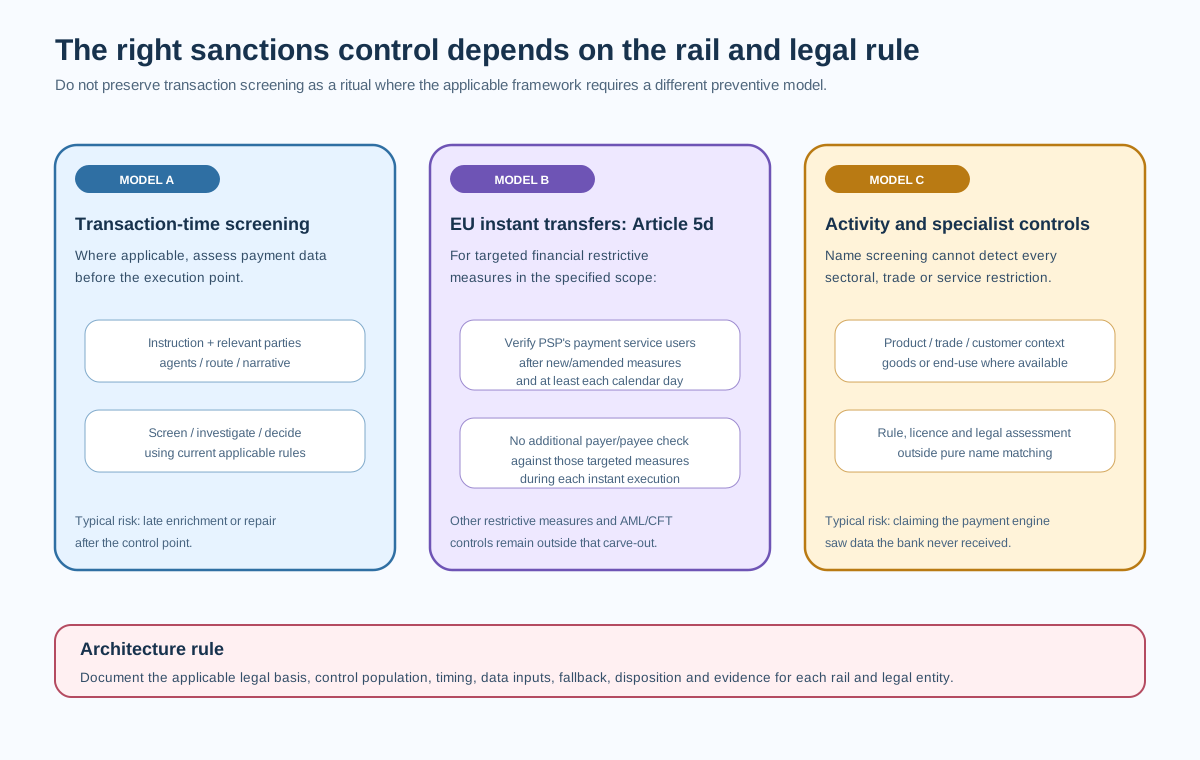
The key learning is that sanctions coverage is a processing-chain question. A payment can acquire new risk-relevant data after an early screening step, so enrichment, repair and routing changes must be assessed for re-screening rather than assuming one initial check covers the entire lifecycle.
Current-source control note: payment screening is jurisdiction and rail specific
Payment sanctions screening should never be described as one globally uniform control. The practical architecture depends on the legal entity, applicable sanctions regime, payment rail, transaction stage and the data actually available to the institution. A bank may use transaction screening as a preventive control in one flow while another jurisdiction or scheme requires a different control model. The control objective is compliance with the applicable restriction, not preservation of a particular legacy screening pattern.
United States: distinguish blocking from rejection
OFAC's public guidance makes an important operational distinction. A transaction can be prohibited without containing a blockable interest. In that case a U.S. financial institution may have to reject rather than block the transaction. OFAC FAQ 36 explains this distinction using a wire-transfer example. OFAC FAQ 49 separately states that blocking and reject reports required by 31 C.F.R. Parts 501.603 and 501.604 are due within 10 business days and must include the original transfer instructions.
For payment architecture, that means HOLD, REJECTED, RETURNED and BLOCKED/FROZEN cannot be treated as synonyms. A temporary operational hold is an investigation state. Rejection means the payment is not processed. A return is another movement of value that can need its own sanctions assessment. Blocking or freezing is a legal disposition with asset-control and reporting consequences. The exact action depends on the applicable programme, nexus, parties and authorisations.
OFAC's 2019 Framework for OFAC Compliance Commitments remains a useful U.S. programme-design reference. It emphasises management commitment, risk assessment, internal controls, testing/auditing and training. It does not prescribe one universal screening threshold or one technology pattern for every institution. Payment-screening configuration therefore remains a governed control design that must be supported by the institution's sanctions risk assessment and legal obligations.
United Kingdom: use the current list source and the current legislation
OFSI's UK financial sanctions general guidance was updated on 12 May 2026. It states that the legal prohibitions and obligations must be determined from the up-to-date legislation for the specific sanctions regime. From 28 January 2026 the UK Sanctions List became the only current source for all UK sanctions designations; the former OFSI Consolidated List is no longer updated.
This creates an immediate operational requirement for banks that historically loaded both sources. List ingestion, delta processing, identifiers, regression testing and alert evidence should show which source and list version were used. A payment investigator should not rely on a stale local copy merely because the name-matching engine itself is available.
UK reporting and licensing also reinforce the distinction between detection and legal disposition. OFSI's general guidance sets reporting expectations for relevant institutions and explains that licences can only be issued where the relevant legal grounds exist. The bank therefore needs a source-to-decision chain: current designation data, applicable regime, ownership/control analysis where relevant, prohibition, exception or licence, operational action and regulatory reporting.
European Union: instant credit transfers require a specific control model
The EU Instant Payments Regulation, Regulation (EU) 2024/886, amended Regulation (EU) No 260/2012 by inserting Article 5d. This is a critical boundary for any generic statement that instant payments must always be screened transaction by transaction.
For payment service providers offering instant credit transfers, Article 5d requires verification of their payment service users against persons or entities subject to targeted financial restrictive measures immediately after new or amended targeted financial restrictive measures enter into force and at least once every calendar day. During execution of an instant credit transfer, the payer's PSP and the payee's PSP are not to perform an additional verification of the payer or payee against those targeted financial restrictive measures beyond the Article 5d(1) verification model.
That rule is specific. It does not mean that all sanctions controls disappear from EU instant payments. Article 5d expressly preserves actions needed to comply with restrictive measures other than the targeted financial restrictive measures covered by that paragraph, with other restrictive measures, and with Union AML/CFT law. It also does not create a global rule for instant payments outside the EU.
The practical design lesson is therefore more precise than 'screen faster'. For in-scope EU instant credit transfers, the bank needs a highly reliable customer-verification and list-update process capable of reacting immediately to new or amended targeted measures and operating at least daily, while preserving separate controls for other restrictions that remain relevant. For other payment rails or jurisdictions, transaction-time screening may remain appropriate or required. The architecture should make this distinction explicit rather than applying one global instant-payment pattern.
The EBA's final Guidelines on internal policies, procedures and controls to ensure implementation of Union and national restrictive measures apply from 30 December 2025. They include a set specifically for PSPs and crypto-asset service providers performing transfers of funds or crypto-assets. The Guidelines focus on governance, KYC, screening and due diligence and should be read together with the applicable EU legal acts. Responsibility for EU-level AML/CFT tasks moved from the EBA to AMLA on 1 January 2026, while existing EBA AML/CFT guidelines remain valid until replaced where the AMLA Regulation provides for continuity.
The EU's 2025 implementing rules and the EBA's April 2026 reporting decision also require reporting of the share of payment rejections due to targeted financial restrictive measures. That makes outcome coding and reason lineage operationally important: a PSP should be able to distinguish an instant payment not executed because of a targeted measure from a technical rejection, fraud control, AML control or another sanctions restriction.
FATF Recommendation 16: current standard versus implementation timetable
FATF agreed revisions to Recommendation 16 in June 2025. FATF's June 2026 consultation on supporting guidance confirms that countries are expected to be ready to implement the strengthened payment-transparency changes by the end of 2030. The consultation closed on 21 August 2026.
The chapter should therefore use the revised Recommendation 16 as a direction of travel and implementation programme, not as proof that every revised data element or control is already identically binding in every jurisdiction. Payment transparency and sanctions screening are related but different disciplines: better originator, beneficiary and payment data can improve sanctions detection and investigation, while the legal sanctions decision still comes from the applicable sanctions framework.
SWIFT, ISO 20022 and correspondent chains
Message standards provide data; they do not determine legal outcome. ISO 20022 can improve structure for debtor, creditor, ultimate parties, agents and postal addresses, but the bank must prove that data is populated, preserved through translation and enrichment, and supplied to the relevant control. An MX message that is schema-valid can still lose sanctions-relevant information through internal truncation or mapping.
Correspondent chains add another boundary. Each institution can have a different legal nexus and different visibility. A downstream rejection or hold is new evidence, not automatic proof that the originating bank's control failed. The originating bank should link the downstream event to the original payment, preserve identifiers such as UETR where applicable, and reassess the transaction using the information now available.
Control implications for a bank
A defensible payment-screening design should maintain a coverage matrix by legal entity, rail, direction, message family, channel, currency and processing platform. For each combination, the bank should be able to state what is screened or otherwise verified, at what point, against which reference data, what changes trigger re-evaluation, how unresolved cases affect execution, and how the final legal disposition is reconciled to settlement.
The strongest control evidence is end to end. It links the original instruction, transformed representation, sanctions list version, matched field and party role, alert, investigation evidence, legal basis, licence or exception if relevant, case decision, actual payment outcome and any report to the competent authority. Where a legal framework intentionally uses periodic or event-driven customer verification instead of transaction-time payer/payee screening, as Article 5d does for its specific EU instant-payment scope, the evidence should demonstrate that alternative control model rather than pretending a transaction screen occurred.
Sources verified 15 September 2026
- FATF — The FATF Recommendations, amended June 2026: https://www.fatf-gafi.org/en/publications/Fatfrecommendations/Fatf-recommendations.html
- FATF — June 2026 consultation on guidance for strengthened Recommendation 16: https://www.fatf-gafi.org/en/publications/Fatfrecommendations/R16-Public-Consultation-June-2026.html
- U.S. Treasury OFAC — FAQ 36, blocking versus rejecting transactions: https://ofac.treasury.gov/faqs/36
- U.S. Treasury OFAC — FAQ 49, reporting blocked and rejected transactions: https://ofac.treasury.gov/faqs/49
- U.S. Treasury OFAC — A Framework for OFAC Compliance Commitments: https://ofac.treasury.gov/recent-actions/20190502_33
- UK Office of Financial Sanctions Implementation — UK financial sanctions general guidance, updated 12 May 2026: https://www.gov.uk/government/publications/financial-sanctions-general-guidance/uk-financial-sanctions-general-guidance
- UK Government — UK sanctions collection and current UK Sanctions List information: https://www.gov.uk/government/collections/uk-sanctions
- EUR-Lex — Regulation (EU) 2024/886, including Article 5d on targeted financial restrictive measures and instant credit transfers: https://eur-lex.europa.eu/legal-content/EN/ALL/?uri=CELEX:32024R0886
- European Banking Authority — final Guidelines on internal policies, procedures and controls for Union and national restrictive measures: https://www.eba.europa.eu/activities/single-rulebook/regulatory-activities/anti-money-laundering-and-countering-financing-terrorism/guidelines-internal-policies-procedures-and-controls-ensure-implementation-union-and-national
- European Banking Authority — 10 April 2026 decision on SEPA reporting, including rejections due to targeted financial restrictive measures: https://www.eba.europa.eu/publications-and-media/press-releases/eba-publishes-decision-harmonising-reporting-sepa-data-national-authorities
- Wolfsberg Group — Sanctions Screening Guidance: https://wolfsberg-group.org/resources/legacy/53
- Wolfsberg Group — Payment Transparency Standards: https://dev.wolfsberg-group.org/resources/correspondent-banking/136
Knowledge check
-
Why can customer sanctions screening never fully replace payment sanctions screening?
-
What should a bank prove when it says a payment population is “screened”?
-
Why can ISO 20022 improve sanctions screening while still not determining whether a payment is legally permitted?
-
When should a repaired or enriched payment be screened again?
-
Why must the sanctions case disposition be reconciled with the actual payment or settlement status?
-
What is the correct control principle when an instant-payment alert cannot be safely resolved inside the scheme response window?
Answer guide
Payment screening evaluates transaction-specific parties, agents, addresses, remittance information and routing that may not exist in customer KYC. Coverage should be evidenced by legal entity, rail, direction, message family, channel, processing platform and screened roles, with reconciliation between actual payment populations and screening events. ISO 20022 can provide richer structured data, but sanctions applicability still depends on law, nexus, ownership, activity and permissions. A material change to sanctions-relevant data after screening—such as beneficiary name, agent, address, BIC or other relevant enrichment—should follow the bank’s defined re-screening rule and preserve original and amended data. Case-to-settlement reconciliation ensures that a legal block/reject/release decision actually controlled execution. For instant payments, the bank should invoke a pre-defined legal and scheme-compatible fallback rather than weakening screening merely to meet latency; the exact disposition depends on applicable law and scheme rules.
Glossary
Payment population — The set of transactions in scope for a defined sanctions-screening control, classified by rail, direction, message, channel, legal entity and processing path.
Party role — The economic or messaging role of a person or institution in the payment, such as debtor, creditor, ultimate party or agent.
Screened representation — The actual data string or structured record sent to the screening engine after any transformation, normalisation or truncation.
Enrichment — Addition of payment data during processing, such as routing, intermediary or other information that may create a new sanctions-relevant fact.
Repair — Manual or automated correction of a payment field after initial capture or validation; sanctions-relevant repairs may require re-screening.
Re-screening — A new screening event after material data, list or timing changes under the bank’s control policy.
Correspondent chain — The sequence of financial institutions involved in transmitting or settling a cross-border payment; each institution can have different data and legal obligations.
UETR — Unique End-to-end Transaction Reference used in relevant SWIFT cross-border payment flows to support transaction correlation; it is not a universal identifier for every rail.
Operational hold — A temporary stop while an alert is investigated, distinct from a legal freeze or block.
Settlement reconciliation — Verification that the final sanctions disposition matches the actual payment, clearing or settlement outcome.
Fallback control — The approved operating response when screening or case infrastructure is unavailable or cannot complete within the required processing window.
Payment transparency — The availability and preservation of originator, beneficiary and payment-chain information; richer transparency supports controls but does not itself decide sanctions legality.
References and further reading
Payment sanctions screening must be designed around the applicable sanctions law, the bank legal entity, the payment rail, actual data visibility and the point at which the institution can still control execution. Payment-transparency standards can improve detection inputs but do not themselves determine the sanctions legal outcome.
Global standards and industry guidance
- FATF — The FATF Recommendations, amended June 2026: https://www.fatf-gafi.org/en/publications/Fatfrecommendations/Fatf-recommendations.html
- FATF — June 2026 consultation on guidance for the strengthened Recommendation 16 payment-transparency standard: https://www.fatf-gafi.org/en/publications/Fatfrecommendations/R16-Public-Consultation-June-2026.html
- Wolfsberg Group — Sanctions Screening Guidance, covering screening governance, transaction screening, list management, alert handling, testing and quality assurance: https://wolfsberg-group.org/resources/legacy/53
- Wolfsberg Group — Payment Transparency Standards: https://dev.wolfsberg-group.org/resources/correspondent-banking/136
United States
- U.S. Treasury OFAC — Sanctions List Service: https://ofac.treasury.gov/sanctions-list-service
- U.S. Treasury OFAC — Sanctions Programs and Country Information: https://ofac.treasury.gov/sanctions-programs-and-country-information
- U.S. Treasury OFAC — FAQ 36, distinction between blocking and rejecting transactions: https://ofac.treasury.gov/faqs/36
- U.S. Treasury OFAC — FAQ 49, reporting blocked and rejected transactions: https://ofac.treasury.gov/faqs/49
- U.S. Treasury OFAC — A Framework for OFAC Compliance Commitments: https://ofac.treasury.gov/recent-actions/20190502_33
United Kingdom
- UK Office of Financial Sanctions Implementation — UK financial sanctions general guidance, updated 12 May 2026: https://www.gov.uk/government/publications/financial-sanctions-general-guidance/uk-financial-sanctions-general-guidance
- UK Government — UK sanctions collection and UK Sanctions List resources: https://www.gov.uk/government/collections/uk-sanctions
- UK Government — How to use exceptions and licences to comply with sanctions, updated 23 April 2026: https://www.gov.uk/guidance/how-to-use-exceptions-and-licences-to-comply-with-sanctions
European Union
- EUR-Lex — Regulation (EU) 2024/886, including Article 5d on verification of payment service users for targeted financial restrictive measures in instant credit transfers: https://eur-lex.europa.eu/legal-content/EN/ALL/?uri=CELEX:32024R0886
- European Banking Authority — final Guidelines on internal policies, procedures and controls to ensure implementation of Union and national restrictive measures, applicable from 30 December 2025: https://www.eba.europa.eu/activities/single-rulebook/regulatory-activities/anti-money-laundering-and-countering-financing-terrorism/guidelines-internal-policies-procedures-and-controls-ensure-implementation-union-and-national
- European Banking Authority — 10 April 2026 decision harmonising SEPA reporting, including reporting on rejections due to targeted financial restrictive measures: https://www.eba.europa.eu/publications-and-media/press-releases/eba-publishes-decision-harmonising-reporting-sepa-data-national-authorities
- European Commission — Overview of EU sanctions and related resources: https://finance.ec.europa.eu/eu-and-world/sanctions-restrictive-measures/overview-sanctions-and-related-resources_en
Accuracy note — reviewed 15 September 2026: the strengthened FATF Recommendation 16 changes agreed in June 2025 are expected to be implemented by countries by the end of 2030, while FATF consulted on supporting guidance in 2026. The EU has a specific rule for in-scope instant credit transfers under Article 5d of Regulation (EU) No 260/2012 as amended by Regulation (EU) 2024/886: PSPs verify their payment service users immediately after new or amended targeted financial restrictive measures and at least once each calendar day, and do not add a payer/payee verification against those targeted measures during execution of each instant transfer. That rule does not remove controls for other restrictive measures and is not a global instant-payment standard. ISO 20022 or richer payment data can improve control inputs, but no message standard by itself determines whether a sanctions restriction applies.