Name Matching, Aliases and Transliteration
Sanctions screening rarely compares two perfectly identical names. Real customer and payment data contains spelling variation, abbreviations, transliteration differences, nicknames, former names, legal suffixes, initials, reordered tokens, punctuation, accents and incomplete data. A bank therefore needs matching logic that can identify plausible candidates without turning every similar name into an operational crisis.
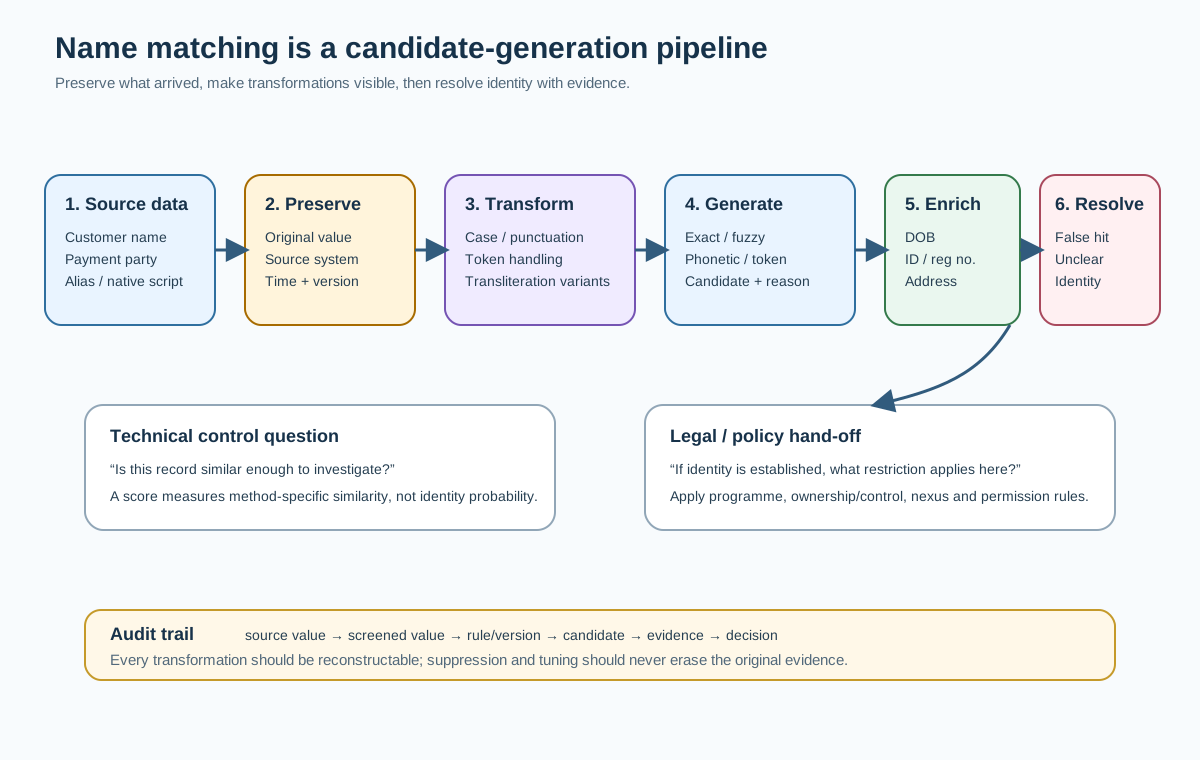
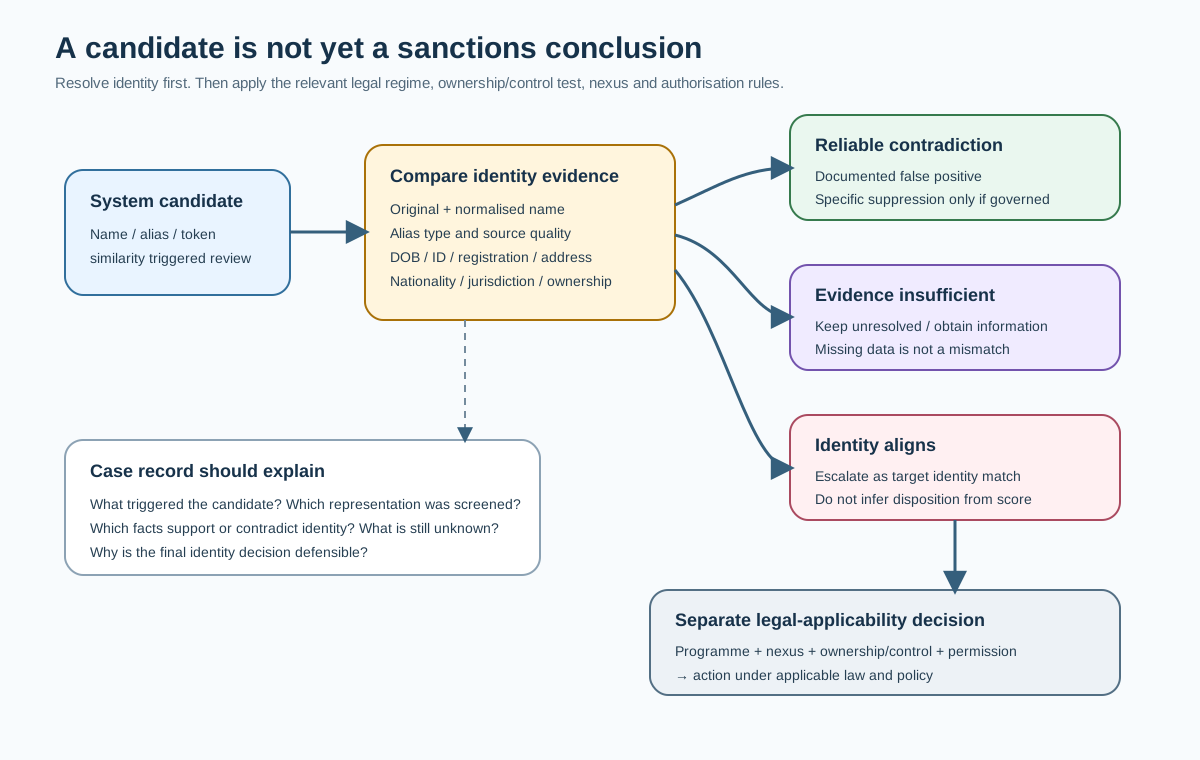
The key principle is that matching is a candidate-generation process, not a legal conclusion. The algorithm should identify records worth investigating. The analyst then uses identifiers, context, ownership and the relevant sanctions regime to decide what the match means.
Exact matching
Exact matching compares the screened value with a sanctions value after defined transformations. It is simple, explainable and useful for highly distinctive names or identifiers.
Its weakness is sensitivity to variation. “Mohammed Al Rahman” and “Muhammad al-Rahman” may refer to the same person but fail an exact string comparison.
Fuzzy matching
Fuzzy algorithms score similarity rather than require identity. They can compare edit distance, phonetic similarity, token overlap, token order or other features.
OFAC's public Sanctions List Search tool itself uses fuzzy logic for name searches, illustrating why sanctions-name matching cannot depend only on exact strings.
A fuzzy score should be understood as an algorithmic similarity measure, not a probability that the customer is sanctioned.
Tokenisation
Names can be split into components or tokens. This can help when word order changes or when one part is omitted.
Tokenisation can also create noise. Common tokens such as “Bank,” “Trading,” “Mohamed” or “International” may match many records.
The bank should understand which tokens drive a score.
Stop words and legal suffixes
For entities, suffixes such as Ltd, LLC, PLC, GmbH or SA can be normalised or down-weighted. Generic words may also be treated differently.
However, removing too much information can make distinct companies look identical. Configuration should be tested against the institution's customer population.
Initials
Initials can produce ambiguous matches. “M A Khan” may correspond to many people. A system that generates high-confidence alerts from initials alone can create enormous noise.
Other identifiers should therefore become important in resolution.
Aliases
Sanctions data may include alternate names, aliases, former names, spelling variants, nicknames or weak aliases. The bank should know how its provider categorises them.
A weak alias can be too generic to carry the same evidential weight as a strong alias. Analysts should see which alias triggered the alert and how it is classified.
Former names
Companies and individuals can change names. Former-name data can be highly relevant because sanctions exposure does not disappear merely because a legal entity rebrands.
KYC systems should preserve name history where appropriate.
Transliteration
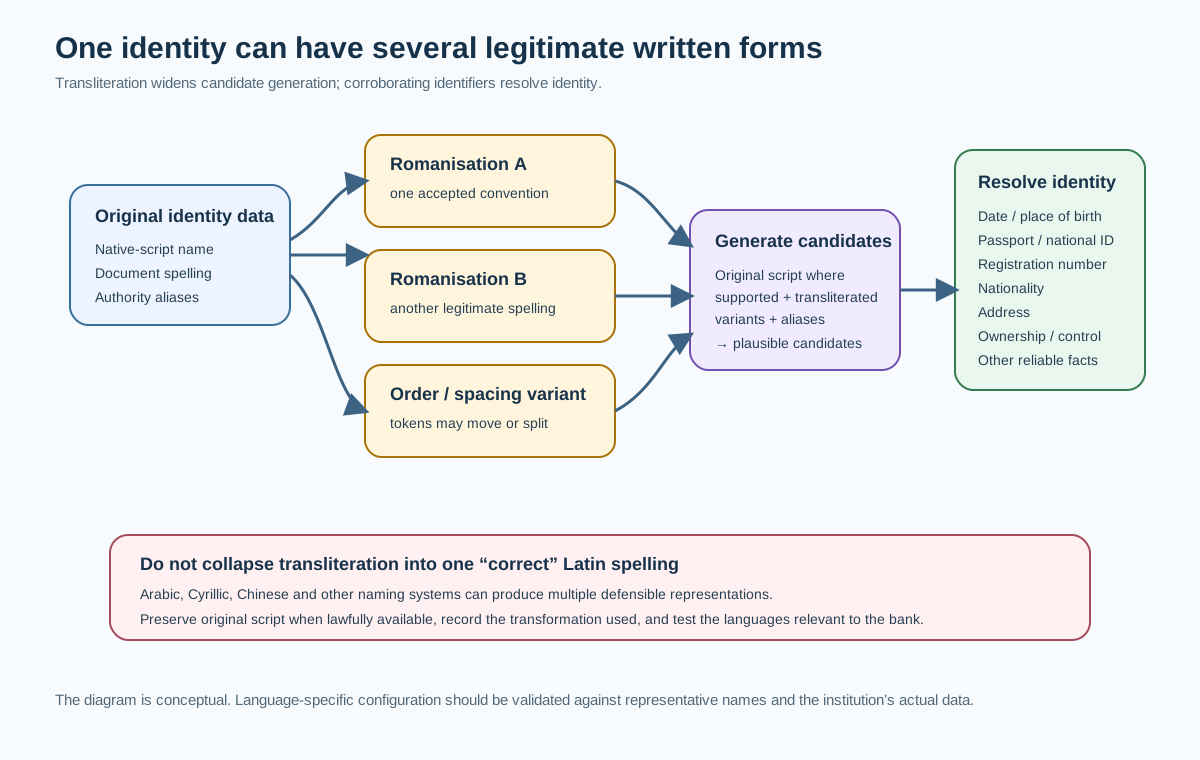
Transliteration converts names from one script into another. Arabic, Russian, Chinese and other languages can produce multiple valid Romanised forms.
There is often no single correct transliteration. Screening systems therefore need controlled variation rather than one preferred spelling.
Arabic-name considerations
Arabic names can include multiple components, patronymics, family names and particles. English spellings can vary substantially.
A matching engine should not assume that removing particles or reordering every token is always safe. It should be tested using realistic examples and supporting identifiers.
Cyrillic-name considerations
Russian and other Cyrillic names can have different English transliterations depending on convention. Patronymics can be included or omitted.
A sanctions record and customer passport may therefore differ while referring to the same person.
Chinese-name considerations
Chinese names can appear in different romanisation systems or word orders. Distinguishing family and given name can be important.
As with other scripts, a name-only conclusion is unsafe when better identifiers exist.
Diacritics and accents
Accents and diacritics can be normalised for comparison, but the original value should be retained. “José” and “Jose” may be treated as comparable for candidate generation while preserving the source spelling for evidence.
Word order
Entity and personal names can appear in different orders. Matching logic may allow token reordering, but this can increase false positives.
The configuration should reflect the languages and naming structures in the bank's customer base.
Abbreviations
A company may be registered as “International Commercial Trading Company Limited” but trade as “ICTC Ltd.” Abbreviations can be difficult to match without additional data.
Banks should not expect fuzzy text alone to resolve every trading-name issue.
Registration numbers and identifiers
Identifiers can be much more powerful than names. Passport numbers, national IDs, registration numbers, IMO numbers for vessels or other official identifiers can strongly support or disprove a candidate match.
A mature screening engine should make these fields visible to analysts when legally available.
Date of birth
Date of birth can be exact, partial, approximate or represented differently in sanctions data. An analyst should understand the quality of the source record.
A mismatch can be decisive in some cases but not always if the sanctions record itself contains uncertain or multiple birth dates.
Nationality and citizenship
Nationality can help distinguish common names but should not be used as a simplistic exclusion. People can hold multiple nationalities or change citizenship.
Address data
Addresses can be current, former, incomplete or shared. A matching address can strengthen a case, but a different address does not automatically clear a person.
Address should be considered alongside the full identity evidence.
Vessels and aircraft
Sanctions screening can involve vessel names, IMO numbers, call signs, aircraft tail numbers and other identifiers. Name variation can exist here too.
Unique identifiers often carry greater evidential value than a common vessel name.
Matching thresholds
A threshold determines when a similarity score becomes an alert. There is no universal “correct” threshold.
Lower thresholds increase sensitivity and alert volume. Higher thresholds reduce noise but can miss weaker name variants. The bank should set and test thresholds according to risk, population and matching method.
Field weighting
Some models combine multiple fields. A strong name match plus date-of-birth match may score higher than name alone.
The weighting should be explainable. Analysts should not be forced to accept a score with no visibility into its drivers.
Good-listing and suppression
Banks sometimes suppress known false positives to reduce repeated alerts. A customer named “John Smith” might otherwise trigger the same list candidate every day.
Suppression should be specific, evidence-based, reviewable and sensitive to list changes. A broad rule such as “ignore this name forever” can create future risk.
List-entry changes
A sanctions authority can add an alias, identifier or date of birth later. A previously safe suppression may become invalid.
Good-listing should therefore include triggers for re-evaluation after material sanctions-record changes.
False-positive engineering
A high false-positive rate can arise from common names, weak aliases, over-aggressive transliteration or poor customer data.
The solution is not simply raising the threshold. The bank should identify the root cause and test whether proposed tuning affects known true-match coverage.
Explainability
For each alert, the analyst should know which field matched, which list value matched, what transformations occurred, the similarity score and which rule produced the candidate.
That information is essential for QA and model governance.
Candidate versus match terminology
Using the word “match” too early can confuse operations. A system-generated candidate is not necessarily a true match.
A useful vocabulary is candidate alert → investigated potential match → false positive / unresolved / true match.
Scenario: common name
A customer named “Ali Hassan” matches several sanctions records above the fuzzy threshold. Date of birth, nationality and passport details differ from all listed persons.
The analyst can close the candidates with evidence rather than repeatedly treating the name as high risk.
Scenario: transliteration variant
A customer named “Aleksandr Petrov” has a list candidate “Alexander Petrov.” Date of birth, passport number and nationality align.
The spelling difference does not safely resolve the alert.
Scenario: weak alias
A sanctions target has a weak alias that is a generic nickname. Hundreds of customers match it.
The bank can configure the weak alias differently, but the change should be tested and documented rather than silently excluded.
Scenario: corporate suffix
“ABC Trading LLC” matches “ABC Trading Limited.” The legal suffix difference alone cannot prove whether the entities are the same. Registration jurisdiction, address and registration number become important.
Scenario: reordered Chinese name
A name appears as “Wang Wei” in one source and “Wei Wang” in another. The engine creates a candidate through token-order logic. Supporting date-of-birth and identifier data determines whether the alert has substance.
Scenario: vessel alias
A vessel changes name but retains the same IMO number. Name-only screening could miss the connection; identifier screening exposes it.
Tuning methodology
A proper tuning exercise uses known true-match cases, synthetic variants, representative customer data and false-positive samples. It measures what changes are gained and lost.
Tuning should be reproducible. “Threshold felt too low” is not a defensible rationale.
Back-testing
Before deployment, revised matching settings can be run against historical data to estimate alert impact and known-match detection.
Back-testing should include high-risk transliteration and alias cases, not only English names.
Model drift
Customer populations change and sanctions data evolves. A configuration that worked well two years ago may become noisy or insensitive.
Periodic performance review is therefore necessary.
Vendor algorithms
Banks may not own the matching algorithm. Even so, they should understand enough about the vendor method to govern thresholds, testing and limitations.
A black-box vendor score is not a substitute for control accountability.
Data privacy
Identity fields used for screening can be sensitive personal data. Access, retention and use should comply with relevant privacy and secrecy rules.
The need for sanctions compliance does not remove the obligation to protect data appropriately.
Business analyst view
A BA should specify original value, normalised value, tokens, algorithm, threshold, list record, candidate score, supporting identifiers and analyst outcome.
Acceptance tests should cover accents, punctuation, aliases, transliteration, reordered names, initials, legal suffixes, common names, weak aliases, vessel identifiers and record updates.
Tester view
Testers should not rely only on happy-path exact matches. They should deliberately create difficult near matches and close false positives.
The test pack should include false negatives the control must avoid.
Operational capacity
A technically sensitive engine can fail in practice if analysts cannot keep up with alert volume. Capacity is therefore part of control design.
The bank should monitor ageing and prioritise alerts without allowing queue pressure to drive unsafe release decisions.
Common mistakes
Common mistakes include treating fuzzy score as probability, using one transliteration method globally, ignoring weak-alias quality, raising thresholds to solve workload without testing missed matches, and allowing permanent good-list rules to survive list changes unchecked.
Learning checkpoint
A reader should be able to explain exact and fuzzy matching, describe aliases and transliteration risk, understand why identifiers matter, design threshold and suppression governance, and distinguish algorithmic candidate generation from legal sanctions decisioning.
Reference links
- OFAC — Sanctions List Search Tool: https://ofac.treasury.gov/sanctions-list-search-tool
- OFAC — Sanctions List Service: https://ofac.treasury.gov/sanctions-list-service
- UK Government — UK Sanctions List and sanctions guidance: https://www.gov.uk/government/collections/uk-sanctions
- OFSI — UK financial sanctions general guidance: https://www.gov.uk/government/publications/financial-sanctions-general-guidance
Educational note: matching algorithms and thresholds are control-design choices. They do not replace the legal tests for whether a person, entity, asset or transaction is subject to sanctions.
Operational deep dive: engineering sanctions-name matching without losing explainability
Name matching is a search-and-resolution problem. The engine should be sensitive enough to find plausible variants, but the bank must still understand why a candidate appeared and how changes to configuration affect both detection and workload.
Build a golden test set
Maintain a controlled set of true-match and false-positive examples covering exact names, reordered names, transliteration variants, abbreviations, weak aliases, common names, legal suffixes, initials, vessel names and identifier matches. Every material configuration change should be tested against the set.
Separate normalisation from scoring
Normalisation prepares data; scoring compares it. Keep these concepts visible. If accents are removed, punctuation stripped or tokens reordered before scoring, analysts and testers should know that transformation occurred.
Multi-script strategy
Do not assume Romanisation solves every script. Some institutions screen both original script and transliterated form where data and technology allow. The chosen approach should reflect customer population and supported list data.
Threshold calibration
Plot alert volume and known-match detection across threshold levels. A threshold change should show the trade-off explicitly. If moving from 82 to 88 reduces alerts by 40%, testing should show which known variants are lost.
Weak-alias governance
Weak aliases can create extreme noise. Treating them differently can be reasonable, but exclusions should be controlled. Store alias classification and source and test whether stronger identifiers can compensate.
Good-list design
A good-list rule should identify the specific customer, specific candidate and evidence for distinction. It should have effective date, review trigger and expiry logic. Avoid broad name-based suppressions that can affect unrelated people.
Entity-name matching
Corporate matching should test trading names, former legal names and suffixes while preserving registration numbers and jurisdiction. Generic entity tokens should not dominate a score.
Identifier matching
Identifiers can create high-confidence candidates but also contain formatting errors. Normalise passport or registration numbers carefully and retain the original form.
Transliteration QA
Review cases across Arabic, Cyrillic and East Asian names rather than assuming one language family represents all transliteration risk. Include common legitimate naming patterns to test false-positive impact.
Explainability screen
The analyst interface should show original customer value, normalised value, matched list value, alias type, algorithm, score and supporting fields. That turns a black-box number into usable evidence.
Vendor-change risk
A vendor software upgrade can silently change tokenisation or scoring. Regression testing should compare alert outcomes before and after the release.
Model-monitoring indicators
Track false-positive drivers, distribution of scores, alerts by language/script, good-list growth, true-match scores and reopened cases. Sudden changes can indicate data or algorithm drift.
Investigator discipline
The analyst should never write “95% match means 95% likely sanctioned.” Similarity score is not probability. Notes should describe the actual identity evidence.
Practitioner checkpoint
A strong matching programme combines realistic multilingual test data, transparent transformations, calibrated thresholds, controlled suppressions, identifier use, regression testing and analyst-visible explanations.
Advanced practitioner layer: matching quality is a data-and-decision problem
A sanctions name-matching control is often described as an algorithm problem, but the algorithm is only one component. The bank must decide which populations are screened, which source values are supplied, which transformations occur before comparison, how aliases and non-Latin names are handled, what threshold generates a candidate, which identifiers are available for investigation, how suppressions are governed and how changes are tested. A sophisticated fuzzy algorithm can still fail if the beneficiary name is truncated before it reaches the engine or if a beneficial owner is missing from the screening population.
The practical objective is therefore not to maximise similarity scores. It is to create a controlled process that generates enough plausible candidates to protect the bank without overwhelming operations with noise, and then gives investigators the evidence required to resolve those candidates safely.
OFAC's public search tool is an example, not a universal bank model
OFAC explains that its public Sanctions List Search uses fuzzy logic in the name field, while other fields use character matching. It also explains that the score represents similarity between the entered name and list names; it is not a probability that the person is sanctioned. OFAC does not recommend a universal minimum score because each user has different facts, risk assessments and compliance practices.
This distinction is important in training. A bank should not take a public-tool threshold and hard-code it as a regulatory requirement. Commercial screening products may use different algorithms, tokenisation methods, transliteration libraries, weighting and candidate-generation logic. The bank's responsibility is to understand and validate the configuration it uses.
A strong model document therefore describes the purpose of each matching rule, the fields it uses, transformations, thresholds, expected sensitivity, known limitations, testing evidence and governance. If a vendor changes an algorithm, the bank should assess whether historic tuning remains appropriate rather than assume that the same numerical threshold produces the same detection behaviour.
Original value, screened value and displayed value can be different
Consider a customer legal name captured as Abd al-Rahman International Engineering and Industrial Services Company. The onboarding system stores the full value. An integration layer removes punctuation and converts characters. A legacy interface accepts only 35 characters. The screening engine receives a truncated string. The analyst interface then displays the original full name from KYC.
If the alert is investigated without knowing the screened representation, the analyst may believe that the engine compared the complete name when it did not. This is a data-lineage weakness rather than a fuzzy-matching weakness.
The control should therefore preserve at least the source value, normalised value, screened value, transformation version and source system. Where truncation exists, testing should deliberately place distinguishing tokens near the truncation boundary. The same principle applies to payment fields, where message conversion between proprietary formats, MT and ISO 20022 can change spacing, character sets or field length.
Normalisation should be reversible in evidence
Normalisation can improve candidate generation by standardising case, punctuation, spacing, legal suffixes and diacritics. But the bank should never destroy the original evidence. José, Jose and JOSE may be normalised similarly for comparison, while the case must still show the exact value provided by the customer or payment message.
Aggressive normalisation can create false positives. Removing company suffixes, geographic words or generic tokens may make unrelated entities appear identical. Weak normalisation can create false negatives where a harmless punctuation or accent difference prevents comparison. The correct approach is empirical testing against representative customer and payment populations.
For a BA, a requirement such as “normalise names before screening” is incomplete. The transformation rules, versioning, exceptions, original-value retention and regression tests should be specified.
Native script can be valuable evidence
Names written in Arabic, Cyrillic, Chinese and other scripts may have several legitimate Romanised forms. Where the bank lawfully captures native-script names, preserving them can improve identity resolution and reduce dependence on one transliteration convention.
The control should still avoid assuming that native script solves identity automatically. Different spellings, character variants, typographical errors and incomplete source data remain possible. The important point is that native-script values should not be discarded merely because the screening platform historically expected Latin characters.
A migration programme should test both native and transliterated values where supported. If the engine generates a candidate based on a transliterated representation, the analyst should be able to see both the original and the representation that was screened.
Transliteration is many-to-many
Transliteration is not a one-to-one dictionary. One source-script name can produce several Romanised spellings, and one Romanised spelling can correspond to different source-script names. A rule that produces only one “canonical” Latin form can therefore create false confidence.
Arabic names may vary through particles, spacing and representation of sounds. Cyrillic names may differ under passport, national or commercial transliteration conventions. Chinese personal names can vary by romanisation system and name order. Other languages introduce similar challenges.
The bank should use transliteration as candidate-generation support, not as a legal identity converter. Stronger identifiers such as passport number, national identifier, registration number, date of birth and address should be used when available.
Token order and name structure need language awareness
Permitting arbitrary token reordering can improve recall for names recorded in different orders, but it can also create large false-positive populations. A personal name with common tokens may match many unrelated people when order is ignored. Entity names can be even more difficult because generic words such as Trading, International, Holdings, Bank, Group or geographic terms can dominate the comparison.
Testing should therefore include language and entity-type segments. A threshold that works for distinctive corporate names may perform poorly for common personal names. A bank may legitimately use different matching configurations by data domain, but those differences should be governed and justified.
Weak aliases should not be silently discarded
OFAC distinguishes weak aliases because broad or generic aliases can generate many false hits, while still being useful as supporting identification information. That provides a useful control principle: low-discriminating alias data may need different treatment, but simply deleting it can remove relevant evidence.
A bank can configure weak aliases so that they require corroborating information, lower operational priority or different candidate logic. The policy should explain the treatment. Analysts should know when the triggering name is a weak alias rather than a primary official name.
Testing should include a case where a weak alias is the only similarity and another where the weak alias aligns with a strong identifier. Those cases should not necessarily receive the same operational outcome.
Thresholds should be calibrated by missed-risk and noise, not workload alone
A lower similarity threshold usually produces more candidates; a higher threshold usually produces fewer. That does not mean the lower threshold is always safer or the higher one more efficient. An alert population so large that investigators cannot review it properly can reduce control effectiveness, while a threshold raised only to meet an SLA can create false negatives.
Calibration should use known or synthetic true-match variants, representative false positives and relevant customer/payment data. The test set should include common names, rare names, initials, spelling errors, aliases, multiple scripts, token order changes, abbreviations and entity suffixes.
The decision should document the trade-off. If a threshold change removes 30 percent of alerts, which alert types disappear? Does the change reduce noise from one common token, or does it also remove previously detected true-match variants? Control governance needs that answer.
Segment-level tuning can be safer than one global threshold
Retail individuals, corporate entities, vessels, banks and payment free text have different data characteristics. A global matching configuration may therefore be inappropriate.
For individuals, date of birth and identification data can be important resolution fields. For companies, registration number, jurisdiction, ownership and address can matter. For vessels, IMO number can be decisive. For payment messages, data can be thin and abbreviated. The bank can use different candidate logic for these populations while preserving common governance principles.
Segmentation should never become a hidden exception. Each segment needs documented population definition, configuration, test set, owner and monitoring.
False-negative testing deserves equal status
Operations naturally sees false positives because they create work. False negatives are harder because they are invisible until identified through testing, lookback, regulator feedback or a later event. This creates a behavioural risk: tuning programmes can over-focus on reducing alert volume.
A mature testing programme maintains challenge cases that the engine must detect. These can include known public list entries transformed through realistic spelling, transliteration, abbreviation and truncation scenarios. Synthetic cases can be used where production data would create privacy or security concerns.
When a model or rule changes, the bank should run both false-positive and false-negative test packs. A decrease in alerts is not evidence of improvement unless detection sensitivity remains acceptable.
Adversarial name variation should be tested without teaching evasion
Banks should assume that some parties may deliberately alter how names are presented. Testing can cover generic categories such as inserted punctuation, spacing changes, reordered tokens, omitted legal suffixes, initials, alternate transliteration and minor spelling changes. The purpose is to validate resilience, not to publish a recipe for bypassing a particular bank's thresholds.
The same restraint belongs in training. Learners should understand that deliberate variation exists and that systems must be robust, without exposing proprietary settings or exact evasion methods.
Identifier matching needs its own quality rules
A passport or company registration number can be more discriminating than a name, but identifiers are not immune to error. Formatting, leading zeros, country prefixes, punctuation and transcription mistakes can change exact comparisons. OFAC's public tool notes that its ID field uses character matching and advises users to consider formatting variation when searching.
Bank systems should define normalisation separately for each identifier type. A company registration number should not be processed with the same generic transformations as a personal name. Country or issuing authority should be stored where relevant so that identical-looking numbers from different systems are not treated as the same identifier.
Dates are not always exact facts
List records can contain exact, partial, approximate or multiple dates of birth. Customer data can also contain errors. A mismatch against an uncertain list field is not equivalent to a mismatch against a reliable unique identifier.
Investigation tools should represent data quality visibly. If the list says only a birth year, the analyst should not see a fabricated full date. If multiple dates are associated with the target, the case should show them rather than select one without explanation.
The general rule is that absence of alignment should be interpreted in light of source quality.
Candidate explanation should be available at the analyst desktop
An investigator should not have to guess why an alert exists. The workstation should show the screened field, original value, normalised value, matched list value, alias classification, algorithm/rule, score where applicable and relevant identifiers.
This improves decision quality and makes QA possible. If the analyst sees that a high score is driven entirely by a common token, the supporting identifiers can be evaluated accordingly. If the engine matched an alternate script or official identifier, that evidence should also be visible.
Suppression is a model decision, not clerical housekeeping
Good-list or suppression rules reduce repeated known false positives. They are useful, but they create the possibility that future material changes will be hidden.
A suppression should therefore identify the specific customer or known party, the specific list target, the discriminating evidence and the scope of the rule. It should have maker-checker approval, effective date, review or expiry logic and triggers for reconsideration.
Material changes can include a new alias or identifier on the sanctions record, customer identity changes, new ownership information, or a change in the screening configuration that alters how the candidate is generated.
Broad statements such as “ignore John Smith” or “ignore this beneficiary forever” should not be acceptable control objects.
Vendor change management
A bank using external screening technology remains accountable for its control. Vendor releases can modify algorithms, transliteration libraries, tokenisation, scoring or data handling even when the interface looks unchanged.
Release management should therefore include vendor release-note review, regression testing, impact analysis, threshold validation and controlled deployment. If the vendor cannot explain an important scoring change, the bank should treat that as a model-governance issue rather than assume proprietary technology is automatically correct.
Version information should be preserved so a historic screening event can be reconstructed using the engine configuration that existed at the time.
Monitoring matching performance
Useful metrics include alerts per thousand or million screened parties, false-positive rate by population and rule, unresolved-match rate, true-match detections, suppression volume, suppression expiries, average decision time, alerts caused by weak aliases, alerts caused by truncation or data defects, and QA overturns.
Metrics should be segmented. An overall false-positive rate can hide a severe issue in one language or one customer population.
A sudden drop in alerts should be treated as potentially suspicious operationally. It may reflect better data or tuning, but it can also indicate a failed list load, missing population or interface defect.
Business analyst control model
A robust BA data model separates source_party, source_value, screened_value, normalisation_rule, matching_rule, list_record, alias_type, candidate, evidence_item, investigation and decision. Effective dates and version numbers should be used where settings or source data can change.
Acceptance criteria should test that every alert can be traced from source data to screened representation and that every released or suppressed case can be reconstructed later. The goal is not only to generate candidates; it is to prove how and why the system did so.
Practitioner conclusion
World-class sanctions matching is not the system with the most sophisticated fuzzy algorithm. It is the control in which population completeness, source data, transformations, algorithms, thresholds, identifiers, investigator evidence, suppressions, testing and change management fit together coherently. The algorithm proposes. The evidence resolves identity. The legal framework determines consequence.
Practitioner close: case labs for matching, transliteration and suppression
The best way to test sanctions-name matching is to work from imperfect evidence. Real alerts rarely arrive with a full name, perfect date of birth, unique identifier and current address. The cases below focus on how an analyst, BA or product owner should reason when evidence is incomplete or conflicting.
Case lab: common personal name with strong mismatches
A retail customer named Ahmed Hassan generates several candidates against official sanctions records. The customer was born in 1994. One target has an exact same name but a documented birth year in the 1950s, different nationality and incompatible passport information. Another target has only a similar transliteration and no matching secondary identifiers.
The correct process begins with the individual list entries, not the highest score. The analyst compares the quality and completeness of the identifiers. If the customer and first target have reliable, incompatible identity evidence, the case can be resolved as a false positive according to policy. The second candidate should be assessed independently; a low-quality list record may require more care because missing identifiers cannot be treated as mismatches.
The closure note should identify the evidence actually used. “Different DOB and passport from target X; different nationality and no supporting identifier for target Y” is better than “common name, false positive.” If a suppression is created, it should attach to the precise customer-target comparison rather than suppress all future alerts involving the name Ahmed Hassan.
Case lab: approximate date of birth
A customer has an exact name match and matching nationality. The official list entry shows an approximate birth year rather than a verified full date. The customer's exact date differs by one year.
An analyst should not apply a simplistic rule that “different date of birth equals false positive.” The quality of the source value matters. Approximate or multiple list dates can mean that small differences do not safely disqualify the candidate. The case may need other identifiers such as place of birth, passport, national ID, address or external official information.
The technology requirement is equally important: the list-data parser should preserve qualifiers such as approximate or multiple dates. Turning an approximate year into a fabricated exact date can lead analysts to make unsafe decisions.
Case lab: native-script alignment with different transliteration
The KYC system stores a customer's name in Arabic script and in a passport transliteration. The sanctions list contains the same native-script name but a different Romanised spelling. A Latin-only comparison produces a moderate candidate score, while the native-script value aligns closely.
The native-script agreement materially strengthens the identity hypothesis, but the analyst should still review secondary identifiers. The lesson is not that native script automatically proves identity; it is that throwing away native-script data can remove useful evidence.
For architecture, both original script and transliterated values should remain linked to the same party. The case should show which representation triggered each candidate.
Case lab: corporate abbreviation
A payment beneficiary appears as GME Trading Co. A sanctions record contains Global Meridian Engineering Trading Company Limited. Commercial data shows that GME Trading is a legitimate trading name used by the listed entity, but the payment contains no company registration number.
A name-only engine may produce a weak or moderate candidate. The analyst should examine jurisdiction, addresses, websites or official identifiers where available. If the beneficiary is an external party with limited data, the case may remain unresolved until the ordering customer provides additional information.
This is a useful distinction between matching and customer due diligence: the beneficiary bank or intermediary may not have the same verified information as the bank that onboarded the beneficiary.
Case lab: legal suffix creates a false sense of difference
Orion Technologies LLC and Orion Technologies Ltd are not necessarily the same company and not necessarily different companies. Legal suffixes can identify jurisdictional form, but names can be reused across countries.
The investigation should use registration jurisdiction, number, address and ownership. The matching configuration can down-weight suffixes for candidate generation, but the analyst should not infer identity merely because the core tokens match.
Case lab: reordered East Asian personal name
A customer is recorded as Li Wei; another source represents the same person as Wei Li. Token-order tolerant matching can create a candidate, but it can also create many unrelated candidates because both tokens are common.
Date of birth, nationality, address and official identifiers should carry substantial evidential weight. A rule that increases scores whenever two common tokens appear in any order can overwhelm operations and should be challenged through population testing.
Case lab: initials in payment data
A cross-border payment names the beneficiary as M A Rahman. The list contains several people whose names could be abbreviated to the same initials. The payment has an account identifier and beneficiary bank but no date of birth.
The bank should recognise the limits of the data. If policy requires review, the case may need an RFI or customer information. It would be unsafe to conclude identity based on initials alone, but it can also be unsafe to release automatically merely because the data is thin.
The system should record that the decision problem is insufficient information rather than display blank fields as though they were mismatches.
Case lab: vessel renamed after listing
A payment relates to a vessel whose current name does not match the sanctions entry. The IMO number, however, is identical. A unique or persistent asset identifier can be more probative than the mutable vessel name.
The analyst should confirm that the IMO number is reliable, review the relevant list/programme and determine the legal consequence. This scenario demonstrates why different object types need different matching models. Vessel screening should not be designed as if ships were people.
Case lab: weak alias plus strong identifier
A target has a broad weak alias that generates thousands of candidates. One customer also shares a national identification number or another reliable unique identifier with the target.
The weak alias alone may deserve lower operational weight, but the additional identifier changes the case materially. Configuration should therefore allow weak aliases to contribute to identification when corroborated rather than deleting them entirely.
Case lab: list record gains a new alias
A corporate customer was repeatedly cleared against a target and an approved suppression was created using different registration numbers and jurisdictions. Months later, the sanctions authority adds a new alias and address that more closely align with the customer.
A well-designed suppression control should be reconsidered after material target-record changes. The bank should not assume that a historical false positive remains safe forever. The previous decision remains part of the audit trail, while a new screening event evaluates the updated evidence.
Case lab: customer merger changes identity context
Two customer records are merged after the bank discovers that they represent the same legal entity. One record had a longstanding suppression against a sanctions candidate; the other contains a different registration number and historical name.
The merge should trigger review of screening evidence. Reusing a suppression without validating the consolidated identity can be unsafe. Stable party identifiers and history-aware screening help prevent duplicate records from producing inconsistent sanctions outcomes.
Case lab: payment repair changes the screened name
A payment initially contains an abbreviated beneficiary name and screens clear. Operations obtains the full name during repair. The corrected value creates a strong sanctions candidate.
The payment should be screened again because the relevant data changed. The bank should preserve both the original and repaired values, prior screening result, user and timestamp. A “screened once” flag is not enough.
Case lab: algorithm upgrade
A vendor releases a new matching engine version. The bank's existing threshold continues to display the same number, but the vendor explains that token scoring has changed. Production alert volumes fall 20 percent after deployment.
The bank should not interpret lower alerts as immediate success. Regression testing should compare known detection cases and representative false positives before and after the change. If the algorithm has changed materially, threshold calibration may need to be revisited.
The change record should preserve model version and testing evidence so future lookbacks can identify which logic produced a historical result.
Designing an effective challenge set
A world-class validation pack should include exact matches, spelling changes, accents, punctuation, initials, reordered tokens, common names, rare names, former names, strong and weak aliases, multiple scripts, transliteration variants, legal suffix changes, abbreviations, partial dates, multiple dates, unique identifiers, identifier formatting variation and deliberately thin payment data.
The pack should include both cases expected to alert and cases expected not to alert. Testing only the positive cases can hide a configuration that generates unacceptable noise. Testing only false positives can hide dangerous false negatives.
For each case, store the expected reason rather than only the expected numeric score. If a vendor algorithm changes, a score can legitimately move while the required candidate-generation behaviour remains the same.
Acceptance criteria for threshold changes
A threshold change should have a defined problem statement. For example: “Common corporate token X produces disproportionate alerts with no true matches in the validated sample.” The proposed change should identify the affected rule or segment, test result, true-match challenge set, projected operational impact and rollback approach.
Approval should come from appropriate control owners, not solely from operations. A change that reduces analyst workload but weakens sanctions sensitivity is not an efficiency improvement.
Operational capacity as a control parameter
Alert volume should be considered in design because unresolved queues can create real risk. But capacity planning should not be confused with matching calibration. If a properly calibrated control produces more alerts than the bank can investigate, the response can include staffing, better data, stronger identifiers, improved case grouping or better suppression governance rather than blindly raising thresholds.
High-risk or high-confidence candidates can be prioritised, but lower-priority alerts should remain visible and governed. Queue management should never cause silent loss of candidates.
Explainable case writing
A good sanctions matching note should answer: what value was screened, what list value generated the candidate, what transformations or alias were involved, which identifiers were compared, which facts support or contradict identity, what data is missing, and what conclusion follows.
For a false positive, the note identifies discriminating evidence. For an unresolved case, it explains what evidence is still required. For a true identity match, it records why identity is established and hands off to the legal-applicability decision rather than assuming a universal disposition.
Final practitioner test
A learner has mastered this topic when they can look beyond the score. They should be able to trace source data into the screened representation, understand why transliteration creates several legitimate variants, use identifiers according to evidential strength, challenge unsafe suppression, design both false-positive and false-negative testing, distinguish vendor scoring from legal identity and explain why no authority gives the bank one universal similarity threshold.
Practitioner masterclass: name matching, aliases and transliteration
A good sanctions analyst should be able to explain why an alert exists without treating a similarity score as proof. The practical skill is to combine name variation with stronger identity evidence.
Exercise 1 — fuzzy-score trap
A customer receives a 97 similarity score against a listed person. Date of birth, nationality and passport are different. Explain why the score is not a 97% probability of identity.
Exercise 2 — transliteration
Compare several legitimate Romanisations of one Arabic or Cyrillic name. Identify which normalisation steps help and which could create false positives.
Exercise 3 — weak alias
A weak alias generates thousands of alerts. Design a controlled treatment that reduces noise without simply deleting the alias from screening.
Exercise 4 — corporate names
Compare a legal name, trading name and former name across two jurisdictions. Decide which identifiers are needed to resolve the candidate.
Exercise 5 — vessel rename
A vessel name changes but IMO number stays the same. Show why identifier matching can outperform name matching.
Tuning exercise
Test two threshold settings against a golden dataset containing true matches and close false positives. Record both detection loss and alert-volume reduction.
Final test
The learner should be able to explain exact, fuzzy, token and transliteration matching; use identifiers intelligently; and govern thresholds, good lists and vendor changes without losing explainability.
60-minute mastery extension: name matching, aliases and transliteration
This extension is designed to make the chapter a minimum 60-minute guided learning experience. Spend around 25 minutes on the core lesson and diagrams, 15 minutes on matching cases, 10 minutes on tuning and test-set design and 10 minutes on the final identity-resolution exercise.
A similarity score is not a probability that someone is sanctioned
Name-matching engines compare strings and related identifiers. They can use exact matching, fuzzy similarity, token logic, phonetic techniques, transliteration, aliases and language-specific normalisation. A score such as 92 does not mean there is a 92% probability the customer is the designated person. It means the algorithm found a level of similarity according to its design.
The legal and operational question still requires identity resolution using additional evidence. This distinction should be explicit in analyst training, model documentation and user interfaces.
Why names vary
Names can change because of transliteration between scripts, ordering conventions, abbreviations, patronymics, initials, punctuation, titles, spacing, spelling variants, married names, trading names and known aliases. Corporate names can include legal-form suffixes, translated business names and local-language versions.
Normalisation helps reduce avoidable differences, but aggressive normalisation can also remove meaning. Removing all short tokens, for example, can damage matching for legitimate short names. Converting every corporate suffix or common word identically can create large false-positive populations.
Worked case: Arabic transliteration
A customer name appears in Latin characters while the sanctions list includes several transliterated variants from Arabic. The screening engine produces candidates with slightly different vowels and ordering. The analyst should compare date of birth, nationality, location, aliases and other identifiers rather than relying on spelling alone.
The system should preserve the original customer script if available. Transliteration is an interpretation layer; overwriting the source name can make future review harder.
Worked case: corporate-name noise
A customer named Global Trading Limited triggers repeatedly against several listed entities containing "Global Trading." The name itself is not sufficiently distinctive. Registration number, jurisdiction, address, ownership, business activity and other identifiers become essential.
A suppression rule can reduce repeated noise only if it is specific and governed. "Ignore Global Trading" would be unsafe. A better suppression links the resolved customer identity and candidate, evidence used, date and refresh conditions.
Aliases
Sanctions authorities can publish aliases with different quality or strength classifications depending on the source. Screening should ingest aliases accurately, preserve source and avoid treating every historical or weak alias identically where the authority provides distinctions.
Customer aliases and trading names also matter. A bank that screens only the primary legal name can miss relevant relationships. Alias collection should remain lawful and linked to evidence.
Persons versus entities
People and companies need different resolution logic. A person's date of birth and nationality can be highly discriminating. A company's registration number, jurisdiction, address, incorporation date and ownership can be stronger. Applying one generic name algorithm to all party types can create poor performance.
The engine should know party type where possible and tune features accordingly.
Threshold trade-off
Raising a fuzzy-match threshold can reduce false positives but can also increase false negatives. Lowering it improves sensitivity but can overwhelm operations. Threshold setting is therefore a risk decision supported by testing, not simply an IT performance choice.
Useful model measures include recall against known relevant variants, precision, alert volumes, false-positive concentration by population, missed-match analysis and operational capacity. Test sets should include difficult names, common names, transliteration variants, aliases, short names and entity suffixes.
Test-set exercise
Create a controlled test set containing: exact names, reordered names, one-character errors, multiple scripts, common personal names, weak aliases, company legal-form variants, initials, compound surnames and intentionally unrelated names with high string similarity.
For each case, define the expected candidate behaviour—not necessarily the final legal outcome. The screening model's job is to generate appropriate candidates; the analyst or downstream decision process resolves identity and legal applicability.
Explainability
Analysts should be able to see why a candidate was generated: which tokens matched, which alias was used, what normalisation occurred and what secondary identifiers agree or conflict. A black-box score with no explanation makes consistent resolution and QA difficult.
The same explainability helps tuning teams understand systemic false positives rather than asking analysts to close the same noise indefinitely.
Data-quality failures
Poor KYC data can create both false positives and false negatives. Missing DOB, truncated company names, inconsistent nationality codes, stale addresses and unstructured aliases weaken resolution. The screening programme should therefore monitor upstream data quality and not treat matching as an isolated vendor problem.
Transliteration governance
There is rarely one uniquely correct transliteration. A system should support multiple plausible representations and authoritative aliases while retaining original script. Testing should include the scripts and languages relevant to the bank's customer base and sanctions exposure.
Final matching exercise
For each pair, decide what additional identifiers are needed before resolution: identical common personal name; near-match with same DOB but different nationality; transliterated name with matching passport number; similar corporate name in a different jurisdiction; exact entity name but different registration number; and weak alias with no other matching identifiers.
Then explain why none of the string scores alone proves sanctions identity.
A strong learner should finish able to understand how matching algorithms generate candidates, why transliteration and aliases matter, how thresholds affect risk and operations, and why identity resolution needs evidence beyond name similarity.
Arabic-name structures: ism, nasab, kunya and nisba
Arabic personal names follow structures that Western given-name-surname matching systematically mishandles. The ism is the personal name; the nasab chains patronymics through ibn or bin connectors across generations; the kunya denotes parental relationship through abu or umm forms; the nisba indicates origin, tribe, profession or sect; and honorifics, religious titles and teknonymic variations layer additional complexity. Any single component may serve as the address form in different contexts, name order varies between official documents and daily use, and the definite article al- attaches inconsistently with hyphenation, spacing and capitalisation variants that defeat naive exact matching.
Matching design for Arabic names must therefore operate on normalised component structures rather than full-string comparison. Parsing should identify and separately weight components: ism matches carry more discriminating power than common nasab chains shared across thousands of individuals, while rare nisba elements provide strong corroboration. Connector and article normalisation, standardising ibn, bin, ben variants and al- attachments, should precede comparison with the original preserved for evidence. Kunya forms must match against ism-based list entries through alias tables rather than failing as mismatches: a list entry under an ism and a transaction under the same person's kunya refer to the same individual, and only alias intelligence connects them.
List-side variation compounds the challenge: the same Arabic name transliterated by different authorities produces different Latin spellings, and the bank's matching must bridge its own customers' spellings, transaction spellings and list spellings simultaneously. Multi-variant index design, generating and matching across plausible transliteration variants rather than depending on single canonical forms, addresses this systematically. Analyst training must include Arabic-name literacy sufficient to recognise component structures and avoid the characteristic errors of treating patronymics as surnames or discarding kunya references as nicknames.
Cyrillic transliteration: standards, inconsistency and evasion
Russian, Ukrainian, Belarusian, Serbian, Bulgarian and other Cyrillic-script names reach Latin-script screening through transliteration standards that differ by authority and era: ISO 9 systematic transliteration, BGN/PCGN romanisation conventions, national passport standards, and informal phonetic renderings each produce different Latin forms of identical names. The letter-level divergences are systematic and exploitable: soft and hard signs retained or dropped, iotated vowels rendered through varying conventions, and language-specific letters such as Ukrainian yi versus Russian i mapped differently by different standards. A matching system built around one standard misses list entries and transactions transliterated under others.
Robust Cyrillic handling combines multi-standard variant generation with script-aware matching. Variant generation produces the plausible Latin forms across major standards for each Cyrillic source, expanding the match surface systematically rather than hoping fuzzy thresholds bridge standard-level differences. Where the bank holds Cyrillic originals, in customer records or trade documents, Cyrillic-to-Cyrillic comparison bypasses transliteration variance entirely and should be preferred; the control implication is preserving original-script data through processing chains rather than transliterating at capture and discarding the source. Ukrainian-Russian name-pair awareness addresses the specific challenge of individuals appearing under different linguistic forms across documents and lists, requiring alias treatment rather than mismatch disposition.
Evasion through transliteration exploits precisely these inconsistencies: sanctioned persons transliterating names under minority standards, mixing standards within documents, or adopting spellings that processing systems normalise unpredictably. Defence combines variant breadth with corroborating-identifier requirements for high-risk corridors: transliteration-variant matches must resolve through dates of birth, document numbers, addresses or ownership links rather than clearing on name similarity alone. List-change monitoring should track transliteration-variant additions to designation records, since authorities progressively add known spelling variants that the bank must ingest as searchable aliases rather than display text.
Chinese-name segmentation and order variation
Chinese personal names present segmentation and ordering challenges distinct from alphabetic-script matching. Characters without word delimiters require segmentation into surname and given-name components, with the surname preceding the given name in Chinese order but frequently reversed in Western-order documents. Romanisation systems differ historically and regionally: Hanyu Pinyin dominates mainland contexts, Wade-Giles persists in older records and Taiwanese contexts, Cantonese romanisations serve Hong Kong-origin names, and each system renders identical characters differently. Character variants between simplified and traditional forms add a further matching dimension where systems store different forms.
Matching design must handle order variation systematically through order-free token comparison rather than positional matching: surname-given-name and given-name-surname orderings of identical tokens must score equivalently, with surname identification informing weight rather than position determining match. Romanisation-variant generation bridges Pinyin, Wade-Giles and Cantonese forms through mapping tables, while character-level comparison where originals are available bypasses romanisation entirely. Generational and courtesy names, where individuals use different names across life stages and contexts, require alias treatment equivalent to Western former-name handling.
Corporate Chinese names add entity-specific complexity: translated versus transliterated company names bearing little resemblance to each other, branch and subsidiary naming conventions, and state-owned-enterprise group structures where similar names denote distinct legal entities requiring precise discrimination. Matching thresholds for Chinese corporate names must reflect the high similarity among SOE-group entity names: over-matching floods analysts with group-internal false positives, while under-matching misses designated subsidiaries differing by single characters from clean affiliates.
Corporate-suffix stripping and entity-name normalisation
Corporate legal suffixes, Ltd, LLC, GmbH, SARL, SA, Pty and hundreds of jurisdictional variants, create matching noise that must be normalised without destroying discriminating information. Suffix-stripping rules should remove legal-form indicators for comparison purposes while preserving the stem for evidence, with jurisdiction-specific suffix tables maintained as living configuration rather than hardcoded lists. Abbreviation handling normalises common shortenings, International versus Intl, Company versus Co, Trading versus Trdg, through expansion tables applied symmetrically to bank data and list records.
The normalisation danger lies in over-stripping: removing too much reduces distinct entities to identical stems, particularly in markets where descriptive naming concentrates around common terms. Stem-length and distinctiveness analysis should govern stripping aggressiveness: short common stems retain suffixes as discriminators, while long distinctive stems match confidently without them. Generic-term handling addresses entities named around common words, International Trading Company variants proliferating across jurisdictions, through corroborating-identifier requirements rather than name-only disposition. Registration-number matching, where the bank holds verified company numbers and lists publish them, bypasses name normalisation entirely and should be prioritised in matching hierarchy.
Former-name and trading-name coverage completes entity matching: designated entities' previous names, dissolved-and-reformed successor entities, and trading names differing from registered names each require searchable alias treatment. Corporate-registry change monitoring feeds alias updates for customer-linked entities, while list-side former-name ingestion must preserve historical names as searchable rather than archival. A reformed entity differing from its designated predecessor only by suffix change and reincorporation date is the corporate analogue of the renamed vessel, and only history-aware matching catches it.
Token-order-free matching and threshold architecture
Token-based matching that ignores word order addresses the pervasive reality of reordered names across documents, transliterations and data-entry variations, but order-free matching increases false-positive rates by treating permutations as equivalent. Threshold architecture must compensate through token-weighting that reflects discriminating power: rare tokens contribute more than common ones, surname tokens more than patronymic chains, numeric and identifier tokens most of all. Length-normalised scoring prevents short-name over-matching, where two common tokens produce high scores from minimal evidence, and long-name under-matching, where single-token differences in lengthy corporate names suppress genuine matches.
Field-weighted combination merges name similarity with corroborating-attribute comparison into disposition-ready scoring: name score, date-of-birth proximity, nationality consistency, address and document corroboration each contribute defined weights with override rules for strong identifiers. Exact identifier matches route directly to specialist review regardless of name-score thresholds; contradictory strong identifiers suppress name-driven alerts with documented reasoning rather than generating unresolvable queues. Threshold-setting methodology must be empirical and segmented: thresholds tuned on retail personal-name populations misbehave on corporate, vessel and transliterated populations, and each segment needs its own calibration with test packs reflecting its specific confusion patterns.
Back-testing and drift monitoring keep thresholds honest as populations and lists evolve: scheduled replays of historical true matches verify continued detection, false-positive sampling verifies continued precision, and alert-rate monitoring by segment detects the drift that precedes control failure. Threshold changes require documented rationale, impact analysis and approval proportionate to their detection consequences, since each adjustment trades detection against capacity across the entire alert population.
Persian, Urdu and South Asian naming variation
Persian names combine Islamic naming traditions with distinctive elements: honorifics and religious titles carrying identification significance, compound given names where components must not be separated for matching purposes, and surname conventions with variable adoption across generations and migration contexts. Transliteration from Persian script introduces characteristic divergences: vowel representations varying across transliterators, consonant mappings differing between Iranian, Afghan and Tajik conventions, and the same individual appearing under substantially different Latin forms in banking, travel and official records. Matching must generate variants across these conventions systematically while preserving compound-name integrity that naive tokenisation destroys.
Urdu and South Asian Muslim names layer regional conventions onto shared Islamic structures: caste, clan and tribal names functioning as surnames inconsistently across documents, honorific prefixes and suffixes, Choudhry, Malik, Khan, Syed, that may or may not appear in any given record, and the widespread use of single names with patronymic extensions varying by context. Pakistani, Indian and Bangladeshi administrative practices differ in name recording, and diaspora documents introduce Western-order reversals and spelling adaptations. Effective matching treats honorifics and clan names as corroborating rather than determinative tokens, generates variants across regional spelling conventions, and requires corroborating identifiers for high-risk corridors rather than clearing on partial-name similarity.
Transliteration-testing methodology for matching systems
Matching-system validation for transliterated names requires purpose-built test methodology rather than generic fuzzy-match testing. Test-pack construction assembles name pairs across the transliteration challenges the bank actually faces: standard-variant pairs differing by transliteration convention alone, alias pairs connecting kunya, former-name and transliterated forms, common-name collision pairs requiring corroborating-identifier resolution, and adversarial pairs where evasion-motivated spelling manipulation mimics transliteration variance. Each pair carries expected-outcome labelling with difficulty grading, so that testing measures performance across the challenge spectrum rather than producing single aggregate scores that hide segment failures.
Effectiveness measurement reports detection rates by challenge category with false-positive rates measured against realistic background populations rather than sanitised test data. Threshold validation demonstrates that production thresholds reproduce test-performance characteristics on live data volumes, since test-environment performance frequently degrades under production data-quality conditions. Regression discipline reruns transliteration test packs after every normalisation change, vendor update, list-format modification and migration event, catching the silent detection shifts that characterise matching-system decay. Test-pack maintenance adds newly observed transliteration patterns from production alerts and designation updates, keeping the validation current with the adversary's evolving spelling practices.
Assessing vendor matching algorithms independently
Vendor matching algorithms arrive with vendor-supplied performance claims that banks must verify independently rather than accept as validation evidence. Independent assessment starts from algorithm transparency requirements: normalisation rules, tokenisation logic, similarity metrics, threshold mechanics and transliteration handling documented sufficiently for the bank to understand, test and challenge the matching behaviour. Black-box algorithms that vendors refuse to explain cannot support control-effectiveness assertions regardless of claimed accuracy, since the bank cannot demonstrate understanding of its own control to supervisors or auditors.
Benchmark testing pits vendor algorithms against the bank's transliteration and alias test packs with results compared to defined acceptance criteria rather than vendor-reported metrics. Adversarial testing probes known weaknesses: transliteration-standard breadth, alias-table coverage, common-name discrimination, corporate-suffix handling and evasion-pattern resilience. Configuration-governance assessment examines whether the bank controls its own matching configuration, thresholds, normalisation rules, suppression logic, or depends on vendor-managed settings changed without bank approval or impact analysis. Contractual protections must secure change notification, testing rights, performance remedies and exit portability for matching configuration, since vendor dependence without governance converts the bank's control into the vendor's product roadmap.
List-entry lifecycle: additions, amendments and delistings
Designation records are living data: authorities add aliases and identifiers over time, correct transliterations, split or merge entries, update narratives with new intelligence, and delist where circumstances change. Each lifecycle event requires bank-side processing beyond simple list reloading: alias additions need rescreening of historical populations against the new identifiers, since the alias may match long-standing customers previously cleared; transliteration corrections need matching-verification that the corrected forms screen equivalently; entry splits and merges need case-review for investigations referencing the old entry structure; and delistings need the coordinated unblocking discipline detailed elsewhere.
Amendment-monitoring capability distinguishes mature list management from reload-only operations: diff analysis between list versions identifying exactly what changed, impact assessment routing each change type to its defined workflow, and completion tracking proving every material change received its response. Authorities publish amendments with varying clarity, and the bank's processing must handle terse change notices through analyst review rather than assuming machine processing captures significance. Narrative-update monitoring extracts investigative value from designation-reason updates: new aliases, associates, vessels, addresses and methods published in updated narratives feed monitoring scenarios, training material and investigation leads beyond the immediate list-record change.
Korean, Japanese and Southeast Asian name handling
Korean names combine a limited surname pool, Kim, Lee, Park and a handful of others covering the great majority, with given names whose romanisation varies between Revised Romanization, McCune-Reischauer legacy forms and personal-preference spellings. The surname concentration means surname-only or surname-dominant matching generates overwhelming false positives, requiring given-name discrimination with variant generation across romanisation systems and order-handling for Western-reversed presentations. Clan-origin bon-gwan distinctions, where available in customer data, provide additional discrimination that matching should utilise rather than discard.
Japanese names present script-layered complexity: kanji originals with multiple readings, kana renderings, and Hepburn versus Kunrei romanisation differences, compounded by Western-order reversal in international contexts. Kanji-level comparison where originals are available bypasses romanisation variance entirely and should be prioritised in matching hierarchy; where only romanised forms exist, variant generation across romanisation systems with long-vowel handling, ou versus o, uu versus u, addresses the characteristic divergences. Corporate Japanese names add keiretsu-group similarity requiring precise entity discrimination equivalent to the Chinese SOE challenge.
Southeast Asian naming practices vary dramatically by country and ethnicity: Thai given-name plus nickname systems where daily-use names bear no relation to official records, Indonesian single-name and patronymic practices with variable surname adoption, Filipino Spanish-derived naming with maternal surnames as middle names, and Vietnamese surname-given-name orders with tonal-diacritic romanisation loss. No single matching configuration serves this diversity; segmentation by customer-base composition with tailored normalisation, variant generation and corroboration requirements per naming tradition provides the precision that uniform treatment cannot. Nickname-alias tables for Thai and similar conventions, single-name handling protocols, and diacritic-restoration matching each address specific failure modes that generic fuzzy logic misses.
Nicknames, diminutives and familiar forms
Individuals appear in banking data under nicknames, diminutives, abbreviated familiar forms and Anglicised adaptations that diverge substantially from list-entry formal names: Aleksandr as Sasha, Dmitri as Dima, Muhammad as Mo, Margaret as Peggy, alongside transliteration-driven familiar forms. Diminutive-alias tables connecting familiar forms to formal names belong in standard matching configuration with coverage measured against the bank's customer demographics rather than assumed complete. Cultural specificity matters: Russian and Slavic diminutive systems follow morphological patterns that table-based approaches must cover extensively, Arabic kunya and familiar forms need the alias treatment detailed earlier, and Chinese familiar address forms differ entirely from Western nickname mechanics.
Anglicisation and adaptation through migration create systematic alias patterns: names adapted for pronunciation or employment contexts, official-name changes upon naturalisation, and generational naming divergence within families. Customer-record alias capture at onboarding and review, recording known-used names with source and verification, builds the alias inventory that matching consults; transaction-side alias intelligence from remittance patterns and counterparty references supplements customer-declared aliases with observed usage. List-side alias ingestion must treat authority-published also-known-as entries as searchable matching content with the same priority as primary names rather than display supplements, since evasion specifically exploits primary-name-only screening.
Legal-entity identifiers as matching anchors
Legal Entity Identifiers, company-registration numbers, tax identifiers and vessel/aircraft identifiers bypass name-matching uncertainty entirely where both the bank's records and list entries carry them, and matching architecture should prioritise identifier comparison above name similarity in its hierarchy. The operational challenge is identifier population: customer records frequently lack verified LEIs and registration numbers, list entries publish identifiers inconsistently across programmes, and transaction messages rarely carry entity identifiers beyond account numbers. Identifier-enrichment programmes that populate LEIs for corporate customers, verify registration numbers at onboarding, and ingest list-published identifiers into searchable matching fields deliver detection improvements that no name-algorithm tuning can replicate.
Directors, signatories and authorised persons provide person-level identifier anchors within corporate matching: national identity numbers, passport numbers and dates of birth for verified individuals connected to entities resolve corporate-name ambiguity decisively where name similarity alone cannot. Privacy and data-protection constraints on individual-identifier collection and use require jurisdiction-specific legal grounding, but where lawfully held, individual identifiers transform corporate match resolution from probabilistic to deterministic. Matching-evidence standards should require identifier verification wherever identifiers are available rather than permitting name-only disposition on convenience grounds, since the marginal effort of identifier comparison is trivial against the consequences of misidentification. Identifier-match audit trails should record which identifiers were checked against which sources for every material disposition, completing the evidence chain.
Authoritative anchors
OFAC Sanctions List Service and list resources: https://ofac.treasury.gov/sanctions-list-service
UK Sanctions List: https://www.gov.uk/government/collections/uk-sanctions
EU Sanctions: https://finance.ec.europa.eu/eu-and-world/sanctions-restrictive-measures_en
Visual control checkpoint: threshold trade-offs
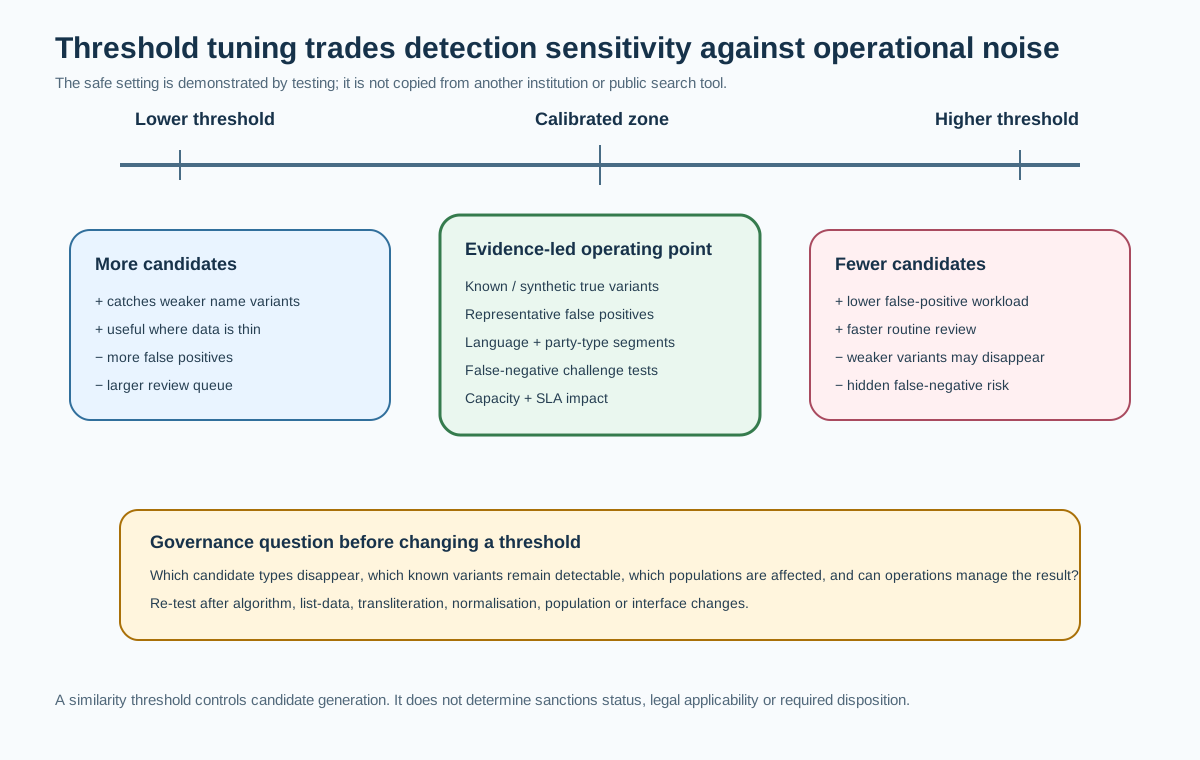
The diagram is intentionally not a formula for choosing a threshold. It teaches the governance principle: calibration must be supported by a golden test set containing known true matches and realistic false positives, so workload reduction is never treated as sufficient evidence that a higher threshold is safe.
Knowledge check
-
Why should a fuzzy-match score never be interpreted as the probability that a customer is sanctioned?
-
Why can a bank not copy one public screening-tool threshold and treat it as a regulatory standard?
-
What is the difference between source value, normalised value and screened value, and why must all three be traceable?
-
Why does preserving native-script data improve some investigations without making transliteration unnecessary?
-
What is a weak alias, and why is silently removing all weak aliases an unsafe control design?
-
When can a historical false-positive suppression become unsafe?
-
Why must tuning test false negatives as well as false positives?
-
A payment name is repaired after screening. What should happen if the repaired field is sanctions-relevant?
Answer guide
A fuzzy score measures algorithmic name similarity under a specific method; it does not establish legal identity. OFAC itself does not prescribe one universal public-search threshold because institutions must make threshold decisions using their own facts, risk assessments and compliance practices. Source, normalised and screened values can differ because of punctuation removal, transliteration, truncation or other transformations; lineage is necessary to understand what the engine actually compared. Native-script data can add discriminating evidence, while several legitimate transliterations may still exist. Weak aliases are broad or generic aliases that can create many false candidates but can still help identify a target when corroborated. Suppressions can become unsafe after list-record changes, customer identity/ownership changes or model changes. Tuning that measures only noise reduction can hide missed matches. A material repair should preserve the original value and trigger re-screening under the bank's control rules.
Glossary
Candidate generation — The technical process that identifies records similar enough to require investigation; it is not a legal identity decision.
Fuzzy matching — Comparison logic that tolerates differences between strings and returns similarity or candidate results rather than requiring exact equality.
Similarity score — A measure generated by a specific matching algorithm; it is not a probability of sanctions status.
Tokenisation — Splitting a name into component words or tokens so they can be compared individually or in different arrangements.
Normalisation — Controlled transformation of source data, such as case, punctuation, spacing or diacritics, to improve comparison while retaining the original value.
Transliteration — Representation of text from one writing system in another; one source-script name can have several valid Romanised forms.
Native script — The original writing system in which a name is recorded, such as Arabic, Cyrillic or Chinese characters.
Alias — An alternative, former or additional name associated with a sanctions target.
Weak alias — A broad or generic alias that can produce many false candidates but may still be useful as supporting evidence.
Screened representation — The actual value presented to the screening engine after transformations or truncation.
Threshold — A configured point at which matching output becomes a candidate requiring review; it is a control parameter, not a universal legal standard.
Suppression / good-list rule — A controlled rule that prevents a known customer-target false-positive comparison from repeatedly generating operational work.
False negative — A relevant sanctions candidate or exposure that the control fails to detect.
Challenge set — A curated set of known or synthetic scenarios used to test that matching logic continues to detect expected variants and avoid unacceptable noise.
Model drift — Change in performance over time because customer populations, list data, software or matching behaviour have changed.
Data lineage — Evidence showing where screening data originated and what transformations occurred before the control used it.
References and further reading
Use official sanctions-list data and current authority guidance when designing or investigating live screening cases. Matching logic is a control mechanism; it does not replace the legal test for whether restrictions apply. A similarity score, alias classification or threshold should therefore be interpreted within the specific screening method, data available, institution policy and applicable legal regime.
- U.S. Treasury OFAC — Sanctions List Search Tool: https://ofac.treasury.gov/sanctions-list-search-tool
- U.S. Treasury OFAC — FAQ 246, how Sanctions List Search works: https://ofac.treasury.gov/faqs/246
- U.S. Treasury OFAC — FAQ 247, what the Sanctions List Search score means: https://ofac.treasury.gov/faqs/247
- U.S. Treasury OFAC — FAQ 250, OFAC does not recommend one universal minimum match score: https://ofac.treasury.gov/faqs/250
- U.S. Treasury OFAC — FAQ 5, assessing whether a sanctions alert is a valid match and comparing available identifiers: https://ofac.treasury.gov/faqs/5
- U.S. Treasury OFAC — FAQ 122, weak aliases and their identification value: https://ofac.treasury.gov/faqs/122
- U.S. Treasury OFAC — Sanctions List Service: https://ofac.treasury.gov/sanctions-list-service
- UK Office of Financial Sanctions Implementation — UK financial sanctions general guidance: https://www.gov.uk/government/publications/financial-sanctions-general-guidance/uk-financial-sanctions-general-guidance
- UK Government — UK sanctions collection and UK Sanctions List resources: https://www.gov.uk/government/collections/uk-sanctions
- Wolfsberg Group — Sanctions Screening Guidance: https://wolfsberg-group.org/resources/legacy/53
- FATF — FATF Recommendations, including targeted financial sanctions standards: https://www.fatf-gafi.org/en/publications/Fatfrecommendations/Fatf-recommendations.html
- FATF — June 2026 update to Recommendation 6 on humanitarian exemptions: https://www.fatf-gafi.org/en/publications/Fatfrecommendations/update-recommendation-6-june-2026.html
Accuracy note — reviewed 15 September 2026: OFAC's public Sanctions List Search uses fuzzy logic for its name field and describes the returned score as a similarity measure, not a probability of sanctions identity. OFAC does not prescribe one universal minimum name score. OFAC's public tool is an example of one implementation, not a universal bank matching specification. OFSI's current UK guidance separately distinguishes a name match from a target match and directs users to compare the available identifying information. Wolfsberg frames screening as one control within a wider sanctions compliance programme. Institutions should validate their own data, matching configuration, thresholds, alert handling and legal decision process against applicable law and their risk-based control design.