Customer Sanctions Screening
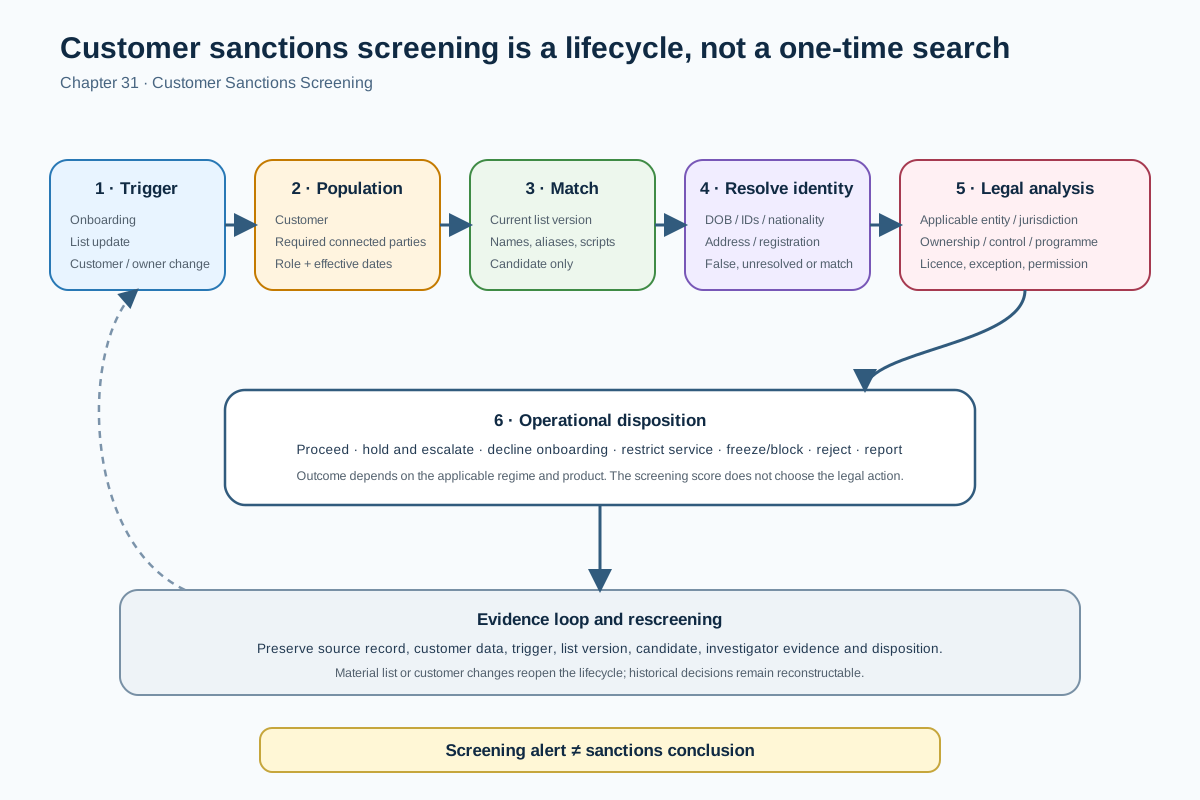
Customer sanctions screening is the process of comparing customers and relevant connected parties against sanctions data so that a bank can identify potential legal restrictions before or during a relationship. It sounds like a name-matching exercise, but in a mature bank it is a much broader control involving data quality, ownership and control, list governance, matching logic, analyst investigation, escalation, legal interpretation, periodic re-screening and auditable decisioning.
The central principle is simple: a screening alert is not a sanctions conclusion. An alert says that customer data is sufficiently similar to sanctions data to require assessment. The bank must then determine whether the customer is the listed person, whether an unlisted entity is nevertheless owned or controlled by a designated person, whether the applicable regime creates a restriction, and what operational action is required.
Who should be screened
A customer-screening population is broader than the account name. Depending on product, legal entity and jurisdiction, relevant parties can include individual customers, legal entities, beneficial owners, controllers, directors, trustees, settlors, protectors, beneficiaries, authorised signatories, partners, guarantors and other connected parties.
The purpose is not to screen everyone connected to everything. The population should be defined by applicable law, the bank's risk model and the nature of the relationship. A retail current account, private-banking trust and corporate cash-management relationship can require different connected-party models.
Customer identity data
Screening quality is limited by source data. For individuals, useful identifiers can include full name, aliases, date of birth, place of birth, nationality, address, national identifier and passport details where lawfully held. For entities, useful data includes legal name, trading names, registration number, incorporation jurisdiction, addresses and ownership/control relationships.
A common control weakness is assuming that name is the only important field. Two people can share the same name. A date of birth, nationality or address can help resolve the match. Conversely, a customer can use a transliterated or alternate spelling that means a strict exact-name rule misses a relevant listing.
Screening at onboarding
Onboarding screening is designed to identify sanctions exposure before the relationship becomes fully active. It should occur after sufficient identifying data has been captured but before the bank allows activity that could breach applicable restrictions.
The exact sequence matters. If the bank screens too early, it may have only a partial name and generate unnecessary alerts. If it screens too late, the customer may already have access to products or funds. A controlled design defines when the screening request is sent, what data is included, which decision blocks progression and how manual review affects the customer journey.
Screening after onboarding
Sanctions risk does not end once a customer is approved. Lists change, customer ownership changes, directors change, aliases are added and new sanctions programmes are introduced. Banks therefore need event-driven and periodic re-screening.
A strong design re-screens when sanctions data changes and when material customer data changes. It also defines whether a full customer population is re-screened after list updates or whether a controlled incremental process is used.
List-source governance
Banks should consume authoritative sanctions data appropriate to the regimes they must comply with. In the United States, OFAC's Sanctions List Service provides current SDN and non-SDN list data. In the United Kingdom, the UK Sanctions List became the only current source for all UK sanctions designations from 28 January 2026; the former OFSI Consolidated List is no longer updated.
A bank should not hard-code a list source and forget it. List formats, identifiers and publication mechanisms can change. Governance should cover source ownership, download frequency, integrity checks, parsing, effective timestamps, failed loads, rollback and evidence that the production screening engine used the expected list version.
Matching logic
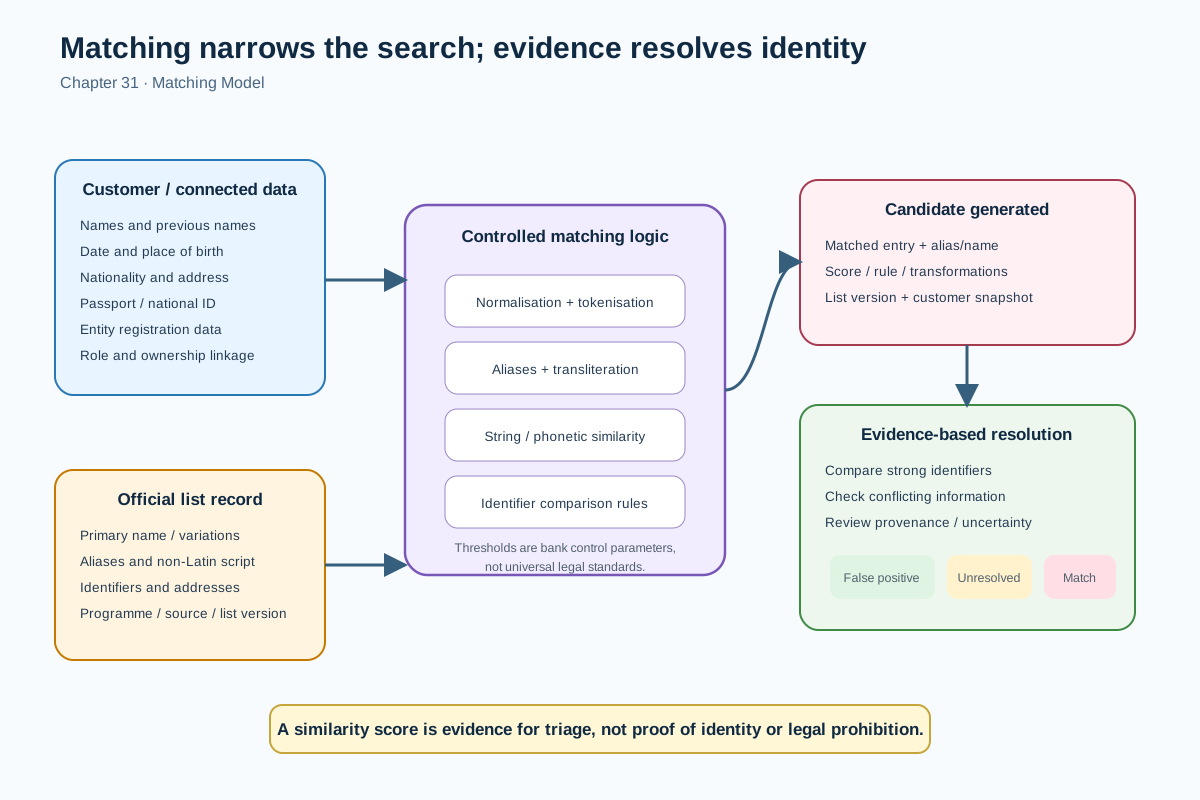
Exact matching alone is rarely sufficient because names contain spelling variation, transliteration, abbreviations, word-order changes and typographical differences. Screening engines therefore commonly use fuzzy matching and normalisation.
Normalisation can remove punctuation, standardise case, handle common legal suffixes and transform character sets. But every transformation creates trade-offs. Aggressive normalisation may increase false positives; weak normalisation may miss true matches.
Matching thresholds are therefore control parameters, not universal legal standards.
Aliases and alternate names
Sanctions records can include aliases, weak aliases, former names, alternative spellings and transliterations. Banks should understand how their data provider and screening engine represent these values.
Not every alias deserves identical matching treatment. A weak alias may be too generic to justify the same score as a strong alias. Configuration should be transparent enough that investigators know why the alert was created.
Transliteration
Names originally written in Arabic, Cyrillic, Chinese and other scripts can have multiple Romanised forms. There may be no single universally correct transliteration. A sanctions-screening engine should therefore support reasonable variation while still allowing analysts to compare other identifiers.
A common-name match with incompatible date of birth and nationality may be readily dismissed. A partial transliteration match with matching passport or registration details requires far greater attention.
Entity names
Corporate names can create different matching challenges. Legal suffixes such as Ltd, LLC, GmbH or SA may be present or omitted. Words may be reordered. Trading names can differ from legal names.
The screening process should preserve the original legal name while also applying controlled normalisation. It should not remove so much information that distinct companies become indistinguishable.
Beneficial owners and controllers
A customer can be unlisted but still subject to sanctions consequences because of ownership or control by a designated person under the relevant regime. That means customer screening must interact with KYC/KYB data rather than operate as a name-only silo.
Ownership analysis should be effective-dated. The bank may need to know who controlled a company when a relationship began, when a transaction occurred or when a designation took effect.
Direct and indirect ownership
Indirect ownership can pass through several legal entities. The calculation method depends on the applicable regime and legal interpretation. Banks should not assume that one percentage rule applies globally.
For example, OFAC's 50 Percent Rule can cause property and interests in property of an entity to be blocked when one or more blocked persons directly or indirectly own 50 percent or more in aggregate. UK ownership/control rules use a different legal framework, including more-than-50-percent ownership and broader control concepts. These are not interchangeable tests.
Control without ownership
Control can exist even where formal share ownership is below an ownership threshold. Board appointment rights, voting arrangements or the ability to direct an entity's affairs can matter under some regimes.
The bank should capture the legal basis for a control conclusion rather than convert a compliance interpretation into an unsupported numerical score.
Potential match investigation
An analyst should compare the customer against the sanctions record using available identifiers. Good investigation begins with the alert reason: which name or alias matched, at what score, after which normalisation, and on which list version?
The analyst then compares date of birth, nationality, address, registration details, ownership, identifiers and relevant public information. The objective is to determine whether the alert is a false positive, an unresolved potential match or a true match according to the bank's policy and applicable law.
False positive
A false positive is an alert that can be resolved as not being the sanctions target. The closure should be evidence-based. “Different person” is weaker than “same name but customer date of birth 1988 and UK residence; sanctions target born 1951 with different nationality and passport details.”
Well-structured closure reasons are useful for quality assurance and tuning.
Unresolved potential match
Sometimes data is insufficient to clear or confirm. The bank may need additional information, secondary review or legal escalation.
The system should support a genuine unresolved state. Forcing every alert immediately into false positive or true match can create unsafe decisioning.
True match
A true match means the bank has sufficient basis to conclude that the customer or connected party is the sanctions target or is otherwise subject to relevant restrictions. The operational outcome then depends on the applicable regime and product.
The screening team should not automatically invent the next action. Blocking, freezing, rejecting, reporting, refusing onboarding or restricting services can have different legal triggers.
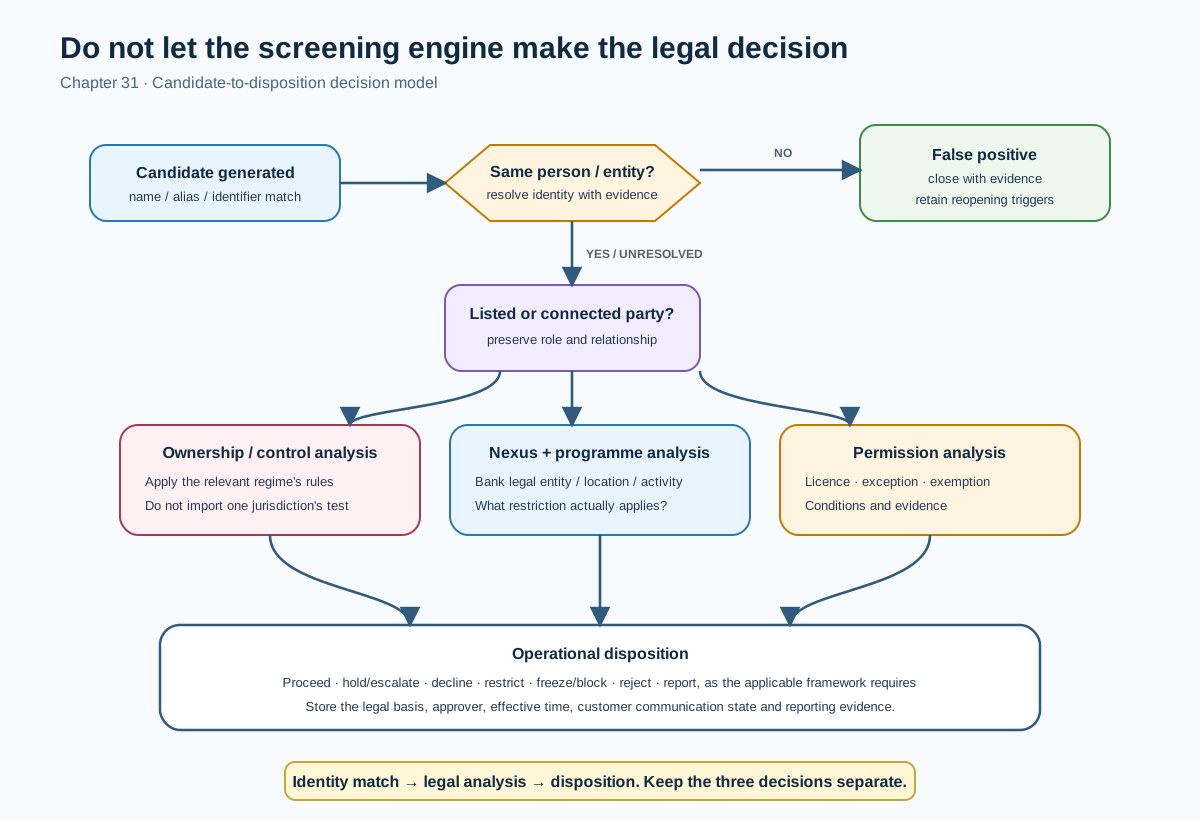
Customer-screening decision matrix
The same customer can produce different outcomes depending on the bank legal entity, sanctions nexus, list, programme and product. A global bank therefore needs a documented jurisdiction and legal-entity decision model.
Rescreening after list updates
When a designation is added or amended, the bank should assess the affected population promptly. The process should record list effective time, ingestion time, screening completion time, number of alerts and any affected relationships.
A failed sanctions-list load is a control incident, not merely a technical inconvenience.
Customer data changes
A name change, new beneficial owner, director change, ownership restructuring or new nationality can require re-screening. The same applies when a trust adds a beneficiary or when an entity changes control.
Event-driven screening is often more effective than waiting for the next periodic review.
Dormant and closed relationships
Banks need a policy for whether closed or dormant customers remain in screening populations. This can matter where residual assets, unclaimed balances, historical obligations or continuing reporting requirements remain.
The answer should come from legal and policy design, not from a generic technology default.
Screening-list versioning
Investigators should be able to reconstruct which list record existed when a decision was made. If a sanctions target later changes name, date of birth or programme tag, the bank should still be able to explain the original alert and closure.
Versioned list data and decision timestamps are therefore important audit evidence.
Data-provider dependency
Many institutions obtain sanctions content from commercial providers. Outsourcing data collection does not outsource accountability. The bank should understand provider sources, update cadence, data mapping, quality controls and incident handling.
Where a provider enriches official data with aliases or research, the bank should distinguish official designation data from vendor-added intelligence.
Screening engine governance
Configuration includes thresholds, tokenisation, transliteration rules, alias handling, exclusions, stop words and weighting. Changes can materially alter detection.
A proper change process includes requirement, impact assessment, test cases, approval, deployment evidence and post-change monitoring.
Testing
Testing should include known true matches, close false positives, transliteration variants, common names, entity suffixes, name order changes, aliases and beneficial-owner scenarios. Negative tests are equally important.
A screening engine that passes only obvious exact-name examples is not sufficiently tested.
Alert volumes and tuning
High alert volume can overwhelm analysts and delay true-match decisions. Tuning should reduce noise without hiding plausible matches.
The bank should analyse false-positive patterns by name type, list source, customer segment and matching rule. Tuning decisions should be supported by evidence and independent challenge where appropriate.
Quality assurance
QA should review whether analysts used relevant identifiers, whether true matches were escalated correctly, whether common names were resolved consistently, whether ownership/control cases were identified and whether closure evidence is reproducible.
QA should also examine whether analysts over-relied on one field.
Screening versus adverse media and PEP screening
Sanctions screening has a distinct legal purpose from PEP or adverse-media screening. The same technology may host several datasets, but the decisions are not the same.
A PEP match is not a sanctions match. Adverse media does not create an asset freeze. Systems should preserve separate case types and outcome codes.
Screening and AML
A sanctions true match does not automatically prove money laundering. Conversely, a customer can create serious AML concerns without being sanctioned.
Relevant information can be shared across controls, but decision rights should remain clear.
Scenario: common personal name
A retail customer shares a name with an SDN-listed individual. The customer has a different date of birth, nationality and address. The analyst documents the differences and closes the alert as false positive.
The value comes from evidence, not from the phrase “not a match.”
Scenario: corporate ownership
A company is not named on a sanctions list, but a designated person indirectly owns a significant interest through holding companies. The bank should apply the ownership/control rules of the relevant regime rather than relying only on list-name screening.
The investigation should preserve the ownership calculation and source evidence.
Scenario: transliteration
A customer name differs from a listed name by several Romanisation choices, but date of birth, nationality and passport identifier align. The alert deserves escalation despite the imperfect name match.
Scenario: list update
A long-standing customer is added to a sanctions list overnight. The bank's list-management service ingests the change, rescreens the population, creates a high-priority alert and routes it to sanctions operations.
The control should evidence both timing and action.
Business analyst view
A BA should define customer-screening objects explicitly: customer, connected party, source identifier, screening request, list version, candidate match, investigation, decision, restriction and report.
Acceptance criteria should cover incomplete data, transliteration, multiple aliases, customer-data changes, list-load failure, duplicate alerts, re-screening and retrospective reconstruction.
Data lineage
The analyst should know which customer system supplied the name, when it was effective and whether it was transformed before screening. If the customer name is truncated or ownership data fails to arrive, that should be visible as a data-quality issue.
Screening effectiveness depends on lineage as much as matching logic.
Metrics
Useful metrics include list-load timeliness, population-screening completion, alert ageing, true matches, unresolved cases, false-positive drivers, ownership/control cases, data defects and QA findings.
Alert count alone does not measure effectiveness.
Common mistakes
Common mistakes include treating screening as exact-name matching, assuming a customer is clear because the legal entity is not listed, using one ownership threshold globally, confusing PEP and sanctions outcomes, closing common-name alerts without evidence, and failing to rescreen after ownership or list changes.
Learning checkpoint
A reader should be able to explain the customer-screening lifecycle, define who should be screened, describe list and data governance, distinguish false positive from true match, explain why ownership/control analysis matters and design re-screening and audit requirements that can withstand regulatory review.
Reference links
- OFAC — Sanctions List Service: https://ofac.treasury.gov/sanctions-list-service
- OFAC — Sanctions List Search Tool: https://ofac.treasury.gov/sanctions-list-search-tool
- OFAC — 50 Percent Rule guidance and FAQs: https://ofac.treasury.gov/faqs/topic/1521
- UK Government — UK sanctions collection and UK Sanctions List: https://www.gov.uk/government/collections/uk-sanctions
- OFSI — UK financial sanctions general guidance, updated 12 May 2026: https://www.gov.uk/government/publications/financial-sanctions-general-guidance
Educational note: sanctions screening obligations, ownership/control tests, reporting requirements and permitted activities vary by regime and jurisdiction. Always apply the law and guidance relevant to the bank legal entity and activity.
Operational deep dive: building a defensible customer-screening control
Customer screening becomes difficult when the bank has to prove not only that it screens names, but that the right population, the right data and the right list versions reached the engine at the right time. A mature control therefore links KYC, ownership data, list management, matching, investigation and downstream restriction into one traceable chain.
Population completeness
The first audit question is often simple: who should have been screened, and can the bank prove they were? A population-control process can compare active customers and required connected parties against screening records. Missing beneficial owners, trustees or authorised persons should appear as data-quality exceptions rather than silently disappear from the control.
Connected-party roles
The same natural person can be beneficial owner of one company, director of another and authorised signatory on a third. Screening systems should preserve the role because the legal and operational response can differ.
A role should not be inferred only from free-text KYC notes.
Effective dates
Ownership and relationship data needs effective dates. If a designated person became a shareholder after onboarding, the bank needs to know when the relationship changed and when rescreening should have occurred.
This matters in retrospective regulatory review.
List-ingestion architecture
A robust ingestion service records source, publication timestamp, download timestamp, checksum, parser version, number of records, rejected records and production activation time. If the feed fails or record counts change unexpectedly, the issue should generate an incident.
The bank should be able to answer which exact list version was active when an alert was generated.
UK list transition lesson
From 28 January 2026 the UK Sanctions List became the only current source for UK sanctions designations; the former OFSI Consolidated List stopped being updated. This is an example of why list-source governance is a living operational control. A bank that continued loading the old source would appear technically healthy while becoming substantively stale.
Screening request lineage
Each screening request should link back to the customer record and show which fields were sent. If the KYC source stores a 120-character legal name but the interface sends only 35 characters, the truncation must be visible.
Alias provenance
A vendor may enrich official records with additional aliases. Analysts should know whether an alias is official designation data or vendor research. That distinction can affect confidence and escalation.
Ownership-service integration
Name screening cannot discover every owned entity. The bank can use an ownership service to calculate direct and indirect interests and identify entities requiring sanctions analysis.
The service should store the underlying chain rather than only output a final percentage.
Event-driven triggers
Useful rescreening triggers include customer name change, new nationality, director or beneficial-owner change, trust-party change, merger, list update, ownership restructure and reactivation of a dormant relationship.
Trigger design should be tested end to end: event generated, message delivered, screening executed, alert created and disposition completed.
Batch rescreening risk
A full-population rescreen after a major list update can produce large volumes. Prioritisation can consider legal urgency and high-confidence matches, but lower-priority alerts should not vanish from the queue.
Screening outage scenario
Assume the screening service is unavailable for three hours during peak onboarding. The contingency plan should state whether onboarding pauses, uses a fallback engine or queues customers without activation. The decision should be approved before the incident occurs.
Data correction scenario
A customer was screened under an incorrectly truncated surname and later corrected. The bank should determine whether retrospective screening is required for the period when the bad data existed.
Data remediation and sanctions remediation can be linked.
List amendment scenario
A sanctions authority adds a new alias to an existing designation. Previously closed customers can now generate different results. The bank should understand whether good-list rules or prior closures need re-evaluation.
QA sampling design
A useful QA sample includes common-name closures, transliteration cases, ownership cases, weak aliases, high-confidence true matches and alerts closed unusually quickly. Random sampling alone can miss the highest-risk judgement areas.
Screening effectiveness testing
Effectiveness testing can seed synthetic names and identifiers into a controlled environment to verify that the engine detects expected variants. It can also replay known historical matches.
The test should cover both detection and downstream case creation.
Analyst workstation design
Analysts need original customer data, matched list values, list source, alias type, similarity score, identifiers, ownership links and prior decisions. Poor user interface design can increase operational errors even when the matching engine is strong.
Decision reproducibility
A second analyst should be able to reproduce the decision from stored evidence without contacting the original investigator. This is a useful standard for case-note quality.
Customer fairness
Sanctions screening can create serious customer harm if common-name false positives lead to repeated restrictions. Good tuning, precise evidence and fast escalation protect both compliance and customer outcomes.
Practitioner checkpoint
A mature customer-screening control can prove population completeness, current list ingestion, data lineage, ownership integration, event-driven rescreening, investigated evidence and auditable disposition. Anything less is a collection of components rather than a controlled process.
Advanced practitioner layer: customer sanctions screening as a continuous control
A mature customer-screening programme is not a search box connected to a sanctions list. It is a continuous control that must prove four things at the same time: the bank screened the right population, with the right customer and connected-party data, against the right sanctions data and rules, at the right point in time. A strong matching algorithm cannot compensate for a missing beneficial owner, a stale list feed or a customer record that never reached the screening service.
The practitioner mindset is therefore wider than alert investigation. Screening effectiveness begins before the alert exists—with population design, data ownership, list governance and event architecture—and continues after the analyst closes the case through restrictions, rescreening, quality assurance and historical reconstruction.
Population design: who actually needs to be screened?
Customer screening starts with a population policy. Depending on legal entity, product and jurisdiction, that population can include customers, beneficial owners, controllers, directors, trustees, settlors, protectors, beneficiaries, partners, authorised signatories, guarantors and other connected persons.
The bank should not simply send every name in every database to the engine. Over-broad populations can generate noise and confuse legal purpose; under-broad populations can create false negatives. Each role should have a documented rationale and source system.
A useful control reconciles expected population to actual screening events. If 1,000 corporate customers should contribute 3,800 screenable connected parties and only 3,720 arrive at the engine, the missing 80 should become a control exception, not disappear silently.
Role matters
A person can be a director, beneficial owner and signatory across different entities. Those relationships should not be flattened into one generic “related party” field. Role can affect ownership/control analysis, operational response and the relevance of a match.
For example, a sanctions match on a 60-percent owner can create an ownership issue that is materially different from a match on a non-owning employee. Both require review, but the legal question and downstream restriction may differ.
Onboarding sequence: screen at the right moment
Screening too early can be ineffective because only a partial customer name is available. Screening too late can allow product activation before the bank has resolved sanctions risk.
A well-designed onboarding flow captures sufficient identity data, performs screening, resolves blocking conditions and only then enables the relevant relationship or service. Where onboarding is staged, the system should define exactly which functions remain unavailable while a sanctions alert is unresolved.
The control should also prevent workarounds. A relationship manager should not be able to activate an account through a different channel simply because the screening case is delayed.
Customer-master problems: merge, split and duplicate identity
Real banks contain duplicate customer records. One natural person can exist in retail, private banking and corporate systems with different spellings and identifiers. Conversely, two people with similar names can be incorrectly merged.
Customer-master changes should therefore be sanctions-relevant events. If two records are merged, the bank should understand whether connected-party relationships and prior screening decisions remain valid. If one record is split into two identities, reused false-positive decisions may become unsafe.
A strong architecture links screening to stable party identifiers while preserving the exact source attributes used in each historical screening event.
The 2026 UK list-source transition as a control lesson
From 28 January 2026, the UK Sanctions List became the current source for all UK sanctions designations and the former OFSI Consolidated List ceased to be updated. This is not merely a regulatory trivia point. It is an example of how a technically functioning interface can become substantively wrong if source governance is weak.
The bank should maintain a controlled source register with authority, endpoint or delivery method, expected cadence, data format, effective date, ownership and fallback. Source changes should trigger impact assessment, testing, cutover and evidence that the old feed is no longer relied on.
List-version evidence
For every screening event, the bank should be able to answer which list version was used. Useful metadata includes authority, source timestamp, bank ingestion time, parser version, production activation time and record version.
This becomes critical during regulatory review. If a customer was designated at 14:00 and screened at 14:05, the bank needs to know whether the new designation had reached production or whether the screening used an earlier list snapshot.
Matching is a candidate-generation process
Fuzzy matching, transliteration, tokenisation and alias handling generate candidates. They do not determine legal identity. The investigator’s job is to assess whether the customer and listed target are the same person or entity using available identifiers.
A screening engine should expose why an alert occurred: exact name, fuzzy name, alias, transliteration, identifier, address or another rule. An opaque score such as 87/100 is not enough if the analyst cannot see which attributes contributed to it.
Strong and weak identifiers
Identifiers differ in evidential value. A unique passport number, national identifier or company registration number can be far more discriminating than nationality or city. Date of birth can be powerful but may be incomplete or approximate in official list data.
The system should not mechanically treat every mismatch as exculpatory. A list record with an unknown or approximate birth date cannot safely be cleared because the customer’s exact birth date differs from an empty or uncertain field.
Investigators should understand both the identifier and its reliability.
Transliteration and multiple scripts
Names originating in Arabic, Cyrillic, Chinese and other scripts can be Romanised in several legitimate ways. A bank should therefore test its engine against realistic spelling variants rather than rely on one preferred transliteration.
Where native-script data is lawfully available, preserving it can improve identity resolution. But the control should know which script reached the engine. A source system containing Arabic characters while the interface sends only a lossy Latin conversion can change screening effectiveness.
Common names and customer harm
Common-name alerts create operational burden and can repeatedly inconvenience innocent customers. Efficient resolution matters, but the bank should not solve the problem by creating broad permanent suppressions.
A well-governed false-positive rule is specific. It can identify the customer, list target and discriminating identifiers that justify closure. It should have scope, owner, creation date and review or expiry conditions.
If the list record later gains a new identifier or the customer changes name, nationality or ownership, the suppression may need re-evaluation.
“Good guy” and suppression controls
Many screening systems support whitelists, good-guys or alert-suppression rules. These can reduce repeated false positives, but they are high-risk configuration objects because a poorly designed rule can suppress a future true match.
A safe suppression should be narrow and explainable. It should not say “ignore all matches to John Smith.” It should identify the specific customer-to-target comparison and the evidence supporting the distinction.
Governance should include maker-checker approval, effective dates, expiry or periodic review, impact testing and reporting on suppressed alerts.
Alias changes can invalidate prior closures
A sanctions authority can add an alias or identifier to an existing target. A customer previously cleared may now align more closely with the target. The bank should determine whether existing suppression rules and prior false-positive closures remain safe.
This is why list updates should trigger more than a simple name comparison. Material record amendments can require re-evaluation of previously resolved cases.
False positive, unresolved potential match, identity match and legal applicability
These are distinct states and should remain distinct in the workflow.
A false positive means the customer is not the listed target. An unresolved potential match means the available evidence is insufficient to decide. An identity match means the bank believes the customer or connected party is the listed target. The legal applicability step then determines what restriction follows under the relevant regime, bank entity and product.
Collapsing identity and legal disposition into one status can cause mistakes. A confirmed identity match under an activity-specific restriction may not have the same operational outcome as a full asset-freeze designation.
Case lab: high name score, conflicting identifiers
A customer name produces a 96-percent similarity score against a listed individual. Nationality matches, but date of birth differs by 25 years and passport details are incompatible. The analyst should not be intimidated by the score. The score generated the candidate; the identifiers support a false-positive conclusion if the data quality is reliable.
The closure note should state the differentiators. “Score high but not match” is weaker than a structured explanation of the incompatible identity evidence.
Case lab: low name score, strong identifier alignment
A transliterated customer name produces only a moderate similarity score, but date of birth, nationality and passport number align with the listed target. This should escalate. Matching score is not the legal burden of proof.
The case demonstrates why screening effectiveness should be tested across identifiers and transliteration, not only average name-match scores.
Case lab: unlisted corporate customer, designated owner
The customer company itself produces no name alert. A newly designated person appears in the customer’s ownership graph. The screening programme should connect customer screening with ownership analysis so that the relationship is re-evaluated.
The system should show the designated owner, ownership path, applicable regime and calculation rather than merely attach a generic “sanctions hit” flag to the company.
Event-driven rescreening
Useful customer events include legal-name change, alias addition, nationality change, new identity document, beneficial-owner change, director change, trust-party change, merger, reactivation and ownership restructuring. Relevant events should trigger screening rather than wait for the next annual review.
The trigger should be traceable end to end: source event, message publication, screening request, list version, result, alert and disposition.
A queue failure between KYC and sanctions can otherwise leave the source record correct but the control stale.
Full-population rescreening and surge management
A major sanctions event can create huge alert volumes. Banks need surge plans that preserve legal coverage. Prioritisation may use match confidence, ownership exposure or legal urgency, but unreviewed alerts should remain visible and governed.
Temporary threshold changes during a surge are especially sensitive. Any tuning must be approved, tested, time-limited and monitored. Operational pressure should not silently reduce detection quality.
Screening outages
If the customer-screening service fails, the bank should know whether onboarding pauses, uses a fallback engine, queues cases before activation, or applies another approved control. The contingency should reflect actual capacity.
“Manual screening” is not a credible fallback unless staff have access to current official or approved data and can handle expected volumes with evidence.
After restoration, the bank should reconcile queued populations and confirm no customer became active without the required control.
Analyst workstation design
A sanctions investigator needs more than the matched name. The workstation should present source customer data, role, ownership connections, matched list record, authority, programme, alias type, list version, match explanation, identifiers, prior decisions and relevant supporting documents.
The user interface should also preserve uncertainty. Missing identifiers should appear as missing, not as mismatches. Vendor-enriched aliases should be distinguishable from official source data where that distinction is material.
Good UX is a control feature because poor interfaces create judgement errors.
Case grouping without evidence loss
One customer can generate several alerts against the same target because legal name, alias and connected-party records overlap. Case grouping can reduce duplicate work, but the system must preserve each original alert and trigger reason.
Similarly, one person can match several list records. Grouping should not hide that different authorities or programmes may apply.
Shadow testing and tuning
Before changing matching thresholds, banks can run proposed configuration in shadow mode against historical customer populations and known test cases. The objective is to estimate additional true-match coverage and false-positive impact without immediately changing production decisions.
Testing should include exact names, common names, weak aliases, multiple scripts, reversed name order, abbreviations, entity suffixes, missing identifiers and known historical sanctions cases.
A tuning proposal should explain both what noise it removes and what detection sensitivity it changes.
Quality assurance focused on judgement risk
Random QA alone can miss the most dangerous cases. Targeted samples should include rapidly closed alerts, common-name suppressions, transliteration, high-score false positives, low-score escalations, ownership cases, unresolved cases and manual overrides.
QA should ask whether evidence supports identity conclusion, whether the applicable regime was identified, whether ownership/control analysis was considered where relevant and whether the operational restriction matched the legal decision.
Metrics beyond alert count
Useful measures include population completeness; list-ingestion latency; percentage of customer events reaching screening; alert age by risk; unresolved matches; suppression population; suppression expiries; ownership-triggered cases; data truncation defects; rescreening completion after major list changes; QA overturn rate; and incidents where restrictions were applied late.
A falling alert count can be positive if tuning removed noise—or dangerous if a feed broke. Metrics need context.
Historical reconstruction
A regulator may ask whether a customer was screened correctly on a date months ago. The bank needs the customer attributes effective at that time, connected parties, ownership structure, sanctions-list version, engine configuration, alert result and analyst disposition.
Current customer data cannot safely answer a historical question. Versioning is part of control design.
Business analyst acceptance criteria
A strong test pack should cover missing connected parties, duplicate customer identities, record merge/split, list-source change, new alias on an existing designation, exact and fuzzy matches, transliteration, weak aliases, strong identifier mismatch, strong identifier alignment, ownership-triggered rescreening, good-guy expiry, failed event message, failed list load, onboarding during outage and retrospective reconstruction.
Each scenario should verify both detection and downstream restriction. Passing the matching step while failing to prevent activation is not a successful test.
Final practitioner checkpoint
A learner should be able to explain customer screening as a complete operating control rather than a matching engine. They should be able to prove population completeness, distinguish candidate generation from identity decision, govern suppressions, handle list and customer changes, integrate ownership, design resilient onboarding and reconstruct a historical decision with the exact data and list version used.
That is the standard required for sanctions screening to be defensible in a real bank.
Practitioner close: proving that customer screening actually works
A customer-screening programme can generate millions of successful screening records and still fail if one population is missing, one sanctions source is stale or one suppression rule is too broad. The final practitioner discipline is therefore control assurance: prove that the right parties entered the control, that the engine received the intended attributes, that list changes reached production, that analysts could resolve identity correctly and that the legal outcome changed the customer relationship when required.
Population reconciliation case
A bank has 500,000 active customers. The sanctions engine reports 500,000 customer-screening events, apparently proving complete coverage. A deeper review finds that corporate beneficial owners are stored as connected parties in another master system and were never included in the comparison.
The lesson is that transaction counts cannot define the expected population. The bank first needs a role-based screening policy and a source-to-screening reconciliation. For a corporate customer, expected screenable records might include the entity, relevant beneficial owners, controllers, directors or authorised persons according to policy and applicable rules.
A population control can compare unique party-role relationships expected from KYC against successful screening records. Exceptions should be investigated as data or integration defects.
Case lab: customer data is correct but the interface is wrong
KYC stores the customer’s full legal name, date of birth, nationality and aliases. The screening interface truncates the name, drops the alias and sends an old nationality from a legacy customer table. The screening engine is functioning exactly as configured but with poor input.
This case shows why model validation must include field lineage. The bank should trace each screening attribute from system of record through transformations to the engine and case tool. Data quality and matching quality are part of one control chain.
New list record versus amendment to an old record
A new designation naturally triggers rescreening. Amendments can be just as important. An authority may add an alias, date of birth, address, passport number or other identifier to an existing target.
A customer previously closed as a false positive could become a stronger match after the amendment. The bank should know whether amended records trigger rescreening and whether prior suppression rules are re-evaluated when the matched target materially changes.
The system should preserve the old and new list record versions so investigators can understand why an alert appeared today but not yesterday.
Source transition case: obsolete feed still technically healthy
The 2026 closure of the former OFSI Consolidated List is a useful operational example. Imagine a bank feed that continues downloading the obsolete file successfully every day. Infrastructure monitoring shows green because the HTTP call and parser work; compliance coverage is nevertheless stale because the source is no longer authoritative.
A mature source register therefore tracks authority and business validity, not only technical availability. Change ownership should sit with a sanctions-data governance process capable of updating source URLs, formats, parsers and downstream dependencies.
Common-name false positives and suppression discipline
A customer named Mohammed Ali or John Smith may repeatedly match several sanctions records. Investigation can establish reliable differentiators such as date of birth, nationality or identification number. Reusing that decision can improve customer experience and analyst efficiency.
The reuse mechanism should be narrow. It can link the specific customer identifier to the specific list target and record the discriminating evidence. It should not suppress every future match containing the same name.
Expiration or re-evaluation triggers can include customer identity changes, list-record amendment, ownership change or major engine-rule change.
Case lab: customer changes legal name
A long-standing customer previously had several false-positive closures. After marriage, corporate restructuring or another legitimate reason, the customer changes legal name. If the bank blindly reuses old suppressions, new sanctions exposure could be missed.
The customer event should trigger rescreening using the updated name while preserving former names as appropriate. The investigator should see both current and historical identity data rather than treat the change as creation of a wholly unrelated person.
Transliteration case
An Arabic-script name is stored natively in one system and as a Latin transliteration in another. Different transliterations produce materially different similarity scores.
Testing should include plausible variants and confirm which representation is screened. If the engine supports native scripts, the bank can evaluate whether using both native and transliterated forms improves effectiveness. If an upstream interface strips or corrupts characters, that is a data-quality defect rather than a tuning issue.
The investigator should not rely only on the name score. Date of birth, nationality, identifiers and other attributes help resolve identity.
Corporate customers require screening plus ownership analysis
A corporate customer can have a perfectly clean legal name while being owned or controlled by a designated person under the relevant regime. Customer screening should therefore connect to ownership-control data rather than claim that entity-name screening alone proves the relationship is clear.
When an owner is newly designated, reverse ownership search should identify affected customers. The alert should show the ownership path and legal rule, not merely generate an unexplained customer-name hit.
Onboarding case: unresolved potential match
A new customer produces a plausible sanctions match. Available identifiers are insufficient to confirm or clear identity. The account-opening journey is approaching its service target and business staff want activation.
The system should follow pre-agreed controls. It can place the onboarding relationship in an unresolved sanctions state that prevents prohibited activation while investigators obtain appropriate information. The case should not be auto-closed because the service-level timer expires.
Service targets are operational goals, not substitutes for legal resolution.
Batch rescreening after a major event
A major sanctions update generates tens of thousands of alerts. The bank can prioritise based on confidence, legal urgency and customer exposure, but every in-scope alert should remain tracked. Temporary tuning intended to manage volume should be approved, tested and time-bounded.
Management information should show backlog size, oldest alert, high-confidence population, customers or assets restricted pending review and expected completion. “Rescreening job completed” is not equivalent to “all resulting alerts were resolved.”
Screening-service outage during onboarding
Assume screening is unavailable for four hours. If the bank queues customers and allows activation, it creates a period of uncontrolled sanctions exposure. If it stops every onboarding globally, customer impact can be significant.
The contingency should be defined before the incident. Options can include an approved alternate screening service, controlled queuing before product activation or a genuinely scalable manual process for limited populations. The chosen response depends on product, jurisdiction and risk.
After recovery, reconciliation should prove that all queued records were screened and that no relationship bypassed the control.
Case-management quality
A high-quality analyst decision identifies customer and matched target, list source and programme, matched attributes, differentiating or confirming identifiers, ownership/control relevance, legal applicability, evidence reviewed and final disposition. “Not a match” without reasoning is difficult to audit.
The workstation should expose uncertainty. An absent date of birth on the list is not a mismatch. An approximate year should not be compared as if it were an exact date.
QA sampling should follow risk
Pure random QA can miss rare but consequential judgement. Target samples should include high-score false positives, low-score escalations, transliteration, ownership cases, broad suppression rules, unusually fast closures, unresolved matches, manual overrides and list-source incidents.
QA should record whether the identity decision was supported and whether the downstream relationship restriction matched the legal conclusion.
Control metrics that detect silent failure
Useful metrics include expected-versus-screened population, customer-event-to-screen latency, official-list-to-production latency, list-ingestion failures, data truncation rates, unscreened connected parties, active suppressions, suppressions due for review, alert age, QA overturn rate and customers activated while sanctions cases were unresolved.
Volume metrics need interpretation. A sudden drop in alerts may reflect excellent tuning or a broken feed. Control health should combine coverage, data quality, outcomes and operational evidence.
Final 60-minute practitioner test
A learner should be able to design and defend the full customer-screening lifecycle: define the population, reconcile it, trace data fields, govern official list sources, handle amendments and transliteration, distinguish fuzzy candidate generation from identity confirmation, integrate ownership/control, govern suppressions, manage onboarding and outages, rescreen after changes and retain enough evidence to reconstruct the exact decision later.
That is what makes customer sanctions screening a controlled banking process rather than a name-matching utility.
Practitioner masterclass: customer sanctions screening
Start with one customer and reconstruct the full control chain: KYC record, connected parties, ownership graph, list version, screening request, candidate, analyst evidence, decision and any restriction. If any link is missing, the control is difficult to prove.
Exercise 1 — common-name customer
A customer name matches three listed persons. Build the shortest evidence path that can safely clear all three candidates. Identify which fields are decisive and which are merely supportive.
Exercise 2 — ownership change
A corporate customer was clean at onboarding. Six months later a designated person acquires an indirect interest. Define the event that should trigger re-screening, the ownership calculation, escalation and effective date.
Exercise 3 — stale list source
The list-ingestion service continues to run successfully but the underlying source is no longer authoritative. Explain why technology availability is not control effectiveness and define a source-governance check.
Exercise 4 — transliteration
A customer's Romanised name differs from a listed alias, but date of birth and passport align. Explain why name score alone is not enough.
Exercise 5 — screening outage
Design a three-hour outage procedure covering new onboarding, existing-customer list updates, queued events and management escalation.
BA acceptance criteria
Include population completeness, list checksum failure, missing beneficial owner, duplicate connected party, list update, customer ownership change, reopened alert and audit reconstruction.
Final test
The learner should be able to prove that the right people were screened against the right data at the right time and that every decision can be reconstructed.
60-minute mastery extension: customer sanctions screening
This extension is designed to make the chapter a minimum 60-minute guided learning experience. Spend around 25 minutes on the core chapter and diagrams, 15 minutes on the customer-screening cases, 10 minutes on rescreening and data governance and 10 minutes on the final identity-resolution test.
Customer screening is broader than screening the customer name
A customer relationship can expose the bank through the customer itself, beneficial owners, controllers, directors, trustees, authorised signatories and other connected parties depending on the legal framework, product and internal policy. The screening population should therefore be explicitly defined for each customer type rather than assumed to mean one legal name.
For legal entities, screening must connect to current ownership and control information. A company can have a clean legal-name result while a relevant owner or controller is designated. For individuals, date of birth, nationality, address, identification numbers and other reliable identifiers can be essential for distinguishing a genuine match from a namesake.
Screening at onboarding is only the beginning
Sanctions exposure can change after onboarding because authorities add or remove designations, aliases change, customer ownership changes, directors or controllers change, or the bank learns new identity information. The operating model therefore needs ongoing rescreening driven by both external list changes and internal customer-data changes.
A mature control can answer: which customers and related parties were screened, against which list version, using which data, when the screening occurred and what happened to any unresolved candidates.
Worked case: ownership change after onboarding
Customer X was screened and cleared when onboarded. Six months later, 60% of the company is acquired by another company ultimately owned by a designated person under a regime applicable to the bank. The legal name of Customer X has not changed.
If the bank relies only on periodic name rescreening, it can miss the new exposure. An ownership-change event should trigger relevant due diligence and sanctions analysis. The system needs effective-dated ownership, material-change triggers and a route to rescreen newly connected parties.
Worked case: common-name individual
A customer named Mohammed Ali triggers a candidate against a sanctions list. Name similarity alone is weak because the name is common. The analyst compares date of birth, nationality, address, passport or national identifier, aliases and other available data. If identifiers clearly conflict, the candidate can be resolved as a false positive with evidence.
The system should record why the candidate was closed. A generic "not match" reason provides little value for QA or future tuning. At the same time, the bank should avoid collecting unnecessary personal data simply to reduce false positives; data use should remain lawful and proportionate.
List-source governance
Screening quality depends on authoritative list data. The bank should know the source, publication or retrieval time, programme, identifiers, aliases and effective status. Loading a list into production is a control process: ingestion, parsing, validation, testing and monitoring all matter.
For the UK, current designations should be sourced from the current UK Sanctions List rather than relying on the former OFSI Consolidated List, which ceased to be the current source in January 2026. Historical records still need to show what list/version was used when past decisions were made.
Rescreening strategy
Rescreening can be triggered by list updates, customer-data changes, ownership changes, scheduled periodic runs or relevant external events. The frequency and architecture should reflect legal requirements, risk and operational capability. A daily batch may be adequate for some populations but too slow where the applicable obligation or risk requires more immediate action.
The bank should monitor failed or delayed rescreening. A job that reports "completed" after silently skipping 5% of customers is not an effective control.
Suppression and false-positive governance
Institutions often use suppression rules or previously resolved false-positive decisions to reduce repeated alerts. Suppression should be specific and governed. It can include the candidate, identifiers used, rationale, reviewer, effective date, expiry or refresh trigger and the list/customer data version.
A permanent whitelist based only on a name can create false negatives when customer or list information changes. Resolved candidates should be reconsidered when material identifiers change.
Customer-data quality exercise
Take one corporate customer and list every field needed for screening: legal name, aliases/trading names, registration number, jurisdiction, address, beneficial owners, controllers, directors and authorised persons where relevant. Mark each as verified, customer-declared, third-party sourced or missing. Then identify which missing fields could materially weaken identity resolution.
Repeat the exercise for an individual. This demonstrates why screening is dependent on KYC quality.
Event-driven control exercise
Design triggers for: name change, new alias, ownership change, director change, nationality/residence change, new identification document, list update and sanctions-programme change. For every trigger, define the population to rescreen, SLA, failure handling and evidence retained.
Identity match versus legal outcome
Customer screening identifies possible or confirmed identity relationships. The final legal outcome can still require ownership/control, programme, nexus, licence or exception analysis. Do not make the screening engine responsible for a legal conclusion it does not have the data to support.
Final identity-resolution test
For each case—common personal name, company with renamed owner, customer with new nationality, newly designated director, entity indirectly owned by blocked persons, and previously suppressed false positive after DOB correction—state whether the bank needs simple rescreening, full identity resolution, ownership/control analysis or specialist legal review.
A strong learner should finish able to define the screening population, govern list and customer data, rescreen at the right events and separate identity matching from the legal sanctions decision.
Onboarding-screening service design: speed, safety and honesty
Customer onboarding pits commercial speed against screening thoroughness, and the service design must resolve this tension explicitly rather than leaving front-office staff to choose between revenue and compliance. Risk-tiered screening paths provide the structure: streamlined verification for lower-risk profiles with defined data requirements and automated disposition, standard review for typical profiles, and enhanced assessment for higher-risk profiles with specialist involvement and extended timeframes. Each path specifies its data inputs, matching configuration, decision authorities, service-level targets and evidence standards, so that speed differences reflect designed risk differentiation rather than corner-cutting.
Pre-screening and progressive verification manage the timing problem where full onboarding cannot complete before the customer needs service. Preliminary screening on available identity data can clear low-risk onboarding to proceed while enhanced checks continue, provided the interim permissions are genuinely limited and the completion discipline is enforced through system controls rather than diary reminders. Partial-service states, such as receive-only accounts pending verification completion, balance access with protection where the framework permits. What the design must never allow is full-service activation on incomplete screening justified by commercial urgency: the revenue from one accelerated onboarding never compensates the exposure from onboarding a designated party.
Friction communication shapes both compliance and commercial outcomes. Customers asked for additional information without explanation experience arbitrary obstruction; customers told specifically what is needed, why, and how long it will take generally cooperate. Standard communication templates for common information requests, translated appropriately and delivered through the relationship channel, reduce abandonment while improving evidence quality. Abandonment analytics themselves provide control intelligence: onboarding abandoned at the screening stage at anomalous rates for specific segments or introducers may indicate evasion rather than impatience, warranting review of the abandonment population rather than relief at reduced workload.
Batch, real-time and event-driven screening architecture
Screening architecture combines three processing modes whose coverage must be designed jointly rather than assumed complementary. Real-time screening at onboarding and transaction initiation provides immediate prevention with latency constraints that limit matching depth. Batch screening across the customer base applies deeper matching, ownership analysis and adverse-information correlation on a scheduled cycle with comprehensive coverage. Event-driven screening responds to triggers, list updates, customer-data changes, designation-adjacent events and external intelligence, with defined populations and timeframes per trigger type.
Coverage-mapping across the three modes prevents the characteristic gaps: customers onboarded between batch cycles without real-time screening, list updates processed in real-time flows but not applied to the existing base until the next batch, data changes that never trigger rescreening because no event subscription exists. The mapping should specify for each customer population which modes cover it with what latency, and assurance testing should verify coverage empirically through seeded-test methodology rather than accepting architectural diagrams as proof. Intraday designation capability, screening new designations against the full base within hours rather than days, separates mature operations from batch-dependent ones, and the investment case rests on the exposure arithmetic of delayed implementation applied to the bank's customer volumes.
Performance engineering underpins the architecture: matching depth, population size and latency budgets trade against each other continuously, and capacity planning must accommodate designation-wave surges that multiply alert volumes overnight. Degradation protocols define which matching depth reductions are permissible under load, with approvals and time limits, versus which reductions would breach control standards and therefore require queuing or throttling instead. These protocols are approved in calm conditions and tested under simulated surge, because load-shedding decisions improvised during real designation waves reliably sacrifice exactly the matching depth the wave requires.
Screening through mergers, migrations and portfolio transfers
Corporate actions affecting the customer base, mergers, acquisitions, portfolio purchases, system migrations and booking-model changes, create screening-coverage risk at scale that project planning frequently underestimates. Each event imports customer populations screened under different standards, with different data quality, into the bank's control environment, and the integration period creates windows where neither the old nor the new screening fully applies. Screening workstreams belong in transaction planning from due-diligence stage rather than appearing as post-completion remediation.
Pre-completion screening assessment examines the target population's sanctions exposure directly: screening the acquired base against current lists before completion, assessing data-quality gaps that would impair ongoing screening, and quantifying remediation requirements with cost and timeline. These findings inform transaction valuation, completion conditions and integration planning rather than surfacing as surprises afterward. Day-one readiness defines the minimum screening operability required at legal completion: which populations screen in which systems from which date, with interim manual or batch coverage for populations not yet migrated and explicit expiry dates for interim arrangements.
Migration execution tracks screening-data fidelity with the same rigour as balance migration: name-field completeness, identifier preservation, ownership-linkage transfer, screening-history and disposition-record migration, and allow-list revalidation rather than blind transfer. Post-migration verification through seeded testing and coverage reconciliation proves the migrated base screens correctly before interim arrangements retire. Portfolio-transfer transactions, where customer populations move between institutions without corporate merger, need equivalent discipline scaled to the transfer size, since the receiving bank inherits both the customers and their screening history gaps.
Periodic-review triggers that reflect sanctions risk
Calendar-based periodic review cycles treat sanctions risk as time-decaying uniformly, which it is not: a customer's sanctions exposure changes with its behaviour, ownership, geography and the evolving sanctions environment rather than with months elapsed. Event-driven review triggers aligned to sanctions-risk drivers provide more responsive coverage: ownership and control changes, however minor in equity terms; geographic expansion into higher-risk jurisdictions; sector changes toward restricted industries; adverse-media allegations with sanctions nexus; designation of connected persons, counterparties or infrastructure; transaction-pattern shifts suggesting new corridors or counterparties; and structure changes including new layers, protectors or nominees.
Trigger design must balance sensitivity with operational capacity: triggers firing on immaterial changes drown review teams, while narrow triggers miss the restructuring patterns that precede sanctions events. Materiality calibration by customer risk tier concentrates review on higher-risk populations while maintaining baseline coverage elsewhere. Trigger-evidence standards specify what each trigger requires: ownership-change triggers need re-verified structure charts with registry evidence, geographic triggers need activity and counterparty assessment for the new exposure, adverse-media triggers need allegation verification proportionate to source credibility. Each trigger type carries defined review timeframes reflecting its urgency, with designation-adjacent triggers operating on days rather than months.
Review-outcome discipline closes the loop: confirmation with updated baseline documentation, enhanced monitoring with defined parameters and review dates, restriction or exit with legal and relationship process, or reporting where findings meet thresholds. Outcomes feed the customer-risk rating dynamically rather than awaiting the next calendar review, so that the rating reflects current knowledge. Trigger-performance measurement tracks which triggers produce findings versus noise, refining calibration continuously and retiring triggers that consistently consume effort without risk yield.
Screening-vendor management and exit readiness
Outsourced screening engines, list-data feeds and matching services concentrate control dependency on vendors whose performance the bank must govern actively rather than assume contractually. Vendor-governance essentials include contractual service levels for list-update latency, matching availability and support responsiveness with remedies; independent testing of vendor matching against the bank's own test packs rather than acceptance of vendor self-certification; change-notification requirements for algorithm, data-format and list-processing changes with impact-assessment rights; and audit and information rights sufficient for supervisory examination of the outsourced control.
Concentration risk deserves explicit assessment: single-vendor dependence for all screening creates a single point of failure whose outage or degradation affects every control simultaneously. Mitigation options include dual-vendor strategies for critical populations, in-house fallback capability for defined periods, and contractual protections with tested invocation procedures. Vendor financial viability, acquisition exposure and technology-roadmap alignment each affect the control's durability and belong in periodic vendor review alongside performance metrics.
Exit readiness converts vendor dependence from structural vulnerability to managed relationship: documented exit plans specifying data extraction, configuration portability, transition timelines and interim coverage arrangements, tested periodically through tabletop exercises rather than trusted on paper. Algorithm-transparency requirements ensure the bank understands its own screening logic sufficiently to replicate or transfer it: black-box vendor matching that the bank cannot explain, test or transfer is an unacceptable control foundation regardless of its detection statistics. The objective is vendor-supported control owned and understood by the bank, never vendor-owned control rented by the bank.
Dormant and closed relationships: the forgotten populations
Dormant accounts, inactive entities and closed-but-reopenable relationships accumulate outside active monitoring while retaining sanctions exposure that reactivates without warning. Dormant-account screening discipline requires continued list screening of dormant holders with the same currency as active customers, since designation during dormancy creates frozen-position obligations the bank must implement upon discovery rather than upon reactivation. Reactivation controls treat dormancy-break as a defined event triggering refreshed due diligence proportionate to the new activity, with the reactivation explanation tested against independent evidence rather than accepted as self-validating. Long-dormant accounts reactivating with high-risk activity patterns, third-party funding or urgent large transactions exhibit the classic sleeper characteristics warranting enhanced review before full service restoration.
Closed-relationship data retention must preserve screening-relevant records through the applicable retention periods with searchability that supports later investigation: former customers appearing in subsequent network cases, designation investigations or law-enforcement inquiries must be reconstructable from retained records. Record-destruction schedules require sanctions-aware holds preventing premature destruction where investigation, proceedings or designation-adjacency indicate future need. Re-onboarding of former customers should retrieve and review historical records rather than starting fresh, since the historical file contains the behavioural baseline and prior findings that efficient assessment needs.
Screening during incidents and designation waves
Major designation events affecting the bank's customer base or corridors trigger incident-mode screening operations that differ fundamentally from steady-state processing. Incident activation criteria define what constitutes a screening incident: designations directly affecting customers or counterparties, programme changes affecting material business volumes, list-feed failures creating unknown exposure, and system outages interrupting screening coverage. Each criterion triggers defined response structures with decision authorities, communication protocols and operational playbooks prepared in advance rather than improvised under pressure.
Surge-capacity planning addresses the alert-volume multiplication that designation waves produce: pre-arranged analyst reallocation with cross-training completed before incidents, overtime and contractor arrangements with vetting and system access prepared, triage-prioritisation rules focusing scarce attention on highest-consequence alerts first, and customer-communication templates for common incident scenarios. Exposure-identification procedures run systematically across customers, transactions, assets, facilities and services rather than depending on alert generation alone, since list changes affect positions that generate no new alerts. Incident documentation captures decisions, timing and rationale to examination standards despite operational pressure, since post-incident review by supervisors and auditors is certain and the record must show controlled response rather than heroic improvisation.
Screening-list versioning and audit reconstruction
Every screening decision depends on the list version applied, yet many banks cannot reconstruct which version screened which transaction or customer at which time. Version-governance essentials include immutable version identification for every list update with effective timestamps, decision-level version recording linking each screening outcome to its list version, retention of historical list versions supporting retrospective reconstruction, and change documentation describing what each version altered. These foundations enable the investigations, audits and regulatory inquiries that inevitably ask whether a designation was effective when the bank acted.
Retrospective analysis capability converts version governance from recordkeeping to control: re-screening historical populations against current lists identifies exposure that past screening missed through data, configuration or timing gaps, with lookback scope proportionate to the gap discovered rather than unlimited archaeology. Version-gap analysis measures the interval between official publication and production implementation per update, trending the latency that determines real-world protection speed. Version-related incident response addresses the characteristic failures: updates applied partially across systems, version mismatches between customer and transaction screening producing inconsistent decisions, and rollback events where faulty updates require reversion with exposure assessment for the affected window.
Screening KPIs that measure protection, not activity
Screening performance measurement frequently degenerates into activity counting, alerts closed, queue sizes, handling times, that rewards speed over protection and obscures control effectiveness. Protection-oriented KPIs measure what screening exists to achieve: designation-capture effectiveness through back-testing and seeded-test pass rates, time-to-protection measuring designation-to-implementation latency across customer populations, resolution accuracy through QA overturn and audit findings, and thin-decision rates tracking dispositions made on inadequate evidence. Each KPI needs defined calculation, data source, target grounded in risk analysis rather than aspiration, and trend reporting with variance explanation rather than point-in-time snapshots.
KPI governance prevents metric gaming: closure-rate targets without quality balancing incentivise superficial review, handling-time targets without complexity segmentation punish thorough investigation of difficult cases, and alert-volume reductions celebrated without precision analysis may reflect suppression rather than improvement. Balanced scorecards combine protection, quality, efficiency and fairness measures with explicit trade-off discussion at governance forums, so that resourcing and tuning decisions weigh all dimensions rather than optimising the most visible number. Supervisory dialogue increasingly probes KPI substance over KPI existence, and banks should be prepared to demonstrate that their measures drive genuine control improvement through documented management actions following metric signals.
Data-cleansing programmes for screening reliability
Customer-data quality determines screening effectiveness more than matching algorithms do, yet data-cleansing rarely receives sustained investment proportional to its control impact. Programme design starts from data-quality measurement across the screening-critical attributes: name completeness and structure, date-of-birth and nationality population rates, address standardisation, identifier availability, ownership-linkage completeness and transliteration-original preservation. Each attribute needs defined quality thresholds with remediation workflows for populations below standard, prioritised by customer risk tier and screening criticality rather than treated as uniform hygiene.
Remediation mechanics combine systematic and targeted approaches: bulk standardisation for format and encoding issues, customer-outreach campaigns for missing identifiers with response tracking and escalation for non-response, registry and database enrichment for corporate structures, and front-office accountability for origination quality with error-rate feedback to onboarding teams and introducers. Cleansing effectiveness is measurable in screening-performance improvement: false-positive reduction from standardisation, true-match capture improvement from identifier population, and investigation-time reduction from complete records. Sustained funding depends on demonstrating this control return rather than presenting cleansing as infrastructure housekeeping, and governance should review data-quality trends alongside screening outcomes as connected control health rather than separate technical matters. Cleansing-programme reporting should quantify the screening-performance dividend explicitly: match-rate improvements, investigation-time reductions and designation-capture gains attributable to data quality, translating technical work into control language governance understands and funds.
Authoritative anchors
UK Sanctions List and guidance: https://www.gov.uk/government/collections/uk-sanctions
OFAC Sanctions List Service / sanctions resources: https://ofac.treasury.gov/sanctions-list-service
EU Sanctions: https://finance.ec.europa.eu/eu-and-world/sanctions-restrictive-measures_en
Visual control checkpoint: screening population completeness
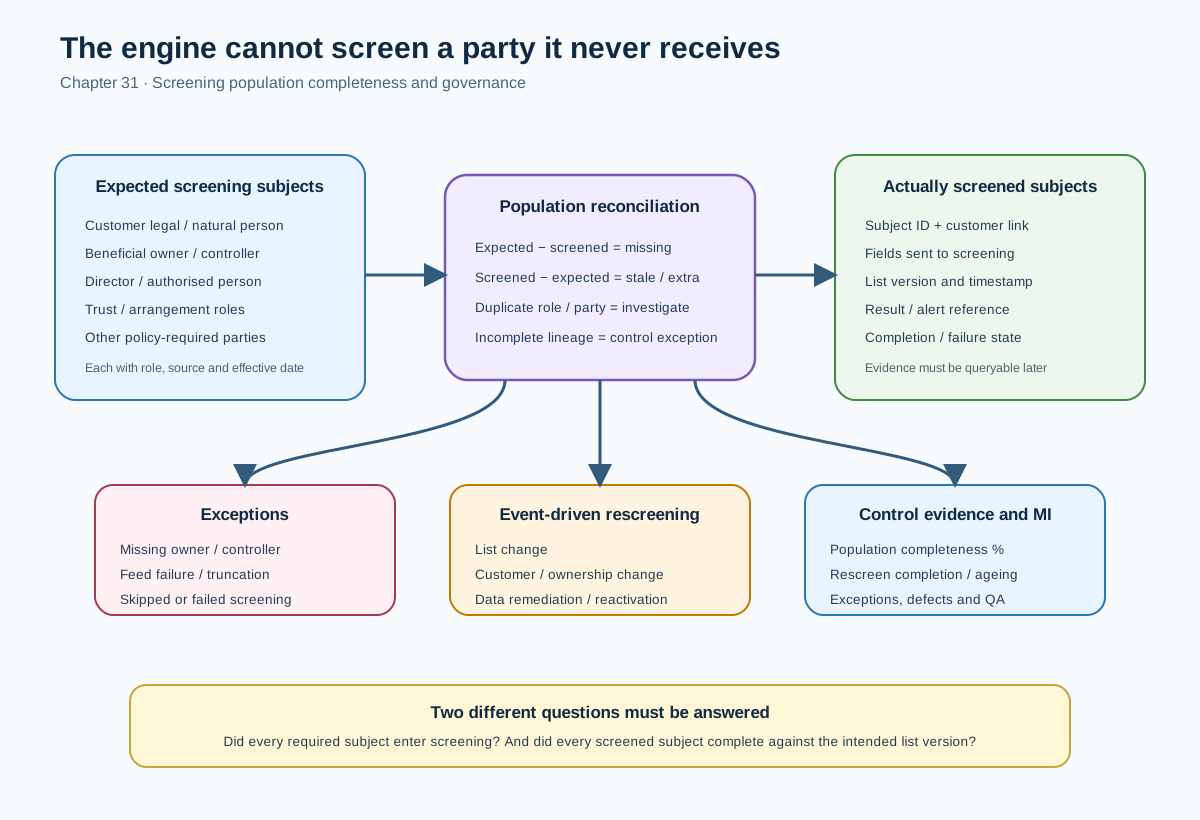
The diagram reinforces a core audit point: a screening engine cannot detect a party that never entered the screening population. Population completeness, connected-party role modelling and event-driven rescreening are therefore part of the sanctions control itself, not merely upstream KYC administration.
Current-source control design: customer sanctions screening in 2026
Customer sanctions screening is easiest to misunderstand when the bank treats it as a search function. The search function matters, but the control is larger: the bank must identify the population that should be screened, obtain the correct designation data, preserve the customer data actually sent to the engine, generate candidates with explainable matching logic, resolve identity with evidence, perform any required ownership or control analysis, determine which legal regime is relevant to the bank and activity, and then implement the correct operational outcome. A mature design can reconstruct every one of those steps later.
That distinction matters because official sources themselves separate list matching from legal effect. OFAC's current FAQ 5 describes a potential name match as something an organisation must investigate using its own sanctions compliance procedures. It directs users to compare the complete list entry and available identifiers, and only after identity resolution to assess the relevant sanctions regulations, authorisations or exemptions. OFAC's FAQ 91 also makes a second point that is essential for system design: some persons can be blocked even though they are not separately named on the SDN List, including entities captured by OFAC's 50 Percent Rule. A clean list-name result therefore cannot be represented as a universal legal-clearance flag.
The same discipline applies outside the United States. The UK changed its designation-source architecture on 28 January 2026: the UK Sanctions List became the only current source for all UK sanctions designations, while the former OFSI Consolidated List stopped being updated. Current UK list records expose fields such as primary names, name variations, aliases, non-Latin-script names, alias strength, dates and places of birth, identification details and entity registration information. Those fields are valuable for matching, but the legal effect still comes from the applicable UK sanctions legislation and guidance, including the relevant ownership and control rules. An institution should therefore store the designation record separately from the legal-rule evaluation that follows it.
For EU sanctions, the European Commission's consolidated financial sanctions list is an operational resource reflecting the officially adopted texts, but the Commission explicitly points users back to the relevant EU legal acts published in the Official Journal. The list is useful for detection; the applicable Regulation and other legal material govern the restriction. At UN level, the Security Council Consolidated List brings together names subject to targeted measures, but the Security Council states that Member States must implement the measures specific to each listed name as described by the relevant sanctions committee. A global bank should therefore avoid building one field called sanctioned=true and treating it as a complete legal answer across all booking entities.
Build a source-to-decision chain, not a list lookup
A defensible architecture keeps at least six objects separate even when one vendor platform presents them on a single screen.
The first object is the official source record. It should retain the issuing authority, list or programme, permanent or source identifier where available, publication or update time, source URL or feed identifier, and the raw attributes supplied by the authority. Where a commercial provider enriches the record, vendor-added aliases or research should be distinguishable from official designation data.
The second object is the screening subject. This is not always the legal customer. It can be a natural person, legal entity or other connected party selected because the relevant policy requires that role to be screened. The subject should carry its relationship to the customer, effective dates, source system and the attributes sent to screening. If a beneficial owner was not in the screening population because an upstream ownership feed failed, the screening engine cannot compensate for the missing subject.
The third object is the screening event. It records why screening occurred: initial onboarding, a list change, a customer-name change, ownership restructuring, director change, periodic refresh, data remediation, dormant-account reactivation or another defined trigger. The event should also record when it was created, when screening started, which population it covered and whether any records were skipped or failed.
The fourth object is the candidate match. A candidate should record the matched list entry, matched name or alias, normalisation steps, score or rule that generated the candidate, list version and relevant customer attributes. A score is evidence about string or phonetic similarity, not a legal conclusion. OFAC explicitly states that it does not recommend one universal Sanctions List Search score because each search has its own facts. A bank can set internal thresholds for its engine, but those thresholds need testing, governance and documented rationale rather than being presented as regulatory numbers.
The fifth object is the identity-resolution decision. The investigator compares identifiers such as date and place of birth, nationality, passport or national identifier, address, registration number, business location and other reliable facts. The decision can be false positive, unresolved, probable/confirmed identity match or another policy-defined state. An unresolved state is important: forcing insufficient evidence into either false or true creates artificial certainty.
The sixth object is the legal and operational disposition. This is where the bank determines the relevant legal entity, jurisdictional nexus, sanctions programme, ownership/control implications, licences or exceptions, reporting obligations and operational action. Possible actions may include proceeding, holding for specialist review, declining onboarding, restricting a product, freezing or blocking assets, rejecting activity, reporting, or another regime-specific outcome. The engine should not invent these actions from the name score alone.
List changes are business events
Designation data is not static reference data. Additions, amendments, corrections and delistings can each change the bank's control population and decisions. The UN Consolidated List, for example, was updated on 4 September 2026 at the time of this review. UK regime pages also publish notices for new designations, amendments and variations. These changes illustrate why a bank needs both a current full list and delta-aware operational processing.
A list-ingestion control should record source retrieval time, source version or file identity, checksum where appropriate, parser version, record count, rejected records, activation time and downstream completion. The control should distinguish “download succeeded” from “production population successfully rescreened.” A technically successful feed with a parser defect that drops non-Latin aliases is a failed sanctions control even if every infrastructure dashboard is green.
Delistings and amendments deserve the same discipline as additions. A delisting may change future legal treatment, but it does not automatically erase the history of why the bank previously restricted a relationship. An amended name or identifier may invalidate an old false-positive suppression. The system should therefore preserve historical designation versions and re-evaluate suppressions when relevant attributes change.
Screening population completeness is an independent control
One of the strongest controls is also one of the least glamorous: reconcile the expected population against the population actually screened. For a corporate relationship, that can mean comparing active customers and required connected-party roles from KYC/KYB against screening-subject records. For trusts or similar arrangements, the expected roles may differ and must be defined by policy and applicable requirements. The reconciliation should identify missing subjects, duplicate subjects, stale relationships, missing effective dates and subjects whose screening status cannot be traced to a current list version.
This control should not be reduced to “100 percent of customers screened” if the policy also requires certain owners or controllers. The denominator must be the expected screening subjects, not merely customer IDs. Management information should show both population completeness and screening completion, because a bank can achieve 100 percent screening completion over an incomplete population.
Matching configuration must be explainable
The official sources demonstrate why matching needs more than exact text. OFAC's Sanctions List Search uses fuzzy logic on names, including character/string and phonetic matching, and current UK list data can contain name variations, aliases and non-Latin script. A bank's engine may use different technology, but its behaviour should be explainable in business terms.
Configuration should document normalisation, tokenisation, punctuation handling, legal-suffix treatment, word order, transliteration, alias categories, phonetic logic, exact-identifier rules and weighting. Test packs should include realistic variations rather than only exact copied names. Equally, negative tests should include common names and near matches that must not produce automatic customer restrictions.
A useful design principle is that stronger identifiers should help resolve a candidate but should not be assumed infallible. Dates of birth can be incomplete; addresses can be shared; corporate registration data can be missing; official list data can contain ranges or alternative values. The investigator workstation should display provenance and uncertainty rather than collapsing each field to a binary match icon.
Suppression is a decision that must expire intelligently
Repeated false positives create operational cost and customer friction, so many banks retain prior clearance decisions. The risk appears when a historical clearance becomes a permanent name-level whitelist. A suppression should be tied to the specific customer/list candidate pair and the attributes that justified the decision. It should record who approved it, when, the evidence used and what events invalidate or reopen it.
Reopening triggers should include material changes to the customer record, list-entry amendments, new identifiers, alias changes and policy changes that affect the decision. The design should also support bulk invalidation where a matching-rule or data-quality defect means earlier closures can no longer be trusted.
Operational timing must be designed around legal urgency
Customer screening is often slower than payment screening because onboarding is not measured in seconds, but list changes can still require urgent action. FATF Recommendations 6 and 7 are built around targeted financial sanctions that countries must implement without delay in the relevant terrorism and proliferation contexts. The exact bank obligation comes through applicable law, but the control lesson is clear: designation handling cannot wait casually for the next monthly review cycle.
A global operating model should define service levels by event type and legal risk. A new designation with a high-confidence match to an existing customer may require immediate specialist handling. A low-confidence common-name candidate can require investigation without assuming the customer is prohibited. A list-ingestion outage during a major designation event should trigger an incident with known escalation and contingency procedures rather than an ordinary technology ticket.
Practical BA and architecture acceptance criteria
Requirements should be testable as end-to-end behaviours rather than broad statements such as “the system shall screen customers.” Useful acceptance criteria include the following conditions expressed in the bank's own data and workflow model:
A newly onboarded customer cannot reach the policy-defined activation state until every mandatory screening subject has either a completed screening result or an explicitly authorised exception state. When a customer name or mandatory connected party changes, an event is produced once, linked to the changed record and screened against the then-current list version. When an official list update is activated, the system can demonstrate the population selected for rescreening, completion totals, failed records and alert creation. When a prior false positive is suppressed, the suppression is linked to the exact candidate and evidence, and a later material change invalidates it according to policy. When an investigator reopens a historical case, the workstation can display the original customer data, list entry, list version, match reason and disposition as they existed at the original decision time.
Testing should include list additions, amendments and delistings; feed delay and parser failure; truncated customer names; missing connected parties; multiple transliterations; strong and weak aliases; corporate legal-suffix variation; common-name false positives; exact identifiers with conflicting names; ownership-change triggers; and suppression invalidation. The objective is not merely to show that the matching algorithm works. The test must prove that the whole control moves the right data to the right decision at the right time.
Mini case: an apparently clean corporate customer
Consider a corporate customer that passed onboarding screening twelve months ago. Its legal name has not changed and therefore produces no new name alert. A new shareholder is added upstream in the KYC ownership graph after a corporate restructuring. The shareholder is a designated person under a regime relevant to one of the bank's legal entities.
A weak design does nothing until the next periodic KYC review because the customer name did not change. A stronger design treats the ownership change as a screening and sanctions-analysis event. It screens the new connected party, preserves the ownership chain and effective date, routes any identity candidate to investigation, applies the applicable ownership/control rule separately from the name match, and then determines the legal and product consequences for the relevant booking entity.
The lesson is broader than the example: customer sanctions screening is a continuously evidenced relationship control, not a one-time search at account opening. The bank should be able to prove its population, source data, list version, matching behaviour, identity evidence, legal analysis and operational action without reconstructing the story from disconnected system logs after an incident.
Knowledge check
-
Why is customer sanctions screening better described as a continuous control than as a one-time onboarding check?
-
What four things must a mature screening programme prove about population, customer data, sanctions data and timing?
-
What is the difference between a false positive, an unresolved potential match, an identity match and legal applicability?
-
Why can a high fuzzy-match score still support a false-positive decision, while a lower score can require escalation?
-
What risks are created by broad “good guy” or whitelist suppressions?
-
Which customer or relationship events should trigger re-screening without waiting for the next periodic review?
Answer guide
Lists and customer facts change after onboarding, so the control must respond to designation changes, aliases, ownership changes and relationship changes throughout the customer lifecycle. The programme should prove that the right population was screened, the right source customer/connected-party data reached the engine, the right current sanctions data and rules were used, and screening occurred at the required time. A false positive means the parties are different; an unresolved potential match means evidence is insufficient; an identity match means the bank believes the customer is the target; legal applicability then determines the actual restriction. Matching scores generate candidates and do not replace identifiers or investigation. Broad suppressions can hide a future true match and therefore need narrow scope, evidence, approval and review. Re-screening triggers can include legal-name or alias changes, identity-document changes, beneficial-owner/control changes, director or trust-party changes, mergers, reactivation and sanctions-list updates.
Glossary
Screening population — The customers and connected parties that policy requires to be screened for the relevant legal entity, product and jurisdiction.
Population completeness — Evidence that every party expected to be screened actually generated the required screening event or a controlled exception.
Candidate match — A potential similarity generated by screening logic that requires assessment; it is not a legal conclusion.
False positive — A candidate alert resolved with evidence showing that the customer or connected party is not the sanctions target.
Unresolved potential match — A state where available information is insufficient to clear or confirm identity and escalation or more evidence is needed.
Identity match — A conclusion that the screened party is the person or entity represented by the sanctions record.
Legal applicability — The separate assessment of what restriction applies to the identity match under the relevant regime, bank entity and product.
Transliteration — Representation of a name from one writing system in another; multiple valid spellings can exist and must be considered in screening design.
Alias — An alternative, former or additional name associated with a sanctions target; strength and provenance can vary.
Suppression / good-guy rule — A controlled rule that prevents repeated known false positives from creating unnecessary alerts; it must be narrow, evidence-based and reviewed.
List ingestion — The controlled process of receiving, validating, parsing, deploying and evidencing sanctions-list updates.
Event-driven rescreening — Re-screening triggered by a material customer, relationship or list change rather than waiting for a periodic review date.
References and further reading
Customer sanctions screening should use current official designation sources and a documented control framework for population coverage, matching, investigation, ownership analysis, re-screening and evidence. The sources below were checked on 15 September 2026. Jurisdiction-specific legal requirements must be applied through the law and guidance relevant to the bank legal entity and activity; a screening alert is not by itself a legal conclusion.
- U.S. Treasury OFAC — Sanctions List Service, the primary OFAC service for current SDN and non-SDN list data: https://ofac.treasury.gov/sanctions-list-service
- U.S. Treasury OFAC — FAQ 5, assessing potential OFAC name matches using available identifiers and the applicable sanctions programme: https://ofac.treasury.gov/faqs/5
- U.S. Treasury OFAC — FAQs on how Sanctions List Search works, including fuzzy matching and OFAC's statement that it does not recommend one universal match-threshold score: https://ofac.treasury.gov/faqs/topic/1636
- U.S. Treasury OFAC — FAQ 91, explaining that some blocked persons or entities may not be separately named on the SDN List, including entities captured by the OFAC 50 Percent Rule: https://ofac.treasury.gov/faqs/91
- U.S. Treasury OFAC — Entities Owned by Blocked Persons / 50 Percent Rule FAQs: https://ofac.treasury.gov/faqs/topic/1521
- UK Government — UK sanctions collection and current UK Sanctions List resources. From 28 January 2026 the UK Sanctions List is the only current source for all UK sanctions designations: https://www.gov.uk/government/collections/uk-sanctions
- UK Office of Financial Sanctions Implementation — UK financial sanctions general guidance, last updated 12 May 2026 at the time of this review: https://www.gov.uk/government/publications/financial-sanctions-general-guidance/uk-financial-sanctions-general-guidance
- European Commission — Overview of EU sanctions and related resources, including the consolidated financial sanctions list and links to the controlling EU legal acts: https://finance.ec.europa.eu/eu-and-world/sanctions-restrictive-measures/overview-sanctions-and-related-resources_en
- United Nations Security Council — Consolidated List. The current list page records the date of the latest list version and states that Member States implement the measures attached to each relevant sanctions regime: https://main.un.org/securitycouncil/en/content/un-sc-consolidated-list
- FATF — The FATF Recommendations, including Recommendations 6 and 7 on targeted financial sanctions and their interpretive notes: https://www.fatf-gafi.org/en/publications/Fatfrecommendations/Fatf-recommendations.html
- FATF — June 2026 update to Recommendation 6 concerning humanitarian exemptions under the relevant UN Security Council framework: https://www.fatf-gafi.org/en/publications/Fatfrecommendations/update-recommendation-6-june-2026.html
- Wolfsberg Group — Sanctions Screening Guidance, a public industry guidance paper on designing and assessing effective sanctions-screening controls: https://wolfsberg-group.org/resources/legacy/53
Accuracy note — reviewed 15 September 2026: current official sources continue to support the chapter's core control model. Matching is an identity-triage step; legal effect depends on the relevant regime and jurisdiction. OFAC does not prescribe one universal fuzzy-match threshold. The UK Sanctions List, not the closed OFSI Consolidated List, is the current designation source for UK sanctions. EU consolidated-list data is an operational resource reflecting officially adopted measures, while the applicable EU legal acts remain controlling. UN list entries must be read with the measures of the relevant sanctions committee and implemented through the applicable legal framework.