Ownership, Control and Beneficial Interest
One of the most dangerous assumptions in sanctions compliance is that an entity is safe because its name does not appear on a sanctions list. Many regimes extend restrictions to entities that are owned or controlled by designated persons, even if the entity is not separately named. This makes ownership and control analysis a core sanctions capability rather than a specialist afterthought.
The second dangerous assumption is that one ownership percentage works everywhere. It does not. Different sanctions regimes use different legal tests, and control can exist without majority economic ownership. A bank therefore needs a jurisdiction-specific framework that distinguishes direct ownership, indirect ownership, aggregation, voting rights, appointment rights, de facto control, joint arrangements and other relevant legal concepts.
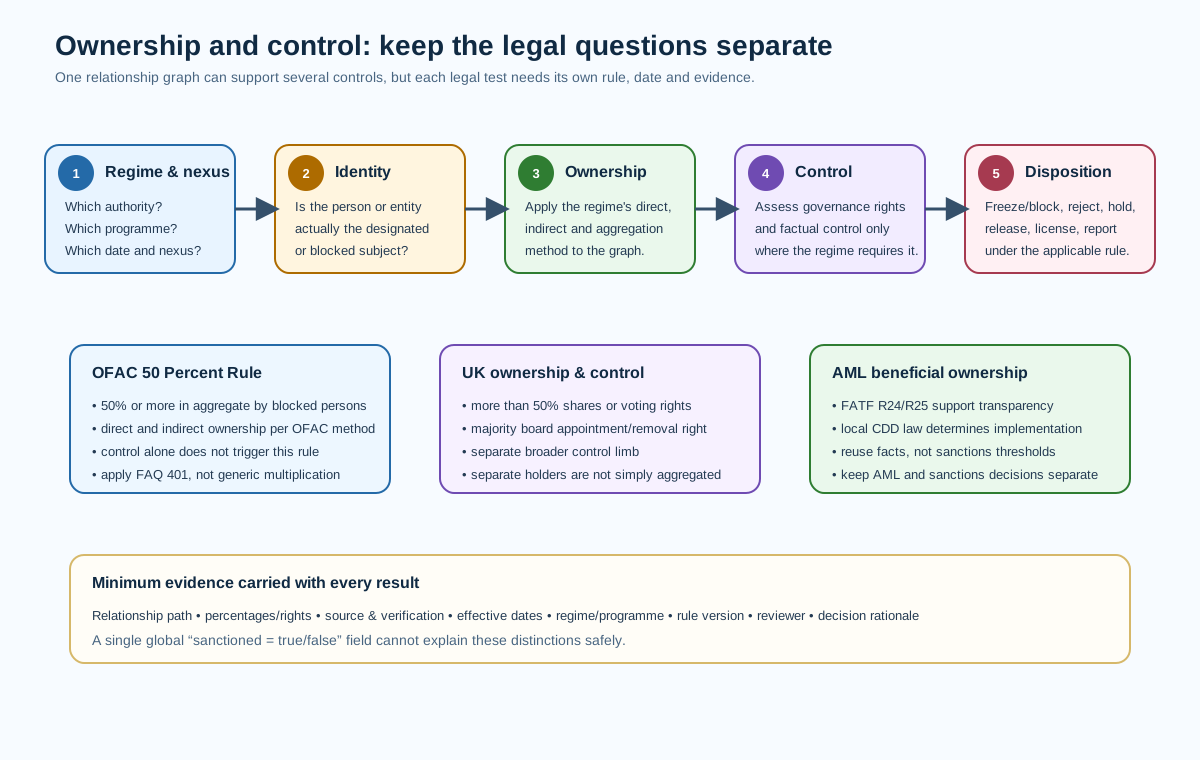
Beneficial ownership and sanctions ownership are related but not identical
AML beneficial-ownership rules seek to identify the natural persons who ultimately own or control a customer according to applicable CDD law. Sanctions ownership/control analysis asks whether an entity is subject to sanctions restrictions because of its connection to a designated person under a particular sanctions regime.
The same ownership data can support both controls, but the legal questions are different. A customer can satisfy AML beneficial-ownership requirements and still require a separate sanctions analysis.
Direct ownership
Direct ownership occurs where a person holds shares or other ownership interests in an entity directly.
The system should store percentage, class of interest, voting rights where relevant, source of evidence and effective dates rather than only a yes/no owner flag.
Indirect ownership
Indirect ownership arises through one or more intermediate entities. If Person A owns Company X and Company X owns Customer Y, the bank may need to calculate Person A’s indirect economic interest and separately assess whether control exists.
Arithmetic should be transparent. Analysts should be able to explain each ownership path.
Ownership chains
Corporate structures can include several subsidiaries, holding companies, trusts, partnerships or nominee arrangements. A sanctions engine that screens only the immediate shareholder can miss designated persons higher in the chain.
The bank should be able to traverse the graph to the relevant natural persons or designated entities.
OFAC’s 50 Percent Rule
OFAC guidance states that entities owned, directly or indirectly, 50 percent or more in the aggregate by one or more blocked persons are treated as blocked, even if the entity itself does not appear on the SDN List. OFAC’s programme and legal context still matter, and banks should use current official guidance.
A key operational point is that a customer’s list status and its ownership status are separate data points.
Aggregation under OFAC
For the OFAC 50 Percent Rule, ownership interests of multiple blocked persons can be aggregated. This differs from some other regimes.
The bank’s rules engine should therefore know which aggregation logic belongs to which authority.
UK ownership and control
OFSI’s May 2026 guidance states that an entity can be owned or controlled where a person holds directly or indirectly more than 50% of shares or voting rights, has the right to appoint or remove a majority of the board, or where it is reasonable to expect that the person can ensure the entity’s affairs are conducted in accordance with that person’s wishes.
The UK framework therefore makes clear that control can exist even when a simple ownership percentage does not establish it.
UK aggregation nuance
OFSI guidance explains that it would not simply aggregate separate designated persons’ holdings unless, for example, shares or rights are held jointly, subject to a joint arrangement, or one party controls the rights of another.
This is a practical example of why a global “sum all sanctioned percentages” rule can be wrong.
EU ownership and control
EU restrictive measures can extend asset-freeze restrictions to entities owned or controlled by listed persons. The detailed legal test should be applied using current EU legislation and guidance relevant to the regime.
Banks should not assume that U.S. or UK interpretations can simply be copied into EU controls.
Control without majority ownership
A designated person may have significant influence through voting agreements, rights to appoint directors, financing arrangements, contractual rights, personal relationships or other means.
Control analysis therefore requires more than a cap table.
Board appointment rights
The ability to appoint or remove a majority of directors can be an important indicator or legal test of control in some regimes.
Customer data should capture governance rights where materially relevant rather than store only ownership percentages.
Voting rights
Economic ownership and voting power can differ. Dual-class shares, shareholder agreements and special voting rights can create control with lower economic ownership.
A bank should model both where needed.
Joint arrangements
Parties can hold or exercise rights jointly. Joint arrangements can affect ownership/control analysis and aggregation.
Analysts need access to shareholder agreements or reliable legal analysis in complex cases.
Trusts
Trust structures can involve settlors, trustees, protectors, beneficiaries and persons with control rights. The legal owner of assets may be the trustee while economic benefit or control sits elsewhere.
AML and sanctions analysis should not force trusts into a simple shareholder model.
Foundations and similar arrangements
Foundations and other legal arrangements can also separate formal ownership from benefit or control. The relevant parties and rights vary by legal form and jurisdiction.
The bank should model role, source, effective date and control relationship.
Nominees
Nominee shareholders or directors can be legitimate. Their presence does not prove concealment.
The bank should identify the person on whose behalf the nominee acts and whether that person exercises control.
Proxies and de facto control
A designated person can attempt to retain influence through relatives, business associates, management teams or informal arrangements after reducing formal ownership.
OFSI enforcement guidance notes that due diligence may consider indicators such as continued influence, proxies, changes in ownership and complex arrangements.
Divestment after designation
A sudden reduction in ownership after designation can be legitimate or designed to avoid restrictions. Banks should not assume either conclusion.
The investigation should examine timing, consideration, buyer independence, continuing rights and actual governance.
Management control
A designated former owner who continues to direct senior management may still create control concerns under some regimes.
Evidence can include governance documents, financing dependencies, contractual rights and credible external intelligence.
Beneficial interest
The concept of beneficial interest can matter where a designated person receives economic benefit without formal ownership.
Banks should avoid using the term generically unless the relevant legal framework defines its significance. The correct analysis depends on the applicable regime.
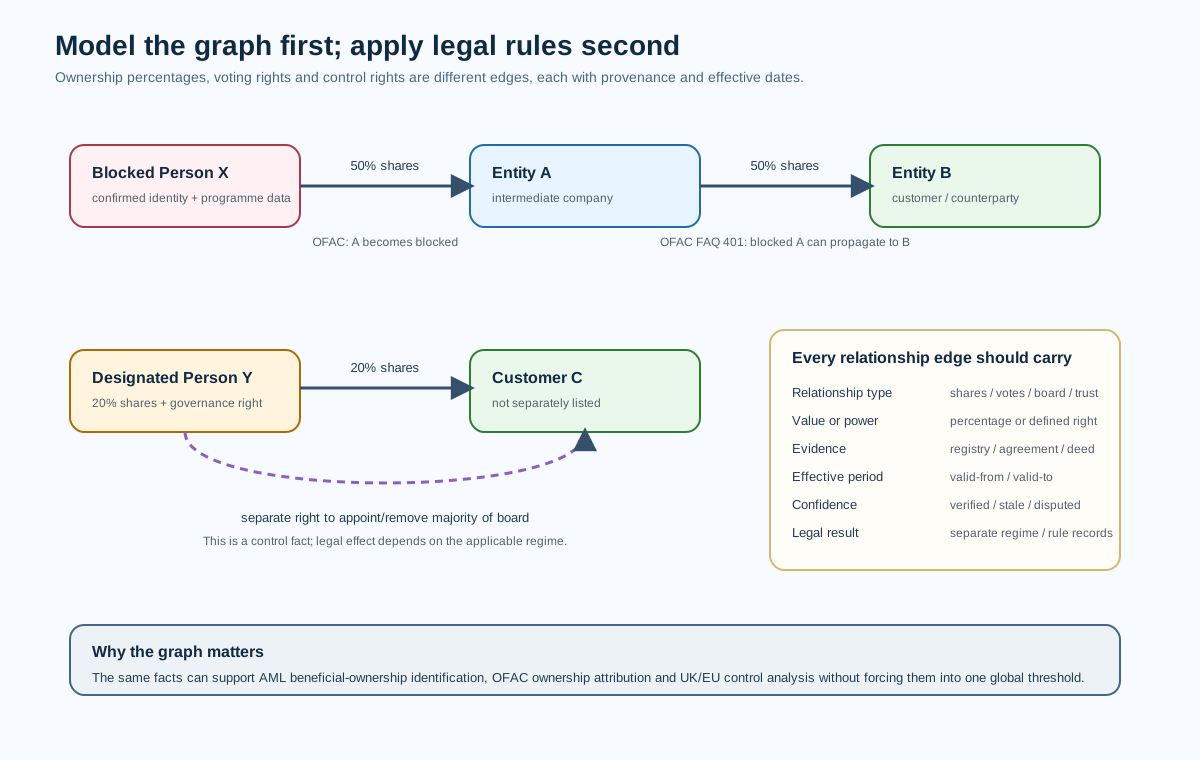
Why percentages need effective dates
Ownership today may not reflect ownership when a historical payment occurred. Every material relationship should have effective-from and, where relevant, effective-to dates.
This supports lookbacks, regulatory enquiries and post-designation analysis.
Corporate actions
Mergers, acquisitions, share issues, buybacks, transfers and restructurings can change sanctions exposure.
Material ownership changes should trigger event-driven rescreening and control review.
Scenario: direct OFAC ownership
Blocked Person A owns 60% of Customer X. Customer X is not separately listed.
Under OFAC’s 50 Percent Rule, X is treated as blocked. The bank should apply the relevant legal restrictions and reporting requirements.
Scenario: indirect ownership
Blocked Person A owns 80% of Holding Company B, which owns 70% of Customer C. The bank should calculate the indirect path and apply OFAC guidance as relevant.
The system should show the chain rather than merely display “ownership hit.”
Scenario: two blocked owners
Blocked Persons A and B each own 30% of Customer C under OFAC jurisdiction. Aggregation can make C 60% owned by blocked persons.
A system that checks each owner separately against a 50% threshold could miss the result.
Scenario: UK minority owner with control
A designated person owns 30% but has contractual rights to appoint most directors and direct key decisions.
The UK control test can be relevant even though the shareholding is below 50%.
Scenario: UK separate minority holders
Two separate designated persons each hold 30% with no joint arrangement and no evidence of one controlling the other’s rights.
OFSI guidance indicates that holdings are not simply aggregated merely because both owners are designated. Analysts should still assess other control facts.
Scenario: post-designation divestment
A designated owner transfers shares to a long-time business associate shortly after designation but continues to finance the company and appoint senior management.
The bank should not rely solely on the updated registry. Control and proxy risk require deeper analysis.
Scenario: family relationship
A family member owns an entity connected to a designated person. Family relationship alone does not prove ownership or control by the designated person.
Evidence should establish whether the designated person benefits from or directs the entity.
Registry data
Corporate registries are important but can be incomplete, stale or self-reported. They should be combined with customer declarations, corporate documents, reliable databases and other evidence according to risk.
A registry match is evidence, not infallible truth.
Commercial databases
Third-party ownership data can accelerate analysis but should preserve provenance and confidence. Complex ownership graphs may contain inferred relationships.
Analysts need to know what is verified and what is modelled.
Customer declarations
Customers can provide ownership charts and legal documents. These are important inputs but may require independent corroboration where risk is higher.
Effective-dated ownership model
A strong data model stores entity, owner, ownership type, percentage, voting rights, control rights, source, verification status and effective period.
It also supports multiple simultaneous ownership paths.
Calculation engine
Ownership calculations should be reproducible. For each result the engine should show path, percentages, aggregation rule and legal regime.
Opaque ownership scores are not sufficient for high-stakes sanctions decisions.
Control assessment workflow
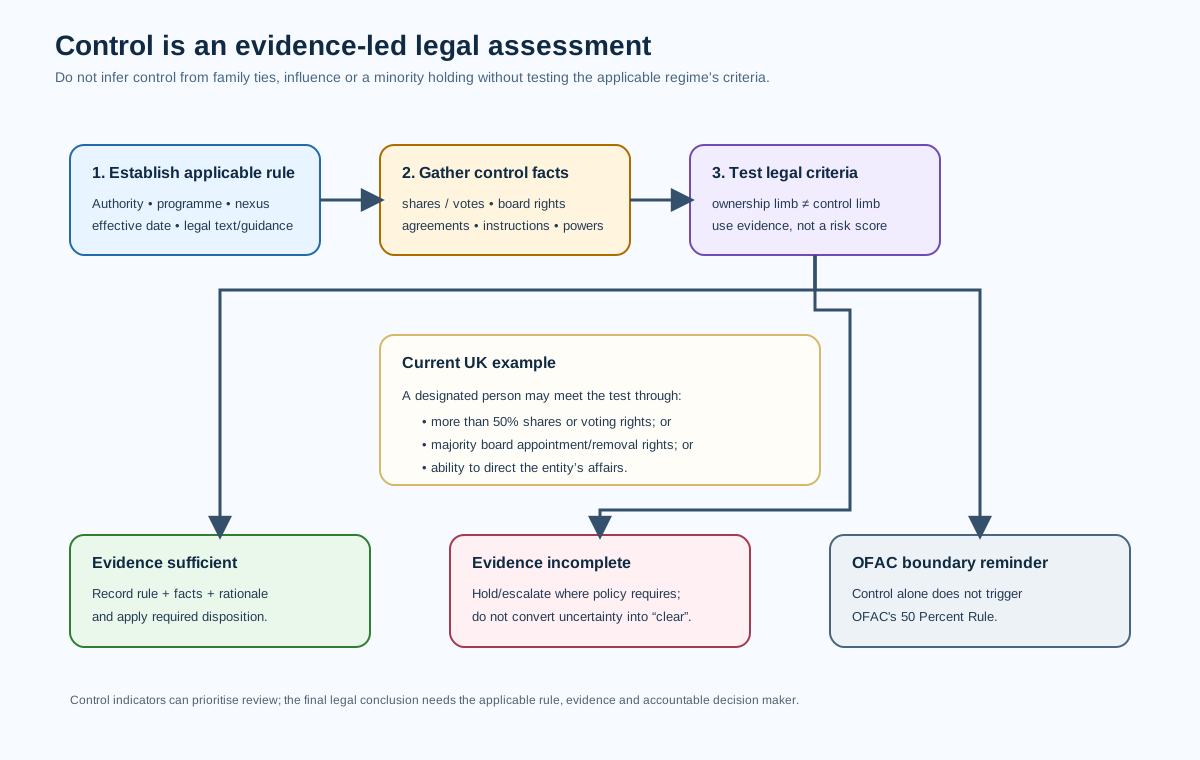
Ownership may be partly automated, but control often requires specialist judgement. The workflow should allow escalation, legal interpretation, evidence collection and documented conclusion.
Screening ownership relationships
When a new designation is added, the bank should not only rescreen customer names. It may need to identify customers owned or controlled by the newly designated person.
This requires reverse relationship queries through the ownership graph.
Customer changes
A new shareholder, director or control right can alter sanctions exposure even if the sanctions list did not change.
Event-driven rescreening should therefore respond to customer-data changes as well as list changes.
Payments to owned entities
A payment beneficiary may not be listed but can be restricted because of ownership/control. Payment screening needs access to relevant counterparty ownership intelligence where feasible.
This is more difficult for one-off external beneficiaries than for customers, which is why risk-based escalation and external data can matter.
Securities and custody
Ownership analysis also affects securities, funds, corporate actions and custody. A bank can hold assets issued by or economically connected to restricted entities.
Product-specific rules should complement customer screening.
Funds and pooled vehicles
Investment funds can contain underlying holdings that create sanctions questions depending on product, legal regime and bank role.
Banks should involve legal and product specialists rather than apply a simplistic customer-ownership rule to every fund structure.
Sanctions versus AML beneficial ownership thresholds
AML CDD thresholds and sanctions ownership thresholds serve different purposes. The bank should not reuse one threshold merely because both involve ownership.
This distinction belongs explicitly in requirements and training.
Business analyst view
A BA should model direct ownership, indirect ownership, voting rights, control type, joint arrangement, designated-party status, legal regime, calculation path, evidence and decision.
Requirements should specify aggregation separately by regime.
Acceptance criteria
Tests should include multiple ownership paths, rounding, missing percentages, changes over time, joint ownership, aggregation, trusts, nominees, dual-class shares and control without ownership.
Explainability
An analyst should be able to show why a customer is considered restricted: which designated person, which path, which ownership/control rule and which evidence.
A red banner saying “sanctions ownership risk” is not enough.
Data-quality controls
Missing shareholder percentages, stale ownership, duplicate entities and unresolved natural-person identities can create false negatives or false positives.
Ownership data quality is therefore part of sanctions control effectiveness.
Governance
Complex control determinations should be reviewed by appropriate sanctions/legal specialists. Policies should define when automation is sufficient and when legal interpretation is required.
Quality assurance
QA should test whether analysts applied the correct regime, whether aggregation was performed correctly, whether control evidence was considered and whether case notes explain the decision.
Metrics
Useful measures include ownership-data completeness, unresolved complex structures, time to assess new designations, rescreening coverage, legal escalations, false positives and post-event breaches.
Common mistakes
Common mistakes include assuming unlisted means unrestricted, applying OFAC’s 50% rule globally, ignoring indirect ownership, ignoring control rights, simply aggregating designated owners in every regime, using AML ownership thresholds for sanctions and relying solely on registry data.
Learning checkpoint
A reader should be able to distinguish AML beneficial ownership from sanctions ownership/control, calculate direct and indirect ownership, explain OFAC aggregation, explain why UK aggregation and control analysis differ, identify control without majority ownership, and design an auditable ownership engine with regime-specific logic and evidence.
Reference links
- OFAC — Sanctions Programs and Country Information: https://ofac.treasury.gov/sanctions-programs-and-country-information
- OFAC — Guidance on entities owned by blocked persons / 50 Percent Rule: https://ofac.treasury.gov/faqs/topic/1521
- OFSI — UK financial sanctions general guidance: https://www.gov.uk/government/publications/financial-sanctions-general-guidance/uk-financial-sanctions-general-guidance
- OFSI — Financial sanctions enforcement and monetary penalties guidance: https://www.gov.uk/government/publications/financial-sanctions-enforcement-and-monetary-penalties-guidance/financial-sanctions-enforcement-and-monetary-penalties-guidance
- European Commission — EU sanctions overview: https://finance.ec.europa.eu/eu-and-world/sanctions-restrictive-measures/overview-sanctions-and-related-resources_en
Educational note: ownership and control rules vary by sanctions regime and can change. Apply current legislation, official guidance and bank legal interpretation; do not treat any percentage in this chapter as a universal threshold.
Deep dive: ownership calculations, control judgement and evidence
Ownership analysis looks mathematical, but sanctions decisions are not merely arithmetic. The bank needs both a calculation engine and a control-assessment workflow. The calculation engine shows economic ownership paths. The control workflow asks whether the designated person can direct or influence the entity under the applicable legal test.
Build the ownership graph
Each node should be a person, company, partnership, trust or other relevant entity. Each link should identify ownership type, percentage, voting rights, source, verification status and effective dates.
The graph should permit more than one path from a person to the customer.
Direct and indirect calculation
If Person A owns 80% of Company B and B owns 70% of Customer C, A has a 56% indirect economic interest through that path. If A has another separate path, the relevant regime may require additional aggregation or analysis.
The system should show the arithmetic rather than hide it behind a score.
OFAC aggregation exercise
Blocked Person A owns 30% and Blocked Person B owns 25% of Customer X. Under OFAC's 50 Percent Rule, their ownership interests can be aggregated, resulting in 55% ownership by blocked persons.
This does not mean the same aggregation logic should be applied under every sanctions regime.
UK aggregation exercise
Two designated persons each own 30% of Customer X, with no evidence of a joint arrangement or one controlling the other's rights. OFSI guidance states that separate holdings are not simply aggregated merely because both owners are designated.
The analyst should still assess whether any joint arrangement, indirect control or other control fact exists.
Voting-control exercise
A designated person owns 20% but has rights to appoint six of ten directors. Depending on the regime, that can satisfy a control test even though the economic ownership percentage is low.
This shows why cap-table analysis alone is insufficient.
Proxy ownership
A designated person transfers shares to a long-time associate while retaining financing rights, management influence and economic benefits. The registry may show divestment, but the control question remains open.
Analysts should distinguish evidence of continued influence from mere personal association.
Family relationships
A family member owning an entity does not automatically mean the designated person controls it. Family links can be a reason to investigate but are not proof of control.
The case should identify actual rights, funding, instructions or other evidence.
Trust structures
For a trust, ownership percentages may be meaningless. Relevant roles can include settlor, trustee, protector, beneficiary and persons exercising control.
The bank's data model should support those roles and the legal analysis relevant to the sanctions regime.
Partnership structures
Partnership interests can combine capital share, profit share and management rights. The bank should not assume a corporate-shareholder model applies unchanged.
Dual-class shares
A founder can retain super-voting shares while holding a minority economic interest. This can create control without majority ownership.
The sanctions data model should therefore include voting rights where relevant.
Shareholder agreements
Agreements can create veto rights, appointment rights or joint control. Important rights may not appear in public registry percentages.
Complex cases may require legal document review.
Ownership changes over time
When a person becomes designated, a lookback may need to establish whether historical transactions involved an entity that was owned or controlled at the relevant time. Effective-dated ownership is essential.
Current structure alone is not enough.
Reverse screening
A new designation should trigger a search for all customers and relationships in which the newly designated person appears anywhere in the ownership graph.
This is different from screening customer names against a new list record.
Corporate events
Mergers, acquisitions, share transfers, buybacks, new share classes and restructurings can change ownership percentages quickly. Corporate-event feeds can therefore be sanctions control inputs.
Data provenance
Every relationship should state where it came from: registry, customer declaration, legal document, commercial database, public information or analyst inference.
A sanctions decision based on inferred ownership should be clearly identified as such and escalated where appropriate.
Source conflict
Different sources can disagree. A registry may show one shareholder while a customer declaration shows another. Do not silently choose one.
Record the conflict, investigate the effective date and determine which source is reliable for the decision.
Calculation precision
Rounding can alter results near thresholds. Ownership engines should use sufficient precision and define how percentages are represented and aggregated.
Analysts should not manually round a 49.999% calculation into a legal conclusion.
Circular ownership
Corporate groups can contain circular or reciprocal ownership. A naive graph algorithm can loop indefinitely or double count.
The calculation engine should detect cycles and route complex cases for specialist review.
Unknown ownership
Missing ownership is not the same as zero ownership. Systems should represent unknown, not silently convert it to no risk.
High-risk unresolved structures may require enhanced due diligence or restriction according to policy.
Control indicators
Potential control evidence can include board appointment rights, voting agreements, financing dependence, contractual rights, management instructions, power of attorney, dominant influence and other facts recognised by the applicable regime.
Each indicator needs evidence and context.
Sanctions screening integration
Customer screening should consume the ownership graph. Payment screening can also benefit from ownership intelligence for known counterparties, though one-off beneficiaries may have less data.
The bank should be explicit about coverage limitations.
AML integration
AML KYC can provide ownership information, but sanctions may require different thresholds and control analysis. The bank should reuse data without reusing the wrong legal rule.
Legal review
Complex control cases should have a clear path to sanctions legal specialists. The system should capture the question asked, evidence reviewed and conclusion reached.
BA acceptance criteria
Include multiple direct owners, multiple indirect paths, OFAC aggregation, UK non-aggregation, joint arrangements, voting control, board appointment, trust roles, nominee, missing percentages, circular ownership and ownership change during an open case.
QA review
QA should verify that analysts applied the correct regime, did not import an AML threshold, did not assume an unlisted entity is clear and explained both the ownership arithmetic and any control conclusion.
Final deep-dive test
A strong learner should be able to build an ownership graph, perform transparent indirect calculations, explain why aggregation differs by regime, identify control without majority ownership and preserve evidence strong enough for audit or legal review.
Advanced practitioner layer: ownership, control and beneficial interest under sanctions
Ownership analysis becomes dangerous when a bank treats a percentage calculation as if it were the legal conclusion. A strong sanctions framework separates at least four questions: who legally owns the entity, who economically benefits, who can exercise control, and which sanctions regime determines the consequence? The same corporate chart can produce different outcomes under different legal frameworks, so the bank needs transparent calculations and regime-specific legal decisioning rather than one global threshold.
The practitioner discipline is to keep the facts and the rule separate. Facts include shareholding, voting rights, board appointment rights, contractual powers, funding relationships, trust roles, nominees and effective dates. The rule is the legal test under the relevant sanctions regime. The conclusion should show how the facts satisfy—or do not satisfy—that rule.
OFAC: the 50 Percent Rule is an ownership rule
OFAC’s current guidance states that entities owned, directly or indirectly, 50 percent or more in the aggregate by one or more blocked persons are treated as blocked even when they are not separately named on the SDN List. This is a critical rule for system design because a clean name screen can still leave the bank dealing with blocked property.
Equally important is what the rule does not say. OFAC’s 50 Percent Rule is based on ownership. Control by a blocked person, without 50 percent or greater ownership, does not by itself make the entity automatically blocked under that specific rule. OFAC nevertheless advises caution because a controlled entity may present other sanctions risks or itself meet designation criteria. Training should preserve that distinction rather than convert “control concern” into “automatically blocked under the 50 Percent Rule.”
For technology, this means the ownership engine can calculate a 50-percent-rule outcome, while a separate control or risk-assessment workflow handles non-ownership concerns.
Aggregation needs rule context
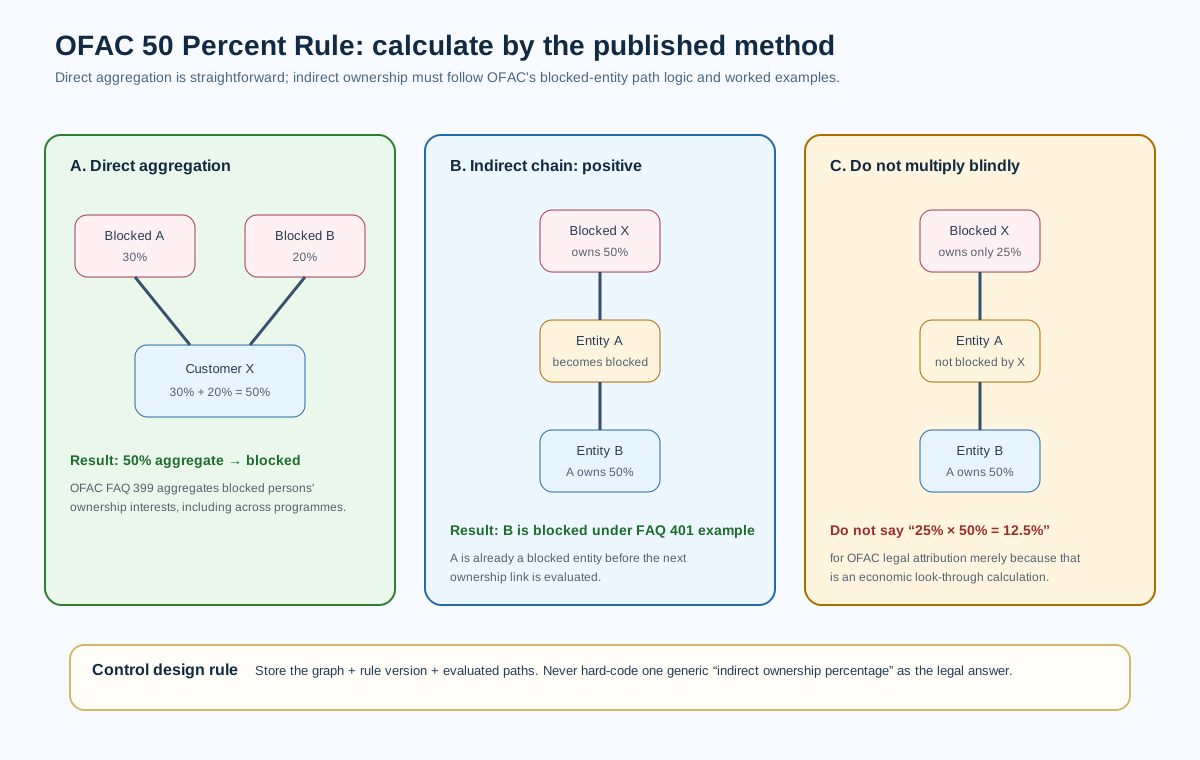
Suppose Blocked Person A owns 25 percent of Company X and Blocked Person B owns 30 percent. Under the OFAC 50 Percent Rule, the blocked persons’ interests can be aggregated, producing 55 percent blocked ownership. A system that tests each owner independently against 50 percent would miss this result.
Now change jurisdiction. A different regime may not aggregate separate designated persons in the same way unless legal conditions such as joint arrangements or shared control are met. Therefore the data model should not store a generic field called sanctioned_ownership_percentage and assume that one calculation answers every regime.
A better model stores the underlying ownership facts once and lets regime-specific calculation logic derive legal outcomes.
Direct, indirect and multiple-path ownership
Simple indirect ownership is easy to explain: if A owns 80 percent of B and B owns 70 percent of C, A has 56 percent economic ownership through that path. Real structures are harder because the same person can reach the customer through multiple paths.
Consider A owning 60 percent of B and 40 percent of D. B owns 40 percent of Customer X and D owns 30 percent. A has one indirect path of 24 percent and another of 12 percent. Whether and how those interests should be combined for the relevant legal test must follow the applicable sanctions rule, not an analyst’s intuition.
The calculation engine should expose every path, input percentage, mathematical operation and rule applied. A final number without lineage is not sufficient evidence for a high-stakes decision.
Rounding and threshold integrity
Ownership close to a legal threshold creates a classic implementation risk. If upstream systems store only whole percentages or round intermediate calculations, the sanctions engine can change the legal outcome.
A strong design preserves source precision and applies a documented calculation methodology. Analysts should see whether the underlying evidence says 49.99 percent, approximately 50 percent, or exactly 50 percent. “Approximately” is not a number and may require additional evidence.
UAT should deliberately include boundary values such as 49.99, 50.00 and 50.01, plus indirect calculations that cross a threshold only after aggregation. The objective is not to teach a universal percentage; it is to prove that the system implements the correct rule precisely.
Circular ownership and double counting
Corporate groups can contain reciprocal or circular ownership. A naive graph algorithm can loop indefinitely or count the same economic interest more than once. The sanctions engine should detect cycles and apply controlled graph logic rather than endlessly traverse the same nodes.
Where the legal or mathematical treatment is complex, the safest automated output can be “specialist review required” rather than a fabricated percentage. Automation should expose uncertainty, not conceal it.
Control is a legal judgement, not a fuzzy score
Control can arise from voting power, rights to appoint or remove management, contractual arrangements, joint arrangements or the practical ability to direct an entity, depending on the regime. These facts may not appear in a corporate registry.
A useful control workflow collects structured indicators but avoids presenting a generic machine score as a legal conclusion. For example, the workflow can record: board appointment rights; veto rights; shareholder agreements; financing dependence; management instructions; power of attorney; shared executives; or evidence that another person acts on behalf of the designated person.
Each indicator should have provenance. An analyst’s inference from media reporting is different from an executed shareholder agreement.
UK ownership and control: keep the broader test visible
UK sanctions guidance includes ownership and control concepts extending beyond a simple shareholding calculation. More-than-50-percent ownership or voting rights and rights relating to board appointment are important, while the broader control concept can also require assessment of whether it is reasonable to expect that a person can ensure the entity’s affairs are conducted in accordance with that person’s wishes.
The practical difficulty of applying ownership and control has been significant enough that OFSI opened a call for evidence in February 2026. That should reinforce a key lesson for learners: complex control cases are not solved by a universal spreadsheet formula. They require current official guidance, facts, and often legal or sanctions-specialist judgement.
EU analysis: do not import US or UK rules automatically
EU restrictive measures can extend asset-freeze restrictions to entities owned or controlled by listed persons, but the analysis must follow the applicable EU legal framework and current guidance. A bank should not simply label an entity “EU blocked because OFAC says 50 percent” or apply a UK control test as if it were identical EU law.
Global technology can reuse the same ownership graph while the legal decision layer remains regime-specific. This is a good example of reusing data without reusing the wrong rule.
Nominee arrangements: indicator, not proof
Nominee shareholders and directors can be legitimate. The presence of a nominee should therefore create a question, not a presumption of evasion. The investigation asks who provided the capital, who receives economic benefits, who gives instructions, what contractual rights exist and whether the nominee acts independently.
A good case note distinguishes verified fact from inference. “Director is known associate of designated person” is not equivalent to “director acts under designated person’s instructions.” The latter requires evidence.
Post-designation divestment and proxy risk
A designated person may transfer shares after designation. A genuine arm’s-length divestment can remove ownership exposure under the relevant rule; a nominal transfer to a proxy may not resolve control concerns.
The analyst should examine timing, consideration paid, buyer independence, financing, continuing board rights, management influence, profit entitlement, contractual arrangements and actual behavior after the transfer. Sudden restructuring is a trigger for deeper assessment, not automatic evidence of evasion.
The bank should also effective-date the old and new ownership structure. Historical transactions must be analysed against the ownership that existed at the relevant time, not today’s registry snapshot.
Trusts and legal arrangements
A trust cannot be reduced to one ownership percentage. Relevant roles can include settlor, trustee, protector, beneficiaries, classes of beneficiaries and persons with powers over appointment or distribution. The legal effect of those roles depends on the sanctions framework and the trust terms.
The bank’s KYC model should preserve roles explicitly. Storing all trust parties in a generic “beneficial owner” table loses important information and can create both false positives and false negatives.
For sanctions investigations, useful evidence can include trust deeds, amendments, letters of wishes where legally available, trustee powers, protector rights, distribution history and credible external information.
Partnerships, foundations and non-corporate structures
Partnerships can separate capital contribution, profit share and management authority. Foundations and similar arrangements can separate formal legal ownership from economic benefit or governance rights. The ownership engine should therefore support legal-form-specific relationships instead of forcing every structure into shareholder percentages.
Where automated calculation does not fit the legal form, the case workflow should route the structure to specialist review.
Reverse ownership search after a new designation
When a person becomes designated, conventional customer screening finds customers whose names match the new record. Ownership screening asks a different question: which customers or connected entities does this newly designated person own or control?
That requires reverse traversal of the relationship graph. The bank should search direct ownership, indirect paths, trusts, controlling roles and other relevant relationships. It should record which population was searched and when.
This capability can be as important as the list-screening engine itself. Without it, a bank may identify the designated individual but miss dozens of unlisted entities connected to that person.
Customer versus external-counterparty visibility
A bank usually has more verified ownership data for its own corporate customers than for a one-off payment beneficiary. Requirements should acknowledge that asymmetry.
For customers, KYC/KYB processes may hold company documents, beneficial owners, directors and verification evidence. For external counterparties, ownership may come from commercial data, public registries or targeted research. Confidence and freshness can be different.
The sanctions decision should not state “no designated ownership found” as if exhaustive global ownership research occurred when the bank actually had only a name and country. A precise statement is safer: “no designated ownership identified in the sources and scope reviewed.”
Provenance and confidence
Every ownership or control relationship should record source and verification status. Suggested provenance categories include official registry, audited filing, customer-provided legal document, customer declaration, commercial provider, credible public source, analyst inference and legal opinion.
Conflicting sources should remain visible. If a registry says Owner A while customer documents say Owner B, the system should create a discrepancy for resolution instead of silently overwriting one source.
A time stamp is not enough; the model should capture the date the ownership fact was effective where known and the date the bank learned it.
Explainable ownership engine
A defensible ownership service should be able to answer: Which designated person creates the concern? Which ownership path connects that person to the entity? What percentage or rights exist at each link? Which source supports each link? Which regime’s rule was applied? Was aggregation used? What effective date applies? What result did the calculation produce, and what manual judgement followed?
This explainability is valuable for operations, quality assurance, legal review and regulators. It also helps detect data defects. If an unexpected outcome comes from a single stale 100-percent ownership record, the analyst can see it immediately.
Case lab: hidden second path
A blocked person owns 40 percent of Customer X directly. The same person owns 100 percent of Holding Y, which owns another 15 percent of Customer X. A system looking only at the direct cap table sees 40 percent. A graph-aware system identifies the second path.
The legal conclusion depends on the applicable regime, but the factual model must first discover both relationships. This illustrates why ownership screening is a graph problem before it becomes a legal problem.
Case lab: control without OFAC 50-percent ownership
A blocked person owns 20 percent of Company Z but has contractual rights to appoint most directors. Under the OFAC 50 Percent Rule alone, that 20-percent ownership does not automatically make Z blocked merely because the blocked person controls it. The bank should nevertheless assess the relevant sanctions programme, other legal prohibitions, potential designation risk and its own risk policy.
This example is useful because it prevents a common training mistake: turning every control relationship into an automatic OFAC blocking conclusion.
Case lab: family member acquires shares
After designation, the designated person’s adult child acquires the company. Family connection alone does not prove continued ownership or control. The analyst should examine purchase funding, governance, management instructions, profit flows, contracts and independence.
A strong decision can conclude either way, but it must be based on evidence rather than relationship labels.
Data architecture and event triggers
Useful ownership events include new shareholder, shareholder removal, percentage change, new voting agreement, board-control change, trust amendment, merger, acquisition and legal-form conversion. Material events should trigger sanctions re-evaluation when relevant.
The event bus should carry entity identifier, relationship change, effective date, source and verification state. The sanctions service can then identify affected customers and run regime-specific calculations.
Batch periodic review remains useful, but event-driven architecture reduces the time that a material change remains undiscovered.
UAT and calculation test pack
A serious test pack should include direct ownership; multi-level indirect ownership; multiple paths; multiple blocked owners; regime-specific aggregation; no aggregation where not legally supported; exactly-on-threshold values; rounding; missing percentages; circular ownership; dual-class voting; board appointment rights; joint arrangements; trusts; nominee arrangements; post-designation divestment; effective-date changes; conflicting data sources; and ownership changing while an alert is open.
Each expected result should specify both the mathematical result and the legal decision step. This prevents testers from validating the arithmetic while missing the legal workflow.
QA questions for investigators
Quality reviewers should ask whether the correct regime was applied, whether all relevant ownership paths were considered, whether source dates are appropriate, whether control was assessed separately from ownership, whether the analyst imported an AML threshold by mistake, and whether the conclusion can be reproduced from stored evidence.
Near-threshold and post-designation restructuring cases deserve targeted QA because they contain more judgement than ordinary cases.
Business analyst design standard
A BA should model person, legal entity, legal arrangement, ownership link, voting right, control right, role, source evidence, effective period, designation, regime, calculation path, legal conclusion and operational restriction as separate concepts. This makes it possible to reuse the relationship graph across AML and sanctions while preserving different legal tests.
Acceptance criteria should never say only “system must check sanctioned beneficial owners.” They should define population, relationship depth, aggregation rule, effective dating, error handling, explainability, escalation and rescreening triggers.
Final practitioner checkpoint
A strong learner should be able to reconstruct a complex ownership graph, calculate direct and indirect paths without double counting, explain why aggregation is regime-specific, distinguish ownership from control, avoid falsely treating OFAC control below 50 percent as automatic blocking under the 50 Percent Rule, analyse proxies and divestments with evidence, and design a transparent ownership service that survives historical lookback and legal review.
The objective is not to memorise one percentage. It is to build a disciplined method that connects verified ownership facts to the correct sanctions rule.
Practitioner close: ownership decisions that survive legal review
The final test of an ownership-control framework is whether another qualified reviewer can reproduce the conclusion from the same facts. That means the bank should not store only a percentage or a red/amber/green result. It should preserve the ownership path, source documents, effective dates, regime-specific rule and any separate control judgement.
Case lab: three paths to one customer
A designated person owns 60 percent of Holding A, which owns 40 percent of Customer X. The same designated person owns 25 percent of Holding B, which owns 40 percent of Customer X, and also holds 10 percent of X directly.
A graph engine should expose all three paths rather than simply return a final percentage. The legal rule then determines whether and how those interests are aggregated. This is important because different sanctions regimes can treat aggregation and control differently.
The case record should display the source of every link. If one percentage comes from an official registry and another from an unverified customer declaration, the evidential quality is not identical.
Effective dating can change a historical answer
Assume the ownership above changed two months later: the designated person sold the direct stake and Holding B reduced its interest. A current snapshot may fall below a relevant threshold, but a payment made before the divestment must be analysed against the ownership structure in force on the payment date.
The data model should therefore distinguish effective_from, effective_to, observed_at and source_date where feasible. These fields answer different questions. The bank can learn about a historical ownership change after it became effective.
A retrospective review should not overwrite the old structure with the latest registry record.
Post-designation divestment needs factual review
A blocked owner may sell shares after designation. A genuine divestment can change future ownership analysis, while a sham transfer to a proxy can leave control or economic benefit unresolved.
Useful evidence can include consideration paid, independent financing, transfer documents, governance changes, board composition, profit rights, management instructions and continuing contractual powers. The relationship between buyer and seller can be relevant but should not be treated as proof by itself.
The case should distinguish the legal ownership outcome from any separate concern that the designated person continues to participate in transactions.
Joint arrangements and voting agreements
Ownership percentages alone can miss arrangements where shareholders agree to exercise rights together. A shareholder agreement, voting pact or other contractual arrangement can change control analysis depending on the regime.
Technology can store these rights, but legal specialists may need to interpret their effect. The workflow should support escalation rather than force every agreement into an automated percentage.
Control evidence should be specific
Statements such as “Person A appears influential” are too vague. Better evidence identifies a concrete right or behaviour: appoints five of seven directors, holds a contractual veto over budgets, issues documented management instructions, controls bank mandates, or possesses a power of attorney.
At the same time, social influence, family connection or public prominence should not be converted automatically into legal control. Those facts may justify investigation but need a link to the relevant legal test.
Missing ownership must remain missing
A frequent data defect occurs when unknown ownership is stored as zero. This creates false comfort in screening and analytics. Systems should preserve unknown, not applicable and verified zero as different states.
For higher-risk structures, missing ownership can drive due-diligence escalation. The bank’s response should follow policy and law, but the system should never fabricate certainty.
Corporate-action triggers
Mergers, acquisitions, share issuances, buybacks, conversions, new share classes and changes in voting rights can all alter sanctions exposure. Customer data pipelines should identify material events and trigger re-evaluation.
Consider a customer with 45 percent designated ownership. A buyback reduces the total shares outstanding, raising the designated owner’s percentage without any purchase by that owner. A static KYC review can miss the change.
This illustrates why ownership risk depends on corporate events, not only on new shareholders.
Reverse search and blast-radius analysis
When a person becomes designated, the bank should be able to search every customer and legal arrangement where that person appears in the ownership/control graph. The result set is the potential blast radius of the designation.
The process should show direct and indirect relationships, calculate relevant paths by regime, route complex control cases and record completion. If the bank searches only direct beneficial-owner tables, it can miss intermediate holding companies or trust roles.
UAT pack for an ownership engine
Testing should include direct ownership, multi-level chains, multiple paths, aggregation of several blocked owners where required, no aggregation where not required, boundary percentages, voting control, board rights, trusts, partnerships, nominee arrangements, circular ownership, missing data, effective-date changes, divestment and a corporate action that changes percentages without a share transfer.
For each scenario, testers should verify the underlying graph, arithmetic, legal-rule version, manual escalation and downstream restriction.
Final practitioner checkpoint
A learner should be able to explain not only who owns the customer today, but how that ownership was calculated, which regime’s rule was applied, what control facts exist outside percentage ownership, how the structure changed over time and how a new designation would propagate through the bank’s customer graph. That is the level of precision required for ownership and control analysis to be operationally defensible.
Practitioner masterclass: ownership and control decisions that survive challenge
A sanctions ownership decision should be explainable to a regulator, auditor, legal reviewer and operations team. The file should show the ownership graph, calculation path, applicable legal test, evidence, unresolved uncertainty and final action.
Exercise: direct ownership
A designated person owns 55% of Customer A. Identify the applicable regime, confirm the ownership evidence and explain why the customer may be restricted even if not separately listed.
Exercise: indirect chain
Person A owns 80% of HoldCo B. B owns 70% of Customer C. Calculate the 56% indirect economic interest and show the path in the case record.
Exercise: OFAC aggregation
Two blocked persons own 30% and 25% respectively. Explain why OFAC aggregation can matter and why that rule should not automatically be copied into UK or EU controls.
Exercise: control below 50%
A designated person owns 25% but has contractual rights to appoint most directors. Build the evidence required for a control assessment and identify the specialist escalation point.
Ownership decision map
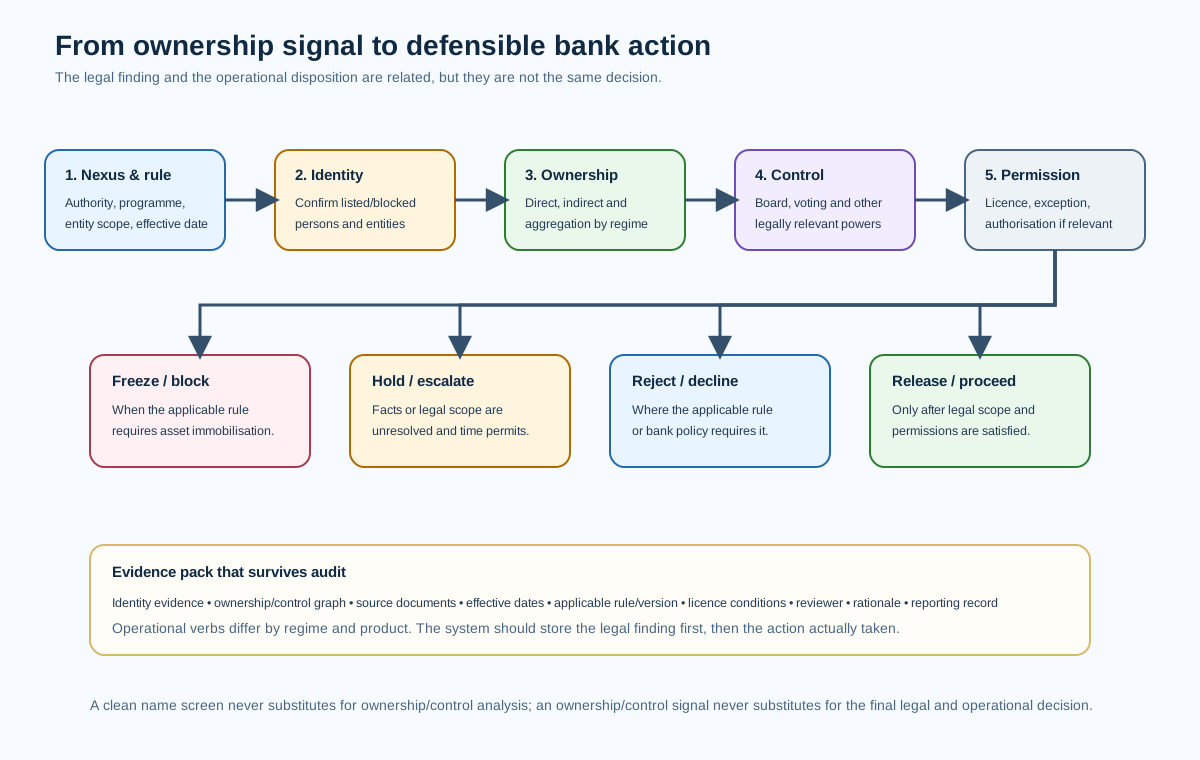
Exercise: apparent divestment
A designated person transfers shares to an associate after designation but continues to finance the company and direct management. Do not assume the transfer is sham; investigate governance and control evidence.
Exercise: family member
A spouse owns a business independently. Family relationship alone is not enough to conclude that the designated person owns or controls it. Identify what additional evidence would matter.
BA design exercise
Create fields for owner, owned entity, percentage, voting rights, control type, source, verification status, effective dates, regime and calculation path. Add reverse-search capability so a new designation can find downstream customers.
QA exercise
Review ten ownership alerts. Check whether analysts used the correct regime, whether percentages were calculated transparently, whether aggregation rules were correct and whether control was assessed separately from ownership.
Final practitioner test
A strong learner should be able to explain not only the final sanctions result but exactly how the bank arrived there, which legal rule was applied, which ownership path or control evidence mattered and where uncertainty required specialist judgement.
60-minute mastery extension: ownership, control and beneficial interest
This extension turns ownership and control into a practical bank control problem rather than a percentage exercise. The same corporate graph can be used by KYC, AML and sanctions teams, but the legal question applied to that graph can be different. A sound implementation therefore keeps the facts reusable while keeping the legal tests separate, versioned and attributable to the relevant authority.
Start with four different questions
A bank should separate four questions that are often collapsed into one field.
Who is the beneficial owner for AML or CDD purposes? FATF Recommendations 24 and 25 concern transparency of legal persons and legal arrangements so that competent authorities and obliged entities can identify the natural persons who ultimately own or control them under the applicable AML/CFT framework. Local law determines how those standards are implemented.
Is a customer, counterparty or connected person itself designated? That is a list-screening question. Identity resolution comes before legal effect: a name similarity is not yet a sanctions conclusion.
Does a sanctions regime attribute restrictions to an unlisted entity because of ownership or control? This is a separate legal test. The answer depends on the applicable regime, nexus, programme, date and facts.
What operational action follows? Blocking or freezing, rejecting, holding for review, declining onboarding, releasing, licensing, reporting and recordkeeping are separate outcomes. A bank should not infer the action from a generic sanctioned = true flag.
This separation is fundamental for business analysts and architects. A reusable corporate-relationship service can store the facts, while a regime-specific legal-rules service determines how those facts affect a particular customer, payment, security or asset on a particular date.
OFAC's 50 Percent Rule: ownership, not generic control
OFAC states that an entity owned directly or indirectly 50 percent or more in the aggregate by one or more blocked persons is itself treated as blocked under the 50 Percent Rule even if it is not separately named on the SDN List. OFAC also states expressly that the rule speaks to ownership, not control. A non-blocked entity controlled by blocked persons but owned less than 50 percent in the aggregate is not automatically blocked under that rule. OFAC may designate such an entity under other available criteria, and dealings with blocked persons acting for the entity can still create separate sanctions problems.
The system consequence is important: do not encode an OFAC ownership result and a control concern as the same status. A case may legitimately conclude 50_percent_rule = false and still require enhanced legal review because a blocked person appears to control the entity or is directly involved in the transaction.
Direct aggregation under OFAC
A simple OFAC example is direct ownership. Blocked Person A owns 30 percent of Customer X and Blocked Person B owns 20 percent. Their blocked ownership interests aggregate to 50 percent, so X is treated as blocked under OFAC's 50 Percent Rule where that rule applies.
The engine should preserve the constituent ownership paths instead of storing only the result 50%. An investigator should be able to see A → X 30 percent and B → X 20 percent, the list status of A and B, the programme data, the effective date and the rule version that produced the conclusion.
Indirect ownership under OFAC: do not use a generic multiplication shortcut
OFAC FAQ 401 is essential because it shows that indirect ownership under the 50 Percent Rule cannot be reduced to ordinary economic-percentage multiplication across every intermediate holding.
Consider OFAC's own pattern: Blocked Person X owns 50 percent of Entity A, and Entity A owns 50 percent of Entity B. A is blocked because of X's ownership, and B is also blocked because it is 50 percent owned by blocked Entity A.
Now change the first link. If X owns only 25 percent of Entity A, A is not automatically blocked under the 50 Percent Rule. Even if A owns 50 percent of Entity B, OFAC's worked examples do not treat X as indirectly owning 12.5 percent of B merely by multiplying 25 percent by 50 percent for purposes of the rule. The legal engine must follow OFAC's published methodology and examples, not a generic corporate-finance calculation.
This distinction matters because ordinary corporate analytics often calculate economic look-through percentages. Those analytics can be useful evidence, but they must not be silently reused as the OFAC legal attribution algorithm.
Complex OFAC paths and aggregation
OFAC also gives examples where indirect interests through entities that are themselves blocked combine with direct interests or other blocked paths. A robust rules engine should therefore traverse the graph path by path and record why each intermediate entity is treated as blocked before propagating the next step.
Useful technical fields include:
relationship_type: share ownership, voting right, board right, trust role, contractual control or another relationship;interest_percent: where a percentage is meaningful;source_entity_idandtarget_entity_id;effective_fromandeffective_to;evidence_sourceand verification status;designation_or_blocking_basis;regime_id, programme and legal-rule version;path_resultand explanation.
The calculation output should be reproducible from these facts. A human reviewer should be able to rerun the path and reach the same result.
UK ownership and control: a different legal test
Current OFSI general guidance describes an entity as owned or controlled directly or indirectly where a person holds more than 50 percent of shares or voting rights, has the right to appoint or remove a majority of the board, or where it is reasonable to expect that the person would be able to ensure the entity's affairs are conducted in accordance with that person's wishes.
The wording matters. The UK share and voting threshold is more than 50 percent, not "50 percent or more". The control limbs are separate from the ownership percentage test.
OFSI also states that it would not simply aggregate different designated persons' holdings in a company unless circumstances such as joint ownership, a joint arrangement, or one party controlling another holder's rights are present. That differs from OFAC's direct aggregation of blocked ownership interests.
A global bank therefore needs separate rule identifiers such as OFAC_50_PERCENT_RULE and UK_OFSI_OWNERSHIP_CONTROL, rather than a single global sanctions_ownership_threshold.
What evidence can support UK control analysis?
Control is a legal conclusion based on facts, not a risk score. Evidence may include constitutional documents, shareholder agreements, board appointment and removal rights, voting arrangements, powers of attorney, financing arrangements, management instructions, contractual rights and credible evidence of how the entity is actually directed.
A minority shareholder does not automatically control an entity merely because it has veto rights or commercial influence. The specific rights and the applicable legal test must be analysed. Similarly, a family relationship, business association or historical ownership link is not proof of control. Those facts can justify further enquiry, but the conclusion needs evidence.
This distinction should be visible in case workflow. control_indicator_present can trigger review. legal_control_determined should be a separate conclusion with the legal basis, reviewer, evidence and effective date.
EU restrictive measures: keep the applicable legal act in view
EU restrictive measures also use ownership and control concepts for asset-freeze implementation, but a bank should apply the relevant EU legal act and current Commission or competent-authority guidance rather than import OFAC or UK logic.
For system design, EU analysis should therefore be a separately versioned ruleset. Where a bank uses common corporate data across U.S., UK and EU controls, the user interface should show multiple legal results side by side rather than overwrite them with one global status.
A practical case might show:
OFAC 50 Percent Rule: not triggered on current facts
UK ownership/control: specialist assessment required
EU asset-freeze ownership/control: pending applicable-regime analysis
That is more accurate than a single red/green ownership flag.
AML beneficial ownership is a data foundation, not the sanctions rule
FATF Recommendations 24 and 25 strengthen access to adequate, accurate and up-to-date beneficial-ownership information for legal persons and legal arrangements. That information is extremely useful to sanctions controls because it helps reveal the real people and relationships behind legal structures.
But FATF beneficial-ownership transparency does not replace sanctions ownership and control law. The AML threshold or method used by a bank under local CDD rules must not be reused automatically as a sanctions threshold.
Architecturally, the clean approach is:
- collect and verify corporate and legal-arrangement facts once;
- preserve provenance, dates and uncertainty;
- expose those facts to AML, sanctions, fraud, tax and other authorised controls;
- let each control apply its own legal or policy rule;
- retain the decision and rule version separately.
This avoids duplicated data while preventing legal logic from being mixed.
Trusts and other legal arrangements
Trusts cannot be represented accurately as ordinary companies with shareholders. Relevant roles can include settlor, trustee, protector, beneficiaries or classes of beneficiaries, and persons exercising other powers. Recommendation 25 reinforces the need for adequate, accurate and up-to-date beneficial-ownership information for express trusts and similar legal arrangements under the AML/CFT framework.
For sanctions analysis, the significance of each trust role depends on the applicable regime and the powers actually held. A beneficiary is not automatically the controller. A protector title does not by itself prove control. A trustee can hold legal title while another person may have important powers. The bank should capture role and power, not force every party into an owner_percent field.
A useful trust relationship model stores the role, governing law, power type, whether the power is unilateral or shared, evidence document, effective date and verification status. Complex or ambiguous cases should route to sanctions and legal specialists rather than be resolved by a generic percentage rule.
Nominees and intermediated ownership
Nominee shareholders and directors can be legitimate. The risk is not the label itself; it is whether the bank understands the person for whom the nominee acts and whether hidden ownership or control changes the sanctions analysis.
Evidence may include nominee agreements, declarations of trust, powers of attorney, instructions, funding flows and reliable registry or corporate information. Where the principal cannot be identified or evidence conflicts, the case should record the uncertainty rather than treating the nominee as the final beneficial owner.
The same principle applies to custodians, omnibus structures and intermediated securities holdings. Product teams need documented look-through expectations based on the applicable legal obligation and the bank's role, not a universal assumption that every underlying investor must always be identified in the same way.
Effective dating and historical reconstruction
Ownership and control are time-dependent. A customer may be unrestricted today but may have been owned by a blocked person when a historical transaction occurred. Conversely, a genuine divestment may change future treatment while leaving previously blocked property subject to separate rules.
Every material relationship should therefore be effective-dated. The sanctions decision itself should also carry an as_of timestamp and the rule version used.
A bank responding to a regulator should be able to reconstruct:
- the sanctions-list state at the time;
- the customer and ownership graph known at the time;
- the ownership or control rule then in force;
- the data sources and their freshness;
- the analyst or automated decision;
- subsequent changes that altered the conclusion.
Without this, a current database snapshot cannot explain a historical decision.
Divestment after designation
A change in formal ownership after designation needs fact-specific analysis. OFAC FAQ 402 explains that where blocked persons genuinely divest so that aggregate ownership falls below 50 percent, the entity is no longer automatically blocked under the 50 Percent Rule for future transactions; property that was already properly blocked does not simply become free because ownership later changes.
That OFAC position should not be generalized to every sanctions regime. For any divestment, the bank must check the applicable authority's rules, the legal effectiveness of the transfer, continuing rights and whether the former owner still has a legally relevant form of control.
Risk indicators such as a related-party buyer, unusual consideration, continued management influence, financing by the former owner or a rapid post-designation restructuring justify enquiry. They do not by themselves prove a sham transaction.
A practical operating model
A mature bank normally separates automated graph processing from specialist legal judgement.
Data layer. Customer KYC, registry feeds, corporate documents, third-party data and internal relationship information are resolved to consistent entity identifiers with provenance and effective dates.
Screening layer. Designated persons and blocked entities are matched to nodes in the graph. Identity confidence is stored separately from legal attribution.
Rules layer. Regime-specific ownership algorithms evaluate direct and indirect ownership. Control rules create specialist-review tasks where the legal framework requires fact-intensive judgement.
Case layer. Analysts see the relevant graph, source documents, rule result, missing evidence and the event that triggered review.
Decision layer. The bank records the legal basis, operational action, reporting requirements, licence or exception if relevant, decision maker and timestamp.
Monitoring layer. New designations, list amendments and corporate-structure changes trigger reverse graph queries and event-driven reassessment.
This model lets the bank reuse a common relationship graph while retaining legal explainability.
Reverse screening after a new designation
Traditional screening asks whether a customer matches a designated person. Ownership screening must also ask a reverse question: which customers or assets are connected to this newly designated person through ownership or control relationships?
A new designation should trigger graph traversal across current customer relationships. Depending on the regime and data available, the bank may need to identify directly owned entities, entities reached through blocked intermediate entities, entities with relevant control rights, securities issuers, custody positions and pending transactions.
The result should be prioritised by legal exposure and urgency. A potential asset-freeze implication can require immediate review, while a weak or stale commercial-database relationship may first require identity and data validation.
Payment and counterparty implications
Customer ownership data is usually richer than data for a one-off payment beneficiary. Payment screening therefore cannot assume that every counterparty's full ownership graph is available in real time.
Banks need a realistic risk-based design. Known customers and recurring counterparties can be enriched with ownership intelligence. Higher-risk payments can trigger external data lookups or manual review. Trade finance may have richer corporate and documentary context. Correspondent banking introduces respondent and nested-party visibility constraints.
Requirements should distinguish what information is actually available at initiation, pre-execution screening, correspondent processing and post-event investigation. A control that depends on ownership data unavailable at that point is not a real control.
Securities, custody and corporate actions
Sanctions ownership analysis can affect securities and custody as well as customer onboarding. A security issuer may be unlisted but subject to asset-freeze implications through ownership or control. Corporate actions can change ownership, create new instruments or distribute value. Income payments may require separate sanctions handling.
The architecture should therefore propagate a legal restriction result to the products and assets that need it. The restriction record should carry scope and effective dates so that systems do not simply blacklist an entity for every product and every jurisdiction.
Data quality and confidence
Missing or stale ownership information can produce false negatives. Duplicate entity identifiers can split ownership paths. Unresolved natural-person identities can create false positives. Registry lag can make the graph historically wrong.
Useful controls include freshness rules, source hierarchy, contradictory-data alerts, unresolved-percentage queues, entity-resolution QA, material-change triggers and sampled comparison between automated conclusions and specialist review.
Do not treat missing data as zero ownership. unknown is a valid and important state.
Business analyst requirements
A strong BA requirement should describe both the facts and the legal evaluation.
For ownership facts:
- store direct ownership percentage and voting rights separately;
- store relationship direction and type;
- store effective dates and provenance;
- preserve original evidence and verification status;
- support more than one ownership path;
- represent trusts and control rights without inventing share percentages.
For legal evaluation:
- select the applicable regime and rule version;
- distinguish list matching from ownership attribution;
- keep ownership and control outcomes separate;
- preserve the evaluated path and intermediate entities;
- support specialist escalation where control cannot be automated;
- record the operational action separately from the legal finding.
For change events:
- react to new designations;
- react to ownership or governance changes;
- recalculate affected paths;
- preserve the former result for audit;
- identify the population potentially affected by a rule change.
Test scenarios that should exist before release
OFAC direct aggregation positive. Two blocked persons own 30 percent and 20 percent directly. Expected: 50 Percent Rule triggered.
OFAC below-threshold direct negative. One blocked person owns 49 percent and no other blocked person owns an interest. Expected: not automatically blocked under the 50 Percent Rule; other programme rules and transaction facts remain separately assessable.
OFAC control-only boundary. A blocked person owns 20 percent but appears to control management. Expected: the 50 Percent Rule result remains false on ownership alone; control concern routes for separate legal review and potential other sanctions implications.
OFAC indirect chain positive. Blocked Person X owns 50 percent of Entity A; A owns 50 percent of Entity B. Expected: A and B treated as blocked under the published OFAC methodology.
OFAC non-propagating intermediate. Blocked Person X owns 25 percent of Entity A; A owns 50 percent of Entity B. Expected: do not attribute a generic 12.5 percent indirect ownership to X for the 50 Percent Rule merely by multiplication; evaluate under the published OFAC method.
UK ownership positive. A designated person holds 51 percent of shares. Expected: ownership limb triggered, subject to applicable UK regulations and facts.
UK exact-50 boundary. A designated person holds exactly 50 percent with no separate control facts. Expected: do not treat the UK "more than 50 percent" ownership limb as met solely by the percentage; evaluate other control limbs separately.
UK separate 30/30 holders. Two designated persons each hold 30 percent, with no joint arrangement and no evidence that one controls the other's rights. Expected: do not simply aggregate to 60 percent under current OFSI guidance; assess joint arrangements and control facts.
Board-right control. A designated person has the right to appoint or remove a majority of the board. Expected: route to the relevant control conclusion under the applicable UK test.
Historical reconstruction. Ownership changes after a payment. Expected: the historical case uses the graph and rule version effective on the transaction date.
Stale registry. Registry data conflicts with recent executed corporate documents. Expected: conflict is surfaced and resolved according to source and verification policy; neither source is silently ignored.
Mini case: one graph, three different answers
A corporate customer, Meridian Components Ltd, is not on a sanctions list. Its ownership file shows Person A at 30 percent, Person B at 20 percent, and unrelated investors at 50 percent. A and B are confirmed blocked persons under an OFAC programme. The customer also has a shareholder agreement giving Person A the right to appoint most of the board.
Under the OFAC 50 Percent Rule, the directly held blocked interests of A and B aggregate to 50 percent. The bank therefore records that Meridian is treated as blocked under that rule, assuming the relevant OFAC legal scope applies.
For UK analysis, the bank must not simply copy the OFAC result. The direct shareholdings are each below the UK ownership threshold and are not simply aggregated on these facts. The board-appointment right, however, is a separate control fact and must be assessed under the applicable UK legal framework.
For AML beneficial ownership, the bank applies the CDD rules implemented in the customer's relevant jurisdiction. Those rules may require identification of particular natural persons and controllers, but that CDD result is not the sanctions conclusion.
One graph has therefore produced three separate legal analyses. The architecture is successful only if it can show all three without overwriting one with another.
Failure modes
The most dangerous failure is a global threshold table that says sanctions ownership = 50%. It hides the difference between OFAC's 50-percent-or-more rule and the UK's more-than-50-percent ownership limb, and it says nothing about separate control tests.
Another failure is ordinary economic look-through multiplication reused as legal sanctions attribution. Corporate-finance analytics and sanctions legal attribution are related but not interchangeable.
A third failure is treating an ownership data vendor's conclusion as the bank's legal conclusion. Vendor data can accelerate fact gathering, but the bank remains responsible for applying its control framework to the relevant legal rule.
A fourth failure is a current-state-only graph. Without effective dates, the bank cannot perform defensible lookbacks or explain why a historical transaction was released.
A fifth failure is an overconfident control score. Control indicators can prioritise cases, but a high score should not replace the legal determination where the regime requires a fact-specific assessment.
Knowledge check
A correct answer to each question should cite the relevant rule or guidance, not intuition.
- Why can an unlisted company still be treated as blocked?
- Why does a 50 percent ownership result mean different things under OFAC and current UK guidance?
- When does OFAC aggregate separate blocked ownership interests?
- Why is generic percentage multiplication unsafe for OFAC indirect ownership?
- Why is control not the same as ownership?
- Why should AML beneficial-ownership data be reused but AML thresholds not automatically reused?
- What additional information must a trust model store?
- Why are effective dates essential?
- What should happen when ownership data is missing or contradictory?
- What evidence should an analyst be able to produce for a sanctions ownership conclusion?
Authoritative anchors
- U.S. Treasury OFAC — Entities Owned by Blocked Persons / 50 Percent Rule FAQs: https://ofac.treasury.gov/faqs/topic/1521
- U.S. Treasury OFAC — FAQ 398 on control below the ownership threshold: https://ofac.treasury.gov/faqs/398
- U.S. Treasury OFAC — FAQ 399 on aggregation: https://ofac.treasury.gov/faqs/399
- U.S. Treasury OFAC — FAQ 401 on indirect ownership examples: https://ofac.treasury.gov/faqs/401
- U.S. Treasury OFAC — FAQ 402 on divestment and previously blocked property: https://ofac.treasury.gov/faqs/402
- UK Office of Financial Sanctions Implementation — UK financial sanctions general guidance: https://www.gov.uk/government/publications/financial-sanctions-general-guidance/uk-financial-sanctions-general-guidance
- FATF — Guidance on Beneficial Ownership of Legal Persons (Recommendation 24): https://www.fatf-gafi.org/en/publications/Fatfrecommendations/Guidance-Beneficial-Ownership-Legal-Persons.html
- FATF — Guidance on Beneficial Ownership and Transparency of Legal Arrangements (Recommendation 25): https://www.fatf-gafi.org/en/publications/Fatfrecommendations/Guidance-Beneficial-Ownership-Transparency-Legal-Arrangements.html
The professional discipline is simple: preserve the ownership and control facts in enough detail to reuse them, then apply the current rule of the relevant legal regime. Never let one convenient percentage replace that analysis.
Boundary cases: when ownership arithmetic is not enough
A difficult ownership case can involve incomplete percentages, different share classes, voting rights that do not mirror economic ownership, shareholder agreements, or legal arrangements whose control cannot be reduced to multiplication. The bank should not force uncertain facts into a precise percentage merely because the screening engine expects one. It should preserve the underlying evidence, mark the uncertainty explicitly and route the case to the sanctions or legal specialist responsible for the applicable regime.
Consider a company where a designated person holds 48 percent of ordinary shares while another investor holds the remaining 52 percent. A separate agreement gives the designated person rights to appoint most directors and approve the annual budget. Under an ownership-only rule, the percentage fact must be assessed exactly as that regime requires; under another regime, the contractual rights may also be relevant to control. The system should therefore present the same verified facts to separate regime-specific decision rules instead of converting them into one global sanctioned = true result.
The same discipline applies when ownership information conflicts. If a registry, customer declaration and commercial provider show different shareholders or effective dates, the bank should retain all sources, identify which source is authoritative or most reliable for the purpose, investigate the discrepancy and document the basis for the final view. Silently overwriting one source destroys the evidence needed for later review.
A strong ownership engine therefore knows when not to calculate. Explainable uncertainty and specialist escalation are safer than false mathematical certainty.
Current-source control design: turning ownership law into bank-grade requirements
The legal distinction between ownership, control and beneficial ownership becomes useful only when a bank can translate it into data, rules, workflows and evidence. This supplement provides that delivery layer. It is deliberately regime-aware: it does not create a universal ownership threshold, and it treats legal attribution as a dated decision produced from facts rather than as an intrinsic property of an entity.
Build two objects: relationship facts and legal evaluations
The relationship graph should be jurisdiction-neutral. An edge says what fact the bank knows: Person A owns 30 percent of Company B; Person C can appoint three of five directors; Trustee D holds legal title; a shareholder agreement gives E a defined consent right. Each edge carries source, verification status and effective period.
A legal-evaluation object is different. It records that, under a named sanctions regime and rule version, the facts produce a particular ownership or control conclusion as of a particular time. Keeping these objects separate prevents a later rules change from corrupting the historic graph and allows the same facts to be evaluated under U.S., UK, EU and other relevant frameworks independently.
A useful evaluation object contains the evaluated entity, regime, programme or legal instrument, as-of time, matched blocked or designated persons, paths considered, ownership result, control result, confidence or unresolved-facts status, legal reviewer where required, source citations, licence or permission references and operational disposition.
Rule changes need impact populations, not only new code
When an authority changes guidance or a bank changes its legal interpretation, deployment is not complete when a rules engine is updated. The bank must identify the population whose previous decisions may be affected.
The change record should therefore state what changed, which legal entities and products use the rule, the effective date, whether historical re-evaluation is required, which customer or counterparty populations are in scope, and which open payments, securities positions or frozen assets need review. Regression tests should include previously decided edge cases so that an improvement for one regime does not silently alter another.
Evidence provenance is part of the control
A percentage without provenance is weak evidence. The same applies to a board right, trust role or alleged proxy relationship. Evidence should be attributable to a registry filing, executed agreement, customer declaration, reliable data provider, court document, competent-authority information or other approved source.
Conflicting evidence should not be silently reconciled by choosing the newest timestamp. A recent self-declaration can be less reliable than an executed shareholder agreement; a registry can lag a completed transaction; a commercial database can infer a relationship from incomplete public information. The bank needs source-priority rules, freshness metadata and an escalation path where material conflicts remain.
Design for unknown and disputed facts
Corporate graphs are rarely complete. Percentages may not sum to 100. A trust deed may be unavailable. Voting rights may differ from economic ownership. A shareholder agreement may create rights that are not visible in a registry.
The data model therefore needs explicit states such as unknown, not_applicable, disputed and not_verified. Treating a missing percentage as zero is a false-negative mechanism. Treating an unverified commercial-data relationship as confirmed is a false-positive mechanism. Both errors become more dangerous when the legal engine produces an authoritative-looking binary result.
Event-driven monitoring
Periodic KYC refresh is too slow for some sanctions ownership changes. Event triggers can include a new designation, list amendment, shareholder change, merger, acquisition, share issue, transfer, board-right change, trust amendment, new adverse information or a material conflict between sources.
A new designation should support reverse traversal: identify entities, customers, securities issuers and other relevant positions connected to the newly blocked person through the relationship graph. A corporate change should support forward re-evaluation: identify which sanctions rules may now produce a different result for that customer.
The trigger should create an auditable work item containing the old graph, new facts, affected legal evaluations and priority based on potential exposure.
Product-aware propagation
An ownership/control finding can affect more than customer onboarding. The same legal conclusion may need to reach payment screening, custody, securities, trade finance, lending, treasury or corporate-action systems. Yet the permitted action can differ by product, asset type and jurisdiction.
The bank should therefore distribute a scoped restriction object rather than a generic blacklist entry. It should identify the affected entity, legal basis, jurisdictions, products or asset classes, effective dates, required treatment and any licence or exception conditions. Downstream systems should acknowledge the restriction version they consumed so that missed propagation can be detected.
Acceptance criteria for a business analyst
A bank-grade story for ownership analysis should be testable. Useful acceptance criteria include:
- The system preserves every ownership and control edge with source and effective dates.
- Direct ownership, voting rights and other control rights are separate attributes.
- OFAC direct aggregation can combine blocked ownership interests to the published threshold.
- OFAC indirect ownership follows the current published methodology and worked examples rather than a universal multiplication formula.
- The UK rule treats exactly 50 percent differently from more than 50 percent for the ownership limb, while evaluating separate control limbs independently.
- Separate UK designated-person holdings are not simply aggregated absent the circumstances described in current OFSI guidance.
- A control indicator can create an escalation without falsely converting itself into an OFAC 50 Percent Rule result.
- AML beneficial-ownership results never overwrite sanctions ownership/control results.
- The engine can reconstruct the graph and rule version used for a historical decision.
- Missing or disputed facts produce an explicit unresolved state and cannot silently default to zero or clear.
- New designations trigger reverse relationship searches.
- Material ownership or governance changes trigger re-evaluation.
- The user can see the path, rule and evidence behind every high-impact conclusion.
- The operational action is stored separately from the legal finding.
- Rule changes identify impact populations and preserve prior decisions for audit.
Negative testing matters as much as positive testing
Positive tests prove that true exposure is found. Negative tests prove that the control does not overreach.
A strong suite should show that an unrelated same-name person does not contaminate the graph; a 49-percent OFAC owner does not automatically block the entity under the 50 Percent Rule; a 25-percent interest in an intermediate company is not blindly multiplied through later holdings for OFAC attribution; two independent UK designated shareholders below the threshold are not simply summed without the relevant joint or control facts; and a family relationship does not become a control finding without evidence.
The bank should also test stale-data recovery, duplicate entity resolution, circular structures, dual-class shares, effective-date boundaries, revoked or superseded rule versions and downstream propagation failures.
Mini implementation case
A bank learns that a newly designated person, D, holds 40 percent of Customer Alpha directly. A commercial database also reports that D owns 60 percent of Holding H, and H owns 20 percent of Alpha. A naive economic look-through calculation might say D has another 12 percent through H and therefore 52 percent overall.
That arithmetic is not enough for an OFAC legal conclusion. The engine must apply the current OFAC 50 Percent Rule method. Because H is 60 percent owned by D, H itself is treated as blocked under the rule. The engine then evaluates H's 20 percent interest in Alpha together with D's direct 40 percent interest in accordance with OFAC's published treatment of blocked owners and aggregation, recording the evaluated paths and why H is a blocked intermediate entity. The legal result is explainable without relying on an opaque look-through score.
The same graph then enters a UK evaluation. The engine must not copy the OFAC result. It evaluates the applicable UK ownership and control tests, including whether relevant rights are jointly held or controlled, and whether D has board or other control powers. Any unresolved governance facts route to specialist review.
The case demonstrates the architecture principle: the graph is shared; legal evaluation is not.
Management information that reveals whether the control works
Useful MI goes beyond alert counts. A sanctions governance forum should see the percentage of in-scope corporate customers with verified ownership data, stale ownership relationships, unresolved graph conflicts, new-designation impact populations, time to complete ownership assessments, cases requiring legal interpretation, decisions overturned by QA, missed downstream propagation, and lookback findings caused by data or rule defects.
Trend analysis should distinguish data-quality problems from legal-rule problems. If most escalations arise from stale registry data, the fix is different from a rules-engine defect. If analysts repeatedly misapply one jurisdiction's aggregation logic to another, training and UI design require attention.
Final delivery principle
The correct design is not “calculate ownership and screen it.” It is: preserve relationship facts, identify the applicable legal framework, evaluate ownership and control under that framework, evidence the decision, propagate the scoped outcome, and re-evaluate when either the facts or the law change.
That sequence is what makes ownership and control analysis explainable to compliance, operations, technology, audit and regulators.
Knowledge check
-
Under OFAC’s 50 Percent Rule, does control without 50 percent or greater aggregate ownership automatically make an entity blocked under that specific rule?
-
Why can the same ownership graph produce a different sanctions conclusion under another jurisdiction’s legal framework?
-
What is the difference between direct ownership, indirect ownership and control?
-
Why must ownership relationships be effective-dated for sanctions investigations and lookbacks?
-
What should an ownership engine show to make its conclusion explainable and auditable?
-
A designated person transfers shares to a family member shortly after designation. Why is the family relationship neither proof of continued control nor sufficient evidence of a genuine divestment?
Answer guide
OFAC’s 50 Percent Rule is an ownership rule: control below the ownership threshold does not automatically block the entity under that specific rule, though separate dealings with blocked persons or other sanctions criteria may still matter. Other regimes apply their own ownership, aggregation and control tests, so one global percentage or control formula is unsafe. Direct ownership is held immediately; indirect ownership runs through other entities; control can arise through governance or other rights recognised by the relevant legal framework and may exist without majority economic ownership. Effective dates allow the bank to reconstruct the structure that existed when a historical transaction or designation occurred. Explainable engines should show the designated person, every relevant path, percentages/rights, source evidence, calculation, aggregation rule, regime, effective date and manual judgement. Post-designation transfers require evidence of consideration, independence, governance, profit rights, financing and continuing influence rather than assumptions based on family relationship alone.
Glossary
Direct ownership — An ownership interest held immediately in an entity without an intermediate owner.
Indirect ownership — An economic ownership interest held through one or more intermediate entities under the calculation method relevant to the applicable regime.
Aggregate ownership — Combining ownership interests where the applicable sanctions rule requires aggregation; the method is regime-specific.
Control — The ability to direct or influence an entity in a manner recognised by the applicable legal framework, potentially through voting, board, contractual or other rights.
Beneficial ownership — A KYC/AML concept concerning the natural persons who ultimately own or control a customer under applicable CDD rules; it is related to but not identical with sanctions ownership/control analysis.
Voting rights — Rights to vote on company matters, which can differ from economic share ownership and can be relevant to control analysis.
Board appointment right — A right to appoint or remove directors or equivalent governing persons; its legal importance depends on the sanctions regime.
Ownership path — A sequence of relationships connecting a person or entity to the customer through one or more ownership links.
Effective dating — Recording when a relationship or right began and ended so historical ownership can be reconstructed correctly.
Nominee — A person or entity holding a formal role or interest on behalf of another; nominee arrangements can be legitimate and require evidence-based analysis.
Proxy risk — The possibility that a designated person continues to exercise rights or receive benefits through another person despite a formal change in ownership.
Provenance — The source and verification status of an ownership or control fact, such as registry data, legal documents, customer declarations, commercial data or analyst research.
References and further reading
Ownership and control analysis must follow the current rule of the relevant sanctions regime. Do not apply one jurisdiction’s threshold, aggregation approach or control test globally. AML beneficial-ownership standards and sanctions ownership/control rules also serve different legal purposes even when the bank reuses the same customer and corporate-structure data.
- U.S. Treasury OFAC — Entities Owned by Blocked Persons / 50 Percent Rule FAQs: https://ofac.treasury.gov/faqs/topic/1521
- U.S. Treasury OFAC — FAQ 398, confirming that control without 50 percent or greater ownership does not automatically block an entity under the OFAC 50 Percent Rule: https://ofac.treasury.gov/faqs/398
- U.S. Treasury OFAC — FAQ 399, aggregation of blocked persons’ ownership interests: https://ofac.treasury.gov/faqs/399
- U.S. Treasury OFAC — FAQ 401, worked examples of indirect ownership through complex structures: https://ofac.treasury.gov/faqs/401
- U.S. Treasury OFAC — FAQ 402, treatment after a genuine divestment below the 50 Percent Rule threshold and treatment of previously blocked property: https://ofac.treasury.gov/faqs/402
- U.S. Treasury OFAC — Revised Guidance on Entities Owned by Persons Whose Property and Interests in Property Are Blocked: https://ofac.treasury.gov/media/6186/download?inline=
- UK Office of Financial Sanctions Implementation — UK financial sanctions general guidance, including ownership, control, minority interests, joint interests and aggregation: https://www.gov.uk/government/publications/financial-sanctions-general-guidance/uk-financial-sanctions-general-guidance
- UK Office of Financial Sanctions Implementation — Financial sanctions enforcement and monetary penalties guidance, including example areas of enquiry for ownership and control due diligence: https://www.gov.uk/government/publications/financial-sanctions-enforcement-and-monetary-penalties-guidance/financial-sanctions-enforcement-and-monetary-penalties-guidance
- UK Government — Ownership and Control: Public Officials and Control guidance: https://www.gov.uk/government/publications/ownership-and-control-public-officials-and-control-guidance/ownership-and-control-public-officials-and-control-guidance
- UK Office of Financial Sanctions Implementation — closed 2026 call for evidence on the ownership and control test: https://www.gov.uk/government/calls-for-evidence/ownership-and-control-test-in-uk-financial-sanctions-regulations
- European Commission — Overview of EU sanctions and related resources: https://finance.ec.europa.eu/eu-and-world/sanctions-restrictive-measures/overview-sanctions-and-related-resources_en
- European Commission — Guidance note illustrating EU ownership and control analysis under an asset-freeze regime, including the more-than-50-percent ownership / majority-interest criterion and separate control criteria: https://finance.ec.europa.eu/document/download/26a534a5-51a1-4b69-b27d-8cda80eb67da_en
- European Commission — Asset freeze and prohibition to provide funds or economic resources, current Russia/Belarus FAQ set updated 6 May 2026: https://finance.ec.europa.eu/publications/asset-freeze-and-prohibition-provide-funds-or-economic-resources_en
- European Commission — Guidance for EU operators on enhanced due diligence to prevent Russia-sanctions circumvention, including ownership/control risk: https://finance.ec.europa.eu/document/download/3c86c9a8-f09e-4092-ab8c-a9e678df1494_en?filename=guidance-eu-operators-russia-sanctions-circumvention_en.pdf
- FATF — Guidance on Beneficial Ownership of Legal Persons (Recommendation 24): https://www.fatf-gafi.org/en/publications/Fatfrecommendations/Guidance-Beneficial-Ownership-Legal-Persons.html
- FATF — Guidance on Beneficial Ownership and Transparency of Legal Arrangements (Recommendation 25): https://www.fatf-gafi.org/en/publications/Fatfrecommendations/Guidance-Beneficial-Ownership-Transparency-Legal-Arrangements.html
Accuracy note — reviewed 15 September 2026: OFAC’s 50 Percent Rule is an ownership rule. It aggregates the ownership interests of blocked persons and applies to direct and indirect ownership, but OFAC’s own complex-structure examples must be followed rather than using a generic percentage-multiplication formula. Control below the ownership threshold does not by itself make an entity automatically blocked under that specific OFAC rule, although transactions involving a blocked person and other programme provisions can still be prohibited. Current UK guidance uses a more than 50% ownership or voting-rights test plus separate board-appointment and broader control limbs; OFSI says separate designated persons’ holdings are not simply aggregated unless circumstances such as joint arrangements or control of another holder’s rights apply. EU asset-freeze guidance likewise uses its own ownership and control criteria and current EU legal acts and competent-authority guidance remain controlling. FATF Recommendations 24 and 25 concern beneficial-ownership transparency for AML/CFT purposes and should not be substituted for sanctions ownership/control rules.