Natural Language Processing (NLP) for Adverse Media
Adverse-media screening looks simple until a bank tries to operate it at scale. A relationship manager can search a customer name on the internet and read a few results. A global bank cannot do that reliably for millions of customers, beneficial owners, directors, counterparties and connected parties across many languages, alphabets and news sources. The problem is not merely finding negative words. The real problem is deciding whether public information is about the bank's actual customer, whether the reported event is relevant to financial-crime risk, how credible and current the information is, what stage the allegation has reached, and what the bank should do with that evidence.
Natural language processing, or NLP, can help with that work. It can identify people and organisations mentioned in text, detect language, recognise aliases, classify reported events, find dates and locations, group duplicate stories, distinguish allegations from convictions, and rank material that deserves human attention. Used well, NLP reduces an enormous body of unstructured information into a smaller, better-organised evidence set. Used badly, it can create a fast and convincing route to the wrong customer, the wrong allegation or the wrong risk conclusion.
The most important mental model is therefore simple: NLP structures evidence; it does not decide guilt, customer acceptability or suspicion. A machine can help a bank find and organise information. The bank still needs policy, entity matching, source assessment, human judgement, escalation and jurisdiction-specific decision rights.
Wolfsberg's Negative News Screening FAQs describe negative news broadly as public-domain information that a financial institution considers relevant to managing financial-crime risk, while emphasising a risk-based and proportionate approach. That framing is useful because it prevents two common mistakes. First, not everything unpleasant about a customer is financial-crime adverse media. Second, a relevant article is not automatically proof that the person committed an offence. The control must preserve both distinctions.
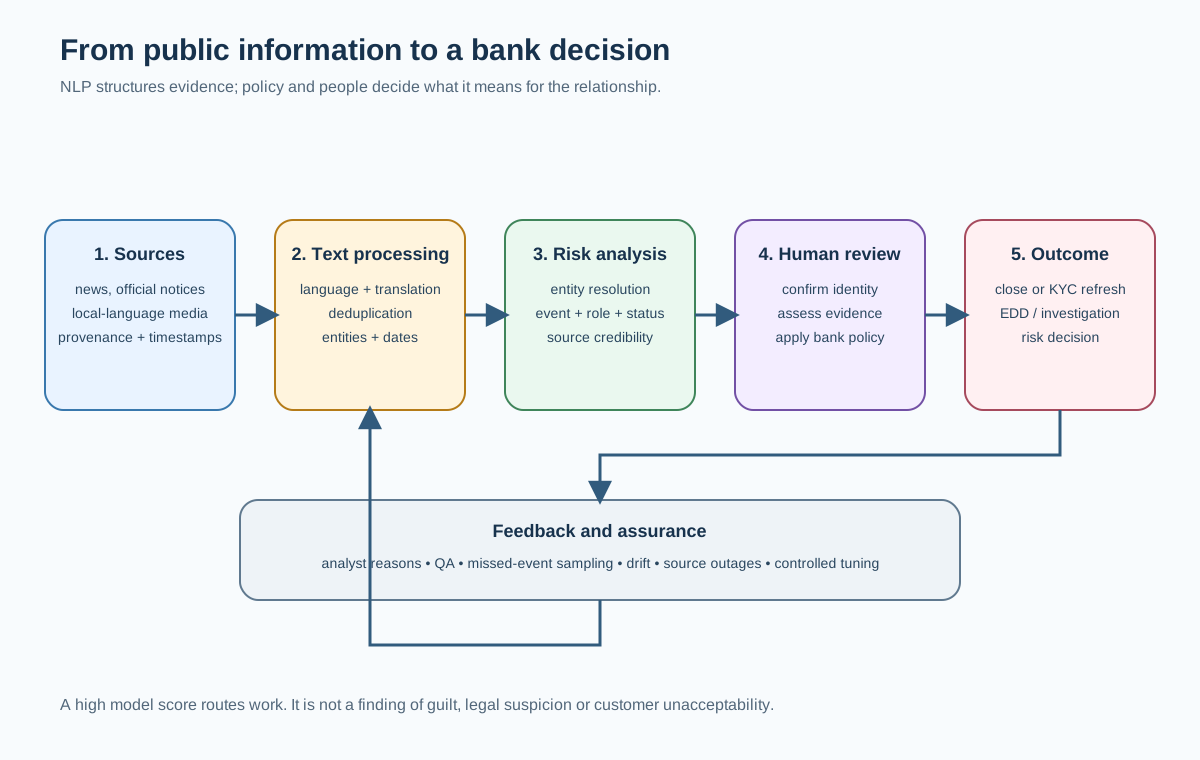
What adverse-media NLP is actually trying to solve
A bank's adverse-media problem contains several separate questions that are often collapsed into one vendor score. They should remain visible as separate control stages.
The first question is coverage. Which public sources does the bank search, in which languages, for which customers or connected parties, at what points in the relationship? A source universe may include mainstream news, specialist trade publications, official regulator releases, prosecution or court publications where legally usable, government notices, credible local media and other public sources permitted by policy. Coverage is never literally universal. Paywalls, closed databases, local-language sources, indexing delays and licensing restrictions mean every system has boundaries. Those boundaries should be understood and documented rather than hidden behind a claim of "global media coverage."
The second question is identity. Does an article about "Eastern Meridian Holdings" refer to the corporate customer with that exact registered name, another company with a similar trading name, its parent, a subsidiary, a former director or an unrelated entity in another country? For individuals, common names create an even harder problem. The system may need name variants, date of birth, nationality, occupation, location, associated companies, aliases and other identifiers. Entity resolution is therefore at least as important as text classification.
The third question is event relevance. An article may describe poor service, an industrial accident, a labour dispute, a civil lawsuit, a political controversy or an alleged bribery scheme. Only some of those events may fall within the bank's financial-crime adverse-media taxonomy. The taxonomy should map to risks the institution has actually defined, such as fraud, corruption and bribery, money laundering, terrorist financing, proliferation financing, sanctions evasion, organised crime, trafficking, cyber-enabled crime, tax crime, environmental crime or predicate offences relevant to the institution's risk framework. A generic "negative sentiment" model is a poor substitute for this work.
The fourth question is evidential status. "Investigated", "arrested", "charged", "convicted", "acquitted", "case dismissed", "sanctioned", "licence revoked" and "alleged by an unnamed source" are not interchangeable. A good NLP pipeline extracts or infers event status and presents it to the reviewer with the underlying text. It must also understand negation. "The director was not charged" should not be classified as "director charged" simply because both words occur in the same sentence.
The fifth question is decision context. The same credible article may have different significance for an existing low-risk retail customer, a high-risk private-banking relationship, a corporate beneficial owner, a prospective correspondent bank or a trade-finance counterparty. Local law, product exposure, customer risk, relationship stage, recency, corroboration and bank policy determine what happens next. NLP should support that decision context rather than pretend to replace it.
Why sentiment analysis is not adverse-media screening
One of the easiest implementation mistakes is to equate adverse media with negative sentiment. Sentiment analysis asks whether language sounds positive, neutral or negative. Financial-crime adverse-media screening asks whether reliable public information describes a risk-relevant event connected to a specific person or entity.
The difference is fundamental. "Company profits collapsed after a failed product launch" is negative in tone but may have no financial-crime relevance. "The company is under investigation for bribery of public officials" may be written in calm, factual language but is highly relevant. A headline such as "Bank cleared of money-laundering allegations" contains highly negative vocabulary but communicates an outcome that may reduce rather than increase concern, depending on the facts.
For that reason, sophisticated systems usually need event or topic classification, entity linking and allegation-status extraction rather than a single sentiment score. Sentiment can still be a feature, but it should not be the control objective.
The end-to-end pipeline
A practical architecture begins before the NLP model. Source acquisition determines what the model can ever see. The bank or its vendor ingests articles, official notices or metadata under permitted licensing arrangements. Each item receives a stable source identifier, publication time, ingestion time, publisher identity and original link. The system should preserve enough provenance to reconstruct what information was available when the alert was created.
The next layer performs text preparation. It may identify language, normalise encoding, split content into sentences, remove obvious boilerplate and detect duplicate or near-duplicate material. Translation may be used where reviewers do not work in the original language, but the original text should remain available where licensing and policy permit because translation can change legal nuance, names and allegation status.
Named-entity recognition then identifies people, companies, locations, agencies and other entities mentioned in the text. This is not yet customer matching. A single article can mention a suspect, a victim, a regulator, a bank, a parent company and several unrelated individuals. The system must determine the role in which each entity appears.
Entity resolution links those mentions to known parties. This stage compares the extracted name and context with customer master data and connected-party records. Strong matching can use multiple attributes rather than name similarity alone. A common-name match with conflicting geography and age should be treated differently from a rare legal name with matching company registration details and a consistent director profile.
Event classification determines what happened. The classifier should use a bank-approved taxonomy and allow multiple event types where appropriate. A procurement-fraud case may also involve bribery and money laundering. A ransomware article may involve sanctions exposure if the identified infrastructure or recipient is designated, but that legal question requires separate sanctions analysis rather than a generic adverse-media label.
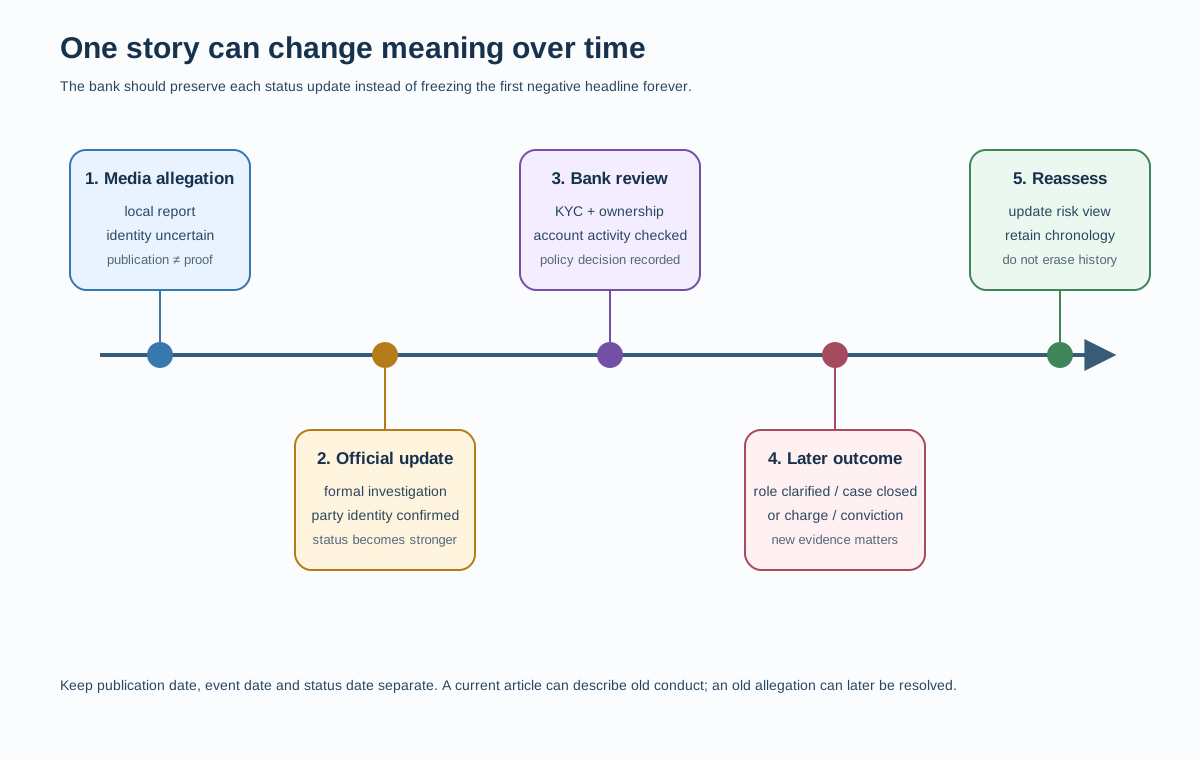
The pipeline should then extract status, time and role. Who is alleged to have done what, when did the underlying event occur, when was it reported, and what stage has the matter reached? Article date and event date are not always the same. A 2026 article can describe conduct from 2018. A later article may record acquittal, settlement or conviction. The control should preserve that chronology.
Source assessment adds another dimension. A regulator release or published court judgment carries different evidential characteristics from an anonymous blog. A reputable newspaper may quote a government investigation; a content farm may merely copy the newspaper. The bank should not treat five syndicated copies of one original story as five independent confirmations.
Finally, orchestration combines identity confidence, event relevance, status, source quality, recency and customer context to decide whether to suppress, queue, prioritise or escalate the item for human review. That decision is a workflow decision, not a legal conclusion.
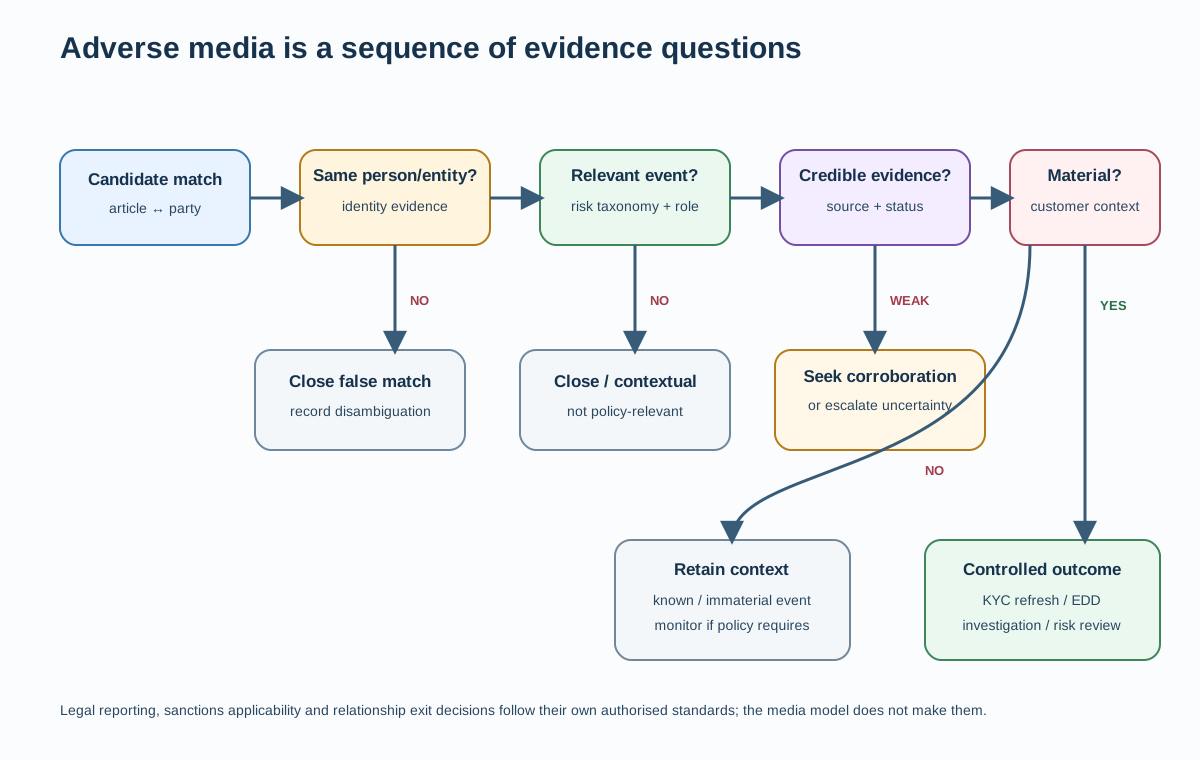
Entity resolution: where many false positives begin
Adverse-media tools can appear highly accurate in demonstrations because the examples use distinctive names. Production populations are different. Banks serve customers with common surnames, transliterated names, abbreviations, initials, former names, trading names and companies belonging to groups with similar legal entities.
Entity matching should therefore use contextual evidence. For an individual, useful fields can include date or year of birth, nationality, residence, occupation, employer and known associates. For a company, useful attributes can include legal name, trading name, registration number, registered country, address, industry, parent group, directors and beneficial owners. Not every source supplies all of these attributes. The matching logic must be comfortable with missing evidence without converting absence into confirmation.
Transliteration creates special difficulty. The same Arabic, Cyrillic, Chinese or other non-Latin name can be rendered in Latin characters in several ways. A good system retains original-script forms where possible and uses language-aware transliteration and alias logic. It should not simply remove punctuation and compare strings.
Entity resolution also needs relationship semantics. If an article concerns a customer's former director, the bank needs to know whether the relationship was active at the time of the alleged conduct and whether policy treats the person as relevant now. If the article concerns a 30%-owned subsidiary, the significance may differ from a completely unrelated company sharing part of the parent name.
A useful case screen exposes the match rationale to the analyst. Instead of displaying "92% match", it should show which attributes agreed, which conflicted and which were unavailable. A percentage without evidence encourages anchoring: once an analyst sees a high score, they may search for reasons to accept it.
Event taxonomy and allegation status
The event taxonomy is a policy artefact as much as a machine-learning artefact. Compliance should define what types of public information matter to the institution's financial-crime risk management. Data science then translates those categories into labels and models. If the taxonomy is vague, the model may be mathematically sophisticated while the control remains conceptually weak.
Categories should be mutually understandable but need not be mutually exclusive. An article can support more than one risk code. The taxonomy should also include non-relevant or contextual categories so the model learns the difference between financial crime and ordinary negative business news.
Status should be represented separately from event type. A corruption event might have statuses such as allegation, inquiry, formal investigation, charge, trial, conviction, acquittal, dismissal or appeal. The exact statuses will vary by jurisdiction because legal processes use different terminology. The system should avoid translating local procedural terms into stronger conclusions than the source supports.
This separation matters operationally. A bank may decide that a credible formal investigation involving a high-risk beneficial owner triggers enhanced review, while an uncorroborated allegation involving a remote former employee does not. That is a policy decision. The NLP engine's job is to present the facts consistently enough for policy to be applied.
Source credibility, duplication and the problem of apparent corroboration
Source quality should not be reduced to a permanent ranking of publishers. A usually reputable outlet can publish an early report that is later corrected. A small local publication can be the first credible source for an important event. Official sources can also change: charges can be withdrawn, sanctions can be lifted and court outcomes can reverse earlier assumptions.
A more useful source model captures publisher identity, article provenance, whether the story cites primary material, whether another credible independent source corroborates it, whether the publication has issued a correction, and whether the content is original or syndicated.
Duplicate clustering is especially important. News agencies and press releases are routinely republished. Without clustering, the same paragraph can appear on dozens of sites and create the illusion of independent confirmation. Near-duplicate detection can use text similarity, source metadata, publication timing and common quoted passages. The analyst should see the cluster's likely origin and meaningful updates rather than twenty alerts for the same story.
Retractions and corrections must also flow through the lifecycle. If an article is materially corrected after a customer decision, the bank needs a controlled mechanism to reassess the case where appropriate. An evidence store that captures only the first headline and never checks updates can preserve an inaccurate risk picture indefinitely.
Multilingual screening and translation risk
A global bank loses material coverage if it searches only English-language media. Local investigations are often reported first in local languages. At the same time, multilingual processing introduces its own failure modes.
Language detection can fail on short headlines or mixed-language text. Translation can alter names, legal terms and negation. A model trained mainly on English may perform poorly on inflected languages or scripts that were under-represented in its training data. Some terms that look equivalent in translation carry different procedural meaning in local law.
A robust design therefore measures performance by language or language family rather than publishing one global precision number. It preserves original text or source references, exposes translation confidence where available, and routes difficult material to language-capable reviewers or approved translation services. It also tests transliteration variants and mixed-script names.
The control should be honest about unsupported languages. Silently returning no result is more dangerous than declaring a coverage limitation because the first creates false assurance.
Where adverse media enters the customer lifecycle
Adverse-media screening may be used at onboarding, during periodic customer review, after a trigger event, before particular high-risk decisions and as part of ongoing screening. The right pattern depends on risk and jurisdiction.
At onboarding, relevant adverse information may change the evidence required before establishing a relationship. It can prompt enhanced due diligence, clarification of source of wealth, deeper beneficial-ownership work or senior approval. It should not automatically become a rejection rule unless policy and applicable law support that outcome.
During an existing relationship, newly discovered information can trigger an event-driven KYC review. The bank may update the customer's risk assessment, intensify monitoring or investigate connected activity. AUSTRAC's current Australian guidance, for example, explicitly requires regulated businesses in scope to review and, where appropriate, update customer ML/TF risk and KYC information when relevant circumstances change. That is an Australian legal and supervisory example, not a universal global rule.
In the EU context, EBA risk-factor guidance has treated customer or beneficial-owner reputation and credible adverse information as relevant risk considerations. The underlying point is again risk-based: quality, credibility and persistence of allegations matter, and one weak source should not automatically determine a customer outcome.
Wolfsberg's industry guidance similarly frames negative-news screening as a mechanism for understanding potential financial-crime risk and stresses proportionality. None of these sources turns a media classifier into a legal decision engine.
Alert, case and investigation outcomes
An NLP alert should answer enough questions for a reviewer to start intelligently. Who is the candidate customer match? Which source produced the information? What event did the model identify? What is the alleged person's role? What status was extracted? What dates matter? Why did the system believe the article was relevant? What evidence contradicts the match?
The analyst then decides whether the article concerns the customer or a relevant connected party. A false entity match should normally be closed with a reason that can support tuning and future suppression. A true match then moves to event assessment: is the reported conduct within policy scope, is the source credible, is the matter current or resolved, and what further corroboration is required?
If the information is material, the case may trigger enhanced due diligence or an event-driven customer review. It may also supply context to a transaction-monitoring investigation. But adverse media does not itself prove that the customer's transactions are suspicious. Suspicious-transaction or suspicious-activity reporting is governed by local law and must follow the applicable threshold, confidentiality rules and authorised decision process.
Likewise, adverse media involving sanctions evasion does not mean the customer is legally sanctioned. Sanctions screening and legal applicability must be performed against the relevant regimes, designations, ownership/control rules and transaction facts.
The final disposition should be explicit. Examples include false entity match, event not relevant, credible but immaterial under policy, event already known and assessed, trigger KYC refresh, escalate for enhanced due diligence, refer to investigations, refer to sanctions specialists, refer for customer-risk decision or link to an existing case. The system should not use vague outcomes such as "cleared" where the actual decision was narrower.
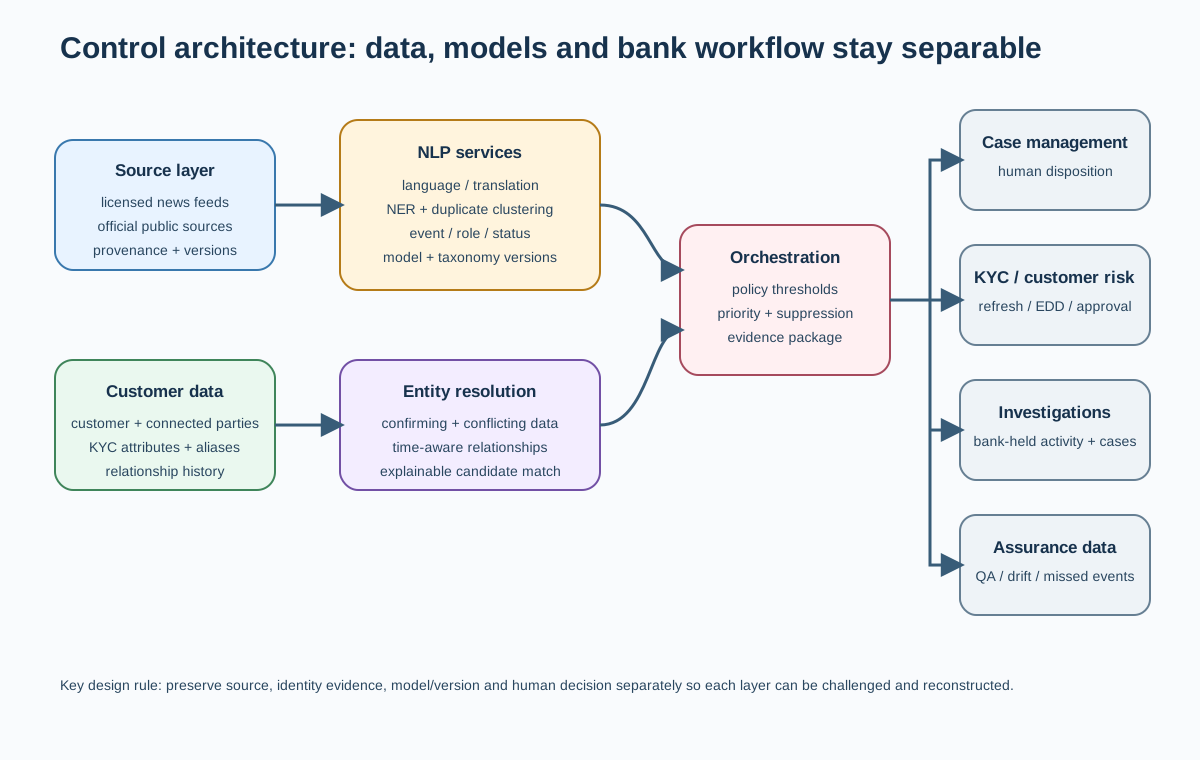
Data and system touchpoints
A bank-practical adverse-media service usually touches more systems than expected. Customer master data supplies names and identifiers. KYC platforms supply beneficial owners, directors and risk ratings. A screening engine or vendor supplies articles and candidate matches. Translation services may transform text. Case-management platforms capture analyst decisions. Customer-risk engines consume material outcomes. Data platforms support management information and model monitoring.
A useful event contract should make provenance visible. Fields can include source_id, original_url, publisher, publication_date, ingestion_timestamp, language, article_cluster_id, entity_mention, candidate_party_id, entity_match_features, event_type, allegation_status, event_date, source_tier, model_version, classification_score, threshold_version, evidence_pointer, disposition, reviewer_id and decision_timestamp. The exact schema varies, but the principle is stable: the case should be reconstructable without guessing which model or source version produced it.
The bank should be careful about storing full copyrighted articles in downstream systems. Licensing terms may restrict copying or retention. A safer architecture can retain the permitted evidence, extracted metadata and source reference while using controlled access to licensed content. Legal and data-governance teams should define the approach.
Personal-data handling also matters. Adverse media can contain sensitive or inaccurate information about individuals. Access should be role-based. Retention should be purposeful. Search results should not be exposed broadly simply because they are public on the internet. The applicable privacy and data-protection framework must be assessed in each jurisdiction.
Model performance: measure the real control, not only the classifier
A single model-accuracy number is almost useless for governing an adverse-media programme. The control contains multiple models and decisions, and each can fail differently.
Entity resolution should be measured for both false matches and missed matches. Event classification should be measured by risk category and language. Status extraction should be tested for negation and procedural nuance. Duplicate clustering should be tested for both over-grouping and under-grouping. Translation quality should be assessed on the language pairs that matter to the institution.
Operational metrics matter too. Alert yield, analyst override rate, queue ageing, re-open rate, duplicate suppression, time from publication to alert, coverage outages and material missed-event sampling tell management whether the system works in production. A reduction in alerts is not automatically an improvement. It can mean better precision, but it can also mean a source feed failed or a threshold became too restrictive.
Sampling should include silent cases, not only generated alerts. If QA reviews only what the model surfaced, it cannot discover important events the model never detected. Periodic benchmark searches, retrospective sampling and targeted challenge sets can test for false negatives.
Performance should also be segmented. A model that performs well on English corporate news may fail on local-language reporting involving individuals. A global average can hide that weakness.
Human judgement and explainability
Human review is not a decorative control after the algorithm. It is where identity, source, event status, customer context and policy are combined into a decision.
For that reason, explainability should be designed for the reviewer rather than for a data-science presentation. The analyst needs to see the matched party, the relevant text, the extracted event, source and dates, the identity attributes that matched, contradictory attributes, the model and rule versions, and any history of related alerts. A generic "high risk" score is not enough.
The analyst also needs a way to disagree. Override reasons should be structured sufficiently to support quality review and model improvement. But analyst closures are not automatically ground-truth labels. Analysts can make mistakes or follow an old policy. Using every closure directly as a training label can teach the model historical process bias.
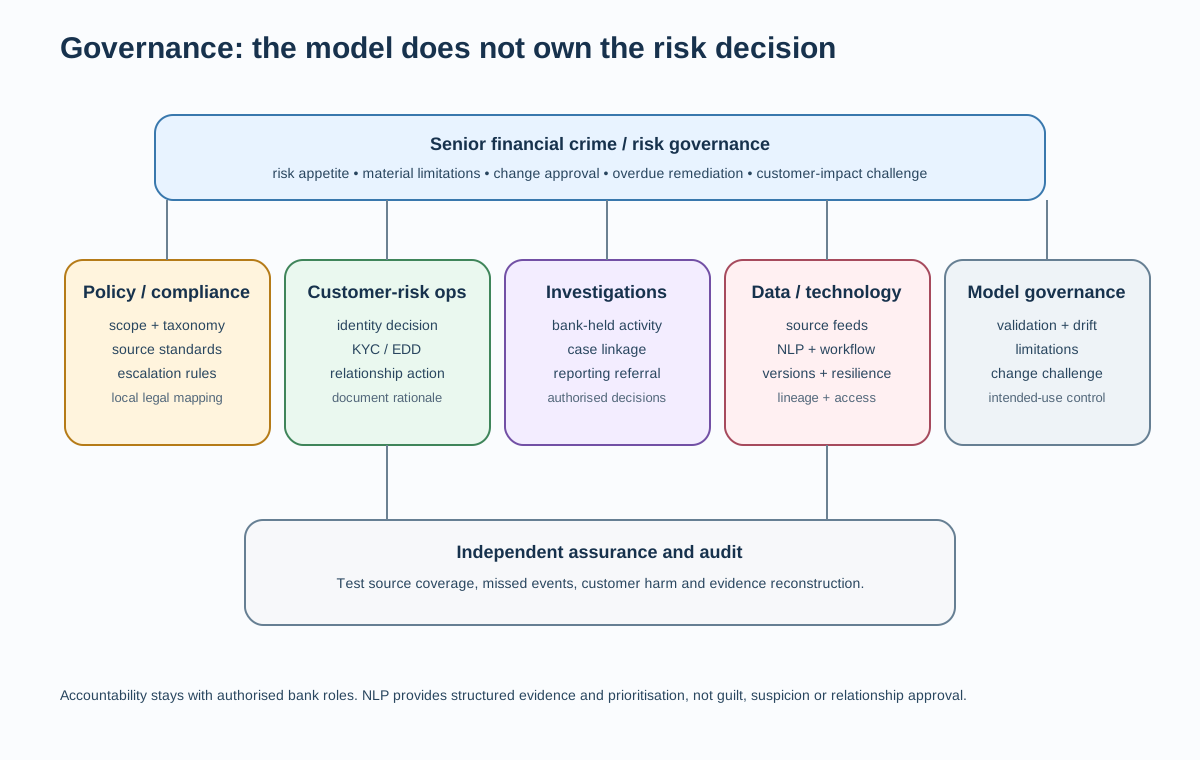
Governance and accountability
The policy owner should define what adverse media means for the institution, which parties are screened, which risk categories matter, what evidence and source standards apply, and what outcomes require escalation. The business or customer-risk function owns the relationship decision within its authority. Financial-crime specialists own investigation standards and legal-reporting escalation where applicable. Technology and data teams operate the platform. Model or AI governance challenges model design and performance where relevant. Independent assurance tests whether the control works as described.
FATF's work on digital transformation recognises that AI and NLP can improve AML/CFT risk identification and monitoring, while also highlighting explainability, data protection, governance and implementation challenges. NIST's AI Risk Management Framework is not an AML law and is voluntary, but its govern, map, measure and manage concepts provide a useful generic discipline for AI-enabled controls. Banks should clearly distinguish such voluntary frameworks and industry guidance from binding legal obligations.
Common failure modes
A weak programme often starts with a marketing promise such as "AI screens all global news" and then leaves the difficult questions unanswered. The most damaging failures are usually ordinary control failures rather than exotic AI problems.
One failure is name-only matching. It produces high volumes for common names and can harm customers through mistaken identity. Another is sentiment-only classification, which confuses bad publicity with financial crime. A third is headline-only processing, which misses negation and context contained in the body.
Another failure is syndication inflation. The same allegation appears across many sites and is counted as repeated independent evidence. A related failure is stale-event persistence, where an old accusation remains permanently high risk even after acquittal or retraction.
Multilingual blind spots are common. A bank may claim global coverage while the model performs materially worse outside a few languages. Vendor opacity can worsen the problem if the institution cannot test source coverage, model changes or threshold logic.
Operational design can fail even when the model is good. Queues may become too large for timely review. Evidence links can expire. Case systems may not store model versions. A threshold change can be deployed without back-testing. A source outage can last days before anyone notices because monitoring focuses on system uptime rather than content volume.
Finally, automation can create unfair customer outcomes if a machine score directly triggers rejection, restriction or exit without appropriate policy and human review. Risk-based AML/CFT control should not become indiscriminate de-risking.
A realistic mini case: Eastern Meridian Trading
Consider a fictional corporate customer, Eastern Meridian Trading Ltd, a regional industrial-equipment distributor. The customer has operated for four years with a medium customer-risk rating. An adverse-media system ingests a local-language article reporting that "Eastern Meridian Group" is under investigation for alleged bribery in a public procurement contract.
The first model produces a strong name similarity. If the bank stopped there, the customer would be escalated as a likely match. Entity resolution, however, shows that the article's company is registered in another country. The customer master has a different registration number, different directors and no known group relationship. The correct disposition may be false entity match.
Now change one fact. Suppose the article names a director whose transliterated name matches one of the customer's beneficial owners and gives the same age and former employer. A regulator press release, published the next day, confirms a formal investigation. The system clusters six newspaper copies into one story family and treats the regulator release as an independent higher-quality source rather than counting seven separate confirmations.
The customer-risk team opens an event-driven review. It checks corporate ownership, procurement activity, source of wealth where relevant, account behaviour and counterparties. Transaction monitoring finds payments to a consultancy named in the regulator release. That does not prove bribery, but it creates additional bank-held evidence. The case is referred to financial-crime investigations under the institution's policy.
Two months later, a court record clarifies that the beneficial owner was a witness rather than a suspect. The news provider updates its status. The bank revisits the case, records the new evidence and changes the customer-risk conclusion. The important lesson is not that NLP "found corruption." The successful control separated identity, source, event, role, status and bank-held activity, then allowed humans to revise the conclusion when the evidence changed.
What a strong implementation should leave behind
A strong adverse-media NLP control leaves an evidence trail that answers five questions without reverse engineering the system months later: what was published, who did the bank think it referred to, what event and status were extracted, what other evidence was considered, and who made the final decision under which policy version?
That is the standard business analysts, architects, developers and testers should design toward. The technology can be sophisticated, but the control should remain understandable. If a regulator, internal auditor or quality reviewer cannot reconstruct why a customer was escalated or cleared, the programme is not mature simply because the model uses advanced NLP.
Operational deep dive: from public text to a defensible bank decision
The base chapter separated source coverage, entity resolution, event classification, evidential status and human judgement. This deep dive focuses on what happens when those stages run every day at bank scale. The central challenge is not building one clever classifier. It is making several imperfect components behave as one controlled process when names are ambiguous, media is duplicated, sources update, languages differ and analysts work under queue pressure.
Source acquisition and provenance
A bank cannot govern an adverse-media control without knowing what enters it. Every item should carry provenance: publisher, original URL or licensed source identifier, publication time, ingestion time, language, content version where relevant and the acquisition channel. Provenance is necessary for more than audit. It supports source-quality assessment, duplicate clustering, correction handling and outage detection.
Feed monitoring should therefore test content as well as infrastructure. An API can return HTTP 200 while delivering only a fraction of normal articles. Operations should watch source volumes by publisher, geography and language, delayed ingestion, malformed documents and unusual changes in duplicate rates. A silent source outage is a false-negative problem, not merely a technical incident.
Coverage also needs deliberate scope. Some institutions screen all customers periodically; others concentrate continuous adverse-media screening on higher-risk populations and use searches at onboarding or event-driven review for other customers. The pattern should reflect law, policy, risk appetite and operational capacity. Wolfsberg's negative-news guidance is useful precisely because it rejects a one-size-fits-all design and encourages a risk-based, proportionate framework.
Normalisation without destroying meaning
Text preparation sounds mechanical but can alter the evidence. Removing boilerplate is helpful; removing the sentence that states "charges were dismissed" is not. Normalisation should preserve sentence boundaries, quotation context, negation and names. If the platform creates translated text, the original language and source reference should remain available to reviewers where permitted.
Dates require care. The publication date is not necessarily the event date. The article may describe an investigation opened months earlier or a conviction relating to conduct years earlier. A data model should therefore separate publication_date, event_date, status_date and ingestion_timestamp. That distinction allows a reviewer to understand both recency and chronology.
The same principle applies to location. Publisher location, event location, customer address and court jurisdiction are different concepts. Collapsing them into one country field creates poor matching and misleading geographic risk analysis.
Named entities are not yet customer matches
Named-entity recognition identifies mentions such as people, organisations and places. It does not establish that a mention is the bank's customer. A robust pipeline creates candidate links between article entities and customer master records, then applies entity-resolution logic.
For individuals, the resolver can use combinations of full name, aliases, transliteration, age or date of birth, nationality, residence, employer, occupation and associated entities. For legal persons, it can use legal name, trading names, company number, incorporation country, registered address, industry, directors, beneficial owners and corporate group relationships. Matching logic should record both confirming and contradictory features.
A useful principle is evidence before score. If the screen tells an analyst only that a customer match has confidence 0.94, the analyst cannot challenge it. If it shows name match, company-number mismatch, different country and no shared directors, the reviewer can understand why a high string-similarity score should not determine the result.
Entity resolution must also be time-aware. A director who left a company before the reported conduct may carry different relevance from an active controller. A beneficial owner acquired last month should not automatically be linked to events from ten years ago without contextual analysis.
Event extraction needs roles, not just topics
Suppose an article says: "The prosecutor charged Asterix Construction with bribing a public official; Meridian Bank reported the suspicious payment that prompted the investigation." A naive classifier may tag both companies with bribery. A useful system recognises roles: alleged perpetrator, institution reporting the matter, victim, authority, witness or unrelated contextual entity.
Role extraction reduces damaging false positives. Financial institutions are frequently mentioned in crime stories because they froze funds, reported suspicious activity or cooperated with authorities. A system that treats every co-mentioned bank as implicated will generate noise and could even penalise institutions for effective control activity.
Event extraction should likewise distinguish the object and action. "Regulator investigates Company X for false invoicing" is different from "Company X investigates false invoicing by a supplier." Grammar, semantic roles and sentence context matter.
Negation, uncertainty and legal status
Financial-crime text contains language that simple keyword systems handle badly: "not charged", "no evidence found", "allegations denied", "investigation closed", "charges reinstated on appeal", "former suspect now treated as witness". Status extraction should identify the procedural state and the subject to whom it applies.
Uncertainty matters too. "Authorities are considering whether to open an inquiry" is not the same as a formal investigation. "According to an unnamed source" is different from a published charging document. NLP can label these distinctions, but policy should determine their significance.
Where local legal terminology is unfamiliar, the safest design is to preserve the original phrase and avoid mapping it automatically to a stronger universal concept. Legal systems differ in the meaning of investigation, indictment, charge and conviction. Reviewers may need local expertise.
Duplicate clustering and story evolution
A mature adverse-media system treats a story as an evolving cluster rather than a collection of disconnected URLs. The first report may contain an allegation. Later reports may add named parties, formal charges, a court decision or a retraction. A cluster can preserve the sequence and highlight material changes.
Clustering typically combines text similarity, publisher relationships, timestamps, shared quoted passages and entity/event overlap. It should not over-group distinct cases involving the same person. A customer can face separate investigations in different countries, and those should not disappear into one cluster.
The analyst interface should identify the likely originating source and meaningful independent corroboration. If twelve sites reproduce the same wire-service copy, the interface should show one originating item plus syndication, not twelve independent risk signals.
Source quality is contextual
Source-tiering can help workflow prioritisation, but a permanent "trusted/untrusted" label is too crude. Official regulator, prosecutor or court publications often provide strong primary evidence for the procedural fact they state. Established media may provide high-quality investigative reporting. Specialist or local outlets may possess unique information. Blogs and social media can produce leads but frequently need corroboration.
The relevant question is what the source proves. A prosecutor release can prove that a charge was announced; it does not prove guilt. A court judgment can establish an adjudicated outcome within that jurisdiction; it may still be appealed. A newspaper can credibly report an investigation without possessing the underlying evidence. The case record should preserve this distinction.
Queue design and prioritisation
NLP exists partly because human teams cannot read everything. Prioritisation should therefore combine materiality dimensions that policy has approved: identity confidence, risk-event type, source quality, allegation status, customer risk, role, geography, recency and relationship significance. The highest score should mean "review sooner under this workflow", not "customer is guilty".
Queue design needs service levels by risk rather than one universal SLA. A credible new corruption charge against the controlling owner of a high-risk corporate customer may need rapid review. A weak name-only match to a low-risk retail customer can wait or be automatically suppressed under a validated rule.
Capacity controls should monitor oldest case, high-risk ageing, queue inflow versus analyst capacity, reopen rates and cases waiting for language expertise. If a backlog forces analysts to close cases with minimal review, the technology has not solved the control problem.
Feedback loops without poisoning the model
Analyst dispositions are valuable feedback but require quality control. A false-match reason such as "different date of birth" can improve matching. A closure reason such as "no concern" is much less precise. If the bank trains directly on historic closures, it may reproduce inconsistent analyst behaviour, old policy thresholds or past bias.
Feedback should therefore distinguish operational labels from verified training labels. Selected cases can undergo QA or adjudication before entering a training set. Label provenance should capture who assigned the label, under which policy version and with what evidence.
The same discipline applies to suppressions. A suppression rule for a repeatedly false entity match can reduce noise, but it needs expiry and change triggers. If customer data or source information later changes, the suppression may no longer be valid.
Resilience and fallback
Adverse-media screening often depends on external vendors, translation services and hosted models. Resilience design should identify what happens when each dependency fails. If the news feed is unavailable for six hours, the system should record the gap and catch up after recovery. If the classifier is unavailable, the bank may route a smaller high-risk population through simpler rules or delay low-risk processing, depending on policy and business needs.
Fallback must not silently convert "unable to screen" into "no adverse media found". Those states are operationally and evidentially different.
Reprocessing is equally important. When a source feed catches up or a model is restored, the system should prevent duplicate cases while ensuring missed material is evaluated. Idempotent event IDs and stable story-cluster IDs help.
Management information that reveals risk
Useful management information connects model performance and operations. It can show entity-match precision by population, event-classifier precision and recall by category and language, material missed-event findings, feed latency, duplicate suppression, high-risk ageing, analyst overrides, QA disagreement, source outages and material status updates received after closure.
Metrics need denominators and context. "False positives fell 40%" is not meaningful if the source universe also shrank. "Alert volume decreased" may indicate better targeting or a broken feed. "Average handling time fell" may indicate efficient tooling or shallow review.
The strongest governance packs therefore combine volume, quality, coverage, missed-risk testing and customer-impact indicators.
A reviewer-friendly evidence package
When the system escalates an item, the analyst should be able to see a compact evidence package: the customer and connected party, the matched article entity, identity attributes that agree and conflict, event category, extracted role, allegation status, original and translated text around the relevant passage, source and publication date, story cluster, related prior events, model version and why the alert crossed the workflow threshold.
That package makes human review faster while preserving challenge. It also gives QA and audit a stable record of what was known at the time. The goal of NLP is not to hide complexity; it is to organise complexity so the bank can make a proportionate, explainable decision.
Advanced practice: validation, change and control assurance
An adverse-media NLP service is never finished. Publishers change formats, language coverage expands, legal processes create new terminology, customer populations shift, financial-crime typologies evolve and vendors release new models. Advanced practice therefore focuses on how the bank proves that the control continues to work after change.
Define the intended use before validating the model
Validation begins with the decision the system supports. A model used only to rank analyst queues carries a different risk from a model that suppresses articles automatically. A model that suggests event categories is different from a model whose output feeds customer-risk scoring. The bank should document the intended use, prohibited uses, target population, supported languages, dependencies, decision owners and human-review expectations.
This prevents a common form of control drift: a tool originally approved as an analyst aid gradually becomes an automated decision gate because downstream teams discover its score and start treating it as authoritative.
NIST's AI Risk Management Framework is voluntary and non-sector-specific, but its govern, map, measure and manage structure offers a useful generic discipline for this lifecycle. FATF's technology work similarly recognises NLP and other AI techniques as potentially useful for AML/CFT while highlighting explainability, privacy, governance and responsible implementation. Neither source creates a universal adverse-media legal requirement. The bank must map those principles to applicable law and its own risk framework.
Build a validation set that resembles real production
A convenient test set can flatter a model. Validation should include difficult cases: common names, rare names, aliases, transliterations, short headlines, long investigative articles, multiple people in one story, negation, acquittals, historical allegations, local-language reporting, syndicated copies, corporate groups and entities with similar trading names.
The dataset should include genuine non-relevant negative news. Otherwise a classifier may learn that any negative vocabulary is adverse media. It should also include financial-crime events written in neutral language, because official notices and court summaries are often factual rather than emotional.
Performance should be reported by meaningful slice. Entity matching can be segmented by individuals versus companies, common-name risk, script or language, country and data completeness. Event classification can be segmented by typology and language. A global average can conceal a serious weakness in a smaller population.
Precision and recall belong to different control stages
Precision asks how much surfaced material is truly relevant. Recall asks how much relevant material the system finds. Both matter, but not identically at every stage.
For initial source retrieval, a bank may tolerate lower precision to avoid missing material. For automatic suppression, the tolerance for false negatives should be much lower. For high-risk queue prioritisation, ranking quality may matter more than a hard binary threshold.
The institution should therefore avoid one universal "model accuracy" target. It should define metrics around each use: entity-resolution false-match rate, entity-resolution missed-match rate, event classification precision and recall, allegation-status accuracy, duplicate-cluster quality, source latency and human-review outcomes.
Testing negation and status transitions
Negation and procedural status are high-value test areas because errors directly change meaning. Test cases should include sentences such as "was not charged", "charges were dismissed", "denied wrongdoing", "conviction overturned", "investigation reopened", "acquitted on all counts", "named as a witness" and "not the subject of the inquiry".
Regression testing should verify that a model upgrade does not improve general classification while worsening these critical edge cases. A small bank-curated challenge set can be more useful for this purpose than a large generic benchmark.
Status-transition testing should also cover story evolution. The same person may move from allegation to investigation, charge, conviction and appeal. The system should update or link the case rather than generate disconnected alerts that leave analysts with conflicting snapshots.
Multilingual validation
Translation is not a substitute for language validation. The bank should test whether entity names survive translation, whether legal terminology is preserved, whether negation remains intact and whether local-language risk events map correctly to the bank's taxonomy.
For languages with lower model performance, the control can use stricter human-review requirements, specialised models or language-capable analysts. What matters is that the weakness is visible and controlled. Claiming equal global performance without evidence creates false assurance.
Change governance
Material changes can arise from the model, taxonomy, threshold, source universe, customer master, translation engine or case workflow. A change framework should classify impact and define required testing before release.
For example, adding a new corruption category affects labels, training data, analyst procedures and management reporting. Changing the entity-match threshold may alter thousands of suppressions. Replacing a news vendor changes source coverage even if the classifier remains identical. Migrating translation providers may affect names and legal nuance.
Release evidence should therefore capture more than a model version. It should record source configuration, taxonomy version, threshold version, supported languages, reference datasets, test results, approved exceptions and rollback plan.
Drift in adverse-media systems
Drift is not only statistical. The source environment itself changes. News publishers adopt new layouts. Search-engine ranking changes. Criminal activity introduces new terminology. A geopolitical event can suddenly increase coverage of certain countries. Generative AI can increase low-quality or synthetic content. A vendor may add new sources without the bank noticing.
Monitoring should look for changes in article mix, language distribution, source concentration, entity-match confidence, event-category distribution, analyst override rates and false-negative challenge results. An unexpected shift should trigger investigation rather than automatic threshold tuning.
FATF's 2025 horizon work on AI and deepfakes is relevant as a broader warning: information ecosystems can be manipulated. For adverse media, that strengthens the case for provenance, source quality and corroboration. It does not mean every bank must deploy a universal deepfake detector.
BA requirements that are actually testable
A useful requirement states observable behaviour. Examples include:
- When two articles are near-duplicates from syndication, the system shall link them to one story cluster while preserving each source record.
- When a candidate customer match contains a conflicting date of birth, the analyst view shall display the conflict and the match logic shall not hide it behind an aggregate score.
- When the classifier detects a risk event, the alert shall retain the model version, event taxonomy version, evidence sentence and source provenance used at decision time.
- When a source publishes a material correction or retraction received through the feed, the system shall associate the update with the existing story cluster and evaluate whether a previously closed case requires review.
- When screening is unavailable, downstream systems shall distinguish
screening_pendingorscreening_unavailablefromno_relevant_media_found.
Acceptance criteria should include both positive and negative tests. A system should find a true relevant article, but it should also correctly avoid escalating an unrelated namesake, a bank mentioned as reporter rather than suspect, a story whose charges were dismissed and a duplicated copy that adds no new evidence.
Architecture and failure-mode testing
Integration testing should cover customer data arriving late, source API timeouts, translation failure, duplicate event delivery, case-system outage, stale model versions and reprocessing after recovery. Idempotency matters because replaying an article feed must not create dozens of duplicate cases.
Data lineage tests should trace one production-like alert from source through ingestion, text processing, entity resolution, event classification and case creation. The test should prove that timestamps, versions and evidence pointers survive each transformation.
Security testing should confirm that analysts see only information permitted for their role, that source credentials are protected, and that case exports do not expose licensed or sensitive content inappropriately.
Quality assurance and independent challenge
First-line quality assurance can sample analyst decisions and confirm that identity, source, event status and customer context were assessed consistently. Independent validation or second-line challenge should test whether the model and workflow are appropriate for their intended use, whether limitations are transparent and whether remediation is timely.
Independent review should not ask only, "Does the model meet its accuracy threshold?" It should ask whether the entire system delivers the intended financial-crime outcome. A model can pass technical metrics while the source feed is incomplete, the queue is unmanageable or analysts cannot see why articles were matched.
When an issue is serious
Some defects are nuisance issues; others undermine the control. A minor formatting error in the analyst screen is different from a language-detection defect that silently excludes a country, an entity-resolution bug that merges two customers, or a source outage that is reported as zero adverse media.
Issue severity should reflect financial-crime exposure and customer harm, not only system availability. Root-cause remediation should identify whether the failure came from data, taxonomy, model, threshold, interface, process, capacity or governance. Closure should require evidence that the root cause is fixed and that affected historical populations have been assessed where necessary.
The mature standard is straightforward: the bank should be able to explain what the system was designed to do, demonstrate how it performs on the populations that matter, show how humans use it, identify its limitations and prove that change is controlled.
Practice close: investigate the evidence, not the score
This exercise turns the chapter into a realistic review problem. The case is fictional, but the control questions are the same ones a bank should ask in production.
Scenario
A bank onboards Northbridge Medical Supplies Ltd, incorporated in the United Kingdom and owned 55% by Maya Raman. Six months later, the adverse-media platform creates a high-priority alert. A translated article from another jurisdiction states that "Maya Raman, procurement adviser to Northbridge Health Group, is being questioned in connection with alleged kickbacks involving hospital contracts."
The platform assigns a high event score for corruption and a medium entity-match score. Three other websites carry nearly identical stories. A fifth source says prosecutors have "not named Raman as a suspect." The customer's file shows that Maya Raman was born in 1984, lives in London and has never been employed by Northbridge Health Group. The article describes a Maya Raman aged 52 who previously worked for a regional health authority overseas.
The correct first question is not whether corruption is serious. It is whether the article concerns the customer or beneficial owner at all.
Step 1: reconstruct the match
The analyst should examine the matched attributes. The name is identical, but age, geography and employment history conflict. The system should expose those conflicts. If the platform shows only a 78% match score, the analyst needs to retrieve the underlying evidence before deciding.
The four similar articles should be checked for provenance. If three simply reproduce one news-agency report, they are one story family, not three independent confirmations. The fifth source matters because it adds a different procedural statement, but its reliability and relationship to the original story must also be assessed.
At this point, the likely outcome is a false entity match. That conclusion should be recorded with the disambiguating evidence so the same namesake does not generate repeated manual work without good reason.
Step 2: change the facts
Now assume customer data reveals that Maya Raman previously used another surname and that her employment history includes the health authority named in the article. The age in the translated story appears to come from a transcription error, while an official prosecutor notice contains the same former surname and date of birth as the customer's beneficial owner.
The identity conclusion changes. The event is now a credible true match. But the next decision is still not "guilty" or "exit customer." The analyst must assess what the official source actually says, the status of the investigation, the customer's role, the bank's risk policy and any relevant account activity.
A KYC review might confirm whether the customer's business has public-procurement exposure, whether source of wealth needs refreshing and whether connected companies require review. Transaction analysis may identify payments to entities mentioned in the official notice. If that evidence creates suspicion under applicable law, the case follows the bank's authorised reporting process. The media alert itself does not automatically satisfy the reporting threshold.
Step 3: test a later status update
Three months later, the prosecutor publishes an update saying the individual was interviewed as a witness and is no longer a person of interest. The adverse-media system should link that update to the original story cluster. The customer-risk team should be able to reassess the earlier conclusion rather than leaving the original allegation as a permanent unexplained flag.
This illustrates why chronology is part of the control. An adverse-media system that finds bad news but cannot process exculpatory or corrective information creates customer harm and weakens risk accuracy.
Reviewer prompts
A strong reviewer should be able to answer these questions from the case record:
- What public source triggered the alert and when was it available to the bank?
- Which article entity was linked to which customer or connected party?
- What identity attributes supported the link and which contradicted it?
- What financial-crime event was identified, and what was the person's role?
- Was the information an allegation, investigation, charge, conviction, acquittal, dismissal, retraction or another status?
- Were multiple stories independent or syndicated copies?
- What customer-risk or bank-held transaction information changed the assessment?
- What decision was made, by whom and under which policy version?
- What follow-up or event-driven review was required?
- Could a later correction or status change reopen the assessment?
Acceptance criteria for a delivery team
A build should not be accepted merely because it can display articles. It should prove that customer identity, evidence and decision context survive the workflow. A useful acceptance pack includes true-match and false-match namesakes; transliterated names; corporate parent and subsidiary distinctions; negative wording that is not financial crime; neutral wording that is financial crime; negated charges; article corrections; acquittals; duplicate syndication; unsupported languages; feed outages; translation failures; replayed events; and role distinctions such as suspect, victim, witness and reporting institution.
The analyst screen should never turn a model score into an unexplained conclusion. It should show the evidence needed to challenge the model. The audit record should preserve source provenance, model and taxonomy versions, reviewer outcome and material evidence without breaching source licensing or data-retention rules.
Misconceptions to avoid
"More negative words mean more risk." No. Financial-crime relevance depends on event meaning, not emotional tone.
"Five articles mean five confirmations." Not if four are copies of the same original report.
"A name match is enough." Common names, aliases and transliteration make contextual identity evidence essential.
"An investigation means guilt." It means an investigation. Status and evidential weight must be represented accurately.
"No media result means no risk." It can also mean a coverage gap, source outage, language limitation or missed match.
"The model can decide whether to file a suspicious report." Reporting thresholds and authorised decisions are governed by applicable law and bank policy. NLP provides evidence; it does not replace the legal decision process.
Operational extension: corrections, removals and contested information
A production control also needs a defined response when public information changes after the first review. News publishers can correct names, amend dates, remove an article, change a headline or append an editor's note. Courts and authorities can publish later decisions that materially alter the meaning of an earlier allegation. A bank should therefore avoid treating the first captured article as a permanently complete statement of fact.
The data model should distinguish the source record from the bank's assessment record. The source record captures what was observed, when it was observed, where it came from and, where licensing permits, enough evidence to reconstruct the relevant passage. The assessment record captures the identity decision, event classification, procedural status, policy relevance, reviewer reasoning and downstream action. If the source later changes, the historical assessment should not be silently rewritten. Instead, a new source event should be linked to the existing story and routed for reassessment when the change could affect the bank's conclusion.
A source becoming unavailable is not the same as a retraction. A broken link may result from a website redesign, paywall, archive policy or technical failure. The system should retain the provenance and observation timestamp and, where lawful and contractually permitted, a controlled evidential representation. Analysts should not infer that an allegation was withdrawn simply because the original URL no longer resolves.
The opposite problem also matters. If a publisher issues a correction or an authority announces an acquittal, dismissal or mistaken identity, the bank should not preserve only the adverse version because it is operationally convenient. Event-driven review should allow material exculpatory information to change the risk assessment. This is both a control-quality issue and a customer-outcome issue: stale adverse data can lead to unnecessary enhanced due diligence, restrictions, escalations or relationship decisions.
Testing should therefore include article edits, retractions, broken links, later official notices and conflicting sources. The expected result is not automatic deletion of the old evidence. It is a traceable chronology showing what the bank knew at each point, how the new information changed the assessment and who approved any consequential action. That chronology gives investigators, compliance, audit and customer-facing teams a defensible answer to a simple but important question: what did we know, when did we know it, and what did we do when the facts changed?
Chapter recap
Adverse-media NLP is valuable because it converts large amounts of unstructured public information into reviewable evidence. Its strongest contribution is not automatic judgement but disciplined organisation: identify the right person, identify the right event, preserve source and status, connect the information to customer context and route the result to a human who has clear decision rights.
A mature bank therefore measures the whole control. It watches coverage, entity resolution, event classification, multilingual performance, duplicate suppression, status updates, queue quality, analyst decisions, missed events and customer impact. That is what turns NLP from an impressive search feature into a defensible financial-crime capability.
References and further reading
These sources support the chapter's treatment of adverse-media screening, technology governance and ongoing customer-risk review. They do not create one universal legal rule. Institutions must apply the law, regulatory guidance and internal policy that govern each legal entity and jurisdiction.
- Wolfsberg Group — Negative News Screening FAQs
- FATF — Digital Transformation of AML/CFT
- FATF — Opportunities and Challenges of New Technologies for AML/CFT
- FATF — Updated Standards to promote financial inclusion and a proportionate risk-based approach, 25 February 2025
- FATF — Horizon Scan: AI and Deepfakes
- European Banking Authority — Guidelines on ML/TF Risk Factors, consolidated with the 2023 amendments
- AMLA — EBA and AMLA complete handover of AML/CFT mandates, 19 January 2026
- European Banking Authority — AML/CFT policy page and regulatory-continuity notice
- AUSTRAC — Reviewing and updating customers' ML/TF risk and KYC information
- NIST — Artificial Intelligence Risk Management Framework
- NIST — AI RMF Playbook
How the sources are used. Wolfsberg supplies the chapter's core industry framing for negative-news screening: public-domain information relevant to financial-crime risk, applied through a risk-based and proportionate framework. FATF supports the discussion of NLP and other advanced technologies as tools that can improve AML/CFT effectiveness while requiring explainability, governance, data protection and responsible implementation. The EBA risk-factor guidance supports the EU-specific discussion of customer and beneficial-owner reputation and credible adverse information as risk factors. Since 1 January 2026, EU-level AML/CFT mandates have transferred from the EBA to AMLA; the EBA and AMLA confirm that existing EBA AML/CFT guidelines and standards remain in force until AMLA replaces them. AUSTRAC provides the current Australian example of ongoing customer-risk and KYC review when circumstances change. NIST is used only as a voluntary, non-sector-specific AI governance framework, not as an AML legal obligation.