Robotic Process Automation (RPA) in Alert Triage
Financial-crime alert triage contains an awkward mix of repetitive administration and difficult judgement. An analyst may spend minutes opening several systems, locating the same customer, copying identifiers, collecting recent transactions, checking the current KYC risk rating, finding prior alerts and building a case record before any real investigation begins. At scale, that work consumes thousands of hours, creates avoidable copy-and-paste errors and makes alert handling slower precisely when queues are already under pressure.
Robotic process automation, or RPA, can remove part of that friction. In its classic form, an RPA bot is software that follows defined instructions to interact with applications, screens, files, queues or APIs. It can log in using an approved machine identity, retrieve data, apply deterministic validation rules, populate standard fields and route work to the next step. That makes RPA useful for alert triage because much of the early work is repeatable evidence preparation rather than financial-crime judgement.
The central mental model is simple: RPA is a digital operations worker, not a digital investigator. A bot can collect and structure evidence. It can enforce an approved workflow rule. It can identify that a mandatory data source did not respond. It should not silently convert ambiguity into a conclusion that activity is suspicious or not suspicious unless the institution has deliberately designed, approved and tested a narrowly defined automated decision for that purpose. The legal and policy implications of suspicious-activity reporting, customer restrictions, account exit, sanctions action and similar outcomes remain governed by the applicable jurisdiction and the bank's own decision framework.
RPA is also not the same thing as artificial intelligence. Traditional RPA is deterministic: the same validated inputs and configuration should produce the same workflow action. A bot may call a machine-learning model, large language model or entity-resolution engine, but the inference belongs to that component, not to RPA itself. That distinction matters because an institution should not apply model-risk terminology mechanically to every bot, while it also should not allow an AI component to escape model or AI governance merely because it is invoked inside an RPA workflow.
Why banks automate alert triage
The business case for RPA usually begins with volume and fragmentation. A transaction-monitoring alert may be created in one platform while customer master data sits in another, account balances in core banking, payment details in a payment hub, sanctions or PEP results in a screening service, adverse-media output in a vendor portal and previous cases in a separate investigation tool. If those systems are not connected through stable services, an analyst becomes the integration layer.
That manual pattern is expensive, but the more serious problem is control variability. One analyst may capture three months of history and another six. One may notice that the KYC record is stale; another may copy the displayed risk rating without checking its effective date. A third may create a new case even though an existing open case already covers the same customer and alert family. RPA can standardise the preparation step so that the same required sources, timestamps and identifiers are collected before human review.
The automation objective should therefore be stated in control terms, not simply as "reduce headcount" or "close alerts faster". A stronger objective is: assemble a complete, current and traceable evidence pack for eligible alerts; route exceptions visibly; preserve decision rights; and prove that every source alert is accounted for. Speed is valuable, but only after completeness and integrity are protected.
The Financial Action Task Force has encouraged responsible use of new technologies in AML/CFT where they can improve effectiveness and efficiency, while stressing governance, data protection and implementation conditions. In the United States, the federal banking agencies have similarly encouraged responsible innovation without prescribing a particular technology or changing underlying BSA/AML obligations. Wolfsberg's 2025 work on effective monitoring also places transition, testing and explainability at the centre of responsible innovation. None of these sources says that banks should use RPA, and none turns an automation choice into a universal legal requirement. They provide a useful principle: innovation is valuable when the institution can show that the financial-crime control remains effective.
Where RPA fits in the alert lifecycle
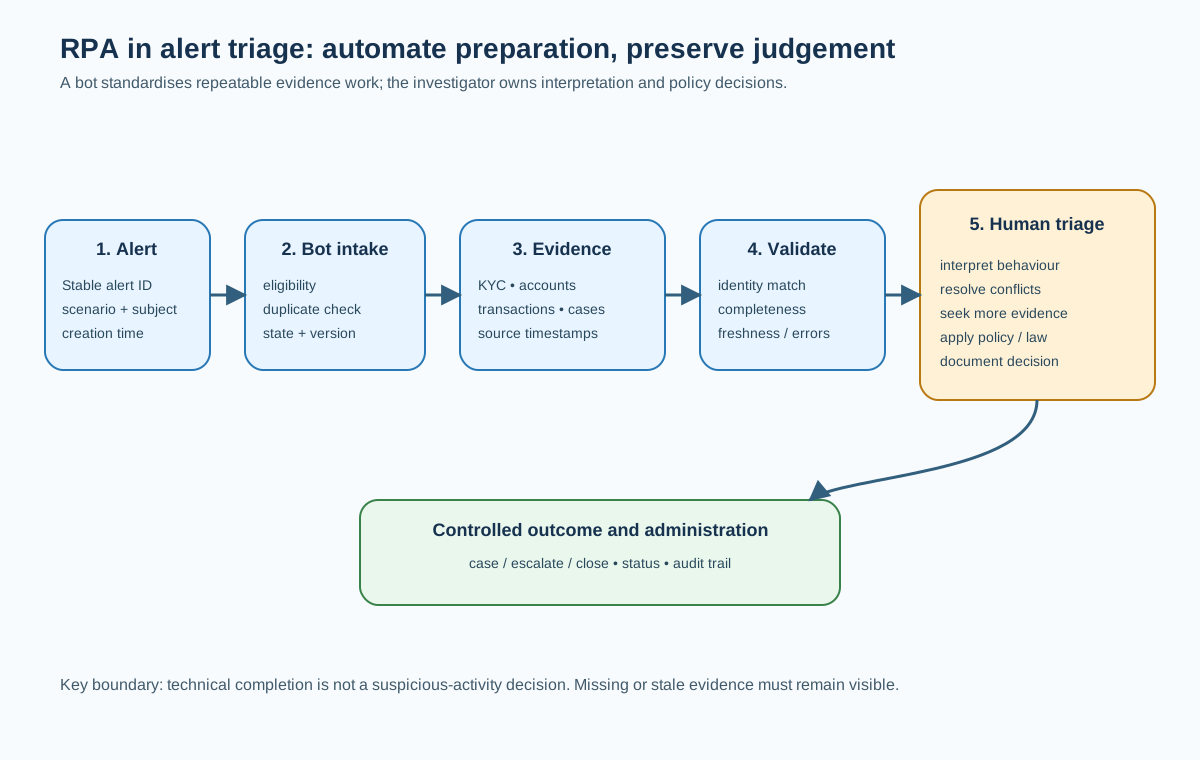
An alert lifecycle usually begins before the bot. A monitoring or screening control identifies activity or information that requires review. The alert should already carry a stable identifier, source-system identity, creation time, scenario or detection reason and the relevant party or account references. RPA should not be used to hide weaknesses in that upstream alert definition. If the trigger cannot be traced to its source or the party identifiers are unreliable, automating the downstream clicks only makes the defect travel faster.
At intake, an orchestrator or work queue can present eligible alerts to a bot worker. Eligibility is important. Some alert types may be suitable for automated evidence assembly while others require immediate specialist handling. A sanctions interdiction case, for example, may have time-critical legal actions and restricted data. A law-enforcement request may have confidentiality requirements. A complex correspondent-banking alert may need information not available through standard sources. The institution should define which alert classes the bot can touch and which it must route untouched.
For eligible alerts, the bot can retrieve customer identity, KYC status, customer-risk rating, account ownership, product relationships, recent transactions, prior alerts and cases, linked parties, device or channel information and other evidence defined by the investigation procedure. Each retrieval should carry source provenance. "Risk rating: high" is weak evidence if the case cannot later show which system supplied it, when it was retrieved and which effective-dated customer profile was in force.
The bot can then perform deterministic validations. Does the customer identifier from the alert match the customer identifier returned by core banking? Are the expected accounts present? Is the KYC review date within the bank's policy expectation? Did all mandatory systems respond? Is the transaction-history period complete? Is a prior open case already linked to the same subject? These are not suspicion decisions; they are quality and workflow checks.
Once evidence is complete, the bot can create or enrich the investigation record and route it to a human queue. The analyst then performs the work that requires interpretation: understanding whether the activity makes economic sense, assessing explanations, comparing activity to expected behaviour, resolving contradictory information, considering typologies, deciding whether further information is needed and escalating under policy.
After a human decision, RPA can again be useful for administration. It can update a case status, create an approved follow-up task, send an internal request, record a review date or copy a decision reference to a downstream system. Care is needed around customer communication and regulatory reporting. A bot can assist with controlled preparation and filing workflows, but the accountable decision and jurisdiction-specific legal requirements should remain explicit.
RPA, workflow orchestration, rules engines and APIs
Banks often call several different things "RPA", which causes design confusion. A workflow or business-process-management engine manages states, tasks, queues and ownership. A rules engine evaluates structured conditions. An API transfers data between systems through a defined interface. A classic RPA bot often imitates user actions in a graphical application. These can work together, but they are not interchangeable.
If a stable, supported API exists, direct integration is generally easier to test and less fragile than screen automation. A screen bot depends on page structure, labels, selectors, window timing and sometimes pixel-level behaviour. A harmless user-interface release can therefore break an RPA process without changing the underlying data. RPA is often justified when legacy applications do not expose suitable services, when an integration is needed quickly, or when a tactical bridge is required during system migration. The architecture should still record that dependence and avoid treating the bot as a permanent invisible interface.
The distinction also matters for resilience. An API can return a structured error code. A screen bot may simply fail to find a field. A workflow engine may know that a task is in an exception state, while a stand-alone desktop script may only log an error locally. Bank-grade RPA therefore needs orchestration, central monitoring and explicit state management around the robot.
A rules engine can determine that an alert is eligible for a particular routing lane based on approved fields. RPA may invoke that rule and carry out the result. If the routing condition changes, that is a controlled business-rule change, not merely a technical bot tweak. Requirements and testing should distinguish the two because the impact is different.
The control architecture
A robust design separates source systems, orchestration, bot execution, validation and investigation. Source systems remain authoritative for their own data. The orchestrator owns work distribution and bot status. A credential vault or privileged-access mechanism provides controlled machine credentials. The bot retrieves data and records technical steps. A validation layer checks completeness, identity consistency and freshness. The case-management platform preserves the assembled evidence and human decision.
Cross-cutting controls are as important as the main flow. Central logging should capture run identity, bot version, source requests, timestamps, outcome and exception reason without exposing sensitive data unnecessarily. Reconciliation should compare source alerts with bot-processed alerts, exceptions and created cases. Monitoring should detect queue ageing, source outages and abnormal failure patterns. Access control should restrict what the bot can read and write.
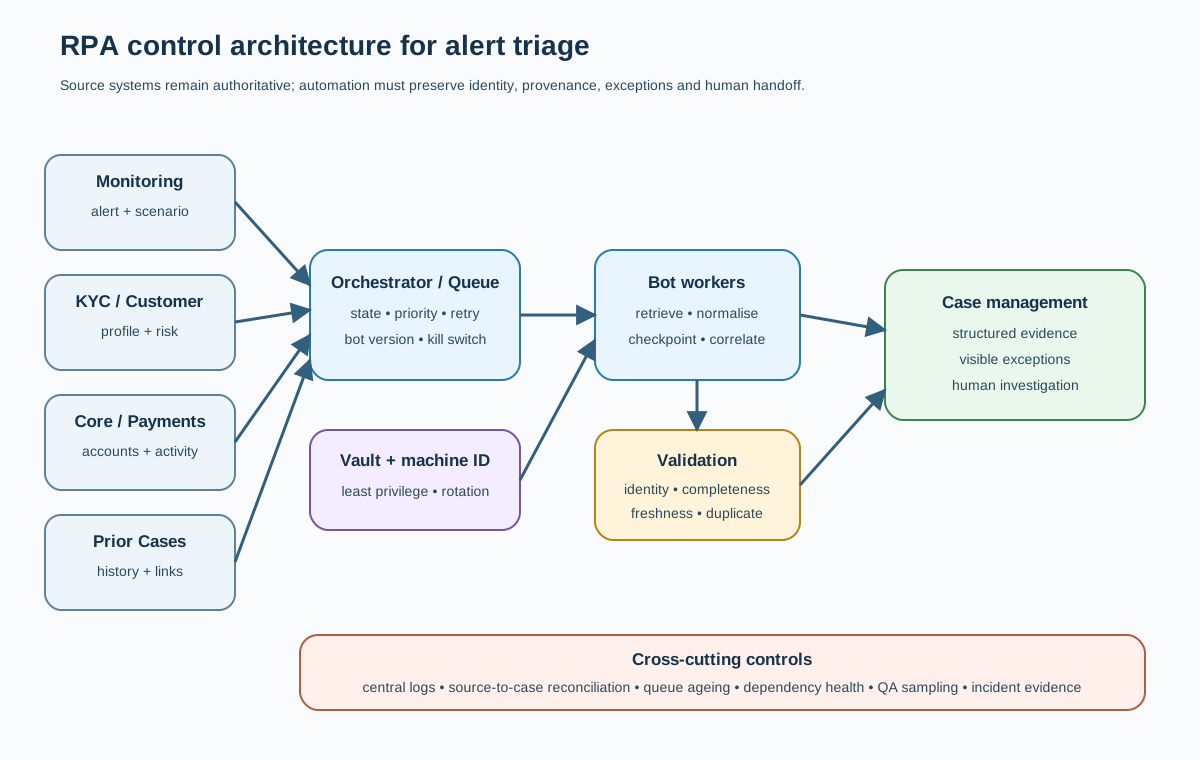
The strongest architecture also recognises that a successful technical run does not prove a successful control outcome. A bot can complete every click while collecting yesterday's data because a source cache stopped refreshing. It can create a case successfully while omitting a linked account because an upstream data field changed. It can route the case correctly while attaching a truncated transaction file. For this reason, technical health metrics must be paired with business-control checks.
Data lineage, evidence freshness and time
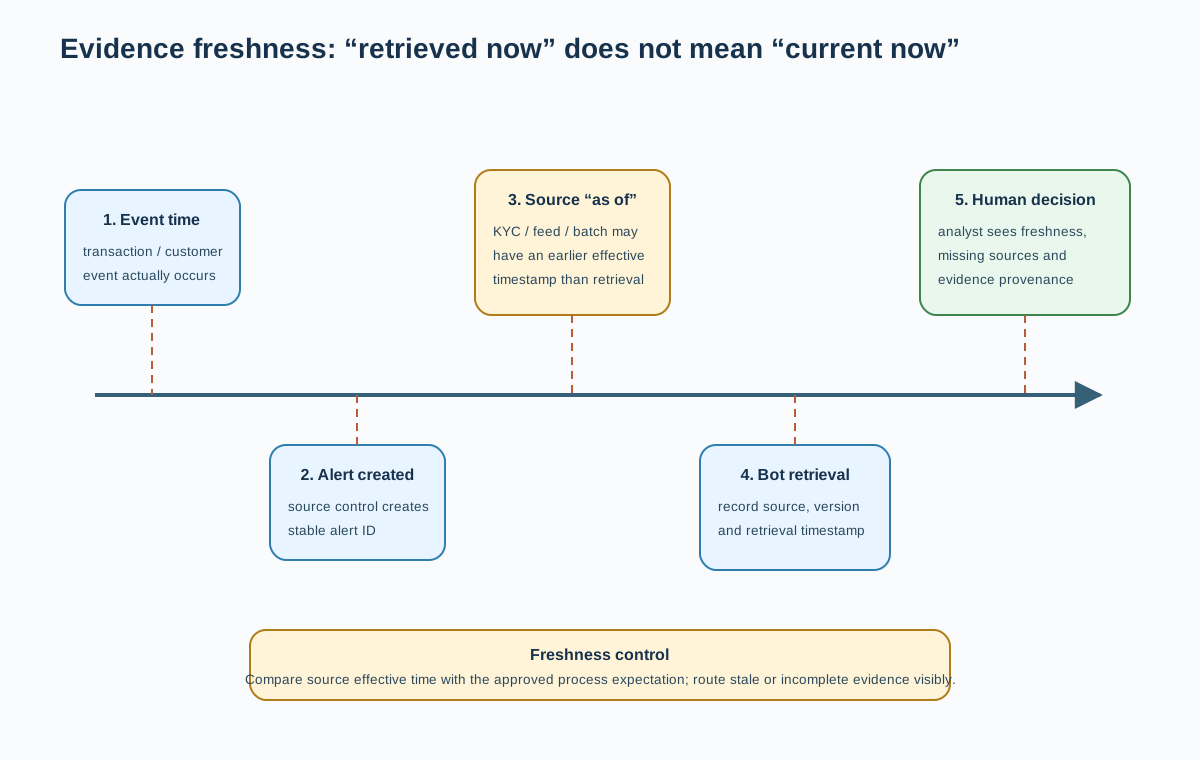
Alert triage is highly sensitive to time. There may be a transaction event time, posting time, alert creation time, bot retrieval time, case creation time, analyst review time and decision time. Those timestamps should not be collapsed into one field.
Consider a KYC risk rating. The bot may retrieve it at 09:10, but the underlying customer-risk calculation may have been last updated two weeks earlier. The case should be able to distinguish retrieval time from source effective time. The same principle applies to sanctions-screening results, adverse-media feeds, customer addresses and transaction data. "Retrieved now" does not mean "current now".
A reusable evidence object can include source-system name, source record key, business effective time, retrieval time, transformation or mapping version, bot run ID and case ID. Not every bank needs exactly those fields, but the design should support later reconstruction. An investigator, quality reviewer or regulator may need to know what information was available when the decision was made, not what the source system shows months later.
The bot should also detect incomplete periods. If policy requires a review of a defined transaction window, a file containing only 87 days because one archive partition failed should not be treated as complete simply because the file downloaded successfully. Completeness controls can compare expected and actual date ranges, record counts, account populations or source acknowledgements.
Bot identity, credentials and access
An unattended bot should not sign in as a human analyst. Shared analyst credentials destroy accountability and make it difficult to separate human actions from automation. A better pattern uses named non-human identities with privileges restricted to the functions the bot genuinely requires.
Least privilege matters because RPA often crosses many applications. A bot that only needs to read KYC data and create a draft case should not receive the right to modify KYC records, close customer accounts or approve investigations. If separate privileges are required for different parts of the process, separate bot identities or tightly controlled service roles may be appropriate.
Credentials should be held in an approved secrets or privileged-access mechanism rather than hard-coded in scripts or configuration files. Rotation, expiry, revocation and emergency access need operational procedures. A credential failure should produce a visible exception and stop or reroute work safely; it should not trigger repeated login attempts that lock accounts or overwhelm an identity service.
European institutions within scope of DORA have specific ICT risk-management obligations, and the supporting regulatory technical standards address access controls and account management. Those rules should be applied according to legal-entity scope. Outside that context, the same design ideas remain sensible security practice but should not be mislabeled as a universal DORA obligation.
Idempotency and duplicate prevention
One of the least glamorous RPA concepts is also one of the most important: idempotency. If a bot retries the same alert after a timeout, the retry should not accidentally create a second case, send a second internal request or update the same record twice.
A practical design uses a stable alert identifier and an idempotency key for side-effecting actions. Before creating a case, the bot checks whether a case has already been created for that alert and workflow version. If the first attempt timed out after the case system accepted the request but before the bot received confirmation, the next attempt should reconcile before creating anything new.
This becomes harder in screen automation because the application may not provide a clean transaction boundary. The bot might click "Create", the browser might freeze, and the orchestrator may only know that no success message was received. The correct response is not always "retry". It may be "query the target system using the alert ID; if an object exists, resume from the next checkpoint; otherwise retry creation".
Duplicate control also applies to evidence. If the bot reruns, it should not attach the same files repeatedly or overwrite a human annotation. Once a human analyst has begun investigation, the automation must know which fields remain bot-owned and which have become human-owned.
Checkpoints, retries and exception queues
A long automation should be split into checkpoints. For example: intake accepted, customer identity confirmed, mandatory data retrieved, evidence validated, case created, human queue assigned and post-decision administration completed. Checkpoints make recovery safer because a failed bot can resume from a known state rather than repeat the entire process.
Retries should be designed by error type. A network timeout may justify a limited retry with backoff. A "customer not found" response may indicate a data-quality problem that will not improve by retrying. A schema change requires technical intervention. An authentication failure may require credential repair. Treating every exception as a transient error creates retry storms and can hide genuine control defects.
Records that cannot be processed safely should enter a controlled exception queue with a clear reason code, age, owner and service expectation. That queue is part of the financial-crime control, not an IT dumping ground. Operations should be able to see how many alerts are waiting because KYC data is unavailable, how long they have waited and whether manual review is required.
A critical rule is that "bot failed" must never mean "alert disappeared". Source-to-target reconciliation should show every source alert in exactly one known state: not yet eligible, queued, in progress, completed and routed, exception, manually taken over or otherwise dispositioned under an approved state model.
Human handoff and decision rights
The human handoff is where automation design becomes financial-crime design. The case presented to the analyst should make it obvious which facts came from authoritative sources, which values were calculated by a rule, what information is missing and which actions the bot already performed. The analyst should not need to reverse engineer a bot log to understand the evidence.
A useful case screen can show source freshness, failed retrievals, prior-case links and any deterministic routing rule that affected priority. It should not hide uncertainty behind a green "automation complete" banner. If an important source is unavailable, the visual design should make that limitation prominent.
Decision rights should be documented by action. Can the bot close an alert as a confirmed technical duplicate? Can it suppress a second alert when the same source system has already linked it to an open case? Can it classify an alert as low priority? Can it decide that no SAR/STR is required? These are different decisions with different risk. The bank may automate some administrative outcomes and prohibit automation for others.
In the United States, the FFIEC BSA/AML Manual describes suspicious-activity monitoring as a chain that includes identification, alert management, SAR decision-making, filing and continuing activity, and examiners assess whether all relevant information is considered. That is a US supervisory framework, not a global template. Its practical lesson travels well: automation should not blur the boundary between generating or managing an alert and making the accountable suspicious-activity decision.
Operational resilience
RPA creates a dependency. If a bank automates most of its first-level evidence assembly, a prolonged bot outage can quickly create an alert backlog. Resilience therefore requires more than restoring the server. The institution needs to know what happens to work during the outage, how manual capacity is activated, how missed alerts are identified and how the queue is recovered in priority order.
The Basel Committee's operational-resilience principles emphasise governance, dependencies, change management, business continuity and testing against severe but plausible disruption. A bank can apply those principles proportionately to a material financial-crime automation even though Basel does not prescribe a specific RPA control.
Manual fallback should be real, not a paragraph in a procedure. Analysts need access to the underlying systems, documented steps and an agreed threshold for invoking fallback. If the normal process has been automated for years, operations may lose the muscle memory to perform it manually. Periodic exercises can expose that dependency.
Recovery also needs reconciliation. When the platform returns, operations should not simply release the whole backlog to bots. Alerts may have been handled manually during the outage. Some evidence may have changed. High-priority alerts may need to overtake old low-risk work. The recovery plan should merge manual and automated states without duplicates or gaps.
Monitoring the automation as a control
Bot uptime is not enough. Management information should cover at least four dimensions: throughput, exceptions, control quality and resilience.
Throughput includes alerts received, processed and routed, but counts should reconcile to source populations. Exceptions should be broken down by reason so teams can distinguish source-system problems, data-quality defects, credential issues, bot defects and genuine business exceptions. Control quality includes evidence completeness, freshness, duplicate rate and human rework. Resilience includes queue age, failed runs, recovery time and fallback usage.
Metrics require context. A falling exception rate may reflect a better bot, or it may mean the bot stopped recognising an exception. Faster average handling may reflect efficiency, or it may conceal missing evidence. Management should therefore pair volume metrics with quality samples and reconciliation.
There is no universal "acceptable bot failure rate" for AML alert triage. Appropriate tolerances depend on the control, alert risk, volume, fallback capacity and impact of failure. Institutions should set and govern their own thresholds rather than inventing industry percentages.
Governance and ownership
RPA sits across business, technology and financial-crime ownership. The financial-crime control owner should define what evidence and decision boundaries are required. Operations should own the workable process and exception handling. The automation engineering team should own bot code, orchestration, technical testing and release. Identity and cyber teams should govern machine access. Data owners should define source contracts. Compliance or second-line functions should challenge whether the automation remains consistent with policy and legal obligations. Internal audit may independently assess the framework.
A central inventory is valuable. It should identify the bot, purpose, business owner, control owner, systems accessed, credentials or service identities, data classifications, actions permitted, schedule or trigger, criticality, code/configuration version, dependencies, fallback process and retirement plan.
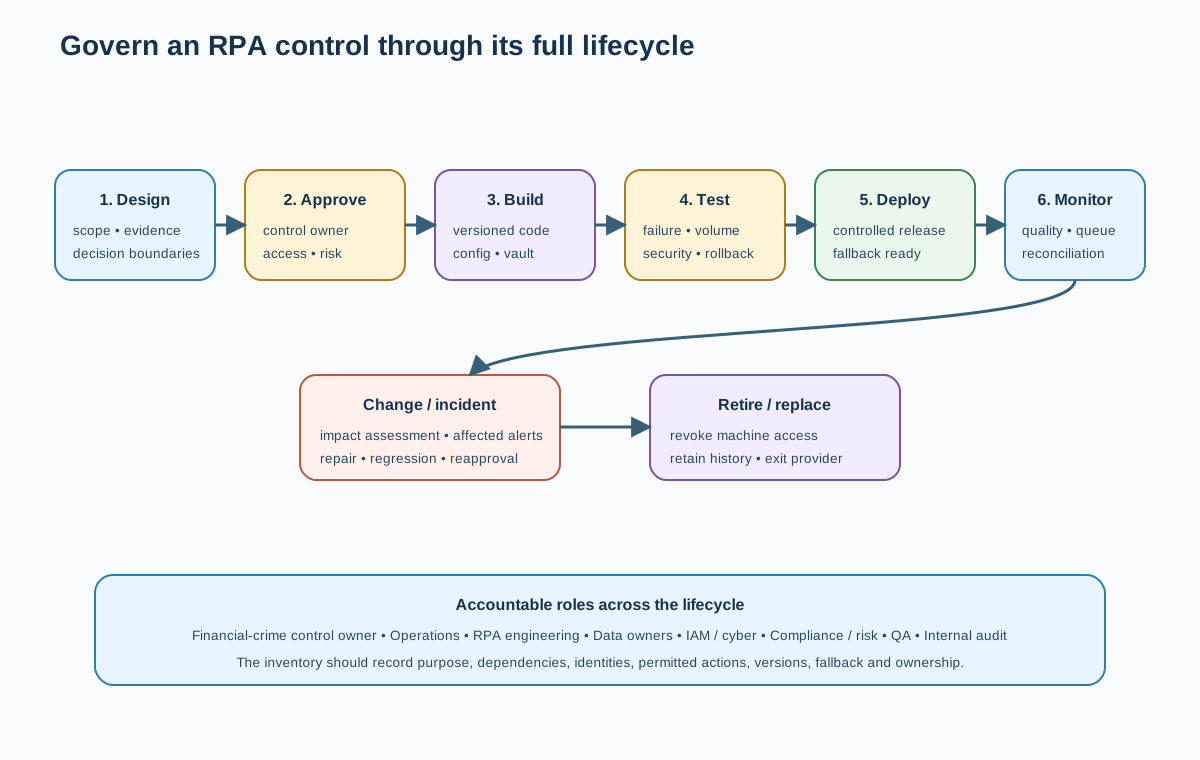
Change governance deserves special attention. A field name change in the KYC system can alter evidence capture. A new transaction-monitoring scenario can introduce alerts the bot was never designed to process. A case-management release can change mandatory fields. A policy update can make the previous routing rule inappropriate. Changes in any of these layers should trigger an impact assessment.
The bot may also be changed without changing code. Configuration, credentials, selectors, schedules, queue priorities and rules can all alter behaviour. Version control and approval should therefore cover the effective automation configuration, not only the source-code repository.
Customer and investigator impact
Good automation can improve customer outcomes by reducing unnecessary delays, especially where an alert causes a payment review, onboarding pause or account restriction. Faster evidence assembly can help analysts reach a sound decision sooner. But bad automation can scale customer harm equally quickly. A wrong identity link, stale risk rating or duplicate case can propagate across thousands of alerts.
Investigators are also customers of the automation. If the bot floods the case screen with unstructured data, it has moved work rather than removed it. The evidence pack should be designed around the questions analysts actually answer. Important facts should be easy to locate, and the original source should remain traceable.
Automation can change analyst behaviour. If a bot usually produces correct output, humans may stop checking it critically. This automation bias is one reason to surface exceptions and provenance clearly, rotate quality samples and train analysts on bot limitations. "The robot populated it" is never a sufficient evidential explanation.
A practical design rule
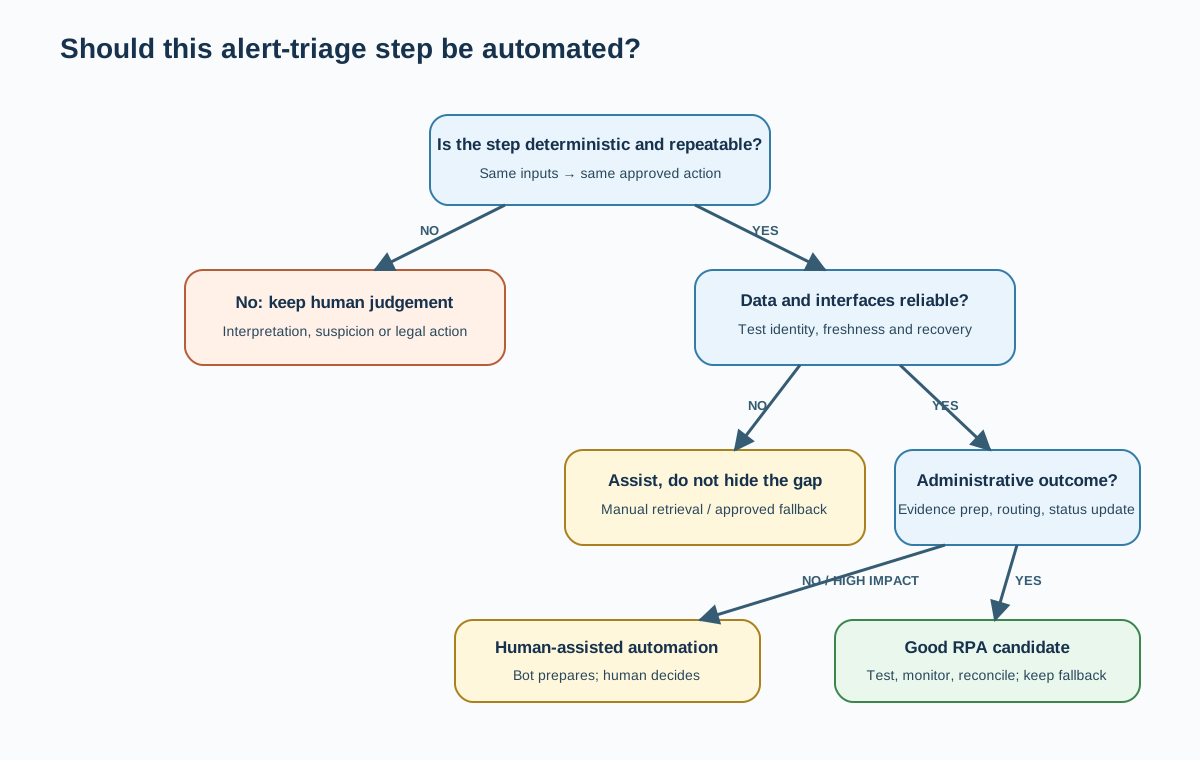
The safest way to decide whether a triage step belongs in RPA is to ask four questions. Is the step deterministic? Is the required data reliable and machine accessible? Can failure be detected and recovered without losing an alert? Is the result administrative or evidential rather than a high-impact judgement?
If the answers are yes, RPA may be a good fit. If the step requires interpretation of conflicting narratives, legal judgement, suspicion assessment or a customer-impact decision, automation should normally support the reviewer rather than silently replace the reviewer unless the institution has explicitly approved a different controlled design.
The goal is not maximum automation. The goal is a financial-crime process in which repetitive work is automated without weakening the evidence chain, the human decision, the control's resilience or the bank's ability to explain what happened.
Operational deep dive: building reliable RPA alert triage
A useful RPA design becomes clearer when it is treated as a stateful financial-crime process rather than a script that performs clicks. The bot has to know what work it owns, what has already happened, what evidence is required, which failures can be retried and when a human must take over. Without that state model, automation can make a control faster while making it harder to reconstruct.
Start with the alert contract
The first requirement should define the alert the bot receives. A practical alert contract includes a unique alert identifier, source system, alert type or scenario, subject identifiers, relevant account or transaction identifiers, creation timestamp, priority or severity where the source supplies one, and a schema or message version. The contract should say which fields are mandatory and what the bot does when they are missing.
A stable identifier is especially important. Customer number alone is rarely enough because one customer can have several alerts. A transaction identifier alone may not work for behavioural scenarios covering many transactions. The source alert ID normally becomes the anchor, with other identifiers used for lookup and reconciliation.
The bot should validate that the alert is still actionable before beginning expensive enrichment. It may discover that the alert has already been withdrawn by the source control, merged into a parent alert, assigned manually or linked to an existing case. Those states should be governed rather than improvised.
Eligibility rules should be explicit and versioned. A bank might automate evidence assembly for standard retail transaction-monitoring alerts but exclude sanctions interdictions, employee investigations, highly confidential law-enforcement matters and certain private-banking cases. The exclusion is not evidence that one alert is riskier than another; it is a statement about what the automation has been approved to process.
Data retrieval as an evidence chain
Evidence collection should use the strongest available interface. An API or supported service typically gives a cleaner contract than screen scraping, but the architecture may have to work with legacy applications. Regardless of interface, every retrieval should have a known source and expected response.
For customer data, the bot may need legal name, customer ID, entity type, KYC status, risk rating, occupation or business activity, expected account use, countries of activity and beneficial owners. For account data it may collect account status, opening date, product, linked parties and balances. For transaction data, the process may need a defined look-back period and enough detail to understand counterparties, channels, currencies, values and references. Prior-alert and prior-case data help the analyst understand repetition and previous explanations.
The bot should not infer that a missing response means "none". A search for prior cases returning zero results is different from a case system timing out. That difference needs its own status. The same applies to an empty adverse-media result, no connected parties, no recent transactions and no sanctions hits. A controlled response should distinguish a valid negative result from an unavailable source.
Data transformations should be small and transparent. Converting source dates to a common display format, normalising country codes or mapping product codes to names may be useful, but the original value should remain traceable. If the bot calculates transaction totals, it should record the calculation rule, included population and currency treatment. Cross-currency aggregation without an approved FX method can create false precision.
Where the bot retrieves sensitive information, case visibility should follow the data's classification. Prior suspicious-activity reports may have strict confidentiality requirements in some jurisdictions. Law-enforcement requests may have separate restrictions. RPA should not broaden access simply because the machine can read several sources. The case should receive only information that its users are entitled to see.
Orchestration, queues and bot workers
A mature implementation usually uses an orchestrator. The orchestrator receives work, assigns it to bot workers, records status and supports operational monitoring. It should know which bot version processed an alert and which machine or runtime executed the work.
Queues should support priority without allowing low-priority work to vanish. If high-severity alerts repeatedly jump the queue, lower-severity items can age indefinitely. Queue management should therefore consider both risk and age, with escalation rules when service expectations are threatened.
Concurrency needs control. Ten bot workers querying the same legacy system may overload a service that was designed for a few human analysts. Rate limits, connection pools and source-system capacity should be included in non-functional requirements. A sudden alert spike should not turn into a self-created outage.
The orchestrator also provides a useful kill switch. If a release begins creating bad cases or a source field is found to be wrong, operations should be able to stop new processing while preserving queued work. Emergency stop procedures should identify who can invoke the stop, how the issue is communicated and what evidence is retained for later analysis.
State model and checkpoints
A state model makes recovery deterministic. One possible sequence is:
| State | Meaning | Safe next action |
|---|---|---|
| Received | Alert accepted from source | Validate eligibility |
| Eligible | Alert approved for bot processing | Retrieve evidence |
| Enriching | Mandatory sources being queried | Continue or create source exception |
| Validated | Required evidence passed completeness checks | Create or update case |
| Routed | Case delivered to human queue | Await human decision |
| Exception | Automation cannot continue safely | Manual repair or controlled retry |
| Completed | Approved automated administration finished | Retain audit evidence |
The names are illustrative. What matters is that each state has entry and exit conditions. A bot should not leap from "received" to "completed" merely because the script reached its last line.
Checkpoints reduce duplicate side effects. After case creation, for example, the bot stores the case ID against the source alert before adding attachments. If attachment upload fails, the recovery run can reopen the existing case rather than create another.
State transitions should themselves be auditable. If an operator manually changes an exception to completed, the system should record who did it and why. Otherwise the automation history can be rewritten without evidence.
Retry design
Retries are one of the places where simple automation becomes engineering. A retry policy should classify failures into transient, business, data and technical categories.
A short network timeout may be transient. The bot can wait and retry a limited number of times. A customer ID that does not exist in the authoritative customer master is a data exception; repeating the same query ten times adds no value. A changed page layout is a technical defect. A customer with two plausible master records is a business/data ambiguity requiring human resolution.
Exponential backoff or scheduled retry can protect downstream systems during outages. Circuit-breaker behaviour may be appropriate where a source is broadly unavailable: instead of thousands of bots repeatedly calling the service, the orchestrator pauses that dependency and routes or holds affected work according to the continuity plan.
Retry counters and last-error details should be visible. Operations should not have to inspect raw logs to discover that an alert has failed eleven times over six hours. Ageing starts from the business alert, not from the latest retry, so retries must not reset the clock.
Partial failure and reconciliation
The most dangerous failures occur after a side effect but before the bot records success. Imagine that the case system creates a case, returns an acknowledgement, and the connection drops before the bot receives it. From the bot's perspective, creation failed. If it retries blindly, a duplicate case is created.
The safer approach is to use a business correlation key. After an uncertain outcome, the bot queries the target system for the source alert ID. If the case exists, it resumes. If it does not, it retries the creation. APIs that support idempotency keys make this much easier, but the principle can also be implemented around legacy systems.
A similar problem occurs when the bot updates the alert source but fails to update case management, or vice versa. End-of-run reconciliation should compare the expected states across systems. A financial-crime operations dashboard should be able to identify alerts marked processed with no case, cases with no valid alert link, exceptions older than tolerance and duplicate cases.
Reconciliation is the control that catches "silent success". Technical monitoring often catches crashes; it is less good at catching a bot that ran successfully using incomplete or mis-mapped data. Business reconciliation looks at outcomes rather than processes.
Evidence freshness and stale-data control
Automation can make stale data look authoritative because it arrives neatly formatted. A case pack should therefore identify freshness rules for important sources.
A transaction extract may be expected to include activity through the end of the previous business day, while an instant-payment investigation may require much fresher data. KYC data may have a review date and a separate last-change date. A risk rating may be recalculated periodically. Each source needs a practical freshness expectation based on the process.
The bot can compare source timestamps with alert and retrieval times. If data exceeds the permitted age, it can mark the evidence stale and route the case for manual handling or another approved action. The limit is an institution-specific control parameter, not a universal regulatory number.
Freshness checks should also consider caches. If an API returns HTTP success but its upstream feed has not updated, technical availability does not equal business currency. Source owners may need to expose a "data as of" timestamp or batch ID so the bot can verify freshness.
Security and machine identity
RPA can become a privileged bridge across systems, which makes machine identity a first-class design issue. Each unattended process should be attributable to a controlled non-human identity. The identity should be linked to an owner, purpose and approved access profile.
Credentials should be retrieved at runtime from an approved vault or privileged-access service. Scripts and logs should not contain passwords, API keys or session tokens. Rotation should be tested because a process that only works with a long-lived static password is fragile and unsafe.
Permissions should be designed around actions. Read customer data, read transactions, search cases and create a draft case are separate entitlements. A bot that never approves an investigation should not receive an approval entitlement. Where a source system only provides coarse roles, the residual access risk should be documented and monitored.
Service identities also require lifecycle management. When a bot is retired, its access should be revoked. When ownership changes, the inventory should update. Periodic access review should include non-human accounts rather than focusing only on employees.
Release and change management
A bot release can affect the financial-crime control even when business rules are unchanged. A selector update may retrieve a neighbouring field. A date-parser change can reverse day and month. A performance optimisation can skip a slow but mandatory source. Testing therefore has to cover business evidence, not only script execution.
A release package should identify code version, configuration version, selector or interface changes, affected sources, expected process changes, tests performed and rollback plan. Segregation of duties should prevent an individual from making an unreviewed production change to a critical bot and approving the same change.
Changes in dependent systems also require impact analysis. The automation owner needs a way to learn about KYC, core banking, case-management and monitoring releases. Contract tests can detect schema changes for APIs. UI automation may require scheduled regression tests against pre-production environments.
Wolfsberg's innovation framework is useful here because it stresses purposeful transition and validation rather than assuming a new technology is better simply because it is newer. For deterministic RPA, validation focuses heavily on process coverage, evidence integrity, exception handling and control outcomes. If an ML model is embedded in the workflow, model-specific validation applies to that component as well.
Quality assurance and sampling
Quality assurance should sample completed bot-assisted alerts and compare the evidence pack with authoritative sources. The review should ask whether all required sources were present, whether identifiers matched, whether timestamps were correct, whether calculations reproduced and whether routing followed the approved rule.
Sampling only successful cases creates blind spots. QA should also inspect exceptions, manual takeovers, retried alerts and recovery after outages. Those are the places where state and ownership can become unclear.
Human rework is a useful signal. If analysts routinely repeat the bot's customer search or distrust transaction totals, the automation may be technically correct but operationally unhelpful. Rework should be classified rather than dismissed as user preference. It may reveal missing context, confusing presentation or genuine data defects.
Independent review can focus on whether the process is governed as described: inventory completeness, access, change control, reconciliations, failure handling, release evidence and issue remediation. The review should be able to select a historical alert and reconstruct the bot version, source evidence and human handoff.
Root-cause management
Recurring bot exceptions should be treated as signals about the wider architecture. If a large share of exceptions arise because a legacy application times out, the strategic fix may be a supported service rather than more retry logic. If identity mismatches are common, customer-master quality may be the real problem.
Root-cause analysis should distinguish defects in the bot from defects exposed by the bot. Automation often makes inconsistent identifiers, weak source ownership and undocumented manual workarounds visible for the first time. That is useful if the programme fixes them rather than encoding the workaround permanently.
Issue closure should show evidence that the underlying cause is resolved. A selector defect is not closed because the script was edited; it is closed when regression tests pass, affected alerts are identified, any missed evidence is repaired and monitoring can detect recurrence.
The operational objective is a controlled chain from alert to human judgement. RPA earns its place when that chain becomes faster, more consistent and more reconstructable without creating a new opaque dependency.
Advanced practice: requirements, testing and control assurance
For business analysts, architects and testers, the hardest part of RPA alert triage is converting an informal analyst routine into explicit behaviour. Manual processes contain hidden judgement. An analyst may say "I always check the customer's previous cases" but in practice skip the check when the case system is slow, use a different search key for corporate customers or recognise a known data issue from experience. Automation forces those assumptions into requirements.
Requirements that can actually be built
A strong requirement begins with an observable condition and expected outcome. "The bot shall collect KYC data" is too weak. A better requirement identifies the source, customer key, required attributes, freshness information, timeout, behaviour on no match, behaviour on multiple matches, audit fields and exception route.
The same discipline applies to case creation. Requirements should specify when a case is created, how duplicates are prevented, which fields are bot-owned, how the source alert ID is stored, what happens if creation succeeds but the acknowledgement is lost, and how the human analyst sees missing evidence.
Non-functional requirements belong in the same control story. They include expected peak volume, maximum safe concurrency against dependent systems, credential handling, log retention, recovery objectives, observability, accessibility of the analyst view and capacity of the manual fallback process. A bot that works functionally but cannot handle the Monday alert peak is not complete.
A useful BA artefact is a source-and-decision matrix:
| Process step | Source or input | Bot action | Validation | Human decision? | Exception owner |
|---|---|---|---|---|---|
| Accept alert | Monitoring platform | Read alert and identifiers | Mandatory fields and schema | No | Monitoring support |
| Retrieve customer | Customer master | Fetch current profile | Unique ID and freshness | No | Data/KYC operations |
| Retrieve activity | Core/payment systems | Collect approved look-back | Completeness and period | No | Source-system support |
| Link prior cases | Case platform | Search by approved keys | Match confidence rules | Borderline links require review | Investigation operations |
| Assemble case | Validated evidence | Populate structured fields | Reconcile mandatory pack | No | RPA operations |
| Assess activity | Evidence pack | None beyond presentation | Missing-data warning | Yes | Investigator |
| Post-decision admin | Human-approved outcome | Update permitted systems | Case ID and status check | Decision already made | Operations |
The exact matrix varies by institution, but it exposes where automation ends and judgement begins.
Acceptance criteria
Acceptance criteria should be written against failure as well as success. For a successful retail alert, the test may require all mandatory data sources to return, the customer identity to match, the transaction period to be complete, the prior-case search to be recorded, the case to contain the alert correlation ID and the work item to appear in the correct analyst queue.
For a missing KYC record, the expected result should not be a partially populated case marked ready. It may be an exception with a specified reason code and ownership. For a case-system timeout after creation, the expected result should be reconciliation using the correlation ID before any retry. For a stale source, the case should display a freshness warning or follow the approved fallback.
Acceptance criteria should also protect human work. Once an analyst edits a narrative or enters a disposition, a late bot retry must not overwrite those fields. Ownership of each field and state transition should be testable.
Test strategy
A good test pack contains more than happy-path examples. It should exercise missing and null mandatory fields; wrong or conflicting customer identifiers; more than one customer returned for a search; source-system timeout and complete outage; slow responses near the automation timeout; expired or revoked bot credentials; password or token rotation; duplicate delivery of the same alert; retry after an uncertain case-creation response; transaction data with a missing day or account; date, timezone and daylight-saving boundaries; Unicode names, long remittance text and unusual characters; case-management outage after evidence has been assembled; a UI or API schema change; manual takeover while a retry is pending; high-volume queue conditions and rate limiting; rollback from a defective release; and restart after the orchestrator itself fails.
This is not over-testing. These are predictable failure modes in a process that connects several systems and is expected to run unattended.
Production-like testing matters. A mocked service that always returns instantly cannot reveal rate limits, timeout interactions or pagination defects. Pre-production data does not need to contain real sensitive customer information, but its structure and scale should exercise the same logic.
Security testing
Security testing should verify what the bot cannot do. Attempt to use its identity to modify customer data, approve a case or access a restricted repository that is outside scope. Confirm that logs do not print secrets. Test what happens when access is revoked mid-run. Check that privileged credentials are retrieved from the intended vault and that the bot cannot bypass the mechanism using a locally stored fallback.
Machine identities should appear in access reviews and monitoring. An unusual login location, impossible schedule or access outside the bot's normal application set may indicate compromise or misconfiguration. Security monitoring should understand that a bot can legitimately make many repetitive calls while still detecting activity that does not fit its approved pattern.
Operational readiness
Before go-live, operations need more than a runbook. They need a dashboard that shows queue size, ageing, worker status, dependency health and exceptions. They need a method to pause the bot, transfer work to humans, resume safely and reconcile the backlog afterward.
A support model should distinguish business exceptions from platform incidents. A customer with ambiguous identity is not fixed by restarting a bot. A broken selector is not solved by asking an analyst to change the customer record. Clear ownership prevents alerts from bouncing between IT and financial-crime operations.
Release timing can matter. Introducing a major automation change during a known remediation programme, regulatory deadline or peak operational period can increase execution risk. Change forums should consider the state of the control environment, not just whether development is complete.
Metrics and assurance
Metrics should tell a control story. A useful set may include source alerts received, alerts successfully routed, exceptions by cause, manual fallback volume, evidence-completeness failures, stale-source occurrences, duplicate-prevention events, reconciliation breaks, analyst rework, oldest unprocessed alert, mean time to recover and changes that caused production incidents.
Avoid using closure speed as the main success measure. If the bot removes evidence to reduce handling time, the metric improves while the control deteriorates. Efficiency should be paired with quality.
Assurance should also test historical replay. Select a completed alert and ask whether the bank can reconstruct the bot version, configuration, identities used, source records retrieved, freshness status, exceptions, case created and analyst handoff. If the answer depends on today's source-system screen rather than preserved evidence, auditability is weak.
When RPA includes AI
Some modern automation platforms combine RPA with optical character recognition, natural-language processing, entity resolution or generative AI. The architecture should label those components separately. A deterministic bot that copies a field is not equivalent to a model that infers which person a news article refers to or generates an investigation summary.
If an AI component affects alert prioritisation, evidence interpretation or next-best action, its data, validation, explainability, monitoring and human-oversight obligations should follow the institution's AI/model governance and any applicable law. RPA orchestration does not dilute those obligations.
The converse is also important: do not burden a deterministic copy-and-route bot with inappropriate model-risk processes merely because the word "automation" appears in both. Governance should be proportionate to what the technology actually does.
Practical mini case: the source that failed silently
A bank uses RPA to prepare first-level transaction-monitoring alerts. At 01:14, an alert is generated for a retail customer whose account received several credits from unrelated parties followed by rapid outbound transfers. The alert itself does not establish mule activity; it requires review.
The bot accepts the alert, validates the customer ID and retrieves current KYC information. It collects transaction history from the core ledger and finds two prior alerts in case management. A device-risk service also responds. The final mandatory source is a customer-linkage service that identifies accounts sharing contact details and devices.
That service returns HTTP success, but an upstream nightly feed has failed. The response contains data "as of" the previous day. A weak bot treats the call as successful and marks the evidence pack complete. A strong bot checks the source freshness marker, recognises that the linkage data does not meet the approved freshness requirement and moves the alert to an exception state. The case is created only if policy permits, and the missing source is visibly marked for the analyst.
At 02:05, the linkage feed is restored. The orchestrator retries only the failed enrichment step, verifies the alert/case correlation ID and adds the current linkage result to the existing case. It does not create another case and does not overwrite the analyst's notes.
The new result shows another account with the same device and address. The analyst reviews both accounts, customer profiles and payment behaviour. Whether the bank escalates, restricts activity or files a suspicious-activity report depends on the evidence, policy and applicable jurisdiction. The bot does not make that legal judgement.
A week later, the KYC application's user interface changes. One screen selector now points to the neighbouring "customer segment" field instead of "risk rating". The automation still completes technically. Source-to-case quality sampling detects an unexpected pattern of segment values in the risk-rating field, and reconciliation/validation stops the release before the defect affects the entire queue.
This case illustrates the real value of RPA governance. The most serious automation failure is often not a visible crash. It is a clean green technical run that produces incomplete or wrong evidence. Freshness controls, semantic validation, versioned change, QA sampling and human decision rights are what turn automation into a defensible financial-crime control.
Control boundaries for auto-closure and routing
One recurring design question is whether the bot may close an alert. The answer cannot be based on a generic belief that automation is safe or unsafe. It depends on what "close" means.
A technical duplicate is different from a substantive no-suspicion decision. If two identical source messages created duplicate alerts because of a documented processing defect, a deterministic duplicate rule may allow one record to be administratively linked or suppressed under approved controls. The bank should be able to prove identity of the duplicate, preserve the source records and show the rule version.
By contrast, closing an alert because customer activity "looks reasonable" normally contains interpretation. The reviewer may need to understand occupation, business purpose, counterparties, prior explanations, product use and changing behaviour. Encoding that conclusion into an RPA script without an explicit decision framework can conceal policy judgement inside technical logic.
Priority routing sits between those extremes. A deterministic rule may route an alert to a specialist team because it involves a particular product, country, customer segment or typology. If the rule changes the order in which potentially suspicious activity is reviewed, it still needs control ownership and testing because poor routing can create harmful delay.
The design document should list each automated disposition and classify its effect: administrative, evidential, prioritisation, customer-impacting, regulatory or legal. Higher-impact actions require stronger approval, monitoring and often retained human authority.
The role of the investigator
Automation should improve an investigator's starting position, not narrow the investigation to what the bot happened to collect. The case interface should make additional source access possible where the analyst needs it. A customer explanation, newly received payment, updated KYC event or related-party fact may arise after the bot completed its initial pack.
Investigators also need to understand automation limitations. Training should explain the sources used, freshness expectations, known exclusions, calculated fields and exception indicators. An analyst who assumes the pack is exhaustive may miss risk that sits outside the automation's scope.
Human feedback can improve the process without turning every analyst preference into a rule. If analysts repeatedly request the same missing account attribute or reject the same misleading calculation, product ownership should assess whether the pack should change. Changes should be governed and tested, not patched informally.
Production incidents and financial-crime impact assessment
An RPA incident should be assessed for financial-crime impact, not only IT severity. A two-hour outage at low volume may be operationally minor if manual fallback works. A bot that populated wrong customer identifiers for fifteen minutes may be more serious even if availability remained 100%.
Incident assessment should ask which alerts were affected, which evidence fields were wrong or missing, whether any cases were closed or prioritised using the defect, whether reporting or customer action may have been affected and whether historical repair is required. The affected population should be derived from logs and version records rather than estimated from memory.
If the incident could have changed an investigator's conclusion, reopening or retrospective review may be necessary according to the institution's governance. If it only delayed evidence assembly and no service expectation was breached, remediation may be simpler. The point is to connect technology failure to control consequence.
Post-incident review should preserve the difference between root cause and trigger. A user-interface release may trigger a selector failure, but the root cause might be absence of semantic validation, inadequate release coordination or an architectural choice to depend on screen scraping when a supported service existed.
Vendor and third-party RPA platforms
Banks often use commercial automation platforms, managed runtimes or implementation partners. Outsourcing the technology does not outsource the bank's understanding of the control. The institution still needs to know what the bot does, what data the provider can access, where logs are stored, how privileged credentials are protected, how changes are released and how service disruption is handled.
Third-party arrangements should follow the bank's applicable outsourcing and ICT third-party risk framework. Requirements vary by jurisdiction and entity. For EU financial entities in DORA scope, ICT third-party risk has a specific legal framework. Other jurisdictions use their own supervisory expectations.
Exit planning matters for critical automations. The bank should be able to recover bot definitions, configuration, run history and evidence needed for ongoing cases if a provider changes or a contract ends. A proprietary platform should not become the only place where the institution can understand how historical alert evidence was assembled.
What good looks like
A well-controlled RPA triage process is almost boring in production. Alerts move predictably. Exceptions are visible. Analysts know what the bot did. Source outages do not masquerade as empty results. Retries do not create duplicates. Access is attributable to machine identities. Releases are versioned. Quality sampling can reproduce the evidence. When the process fails, the bank knows which alerts are affected and how to recover them.
That standard is more important than the brand of automation platform. The control is successful when it reduces repetitive work while making the alert-to-investigation chain more consistent, more transparent and easier to challenge.
Practice close: review the automation before approving it
Before approving an RPA alert-triage design, walk through one alert from source creation to human handoff and ask whether every important state can be explained. The reviewer should be able to identify the alert correlation key, the bot version, the mandatory sources, the data effective times, the validations performed, any retries, the case created and the person or queue that received the work. If one of those facts exists only in a developer's memory, the control is not yet operationally mature.
A useful final challenge is to imagine that a mandatory customer source is unavailable for four hours. The design should say whether the bot pauses, retries, creates a visible exception or invokes manual fallback. It should also say who owns the queue, how ageing continues to be measured and how alerts handled manually will be reconciled when automation returns. "The bot will retry" is not a continuity plan.
Then imagine the opposite failure: every technical component reports green, but a source sends stale or semantically wrong data. Ask what business validation or quality sampling would detect the problem. This test separates platform monitoring from financial-crime control monitoring.
Finally, confirm the human boundary. Analysts should know which fields are source facts, which are bot-calculated, which are incomplete and which decisions remain theirs. An automation that makes missing evidence visually disappear can be more dangerous than a slower manual process.
For delivery teams, four acceptance questions provide a practical close. Can the bot fail without losing an alert? Can it retry without duplicating a case or overwriting human work? Can an independent reviewer reconstruct what evidence the bot saw at the time? Can operations continue safely if the bot is unavailable? If any answer is unclear, the workflow needs further design before scale makes the weakness harder to contain.
The strongest RPA programme does not celebrate the number of clicks removed. It demonstrates that repetitive work was removed while evidence integrity, decision accountability, security, resilience and customer protection were strengthened at the same time.
References and further reading
These sources support the global principles and jurisdiction-specific examples used in the chapter. RPA itself is not mandated by these sources. Local legal obligations, suspicious-activity reporting rules, access requirements and ICT controls must be applied according to the relevant entity and jurisdiction.
- FATF, Opportunities and Challenges of New Technologies for AML/CFT: https://www.fatf-gafi.org/content/dam/fatf-gafi/guidance/Opportunities-Challenges-of-New-Technologies-for-AML-CFT.pdf
- FATF, Digital Transformation of AML/CFT: https://www.fatf-gafi.org/en/publications/Digitaltransformation/Digital-transformation.html
- Wolfsberg Group, Statement on Effective Monitoring for Suspicious Activity, Part II: Transitioning to Innovation (2025): https://wolfsberg-group.org/resources/195/202
- Wolfsberg Group, Innovation resources: https://wolfsberg-group.org/resources/innovation
- Basel Committee on Banking Supervision, Principles for Operational Resilience — consolidated guidance: https://www.bis.org/committees/bcbs/basel-consolidated-guidelines/module/orr/20
- Basel Committee on Banking Supervision, Principles for the Sound Management of Operational Risk — consolidated guidance: https://www.bis.org/committees/bcbs/basel-consolidated-guidelines/module/orr/10
- U.S. Federal Reserve, FDIC, FinCEN, NCUA and OCC, Joint Statement on Innovative Efforts to Combat Money Laundering and Terrorist Financing (2018): https://www.federalreserve.gov/supervisionreg/srletters/sr1810.htm
- FFIEC, BSA/AML Examination Manual — Suspicious Activity Reporting: https://bsaaml.ffiec.gov/manual/AssessingComplianceWithBSARegulatoryRequirements/04
- FFIEC, BSA/AML Examination Procedures — Suspicious Activity Reporting: https://bsaaml.ffiec.gov/manual/AssessingComplianceWithBSARegulatoryRequirements/04_ep
- FFIEC, Appendix S — Key Suspicious Activity Monitoring Components: https://bsaaml.ffiec.gov/manual/Appendices/20
- European Union, Regulation (EU) 2022/2554 on digital operational resilience for the financial sector (DORA): https://eur-lex.europa.eu/eli/reg/2022/2554/oj
- European Union, Commission Delegated Regulation (EU) 2024/1774 — ICT risk management tools, methods, processes and policies: https://eur-lex.europa.eu/legal-content/EN/TXT/PDF/?uri=CELEX:32024R1774