AI and Machine Learning in Transaction Monitoring
Machine learning in transaction monitoring is not a replacement for the legal decision about whether activity is suspicious. It is a way of finding, ranking and connecting signals so that a bank can identify potentially suspicious behaviour more effectively. That distinction is the foundation of a safe design. A model can estimate that a pattern resembles previously concerning behaviour, that an account is unusual compared with a peer group, or that several weak indicators become important when seen together. The investigator still has to understand the customer, test the explanation, review the wider relationship and apply the bank's reporting standard under the law and policy that govern the case.
This is why the better term for the operating model is increasingly monitoring for suspicious activity, rather than assuming that the control is only a transaction-by-transaction rule engine. The Wolfsberg Group's 2024 and 2025 work on effective monitoring makes the same practical point: customer behaviour, customer attributes, transactions and other intelligence can be combined to produce better leads, and institutions can move beyond the historic idea that every automated control has to behave like a fixed threshold scenario. Machine learning is one tool inside that wider monitoring system.
A useful mental model is to separate five layers. The first is evidence: transactions, customer facts, account behaviour, counterparties, products, channels, devices, geographies and previous case outcomes. The second is representation: the features that turn raw data into measures such as velocity, peer deviation, counterparty concentration or rapid movement of funds. The third is detection: rules, statistical models and machine-learning models that generate scores or candidate events. The fourth is decision support: alert prioritisation, reason codes, evidence packs and routing. The fifth is human and legal judgement: investigation, escalation, customer action and SAR or STR decisioning. Problems arise when a bank collapses those layers and treats a score as if it were a legal conclusion.
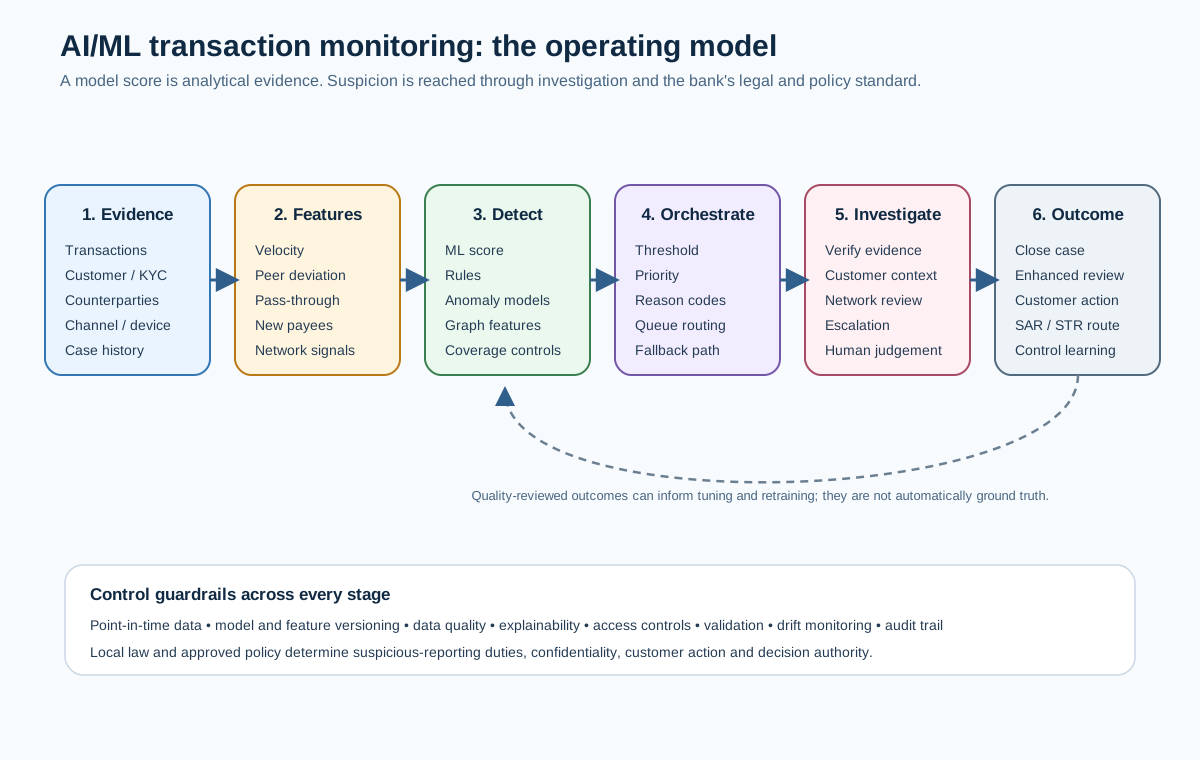
What machine learning adds to traditional monitoring
Traditional transaction monitoring is usually built from scenarios. A scenario expresses a known pattern in explicit logic: for example, repeated cash deposits around a reporting threshold, rapid movement of funds after incoming credits, or payments to a high-risk geography combined with other risk factors. Rules remain valuable because they are transparent, easy to test and often well suited to clearly defined typologies. Their weakness is that criminals do not have to behave exactly like the rule designer expected.
Machine learning can add value where the relationship among signals is too complex for a small number of thresholds. A supervised model can learn from historical examples that have been labelled through investigation or other reliable outcomes. An unsupervised model can identify activity that is unusual relative to the customer's own history or a relevant peer group even when there is no strong historical label. Clustering can help reveal cohorts and behavioural segments. Graph-derived features can describe network position, shared counterparties or movement across connected accounts. These techniques can be combined with rules rather than treated as competing philosophies.
The bank should choose the technique according to the control objective. If the objective is to detect a known regulatory or typology condition with an explicit definition, a rule may be the clearest control. If the objective is to rank large alert populations by likely investigative value, a supervised prioritisation model may work well. If the objective is to surface novel or changing behaviour, an anomaly model may be more appropriate. If the objective is to connect activity across apparently separate customers, graph analytics may be needed. The right question is not “can we use AI here?” but “what decision or detection problem are we trying to improve, and what method is proportionate to that problem?”
Wolfsberg's 2022 principles for AI and machine learning in financial crime compliance are useful here because they frame the use of technology around legitimate purpose, proportionate use, design and technical expertise, accountability and oversight, and openness and transparency. They do not prescribe one model family. They place responsibility on the financial institution to understand what the technology is doing, why the data is being used, how outcomes are explained and how performance is monitored after implementation.
Labels are not the same as truth
One of the hardest issues in financial-crime machine learning is the quality of the target label. In credit modelling, a default can often be observed directly. In suspicious-activity monitoring, the historical outcome is much less clean. A filed SAR or STR is not proof that a crime occurred. A closed alert is not proof that the activity was innocent. A case escalated by one investigator may have been closed by another. Law-enforcement feedback may be partial. Some historical reporting may have been defensive or driven by older policy, while significant criminal activity may have gone undetected and therefore never entered the labelled dataset.
This creates several forms of bias. Selection bias appears because only activity detected by the old controls received investigation. Label bias appears because investigator judgement and policy affected the outcome. Temporal bias appears because typologies, products and customer behaviour changed after the historical period. Process bias appears when operational targets encouraged quick closure or defensive escalation. A model trained uncritically on those outcomes can automate the weaknesses of the old programme while appearing statistically sophisticated.
A mature bank therefore builds a label strategy rather than simply choosing a column from the case system. It may distinguish high-confidence positive examples, lower-confidence investigative outcomes, known fraud or law-enforcement-linked cases, and ordinary case closures. It should preserve the provenance and date of the label, the policy version under which the decision was made, and any later information that changes the interpretation. Some models may use positive-unlabelled or semi-supervised techniques where negative labels are unreliable, but the governance question remains the same: can the bank explain what the training outcome actually represents?
Features turn banking behaviour into model evidence
Features are measurements presented to the model. Their design determines what the model can see. A raw payment amount is rarely enough on its own. More useful features might describe the number of credits over the past day, the proportion of value sent onward within an hour, the age of the customer relationship, the number of first-time beneficiaries, the difference between recent activity and the customer's established baseline, the share of activity involving higher-risk corridors, or the number of connected accounts using the same device or contact detail.
The feature catalogue should be treated as controlled financial-crime data, not as an informal data-science notebook. Each feature needs a business definition, source fields, transformation logic, time window, handling of missing values, effective date and owner. If a feature depends on customer risk rating, the bank should know which rating version was used. If it uses geography, the source of the country attribute must be defined. If it uses historical case outcomes, the leakage risk must be tested so that information created after the event is not accidentally used to predict the earlier event.
Time is especially important. Monitoring systems often combine event time, booking time, settlement time, processing time and data-arrival time. A model that is trained on complete end-of-day data but used for near-real-time alerting may perform differently because some features are not yet available at decision time. The production feature pipeline must reproduce the same information horizon used during validation. Otherwise the bank validates one model and deploys another in practice.
Sensitive and proxy data require deliberate governance. A feature may be statistically predictive while still creating legal, ethical or fairness concerns. Nationality, postcode, occupation, language, device type and relationship channel can correlate with protected or vulnerable characteristics depending on the jurisdiction and customer population. The correct response is not a universal ban on contextual information, because some attributes can be relevant to financial-crime risk. The bank should document the legitimate purpose, test whether the feature contributes meaningfully, look for disproportionate outcomes and apply the privacy, data-protection and conduct requirements relevant to the legal entity and geography.
From score to alert to investigation
A machine-learning score is usually most useful as part of a decision flow rather than as a standalone verdict. The model may score a customer, transaction, network or rolling window of behaviour. That score can be combined with explicit rules, product coverage, customer risk, sanctions or fraud signals, and minimum evidence conditions. The orchestration layer then decides whether to create an alert, increase priority, route the item to a specialist queue, ask for additional enrichment or take no immediate action while retaining the event for future aggregation.
The threshold is a control choice. Lowering it increases sensitivity but also increases operational volume. Raising it reduces volume but may increase missed-risk exposure. The threshold should therefore be set against the programme's desired outcomes, investigator capacity, risk appetite and complementary controls. A threshold chosen only because it produces the same number of alerts as the legacy system is not a meaningful validation criterion.
Wolfsberg's 2025 Statement on Effective Monitoring for Suspicious Activity, Part II, is important because it explicitly describes transition and validation in terms of desired outcomes. It discusses measures including priority risk coverage, expanded risk-indicator coverage, precision, recall, SAR or STR quality and downstream integration. The practical lesson is that a new model does not have to reproduce every alert generated by the old system. It does have to demonstrate that the new control is fit for its stated purpose and that the bank understands significant cases that the new approach no longer identifies.
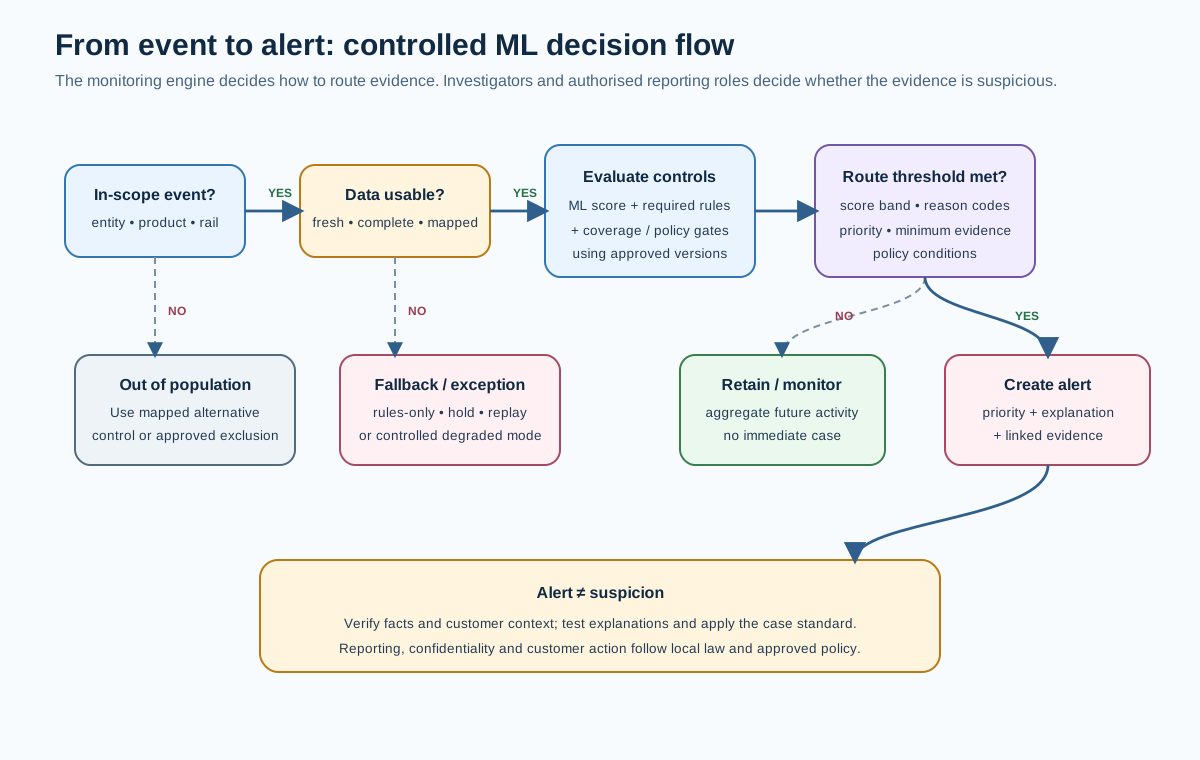
Precision, recall and the imbalance problem
Transaction-monitoring datasets are highly imbalanced: genuinely concerning outcomes are normally a small share of all customer activity. That makes headline accuracy a poor metric. A model that predicts “not concerning” almost all the time may achieve a very high accuracy rate and still be useless as a financial-crime control.
Precision asks: of the items the model identified as positive, how many were actually positive according to the evaluation label? High precision can reduce wasted investigation effort. Recall asks: of the known positive items, how many did the model identify? High recall reduces known misses. These measures trade off against each other as the threshold moves. The correct operating point depends on the use case, the severity of the risk and the presence of other controls.
Even precision and recall are not sufficient by themselves. The bank should examine performance by product, legal entity, customer segment, geography, channel and typology where data volumes permit meaningful analysis. It should also assess alert quality, time to disposition, escalation quality, useful SAR or STR outcomes, customer friction and investigation effort. If the model improves average precision while materially weakening coverage of a priority threat, the average metric can conceal a serious control problem.
For ranking models, lift and precision at the top of the queue can be operationally important. For calibrated risk scores, the bank may test whether higher predicted risk bands actually correspond to higher observed rates of the chosen evaluation outcome. For anomaly models, the evaluation may rely more heavily on expert review, seeded typologies, historical cases and stability analysis because there may be no complete ground-truth label.
Explainability that works for investigators
Explainability has two different audiences. The model-development and validation teams need to understand global behaviour: which features generally drive the model, how sensitive outputs are to input changes, where the model is weak, and whether unexpected proxies are dominating. Investigators need local explanation: why this customer or activity was surfaced now, what changed, which transactions or relationships are relevant, and what evidence they should review next.
A list of statistical feature contributions is not automatically an investigation narrative. “Feature 17 increased the score by 0.13” is technically informative but operationally poor. A better case explanation could say that the customer received credits from eight newly connected counterparties within two hours, forwarded most of the funds to three first-time beneficiaries, and displayed a sharp departure from the previous six-month pattern. The system should preserve the underlying transactions so the investigator can verify the explanation rather than relying on generated prose.
Explainability must also avoid helping criminals reverse-engineer controls. Internal investigators, validators and supervisors may need detailed model information that should not appear in customer messages. Customer communications can explain that activity is under review or that additional information is required without disclosing exact thresholds, feature weights or detection logic. SAR and STR confidentiality rules can impose further restrictions depending on the jurisdiction.
The architecture behind a trustworthy model
A production ML monitoring solution normally contains more than the model itself. Source systems provide transaction, customer, account, channel, device, KYC and reference data. A data pipeline standardises and timestamps those inputs. A feature layer creates reproducible measurements. The model service produces a score. A rules or orchestration layer applies coverage logic, thresholds and fallbacks. An alert platform creates work for investigators. Case management records evidence and outcomes. A model registry stores approved versions and parameters. Monitoring services track data quality, score distributions, drift and operational performance. Audit logging preserves the chain from source event to final decision.
The architecture should make versioning explicit. For any historical alert, the bank should be able to identify the model version, feature definitions, threshold, reference data, input snapshot and explanation used at the time. Re-running today's model over yesterday's transaction is useful for analysis but does not reproduce the decision that actually occurred yesterday. Point-in-time evidence is essential when an investigator, auditor or supervisor later asks why a specific alert was or was not generated.
Availability also matters. If the model service is unavailable, the bank needs a governed fallback. Depending on the use case, that might mean using a rules-only control, holding a queue, degrading to a simpler model, or continuing processing while creating post-event review. The fallback should be decided before the outage, not invented during it. Recovery testing should confirm that queued events are not lost, duplicated or scored with the wrong feature state after service restoration.
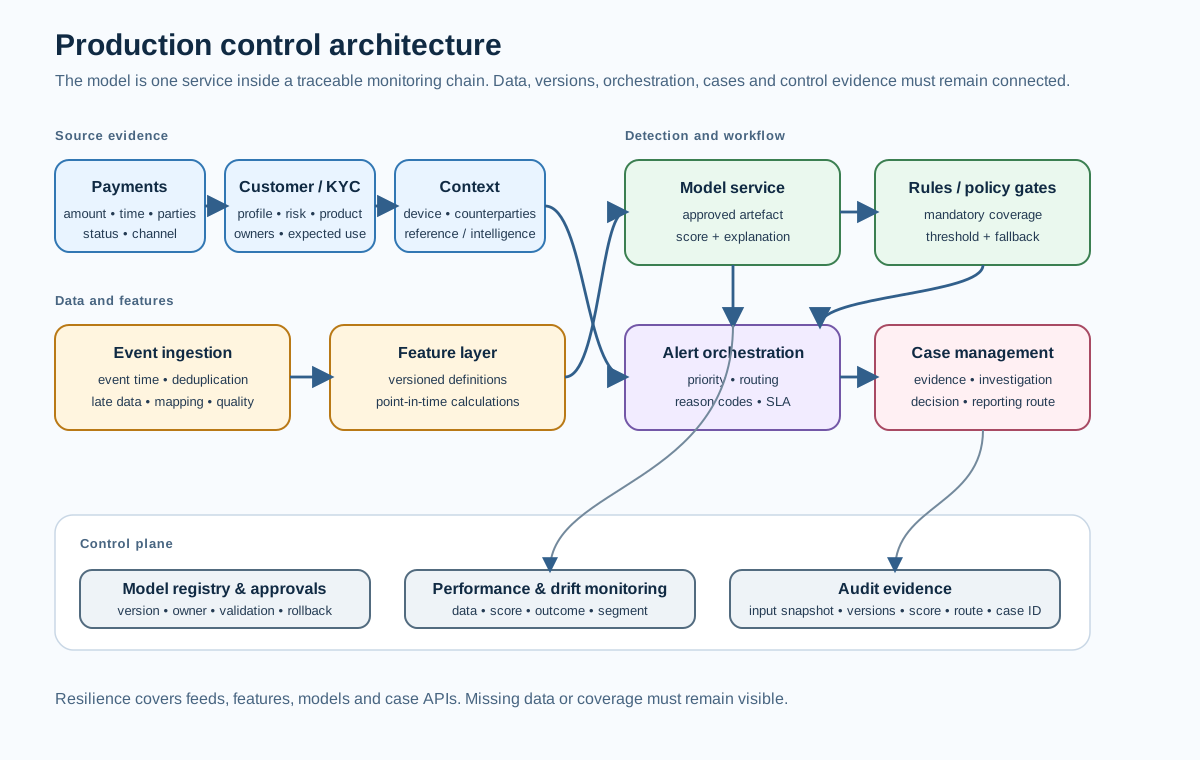
Drift: when yesterday's model meets today's criminals
A model can deteriorate even when its code does not change. Data drift occurs when the distribution of inputs changes. Population drift occurs when the mix of customers, products or geographies changes. Concept drift occurs when the relationship between the inputs and the risk outcome changes. Process drift occurs when the way investigators label or close cases changes. Pipeline drift occurs when source mappings, currencies, timestamps or reference data change without the model team realising the feature meaning has changed.
Financial-crime models are especially exposed to concept drift because criminals adapt. A mule network may change transfer sizes, move to a new rail, use different onboarding channels or alter the timing of onward payments once a control becomes effective. Product change can have the same statistical effect without any criminal adaptation: a new instant-payment feature can create transaction velocity that would have looked anomalous under the old product.
Monitoring therefore needs both technical and financial-crime indicators. Technical monitoring can track missing data, feature distributions, score distributions and prediction stability. Financial-crime monitoring should track typology coverage, alert themes, investigator findings, emerging intelligence, product changes and significant cases missed by the model but found elsewhere. A stable score distribution does not prove that risk coverage is stable.
Human judgement is part of the control, not a weakness
A human-in-the-loop design does not mean that every model decision must be manually repeated. It means that the bank is clear about which decisions are automated and which require accountable human judgement. A model can prioritise an alert automatically. It can enrich the case with relevant transactions. It can recommend investigative steps. The investigator remains responsible for evaluating the evidence and applying the case-disposition standard. The MLRO or equivalent reporting authority remains responsible for the reporting decision where local governance assigns that role.
Humans introduce their own risks: inconsistency, anchoring, fatigue and over-reliance on model explanations. Training should therefore cover both the model's strengths and its limitations. Investigators need to know that a low score does not prove innocence, a high score does not prove criminality, and the explanation is a guide to evidence rather than a substitute for evidence. Quality assurance should test whether analysts are exercising judgement rather than merely confirming the model.
The feedback loop should be designed carefully. Investigator outcomes can improve future models, but feeding every closure or escalation directly back into training can reinforce operational bias. Before case outcomes become training labels, the bank should define which outcomes are sufficiently reliable, whether later information changed the result, and whether the original alert itself influenced the investigation in a way that creates circular learning.
Global standards and jurisdiction-specific expectations
FATF does not require banks to use machine learning. Its work on the digital transformation of AML/CFT and the opportunities and challenges of new technologies describes how advanced analytics can support more effective risk identification while emphasising data quality, privacy, governance and the need to manage new technology risks. The FATF Recommendations continue to require a risk-based AML/CFT framework; the technology used to implement that framework is a design choice subject to local law and supervision.
The Wolfsberg Group is industry guidance rather than law. Its AI/ML principles and 2025 transition framework are nevertheless useful professional benchmarks because they deal directly with financial-crime monitoring, validation, explainability and the tension between model risk and rapidly changing criminal threats.
In the United States, FinCEN and the federal banking agencies have encouraged responsible innovation in BSA/AML programmes. Their 2018 joint statement explicitly recognised artificial intelligence and other advanced analytical techniques and noted that a pilot identifying suspicious activity not found by the legacy process does not automatically mean the old process was deficient. In April 2026, the Federal Reserve, OCC and FDIC issued revised model risk management guidance. For covered banking organisations, that guidance superseded the older SR 11-7 framework and the 2021 BSA/AML model-risk statement, emphasising a risk-based and tailored approach to model development, validation, monitoring, governance and vendor products. The 2026 guidance explicitly excludes generative and agentic AI from its scope; conventional machine-learning monitoring models may still fall within the broader model-risk framework depending on their design and use.
Australia provides a useful operational example of jurisdiction-specific monitoring expectations. AUSTRAC's current 2026 guidance states that regulated businesses must monitor customers for unusual transactions and behaviours and expects automated transaction monitoring where transaction volumes cannot be monitored effectively manually. That is an Australian regulatory expectation, not a universal rule for every country. It illustrates why the chapter distinguishes the global risk-based principle from local implementation requirements.
What good looks like
A strong machine-learning monitoring control is not defined by the sophistication of the algorithm. It is defined by whether the bank can explain the problem, the data, the model, the threshold, the investigator workflow, the limitations, the validation evidence and the ongoing monitoring. It should be possible to answer a simple chain of questions for any material model: what risk is this intended to detect, what population does it cover, what evidence can it use at decision time, why is the model appropriate, what significant risk can it miss, how do investigators understand its output, how do we know it still works, and what happens when it does not?
Those questions keep the technology subordinate to the control objective. Machine learning can be extremely powerful in financial crime because it can connect weak signals at a scale that humans and fixed rules cannot. It becomes dangerous when its complexity is used to avoid accountability. The best design is therefore not “AI instead of rules” or “AI instead of investigators.” It is a controlled monitoring system in which rules, statistical models, machine learning, human intelligence and investigation evidence reinforce one another.
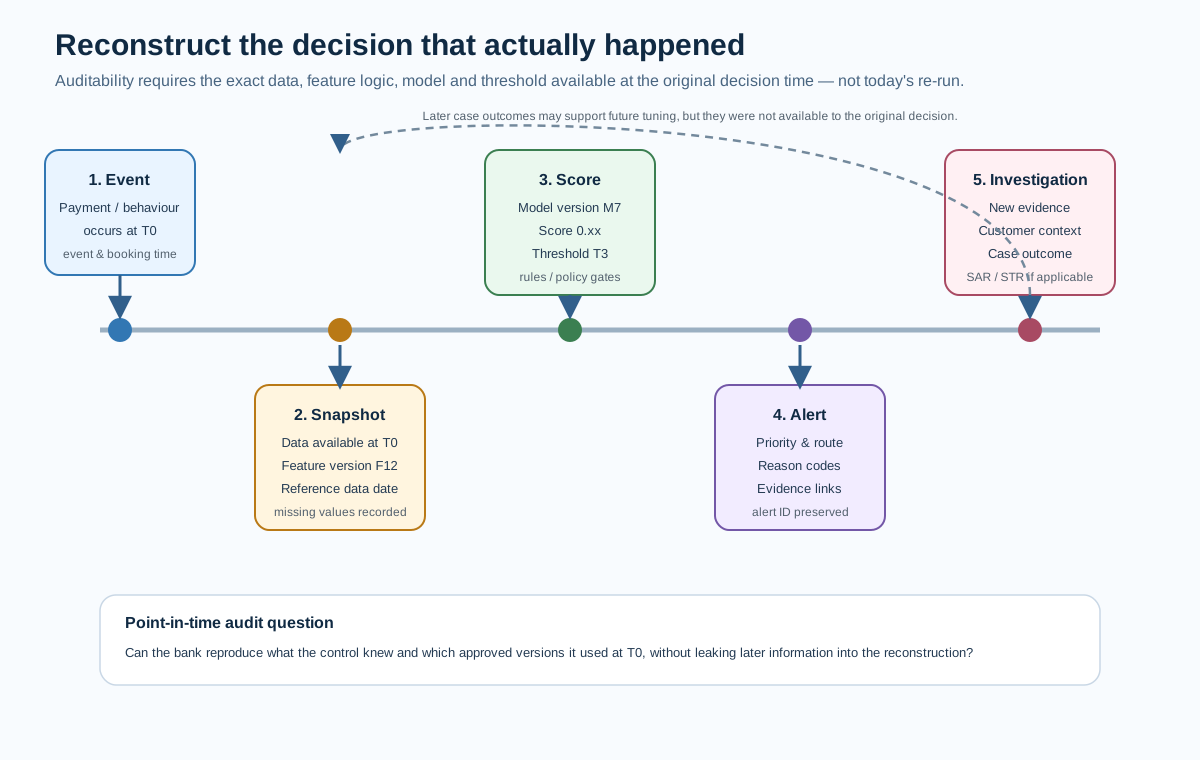
The next sections deepen that operating model through validation, model-risk trade-offs, BA and testing requirements, a realistic case study and governance practices for production use.
Operational deep dive: training, validation and transition from legacy monitoring
A bank normally introduces machine learning into an environment that already contains rules, thresholds, manual referrals, fraud controls, sanctions screening, customer risk models and investigation teams. The hard problem is therefore not building a model in isolation. It is changing the monitoring system without losing known coverage, creating uncontrolled gaps or forcing investigators to work with outputs they do not understand.
Start with the control objective, not the algorithm
The design team should first define the problem in operational terms. A useful objective is specific enough to test, such as “prioritise retail payment alerts associated with rapid pass-through mule behaviour” or “identify business customers whose cross-border activity has moved materially outside their established peer and customer profile.” An objective such as “use AI to improve AML” is too broad to validate.
The population also needs to be explicit. The model may cover only certain legal entities, account types, currencies, products or channels. If a model was trained primarily on retail current accounts, extending it to correspondent banking or trade-finance flows is not just a configuration change. The behaviour, data fields, typologies and case outcomes may be materially different. Product coverage should therefore be part of the approved model scope and the change process.
The bank should map the model to the wider control environment. If rapid pass-through behaviour is also detected by a rules-based mule scenario, the machine-learning model may provide prioritisation rather than sole coverage. If the model is the only control for a particular emerging typology, its concentration risk is greater. This distinction affects validation depth, fallback design and the urgency of remediation when performance deteriorates.
Supervised learning: useful labels, imperfect labels
Supervised learning is attractive because the model can be trained against known outcomes. In financial crime, however, historical outcomes have to be interpreted carefully. A filed SAR or STR reflects suspicion under a particular jurisdiction and policy at a particular time. It does not prove the underlying offence. A closed case may have lacked evidence rather than risk. A fraud-confirmed event can be a strong label for a fraud-related model but may not represent the broader money-laundering objective.
A robust training dataset therefore records label provenance. Useful fields include the originating control, investigation outcome, decision date, policy version, quality-review result, later law-enforcement or fraud confirmation if available, and whether the case was reopened. The team can then create label tiers rather than pretending every outcome is equally reliable.
Historical case populations are also shaped by the old detection system. If the legacy rule never selected a certain pattern, that pattern will be underrepresented among reviewed cases. Training only on previously alerted activity can teach the new model to reproduce the old system's blind spots. Banks can mitigate this through broader sampling, typology-led data exploration, random or risk-based control samples, network analysis, expert-labelled examples and carefully designed unsupervised methods.
Delayed outcomes create another challenge. A transaction occurring today may not become part of a suspicious case for weeks or months. Training pipelines must use point-in-time labels so that the model is not evaluated as though it could have known a future event. The same principle applies to customer risk changes, account exits and sanctions events: information created later cannot leak into the historical feature set.
Unsupervised learning: finding unusual does not mean finding criminal
Anomaly detection can surface activity that differs from a customer's history or peers. That is valuable where new typologies do not have reliable labels. It is also easy to misuse. New employment, a property sale, seasonal business activity, travel, a new supplier or a product migration can all look unusual without being suspicious.
The peer group matters as much as the algorithm. Comparing a student account with multinational corporate treasury behaviour is meaningless. Peer-group logic should use stable and relevant dimensions such as product, business type, customer tenure, geography, expected volume and channel, while avoiding a segmentation scheme so narrow that every customer becomes their own peer group.
Anomaly models need operational explanation. Investigators should see what changed and why the activity differs from the baseline. A high anomaly score without supporting context tends to create expensive research rather than useful leads. The model should therefore surface the transactions, time windows, counterparties and behavioural dimensions that contributed to the deviation.
Training data and feature controls
The development environment should reproduce production logic. Feature code should be version controlled. Reference data should be date effective. Currency conversion should use the same methodology. Time zones and daylight-saving treatment should be consistent. Duplicate and reversed transactions must be handled deliberately. Missing values should not silently become zero when zero has a different business meaning.
Data lineage should extend from the source system to the model feature. If the model uses “number of new beneficiaries in seven days,” the bank should know how a beneficiary is identified, how shared or tokenised identifiers are treated, whether deleted beneficiaries remain in history and how the seven-day window is calculated. These details are not technical trivia; they change what risk the model is measuring.
Data quality monitoring should be tied to control impact. A two per cent fall in the availability of an optional enrichment field may be immaterial, while a small drop in customer identifier mapping could disconnect transactions from customer history and materially damage the model. Critical data elements should therefore have risk-based thresholds and defined fallback behaviour.
Validation should test the whole monitoring outcome
Technical validation begins with conceptual soundness. The validator should understand the business problem, model family, data, assumptions, training population, feature design, target label and limitations. It then examines implementation: whether the approved logic is what production actually runs. Outcome analysis tests how the model behaves on data not used for training and whether its performance remains acceptable over time.
For a supervised classification model, validation may examine precision, recall, calibration, stability and performance across material sub-populations. It should inspect error cases, not only aggregate metrics. A false negative involving a high-priority threat may matter more than many low-risk false positives. The team should also test sensitivity to thresholds and important features so that the operating point is understood rather than inherited from a development notebook.
For unsupervised or hybrid models, validation relies more heavily on expert review, seeded scenarios, known historical cases, stability analysis and comparison with complementary controls. The absence of a clean ground-truth label is not a reason to skip validation; it means the evidence of effectiveness must be broader.
The revised US interagency model-risk guidance issued in April 2026 is a useful jurisdiction-specific reference. It emphasises that model-risk management should be risk based, tailored to model use and proportionate to the banking organisation's size and complexity. Development and use, validation and monitoring, governance and vendor products remain core themes. This guidance superseded SR 11-7 and the 2021 BSA/AML model-risk statement for the relevant US banking agencies. It is not a global law, and it should not be presented as one.
Transitioning from legacy rules
A legacy-to-ML transition should not be judged only by alert overlap. If the new system is intentionally designed to detect broader behavioural patterns, a perfect match with the old rules would suggest that little has changed. The bank should instead identify the legacy controls being retired, retained or complemented and explain how their risk coverage moves into the new design.
Historical back-testing is useful because it allows the team to study how the new model would have behaved on known periods. Shadow operation is useful because the model can score live activity without controlling the production queue. A parallel run can be useful where operational continuity requires it, but it should not become a ritual that forces the new system to mimic the old system. Wolfsberg's 2025 transition framework explicitly warns against low-value historical comparisons when the desired outcomes of the monitoring programme have changed.
The transition plan should catalogue significant misses in both directions. Cases found by the old approach but missed by the new one need explanation. They may be covered by another control, may no longer represent a desired risk target, or may expose a real gap. Cases found only by the new approach should be reviewed for investigative value and emerging-risk coverage. The objective is to understand differences, not to force them away.
Operational readiness is equally important. Investigators may be accustomed to a rule name such as “cash structuring scenario 14.” A machine-learning alert may be caused by a combination of behaviours. Before go-live, the case interface needs reason codes, evidence, training and escalation guidance. Quality assurance should sample early cases to identify whether analysts are misunderstanding the model or over-trusting the score.
Balancing model risk and financial-crime risk
A technically imperfect model can still be useful if it materially improves financial-crime detection and its limitations are understood and controlled. Conversely, a statistically elegant model can be unsafe if it takes too long to deploy against a fast-moving threat, hides its limitations or creates unmanageable investigation noise.
This is the core of the “model risk versus financial crime risk” problem discussed by Wolfsberg in 2025. A bank should not use the idea as an excuse to bypass governance. It should use it to tailor governance so that validation effort is proportionate to the model's actual control role, concentration, coverage, complexity and potential impact.
A model that is the sole detector for a high-risk product deserves stronger resilience and fallback controls than a model used only to prioritise an alert queue already generated by established scenarios. A simple scorecard can also be material if thousands of decisions depend on it. Complexity is only one dimension of risk.
Explainability as part of validation
Model explainability should be tested for fidelity and usefulness. A local explanation should reflect what actually drove the model score, not produce a generic narrative that sounds plausible. If the model's most influential feature is rapid value movement, the explanation should identify the relevant time window and transactions. If a graph feature contributed, the investigator should be able to see the relationship rather than an opaque “network risk” label.
Global explanation helps identify inappropriate dependence on a feature. If customer tenure dominates the model in a way not supported by the control objective, the team should investigate whether the model is learning a historical process artefact. Feature importance can change over time, so explainability belongs in ongoing monitoring as well as initial validation.
The bank should also document what will not be disclosed externally. Detailed thresholds or feature weights could enable evasion. Transparency to internal governance, validators and supervisors can therefore be much greater than transparency in customer communications.
Ongoing monitoring and trigger events
Model monitoring should have scheduled measures and event-driven triggers. Scheduled monitoring can include feature availability, score distributions, precision or other outcome measures, alert volume, investigator outcomes and performance by material segment. Trigger events can include product launches, acquisitions, significant source-system changes, new payment rails, policy changes, major typology developments, vendor releases and unexplained shifts in alert behaviour.
Drift thresholds should lead to defined actions: investigation, recalibration, threshold change, additional controls, restricted use or rollback. A dashboard that turns red without an owner and action standard is not a control.
The model inventory should show the approved purpose, owner, version, materiality, dependencies, validation status, limitations, last change and next review. The inventory should also link to the financial-crime risk or typology coverage it supports. This allows governance forums to understand what happens if a model is withdrawn or degraded.
Vendor models and opaque technology
Buying a model does not transfer accountability. The bank still needs to understand the vendor's intended use, inputs, limitations, update process, performance evidence and change controls. Proprietary intellectual property can limit access to code, but it should not prevent the bank from validating outcomes, testing its own data, monitoring drift and documenting how the product supports the bank's control objective.
Contractual requirements should address notification of material model changes, data handling, subcontractors, security incidents, service availability, audit rights, support for validation, version retention and exit. A vendor that changes feature logic or model weights without sufficient notice can create a control change even if the API remains technically compatible.
Practical conclusion
A successful ML transition is not measured by whether the bank can say that it uses artificial intelligence. It is measured by whether the new monitoring approach identifies meaningful risk, produces usable investigation leads, preserves explainable evidence, adapts to change and remains governable. The strongest programmes treat the model as one component of a monitored control system, with clear links to risk assessment, investigations, reporting, model validation, technology operations and data governance.
Advanced practice: BA, architecture, testing and operating controls
Machine-learning transaction monitoring becomes a delivery problem as soon as the concept leaves the data-science environment. Business analysts have to define what the control is meant to achieve, architects have to place it correctly in the bank's data and case ecosystem, developers have to reproduce approved feature logic, testers have to prove that the end-to-end workflow works under realistic conditions, and operations teams have to understand what happens when the model, data or downstream case platform fails.
Requirements that can actually be built and tested
A good requirement avoids language such as “the system shall use AI to detect suspicious transactions.” It defines the decision point. For example: when a customer or transaction enters the monitored population, the platform must calculate the approved feature set using data available as of the event-processing time, invoke the active model version, combine the resulting score with configured policy rules, record the decision inputs and either create an alert, retain the event for aggregation or route it to a defined exception path.
The requirement should state population scope, latency, mandatory data, fallback behaviour, threshold ownership, explanation fields, audit logging and downstream status handling. It should also define what the model is not permitted to do. If the model only prioritises alerts, it must not silently suppress mandatory rule-generated alerts. If the score is advisory, the case tool should not turn it into an automatic suspicious-reporting decision.
Useful non-functional requirements include maximum scoring latency, feature freshness, recovery time, acceptable data-loss tolerance, model-version traceability, replay behaviour and idempotency. Financial-crime controls often fail because those delivery details are treated as generic technology matters even though they determine whether the bank actually monitored the full population.
Acceptance criteria for an ML monitoring service
A practical set of acceptance criteria may include the following:
| Area | Example acceptance evidence |
|---|---|
| Population | All in-scope products and legal entities are demonstrably routed to the model; exclusions are documented and approved. |
| Data | Mandatory features reconcile to source populations and preserve event-time logic. |
| Decision | Approved model version and threshold produce the expected route for controlled test cases. |
| Explainability | Investigator-facing reason codes identify the main contributing behaviours and link to underlying evidence. |
| Audit | Model version, feature snapshot, score, threshold, orchestration decision and alert identifier are reconstructable. |
| Resilience | Documented fallback works when the model or feature service is unavailable. |
| Change | Model, threshold and feature changes are versioned, approved and regression tested. |
The table is deliberately control oriented. A technically correct probability score is not enough if the event is lost before case creation, if the wrong model version is invoked, or if investigators cannot understand why the alert exists.
Test the data pipeline before testing the model
Many production failures originate upstream. Testers should reconcile record counts from source transaction systems into the monitoring intake layer. They should verify duplicate handling, reversals, rejected payments, backdated postings, multi-currency conversion, midnight boundaries, daylight-saving changes and late-arriving files. Customer merges and account re-parenting deserve dedicated tests because they can break history windows and peer comparisons.
Feature tests should use known examples where the expected value can be calculated independently. If the feature is “share of inbound value forwarded within two hours,” the test should include partial onward movement, multiple beneficiaries, transactions that cross midnight, reversed credits and a late settlement. This proves business meaning, not only code execution.
Schema-change testing is critical. If an upstream team changes a country code, device identifier or transaction-type mapping, the pipeline should either map it deliberately or fail visibly. Silent defaulting is dangerous because the model continues to score while its inputs have changed meaning.
Model and threshold testing
Model testing should separate development metrics from production acceptance. Development may compare algorithms using cross-validation or holdout data. Production acceptance should test the approved artefact, feature code, threshold, orchestration logic and case output together.
Positive tests should include representative known-risk patterns and high-priority typologies. Negative tests should include legitimate high-velocity or unusual activity so that the bank understands customer-friction risk. Boundary tests should exercise observations just below and above thresholds. Segment tests should compare material product and customer groups. Evasion tests should change timing, amounts and counterparties to understand whether small behavioural changes collapse detection.
For a ranking model, testers should verify queue order and confirm that ties, missing features and extreme scores are handled predictably. For a calibrated score, test cases should confirm that the score remains within the documented range and that downstream bands map correctly. For anomaly models, test cases should include legitimate new behaviour so that operations understands the level of expected novelty.
Failure-mode testing
The model service can fail, but so can the feature store, source feed, reference data, case API, model registry or explanation service. Each failure should have a known operational outcome.
A safe architecture distinguishes hard failure from degraded data. If the service is unreachable, the platform may invoke a fallback route. If the service responds but a critical feature population has collapsed, the system needs data-quality controls that can prevent false confidence. A successful HTTP response is not proof that the monitoring control operated effectively.
Replay is another material risk. After an outage, queued events may be rescored. The bank should decide whether replay uses the model and feature state that would have applied at original event time or the current state, and document the choice. For audit reconstruction, the original decision context should be preserved even where a later rescore is used for remediation.
Change governance without freezing the control
Machine-learning controls need to change faster than many traditional bank systems because typologies, products and data evolve. Governance should distinguish material changes from routine maintenance while still preserving evidence. A feature addition, model-family change or significant threshold shift may require independent validation. A correction to a non-material reference mapping may follow a lighter route. The institution's own model-risk and financial-crime policies should define those categories.
Wolfsberg's 2025 transition framework argues for balancing model risk with financial-crime risk and avoiding redundant validation that prevents timely response to new threats. That does not mean “move fast and skip validation.” It means designing validation and assurance so that the level of review is proportionate to the control's role and the risk of delay.
A model change record should explain the trigger, expected benefit, affected population, test evidence, validation outcome, approval, deployment date, monitoring plan and rollback point. Threshold changes need the same discipline because a threshold can materially alter risk coverage even when the model code is unchanged.
Investigator usability testing
User acceptance testing should include investigators, not only technology staff. The investigator should be able to answer: why did this alert fire; what activity should I inspect first; what behaviour is unusual; which information is model-generated versus source evidence; what are the model's known limitations; and how do I escalate when the explanation does not fit the facts?
A useful alert screen shows the score in context rather than making it the dominant visual. The score can be accompanied by reason codes, trend or peer context, relevant transactions, customer profile, connected parties and previous alerts. Showing “risk score 0.92” in large type without evidence can create anchoring bias.
Operational testing should measure case handling time and quality. A model that raises fewer alerts but requires twice as long to understand may not create the expected efficiency. Conversely, a richer evidence pack can justify a higher model-compute cost if it materially improves investigation quality.
Data protection and access design
ML monitoring frequently brings together data that were previously held in separate systems. That can improve detection while increasing privacy and access risk. The architecture should implement role-based access, data minimisation, controlled retention and purpose limitation according to the legal framework that applies to the bank and data subjects.
Development environments should avoid uncontrolled copies of production customer data. Where production-like data are required, the bank should use approved masking, synthetic data or secure controlled environments. Model developers should not gain unrestricted case or SAR information merely because those fields could improve a training label.
Governance map
The first-line monitoring owner remains accountable for the control objective and operational performance. Data-science teams design the model but do not own the suspicious-reporting decision. Financial-crime compliance provides policy interpretation and challenge. Model-risk or equivalent independent validation challenges the methodology and limitations according to the institution's framework. Data governance and privacy teams control lawful and appropriate use of data. Technology operations maintain availability and recovery. Internal audit independently assesses governance and control effectiveness.
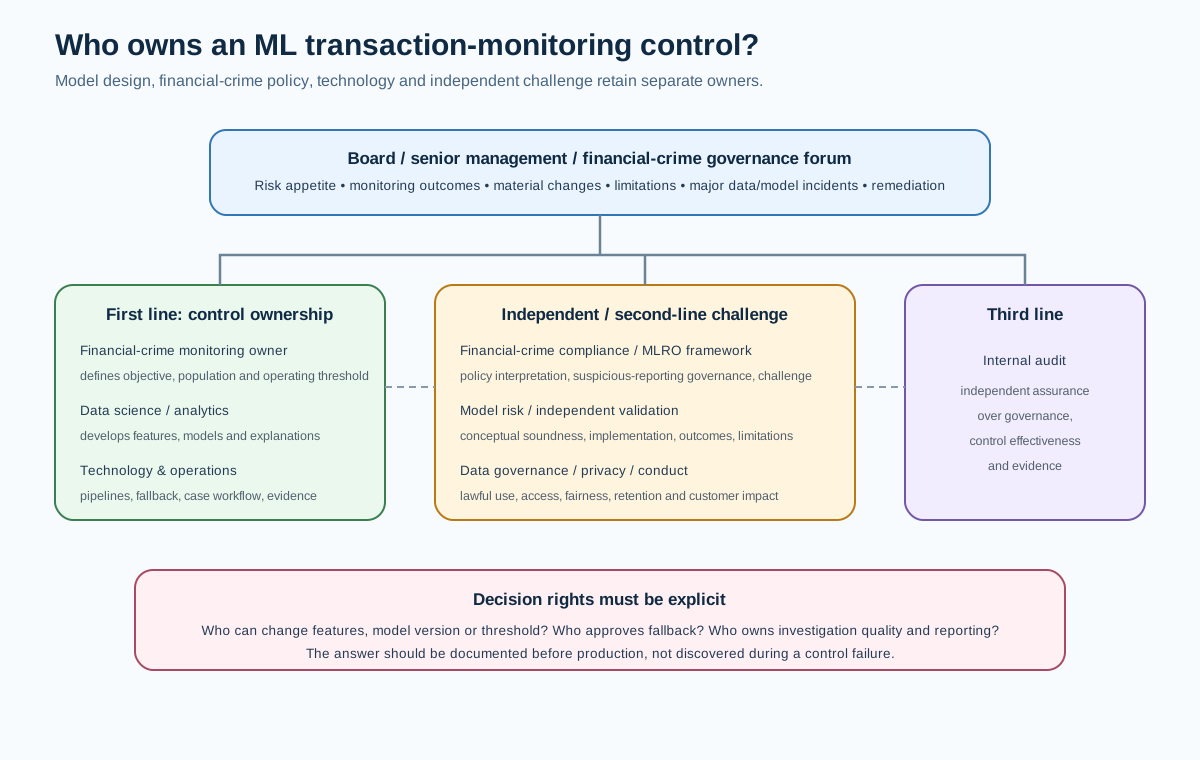
The important design principle is that no function should be able to say “the model decided.” The model produces an analytical output. The bank owns the control, the threshold, the workflow, the evidence and the consequences.
Practice close: investigating an ML-generated alert
This exercise converts the chapter into the sequence an investigator, business analyst or tester should expect to see in production.
A retail customer has held an account for eighteen months. Historically, salary credits arrive twice each month and ordinary card and bill payments follow. Over the last forty-eight hours, the account receives twelve transfers from unrelated individuals. Most of the value is forwarded within ninety minutes to four beneficiaries not previously used by the customer. The amounts are individually modest and do not breach the bank's legacy high-value scenario. Device information is stable and the customer authenticated normally.
The bank's machine-learning model scores the behaviour highly because several features combine: a sharp increase in unrelated inbound counterparties, unusually fast pass-through, first-time beneficiary concentration, a break from the customer's baseline and similarity to previously investigated mule-account patterns. The model does not label the customer a mule. It creates a high-priority alert and provides the contributing behaviours and linked transactions.
Step 1: verify the alert evidence
The investigator first confirms that the alert reflects real source data. They check that the twelve credits are posted transactions, that reversals are not being double counted, that the beneficiaries are genuinely new and that the timing calculation uses booking events available when the model scored the case. If the evidence is wrong, the problem may be a data or model-control issue rather than customer risk.
The investigator should not start by reading the score as a conclusion. They should read the behaviour. A score is useful for prioritisation; the case has to be investigated from evidence.
Step 2: understand the customer context
The customer profile is reviewed for occupation, expected account use, prior activity, previous alerts, connected accounts and recent customer-contact history. The investigator checks whether there is a plausible known event, such as a marketplace sale, family collection or community activity, that could explain the multiple incoming payments.
This is also the point at which customer-contact governance matters. Some institutions allow an investigator or relationship team to ask the customer for context before reaching a final conclusion. Others restrict direct contact in particular case types. The applicable bank procedure and jurisdiction decide the route.
Step 3: widen the network view
The four onward beneficiaries are checked against internal information. Two are new customers at the same bank. One of those accounts has received similar pass-through payments from several other customers. The investigator now has network evidence that did not exist in the original single-account score.
This illustrates a key control boundary. The ML model generated a useful lead, but the suspicion is developed through investigation. The bank should preserve which facts came from the original model and which were discovered later so that model performance is not overstated.
Step 4: decide the case under the bank's legal and policy standard
The investigator documents the activity, customer context, linked accounts, explanations obtained and remaining concerns. The case is escalated according to the bank's suspicious-activity procedure. The filing decision is made under the law and governance applicable to the legal entity. The model score is supporting evidence, not the legal basis for the report.
If a SAR or STR is filed, the model-training process should not automatically treat that filing as proven criminality. The label may be useful, but its evidential meaning should remain clear. If later law-enforcement or fraud-confirmation information becomes available, it can create a higher-confidence outcome for future model evaluation.
Step 5: feed control learning back carefully
The monitoring team asks three different questions after the case closes. First, did the model identify a risk that the legacy rules would have missed? Second, did the alert explanation help the investigator reach the right evidence quickly? Third, do the newly observed network patterns justify a feature, rule or typology change?
The team should avoid direct circular learning. If the model's own alert caused the case and the case outcome is immediately used as unquestioned training truth, the next model may simply learn to reproduce itself. Feedback needs quality criteria and, where appropriate, independent review.
Tester challenge pack
A strong regression pack for this scenario should include more than the suspicious example. It should also include a legitimate customer collecting money for a documented group event, a small business receiving many low-value consumer transfers, a customer whose beneficiaries are new because of a product migration, a data-quality defect that temporarily marks old beneficiaries as new, and a case in which the model service is unavailable and the approved fallback must operate.
The expected result is not that every unusual case creates an alert. The expected result is that the monitoring system behaves predictably, records why it took the action, preserves the evidence and routes uncertainty according to policy.
Questions for review
- What exactly is the model predicting or ranking, and is that outcome different from legal suspicion?
- Which features were available at decision time, and can they be reconstructed later?
- What known risk is the model intended to cover, and what complementary controls cover its gaps?
- How were the labels created, and what biases exist in the historical case population?
- Which performance measures matter at the chosen operating threshold?
- Can investigators understand the main contributing behaviours without being encouraged to accept the score blindly?
- What happens if critical data, the feature pipeline, model service or case-management API fails?
- Who can approve a threshold or model change, and what regression evidence is required?
- How are model drift, product change and emerging typologies distinguished?
- How does the bank demonstrate that the control remains effective after deployment?
If a delivery team can answer those questions with evidence rather than presentation slides, it is much closer to having a controlled machine-learning monitoring capability.
Masterclass: migrating a legacy monitoring estate to machine learning
Consider a composite bank with several million retail and small-business customers, multiple payment rails and a transaction-monitoring estate built over many years. The legacy platform contains hundreds of scenarios. Some are effective, some overlap, some produce large alert volumes with little investigative value, and some remain mainly because no team feels comfortable retiring them. Investigators know the rule names well but spend significant time closing repetitive alerts.
The bank wants to introduce machine learning. The wrong programme starts with a vendor demonstration, chooses the most impressive model and then asks compliance to approve it. The stronger programme starts by defining which monitoring outcomes need improvement.
The bank identifies three objectives. It wants better coverage of mule-account networks using retail instant payments, better prioritisation of high-volume alert queues, and improved detection of behavioural change in customers whose transaction amounts remain below traditional thresholds. Those objectives create three different design problems rather than one generic “AI model.”
Workstream one: mule detection
For mule behaviour, the team combines rules, supervised learning and network features. Rules preserve explicit known indicators. The model learns combinations of inbound-counterparty novelty, pass-through speed, beneficiary concentration, account tenure and customer-baseline deviation. Network features identify shared beneficiaries and coordinated flows across accounts.
Historical SAR or STR filings are not treated as unquestioned ground truth. The team builds a curated positive set using cases that passed quality review and, where available, stronger fraud or law-enforcement outcomes. It also samples non-alerted populations so that the model does not learn only from the legacy rules' view of the world.
The model is first tested on historical periods that were not used for training. Subject-matter experts review newly surfaced cases. The team asks whether the cases reflect the priority risk, not merely whether they resemble old alerts. It also reviews legacy cases missed by the new approach and maps whether another control would detect them.
Workstream two: alert prioritisation
The prioritisation model has a different control role. It does not decide whether an alert exists. Existing scenarios still create the alerts, but the model orders the queue so that analysts see more promising cases earlier.
Because this model cannot suppress an alert, its direct detection concentration risk is lower than the mule model. It still matters operationally: poor ranking can delay important cases beyond service levels. Validation therefore focuses on ranking quality, stability, segment fairness and whether high-priority known cases consistently appear near the top without creating blind spots in lower-ranked work.
The case tool shows the priority score alongside reasons but prevents analysts from closing a case simply because the score is low. Queue policy still requires all mandatory alerts to be disposed within the required timeframe.
Workstream three: behavioural anomaly detection
The third model looks for unusual customer behaviour. The bank deliberately avoids calling the output “suspicion.” It calls it behavioural deviation and uses it as one input to monitoring.
Peer groups are validated carefully. Small retailers, gig-economy workers and seasonal businesses produce legitimate patterns that can resemble unusual activity. The bank tests whether the peer design creates disproportionate alerting for groups with different but legitimate transaction behaviour. Investigators receive the dimensions of the deviation and the relevant transactions rather than only an anomaly score.
The transition decision
After testing, the governance forum does not ask whether the new models reproduce the legacy alert count. It asks whether the new control set provides reasonable and risk-based coverage of the identified threats, whether significant legacy detections remain covered, whether investigators are operationally ready, and whether the residual limitations are understood.
Several old scenarios are retired because the mule model plus complementary fraud controls cover their risk more effectively. Other rules are retained because they express clear known typologies and provide an independent layer. The prioritisation model is deployed without changing underlying scenario coverage. The anomaly model is introduced in shadow mode first because the team needs more evidence about operational volumes.
This mixed outcome is a sign of maturity. Machine learning does not have to replace every rule to be valuable.
A material drift event
Six months later, the bank launches a new instant-payment product with higher usage among small businesses. Within days, the anomaly model's score distribution shifts and alert volumes rise sharply. Technical monitoring detects the drift, but investigators also report that many cases involve legitimate new payment behaviour.
The team does not simply raise the threshold until volumes fall. It identifies the product launch as the cause, rebuilds the relevant peer segmentation and retests affected features. During the change, the bank uses a controlled temporary threshold adjustment approved under the model-change process and increases sampling of lower-scored cases to watch for missed risk.
This response distinguishes drift management from capacity management. A model should not be recalibrated merely to make operations quieter. The change must be linked to a changed population, product, threat or evidence base.
What the board and senior management need to know
Senior governance does not need a lesson in gradient boosting. It needs a defensible picture of risk. The reporting pack should explain what risk each model covers, what proportion of the business is in scope, how performance is measured, significant limitations, recent drift or data incidents, model changes, cases of material missed risk, investigation quality and any dependency on vendors or fallback controls.
A useful governance conversation asks whether the monitoring system is becoming more effective and adaptable while remaining explainable. It should not reward a lower alert count unless the bank can show that the reduction reflects better precision and preserved risk coverage rather than hidden misses.
The central lesson
This case illustrates why machine learning in transaction monitoring is a control transformation rather than a data-science project. The model matters, but the larger system matters more: label quality, source data, feature engineering, threshold policy, investigator usability, model validation, operational resilience, customer impact and governance all determine the outcome.
The safest question throughout the lifecycle is simple: what evidence would convince an informed independent reviewer that this model improves the bank's ability to identify suspicious activity without creating an unmanaged new risk? If the programme can answer that question at design, validation, deployment and ongoing monitoring, it is using machine learning as part of a serious financial-crime control rather than as a technology label.
References and further reading
The sources below were reviewed for this chapter on 21 September 2026. They are public, first-party materials. Global standards and industry guidance are separated from jurisdiction-specific supervisory material so that a local rule is not presented as universally applicable.
Global standards and financial-crime monitoring guidance
-
Financial Action Task Force (FATF), Digital Transformation of AML/CFT. This is FATF's public entry point for its work on new technologies, advanced analytics, data pooling, privacy and operational digital transformation in AML/CFT.
https://www.fatf-gafi.org/en/publications/Digitaltransformation/Digital-transformation.html -
Financial Action Task Force (FATF), Opportunities and Challenges of New Technologies for AML/CFT, 1 July 2021. The report is linked from FATF's Digital Transformation page and discusses conditions for responsible adoption of new technology, including advanced analytics and machine learning.
https://www.fatf-gafi.org/en/publications/Digitaltransformation/Opportunities-challenges-new-technologies-aml-cft.html -
The Wolfsberg Group, Principles for Using Artificial Intelligence and Machine Learning in Financial Crime Compliance, 2022. The principles cover legitimate purpose, proportionate use, design and technical expertise, accountability and oversight, and openness and transparency.
https://dev.wolfsberg-group.org/resources/innovation/93 -
The Wolfsberg Group, Statement on Effective Monitoring for Suspicious Activity, Part II: Transitioning to Innovation, 27 August 2025. This is the main source for the chapter's discussion of transition and validation, balancing model risk with financial-crime risk, explainability and outcome-based measures of monitoring effectiveness.
https://wolfsberg-group.org/resources/195/202
United States: supervisory and innovation guidance
-
Board of Governors of the Federal Reserve System, SR 26-2: Revised Guidance on Model Risk Management, 17 April 2026. For covered US banking organisations, this supersedes SR 11-7 and SR 21-8 and sets out a risk-based, tailored approach to model development and use, validation and monitoring, governance and third-party models. It expressly states that generative and agentic AI are outside the scope of this particular guidance.
https://www.federalreserve.gov/supervisionreg/srletters/SR2602.htm -
Office of the Comptroller of the Currency, OCC Bulletin 2026-13: Model Risk Management – Revised Guidance, 17 April 2026. This is the OCC publication of the 2026 interagency model-risk guidance and explains applicability, rescissions and the non-prescriptive, risk-based supervisory approach.
https://www.occ.treas.gov/news-issuances/bulletins/2026/bulletin-2026-13.html -
Financial Crimes Enforcement Network and the federal banking agencies, Joint Statement Encouraging Innovative Industry Approaches to AML Compliance, 3 December 2018. The statement encourages responsible experimentation with innovative BSA/AML approaches and makes clear that unsuccessful pilots, or pilots that reveal gaps, do not automatically result in supervisory criticism.
https://www.fincen.gov/news/news-releases/treasurys-fincen-and-federal-banking-agencies-issue-joint-statement-encouraging
Australia: current customer-monitoring expectations
- AUSTRAC, How to monitor your customers, current guidance accessed 21 September 2026. AUSTRAC explains Australian ongoing customer-monitoring expectations, including that monitoring may be manual, automated or both and that an automated transaction-monitoring system is expected where transaction volumes cannot be monitored effectively manually. This is an Australian supervisory expectation and should not be treated as a universal rule.
https://www.austrac.gov.au/industry-and-business/obligations-and-guidance/your-amlctf-program/customer-due-diligence/ongoing-customer-due-diligence/how-monitor-your-customers
Practical use
These materials support the chapter's treatment of monitoring outcomes, model design, validation, explainability, operational controls and governance. They do not replace the legislation, regulatory rules, suspicious-reporting thresholds, confidentiality requirements or model-governance policy applicable to a specific bank legal entity. Those obligations must be confirmed against the current law and approved policy for the relevant jurisdiction.