National Risk Assessments, FATF Lists and Country Exposure
Country risk sounds simple until a bank tries to make it operational. A customer has a country of residence. A company has a country of incorporation. A payment has originator and beneficiary countries. A correspondent bank has a home jurisdiction. A trade transaction has countries of origin, transit, shipment and end use. A beneficial owner may live somewhere completely different from the company they control. A digital customer can open an account in one country while operating a business, using a device and receiving funds in several others. Each of those geographic facts can be relevant to financial-crime risk, but they do not mean the same thing and should not automatically produce the same control response.
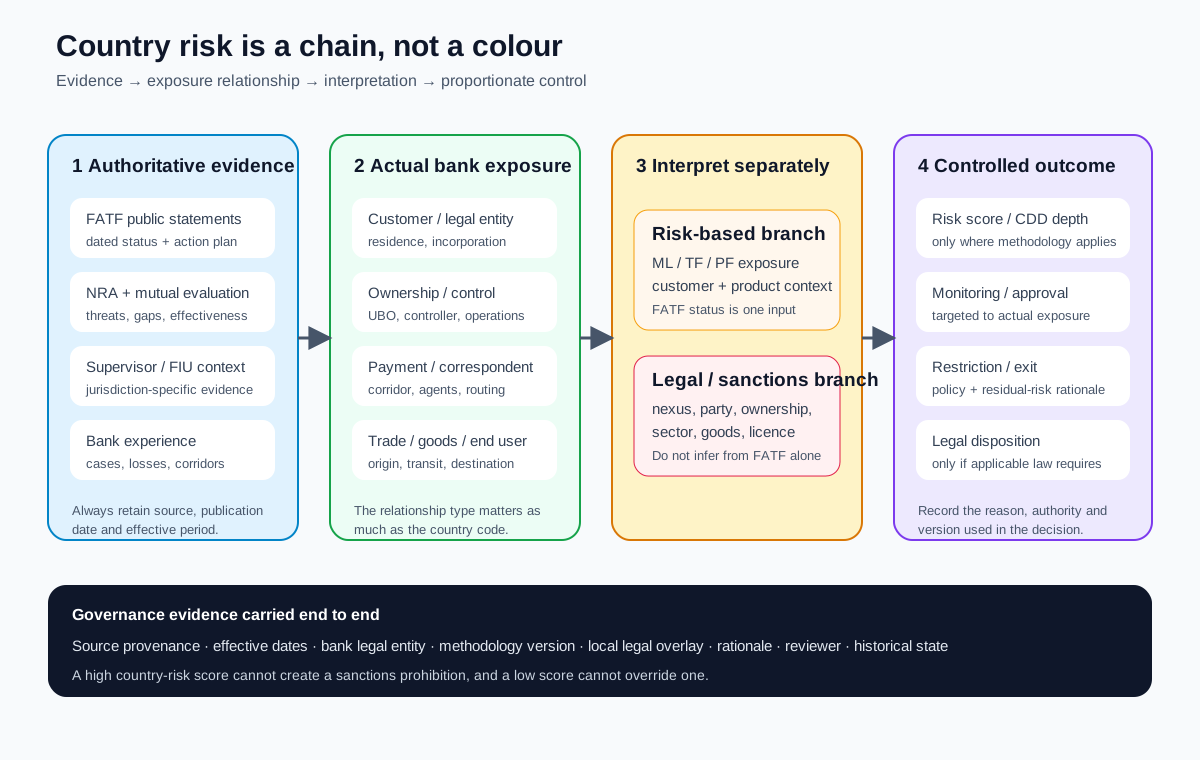
The most important mental model is therefore this: country risk is not a judgement about people from a country. It is an assessment of how a geographic connection changes the bank's exposure to money laundering, terrorist financing, proliferation financing, sanctions, predicate crime, corruption, weak controls or other relevant threats. The bank should know which connection it is assessing, why that connection matters, which source supports the assessment, what legal obligations apply, and what proportionate control response follows.
National risk assessments, FATF Recommendations, mutual evaluations, FATF public statements, domestic high-risk-country rules, sanctions programmes, supervisory publications, law-enforcement intelligence and the bank's own experience can all contribute to this picture. They are different evidence sources, not interchangeable labels. A strong framework keeps those sources distinct enough to preserve their meaning while combining them into a practical decision.
Why country risk matters in a bank
Financial crime is often cross-border even when the customer relationship is domestic. Fraud proceeds can be transferred abroad within minutes. Corruption proceeds may be held through companies in several jurisdictions. Trade-based laundering can separate the location of the payer, seller, goods, shipping route and beneficial owner. Terrorist financing may use small-value remittances through corridors that look ordinary in isolation. Proliferation networks can use front companies, intermediaries and procurement routes that deliberately separate payment from end use. Sanctions evasion can involve ownership chains, transit countries, alternative currencies or financial institutions that are not the obvious final destination.
A bank therefore needs geographic context to decide how much it should know, what it should monitor, where it should escalate and when a legal prohibition may apply. Geography can influence customer acceptance, customer risk rating, beneficial-ownership verification, source-of-funds and source-of-wealth work, correspondent-bank due diligence, product eligibility, transaction monitoring, sanctions screening, trade-finance review, alert prioritisation, periodic review and event-driven review. It can also influence management information, risk appetite, staffing and control investment.
The danger lies at both extremes. If a bank ignores geography, it may miss material exposure. If it treats geography as a blunt blacklist, it can create unnecessary customer harm, financial exclusion and poor risk decisions. FATF's risk-based approach exists partly to avoid both outcomes. Higher risk should receive stronger attention, while lower risk should not automatically receive the same intensity of control. Proportionality is not a relaxation of standards; it is a way of placing control effort where the evidence says it matters most.
Start with three different levels of risk
People often use the phrase “country risk” for several different questions. Separating them immediately improves analysis.
At the national level, authorities ask what money-laundering, terrorist-financing and related risks affect the jurisdiction as a whole. What crimes generate proceeds? Which sectors are vulnerable? How effective are supervision, law enforcement, confiscation, beneficial-ownership arrangements, suspicious-transaction reporting and international cooperation? What cross-border threats matter? A national risk assessment, or another national risk-understanding process, is designed to answer this kind of question.
At the institution level, the bank asks how those national threats intersect with its particular business. A private bank, a domestic retail bank, a trade-finance bank and a payment institution can operate in the same country but have very different exposure. The bank's enterprise-wide financial-crime risk assessment should therefore consider national risk information but translate it through its own customers, products, channels, geographies, legal entities and transaction flows.
At the relationship or transaction level, the bank asks what the geographic facts mean for a particular customer, payment, counterparty or case. A customer incorporated in a higher-risk jurisdiction may have transparent ownership, a simple business model and well-understood activity. A customer incorporated in a lower-risk jurisdiction may suddenly send funds through an unexplained high-risk corridor. The institutional framework should allow both facts to be handled intelligently rather than allowing one static country code to dominate every decision.
This distinction is central to sound design. An NRA is not a customer score. A FATF public statement is not a sanctions list. A mutual evaluation is not a transaction-monitoring rule. A country-risk score is not proof of suspicion. Each is an input with a particular purpose.
What FATF Recommendation 1 actually requires
FATF Recommendation 1 is the foundation of the risk-based approach. The FATF Standards require countries to identify, assess and understand their money-laundering and terrorist-financing risks and to take action, including designating an authority or mechanism to coordinate actions to assess risks and apply resources aimed at ensuring risks are mitigated effectively. The Standards also require financial institutions and other covered sectors to identify, assess and understand their relevant risks and apply mitigating measures proportionate to them.
The detail has evolved. In February 2025 FATF amended Recommendation 1 and related text to strengthen the emphasis on proportionality and to support financial inclusion. The current FATF Recommendations are regularly amended; the version available in 2026 incorporates subsequent changes. This matters to banks because policy documents that quote an old version of Recommendation 1 can gradually diverge from the standard even if the broad risk-based principle remains familiar.
The practical message is more important than memorising wording. Risk assessment is not supposed to be an annual spreadsheet exercise detached from operations. It should influence where the bank spends investigative capacity, how it designs controls, which customers or products require more information, where simplified treatment is justified under applicable law and policy, and how senior management understands residual risk.
A second important point is that FATF does not require every jurisdiction to publish a document formally called a “National Risk Assessment”. FATF's own 2025 NRA toolkit explicitly notes that the Standards require risk identification, assessment and understanding, not a particular document format. Many countries publish NRAs because they are a useful mechanism, but a bank should not conclude that a country has no risk understanding simply because it cannot find a public PDF titled “NRA”. It may need to examine national strategies, sectoral assessments, supervisory publications, threat assessments and mutual-evaluation material.
What a national risk assessment is trying to understand
A strong national risk assessment usually brings together several forms of evidence. It considers the threats capable of generating or moving illicit funds, the vulnerabilities that criminals can exploit, the sectors and products through which value moves, and the effectiveness of existing mitigants. FATF's updated Money Laundering National Risk Assessment Guidance, updated in August 2025, describes risk understanding as an ongoing and dynamic process rather than a one-off exercise. It emphasises structured preparation, evidence gathering, assessment and post-assessment action.
The threat side may include fraud, corruption, drug trafficking, organised crime, cybercrime, tax crime, environmental crime, human trafficking or other significant predicate offences. The relative importance of those threats varies between countries. A large international financial centre may have relatively low levels of domestic predicate crime but high exposure to foreign proceeds. A cash-intensive economy may face different vulnerabilities from a highly digitalised market. A country bordering conflict zones may have particular terrorist-financing or smuggling concerns. A major trade hub may face complex trade-based laundering and sanctions-evasion exposure.
Vulnerability asks where systems can be exploited. Weak beneficial-ownership transparency can make legal persons attractive for concealment. Limited supervisory resources can reduce deterrence. Poor cross-border information sharing can slow investigations. Weak suspicious-transaction-reporting quality can limit financial intelligence. Gaps in asset recovery can reduce the consequences for offenders. A large informal economy may make cash activity harder to distinguish. Vulnerability is not the same as criminality; it describes conditions that can make misuse easier or control less effective.
Consequences may also be considered, depending on the assessment method. A risk can matter because it enables serious crime, undermines financial stability, damages public institutions, threatens national security or creates substantial social harm. Different assessment methods combine threat, vulnerability and consequence in different ways, which is one reason banks should avoid comparing raw NRA scores across countries as though they were produced by one universal formula.
An NRA is evidence, not a universal rating agency
Suppose Country A rates corruption-related laundering “high”, while Country B rates it “medium-high”. It is tempting to convert those labels directly into numeric bank scores. That can be misleading because the countries may use different definitions, data, scoring scales, time horizons and thresholds. Country A may be unusually transparent and willing to publish weaknesses. Country B may have less complete data. A high self-assessed risk can even demonstrate stronger risk understanding rather than weaker controls.
A bank should therefore extract the meaning behind the label. Which threats were identified? Which sectors were exposed? Which data sources were used? What limitations were acknowledged? What actions were recommended? How current is the assessment? Does it cover ML, TF and PF separately? Does it discuss foreign proceeds? Does it identify important corridors or typologies? Are financial institutions expected to take specific action under local law or supervisory guidance?
The bank's country-risk methodology can record that evidence in a structured way, but it should not create false precision. A score such as 83/100 may look scientific while hiding subjective weighting, stale sources and incompatible inputs. Explainability is more valuable than decimal points. A reviewer should be able to understand why the country is classified as higher risk and which controls the classification is intended to influence.
National risk assessments and the bank's enterprise-wide risk assessment
A bank should be able to show a line from national risk understanding to its own risk assessment. If a national assessment identifies authorised push-payment scam proceeds and mule networks as major threats, a retail bank offering instant payments should ask whether its onboarding, device intelligence, payment controls, mule detection and fraud-to-AML hand-offs address those threats. If the national assessment highlights complex legal entities used to launder overseas corruption proceeds, a corporate or private bank should consider beneficial ownership, PEP risk, source of wealth and cross-border structures.
This translation is not automatic. A bank with no cash services may have less direct exposure to a nationally significant cash-smuggling risk. A bank with major remittance activity can have greater exposure to corridors that are immaterial to a domestic mortgage lender. A securities custodian may need to interpret the same national information through different products and intermediaries.
For governance purposes, it is useful to record the chain explicitly: national finding, relevance to the bank, affected customer/product/channel/geography, existing control, residual gap, action, owner and completion date. That turns an external report into auditable risk management rather than a document stored in a policy folder.
Mutual evaluations: technical compliance and effectiveness are different
FATF and FATF-style regional bodies conduct mutual evaluations of jurisdictions. The FATF Methodology distinguishes technical compliance from effectiveness. Technical compliance considers whether the necessary laws, regulations and institutional arrangements are in place. Effectiveness considers whether the system is producing the intended outcomes in practice.
This distinction is extremely useful to banks. A country can have legislation that closely follows international standards while still struggling to produce high-quality financial intelligence, investigate complex laundering, confiscate criminal assets, supervise higher-risk sectors or make beneficial-ownership information reliably available. Conversely, an older technical deficiency may have been addressed since the last published evaluation.
The FATF 2022 Methodology, used for the fifth round of evaluations that began in 2024, was amended again by June 2026. The current evaluation cycle places strong emphasis on risk and effectiveness. A bank using mutual-evaluation information should therefore record the report date, follow-up reports and material subsequent reforms rather than treating the initial rating as permanent.
Mutual evaluations can also help the bank understand why a country presents risk. A poor rating related to non-profit-organisation controls has different implications from a weakness in beneficial ownership, correspondent banking, targeted financial sanctions or money-laundering investigations. Risk decisions improve when the bank uses the underlying finding instead of a single country colour.
FATF public statements: two very different categories
FATF publishes public statements identifying jurisdictions with strategic deficiencies. In common market language these are often called the “grey list” and “black list”, but the official labels matter because they describe different processes and expectations.
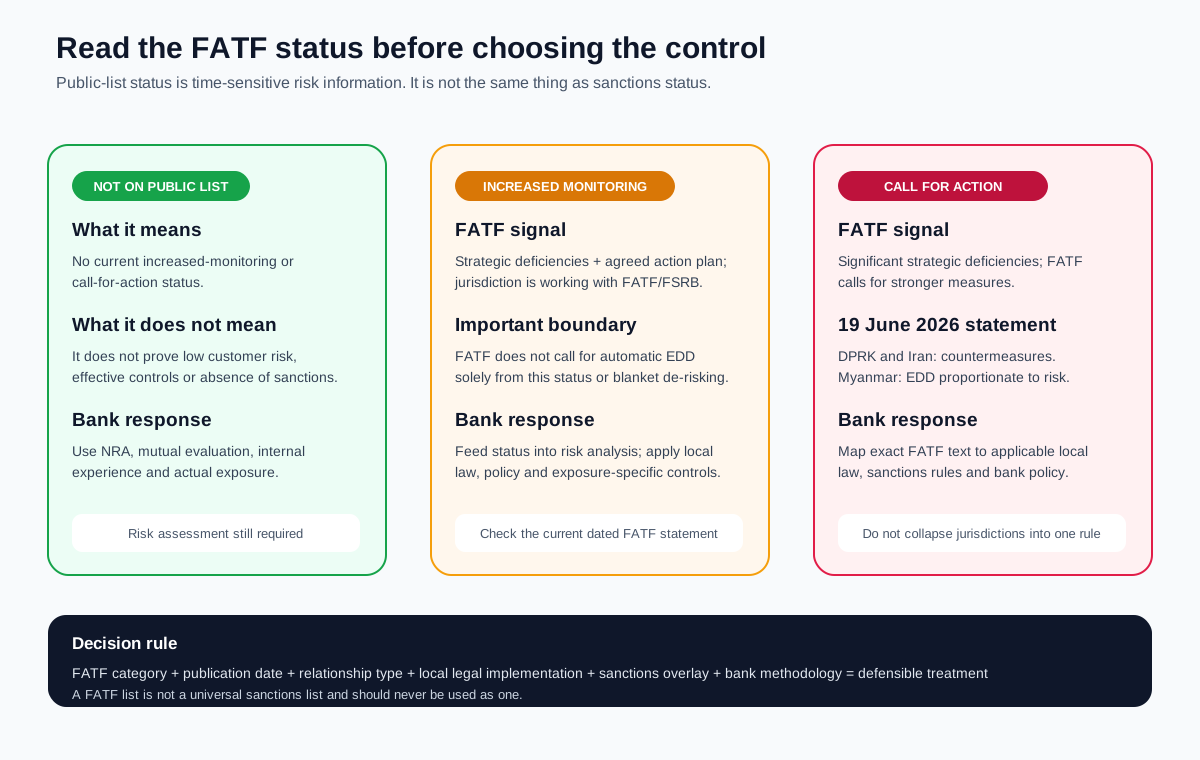
The first category is Jurisdictions under Increased Monitoring. A jurisdiction placed under increased monitoring has committed to work with FATF or the relevant FATF-style regional body to address identified strategic deficiencies within agreed timeframes. It is subject to increased monitoring and has an action plan.
The second category is High-Risk Jurisdictions subject to a Call for Action. These jurisdictions have significant strategic deficiencies, and FATF calls on members and urges jurisdictions to take stronger measures. Depending on the jurisdiction and the current FATF statement, the response can include enhanced due diligence and, in the most serious cases, countermeasures.
As of the FATF Plenary ending 19 June 2026, the call-for-action statement covers the Democratic People's Republic of Korea, Iran and Myanmar, with the required response differing between them. The increased-monitoring statement contains a larger group of jurisdictions working through action plans. Because the lists are updated at FATF plenaries and individual country status can change, the bank should treat the effective date as part of the data, not as a footnote.
What the grey list means — and what it does not mean
A grey-listing is serious. It tells the market that FATF has identified strategic deficiencies and that the jurisdiction has committed to an action plan. It can affect correspondent relationships, investor perception, cost of cross-border finance and supervisory attention. A bank should not ignore it.
But grey-listing is not a finding that every customer, company or transaction connected to that jurisdiction is suspicious. It is not a sanctions designation. It is not a statement that all banks in the country are unsafe. It does not, by itself, prove that a particular customer requires exit.
FATF's public language on increased monitoring is deliberately risk based. FATF states that it does not call for the application of enhanced due diligence merely because a jurisdiction is under increased monitoring and does not call for blanket de-risking. Institutions should take the information into account in their risk analysis. Local law or supervisory rules can of course impose additional requirements, which is why the bank must always layer the FATF statement with jurisdiction-specific obligations.
The distinction became especially useful in the United Kingdom in 2026. UK rules changed on 30 June 2026 so the specific mandatory enhanced-due-diligence treatment tied to FATF country status focuses on countries subject to a FATF call for action, while firms remain required to consider geographic risk and FATF mutual-evaluation information more broadly. That is a UK legal implementation choice, not a universal FATF rule. It illustrates why global banks cannot translate one country's regulatory treatment into a global policy without legal mapping.
The call-for-action list requires closer reading
The high-risk call-for-action statement should not be reduced to one generic red flag either. FATF's current statement differentiates the measures applicable to the jurisdictions it identifies. For the DPRK and Iran, FATF calls for countermeasures. For Myanmar, FATF calls for enhanced due diligence proportionate to the risks and indicates when stronger action may be considered if progress remains insufficient.
A global bank therefore needs to store more than fatf_blacklist = true. The operationally useful object includes the jurisdiction, category, effective date, FATF statement text or rule interpretation, required institutional response under relevant local law, sanctions overlap, policy response, review date and source link. If the system collapses all three jurisdictions into one code, it can lose important differences in legal and policy treatment.
The statement can also evolve without the list of names changing. FATF may adjust the required response or describe new risk information. Change management should compare statement content, not merely compare country names.
FATF status is not sanctions status
This is one of the most important control distinctions in the chapter. FATF public statements concern AML/CFT/CPF strategic deficiencies and the risk response expected under the FATF framework. Sanctions are legal restrictions imposed under specific national, regional or international authorities. They may target countries, territories, persons, entities, sectors, vessels, goods, services or activities.
The two can overlap, but they are not substitutes. A jurisdiction can be under FATF increased monitoring without being subject to broad financial sanctions. A sanctioned person can be located in a country that is not on either FATF public list. A sanctions programme can be targeted rather than country-wide. OFAC explicitly explains that it does not maintain a universal list of countries with which U.S. persons cannot do business; its programmes vary in scope and can be comprehensive or selective.
From an architecture perspective, the lesson is clear: do not build one undifferentiated highRiskCountry flag and feed it simultaneously into AML, sanctions and payment-blocking logic. Store the relevant sources separately, map them to the legal entities and products to which they apply, and let the appropriate decision service determine the outcome.
An AML country-risk factor may increase due diligence or monitoring. A sanctions prohibition may require blocking, rejecting, freezing or another legally specified action. Confusing those outcomes is not merely untidy design; it can create unlawful processing, missed sanctions obligations or unjustified customer exits.
Country exposure is a network, not a passport field
The next step is to define how a customer or transaction can be connected to a country. A single record can contain many meaningful geographic relationships.
For an individual customer, the bank may know residence, nationality, tax residence, place of birth, employer location, business interests, source-of-wealth origin, expected payment corridors and actual device or transaction locations. Not every field should be weighted equally. Nationality can be relevant in some contexts but is a poor substitute for actual economic exposure and can create fairness concerns if used mechanically.
For a legal entity, relevant locations can include incorporation, registered office, headquarters, operating sites, beneficial owners, controllers, directors, major suppliers, customers, assets, source of revenue and tax residence. A company incorporated in a low-risk jurisdiction may conduct nearly all of its activity in higher-risk markets. Another company incorporated in a higher-risk jurisdiction may have transparent ownership, regulated activity and predictable domestic business.
For a payment, geography can enter through the debtor, creditor, ultimate debtor or creditor, debtor and creditor agents, intermediaries, correspondents, addresses, account identifiers, clearing route, currency and remittance context. The payment route can be different from the commercial relationship. A U.S.-dollar transfer between two non-U.S. companies may touch a U.S. correspondent; a cross-border instant payment can route through infrastructure not obvious to the customer.
For trade, the relevant countries may include seller, buyer, manufacturer, origin of goods, destination, ports, vessel registration, transit points, freight forwarders and end user. For virtual assets, relevant geography can involve customer residence, exchange or VASP location, counterparty service provider, IP/device evidence and blockchain exposure, although the meaning of location may be less direct than in traditional banking.
Build the country-risk model from questions, not just indicators
A useful country-risk model starts by defining the decisions it needs to support. Does the model determine customer risk rating? Does it trigger enhanced due diligence? Does it influence correspondent-bank approval? Does it change transaction-monitoring thresholds? Does it restrict a product? Does it support management information only? Different decisions can require different factors and different thresholds.
One source can be FATF status. Another can be mutual-evaluation findings. Others may include national or supranational assessments, corruption and governance information, organised-crime threats, terrorist-financing exposure, proliferation-financing exposure, sanctions context, conflict, secrecy or beneficial-ownership weaknesses, supervisory intelligence and the bank's own losses or cases. External commercial indices may be used where policy permits, but they should not become opaque substitutes for analysis.
The bank then needs a documented methodology. Each factor should have a definition, source, refresh frequency, effective-date treatment, weighting or override logic, owner and intended control consequence. The methodology should explain how conflicting signals are resolved. It should also identify factors that are legal overrides rather than ordinary weighted risk inputs.
For example, if a country receives a relatively favourable composite AML score but an applicable sanctions rule prohibits a particular transaction, the sanctions rule must not be “averaged down”. Conversely, a high corruption indicator should not automatically create a sanctions hold. Separate legal decisioning from risk scoring.
Avoid false precision in country scores
Country-risk models often produce numbers because numbers are easy to rank and automate. The risk is that the numeric output can appear more objective than the evidence actually is.
Suppose a bank assigns FATF status 25%, corruption 20%, sanctions 20%, conflict 10%, mutual-evaluation effectiveness 15% and internal experience 10%. The percentages look disciplined, but important questions remain. Why those weights? Are the underlying scales comparable? Is a one-point difference meaningful? What happens when data is missing? How is a new sanctions restriction handled? Can a country move from medium to high because one public index changed methodology rather than because the real-world risk changed?
The model should therefore be explainable at the factor level. A case analyst or relationship manager should be able to see the main drivers. Model governance should test sensitivity, stability and unintended outcomes. Thresholds should be reviewed against actual cases and business exposure. A human override, where permitted, should require a reason, approval and expiry rather than silently changing the score.
Effective dates are part of the control
Country classifications change. If the bank stores only today's classification, it cannot reliably reconstruct yesterday's decision.
Imagine a payment processed on 10 May and reviewed in an investigation six months later. The analyst may need to know what FATF status, sanctions context and internal country rating applied on 10 May, not only what applies today. The same is true for a customer accepted before a grey-listing, a correspondent relationship approved before a regulatory change or a transaction processed shortly after a delisting.
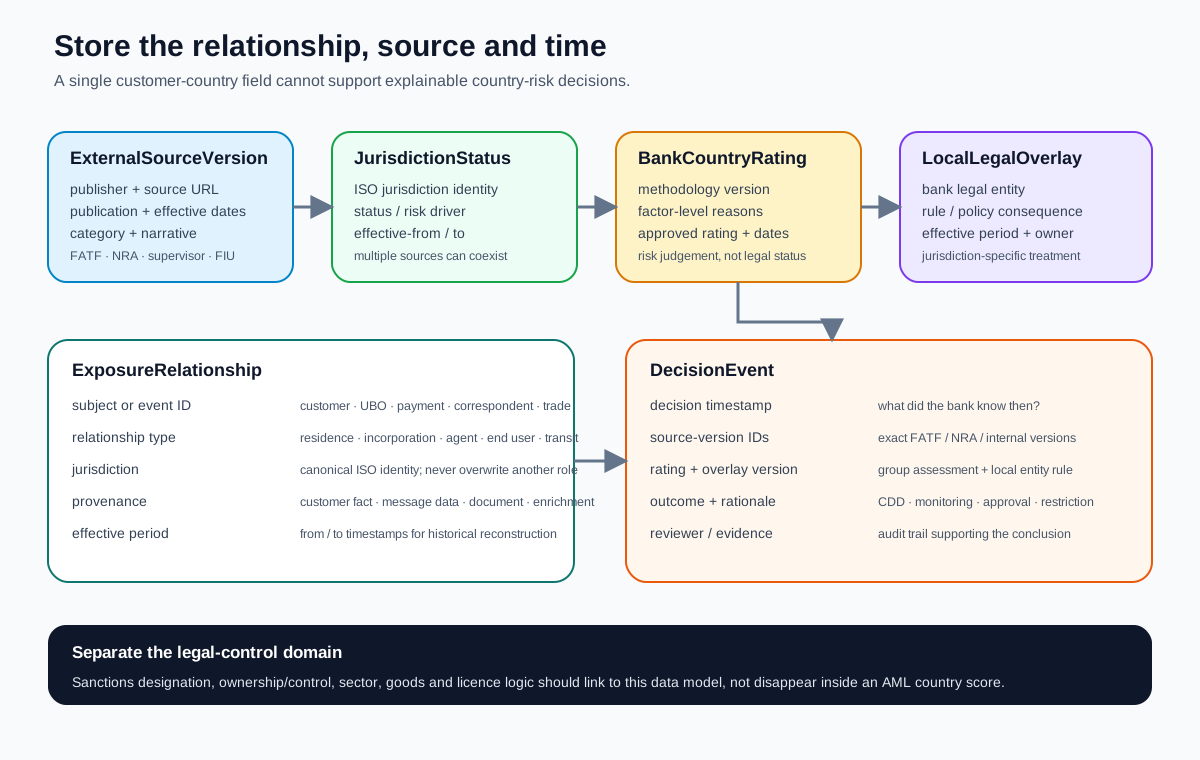
A mature country-risk service therefore uses effective-dated records. At minimum it should preserve jurisdiction code, source, classification, effective-from date, effective-to date, version, rationale and approval metadata. Downstream decisions should ideally record which version was used. This supports investigations, audit, quality assurance and regulatory explanation.
Historical reconstruction is especially important when the bank changes methodology. If the score moves because the weighting changed, that is different from a country becoming riskier. MI should be able to distinguish methodology-driven movement from external-risk movement.
Country codes and identity are less trivial than they look
Systems also need to agree on what a “country” is. ISO country codes are useful, but data sets can differ in how they treat territories, dependencies, disputed areas or legacy codes. FATF statements may use one naming convention, sanctions authorities another, customer master data another and payment messages another.
A bank should maintain a governed jurisdiction master with aliases and source mappings. The goal is not political interpretation; it is control consistency. If one system calls a territory by a short code and another uses a different name, the mapping should still lead to the correct risk record where legally and operationally appropriate.
Free-text addresses create another challenge. A payment message may contain a city but no country. A customer may use an address containing abbreviations or transliteration. Geocoding can assist but should not silently invent legal conclusions. The system should preserve the original data, the derived geography, confidence and derivation method where derived location affects a control decision.
Customer onboarding and KYC
At onboarding, geographic risk should help determine what the bank needs to understand. For a straightforward domestic salaried customer, residence and expected payment behaviour may be sufficient for the geographic component of risk. For a complex corporate group, the bank may need to understand incorporation, operating markets, ownership, customers and suppliers, source of funds, source of wealth and expected corridors.
A higher country-risk rating can justify enhanced evidence, but the bank should articulate the question it is trying to answer. If beneficial-ownership transparency is a known weakness in the relevant jurisdiction, stronger independent verification of ownership may be appropriate. If corruption and public procurement are major risks, PEP connections, source of wealth and government-contract exposure may matter. If TF risk is material in a corridor, the bank may need different monitoring and escalation than it would for corruption risk.
This is more useful than a generic instruction to “obtain one additional document for high-risk countries.” Extra paperwork does not necessarily mitigate the risk. Good EDD is targeted evidence designed to reduce uncertainty about the specific threat.
Periodic and event-driven review
Country risk changes after onboarding. A jurisdiction may be added to a FATF list, removed from one, become subject to new sanctions, experience conflict, receive a new NRA or publish a mutual-evaluation follow-up. A customer's own geography can also change because of new owners, suppliers, markets or payment corridors.
The bank needs rules for when those changes trigger review. Not every country-score movement should force immediate full KYC refresh across thousands of customers. The response should be based on materiality, legal requirements and risk. A call-for-action change may warrant urgent assessment. A small adjustment to a composite score may be handled at the next scheduled review unless other factors are present.
Event-driven review logic should be testable. It should define which customers are in scope, what action is required, the SLA, the owner and how completion is evidenced. If the change affects sanctions or another legal prohibition, the response may need to be immediate and separate from ordinary KYC review.
Payments: where country risk enters the lifecycle
Payments bring geography into real-time operations. At initiation, the bank can have customer profile data, beneficiary details, country, purpose, amount, currency and channel information. During routing it may add agent and correspondent information. Screening can generate sanctions or other list matches. Monitoring can compare the transaction with expected corridors, historical behaviour and typologies. Post-event investigation can use richer context from linked transactions, counterparties and customer records.
The bank should avoid using a country score as a crude payment veto unless law or explicit policy requires that outcome. For many AML purposes the score is better used as one feature in detection and prioritisation. A new high-risk corridor combined with rapid pass-through activity, newly added beneficiaries and profile mismatch is more informative than geography alone.
Instant payments make this harder because the decision window is short. The institution may have to separate controls that can operate synchronously before execution from controls that run near-real-time or post-event. A high-risk geography can influence real-time fraud or sanctions controls, but AML suspicion often requires broader context than a single transaction can provide.
Correspondent banking deserves special treatment
Correspondent banking can expose one institution to activity originating from customers it does not directly onboard. The Basel Committee's current AML/CFT guidance recognises that correspondent banks generally have a direct relationship with the respondent bank, not with every customer of the respondent, and should perform due diligence on the respondent proportionate to its risk profile.
Country information therefore matters in several layers. The respondent's home jurisdiction matters, but so do its customer base, products, management and controls, regulatory environment, downstream relationships, payment corridors and the quality of information available. A respondent in a higher-risk jurisdiction is not automatically unacceptable. The correspondent needs to understand whether the respondent's control framework and the correspondent's own monitoring can manage the exposure.
Nested relationships can increase uncertainty because other financial institutions access the correspondent indirectly through the respondent. Payable-through arrangements can create additional exposure. Higher-risk corridors can also require closer understanding of underlying activity. Country risk should therefore connect to correspondent due diligence, transaction monitoring and periodic relationship review rather than exist as a separate score with no operational consequence.
Trade finance and country exposure
Trade illustrates why geography cannot be reduced to payer and payee. A buyer can be in Country A, seller in Country B, goods manufactured in Country C, shipped through Country D, financed by a bank in Country E and destined for an end user in Country F. The payment message may reveal only part of that chain.
For AML, the bank may consider whether the trade makes commercial sense, whether counterparties fit the customer's business, whether invoice values or routes are unusual and whether the activity matches expected volumes. For sanctions and proliferation financing, goods, end user, shipping route, vessel and licensing information may be critical. Those controls require separate legal and technical expertise even though they share geographic data.
A country-risk engine should therefore be able to accept different exposure types rather than return one undifferentiated answer. Country F = high risk is less useful than end-use exposure to Country F requires trade-sanctions review under policy X or counterparty exposure to Country B increases AML risk weighting but does not itself prohibit the transaction.
Cards, merchants and digital channels
Country exposure also appears outside traditional cross-border transfers. Card transactions can show merchant country, acquirer country, device location and customer residence. Merchant acquiring can involve merchant establishment, website customers, settlement accounts, business operations and beneficial owners in different places. Digital banking adds IP and device geolocation, although technical location signals can be spoofed and should be treated as evidence with confidence rather than fact.
A customer whose phone appears abroad while travelling is not necessarily high risk. Repeated device activity in a country inconsistent with declared residence and business, combined with unusual payment flows, may be more meaningful. The control should combine signals and consider plausible explanations.
Geographic analytics should also be designed carefully to avoid inappropriate discrimination. The purpose is to identify risk-relevant exposure, not to judge individuals by nationality or ethnicity. Governance should review whether proxies are producing unfair or unjustified outcomes.
Risk appetite and country restrictions
Boards and senior management may decide that certain country exposures exceed the institution's risk appetite even where the law does not prohibit them. This is a legitimate risk-management choice if it is clearly distinguished from a legal obligation and applied through controlled governance.
For example, a bank might decide not to offer a complex trade product into a particular high-risk corridor because it lacks the specialist capability to assess the risk. Another bank with deeper trade expertise may accept the same corridor with stronger controls. Risk appetite should reflect capability as well as inherent risk.
The policy should state whether a country classification causes prohibition, senior approval, enhanced due diligence, restricted products, transaction limits, increased monitoring, more frequent review or simply a scoring uplift. Ambiguous labels such as “restricted country” can lead different teams to make inconsistent decisions.
Customer communications also matter. If the decision is a bank risk-appetite decision rather than a legal prohibition, staff should not tell the customer that “the regulator does not allow it” unless that is actually true. Accuracy protects trust and reduces legal and conduct risk.
The grey-list response playbook
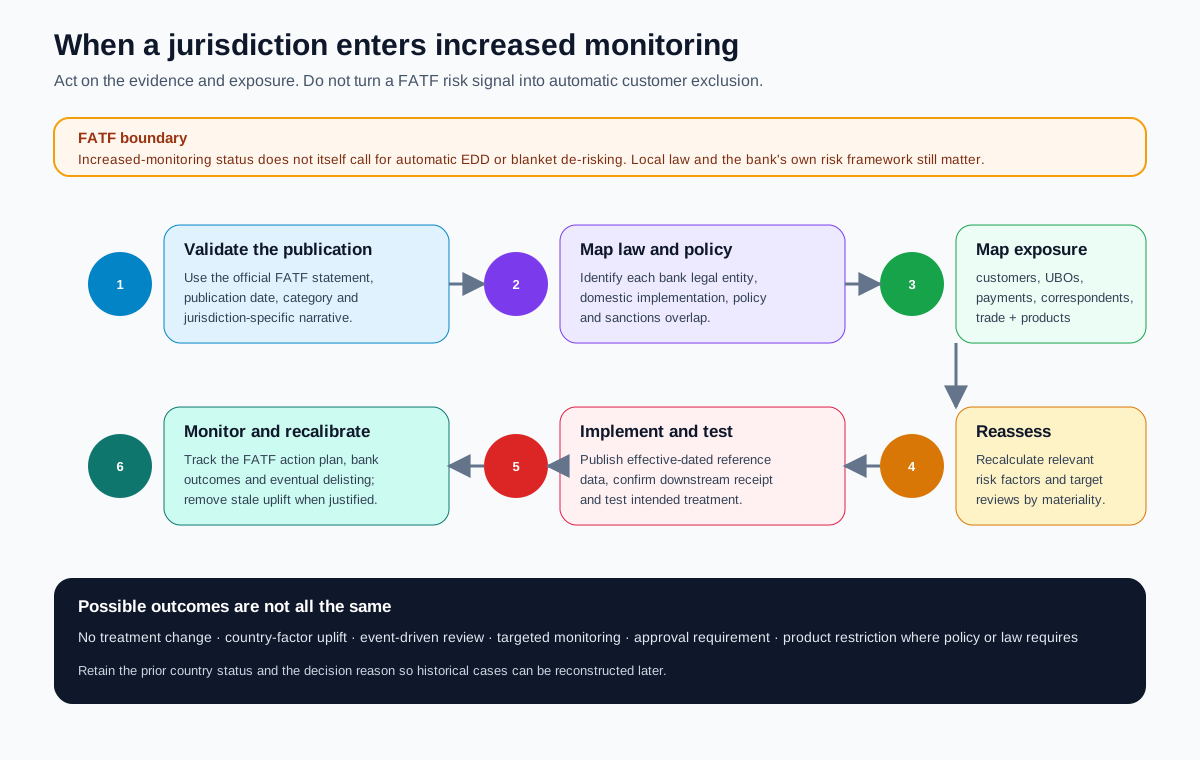
When a jurisdiction enters increased monitoring, a mature bank avoids panic. It first assesses its exposure: customers, beneficial owners, counterparties, correspondents, branches, products, corridors and open cases. It determines what the new FATF statement actually says and checks the legal requirements of the jurisdictions in which the bank operates.
It then decides whether customer risk scores, due-diligence requirements, correspondent reviews, monitoring scenarios or management reporting need adjustment. The bank may contact correspondent partners where necessary to explain its controls rather than allowing assumptions to drive de-risking. It should track the jurisdiction's action plan and subsequent FATF statements so that improvements and eventual delisting can also be reflected.
A proportionate response can still be strong. It may include targeted file reviews, increased monitoring of relevant corridors, enhanced beneficial-ownership verification or senior approval for particular products. The point is that the measures are linked to the identified deficiency and actual exposure rather than applied blindly to every person connected to the country.
De-risking can hide risk instead of reducing it
Blanket exits can sometimes reduce a bank's exposure, but they can also shift activity into less transparent channels. FATF has repeatedly warned about unintended consequences of indiscriminate de-risking, including impacts on financial inclusion, remittances and legitimate non-profit activity.
This does not mean banks must maintain every relationship. A bank can decide that it cannot manage a particular risk or cannot obtain sufficient information. The important point is that the decision should be evidence based. If the customer is exited, the record should show why: legal prohibition, inability to complete CDD, unacceptable residual risk, policy restriction, suspected financial crime or another defined reason.
The distinction matters operationally because those reasons can trigger different reporting, communication and future-onboarding consequences. Treating every country-related exit as “sanctions” corrupts data and can create inappropriate permanent exclusion.
Humanitarian and remittance considerations
Country controls can affect people who have no connection to financial crime. Remittances may support families. Non-profit organisations may deliver humanitarian assistance in difficult environments. Legitimate businesses may depend on cross-border suppliers in countries facing heightened scrutiny.
FATF's current statements explicitly recognise the importance of not unnecessarily disrupting legitimate humanitarian assistance, NPO activity and remittances. United Nations sanctions frameworks can also include humanitarian exemptions. A bank should therefore build legal exceptions, licences and risk-based review into its control framework where applicable rather than assuming that “higher risk” means “nothing may move”.
This is a good example of why legal, sanctions and AML teams need shared data but separate decision logic. A payment can involve a high-risk jurisdiction and still be lawful and legitimate. The bank's task is to identify and manage the real risk without ignoring binding restrictions.
Transaction monitoring and detection design
Country risk can be a useful transaction-monitoring feature when combined with behaviour. Scenarios might consider new or unexpected corridors, rapid movement through multiple jurisdictions, activity involving countries inconsistent with the customer's business, repeated transfers through higher-risk correspondents, cross-border cash-equivalent activity or unusual combinations of country, product and counterparty.
Static rules such as “alert every payment involving a high-risk country” often produce overwhelming false positives. The more useful approach combines geography with amount, velocity, customer risk, peer behaviour, counterparty history, purpose, product and typology. A modest payment to a long-standing supplier in a declared market may be less concerning than repeated new beneficiaries and immediate onward movement through the same corridor.
Scenario documentation should explain why the geography matters. The control should also define what happens when a country rating changes. Does the threshold change immediately? Are historical transactions reconsidered? Is a lookback required? Who approves tuning? How is model performance monitored? Those are requirements questions, not only compliance questions.
Alerts, cases and investigations
An alert caused partly by country risk should never be closed or escalated solely because the country is “red”. The investigator should understand the customer, exposure type, transaction purpose, counterparties and relevant risk source.
A good case record distinguishes external facts from internal judgement. “Country X is under FATF increased monitoring effective 19 June 2026” is an external fact. “This increases concern because the customer's unexplained new activity uses a sector identified in the action plan” is analysis. “The activity is suspicious” is a case conclusion requiring the full evidence set.
If local law requires a suspicious transaction or activity report, the reporting decision should be based on the applicable suspicion threshold, not simply the geographic classification. Sanctions reporting or blocked-asset reporting follows separate legal rules. A single case can involve both AML and sanctions, but the system should retain the different legal bases and actions.
A realistic mini case: one company, six country signals
Consider Northbridge Components Ltd, an industrial-parts wholesaler incorporated in a jurisdiction the bank rates as medium risk. The company has traded with the bank for four years. Its beneficial owners live in the same country, its audited accounts are consistent with declared turnover and its historical payments have mainly involved suppliers in neighbouring markets.
A new payment pattern emerges. Northbridge begins sending larger U.S.-dollar payments to a distributor incorporated in a jurisdiction that has recently entered FATF increased monitoring. The distributor's bank is in a third jurisdiction. Shipping documents attached to one trade-finance request show goods transiting through a fourth country. An ultimate end user appears in a fifth country associated with heightened export-control concerns. The payment will clear through a U.S. correspondent, creating a sixth legal and operational connection.
A simplistic country model might produce six alerts and still fail to answer the real questions. A better analysis separates them. The FATF grey-list connection increases AML risk understanding but is not itself a sanctions prohibition. The end-use country may require export-control or sanctions specialist review depending on goods and law. The U.S. correspondent route creates a U.S. sanctions nexus that legal and sanctions teams may need to consider. The unusual change in customer activity creates an AML profile mismatch that transaction monitoring should assess.
The investigator obtains the commercial contract, invoice, goods description, beneficial-ownership information and explanation for the new distributor. The customer explains that it won a legitimate contract requiring a new supply route. Independent checks confirm the distributor's ownership and business presence. The goods are ordinary industrial components, not controlled items under the applicable review, and no sanctions prohibition is identified. The transaction can therefore be legitimate even though several country-risk signals are present.
Now change one fact. The distributor's ownership cannot be verified, the invoice describes goods vaguely, the payment is materially above market expectations, and funds are repeatedly returned through another company linked to the customer. The same country exposures now sit inside a much stronger suspicious pattern. Country risk has become useful because it is combined with ownership, transaction and behavioural evidence.
The mini case demonstrates the correct order: identify every meaningful geographic connection, determine which risk or legal framework each connection affects, obtain evidence, apply the appropriate control, and document the conclusion. Geography frames the questions; it does not answer them by itself.
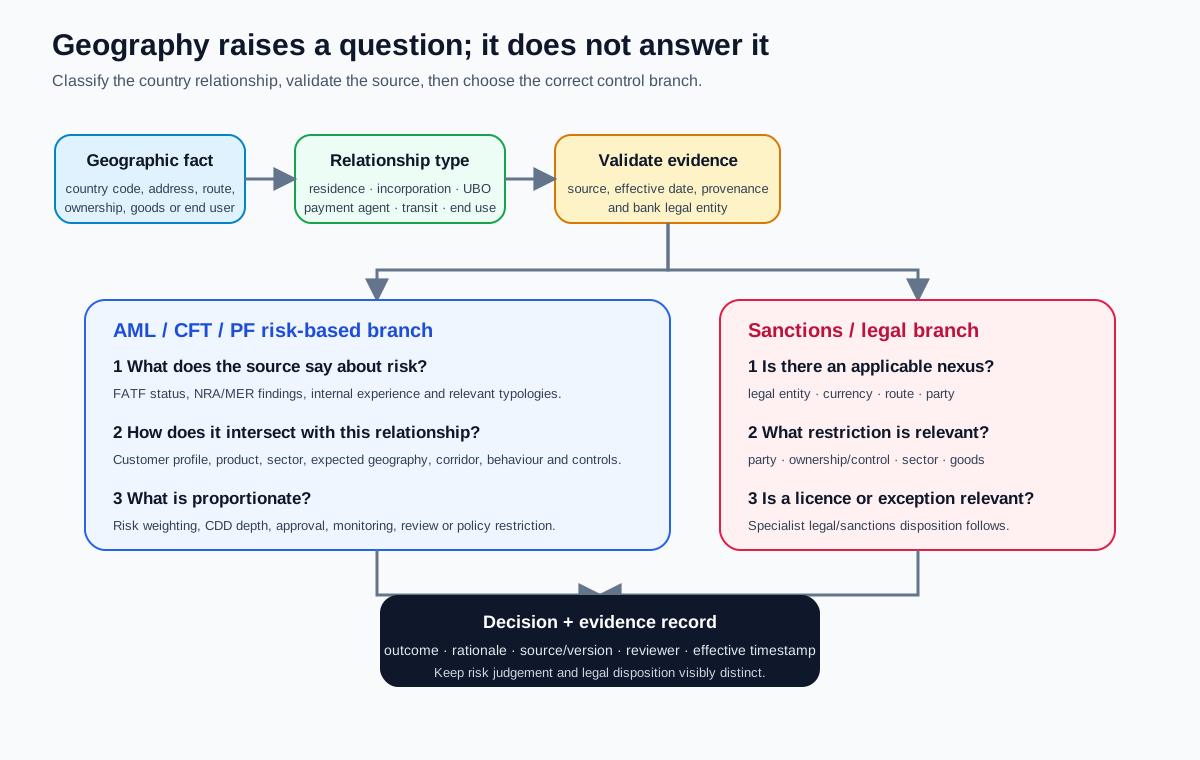
Local law can change the same FATF fact into different obligations
Global banks need a jurisdiction matrix because the same FATF status can have different regulatory consequences in different legal entities. One country may incorporate FATF lists directly into mandatory EDD requirements. Another may require firms to treat them as a risk factor. A third may maintain its own high-risk-country list or supervisory expectations.
The United Kingdom's June 2026 change is a useful example precisely because it changed the relationship between FATF status and mandatory EDD. Before the change, UK high-risk-third-country treatment had been tied to both FATF public lists. From 30 June 2026, the specific rule was amended to focus on FATF call-for-action countries, while geographic risk and mutual-evaluation information remain relevant to the wider risk-based assessment. A policy written for the old rule could therefore become incorrect even though the FATF list itself had not changed.
A bank operating in several countries should maintain a controlled mapping from external source to local obligation. The mapping should record legal entity, jurisdiction, regulation or guidance, trigger, required action, effective date, owner and legal interpretation. Global policy can set a minimum framework, but local overlays determine where law is more specific.
This is also why a global “country blacklist” spreadsheet emailed to operations is not sufficient. Operations need executable rules tied to the correct entity and product.
Sanctions programmes make country logic even more complex
Sanctions further demonstrate why country risk and legal restrictions must remain separate. OFAC states that U.S. sanctions programmes can be comprehensive or selective and that it does not maintain one universal country list. Other sanctions authorities use their own legal structures. Restrictions may depend on ownership, sector, goods, services, financing, vessels or activity rather than simple location.
A bank therefore should not treat a country's absence from a broad embargo list as evidence that sanctions risk is absent. Nor should it assume every resident of a sanctioned or partially sanctioned jurisdiction is a designated person. The sanctions engine needs current programme rules and party screening; the AML country-risk framework needs broader risk analysis.
The systems can share reference data. A sanctions programme change may also affect the bank's country-risk assessment because it changes exposure and evasion risk. But the decision records should preserve the distinction between risk increased and transaction legally prohibited.
Data architecture: build a governed country-risk service
For architects and BAs, the clean design pattern is a governed country-risk service rather than scattered spreadsheets and hard-coded lists. The service can ingest authoritative sources, internal assessments and approved local overlays, then publish effective-dated classifications to consuming systems.
The core data object might include jurisdiction identifier, exposure type, source type, source URL, source publication date, bank assessment, reason codes, effective-from and effective-to dates, legal overlay, risk-appetite restriction, approval, version and review date. Not every consumer needs every field, but the master should retain enough information to explain the decision.
Customer systems may consume country risk for onboarding and periodic review. Payment monitoring may consume it as a feature. Correspondent-banking tooling may use a more specialised view. Trade systems may combine it with goods and shipping data. MI platforms may aggregate exposure. Sanctions systems should receive legal programme data through the sanctions control architecture rather than relying solely on the AML country score.
APIs should return both value and metadata. risk=HIGH without reason or effective date is weak. A richer response might say that the country is high due to FATF call-for-action status plus internal TF/PF assessment, effective 19 June 2026, and that a UK legal-entity consumer must apply a particular rule while another entity has a different overlay. The exact implementation depends on architecture, but the principle is explainability.
Data lineage and source governance
Every material country classification should be traceable to its sources. If FATF changes a public statement, the bank should know which data record changed, which systems consumed it and which customer or payment decisions might be affected.
Source governance should define whether data is manually curated, vendor supplied or automatically ingested. Vendor data can improve speed and coverage, but the bank remains responsible for understanding what it is using. If a vendor changes methodology or code mapping, the impact should be assessed before production deployment.
Data-quality controls should cover completeness, duplicate jurisdictions, code mapping, effective dates, stale records and failed distribution. Reconciliation between the master and downstream systems can identify cases where one platform still uses an older classification.
A control can be legally correct at source and operationally wrong downstream because the update failed to propagate. That is why data lineage is a financial-crime control issue, not merely an IT quality issue.
Change management when a country status changes
Country-status changes are predictable enough that banks should have a playbook. FATF plenary dates are known in advance. Mutual-evaluation reports and follow-ups are published. Sanctions changes can be less predictable but should still enter a controlled change process.
The first stage is intelligence: identify the source and confirm authenticity. The second is interpretation: determine what changed and whether local law creates a mandatory action. The third is impact analysis: identify affected legal entities, products, customers, correspondents, rules and cases. The fourth is approval: compliance, legal, risk and business owners approve the response. The fifth is implementation: update reference data, rules, procedures and communications. The sixth is validation: test that the change reached all consumers and produced intended outcomes. The final stage is monitoring: review volumes, customer impact, exceptions and emerging issues.
Emergency changes may compress those stages but should not eliminate evidence. A production update made quickly still needs a source, approval, test and retrospective validation.
Roles and governance
Country risk crosses organisational boundaries. Financial-crime compliance typically owns or challenges the methodology. Sanctions specialists own sanctions interpretation. Legal teams advise on binding obligations. Business lines own first-line application and customer decisions within policy. Data and technology teams implement the reference service and downstream rules. Model-risk or validation teams may review scoring methodology. Internal audit provides independent assurance.
Senior management should understand material exposure and exceptions. Risk committees may approve methodology, appetite and major changes. Where a country restriction materially affects customers or markets, conduct and reputational considerations can also be relevant.
The three-lines model works only when ownership is specific. “Compliance owns country risk” is too vague if operations do not know who must update a payment rule or who approves a customer exception. A RACI should name the action, not merely the topic.
Management information that actually helps
Useful MI goes beyond the number of customers linked to high-risk countries. The bank should understand exposure by type: residence, incorporation, beneficial ownership, transaction corridor, correspondent, trade route and product. It should know how much exposure is new, how much is legacy, which controls apply and where exceptions exist.
Trend information is valuable. Did a grey-listing cause a sudden rise in alert volume? Did false positives increase after a country-score change? Are relationship managers submitting more exception requests? Has customer attrition changed? Are correspondents asking questions? Are backlogs developing in event-driven reviews?
The MI should distinguish legal prohibitions from risk-based restrictions. Otherwise senior management may believe that customer exits are legally required when they are actually policy decisions. That distinction can affect risk appetite, resource allocation and customer strategy.
Testing the country-risk framework
Testing should begin with source ingestion. When FATF adds, removes or changes a jurisdiction, does the master update with the correct effective date? Are aliases and ISO codes mapped correctly? Does a failed source feed generate an alert rather than silently leaving stale data?
Next test decision logic. Does increased monitoring create the intended risk effect without triggering sanctions blocking? Does call-for-action status produce the correct local-law treatment for each legal entity? Do sanctions overrides remain separate? Does a country removal end the classification at the correct time without rewriting history?
Then test customer journeys. A new customer with one high-risk exposure should receive the required KYC steps. A legacy customer affected by a material change should enter the correct event-driven review queue. An unaffected customer should not be pulled into review because of a loose mapping.
Payment testing should cover debtor, creditor, ultimate parties, agents, intermediaries and free-text country indicators where used. Trade testing should include origin, destination and transit. Correspondent testing should include respondent and nested relationships where relevant.
Finally, test negative cases. A grey-listed country should not automatically create a sanctions match. A nationality alone should not create a prohibition unless a specific rule legitimately requires it. A country that was removed from a list should not remain high because a cache was not refreshed. A historical case should still reproduce the classification that applied at the decision date.
BA acceptance criteria that expose weak design
A BA can improve a country-risk implementation by making the expected behaviour explicit. Requirements should state the authoritative source, update frequency, effective-date rule, exposure type, consuming system, decision consequence, local overlay and audit evidence.
A useful acceptance criterion is not “the system shall flag high-risk countries”. It is closer to: when an approved country-risk record becomes effective, the customer-risk engine shall use the new classification for new calculations from that effective time while retaining the prior version for historical reconstruction; the payment-monitoring engine shall consume the updated feature within the agreed SLA; sanctions decisioning shall remain governed by sanctions rules and shall not treat the AML classification as a sanctions prohibition.
Another criterion can address delisting: when a country leaves increased monitoring, the risk service shall end-date the FATF status, recalculate affected risk scores according to policy, preserve previous decisions and route any required customer-review changes without automatically cancelling unrelated controls.
Requirements like these force teams to confront timing, lineage, separation of concerns and historical auditability before production.
Common failure modes
The first failure mode is equating country with nationality. Nationality can be one data point, but the risk usually concerns actual economic, transactional or legal exposure. Mechanical nationality rules can be both weak controls and unfair treatment.
The second is treating the FATF grey list as an automatic prohibition. That misstates FATF's own risk-based position and can create unnecessary de-risking unless local law or policy independently requires stronger action.
The third is treating FATF lists and sanctions as the same thing. They are different frameworks with different legal effects.
The fourth is using one current country score with no history. Without effective dates, investigations and audits cannot reconstruct past decisions.
The fifth is hard-coding country names in multiple systems. This guarantees inconsistency when lists change.
The sixth is using a composite score without reasons. Analysts then see a red number but cannot explain what threat it represents.
The seventh is failing to distinguish external source changes from methodology changes. A country may move risk bands because the bank changed weights, not because the country changed.
The eighth is adding documents instead of mitigating risk. EDD should answer the specific uncertainty, not merely increase paperwork.
The ninth is ignoring the customer and operational impact. Large-scale review triggers can create backlogs, delayed payments and financial exclusion if capacity is not planned.
The tenth is failing to recalibrate after improvement. A risk-based approach should be capable of reducing control intensity when justified, not only increasing it.
A practical decision sequence
When country exposure appears, the analyst or system should be able to answer seven questions in sequence.
First, what is the exposure? Is it residence, incorporation, beneficial ownership, payment corridor, agent, correspondent, trade route, device location or another connection?
Second, which source makes the country relevant? Is it an NRA finding, FATF status, mutual-evaluation weakness, sanctions measure, supervisory rule, internal typology or risk appetite decision?
Third, how current is that source? What is its effective date and has it been superseded?
Fourth, what does the source actually say? A strategic AML deficiency is different from a legal prohibition.
Fifth, what local law applies to the bank entity and product?
Sixth, what other evidence changes the risk? Customer profile, ownership, transaction behaviour, purpose and counterparties may strengthen or weaken the concern.
Seventh, what is the documented outcome? Standard treatment, EDD, increased monitoring, senior approval, product restriction, investigation, report, sanctions action, customer exit or no additional action.
Following this sequence prevents the country label from becoming the decision itself.
What good looks like
A mature bank can explain its country-risk framework in plain language. It knows which external sources it uses and why. It distinguishes FATF status from sanctions. It understands its own exposure rather than copying a public list. It maintains effective-dated data and local legal overlays. Its customer and payment systems consume the same governed reference data. Its investigators can see the reason behind a score. Its controls become stronger when risk increases and can be recalibrated when risk reduces.
The bank also understands uncertainty. No national assessment is complete. Public lists are necessarily selective. Criminal networks adapt. Data can be stale or incomplete. A risk-based approach therefore needs judgement, monitoring and feedback from actual cases.
Country risk is most useful when it helps the institution ask better questions. Why is this customer connected to this market? Does the activity match the business? What weakness does the external source identify? Which legal rule applies? Do we understand the ownership and counterparties? Is the route commercially plausible? Can our controls manage the residual risk?
Those questions are more powerful than any red, amber or green country map.
References and further reading
The following sources were used for the standards, current FATF status and practical control context in this chapter. Country status and legal requirements can change, so practitioners should always consult the current official version before making a live decision.
- FATF, The FATF Recommendations, current version amended June 2026: https://www.fatf-gafi.org/en/publications/Fatfrecommendations/Fatf-recommendations.html
- FATF, Money Laundering National Risk Assessment Guidance, updated 28 August 2025: https://www.fatf-gafi.org/en/publications/Methodsandtrends/Money-Laundering-National-Risk-Assessment-Guidance.html
- FATF, Money Laundering National Risk Assessment Toolkit – Annexes A-C: https://www.fatf-gafi.org/en/publications/Methodsandtrends/Money-Laundering-National-Risk-Assessment-Toolkit-Annexes.html
- FATF, Terrorist Financing Risk Assessment Guidance: https://www.fatf-gafi.org/en/publications/methodsandtrends/documents/terrorist-financing-risk-assessment-guidance.html
- FATF, The 2022 and 2013 Methodologies for Assessing Technical Compliance and Effectiveness, 2022 Methodology amended June 2026: https://www.fatf-gafi.org/en/publications/Mutualevaluations/Fatf-methodology.html
- FATF, Jurisdictions under Increased Monitoring – 19 June 2026: https://www.fatf-gafi.org/en/publications/High-risk-and-other-monitored-jurisdictions/increased-monitoring-june-2026.html
- FATF, High-Risk Jurisdictions subject to a Call for Action – 19 June 2026: https://www.fatf-gafi.org/en/publications/High-risk-and-other-monitored-jurisdictions/call-for-action-june-2026.html
- FATF, Outcomes FATF Plenary, 17–19 June 2026: https://www.fatf-gafi.org/en/publications/Fatfgeneral/outcomes-fatf-plenary-june-2026.html
- Basel Committee on Banking Supervision, Anti-money laundering and counter-terrorist financing – correspondent banking guidance: https://www.bis.org/committees/bcbs/basel-consolidated-guidelines/module/afs/10
- HM Treasury, Money Laundering Advisory Notice: June 2026, for the UK-specific legal example discussed in this chapter: https://www.gov.uk/government/publications/money-laundering-advisory-notice-high-risk-third-countries--2/money-laundering-advisory-notice-high-risk-third-countries--2
- Office of Foreign Assets Control, Where is OFAC's Country List?, for the distinction between geographic and targeted sanctions programmes: https://ofac.treasury.gov/sanctions-programs-and-country-information/where-is-ofacs-country-list-what-countries-do-i-need-to-worry-about-in-terms-of-us-sanctions
Topic 13 Advanced Practice — National Risk Assessments, FATF Lists and Country Exposure
Country risk is useful only when the bank can explain which connection to the country matters, what source created the concern, when that source became effective, which legal entity is affected, and what proportionate control response follows. A single “high-risk-country = yes” flag is rarely enough.
1. Build country risk from separate evidence domains
Do not collapse every source into one undifferentiated country label. A governed model can keep separate domains such as:
- national risk assessment findings;
- FATF mutual-evaluation and follow-up information;
- FATF increased-monitoring status;
- FATF call-for-action status;
- sanctions restrictions;
- terrorist-financing and proliferation-financing exposure;
- corruption and public-sector integrity risk;
- organised-crime and predicate-offence threats;
- tax-transparency or secrecy concerns where relevant;
- conflict/security conditions;
- supervisory or law-enforcement intelligence;
- the bank's own transaction, customer and correspondent experience.
The composite country rating can use those inputs, but downstream users should still be able to see the reasons behind it.
2. FATF public statements are time-sensitive risk information
As of 19 June 2026, FATF's high-risk call-for-action statement identifies the DPRK, Iran and Myanmar, with different stated treatment. FATF's increased-monitoring statement of the same date identifies jurisdictions working under action plans to address strategic deficiencies.
The operational lesson is not to memorise today's list. It is to design for change.
FATF normally updates public identification following plenaries. A bank therefore needs:
- authoritative source URL/reference;
- publication date;
- effective/internal activation date;
- status type;
- jurisdiction code;
- narrative/reason;
- previous status;
- downstream impact assessment;
- historical retention.
A bank should never overwrite the old country record and lose the status that existed when a historical customer or payment decision was made.
3. Increased monitoring does not equal automatic de-risking
FATF's June 2026 increased-monitoring statement explicitly says FATF does not call for automatic enhanced due diligence solely because a jurisdiction is under increased monitoring and does not envisage cutting off entire classes of customers. The information should be taken into account in risk analysis using a risk-based approach.
This matters in requirements.
Poor rule:
If FATF grey list = yes, reject onboarding.
Better design:
FATF increased-monitoring status shall contribute to the configured country-risk assessment; resulting due-diligence, approval and monitoring requirements shall follow the bank's jurisdiction-specific risk methodology and applicable law.
That preserves the distinction between an external risk signal and the bank's decision.
4. Call-for-action status is more serious but still requires precise implementation
FATF's call-for-action statement calls for enhanced due diligence for high-risk jurisdictions and, in the most serious cases, countermeasures. The exact legal effect on a bank depends on applicable national implementation, sanctions rules and the institution's legal nexus.
Do not encode FATF_HIGH_RISK = SANCTIONS_BLOCK.
FATF risk status and sanctions restrictions are separate concepts and should remain separate data attributes, even if both ultimately influence the same customer or payment.
5. Country exposure is a relationship, not one field
A party or transaction can connect to many jurisdictions simultaneously.
For an individual:
- residence;
- nationality;
- place of birth;
- tax residence;
- source-of-wealth geography;
- operating/business location.
For a legal entity:
- incorporation;
- headquarters;
- operating countries;
- beneficial-owner locations;
- director/controller locations;
- major revenue/customer/supplier countries.
For payments:
- debtor and creditor locations;
- account-servicing banks;
- intermediary/correspondent agents;
- currency/nexus;
- ultimate parties;
- purpose/remittance information;
- payment corridor.
For trade:
- origin/destination of goods;
- ports and transshipment points;
- vessel/transport route;
- end user;
- supplier/manufacturer location.
The data model should therefore represent object + relationship_type + jurisdiction + effective_period, not one generic customer-country value.
6. Payment corridor risk deserves its own view
A low-risk domestic customer can create higher-risk exposure through a changed payment corridor.
Corridor risk can consider:
- origin and destination jurisdictions;
- intermediary routes;
- transaction value and velocity;
- customer profile consistency;
- respondent/correspondent relationship;
- known typologies;
- sanctions/PF concerns;
- quality of originator/beneficiary information;
- unusual routing changes.
The corridor is an exposure signal, not proof of suspicious activity.
7. Country-risk models should resist proxy discrimination
Country information can be relevant to legitimate AML/CFT and sanctions risk management, but it should not become an uncontrolled proxy for ethnicity or nationality-based exclusion.
Good governance asks:
- What risk factor are we actually measuring?
- Is the source credible and current?
- Does it apply to this relationship/activity?
- Is the control response proportionate?
- Does law or policy require a specific action?
- Can legitimate lower-risk activity still proceed with appropriate controls?
This is particularly important for remittances, humanitarian activity and NPO relationships.
8. National risk assessments must be translated into the bank's own exposure
An NRA may identify corruption, tax crime, fraud, cash laundering, professional enablers or organised crime as major threats. The bank should map those findings to its own products and customers.
Example:
If an NRA identifies real-estate laundering as material, a bank with mortgage, private-banking and corporate-account exposure can ask:
- Which customers transact with real-estate businesses?
- Do source-of-funds controls capture property transactions?
- Are high-value third-party payments visible?
- Do monitoring scenarios cover rapid property-related movement?
- Are professional intermediaries adequately understood?
The bank should document this translation rather than merely citing the NRA in a policy.
9. Mutual evaluations need interpretation, not score copying
Mutual evaluations distinguish technical compliance from effectiveness. A bank should understand the particular weakness relevant to its exposure.
A low effectiveness rating relating to beneficial ownership may matter greatly for corporate onboarding. A weakness in cash supervision may be less directly relevant to a digital bank with no cash services, though it can still affect counterparties or national threat context.
Use mutual-evaluation findings as evidence, not a permanent label.
10. Versioning and effective dates are mandatory design features
Country-risk reference data should preserve:
- source publication date;
- source effective date if different;
- bank approval/activation date;
- superseded date;
- model version;
- score/rating;
- factor-level reasons;
- local legal overlay;
- override and expiry.
A customer approved on 1 May and reviewed on 1 July may legitimately show different country risk if authoritative information changed in June. Historical reconstruction must be possible.
11. Change impact should be population-based
When a country's status changes, the bank should identify affected populations using multiple relationships, not only customer residence.
Impact populations can include:
- customers incorporated/resident there;
- beneficial owners/controllers connected there;
- active payment counterparties;
- correspondent/respondent relationships;
- significant payment corridors;
- trade routes or goods exposure;
- vendors/partners;
- portfolios using the country in risk scoring.
The impact assessment then determines which actions are required: recalculation, event-driven review, monitoring changes, approval, communication, restriction or no immediate action.
12. Country-risk exits require governance
Removing a country from a FATF monitoring list does not necessarily mean every bank risk factor disappears immediately.
The bank may still have:
- local supervisory concerns;
- sanctions restrictions;
- high corruption/organised-crime exposure;
- adverse internal experience;
- existing customer-specific issues.
A country-risk downgrade should therefore follow the methodology rather than automatically switching all related customers to lower risk.
13. Worked case — country added to increased monitoring
A jurisdiction is newly added to FATF increased monitoring. The bank has:
- 420 retail customers resident there;
- 55 corporate customers incorporated there;
- 17 beneficial owners linked to other corporate relationships;
- one respondent bank;
- significant remittance flows;
- no comprehensive sanctions prohibition.
A strong response is:
- ingest and version the authoritative FATF change;
- perform legal/policy applicability review;
- identify all exposure relationships;
- recalculate country-risk factors where methodology requires;
- identify high-risk concentrations rather than blanket treating every customer the same;
- review respondent-bank exposure separately;
- assess monitoring/corridor implications;
- apply event-driven customer review only where methodology/policy requires;
- monitor legitimate remittance/humanitarian impact;
- preserve decisions and effective dates.
Blanket closure would not be the default conclusion from FATF increased-monitoring status alone.
14. Worked case — FATF status and sanctions point in different directions
A country is not under FATF increased monitoring, but a transaction involves a party or sector subject to a sanctions restriction relevant to the bank.
The AML country-risk engine may return a moderate score. The sanctions control can still prohibit or restrict the activity.
This is why one composite “country score” should never replace sanctions decisioning.
15. Worked case — trade route creates exposure not visible in payment country
A corporate customer in a lower-risk jurisdiction pays a supplier in another lower-risk jurisdiction. The payment looks ordinary. Trade documents show that dual-use goods will transit a higher-risk port and the end user is in a jurisdiction of proliferation concern.
The relevant geography exists in goods, route and end user rather than the bank payment addresses.
The data model and investigation process should preserve those dimensions.
16. BA country-risk data model
Suggested objects:
Jurisdiction — ISO code and canonical identity.
External source — FATF/NRA/sanctions/regulator/etc.
Source status — classification, narrative, publication/effective dates.
Risk factor — AML/CFT/PF/corruption/conflict/etc.
Bank country rating — score/category, methodology version, reasons.
Local overlay — legal entity, rule, effective period.
Country relationship — party/payment/trade object, relationship type, jurisdiction.
Override — previous/new rating, reason, authority, expiry.
Impact event — changed status and affected population.
Keep sanctions status as a separate legal-control domain rather than embedding it invisibly inside the AML country rating.
17. BA acceptance tests
Test at least:
- FATF list changes effective on a future date;
- jurisdiction removed from increased monitoring;
- customer nationality and residence differ;
- company incorporation and UBO country differ;
- payment uses intermediary in another jurisdiction;
- historical decision reconstructs old rating;
- country source is updated but downstream cache remains old;
- local legal entity applies a stricter overlay;
- sanctions status changes independently of FATF status;
- one source feed fails;
- override expires;
- unknown country code arrives from upstream;
- corridor risk changes without customer master change;
- trade route introduces a country absent from payment message.
Advanced takeaways
- Country risk is multi-dimensional exposure, not a passport label.
- FATF increased monitoring, FATF call-for-action status and sanctions are different control concepts.
- Current FATF status must be versioned because public statements change.
- National and mutual-evaluation findings must be translated into the bank's actual business exposure.
- Country-risk changes require population impact assessment, not blind mass action.
- Historical ratings and source versions must remain reconstructable.
- Payment corridors, correspondents, beneficial owners and trade routes can create geography that customer residence misses.
- Proportionate controls should avoid using geography as an uncontrolled proxy for customer legitimacy.
Educational note: FATF statements are international risk information and standards-related outputs; legal obligations for a specific bank depend on applicable national law, sanctions regimes, regulatory expectations and bank policy. Always verify current authoritative sources.
Practice close: applying country risk without turning geography into guilt
Country risk becomes useful only when it changes the right control for the right reason. This final practice layer focuses on decisions, data and testing.
Case 1 — grey-list country, transparent customer
A manufacturing company is incorporated in a jurisdiction under FATF increased monitoring. It has transparent ownership, audited accounts, known suppliers, stable management and ordinary commercial payments.
The FATF listing is relevant, but it is not a finding that the company is suspicious. FATF's current increased-monitoring statement explicitly says the listing does not automatically call for enhanced due diligence and does not support blanket de-risking. The bank should apply its risk-based framework, local law and policy to the complete customer profile.
The BA lesson is important: a country-status flag should feed a decision model, not become the decision itself.
Case 2 — low-risk incorporation, high-risk operating footprint
A company is incorporated in a low-risk jurisdiction but earns most revenue from higher-risk markets, has beneficial owners elsewhere and pays suppliers through several correspondent routes.
A model based only on incorporation country would understate exposure.
The customer model may need separate attributes for:
- incorporation;
- registered address;
- headquarters;
- operating countries;
- beneficial-owner residence/nationality where lawful and relevant;
- major revenue markets;
- supplier/customer geography;
- transaction corridors;
- shipping or trade geography where applicable.
The correct geographic lens depends on the risk question.
Case 3 — country removed from increased monitoring
A jurisdiction is removed from FATF increased monitoring.
The bank should not automatically downgrade every customer. FATF status is one risk input. Corruption exposure, sanctions, customer activity, sector, ownership and the bank's own experience may still justify a higher rating.
The change process should identify affected customers and products, recalculate only the relevant country factor, preserve the historical rating and record whether any downstream action is required.
Case 4 — FATF status and sanctions diverge
A jurisdiction is not on the FATF increased-monitoring list but is subject to material sanctions restrictions.
This demonstrates why one generic high_risk_country=true field is unsafe.
The model should preserve distinct concepts such as:
- FATF increased-monitoring status;
- FATF call-for-action status;
- sanctions regimes applicable to the bank legal entity;
- country-risk score;
- corruption/conflict/TF/PF indicators;
- bank-specific risk assessment;
- effective dates.
Sanctions can create legal restrictions. FATF country statements primarily inform risk analysis and national countermeasures. They should not be conflated.
Country-risk service design
A governed country-risk service should support:
- ISO country code and recognised aliases;
- source identifier;
- source publication date;
- effective date;
- expiry/review date where relevant;
- FATF status;
- bank risk rating;
- risk drivers;
- legal-entity overlay;
- sanctions treatment held separately or by linked object;
- override decision and rationale;
- version history;
- downstream publication acknowledgement.
Systems consuming the service should record the version used when a material decision is made.
Multiple-country payment testing
A cross-border payment can involve debtor, creditor, debtor agent, creditor agent, intermediary agents and ultimate parties.
Acceptance tests should prove that:
- each configured geographic attribute is preserved;
- country code mapping is consistent;
- intermediary geography does not overwrite customer geography;
- routing through a higher-risk jurisdiction is visible where relevant;
- original and enriched values remain traceable;
- sanctions logic and AML country-risk logic remain separate;
- historical payments retain the country-state version applicable at processing time.
FATF list-change workflow
The latest FATF public statements remain dated 19 June 2026 as of this audit. Bosnia and Herzegovina and Iraq were added to increased monitoring; Algeria and Namibia were removed. DPRK, Iran and Myanmar remain under the call-for-action statement.
A bank-grade update workflow should include:
- detect publication from authoritative source;
- independently validate the change;
- establish effective date;
- assess local regulatory implementation and policy impact;
- update governed reference data;
- publish to downstream systems;
- confirm downstream receipt;
- identify affected customers/products/corridors;
- perform proportionate reassessment;
- retain the prior version for historical reconstruction.
BA requirement patterns
Weak requirement:
High-risk countries should trigger EDD.
Stronger requirement:
The customer-risk service shall consume the effective-dated bank country-risk classification applicable to the relevant geographic relationship and apply the configured risk treatment for the bank legal entity; FATF increased-monitoring status alone shall not be treated as an automatic customer prohibition unless local law or approved policy explicitly requires that outcome.
Weak requirement:
Block blacklisted countries.
Stronger requirement:
Sanctions restrictions shall be evaluated through the applicable sanctions-control framework and shall not be inferred solely from FATF country status.
Weak requirement:
Keep country history.
Stronger requirement:
The platform shall retain every country-risk version with source, effective timestamp and superseded timestamp so historical customer and payment decisions can be reconstructed.
Acceptance-test catalogue
- country added to increased monitoring;
- country removed from increased monitoring;
- country remains FATF-unlisted but sanctions restrictions apply;
- customer has multiple geographic links;
- legal entities apply different local overlays;
- one downstream system misses a country update;
- historical decision is reconstructed after a rating changes;
- country code alias maps incorrectly;
- payment includes several agents in different jurisdictions;
- customer incorporation is low risk but operating geography is higher risk;
- override expires;
- source is stale beyond review date;
- humanitarian/NPO activity requires proportionate analysis rather than blanket exclusion.
Practice exercise — work through this before reading on.
Exercise — explain the decision
A payment company is incorporated in Country A, regulated in Country A, owned by individuals resident in Country B, processes most customer flows between Countries C and D, and uses a correspondent in Country E. Country C is under FATF increased monitoring; Country D has significant sanctions restrictions for the relevant legal entity; Country E is not high risk but the respondent allows nested activity.
Design the country-risk view and answer:
- Which geographic relationships are relevant to AML risk?
- Which are relevant to sanctions?
- Which attributes belong to customer due diligence?
- Which belong to payment monitoring?
- Which FATF status affects risk analysis but not automatic prohibition?
- Which legal-entity overlay is required?
- What data must be effective-dated?
- How will investigators see the reason behind the final country-risk treatment?
If the answer is one country score, the design is too simple.
Final practitioner standard
A mature country-risk framework should always be able to explain which country connection matters, why it matters, which authoritative source supports the concern, which legal entity is affected, what control consequence follows and when that classification became effective.
That is the difference between proportionate country-risk management and blunt geographic de-risking.
Practitioner masterclass: building country risk without blunt de-risking
Country risk is one of the easiest places for a bank to become mechanically risk based rather than genuinely risk based. A list changes, a country turns red and every customer connected to it receives the same response. That may feel conservative, but it can be analytically weak and can create unnecessary customer exclusion.
A stronger model separates the source of concern, the type of connection and the control response.
Build a country-risk taxonomy
A country-risk service can distinguish among several dimensions rather than producing one unexplained score.
One dimension can capture AML/CFT framework concerns, drawing on FATF mutual evaluations, public statements and national risk information. Another can capture sanctions restrictions. Another can capture corruption, conflict, terrorism or proliferation risk. Another can capture the bank's own experience, such as fraud losses, suspicious-report themes or correspondent-risk history.
The final bank rating can combine these dimensions, but users should still be able to see the drivers.
Source freshness
Country data ages quickly.
A model should record source publication date, effective date, review date and next review. FATF public statements can change several times a year. Sanctions can change even faster. National risk assessments may remain valid longer but can still become outdated as threats change.
A country service should therefore be treated as governed reference data rather than a manually maintained spreadsheet copied into several systems.
Legal entity matters
The same country connection can lead to different obligations for different bank entities because local law, sanctions regimes and supervisory expectations differ.
A global bank should therefore avoid one universal country outcome. A group classification can provide a common baseline, but the legal entity may need a local overlay.
For example, a US entity, EU entity and UK entity may all consider the same country high risk but face different sanctions rules and licensing arrangements.
Multiple geographies in one payment
Cross-border payments can involve several relevant countries at once.
The debtor may be in one country, the creditor in another, the debtor agent in a third and an intermediary bank in a fourth. The ultimate debtor or creditor may add more geography. The payment purpose may refer to goods moving through another jurisdiction.
A bank should define which geographic attributes drive sanctions, AML and monitoring rules rather than collapsing the payment into the country of the beneficiary bank.
Geographic mismatch as a signal
Mismatch can be more informative than country rating alone.
A domestic small-business customer sending payments to a new unrelated geography may deserve review even if the destination country is not officially high risk. Conversely, a global manufacturer may legitimately pay suppliers in many countries, including some higher-risk ones.
Expected geography should therefore be part of customer understanding where relevant.
Country and sector interaction
A country can present different risk depending on sector.
Public procurement in a high-corruption environment may create different risk from ordinary retail activity. Commodity trade can interact with sanctions, corruption and trade-based laundering. Charities can create humanitarian and terrorist-financing considerations. Payment firms can create indirect transaction exposure.
The combination of country plus sector plus product can be more informative than a country score alone.
FATF increased monitoring in practice
FATF's June 2026 statement is explicit: jurisdictions under increased monitoring are working to address strategic deficiencies, and FATF does not call for automatic enhanced due diligence or de-risking solely because of the listing.
A bank may still decide that a particular relationship warrants enhanced measures based on its full risk assessment or local regulation. The key is that the decision should come from risk analysis, not from treating the label itself as a prohibition.
This is especially important for remittances, humanitarian activity and NPOs, where indiscriminate restrictions can cause real harm.
Call-for-action jurisdictions
Call-for-action status is more serious. FATF may call for enhanced due diligence and, in the most serious cases, countermeasures.
A bank should map the exact FATF statement, local regulatory implementation and sanctions position. The outcome may involve restrictions, enhanced measures or prohibition depending on the legal framework.
The model should not assume that all call-for-action jurisdictions receive one identical technical treatment.
Historical reconstruction
Suppose a regulator asks why a bank onboarded a customer in March 2025 from a country that is high risk today.
The bank should be able to reconstruct what the country rating was at that time, which sources supported it, what due diligence was applied and who approved the relationship.
This requires effective dating and versioning.
Without historical state, a current country list can distort the past.
Country-list update workflow
A controlled update process can include source detection, independent validation, impact analysis, approval, data publication, downstream acknowledgement and post-change verification.
Downstream systems should confirm receipt. Otherwise one platform may use the new country rating while another silently continues with the previous version.
Scenario: removal from increased monitoring
A country is removed from FATF increased monitoring after demonstrating progress.
The bank should not automatically move every connected customer to low risk. FATF status was only one input. Other risk drivers may remain.
The correct response is to reassess the relevant country factor and determine whether customer or product ratings should change.
Scenario: sanctions and FATF status diverge
A country is not under FATF increased monitoring but is subject to significant sanctions restrictions.
A single “FATF country” rule would miss the legal risk. Sanctions needs its own source and control logic.
The reverse can also happen: a country can be under FATF increased monitoring without broad sanctions.
This is why the two frameworks must remain separate even if they feed the same risk service.
Scenario: correspondent with regional reach
A respondent bank is incorporated in a moderate-risk jurisdiction but processes significant business from several high-risk neighbouring countries.
The correspondent should assess the respondent's customer base and transaction corridors, not only the country of incorporation.
Indirect exposure can matter more than direct location.
Country risk and financial inclusion
Country-risk controls can unintentionally exclude migrants, refugees, charities and remittance users.
A good risk-based approach asks whether the risk can be managed through customer understanding, transaction limits, monitoring, purpose information or targeted EDD before deciding that an entire population should be denied service.
The risk-based approach is not a requirement to accept every customer. It is a requirement to make proportionate, evidence-based decisions.
Final practitioner test
For every high-risk country rule, the bank should be able to explain the authoritative source, the risk driver, the effective date, the affected legal entities, the customer or transaction attributes used, the decision consequence and the override or review process.
If the answer is simply “because the country is red,” the control is not sufficiently mature.
Further cases and independent practice
These further cases support the core reading. Allow additional time to work through the independent exercises and compare your reasoning with the explanations.
Country risk is evidence, not a shortcut
Country exposure matters because legal frameworks, corruption, organised crime, conflict, sanctions, financial inclusion, cash usage, supervisory effectiveness and predicate-crime threats differ across jurisdictions. But a country label should never become a substitute for understanding the customer and transaction. A customer located in a higher-risk jurisdiction can have transparent ownership, clear business purpose and strong evidence. A customer in a lower-risk jurisdiction can still launder fraud proceeds.
A bank should therefore understand what its country-risk score is measuring. FATF public statements are one input. National risk assessments, sanctions exposure, corruption and crime indicators, supervisory information, internal cases, payment corridors and business experience can add context. Data sources should be dated and their limitations understood.
FATF increased monitoring versus call for action
FATF's list of jurisdictions under increased monitoring is commonly referred to as the grey list. FATF explicitly states that being under increased monitoring does not call for blanket de-risking or automatic enhanced due diligence in every case; institutions should apply a risk-based approach. The separate high-risk jurisdictions subject to a call for action carry a stronger signal and may be associated with enhanced measures or countermeasures according to the applicable framework.
These categories must not be collapsed into one binary "FATF high risk" flag. Systems should preserve source, category, effective date and policy consequence so that changes can be governed correctly.
Worked case: same country, different exposure
A bank has three customers connected to the same higher-risk country. Customer A is a listed multinational with transparent ownership and routine payroll activity. Customer B is a regulated remittance business serving corridors into the country with high transaction volumes but good transparency and controls. Customer C is a newly formed company with nominee shareholders, unexplained third-party funding and rapid transfers to unrelated companies.
If the country score is the only driver, all three customers look similar. A proper risk-based approach combines geography with customer type, ownership, purpose, product, transaction behaviour and control quality. Customer B may require specialised MSB due diligence because of the business model. Customer C may require strong investigation because its behaviour and ownership create unresolved risk. Customer A may require no extraordinary treatment beyond controls proportionate to actual exposure.
Direct, indirect and transaction exposure
Country exposure can arise through more than registered address. Customers can have incorporation, residence, ownership, operating, supplier, customer, payment, correspondent, shipping or asset links to different jurisdictions. A bank should define which dimensions matter to each risk model.
For sanctions, the payment route and parties can create nexus even when the customer has no obvious geographic connection. For AML, transaction corridors can change the risk picture. For correspondent banking, the respondent's own downstream business can create indirect exposure. A single country_code field is rarely sufficient.
National risk assessments
A national risk assessment can provide valuable information about a country's major money-laundering or terrorist-financing threats, sectors, vulnerabilities and control environment. It should be read critically. Publication dates matter. Methodologies differ. A national assessment describes system-level risk, not the guilt of an individual customer.
Banks can use national assessments to improve typologies, sector scoring and monitoring hypotheses. If an assessment identifies particular threats—for example, fraud, corruption, cash-intensive sectors or environmental crime—the bank can compare those threats with its own product and customer exposure.
Practice exercise — work through this before reading on.
Methodology exercise
Build a country-risk model using five to eight factors. For each factor, define the source, update frequency, scale, weighting and governance. Then identify where double counting could occur. For example, FATF status, supervisory effectiveness and AML-law quality may be correlated. If all receive heavy weights, the same underlying issue can dominate the score three times.
Now add a legal overlay. Sanctions restrictions should not simply be converted into a generic country-risk score because a legal prohibition can require a specific action regardless of the overall score.
Practice exercise — work through this before reading on.
Change-event exercise
Assume a jurisdiction moves onto FATF's increased-monitoring list. Define which customer and transaction populations are affected, what risk scores are recalculated, whether reviews are triggered, what communications are needed, and how blanket de-risking is prevented. Then assume a jurisdiction moves off the list. Define how controls are normalised without automatically classifying every customer as low risk.
The exercise should include effective dating. Historical investigations need to know what the country status was at the time of the transaction, not only the current status.
Final country-risk test
Explain why each statement is incomplete: "grey-list country means EDD"; "customer is safe because country is low risk"; "all offshore jurisdictions are high risk"; "sanctions country score tells us whether a payment is prohibited"; and "national risk assessment proves a sector is suspicious." Rewrite each statement into a risk-based, evidence-led version.
A strong learner should finish able to use country information as one dimension of risk without turning geography into guilt, and should understand the important difference between risk classification and a specific legal sanctions restriction.
Worked country-risk assessment: interpret the evidence before assigning a score
This case uses fictional countries called Alder, Birch, Cedar and Dune. They do not represent particular real jurisdictions. The figures, customer profiles and internal decisions are invented for teaching. Real country status and legal restrictions must be checked against dated authoritative publications and the requirements applicable to the bank's legal entity.
Meridian Bank is reviewing a proposed payment corridor between Alder and Birch. Its country-risk database assigns both countries the same numerical band, but the underlying evidence differs substantially. Alder's national assessment reports extensive detection of investment fraud and detailed supervisory work on payment intermediaries. Birch's published assessment contains fewer reported cases but acknowledges gaps in beneficial-ownership information and limited visibility of informal value-transfer activity. A product sponsor argues that fewer reported cases make Birch safer. The country-risk analyst must explain why that conclusion is not supported by the information alone.
What a reported case count actually measures
A count of detected cases reflects several processes: underlying criminal activity, the ability to observe it, reporting incentives, investigative resources, legal definitions and the period covered. Higher detection can coexist with stronger controls. Lower detection can reflect lower underlying activity, weaker detection or incomplete reporting. The analyst should not treat the count as a direct measurement of all crime occurring in the country.
In this fictional example, Alder reports 2,000 investigations and Birch reports 200. That tenfold difference is not a defensible relative-risk ratio. The populations, definitions and observation systems may differ. One jurisdiction may count investigations, another defendants, and another suspicious reports. Some investigations may concern the same network. A country with a large financial sector may have more reported cases simply because more activity passes through it. These limitations should be documented before the numbers influence a rating.
The analyst asks what the national assessment says about threats and vulnerabilities rather than extracting one headline. Alder's fraud threat may be particularly relevant to Meridian's instant-payment product. Birch's ownership-information gaps may matter more for complex corporate customers. The bank's exposure to each issue depends on the service it provides and the controls it can operate. A common country band can be a useful summary, but it should not erase those different reasons.
Read the assessment's perimeter and age
A national assessment has a scope. It may examine money laundering broadly, focus on a particular sector, or use data from an earlier period. The publication date does not necessarily identify the period of the underlying observations. An assessment released this year may contain statistics that predate a major change in payment usage or legal infrastructure.
Meridian records the publication date, observation period, subject matter and material limitations for each source. When a more recent sectoral report addresses payment intermediaries, the analyst links it to the relevant exposure instead of automatically replacing the national assessment in full. The sources can complement each other. One describes broad threats and vulnerabilities; the other provides more detailed evidence about a channel the bank actually uses.
The source register should also distinguish an official assessment from an external index, a commercial vendor's synthesis or the bank's own judgement. A vendor can help distribute and organise information, but its numerical score should not conceal the origin and meaning of the underlying evidence. If Meridian cannot explain why the score changed, it should investigate before allowing the change to alter customer treatment automatically.
Separate technical compliance from effectiveness
Mutual evaluation material can provide evidence about a jurisdiction's legal and institutional framework and about the effectiveness of its system. Those are related but different questions. A jurisdiction can have relevant legal provisions while implementation remains weak. It can also make progress in operation while particular technical deficiencies still require correction.
The analyst should read the relevant findings in context. A poor outcome in one area is not a universal finding about every bank, company or customer in the jurisdiction. Nor does a favourable national result establish that a particular counterparty has effective controls. Country-level evidence informs the bank's risk understanding; relationship-specific due diligence still needs to address the actual institution and activity.
For Meridian's proposed corridor, the analyst identifies which findings bear on payment transparency, supervision of intermediaries, access to ownership information and investigation cooperation. This creates an explainable link between the source and the product's risk. Copying every rating into an average would be easier, but it would not show which weakness the bank needs to mitigate.
Translate country evidence into the bank's exposure
Meridian has three potential customer types in the corridor: an established manufacturer paying verified suppliers, a remittance provider serving individuals, and a newly formed trading company receiving funds from unrelated third parties. All have a connection to Birch. Their risk profiles nevertheless differ because their ownership, purpose, products, counterparties and transaction behaviour differ.
For the manufacturer, the bank can examine the commercial relationship, expected payment patterns, ownership and supplier information. For the remittance provider, the bank needs to understand the business model, underlying payment transparency, agents or partners, oversight and the information available to the bank. For the new trading company, unexplained third-party funding and weak economic rationale may require investigation beyond the country factor. Geography is one part of each analysis, not a substitute for it.
A useful risk statement connects threat, exposure and control. For example: “The remittance service may be used to move fraud proceeds through rapid transfers, and Meridian's ability to assess that risk depends on reliable underlying-party information and effective monitoring of the corridor.” This statement identifies something the bank can test. “Birch is high risk” does not explain the mechanism or the required response.
Model the geographic relationships instead of choosing one country
The remittance provider is incorporated in Alder, operates through agents in Birch, has beneficial owners resident in Cedar and uses a settlement bank in Dune. Its customers can send funds to several destinations. A single customer-country field cannot represent that structure adequately.
The data model should preserve the role associated with each geographic attribute. Incorporation identifies one legal connection; operating location describes where business occurs; beneficial-owner information supports ownership analysis where lawfully collected and relevant; payment destination describes a transaction relationship; and the settlement bank's location describes part of the payment chain. They should not overwrite one another.
| Geographic relationship | Question it can help answer | What it does not establish alone |
|---|---|---|
| Customer incorporation | Which legal entity exists and under which corporate framework? | Where all business activity occurs |
| Operating countries | Where are services delivered and exposures generated? | Whether each transaction is prohibited |
| Owner residence or other relevant owner geography | What geographic context may affect ownership analysis? | That nationality or residence proves wrongdoing |
| Payment origin and destination | Which corridor and parties are involved in this instruction? | The full trade route or ultimate economic purpose |
| Agent and correspondent locations | Through which institutions or intermediaries does activity pass? | The location of every underlying customer |
| Goods, route and end-user geography | Where may trade-related exposure arise? | A complete sanctions or export-control conclusion |
The distinction between a recorded attribute and an inference also matters. A payment message may show a bank address, while a vendor infers a company's main operating country. Investigators should know which is which. A country-risk service that stores both values without provenance can make an inference appear to be a verified customer fact.
Measure corridor activity with a defined unit
Meridian's planning report says that Birch accounts for 30% of cross-border activity. The analyst asks whether that means payment count, payment value, customer count, settlement value or revenue. Each denominator can reveal a different concentration. None should be used without its definition.
In the fictional portfolio, Birch represents 30% of payment count but 8% of value. Most payments are smaller remittances. Dune represents only 4% of count but 35% of value because it hosts a settlement bank used for several corridors. Treating the settlement bank's country as the ultimate destination would materially distort the customer-flow analysis. The report should distinguish the payment-chain role from the origin and destination of the underlying activity where that information is available.
The bank should also account for returns and internal transfers consistently. A returned payment can create another record without representing a new independent customer instruction. Internal settlement movements can support several underlying payments. The appropriate unit depends on the risk question, but the relationship between records should be preserved so that the bank does not mistake processing events for separate economic flows.
Compare two control options against the actual vulnerability
The product sponsor proposes applying a higher country score to every Birch-connected customer. That may trigger additional review, but it does not necessarily repair the identified weakness: incomplete underlying-party information in one agent channel. The analyst compares the proposal with an intervention aimed directly at that gap.
One option is enhanced manual review of every affected payment. Its feasibility depends on the information available, the review capacity, the time available before execution and the legal requirements. A reviewer cannot resolve missing facts by looking harder at the same incomplete record. Another option is improving upstream capture and validation, supported by a controlled response when required data is unavailable. That may address the vulnerability more directly, but it requires implementation and evidence of operation.
The decision can combine measures. Meridian may improve the data feed, limit particular activity while the gap remains and perform targeted review based on the risk. The important point is that the chosen control should address the mechanism identified in the assessment. A numerical uplift that merely creates more work is not automatically stronger mitigation.
Handle uncertainty explicitly
Suppose Meridian cannot determine how much of the remittance provider's activity is initiated through a particular agent network. It should not assign the unknown portion to the lowest-risk category to complete the report. It should identify the missing relationship, assess the importance of the uncertainty and determine what evidence or interim treatment is needed.
Uncertainty can be represented alongside the rating rather than hidden inside it. A country-related conclusion may have a clear risk rationale but limited confidence because data coverage is weak. This distinction allows management to prioritise information improvements and avoid treating a precise score as proof of complete understanding.
The bank should also avoid using conservative assumptions indefinitely without review. An interim treatment adopted because data is missing should have an owner and a path to better evidence. Otherwise, a temporary precaution can become a permanent broad restriction that no one can justify or remove. Proportionality includes reassessing the response when the facts improve.
Worked change event: FATF status changes while other risks remain
Assume that a fictional country, Alder, is added to increased monitoring. This is a teaching scenario, not a statement about any real jurisdiction. The first operational task is to capture the actual dated publication, understand what it says and identify the applicable local legal and policy consequences. The bank should not rely on a social-media label or a vendor's unexplained red flag.
FATF's 19 June 2026 increased-monitoring statement explains that this status concerns jurisdictions working to address strategic deficiencies and does not itself call for enhanced due diligence or blanket de-risking. The call-for-action statement is a separate publication with different measures. Banks must read the relevant statement and applicable local requirements rather than treating the two categories as interchangeable.
Build a population impact view before launching reviews
Meridian's first query finds 800 customers incorporated in Alder. A second query finds 1,200 customers with recent payments involving Alder. A third finds 150 relationships with relevant owners or operations there. These populations overlap. Adding the counts would overstate the number of distinct affected customers.
The bank should preserve both the unique customer population and the reasons each customer is included. A customer connected through incorporation and payment activity has two exposure relationships, not two identities. The impact view should identify the relevant products and legal entities, then determine which changes follow under the bank's approved methodology and applicable requirements.
Some impacts may be at transaction or product level rather than customer level. A correspondent route can change the bank's exposure even where no direct customer is incorporated in the country. Conversely, a historical payment connection may not justify the same action as continuing material activity. The analysis should distinguish current, expected and historical exposure rather than treating every past country reference as an identical live risk.
Recalculate the input that changed
If the methodology uses FATF status as one factor, the change process should identify that factor and its contribution. It should not automatically replace the complete customer assessment with a country label. Ownership complexity, business model, expected activity, observed behaviour and control evidence remain relevant.
The calculation should preserve the prior result and the source version used at the time. A reviewer investigating a payment from an earlier period needs to know both what information was available then and what is known now. These are different analytical views. Reassessing an old decision with current information can be useful, but it should not silently rewrite the historical record.
The system should also distinguish a corrected source record from a newly effective status. If a country code was mapped incorrectly, correcting the error may require identifying decisions affected by the bad mapping. That is different from a legitimate change in country status taking effect on a later date. Both require traceability, but their remediation populations and explanations differ.
Keep legal sanctions treatment on its own basis
At the same time, Meridian receives an unrelated sanctions update affecting a particular party connected with Dune. The country is not assumed to have any particular FATF status in this example. The sanctions team must assess the applicable regime, identity, ownership or control issues and required action using the relevant legal framework.
A moderate AML country score cannot authorise a transaction prohibited by applicable sanctions law. Equally, increased-monitoring status alone is not a finding that every connected party is designated or every payment is prohibited. The bank may use shared data infrastructure, but the resulting decisions need separate reasons and control logic.
This separation is especially important for customer communication and internal records. “Country risk” is too vague to explain whether an action arose from an internal risk decision, missing information, a potential identity match or a legal restriction. Staff should receive enough approved guidance to describe the operational position accurately without disclosing protected information or making unsupported allegations.
Plan a proportionate review queue
An indiscriminate review of every connected customer can consume capacity that should address the most relevant exposure. Meridian prioritises according to its approved methodology, materiality and applicable requirements. It identifies customers for whom the changed factor materially affects treatment, relationships with unresolved information gaps and products with significant corridor concentration.
The prioritisation does not erase other obligations. Existing review requirements, material suspicious activity and applicable sanctions actions still need their own handling. The change programme should coordinate queues so that one customer does not receive several contradictory requests from different teams without a clear owner.
A useful review instruction explains why the relationship is in scope and what evidence is needed to resolve the question. “Review because country changed” is weaker than identifying the specific exposure, relevant factor and decision under consideration. Clear instructions improve consistency and reduce unnecessary requests for information that the bank already holds.
Test removal as carefully as addition
Later, assume Alder is removed from increased monitoring. The bank should update the relevant source and reassess the factor according to its methodology. It should not leave the old status indefinitely because the original change programme was easier to implement than the reversal.
Removal also does not make every connected relationship low risk. A customer may still have opaque ownership, unexplained activity or a business model requiring stronger controls. Separate sanctions restrictions may remain relevant. The change record should show which element changed and why a particular customer's treatment did or did not change as a result.
This is a useful test of whether the risk framework operates in both directions. A model that always intensifies controls but never recognises improved evidence can become disproportionate. A model that automatically removes all controls after one external change can become unsafe. The bank needs reasoned reassessment tied to the complete risk profile.
A closer look at methodology: when a weighted average hides the answer
Meridian's draft model combines several country factors into a single score. Its designers include FATF status, supervisory effectiveness, legal-framework quality, corruption exposure and the bank's own experience. The factors appear sensible individually, but some may reflect overlapping evidence.
Identify correlated inputs before assigning weight
If the FATF status, supervisory factor and legal-framework factor all derive substantially from the same evaluation findings, giving each a large independent weight can count the same weakness several times. The model should document the source and meaning of each factor and consider whether they add distinct information.
Correlation does not mean that a factor must always be removed. A factor can provide useful detail even when related to another. The issue is whether the combined treatment exaggerates its contribution or creates an unexplained result. Analysts should test plausible profiles and inspect the narrative behind the score rather than assuming that a balanced-looking set of percentages guarantees a balanced assessment.
The bank's own experience also needs interpretation. A high alert rate can indicate meaningful exposure, poor data or overly broad matching. A low report rate can reflect low risk, weak detection or delayed investigation. These measures should be connected to control-health and outcome evidence before they influence a country conclusion.
Do not let a legal restriction disappear in arithmetic
A weighted average can be useful for prioritising some risk-based measures, but it is not an appropriate mechanism for cancelling a legal prohibition. If an applicable restriction requires a particular action, several lower-risk factors cannot average that requirement away. The legal decision should remain explicit and separately traceable.
The same design principle applies to certain internal policy boundaries. Where the bank has an approved hard restriction, its operation should be governed as such. If an exception is permitted, the authority and conditions should be explicit. Encoding everything as a score can conceal whether a user is adjusting analytical judgement or bypassing a binding decision rule.
Test with paired customer profiles
A useful model test holds most facts constant and changes one relevant input. Consider two otherwise comparable manufacturers with equally transparent ownership and similar activity. If only incorporation country changes, the resulting difference should be explainable through the country-risk rationale and applicable requirements. A dramatic unexplained difference may reveal a disproportionate rule or a hidden interaction.
Another test holds country constant and changes the activity. Compare ordinary supplier payments with unexplained rapid third-party flows through the same product. If the model produces identical treatment because geography dominates every other factor, it may fail to distinguish the risk that the bank can actually observe. The test does not establish one universal correct score; it checks whether the methodology responds sensibly to material facts.
The test set should include missing and contradictory data. An absent operating-country value should not silently become the incorporation country unless the model expressly treats that as a documented assumption and its limitations are understood. Conflicting source values should have a resolution process. Otherwise, apparently precise country analysis can rest on unexamined defaults.
Review outcomes without treating every adverse event as model failure
No risk model can guarantee that an accepted customer will never be involved in wrongdoing. When an adverse event occurs, the bank should examine what was known, what the model and controls were intended to do, whether relevant information was available and whether the response was appropriate. The review should distinguish design weakness, data failure, operational failure and information that was not reasonably available at the time.
Likewise, the absence of an adverse event does not prove that the methodology is effective. The bank needs evidence that the model identifies relevant exposure and supports proportionate controls. Outcome review, challenge, testing and data-quality assessment contribute different pieces of that evidence.
The methodology should change when the evidence supports change, with the effect on existing populations assessed and recorded. Tuning a country model simply to reduce the number of high-risk customers would reverse the reasoning. The desired workload is an operating constraint to manage, not the answer the risk model should be forced to produce.
Worked humanitarian-payment discussion: preserve access and understand the flow
Consider a fictional humanitarian organisation paying a local supplier in a conflict-affected area. The existence of humanitarian purpose does not remove the need to understand the parties, route, purpose and applicable legal framework. Equally, a broad geographic label does not establish that the payment is prohibited or that the organisation is illegitimate.
The bank's analysis should identify the organisation's governance, the intended activity, the supplier relationship, the payment chain and the information available about end use. Where sanctions are relevant, the appropriate specialists must determine whether an applicable exception, exemption, licence or other authorisation is relevant and what conditions attach. The terms are not interchangeable across regimes, and an educational example cannot supply the legal answer for a real payment.
The operational design should connect the legal analysis to evidence the bank can retain and conditions it can actually monitor. A general statement that “humanitarian payments are allowed” is too broad. A requirement to obtain information that no participant can reasonably provide may also fail to create a workable control. The bank needs a proportionate, lawful process that recognises both the risks and the practical context.
Customer-impact review is valuable here. Repeated requests, unexplained delays or blanket refusals can reveal weak internal coordination or overly broad rules. Investigating those patterns can improve access without bypassing applicable obligations. The control objective is to make a sound decision on the specific activity with an intelligible basis, not to use either humanitarian purpose or country risk as an automatic answer.
Integrating the lesson into a bank decision
A defensible country-risk conclusion brings together the dated source evidence, the bank's actual exposure, the meaning and limitations of the data, the applicable legal requirements and the controls available. It states which facts drive the decision and what would cause reassessment. It preserves historical reasoning while allowing current treatment to change when the evidence changes.
In the Meridian case, that means the committee can understand why the proposed corridor requires better underlying-party information, why two countries with the same band may need different control responses, why a FATF status change does not decide every customer outcome and why sanctions remain a distinct legal analysis. The conclusion is more useful than a red country flag because it identifies what the bank should do and how it will know whether the action addresses the risk.
The professional standard is not to memorise a permanent list of risky countries. Lists and conditions change. The durable skill is to read authoritative information precisely, connect it to the bank's own activity, avoid unsupported inferences about people or businesses and retain an evidence-based explanation for the resulting decision.
Data-resolution case: two sources disagree about the same country field
Meridian's vendor file assigns a company to Alder, while the customer record shows Birch. The first question is whether the sources actually disagree. The vendor may describe headquarters, while the customer platform stores incorporation. If both values are correct for different roles, replacing one with the other would destroy useful information rather than improve quality.
The analyst checks the definition, source, observation date and verification status of each value. If both claim to represent incorporation and conflict, the bank needs a controlled resolution using appropriate evidence. The result should preserve the original values and the reason for the correction. It should also identify downstream decisions that depended on the incorrect attribute. Correcting today's display does not automatically remedy a historical risk rating or review decision affected by the error.
Country codes and names can introduce their own problems. Different sources may use different naming conventions or represent territories and geographic areas differently. A mapping service should preserve the source value and use an approved correspondence appropriate to the control. It should not silently force every unfamiliar entry into a neighbouring country or a generic low-risk default. The legal or analytical significance of a territory may differ by regime and purpose, so one technical mapping may not answer every control question.
Consider a fictional payment record with a recognised bank identifier but an absent beneficiary-country value. Inferring the beneficiary's country from the bank's location may be useful for a limited analytical purpose if clearly labelled, but it is not the same as observing the beneficiary's location. The intermediary or account-servicing bank can be elsewhere. The control should state whether it uses an observed party attribute, an agent attribute or an inference, and how missing information affects the decision.
The same principle applies to trade. A port, goods-origin country, shipping destination and end-user location answer different questions. A payment to a supplier's treasury account may reveal little about the goods route. When the bank's product and risk assessment require trade information, the case should link the relevant documents and relationships rather than pretend that the payment-country field contains the whole story.
A useful acceptance test supplies deliberately different values for incorporation, operations, bank location and goods destination. The system should retain each role and apply the intended rules to the intended attribute. Another test supplies an unmapped source code and checks that the process raises an intelligible exception instead of assigning an unsupported country. A historical test then confirms that a corrected mapping does not overwrite the evidence of the original decision.
These controls may seem technical, but their consequence is educationally central: country-risk judgement is only as reliable as the meaning of the geography being assessed. A sophisticated score applied to the wrong country role can produce a confidently wrong conclusion. Clear definitions, provenance and controlled correction protect the connection between source evidence and the bank's actual exposure.
For example, if a mapping defect assigns 500 customers to an unknown-country category, the remediation should retain those 500 identities and their affected decisions. Fixing the mapping table alone does not prove that customer ratings, review queues and monitoring segments were recalculated where required. The bank should reconcile the affected population through each relevant downstream process and record justified exclusions. That evidence distinguishes a repaired reference service from a completed risk-treatment correction.
References and further reading
The following sources support the standards, current FATF status, country-risk methodology and jurisdiction-specific examples used in this topic. Country status and legal requirements can change, so live decisions should always be checked against the current official source and the law applicable to the bank legal entity.
- FATF — The FATF Recommendations, current version amended June 2026: https://www.fatf-gafi.org/en/publications/Fatfrecommendations/Fatf-recommendations.html
- FATF — Money Laundering National Risk Assessment Guidance, updated 28 August 2025: https://www.fatf-gafi.org/en/publications/Methodsandtrends/Money-Laundering-National-Risk-Assessment-Guidance.html
- FATF — Money Laundering National Risk Assessment Toolkit — Annexes A-C: https://www.fatf-gafi.org/en/publications/Methodsandtrends/Money-Laundering-National-Risk-Assessment-Toolkit-Annexes.html
- FATF — The 2022 and 2013 Methodologies for Assessing Technical Compliance and Effectiveness, with the 2022 Methodology amended June 2026: https://www.fatf-gafi.org/en/publications/Mutualevaluations/Fatf-methodology.html
- FATF — Jurisdictions under Increased Monitoring — 19 June 2026: https://www.fatf-gafi.org/en/publications/High-risk-and-other-monitored-jurisdictions/increased-monitoring-june-2026.html
- FATF — High-Risk Jurisdictions subject to a Call for Action — 19 June 2026: https://www.fatf-gafi.org/en/publications/High-risk-and-other-monitored-jurisdictions/call-for-action-june-2026.html
- FATF — Outcomes FATF Plenary, 17–19 June 2026: https://www.fatf-gafi.org/en/publications/Fatfgeneral/outcomes-fatf-plenary-june-2026.html
- Basel Committee on Banking Supervision — Anti-money laundering and counter-terrorist financing, Basel Consolidated Guidelines AFS10: https://www.bis.org/committees/bcbs/basel-consolidated-guidelines/module/afs/10
- HM Treasury — Money Laundering Advisory Notice: June 2026, used only for the UK-specific implementation example: https://www.gov.uk/government/publications/money-laundering-advisory-notice-high-risk-third-countries--2/money-laundering-advisory-notice-high-risk-third-countries--2
- HMRC — ECSH31555: FATF call for action countries and previous high-risk third countries schedules, updated 30 June 2026, for the post-amendment UK Regulation 33 position: https://www.gov.uk/hmrc-internal-manuals/economic-crime-supervision-handbook/ecsh31555
- Office of Foreign Assets Control — Where is OFAC's Country List?, used only to explain the US sanctions distinction between geographically broad and targeted programmes: https://ofac.treasury.gov/sanctions-programs-and-country-information/where-is-ofacs-country-list-what-countries-do-i-need-to-worry-about-in-terms-of-us-sanctions
Educational note: FATF public statements are international risk information, not a universal sanctions list. Country-risk scoring, enhanced due diligence, sanctions treatment, customer restriction and exit requirements depend on applicable law, supervisory expectations, the bank's legal entity and approved policy.