Regulatory Change, Horizon Scanning and Jurisdiction Mapping
Financial-crime regulation does not change in one clean stream. A global bank can receive an amended law, a sanctions designation, a regulator's final guidance, a draft consultation, a financial-intelligence alert, a court judgment, a list-format change, a revised reporting schema and an international-standard update in the same week. Some developments create an immediate legal duty. Some indicate what may happen later. Some change supervisory expectations without amending primary law. Some change only the technical source through which a control receives information. Treating every development as the same kind of “regulatory update” is one of the fastest ways to create unnecessary delivery work on one side and a serious control gap on the other.
A mature bank therefore treats regulatory change as an end-to-end financial-crime control process. The work begins when an authoritative development is detected, but it is not complete until the bank can show which legal entity, branch, product, customer population and activity were affected; how the requirement was interpreted; which policy, process, data set, system or control changed; how the change was tested; when the new rule became effective; and what evidence proves that it is operating as intended.
The central mental model is:
source → applicability → obligation → impact → implementation → testing → evidence → business-as-usual operation.
Every link matters. A legally correct interpretation is useless if the wrong population is configured. A successful software deployment is not enough if a mandatory data element is not populated in production. A sanctions list can be downloaded on time while a parser silently drops aliases. A policy can be approved while operations continue to use the old procedure. A control can work today but still fail audit because the bank cannot reconstruct which rule version was active six months ago.
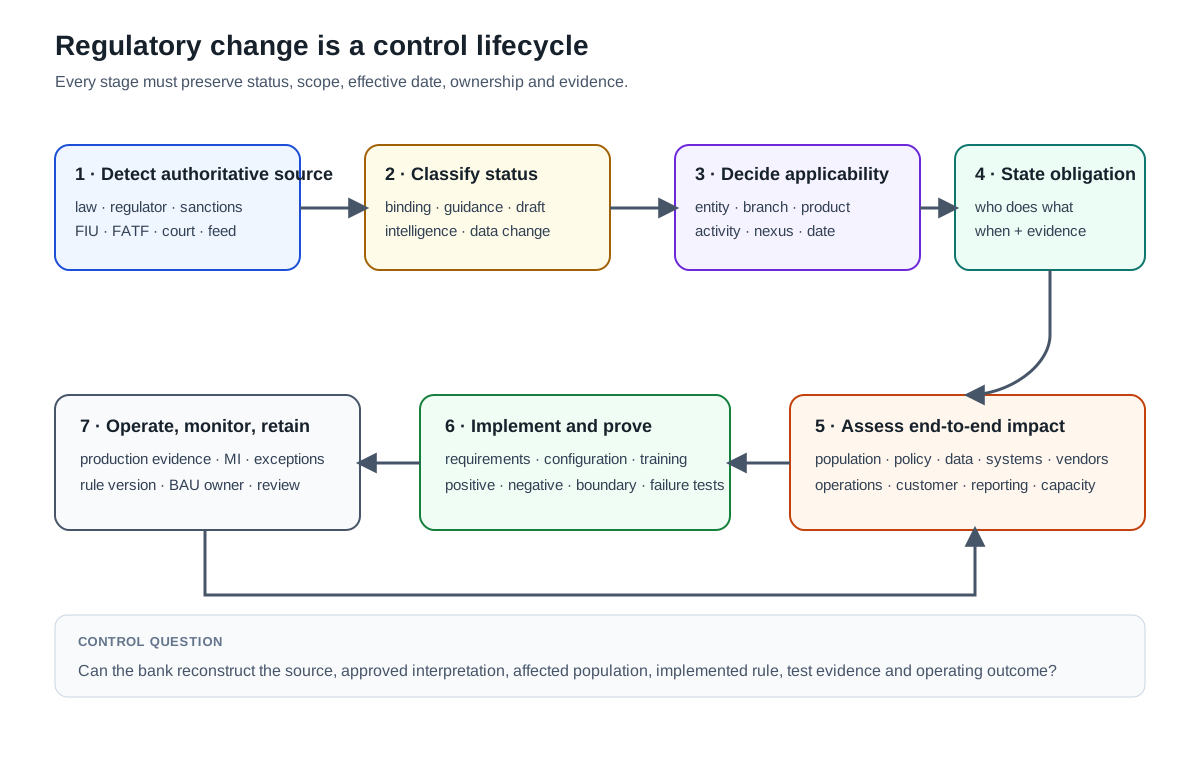
This chapter explains how to avoid those failures. It is written from the perspective of a real bank where compliance, legal, sanctions, financial-crime operations, business teams, product owners, business analysts, architects, developers, data engineers, testers and internal audit all see different parts of the same change. The objective is not to turn every reader into a lawyer. It is to show how the institution can preserve the legal meaning of an external requirement while converting it into controlled, testable and auditable operational behaviour.
Horizon scanning is controlled detection, not news collection
Horizon scanning is the structured process of identifying external developments that may change the bank's obligations, risk exposure or control expectations. Useful sources include legislation, regulations, sanctions authorities, supervisors, financial intelligence units, courts, FATF, central banks, competent authorities, official consultations, enforcement decisions and credible industry standards. The purpose is not to create the largest possible reading list. The purpose is to detect material change early enough to analyse it, decide whether it matters and implement it safely.
A weak horizon-scanning function behaves like a news digest. It forwards links, attaches PDFs and asks business areas to “review for impact.” That creates activity but not control. A stronger function creates a governed record for each material development. The record preserves the issuing authority, source type, publication or update date, status, jurisdiction, effective date where known, official URL or reference, topic, likely business areas and the person or function accountable for assessment.
The source record should answer a basic audit question: what exactly did the bank know, from which official source, at what point in time? If a source is later amended or withdrawn, the bank should be able to identify the version that informed the original decision. This becomes important when a consultation changes materially before finalisation, a sanctions authority alters data formats, or a regulator changes guidance after industry feedback.
Horizon scanning should also distinguish signal from obligation. A consultation can justify architecture analysis, data-gap assessment or budget planning, but it should not be represented as a final legal requirement. A regulator's enforcement action may expose a weakness worth testing internally, but the facts of that case do not automatically become a universal rule. An FIU typology may be operationally important without amending statute. An international standard may require national implementation before it becomes directly binding on a particular bank.
The discipline is therefore twofold: identify relevant change early, but preserve the status and legal weight of what has actually been published.
Source hierarchy: authority matters as much as content
Financial-crime teams work with a mixture of primary law, regulations, regulatory technical standards, statutory guidance, supervisory guidance, sanctions licences, official FAQs, FIU notices, international standards, industry guidance, vendor summaries and legal commentary. Problems begin when those sources are flattened into one spreadsheet column labelled “regulation.”
A useful hierarchy starts with the binding legal instruments and official decisions applicable to the entity. Below or alongside them sit implementing regulations, competent-authority guidance, formal supervisory materials, licences and official interpretations. International standards such as the FATF Recommendations shape national frameworks but are not themselves identical to domestic law in every jurisdiction. Industry guidance can be highly valuable for control design while remaining non-binding unless adopted through policy or referenced by an authority.
The FATF Recommendations illustrate the point well. The Recommendations were amended again in June 2026. FATF describes them as an international standard that countries should implement through measures adapted to their legal, administrative and financial systems. A global bank should assess a FATF change promptly, but it should not assume that the publication date creates an identical production obligation in every country. Local legislation, regulation, guidance and implementation dates still matter.
This distinction is not academic. If a project team labels “FATF requirement” as the legal basis for a production control, it may miss a stricter national rule, an exemption in local law, a different effective date, or a supervisory interpretation that changes implementation. Conversely, waiting for every jurisdiction to publish detailed implementation rules before beginning strategic analysis can leave the bank with too little time to change data models, customer journeys or payment infrastructure.
A well-designed regulatory inventory therefore stores both the source layer and the bank decision layer. The source record states what the authority issued. The interpretation record states what qualified bank functions concluded. The obligation record states what the institution must or has chosen to do. Those are linked, but they are not interchangeable.
Not every external development creates the same kind of change
It helps to classify developments before they enter delivery. One category is a binding legal change: new legislation, an amended regulation, a sanctions designation, a mandatory reporting rule or an order with a defined effective date. A second category is supervisory expectation: formal guidance, thematic findings or supervisory statements that influence how compliance will be assessed. A third category is international standard-setting, such as a revised FATF Recommendation. A fourth is operational-source change, such as a new sanctions data schema or official list endpoint. A fifth is risk intelligence: FIU typologies, threat assessments or law-enforcement alerts. A sixth is prospective change: consultations and legislative proposals.
The categories can converge. A sanctions authority may publish an amended legal measure and change its machine-readable list format at the same time. A new AML regulation can create a future binding date while a supervisor issues implementation guidance months earlier. A FATF revision can trigger local legislative programmes in many jurisdictions on different schedules.
Classification helps the bank assign the right treatment. Immediate legal changes may enter an accelerated lane. Future-dated laws may enter a programme with milestones and contingency. Consultations may enter horizon scanning with assumptions clearly marked. Intelligence publications may trigger risk-assessment or monitoring review without being treated as new law. Technical source changes may require urgent data engineering even where the underlying sanctions law has not changed.
The important point is that regulatory change is not a document type; it is a change in the bank's external obligations, expectations, risk understanding or control inputs. The operating model must be capable of distinguishing them.
The four clocks of regulatory change
One of the most common delivery errors is to keep a single “regulatory date.” In reality, at least four clocks may matter: the source publication or decision date, the legal effective or application date, the bank's internal readiness date and the production activation or business-as-usual date.
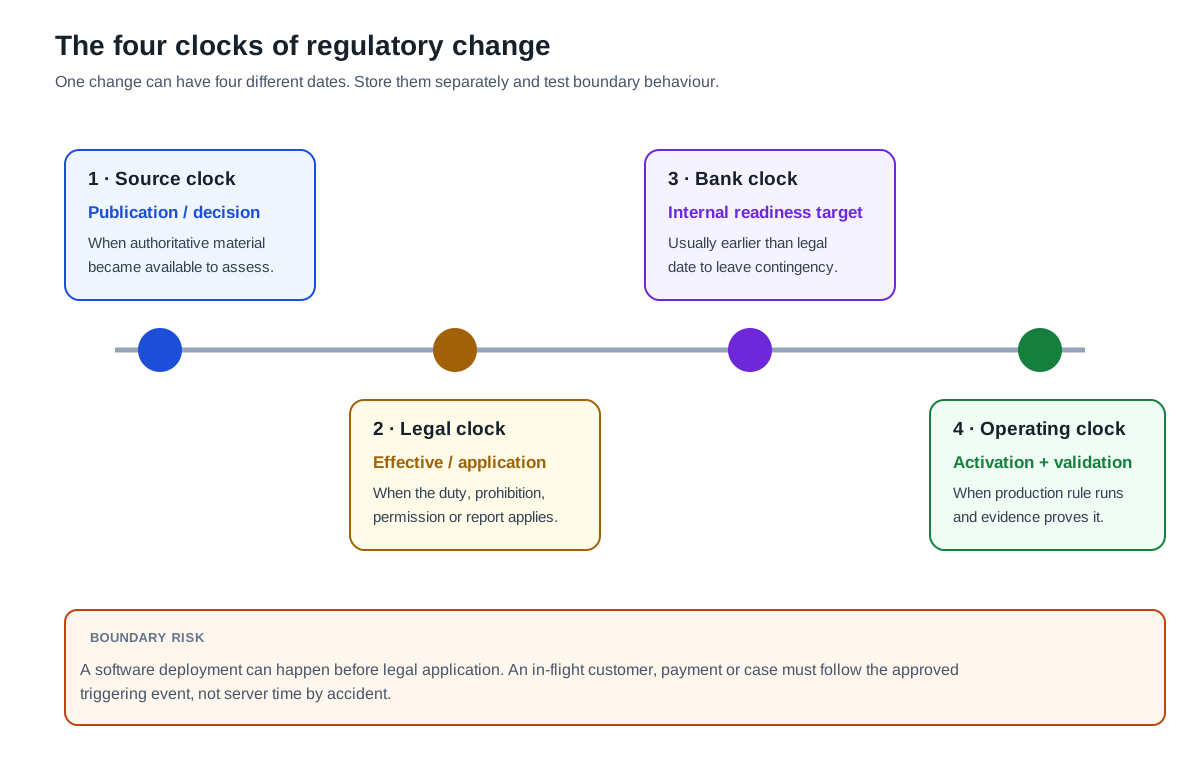
The source date tells the bank when an authoritative development became available. It starts assessment and evidence retention. The legal clock tells the bank when the external duty, prohibition, permission or reporting requirement applies. The bank target is an internal control date, often earlier than the legal date, chosen to create contingency for deployment, defect resolution, training or data remediation. The operational clock records when the production rule was activated and when monitoring proved it was working.
These dates can be close together or months apart. Sanctions measures can require action very quickly. A large AML regulatory package can be published years before application. A technical migration may be deployed early but feature-switched at the effective timestamp. A bank can complete policy and technology changes before the legal date while delaying mandatory customer treatment until the appropriate time.
Time also affects cases already in progress. If a customer review starts under one rule and reaches approval after another rule becomes applicable, which version governs? If a payment is queued when a sanctions designation is published, what is required for the in-flight item? If a regulatory reporting format changes at midnight, which population uses the previous schema? These questions require legal or policy decisions, but systems must preserve the data needed to implement the answer.
That is why effective dating is part of control architecture, not project administration. Rules, thresholds, country classifications, list identifiers, workflows and policy versions should be reconstructable historically where the decision requires it. An auditor should be able to determine which rule version the bank applied to a specific event at a specific point in time.
Applicability comes before impact assessment
Before asking “what must we change?”, the bank must ask “to whom and to what does this apply?” Applicability can depend on legal entity, branch, licence, booking location, customer type, product, service, currency, payment route, counterparty, activity, geographic nexus and time period. The legally significant factors vary by regime; no architecture should assume that one field such as country or currency universally decides jurisdiction.
This is especially important in global banking groups because the group brand is not the legal perimeter. A bank may operate through a parent company, subsidiaries, branches, investment firms, payment institutions, e-money entities and service companies. One rule may bind only one subset. A group policy may then choose to impose a common minimum standard more broadly, either for consistency or risk-management reasons.
Those two layers must remain distinguishable. Legal applicability answers what the external framework requires. Group-policy applicability answers what the institution has decided to require. A bank is allowed to set a higher internal standard where lawful, but it should not describe its internal choice as though a foreign law required every group entity to behave identically.
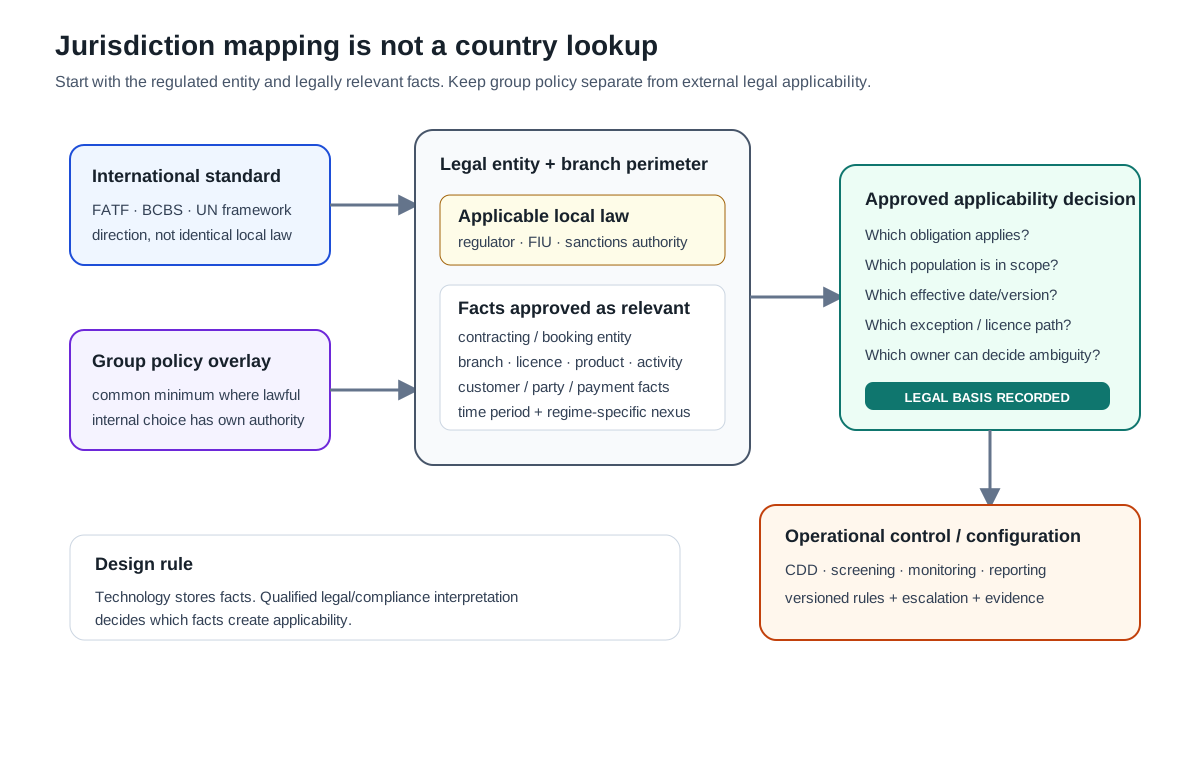
A practical jurisdiction map links each legal entity to countries of operation, branches, licences, competent authorities, FIUs, sanctions authorities, material products, booking models, outsourcing arrangements and reporting channels. It also records the group policy that governs the subject and any approved local overlay. The map allows teams to ask precise questions: Which entity owns the customer? Which entity provides the service? Which entity submits the report? Which law creates the restriction? Which authority is the source of the sanctions measure? Which operational team acts on behalf of which regulated entity?
The map should support dates as well as relationships. Regulatory responsibility can move. A legal entity can merge. A licence can change. A branch can close. A service can migrate to another booking centre. A rule that was irrelevant last year can become applicable after a business-model change even if the legal text itself is unchanged.
Jurisdiction mapping is a decision model, not a country lookup table
A simplistic jurisdiction matrix often has countries as rows and laws as columns. That can be a useful index, but it is not enough for operational decisioning. Real financial-crime obligations attach to legal persons, activities and transactions, and the facts that establish a regulatory nexus differ by subject.
Customer due-diligence rules may turn on the regulated entity providing the service, the location of the branch, the type of customer and the product. Suspicious-activity reporting may depend on the reporting entity and local FIU regime. Sanctions can create exposure through persons, ownership, territorial presence, nationality rules, currency clearing or other legally relevant connections depending on the authority. Payment-transparency rules may apply to particular payment service providers, payment chains or transfer types. Data-protection constraints can affect how information collected for financial-crime purposes is transferred or retained.
The architecture should therefore represent facts and approved applicability rules separately. Facts include customer domicile, contracting entity, booking entity, transaction currency, originator and beneficiary locations, branch, payment agent, product and service. The legal applicability engine or policy logic uses only those factors that qualified interpretation has approved for the regime. A data field being available does not make it legally relevant.
This separation is particularly important for business analysts and developers. A requirement such as “apply enhanced screening where the transaction has UK nexus” is not implementable until the approved nexus conditions are defined. Technology should not invent those conditions. The BA should obtain and document the interpretation, then turn it into observable decision logic with an escalation route for facts that cannot be automated safely.
A current supervisory example: EBA to AMLA
The transfer of EU-level AML/CFT responsibilities from the European Banking Authority to the Authority for Anti-Money Laundering and Countering the Financing of Terrorism shows why authority mapping needs both ownership and continuity. The EBA and AMLA confirmed that the handover of AML/CFT mandates and functions was completed on 1 January 2026. They also confirmed that existing EBA AML/CFT guidelines and standards remain in force until replaced by AMLA.
For a bank, this is more nuanced than changing the regulator name in a register. The institution may need to update the owner of future horizon-scanning sources, regulatory contact inventories, governance materials and reference data while retaining links to existing EBA guidelines that remain valid. Deleting every EBA reference would destroy useful lineage. Ignoring AMLA would leave the future source model stale.
A robust regulatory inventory can therefore represent a relationship such as: “guideline originally issued by EBA; remains effective; successor authority for AML/CFT mandate is AMLA from 1 January 2026; monitor AMLA for amendment or replacement.” That model preserves historical provenance and current ownership at the same time.
This example also demonstrates why source metadata should not be hard-coded into policy text alone. Supervisory institutions, URLs, document repositories and identifiers can change without an immediate change in the substantive customer control. The regulatory-change process must be able to modify the source architecture while showing that the underlying obligation continues.
A future-dated law example: the EU AML Regulation
Regulation (EU) 2024/1624 provides another useful timing example. Article 90 states that the Regulation applies from 10 July 2027, with a later application date of 10 July 2029 for the specified football-sector obliged entities. The fact that the law was published in 2024 does not mean every requirement became operationally binding at publication.
For a bank, a multi-year lead time is not an excuse to wait. A major directly applicable AML regulation can require changes across CDD, beneficial ownership, high-risk relationships, governance, recordkeeping, internal controls and customer journeys. The institution can use the lead period for legal analysis, gap assessment, data remediation, operating-model design, platform change and testing. Yet the project should still distinguish “future legal requirement” from “current production obligation.”
A good programme creates obligation records with the future applicability date, maps them to affected entities and products, records interpretation assumptions, identifies dependencies on technical standards or guidance, and plans internal readiness before the legal date. When new implementing material arrives, the programme reconciles it against those assumptions rather than starting from zero or pretending the early assumption was final law.
This is the practical value of horizon scanning: it creates time for safe change without corrupting the legal status of what is known today.
Translating an external source into a controlled obligation
Copying a paragraph from regulation into a spreadsheet is not implementation. The bank needs an obligation statement that preserves the external meaning while being clear enough to trace to policy, process, systems and tests.
A useful obligation record normally identifies the issuing authority, official source and reference, source status, jurisdiction, legal entities and activities in scope, publication date, effective date, interpreted requirement, policy owner, control owner, affected processes, relevant data, exceptions, expected evidence and testing approach. Material assumptions and unresolved interpretation questions should be visible rather than buried in email chains or project minutes.
The obligation should answer who must do what, for whom, when, under which conditions and with what evidence. It should not remove legal nuance merely to create a neat requirement. If a legal condition depends on judgement, the system requirement may need to gather facts and route the case for authorised review rather than automate the legal conclusion.
Legal and compliance specialists determine interpretation and applicability. Delivery teams translate the approved interpretation into operational requirements. Neither side can replace the other. “Comply with sanctions law” is not a usable requirement. Equally, a developer should not decide that every payment in a particular currency creates legal jurisdiction because the currency field happens to be available.
A strong traceability model keeps the external wording available, records the bank's interpretation separately and then links it to implementable requirements. If the interpretation changes, the bank can identify all dependent controls and tests without rereading the entire regulatory archive.
Obligation taxonomy makes requirements easier to design and test
Not all obligations instruct the bank to do the same kind of thing. It is useful to classify them by behaviour. A prohibition says the bank must not perform an activity in defined circumstances. A positive duty requires an action, such as collecting information or conducting due diligence. A reporting duty requires information to be submitted to an authority or FIU. A recordkeeping duty specifies evidence and retention. A governance duty concerns policies, senior management, controls or independent testing. A threshold rule changes treatment above or below a defined level. A licensing or exception rule permits activity only where conditions are satisfied. A risk-based duty requires proportionate measures rather than one deterministic action.
This taxonomy helps system design because each class produces different behaviours. A prohibition may require blocking or workflow prevention. A reporting duty needs population selection, data generation, validation, submission and acknowledgement. A recordkeeping duty needs immutable evidence and retention controls. A risk-based duty may require a decision framework, documentation and human judgement rather than a fixed binary rule.
The taxonomy also improves testing. The tester can ask whether the change involves positive cases, negative cases, thresholds, exception conditions, effective dates, approval levels or evidence. It prevents a generic test plan from missing the legal shape of the obligation.
Impact assessment must follow the real operating model
Financial-crime change rarely belongs to one application. A CDD amendment can affect onboarding, customer master data, beneficial-ownership records, risk rating, screening, periodic review and reporting. A sanctions change can affect list ingestion, customer screening, payment screening, securities processing, trade finance, case management and operations. A suspicious-transaction reporting change can affect investigation data, case decisions, report generation, submission channels, acknowledgements and management information.
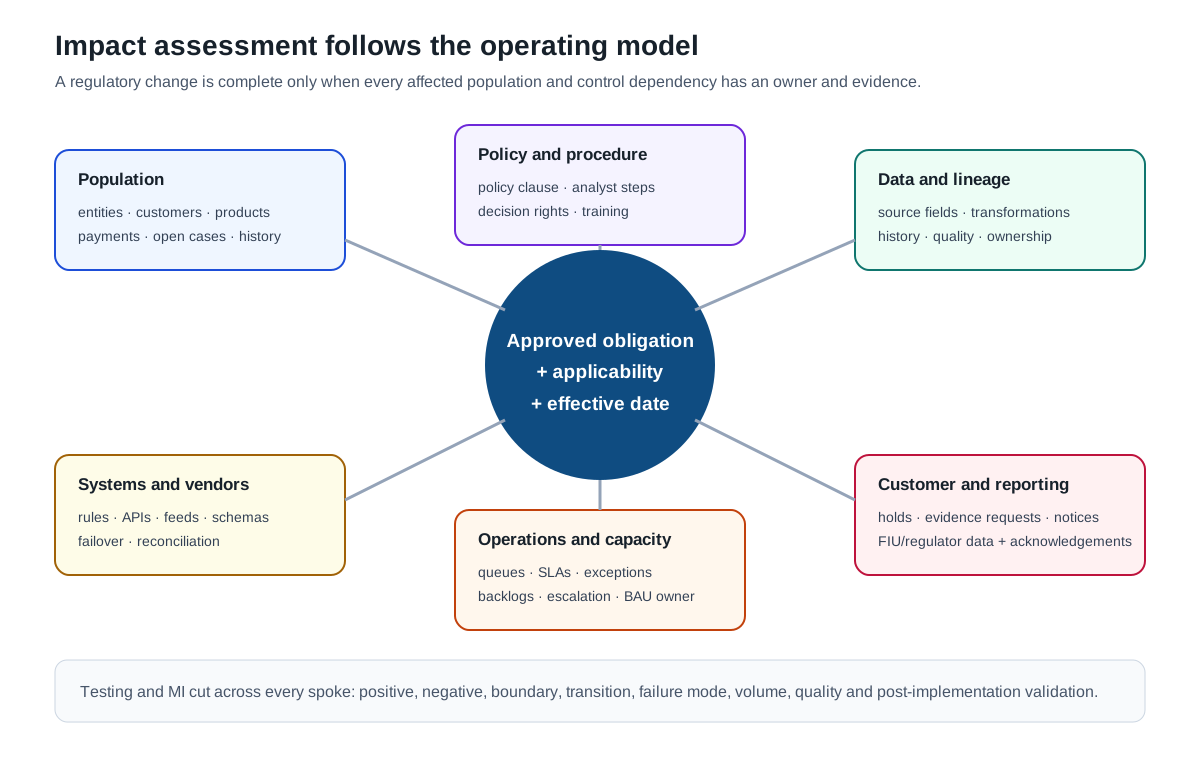
Impact assessment should therefore follow the full lifecycle and identify the affected population, not simply rate “technology impact” as high, medium or low. Which customers are in scope? Which legal entities? Which payment types? Which products and channels? Which stored records? Which open cases? Which historical transactions? Which downstream reports? Which vendors and interfaces? Which teams require training? Which customer communications may change?
Population logic deserves the same care as rule logic. A technically correct control applied to the wrong population is still a failed control. If a remediation programme starts with 100,000 relationships, management should be able to reconcile that population into completed, legitimately excluded, pending and exception categories. A difference of a few thousand records cannot be dismissed because the application itself passed testing.
Impact assessment should also identify dependencies. A screening-system change may depend on a vendor releasing a compatible schema. A reporting change may depend on upstream customer data. A policy deadline may depend on training. A new field may require privacy review. Recording dependencies early makes the critical path visible instead of discovering it during production deployment.
Policy, procedure and technology must move together
Financial-crime programmes sometimes produce a perfect policy months before the operating process is ready. In other cases, technology is deployed while policy still describes the old control. Both create ambiguity for staff and reviewers.
A change should therefore maintain alignment across at least four layers. The policy layer states the institution's requirement and governance. The procedure layer explains how people perform the control. The technology layer implements automated and workflow behaviour. The evidence layer proves that the control operated.
If the technology temporarily leads policy because of an urgent sanctions update, the change record should explain the emergency governance and when documentation will be aligned. If a policy is approved before system delivery, interim procedures need defined ownership, scope and expiry. The goal is not bureaucratic simultaneity; it is controlled consistency.
The BA can help by maintaining a traceability matrix that shows which policy clauses map to processes, system requirements, test cases and operational evidence. This makes documentation gaps visible before audit does.
Payment transparency shows how staged regulatory change works
FATF agreed revisions to Recommendation 16 on payment transparency in June 2025. On 24 June 2026, FATF launched a consultation on draft implementation guidance and stated that countries are expected to be ready to implement the strengthened requirements by the end of 2030. Those milestones should not be collapsed into one “deadline.” They represent a revised international standard, continuing implementation guidance and a future expectation for country-level implementation.
For a bank, the subject can touch payment initiation, party and account data, ISO 20022 mapping, validation, payment-chain roles, fraud and error controls, screening, investigations, privacy, retention and customer experience. Strategic analysis can begin well before every local rule is final. A bank can examine current data completeness, identify legacy truncation, assess payment-chain architecture and plan investment. But production obligations should still be mapped to the legislation, rules and effective dates applicable to each entity and payment service.
This distinction between strategic readiness and binding implementation is central to good change management. Early preparation is prudent. Inventing a global legal deadline that no authority has imposed is not.
The same principle applies to other international standards. A global standard may justify a common architecture and policy direction, while the exact legal activation remains jurisdiction-specific. The bank can reuse capability without falsely universalising law.
Rapid change: sanctions need a different delivery lane
Sanctions can move faster than conventional regulatory programmes. A new designation, amendment or prohibition can require action within hours rather than months. The bank needs an accelerated lane for source validation, legal applicability, list or rule ingestion, effective-time capture, impacted-customer and transaction identification, rescreening where required, in-flight item treatment, licence analysis, reconciliation and governance evidence.
Speed does not eliminate control. It changes the design of the control. The accelerated lane should have pre-agreed roles, authoritative source feeds, tested ingestion patterns, emergency change procedures, decision forums and operational runbooks. The objective is to reduce time spent inventing the process during an event.
Sanctions changes can also be broader than names. Country, sector, activity, service, goods, vessel, ownership or financing restrictions can require logic that list screening alone cannot provide. Horizon scanning must therefore cover legal texts and official guidance as well as list files.
Technical rollback deserves special attention. If an official sanctions source changes schema and a new parser fails, reverting software can restore application stability while reintroducing an obsolete source format. A rollback plan must explain how legal control coverage will be maintained, perhaps through a validated alternate feed or controlled manual process, not merely how the previous code version will be restored.
The UK sanctions-list migration is a practical data-change case
The United Kingdom provides a concrete example of why regulatory change can become a data-engineering problem. From 9:00 UK time on 28 January 2026, the UK Sanctions List became the only current UK government source for UK sanctions designations, and the former OFSI Consolidated List ceased to be updated. Official guidance also explained that newly designated persons would no longer receive the old OFSI Group ID and that systems should use the UK Sanctions List Unique ID and Sanction Type fields for new designations.
A bank could not treat this as a simple URL replacement. The change could affect list ingestion, data-field mappings, identifiers stored in customer and payment cases, vendor feeds, historic matches, reporting references, licences, reconciliations and downstream interfaces. Historic Group IDs remained relevant for persons designated before the change, which meant a design that simply deleted the old field could lose useful lineage.
A safe migration would inventory every consumer of the old source, map old and new fields, test parsers against representative files, reconcile record populations, run old and new feeds in parallel where appropriate, validate downstream matching and case display, confirm historic identifier handling, update operating procedures, test vendor behaviour and record the cutover time. The team would also define what happens if the new ingestion fails after the old official source has stopped updating.
This example shows why source changes deserve the same governance as application changes. The legal control is only as reliable as the data path that carries authoritative information into screening.
Authoritative list ingestion is part of the control
The United States provides another useful technical reference. OFAC's Sanctions List Service is the primary application through which OFAC provides sanctions-list files and data. A bank may consume official data directly or through a specialist vendor, but in either case it remains responsible for understanding whether the data entering its control is current and complete for its required scope.
A robust ingestion process records source time, retrieval time, file or feed version, schema validation, transformation results and load completion. It can use counts, control totals, checksums or other reconciliation methods to detect unexpected changes. It should distinguish “no changes received” from “feed failed.” A successful HTTP response is not evidence that the complete sanctions population reached the matching engine.
Vendor use does not remove the need for governance. The bank should understand the vendor's source universe, update frequency, transformation logic, service levels, incident process and field mappings. When an authority changes a source, the bank should confirm how the vendor will implement it and test the bank's own configuration. “Vendor confirmed compliance” is useful evidence, but it is not a substitute for testing the institution's end-to-end control.
Regulatory change is a data-lineage problem
A requirement that looks simple in policy can become complex in implementation because the data needed for the control is distributed across systems. A new beneficial-owner field may originate in onboarding, be transformed in a customer master, feed sanctions screening, appear in a case-management tool and later be used in regulatory reporting. A definition change in one place can therefore alter several downstream decisions.
The BA and data architect should map each material field to its business definition, source system, owner, permitted values, transformations, effective dates and downstream uses. Missing data needs an approved treatment. Values such as UNKNOWN, NOT_AVAILABLE and NOT_APPLICABLE are not interchangeable; each should have a controlled meaning and should not be used merely to make mandatory validation pass.
Historical values often matter. If a country-risk rating, beneficial owner, sanctions identifier, customer category or rule version changes, an investigator may need to know the value that existed when an earlier decision was made. Overwriting history can make retrospective review impossible.
Data lineage also helps assess regulatory change. If an external rule changes the definition of a field, the bank can identify all consuming systems and reports. Without lineage, teams discover dependencies only after production defects occur.
Rule versioning and temporal lineage
Financial-crime controls are decisions made using facts and rules at a point in time. A strong architecture therefore treats rule version as data. Screening configuration, customer-risk models, transaction-monitoring scenarios, country classifications, thresholds and reporting rules should have controlled versions and effective periods where reconstruction is required.
Consider a customer risk score that changes after a country is reclassified. If the bank overwrites the old score and rationale, a later investigator cannot tell why enhanced due diligence was not applied six months earlier. Similarly, if a sanctions case is reopened after a designation is amended, the analyst should be able to distinguish the list data visible during the original decision from today's information.
Temporal lineage does not mean storing unlimited duplicate data without purpose. Retention should follow legal, privacy and policy requirements. The design principle is that evidence needed to explain a regulated decision should not disappear because configuration moved forward.
Screening, monitoring and detection implications
Regulatory change can alter the universe of parties screened, the lists used, the fields matched, matching logic, monitoring scenarios, thresholds or escalation rules. Each change creates different validation needs.
A sanctions-list source change requires completeness and schema testing before match-quality testing. A new customer category may require rescreening of existing relationships. A revised monitoring typology may require scenario calibration and analysis of expected alert volumes. A new country-risk classification may affect customer risk scores, enhanced review populations and transaction monitoring. A changed payment-data requirement may improve screening only if upstream channels populate the field consistently.
Detection changes also affect operations. A configuration that increases sensitivity may generate more alerts. If the legal change requires rapid action but operations cannot absorb the resulting volume, the control can fail through backlog even though the technology works. Capacity assessment should therefore accompany material tuning changes.
When historical activity becomes relevant, the bank may need a lookback or backfill. That decision should be governed rather than assumed. The population, time period, data quality, scenario version, review method and reporting consequences should be defined explicitly.
From alert to case, investigation and regulatory outcome
A regulatory change can affect not only detection but what happens after detection. New reporting fields can alter the case data investigators must capture. A new sanctions restriction can change whether a transaction is released, rejected, blocked or escalated. A new FIU reporting rule can change filing deadlines or submission schemas. New CDD obligations can create remediation cases for existing customers.
The change assessment should follow the alert through its downstream lifecycle. Does the alert contain the new information? Can the case tool display the authoritative source and rule version? Does the analyst have an approved procedure? Are decision codes still accurate? Does a case closure reason map correctly to management information? If an external report is required, can the required data be generated without manual rekeying that introduces errors?
This end-to-end view is particularly important when different systems are owned by different teams. A screening engine may be changed by a vendor while the case platform remains internal. A reporting portal may be maintained by another authority. The customer channel may sit with a product team. Regulatory change governance needs one view across those boundaries.
Impact on customers and service
Financial-crime regulatory change can increase customer friction. New evidence requirements can delay onboarding. Screening changes can increase payment holds. A risk-methodology change can move customers into enhanced review. New source-of-funds requirements can generate additional information requests. Those effects do not mean the control should be weakened, but they should be understood and managed.
The impact assessment should estimate volume, handling time, exception rates and operational capacity where possible. Customer communications should be clear, lawful and proportionate. Teams should avoid repeatedly asking for information the bank already holds unless refresh or verification is genuinely required. If an urgent change introduces manual handling, management should monitor ageing and quality so speed does not quietly reduce decision quality.
Customer outcomes are also useful control indicators. A sudden spike in false-positive payment holds after a screening change may show a tuning or data-quality problem. Repeated onboarding abandonment after a new KYC step may indicate poor journey design or unclear communication, even where the underlying requirement is valid. The objective is effective compliance, not unnecessary friction.
Delivery model: from legal interpretation to executable requirement
The handoff between compliance and technology is where many regulatory programmes become vague. Compliance may produce a memo describing the rule, while technology asks for acceptance criteria. A good BA bridges the two without taking over legal judgement.
The BA begins with the approved interpretation and extracts the actors, populations, conditions, data, decisions, exceptions, dates and evidence. Each requirement should identify the legal entity or configuration scope. Ambiguous words such as “appropriate,” “promptly,” “high risk” or “where necessary” need an approved operational interpretation or a human decision step. The BA should not silently convert them into arbitrary numeric rules.
A requirement should describe observable behaviour. “System supports new AML regulation” is not testable. A stronger statement might say: “For covered corporate relationships of Entity A initiated on or after the configured effective timestamp, final onboarding approval cannot be completed until the required beneficial-ownership evidence is present or an authorised exception with reason and approver is recorded.” That statement can be traced, designed and tested.
Requirements should also describe failure behaviour. What happens if the regulatory source feed is late? What happens if required customer data is missing? What happens if the jurisdiction cannot be resolved? Does the system stop, route for review, apply a conservative default or continue with an exception? Those decisions should be governed in advance.
Architecture: configuration beats uncontrolled hard-coding
Global banks benefit from reusable capability, but regulatory variation makes uncontrolled hard-coding dangerous. Where practical, architecture should separate common capability from jurisdiction-specific configuration.
A shared onboarding engine can collect beneficial-ownership data for many countries while configuration controls when particular evidence is mandatory. A screening platform can use common matching services while different entities subscribe to different legally relevant lists. A reporting platform can reuse data extraction while producing jurisdiction-specific schemas.
Configuration should still be controlled like code. It needs ownership, versioning, approvals, testing, segregation of duties, deployment evidence and rollback or contingency planning. A spreadsheet maintained manually on a shared drive is not automatically safer because it avoids software development.
The architecture should also make provenance visible. A rule should be linked to the obligation and effective date that justify it. A downstream consumer should know which version it received. This reduces the risk that a “temporary” workaround remains in production long after the original change has been superseded.
Minimum data model for regulatory change
A scalable regulatory-change platform does not need to become a giant legal database, but several entities are especially useful. A source records the external document or official feed. An interpretation records the bank's approved understanding. An obligation records what the institution must or chooses to do. An applicability record links the obligation to legal entities, activities and dates. A control records how the obligation is satisfied. A requirement describes changes to process or technology. A test proves expected behaviour. An evidence record proves implementation and operation. A change event records amendments, supersession and withdrawal.
The relationships matter more than the labels. One source can create several obligations. One obligation can map to several controls. One control can satisfy multiple obligations. A change to one source can therefore have a large blast radius. A graph or relational model that preserves those links makes impact analysis faster and more reliable.
Status should also be explicit. Draft, final, effective, superseded and withdrawn are different. An interpretation may be pending. A requirement may be designed but not deployed. A control may be active with an interim workaround. Without disciplined status semantics, dashboards can show “complete” while the actual control is not live.
Testing strategy for financial-crime regulatory change
Testing should be designed from the obligation and risk, not copied from a generic release template. Unit and configuration testing confirms component logic. Integration testing confirms data and workflows across systems. Data-migration testing proves the correct population and values were moved. Regression testing confirms existing controls still work. User-acceptance testing validates operational outcomes. Performance and volume testing matters when screening or monitoring behaviour changes materially.
Boundary tests are especially important. Test just before and after an effective timestamp. Test a legal entity in scope and one out of scope. Test a customer who meets the threshold and one just below it. Test an authorised exception and an unauthorised attempt. Test missing and malformed data. Test a late sanctions feed. Test duplicate list records. Test historic cases created under the previous rule.
Negative testing often reveals more than the happy path. The bank needs confidence that the system does not impose the rule where it should not, does not release where it should block, and does not silently default when mandatory information is absent.
For data-source migrations, reconciliation is part of testing. Record counts alone are insufficient. Teams may compare identifiers, aliases, dates, categories and critical fields, investigate differences and document expected transformations. Where old and new sources overlap temporarily, a controlled parallel run can provide evidence before cutover.
Evidence: deployment is not proof of compliance
A regulatory item is not complete because a release reached production. Evidence may include the approved interpretation, policy update, procedure, configuration, code version, data migration, reconciliation, test results, training completion, vendor confirmation, activation timestamp, control mapping, approvals and post-implementation validation.
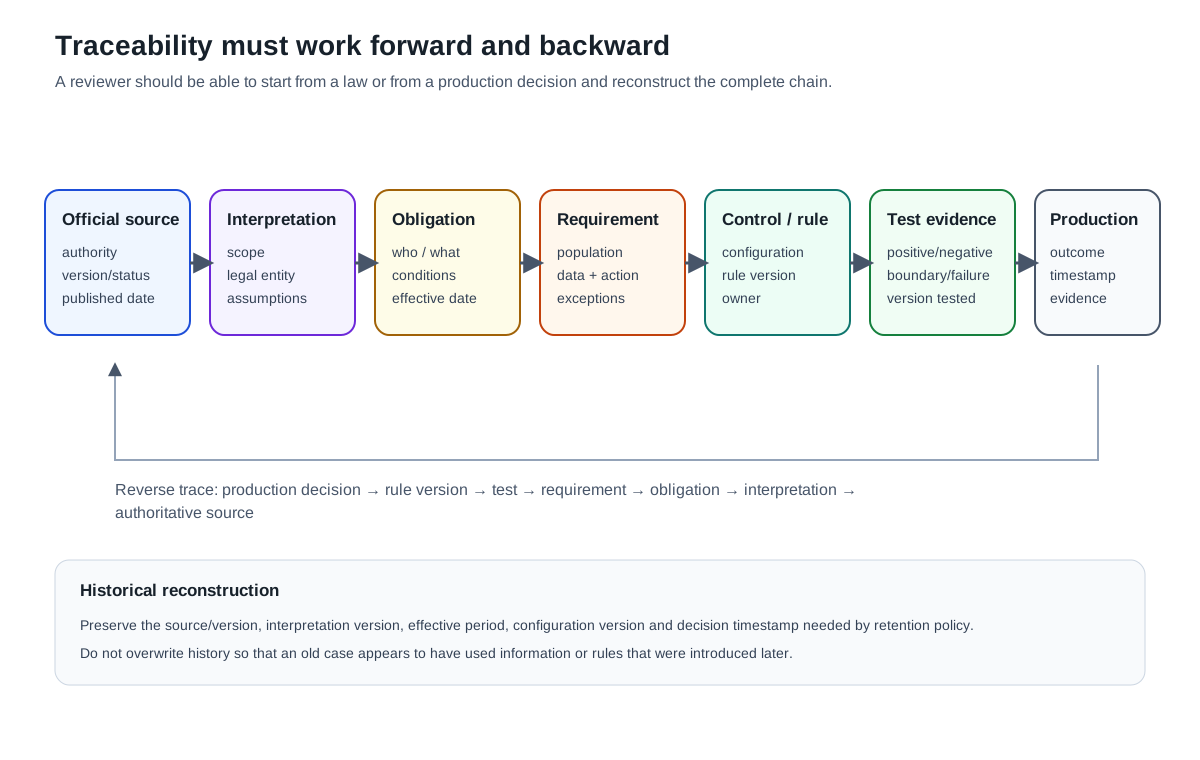
The evidence should form a chain rather than a document dump. A reviewer should be able to move from an external source to the bank's interpretation, from interpretation to obligation, from obligation to requirements and controls, from controls to tests, and from tests to evidence of production operation. Traceability should also work backwards. A developer changing a field should be able to identify which obligations depend on it. A tester should understand why a test exists. A regulator asking how a provision is implemented should not require the bank to reconstruct the answer from individual memories.
Evidence quality matters. Screenshots can be useful but are weak if they do not show environment, date, rule version or population. Meeting minutes may evidence a decision but should not replace a controlled approval record where one is required. Automated deployment logs can prove what was released but not whether the business outcome was correct.
Post-implementation validation closes the change loop
A release can pass testing and still fail in operation. Real data may differ from test data. Alert volumes may exceed assumptions. A source feed can behave differently at the next update. Operations may misunderstand a new decision code. A customer channel may send incomplete information.
Post-implementation validation should therefore check whether the intended control outcome is actually occurring. Depending on the change, this can include reconciliation, sample testing, production metrics, alert-volume review, exception analysis, customer-impact review and confirmation that interim controls were retired.
The validation period should be proportionate to risk. An urgent sanctions-list migration may need immediate reconciliation after every early feed. A future-dated CDD rule may need several weeks of operational quality review. Material defects should feed back into the change record and, where necessary, trigger risk escalation or remediation.
Closure means the control is stable enough for business-as-usual ownership, not merely that the project team has run out of tasks.
Governance and decision rights
Every material change needs an accountable owner and a forum capable of making decisions. Compliance may own interpretation. Legal may resolve legal questions. Business or operations may own control execution. Technology may own system delivery. Data teams may own pipelines. Product teams may own customer journeys. Second-line financial-crime functions may challenge readiness. Internal audit may later provide independent assurance.
The exact model differs by bank, but responsibility must not disappear between teams. A RACI is useful only if it reflects real decision rights. Someone must be authorised to approve applicability, accept the interpretation, approve an interim control, decide whether activity must be restricted, sign off testing and confirm production readiness.
A red project status should lead to a decision: accelerate delivery, deploy a lawful interim control, restrict the affected activity, escalate a residual risk where acceptance is permissible, or change the plan. A dashboard that remains red for months without a decision is reporting, not governance.
Governance records should also show dissent and conditions. If compliance approves go-live subject to a manual review for a defined population, that condition should become an owned control with an expiry and evidence. It should not disappear into meeting notes.
Interim controls are controls, not excuses
Regulatory deadlines sometimes arrive before strategic technology is ready. A manual or semi-manual interim control may be appropriate, but it requires the same design discipline as a permanent control.
The interim control should define its population, trigger, procedure, owner, evidence, quality assurance, capacity, escalation path and expiry. Management should know how many items it can handle. If the population grows beyond capacity, that is a control issue, not merely an operational inconvenience.
Interim controls also need a retirement plan. Temporary spreadsheets and manual queues frequently survive because the strategic project closes without proving that the workaround has been decommissioned. The closure checklist should confirm migration of open items, evidence retention and removal of obsolete access or procedures.
Metrics and management information
Good management information helps leaders decide whether the change process is healthy. Useful measures include material developments awaiting assessment, overdue applicability decisions, obligations approaching effective date, unresolved legal questions, requirements without mapped controls, tests not executed, critical defects, overdue remediations, interim controls past expiry and production exceptions after go-live.
Source-ingestion metrics can include timeliness, failed updates, unexplained record-count changes and reconciliation breaks. Customer-impact metrics can include payment holds, onboarding delays or increased information requests. Operations metrics can include queue ageing, rework and quality findings.
Metrics need thresholds and actions. A count without a response rule can become decorative. If a sanctions feed misses its expected update window, who is alerted and what alternate source is used? If a remediation population is behind plan, who decides whether additional resources or restrictions are needed? If alert volumes double after tuning, who evaluates whether the change reflects genuine risk or an unintended control effect?
Regulatory change and the three lines model
The first line normally owns implementation and operation of controls within its business or service. Second-line financial-crime compliance defines or challenges policy, interprets requirements within its mandate and oversees risk. Internal audit independently assesses governance and control effectiveness. Legal provides legal advice and interpretation according to the institution's model; it should not be casually merged with compliance because the roles and privilege considerations can differ.
Regulatory change crosses all three lines, but independence should remain clear. A second-line function that designed a control may still challenge implementation, but audit should not become the project test team. First-line ownership should not be displaced simply because the external source is a compliance topic.
Clear ownership is especially important in shared-service models. A central screening team may operate controls for many legal entities. The service can be centralised while accountability for local legal obligations remains mapped to the relevant regulated entities and governance.
Change control for third parties and vendors
Banks increasingly rely on external KYC platforms, screening providers, adverse-media services, transaction-monitoring vendors, cloud platforms and managed operations. Regulatory change must include those dependencies explicitly.
Contracts and service descriptions should clarify notification of material regulatory or source changes, data provenance, update frequency, testing support, incident handling, audit rights and exit arrangements where relevant. A vendor road map should not be assumed to match the bank's legal date.
When a vendor implements a regulatory change, the bank should understand which component changed, what configuration the bank must perform, whether historical data is affected and how the vendor tested the update. The institution still needs end-to-end testing in its own operating context.
Concentration risk matters as well. If several controls depend on one external data provider, a source or schema issue can affect onboarding, customer screening and payment screening simultaneously. Impact assessment should show that common dependency.
Regulatory change in cloud and distributed architectures
Modern financial-crime controls may be distributed across cloud services, microservices, event streams and vendor APIs. This architecture can make change faster but also makes lineage harder if ownership is unclear.
A rule may be evaluated in one service, enriched in another, screened through a vendor API and recorded in a case platform. The change record should identify which component owns the decision, which version of the rule each component uses and how failures propagate. Observability should distinguish business-rule failures from infrastructure failures.
Feature flags can help stage a future-dated rule, but the flag itself becomes a control point. It needs controlled activation, legal-entity scope, timestamp evidence and testing. A global flag switched manually at midnight is risky if only some entities are in scope.
Event-driven systems should preserve enough metadata to reconstruct what happened. A message indicating screening_passed=true is weak evidence if the list version, screening configuration and relevant party data cannot be linked later.
Model and analytics change governance
Some financial-crime obligations are implemented through risk models, machine learning or analytics rather than simple rules. A regulatory change can alter model inputs, thresholds, target populations or the definition of high risk.
Model changes require both regulatory traceability and model governance. Teams should assess data representativeness, calibration, explainability, performance, bias where relevant, validation and change approval. A regulator's expectation that higher-risk customers receive enhanced measures does not itself specify a machine-learning threshold. The model design must remain justified by risk and policy.
When a model is retrained, the bank should understand whether the change was driven by new regulation, new risk intelligence, performance deterioration or data evolution. Combining several motives in one release can make later explanation difficult. Change records should preserve the rationale and testing appropriate to each.
How enforcement and supervisory findings should be used
Enforcement actions and supervisory findings can be powerful sources of learning because they show how authorities view control failures in real institutions. They should be analysed carefully, not copied mechanically.
The bank should identify the facts, legal basis, jurisdiction, product and control weakness described. It can then ask whether a similar weakness exists internally. A thematic review might be justified even where the action creates no new legal requirement for the bank.
The risk is overgeneralisation. A settlement involving one institution under one legal framework does not automatically create a globally binding rule. The appropriate outcome may be a control health check, scenario review or policy clarification rather than a regulatory obligation record.
This distinction keeps horizon scanning useful without turning every enforcement headline into an emergency project.
A realistic mini-case: migrating a sanctions source without losing control
Imagine a multinational bank whose UK sanctions screening uses a commercial vendor. The vendor historically ingested the OFSI Consolidated List and exposed the OFSI Group ID to the bank's customer-screening and payment-screening platforms. The same identifier is stored in sanctions cases and referenced in some operational reports.
The UK government announces that from 28 January 2026 the UK Sanctions List will be the single current source and that new designated persons will use UK Sanctions List Unique IDs rather than new OFSI Group IDs. The external change looks small: switch source. The impact assessment shows otherwise.
Compliance confirms the official source and effective time. The sanctions policy team determines the required screening scope. The vendor explains its migration plan. The BA inventories downstream consumers of Group ID. Data engineers compare UKSL fields with the existing vendor schema. Architects decide to preserve a canonical internal designation identifier while retaining source-specific identifiers and effective dates. Operations update case procedures so analysts can see both historic and current identifiers where available.
Testing uses a controlled sample of historic designations, newly structured records, aliases and specified ships. The team compares old and new populations, investigates differences, tests matching, validates case creation and checks that reporting can still reference historic Group IDs where appropriate. A parallel reconciliation runs before cutover. A contingency plan defines how official UKSL data will be checked if the vendor feed fails during the first updates.
At 9:00 UK time on 28 January, the new source path is active. The team records the cutover, validates the first production load and monitors discrepancies. The old source remains as historical evidence but is no longer treated as current. After a defined stability period, the programme closes only when all downstream users are confirmed migrated and temporary reconciliation is retired.
The lesson is not specific to UK sanctions. An authoritative-source change can alter identifiers, lineage, evidence and downstream control behaviour even when the underlying legal objective remains the same.
A second mini-case: one shared platform, three legal states
Assume a banking group has entities in Jurisdictions A, B and C using one shared onboarding platform. Jurisdiction A publishes a final beneficial-ownership rule effective in six months. Jurisdiction B has only a consultation. Jurisdiction C has no equivalent new rule. Group policy is considering adopting the stronger requirement everywhere.
A weak programme creates one global mandatory field and one go-live date. A stronger programme records the three external states separately. It maps the binding obligation to Entity A, keeps B's consultation as a horizon item and preserves C's current legal position. If the group later adopts a common policy, that policy decision is recorded separately from local law.
The shared platform can still implement one reusable capability. Configuration determines where evidence is mandatory, when the requirement activates and what exception route applies. Tests cover each legal entity. Historical decisions preserve the rule version used. If B's final rule later differs from the consultation, the team reconciles the final text against assumptions made during design instead of pretending the consultation was always law.
This is the essence of good jurisdiction mapping: reuse technology where sensible, but never erase the legal distinctions that determine when and why the capability is used.
BA analysis checklist in practice
For a business analyst, the work becomes much easier when questions are asked in the right order. What is the authoritative source? What is its legal status? What changed from the previous version? Which legal entities and activities are in scope? What are the publication and effective dates? Which populations are affected? Which data facts determine applicability? Which controls currently satisfy the obligation? What gaps remain? Which exceptions or licences exist? What evidence must be retained? What happens to in-flight and historical items? Which systems and vendors are involved? What volumes and customer impacts are expected? What does success look like in testing and in production?
The BA should record unanswered questions explicitly. An unknown effective-date interpretation is not a software assumption. A disputed definition is not a backlog item to be decided by development. Open legal and policy questions should have owners and deadlines because they can block design.
Requirements should maintain source references and decision lineage. If the official source changes before go-live, the programme can then identify which requirements need reassessment.
Architecture questions that matter
Architects should ask where applicability logic resides, how legal entities are represented, how effective dates are controlled, how rule versions are stored, which systems are sources of truth, how external regulatory data enters the bank, how downstream consumers know which version they received and how evidence is retained.
They should also ask what happens during failure. If the sanctions feed is unavailable, does screening stop? If jurisdiction mapping cannot resolve the entity, is the transaction routed for review? If a new mandatory field is missing from one legacy channel, does the payment reject, repair or continue under an approved interim control? Resilience design is part of compliance design.
Shared services should expose configuration clearly enough that each legal entity's coverage can be evidenced. A technically elegant central platform is dangerous if no one can demonstrate which rules apply to which entity.
Developer considerations
Developers need unambiguous business rules, controlled configuration and testable acceptance criteria. They should avoid embedding legal assumptions in code comments or constants without traceability. Country lists, thresholds, effective dates and product scopes should be configuration where that improves governance and does not create uncontrolled complexity.
Logs should capture business-relevant events without exposing sensitive information unnecessarily. A regulatory decision may need rule version, timestamp, entity, outcome and correlation ID, while detailed customer data remains protected in authorised systems.
Code should fail visibly when a critical regulatory dependency fails. Silent fallback to stale configuration can be worse than a controlled stop. Whether to stop or continue is a risk and policy decision, but the technology must make failure observable.
Tester considerations
Testers should build coverage from the obligation and population map. Positive cases prove required behaviour. Negative cases prove that out-of-scope populations are not affected. Boundary cases test dates, thresholds and ownership percentages. Transition cases test items created before and completed after a change. Failure cases test source outages, invalid data and missing configuration.
Test evidence should identify the rule version and environment. Where personal or sensitive data is used, test data should follow privacy and security standards. Production validation should not depend on screenshots of real customers where safer evidence is available.
For a global platform, matrix testing is often necessary: legal entity × product × customer type × jurisdiction × date × exception condition. Risk-based selection can reduce the combinatorial explosion, but the rationale for coverage should be documented.
Common failure modes and what they reveal
The most persistent weaknesses are predictable. Draft material is treated as final law. An international standard is mistaken for identical local law. Applicability is assessed at group level instead of legal-entity level. Effective dates are stored in documents but not system logic. Policy is updated while the operational workflow is unchanged. A source file is downloaded but not reconciled. Data is migrated without proving the population. A vendor claims support but the bank never tests its own configuration. Temporary controls have no expiry. Production goes live without post-implementation validation. Historical rule versions are overwritten.
Another common failure is excessive legal abstraction. The programme knows the regulation but cannot name the impacted queue, field, API, report or customer population. The opposite failure is technical tunnel vision: the system team knows the field change but cannot explain which obligation it serves. Traceability exists to prevent both.
A further weakness is treating change closure as a project date. Teams close tickets while training is incomplete, exceptions remain manual and monitoring is not yet stable. True closure requires control ownership to have moved into BAU with evidence that the intended outcome works.
Quality assurance and independent challenge
Material financial-crime changes benefit from challenge outside the delivery team. Quality assurance can sample obligation mapping, population logic, analyst decisions and evidence. Compliance oversight can challenge whether the design reflects approved interpretation. Technology assurance can review source ingestion, access, resilience and configuration controls. Internal audit may later assess the whole framework independently.
Challenge should focus on the highest-risk assumptions. If the programme depends on a new vendor feed, test data provenance and failure handling. If it relies on manual remediation, test population completeness and operational capacity. If it uses one global rule for several jurisdictions, challenge the legal basis for harmonisation.
Independent challenge is not intended to recreate the project. Its value is to expose blind spots before supervisors or customers experience them.
What good looks like during an examination or audit
A mature bank can answer a regulatory-change question without assembling a war room. If a reviewer selects a requirement, the bank can show the official source, approved interpretation, applicability decision, obligation, affected entities and products, linked controls, requirements, implementation evidence, tests and current operating metrics.
If the reviewer selects a production control instead, the bank can trace backwards to the obligations it satisfies. If the reviewer selects an historic case, the bank can identify the rule and data version relevant at the time. If the source has since changed, the bank can show when and why the change was implemented.
The answer does not need to live in one application. What matters is reliable linkage and ownership. A controlled set of systems can be more realistic than one monolithic regulatory platform, provided the chain can be reconstructed efficiently and consistently.
Practical acceptance criteria for a regulatory-change capability
A bank building or enhancing a regulatory-change platform can use acceptance criteria such as these as a starting point, adapting them to local governance:
- Each material source record stores issuing authority, official reference or URL, source type, status, publication date, effective date where known, version and accountable assessor.
- Applicability decisions identify the legal entity and activity scope and are linked to an approved interpretation or policy decision.
- The system distinguishes external legal applicability from broader group-policy applicability.
- Obligation records link to one or more controls, and each material control can trace back to the obligations it satisfies.
- Effective-dated rules preserve sufficient history to reconstruct decisions according to legal and policy retention requirements.
- Source-feed failures, parsing errors and reconciliation breaks generate visible exceptions rather than silently using stale data.
- Tests identify the obligation, rule or configuration version being validated and cover positive, negative, boundary and transition conditions appropriate to the change.
- Interim controls have an owner, scope, evidence, capacity assessment, expiry and retirement action.
- Closure requires production validation and named BAU ownership rather than deployment alone.
These criteria are intentionally outcome-oriented. The specific technology can vary while the control objective remains stable.
Regulatory change as a living financial-crime capability
Regulatory change is sometimes treated as a programme-management discipline separate from AML, sanctions and investigations. In reality it is the mechanism through which those control frameworks stay aligned with the external environment. If horizon scanning fails, the bank may never know a rule changed. If applicability fails, the wrong entity is controlled. If impact assessment fails, a downstream system is missed. If testing fails, a design defect reaches production. If evidence fails, the bank cannot prove what it did.
The capability should therefore be connected to enterprise financial-crime risk assessment, policy governance, control inventories, issue management, data governance and technology change. New risks identified through national risk assessments, FATF statements, FIU intelligence or enforcement can feed scenario and policy reviews. Control weaknesses discovered during implementation can feed the risk assessment. This feedback loop keeps regulatory change from becoming a one-way document factory.
Final takeaway
Regulatory change in financial crime is a control lifecycle, not an administrative tracker. Horizon scanning detects relevant developments. Source classification establishes authority and status. Jurisdiction mapping determines which legal entity, activity and population are affected. Interpretation turns external material into a governed obligation. Impact assessment follows customers, payments, products, data, systems, vendors and operations. Delivery implements the change with explicit effective dates and versioning. Testing proves behaviour. Evidence makes the decision reconstructable. Post-implementation validation confirms that the control works in real operations.
The strongest global-bank model combines reusable group capabilities with precise legal-entity and jurisdiction overlays. It distinguishes international standards from binding local law, consultations from final rules, internal policy choices from legal duties, sanctions-list changes from broader restrictions, publication dates from effective dates, software deployment from legal activation, and successful releases from sustainable operating controls.
For a BA, architect, developer, tester or compliance professional, the practical question is always the same: can the bank prove that the correct obligation was applied to the correct population, at the correct time, through a control that actually operated and left reliable evidence? If the answer is yes, regulatory awareness has become defensible execution.
References and further reading
The references below are authoritative public sources used for the legal, supervisory and implementation examples in this chapter. Readers should always check the current version and the law applicable to the relevant legal entity before making a live compliance decision.
- Financial Action Task Force, The FATF Recommendations, as amended June 2026: https://www.fatf-gafi.org/en/publications/Fatfrecommendations/Fatf-recommendations.html
- Financial Action Task Force, Public consultation on guidance to increase payment transparency, 24 June 2026: https://www.fatf-gafi.org/en/publications/Fatfrecommendations/R16-Public-Consultation-June-2026.html
- Financial Action Task Force, Update to Recommendation 6 on targeted financial sanctions and humanitarian assistance, 23 June 2026: https://www.fatf-gafi.org/en/publications/Fatfrecommendations/update-recommendation-6-june-2026.html
- European Banking Authority, EBA and AMLA complete handover of AML/CFT mandates, 19 January 2026: https://www.eba.europa.eu/publications-and-media/press-releases/eba-and-amla-complete-handover-amlcft-mandates
- European Banking Authority, Anti-Money Laundering and Countering the Financing of Terrorism overview and transition information: https://www.eba.europa.eu/regulation-and-policy/anti-money-laundering-and-countering-financing-terrorism
- EUR-Lex, Regulation (EU) 2024/1624 on the prevention of the use of the financial system for money laundering or terrorist financing, including Article 90 application dates: https://eur-lex.europa.eu/eli/reg/2024/1624/oj/eng
- UK Government, FCDO, HM Treasury and OFSI, Moving to a single list for UK sanctions designations, 28 January 2026: https://www.gov.uk/guidance/moving-to-a-single-list-for-uk-sanctions-designations-28-january-2026
- UK Government and OFSI, UK sanctions collection and current guidance: https://www.gov.uk/government/collections/uk-sanctions
- U.S. Department of the Treasury, Office of Foreign Assets Control, Sanctions List Service: https://ofac.treasury.gov/sanctions-list-service
- Basel Committee on Banking Supervision, Anti-money laundering and counter-terrorist financing – Basel Consolidated Guidelines, published 1 January 2026: https://www.bis.org/committees/bcbs/basel-consolidated-guidelines/module/afs/10
- Basel Committee on Banking Supervision, Sound management of risks related to money laundering and financing of terrorism: revisions to supervisory cooperation, July 2020: https://www.bis.org/publications/202007-guidelines-sound-management-risks-related-money-laundering-and-financing-terrorism-revisions-supervisory-cooperation
Reading the regulatory-change diagrams
Use the five diagrams together to connect a regulatory source to a controlled change in the bank. The lifecycle explains the sequence from source and interpretation to implementation and operating evidence. The four clocks separate publication, legal applicability, delivery and assurance timing.
Jurisdiction mapping identifies the legal entities, activities and obligations in scope. The operating-model impact map then shows which processes, data, systems and people must change. Traceability connects the obligation to requirements, controls, tests and evidence, and allows a reviewer to work backwards from a production decision to its approved basis.
For a worked change, ask five questions: what is the sequence, which dates matter, where does the requirement apply, what must change, and how can the bank demonstrate that the resulting control meets the obligation?
Extended delivery case: one capability, three different obligations
The following case is fictional. The authority, rules, dates, entities, fields and transition arrangements are invented to teach regulatory-change analysis. They must not be treated as the requirements of any real jurisdiction. The case shows how a bank can build a reusable capability while preserving the separate legal interpretations that determine when and how it is used.
Northbank operates through three subsidiaries, Alpha Bank, Beta Bank and Gamma Bank. The group uses a shared customer platform, screening service and case-management application. A fictional authority responsible for Alpha publishes a final rule requiring an additional ownership-verification record for certain newly established business relationships from 1 March. A separate transition provision covers specified existing relationships from 1 September. Beta has a consultation on a related subject, while Gamma has no equivalent new local rule. Group management is considering adopting a common internal standard across all three entities.
The programme sponsor proposes one project called “global ownership compliance,” with a single deployment date. That may be a convenient funding label, but it is not an adequate obligation model. The delivery team must distinguish Alpha's binding requirements, Beta's consultation, Gamma's existing obligations and any additional group-policy decision. Otherwise, a common technical release can apply the wrong requirement to the wrong population or describe an internal choice as local law.
Start with a controlled source record
The change team records the final Alpha publication, the relevant provisions, its publication date, the stated application dates and the source location. It retains an authorised copy or record sufficient to reconstruct what was assessed. It also records supporting guidance separately from the rule and identifies whether a later correction or amendment changes the interpretation.
The source record is not the bank's legal conclusion. It is the evidence from which the appropriate legal and compliance owners develop that conclusion. Their interpretation identifies the entity in scope, the relevant customer types, the triggering events, exceptions or transition provisions, the required action and any material uncertainty. The interpretation should be attributable and versioned so that delivery teams know which approved position they are implementing.
Beta's consultation belongs in the horizon-scanning register with its draft status. It can justify early analysis and reusable design work, but it should not appear as a current binding requirement simply because it resembles Alpha's final rule. If group management chooses to adopt a broader internal standard, that decision should have its own owner, rationale, scope and effective date. The system can support both legal and policy requirements without confusing their sources.
Turn a broad phrase into an obligation that can be tested
“Obtain an ownership-verification record” is still too broad for implementation. The team needs to know what constitutes the record, which relationship triggers the requirement, how completion is evidenced, what happens when information is unavailable and who can decide any permitted exception. It must identify whether the rule concerns onboarding, periodic review, an ownership-change event or another defined point.
For the fictional Alpha rule, the approved interpretation says that the new-relationship requirement applies when the bank establishes a covered relationship on or after 1 March. The transition provision separately identifies an existing-customer population for completion by 1 September. Those are two related obligations with different population logic. The project should not implement one condition called “customer created after March” without confirming that a technical creation timestamp represents the legal event.
An application can be entered before the relationship is established. A migrated customer record can be created in a new system years after the original relationship began. A reopened relationship may require its own interpretation. The BA must connect the business event to the correct data and document the handling of ambiguous or missing dates. This is where legal analysis and data analysis meet.
Build the applicability matrix before the release plan
The team creates a matrix showing which source applies to each entity and population. It distinguishes capability availability from mandatory use. The shared platform may offer the new record type to all entities, while enforcement rules activate only where the relevant obligation or approved policy requires them.
| Entity and population | Source in this fictional case | Delivery consequence |
|---|---|---|
| Alpha, covered new relationships | Final local rule from 1 March | Enforce the approved onboarding requirement at the relevant event |
| Alpha, specified existing relationships | Final local transition provision | Identify and complete the transition population by 1 September |
| Beta | Consultation, pending final outcome | Prepare and test assumptions; reconcile them against the final publication |
| Gamma | Existing local framework, no equivalent new rule in this example | Preserve current obligations; apply any additional group policy on its own authority |
| Any entity covered by a later group decision | Approved internal policy | Record the policy basis, scope, date and relationship to local requirements |
The matrix should include branch or service arrangements where they affect applicability. The location of a shared server does not automatically determine which entity's customer obligation applies. Similarly, a central operations team can perform work for several entities without making the legal basis identical. The programme should preserve those distinctions in task ownership, reporting and evidence.
Reconcile the transition population
Alpha's customer platform contains 20,000 business records. The programme initially treats all of them as the existing-customer population. A reconciliation finds duplicate technical records, closed relationships, applications that never became relationships and customers outside the interpreted scope. Removing those categories requires documented reasons and controls; a simple filter that produces a smaller workload is not enough.
The team constructs a population bridge from the original source inventory to the in-scope set. It preserves identifiers, exclusion reasons and the version of the interpretation used. It also identifies records with unresolved scope because a required attribute is missing. Those records should not disappear from the programme report. They form a separate workstream for investigation or appropriately governed treatment.
The population is not necessarily static. New information can reveal an ownership change, correct a relationship date or show that a supposedly closed relationship remains active through another product. The transition process needs a way to incorporate justified additions and removals while preserving the original baseline. Management should be able to explain why the population changed, not merely report a new percentage complete.
Trace each required fact from source to decision
The ownership-verification record contains several kinds of information: customer facts, evidence references, analyst conclusions, approval events and system timestamps. They should not all be treated as interchangeable fields. A customer-provided statement has a different evidential status from a registry extract or a bank's assessment of conflicting information.
The BA maps each required element to its authoritative source, business definition, permitted values, validation, owner and downstream use. If a value is derived, the transformation should be documented. If the source is unavailable, the workflow should identify the required response rather than populating a plausible default. A technical value such as “not applicable” should have a defined meaning and should not become a convenient substitute for missing information.
The team also considers how the record affects screening, risk assessment and future reviews. A new ownership relationship may require downstream processing beyond saving a document. If the platform records the evidence but fails to update the structured relationship used by controls, the requirement may appear complete while the operating model remains incomplete. The impact analysis should follow the information to each decision point that relies on it.
Preserve evidence without assuming unrestricted group access
The shared platform raises access and data-transfer questions. The fact that group compliance wants a consolidated view does not by itself settle whether every underlying document may be stored or accessed in the same way across entities. The appropriate legal and privacy owners need to assess the applicable requirements and permitted design.
One possible operating model separates a group-level completion indicator from restricted underlying evidence. Another uses local storage with controlled access or reference links. The correct design depends on the actual law and operating context; the case does not prescribe one architecture. What matters is that the programme explicitly identifies what information is shared, for what purpose, with which users and under which controls.
Testing should include both permitted access and denied access. An analyst should be able to retrieve the evidence needed for an authorised task, while an unrelated user should not gain access merely because the customer appears in a group dashboard. Auditability should include access and disclosure events where appropriate, not just the fact that the record exists.
Treat effective time and processing time separately
Alpha deploys the new capability on 20 February but activates the mandatory new-relationship rule on 1 March. The deployment date and legal application date are different. The system should record the relevant rule version and the business event to which it was applied.
A relationship established late on 28 February may be processed by a downstream batch on 1 March. Whether the new requirement applies depends on the approved interpretation of the triggering event, not merely on the batch execution date. Time zones and date boundaries should be specified where they matter. A technical default based on server time can produce inconsistent treatment across entities.
Late corrections create another challenge. Suppose a relationship date was entered incorrectly and is corrected after onboarding. The platform should preserve the original value, the correction and the reason, then determine whether the change requires reassessment. It should not silently replace the historical value and make the earlier decision appear to have used information that was not recorded at the time.
Design the transition state as deliberately as the target state
The programme expects some customer information to remain unresolved before the transition deadline. Its workflow needs clear states for work not started, evidence requested, evidence received, assessment in progress, approval required, completed and exception or issue handling where applicable. The exact labels are an implementation choice; their meanings and decision rights are the essential part.
A record should not become complete merely because a request was sent to the customer. Nor should a document upload automatically prove that the evidence satisfies the requirement. The completion event should reflect the approved interpretation and the evidence that the required assessment or action occurred. The workflow should distinguish an operational delay from a permitted exception and from a situation requiring escalation.
Customer communication should be coordinated. If the bank already holds suitable evidence, another team should not request it again simply because the project uses a separate tracker. If information must be refreshed or clarified, the request should explain what is needed in approved terms. Better communication can improve completion and reduce friction without changing the obligation.
Test the boundary conditions that are most likely to fail
Happy-path testing confirms that a new covered Alpha customer can complete the process after 1 March. That is necessary but insufficient. The test set should include an application started before the date and established after it, a migrated historical customer, a customer outside scope, an existing customer entering the transition population, a missing relationship date and a later correction to a material attribute.
Tests should also distinguish entities. Beta should not be labelled legally non-compliant with Alpha's rule merely because the shared platform can capture the same evidence. If group policy applies to Beta, the decision should identify that basis. Gamma's users should see the correct workflow for their entity rather than an unexplained global hard stop.
Failure tests are equally important. If the evidence store is unavailable, the system must not record a successful retrieval. If an approval event fails to persist, a screen message should not create a false completion state. If a downstream ownership update is rejected, the process should identify the resulting gap and the required recovery. Testing should inspect the retained evidence as well as the visible user journey.
Reconcile the final publication against earlier assumptions
During delivery, Beta publishes its final rule. It differs from the consultation in two material respects: the covered population is narrower and the application date is later. The team should compare the final text with the assumptions recorded during design and identify which requirements, tests, training materials and communications depend on those assumptions.
The change does not necessarily require discarding the shared capability. It may require adjusting activation rules, scope logic and the legal mapping. A well-separated design makes that easier. A system with one hard-coded “global compliance” flag would make the correction more difficult and could encourage the bank to retain an unnecessarily broad rule without an explicit policy decision.
The source register should retain the superseded consultation and its relationship to the final rule. Historical project decisions can then be understood in context. Preserving that history is not an excuse for continuing to implement an obsolete assumption; it is the means of identifying and correcting its effects reliably.
Operational change case: a reporting schema is accepted technically but rejected substantively
A second fictional change affects the bank's suspicious-report submission interface. An authority introduces a new schema with a required identifier for certain report subjects. The bank's developer successfully submits a sample file to a test endpoint. The project dashboard marks the reporting change green. Operations later discovers that the production source data does not consistently contain the identifier.
A schema test cannot create missing business information
The successful sample demonstrates that the interface can produce an acceptable structure for the data supplied. It does not demonstrate that every in-scope case contains the required information or that missing-data handling follows the authority's actual rules. The programme needs to map the field back to its source and determine how it is obtained, verified and maintained.
Where the real authority permits a specific missing-value treatment or alternative identifier, the bank should implement that approved treatment precisely. Where it does not, the bank must assess the required operational response through the appropriate reporting function. Inventing an identifier, reusing another person's value or filling a field with meaningless text would create false information. A validation pass is not a substitute for truthful reporting.
The impact assessment should include open cases that cross the schema transition. A case opened under an earlier form may be submitted after the new format applies. The workflow needs to determine the applicable submission format and identify any additional information required without losing the investigation history. The relevant date may depend on the authority's rules; it should not be guessed from the case creation date.
Distinguish transmission, acceptance and completion
A reporting system should represent several outcomes accurately. A file can be created but not sent, sent but not received, received but rejected, or accepted with a reference that must be retained. The actual authority may use different acknowledgement stages, and the bank's workflow should reflect them.
An HTTP success response or a successful file transfer may indicate only that a transport step completed. It should not automatically become “report filed” unless that is the appropriate interpretation of the channel's acknowledgement. Conversely, an uncertain response should trigger a controlled status check rather than an unexamined resubmission that risks duplicates.
The system should retain the submitted version, its relationship to the approved report, the acknowledgement or rejection, the responsible user or service and any correction. If a report is amended, the link to the original should remain clear. A later correction must not make it impossible to reconstruct what the bank actually submitted first.
Recover from failure without losing the reporting obligation
Suppose the submission service becomes unavailable near a relevant deadline. The bank needs the authority's actual contingency arrangements and its own approved escalation process. A technical incident ticket does not suspend the legal obligation by itself. The reporting team must determine the appropriate action, including any alternative channel or communication that is required or permitted.
The recovery plan should identify the unsent or uncertain population, preserve approved report versions and prevent duplicate or missing submissions. It should also reconcile the internal case system with the authority's acknowledged records once service is restored. Clearing a technical queue is not enough if the bank cannot establish which reports were accepted.
This case illustrates why regulatory-change closure needs operational evidence. The interface can be correctly coded while the source information, exception process or acknowledgement handling remains inadequate. The change is complete only when the institution can perform the required activity reliably for the relevant population and demonstrate the outcome.
Urgent change case: a source format changes without a new legal rule
A sanctions authority changes the structure of its published list. The legal designations remain governed by the relevant measures, but the file now represents aliases and identifiers differently. The bank's horizon-scanning process must detect the operational change because a parser that silently drops those fields can weaken screening even if no policy paragraph needs updating.
Validate meaning as well as file availability
A download check can show that the file arrived. A schema check can show that the file is structurally readable. Neither proves that the bank preserved the information required for its screening design. The ingestion process should compare meaningful content, including records, identifiers, aliases and relevant changes, using controls suited to the actual source.
Unexpected differences require investigation. A substantial fall in alias count might reflect a legitimate source change, a parser defect or a failed transformation. The bank should not assume either success or failure from the count alone. The process needs a named owner who can assess the source, explain the difference and determine the appropriate operational response.
The list version used for screening should remain traceable. If the bank later discovers that a particular identifier was omitted during ingestion, it needs to identify the affected period and screening population. Without that lineage, retrospective review becomes a guess about which customers or payments may have been affected.
Do not confuse technical rollback with legal rollback
If a new parser fails, reverting code may restore technical stability. It does not necessarily restore a legally appropriate control state. The previous parser may be unable to read the current source, and the previous list may omit designations that now apply. The recovery decision must consider the current legal and control requirements.
The bank may need an approved alternative ingestion route, a controlled manual process or restrictions on affected activity, depending on the circumstances and applicable obligations. The available option must be assessed for coverage, timeliness, capacity and evidence. “Rollback available” is not a complete contingency plan unless the reverted arrangement can support the required control.
This distinction applies more broadly to future-dated regulatory change. Once a new obligation applies, reverting to an earlier application version may require a compensating operating arrangement or another decision. A software release plan should therefore connect rollback steps to business and legal acceptance criteria, not just system health.
Build an evidence pack that answers a reviewer's questions
A useful evidence pack is organised around the obligation and the affected population. It should allow a reviewer to see the source, approved interpretation, scope analysis, requirements, implementation, testing, operational readiness and evidence of actual use. The links between these items matter more than the number of documents collected.
Keep requirement traceability specific
A test linked to the entire regulation does not show which requirement it verifies. The mapping should identify the relevant obligation or approved interpretation and the behaviour being tested. One obligation can require several tests, and one control can support several obligations. The relationship is often many-to-many, so a simple one-row-per-document spreadsheet can hide important dependencies.
The pack should also record exclusions. If a provision is assessed as out of scope for an entity or product, the reason and approving owner should be available. That conclusion can then be revisited when the business changes. An undocumented omission is much harder to distinguish from a deliberate and reasonable scope decision.
Separate readiness evidence from operating evidence
Training attendance, approved procedures and successful tests support readiness. They do not prove that the control operates effectively after launch. The post-implementation review should examine actual in-scope records, exceptions, data completeness, downstream processing and user behaviour over an appropriate observation period.
The period should be chosen for the control and its activity, not because every project uses the same calendar interval. A high-volume daily control may produce useful evidence quickly; an infrequent event-driven obligation may need a different approach. Where the observation is limited, the closure record should state that limitation and identify any follow-up assurance.
The review should also examine unintended effects. A new mandatory field may cause users to enter meaningless defaults. A workflow hard stop may push work into an ungoverned spreadsheet. A shared rule may affect an out-of-scope entity. These outcomes can be invisible in a deployment report but materially affect the quality of compliance.
Give unresolved issues a real owner after project closure
Projects often close while a small number of defects, data exceptions or follow-up checks remain. The bank should distinguish what can reasonably be transferred into business-as-usual ownership from what prevents the obligation from being met. The decision should be explicit, with scope, owner, due date, interim treatment and escalation criteria.
A project cannot make a material compliance gap disappear by relabelling it as a minor operational issue. Equally, the existence of a low-impact follow-up item does not automatically mean that every delivered control has failed. The closure decision should assess the actual effect and preserve the evidence behind that judgement.
The receiving owner must understand the obligation and the conditions being transferred. A ticket assigned to a generic queue without acceptance or context is not a reliable handover. The programme should confirm who monitors the issue, who can make further decisions and how material changes return to governance.
Applying the method to current international developments
Real changes often occur in stages. FATF's June 2026 consultation on Recommendation 16 implementation guidance is an example of a source whose status matters: it is consultation material about implementing revised international standards, not one universal local production rule for every bank. The bank should track the adopted standard, the status of supporting guidance, local implementation and any separate scheme or internal-policy requirements.
That observation does not justify waiting until the last moment. Early analysis can identify data and architecture dependencies, prepare reusable capabilities and expose long delivery lead times. The discipline is to label assumptions accurately and reconcile them against the final applicable requirements before activation. Preparation and legal applicability are related but different questions.
The same method applies to changes in country statements, reporting interfaces, ownership rules and supervisory expectations. Identify the source and its status, determine the relevant entity and activity, translate the requirement into observable behaviour, test difficult boundaries and retain evidence of actual operation. The result is a regulatory-change process that can explain what changed in the bank and why that change satisfies the obligation it was intended to address.
Sunset case: retiring an obsolete control without losing another obligation
Regulatory change can remove or narrow a requirement as well as introduce one. A bank that only adds controls can accumulate duplicate checks, outdated customer requests and conflicting workflows. Retirement nevertheless requires analysis because the same control may support several obligations or an independent internal risk decision.
Assume a fictional local requirement is replaced and one document is no longer required for a specified population. The change team should identify the source and the effective scope of the replacement, then trace where the document requirement is used. It may appear in onboarding forms, review procedures, customer messages, validation rules, quality checks and management reports. Removing it from the front-end form while leaving a downstream completeness rule unchanged can create a new queue of false exceptions.
The team also checks whether another applicable requirement or approved policy still calls for the information. If the bank decides to retain an additional internal control, it should state that basis clearly and assess proportionality, customer impact and data-handling requirements. An obsolete legal citation should not be kept merely because changing the workflow is inconvenient. Conversely, removing one citation should not automatically delete a control whose other purposes remain valid.
Historical evidence requires separate treatment. Retiring a current collection requirement does not automatically authorise deletion of previously retained records. The relevant retention, legal-hold and access requirements must be considered through the bank's approved process. The system should preserve enough version history to explain why an earlier customer was asked for information that a new customer no longer needs to provide.
Testing should cover both sides of the change date, the precise population affected, open work already in progress and dependencies in reporting or quality review. The post-implementation review should check that obsolete requests stopped where intended and that no continuing obligation lost its supporting control. It should also confirm that staff guidance reflects the new position, since a removed system field may otherwise survive as an unofficial email request.
This case completes the regulatory-change lifecycle. A controlled programme can introduce, amend and retire requirements with the same discipline: source, interpretation, scope, implementation and evidence. The purpose is a current and effective operating model, not the indefinite accumulation of every rule or workaround the bank has ever used.
A practical handover test is to ask the receiving control owner to reconstruct one production decision using the evidence pack. They should identify the applicable source and interpretation, the customer or transaction facts, the configuration version, the resulting action and any exception. If the owner can find only a successful deployment ticket, the handover has not demonstrated the necessary traceability. This small walkthrough often reveals broken document links, unclear ownership or missing operational evidence before the programme team disperses.
References and further reading
- Financial Action Task Force (FATF) — The FATF Recommendations, current edition amended June 2026: https://www.fatf-gafi.org/en/publications/Fatfrecommendations/Fatf-recommendations.html
- Financial Action Task Force (FATF) — Public consultation on guidance to increase payment transparency, 24 June 2026: https://www.fatf-gafi.org/en/publications/Fatfrecommendations/R16-Public-Consultation-June-2026.html
- Financial Action Task Force (FATF) — Update to Recommendation 6 on targeted financial sanctions and humanitarian assistance, 23 June 2026: https://www.fatf-gafi.org/en/publications/Fatfrecommendations/update-recommendation-6-june-2026.html
- Basel Committee on Banking Supervision — Anti-money laundering and counter-terrorist financing, Basel Consolidated Guidelines AFS10, published 1 January 2026: https://www.bis.org/committees/bcbs/basel-consolidated-guidelines/module/afs/10
- Basel Committee on Banking Supervision — Compliance functions, Basel Consolidated Guidelines IAC20: https://www.bis.org/committees/bcbs/basel-consolidated-guidelines/module/iac/20
- European Banking Authority — EBA and AMLA complete handover of AML/CFT mandates, 19 January 2026: https://eba.europa.eu/publications-and-media/press-releases/eba-and-amla-complete-handover-amlcft-mandates
- European Banking Authority — Anti-Money Laundering and Countering the Financing of Terrorism, transition overview: https://www.eba.europa.eu/regulation-and-policy/anti-money-laundering-and-countering-financing-terrorism
- EUR-Lex — Regulation (EU) 2024/1624 on the prevention of the use of the financial system for money laundering or terrorist financing, including Article 90 application dates: https://eur-lex.europa.eu/eli/reg/2024/1624/oj/eng
- UK Government, FCDO, HM Treasury and OFSI — Moving to a single list for UK sanctions designations, 28 January 2026: https://www.gov.uk/guidance/moving-to-a-single-list-for-uk-sanctions-designations-28-january-2026
- UK Government — UK sanctions collection, including the UK Sanctions List, current regimes, licences and reporting guidance: https://www.gov.uk/government/collections/uk-sanctions
- UK Government — Current UK sanctions regimes: https://www.gov.uk/government/collections/uk-sanctions-regimes-under-the-sanctions-act
- U.S. Department of the Treasury, Office of Foreign Assets Control — Sanctions List Service: https://ofac.treasury.gov/sanctions-list-service
- U.S. Department of the Treasury, Office of Foreign Assets Control — Formal launch of the Sanctions List Service, confirming SLS as OFAC's primary public sanctions-list delivery application: https://ofac.treasury.gov/recent-actions/20240506_33
Educational note: this chapter explains regulatory-change operating principles rather than giving legal advice. Applicability, legal effect, effective dates, sanctions nexus and reporting obligations must be confirmed against the authoritative sources and law applicable to the relevant bank legal entity and activity.