Financial Crime Risk Appetite, MI and Escalation
Financial-crime risk appetite is where an institution stops speaking only in broad principles and starts making choices. A bank may say that it is committed to preventing money laundering, terrorist financing, proliferation financing, sanctions breaches, fraud and other forms of financial abuse. That statement matters culturally, but it does not tell a relationship manager whether a complex customer is acceptable, a product owner whether a proposed feature exceeds the bank's control capability, an operations manager how much alert ageing is tolerable, or a board committee when deterioration requires intervention.
A practical framework connects three disciplines. Risk appetite defines the types and levels of exposure the institution is prepared to accept, avoid, restrict or manage subject to conditions. Management information, or MI, shows what exposure and control performance actually look like in practice. Escalation moves a matter to the person or forum that has the authority to decide when an exposure approaches or exceeds an agreed boundary, when a control fails, or when uncertainty itself becomes material.
The quality of the framework is visible in ordinary decisions. Can a business team tell whether a proposed customer falls within appetite before it spends weeks onboarding the relationship? Can an AML operations head distinguish a temporary volume spike from a control-capacity problem? Can a sanctions team show which unresolved cases are time-critical rather than only how many cases are open? Can senior management see that a green dashboard is becoming riskier because data completeness is deteriorating? Can an auditor reconstruct why an appetite exception was approved and whether its conditions were ever fulfilled?
A mature bank does not use appetite to make financial crime acceptable. It uses appetite to allocate attention, business participation, control intensity and decision authority within legal boundaries. Some activity is prohibited by law and is therefore not a matter of appetite at all. Some activity may be lawful but outside the bank's strategy or control capability. Other activity may be higher risk but manageable with enhanced due diligence, stronger monitoring, restricted product features or senior approval. Keeping those categories separate is fundamental.
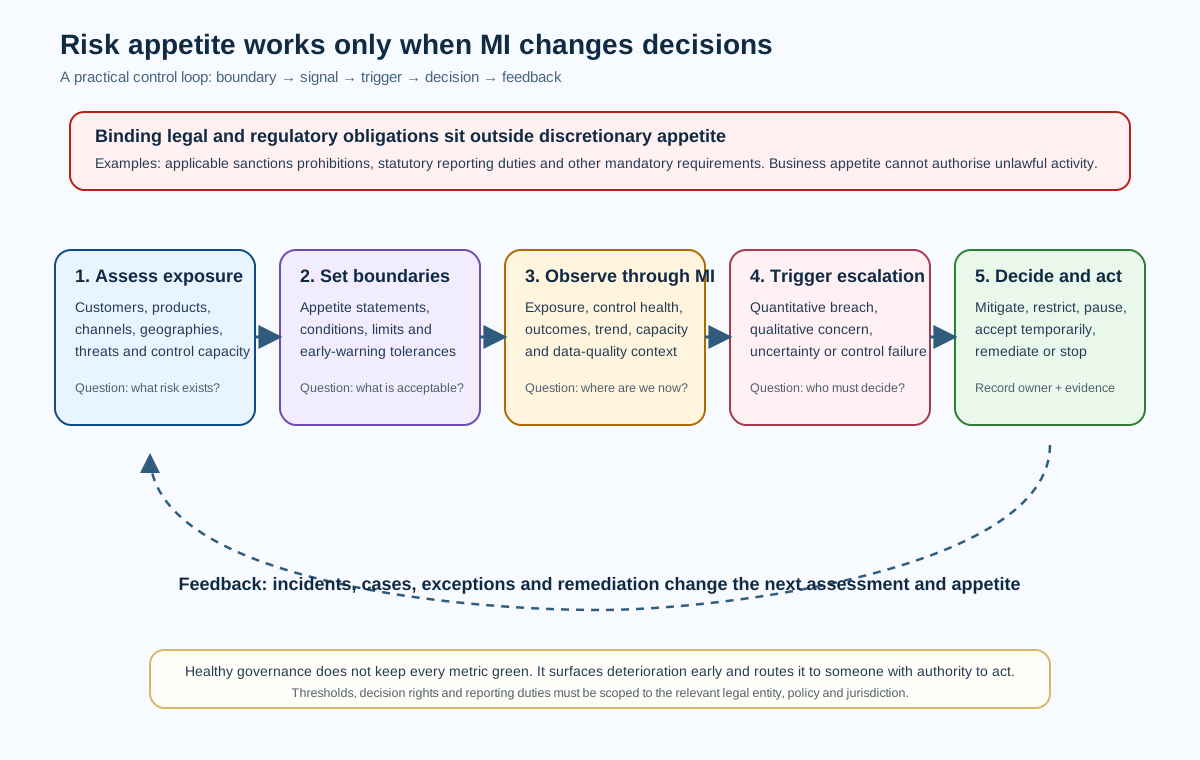
The simplest mental model: boundary, signal, decision
A useful way to think about the subject is to reduce it to three questions.
The first question is what boundary are we trying to operate within? The boundary may be legal, strategic, customer-related, product-related, geographic, operational or control-related. A bank may prohibit shell-bank relationships, restrict some activities involving certain jurisdictions, require enhanced approval for particular customer types, set tolerance for overdue high-risk reviews, or establish a maximum period for unresolved control defects. Not every boundary has to be numerical, but it should be clear enough to affect behaviour.
The second question is what signal tells us where we are relative to that boundary? A signal may be a customer concentration, corridor exposure, percentage of overdue enhanced reviews, number and age of unresolved sanctions cases, monitoring-feed completeness, investigation backlog, quality-assurance error rate, fraud-to-AML referral trend, control override count, model coverage measure or emerging threat indicator. The strongest signal is not always the easiest number to produce.
The third question is what decision follows when the signal changes? An amber threshold without a defined action is only decoration. A red threshold without an accountable owner can produce repeated reporting but no risk reduction. The decision may be to add capacity, narrow a product, pause onboarding, increase sampling, correct data, approve a temporary exception, escalate to a committee, notify a local legal entity, accelerate remediation, obtain legal advice, change a control or stop an activity.
This leads to a practical test: every material appetite statement should have one or more observable signals, and every material threshold should have an owner, an action and a route for escalation.
Global standards provide principles, not one universal appetite template
There is no single global AML risk-appetite template that every bank must use. International standards, prudential governance principles and jurisdiction-specific rules contribute different parts of the operating model.
FATF Recommendation 1 requires countries and financial institutions to identify, assess and understand money-laundering and terrorist-financing risks and to apply measures proportionate to those risks. In February 2025 FATF revised Recommendation 1 and related material to strengthen the emphasis on proportionality and support more appropriate simplified measures in lower-risk situations. That matters because a risk-based framework is not supposed to become a disguised zero-risk framework. Financial institutions are expected to understand risk and direct controls accordingly rather than apply identical intensity to every customer and activity.
FATF does not prescribe a bank's board risk-appetite statement, dashboard colours or committee thresholds. Those are governance mechanisms through which an institution can operationalise its risk-based approach. The relationship is therefore conceptual: the risk assessment identifies material exposure; appetite and control strategy determine how the bank intends to operate within that exposure; MI tests whether the approach remains effective; escalation addresses breaches and emerging concerns.
The Basel Committee's corporate-governance principles are broader than financial crime, but they provide useful bank-wide definitions. The Basel framework describes risk appetite as the aggregate level and types of risk a bank is willing to assume in advance and within its risk capacity to achieve strategic objectives. Its risk-appetite framework includes the policies, processes, controls and systems through which appetite is established, communicated and monitored, together with limits and responsibilities. Basel also emphasises that the board should establish clear escalation procedures for limit breaches and receive robust communication about risk.
That Basel language should not be misrepresented as a financial-crime-specific legal rule. It is a prudential governance framework that can be applied sensibly when a bank designs its financial-crime governance.
Industry guidance can add practical detail. The Wolfsberg Group's 2025 statement and June 2026 updated guidance on the risk-based approach emphasise proportionality, prioritisation and effectiveness. Wolfsberg explicitly connects a financial institution's financial-crime risk-management programme to its business model, risk assessment and risk appetite. It also argues that institutions should direct resources toward higher-priority risks and be willing to stop, reduce or redesign activity that does not materially improve outcomes. Wolfsberg guidance is not law, but it is useful professional practice for internationally active financial institutions.
Jurisdiction-specific governance requirements must then be applied where relevant. In the EU, EBA guidelines specify roles for the management body and AML/CFT compliance officer within the EU AML/CFT framework. In Australia, AUSTRAC's reformed AML/CTF obligations explicitly distinguish responsibilities of the governing body, senior managers and the AML/CTF compliance officer. Those requirements should be applied to entities within their legal scope, not copied globally as if they were universal.
Risk appetite is not a permission to break the law
The most important boundary is the distinction between legal obligation and risk appetite.
Suppose a sanctions rule legally prohibits making funds available to a designated person. A bank cannot decide that its appetite permits the transaction because the amount is small, the customer is strategically valuable or the probability of enforcement is low. The legal restriction sits outside the bank's discretionary appetite.
Now consider a lawful but complex money-service business operating across several high-risk corridors. The relationship may not be prohibited. The bank may decide that it is within appetite only if ownership is transparent, management quality is acceptable, source and purpose are understood, downstream activity is sufficiently visible, monitoring capability is strong and senior approval is obtained. That is an appetite decision.
A third example is a lawful product that the bank cannot currently monitor effectively because a critical transaction field is unavailable. The legal question may not be whether the product is prohibited. The governance question is whether the bank is willing to launch while the control gap exists, what temporary mitigation is credible, who can accept the residual risk, and by what date the missing capability must be delivered.
A good system therefore should not expose only one generic field called riskAppetiteOutcome. It may need to distinguish legal prohibition, policy prohibition, outside appetite, conditional acceptance, exception, temporary risk acceptance, unresolved legal interpretation and ordinary in-appetite processing.
"Zero tolerance" needs careful translation
Financial institutions often use language such as "zero tolerance for financial crime" or "zero tolerance for sanctions breaches". The intention is understandable: nobody wants a governance statement suggesting that money laundering or terrorist financing is acceptable. The phrase becomes problematic when teams interpret it as an operational claim that no criminal can ever pass through the bank or that every unusual event must be prevented.
No realistic financial system can guarantee that criminals will never attempt to use legitimate products. Some risks are visible only after behaviour develops. Some customers deceive the bank. Some identity and transaction data are imperfect. Some typologies are unknown until law enforcement, industry or internal investigations expose them. A credible framework therefore aims for effective prevention, detection, disruption, reporting and remediation rather than pretending that residual risk can be reduced to absolute zero.
Wolfsberg's recent risk-based work is useful here because it explicitly rejects a "focus on everything" mentality and argues for prioritisation and effectiveness. FATF's 2025 changes similarly strengthen the concept of proportionality. These developments do not lower legal standards. They reinforce the point that finite investigative and control resources should be deployed according to risk rather than distributed mechanically.
A bank can still use "zero tolerance" for particular conduct, such as deliberate employee facilitation of sanctions evasion, falsification of customer records or intentional suppression of suspicious-activity escalation. The phrase is clearer when it describes unacceptable behaviour rather than an impossible promise that no financial-crime event will ever occur.
From enterprise-wide risk assessment to appetite
The enterprise-wide financial-crime risk assessment and the risk-appetite framework should be connected, but they perform different jobs.
The risk assessment asks where the bank is exposed. It considers customers, products, services, channels, countries, legal entities, delivery models, counterparties and relevant threats. It examines inherent exposure, the design and effectiveness of controls, and the residual risk that remains. It also considers external change: new typologies, regulatory findings, geopolitical developments, criminal innovation, acquisitions, new products and changes in customer behaviour.
Risk appetite asks what the bank intends to do with that understanding. A risk assessment may identify high inherent risk in correspondent banking. Appetite may say that correspondent banking remains strategically important but is permitted only for defined institution types, subject to enhanced due diligence, nested-relationship controls, periodic review and senior approval. Another bank could assess similar inherent risk and decide not to offer the product because it lacks the required control capability. Both can be rational if their business models and capabilities differ.
The connection should be traceable. If the risk assessment identifies material exposure that is absent from appetite, teams should ask whether the appetite is incomplete. If appetite imposes a major restriction that is not explained by assessed risk, management should understand whether the restriction comes from strategy, legal uncertainty, historical events, control capacity or another factor.
The reverse connection also matters. Material appetite breaches, incidents, quality findings and investigation outcomes should feed the next risk assessment rather than remain isolated operational data.
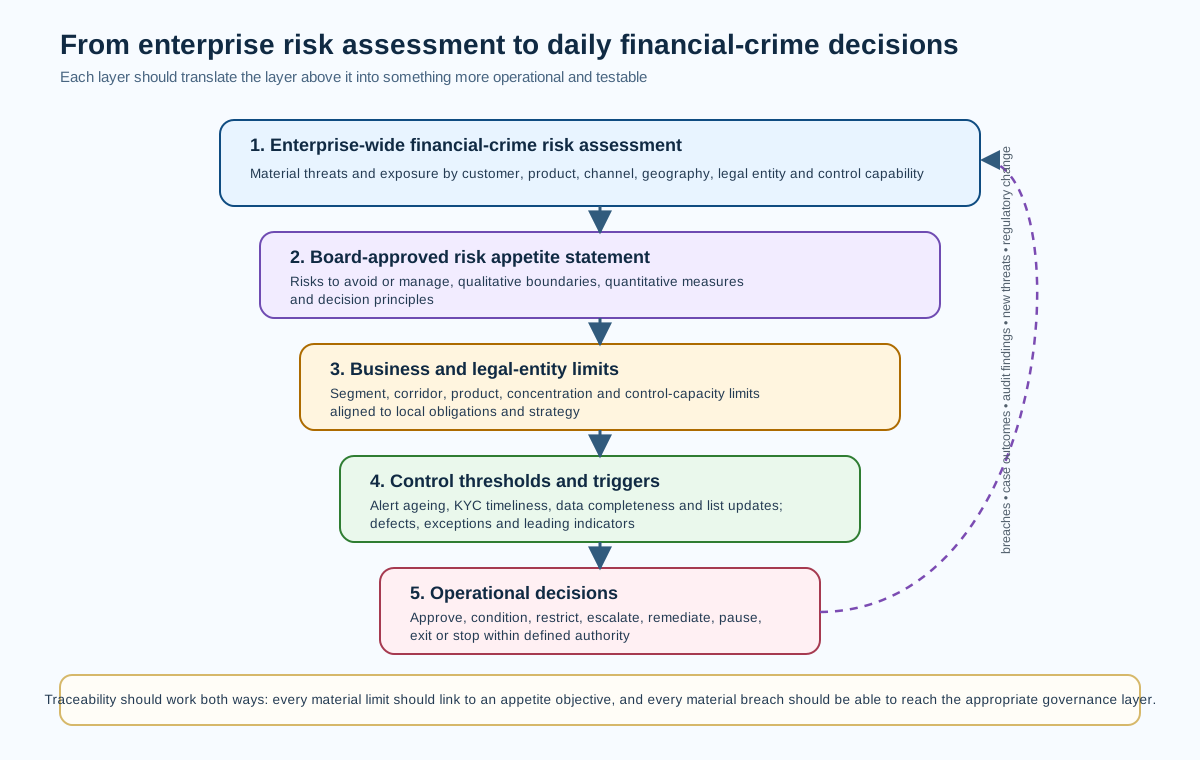
Building an actionable financial-crime appetite
An effective appetite statement combines qualitative boundaries with measurable indicators. It should be understandable to the board but specific enough to influence operational decisions.
At the highest level, the institution may describe the financial-crime risks it will avoid, the higher-risk activity it is prepared to manage, the importance of compliance with applicable legal obligations, the expectation that controls remain effective, and the circumstances in which business growth must slow or stop because control capability is not keeping pace.
Below that level, business lines and legal entities need more operational boundaries. A corporate bank may define appetite for correspondent relationships, payment institutions, cash-intensive sectors, trade corridors and complex ownership structures. Retail banking may focus more on mule exposure, remote onboarding, high-risk cash activity, PEP relationships, scam patterns and account misuse. Wealth management may require stronger source-of-wealth evidence and senior approval for particular risks. Merchant acquiring may focus on merchant categories, settlement models and third-party payment flows.
Operational appetite is equally important. It can cover overdue KYC reviews, sanctions queue age, alert backlogs, missing transaction feeds, list-update failures, unresolved high-severity defects, quality error rates, overdue regulatory reporting, untested models or manual control capacity.
The framework becomes useful when those statements have consequences. A business that exceeds its approved high-risk customer concentration may need executive review before further growth. A payment channel with incomplete sanctions-relevant data may require a launch restriction. A severe monitoring-feed gap may require a lookback or temporary compensating control. The objective is not to create bureaucracy; it is to prevent risk from becoming visible only after a major failure.
Appetite, tolerance, limit and trigger are not synonyms
Banks use these words differently, so the internal policy should define them. A practical model is to treat appetite as the overall type and level of risk the bank intends to assume, tolerance as an acceptable range around an appetite objective, limit as a firm boundary and trigger as an early-warning point that starts action before a limit is breached.
Imagine the bank expects high-risk periodic reviews to be completed by their due dates. It may set an operating target of close to full completion, an amber trigger when a small backlog develops, a tighter tolerance for the highest-risk population, and an escalation requirement if ageing passes a defined point. The exact percentages and days should reflect local rules, policy, risk and operational design; they should not be copied from a generic example.
The distinction matters because a red metric can mean different things. A legal reporting deadline may be absolute. An internal backlog tolerance may allow temporary variation if a credible recovery plan exists. A strategic concentration limit may require the business to stop new onboarding. A data-quality trigger may require engineering remediation but not customer restriction.
Thresholds should therefore carry metadata: what they mean, why they exist, which population they cover, who owns them, when they became effective, what action they trigger and who can approve an exception.
Risk capacity and control capacity
Financial-crime discussions often focus on customer risk but overlook the bank's capacity to control the business it already has.
Suppose a bank has appetite for payment institutions as a customer segment and its due-diligence framework is strong. If transaction volumes triple while investigators, monitoring infrastructure and data pipelines remain unchanged, the actual risk position can deteriorate even though the customer mix has not changed. Risk exposure is not only a function of customer category; it also depends on scale and control capacity.
Control capacity has several dimensions. Human capacity concerns analysts, investigators, quality reviewers and specialist expertise. Technical capacity concerns throughput, latency, storage, screening performance and monitoring processing windows. Data capacity concerns completeness, timeliness and lineage. Governance capacity concerns whether committees and decision owners can process escalations promptly. Change capacity concerns whether identified weaknesses can be remediated before further growth compounds them.
MI should therefore pair business exposure with control capability. A high-risk customer count may remain stable while transaction volume doubles. Alert volume may remain stable because a feed failed. A sanctions false-positive rate may remain stable while average resolution time increases because staffing is constrained. Each tells a different story.
One of the most important management questions is: if the business grows as planned, will the control environment still be within appetite six months from now? Appetite should be forward-looking rather than merely reporting whether yesterday was within a limit.
Customer appetite should not become category-based de-risking
Customer appetite is often expressed by segment, occupation, legal form, sector, ownership complexity, political exposure or geography. Those dimensions are legitimate inputs, but they can become dangerous when a category turns into an automatic presumption of wrongdoing.
FATF's risk-based approach expects proportionality. A higher-risk category should generally drive stronger understanding and mitigation, not a conclusion that every member of the category is suspicious. A money-service business, charity, cash-intensive business or customer connected to a higher-risk country can have a legitimate purpose and strong controls. The institution may still decide that it lacks the capability or appetite to serve some segments, but the reasoning should be transparent and consistent with applicable legal, conduct and inclusion expectations.
This is why an appetite statement should distinguish risk factor from decision rule. "Customers operating in a high-risk sector require enhanced assessment" is different from "all customers in that sector are prohibited." If the institution genuinely prohibits the segment for strategic reasons, the policy should say so rather than disguising the decision as a risk score.
MI can also reveal unintended de-risking. A sharp fall in high-risk customers may appear positive, but management should ask why. Did controls improve and customers become lower risk? Did the bank exit relationships that were genuinely unmanageable? Or did staff learn that assigning a high-risk rating creates extra work, so they changed classifications or avoided legitimate customers? Metrics need interpretation.
Product and channel appetite
Products shape financial-crime exposure because they determine how value enters, moves and leaves, how quickly decisions must occur and how much information the bank can observe.
Instant payments compress the sanctions and fraud decision window. Cash products reduce traceability of physical source. Trade finance adds goods, documents, shipping and counterparties. Correspondent banking exposes the bank to activity involving customers it may not directly know. Embedded-finance models can put several parties between the bank and the end user. Virtual-asset exposure introduces different transfer mechanisms and counterparty risks. Remote onboarding changes identity and impersonation risk.
A product appetite should therefore ask more than whether a product category is permitted. It should consider target customers, allowed use cases, geographic reach, transaction limits, third-party access, transparency, speed, control points, data availability and contingency behaviour.
A classic implementation failure occurs when business appetite and system capability diverge. Policy may allow a high-risk product only where enhanced monitoring is available, but the product launches before the required data reaches monitoring. The approval remains in a governance pack while operational reality changes.
For business analysts, appetite conditions should be expressed as testable product requirements. If a product is approved only when ultimate-party information is available for relevant transactions, the requirement should identify the source field, transformation, downstream control and failure behaviour. Appetite then becomes an engineering constraint rather than a paragraph that disappears after approval.
Geographic appetite is more than a country score
Country and jurisdiction risk is important, but geographic appetite should not collapse into a single static list.
Different risks may arise from different facts: sanctions exposure, FATF public statements, terrorism threats, corruption, conflict, weak supervision, secrecy, proliferation concerns, tax crime, fraud patterns or poor availability of reliable ownership information. The relevance of those factors varies by product and customer.
The bank also needs to distinguish the different ways a geography can appear. Customer residence, incorporation, beneficial ownership, operating location, source of wealth, destination of goods, payment counterparty, correspondent route, IP address and card usage are not equivalent exposures.
A customer incorporated in one country may operate entirely elsewhere. A payment can pass through an intermediary bank in a country that is not economically connected to the customer. A customer can have a legitimate supplier in a higher-risk market. The appetite framework should therefore specify which geographic relationships matter for which decisions.
Country-risk MI should also be versioned. If the bank changes a country classification, management should know when the change became effective and which customers or transactions were reassessed. Otherwise the same historical exposure may be reported differently from one month to the next without explanation.
Operational appetite is where governance becomes real
Some of the most important financial-crime appetite measures are not about customers at all. They are about the health of controls.
Examples include the age of unresolved sanctions cases, overdue high-risk KYC reviews, monitoring alerts beyond target service levels, unprocessed list updates, missing transaction populations, failed batch reconciliations, excessive manual overrides, unresolved high-severity defects, delayed suspicious-report decisions, repeated quality errors or model coverage gaps.
The point is not to declare that every minor operational exception is an appetite breach. The point is to identify which deterioration could materially reduce the institution's ability to manage financial-crime risk.
Operational metrics should be segmented by risk. A backlog of low-priority routine alerts is different from a backlog containing time-sensitive sanctions cases or high-risk mule investigations. An average age can hide one extreme case. A percentage can hide a concentrated problem in one legal entity. A global total can hide a failed payment feed affecting one channel.
Good MI therefore combines volume, age, severity, concentration, trend and affected population. It also shows whether management action is working. A red backlog that falls each week under a credible remediation plan tells a different story from a red backlog that remains flat while business volume grows.
Management information should answer a decision question
Financial-crime teams can produce hundreds of metrics because modern systems generate large amounts of data. The challenge is not producing numbers. It is deciding which numbers help someone act.
A useful metric should have a clear decision question. "Number of transaction-monitoring alerts" by itself has limited meaning. The decision question might be: is detection demand growing faster than investigation capacity? That suggests additional measures such as alert volume by scenario, risk segment and time; case conversion; ageing; staffing capacity; data completeness; and quality results.
"Number of sanctions alerts" is similarly incomplete. The decision question may be: can the bank resolve potentially relevant sanctions exposure before operational or legal deadlines without excessive customer harm? That requires age, payment value, jurisdiction, programme, case status, false-positive cause, staffing, cut-off proximity and perhaps blocked-asset information where applicable.
"High-risk customer population" becomes useful when linked to questions about concentration, growth, enhanced review completion, source-of-wealth quality, product use and exit trends.
MI should therefore be designed from governance questions backward to data, not from available database columns forward to a dashboard.
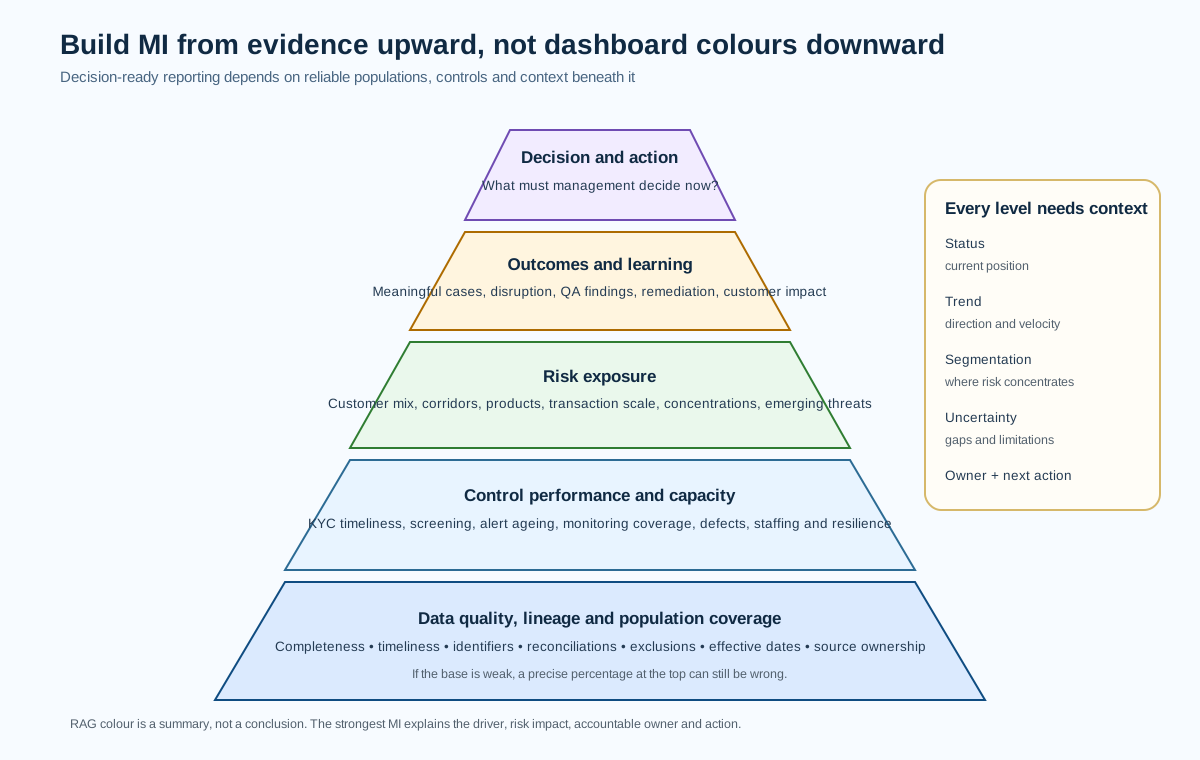
Exposure metrics, control metrics and outcome metrics
A balanced financial-crime MI pack normally needs several categories of measure.
Exposure metrics describe the risk the business is taking. Examples include customer mix, payment volumes, corridor concentrations, product usage, PEP population, high-risk sectors, correspondent relationships, cash exposure or new digital-channel activity.
Control-performance metrics describe whether controls are working as designed. Examples include screening completion, KYC review timeliness, transaction-feed completeness, alert ageing, rescreening completion, data-quality exceptions, quality-assurance results, model uptime and remediation status.
Outcome metrics describe what the programme is achieving or learning. Examples might include material cases identified, useful network disruption, quality of regulatory reporting, fraud loss prevented, repeated typologies, high-risk relationships remediated, false-positive reduction without loss of coverage, or investigation feedback leading to control improvement.
No single category is sufficient. Exposure can rise while control performance remains stable, which may still require action. Control metrics can look excellent while the bank is simply generating low-value alerts. Outcome metrics can improve temporarily while a hidden data defect is reducing future coverage.
The goal is not to force every outcome into a numerical target. Some outcomes require qualitative assessment and case examples. A board can learn more from one well-explained systemic control weakness than from a dashboard containing dozens of green percentages.
KPI, KRI and KCI: useful labels if the meaning is clear
Institutions often distinguish key performance indicators, key risk indicators and key control indicators.
A KPI typically measures how a process performs, such as average review time or cases completed. A KRI indicates exposure or deterioration, such as growth in high-risk corridors, ageing beyond tolerance or repeated control exceptions. A KCI focuses on whether a specific control is functioning, such as transaction-feed reconciliation completeness or sanctions-list loading success.
The labels can help, but the same number can play different roles depending on the decision. A rising alert backlog is a performance measure for operations, a risk indicator for management and evidence of control capacity for a product owner considering expansion.
What matters is the metric definition. It should state the population, calculation, owner, data source, frequency, segmentation, threshold, rationale and expected action. The board should not have to debate whether "95% complete" means 95% of customers, reviews, transactions or files.
Metrics should also identify exclusions. If one legal entity or product is not included because the data is unavailable, the dashboard should say so. Silence creates false confidence.
Leading and lagging indicators
Lagging indicators describe events that have already occurred: a missed reporting deadline, confirmed sanctions breach, regulatory finding, fraud loss, audit issue or material customer harm. They matter for accountability and learning, but they often arrive too late to prevent the event.
Leading indicators give earlier warning. Examples include rising manual payment repair, deteriorating data completeness, increased unresolved name matches, growing alert age, repeated analyst rework, model drift, higher-risk customer growth without capacity increase, unusual override rates, delayed list updates, low completion of event-driven reviews or repeated near misses.
The distinction is not absolute. An indicator can lead one risk while lagging another. A sudden increase in false positives may lag a data-quality defect but lead future operational backlog.
Trend is often more informative than a point-in-time threshold. A metric can remain green while moving rapidly toward amber. A mature dashboard highlights velocity and direction. Management should know not only today's position but whether the position is improving, deteriorating or volatile.
Leading indicators are especially valuable for growth decisions. If onboarding volumes are rising but KYC quality-review failure rates are also increasing, the bank may need to slow growth before formal limits are breached.
Metric lineage is part of governance
A number presented to senior management should be reproducible. If a committee asks why a metric changed, the institution should be able to trace the answer through source data, transformations, calculation logic and business events.
Consider an MI metric called high-risk customers overdue for review. The definition depends on at least five things: which customer relationships count as active, what qualifies as high risk, which review due date is authoritative, whether grace periods exist, and how closed or restricted relationships are treated. A change in any of those rules can alter the number without any real-world change in risk.
The metric also depends on data lineage. Customer risk rating may come from one KYC system while review dates come from another. Legal-entity mapping may occur in a warehouse. Records may be deduplicated. A reporting layer may exclude dormant relationships. If those transformations are not controlled, the final dashboard can be precise but wrong.
Every material metric should therefore have a data owner and a business owner. The data owner ensures the input and calculation are reliable. The business owner ensures the metric remains relevant to the risk decision.
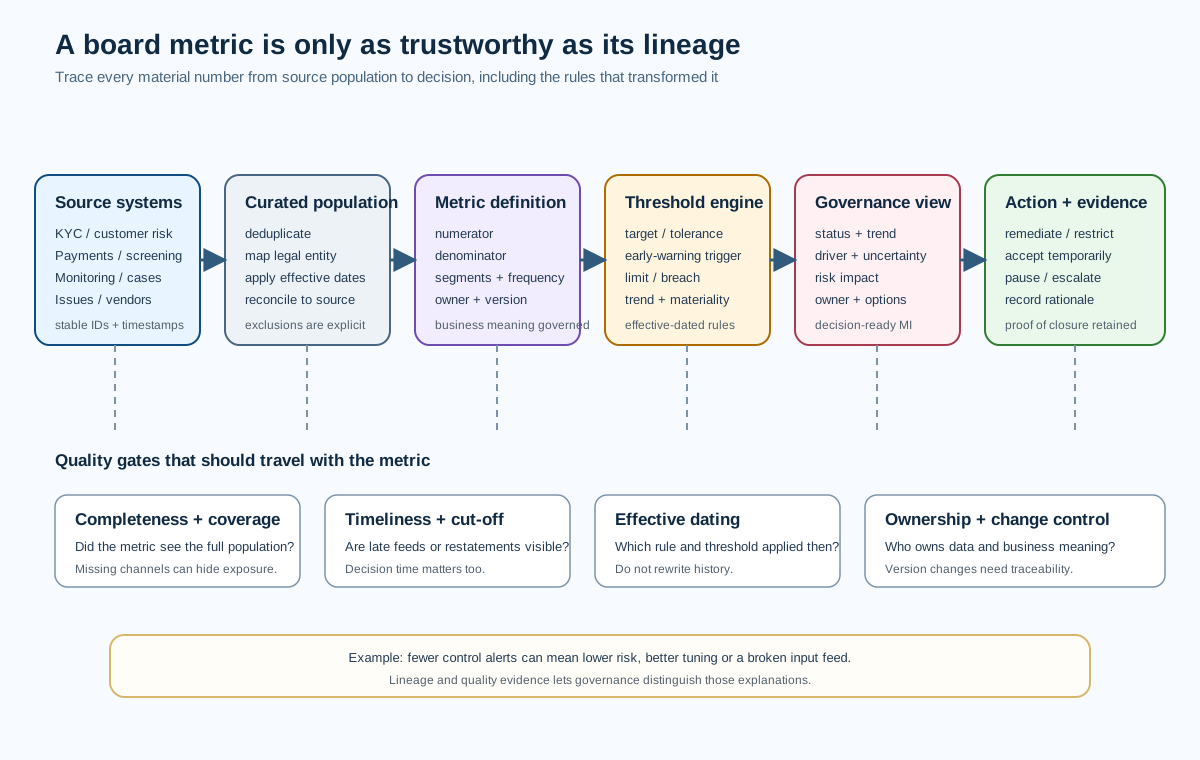
Data quality should be visible in the MI itself
Financial-crime MI often assumes that source data is complete. That assumption should be challenged.
If 8% of payments lack a reliable country attribute, a corridor-risk dashboard should not present the remaining 92% as if it represented the full population. If ultimate-party fields are dropped during ISO 20022 transformation, sanctions alert volumes may fall even though risk has not fallen. If beneficial-owner relationships are stored only in scanned documents, an ownership-screening metric may overstate coverage.
A strong dashboard therefore exposes important limitations. It can show completeness, timeliness, rejected records, unmatched identifiers, duplicate rates, feed delays and reconciliation differences. Where a metric is materially affected by a data issue, the limitation should travel with the metric into governance rather than remain buried in a data-quality ticket.
This is particularly important when management uses MI to make resource decisions. A low alert count can lead to staffing reduction. If the low count was caused by a broken feed, the organisation can compound the original control failure by removing capacity just when it is needed.
Data-quality thresholds can themselves be part of appetite. For example, the bank may decide that a control cannot be relied upon if a critical field drops below an agreed completeness level. The exact threshold should be justified by the control design, not selected arbitrarily.
Threshold design should begin with harm and decision time
A good threshold has a rationale. It is not chosen because 5% looks neat or because a red line makes the dashboard attractive.
For time-sensitive controls, the rationale may come from legal or operational deadlines. A sanctions payment review may need resolution before release or cut-off depending on the legal regime and payment state. A suspicious-reporting process may be governed by local filing requirements. A fraud-recovery process may become less effective as time passes.
For control-capacity measures, the rationale may come from how quickly risk accumulates. If investigators can normally resolve 1,000 alerts a week and inflow rises to 1,300 for several weeks, a backlog will grow even if current ageing remains acceptable. The trigger should therefore consider inflow, outflow and capacity rather than only total backlog.
For data quality, the relevant question is which missing fields materially weaken the control. Missing optional narrative text may have a different impact from missing customer identifier or transaction amount.
Thresholds should also be calibrated by segment. A single global alert-age target can obscure different legal entities, risks and case types. The highest-risk population may need earlier escalation.
Finally, thresholds should be reviewed after major business or control changes. A limit designed for last year's volume may become meaningless after an acquisition or product launch.
Avoiding the red-amber-green trap
RAG reporting is useful because senior managers need rapid orientation. It becomes harmful when colour replaces analysis.
A green metric can be deteriorating quickly. An amber metric can be stable and well controlled. A red metric can be caused by a deliberate temporary action, such as pausing automated closures while a rule is recalibrated. The colour is a summary, not a conclusion.
A useful executive metric pairs status with trend, driver, risk impact, owner and action. Instead of Alert ageing: RED, a better message might explain that high-priority alert ageing exceeded tolerance after a 40% volume increase caused by a new scam typology; temporary staffing is active; the oldest priority cases are being cleared first; no regulatory deadline has been missed; and a sustainable capacity decision is due at the next committee.
The purpose is not to write an essay for every metric. It is to make the management decision visible.
Banks should also guard against "green culture", where teams learn that red metrics damage careers and therefore redefine populations, delay recognition or create optimistic thresholds. Escalation is a control. A truthful red status identified early is often evidence of a healthy risk culture, not failure.
KYC and customer-risk MI
Customer due diligence produces several categories of useful MI.
Population measures can show active customers by risk rating, business line, geography, product and legal entity. Review measures can show upcoming, due and overdue periodic reviews, with separate views for high-risk relationships. Event-driven review measures can identify customers affected by ownership change, adverse information, sanctions updates or material behavioural changes.
Data-quality measures can show missing beneficial-owner information, unverified identity attributes, stale occupation or business activity, incomplete source-of-wealth evidence, unresolved duplicate identities and ownership structures that cannot be screened effectively.
Decision measures can show high-risk approvals, exceptions, declined relationships, exited customers and the conditions attached to approvals. Trend analysis can identify whether particular segments are expanding faster than the control environment.
Management should avoid using one metric as a proxy for quality. A very low number of overdue reviews can coexist with superficial review quality. A very high number of requested documents can reflect inefficient process rather than stronger due diligence. Quality assurance, evidence sufficiency and downstream usability need to be considered alongside timeliness.
Transaction-monitoring MI
Transaction-monitoring MI should move beyond alert counts.
A monitoring framework may need measures of source-population completeness, scenario or model coverage, alert generation, prioritisation, case conversion, ageing, investigator capacity, quality findings and outcome relevance. It should also explain material changes in volume.
If one scenario's alerts fall by 70%, the bank should ask whether risk declined, the scenario was tuned, a source field changed, a customer segment migrated, a threshold changed or a data feed failed. The same number can represent improvement or serious weakness.
Scenario-level MI should be linked to purpose. Which typology or risk does the scenario address? Which population is in scope? What important behaviours could it miss? What proportion of alerts become meaningful cases? What do closed alerts reveal about noise? Has the business changed since the scenario was designed?
Wolfsberg's 2024 and 2025 work on monitoring for suspicious activity is useful because it encourages institutions to focus on effective outcomes rather than treat legacy automated transaction monitoring as the only detection mechanism. That approach supports richer MI: priority-risk coverage, quality of leads, data diversity, explainability and responsible innovation can matter alongside traditional alert statistics.
Sanctions MI
Sanctions MI needs especially clear distinctions because legal and operational outcomes vary by regime.
Potential-match volume is not the same as true-match exposure. False-positive rate is not the same as screening effectiveness. Payment holds are not the same as blocked or frozen assets. A list update successfully loaded is not the same as every affected customer having been rescreened. Management should know which stage each metric represents.
Useful measures can include list-update receipt and deployment, rescreening completion, unresolved customer matches, unresolved payment matches, case age, high-priority jurisdictions or programmes, ownership-and-control cases, payment repair rates, false-positive causes, analyst override rates, technical failures, backlog by cut-off proximity and quality-review findings.
Where the bank maintains blocked or frozen assets or handles licences, the relevant MI should reflect the jurisdiction-specific legal framework. A global dashboard should not assume that US OFAC terminology applies to EU, UK or other sanctions regimes.
The governance question is usually not "how many alerts did screening produce?" It is "are we identifying and resolving relevant sanctions exposure accurately, on time and with defensible evidence?"
Fraud and AML MI should connect where the risks connect
Fraud and AML often observe different parts of the same criminal network. Fraud teams may identify victim payments, scam beneficiaries, compromised devices or account takeover. AML teams may identify mule networks, pass-through behaviour and laundering of the proceeds.
Joined MI can reveal trends that neither team sees alone: repeated beneficiaries across scams, receiving-account clusters, corridors used for rapid onward movement, device networks associated with multiple customer identities, or concentrations of accounts receiving victim-linked funds.
This does not mean every fraud alert should become an AML case. The functions can have different legal obligations, customer-protection objectives and reporting processes. The governance design should define which intelligence can be shared, for what purpose, with what confidentiality controls and which team retains decision accountability.
A useful management metric might show the percentage and timeliness of material fraud-to-AML referrals, but the number alone is not a target. If teams are rewarded for referral volume, they may flood each other with low-value information. Quality and usefulness matter.
Correspondent-banking and payment-institution MI
Correspondent relationships and non-bank payment institutions can create indirect exposure to customers and flows that the bank does not onboard directly. Appetite and MI should therefore consider more than the named institution.
Measures may include respondent risk rating, countries served, nested relationships, payable-through arrangements, downstream institution population, material changes in payment corridors, RFI volumes, payment transparency issues, sanctions repair, expected-versus-observed activity and overdue due-diligence refreshes.
If the bank permits nested activity only under specific conditions, MI should test those conditions. A policy statement that says nested relationships require transparency is incomplete unless the bank can observe whether the actual relationship remains transparent.
For payment institutions, rapid volume growth can be as important as customer count. One customer can generate millions of underlying transfers. A concentration measure based only on the number of relationships can therefore understate exposure.
Wolfsberg's 2026 risk-based guidance reinforces the importance of tailoring the financial-crime programme to business model, size, scale, footprint, customers and appetite. That is especially relevant where one institutional customer can create large downstream reach.
Emerging-risk MI
Financial-crime governance should leave room for risks that are not yet mature enough to have stable quantitative metrics.
A new scam typology, sanctions-evasion method, synthetic-identity technique or proliferation-financing pattern may initially appear through case narratives, law-enforcement feedback, regulatory intelligence or external events. Forcing an immature risk into a precise metric can create false confidence.
Emerging-risk MI can therefore combine qualitative and quantitative information. A committee may receive a short description of the threat, affected products, observed internal cases, external intelligence, current control coverage, uncertainty, actions underway and a decision on whether appetite or monitoring needs to change.
Over time, the bank may create structured measures as the risk becomes better understood. The governance process should not wait for perfect data before discussing a material concern.
This is also where horizon scanning meets appetite. A new law, sanctions measure or FATF change may alter legal obligations. A geopolitical event may change exposure overnight. A new product can create a customer or data pattern the existing framework never anticipated. Appetite must be capable of controlled change.
Escalation is a decision route, not a notification route
Escalation is often misunderstood as copying more senior people into an email. Real escalation transfers a matter to an authority that can make or sponsor a decision.
An investigator escalating a complex sanctions case needs a specialist who can interpret the relevant regime or obtain legal advice. An operations manager escalating a growing backlog needs someone who can authorise capacity, prioritisation or business restriction. A product owner escalating a control gap needs a risk owner who can accept, condition or reject the residual risk. A local compliance officer escalating a material issue may need both local management-body attention and group visibility.
The escalation record should explain the question being decided. Please note the backlog is high is weak. High-priority case ageing will exceed the approved tolerance within six days at current inflow; approve temporary redeployment and pause onboarding of segment X until capacity recovers is decision-ready.
Good escalation therefore contains facts, uncertainty, impact, options, recommendation where appropriate, decision owner and time by which a decision is needed.
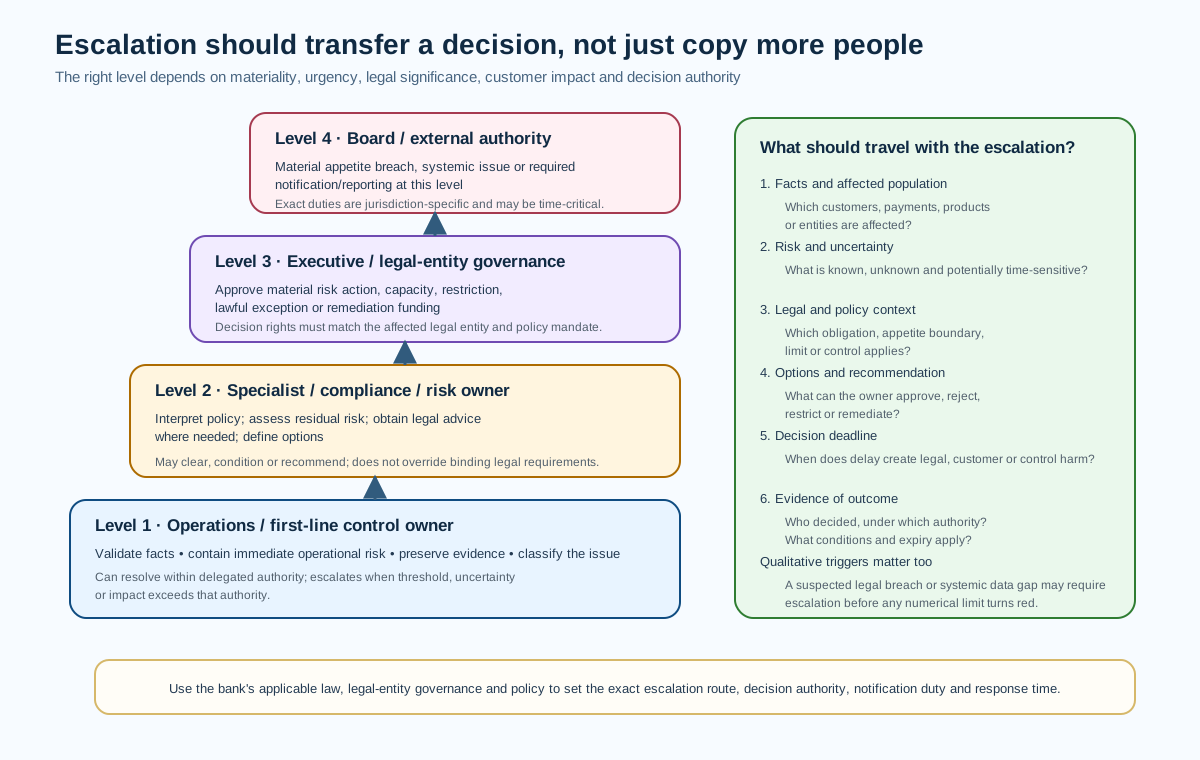
Quantitative and qualitative escalation triggers
Some escalation triggers are numerical. Examples include queue age, case volume, control failure rate, concentration limit, overdue remediation, data completeness or repeated quality defects.
Other triggers are qualitative and should not wait for a numerical threshold. Possible examples include a suspected legal breach, credible sanctions exposure, evidence of internal facilitation, material law-enforcement interest, suspicious activity involving senior management, a control defect affecting an unknown population, serious customer harm, a regulator request, a possible systemic reporting failure or a weakness that affects several legal entities.
This is why appetite cannot be reduced to a spreadsheet of percentages. Materiality can come from legal significance, customer harm, reputational impact, uncertainty or systemic reach rather than value alone.
Policies should give staff authority to escalate concerns even when no threshold has been crossed. If escalation is allowed only when a metric becomes red, the organisation can miss new risks that were never designed into the metric set.
Decision authority should be explicit
The person receiving an escalation should have a defined decision right.
Examples include authority to approve a higher-risk relationship, release or reject a payment after specialist review where legally appropriate, accept temporary residual risk, approve a policy exception, extend a remediation date, pause a product launch, exit a customer, deploy emergency resources, notify a regulator or escalate to the board.
Decision rights should include limits. A business executive may be able to accept a commercial exception but not override a legal prohibition. A local entity may have mandatory reporting duties that group management cannot cancel. A sanctions analyst may clear a false positive but not approve activity that requires legal interpretation or a licence.
Systems should preserve the authority used. An approval record should identify who decided, in what role, under which policy version, on what date, based on what evidence and subject to what conditions.
Temporary approvals should have expiry dates. Otherwise an exception can quietly become the permanent operating model.
Group governance and legal-entity accountability
Global banks face a recurring governance tension: group consistency versus local legal responsibility.
A group financial-crime framework may establish standards, common technology, risk appetite and escalation routes. Local entities may nevertheless have different laws, regulators, FIUs, sanctions regimes, reporting deadlines and management-body responsibilities. A global dashboard should support both views.
A material issue can require two simultaneous escalations. The local legal entity may need to assess regulatory notification or local board action. The group may need to understand whether the same defect exists elsewhere, whether enterprise appetite is affected and whether a common platform needs remediation.
Systems should therefore capture legal entity and jurisdiction as business data, not infer them from analyst location. A case worked by a team in one country may belong legally to an entity in another.
The EBA's AML/CFT governance guidance is a useful EU example because it describes responsibilities of management bodies and AML/CFT compliance officers, including at group level. AUSTRAC's current Australian framework similarly identifies governing-body, senior-manager and AML/CTF compliance-officer responsibilities. Those are jurisdiction-specific illustrations of a broader governance principle: accountability should be explicit and evidenced.
Board and senior-management MI
The board does not need the same dashboard as an operations manager.
Operational management needs detail: queue volumes, staffing, scenario performance, system incidents and case-level ageing. Senior management needs a view of exposure, trend, material control performance, breaches, remediation and business impact. The board or board risk committee needs enough information to understand whether the financial-crime framework remains within approved appetite, whether material weaknesses are being addressed and whether management decisions are credible.
Board reporting can therefore focus on highest residual risks, appetite breaches, major legal or regulatory matters, significant sanctions or fraud themes, material customer concentrations, severe data or technology issues, overdue remediation, internal-audit findings, key changes in external threat and decisions required from the board.
The board should also receive uncertainty. A dashboard that states precise numbers without disclosing a material data gap is worse than a dashboard that says coverage incomplete; exposure may be understated.
Basel governance principles emphasise robust risk communication, board oversight and actions when risk limits are breached. Financial-crime governance can apply the same discipline: reporting should enable challenge and decision, not merely demonstrate that a meeting occurred.
Appetite breach, control breach and policy exception are different events
These concepts are often mixed together.
An appetite breach occurs when exposure exceeds an approved boundary. A control breach occurs when a required control fails or is not performed as intended. A policy exception is an authorised deviation from a policy requirement under defined governance. A legal breach is a failure to meet a binding legal or regulatory obligation. The four can overlap, but they are not interchangeable.
A monitoring system outage may be a control breach. If the outage is short and recovered without loss of coverage, the institution may remain within appetite. If the outage creates a large unmonitored population, appetite may also be breached. If management had previously approved a temporary exception while a replacement system was implemented, the exception does not automatically eliminate the control risk. If the failure causes a missed legal reporting deadline, a legal or regulatory breach may also exist.
The classification affects escalation, root-cause analysis, reporting and remediation. A generic breach field is often too weak for case and issue systems.
Issue management and remediation
Material escalations should become controlled issues when they require sustained remediation.
A strong issue record describes the risk and affected population, not only the technical defect. It identifies root cause, interim controls, accountable executive, delivery owner, milestones, dependencies, target date, evidence required for closure and any validation or assurance step.
Suppose a transaction-monitoring feed omits a new payment channel for three weeks. The technical action may be to repair an interface. The risk action may also require reconstructing the missed population, replaying transactions, assessing whether alerts would have been generated, prioritising any resulting cases and checking whether similar feed onboarding gaps exist elsewhere.
Closing the interface ticket does not prove that the financial-crime risk has been remediated.
MI should therefore track issue progress and residual exposure. A project can be on schedule while risk remains high. Conversely, an overdue project milestone may be less concerning if an effective interim control materially reduces exposure. Governance should see both.
Risk acceptance must be bounded and temporary where appropriate
Banks sometimes need to operate while a control weakness is being fixed. A risk-acceptance process can make that decision explicit rather than allowing uncontrolled workarounds.
A credible risk acceptance should identify the weakness, affected population, legal assessment, residual risk, compensating controls, monitoring, accountable owner, expiry date and conditions that would force earlier escalation. It should explain why continuing the activity is acceptable relative to alternatives.
Compensating controls should be real. Operations will be careful is not a control. Additional manual review may be credible if volumes and expertise make it sustainable. A temporary transaction cap may reduce exposure. Restricted geographies or customer segments may narrow risk while a system is repaired.
Temporary risk acceptance should not become a substitute for investment. MI can reveal ageing exceptions, repeated extensions and cumulative exposure. Senior management should know when an organisation is normalising permanent operation outside its intended control design.
New-product approval and change governance
Financial-crime appetite should be embedded in product and change governance rather than consulted only immediately before launch.
A new product can change customer type, payment speed, geographic reach, transaction volume, third-party access, data availability and operational workload. Those changes should be compared with existing appetite and control capacity during design.
The approval pack should identify which financial-crime risks change, which controls will apply, whether required data is available, how the control will be tested, what MI will demonstrate safe operation after launch, and which conditions must be met before scale increases.
Post-launch MI is important because assumptions can be wrong. A product expected to generate 10,000 transactions a month may generate 100,000. Fraud patterns may differ. Screening false positives may be higher because customer data is less structured. The product should have early-life indicators and defined escalation if observed exposure differs from the approved model.
A strong product approval therefore has a feedback loop. Appetite informs design; launch creates evidence; MI tests the assumptions; escalation changes the product if reality diverges.
Practical mini case study: growth outruns control capacity
Consider a fictional bank, NorthBridge Bank, that decides to grow its business with regulated payment institutions. The segment fits strategy and is not prohibited. The enterprise financial-crime risk assessment identifies elevated exposure because customers can process large cross-border volumes for underlying users that NorthBridge does not directly onboard.
The board-approved appetite permits the segment subject to enhanced due diligence, clear understanding of downstream activity, defined country restrictions, monitoring appropriate to expected payment flows and senior approval for higher-risk relationships. The appetite also contains an operational expectation that high-priority monitoring and sanctions cases remain within defined ageing tolerance.
During the first year, the bank onboards twelve payment institutions. Due diligence is strong, transaction volumes are close to forecast and monitoring capacity is adequate. MI shows high alert volume but manageable age and good quality-review results.
Then a commercial campaign succeeds. Four existing customers expand rapidly and several new customers are approved. Payment volume doubles in three months. Customer count remains within the formal concentration limit, so one headline appetite metric stays green.
Operations data tells a different story. Monitoring inflow rises faster than investigator capacity. Priority-alert age remains technically within tolerance but deteriorates each week. Fraud referrals involving mule beneficiaries increase. One transaction-data pipeline begins arriving later because the batch window is overloaded. Sanctions screening remains available, but payment repairs increase because some new customers provide lower-quality address information.
A weak governance framework would wait until a hard backlog limit is breached. A stronger framework treats the trend as a leading indicator. The financial-crime MI pack links customer growth, transaction volume, alert inflow, case ageing, fraud referrals, data latency and sanctions repair. Management can see that the business is approaching a control-capacity boundary.
The first-line business owner proposes additional onboarding. The financial-crime risk owner asks a different question: can the existing control environment safely support another volume step before new capacity is deployed?
The issue is escalated to the relevant executive committee with three options. Continue unrestricted growth and accept rising operational risk; pause new high-volume relationships until capacity improves; or allow limited growth subject to transaction caps, additional staffing and accelerated data remediation.
The committee chooses the third option. The decision is recorded with conditions and an expiry date. Two new investigators are temporarily redeployed, a permanent recruitment plan is approved, the data platform receives capacity improvement, and customers with poor payment data receive remediation actions. New customers are subject to initial transaction caps until data-quality and monitoring performance are demonstrated.
Over the next six weeks, MI shows that priority-alert age stabilises and begins to fall. Transaction-feed timeliness returns to target. Sanctions repair decreases for remediated customers. The risk owner removes the temporary transaction cap only after the evidence supports the decision.
This case demonstrates why customer count alone was an inadequate appetite measure. The risk was created by scale, data quality and control capacity. No criminal event or regulatory breach was required for escalation. Governance acted because leading indicators showed that the bank was moving toward an unacceptable position.
A second case: green dashboard, broken data
Consider another fictional scenario. A bank's sanctions dashboard shows fewer payment alerts for three consecutive weeks. False-positive volume is down, average resolution time is excellent and the dashboard is green. Management initially celebrates the improvement.
A data-quality control then identifies that one payment channel stopped sending beneficiary address data after a software release. The screening engine continued receiving names, so the service reported successful processing. The alert reduction was partly caused by weaker input rather than cleaner customer behaviour.
This is why metric lineage and control reconciliation belong in the MI framework. The screening platform was technically available. Operations met its case-resolution SLA. The dashboard was numerically correct for the data received. The control was still weaker than intended.
The incident should create several actions. The interface defect must be repaired. The affected payment population must be identified. The bank must assess whether transactions need to be rescreened or reviewed under the applicable control framework. Root cause should determine why the release was not caught in testing. MI design should be updated so critical-field completeness is visible next to alert volume.
The governance lesson is important: good MI does not merely count control outputs. It also measures whether the control had the inputs and scope required to produce a reliable output.
Business-analysis requirements for appetite and MI
For a business analyst, this topic becomes concrete when converted into data, events, states, decisions and evidence.
A risk-appetite requirement should identify the business object. Is the boundary attached to a customer, product, legal entity, geography, transaction type, control process or portfolio? It should define the effective dates, owner, approval authority and conditions.
A metric requirement should define numerator, denominator, exclusions, segmentation, frequency, source systems, time zone, treatment of late data and historical restatement. Show overdue KYC percentage is not sufficient unless overdue, population and risk segmentation are defined.
A threshold requirement should define the trigger, evaluation frequency, state transition and required action. If a metric moves from green to amber, does a case open automatically? Is an email sent? Does a governance task require acknowledgement? Can the threshold be overridden? Who can change it?
An escalation requirement should define recipient role, legal entity, due date, evidence package, available decisions and audit trail. A material concern should not disappear because a named individual is on leave; workflows should route by accountable role where appropriate.
An exception requirement should capture rationale, compensating controls, expiry, approval and review. It should support reporting of aged and repeatedly extended exceptions.
The BA should trace each metric backward to the risk it represents and forward to a decision someone is expected to make.
Architecture and data design
A financial-crime MI platform is usually fed by multiple systems: KYC, customer risk rating, screening, payment processing, fraud, transaction monitoring, case management, regulatory reporting, issue management and external reference data.
Architecture should preserve stable identifiers across those systems. Customer, legal entity, account, payment, alert, case, issue, model version, list version and product identifiers enable reliable joins and historical reconstruction.
Effective dating matters. Management may need to know which risk rating applied when a transaction occurred, which threshold was active when a breach triggered, or which country classification was used for a monthly report. Reporting only the current value can rewrite history.
The architecture should separate business status from technical status. Screening completed should not mean the same thing as screening request successfully transmitted. Metric generated should not imply source completeness. Escalation closed should not imply risk remediated.
Access control is also critical. Board MI may contain sensitive case trends, sanctions exposures, suspicious-report information or law-enforcement-related data. The institution should minimise unnecessary detail and protect information according to applicable confidentiality rules.
Testing the framework
Testing should cover more than whether a dashboard loads.
For metric logic, testers should seed known populations and verify numerator, denominator, exclusions and segmentation. Boundary dates should be tested: due today, overdue tomorrow, closed yesterday, customer reclassified mid-period. Late-arriving data should be tested so the team understands whether prior reports are restated.
For thresholds, test values below, exactly at and above trigger points. Test trend logic where used. Verify that the correct owner receives escalation and that a technical failure to send an alert is itself visible.
For risk appetite, test conflicting conditions. A customer may be within segment appetite but outside geographic appetite. A product may be allowed only with enhanced controls. A legal prohibition should always take precedence over a discretionary approval route.
For exceptions, test expiry, extension, duplicate approval, segregation of duties and attempts by unauthorised users to change conditions.
For data lineage, simulate a missing feed, duplicate records, truncated identifiers and stale risk ratings. Confirm that MI exposes the defect rather than quietly reporting a lower-risk picture.
User-acceptance testing should include governance users. A dashboard that is technically correct but cannot answer an executive's decision question is not successful.
Quality assurance and audit
Quality assurance should test whether operational decisions are consistent with appetite and policy. Samples can ask whether the right approval authority was used, whether conditions were documented, whether exceptions expired correctly and whether escalation occurred when triggers were met.
Independent audit should be able to reconstruct the framework from board appetite to business limits, metrics, breaches and remediation. Audit can challenge whether metrics are meaningful, whether thresholds are manipulated, whether data lineage is reliable and whether governance forums actually change outcomes.
Wolfsberg's work on auditing for effectiveness and risk-based financial-crime programmes reinforces the idea that assurance should examine outcomes, not only procedural completion. A control can follow every step and still fail to manage the intended risk.
Audit evidence should include policy versions, committee minutes, metric definitions, threshold changes, issue records, exception approvals and proof of closure. Where models or advanced analytics influence MI, model governance and validation evidence may also be relevant.
Common failure modes
One common failure is vague appetite. Statements such as the bank has low appetite for financial crime sound strong but do not tell anyone what to do.
A second is legal and appetite confusion. Teams treat a discretionary business boundary as if it were law, or treat a legal prohibition as if it could be approved through risk acceptance.
A third is metrics chosen because data is easy to obtain. The dashboard becomes a reflection of system tables rather than material risk.
A fourth is activity mistaken for effectiveness. High case closure, high screening volume or high training completion is treated as proof that financial crime is being managed.
A fifth is aggregate reporting that hides concentration. Four percent overdue KYC may look acceptable until management learns that the backlog is concentrated in the highest-risk correspondent relationships.
A sixth is missing data-quality context. A drop in alerts is celebrated even though the source population is incomplete.
A seventh is escalation without authority. Issues are repeatedly reported to committees that cannot make the required decision.
An eighth is permanent temporary exceptions. Risk acceptances are extended until they effectively replace the policy.
A ninth is green culture. Teams learn to avoid red status rather than surface risk early.
A tenth is group reporting that obscures local legal responsibility. A global committee sees an issue, but the relevant legal entity fails to assess its own obligations.
An eleventh is threshold drift. Limits remain unchanged while business scale, threat and control capacity change materially.
A twelfth is no feedback loop. Investigation findings and control incidents never change appetite, products, data or resource allocation.
A practical review method
When reviewing a financial-crime appetite and MI framework, start with the risks rather than the dashboard.
Ask what the enterprise risk assessment says are the most material financial-crime exposures. Then ask where those exposures appear in the appetite statement. For each material appetite area, identify the observable metrics and the thresholds used to detect deterioration.
Next, trace each metric to its source population and calculation. Confirm whether data-quality limitations are visible. Ask what management decision is expected when the metric changes.
Then inspect escalation routes. Who owns the risk? Who owns the control? Who can approve an exception? Who can stop a product or customer activity? Which legal entity is accountable? What happens outside office hours for urgent matters?
Review actual examples. Select a recent amber or red metric and follow it through governance. Did anyone act? Select a risk acceptance and verify that compensating controls operated. Select a closed issue and confirm that residual risk was reduced. Select a major customer or product change and verify that appetite was reconsidered.
Finally, test feedback. Did material cases, audit findings, law-enforcement feedback or external typologies change risk assessment, controls, metrics or thresholds? A framework that never changes despite a changing threat environment is probably not genuinely risk-based.
What good looks like
A mature bank can explain financial-crime risk appetite in plain language and connect it to daily decisions. The board understands the highest material exposures and approves meaningful boundaries. Business lines know which customers, products, geographies and channels require enhanced approval or are outside appetite. Legal prohibitions are clearly separated from discretionary risk choices.
Management information shows exposure, control health, outcomes, trend and uncertainty. Material metrics have definitions, owners, source lineage and threshold rationale. Data-quality limitations are visible. High-risk concentrations are segmented rather than hidden inside averages.
Escalation routes lead to people with authority. Qualitative concerns can escalate even when no numerical limit has been crossed. Local legal entities retain accountability within group governance. Exceptions are documented, time-bound and monitored. Issues remain open until risk is actually remediated, not merely until a technology ticket is closed.
Product and growth decisions consider control capacity. Risk appetite is revisited when new customers, geographies, technologies or threats change the exposure. Investigations, fraud intelligence, sanctions cases, QA, audit and incidents feed back into the framework.
Most importantly, the institution can demonstrate that the framework changes behaviour. Appetite is not a slide. MI is not a reporting ritual. Escalation is not an email. Together they form a control system for directing attention and authority to the places where financial-crime risk is becoming unacceptable.
Final takeaway
Financial-crime risk appetite defines how an institution intends to operate within the risks it has identified, subject always to binding legal obligations. Management information tells the institution whether reality still matches that intention. Escalation ensures that deterioration, uncertainty and breaches reach people who can act.
The three disciplines are strongest when they form one chain: risk assessment identifies material exposure; appetite sets boundaries and conditions; products and controls implement them; MI measures exposure and control performance; thresholds provide early warning; escalation creates accountable decisions; issues and exceptions are tracked; outcomes feed back into risk assessment and appetite.
For compliance professionals, the key is to preserve the distinction between risk, law, policy and business choice. For investigators and operations, it is to understand which signals require escalation and why. For product owners, it is to recognise that growth cannot be separated from control capacity. For business analysts, it is to translate appetite into data, states, thresholds, workflows and evidence. For architects and developers, it is to preserve lineage and semantics. For testers and auditors, it is to prove that the framework produces the intended decisions under normal, boundary and failure conditions.
A bank does not demonstrate strong financial-crime governance by keeping every dashboard green. It demonstrates strong governance by knowing where risk is increasing, surfacing it early, making defensible decisions and reducing exposure before a warning becomes a failure.
References and further reading
- Financial Action Task Force, The FATF Recommendations — current consolidated international AML/CFT/CPF standards: https://www.fatf-gafi.org/en/publications/Fatfrecommendations/Fatf-recommendations.html
- Financial Action Task Force, FATF updates Standards and consults on guidance to better promote financial inclusion, 25 February 2025 — revisions strengthening proportionality under the risk-based approach: https://www.fatf-gafi.org/en/publications/Fatfrecommendations/update-standards-promote-financial-conclusion-feb-2025.html
- Financial Action Task Force, Risk-based approach and de-risking — FATF background and guidance resources: https://www.fatf-gafi.org/en/publications/Fatfgeneral/Rba-and-de-risking.html
- Basel Committee on Banking Supervision, Corporate governance — Basel consolidated framework, including risk-appetite framework, board oversight and risk communication: https://www.bis.org/committees/bcbs/basel-consolidated-guidelines/module/cgo/10
- Basel Committee on Banking Supervision, Corporate governance principles for banks, 8 July 2015: https://www.bis.org/publications/201507-guidelines-corporate-governance-principles-banks
- Basel Committee on Banking Supervision, Operational risk — Basel consolidated framework, including principles for risk-appetite and tolerance statements: https://www.bis.org/committees/bcbs/basel-consolidated-guidelines/module/orr/10
- Wolfsberg Group, Guidance on the Risk-Based Approach, June 2026 — industry guidance on proportionality, prioritisation, effectiveness and risk appetite: https://wolfsberg-group.org/resources/rba
- Wolfsberg Group, Statement on the Risk-Based Approach, July 2025: https://wolfsberg-group.org/resources/rba/203
- Wolfsberg Group, Statement on Effective Monitoring for Suspicious Activity, Part II: Transitioning to Innovation, 2025: https://wolfsberg-group.org/resources/195/202
- European Banking Authority, Guidelines on the role of AML/CFT compliance officers — EU-specific governance guidance, in force from 21 November 2022: https://www.eba.europa.eu/activities/single-rulebook/regulatory-activities/anti-money-laundering-and-countering-financing-1
- European Banking Authority, EBA publishes Guidelines on role and responsibilities of the AML/CFT compliance officer, 14 June 2022: https://www.eba.europa.eu/publications-and-media/press-releases/eba-publishes-guidelines-role-and-responsibilities-amlcft
- AUSTRAC, Your obligations — establish your governance framework — Australian AML/CTF governance context: https://www.austrac.gov.au/industry-and-business/obligations-and-guidance/your-obligations
- AUSTRAC, Establishing a strong AML/CTF culture — Australian guidance on governing-body engagement and escalation: https://www.austrac.gov.au/industry-and-business/obligations-and-guidance/your-amlctf-program/develop-your-amlctf-programs/step-1-establish-your-governance-framework/establishing-strong-amlctf-culture
Topic 12 Advanced Practice — Financial Crime Risk Appetite, MI and Escalation
Risk appetite becomes useful only when it changes real decisions. Management information becomes useful only when it reveals whether exposure and controls are moving toward or away from those boundaries. Escalation becomes useful only when it sends the issue to somebody who has the authority, evidence and time to act.
This section converts those principles into an operating model for analysts, BAs, product owners, compliance teams and technology teams.
1. Start with the hierarchy: law, policy, appetite, tolerance and trigger
These layers should not be confused.
Legal or regulatory prohibition — activity cannot be accepted merely because the bank has appetite for it.
Mandatory group/local policy requirement — internal minimum required by the bank, which may be stricter than law.
Risk appetite — the types and amounts of risk the bank is prepared to manage while pursuing its strategy.
Limit — a hard quantitative or qualitative boundary established under the appetite framework.
Tolerance — an operating range around an expected condition or target.
Trigger — an early-warning point that requires review, challenge or escalation before the hard boundary is crossed.
A useful requirement should identify which layer drives the action. Otherwise the system may treat a policy preference as though it were a legal prohibition, or treat a legal restriction as though it were an overrideable appetite limit.
2. Appetite should be expressed in decisions, not slogans
“Zero tolerance for financial crime” communicates values but cannot tell a product team whether a payment-institution customer is acceptable.
Operational appetite statements should identify the decision context. Examples include:
- prohibited or restricted customer types;
- products requiring enhanced approval;
- country/corridor conditions;
- correspondent or nested-relationship conditions;
- maximum unresolved high-risk KYC exposure;
- maximum ageing for defined sanctions referrals;
- data-quality tolerances for critical control inputs;
- conditions under which new products can launch;
- limits on risk acceptance or remediation extensions.
A statement is actionable when a user can determine what evidence is required, which authority decides, and what happens when the boundary is approached or breached.
3. Build an appetite-to-metric map
Every material appetite statement should map to one or more measures.
Example:
Appetite statement: The bank has low appetite for operating material sanctions-screening populations with incomplete party data.
Possible measures:
- percentage of in-scope payment records missing required party fields;
- percentage of routes failing screening-data reconciliation;
- number/value of payments processed under approved degraded control;
- unresolved data defects by severity and age;
- percentage of screening events linked to the exact payment-data version.
This is much stronger than measuring only alert counts.
An appetite-to-metric map should record:
- appetite statement/reference;
- metric name and definition;
- numerator/denominator;
- source systems;
- calculation frequency;
- legal entity/business scope;
- target, trigger, tolerance and limit;
- owner;
- decision/escalation route;
- data-quality confidence.
4. Distinguish KPI, KRI, KCI and outcome measures
Banks use these labels differently, so internal definitions matter more than terminology. A practical distinction is:
KPI — key performance indicator: how efficiently an activity is being performed. Example: average KYC case completion time.
KRI — key risk indicator: whether risk exposure is increasing or approaching an unacceptable level. Example: growth in high-risk cross-border corridors.
KCI — key control indicator: whether a control is operating within expected parameters. Example: percentage of payments missing required screening fields.
Outcome indicator: whether the programme is producing meaningful risk-management results. Example: repeated material findings, detection of relevant typologies, or sustained reduction in a known control weakness.
One measure can play more than one role, but the dashboard should make its purpose clear.
A high investigator closure rate may look like a positive KPI while hiding declining investigation quality. A low sanctions alert rate may appear efficient while actually reflecting missing data. Metrics require context.
5. Leading and lagging indicators should work together
A lagging indicator confirms something has already happened: breach, loss, missed deadline, regulatory finding.
A leading indicator warns that failure may be approaching: growing backlog, repeated overrides, declining data quality, rising manual repair, control-service instability, increasing concentration or rapidly changing exposure.
The most useful dashboards show the relationship.
For example:
Leading: payment screening service availability deteriorates; queue age rises; manual fallbacks increase.
Lagging: payment cut-off missed; control breach recorded; customer impact or regulatory notification occurs.
Management should not have to wait for the lagging event before seeing the problem.
6. RAG status needs trend and confidence
Red/amber/green is useful for executive scanning, but colour alone can mislead.
Every material status should ideally include:
- current value;
- threshold/limit;
- trend;
- forecast where appropriate;
- data confidence;
- cause;
- affected population;
- owner;
- action;
- expected recovery date.
A metric at 89 against a red limit of 100 may still deserve escalation if it moved from 30 to 89 in two days. A red metric may be under tightly controlled remediation with exposure already contained.
Do not design governance where “green” means no discussion and “red” means personal failure. That culture encourages delayed escalation.
7. Escalation should be a decision workflow
An escalation record should answer:
- What happened?
- Which legal entity/business/control is affected?
- What is the current exposure?
- What evidence supports the assessment?
- What interim controls exist?
- What decision is required?
- Who has authority to make it?
- By when must the decision occur?
- What happens if no decision is made?
- What evidence closes the escalation?
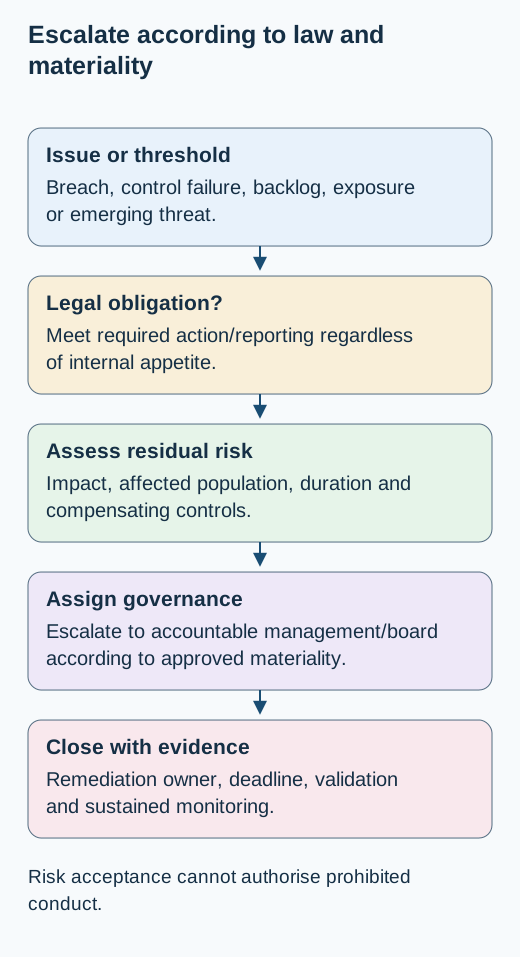
A ticket saying “sanctions queue high — please investigate” is an operational message, not a complete escalation.
8. Design escalation clocks by risk, not one SLA
Different issues require different speeds.
A possible true sanctions match on an in-flight payment may require immediate specialist review.
A rapidly increasing transaction-monitoring backlog may need same-day management intervention but not payment-level legal disposition.
A strategic appetite question about entering a new market may follow a scheduled committee cycle.
An overdue remediation action may have an escalation clock based on severity, regulatory commitment and residual risk.
Therefore model urgency class separately from severity. A severe strategic issue may allow deliberate committee review; a smaller but time-critical payment event may require immediate action.
9. Appetite breach, limit breach, control breach and incident are separate
These terms should not be merged.
Appetite breach: exposure exceeds a board/management-approved risk boundary.
Limit breach: a defined quantitative/qualitative limit is exceeded.
Control breach: a required control did not operate as designed or required.
Incident: an event caused or could cause operational, legal, financial, customer or regulatory impact.
One event can satisfy several categories, but the workflow and reporting implications can differ.
Example: a transaction-monitoring feed fails for two hours. That is a control/technology incident. Whether it also creates an appetite breach depends on exposure, duration and defined appetite metrics.
10. Risk acceptance must remain visible in MI
If management temporarily accepts residual risk, dashboards should not turn green merely because the exception was approved.
A risk acceptance should remain identifiable with:
- issue/risk description;
- affected population;
- residual risk;
- compensating controls;
- decision authority;
- approval date;
- expiry date;
- remediation owner;
- monitoring requirement;
- conditions that invalidate the acceptance.
MI should show active acceptances, upcoming expiries, repeated extensions and cumulative concentration.
Ten individually small exceptions can become a material aggregate risk.
11. Data-quality MI should be first-class financial-crime MI
Controls depend on data. Therefore data quality should appear alongside alert, KYC and case metrics.
Useful measures include:
- required party fields missing by payment route;
- unreconciled transaction feeds;
- stale customer-risk ratings;
- missing beneficial-owner links;
- country-risk reference-data age;
- unprocessed sanctions-list updates;
- duplicate or orphan customer identifiers;
- event-driven review triggers not consumed;
- case/report fields populated by manual workaround.
A management dashboard that shows “screening 99.99% available” but omits that 12% of one route lacks beneficiary address is incomplete.
12. Segment before aggregating
Aggregate statistics can hide severe pockets of risk.
A KYC backlog of 3% may appear manageable. If 70% of the overdue cases are high-risk correspondents, the management conclusion changes.
An alert backlog may be stable overall while one high-risk scenario is ageing rapidly.
Country exposure may look moderate while one corridor accounts for most high-value flow.
Segment MI by relevant dimensions such as:
- legal entity;
- business line;
- customer risk;
- product/rail;
- geography/corridor;
- scenario/control;
- severity/priority;
- source system;
- age bucket.
Then aggregate for executives without losing the ability to drill down.
13. Board MI should lead to decisions
Board or senior-committee reporting should not reproduce an operational dashboard.
It should focus on:
- highest residual risks;
- appetite/limit breaches;
- material control failures;
- severe or repeated incidents;
- major regulatory commitments;
- overdue high-severity remediation;
- significant sanctions/TF/PF exposure;
- material fraud/AML trends;
- data-quality weaknesses affecting control reliability;
- important risk acceptances;
- emerging risks and strategic decisions required.
Each material item should explain direction of travel and management action.
A useful board question is: What are we being asked to decide, endorse, challenge or note? If the answer is “nothing,” the slide may not belong in board MI.
14. Worked case — sanctions service outage
A central payment-screening service becomes unavailable for 22 minutes during peak cross-border processing.
A mature control response does not start with dashboard colour. It starts with the pre-agreed operating model:
- Preventive control outage detected automatically.
- Affected routes identified.
- Approved fail-safe action invoked — for example, hold/queue rather than uncontrolled release where required.
- Incident owner and sanctions specialist informed.
- Queue volume/value and customer impact monitored.
- Recovery validated.
- Held payments evaluated against the current list state before release.
- Reconciliation proves no route bypassed screening.
- Root cause and recurrence risk assessed.
- MI reflects outage, exposure, recovery and any breach/escalation.
A 22-minute outage can be low impact if controlled well or severe if payments bypassed a legally required control. Duration alone is not the risk measure.
15. Worked case — transaction-monitoring backlog
A tuning change doubles alerts in one corporate segment. The overall monitoring backlog rises only 12%, still within the formal limit.
Better MI reveals that high-priority alerts in that segment have tripled and investigators are reallocating capacity from another typology.
Management should ask:
- Was the tuning change expected to increase volume?
- Are the additional alerts meaningful?
- Is the priority population ageing?
- Is another risk area losing coverage because staff were moved?
- Does the threshold/model require refinement?
- Is temporary staffing enough, or is the scenario design wrong?
The escalation should identify the decision required, not merely report the backlog.
16. Worked case — appetite remains green while exposure changes
A bank's appetite permits up to 200 high-risk payment-institution relationships. The current number is 120, so the count metric is green.
However, transaction value has tripled, several institutions have introduced nested access, and one corridor now represents 45% of cross-border activity.
The customer-count metric is technically correct but strategically incomplete. Appetite should be multidimensional: relationship count, value, indirect access, corridor concentration and control capacity.
This is why metrics should be derived from the risk the appetite statement is intended to constrain.
17. BA data model
Useful objects include:
Appetite statement — approved wording, scope, version, owner.
Metric — definition, formula, source, frequency, quality rule.
Threshold — trigger/tolerance/limit value, effective date, scope.
Observation — measured value and timestamp.
Breach — type, severity, scope, detected time.
Escalation — recipient/authority, deadline, decision required.
Decision — outcome, rationale, conditions, approver.
Risk acceptance — residual risk, compensating controls, expiry.
Action — owner, due date, evidence, closure.
Version everything. A historical dashboard must use the threshold and appetite statement that were effective at that time, not today's values.
18. BA acceptance tests
Test scenarios should include:
- threshold changes effective next month;
- metric value crosses trigger but not limit;
- metric crosses limit outside business hours;
- legal prohibition triggered regardless of appetite status;
- one legal entity breaches while group aggregate remains within limit;
- risk acceptance expires automatically;
- repeated temporary extensions require higher approval;
- source data becomes incomplete and confidence falls;
- RAG status stays green while trend breaches a velocity trigger;
- escalation recipient is absent/delegated;
- decision occurs but downstream action is not completed;
- issue is reopened after failed closure validation;
- board metric can be drilled to source population;
- historical report reproduces old thresholds and values.
Advanced takeaways
- Appetite operates inside legal and policy boundaries; it cannot override them.
- Every material appetite statement should map to evidence-backed metrics and decision rights.
- KPI, KRI, control and outcome measures answer different questions.
- Trend, concentration and data confidence are as important as current status.
- Escalation should be a governed decision workflow with a clock and authority.
- Approved risk acceptance does not make residual risk disappear from MI.
- Aggregate dashboards must preserve high-risk concentrations.
- Board MI should drive decisions, not reproduce operations reporting.
- Historical reproducibility requires versioned thresholds, metrics, decisions and appetite statements.
Educational note: terminology and governance for risk appetite, limits, tolerances, incidents and escalation vary by institution and jurisdiction. Apply the bank's approved framework and applicable legal requirements.
Practice close: operating risk appetite, MI and escalation under pressure
This final practice layer tests whether risk appetite, management information and escalation can survive real operating pressure. The purpose is to move from definitions to decisions.
Case 1 — sanctions queue within limit, but risk is rising
A sanctions queue has 1,200 payments. The formal queue limit is 1,500, so the dashboard remains green. However, 80 payments are high value, 25 are approaching market cut-off, several relate to a newly sanctioned geography and false positives have increased sharply after a customer-data change.
A mature framework should not wait for the absolute limit to breach.
The better questions are:
- Is ageing worsening?
- Is risk concentrated in particular payments?
- Has the underlying data changed?
- Is specialist capacity sufficient?
- Are any payments legally time-sensitive?
- Is the apparent increase caused by genuine exposure, matching configuration or poor data?
- Which trigger should move the issue from operations to sanctions governance?
This demonstrates why one aggregate number cannot represent all dimensions of risk.
Case 2 — appetite is formally intact, but capacity is not
A business line remains within its approved limit for high-risk payment institutions. During the quarter, transaction volume doubles and several customers expand into new corridors. EDD staffing and monitoring capacity remain unchanged.
The portfolio may still be inside the customer-count limit while operational control capacity moves outside acceptable tolerance.
A good appetite framework therefore measures both exposure and ability to control the exposure.
Case 3 — a red metric that never produces action
A transaction-monitoring backlog is red for four consecutive months. Each committee receives the same update: “recruitment ongoing.” No interim control, scenario prioritisation, root-cause analysis or risk acceptance is documented.
This is weak governance even though the issue is transparently reported.
Escalation is effective only when it creates a decision: add capacity, reduce exposure, introduce compensating controls, prioritise specific risk segments, accept risk formally for a limited period, or implement another approved response.
Designing a metric dictionary
For every material MI measure, define:
- metric name;
- business purpose;
- numerator and denominator;
- inclusion/exclusion rules;
- legal entity and population;
- data source;
- calculation frequency;
- owner;
- threshold and trigger;
- trend logic;
- known limitations;
- escalation consequence.
This prevents the same phrase from meaning different things across dashboards.
For example, “overdue KYC percentage” is ambiguous unless the bank defines whether closed relationships, suspended relationships, grace periods, incomplete event-driven reviews and high-risk customers are treated consistently.
Threshold testing
Thresholds should be tested as carefully as system rules.
Ask:
- Does the trigger fire before a hard boundary is reached?
- Can a severe qualitative event escalate regardless of numeric value?
- Can a fast deterioration trigger action even while the absolute value is still acceptable?
- Can the metric be segmented by material risk population?
- Is the threshold still meaningful after business growth?
- Who can change it and how is that change governed?
A static threshold in a rapidly growing business can become meaningless.
Appetite rules in technology
Appetite should become executable logic where appropriate.
A customer-acceptance platform may need to know:
- which customer categories are prohibited by law;
- which are outside bank appetite;
- which require enhanced due diligence;
- which require senior approval;
- which require periodic review at a different frequency;
- which restrictions apply by legal entity or jurisdiction.
A product platform may need limits for countries, currencies, transaction values or indirect access.
A workflow should preserve the exact appetite rule and version used in a decision. Otherwise future reviewers see only the outcome, not the boundary that produced it.
Escalation-state model
A useful escalation model can separate:
Detected — trigger occurred.
Triaged — severity and owner confirmed.
Escalated — decision authority engaged.
Decision pending — evidence or options under review.
Decision made — action, acceptance or remediation approved.
Action in progress — implementation underway.
Validated — control outcome verified.
Closed — governance confirms completion.
This is stronger than one field called issue_status.
BA acceptance tests
- a metric crosses an early-warning trigger before the hard limit;
- a severe qualitative sanctions event escalates even when volume is low;
- a high-risk segment is visible inside an otherwise green aggregate metric;
- a threshold change requires approval and effective dating;
- expired temporary risk acceptance triggers review;
- a dashboard value can be traced to source population and calculation;
- one legal entity can have a different limit from another;
- committee decision records link back to the triggered metric or issue;
- control failure and appetite breach are reported as different event types;
- risk acceptance cannot close the underlying remediation automatically;
- a metric with incomplete source data shows a confidence/limitation warning;
- board reporting highlights material movement rather than only current RAG status.
Practice exercise — work through this before reading on.
Exercise — build the escalation logic
Design escalation for these four events:
- sanctions screening service unavailable for ten minutes;
- monitoring feed misses one payment source for six hours;
- high-risk customer growth remains within limit but doubles quarter-on-quarter;
- regulatory remediation is due in 30 days and still depends on an untested vendor release.
For each event define:
- trigger;
- severity;
- legal entity;
- first owner;
- second-line involvement;
- senior escalation point;
- decision required;
- interim control;
- evidence retained;
- closure condition.
The exercise demonstrates that escalation design is part of control architecture, not merely committee administration.
Final practitioner standard
A mature framework should allow management to answer:
What risk are we willing to run? What are we actually running? What is deteriorating? What boundary is approaching? Who must decide? What action was taken? Did it work?
If appetite, MI and escalation can answer those questions consistently, they are functioning as a control system rather than a reporting process.
Practitioner masterclass: designing appetite and MI that drive behaviour
The quality of a risk-appetite framework is revealed by behaviour. If teams still make decisions through informal judgement, if dashboards are reviewed without action and if serious issues are escalated only after a breach, the framework exists on paper rather than in the operating model.
A mature bank designs appetite so that front-line teams, risk functions and senior management understand the same boundaries. It also designs MI so that those boundaries can be observed before they are crossed.
Turn qualitative appetite into operational rules
High-level statements need operational translation.
If the bank says it has limited appetite for opaque ownership, the onboarding process should define what level of ownership transparency is required, what evidence is acceptable, when enhanced due diligence is triggered and when the relationship must be declined or escalated.
If the bank has restricted appetite for particular payment corridors, the payment and monitoring systems should know which corridor attributes are relevant and what consequence follows from each risk state.
If the bank has low appetite for unresolved sanctions risk, the payment engine should support hold, review, release and block or reject outcomes according to the applicable legal framework.
This is the bridge between policy and system behaviour.
Appetite should include capacity risk
A bank can accept a business model in principle and still lack the capacity to control it safely.
If high-risk customer growth outpaces EDD staff, if sanctions alerts exceed specialist capacity or if transaction-monitoring volume grows faster than investigation capability, residual risk can increase even though policies have not changed.
Risk appetite should therefore consider operational capacity, not only customer and product categories.
A practical appetite may include limits or triggers for overdue high-risk reviews, priority-case ageing, unresolved sanctions alerts, manual repair volume, quality-assurance failure rates or critical remediation backlog.
MI should be risk-weighted
Simple counts can be misleading.
One hundred low-risk alerts are not necessarily more important than three alerts involving a high-risk correspondent, sanctioned-country nexus or material fraud network.
MI should therefore support segmentation by customer risk, value, product, jurisdiction, legal entity, typology and priority.
The same principle applies to overdue KYC. A backlog of low-risk customers may be operationally important, but a smaller backlog of high-risk PEP or correspondent relationships may present greater risk.
Trend, velocity and concentration
Management needs more than current status.
Trend shows whether the metric is improving or deteriorating. Velocity shows how quickly it is changing. Concentration shows where the problem sits.
For example, sanctions false positives may rise only 5% overall but increase 80% for one new payment corridor after a data change. Aggregate MI can hide the root cause.
Dashboards should therefore allow management to drill down from group totals to legal entity, product, corridor, scenario or queue.
Data lineage for MI
A management metric should be traceable to source data.
If the board is told that 96% of high-risk reviews are current, someone should be able to explain which customers are included, how “high risk” is defined, which review date is used, how closed relationships are treated and whether the data is complete.
This is especially important when the same metric is produced by several legal entities. Inconsistent definitions create false comparability.
A metric dictionary can define name, business purpose, calculation, owner, data source, frequency, threshold and known limitations.
Avoid perverse incentives
Metrics influence behaviour.
A target to reduce alerts can encourage teams to tune away risk. A target to increase suspicious-report conversion can encourage over-escalation. A target to close more cases can reduce investigation quality.
Good MI therefore balances volume, timeliness and quality.
For example, investigator productivity can be viewed alongside QA results and case complexity. Alert reduction can be viewed alongside scenario coverage and confirmed-risk detection. Customer-exit numbers can be viewed alongside reasons and financial-inclusion impact.
Early-warning indicators
The best escalation systems identify deteriorating conditions before a breach.
Examples include a rising proportion of payments requiring manual repair, increasing failed KYC refreshes, growing sanctions-queue age, sharp increases in new beneficiaries, unusual corridor growth, repeated data-feed defects, or rising fraud losses in a specific segment.
An early-warning indicator should have an owner and action. A yellow metric that stays yellow for six months without decision is not effective escalation.
Risk acceptance
Some issues cannot be remediated immediately. Management may decide to accept residual risk temporarily while a longer-term fix is delivered.
Risk acceptance should be formal. It should define the issue, affected scope, residual risk, compensating controls, accountable approver, expiry date and conditions for review.
Temporary acceptance should not become a permanent workaround by default.
Escalation design
An escalation matrix should identify event, severity, recipient, response time and decision authority.
A possible sanctions true match may require immediate specialist and legal review. A major transaction-monitoring data defect may require senior management and regulatory assessment. A moderate backlog may remain within operational governance until a threshold is crossed.
The objective is proportional escalation, not escalation of everything.
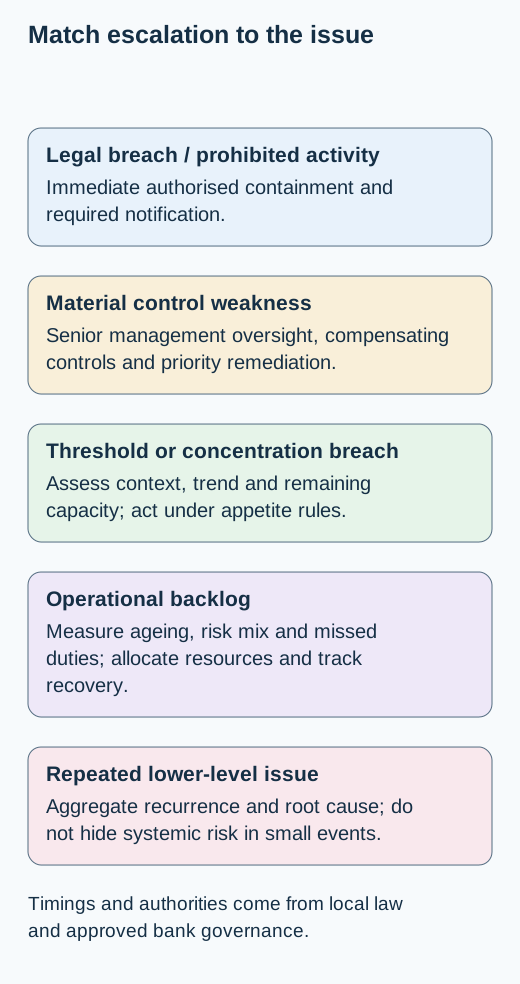
Incident versus issue versus breach
Teams should distinguish these concepts.
An incident is an event that disrupts or affects a process or control.
An issue is a recognised weakness requiring remediation.
A breach means a legal, regulatory, policy or appetite requirement has been violated, depending on the bank's terminology.
One incident can create an issue without necessarily creating a regulatory breach. A systemic data failure can become both.
The classification affects escalation, reporting and governance.
Regulatory notification
Some material control failures may trigger regulatory-notification obligations. The exact threshold and timing are jurisdiction specific.
The escalation process should therefore include legal and compliance assessment of whether external notification is required.
Technology teams should not decide this alone, but they must provide accurate facts: start time, affected systems, population, transactions, controls bypassed, data lost or delayed and remediation status.
Scenario: monitoring data feed fails
A transaction-monitoring platform stops receiving one payment source for six hours.
Operationally, there may be no alert backlog because no alerts were generated. A simple queue dashboard could remain green.
A stronger control framework monitors data completeness. The missing feed becomes an immediate control incident, affected transactions are identified, retrospective monitoring is planned and management assesses whether external notification or customer action is required.
This example shows why control-health MI is as important as output MI.
Scenario: growing PEP backlog
PEP review backlog increases gradually over three months. Total overdue percentage remains within tolerance, but domestic PEP cases are ageing significantly and several involve high-value private-banking relationships.
A segmented dashboard should show the concentration. The trigger may escalate before the overall limit is breached because the affected population is high risk.
Scenario: partner risk growth
A fintech partner doubles transaction volume and launches a new country corridor. Customer numbers and KYC backlog remain stable.
A purely customer-based appetite view misses the change. Transaction exposure, geographic concentration and operational capacity should trigger reassessment.
Decision logs
Material risk decisions should be recorded in a decision log.
The record can include decision date, issue, options considered, risk assessment, legal input, final decision, approver, conditions and review date.
This becomes valuable months later when staff change or a regulator asks why a decision was made.
Committee effectiveness
A committee is not effective because it meets every month.
Useful governance should show clear decisions, challenge, action ownership and follow-up. Repeated red metrics without decisions indicate weak governance even if minutes are produced perfectly.
Committees should also avoid drowning in operational detail. The purpose of escalation is to move decisions to the right level, not to send every queue metric to the board.
Final practitioner test
For any material metric, management should be able to answer: what does this measure, why does it matter, what threshold applies, what is the trend, what action occurs if it deteriorates, who owns the decision and what evidence proves the response?
If those answers are clear, MI becomes part of the control environment rather than a reporting layer.
Further cases and independent practice
These further cases support the core reading. Allow additional time to work through the independent exercises and compare your reasoning with the explanations.
Risk appetite must change decisions
A financial-crime risk appetite is useful only if it changes behaviour. Statements such as "we have zero tolerance for financial crime" sound strong but are not enough to operate a bank. No control system can guarantee that no criminal will ever attempt to use the institution. The practical appetite framework should identify exposures the bank will not knowingly accept, risks it can accept only with enhanced controls, limits or thresholds that trigger management action and the governance for exceptions.
Appetite should be connected to products, customer types, geographies, channels and operational capability. A bank may decide that a particular sanctions exposure is legally prohibited, while a high-risk but lawful customer segment can be supported only if enhanced due diligence and monitoring are available. Those are different kinds of boundaries and should not be expressed as one generic red line.
Metrics, indicators and limits
Management information should distinguish exposure measures from control-performance measures. Exposure metrics can include high-risk customer populations, country corridors, cash volumes, correspondent relationships, PEP populations or sanctions-sensitive activity. Control metrics can include screening coverage, alert ageing, false-positive concentration, investigation quality, data defects, overdue reviews and issue remediation.
A limit or trigger should have a defined response. If a backlog exceeds a threshold, who is informed? What actions are required? Does risk acceptance need approval? How long can the breach continue? What happens if remediation fails? A red dashboard indicator with no consequence is not effective governance.
Worked case: growing AML backlog
A bank's transaction-monitoring alert volume rises by 40% after a model change. Staffing remains unchanged, and high-risk alerts begin to age beyond the internal SLA. The raw volume increase does not automatically mean the model is better. Management should understand why alerts increased, whether risk coverage improved, which segments drive the volume, whether investigators have sufficient context and whether material cases are being delayed.
The risk-appetite question is whether the backlog creates residual risk beyond the level senior management has agreed to accept. If it does, the bank needs action: prioritisation, temporary resource, model review, stronger triage, remediation or formal risk acceptance with an expiry and accountable owner. Quietly changing the SLA to make the dashboard green would hide the risk rather than manage it.
Sanctions example
A sanctions screening service experiences repeated latency and occasionally releases payments under a contingency process. Management information should not report only availability. It should show the number and value of payments processed under contingency, legal entities and regimes affected, manual-review capacity, rescreening completion, incidents and any breaches. The appetite decision may differ by payment type and legal requirement.
This illustrates why operational metrics need financial-crime meaning. System uptime is not the same as control effectiveness.
Designing useful MI
A strong dashboard tells a decision-maker what has changed, why it matters and what action is needed. Trend matters more than isolated numbers. Segmentation matters because a 5% false-positive rate in one population and 95% in another can disappear inside an average. Ageing distributions are often more useful than a single average queue age. Root causes should be visible where possible.
MI should also preserve definitions. If "high-risk customer" changes meaning after a scoring-model update, trend lines need annotation. If one legal entity reports alerts while another reports cases, group totals should not pretend they are directly comparable.
Practice exercise — work through this before reading on.
MI-design exercise
Build a dashboard for a financial-crime executive committee using no more than ten measures. For every measure, state the risk question, data source, owner, frequency, threshold, escalation path and potential unintended incentive. Include at least one exposure measure, one data-quality measure, one operational measure, one quality measure, one customer-impact measure and one remediation measure.
Then test each metric. Could teams game it? A closure-rate target can encourage weak investigations. A false-positive-reduction target can encourage unsafe tuning. A "zero overdue KYC" target can encourage superficial completion. Good MI supports judgement rather than replacing it.
Escalation design
Escalation should be based on materiality, legal urgency, customer impact and risk, not hierarchy alone. A suspected sanctions breach may require immediate legal/compliance escalation even when value is small. A large but well-controlled KYC backlog may require management action without becoming a legal breach. A repeated data defect can be more serious than one operational error because it affects many controls.
The system should capture escalation reason, date, decision-maker, options considered, decision, conditions, expiry and follow-up. Verbal risk acceptance with no record is not defensible.
Risk acceptance and exceptions
An exception should not become a permanent workaround. Where an exception is permitted, document scope, rationale, residual risk, compensating controls, approver, expiry and exit criteria. Review whether the exception remains necessary and whether conditions are being met.
Some legal obligations cannot be waived internally. Risk appetite cannot authorise activity that law prohibits. This distinction should be explicit in governance.
Practice exercise — work through this before reading on.
Final escalation exercise
Rank these events by urgency and explain why: a small payment with a likely true sanctions match; 10,000 low-risk AML alerts one day overdue; a missing beneficial-owner field affecting 20% of a corporate portfolio; one poor-quality SAR narrative; an expired KYC review for a transparent low-risk customer; and a model change that unexpectedly reduces alerts by 80%.
There is no universal numeric answer. The professional skill is to connect the event to legal obligation, risk exposure, control dependency, customer harm and time sensitivity.
A strong learner should finish able to design appetite that changes decisions, MI that explains risk and escalation that creates accountable action.
Worked management pack: a green dashboard with a deteriorating queue
The following fictional example develops the mechanics behind management information. The figures and operating limits are illustrative internal choices. They are not legal reporting deadlines, recommended industry thresholds or evidence about any real bank.
Northbank's financial-crime committee receives a monthly monitoring dashboard. The latest pack reports that the alert queue fell from 2,000 to 1,900 and that investigators closed more items than arrived. The executive summary describes the position as improving. A specialist manager disagrees because the oldest and most complex cases are receiving less attention. Both statements can be true. The task is to explain the difference and turn it into an accountable decision.
Reconcile the stock before interpreting the trend
During the month, the system generated 1,500 new alerts. Operations closed 1,400, merged 150 duplicate work items into retained alerts and transferred 50 to another queue. Starting with 2,000 open items, those movements produce 1,900 in the reporting queue. The arithmetic is correct, but only 1,400 closures represent the reported closure activity. Duplicate merges and transfers have different meanings.
The queue bridge is:
| Movement | Open items in this queue |
|---|---|
| Opening position | 2,000 |
| New alerts | +1,500 |
| Closed alerts | −1,400 |
| Duplicate items merged into retained alerts | −150 |
| Items transferred to another queue | −50 |
| Closing position | 1,900 |
The bridge does not prove that 1,600 risks were resolved. A merge should preserve the underlying detection events and their connection to a retained work item. A transfer should preserve ownership and ageing in the destination queue. Without those links, a local improvement can conceal lost work or a growing backlog elsewhere. Group MI should eliminate double counting while retaining the unresolved exposure.
The committee should also ask whether the opening position was restated. Late-arriving alerts, reopened cases or corrected identifiers can change historical counts. A report that silently overwrites last month's 2,000 with a different number makes the trend hard to reconstruct. A clear pack distinguishes the originally reported value, any correction, its reason and the comparable opening position used in the current bridge.
Follow cohorts rather than relying on the total
At the beginning of the month, 200 alerts were older than the bank's internal age threshold. At month end, 350 are beyond that threshold. Meanwhile, many straightforward new alerts were closed quickly. The aggregate queue declined while the aged population increased by 150. This is not a statistical contradiction; it reflects different movements within the stock.
A cohort view follows alerts from their creation period through later states. For each cohort, it shows how many remain open, how many were closed after substantive review, how many were merged or transferred and how many were reopened. The view helps management distinguish an improving process from one that continually clears new easy work while leaving difficult items behind.
Priority also matters. An old low-priority alert and a newly generated alert involving an urgent risk indicator may require different actions. Age does not replace risk judgement. The MI should therefore combine age bands with meaningful priority or exposure segments, while making clear how those classifications were assigned and whether they changed. If a team lowers priority to meet a target, the original classification and rationale should remain visible.
This analysis leads to a specific management question: does Northbank have enough suitably skilled capacity for its complex population? Adding general processing staff may improve the total closure count without resolving a specialist bottleneck. The action should match the constraint, which could be investigative expertise, access to information, legal interpretation, quality-review capacity or a broken source-data interface.
Separate workload from unresolved risk
Alert counts measure work items, not the number of criminals or the value of criminal proceeds. Several alerts can relate to the same customer, network or underlying activity. Conversely, one alert can reveal a complex pattern spanning many accounts and transactions. A useful management pack does not convert these objects into one supposedly universal unit of risk.
Northbank links its queue to customer and case identifiers and shows concentrations separately. In the fictional month, 300 open alerts relate to one connected network under investigation. Counting them as 300 unrelated risks would exaggerate independence; treating the network as one ordinary case would understate complexity. The pack therefore shows both the operational workload and the connected exposure, with a short explanation of why specialist attention is needed.
Value measures also require care. The total value of payments associated with an alert is not automatically suspicious value, criminal proceeds or potential loss. Analysts may examine a broad activity window to establish context. If management uses an exposure-value measure, the dictionary should state what is included and what the measure does not establish. Otherwise, a large number can create unwarranted certainty and distort priorities.
Detect a denominator that makes deterioration look like improvement
Suppose Northbank reports overdue high-risk reviews as a percentage of all customer relationships. The number of overdue reviews rises from 100 to 150, but the bank acquires a large portfolio of lower-risk customers. The overall overdue percentage can fall even though the relevant high-risk review problem worsens. The denominator has changed the story.
A more useful measure identifies the population genuinely eligible for the control. For periodic reviews, this may be the reviews due under the applicable policy during the period or the open review population at a defined point. The precise definition depends on the question. “Reviews overdue as a share of all customers” answers a different question from “reviews overdue as a share of reviews due.” Neither should be relabelled as the other.
The same issue can arise in sanctions operations. A falling percentage of payments referred for review can reflect growth in a low-complexity channel while referrals rise in a corridor that requires specialist work. Management should see the important segments, not just the blended percentage. Segmentation should be stable enough for comparison and explained when it changes; it should not be adjusted opportunistically to produce a favourable picture.
Add a quality measure that cannot be confused with throughput
Northbank's quality team reviews a sample of closed alerts. It finds that some closures contain a complete checklist but do not explain why the observed activity is consistent with the customer profile. Operations has met a documentation-completion target, but that target did not establish decision quality.
A useful quality framework distinguishes critical defects from minor administrative errors. An absent decision rationale, an uninvestigated material counterparty or an unsupported dismissal of contradictory evidence may affect the reliability of the outcome. A typographical error may have a different significance. Combining them into one defect rate can obscure the issue requiring management action.
The sample method should also be visible. A risk-targeted sample selected because cases looked difficult cannot be used unqualified as an estimate of the defect rate across all closures. It can still identify a serious control weakness and justify wider review. A random or otherwise representative sample supports different inferences, subject to its size and design. The management pack should explain the scope rather than displaying a percentage with false precision.
Quality results arrive after the operational activity they assess. The dashboard should show the period of the underlying closures and the date the review was completed. Otherwise, a current quality score may be mistakenly attributed to this month's new process even though it reflects cases closed before the change. This is another reason that MI needs effective dates and cohort definitions, not just a reporting month.
Distinguish internal clocks from legal clocks
Northbank uses internal service targets to organise alert triage, specialist review and committee escalation. Those targets do not define the legal trigger or deadline for a suspicious report. The relevant legal entity must determine the applicable reporting obligation, including when its clock starts and what action is required. A workflow should not assume that moving an alert to a new queue resets every clock.
The management pack therefore separates operational ageing from legal-obligation tracking. An alert can be within an internal handling target while a separate reporting or authority-response obligation requires urgent attention. It can also be overdue against an internal target without the same fact automatically establishing a statutory breach. Both situations need accurate classification so management can respond proportionately.
Where a legal deadline is relevant, its source, triggering event, responsible entity and interpretation should be recorded by the appropriate function. The system can calculate and monitor the resulting deadline, but technical defaults should not invent the legal rule. If the trigger is disputed or information is incomplete, the uncertainty needs escalation; it should not silently produce a reassuring green status.
Forecast capacity without pretending that every alert is identical
The committee asks whether temporary staffing will clear the aged queue. A crude forecast divides open alerts by average closures per investigator. That approach can be misleading when the remaining population is materially more complex than the cases used to calculate the average.
Northbank instead estimates work by meaningful categories and makes its assumptions explicit. Straightforward identity resolution, complex network investigation and specialist legal review require different skills and can have different dependencies. The forecast also accounts for quality review, training, leave and time spent responding to new information. It should not assume that every contracted hour becomes an hour of case production.
The forecast is a planning tool, not a promise. Management should see how it changes if inflow rises, if a data defect creates rework, or if experienced staff must train temporary analysts. An intervention that increases headcount today may initially consume specialist capacity before improving throughput. This does not mean recruitment is ineffective; it means the plan must reflect the actual operating model.
The bank should also avoid solving capacity pressure by suppressing alerts without a defensible review of coverage. Tuning can improve effectiveness when it removes unhelpful noise while preserving relevant detection. It requires evidence about risk hypotheses, affected populations and outcomes. A desired queue size is not by itself a valid reason to change a detection threshold.
Turn an appetite statement into a decision boundary
Northbank's policy says it will not expand a payment service beyond the capacity of its financial-crime controls. This is a useful principle, but it needs operational meaning. The bank identifies the service, the relevant exposure measures, the controls that constrain expansion and the evidence required to demonstrate capacity.
The boundary might combine transaction growth, partner complexity, monitoring completeness and specialist review capacity. It should also define conditions that require reassessment before a numerical limit is breached. A new form of indirect access may materially change the business even if the number of direct customers stays constant. A critical data failure may invalidate the capacity conclusion even if the queue remains small.
The decision framework needs to distinguish a warning trigger from a hard boundary. A warning prompts analysis or escalation while management still has room to act. A hard internal limit constrains activity according to the approved policy and decision rights. A legal prohibition has its own basis and cannot be waived through ordinary appetite governance. Clear distinctions make the framework usable under pressure.
The FSB's 2013 principles provide a high-level foundation for institution-specific risk appetite, limits and governance. The operational examples here apply that idea to financial-crime management; they are not a claim that the FSB prescribes Northbank's particular metrics or thresholds.
Make the escalation request concrete
A committee paper that says “backlog red, recruitment ongoing” does not tell management what it must decide. Northbank's revised paper states that the aged specialist population is growing despite a declining total queue, identifies the affected risk segments and explains the limits of current quality evidence.
It then presents a bounded proposal: allocate specified specialist capacity, pause a planned expansion that would add work to the constrained team, repair a defined source-data problem and review progress against evidence at the next decision point. The paper identifies which executive can approve each action and which matters require another authority. It also states the consequence of delay, including the expected effect on the oldest unresolved work.
The decision record should capture the selected action and rejected alternatives with enough reasoning to make the choice understandable. If management accepts a temporary residual risk within its authority, the record should specify scope, conditions, duration, review triggers and the owner responsible for monitoring those conditions. A vague acceptance of “the backlog” can conceal several different risks and legal obligations that require separate treatment.
Design expiry so that an exception cannot disappear
Temporary arrangements often fail at expiry. The original decision-maker moves role, the programme date slips, or the dashboard continues showing the exception as approved even after its conditions have changed. A reliable process makes expiry an active event.
Before expiry, the owner should provide current evidence and request a decision on closure, replacement or extension where extension is permitted. The process should identify what happens if no decision is obtained. It should not automatically renew approval simply because a remediation task remains open. Conditions such as data completeness or capacity should be monitored throughout the exception, not only on the review date.
If the scope changes, the original approval may no longer cover the situation. For example, an interim arrangement designed for one payment channel cannot be assumed to cover a newly added channel with different data. The change should trigger reassessment against the original decision's boundaries. This prevents temporary risk acceptance from expanding informally as the business grows.
Include customer impact without using it to erase control obligations
Financial-crime controls can delay payments, require additional information or restrict services. Those effects belong in management information because they help the bank identify poor design, data-quality problems and disproportionate treatment. They do not automatically justify bypassing a necessary control.
Northbank measures how long legitimate customers remain in unresolved review states, whether repeated information requests arise from internal handoff failures and whether particular channels suffer avoidable delays. It distinguishes these operational effects from the separate reasons for a control decision. A payment delayed because identifiers were truncated may require a data repair; a payment subject to an applicable legal restriction requires the appropriate legal treatment.
Customer-impact MI can improve control effectiveness. If reviewers repeatedly lack the same field, better upstream capture may reduce delays and improve decisions. If customers receive contradictory explanations, the bank may need clearer state definitions and communication guidance. These are practical improvements that can reduce friction while strengthening the evidence available to the control.
Validate the dashboard as a control product
Before relying on the revised pack, Northbank tests a small set of deliberately difficult records. A transferred alert must remain visible in the group unresolved population. A merged duplicate must retain its detection history. A reopened case must appear in the correct cohort and movement category. A missing source feed must produce a coverage limitation, not a zero-alert success signal.
The tests also cover permissions and reproducibility. A board pack may need aggregated or restricted information rather than unrestricted access to protected case material. An authorised reviewer should be able to reconstruct the numbers from the approved definitions and source snapshots without exposing more personal or confidential information than needed for that purpose.
The dashboard owner should control changes to definitions, not just changes to code. Altering which statuses count as open can change a trend as materially as fixing a calculation. A release note should identify the definition change, its effect on comparisons and whether historical figures have been restated. That discipline allows management to distinguish improved performance from improved measurement.
Worked interpretation of the committee's final position
After the revised analysis, the committee should not conclude simply that the queue is good or bad. It can conclude that total work items declined, that the aged specialist population worsened, that transfers contributed to the local reduction and that quality evidence identifies a concern requiring targeted action. Each statement answers a different question and is supported by a defined measure.
The resulting decision can be proportionate: preserve necessary controls, address the specialist bottleneck, repair the information gap, limit additional exposure where justified and monitor whether the intervention improves both timeliness and decision quality. The next pack should report against those decisions, including whether the assumptions behind them remained true.
This is the practical connection between appetite, MI and escalation. Appetite establishes the boundaries and decision rights. MI reveals the bank's position with enough context to interpret it. Escalation turns that understanding into an owned action at the right level of authority. If any link is missing, a dashboard can remain technically accurate while failing to protect the institution or its customers.
Follow-up case: did the intervention improve the control?
Two months later, Northbank reports that the aged specialist queue has fallen. The committee should welcome the improvement but still ask what caused it. During the same period, the bank added experienced investigators, changed a data feed and reduced new business through the affected channel. Any of those changes could influence the result. The dashboard should not attribute all improvement to one initiative without supporting evidence.
The follow-up analysis separates inflow, productive capacity, rework and disposition. If fewer alerts arrive because the restricted channel carries less activity, the queue can fall without any increase in investigative efficiency. If a corrected data feed reduces repeated information requests, cases may move faster while quality improves. If closures rise because reviewers apply a weaker evidential standard, the apparent improvement may create a different control problem. These mechanisms require different management conclusions.
Northbank compares the relevant cohorts and segments, checks that definitions remained stable and examines quality results for the cases closed after the intervention. It also reviews whether work was displaced into another queue or postponed through customer-information requests. A case marked as awaiting information is still unresolved; changing its status should not hide the time it has spent in the process or the risk decision that remains outstanding.
The committee then asks whether the improvement is sustainable. Temporary specialists may leave, a restricted channel may reopen and the new data feed may require ongoing maintenance. The proposed removal of an interim restriction should therefore be supported by evidence about the expected operating state, not just the favourable results achieved while exposure was constrained. If the bank plans to restore volume gradually, the decision should identify the observations and triggers that govern each stage.
This follow-up also tests whether the original appetite framework was well designed. If the bank repeatedly needs emergency intervention before a formal threshold changes colour, its warning indicators may be too slow or too aggregated. If the framework constantly escalates immaterial noise, decision-makers may become desensitised. Revising the indicators can be appropriate when supported by evidence and governance. The revision should improve the connection between exposure, control capacity and timely action, rather than simply reduce the number of red metrics.
A successful intervention closes the loop from management decision to observed outcome. It documents what changed, what evidence supports the conclusion, what limitations remain and which operating conditions must continue. That is a stronger basis for confidence than a dashboard that turns green without an explanation.
A final MI test concerns an unavailable source. If the customer-review feed fails, the dashboard should not show zero overdue reviews. Zero is a measured outcome; unavailable is a limitation on measurement. The report should display the last reliable observation, its age, the affected scope and the owner of recovery. Management may need an interim source or another control decision, but the absence of a current number should remain visible. This distinction prevents a technical data failure from appearing as the best possible performance result.
References and further reading
- Financial Action Task Force (FATF), The FATF Recommendations — current consolidated AML/CFT/CPF standards, including the risk-based approach in Recommendation 1: https://www.fatf-gafi.org/en/publications/Fatfrecommendations/Fatf-recommendations.html
- FATF, FATF updates Standards and consults on guidance to better promote financial inclusion, 25 February 2025 — explains the stronger focus on proportionality and simplified measures in lower-risk situations: https://www.fatf-gafi.org/en/publications/Fatfrecommendations/update-standards-promote-financial-conclusion-feb-2025.html
- FATF, Risk-based approach and de-risking — FATF resources explaining risk-based implementation and the problems created by indiscriminate de-risking: https://www.fatf-gafi.org/en/publications/Fatfgeneral/Rba-and-de-risking.html
- Basel Committee on Banking Supervision, Corporate governance — Basel Consolidated Guidelines, published 1 January 2026 — current bank-governance material covering board oversight, risk governance and risk-appetite frameworks: https://www.bis.org/committees/bcbs/basel-consolidated-guidelines/module/cgo
- Basel Committee on Banking Supervision, AML/CFT — Basel Consolidated Guidelines, published 1 January 2026 — bank-level ML/TF risk-management and governance context: https://www.bis.org/committees/bcbs/basel-consolidated-guidelines/module/afs/10
- Wolfsberg Group, Guidance on the Risk-Based Approach, June 2026 — industry guidance on proportionality, prioritisation, effectiveness and the relationship between an institution's business model, risk assessment, risk appetite, policies, measures and controls: https://wolfsberg-group.org/resources/195/205
- Wolfsberg Group, Statement on the Risk-Based Approach, July 2025 — industry statement on effective and proportionate financial-crime risk management: https://wolfsberg-group.org/resources/rba/203
- European Banking Authority (EBA), AML/CFT compliance-officer and management-body guidance — existing EBA AML/CFT guidelines remain in force until replaced by AMLA: https://www.eba.europa.eu/activities/single-rulebook/regulatory-activities/anti-money-laundering-and-countering-financing-1
- Authority for Anti-Money Laundering and Countering the Financing of Terrorism (AMLA), EBA and AMLA complete handover of AML/CFT mandates, 19 January 2026 — confirms transfer of EU-level AML/CFT mandates on 1 January 2026 and continuity of existing EBA guidance until AMLA replaces it: https://www.amla.europa.eu/eba-and-amla-complete-handover-amlcft-mandates_en
- AUSTRAC, Your obligations — establish your governance framework — Australian jurisdiction-specific guidance on governing-body, senior-management and AML/CTF compliance-officer responsibilities: https://www.austrac.gov.au/industry-and-business/obligations-and-guidance/your-obligations
- Financial Stability Board, Principles for an Effective Risk Appetite Framework, 18 November 2013 — high-level risk-appetite governance principles used across financial institutions: https://www.fsb.org/2013/11/cos_131118/
Educational note: risk-appetite terminology, governance responsibilities, legal reporting thresholds, escalation routes and decision rights vary by legal entity, bank and jurisdiction. Binding legal obligations take precedence over discretionary risk appetite. Apply the framework using the institution's current law, regulation and approved policy.