Environmental Crime, Illegal Mining and Wildlife Trafficking
Environmental crime is a major source of illicit proceeds and can intersect with corruption, organised crime, fraud, trade-based money laundering, shell companies, tax crime, smuggling and sanctions evasion. FATF's current environmental-crime topic page continues to describe illegal logging, illegal wildlife trade and waste trafficking as important examples and continues to cite an estimated USD 110–281 billion in annual criminal gains. That figure is useful scale context, not a fresh 2026 measurement. FATF's 2021 environmental-crime report also highlights front companies, mixing of legal and illegal goods and payments, corruption, trade-based fraud and offshore corporate structures. For banks, the financial-crime challenge is not to become environmental investigators. It is to understand how value generated by environmental offences can enter ordinary commercial, trade, payments and wealth-management channels.
A payment for timber, minerals, recycled material, agricultural commodities, logistics or professional services can be entirely legitimate. The risk appears when the commercial story, licences, counterparties, ownership, source, geography, trade route or transaction pattern does not make economic sense, or when credible external intelligence indicates that apparently normal activity is connected to unlawful extraction, trafficking or disposal.
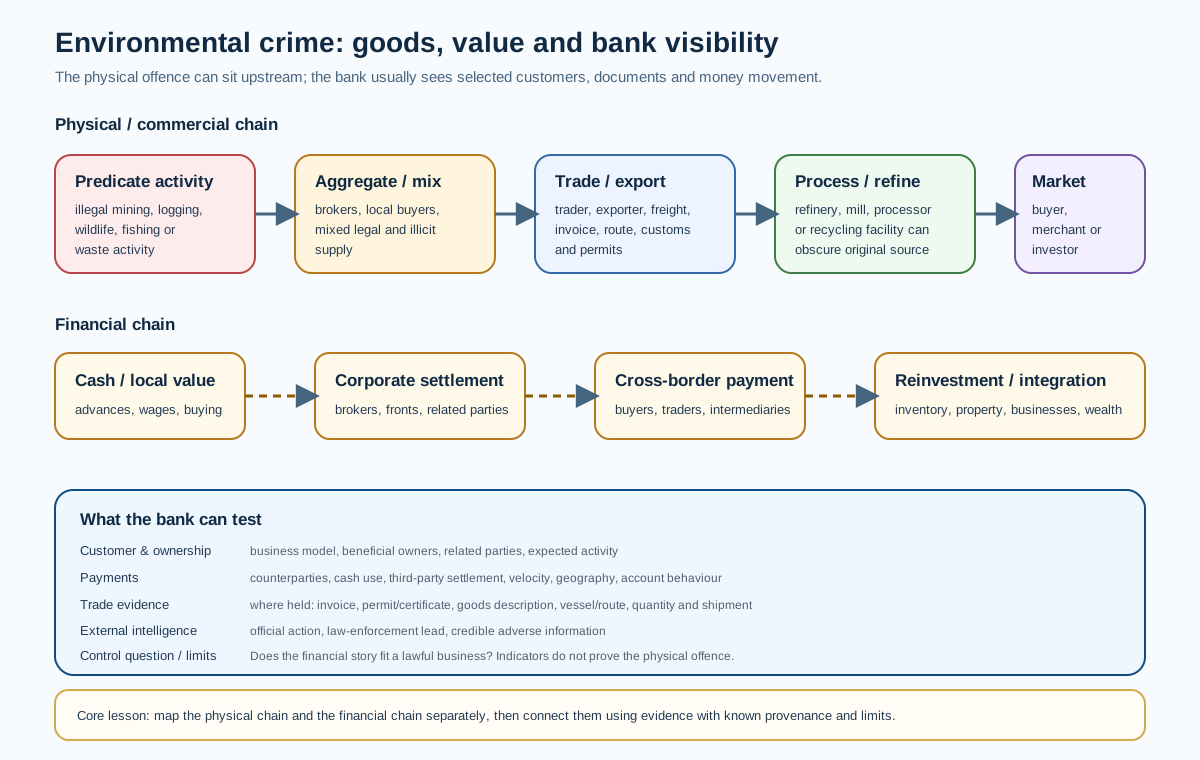
Environmental crime is a predicate-offence problem first
The AML question starts with the underlying offence. Illegal mining, illegal logging, wildlife trafficking, illegal fishing, waste trafficking and unlawful land clearing can generate proceeds that later need to be stored, transferred, converted or invested. The exact criminal offence depends on local law. A bank should therefore avoid writing that a customer committed an environmental crime merely because a commodity is high risk or a country has weak environmental enforcement.
The bank should identify facts it can support: the customer trades a high-risk commodity; a licence cannot be corroborated; ownership is opaque; payments are inconsistent with stated volumes; counterparties have adverse-media links to illegal extraction; or the payment route does not match the physical trade route. Those facts may justify investigation without pretending the bank has proved the environmental offence.
Illegal mining
Illegal mining can involve gold, precious stones, critical minerals, coal and other extractive products. Risks can arise where extraction occurs without required rights, outside licensed areas, through corruption, through criminal control of sites, or through false declarations about origin or volume.
Banks can encounter the proceeds through mining companies, traders, refiners, exporters, logistics firms, equipment suppliers, cash dealers, commodity brokers, jewellers and related companies. A mining-related customer can be legitimate even in a high-risk country. The control objective is to understand the business model and whether financial activity is credible for the customer's scale, licences, geography and counterparties.
Gold as a laundering vehicle
Gold can store high value, cross borders, be melted and re-refined, and be bought through multiple intermediaries. This makes origin difficult to establish once material from different sources is mixed.
A bank may see payments to or from miners, dealers, refiners, jewellers, exporters or commodity traders. The presence of gold is not suspicious by itself. Risk increases where a customer's volumes exceed plausible production, source countries are inconsistent with the business model, payments involve unrelated third parties, cash use is unusually high, or ownership and supply chains are opaque.
The bank should not claim that a bar or shipment is illegally mined unless it has evidence. The defensible question is whether the customer can explain and evidence the commercial origin of the material and the associated funds.
Illegal logging
Illegal logging can involve unauthorised cutting, fraudulent permits, misdeclared species, laundering timber through legitimate concessions or mixing illegally sourced wood into lawful supply chains.
Financial patterns may include payments between logging companies, concession holders, exporters, freight companies, brokers and offshore entities. Banks processing ordinary payments may not see forestry documents, while trade-finance banks may have invoices, shipping information or certificates.
Monitoring should reflect what the bank actually knows. A payment description such as "timber" does not establish species, concession or legal origin.
Illegal wildlife trade
Wildlife trafficking can involve live animals, animal parts, plants and derivative products. Payments can occur through cash, informal value transfer, e-commerce, personal accounts, merchant services and international transfers.
The challenge is often that transaction values may be relatively small compared with other financial crimes. A simple large-value threshold can therefore miss activity. Counterparty networks, merchant descriptions, unusual trade routes and external intelligence may matter more.
Banks should use precise language. A payment to a pet trader or exotic-food merchant is not evidence of wildlife trafficking. Risk comes from combinations of behaviour and intelligence.
Waste trafficking
Waste crime can include illegal export, disposal, dumping, misclassification or fraudulent recycling. Companies may appear legitimate because waste management is itself a lawful industry.
Financial indicators can include unusual payments to brokers or transport companies, rapid changes in turnover, cross-border flows inconsistent with known contracts, shell companies, repeated corporate changes and payments involving jurisdictions used as transhipment or disposal destinations.
Environmental and customs data can be particularly useful when available through lawful channels.
Illegal fishing and marine resources
Illegal, unreported and unregulated fishing can create financial-crime exposure through vessel ownership, seafood trading, fuel, ports, payroll, agents and export companies. Vessel identity, flag changes and beneficial ownership can matter.
Banks should not assume a vessel or fishing company is high risk merely because it operates internationally. The relevant question is whether licensing, ownership, route, catch activity and financial flows make sense.
Why trade matters
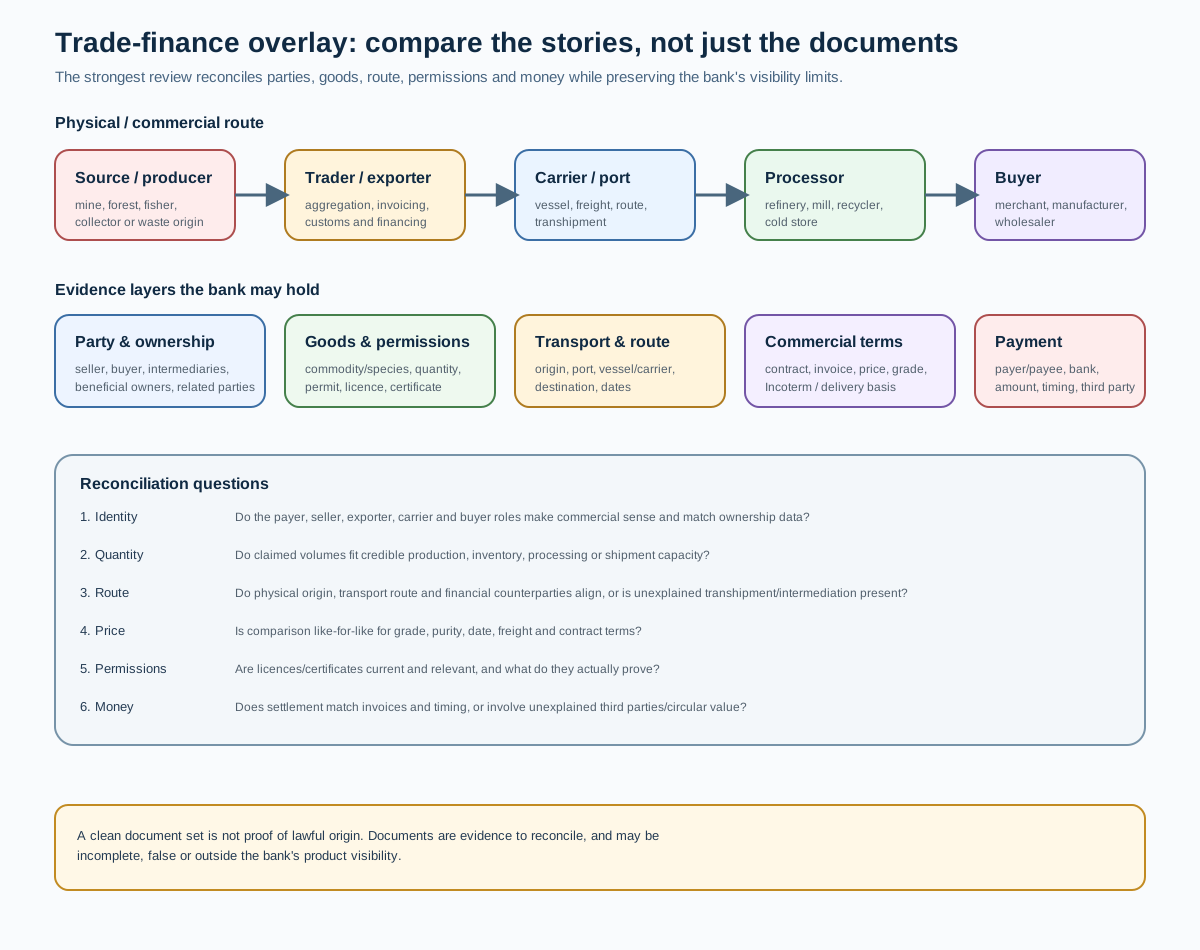
Environmental commodities frequently enter legitimate trade chains. Once illegally sourced material is mixed with lawful goods, the financial flow can look normal. This makes environmental-crime laundering particularly connected to trade-based techniques.
A bank may see invoices, commodity descriptions, shipping routes, letters of credit, documentary collections or simple wire payments. The more trade data the bank holds, the more it can compare the financial story with the physical-goods story.
Shell and front companies
Corporate vehicles can be used to obtain licences, hold concessions, buy equipment, export commodities, receive proceeds or distance criminal actors from the underlying activity.
A shell company is not inherently criminal. A front company can have genuine operations. The investigation should therefore focus on ownership, purpose, counterparties, economic substance and transaction behaviour rather than labels.
Environmental crime can involve legitimate companies being infiltrated or used without every employee or shareholder knowing the criminal activity.
Corruption and public officials
Extraction rights, customs clearance, permits and inspections can create corruption exposure. Bribes may be disguised as consultancy fees, commissions, facilitation payments or third-party contracts.
PEP exposure can therefore be relevant, but PEP status is not proof of corruption. The bank should understand relationships, contracts, payment timing and source of wealth where proportionate.
Cash and informal finance
Some environmental-crime supply chains begin in remote areas with cash-based activity and weak access to formal banking. Cash can then be consolidated through traders or brokers.
A bank might see only the higher-level trader, not the original extraction. Monitoring should acknowledge this visibility gap instead of pretending the bank can directly verify mine-site or forest activity.
Commodity-price anomalies
Unusual prices can be a red flag, especially where under- or over-invoicing may move value. But price comparison must be technically credible. Commodity grade, purity, quality, delivery terms, transport, insurance, contract timing and market volatility can explain differences.
A case should say that pricing appears inconsistent with comparable data, not that over-invoicing has been proved unless evidence supports that conclusion.
Worked example: decompose turnover before explaining the risk
This fictional example uses one commodity grade, one currency and equal reporting periods. The quantities and prices are original teaching assumptions, not observations about a real customer or market. It isolates two possible explanations for the same change in revenue; a real investigation would also consider product mix, currency conversion, delivery terms, credit notes and the timing of recognition and payment.
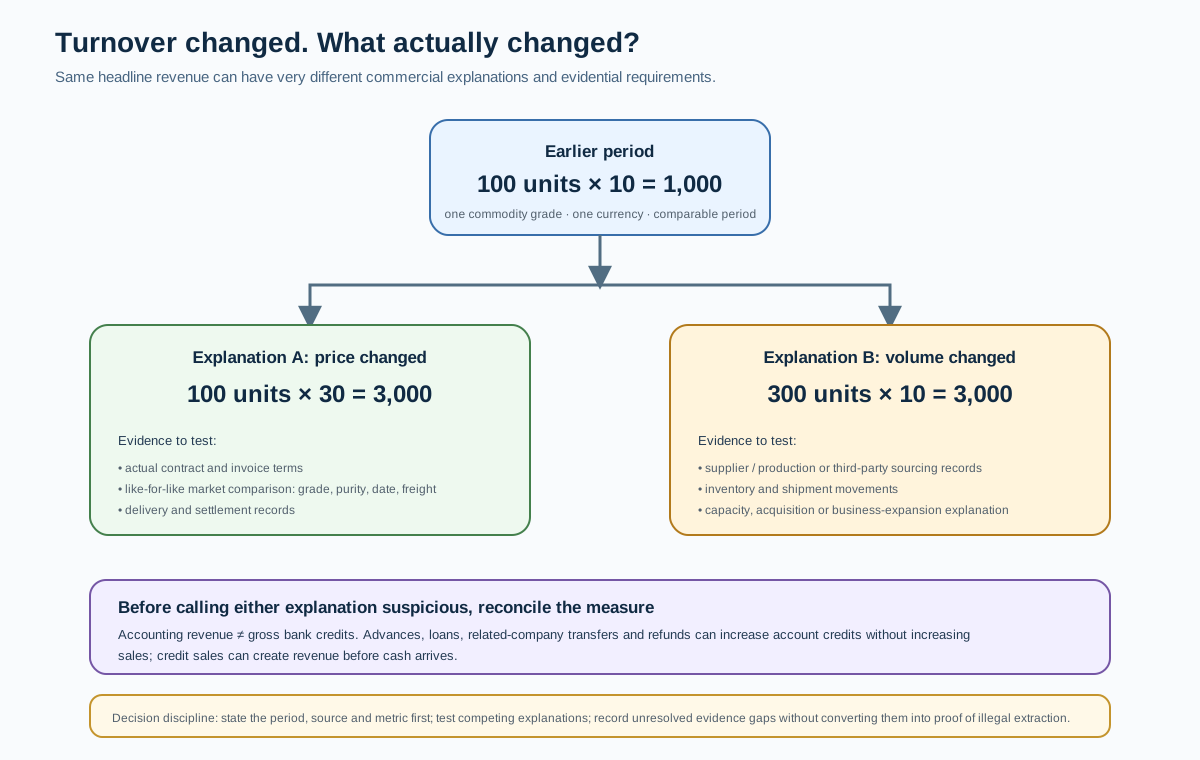
A trader initially sells 100 units at 10 currency units each, producing revenue of 1,000. Revenue later reaches 3,000. Saying that revenue trebled is correct; saying that the customer must have acquired three times as much material is premature. The first possible explanation is that the trader still sold 100 units but received 30 per unit. The second is that the trader sold 300 units at the original price of 10. Each produces the same headline number, but the evidence needed to understand it differs.
For the price explanation, an analyst would examine the actual contracts and invoices and whether an appropriate independent comparison supports the claimed increase. A benchmark for another grade, market or delivery date may be misleading. A higher invoice price is evidence of what was billed, not independent confirmation of what the commodity was worth or whether payment occurred. The investigator should reconcile the contract, delivery, invoice and associated financial entries rather than select whichever document supports the initial theory.
For the volume explanation, the analyst needs to understand where the additional units came from. An exporter may buy material from other suppliers; its sales are not necessarily limited to the output of a mine it owns. Earlier inventory, a newly acquired supplier, a longer production run or an expanded trading business can produce legitimate growth. Compare the explanation with the customer's role, purchasing records, inventory movements and available shipment evidence. A missing source record leaves an evidential gap. It does not establish that the extra material was illegally extracted.
The investigation also needs a consistent measure of money. Bank credits are not automatically the same as accounting revenue. An advance for a later shipment, a loan, a related-company transfer or a refund could increase incoming payments without increasing sales. Conversely, a sale on credit can produce recognised revenue before the bank receives payment. An analyst who compares annual sales with one month's gross account credits can manufacture an apparent anomaly simply by choosing incompatible measures.
A defensible case would first state which measure changed, its period and the source of the data. It would then explain the competing interpretations, which records support or contradict each, and which uncertainty remains. If the bank's information is insufficient to corroborate commodity origin, the conclusion should say so explicitly. The control owner must then apply the institution's procedures and applicable obligations to the actual concern. The diagram supplies a reasoning method; it does not create an automatic suspicion threshold, reporting decision or permission to process a transaction.
Third-party payments
A buyer may pay a supplier directly, through a treasury centre, broker, agent or financier. Third-party payment is not inherently suspicious.
Risk increases when the payer has no clear commercial connection, when ownership is opaque or when third parties repeatedly change without explanation.
Geographic risk
Countries with significant illegal extraction, weak governance or conflict can create higher exposure, but geography should not become a shortcut. Legitimate companies operate in high-risk jurisdictions and may be important to local development.
The bank should combine country risk with customer, product, ownership, commodity and transaction factors.
Adverse media and external intelligence
Environmental investigations often depend on information from regulators, customs authorities, NGOs, law enforcement and specialist reporting.
Source quality matters. Allegations should be distinguished from confirmed enforcement actions. A news article can trigger review without becoming proof.
Scenario: gold exporter
A gold exporter has been a customer for five years. Turnover suddenly triples while the number of declared suppliers falls. Payments arrive from buyers in multiple jurisdictions and are rapidly distributed to newly formed local companies.
The bank should understand the production and sourcing explanation, ownership of new suppliers, licences, invoice volumes and whether trade data supports the increase. The pattern is not proof of illegal mining, but it creates a credible reason to investigate.
Scenario: timber trader
A timber trader begins routing payments through a newly incorporated intermediary in another country. The customer explains that the intermediary handles logistics.
The bank can test whether the intermediary has a real role, whether pricing and route are plausible, whether ownership overlaps with the trader and whether the transaction pattern matches historical business.
Scenario: wildlife-linked merchant
A merchant receives many small international payments with product descriptions referring to exotic animal products. External intelligence indicates some products may be prohibited.
The bank should involve relevant compliance and legal teams, preserve transaction evidence and avoid assuming every product description reflects an illegal item.
Scenario: waste management company
A waste company receives rising payments from foreign customers while making payments to unrelated brokers and transport firms in several jurisdictions. Regulatory information indicates its waste-export licence was suspended.
That change is material and can trigger enhanced review of current activity.
Customer due diligence
For higher-risk environmental sectors, KYC or KYB should understand legal entity, beneficial owners, operating sites, licences where relevant, major commodities, customers, suppliers, countries and expected payment routes.
The bank should not collect sector documents it cannot use. Structured data is more valuable when it feeds monitoring and event-driven review.
Monitoring design
Potential scenarios can include sudden turnover changes, unexplained third-party payments, activity with high-risk commodity corridors, pass-through behaviour, rapid corporate changes, unusual cash, new counterparties or transactions inconsistent with declared business scale.
The strongest controls combine indicators rather than rely on a single sector flag.
Trade-finance controls
Trade-finance teams may have access to invoices, transport documents and goods descriptions. They should compare available data for internal consistency and sanctions/export-control concerns.
Document compliance is not the same as AML clearance. A documentary presentation can be formally correct while the underlying trade still presents financial-crime risk.
Beneficial ownership
Ownership can reveal links among miners, exporters, intermediaries, politically exposed persons, sanctioned parties or related companies.
Banks should maintain effective-dated ownership because current ownership may differ from ownership when older transactions occurred.
Sanctions and environmental crime
Some commodities, countries, companies, vessels or sectors can also be subject to sanctions. Sanctions analysis is legally distinct from AML. A transaction can be prohibited under sanctions without evidence of money laundering, and environmental crime can create AML concern without any sanctions nexus.
The two controls can share ownership and trade data while maintaining separate decision logic.
Data model
Useful data can include customer, legal entity, beneficial owner, licence, commodity, supplier, buyer, country, shipment, vessel, invoice, payment, external intelligence and case.
Relationships should have source and effective dates. An investigator should know whether a supplier link came from the customer, trade documentation, public registry or external intelligence.
Business analyst view
A BA should translate the typology into data and process requirements. Which fields identify commodity and trade route? Which systems hold licences? Can ownership be linked across companies? Does transaction monitoring receive merchant or trade data? How are external alerts ingested and reviewed?
Requirements should include data-quality failures and explain what happens when a critical field is missing.
Evidence discipline
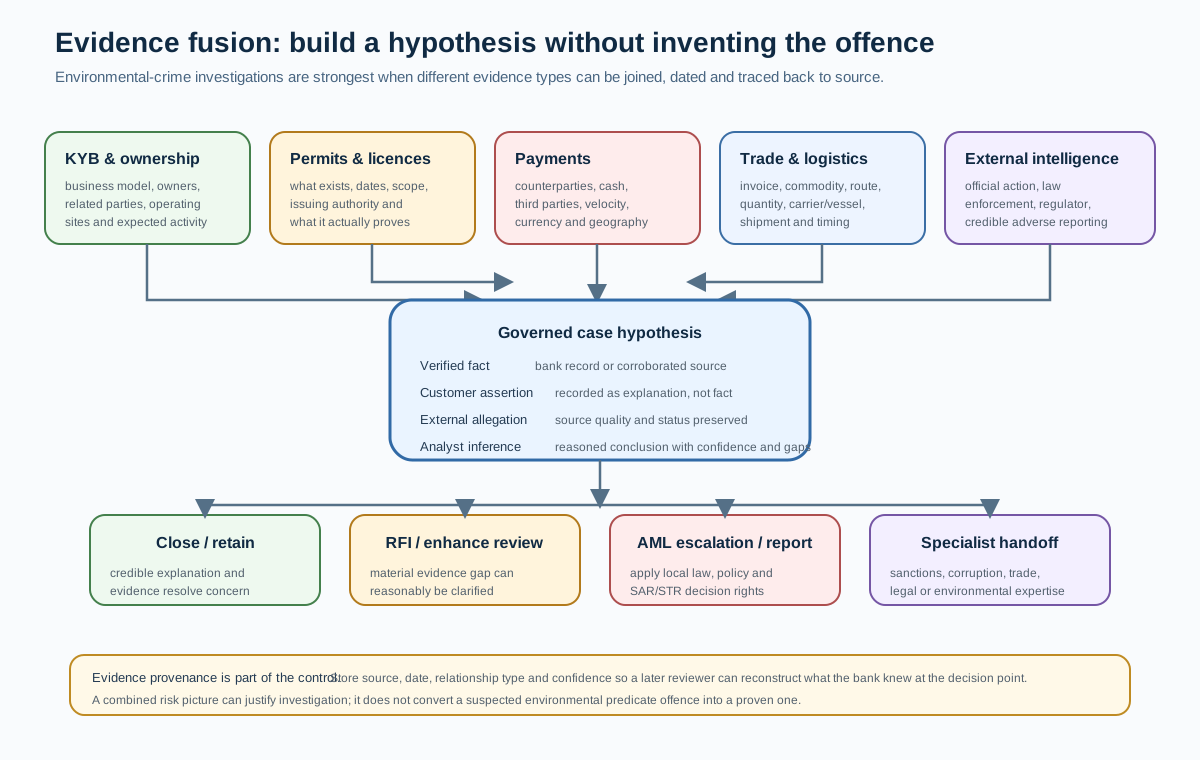
A strong case separates fact, customer explanation, external allegation and analyst inference. "Customer trades gold from Region X" is different from "gold is illegally mined." The latter requires evidence the bank may not possess.
Quality assurance
QA should look for overclaiming, unsupported commodity assumptions, poor price comparisons, missing ownership analysis and failure to distinguish AML suspicion from environmental-law findings.
Metrics
Useful measures include sector-alert quality, confirmed typology coverage, investigation outcomes, data defects, time to escalate credible external intelligence and repeat control gaps.
Alert volume alone does not show effectiveness.
Common mistakes
Common mistakes include treating high-risk commodities as automatically illicit, assuming offshore companies indicate concealment, using country risk as proof, relying on one document or price comparison, and ignoring legitimate business explanations.
Another mistake is designing environmental controls without understanding what data the bank actually receives.
Learning checkpoint
A reader should be able to explain environmental crime as a predicate-offence and illicit-proceeds problem, describe major typologies such as illegal mining, logging, wildlife and waste trafficking, connect them to trade and corporate structures, identify the bank's visibility limits and write evidence-based conclusions without pretending to prove the underlying environmental offence.
Deep dive: environmental crime as a financial network
Environmental crime becomes easier to understand when the bank separates the physical commodity chain from the financial chain. The physical chain may begin with extraction, harvesting, capture or disposal. The financial chain may begin with cash payments, advances, broker payments, export proceeds, merchant settlement or payments to front companies. The two chains overlap, but they are not identical.
A gold shipment can move from mine to local trader to exporter to refiner while the money moves through different companies, currencies and countries. A waste shipment can travel through several ports while the payment is made to a broker in another jurisdiction. Investigators should therefore map goods, legal entities, ownership and payments separately before trying to connect them.
Illegal mining operating model
A useful mining-risk assessment considers concession or licence holder, mine location, commodity, estimated production, local buyer, exporter, refiner, transport route, payment counterparties and beneficial ownership. The objective is not to verify geology. It is to establish whether the business model is plausible.
If a company reports small-scale production but receives proceeds consistent with industrial-scale exports, the mismatch deserves investigation. If production rises after a new concession or acquisition, the increase may be legitimate. Context matters.
Gold dealer scenario
A gold dealer buys from dozens of small suppliers and sells to two refiners. The dealer has high cash withdrawals because suppliers operate in remote areas. This may be consistent with the business model.
Now add a new pattern: cash withdrawals double, supplier identities become less complete, export proceeds rise sharply and ownership links appear between the dealer and a newly formed exporter. The bank should understand whether the business expanded legitimately or whether the new structure is obscuring source.
Purity and price
Gold prices depend on purity, weight, market timing, fabrication, transport, refining and contractual terms. Comparing invoice price with a spot benchmark without adjusting for these variables can generate false conclusions.
Investigators should document the basis of any pricing anomaly and avoid statements such as “gold was over-invoiced” unless comparable evidence supports it.
Illegal logging scenario
A timber exporter historically buys from three licensed suppliers. It begins buying through a broker in another country while shipping routes remain domestic-to-overseas. Payments to the broker are much larger than previous supplier payments.
Questions include the broker’s role, ownership, contracts, species, licences where available, payment terms and whether the broker is merely an invoicing entity. The bank should not infer illegal logging solely from an unusual intermediary.
Mixing legal and illegal goods
FATF has highlighted that environmental-crime proceeds can be laundered by mixing lawful and unlawful commodities early in the supply chain. This creates a difficult banking problem because a legitimate customer can trade mixed-origin goods without the payment itself revealing which portion is illicit.
This is where external intelligence, supplier due diligence and anomalies in volume or sourcing become important.
Wildlife trafficking payments
Wildlife trafficking can use personal accounts, e-commerce, social-media sales, cash and remitters. Payment descriptions may use coded language or legitimate-looking product names.
A bank should not build a control around one keyword list. Stronger monitoring can combine merchant category, repeated cross-border micro-payments, known counterparty intelligence, beneficiary networks and abrupt behavioural changes.
Network analytics for wildlife cases
If several merchants receive payments from common customers and transfer funds to the same exporter or freight company, the network may warrant review. But common logistics providers can be legitimate hubs.
Graph relationships should include confidence and relationship type.
Waste trafficking case
A waste exporter uses several transport firms and brokers. One broker receives most of the value but appears unrelated to the actual shipment route. The exporter’s licences recently changed.
Investigators should compare payment counterparties with contracts, available shipping data and licence status. “Unrelated to route” is an investigative question, not proof of waste crime.
Environmental crime and corruption
Extraction and environmental permits can create bribery risk. Payments to consultants near the time of licence awards or renewals can warrant deeper understanding.
The bank should identify whether a consultant has capability and a credible role. PEP or public-official connections can increase risk but remain risk factors rather than proof.
Environmental crime and sanctions
Illegal mining or commodity trading can also intersect with sanctioned countries, designated parties, vessels or sectors. AML and sanctions teams may use the same trade and ownership data but make different decisions.
A sanctions prohibition does not need a money-laundering theory. AML suspicion does not require a sanctions nexus.
Remote regions and cash
Remote extractive economies can rely heavily on cash. A blanket “cash = suspicious” rule can exclude legitimate customers and create noise.
The bank should understand why cash is used, who receives it, how volumes align with business, and whether the customer has practical alternatives.
Supply-chain finance
Banks may provide working capital, invoice finance or trade finance to commodity businesses. Financial crime risk can therefore arise before final payment, through financing of inventory or receivables.
Due diligence should consider what asset or trade flow underpins the financing and whether parties are related.
Vessel and logistics data
Environmental commodities often move through shipping networks. Vessel identifiers, ports, route and ownership can provide useful context where available.
Names can change, so persistent asset identifiers are preferable to names alone.
External datasets
Banks may use company registries, customs information, commodity data, adverse media, sanctions data and specialist environmental intelligence. Each source should have provenance and known limitations.
Third-party risk scores should not replace analyst judgement.
Practice exercise — work through this before reading on.
Data-lineage exercise
Trace one commodity payment from customer onboarding through payment message, trade system, screening, booking, archive and investigation. Identify which fields describe commodity, supplier, buyer, country and ownership.
If critical data disappears between systems, the control environment has a coverage gap.
Investigation narrative
A strong narrative describes what the bank knows: customer business, expected activity, actual transactions, counterparties, ownership, anomalies, documents, external intelligence and customer explanation. It then explains why the residual concern remains or why the activity is reasonable.
Avoid unsupported statements such as “illegal mine proceeds” unless the case has evidence of the underlying offence.
BA delivery requirements
Requirements should define how licences, commodity types, counterparties and ownership are represented; what changes trigger review; how external intelligence is linked; and how environmental-sector customers are segmented.
Edge cases should include missing licence data, commodity-code changes, multi-currency settlement, third-party payer, related company, vessel-name change and customer migration between systems.
Quality assurance checklist
QA should ask whether the analyst used comparable pricing, whether geography was treated as proof, whether external allegations were described accurately, whether beneficial ownership was checked and whether legal limitations were acknowledged.
Practice exercise — work through this before reading on.
Final deep-dive test
The reader should be able to map both the physical and financial chain, explain where the bank’s visibility begins and ends, distinguish commodity risk from evidence of crime and design controls that combine customer understanding, trade data, ownership and external intelligence.
Advanced practice: environmental-crime investigations across trade, commodities and ownership
Environmental-crime cases are difficult because the financial system often sees ordinary commercial activity while the illegality sits earlier in the value chain: extraction without permission, false origin, illegal harvesting, protected species, corrupt licensing, smuggling, waste misclassification or deliberate evasion of quotas and controls. The bank therefore needs to combine financial behaviour with business-model evidence without pretending that it can independently prove the physical offence.
Case 1: gold trader with plausible turnover and implausible supply
A precious-metals trader has operated for five years and receives payments from established refiners. Revenue rises sharply after the customer says it has added small-scale mining suppliers in another region. The bank sees no immediate payment anomaly: buyers are known counterparties, values are commercially significant but not extraordinary, and the account pays normal logistics and business expenses.
The risk appears only when the customer profile is compared with the supply story. The customer has not updated its expected countries, supplier base or licensing information. Large cash withdrawals begin near the sourcing region. Several payments are made to individuals rather than mining companies, and a newly introduced intermediary shares an address with a company previously mentioned in credible official reporting about illegal mining.
The investigator should not conclude that the gold is illegally mined merely from those facts. A stronger review asks: what permits or supplier due diligence does the customer rely on; what proportion of purchases comes from artisanal or small-scale miners; how are suppliers paid; why are cash withdrawals required; who owns the intermediary; and do purchase volumes match plausible production capacity?
The case can be suspicious even if the bank cannot prove the mine's legal status. The report should explain the financial inconsistencies and the credible external information, not overstate the physical evidence.
Case 2: illegal logging risk hidden in ordinary trade
A furniture manufacturer imports timber and exports finished goods. Payments to suppliers have historically come from three countries. Over four months, a new supplier becomes the largest counterparty, but invoices still describe generic hardwood and payment amounts remain within the customer's normal range.
A simple transaction-monitoring system may not flag the change because total turnover is stable. A trade-aware control can detect the new supplier, change in source country and concentration. The investigator can then assess whether the species, origin, certification or route requires additional explanation under the customer's operating model and applicable law.
Banks are not forestry inspectors. Where documents are available, they can compare supplier, origin, goods description, shipping route and payment. Where documents are not collected, the bank should state that limitation and avoid asserting that legal harvesting has been verified.
Case 3: wildlife-trafficking proceeds fragmented across low-value payments
An online seller receives hundreds of small domestic payments with references describing collectibles, supplements and pet products. Individually, values appear ordinary. Several payers later become linked through law-enforcement intelligence to wildlife trafficking. The seller's outbound activity includes payments to freight companies, cash withdrawals and transfers to businesses in countries associated with the species under investigation.
The bank should reconstruct the network rather than treat each small payment as a separate alert. Relevant questions include what the customer actually sells, whether the business is registered for the stated activity, how inventory is sourced, whether freight and destination patterns fit, and whether other bank customers transact with the same counterparties.
Official intelligence can raise the evidential weight of otherwise ambiguous payments. It should still be source-labelled and handled under confidentiality rules.
Case 4: waste and recycling business with circular payments
A waste-management company receives municipal and commercial payments and sends significant funds to recycling partners. Monitoring identifies repeated round-value transfers to a newly formed company, followed by returns through a related consultancy.
Circularity can arise from legitimate group financing or subcontractor arrangements, so the bank maps beneficial ownership. Both counterparties are ultimately controlled by relatives of the customer's owner. Contracts describe waste processing but the receiving company has minimal staff and no visible operating facilities.
The concern is not "waste industry equals environmental crime." It is that related-party payments, weak operational substance and circular value movement appear inconsistent with the declared service. The case may indicate laundering, fraud, corruption or another offence; the bank should report the suspicious financial pattern without inventing the predicate offence.
Case 5: fisheries, quota risk and payment behaviour
A seafood exporter has legitimate international customers but begins paying brokers in a jurisdiction unrelated to its fishing grounds or buyers. Invoices use broad descriptions and vessel or catch information is absent from the bank's payment data.
If the bank provides only payment services, it may have no direct evidence of catch origin or quota compliance. The investigation can still examine ownership, broker relationships, route logic, payment purpose, unusual cash or third-party settlement and credible external information. If the bank also provides trade finance and receives transport or catch documents, controls can use that additional evidence.
This case demonstrates why the same customer may require different monitoring depending on product visibility.
Corruption can be the bridge between environmental crime and finance
Illegal extraction or trafficking can depend on bribed officials, compromised inspections, fraudulent licences or customs manipulation. A bank can encounter consultancy fees, commissions, payments to politically connected intermediaries or assets inconsistent with known income.
PEP status is not evidence of corruption. The investigator should understand role, relationship, payment purpose, ownership and whether the customer has a legitimate reason to engage the intermediary. Stronger concern arises when fees are unexplained, disproportionate, routed through opaque companies or linked to decisions affecting licences or concessions.
Commodity traders and professional laundering
Professional laundering networks can use commodity traders because trade provides a plausible reason for cross-border value movement. A criminal network might provide cash to a trader in one country and settle an obligation through goods or corporate payments elsewhere, reducing the need for a direct cross-border transfer from the criminal client.
This overlaps with underground banking and TBML. FATF's September 2026 work on professional money laundering, underground banking, hawala and similar service providers reinforces the need to follow economic obligations rather than assume every bank transfer corresponds to the original sender and receiver of value. Hawala and similar systems can also serve legitimate communities, so the presence of such a settlement method is not by itself evidence of criminality.
For a bank, useful questions are: why is this customer paying on behalf of third parties; are counterparties related; do goods and routes make commercial sense; are settlement values consistent with invoices; and is the customer effectively providing financial services without declaring them?
Front companies and operational substance
Environmental-crime proceeds can move through apparently legitimate logging, mining, waste, transport, trading or export companies. Legal registration alone does not establish genuine operating substance.
Investigators can consider staff, premises, business history, declared activity, licences, suppliers, customers, payment patterns and ownership. External information should be used carefully. A missing website or small office is weak evidence; a combination of minimal operations, large unexplained flows, opaque ownership and counterparties linked to credible investigations is stronger.
Beneficial ownership should be time-specific
Commodity and natural-resource companies can change ownership quickly, especially around licences, concessions or investigations. Current registry information may not show who controlled an entity when the suspicious payment occurred.
A bank-grade ownership model should store start and end dates for shareholders, controllers, directors and relevant trust roles. If the organisation cannot reconstruct historical ownership, an important investigative capability is missing.
Trade-document limitations
Trade documents can contain invoice, shipper, consignee, port, vessel, goods and quantity data. They can also be false, incomplete or only checked for documentary compliance. A documentary credit that complies with its terms is not proof that goods were legally harvested, mined or traded.
The bank should distinguish documentary consistency from physical or legal verification. Where an inconsistency appears, trade operations can escalate it; where documents are outside the product flow, monitoring should not assume they exist.
Environmental risk and sanctions/proliferation controls
Mining, shipping and commodity activity can intersect with sanctioned jurisdictions, designated parties or proliferation-sensitive goods. Those are separate control questions. Sanctions teams determine whether legal restrictions apply; AML teams assess suspicious source and movement of value; export-control or proliferation specialists address controlled goods and end users.
A single case can contain all three, but the case record should preserve distinct decisions and legal bases.
Geographic risk without stereotyping
Resource-rich countries, conflict zones and locations with weak governance can increase inherent risk. Geography must not become a substitute for customer analysis. Legitimate mining, forestry, fisheries and conservation businesses operate in high-risk environments.
Controls should combine country risk with sector, customer, ownership, transaction behaviour, counterparties and evidence of actual exposure. If a customer has strong governance and transparent supply chains, those controls should influence residual risk.
Network exercise: identify the economically important nodes
Take a hypothetical network with one miner, three local buying agents, two exporters, one logistics company, two refiners and four bank accounts. Do not begin by marking every connection as suspicious. Instead identify which nodes control value or information. Which company owns the exporter? Which agents share addresses or phones? Which bank account receives payments from multiple exporters? Which logistics provider appears across unrelated customers? Which parties are mentioned in official intelligence?
Then grade each link: verified ownership, transaction link, shared attribute, customer assertion, public allegation or official intelligence. The exercise teaches why graph visualisation without evidential confidence can mislead.
Monitoring scenarios that can be tested
A bank serving resource-sector customers can test scenarios such as sudden supplier-country change; turnover exceeding declared or plausible capacity; cash deposits followed by commodity payments; unexplained third-party funding; new counterparties linked to high-risk logistics routes; related-party circular payments; payments to individuals where corporate suppliers are expected; and rapid changes in beneficial ownership around major transactions.
Each scenario should identify the customer segments for which it makes sense. A retail customer should not be run through a mining-company capacity model. A global commodity trader should not be compared with a local jeweller.
Investigation narrative standard
A high-quality environmental-crime case should answer: what is the customer's legitimate business; which financial behaviour diverges from that model; what trade, ownership or licensing evidence is available; what external intelligence is credible; which predicate offence is suspected versus proven; and why the remaining facts meet or do not meet the bank's escalation threshold.
The bank's role is to identify and report suspicious finance, support lawful information sharing and preserve evidence. It should not claim expertise or physical verification it does not possess.
Operating model: who owns which question
Environmental-crime exposure crosses organisational boundaries, and weak cases often fail because no team knows which part it owns. Relationship or onboarding teams own the quality of the customer's declared business model, expected geographies, key counterparties and ownership data. Transaction-monitoring teams own detection logic based on the data actually available to the bank. Trade operations own documentary processing and the escalation of inconsistencies they can observe; they should not be made responsible for proving the physical legality of goods. AML investigators own the financial hypothesis, evidence chronology and suspicion assessment. Sanctions, anti-bribery and corruption, export-control or legal specialists own their separate legal questions. Data and technology teams own lineage, timeliness, identifiers and the technical evidence that a control received the data it was designed to use.
A practical case-management design should therefore support linked but separate decisions. One environmental-crime case may produce an AML escalation, a sanctions referral and a customer-risk review without forcing all three into one generic outcome. Each decision needs an owner, date, legal or policy basis, evidence links and status. Where information sharing is restricted, the system must also enforce confidentiality boundaries rather than expose every investigation note to every team.
Data lineage: the control is only as strong as the join
A resource-sector alert can look sophisticated while depending on fragile joins. The customer's legal entity may sit in one master-data platform, beneficial ownership in another, trade documents in an imaging system, payment messages in a payment hub, vessel or route data in a trade platform and external intelligence in a screening or adverse-media service. If identifiers are inconsistent, the analyst may never discover that a supplier and logistics company share an owner, or may incorrectly join two businesses with similar names.
For a bank-grade implementation, requirements should define stable customer and account identifiers, legal-entity identifiers where available, source-system record keys, effective dates, relationship types and provenance. Ownership links need validity periods. Commodity and route fields need controlled vocabularies where the business actually captures them. Free-text extraction should preserve the original source and confidence so investigators can see whether a field was supplied by the customer, read from a document or inferred by a model.
Coverage testing should ask a more difficult question than whether a field exists in a schema. Does the field arrive for the products, countries and customer segments the monitoring scenario claims to cover? A trade-finance scenario that relies on vessel data is ineffective if only documentary-credit transactions populate the vessel field while open-account trade does not. A mining-sector scenario that depends on supplier identifiers is misleading if domestic bulk payments collapse all suppliers into free-text narratives. These gaps belong in control documentation and residual-risk assessment.
Testing the environmental-crime control without manufacturing success
Positive tests should represent realistic combinations of indicators rather than cartoon criminality. One seeded case can combine a sudden supplier shift, related-party ownership, third-party settlement and official adverse information while keeping transaction amounts within the customer's historical range. Another can test wildlife-related network behaviour through many small payments rather than one obvious large transfer. A waste-sector test can use circular related-party flows with plausible invoice descriptions. The expected outcome is not always a SAR/STR; the test should verify that the right evidence reaches the right analyst and that the decision route works.
Negative tests are equally important. A commodity trader may legitimately triple turnover after acquiring a new business. A timber customer may change transit ports because of freight disruption. A gold dealer may use cash in a region where suppliers have limited banking access. A seafood exporter may use a new broker because a buyer changed procurement arrangements. The control should allow these cases to close when evidence supports the explanation. If every high-risk-sector test escalates, the system is measuring sensitivity without demonstrating discrimination.
Failure-mode tests should deliberately remove or delay critical data. What happens when beneficial ownership is stale, a permit feed is unavailable, the trade-document service times out, a payment arrives before KYC changes propagate, or an external-intelligence provider revises an earlier allegation? A strong design either degrades transparently or routes the case for manual treatment. It should not silently produce a normal-looking risk score from incomplete evidence.
Mini case: when the documents disagree with the money
Consider a fictional mining exporter whose invoices, permits and shipping documents appear internally consistent. The customer states that all material comes from two licensed mines. Payment analysis, however, shows repeated transfers to six local companies described as equipment and logistics providers. Beneficial-ownership enrichment finds that four are controlled by the same family, and three were incorporated within weeks of a rapid increase in export volume. None appears in the supplier list provided at the last KYC review.
The investigator should resist two opposite errors. The first is to accept the clean trade documents as proof that the sourcing is lawful. The second is to treat the new companies as proof that the customer is laundering illegal-mining proceeds. The correct approach is to build competing explanations. The companies may genuinely provide outsourced haulage, equipment leasing or aggregation services. They may also be undisclosed suppliers or conduits. The bank can ask for contracts, service descriptions, ownership explanations and reconciliation between export volumes and stated mine output. It can compare payment timing with shipments and assess whether the new entities have credible operational roles.
Suppose the customer provides contracts for two companies but cannot explain why the other four receive payments calculated as a percentage of exported value rather than as fixed logistics charges. An official source also identifies one controller as the subject of an investigation into unlicensed extraction, without a conviction. That combination strengthens the financial-crime hypothesis but still does not allow the bank to state that the customer's exported material is illegally mined. The case narrative should distinguish the official investigation, the unexplained payment formula, the ownership links, the customer's partial explanation and the remaining sourcing gap. The AML decision then follows the institution's suspicion standard and local reporting law, while any sanctions, corruption or trade-control issue is referred separately.
QA challenge pack for reviewers
A reviewer should challenge environmental-crime cases for evidential inflation. If an analyst writes "illegal gold", ask which evidence establishes illegality. If a scenario labels a country or commodity as suspicious, ask what customer behaviour changes the risk from inherent to specific. If pricing is called anomalous, ask whether grade, purity, delivery terms, currency and timing were normalised. If a permit is missing, ask whether the bank was entitled to expect that permit and whether another lawful permission route exists. If an ownership link comes from fuzzy matching, ask for confidence and corroboration.
The reviewer should also challenge under-escalation. A well-established customer is not safe merely because its account is old. A reputable auditor does not verify every commodity source. A clean sanctions result does not answer an AML question. A valid permit does not prove that every shipment falls within its scope. Good quality assurance therefore tests both directions: whether the bank is overclaiming criminality and whether it is accepting superficially reassuring evidence without testing the economic story.
The final educational objective is disciplined uncertainty. The best environmental-crime investigation is not the one that sounds most certain. It is the one that shows exactly what the bank knows, how the evidence connects, which legitimate alternatives were tested, what remains unresolved, who owns the next decision and how the conclusion follows from applicable law and policy.
Practitioner close: environmental crime as a financial investigation
Environmental crime often enters the banking system looking like ordinary commercial activity. Illegal mining can generate payments that resemble commodity trading. Illegal logging can sit inside legitimate forestry supply chains. Wildlife trafficking can involve small retail payments as well as higher-value wholesale trade. Waste crime can be hidden behind transport, recycling or disposal businesses. The investigator’s challenge is therefore to connect financial behaviour with ownership, geography, trade context and credible external information without assuming that a customer is criminal merely because it operates in a high-risk sector.
Case lab: gold trader with a changing economic story
A gold trader has operated for several years and historically purchased from a small group of domestic suppliers. Over six months, incoming and outgoing payments increase sharply. New suppliers appear in areas associated with informal mining, several payments involve unrelated third parties, and the customer begins sending funds to logistics and equipment companies whose role is unclear. The customer says business has expanded because market prices are attractive.
The bank should first understand whether the commercial explanation is plausible. Useful evidence can include expected turnover, supplier contracts, licences where relevant, source of commodity, counterparties, transport arrangements, tax or customs information available to the customer, ownership changes and transaction geography. None of these items alone proves legality. The objective is to test whether the financial flows fit a credible supply chain.
An effective transaction-monitoring scenario might combine rapid turnover growth, new high-risk supplier geography, third-party settlement, cash usage, unusual cross-border payments and ownership changes. A universal “mining customer” flag would be far less useful.
Case lab: illegal logging hidden in a legitimate exporter
A timber exporter is properly incorporated and has long-standing customers. Payments begin arriving from buyers in new jurisdictions while outgoing funds are sent to small companies with limited web presence and recently created bank accounts. Shipping documentation available through the trade-finance relationship shows routing through an unexpected transhipment location.
The bank should not attempt to become a forestry regulator. It can, however, compare the customer’s declared sourcing model with the observed counterparties and trade route, review the documentation it legitimately holds, identify unusual third-party payments, and escalate when the economic story no longer fits.
Where the bank processes only account-to-account payments and has no trade documents, the case should state that limitation. Lack of documentary visibility is not proof that the trade is legitimate or illicit.
Wildlife trafficking: small payments can still matter
Wildlife trafficking can be financed and settled through relatively small transactions, marketplaces, cash, money-service businesses, logistics providers or personal accounts. A rule based only on very large payment values can therefore miss relevant behaviour.
The stronger approach is network-based. Repeated payments to multiple logistics providers, clusters of buyers, rapid pass-through activity, links to known trafficking locations, unexplained use of personal accounts for commercial settlement and credible law-enforcement information can collectively raise concern.
An individual customer buying one lawful wildlife-related product should not be treated as a trafficker merely because a keyword appears in a payment narrative. Context and corroboration are essential.
Waste crime and the economics of disposal
Waste businesses can be exploited because disposal costs create an economic incentive to misclassify, illegally dump or export material. A bank may observe payments among waste brokers, transporters, recycling businesses and overseas counterparties.
Investigators can compare the customer’s stated business, expected jurisdictions, licensing information where accessible, counterparty pattern and payment purpose. Sudden movement into jurisdictions or counterparties inconsistent with the declared model can be useful risk signals.
Environmental-crime controls should not depend on analysts memorising lists of “bad countries.” Commodity, waste and wildlife supply chains are dynamic, and legitimate trade occurs in high-risk geographies.
Corruption and environmental crime can intersect
Illegal extraction or trafficking can be facilitated by bribery of officials, falsified permits or protection by organised-crime networks. Financial investigation can therefore reveal payments to politically exposed persons, public officials, intermediaries or unexplained consultants.
PEP status alone does not prove corruption. The investigator should examine purpose, timing, relationship, value and whether the payment makes commercial sense. Where bribery indicators are present, the case can require a separate corruption or AML analysis alongside the environmental predicate-risk hypothesis.
Professional enablers and company structures
Environmental crime can use shell companies, nominees, trading companies, transport firms and professional services to distance proceeds from the underlying activity. The bank should examine beneficial ownership and control, company age, sudden changes in ownership, shared addresses or directors, and networks of related counterparties.
A newly created company is not inherently suspicious. The concern arises when structure, transactions and business explanation conflict.
Trade documentation: use it carefully
Invoices, bills of lading, commodity descriptions, certificates and customs data can provide valuable context, but documents can be incomplete or falsified. The bank should preserve originals, source and dates and avoid treating one certificate as conclusive proof of lawful origin.
Where automated document extraction is used, investigators should be able to see the original document and understand extraction confidence. A misread commodity code can send an investigation in the wrong direction.
Geography should be specific
“High-risk country” is too broad for many environmental-crime investigations. Risk can be local to a mining region, wildlife corridor, port, forest area or transhipment route. Geographic analytics should therefore use the most precise reliable data available.
At the same time, location is only one factor. Criminal supply chains can route transactions through low-risk financial centres, while legitimate businesses can operate in high-risk producing regions.
Network evidence and confidence
Graph analysis can connect customer accounts, owners, suppliers, buyers, addresses, devices and external intelligence. The graph should distinguish confirmed relationships from inferred ones. Shared address or phone number can be meaningful, but it can also occur legitimately through accountants, corporate-service providers or shared offices.
Investigators should be able to click from a network edge to the underlying evidence. An unexplained “relationship score” is not sufficient for a regulatory decision.
Case lab: legitimate commodity trading false positive
A commodity trader sends high-value payments to a mining jurisdiction, uses several logistics companies and receives funds from international buyers. At first glance the pattern resembles laundering of illegal mining proceeds. Investigation shows a long operating history, consistent audited turnover, well-documented suppliers, credible shipping records and payment flows aligned to contracts.
The correct outcome may be to close the case. Good AML controls must be capable of reaching a well-evidenced legitimate conclusion rather than treating every high-risk-sector alert as suspicion.
The case can still inform scenario tuning: what features differentiated this legitimate trader from customers requiring escalation?
Sanctions and proliferation-financing overlap
Certain commodities, counterparties or jurisdictions can also create sanctions or proliferation-financing concerns. Those should be assessed under the relevant legal framework rather than absorbed into a generic environmental-crime label.
A customer can present environmental-crime risk without sanctions exposure, and a sanctions restriction can apply without any environmental predicate offence. Case orchestration should permit separate but connected investigations.
Investigation narrative
A strong case narrative states the environmental-crime hypothesis, customer profile, observed financial pattern, counterparties and geographies, ownership information, documents or external intelligence reviewed, alternative legitimate explanations considered, and the reason for closure or escalation.
Avoid unsupported statements such as “payments to mining country indicate illegal mining.” A defensible narrative explains why the particular activity is inconsistent with the customer’s legitimate business or connected to credible evidence of illicit activity.
BA and data-design checkpoint
Useful data objects include customer, beneficial owner, supplier, buyer, commodity or service, geography, licence or permit where relevant, invoice, shipment, vessel or carrier, payment, account, external intelligence, alert, investigation and decision. Provenance matters for every relationship.
Acceptance testing should include legitimate high-risk-sector activity, unusual supplier changes, third-party settlement, incomplete trade documents, conflicting ownership sources, a credible law-enforcement lead, sanctions overlap and a case where available banking data is insufficient to determine the underlying environmental legality.
Final practitioner checkpoint
The learner should be able to investigate environmental crime without pretending that a bank can certify mining, forestry, wildlife or waste legality from a payment alone. They should combine customer context, ownership, transaction behaviour, geography, trade data where actually available, network analysis and authoritative intelligence; distinguish indicators from proof; consider legitimate alternatives; and write a decision that is precise about both evidence and visibility limitations.
Practitioner masterclass: investigating environmental-crime exposure without pretending to be the regulator
The bank’s strongest contribution is financial reconstruction. It can compare expected business with actual money movement, ownership, counterparties, trade data and credible intelligence. It should not invent environmental-law conclusions simply because a commodity is sensitive.
Practice exercise — work through this before reading on.
Exercise: mining company turnover
A mining customer reports annual production equivalent to roughly EUR 20 million. Its account receives EUR 55 million in export proceeds. Do not immediately call this illegal mining. Establish whether the company trades third-party material, changed production capacity, acquired another site or acts as a broker.
If none of those explanations is credible, the volume mismatch becomes a stronger financial-crime concern.
Practice exercise — work through this before reading on.
Exercise: commodity mixing
An exporter sources both licensed and higher-risk material. Ask how suppliers are identified, what traceability exists, how volumes reconcile and whether payments to suppliers match known sourcing.
The bank may not be able to identify the origin of every unit, but it can identify unexplained financial mismatches.
Practice exercise — work through this before reading on.
Exercise: wildlife merchant
A merchant receives small international payments, uses multiple shipping agents and sells products with ambiguous descriptions. Build a case using payment network, merchant profile, logistics information and credible external intelligence. Avoid treating one keyword as proof.
Practice exercise — work through this before reading on.
Exercise: waste exporter
A waste company routes funds through a broker unrelated to known shipment routes. Check contractual role, ownership, licence changes, destination and settlement history before concluding that the broker is a laundering vehicle.
Investigative map
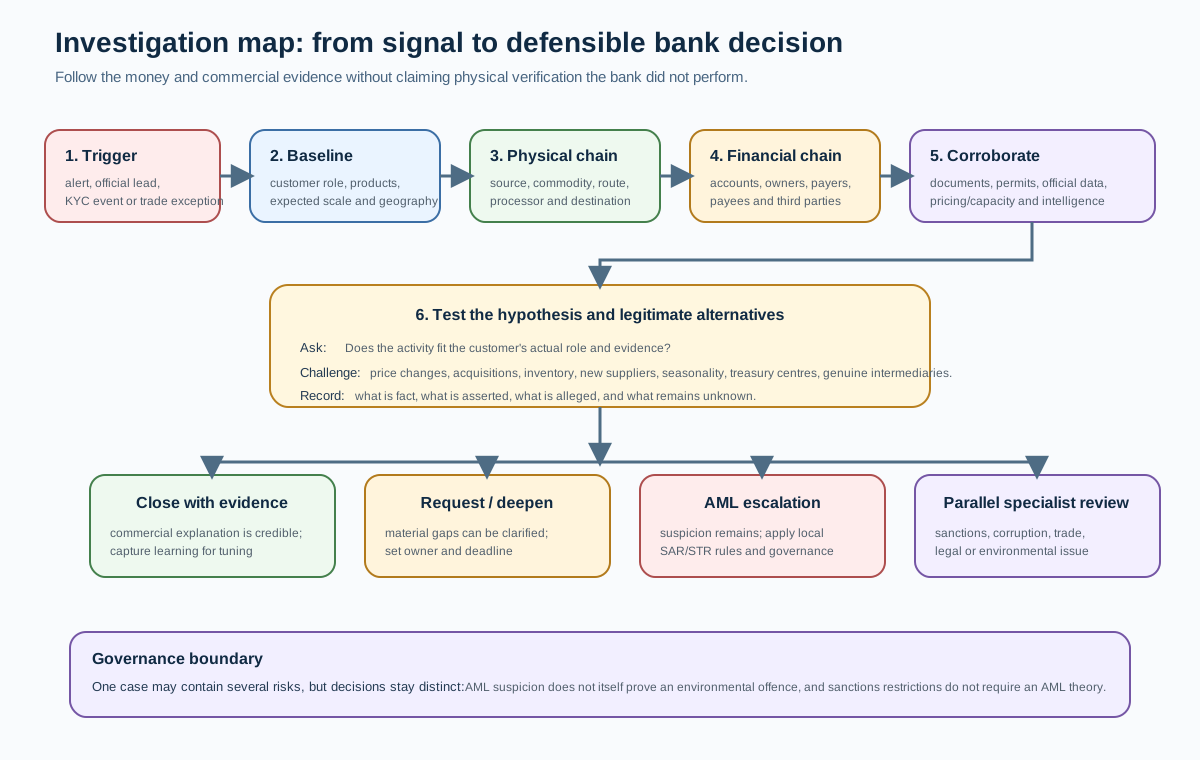
Practice exercise — work through this before reading on.
Control design exercise
Design a monitoring scenario for high-risk commodity customers. Include business segment, expected turnover, commodity, supplier geography, counterparty novelty, cash exposure, ownership changes and external intelligence. Then create legitimate negative test cases such as a new mine acquisition, seasonal commodity-price increase and known treasury restructuring.
Practice exercise — work through this before reading on.
Data-quality test
Remove supplier identifiers from the data set. Then remove commodity codes. Then remove effective-dated ownership. Observe how quickly the bank loses its ability to distinguish ordinary trade from unexplained value movement.
Practice exercise — work through this before reading on.
Case-writing exercise
Replace “customer laundered illegal-mining proceeds” with a factual narrative: “Export proceeds increased 170% while declared production remained unchanged; 62% of onward payments were made to newly formed entities with common beneficial ownership; the customer did not provide evidence explaining third-party sourcing.”
The second statement is more defensible because it states what the bank knows.
Practice exercise — work through this before reading on.
Final practitioner test
A strong learner should be able to investigate environmental-crime exposure using financial evidence, understand where trade and ownership data matter, distinguish a sector red flag from proof of predicate crime and know when to escalate to environmental, trade, sanctions or legal specialists.
Guided practice: environmental crime, illegal mining and wildlife trafficking
Use these cases to practise evidence-based reasoning. Allow additional time to answer the independent exercises before comparing your reasoning with the explanations.
Environmental crime creates financial flows that can look commercial
Illegal mining, illegal logging, waste crime, wildlife trafficking and related offences can generate substantial proceeds through activities that resemble ordinary trade. Payments may involve traders, exporters, logistics providers, brokers, processors and holding companies. The bank's challenge is therefore to distinguish legitimate commodity business from value linked to unlawful extraction, transport, sale or concealment.
A high-risk commodity does not prove crime. Gold, timber, minerals, waste-management services and wildlife-related products can all have lawful markets. The risk emerges from combinations of licensing, source geography, ownership, trade route, counterparties, pricing, cash usage, adverse information and unexplained financial behaviour.
Worked case: gold trader
A gold-trading company receives large payments from buyers in several countries and sends funds to suppliers near artisanal-mining regions. High value and geographic exposure are expected for the sector. The investigation becomes more meaningful when supplier companies have opaque ownership, documentation of origin is inconsistent, transaction values exceed the customer's declared scale and funds are repeatedly routed through unrelated intermediaries.
The bank should not claim the gold is illegally mined unless reliable evidence supports that conclusion. It can still identify unresolved source-of-funds, trade-transparency or laundering concerns and escalate accordingly.
Commodity provenance
Commodity provenance can matter because apparently legitimate goods can embody illicit value. A bank may not be able to verify the physical origin of goods directly, especially when it processes only payments. Trade-finance products can provide more documentary visibility than ordinary account transfers.
Controls should therefore state what the bank actually knows. A payment description saying "gold purchase" is a claim. An invoice can support the commercial narrative. Independent certification, customs records or reliable counterparty data can strengthen it where available. The absence of one document is not automatically proof of illegal origin.
Illegal logging and timber
Timber transactions can involve concessions, harvest licences, intermediaries, processors, exporters and shipping. Risks can increase where source regions have known illegal logging, documents are inconsistent, companies have little visible operating substance or payment routes do not align with the supply chain.
A useful investigation maps producer, exporter, buyer, beneficial owners, goods route and payment route separately. If several apparently independent suppliers are controlled by the same person, the financial interpretation changes.
Waste crime
Waste-management businesses can generate legitimate cross-border payments for collection, processing, recycling and disposal. Illegal waste movement or disposal can also produce proceeds and use front companies. Banks should understand the customer's business model, permits where relevant, counterparties and transaction patterns without assuming that cross-border waste activity is inherently criminal.
Wildlife trafficking
Wildlife trafficking can involve small payments, cash, logistics firms, travel, e-commerce and trade in products that may be mislabeled. The banking footprint can therefore be fragmented. Network relationships and external intelligence can matter more than individual transaction values.
Investigators should avoid making unsupported species or trafficking conclusions from vague payment text. Relevant intelligence from authorities or credible public sources can materially change the context.
Corruption and environmental crime
Environmental offences can intersect with bribery and corruption through permits, concessions, customs, inspections and procurement. PEP or public-official connections can therefore be relevant risk factors, but they are not proof of corruption. The investigation should identify actual relationships, payment timing and economic purpose.
Trade and sanctions overlap
Commodity activity can also create sanctions, export-control or conflict-financing concerns. AML investigators should recognise the overlap and hand off to appropriate specialists when goods, parties, ports or ownership create legal restrictions. Shared evidence should not collapse separate legal decisions.
Practice exercise — work through this before reading on.
Network-analysis exercise
Build a graph containing mining company, exporter, logistics provider, refinery, beneficial owners, bank accounts and overseas buyers. Mark which links are verified and which come from shared address, director, payment or device data. Then identify where one apparently independent counterparty is actually related to another.
Next, remove beneficial-ownership data and observe how much weaker the picture becomes. This demonstrates why KYB quality is a core dependency for environmental-crime detection.
Practice exercise — work through this before reading on.
Scenario-design exercise
Design a monitoring scenario for a commodity trader that avoids simplistic "high-risk country + high value" logic. Include expected turnover, supplier/customer geography, counterparties, cash usage, ownership changes, transaction velocity, related-party payments and deviation from historical activity. Define legitimate challenge cases such as seasonal commodity price changes and newly opened trade corridors.
Case-writing discipline
Prefer: "Customer paid six suppliers whose ownership could not be established; three were incorporated within two months, values materially exceeded the customer's historical turnover, and no credible source documentation was provided." Avoid: "Customer is involved in illegal mining" unless evidence supports that stronger statement.
Practice exercise — work through this before reading on.
Final evidence test
For each signal—high-risk commodity, cash payment, conflict-affected region, opaque supplier, unusual price, new route, PEP connection and negative media—write what it means, what it does not prove and the next reasonable question.
A strong learner should finish able to identify financial patterns connected to environmental crime without criminalising legitimate commodity sectors or overstating what the bank can observe.
Worked case: the fishing fleet that fishes on paper
A trade-finance review examines a seafood exporter with five years of steady business: frozen catch shipped to three buyer markets, documented through catch certificates, health certifications and bills of lading. A routine limit-increase request prompts deeper analysis, which surfaces inconsistencies invisible in any single document set. Declared catch volumes for two licensed vessels exceed credible fishing capacity for their size, gear and days at sea by multiples. Transhipment records show catch transferred at sea to reefers flagged in jurisdictions with minimal oversight, after which origin documentation becomes generic. Port-landing records obtained through a correspondent inquiry cover barely half the exported volume. Payments from buyers arrive promptly and in full, including for shipments whose documented catch could not have been legally harvested under the vessels' quota allocations.
Illegal, unreported and unregulated fishing can generate criminal proceeds through quota fraud, closed-area or closed-season violations, prohibited transhipment and document fraud that launders illegal catch into apparently legitimate supply chains. The bank's visibility is documentary and financial rather than physical: it cannot inspect the ocean, but it can test whether the paper fishery is plausible. Capacity analysis can compare declared catch against vessel characteristics, gear, season length and credible fisheries data. Transhipment analysis can map at-sea transfers against applicable authorisation requirements. Landing reconciliation can compare exports against independently evidenced landings. Gaps strengthen an investigative hypothesis, but they still require corroboration before the bank states that a specific catch was illegal.
Ownership and market analysis completes the picture. The exporter's fleet ownership traces through two holding layers to individuals also controlling a cold-storage and logistics group that handles competitors' catch, creating commingling opportunity where illegal product could mix with legal product before export documentation is issued. Buyer analysis shows one major buyer paying consistent premiums above market for the exporter's product. That may deserve explanation, but a premium is not by itself evidence that the buyer is paying for illegal supply. Crew and labour indicators, where available through credible official or specialist information, can add human-trafficking or labour-abuse concerns that require their own evidential and reporting analysis.
The outcome combines transaction discipline with relationship consequences: enhanced documentation requirements where proportionate, review of suspected quota or document irregularities under the applicable framework, and relationship review considering the wider commingling infrastructure. The control lesson is that environmental trade-crime analysis benefits from physical-reality testing, but capacity estimates and documentary gaps are evidence inputs rather than automatic legal conclusions.
Waste misclassification: disposal economics as detection logic
Waste trafficking can exploit the economics of disposal: compliant treatment can be expensive, while illegal dumping or misclassified export may reduce costs. The financial patterns can therefore include commercial documentation that appears plausible while the economics or physical capacity merit further questions.
Banking analysis can compare contracted disposal or treatment prices against credible market information for the declared waste stream and destination. Prices materially below an appropriate comparison can justify questions about classification, service scope, subsidies, bundled contracts, capacity or disposal method; price alone cannot determine illegality. Volume-capacity testing can compare declared throughput against the exporter's and receiving facility's credible processing capacity, permits and operating history. Route analysis can ask why waste travels to a distant destination when nearer compliant capacity appears available, while recognising that contract, technology, price or regulatory factors may provide legitimate explanations. Document scrutiny can compare classification codes, laboratory analyses and waste descriptions across contracts, customs declarations and transport documents.
Corporate and ownership patterns can add context: rapidly formed intermediaries with limited visible operating assets, directors shared across waste entities, permits held by dormant companies or circular subcontracting may warrant deeper review. Corruption indicators can also cluster around permitting and inspection functions. The bank's response should follow the evidence and applicable law rather than presume a predicate offence from sector economics alone.
Timber certification fraud and chain-of-custody testing
Timber laundering can involve document fraud, mixing at mills and abuse of certification or permit systems. Chain-of-custody analysis compares the volume, species and origin claimed at each stage—harvest, transport, milling and export—with the previous stage within credible conversion ratios and timelines. Potential concerns include harvest volumes above concession allocations, species mismatches, mill throughput above credible input supply and certificate use beyond the scope or period actually verified.
Financial corroboration tests the paper chain against money flows. Payments to harvesting contractors inconsistent with declared volumes, premiums for certified product without corresponding verified supply, or intermediaries adding margins without an understood function can justify deeper questions. Geographic analysis can test whether harvest, mill and export locations are commercially plausible. Specialist support may be needed where species, forestry or certification interpretation is material.
Certification-body data, where accessible, can help verify certificate validity, scope and audit history. Discrepancies are evidence gaps or inconsistencies to investigate; they should not automatically be described as certificate abuse until the bank has sufficient support. Certification itself is also evidence rather than an absolute guarantee of lawful origin.
Worked case: the refinery that asks no questions
A corporate banking team services a precious-metals refinery with twenty years of history, audited statements from a reputable firm, membership in an industry responsibility scheme, and LBMA-style good-delivery accreditation aspirations documented in board minutes. A periodic review notes a shift in feedstock sourcing over eighteen months: established mining-company suppliers decline from 80 to 45 percent of intake, replaced by intermediaries and aggregators in higher-risk jurisdictions using more cash-intensive settlement patterns. The refinery's explanation cites supply diversification and competitive pricing. Its compliance documentation describes enhanced due diligence on new suppliers, but the files contain only incorporation documents and self-declared source statements.
Refining can reduce traceability because material from multiple sources may be mixed and transformed. The OECD Due Diligence Guidance for Responsible Supply Chains of Minerals from Conflict-Affected and High-Risk Areas provides a government-backed responsible-supply-chain framework for companies potentially sourcing minerals or metals from conflict-affected and high-risk areas. It is not a universal AML rule for banks. A bank can use the framework as contextual evidence when assessing the quality of a refinery customer's sourcing controls, while applying the legal and policy requirements that actually govern the bank and relationship.
The assessment examines sourcing-pattern plausibility first: whether the shift toward intermediaries reflects genuine market developments or a move toward less transparent supply. Price analysis can be informative, but there is no universal rule that illicit gold always trades at a discount. Volume analysis can compare intermediary supply against credible collection capacity. Supplier declarations should be weighed alongside available mine-origin evidence, transport documentation, export permits and assay information where relevant and obtainable. An aggregator with no visible mining assets or processing capability is not automatically a laundering conduit; concern becomes stronger when its claimed volumes, ownership, counterparties and evidence do not support its stated role. Scheme memberships and audits should be verified for scope, date, findings and remediation rather than accepted as conclusive assurance.
In this fictional case the findings show progressive control erosion rather than a proved criminal arrangement: commercial pressure drove sourcing toward cheaper, less-documented supply, while compliance resources and evidence requirements did not keep pace. The response can therefore be graduated but firm: enhanced sourcing evidence, independent supply-chain review where proportionate, limits on unsupported higher-risk intake, and relationship-level review. Reporting decisions should be based on the institution's actual suspicion threshold and applicable law, not on scheme membership or sourcing-country risk alone.
Wildlife-trafficking payments: small, fast and revealing
Wildlife-trafficking finance can involve small transactions, mainstream payment channels, mobile money, e-commerce, logistics providers and cross-border transfers. Detection can therefore depend more on network assembly and contextual intelligence than on amount thresholds.
Payment-pattern analysis can focus on roles and relationships: repeated transfers to individuals in source regions without a clear commercial explanation, aggregation from multiple low-level participants, rapid onward movement to exporters, or merchant activity inconsistent with the declared business. Each pattern is individually ambiguous. Credible official intelligence, customs information, seizure data and CITES-related context can materially increase evidential weight.
Product-misdescription concerns also require discipline. Goods can be misdeclared, but vague payment text or an unusual product name is not proof. Transport and logistics information, where lawfully available, can help map physical movement alongside financial flows.
The bank's response should reflect the organised-crime character of serious wildlife trafficking while preserving local reporting law and confidentiality. Where suspicion is reached, a report should accurately describe the suspected predicate and laundering concerns to the extent known. Rural communities and legitimate wildlife-related businesses should not face exclusion merely because trafficking networks operate in the same geography.
Timber concessions and harvest-quota fraud
Concession-allocation corruption and harvest-quota fraud can create criminal proceeds at the forest gate. Potential concerns include concessions obtained through corruption, harvests exceeding licensed quotas, logging outside authorised boundaries or species misdeclaration. The bank's visibility may come through logging-company customers, equipment financing, transport payments, sawmills and exporters.
Concession verification can use forestry cadastres, licensing records and remote-sensing information where accessible. Production plausibility compares declared harvest against concession terms, equipment capacity and workforce. Volumes materially above licensed or credible capacity can signal a potential breach or undocumented sourcing, but the bank should corroborate the explanation before asserting illegality. Satellite or remote-sensing information can provide useful contextual evidence, but interpretation may require specialist expertise and does not itself establish who committed an offence. Downstream volume mismatches can justify supply-chain inquiry and potential escalation.
Mining royalties, permits and the corruption interface
Industrial and artisanal mining can create financial-crime risk at permit, royalty, marketing and extraction stages. Potential misconduct includes permit fraud, operating outside valid concessions, exceeding boundaries or misdeclaring minerals. Royalty evasion or transfer-pricing abuse may also overlap with tax crime and corruption, depending on local law.
Banking controls for mining portfolios can combine production plausibility with corruption vigilance. Production analysis may compare declared output against concession terms, equipment capacity and workforce. Royalty and tax information, where relevant and lawfully available, can be reconciled with the customer's explanation. Marketing analysis should test whether sales channels and counterparties fit the business model without assuming that unfamiliar intermediaries are illicit. Expired, suspended or geographically inconsistent permits are strong review triggers, but the legal effect must be assessed under the applicable regime.
Politically exposed person and corruption analysis can be important where concessions allocate valuable state resources through discretionary processes. Beneficial-ownership analysis should identify relevant officials, family members or associates where required by policy and law, while PEP status itself remains a risk factor rather than proof. Any source-of-wealth or lifestyle analysis should stay within lawful, proportionate information handling.
Illegal sand mining: high volume, low visibility
Sand supports large construction markets and has been associated in some jurisdictions with illegal extraction, organised crime, corruption and violence. Financial patterns can resemble other bulk-commodity environmental crime: high physical volumes at low unit values, cash-heavy local settlement and transport-intensive logistics.
Analysis can use volume-value relationships where credible data exist. Licensed quarries or riverbed concessions may have extraction limits; supply materially above those limits can justify questions about additional lawful suppliers or undocumented sourcing. Price analysis can identify unusual procurement terms, but discounts may also arise from contract scale, location, quality or market conditions. Transport analysis can compare claimed volumes with fleet capacity, routes and fuel patterns where those data are legitimately available.
Construction-sector review can ask whether major volumes come from documented suppliers and whether payment methods fit the customer's operating model. Equipment financing for dredging or excavation in exposed regions can justify enhanced due diligence on the operator's business and permissions. These are risk-based controls, not presumptions that construction or extraction customers are criminal.
CITES permits and wildlife-document risk
International wildlife trade can involve CITES permits and national implementation rules. Fraud can include forged permits, quota breaches, species misdescription or false source claims. Banks should not attempt species or permit adjudication beyond their competence; specialist or authority confirmation may be needed.
Where official CITES or national records are accessible and relevant, they can help test permit authenticity, species, quantity, source codes and exporter details. Cumulative trade information can also provide context for volumes, but the CITES Trade Database itself warns that interpretation is complex. A discrepancy should therefore trigger investigation rather than an automatic conclusion of trafficking.
The bank's role is to connect customer, payment, ownership, logistics and authoritative information, preserve evidence provenance and escalate through the correct AML, sanctions, corruption, trade or legal pathway when facts justify it.
2026 practitioner enhancement: environmental crime as a proceeds, trade and ownership problem
Environmental crime can generate illicit value through illegal mining, illegal logging, wildlife trafficking, waste crime, fisheries-related crime and associated corruption or smuggling. In a bank, these cases rarely arrive labelled "environmental crime". They can look like ordinary commodity trading, cash-intensive activity, equipment purchases, freight settlement, merchant payments, cross-border transfers or wealth funded from business income.
The control challenge is therefore to connect financial behaviour with the customer's declared business, ownership, licences or permits where relevant, supply chain, counterparties, geography and available trade evidence. A commodity, country, cash transaction, permit gap or adverse-media item is not a conviction. The investigator should build a chronology, preserve source quality and test legitimate explanations before deciding whether a residual AML concern remains.
FATF's current environmental-crime topic page continues to cite environmental crime as a highly profitable criminal activity and explains that the financial response depends on following illicit proceeds and strengthening public-private and cross-border cooperation. FATF's 2021 report is particularly useful for banks because it describes front companies, early mixing of legal and illegal goods and payments, corruption, trade-based fraud and offshore corporate structures. The 2020 illegal-wildlife-trade report adds the need to assess risk, follow financial trails and pursue financial investigations rather than relying only on seizures of wildlife or products.
INTERPOL's current environmental-crime and illegal-mining material reinforces the organised-crime, cross-border, corruption and money-laundering context. It is useful operational background, but a bank should not treat law-enforcement typologies as automatic customer-screening rules. The same principle applies to CITES information: official trade and permit data can help corroborate a wildlife-trade story, but interpreting species, source codes, permits and trade records can require specialist expertise.
For minerals sourced from conflict-affected and high-risk areas, the OECD Due Diligence Guidance is a government-backed responsible-supply-chain framework for companies. It is not a universal bank AML rule. A bank can use the framework as contextual evidence when assessing a customer's sourcing controls, while still applying the AML, sanctions, trade and reporting law that actually governs the bank and transaction.
FATF's September 2026 work on professional money laundering, underground banking, hawala and similar service providers is also useful for understanding how third-party settlement networks can move value across predicate crimes. Hawala and similar systems can have legitimate uses; exposure should be assessed on evidence and risk rather than treated as inherently criminal.
References and further reading
- FATF — Environmental Crime: https://www.fatf-gafi.org/en/topics/environmental-crime.html
- FATF — Money Laundering from Environmental Crime, 28 June 2021: https://www.fatf-gafi.org/en/publications/Environmentalcrime/Money-laundering-from-environmental-crime.html
- FATF — Money Laundering and the Illegal Wildlife Trade, 25 June 2020: https://www.fatf-gafi.org/en/publications/Environmentalcrime/Money-laundering-wildlife-trade.html
- FATF — The FATF Recommendations, as amended June 2026: https://www.fatf-gafi.org/en/publications/Fatfrecommendations/Fatf-recommendations.html
- FATF — Investigating Professional Money Laundering, Underground Banking, and the Use of Hawala and Other Similar Service Providers, 3 September 2026: https://www.fatf-gafi.org/en/publications/Methodsandtrends/pml-underground-banking-hawala-hossps.html
- INTERPOL — Environmental Crime: https://www.interpol.int/Crimes/Environmental-crime
- INTERPOL — Illegal Mining: https://www.interpol.int/Crimes/Environmental-crime/Illegal-mining
- CITES — CITES Trade Database: https://trade.cites.org/
- OECD — Due Diligence Guidance for Responsible Supply Chains of Minerals from Conflict-Affected and High-Risk Areas, Third Edition: https://www.oecd.org/en/publications/oecd-due-diligence-guidance-for-responsible-supply-chains-of-minerals-from-conflict-affected-and-high-risk-areas_9789264252479-en.html
Educational note: environmental offences, licensing requirements, CITES implementation, mineral-sourcing obligations and SAR/STR duties vary by jurisdiction and product. This chapter teaches bank-practical financial-crime analysis and does not replace legal, environmental, customs or trade-control advice.