Cash, Wire, Cross-Border and Other Regulatory Reports
A bank can process a completely legitimate transaction and still have a mandatory reporting obligation. That is the central idea of this chapter. Financial-crime reporting is not limited to suspicious activity reports. Many jurisdictions require reporting entities to submit other information because a transaction meets an objective condition: a cash amount crosses a statutory threshold, an international electronic transfer enters or leaves the country, a cross-border wire exceeds a prescribed value, a particular type of monetary instrument is moved across a border, or another reportable event occurs under local law.
These reports are useful to authorities because they create structured financial intelligence even when the bank has not formed a suspicion. A cash threshold report can later become one part of a wider law-enforcement picture. An international funds transfer report can help an FIU reconstruct movement between jurisdictions. A cross-border wire report can reveal relationships that are not obvious from one institution's customer view. The bank's job is therefore different from the job it performs when deciding whether to file an STR or SAR. For threshold and event-based reporting, the first question is normally not “is this suspicious?” but “does this event fall within the local reporting rule?”
That distinction sounds simple until it reaches production. A global bank may have branches and legal entities in dozens of countries, several core-banking platforms, separate payment hubs, teller systems, cash-deposit machines, cards, remittance channels, correspondent accounts, data warehouses and acquired businesses. The transaction that creates the obligation may be split across channels or branches. The legal reporting threshold may be expressed in local currency while the transaction is in foreign currency. An aggregation rule may join transactions by person, entity, beneficiary or business day. Exemptions may apply only to specified customers or transaction types. A filing may have a deadline measured from the event date, while an amended report may follow a different process. A report can fail even though every individual source system appears to have processed its own transaction correctly.
The practical control is therefore an end-to-end reporting capability: identify the applicable obligation, capture the right population, aggregate correctly, enrich with reliable customer and transaction data, create the report in the authority's required format, validate it, submit it on time, preserve acceptance evidence, correct errors, and demonstrate completeness later. That capability needs legal interpretation, data engineering, operations, compliance ownership, quality assurance and change governance working together.
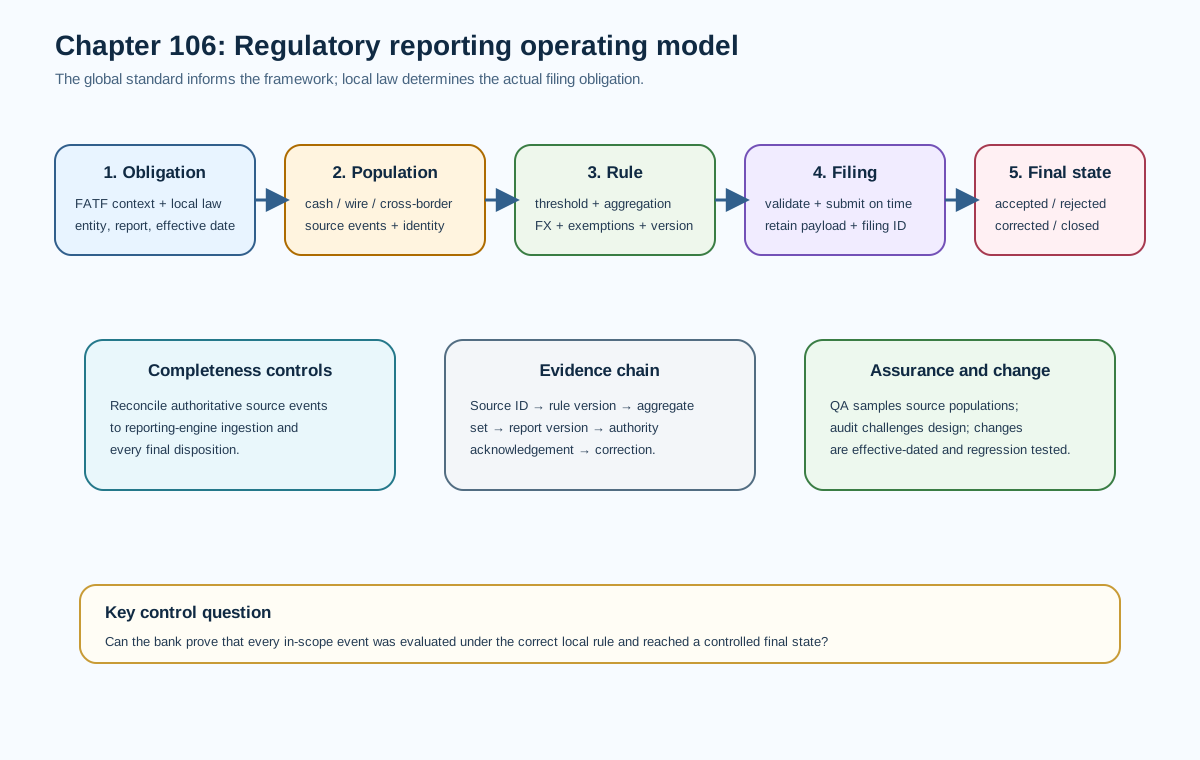
The most important distinction: threshold reporting is not suspicious reporting
Financial-crime teams often use the word “reporting” as though all reports are the same. They are not. A useful mental model separates three categories.
The first category is suspicion-based reporting. FATF Recommendation 20 establishes the international expectation that financial institutions report promptly to the relevant FIU when they suspect, or have reasonable grounds to suspect, that funds are proceeds of criminal activity or relate to terrorist financing. The legal test, filing deadline, confidentiality rules and form are then implemented through national law. Suspicion-based reporting depends on judgement about facts and context. It does not depend on an amount threshold under the FATF standard.
The second category is threshold or event-based regulatory reporting. Here, legislation or regulation specifies an objective condition. The bank may have to file even when the customer is well known, the commercial purpose is clear and no suspicious behaviour exists. Examples include U.S. Currency Transaction Reports for reportable cash activity, Australian Threshold Transaction Reports, Canadian Large Cash Transaction Reports, Canadian Electronic Funds Transfer Reports, Australian international transfer reporting and Indian Cash Transaction Reports or Cross Border Wire Transfer Reports. The names, thresholds, aggregation rules, deadlines and covered institutions differ materially between jurisdictions.
The third category is payment-transparency and recordkeeping obligations. These may require information to accompany a payment or be retained by the institution but do not necessarily create a transaction-by-transaction filing to an FIU. This distinction is especially important for wires. FATF Recommendation 16 concerns payment transparency. In the United States, the BSA funds-transfer recordkeeping and Travel Rules generally require specified information for covered funds transfers or transmittals of funds of USD 3,000 or more, but that is not the same as a universal government “wire report” for every transfer above USD 3,000. By contrast, Canada requires certain reporting entities to file Electronic Funds Transfer Reports for reportable international EFTs, and India has a specific cross-border wire transfer reporting obligation above the locally prescribed threshold.
If a training chapter collapses those three categories into one idea, learners can make serious mistakes. A bank might incorrectly assume that meeting a payment-data rule means no regulatory report is needed. Another team might file a threshold report but fail to consider whether the same activity is suspicious. A technology team might implement a “wire threshold” globally because a local requirement was mistaken for an international standard. Strong design keeps each legal trigger and each control outcome separate.
What FATF does and does not require
FATF provides a global standards framework, not one worldwide filing form or one worldwide cash threshold. Recommendation 11 requires financial institutions to keep necessary records on domestic and international transactions for at least five years so that transactions can be reconstructed and information can be made available to competent authorities. Recommendation 20 addresses suspicious transaction reporting. Recommendation 16 addresses the information that should accompany qualifying payments and the responsibilities of financial institutions in a payment chain. The revised Recommendation 16 was agreed in June 2025, and FATF stated in 2026 that jurisdictions are expected to be ready for implementation of the strengthened requirements by the end of 2030.
Those standards help explain why transaction data, traceability and reporting matter, but a bank must not invent a “FATF threshold report” that does not exist. Cash-reporting thresholds, cross-border transaction reports, filing timelines, aggregation windows and exceptions come from national or regional law. The group policy should therefore distinguish a global minimum control architecture from the legal schedules that parameterise each regulated entity.
A good global policy might say that every reportable-event control requires traceable source population, approved jurisdictional logic, controlled aggregation, validation, timely submission, evidence of acceptance, correction procedures and independent testing. A U.S. annex would then define the CTR rule and its exemptions. An Australian annex would define TTR and international transfer reporting. A Canadian annex would define LCTR, EFTR and the 24-hour rule. An Indian annex would define CTR, CBWTR and other FIU-IND reports. This design supports consistency without pretending the laws are identical.
Four jurisdiction examples and why they must not be mixed
The United States illustrates cash reporting clearly. FinCEN requires covered financial institutions to report transactions in currency over USD 10,000, including multiple cash transactions that must be aggregated when the institution has knowledge that they are by or on behalf of the same person and produce cash-in or cash-out totals over USD 10,000 during one business day. Cash-in and cash-out are considered separately rather than netted. The FFIEC BSA/AML Manual also emphasises aggregation across domestic branches. The rule is objective: the presence or absence of suspicion does not determine whether the CTR is required. Suspicious structuring around the threshold may separately raise a SAR question.
Australia uses different concepts. AUSTRAC states that a Threshold Transaction Report is required for a designated service involving AUD 10,000 or more in physical currency, including the foreign-currency equivalent, and the TTR is generally due within 10 business days after the transaction. Australia also requires reporting of international transfer instructions under the current transitional framework. As of September 2026, AUSTRAC's transition guidance says existing reporting entities enrolled by 30 March 2026 may transition to new TTR and SMR forms between 1 July 2026 and 30 March 2029, while the existing IFTI requirements continue until the relevant transition to the future international value transfer service reporting framework. This is exactly the sort of change that a reporting engine must handle with effective dating rather than a hard-coded “Australia rule.”
Canada uses another model. FINTRAC requires Large Cash Transaction Reports when a reporting entity receives CAD 10,000 or more in cash in a single transaction or when reportable cash amounts meet the 24-hour rule. FINTRAC also requires Electronic Funds Transfer Reports for qualifying international EFTs at the CAD 10,000 threshold, including specified aggregated activity under the 24-hour rule. The submission deadlines differ by report type. Current FINTRAC guidance states that LCTRs are due within 15 calendar days, while covered EFTRs are generally due within five business days after initiation or final receipt. The detailed 24-hour tests include knowledge and relationships such as the same person, entity, third party or beneficiary, so the bank needs more than a simple arithmetic sum.
India again differs. FIU-IND's public guidance describes reportable cash transactions over INR 10 lakh, series of integrally connected cash transactions below that amount whose monthly aggregate exceeds INR 10 lakh, and cross-border wire transfers over INR 5 lakh where either the origin or destination of funds is in India. FIU-IND also receives other prescribed reports such as counterfeit-currency and non-profit-organisation reports. The reporting formats are defined through FIU-IND's reporting framework and FINnet environment. These are Indian obligations; they are not a template to be applied to another country simply because the bank uses one global transaction-monitoring platform.
The educational point is not to memorise four thresholds. Thresholds can change. The point is to understand the control architecture needed to express different legal rules accurately and to update them safely when the law changes.
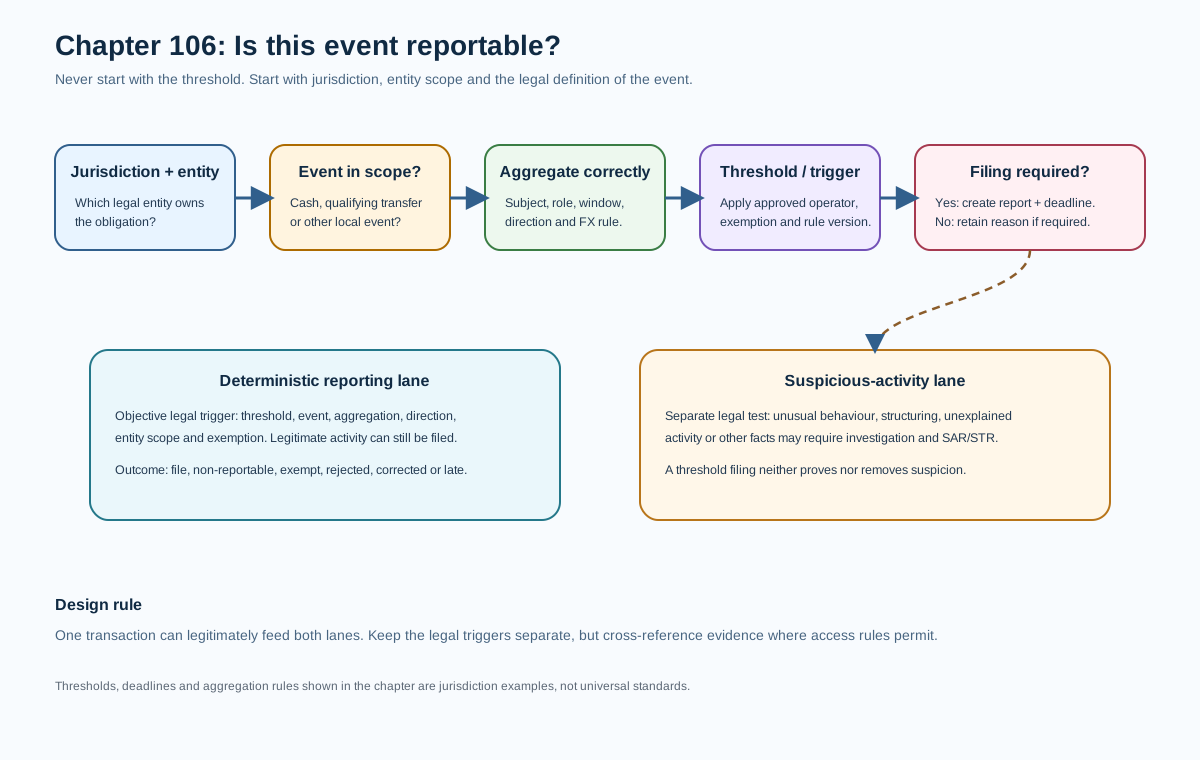
Start with the reporting perimeter
Before a threshold can be coded, the bank must know which legal entity and activity are in scope. This is a legal-perimeter problem as much as a technology problem. A multinational group may have a parent bank, local branches, subsidiaries, broker-dealers, payments companies, money-service businesses and outsourced service providers. A central reporting platform may process data for all of them, but the filing obligation may sit with different entities.
The perimeter definition should answer which reporting entity owns the obligation, which products and channels are covered, which locations or branches count toward aggregation, what constitutes the reportable event, and which authority receives the report. The answer should be effective-dated. If a newly acquired subsidiary migrates to the group reporting platform on 1 November, the control must know whether historical transactions remain in the legacy reporting perimeter and whether post-migration aggregation must join activity across old and new systems.
Branch logic is particularly important. A customer can deposit cash at one branch in the morning and withdraw cash at another location later. A bank that evaluates only one branch may miss aggregation. In the U.S. context, FFIEC guidance explicitly notes that a bank includes its domestic branch offices for CTR purposes. Other jurisdictions have different aggregation constructs, so the architecture should not infer a global branch rule from this example.
Channels matter in the same way. Cash can enter through a teller, ATM, cash-deposit machine, night depository, vault service or an authorised agent. International payment instructions can arrive through online banking, host-to-host channels, branch systems, APIs or correspondent messages. The source application may know only a local transaction identifier, while the reporting engine needs customer, account, party, currency, country and purpose information from several systems. The reporting perimeter is therefore a data lineage map, not merely a legal paragraph.
Define the reportable event precisely
A frequent implementation failure is to use a vague event label such as WIRE, CASH, or CROSS_BORDER and assume it maps cleanly to law. It rarely does. The rule may distinguish physical currency from electronic value, initiation from receipt, domestic from international, customer transaction from interbank settlement, principal from agent activity, and one transaction from several related transactions.
For cash reporting, the system should know what local law means by currency or physical cash. A cheque, bank draft, card payment and electronic transfer are not automatically “cash” because a business user calls them cash-equivalent. For U.S. CTR purposes, the trigger concerns transactions in currency, and separate rules apply to monetary instruments. For Australian TTRs, AUSTRAC's current guidance expressly refers to physical currency. The distinction affects source-system classification and test cases.
For international transfer reporting, direction matters. A report may be triggered on initiation, final receipt, or both depending on the jurisdiction and reporting entity. The location of the customer, originator, beneficiary, sending institution, receiving institution and payment account can all matter to whether a transfer is considered international under the local rule. A payment routed through a foreign correspondent does not necessarily make the customer's payment “cross-border” for every legal purpose, and a payment between two customers of the same provider can still have an international reporting consequence under some regimes.
The event date also needs a formal definition because it drives filing deadlines and aggregation. Is the event date the time cash is physically received, the posting date, the booking date, the settlement date, the message acceptance timestamp or the business date assigned by the source system? Night deposits and weekend transactions demonstrate why this is not trivial. The reporting data model should retain both the original event timestamp and the derived regulatory business date, together with the rule used to derive it.
Aggregation is a legal rule expressed through identity and time
Threshold reporting is often described as “sum transactions and compare with a number.” That is incomplete. Aggregation normally depends on who the transactions belong to, the direction or type of activity, a defined time window, and the institution's knowledge. The system must therefore solve identity, relationship and time questions before it performs arithmetic.
Consider a customer who conducts several cash deposits into two business accounts. Whether the amounts aggregate may depend on whether they were conducted by or on behalf of the same person or entities and on the jurisdiction's rule. Now consider two individuals depositing on behalf of one company. A reportability engine that keys only on teller customer ID can miss the company-level aggregation. Conversely, a bank that aggregates all entities under a shared director without legal basis can create false reports and unnecessary customer friction.
Time windows also differ. The U.S. CTR rule uses one business day. Canada's 24-hour rule uses the definitions in FINTRAC's guidance and regulations. India's public guidance includes monthly aggregation for specified integrally connected cash transactions. Those examples alone show why one global field called daily_total is insufficient.
The safest architecture represents aggregation as a controlled rule with explicit dimensions: jurisdiction, report type, reporting entity, transaction class, direction, aggregation subject, related-party logic, time window, threshold currency, exchange-rate method, inclusive or exclusive comparison, exemption logic, effective date and rule version. When the rule changes, the bank should be able to identify which reports were created under which version.
Currency conversion deserves the same discipline. If a threshold is expressed in local currency and the transaction is denominated elsewhere, the bank needs the legally or regulatorily accepted exchange-rate source and time. FINTRAC, for example, specifies the exchange-rate approach for determining its threshold. The rate used for regulatory reportability should be preserved as evidence; it should not be silently recalculated later using a current rate.
Threshold logic must be deterministic but not simplistic
A threshold rule is deterministic in the sense that two systems receiving the same complete facts and the same rule version should reach the same reportability result. That does not mean the upstream facts are always simple. Customer linkage may be uncertain. Third-party status may be missing. A transaction may be reversed or corrected. One channel may deliver late. A branch could close its day at a different time from a central ledger. Data latency can cause the first calculation to say “not reportable” and a later event to push the total over the threshold.
For this reason, mature systems support re-evaluation. New events can reopen the aggregation set within the legally relevant window. Late-arriving data can trigger a report or amendment. A change to party identity can cause previously separate transactions to belong to the same subject. The engine should record why a population changed and what downstream action followed.
The reportability decision should also be distinguishable from suspicious-activity detection. A customer depositing amounts just below a cash threshold may not create a threshold report under a particular rule but may create a structuring concern. Conversely, a routine large cash deposit may require a threshold report even when the activity is entirely expected. The systems can share data, but the legal triggers should not be merged into one opaque score.
Exemptions are controlled data, not tribal knowledge
Some regimes permit exemptions or exclusions for specified customers or transactions. These should be treated as governed reference data with eligibility evidence, approval, effective dates and periodic review. An exemption should not be a free-text note saying “do not report this customer.”
The control needs to know which report type the exemption applies to, who approved it, the legal basis, start date, end date or review date, customer or account scope, conditions, and any activity that remains reportable despite the exemption. A customer can be exempt for one reporting purpose while still subject to another. Exemption status should not suppress suspicious-activity monitoring.
Testing should include expired exemptions, incorrectly scoped accounts, mergers that change customer identity, new products not covered by an old exemption, and transactions processed after an exemption's effective end. Assurance teams should be able to reconstruct why a report was not filed, not merely observe that the engine returned EXEMPT.
The data architecture behind a regulatory report
A regulatory report is an output, but the control starts much earlier. Source systems generate events. Customer master and KYC systems provide identity. Account and product systems supply relationships. Payment messages provide originator, beneficiary, bank, country and transaction information. Reference data contributes currency, country and legal-entity attributes. Reporting logic determines whether the event belongs in a reportable population. Enrichment services complete required fields. A reporting application creates the authority-specific message or form. A gateway submits it. The regulator or FIU returns acknowledgement, acceptance, rejection or another status. Every stage should be traceable.
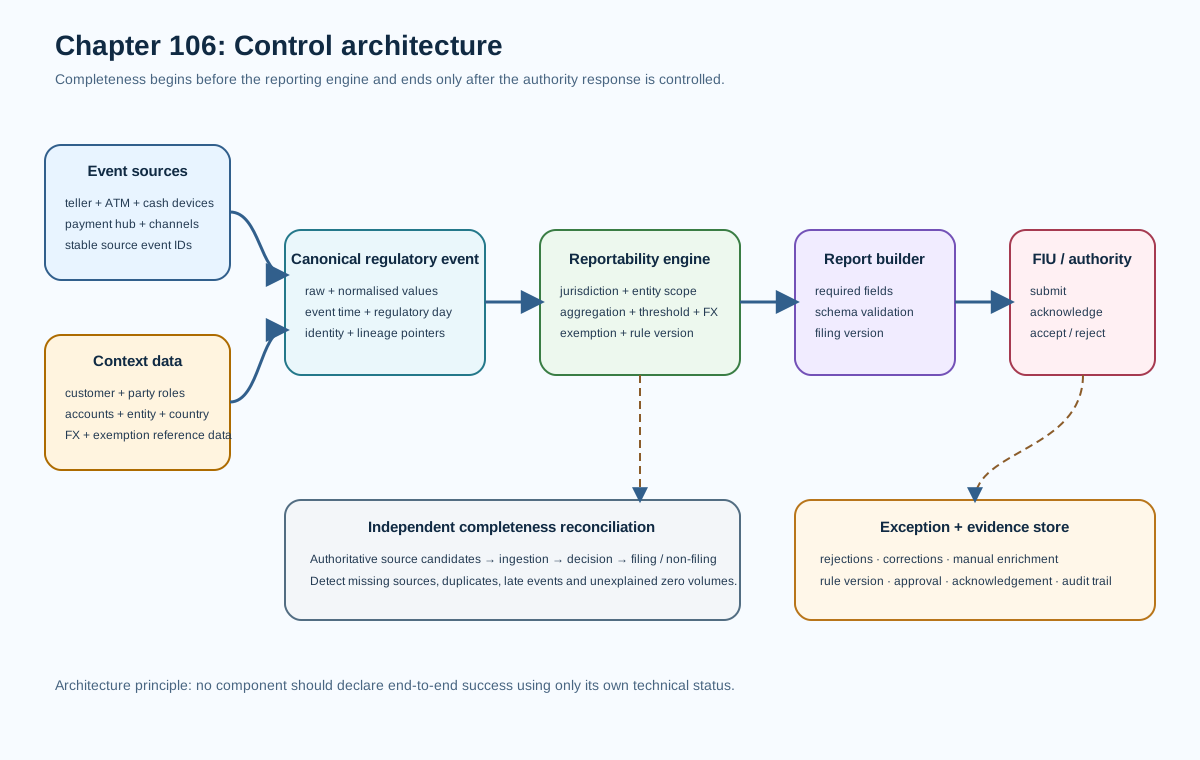
A bank should be able to answer six lineage questions for any field on a filed report: where did the value originate, what transformations occurred, which rule selected or calculated it, whether a human changed it, which version was submitted, and what the authority returned. If a report says the originator country was DE, the bank should not have to reverse-engineer that field from a six-month-old batch script.
This becomes particularly important when payment data passes through multiple formats. A cross-border payment may originate as pain.001, become an internal canonical object, produce pacs.008, be enriched by customer data and later feed a regulatory reporting schema. The regulatory report may require a concept that does not map one-to-one to a payment-message field. Architects should document semantic mapping rather than relying on field-name similarity.
Identifiers are equally important. A source transaction ID, account entry ID, payment ID, UETR, EndToEndId, customer ID, party ID, reporting event ID, filing ID and authority acknowledgement ID serve different purposes. A reliable reporting chain stores the relationships among them. This allows an investigator to start from a regulatory filing and navigate back to the customer and source transactions, or start from a payment and determine whether it contributed to a filed report.
Completeness is harder than accuracy
A report can be perfectly accurate and still represent a failed control if the bank omitted half of the reportable population. Accuracy asks whether the fields in a submitted report are correct. Completeness asks whether every in-scope event that should have reached the reporting pipeline actually did so. Regulators and auditors care about both.
Completeness should be designed as a reconciliation problem. The bank identifies authoritative source populations, counts and values in-scope events, then reconciles them to reporting-engine ingestion and final dispositions. A transaction should not disappear simply because it failed enrichment. Exceptions need a state and owner: awaiting data, suppressed under approved exemption, not reportable with reason, filed, rejected by authority, corrected, or escalated.
Control totals are valuable but must be meaningful. Comparing yesterday's total payment count with the number of reports is usually useless because only a subset is reportable. Better reconciliations compare eligible source events to reporting-engine events by source, date, legal entity, report type and transaction class. Hash totals or monetary totals can detect truncation or duplication. Sequence monitoring can detect missing files. Late-arrival metrics can show whether source systems are feeding the engine inside the filing deadline.
A common control gap appears when a new product is launched. Transactions process successfully, but nobody adds the new product code to the regulatory reporting extraction. The reporting engine itself is healthy and produces zero errors because it never sees the population. This is why product governance must include a regulatory-reporting impact assessment before launch.
Mandatory field quality and enrichment
Authorities require structured data because they need to match parties, connect transactions and analyse networks. Missing or poorly populated fields can reduce intelligence value and cause rejected filings. The reporting process should therefore distinguish three field types: values that must come unchanged from a source record, values that can be enriched from governed master data, and values that require an operational or compliance judgement.
Enrichment should not silently overwrite the transaction's historical truth. If a customer's address changed after the transaction, the report may require the address relevant at the transaction time or the current address depending on the local form. The data model should support time-aware retrieval. If the reporting operation corrects a misspelled name, the system should preserve both the source value and the submitted value, together with the reason for change.
Free text should be minimised where a controlled code exists, but not at the expense of meaning. Country codes, currency codes, transaction types and party roles should come from governed reference data. Narrative fields, where present, should explain relevant context rather than duplicate machine-readable fields. The bank's rulebook should define field ownership so operations do not invent inconsistent interpretations during deadline pressure.
Submission is not completion
A bank has not completed its obligation merely because a file left its network. The authority may reject the file, reject an individual report, return validation errors, accept it with warnings or provide an acknowledgement identifier. The final control state must reflect the authority's response where the filing channel provides one.
The reporting platform should distinguish generated, validated, approved, submitted, technically acknowledged, accepted, rejected, corrected and closed states as appropriate. Not every jurisdiction uses the same acknowledgements, so these are conceptual states rather than universal regulatory labels. The key requirement is that the institution can prove what happened.
Acknowledgement monitoring needs service levels. A rejected report approaching its legal deadline should escalate immediately. A missing acknowledgement may indicate a gateway failure. A successful batch transfer with zero accepted records may be a parsing problem. Operations dashboards should show ageing and deadline risk, not just throughput.
Corrections, amendments and late reports
Errors happen. The strength of the programme is visible in how quickly it identifies them, whether it assesses the population impact and whether it corrects reports under the applicable local process. A typo in one optional field is different from discovering that an aggregation rule excluded an entire branch for three months.
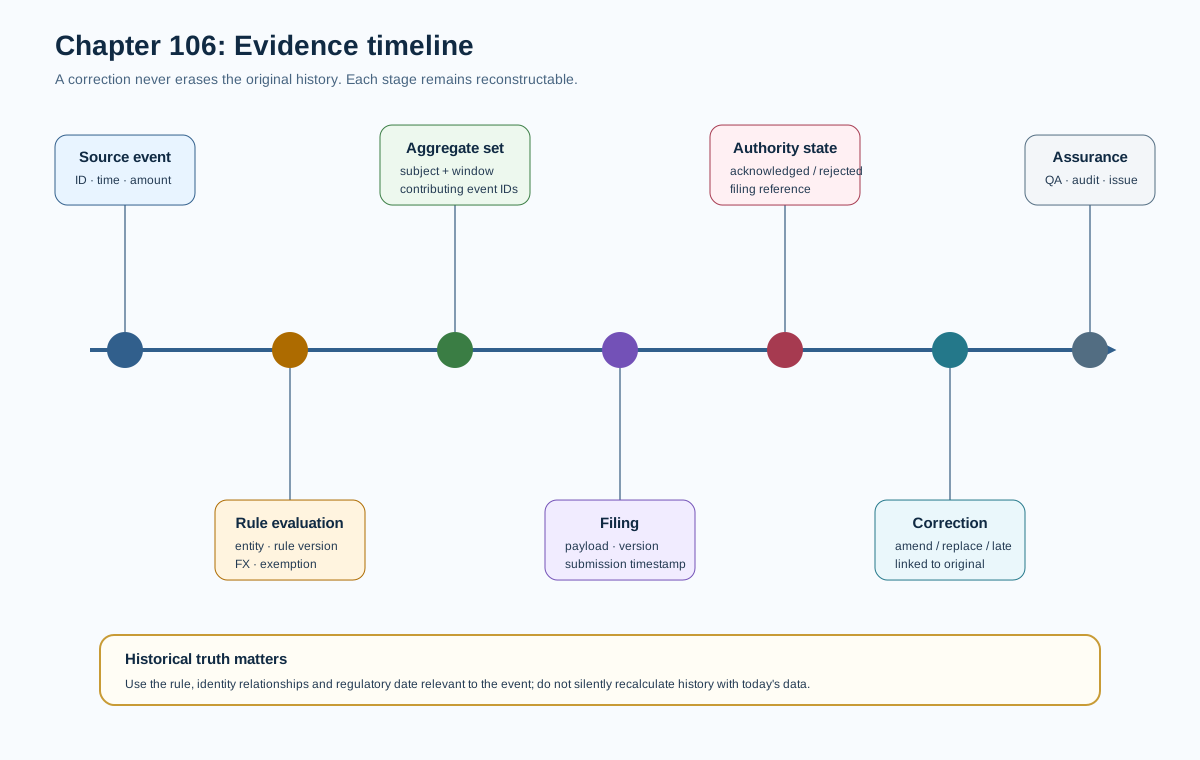
A correction process should first classify the defect. Was the original report wrong, incomplete, duplicated, rejected or never filed? Did the error affect one report or a population? Is the filing deadline still open? Does the authority require an amendment, cancellation and replacement, corrected filing, voluntary disclosure or another mechanism? Who has authority to decide? The bank should not apply one jurisdiction's correction process to another.
Root-cause analysis should then connect the filing issue to the source of failure: data mapping, aggregation logic, reference data, identity linkage, change deployment, manual error, source outage, interface loss or legal interpretation. Remediation needs both immediate correction and preventive action. If a missing source feed caused ten unfiled reports, manually filing ten reports solves the regulatory backlog but not the control weakness.
Late reporting needs transparent governance. Operations should not backdate or alter event dates to make performance appear compliant. Management information should distinguish on-time original filings, late filings, corrected filings and authority rejections. Where local rules or supervisory expectations require notification or self-disclosure of a material reporting breach, legal and compliance teams should assess that separately under the relevant framework.
Relationship with transaction monitoring and investigations
Threshold-reporting data and transaction-monitoring data should inform each other without becoming the same control. A cash report can provide an additional feature for monitoring, such as frequency of large cash activity or geographic spread. A monitoring investigation can reveal that a customer deliberately structured transactions around a threshold, leading to suspicion-based reporting. A cross-border report can supply data for network analysis. But the controls retain distinct objectives and legal bases.
The reporting engine should not wait for an AML case to close before making a deterministic threshold filing if the statutory deadline requires earlier submission. Likewise, filing a threshold report should not close an AML alert automatically. The investigator may need to review the behaviour even though the transaction was already reported under a separate obligation.
The case-management system can show relevant regulatory-report history so investigators understand context. Care is needed around access controls, especially where SAR/STR information is protected by specific confidentiality regimes. A threshold-reporting operations team may not need visibility of a suspicion report merely because both concern the same transaction.
Roles and decision rights
A durable operating model gives each role a clear responsibility. Legal and compliance interpret the obligation and approve the rulebook. Data owners are responsible for source quality. Technology implements and operates the pipeline. Reporting operations investigate exceptions, complete permitted enrichments and manage submissions. The accountable financial-crime owner signs off material rule changes and breach decisions. Quality assurance tests first- or second-line execution depending on the bank's model. Internal audit provides independent assurance rather than operating the control.
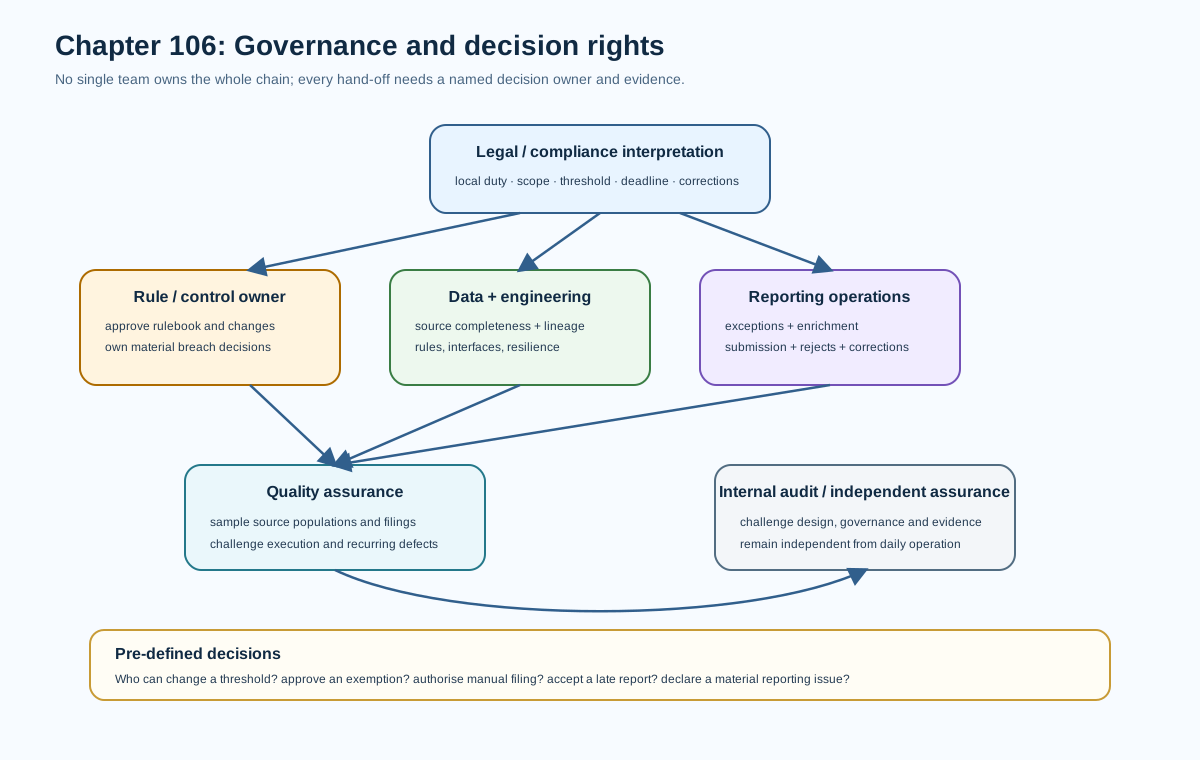
Decision rights matter most under pressure. Who can approve a manual filing when the automated platform is down? Who can change a threshold parameter? Who can decide that two identities are the same person for aggregation? Who can approve an exemption? Who can accept a late filing? Who determines whether a reporting defect is material enough for regulatory escalation? These decisions should be defined before an incident.
Segregation of duties is especially important around rule changes. The person who modifies a threshold should not be able to promote it directly into production without independent review. Production parameters should be protected by access controls, dual approval and audit logging. Emergency changes need a retrospective review and evidence trail.
Customer impact and conduct risk
Threshold reporting is often invisible to customers, but the surrounding process can create impact. Staff may ask for identification or transaction details required by law. A poorly tuned system can repeatedly stop legitimate customers for information already held. A failed reporting process can lead a bank to impose unnecessary restrictions while it tries to resolve its own data problem. Front-line communication should therefore be accurate and proportionate.
Staff should not tell customers that a filing means they are suspected of criminal activity when the report is purely threshold-based. Equally, staff should not promise that a transaction is “not reported” because it appears ordinary. Customer-facing teams need approved language that respects confidentiality and avoids misleading explanations.
Financial inclusion also matters. A threshold is not a risk score. Customers in cash-intensive sectors may legitimately trigger frequent reports. The institution should monitor actual AML risk separately and avoid using report volume as a shortcut for customer risk unless the wider evidence supports that conclusion.
BA and product-owner requirements
For a business analyst, the most useful artefact is a jurisdiction-specific reporting rule specification connected to data lineage and test scenarios. It should identify the legal owner, report type, in-scope entity, reportable event, threshold, currency-conversion rule, aggregation subject, window, direction, exemptions, required fields, deadline, submission channel, acknowledgement behaviour, correction process, retention and effective dates. Every configurable value needs a source and approval owner.
Requirements should distinguish functional and non-functional controls. Functional requirements cover population selection, aggregation, enrichment, report creation and correction. Non-functional requirements cover availability, performance, recoverability, audit logging, data retention, access control and observability. A threshold engine that produces correct results but cannot recover from a two-day outage before the filing deadline is not production-ready.
Acceptance criteria should use concrete examples. A single reportable cash transaction exactly on, above and below the threshold; multiple same-day transactions by the same subject; transactions by different conductors on behalf of one entity; cash-in and cash-out; foreign-currency equivalents; branch and ATM activity; exempt customers; an exemption that expired yesterday; late source events; reversed transactions; duplicated source events; and boundary times around the regulatory day or 24-hour window. Cross-border tests should cover outbound, inbound, domestic, same-provider international, intermediary routing and missing residence or country data where the rule depends on it.
Architecture and engineering considerations
A reporting platform should be designed for explainability. A rules engine can be flexible, but its output needs human-readable reason codes. REPORTABLE: CASH_TOTAL > THRESHOLD is more useful than an opaque numeric score. For aggregate reports, the system should retain the contributing transaction set. For non-reportable events, it should preserve enough decision evidence to demonstrate why they were excluded if the control design requires that level of traceability.
Idempotency is essential. Replaying a batch after an outage should not create duplicate regulatory reports. Event identifiers and report versioning should separate a true new filing from a technical retry. Message queues should support dead-letter handling without losing deadline visibility. Backfill processing should be able to apply the correct historical rule version rather than today's rule to an old event unless the remediation plan explicitly requires otherwise.
Effective dating should be first-class. Rules, thresholds, exchange-rate methods, forms, required fields and authority endpoints can all change. AUSTRAC's 2026 reporting-form transition is a good example: different populations may legitimately use different form versions during a transition window. The bank must know which version applies to which reporting entity and date.
Observability should include more than infrastructure health. Business metrics should show source events received, reportability decisions, reports generated, validation failures, submissions, acknowledgements, rejections, amendments, late events and open exceptions. Technical “green” status is meaningless if a source interface is delivering zero records because a business filter was misconfigured.
Testing the control as a regulator would see it
Testing should begin with population completeness. Select source transactions independently and determine whether the reporting platform received them. Then test rule correctness, field accuracy, aggregation, deadlines, acknowledgements and corrections. If testers begin only from reports that the engine produced, they cannot find missing populations.
Positive tests prove that reportable activity files correctly. Negative tests prove that non-reportable activity is excluded for the right reason. Boundary tests focus on threshold edges, time cut-offs and effective dates. Aggregation tests prove linkage across branches and channels. Data-quality tests introduce missing identities and invalid reference values. Resilience tests simulate delayed files, duplicate messages and gateway outages. Regression tests confirm that a change for one jurisdiction does not alter another jurisdiction's logic.
Test evidence should include expected result, actual result, rule version, source dataset and report output. For high-impact changes, compliance or rule owners should review scenarios before production release. Synthetic data is preferable where possible, but it must preserve the characteristics needed to test aggregation and identity logic.
Failure modes worth recognising early
The most damaging reporting failures are often mundane. A branch code is omitted from an extraction. A new product is not mapped. A foreign-currency amount is compared directly with a local-currency threshold. A daily aggregation resets at system midnight even though the regulatory business day is defined differently. Two customer IDs belonging to the same legal person are not linked. A customer exemption remains active after expiry. A report is generated but rejected by the FIU gateway and no one monitors the acknowledgement. A correction overwrites the original filing so the audit trail disappears.
Another failure is legal drift. A system continues to apply a rule after legislation or regulator guidance changes because the policy was updated but the configuration was not. The reverse can also happen: technology changes a parameter based on an informal interpretation before policy approval. A change-control matrix should tie legal change, policy, requirements, configuration, testing, deployment and post-implementation validation together.
A subtler failure is over-reporting. Filing too much is not automatically safe. It can create inaccurate government records, expose unnecessary personal data, overload operations and signal that the institution does not understand the law. The objective is complete and accurate reporting of the required population, not maximum reporting.
A practical mental model to carry forward
Think of regulatory transaction reporting as a controlled evidence pipeline. Law defines the trigger. Data proves the facts. Rules select and aggregate the population. Operations resolve exceptions. Technology produces and transmits the report. The authority's response proves receipt or rejection. Corrections preserve history. Assurance proves that the whole population was covered.
The strongest question for any reporting control is therefore not “did we send the file?” It is: can we prove that every in-scope event was evaluated under the correct rule, that every required report was complete and timely, and that every exception reached a controlled final state?
Operational deep dive: from local rule to a defensible filing population
The base chapter established the control architecture. This deep dive focuses on the hardest part of regulatory transaction reporting: translating different national requirements into precise populations without turning local rules into false global standards.
Do not build a global threshold table without legal context
A spreadsheet of country, report and threshold can be useful as an index, but it is not enough to drive production. A threshold only makes sense together with the legal definition of the reportable transaction, reporting-entity scope, aggregation method, currency-conversion rule, exemptions, filing deadline and effective date. Two rows that both say “10,000” may describe completely different obligations.
The U.S. CTR rule and Australia's TTR rule illustrate the point. Both are often described using a 10,000-unit threshold, but one is denominated in U.S. dollars and one in Australian dollars, and each sits within its own statute, regulations, definitions, exemptions and reporting process. Canada's LCTR also uses CAD 10,000, but FINTRAC's 24-hour aggregation framework is different from the U.S. business-day aggregation concept. India's CTR framework uses INR 10 lakh and includes a monthly rule for specified integrally connected below-threshold cash transactions. The correct implementation cannot be obtained by changing only a currency code.
A production rule catalogue should therefore contain legal metadata, not just numbers. Useful fields include jurisdiction, authority, legal source, entity type, report code, reportable-event definition, threshold amount and currency, comparison operator, aggregation subject, aggregation window, required knowledge test, direction, exchange-rate source, exemptions, deadline, correction mechanism, form or schema version, effective start, effective end, policy owner and approval reference. The bank can then trace a configuration value back to a controlled interpretation.
This also protects the institution during regulatory change. If a supervisor changes a form but not the legal threshold, the report schema can change without altering population logic. If a statute changes the aggregation window, the bank knows that historical back-testing may be required. If a new category of reporting entity enters scope, the perimeter can be extended without rewriting unrelated rules.
U.S. example: cash reporting and wire recordkeeping are different controls
In the United States, a covered bank's Currency Transaction Report obligation is tied to transactions in currency. FinCEN and the FFIEC BSA/AML Manual explain that multiple cash transactions must be aggregated when the institution has knowledge that they are by or on behalf of the same person and produce cash-in or cash-out totals above USD 10,000 during one business day. Cash-in and cash-out are not netted against each other. The bank must also consider activity across domestic branches.
This is a useful case for data architecture. A teller deposit, ATM cash deposit and cash loan payment may originate in different systems. If each application only evaluates its own transaction, none may see the full reportable amount. The bank needs a sufficiently central view of the subject, event type and regulatory day to perform aggregation. The event must carry the person conducting the transaction and the party on whose behalf the transaction is conducted when those concepts are relevant.
Wire transfers require a different U.S. control. FinCEN's funds-transfer recordkeeping and Travel Rule framework generally applies to covered transfers or transmittals of funds of USD 3,000 or more. The institution must collect, retain and transmit specified information depending on its role in the chain. This is not a universal rule requiring a bank to file a government report for every USD 3,000 wire. A suspicious wire may separately generate a SAR obligation, and other reporting regimes can apply to particular institutions or circumstances, but the Travel Rule itself is about information and records travelling with the transfer.
This difference should be visible in the bank's control taxonomy. US_CTR is a filing obligation. US_FUNDS_TRANSFER_RECORDKEEPING is a recordkeeping control. US_TRAVEL_RULE is a payment-information control. US_SAR is a suspicion-based reporting control. One transaction can be relevant to several controls without those controls becoming one rule.
Australia example: reporting transitions need effective dating
AUSTRAC requires Threshold Transaction Reports for designated services involving AUD 10,000 or more in physical currency or the foreign-currency equivalent. Current guidance states that TTRs are generally due within 10 business days after the transaction. Australia also has international transfer reporting obligations.
The 2026 reform programme shows why static reporting logic is risky. AUSTRAC announced changes to reporting from 1 July 2026, including new TTR and SMR forms for newly regulated businesses. Existing reporting entities enrolled by 30 March 2026 have transitional arrangements that can extend to 30 March 2029 for those forms. AUSTRAC has also explained that existing IFTI reporting continues under transitional rules until the relevant future transition to international value transfer service reporting, with no immediate change to IFTI or cross-border movement reporting at the July 2026 point.
A bank operating through several Australian entities may therefore need a transition matrix rather than one cutover date. The reporting service should know the entity, enrolment position, report type and applicable form version. Testers need scenarios on both sides of every transition boundary. A backdated transaction processed after the cutover may still need the version applicable to the transaction and legal rule, not simply the version currently active in the UI.
This is also a reminder that regulatory reporting programmes must track proposed, final and effective requirements separately. A consultation or announced future change should not be coded into production as if it were already legally effective. Change governance should record source status and effective date explicitly.
Canada example: the 24-hour rule is a relationship problem as well as a time problem
FINTRAC's current guidance requires a Large Cash Transaction Report when an applicable reporting entity receives CAD 10,000 or more in cash in a single transaction or where transactions meet the 24-hour rule. FINTRAC also requires Electronic Funds Transfer Reports for qualifying international EFTs of CAD 10,000 or more, including certain aggregated transfers under the 24-hour rule. Current guidance specifies different submission deadlines: LCTRs within 15 calendar days and EFTRs generally within five business days after initiation or final receipt.
The important technology point is that the 24-hour rule is not satisfied by summing every transaction from one account. FINTRAC's guidance considers relationships such as transactions conducted by the same person or entity, on behalf of the same person or entity, or for the same beneficiary, depending on the report type. The institution therefore needs party roles and relationship resolution. An account-only model can miss transactions performed through different accounts or channels.
A static 24-hour window also needs careful implementation. Developers should not casually substitute “same calendar day” or a rolling window without confirming the regulatory definition and the bank's approved interpretation. Timestamps need a consistent time zone. Daylight-saving changes should be tested where relevant. Events arriving late should trigger re-evaluation rather than disappear because the original window was already processed.
Canada also demonstrates why a single transaction can produce more than one report type. FINTRAC's examination material describes circumstances where receipt of reportable cash used to initiate a reportable international EFT can produce both an LCTR and an EFTR. A de-duplication engine must not wrongly suppress the second report merely because the same underlying funds appear in two regulatory obligations.
India example: cash and cross-border wire reporting use different windows and thresholds
FIU-IND's public FAQ describes several reportable categories under the Prevention of Money-Laundering framework. For cash, reporting entities maintain and furnish information on cash transactions above INR 10 lakh and specified series of integrally connected cash transactions individually below INR 10 lakh whose monthly aggregate exceeds INR 10 lakh. For cross-border wires, FIU-IND describes reporting of transfers above INR 5 lakh or foreign-currency equivalent where either the origin or destination of funds is in India. FIU-IND also receives other prescribed reports, including counterfeit-currency and non-profit-organisation-related reports.
The operational lesson is that CTR and CBWTR cannot share one aggregation calendar merely because they both feed FIU-IND. The cash rule has its own monthly connected-transaction logic, while the cross-border wire rule has a different trigger. Each report has its own schema and field expectations in the FIU-IND reporting framework.
For a bank with a central payment hub, the cross-border reporting rule should be driven by the actual regulatory meaning of origin or destination and transaction value, not by whether the SWIFT message happened to traverse an overseas correspondent. For a bank with multiple customer channels, the reporting layer needs a consistent view of transaction geography and value after FX conversion according to approved policy.
The reporting format also matters. FIU-IND publishes report codification and transaction formats through its FINnet resources. A mapping change between the bank's canonical payment model and FIU fields should be treated as a regulated change, with field-level traceability and regression testing.
Reportability, filing and suspicion can coexist
A practical operating model treats each obligation independently. Consider a customer who deposits several large amounts of cash and then sends an international payment. The cash may meet a threshold-reporting rule. The payment may meet an international transfer reporting rule. The behaviour may also be unusual enough to create an AML alert. Those outcomes can coexist.
The bank should avoid two opposite mistakes. The first is assuming that a threshold filing “takes care of” suspicious reporting. It does not. The second is assuming that a threshold report should be suppressed because an STR or SAR has been filed. Unless local law says otherwise, each obligation follows its own legal trigger. The case-management and reporting systems need cross-references, not mutual cancellation.
This separation also improves confidentiality. Suspicion reports often have strict access and tipping-off protections. A threshold-reporting operator who only needs to resolve a cash aggregation exception may not need to see an STR narrative. Systems should expose the minimum information needed for each role while still allowing appropriately authorised investigators to understand the combined picture.
The reporting population should be reproducible
A regulator or internal auditor may ask the bank to reproduce a historical reporting population. That request exposes weak architectures quickly. If the answer depends on a current customer profile, a current FX rate or a rule table that has been overwritten since the transaction date, the institution may not be able to explain what happened.
Reproducibility requires historical rule versions, effective-dated reference data and immutable source-event identifiers. The bank should know which transactions were considered, which were excluded, which were aggregated together, what exchange rate was used, what exemption was applied, and which report or non-report decision resulted. Human changes should be recorded as changes, not silently replace machine values.
For high-volume platforms, keeping every intermediate object forever may be unnecessary, but the institution still needs enough evidence to reconstruct the outcome within legal retention periods. That can mean retaining source references, rule version, derived regulatory fields, contributing transaction IDs, report payload version and authority acknowledgement rather than duplicating entire operational databases.
Control totals that actually reveal defects
A daily dashboard showing “10,000 reports submitted successfully” can create false comfort. What matters is whether the population was complete and accurate. Useful control totals compare independently derived quantities.
For example, a bank can compare the count and value of physical-cash events from authoritative channel feeds with the count and value received by the reporting engine. It can compare the number of candidate aggregation subjects to final dispositions. It can reconcile all generated reports to submitted reports and submitted reports to authority acknowledgements. It can reconcile rejects to corrected or closed outcomes. It can monitor transactions arriving after the normal processing cut-off.
The comparison needs meaningful granularity. If one branch is missing but the group total remains within a normal volume band, a high-level total may not show the defect. Reconciliations should be segmented by legal entity, source, branch or channel, report type and date where practical. Zero-volume alerts are particularly useful for sources that normally produce regular activity.
Variance monitoring should not replace deterministic reconciliation. A 20% drop in reports might be genuine; a 1% drop might conceal a material missing branch. Statistical monitoring is a useful warning layer, but the bank still needs source-to-report traceability.
Exception queues are part of the legal control
An exception is not a completed control. If a record cannot be reported because identity data is missing, the bank needs a queue with an owner, reason, deadline and escalation path. The system should preserve the original filing deadline so that operations can prioritise by regulatory risk rather than simply by queue age.
Exceptions should be classified. Data exceptions require source or enrichment repair. Rule exceptions require compliance interpretation. Submission exceptions require gateway or schema resolution. Duplicate exceptions require idempotency analysis. Authority rejects may require correction. Each category should have a standard operating path and management information.
A dangerous pattern is a generic “manual review” status that can remain open indefinitely. Another is silently defaulting missing data to a placeholder that passes schema validation but makes the report inaccurate. If a mandatory value genuinely cannot be obtained, the local rulebook should define the permitted treatment and escalation rather than leaving staff to improvise.
Regulatory reporting is a production service
Because deadlines are statutory, reporting should be operated with the discipline of a critical production service. The service needs monitoring, capacity planning, disaster recovery, tested manual contingency, access management and incident response. Recovery objectives should be derived from filing deadlines and source cut-offs, not from generic IT tiers.
A contingency process needs more than a document saying “file manually.” Operations must know which authority portal is available, who has credentials, how to generate a compliant emergency file, how to avoid duplicates when the main platform returns, and how to capture evidence back into the central audit trail. Manual fallback should be exercised periodically with realistic volumes.
Weekend and holiday calendars also matter because filing deadlines may be defined in business days or calendar days depending on the jurisdiction. The deadline service should use the correct local calendar and rule rather than one group holiday table. Changes in public holidays or emergency closures need governed treatment.
The mature outcome is a reporting capability that can explain itself. For any report, the bank can show the legal rule, source events, aggregation set, data transformations, approvals, submission, acknowledgement and any correction. For any source event, it can show which reporting rules evaluated it and why it did or did not produce a filing. That two-way traceability is the core of defensible regulatory transaction reporting.
Advanced practice: engineering reporting controls that survive change
A reporting solution can pass its first release and still fail six months later. Products change, branches migrate, customer identifiers are merged, payment formats evolve, reporting forms are revised, thresholds are amended and operating teams adopt workarounds. Advanced practice is therefore about controlling change and proving continued completeness, not merely proving that one set of test cases passed before go-live.
Build the rulebook as versioned business logic
The legal interpretation should exist in a form that technology and operations can use without copying legislation into code. A versioned rulebook can state the approved reportable-event definition, threshold, aggregation logic, exemptions, required data, deadline and correction treatment for each entity and jurisdiction. Each rule should have an owner and source reference. Technical configuration should point to that approved rule version.
This creates a clean separation between law, policy and implementation. Legal or compliance can change an interpretation through governance. Business analysis translates the interpretation into precise functional requirements. Technology changes configuration or code. Testing verifies the change. Production deployment records when it became effective. Post-implementation checks confirm that expected populations changed and unrelated populations did not.
Without this chain, reporting teams often rely on “known rules” that nobody can trace to an approved source. A developer changes a threshold based on an email. An operations team continues to use an old form because a procedure was not updated. An audit later finds three different descriptions of the same obligation. Version-controlled rule governance prevents that fragmentation.
Use a regulatory calendar, not a project calendar
Reporting obligations are highly time-sensitive. The control needs a calendar of effective dates, reporting deadlines, form migrations, schema deprecations, transition windows and policy review dates. This calendar should feed both change planning and production operations.
A future regulatory change normally passes through several states: proposed, consulted on, finalised, legally effective, operationally mandatory, transitional and retired. Those states should not be conflated. FATF's strengthened Recommendation 16 provides a useful example. FATF agreed revisions in June 2025 and in June 2026 consulted on implementation guidance, while stating that countries are expected to be ready to implement the strengthened standard by the end of 2030. A bank should prepare architecture and data capability, but it should not treat the future global expectation as if every country had already enacted identical local law in 2026.
The same discipline applies to national reporting forms. AUSTRAC's 2026 transition arrangements allow different form versions for different reporting populations over a multi-year period. A deployment plan must therefore model who moves when rather than overwrite one schema globally on 1 July 2026.
Requirement patterns for business analysts
A strong user story for regulatory reporting is not “as compliance, I want transactions over the threshold to be reported.” It should expose the actual rule and evidence.
A useful requirement pattern starts with the legal entity and report. It defines the source event and event timestamp, the eligible population, the subject used for aggregation, the threshold and currency treatment, the aggregation window, exemptions, the required filing fields, the deadline and the expected acknowledgement. It then states exception and correction behaviour. Finally, it identifies the audit data that must be retained.
For example, an acceptance criterion can say that when three qualifying cash-in events for the same reportable subject occur across two branches within the applicable U.S. business day and their combined amount exceeds the approved CTR threshold, the system must create one reportable aggregation set, retain all three source transaction IDs, preserve conductor and on-behalf-of party data, apply the active rule version and make the filing available inside the required operating SLA. A separate criterion tests cash-out because cash-in and cash-out are not netted.
That requirement is testable and explainable. It does not ask technology to infer legal meaning from a high-level policy sentence.
Design a canonical regulatory event carefully
Global banks often use a canonical event between source systems and regulatory reporting. This can reduce duplication, but only if the canonical model preserves the distinctions that local rules need.
A useful event can contain identifiers for legal entity, source system, source transaction, customer, account, conductor, originator, beneficiary and ultimate parties where available; event type; cash or non-cash indicator; amount and currency; original timestamp; regulatory business date; country attributes; product and channel; source branch; payment direction; message references; and a pointer to immutable source evidence. Not every field is populated for every event, but the model should not collapse distinct party roles into one customerName.
The canonical layer should preserve raw and normalised values separately where normalisation affects reporting. A country inferred from IBAN structure is not the same evidence as a country explicitly supplied by the customer. A party name transliterated for a filing should not overwrite the source name. An FX conversion used for threshold comparison should retain amount, rate, rate source and rate timestamp.
Schema evolution needs compatibility controls. If a new payment source adds an ultimate debtor field, older consumers should not silently ignore a value that has become legally relevant. Data-contract testing should verify mandatory fields and enumerations at integration boundaries.
Data-quality controls need regulatory meaning
Generic data-quality dashboards showing 99.5% completeness can hide serious defects. Regulatory reporting needs field criticality. A missing optional marketing attribute is irrelevant. A missing party identifier that prevents aggregation can cause under-reporting.
Each reportable field should have quality rules based on legal and operational importance. Completeness, validity, consistency, uniqueness and timeliness can all matter. The bank should know which fields block filing, which permit controlled enrichment, and which can be submitted as unavailable under the relevant local specification.
Data-quality exceptions should feed root-cause management. If ten reports per day require manual correction of the same branch code, the operating control may be coping while the source defect remains unresolved. Management information should distinguish manual repair from true source quality so that apparent filing success does not hide recurring control debt.
Test aggregation as graph logic, not only arithmetic
Many aggregation defects are identity defects. The system needs to decide which events belong to the same reportable subject. A person can transact through several accounts. Several conductors can transact on behalf of one company. A customer can have duplicate records after a merger. Beneficiary-based aggregation may be required under one rule while customer-based aggregation applies under another.
Testing should therefore create relationship graphs. One person with two customer IDs; one company with three accounts; two companies with a shared beneficial owner; multiple conductors for one entity; one conductor acting for different unrelated entities; and payments to the same beneficiary from different requesters. Expected outcomes should follow the exact legal rule, not a general idea that “related things aggregate.”
False joins deserve as much attention as missed joins. If two customers share a name but are different people, fuzzy identity resolution must not combine their cash activity into a regulatory filing. The aggregation service should rely on governed identifiers and relationship evidence appropriate to the rule.
Boundary tests find the defects that ordinary tests miss
Every threshold needs tests just below, exactly at and just above the legally defined boundary because some rules use “more than” while others use “at least.” Testers should not assume the comparison operator from colloquial language. Foreign-currency equivalents need boundary cases where a small FX-rate difference changes reportability.
Time windows need equally precise tests. Events one second before and after the cut-off, daylight-saving changes, weekend deposits, late-arriving events, corrections to timestamps and reprocessing after a system outage can expose hidden assumptions. If the local rule uses a business day, testers need the bank's approved business-day interpretation. If it uses a consecutive 24-hour window, calendar-day test cases are insufficient.
Effective-date boundaries also matter. A transaction occurring before a rule change but ingested after it may require the old rule. A correction filed after a form migration may require a current correction format referencing a historical original. These scenarios should be agreed with the local rule owner rather than invented by developers.
Regression testing should prove isolation between jurisdictions
Shared reporting platforms create efficiency but also contagion risk. A parameter change for Canada should not alter U.S. aggregation. A new Australian schema should not remove a field needed for India. Regression packs should therefore include representative golden cases for every active jurisdiction whenever shared code changes.
Golden cases need governance. They should encode legally reviewed scenarios and expected outcomes, not simply capture whatever the old system happened to do. When law changes, the golden case is updated through controlled approval. Historical cases can be retained to prove backward reproducibility.
For large rule sets, automated regression is essential. A release should run thousands of deterministic cases covering population selection, aggregation, exemptions, currency conversion, field mapping and deadlines. Human review can then focus on interpretation-sensitive scenarios and changed rules.
Production verification closes the change loop
Testing in a lower environment cannot prove that production data flows are complete. After deployment, teams should perform targeted production verification. Compare expected source volumes with reporting-engine ingestion. Check that the new rule version activated at the intended time. Confirm that report volumes changed within an explainable range. Inspect selected filings end to end. Verify acknowledgements from the authority.
A post-implementation review should also look for unintended side effects. A threshold change can increase exception volume and overwhelm operations. A new mandatory field can drive reject rates if source data is weak. A schema update can increase message size and expose gateway limits. Operational readiness belongs in the release decision.
Correction and backfill architecture
When a defect is discovered, banks often need to identify a historical affected population. This should be a designed capability rather than an emergency SQL exercise. The reporting platform should support replay against historical rule versions, comparison between original and corrected outcomes, and controlled generation of late or amended reports where the authority's process permits.
Backfill must preserve provenance. A remediation report should state that it was generated during remediation, identify the original source event and rule basis, and link to the issue or defect record. If an original report is amended, the relationship between versions should be explicit. The institution should never erase the original filing simply because it was wrong.
Population scoping needs independent challenge. If the defect began when a release went live on 10 January, do not assume 10 January is the first affected date until evidence confirms it. A related configuration may have changed earlier. Root-cause teams should use code history, parameter logs, source lineage and sample testing to set the lookback period.
Incident management should recognise regulatory deadline risk
A reporting outage is not merely an IT incident. Severity should consider the number of potentially reportable events, jurisdictions affected, time to the next filing deadline, availability of fallback, and whether data integrity is uncertain. A one-hour outage may be immaterial if the report is due in ten days and data is safely queued; a one-hour data-loss incident can be severe if the bank cannot reconstruct the population.
Incident bridges should include reporting operations and compliance when deadline risk becomes material. Technical teams need to communicate in business terms: which sources are affected, from what timestamp, whether events are safely stored, which report types may be delayed, and what recovery sequence is planned. Compliance then assesses regulatory consequences using the correct local framework.
After recovery, the bank should reconcile the incident window independently. “System back up” is not evidence that every missed event was processed. Recovery is complete only when backlog, duplicates, submissions and acknowledgements have been controlled.
Quality assurance should sample the invisible population
Quality assurance often samples completed reports because they are easy to obtain. That tests field accuracy but not under-reporting. A stronger QA programme samples source events independently and traces them through the reportability decision. It also tests exemptions, non-reportable decisions and closed exceptions.
QA should use both random and targeted sampling. Random samples test ordinary execution. Targeted samples focus on high-risk branches, new products, manual enrichments, rejected filings, late events, exemption populations and recent rule changes. Findings should distinguish isolated execution error from systemic design weakness.
The QA team should be able to recreate the decision without asking the original operator what they “meant.” Evidence should stand on its own. If reconstruction depends on personal memory or a spreadsheet stored outside the controlled case, the control design is weak even if the filing itself happened to be correct.
Management information should show control health, not just volume
Useful reporting MI includes eligible source events, reportable populations, reports filed, on-time percentage, late reports, authority rejects, corrections, manual enrichments, aged exceptions, source-feed latency, exemption counts, rule changes, data-quality defects and open remediation. Trends should be segmented by jurisdiction and report type.
Volume changes need explanation. A sudden fall in CTRs could reflect business activity, customer behaviour, a threshold change, an exemption population, a source outage or a broken extraction. Management should not infer risk improvement or deterioration from filing count alone.
The most important indicator is often unresolved population uncertainty. If the bank knows that a source feed was incomplete but does not yet know how many reports were affected, the issue should remain visibly open. Uncertainty should not disappear from MI simply because a technical ticket was closed.
Independent assurance asks a different question
Operations asks whether today's reports were filed. QA asks whether the control was executed correctly. Internal audit or independent assurance asks whether the control framework is designed and operating effectively across time. That review should challenge legal governance, population completeness, data lineage, access control, change management, resilience, incident handling and remediation, not just inspect a few forms.
A mature bank can provide a coherent evidence pack: current obligations inventory, approved rulebook, data lineage, source reconciliations, control descriptions, access records, change history, test results, exception MI, filing acknowledgements, correction history and issue remediation. The evidence tells one story from law to production outcome.
That is the standard worth designing for. Regulatory reporting is not a reporting team's end-of-day batch. It is a regulated data product with legal logic, operational deadlines and an evidential chain that must remain trustworthy through constant change.
Practice close: can you prove the reporting population?
Use these scenarios to test whether the chapter has become operational knowledge rather than a list of thresholds. The correct answer is rarely “report it because the amount is large.” A defensible answer identifies the jurisdiction, regulated entity, report type, event definition, aggregation rule, filing deadline and evidence that proves the result.
Scenario 1: several U.S. cash deposits across branches
A business customer has two accounts at the same U.S. bank. An employee deposits USD 6,200 in cash at Branch A at 09:15 and USD 5,100 in cash at Branch B at 15:20 on the same business day. Both deposits are on behalf of the same company. The bank's systems can identify the company and the employee conducting both transactions.
The reporting question is not whether either individual deposit exceeds USD 10,000. FinCEN's aggregation rule requires the bank to consider multiple currency transactions when it has knowledge that they are by or on behalf of the same person and result in cash-in or cash-out totals of more than USD 10,000 during one business day. The two cash-in amounts therefore belong in the same reportability assessment. The implementation also needs the branch feeds to meet in a central or coordinated aggregation process; evaluating each branch independently would create an under-reporting risk.
Now change one fact. Assume the second transaction is a cash withdrawal of USD 5,100 rather than a deposit. The bank should not simply net USD 5,100 against USD 6,200 and decide that only USD 1,100 of activity remains. U.S. CTR guidance treats cash-in and cash-out separately for aggregation purposes. The revised facts therefore produce a different threshold result even though the gross movement is still substantial.
A BA should create both cases, plus transactions just below and just above the boundary, in the U.S. regression pack. The expected result should reference the approved U.S. CTR rule version rather than a generic global threshold parameter.
Scenario 2: reportable cash does not automatically mean suspicious cash
A long-established grocery wholesaler routinely receives cash from small retailers. Its business profile, turnover and cash volumes are well understood. A qualifying cash transaction triggers the applicable local threshold report.
The bank should not describe the threshold filing as proof that the customer is suspicious. A deterministic report can be required for legitimate activity. The transaction-monitoring system can still use the customer's cash behaviour as part of its risk view, but suspicion requires a separate assessment under the bank's AML framework.
Now change the pattern. The wholesaler begins making repeated transactions deliberately just below the reporting threshold through several locations and cannot give a credible reason for the change. That behaviour may create a structuring or evasion concern even where individual events do not create a threshold filing. The lesson is that threshold reporting and suspicious-activity detection are complementary controls, not substitutes.
Scenario 3: Canadian international EFT aggregation
A Canadian reporting entity sends several qualifying international electronic funds transfers within the relevant 24-hour framework. No single transfer reaches CAD 10,000, but the transfers are connected to the same reportable subject under the institution's approved interpretation and together meet the applicable threshold.
A robust implementation needs more than account number and timestamp. It needs the party and relationship attributes necessary to apply FINTRAC's 24-hour rule. Testers should create events across different customer accounts, channels and timestamps to prove that the correct subject is aggregated and unrelated customers are not joined accidentally.
The test must also verify the correct deadline for the EFTR rather than borrowing the LCTR deadline. Report types can share a regulator and still have different filing requirements.
Scenario 4: Australian reporting during a transition period
An Australian entity is already enrolled with AUSTRAC and is operating during the 2026 transition period for new TTR and SMR forms. Another group entity enters the regime under a different transition position.
The bank should not use one global “Australia form version” switch. The applicable form and timing depend on the reporting entity and transition arrangement. The requirement should be effective-dated, and the report generator should select the correct schema for the entity and event date. Testers need cases for the day before and after each transition boundary.
The same principle applies to international transfer reporting. AUSTRAC's 2026 guidance states that existing IFTI requirements continue under the transitional arrangements until the future international value transfer service reporting transition. A team should not disable an existing IFTI control simply because other AML/CTF reforms took effect on 1 July 2026.
Scenario 5: Indian cash and cross-border wire reports are separate populations
A reporting entity in India processes a cross-border wire transfer above INR 5 lakh where the origin or destination of funds is in India. On the same day, the customer also conducts cash activity.
The cross-border wire reportability assessment should follow the FIU-IND rule relevant to cross-border wire transfers. It should not wait for the cash aggregation process. Conversely, the cash transactions should be evaluated under the CTR rules, including the locally defined connected-transaction aggregation where relevant. The fact that both may ultimately be furnished to FIU-IND does not make them one report type.
A test pack should verify that report codes, fields, thresholds, aggregation windows and source data remain distinct. It should also verify that a suspicious-transaction assessment can occur independently if the combined behaviour creates concern.
Scenario 6: the source feed is missing but the reporting engine is green
The regulatory reporting platform finishes its nightly batch with no errors. All files generated by the platform are accepted by the authority. A week later, an operations analyst notices that one ATM source has contributed zero events since a recent migration.
This is a completeness failure even though the report engine itself is technically healthy. The bank should first establish the affected period and whether the ATM source contained reportable events. It should preserve evidence of the defect, reconstruct the historical source population, run the correct historical rule versions, identify missing or incorrect reports, and use the jurisdiction-specific late or correction process. Compliance and legal teams should assess whether the incident creates a separate regulatory breach or disclosure obligation.
The root cause should not be closed merely because missing reports were eventually filed. The bank needs to correct the source-to-report reconciliation so the same omission is detected quickly next time. A good control would have raised a zero-volume or source-reconciliation exception near the start of the outage.
Scenario 7: a rejected report is still an open obligation
A report is generated and transmitted before the legal deadline, but the FIU gateway rejects it because a mandatory field contains an invalid code. The file-transfer platform records a successful network transmission.
The regulatory obligation is not necessarily complete. The bank's workflow must distinguish transmission from authority acceptance. The rejected filing should enter an exception state with deadline visibility, be corrected using the local process, and retain both the original rejection and corrected submission. A dashboard that counts file_sent = true as successful would hide this failure.
This is why acknowledgements belong in the end-to-end control design. The control objective is not “move a file out of the bank”; it is to complete the required filing and preserve evidence of its final state.
Scenario 8: a customer exemption expires
A customer is legitimately exempt from a specified threshold-reporting requirement until 30 September. Transactions on 29 September are processed under the exemption. Similar transactions on 1 October are still being suppressed because the reporting platform stores exemption status as a permanent customer flag.
The defect is not simply an operations error. The data model is wrong. Exemptions need legal basis, scope, start and end dates, approval and periodic review. The reportability engine should evaluate the exemption effective on the event date. Testing must include expiry boundaries and newly added accounts or products that may not be covered by an old exemption.
Acceptance criteria worth taking into delivery
A production-ready reporting rule should pass at least these forms of evidence-based testing:
- source events just below, exactly at and above the legal threshold, using the precise comparison operator in the approved local rule;
- aggregation across all in-scope branches, channels and accounts where the law requires it, with separate tests for false joins;
- foreign-currency transactions using the approved rate source and timestamp;
- late-arriving events that cause a previously non-reportable aggregation to become reportable;
- expired, future-dated and incorrectly scoped exemptions;
- duplicated source events and technical replay, proving idempotency;
- missing mandatory fields, authority rejection and controlled correction;
- effective-date boundaries for rule, form and schema changes;
- source outage and recovery, proving population reconciliation rather than only technical restart;
- one transaction that legitimately creates two different regulatory obligations, proving that de-duplication does not suppress a required filing.
The list is not a universal legal checklist. It is a delivery checklist for proving that the local legal interpretation has been implemented faithfully.
Misconceptions to avoid
“FATF requires a universal cash threshold.” It does not. FATF provides international standards; cash and other transaction-reporting thresholds come from local law.
“Every wire over USD 3,000 in the United States is reported to the government.” That confuses the funds-transfer recordkeeping and Travel Rule with a universal transaction filing requirement. The control concerns specified information and records for covered transfers; other reporting obligations are separate.
“A threshold report means the customer is suspicious.” It does not. Threshold or event reporting can be entirely deterministic. Suspicious reporting uses a different legal test.
“If the file was transmitted, the report is complete.” Not necessarily. Rejections and acknowledgements must be monitored under the local submission process.
“If no report was generated, there was nothing to report.” That conclusion is unsafe unless the bank can prove source population completeness and correct rule evaluation.
“Over-reporting is safer than precise reporting.” Inaccurate or unnecessary reporting can create its own legal, privacy and operational problems. The goal is the complete and accurate population required by law.
Chapter close
Cash, wire and cross-border regulatory reporting looks mechanical because many rules use thresholds and defined events. In practice, the difficult work lies in identity, aggregation, legal perimeter, effective dates, source completeness and evidence. A good bank does not merely know its thresholds. It can show which population was evaluated, which rule version was applied, why each filing or non-filing decision occurred, whether the authority accepted the report and how any defect was corrected.
That is the standard to carry into the next chapter: reporting should be treated as a regulated evidence pipeline, not an end-of-day file generation task.
Masterclass: the reporting platform was green while the bank under-reported
This case is fictional but built from common regulatory-reporting failure patterns. The point is not the particular threshold or country. The point is how an apparently healthy reporting service can fail when source completeness, identity linkage and change governance are weak.
The setting
A multinational bank operates a central regulatory reporting platform for several legal entities. The platform receives cash events from branch teller systems, ATMs and cash-deposit machines. It also receives cross-border payment events from the payment hub. Customer and party data are enriched from group master-data services, while local rule packages determine which events produce each jurisdiction's required reports.
The reporting platform has strong technical monitoring. Batch jobs are green. Message queues are healthy. Submission files are delivered before internal cut-offs. Authority acknowledgements show very low rejection rates. Senior management sees a monthly dashboard with more than 99% on-time filing performance.
One country business migrates its ATM estate to a new transaction processor. The migration project verifies customer balances, cash availability, settlement entries and ATM functionality. Regulatory reporting is listed in the impact assessment, but the project team assumes the new processor will publish the same canonical cash event as the old platform. No end-to-end reporting scenario is included in release acceptance because the reporting application itself is unchanged.
The first weekend after migration goes smoothly. Customers can deposit cash. Accounts are credited correctly. General ledger reconciliation balances. No reporting alerts fire.
The first clue
Three weeks later, a reporting analyst prepares routine management information and notices that cash events from the migrated channel are zero. Total threshold-report volumes have fallen only modestly because branch cash activity remains normal. The automated volume threshold did not trigger because the control monitors total report count, not source-level candidate events.
The analyst asks technology whether the reporting platform is working. The platform team shows successful nightly processing and says there have been no ingestion errors. Both statements are true. The application processed everything it received. The missing events never reached it.
The incident now changes character. It is not a filing-platform outage. It is a population-completeness failure.
Scoping the problem
The bank forms a small incident team with reporting operations, the local MLRO or equivalent compliance owner, data engineering, ATM technology, the migration product owner and legal support. The first objective is not to estimate missing reports from historical averages. It is to reconstruct the actual population.
The ATM processor retains source transaction records. The team extracts all cash-deposit events from the migration date, including transaction identifiers, account references, event timestamps, amount and currency, device identifiers and customer linkage. It then compares those events with the reporting platform's raw ingestion store. None are present.
The migration interface specification reveals the cause. The new processor publishes an accounting event and a customer-notification event, but the regulatory cash-event message was omitted from the integration contract. The old processor had produced it through a channel-specific adapter. That adapter was retired during migration.
The defect therefore started at the migration cutover, not at the time the reporting analyst noticed the volume drop. The bank now needs to determine which source transactions would have contributed to reportable populations.
Why simply comparing each ATM deposit with the threshold is wrong
The ATM transactions cannot be assessed in isolation. Some customers also conducted cash activity at branches during the same reporting window. The local threshold rule requires specified aggregation across the bank's in-scope channels. A USD 4,000-equivalent ATM deposit might appear non-reportable by itself but could be part of a reportable aggregate with branch activity.
The remediation dataset therefore joins the recovered ATM events to the other cash events already processed by the reporting platform. It uses the historical customer and party identifiers, not current customer relationships that may have changed since the transaction date. It applies the rule version that was effective for each event and preserves the original regulatory business date.
This is where a mature architecture pays off. Because the bank retained contributing transaction IDs and rule versions for previously filed reports, it can determine whether an ATM event should create a new filing, amend an existing filing or remain non-reportable. Without that evidence, remediation would require a large manual reconstruction.
A second defect appears
During the lookback, QA finds that some customers hold both personal and sole-proprietor accounts under separate source customer IDs. The reporting engine normally links those records through the party master before applying the local aggregation rule. The recovered ATM dataset contains only the source customer ID and account number; the historical party-link snapshot was not included in the emergency extract.
If remediation simply groups by customer ID, it could miss reportable aggregations. If it groups by customer name, it could join unrelated people with similar names. The team therefore retrieves historical party-link data from the master-data archive and defines an approved matching hierarchy. Ambiguous identities are routed to manual review.
This is an important lesson: aggregation is often an identity-control problem disguised as arithmetic.
Deciding what to file
After the reconstruction, the bank identifies three populations.
The first contains transactions that would not have produced a report even when correctly aggregated. These remain documented as evaluated and non-reportable.
The second contains transactions that should have produced new reports but did not. These are prepared as late filings under the local process, with the reporting team preserving the original event dates and remediation context. The bank does not manipulate dates to make the reports appear timely.
The third contains ATM transactions that should have been included in reports already filed from branch activity. Those cases follow the jurisdiction's correction or amendment process. The original filing remains in the evidence trail, linked to the corrected version.
Legal and compliance separately assess whether the control failure itself creates a regulatory notification or self-disclosure question. That assessment is not assumed from another jurisdiction's practice. The local legal framework, materiality and supervisory relationship determine the response.
The customer dimension
Most customers never know that a regulatory reporting correction occurred, and the bank does not describe a threshold report as a suspicion finding. A few customers are contacted because mandatory report fields cannot be reconstructed from existing records. Customer communication is carefully worded and does not imply criminal concern.
The bank also checks whether any customer restrictions were imposed solely because the reporting defect created internal uncertainty. Where restrictions were not legally required, they are reviewed promptly. A bank should not transfer the consequences of its data failure to customers without a sound legal or risk basis.
Fixing the immediate interface is not enough
Technology adds the missing regulatory event to the new ATM processor. End-to-end testing confirms that source transactions reach the reporting platform and can contribute to cross-channel aggregation. That addresses the immediate defect, but the root-cause review identifies broader weaknesses.
The product-launch checklist did not require independent confirmation of all regulatory data consumers. The reporting platform's reconciliation began with received events rather than an independently derived source population. Volume monitoring operated only at total report level. Data contracts did not classify the regulatory event as a mandatory interface. The migration regression pack tested customer and accounting outcomes but not financial-crime reporting.
The remediation programme therefore changes four controls. First, every payment or channel migration must complete a regulatory-data impact assessment signed by the relevant control owner. Second, the reporting platform adds source-level completeness reconciliations and zero-volume alerts. Third, canonical data contracts identify regulated consumers and fail deployment checks when required events disappear. Fourth, regression packs contain golden reporting cases covering every in-scope channel.
What the BA should capture from this case
The most important requirement is not “ATM deposits must be reported.” It is a chain of requirements.
The source processor must publish every in-scope cash event with stable identifiers and timestamps. The canonical event must preserve the party and account attributes needed for aggregation. The reporting engine must evaluate the event under the correct jurisdiction and rule version. Cross-channel aggregation must include the ATM population. The source population must reconcile independently to reporting-engine ingestion. Missing events must create an exception before the filing deadline. Replay must be idempotent. Historical reconstruction must use time-appropriate party and rule data. Corrections and late filings must retain the original evidence trail.
Those requirements connect business, data and control design. They are much stronger than a screen-level requirement because they explain how the legal obligation survives the full technology chain.
What the architect should capture
The architecture needs clear control boundaries. Source applications are authoritative for transaction occurrence. Identity services are authoritative for party relationships. The reporting engine is authoritative for reportability decisions under an approved rule version. The filing gateway is authoritative for submission transport, but the authority acknowledgement determines whether the report was accepted where such acknowledgements exist.
Observability should cross those boundaries. A source count should be visible independently from ingestion count. The aggregation service should expose reason codes and contributing events. Report generation should expose validation failures. Submission monitoring should expose acknowledgement state. No component should be able to declare end-to-end success based only on its own technical status.
What the tester should capture
The defect escaped because testing followed the changed system rather than the regulated outcome. A stronger test starts with a customer action: conduct cash activity through the migrated ATM, then combine it with branch activity and prove the reporting outcome. Additional tests cover a non-reportable ATM event, a threshold-boundary event, an event arriving late, duplicate replay after recovery and a customer with multiple linked accounts.
The tester should also deliberately break the regulatory event interface. The expected result is not silent success. Monitoring should detect the missing source population, create an incident or exception and retain deadline visibility.
What management should learn
A green technology dashboard is not evidence of regulatory-reporting completeness. The bank needs business controls that ask whether the expected population arrived, not just whether the application processed what it received.
Volume metrics should be segmented by source and report type. Material migrations should have post-implementation monitoring. Reporting incidents should be described in terms of affected population and deadline exposure, not only system availability. Senior governance should also see unresolved population uncertainty: “impact still being quantified” is materially different from “no impact.”
The final lesson
The strongest regulatory reporting control is able to answer both directions of traceability.
Starting from a source transaction, the bank can show which reporting rules evaluated it, whether it was aggregated with other events, the filing or non-filing outcome and the evidence supporting that outcome.
Starting from a filed report, the bank can show the contributing transactions, party relationships, rule version, enrichment, approval, submission, acknowledgement and any later correction.
When both directions work, a source migration can be investigated and repaired with evidence. When they do not, a seemingly small interface defect can become a prolonged regulatory lookback.
References and further reading
These sources are public, first-party materials used for this chapter. Thresholds, filing deadlines, forms and aggregation rules are jurisdiction-specific and can change, so production implementation should always be checked against the currently effective law, regulator guidance and the bank's approved legal interpretation.
Global standards
- Financial Action Task Force, The FATF Recommendations. This is the current global AML/CFT standards entry point, including Recommendations 11, 16 and 20 and their interpretive notes: https://www.fatf-gafi.org/en/publications/Fatfrecommendations/Fatf-recommendations.html
- Financial Action Task Force, Public Consultation on Recommendation 16 Implementation Guidance, June 2026. Useful for the strengthened payment-transparency standard and implementation timeline: https://www.fatf-gafi.org/en/publications/Fatfrecommendations/R16-Public-Consultation-June-2026.html
United States: FinCEN and FFIEC
- Financial Crimes Enforcement Network, Bank Secrecy Act. Official overview of BSA reporting and recordkeeping obligations: https://www.fincen.gov/resources/statutes-and-regulations/bank-secrecy-act
- FinCEN, Frequently Asked Questions Regarding the FinCEN Currency Transaction Report. Covers aggregation, cash-in/cash-out treatment and common CTR questions: https://www.fincen.gov/resources/frequently-asked-questions-regarding-fincen-currency-transaction-report-ctr
- FFIEC, BSA/AML Examination Manual: Currency Transaction Reporting. Examination guidance on CTR scope, aggregation and exemptions: https://bsaaml.ffiec.gov/manual/AssessingComplianceWithBSARegulatoryRequirements/05
- FinCEN, Funds “Travel” Regulations: Questions & Answers. Official guidance on funds-transfer recordkeeping and information-transmission requirements: https://www.fincen.gov/resources/statutes-regulations/guidance/funds-travel-regulations-questions-answers
- FFIEC, BSA/AML Examination Manual: Funds Transfers Recordkeeping. Examination guidance for the U.S. funds-transfer recordkeeping and Travel Rule framework: https://bsaaml.ffiec.gov/manual/AssessingComplianceWithBSARegulatoryRequirements/09
Australia: AUSTRAC
- AUSTRAC, Threshold Transaction Reports. Current requirements for reportable physical-currency transactions and filing timeframes: https://www.austrac.gov.au/industry-and-business/obligations-and-guidance/your-amlctf-program/reporting-us/threshold-transaction-reports
- AUSTRAC, International Funds Transfer Reports. Current guidance on international transfer reporting and transitional arrangements: https://www.austrac.gov.au/industry-and-business/obligations-and-guidance/your-amlctf-program/reporting-us/international-funds-transfer-reports
- AUSTRAC, Changes to transaction reporting from 1 July 2026. Official transition guidance for the 2026 AML/CTF reforms and reporting-form changes: https://www.austrac.gov.au/news-and-media/article/changes-transaction-reporting-1-july-2026
Canada: FINTRAC
- Financial Transactions and Reports Analysis Centre of Canada, Large Cash Transaction Reports. Current LCTR threshold, reporting process and deadline guidance: https://fintrac-canafe.canada.ca/guidance-directives/transaction-operation/lctr-doie/lctr-doie-eng
- FINTRAC, Electronic Funds Transfer Reports. Current international EFT reporting requirements and filing deadlines: https://fintrac-canafe.canada.ca/guidance-directives/transaction-operation/eft-dt/eft-dt-eng
- FINTRAC, The 24-hour rule. Detailed guidance on aggregation relationships and time-window treatment across applicable reports: https://fintrac-canafe.canada.ca/guidance-directives/transaction-operation/24hour/1-eng
India: FIU-IND
- Financial Intelligence Unit India, Frequently Asked Questions. Public explanation of reportable cash transactions, connected cash transactions, suspicious transactions and cross-border wire-transfer reporting under the PMLA framework: https://fiuindia.gov.in/files/FAQs/faqs.html
- FIU-IND, Reporting Format Guide. Official report codification and transaction/report formats, including CTR and CBWTR structures: https://fiuindia.gov.in/pdfs/quicklinks/Reporting_Format.pdf
- FIU-IND, About FIU-IND. Overview of the FIU's role and the report types it receives: https://fiuindia.gov.in/files/About_FIU-IND/About_FIUIND.html
How to use these sources
Use FATF to understand the global standards architecture and use the relevant national authority to determine the actual filing rule. Do not transplant a threshold, deadline, aggregation window, exemption or form from one jurisdiction into another. For implementation, retain the exact local source and effective date behind every configured reporting rule so that later reviewers can reconstruct why the bank applied that logic.