KYC and KYB as Risk Understanding
KYC and KYB are often described as onboarding processes, but that description is too narrow for a bank. A passport check, company-registry lookup or signed application can establish facts. It does not by itself establish whether the bank understands the customer well enough to manage money-laundering, terrorist-financing, proliferation-financing, sanctions and related financial-crime risks. The practical control objective is customer risk understanding: knowing who the customer is, who acts for or controls them, why the relationship exists, how value is expected to move, which risk factors matter and what changes would make the bank reassess its original view.
That distinction matters because downstream controls inherit whatever quality customer due diligence creates. Transaction monitoring needs a meaningful baseline. Sanctions screening needs reliable names, identifiers and connected-party data. Investigators need to know what the bank understood when the relationship began and what changed later. Relationship managers need rules for when new information must be escalated. Architects need structured, effective-dated data rather than PDFs that cannot be consumed by controls. Testers need observable outcomes rather than a vague requirement that “KYC must be completed.”
In this chapter, KYC is used as common industry shorthand for customer due diligence on natural persons and, more broadly, customer relationships. KYB is used as common industry shorthand for due diligence on businesses, legal persons and, where relevant, legal arrangements. These labels are useful operationally, but laws and standards do not use them identically in every jurisdiction. Binding obligations come from the legal and regulatory framework applicable to the institution, product, entity and relationship.
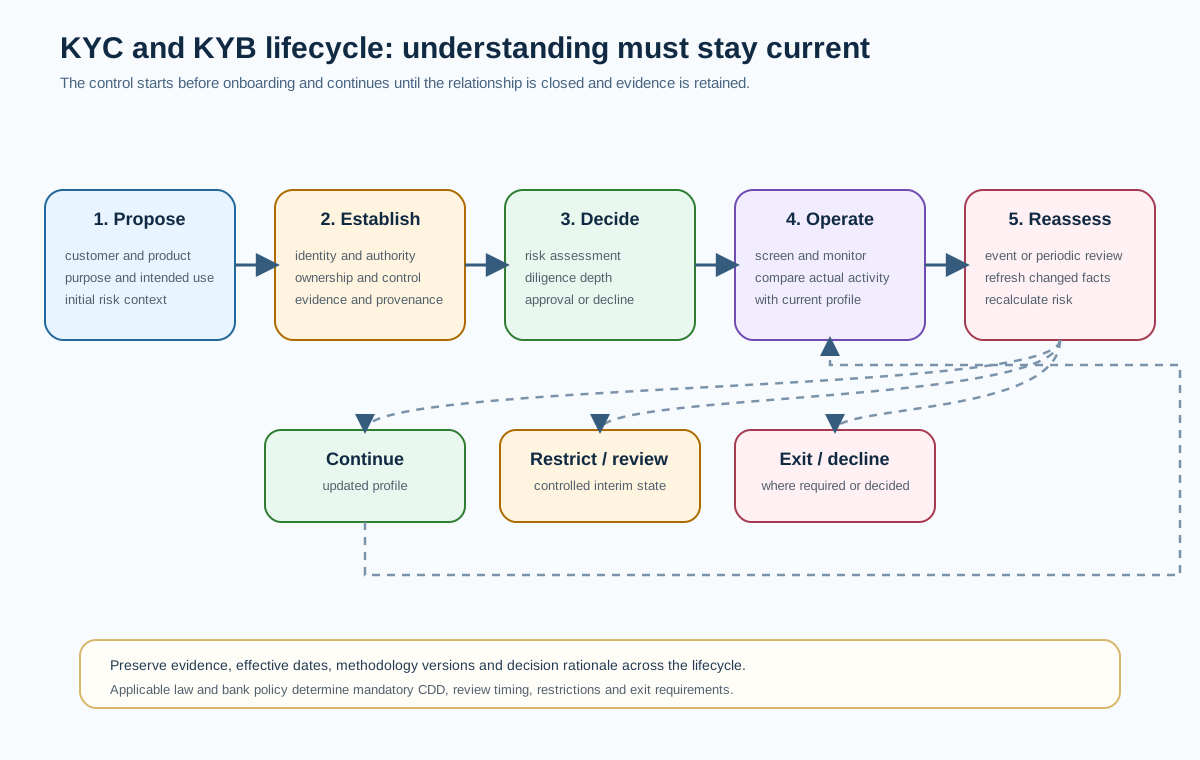
The lifecycle is the simplest way to frame the topic. KYC is not a document pack created at day one. The bank forms a view, uses that view, observes what happens, refreshes it when necessary and preserves the evidence behind material decisions until the relationship is closed and the applicable retention period ends.
The five questions behind useful KYC
A practical customer-understanding model asks five questions.
Who is the customer? The bank needs enough reliable identity information to know which natural or legal person it is dealing with and, where applicable, who is acting on that person’s behalf. Verification asks whether the evidence is sufficiently reliable for the applicable legal framework and risk.
Why does the relationship exist? The bank needs to understand the purpose and intended nature of the relationship. A salary account, a property-management company, an international commodities trader and a charity operating in conflict-affected areas can all be legitimate, but their expected use and risk exposures are different.
Who ultimately owns, controls or benefits? For legal persons and arrangements, the named customer may be only the visible layer. Ownership, control, authority and beneficial ownership determine whose interests sit behind the relationship. The precise legal tests differ across jurisdictions and customer types, so the bank should preserve the facts and apply the correct rule rather than hard-code one global percentage as universal truth.
What should activity broadly look like? The bank needs a plausible baseline for products, volumes, payment corridors, sources of funds, counterparties and transaction types at a level proportionate to risk. The objective is not to predict every future payment. It is to create enough context that a material deviation has meaning.
What changed? Customer knowledge remains useful only if the bank can recognise when circumstances, ownership, business model, products, geography or behaviour make the original understanding stale. Ongoing due diligence is therefore not a clerical refresh exercise; it is the process of keeping the risk view aligned with reality.
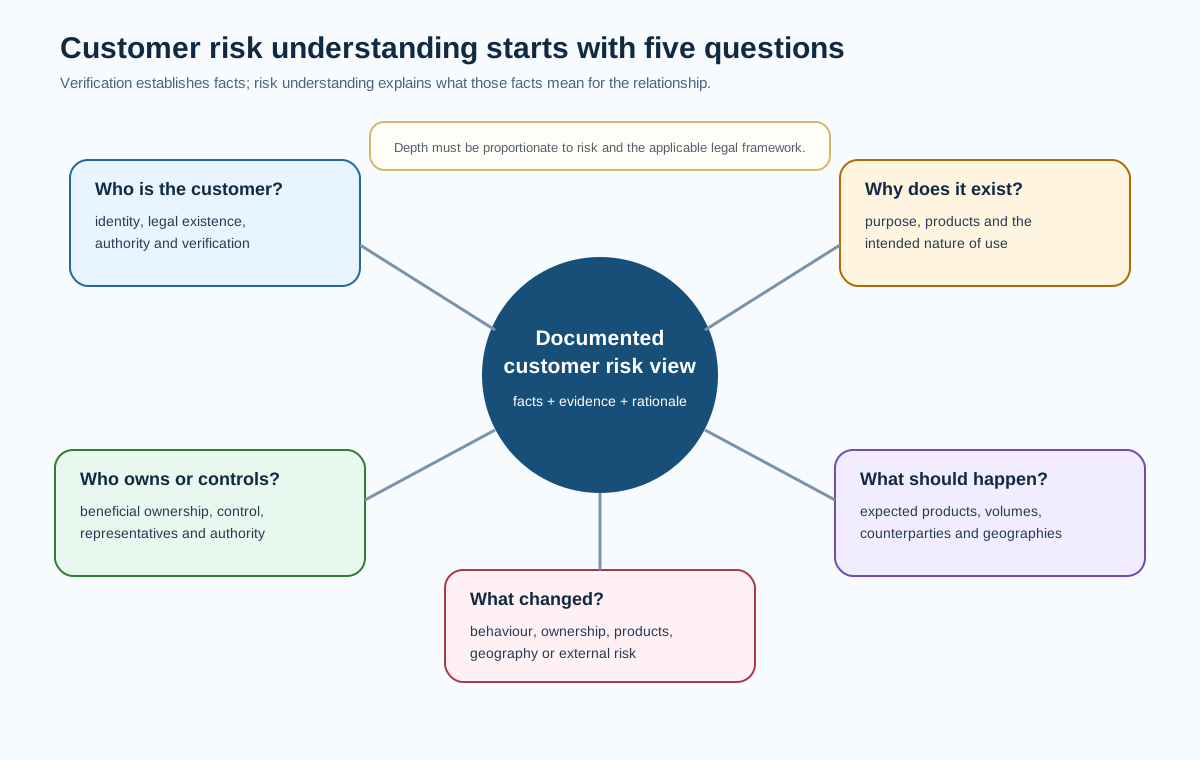
A file can be document-complete while one or more of those questions remains unanswered. The reverse is also true: a proportionate lower-risk relationship may require fewer documents while still being well understood under the applicable framework.
FATF Recommendation 10: global architecture, local implementation
The FATF Recommendations are international standards. They are not one globally binding operating procedure. The consolidated Recommendations, amended through June 2026, provide the common AML/CFT framework, while countries and regional systems translate that framework into law, regulation and supervisory expectations.
Recommendation 10 establishes the core customer-due-diligence architecture. Financial institutions should identify the customer and verify the customer’s identity using reliable, independent source documents, data or information; identify the beneficial owner and take reasonable measures to verify that identity so the institution is satisfied it knows who the beneficial owner is; understand and, as appropriate, obtain information on the purpose and intended nature of the business relationship; and conduct ongoing due diligence so transactions are consistent with the institution’s knowledge of the customer, business and risk profile, including source of funds where necessary.
Operationally, those objectives create distinct capabilities. Identity capture and verification must be reliable enough to distinguish the customer from another person. Connected-party data must be available where the framework requires it. Business-purpose information must be usable rather than generic narrative. Monitoring must be able to compare observed activity with a current profile. When the bank doubts information already obtained, it needs a controlled way to refresh, reverify or escalate.
FATF’s February 2025 amendments strengthened the language of proportionality in Recommendation 1 and clarified that countries should allow and encourage simplified measures in lower-risk situations where appropriate. The related June 2025 financial-inclusion guidance is non-binding and explains how proportionate implementation can support inclusion while maintaining AML/CFT safeguards. These changes do not permit institutions to skip mandatory CDD. They reinforce the idea that controls should be proportionate to risk, legal requirements and the nature of the relationship.
A global bank should therefore separate four layers: standard, law, bank policy and operating procedure. A field may exist because FATF identifies an international objective, because local law mandates it, because group policy applies a common control floor, or because the bank’s own risk assessment requires it for a particular product. Those are different reasons and should be traceable.
Identity assurance is necessary but not sufficient
A fraudster may use a genuine identity. A shell company may be validly incorporated. A politically exposed person may present perfect documentation. A sanctioned entity may have a genuine company number. A legitimate customer can later change behaviour in a way that raises new questions. Identity assurance tells the bank that an attribute is sufficiently reliable; relationship assessment tells the bank what the verified facts mean in context.
For many lower-risk retail relationships, the assessment may be straightforward. A resident employee opening an ordinary account for salary, household spending and domestic transfers can often be understood with a relatively simple profile if no higher-risk factors are present. The institution still needs to meet the CDD required by the applicable framework, but it should not force every low-risk customer through private-bank-style wealth analysis merely because the system can ask more questions.
For a complex corporate relationship, the assessment can be materially deeper. A company that trades internationally through subsidiaries, receives third-party funds, uses intermediaries and requests cross-border products may require analysis of ownership, management, business activity, expected counterparties, source of funding and the commercial purpose of the structure. Depth should respond to risk and legal requirements rather than a preference for collecting paper.
The practical rule is: collect what is required, verify what must be reliable, and understand what the decision depends on.
Natural persons: understand the relationship without turning KYC into biography
For individuals, good customer due diligence is selective. The bank needs enough information to identify the person, understand the relationship and assess relevant risk, but should not turn onboarding into an unlimited inquiry into someone’s life.
The baseline may include identity, date of birth, address or residence information, nationality or citizenship where relevant, occupation or economic activity, expected products and purpose of the relationship. Depending on risk and law, the bank may also need source-of-funds or source-of-wealth information, political-exposure assessment, tax or residency data for separate obligations, or additional verification evidence.
Facts should be distinguished from assessments. “Software engineer employed by Company A” can be a customer fact if established appropriately. “Standard financial-crime risk” is an assessment based on facts and methodology. “Expected salary credits and ordinary household spending” is a behavioural expectation. Keeping those layers separate makes later review and challenge more explainable.
Life events can change the profile without creating suspicion. A customer may retire, move country, sell a business, receive an inheritance or begin investing internationally. The bank should have triggers that prompt review when a change is relevant. The correct outcome may simply be an updated profile.
Customers who cannot follow a standard identity journey need controlled alternatives rather than improvised exceptions. FATF’s 2025 financial-inclusion guidance emphasises proportionate implementation, but the evidence acceptable for verification remains a matter for the applicable national framework. A humanitarian or refugee document may be usable in one jurisdiction or product and insufficient in another. Product and compliance design should define those routes in advance.
Legal persons: existence is not the same as substance
KYB begins with a basic question: does the legal person exist? Registry information, constitutional documents, tax identifiers, licences and other evidence can establish legal existence. A company can exist legally and still be misunderstood economically.
The bank should therefore move from existence to substance. What does the company sell or provide? Where are its customers and suppliers? How does it earn revenue? Why does it need the requested products? Who owns it? Who controls it? Who can instruct the bank? What transaction pattern is plausible for that business model? Which jurisdictions matter?
Consider two companies incorporated in the same country on the same day. One is a software startup funded by identifiable founders and an institutional investor, with employees, contracts and a clear product. The other claims to be an international commodity trader but has no meaningful operating footprint, vague counterparties, nominee directors and projected turnover far beyond its capital or history. Registry verification can confirm both companies. Risk understanding separates them.
Commercial substance should be assessed proportionately. A holding company may legitimately have no employees. A special-purpose vehicle may legitimately have a narrow purpose. A newly formed company may legitimately have little historical revenue. The question is whether the structure and activity make sense for what the customer claims to be and whether the bank can evidence that understanding.
Labels such as “offshore,” “startup,” “trust,” “cash business” or “international trader” are not conclusions. They are context. The control should identify which additional questions or evidence are relevant to the risk presented by the specific relationship.
Purpose and intended nature: the centre of usable customer knowledge
Purpose is often captured badly because forms ask generic questions and accept generic answers. “Business banking,” “investment,” “payments” or “savings” provides little baseline for monitoring or investigation.
A useful purpose statement connects economic activity to the requested product. A property-management company may need to receive rent, pay maintenance firms and transfer net proceeds to property owners. A payroll company may receive bulk corporate funding and make many employee payments. An importer may require foreign exchange, documentary trade services and supplier payments in defined corridors. These descriptions create context that later controls can test.
Expected activity should use ranges and categories where precision is impossible. A new customer may not know whether it will make 37 or 42 payments next month. The bank can still capture broad turnover, cash use, common transaction sizes, relevant countries, main counterparty types, inbound and outbound sources and products used.
The bank should identify which expectations are material enough to trigger review. If every variance creates an alert, the profile becomes a noise generator. If no variance matters, it becomes decorative. Materiality can depend on segment, product, customer risk and behaviour.
For business analysts, “expected activity” should rarely be one free-text field. It is usually a set of structured, versioned attributes supported by narrative where context cannot safely be reduced to codes.
Beneficial ownership, control and authority are related but different
A legal person can involve several relationship types that systems often collapse into one owner field.
Legal ownership concerns formal ownership interests. Beneficial ownership concerns the natural person or persons who ultimately own or control the customer under the applicable definition. Control can arise through ownership, voting rights, contractual rights or other means depending on the legal regime. Authority concerns who is permitted to act for the customer in the banking relationship, such as a director, trustee, signatory or authorised representative.
These relationships drive different controls. A signatory may require identity verification and screening while having no ownership. A beneficial owner can influence risk without ever initiating a payment. A corporate shareholder may sit between the customer and the ultimate natural-person owner. A trustee may exercise legal powers while beneficiaries hold economic interests.
FATF’s strengthened Recommendation 24 framework and its 2023 guidance on legal persons reinforce the importance of adequate, accurate and up-to-date beneficial-ownership information at jurisdiction level. The 2024 guidance on legal arrangements provides additional context for trusts and similar arrangements. For banks, registry information is valuable but should not automatically be treated as infallible or universally sufficient. The institution remains responsible for applying the verification obligations that govern it.
The data model should preserve the ownership or control relationship, percentage where relevant, evidence source, verification status and effective dates. Historical ownership matters: an investigator reviewing a payment from six months ago may need the structure that existed then, not the current structure.
Customer risk assessment: turn facts into a reasoned view
Customer risk assessment converts established facts into a control decision. A methodology can consider customer type, occupation or business, ownership structure, product, channel, geography, transaction characteristics, political exposure and other factors relevant to the institution’s risk assessment.
The method can be rules-based, score-based, judgement-based or hybrid. Sophistication alone does not guarantee quality. A model with hundreds of variables is weak if nobody can explain why the rating changed or which control response it triggers.
Risk factors should not be treated as independent truths. A country exposure may matter differently for a domestic payroll account than for a commodity-trading business. Cash intensity may be normal for one sector and inconsistent with another. Non-face-to-face onboarding may be strongly controlled through robust digital identity or weakly controlled through easily manipulated evidence. The assessment needs context.
The output should change action. If higher-risk and standard-risk customers receive identical diligence, approval and monitoring, the rating has little operational meaning. At the same time, the bank should avoid making higher-risk classification so commercially punitive that analysts are incentivised to manipulate scores.
The rationale should be preserved. A reviewer should be able to identify the risk factors, data version, methodology version, overrides and approval. Manual overrides should be controlled, reasoned and visible to governance.
Simplified, standard and enhanced measures
Simplified due diligence, standard due diligence and enhanced due diligence are often presented as three document packs. That is too mechanical. They are better understood as different levels or forms of assurance and investigation applied where the legal framework and risk assessment support them.
In lower-risk circumstances, simplified measures may reduce the extent, intensity or timing of some checks where the applicable framework permits. FATF’s 2025 amendments gave greater emphasis to proportionality and simplified measures in lower-risk settings. Simplification is not the same as ignoring mandatory CDD.
Standard due diligence should establish a reliable and usable profile for the ordinary risks of the institution’s business. Enhanced measures should respond to the reason risk is higher. If the uncertainty is complex ownership, additional work should focus on ownership and control. If the issue is unexplained wealth, the work should focus on the wealth proposition. If the concern is geography, the institution should understand the actual nexus and activity rather than request unrelated documents.
The strongest EDD is targeted. Generic requests create cost and frustration while producing weak evidence. An investigator or reviewer should be able to explain what uncertainty the additional measure was intended to reduce.
Where senior-management approval is required by the governing framework or bank policy, the approval should show that the decision maker saw the material risk, mitigating controls and residual uncertainty. Internal governance choices should not be described as universal legal obligations.
Source of funds and source of wealth are coherence tests
Source of funds and source of wealth are distinct concepts that support customer understanding where they are required or risk-relevant.
Source of funds explains the origin of specific money used in a transaction or relationship: salary, business revenue, sale proceeds, inheritance, loan proceeds or investment redemption, for example. Source of wealth explains how a person accumulated their overall economic position over time.
The purpose is not to demand the same proof from every customer. It is to test economic coherence where the law, product and risk justify the information. A customer with modest declared earnings proposing to place substantial assets into a higher-risk private-banking relationship may need deeper explanation. A business receiving funding from a parent may need evidence of the parent relationship and funding rationale.
Evidence has different strength. A customer statement, independently verifiable bank record, audited financial statement and public registry do not carry identical evidential value. The bank should record both the conclusion and the evidence behind it rather than use a bare “SOF verified” flag.
Geographic risk is more than nationality
A customer can reside in one country, be incorporated in another, have beneficial owners in a third, operate in a fourth and make payments through a fifth. Nationality alone does not describe geographic exposure.
The bank should identify which geographic connections matter for the specific risk: residence, incorporation, operating location, source of funds, counterparty location, payment corridor, correspondent bank, asset location or service destination. Their weight depends on the product and methodology.
Country-risk models may consider FATF public statements, national risk assessments, sanctions exposure, conflict, regulatory quality, corruption or organised-crime indicators and the bank’s own experience. External indices can inform a view, but the institution should understand what each source measures and how current it is.
Higher risk should not automatically be translated into rejection where activity remains lawful and within appetite. Some legal restrictions do prohibit activity, but AML/CFT higher risk generally calls for proportionate mitigation rather than wholesale de-risking.
Product and channel determine what the bank needs to know
Customer risk cannot be separated from the service provided. A domestic deposit account, private banking, cross-border payments, merchant acquiring, correspondent banking, trade finance and digital-asset services expose a bank to different vulnerabilities and require different customer context.
The same customer may therefore need additional due diligence when adding a new product. Existing customer knowledge should be reused where reliable, but the new product may introduce new geography, counterparty, transaction or regulatory questions.
Channel matters too. Face-to-face onboarding is not inherently safe and remote onboarding is not inherently unsafe. The control question is how identity and authority are established, what fraud and impersonation protections exist, which evidence is independently validated and how exceptions are reviewed.
Digital onboarding can improve CDD through authoritative-data validation and reduced transcription. It can also scale synthetic identity, document manipulation or impersonation if assurance is weak. Fraud and digital-identity controls therefore need to interact with KYC rather than operate as separate islands.
Screening uses KYC subjects but reaches a different decision
KYC identifies which parties and relationships the bank knows about. Sanctions screening compares relevant subjects and transaction data with applicable sanctions information. If KYC omits a beneficial owner or authorised signatory that should be in scope, screening cannot compensate for the missing subject.
The customer data model should therefore identify connected-party roles clearly and indicate which controls consume them under policy and jurisdiction. Customer, beneficial owner, controller, director, trustee, settlor, protector, beneficiary or signatory can have different relevance depending on the relationship and rule.
Screening results can feed back into customer understanding where they change risk or relationship status, but the meanings should remain separate. A false positive should not become permanent adverse customer data. A confirmed sanctions exposure can trigger a legal action that is distinct from the customer AML risk rating. A PEP identification may trigger specific measures under the applicable framework. Adverse media creates a review question rather than an automatic conclusion.
Ongoing due diligence keeps the model aligned with reality
Customer profiles decay unless maintained. Ownership changes. Businesses change products. Directors move. Customers become politically exposed. A domestic company begins trading internationally. A private client sells a company and receives a large new source of wealth.
Ongoing due diligence combines observation of transactions and behaviour with maintenance of customer information. The institution asks whether activity remains consistent with what it knows and whether the knowledge itself remains accurate and adequate.
Different jurisdictions implement these duties differently. In the United States, the FFIEC BSA/AML Examination Manual explains that the CDD rule’s customer-information updating requirement is risk-based and event-driven rather than a categorical universal requirement to update all customer information continuously or at fixed intervals, while banks may establish periodic reviews based on risk. UK and Australian frameworks use their own legal and supervisory requirements. These differences are exactly why a global policy should not copy one jurisdiction’s cadence and call it universal.
A mature bank maintains a trigger taxonomy. Structural triggers can include ownership, director or legal-form changes. Behavioural triggers can include sustained activity outside the expected profile. External triggers can include adverse information, PEP status changes or sanctions developments. Product triggers can include adoption of a higher-risk service. Quality triggers can include doubts about previously obtained information.
Each trigger should define materiality, urgency, scope and owner. A changed telephone number should not launch the same review as a new controlling owner in a materially different risk context.
Periodic and event-driven review work together
Periodic review provides a backstop where material change is not captured by a reliable event. Event-driven review improves responsiveness by reacting sooner when important information changes.
The design should avoid duplication. If a recent event-driven review has refreshed all material information to the standard required by the applicable framework, policy may be able to recognise that work when a scheduled review arrives. If a periodic review identifies material change, it should update the same customer profile and trigger the same downstream consumers.
Review scope should be risk-based. Re-performing every onboarding step regardless of change can waste resources and create unnecessary customer friction. The reviewer should determine which information remains reliable, what changed, whether the risk assessment remains valid and what additional evidence is required.
Historical versions should remain available. Overwriting an old occupation, ownership structure or risk rating destroys investigation context.
Perpetual KYC is an operating model, not a magic legal category
“Perpetual KYC” commonly refers to using data and event detection to keep customer information and risk assessments more current rather than relying mainly on large periodic refresh batches. It is an operating concept, not a universal legal term and not an automatic substitute for jurisdiction-specific refresh requirements.
Registry changes, internal behavioural signals, returned mail, product events or customer updates can trigger targeted reviews. Automation can prioritise genuinely changed relationships rather than forcing analysts to re-read unchanged files.
The model can fail if external data is stale, risk changes are unexplained, trigger volumes exceed capacity or only a narrow subset of customer facts is actually monitored. A credible design therefore defines authoritative sources, materiality, human review points, service levels, reconciliation, audit trail and fallback procedures.
Customer data architecture: facts must be reusable
A bank can employ excellent analysts and still operate weak KYC if customer knowledge is trapped in unstructured documents. Financial-crime controls need reusable data.
A useful architecture separates identity, relationships, purpose, risk, evidence and decisions. Identity records describe the person or entity. Relationship records connect owners, controllers, representatives and related entities. Product relationships connect customers to accounts and services. Risk records preserve factors, ratings and methodology versions. Evidence records identify source, verification method, date and reviewer. Decision records capture outcome, rationale and approval.
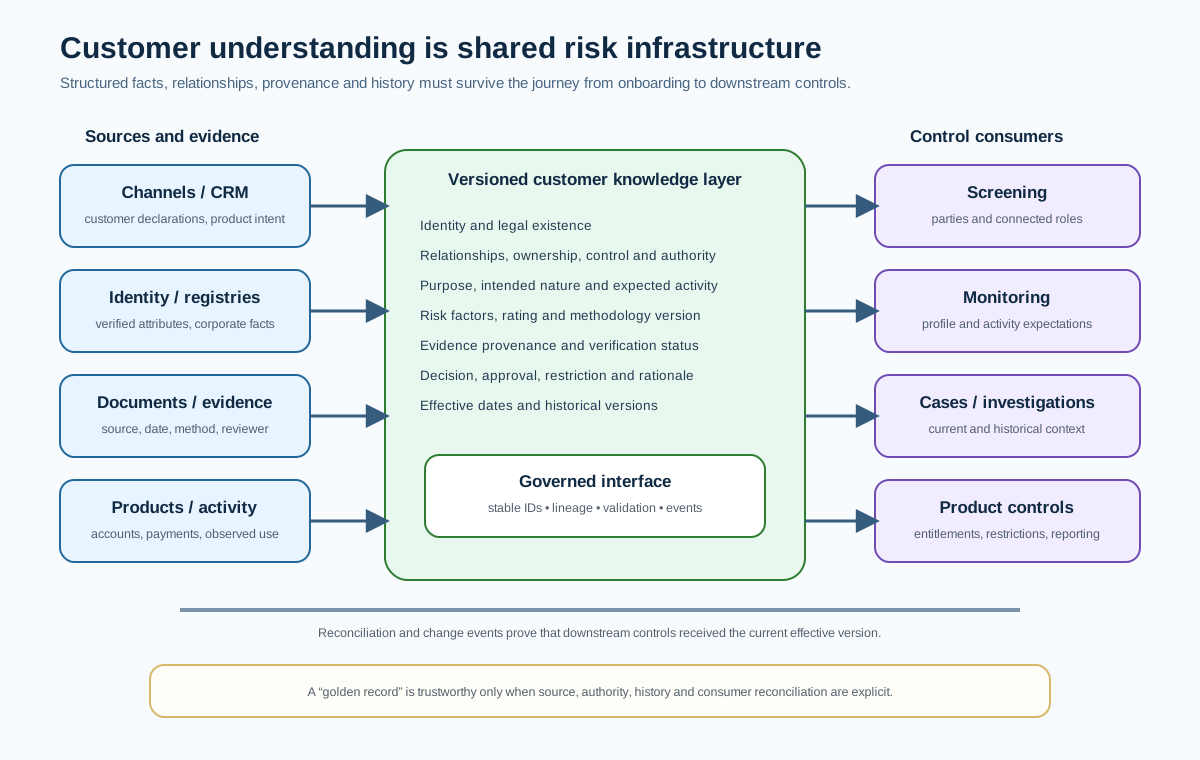
A “golden customer record” is useful only if it has clear survivorship rules. If CRM shows one address, KYC another and the payment system a third, the architecture needs rules for which value is authoritative for which purpose. History should be preserved rather than simply overwritten.
Stable identifiers are essential. A legal entity should not become invisible to monitoring because one system uses registration number, another a local customer ID and another only the name. Entity-resolution decisions should also be explainable: two customers sharing an address are not automatically the same person, and two similar company names may or may not refer to the same legal entity.
Data lineage and evidence provenance are control requirements
Customer data can change meaning as it moves between systems. A legal name can be truncated, non-Latin characters transliterated inconsistently, ownership percentages rounded, a country code converted into ambiguous free text, or a risk factor mapped incorrectly during migration.
For material attributes, the bank should know the source, transformation, validation, effective date and consuming controls. Evidence provenance answers a related question: why does the bank believe this fact? Customer declaration, government registry, identity provider and analyst inference have different evidential qualities.
Testing should include lineage. It is not enough to show that a field is correct on the KYC screen. The tester should confirm that screening, monitoring and case management receive the same intended value with the correct semantics and effective date.
Customer states and decision rights
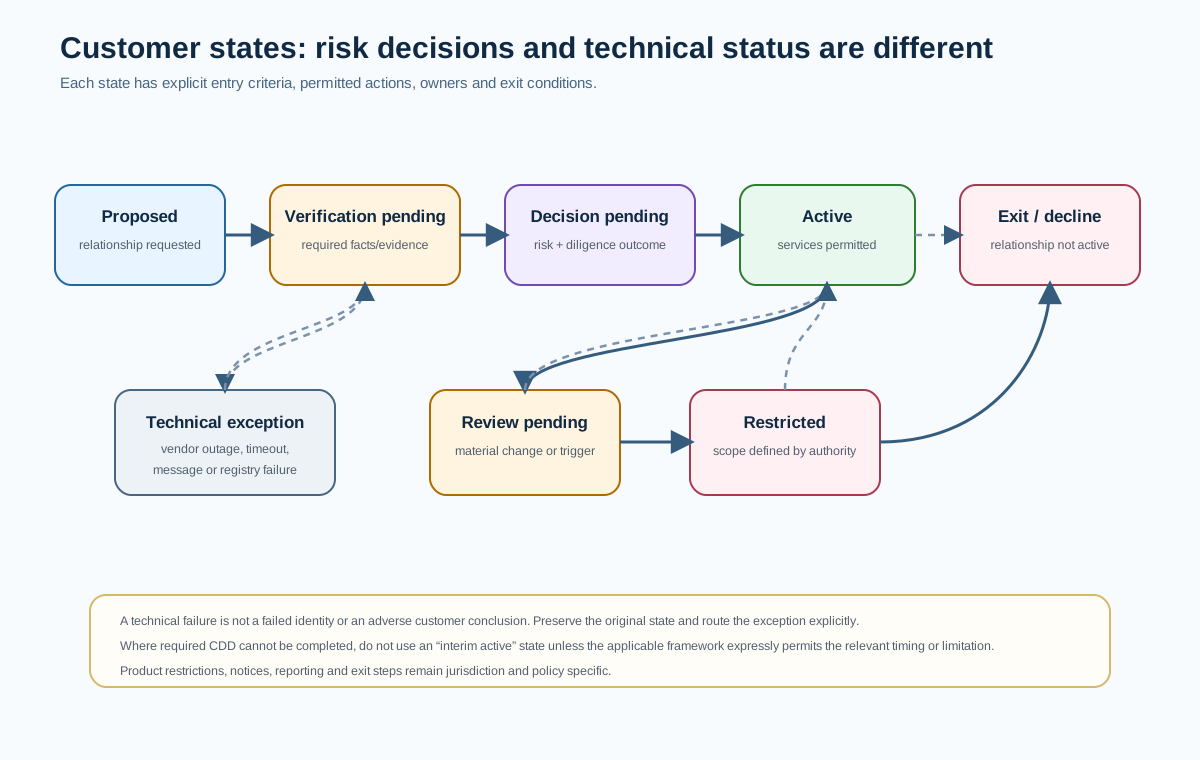
KYC creates business states that other systems need to respect. A relationship may be proposed, pending verification, pending risk decision, active, under review, restricted, exit pending or closed. Those states need explicit meaning.
A single status such as KYC_COMPLETE cannot tell a payment system whether service is permitted, whether a review is unresolved, whether a restriction applies only to one product or whether a decision is still pending.
State transitions should therefore have controlled decision rights. Who can approve a higher-risk relationship? Who can override a risk factor? Who can accept an exception where law and policy permit one? Who can impose or remove a restriction? What happens if a dependency fails?
Technical failure must be distinguished from risk outcome. An unavailable identity service is not a failed identity. A pending sanctions review is not a sanctions match. A missing document is not proof of suspicion.
Monitoring and KYC should form a feedback loop
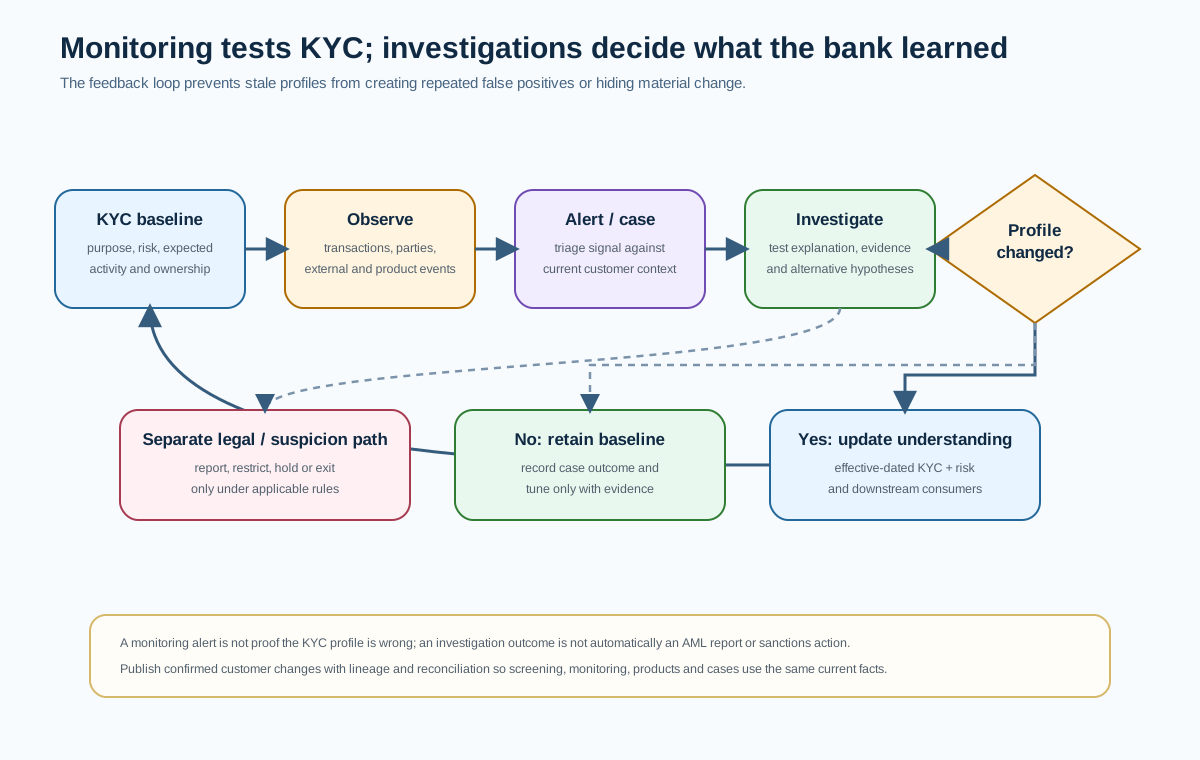
KYC provides a baseline to monitoring. Monitoring provides evidence that KYC may be stale.
Suppose a company is onboarded as a domestic wholesaler with expected local supplier payments. Six months later it begins receiving funds from unrelated overseas companies and rapidly forwarding them to new beneficiaries in several jurisdictions. Monitoring may detect the pattern. Investigation may conclude that the company legitimately expanded into a new distribution business. If so, the KYC profile should be updated. Closing the alert without updating the profile guarantees repeated noise.
The reverse also occurs. A KYC review discovers a new business activity or owner that monitoring needs to know about. If the update remains in the KYC platform but never reaches analytics, the monitoring model keeps comparing behaviour with the old profile.
The bank needs explicit events such as profile changed, ownership changed, risk rating changed, new expected geography, new product, restriction imposed or restriction removed. Each event should have a downstream consumer and reconciliation.
Third-party reliance, outsourcing and data purchase are different
Banks use identity vendors, KYC utilities, group shared services, external analysts and commercial data providers. The legal implications depend on the arrangement.
A data provider supplies information that the institution evaluates. An outsourced provider performs work on the bank’s behalf. A legally permitted reliance arrangement may allow specified CDD performed by another party to be relied upon if conditions set by the applicable framework are met. National rules define when reliance is available and what responsibility remains with the relying institution.
The bank should therefore avoid one generic “third-party KYC” policy. Contracts and oversight may need evidence access, data-quality standards, information security, performance metrics, audit rights, incident management, continuity, subcontractor controls and exit planning depending on the service.
Vendor outputs should never become unchallengeable facts. Analysts need a path to resolve discrepancies and the bank needs enough evidence to demonstrate the control it remains responsible for.
Group-wide KYC: reuse knowledge without losing booking-entity accountability
Large banking groups want to understand a customer once and reuse reliable information across entities. Reuse can reduce duplicate requests and improve consistency, but legal, privacy and accountability questions remain.
A group record should distinguish group knowledge from booking-entity obligations. One entity may have verified a customer under its local framework. Another may require additional information for a different product or jurisdiction. “Another branch already did KYC” is not a sufficient control design.
The architecture should show which entity owns the relationship, which entity collected and verified an attribute, whether the evidence may be shared and which local requirements remain outstanding. Access control should respect applicable data-protection, bank-secrecy and confidentiality rules. Cross-border information sharing should follow the legal gateways available to the institution.
Group policy can create a common control floor while local addenda address jurisdiction-specific obligations. Where local law restricts information sharing or requires different measures, that difference should be explicit rather than hidden in manual workarounds.
Customer experience and financial inclusion are control-quality issues
Poor operating design creates unnecessary friction. Customers become frustrated when different teams ask for the same valid document, when requests are generic, or when a review remains open because the bank has not assigned internal ownership. Repeated requests can also damage data quality because customers provide slightly different answers to slightly different questions.
A good workflow reuses valid information where law and policy allow, asks targeted questions, routes exceptions to the right specialist and records why additional evidence is needed. Service levels should reflect risk and customer impact. A routine lower-risk refresh should not remain pending indefinitely; a material ownership change may require more urgent review.
Financial inclusion requires the same discipline. Higher risk is not automatically prohibited risk. Some activities are legally prohibited, and banks can have legitimate risk-appetite boundaries, but legal prohibition, risk appetite, control capability and commercial choice should be distinguished rather than collapsed into one vague “compliance decline.”
Where a customer cannot satisfy the standard journey but can be verified through a permitted alternative, that path should be controlled and designed in advance rather than invented at the front line.
Quality assurance: test reasoning, not only documents
A technically complete file can still be weak if business purpose is generic, ownership is incomplete, risk factors are misapplied or contradictory evidence is ignored. QA should therefore sample the reasoning chain: fact, evidence, interpretation, required measure and decision.
Quality metrics should distinguish error types. Missing evidence, wrong connected-party role, incomplete beneficial ownership, stale data, unsupported override and weak rationale have different root causes and remediation. One aggregate “QA pass rate” can hide serious recurring defects.
Calibration matters where judgement is involved. If competent analysts reach very different outcomes on similar facts, the bank should determine whether policy is unclear, training is inconsistent or the methodology allows too much uncontrolled discretion. Calibration can improve consistency without turning judgement into rigid scripts.
Independent testing and internal audit then assess whether the wider framework is designed and operating effectively across data lineage, system logic, backlog, overrides, restriction handling, third parties and governance.
Management information: volumes are not enough
KYC programmes often report applications completed, reviews overdue and average turnaround time. Those metrics are useful operationally but do not prove risk effectiveness.
Management information can also show risk and quality: higher-risk population trends, enhanced-review ageing, ownership-verification exceptions, material data-quality breaks, event-review backlog, override rates, repeat customer requests, QA findings by severity, restriction ageing and downstream failures caused by stale customer data.
The denominator matters. One hundred overdue higher-risk reviews means something different in a population of five hundred than in a population of one hundred thousand. Concentration and severity matter too. A small backlog in a particularly sensitive product can deserve more attention than a larger low-risk backlog.
Senior governance should know when an issue moves from ordinary operations into incident, remediation or explicit risk acceptance.
Business analyst view: translate policy into testable states
“The bank shall perform KYC” is not a system requirement. A testable requirement defines trigger, subject, data, validation, decision, state transition, evidence and downstream notification.
For example, when a legal-entity application reaches pre-activation review, the system may need to establish legal identity and capture connected parties defined by policy. The risk engine must consume defined factors using the current methodology version. If enhanced review is required, activation remains unavailable until the authorised role records a disposition. The case preserves source data, evidence references, factors, overrides and approval.
Acceptance criteria should include negative paths: registry unavailable, ownership percentages inconsistent, director cannot be verified, risk service timeout, customer changes information while approval is pending, or update arrives after account activation.
The BA should trace downstream use. Which customer fields feed sanctions screening? Which feed transaction monitoring? Which appear in investigations? Which changes generate events? Which exist only for reporting? A field with no owner, validation or consumer is a warning sign.
Architecture and developer view: semantics and history matter
KYC rarely lives in one application. Digital onboarding, branch systems, CRM, identity providers, registries, document repositories, risk engines, screening, core banking, payment hubs, monitoring and case management all participate.
System-of-record responsibilities should be clear. APIs and events should carry stable identifiers and explicit semantic states. Historical reconstruction should be designed deliberately: what did the bank know on the day a payment occurred, which owner was recorded, which risk methodology applied and which analyst approved the relationship?
Developers should avoid ambiguous values such as verificationStatus=done. Was evidence collected, identity verified, automated verification passed, manual exception approved or the service merely unavailable? Dates also need semantics: vendor response time and analyst approval time are not necessarily the same.
Country fields need purpose. Is the value citizenship, residence, incorporation, operation or source of funds? Connected-party roles should distinguish direct shareholder, ultimate beneficial owner, controller, director, trustee or signatory where those differences drive controls.
Names and addresses need international support. Systems should not force fake data into mandatory formats designed around one market.
Tester view: test the customer story end to end
For natural persons, test identity variation, transliteration, multiple nationalities where supported, address changes, expired evidence, permitted non-standard evidence, PEP-status changes and risk updates. For businesses, test layered ownership, multiple controllers, ownership totals that do not reconcile, legal arrangements where in scope, director changes, mergers and entity-name changes.
Test downstream propagation. A new beneficial owner should reach the screening process that consumes that role. A changed risk rating should reach monitoring where intended. A customer restriction should reach affected products. A profile update should appear in case management with the correct effective date.
Test negative states: vendor timeout, registry outage, duplicate customer, late event, malformed data, stale cache and failed replay. Test history by updating the customer several times and reconstructing prior versions. Test access control so front-line users cannot see information reserved for investigations or specialist teams.
Finally, test customer impact. Can a legitimate exception be resolved? Does a cleared review remove a restriction where policy permits it? Does the customer receive an accurate message that does not disclose protected information? Does the process ask for the same evidence twice because internal systems do not share status?
A realistic mini case: Northstar Medical Components
Northstar Medical Components is a fictional mid-sized company seeking current accounts, cross-border payments and foreign exchange at Horizon Bank. It says it imports diagnostic-equipment components and sells them to hospitals and medical-device manufacturers.
Registry checks confirm the company exists. The onboarding process identifies two corporate shareholders. One is a domestic holding company; the other an overseas investment vehicle. If Horizon stopped at legal existence, KYB would look complete. Instead, the bank traces the ownership and control relationships required by its framework, records the evidence sources and establishes who can act for the company.
The relationship manager explains that Northstar expects supplier payments in three currencies, mainly to established manufacturers in two countries. Customer receipts should be predominantly domestic. Expected turnover is consistent with available financial information. The customer requests no cash services.
The risk assessment identifies cross-border and sector exposures but no fact that automatically requires the relationship to be declined. A newly appointed director is verified according to the bank’s requirements. Screening produces a common-name candidate on a connected party and resolves it as a false positive using additional identifiers.
Horizon approves the relationship with a structured baseline for expected corridors and counterparty types. Nine months later, payments begin going to a logistics intermediary in a new jurisdiction. Volumes rise and several remittance references become less specific. Monitoring generates an alert because the behaviour differs materially from the established profile.
The investigator does not assume laundering or sanctions evasion. The first question is whether the customer model is stale. The relationship manager confirms that Northstar has changed distribution routes following shipping disruption. The company supplies contracts and logistics evidence. The intermediary is genuine, but the bank also learns that Northstar has started selling into two additional markets.
The investigation finds no basis, on the evidence available, for a suspicious conclusion. It does identify a confirmed profile change. The case outcome triggers KYC maintenance: expected geographies and counterparties are updated, the risk model recalculates and downstream monitoring receives the new version.
Three months later, the overseas investment vehicle transfers its shares to a newly formed company. An ownership-change trigger opens a separate review rather than waiting for the next scheduled refresh. The new structure is assessed and screening is performed on the connected parties that fall within scope.
The key lesson is that no single control “solved” the case. Onboarding created a usable baseline. Monitoring detected change. Investigation tested the explanation. KYC incorporated confirmed new facts. Ownership monitoring triggered another review. Architecture allowed each control to consume the updated customer view.
In the weak version of the same bank, purpose is stored as “medical trading,” expected countries are free text, ownership is a PDF, monitoring sees only transaction amounts and updates remain in email. Every application may technically work while the bank itself does not maintain usable customer understanding.
Common failure modes
Document-complete, knowledge-poor files. Required documents are present, but analysts cannot explain the customer’s business, ownership or expected use.
Free-text everything. Important facts exist only in narrative. Humans may read them, but screening, monitoring and analytics cannot consume them reliably.
One global rule for every jurisdiction. A local threshold or review rule is embedded into a group workflow and taught as if universal.
Static ownership. Ownership is captured at onboarding but no material-change process exists.
Risk score without rationale. Users see a number or colour but cannot identify factors, methodology version or override history.
EDD by document count. Higher-risk customers are asked for more documents unrelated to the risk that actually needs explanation.
No downstream propagation. KYC changes successfully while screening or monitoring continues to use stale values.
False-positive contamination. A cleared screening candidate remains attached to the customer as if confirmed.
Overdue review treated only as an SLA problem. Backlog is reported without risk-based prioritisation or escalation.
Temporary restriction without owner or review date. A limitation survives after the issue is resolved because no workflow owns the reverse transition.
Vendor dependence without challenge. External verification or data is accepted blindly without quality, incident or evidence-access controls.
Poor history. Current information overwrites old information, preventing reconstruction of what the bank knew at an earlier date.
Commercial override without governance. High-value customers bypass required controls through informal escalation.
Zero-risk thinking. Every higher-risk category is treated as unacceptable, weakening genuine risk assessment and creating unnecessary exclusion.
Practical audit checklist
An auditor, product owner or BA can test one customer end to end.
Can the bank show who the customer is, how identity was verified and which connected parties were in scope? Can an independent reviewer understand why the relationship exists and what the products are expected to do? Are ownership, control and authority represented as structured relationships with evidence and effective dates? Can the risk outcome be reproduced from the factors and methodology version? Are overrides visible?
Does monitoring receive the customer context it is meant to use? Can an investigator see the same current profile? If an owner, country, occupation or business model changes, which events fire and which systems update? If a verification service fails or an event cannot be delivered, does the process enter a controlled exception state rather than silently appear complete?
Can the bank reconstruct the customer profile and decision from a prior date? Who sees ageing, data-quality failures, overrides and control incidents? Who is accountable for remediation?
If those questions can be answered with evidence, KYC is functioning as risk infrastructure. If the answers depend on people searching email and unrelated PDFs, the programme remains document-centric.
Final takeaway
KYC and KYB are not primarily about collecting documents. They are about creating and maintaining a defensible understanding of the customer that other bank controls can use.
The strongest programmes connect identity, purpose, ownership, expected behaviour, risk assessment and change into one lifecycle. They distinguish global standards from local legal requirements. They apply proportionality rather than one universal checklist. They preserve data lineage and historical versions. They connect customer understanding with screening, monitoring and investigations while keeping the legal decisions of those controls distinct. They design customer states and exception paths explicitly. They measure quality and downstream effectiveness, not merely files completed.
For compliance professionals, the task is to define what understanding is required and why. For investigators, it is to use customer context without treating the profile as unquestionable truth. For operations, it is to maintain accurate evidence and controlled states. For business analysts, it is to translate policy into data, triggers, decisions and acceptance criteria. For architects and developers, it is to preserve semantics, lineage and history. For testers, it is to prove that changes and failures behave safely. For product owners, it is to recognise that customer experience and financial-crime control are shaped by many of the same data and workflow decisions.
A bank that knows the customer only at onboarding does not truly maintain customer understanding. A bank that can explain who the customer is, why the relationship exists, who controls it, what activity makes sense, what changed and how that change affected the risk decision has built KYC and KYB as living risk controls.
References and further reading
- Financial Action Task Force, The FATF Recommendations, consolidated version amended June 2026: https://www.fatf-gafi.org/en/publications/Fatfrecommendations/Fatf-recommendations.html
- Financial Action Task Force, FATF updates Standards to better promote financial inclusion, 25 February 2025: https://www.fatf-gafi.org/en/publications/Fatfrecommendations/update-standards-promote-financial-conclusion-feb-2025.html
- Financial Action Task Force, Guidance on Financial Inclusion and Anti-Money Laundering and Terrorist Financing Measures, 23 June 2025: https://www.fatf-gafi.org/en/publications/Financialinclusionandnpoissues/guidance-financial-inclusion-aml-tf-measures.html
- Financial Action Task Force, Guidance on Beneficial Ownership of Legal Persons, 10 March 2023: https://www.fatf-gafi.org/en/publications/Fatfrecommendations/Guidance-Beneficial-Ownership-Legal-Persons.html
- Financial Action Task Force, Guidance on Beneficial Ownership and Transparency of Legal Arrangements, 11 March 2024: https://www.fatf-gafi.org/en/publications/Fatfrecommendations/Guidance-Beneficial-Ownership-Transparency-Legal-Arrangements.html
- Basel Committee on Banking Supervision, Sound management of risks related to money laundering and financing of terrorism: revisions to supervisory cooperation, 2 July 2020: https://www.bis.org/publications/202007-guidelines-sound-management-risks-related-money-laundering-and-financing-terrorism-revisions-supervisory-cooperation
- UK Financial Conduct Authority, Firms’ customer due diligence processes and controls: our findings, 8 April 2026: https://www.fca.org.uk/publications/good-and-poor-practice/firms-customer-due-diligence-processes-and-controls-our-findings
- UK Financial Conduct Authority, Financial Crime Guide, FCG 3 — Money laundering and terrorist financing: https://handbook.fca.org.uk/handbook/fcg3
- Federal Financial Institutions Examination Council, BSA/AML Examination Manual — Customer Due Diligence, US-specific context: https://bsaaml.ffiec.gov/manual/AssessingComplianceWithBSARegulatoryRequirements/02
- AUSTRAC, Reviewing and updating customers’ ML/TF risk and KYC information, updated 25 March 2026, Australian-specific context: https://www.austrac.gov.au/industry-and-business/obligations-and-guidance/your-amlctf-program/customer-due-diligence/ongoing-customer-due-diligence/reviewing-and-updating-customers-mltf-risk-and-kyc-information
- AUSTRAC, Reliance under customer due diligence arrangements, Australian-specific context: https://www.austrac.gov.au/industry-and-business/obligations-and-guidance/your-amlctf-program/customer-due-diligence/reliance-customer-identification-third-party/reliance-under-customer-due-diligence-arrangements
Operational deep dive: expectation setting, substance testing and continuous customer understanding
The base chapter establishes the purpose of KYC and KYB: a defensible understanding of the customer that remains useful after onboarding. This deep dive concentrates on four disciplines that make that idea operational: expectations that monitoring can test, commercial-substance analysis that does not confuse legal existence with genuine activity, event-driven or continuous maintenance, and customer-data quality strong enough for downstream controls to trust.
Expectations that monitoring can actually use
A customer profile becomes operationally useful when it describes expected use in a form that can be compared with observed behaviour. Generic statements such as “business payments” or “international trade” provide little analytical value. A better baseline identifies the products the customer expects to use, broad turnover or value ranges where appropriate, typical transaction sizes, important geographies, material counterparty types, expected cash exposure and other characteristics relevant to the product and risk. The objective is not to predict every transaction. It is to describe the relationship well enough that a material change has meaning.
Precision should be proportionate to the information reasonably available. A mature payroll company may be able to describe payment volumes and corridors confidently. A new business may have only credible ranges. False precision creates a different control weakness because monitoring treats a speculative number as fact. The profile should therefore distinguish customer-stated expectations, independently established facts and analyst assumptions.
Tolerance design belongs to the monitoring methodology, not to an arbitrary KYC form. Seasonal or project-based businesses can legitimately vary widely. Stable salary relationships often vary less. Review triggers should therefore reflect customer segment, product, historical behaviour and risk rather than one universal percentage. A single transaction outside an expected range may be entirely legitimate; a sustained or material change may justify a profile review. The bank should document which deviations are merely monitoring features and which create an event-driven KYC trigger.
When investigation confirms a legitimate business change, the control loop must update the customer profile. Repeatedly closing alerts against an obsolete baseline is not good monitoring. It is evidence that KYC maintenance has failed. The updated profile should be effective-dated and propagated to the downstream controls that use it so the institution can reconstruct what the bank understood before and after the change.
Commercial substance: test coherence, not stereotypes
Legal existence and commercial substance are different questions. A company registry may establish that an entity exists and identify filed directors or shareholders. It does not prove that the company conducts the activity it claims, that its ownership information is current, or that the proposed account use makes commercial sense.
Substance testing should be risk-based and hypothesis-led. For an operating company, useful evidence can include business premises, employees, contracts, customers and suppliers, licences, tax or financial records, logistics, digital footprint and observed account behaviour. Not every legitimate company will have every feature. Holding companies, special-purpose vehicles, investment entities and digital businesses can have intentionally lean structures. The analyst should therefore ask whether the structure and evidence are coherent with the stated purpose rather than compare every customer with a conventional operating company.
A practical review combines several perspectives. Operational substance asks whether the people, capabilities and infrastructure fit the claimed activity. Commercial substance asks whether counterparties, contracts and economics make sense. Financial substance tests whether funding, margins, turnover and assets are plausible. Behavioural substance asks whether observed transactions look like the business the bank was told to expect. No single indicator proves a shell or front company. The strength comes from corroboration or contradiction across independent dimensions.
The result should be recorded as reasoning, not as a mysterious score. If the company is understood despite a lean footprint, explain why. If a contradiction requires additional evidence, identify the uncertainty the evidence is intended to resolve. If the bank cannot complete the CDD required by the applicable framework, the relationship or transaction must be handled according to that framework; an internal desire to win the customer cannot substitute for the legal gate.
Beneficial-owner verification: registry data is a source, not an automatic conclusion
Beneficial-ownership analysis is an area where global training easily becomes unsafe. FATF Recommendation 10 sets an international standard for identifying the beneficial owner and taking reasonable measures to verify the beneficial owner’s identity so the institution is satisfied that it knows who the beneficial owner is. National frameworks implement that standard differently, including different definitions, thresholds, control tests, evidence expectations and timing rules.
A registry can be an important source of information, especially where a jurisdiction maintains high-quality, current beneficial-ownership data. It should not automatically be treated as sufficient in every case. The bank should understand what the registry records, who supplied the information, how it is verified, how current it is and whether the customer’s structure or other evidence contradicts it. Customer declarations, constitutional documents, shareholder registers, corporate registries, reliable commercial sources and other evidence may need to be combined according to risk and the applicable framework.
Straightforward structures with consistent, reliable information may require limited corroboration beyond the applicable minimum. More complex or higher-risk structures may justify deeper tracing and additional independent evidence. Escalation should respond to the actual uncertainty: unexplained intermediate entities, inconsistent ownership percentages, nominee arrangements, control through agreements, unexplained financing dependence or behaviour suggesting control by a person not reflected in formal records. “High risk” is not a licence for unlimited inquiry; additional measures should be relevant to the identified risk and legally permitted.
The data model should preserve the ownership and control chain, relationship type, percentage where relevant, evidence source, verification status and effective dates. That history matters in investigations because today’s ownership structure may not be the structure that existed when an earlier transaction occurred.
Event-driven and continuous maintenance
“Perpetual KYC” is best understood as an operating concept rather than a regulatory category. It uses customer events, internal behaviour and external data to identify material change and route targeted reviews sooner than a periodic cycle might. It does not remove the need to meet periodic-review or refresh obligations where a jurisdiction or bank policy requires them.
Useful triggers include ownership or director changes, new products, changes in geography, material behaviour inconsistent with the established profile, PEP-status changes, adverse information, returned communications, new legal-entity information and doubts about information already obtained. A good trigger taxonomy defines the event, materiality, risk, review scope, urgency, owner and downstream action. A phone-number change should not automatically produce the same review as a new beneficial owner in a materially different jurisdiction.
Event detection creates its own risk. External feeds can be stale or inaccurate. A registry can change for administrative reasons that have no financial-crime significance. Over-sensitive triggers can generate a backlog that is less controlled than the periodic process they were intended to improve. A credible design therefore includes source-quality assessment, materiality rules, deduplication, capacity planning, service levels, manual review points and reconciliation.
Hybrid models are often practical. Some populations may receive more continuous external and behavioural change detection while periodic review remains the backstop. The effectiveness measure is not how fashionable the technology sounds. It is whether material customer changes are identified, reviewed, decided and propagated faster and more reliably without overwhelming analysts with noise.
Customer-data quality as a control dependency
KYC analytics cannot compensate for customer data that is incomplete, stale, contradictory or semantically ambiguous. Data quality should therefore be managed like other critical control data. Completeness matters, but it is only one dimension. Accuracy, timeliness, consistency, lineage, validity and historical reconstructability also matter.
For each material attribute, the bank should know the authoritative source or survivorship rule, the validation performed, the effective date and the controls that consume it. A country field must say whether it represents residence, citizenship, incorporation, operating location, source of funds or another concept. An owner role must distinguish shareholder, ultimate beneficial owner, controller, director and authorised representative where those distinctions drive downstream decisions.
Cross-system reconciliation is essential. A corrected beneficial owner that remains unchanged in sanctions screening is a control break even if the KYC application shows the new value perfectly. A changed risk rating that never reaches monitoring can leave detection calibrated to the wrong customer context. Metrics should therefore include downstream propagation failures and unreconciled events, not only source-system completeness.
Quality assurance should examine the reasoning chain as well as the record. Useful samples ask whether the evidence supports the fact, whether the fact supports the risk interpretation, whether the required measure addressed the risk and whether the final decision is explainable. Error categories should be specific enough to drive remediation: missing evidence, wrong connected-party role, incomplete ownership, stale information, unsupported override, weak business-purpose narrative, wrong risk factor or downstream propagation failure.
Network context without overreaching
Customer understanding can sometimes benefit from network context. Ownership links, transaction counterparties, shared addresses, common devices or intermediaries may reveal relationships that are invisible when each customer is reviewed separately. Network analysis should be used carefully because a connection is not proof of common control or wrongdoing.
The bank should define the purpose of the analysis, the permitted data sources, confidence levels and escalation rules. A shared address can be expected for family members, serviced offices or group companies. A common device may reflect legitimate shared infrastructure. The analytical value comes from corroborating patterns, not from converting a graph edge into an adverse conclusion.
Privacy, bank-secrecy, confidentiality and data-protection requirements must be assessed under the applicable law. The institution should not assume that an AML purpose automatically permits every form of network data collection or cross-border sharing. Legal and privacy teams should determine the lawful basis, purpose limitation, access controls, retention and sharing arrangements for the relevant jurisdiction and use case.
Risk tiers should change control depth, not create labels without consequence
Banks commonly segment customer risk into levels so that resources and controls can be differentiated. The exact labels and methodology are institution-specific. Simplified measures are not a universal “low-risk tier”; they may be used only where the applicable framework permits them and the assessed lower-risk conditions are met. Enhanced measures likewise should respond to the reason risk is higher rather than become a generic document pack.
A useful methodology identifies the factors that influence risk, how they interact, when judgement or overrides are permitted and what each outcome changes operationally. Calibration should use multiple forms of evidence: QA findings, investigation experience, known incidents, model validation, customer outcomes and portfolio changes. Suspicious-transaction-report volumes should not be used as a simplistic success target; reporting decisions are jurisdiction-specific and an increase or decrease can have many explanations.
Risk migration should work in both directions. Material adverse change can require more intensive measures, while sustained and evidenced reduction in risk may justify a different control level where policy and law permit. Both upgrades and downgrades need a rationale and effective date. Automatic downgrades based only on time can erase relevant risk; permanent high-risk status despite changed facts can create unnecessary friction and weakens the credibility of the methodology.
QA and assurance for customer understanding
Quality assurance should test whether another competent reviewer can follow the file from fact to evidence to risk interpretation to decision. Samples can be weighted toward complex structures, higher-risk relationships, new processes, overrides or known weak points. Rating scales should be anchored in examples so reviewers distinguish a serious reasoning failure from a minor documentation defect consistently.
Recurring findings should drive root-cause analysis. If ownership errors cluster in one channel, the answer may be training, workflow design or data integration rather than more reviewer reminders. If purpose narratives remain generic, the product may be asking the wrong questions. If analysts routinely override one risk factor, the methodology itself may need review.
Independent assurance then asks a broader question: does the framework operate effectively across policy, process, technology, data, capacity and governance? A strong audit does not only open customer files. It tests lineage, system rules, backlog management, restriction handling, reliance arrangements, change control, management information and evidence that identified weaknesses were remediated.
Practitioner checkpoint
A practitioner should finish this deep dive able to turn customer purpose into monitoring-useful expectations, assess commercial substance without stereotyping modern or specialised legal entities, calibrate beneficial-owner verification to the applicable framework and actual uncertainty, design event-driven maintenance without drowning operations in noise, and treat customer data as control infrastructure with lineage and reconciliation. Those capabilities are what make KYC and KYB useful after onboarding rather than a document archive that becomes less reliable every day the relationship remains open.
Advanced practice: worked customer-understanding cases
The cases below are fictional and use illustrative values. They are not templates for legal outcomes. Their purpose is to show how a bank moves from profile to evidence, tests alternative explanations and records a proportionate relationship decision. The binding CDD, reporting, restriction and exit rules remain those of the applicable jurisdiction and the institution’s policy.
Case 1: the consultancy with one client and unusually high projected income
A newly incorporated management consultancy seeks a business account and projects annual turnover of an illustrative 2.5 million from one foreign conglomerate. Incorporation documents are valid, the directors have credible professional histories and the customer supplies an engagement letter describing strategic-advisory services. The apparent weakness is not that the company is young or has only one client. It is that the proposed economics depend almost entirely on one unusually valuable relationship whose commercial reality is central to understanding the account.
The analyst tests the hypothesis that this is a genuine specialist consultancy. Director capability is checked against independent employment and professional records. The claimed client relationship is corroborated through independently sourced contact details rather than contact information supplied by the applicant. The engagement is examined for scope, authorisation, milestones and pricing coherence. Funding for early operating costs is traced to a plausible source. The bank also considers the alternative hypothesis that the entity is a pass-through vehicle supported by fabricated commercial documents.
In this fictional case, the foreign group confirms that it has no contract with the applicant and the named signatory has no procurement authority. Other evidence that looked individually plausible becomes less persuasive once the central revenue proposition fails. The relationship is not declined because “consultancies are risky.” It is declined because the bank cannot establish a credible purpose for the proposed account on the evidence available. Whether the facts also require a suspicious-activity report is a separate jurisdiction-specific assessment.
The control lesson is to concentrate verification on the fact that makes the relationship economically possible. A bank can collect ten routine documents and still miss the one question that determines whether it understands the customer.
Case 2: the trading company that never behaves like a trader
A company describes itself as a general international trader and has three years of banking history. It processes an illustrative 15 million each year through open-account transfers across several jurisdictions. There are few logistics payments, no stable supplier base, product descriptions change constantly and some funds appear to return to their originators through intermediary accounts within days. Management explains that modern trade is flexible and that documentary instruments are unnecessary for trusted counterparties.
The correct question is not whether every legitimate trader must use letters of credit or bills of lading. Many do not. The bank instead tests commercial coherence. It compares counterparties and goods descriptions with the customer’s stated business, looks for evidence of real fulfilment, tests margins and funding cycles, examines freight or service relationships appropriate to the claimed trade model and considers whether the transaction network reflects genuine buying and selling or mainly movement of value.
In the fictional case, several independent dimensions contradict the stated purpose. Counterparty confirmation is weak, transaction chains are circular, margins appear engineered rather than market-driven, and the company has little evidence of commercial operations. The bank escalates for enhanced review and relationship decisioning. The final outcome must follow the applicable law and bank policy; the important analytical point is that “no documentary trade finance” was never the finding. The finding was a pattern of commercial inconsistency across evidence, economics and behaviour.
The case also shows why KYC and transaction monitoring must share information. The onboarding profile explains what genuine activity should look like; transaction analysis tests whether that profile remains credible.
Case 3: the private client with three incompatible wealth stories
A private-banking applicant holds an illustrative 12 million across cash, property and investments. In different conversations and documents, the customer attributes the wealth variously to a business sale, inheritance and investment gains. Each explanation has some supporting evidence when viewed alone. The risk emerges only when the narratives are placed on one timeline and reconciled to the same pool of assets.
The analyst builds a wealth chronology rather than collecting another isolated document. The business sale is checked against company history and sale records. The inheritance is compared with probate or equivalent evidence where lawfully available. Investment gains are tested against statements and market plausibility. Amounts are mapped to avoid double counting. The aim is not to demand forensic proof of every historical unit of currency. It is to determine whether the overall economic story is coherent to the level required by the relationship risk and applicable framework.
In this fictional case, the same tranche of wealth is attributed to different origins at different times, the inheritance evidence supports only a small fraction of the amount claimed and the supposed business sale cannot be reconciled with the seller’s operating history. The bank therefore cannot establish a satisfactory source-of-wealth narrative for the proposed higher-risk private-banking relationship. The relationship decision, and any reporting assessment, are documented separately.
The case demonstrates why source of funds and source of wealth are not interchangeable. A specific incoming transfer can be perfectly traceable while the broader accumulation of wealth remains unexplained, and the relevance of that broader question depends on the customer, product, risk and legal framework.
Case 4: the charity with mixed commercial and programme flows
A registered charity receives donations, cash from fundraising events, income from a charity shop and venue-hire receipts. It also sends funds to partner organisations in higher-risk jurisdictions. Mixed sources of income are not inherently suspicious; many charities operate legitimate commercial activities to fund their missions. The bank’s task is to understand governance, programme delivery and financial control without treating charitable status either as a shield or as a risk conclusion.
The review starts with the organisation’s purpose, trustees or equivalent controllers, decision rights and regulatory filings. It then samples whether programme expenditure can be connected to the stated mission, whether overseas partners have been subject to due diligence appropriate to the risk, and whether accounting records allow the organisation and the bank to understand how different income streams are used. Controls such as fund segregation, restricted-fund accounting or separate cost centres may be relevant depending on the organisation and local requirements, but they should not be presented as one universal banking rule.
In the fictional case, half of the claimed programme expenditure cannot be supported, governance is concentrated in a small family group without effective challenge and overseas partner information is incomplete. Those facts justify deeper review. They do not by themselves prove diversion or terrorist financing. The bank seeks targeted evidence, reassesses the relationship risk and determines any restriction, remediation or reporting outcome under the applicable framework.
The lesson is that good NPO due diligence is evidence-led and proportionate. It protects legitimate charitable access to finance while identifying governance or transaction patterns that genuinely require escalation.
Case 5: the fintech whose sub-merchants are visible only in aggregate
A payment institution seeks settlement accounts for a rapidly growing portfolio of thousands of digital sub-merchants. It describes its automated onboarding and transaction monitoring as equivalent to a bank’s controls, but offers the bank only aggregate statistics. The bank’s exposure depends partly on customers it does not directly onboard, so understanding the fintech requires more than confirming the fintech’s own corporate identity.
The relationship team maps the business model: who the fintech serves, which services it performs, which regulated permissions apply, how merchants are accepted, how settlement works, which data the bank can access and who owns fraud, AML and sanctions decisions. Depending on applicable law and contractual rights, the bank may use control testing, sample reviews, independent assurance reports, data-quality checks and transaction analysis to test whether the partner’s stated framework operates in practice. “Mystery shopping” or direct sub-merchant testing may be appropriate in some arrangements but should not be assumed to be legally or contractually available everywhere.
In the fictional case, sample evidence shows identity-verification weaknesses, automated alert closure without adequate investigation and merchant categories inconsistent with the partner’s stated appetite. The bank requires more granular transparency and a remediation plan before allowing further growth. If the partner cannot provide the assurance required for the bank to manage the relationship lawfully and within appetite, a controlled exit may be necessary.
The control lesson is that outsourcing, partnership and reliance are different concepts. A vendor may perform work, but the bank must know which obligations remain its own and what evidence it needs to demonstrate effective oversight.
Case 6: the prominent professional with political connections
A senior lawyer seeks private-banking services with an illustrative initial funding of 3 million. Professional standing is genuine, tax records broadly support high earnings, and identity verification is straightforward. The lawyer also represents politically exposed clients, holds roles at state-connected enterprises and has an offshore property interest that was not disclosed when the relationship was first described.
Professional proximity to a PEP is not itself the same as being a PEP, and a “high-profile” label does not create a universal legal category. The bank should first determine whether the customer or any relevant connected person meets the PEP definition under the applicable framework. Separately, it should assess the unexplained asset and other risk indicators on their own evidence.
In the fictional case, the offshore property cannot be reconciled with the wealth narrative without additional information. That inconsistency justifies targeted source-of-wealth and ownership questions under the bank’s risk framework. If the applicable PEP rules are triggered, the institution applies those specific measures; if they are not, the bank should not pretend that PEP law applies merely because the customer is politically connected. The relationship outcome follows the evidence and the governing rules, not social prominence.
The lesson is to separate three questions that are often blurred: formal PEP status, broader corruption or influence risk, and economic coherence of wealth. They may overlap, but they are not interchangeable.
What these cases have in common
Every case begins with a plausible legitimate explanation. The analyst does not start from a conclusion and search for confirming evidence. The analyst identifies the facts that make the relationship economically and legally coherent, tests those facts with evidence appropriate to the risk, considers alternative explanations and records what uncertainty remains.
That discipline protects customers as much as it protects the bank. Genuine startups should not be rejected because they lack long histories. Charities should not be penalised for serving difficult regions. Professionals should not be treated as corrupt because of their clients. Fintechs should not be trusted merely because they use sophisticated technology. Good KYC and KYB is the structured work of distinguishing those situations with evidence rather than stereotype.
Practice close: the KYC analyst’s playbook
This section turns customer risk understanding into a practical sequence for onboarding analysts, relationship teams, reviewers, business analysts and control owners. The aim is not to create a universal checklist. It is to make the reasoning visible: what fact matters, what evidence supports it, which legal or policy requirement applies, what uncertainty remains and what decision state follows.
Build understanding in a deliberate sequence
Start by establishing the subject of the relationship. For a natural person, identify and verify the customer using the methods required or permitted by the applicable framework. For a legal person or arrangement, establish legal existence, authority to act, ownership and control relationships, and the connected parties that fall within the institution’s CDD and screening scope. A completed document upload is not the same thing as a completed verification decision; the file should show what was verified, against which source, when and with what result.
Next, understand why the relationship exists. Link the customer’s economic activity or personal purpose to the products requested. Capture expected use in a form that downstream controls can consume without pretending the bank can predict every future transaction. Ranges, relevant geographies, principal counterparty types, cash exposure and product use are often more useful than one narrative field. Where source of funds or source of wealth is required or risk-relevant, record the proposition being tested and the evidence that supports the conclusion rather than a generic “verified” flag.
Then turn the collected facts into a risk view. Apply the methodology version in force, preserve relevant factors, document overrides and identify which additional measures are required by law, policy or risk assessment. The decision should move the relationship into an explicit state such as approved, pending further review, restricted or declined. The state should determine what products and actions are permitted; it should not be a cosmetic workflow label.
Finally, plan for maintenance before the account becomes routine. Identify which changes should reopen the risk assessment, which downstream systems consume customer data and how confirmed changes will be propagated and reconciled. A customer profile that cannot be updated safely is already becoming obsolete on the day it is approved.
PEPs, public prominence and enhanced-risk customers
Politically exposed person obligations differ by jurisdiction, including definitions, family-member and close-associate treatment, domestic versus foreign PEP distinctions, approval requirements and source-of-wealth or source-of-funds expectations. A bank should therefore determine formal PEP status under the applicable framework before applying a PEP-specific legal control. Being famous, politically connected, professionally close to public officials or employed by a state-related organisation does not automatically make a person a PEP under every regime.
Those facts can still be relevant to broader corruption or customer-risk assessment. The institution may decide that a prominent or influence-connected relationship deserves additional understanding even where a formal PEP rule is not triggered. That is a risk-based or policy decision and should be described as such. Additional evidence should address the actual uncertainty: source of wealth, ownership of assets, commercial relationships, conflicts of interest or unusual payment channels. Asking for unrelated extra documents merely because a customer is “high profile” creates friction without improving the control.
Where senior-management approval is required by the governing framework or policy, the approval should be informed. The decision maker should see the material facts, remaining uncertainty, mitigating controls and proposed relationship conditions. Where no such approval is legally required, a bank may still adopt an internal escalation rule for higher-risk relationships, but it should not teach that internal governance choice as universal law.
Customers who cannot follow the standard identity journey
A standard digital or branch process can exclude legitimate customers whose circumstances do not fit the expected document set. Refugees, displaced people, people without stable addresses and other financially excluded groups may be affected. FATF’s 2025 financial-inclusion guidance emphasises proportionality and the need to consider lower-risk situations and appropriate simplified measures through national frameworks. That does not mean any alternative document is automatically acceptable.
The institution must identify the evidence and methods the applicable framework permits. In some jurisdictions, government, humanitarian, refugee-registration or other reliable evidence may contribute to verification; in others it may not satisfy mandatory requirements without additional steps. Product design can also matter: a lower-risk, limited-function product may be permitted under a local framework where a full-feature relationship would require more evidence. Legal and compliance interpretation should define the acceptable routes before front-line staff need them.
The operating procedure should state which alternative evidence is permitted, who may approve an exception, whether any product limits apply, how the identity conclusion is recorded and what later events require refresh. Staff should never invent a workaround because the standard screen cannot accommodate a legitimate customer.
Complex structures and staged onboarding
Complex legal structures can take time to understand, but commercial urgency does not change the minimum CDD required before a relationship or transaction may proceed. The institution must first identify what the applicable framework requires to be completed before establishment, activation or execution. If the framework permits a limited timing exception or delayed verification under defined conditions, the system can support that specific exception with controls and deadlines. If it does not, the relationship must remain unavailable until the mandatory work is complete.
This distinction matters because “staged onboarding” is sometimes used loosely to justify partial service while ownership or verification remains unresolved. A safe staged design separates information collection from service activation. Analysts can gather data, run preliminary checks and prepare decisions without treating the relationship as active. Any interim access must be grounded in an explicit legal or policy basis, limited to what is permitted, time-bound and visible to downstream product controls.
For complex ownership, the reviewer should record the unresolved question rather than simply label the structure “complex.” Is the problem an intermediate company, an inconsistent shareholder percentage, an unclear control right, a trust relationship, a nominee arrangement or missing evidence? That specificity determines what additional work is needed and prevents repeated requests that do not reduce uncertainty.
Customer communication and challenge
CDD information requests should be understandable without revealing sensitive detection logic or investigation information. Tell the customer what category of information is needed, why the bank needs it at an appropriate level and when a response is expected. Where a customer disputes a fact, provide the correction or review process required by applicable law and the institution’s policy. Do not promise a formal appeal right where none exists; equally, do not design a process that leaves clearly incorrect customer data uncorrectable.
When a relationship is delayed, restricted or exited, customer communications must reflect the legal and policy constraints that apply to that decision. AML confidentiality, sanctions notice rules, fraud-security concerns, data-protection rights and contractual requirements can produce different communication boundaries. A generic “compliance reason” message should not be the accidental default for every financial-crime outcome.
Front-line teams need approved communication guidance and escalation routes. They should know which questions can be answered, when legal or specialist review is required and how to document new customer information that may change the decision. Commercial pressure should be captured as context, not allowed to bypass the control gate.
When business and control teams disagree
Customer-risk decisions often create legitimate disagreement. The relationship team may have commercial context that compliance lacks; the control function may see risk factors the relationship team underestimates. A useful escalation model requires each side to state its evidence and reasoning rather than argue from authority.
The bank can define delegated decision levels based on risk, value, precedent and legal consequence. Higher-risk or novel cases may go to a senior forum; routine disagreements can be resolved by named accountable roles. Independence safeguards should be appropriate to the institution’s governance model. For example, the risk or compliance function may hold a veto for specified legal or policy breaches, while other risk-appetite decisions may be taken by a designated committee. Those are design choices, not universal legal requirements.
Record the decision, the material facts considered, any dissent, conditions and the accountable approver. Afterwards, track whether conditions were implemented and whether the outcome suggests the policy or methodology needs clarification. Repeated disputes about the same factor are often evidence of an unclear rule rather than unusually difficult customers.
Back-book remediation
Historical portfolios can contain customers onboarded under older standards, acquired through mergers, migrated from legacy systems or left with stale profiles after years of business change. Remediation should begin with exposure analysis rather than a blanket demand to re-onboard everyone identically.
Prioritisation can consider current customer risk, structural complexity, product and geographic exposure, known data gaps, review age, adverse information, transaction behaviour and the consequences of missing information. Each selected relationship should be assessed against the current requirements that apply to that relationship and the remediation objective. The work should not merely fill historical form fields if the information no longer supports a useful risk view.
Quality assurance is essential because large programmes create throughput pressure. Sample remediated files for reasoning quality, not only completion. Track what the programme actually discovered: material ownership changes, risk-rating changes, control restrictions, corrected data, closed gaps and downstream propagation. File counts alone do not demonstrate effectiveness.
Customer outreach should avoid implying suspicion simply because the bank is improving an old file. Explain requests in plain language and reuse reliable information where permitted. Repeatedly asking the same customer for the same valid evidence is both poor experience and a sign that the bank’s internal data model is fragmented.
Failure scenarios to test
A good KYC capability should be tested under failure, not only happy-path onboarding. Useful scenarios include an unavailable company registry, identity-vendor timeout, duplicate customer match, ownership percentages that do not reconcile, a PEP-status change while approval is pending, an event arriving late, a risk-engine failure, an update message that cannot reach screening, or a restriction that fails to propagate to a product.
The expected outcome should distinguish technical exception from customer-risk conclusion. A vendor timeout must not become “identity failed.” An unavailable registry must not be silently treated as successful verification. A failed downstream event must create a reconcilable exception rather than leaving two systems with different versions of the customer.
Test history as well. Change ownership, purpose and risk rating several times and confirm that an investigator can reconstruct what the bank knew at a chosen historical date. Test access control and logging so sensitive identity and investigation data are not exposed merely to make technical support easier.
Business analyst acceptance criteria
Requirements should identify the trigger, subject, data, validation, decision, state transition, evidence, owner and downstream event. “Perform KYC” is not testable. A useful requirement states which relationship state cannot be entered until which CDD elements are satisfied, what happens when evidence is unavailable, who can approve an exception and which consumers must receive the resulting customer version.
For ownership, define roles semantically: direct shareholder, ultimate beneficial owner, controller, director, trustee, settlor, protector, beneficiary or authorised signatory where relevant. For country data, identify the business meaning rather than use one ambiguous country field. For verification, distinguish evidence collected, automated check passed, manual review passed, exception approved and service unavailable.
Acceptance criteria should also cover reconciliation. If the KYC source publishes a new owner, screening must receive the correct identifier and effective date or raise an exception. If a relationship becomes restricted, affected products must enforce the scope intended by the decision. If a review clears the concern and policy permits removal, the restriction should not remain indefinitely because no system owns the reverse transition.
Closing operational principle
KYC quality is not the number of fields completed. It is the bank’s ability to explain who the customer is, why the relationship makes sense, who owns or controls it, what use is expected, what changed and why the resulting decision was lawful, proportionate and supported by evidence. Every workflow, data field, exception and review should strengthen that chain of understanding rather than simply make the file look complete.
Masterclass: governing customer understanding across the bank
Customer understanding can fail even when individual analysts work well. The usual causes are structural: commercial teams optimise onboarding speed while control teams optimise evidence quality, customer facts are distributed across systems, review capacity lags portfolio growth, and no senior owner can see whether the bank’s customer knowledge remains usable after onboarding. This masterclass focuses on the governance needed to keep KYC and KYB effective across functions without pretending that one operating model is mandatory everywhere.
Define accountable ownership without making compliance the owner of every fact
A practical operating model assigns ownership according to capability. Relationship or product teams are often best placed to know the customer’s current business and intended use. Operations may own verification execution and review workflows. Financial-crime compliance can own policy, interpretation, specialist challenge and selected risk methodologies. Data and technology functions own system reliability, lineage and controlled change. Independent assurance tests whether the whole framework operates effectively.
The exact allocation differs by institution. What matters is that each material decision and data domain has a named accountable owner and that gaps cannot be passed indefinitely between teams. If the customer changes business activity, someone must own updating the profile. If an ownership event fails to reach screening, someone must own the data break. If a review backlog becomes material, someone must own the risk response rather than merely report the volume.
A cross-functional customer-risk forum can be useful where several functions share the control. Its mandate might include risk appetite, material backlog, data-quality issues, methodology changes, higher-risk portfolio trends and remediation. It should not become a substitute for day-to-day accountability or a place where every difficult customer is escalated because operational decision rights are unclear.
Incentives can strengthen or undermine KYC quality
A relationship manager measured only on revenue and onboarding speed experiences KYC as a delay. An operations team measured only on cases completed may learn to optimise throughput rather than reasoning quality. A compliance team rewarded only for reducing findings can become overly conservative. Governance should therefore examine whether performance measures unintentionally encourage thin customer understanding, unnecessary de-risking or excessive customer friction.
Some banks include quality measures such as independent file-review results, overdue-review performance, repeated customer requests, material data defects or unresolved exceptions in management scorecards. Others use different mechanisms. The principle is not that every employee must have the same control KPI. It is that commercial and operational incentives should not systematically reward behaviour that weakens required CDD.
Metrics also need anti-gaming controls. A purpose field populated with copied text can meet a completeness target while conveying no useful information. An expected-activity range made extremely wide can prevent alerts while hiding a weak profile. A review completed without testing changed facts can satisfy an SLA while leaving the customer misunderstood. QA samples should therefore test substance rather than trust dashboard completion rates.
Senior reporting should connect operational facts to risk decisions
Board or senior-management reporting becomes useful when it explains exposure and decisions rather than listing volumes. Relevant information can include the distribution of customer-risk levels, material review backlog and ageing, unresolved beneficial-ownership or verification exceptions, high-severity QA findings, significant data-quality breaks, restriction ageing, override patterns and known downstream control failures caused by stale customer information.
Metrics need denominators and context. One hundred overdue higher-risk reviews has a different meaning in a portfolio of five hundred such customers than in a portfolio of one hundred thousand. A small backlog concentrated in a sensitive product or jurisdiction may deserve more attention than a larger low-risk backlog. Trend, concentration and severity matter as much as absolute volume.
The forum should be clear about the decision requested. Does the bank need more review capacity? A system change? A temporary risk acceptance? A revised risk-appetite boundary? A data remediation programme? Without a decision frame, management information can become observational rather than governing.
Supervisory readiness is evidence readiness
Supervisory reviews can test customer-due-diligence effectiveness through more than document presence. The UK FCA’s April 2026 CDD review, for example, discussed procedure quality, alternative identification, enhanced diligence, ongoing review, senior approval and quality-assurance or audit arrangements in the UK context. Other supervisors use their own legal and examination frameworks. The common practical lesson is that a bank should be able to show how its customer-risk process works in practice, not only what policy says should happen.
Evidence should therefore be organised continuously. The institution should be able to retrieve the customer profile, verification evidence, ownership chain, risk methodology version, overrides, review history, decision rationale and downstream control events for a sampled relationship. Where a system migration or vendor change has altered the process, change records and testing should show that control continuity was preserved.
Mock reviews can be useful, but they should test real operating evidence rather than rehearse ideal answers. Select customer files, reconstruct historical states, follow updates across systems and challenge whether high-risk decisions are explainable. Findings should enter ordinary remediation governance rather than disappear after the exercise.
Measure whether customer understanding helps downstream controls
KYC does not create value by existing. It creates value when screening, monitoring, investigations and product controls receive better context and make better decisions. Effectiveness measurement should therefore include downstream outcomes where attribution is reasonable.
Examples include the proportion of monitoring alerts caused by demonstrably stale customer expectations, investigation delays caused by missing ownership or purpose data, repeated screening false positives caused by poor identity attributes, restrictions left in place because the source system did not publish a clearance event, or product onboarding failures caused by inconsistent customer identifiers. These measures reveal where KYC quality affects the wider financial-crime system.
Care is needed with outcome metrics. Suspicious-report volumes are not a simple score for KYC quality. More reports can reflect higher risk, better detection, poor alert quality or policy changes. Fewer reports can reflect lower risk, weak detection or better prevention. Use several measures and examine the causal chain before declaring success.
Mergers and acquisitions: integrate knowledge before deleting history
Mergers, acquisitions and platform consolidations create a specific KYC risk. Two institutions may use different risk methodologies, evidence standards, customer identifiers, review cycles and ownership models. Simply migrating both populations into one application does not make them equivalent.
Due diligence should estimate the quality and gaps in the acquired portfolio sufficiently to plan integration. Sampling can test customer-file depth, review backlog, ownership data, identity quality and system lineage. The findings can influence remediation priority, migration design and resource needs. They should not be reduced to one average “KYC quality score” that hides segment differences.
During integration, parallel controls may be necessary until the target framework can safely assume coverage. Data migration should preserve historical versions, evidence links and decision dates. Mapping should distinguish fields that are semantically equivalent from fields that merely have similar names. Reconciliation should prove that screening, monitoring and product controls received the migrated identities and relationships correctly.
Legacy decommissioning should wait until the bank can reconstruct material historical customer states without the old platform. Investigations and supervisory requests often require the information that looked obsolete during migration planning. Retaining history is part of control continuity, subject to applicable retention and privacy requirements.
Third parties, utilities and outsourcing
Banks increasingly use identity providers, corporate-data vendors, KYC utilities, managed operations and group shared services. Governance should distinguish what each arrangement actually does. A data vendor supplies information. An outsourced provider performs work on the bank’s behalf. A legally permitted reliance arrangement may allow specified CDD performed by another party to be relied upon under conditions defined by the applicable framework. Those categories are not interchangeable.
Contracts and oversight should reflect the arrangement. Relevant controls can include data-quality standards, evidence access, service levels, incident reporting, security, audit rights, subcontractor governance, business continuity and exit planning. The institution should know which decisions remain internal, which tasks the provider performs and how exceptions are escalated.
Provider assurance should not become blind trust in a certification or dashboard. Sample outputs, investigate defects and test whether evidence is available when needed. If a provider changes a matching algorithm, document source or verification method, assess whether the change affects the bank’s control rather than assume the external service remains equivalent.
Change governance for customer-risk methodologies
Customer-risk scoring, evidence requirements and review triggers change over time. Each material change should have a reason, impact assessment, approval, test strategy and effective date. If a factor weight changes, the bank should understand which customer populations may move risk level and whether back-book recalculation is required. If a new data source replaces a manual check, testing should show how failures, stale data and mismatches are handled.
Methodology versions should be preserved with customer decisions. An investigator reviewing a five-year-old transaction needs to know what the bank’s risk view was then, not only what today’s model would say. Historical explainability is particularly important when the institution is challenged about why a relationship was accepted or why a trigger did not generate a review at the time.
Change governance also prevents silent policy drift. Teams sometimes add local workarounds after incidents, and years later the process contains controls nobody can trace to a requirement or risk rationale. Periodic control mapping should identify which obligations, policies and risk decisions each significant requirement supports.
Closing governance principle
KYC and KYB work when customer understanding has accountable owners, usable data, sufficient capacity, explicit decision rights, controlled change and independent challenge. Governance does not require one universal committee or one universal scorecard. It requires the institution to demonstrate that the people who own the customer, the controls and the technology collectively keep the customer view accurate enough for the risks they manage and can explain what happens when that view becomes uncertain or wrong.
Knowledge checks with explained answers
1. An onboarding file contains verified identity documents, registry extracts and signed forms, but the business purpose is generic and the risk assessment is not recorded. Is the file automatically complete?
No. Identity evidence and registry documents may satisfy important elements, but they do not by themselves demonstrate completion of all customer-due-diligence requirements. The institution must apply the CDD elements required by the applicable framework, including understanding the purpose and intended nature of the relationship where required and forming the customer-risk view needed for its risk-based controls. Source-of-funds or source-of-wealth information is not universally required for every customer; it becomes relevant where law, product, risk or policy requires it. The test is whether the bank can evidence the required customer understanding and decision, not whether a standard document pack is full.
2. A newly formed company presents complete incorporation documents with nominee directors and no operating history, seeking high-volume trade accounts. What should the analyst do?
Treat incorporation as evidence of legal existence, then test the facts that make the proposed relationship commercially coherent. Depending on the risk and applicable requirements, that can include ownership and control, founder or management capability, funding, counterparties, business model, expected corridors and evidence of genuine commercial activity. A startup should not be presumed illegitimate because it lacks history. Equally, legal existence should not be mistaken for proof that the claimed business operates as described. The conclusion should follow the evidence and unresolved uncertainty.
3. Monitoring generates sustained false positives because the customer’s legitimate business has evolved but the KYC profile still describes the original activity. What is the correct response?
Investigate whether the profile is genuinely stale. If the change is verified and lawful, update the customer understanding with effective dates, reassess risk where relevant and propagate the new profile to downstream controls. Simply tuning the monitoring rule or repeatedly clearing the same alert leaves the underlying data problem unresolved. Ownership of the fix is normally shared across the relationship or customer-data owner, KYC operations and the control functions that consume the profile.
4. Must beneficial-ownership verification always go beyond an official registry and use behavioural evidence?
Not always. The applicable legal framework defines what the institution must identify and verify, and the quality of official beneficial-ownership information varies by jurisdiction. A reliable registry may provide strong evidence for a straightforward lower-risk structure. Additional corroboration becomes important where the framework requires it, information is inconsistent or incomplete, the structure is complex, risk is higher, or other evidence suggests that formal filings may not reflect actual ownership or control. Behavioural information can help resolve a question, but it is not a universal mandatory verification method.
5. A fintech partner says its automated onboarding is “bank equivalent.” How should the bank assess that claim?
First understand the relationship and the bank’s own obligations. Then obtain assurance appropriate to the risk and to the rights available under law and contract. Depending on the arrangement, that may include sample testing, independent assurance, control evidence, data-quality review, incident history and transaction analysis. The bank should not equate sophisticated technology with effective CDD, but it should also not assume it can directly test sub-customers unless the legal, regulatory and contractual framework permits that access.
6. What is perpetual KYC?
It is an operating model that uses internal or external change events to keep customer information and risk assessments more current rather than relying mainly on scheduled refreshes. It is not a universal legal category and does not automatically replace periodic reviews required by law or policy. A credible implementation defines sources, materiality, human-review points, service levels, reconciliation and capacity so that continuous monitoring of change produces usable decisions rather than an uncontrolled alert backlog.
7. A prominent lawyer has clean identity documents but an undisclosed offshore property that does not fit the stated wealth narrative. Should the bank automatically treat the customer as a PEP and require senior approval?
No. Formal PEP status must be determined under the applicable definition. Public prominence or professional relationships with PEPs do not automatically create PEP status in every jurisdiction. The unexplained property is a separate risk fact that may justify targeted source-of-wealth, ownership or relationship questions. Senior approval should be applied where the governing framework or bank policy requires it. If mandatory CDD cannot be completed, the relationship must be held, declined, restricted or otherwise handled according to the applicable rules rather than granted conditional service merely because the customer is commercially important.
8. What is the difference between third-party reliance, outsourcing and buying data from a vendor?
They are different arrangements. A data vendor provides information that the bank evaluates. An outsourced provider may perform CDD tasks on the bank’s behalf while responsibility remains with the bank according to the applicable framework. A permitted reliance arrangement can allow the institution to rely on specified CDD performed by another party, but the conditions and responsibilities are defined by local law. Before designing one generic “third-party KYC” process, determine which arrangement actually exists and what evidence, access, oversight and contingency obligations follow.
9. A long-established social club processes transaction volumes far beyond what membership fees and events can plausibly explain. Does its fifty-year history reduce the need for review?
No. Longevity is context, not proof that current activity is understood. The analyst should compare governance, stated purpose, expected economics and observed payments, then investigate material inconsistencies with evidence. A heritage organisation deserves the same respectful, proportionate analysis as a newly formed entity. The relationship outcome should depend on the facts and applicable framework, not on reputation or age alone.
10. What distinguishes a useful back-book remediation programme from a file-completion exercise?
A useful programme prioritises material risk, assesses selected relationships against the current requirements that apply to them, tests reasoning quality as well as document presence, records meaningful changes and proves that corrected data reaches downstream controls. Completion counts are necessary operational metrics, but they do not demonstrate that customer understanding improved. Evidence such as corrected ownership, updated purpose, risk changes, resolved data gaps and reconciled downstream events provides a stronger view of remediation effectiveness.
Glossary of working terms
Customer risk understanding is the maintained, evidence-supported view of who the customer is, why the relationship exists, who owns or controls it, what activity is expected, which risks are relevant and what changes require reassessment.
KYC is common industry shorthand for customer-due-diligence activity relating to natural persons and customer relationships. The legally binding requirements come from the applicable jurisdiction, not from the label itself.
KYB is common industry shorthand for due diligence on businesses, legal persons and sometimes legal arrangements. Laws and standards may use different terminology and scope.
Testable expectations are customer-profile attributes that monitoring or review can compare with observed behaviour, such as broad value ranges, product use, material counterparty types or relevant geographies. They should be proportionate and should not imply false precision.
Commercial substance is the coherence between a legal entity’s claimed purpose and evidence such as people, counterparties, economics, activity and operating arrangements. Substance analysis must account for legitimate holding companies, special-purpose vehicles and digital business models rather than assuming every genuine business looks alike.
Beneficial ownership refers to the natural person or persons who ultimately own or control a customer under the applicable definition. Thresholds and control tests vary by jurisdiction and must not be taught as one universal percentage.
Event-driven review is a targeted reassessment triggered by a material change such as ownership, behaviour, product, PEP status, adverse information or doubts about existing data.
Perpetual KYC is an operating concept using ongoing change detection and triggered review to improve customer-information currency. It does not by itself remove jurisdiction-specific periodic-review or refresh obligations.
Evidence provenance records why the bank believes a fact: source, method, date, verification status and reviewer. A customer declaration and an independently verified public record should not be represented as identical evidence.
Effective dating records when a fact or decision became valid and, where relevant, when it ceased to apply. It allows investigators to reconstruct what the bank knew at the time of an earlier event.
Reliance is a legal or regulatory concept under which specified CDD performed by another party may be relied upon if the conditions of the applicable framework are satisfied. It is distinct from outsourcing and data purchase.
Technical exception is a service or processing failure such as a vendor timeout or message-delivery problem. It should not be recorded as if the customer failed verification or generated an adverse risk conclusion.
References and further reading
KYC and KYB practice must be grounded in the law and supervisory framework that applies to the institution, customer, product and booking entity. FATF sets international standards; it does not create one universal customer-due-diligence procedure. Beneficial-ownership tests, verification timing, simplified and enhanced measures, PEP treatment, reliance, review cadence, privacy constraints and reporting duties vary by jurisdiction. Bank policy may also be stricter than the legal minimum, but policy should not be described as law.
Global standards and risk-based customer due diligence
- Financial Action Task Force (FATF) — The FATF Recommendations, as amended June 2026: https://www.fatf-gafi.org/en/publications/Fatfrecommendations/Fatf-recommendations.html
- FATF — FATF updates Standards to better promote financial inclusion, 25 February 2025. This explains the Recommendation 1 / Interpretive Note changes, the shift to proportionality and the stronger treatment of simplified measures in lower-risk situations: https://www.fatf-gafi.org/en/publications/Fatfrecommendations/update-standards-promote-financial-conclusion-feb-2025.html
- FATF — Guidance on Financial Inclusion and Anti-Money Laundering and Terrorist Financing Measures, 23 June 2025. The guidance is non-binding and explains proportionate implementation, financial-exclusion risk and examples of simplified measures where the applicable framework permits them: https://www.fatf-gafi.org/en/publications/Financialinclusionandnpoissues/guidance-financial-inclusion-aml-tf-measures.html
- FATF — Guidance on Beneficial Ownership of Legal Persons, 10 March 2023: https://www.fatf-gafi.org/en/publications/Fatfrecommendations/Guidance-Beneficial-Ownership-Legal-Persons.html
- FATF — Guidance on Beneficial Ownership and Transparency of Legal Arrangements, 11 March 2024: https://www.fatf-gafi.org/en/publications/Fatfrecommendations/Guidance-Beneficial-Ownership-Transparency-Legal-Arrangements.html
- FATF — Risk-Based Approach Guidance for the Banking Sector, October 2014: https://www.fatf-gafi.org/en/publications/Fatfrecommendations/Risk-based-approach-banking-sector.html
- Basel Committee on Banking Supervision — Sound management of risks related to money laundering and financing of terrorism, including the July 2020 supervisory-cooperation revisions: https://www.bis.org/publications/202007-guidelines-sound-management-risks-related-money-laundering-and-financing-terrorism-revisions-supervisory-cooperation
Current jurisdiction-specific examples used in the chapter
- UK Financial Conduct Authority — Firms’ customer due diligence processes and controls: our findings, published 8 April 2026. The review discusses CDD/EDD procedures, alternative identification evidence, event-driven and periodic review design, senior-management approval and independent assurance in the UK regulatory context: https://www.fca.org.uk/publications/good-and-poor-practice/firms-customer-due-diligence-processes-and-controls-our-findings
- UK Financial Conduct Authority — Financial Crime Guide, FCG 3 — Money laundering and terrorist financing: https://handbook.fca.org.uk/handbook/fcg3
- UK Joint Money Laundering Steering Group — Guidance for the UK financial sector: https://www.jmlsg.org.uk/
- US Federal Financial Institutions Examination Council — BSA/AML Examination Manual: Customer Due Diligence. The US CDD section explains the risk-based, event-driven updating requirement and notes that it does not impose a categorical requirement to update all customer information continuously or periodically: https://bsaaml.ffiec.gov/manual/AssessingComplianceWithBSARegulatoryRequirements/02
- US Federal Financial Institutions Examination Council — Beneficial Ownership Requirements for Legal Entity Customers, US-specific rule and examination context: https://bsaaml.ffiec.gov/manual/AssessingComplianceWithBSARegulatoryRequirements/03
- AUSTRAC — Reviewing and updating customers’ ML/TF risk and KYC information, last updated 25 March 2026. This is Australian-specific guidance under the reformed AML/CTF framework: https://www.austrac.gov.au/industry-and-business/obligations-and-guidance/your-amlctf-program/customer-due-diligence/ongoing-customer-due-diligence/reviewing-and-updating-customers-mltf-risk-and-kyc-information
- AUSTRAC — Reliance under customer due diligence arrangements, Australian-specific guidance on reliance arrangements and continuing responsibility: https://www.austrac.gov.au/industry-and-business/obligations-and-guidance/your-amlctf-program/customer-due-diligence/reliance-customer-identification-third-party/reliance-under-customer-due-diligence-arrangements
- EU Anti-Money Laundering Authority — Supervisory resources and publications. Use current EU legislation and competent-authority guidance for binding requirements rather than treating a global standard as directly applicable EU law: https://www.amla.europa.eu/
Accuracy note — reviewed 17 September 2026: the FATF Recommendations page identifies the consolidated Standards as amended June 2026. FATF’s February 2025 amendments strengthened the language of proportionality and lower-risk simplified measures, and its June 2025 financial-inclusion guidance explains that those flexibilities operate through national frameworks. The FCA, FFIEC and AUSTRAC materials above are deliberately labelled as jurisdiction-specific examples. Before applying any threshold, verification method, review timing, reliance model, restriction or reporting duty to a live relationship, confirm the law, rules, supervisory guidance and bank policy that govern that relationship.