Asset Management, Dividends and Corporate Actions Under Sanctions
Sanctions become unusually difficult in asset management and securities services because a security is not just a static asset. It produces dividends and coupons, can be lent or pledged, may be transformed by a merger or spin-off, carries voting and subscription rights, can sit inside an investment fund, and may be held through several custodians before the bank reaches the ultimate investor. A sanctions event can therefore affect far more than the ability to buy or sell. It can affect income, settlement, valuation, collateral, corporate-action elections, redemptions, transfer registration, voting, fund administration, accounting and customer communication.
The first discipline is to avoid one universal rule. Asset management under sanctions is jurisdiction-first. The legal result depends on the sanctions regime that applies to the legal entity or transaction, the kind of restriction involved, the ownership or control position, the asset or service being provided, the date of the relevant event, and any exception, general licence, specific licence, derogation or other authorisation. A U.S. blocking rule administered by OFAC, a UK asset freeze implemented under a UK sanctions regulation, and an EU asset freeze under a Council Regulation can share broad policy goals but differ in legal wording, ownership tests, exceptions, reporting and licensing mechanics. Investment prohibitions and sectoral restrictions are different again.
For that reason, this chapter teaches an operating method rather than a fictional global rulebook. The method can be used by asset managers, private banks, custodians, transfer agents, fund administrators, securities operations, compliance teams, business analysts, architects, developers and testers. It asks what the bank knows, what legal question must be answered, what system action follows, and what evidence must be preserved.
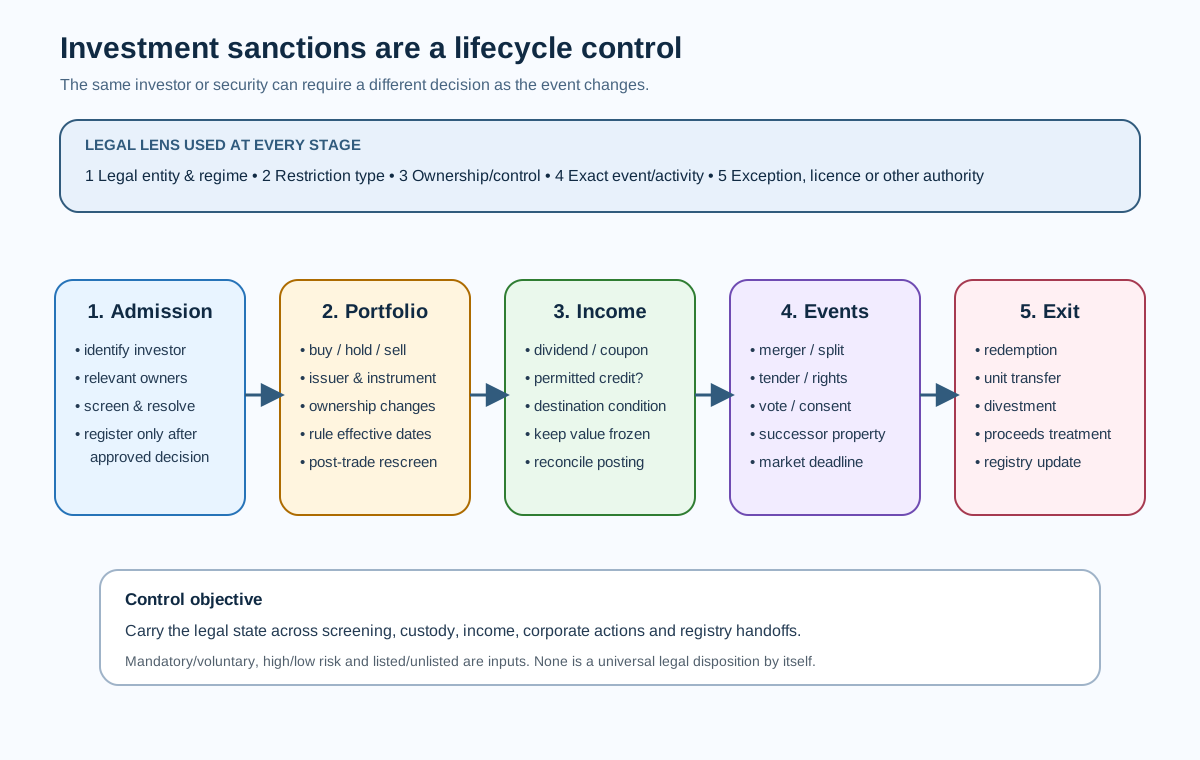
A five-question mental model
When a sanctions question appears in an investment process, begin with five questions in order.
1. Which legal regimes and legal entities are in scope? A group may operate a U.S. broker-dealer, an EU bank, a UK investment firm and offshore funds. The same position may be subject to different rules depending on the entity acting, where the service is performed, the nationality or status of the persons involved, and any transaction-specific nexus. Group policy may be stricter than the legal minimum, but policy and law must not be confused in the case record.
2. What type of restriction is this? A full asset freeze or blocking measure is not the same as a ban on new investment, a debt or equity restriction, a prohibition on certain securities services, or a country or sector measure. The data and decision logic differ. A blocked security may be property that cannot be transferred or dealt in without authorisation. A security subject to an investment prohibition may be lawfully held but not newly acquired by a particular person. A sectoral restriction may turn on issuance date, tenor, issuer, instrument type or other programme-specific attributes.
3. Whose property, interest or benefit is involved? Screening the issuer name is not enough. The bank may need to establish whether a security, fund, account, issuer, investor or intermediary is owned or controlled by a designated person under the applicable regime. Ownership and control rules differ. For example, OFAC’s 50 Percent Rule is an ownership rule, while UK and EU frameworks include their own ownership and control concepts. A global engine therefore needs regime-specific attribution logic rather than one percentage field labelled sanctioned.
4. What event is the bank actually processing? Holding, buying, selling, receiving a dividend, crediting a coupon, exercising a right, voting, accepting a tender, processing a merger, lending stock, taking collateral, redeeming fund units and transferring ownership are legally and operationally different events. The fact that an event is “mandatory” or “automatic” does not by itself answer whether it is permitted. The fact that cash remains inside the bank does not necessarily make the activity permitted either.
5. Is there an exception or authorisation, and what evidence does it require? Some regimes expressly allow certain credits to frozen accounts if the credit is itself immediately frozen. Some activities require a licence. Some investment restrictions allow holding or divestment but prohibit acquisition. The operations team should not infer permission from commercial necessity. It should identify the exact legal basis, conditions, reporting duties, effective dates and evidence needed before processing.
This sequence prevents a common control failure: screening produces a hit, the organisation jumps directly to “freeze” or “reject,” and nobody first determines what legal restriction actually applies to the investment event.
Sanctions screening is not the same as AML or investor suitability
Investment businesses often combine onboarding, AML, tax, suitability, market-abuse and sanctions controls in one workflow. The data may overlap, but the decisions are different. A fund subscription may need customer identification, beneficial-ownership information and source-of-funds evidence for AML reasons; it may require investor classification or suitability assessment under securities regulation; and it may require sanctions screening of the investor and relevant connected parties. Those controls should exchange data without pretending they have the same legal test.
A politically exposed person is not automatically sanctioned. A customer from a higher-risk jurisdiction is not automatically prohibited. An unusual subscription is not automatically a sanctions issue. Conversely, a customer that appears low risk for AML can still become subject to an asset freeze overnight through a designation or ownership change. The sanctions control therefore needs its own determination, evidence and escalation path.
This separation also matters to technology design. A case record should be able to state whether the trigger is a sanctions-list match, an ownership/control concern, an investment restriction, an AML risk factor, a fraud concern or another issue. A single red highRisk=true flag is not enough to support a legal disposition.
Funds, underlying securities and the difference between a blocked holding and a blocked fund
One of the most useful lessons in asset-management sanctions is that the status of an underlying holding does not always determine the status of the whole fund in a simple way. The legal answer depends on the programme.
OFAC provides clear programme-specific examples. Its FAQ 652 explains that a U.S. fund may not buy, sell or otherwise transact in blocked-person holdings and must block those holdings unless authorised, but the fund itself is generally not treated as blocked merely because it contains those holdings. Its FAQ 982 makes a similar point for certain blocked Russian financial-institution securities and explains the 50-percent-by-value consequence in that specific context. OFAC FAQ 1054, dealing with U.S. Russia-related new-investment prohibitions, shows a different type of restriction: U.S. persons may continue to hold certain previously acquired Russian securities and may divest to non-U.S. persons, while acquisition is restricted.
The teaching point is not that one OFAC FAQ is a global fund rule. It is the opposite. A sanctions engine must distinguish the status of the underlying asset, the fund vehicle, the investor and the activity. A fund may contain a restricted position without every investor becoming a blocked person. An investment prohibition may prevent acquisition without requiring a pre-existing holding to be sold. A fund itself may become blocked because of its ownership structure even if the specific portfolio position being reviewed is not listed. The system must preserve these distinctions.
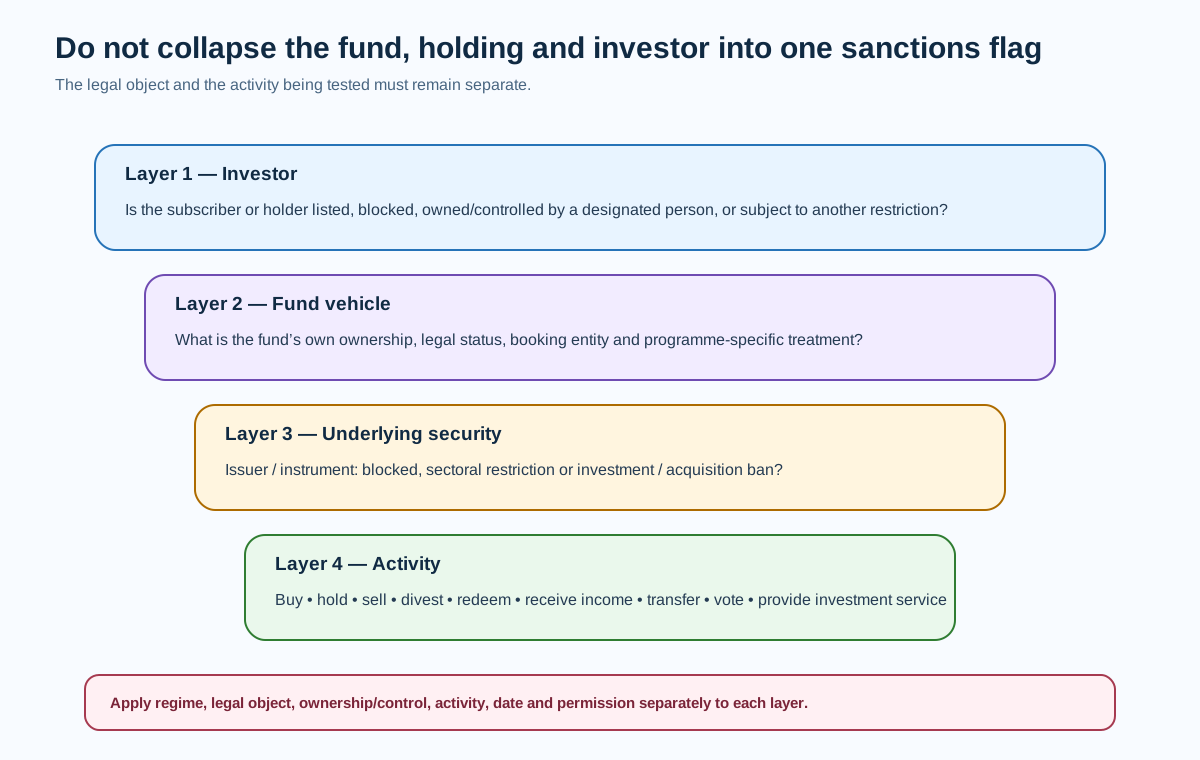
For business analysts, this means the core data model should not rely on a single securityRestrictionStatus. It should capture at least the legal regime, restriction type, subject entity or instrument, ownership/control basis where relevant, effective date, applicable activity, authorisation status and evidence source. The decision engine can then evaluate a proposed transaction against the correct restriction rather than apply a permanent static label to the instrument.
Investor admission and fund subscriptions
At onboarding or subscription, the sanctions objective is to avoid providing prohibited financial services or interests to persons caught by applicable restrictions. The exact screening population should come from law, regulatory guidance and bank policy. Depending on the product and legal structure, it can include the subscriber, beneficial owners, controllers, trustees, general partners, authorised signatories, intermediaries or other connected parties.
The sanctions determination should be separate from AML customer-risk scoring. AML teams may need source-of-wealth or source-of-funds evidence; sanctions teams may need identity resolution, ownership evidence, legal-entity relationships, nationality or jurisdictional facts, and the exact applicable list entry. When the same document serves both purposes, the case should record which fact it proves.
A strong subscription control has two stages. First, identity and ownership data are resolved before unit issuance. Second, the fund and transfer-agent systems prevent registration if the sanctions decision has not reached an approved disposition. This is more reliable than a workflow where screening occurs but the registry can still issue units because the sanctions case sits in a separate queue.
Ongoing screening matters because investor status changes. A designation, ownership change, corporate restructuring or legal update can affect an existing investor after onboarding. The bank therefore needs event-driven rescreening and a controlled response for positions already held. That response must follow the applicable legal framework; it should not be hard-coded as “close the account,” because an asset freeze normally aims to preserve property rather than transfer or confiscate it.
Portfolio screening and pre-trade controls
Portfolio sanctions controls answer a different question: may this legal entity acquire, hold, dispose of or service this instrument in this transaction?
The pre-trade engine should combine several types of information. Issuer screening can identify listed or blocked issuers. Ownership data can identify entities caught by an applicable ownership rule. Instrument data can support programme-specific restrictions based on debt or equity type, issuance date, maturity, tenor, currency or market. Geography and activity data can support country or sector prohibitions. Legal-rule data should identify what action is restricted: purchase, new investment, dealing, transfer, financing, securities service or another activity.
Post-trade controls are equally important. A previously clean issuer can be designated after purchase. A fund can acquire an issuer that later becomes owned by a designated person. A sanctions authority can amend a programme. A general licence can expire. A corporate action can change the instrument. The system therefore needs event-driven reassessment, not only a trade-date screen.
Good investment-sanctions architecture preserves as-at history. Investigators, auditors and regulators may ask what the bank knew on the trade date, which list version applied, what ownership evidence was available and what rule version produced the disposition. Reconstructing a past decision from today’s security master is unreliable because lists, ownership and instrument attributes change.
Dividends, coupons and other earnings on frozen property
Income is where simplistic sanctions training often goes wrong. A common but inaccurate shortcut says, “If the holder is sanctioned, every dividend or coupon needs a licence.” That is not universally true.
Under UK financial-sanctions regulations, there are exceptions in a number of regimes allowing a relevant institution to credit a frozen account with interest or other earnings due on that account, provided the credited amount is frozen immediately. OFSI’s FAQ 203, added on 14 September 2026, adds an important operational detail: for the Russia Regulations and equivalent provisions it identifies, the exception applies when the earnings are credited to the same frozen account on which they accrue. Crediting a separate frozen account may require a licence.
EU Regulation 269/2014 provides another example. Article 7 permits certain additions to frozen accounts, including interest or other earnings, provided the additions are also frozen. It also addresses third-party credits and certain pre-designation or judicial obligations. This does not mean every EU sanctions regime is identical, so the legal team still needs to identify the applicable instrument.
OFAC programmes have their own rules and licences. For example, OFAC FAQ 1197 addresses a specific Russia-related securities situation involving the National Settlement Depository and explains treatment of securities and income in that programme. The conclusion cannot simply be copied into another programme.
The correct control design is therefore:
- identify whether the account, security or entitlement is frozen or blocked under the applicable regime;
- identify the nature of the income event;
- check whether an exception or authorisation permits the credit and what destination it requires;
- ensure the credited amount remains frozen where required;
- apply any reporting or recordkeeping obligation; and
- prevent sweeps, reinvestments, transfers or standing instructions from moving the value out of the permitted frozen state.
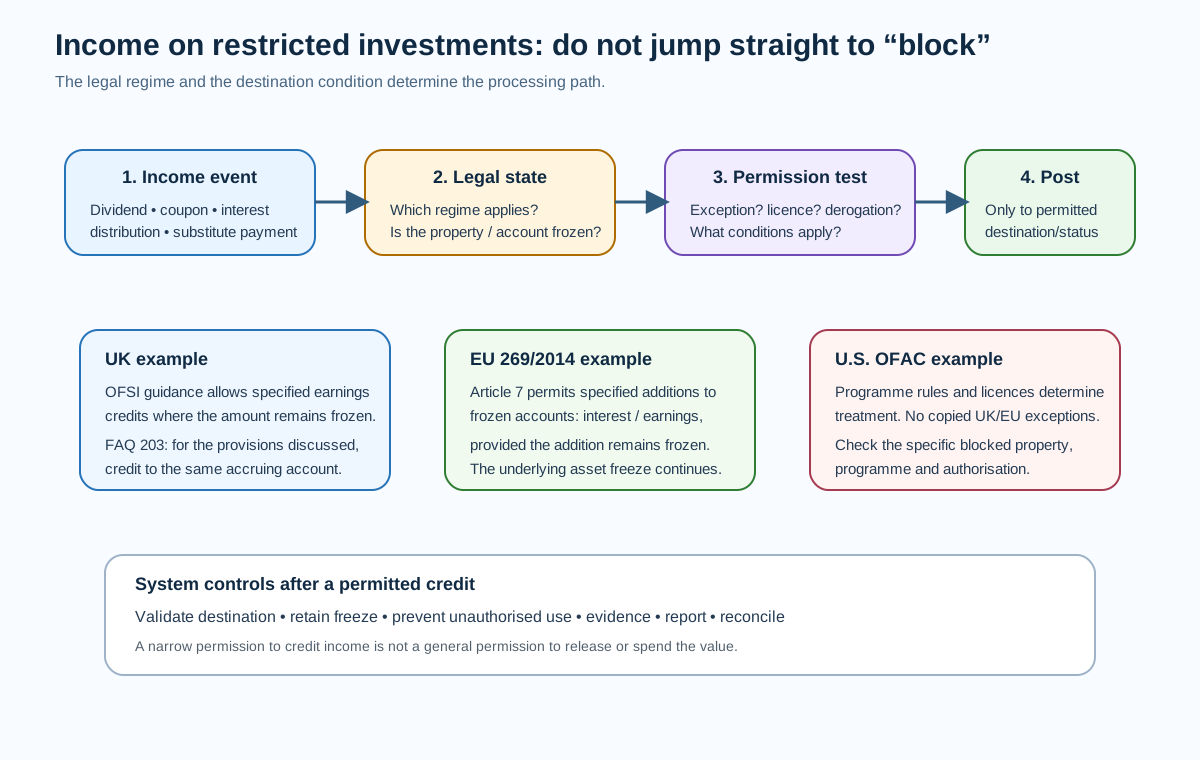
The technology risk is often not the sanctions rule itself but the fact that income processing uses a different system from the custody restriction flag. The security master may correctly show a frozen holding while the dividend engine follows an old standing settlement instruction and credits a normal cash account. End-to-end testing must therefore start at the restriction event and finish at the actual cash destination.
Tax withholding requires the same discipline. Whether tax can be deducted, paid to an authority or reclaimed from frozen income depends on the applicable legal framework and, sometimes, a licence or exception. A sanctions rule should not be replaced by a generic “tax always allowed” or “tax always needs a licence” system rule.
Corporate actions: mandatory does not mean automatically permitted
Corporate actions are difficult because they transform rights and property. A share split changes quantity without necessarily changing economic ownership. A merger may exchange one security for another. A compulsory acquisition may replace shares with cash. A rights issue can require new funds. A tender offer can involve a voluntary sale. A consent solicitation may involve voting or other exercise of ownership rights.
Operations teams commonly divide events into “mandatory” and “voluntary,” but that classification is only one input to the sanctions analysis. The legal question is whether the event involves dealing with frozen property, transferring value, exercising rights, making funds or economic resources available, entering a prohibited new investment, or performing another restricted service. A mandatory event can still create a new property interest or cash entitlement that must remain frozen. A voluntary election can sometimes be permitted under a specific exception or licence. The bank must test the actual event.
A practical corporate-action assessment captures:
- the legal regime and restriction;
- the holder and issuer sanctions status;
- the old instrument and the new instrument or cash entitlement;
- whether ownership, possession, value or rights change;
- whether the event is automatic or requires an election;
- whether the customer must contribute new cash or securities;
- whether an exception or authorisation applies;
- the election deadline and processing cut-off; and
- the intended destination and freeze status of any proceeds or new security.
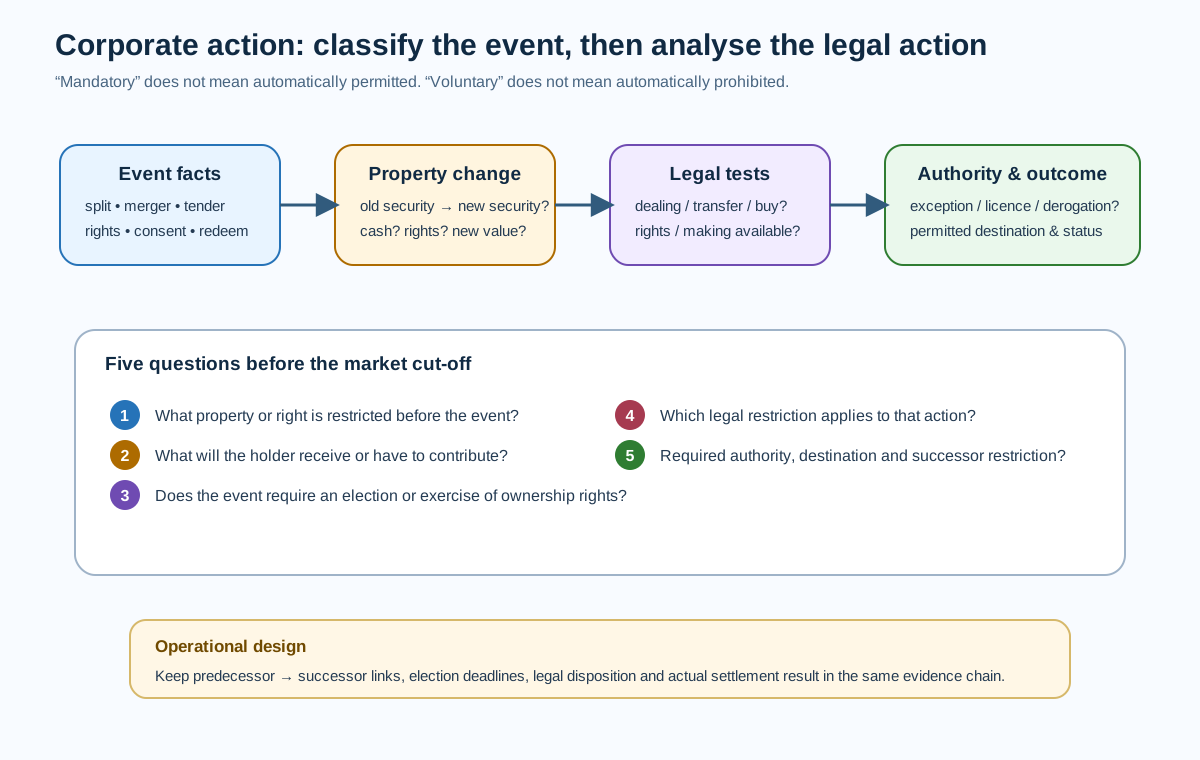
This design allows operations to prepare for a deadline without making an unauthorised election. A bank may create a conditional instruction pending legal determination, provided its operating model and market infrastructure allow that approach. The case should record what was done before the cut-off, what legal basis supported the final action, and how the successor property was restricted.
Custody chains and omnibus holdings
A global security can be held through issuer, central securities depository, local custodian, global custodian, nominee and client layers. A bank may therefore hold legal title while another party has the economic interest. Sanctions attribution needs the evidence available at the bank’s layer and, where required, look-through information from intermediaries.
Omnibus accounts create a particular challenge because designated and non-designated interests can be pooled. The objective is not to freeze innocent property by default. The objective is to identify the restricted interest accurately enough to preserve it while permitting lawful activity in unaffected interests, subject to the applicable legal framework and the bank’s ability to evidence attribution.
Possible operational techniques include sub-account segregation, quantity or value attribution based on underlying books, transaction-history reconstruction and specific blocked sub-ledgers. Any method should be legally validated for the product and jurisdiction. A crude pro-rata freeze is not a neutral answer if the legal entitlement can be identified more precisely.
The data lineage matters as much as the legal conclusion. The case should be able to show the client account, omnibus account, position identifier, beneficial or underlying owner where relevant, restriction source, quantity or value frozen, downstream custodian instruction and reconciliation result. If one layer shows blocked and the next layer does not, the control is not complete.
Transfers, redemptions and secondary transactions
A fund can receive a new investor through a primary subscription or a secondary transfer of units. That second route is a classic control gap. A transfer agent that screens only new subscriptions can admit a prohibited investor through an off-market transfer while every primary-market control appears green.
The appropriate screening and look-through depth depends on law, fund documents and risk, but the control design should ensure secondary changes of ownership receive a sanctions determination before the registry is updated where the bank is responsible for that function. The same principle applies to transmissions on death, insolvency events and reorganisations that change registered ownership.
Redemptions require separate analysis. A designated investor may have an economic entitlement but be unable to receive unrestricted cash. In an asset-freeze regime, the bank may need to retain the property in frozen form unless an exception or licence permits another action. In a different investment restriction, holding or divestment may be permitted. The operations system should therefore route the request to a legal disposition instead of treating redemption requested as either automatically blocked or automatically executable.
Fund-level liquidity gates should also be separated from sanctions decisions. A manager may legitimately suspend redemptions because the portfolio is illiquid, but that commercial or regulatory liquidity action does not replace the sanctions determination for restricted holdings. The records and customer communications should state the correct basis for each action.
Securities lending, collateral and financing
Securities lending and collateral multiply the number of parties and events around one security. A stock-loan transaction can involve a lender, borrower, agent lender, collateral provider, custodian and manufactured dividend. Collateral can be substituted daily. Rehypothecation can move a security through several arrangements.
The sanctions control should therefore assess each legally relevant leg rather than assume a clean borrower makes the security clean. Before allocation, the system can check whether the security is eligible for lending under applicable restrictions. Collateral engines can exclude securities that cannot lawfully be transferred or realised. Manufactured payments need their own legal treatment; a substitute payment should not be assumed automatically equivalent to a dividend under every sanctions regime.
Credit risk and sanctions risk intersect but remain separate. A restricted security may have reduced collateral value because it cannot readily be sold. That affects haircut and recovery assumptions. It does not itself determine whether the security is legally prohibited. The legal and credit conclusions should be stored separately so one does not silently stand in for the other.
Voting, consent and governance rights
Frozen property can include securities that carry voting or consent rights. Whether those rights can be exercised depends on the applicable prohibition. The analysis should consider whether voting is a form of dealing with the frozen asset, an exercise of ownership rights, or another restricted activity under the relevant regime. A global bank should not configure a universal votingDisabled=true rule for all sanctioned holdings without legal mapping.
This becomes especially important in restructurings, schemes, bondholder consents and activist situations where a vote can change the value or control of an entity. Proxy-voting platforms and custody instruction systems need the sanctions status and the legal disposition early enough to meet meeting deadlines. The evidence should record both the position restriction and the decision on the governance action.
Investment data and system architecture
An effective investment-sanctions control is a data system as much as a policy. At minimum, the architecture needs reliable identities for investors and issuers, ownership and control relationships, instrument identifiers, positions, corporate-action events, income events, legal-entity nexus, sanctions-rule versions, licences or exceptions, and final disposition.
A useful event model separates:
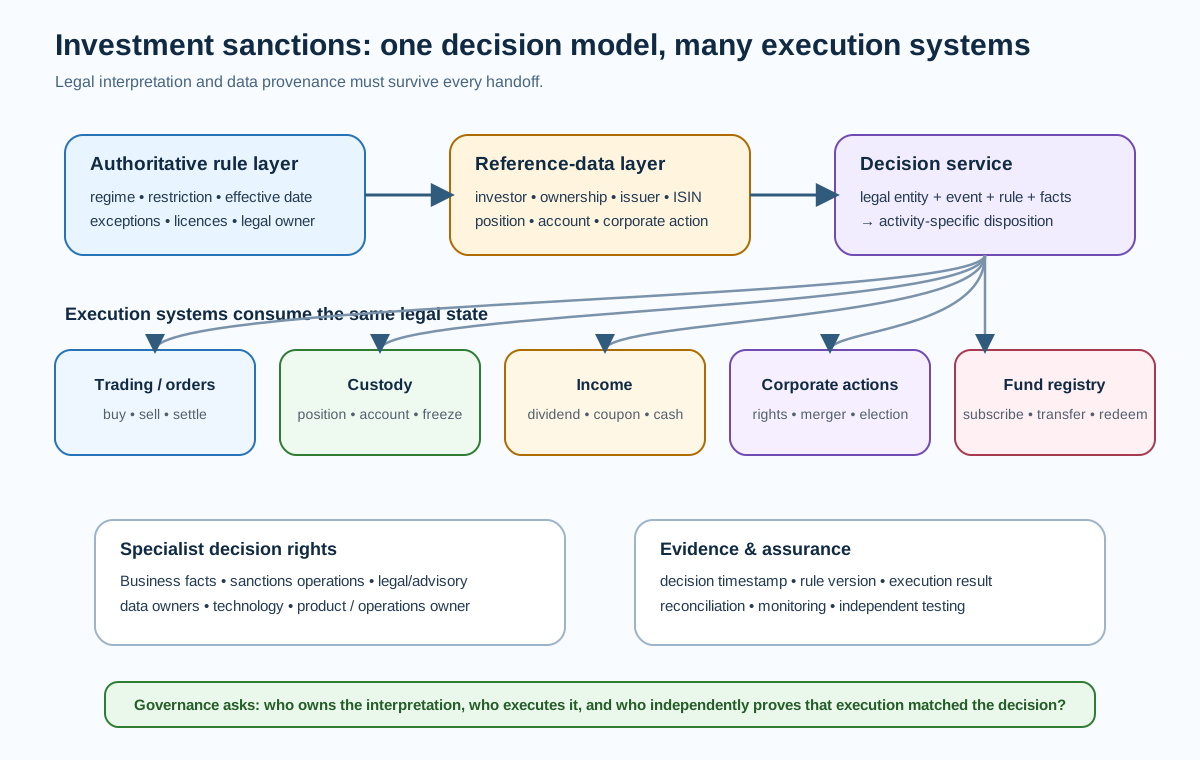
restriction_event: designation, ownership change, rule change or licence expiry;position_event: acquisition, disposal, transfer or collateral allocation;income_event: dividend, coupon, distribution or substitute payment;corporate_action_event: split, merger, rights issue, tender, redemption or other event;decision_event: legal/compliance disposition with rule version and evidence; andexecution_event: what the custody, trading, payment or transfer system actually did.
This separation supports both operations and investigations. If a regulator asks why a dividend moved after designation, the bank can trace the designation time, position state, income event, decision and actual posting instead of reconstructing the answer from screenshots.
Rule engines should be effective-dated. A sanctions conclusion on 10 September should be reproducible using the rules and lists that applied on 10 September, even if the current list has changed. This is especially important in sectoral restrictions and investment bans where dates can determine whether acquisition, holding or divestment is permitted.
The control architecture and decision rights
Investment sanctions cut across investment management, markets, custody, fund administration, legal and compliance. The operating model should therefore define who owns each decision.
The investment or product team owns the commercial activity and complete transaction facts. Securities operations own accurate execution and position records. Sanctions operations perform screening, identity resolution and established-rule application. Legal or sanctions advisory resolves novel legal interpretation, licensing and jurisdiction questions. Technology teams implement effective-dated rules and controls. Data owners maintain instrument and ownership data. Independent testing and audit challenge the effectiveness of the whole chain.
No one role should silently perform all of those functions. A trader should not decide whether an ambiguous licence covers a transaction. A sanctions analyst should not invent a security’s maturity because reference data is missing. A developer should not translate a legal memo into a permanent hard-coded rule without an effective date and change process.
Alert to case to investigation
Not every investment-sanctions alert becomes an investigation. The initial alert may be a name match, an ownership link, a security restriction, a new designation, a corporate-action event or a failed downstream instruction. Triage should resolve clear false positives and known authorised activity quickly while preserving enough evidence to explain the closure.
A case is needed when the bank must resolve identity, ownership, applicable law, instrument scope, transaction purpose, licence conditions or an apparent control breach. The investigator should build a timeline across customer, trade, position, income and corporate-action systems rather than examine the screening alert alone.
Where the issue suggests intentional evasion, the investigation can expand to related accounts, counterparties, intermediaries, transfers and communications. AML or suspicious-activity reporting may become relevant under local law, but a sanctions control issue does not automatically equal an AML report. The reporting decision should follow the applicable FIU and sanctions-authority requirements separately.
The case outcome should state both the legal disposition and the operational remediation. For example: property frozen under a particular regime; income re-credited to the permitted frozen account; corporate-action instruction cancelled; transfer registration prevented; licence application initiated; incorrect restriction removed; or control defect raised for remediation. This prevents the case from closing with a vague “confirmed sanctions hit” that tells operations nothing about what must happen next.
Worked mini-case: the dividend routed to an old settlement account
A global custodian holds shares for a client. The client becomes subject to an asset freeze under the law applicable to the booking entity. The custody platform correctly applies a restriction flag to the securities position. Two weeks later, the issuer pays a dividend. The income engine follows a standing settlement instruction created months earlier and credits the dividend to the client’s ordinary cash account, which is then swept automatically to another account.
The investigation starts with the legal question: what did the applicable regime permit for income on frozen property? Assume, for this fictional case, that the relevant rule permits interest or earnings to be credited to a qualifying frozen account provided the addition remains frozen, and the customer’s ordinary cash account is not that permitted destination. The dividend processing was therefore not compliant with the assumed rule.
The next step is transaction reconstruction. Investigators identify the record date, payment date, amount, security position, designation time, restriction flag, income instruction, cash posting, sweep and final balance. They determine whether the value remains recoverable inside the bank and whether other frozen positions used the same settlement-instruction logic.
The root cause is architectural: custody restrictions and income routing use different master data. The designation workflow updated the position flag but not the standing settlement instruction. The control fix is not merely to retrain the analyst. The bank adds a restriction check at income generation, validates the destination account, suppresses sweeps from frozen accounts, creates an exception queue when no legally permitted destination is available, and tests the change with dividends, coupons and corporate-action cash proceeds.
The lesson is broader than dividends. Sanctions compliance fails at system boundaries. A legally correct status in one system is useless if another system can move the value without reading it.
BA, architecture and testing considerations
A business analyst should convert the chapter into requirements that are testable. Examples include: every investment transaction must carry the booking legal entity and applicable sanctions-rule context; every security decision must preserve the rule version and evidence used; every corporate action must carry predecessor and successor instrument identifiers; every income posting on a restricted position must be tested against a destination-account rule before posting; every registry ownership change must invoke the relevant sanctions determination; and every exception or licence must carry validity dates and conditions.
Acceptance criteria should use concrete scenarios, not statements such as “system must comply with sanctions.” Test packs should include clean holdings, false-positive issuer names, blocked issuers, entities caught by an ownership rule, pre-existing holdings subject to an acquisition ban, income that can be credited only to a frozen account, income needing further authorisation, mandatory mergers, voluntary tenders, rights issues requiring new cash, transfers to a restricted investor, licence expiry, list-update failure, missing instrument data and downstream custodian rejection.
Negative testing matters. A lawful dividend credit should not be stopped because the engine confuses an asset freeze with a total prohibition on receiving earnings. A pre-existing holding should not be forced into sale where law permits continued holding. A clean fund should not be blocked solely because one underlying security is restricted when the applicable regime does not produce that result. Over-restriction is a control failure too: it can create customer harm, market disruption and legal claims while hiding the fact that the rule engine does not understand the law.
Failure-mode testing should include unavailable sanctions-list feeds, stale ownership data, missing corporate-action details, duplicate events, late list updates, processing cut-offs and a licence expiring while an event is in flight. The expected fallback should be pre-defined. “Hold everything until someone decides” may be appropriate for some high-risk conditions but is not a universal legal answer and can itself breach market or customer obligations if used indiscriminately.
What good looks like
A mature investment-sanctions programme can answer seven questions quickly for any material position or event: which legal entity acted; which regime applied; which restriction applied; whose property or interest was involved; what exact investment event occurred; what exception, licence or rule supported the action; and what the systems actually executed.
It also keeps law, policy and risk appetite separate. The bank may choose not to offer certain investments even when legally permitted. That is a business or risk decision. It should not be labelled a statutory sanctions prohibition. Equally, a commercially important customer does not change a legal asset freeze.
The strongest programmes are precise rather than simply restrictive. They freeze what must be frozen, prevent prohibited acquisitions and services, preserve authorised income correctly, process corporate actions within the law, allow lawful activity to continue, and maintain an evidence trail that a regulator, auditor or court can reconstruct later.
The next sections deepen the operating mechanics, worked cases, governance, testing and practitioner checks. They should be read together with the dedicated chapters on ownership and control, blocking and reporting, sectoral restrictions, licensing and sanctions interdiction because investment operations consume all of those capabilities at once.
Operational deep dive: restriction engines, custody events and evidence
The base chapter established a jurisdiction-first method. This section turns that method into operating architecture. The aim is not to automate legal judgement away. It is to make the facts, rule version, decision and execution sufficiently structured that routine cases can be controlled consistently and difficult cases can reach a specialist with the right evidence before a market deadline expires.
Separate legal restriction from operational status
A securities platform often wants one status such as BLOCKED, RESTRICTED or PERMITTED. That is convenient for processing but dangerous as the legal source of truth. One instrument can be subject to several restrictions at the same time, and each can prohibit a different activity.
A better model stores the legal facts separately from the operational outcome. The legal layer records the authority or regulation, programme, subject, restriction type, ownership/control basis, effective date, affected activity, exception or authorisation, expiry and source. The operational layer then derives the action for a specific legal entity and event: allow, allow with conditions, prevent acquisition, preserve holding, freeze, route to a specified frozen account, hold for specialist decision, or reject an instruction where that is the lawful and operationally correct response.
This matters because the word restricted can hide incompatible meanings. A blocked security under an OFAC programme is not the same thing as a security that a U.S. person may continue to hold but may not newly acquire under an investment prohibition. A UK frozen asset is not the same thing as an instrument affected by a specific Russia investment restriction. An EU asset freeze may permit certain additions to a frozen account while still prohibiting dealing with the frozen funds. The engine must know which proposition it is enforcing.
Effective-dated rule architecture
Sanctions decisions are time-sensitive. The architecture should therefore preserve effective dates for list entries, ownership conclusions, legal rules, general licences, specific licences, derogations and internal policy overlays. A trade on Monday should be judged using Monday’s applicable legal state, not the current state after a designation on Wednesday.
A useful rule object contains:
- legal regime and authority;
- regulated legal entity or nexus;
- restriction type;
- subject person, issuer, instrument or activity;
- rule start and end dates;
- grandfathering or transitional conditions where applicable;
- authorisation identifier and validity period;
- action controlled, such as acquisition, sale, transfer, provision of service or dealing with frozen property;
- evidence source and legal owner of the interpretation; and
- version and approval history.
The trading or custody system should consume a derived disposition rather than reproduce legal text in dozens of local code bases. This reduces divergence when a rule changes. It also allows a determination library to explain why one event is prohibited while another event involving the same issuer is permitted.
Security-master and ownership data
Investment controls are only as good as their reference data. The bank should be able to resolve multiple identifiers for the same instrument, such as ISIN, CUSIP, SEDOL and proprietary identifiers, and link them to the correct issuer and guarantor where relevant. Corporate actions must carry predecessor and successor identifiers so restriction status does not disappear during a merger, exchange or reorganisation.
Ownership data requires effective dating too. A company may become caught by an applicable ownership rule without appearing by name on a sanctions list. The engine should retain who owned what percentage, through which entities, on which date, and which regime’s ownership/control methodology was applied. It should not collapse an OFAC 50 Percent Rule determination and a UK ownership/control conclusion into a common percentage threshold.
Data-quality controls should identify stale ownership records, missing instrument dates, conflicting issuer identifiers and unsupported vendor flags. A vendor’s sanctions=true flag is an input, not a legal determination. Material exposures and edge cases require evidence the bank can defend independently.
Pre-trade and post-trade control design
Pre-trade controls should answer whether the proposed transaction is permitted for the acting legal entity at the intended time. The engine needs the security, side of trade, quantity, counterparty, account, booking entity and relevant product mechanics. If the restriction depends on issuance date, maturity, country, issuer ownership or another attribute, those fields must be present before the system can claim a deterministic decision.
When required data is missing, the fallback should be explicit. Some transactions may route to manual review. Some products may be prevented from trading until mandatory reference data is present. The fallback is a risk and service decision informed by legal obligations; it should not be described automatically as a legal freeze.
Post-trade controls detect changes that arise after execution: new designations, ownership changes, list corrections, licence expiry, corporate actions or rule amendments. The output is an affected-position population with a reason and effective time, not merely a list of customers to rescreen. The downstream workflow should assess holdings, open orders, unsettled trades, collateral, lending positions, income entitlements and upcoming corporate actions.
Income processing: preserve the legal state through automation
Income engines are often separate from custody restriction platforms. That makes them a high-risk handoff. The correct design begins by determining the legal status of the entitlement, then the permitted destination and any reporting conditions.
In some asset-freeze regimes, interest or other earnings may be credited to a frozen account if the addition is itself frozen. UK guidance provides a current example, and OFSI FAQ 203 adds a same-account condition for the provisions it discusses. EU Regulation 269/2014 Article 7 provides another regime-specific example of additions to frozen accounts. Other sanctions programmes can differ. The system therefore needs a configurable income disposition rather than a universal block dividend rule.
The processing sequence should include:
- identify the position and entitlement holder at the relevant record date;
- establish the applicable restriction and rule version;
- classify the income event: dividend, coupon, distribution, interest, substitute payment or other entitlement;
- determine whether an exception or authorisation permits crediting and to which account;
- ensure the destination carries the required frozen status before posting;
- suppress sweeps, reinvestment and automatic transfers that would move the value outside the permitted state;
- create any required regulatory report or event record; and
- reconcile the posted value to the restricted position and decision.
A corporate action can generate cash even when it is not labelled an income event. Cash-in-lieu for fractional shares, merger consideration, redemption proceeds and tender premiums should enter the same legal-disposition framework rather than bypass income controls through a separate event processor.
Tax, fees and deductions
Tax and fee processing should not be assumed permitted merely because it is operationally standard. The control needs to identify whether withholding or payment is allowed under the applicable sanctions framework, whether an exception applies, whether a licence is required, and whether the payment creates a prohibited benefit.
The bank should distinguish calculation from movement. It may be able to calculate a tax liability even when payment from frozen property requires separate authority. Conversely, a particular regime may permit a payment without a specific licence. The system should therefore store the legal basis for the deduction or payment instead of embedding tax=true => allow in accounting logic.
Tax reclaims create a second problem: a refund is new value arriving after the original withholding. The reclaim workflow should identify the sanctioned status at the time the refund is received, determine the permitted destination and prevent the recovery from becoming freely available through an unrestricted cash account.
Corporate-action event model
Corporate-action systems should provide sanctions teams with structured facts rather than a free-text event notice. Useful fields include event type, mandatory/voluntary classification, old and new instruments, cash consideration, subscription amount, record date, ex-date, election deadline, market deadline, default option, issuer, paying agent and custody chain.
The sanctions determination should then answer questions that are legally meaningful:
- does the event change ownership, possession, character, destination or ability to use frozen property under the applicable regime;
- does an election constitute a sale, purchase, new investment, transfer, dealing or exercise of rights;
- does the holder have to contribute new funds or securities;
- is a licence, exception or derogation available;
- what happens if no election is made;
- where will successor securities or cash be credited; and
- what restriction must attach to the successor property.
The default option matters. Operations should not assume that doing nothing is legally neutral. A default cash-out can transform a restricted security into cash. A default stock option can create a new security. The legal review should assess the actual default mechanics when the customer cannot lawfully make an election.
Omnibus and pooled positions
Pooled custody requires the bank to connect the legal entitlement to an identifiable share of the omnibus position. The control should preserve both the external omnibus position and the internal sub-ledger showing each customer’s beneficial or economic interest where the bank maintains that information.
When a customer becomes subject to an asset freeze, the bank should determine the quantity or value attributable to that customer under the applicable legal and custody framework. The external account may remain technically omnibus, but internal controls should prevent the restricted customer’s interest from being transferred, released or used. If downstream custodians need an instruction or separate blocked account, that requirement becomes part of the execution evidence.
Approximation should be exceptional. If the bank can identify the customer’s exact securities and cash, a rough pro-rata freeze is difficult to defend and can harm innocent holders. Where the legal structure truly prevents exact attribution, specialist legal and custody analysis should determine the method.
Reconciliation is essential. The sum of clean and restricted internal interests should reconcile to the external holding. Corporate actions and income should update both layers consistently so a frozen interest does not disappear after an event.
Transfer-agent and fund-registry controls
Fund registers can change ownership through subscriptions, redemptions, secondary transfers, transmissions on death, mergers of investor entities or corrections. Every route that changes ownership should be mapped to the sanctions-control point appropriate to that product and jurisdiction.
A practical design uses a registration gate: before ownership is recorded, the workflow confirms the sanctions determination has completed or that an approved exception path applies. This does not mean every transfer needs identical due diligence to a new subscription under every law. It means the fund and administrator should not create an obvious unscreened side door into the register.
The control should also preserve evidence of the transferor, transferee, intermediary, beneficial-owner information available, screening results, ownership analysis, decision and registration time. If a transfer is later found to involve a prohibited person, the bank can reconstruct what it knew and whether the failure came from data, process, screening or deliberate evasion.
Collateral and securities-financing integration
Collateral systems need sanctions-aware eligibility because they may automatically allocate or substitute securities at high frequency. The engine should evaluate whether the proposed pledge, transfer, reuse or realisation is permitted, not simply whether the security is listed.
A security may be legally holdable but unsuitable as collateral because the bank could not enforce or sell it under foreseeable sanctions conditions. That is a credit-risk or collateral-policy conclusion layered on top of the legal sanctions conclusion. Keeping those fields separate prevents the control from falsely describing a conservative haircut as a statutory prohibition.
Securities lending similarly requires event-level analysis. The opening loan, collateral movement, recall, return and substitute dividend are distinct transactions. If the legal regime treats one of them differently, a single eligibility flag for the whole lending programme is too crude.
Event queues and market deadlines
Investment operations work against exchange, CSD, custodian, fund and corporate-action deadlines. A sanctions case can therefore become time critical without becoming legally simpler.
A good queue carries both legal urgency and market urgency. Legal urgency reflects the consequences of potential prohibited activity. Market urgency reflects an election or settlement cut-off. The queue should not prioritise solely by trade value or customer importance.
Where the facts are incomplete, the case should identify the minimum information needed to decide. For a rights issue, that may be holder status, applicable regime, cash subscription requirement and successor security. For a dividend, it may be account status and permitted credit destination. For a transfer, it may be identity and ownership of the transferee. This keeps investigation focused and avoids requesting broad KYC packs when the legal decision turns on one missing fact.
Audit trail and as-at reconstruction
Each material determination should support an as-at reconstruction with:
- transaction or event identifier;
- legal entity and jurisdictional nexus;
- customer, issuer and instrument identifiers;
- sanctions-list version and ownership evidence;
- rule or policy version;
- licence, exception or legal advice reference;
- analyst and approver;
- decision timestamp;
- operational instruction; and
- execution and reconciliation result.
Screenshots can supplement this record but should not be the primary evidence. Structured data allows lookbacks, control testing and regulatory response at scale.
BA and testing patterns
Business analysts should derive scenarios from the restriction taxonomy, not just from happy-path products. A robust test pack includes:
- a clean security and clean investor;
- a false-positive issuer name;
- a blocked issuer;
- an issuer caught by an applicable ownership rule;
- a fund containing a blocked underlying position where the fund itself is not blocked under the assumed rule;
- a pre-existing security that may be held but not newly acquired under an assumed investment prohibition;
- a dividend permitted only into a specified frozen account;
- an income event requiring licence review;
- a mandatory merger creating successor securities;
- a compulsory cash-out;
- a voluntary tender;
- a rights issue requiring new cash;
- a secondary transfer to a designated investor;
- a general licence expiring before settlement;
- stale ownership data;
- a list-feed outage; and
- a downstream custodian rejecting an instruction that the bank’s own engine allowed.
For each case, expected results should be approved by the legal or sanctions-policy owner. Testing against current production behaviour merely proves the system can reproduce itself.
Practitioner checkpoint
A practitioner should now be able to distinguish legal restriction from operational disposition, explain why effective-dated rule and ownership data are essential, design an income-processing control that preserves a permitted frozen credit without releasing value, model a corporate action as a property transformation rather than a simple event code, and build an audit trail that reconstructs the decision months later.
The central idea is precision. Investment sanctions controls are strongest when they identify exactly what property, person, activity, legal rule and time period are relevant. Generic labels such as sanctioned security or blocked customer are not enough to operate complex securities businesses safely.
Advanced practice: worked investment-sanctions cases
These cases are fictional and use illustrative facts. They are designed to show how a bank should reason rather than to teach one jurisdiction’s result as a global rule. Each case therefore states an assumed legal setting. In a live case, the institution must confirm the actual sanctions regime, legal entity, ownership/control position, programme wording, exceptions, authorisations and reporting duties before acting.
Case 1: dividend income reaches the wrong cash account
Assumption. The booking entity is subject to a financial-sanctions regime that freezes a designated customer’s securities and permits certain earnings to be credited only if the credit remains frozen in a qualifying account. The exact exception and destination conditions are confirmed by legal or sanctions advisory before processing.
A global custodian correctly freezes a customer’s equity position after designation. The next quarterly dividend is processed by a separate income platform that follows an old standing instruction and credits an ordinary operating account. An automatic sweep then moves part of the balance to another internal account.
The investigation should not start with the proposition that “all dividends are prohibited.” It should identify the applicable rule and permitted destination, then reconstruct the event. The evidence pack includes the security position, designation timestamp, list version, income entitlement, record date, payment date, account status, standing instruction, sweep, subsequent transactions and any reporting already made.
The control failure is an integration failure. The custody platform carried the correct legal status, but the income engine did not consume it. Remediation therefore includes recovery or re-freezing of value where legally required and possible, a lookback across other restricted positions, a destination-account validation before income posting, sweep suppression for frozen accounts and end-to-end regression tests.
The lesson is that sanctions status must travel with value. Correct screening at the custody layer does not protect a dividend that another system can release.
Case 2: a fund contains a blocked underlying security
Assumption. A U.S. fund is reviewing a holding in a blocked issuer under an OFAC programme. The legal team uses the applicable OFAC regulations, licences and programme guidance rather than applying a generic fund rule.
The portfolio manager asks whether the entire fund must be frozen because one portfolio company has become blocked. The compliance engine currently sets the fund’s own status to BLOCKED whenever any underlying security is blocked, which would prevent subscriptions, redemptions and ordinary management of clean assets.
The team reviews the programme and relevant OFAC guidance. OFAC FAQs 652 and 982 illustrate that, in the circumstances those FAQs address, a U.S. fund can be required to block and stop transacting in the blocked underlying holdings without the fund itself automatically becoming a blocked entity merely because it contains them. Programme-specific ownership and value rules still matter, and other investment restrictions can apply separately.
The system defect is conceptual: it treats underlying holding blocked and fund vehicle blocked as the same status. The remediation creates separate entities and restriction records for the issuer, security, fund and investor, with rules that test the actual activity. It also adds an exception route for authorised divestment where applicable.
The lesson is that a portfolio is a collection of legal interests, not one sanctions object. A control can be stricter than law as a risk decision, but it should not mislabel that decision as a statutory asset freeze.
Case 3: compulsory acquisition converts frozen shares into cash
Assumption. A customer holds shares that are frozen under the law applicable to the custodian. A compulsory acquisition will cancel the shares and create a cash entitlement. Legal advice confirms that the restriction must continue to attach to the value received unless an exception or authorisation provides otherwise.
The corporate-action platform marks the event MANDATORY and therefore bypasses sanctions review. The shares are cancelled, and cash consideration is automatically credited to the customer’s normal settlement account.
The failure is not that the event was mandatory. The failure is that the system treated mandatory as a legal permission. The correct assessment should have considered the property transformation, the customer’s frozen status, the nature of the cash entitlement, the destination account and the applicable exception or licence framework.
Remediation adds a sanctions decision gate to every event that changes a restricted position into another security or cash, regardless of event classification. The system preserves predecessor and successor identifiers, links the resulting entitlement to the original restricted property and validates the destination before settlement.
The lesson is that mandatory and voluntary are operations classifications. They help describe the event but do not replace the sanctions analysis.
Case 4: a secondary transfer admits a designated investor
Assumption. The fund documents and applicable law permit the administrator to refuse or suspend registration where sanctions make the transfer prohibited, and the transfer agent is responsible under the operating model for obtaining an approved sanctions determination before registration.
A private fund applies full screening to subscriptions but treats off-market transfers as administrative changes. A purchaser is introduced through two intermediaries, and the transfer agent registers the new holder after checking only signed transfer forms. A later rescreen identifies the purchaser as an entity caught by an applicable ownership rule.
The investigation maps the information available at transfer time, including the intermediaries, ownership evidence, pricing, beneficial-owner data and whether the designated connection could reasonably have been identified. The team also reviews whether the fund’s constitutional documents and service agreements clearly assign sanctions responsibilities for secondary transfers.
The control reform is a registration gate: no change of holder is completed until the required sanctions determination is recorded. The depth of look-through is defined by applicable law, policy and risk rather than a slogan that every secondary transfer must copy the entire subscription process.
The lesson is that controls should cover every route by which ownership can change. A perfect primary-market process does not protect an unscreened secondary door.
Case 5: an investment prohibition is mistaken for an asset freeze
Assumption. A U.S. person holds securities affected by a Russia-related new-investment prohibition. The securities are not themselves blocked property, and current OFAC guidance permits continued holding and specified divestment activity in the circumstances assumed.
A rule change is loaded into the bank’s sanctions engine. The configuration team maps the rule to BLOCKED, causing custody to freeze pre-existing holdings, reject all sales and prevent settlement instructions. The intention was conservative, but the configuration has changed the legal meaning of the restriction.
OFAC FAQ 1054 illustrates why the distinction matters: certain Russia-related new-investment prohibitions restrict purchases while allowing continued holding and divestment to non-U.S. persons, subject to the programme and facts. A blocking rule and an acquisition prohibition therefore require different system states.
The repair introduces activity-specific restrictions: ACQUIRE_PROHIBITED, HOLD_PERMITTED, DIVESTMENT_PERMITTED_SUBJECT_TO_CONDITIONS, BLOCKED_PROPERTY and other states are mapped separately. The user interface shows both the legal restriction and the operational action so custody staff understand why a sale can be allowed even though a purchase is not.
The lesson is that over-restriction is not evidence of a sophisticated sanctions system. Precision is stronger because it preserves lawful activity while enforcing the exact prohibition.
Case 6: a rights issue crosses the line from holding to new investment
Assumption. An investor lawfully holds an existing security, but the applicable sanctions programme restricts certain new investment or acquisition activity. A rights issue offers the investor the option to contribute new cash for additional securities.
The custody system sees the rights entitlement as a corporate action linked to an existing holding and automatically offers the customer the default instruction to subscribe. Compliance initially assumes the action is grandfathered because the original shares pre-date the restriction.
The correct analysis separates the old property from the new action. The bank identifies whether exercising the right would constitute a new purchase, new investment or other prohibited transaction under the applicable programme. It also assesses whether sale, lapse or another treatment of the right is allowed. If authorisation is required, the election deadline and licence timing become operational constraints but do not create permission by themselves.
The system change adds a new_value_required and new_security_acquisition indicator to corporate-action events. That data routes rights issues and similar elections to the correct legal rule instead of inheriting the status of the original holding.
The lesson is that corporate actions can contain new transactions inside an existing investment relationship. The event must be decomposed into its legal components.
Case 7: UK frozen-account earnings are sent to a different frozen account
Assumption. A UK relevant institution is processing interest or other earnings under the exception discussed by OFSI FAQ 203, added on 14 September 2026. The facts fall within the provision described in that guidance.
The bank has two frozen accounts for the same designated person. Its cash-management configuration sends all investment income to a nominated income account. Operations assume this is safe because both accounts are frozen.
OFSI FAQ 203 makes the operational detail material: for the Russia Regulations and equivalent provisions identified by OFSI, the exception allows the earnings to be credited to the same frozen account on which they accrue, not simply any frozen account belonging to the same person. The bank therefore cannot treat destination frozen = yes as sufficient for that exception.
The control change records the source account, accrual relationship and permitted destination condition. If the business wants to use a different account, the case routes for licence analysis rather than relying on the generic frozen status.
The lesson is that exceptions have conditions. A broad platform flag can be legally wrong even when it appears conservative.
Case 8: EU frozen-account income is confused with an unrestricted payment
Assumption. An EU credit institution is applying Council Regulation (EU) No 269/2014 to a listed person. Article 7 is relevant to the facts.
A business user sees that interest or other earnings may be added to a frozen account and concludes that the customer can use the credited amount to pay an unrelated supplier. That interpretation collapses two separate questions: whether value may be credited and whether the frozen value may subsequently be dealt with or made available.
The control should preserve the frozen status of the addition. The permitted credit does not convert the money into unrestricted funds. Payment out requires its own legal basis, such as an applicable authorisation or other provision.
The system therefore stores both credit permitted and post_credit_status = frozen. Payment engines consume the second state and prevent ordinary release.
The lesson is that sanctions exceptions often permit a narrow step without lifting the underlying freeze. Systems must preserve the condition after the permitted action.
Case 9: fund governance and outsourced administration diverge
Assumption. A regulated fund manager delegates transfer-agency and fund-accounting activities to a service provider. The specific legal and regulatory framework defines the manager’s and provider’s responsibilities; the contract allocates operational duties but does not magically erase any responsibility retained by law.
The manager’s policy requires event-driven sanctions rescreening after ownership changes. The administrator’s procedure rescreens only monthly. A designated investor is therefore identified weeks after a transfer was registered.
The remediation begins by mapping actual legal and contractual responsibility instead of asserting that “outsourcing never transfers responsibility” as a universal sanctions rule. The contract, service levels, data interfaces and oversight process are compared with the applicable requirements. The manager and administrator agree an event-driven trigger, evidence standard and notification timeline, while independent assurance samples transfers to prove the control operates.
The lesson is that delegation changes who performs a control, not the need to understand who remains accountable. The answer must come from the applicable framework and contract, not from a generic outsourcing slogan.
What these cases should teach
Across all nine cases, the recurring errors are the same: a generic status replaces a legal rule, an operations classification replaces legal analysis, one system loses the restriction carried by another, a narrow exception is treated as a broad permission, or a policy preference is presented as law.
The corrective pattern is consistent. Identify the legal entity and regime. Define the restriction type. Resolve ownership and the affected property. Break the investment event into its actual legal actions. Test exceptions and authorisations. Record the disposition. Then verify what the downstream system executed.
That is what makes investment-sanctions controls defensible: not maximum friction, but traceable precision.
Practice close: the investment-operations sanctions playbook
This section turns the chapter into an operating routine for asset managers, custodians, transfer agents, fund administrators, securities operations and delivery teams. It deliberately avoids one global action matrix. The routine begins with the applicable legal regime and then converts the legal conclusion into a controlled operational instruction.
The daily routine
At the start of each material investment event, establish the acting legal entity, relevant sanctions regime, customer or holder, security or fund, ownership/control facts and event type. The event might be a trade, dividend, coupon, fund subscription, transfer, redemption, corporate action, collateral movement, securities loan or voting instruction.
Next, identify the restriction type. Do not use sanctions hit as the conclusion. State whether the issue is an asset freeze or blocking measure, an acquisition or investment prohibition, a debt/equity restriction, a securities-service restriction, an ownership/control attribution, a licence condition or another programme-specific rule.
Then identify the affected action. A customer may be allowed to hold an asset but not acquire more. A frozen position may receive permitted earnings only into a specified frozen account. A corporate action may require a new investment decision. A transfer may change the beneficial owner. A licence may permit a disposal while prohibiting other dealings. The operation should reflect that exact distinction.
Finally, verify execution. A legal decision is not complete until custody, trading, payments, fund registry or corporate-action systems have carried it out and reconciliation confirms the expected state.
Five evidence packs worth standardising
Investor admission pack. Identity, relevant beneficial ownership/control evidence, screening results, legal-entity nexus, rule version, decision and registry outcome. AML source-of-funds or source-of-wealth evidence can be linked where relevant but should not be presented as the sanctions test itself.
Security restriction pack. Issuer, instrument identifiers, ownership attribution, restriction type, issue and maturity attributes where relevant, rule effective date, trade activity, disposition and system result.
Income pack. Position, entitlement holder, record date, payment date, amount, applicable asset-freeze rule, exception or licence, permitted destination, posting, freeze status after posting and reporting where required.
Corporate-action pack. Event type, mandatory/voluntary flag, predecessor asset, successor asset or cash, election requirement, new money required, deadline, applicable restriction, authorisation and final execution.
Transfer or redemption pack. Transferor, transferee or redeeming investor, registry position, sanctions determination, fund-document authority where relevant, proceeds treatment and final ownership record.
These packs reduce case variation and make testing easier because each important decision has a predictable minimum evidence set.
Decision-quality checklist
Before approving a sanctions-sensitive investment event, the reviewer should be able to answer the following without inference:
- Which legal entity is acting?
- Which sanctions regime and rule apply?
- What is the exact restriction type?
- Who owns or controls the relevant person or property under that regime?
- What event is being processed?
- What part of the event is potentially prohibited?
- Does an exception, general licence, specific licence, derogation or other authorisation apply?
- What conditions and dates attach to it?
- What operational action follows?
- What must remain frozen or restricted after the event?
- Is reporting or notification required?
- What evidence proves the system executed the decision?
If one of these questions cannot be answered, the case should say what fact or legal determination is missing rather than close with a vague high-risk label.
Control failures to test deliberately
Restriction flag present, income released
Seed a frozen position whose income system uses a pre-existing settlement instruction. The expected control should detect the restricted position, determine the permitted destination under the assumed legal rule, prevent an unrestricted posting and suppress any sweep that would release frozen value.
Acquisition ban treated as full blocking
Seed a pre-existing holding in a scenario where the assumed legal rule permits holding and specified divestment but prohibits acquisition. The test should prove that purchase is stopped while permitted holding or divestment is not incorrectly frozen.
Fund status inherited from one holding
Seed a fund with a restricted underlying security under an assumed rule where the fund itself is not automatically blocked. The engine should restrict the underlying position correctly without assigning an unsupported fund-wide blocking status.
Mandatory event bypasses review
Create a compulsory acquisition or merger affecting a frozen holder. The corporate-action system should route the property transformation through sanctions decisioning even though no customer election is required.
Secondary transfer bypasses screening
Create an off-market fund-unit transfer to an entity caught by the applicable ownership rule. The registry gate should invoke the required sanctions determination before registration.
Licence or exception expires mid-event
Create a corporate action or divestment whose authorisation expires between instruction and settlement. The platform should revalidate authority at the point required by policy and law rather than rely indefinitely on the status at instruction time.
Rule data and custody data disagree
Seed a position marked restricted in the central decision service but clean in the custody platform. The reconciliation control should identify the divergence and prevent silent processing through the weaker layer.
BA acceptance criteria
Good acceptance criteria describe observable outcomes. Examples:
AC1 — Rule context. Every sanctions-controlled investment decision records the acting legal entity, legal regime, restriction type, rule version and effective date.
AC2 — Ownership evidence. Where an ownership/control rule is used, the decision records the applicable regime, relationship path, evidence source and as-at date. The platform does not apply one universal percentage threshold across regimes.
AC3 — Activity-specific decisioning. The system can distinguish acquisition, holding, sale, transfer, income receipt, corporate-action election and redemption rather than applying one permanent status to the security.
AC4 — Income destination. For a restricted income event, the system validates the destination-account condition required by the configured rule before posting and preserves the required frozen status after posting.
AC5 — Corporate-action transformation. A corporate action that changes a restricted position into cash or another security retains a traceable relationship from predecessor property to successor property and invokes a sanctions disposition before final settlement.
AC6 — Secondary ownership change. A fund-registry ownership change cannot complete until the configured sanctions-control point has produced an approved outcome or authorised exception path.
AC7 — Authorisation conditions. A licence or exception stores start date, end date, scope, conditions and evidence. A transaction outside those parameters cannot reuse the prior approval automatically.
AC8 — As-at reconstruction. The bank can reproduce a historical decision using the list, ownership data and rule version applicable at the time of the event.
AC9 — Execution evidence. The case stores or links the actual trade, custody, payment, registry or corporate-action result, not only the analyst’s instruction.
AC10 — Failure mode. If mandatory reference data or the decision service is unavailable, the product follows a pre-defined fallback approved for that product and legal risk. The fallback is not falsely labelled a legal freeze unless law actually requires freezing.
Tester view
Testers should construct scenarios from law and product mechanics rather than from screens. A single issuer can support multiple expected outcomes depending on the event: purchase prohibited, holding permitted, dividend allowed only into frozen status, tender requiring authorisation and voting needing separate assessment. That is exactly why unit tests around isSanctioned=true are insufficient.
Regression packs should run after sanctions-list provider changes, ownership-data changes, rule-engine releases, custody migrations, corporate-action platform upgrades and licence-management changes. The most dangerous defects appear at interfaces because each system can be locally correct while the end-to-end outcome is wrong.
Test data should include dates around rule changes and deadlines. An event one minute before an effective time can have a different result from the same event one minute after it. Similarly, a licence that is valid on instruction date but expired on settlement date should exercise the bank’s defined validation point.
Data-analyst view
Useful management information measures control quality rather than raw alert volume. Examples include:
- restricted positions with inconsistent status across systems;
- income events on restricted positions by disposition and destination;
- corporate actions involving restricted positions approaching deadline without a decision;
- secondary fund transfers completed without a sanctions decision record;
- rules or licences due to expire with open events;
- manual overrides by reason and approver;
- downstream custodian rejections of internally approved instructions;
- stale ownership evidence on material exposures; and
- cases where legal disposition and execution outcome differ.
These measures expose operational leakage that a count of screening alerts cannot show.
Customer and front-office communication
Communication should distinguish legal requirement from bank policy. A customer may be told that an asset cannot be transferred because it is frozen under a stated legal framework, or that the bank will not support a transaction under its risk policy even though the transaction is not described as legally prohibited. Mixing those messages damages trust and makes later complaint or regulatory review harder.
Front-office staff should not speculate about licences or promise release dates. They should explain the current operational status, information required and escalation route. Where confidentiality or anti-tipping-off rules are relevant to a parallel AML investigation, the communication plan must account for those separate restrictions without using them as a generic reason to say nothing.
Governance routine
A central sanctions-policy or legal function should own interpretation of material investment restrictions. Business lines implement those positions in local processes. Data owners maintain instrument and ownership facts. Technology owns reliable rule execution. Operations owns correct processing. Compliance monitoring and independent assurance test whether the chain works.
Equivalent cases across business lines should produce equivalent legal conclusions unless a documented difference in legal entity, jurisdiction, product or facts explains the divergence. That is more useful than demanding identical processing everywhere, because different businesses can have different operational mechanics while still applying the same legal reasoning.
Proxy voting and governance rights
Voting and consent should be treated as separate events. The platform needs to know the restricted holder, meeting or consent event, relevant security, legal rule and intended instruction. Legal analysis determines whether the action is permitted, prohibited or authorised under the applicable regime. A universal voting ban across all frozen positions is as unsafe as a universal permission.
For schemes, restructurings and bondholder consents, the team should also assess whether the vote changes value, control or rights. Event deadlines should be visible in the sanctions queue so legal review occurs before the custodian cut-off.
ESG, mandate restrictions and sanctions
ESG exclusions, client mandates and sanctions can overlap but are not the same control. A security can be excluded by an ESG mandate while legally permitted under sanctions, or sanctioned while scoring well under an ESG methodology. Systems should maintain separate restriction reasons and report performance impact separately.
This distinction becomes important when a bank voluntarily exits a sector before any sanctions rule exists. The decision can be a legitimate risk or values-based choice, but the case and customer communication should not describe it as a legal sanctions obligation.
Final practitioner check
Before closing a topic-49 case, ask one final question: Could an independent reviewer understand both the legal reasoning and what the systems actually did without speaking to the original analyst? If the answer is no, the record is not complete.
Investment sanctions are controlled successfully when the organisation can connect law, data, event, decision and execution. The difficult cases are rarely solved by more screening alone. They are solved by precise legal scoping and disciplined end-to-end processing.
Masterclass: governing investment sanctions across businesses
Investment sanctions become a group-level problem when asset management, custody, private banking, markets and fund administration use different security masters, different vendor feeds and different interpretations of the same restriction. The purpose of governance is not to make every business process identical. It is to make legal interpretation, decision rights, evidence and escalation coherent enough that equivalent facts do not produce unexplained opposite outcomes.
Central interpretation, local execution
A mature model has a central legal or sanctions-policy owner for material interpretations and business-level ownership for implementation. The central function publishes the legal proposition, scope, effective date, assumptions and required controls. Business lines then map that proposition into their own trading, custody, registry or corporate-action processes.
This distinction matters because the same legal rule can require different technical controls. An asset manager may prevent an order in an order-management system. A custodian may restrict a position and cash destination. A transfer agent may stop registration. A private bank may restrict a customer instruction. Those controls can look different while applying the same legal interpretation.
A consistency review should therefore compare reasoning and outcome, not screen layout. Where two businesses reach different conclusions, governance should ask whether the difference comes from legal entity, jurisdiction, product, ownership facts, authorisation or a genuine policy overlay. If none explains it, the divergence should be remediated.
Vendor data is evidence, not delegated law
Investment businesses depend heavily on sanctions-data vendors, security-master providers and corporate-action feeds. Those services improve coverage but do not eliminate the institution’s need to understand material decisions.
Vendor governance should include sampling of restriction flags against authoritative sources, review of methodology changes, monitoring of stale or conflicting identifiers, defined override procedures and independent verification of high-value or novel positions. A vendor flag should carry provenance: provider, timestamp, underlying authority or list where available, and any internal override.
The most dangerous vendor error is not always a missed name. It can be an oversimplified legal classification, such as treating an acquisition prohibition as a full asset freeze. The bank’s decision layer should therefore map raw vendor data into the institution’s approved legal taxonomy rather than expose vendor labels directly as the final disposition.
Capability: law plus securities operations
Investment sanctions is a hybrid discipline. Analysts need enough securities knowledge to understand custody, settlement, dividends, funds, corporate actions, collateral and transfer agency. Operations specialists need enough sanctions understanding to recognise when a routine event changes legal rights or property. Legal specialists need enough operational knowledge to write advice that can actually be executed in a system before a market deadline.
Training should therefore use event-based cases. A learner should be able to trace a designation through a security position, dividend, merger and redemption rather than memorise lists of sanctions authorities. Supervised casework and peer review are especially valuable because many difficult questions concern the interaction between law and market mechanics.
Competence should be measured through decision quality, not course attendance. Useful indicators include avoidable decision reversals, missing evidence, unexplained business-line divergence, processing incidents, downstream custodian challenges and audit findings.
Outsourcing and delegated functions
Investment firms often outsource fund administration, transfer agency, custody, sub-custody, data processing or investment management. The correct governance question is not whether “responsibility can never be outsourced” as a universal slogan. Responsibility must be mapped under the applicable sanctions law, sector regulation, fund structure and contract.
The service agreement should identify who performs screening, who resolves ownership, who maintains the restriction flag, who decides on corporate actions, who applies frozen-account treatment, who reports incidents and who escalates legal uncertainty. It should also define data standards, timeliness, audit rights, list-update handling and incident notification.
The regulated or contracting institution should understand which responsibilities it retains and how it oversees the delegated control. In many regulatory frameworks outsourcing does not remove the regulated firm’s accountability for outsourced functions, but that proposition should be anchored to the relevant framework rather than presented as a universal sanctions rule.
Transitions between providers deserve special attention. Restriction records, blocked balances, open corporate actions, licences and historical evidence must migrate with the service. A clean technical cutover that loses the legal state of a frozen position is not a successful migration.
Data architecture for group consistency
Group architecture should maintain a reusable sanctions decision service or at least a common decision model. The key objects are person/entity, instrument, account, fund, position, legal entity, event, rule, authorisation and disposition.
Security identifiers must resolve across CUSIP, ISIN, SEDOL and local identifiers. Ownership relationships need effective dates. Position records need booking entity and account. Corporate actions need predecessor and successor instruments. Income events need destination accounts. Licences and exceptions need conditions and expiry dates.
The architecture should also preserve why a restriction exists. BLOCKED without a source and rule is weak data. EU 269/2014 asset freeze, Article 2, subject identified through listed-person ownership/control analysis, effective 2026-09-xx is a reconstructable legal state. The exact field design will vary, but provenance and effective dating are non-negotiable if the bank wants reliable lookbacks.
Rule change management
Sanctions rules can change quickly, but investment platforms often release slowly. A controlled change process therefore needs horizon scanning, legal interpretation, impact analysis, technical implementation, pre-production testing, effective-date activation and post-implementation verification.
The impact analysis should identify all affected processes: trading, custody, fund registry, income, corporate actions, collateral, securities lending, payments and reporting. A change that is implemented only in screening can leave existing holdings and downstream events uncontrolled.
Where legal effectiveness precedes a system release, the bank may need an interim manual control. The interim control should have a defined population, owner, start date, stop condition, evidence and reconciliation. “Operations will watch for it” is not a control design.
Independent assurance
Assurance should test the complete lifecycle rather than only list screening. A useful sample starts with a restricted person or security and follows it through every relevant system.
For a frozen security, assurance can confirm the restriction in the security master, position control, order management, income engine, corporate-action platform, collateral engine and client reporting. It can then inspect one actual income event and one corporate action to verify that the legal state survived the handoffs.
For an investment prohibition, assurance should test the activity distinction. The system should stop what is prohibited without automatically stopping activity that the assumed rule permits. This catches false confidence created by over-restrictive configuration.
Thematic reviews should compare identical or similar positions across businesses. Unexplained divergence is evidence of inconsistent interpretation, stale data or local overrides. The review should trace the difference to its source instead of averaging the outcomes into a dashboard.
Incident governance
A sanctions incident in securities operations can involve more than a failed screen. Examples include income credited to the wrong account, a corporate action processed without restriction carry-over, a fund transfer registered before sanctions review, a prohibited purchase executed after a rule change, or a licence condition breached during settlement.
Incident response should separate four questions:
- What legal or policy requirement applied?
- What happened operationally?
- What value, property or service was affected?
- What immediate containment and longer-term remediation are required?
Legal or regulatory reporting follows the applicable framework. The organisation should not promise itself that cooperation guarantees favourable enforcement treatment. Remediation quality, disclosure and cooperation can be relevant under particular enforcement frameworks, but outcomes are authority-specific and fact-specific.
Root cause should reach the system or governance defect. If a dividend was released because a standing instruction ignored the restriction flag, “analyst error” is incomplete. If a prohibited purchase executed because a rule change reached one trading platform but not another, the issue is change and architecture governance.
Product governance
New funds, structured products, tokenised securities and investment platforms should include sanctions requirements before launch. Product approval should identify target investors, legal entities, markets, settlement chains, underlying assets, corporate-action mechanics, liquidity, transfer restrictions and possible sanctions failure modes.
For example, an ETF-like product can require analysis at both the fund and underlying-security level. A tokenised security may introduce wallet and venue screening plus legal questions about transfer finality. A private fund may rely heavily on transfer-agent controls because ownership can change through secondary transfers. Product governance should design those controls while the product is still changeable, not after a designation exposes the missing architecture.
Measuring effectiveness
Useful governance metrics include:
- material positions with unresolved legal classification;
- restriction-status divergence between systems;
- time from designation to position control;
- income events on restricted positions with incorrect or manually repaired destination;
- corporate-action decisions completed after market cut-off;
- secondary transfers lacking a recorded sanctions disposition;
- expired authorisations attached to open transactions;
- rule changes implemented after legal effective date;
- vendor overrides and error trends;
- cross-business decision divergence; and
- repeat incidents by root cause.
Alert volume alone says little about control effectiveness. A low alert count can mean good tuning or weak coverage. A high count can mean broad screening or poor data. Outcome and execution measures are more informative.
Management information and escalation
Senior forums should see the issues that require decisions: material exposure to frozen or restricted assets, legal uncertainty affecting business, licences nearing expiry, repeated execution defects, significant vendor-data problems and remediation that is overdue.
The forum should not re-adjudicate individual name matches. Its role is to set risk appetite, approve material remediation, allocate resources, challenge recurring weaknesses and ensure legal/policy decisions are implemented consistently.
Escalation should preserve the difference between legal prohibition and risk appetite. Management can choose a stricter policy, but the decision record should state that it is a policy choice. This protects both legal accuracy and customer communication.
Connecting neighbouring chapters
This topic relies on several other course capabilities. Ownership and control determines whether an unlisted issuer, fund or investor is caught by a designation. Blocking and reporting explains the mechanics of preserving frozen property. Sectoral sanctions explains activity-specific debt and equity restrictions. Licensing explains how permissions are scoped and evidenced. Screening chapters explain identity resolution. Investigations chapters explain how apparent evasion or control failures are examined and reported.
The investment chapter is therefore a practical integration point. It tests whether the bank can carry a legal restriction through a complex product lifecycle without losing the meaning of the rule at a system boundary.
Final governance standard
A strong governance model can answer three questions at group level: Who owns the legal interpretation? Who owns the operational implementation? Who independently proves it works?
If those answers are clear, investment sanctions can be precise even across complicated products and outsourced chains. If they are unclear, the organisation tends to compensate with blanket restrictions, manual workarounds and inconsistent decisions. Those measures can look conservative while masking weak control design.
Knowledge checks with explained answers
These checks test reasoning rather than memorisation. Unless a question states a jurisdiction, the correct answer should begin by identifying the applicable legal regime rather than assuming a universal outcome.
1. A client becomes designated and the custody system freezes the security position. The next dividend goes to an ordinary cash account. What should the investigator ask first?
Identify the applicable sanctions regime and the legal treatment of earnings on the frozen property. Then reconstruct the entitlement, account status, permitted destination, standing instruction and subsequent movement. Some regimes permit certain earnings to be credited if the value remains frozen and specified conditions are met; others or particular programmes can differ. The control failure is proven by comparing the legal disposition with what the income engine actually did, not by assuming every dividend is automatically prohibited.
2. Why is fund contains blocked security not automatically the same as fund is blocked?
Because the legal status of an underlying holding, the fund vehicle, the investor and the activity can be different. OFAC FAQs 652 and 982 provide programme-specific examples where a U.S. fund must block certain underlying holdings without the fund automatically becoming blocked merely because it contains those holdings. Other ownership or value rules and other programmes can produce different results. The system should therefore model each legal object separately.
3. A sanctions rule prohibits new acquisition but allows continued holding under the assumed facts. What is wrong with mapping the security to one permanent BLOCKED state?
The state loses the activity distinction. It can wrongly prevent holding or authorised divestment and can misstate the legal basis to operations and customers. The rule engine should record the restriction by activity, for example acquisition prohibited while holding remains permitted, subject to the exact programme and conditions.
4. A compulsory merger converts a frozen share into cash. Does mandatory corporate action answer the sanctions question?
No. Mandatory or voluntary is an operational classification. The bank must assess whether the event changes or deals with frozen property, creates cash or a successor security, exercises rights, requires new value, or falls within an exception or authorisation. The successor value may need to remain frozen under the applicable rule, but that conclusion comes from the legal framework, not the mandatory label.
5. Under the UK exception discussed in OFSI FAQ 203, can interest accruing on one frozen account simply be credited to a different frozen account for the same designated person?
For the Russia Regulations and equivalent provisions described by OFSI FAQ 203, no. OFSI says the exception applies to crediting the same frozen account on which the interest or other earnings accrue. A different destination may require licence analysis. This is a useful example of why an engine cannot treat destination is frozen as the only condition.
6. What does EU Regulation 269/2014 Article 7 illustrate about earnings on frozen accounts?
It illustrates that a narrow permitted credit can coexist with an ongoing freeze. Article 7 allows specified additions such as interest or other earnings to frozen accounts provided the additions remain frozen, and it addresses certain third-party credits and prior obligations. It does not turn the credited funds into freely usable money. The exact rule must still be checked for the applicable EU sanctions instrument.
7. Why should AML source-of-funds checks and sanctions screening remain distinct even when they use the same customer documents?
They answer different questions. AML may assess the origin and legitimacy of funds and the customer’s risk profile. Sanctions determines whether a person, property, service or activity is restricted under an applicable legal regime. A customer can be high risk for AML but not sanctioned, or become sanctioned despite an otherwise ordinary AML profile. Systems should retain both decisions separately.
8. What is the control objective for an omnibus account containing both frozen and unaffected interests?
Identify and preserve the restricted interest accurately while allowing lawful activity in unaffected interests, subject to the applicable legal and custody framework. The bank should use the best supported attribution method available, maintain sub-ledger evidence, reconcile internal interests to the external position and carry the restriction through income and corporate actions. A crude pro-rata freeze should not replace more precise attribution where precise data exists.
9. Why should secondary fund transfers have a sanctions-control point even if primary subscriptions are screened well?
Because a secondary transfer can change ownership without passing through the primary subscription process. The appropriate due-diligence depth depends on law, product and policy, but the operating model should not allow a registry update to become an obvious unscreened route for a prohibited investor. The transfer decision should record the transferee, ownership information available, screening result and legal disposition.
10. What should be stored with a licence or sanctions exception in an investment platform?
At least the legal authority, scope, relevant person or property, permitted activity, conditions, start and end dates, evidence, approval owner and any reporting requirement. The transaction engine should test those conditions at the required point in the lifecycle rather than treat licence exists as an unlimited permanent exemption.
11. A securities-lending position generates a manufactured dividend. Can the bank simply apply the same rule as an ordinary dividend?
Not automatically. The bank should identify how the applicable sanctions regime treats the substitute payment, the parties and the underlying security. A policy may choose equivalent treatment for control consistency, but the legal record should not state that all jurisdictions treat a manufactured payment identically to direct dividends without authority.
12. What is the difference between legal disposition and operational execution?
Legal disposition states what the bank may or must do under the applicable rule: freeze, prevent acquisition, allow a credit with conditions, seek authorisation, or another outcome. Operational execution is what the system actually does: reject an order, restrict a position, credit a particular account, suppress a sweep, stop a registry update or process an authorised corporate action. A case is incomplete if it records the legal answer but never verifies execution.
Glossary of working terms
Asset freeze / blocking — a restriction that preserves specified property or interests in property and restricts dealing, transfer or making value available under the applicable regime. The detailed legal test and terminology vary by jurisdiction.
Investment prohibition — a restriction on specified investment activity, such as acquisition or new investment. It should not automatically be modelled as an asset freeze because holding, divestment or other activity may be treated differently.
Activity-specific restriction — a data model that records which actions are prohibited or permitted, such as buy, sell, hold, transfer, vote, receive income or exercise rights, rather than assigning one undifferentiated status to an instrument.
Frozen-account credit — an addition to a frozen account that a particular legal framework permits subject to conditions while the credited value remains frozen. The destination and reporting conditions must be taken from the applicable regime.
Corporate-action transformation — an event that converts or changes a security or right, such as a merger, split, tender, rights issue or compulsory acquisition. The sanctions control traces restriction from predecessor property to successor property or cash.
Predecessor / successor asset link — the relationship used to show that property produced by a corporate action came from a restricted position. It supports restriction carry-over, audit and investigation.
Omnibus segregation — the process for identifying and preserving a restricted client interest inside a pooled external holding while keeping unaffected interests available for lawful activity where permitted.
Registration gate — a control preventing a change in a fund register from completing until the required sanctions determination or approved exception path has been recorded.
Effective-dated rule — a sanctions rule stored with the time period in which it applies so historical decisions can be reproduced using the correct legal state.
Determination provenance — the evidence showing why a restriction exists: authority, programme, rule version, ownership evidence, list version, legal advice or licence. Provenance is stronger than a bare restricted flag.
Policy overlay — a bank-imposed restriction that is stricter than the legal minimum. Policy overlays can be legitimate risk decisions but should be clearly distinguished from statutory sanctions prohibitions.
Execution evidence — proof that the downstream trading, custody, payment, registry or corporate-action system carried out the approved disposition.
Final knowledge check
The safest mental habit in investment sanctions is to replace the question “Is this security sanctioned?” with a more precise question: “For this legal entity, under this regime, involving this person and property, is this specific investment event restricted at this time, and what authorised operational action follows?”
That question forces the practitioner to preserve the distinctions on which accurate sanctions control depends.
References and further reading
The chapter uses the sources below as examples of current sanctions treatment in specific legal regimes. They are not interchangeable. A live transaction must be checked against the law and guidance that apply to the relevant legal entity, jurisdiction, person, property and activity.
United States — OFAC
-
U.S. Treasury, Office of Foreign Assets Control — FAQ 652: U.S. funds and blocked debt, equity or other holdings. Programme-specific guidance illustrating the distinction between a blocked underlying holding and the status of the fund vehicle: https://ofac.treasury.gov/faqs/652
-
U.S. Treasury, Office of Foreign Assets Control — FAQ 982: U.S. funds and debt or equity of blocked Russian financial institutions. Explains blocking of affected holdings and the fund-level treatment described for that Russia-related context: https://ofac.treasury.gov/faqs/982
-
U.S. Treasury, Office of Foreign Assets Control — FAQ 1054: Russia-related new-investment prohibitions and debt/equity securities. Illustrates why acquisition, holding and divestment must be modelled separately rather than collapsed into a blocking flag: https://ofac.treasury.gov/faqs/1054
-
U.S. Treasury, Office of Foreign Assets Control — FAQ 1197: securities and income associated with the National Settlement Depository. A programme-specific example showing why securities income treatment must be taken from the applicable OFAC rule and authorisation rather than imported from another jurisdiction: https://ofac.treasury.gov/faqs/1197
-
U.S. Treasury, Office of Foreign Assets Control — Consolidated Frequently Asked Questions. Current entry point for blocking, licensing, reporting and programme guidance: https://ofac.treasury.gov/faqs/all-faqs
-
U.S. Treasury, Office of Foreign Assets Control — OFAC’s 50 Percent Rule. Ownership attribution must be applied according to OFAC’s rule rather than treated as a universal global threshold: https://ofac.treasury.gov/faqs/topic/1521
United Kingdom — OFSI
-
HM Treasury, Office of Financial Sanctions Implementation — UK financial sanctions general guidance, updated 12 May 2026. Covers asset freezes, ownership and control, reporting, exceptions and licensing: https://www.gov.uk/government/publications/financial-sanctions-general-guidance/uk-financial-sanctions-general-guidance
-
HM Treasury, Office of Financial Sanctions Implementation — UK Financial Sanctions FAQs, updated 14 September 2026. FAQ 203 explains the same-account condition for the frozen-account interest/earnings exception under the Russia Regulations and equivalent provisions discussed by OFSI: https://www.gov.uk/government/publications/uk-financial-sanctions-faqs/uk-financial-sanctions-faqs
-
HM Treasury, Office of Financial Sanctions Implementation — How to use exceptions and licences to comply with sanctions. Includes current guidance on common exceptions such as crediting interest or other earnings to a frozen account where the credited amount remains frozen: https://www.gov.uk/guidance/how-to-use-exceptions-and-licences-to-comply-with-sanctions
-
HM Treasury, Office of Financial Sanctions Implementation — Reporting information to OFSI — what to do. Current reporting guidance for frozen assets and relevant financial-sanctions information: https://www.gov.uk/guidance/suspected-breach-of-financial-sanctions-what-to-do
European Union
-
EUR-Lex — Council Regulation (EU) No 269/2014, consolidated text current on EUR-Lex. Article 2 contains the asset-freeze and making-available prohibitions; Article 7 addresses specified credits and additions to frozen accounts, including interest or other earnings, subject to the Regulation’s conditions: https://eur-lex.europa.eu/eli/reg/2014/269
-
European Commission, Directorate-General for Financial Stability, Financial Services and Capital Markets Union — Asset freeze and prohibition to provide funds or economic resources, published/updated 6 May 2026. Current Commission FAQs focused on the Russia/Belarus asset-freeze framework: https://finance.ec.europa.eu/publications/asset-freeze-and-prohibition-provide-funds-or-economic-resources_en
-
European Commission — Sanctions adopted following Russia’s military aggression against Ukraine — consolidated FAQs, updated 24 August 2026. Use the topic-specific sections together with the underlying regulations rather than relying on summaries alone: https://finance.ec.europa.eu/publications/consolidated-version_en
Use of these sources
The OFAC FAQs above are U.S.-specific examples, not global fund law. OFSI guidance applies to UK financial sanctions and must be read with the relevant UK regulations. EU Commission FAQs explain EU measures but the binding legal text remains the applicable Council Regulation. Product documentation, market practice and internal procedures can help explain operational mechanics, but they do not replace the applicable sanctions law or an authority-issued licence.
Accuracy review: 17 September 2026. Sanctions lists, programme scope, licences, exceptions, reporting requirements and securities restrictions can change quickly. Before acting on live assets, verify the latest authoritative legal text and guidance for the relevant jurisdiction and obtain specialist legal advice where the position is uncertain.