Customer Identity and Verification Evidence
Customer identification and identity verification answer two related but different questions. Identification is the collection of identifying information: who the customer says they are. Verification is the use of reliable and appropriately independent evidence, data or information to gain confidence that the claimed identity is real and belongs to the person or entity being onboarded. In a bank, that distinction matters because a name typed into an application form is a claim; a control decision should rest on evidence supporting the claim.
The global baseline comes from FATF Recommendation 10. FATF expects financial institutions, when customer due diligence is required, to identify the customer and verify the customer's identity using reliable, independent source documents, data or information. FATF also requires institutions to identify the beneficial owner and take reasonable measures to verify that identity, understand the purpose and intended nature of the business relationship, and conduct ongoing due diligence. FATF deliberately does not prescribe one worldwide list of acceptable documents, one biometric technology, one assurance score or one onboarding journey. Those details depend on applicable law, supervisory expectations, the customer and product risk, the institution's policy and the reliability of evidence available in the relevant jurisdiction.
That is the most useful mental model for this chapter: claim → evidence → validation → association → corroboration → decision → record. The bank first receives an identity claim. It then obtains evidence. It validates whether that evidence is genuine or trustworthy enough for the purpose. It checks whether the evidence is actually associated with the applicant or entity. It corroborates important attributes from independent sources where appropriate. It then makes and records a decision with enough evidence to explain later why the identity was accepted, challenged or rejected.
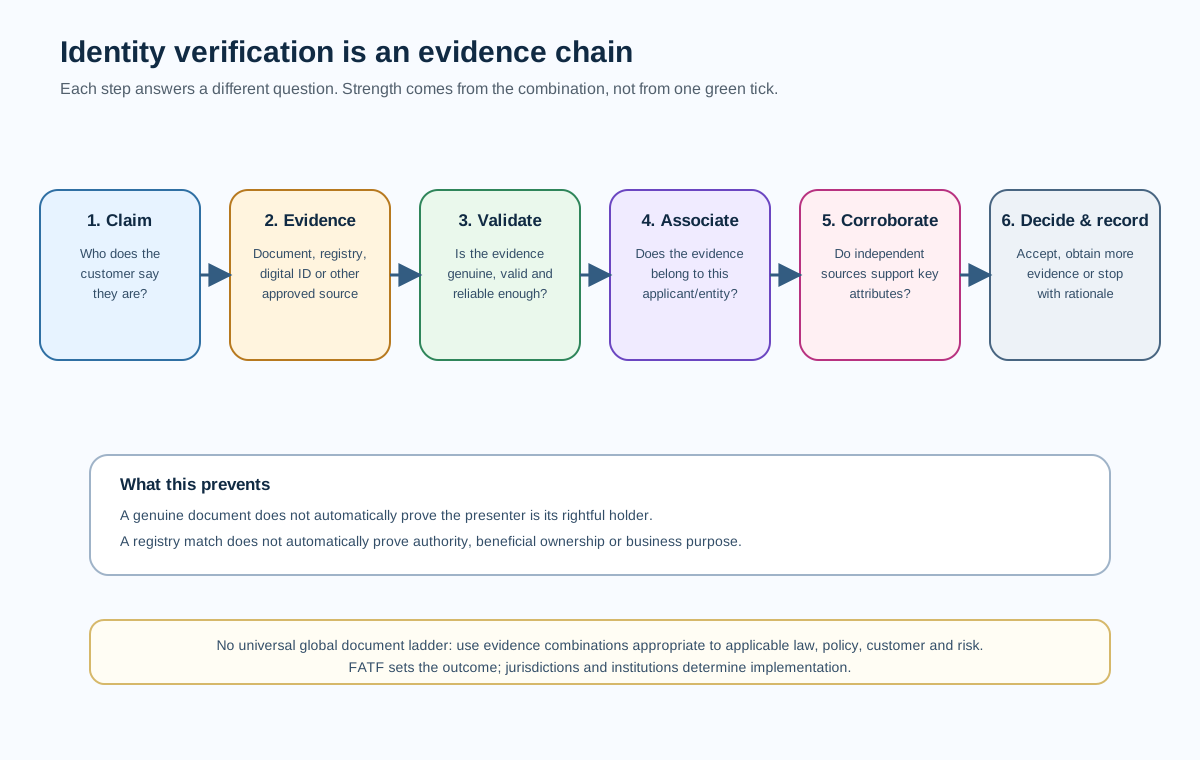
The diagram is deliberately a chain rather than a ranking of passports, databases and biometrics. There is no universal global document hierarchy. A strong control asks whether the evidence combination is reliable enough for the risk and legal framework in which the bank is operating.
Keep four concepts separate: identification, verification, authentication and screening
Banks often create avoidable design problems by treating four different control questions as if they were the same.
Identification asks what identity is being claimed. For a natural person this may include name, date of birth, address, nationality and an identification number where required. For a legal person it normally includes legal name, legal form, registration details, registered office and other information needed by the applicable CDD framework.
Verification asks whether the claimed identity is supported by reliable evidence. A passport, national identity document, trusted government register, appropriately governed digital identity credential or another independent data source may contribute to verification depending on jurisdiction and risk. A bank may use documentary methods, non-documentary methods or combinations of methods where permitted. The U.S. Customer Identification Program rules, for example, explicitly contemplate documentary and non-documentary procedures. That is a U.S. regulatory design, not a universal FATF formula, but it is a useful reminder that identity verification is broader than photocopying an identity document.
Authentication asks whether the person now using an account or credential is the authorised user. Passwords, passkeys, possession factors, device binding and authentication biometrics belong primarily to this question. NIST SP 800-63B-4 is an important technical reference for authentication, but it is not an AML identity-verification law. A customer can be correctly identified at onboarding and later suffer account takeover; conversely, a fraudster may authenticate perfectly to an account that was opened under a fabricated identity. Architecture and case-management models should preserve this distinction.
Screening asks whether the customer or connected parties match sanctions, PEP or other relevant lists or risk datasets. Identity quality affects screening accuracy, but screening is not itself identity verification. A sanctions engine finding no match does not prove identity, and a common-name potential match does not mean the customer is the listed person. The institution must resolve identity and list-match questions through the appropriate control processes.
This separation is not academic. It determines system ownership, data models, reason codes, testing and customer outcomes. A single field such as kycPassed = true loses too much information. A better design records which identity attributes were collected, which evidence sources were used, what validations were performed, how association with the applicant was established, which discrepancies remained, who approved the outcome, and when the evidence was obtained.
What makes identity evidence useful
Evidence quality is not simply about whether a document looks official. A bank should consider several dimensions.
The first is source independence. Information supplied only by the applicant can be necessary, but it is not independent corroboration of itself. A registry response, issuer validation, trusted digital identity assertion or another source outside the applicant's control may provide stronger corroboration, provided the source itself is sufficiently reliable.
The second is integrity. The bank needs reasonable confidence that a document, data response or credential has not been altered, fabricated or substituted. For a physical or digital document this may involve machine-readable-zone checks, chip or issuer validation, security-feature checks, document-template validation, or a specialist service. Not every bank performs laboratory-style document forensics itself; many use trusted technology providers, issuer services or trained operations teams. The control objective is trustworthy validation, not a particular tool.
The third is currency and relevance. Some attributes change. Addresses, names, corporate officers, authorised signatories and legal status can change during a relationship. An old record can be genuine but no longer describe the current situation. Currency should therefore be assessed in relation to the attribute and the purpose for which it is being relied on. Importantly, FATF does not create a universal rule that expiry of an identity document by itself requires a complete re-onboarding. Institutions should follow applicable law, policy and risk-based refresh triggers.
The fourth is coverage. A database can be highly reliable for people who appear in it and still be unsuitable as the only verification method for young customers, recent migrants or people with limited formal financial histories. Absence from a database is not automatically evidence of deception. Control design needs alternative paths that preserve sufficient assurance without creating unnecessary exclusion.
The fifth is association. Even a genuine document must be associated with the applicant. In person this can involve trained comparison and other controls. Remotely it may involve facial comparison, liveness or presentation-attack detection, secure digital identity, issuer-backed verification, device and capture-integrity controls, or a combination. No single method should be described as infallible. Biometrics can materially improve association, but performance varies by technology, environment and population, and presentation or injection attacks continue to evolve.
Natural persons: documentary and non-documentary verification
For natural persons, documentary evidence often includes passports, national identity documents, driving licences or other government-issued credentials where the applicable framework and bank policy permit them. The evidentiary value of a document depends on the issuing process, security characteristics, the attribute being proven, the bank's ability to validate it and the risk context. It is therefore misleading to say that one document category is always globally “stronger” than another. A national electronic identity used in one country may provide better assurance than a scanned passport image from another context; in another jurisdiction the opposite may be true.
Document checks can test several different things. Data extraction reads the name, date of birth, identifier and other attributes. Document validation asks whether the artefact is consistent with a genuine document of that type and whether obvious tampering or expiry issues exist. Issuer or register checks, where available and lawful, ask whether the identifier or credential is valid according to an authoritative source. Association checks ask whether the applicant is the person to whom the evidence belongs.
Non-documentary methods can supplement or, where permitted, substitute for particular documentary methods. The FFIEC BSA/AML Examination Manual describes U.S. CIP procedures that may use methods such as contacting a customer, independently verifying identity through public databases, checking references with other financial institutions or obtaining financial statements. The exact method and adequacy of evidence remain jurisdiction- and risk-specific. A global bank should therefore parameterise accepted evidence and verification logic by legal entity and jurisdiction rather than hard-code one country's procedure as a worldwide rule.
A practical evidence record might capture the evidence type, issuer or source, country, identifier, issue and expiry dates where relevant, validation method, validation result, source timestamp, association method, confidence or assurance outcome, reviewer, reason codes and links to preserved evidence. Sensitive data should be collected and retained only where lawful and necessary, with access controls appropriate to the risk of identity data itself becoming a target for misuse.
Remote onboarding changes the attack surface, not the objective
Remote onboarding does not remove the CDD objective. It changes how the bank obtains and validates evidence and how an attacker may try to defeat the process. The EBA's remote customer onboarding guidelines, which apply to in-scope EU credit and financial institutions, are technology-neutral and focus on governance, reliability of remote-onboarding solutions, information collection, document authenticity and identity matching, outsourcing and ICT/security risk. They should be treated as EU-specific supervisory guidance, not a global rulebook.
Remote journeys can face stolen document images, altered documents, replay attacks, presentation attacks, synthetic media, virtual-camera or injection attacks, compromised devices, social engineering and organised application farms. The control architecture should respond in layers. Document validation may assess the identity evidence. Capture-integrity controls may help establish that data came through the intended capture path. Biometric comparison may help associate the applicant with a document or identity record. Liveness or presentation-attack detection may reduce certain impersonation risks. Device and network signals may identify coordinated abuse. Human review may resolve cases that automated controls cannot decide confidently.
The word reduce is important. A liveness result does not prove that every presentation or injection attack has been defeated. A face match is not a legal conclusion. A device signal is not identity proof. Each is evidence contributing to a decision. Technical controls should therefore expose their output and limitations rather than collapse everything into a single opaque “verified” flag.
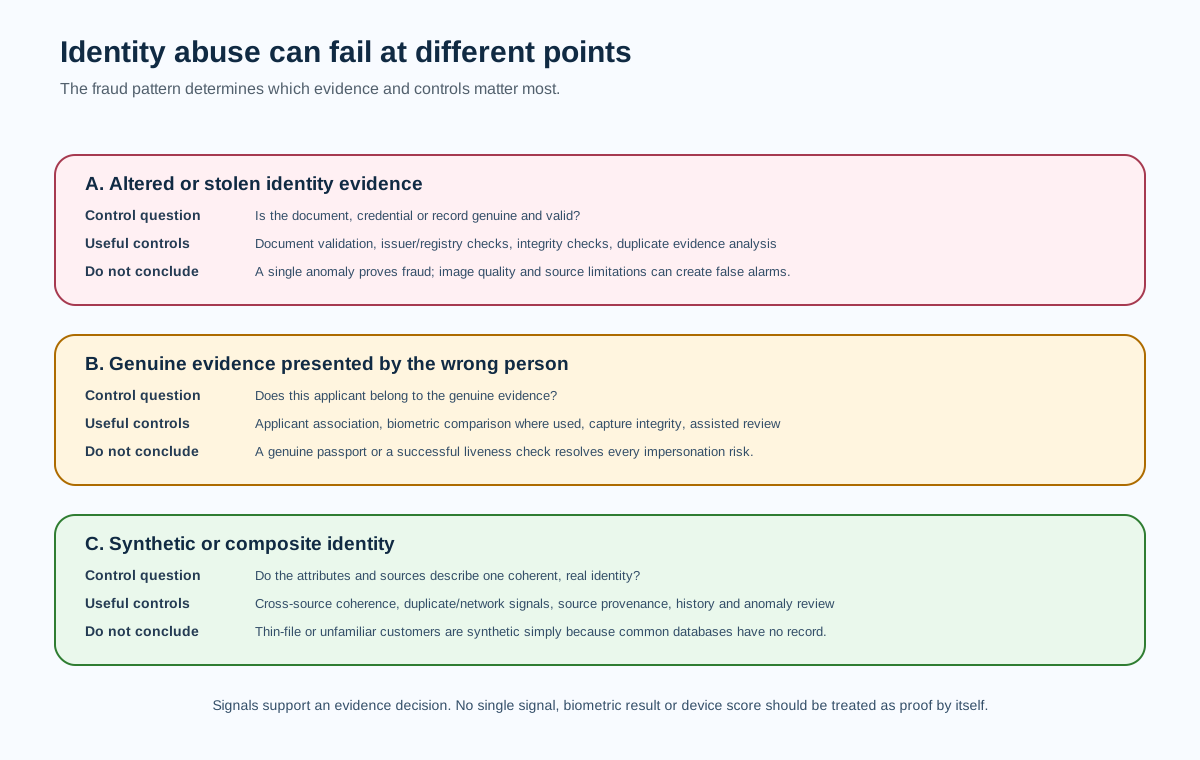
The diagram separates altered or stolen evidence, presenter or impersonation attacks, and synthetic or composite identities. These risks can overlap, but they fail in different places in the evidence chain and therefore need different detection methods.
Biometrics: useful association evidence with governance obligations
Facial comparison is widely used in remote onboarding because it can compare a live or freshly captured face with a trusted portrait. The control value is clear, but so are the limitations. False matches and false non-matches exist. Lighting, camera quality, ageing and presentation can affect performance. Performance may differ across demographic groups. Deepfake and injection techniques can attack the capture path rather than the comparison algorithm itself.
A bank using biometrics should therefore understand more than the vendor's headline accuracy. It should know what population the model was evaluated on, what operating threshold is used, how performance changes by relevant demographic and environmental conditions, what presentation-attack or injection controls are present, how ambiguous results are reviewed, how customers who cannot use the standard biometric journey are handled, and how sensitive biometric data is protected.
NIST SP 800-63A-4 is useful here as a technical reference for identity proofing and enrolment. It describes concepts such as evidence validation, identity verification, fraud checks and Identity Assurance Levels in the context of U.S. government digital identity. It should not be presented as an AML legal requirement for banks outside that context. Its value for a bank BA or architect is methodological: it encourages teams to define what evidence is being validated, how the applicant is linked to it, what threats the process addresses and what assurance result the process is designed to support.
Accessibility also belongs in design. A customer may be unable to complete a standard selfie or active-liveness movement because of disability, age, device limitations or other legitimate circumstances. The answer should not be an ungoverned bypass. A well-designed journey provides an alternative method that reaches an appropriate confidence level through different evidence, assisted review or another permitted path, while documenting why the alternative was used.
Digital identity and reusable credentials
Digital identity can simplify customer verification when the credential and its issuing ecosystem are trustworthy. FATF's digital identity guidance focuses on whether a digital ID system used for CDD is sufficiently reliable and independent in the relevant context and encourages institutions to understand the system's assurance level, technology, governance and risks.
A bank considering an external digital identity should ask who performed the original proofing, what evidence was used, how the credential is issued and bound to the holder, how compromise and revocation are managed, what attributes are asserted, how current those attributes are, what audit evidence is available and what legal framework governs reliance. Accepting a cryptographically valid assertion without understanding the underlying proofing process can create false confidence. Strong cryptography protects the assertion; it does not automatically make the original identity proofing sound.
A separate question is authentication after onboarding. An external digital credential may be used both to prove identity initially and to authenticate later, but those uses have different control objectives. Architecture should preserve the distinction so that compromise of an authentication credential does not rewrite historical identity evidence and so that new identity proofing does not unnecessarily occur every time authentication risk increases.
Legal persons: verify existence, authority and ownership separately
Legal-person verification is often weakened by collapsing three different questions into one.
First, does the entity legally exist, and what are its current legal attributes? Evidence may come from an official company register, formation documents, licences or other sources appropriate to the jurisdiction and legal form. Registry reliability varies, so a bank should understand whether information is authoritative, self-declared, independently verified, current and legally accessible.
Second, who is authorised to act for the entity? The customer may be a company, but people open accounts, sign agreements and initiate instructions. The bank may need evidence of directorship, mandate, power of attorney, board authority or another valid basis for representation. Authority can change independently of ownership.
Third, who ultimately owns or controls the entity? FATF Recommendation 10 requires beneficial-owner identification and reasonable measures to verify beneficial ownership so the institution is satisfied that it knows who the beneficial owner is. FATF's beneficial-ownership guidance and local implementing rules provide the relevant legal framework. The applicable ownership thresholds, control tests, registry access and treatment of trusts or other arrangements vary by jurisdiction. Beneficial ownership should therefore be modelled as its own relationship graph, not inferred from the identity-verification status of the legal entity.
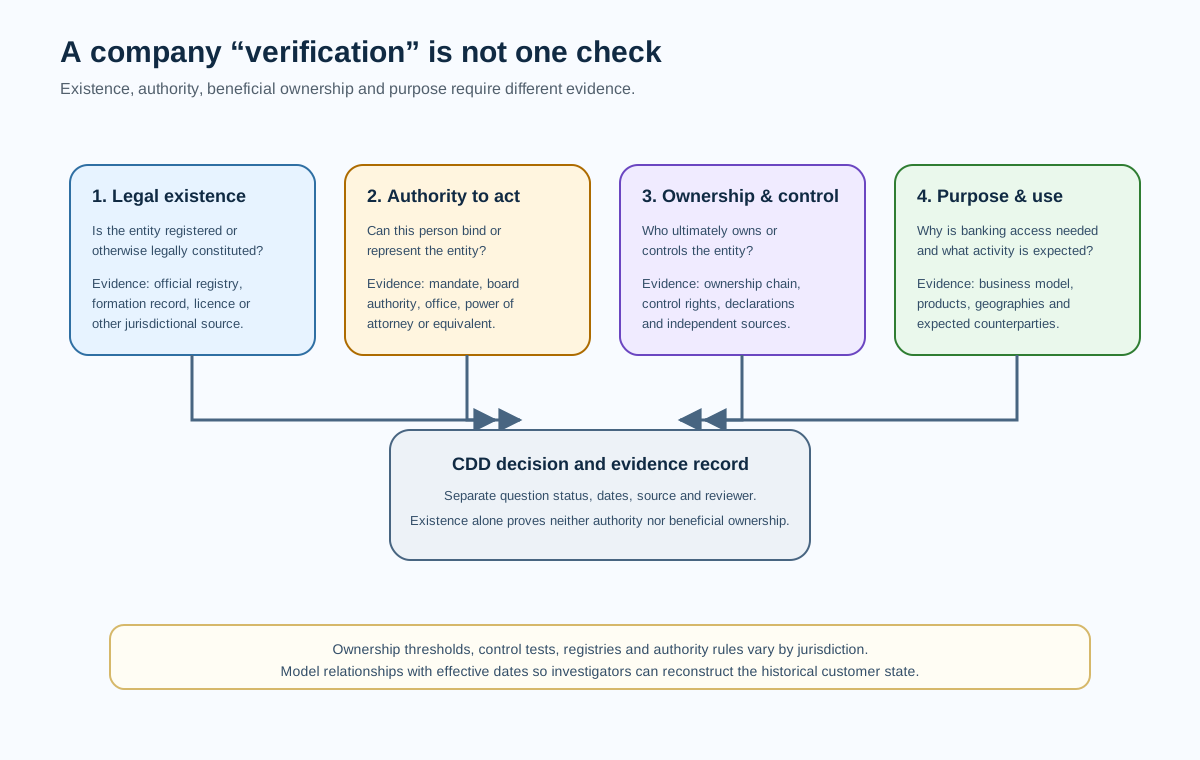
These questions eventually converge in one CDD decision, but the evidence and control ownership can differ. A registry may prove that a company exists without proving that the person on a video call is an authorised signatory. A board mandate may prove authority without revealing the ultimate beneficial owner. A beneficial-ownership declaration may identify an owner without proving that the underlying company is still in good standing.
Evidence assurance should be designed, not assumed
Banks often create internal assurance tiers to translate risk into evidence requirements. This can be useful, but the tiers should not be misrepresented as FATF-mandated levels. FATF sets outcomes and risk-based expectations; institutions and jurisdictions decide how those outcomes are implemented.
A practical internal model can start with the required confidence for the customer, product, channel and risk. It can then map which evidence combinations are permitted, what independent validation is required, which gaps are acceptable only with additional corroboration, when manual review is necessary, and what outcome is available if sufficient confidence cannot be reached. The model should also define exception governance and alternative paths for customers who cannot provide standard evidence.
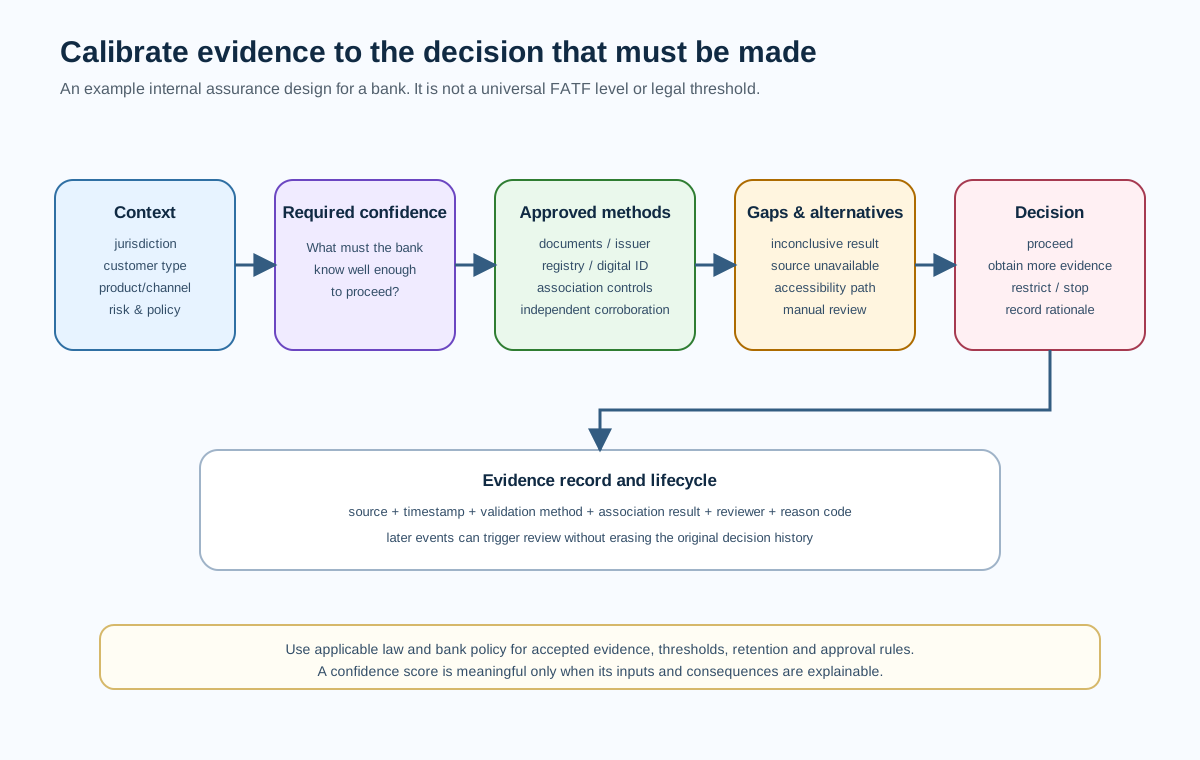
The aim is reproducibility, not mathematical theatre. A score is useful only if its inputs, weightings and consequences can be explained. If “document quality 82” has no clear relationship to evidence reliability or a defined decision threshold, it adds precision without meaning.
Data and system touchpoints
Identity verification rarely lives in one application. A digital onboarding channel may collect customer data and document images. An identity-verification provider may return document, biometric and device results. A customer master may store core identity attributes. A CDD platform may manage evidence, ownership and risk decisions. Screening systems consume names, dates of birth, nationalities, addresses and identifiers. Fraud systems analyse device and behavioural signals. Case-management tools preserve escalations and reviewer decisions. Data warehouses support control testing, MI and audit.
For a BA or architect, the most important design problem is provenance. The system should be able to answer: what did we know, from which source, at what time, and what decision did it support? A name field overwritten in place destroys history. A better model preserves effective dates, source, verification status and evidence references so an investigator can reconstruct the customer profile as it existed when a transaction occurred.
A useful entity model separates customer, person, legalEntity, identityAttribute, evidenceItem, evidenceSource, validationResult, associationResult, authorityRelationship, ownershipRelationship, verificationDecision and reviewEvent. That may sound elaborate, but it prevents a common operational problem: one field such as verified = true being reused for several incompatible meanings.
Reason codes also matter. “Verification failed” is not enough. A case may involve unsupported document type, failed issuer validation, unreadable image, unresolved attribute mismatch, low-confidence face association, suspected alteration, unavailable registry, expired mandate, inconsistent legal status, or inability to complete a digital method. Different reasons require different customer communication, escalation, fraud response and remediation.
How identity evidence supports screening, monitoring and investigations
Good identity evidence improves financial-crime controls downstream, but it does not replace them. Screening works better when names are structured correctly, dates of birth and nationalities are reliable, aliases are captured and legal-person identifiers are available. Transaction monitoring works better when customer profiles are tied to the correct person or entity. Investigators can move faster when they can reconstruct what evidence supported onboarding and subsequent reviews.
An identity concern can also emerge after onboarding. A fraud investigation may show that the account was opened using another person's evidence. A sanctions alert may reveal that the customer record contains a date of birth inconsistent with an authoritative source. A mule-account investigation may identify multiple apparently unrelated customers sharing photographs, devices, addresses or verification artefacts. Those findings should feed back to customer due diligence and, where appropriate, trigger re-verification or relationship review.
The feedback loop should be governed carefully. A behavioural anomaly is not by itself proof that the customer's legal identity is false. It may indicate account takeover, coercion, a legitimate life event or another risk. Case management should preserve the distinction between identity confidence, account-control confidence, fraud suspicion and AML suspicion so one alert type does not silently overwrite another control conclusion.
Ongoing maintenance and re-verification
CDD is ongoing, but that does not mean every identity document must be re-collected on a fixed global schedule. FATF Recommendation 10 expects institutions to keep CDD information relevant and up to date, particularly for higher-risk customers, and to conduct ongoing due diligence. How that is implemented depends on applicable rules and institutional policy.
Useful review triggers can include a material change in customer details, a corporate restructuring, a change of directors or authorised signatories, evidence of identity compromise, a significant unexplained discrepancy, a regulatory requirement, a higher-risk event or a periodic review required by policy. Document expiry can be relevant where policy or local rules make the document a continuing dependency, but expiry alone should not be described as a universal FATF trigger for full CDD refresh.
For legal persons, authority data can be especially time-sensitive. A former director or signatory may remain in a stale bank record long after leaving the company. External registry monitoring, customer notifications and event-driven workflows can help, but the exact control should match the jurisdiction, product and risk. The bank should retain historical relationships as well as current ones so past transactions can be reconstructed accurately.
Third-party reliance and outsourced verification
Banks may use external identity-verification vendors, group entities, introducers, agents or other third parties. The legal meaning of reliance differs from simple outsourcing and varies by jurisdiction. A contract cannot be assumed to transfer all regulatory responsibility merely because a vendor performs operational steps.
The bank should understand which party collects CDD information, which party performs verification, whether the bank can obtain the underlying evidence when required, how quality is tested, what happens when a vendor changes its model or data sources, what incident-notification obligations apply, how data is protected, and how the bank exits or substitutes the service if necessary. Vendor due diligence should include evidence of performance against the bank's actual use case, not only a marketing claim that the product is “bank grade.”
Testing should include positive cases, genuine-but-difficult cases and adversarial cases. It should also include outages and degraded service. If the identity provider is unavailable, the onboarding journey needs a controlled fallback: pause, route to assisted review, use an approved alternative, or decline to proceed, depending on policy and product. A fallback that silently skips verification is not resilience; it is a control bypass.
Practical BA, architecture and testing questions
A strong requirements workshop should force precise answers. Which identity attributes are mandatory by customer type and jurisdiction? Which are merely useful? Which evidence sources are accepted for each attribute? What makes a source independent enough for the purpose? Which validation checks are performed? How is the applicant associated with the evidence? What result states exist besides pass and fail? What requires manual review? What is the customer told when a journey cannot proceed? What evidence is retained, for how long and under which legal basis? Which systems consume the verified attributes downstream?
For digital journeys, teams should also define capture integrity, retry limits, duplicate-application detection, device and network intelligence, biometric thresholds where used, human-review queues, accessibility alternatives, provider outage handling and model-change governance. Test data should include common names, transliteration, document edge cases, poor image quality, legitimate name changes, thin-file customers, multi-national customers, complex entities, authorised-representative changes and realistic fraud attempts.
Regression tests are essential when a vendor changes a document model, biometric model, OCR engine, registry provider or decision threshold. A seemingly small model update can change acceptance rates, demographic performance and false-reject burden. Release governance should therefore compare outcomes against controlled test sets and production monitoring before and after change.
Mini case: a remote corporate onboarding with conflicting evidence
Consider a fictional software distributor applying remotely for a multi-currency business account. The company register shows a valid legal entity incorporated four years earlier. The applicant provides a passport for a director and a board resolution appointing that director as the account signatory. Automated document checks find no obvious issue, and facial comparison is within the bank's manual-review band rather than an automatic pass.
The CDD platform then retrieves current registry information and finds that the person resigned as a director three months earlier. That does not automatically prove fraud: the person might still hold valid authority under a surviving mandate, or the public register could be delayed. The case is routed to review rather than rejected by rule.
The reviewer checks the board resolution and finds it was supposedly signed after the resignation date by another director whose signature can be corroborated. The customer explains that the former director remains an authorised commercial representative. The bank requests evidence of the current authority under its policy and receives a newer board resolution that is independently validated through the company's established corporate contact channel. Beneficial-ownership information is also checked separately; it is unchanged and consistent with the registry and prior evidence.
The bank can now make a reasoned decision. The legal entity exists. The original authority evidence was stale or ambiguous, but current authority has been corroborated. The applicant's identity evidence and association have been reviewed to the required confidence. Beneficial ownership has been handled as a separate CDD question. The case record preserves the discrepancy, the additional evidence obtained and the reviewer rationale.
If instead the customer could not provide credible authority evidence, the correct conclusion would not be “identity failed.” The person's identity might be genuine while their authority to act for the company remains unverified. That distinction matters operationally because the next action, customer communication, fraud assessment and reporting consideration can be different.
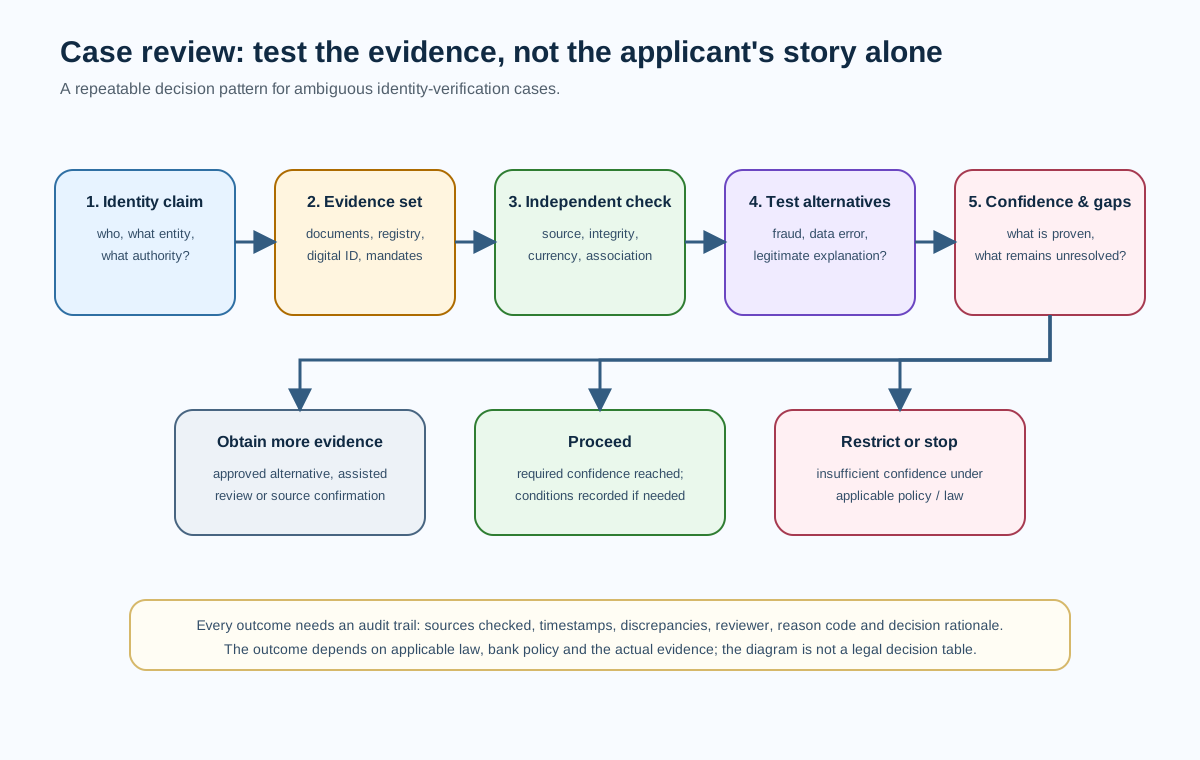
What good looks like
A mature identity-verification control does not promise perfect certainty. It produces defensible confidence from evidence appropriate to the customer, jurisdiction, product and risk. It knows the difference between proving a person's identity, proving a company's existence, proving authority to act, identifying beneficial ownership, authenticating an account user and screening a party against a risk list.
It also leaves an audit trail. Years later, an investigator or supervisor should be able to understand what identity was claimed, what evidence was used, what the bank validated, what discrepancies existed, who decided, which policy and jurisdiction applied, and what later events changed the view. That is the practical standard: not collecting the most documents, but making the identity conclusion explainable, proportionate and connected to the rest of the bank's financial-crime control framework.
Operational deep dive: assurance architecture, digital proofing and evidence governance
The base chapter separates identification, verification, authentication and screening. This deep dive focuses on the engineering problem underneath identity verification: how a bank decides that the evidence combination is strong enough for a particular relationship without pretending that one universal document, biometric threshold or database check works everywhere.
The most useful design principle is simple: assurance is an outcome of the process, not a label supplied by one tool. A document vendor may return a high confidence score, a registry may confirm a record, a biometric engine may report a close match and a device service may see no suspicious indicators. The bank still needs to understand what each result proves, what it does not prove, and whether the combined evidence meets the requirement created by law, policy and risk.
Start with the required decision, not the available technology
Identity projects often start with a product demonstration: scan a passport, take a selfie, receive a green tick. That reverses the correct sequence. The bank should first define the decision it needs to make and the level of confidence needed for that customer type and use case.
A low-value retail product, a private-banking relationship, a legal entity opening a cross-border payments account and an employee authenticating to an internal application do not present the same problem. The first three involve customer due diligence; the fourth is principally an authentication problem. Even within CDD, evidence expectations can differ because of legal-entity scope, geography, product risk, delivery channel and customer circumstances.
A practical internal assurance design can therefore use five stages:
- define the identity question and applicable legal/policy requirement;
- identify acceptable evidence methods and independent sources;
- define how evidence is validated and associated with the applicant;
- define gaps, alternatives and manual-review rules;
- record the final confidence decision and the evidence that supported it.
Those stages are an internal control model, not FATF-mandated assurance levels. FATF Recommendation 10 sets the CDD outcome. A bank can create its own tiers or confidence bands, but it should document why they are appropriate and how they are tested.
Validation and verification are different technical operations
Digital identity standards make a useful distinction between validating evidence and verifying the applicant against the evidence. NIST SP 800-63A-4 uses this distinction in its identity-proofing model. Although NIST is U.S. government technical guidance rather than global AML law, the distinction is useful for banking architecture.
Evidence validation asks whether the evidence itself is authentic, valid and trustworthy enough for the purpose. With a passport, that might involve document-template checks, data consistency, chip validation where supported, or issuer checks where available. With a company record, it might involve querying an official register and checking status. With a digital identity credential, it might involve validating the issuer, cryptographic assertion, assurance information and revocation status.
Applicant verification or association asks whether the person or entity presenting the evidence is actually connected to it. A genuine passport can be stolen. A valid company exists even if the person opening the account has no authority to represent it. A valid digital credential can be compromised after issuance. The verification step therefore needs controls appropriate to the evidence and channel.
Keeping these operations separate improves reason codes. A failed document-authenticity check is different from a genuine document with an unresolved presenter match. A registry outage is different from a negative registry result. A biometric comparison in an inconclusive band is different from a confirmed mismatch. Those distinctions matter for customer treatment and for fraud analytics.
Digital identity assurance without importing another framework as law
NIST defines Identity Assurance Levels for U.S. government digital identity. Other national eID schemes and trust frameworks use their own terminology and assurance models. Banks should resist mapping labels mechanically. “High assurance” in one framework may not be equivalent to another because the underlying evidence, proofing process, supervision and credential lifecycle can differ.
When a bank relies on an external digital identity, a better assessment examines the underlying system:
- who is allowed to issue the credential;
- what evidence is required at initial proofing;
- how evidence is validated;
- how the applicant is bound to the credential;
- whether attributes are verified or merely self-asserted;
- how compromise, suspension and revocation operate;
- how the bank obtains evidence or audit information if a decision is challenged;
- whether the framework is recognised or acceptable under the law applying to the bank.
FATF's digital identity guidance is especially useful because it frames digital identity through the Recommendation 10 objective: whether the system is sufficiently reliable and independent for CDD in the relevant context. It does not instruct banks to accept every government eID or require one technical architecture.
Document validation: avoid both under-engineering and forensic theatre
A bank does not need to become a forensic laboratory to operate an effective identity control. The appropriate validation depth depends on risk, available infrastructure and the bank's operating model.
At one end, visual inspection alone may be weak for remote onboarding because high-quality alterations are difficult to detect reliably from a photograph. At the other end, requiring every frontline employee to assess ultraviolet inks, print techniques and microscopic security features is unrealistic and may produce false confidence. Many institutions therefore use specialist services, chip-capable document readers, issuer validation or trained central teams for more difficult cases.
The control requirement should describe the outcome: evidence must be validated to the level required by the policy and risk. Requirements should then state which methods are approved for each document or credential type and what happens when a method is unavailable. A passport read through a functioning chip interface is not the same evidence path as an image-only upload. Both may be acceptable in particular circumstances, but the decision model should know the difference.
Document-validation data should also preserve model and reference versions. If a document-verification provider later discloses that a certain template was incorrectly classified, the bank needs to identify affected customers. Storing only documentCheck = pass makes retrospective analysis almost impossible.
Biometrics and presentation-attack controls
Biometric comparison can help bind an applicant to trusted identity evidence. The comparison result, however, is probabilistic. Banks should define operating thresholds, inconclusive bands and manual-review procedures with an understanding of false-match and false-non-match tradeoffs.
Presentation-attack detection and liveness controls address a different threat: whether the capture appears to come from a live person rather than a photograph, screen replay, mask or other presentation. Modern attacks can also target the capture pipeline through virtual cameras or injected synthetic media. That means a strong remote-onboarding design may need capture-integrity and device controls in addition to content-based liveness checks.
No control should be described as defeating all deepfakes or all presentation attacks. Attack methods evolve, and vendor capability differs. The bank should use testing and threat intelligence to understand the attack classes its solution is designed to detect, then monitor for evidence that criminals are moving around those controls.
Independent testing is particularly valuable when a provider changes its biometric model or liveness engine. The bank should compare acceptance rates, false-reject rates and observed fraud outcomes before and after major changes. Where legally and ethically appropriate, performance analysis should also look for material differences affecting demographic groups so that verification does not create avoidable exclusion.
Accessibility and alternative paths
An identity framework is incomplete if it works only for customers who own a recent smartphone, have conventional government documents, have extensive credit histories and can complete every biometric challenge. Legitimate customers can fall outside those assumptions.
The answer is not to waive verification. It is to design alternative paths that can reach an appropriate evidence outcome using different methods. Depending on jurisdiction and policy, that could involve assisted branch or video review, a different accepted document combination, an approved digital identity, independent registry checks, additional corroboration, or a more limited product while evidence is completed.
FATF's 2025 changes on financial inclusion reinforce proportionality in the risk-based approach. They do not remove CDD requirements, but they are a useful reminder that controls should distinguish genuine risk from simple unfamiliarity. A recent migrant's absence from a domestic credit bureau, for example, is a coverage issue before it is a fraud conclusion.
Alternative-path performance should be measured. If customers routed to manual verification wait days while standard digital applicants finish in minutes, the control may create practical exclusion even if policy technically allows an alternative. Operational MI should therefore track queue age, completion rates, failure reasons and repeat submissions alongside fraud outcomes.
Registry and database use: corroboration with known limitations
Official registries can be powerful because they place some distance between the applicant and the evidence source. Their reliability nevertheless varies. Some registers verify submitted information rigorously; others primarily publish self-declared filings. Some update quickly; others lag. Some expose historical officers and beneficial owners; others do not. Some provide APIs with strong identifiers; others offer only name search.
A registry integration should therefore record the source and retrieval date, the attributes returned, the match method and any limitations. “Company found” is not enough. The bank may need to know whether the registration number matched, whether status is active, whether the registered name differs, whether directors changed, and whether the source is authoritative for the attribute being relied upon.
Commercial databases can provide additional corroboration but also have coverage gaps. If a database is used as a gating control, the bank should understand who is likely to be absent and what alternative route exists. A no-match result can mean fraud, data quality problems, a recently created record or simple lack of coverage. Decision logic should preserve that ambiguity until enough evidence exists to resolve it.
Where consortium or shared fraud intelligence is used, legal basis, purpose limitation, data minimisation, access controls and correction processes matter. Identity and fraud data can cause significant harm if inaccurate information propagates across institutions. Governance should therefore include challenge and remediation routes rather than treating shared intelligence as unquestionable truth.
Legal-person evidence is a graph, not a document pack
For corporate customers, evidence becomes relational. The bank needs to connect the legal entity to its registration, people to authority roles, owners to ownership interests, controllers to control mechanisms and the entity to its business purpose and expected activity.
That structure is better represented as a graph than as a folder of PDFs. A beneficial owner can own through several intermediate entities. A director can resign while a power of attorney remains valid. A trustee can change without the settlor changing. A legal representative can have authority for one product but not another. Effective dates are therefore essential.
An architecture that stores only the current snapshot makes historical investigation difficult. If a suspicious payment from 18 months ago is reviewed today, investigators may need to know who controlled the entity and who was authorised to act at that time. Ownership and authority relationships should therefore carry start and end dates, source evidence and verification status.
Legal-person verification also needs jurisdiction-aware rules. FATF provides the global beneficial-ownership standard and guidance, but national implementation determines thresholds, available registers, documentation and legal consequences. The product should not hard-code a single percentage threshold or one definition of control across all entities.
Separate identity confidence from customer risk rating
A verified customer is not a low-risk customer. Identity verification answers whether the bank has sufficient confidence about who the customer is. Customer risk rating asks a different question: how much money-laundering, terrorist-financing, sanctions or other financial-crime risk the relationship presents given customer, product, geography, channel, ownership and behaviour.
These variables interact but should not be collapsed. A politically exposed person can be very well verified while requiring enhanced due diligence because of PEP-related corruption risk. A standard retail customer can have low AML risk while presenting difficult identity evidence requiring manual verification. A legal entity can have a clear registered identity while its beneficial ownership remains unresolved.
This distinction should appear in workflow states. identityVerified, beneficialOwnershipResolved, authorityVerified, customerRiskRated and relationshipApproved are different outcomes. Combining them into one KYC status makes exception handling and audit much harder.
Authentication boundary and account takeover
After onboarding, authentication protects access to the account. NIST SP 800-63B-4 is a useful technical reference for authentication and authenticator management. It should not be used to imply that re-authentication automatically re-verifies legal identity.
A customer may authenticate successfully using a compromised credential because an attacker has obtained control of the authenticator. Fraud and cyber controls therefore examine device changes, credential resets, recovery events and transaction behaviour. Those signals can trigger step-up authentication or a broader identity review, but they should not rewrite the original evidence without analysis.
Conversely, a customer whose identity is correctly verified may legitimately replace a phone, lose a device or recover an account. High-friction identity re-proofing for every routine device change can create unnecessary customer harm. The bank should define when authentication recovery is sufficient and when evidence indicates that full or partial re-verification is justified.
Evidence lifecycle and model-change governance
Identity evidence has a lifecycle. Documents expire, registries update, authorities change, vendors change models, digital credentials can be revoked, data providers correct records and bank systems migrate. The control needs mechanisms to preserve what was originally seen while allowing the current state to evolve.
For every material evidence item, a defensible record can include source, retrieval time, raw or legally permitted preserved evidence, parsed attributes, validation method, result, provider/model version, reviewer decision and linkage to the CDD event it supported. Sensitive evidence should be protected with strong access control and retention rules appropriate to applicable law.
Model-change governance deserves explicit requirements. If a vendor changes OCR, document-authenticity logic, face matching or liveness detection, the bank should know what changed, how it was tested and whether decision thresholds need recalibration. Material performance changes should be assessed before full rollout, particularly where automated decisions can block customers.
Practitioner checkpoint
A practitioner should now be able to explain why identity verification cannot be represented by one green tick. They should be able to separate evidence validation from applicant association, explain why a digital identity's trust depends on its proofing and governance, distinguish identity proofing from authentication, model legal-person existence/authority/ownership separately, and design alternative paths for legitimate customers who cannot complete the standard journey.
For delivery teams, the strongest requirement is usually not “implement eKYC.” It is a precise statement of what identity conclusion the bank must reach, which evidence combinations are permitted, how each evidence source is validated, how uncertainty is handled, what data proves the decision later, and which jurisdictional rule or policy justifies the design.
Advanced practice: worked identity-verification cases
The cases below are fictional and designed for control analysis. They are not legal precedent and they do not imply that one outcome applies in every jurisdiction. Each case follows the same disciplined pattern: define the identity claim, inspect the evidence, test independent explanations, identify what remains unproven, and make a decision under the bank's applicable law and policy.
Case 1: a genuine passport, but the presenter may not be the holder
A retail applicant uploads a passport that passes the bank's approved document-validation checks. The document data is internally consistent and, where the bank's service is able to validate the chip or issuer data, no issue is identified. Facial comparison between the document portrait and the current capture falls into the bank's manual-review band rather than an automatic pass or fail.
The important control point is that document authenticity and applicant association are separate questions. The document can be genuine while the presenter is not the rightful holder. The reviewer should not treat the valid document as resolving the face-association uncertainty, nor should they assume that an inconclusive biometric score proves impersonation.
The review follows the bank's approved process. It checks image and capture quality, whether the current appearance can reasonably differ because of ageing or other legitimate change, whether the capture pipeline shows evidence of replay or injection, and whether an alternative approved identity source can corroborate the applicant. A trained reviewer documents the specific features and evidence considered rather than writing “looks similar.”
Suppose an issuer-backed digital identity available in that jurisdiction independently confirms the same identity and the applicant successfully completes the approved association process for that credential. The combined evidence may be sufficient under the bank's policy even though the original face comparison was inconclusive. If instead material inconsistencies remain and no approved alternative can resolve them, the bank may pause or decline onboarding under its policy.
The lesson is not “biometrics decide.” It is that ambiguous evidence should trigger a defined evidence path. The final case record should say what was proven, what was not, which alternative evidence was obtained and why the final confidence decision was reasonable.
Case 2: the company exists, but the applicant's authority is stale
A software company applies for a cross-border business account. The official register confirms that the company exists and is active. Beneficial-ownership information provided by the customer is consistent with available registry and independent evidence. The person conducting onboarding presents a valid passport and is correctly identified.
The problem appears in the authority evidence. The applicant submits a board mandate naming them as an authorised account representative, but the bank's current registry information shows that the person resigned as a director several months earlier. The resignation does not automatically cancel every possible authority under company law, and the person being genuinely identified does not prove they are still authorised to act.
The bank therefore separates the questions. Legal existence is confirmed. The person's identity is confirmed to the required level. Beneficial ownership is handled under the relevant CDD rules. Authority remains unresolved. The relationship is not marked as an identity failure; it is routed to the authority-verification process.
The customer provides a later board resolution expressly continuing the person's authority for banking matters. The bank validates the resolution through its approved corporate channel and records the effective date and scope of the mandate. If the evidence is acceptable under the governing law and policy, onboarding can continue. If authority cannot be established, the bank can refuse to accept instructions from that person even though both the company and the individual are genuine.
This case illustrates why entity architecture needs separate objects for legal-person identity, natural-person identity, authority and ownership. A single KYC status would conceal the real issue and make later investigations harder.
Case 3: a legitimate customer cannot complete the standard digital path
A displaced person seeks a basic transaction account. They have an identity document that is no longer current and evidence from a recognised humanitarian or public authority, but they cannot satisfy the bank's standard digital journey because the normal database and document path was designed around domestic identity records.
The wrong response is either to waive verification casually or to assume that unfamiliar evidence means the person is fraudulent. The bank should use the alternative method permitted by the law and its policy. Depending on jurisdiction, that could involve validating the humanitarian or governmental record, assisted review, an accepted alternative document combination, an approved digital identity, or a restricted product until additional evidence can be obtained.
The reviewer documents the source and reliability of each item, what attributes it supports, any unresolved limitations and why the alternative combination reaches the required level of confidence. If the bank offers a lower-risk or limited product as part of a proportionate approach, the limitations should be explicit and operationally enforceable rather than informal promises by frontline staff.
The case also demonstrates why database coverage must be measured. If a domestic database has low coverage for recent migrants, a no-match result is predictable and should not be scored as evidence of deception. Control MI should distinguish no record found from record contradicts applicant.
The lesson is that inclusion and control quality are not opposites. A designed alternative path can maintain an appropriate verification standard while avoiding unnecessary exclusion caused by assumptions embedded in the default technology.
Case 4: deepfake-resistant design requires more than a better face model
A digital bank observes an increase in onboarding applications that pass document image checks and facial comparison but later behave like coordinated mule accounts. Fraud investigation finds repeated use of similar device configurations and evidence that some video captures may have been injected into the application rather than recorded through the intended camera path.
The first response should not be to declare every successful biometric check unreliable. The bank should identify which layer is being attacked. If the capture pipeline can accept virtual-camera or injected media, improving the face-comparison threshold alone may not solve the problem. The control architecture may need stronger capture-integrity checks, device attestation where appropriate, improved presentation-attack detection, duplicate-image and device-network analysis, and more effective review of coordinated application patterns.
The bank should test the provider and its own application against realistic attack classes. It should record which controls detect which attacks and measure false rejection of legitimate customers. Claims such as “deepfake proof” should be avoided unless they are narrowly defined and continuously substantiated. Synthetic-media techniques evolve, and a control tested successfully against one generation of attacks may not remain sufficient indefinitely.
The incident also feeds back into previously opened accounts. Where lawful and proportionate, the bank can identify accounts sharing the compromised application characteristics and review them as a network rather than assuming each application is independent. That review should still distinguish evidence of a weak onboarding channel from proof that a particular customer is fraudulent.
The lesson is architectural: remote identity assurance depends on the whole evidence and capture chain. A highly accurate biometric model cannot compensate for an untrusted input path, and a device-risk score cannot replace identity evidence.
Case 5: identity evidence is sound, but account control has changed
A long-standing customer was correctly identified and verified at onboarding. Years later, the bank receives a fraud complaint after several high-value transfers were authenticated using the customer's registered mobile device and valid credentials. Fraud telemetry shows a recent credential-recovery event followed by new beneficiary creation and rapid payment activity.
This is principally an authentication and account-control problem, not proof that the original identity was false. The bank should preserve the original CDD evidence while investigating who controlled the account at the relevant time. Recovery logs, device changes, channel events, customer contact and transaction context become central.
If the investigation shows that an attacker took over the account, the customer may need to re-establish secure control and, depending on the facts and policy, may undergo some identity re-proofing as part of recovery. But the system should not rewrite the historical record to say the customer was never verified. Instead, it records a new event: previously verified identity, compromised account control, recovery and any subsequent re-verification performed.
This distinction improves fraud liability analysis, investigation quality and data lineage. It also prevents operations teams from repeatedly collecting documents when the actual failure sits in authentication or recovery design.
Case 6: a registry confirms the company but not the business story
A newly formed trading company appears in the official register with matching registration number, directors and registered office. The onboarding team correctly treats the registry as evidence of legal existence. The customer describes a business importing industrial components across several jurisdictions and expects high-value international payments from launch.
Legal existence is only one part of CDD. The bank still needs to understand the purpose and intended nature of the relationship and, where required, beneficial ownership. The company may be perfectly real while the proposed activity is inconsistent with its stated experience, funding or counterparties. Conversely, a new company can legitimately have large expected volumes if there is credible evidence supporting the business model.
The bank therefore asks for proportionate supporting context: ownership and control evidence, relevant licences where the activity requires them, expected suppliers and customers, funding source and operating footprint. The reviewer compares these facts for coherence rather than demanding a fixed pile of documents. A newly incorporated company should not be treated as suspicious merely because it lacks years of transaction history.
If contradictions cannot be resolved, the issue is recorded as a business-purpose or customer-risk concern, not falsely labelled as a failed identity check. That classification matters because the downstream control, escalation and reporting analysis differ.
Delivery lessons from the cases
Across the six examples, the strongest pattern is separation of questions. A bank should be able to say whether the problem is evidence authenticity, applicant association, legal-person existence, authority, beneficial ownership, business purpose, authentication, fraud or another risk. Those questions often interact, but treating them as separate control outcomes produces better customer communication and better investigations.
For business analysts and testers, each workflow should therefore include at least four non-happy paths: genuine evidence with unresolved association, genuine person without proven authority, legitimate customer requiring an alternative method, and technically successful onboarding later linked to coordinated fraud. Passing only the straightforward document-plus-selfie journey proves very little about the resilience of the real control.
For architects, the case record should preserve evidence provenance and time. Later investigators need to know what source was queried, when, what the source returned, what the bank decided, and which later event changed the conclusion. The quality of identity verification is ultimately visible in that reconstructability: a defensible decision should be explainable long after the onboarding session has ended.
Practice close: the verification analyst's playbook
A verification analyst should be able to turn a messy application into a small number of precise questions. The objective is not to collect the largest document pack. It is to decide whether the bank has enough reliable evidence to know who the customer is, and to keep separate any unresolved questions about authority, ownership, business purpose, authentication or fraud.
A practical review sequence
Start with the claim. Write down the identity that is being asserted and which attributes matter for the product and jurisdiction. For a natural person that may include name, date of birth, address and an identifier. For a legal person it may include legal name, registration details, registered office and legal form.
Next list the evidence supporting each material attribute. Record the source, date and method. Do not treat every item as independent. A utility bill uploaded by the applicant and a form populated from the same uploaded bill are one underlying source, not two corroborating sources.
Then ask whether the evidence is valid and trustworthy enough. Is the document consistent with a genuine credential? Does the registry record match the identifier? Is the digital identity assertion current and from an accepted issuer? Are there material signs of alteration or source inconsistency? If a provider performed the check, record the actual result rather than only the provider's overall colour code.
After that, assess association. Does the evidence belong to this applicant? For legal persons, does the person have authority to act? Where biometrics are used, treat them as evidence with known performance limits. Where assisted review is used, record the reviewer reasoning.
Finally, examine discrepancies and gaps. A mismatch can have innocent explanations, data-quality explanations or fraudulent explanations. The analyst's job is to test the reasonable alternatives through approved sources and then decide whether enough confidence has been reached. If not, obtain more evidence, route to a specialist path or stop according to policy.
Common exception patterns
A legitimate customer may not have the standard document combination. The correct response depends on local law and policy, but the process should offer a designed alternative where one is permitted. An analyst should know which alternative evidence can be accepted, which specialist team owns the decision and what product restrictions, if any, are available while evidence is resolved.
A customer may have a genuine identity but a name discrepancy caused by marriage, transliteration, naming conventions or data-entry differences. The analyst should identify whether the mismatch affects identity confidence and use appropriate evidence to resolve it rather than force every name into one cultural pattern.
A legal entity may be correctly identified while authority is unclear. Keep the customer identity status separate from signatory or representative authority. Ask for the relevant mandate or corporate evidence instead of repeatedly requesting the entity's incorporation documents.
A registry may be unavailable. The bank needs a predefined fallback. Depending on risk and policy, this could mean waiting for the source to recover, using another approved authoritative source, routing to manual review or pausing onboarding. Do not treat a technical outage as either a positive verification or a negative customer finding.
Customer communication
Good verification communication tells the customer what is needed without revealing sensitive fraud-detection logic. “We need current evidence showing that you are authorised to act for the company” is more useful than “KYC failed.” If a document is unreadable, say so. If an accepted alternative is available, explain it. If the bank cannot proceed, the communication should follow applicable legal, conduct and policy requirements and avoid unsupported accusations of fraud.
Repeated evidence requests are a useful quality signal. If customers routinely send the same document several times because systems fail to carry evidence between teams, the problem is operational rather than customer risk. Case design should allow reviewers to see what has already been requested and why it was insufficient.
Tester view
Testing should cover more than the happy path. A robust scenario set includes:
- genuine document with a clear association result;
- genuine document with an inconclusive association result;
- altered or unsupported evidence;
- legitimate applicant with an alternative approved evidence path;
- registry no-match caused by formatting or recent incorporation;
- registry contradiction that requires investigation;
- legal entity with valid existence but stale authority evidence;
- identity provider outage and approved fallback behaviour;
- duplicate or coordinated applications that require fraud review;
- authentication recovery that should not overwrite historical identity evidence.
Expected results should be defined from approved policy and requirements, not copied from whatever the current production system happens to do. When the expected outcome varies by jurisdiction or product, the test data must include those parameters explicitly.
Data-quality checks
Identity controls depend heavily on data quality. Useful checks include completeness of required attributes, preservation of original script where relevant, transliteration quality, format validation of identifiers, consistency between customer master and evidence source, correct effective dates, and lineage showing which system changed an attribute.
A particularly important test is whether a later profile update destroys the original evidence context. If a customer changes address, the current address should update while the historical address and the evidence supporting it remain reconstructable under the institution's retention model. The same principle applies to names, directors, signatories and ownership relationships.
Quality-assurance questions
A reviewer sampling a completed case can ask:
- What identity was claimed?
- Which evidence sources supported it?
- Which sources were independent of the applicant?
- How was the evidence validated?
- How was the applicant associated with the evidence?
- Were material discrepancies resolved or merely ignored?
- Were legal-person existence, authority and beneficial ownership kept separate?
- Is the decision rationale understandable without asking the original analyst?
- Did the process follow the rules for the correct booking entity and jurisdiction?
- Is sensitive identity evidence protected and retained appropriately?
These questions are more revealing than a checklist asking only whether a passport copy is present.
Metrics that help operations improve
Operational teams should monitor completion and review times, but those numbers need context. A fast process can be weak and a slow process can be badly designed. Pair throughput measures with quality measures such as confirmed onboarding fraud linked to identity weakness, reviewer-overturn rates, repeated evidence requests, alternative-path completion, complaint themes and quality-review findings.
For automated tools, monitor the distribution of outcomes over time. A sudden drop in manual-review cases after a model release may be a genuine improvement, but it can also indicate a threshold change that is clearing uncertain cases automatically. A sudden rise in failures from one document type or country may reflect fraud, a provider defect or a change in the issuing format. The metric should trigger investigation, not an automatic conclusion.
Final analyst discipline
The most reliable habit is to write the decision in plain language before closing the case. A strong note might say: “Company existence confirmed through official registry on 17 September 2026. Applicant identity verified through approved evidence. Initial mandate was outdated; current authority confirmed through board resolution validated through established corporate contact. Beneficial ownership reviewed separately with no unresolved discrepancy.”
That note tells a later reviewer what the bank actually established. It is far more useful than “KYC complete.” Identity verification is strongest when the reasoning is visible, the evidence is traceable and unresolved questions are named honestly rather than hidden behind a generic pass status.
Masterclass: governing identity assurance across a bank
Identity verification is rarely owned by one team from beginning to end. Product teams design onboarding, operations review exceptions, fraud teams understand attack patterns, compliance interprets CDD requirements, technology teams integrate vendors and registries, privacy teams govern sensitive data, and audit tests whether the control works as designed. Weak governance appears when each function optimises its own component while no one can explain the effectiveness of the complete evidence chain.
A practical governance model therefore needs a named control owner or clearly defined set of accountable owners. The purpose is not to create a new bureaucratic layer. It is to make someone responsible for answering cross-cutting questions: Which evidence methods are approved in each jurisdiction? Which customer populations cannot use the standard path? What happens when a biometric vendor changes its model? How are false rejects measured? Which attacks have been tested? How quickly are new document types or issuer changes incorporated? Who can approve an exception, and how is that decision reviewed later?
Control ownership should match the evidence lifecycle
Ownership is clearer when the identity process is broken into lifecycle stages. Product and channel teams may own data capture and customer experience. Identity operations may own document or evidence review. Fraud teams may own device and attack intelligence. Compliance may own the policy interpretation of CDD requirements. Technology may own integrations and operational resilience. Data governance may own lineage and retention controls.
The control owner must connect these responsibilities rather than assume that one team's pass result guarantees the whole outcome. For example, a vendor can correctly validate an identity document while the application fails to bind the right person to it. A registry integration can work perfectly while the bank uses stale authority data. A biometric engine can perform within specification while the capture pipeline allows injected media. Governance must therefore review the chain, not only the component service-level agreements.
Technology changes are control changes
Identity technology is frequently updated. Providers change document-recognition libraries, biometric models, liveness engines, supported countries, scoring logic or API behaviour. A bank should decide which changes are material enough to require testing before production rollout and what evidence the provider must supply.
A sensible change process compares the proposed version with the current version on representative test populations and known fraud scenarios. It checks not only overall pass rates but also error patterns, manual-review volumes and legitimate-customer impact. Where biometrics are used, the bank should consider whether performance differences across relevant populations have been assessed and whether alternative paths work for customers who cannot complete the standard journey.
The same discipline applies when the bank changes its own thresholds. Lowering a face-match threshold, increasing automatic acceptance of document results or removing a secondary registry check may improve conversion, but each change alters the control. A business case should state the expected customer benefit and the risk consequence so the decision is conscious rather than hidden inside a configuration release.
Vendor governance must look beyond certification badges
External identity services can be highly valuable, but the bank still needs to understand what the service actually does. Due diligence should cover the provider's operating model, supported evidence types, data sources, security, privacy, subcontractors, resilience, model governance and incident handling. Independent certifications can contribute evidence but should not substitute for understanding the bank's specific use case.
Contractual arrangements should support operational needs: notice of material model changes, service availability, incident notification, access to evidence needed for investigations, data retention and deletion, support for regulatory or audit requests, and an exit path if the service is replaced. Where legal reliance or outsourcing rules apply, those obligations should be mapped explicitly to the jurisdictions and entities in scope.
A bank should also know how it will operate when the provider is unavailable. The fallback may be to stop onboarding temporarily, use an approved alternative source or route cases to assisted review. The correct choice depends on product, law and risk, but it should be decided before an outage rather than improvised under customer pressure.
Quality assurance should re-perform judgement, not count documents
A file can contain every expected document and still be poorly verified. Quality assurance should therefore test the reasoning behind decisions. A reviewer can sample cases and ask whether the source was sufficiently reliable, whether material discrepancies were investigated, whether an inconclusive result was resolved through an approved method, whether legal-person authority and ownership were kept separate, and whether the decision rationale is reproducible.
Sampling can be risk-informed. New channels, new vendors, higher-risk products, complex entities and recurring failure reasons deserve more attention. That does not mean every sample must be statistically representative of the entire population; the purpose and limitations of the sample should be stated honestly.
Quality findings should feed into training, policy, technology configuration and vendor management. If reviewers repeatedly misunderstand the same reason code, training may be the problem. If a large share of legitimate customers fall into manual review because a database has poor coverage, the evidence strategy may be the problem. If one branch or team shows an unusual concentration of overrides, governance should investigate whether this reflects customer mix, process weakness or misuse of discretion.
Metrics need protection, inclusion and customer experience together
Identity-verification MI is most useful when it balances three dimensions.
Protection metrics can include confirmed impersonation detected at onboarding, later fraud linked to onboarding weakness, duplicate or coordinated applications identified, provider/model failure incidents, and quality-review error rates.
Inclusion and fairness metrics can include completion rates by relevant customer populations, alternative-path usage, repeated no-match outcomes caused by data coverage, accessibility escalations and material performance differences where lawful and appropriate to measure.
Customer and operational metrics can include abandonment, average review time, queue ageing, repeat evidence requests, complaints and the proportion of cases resolved automatically versus manually.
No single number proves effectiveness. A falling manual-review rate may reflect better automation or overly permissive thresholds. A lower false-positive rate may be genuine improvement or simple suppression of difficult cases. Governance forums should therefore look at several measures together and investigate unexpected movements.
Complaints are control intelligence
Customer complaints can reveal weaknesses that technical metrics miss. Repeated complaints that customers cannot understand an evidence request may indicate poor communication. Complaints from particular customer groups about unavailable document paths may expose coverage assumptions. Long delays after an automated failure may show that the alternative-review process exists in policy but is not operationally staffed.
Complaint analysis should separate legitimate frustration from requests that the bank cannot safely or legally accommodate. The objective is not to approve every customer. It is to make requirements understandable, alternatives governed and adverse outcomes reviewable where the applicable framework requires or permits review.
Mergers, migrations and historical evidence
Identity assurance becomes especially difficult during system migrations and acquisitions. Two institutions may use different evidence types, different reason codes and different document stores. Re-verifying an entire acquired population may be unnecessary or impractical, while blindly treating every legacy record as equivalent can create hidden gaps.
A migration assessment should map legacy evidence and verification outcomes into the target model, preserve historical provenance, identify populations that fall below the target bank's accepted standard, and define remediation based on law, risk and practical urgency. The bank should avoid destroying historical evidence merely because the new platform uses a cleaner data model. Investigators and supervisors may still need to reconstruct what the legacy institution knew at the time of onboarding.
Senior governance question
The most useful senior-management question is not “Are we compliant with KYC?” It is: How do we know that our identity-verification process produces reliable decisions across the customers and channels we actually serve, and where are its known limitations?
A mature answer names the evidence methods, explains their limitations, shows how difficult customers are handled, demonstrates how technology changes are tested, quantifies important failure patterns and identifies the residual risks senior management has consciously accepted. That is a stronger form of governance than a policy stating that customers must provide valid identification, because it connects the rule to the operating system that must make the rule work every day.
Knowledge checks with explained answers
1. A passport passes document validation, but the face-association result is inconclusive. Has the customer's identity been verified?
Not yet on the strength of those facts alone. The document result supports the authenticity or validity of the evidence; the inconclusive association result leaves uncertainty about whether the applicant is the rightful holder. The bank should follow its approved review or alternative-evidence path. It should not assume that a genuine passport proves rightful possession, and it should not assume that an inconclusive biometric score proves impersonation.
2. A company appears in an official registry and is active. What has that established?
It supports the legal existence and registered attributes of the entity to the extent that the registry is authoritative for those facts. It does not by itself establish that the applicant is authorised to act, that the declared beneficial owners are correct, or that the business purpose is credible. Those are separate CDD questions requiring appropriate evidence.
3. Can a bank treat one document type as the universally strongest identity evidence?
No. FATF requires reliable, independent source documents, data or information but does not prescribe one worldwide document hierarchy. Evidence strength depends on the issuing process, the attribute being proved, the bank's ability to validate the source, the channel, the jurisdiction and the risk. Institutions should define accepted evidence combinations under applicable law and policy.
4. Why is authentication different from identity verification?
Identity verification establishes sufficient confidence in the customer's claimed identity. Authentication later establishes that a person or system is permitted to use a credential or account at that moment. A correctly verified customer can suffer account takeover, and an attacker can authenticate successfully with compromised credentials. NIST SP 800-63B-4 is useful technical guidance for authentication, but it is not a substitute for AML customer identification and verification.
5. A domestic database returns no record for a recent migrant. Is that evidence of fraud?
Not by itself. A no-match can reflect database coverage, data-format differences, a short domestic history or an incorrect identity. The bank should understand the source's coverage and use an approved alternative path where appropriate. The system should distinguish “no record found” from “record contradicts the customer.”
6. What is the purpose of an internal assurance model?
It translates a legal and policy requirement into a repeatable evidence decision: what confidence is required, which evidence methods are accepted, how evidence is validated and associated with the applicant, what happens when results are inconclusive, and who approves exceptions. Such tiers or confidence bands are internal design choices unless a jurisdictional framework specifically defines them; they should not be presented as universal FATF levels.
7. Does expiry of an identity document automatically require full CDD re-verification everywhere?
No. FATF requires ongoing due diligence and keeping relevant CDD information up to date, particularly for higher-risk customers, but it does not create a universal rule that every expired identity document triggers full re-onboarding. Applicable law, institutional policy, the attribute being relied upon and the customer's risk determine the appropriate refresh action.
8. A legal entity's authorised signatory leaves the company. What should the bank update?
The bank should assess the authority record and follow the event-driven review required by its policy and applicable rules. The historical authority should remain reconstructable for past transactions, while current authority is updated with effective dates and supporting evidence. This is an authority-maintenance question; it does not necessarily mean the legal entity's identity or beneficial ownership has changed.
9. A remote-onboarding provider says its liveness control is “deepfake proof.” How should the bank treat that claim?
As a claim requiring precise evidence, not as a permanent guarantee. The bank should understand which attack classes were tested, how capture integrity is protected, what independent evaluation exists, how model changes are governed and how performance is monitored. Presentation and injection attacks evolve. A strong design layers evidence rather than relying on one vendor statement.
10. What makes an identity decision auditable?
A reviewer should be able to reconstruct the claim, evidence sources, retrieval times, validation results, applicant-association method, discrepancies, alternative evidence, applicable policy or jurisdiction, reviewer and reasoned outcome. A single verified = true field is not enough.
Glossary of working terms
Identification: collecting the identity information the customer claims, such as name, date of birth or legal-entity registration details.
Identity verification: using reliable and appropriately independent evidence, data or information to gain sufficient confidence that the claimed identity is real and belongs to the customer.
Evidence validation: determining whether an identity document, registry response, credential or other evidence is genuine, valid and reliable enough for the intended use.
Applicant association: establishing that the evidence belongs to, or is properly connected with, the person or entity presenting it. Biometrics may contribute to association for natural persons but are not the only possible method.
Documentary verification: identity verification using accepted documents under the applicable framework. The accepted document set varies by jurisdiction and bank policy.
Non-documentary verification: verification using independent data or other methods rather than relying solely on documents. The U.S. CIP framework is one example that explicitly describes non-documentary methods; other jurisdictions may use different rules.
Digital identity: a system or credential representing identity in a digital environment. For CDD, the bank should understand how the identity was originally proofed, how the credential is bound to the holder and how compromise or revocation is managed.
Identity proofing: a technical term used in digital-identity frameworks for establishing and verifying a person's claimed identity before credentials are issued or an identity assertion is accepted.
Authentication: proving control of an authorised account or credential during later access. Authentication should not be confused with the original customer identity-verification decision.
Presentation attack: an attempt to fool a biometric or capture process using an artefact or presentation such as a photograph, screen, mask or other manipulated input.
Injection attack: an attempt to feed manipulated or synthetic data into the capture pipeline, potentially bypassing the physical camera or intended acquisition path.
Beneficial owner: the natural person or persons who ultimately own or control a customer or on whose behalf a transaction is conducted, as defined and implemented under the applicable AML/CFT framework. Legal definitions and thresholds vary by jurisdiction.
Authority to act: the legal or contractual basis on which a natural person can represent or bind a legal person, for example through office, mandate, board authority or power of attorney.
Evidence provenance: information showing where evidence came from, when it was obtained, how it was validated and which decision it supported.
Alternative verification path: an approved method used when a legitimate customer cannot complete the standard evidence journey. It should achieve the required confidence under applicable law and policy rather than operate as an informal waiver.
Reason code: a structured explanation of why a verification result or review outcome occurred, such as issuer validation failure, unresolved attribute mismatch, unsupported document type or insufficient authority evidence.
Event-driven review: a review triggered by a material change or risk event rather than only by a calendar date. Examples may include a change of authorised signatory, evidence of identity compromise or a material discrepancy.
Synthetic identity: a fabricated or composite identity assembled from invented and/or real identity elements. Detection can require cross-source coherence and network analysis; database absence alone does not prove a synthetic identity.
References and further reading
The chapter uses the following public sources. FATF provides the global AML/CFT baseline; the other sources below are jurisdiction-specific or technical references and should be applied only within their proper scope.
Global standard and digital identity
- Financial Action Task Force (FATF), The FATF Recommendations, as amended June 2026. Recommendation 10 and its Interpretive Note provide the global customer due diligence baseline, including customer identification and verification using reliable, independent source documents, data or information: https://www.fatf-gafi.org/en/publications/Fatfrecommendations/Fatf-recommendations.html
- FATF, Guidance on Digital Identity. This explains how regulated entities can assess whether digital identity systems are sufficiently reliable and independent for customer due diligence; it does not mandate a single technology: https://www.fatf-gafi.org/content/dam/fatf/documents/recommendations/Guidance-on-Digital-Identity.pdf
- FATF, Guidance on Beneficial Ownership of Legal Persons, 10 March 2023. Useful for understanding Recommendation 24 and the distinction between legal-person information and beneficial ownership: https://www.fatf-gafi.org/en/publications/Fatfrecommendations/Guidance-Beneficial-Ownership-Legal-Persons.html
- FATF, Guidance on Beneficial Ownership and Transparency of Legal Arrangements, 11 March 2024. Relevant to trusts and similar legal arrangements under Recommendation 25: https://www.fatf-gafi.org/en/publications/Fatfrecommendations/Guidance-Beneficial-Ownership-Transparency-Legal-Arrangements.html
European Union remote onboarding
- European Banking Authority (EBA), Guidelines on the use of Remote Customer Onboarding Solutions, EBA/GL/2022/15, issued 22 November 2022. These are EU-specific guidelines for in-scope credit and financial institutions and cover governance, reliability of remote onboarding tools, information collection, document authenticity, identity matching, outsourcing and ICT/security considerations: https://www.eba.europa.eu/sites/default/files/document_library/Publications/Guidelines/2022/EBA-GL-2022-15%20GL%20on%20remote%20customer%20onboarding/1043884/Guidelines%20on%20the%20use%20of%20Remote%20Customer%20Onboarding%20Solutions.pdf
- EBA, EBA publishes guidelines on remote customer onboarding, 22 November 2022: https://www.eba.europa.eu/publications-and-media/press-releases/eba-publishes-guidelines-remote-customer-onboarding
United States customer identification
- Federal Financial Institutions Examination Council (FFIEC), BSA/AML Examination Manual — Customer Identification Program. This is U.S.-specific guidance explaining documentary and non-documentary verification methods under the U.S. CIP framework: https://bsaaml.ffiec.gov/manual/AssessingComplianceWithBSARegulatoryRequirements/01
- FFIEC, BSA/AML Examination Manual — Beneficial Ownership Requirements for Legal Entity Customers. This U.S.-specific material distinguishes legal-entity customer identification from verification of beneficial owners: https://bsaaml.ffiec.gov/manual/AssessingComplianceWithBSARegulatoryRequirements/03
Technical identity-proofing and authentication references
- U.S. National Institute of Standards and Technology (NIST), SP 800-63A-4, Digital Identity Guidelines: Identity Proofing and Enrollment, final July 2025 / published August 2025. It is technical guidance for U.S. government digital identity and is used here as an engineering reference, not as global AML law: https://csrc.nist.gov/pubs/sp/800/63/a/4/final
- NIST, SP 800-63B-4, Digital Identity Guidelines: Authentication and Authenticator Management, final July 2025. This is useful for keeping authentication distinct from identity proofing: https://csrc.nist.gov/pubs/sp/800/63/b/4/final