Debtor, Creditor and Ultimate Party Data
A payment can be technically perfect and still tell the wrong story about who is really involved. That is the central problem behind debtor, creditor and ultimate-party data. In a simple retail transfer, the person whose account is debited is usually also the person who economically owes the money, while the person whose account is credited is usually the person to whom the money is due. In corporate treasury, factoring, payroll, marketplaces, law-firm client accounts, centralised collection structures and payment-factory arrangements, those roles can separate.
ISO 20022 gives banks a much better vocabulary for describing that separation. The Debtor and Creditor identify the immediate parties to the payment instruction in their account or payment-service roles. Ultimate Debtor and Ultimate Creditor can provide the underlying economic party when a payment is made or collected on behalf of somebody else. The Initiating Party can identify who sent or created the instruction, while debtor agents, intermediary agents and creditor agents identify financial institutions or payment service providers in the payment chain.
The benefit is not simply richer XML. The benefit is that a bank can preserve the distinction between who owns or uses the account, who economically owes or is owed the money, who initiated the instruction and which institutions move it. When those roles are mapped accurately, sanctions screening, transaction monitoring, customer profiling, investigations, payment transparency and downstream reconciliation all become more explainable. When the roles are flattened, duplicated or invented, a bank can screen the wrong person, attach activity to the wrong customer, create false positives or lose the very party that matters most to an investigation.
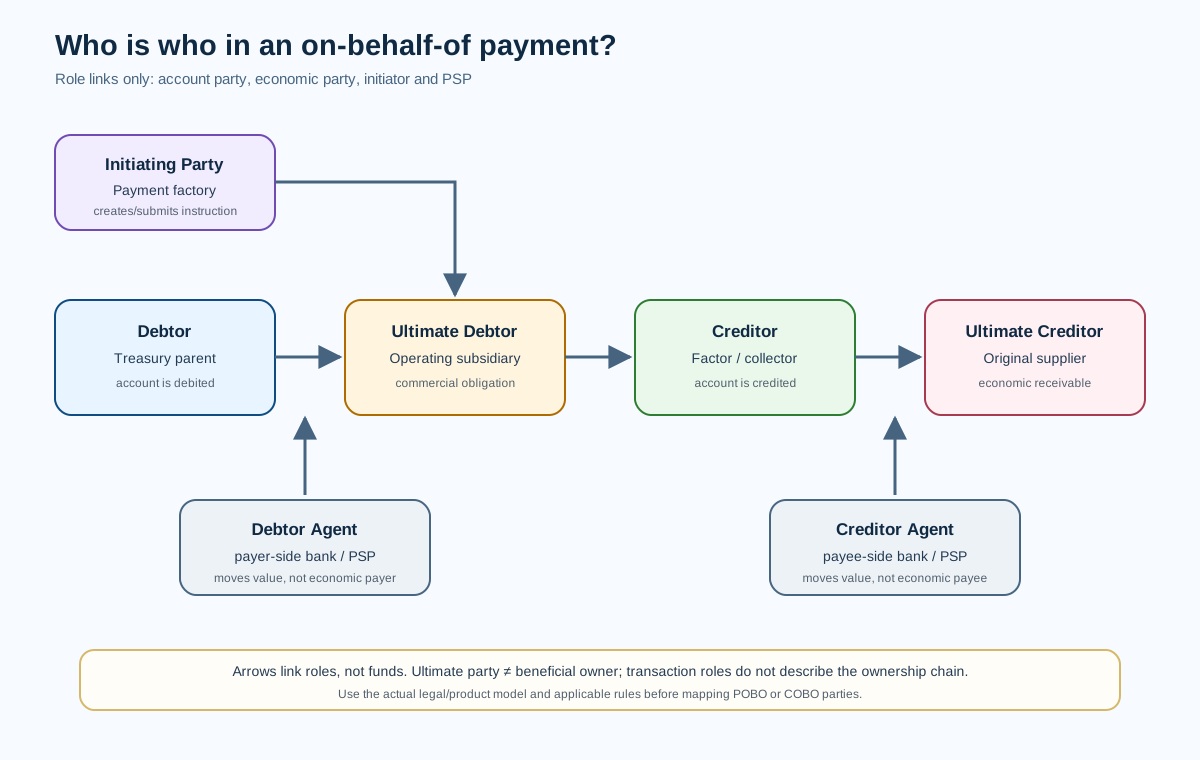
The mental model: four questions before any field mapping
Before discussing tags, schemas or screening engines, ask four questions about the business event.
Whose account or payment relationship is being used? That is normally the starting point for identifying the debtor on the sending side and the creditor on the receiving side. In a payments-on-behalf-of structure, for example, a parent or treasury company may hold the account from which a supplier payment is sent. The parent can therefore be the Debtor even though the commercial obligation belongs to a subsidiary.
Who economically owes the money? If that party is different from the immediate debtor, the underlying party may be represented as the Ultimate Debtor. Swift's 2025 market-practice material gives the familiar POBO example: a parent company uses its account to pay on behalf of a subsidiary, so the parent remains the Debtor and the subsidiary is represented as Ultimate Debtor.
Who is entitled to the economic benefit? In a collection-on-behalf-of arrangement, the account receiving funds can belong to a factor, collection company or treasury centre while the commercial receivable belongs to another entity. That underlying party may be represented as the Ultimate Creditor. Swift uses a factoring example in which the factor is the Creditor because its account receives the funds, while the original supplier is the Ultimate Creditor.
Who merely initiated or transported the instruction? A corporate payment factory, service bureau, ERP, bank channel or PSP can initiate or transmit a payment without becoming the economic debtor or creditor. Likewise, a bank or PSP belongs in an agent role when it is acting as a payment service provider. Mixing an initiating party or agent into debtor/creditor fields creates a false economic story.
Those four questions are more useful than memorising field names because they survive product and system changes. A new API, payment hub or ISO 20022 version can change technical implementation without changing the need to distinguish account party, underlying economic party, initiator and agent.
Ultimate party is not the same thing as beneficial owner
A recurring financial-crime mistake is to treat Ultimate Debtor or Ultimate Creditor as another name for a customer's ultimate beneficial owner. They are different concepts.
Beneficial ownership is a KYC and legal-person concept concerned with natural persons who ultimately own, control or benefit from a legal entity or arrangement under the applicable legal framework. Ultimate-party fields in a payment message describe the underlying party in the economic payment relationship when that party differs from the immediate debtor or creditor. A subsidiary can be an Ultimate Debtor even though it is owned by the Debtor parent. A supplier can be an Ultimate Creditor even though its shareholder has no role in the payment message. A natural person can also be an ultimate party, but that does not turn the message field into a beneficial-ownership declaration.
The distinction matters operationally. If a sanctions investigator sees Ultimate Debtor = Nordic Components AB, the investigator should not infer that Nordic Components AB is the beneficial owner of the Debtor. The field says something about the payment relationship, not the ownership chain. If beneficial ownership is relevant, the bank should obtain it from the customer/KYB record, ownership graph or other controlled source and link the evidence explicitly.
Why on-behalf-of structures matter to financial crime controls
POBO and COBO arrangements are legitimate and common. Large groups centralise cash management to reduce bank accounts, improve liquidity and standardise operations. Factors collect receivables for clients. Payroll companies disburse salary payments. Law firms may handle client money. Marketplaces and payment platforms may aggregate funds before onward settlement. None of those structures is suspicious merely because an immediate account party differs from the underlying economic party.
The control problem is opacity. If a bank knows that its corporate customer operates a payment factory but receives only the parent company's name in every outgoing payment, the bank can lose visibility of which subsidiary created the obligation. A monitoring rule might attribute all activity to the parent, hiding unusual geography or counterparties at subsidiary level. A sanctions-screening control might never see an underlying entity that is relevant under the bank's applicable legal and policy framework. An investigator may need to send an RFI for information the payment process could have carried from the start.
The opposite problem is false transparency: filling ultimate-party fields with duplicated names, department labels, product names, NOTPROVIDED, branch descriptions or other text that looks complete but has no useful identity meaning. Swift's 2025 PMPG guidance specifically warns against using ultimate-party fields for duplicates, departments, trade names used as substitutes for legal entities or placeholder values. If no distinct ultimate party exists, omitting an optional ultimate-party field is more transparent than inventing one.
Global standards, industry practice and local law are different layers
Payment-transparency requirements must be scoped carefully. FATF Recommendation 16 is the international standard for payment transparency, but countries implement FATF standards through their own laws and regulations. Scheme and network rules then define how those requirements are carried in a particular payment environment. A bank's internal policy may apply additional controls based on risk appetite, sanctions exposure or correspondent requirements.
FATF revised Recommendation 16 in June 2025, and FATF's current Recommendations were updated again in June 2026. The revised framework strengthens the information that should accompany cross-border payments and moves toward greater symmetry between originator and beneficiary information. FATF's explanatory material distinguishes verification responsibilities: the ordering financial institution sends originator information that is verified for accuracy, while it is not generally required by FATF to verify beneficiary information supplied by the originator; beneficiary institutions have their own verification responsibilities where the revised standard applies. FATF has said countries are expected to be ready to implement the strengthened requirements by the end of 2030.
That does not mean an ISO 20022 UltimateDebtor or UltimateCreditor element is universally mandatory whenever Recommendation 16 applies. Recommendation 16 speaks in legal and policy concepts such as required originator and beneficiary information. ISO 20022 provides message structures that can carry party data. Swift CBPR+ and PMPG guidance describe how those structures should be used in that market. Local regulation, scheme rules, business model and payment context determine what information must be collected, verified, transmitted or screened.
Wolfsberg's Payment Transparency Standards provide useful industry practice. They emphasise accurate representation of party and agent roles, preservation of information through the chain and the need for PSPs to understand on-behalf-of structures. Wolfsberg also recognises that some jurisdictions permit collection-agent models in which a PSP may legally be the debtor or creditor. That is a useful warning against building one global mapping rule that assumes every platform, factor or PSP must always be an agent or ultimate party.
Party roles in a practical ISO 20022 payment
A useful corporate example starts in a payment factory.
A group has a parent treasury company, Northstar Treasury Ltd, that owns the bank account. Its subsidiary, Northstar Components AB, buys equipment from a supplier, Arbor Machines GmbH. The parent sends the supplier payment from the central treasury account on behalf of the subsidiary.
In that POBO model, the payment story can be represented as:
| Business role | Example party | Why it matters |
|---|---|---|
| Initiating Party | Northstar Payment Factory | Created or submitted the payment instruction; not automatically the debtor |
| Debtor | Northstar Treasury Ltd | Immediate account party whose account is debited |
| Ultimate Debtor | Northstar Components AB | Underlying group entity whose commercial obligation is being paid |
| Creditor | Arbor Machines GmbH | Immediate receiving party / account beneficiary |
| Ultimate Creditor | Usually absent if no distinct underlying payee exists | Do not duplicate the creditor merely to fill a field |
| Debtor Agent | Northstar's bank | PSP servicing the debtor side |
| Creditor Agent | Supplier's bank | PSP servicing the creditor side |
Now change the receiving model. Arbor Machines has assigned the receivable to Arbor Receivables Finance SA, which collects into its own account. Depending on the legal structure, applicable rules and market practice, the factor may be the Creditor while Arbor Machines remains the Ultimate Creditor. The bank must understand the commercial and legal arrangement before it maps the fields. It should not assume that every factor, marketplace or collector follows the same model.
The source-to-message chain is the real control boundary
Most party-data defects are not created by ISO 20022 itself. They are created in the chain around it.
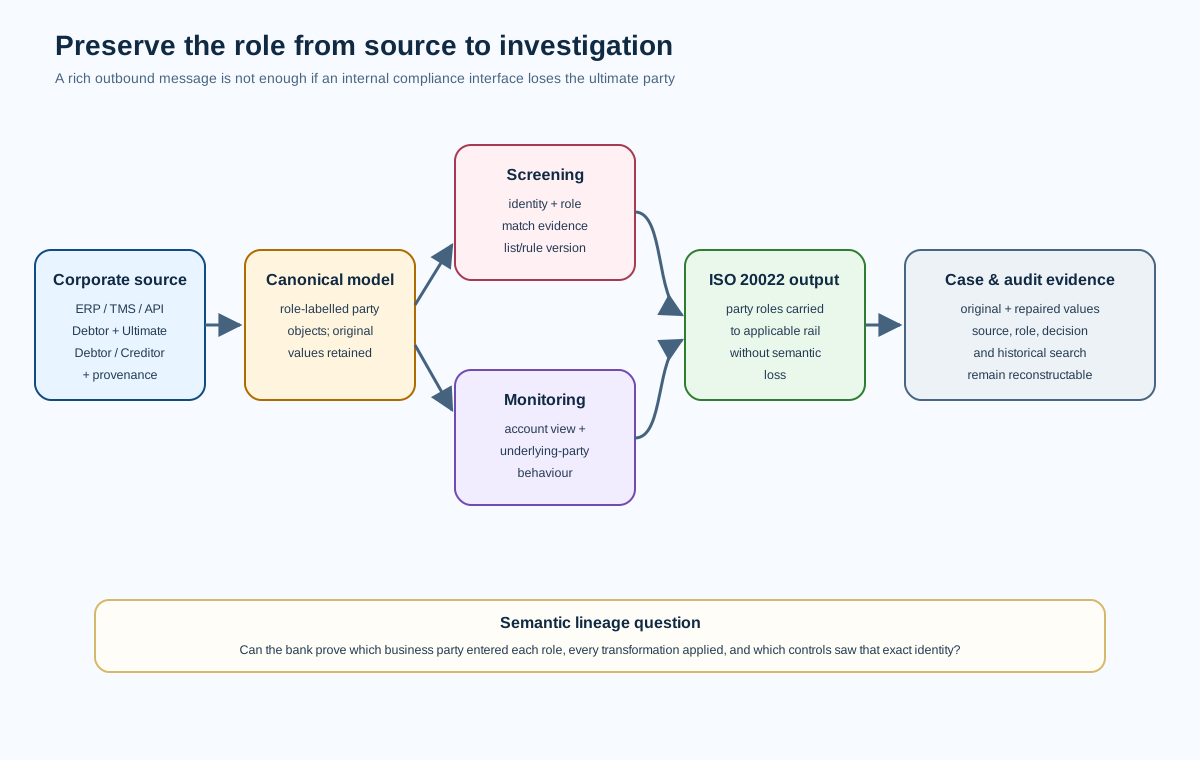
The instruction may start in an ERP, TMS, payroll engine, payment factory, host-to-host file, API or online channel. That source may distinguish the account-owning entity from the underlying subsidiary, or it may collapse both into one beneficiary or payer record. A bank ingestion layer then validates and transforms the instruction into a canonical payment model. The hub may enrich party data from customer master records, account data, reference data or sanctions controls. The payment is then rendered into a scheme-specific or network-specific message such as a pain.001-to-pacs.008 flow or another supported format.
Every transformation can change meaning. A mapper may copy InitiatingParty into Debtor because an old internal model has no separate field. A legacy channel may carry a subsidiary name in unstructured remittance text while a new API carries it as Ultimate Debtor. A repair operator may overwrite a structured party because the downstream system rejects an unsupported identifier. A correspondent translation layer may truncate or flatten information. A screening interface may receive only immediate parties even though the payment hub retained ultimate parties.
A strong control therefore maintains semantic lineage, not just technical lineage. It should answer:
- which business role the source intended;
- which ISO 20022 role the bank mapped it to;
- which transformations or enrichments occurred;
- which fields reached each screening and monitoring control;
- which version of the data was shown to an investigator;
- whether the outbound payment preserved the material information.
The bank should be able to reconstruct those facts after the event. Logging only the final XML is not enough if upstream data was changed or dropped before message generation.
Screening: screen identities, but preserve the role
Sanctions screening commonly compares names and other identity attributes against lists, but the party role affects interpretation. An immediate Debtor is usually a customer or account party known to the ordering bank. An Ultimate Debtor may be a related group company or third party supplied by the customer. A Creditor may be a direct beneficiary. An Ultimate Creditor can reveal the economic recipient behind a collection structure.
The screening engine should therefore receive enough metadata to tell the investigator what role triggered the alert. A hit on an Ultimate Debtor should not be displayed simply as “payer hit” if the account owner is a different entity. A hit on a Creditor should not be described as an Ultimate Creditor match. Those distinctions can affect evidence, outreach, legal analysis, payment disposition and which customer relationship team can answer questions.
Banks also need a clear policy on duplicate screening. If the same legal entity appears legitimately in more than one role, repeated screening may create duplicate alerts without additional risk value. Conversely, deduplication based only on name similarity can suppress a real separate party. The safer design uses stable party identifiers where available, role context and explicit deduplication rules rather than simply removing repeated strings.
Where sanctions law requires real-time action, the bank must apply the relevant jurisdictional rule and legal advice. The existence of an Ultimate Debtor or Ultimate Creditor field does not itself define a freeze, reject or report outcome. Screening identifies possible exposure; identity resolution and applicable-law analysis determine the action.
Transaction monitoring: attach behaviour to the right entity
Monitoring is where role quality becomes even more important. If a treasury parent makes payments for fifty subsidiaries, monitoring only the Debtor account can hide differences between those subsidiaries. One subsidiary may operate in a higher-risk corridor, suddenly start paying unfamiliar counterparties or transact in a sector inconsistent with its profile. If all transactions are aggregated at parent level, those patterns can be diluted.
A mature monitoring architecture can preserve both views. The account-level model assesses the behaviour of the parent treasury relationship: aggregate values, liquidity patterns, beneficiary concentration and use of on-behalf-of functionality. A party-level model can also aggregate activity by Ultimate Debtor or Ultimate Creditor where data quality is reliable enough. Investigators can then move from the account to the underlying entity and back again without losing the relationship between them.
That does not mean every ultimate party should automatically become a fully onboarded customer in the monitoring platform. The bank may not have a direct customer relationship with the ultimate party. The data may be customer-supplied and unverified. The model should preserve provenance so an investigator knows whether the attribute came from KYC, account master data, the payment instruction or external enrichment.
A useful rule is: never let richer data create stronger certainty than the source supports. Ultimate-party information can improve context even when it is not independently verified, but the system should label it accordingly.
Investigations: reconstruct the economic story
A financial-crime investigation should be able to distinguish three questions:
- Who was the bank's customer or account party?
- Who was the underlying economic party represented in the payment?
- What evidence supports that representation?
The investigator may compare the payment instruction with customer profile data, corporate hierarchy, contracts, invoices, factoring agreements, correspondent information, prior activity and RFI responses. If the Ultimate Debtor is a subsidiary of the Debtor parent, that relationship may be expected. If a previously unseen unrelated company suddenly appears as Ultimate Debtor in hundreds of payments, the question becomes whether the customer's business model permits third-party payment activity and whether the bank understood it at onboarding.
Cases should preserve both the original party values and any repaired values. If an operations team corrects a misspelt name or moves a party to a more appropriate field, the case should not erase what originally arrived. Auditability requires the bank to show what it received, what changed, who changed it and which version was screened or released.
Payment operations and customer impact
Poor party-role design produces operational problems before it produces regulatory findings. Payments can be repaired because a downstream bank cannot interpret a party. Customers can be asked repeatedly for information that their ERP already supplied. Screening false positives can increase because duplicate parties are screened as if they were different entities. Investigations can age while operations searches multiple systems for an ultimate party that was dropped in transformation.
Controls should therefore be designed with customer journeys in mind. If a bank offers POBO capability, the channel should explain when an Ultimate Debtor is expected and validate enough information to make the value usable. If the bank does not support a particular on-behalf-of model, it should not silently discard the field; the customer needs a clear product rule or alternative process. Repair should be governed, because an operator who guesses the intended party can unintentionally change the economic meaning of the payment.
Swift's move toward structured and hybrid postal addresses in CBPR+ reinforces the same principle. The CBPR+ target model requires at minimum town and country in designated structured elements where applicable, subject to the network's defined scope and exceptions. Swift deferred the earlier 14 November 2026 enforcement timetable on 27 August 2026, so the current and target profiles must be versioned separately. That is a Swift CBPR+ requirement, not a universal legal rule for every ISO 20022 implementation, but it illustrates the direction of travel: richer party data must be captured in fields that downstream controls can interpret consistently.
Control design: prevent semantic loss, not just missing fields
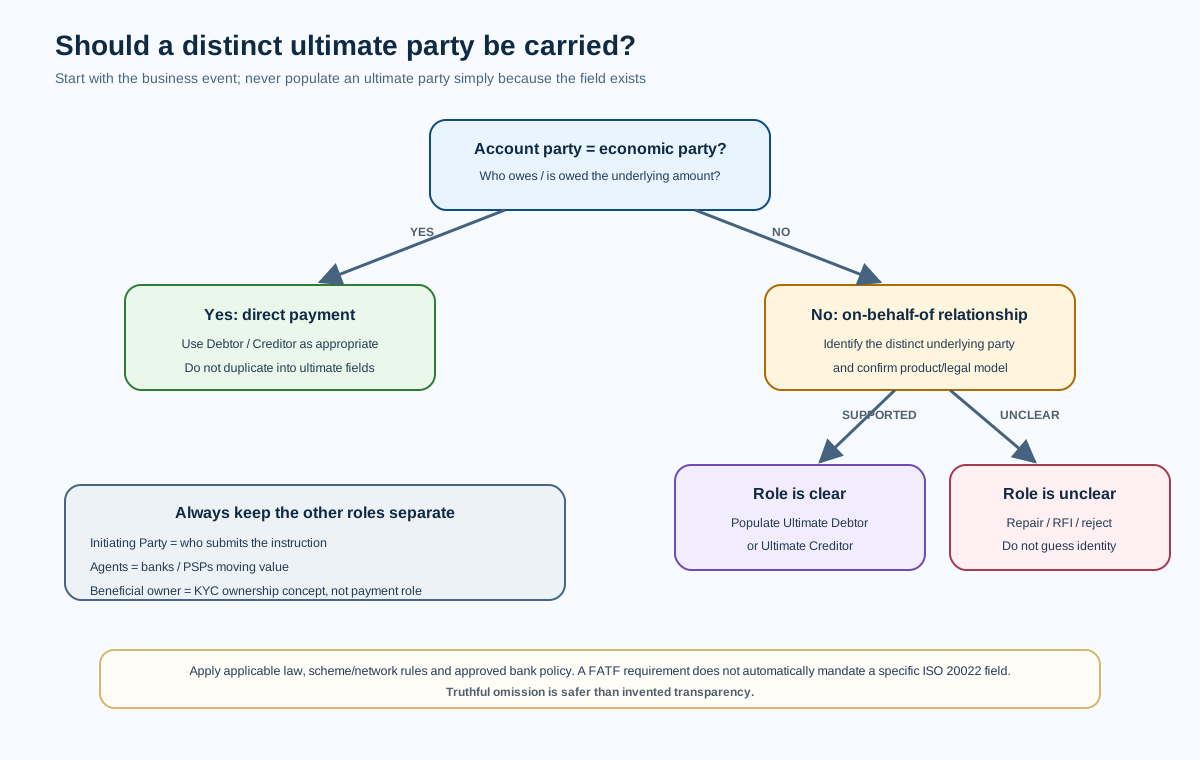
A completeness rule that checks whether UltimateDebtor is populated can be worse than no rule if the field is not actually required for the business event. The better control asks whether the payment is an on-behalf-of arrangement and, if so, whether the relevant underlying party is identified according to product policy, applicable rules and message capability.
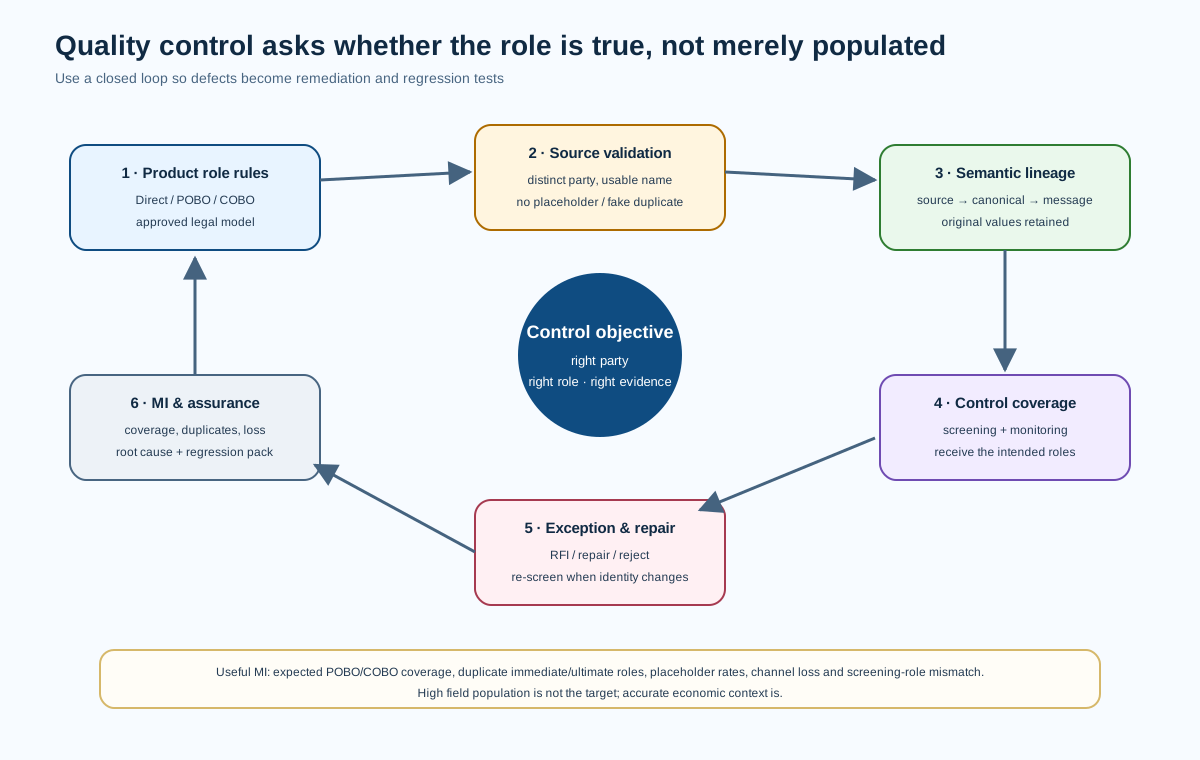
Controls should operate at several layers. Channel controls can validate mandatory business information. Mapping controls can prove that role-to-role transformations are correct. Screening controls can demonstrate which parties are screened. Monitoring controls can show whether underlying parties are retained for analytics. Operations controls can govern repair. Data-quality controls can measure missing, duplicated or suspiciously constant ultimate-party values. Change controls can prevent a new message version from dropping a field that an older interface happened to preserve.
A particularly useful metric is not simply “percentage of payments with Ultimate Debtor.” A high percentage may indicate misuse. Better metrics are contextual: percentage of known POBO customers whose qualifying payments contain the expected distinct party; rate of duplicate Debtor/Ultimate Debtor values; rate of placeholder or unusable ultimate-party data; field loss by channel; manual repair rate; screening alerts by party role; and repeat defects by source system.
Roles and governance
No single team owns the full control.
Product owns which payment models the bank offers and what customers are told. Relationship and onboarding teams understand whether the customer's business model includes payment-factory, third-party or collection activity. Compliance interprets financial-crime expectations and defines control standards. Payments architecture preserves message semantics. Data teams maintain lineage and quality rules. Screening and monitoring teams determine how party roles enter detection. Operations handles exceptions. Investigations use the data. Technology delivers transformations and logging. Testing proves end-to-end behaviour. Second line and audit challenge whether the model remains effective.
Governance should resolve disagreements about meaning. If a business team says a marketplace is always the Creditor while compliance says the underlying seller must always be Creditor, the answer should not come from whoever owns the mapping spreadsheet. The bank needs legal and product analysis of the actual flow, local regulation, scheme rules and account arrangement. The approved role model should then become a controlled requirement used consistently by channels, hubs and financial-crime systems.
BA, architecture and testing considerations
For a business analyst, “support Ultimate Debtor” is not a sufficient requirement. A buildable requirement defines the business conditions under which the field is used, source ownership, permitted party types, mandatory attributes, validation rules, downstream consumers, error behaviour, repair permissions, audit events and reporting.
A useful mapping specification includes source field, source definition, canonical field, ISO 20022 role, target message path, screening use, monitoring use, persistence period and transformation rule. It should explicitly identify fields that must not be copied into a party role. Tests should prove both positive mapping and the absence of inappropriate duplication.
Architecture needs to preserve role metadata through APIs, event streams, databases and screening interfaces. A generic partyName array without role type is a common anti-pattern. So is a canonical model with payer and payee only when the bank supports payment factories or collection structures. Historical versioning matters: investigators may need to reconstruct a payment created under an older mapping rule.
Testing should include normal direct payments, POBO, COBO, both-sided on-behalf-of arrangements where supported, no-ultimate-party cases, duplicate values, missing names, structured-address defects, unexpected third parties, repair, resubmission and downstream rejection. It should also include sanctions test data for each role and monitoring scenarios that prove transactions can be aggregated to both immediate and underlying parties without converting an unverified ultimate party into a verified customer attribute.
Mini case: the subsidiary that disappeared in translation
Northstar Treasury Ltd runs a central payment factory for fifteen subsidiaries. The arrangement is known to the bank and permitted under the relevant product and local rules. Northstar Components AB buys specialised equipment from Arbor Machines GmbH. The corporate file identifies Northstar Treasury as Debtor, Northstar Components as Ultimate Debtor and Arbor Machines as Creditor.
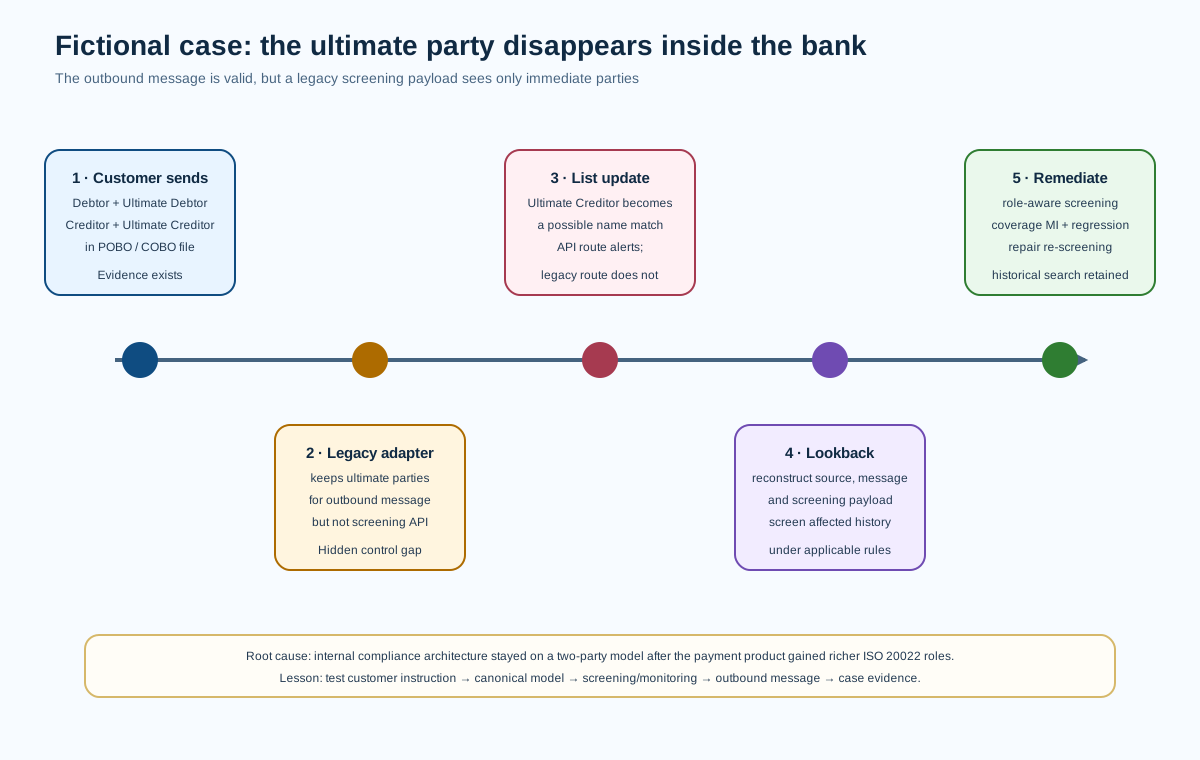
The bank's new API path preserves all three parties. Its older host-to-host adapter, however, maps the parent correctly as Debtor but drops Ultimate Debtor because the canonical model used by that adapter was created before the POBO product was launched. Both paths generate valid outbound messages. Schema validation therefore passes.
Months later, a sanctions-list update creates a possible match against another group subsidiary. Compliance asks the bank to identify payments involving that entity. API-originated payments can be found by Ultimate Debtor. Host-to-host payments cannot. The problem is not that the bank failed to use ISO 20022; it is that one source-to-canonical mapping silently removed the economic party before the ISO 20022 message was built.
The remediation has several parts. The bank fixes the mapping, adds regression tests, identifies the historical population affected by the defect, decides under its legal and policy framework whether retrospective screening or review is required, and adds a metric comparing expected POBO volumes with actual ultimate-party population by channel. It also checks whether the missing field affected monitoring, RFIs or investigations, not only sanctions screening.
The case shows why party data is a control architecture problem rather than an XML problem. A message can be syntactically valid while financially incomplete.
What to remember
Debtor and Creditor describe the immediate payment parties; Ultimate Debtor and Ultimate Creditor provide underlying economic-party context when a distinct on-behalf-of relationship exists. Initiating parties and payment agents have different roles and should not be forced into debtor or creditor fields simply because a legacy model lacks the right structure.
Ultimate-party data is not a substitute for beneficial-ownership data, and its presence does not by itself determine a sanctions or AML outcome. The control value comes from accurate business-role modelling, reliable source data, preserved lineage, role-aware screening and monitoring, disciplined repair and evidence that can be reconstructed later.
The most important practical question is not “is the field populated?” It is: does the payment message tell the true economic story of the parties, at the level of certainty the bank actually has, without losing or inventing meaning along the way? Swift timetable source, checked 2 October 2026: Structured-address migration extension and 21 September release update. The deferred release includes exceptions/investigations messages on 12 June 2027; structured-address enforcement timing remains separately governed: https://www.swift.com/news-events/news/swift-accepts-community-request-extend-structured-address-migration-iso-20022-payment-messages
Operational deep dive: from commercial relationship to party-role evidence
The difficult part of debtor, creditor and ultimate-party data is not learning four field names. It is translating a real commercial relationship into message roles without losing meaning as the payment moves through channels, hubs, compliance controls and correspondent chains. This deep dive follows that translation in the same order a bank would normally design and test it.
Start with the business arrangement, not the XML
A bank should understand why an on-behalf-of arrangement exists before it decides how to map it. A corporate group may centralise payments because one treasury entity owns the funding account. A factoring company may collect receivables because the supplier assigned collection rights. A payroll provider may submit payments on behalf of employers. A law firm can pay or receive money for clients. A marketplace may collect funds from buyers and settle sellers. Those models do not have identical legal relationships even if they all involve more than one party behind a payment.
The first design artefact should therefore be a business-role model. It identifies the account owner, the party whose obligation is being discharged, the party economically entitled to the payment, the initiator, the servicing PSPs and any intermediary. It also states which relationships are verified by the bank and which are merely asserted in the payment instruction.
That last point is crucial. The bank may have completed CDD on its direct corporate customer but not on every subsidiary, supplier, buyer or seller represented as an ultimate party. The message should preserve the information, but downstream systems should not silently upgrade customer-supplied data into verified KYC data. Provenance needs to travel with the value even if the ISO 20022 message itself does not carry an explicit “verified by bank” flag for every business concept.
POBO: the account party and economic obligor separate
In a payment-on-behalf-of model, the central treasury entity commonly owns the account and pays an obligation belonging to another group company. The treasury company can therefore be the Debtor, while the underlying group company can be the Ultimate Debtor.
The bank should confirm that the arrangement is consistent with the customer's known business model and permitted under applicable product, legal and regulatory rules. Wolfsberg's Payment Transparency Standards make this practical point: before allowing a corporate customer to make payments on behalf of other parties, the debtor agent PSP should understand the arrangement and set expectations for the ultimate-debtor information that customers should provide.
A common error is to reverse the roles because the subsidiary “feels like the real payer.” That may cause the payment message to imply that the subsidiary owns the debit account when it does not. Another error is to put the parent in both Debtor and Ultimate Debtor simply to satisfy a downstream field rule. That creates no extra transparency. A third error is to put the payment-factory name in Ultimate Debtor even though the factory is only the initiator.
Good POBO design keeps three layers separate: who owns the account, on whose behalf the payment is economically made, and who technically initiates the file.
COBO: collection structures need the same discipline
COBO arrangements are the mirror image only at a high level. A factor, treasury centre or collection company can receive money into its account on behalf of another entity. Swift's public ultimate-party guidance uses a factoring example: the factor is represented as Creditor because it is the account holder receiving the funds, while the original supplier is represented as Ultimate Creditor.
Banks must still validate the legal and product model. In some jurisdictions and collection-agent arrangements, the PSP or collector may legally be the creditor in its own right. Wolfsberg expressly recognises that local regulation can permit models where the PSP is considered the legal debtor or creditor. The architecture should therefore support controlled variation rather than embed a universal assumption that “platform = agent” or “seller = creditor.”
For financial crime teams, COBO transparency can be important because the credited account alone may not explain the economic recipient population. A factor can collect for many suppliers; a marketplace can settle many sellers; a collection account can receive money for multiple group entities. Monitoring only the immediate creditor can hide underlying concentration or counterparty patterns. At the same time, underlying parties may not be direct customers, so the bank should distinguish payment evidence from customer due-diligence evidence.
Initiating Party is not a substitute for Debtor
Corporate payment factories and service bureaus often create confusion because the entity sending the file is visible before the account party is resolved. In ISO 20022 pain.001 use, the Initiating Party can identify the party sending the instruction while the Debtor identifies the party whose account is debited. Swift's ISO 20022 programme material specifically warns that Ultimate Debtor should not be confused with Initiating Party.
An ERP service provider could submit a file for Northstar Treasury without being debtor, ultimate debtor or agent. A group payment factory could be the same legal entity as the Debtor in one implementation and a separate service entity in another. The system should model the role from facts rather than infer it from who opened the API session or signed the file.
Authentication data is still valuable. The bank should retain which corporate user, certificate, API client or service submitted the instruction. But that security evidence belongs alongside the payment-role model, not inside it as a substitute.
Agents must remain agents
Debtor Agent, Creditor Agent and intermediary-agent roles identify PSPs involved in moving the payment. Putting a bank or PSP into an ultimate-party field because it “stands behind” the transaction destroys the distinction between commercial party and financial intermediary.
The distinction is particularly important in correspondent banking. An intermediary may see debtor, creditor and ultimate-party information without having a customer relationship with those parties. Wolfsberg notes that intermediary PSPs are not expected to perform CDD on every underlying debtor or creditor merely because the information appears in the payment. They remain responsible for the obligations applicable to their role, including relevant screening and monitoring based on the information available to them.
This prevents a common conceptual error: richer payment data does not make every bank in the chain the KYC bank for every named party.
Building a canonical party model
A payment hub that supports complex business models needs more than payerName and payeeName. A stronger canonical model separates at least:
- party role;
- legal or natural-person identity attributes;
- account relationship;
- source system and source field;
- verification or provenance status where the bank can support it;
- effective timestamp/version;
- identifiers such as LEI, BIC or other organisation/private identifiers where appropriate;
- address and country attributes;
- relationship to another party where known, such as “payment on behalf of subsidiary.”
The canonical model should also allow absence. If there is no distinct Ultimate Creditor, the right value is not a duplicate copy of Creditor. Optionality is part of semantic correctness.
When source channels have different capabilities, the model should make the difference observable. A modern API might provide a structured Ultimate Debtor object while an older host-to-host file only provides free text. The bank can enrich or repair according to approved rules, but it should not hide the fact that the sources have different evidence quality.
Mapping controls should test meaning, not only syntax
Schema validation proves that a message conforms to the technical specification. It does not prove that the bank mapped the correct party to the correct field.
A semantic mapping control can use rule-based assertions. If a product configuration says the customer is operating POBO and the payment identifies a distinct underlying obligor, the canonical model should preserve both Debtor and Ultimate Debtor. If Debtor == UltimateDebtor for nearly every POBO payment, that may indicate duplication. If an Initiating Party is systematically copied to Ultimate Debtor, that is a mapping defect even if every message validates successfully.
Tests should also cover null behaviour. If no ultimate party is supplied and none is required by the business model or applicable rule, the system should not create one. If an ultimate party is required for a supported product but missing, the channel or orchestration layer should follow an explicit error, repair or reject path. Silent deletion is rarely defensible.
Screening interface design
A screening request should preserve role labels. Sending a flat list of names can make matching possible but investigation poor. The response should be traceable to Debtor, UltimateDebtor, Creditor, UltimateCreditor, InitiatingParty or the relevant agent role.
The bank should define which roles are screened at which point. Customer onboarding screening, payment screening and post-event monitoring are separate controls. An Ultimate Debtor supplied in one payment may require transaction-time sanctions screening under bank policy while not creating a standing customer-screening record. Conversely, a group subsidiary already known in KYC may be screened periodically as a connected party independently of payment messages.
If a screening vendor does not support all role types, the integration layer can still preserve role metadata in a correlation object so investigators know which field generated the match. Dropping that metadata because the vendor only accepts party1, party2 is a technology limitation that should be compensated, not normalised.
Monitoring model design
Monitoring can use ultimate-party data in several ways. One is aggregation: group payments by Ultimate Debtor to see whether one subsidiary's behaviour changes even though the parent account remains stable. Another is relationship analysis: identify repeated Ultimate Creditors across otherwise unrelated customers. A third is discrepancy detection: identify customers whose declared POBO population differs materially from the ultimate-party values appearing in payments.
Those uses require quality thresholds. If half the payments have unreliable or missing ultimate-party data, a model based on the field can produce misleading risk scores. Data quality should therefore be a feature of the control, not merely an upstream IT metric. Models can distinguish “known absent,” “not applicable,” “customer supplied,” “verified connected party” and “mapping failure” rather than treating every null or name string equally.
Investigations and RFI handling
An investigator reviewing a suspicious or sanctioned payment needs the original and current versions of each party role. The case should show the immediate debtor/creditor, ultimate parties, agents, source channel, repair history and any linked KYC entity.
If information is incomplete, an RFI should ask the party that can realistically supply it. The debtor agent may ask its customer to explain the Ultimate Debtor relationship. An intermediary may ask the upstream PSP for missing originator or ultimate-party information. The case should record whether the information was present originally, lost in transformation or genuinely unavailable from the customer.
That distinction affects remediation. A customer-data problem may require channel guidance or relationship management. A bank-mapping problem requires technology repair and potentially historical review. A downstream truncation problem may require network or correspondent engagement. Without lineage, all three become “missing party data,” which produces weak root-cause management.
Data retention and historical reconstruction
Payment investigations often happen after the transaction. A bank therefore needs to retain enough data to reconstruct the party model as it existed at execution time. That includes values, role, source, message version, mapping rule version and relevant screening result.
Historical reconstruction is especially important after a sanctions designation or control defect. If an Ultimate Creditor becomes designated, the bank may need to identify prior payments involving that party. A search across free-text remittance is not an adequate substitute for structured party history where the bank had the data available.
Retention periods and disclosure rights are jurisdiction-specific. The architecture should follow applicable privacy, AML, sanctions, payment and recordkeeping requirements rather than create indefinite storage merely because data is useful.
Change management: ISO 20022 migrations can improve or damage transparency
Migration from legacy formats to ISO 20022 can improve party transparency only if banks adopt the richer model end to end. Swift notes that translating from richer ISO 20022 into less rich MT formats can lose or truncate party information. The same problem can occur inside a bank if a rich external message is converted into an old internal model before screening.
Every migration should therefore include field-level lineage tests. Teams should compare the source instruction, canonical object, outbound message, screening payload, monitoring event and investigation view. Tests should confirm that party roles remain stable across normal processing, repair, reject/re-submit, duplicate detection and failover.
A release that “passes ISO schema validation” but drops Ultimate Debtor from the screening interface is not a successful financial-crime migration.
What architecture reviewers should challenge
Architecture review should be sceptical of five patterns: one generic party array with no role; silent role inference from account position; mandatory duplication of immediate and ultimate parties; transformations that do not preserve original values; and compliance integrations that receive less information than the payment hub holds.
A strong design can explain each party from business event to case screen. It can show where the party came from, why it occupies that role, whether the bank verified it, what controls consumed it and how historical payments can be found if the risk changes later.
That is the real value of ISO 20022 party structure: not more tags, but a more faithful and auditable representation of who is actually involved in the movement of money.
Advanced practice: control design, testing and change assurance
Once a bank can represent debtor, creditor and ultimate parties correctly, the next challenge is proving that the representation remains correct under real operating pressure. This is where a data feature becomes a financial-crime control. The control has to survive multiple channels, upgrades, repair, sanctions-list changes, payment-hub releases, correspondent translation, high volumes and incomplete customer instructions.
Design controls around business conditions
The strongest validation rule is not “Ultimate Debtor must be populated.” It is “when this product and business arrangement represents a payment on behalf of a distinct underlying obligor, the approved party-role information must be present, usable and preserved.”
That formulation matters because ultimate-party fields are conditional. In an ordinary direct payment, a distinct Ultimate Debtor may not exist. Forcing one creates duplicate or artificial data. In a genuine POBO payment, however, omission can remove the economic party that explains the transaction.
A product-control matrix should therefore describe supported models such as direct payment, group POBO, third-party OBO, payroll, factoring/COBO, marketplace collection and other approved arrangements. For each model it should state the expected roles, source attributes, verification status, validation behaviour, screening treatment, monitoring use and exception route. Jurisdiction-specific restrictions or licensing considerations should be attached to the relevant model rather than embedded as a misleading global rule.
Separate legal obligation, network rule and bank policy
Delivery teams often collapse three layers into one “compliance requirement.” That makes change difficult and creates false universality.
The first layer is law and regulation. FATF Recommendation 16 is an international standard implemented through national or regional law. The precise legal requirements, thresholds, exemptions, verification responsibilities and enforcement consequences depend on the jurisdiction.
The second layer is payment-market or network practice. Swift CBPR+ usage guidance, PMPG market practice and ISO 20022 message structures determine how information can be carried through a particular cross-border payment environment. Swift's current direction on structured/hybrid addresses is an example of a network implementation requirement, not a universal law of every ISO 20022 payment.
The third layer is bank policy. A bank can require richer information for a product, correspondent relationship or risk appetite reason, provided that requirement is lawful and operationally supported. Policy can also define which party roles are screened, how missing data is handled and when an RFI is required.
Requirements should record their source layer. That allows a future change team to know whether an update is mandatory because law changed, required by a scheme release or chosen by bank policy.
Control points across the lifecycle
A mature bank uses several complementary control points rather than one validation gate.
At onboarding, the bank establishes whether the customer is expected to use POBO, COBO or third-party payment models. It records the expected group entities, business purpose, geographies and products at a level proportionate to risk.
At initiation, the channel asks for the information necessary for the selected payment model. It should make the role understandable to customers. A corporate user should not need to know internal database names, but the journey can clearly distinguish “account owner” from “company on whose behalf you are paying.”
At orchestration, the payment hub validates the role combination and preserves the source values. Enrichment should use controlled reference data. A known group-company identifier can help reduce typing errors, but enrichment should not fabricate a relationship not present in the approved customer profile.
At screening, each relevant identity reaches the sanctions control with role metadata and provenance. At monitoring, account and underlying-party views are retained where data quality supports them. At payment release, repair or reject decisions are logged. At investigation, the original and transformed values are reconstructable. At assurance, quality teams test whether the whole chain still works after change.
Role-aware screening test strategy
Sanctions testing should prove more than that “a name can hit.” Test cases should place controlled listed or watchlist-like names in each supported role separately: Debtor, Ultimate Debtor, Creditor and Ultimate Creditor. The expected alert should identify the correct role. The test should also verify that an agent match is not mislabelled as a customer-party match.
Negative cases matter equally. A distinct Ultimate Debtor with a common name should be capable of closing as a false positive using geography, identifiers and other reliable attributes without the system accidentally using the Debtor's KYC data as if it belonged to the Ultimate Debtor. A duplicate immediate/ultimate party should not create two unrelated case identities if the values refer to the same entity, but deduplication must not merge two different entities merely because their names are similar.
Screening regression tests should capture rule and list versions. If a future release changes transliteration, name normalisation or field precedence, the bank should be able to see whether the alert population changed because of screening logic or because party-role data changed upstream.
Monitoring test strategy
Monitoring tests should confirm that activity can be analysed at the account-party level and, where intended, at the ultimate-party level.
For a POBO treasury account, create transactions for three subsidiaries with different normal profiles. Introduce a sudden high-risk corridor only for one Ultimate Debtor. The model should be capable of identifying the change without requiring the entire parent account to breach an aggregate threshold.
Then test missing ultimate-party data. The model should not quietly classify those transactions under the parent as if no underlying party existed. Data-quality status should be observable so compliance knows whether an apparently low-risk subsidiary view is incomplete.
Finally, test a false relationship. If a customer supplies a third party as Ultimate Debtor but the relationship is inconsistent with its approved business model, the system should be able to generate an exception or monitoring signal without assuming the third party is necessarily suspicious. The control question is whether the activity is understood and permitted.
Mapping and transformation testing
For each supported channel, build a field-lineage test from source to final consumer. The evidence should include:
| Stage | Test question |
|---|---|
| Channel/API/file | Was the correct business role captured? |
| Canonical model | Was the role preserved without duplication or coercion? |
| Payment message | Was the party rendered in the correct target structure? |
| Screening payload | Did the relevant party and role reach screening? |
| Monitoring event | Can behaviour be attributed to the intended entity? |
| Case view | Can an investigator see original, current and source values? |
| Outbound/network | Was material party information retained downstream? |
The test pack should include repair and resubmission. A surprisingly common defect appears only after manual repair: the original structured Ultimate Creditor is moved into narrative text, or the repaired payment bypasses a screening point because the system believes it was already screened. Regression testing must follow the payment through exception paths, not only straight-through processing.
Data-quality controls that reveal semantic defects
Traditional data-quality metrics such as null percentage and valid-character rate are useful but insufficient. Party-role controls need semantic metrics.
Examples include the proportion of POBO transactions where Debtor and Ultimate Debtor are identical; sudden changes in the population of ultimate parties by channel; high use of placeholders; excessive concentration of one ultimate party across unrelated customers; unexpected use of a PSP name as Ultimate Creditor; values that look like departments rather than legal or natural persons; and a mismatch between customer product configuration and the roles appearing in payment messages.
These metrics should support investigation, not automatic accusation. A high duplicate rate may reflect a mapping rule rather than customer misconduct. The goal is to find where meaning is being lost.
Repair authority and the danger of “helpful” edits
Operations teams often receive vague payment instructions and try to make them pass. That can be necessary, but party-role repairs are sensitive because they change who the message says is involved.
A repair operator should not convert a payment-factory name into an Ultimate Debtor merely because the field is empty. Nor should the operator move a supplier name from remittance text into Ultimate Creditor without evidence that the supplier is the underlying economic beneficiary. The bank should define which corrections can be made from authoritative internal data, which require customer confirmation and which require rejection or RFI.
Every repair should preserve the original value, repaired value, reason, operator, timestamp and any re-screening decision. Where a repair changes a screened identity, the payment should follow the applicable re-screening path before release.
Change assurance for the deferred address transition and beyond
Swift's CBPR+ address changes make 2026 a good example of why party controls need change assurance. The target CBPR+ model uses at least structured town and country elements within the network's stated scope; Swift deferred the earlier 14 November 2026 enforcement plan on 27 August 2026. Readiness and production enforcement must therefore follow separately governed rule versions and confirmed effective dates. A bank can successfully implement that rule and still damage ultimate-party transparency if its address-remediation project changes party mapping or strips identifiers.
Testing should therefore cover the whole party object, not just the address fields being changed. Compare pre-release and post-release messages for role, name, identifiers, address, account linkage, screening payload and case presentation. Where AI or automated address structuring is used, retain confidence, original value and transformation evidence according to the bank's governance model.
Defect management and retrospective impact
A defect in party-role mapping can have a historical population. When one is discovered, the bank should identify the affected channels, products, dates and transactions. The response then depends on the defect and applicable rules.
A missing Ultimate Debtor may have affected sanctions screening, monitoring, payment transparency, investigations and regulatory reporting. The bank should not assume that fixing future messages closes the risk. Compliance and legal owners should assess whether retrospective screening, lookback, customer outreach, correspondent notification or other remediation is required.
The impact assessment should distinguish data not supplied by the customer from data supplied but lost by the bank. Those scenarios can have very different accountability and remediation implications.
Governance evidence
A senior control owner should be able to show:
- the approved party-role model for each product;
- legal/network/policy traceability;
- source-to-consumer lineage;
- screening and monitoring coverage by role;
- data-quality MI and defect trends;
- repair permissions and exception ageing;
- regression tests across supported channels;
- known limitations and accepted residual risks;
- evidence that material changes trigger reassessment.
The purpose is not to create paperwork. It is to make it possible to answer a regulator, auditor or incident manager when they ask how the bank knows the payment tells the right story.
Advanced design principle
The most mature control does not maximise the number of populated party fields. It maximises truthful, traceable and usable party information. A blank optional field can be correct. A fully populated field can be wrong. The bank's job is to preserve the economic meaning of the payment, know how certain it is about that meaning and apply financial-crime controls to the parties actually represented. Swift timetable source, checked 2 October 2026: Structured-address migration extension and 21 September release update. The deferred release includes exceptions/investigations messages on 12 June 2027; structured-address enforcement timing remains separately governed: https://www.swift.com/news-events/news/swift-accepts-community-request-extend-structured-address-migration-iso-20022-payment-messages
Practice close: review the payment story before the field list
Use this section to test whether the chapter has become practical rather than merely familiar. A strong learner should be able to look at a payment flow, identify the immediate and underlying parties, distinguish payment-role data from KYC ownership data, and challenge a system design that loses meaning even when the XML remains valid.
Five scenarios to reason through
Scenario 1: ordinary supplier payment
A company pays a supplier directly from its own account. No payment factory, factor, collector or other underlying party exists.
The likely model is Debtor = paying company and Creditor = supplier. There may be no distinct Ultimate Debtor or Ultimate Creditor. Populating duplicates solely to satisfy a template would reduce rather than improve data quality.
The control question is not “why is Ultimate Debtor blank?” It is “does a distinct underlying party exist for this business event?”
Scenario 2: group payment factory
A parent treasury company pays an invoice on behalf of a subsidiary. The parent's account is debited. The subsidiary purchased the goods.
The parent can be Debtor and the subsidiary Ultimate Debtor. The payment factory that submits the file may be Initiating Party. If the factory is simply a technical or organisational initiator, it should not displace the account owner or economic obligor.
The bank should already understand the customer's POBO model. A sudden unrelated Ultimate Debtor outside the approved group population should prompt contextual review, not automatic suspicion.
Scenario 3: factoring collection
A buyer pays an invoice into the factor's account after the supplier assigns the receivable. Under the specific legal and product model assumed for the example, the factor is Creditor and the supplier is Ultimate Creditor.
A bank should not generalise that mapping to every factoring or collection structure. Legal rights, account arrangements, local rules and scheme practice can differ.
Scenario 4: marketplace payout
A marketplace receives buyer funds and later settles sellers. Whether the marketplace is Debtor, Creditor, agent, PSP, collector or another role depends on the actual payment leg and legal model. The learner should resist the temptation to force “seller = Ultimate Creditor” into every leg.
The right process is to diagram each movement of funds separately, identify account ownership and economic obligation for that leg, then map the approved roles.
Scenario 5: law-firm client payment
A law firm uses its client account to make a payment for a client. Wolfsberg uses on-behalf-of examples to illustrate why an underlying party can matter for transparency. The bank should understand whether the activity fits the customer's expected business model, what party information should accompany the transfer and what local legal restrictions apply.
Again, the client's presence as an Ultimate Debtor does not make the client a direct customer of every bank in the chain.
Common misconceptions
“Ultimate party means ultimate beneficial owner.” No. Ultimate-party fields describe the underlying economic party in the payment. Beneficial ownership describes ownership/control of a legal person or arrangement under the applicable KYC framework.
“Every payment should have Ultimate Debtor and Ultimate Creditor.” No. Where no distinct underlying party exists, duplication creates noise. Requirements depend on the business model, applicable rules and message context.
“The initiator is the debtor.” Not necessarily. A payment factory or service bureau can submit the file without owning the debit account or the commercial obligation.
“If the outbound ISO 20022 message is correct, screening is correct.” Not necessarily. An internal screening interface can drop ultimate parties even while the outbound message retains them.
“If an Ultimate Debtor is supplied, the bank has verified it.” Not necessarily. The value may be customer-supplied. Provenance must distinguish verified KYC information from transaction data supplied for the payment.
“One mapping works globally.” No. FATF standards, national law, network rules and bank policy operate at different layers. Wolfsberg also recognises collection models where a PSP can legally be debtor or creditor in some jurisdictions.
BA acceptance criteria
A delivery team should be able to answer these questions before declaring the feature complete:
- Is the exact business condition for using each ultimate-party role documented?
- Can the source channel distinguish account party, underlying party and initiator?
- Does the canonical model preserve those distinctions?
- Are original and repaired values retained?
- Does the relevant screening control receive the same party identity and role that the payment hub holds?
- Can monitoring aggregate both immediate and underlying parties where intended?
- Can case management identify which role caused an alert?
- Is provenance visible so customer-supplied data is not mistaken for verified KYC data?
- Do tests cover direct, POBO, COBO, missing, duplicate, adverse-party and repair scenarios?
- Can the bank identify historical payments if a mapping defect or sanctions-list change occurs later?
A “no” does not always mean the payment product must stop immediately, but it does mean the control limitation should be understood, owned and remediated rather than hidden behind successful message validation.
Architecture review prompts
An architect reviewing the design should ask where the party role first enters the bank and where it can be lost. Look for conversions from rich channel objects into older canonical models, generic payer/payee structures, flattening to narrative strings, screening interfaces that accept fewer roles than the payment hub, and data stores that preserve values but not provenance.
Ask what happens on repair. If operations changes an identity, does the revised party get re-screened? Can the original be reconstructed? Does a re-submitted payment retain its role data or revert to defaults?
Ask what happens on failure. If screening is temporarily unavailable, does the fallback process still preserve ultimate-party data for subsequent control action? If a downstream scheme rejects a field, is the bank allowed to remove it, or must the payment be repaired with customer involvement?
Ask how the design handles privacy. Richer party data should be retained and exposed only for legitimate processing, compliance and investigation purposes under applicable law. “Useful to compliance” is not a justification for unrestricted internal distribution.
Testing pack
A robust test pack includes positive, negative, boundary and failure cases.
Positive: direct payment with no ultimate party; valid POBO with distinct Ultimate Debtor; valid COBO with distinct Ultimate Creditor; both roles present where the approved business flow requires them; identifiers and structured addresses preserved.
Negative: duplicated Debtor/Ultimate Debtor; department name in Ultimate Debtor; NOTPROVIDED placeholder; PSP placed in Ultimate Creditor instead of agent role; Ultimate Debtor lost between channel and screening; unapproved unrelated third-party payer.
Boundary: same party appears in more than one legitimate role; very long legal name; transliteration; missing optional identifier; customer-supplied ultimate party differs from KYC-connected-party record; change from direct payment to POBO after customer profile update.
Failure: manual repair changes party; screening service outage; duplicate payment reprocessing; message conversion; failover to legacy channel; historical lookback after mapping defect.
For every case, validate more than the outbound message. Inspect source data, canonical representation, screening request, monitoring event, payment message, case view and audit trail.
Investigator review prompts
When an alert involves an ultimate party, an investigator should establish the role before making a conclusion. Useful questions include:
- Is the alerting name Debtor, Ultimate Debtor, Creditor or Ultimate Creditor?
- Who owns the debited or credited account?
- What commercial relationship explains the ultimate party?
- Is the information verified by the bank or supplied by the customer?
- Does the relationship fit the customer's expected business model?
- What other identifiers, geography or documents support identity resolution?
- Was the party present in the original instruction or added/repaired later?
- Did all relevant controls see the same value?
- Does applicable law require a hold, reject, freeze, report or other action, or is this only a potential match requiring investigation?
The case narrative should preserve these distinctions. “Payer matched list” is poor documentation if the actual match was to an unverified Ultimate Debtor supplied by a corporate customer.
Knowledge check
Why can a blank Ultimate Creditor be correct? Because there may be no distinct underlying party behind the immediate Creditor. Optional fields should not be populated with duplicates simply to look complete.
Why is a payment factory usually not the Ultimate Debtor just because it created the file? Because initiation is a different role from economic obligation. The factory may be an Initiating Party while a parent account holder is Debtor and a subsidiary is Ultimate Debtor.
Why does role provenance matter to sanctions investigations? Because the investigator must know what the bank actually verified versus what a customer supplied, and which identity caused the alert.
Why can transaction monitoring benefit from Ultimate Debtor? Because activity executed through one treasury account can be analysed by the underlying subsidiary, making changes or concentrations visible that may be diluted at parent-account level.
What is the key distinction between FATF Recommendation 16 and ISO 20022 ultimate-party fields? FATF defines international payment-transparency expectations that countries implement through law; ISO 20022 provides message structures. The legal requirement does not automatically translate into a universal requirement to populate a particular ISO 20022 ultimate-party element.
Closing principle
The best party-data implementation is not the one with the most fields populated. It is the one where every populated role has a defensible meaning, every important party survives the end-to-end journey, and investigators can reconstruct the payment's economic story without guessing.
Masterclass: a payment factory, a factor and one bad mapping rule
This fictional case brings the chapter together from customer model to payment release. It is deliberately realistic without referring to a real bank, customer or enforcement event.
The business arrangement
Northstar Group operates a central treasury company, Northstar Treasury Ltd, which holds the group's main euro payment account. Fifteen operating subsidiaries submit supplier payments to a group payment factory. The bank has approved the arrangement after understanding the corporate structure, treasury model and expected payment activity.
For ordinary POBO payments, the approved role model is straightforward. Northstar Treasury is the Debtor because its account is debited. The operating subsidiary whose commercial obligation is being paid is the Ultimate Debtor. The supplier receiving money directly is the Creditor. If no distinct underlying receiving party exists, Ultimate Creditor is omitted rather than duplicated.
One subsidiary, Northstar Components AB, buys industrial equipment from Arbor Machines GmbH. Arbor has sold some of its receivables to Arbor Receivables Finance SA. For invoices assigned to the factor, the agreed collection model treats Arbor Receivables Finance as the Creditor because the factor's account receives the funds, while Arbor Machines remains the Ultimate Creditor because the payment satisfies the original supplier receivable. The bank's legal and product teams have confirmed that this role model is appropriate for this fictional arrangement. Another legal structure could require a different mapping.
What the corporate file contains
The payment factory sends a structured corporate instruction containing:
- Initiating Party: Northstar Payment Factory
- Debtor: Northstar Treasury Ltd
- Ultimate Debtor: Northstar Components AB
- Creditor: Arbor Receivables Finance SA
- Ultimate Creditor: Arbor Machines GmbH
- invoice references and purpose data identifying the equipment purchase
The bank's modern API route handles the instruction correctly. The canonical payment model preserves all five business parties. Screening receives Debtor, Ultimate Debtor, Creditor and Ultimate Creditor with their roles. Monitoring receives the same role-labelled identities. The outbound ISO 20022 message carries the intended party structure permitted by the relevant market practice.
The legacy route
A second route exists for large host-to-host customers. It was built years earlier around a simpler internal model with fields for payer, payee and submitting company. When the POBO/COBO product was added, developers extended the outbound message mapper but did not redesign the screening integration.
The adapter now behaves as follows:
Debtoris mapped correctly to payer.Ultimate Debtoris stored in an extension object and reaches the outbound payment.Creditoris mapped correctly to payee.Ultimate Creditoris stored in the same extension object and reaches the outbound payment.- The screening service, however, reads only payer and payee from the old canonical object.
The outbound message looks rich and schema-valid. A payment operations user can open the generated XML and see both ultimate parties. The screening control nevertheless sees only Northstar Treasury and Arbor Receivables Finance.
This is a classic control gap: the payment message is more transparent than the bank's own compliance interface.
The first signal
Several months later, Arbor Machines GmbH becomes a close name match to a newly added sanctions-list entry. This is not a confirmed match; it is simply the sort of event that should cause a screening alert so investigators can resolve identity.
Payments from the modern API route generate Ultimate Creditor alerts. The investigator closes them as false positives after comparing reliable identity attributes. Host-to-host payments generate no corresponding alerts because the screening integration never received Ultimate Creditor.
The difference appears in management information. Compliance notices that one corporate channel produces substantially fewer ultimate-party alerts than expected despite similar business usage. Data-quality analysis finds that outbound messages contain ultimate parties, yet the screening payload for that channel does not.
Incident triage
The bank does not immediately assume that every affected payment was prohibited. It separates four questions.
Was the data present? Yes. The customer supplied the party information and the outbound message retained it.
Was the bank's transaction-time screening control configured to consume it? No, not on the legacy route.
Did any affected payment involve a true sanctioned party? That requires retrospective identity analysis; it cannot be inferred from the defect alone.
What obligations apply? Compliance and legal teams assess the jurisdictions, sanctions programmes, payment dates and bank entities involved. They do not treat one jurisdiction's screening convention as a universal rule.
This disciplined separation prevents two bad reactions: minimising the issue as “only a mapping bug” or declaring every affected payment a sanctions breach before the facts are known.
Reconstructing the historical population
Technology identifies the code release in which POBO/COBO fields were added to the host-to-host route. Data teams query all payments from the affected period where the extension object contained Ultimate Debtor or Ultimate Creditor values but the screening audit log contained only immediate parties.
The bank preserves the original instruction, canonical object, outbound message, screening payload and release decision for each sampled transaction. This proves that the defect was internal and systematic rather than sporadic customer omission.
Compliance then defines a retrospective screening population under the applicable policy and legal framework. Historical ultimate-party values are screened against the relevant list data and effective dates. Potential matches are routed to investigators. The exercise is documented separately from normal current-day screening so the bank can explain what was reconstructed and why.
Investigation of a potential match
One historical payment produces a strong name similarity for the Ultimate Creditor. The investigator sees:
- Debtor: Northstar Treasury Ltd
- Ultimate Debtor: Northstar Components AB
- Creditor: Arbor Receivables Finance SA
- Ultimate Creditor: Arbor Machines GmbH
- original customer instruction
- invoice and factoring reference supplied during RFI
- geographic and organisation identifiers
- list entry attributes and designation date
The investigator determines that Arbor Machines GmbH is not the listed entity. The outcome is a false positive, but the investigation is still valuable. It proves why role preservation matters: without Ultimate Creditor, there would have been no alert to resolve; without provenance, the investigator could have confused the factor with the supplier; without the effective-date view, the historical review could have applied the wrong list state.
Root cause
The root cause is not “ISO 20022 complexity.” The root cause is architectural asymmetry. Product and outbound messaging evolved to support richer roles, while the screening interface remained on an old two-party model. Testing focused on message validation and failed to verify the screening payload end to end.
The bank records contributing causes:
- no single data owner for financial-crime party lineage;
- test cases validated outbound XML but not screening inputs;
- the canonical model used extension fields rather than first-class roles;
- release governance did not require compliance sign-off on newly introduced party data;
- monitoring MI did not compare party populations between channels until later.
Remediation
The bank promotes Ultimate Debtor and Ultimate Creditor into first-class canonical roles. The screening API is updated to accept role-labelled party objects. The case-management interface shows which role generated an alert. Regression tests cover all supported channels and roles.
A new data-quality control compares expected on-behalf-of usage with actual ultimate-party coverage at channel, customer and product level. Another metric identifies cases where an outbound payment contains an ultimate party but the screening audit record does not. Any recurrence becomes a control incident rather than a routine IT defect.
Operations procedures are also updated. Manual repairs that add or change a party identity trigger the appropriate re-screening path. Users can see original and repaired values. Product documentation explains to corporate customers when ultimate-party data is expected and why duplicate or placeholder values should not be supplied.
What the board or risk committee should hear
A useful senior-management explanation is short and evidence-based:
The bank supported legitimate POBO and COBO payments correctly in outbound ISO 20022 messages, but one legacy channel did not pass Ultimate Debtor and Ultimate Creditor to transaction-time screening. We identified the affected historical population, assessed it under the relevant sanctions frameworks, remediated the interface, added end-to-end regression tests and introduced channel-level coverage controls.
That explanation is stronger than saying “we fixed an XML issue,” because it states the control failure, impact assessment and prevention mechanism.
Delivery lessons from the case
The first lesson is that message correctness and control correctness are different things. A valid pacs.008 or other ISO 20022 message does not prove that every internal screening and monitoring system saw the same data.
The second is that ultimate-party data needs provenance. Investigators must know whether an underlying party came from verified KYC, a customer instruction, enrichment or manual repair.
The third is that historical reconstruction must be designed before an incident. If a bank cannot retrieve the original role-labelled party data, a later sanctions-list change or defect lookback becomes slow and unreliable.
The fourth is that testing must cross organisational boundaries. Payments teams may prove message generation; compliance teams may prove screening logic. Neither test alone proves the integrated control. The end-to-end test must start with the customer's business event and finish with the investigator's evidence.
The fifth is that role modelling is a product decision as well as a compliance decision. POBO and COBO should be deliberately supported, documented and governed. If the bank cannot represent or control a business model safely, it should address the product limitation rather than silently flatten the transaction into immediate payer and payee.
A reusable programme template
For any bank implementing or reviewing ultimate-party controls, the case can be converted into a practical programme sequence:
- inventory payment products and channels that support on-behalf-of activity;
- document the approved business/legal role model for each;
- map source fields to canonical and ISO 20022 roles;
- identify which roles reach screening, monitoring, investigations and reporting;
- test normal, missing, duplicate, repaired and adverse-party scenarios;
- establish coverage and quality MI;
- preserve historical data and rule versions;
- define defect impact and retrospective-review procedures;
- obtain accountable product, compliance, architecture and operations sign-off;
- re-test after scheme, standard or internal platform changes.
The programme is complete only when a reviewer can select a historical payment and explain, without guessing, who the immediate parties were, who the underlying parties were, why they occupied those roles, what the bank knew about them, which controls saw them and what decision was taken.
References and further reading
These sources were reviewed for this chapter on 19 September 2026. They are public, authoritative or recognised industry sources. FATF material sets international standards that are implemented through national or regional law; Swift and PMPG material describes ISO 20022 and CBPR+ market practice; Wolfsberg material is industry guidance rather than legislation. Banks should always apply the legal and regulatory framework relevant to their entities and payment corridors.
FATF payment-transparency standards
- Financial Action Task Force, The FATF Recommendations, updated June 2026: https://www.fatf-gafi.org/en/publications/Fatfrecommendations/Fatf-recommendations.html
- Financial Action Task Force, Explanatory note for revised Recommendation 16: https://www.fatf-gafi.org/content/dam/fatf-gafi/recommendations/Explanatory%20Note%20for%20Revised%20R.16.pdf.coredownload.pdf
- Financial Action Task Force, Public consultation on guidance to increase payment transparency, 24 June 2026. The consultation closed on 21 August 2026 and describes the implementation direction for the strengthened Recommendation 16: https://www.fatf-gafi.org/en/publications/Fatfrecommendations/R16-Public-Consultation-June-2026.html
ISO 20022, CBPR+ and ultimate-party market practice
- Swift, A brief introduction to the Ultimate Parties field. Includes practical POBO and COBO examples and guidance on distinguishing immediate from ultimate parties: https://www.swift.com/ja/node/310245
- Payments Market Practice Group / Swift, Market Practice Guidelines: Ultimate Parties in Cross-Border Payment Messages, March 2025: https://www.swift.com/swift-resource/251596/download
- Swift, ISO 20022 for Financial Institutions. Explains the current CBPR+ migration position and the importance of preserving party data end to end: https://www.swift.com/es/node/310120
- Swift, Unstructured address data is being removed. Earlier migration background; the November 2026 timetable is superseded by the later release announcement: https://www.swift.com/standards/iso-20022/removal-unstructured-address
- ISO, ISO 20022 official site: https://www.iso20022.org/
Industry payment-transparency guidance
- The Wolfsberg Group, Payment Transparency Standards. Covers debtor agent, intermediary agent and creditor agent responsibilities, preservation of party information and on-behalf-of payment models: https://wolfsberg-group.org/resources/legacy/136
- The Wolfsberg Group, Guidance on Payment Transparency: Roles and Responsibilities. Supplements the Payment Transparency Standards with practical payment-chain role guidance: https://wolfsberg-group.org/resources/203/200
How to use these references
For a real implementation, start with the law and regulatory requirements applying to the bank entity and payment. Then apply the relevant scheme or network rulebook and ISO 20022 usage guideline. Use FATF, Swift/PMPG and Wolfsberg sources to understand the policy intent, data structures and good practice, but do not treat an industry example as legal advice or assume that a role model used in one market is mandatory in every jurisdiction.
Swift timetable source, checked 2 October 2026: Structured-address migration extension and 21 September release update. The deferred release includes exceptions/investigations messages on 12 June 2027; structured-address enforcement timing remains separately governed: https://www.swift.com/news-events/news/swift-accepts-community-request-extend-structured-address-migration-iso-20022-payment-messages