Independent Assurance, Regulatory Examination and Delivery Roles
A financial-crime control is not complete merely because somebody designed it, documented it and says it is working. A bank also needs a credible way to determine whether the control is actually designed for the risk, whether it operated as intended, whether the evidence can be reproduced, whether weaknesses are identified without conflicts of interest, and whether remediation survives independent challenge. That is the purpose of assurance.
Regulatory examination adds a second perspective. An internal team may understand why a process developed in a particular way, but a supervisor starts from the evidence available to it. The supervisor may ask what population was screened, how transaction-monitoring coverage was reconciled to source systems, why a customer-risk decision was approved, whether a sanctions-list update reached every relevant platform, how an alert backlog was controlled, or whether a previously reported issue was genuinely fixed. The bank must be able to answer those questions with controlled records rather than institutional memory.
This makes the subject broader than internal audit. It connects the governing body, senior management, business control owners, financial-crime compliance, quality-assurance teams, internal audit, legal, regulatory relations, technology, data teams, business analysts, testers and external supervisors. Each role sees a different part of the truth. Good governance makes those roles complementary without allowing one line to mark its own homework.
The simplest mental model is control, evidence, challenge, remediation, validation. Management owns and operates controls. Evidence shows what happened. Independent challenge asks whether the evidence supports the claimed conclusion. Weaknesses are remediated by accountable owners. Closure is accepted only when implementation and sustainable effectiveness have been demonstrated at the level required by the bank and the applicable authority.
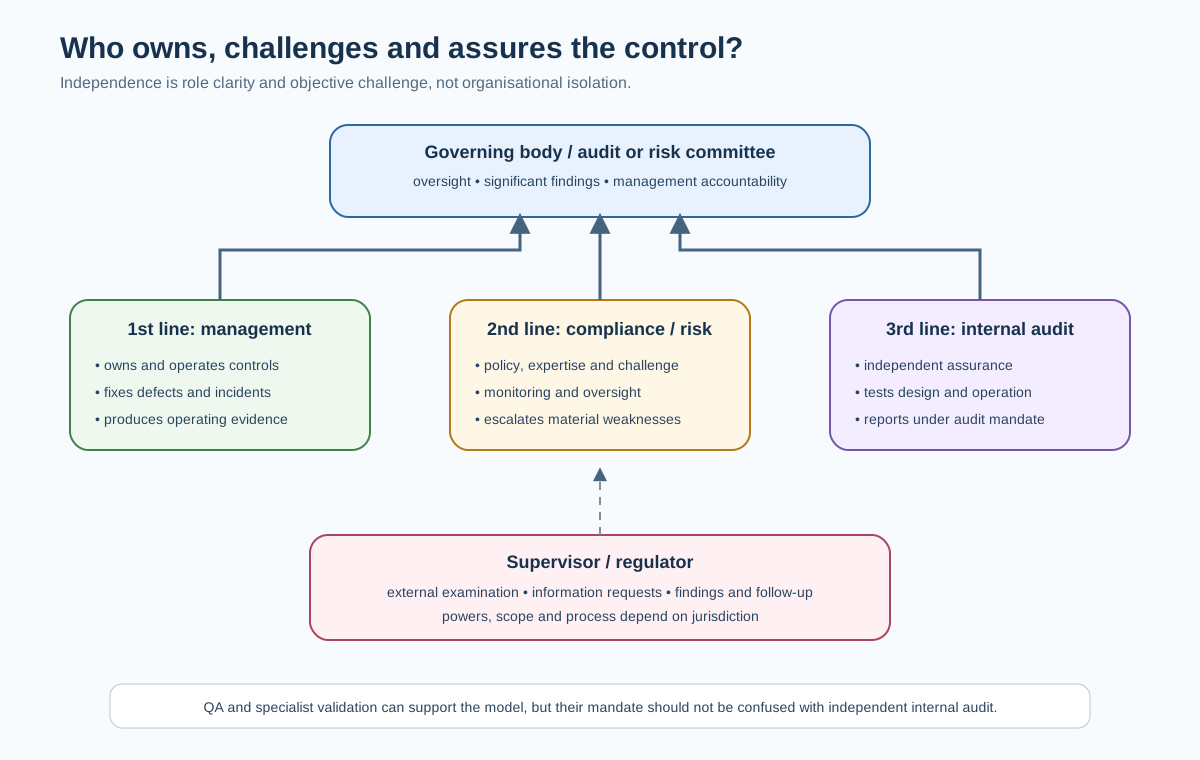
What independent assurance means
Independent assurance is an objective assessment performed by a person or function with sufficient separation from the activity being assessed. Independence is not the same as organisational distance for its own sake. The point is that the assessor should be able to reach an evidence-based conclusion without having designed, operated or defended the control in a way that creates an unacceptable conflict.
In financial crime this distinction matters because several activities can look similar while serving different purposes. A first-line quality check may verify that an investigator completed mandatory fields. A second-line compliance review may challenge whether an AML policy is being applied consistently. Model validation may assess methodological soundness of an analytical model. Internal audit may provide independent assurance over governance, risk management and controls. An external evaluator may be required or used in some jurisdictions or circumstances. A regulator may then examine the institution from its own statutory or supervisory perspective. These activities can rely on one another where appropriate, but they are not interchangeable.
The Institute of Internal Auditors' Three Lines Model is useful as a governance framework. Management retains responsibility for achieving objectives and managing risk. Second-line roles provide expertise, support, monitoring and challenge. Internal audit provides independent assurance and advice to the governing body and management. The model is not an AML law and institutions may structure functions differently, but it is a helpful way to test whether accountability, oversight and assurance are becoming blurred.
FATF Recommendation 18 provides a global standards anchor. It expects financial institutions to maintain AML/CFT programmes that include compliance management arrangements, employee screening, ongoing training and an independent audit function to test the system. FATF Recommendations are international standards implemented through national or regional law and regulation; they should not be presented as if FATF itself directly imposes identical legal duties on every bank.
Jurisdictions then translate the principle differently. In the United States, the FFIEC BSA/AML Examination Manual describes independent testing by internal audit, outside auditors, consultants or other qualified independent parties and emphasises freedom from conflicts with the function being tested. Australia’s reformed AML/CTF framework uses the concept of an independent evaluation and, from the relevant 2026 reforms, requires an evaluation frequency appropriate to the nature, size and complexity of the business with a minimum interval set by Australian law and rules. The European Union is moving into the AMLA era: AMLA assumed the EBA’s AML/CFT mandates from 1 January 2026, while existing EBA AML/CFT guidelines continue until replaced or amended. These examples illustrate why a global bank needs one assurance framework with jurisdiction-specific obligation mapping rather than a single universal procedure.
Assurance begins with the risk universe
An assurance plan should start with what can go wrong, not with last year’s audit calendar. The financial-crime universe may include customer due diligence, beneficial ownership, PEP controls, sanctions screening, payment filtering, transaction monitoring, suspicious-activity reporting, correspondent banking, trade finance, fraud-to-AML handoffs, data quality, model governance, alert backlogs, investigation quality, regulatory reporting, record retention and third-party dependencies.
Each area should be connected to the bank’s legal entities, products, geographies, customer segments, channels, systems and material changes. A transaction-monitoring control used by retail accounts in one country may not cover corporate payments in another. A central sanctions engine may screen messages received through one hub but not a legacy local channel. An enterprise policy can therefore appear complete while the actual control population contains gaps.
Risk-based planning means deciding where independent testing creates the greatest assurance value. High inherent risk, major regulatory change, large transaction populations, recent incidents, material transformation, weak prior findings, rapid growth, control overrides, data migrations and significant third-party dependencies may justify deeper or more frequent work. Conversely, stable low-risk areas with strong recent assurance may receive proportionately lighter coverage. The decision should be documented so that the plan can be challenged and reproduced.
A mature assurance universe also records dependencies. A KYC control may depend on customer master data, document services, screening vendors, workflow platforms and account-opening channels. A sanctions control may depend on list ingestion, parsing, transliteration, matching, payment orchestration, case management and release logic. A finding in one dependency may therefore affect several nominally separate controls. Assurance that tests each control as an isolated box can miss the systemic risk created by a shared dependency.
Design effectiveness and operating effectiveness
A useful assurance conclusion separates design effectiveness from operating effectiveness. Design asks whether the control, if performed as described, is capable of addressing the identified risk. Operating effectiveness asks whether the control actually performed as designed over the relevant period and population.
Consider a sanctions-list update control. Design effectiveness may require an authoritative list source, defined ingestion frequency, integrity checks, environment promotion, failure alerts, version evidence and rescreening rules. If the process has no mechanism to detect a failed update, the design itself may be weak. If the design is sound but a production scheduler failed for eight hours without escalation, the issue is operating effectiveness. The remediation is different in each case.
The same distinction applies to customer due diligence. A policy may correctly require enhanced due diligence for a defined high-risk population, but assurance must determine whether the rule is implemented in systems, whether customers are classified correctly, whether cases are completed on time, whether evidence is sufficient and whether overrides are governed. Testing only the written procedure proves very little about live operation.
Assurance should also distinguish a control objective from the mechanism currently used to achieve it. The objective might be to ensure all in-scope payments are screened against current applicable sanctions data before release. One bank may use a central screening service, another may use multiple local engines. The assurance conclusion should address the objective and its coverage, not merely whether a particular application produced a successful technical log.
Evidence is the bridge between operation and assurance
Evidence should allow another qualified reviewer to understand what was tested, what population was in scope, what procedures were performed, what exceptions were found and why the conclusion follows. Screenshots can be useful, but screenshots alone often prove only what was visible at one moment. Strong evidence combines system records, configuration extracts, reconciled populations, workflow histories, change records, approvals, sampled cases, exception logs and audit trails.
An assurance file should answer five practical questions. What was the control supposed to do? What population should have been subject to it? What evidence proves the population was complete? What testing was performed? What conclusion was reached, including exceptions and limitations? If one of these elements is missing, the reviewer may be unable to distinguish a true control failure from weak documentation.
Population completeness is especially important in financial crime. Testing 50 alerts is meaningful only if the auditor understands the universe from which the 50 were selected. If a source-to-monitoring interface silently dropped 8 percent of transactions, beautifully documented alert reviews do not demonstrate monitoring coverage. Assurance therefore needs reconciliation from source events to the control population before it relies on sample-based testing of downstream decisions.
Data lineage should preserve the difference between source data and derived evidence. A transaction extract may have been filtered, joined, enriched or deduplicated before it reached the auditor. Those transformations need traceability. Otherwise a later reviewer cannot determine whether missing records reflect a control weakness, an extraction decision or an error in the assurance procedure itself.
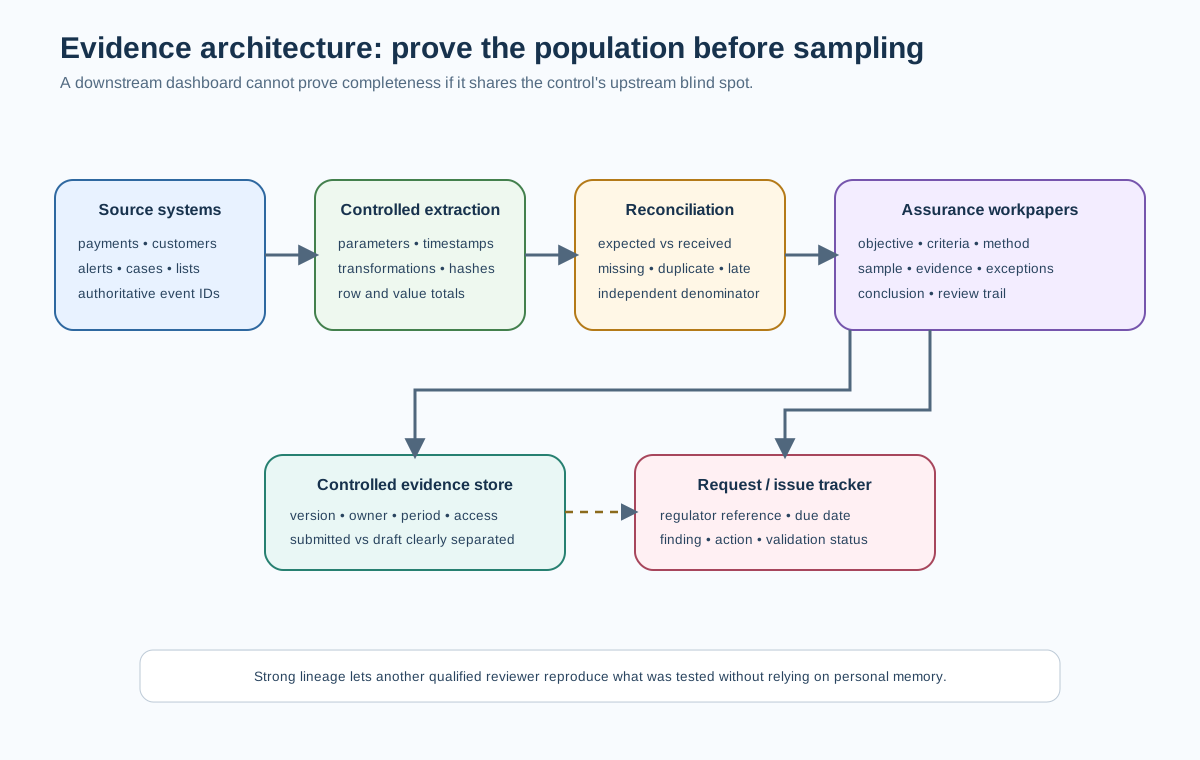
Workpapers, sampling and reperformance
Good workpapers are not a transcript of everything the tester saw. They document the purpose, scope, criteria, population, method, evidence, exceptions and conclusion. A reviewer should be able to reproduce the logic without asking the original tester to remember why an item was marked pass or fail.
Sampling needs similar discipline. A random sample can estimate routine operating effectiveness when the population is suitable, but it may not capture high-risk edge cases. Targeted sampling can deliberately test high-value, high-risk, overridden, aged or unusual items, but targeted results should not be presented as a statistically representative estimate of the whole population. Many assurance reviews use both: representative testing for baseline operation and risk-based selections for severe failure modes.
Reperformance is stronger than simply reading an attestation. If a control claims that a customer-risk model assigns a higher rating when particular factors are present, a tester can take source data and independently reproduce the expected classification. If a sanctions process claims that list updates are deployed within a defined operational window, the tester can trace list publication, ingestion, validation, deployment and rescreening timestamps. Reperformance reveals gaps that a policy review may never show.
The tester should also understand the limits of evidence generated by the control owner. Management information is valuable, but if the same flawed data pipeline feeds both the control and the dashboard used to prove the control, the evidence may inherit the same blind spot. Independent assurance often needs alternative data, reconciliation or direct source access to reduce that circularity.
Independence, competence and access
A reviewer can be organisationally separate and still deliver weak assurance if they lack subject expertise. Financial-crime testing may require knowledge of regulatory obligations, customer and payment flows, data architecture, sanctions logic, transaction-monitoring scenarios, investigation standards and system behaviour. The assurance team does not need to be the operational owner, but it needs enough competence to challenge the owner’s explanation.
Independence also has a practical dimension. A person who designed a sanctions rule should not be the sole independent assessor of whether that rule is effective. A consultant who built an AML programme may face a conflict if later engaged to provide supposedly independent assurance over the same work. Policies should define how conflicts are identified, disclosed and mitigated, including the use of alternative reviewers where needed.
Access is equally important. An assurance function cannot provide a strong conclusion if it cannot obtain data, system configurations, case files, committee papers or third-party evidence necessary to test the control. Access restrictions may be legitimate because of secrecy, privilege, personal-data or security requirements, but the restriction should be managed explicitly. The correct answer is not to pretend the evidence was complete; it is to document the limitation, seek an appropriate controlled access route and assess the effect on the assurance conclusion.
Regulatory examination: what changes when the reviewer is external
A regulatory examination is not simply an internal audit with a different audience. The authority, scope, information powers, confidentiality requirements, deadlines, escalation route and potential outcomes depend on jurisdiction and regulator. A bank should therefore maintain jurisdiction-specific examination procedures rather than assuming one global template satisfies every authority.
The operating discipline, however, is broadly reusable. An examination normally requires controlled intake of requests, assignment of accountable owners, interpretation of scope, collection of evidence, quality review, timely delivery, tracking of follow-up questions, preservation of what was submitted and escalation of emerging concerns. The bank should know exactly which version of a document was provided and when.
A regulator may ask for a policy, but the underlying question is often whether the policy operates. If the bank provides a sanctions procedure stating that all customers are rescreened after list updates, the examiner may request rescreening logs, sample customer results, exception handling, failed-job alerts and evidence of oversight. A response pack should therefore be accurate, responsive to the request and consistent with the evidence that sits behind it.
Examination management should never become evidence manufacturing. Teams sometimes create polished narratives after a request arrives, while the underlying operational records are incomplete. That creates a second risk: the bank may make an assertion it cannot substantiate. Regulatory relations, legal and subject-matter owners should distinguish existing contemporaneous evidence from explanatory material created for the examination.
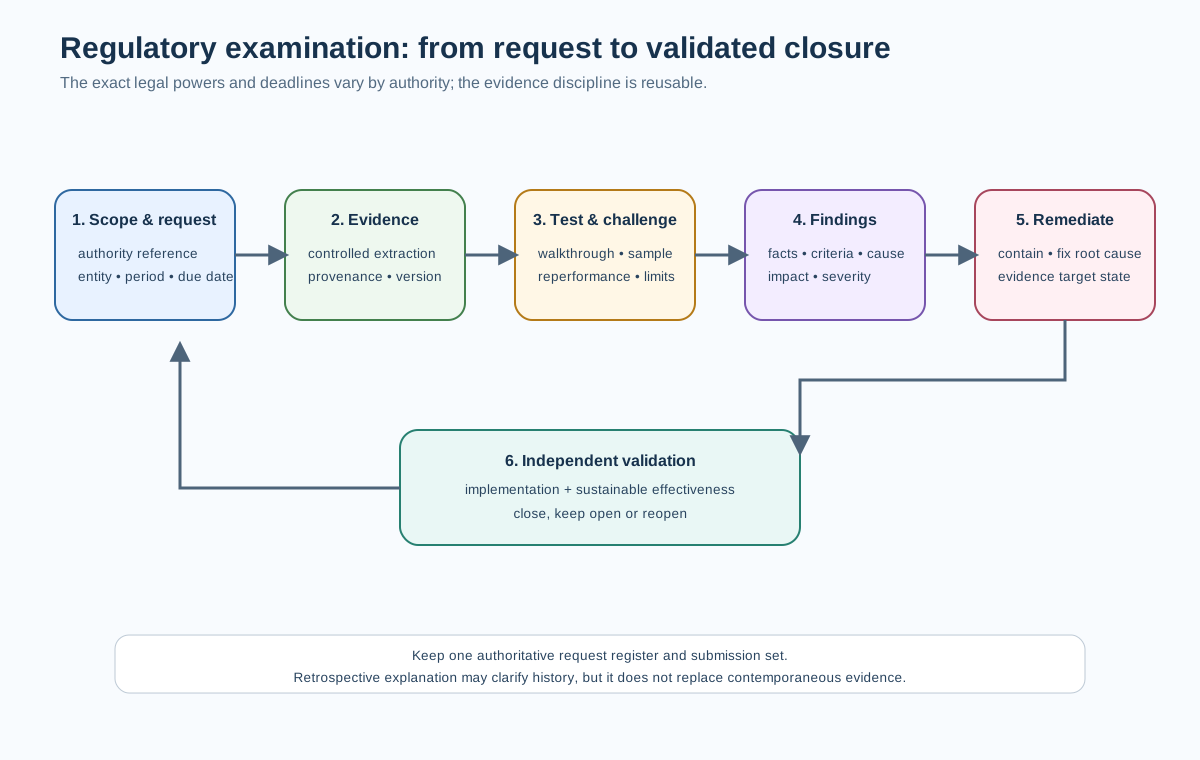
Handling information requests safely
A central request register reduces confusion. Each request should have an identifier, authority, legal entity, date received, response deadline, owner, subject-matter contributors, status, dependencies, final response, evidence package and submission record. Where the authority uses its own numbering, the bank should preserve that reference so every answer can be traced back to the request.
Responses benefit from a maker-checker process. The subject-matter owner explains the facts; evidence specialists confirm the supporting records; legal or regulatory relations assess jurisdictional and disclosure considerations where required; and an authorised approver confirms that the response is accurate and complete for submission. The exact roles vary by institution and authority, but the principle is consistent: a high-stakes response should not depend on an unreviewed email from one individual.
Confidentiality boundaries must be explicit. Suspicious-activity reporting data can be subject to strict secrecy or tipping-off controls. Legal privilege may apply to some materials. Personal data may require controlled handling. Cross-border sharing can trigger local restrictions. Those constraints should shape the evidence process from the start rather than being discovered after a response pack has already circulated widely.
The bank should also control contradictions. Two teams may answer similar requests with different population counts because they extracted data on different dates or used different filters. A response library can help, but reused material must be revalidated against the current question, legal entity, period and evidence. Historical consistency is useful only when the underlying facts are actually the same.
Findings are not complete until root cause is understood
A finding describes a gap; remediation should address why the gap existed. If transaction-monitoring alerts were late because investigator capacity was insufficient, hiring temporary staff may reduce the backlog but may not address poor forecasting, inefficient scenarios, case complexity, weak prioritisation or a broken upstream feed. Sustainable remediation therefore separates immediate containment from root-cause correction.
Good issue records define the risk, affected population, period, root cause, interim controls, target state, accountable owner, milestones, dependencies and validation approach. Severity should reflect the institution’s approved methodology and the actual risk, not the seniority of the team affected. High-severity issues should reach governance forums with enough clarity for leaders to understand exposure, customer impact and regulatory implications.
Closure evidence must prove implementation, not intention. A project plan showing that a new control was scheduled is not evidence that the control works. A policy approved yesterday may not demonstrate that staff follow it. A code release may not prove that all in-scope transactions are now captured. Independent validation should therefore test the implemented state and, where needed, a period of sustainable operation.
Read-across is critical. If an audit discovers that one payment channel bypassed sanctions screening after a migration, the bank should ask whether similar migrations, countries or channels have the same design pattern. Treating the issue as a single local defect can miss an enterprise-wide weakness.
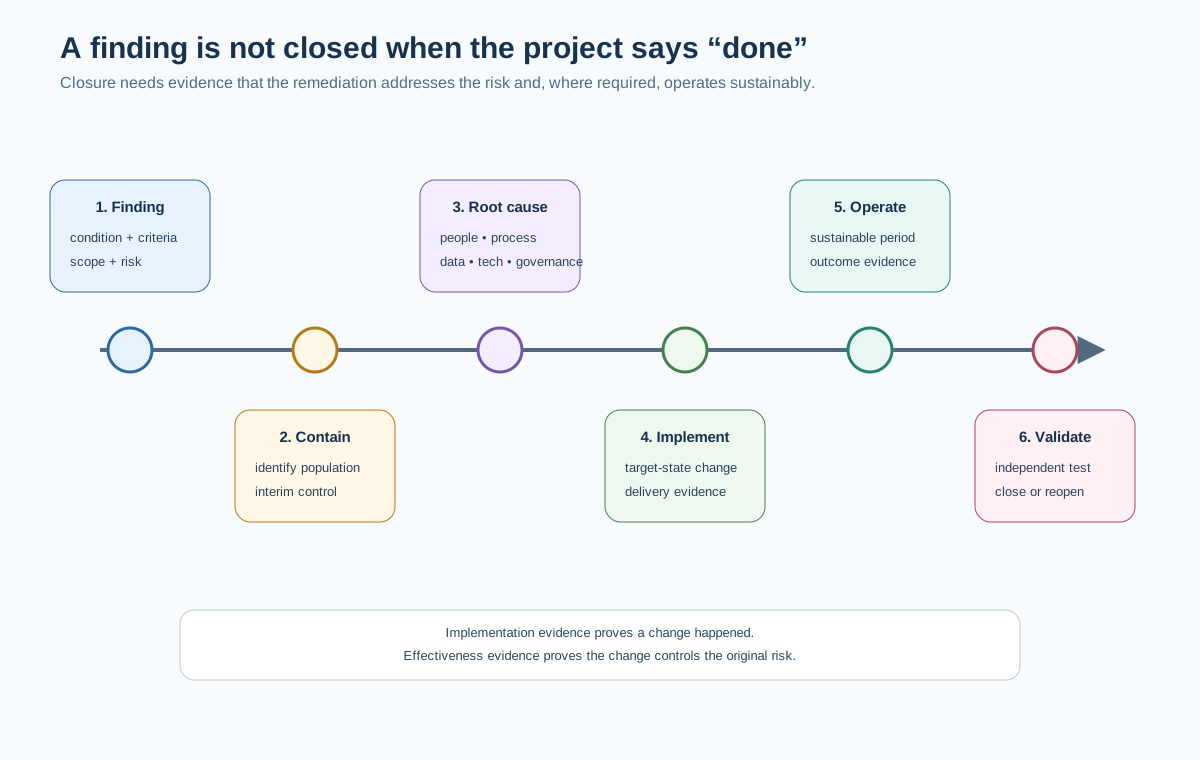
Delivery roles in a real change programme
Financial-crime assurance becomes stronger when delivery teams design evidence at the same time as the control. A business analyst should not write only the happy-path requirement that a payment will be screened. The requirement should also define the in-scope population, source systems, data fields, failure behaviour, timestamps, audit trail, override route, operational ownership, monitoring, retention and the evidence needed to prove completeness.
Architects should identify control boundaries and dependencies. If a central screening service sits between payment orchestration and settlement, the architecture should show what happens when screening is unavailable, where queued payments are held, how retries work, how versioned list data is recorded and which logs prove the decision path. A diagram that shows boxes but not control points is weak evidence for assurance.
Developers need testable control requirements. Logging must capture enough context to reconstruct the event without exposing unnecessary sensitive data. Error handling should be deterministic. Configuration changes should be version controlled. Access should be least privilege. Where rules or thresholds are configurable, the system should preserve who changed them, when, why and under whose approval.
Testers should think like future assurance reviewers. Positive tests prove that the intended control fires. Negative tests prove legitimate activity is not incorrectly stopped. Boundary tests examine thresholds and timing. Failure-mode tests simulate unavailable services, stale data, duplicate messages, partial files and replay. Reconciliation tests prove population completeness. Regression tests ensure a change in one area does not silently remove control coverage elsewhere.
Operations teams need actionable exception routes. A technical alert that says screening failed is not enough if it does not identify affected payments, prevent unsafe release, assign ownership and record resolution. Compliance teams need visibility into significant exceptions and trends. Audit needs access to the evidence without forcing operations to reconstruct the story manually months later.
Governance and decision rights
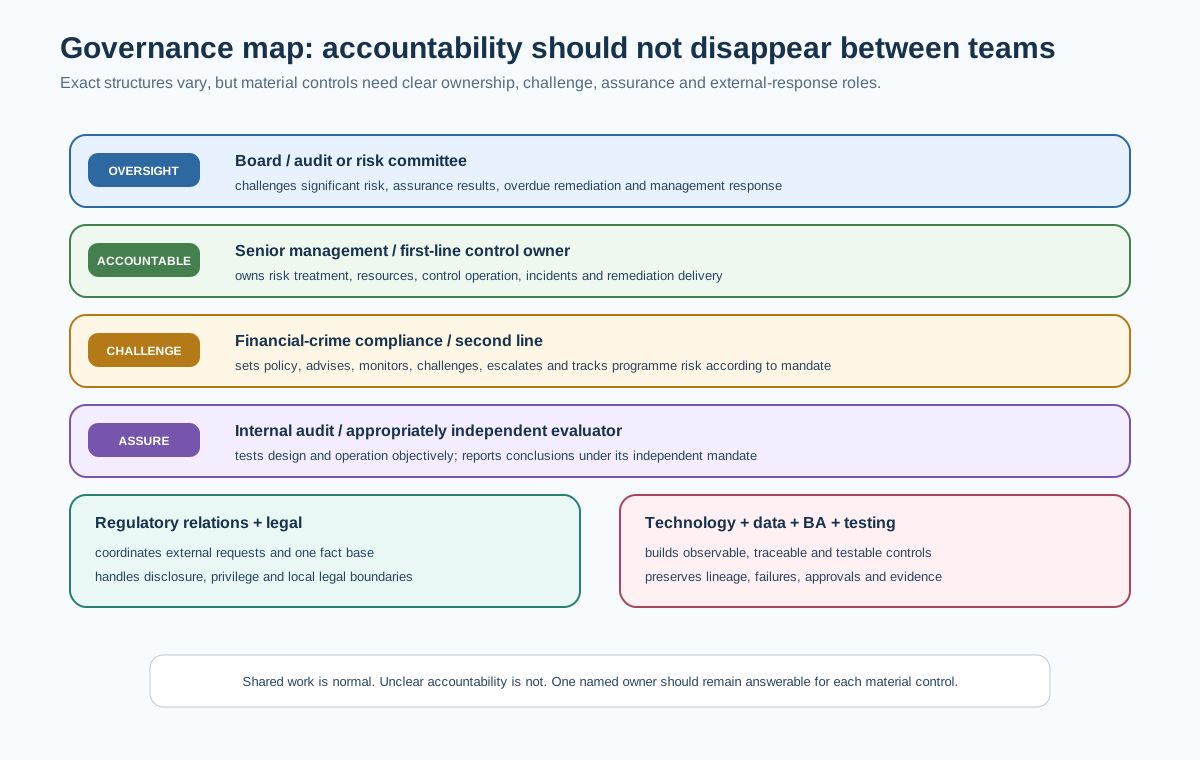
The governing body or relevant board committee does not need to inspect individual alerts, but it needs reliable information about whether the programme is effective, whether significant weaknesses are being remediated and whether management is responding appropriately to independent assurance. Senior management translates that oversight into resources, accountable ownership and prioritised remediation.
First-line management owns controls embedded in business and operations. Financial-crime compliance provides policy, expertise, oversight and challenge according to the bank’s model. Internal audit maintains the independence required for its assurance role. Regulatory relations coordinates external engagement. Legal advises on legal interpretation, privilege and disclosure boundaries where appropriate. Technology and data teams own systems and data controls. Business analysts and product owners translate obligations and control objectives into change. Testers provide evidence that delivered controls behave as expected.
No diagram can replace the institution’s formal responsibility map, but every material control should have an accountable owner. Shared responsibility can be real; shared accountability usually becomes ambiguity. If a sanctions control fails at 02:00, the bank should know which team contains the incident, which team assesses compliance implications, who can authorise a controlled workaround and who must be informed.
Customer and operational impact
Assurance may sound remote from customers, but weak assurance can allow poor outcomes to persist. A defective screening rule can block legitimate payments. A missing monitoring feed can leave mule activity undetected. A KYC remediation programme can repeatedly request the same documents if its data architecture is poor. A badly governed issue can lead to abrupt de-risking instead of proportionate control improvement.
Testing should therefore consider both financial-crime effectiveness and customer impact. A control may be technically effective at stopping risk but operationally unsustainable because false positives overwhelm teams. Another may be efficient but miss significant exposure. Assurance should surface that trade-off rather than rating a control solely on whether the procedure was followed.
Operational resilience matters as well. If the assurance process depends on one spreadsheet owner, one query or one external consultant, the bank may struggle during a major examination. Evidence production should be repeatable, access-controlled and supported by clear data lineage. The objective is not to build an enormous permanent examination room; it is to make normal operations sufficiently controlled that examination evidence is a by-product of good management.
What strong assurance looks like
Strong independent assurance is sceptical without being adversarial. It understands the business, tests the right risks, distinguishes design from execution, verifies populations before sampling, records limitations, and communicates findings in language that management can act on. Strong regulatory examination management is accurate without becoming defensive. It preserves what was asked, what was submitted and what evidence supports the response.
The best delivery teams make those outcomes easier long before an audit begins. They build controls with observable states, traceable data, explicit ownership and reproducible evidence. When a weakness is found, they contain the risk, correct the root cause, test the target state and read the lesson across the enterprise.
That is the practical purpose of this chapter. Independent assurance is not an annual ceremony and regulatory examination is not a document-request contest. Both are mechanisms for answering a more important question: can the bank demonstrate, with credible evidence, that its financial-crime programme manages the risks it says it manages?
Operational deep dive: evidence that survives challenge
Independent assurance becomes difficult when the question moves from “do you have a control?” to “prove what the control did for the complete population during the period under review.” That shift is where weak evidence models are exposed. A policy may be clear, staff may be competent and the control may usually work, yet the bank can still struggle to demonstrate effectiveness because source populations, transformations, decisions and exceptions were not preserved in a reproducible way.
The operational objective is therefore to make evidence a normal output of the control rather than a special product assembled when internal audit or a supervisor arrives. This deep dive focuses on population integrity, workpapers, sampling, examination response management and the difference between contemporaneous evidence and retrospective explanation.
Start with the population, not the sample
A sample is meaningful only when the reviewer understands the population from which it came. In transaction monitoring, the relevant population may be all transactions that should have entered a scenario during a defined period. In sanctions screening it may be all customer records or payment messages that should have been screened using a defined list version. In KYC it may be all customers due for periodic review, all event-driven review triggers or all accounts opened under a particular control design.
Population integrity should be established before case testing. A common control failure is to sample only the cases that reached the downstream workflow. That can prove how analysts handled visible cases while completely missing records that never entered the control. If a source interface dropped one file every Friday, alert-quality testing would not discover the missing transactions unless assurance reconciled source volumes to control ingestion first.
A robust population test usually asks where the source-of-record sits, what inclusion and exclusion logic applies, how the extract was generated, whether records were transformed or deduplicated, and what control totals can be independently reconciled. The exact techniques depend on the platform. A file-based process may use record counts, control totals and hash checks. An event-streaming architecture may use message offsets, producer and consumer metrics, dead-letter queues and replay evidence. A batch database process may use source-versus-target reconciliation by date, product, legal entity and status.
The assurance conclusion should preserve the extraction logic. A SQL query pasted into a workpaper is better than an unexplained spreadsheet, but even a query can be misleading if table versions, effective dates or upstream filters are unknown. Mature assurance captures enough technical context to allow controlled reproduction: source name, environment, extraction timestamp, parameters, transformation logic, row counts, exclusions and reconciliation results.
Evidence hierarchy and corroboration
Different evidence types have different strengths. A signed procedure demonstrates approved design. A workflow record demonstrates that a case moved through defined states. A system log can show a technical event. An approval record demonstrates an authorised decision. A reconciled population proves scope. A sampled case provides detail about execution. A management attestation provides context but is generally weaker than independently verifiable records.
No single evidence type is always sufficient. If a control owner states that a sanctions list was updated at 09:00, the reviewer may corroborate that statement with vendor receipt time, ingestion logs, deployment records, version metadata and rescreening evidence. If an alert was closed because the activity matched an expected customer profile, the workpaper should preserve the customer data and rationale that supported the conclusion at the time, not only the investigator’s final status.
Corroboration matters especially when systems share a common dependency. Suppose a dashboard reports 100 percent transaction-monitoring feed completeness, but the dashboard is populated by the same target table that receives the monitored transactions. If the upstream feed fails before the target table, both the control and its dashboard may miss the same records. An independent source comparison is stronger because it does not inherit the identical blind spot.
Workpapers should explain the reasoning
A useful workpaper has a clear relationship between objective, criteria, procedure, evidence and conclusion. The objective might be to determine whether all high-risk customers received enhanced due diligence before onboarding. The criteria should identify the applicable policy or jurisdiction-specific requirement. The procedure should explain how the population was obtained and how samples were selected. Evidence should show the actual files or system records examined. The conclusion should state what passed, what failed, how widespread any issue may be and what limitations remain.
Vague workpapers create a review problem. Phrases such as “checked and okay” or “no issues noted” do not explain what was checked. Equally, copying large volumes of evidence without a clear conclusion creates noise rather than assurance. Reviewers need concise reasoning supported by traceable records.
Version control is essential. If a tester downloads a procedure, configuration or population extract, the workpaper should identify the version and date. If the control changes during the review period, assurance may need to test both designs. A conclusion that blends pre-change and post-change results can conceal a material transition risk.
Workpapers also need a review trail. The reviewer of the tester’s work should be able to challenge unsupported conclusions, inconsistent sample treatment and unexplained exceptions. The review should be evidenced rather than assumed from file location or meeting attendance.
Sampling without pretending it proves more than it does
Sampling is useful because many financial-crime populations are too large for full manual review. The method should match the question. Statistical or random sampling can support conclusions about a broader population when assumptions are appropriate. Risk-based sampling deliberately selects items more likely to reveal weakness, such as high-risk customers, manual overrides, late reviews, unusual corridors, high-value payments or cases handled during system incidents. Judgmental samples can explore specific control concerns.
The danger is overclaiming. A risk-based sample of 25 unusually complex cases can reveal important defects but should not be described as proving the defect rate across a million routine cases. Conversely, a purely random sample may underrepresent severe edge cases. Mature assurance often combines methods and clearly distinguishes what each method supports.
Sampling should also consider temporal coverage. A control can work for most of the year and fail during a migration, holiday period or backlog spike. Selecting cases across the period and around known change events can reveal instability that a single-month sample misses.
Exception treatment must be consistent. If one sample is marked “not applicable,” the reviewer should understand why. Replacing failed samples until the sample looks clean destroys the credibility of the test. Exclusions should be governed by pre-defined criteria and preserved in the workpaper.
Reperformance and trace testing
Reperformance is one of the strongest techniques because the assurance team independently executes part of the control logic. A tester can reconstruct a customer-risk rating from source attributes, replay a sanctions match against the configured rule set, recalculate a threshold scenario, or trace a payment from source channel through screening to settlement.
Reperformance is not always practical at scale, but selected use can expose hidden assumptions. A configuration may look correct while a mapping layer converts a country code incorrectly. A scenario document may show a threshold that differs from production configuration. A KYC workflow may display an approval while the underlying entitlement model allows an unauthorised user to provide it.
Trace testing works in both directions. A forward trace starts with source activity and follows it into the control, alert, case and outcome. A reverse trace starts with a case or reported outcome and traces back to source events. Using both directions helps detect missing records and duplicate or transformed records.
Examination response management
A regulatory information request should enter a controlled workflow immediately. The request needs an owner, due date, legal entity, regulator reference, subject area, contributors, dependencies and an approval route. Ambiguity should be resolved early. If the authority asks for “all sanctions alerts for the period,” the bank should confirm whether that means customer screening, payment screening or both rather than silently choosing the interpretation easiest to produce.
Evidence collection should preserve provenance. A file should not be renamed in a way that obscures the source or period. Manual adjustments should be documented. If the response uses a derived dataset, the derivation should be reproducible. Sensitive material should remain within the bank’s approved handling controls.
Quality review should test both accuracy and responsiveness. A perfectly accurate explanation that does not answer the question is a poor response. Equally, a concise answer that omits material qualifications may be misleading. The bank should be able to identify which statements are factual, which are interpretations and which rely on assumptions.
When several teams contribute, one coordinating function should maintain the authoritative submission set. Otherwise different drafts can circulate and the institution may lose track of what was actually delivered. The final record should include the request, approved response, supporting evidence, submission date, transmission method and follow-up correspondence.
Contemporaneous evidence versus retrospective explanation
Supervisors and auditors commonly distinguish what existed at the time from what was created later. A control owner may be able to explain a sensible process during an interview, but if no contemporaneous record supports the explanation, assurance should not silently convert oral recollection into historical fact.
Retrospective explanation is still useful. It can clarify architecture, terminology or context. The key is labelling it accurately. For example: “The following narrative was prepared in September 2026 to explain the control design that applied during the review period; supporting production evidence is referenced separately.” That is more credible than presenting a new narrative as if it had existed throughout the period.
The same discipline applies to reconstructed data. If original logs have expired and the bank rebuilds a population from secondary sources, the limitation should be stated. Assurance can assess whether the reconstruction is reliable, but it should not describe the evidence as original when it is not.
Legal, secrecy and privacy boundaries
Evidence access is not unlimited. Suspicious-activity reports and related information may be subject to secrecy or confidentiality restrictions that vary by jurisdiction. Legal privilege can affect particular communications. Personal information may be restricted by privacy and cross-border transfer requirements. Supervisory authorities can have different legal powers to obtain information.
The assurance design should therefore identify restricted evidence categories before testing begins. Controlled viewing, redaction, need-to-know access, local review or legal consultation may allow testing without inappropriate disclosure. The reviewer should document any resulting scope limitation and its effect on the conclusion.
Assurance teams should avoid the opposite error as well: using confidentiality as a blanket reason not to test. The institution needs a lawful way to assess whether sensitive controls are effective. Governance should provide a controlled route rather than leaving the risk permanently outside independent review.
Third parties and reliance
Financial-crime controls increasingly depend on external providers: screening data vendors, identity services, cloud platforms, transaction-monitoring software, managed investigators and data processors. A service organisation report or vendor certification can contribute evidence, but it rarely answers every bank-specific question.
The bank remains responsible for understanding how the outsourced service fits its own control. A sanctions vendor may certify list-processing controls, while the bank still needs assurance that its own customer population is sent completely to the vendor and that returned matches are handled correctly. A cloud provider may provide assurance over infrastructure controls, while the bank must test its own configuration, access model and application logic.
Reliance should therefore be explicit. The assurance file should record what third-party evidence covers, its period, relevant exceptions and what residual testing the bank performs. If the report period does not align with the bank’s review period, bridge evidence may be needed. If a subcontractor performs a critical function, the assurance team should understand whether that dependency is included.
Findings, challenge and factual accuracy
Before finalising a finding, assurance normally allows management to confirm factual accuracy. This is not an opportunity to negotiate away valid criticism. It is a mechanism to ensure the finding correctly describes the process, affected population, evidence and risk.
Disagreement should be recorded transparently. Management may accept the facts but disagree with severity. Assurance should apply the approved rating methodology and escalate unresolved disagreement through governance. The independent function’s conclusion should not be rewritten merely to achieve consensus.
A strong finding identifies condition, criteria, cause, consequence and required outcome. It does not prescribe a technical solution unless that solution is necessary. This leaves management accountable for designing remediation while assurance retains the ability to validate whether the remediation addresses the risk.
Validation is a separate decision
Issue closure should not be an administrative state change. Validation asks whether agreed actions were implemented and whether they address the finding. For a data-feed gap, that may require source-to-target reconciliation after remediation, testing of monitoring alerts for missing files, and evidence that the exception process operates. For weak investigation quality, it may require revised standards, training, quality results and sample testing over a sustainable period.
The validator should understand what evidence is necessary before closure and should avoid relying solely on the project team’s assertion that delivery is complete. If evidence is insufficient, the issue remains open or returns for further work according to the bank’s governance model.
Reopened findings are not necessarily proof that the assurance process failed. A control can regress because of later change. What matters is whether the bank detects the regression, understands why it happened and adjusts monitoring, change governance or assurance coverage accordingly.
The practical standard
The most defensible assurance file is one that another qualified person can pick up later and follow without the original tester. It shows the risk, the expected control, the complete population, the procedures performed, the evidence reviewed, the exceptions found, the conclusion reached and the actions that followed.
That standard is demanding, but it prevents assurance from becoming a collection of opinions. It also makes regulatory examinations calmer. When normal operations already preserve reliable evidence, the bank spends less time reconstructing the past and more time explaining the control as it actually worked.
Advanced practice: designing assurance into change
Mature financial-crime programmes do not wait for the annual audit plan to discover whether a new product, system migration or regulatory change is testable. They design assurance into delivery. That means translating the control objective into observable system behaviour, defining the evidence that will prove it, identifying who can challenge it independently and deciding how failures will be detected after implementation.
Build an enterprise assurance map
A large bank can have many assurance activities running over the same control environment: first-line quality checks, second-line monitoring, compliance testing, model validation, internal audit, external reviews, regulator-driven remediation validation and control self-assessments. Without an assurance map, teams can duplicate low-value checking while leaving important risks untouched.
An assurance map links risks and controls to the functions that test them, the frequency of testing, the scope, the evidence relied upon, the last conclusion and the next planned review. It should reveal both overlaps and gaps. Two functions reviewing sanctions case quality may be sensible if they have different objectives, but the bank should know why both exist. Conversely, if everyone assumes another team validates payment-feed completeness, the map should expose the missing ownership.
The map should not be treated as static inventory. New products, acquisitions, vendor changes, regulatory developments and control incidents can change the assurance need quickly. A bank launching instant payments, for example, may need to reassess assurance over pre-execution screening, latency controls, beneficiary intelligence, fraud-to-AML escalation and post-event traceability. The existing annual plan may not cover those risks at the required time.
Change assurance should start before production
A control can fail on day one because delivery teams considered functional requirements but not assurance requirements. A new transaction-monitoring platform might produce alerts correctly in test while lacking production reconciliation between source transactions and scenario ingestion. A KYC workflow may enforce mandatory fields while failing to preserve the value that existed when an approval was made. A screening service may return decisions but not retain the list version and matching configuration needed to reconstruct them.
Business analysts can prevent these gaps by writing evidence requirements into acceptance criteria. If the requirement says “all in-scope payments must be screened before release,” supporting acceptance criteria should define how in-scope is determined, how the population is reconciled, what timestamp proves screening occurred before release, which version of screening data was used, how failures are handled, and which audit records are retained.
Architecture reviews should identify assurance boundaries. The diagram should show where control data enters, where it is transformed, where the decision occurs, what happens when dependencies fail and where evidence is persisted. This gives future reviewers a defensible view of the control path instead of forcing them to infer it from application names.
Pre-production assurance can use design review, trace testing and scenario-based challenge. The aim is not for internal audit to become part of project delivery. Independence needs to be protected. Instead, management and second-line teams can make the system testable, while independent assurance later evaluates whether the design and operation are effective.
Regulatory change creates an assurance problem as well as a policy problem
When rules change, banks often focus on policy wording and delivery milestones. Assurance needs its own impact analysis. Which controls change? Which legal entities are affected? What effective dates apply? Are transitional arrangements available? Which data fields or evidence standards change? Does prior testing remain relevant after the change?
The EU’s institutional transition to AMLA illustrates the importance of effective-date discipline. AMLA assumed the EBA’s AML/CFT mandates from 1 January 2026 and existing EBA AML/CFT guidelines remain in force until replaced or amended. A global bank should therefore maintain a controlled mapping of current sources and dates rather than assuming every reference to the EBA became obsolete overnight. Similarly, national obligations may continue to be implemented and supervised through competent authorities while the EU framework evolves.
Australia’s 2026 AML/CTF reforms provide another example. AUSTRAC describes independent evaluation obligations and transitional arrangements that depend on the type and history of the reporting entity. An assurance plan should capture the Australian legal effective dates and transitional deadlines rather than treating a global “independent review every X years” rule as universal.
The same principle applies in the United States, United Kingdom and other jurisdictions. Global policy can define minimum principles, but assurance criteria must identify the legal and supervisory source actually applicable to the entity and activity being tested.
Continuous control monitoring is not the same as independent assurance
Automated control monitoring can improve assurance by detecting failures quickly. Dashboards can monitor stale sanctions lists, unmatched source files, screening-service outages, overdue KYC reviews, alert backlogs, failed jobs or unexpected drops in transaction volume. These controls reduce the time between failure and detection.
They do not automatically replace independent assurance. Continuous monitoring is usually part of management’s control environment. The monitoring logic can itself be wrong, disabled or dependent on the same data source as the control it monitors. Independent assurance should periodically validate that the monitoring covers the right risk, uses reliable data and escalates exceptions appropriately.
A useful design separates three layers: the primary control, management monitoring and independent testing. If all three rely on one dataset, one system owner and one logic path, apparent assurance may be illusory. Diversity of evidence and independent access can improve confidence.
Analytics can make assurance more risk-sensitive
Assurance teams increasingly use data analytics to test entire populations or identify suspicious patterns within them. Instead of selecting a small sample of sanctions cases, analytics can identify all overrides, all releases during screening outages, all cases closed unusually quickly, all payments routed through manual repair, or all customer records missing key identifiers.
Analytics does not eliminate judgement. The assurance team still needs to understand data provenance, false positives, exclusions and business context. An outlier can indicate a valid operational exception rather than a control failure. The value of analytics is that it expands the reviewer’s field of view and helps target detailed testing where risk signals are strongest.
For business analysts and data engineers, this creates a requirement to expose stable identifiers and timestamps. A customer, account, payment, alert, case and decision should be linkable across systems where permitted. If every platform generates unrelated identifiers without a cross-reference, assurance spends enormous effort rebuilding lineage before it can test the control.
Defect governance and assurance findings must connect
Delivery teams often manage software defects separately from financial-crime issues. That separation is useful operationally but dangerous when a technical defect has control implications. A failed interface can be a technology incident, a financial-crime control gap and a regulatory issue at the same time.
A mature model links the records. The technology defect captures reproduction steps, technical cause and fix. The control issue captures affected population, risk, interim mitigation, governance and validation. The regulatory record captures any notification or examination commitments where applicable. Cross-references prevent one record from being closed while the related risk remains unresolved.
Severity should not be inherited blindly from IT classification. A low-severity technical defect affecting a small code component can have high financial-crime impact if it bypasses sanctions screening for a critical payment corridor. Conversely, a highly visible system incident may have limited AML/CFT impact if fail-safe controls prevented transactions from proceeding.
Root-cause analysis should distinguish mechanism from cause
Statements such as “human error,” “system defect” or “procedure not followed” are often descriptions of the immediate mechanism rather than root cause. Assurance should ask why the error was possible and why it was not detected.
If an analyst released a payment after an unresolved sanctions alert, root cause may involve ambiguous procedures, poor entitlement design, time-pressure incentives, weak supervision, confusing user-interface states or inadequate training. If a transaction feed failed, root cause may involve missing reconciliation, change-management weakness, an unsupported legacy interface or unclear ownership between teams.
Remediation that addresses only the immediate mechanism may fail again. Root-cause analysis should therefore connect people, process, technology, data and governance. The action plan can then include both containment and sustainable correction.
Read-across converts one finding into enterprise learning
A finding should trigger a structured question: where else could the same cause exist? This is read-across. If a local screening platform lacked list-update monitoring, other local platforms may have the same architecture. If a KYC workflow allowed approvals without evidence attachment, related workflows might share the same component. If a vendor contract failed to guarantee access to assurance evidence, similar contracts may contain the same gap.
Read-across should be proportionate. The bank does not need to investigate every system for every issue. It needs a defensible method for identifying analogous controls, products, geographies, vendors and change patterns. The outcome and rationale should be documented, especially for significant findings.
Enterprise learning also belongs in standards and design patterns. A one-time project fix is weaker than updating reusable requirements so future projects avoid the same mistake.
Multi-jurisdiction examinations require one fact base and local legal handling
Global banks can face overlapping reviews from home and host supervisors, sanctions authorities, prudential regulators, conduct regulators and FIUs. The underlying operational facts should be consistent across responses, while legal disclosure requirements and terminology may differ.
A central fact base helps prevent contradictions. It can hold validated architecture, control descriptions, population definitions, issue status and prior responses. Local legal and regulatory teams then adapt the response to the authority’s mandate and jurisdiction without changing the underlying facts.
Cross-border evidence transfer needs care. Customer data, SAR/STR information, employee records and privileged material may be subject to local restrictions. The examination process should identify these restrictions early and agree lawful methods of review. Sending a global evidence pack first and asking legal questions later is poor governance.
Vendor assurance needs bank-specific testing
A bank that outsources part of financial-crime processing still needs to understand the end-to-end control. Vendor attestations, certifications and service-organisation reports can support that understanding, but they do not prove the bank’s own configuration or data completeness.
Assume a vendor performs customer screening. Independent assurance should consider whether all in-scope customer records reach the vendor, whether fields are mapped correctly, whether list updates are current, whether matches return completely, whether the bank investigates them appropriately and whether outages are controlled. The vendor can only assure the part it performs.
Contracts should therefore preserve audit and information rights appropriate to the service, incident notification, data retention, subcontractor transparency and exit support. The exact contractual requirements depend on jurisdiction and service criticality, but assurance needs access to sufficient evidence to test the bank’s obligations.
Remediation governance needs outcome measures
Large remediation programmes can become milestone-driven. Management sees green status because policies were approved, code was deployed and training was delivered. Those milestones matter, but they do not prove that the underlying risk is controlled.
Outcome measures ask whether the target state works. After a monitoring-feed remediation, source-to-target reconciliation should remain complete over time. After KYC quality remediation, defect rates and repeat findings should improve. After sanctions-workflow changes, inappropriate releases should be prevented and overrides should be controlled. Independent validation should test these outcomes before closure.
Temporary controls also need expiry discipline. A manual reconciliation introduced during remediation may reduce risk, but it can quietly become permanent and fragile. The issue record should define who owns the temporary control, how often it runs, what evidence it produces and when it can be retired.
Business analysis requirements that survive audit
For delivery professionals, assurance can be translated into practical requirements. Every material financial-crime control should have an explicit control objective, in-scope population, decision rule, data source, exception route, ownership model, audit trail, retention rule and evidence standard. Requirements should address failure modes as deliberately as the happy path.
A useful acceptance criterion is observable. “The system must screen payments correctly” is not observable enough. A stronger criterion defines that every payment meeting specified scope conditions is submitted to the screening service before settlement release; the decision, list version, request and response timestamps are stored; service failure routes the payment to the approved fail-safe state; and source-to-screening reconciliation identifies missing events within the approved operational window.
That level of detail helps developers build the right control, testers prove it and assurance later understand what evidence should exist.
The advanced-practice test
A mature programme should be able to answer four questions about a material control without launching a rescue project. Who owns it? What complete population does it cover? What evidence proves it worked? Who can challenge that evidence independently?
If the answers depend on personal memory, uncontrolled spreadsheets or one technical specialist, assurance weakness already exists even if no regulatory finding has been raised. Designing these answers into the operating model is cheaper and more reliable than reconstructing them under examination pressure.
Practice close: applying assurance thinking
This section turns the chapter into practical review habits for auditors, compliance teams, operations, business analysts, architects, developers and testers. The aim is not to memorise audit terminology. The aim is to be able to look at a material financial-crime control and judge whether the bank can prove that the control covers the right population, operates as intended and is governed by people with clear decision rights.
A six-question control challenge
Start with the control objective. Ask what risk the control is intended to reduce. “We screen payments” is not an objective. “All in-scope payments are screened against applicable sanctions data before release, with controlled handling of potential matches and failures” is much closer because it identifies population, timing and outcome.
Then ask what the complete population is. Which legal entities, products, channels, currencies, customer types or transaction classes are in scope? Where is that population sourced? Which exclusions are legitimate and approved? A control cannot be tested properly until its population is defined.
Third, ask what evidence proves operation. For a customer review this may include trigger records, workflow history, evidence files, risk-rating inputs and approval records. For transaction monitoring it may include source-to-target reconciliations, scenario configuration, alert populations and case outcomes. For screening it may include list versions, request and response timestamps, matching outcomes, release controls and exception logs.
Fourth, ask who owns the control and who challenges it. The operating owner should be accountable for performance. Second-line roles should provide oversight according to the bank’s model. Independent audit or another appropriately independent evaluator should be able to assess effectiveness without unacceptable conflict.
Fifth, ask what happens when the control fails. Does the bank detect failure quickly? Is there a safe interim state? Are affected populations identifiable? Can missed activity be replayed or reviewed? Is escalation proportional to the risk?
Finally, ask how the bank knows the issue is actually fixed. Delivery evidence, such as a new procedure or code release, should be distinguished from effectiveness evidence showing that the target state works in practice.
Reviewer checklist for independent assurance
Before accepting an assurance conclusion, a reviewer should be able to trace the objective, criteria, population, method, evidence, exceptions and conclusion. The following checklist is deliberately compact; each item should be supported by workpapers rather than ticked mechanically.
- The control objective and risk are explicit.
- Applicable policy, standard or jurisdiction-specific requirement is identified.
- The complete in-scope population is defined and reconciled.
- Sampling method is appropriate and limitations are documented.
- Design effectiveness and operating effectiveness are considered separately where relevant.
- Evidence is traceable to source and period.
- Derived datasets preserve transformation logic and control totals.
- Exceptions are treated consistently and are not silently replaced.
- Independence and competence of the reviewer are appropriate to the work.
- Findings identify cause and impact rather than only symptoms.
- Remediation has accountable ownership and target-state evidence.
- Closure or validation is performed under the bank’s approved governance model.
Acceptance criteria for an examination-request workflow
A regulatory-request management tool should make the bank more accurate, not merely more organised. Useful acceptance criteria include the following.
Each request has a unique identifier linked to the authority’s reference where provided. The record captures receiving legal entity, subject, date received, due date, accountable owner, contributors and status. Evidence files are linked to the request rather than copied into uncontrolled locations. Every response version is retained with author and approval history. The final submitted version is clearly distinguishable from drafts. The submission date and transmission route are recorded. Follow-up questions remain linked to the original request.
The workflow should enforce access controls appropriate to sensitive material. A contributor can prepare content without automatically gaining authority to submit it externally. If an evidence pack contains restricted SAR/STR information, privileged material or personal data, the workflow should support the bank’s approved handling process rather than encouraging users to bypass controls to meet a deadline.
A due-date dashboard should show more than red and green status. It should expose unresolved dependencies, overdue evidence requests, legal-review holds and high-risk topics so management can intervene before a response becomes late or incomplete.
Test scenarios for delivery teams
A good test pack includes failure cases that mirror the problems assurance teams encounter later.
Missing source records. Remove a known subset of in-scope transactions before they reach the monitoring platform. The reconciliation control should detect the gap and route it to an accountable owner. The test should prove that the control does not rely only on target-system volume.
Stale sanctions data. Delay a sanctions-list update or simulate a failed deployment. Monitoring should identify the stale state, prevent inappropriate silent continuation according to approved policy and preserve evidence of the incident and recovery.
Unapproved issue closure. Attempt to close a significant financial-crime finding with only project-completion evidence. The workflow should require the defined validation evidence and authorised closure role.
Conflicting examination response. Have two teams draft different answers to the same end-to-end control question. The operating process should route the inconsistency to a fact owner before external submission.
Restricted evidence. Include a file subject to tighter confidentiality controls. The workflow should prevent broad access while still allowing authorised assurance or legal review through the approved route.
Vendor outage. Simulate unavailability of a third-party screening or identity service. The bank should know which transactions or customers are affected, how the control fails safely and which evidence supports recovery.
Common misconceptions
“QA is the same as internal audit.” It is not. Quality assurance can be valuable and objective, but its mandate, organisational position and scope may differ from independent internal audit.
“If the control owner signs an attestation, the control is proven.” An attestation is evidence, but assurance normally needs corroboration appropriate to the risk.
“If a sample passes, the population is complete.” Sampling downstream records does not prove that all in-scope records reached the control.
“If a regulator did not ask about it, the risk is not important.” Examination scope does not define the bank’s complete risk universe.
“If the project delivered all milestones, the finding can close.” Delivery completion and control effectiveness are different conclusions.
“Independent means nobody can cooperate with audit.” Independence does not require isolation. Assurance works better when functions share information while preserving clear accountability and objectivity.
“Global policy means one legal requirement everywhere.” Global policy can set common minimums, but the legal source, supervisory expectation, examination powers, reporting rules and evidence restrictions can differ materially by jurisdiction.
Mini exercise: audit the control story
Imagine a bank says: “Our high-risk customers are reviewed every year, and our dashboard shows 98 percent completion.” Before accepting the statement, an assurance reviewer should ask what qualifies as high risk, which system owns that classification, whether every relevant legal entity is included, how due dates are calculated, what the denominator contains, whether exited or restricted customers are treated correctly, how overdue reviews are escalated, and whether the dashboard is independently reconciled to the customer population.
Now assume 20 sampled files all look complete. That supports case-quality conclusions for those files, but it still does not prove that the dashboard’s denominator is complete. The reviewer needs population evidence first. If a migration left 500 customers on a legacy system outside the dashboard, the sampled files may be perfect while the programme still has a serious coverage gap.
The exercise illustrates a recurring assurance principle: a well-performed control over an incomplete population can still be materially ineffective.
Knowledge check
Why should design effectiveness and operating effectiveness be separated? Because a control can be badly designed even when staff follow it perfectly, or well designed but poorly executed. The remediation differs.
Why does population reconciliation usually come before sampling? Because sampling records that reached the control cannot detect records that should have reached it but did not.
Why is a newly written explanation weaker than contemporaneous evidence for historical operation? Because it can clarify the past but does not itself prove what happened at the time.
Can an external consultant provide independent testing? In some frameworks, yes, if qualifications, mandate and conflicts are appropriately managed. The answer must follow the applicable jurisdiction and the bank’s governance model.
What makes issue closure credible? Evidence that agreed remediation is implemented and, where required, effective over an appropriate period, followed by the designated validation and closure decision.
Final takeaway
Independent assurance is valuable when it changes the bank’s confidence from “we believe the control works” to “we can show how the control works, what population it covers, where it failed, how the failure was fixed and who independently challenged the evidence.”
Regulatory examination uses many of the same facts but under an external mandate. Banks that maintain clear ownership, reliable data lineage, controlled evidence and disciplined remediation are better able to respond accurately without inventing a story after the event.
For delivery teams, the practical lesson is simple: build controls so that future assurance is possible. If a tester cannot identify the population, reproduce the decision path or prove a failure was handled, the design still has work to do.
Masterclass: the examination that exposed an evidence problem
The following case is fictional and composite. It is designed to show how several ordinary weaknesses can combine during an AML/CFT regulatory examination. The names, numbers and events are illustrative; the control lessons reflect common assurance disciplines rather than any particular institution or enforcement action.
The starting position
Harbourview Bank is a multi-country commercial bank that has spent two years consolidating transaction monitoring onto a regional platform. Management believes the programme is in good shape. Alert backlogs have fallen, customer-risk reviews are on schedule, sanctions screening is centralised for most payment channels and the board receives monthly financial-crime metrics.
An authority begins a scheduled examination focused on transaction monitoring, sanctions governance and issue remediation. The first information request asks for the bank’s monitoring architecture, complete transaction populations for two legal entities, scenario inventories, independent-testing reports, open findings, sanctions-list-update controls and evidence supporting closure of a prior data-quality issue.
The request initially looks manageable. The bank has policies, dashboards and recent internal-audit work. The difficulty appears when teams try to connect those artefacts to the same factual population.
Problem one: the monitoring dashboard and the control share the same blind spot
Operations provides a dashboard showing that 99.9 percent of expected daily transaction volumes reached the monitoring platform. Internal audit had previously relied on that dashboard when scoping sample testing. The examiner asks how the dashboard’s expected population was derived.
The answer is uncomfortable. The dashboard reads volume from the monitoring platform after ingestion. It compares today’s monitored records with historical volumes, not with an independent source population. If an upstream interface omits a category consistently, the dashboard can remain green because it never sees the missing records.
Data engineering performs a new source-to-target reconciliation using payment-system records. It identifies that a small category of repaired cross-border payments bypassed the normal feed after a migration. The missing volume is not enormous, but the gap has existed for several months and includes activity that should have been monitored.
The control weakness is now larger than a dashboard defect. Management must assess the affected population, determine what monitoring should have occurred, perform lookback analysis where appropriate, consider reporting or notification duties under applicable local requirements, and correct the feed and reconciliation design.
The assurance lesson is direct: evidence generated from the same incomplete population as the control cannot prove population completeness. Independent testing should have challenged the source of the denominator before relying on downstream metrics.
Problem two: independent testing was independent in name but not in practice
The examiner next reviews an “independent AML testing” report prepared by a consulting firm. The report is professionally written and contains no major findings. During interviews, however, the bank discloses that the same consulting team had helped design the transaction-monitoring tuning methodology six months earlier.
That does not automatically make every conclusion wrong, but it creates a conflict question. The bank cannot simply point to the title of the report as proof of independence. It needs to show how independence and objectivity were assessed, whether different personnel were used, what safeguards applied and whether the scope included areas where the consultant had designed the process.
Internal audit subsequently performs targeted work over the highest-risk areas instead of relying on the consultant’s report. This review does not duplicate every procedure. It focuses on the design decisions most affected by the potential conflict and on areas that were not independently challenged before.
The governance lesson is that independence is a property of the relationship and work, not a label attached to the deliverable. Procurement, compliance and audit functions should consider conflicts before an engagement begins.
Problem three: the prior remediation was closed on delivery evidence, not effectiveness
A year earlier, the bank had raised a finding that customer-country data was inconsistently mapped into monitoring scenarios. The remediation project created a new mapping table, updated procedures and deployed code. The issue was closed after the project team supplied release evidence and a successful user-acceptance test.
The examiner asks for the independent validation supporting closure. The bank produces the release pack but cannot show post-implementation population testing. A later sample reveals that one legacy product still populated a free-text country field that did not feed the new mapping logic.
The issue had therefore been closed when the solution was delivered, not when the risk was demonstrably controlled. The bank reopens the issue, performs product-level data lineage analysis, adds reconciliations and defines a sustainable testing period before revalidation.
This is a common distinction in remediation governance. Implementation evidence says the change was made. Effectiveness evidence says the change solved the control problem. A strong closure process requires the latter when the finding calls for it.
Problem four: examination responses were technically correct but inconsistent
The sanctions team responds to a request for “frequency of sanctions list updates” by saying that updates are processed continuously after vendor publication. A technology team answers a related question by stating that production deployment is scheduled every 30 minutes. Both statements are defensible in their own context: the vendor feed is monitored continuously, while an internal job packages validated updates for deployment on a cycle.
To the examiner, however, the two answers look contradictory because neither explains the end-to-end process. Regulatory relations pauses further responses and creates one validated narrative covering publication, vendor receipt, internal ingestion, validation, deployment, exception monitoring and rescreening. Supporting timestamps show the actual operating intervals.
The lesson is not that every answer must use identical wording. It is that a bank needs one fact base. Subject-matter teams should avoid answering narrowly from their own system boundary when the regulator is asking about the control as a whole.
Problem five: the evidence room contained too much material and too little provenance
Harbourview’s examination team created a shared repository with hundreds of files. Some filenames contained dates, some did not. Several spreadsheets had been manually filtered. Duplicate procedures existed with slightly different names. Draft responses sat beside submitted responses.
The volume created false confidence. When the examiner asked which transaction extract supported a particular response, the team needed several hours to reconstruct the lineage.
The bank replaces the repository with a controlled request index. Each request maps to an approved response, named evidence objects, source owner, extraction date, version and submission record. Drafts remain in the working area but cannot be confused with the final submission set. Derived datasets include their transformation logic and reconciliation totals.
This improves both examination speed and auditability. More documents do not create more assurance if nobody can show which document proves which assertion.
Problem six: quality assurance had been mistaken for independent assurance
Management initially tells the examiner that alert investigations undergo “independent review” because a quality-assurance team samples completed cases every month. The QA team, however, reports to the same operations head as the investigators and focuses mainly on adherence to case standards. It does not assess monitoring coverage, data lineage or programme design.
The QA activity is valuable, but it should not be described as equivalent to independent audit. The bank clarifies the roles: operations QA checks investigation quality; second-line compliance performs risk-based monitoring and challenge; internal audit provides independent assurance under its mandate. The assurance map is updated so governance papers stop using “independent review” as a generic phrase.
This does not mean QA lacks objectivity or usefulness. It means the bank should accurately describe the purpose and organisational position of each function.
The remediation programme
The bank creates five workstreams rather than one broad “regulatory remediation” project.
The first addresses population completeness. Data teams define source systems, in-scope transaction classes and reconciliation controls for each legal entity. Missing repaired payments are identified and assessed. Monitoring coverage is retested after correction.
The second strengthens assurance governance. Conflicts are assessed before external assurance engagements, the assurance universe is mapped, and internal audit defines where it will rely on or independently validate other testing.
The third rebuilds issue closure criteria. Significant findings require explicit validation procedures. Project delivery milestones remain visible but cannot by themselves move the issue to closed status.
The fourth improves examination management. Regulatory relations owns the request register and authoritative submission set. Evidence objects receive provenance metadata. Subject-matter responses are reviewed for consistency across systems and legal entities.
The fifth improves board reporting. Instead of showing only the number of open issues, the board receives information on severity, overdue actions, repeat findings, population affected, temporary controls, validation status and read-across.
How a business analyst would translate the case
A business analyst working on the monitoring feed should derive requirements from the failure rather than simply add a dashboard. The target state needs an independently sourced expected population, source-to-target reconciliation, tolerance rules, alerting, named ownership, exception workflow, audit history and a controlled replay process. Acceptance tests should prove that intentionally omitted records trigger the reconciliation control.
For issue management, the BA should separate delivery status from validation status. The workflow needs states such as open, containment active, remediation in progress, implementation complete, validation pending, closed and reopened. Only authorised roles should move an issue into validated closure, and the evidence supporting that decision should be attached or referenced immutably.
For examination requests, requirements should support unique regulator-request identifiers, due dates, evidence links, response versions, approval history and submission records. Access controls should distinguish ordinary contributors from staff authorised to release information externally.
How testers would prove the target state
Testing begins with negative cases because those reveal whether the design is fail-safe. Testers deliberately omit a transaction file and confirm reconciliation detects the loss. They send malformed records and confirm they enter an exception route rather than disappear. They delay a sanctions-list deployment and verify monitoring alerts the correct owner. They attempt to close an issue without validation evidence and confirm the workflow blocks the action.
Positive tests prove routine operation. Complete transaction feeds reconcile, approved evidence packs preserve the correct versions, and authorised users can submit responses. Regression tests verify that adding a new payment product does not bypass population controls.
Operational tests use realistic volumes. A reconciliation that works with 1,000 records but times out on a full production day is not an effective control. Resilience tests also examine recovery after outages and the treatment of queued or replayed data.
What internal audit would look for after remediation
Independent assurance should avoid simply confirming that project documents exist. It should trace the original findings to the new controls and reperform critical tests. Does the source-to-target reconciliation use an independent source? Are all legal entities and products in scope? Are exceptions investigated? Did the control operate over a sustainable period? Are previously missed records now captured? Are issue-closure decisions supported by validation evidence?
Audit should also assess governance. Did management perform read-across to other data feeds? Are temporary controls still necessary? Are board metrics showing the actual remaining risk? Have conflict assessments changed external assurance procurement?
What the case teaches
Harbourview’s largest weakness was not that every financial-crime control was broken. The deeper problem was that the bank could not consistently prove where its control populations started, how evidence related to claims, and why issues were considered closed. The examination connected weaknesses that individual teams had viewed separately.
The case shows why independent assurance and regulatory examination belong in the same learning topic as delivery roles. Assurance is strongest when delivery teams build traceability into the control, compliance challenges the right risks, internal audit remains independent, regulatory relations manages one fact base, and senior management treats findings as evidence about the system rather than criticism of a team.
A bank that learns those habits does not become examination-proof; no institution should make that claim. It becomes more capable of explaining its controls accurately, finding weaknesses earlier and demonstrating remediation with evidence that stands up to independent challenge.
References and further reading
These sources support the assurance, governance and examination principles used in the chapter. FATF and Basel sources provide international standards or supervisory guidance; national and regional sources apply only within their own legal and supervisory scope. A bank must map the relevant source to its legal entity, activity and effective date before turning guidance into a control requirement.
Global standards and supervisory guidance
- FATF Recommendations — Recommendation 18 includes the expectation for AML/CFT programmes to include an independent audit function to test the system. FATF standards are implemented through national or regional frameworks rather than operating as one directly binding global banking law.
- FATF Guidance for a Risk-Based Approach: Banking Sector — practical context for proportionate AML/CFT risk management, governance and supervision in banking.
- Basel Committee: Sound management of risks related to money laundering and financing of terrorism — supervisory guidance on governance, risk management, group arrangements and cooperation relevant to bank AML/CFT control environments.
Internal audit and assurance governance
- The IIA Three Lines Model — governance model distinguishing management responsibilities, second-line roles and internal audit’s independent assurance role. It is a professional governance framework, not AML legislation.
- The IIA Statements of Position — current IIA materials on the Three Lines Model and internal-audit independence.
United States
- FFIEC BSA/AML Examination Manual: BSA/AML Independent Testing — U.S. banking examination guidance on the purpose, independence, scope and reporting of BSA/AML independent testing.
- FFIEC BSA/AML Examination Manual — wider U.S. examination procedures and risk-focused supervisory context.
Australia
- AUSTRAC: Conduct an independent evaluation — current Australian guidance on independent evaluation, evaluator independence and frequency under the reformed AML/CTF framework.
- AUSTRAC: AML/CTF transitional rules 2026 — transitional timing for first independent evaluations and other reform implementation details.
European Union
- AMLA: EBA and AMLA complete handover of AML/CFT mandates — confirms the transfer of AML/CFT mandates to AMLA on 1 January 2026 and the continuation of existing EBA AML/CFT guidelines until replaced or amended.
- EBA: Guidelines on AML/CFT compliance management and the role and responsibilities of the AML/CFT compliance officer — governance and compliance-management expectations that remain relevant during the institutional transition unless superseded.
United Kingdom
- FCA Financial Crime Guide — UK regulatory guide containing examples of systems, controls and governance practices relevant to financial-crime risk management.
- JMLSG Current Guidance — UK industry guidance for the financial sector. Institutions should distinguish JMLSG guidance from legislation and binding regulatory rules.
Using these sources
The sources should be read with their dates and scope. A U.S. independent-testing rule should not be presented as a universal requirement for an Australian or EU entity; an Australian minimum evaluation frequency should not be applied globally; and a professional governance model such as the IIA Three Lines Model should not be cited as if it were legislation. The practical assurance framework in this chapter deliberately separates global principles from jurisdiction-specific implementation.