Scenario Tuning, Testing and Model Validation
A transaction-monitoring scenario is a controlled hypothesis about suspicious behaviour. It says, in effect: if a defined population behaves in a defined way over a defined period, the activity deserves review because it may indicate a financial-crime risk that the bank has chosen to monitor. Scenario tuning is the process of calibrating that hypothesis so it works for the bank's actual customers, products, channels and data. Testing asks whether the implemented control behaves as designed. Validation adds sufficiently independent challenge: is the logic sensible, is the data trustworthy, is the implementation faithful to the design, and do the observed outcomes support continued use?
Those distinctions matter because monitoring programmes can fail in opposite directions. A control can generate millions of alerts and still miss important risk because its scenarios are poorly targeted. A programme can also reduce false positives dramatically while silently creating blind spots. Neither high alert volume nor low alert volume is evidence of effectiveness by itself. The defensible question is whether the bank can show a reasonable, risk-based connection from identified financial-crime exposure to monitoring coverage, from coverage to detection logic, from detection logic to reliable data and implementation, and from outputs to useful investigative outcomes.
The global standards do not prescribe a universal threshold or one technical architecture. FATF's risk-based approach expects controls to be proportionate to identified risk. The Basel Committee's guidance similarly places AML/CFT within sound risk management and governance. More operational guidance becomes jurisdiction-specific. In the United States, the FFIEC BSA/AML Examination Manual states that banks should periodically review and test monitoring-system capabilities and thresholds and independently validate programming methodology and effectiveness. In the United Kingdom, FCA enforcement has shown the consequences of inadequate scenario-risk coverage, parameter testing and source-data quality. In Australia, the reformed AML/CTF framework effective from 31 March 2026 requires programmes to be evaluated and, separately, independently evaluated in accordance with the applicable Act and Rules. These sources point in the same practical direction while remaining legally distinct: monitoring needs evidence of design, implementation, effectiveness and governance, not merely evidence that software is running.
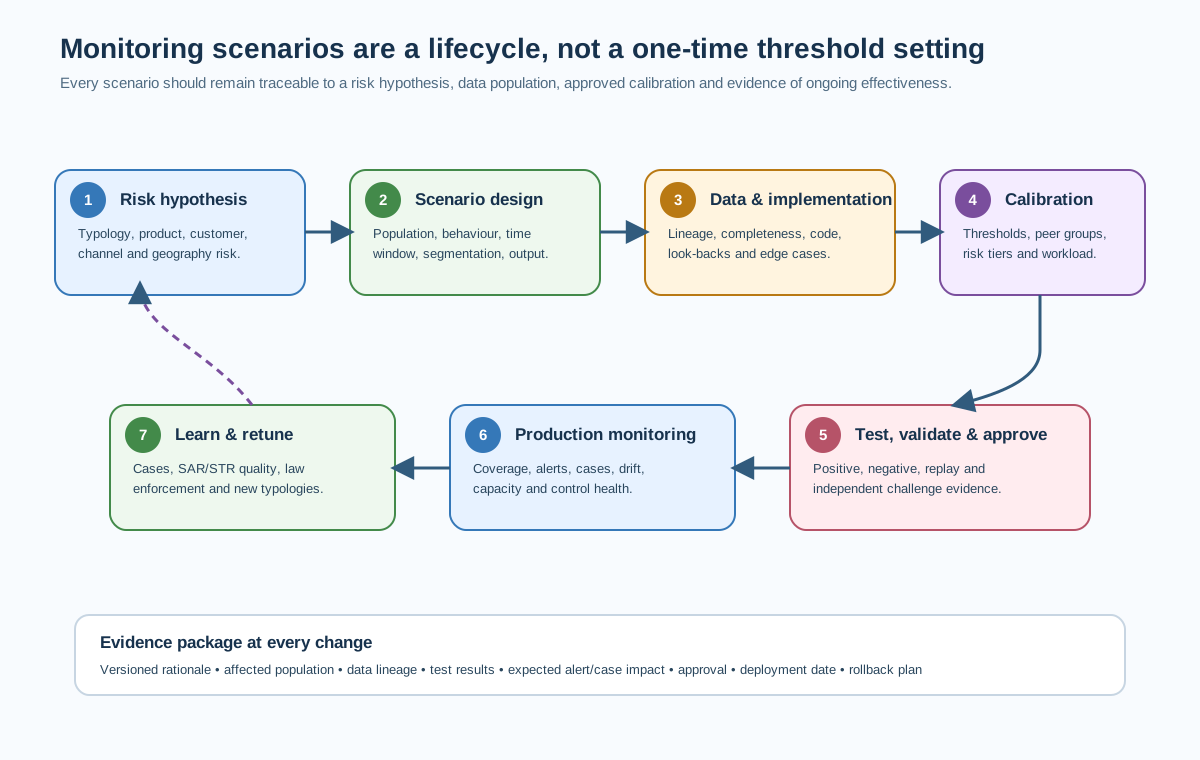
The mental model: scenario as a testable risk hypothesis
A useful way to design monitoring is to begin with a sentence that a non-technical financial-crime specialist can challenge. For example: “Recently opened retail accounts receiving unrelated third-party credits and moving most value onward within a short period may indicate mule activity.” That sentence can then be translated into data and logic: what counts as “recently opened,” what makes a credit “unrelated,” which onward movements matter, what time window is relevant, what proportion of value is meaningful, which customer segments should be excluded or treated differently, and what additional risk indicators make the pattern more compelling.
The scenario should not begin with “the vendor has a rule numbered 247.” Vendor libraries can be useful accelerators, but a bank must still understand why a rule is relevant to its risk assessment and how it behaves on its data. A scenario that cannot be explained in plain language is difficult to tune intelligently and almost impossible to challenge when business conditions change.
A mature scenario record normally preserves several layers of information. The risk statement describes the threat or vulnerability. The coverage statement identifies the products, entities, customers, channels and geographies the scenario is intended to monitor. The detection specification defines the population, fields, transformations, time windows, aggregations, thresholds, segmentation and suppression logic. The decision specification describes what output is created and how it enters alert or case workflow. The evidence record explains calibration, testing, approval, known limitations and post-production performance.
This turns monitoring from a collection of opaque rules into an inventory of risk controls. The distinction is more than documentation. It makes gaps visible. If the enterprise risk assessment identifies a material risk but no scenario, manual control, customer-control mechanism or other detective/preventive control maps to it, the bank can see the coverage gap. If several scenarios all target the same behaviour while another risk has no coverage, governance can ask whether resources are being allocated sensibly.
Tuning is not simply “reducing false positives”
Teams often describe tuning as an exercise to reduce alert volumes. That can be a legitimate operational objective, especially where low-value alerts consume investigation capacity that should be focused on stronger risk. But it cannot be the primary proof of success. If a threshold is increased until alert numbers fit staffing capacity, the bank may have solved a queue problem by weakening detection.
Tuning should instead balance several forms of evidence. The bank asks how the scenario covers the stated risk, how outputs change across candidate thresholds, whether relevant historical cases remain detectable, what new risks appear when the threshold moves, whether different customer segments require different calibration, and whether the resulting workload can be investigated with appropriate quality and timeliness. Capacity matters because an unusable control is not effective, but capacity should not secretly become the risk appetite.
Segmentation is therefore central. A single amount threshold often behaves badly across unlike populations. A cash-intensive grocery merchant, a salaried retail customer, a corporate treasury centre and a money-services business may legitimately produce very different transaction volumes. The risk signal may depend on velocity, counterparties, change from expected behaviour, concentration, geography, account age or rapid movement rather than a single amount. Good calibration asks whether the logic distinguishes behaviour that is unusual for the relevant population, not merely whether a number looks large.
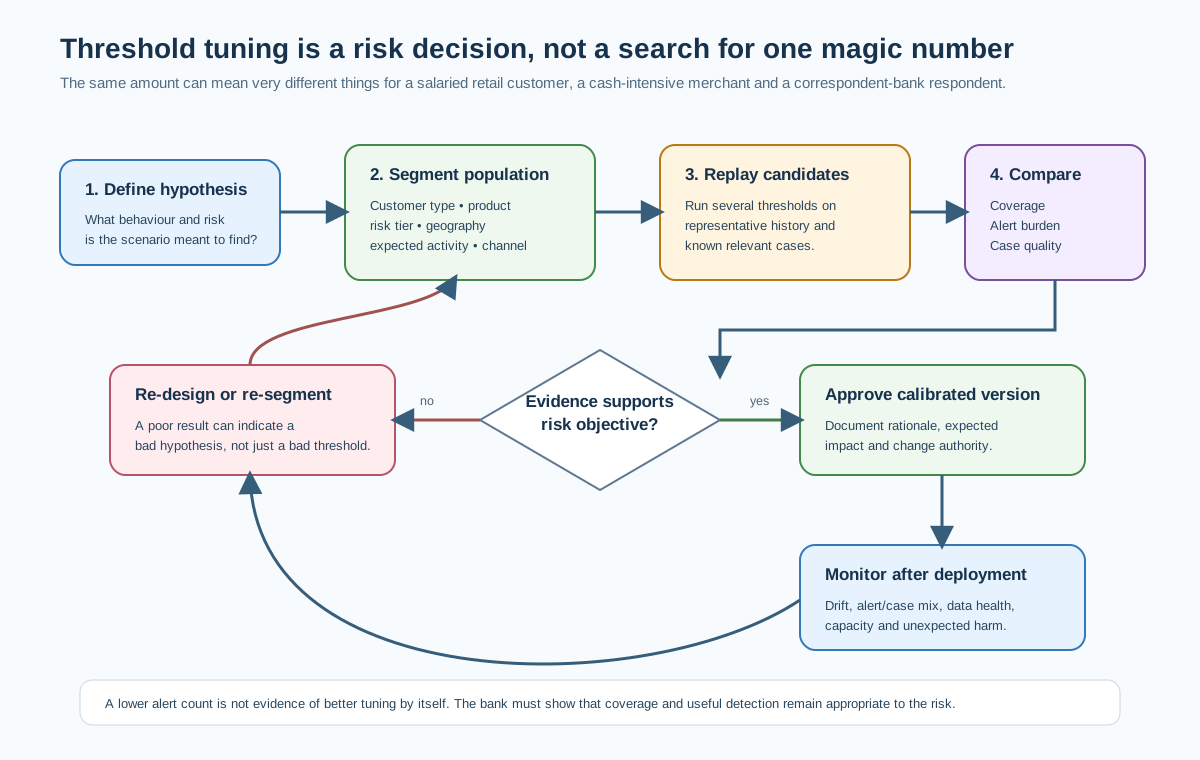
Start with coverage before touching thresholds
Before changing a parameter, the control owner should confirm what the scenario is intended to cover. This sounds obvious, yet many weak tuning exercises start with a table of alert volumes and thresholds without first confirming the financial-crime hypothesis. That makes it easy to optimise the wrong thing.
Coverage should be traceable to the institution's risk assessment and to more granular typology or threat analysis where available. If a bank has elevated exposure to mule networks through instant payments, the monitoring design should identify the relevant customer populations, incoming and outgoing payment events, velocity characteristics, beneficiary relationships, device or authentication signals if available, and the time horizon in which value typically moves. If the scenario only sees end-of-day ledger entries and excludes instant-payment events, tuning the threshold cannot repair the coverage gap.
Coverage analysis should also identify control dependencies. A monitoring scenario may depend on customer risk rating, occupation, business type, beneficial-owner information, geographic classification, sanctions or PEP attributes, channel identifiers, merchant category, device data or prior alerts. If those upstream values are stale or incomplete, the scenario can appear technically healthy while operating on corrupted context.
For this reason, a scenario inventory should not be isolated from data lineage. The inventory should identify the data elements required by each control, their source systems, refresh frequency, transformation logic and critical quality checks. When an upstream platform changes a code set or stops populating a field, owners can identify which scenarios are affected and trigger regression testing before the loss becomes a production blind spot.
Scenario design: population, behaviour, time and output
Most scenario specifications can be challenged through four questions.
Who or what is in scope? Population logic defines customers, accounts, transactions, entities or relationships eligible for evaluation. This includes explicit inclusions and exclusions. Exclusions require particular care because a convenient suppression can create a permanent blind spot. If staff accounts, internal accounts, certain legal entities or low-risk segments are excluded, the rationale and compensating controls should be documented.
What behaviour is being evaluated? Behaviour may be a single event, an aggregation, a sequence, a network relationship or a deviation from expected activity. A rule detecting cash deposits just below a reporting threshold is conceptually different from a rule detecting rapid pass-through across several counterparties. Clear behaviour definitions make both testing and investigation more meaningful.
Over what period? A thirty-minute instant-payment pattern, a rolling seven-day cash pattern and a six-month dormant-account reactivation pattern require different time semantics. The specification should be precise about event time, booking time, value date, timezone, late-arriving events and boundary conditions. Otherwise a scenario may behave differently at month-end, daylight-saving changes or batch cut-offs without anyone realising that the apparent risk pattern is a technical artefact.
What happens when the condition is met? Some scenarios create one alert per account; others aggregate at customer, relationship or network level. Some feed a risk score rather than directly create an alert. The output design affects duplicate alerts, case consolidation, investigator context and downstream metrics. Testing must therefore cover the whole chain, not only whether a rule returns true.
Data is part of the control
Monitoring effectiveness is inseparable from data quality. The FCA's 2021 HSBC transaction-monitoring enforcement action is a useful public example because the weaknesses were not limited to thresholds; the FCA also identified failures to check the accuracy and completeness of data feeding monitoring systems. The lesson is general even though the enforcement action is UK-specific: sophisticated detection logic cannot compensate for missing transactions, incorrect customer attributes or broken transformations.
Data assurance for a scenario begins with completeness. Does the monitoring population include all intended products, legal entities and channels? If the bank migrates a payment product to a new hub, are those events still delivered to the monitoring engine? Completeness should be reconciled to authoritative source totals where feasible rather than inferred from “files arrived successfully.” A file can arrive successfully and still contain only 80% of the intended population.
Accuracy asks whether fields represent what the scenario thinks they represent. A country field may be customer domicile, bank location, transaction destination or IP geolocation. A transaction code may change meaning after a product migration. Currency conversion may use the wrong date or rate. Relationship identifiers may be duplicated after a customer-master change. These are not merely data-governance problems; they change detection behaviour.
Timeliness also matters. A near-real-time control cannot rely on a risk rating refreshed two days later if that rating is central to the decision. A post-event monitoring scenario may accept slower enrichment but should document the lag. The bank should know which features are available at decision time and which arrive later for investigation.
Lineage should be reconstructable. For a sampled alert, a tester should be able to trace the values used by the scenario back to source records, through transformations, into the calculated result. For a sampled non-alerted transaction, the tester should be able to explain why the rule did not trigger. That second test is often more informative because it challenges silent failure rather than visible output.
Calibration: finding defensible operating points
Calibration is the process of selecting parameters that make the control appropriate for the bank's population and risk. It may involve monetary thresholds, counts, ratios, time windows, risk-score cut-offs, peer-group definitions, suppression limits or combinations of indicators. Calibration is not always statistical. A deterministic rule may be tuned through expert judgement supported by replay analysis and known cases. A machine-learning model may require more formal performance assessment. The evidence should fit the method.
A practical calibration exercise uses representative historical data, not only a convenient sample. The period should cover ordinary activity and relevant variation such as salary cycles, holidays, year-end corporate flows, seasonal businesses or known event spikes where these affect the population. If a scenario is intended for a rare but severe risk, the absence of many positive historical examples should be acknowledged rather than disguised by precision metrics based on tiny samples.
Candidate settings should be compared before a decision is made. For each candidate, teams can estimate affected customers, alert count, concentration by segment, known-case capture, investigator workload and likely downstream cases. The aim is to understand trade-offs. A threshold that reduces alerts by 70% may be attractive until the team notices that it removes nearly all alerts from a high-risk remittance segment or misses cases previously assessed as meaningful.
The bank should also test sensitivity around the chosen point. If moving a threshold by 1% causes a 50% change in alerts, the control may sit on an unstable cliff. That does not automatically make it wrong, but the operational risk deserves attention. Sensitivity analysis can reveal whether a parameter is robust or whether small data changes will repeatedly overwhelm investigators.
Testing: prove the control behaves as specified
Testing should answer more than “did an alert appear?” Positive tests confirm that known in-scope patterns trigger. Negative tests confirm that clearly out-of-scope or benign patterns do not trigger solely because of coding errors. Boundary tests examine exactly-at, just-below and just-above thresholds. Temporal tests examine window edges, late events and timezone behaviour. Data-quality tests inject missing, malformed or unexpected values. Regression tests confirm that unrelated scenarios or downstream workflow are not broken by a change.
Historical replay is particularly valuable. The bank runs the proposed scenario version against a defined historical period and compares the results with the current version. Differences are then explained. The objective is not to force the new version to reproduce the old one; that would prevent genuine improvement. The objective is to make the change visible and reasoned. If the new design intentionally stops detecting a low-value pattern, governance should know that. If it unexpectedly stops detecting a known typology, the change should not progress until the reason is understood.
Known-event or “golden case” testing can help, but it must be used carefully. A control tuned only to known past cases can overfit historical behaviour and fail on evolving methods. A golden-case library should therefore include different typologies, segments and boundary conditions, and it should be supplemented with broader sampling and synthetic or seeded patterns where permitted.
Synthetic testing is useful when rare events are hard to find in production history. A team can construct transactions or feature combinations that represent the scenario's intended behaviour and confirm processing end to end in a controlled environment. Synthetic data should not be treated as proof of real-world effectiveness, because it lacks the complexity and noise of production populations. It proves implementation logic; production replay and outcome analysis address different questions.
Validation: independent challenge, not ceremonial sign-off
The word “validation” is sometimes used loosely to mean any testing. A stronger operating model reserves it for structured challenge with sufficient independence from the design decision. Independence does not necessarily mean a completely separate legal entity or external consultant. It means the reviewer has enough organisational separation, competence and authority to disagree with the owner, require remediation and escalate unresolved limitations.
Validation should be proportionate to the nature of the control. A simple deterministic rule may not require the same quantitative validation methods as a complex statistical model, but it still needs evidence of conceptual appropriateness, data integrity, implementation accuracy and performance. A vendor product is not exempt. Outsourcing logic does not outsource accountability; the institution still needs enough understanding and evidence to judge whether the product is fit for its use.
A useful validation structure has four layers.
First is conceptual soundness. Does the scenario make sense for the identified risk? Are the assumptions reasonable? Is the population appropriate? Are material exclusions justified? Does the design rely on a feature that is a weak proxy for the behaviour it claims to detect?
Second is data and implementation validation. Are the intended inputs complete and accurate? Was the specification coded correctly? Are aggregations, joins, thresholds and time windows implemented as approved? Is the production version the version that was tested?
Third is performance and outcomes analysis. How is the control behaving in production? Are alerts concentrated in one segment unexpectedly? Are investigators finding relevant risk? Are known cases being captured? Has data or customer behaviour drifted? Are limitations increasing? Performance analysis should not collapse into one productivity ratio.
Fourth is governance and control validation. Is the scenario inventoried and owned? Are changes approved? Are issues tracked? Are overrides controlled? Are validator findings resolved or formally accepted? Can the bank reconstruct which version was in production on a given date?
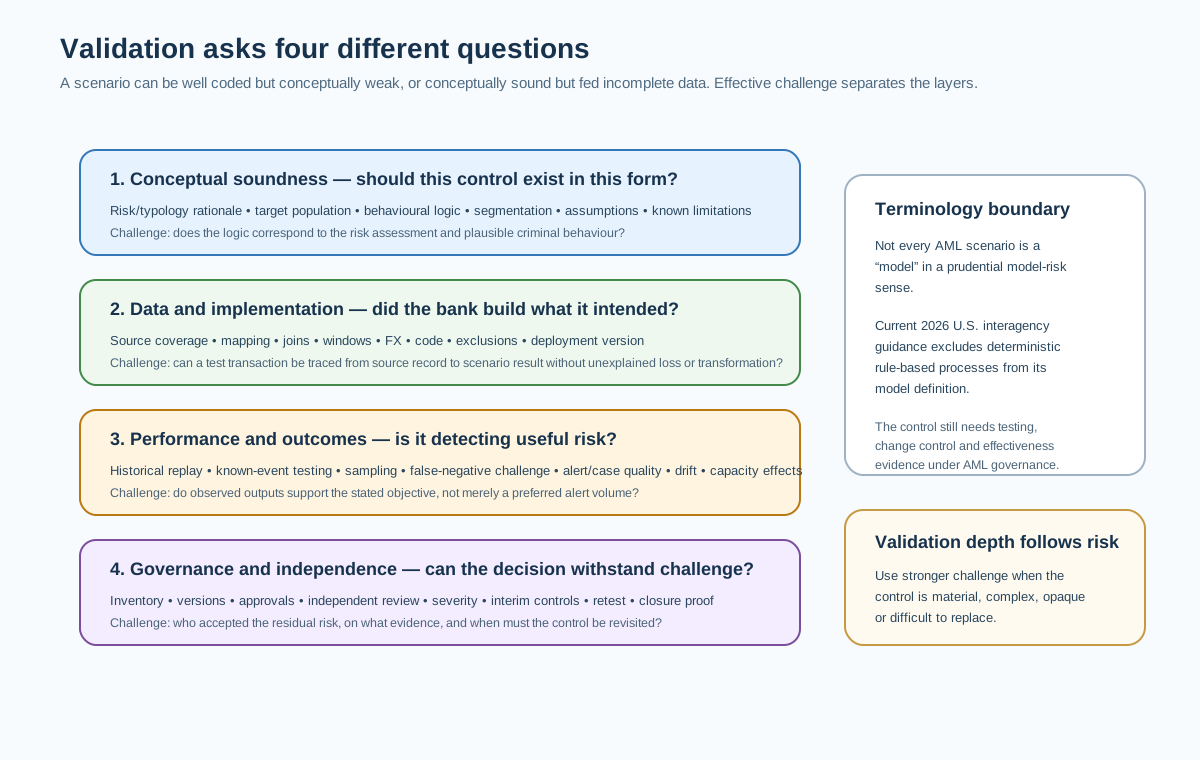
A current 2026 point: not every AML rule is a “model”
Terminology needs particular care in U.S. banking after the interagency model-risk guidance issued on 17 April 2026. The updated guidance defines a model as a complex quantitative method, system or approach applying statistical, economic or financial theories to produce quantitative estimates. It explicitly excludes deterministic rule-based processes and software without those theories from the model definition. The guidance is risk-based and is not a prescriptive AML rulebook.
That means a bank should not mechanically label every transaction-monitoring scenario a prudential “model” and then impose a full model-risk process merely because the scenario is automated. A deterministic rule such as “aggregate cash deposits over a specified amount within a rolling period, subject to defined segmentation” may be a monitoring control without being a model under that U.S. guidance. It still needs AML control governance, data assurance, testing, tuning and change evidence. A statistical anomaly detector or machine-learning classifier may more clearly fall into model-risk territory depending on its design and the institution's framework.
This distinction is jurisdiction-specific. Other jurisdictions and individual banks may use the word “model” differently in policy. The safe design principle is to classify controls consistently under the applicable framework while ensuring that the assurance effort remains proportionate to risk, complexity, opacity and materiality.
Outcomes, productivity and the danger of a single metric
Alert-to-case conversion, case-to-SAR/STR conversion, average handling time and false-positive rates are useful operational measures, but none proves effectiveness alone. A high SAR conversion rate can mean a well-targeted scenario; it can also mean investigators only escalate the most obvious alerts while subtler risks are missed. A low conversion rate can indicate poor tuning; it can also reflect a deliberately broad control for a high-severity risk where most alerts are expected to be cleared after review.
Wolfsberg's 2024 and 2025 statements on Monitoring for Suspicious Activity are useful here because they encourage institutions to focus on effective outcomes rather than treating traditional transaction-monitoring volume as the objective. The 2025 statement specifically frames innovation around transition and validation, balancing model risk with financial-crime risk, and explainability. Wolfsberg guidance is not law, but it is an important industry benchmark for thinking beyond “more alerts equals more compliance.”
An effectiveness dashboard should therefore combine different lenses. Coverage metrics show whether intended populations and data feeds are present. Control-health metrics show job completion, latency, errors and data-quality exceptions. Detection metrics show alert distribution, concentration and stability. Investigation metrics show case relevance, typology confirmation, escalation quality and repeat patterns. Outcome metrics may include SAR/STR usefulness feedback where available, law-enforcement requests, internal intelligence value or control improvements triggered by cases. Risk metrics show whether identified threats are changing faster than scenarios are updated.
False negatives deserve explicit attention because production systems naturally show what they caught, not what they missed. Banks can challenge false-negative risk through look-backs, retrospective analysis of filed SARs/STRs, law-enforcement feedback, cases detected by other controls, sampling of non-alerted populations, network analysis, quality-assurance findings and targeted thematic reviews. No method reveals every missed suspicious transaction. The purpose is to build evidence that the bank actively looks for blind spots rather than assuming “no alert” means “no risk.”
Change control and effective dating
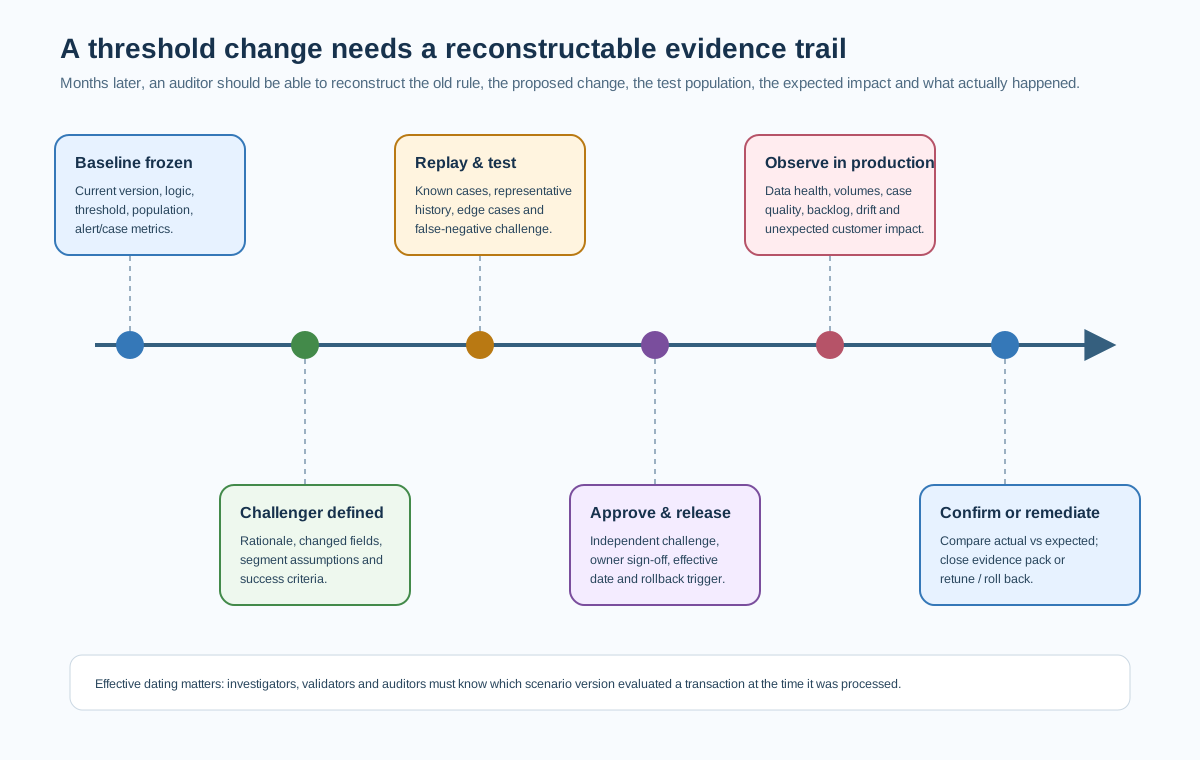
Monitoring scenarios change frequently enough that version control becomes a core financial-crime control. Every material version should have an effective date, rationale, specification, test evidence, expected impact, approval, deployment record and rollback plan. The bank should be able to answer a simple audit question: which version assessed this customer's transactions on 14 March last year, and what exactly was that version designed to do?
Changes can be triggered by a new typology, regulatory expectation, risk-assessment update, product launch, data migration, investigator feedback, model drift, backlog pressure, vendor release or validation finding. Different triggers may require different approval levels, but all should enter a controlled change process.
The pre-change baseline should be frozen before testing. That baseline includes logic, parameters, population, recent alert volumes, case outcomes and known limitations. The challenger version is then replayed on a defined dataset. Expected changes are documented before deployment; otherwise teams can rationalise almost any post-production result as “expected.”
After deployment, post-implementation monitoring compares actual outcomes with those expectations. If alert volumes spike, high-risk coverage collapses, data errors appear or investigator workload becomes unsafe, predefined rollback or remediation triggers should activate. A scenario change is not complete merely because code reached production.
Drift: when yesterday's calibration stops fitting today's bank
Drift can occur in data, population, behaviour or risk. Data drift occurs when feature distributions change because source systems, coding standards or feeds change. Population drift occurs when the bank's customer mix changes, perhaps after an acquisition or expansion into a new market. Behavioural drift occurs when legitimate customer activity evolves, as happened with rapid growth in digital payments. Threat drift occurs when criminals adapt specifically to known controls.
Monitoring should distinguish those causes because the response differs. If an average transaction amount increases because inflation or product growth changed legitimate behaviour, the scenario may require recalibration. If a feature distribution changes because a mapping broke, tuning would be the wrong response; the data defect must be fixed. If a typology evolves toward smaller, faster transactions across mule networks, the design itself may need to change rather than simply moving a threshold.
Drift indicators should therefore link to investigation. A statistical change is a prompt for review, not automatically proof of control failure. Teams should examine which customers and transactions drive the change, whether known risks remain detectable, and whether customer or product strategy explains the movement.
Scenario overlap, suppression and portfolio effects
A monitoring programme is a portfolio, not a set of independent rules. Two individually sensible scenarios can generate duplicate alerts for the same behaviour, overwhelming investigators without adding information. Conversely, broad suppression rules introduced to control duplicates can hide legitimate detections from one scenario because another scenario triggered first.
Portfolio testing should map overlap. Teams can measure how often scenarios trigger together, whether duplicate alerts are consolidated, whether the strongest risk indicators survive consolidation, and whether case workflow preserves the contributing scenario reasons. Scenario retirement should also be evidence-based. If a new network model replaces three legacy rules, the bank should show how relevant legacy coverage is preserved or intentionally changed before switching them off.
This is where champion-challenger approaches can help. The current control remains the champion while a challenger runs in parallel or on historical data. The comparison focuses not only on total alerts but on unique relevant cases, missed-risk patterns, investigator utility, data dependencies and operating cost. A challenger that produces fewer alerts but identifies different, higher-value risk may be better even if simple volume metrics make comparison difficult.
Governance and the three lines
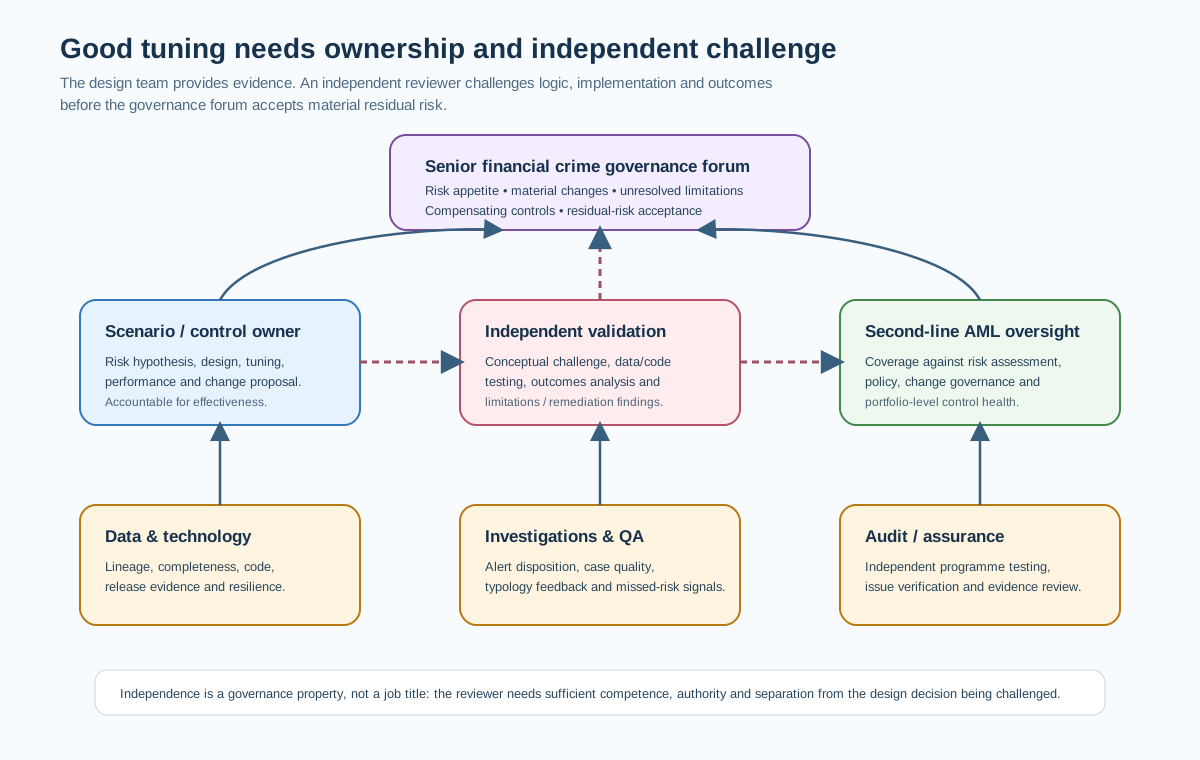
Ownership should be explicit. A scenario owner is accountable for the risk hypothesis, design intent, performance and change proposals. Data and technology teams are accountable for reliable implementation, lineage and production operation. Investigation teams provide outcome feedback and identify weak alerts or missed patterns. Second-line financial-crime compliance challenges coverage and policy alignment. An independent validation function, where the institution's framework requires one, performs structured challenge distinct from day-to-day tuning. Internal audit independently assesses the overall framework and evidence.
Senior governance should focus on material decisions rather than approve every minor technical change. Useful escalations include significant coverage reductions, unresolved validation findings, material data gaps, prolonged backlogs that undermine timely investigation, reliance on compensating controls, delayed model redevelopment and risk acceptance beyond agreed tolerance.
A governance paper should not contain only productivity charts. It should state what changed in the risk environment, which controls were affected, what evidence supports the proposed change, what was lost as well as gained, what limitations remain, how customer impact was assessed and who accepts residual risk.
Customer and operational impact
Monitoring is usually invisible to customers until it is not. Poor tuning can generate unnecessary holds, repeated requests for information, delayed payments, account restrictions or exits. In some jurisdictions and products, monitoring may occur post-event; in others, risk controls can interact with real-time decisions. The chapter should not assume that every AML monitoring alert lawfully permits a bank to stop a payment. Payment execution rules, sanctions obligations, fraud controls and local AML law must be considered separately.
Customer impact is therefore a useful tuning dimension. If a change disproportionately alerts a vulnerable or particular customer segment, the bank should understand why. That does not mean the control is invalid; real risk can be concentrated. It does mean the institution should distinguish genuine risk concentration from poor data, crude segmentation or proxy effects.
Operational impact matters too. A scenario producing 20,000 alerts on a Friday evening may be technically accurate but operationally unsafe if the bank cannot investigate within appropriate timescales. The response may include better prioritisation, automated enrichment, case consolidation or additional capacity. Simply increasing thresholds to fit staffing is not a sound substitute for understanding risk.
Business-analysis and architecture requirements
A business analyst working on monitoring should be able to turn control intent into testable requirements. At minimum, a scenario requirement should identify the risk/typology reference, in-scope population, source events and fields, data transformations, segmentation, time semantics, rule or model logic, thresholds, exclusions, output/granularity, priority logic, downstream workflow, audit fields, owner, approval requirements, expected performance indicators and version/effective-date rules.
Architecture should support reproducibility. Parameter values should be configuration with controlled versioning where possible rather than hidden in code. Source-to-feature lineage should be discoverable. Release tooling should prevent an unapproved rule version from being promoted. Monitoring jobs should emit control totals and failure statuses. Historical replay should be possible without corrupting production cases. Where vendor engines obscure internal logic, the bank should negotiate sufficient transparency, test interfaces and evidence to meet its governance obligations.
Testing requirements should cover data and decision paths. A useful pack includes positive, negative, boundary, temporal, missing-data, duplicate-event, late-event, multi-currency, segment-transition, regression, replay, rollback and access-control tests. Performance testing is also relevant: a rule that is correct on a small dataset but misses service-level windows at production volume is not ready.
Test evidence should state expected results before execution. Screenshots alone are weak evidence when they do not show source data, scenario version and comparison logic. Reproducible queries, test datasets, run identifiers and generated outputs allow a later reviewer to understand what was proved.
Practical mini case: rapid pass-through in newly opened SME accounts
Consider a bank that has seen several cases where newly incorporated small businesses receive credits from many unrelated retail customers and move most of the funds to external accounts within hours. The existing monitoring scenario uses a fixed monetary threshold and a seven-day window. Investigators report that it generates large volumes from legitimate e-commerce merchants while missing smaller but faster mule-like activity.
The tuning team first rewrites the hypothesis rather than merely raising the threshold. It identifies the important features: account age, number of unrelated originators, proportion of incoming funds sent onward, time to onward movement, number of beneficiaries, customer business model and whether the activity matches expected turnover. The team separates genuine high-volume online merchants from newly onboarded businesses with no declared reason to receive consumer payments.
Data analysis reveals a problem before tuning begins: instant-payment credits are available in the payments platform but arrive in the monitoring warehouse after an overnight transformation that loses the original event timestamp. The current seven-day scenario therefore cannot accurately measure movement “within two hours.” Architecture fixes the timestamp lineage and reconciles coverage before calibration. This is a good example of why thresholds should not be tuned around a data defect.
The team then runs challenger variants over twelve months of representative history. Known mule cases are included as reference cases, but the sample also contains legitimate businesses and randomly selected non-alerted accounts. Candidate designs are compared on risk coverage, unique relevant cases, alert distribution by segment and investigator workload. The best design reduces noisy merchant alerts while adding a velocity component that identifies several cases not generated by the old rule.
Independent validation challenges the segmentation because the “e-commerce merchant” tag is maintained manually and can be stale. The design is revised so the tag is not an automatic suppression; it modifies the threshold but strong velocity and counterparty indicators can still alert. Validation also confirms that the new timestamp field is complete across all payment channels and that the production code matches the tested specification.
Governance approves a controlled release with a four-week observation period. Expected alert volumes and segment mix are documented. A rollback trigger is defined if instant-payment coverage falls below reconciled control totals or if alerts from newly opened high-risk SMEs fall materially below the replay expectation without a clear business reason. After deployment, actual volumes are close to expectations, investigator feedback improves, and two new data-quality exceptions are identified and remediated. The change is closed only when post-implementation evidence confirms that the production control behaves as approved.
The lesson is not that one formula is correct. The lesson is the method: start with risk, prove the data, compare alternatives, challenge false negatives, separate tuning from validation, control the change and monitor the outcome. That method travels across cash, wires, cards, trade, correspondent banking, instant payments and virtual assets even though the specific signals differ.
What strong evidence looks like
At the end of a tuning cycle, a reviewer should be able to pick up the evidence pack and understand the decision without interviewing the original developer. The pack should identify the risk rationale; current and proposed versions; data population and lineage; test period; candidate parameters; positive and negative results; known-event and non-alert sampling; expected alert and case impact; limitations; validator challenge; approval; effective date; deployment evidence; post-implementation outcome; and outstanding actions.
What matters is not the size of the pack but the traceability of the reasoning. A hundred pages of charts do not compensate for an unexplained exclusion. A short decision record can be strong if every material assertion links to reproducible evidence.
The most important discipline is to resist convenient conclusions. “Alerts fell” is not the same as “effectiveness improved.” “The model passed validation” is not the same as “no limitations exist.” “No regulator prescribed a threshold” is not permission to choose one without evidence. “The vendor owns the model” is not a transfer of the bank's accountability. And “the scenario has always worked this way” is not a defence when the bank's customers, data and criminal threats have changed.
Operational deep dive: how to test effectiveness without fooling yourself
Scenario testing becomes difficult when teams try to convert a messy financial-crime problem into one clean performance number. In ordinary predictive modelling, the outcome may eventually be observable: a borrower defaults or does not, a card transaction is confirmed as fraud or not, a machine fails or does not. Suspicious-activity monitoring has weaker labels. An alert closed as “not suspicious” is not proof that the underlying activity was innocent. A SAR or STR filing is not proof that a crime occurred. Law-enforcement feedback may be delayed, selective or unavailable. The validation framework therefore has to combine quantitative evidence, investigative judgement and control-risk analysis without pretending that any one measure is ground truth.
Build a test population that represents the decision
A tuning team should first define the population against which a conclusion is being made. If a scenario applies to retail current accounts in three countries, replaying it only on a convenient sample of high-risk customers gives a distorted picture. If it applies to both consumer and SME accounts but the test set is dominated by consumer traffic, the apparent performance may hide poor SME behaviour.
Representative does not always mean random. A strong test population may deliberately contain several components: an unbiased sample of ordinary activity, all or a sample of known relevant cases, targeted high-risk segments, known data-quality edge cases, recently introduced products and a set of non-alerted transactions selected specifically to challenge false-negative risk. The composition should be documented so reviewers know what each result can and cannot support.
Time-period selection matters. A three-month sample can miss annual tax flows, holiday remittance patterns or year-end corporate behaviour. A twelve-month sample may be appropriate for many scenarios but can also blend together periods before and after a material product or data migration. Testers should understand whether the period is stable enough to compare, and where necessary stratify results by month or regime.
For very rare risks, statistical confidence can be weak. If only six relevant historical cases exist, a 100% capture rate sounds impressive but says little about performance on unseen variants. The correct response is not to manufacture percentages. It is to acknowledge the small sample, combine it with conceptual analysis, synthetic cases, non-alert sampling, external typologies and stronger post-production monitoring.
Positive, negative and boundary testing answer different questions
A positive test asks whether intended suspicious or high-risk behaviour produces the expected output. It should include both simple “textbook” examples and realistic cases containing noise. A rule that only triggers when every feature is perfectly populated may fail when production data is incomplete.
A negative test asks whether legitimate or explicitly out-of-scope activity is processed correctly. This is important because a scenario that alerts almost everything will pass positive testing while being operationally useless. Negative tests should include legitimate high-volume customers, expected seasonal spikes, internal transfers where appropriately excluded, and other behaviours known to resemble the typology superficially.
Boundary tests focus on the edges of logic: exactly equal to a threshold, one unit below, one unit above, first and last event in a rolling window, accounts opened exactly on an age boundary, currencies converted at rounding points, and customers moving between risk segments. Boundary defects are common because specification language such as “greater than” versus “greater than or equal to” can materially change populations.
Temporal testing deserves special attention. Rolling windows require precise definitions of event time and inclusivity. A “24-hour” window may behave differently if implemented as calendar day rather than 24 elapsed hours. Systems operating across timezones can double-count or drop activity during daylight-saving transitions. Batch systems may allocate late-arriving transactions to the wrong run. These are technical details with direct control consequences.
Historical replay should explain differences, not suppress them
Historical replay creates a powerful before-and-after view. The bank executes the current scenario and proposed version on the same historical population and compares outputs. The comparison should be performed at more than aggregate volume level. Teams should ask which customers are newly alerted, which are no longer alerted, which risk segments change most, which known cases move, and how downstream case consolidation changes.
A difference is not automatically a defect. If the challenger intentionally removes a weak signal and adds a network indicator, substantial changes may be desirable. The discipline is to classify differences as expected, acceptable-but-limited or unexpected. Unexpected differences require root-cause analysis before approval.
Replay can also estimate operational impact. If a new version would have generated 40% more alerts during a month in which the investigation team was already at capacity, governance needs to know. The answer may be more resources, better prioritisation or a phased release. It should not be a hidden threshold increase performed after go-live because the queue became uncomfortable.
Use known cases carefully
Known relevant cases are valuable because they provide concrete examples of behaviour the bank considered sufficiently concerning to investigate or report. But they are not a complete ground truth. SAR/STR labels are affected by previous scenario coverage, investigator judgement and legal reporting thresholds. Using only previously reported cases to train or tune a system can reproduce historical blind spots: the bank learns to find what it already knew how to find.
Known cases should therefore be used as one evidence set. A tuning team can ask whether the new scenario preserves intended detection of those cases, but it should also look for new patterns. Cases discovered through fraud investigations, sanctions reviews, law-enforcement requests, customer complaints, internal whistleblowing or external intelligence can provide alternative evidence of activity missed by transaction monitoring.
A “golden case” library needs governance. Each case should have a reason for inclusion, relevant typology, required data and expected scenario behaviour. Cases should be refreshed as threats evolve. Artificially simple records that were created years ago and never challenged can become a regression test for obsolete logic rather than a meaningful effectiveness test.
False negatives require an active search strategy
A false positive is visible because an alert exists and an investigator closes it. A false negative is harder: the system did not alert. Effective challenge therefore needs deliberate methods for looking outside the alerted population.
One method is retrospective SAR/STR analysis. Take reports filed from referrals, fraud cases or other scenarios and ask whether the scenario under review should have detected any part of the behaviour. Another is non-alert sampling: select transactions or customers just below thresholds, from high-risk segments, or with partial typology indicators and review them manually. A third is typology-led look-back: when a new laundering method is identified, search historical data independently of the scenario and compare the resulting population with prior alerts.
Network analysis can also identify missed clusters. If five accounts were linked in a confirmed mule case, investigators can examine related counterparties and determine whether the monitoring portfolio identified them. External feedback from FIUs or law enforcement, where available and legally usable, can reveal patterns not reflected in internal labels.
The objective is not to calculate a mathematically exact “false-negative rate” where the true number of suspicious transactions is unknowable. It is to demonstrate that the institution has credible processes to challenge the blind spots created by its own monitoring design.
Alert productivity is useful but easy to misuse
Suppose Scenario A generates 10,000 alerts and 200 cases, while Scenario B generates 2,000 alerts and 160 cases. Scenario B looks more productive. But the result is incomplete. Are the 40 cases lost by B low value or high severity? Does B identify different customers? Were some cases generated by duplicate alerts under A? Do investigators spend more time on each B alert because it lacks context? Do either scenario's cases lead to useful SARs/STRs, risk exits or intelligence? Does B leave an uncovered segment?
A productivity ratio is therefore an operational lens, not an effectiveness verdict. Useful metrics can include alert-to-case rate, cases per investigator hour, duplicate alert rate, ageing and backlog, but they should be interpreted alongside risk coverage, case quality and missed-risk evidence.
Precision and recall terminology can be useful in statistical or machine-learning contexts but requires caution. “Precision” usually means the proportion of predicted positives that are truly positive. In AML, “true suspicious” may not be objectively known. “Recall” requires knowing the total number of true positives, which is also generally unavailable. Banks may use proxy labels for model development, but governance should be explicit about what the label represents: investigator escalation, SAR/STR filing, confirmed fraud, law-enforcement feedback or another outcome. A proxy should not be described as legal proof of money laundering.
Data-quality testing should be scenario-specific
Enterprise data-quality dashboards are helpful but insufficient. A field can meet a 99.9% completeness target overall while being missing for the exact high-risk product a scenario is meant to monitor. Scenario testing should therefore evaluate data quality within the in-scope population.
Useful checks include reconciling transaction counts and amounts from source to monitoring platform; verifying all intended legal entities and product codes are present; confirming currency conversion; checking customer-to-account relationships; validating country and channel codes; detecting unexpected nulls; and tracing effective-dated customer risk attributes. Where the scenario uses derived features, testers should recompute a sample independently.
Data exclusions should be visible. If the monitoring engine rejects malformed events, there should be a control total and exception process. Silent discards are dangerous because a healthy job status can coexist with missing risk data.
Implementation testing: specification versus production code
The approved scenario specification should be executable enough to test. A validator should be able to take a sample dataset, apply the stated logic independently and compare results with the production or test engine. Differences may reveal undocumented coding choices, rounding, join behaviour or default handling.
Configuration matters as much as code. Thresholds, segmentation tables, risk weights and suppression lists may sit in database tables or vendor administration screens. Test evidence should capture the actual values deployed, not only the values in a design document. Access to change those values should be controlled and logged.
Release testing should prove that the validated version is the version promoted to production. Hashes, build identifiers, configuration versions or controlled release packages can support this. A common governance weakness is to validate one configuration, make a “small” last-minute adjustment and deploy without rerunning impact tests.
Independent validation should be risk-based
Current U.S. interagency model-risk guidance issued in April 2026 reinforces a risk-based and tailored approach to model validation and ongoing monitoring. It discusses conceptual soundness, outcomes analysis, monitoring, governance and vendor models, while clarifying that deterministic rule-based processes are outside its model definition. This is relevant to U.S. banks' model-risk frameworks but should not be globalised into a universal AML rule.
For a deterministic monitoring rule, effective independent challenge may focus on risk rationale, source-data coverage, implementation accuracy, threshold evidence, historical replay, false-negative testing and change governance. For a complex statistical model, validation may additionally examine feature engineering, training data, statistical assumptions, stability, explainability, performance metrics, bias, overfitting and model limitations. The level of sophistication should follow risk and complexity rather than the label attached to the control.
Vendor models deserve the same principle. The bank may not see proprietary source code, but it should understand enough about inputs, outputs, intended use, limitations, configuration and observed performance to govern the product. If a vendor cannot provide sufficient transparency, the institution should decide whether compensating testing, contractual rights or an alternative product is needed.
Champion–challenger is a controlled comparison, not a competition for the lowest volume
In a champion–challenger approach, the production method remains the champion while an alternative runs on the same or comparable data. The challenger may be a new threshold set, a redesigned ruleset, network analytics or machine-learning approach. Success criteria should be defined before comparison.
The comparison should include unique detections, overlap, missed known cases, risk-segment distribution, investigator feedback, data dependencies, explainability and operating cost. If the challenger requires features that are unavailable for 20% of customers, that limitation may outweigh an apparent gain on the remaining population.
Where feasible, a parallel run in production-like conditions gives stronger evidence than offline replay because it exposes latency, data arrival, orchestration and workflow behaviour. Parallel runs should be designed so they do not accidentally create duplicate customer action or uncontrolled investigator workload.
Test the monitoring programme as a system
Finally, validation should recognise that a scenario is only one part of the control chain. A perfect detection that never reaches an investigator because of queue routing is a failed control. An alert that reaches a case but loses transaction context can produce poor decisions. A case that should feed a SAR/STR process but is not escalated because of broken workflow also defeats the scenario's objective.
End-to-end tests should therefore trace selected patterns from source transaction to scenario calculation, alert creation, prioritisation, case formation, investigator display, decision recording and, where applicable, reporting or feedback. They should also verify audit logging and retention. This end-to-end view connects technical testing with the real bank outcome: identifying activity that deserves informed human review and ensuring the evidence survives long enough to be challenged.
Advanced practice: innovation, machine learning and change without losing control
Modern suspicious-activity monitoring increasingly combines deterministic rules with customer behaviour, network analytics, anomaly detection and machine-learning methods. The governance challenge is not to force every technique into the same validation template. It is to preserve a clear chain from risk objective to design, evidence and accountable use while allowing more effective approaches to replace legacy controls when justified.
The Wolfsberg Group's 2025 Statement on Effective Monitoring for Suspicious Activity, Part II is useful industry guidance for this transition. It frames responsible innovation around three themes: effective transition and validation, balancing model risk with financial-crime risk, and explainability. Wolfsberg is not a regulator and its statements are not binding law, but the approach highlights a practical problem familiar to banks: demanding that an innovative control reproduce every output of a noisy legacy system can prevent improvement. A new approach should be judged against the risk outcome it is meant to improve, with the differences understood and governed.
Do not make the legacy scenario the definition of truth
Suppose a bank's legacy rules produce 100,000 alerts a month and a new network model produces 25,000. A weak validation approach asks whether the model reproduced most of the old alerts. A stronger approach first asks which old alerts represented useful detection, which were duplicates or low value, which risk areas the new method covers better, and which legacy coverage would genuinely be lost.
The old system is evidence, not ground truth. It contains historical design choices, past data limitations and accumulated tuning decisions. If the purpose of innovation is to detect relationships or behaviours that rules cannot see, perfect replication would defeat the objective.
Transition evidence should therefore compare risk coverage and outcomes, not just output overlap. The bank can map old and new controls to typologies, examine unique detections, review known relevant cases, sample non-overlap populations, test high-risk segments and evaluate investigation quality. Material coverage intentionally removed should be explicitly accepted or replaced by another control.
Explainability has several audiences
“Explainable” does not mean every user needs to understand every mathematical detail. Different audiences need different explanations.
An investigator needs to know why a customer or network was surfaced and which facts deserve review. A validator needs enough technical transparency to challenge data, features, assumptions, performance and limitations. A governance committee needs to understand the risk objective, material trade-offs and unresolved limitations. An auditor or supervisor needs evidence that the institution understood and controlled the method. A developer needs implementation detail precise enough to reproduce results.
For a machine-learning control, an investigator may be shown key contributing behaviours, network links and deviations without being given source code. The validator, however, may need model documentation, training and testing datasets, feature definitions, hyperparameters, stability analysis and evidence of performance under different segments. The right level of explainability depends on the decision and control function.
Separate financial-crime risk from model risk
A model can be statistically imperfect yet still materially improve financial-crime detection. Conversely, a model can be technically elegant but poorly aligned with the bank's actual threats. Governance should evaluate both dimensions.
Financial-crime risk asks what happens if the control misses or misclassifies activity: exposure to laundering, terrorist financing, proliferation financing, sanctions evasion, fraud proceeds, regulatory failure or weak intelligence. Model risk asks how errors can arise from design, data, assumptions, implementation, use or deterioration. The two overlap but are not identical.
A bank may reasonably accept some model uncertainty when a challenger materially improves detection of a serious risk, provided limitations are understood and mitigated. It may also reject a statistically strong model if its data dependency is too fragile, its output cannot be operationalised or its behaviour cannot be explained sufficiently for the intended use.
Validation cadence should be triggered by risk and change
A fixed annual validation date can become a ritual that misses meaningful change. Periodic review remains useful, but mature frameworks also use event-driven triggers. Examples include a major data migration, acquisition, new payment rail, new customer population, material typology change, vendor model upgrade, sustained performance drift, validation issue, regulatory change or evidence that the control missed relevant cases.
Current U.S. interagency model-risk guidance is explicitly risk-based and tailored rather than prescribing an annual validation cycle for every model. Other jurisdictions and internal policies may set different requirements. A global bank should therefore maintain a jurisdiction and policy map instead of importing one cadence everywhere.
Independent challenge of machine-learning features
Feature engineering can hide assumptions. A feature such as “high-risk country count” depends on a country classification that must be governed and effective-dated. “Counterparty novelty” depends on a relationship-history window. “Velocity” depends on event time and aggregation. “Peer deviation” depends on how peer groups are built. Validation should unpack these definitions because model performance can deteriorate when apparently minor reference data or segmentation changes.
Data leakage is another concern. If the training data uses information that was only available after an investigation—such as a SAR filing flag—the model may appear highly predictive during development but fail in production where that information is not available at decision time. Every feature should be tested for point-in-time availability.
Class imbalance is common because known suspicious outcomes are rare relative to ordinary transactions. Teams may oversample positive examples or use weighted objectives, but evaluation should be performed on populations that represent production use. Otherwise performance measures can look impressive while positive predictive value collapses under real prevalence.
Human feedback is useful only when the label is understood
Investigator decisions can improve monitoring, but they are not automatically objective labels. A closure may reflect insufficient information, local reporting thresholds, time pressure or differences in analyst judgement. A SAR/STR filing reflects suspicion under applicable law or policy, not a judicial finding of criminal conduct.
Feedback loops should therefore preserve label provenance. The dataset should distinguish investigator escalation, QA outcome, SAR/STR decision, confirmed fraud, customer exit, law-enforcement feedback and other labels. Combining all of them into a single suspicious = 1 field can create misleading training data.
Quality assurance can improve label reliability by reviewing samples and measuring decision consistency. If investigator decisions are used for training, changes to investigation policy should be treated as potential label drift.
Vendor and cloud analytics need evidence, not faith
A vendor may provide proprietary scenarios, models or hosted analytics. The bank remains accountable for deciding that the service is appropriate for its risk. Contracts should support access to material documentation, change notices, test environments, data-flow information, security and operational evidence, and enough performance information to challenge the service.
Where the underlying algorithm is opaque, banks can perform black-box testing: submit controlled inputs, compare outputs, replay known populations, measure stability and test edge cases. Black-box testing does not remove the limitations of opacity, but it gives evidence about behaviour. Material limitations should be reflected in risk acceptance and compensating controls.
Vendor releases require change governance. “The vendor upgraded the model” is not a sufficient deployment rationale. The institution should understand what changed, whether inputs or thresholds changed, how the release was tested, what output impact is expected and whether revalidation is needed.
Retiring a scenario is a control decision
Legacy scenarios accumulate because teams are often comfortable adding controls but reluctant to remove them. The result can be overlapping rules, duplicate alerts and investigation noise. Retirement should be treated as seriously as deployment.
A retirement proposal should identify the risk coverage provided by the scenario, evidence that another control covers the relevant risk or that the risk is no longer material, analysis of unique historical detections, downstream dependencies and a post-retirement monitoring plan. If a new model is replacing several rules, the transition plan should preserve an evidence trail showing when each legacy control was switched off and why.
Temporary parallel operation can provide assurance, but indefinite parallel operation defeats the benefit of replacement. Governance should define exit criteria: once the challenger meets agreed evidence standards and material gaps are resolved, the bank either accepts it and retires the legacy control or rejects it. “Run both forever” is usually a sign that accountability for the risk decision has been deferred.
Practice close: delivery artefacts, acceptance criteria and review questions
A monitoring change should be testable before it is built. The following practice material converts the chapter into concrete delivery and assurance artefacts. It is intentionally more structured than the main narrative because these items are useful in requirements, change papers, test packs and validation workpapers.
Scenario design record
For each scenario or model, the team should be able to answer these questions without reverse-engineering production code:
- What financial-crime risk or typology is the control intended to detect, and where is that risk evidenced in the risk assessment or threat analysis?
- Which customers, accounts, legal entities, products, channels, transaction types and geographies are in scope?
- Which populations are excluded or suppressed, why, and what compensating coverage exists?
- Which source fields and derived features are used, from which systems, at what refresh frequency and with what critical data-quality checks?
- What are the time semantics: event time, booking time, value date, timezone, rolling-window boundaries and treatment of late-arriving events?
- What segmentation, thresholds, weights or scores are used, and what evidence supports them?
- What output is created: alert, score, event, case contribution or other action? At what customer/account/network granularity?
- Who owns the scenario, who can change it, who independently challenges it, and which governance forum accepts material residual risk?
- Which version is currently effective, which version was tested, and what is the rollback path?
Minimum tuning evidence
A tuning proposal should include the existing baseline, the proposed design, a representative test population, known relevant cases where available, non-alerted or below-threshold challenge samples, segment-level impact, expected alert/case volumes, material detections gained and lost, operational-capacity impact, limitations and post-implementation monitoring criteria.
The analysis should show enough detail to prevent a misleading aggregate. A 30% alert reduction can hide a 90% reduction in one high-risk segment. A strong pack therefore includes results by relevant customer, product, geography or risk segment where those dimensions matter to the hypothesis.
Example acceptance criteria for a threshold change
AC1 — population coverage: Reconciled source-to-monitoring control totals confirm that all in-scope transaction events for the test period are available to the scenario. Any exclusions are listed and approved.
AC2 — version traceability: The scenario version, configuration and effective date used for replay are uniquely identifiable and match the version proposed for release.
AC3 — boundary correctness: Tests at below, equal-to and above each material threshold produce results that match the approved specification.
AC4 — temporal correctness: Rolling windows, timezone handling and late-arriving events behave as specified across window boundaries.
AC5 — known-event analysis: Relevant historical cases are replayed and any change in detection is explained. Loss of a material known detection requires explicit risk assessment rather than being hidden in aggregate volume.
AC6 — false-negative challenge: The test pack includes a documented sample of non-alerted or just-below-threshold activity and a typology-led review independent of the scenario output.
AC7 — segment impact: Alert and case impacts are assessed for material customer/product/risk segments, not only at portfolio level.
AC8 — workload impact: Forecast investigator volume, duplicate-case impact and expected ageing are assessed against operational capacity. Capacity concerns do not by themselves determine the detection threshold.
AC9 — independent challenge: A reviewer with sufficient independence confirms conceptual soundness, data/implementation evidence, performance analysis and limitations, with findings tracked to closure or formally accepted.
AC10 — post-implementation monitoring: Expected production outcomes and rollback/remediation triggers are approved before deployment, then compared with actual results after release.
Test scenarios a BA or tester should include
A useful regression pack should include ordinary expected activity, a clear typology-positive pattern, customers at segment boundaries, missing customer attributes, duplicate transactions, corrected/reversed transactions, multi-currency events, out-of-order arrival, late events, product migration codes, an excluded population, a customer changing risk tier, and a high-risk pattern that triggers multiple scenarios simultaneously.
Where the control is statistical or machine-learning based, add tests for feature availability at decision time, extreme/outlier inputs, missing features, model-version mismatch, distribution drift, score calibration, explainability output and fallback behaviour if the scoring service is unavailable.
Review questions for governance
Before approving a material change, a governance forum should be able to answer five questions in plain language.
- What risk are we trying to detect better? If the answer is only “reduce alerts,” the proposal is not yet a risk case.
- What will we stop detecting or detect differently? Every change has trade-offs; unexplained loss is a warning sign.
- How do we know the data and implementation are reliable? Performance charts built on incomplete data are not useful assurance.
- Who challenged the proposal independently, and what limitations remain? A “pass” with no limitations can indicate shallow validation rather than perfect control.
- What will tell us after deployment that we were wrong? A change without predefined monitoring and rollback criteria is hard to govern honestly.
Common misconceptions
“A high false-positive rate proves the scenario is bad.” Not necessarily. It may indicate poor tuning, but some severe or uncertain risks legitimately require broader review. The bank should evaluate risk coverage and downstream value, not one rate.
“A high SAR/STR conversion rate proves effectiveness.” Not by itself. Filing decisions are jurisdiction- and case-specific, and a narrow scenario can show high conversion while missing a wider risk population.
“If the vendor validated the model, the bank does not need to.” The institution still needs sufficient evidence that the product is appropriate for its own use, data, risk and operating environment.
“Every automated AML rule is a model.” Terminology depends on the applicable framework. Current 2026 U.S. interagency model-risk guidance excludes deterministic rule-based processes from its model definition, although those controls still need appropriate AML testing and governance.
“Annual validation is always required.” There is no universal global annual rule. Validation or evaluation frequency must follow the applicable law, supervisory framework and internal policy, with event-driven review where change or deterioration warrants it.
“If alert volumes stayed stable, the scenario is stable.” Stable volume can hide population drift, data loss or changed risk. Stability must be analysed in context.
Final practitioner test
A chapter learner should now be able to examine a monitoring change and distinguish four different questions: whether the scenario concept makes sense; whether the bank built it correctly on trustworthy data; whether evidence suggests it is effective for the intended risk; and whether governance has independently challenged and accepted the remaining limitations. Keeping those questions separate is the foundation of credible scenario tuning, testing and model validation.
Masterclass: the tuning change that looked efficient but created a blind spot
This composite case is deliberately realistic rather than tied to one institution. It shows how a sensible operational request can become a control failure when alert productivity is treated as the objective instead of one part of the evidence.
Northbridge Bank operates retail and SME banking across several countries. Its “rapid cross-border movement” scenario looks for customers receiving multiple incoming payments and transferring a large proportion of the value abroad within a short period. The rule was introduced several years earlier after money-mule and scam-proceeds cases. Since then, instant payments have grown, the SME portfolio has doubled and the bank has acquired a digital business-account provider.
The scenario now produces 18,000 alerts a month, and investigators close about 94% without escalation. Operations proposes increasing the monetary threshold by 60%. A preliminary spreadsheet suggests the change would reduce alerts to around 7,000 and bring the queue within current staffing capacity. Senior management initially views the proposal as straightforward tuning.
Step 1: challenge the objective
The scenario owner reframes the request. The objective is not “reduce alerts to 7,000.” The objective is “reduce low-value alerts while maintaining appropriate detection of rapid movement of potentially illicit funds across the bank's current customer population.” That small change in wording forces the team to evaluate coverage, not just capacity.
Investigators are interviewed to understand why alerts close. They identify three different populations. Long-established import/export SMEs generate repeat alerts because large foreign payments are expected. Newly opened digital business accounts generate fewer alerts, but when escalated they have a much higher concentration of mule-like activity. Retail customers generate moderate volumes associated with travel and family remittances.
The proposed 60% threshold increase affects these populations differently. It removes much of the SME noise, but it also removes most alerts from the newer digital-business segment because criminals in that population move smaller amounts through more accounts.
Step 2: verify the data before calibration
The tuning team maps the scenario inputs. It discovers that transactions from the acquired digital platform are converted into the core warehouse's common payment format, but one field identifying the original payment rail is defaulted to OTHER. This means a segmentation analysis by payment type had been undercounting instant payments from the acquired portfolio.
A second issue appears in customer age. The warehouse uses the date on which the customer was migrated into Northbridge, not the original onboarding date, making long-standing acquired customers look newly opened. The problem affects a behavioural feature proposed for the challenger design.
Rather than tuning around those defects, the bank fixes the mappings, backfills the historical test population and adds reconciliation controls. The scenario owner updates the data-dependency record so future changes to these fields trigger regression testing.
Step 3: design challengers, not one preferred answer
The team tests four alternatives. Challenger A is the original proposal: a higher amount threshold. Challenger B keeps the amount threshold but segments established trade SMEs differently. Challenger C adds a velocity ratio measuring how quickly incoming funds leave and lowers the importance of absolute amount for recently opened digital businesses. Challenger D combines segmentation and velocity with a counterparty-diversity feature.
All four are replayed over twelve months. The population includes ordinary traffic, previously escalated cases, cases originating from fraud referrals rather than this scenario, and a sample of non-alerted digital-business customers. Results are reviewed by segment rather than only in aggregate.
Challenger A gives the best alert reduction but fails to reproduce several relevant mule cases and substantially reduces coverage of the digital-business segment. Challenger B removes a large amount of trade-SME noise but adds little new detection. Challenger C preserves known mule cases and finds additional rapid pass-through activity, but alert volumes remain high. Challenger D produces the strongest balance: materially fewer duplicate/low-value SME alerts, better detection in the digital segment and manageable investigator volume.
Step 4: independent validation finds a hidden weakness
Validation does not simply confirm the replay. It challenges the new counterparty-diversity feature. The feature counts distinct originators, but the payment feed sometimes supplies an intermediary bank identifier where the true originator field is missing. In those records, many genuine originators collapse into the same apparent party. The model would understate diversity precisely on some cross-border flows.
The feature is redesigned to use a hierarchy of identifiers with an explicit “insufficient originator identity” state. That state does not automatically reduce risk; in selected high-risk corridors it can increase review priority because poor transparency is itself relevant context. The revised feature is replayed and independently recomputed on a sample.
Validation also tests scenario overlap. Another mule scenario detects some of the same customers. Rather than suppress Challenger D whenever the other scenario alerts, case orchestration is changed to consolidate both reasons into one case. This reduces duplicate investigator effort without discarding detection evidence.
Step 5: governance decides what risk it is accepting
The governance paper shows the old and proposed designs, segment-level impact, cases gained and lost, data fixes, validation findings, expected monthly volume and residual limitations. It explicitly rejects Challenger A despite its attractive productivity because it would create an unaccepted blind spot.
Challenger D is approved for a controlled production release. The legacy scenario remains active in shadow mode for six weeks. Exit criteria are defined in advance: reconciled transaction coverage must remain above the control threshold set by policy; digital-business alert rates must stay within the replay tolerance unless explained by business changes; known high-risk patterns must continue to surface; and investigation backlog must remain within agreed service levels.
Step 6: post-production evidence changes one parameter
During the shadow period, the challenger behaves broadly as expected but produces an unexpected concentration of alerts among payroll intermediaries. Investigation confirms that the behaviour is legitimate and caused by a business model not represented properly in the original peer groups. The bank does not simply suppress the sector. It builds a payroll-intermediary segment, tests it against both legitimate customers and relevant cases, and adjusts the velocity threshold within that segment.
The adjustment goes through the same versioning and approval process. The final control reduces overall alerts materially, improves case relevance and preserves detection in the digital-business population. The legacy rule is then retired with documented coverage mapping and a post-retirement look-back scheduled.
What the case teaches
The first tuning proposal was operationally attractive and technically easy. It was also wrong because it treated workload as the success criterion. The stronger outcome came from six disciplines working together: risk-based objective setting, data assurance, segmented replay, false-negative challenge, independent validation and controlled post-implementation monitoring.
The case also shows why validation cannot be reduced to a checklist. The decisive finding was not a failed code test; it was a conceptual/data weakness in how counterparty diversity was represented. A validator who only confirmed that the code matched the specification would have missed it.
For a business analyst, the important artefacts are equally concrete: a versioned scenario specification, source-to-feature mapping, replay dataset definition, candidate comparison, expected-impact statement, validation findings, governance decision, release and rollback criteria, and post-implementation report. Those artefacts are what turn “we tuned the threshold” into a defensible control change.
References and further reading
These sources were used for the chapter's control, tuning, testing and validation principles. They do not create one universal technical rulebook: institutions must apply the law, supervisory framework and approved policy relevant to each legal entity and jurisdiction.
Global standards and risk-based control design
- Financial Action Task Force (FATF), The FATF Recommendations — current global AML/CFT/CPF standards and the risk-based framework: https://www.fatf-gafi.org/en/publications/Fatfrecommendations/Fatf-recommendations.html
- FATF, Guidance for a Risk-Based Approach: The Banking Sector — applying proportional, risk-sensitive AML/CFT controls in banking: https://www.fatf-gafi.org/en/publications/Fatfrecommendations/Guidance-rba-banking-sector.html
- Basel Committee on Banking Supervision, Sound management of risks related to money laundering and financing of terrorism — governance, risk management and control expectations for banks: https://www.bis.org/bcbs/publ/d505.htm
Monitoring effectiveness and innovation
- The Wolfsberg Group, Statement on Effective Monitoring for Suspicious Activity, Part I: Moving Beyond Automated Transaction Monitoring (2024) — outcomes-focused monitoring and the relationship between transaction monitoring and broader suspicious-activity monitoring: https://wolfsberg-group.org/resources/general/168
- The Wolfsberg Group, Statement on Effective Monitoring for Suspicious Activity, Part II: Transitioning to Innovation (27 August 2025) — transition and validation, balancing model risk with financial-crime risk, and explainability: https://wolfsberg-group.org/resources/195/202
United States — monitoring and model-risk guidance
- Federal Financial Institutions Examination Council (FFIEC), BSA/AML Examination Manual — Suspicious Activity Reporting — includes transaction-monitoring-system filtering criteria, periodic review/testing of thresholds, change authority and independent validation of programming methodology and effectiveness: https://bsaaml.ffiec.gov/manual/AssessingComplianceWithBSARegulatoryRequirements/04
- Board of Governors of the Federal Reserve System, Supervisory Guidance on Model Risk Management (updated interagency guidance, 17 April 2026) — risk-based model development, validation, outcomes analysis, ongoing monitoring, governance and vendor-model considerations: https://www.federalreserve.gov/frrs/guidance/supervisory-guidance-on-model-risk-management.htm
- Office of the Comptroller of the Currency, OCC Bulletin 2026-13: Model Risk Management — Revised Guidance (17 April 2026) — explains the revised interagency model definition, including the exclusion of deterministic rule-based processes, and the risk-based nature of the guidance: https://www.occ.treas.gov/news-issuances/bulletins/2026/bulletin-2026-13.html
United Kingdom — transaction-monitoring control evidence
- Financial Conduct Authority, FCA fines HSBC Bank plc £63.9 million for deficient transaction monitoring controls (17 December 2021; page updated 6 May 2022) — public enforcement example covering scenario-risk coverage, parameter testing/updating and monitoring-data accuracy/completeness: https://www.fca.org.uk/news/press-releases/fca-fines-hsbc-bank-plc-deficient-transaction-monitoring-controls
- Financial Conduct Authority, Financial Crime Guide: A firm's guide to countering financial crime risks — UK regulatory guidance and examples of systems and controls: https://handbook.fca.org.uk/handbook/fcg
- Joint Money Laundering Steering Group (JMLSG), Current Guidance — UK industry guidance approved by HM Treasury, including ongoing monitoring in the risk-based CDD framework: https://www.jmlsg.org.uk/guidance/current-guidance/
Australia — current 2026 programme evaluation framework
- AUSTRAC, Step 5: Conduct an independent evaluation (last updated 31 March 2026) — current guidance on independent evaluation of AML/CTF programmes under the reformed Australian framework, including design, risk management and compliance testing: https://www.austrac.gov.au/industry-and-business/obligations-and-guidance/your-amlctf-program/develop-your-amlctf-programs/step-5-conduct-independent-evaluation
- AUSTRAC, Changes to AML/CTF obligations: What you need to do (1 July 2026) — confirms updated obligations for existing reporting entities following the reforms that took effect on 31 March 2026: https://www.austrac.gov.au/news-and-media/article/changes-amlctf-obligations-what-you-need-do
Why the jurisdiction labels matter
The FFIEC and 2026 U.S. model-risk materials apply within the U.S. banking supervisory context and should not be presented as globally binding requirements. The FCA/JMLSG material is UK-specific, and AUSTRAC's independent-evaluation requirements arise from Australia's AML/CTF Act and Rules. Wolfsberg provides influential industry guidance rather than law. The chapter uses these sources to illustrate sound control design while keeping legal obligations scoped to the relevant framework.