Enterprise-Wide Financial Crime Risk Assessment
An enterprise-wide financial crime risk assessment, often shortened to EWRA, is the bank's structured way of answering a deceptively simple question: where can our business be misused for financial crime, how serious is that exposure, how well do our controls reduce it, and what should management do next?
That question is broader than customer risk rating and broader than transaction monitoring. A customer risk score asks how risky a particular relationship appears. A sanctions screen asks whether a person, entity or payment data element may match a restriction. A transaction-monitoring model asks whether activity displays patterns worth investigating. An EWRA sits above those controls. It looks across the institution and asks whether the bank's products, customers, legal entities, geographies, channels, payment rails, third parties, operating model and control environment create concentrations of financial-crime risk that senior management must understand.
A useful EWRA therefore is not a spreadsheet exercise and not a colourful heat map prepared once a year for a committee. It is a management decision system. Its real value appears when it influences where enhanced due diligence is required, which products need stronger monitoring, where sanctions controls need better data, which business changes require pre-launch review, how investigators are staffed, which control weaknesses are remediated first, and which residual risks are accepted, restricted or escalated.
The global policy foundation is the risk-based approach. FATF Recommendation 1 requires countries and covered institutions to identify, assess and understand relevant money-laundering and terrorist-financing risks and to apply measures proportionate to those risks. FATF's February 2025 amendments strengthened the language around proportionality and lower-risk situations, and the Recommendations were further updated through June 2026. The exact legal duty on a bank, however, comes from the laws, regulations and supervisory framework applying to its legal entities. There is no single universal EWRA template or scoring formula that every country requires.
That distinction matters. In the United States, for example, the current FFIEC BSA/AML Examination Manual treats a BSA/AML risk assessment as an important way to identify the bank's unique risks and inform its compliance programme. It says written documentation is a sound practice and that examiners should not expect one prescribed method or format. In Australia, the reformed AML/CTF framework places explicit risk-assessment and risk-management obligations on reporting entities, including documented assessment of proliferation-financing risk. A global bank therefore needs a common enterprise methodology without pretending that every local legal rule is identical.
This chapter explains how to build that common methodology without losing local legal accuracy. It connects risk taxonomy, exposure data, control effectiveness, residual risk, risk appetite, governance, architecture and testing into one practical bank story.
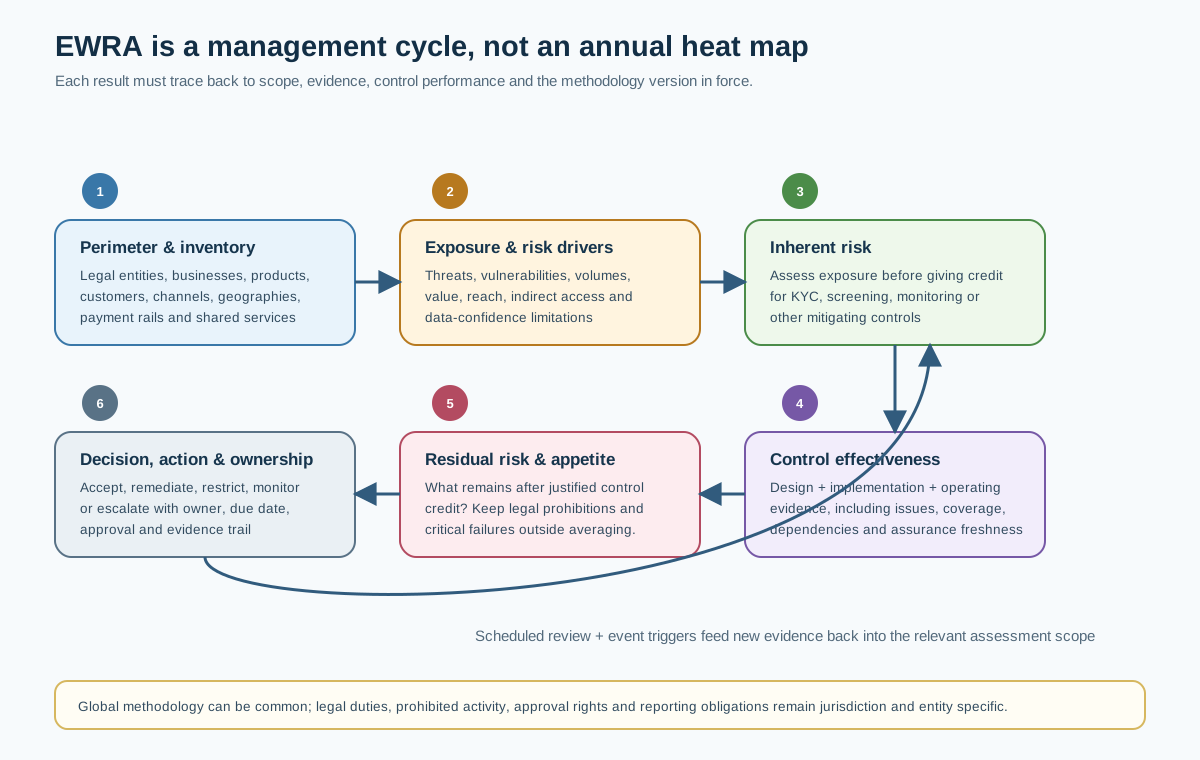
The simplest mental model: exposure, controls, residual risk, action
The cleanest way to understand an EWRA is to separate four layers.
Exposure asks what the bank does and where financial crime could exploit it. This includes the customers the bank serves, products it offers, countries and corridors it touches, channels through which services are delivered, payment and securities rails it uses, third parties it relies on, and the legal entities in which those activities sit.
Controls ask what prevents, detects, investigates or reports the risk. Customer due diligence, beneficial-ownership verification, sanctions screening, transaction monitoring, payment holds, fraud controls, employee training, correspondent due diligence, alert investigation, suspicious-activity reporting, quality assurance and independent testing can all be part of the answer.
Residual risk asks what remains after those controls are considered. Strong controls can reduce exposure, but they rarely reduce it to zero. Some risks are accepted because they are within appetite. Some require additional mitigation. Others may be prohibited by law, outside appetite, or operationally too difficult to manage safely.
Action turns the assessment into management. An EWRA that identifies high residual risk but produces no owner, deadline, funding decision or business restriction is incomplete. The same is true if the assessment shows low risk but the bank never rationalises unnecessary controls. A genuine risk-based approach can require stronger measures in higher-risk areas and simpler, less burdensome measures where risk is demonstrably lower and law permits.
The relationship is often expressed conceptually as inherent exposure + evidenced control effectiveness → residual risk → appetite and legal boundary → action. It is a reasoning sequence, not a universal arithmetic formula.
In practice, residual risk should not be calculated by mechanically subtracting a control score from an inherent-risk score unless the bank can justify the mathematics. Financial-crime risk contains uncertainty, non-linear relationships and legal constraints. A failed sanctions list feed, for example, can transform a previously acceptable control environment overnight. A newly launched instant-payment product can multiply exposure through speed and irreversibility even if customer volumes are initially small.
The purpose of scoring is therefore to support disciplined judgement, not to create fake precision.
What "enterprise-wide" actually means
The word enterprise-wide is sometimes misunderstood to mean that every legal entity, product and country must be compressed into one number. That is not the objective. Enterprise-wide means that risk is assessed across the relevant organisation in a way that lets management see both local detail and aggregated concentrations.
A global banking group can contain retail banks, corporate banks, payment institutions, broker-dealers, private banks, card businesses, merchant acquirers, digital wallets and service companies. Each business may face different legal rules and different criminal threats. If their assessments are completely separate, senior management may miss common dependencies. If they are collapsed into one average score, high-risk pockets may disappear inside a low-risk majority.
A sound design therefore uses hierarchical aggregation. Risk can be assessed at a granular level such as product-country-customer segment, then rolled into business-line, legal-entity, regional and group views while preserving traceability back to the underlying drivers.
Consider a bank in which 95% of customers are ordinary domestic retail customers but 5% are payment intermediaries handling very large cross-border flows. A simple customer-count average could suggest a low-risk portfolio. Yet the small intermediary population may create disproportionate exposure through transaction value, velocity, geographic reach and indirect customers.
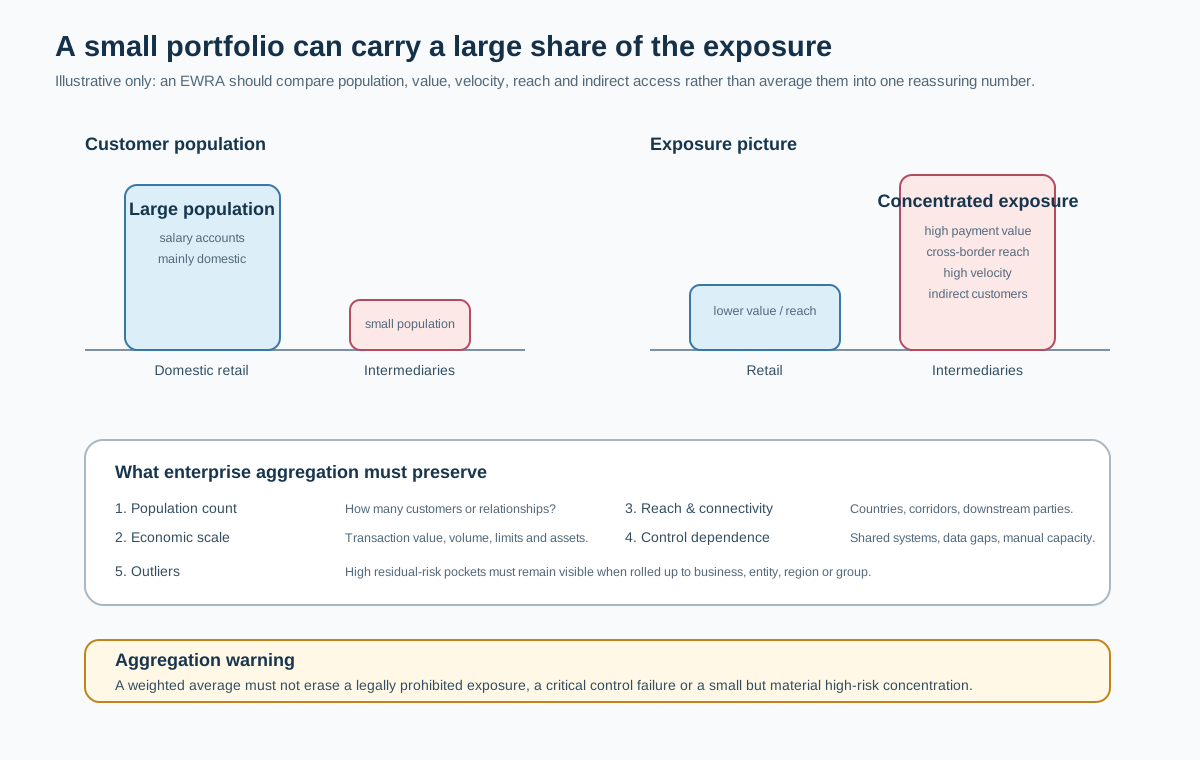
This is why an EWRA should distinguish population size from risk concentration. Customer count, transaction value, transaction volume, cross-border reach, product capability and indirect access may each tell a different story.
Enterprise-wide also means the assessment should cover shared infrastructure. A group sanctions-screening engine, KYC platform, customer master, payment hub or transaction-monitoring data lake can be a control dependency across many businesses. A defect in a shared component can create simultaneous exposure in several legal entities. That dependency should be visible in the assessment rather than counted as unrelated local issues.
EWRA versus customer risk rating, product risk assessment and other assessments
Banks often run many assessments with similar names. Confusion between them creates duplicated work and inconsistent results.
A customer risk rating evaluates the risk associated with an individual customer or relationship. It typically considers factors such as customer type, occupation or industry, ownership, geography, products used, delivery channel and expected activity. It may drive due-diligence level, approval, monitoring intensity and review frequency.
A product risk assessment evaluates how a product or service could be abused. It looks at features such as cash access, anonymity, speed, cross-border capability, third-party funding, limits, reversibility, settlement model and available data. New-product approval processes often use this form of assessment.
A country or geographic risk assessment evaluates country-related factors such as corruption exposure, sanctions, terrorism-financing concerns, organised crime, regulatory effectiveness, secrecy, conflict, proliferation risk and credible public assessments. It should not be reduced to a single external list.
A sanctions risk assessment considers exposure to sanctions regimes, designated parties, ownership and control, restricted jurisdictions, sectors, goods, services, vessels, trade routes and payment nexus. The legal nature of sanctions means that some outcomes are prohibitions rather than appetite choices.
A fraud risk assessment focuses on fraud threats such as account takeover, scams, identity abuse, first-party fraud, merchant abuse and internal fraud. Fraud and AML overlap when criminal proceeds, mule accounts or organised networks cross both disciplines, but their objectives are not identical.
An EWRA brings these perspectives together at portfolio and enterprise level. It should not duplicate each assessment line by line. Instead, it should consume their evidence, reconcile their taxonomies and highlight cross-cutting concentrations.
This matters technically. If customer risk, product risk and EWRA each maintain their own independent country tables, sector classifications and product identifiers, the bank will eventually produce contradictory outcomes. Better architecture establishes governed reference data and clear ownership so that different assessments use the same foundational objects while applying different risk logic where necessary.
The global-standard context and why local implementation still matters
FATF's risk-based approach is the most widely recognised international foundation. Recommendation 1 is built on the principle that countries, competent authorities and financial institutions should identify, assess and understand relevant risks and apply mitigation proportionately. The 2025 revisions emphasised proportionality and made clearer that simplified measures should be possible in lower-risk situations where appropriate. That direction is important because a risk-based approach is not merely permission to do more in high-risk situations; it also requires institutions to avoid indiscriminate controls that add burden without improving outcomes.
FATF standards are not self-executing laws for a bank. National and regional authorities transpose them into legal and supervisory frameworks. A bank operating in several jurisdictions therefore needs a global minimum standard plus local overlays. The global method can define common concepts such as inherent risk, control effectiveness and residual risk. Local overlays can define mandatory risk factors, reporting expectations, approval thresholds, legal prohibitions, record-retention rules and regulatory terminology.
The Basel Committee's current consolidated AML/CFT guidance, AFS10, published on the Basel consolidated-guidelines site in 2026, brings together the Committee's bank-level expectations for sound management of money-laundering and terrorist-financing risk. It reinforces that banks should include ML/FT risk within their overall risk-management framework, understand group-wide exposure, keep that understanding current and maintain effective information sharing subject to applicable law. It complements FATF but does not create identical binding rules in every jurisdiction.
The Wolfsberg Group's updated June 2026 Guidance on the Risk-Based Approach is particularly useful for large financial institutions because it frames effective financial-crime risk management around proportionality, prioritisation and effectiveness. It also stresses that business-wide and targeted risk assessments should reinforce rather than contradict one another, and that risk management should be dynamic rather than confined to annual exercises.
Supervisory expectations illustrate how implementation differs. The FFIEC manual tells U.S. examiners to understand a bank's unique products, services, customers and geographies and explicitly states that there is no expected single method or format for a BSA/AML risk assessment. It also warns that one indicator should not determine the overall risk profile. AUSTRAC's current 2026 guidance, by contrast, sets Australian expectations under the reformed AML/CTF framework and requires reporting entities to identify and assess risks across designated services, customer types, delivery channels and countries, while separately requiring proliferation-financing risk to be assessed and documented.
The lesson for a global EWRA is straightforward: standardise the method, not the law. The system can use common risk concepts while maintaining jurisdiction-specific obligations and evidence.
Step one: define the assessment perimeter before scoring anything
The most common EWRA mistake happens before any risk is scored: the bank does not clearly define what is in scope.
An assessment perimeter should answer at least five questions. Which legal entities are covered? Which businesses and products are included? Which financial-crime risk types are included? What period does the data represent? Which material outsourced or third-party activities are treated as part of the bank's exposure?
Without these boundaries, scores cannot be compared over time.
Suppose one year's assessment includes only retail and corporate banking, while the next year includes merchant acquiring and a newly acquired fintech subsidiary. A rise in risk may simply reflect expanded scope rather than deterioration. The assessment needs metadata showing when and why the population changed.
The same applies to risk taxonomy. Some institutions use "financial crime" to include AML, terrorist financing, proliferation financing, sanctions, bribery and corruption, tax evasion, fraud, market abuse and cyber-enabled crime. Others assess several of those domains separately. There is no benefit in arguing that one taxonomy is universally correct. What matters is that the scope is explicit, legally coherent and stable enough for management to understand trends.
A practical perimeter inventory usually includes:
- legal entities and branches;
- business lines and customer segments;
- products and services;
- delivery channels;
- payment, card, securities and trade-finance rails;
- countries, booking locations and material corridors;
- customer and counterparty populations;
- third parties, correspondents, agents and embedded-finance partners;
- major systems and shared control services.
This inventory should be versioned. If a business is sold, closed or migrated, the historical assessment should still show that it existed when prior risks were measured.
Build a risk taxonomy that describes how abuse can occur
A good taxonomy is not just a list of regulations. It expresses the ways criminal or prohibited activity can exploit the bank.
For money laundering, the bank may consider risks arising from illicit proceeds, layering, integration, mule networks, trade-based laundering, cash, opaque legal entities, professional intermediaries and virtual assets. For terrorist financing, it may consider lawful or unlawful funding sources, small-value transfers, charities, conflict-zone exposure and network connections. For proliferation financing, the assessment may consider exposure to targeted financial sanctions, procurement networks, dual-use goods, trade routes and opaque intermediaries. Sanctions risk may include designated persons, ownership and control, restricted countries and territories, sectors, services, goods, vessels and evasion behaviour.
The taxonomy should distinguish risk type from risk factor. "Money laundering" is a risk type. "High cash intensity" is a factor that may increase exposure. "Country X" is neither inherently a risk type nor automatically high risk; its relevance depends on credible evidence and the bank's activity.
This distinction matters because risk-factor lists age quickly. Criminal methods, sanctions measures, payment technology and regulatory expectations change. A taxonomy that is conceptually stable but allows factors to be added or reweighted is easier to govern than a hard-coded model.
The bank should also decide whether fraud is included directly in the EWRA or linked through a separate fraud assessment. Either can work if interfaces are clear. A scam payment may begin as fraud against a customer and become an AML concern when proceeds reach mule accounts. If the fraud and AML assessments are entirely disconnected, the institution may underestimate the financial-crime exposure created by the same network.
Risk dimensions: the lenses through which exposure is seen
Most practical EWRAs assess risk through several recurring dimensions. The exact labels differ by institution, but the underlying questions are similar.
Customer and relationship risk
Who uses the bank and why? Relevant exposure may arise from customer type, industry, ownership structure, legal form, source of wealth or funds, public-office exposure, cash intensity, intermediary role, expected activity and whether the bank has direct visibility of underlying customers.
A retail salary account does not create the same exposure as a money service business, private investment company or nested correspondent relationship. But labels should never substitute for analysis. A customer type sometimes considered higher risk can be well controlled and transparent, while an apparently ordinary company can be misused through hidden ownership or unusual transaction behaviour.
Product and service risk
What can the product allow a customer to do? Risk factors can include cash access, cross-border reach, speed, irrevocability, anonymity or pseudonymity, third-party funding, high limits, complex trade documentation, virtual-asset conversion, stored value, remote onboarding and whether rich originator/beneficiary information is available.
The assessment should look at product features, not just product names. Two "business current accounts" can have very different risk if one supports domestic payments only and another includes instant international transfers, bulk files and API initiation.
Geographic risk
Which countries or territories are relevant, and in what way? Customer residence, incorporation, business activity, payment origin, beneficiary location, intermediary bank, goods origin, goods destination, vessel route and employee location can all be distinct geographic exposures.
External lists are inputs rather than complete answers. FATF public statements, sanctions regimes, national risk assessments, corruption indicators, terrorism-financing assessments and reliable intelligence can inform a country view, but a bank should document the rationale and effective dates. FATF itself cautions that increased monitoring does not automatically mean all relationships with a jurisdiction should be exited or subjected to blanket enhanced due diligence.
Channel risk
How does the customer access the bank? Branch, mobile, web, API, host-to-host, correspondent, agent, broker, third-party platform and embedded-finance models provide different levels of identity assurance, behavioural data and intervention opportunity.
Remote access is not automatically high risk. Strong digital identity, device intelligence and step-up authentication can provide evidence that is unavailable in a traditional paper process. The assessment should evaluate actual controls rather than equate "digital" with "risky."
Transaction and payment-rail risk
How does value move? Cash, cards, domestic transfers, cross-border wires, instant payments, cheques, trade finance, securities transfers, virtual assets and internal book transfers have different speed, data, settlement and recovery characteristics.
Instant payments illustrate the need for practical nuance. Speed can reduce the time available to intervene, but richer data, real-time fraud scoring and confirmation controls may reduce other risks. The EWRA should capture both exposure and mitigation rather than assign a permanent high score based on one feature.
Third-party and indirect-access risk
What access does the bank provide to parties it does not directly onboard? Correspondent banking, payment intermediaries, fintech partnerships, marketplace models, merchant acquiring and outsourced onboarding can create indirect exposure.
The key questions are visibility and accountability. Does the bank know the partner's business model? Does it understand the underlying customer population? Is transaction-level data available? Can controls be tested? Are escalation and termination rights clear?
Legal-entity and booking-location risk
Which entity contracts with the customer, books the account, executes the payment or owns the control? Group-wide assessment cannot erase legal responsibility. A control operated centrally may serve several entities, but regulatory obligations and risk acceptance may still sit locally.
Inherent risk: measure exposure before giving credit to controls
Inherent risk describes exposure before considering the effectiveness of mitigating controls. The objective is to understand how risky the activity would be if the relevant control environment were absent or ineffective.
This is conceptually simple but difficult in practice because teams often smuggle control assumptions into the inherent score. A business may argue that a product is low inherent risk because "all customers are KYC'd." KYC is a control. The inherent question should instead ask what the product could enable, who can access it and what exposure it creates before control effectiveness is considered.
A practical inherent-risk model often combines threat, vulnerability and exposure.
Threat asks what harmful actors or behaviours are relevant. Vulnerability asks which features make the business susceptible. Exposure asks how much activity, value, reach or concentration is present. These are analytical concepts, not a mandatory FATF formula for banks.
Quantitative indicators can strengthen the assessment. Examples include customer counts, transaction volumes, cross-border percentages, cash turnover, number of high-risk intermediaries, high-risk-country exposure, virtual-asset flows, correspondent activity, payment velocity and product limits.
Qualitative evidence remains necessary. A small portfolio can still be high risk if it creates access to opaque downstream customers. A new product may have little historical loss or SAR data because it is new, not because it is safe. Emerging typologies may be material before they appear in internal metrics.
The institution should therefore record evidence confidence. A score based on complete customer and transaction data should not look identical to a score based on assumptions because system lineage is incomplete.
Scoring without creating false precision
Many EWRAs use low-medium-high, 1-to-5 scales, heat maps or weighted scores. None is inherently superior. The important question is whether users understand what the scale means and whether the method produces stable, explainable decisions.
Problems arise when a mathematical-looking model creates an illusion of scientific certainty. For example:
Customer risk 30% + geography 25% + product 25% + channel 20% = 3.72
A result such as 3.72 looks precise, but the underlying inputs may be judgemental categories. If a one-point change in an arbitrary weight moves a business from "medium" to "high," management should understand that sensitivity.
Better practice includes defined scoring criteria, documented weights, reason codes, qualitative challenge, confidence indicators and clear override governance.
Scoring should also account for non-compensatory factors. Some legal restrictions cannot be averaged away. A prohibited sanctions exposure is not made acceptable because the customer has low cash activity. Likewise, a critical data-feed failure may require escalation regardless of the overall model score.
A good methodology therefore separates:
- ordinary risk scoring;
- hard legal or policy constraints;
- material control failures;
- expert judgement and overrides.
That separation makes the result easier to test.
The evidence chain: from raw data to a management decision
An EWRA should be reproducible. If an auditor asks why a business was rated high residual risk six months ago, the bank should be able to reconstruct the source data, scoring rules, control evidence, judgement and approval that produced the outcome.
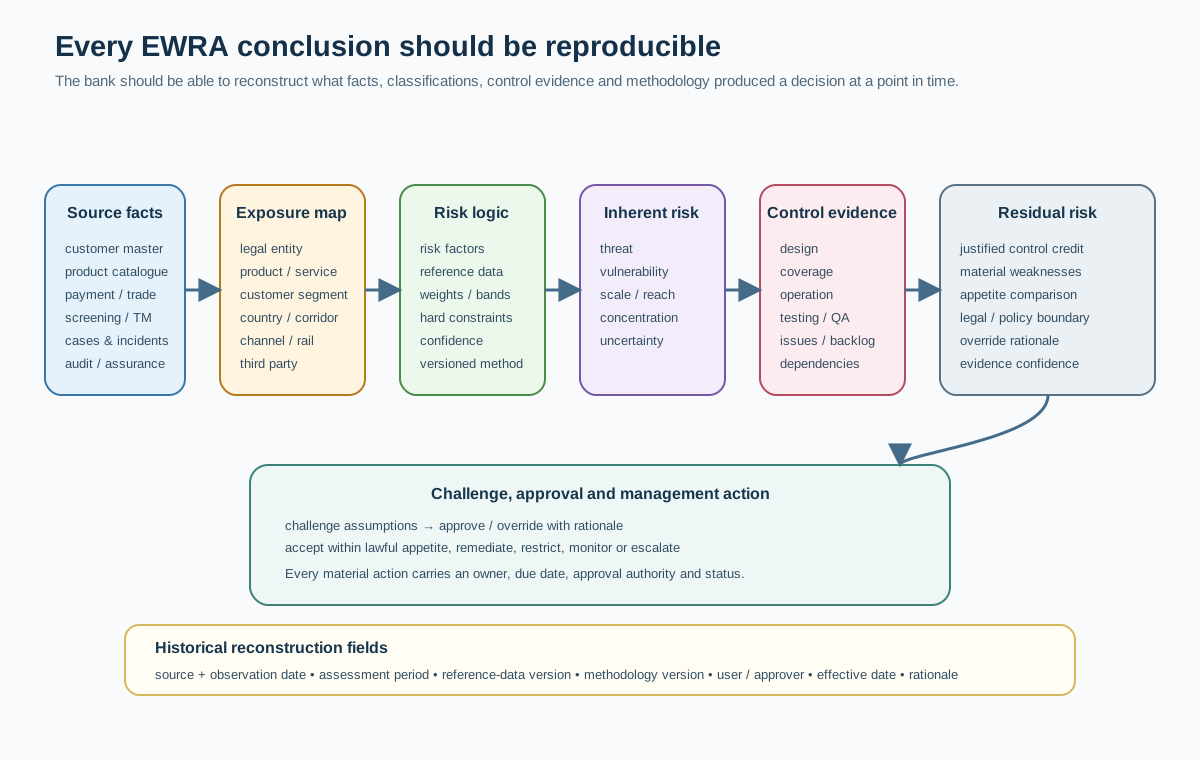
The evidence chain typically begins with source systems: customer master, KYC platform, product catalogue, payment systems, transaction warehouse, sanctions platform, monitoring system, case management, audit findings, operational incidents and third-party registers.
Those sources feed an exposure map. The map connects data to business objects such as legal entity, product, customer segment, country, channel and payment rail.
The methodology then applies risk logic. Inputs should carry an effective date and source. Scores should identify the methodology version used. Manual judgement should identify the decision maker and rationale.
Control evidence should be similarly traceable. If transaction monitoring is rated effective, what supports that conclusion? Scenario coverage? Model validation? Data-quality testing? Alert quality? Backlog levels? Issue history? Independent testing? A control name in a spreadsheet is not evidence of effectiveness.
The residual-risk result should then connect to governance. Where risk is outside appetite, the system should show the action, owner, target date and status. Where management accepts risk temporarily, the approval and expiry should be visible.
Data architecture: what the EWRA needs from systems
For business analysts and architects, the EWRA is fundamentally a data-integration problem wrapped in a risk methodology.
A mature design needs stable identifiers for legal entities, products, customer segments, channels, countries and controls. If the product catalogue calls a service "Global Payments API" while the transaction warehouse calls it "GPA-01" and the risk system calls it "Corporate API," aggregation will fail unless those identifiers are mapped.
Core data domains commonly include:
Customer data: customer ID, segment, legal form, industry, residence/incorporation, beneficial ownership, customer risk rating, PEP status, relationship start date and due-diligence status.
Product data: product code, features, supported currencies, payment rails, limits, funding methods, cash capability, remote access and relevant legal entities.
Transaction data: count, value, currency, direction, domestic/cross-border status, corridor, counterparty or agent information, channel and rail.
Control data: control ID, owner, objective, risk mappings, frequency, automation level, key systems, test results, issues and dependencies.
Incident and issue data: screening failures, monitoring backlogs, data-quality defects, regulatory findings, audit issues, suspicious-activity trends, fraud events and control overrides.
External intelligence: FATF public statements, national risk assessments, sanctions changes, FIU typologies, law-enforcement alerts and credible sector risk information.
The architecture should distinguish source data from derived risk data. A transaction country is a source attribute. "High-risk geography exposure" is a derived classification based on a controlled methodology. Keeping the two separate makes later policy changes manageable: when the country-risk model changes, raw historical facts remain intact.
Data quality is itself a risk driver
An EWRA cannot be more reliable than its input data.
Suppose the bank reports only 2% of payments as cross-border because the geography field is populated from the customer's booking branch rather than the beneficiary or agent location. The model may conclude low geographic exposure while the real activity is international.
Data-quality assessment should therefore cover completeness, accuracy, timeliness, lineage and semantic consistency. It should also record whether known limitations could bias a result.
This creates an important principle: unknown is not the same as low risk.
If 30% of merchant-industry codes are missing, the bank should not silently classify those merchants as ordinary low-risk retail. If beneficial-ownership information is incomplete for a legacy portfolio, the uncertainty should influence the assessment and remediation.
Risk data should also be time-aligned. Combining customer population from December, transaction volumes from June and control testing from the prior year can create a misleading picture. Every major input needs an assessment period and effective date.
Control inventory: connect controls to the risks they actually mitigate
After inherent risk is understood, the bank evaluates controls.
A control inventory should describe more than control names. For each control, it is useful to capture:
- control objective;
- risk or typology addressed;
- business and legal-entity scope;
- preventive, detective or corrective nature;
- automated or manual operation;
- frequency or trigger;
- system dependency;
- data dependency;
- owner;
- evidence generated;
- test method;
- known issues.
Controls should map to specific risk drivers. A customer sanctions-screening control may reduce listed-party risk but does not necessarily mitigate transaction laundering. Transaction monitoring may detect unusual movement but cannot compensate for missing beneficial-ownership information in every scenario.
This prevents control inflation, where a business lists many controls and receives a strong effectiveness score simply because the list is long.
The best question is not "How many controls do we have?" It is "Do the controls address the important ways this risk can materialise, and do we have evidence they work?"
Control effectiveness: design, implementation and operating performance
A control can exist on paper and still be ineffective. EWRA methodology should distinguish at least three ideas.
Design effectiveness asks whether the control is capable of mitigating the stated risk if implemented correctly. A screening rule that never examines beneficiary names cannot adequately mitigate beneficiary designation risk.
Implementation effectiveness asks whether the control has been deployed to the intended population. A strong monitoring scenario may cover 80% of accounts but miss a newly migrated platform.
Operating effectiveness asks whether the control actually works over time. A daily list update process may be well designed yet fail operationally because jobs are repeatedly delayed.
Evidence for control effectiveness can come from testing, QA, model validation, alert outcomes, data-quality checks, operational metrics, incident history, audit, regulatory review and issue-management records.
A mature EWRA does not give full credit to a control when a material unresolved issue undermines it. If the sanctions platform has a known data-truncation defect, the control rating should reflect the actual exposure until remediation is proven effective.
The bank should also guard against double counting. If one shared KYC platform supports five products, the same control may legitimately mitigate several exposures, but it should not be treated as five independent controls when assessing resilience. A single system failure can affect all five simultaneously.
Control evidence and the problem of stale assurance
A common weakness is to reuse last year's control rating automatically.
Controls change. Systems are upgraded, scenarios are tuned, thresholds change, vendors release new versions, staff turnover affects manual operations, volumes grow and new products are onboarded. A control rated "strong" in the previous cycle may no longer deserve the same conclusion.
The methodology should define how fresh evidence must be and what events require reassessment. High-impact controls may need more recent assurance than low-impact controls.
Control owners should not be the only source of evidence. First-line ownership is important, but independent challenge from second line, quality assurance, testing or audit increases reliability.
The EWRA can also use evidence hierarchy. For example, a recent independent test may carry more weight than a self-attestation; production performance data may be stronger than a policy statement; a completed remediation validated by testing may be stronger than an overdue action plan.
This does not mean every control needs the same testing method. The level of assurance should be proportionate to risk and control criticality.
Residual risk: what remains after credible mitigation
Residual risk is the exposure remaining after the bank gives justified credit to controls.
The key word is justified. Residual risk should not become a negotiation in which business teams push for lower scores because the inherent rating looks uncomfortable. The result should follow evidence and documented judgement.
Residual risk can remain high even where controls are strong. A bank may intentionally operate a complex correspondent business in high-risk corridors with excellent controls; the activity can still retain significant residual exposure. Conversely, a simple low-risk domestic product with minor control weaknesses may remain within appetite.
Residual risk should be compared with risk appetite. The result can lead to several possible decisions:
- accept within appetite;
- strengthen or redesign controls;
- add monitoring or due diligence;
- restrict customer types, geographies or features;
- reduce limits or velocity;
- remediate data;
- pause new onboarding;
- seek legal or compliance advice;
- exit an activity;
- escalate for formal risk acceptance.
For sanctions and other legal prohibitions, risk appetite cannot authorise unlawful activity. Appetite operates inside the boundary of applicable law.
Risk appetite: translating abstract tolerance into usable decisions
Financial-crime risk appetite is often written in broad language such as "the bank has no appetite for financial crime." Morally understandable as that statement may be, it is not operationally useful. No bank can guarantee that no customer will ever attempt criminal activity.
A usable risk appetite distinguishes between intentional tolerance of exposure and tolerance of control failure. A bank may serve higher-risk industries if controls are strong and law permits. It may have no tolerance for knowingly processing prohibited sanctions transactions. It may accept limited temporary control gaps under formally approved remediation, but not indefinite untracked weaknesses.
Risk appetite can be expressed through qualitative statements, quantitative metrics or both. Examples include thresholds for high-risk customer concentrations, overdue KYC reviews, alert backlogs, unresolved critical control issues, unassessed products, sanctions-screening failures and exposure to specified business models.
Metrics should not become automatic legal rules. They are governance triggers. Crossing a threshold may require investigation, escalation or action rather than immediate customer exit.
Aggregation and the concentration problem
Enterprise aggregation is useful only if it preserves material detail.
Suppose three legal entities have residual risk scores of 2, 2 and 5 on a five-point scale. A simple average of 3 can hide the fact that one entity has critical exposure. Weighted averages can hide small but strategically significant businesses.
A better dashboard combines aggregate views with concentration indicators and outlier visibility. Management should see:
- highest residual-risk areas;
- largest exposures by value and volume;
- critical control dependencies;
- risk concentrations by geography and customer type;
- material changes since the prior assessment;
- areas outside appetite;
- areas with weak data confidence.
Aggregation rules should be documented. If a business is rated high because of a sanctions-control failure, that result should not automatically disappear when rolled into a region.
The system should support drill-down. A board-level dashboard can remain simple, but the underlying evidence must be retrievable.
Dynamic risk: why annual assessment alone is not enough
A scheduled annual or biennial assessment can provide governance discipline, but financial-crime risk can change within days.
A sanctions designation can alter customer exposure immediately. A new scam typology can create a sudden mule-account problem. An acquisition can introduce thousands of customers and new systems. An instant-payment feature can change transaction velocity. A control incident can invalidate assumptions about mitigation.
A modern EWRA therefore combines a formal assessment cycle with event-driven reassessment.
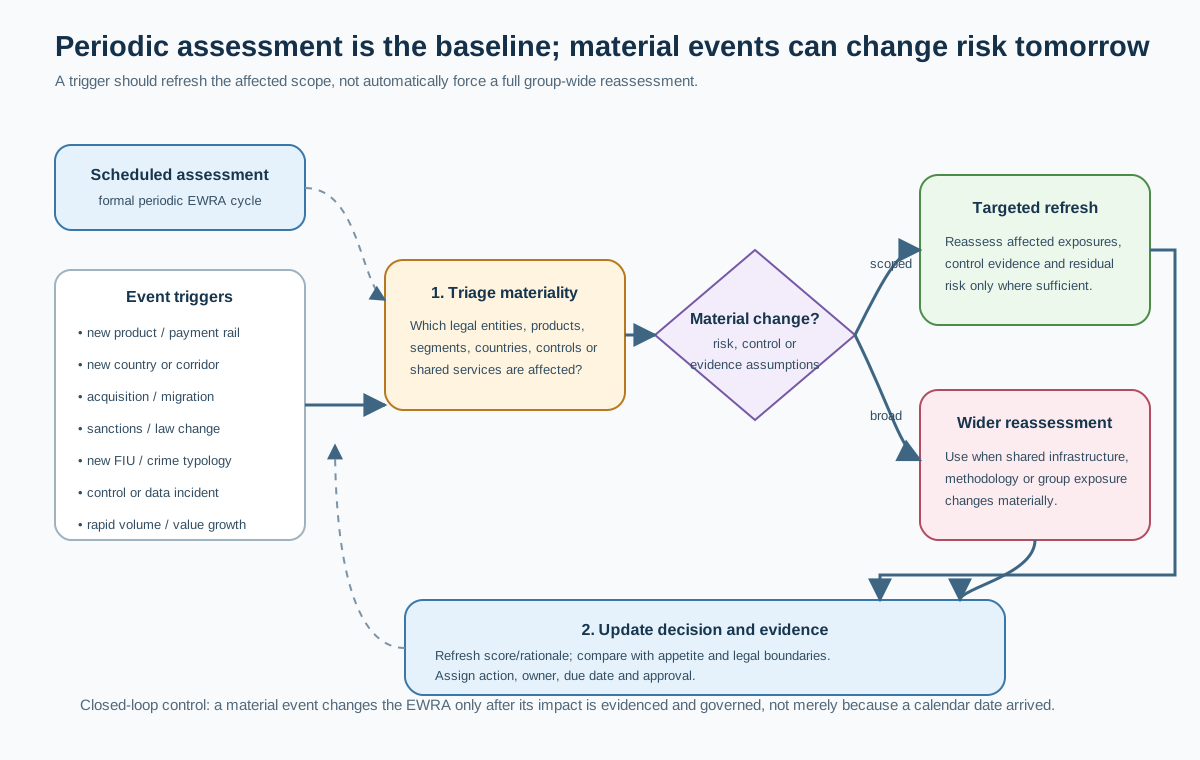
Trigger events can include:
- new product, service or payment rail;
- entry into a new country;
- merger or acquisition;
- material customer-segment change;
- large growth in volume or value;
- sanctions or regulatory change;
- FATF or national risk assessment update;
- new law-enforcement or FIU typology;
- critical control incident;
- data-quality failure;
- model-validation finding;
- regulatory or audit finding;
- sustained alert backlog;
- material third-party change.
The trigger should not always force a complete group-wide reassessment. It may require a targeted refresh of the affected exposure and related controls. This is more efficient and more risk based.
How national risk assessments and external intelligence should feed the EWRA
Banks should not assess risk in isolation. Governments, FIUs, regulators and international bodies publish valuable threat and vulnerability information.
National risk assessments can identify domestic crime threats, vulnerable sectors, cross-border risks and weaknesses in the control environment. FATF's updated 2025 Money Laundering National Risk Assessment Guidance reinforces the importance of systematic, evidence-based risk assessment at country level and of aligning mitigation with identified risk.
A bank can use national assessments as inputs, but it should not copy national ratings mechanically. The bank's business model may differ significantly from the national economy. A country may identify high cash-based laundering risk while a particular bank has almost no cash business. Conversely, a bank may have large international correspondent exposure that is small at national level.
Other useful external sources include:
- FATF public statements;
- FIU typology reports;
- sanctions authorities;
- law-enforcement alerts;
- supervisory thematic reviews;
- industry intelligence;
- credible court or enforcement cases.
External intelligence should be governed like internal data: source, date, relevance and interpretation should be recorded.
Country risk: avoid simplistic "grey list equals high risk" logic
Country risk deserves special care because it is easily oversimplified.
FATF's list of jurisdictions under increased monitoring is commonly called the grey list. FATF explicitly explains that increased monitoring means a jurisdiction is working with FATF to address identified strategic deficiencies and that FATF does not call for blanket enhanced due diligence or wholesale de-risking solely because a jurisdiction is on that list.
A bank can still determine that exposure to a listed jurisdiction raises risk based on its own methodology and applicable local requirements. But the reasoning should consider the nature of the customer's connection, product, transaction, control environment and other credible evidence.
Similarly, sanctions exposure is not identical to country risk. A sanctions regime can target specific persons, entities, sectors, goods or activities rather than an entire country. Country scoring should not replace legal sanctions analysis.
For data design, store the underlying country connections separately from the risk rating. That allows the risk method to change without altering historical transaction facts.
New products and change governance
A strong EWRA should connect to the bank's change process.
Before launching a new product, the bank should understand its financial-crime features: who can use it, where value can move, what data is captured, which screening and monitoring controls apply, how exceptions are handled, which legal entities are involved, and what new indirect access may be created.
The new-product risk assessment should feed the EWRA rather than sit in a separate archive. Once the product goes live, actual volumes and behaviours should replace pre-launch assumptions.
This is especially important for fast-growing digital products. A launch assessment may assume 5,000 customers and low-value domestic payments. Six months later the product may have 200,000 customers, cross-border capability and API partners. The inherent risk has changed even if no formal annual EWRA is due.
Change governance should therefore include post-implementation review and defined triggers for EWRA refresh.
Mergers, acquisitions and portfolio migration
M&A creates one of the hardest EWRA situations because the acquiring bank inherits customers, products, systems, data limitations and control histories that were designed under a different framework.
A pre-acquisition risk review may identify broad concerns, but the post-close EWRA needs much more detailed integration. Key questions include:
- Are customer records complete and current?
- Can beneficial ownership be trusted?
- Are sanctions and monitoring systems equivalent?
- Are historical alerts and SAR/STR records available?
- Which products or geographies fall outside group appetite?
- Can legacy controls continue during migration?
- Are there legal restrictions on data sharing across entities or jurisdictions?
The bank should avoid giving full group-control credit before the acquired population is actually covered. "Planned migration to group monitoring" is not the same as an operating control.
Temporary risk acceptance may be necessary, but it should have an owner, conditions, compensating controls, target date and escalation route.
Correspondent banking and indirect customer exposure
Correspondent banking illustrates why enterprise risk assessment cannot rely only on directly onboarded customers.
A respondent bank may give the correspondent indirect exposure to thousands of underlying customers and nested relationships. The EWRA therefore needs factors such as respondent jurisdiction, ownership, business model, downstream services, payable-through access, nested relationships, expected transaction corridors and the quality of the respondent's AML controls.
Transaction value matters, but so does reach. A relatively small respondent can create access to higher-risk markets that are otherwise absent from the bank.
The control environment may include correspondent due diligence, KYC questionnaires, sanctions screening, payment transparency checks, transaction monitoring, RFI processes and periodic review. Their effectiveness should be assessed using evidence, not simply policy existence.
If the bank cannot obtain sufficient information about indirect exposure, that uncertainty itself is relevant to residual risk.
Payments: connecting the EWRA to actual money movement
For a payments-focused institution, the EWRA should be grounded in how money moves through the bank.
A cross-border payment can involve an initiating customer, debtor, ultimate debtor, creditor, ultimate creditor, intermediary banks, clearing systems, FX, correspondent accounts and structured or unstructured remittance data. Different controls act at different points.
The EWRA should therefore distinguish:
- initiation channel;
- payment type and rail;
- domestic versus cross-border;
- instant versus non-instant;
- currency;
- corridor;
- customer and counterparty types;
- intermediaries;
- data quality;
- screening points;
- monitoring coverage;
- intervention capability.
A product described as "international payments" is too broad if some flows are customer credit transfers and others are bank-to-bank settlement messages. The risk and control points can differ.
ISO 20022 may provide richer structured party data, but only if upstream systems populate it correctly and downstream controls consume it. A richer standard does not automatically mean better risk management. Data lineage and mapping matter.
Transaction monitoring as EWRA evidence
Transaction monitoring is both a control and a source of risk intelligence.
Control effectiveness can be informed by scenario coverage, data completeness, alert quality, model validation, tuning, backlog, investigation quality and escalation outcomes.
At the same time, monitoring outputs can inform inherent risk. A rise in mule-account cases, rapid pass-through activity or high-risk corridors may indicate that the portfolio's exposure has changed.
The EWRA should avoid a circular logic in which "many alerts" automatically means high inherent risk and "few alerts" automatically means low risk. Alert volumes depend on thresholds, models and data. A poor monitoring system can generate few alerts precisely because it misses risk.
Better indicators combine alerts with confirmed cases, suspicious reports, fraud intelligence, external typologies and transaction patterns.
Sanctions and screening risk inside an EWRA
Sanctions risk often requires a parallel legal framework because sanctions obligations can be strict and regime-specific.
The EWRA can still assess exposure: customer and counterparty geography, ownership complexity, currencies, trade goods, vessel activity, payment corridors, sectors and services. It can assess controls such as customer screening, payment screening, list management, ownership analysis and escalation.
However, the final legal decision cannot be reduced to an EWRA score. Whether a transaction must be blocked, rejected, frozen, reported or licensed depends on applicable law and facts.
This is why architecture should not use one generic highRiskCountry or sanctionsRiskScore to make automated legal decisions. The EWRA informs control design and governance; sanctions decision engines need current regime-specific rules and legal interpretation.
Proliferation-financing risk and dual-use exposure
Proliferation financing can be particularly difficult because the underlying commercial activity may look legitimate. Risk may arise from procurement networks, intermediaries, trade finance, dual-use goods, shipping routes and targeted financial sanctions.
An EWRA should consider whether the bank serves customers in sensitive sectors, finances international trade, handles correspondent relationships, processes payments involving higher-risk routes or has limited visibility into goods and end users.
The bank does not need to become an export-control agency. It does need to understand where its business model creates exposure and whether specialist controls, escalation or external expertise are necessary.
FATF's proliferation-financing risk framework is connected particularly to the risk of breach, non-implementation or evasion of proliferation-related targeted financial sanctions. Domestic law can impose additional sanctions or export-control obligations. The EWRA should preserve that distinction.
Fraud, scams and the AML interface
Fraud data can materially improve an EWRA even when fraud is assessed in a separate framework.
Authorised-push-payment scams, account takeover, identity fraud and mule networks can produce criminal proceeds that move through payment systems. AML teams may see the receiving network after the fraud team sees the victim event.
If the EWRA ignores fraud intelligence, it may underestimate exposure to mule accounts and rapid movement. If it treats every fraud event as AML, it can blur responsibilities.
A practical integration model shares risk intelligence while preserving decision ownership. Fraud systems can provide confirmed scam patterns, device signals and mule indicators. AML systems can contribute network analysis, customer context and suspicious-activity reporting. The EWRA can reflect the combined exposure.
Control dependencies and single points of failure
Enterprise assessments often underestimate shared dependencies.
Imagine that customer screening, payment screening and transaction monitoring all depend on one customer-country field from a central master. If that field is wrong, three apparently separate controls can fail together.
The EWRA should therefore map important control dependencies:
- source data feeds;
- shared reference data;
- identity services;
- vendor screening engines;
- messaging gateways;
- case-management platforms;
- cloud providers;
- central operations teams.
This changes how residual risk is understood. Ten controls are not ten independent barriers if they rely on the same data source.
Operational resilience and financial-crime risk intersect here. A control outage may be a technology incident, but its financial-crime impact must be assessed.
Manual controls, capacity and human judgement
Not every control should be automated. Investigations, complex ownership analysis, sanctions escalation and unusual trade cases often require human judgement.
But manual controls have capacity limits. Their effectiveness can deteriorate when volumes grow.
An EWRA should therefore consider:
- staffing relative to workload;
- skill level;
- training;
- turnover;
- queue ageing;
- escalation timeliness;
- maker-checker controls;
- quality-review results;
- use of temporary staff or outsourcing.
A manual control may be well designed but ineffective during a backlog crisis.
This is especially important for high-speed payment environments. If a control requires a manual decision before release, the service-level requirement and staffing model become part of control effectiveness.
Alert backlog and queue risk
Alert backlog is often treated as an operations metric, but it can become a financial-crime risk driver.
If alerts wait weeks for review, the bank may continue serving customers whose activity would otherwise trigger escalation. Reporting deadlines may be affected in jurisdictions where deadlines run from specific knowledge or suspicion events. Customer harm may continue in scam or mule scenarios.
The EWRA should not use one universal backlog threshold. Different alert types have different urgency. Sanctions interdiction, fraud, transaction monitoring and periodic review queues have different legal and operational consequences.
Useful evidence includes age distribution, risk tier, oldest item, throughput, forecast demand, quality, staffing and temporary mitigants.
A sustained backlog can lower control effectiveness even if the underlying detection system is technically sound.
Governance: who owns the assessment?
Ownership should be unambiguous.
The first line usually owns the risks arising from its business activities and operates many controls. The second line establishes or challenges the financial-crime framework, provides subject-matter oversight and may own parts of the methodology. Internal audit independently assesses governance, design and effectiveness.
Exact organisational models vary, and "three lines" should not be treated as a legal rule in every jurisdiction.
The EWRA needs named roles for:
- methodology ownership;
- source-data ownership;
- risk-factor ownership;
- control ownership;
- assessment completion;
- challenge;
- approval;
- risk acceptance;
- remediation tracking;
- model or methodology change.
Senior management and, where appropriate, boards or board committees need information at a level that supports decision making. They do not need every row of the risk register. They need to understand material exposure, changes, control weaknesses, appetite breaches and management action.
Challenge is not a ceremonial meeting
A credible EWRA includes meaningful challenge.
Challenge asks whether assumptions are supported, whether control credit is justified, whether external developments have been considered and whether business optimism has affected scoring.
Good challenge is evidence based. "I disagree" is less useful than "the score assumes complete screening coverage, but testing shows 12% of records from Platform B are not reaching the engine."
The challenge process should be recorded. Significant disagreements should show the rationale and final decision maker.
This becomes especially important when risk acceptance has commercial implications. A business may resist restrictions on a profitable segment. Compliance may prefer stronger controls. Senior management needs transparent evidence to make an informed decision.
Risk acceptance and temporary exceptions
Not every residual risk can be removed immediately. Technology changes take time, acquisitions require migration, vendors fail and regulations change faster than systems.
Temporary risk acceptance can be legitimate if law permits, but it should not become a storage place for unresolved problems.
A strong exception record contains:
- the specific risk;
- affected population;
- legal assessment where relevant;
- current controls and gap;
- compensating measures;
- quantitative exposure where possible;
- owner;
- approval authority;
- expiry date;
- remediation plan;
- trigger for earlier reassessment.
Expired exceptions should not roll forward automatically. Reapproval should require fresh evidence.
Methodology governance and version control
EWRA methodology itself is a controlled asset.
Changes to weights, scoring bands, risk factors, country classifications, control-effectiveness rules or aggregation can materially alter results. The bank should know whether a change in score reflects real risk or a method change.
Methodology governance should therefore record:
- version;
- effective date;
- owner;
- rationale;
- approvals;
- impacted assessments;
- test results;
- back-testing or parallel-run results where appropriate.
If a new model is introduced, running old and new methods in parallel on a sample can reveal unexpected effects.
Historical results should retain the methodology version used at the time. Recalculating all past scores under today's rules may be useful for analysis, but it should not overwrite the original audit trail.
Business-analysis requirements for an EWRA platform
For a BA, the strongest requirements describe decisions and evidence rather than screens.
A requirement such as "the system shall display a heat map" is incomplete. The real requirement is closer to: the system must calculate and display residual risk by governed assessment unit, preserve the underlying inherent-risk and control-effectiveness evidence, identify methodology version and effective date, and allow authorised users to drill down to the factors and approvals supporting the result.
Important functional requirements include:
- configurable assessment hierarchy;
- governed reference data;
- import and reconciliation of source metrics;
- risk-factor scoring;
- control mapping;
- evidence attachments or links;
- qualitative rationale;
- override workflow;
- challenge and approval;
- appetite comparison;
- action tracking;
- event-driven reassessment;
- audit history;
- reporting and export.
Non-functional requirements are equally important. Access controls may need separation between business owners, compliance challengers and approvers. Audit logs must be immutable enough for assurance. Performance must support large portfolios. Data retention must meet local rules. Cross-border data restrictions may constrain centralisation.
Architecture: separate facts, classifications, scores and decisions
A robust design separates four layers.
Facts are source observations: customer country, transaction amount, product code, alert count, audit issue.
Classifications interpret facts using controlled reference data: industry group, geographic risk category, control criticality.
Scores apply a methodology to classifications and facts: inherent risk, control effectiveness, residual risk.
Decisions are governance outcomes: accept, remediate, restrict, escalate.
This separation prevents one of the most common architecture mistakes: storing only the final risk score.
If the bank stores residualRisk = High without the factors and method, it cannot explain the result later.
Effective dating is essential. Country classification, product features, ownership structures and controls change. The system should be able to answer "what did we know and what rule did we apply on 31 March?"
Testing the EWRA like a risk engine, not a document
EWRA testing should go far beyond checking whether pages load.
Data testing
Reconcile source counts and values. If the EWRA says the corporate bank has 12,000 customers, compare that with authoritative customer systems. Validate country mappings, product mappings and transaction totals.
Test missing and invalid values. The system should not silently convert nulls to low risk.
Calculation testing
Create known scenarios and verify the score. Test boundaries between low, medium and high. Test weight changes. Test non-compensatory rules and critical-control overrides.
Workflow testing
Verify who can draft, challenge, approve, reopen and accept risk. Confirm that unauthorised users cannot bypass approval.
Effective-date testing
Change a country classification or control rating and verify that new assessments use the new value while historical assessments remain reproducible.
Aggregation testing
Create a small high-risk unit inside a large low-risk portfolio and verify that the concentration remains visible at group level.
Trigger testing
Simulate a material control incident or new-product launch and confirm that the correct assessment is flagged for review.
Audit testing
Verify that every score, override, challenge, approval and methodology change has user, timestamp and rationale.
Acceptance criteria that reveal real quality
Good acceptance criteria make hidden assumptions testable.
Examples:
Given a product is mapped to a legal entity and three customer segments, when the product's cross-border capability is enabled, then all affected assessment units must be identifiable for reassessment without overwriting historical results.
Given a critical screening control has an unresolved severity-one issue, when residual risk is calculated, then the methodology must apply the approved critical-control rule and show the issue as supporting evidence.
Given a risk analyst overrides an inherent-risk score, when the assessment is submitted, then the system must require rationale and preserve both the calculated and overridden values.
Given a country-risk classification changes with a future effective date, when an assessment is run before that date, then the prior classification must apply; when run after that date, the new classification must apply.
These criteria are far stronger than "user can edit risk score."
Common failure modes
The heat-map trap
The bank produces polished red-amber-green charts but cannot explain the underlying exposure. The remedy is traceability from dashboard to data and methodology.
The annual ritual
The EWRA is prepared for a committee and ignored for the rest of the year. The remedy is event-driven refresh and linkage to change governance, monitoring and risk appetite.
Control optimism
Business owners rate controls effective because procedures exist. The remedy is evidence standards, testing and independent challenge.
Average-risk dilution
Large low-risk populations hide small but critical exposures. The remedy is concentration metrics and outlier visibility.
Static country lists
Country ratings are copied from one external list without context or effective dates. The remedy is governed multi-source analysis and separate sanctions logic.
Data uncertainty treated as low risk
Missing information reduces scores. The remedy is explicit unknown categories and confidence indicators.
Duplicate assessments
Customer, product, sanctions and enterprise teams maintain incompatible taxonomies. The remedy is shared reference data and clear interfaces.
Over-engineering
A complex scoring model becomes impossible for management to explain. The remedy is the simplest model that supports defensible decisions.
Zero-risk language
Policies imply all financial crime can be eliminated. The remedy is clear distinction between prohibited activity, appetite, residual risk and control objectives.
Mini case study: launching real-time cross-border payments
Consider a fictional bank, NorthRiver Bank, operating retail and corporate businesses in six jurisdictions. It plans to launch a real-time cross-border payment service for small and medium-sized corporate customers.
The product team initially describes the service as an enhancement to an existing transfer product and rates change risk as modest. The EWRA process forces a more complete view.
Step 1: define exposure
The service allows API initiation, 24/7 processing, near-real-time beneficiary credit and higher transaction limits than the bank's existing instant-payment product. It supports five currencies and routes through two correspondent banks.
The target customers are existing SMEs, but some are import/export businesses. The bank will also allow batch initiation from accounting software through an embedded-finance partner.
The exposure map therefore includes corporate customers, API and partner channels, cross-border corridors, correspondents, high-speed settlement and indirect technical access.
Step 2: assess inherent risk
Speed reduces intervention time. Cross-border reach increases geographic exposure. Batch API initiation increases potential velocity. Import/export customers create trade-related context. The embedded partner creates a new third-party dependency.
At the same time, all customers are existing bank customers and the product does not support cash or anonymous use.
The assessment concludes that inherent financial-crime risk is high, driven mainly by speed, cross-border reach, value and channel complexity.
Step 3: map controls
The bank plans:
- existing corporate KYC and periodic review;
- sanctions screening of customer and payment parties;
- real-time fraud scoring;
- transaction monitoring;
- beneficiary and corridor restrictions;
- API authentication;
- daily partner reconciliation;
- case escalation and suspicious-activity reporting.
The control list initially appears strong.
Step 4: test control coverage
Data-lineage review finds that the embedded partner sends beneficiary names and account identifiers but not full structured addresses for one corridor. The sanctions engine can screen the name, but the reduced contextual data may increase false positives and reduce disambiguation quality.
Transaction-monitoring testing also finds that the existing cross-border scenario receives transactions after settlement. That may be acceptable for AML detection but cannot provide pre-payment interdiction.
Fraud operations can act in real time, but weekend staffing is lower than weekday staffing.
The EWRA therefore avoids giving full control credit.
Step 5: determine residual risk
Residual risk remains high but potentially manageable. The product is not automatically rejected. Instead, management defines conditions:
- the partner must provide required payment data before launch;
- a weekend operational-capacity plan must be approved;
- selected corridors begin with lower limits;
- monitoring coverage is updated and independently tested;
- the product receives a 90-day post-launch risk review.
Step 6: compare with appetite
The bank's appetite permits high inherent-risk payment products where residual risk is controlled and no legal prohibition applies, but it does not permit launch with unresolved critical sanctions-data gaps.
The launch decision is therefore conditional. The data gap becomes a formal go-live criterion.
Step 7: reassess after launch
After 90 days, volumes are double forecast. Fraud controls show an increase in attempted account takeover, and transaction monitoring identifies several rapid pass-through corporate accounts.
The formal annual EWRA is months away, but the growth and typology triggers cause a targeted reassessment.
The bank raises the exposure score for API velocity, strengthens monitoring for rapid onward movement, increases partner oversight and allocates more weekend investigators.
This is what an EWRA should do: connect business reality to control decisions before and after launch.
How the EWRA should influence the control programme
A risk assessment has little value if the control framework does not change in response.
High customer-risk concentration may lead to more EDD resources. High trade exposure may require specialist investigators. High payment-speed exposure may justify real-time fraud controls and improved beneficiary intelligence. Weak ownership data may trigger KYC remediation. High indirect-access exposure may lead to stronger partner due diligence and transaction-level data requirements.
Lower-risk areas can also change. If evidence consistently shows a segment has low inherent exposure and effective controls, local law and policy may allow simpler review frequency or reduced manual intervention. FATF's 2025 proportionality amendments reinforce the importance of calibrated measures rather than indiscriminate intensity.
The decision should be documented. A reduction in control intensity should be as evidence based as an increase.
Residual risk decides where the next unit of investment goes: fund the high-risk weak-control quadrant first.
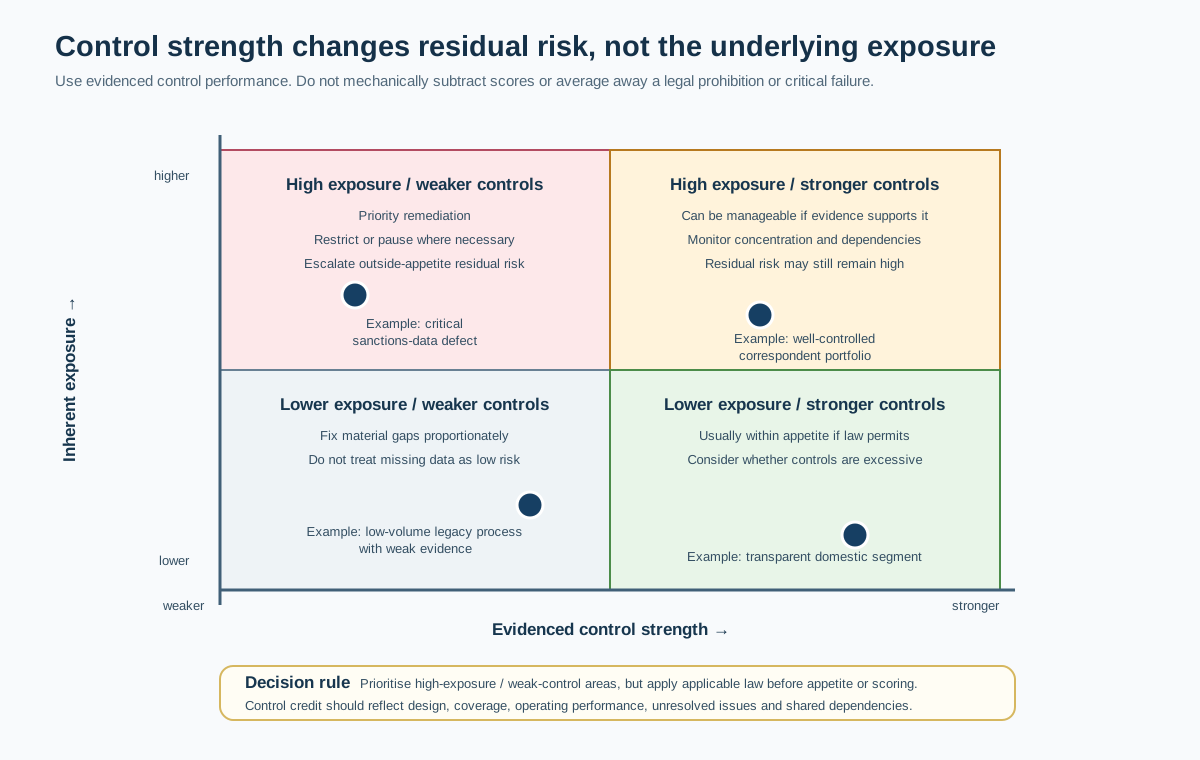
The relationship with independent assurance
Independent testing and internal audit should not simply confirm that an EWRA document exists.
Assurance can test:
- completeness of scope;
- data reconciliation;
- methodology governance;
- scoring consistency;
- quality of control evidence;
- management challenge;
- linkage to actions;
- treatment of known issues;
- historical reproducibility.
The FFIEC manual links risk assessment to the design of a bank's BSA/AML compliance programme: examiners use the bank's risk assessment to understand its risk profile and evaluate whether the programme is appropriately designed for those risks.
Australia's reformed framework likewise requires independent evaluation of the AML/CTF programme. Current AUSTRAC guidance says the frequency stated in the programme must be appropriate to the nature, size and complexity of the business and, subject to applicable transition arrangements, the evaluation must occur at least once every three years.
For a global bank, those examples should inform assurance design without assuming identical legal obligations everywhere.
Customer impact and financial inclusion
Poorly designed risk assessment can harm legitimate customers.
If a bank labels entire industries or countries as unacceptable without analysing actual exposure, it may engage in unnecessary de-risking. This can push legitimate activity outside regulated channels and conflict with the purpose of a proportionate risk-based approach.
Conversely, ignoring real risk can expose customers to scams, corruption, sanctions breaches and criminal networks.
The right objective is proportionate access with effective controls.
Customer-impact analysis can therefore be part of risk decisions. If a proposed control creates large numbers of false positives, delays essential payments or excludes a vulnerable population, management should ask whether a better control design can achieve the same risk outcome.
This is not an argument for weakening legal obligations. It is an argument for measuring effectiveness rather than equating friction with safety.
Final perspective
The enterprise-wide financial crime risk assessment is the bridge between abstract risk-based principles and the bank's actual operating decisions.
Done badly, it becomes an annual spreadsheet in which businesses negotiate colours. Done well, it explains where financial crime can exploit the institution, how much exposure exists, whether controls work, what remains after mitigation and where management must act.
Its power comes from connection. Customer data connects to product capability. Product capability connects to transaction behaviour. Transaction behaviour connects to monitoring. Monitoring connects to investigations. Control evidence connects to residual risk. Residual risk connects to risk appetite. Risk appetite connects to investment, restrictions and governance.
For a compliance professional, the EWRA provides an evidence-based view of programme priorities. For an investigator, it explains why certain typologies and portfolios deserve attention. For operations, it exposes queue and capacity risk. For a business analyst, it turns regulatory expectations into traceable requirements. For an architect, it reveals the data and dependency model behind risk decisions. For a tester, it creates scenarios that prove the methodology behaves as intended. For senior management, it turns thousands of operational facts into a coherent answer to one question: where should we focus our attention to reduce financial crime risk most effectively?
That is the real meaning of a risk-based approach.
References and further reading
-
Financial Action Task Force (FATF), The FATF Recommendations, as amended June 2026:
https://www.fatf-gafi.org/en/publications/Fatfrecommendations/Fatf-recommendations.html -
FATF, FATF updates Standards and consults on guidance to better promote financial inclusion, 25 February 2025:
https://www.fatf-gafi.org/en/publications/Fatfrecommendations/update-standards-promote-financial-conclusion-feb-2025.html -
FATF, Money Laundering National Risk Assessment Guidance, updated 28 August 2025:
https://www.fatf-gafi.org/en/publications/Methodsandtrends/Money-Laundering-National-Risk-Assessment-Guidance.html -
Basel Committee on Banking Supervision, Basel Consolidated Guidelines: AFS10 Anti-money laundering and counter-terrorist financing, published on the consolidated-guidelines site in 2026:
https://www.bis.org/committees/bcbs/basel-consolidated-guidelines/module/afs/10 -
Wolfsberg Group, Guidance on the Risk-Based Approach, June 2026:
https://wolfsberg-group.org/news/guidance-on-the-risk-based-approach -
Federal Financial Institutions Examination Council (FFIEC), BSA/AML Risk Assessment, current BSA/AML Examination Manual:
https://bsaaml.ffiec.gov/manual/BSAAMLRiskAssessment/01 -
AUSTRAC, Step 2: Identify and assess your risks, current 2026 guidance:
https://www.austrac.gov.au/industry-and-business/obligations-and-guidance/your-amlctf-program/develop-your-amlctf-programs/step-2-identify-and-assess-your-risks -
AUSTRAC, Step 3: Manage and mitigate your risks – AML/CTF policies, updated 27 March 2026:
https://www.austrac.gov.au/industry-and-business/obligations-and-guidance/your-amlctf-program/develop-your-amlctf-programs/step-3-manage-and-mitigate-your-risks-amlctf-policies -
AUSTRAC, Our regulatory expectations, including 2026–27 expectations:
https://www.austrac.gov.au/about-us/policies-and-governance/our-policies/our-regulatory-expectations-and-priorities/our-regulatory-expectations -
AUSTRAC, Step 5: Conduct an independent evaluation, current 2026 guidance:
https://www.austrac.gov.au/industry-and-business/obligations-and-guidance/your-amlctf-program/develop-your-amlctf-programs/step-5-conduct-independent-evaluation
Advanced practice: designing an EWRA that can be reproduced, challenged and changed
The difference between an acceptable enterprise-wide risk assessment and a strong one becomes clearest when something changes. A bank acquires a payment institution, launches a new real-time rail, loses a critical data feed, receives a serious audit finding or enters a new market. If the EWRA is only a presentation assembled once a year, teams struggle to understand which ratings should change and why. If the assessment is built as a traceable risk model, the bank can identify the affected exposure, the controls that depend on it, the legal entities involved and the governance decisions that need to be revisited.
A practical design therefore treats the EWRA as a versioned decision system. The assessment has an effective date, a defined population, a methodology version, controlled source data, documented assumptions, approved overrides and an evidence trail. When any of those elements changes, the bank can determine whether the change is merely operational noise or a material shift in financial-crime risk.
Build the assessment around risk statements, not adjectives
A rating becomes useful when it is attached to a clear risk statement. “Payments are high risk” is too broad. A better statement describes the exposure and the reason it matters: the corporate payments business can be used to move high-value cross-border funds through complex ownership structures and multiple correspondent routes, creating elevated money-laundering and sanctions-evasion exposure where underlying-party and purpose data are incomplete.
That statement immediately creates testable questions. Which corporate populations are in scope? What proportion is cross-border? Which ownership data is incomplete? Which payment messages carry ultimate-party and purpose information? Which correspondents are involved? Which sanctions and monitoring controls depend on those data? The assessment becomes a bridge between risk language and actual systems.
Risk statements should be written at a level where management can assign ownership and take action. If the statement is so broad that no single control environment can be evaluated, split it. If it is so narrow that it describes one isolated alert, it belongs in operational risk or case management rather than the enterprise assessment.
Separate exposure metrics from control-performance metrics
A common data-design error is to mix indicators of inherent exposure with indicators of control performance. High cross-border volume is an exposure metric. A transaction-monitoring backlog is a control-performance metric. A large population of payment institutions is exposure. Low beneficial-ownership completeness is partly a vulnerability and partly evidence of control weakness. Keeping these categories distinct makes the residual-risk reasoning much easier to defend.
The assessment dataset can therefore be designed in layers. The exposure layer contains customer, product, geography, channel, transaction and indirect-access measures. The control layer contains design status, operating metrics, testing results, incidents, audit findings, data-quality measures and capacity indicators. The outcome layer contains residual risk, appetite position, management action and approval. This layered model allows the bank to understand whether a rating changed because the business became riskier or because the controls became weaker.
Trend analysis is particularly important. A portfolio that remains “high” for three years may still be changing materially underneath. Cross-border value may have doubled while control effectiveness improved enough to keep residual risk stable. Conversely, inherent exposure may be stable while a major system defect causes residual risk to rise. The narrative should explain the movement, not merely show the final band.
Calibrate without forcing false comparability
Group-wide consistency is important, but identical scoring does not always mean comparable risk. A retail bank, private bank and trade-finance business can use the same high-level scale while relying on different evidence. Calibration should test whether a “high” rating means a similar level of management concern and required response across the institution, not whether every business uses identical indicators.
A useful calibration session compares outliers. Why is one legal entity's correspondent activity rated moderate while another's is high? Is the difference explained by geography, respondent profile, nested activity, control strength or simply different scoring habits? Why does one business give full mitigation credit to automated screening while another reduces the rating because the same system has unresolved data-quality issues? These comparisons expose methodology drift.
Calibration should not become a negotiation designed to make the distribution look tidy. There is no requirement that a certain percentage of the bank be low, medium or high risk. If several businesses are genuinely high risk, the assessment should say so. Management can then decide whether the exposure is within appetite and sufficiently controlled.
Use evidence hierarchies and confidence indicators
Not all evidence is equally reliable. Direct system data that reconciles to an authoritative source is normally stronger than an estimate produced manually for the assessment. A recent independent control test may provide stronger evidence than a control owner's self-assessment. A confirmed regulatory finding has different weight from an unverified concern raised in a workshop.
The methodology can use an evidence hierarchy without pretending that judgement disappears. For each material risk factor, the assessment can record the source, owner, extraction date, population, reconciliation status and confidence. Confidence does not replace the risk rating; it tells management how much trust can be placed in the evidence supporting it.
This is especially useful for new businesses. A newly launched product may have little historical alert or loss data. The absence of history should not force a low score. The bank can assess inherent risk from product design, expected customer population, geography, transaction features and external typologies while marking the evidence base as immature. As real activity develops, the score can be recalibrated.
Control effectiveness needs a minimum evidence standard
A control-effectiveness methodology should define the minimum evidence required before a strong rating can be awarded. For an automated preventive control, the bank may expect documented design, validated data coverage, controlled configuration, evidence of change management, operating metrics, incident history and testing. For a detective control, it may also consider detection coverage, alert quality, investigation outcomes, backlog and feedback into tuning. For a manual control, sampling, competency, quality assurance, segregation and capacity become more important.
This prevents a recurring problem: a business owner rates a control “effective” because it has never caused an obvious issue. Absence of a known failure is not positive evidence of effectiveness. A screening control that has never generated a true match could be excellent, or it could be receiving incomplete names. A monitoring scenario with few alerts could be appropriately targeted, or its thresholds could be ineffective. The EWRA should reward demonstrable performance, not silence.
Known issues should influence the rating in a controlled way. A minor defect with a strong workaround may have limited impact. A critical data omission affecting a high-risk population may materially reduce effectiveness even if remediation is underway. The assessment should capture both the current risk and the forward-looking remediation; it should not give future credit for a control that does not yet operate.
Model control dependencies explicitly
Many financial-crime controls share infrastructure. Customer screening, transaction monitoring, sanctions interdiction and fraud analytics may all depend on customer identifiers, country data or common payment fields. If the EWRA evaluates each control independently without recognising the shared dependency, it can overstate mitigation.
A dependency map should therefore identify critical upstream sources and services. Examples include customer master data, beneficial-ownership repositories, sanctions-list ingestion, country-risk reference data, payment canonical models, device intelligence, case management and regulatory-reporting platforms. The assessment does not need to become a detailed architecture inventory, but it should know when one failure can weaken several lines of defence at once.
This has a direct testing implication. A change to a country-risk table should not be tested only in the EWRA dashboard. Teams should identify which onboarding, payment, sanctions and monitoring decisions consume the same reference data. Similarly, a payment-message transformation should be tested for downstream screening and monitoring completeness, not just technical schema validity.
Reconcile the assessment population
The most sophisticated scoring model is unreliable if the assessed population is incomplete. Each major dataset should have a reconciliation rule. Customer counts should reconcile to a defined source population, with justified exclusions. Transaction values should reconcile to payment or ledger sources for the assessment period. Alert and case metrics should reconcile to operational platforms. Control-issue populations should reconcile to the institution's issue-management system.
Reconciliation does not mean every source will match perfectly. Timing, late postings, closed accounts and different business definitions can create legitimate differences. The point is to explain them. Unexplained gaps are themselves risk information.
For business analysts, this is an important requirement pattern: define the source of record, extraction window, inclusion and exclusion rules, aggregation keys, currency-conversion method where relevant, effective-date logic and tolerance for reconciliation differences. Those requirements allow developers and testers to prove that the risk population is what the methodology says it is.
Test the methodology with adversarial cases
UAT for an EWRA should not consist only of confirming that scores calculate according to a formula. The bank should test whether the methodology behaves sensibly in difficult cases.
Consider a business with low transaction volume but severe sanctions exposure. Does a volume weighting incorrectly dilute the risk? Consider a new product with little historical incident data but significant inherent exposure. Does the model treat missing history as low risk? Consider a portfolio with excellent automated controls but one critical upstream data feed that is incomplete. Does the control score remain unrealistically high? Consider a legal entity that is low risk overall but has one high-risk correspondent relationship representing most of its cross-border value. Can the concentration be seen, or is it averaged away?
Testing should also cover effective dating. If a country classification changes on 1 October, can the bank reproduce the September assessment using the old classification and the October assessment using the new one? If a control issue is closed in November, does the historical October residual-risk result still show the weakness that existed at that time? Historical reproducibility is essential for audit and supervisory challenge.
Make the governance record reconstructable
A final risk score without a governance record is incomplete. The assessment should preserve who proposed the rating, who challenged it, which evidence was considered, whether an override occurred, who approved the final result and what action followed. This does not require storing every conversation. It requires preserving the decision trail for material conclusions.
Override governance deserves particular attention. Overrides are sometimes necessary because quantitative models cannot capture every context. But an override should identify the original calculated result, revised result, rationale, approver, effective date and review date. Repeated overrides in the same direction can signal that the underlying model needs recalibration.
Management actions should be connected to the risk they address. If a high residual risk produces three remediation items, each item should show which control weakness or exposure it is intended to reduce. When the action is closed, the bank should reassess whether risk actually changed. Closing a project task is not the same as proving that the control is now effective.
Scenario: the reassuring dashboard that is wrong
A bank's EWRA dashboard shows its corporate payments business as medium residual risk. Inherent risk is high, but the control environment receives a strong effectiveness score because sanctions screening, transaction monitoring and KYC are all rated effective. During a separate data-quality review, engineers discover that a migration six months earlier stopped passing ultimate-debtor and ultimate-creditor identifiers into the monitoring platform for one high-volume ISO 20022 channel. The payment engine still processes the fields, and sanctions screening uses a different feed, so no operational outage was raised.
This is an EWRA issue even though the scoring application itself works perfectly. Monitoring control effectiveness was assessed using an assumption about data completeness that is no longer true. The bank should identify the affected transaction population, determine which scenarios rely on the missing fields, assess whether alternative data provides sufficient coverage, consider a lookback where justified, revise the control rating if material, update residual risk and document interim treatment while the feed is repaired.
For a BA or architect, the lesson is significant: risk-assessment quality depends on end-to-end data lineage beyond the assessment tool. For a compliance professional, the lesson is that control evidence must be refreshed. For management, the lesson is that a stable heat map can conceal a changed control environment.
What “complete” should mean for the assessment
An EWRA cycle should not be considered complete merely because every business has entered a score. Completion means the population is reconciled, material data limitations are visible, risk statements are understandable, control ratings have evidence, significant known issues are reflected, overrides are approved, concentrations are surfaced, residual risk is compared with appetite, actions have accountable owners and the governing forum has accepted or challenged the result.
That standard is demanding, but it is also practical. It turns the assessment from a yearly compliance artefact into a living map of how financial crime could use the bank and how confidently the institution can prevent, detect, investigate and respond to that risk.
Practitioner masterclass: making the EWRA decision-useful
An enterprise-wide financial-crime risk assessment is useful only if management can use it to make decisions and if a reviewer can later reconstruct why those decisions were made. The strongest EWRAs therefore connect four things that are often separated in weaker programmes: exposure, control effectiveness, evidence confidence and management action.
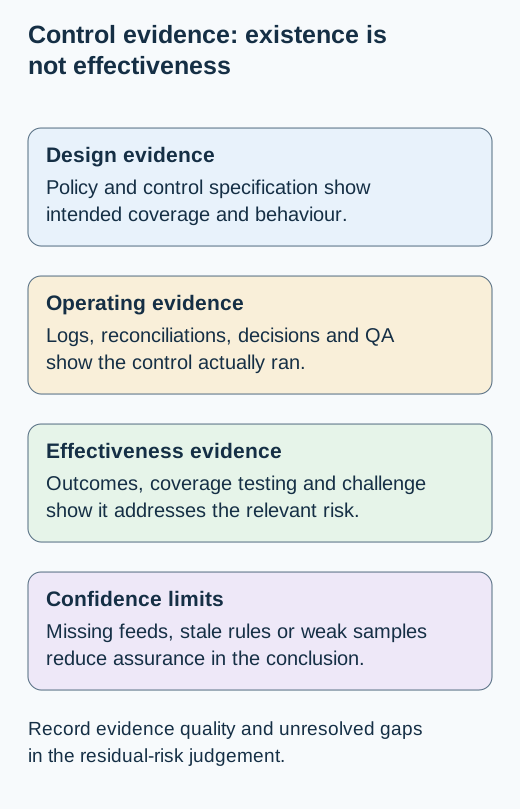
Treat confidence as part of the conclusion
Two risk ratings can have the same numerical result but very different reliability.
A portfolio assessed using reconciled source-system data, recent control testing and stable methodology is not equivalent to a new product assessed mainly through assumptions and manual estimates. The EWRA should therefore make confidence visible.
Confidence can consider:
- source authority and ownership;
- completeness of the assessed population;
- data reconciliation;
- freshness of information;
- quality of control testing;
- known defects or unresolved issues;
- dependence on manual estimates;
- maturity of a new product or channel;
- strength of external intelligence supporting the assessment.
A low-confidence assessment does not automatically mean high risk. It means management should understand that the conclusion is less certain and may need more conservative treatment, targeted data improvement or earlier review.
Risk statements should lead directly to controls
A good risk statement should explain how misuse could happen.
For example:
Corporate payment customers can move high-value cross-border funds through complex legal structures and multiple correspondent routes, creating elevated money-laundering and sanctions-evasion exposure where ownership, purpose or ultimate-party data are incomplete.
This statement should link to specific controls: KYB and beneficial-ownership verification, payment transparency, sanctions screening, correspondent due diligence, transaction monitoring, investigation and escalation.
If a risk statement has no mapped controls, the bank may not actually be managing it. If a control has no clear risk statement or obligation, the bank should challenge why it exists.
Residual risk should explain the mitigation story
Residual risk is not merely a score after subtraction.
A defensible conclusion should explain:
- the material inherent exposure;
- which controls are expected to mitigate it;
- evidence that those controls are designed and operating effectively;
- known weaknesses and dependencies;
- uncertainty in the evidence;
- the resulting residual risk;
- whether that risk is within appetite;
- management actions required.
A formula can support consistency, but the narrative should remain understandable without the formula.
Challenge control-credit inflation
One of the easiest ways to understate residual risk is to give excessive mitigation credit.
Common examples include:
- counting several controls that all rely on the same upstream data feed as independent mitigation;
- rating a control effective because it exists rather than because it has been tested;
- giving full credit to a future-state remediation that is not yet operating;
- rating transaction monitoring effective based on alert closure rather than coverage and outcome quality;
- rating sanctions screening effective without proving list freshness and data completeness;
- treating a manual workaround as permanent equivalent control without capacity evidence.
The EWRA should explicitly identify material dependencies and single points of failure.
New-product assessment before historical data exists
A newly launched product presents a special challenge because historical losses, alerts and cases may not yet exist.
The bank should not interpret the absence of history as low risk. Instead it can assess:
- intended customers;
- geographies and currencies;
- expected transaction volumes and values;
- speed and payment finality;
- third-party or indirect access;
- anonymity or transparency characteristics;
- control coverage;
- data captured and retained;
- fraud and sanctions intervention points;
- operating capacity;
- external typologies relevant to the product.
The assessment should then be refreshed after launch using actual behaviour.
Acquisition and merger scenario
Suppose a banking group acquires a payment institution operating in several countries.
The target has its own customer-risk model, country methodology, monitoring scenarios, screening vendor and case platform. The group should not simply map the target's final ratings into the parent EWRA.
A better integration review asks:
- Are risk definitions compatible?
- Are high-risk populations identified on the same basis?
- Does the acquired company capture the data required by group controls?
- Which controls will remain local and which will migrate?
- Are there regulatory commitments or historical findings?
- Are monitoring and screening models validated to the required standard?
- Which control gaps exist during transition?
- Does migration create a period of duplicated or reduced control coverage?
The EWRA should reflect transition risk until the target-state controls are genuinely operating.
Concentration should be visible even when averages look acceptable
The bank should monitor concentrations that can be hidden by portfolio averages.
Examples include:
- a small number of correspondents carrying most cross-border value;
- one partner generating a large proportion of high-risk customers;
- one country corridor dominating suspicious-report outcomes;
- one payment rail generating most fraud losses;
- one shared data service supporting many preventive controls;
- one operations team handling several critical queues.
A heat map should therefore be supplemented with concentration metrics and material-outlier rules.
Effective dating and historical reproducibility
A reviewer should be able to reconstruct the EWRA as it existed at a past date.
That requires versioning of:
- methodology;
- country-risk tables;
- customer/product classifications;
- control ratings;
- issue status;
- overrides;
- appetite thresholds;
- management approvals.
If a country rating or control issue changes today, the historical assessment should not silently rewrite itself.
BA requirement patterns
Weak requirement:
The system should calculate residual financial-crime risk.
Stronger requirement:
For each assessment object, the platform shall retain inherent-risk factors, source values, control-effectiveness ratings, evidence references, known issues, confidence indicators, methodology version, calculated and overridden result, override rationale, approver and effective date.
Weak requirement:
Show the EWRA dashboard.
Stronger requirement:
The dashboard shall allow authorised users to drill from group residual-risk ratings to legal entity, business line, product, customer segment and material risk-driver level while preserving the assessment version and effective date.
Weak requirement:
Update when risk changes.
Stronger requirement:
A configured material event — including product launch, acquisition, major control failure, country-risk change, significant regulatory finding or material portfolio growth — shall trigger assessment-impact review for affected risk objects.
Acceptance-test catalogue
Test more than arithmetic.
- missing source data cannot silently default to low risk;
- a critical control issue reduces mitigation credit according to methodology;
- a future remediation does not improve current residual risk before implementation;
- one shared data defect affects all dependent controls;
- a high-risk outlier is not averaged away by low-risk volume;
- historical assessments preserve earlier country and control states;
- an override records calculated value, revised value, rationale and approval;
- expired overrides require reassessment;
- a new product can be assessed without historical incidents;
- a portfolio increase above a configured materiality trigger creates reassessment workflow;
- local legal-entity ratings can roll up without losing local detail;
- excluded populations are visible and justified;
- source metrics reconcile to authoritative populations within defined tolerance;
- known evidence limitations appear in management output.
Practice exercise — work through this before reading on.
Exercise — challenge the assessment
A digital payments business is rated medium residual risk. During the year:
- transaction value increases by 70%;
- one new corridor represents 25% of cross-border volume;
- customer numbers grow only 8%;
- sanctions screening remains stable;
- monitoring backlog increases sharply;
- one ISO 20022 field used by monitoring is missing for the new corridor;
- no major suspicious-report increase is yet visible.
Ask:
- Which facts affect inherent exposure?
- Which facts affect control effectiveness?
- Which facts affect confidence?
- Should historical lack of suspicious reports reduce concern?
- Which control dependencies matter?
- Should residual risk change immediately?
- What interim management actions are appropriate?
- What evidence would you request before approving the final rating?
A strong answer should recognise that growth, concentration, backlog and missing monitoring data can materially change risk even before losses or enforcement occur.
Management challenge questions
Senior management should be able to ask:
- What changed since the previous assessment?
- Which conclusions rely on weak or incomplete evidence?
- Which high inherent risks receive the greatest mitigation credit, and why?
- Which controls are shared across several high-risk businesses?
- Which residual risks are outside or close to appetite?
- Which actions are overdue?
- Which ratings depend heavily on manual judgement or overrides?
- Which new products lack sufficient performance history?
- Which concentrations could create sudden exposure if one control fails?
If the EWRA cannot answer those questions, it is probably still too static.
Masterclass takeaways
- EWRA quality depends on evidence quality, not spreadsheet sophistication.
- Confidence and known limitations should be visible alongside risk ratings.
- Inherent exposure and control performance should be measured separately.
- Residual risk should tell a mitigation story, not merely produce a number.
- Control dependencies and concentration can invalidate reassuring averages.
- New products should be assessed from design and expected exposure before historical data exists.
- Historical reconstruction requires effective dating and version control.
- BA requirements should make population, evidence, methodology, overrides and approvals testable.
Worked assessment: an acquisition changes the meaning of the numbers
This extended case is fictional. The institutions, populations, ratings and management decisions are teaching examples, not prescribed regulatory thresholds. The purpose is to show how an analyst turns incomplete and non-comparable information into an assessment that supports a real decision.
Harbour Group has acquired Cedar Payments. Harbour's annual assessment is approaching its approval date, and the integration programme proposes adding Cedar's customer and payment totals to the existing group dashboard. Cedar has reported 12,000 active business customers, 600 rated high risk, and no overdue periodic reviews. Its overall residual-risk rating is medium. Harbour's acquisition model assumed that Cedar could migrate to the group's monitoring platform within six months.
The first temptation is to import those four numbers and describe the acquisition as a modest addition to the existing business. The assessment team instead asks what each number means. Cedar's active population includes any customer with an open account; Harbour's metric requires activity during the assessment period. Cedar counts legal entities, while Harbour's existing report groups some connected entities into a single relationship. Cedar's review report excludes cases awaiting customer documents from its overdue population. These differences do not prove that either bank's risk is worse. They prove that a comparison of the headline figures would be unreliable.
Establish an assessment perimeter that can be reconciled
The team retains Cedar's original 12,000-customer population and reconciles it to the acquisition inventory before making analytical exclusions. Of those customers, 9,000 transacted during the twelve-month assessment period. Another 2,000 have balances but no transactions in that period, and 1,000 have neither balances nor recent activity. The total remains 12,000. The categories support different questions: transaction exposure, continuing relationships, dormant-account treatment and potential future use. They are not interchangeable definitions of the bank's entire risk perimeter.
The risk assessment should explain which population each conclusion covers. A monitoring analysis of the 9,000 transacting customers cannot support an unqualified assertion that all 12,000 relationships have been reviewed for every risk. Dormant customers may have different risk drivers and controls, including reactivation checks. Similarly, customers without balances can still have access to payment products or contractual rights that matter for the forward-looking assessment. The team therefore keeps the full relationship inventory while using clearly named subsets for specific analyses.
The same discipline applies to legal entities. A group view can show consolidated exposure, but it must retain the entity that contracts with the customer, the entity providing the payment service and the location of relevant control responsibilities. Shared infrastructure does not dissolve those distinctions. Where a service operates through a branch, subsidiary or outsourcing arrangement, the assessment records the actual structure and the applicable interpretation of responsibilities. The business inventory becomes the anchor for later jurisdictional and control mapping.
Reconcile classifications before comparing risk bands
Cedar's 600 high-risk customers are not automatically equivalent to Harbour's high-risk population. Cedar gives substantial weight to customer legal form and incorporation country; Harbour also considers indirect access and observed corridor concentration. The assessment team creates a bridge between the two methodologies rather than overwriting the acquired company's historical ratings.
For the fictional case, the bridge identifies 400 customers high risk under both methodologies, 200 high only under Cedar's method, and 700 additional customers that Harbour's method would classify as high. The group-method view would therefore contain 1,100 high-risk customers. That result is a consequence of applying a different methodology to the same population, not evidence that 500 customers became riskier on the acquisition date. The assessment report should separate methodology effects from changes in customer behaviour or exposure.
A bridge table can preserve that distinction:
| Classification relationship | Customers | Assessment implication |
|---|---|---|
| High under both methods | 400 | Compare supporting factors and control treatment |
| High under Cedar only | 200 | Explain why the group method differs; do not remove controls automatically |
| High under Harbour only | 700 | Identify new treatment needs and implementation capacity |
| Not high under either method | 10,700 | Retain other relevant risk factors and legal obligations |
The table totals 12,000 customers and makes the overlap visible. It also exposes a delivery consequence: 700 relationships may need treatment not previously required under Cedar's policy. That is a workload and control-design question, not merely a change to the colour of a dashboard. The institution needs a governed transition plan, with local legal requirements considered separately from the group's chosen methodology.
Distinguish missing evidence from an ineffective control
Cedar states that every high-risk customer receives enhanced review. The integration team can retrieve complete evidence for 420 of the 600 locally classified customers. It finds incomplete evidence for 120 and cannot retrieve the remaining 60 files from an archive during the assessment window. These categories require different conclusions.
For the 420 complete files, the team still needs to assess quality and relevance; completeness alone does not prove that the review addressed the risk. For the 120 incomplete files, it should identify what is missing and whether that omission undermines the control objective. For the 60 unavailable files, it cannot assume either satisfactory performance or definite failure without further evidence. It records an assurance limitation and a retrieval action, while considering whether the uncertainty requires interim treatment.
This is where a two-part conclusion is useful. One part describes the assessed effectiveness of the control on the evidence available. The other describes confidence and coverage. A statement such as “review quality appears satisfactory in the tested segment, but material coverage remains unverified” is more informative than collapsing everything into medium. It enables management to see both the evidence and its limits.
The team must also avoid selecting only the easiest files. If readily accessible files belong mainly to straightforward domestic businesses, their quality cannot establish how Cedar handles complex ownership or indirect payment access. Sampling should reflect the question being asked and the risk concentrations. A targeted review can be valuable without pretending to be a statistically representative estimate for the entire portfolio. The report should describe the selection approach so that readers understand what can reasonably be inferred.
A shared dependency changes several control conclusions
The planned migration assumes that Cedar can send stable underlying-merchant identifiers to Harbour's monitoring platform. Testing reveals that one channel replaces the merchant identifier with the contractual partner identifier. Payments still settle, and the ledger remains accurate, but monitoring cannot distinguish individual merchants behind that partner.
The immediate effect is a loss of analytical granularity. A scenario assessing rapid inflows and outflows for one merchant cannot operate as intended if several merchants are combined. The same defect can affect investigation reconstruction, partner oversight and exposure reporting. It should appear as one underlying dependency with several affected controls, rather than three unrelated findings or three independent mitigating layers.
The EWRA team maps the defect to the channel, affected partner population, relevant payment periods and dependent risk hypotheses. It asks whether another trustworthy source can restore the missing relationship and whether that source is available within the control's required operating time. A file obtainable weeks later may support retrospective analysis but cannot automatically substitute for a control intended to detect changes promptly. The mitigation story must respect that difference.
Management proposes a daily merchant-level file as an interim control. The assessment should not award full control credit merely because the proposal has an owner. It needs evidence that the file covers the affected population, can be reconciled to executed payments, contains stable identifiers and is actually consumed by a defined review process. Capacity matters: an analyst cannot manually examine an unlimited file simply because it is available. The control also needs failure detection and an escalation route when delivery or reconciliation fails.
Show how the risk conclusion changes under plausible assumptions
Suppose the existing scoring model would rate the acquired business medium residual risk if the interim file is complete and operating reliably, but high if it is incomplete or inconsistently reviewed. The assessment should show that sensitivity. Hiding the dependency inside one average score would obscure the decision management needs to make.
The team presents two evidence-based scenarios. In the first, reconciliation demonstrates complete coverage for the tested period, exceptions are investigated promptly, and the review workload remains within demonstrated capacity. In the second, the file excludes one important payment channel and the exception queue grows faster than staff can resolve it. These are not arbitrary optimistic and pessimistic labels; they are alternative states linked to observable evidence.
The immediate management question is whether the business can operate within the approved boundaries while the uncertainty is resolved. Possible responses include limiting expansion through the affected channel, strengthening the interim control, accelerating a specific data repair or changing the migration sequence. Which response is appropriate depends on the actual risk and applicable obligations. A risk-acceptance record cannot authorise conduct that the law prohibits, and a group committee cannot erase an entity's legal responsibilities.
Sensitivity analysis is particularly useful when several judgements sit close to a rating boundary. If small reasonable changes in assumptions repeatedly move the result between medium and high, the report should explain that instability. It may be more decision-useful to describe the exposure, control weakness and required action directly than to debate the precise decimal that determines the colour.
Separate acquisition benefits from transition evidence
Harbour's target platform may genuinely improve Cedar's controls through richer data, broader monitoring and better investigation tooling. Those expected benefits belong in the forward-looking plan. They do not provide current control credit before the capabilities are operating for the relevant population.
The assessment therefore distinguishes the current state, interim state and validated target state. Current-state evidence reflects controls operating at Cedar now. Interim-state evidence reflects the actual transitional arrangements, including any parallel processing and reconciliation. Target-state claims depend on implementation and operational validation. This prevents the assessment from rating the business as though an approved programme had already delivered all its benefits.
Parallel operation itself creates risk as well as reassurance. Two systems can generate duplicate alerts, apply different customer identifiers or disagree about case ownership. If each team assumes the other will investigate, apparent coverage can conceal an unowned queue. The transition plan should define which system produces the authoritative operational work item, how duplicates are linked, how disagreements are resolved and how historical evidence remains accessible after decommissioning.
An acquisition can also change control concentration across the group. Migrating Cedar to a common screening service may improve consistency while increasing dependence on that service. The EWRA should recognise both effects. Standardisation is not automatically a reduction in every dimension of risk; it can exchange fragmented local weaknesses for a more significant shared dependency that requires resilience and oversight.
Write the governance conclusion as a decision
A weak committee paper would say that Cedar remains medium risk and that integration is progressing. A stronger paper states the assessed business perimeter, the methodology bridge, the material indirect-access exposure, the evidence limitations and the conditions on which the interim-control conclusion depends. It identifies the decision requested and the consequences of deferring it.
For this fictional case, management might approve continuation of existing activity subject to a defined channel boundary, reliable daily reconciliation and a dated decision on expansion after additional evidence is reviewed. The paper would identify who can impose or remove the boundary, what evidence is required and what event triggers earlier escalation. It would record second-line challenge and any unresolved disagreement. The decision should remain understandable to a reviewer who did not attend the meeting.
Closure should follow the risk question. A completed migration does not close an evidence limitation if historical files remain unavailable. A repaired merchant identifier does not resolve review capacity if the newly visible population creates more work than the team can handle. A revised rating does not complete remediation unless the associated control actions have been validated. Linking these items prevents one successful milestone from prematurely closing several different obligations.
What the case teaches about a defensible assessment
The most valuable output is not a more complicated score. It is a transparent explanation of what the bank knows, what remains uncertain and which decisions follow. The population reconciliation establishes the perimeter. The classification bridge explains changes in measurement. The evidence review tests control claims. The dependency map prevents double counting. The sensitivity analysis exposes assumptions that materially change the conclusion. The governance record connects those findings to accountable action.
These techniques are useful beyond acquisitions. They apply when a bank introduces a new product, changes its customer-risk methodology, moves to a different data platform or discovers that an apparently stable control has relied on incomplete information. In each setting, the assessment should distinguish a change in real exposure from a change in measurement, and a planned mitigation from one supported by operational evidence.
The final professional judgement is whether another competent reviewer could reconstruct the reasoning without having to trust the author's unexplained confidence. If the answer is yes, the assessment can support challenge and better decisions even when uncertainty remains. If the answer is no, adding a decimal, a heat map or another approval signature will not repair the underlying weakness.
References and further reading
- FATF — The FATF Recommendations, as amended June 2026: https://www.fatf-gafi.org/en/publications/Fatfrecommendations/Fatf-recommendations.html
- FATF — Money Laundering National Risk Assessment Guidance, updated 28 August 2025: https://www.fatf-gafi.org/en/publications/Methodsandtrends/Money-Laundering-National-Risk-Assessment-Guidance.html
- FATF — Money Laundering National Risk Assessment Toolkit: https://www.fatf-gafi.org/en/publications/Methodsandtrends/Money-Laundering-National-Risk-Assessment-Toolkit-Annexes.html
- Basel Committee on Banking Supervision — Anti-money laundering and counter-terrorist financing, Basel Consolidated Guidelines, published 1 January 2026: https://www.bis.org/committees/bcbs/basel-consolidated-guidelines/module/afs/10
- Wolfsberg Group — Guidance on the Risk-Based Approach, June 2026: https://wolfsberg-group.org/resources/195/205
- Wolfsberg Group — Statement on the Risk-Based Approach, July 2025: https://wolfsberg-group.org/resources/general/203
- FFIEC — BSA/AML Risk Assessment examination guidance, United States: https://bsaaml.ffiec.gov/manual/BSAAMLRiskAssessment/01_ep
- AUSTRAC — Identify and assess your risks, Australia, current 2026 guidance: https://www.austrac.gov.au/industry-and-business/obligations-and-guidance/your-amlctf-program/develop-your-amlctf-programs/step-2-identify-and-assess-your-risks
- AUSTRAC — Review and update your AML/CTF program, Australia, current 2026 guidance: https://www.austrac.gov.au/industry-and-business/obligations-and-guidance/your-amlctf-program/develop-your-amlctf-programs/step-4-review-and-update-your-amlctf-program
- European Banking Authority — AML/CFT transition to AMLA and continuing status of existing EBA guidelines: https://www.eba.europa.eu/regulation-and-policy/anti-money-laundering-and-countering-financing-terrorism
- Wolfsberg Group — financial-crime risk-management resources: https://wolfsberg-group.org/resources
- FATF — 2025 changes to Recommendation 1 and the risk-based approach: https://www.fatf-gafi.org/en/publications/Fatfrecommendations/update-standards-promote-financial-conclusion-feb-2025.html
- FATF — Jurisdictions under Increased Monitoring, 19 June 2026: https://www.fatf-gafi.org/en/publications/High-risk-and-other-monitored-jurisdictions/increased-monitoring-june-2026.html
- FATF — High-Risk Jurisdictions subject to a Call for Action, 19 June 2026: https://www.fatf-gafi.org/en/publications/High-risk-and-other-monitored-jurisdictions/call-for-action-june-2026.html
- Basel Committee on Banking Supervision — Sound management of risks related to money laundering and financing of terrorism, 2 July 2020 source publication: https://www.bis.org/publications/202007-guidelines-sound-management-risks-related-money-laundering-and-financing-terrorism-revisions-supervisory-cooperation
- AUSTRAC — Independent evaluation of the AML/CTF program, Australia: https://www.austrac.gov.au/industry-and-business/obligations-and-guidance/your-amlctf-program/develop-your-amlctf-programs/step-5-conduct-independent-evaluation
- European Banking Authority — Revised ML/TF Risk Factors Guidelines background: https://www.eba.europa.eu/publications-and-media/press-releases/eba-publishes-final-revised-guidelines-money-laundering-and
These sources distinguish international principles from jurisdiction-specific requirements. Apply the law and supervisory framework relevant to the bank’s legal entity and activity. Historical guidance should be read alongside current consolidated standards.