Financial-Crime Recordkeeping, Legal Holds and Disclosure Control
Financial-crime recordkeeping preserves the evidence needed to reconstruct transactions, customer decisions, investigations and reports. A legal hold suspends ordinary disposal for specified material when litigation, investigation or another valid preservation requirement applies. Disclosure control governs who may receive that information and under what authority. Retention, preservation and disclosure are related but separate decisions.
FATF Recommendation 11 sets an international baseline of at least five years for required transaction records and CDD-related records, with different start points: transaction completion versus relationship termination or the occasional transaction. National law can require different or longer periods and special reporting records. Do not assign every financial-crime file a universal five-year deletion date.
Records need sufficient detail for transaction reconstruction and timely access by competent authorities where lawfully required. Storing a screenshot of a final status may omit the evidence, rule version, approval and original transaction data that explain how the decision was reached.
Protected reporting information needs particular controls. FATF Recommendation 21 concerns tipping off and confidentiality, while national SAR rules define binding restrictions. The US September 2026 communication clarification does not permit revealing that a SAR exists. A customer access request or routine export must not bypass those restrictions.
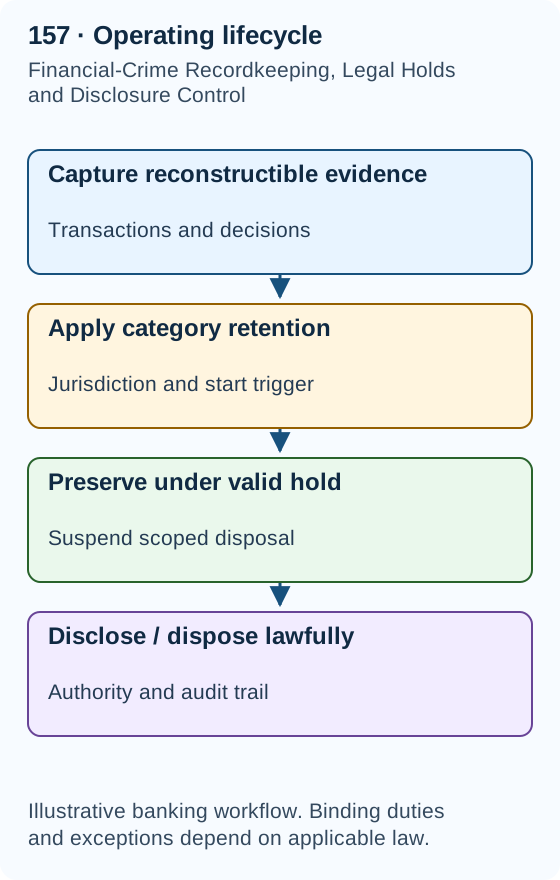
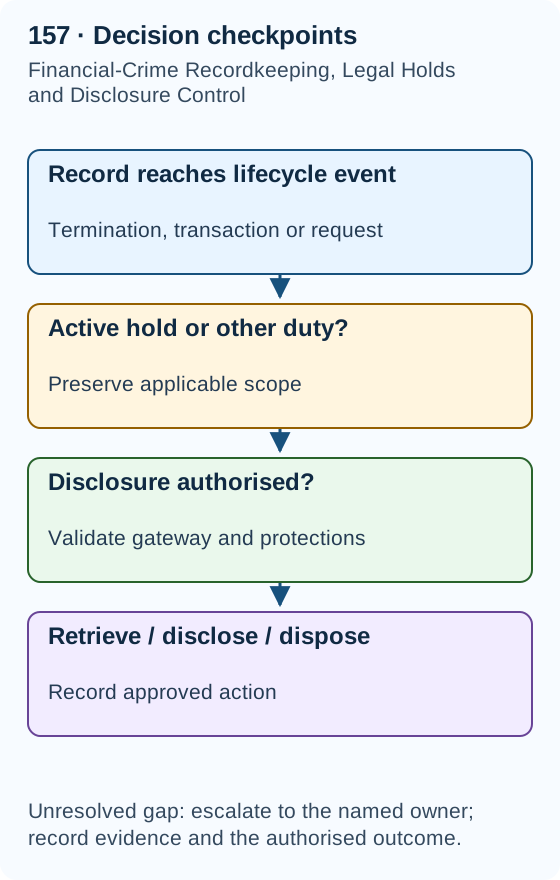
Designing retention and legal holds
Define record categories, applicable jurisdiction, legal basis, retention trigger, period, owner and disposal process. Include customer identity and ownership evidence, transaction records, investigation notes, reporting records, screening decisions and relevant audit logs. Different records may need different access controls even when they relate to the same customer.
A hold should specify scope, responsible authority, date, relevant persons or matters, affected systems and review process. Notify custodians, suspend deletion in live and archived stores, and verify that scheduled jobs and vendor systems honour the hold. Keep the original instruction and changes. A hold added only to a case-management flag may miss email, object storage and backups governed by another process.
Preserve native data and metadata alongside readable exports. Record time zones, currency precision, message identifiers, source system and transformation steps. A transaction's initiation, booking and settlement timestamps can differ; do not overwrite them with one exported date.
On disclosure, authenticate the request, validate authority and scope, assess privilege and protected reporting material, approve the production and use a secure channel. Keep the produced version and proof of delivery. Preservation does not grant permission to disclose, and ordinary retention expiry does not override an active hold.
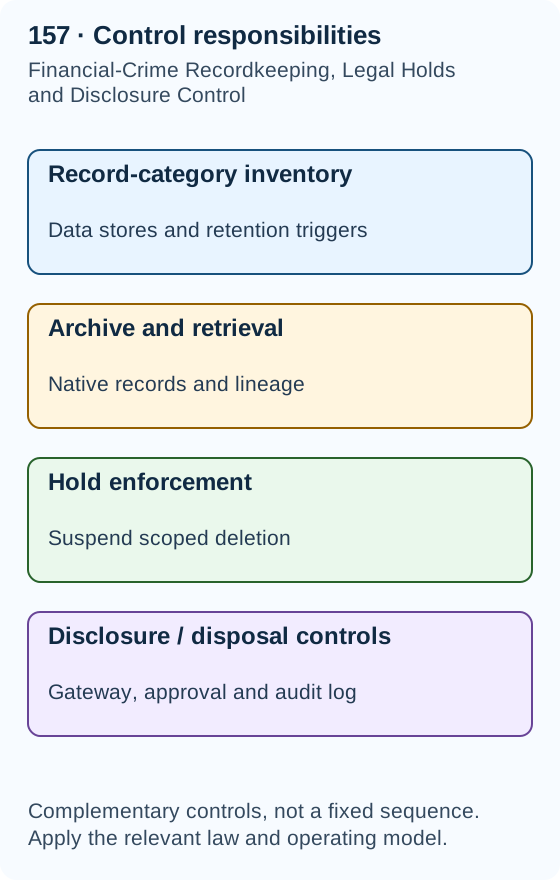
Start with records that can reconstruct a banking event
Financial-crime recordkeeping is an operating capability, not merely storage of a final investigation PDF. A later reviewer may need to establish who instructed a transaction, which parties and accounts were involved, how value moved, what the bank knew, which control ran and why the bank acted. These facts can sit in payment systems, customer repositories, monitoring tools, case management, messaging and archives. The recordkeeping design must connect them. A readable summary helps navigation, but it should lead back to authentic underlying records rather than replace them with unsupported conclusions.
Separate transaction evidence from decision evidence. Transaction evidence establishes the instruction and processing history: amount, currency, parties, references, event times, statuses and resulting ledger entries. Decision evidence establishes the control assessment: data available, alerts, investigation steps, rationale, approval and action. A payment record cannot explain why an analyst cleared a sanctions alert, and an analyst's note cannot prove the final settlement amount. Retain and link the relevant evidence for each purpose under the applicable requirements. This separation also allows authorised production of transaction facts without automatically exposing protected reporting decisions.
Preserve meaningful native records where required and practical. A screenshot can show a user's view at a moment, but it may omit fields, obscure metadata or become detached from the underlying record. A spreadsheet export can lose leading zeros, change dates and convert identifiers into scientific notation. Retain the relevant source representation, format specification and extraction method. When a rendering or transformation is needed, document the relationship between source and output. The question is whether the bank can reconstruct and explain the event reliably, not whether the archive contains an attractive image of a dashboard.
Identify relevant timestamps by event and time basis. Instruction receipt, authorisation, posting, settlement, alert generation and analyst review are different events. Some systems use UTC, some local time and some only a business date. Record the basis and offsets needed to interpret chronology. Daylight-saving changes, batch processing and delayed ingestion can otherwise make an apparently precise timeline misleading. Do not change historical event times to fit the investigation narrative. If the bank cannot resolve a time ambiguity, state that limitation and identify the evidence that supports the remaining sequence.
Use stable identifiers to link records across systems. A customer identifier, account reference, payment instruction ID, ledger event ID and case number can serve different purposes. Keep mappings through mergers, platform migrations and external-provider interfaces. Names and balances alone are poor linkage keys because they can change or be shared. Where duplicate customer records are merged, retain the history needed to find transactions under the original identifiers. A final case that references an obsolete ID is not fully retrievable unless the archive can resolve it to the relevant evidence.
Records also need interpretive context. A status code meaning accepted in one system may mean received for validation in another. An amount may represent gross instruction value, net settlement or an accounting adjustment. Preserve definitions or a versioned data dictionary sufficient to understand the source. Include the meaning of null values, reversals and currency conversions. Without context, an investigator can mistake a rejected attempt for a completed transfer or count the same value twice. Context should be concise and controlled; it does not require copying every system manual into every case.
Category-specific retention instead of a universal clock
Create a retention schedule by record category, relevant legal entity, jurisdiction and purpose. Categories may include transaction records, CDD information, verification evidence, business correspondence, investigation decisions, submitted reports, sanctions records, access logs and disclosure records. Identify the authoritative requirement or other lawful basis, period, start trigger and any conditions for extension or deletion. FATF Recommendation 11 supplies an international baseline for transaction and CDD recordkeeping; national rules determine the bank's obligations. A blanket instruction to keep every financial-crime record for five years cannot capture all those distinctions.
The start trigger matters as much as the duration. A transaction date, completion of an occasional transaction, end of a business relationship, closure of an account and creation of a verification record can lead to different end dates. Avoid treating a customer who closes one product but retains another as automatically having ended every relationship. The schedule should define the relevant entity and relationship and how the system obtains the trigger. If the business cannot establish the trigger reliably, assigning a retention period in policy does not make automated deletion safe.
Two national examples illustrate the problem without creating a global rule. The FFIEC's US CIP manual distinguishes retention of identifying information from records of verification methods and discrepancy resolution, with different five-year triggers. UK MLR regulation 40 generally uses transaction completion for occasional transactions and the end of a business relationship for relevant relationship records, subject to its provisions, including a ten-year limit for specified transaction records. Its personal-data deletion rule has stated exceptions. These are jurisdiction-specific requirements to map accurately, not interchangeable versions of one universal retention clock.
For each category, distinguish minimum retention from authorised extended preservation. Other law, proceedings or a valid hold may justify or require keeping relevant material longer. That does not justify indefinite preservation of every unrelated customer record. Record the basis and scope, review triggers and responsible owner. A retention schedule should make disposal possible when legally appropriate and preservation effective when necessary. Retaining everything forever can create privacy, security and retrieval problems; deleting everything on a single age threshold can destroy required evidence. Neither is a defensible substitute for a mapped lifecycle.
Design the schedule so it can be executed. Specify where records live, which process applies the trigger, how disposal is suspended and how exceptions are reported. A category name such as investigation material must map to actual tables, object stores, exports and provider repositories. Explain whether a derivative copy follows the source's schedule or has a separate valid purpose. When technical limitations prevent the intended treatment, document them, assess the risk and create a controlled remediation plan. Do not assert compliant deletion while known copies remain outside the inventory.
Review the schedule when law, products or systems change. An amendment can alter scope or trigger without changing a headline number of years. A new embedded-finance service can create relevant API and provider records absent from the schedule. A case tool replacement can move evidence into a new storage class. Assign a change owner and verify implementation through sample records. A dated policy approval is useful evidence, but the decisive check is whether affected records receive the correct lifecycle treatment in the operating environment.
Legal holds: scope, propagation and continuing control
A legal hold preserves material within an authorised scope when ordinary disposal must be suspended. The basis and process vary by jurisdiction and context. Establish who can issue the hold, how the bank verifies authority and how the instruction is communicated to custodians. Record the matter, scope, relevant persons or entities, time range, systems, record categories and effective date. Where a request is unclear, obtain clarification rather than silently choosing the narrowest convenient interpretation. A broad preservation email with no accountable owner can be as difficult to execute as an excessively narrow instruction.
Separate the preservation instruction from a disclosure instruction. Holding records does not by itself authorise sending them to a requesting party, another group entity or an external adviser. A preservation need may exist before the lawful disclosure route is settled. Likewise, a valid production request may require carefully scoped retrieval rather than an unlimited hold over unrelated material. Keep the two actions linked where appropriate, with their distinct authority and approvals. This distinction prevents staff from treating a legal hold as permission to share an entire investigation file.
Propagate the hold to every relevant store. Customer documents can sit in onboarding, imaging, case attachments, email, archived exports and a service provider's platform. Transaction histories may exist in operational and archival systems with different deletion jobs. A hold register should identify custodians and obtain evidence that the relevant disposal is suspended. Record failed acknowledgements and stores that cannot apply a granular hold. A central matter number does not prove preservation if a regional archive or vendor continues its scheduled purge.
Include ongoing records when the scope requires them. A hold may cover a defined historic period or also relevant future material. The instruction should make that distinction clear. A snapshot at issue date can miss later communications or adjustments. Conversely, collecting unrelated future records indefinitely can expand the scope without justification. Define event-based additions, review points and the process for changes. When the customer or account identifier changes, confirm that the hold remains linked to the relevant records rather than following only the old identifier.
Preservation must maintain integrity and usability. Restrict unauthorised alteration, record handling and keep appropriate technical and access safeguards. A hold should not create an uncontrolled shared folder that exposes protected material to everyone involved in the matter. Use authorised access and retrieval procedures. Where preservation requires copying records, keep lineage from source to preserved copy and preserve metadata necessary for interpretation. A hash can support integrity checks but does not establish that the record was complete, authentic at source or lawfully collected; those require additional evidence.
Review hold effectiveness during system change. A migration, provider exit, archive purge or permission redesign can break a previously valid hold. Require the change process to identify affected matters and test preservation in the destination environment. Maintain the old environment where necessary until acceptance is justified, within the authorised plan. If the bank discovers premature disposal, preserve remaining evidence and investigate scope, cause and required response. Do not create replacement notes and present them as though the original records still exist.
Ending a hold requires an authorised release and reassessment against other active duties. One matter's closure does not remove another hold or a category's remaining retention requirement. Record the release instruction, issuer, scope and date; communicate it to relevant custodians and reconcile acknowledgements. Then resume the appropriate lifecycle rather than automatically deleting all held material. Some records may remain required for other reasons, while others may be eligible for disposal. A successful release process makes both outcomes visible and accountable.
Disclosure authority and protected information
Build a disclosure workflow around the requester, purpose, authority, scope and destination. Requests can come from regulators, law enforcement, courts, customers, counterparties, auditors and group teams, each with different powers and limitations. Verify the identity and authenticity of the request through an appropriate channel. Assess which bank entity holds the information and which law applies. A convincing letterhead or urgent email is not sufficient evidence of authority. Route uncertain legal questions to the authorised specialists rather than leaving an operations analyst to infer a gateway.
Identify the requested records before extracting a packet. A request for payment details is different from a request for internal reporting decisions. Translate the scope into record categories, date ranges, entities and identifiers. Avoid responding with all records about a customer merely because the archive search makes that easy. Keep a record of searches, included and excluded categories and unresolved interpretation. The scope assessment should be accurate enough for a reviewer to understand why material was produced or withheld without disclosing protected information through the explanation itself.
SAR confidentiality requires particular care. FinCEN's September 2025 cross-border guidance distinguishes underlying facts and documents from SARs and information revealing their existence or non-existence, and does not displace other applicable law. Its September 2026 customer-communication statement likewise does not change existing BSA requirements. A bank must avoid both protected disclosure and a categorical claim that ordinary facts can never be communicated. Assess the actual information and gateway, including any relevant redaction, through the appropriate US-specific procedure where applicable.
Protected reporting information can be exposed indirectly. A file name, report status, case note or export column may reveal a SAR decision even if the report document is removed. A privilege or withholding log can also create a disclosure risk if phrased incorrectly. Review the packet, metadata and covering communication as a whole. This is not a reason to withhold all transaction facts automatically. It is a reason to design controlled extraction and review, with specialist advice for requests involving protected reports or indicators of their existence.
Other protections can also matter, including personal data, secrecy duties, privilege and contractual or statutory limits. Do not presume that an intragroup request creates a universal gateway or that an external counsel relationship makes every attached document privileged. The competent specialist should identify the actual basis, restrictions and conditions. Preserve the advice appropriately and give operations a clear production instruction. Where disclosure cannot lawfully proceed as requested, document the reason and authorised response without inventing a permission or unnecessarily exposing the protected material.
Record approval and delivery separately. An authorised reviewer may approve a packet that is then sent to the wrong recipient or rejected by a portal. Verify the destination, transfer method and receipt or other delivery evidence appropriate to the request. Preserve the exact produced version, including redactions and attachments, rather than an earlier draft. If an error occurs, contain it, record the actual scope and follow the applicable incident process. An email marked sent is not evidence that the intended recipient received the intended records securely.
Retrieval, completeness and evidence packaging
Retrieval should begin with a documented search plan proportionate to the request. Identify authoritative systems, relevant identifiers, time boundaries, field mappings and known limitations. A customer may have historical identifiers under a predecessor bank or closed account. Search by relevant relationships and mappings rather than relying exclusively on the current customer ID. Record why a system or period is outside scope. If a source is unavailable, identify the gap explicitly and assess whether another valid source can provide the required evidence. Silence can falsely imply complete production.
Reconcile the search output to an expected population where possible. Compare transaction counts, balances, ledger references or case inventory within the relevant period. Explain differences caused by reversals, duplicates, filtering or archive boundaries. A large output file is not necessarily complete, while a small one may be correct for a narrow scope. Validate the extraction logic and representative records. Where no reliable expected total exists, use other checks and disclose the limitation to the authorised reviewer rather than claiming perfect completeness from a successful database query.
Preserve a manifest of the produced packet. It should identify the request, records, formats, date ranges, extraction sources, version, redaction decisions, approval and delivery. Use intelligible labels that do not themselves expose protected information. Include necessary interpretive notes about currencies, timestamps, codes and data transformations. The recipient should be able to understand the records without guessing the meaning of every field. A manifest improves traceability but must not imply evidential conclusions beyond what the bank can establish from the underlying records.
Avoid uncontrolled editing of evidence during packaging. Where conversion is necessary, preserve source files and document the conversion. A PDF rendering may be useful for readability, while a native structured export may be needed to reconstruct activity. Ensure neither silently alters values or loses fields. Redactions should be applied securely so hidden text or layers do not remain recoverable in the released output. A black rectangle placed over visible text can fail if the underlying text is still present. Test the actual exported packet rather than relying on its appearance in the editing tool.
Track handling and access appropriate to the evidence. Record who retrieved, reviewed, changed or produced material, with dates and versions. Keep the process workable for legitimate users: excessive manual duplication can increase error and create untracked copies. Use controlled repositories and identifiers rather than attaching successive drafts to broad email threads. Where a third party extracts or hosts records, establish instructions, access and evidence of completion. Responsibility for a reliable production does not disappear because the provider created the export.
The final packet should distinguish verified facts from unresolved questions. If a record is reconstructed from surviving sources, identify the method and limitation. Do not label it as an original that no longer exists. If the scope is partial because of a lawful restriction or unavailable source, the authorised response should make that clear in an appropriate way. Accurate limitations are more useful than unsupported assurances. They allow the requesting authority or reviewer to understand what the material can and cannot establish.
Outsourced records and provider exit
A provider arrangement should identify which relevant records it holds, in what formats, under whose instructions and with what access and retention arrangements. Map the provider's storage to the bank's category schedule and hold process. Include records created by subcontractors where relevant. A contract saying data belong to the bank does not guarantee practical retrieval. Verify that the bank can obtain the information, metadata and historical versions needed for its obligations, within the required timeframe and through a usable operational route.
Test retrieval before relying on the service. Select a representative customer, transaction and decision, including closed or archived material. Obtain the files through the contractual process and validate interpretation and completeness. A successful demo of the current dashboard does not establish access to historical native records. Document gaps and remediation. If the provider returns only a summary score or final status, assess whether that is adequate for the specific recordkeeping need rather than assuming the service's marketing description proves compliance.
Hold propagation must be explicitly supported. The bank should know who receives a preservation instruction, how it reaches relevant stores and how completion is evidenced. Where the provider cannot apply a granular hold, identify the impact and authorised approach. A support ticket closed without evidence may not establish preservation. Review provider deletion changes and subcontractor transitions against active holds. Include contact and access arrangements for emergencies or relationship termination, when ordinary support queues may no longer be dependable.
Provider exit is a planned evidence transfer, not merely cancellation of a subscription. Inventory required records, export formats, definitions, keys and historical versions. Validate transferred populations and preserve appropriate source-system context. Determine which records must remain accessible in the old environment until acceptance and what lawful disposal follows. Reconcile the destination archive before signing off the exit. Otherwise the bank may discover years later that transaction IDs survive but the associated verification evidence or attachment keys were not exported.
Access rights and encryption can affect retrieval even when files remain intact. Establish how authorised users obtain keys, account permissions and format support after personnel or platform changes. Avoid concentrating the only means of retrieval with one departing employee or external provider. Test the arrangements periodically and after material change. A backup is not usable evidence if no authorised team can decrypt it or understand its schema. Conversely, giving everyone unrestricted access to avoid lockout creates unnecessary confidentiality and integrity risk.
Migration and archive assurance
A migration plan should define what evidence must survive and how acceptance will be tested. Separate record counts from semantic equivalence. Identical counts can conceal swapped identifiers, truncated text or missing attachments. Compare key fields, representative full records, metadata, relationship mappings and retrieval behaviour. Include nonstandard names, long narratives, unusual currencies, historical dates and multiple attachments. The aim is to establish that the destination supports required reconstruction and lifecycle control, not just that an import job ended successfully.
Maintain source-to-destination mappings and exception logs. Record transformed fields, merged identifiers, excluded records and reasons. Where a conversion loses information, obtain an authorised assessment and remediate where needed. Do not hide known loss in a general statement that data were migrated to the best available standard. Some old formats may require preserving a compatible reader or an intelligible rendering in addition to structured data. Design the solution around the actual evidence and legal need rather than forcing every historical record into today's simplified model.
Verify lifecycle controls in the destination. Retention triggers, active holds, access restrictions and disclosure protections must transfer alongside the data. A migration that preserves all files but drops hold metadata can expose them to the new purge job. A migration that moves every case into a broadly accessible directory can compromise protected records. Test authorised retrieval and attempted unauthorised access. Reconcile active hold populations and ensure that historical disposal dates are not inadvertently reset without a valid basis.
Source shutdown should follow justified acceptance. The authorised owner should understand outstanding exceptions, temporary controls and the consequence of decommissioning. Where the old platform must remain for some records, define supported access and a review plan; do not leave an unmaintained system as the only route to evidence indefinitely. Preserve relevant technical definitions and keys before specialist staff leave. An exception can be manageable when explicit, funded and tested; it becomes dangerous when everyone assumes another team retained the missing material.
Archive assurance needs realistic retrieval tests. Select records directly from a known historical population and ask the operating team to locate and reconstruct them. Include closed cases and customers, older product systems and provider-held evidence. Measure correctness and timeliness against applicable requirements and internal expectations. A test that selects only records known to be easily available is not representative. Document failures by cause: missing index, inaccessible file, unreadable format, absent metadata or unjustified disposal each requires a different correction.
Privacy, access and disposal as part of the same lifecycle
Evidence preservation and information protection should be designed together. Limit access to authorised roles, review permissions and record relevant use. Different teams may need transaction facts, investigation content or protected reporting information. A single broad financial-crime access group can expose more than each role needs. Implement role and purpose distinctions appropriate to the bank's environment, with an available route for lawful specialist access. Review service accounts and bulk export permissions as well as individual users, because automated access can create a large uncontrolled copy.
Track derivative stores where material risk exists. Investigation spreadsheets, downloaded attachments, analytics extracts and support tickets can contain the same personal or protected information as the official archive. Establish approved working locations and disposal rules, and limit unnecessary replication. Staff should understand how to link evidence rather than repeatedly copying it. A perfectly controlled central repository does not make an unrestricted local export safe. Inventory and controls should be proportionate, focusing on relevant data and exposure rather than pretending that every transient technical byte has identical evidential value.
Disposal should be authorised, scoped and evidenced. Confirm that the applicable retention period has ended and no active duty or hold requires preservation. Verify the relevant population before running a purge. Record what was disposed of, when, under which schedule version and with what exceptions. Where storage technology limits granular deletion, document the actual treatment and lawful basis rather than asserting immediate erasure. Backup cycles, replicated stores and provider copies require appropriate consideration within the bank's approved lifecycle design.
Test deletion in both directions. Eligible records should be treated according to the schedule; ineligible or held records should survive. A purge job that never runs can fail the intended disposal requirement, while one that ignores holds can destroy required evidence. Use controlled test populations with distinct categories and triggers. Review the operating outcome and logs, not just configuration settings. Follow up failed or partial purges. An error should produce an investigation and corrective action rather than an undocumented manual rerun against a larger population.
Incident response should preserve remaining evidence without unnecessarily spreading it. If records are lost, altered or disclosed, identify affected categories, scope, dates and systems. Restrict further unsafe handling, secure surviving material and involve the appropriate legal, privacy, security and financial-crime owners. Reconstruct what can be established, clearly distinguishing original evidence from later reconstruction. Assess required notifications through the applicable rules. A root-cause analysis should connect technical and process failures and verify correction along the actual path where evidence was compromised.
Retrieval, deletion and access testing
Test reconstruction of an old transaction and a customer decision after system migration. Check missing attachments, broken identifiers, inaccessible encryption keys and fields lost during export. An archive that stores bytes but cannot retrieve usable records fails the purpose of retention.
Test deletion with and without a hold, including vendor-managed stores. Releasing a hold requires authorised review; it does not necessarily mean immediate deletion because ordinary retention or another hold may still apply.
Review access to SAR-linked information in search, support tickets, analytics exports and customer portals. Restrictions on the primary case screen are inadequate if the same content is replicated into an unrestricted warehouse.
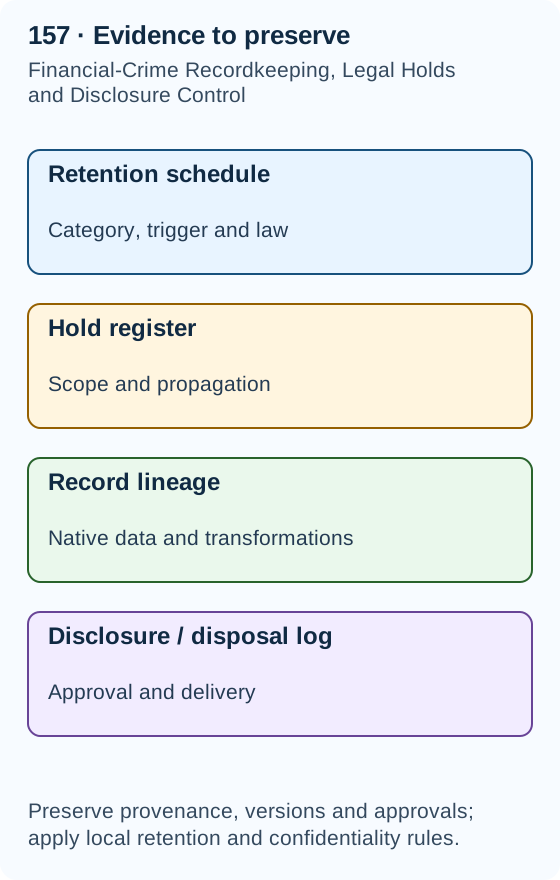
Worked case: an old payment and an acquired-bank archive
These cases are fictional. They illustrate evidence and control reasoning without assigning invented legal powers or universal deadlines. A competent authority requests records concerning payments made through a bank acquired several years earlier. The customer now has a new identifier, the original account is closed and the payment hub has been retired. The first search of the current customer system returns no relevant transactions. The production team must not treat that empty result as proof that no records exist.
The request owner validates the authority, scope and applicable bank entity, then identifies the predecessor account and identifier mapping. Archive custodians locate the old transaction population using the relevant business dates and source-system keys. They preserve the native records and the versioned definitions needed to interpret old status codes. The team checks the requested population against available ledger or settlement references and records any limitations. The search plan covers the historical system deliberately rather than assuming the present interface searches every archived store.
A returned export uses a status code that one reviewer initially interprets as settled. The old dictionary shows that it meant accepted for later processing. The team traces the subsequent event and discovers a rejection on the following business day. The final packet therefore distinguishes the attempted instruction from the completed payments. Without the dictionary and event linkage, the bank would have produced a plausible but false statement about value movement. This is a substantive evidence defect even if every file opens correctly and the total number of rows appears reasonable.
One attachment cannot be located. The team preserves the surviving references, investigates whether it was transferred during migration and identifies the actual gap in the authorised response. It does not fabricate a replacement and call it the original instruction. The gap is assessed against the applicable requirement and incident process. Remediation examines the migration acceptance evidence and whether other historical attachments may be affected. A bounded investigation of the same transfer path is more useful than assuming every bank record is lost.
The production manifest records sources, mappings, chronology definitions, extraction method, reviewed scope and the exact delivered files. Protected investigation material is assessed separately rather than automatically appended to the payment packet. Delivery and approval evidence are retained under their appropriate schedule. A later assurance exercise selects another transaction directly from the predecessor population and repeats retrieval. This verifies whether the archive can support ordinary lawful requests after the original investigation team has moved on.
Worked case: a hold reaches the archive but misses a provider
A litigation matter requires preservation of relevant customer onboarding and investigation records. The authorised hold covers a specified person, relationship, time range and related communications. Internal custodians acknowledge the instruction. A monthly purge on the case archive excludes the held records. However, a third-party verification platform follows its normal deletion cycle because no one included it in the hold distribution. The bank discovers the gap when a reviewer asks for the underlying verification result.
The owner immediately confirms what remains and prevents further disposal within the authorised scope. The provider checks relevant stores and available copies, preserving surviving material with appropriate lineage. Internal teams identify the instructions and acknowledgement failures. The investigation distinguishes lost original evidence from records still retrievable elsewhere. A final customer-status label may show that verification was approved, but it does not necessarily reconstruct the verification method or information actually used. The bank must be precise about that difference when assessing the gap.
Legal and records specialists consider the applicable consequences and response. The bank should not automatically widen the hold to every customer merely because one provider process failed. It should identify the affected matters, data categories and deletion path, with proportionate preservation. The provider relationship owner updates contact and instruction procedures, while technology or operations adds the relevant repository to the inventory. The corrective action requires evidence that the provider applied the hold, not just a revised contract paragraph promising future cooperation.
Testing uses a controlled held record and an otherwise eligible record under the provider's approved lifecycle process. The held record must survive, while the other record receives its appropriate treatment. The bank also tests retrieval and interpretation after preservation. A provider can acknowledge a hold but preserve an unusable file with no key or metadata. The acceptance result should therefore cover preservation, accessibility and evidential meaning. Outstanding limitations remain visible to the matter owner and governance process until resolved.
When the matter ends, the authorised release is propagated to the internal archive and provider. Other retention duties and holds are checked before disposal resumes. The bank records acknowledgements and the resulting schedule treatment. This closes the lifecycle without interpreting release of one hold as a universal instruction to delete every associated record. It also avoids leaving the provider indefinitely preserving personal data under an obsolete matter number that no one reviews.
Worked case: a transaction request exposes reporting metadata
A bank receives a valid request for specified transaction facts. The retrieval tool exports payment details and automatically adds the related investigation case status. One column contains an internal report-decision label, while a PDF attachment name also indicates reporting status. The production reviewer recognises that the packet raises protected-information questions even though the requested payment records are ordinary underlying facts. The team must assess the actual contents and applicable protections before delivery.
The authorised specialist reviews the scope and disclosure route. Transaction facts are separated from information that would reveal a protected reporting decision where required. The output, filenames, metadata and covering communication are checked together. Removing only the report document would not address the case-status column. The bank preserves the unredacted source securely and retains the exact authorised produced version, with the rationale and approval under appropriate controls. Staff do not claim that every record relating to the customer is categorically undisclosable.
The team tests the final redacted files by extracting text and inspecting relevant metadata, using authorised tools in a controlled environment. It identifies a hidden text layer in an early PDF that still contains the removed phrase. The output is corrected and retested before production. The evidence records the final version and review. A visual black box on a screen would have concealed the defect from an appearance-only check but would not have protected the information in the released file.
The request is delivered through the approved channel to the verified recipient. Delivery evidence is recorded independently from packet approval. A later quality review examines other exports created by the same retrieval template, with a bounded assessment of actual exposure. Technology changes the template so protected case metadata is not included by default in transaction productions. Training helps reviewers understand the risk, but a structural change reduces unnecessary protected-data handling at the source.
This case illustrates why disclosure review needs both legal judgement and technical validation. The requester can have valid authority for the requested facts while some automatically included information still needs special handling. The correct response follows the applicable gateway and scope. It neither assumes that a valid request authorises every internal record nor refuses lawful production merely because an investigation file exists. The bank's evidence should support that precise decision without itself revealing protected content to an unauthorised audience.
Worked case: closure changes the lifecycle trigger
A customer closes a current account but retains a deposit and a credit relationship with the same bank entity. A system event labelled customer closed sets a disposal date for all CDD records. The operational term refers to one product's closure; it does not necessarily establish that the relevant business relationship has ended under the applicable schedule. The records owner compares the event to the defined trigger and identifies the mismatch before the purge executes.
The correction begins with meaning rather than simply extending every retention date. Product owners and legal specialists clarify how the relationship trigger is established for the relevant categories and jurisdiction. Technology updates the event mapping and identifies the affected population. The bank preserves records that remain required and reviews any previous disposals through the incident process. It does not use a blanket permanent retention flag to avoid resolving the underlying relationship logic. That would leave the schedule inaccurate and make eventual lawful disposal difficult.
Testing includes a product closure with other continuing services, an actual end of the relevant relationship and an occasional transaction with its own completion trigger. The expected treatment is documented for each category. The test also checks reopening and identifier changes, because a later service can alter the operating facts. Record history should explain what occurred without overwriting earlier dates or pretending the original event had a different meaning. The trigger needs enough provenance to support future lifecycle review.
Management receives a specific account of the defect, affected record categories, preserved and potentially disposed populations, interim controls and verified correction. A report that the purge was disabled gives only part of the outcome. It must also explain how the bank will resume correct disposal and maintain active holds. The incident closes when the category lifecycle works as intended, with known exceptions controlled, rather than when one dangerous job is stopped indefinitely.
Acceptance tests for recordkeeping and disclosure
Test 1: reconstruct a completed payment. Select a transaction from an authoritative ledger population and retrieve the instruction, processing events, settlement evidence and relevant control decision. Confirm identifiers, amount, currency and chronology. The reviewer should explain what occurred without guessing status-code meaning. Compare source and rendered output. Passing requires a coherent trail; a final balance or analyst narrative alone does not reconstruct the individual payment.
Test 2: reconstruct an attempted payment. Select a rejected or cancelled instruction and establish how it differs from completed value movement. Verify whether monitoring and case records preserve the attempt where required. A system that retains only settled transactions may not support investigation of relevant attempts. The test should expose incorrect interpretation of accepted, pending and settled states and any loss of rejected-message details relevant to the applicable recordkeeping need.
Test 3: record-category triggers. Create approved examples for transaction completion, relationship end, account closure and record creation. Verify the schedule treatment for each relevant category and jurisdiction. Check that the system does not use one convenient event for every record. Preserve the expected end dates and calculation basis. Passing establishes accurate trigger implementation, not merely the presence of a five-year value in a policy configuration screen.
Test 4: active hold against purge. Place a controlled record under an authorised hold, then run the safe test disposal process. Confirm preservation in primary, archive and relevant provider stores. Compare an eligible record outside the hold. Review acknowledgements and job exceptions. This tests both hold effectiveness and the normal lifecycle. A disabled purge that preserves everything indefinitely does not establish that scope and release will work correctly.
Test 5: multiple holds. Apply two valid controlled holds to one record and release only one. Confirm the remaining hold prevents disposal. Review how the register records distinct bases and how custodians receive the release instruction. Then release the other hold and assess remaining category retention. This exposes systems that store only one boolean held flag and cannot explain why a record must still be preserved.
Test 6: provider retrieval. Request a representative historical record through the contracted route, including native data, relevant metadata and attachments. Validate completeness and meaning against the source population. Record response limitations and whether the bank can use the result. A provider's current dashboard demo does not satisfy this test. Include an archived or closed relationship so the exercise reflects the evidence most likely to be difficult later.
Test 7: migration semantic checks. Compare source and destination for long identifiers, non-Latin names, timestamps, currency values, narratives, attachments and relationship mappings. Check that lifecycle and hold metadata also survive. Equal record counts are only one check. The test should reveal truncation and transformation errors that preserve the count but alter the evidence. Keep exceptions and acceptance decisions traceable to the actual records and affected fields.
Test 8: unauthorised access. Use approved test roles to attempt access to protected reporting records, underlying transaction facts and ordinary customer records. Confirm the intended permission boundaries and the route for valid specialist access. Review bulk exports and service accounts. Passing means the role design works in the actual interface and extraction path. A policy stating need-to-know does not establish that the system enforces it.
Test 9: protected metadata. Produce a controlled transaction packet from a case-linked population and inspect fields, filenames, document properties and covering text. Identify information outside the authorised scope or subject to special protection. Verify the exact final output after authorised correction. This test checks the packet as a whole, avoiding an appearance-only conclusion based on removing one obvious report attachment.
Test 10: secure redaction. Create approved test content with visible text, hidden layers, comments and metadata. Apply the intended redaction process, then inspect and extract the released output. Confirm that protected content cannot be recovered through ordinary file features. Preserve the source and produced versions under appropriate access. Passing requires tested output, not a screenshot showing that the sensitive words appear covered in an editor.
Test 11: destination and delivery. Send an approved test packet through the designated safe test channel. Verify recipient authentication, transfer destination, file version and delivery evidence. Simulate a rejection or invalid destination without exposing real data. Confirm escalation and correction. The test separates an approved packet from successful authorised delivery, because a draft or a sent-message icon does not establish the intended production outcome.
Test 12: archive key continuity. Change an authorised custodian or test account and verify that retained evidence remains accessible through the approved role. Include encrypted historical files and required format support. Confirm that access does not depend on one individual's credentials or an expired provider account. This establishes usable preservation while maintaining controlled permissions. Broad unrestricted access is not an acceptable way to avoid a continuity problem.
Test 13: scoped disclosure refusal. Present a request containing both authorised and unresolved elements. Require the operating team to route the questions, preserve relevant material and produce only the authorised outcome. Review how reasons and limitations are communicated without revealing protected information. A blanket response to every difficult request can hide inadequate scope assessment; an unrestricted response can violate protections. The exercise should demonstrate a precise, supportable decision.
Test 14: eligible disposal. Select controlled records whose category requirements have ended and which have no active holds or other preservation basis. Verify the actual disposal outcome and evidence, including relevant replicas or provider copies under the approved design. Record limitations honestly. This test complements preservation tests by checking that the lifecycle can end appropriately. A schedule that never executes disposal can create a separate information-protection weakness.
Product-specific evidence requirements in practice
Card and wallet records need event linkage because authorisation, clearing, settlement, reversal and refund can differ in value and time. Keep relevant processor references and map them to the bank's ledger and customer or wallet identifiers. An authorisation hold is not necessarily a completed payment. A refund can have a separate destination or routing history. Investigation records should show the relevant source events rather than infer all activity from one daily balance. If a provider supplies only settlement totals, assess how the required individual trail will be reconstructed.
Merchant and platform services may require linking commercial events to value movement. Order references, entitlement records, settlement adjustments and payout instructions can explain why a bank processed a credit or debit. Their relevance depends on the bank's actual role and obligations; the bank should not claim every underlying marketplace record is automatically its legal record. Where the control relies on those data, however, the retention and retrieval arrangement must support the promised analysis. A final net payout can conceal multiple sales, refunds and destination changes.
Cash records should identify relevant teller or machine events, denominations or monetary-instrument details where required, customer or presenter information and the resulting account postings. Keep distinctions between a cash request, physical delivery and subsequent accounting adjustment. Where commercial cash transport is involved, source and handover evidence can be important to the bank's role. A deposit slip image with no link to the posting may be difficult to reconcile. Preserve the records needed under applicable requirements and controls without inventing a universal duty to collect every possible cash attribute.
Trade services can create records across application, instrument issuance, amendments, presentation, discrepancy handling and settlement. Link the version of a document or instruction actually used to the decision. A final letter of credit may omit an earlier beneficiary or routing amendment relevant to investigation. Preserve product definitions and the bank's role, because document examination does not establish that the bank verified every physical-goods fact. The evidence should show what was reviewed, what was outside scope and the basis for any additional financial-crime assessment.
Private banking and trust services can involve changing persons and legal capacities. An account title alone may not identify the relevant settlor, trustee, beneficiary, protector, authorised representative or other party. Keep the dated relationship information and supporting evidence used for the actual decision, appropriate to the applicable rules. When a person changes role, preserve chronology rather than overwriting all history with the current structure. Otherwise a later reviewer may attribute a historical instruction to someone who acquired authority only afterwards.
Securities and custody records should distinguish order, execution, allocation, settlement and corporate-action events. A security identifier can change after a reorganisation, and a customer's entitlement can move between securities and cash. Preserve mappings needed to trace the relevant asset. Record quantities and valuations separately where both matter. A current portfolio statement can be accurate yet insufficient to reconstruct a past transaction or restriction. The bank should be able to follow the event trail appropriate to its service without claiming that a statement proves the underlying market conduct was lawful.
Accountability and management information
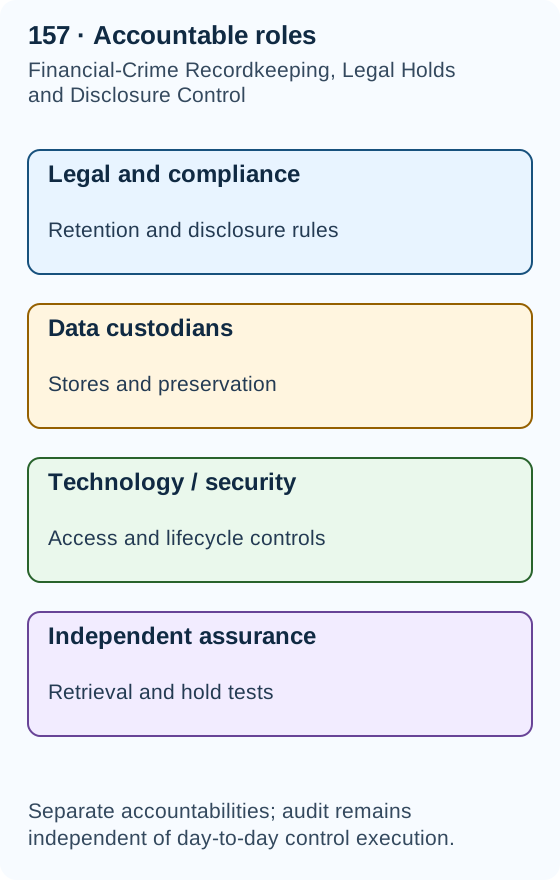
Assign ownership at the category, system and matter levels. Legal and compliance define applicable requirements and protected disclosure routes; business owners identify records created by their services; custodians implement storage and lifecycle controls; technology supports integrity and access; request owners coordinate production. Independent assurance tests outcomes. These are complementary responsibilities rather than a hierarchy in which every function reports to the records team. A missing task should have a named owner, while specialist legal decisions remain with appropriately authorised roles.
Management information should identify whether records are retrievable and correctly controlled. Report failed retrievals by category and cause, hold-propagation exceptions, unresolved migration defects, delivery incidents and overdue lifecycle remediation. Include the affected population and practical consequence. Counting terabytes stored or policies approved does not establish usable evidence. A reduction in archive size may reflect lawful disposal or an unsafe purge; interpret the movement against the schedule and exceptions before presenting it as performance improvement.
Distinguish age of a request from age of a defect. A production might be completed through an alternative source while the archive retrieval problem remains unresolved for future requests. Keep the defect visible with an owner and verified correction. Conversely, an old request may remain open because the authority clarified its scope later rather than because staff ignored it. Accurate chronology helps management understand real exposure and resource needs. Avoid averages that conceal a small number of high-impact records unavailable for active proceedings.
Quality review should sample completed productions and closed holds as well as open exceptions. Trace a delivered record back to its source, verify authorised scope and inspect the exact released version. Select held records from the matter register and confirm preservation at each relevant custodian. Select eligible records from the schedule and confirm disposal treatment. These different directions expose gaps that a control owner's handpicked examples may miss. Review findings together so that improving retrieval does not inadvertently weaken access controls or create uncontrolled copies.
Finally, make unresolved limitations explicit in governance decisions. If an old platform cannot support granular holds, a provider export omits native metadata or a migration leaves attachments accessible only through a temporary reader, state the affected scope and consequence. Identify the approved interim control, resource need and review point. Do not convert a known limitation into a compliance claim because no recent request has failed. Release readiness for a recordkeeping process depends on demonstrable capability when evidence is needed, not merely the absence of a complaint today.
Worked hold conflict
A fictional customer relationship ends and its records approach the ordinary retention expiry. A valid investigation hold covers the customer and related transactions. The bank should identify every relevant store, suspend disposal for the held scope and document the preservation action.
Explain why the normal expiry cannot trigger deletion, why unrelated material still follows its own schedule, and why the hold does not authorise unrestricted disclosure.
Acceptance evidence for record systems
Legal and compliance define requirements; data owners identify storage and lineage; technology implements retention and access; operations test retrieval; information security validates protection; independent assurance challenges coverage. Make the responsibilities explicit where a vendor performs storage or disposal.
Release evidence includes archive retrieval, complete decision history, hold propagation, controlled exports and authorised disposal logs. For migrations reconcile both record counts and critical fields. A successful customer-count reconciliation can conceal lost ownership history or report acknowledgements.
The standard is evidence that remains understandable, accessible to authorised users and protected for its full required lifecycle.
Communications, correction and contested evidence
Business correspondence relevant to an investigation can explain information not present in the ledger: a customer instruction, a change in beneficiary details, a response to a source-of-funds question or a staff escalation. Identify the approved channels where such records are created and captured. Messages should remain linked to the relevant customer, transaction or case without exposing protected material through unrestricted copies. A relationship manager's recollection may help the investigation, but it should be distinguished from a contemporaneous communication that the bank can actually retrieve.
Voice and branch interactions require a proportionate, lawful record appropriate to the service and applicable requirements. Do not invent a universal obligation to record every call. Where recordings or notes are used, retain necessary context such as date, participants, purpose and linkage to the action. A note should make clear whether it records a statement, an observation or an assessment. If a customer disputed an instruction, preserving only the staff member's final decision can leave an incomplete account of what the bank knew and why it acted.
Corrections should preserve material history where needed. A customer can legitimately correct an address, name or identification detail. An analyst may correct a factual error in a case. The current record should become accurate, while the audit trail preserves relevant previous values, timing and authority under the applicable schedule. Overwriting the old value without history can make a later review of a historical decision impossible. At the same time, obsolete incorrect data should not continue driving current decisions as though it remains valid.
Distinguish correcting data from correcting an interpretation. A transaction amount can be wrong because of a parsing defect; an analyst's conclusion can be wrong despite accurate underlying data. The remediation should identify which records and downstream decisions are affected. If a defective export changed several values, reviewing one case note will not repair the population. If the error concerns a single unsupported conclusion, changing the payment ledger would be inappropriate. Preserve the original and corrected representations with a clear account of the error rather than silently replacing evidence used earlier.
Disputed evidence needs an accountable review. A customer may challenge whether a document belongs to them, whether an instruction was authorised or whether a transaction interpretation is correct. Preserve the challenge and assess it through the appropriate process. Do not treat the existence of an investigation label as proof that the customer's account is false. Conversely, a customer assertion does not automatically invalidate reliable source evidence. Record what can be verified, what remains contested and which authorised team decides the resulting action. This improves accuracy without exposing protected reporting decisions.
Data derived by analytics also need clear status. A link between accounts, device association or behavioural score may support investigation, but it is not necessarily a directly observed identity or completed transfer. Preserve the model or rule version, relevant input and limitations appropriate to the decision and recordkeeping need. A generated network diagram should identify supported relationships and avoid implying that every connected party engaged in crime. Where a later model version changes the association, the record should still explain the basis of the historical decision.
Evidence from external public sources should include provenance and date where material. A corporate register entry or media article can change or disappear; a copied excerpt with no source context is difficult to assess. Preserve sufficient information to identify what the analyst reviewed and distinguish it from independently verified fact. Copyright, privacy and access rules still apply to collection and use. The bank should not treat every search result as established adverse information, nor claim certainty when the source concerns a different person with a similar name.
An evidence review should ask whether the file tells a consistent story across sources. Compare the customer's explanation, instruction, processing events, documents and analyst assessment. Differences may reveal an error, a legitimate sequence or unresolved risk. Document the interpretation rather than forcing all records into one simplified narrative. A later reviewer should be able to see both the supportive and contradictory material relevant to the decision. A folder containing only selected confirming evidence can give a misleading impression of the investigation's quality.
The practical handover for a records issue identifies the missing or disputed evidence, source systems already searched, active preservation requirements, disclosure status, accountable owner and next action. Link detailed material through controlled references. If a production has a deadline, derive it from the applicable request or requirement and track dependencies honestly. A handover saying evidence requested leaves the receiving team unable to tell whether a provider failed, a gateway remains unresolved or a file simply awaits review. Precision reduces repeated work and unsafe assumptions.
Before concluding that a recordkeeping control is effective, verify its operation across the actual lifecycle: capture, linkage, preservation, interpretation, authorised retrieval, production and disposal. These stages can fail independently. A bank can store complete evidence but disclose it unsafely, or protect access well but lose an attachment during migration. Assurance should identify the failed stage and the affected population. This produces useful corrective action and a defensible limitation statement rather than a single broad pass label that obscures remaining weaknesses.
References and further reading
Reviewed 2 October 2026. FATF provides international standards; applicable national law determines binding duties. The operating examples are fictional teaching cases.
-
FATF Recommendations, updated June 2026 — relevant anchors: 11 and 21.
-
FinCEN customer communications clarification, September 2026
-
UK MLR 2017 regulation 40, current amended text. UK-specific record categories, triggers, ten-year provision and personal-data deletion exceptions.
-
FFIEC BSA/AML Manual: US Customer Identification Program. Distinguishes identification-information and verification-record retention triggers.
-
FinCEN cross-border information sharing and SAR confidentiality, 5 September 2025. Guidance preserves SAR confidentiality and other applicable law; it creates no blanket disclosure gateway.
-
FinCEN and agencies' customer-communication statement, 2 September 2026. Clarification of existing US requirements, not a new exemption from them.