Financial-Crime Capability, Training and Professional Judgement
Financial-crime capability is the ability to recognise relevant risks, obtain reliable information, apply the correct rules, make defensible decisions and escalate uncertainty. Training supports that capability, but attendance alone does not establish it. A teller, developer, investigator, relationship manager, MLRO and board member need different practical skills.
FATF Recommendation 18's Interpretive Note includes employee screening, ongoing training and independent audit within the programme baseline. National requirements and supervisory expectations determine the binding details. There is no universal FATF rule requiring every role to complete the same annual course or pass one global examination.
Professional judgement is reasoned discretion within legal and policy boundaries. It weighs evidence, alternative explanations and uncertainty; it does not allow a reviewer to waive an obligation because a customer is profitable or a queue is large. Good judgement records what is known, what is inferred, what remains unresolved and why the selected action follows.
Training should connect the person's role to realistic decisions: identifying an ownership discrepancy, handling a fraud-protection call without revealing a SAR, challenging missing payment data, escalating a confirmed sanctions restriction or recognising a monitoring feed failure. All examples should use fictional or properly sanitised information.
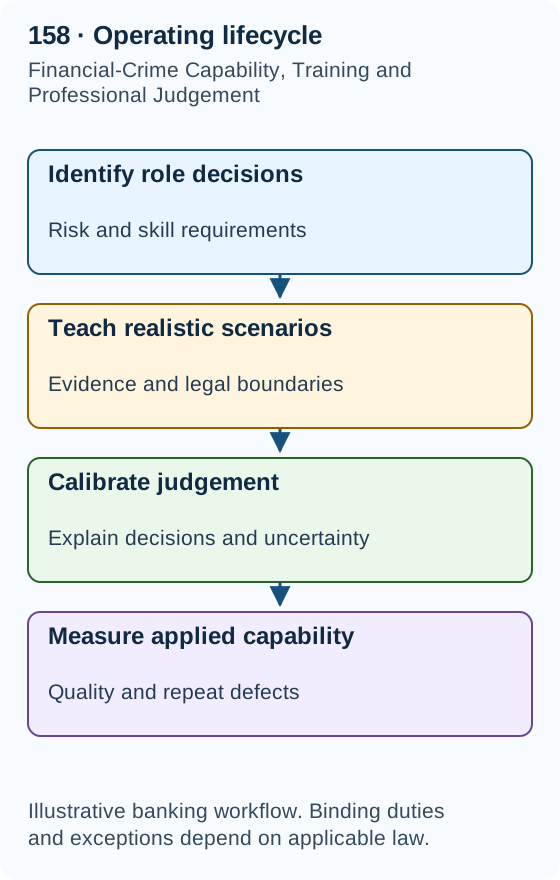
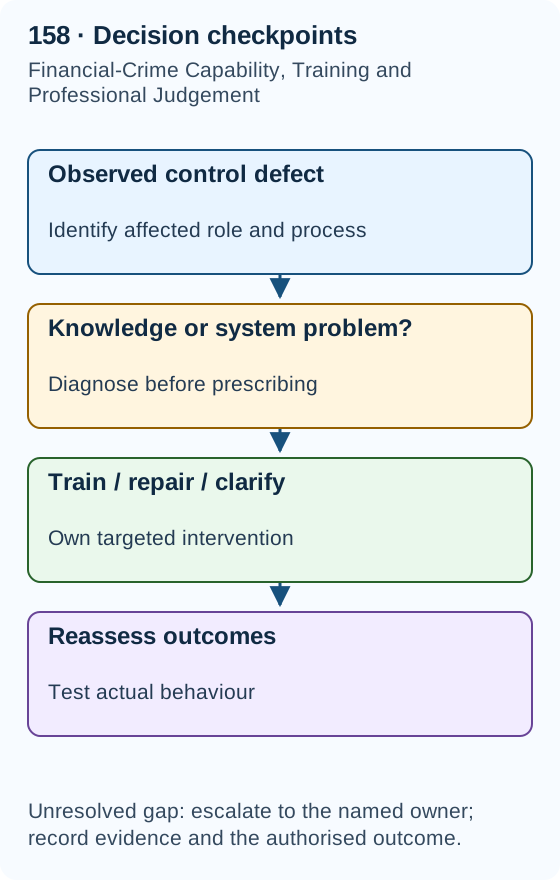
Designing useful training
Begin with a role and risk inventory. Identify critical decisions, common errors, recent findings, product changes and relevant local legal updates. Define what staff must do differently after training and how the bank will assess that change. A developer may need data-lineage and negative-test skills rather than customer-interview practice.
Use cases with incomplete information and plausible alternatives. Ask learners to explain their decision and the next evidence needed instead of guessing a preselected label. Provide feedback showing why an answer is adequate, which facts matter and what would change the conclusion.
Calibration sessions compare reviewers' reasoning on the same fictional cases. Disagreement can reveal unclear policy, inconsistent evidence standards, misleading system prompts or a need for specialist advice. Do not train staff to produce identical wording while leaving the underlying inconsistency unresolved.
Managers need a route for reporting control defects and commercial pressure. Escalations should lead to owned remediation and feedback. If staff repeatedly work around broken mandatory fields, another training module alone will not fix the software or incentive problem.
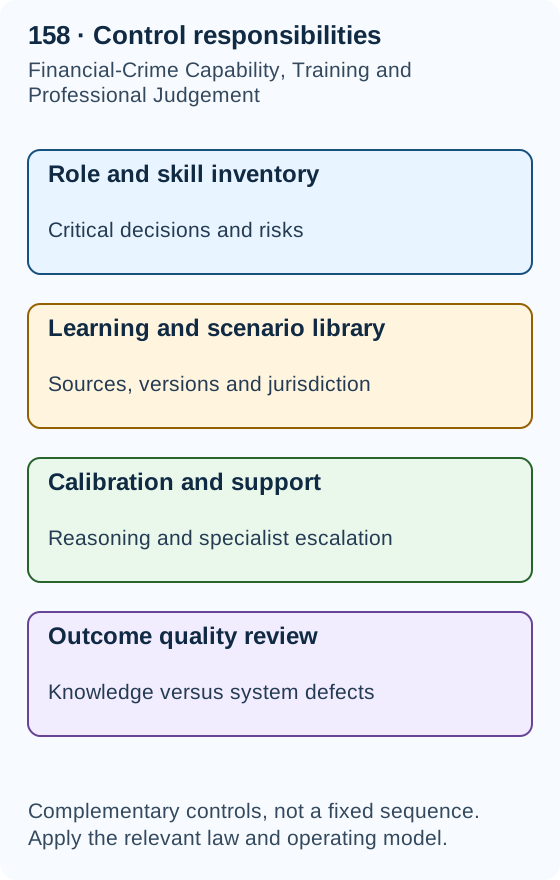
Design capability around the decisions people actually make
A financial-crime capability programme begins with the decisions a bank needs its people to make reliably. Completing a course is one input, not evidence that those decisions are correct. A teller must recognise a relevant inconsistency and escalate it through the right route. A sanctions analyst must resolve identity and legal scope without confusing an alert with a confirmed restriction. A developer must understand whether a data change removes transactions from monitoring. These roles need different knowledge, practice and authority. One generic slide deck cannot establish each capability.
Identify the applicable legal training duties and the operating needs separately. FATF Recommendation 18 includes ongoing training within its international programme baseline; national law supplies binding requirements. As a UK example, MLR regulation 24 covers relevant employees and specified agents, relevant legal awareness, regular training and written records, with appropriate measures informed by business and risk. It does not establish a universal global annual course or fixed pass mark. The bank should map its own duties and then build role-specific capability appropriate to the services and risks it actually has.
Create a role-to-decision map. For each role, identify critical tasks, relevant risks, information available, systems used, decision authority and escalation route. Include staff who contribute indirectly: product owners, data engineers, complaints teams, relationship support, operations and management. A role may influence financial-crime control even if its title contains no compliance language. An employee who changes a payment parser can affect every monitored transaction. A manager who sets throughput targets can change analysts' behaviour. The map should capture those dependencies rather than limiting training to investigators.
Describe competence in observable terms. Recognises red flags is too vague on its own. A stronger objective might require the learner to identify a specific inconsistency, distinguish missing information from contradictory evidence, request relevant material and record an accountable decision. For a data owner, it might require reconciling source and accepted populations after a feed change. For a manager, it might require recognising that a falling alert count reflects missing data rather than improved performance. These objectives let the bank design relevant practice and assess actual capability.
Separate knowledge, skill, authority and resources. A person can know the correct procedure but lack permission to access evidence or an available specialist to consult. Training cannot fix those barriers alone. A person may have the required access but not know how to interpret the product's processing states. The corrective action is different. Capability review should identify the actual reason a decision failed and connect it to the right owner. Requiring another course without diagnosis can consume time while leaving a structural control gap untouched.
Review the role map after product, staffing and system changes. New payment routes, platform partnerships, remote onboarding methods and outsourced services can create new decisions or alter existing ones. A promotion may give a manager approval authority that their prior training never addressed. A move between jurisdictions can change legal thresholds and reporting routes. The programme should update the relevant learning and support before relying on the new capability, with an accountable transition plan where that is not immediately possible. Record what remains unresolved rather than assuming old completion certificates cover the change.
Frontline and relationship roles
Frontline staff need practical recognition, safe information gathering and escalation. Teach the difference between a customer explanation, supporting evidence and an inference. For a cash deposit, a stated business purpose can be plausible while transaction patterns or documents remain inconsistent. The employee should know what information is appropriate to seek, how to record the facts and when to escalate. The aim is not to make every teller a criminal investigator. It is to prevent relevant facts being ignored or transformed into unsupported accusations.
Relationship staff should understand the customer's expected activity and how changes affect the risk assessment. A new source of funds, ownership change or payment destination can require different questions. Training should show how to challenge a commercial narrative respectfully and collect useful evidence without creating unnecessary repeated requests. A statement that the client is longstanding does not resolve a new inconsistency. Nor does wealth itself establish lawful source of wealth. Good practice examines the relevant facts and the bank's actual legal and control requirements.
Customer communication needs its own scenarios. Staff may have to explain an information request, operational delay, fraud concern or account decision within legal limits. They should not improvise protected reporting explanations or promise a transaction will proceed before the authorised review. At the same time, confidentiality must not become a blanket excuse for withholding ordinary, permissible information. Approved guidance should help staff distinguish categories and obtain specialist advice. The training should test an actual response to a realistic customer question, not only recognition of a prohibited phrase.
Inclusion and accessibility affect information quality. Customers may lack familiar documents, use different naming conventions or need another communication format. Staff must know the lawful and approved alternatives relevant to the service and jurisdiction. Do not treat an unfamiliar document as inherently fraudulent or a language difficulty as proof of evasiveness. A legitimate alternative verification path can improve both access and evidence. The bank should test whether staff can use that path accurately while retaining appropriate controls for unresolved identity or inconsistent facts.
Escalation should be operationally available. Staff need to know which channel receives a concern, what information to include and how to handle urgent value movement. Training must reflect the actual service, including weekends or out-of-hours processing where relevant. A concern raised through a defunct mailbox is not an effective control even if the employee completed training on time. Feedback should confirm appropriate handling without disclosing protected information unnecessarily. This helps staff understand that escalation is a useful action rather than an administrative exercise with no visible outcome.
Investigation and sanctions specialists
Investigators need product knowledge as well as typology awareness. Teach how instructions, attempts, postings, settlement, reversals and refunds relate to the evidence. An analyst reviewing a wallet balance can miss a sequence of loads and redemptions if they do not understand the ledger. A securities analyst can confuse order entry with execution. A trade investigator can overstate what document examination proves about goods. Learning objectives should connect the relevant financial mechanics to the investigative question so staff avoid plausible but technically inaccurate conclusions.
Evidence evaluation needs practice with both supporting and contrary facts. A customer explanation can fit part of a pattern while leaving another part unexplained. Analysts should identify what is established, what is inferred and what remains uncertain. They should consider realistic alternatives without inventing facts to close a case. A good assessment explains why further action is or is not needed under the relevant threshold and authority. It does not need theatrical certainty. Unsupported confidence can be more dangerous than a clearly recorded uncertainty with an accountable next step.
Sanctions staff need to distinguish identity resolution, applicable regime, ownership or control analysis and execution of the resulting measure. Name similarity alone does not establish legal coverage, and absence of a company name on a list may not resolve ownership-based restrictions. Training should name the relevant jurisdiction rather than teaching one percentage as a global rule. Humanitarian exemptions and licences need separate treatment. A licence application, expired instrument and current valid authorisation are different states. Practice should include lawful release and legitimate activity, as well as restriction.
Reporting specialists need the applicable threshold, authority and delivery process. A SAR or STR decision is distinct from the relationship decision and from a sanctions freeze. Teach how to produce useful factual narratives with clear chronology, parties, amounts and relevant uncertainty. Do not reward a report merely for being long or for using dramatic typology labels. The record should explain why the activity is relevant and identify the supporting evidence. Where reporting obligations differ by jurisdiction, the programme should keep those distinctions visible rather than normalising them into a generic deadline.
Specialists also need to understand their own limits. Complex legal scope, disputed ownership, protected disclosure or technical data loss may require escalation to other authorised functions. Knowing when to obtain help is a competence, not an admission of failure. Training should identify the available routes and give examples of effective questions. A vague request to legal for approval can produce delay; a concise statement of facts, applicable issue, unresolved evidence and proposed operating consequence is more useful. The bank should support that collaboration with access and capacity.
Operations, technology and data roles
Operations staff execute decisions at points where value moves. Their training should show how a restriction or approval translates into specific system actions, how to verify completion and how to escalate failures. A case marked approved does not prove a held payment was released correctly. A customer marked restricted does not prove every debit channel is blocked. Practice should include scheduled payments, batch files, manual instructions and product-specific exceptions. Staff need to know the distinction between authorised commercial action and a legal restriction that cannot be overridden by ordinary service targets.
Data teams need population and transformation awareness. Teach which source records enter screening or monitoring, how excluded populations are justified and how field changes affect the control. A parser can preserve transaction counts while dropping beneficiary identifiers. A new source can send successful records but omit attempts or reversals needed for a particular scenario. Training should use real interface definitions and controlled examples. The team should know how to reconcile populations, preserve version evidence and involve the control owner before changing an apparently technical field.
Developers and product teams need a usable obligation-to-control view. They do not need to memorise every reporting rule, but they should understand the control consequence of a new payment route, party type or override. A feature allowing destination amendments after approval can invalidate a previous screening decision. A wallet redemption path can bypass the monitored transfer service. Incorporate these questions into design review and acceptance criteria. Learning should be reinforced through actual change processes rather than remain detached from product work.
System support teams need incident scenarios. A feed outage, stale list instance, missing attachment store or unavailable case queue can create different risks. Staff should identify the affected period and population, preserve relevant records and involve the appropriate owner. Restarting a service may restore current operation without recovering missed activity. Training should distinguish availability from coverage and backlog recovery. An incident that silently discards historical exposure is not complete simply because the dashboard becomes green again.
Quality and audit teams require independent methods. They should select records from authoritative populations, reverse-trace decisions and identify whether evidence supports the conclusion. Training should guard against relying exclusively on cases selected by the control owner. Reviewers need product understanding and the ability to distinguish factual, legal, process and technical defects. A missing note and a prohibited payment executed despite a correct freeze instruction have different consequences. Findings should describe the affected control and evidence rather than use a generic failed-case label.
Managers, directors and accountable officers
Managers influence capability through staffing, workload and incentives. They need to recognise when throughput targets cause superficial review, inappropriate suppression or delayed escalation. A reduction in alert backlog can be achieved by good process improvement or by premature closure. Training should help managers ask which occurred. They should review quality and coverage alongside volumes and age. Pressure to meet a service target cannot authorise a legal breach, and a long queue cannot be resolved safely by hiding cases from the metric.
Senior management and directors need a clear account of material risks and limitations. Their learning should cover interpretation of programme information, challenge of remediation plans and understanding of reserved decisions. A slide listing completed training does not explain that an acquired platform is outside monitoring. Board scenarios should ask what information is needed, who owns the gap, what interim control exists and whether the proposed deadline is credible. The aim is informed oversight and decisions, not turning every director into a transaction investigator.
The MLRO or other designated officer needs support for the responsibilities actually assigned under relevant law. Training may include reporting judgement, governance communication, confidentiality, programme challenge and authority engagement. The role should have access to information, specialist advice and resources appropriate to its duties. A course certificate does not compensate for inability to see the affected population or challenge commercial decisions. Capability assessment should examine how the role functions within the bank rather than placing responsibility for every operational task on one person.
Delegation and absence need practical review. A manager should know who can approve, execute and escalate when the primary specialist is unavailable. The deputy needs the required knowledge, access and formal authority, not just a familiar title. Test handovers with realistic unresolved cases. If the bank processes relevant activity continuously, capability must remain available through the operating schedule. A well-trained person who is unreachable when the decision is required cannot provide the full control the programme claims.
Write and maintain a scenario library
A scenario should reproduce a decision with enough facts to be useful and enough uncertainty to require reasoning. Include relevant product, parties, chronology, customer context, evidence and system state. Label fictional values and instruments clearly. Avoid inventing legal thresholds or presenting a typology indicator as proof of a crime. A scenario can show a suspicious pattern without claiming every similar legitimate activity must be refused. Learners should explain their analysis and next action within their role and authority.
Use paired scenarios to test distinctions. Present one instruction with supported legitimate context and another with a material unexplained difference. For example, a refund linked to the original sale differs from a refund redirected to an unrelated account. A listed name that matches a common alias but has reliable incompatible identifiers differs from an unresolved identity. A country under increased monitoring differs from one subject to a particular call for action. The purpose is to test evidence and scope, not whether the learner recognises a dramatic label and selects the harshest response.
Keep source and version information for legal claims. Identify the relevant official rule or guidance, jurisdiction, effective date and status. Distinguish current obligations from proposals and future implementation planning. A draft consultation should not become a present bank duty in an assessment answer. Review scenarios after changes in law, lists or standards. Preserve the version used for a completed assessment so the bank can explain what staff were taught at the time. A current scenario library can coexist with a historical training record without rewriting the past.
Use incidents and quality findings responsibly. Remove or protect real customer and reporting information before using a case for broad training. Preserve the useful decision pattern while avoiding unnecessary exposure or reputational labelling. Include the actual root cause: poor information, unclear authority, missing data, faulty execution or skill gap. A training example that blames an analyst for a missing source field teaches the wrong lesson. Scenario review should involve relevant product, legal, compliance and data specialists where needed.
Define what a satisfactory response looks like. The rubric should identify essential facts, legal or policy boundaries, justified reasoning, evidence required, action and escalation. Allow supported alternatives where the facts legitimately permit them. An answer can be satisfactory while differing in wording or taking a justified additional information step. Conversely, a response containing all expected keywords can still be wrong if it authorises action beyond the learner's authority. Assess the decision and reasoning, not resemblance to a memorised paragraph.
Calibration and professional judgement
Professional judgement means reaching a supportable decision using relevant evidence, applicable requirements and an honest account of uncertainty. It does not mean replacing law with personal intuition or applying a risk score mechanically. Separate factual findings from interpretation and operating action. A case note should explain why the evidence changes or does not change the assessment. This makes judgement reviewable and helps colleagues challenge a material assumption without treating disagreement as disloyalty.
Calibration sessions compare reasoning on common cases. Ask participants to work independently before discussing differences. Review what facts they considered, what rules they applied and which uncertainties drove their actions. The facilitator should distinguish legitimate variation from an error or unsupported assumption. Record the agreed clarification and any policy or system issue requiring a separate owner. A meeting that forces unanimous closure without examining why people disagreed can hide weaknesses rather than improve consistency.
Include borderline and negative cases. If every example ends in reporting or closure, staff can learn that the strongest response is always the safe answer. That can create unnecessary harm and reduce useful intelligence. Teach when evidence supports no further action, when more information is required and when reporting or restrictions follow under the relevant rules. The programme should also make clear that legal obligations cannot be relaxed by averaging different opinions. Calibration supports consistent reasoning within the law; it is not a vote on whether the rule applies.
Review bias and unsupported proxies. A customer's nationality, occupation, language or unfamiliar document can influence assumptions even when the actual evidence is weak. Train staff to identify the relevant risk factors and lawful requirements rather than equate a demographic category with wrongdoing. Use varied legitimate and concerning scenarios. Assess whether information requests and decisions are consistent across comparable facts. Accuracy and inclusion can improve together when the bank challenges unreliable shortcuts instead of treating indiscriminate refusal as a sign of diligence.
Document uncertainty in a way that leads to action. A note saying unclear is insufficient if it does not identify the missing fact, why it matters, who can resolve it and the current operating state. A note claiming certainty without evidence is worse. Teach a concise structure: established facts, relevant requirement, unresolved point, consequence and accountable next step. This makes handover safer and helps managers identify whether the issue needs information, legal interpretation, system repair or additional skill. It also prevents analysts from endlessly repeating the same general questions.
Assessment, coaching and applied outcome review
Assessment should match the role's decisions. Knowledge questions can verify basic distinctions, while scenario responses and supervised work can show whether a person applies them. A frontline assessment might require recognising an inconsistency and escalating with useful facts. An investigator might need to reconstruct a payment and justify the reporting assessment. A data owner might need to identify a missing field in a transformation. A universal quiz with the same pass score for every role can miss these practical needs even when completion is high.
Avoid tests that mirror the training text word for word. They can measure short-term recall rather than transfer to work. Use a new but comparable scenario with changed names, values, timing or product state. Ask for the evidence and rationale, not just a yes or no answer. Include an option that requires escalation where the learner lacks authority or necessary facts. Assessment should not punish justified uncertainty; it should distinguish it from unsupported guessing and identify the next useful action.
Coaching should be specific and proportionate. Explain which part of the decision failed, show a relevant example and let the learner practise the correction. A staff member who confused a reversal with a refund needs product-mechanics coaching, while someone who disclosed protected metadata needs disclosure-process support. Consider whether supervision or access should change temporarily under the bank's authorised process. Do not assign punitive remedial training automatically when the cause is a defective system or impossible workload. The intervention should address the actual risk and preserve fair accountability.
Applied outcome review connects learning to work. Sample decisions before and after an intervention, using comparable populations and considering changes in risk or system behaviour. Review accuracy, evidence quality, escalation and execution. A decline in defects can support effectiveness, but small or selected samples need careful interpretation. A course's popularity or completion rate does not establish control improvement. Record what the evidence supports and what remains uncertain, then decide whether to continue, adapt or replace the intervention.
Retain appropriate evidence of the programme. This can include role coverage, learning version, applicable sources, attendance or completion, assessment reasoning, coaching and outcome review, subject to the relevant recordkeeping and privacy rules. Do not claim a universal retention period for training records without mapping applicable requirements. The evidence should establish who received what learning, when, why and with what result. A certificate with no link to the content version or role objective can be difficult to interpret after law or procedures change.
Diagnose defects before prescribing training
Use a structured defect review. Establish the expected control and actual outcome, then examine the information, procedure, authority, system, workload and skill available at the time. Ask whether the person could reasonably execute the required action. If a screening feed omitted the beneficiary, teaching analysts to review beneficiary matches cannot recover the absent input. If a clear procedure was accessible but repeatedly misunderstood, learning and coaching may be appropriate. Several causes can coexist; record them rather than forcing the issue into a single convenient category.
Information defects require data correction and relevant recovery. A missing document, wrong ownership link or stale source can make a well-reasoned decision unreliable. Training may help staff recognise the limitation, but the source owner must fix the data path and assess affected decisions. Procedure defects require clearer instructions or legal interpretation. Authority defects require valid delegation or escalation. Workload defects may require prioritisation, staffing or process change. Each intervention should have an owner and evidence of outcome instead of being closed through an unrelated course completion metric.
Skill defects also need careful definition. A learner may know the rule but not understand the product evidence, or understand the evidence but write an unclear rationale. Tailor support accordingly. Check whether the training example was inaccurate or the rubric rewarded the wrong action. If many capable staff make the same error, review the programme design as well as individual performance. Repetition of a confusing lesson can reinforce the defect. Subject-matter reviewers should verify the corrected learning before it is distributed broadly.
After correction, test the operating path that failed. If the issue was an unavailable escalation route, demonstrate that staff can now reach an authorised decision-maker. If the issue was an invalid override, verify the system control as well as staff understanding. If the issue was legal-scope confusion, use comparable scenarios and review real decisions where appropriate. The intervention closes when the relevant capability or control has improved with evidence, not when the planned training event appears in a calendar.
Measuring capability and judgement
Use assessment results alongside quality samples, repeat defects, escalation quality and performance after changes. Distinguish knowledge gaps from unclear policy, missing data, workload or technology defects. A high completion rate can coexist with poor outcomes.
Review judgement on both escalated and closed cases. Ask whether the reviewer considered credible explanations, obtained relevant evidence and followed applicable boundaries. An escalation count alone can reward unnecessary referrals; a low count can hide missed concerns.
Refresh content after material regulatory, product or threat changes. Record the source and applicability date so staff can distinguish current obligations from proposals. Keep access to specialist guidance for rare and complex decisions.
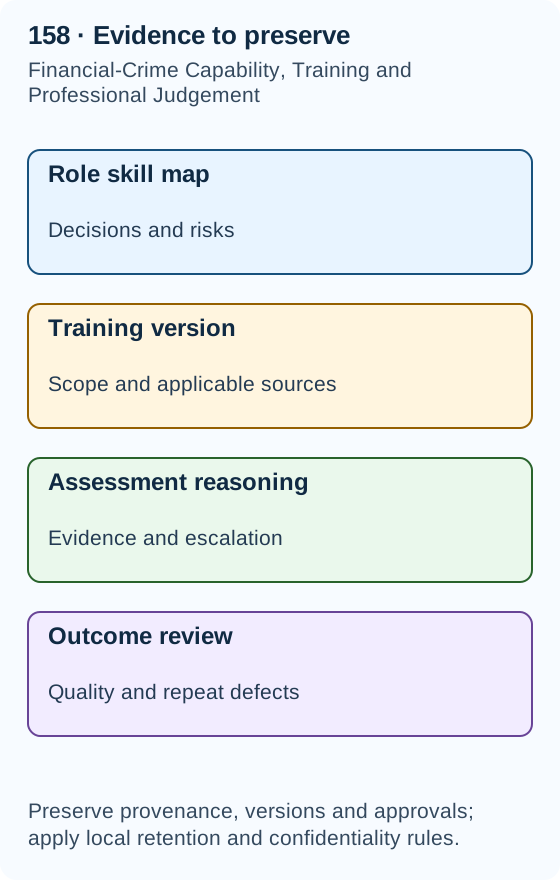
Worked case: a suspicious pattern and a legitimate alternative
These cases are fictional learning examples. They test decision-making rather than assign invented legal thresholds or prove criminal conduct. An investigator reviews a personal account receiving numerous credits followed by rapid onward transfers. A basic typology course described this pattern as a possible mule indicator. The learner proposes reporting and closure solely because the pattern resembles the slide. The bank needs a fuller assessment of customer context, sources, destinations and relevant evidence, with reporting and relationship decisions considered through their separate authority routes.
The available file shows that some credits relate to an organised community collection, supported by contemporaneous messages and a consistent onward recipient. Other credits come from unrelated parties and are redirected to newly added accounts with no supported explanation. The investigator should not ignore the unexplained activity merely because one part of the story is legitimate. Equally, the supported collection should not be described as proven criminal activity to strengthen the narrative. The useful distinction is between the evidenced explanation and the materially unresolved transactions.
The assessment identifies the relevant credits, onward transfers, chronology and evidence gaps. The investigator seeks information proportionate to those gaps and considers the applicable reporting threshold through the designated process. Any relationship action is assessed separately. The case note distinguishes facts from inference and does not claim that rapid movement itself proves laundering. If necessary information remains unavailable, it records why that matters and the authorised next step. It does not fabricate a reassuring explanation to meet a closure target.
The training rubric rewards accurate separation of the supported and unresolved activity, relevant evidence requests and appropriate escalation. It should not require every learner to use the same dramatic typology phrase. Calibration compares two justified responses that differ in their next information step, identifying whether either misses a material fact or exceeds authority. The facilitator also reviews a paired case in which all relevant transactions have reliable supporting evidence. This prevents the course from teaching that every similar pattern deserves the same restrictive outcome.
Applied review later samples real cases with comparable mechanics. It checks whether staff are recording meaningful chronology, considering relevant alternatives and escalating unresolved facts. A lower reporting volume alone does not establish improvement, nor does a higher volume. The useful evidence is better-supported decisions and fewer recurring interpretation defects. If staff still lack access to relevant transaction references, the programme identifies a data or process issue rather than repeatedly prescribing the same typology lesson.
Worked case: training cannot fix a missing beneficiary field
A payments monitoring team receives criticism because several investigations did not identify a common beneficiary across customer transfers. Managers propose mandatory retraining for all investigators. The defect review first reconstructs the expected control and information available. It finds that a payment transformation removed a beneficiary account field before records reached the monitoring engine. The source system contained the field, but neither the relevant scenario nor the analyst's case view received it. Staff could not discover the connection from the supplied evidence alone.
The owner separates the causes and actions. Technology and data teams correct the transformation, test the mapping and reconcile the affected source population. Compliance and operations assess historical exposure and the appropriate recovery process. Analysts receive targeted learning on identifying data limitations and raising a usable incident, but their training is not presented as the repair of the missing field. The incident record states which transactions were affected and what remains unresolved. This avoids making staff completion the substitute for technical coverage.
Acceptance testing uses transfers with the beneficiary account populated, missing and varied in format. The corrected pipeline should preserve the available information and produce the expected monitoring input. Investigators review a case that accurately shows the field and a case where evidence remains incomplete. They should explain the distinction and route the limitation appropriately. The system test and skill assessment complement each other. Neither proves the other: a correct parser does not guarantee good judgement, and a good analyst cannot reconstruct absent input without another reliable source.
Management changes its reporting so course completion is not the only remediation metric. It receives the affected population, recovery results, deployment evidence and remaining data-quality limitations alongside relevant coaching outcomes. Independent assurance selects records directly from the payment source and traces them to monitoring and case review. This direction tests completeness rather than relying only on cases visible in the tool. A successful case sample from the old incomplete population would have concealed the original defect.
The lesson for managers is practical. Before attributing a control failure to knowledge, establish whether the person had the information, system capability and authority required. Staff remain responsible for their own decisions and escalation, but fair accountability needs the actual operating context. A programme that treats every defect as a training issue can look busy while leaving risks unchanged. A diagnosed intervention can improve the underlying control and teach people how to recognise similar limitations earlier.
Worked case: a common-name sanctions alert and an invalid shortcut
A sanctions analyst receives an alert for a customer whose name resembles a listed alias. The case has a reliable identity document, a conflicting date of birth and incomplete information about an earlier address. A colleague says the name has been cleared many times and suggests creating a global exemption for it. The learner must assess the actual identity evidence and the scope of any suppression. A supported false-positive decision for one customer does not justify excluding every future occurrence of the same name.
The analyst records which identifiers agree, conflict or remain unknown and considers their reliability. The applicable process may support a false-positive conclusion on the available evidence, or it may require further review; the scenario rubric should specify the intended evidence and authority clearly. It should not turn every missing field into a true match, nor every inconsistent address into proof of a mismatch. The learning objective is defensible identity resolution and precise uncertainty, separate from any later legal-scope assessment.
If a narrow suppression is authorised, its scope and invalidation events are documented. A changed designation identifier, new customer fact or relevant ownership change can require reassessment. Technology verifies that the rule is linked to the supported case rather than applied globally to the name. The learner explains how the customer can receive timely lawful service while relevant future changes remain visible. This is more useful than training that counts suppression as inherently good or demands permanent review of every unchanged supported mismatch.
The facilitator introduces a second case with the same name but different identifiers that support a relevant match. Learners should recognise that the previous customer's conclusion is not transferable. They then consider a third case with insufficient information and identify the accountable next step and current operating state. The three cases test reasoning more effectively than a single question asking whether matching names should be frozen. They also expose whether staff understand the boundary between an automated alert and an applicable legal restriction.
Outcome review samples false-positive closures and suppression changes, including legitimate release delays and relevant confirmed cases. It checks rationale and execution, not only alert volume. If the interface prevents analysts from seeing the information used by the suppression, a system change may be needed. If the rule is clear but staff repeatedly treat it as a name exemption, targeted coaching and assessment may help. The intervention should reflect the demonstrated cause and preserve evidence of the corrected operating behaviour.
Worked case: commercial pressure and reporting authority
A relationship team seeks urgent release of a high-value instruction while an investigation remains unresolved. The customer is commercially important and has threatened to move business elsewhere. A junior analyst has relevant questions but no authority to make the final reporting or restriction decision. Their manager tells them to clear the case before the service cutoff. The scenario tests escalation, authority and evidence, not whether the learner can recite a slogan about integrity. The bank must provide a real route for an authorised decision within the applicable constraints.
The analyst states the established facts, unresolved information, relevant issue and pending operating event. They escalate through the designated route and preserve the case evidence. The specialist assesses reporting obligations separately from the instruction's permitted treatment and relationship action. Staff do not assume that commercial importance resolves a legal question, or that submitting a SAR automatically authorises a held transaction. The exercise identifies who can decide, who can execute and what happens if the primary officer is unavailable.
The manager's assessment examines behaviour under pressure. A satisfactory response protects the escalation route, obtains relevant advice and communicates the actual operating status. It does not require the analyst to exceed their authority or conceal uncertainty. The customer-facing team uses approved communication appropriate to the legal limits and facts. The bank should assess any avoidable delay and service failure, but those considerations do not create permission for an otherwise prohibited action. A coherent decision record shows the separate assessments and instructions.
After the exercise, leadership reviews whether performance targets encouraged premature closure. If analysts are penalised whenever they escalate a difficult case, training on speaking up may have little practical effect. Incentives, workload and management conduct are part of the operating environment. The corrective action can include revised metrics, better specialist availability and clear delegated authority as well as learning. The bank should then test whether staff actually use the route and receive accountable decisions, rather than recording attendance at another ethics presentation.
Acceptance tests for a capability programme
Test 1: role coverage. Select roles from the actual operating organisation, including an indirect data or product role. Find the mapped critical decisions, applicable learning and assessment. Check a new joiner, a role change and an agent or outsourced role where relevant. Passing requires justified coverage and an identified gap process. A list of people who completed a generic course does not demonstrate that the role-specific decisions were addressed.
Test 2: product interpretation. Present a new but comparable sequence of authorisation, settlement and reversal events for the relevant service. Ask the learner to reconstruct value movement and identify what remains uncertain. Compare reasoning to source records and product definitions. The test should reveal whether staff understand mechanics rather than recognise a memorised typology. A confident narrative that treats an attempt as a completed payment is a substantive error.
Test 3: evidence and inference. Give a scenario with a supported explanation and a materially unresolved element. Require the learner to distinguish facts, statements, inference and unknowns, then identify an appropriate next action. Review whether contrary evidence is considered. Passing does not require certainty where the facts do not support it. It requires a supportable assessment and accountable handling of the uncertainty, within the learner's role and authority.
Test 4: jurisdiction and status. Present a current national requirement, an international standard and a future or draft proposal. Ask which applies to the specified bank entity and transaction now, with a source or escalation route. The learner should not turn a consultation into a current obligation or apply a national threshold globally. The test is particularly relevant after regulatory change, when obsolete course examples can otherwise appear more authoritative than current official information.
Test 5: reporting versus relationship action. Ask the learner to identify who assesses reporting, who decides service continuation and what authority is needed for a restriction. Include a case where the outcomes do not mechanically follow one another. Review whether the response avoids assuming that a SAR proves guilt, mandates closure or authorises asset movement. Passing demonstrates distinct decision routes and appropriate shared evidence, with confidentiality applied to the actual information.
Test 6: safe customer communication. Present a realistic question about an information request, fraud concern or delay. Require an actual response or escalation, not only a multiple-choice label. Check factual accuracy, legal limits and usability for the customer. The learner should avoid revealing protected reporting information and avoid a blanket claim that no explanation can ever be given. Assess the version of approved guidance available in the actual role.
Test 7: available escalation. Run a safe exercise through the operating channel with the primary specialist unavailable. Confirm that staff can reach an authorised deputy, preserve evidence and obtain an executable decision. Include relevant access and out-of-hours arrangements. A learner can know the correct mailbox while the route itself fails. Record knowledge and process results separately so the correction addresses both where necessary.
Test 8: changed data feed. Give the data owner a controlled interface change that preserves record counts but drops a relevant field. Ask them to identify control impact, validation and escalation. Confirm the actual technical mapping through test records. This establishes awareness of semantic completeness, not just service availability. The assessment should connect the change to the control owner and affected population rather than treating it as a purely technical release.
Test 9: training versus system defect. Present a failed investigation caused by unavailable input and another caused by incorrect interpretation of available evidence. Ask the manager to diagnose and assign interventions. Passing requires different owners and outcome evidence for the two causes. A universal remedial course may be one support measure but cannot repair every defect. Review whether the manager proposes recovery for exposed activity as well as a future fix.
Test 10: calibration consistency. Have learners independently assess a common case before discussion. Compare material facts, rules, uncertainty and next action. Record legitimate alternatives and demonstrated errors. Check whether agreed clarification reaches procedures or system owners where needed. Passing is not unanimous wording or automatic escalation of every case. It is supportable reasoning with clear handling of genuine differences and identified control defects.
Test 11: change-sensitive scenario library. Select a scenario affected by a law, source-list or product change. Verify current review, source version and status, then find the historical version used in an earlier assessment. Passing demonstrates both accurate current learning and truthful history. Replacing every historical record with today's text can make the bank unable to explain what staff were actually taught at the time.
Test 12: applied outcome review. Sample relevant decisions after a targeted intervention and compare evidence and quality with an appropriate baseline. Consider changes in product, population and system behaviour. State what the sample supports and its limits. Passing requires some evidence of applied capability or a justified adaptation plan. Popularity, completion and a short-term quiz score alone do not establish that the underlying control improved.
Test 13: incentive conflict. Present a manager with a backlog target and unresolved high-impact cases. Ask what information they need and how they will prevent premature closure while addressing capacity. Review the proposed prioritisation, authority and quality checks. Passing demonstrates that the manager can distinguish efficient processing from hiding risk. The scenario should include a legitimate service concern so the answer considers real operating trade-offs within legal limits.
Test 14: accessible alternative. Present a legitimate customer who cannot use the routine document or communication path. Ask frontline staff to identify lawful approved alternatives and unresolved verification needs. Review whether they avoid demographic assumptions and gather relevant evidence. Passing means an accurate, usable control response. Indiscriminate refusal is not automatically stronger, while unsupported acceptance is not inclusion. The objective is reliable verification and proportionate handling.
Test 15: handover quality. Ask one learner to hand an unresolved case to another through the approved process. The receiving person should identify established facts, missing evidence, authority, current operating state and next action without guessing. Inspect protected-data handling as well as clarity. A concise handover can be effective when it links controlled evidence; a long narrative can still fail if it obscures the pending decision.
Test 16: specialist limit. Give a learner a question beyond their role's legal or technical authority. Assess whether they recognise the limit, frame a useful question and reach the right specialist. Include sufficient facts to avoid a vague referral. Passing does not mean the learner answers every question personally. It means the programme supplies a reliable route to the competence needed, with an accountable operating outcome.
Manage training change as a control change
A regulatory update should produce a scoped impact assessment. Identify the affected bank entities, roles, products, procedures and decisions. Determine what staff need to know now, what remains future planning and what is still a proposal. Do not distribute a dramatic all-staff alert with an unsupported instruction merely because an international standard changed. Use current official sources and appropriate specialist interpretation. Record the effective date and transition needs so managers understand when the changed capability must be available.
Prioritise learning by decision exposure. Staff executing an affected process may need immediate guidance and supported practice, while directors need an oversight update and product teams need design criteria. The same announcement can have different implications for each role. Temporary guidance should identify its scope, owner and review point. It should not become an indefinitely circulating screenshot detached from the authoritative procedure. Where staff cannot yet perform a new required task, the bank needs an accountable interim control rather than a completion deadline that hides the gap.
Validate the content before release. Subject-matter reviewers should check factual accuracy, jurisdiction, effective dates, product mechanics and operational usability. Learning teams should check clarity and accessibility. Technical examples should be tested against the relevant system or definition where appropriate. A beautifully designed scenario with an incorrect settlement sequence can teach a harmful misconception. Record the corrected version and communicate material changes to affected learners. Minor editorial corrections need proportionate handling; a change to the expected operating action requires clearer intervention.
Integrate learning with procedures and tools. Staff should be able to locate current guidance and escalation while working. A course that teaches an action unavailable in the actual interface creates an implementation gap. Product and operations owners should confirm the workflow and update job aids where useful. The learning programme should avoid becoming a separate source of legal truth competing with the bank's controlled policy. Its role is to help people understand and execute the relevant requirements accurately, with clear links to authoritative operating instructions.
Review the change after implementation. Select affected decisions and inspect whether staff used the new process correctly, whether source data were adequate and whether system execution matched the instruction. Capture confusion and unexpected consequences. A feedback form asking whether the course was enjoyable can support delivery improvement but does not establish control effectiveness. If the change causes unnecessary repeated information requests or unsafe overrides, assign the process or system fix alongside any additional learning.
Capacity, support and incentives
Capability needs time and available support. A team can have well-trained staff but too little capacity for its actual case population. Assess work complexity, backlog age, urgent events, specialist demand and absence cover. Do not equate a standard cases-per-day figure with every analyst's feasible workload. A complex ownership investigation differs from a well-supported routine mismatch. Management should understand the consequences of prioritisation and unresolved work rather than assuming training will make every case take the same time.
Supervision can be tailored to risk and experience. New staff may need review of particular decisions until their capability is evidenced. Experienced staff may need targeted support after a product or jurisdiction change. Define the scope and authority of supervision, and avoid making it a permanent unexamined bottleneck. Reviewers also need sufficient capability and time. A second approval that merely repeats the first person's unsupported conclusion does not provide meaningful challenge. Sample the actual reasoning and outcome to assess whether supervision adds value.
Staff should be able to raise defects without being forced to prove a crime or identify a complete technical root cause first. A useful concern can state the observed discrepancy, affected process, available evidence and potential consequence. The receiving owner investigates and provides appropriate feedback. Recognising a missing feed or ambiguous legal instruction is a capability the programme should encourage. At the same time, escalation should contain relevant facts so specialist queues do not fill with vague statements that every customer looks risky.
Incentives should support correct decisions. Counting alerts closed, customers retained or reports filed can influence behaviour in ways that undermine quality. Combine volumes with coverage, sampled evidence and recurring defects. Rewarding every restriction can discourage lawful release; rewarding every cleared alert can encourage unsupported closure. Managers should review both outcomes and their basis. The capability programme can teach this distinction, but performance systems and leadership conduct must reinforce it in actual work.
Well-being and fatigue matter to operating reliability without replacing accountability. Long shifts, repeated urgent decisions and unrealistic targets can increase errors. Managers should identify these conditions and respond through scheduling, support and prioritisation appropriate to the service. Do not treat stress as proof that every decision is invalid, or use personal resilience training as the only remedy for an impossible queue. The bank needs a credible operating arrangement in which people can apply their competence consistently when the decision is required.
Evidence and governance of applied capability
Governance should see both programme delivery and control outcomes. Report role coverage, current content, overdue relevant learning and unavailable specialist support alongside sampled decision quality and recurring defect causes. Explain whether a low assessment result reflects a knowledge gap, poor scenario design or an operating limitation. A completion chart can be useful for identifying missed delivery, but it cannot alone establish capability. Material gaps need a named owner, interim control and verified outcome.
Use quality findings to improve the programme without overgeneralising. One error can reveal a local coaching need or a wider misunderstanding. Assess the affected population and common cause before requiring every role to repeat learning. Preserve the evidence and rationale for the intervention. Review an appropriately selected sample afterwards. If improvement cannot yet be established, state that uncertainty and the next check. This avoids presenting a scheduled course as completed risk reduction before anyone has tested applied behaviour.
Independent assurance should examine whether the bank's capability claims match operating evidence. Select roles and decisions directly from source populations, including difficult cases and legitimate negative outcomes. Review learning versions, assessment reasoning, escalation availability and resulting actions. Challenge unsupported claims that a certificate makes every control effective. The programme's purpose is reliable decisions supported by information, authority and resources. Evidence should show how those elements work together and identify the specific limitation when they do not.
Worked training diagnosis
A fictional investigation team repeatedly omits beneficiary identifiers. All staff completed the required training. Review shows the case form hides those fields and the source feed sometimes omits them. The response should address form design, feed quality and reviewer instruction, then test whether reports improve.
Explain why attributing every defect to staff knowledge is incomplete. Identify the learning outcome and operational evidence that would demonstrate improvement.
Training governance and release evidence
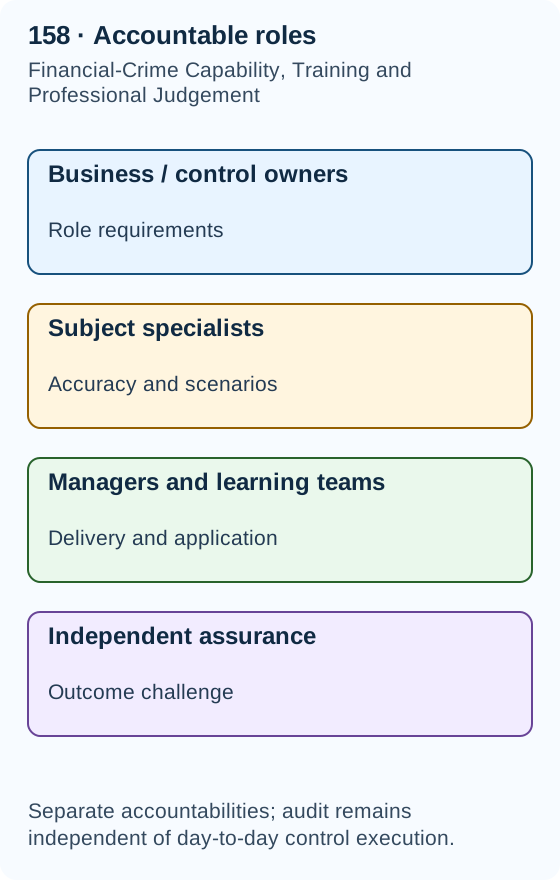
Business and control owners define role requirements; subject specialists validate accuracy; learning teams design delivery; managers assess application; assurance independently samples outcomes. Track version, jurisdiction, assigned population, completion and meaningful assessment rather than a single percentage.
For a product release, include operations, developers, testers and decision owners in scenario rehearsals. Test escalation under time pressure and uncertainty. Capture policy ambiguities discovered during the exercise and resolve them before launch.
Capability improves when staff can explain the risk, act within their authority and produce reliable evidence, with systems and managers supporting that behaviour.
Partner interfaces and cross-team handovers
A bank working with a fintech, agent network or processor needs to understand the capability available at the interface. Identify which party collects information, reviews exceptions, executes restrictions and provides evidence. Contractual allocation and regulatory obligations should be assessed in their actual scope. A partner's claim that its team is trained does not show which decisions they can perform or what happens when they escalate. The bank should obtain relevant evidence appropriate to the arrangement and test the shared operating path it relies on.
Shared scenarios can reveal conflicting assumptions. A platform may think the bank investigates every payout, while the bank may expect the platform to validate the underlying entitlement. A processor may implement a customer restriction only on one payment channel. Present a controlled case with the relevant commercial event, account, instruction and exception. Each party should identify its task, information, authority and acknowledgement. The exercise should not pretend that all participants have identical legal duties; it should establish that the actual allocation produces a reliable outcome.
Outsourced staff need current instructions and available support for the work assigned. A provider's generic induction may omit the bank's escalation, source version or product state. Review how material changes reach the team and how old job aids are withdrawn or superseded. Test staff absence, queue transfer and access to specialist advice. Where the provider cannot supply a necessary competence, the bank needs an authorised operating response and remediation plan. Repeating a contractual assurance does not fill the practical gap.
Handover between teams should preserve the decision context. A frontline concern sent to investigators should identify observed facts and relevant customer information, without claiming an offence has been established. A sanctions assessment sent to operations should specify the executable action and legal scope, not only attach a long memo. A data incident sent to compliance should identify affected fields, population and period. Learning can use these distinct handovers to teach clarity and authority while avoiding unnecessary duplication of protected records.
The receiving team should confirm what remains unresolved and who owns it. An investigation transferred to another region can otherwise lose a reporting deadline or pending instruction. A case moved to long-term asset management can retain licence conditions or reconciliation actions. The handover needs appropriate source links, current operating state and next review trigger. It should not rely on a colleague remembering a conversation. Test whether someone unfamiliar with the case can identify the next authorised action from the record.
Distinguish capability evidence from legal credentials
Professional qualifications and external courses can provide useful knowledge, but they do not automatically establish competence for every bank role or jurisdiction. A qualified analyst may still need product training, current legal updates and practice in the bank's systems. An experienced operations employee may perform a critical control accurately without holding a particular commercial certificate, subject to applicable requirements. Assess the capability needed for the actual task rather than using a credential as a universal substitute for operating evidence.
External learning should receive a proportionate relevance review. Identify which roles and decisions it supports, whether sources are current and whether national examples are labelled accurately. Supplement it with bank-specific procedures and practice where necessary. A global course can be useful while presenting a threshold or deadline that applies only in one jurisdiction. Staff should learn to recognise that limit. The bank should not silently import the example into its policy because the provider is reputable or the certificate looks authoritative.
Training materials themselves can create control risk when they overstate certainty. A mnemonic saying all high-risk customers need the same documents may undermine a properly differentiated process. A diagram showing SAR then close then freeze can teach an incorrect sequence. Review visual aids and answer keys as well as prose. Use precise labels and explanatory context where legal actions are conditional or separate. Readability matters because staff must understand the decision quickly, but simplification should preserve the distinction that determines the lawful outcome.
Learning records should enable later explanation without unnecessary personal exposure. Preserve the relevant content version, role objective and assessment result under the applicable schedule. Detailed coaching material may need more restricted access than attendance records. Managers need useful evidence of capability and support needs, not unrestricted access to every personal note. Keep records accurate when a learner changes role or a scenario is corrected. Historical completion should remain truthful while current capability requirements are reassessed.
The final check for a capability intervention is a realistic decision performed through the available operating route. Verify relevant evidence, authority, execution and escalation, and state the limits of the sample. This connects learning to the purpose of the control. A bank should be able to explain what capability it needs, how it develops that capability, how it knows people can apply it and what happens when they cannot. Those answers support practical governance more effectively than a claim that everyone passed the same quiz.
References and further reading
Reviewed 2 October 2026. FATF provides international standards; applicable national law determines binding duties. The operating examples are fictional teaching cases.
-
FATF Recommendations, updated June 2026 — relevant anchors: 18 and its Interpretive Note.
-
UK MLR 2017 regulation 24, current amended text. UK-specific training and written-record requirements, with measures informed by business and risk; not a universal annual course or fixed pass mark.