Financial Crime Data Lineage, Data Quality and Coverage
A financial-crime control can be beautifully configured and still fail if the right data never reaches it. A sanctions engine cannot screen an ultimate party that disappeared during mapping. A transaction-monitoring scenario cannot detect cross-border behaviour if one payment rail is missing from the feed. An investigator cannot explain an alert if the case screen shows a country code without showing whether it came from the customer profile, the payment message, the device session or an enrichment service. Data lineage, data quality and coverage are therefore not back-office technology concerns. They determine what a bank can actually see, what its controls can reasonably detect and what evidence it can defend after a decision.
The simplest mental model is source → transformation → control → decision → evidence. For every important data element, the bank should be able to explain where it originated, what happened to it on the way, which financial-crime control used it, how it influenced an alert or screening result, and what was retained for later review. Coverage adds a second question: did all relevant customers, products, accounts, transactions, channels and legal entities enter the intended control in the first place? Data quality adds a third: was the information sufficiently complete, accurate, timely, valid, consistent and usable for the control purpose?
These questions sound technical, but their consequences are operational. If a new instant-payment channel starts sending transactions without the same customer identifier used by the monitoring platform, activity may fragment across several identities. If a payment hub truncates an address before sanctions screening, matching effectiveness can deteriorate. If a daily batch arrives after a case is closed, the investigator can reach a conclusion without material activity. If a business line is excluded from a scenario because an old product code was never remapped, the bank may believe it has coverage that does not exist.
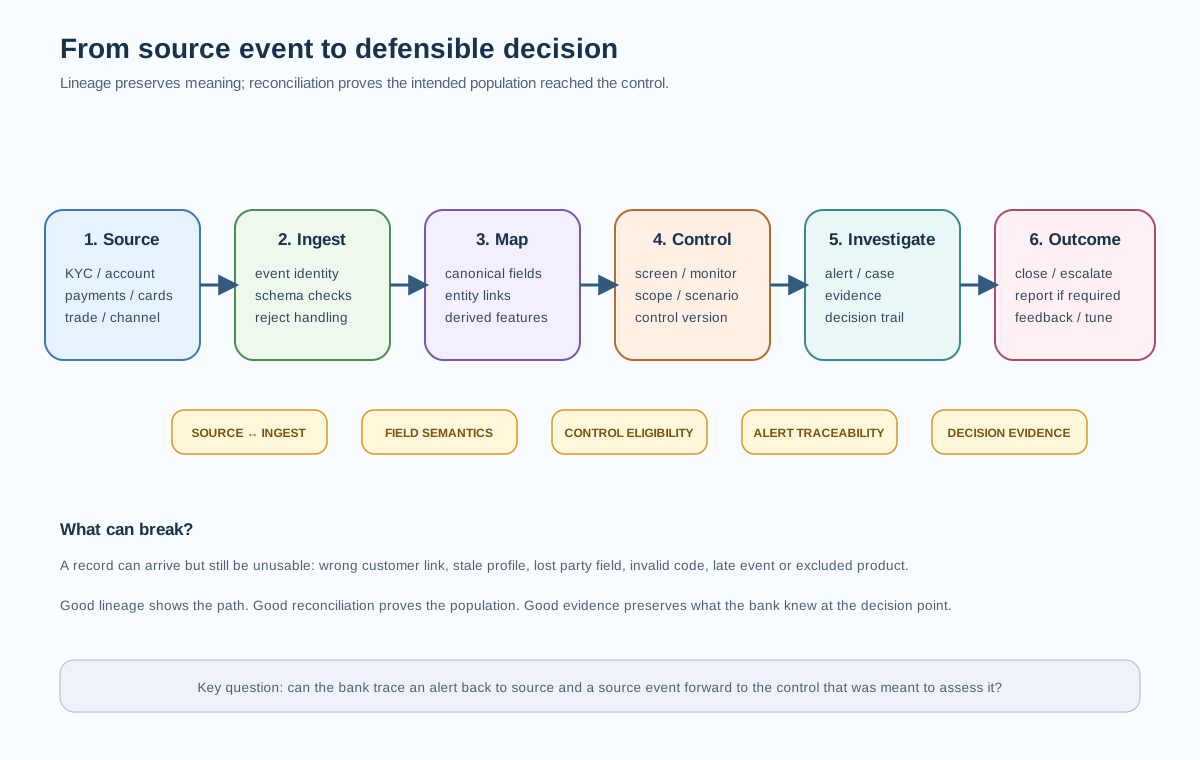
The purpose of this chapter is not to turn compliance professionals into data engineers or developers into lawyers. It is to create a common operating language. Compliance needs to state the risk question and the evidence needed to answer it. Data and engineering teams need to preserve meaning through interfaces and transformations. Operations needs to recognise when missing information makes a decision unsafe. Business analysts need to turn those expectations into testable requirements. Quality assurance and independent testing need to prove that the control population is complete enough and that important data defects are detected rather than silently accepted.
Four ideas that should never be confused
Data lineage is the traceable path of data from origin to use. It includes the source system, field meaning, transformations, joins, enrichments, derived features, control consumption and downstream evidence. Lineage is not just an architecture diagram. A useful lineage record is specific enough to answer questions such as: which source field populated debtorCountry in the monitoring platform on a particular date, what transformation rule applied, which version of the mapping was active and which scenarios consumed the field?
Data quality asks whether data are fit for the control purpose. Quality is multidimensional. A field can be syntactically valid but wrong. It can be accurate but stale. It can be complete at record level while an entire source population is absent. It can be internally consistent yet semantically misleading because two systems use the same code for different meanings. Financial-crime teams therefore need quality rules that are tied to actual control use rather than generic enterprise percentages.
Coverage asks whether the intended risk population is actually inside the control. Coverage is broader than field completeness. A monitoring platform may receive every field for every record it receives while still missing an entire legal entity, product, channel or transaction type. A sanctions platform may screen customer master data but not newly introduced connected parties. A scenario may cover domestic transfers but exclude an API payment product because the event type changed after migration.
Reconciliation is one of the main ways a bank proves coverage and detects breaks. It compares expected population with received and processed population using counts, control totals, identifiers, value totals or other appropriate measures. Reconciliation should be designed around the risk and the system architecture. Matching only row counts is weak if one record can be split into several downstream events. Matching only amounts is weak when zero-value events or non-monetary customer changes matter. The aim is not one universal formula; it is evidence that material activity did not silently fall out of the control chain.
What the global standards do and do not say
There is no single FATF Recommendation called “data lineage”. The relevant global standards instead create obligations whose effectiveness depends on reliable information. FATF Recommendation 1 establishes the risk-based approach. Recommendations 10 and 11 address customer due diligence and record keeping. Recommendation 16 addresses information accompanying qualifying wire transfers. Recommendation 18 addresses internal controls and group-wide programmes. Recommendation 20 concerns suspicious transaction reporting. Banks implement these requirements under applicable national law, and the exact legal obligations differ by jurisdiction.
That distinction matters. A bank should not tell a learner that FATF directly mandates a particular lineage tool, data dictionary or reconciliation percentage. FATF sets outcomes and control expectations at a higher level. End-to-end traceability, data contracts, monitoring inventories and automated reconciliation are implementation capabilities that help an institution demonstrate that those outcomes are actually supported by reliable data.
The Basel Committee's BCBS 239 Principles provide a useful data-governance benchmark, but their original focus is risk data aggregation and risk reporting, particularly for systemically important banks. They are not an AML transaction-monitoring rulebook. The principles nevertheless offer transferable disciplines: governance, robust data architecture, accuracy and integrity, completeness, timeliness and adaptability. The Basel Committee's 6 January 2026 implementation newsletter specifically noted that data lineage remains challenging because of legacy systems, distributed data estates and continuous change. It also highlighted governance, cross-border complexity, emerging technology and compensating controls. Financial-crime teams can learn from that discipline without pretending BCBS 239 creates identical legal duties for every bank or every AML control.
The Wolfsberg Group's statements on Effective Monitoring for Suspicious Activity are also practitioner guidance rather than law. The 2024 statement argues that suspicious-activity monitoring should be broader than traditional transaction monitoring. The 2025 follow-up focuses on responsible transition to innovation and discusses validation, the balance between model risk and financial-crime risk, and explainability of coverage and effectiveness. Those themes are directly relevant to data: a monitoring model cannot be meaningfully validated if the institution does not know which populations and features feed it.
Jurisdiction-specific supervisory material then adds practical expectations. In the United States, the FFIEC BSA/AML Examination Manual asks examiners to assess whether monitoring systems cover relevant higher-risk products, services, customers, entities and geographies and whether system programming and filtering criteria are appropriately reviewed and tested. In Australia, AUSTRAC's current ongoing-customer-due-diligence guidance requires regulated entities to monitor customers under Australian law and stresses systems, controls, policies and procedures. In the United Kingdom, the FCA Financial Crime Guide provides examples of good and poor practice for financial-crime systems and controls. These materials are useful examples, but they should be applied only within their own legal and supervisory context.
The financial-crime data estate
Financial-crime monitoring rarely depends on one source. A retail customer can generate data across onboarding, customer master, accounts, cards, payments, digital channels, fraud systems, screening platforms and case management. A corporate customer can add beneficial owners, directors, authorised signers, trade transactions, host-to-host files, API credentials, correspondent relationships and legal-entity hierarchies. A global bank can add local product systems, regional data hubs, group monitoring platforms and jurisdiction-specific reporting solutions.
For control design, it helps to organise the estate into several data domains. Customer and party data includes identities, names, addresses, dates of birth or incorporation, legal form, ownership and control relationships, occupation or industry, risk rating, expected activity and relationship purpose. Account and product data identifies the accounts, cards, wallets, merchants, loans, securities or other products through which value moves. Transaction data records amounts, currencies, parties, accounts, timestamps, transaction types, status and routing. Channel and technical data may include device, session, API, agent or branch attributes. Reference and enrichment data can include country classifications, entity resolution, watchlists, business registries and other approved sources. Control and case data records rules, scenario versions, alerts, screening matches, analyst decisions, escalations, reports and quality-review outcomes.
Each domain has different quality questions. Customer information can become stale. Payment information can be truncated or mapped to the wrong semantic field. Device data can arrive late or be absent for some channels. External enrichment can change over time. Case-management fields can be edited after the original decision. A strong lineage design therefore preserves both meaning and time.
Effective dating is especially important. Investigators often need to reconstruct what the bank knew when an event occurred, not what the customer record says today. If a beneficial owner changed on 1 June, a transaction from April should be analysed against the ownership relationship that existed in April. If a country-risk classification changed later, the historical control decision should still be reproducible using the version active at the time. The same principle applies to scenario thresholds, screening lists, mapping logic and reference data.
Source to control: preserving meaning through transformation
Most control failures do not begin with obviously missing files. They begin with small semantic changes. A source system may store customer country as residence, while a downstream model assumes nationality. A payment hub may populate the same generic partyCountry field from different message elements depending on rail. A core system may use one transaction code for cash deposit and another system use the same code for cash withdrawal. If these differences are hidden inside ETL, the monitoring platform receives technically valid data with the wrong meaning.
A practical lineage record should therefore capture more than source and target names. It should identify the business definition, source field, transformation rule, reference-data dependency, null handling, data type, effective version, target field, controls that consume the field and the owner responsible for the definition. For high-impact fields, the bank should also know what happens when the value is missing or invalid. Does the record reject? Does it default? Does the control run with reduced information? Is an exception raised? Can an analyst see the original value?
Derived features need the same discipline. A monitoring engine may calculate crossBorderFlag, customerAgeDays, velocity24h, newBeneficiary, cashIntensity or peer-group attributes. These are not raw facts; they are products of logic. Lineage should explain the inputs and calculation, and change control should preserve the version used for each decision. Otherwise an investigator can see that a score was high without being able to explain why.
Coverage starts with an inventory, not with an alert count
A high alert volume does not prove broad coverage. A low alert volume does not prove a gap. Coverage has to be established from the risk universe to the control, not inferred from output.
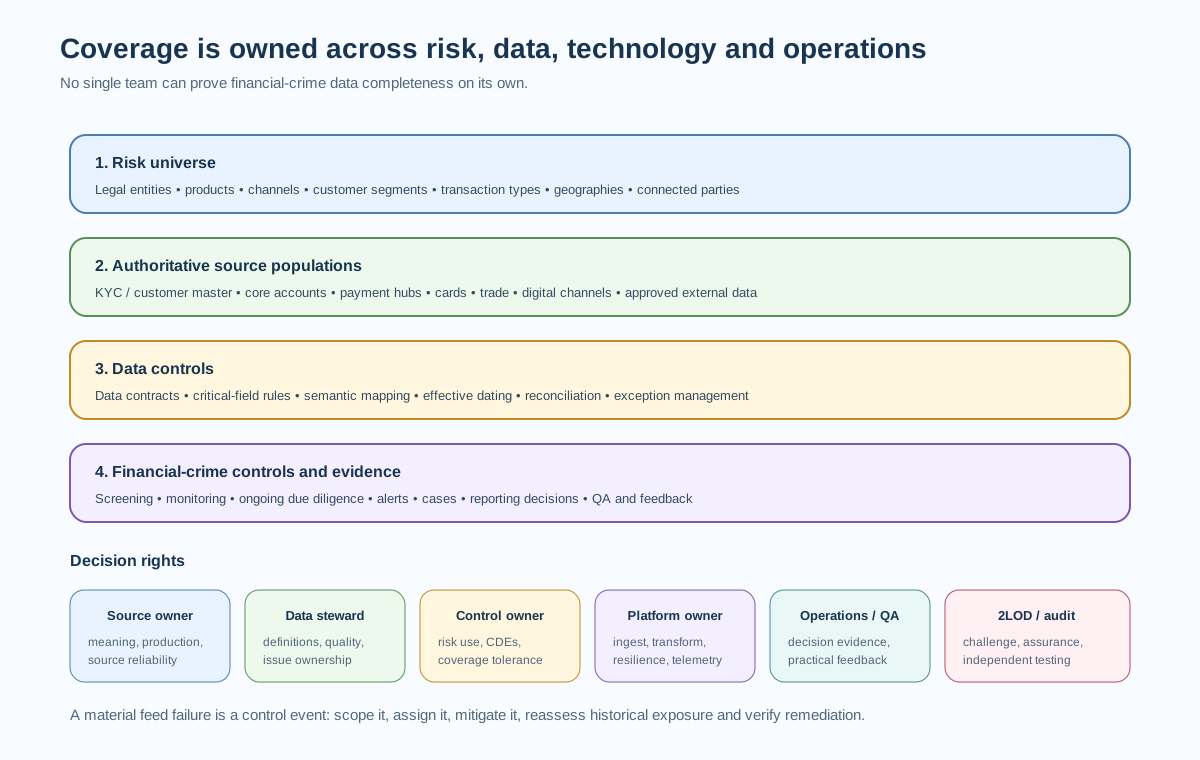
The starting point is an inventory that connects legal entities, businesses, products, channels, customer segments, transaction types and relevant risks to the controls intended to mitigate those risks. For transaction monitoring, this can be expressed as a coverage matrix: which source populations feed which scenarios, what exclusions exist, why they exist, and which compensating controls apply. For sanctions screening, the matrix may include customer types, connected parties, payment rails, trade documents and rescreening events. For ongoing due diligence, it may include trigger events, periodic reviews and behaviour-based refreshes.
Coverage should be explicit about known limitations. If an intermediary payment only exposes limited underlying-party information, the bank should not document “full party coverage”. If an acquired subsidiary is temporarily monitored in a local platform rather than the group platform, the inventory should show the split and the planned migration. If a legacy product cannot provide a particular field, the risk assessment should show how the limitation affects detection and what compensating control is used.
Data quality must be tied to control purpose
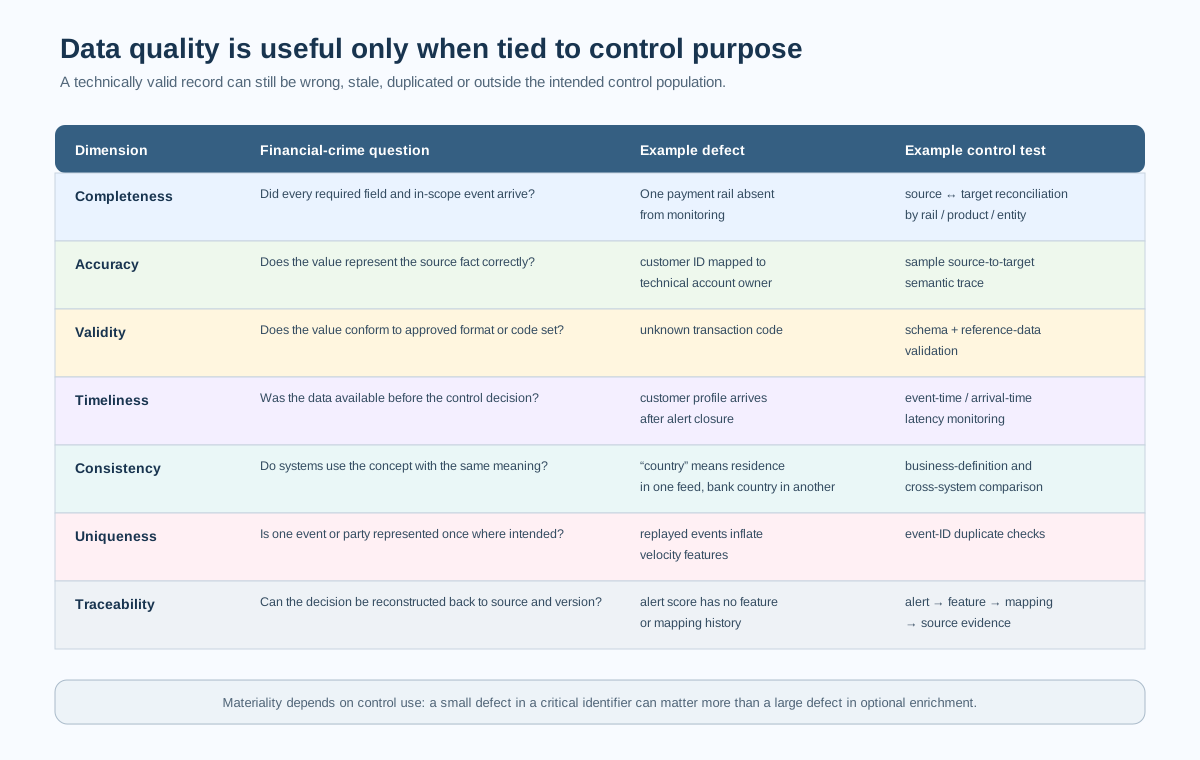
Generic data-quality dashboards often report completeness, validity and timeliness across thousands of fields. That can be useful enterprise information, but it does not tell the financial-crime control owner whether a specific defect can create a false negative, a false positive or an unsafe investigation.
A better model identifies critical data elements for each control. For payment sanctions screening, a party name, relevant address information and financial-institution identifiers may be critical depending on the payment type and applicable requirements. For a cash-structuring scenario, transaction amount, currency, cash indicator, customer/account identifier and timestamp may be critical. For peer-group monitoring, customer segment and business classification may be critical. For an investigation, the alert reason, source events, historical context and previous disposition may be critical.
Quality dimensions should then be connected to those uses. Completeness asks whether expected values and populations are present. Accuracy asks whether values represent the real source fact. Validity asks whether they conform to permitted formats or code sets. Timeliness asks whether they arrive early enough for the control. Consistency asks whether the same concept agrees across systems where it should. Uniqueness asks whether duplicates create double counting or fragmented identities. Integrity asks whether relationships survive transformations. Traceability asks whether the result can be linked back to origin and transformation history.
The required tolerance depends on risk and use. A missing marketing preference is not equivalent to a missing customer identifier in transaction monitoring. A one-hour delay in a monthly management report is not equivalent to a one-hour delay in a control intended to act before an instant payment settles. Quality thresholds should therefore be approved by the relevant control and data owners, with explicit consequences when they are breached.
Payment data: why structured messages do not solve lineage automatically
ISO 20022 can improve structure and semantic richness, but using ISO 20022 does not automatically create high-quality monitoring data. A payment can begin in a customer channel, be transformed into a canonical model, enriched, routed through a payment hub, converted for a clearing system, posted to an account and then copied into a financial-crime platform. Every transformation is an opportunity to lose or reinterpret information.
Consider an ISO 20022 credit transfer. Depending on the message and use case, a bank may receive debtor, creditor, ultimate-party, account, agent, address, purpose and remittance elements. The monitoring system may consume only a subset. A common control question is therefore not “does the message contain the field?” but “does the field survive into the exact dataset used by the control, with its meaning intact?”
The same problem appears during MT-to-ISO migration, domestic-to-instant migration, API channel launches and payment-hub replacement. The source event identifier also matters. If monitoring receives the posting entry but investigation uses the payment instruction, the bank needs a reliable correlation key across both. Otherwise a reviewer can struggle to connect an alert to the original instruction, status changes, returns, rejects or related events.
For business analysts, the requirement should name the business element and its end-to-end path, not simply say “map ISO fields”. For testers, positive cases should prove that important data arrive correctly; negative cases should prove that missing, malformed, duplicated or conflicting information produces the intended control response rather than silent acceptance.
Customer data and entity resolution
Transaction data without customer context can produce shallow monitoring. Customer context without reliable entity resolution can be equally misleading. A person may hold several accounts. A company may operate through multiple legal entities. A payment service provider may hold pooled accounts for underlying users. A merchant can appear under several acquiring identifiers. Beneficial owners and directors can connect relationships that look independent at account level.
Entity resolution joins those records into the appropriate analytical view. It is powerful but must be governed. Over-linking can contaminate innocent customers with another person's risk. Under-linking can hide network activity. The bank should understand the matching rules, confidence thresholds and manual resolution process. Investigators should be able to distinguish verified relationships from probabilistic links.
Reference data also needs effective dates. Industry codes, customer segments, legal-entity hierarchies and risk classifications change. If a customer is re-segmented from small business to corporate, monitoring history should not become unintelligible. The system should preserve enough context to explain both the old and new state.
Alert, case and reporting evidence
Lineage does not stop when an alert is created. The downstream decision chain is part of the evidence. An alert should retain or reference the source events and control version that generated it. A case should record which alerts and other referrals were combined. Analyst notes should distinguish source facts from judgement. Requests for information, customer contact and external research should be time-stamped and attributable. Escalation and filing decisions should show the applicable decision standard and approving role.
This matters when data change during an investigation. A customer record may be refreshed, a transaction description repaired or an external watchlist updated. The case should make clear which information was available at the decision point and which information arrived later. A good system avoids silently rewriting history.
Suspicious-transaction or suspicious-activity reporting is jurisdiction specific. The reporting threshold, deadline, form and confidentiality rules depend on local law. Data-lineage controls support that obligation by helping the institution produce accurate facts and reconstruct the basis of suspicion; they do not replace the legal decision framework.
Governance: who owns what
No single team can own this chapter end to end. The business or source-system owner is accountable for the meaning and reliable production of source data. A data owner or steward maintains definitions, quality rules and issue ownership. The financial-crime control owner defines the risk use, critical data elements, coverage expectations and tolerance for defects. Technology and platform owners implement ingestion, transformation, resilience and observability. Financial-crime operations identifies practical evidence gaps during alert and case work. Model or scenario governance controls derived features, rules and analytical changes. Second-line compliance provides challenge and oversight. Independent audit or testing assesses whether design and operation are effective.
Those roles need decision rights, not just names in a RACI. If a critical feed fails, who can declare the control materially impaired? Who decides whether processing can continue under a compensating control? Who can accept a temporary exclusion? Who reports the issue to senior governance? Who verifies remediation before closure? These decisions should be agreed before the incident.
The most mature operating model treats data defects as control events. A missing field is not automatically a major incident, but the assessment considers the affected population, control purpose, duration, detectability, alternative information, customer impact and legal or regulatory consequence. That creates a proportionate response rather than either ignoring every defect or treating every null value as a crisis.
The rest of this chapter goes deeper into reconciliation, migrations, exception handling, testing, investigation practice and a realistic end-to-end case. The central principle remains simple: a bank should never claim more financial-crime coverage than its data can actually prove.
Operational deep dive: proving that the control population is real
The hardest part of financial-crime data governance is not drawing lineage once. It is proving repeatedly that the population the bank intended to monitor is the population the control actually received and processed. Products change, source systems are upgraded, payment rails migrate, customers move between segments, reference data changes and emergency fixes create temporary routes that can become permanent. Coverage therefore has to be measured as an operating control rather than documented as a one-time design assumption.
A useful coverage model begins with the expected population. For a transaction-monitoring scenario, this may be all posted cash events for selected products and legal entities, all outbound cross-border transfers for a segment, or all transactions associated with customers in a particular risk category. For customer screening, it may be all active customers plus beneficial owners, controllers, directors or other connected parties required by policy. The expected population should come from an authoritative business inventory and risk assessment, not from the monitoring platform itself. If the monitoring platform defines what should have reached the monitoring platform, a missing source can become invisible by design.
The next step is ingestion reconciliation. The bank compares what the authoritative source produced with what the financial-crime platform accepted. The comparison can use record counts, unique event identifiers, totals by source, product, date and currency, hash totals, sequence numbers or other controls suited to the architecture. A good reconciliation is capable of finding both missing and duplicated populations. It also distinguishes deliberately rejected records from technical failures and explains how rejected items are repaired or otherwise controlled.
After ingestion comes processing reconciliation. A record can arrive and still fail to enter the relevant scenario because of transformation errors, filtering rules, segmentation logic or missing derived features. For high-impact controls, the bank should be able to demonstrate the journey from source population to eligible population to processed population to output. This is especially important where a scenario intentionally excludes events. Every material exclusion should have a reason, owner and effective date.
Finally, there is outcome reconciliation. Alerts, screening hits, suppressed results and cases should be traceable to the control execution that created them. Outcome reconciliation does not mean every source event produces an alert. It means the institution can explain why an event was in or out of scope and can reproduce the relevant control path when necessary.
Critical data elements and materiality
A bank cannot govern every data field with the same intensity. Financial-crime programmes should identify critical data elements by control use and risk. The term is deliberately practical: a data element is critical when a defect can materially affect the control's ability to identify, assess, investigate or report relevant risk.
For a monitoring scenario that looks for rapid movement of funds, the customer or account identifier, transaction time, amount, currency, direction and event status can be critical. For sanctions screening, party names and relevant identifiers are obvious examples, while address, date-of-birth, nationality, vessel or corporate information may materially affect match resolution depending on the screening use case. For ongoing due diligence, beneficial ownership, expected activity, customer segment and risk-rating attributes may influence review intensity or scenario selection.
Materiality should be assessed in context. A 1% null rate can be trivial for an optional narrative field and serious for a customer identifier. A defect affecting ten transactions can be more important than one affecting a million records if the ten belong to a high-risk product that is otherwise completely outside monitoring. This is why data-quality thresholds should not be copied blindly from generic enterprise standards.
The impact assessment should ask: what control uses this data, what risk can be missed or distorted, which population is affected, how long has the defect existed, is the problem detectable, can historical data be reconstructed, and which alternative controls exist? The answers determine severity and response.
Data contracts and semantic control
Modern platforms increasingly use data contracts or similar interface agreements. For financial crime, a good contract defines not only technical schema but business meaning. It identifies the event, field definitions, mandatory and conditional elements, code sets, time semantics, identifiers, null rules, versioning, expected frequency and ownership. It also defines what constitutes a breaking change.
This matters because a technically backward-compatible change can still break a control. Suppose a payment source keeps the field name country but changes it from counterparty address country to clearing destination country. The interface still validates. The data may even look plausible. Yet every scenario using the field now answers a different question. Semantic change therefore needs the same discipline as schema change.
Data contracts should also describe event status. Payment systems produce initiated, accepted, rejected, booked, settled, returned and cancelled states. Monitoring can double count activity if both instruction and posting events are treated as separate financial movements. It can also miss risk if only settled transactions are monitored and a relevant control is intended to act earlier. The correct event model depends on the risk use case, but the design must be explicit.
Timeliness and late-arriving data
Timeliness is relative to the control decision. A customer-risk refresh can tolerate a different latency from pre-execution sanctions screening. Daily transaction monitoring can tolerate a different latency from an instant-payment fraud or sanctions control. The data requirement should therefore state when the information must be available relative to the event and decision point.
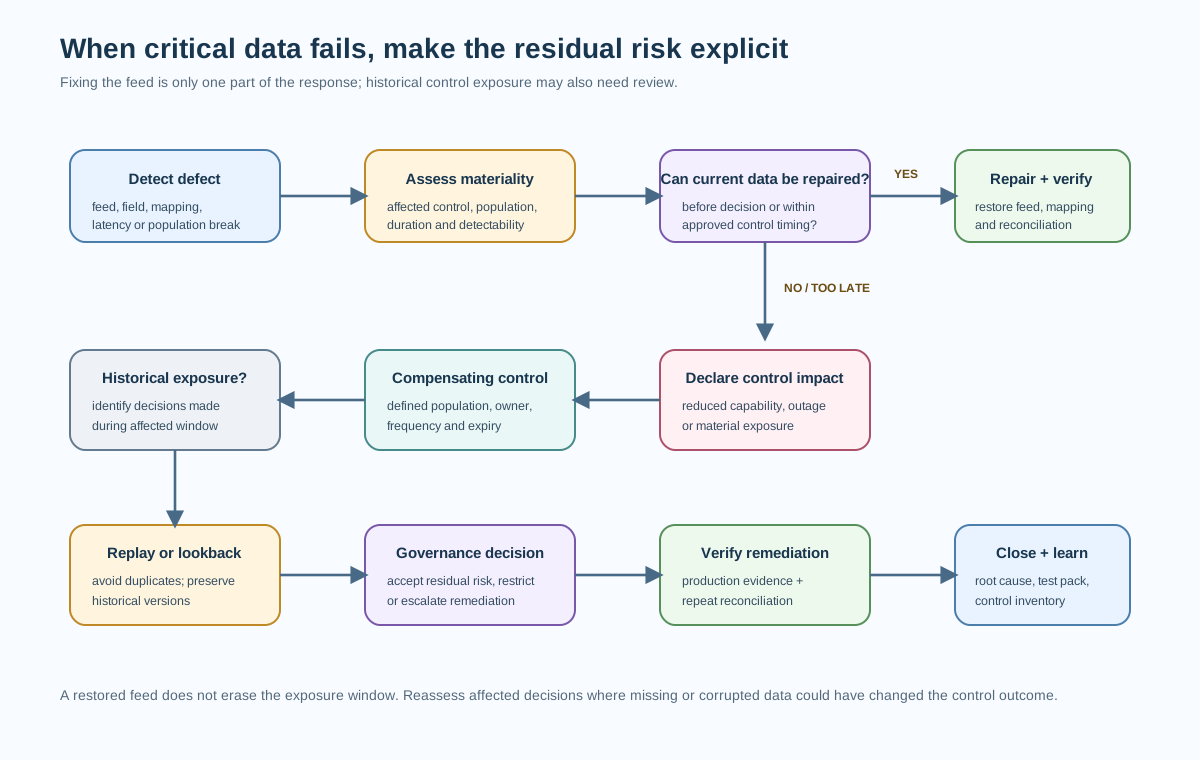
Late-arriving data creates a subtle problem. If a batch is delayed by four hours, the platform may eventually become complete, but alerts generated before the batch arrived may have been incomplete. A mature process identifies which decisions were made during the exposure window and determines whether replay or lookback is necessary. Simply restoring the feed does not prove the control was effective during the outage.
Replay design is important. Systems should know whether replaying historical events can generate duplicate alerts, whether scenario logic uses current or historical reference data, and whether results remain attributable to the correct control version. Where automatic replay is unsafe, a documented alternative review may be needed.
Nulls, defaults and silent repair
Null handling deserves special attention because defaults can hide defects. Replacing a missing country with the customer's residence country may make a record technically complete while corrupting transaction context. Replacing a missing party identifier with account number can merge unrelated entities. Converting an unknown transaction type to OTHER may be acceptable for one report but catastrophic for a scenario that relies on cash or wire classification.
The design should distinguish a genuinely absent value, a value not applicable to the event, a value unavailable from the source, and a value lost through processing. These states should not be collapsed when they have different risk meanings.
Silent repair should be avoided for critical fields. If a mapping engine repairs malformed data, the original and repaired values should be traceable where relevant, and the rule should be governed. Investigators need to know whether they are looking at source data or a derived interpretation.
Entity resolution and relationship lineage
Many monitoring controls operate on networks rather than isolated accounts. Customer-to-account, owner-to-company, merchant-to-terminal, card-to-wallet and payer-to-beneficiary relationships can determine whether behaviour is aggregated correctly. Relationship lineage should preserve the type of link, its source, effective dates and confidence.
For deterministic relationships such as a customer owning an account, the source may be the core customer/account master. For probabilistic relationships such as two digital identities believed to represent the same person, the bank should preserve the matching evidence and confidence threshold. An investigator must be able to distinguish a confirmed relationship from an analytical hypothesis.
Network quality is not measured only by match precision. Missing relationships create false negatives because connected activity remains fragmented. Over-linking creates false positives and can unfairly associate customers with another party's risk. Testing therefore needs both positive and negative identity-resolution cases.
Exceptions and compensating controls
Data issues should enter a controlled exception process. The process records the affected source, control, population, start time, severity, owner and immediate mitigation. It then decides whether the control can continue, continue with restrictions, operate under a compensating control or be declared materially impaired.
A compensating control should be specific. “Operations will monitor manually” is not enough. The record should say what population will be reviewed, using which data, at what frequency, against which risk indicators, by whom and until what exit condition. It should also state what the compensating control cannot see.
Senior governance should receive issues that exceed agreed tolerance, create material unmonitored exposure or remain open beyond the accepted period. The purpose is not to flood committees with technical defects. It is to ensure residual financial-crime risk has an accountable owner.
Reconciliation design for real banking systems
Reconciliation should follow the event architecture. In a batch feed, file sequence, record count and value totals may be strong controls. In event streaming, partition offsets, event IDs, producer acknowledgements and consumer checkpoints may be more useful. In an API flow, request identifiers and response status can help prove delivery, but downstream processing still needs its own evidence.
Financial-crime teams should avoid relying on a single grand total. Reconciliations should be sliced by dimensions that can reveal concentrated gaps: legal entity, product, channel, message type, source system, currency, transaction status or customer segment. A total can balance while one source is missing and another is duplicated.
The control also needs a break-management process. A break is investigated, classified, assigned and resolved. Repeated breaks should lead to root-cause remediation rather than permanent manual repair. The history of breaks is itself management information because it shows where the data chain is fragile.
What evidence should survive for assurance
For an important financial-crime control, assurance should be able to retrieve the approved coverage statement, source inventory, lineage for critical fields, reconciliation design, latest reconciliation results, open data issues, mapping versions, scenario dependencies, change approvals, testing evidence and records of material incidents or lookbacks. Not every artefact needs to live in one tool. The important requirement is that they form a coherent evidence chain.
The evidence should also show limitations honestly. A control described as “cross-border customer transaction monitoring” should not hide the fact that a newly acquired card platform is monitored elsewhere. If underlying payer information is unavailable for an intermediated payment product, that limitation should be explicit. Good governance is not the absence of gaps; it is the ability to identify, assess, mitigate and remediate them before they become invisible assumptions.
Advanced practice: change, validation and assurance
Financial-crime data controls are most vulnerable during change. A platform migration, product launch, ISO 20022 adoption, cloud move, customer-master consolidation or vendor replacement can alter field meaning, event timing, identifiers and population boundaries even when the business process appears unchanged. Mature programmes therefore treat data coverage as part of change acceptance rather than as a post-production clean-up activity.
Migration risk: the old and new worlds must be comparable
A migration test should begin with the existing control population. Teams identify which customers, accounts, products, channels and transaction types are in scope today, which source fields and derived features the control uses, and which known limitations already exist. That becomes the baseline against which the target design is assessed.
The target-state mapping should then make every material change visible. A source field may move to a different message element. A customer identifier can be replaced by a party identifier. One event can become several events. A batch timestamp can become an event timestamp. A legacy code can be replaced by a richer taxonomy. None of those changes is automatically wrong, but each can change scenario behaviour.
Parallel testing is useful when it compares equivalent risk outcomes rather than demanding identical alert counts. The old platform may produce two alerts where the new design produces one better case. A new entity-resolution model may combine activity that was previously fragmented. A redesigned scenario may deliberately reduce false positives. The validation question is therefore whether the new approach maintains or improves the intended risk coverage and whether differences are understood, not whether the output file is numerically identical.
The Wolfsberg Group's 2025 Effective Monitoring for Suspicious Activity Part II statement is relevant here. It argues for a responsible transition framework and highlights validation, balancing model risk with financial-crime risk, and explainability. That is practitioner guidance, not a legal rule, but it captures a real delivery problem: a bank should not block useful innovation merely because a new system behaves differently, and it should not accept a new system merely because it is technologically advanced. Coverage and effectiveness must be demonstrated.
Testing from source to investigation
A strong test strategy has several layers. Schema testing confirms that required fields and code sets are accepted. Mapping testing confirms that business meaning survives transformation. population testing confirms that all intended source events reach the platform. feature testing confirms that derived values are calculated correctly. scenario testing confirms that control logic responds to relevant patterns. workflow testing confirms that alerts and cases preserve evidence. resilience testing confirms what happens when feeds are late, partial, duplicated or unavailable.
These tests should use traceable examples. If the source contains a corporate payment with an ultimate debtor, the test should identify the exact downstream field or relationship in which that party appears. If the target design intentionally does not consume the field, the control owner should understand the consequence. A test that only says “message processed successfully” proves transport, not financial-crime usability.
Negative testing is just as important. Teams should deliberately send a record with a missing critical identifier, an invalid country code, duplicate event ID, out-of-order event, stale customer profile, unmapped transaction type and conflicting customer segment. The expected behaviour should be agreed in advance: reject, quarantine, default, alert, continue with reduced capability or route to an exception queue. Silent success is often the most dangerous outcome.
A practical acceptance model for business analysts
A financial-crime data requirement should be observable. “The system shall provide complete transaction data” is too vague. A stronger requirement describes the population, event point, data elements, timing, reconciliation, failure behaviour and evidence.
For example, an outbound-payment requirement might state that every booked outbound credit-transfer event for defined legal entities and products must be delivered to the monitoring platform with the bank customer identifier, transaction identifier, amount, currency, booking timestamp, payment type and available counterparty information. It should state the permitted latency, how source-to-target population reconciliation is performed, what happens to records that fail validation, and how the operations team can identify the affected customer and control run.
The acceptance criteria then become testable. Testers can prove one-to-one or intentionally transformed event traceability; confirm duplicate handling; validate code mappings; force a late batch; disconnect a source; replay data; change a reference-data version; and verify that the resulting alert or exception retains the correct event lineage.
Requirements should also separate must have for control execution from useful for investigation. Some data are required before a scenario can run. Other information can arrive later to help the analyst resolve the alert. Mixing these categories can create unnecessary real-time dependencies or, in the opposite direction, cause a critical pre-control field to be treated as optional enrichment.
Monitoring the monitoring data
Production data controls need their own observability. Useful measures include whether expected feeds arrived, whether volumes changed outside normal ranges, whether critical-field nulls increased, whether unknown codes appeared, whether reconciliation breaks are open, whether event latency breached tolerance, whether records were quarantined and whether specific controls ran on reduced data.
Thresholds should reflect the data and risk. A sudden 90% drop in card transactions is obviously suspicious from an operational perspective, but smaller anomalies can also matter when they are concentrated. Comparing by product, legal entity and channel often detects issues hidden by enterprise totals.
Trend monitoring helps reveal slow degradation. A customer identifier that becomes null for a small but growing population may not trigger a single-day incident threshold. Over several weeks, it can materially reduce entity aggregation. The control should therefore look for both acute breaks and persistent deterioration.
Management information should avoid misleading comfort. “99.7% complete” means little without the denominator, field, population, period and risk interpretation. Senior governance needs to know whether the missing 0.3% affects low-risk optional enrichment or a critical segment of higher-risk payments.
Data defects can create false positives as well as false negatives
Financial-crime teams often focus on false negatives, but poor data can also generate large quantities of false positives. A missing merchant category can push legitimate merchants into an inappropriate peer group. Duplicate events can create artificial velocity. Stale expected-activity profiles can make normal business growth look unusual. Incorrect country mapping can inflate corridor risk.
False positives are not merely an efficiency problem. They consume investigator capacity, delay higher-value work and can create unnecessary customer contact or restrictions. Data remediation can therefore be one of the most effective forms of scenario tuning.
Root-cause analysis should ask whether the alert was wrong because the scenario was badly designed, because the input data were wrong, because the customer profile was stale, or because the investigator lacked the right context. Tuning the threshold when the root cause is a mapping defect can reduce alerts while increasing risk.
Data quality and analytical models
Machine-learning and advanced-analytics monitoring increases the need for disciplined data lineage. A model can consume hundreds of features, making it harder to see when one upstream definition changes. Training data, feature engineering, model versions and production input distributions all need control.
The Basel Committee's January 2026 BCBS 239 implementation newsletter notes that emerging technologies increase the importance of robust data management because output quality depends on input quality. For financial crime, that is a useful general principle. It does not mean BCBS 239 is a model-governance rule for every AML system; it means data quality cannot be delegated to the model.
Feature drift should be separated from genuine behavioural change. If the average customerTenureDays feature suddenly falls, the cause may be a new customer population, a reset source date or a mapping error. If a model score distribution changes after a source-system release, investigation should consider data changes before concluding that criminal behaviour changed overnight.
Explainability also depends on lineage. An investigator does not need to see every line of model code, but the bank should be able to explain which types of data influenced the result, how those data were governed and whether the values can be traced to source or approved derivation.
Quality assurance and independent testing
First-line quality assurance checks whether procedures and control execution are working as designed. It can sample lineage records, reconciliation breaks, analyst evidence and data-issue closures. Second-line compliance can challenge whether coverage reflects the financial-crime risk assessment and whether limitations are being accepted at the right level. Independent audit or testing can assess the overall design, governance and operating effectiveness.
Testing should not be limited to documents. A reviewer should select a source event and trace it forward into the monitoring platform, then select an alert and trace it backward to its source data. These two directions reveal different weaknesses. Forward tracing tests completeness and transformation; backward tracing tests explainability and evidence.
Coverage testing should also sample excluded populations. A product marked out of scope should have a documented reason and, where required, an alternative control. A scenario with a segment exclusion should prove the segment assignment itself is reliable. Otherwise a valid exclusion rule can become a hidden bypass.
Change governance and release readiness
A release that changes critical financial-crime data should require explicit control-owner review. The impact assessment should identify affected fields, populations, scenarios, screening rules, case workflows and reports. Test evidence should show both normal and failure behaviour. Reconciliation should be ready on day one, not scheduled as a later enhancement.
Post-release verification is essential because production data can differ from test data. The bank should compare source and target volumes, critical-field quality, scenario eligibility and alert behaviour during a defined stabilisation period. Any temporary manual control should have an owner and expiry condition.
Rollback planning should consider financial-crime state. Rolling back an application without reconciling events created during the failed release can create duplicate or missing monitoring. The recovery plan should say how the bank identifies the exposure window and how affected activity will be replayed or reviewed.
What good governance sounds like
A weak governance statement says, “The monitoring platform is 99% complete.” A strong one says, “All intended payment sources are reconciled daily. One legacy corporate channel cannot supply the underlying payer identifier; that limitation affects two scenarios, is mitigated by a defined relationship-level review, is within approved temporary tolerance and has a dated remediation plan.”
The second statement is more useful because it describes population, limitation, control consequence, mitigation, decision and ownership. That is the real purpose of data-lineage governance: not to claim perfection, but to make the institution's actual visibility and residual risk explicit enough for responsible decisions.
Practice close: turning data risk into delivery evidence
The chapter becomes useful when a learner can inspect a real control and ask the right questions. The goal is not to memorise a catalogue of data-quality dimensions. It is to be able to determine whether a bank knows what it monitors, whether the important information survives the journey into the control, and whether a defect would become visible before investigators rely on incomplete evidence.
A review walk-through
Start with one financial-crime control rather than the whole enterprise. Suppose the bank has a scenario intended to identify rapid outward movement of funds after incoming credits. Ask for the risk statement, in-scope customer and product population, source transaction types, critical data elements, derived features and exclusions. The first review question is whether those artefacts describe the same population.
Then choose a recent source event and trace it forward. Confirm that the event receives a stable identifier, arrives in the monitoring platform, is mapped to the correct customer and account, carries the correct amount, currency, direction and time, and is eligible for the intended scenario. If the scenario uses a derived feature such as creditsLast24h, verify how the feature is calculated and whether all required source events were available inside that window.
Now trace backward from an alert. The case should identify the transactions and customer relationship that caused the alert, the control version, relevant features and the analyst's supporting evidence. If the analyst relies on customer segment, expected activity or risk rating, identify where that information came from and whether it was current at the time. If the alert was closed because activity was consistent with a known business event, the case should show the evidence rather than only a conclusion.
Finally, inspect the exception path. What would happen if one source file did not arrive? What if the customer identifier were null? What if a new transaction code appeared? A mature design has observable failure behaviour. A weak one discovers the answer only after a control stops behaving as expected.
Acceptance criteria that can actually be tested
A business analyst can turn this review into concrete acceptance criteria. The exact wording will vary by system, but the following pattern is useful:
- the in-scope population is defined by legal entity, product, channel, event type and status rather than by an ambiguous phrase such as “all payments”;
- each source event has a traceable identifier or correlation method that survives required transformations;
- critical source fields have approved business definitions, mappings, null treatment and owners;
- source-to-target reconciliation detects missing, duplicated and rejected events at a frequency suited to the control;
- the control raises an observable exception when a critical feed or mapping fails instead of silently defaulting;
- derived features can be reproduced from governed inputs and the active logic version;
- alerts and cases retain enough information to reconstruct why the control fired and what information the investigator used;
- changes to critical mappings, data contracts, scenario dependencies or reference data are impact assessed and tested before production;
- known limitations have explicit compensating controls, accountable acceptance and exit conditions;
- production verification after release confirms actual population, field quality and control eligibility rather than relying only on pre-production testing.
These criteria are intentionally end to end. A requirement that covers only ingestion can still leave investigation evidence broken. A requirement that covers only the case screen can hide missing source populations.
Common failure patterns
One common failure is coverage by assumption. A team believes every product is monitored because every product appears in the enterprise catalogue. No one proves that each product generates the events used by the monitoring platform. The correction is a source-to-control inventory and reconciliation, not another policy statement.
A second failure is field-name confidence. A field called country is treated as universally meaningful. In one source it represents customer residence; in another it represents beneficiary-bank country. The correction is semantic lineage and business definitions.
A third failure is technical success mistaken for control success. A file lands, schema validation passes and the interface reports green. Yet half the records carry an unmapped transaction code and are excluded from the scenario. The correction is processing reconciliation and control-eligibility monitoring.
A fourth failure is current-state reconstruction. An investigator reviewing an old event sees today's customer ownership, today's risk rating and today's reference data. The historical decision can no longer be reproduced. The correction is effective dating, versioning and immutable decision evidence where appropriate.
A fifth failure is manual workaround without boundaries. Operations receives a spreadsheet during an outage but no one defines which population it covers, how often it is reviewed or when normal monitoring resumes. The correction is a specific compensating-control procedure with evidence and expiry.
A sixth failure is tuning around bad data. Alert volumes rise after a mapping issue, so thresholds are loosened. The immediate workload falls, but the control becomes less sensitive. The correction is root-cause analysis that distinguishes scenario design, data quality and operating capacity.
Questions for control owners and architects
A control owner should be able to answer: What exact risk is the control designed to detect? Which populations are in scope? Which data elements are critical? Which known data gaps reduce effectiveness? How are those gaps mitigated? How does the owner know the control ran on the complete intended population yesterday?
An architect should be able to answer: Which source is authoritative for each critical concept? How are events identified and correlated? Where are transformations performed? How are mapping versions managed? What telemetry shows missing or late data? How does replay work? Can the case layer retrieve the original or governed source values needed for investigation?
Operations should be able to answer: What evidence is visible in the alert or case? How do reviewers recognise missing data? What escalation exists when evidence is insufficient? Can a reviewer distinguish a source fact from an enrichment or derived feature?
Quality assurance should be able to answer: How is coverage independently sampled? Are excluded populations tested? Are data defects traced to root cause? Are decisions consistent when equivalent facts are presented? Are remediation items closed only after effectiveness is verified?
Chapter recap
Financial-crime data governance has three inseparable outcomes. Lineage makes the information explainable. Quality makes the information fit for the control purpose. Coverage proves that the intended risk population actually entered the control. Reconciliation, exception management, versioning and assurance connect those outcomes into a living operating discipline.
The strongest programme does not claim perfect data. It knows which imperfections matter, detects them quickly, understands their control impact and responds with an accountable decision. That is the standard a bank should aim for when it says a financial-crime control is effective.
Masterclass: the payment migration that looked green
This case is fictional, but the mechanics are realistic. It shows how a financial-crime data problem can survive normal technology testing, affect monitoring and investigations, and require a joined response across payments, data, compliance, operations and assurance.
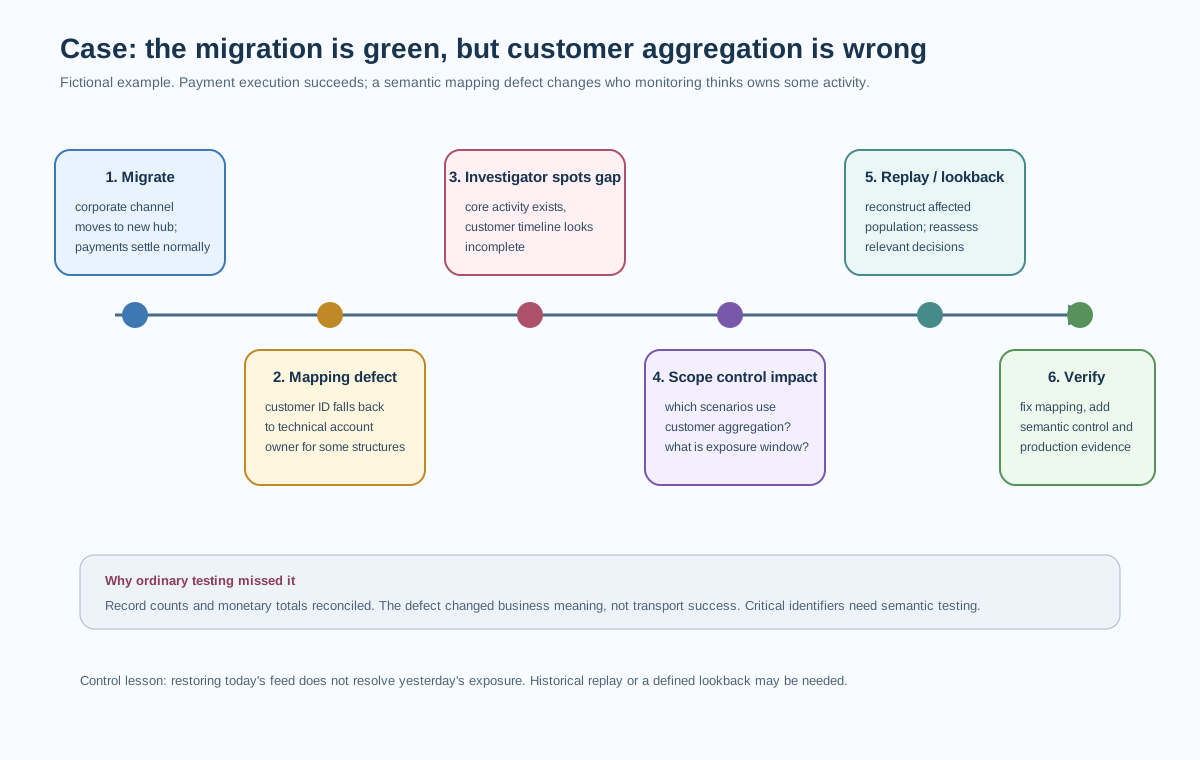
A bank migrates one corporate payment channel from a legacy payment engine to a new payment hub. The business scope is intentionally narrow: outbound customer credit transfers continue to use the same accounts, currencies and clearing routes. The technology programme reports a successful migration. Payments are accepted, booked and settled. Customer service sees no material issue. The financial-crime monitoring platform continues receiving its daily feed and produces alerts at volumes broadly similar to the previous week.
From an ordinary delivery dashboard, the release looks healthy.
What changed underneath
In the legacy flow, the monitoring feed receives the bank customer identifier directly from the channel record. It also receives the initiating legal entity, payment identifier, transaction amount, currency, booking timestamp, payment type, debtor account, creditor account and a set of available party and country attributes.
In the new hub, payment information is normalised into a canonical model before it is sent downstream. The canonical model is richer, but one mapping rule is different. For a subset of corporate files, the customer identifier is not populated from the initiating corporate agreement. A fallback mapping uses the debtor account's technical owner field. Most of the time the two values point to the same customer relationship, so testing passes. For pooled or centrally managed corporate structures, however, they do not.
The result is not a missing transaction. Every payment reaches the monitoring platform. Amounts reconcile. Settlement totals reconcile. The problem is identity attribution. Some transactions are associated with the wrong analytical customer entity.
That distinction explains why basic reconciliation did not catch the issue. The source and target row counts matched. The monetary totals matched. The interface was technically successful. What was missing was a semantic reconciliation of the critical customer identifier.
How the problem becomes visible
The first signal comes from an investigator. A corporate customer that normally generates a combined view across several accounts appears to have unusually little activity in a case. The investigator checks the core account system and can see additional payments that are absent from the customer timeline even though the payments themselves exist in the monitoring platform.
Operations raises a data issue rather than simply closing the alert. A data analyst traces one payment backwards. The event exists in the monitoring feed, but its analytical customer identifier points to the technical account owner rather than the initiating customer relationship. The lineage record shows the new mapping rule and the deployment date.
The team now has a control question, not merely a defect ticket: during the period since migration, which monitoring scenarios relied on customer-level aggregation, which payments were attributed differently, and which alert or case decisions may have been affected?
Containment before root-cause closure
The incident team first stops the problem from expanding. The mapping is corrected for new events after testing in the target environment. A data-quality rule is added to compare the monitoring customer identifier with the approved customer-account relationship for the affected channel. The monitoring control owner defines the affected scenarios and confirms which rely materially on customer aggregation.
The bank does not assume that repairing today's feed solves yesterday's exposure. It identifies the exposure window from the migration timestamp to the corrected deployment. The affected transaction population is reconstructed from authoritative payment records and compared with what the monitoring platform received and how those events were attributed.
For scenarios where the wrong customer association could change the result, the bank determines whether historical replay is safe. Replay must use controlled inputs and avoid duplicate case creation. Where replay is not technically reliable, a defined lookback review is used instead. The decision is documented as a risk-based control response rather than an improvised spreadsheet exercise.
Customer impact is also considered. The defect has not changed payment execution, but a monitoring replay could create new alerts and requests for information. Operations needs to avoid contacting customers merely because data were repaired. An alert is a lead for review, not proof of wrongdoing.
Investigation and reporting decisions remain separate
Suppose the replay identifies activity that was not previously aggregated into one customer's monitoring profile. That does not automatically mean the bank should file a suspicious transaction or suspicious activity report. Investigators assess the newly combined behaviour using the applicable local legal threshold and the customer context. A data defect can explain why the activity was not previously detected; it does not establish that the activity is suspicious.
Likewise, the decision to restrict or exit a customer relationship is separate from the decision to report suspicion. The programme should preserve these decision boundaries. One of the dangers of a significant control incident is organisational pressure to treat every newly discovered alert as proof that the prior system “missed crime”. The correct conclusion depends on the evidence in each case.
Root cause is broader than one mapping line
The immediate root cause is the fallback mapping. The deeper control failure is that the programme's acceptance criteria proved record and value completeness but did not prove semantic integrity of a critical identifier across customer structures. The lineage documentation existed, but the critical-field test did not compare source business meaning with target meaning for pooled structures.
Remediation therefore has several layers. The mapping is fixed. A new critical-data-element rule is added. Migration test packs are expanded to include complex customer/account ownership patterns. The coverage inventory is updated to show which scenarios depend on customer aggregation. Release governance requires explicit financial-crime control-owner approval for future changes to that identifier. The incident is closed only after production evidence confirms the repaired mapping remains stable.
What the case teaches
The case illustrates five practical lessons. First, technical completeness does not equal semantic correctness. Second, reconciliation should be designed around control use, not only data transport. Third, investigators are an important source of data-quality intelligence because they see where evidence does not make sense. Fourth, fixing a feed does not remove historical exposure; replay or lookback may be necessary. Fifth, data incidents, suspicious-activity decisions and customer decisions are related but distinct governance processes.
A mature bank can explain this case from end to end: what changed, which data element was affected, which controls depended on it, what population was exposed, how the bank contained the issue, how historical decisions were reassessed and how the design was improved. That is what defensible lineage looks like in practice.
References and further reading
The chapter uses the following public sources as authoritative or practitioner anchors. They should be read in their own legal and supervisory context. BCBS 239 is a risk-data framework rather than an AML transaction-monitoring rulebook, and Wolfsberg material is industry guidance rather than law.
- Financial Action Task Force, The FATF Recommendations: https://www.fatf-gafi.org/en/publications/Fatfrecommendations/Fatf-recommendations.html
- Financial Action Task Force, Financial Inclusion and Anti-Money Laundering and Terrorist Financing Measures, June 2025: https://www.fatf-gafi.org/en/publications/Financialinclusionandnpoissues/guidance-financial-inclusion-aml-tf-measures.html
- Basel Committee on Banking Supervision, Anti-money laundering and counter-terrorist financing, Basel Consolidated Guidelines AFS10, 1 January 2026: https://www.bis.org/committees/bcbs/basel-consolidated-guidelines/module/afs/10
- Basel Committee on Banking Supervision, Principles for effective risk data aggregation and risk reporting, 9 January 2013: https://www.bis.org/publications/201301-guidelines-principles-effective-risk-data-aggregation-and-risk-reporting
- Basel Committee on Banking Supervision, Implementation of the Principles for effective risk data aggregation and risk reporting, 6 January 2026: https://www.bis.org/publications/implementation-principles-effective-risk-data-aggregation-and-risk-reporting-bcbs-239-principles
- The Wolfsberg Group, Statement on Effective Monitoring for Suspicious Activity, Part I: Moving Beyond Automated Transaction Monitoring: https://wolfsberg-group.org/resources/general/168
- The Wolfsberg Group, Statement on Effective Monitoring for Suspicious Activity, Part II: Transitioning to Innovation: https://wolfsberg-group.org/resources/195/202
- FFIEC, BSA/AML Examination Manual: Suspicious Activity Reporting: https://bsaaml.ffiec.gov/manual/AssessingComplianceWithBSARegulatoryRequirements/04
- FFIEC, BSA/AML Examination Manual: Customer Due Diligence: https://bsaaml.ffiec.gov/manual/AssessingComplianceWithBSARegulatoryRequirements/02
- UK Financial Conduct Authority, Financial Crime Guide: https://handbook.fca.org.uk/handbook/fcg
- AUSTRAC, How to monitor your customers: https://www.austrac.gov.au/industry-and-business/obligations-and-guidance/your-amlctf-program/customer-due-diligence/ongoing-customer-due-diligence/how-monitor-your-customers
- AUSTRAC, What you must monitor for: https://www.austrac.gov.au/industry-and-business/obligations-and-guidance/your-amlctf-program/customer-due-diligence/ongoing-customer-due-diligence/what-you-must-monitor
- AUSTRAC, How we ensure data quality for our regulatory and intelligence operations: https://www.austrac.gov.au/news-and-media/article/how-we-ensure-data-quality-our-regulatory-and-intelligence-operations
- European Banking Authority, EBA and AMLA complete handover of AML/CFT mandates, 19 January 2026: https://www.eba.europa.eu/publications-and-media/press-releases/eba-and-amla-complete-handover-amlcft-mandates
- ISO, ISO 20022: https://www.iso20022.org/
- Swift, ISO 20022: https://www.swift.com/standards/iso-20022