High-Risk Product, Sector and Channel Monitoring
A bank does not manage financial-crime risk well by placing a red label on a sector and then monitoring every customer in that sector in the same way. The words higher risk are useful only when they are translated into a precise explanation of what could go wrong, why the bank is exposed, which information the bank can observe, which controls reduce that exposure, and what evidence should cause an investigator to act. Private banking, remittance, gambling, charities, real estate, non-bank payment services, merchant acquiring, virtual assets and remote delivery channels can create elevated money-laundering or terrorist-financing exposure in some circumstances. None of those categories is automatically suspicious.
The practical monitoring problem is therefore one of context. A regulated remitter can legitimately process thousands of low-value transfers in a day. A private-banking customer can legitimately move a large amount between investment structures. A humanitarian organisation can legitimately send funds to a difficult jurisdiction. A property company can legitimately receive large one-off payments. A payment fintech can legitimately produce rapid, API-driven transaction bursts. Generic rules designed for a normal retail current account will often generate noise against those customers while missing the risks that actually matter.
A useful mental model combines six dimensions: the customer, the product or service, the sector or business model, the delivery channel, the geography and the observed behaviour. These dimensions should not simply be added into a mysterious score. They should explain the risk story. What is expected? What changed? Which information is missing? What controls are working? What residual concern remains after the evidence is reviewed?
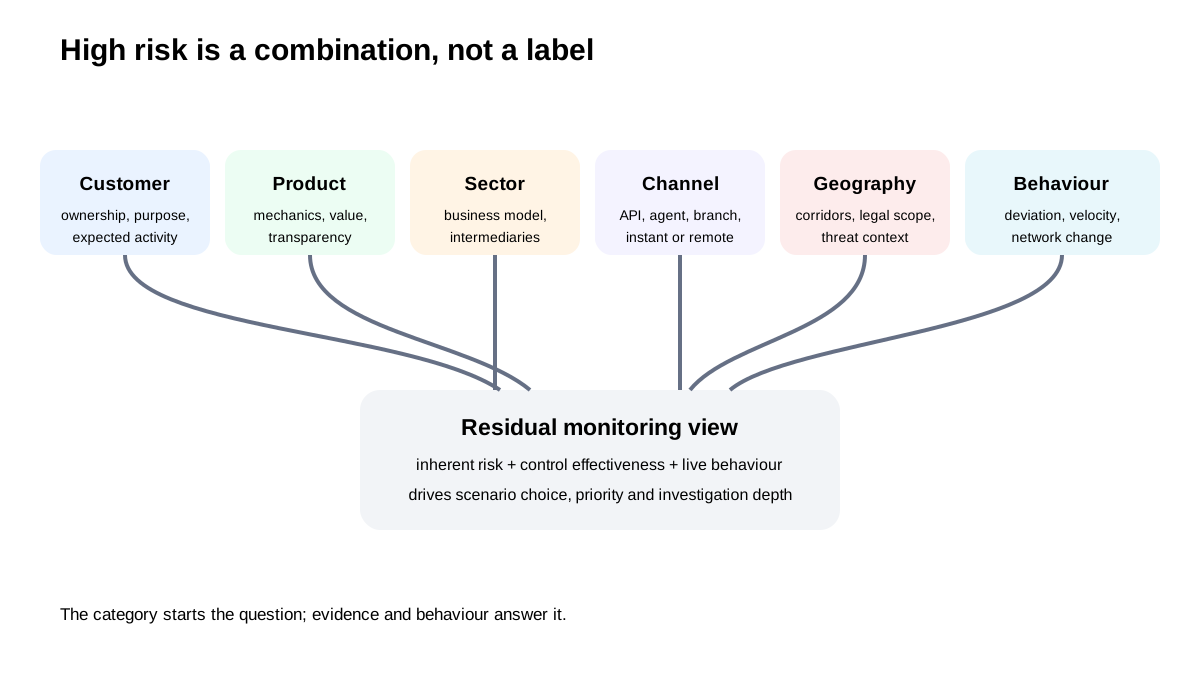
The diagram matters because the same customer can move between risk states without changing industry. A payment firm may be well understood while operating through approved corridors, then introduce an embedded-finance partner and a new settlement model. A charity can move from domestic programme spending to emergency relief in a conflict-affected region. A wealth client can sell a business and legitimately change the scale of activity. Monitoring has to absorb those changes instead of relying on an onboarding label that may be years old.
The global risk-based principle
FATF Recommendation 1 is the global starting point. It requires countries and covered sectors to identify, assess and understand money-laundering and terrorist-financing risks and apply measures that are proportionate to those risks. The February 2025 revisions to Recommendation 1 increased the emphasis on proportionality and on allowing and encouraging simplified measures in lower-risk circumstances. That direction is important for higher-risk monitoring as well: a risk-based approach is not a licence to apply maximum friction everywhere.
FATF's 2025 financial-inclusion guidance reinforces the same idea. Strong AML/CFT controls and access to formal financial services are not competing objectives when controls are genuinely risk based. The guidance gives practical examples of institutions and authorities using differentiated measures instead of excluding whole groups. For an investigator or product owner, the operational lesson is simple: a category can justify deeper understanding, but the final control decision should still be linked to the facts of the relationship.
The Wolfsberg Group's updated 2026 Guidance on the Risk-Based Approach describes proportionality, prioritisation and effectiveness as core elements of a financial institution's programme. That is a useful practitioner lens. Proportionality asks whether the control intensity fits the identified risk. Prioritisation asks whether scarce review and engineering capacity is being directed to the most important threats. Effectiveness asks whether the control contributes to useful risk outcomes rather than merely creating alerts or collecting documents.
National and regional frameworks then add legal detail. In the European Union, the EBA's ML/TF risk-factor guidelines use customer, product or service, delivery-channel and geographical factors and contain sector-specific guidance. In the United States, the FFIEC BSA/AML Examination Manual tells examiners to consider the risks associated with products, services, customers and geographic locations, while also stating that no specific customer type automatically presents a higher risk. In Australia, AUSTRAC guidance similarly expects regulated entities to consider designated services, customers, delivery channels and countries. These are jurisdiction-specific frameworks; they should not be copied into another country as though they were universal law.
That distinction between a global principle and local obligation is critical in system design. A global bank can share a common risk taxonomy, data model and control philosophy, but legal thresholds, report types, record-keeping periods, restrictions and customer-notification rules may differ by legal entity and jurisdiction. Requirements should therefore carry legal-entity and jurisdiction scope rather than rely on one global HIGH_RISK = TRUE flag.
Inherent risk, controls and residual risk
A strong monitoring design separates three questions. Inherent risk asks what exposure exists before the bank's controls are considered. A non-bank payment provider with cross-border remittance, agent distribution and pooled settlement may have greater inherent complexity than a domestic payroll company. Control effectiveness asks whether onboarding, payment transparency, limits, monitoring, screening, contractual rights, case management and governance actually reduce that exposure. Residual risk asks what remains after those controls and whether it fits the bank's risk appetite.
This prevents a common failure where a relationship receives a high customer-risk rating and everyone assumes the risk has been managed simply because enhanced due diligence was performed. Enhanced due diligence is not an outcome. The bank still needs to know whether the information is current, whether transaction data reaches the monitoring platform, whether scenarios are appropriate for the business model, whether alerts are investigated competently and whether known control gaps are being compensated for.
The reverse problem also occurs. A bank may apply very strong controls to a relationship whose underlying risk has reduced, but never revisit the control intensity. That creates unnecessary operational cost and customer friction. Risk review should therefore permit both upward and downward change when evidence supports it.
The monitoring lifecycle
Higher-risk monitoring begins before the first transaction. During onboarding, the bank identifies the customer and relevant beneficial owners or controllers, understands the purpose of the relationship and records expected products, transaction types, countries, counterparties, volumes and channels. The specific information should reflect the relationship. A remitter may need corridor and agent information. A private-banking relationship may need source-of-wealth and structure information. A charity may need programme geographies and delivery-partner context. A property business may need an explanation of client-money or settlement flows.
Those expectations then become a dynamic baseline. If the customer adds a new channel, partner, product, geography or legal entity, the change may need to flow into the monitoring profile. A static KYC record and a dynamic transaction-monitoring system cannot work effectively if they never exchange state.
Transaction monitoring compares actual activity with expected activity, peer behaviour, sector mechanics, known typologies and network relationships. The sector label should influence scenario selection, peer grouping, alert priority and investigation questions. It should not be the sole reason for suspicion.
Investigations then close the loop. A case may show that the activity was expected, that the customer profile is stale, that a control is missing, or that the activity remains unexplained and should be escalated. Those outcomes should feed back to KYC, product governance, scenario tuning and risk assessment.
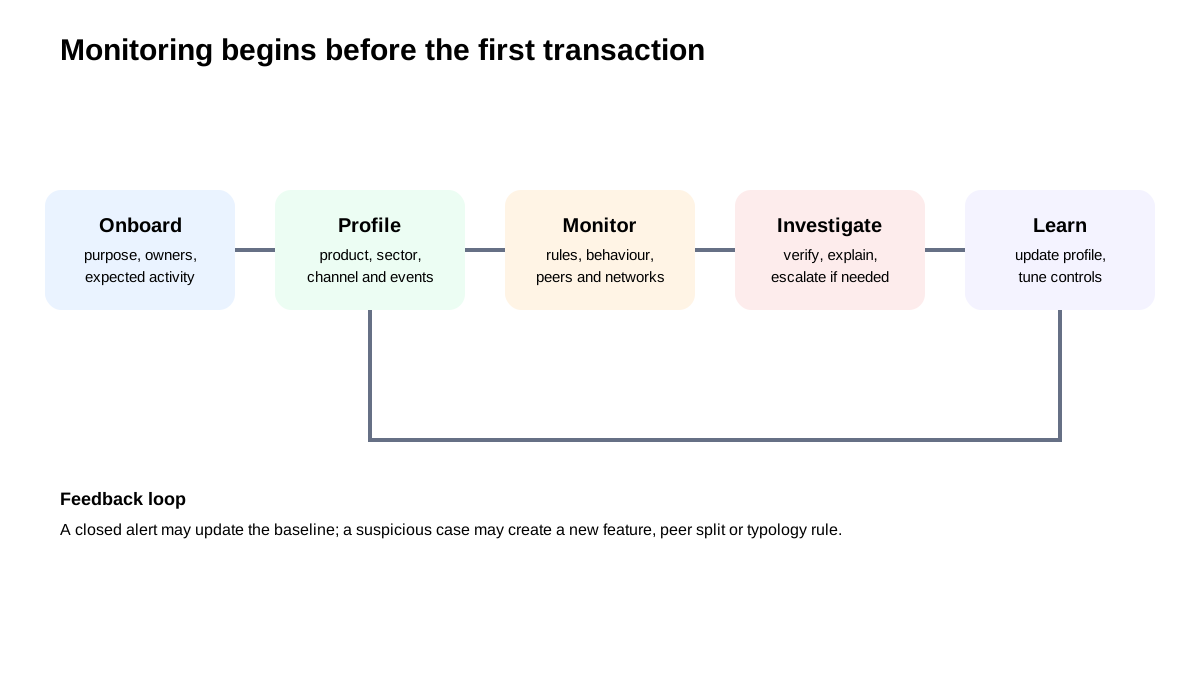
A well-designed lifecycle allows four different results. The bank may close the alert with a clear rationale because the activity is consistent with the relationship. It may refresh the profile because the business changed. It may apply enhanced review or a temporary restriction because material questions remain unanswered. Or it may conclude that the evidence meets the local threshold for suspicious-activity escalation or another legal action. Treating every higher-risk alert as a path to the final outcome creates confirmation bias.
Private banking and wealth
Private banking illustrates why simple thresholds are weak. Large values, multiple jurisdictions, investment entities, trusts and professional advisers may be normal. The useful question is whether the activity is economically coherent with the customer's known wealth and purpose.
Source of wealth describes how the customer accumulated overall economic capacity; source of funds describes the origin of particular money used in a transaction or relationship. The distinction matters. A customer may have a credible long-term wealth story but still receive a specific transfer whose source is unclear. Conversely, a specific payment can be documented while the wider accumulation of wealth remains insufficiently understood for a higher-risk relationship.
Monitoring should join account activity with verified relationship context where lawful and available. If a customer is known to have sold a business, a large receipt from the documented buyer may fit the profile. If the funds arrive from an unrelated company in a different jurisdiction and are rapidly dispersed to third parties, the bank has a different question. The investigator should not infer illegality from complexity alone; the task is to establish whether the parties, purpose and value path can be explained with reliable evidence.
Complex legal arrangements also need careful treatment. Trusts, foundations and holding companies can serve legitimate succession, investment or asset-management purposes. The bank should understand ownership and control according to the applicable law and its own policy, identify relevant connected parties and preserve effective dates so historical transactions can be reconstructed. A structure that is complex but transparent is different from a structure whose purpose, control or economic benefit remains unclear after reasonable enquiry.
Relationship-manager knowledge can be valuable, but it should be captured as evidence rather than authority. "Known to the relationship manager" is not a sufficient closure reason. A useful case note states what event generated the funds, how that event was corroborated, who the counterparties are and why the transaction matches the customer's profile.
Money or value transfer services and non-bank payment providers
Remitters, money services businesses and other non-bank payment service providers can create a very different monitoring problem. Their accounts may legitimately show high volume, rapid turnover, pooled settlement and large numbers of counterparties. A normal corporate velocity rule can therefore be useless.
The bank first needs to understand the relationship type. Is the institution providing an operating account, a safeguarding or client-money account where relevant under local law, payment access, prefunding, settlement, foreign exchange or another service? Does the payment provider act for its own customers? Does it use agents or sub-agents? Which data does the bank receive about underlying originators and beneficiaries? The answers determine what the bank can honestly claim to monitor.
This point is especially important in 2026. The Wolfsberg Group's July 2026 Guidance on the Provision of Banking Services to non-bank Payment Service Providers describes a risk-based framework for these relationships and highlights the challenge created by intermediation. The guidance also reflects the June 2025 FATF Recommendation 16 changes on payment transparency. A bank should not assume it sees every underlying party merely because it processes the settlement leg.
Monitoring can use corridor changes, volume changes, settlement behaviour, concentration, agent patterns and underlying-party information where that information is actually available. A sudden new destination country is not suspicious by itself; it becomes meaningful when combined with the customer's approved business model, licensing footprint, product governance and other behaviour. Likewise, rapid settlement can be entirely normal for a payment provider while unexplained use of an unapproved partner or a material deterioration in transparency may require escalation.
For business analysts and architects, the key is to model layers explicitly: bank customer, payment provider, agent or partner, underlying payer, underlying payee, settlement account and payment event. Flattening those roles into sender and receiver destroys context and can create both missed risk and false alerts.
Non-profit organisations and charities
NPO monitoring needs particular care because an overbroad "high-risk charity" label can obstruct legitimate humanitarian work. FATF revised Recommendation 8 in 2023 to reinforce a focused, proportionate approach to the subset of NPOs that may be vulnerable to terrorist-financing abuse. Its updated best-practices work emphasises targeted measures rather than treating the entire NPO universe as uniformly high risk.
A bank should understand the organisation's purpose, funding model, operating locations, programme partners and distribution methods to the degree justified by risk and local requirements. A domestic sports association collecting membership fees presents a different operating model from a humanitarian organisation distributing aid through field partners in a conflict-affected region. The second relationship may require more information and monitoring while still being legitimate.
Useful monitoring asks whether transactions align with programme purpose and declared geographies, whether major partners are understood, whether material changes are governed and whether cash or alternative delivery methods make sense for the environment. During an emergency, a charity's transaction volume or geography can change rapidly. If the bank cannot update the expected profile quickly, generic monitoring may repeatedly flag activity that is both urgent and legitimate.
The right control response is not to assume that every unusual charity payment is terrorist financing. Analysts should distinguish risk factors from evidence. A new field partner, difficult geography or cash-intensive delivery method may justify questions. The conclusion should depend on the explanation, supporting evidence, connected parties, transaction pattern and applicable legal obligations.
Gambling and gaming relationships
Gambling exposure can appear in several forms: the bank may serve an operator, provide acquiring, process payments for players or simply see a retail customer's gambling transactions. These are not the same risk.
For an operator, the bank may monitor settlement sources, payment processors, geographic footprint and changes in business model. For acquiring, merchant and sub-merchant data, refund behaviour, chargebacks, websites and settlement destinations may matter. For a retail customer, gambling activity can raise separate consumer-harm or affordability concerns depending on jurisdiction, but those concerns should not automatically become AML suspicion.
A relevant AML pattern is activity inconsistent with genuine play or with the operator's business model, such as unexplained third-party funding, rapid movement through gaming accounts with limited economic exposure, or settlement through unapproved processors. The bank should be careful about claiming it can observe play-level behaviour if it only sees bank payments. Where operator data are unavailable, the case should state that limitation instead of inventing certainty.
Licensing is also contextual evidence, not proof of low risk. A licensed operator may have stronger regulatory oversight than an unlicensed one, but the bank still assesses the specific relationship. Equally, the presence of a gambling merchant code is not evidence of laundering.
Real estate and property-related activity
Property activity is often low frequency and high value, so transaction count is a poor risk measure. The bank may see a deposit, mortgage drawdown, lawyer or notary payment, escrow movement, tax payment, seller receipt and third-party contribution. The useful analytical task is to understand the settlement sequence.
Potential concerns can include unexplained third-party funding, opaque corporate buyers, a rapid change in ownership, a material mismatch between known customer means and the property transaction, or flows through client accounts that obscure the underlying parties. Yet each signal has legitimate explanations. Family contributions, bridging finance, renovation and changing market values are common examples. Monitoring should therefore direct investigation rather than pronounce guilt.
Banks should also avoid claiming to perform property valuation analysis when the necessary data are unavailable. If property identifiers, purchase prices, appraisals and ownership records are not linked to the financial event, a transaction-monitoring rule cannot reliably assess over- or under-valuation. Requirements should distinguish what can be automated from what requires document review or external information.
Remote, API, agent and embedded channels
Delivery channels change visibility, speed and control opportunities. Remote onboarding can reduce face-to-face cues while adding device, biometric and digital-identity evidence. API channels can improve structured data while increasing automation and transaction velocity. Agent distribution can expand reach while introducing another party between the institution and end customer. Embedded finance can separate the bank, regulated provider, technology platform and user experience across several organisations.
Channel risk should therefore be described in terms of information and control, not as a moral hierarchy in which digital equals risky and branch equals safe. A face-to-face relationship can still be abused through forged evidence or complicit staff. A well-designed digital journey can provide strong identity, device and behavioural signals. The monitoring design should ask what the channel exposes, what it hides, how quickly value moves and who owns each control.
Channel activation should be an event. When an existing customer moves from manual payment files to API initiation, the bank may need new velocity baselines, credential controls, fraud signals, limits and operational fallback. Product governance should assess the financial-crime impact before launch rather than waiting for the first alert spike.
Data and system architecture
Higher-risk monitoring depends on joining information that often lives in different systems. KYC or KYB platforms hold identity, ownership, business purpose and expected activity. Product systems hold account, wallet, card, merchant, investment or trade information. Payment hubs hold parties, amounts, currencies, references and routing. Digital platforms hold device and session data. Screening systems hold sanctions or other list results. Case management holds previous alerts, decisions and information requests. External sources may provide licences, company records, country-risk information or other intelligence.
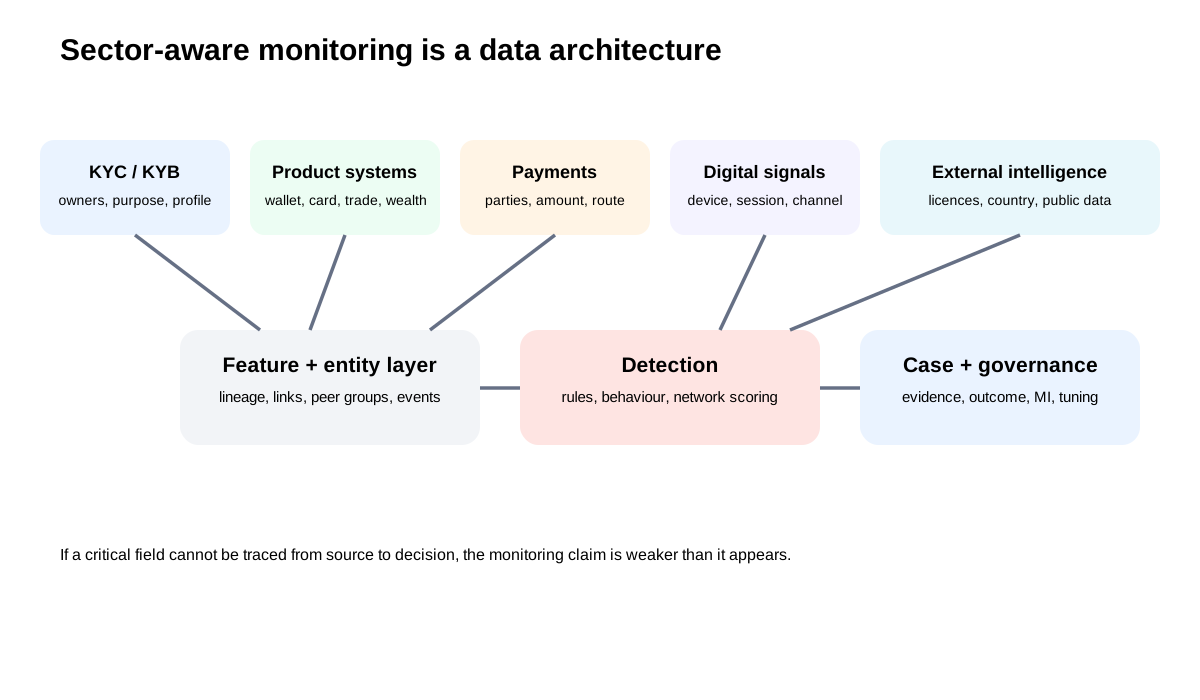
The feature layer shown in the diagram is where many monitoring programmes fail. A field such as COUNTRY can mean country of incorporation, residence, device location, bank location or beneficiary address depending on the source. A sector code can be customer-declared, analyst-assigned or externally enriched. A beneficial-owner link can have an effective date. If those meanings are lost during ETL, the monitoring system can make a technically correct calculation on semantically wrong data.
Lineage should therefore identify source system, transformation, target field, business meaning, update frequency and control owner for critical attributes. Where a critical feed is missing, the system needs a defined response. That may be manual review, compensating control, a temporary restriction or prioritised remediation depending on severity. "The data team knows about it" is not an adequate control.
Entity resolution is also central. Higher-risk relationships often include agents, sub-merchants, trusts, related companies, beneficial owners and intermediaries. Graph analytics can help connect repeated beneficiaries, shared devices, addresses or controllers, but a link is not necessarily suspicious. A common registered-office address can be normal. A shared device across many unrelated retail accounts may have a different meaning. Relationship type and evidence quality should travel with the link.
Detection design and calibration
A useful monitoring framework combines deterministic rules, behavioural analysis, peer comparison and network analysis. Deterministic logic works well where the condition has specific meaning, such as a product being used outside an approved scope. Behavioural monitoring works where deviation matters, such as a remitter suddenly adding new corridors or a charity changing its distribution pattern. Peer analysis can help compare similar businesses, while network analysis can reveal connected parties across accounts or channels.
Segmentation should come before threshold setting. Comparing a family office with a retail customer or a remitter with a small consultancy creates predictable false positives. Segments should be meaningful enough to reflect business behaviour but large and stable enough to support analysis. Where a population is too small, the model should fall back to another benchmark rather than present weak statistics as precision.
Alert volume is not a measure of control strength. A scenario that generates enormous volume but almost no useful investigations can consume the capacity needed for better controls. Equally, a very high case-conversion rate does not prove success if the scenario is so narrow that it misses important behaviour. Effectiveness needs several views: typology coverage, known-case performance, false-negative findings, alert ageing, investigation quality, customer impact and operational capacity.
Model or scenario changes should be versioned. The bank should know which logic, threshold and reference data were applied to a transaction at the time it was assessed. That becomes important during lookbacks, audit and regulatory review.
Alert to case to investigation
The analyst begins with the trigger but should not remain trapped by it. A useful case view shows customer profile, sector and channel context, connected parties, prior alerts, material KYC events, expected activity and relevant product information. The analyst should record what supports concern, what supports a legitimate explanation and what remains unknown.
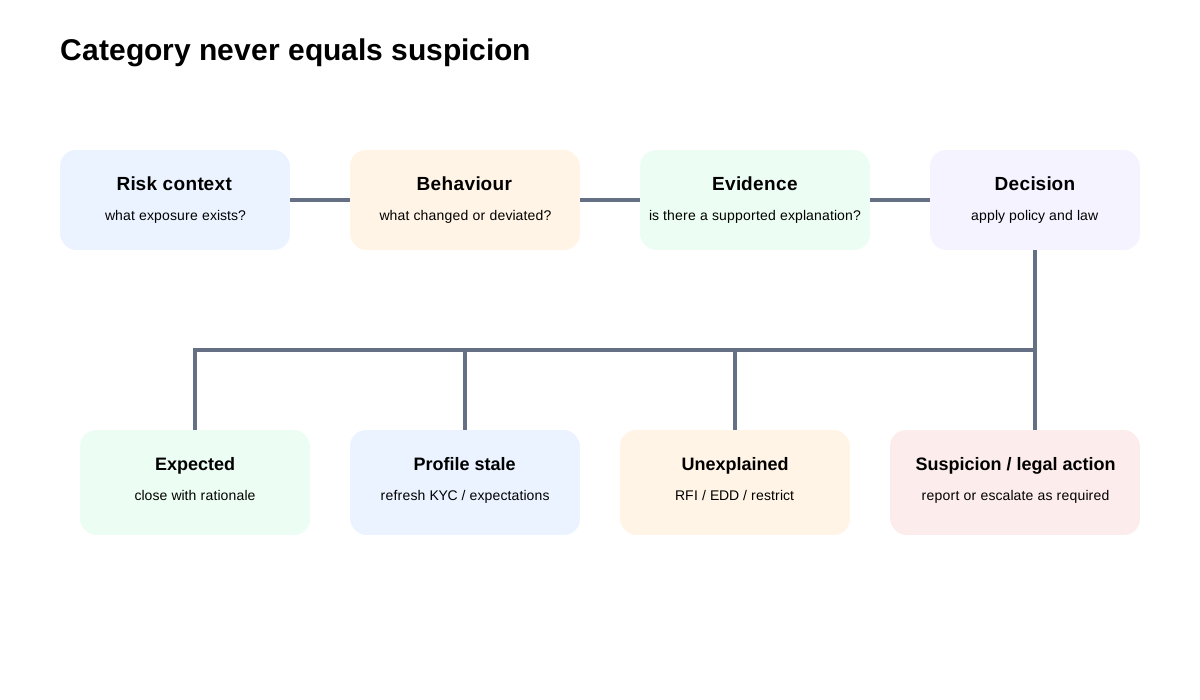
The first question is not "why is this high-risk customer suspicious?" It is "what specifically changed or does not fit?" That phrasing reduces confirmation bias. The case may reveal a stale profile rather than suspicious behaviour. A remitter may have legitimately launched a corridor that product governance approved but KYC never recorded. A charity may have received emergency funding after a disaster. A property customer may have sold an asset. Each explanation still needs appropriate evidence, but the monitoring category should not predetermine the result.
If the activity remains unexplained, the bank can use an RFI, enhanced review or another control permitted by policy and law. If evidence supports suspicion, the institution follows the reporting process applicable to its jurisdiction. Whether to restrict, exit or maintain the relationship is a separate risk-management decision unless local law requires a particular action. That separation matters because suspicious-activity reporting, sanctions blocking, fraud reimbursement, account closure and credit decisions operate under different legal and policy frameworks.
Roles and governance
Business teams own the products and customer relationships, so they should understand how changes affect the risk profile. Financial-crime compliance sets policy, provides challenge and interprets applicable requirements. Operations investigates alerts and cases. Data and technology teams build reliable feeds and detection capabilities. Model or scenario governance validates methodology and change. Legal advises where local law, confidentiality, reporting or restriction questions require interpretation. Internal audit provides independent assurance.
Revenue should not determine the outcome of a financial-crime case, but business knowledge remains relevant. A relationship manager may explain a client's structure or transaction purpose; compliance should then test that explanation against evidence. Good governance separates input from decision rights rather than excluding business context entirely.
Risk appetite should be measurable. Statements such as "we have low appetite for opaque payment intermediaries" need translation into onboarding conditions, data requirements, escalation triggers and accountable approval authorities. Otherwise risk appetite remains a slogan.
Management information should show both risk and control performance. Useful measures can include exposure by sector or channel, missing critical data, scenario coverage, alert ageing, case quality, repeat RFIs, profile-refresh timeliness and material customer-impact events. A board does not need thousands of rule-level metrics, but it does need enough information to understand whether higher-risk business is being managed as intended.
BA, architecture and testing considerations
A business analyst should resist requirements such as "apply enhanced monitoring to all high-risk industries." That statement is not testable. A better requirement identifies the population, risk rationale, data sources, decision logic, frequency, action, exceptions and evidence needed for acceptance.
For each scenario, the design should answer: which legal entities use it; which products and channels are in scope; which data fields are mandatory; how customers are segmented; how reference data are versioned; what happens when a feed is late; how alerts are prioritised; who can change parameters; and how outcomes feed back to the customer profile.
Architecture should keep facts, derived features and decisions separate. "Customer activated API channel on 1 September" is a fact. "API active for less than 30 days" is a derived feature. "Apply the new-channel monitoring pack" is a decision. This separation improves explainability and testing.
Testing needs positive, negative, boundary and failure-mode coverage. Positive tests show that known risk patterns generate the expected case. Negative tests prove that legitimate sector-native behaviour can clear. Boundary tests explore thresholds and time windows. Failure-mode tests cover missing KYC attributes, duplicate events, late payment feeds, broken entity links and unavailable external sources. Production customer data should not be copied into development casually; synthetic, masked or formally approved test data should follow the organisation's security and privacy controls.
Test cases should also examine fairness and proportionality at the control level. The question is not whether every member of a sector receives identical treatment, but whether the reasons for stronger or weaker treatment are tied to relevant risk and evidence rather than unsupported assumptions.
Mini case: remittance platform adds an embedded-finance channel
Consider a fictional bank, Riverbank, that provides settlement and payment services to Northbridge Transfer, a licensed remittance business. At onboarding, Northbridge's expected activity is well documented: specific corridors, an agent network, typical transaction values and settlement accounts. Monitoring is calibrated to those facts.
Northbridge later integrates with an e-commerce platform that embeds remittance into its customer journey. The legal customer at Riverbank has not changed, but the delivery channel has. Within weeks the bank sees a new corridor, a concentration of transfers linked to a small group of agents and several beneficiaries already present in internal fraud investigations. None of these facts alone proves money laundering.
The alert is escalated because the combination is inconsistent with the approved profile. Riverbank asks which party performs customer verification, what underlying payment data are available, how agents are governed, whether the new corridor was approved and which fraud/device signals reach Northbridge's monitoring environment. The response reveals a control gap: the channel launched before the financial-crime profile and monitoring configuration were updated.
Riverbank does not automatically terminate the relationship. It investigates the beneficiary network, restricts the unapproved corridor while the control gap is addressed, requires the appropriate product-change review and enhances monitoring for the new channel. Northbridge separately assesses its own obligations. If the evidence reaches the relevant reporting threshold, each institution follows the law applicable to it. The relationship decision remains documented and proportionate to the facts.
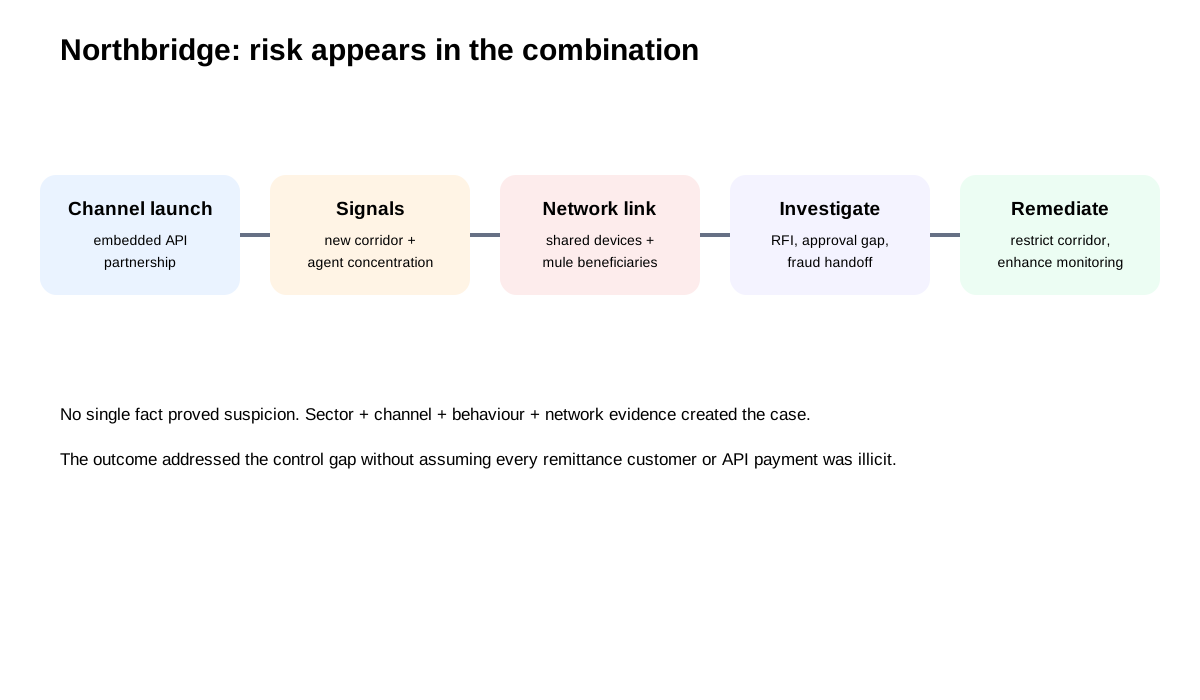
The case demonstrates why "remitters are high risk" is not a useful conclusion. The actionable risk came from the interaction of business model, new channel, geography, data gap, agent concentration and beneficiary network evidence.
Common failure modes
The first failure is category substitution: a sector label replaces analysis. The second is static profiling: expected activity never changes even when the customer does. The third is data overclaiming: policy says the bank monitors underlying parties that its systems never receive. The fourth is generic thresholds: one rule set is applied to populations with fundamentally different economics. The fifth is fragmented investigations: KYC, fraud, payments and AML information sit in separate tools and no one assembles the story. The sixth is de-risking by fatigue: unresolved data or operational problems lead to blanket exit rather than targeted remediation and documented risk decisions.
Another failure is confusing monitoring with proof. A red flag is an instruction to look closer. It is not a finding of criminal conduct. This is particularly important in sectors whose normal behaviour already contains features that look unusual from a retail perspective.
Finally, a bank can fail by keeping controls that no longer add value. The 2026 Wolfsberg RBA guidance is useful here: effective programmes should prioritise resources and be willing to stop, reduce or redesign activities that do not materially strengthen financial-crime outcomes. Removing a redundant control can be responsible risk management when the decision is evidence based and properly governed.
Practical takeaways
Higher-risk monitoring should start with a specific risk story, not a sector label. The design should connect customer understanding, product mechanics, delivery channel, geography and live behaviour. It should state what information the bank can and cannot see. It should distinguish global standards from local legal obligations. It should route unusual activity into evidence-led investigation rather than automatic suspicion. And it should preserve a feedback loop so customer profiles, scenarios, data controls and product governance improve from what investigators learn.
The strongest control is not the one that generates the most alerts. It is the one that can explain why a relationship receives particular scrutiny, detect meaningful deviation, assemble relevant evidence quickly, treat legitimate activity fairly and produce a defensible outcome under the law and policy that actually apply.
Operational deep dive: translating sector risk into observable behaviour
The base chapter established the central rule: a higher-risk label is a reason to ask better questions, not a conclusion that the customer is suspicious. This deep dive shows how that principle changes monitoring design across several common portfolios.
Wealth: economic coherence matters more than size
Large payments are normal in private banking, so absolute-value thresholds usually need context. A useful baseline combines documented source of wealth, source of funds, ownership structures, expected investment activity, known family or corporate relationships and the products the customer actually uses. Monitoring then asks whether a transaction fits that economic story.
Suppose a client has documented proceeds from a business sale and uses the bank for investment management. A large transfer from the documented buyer into the investment account can be consistent with the relationship. A similar amount arriving from an unrelated company, followed quickly by transfers to parties with no known connection, creates a different question. The alert should lead the investigator to the sale documents, KYC record, related-party graph and payment chain rather than rely on value alone.
The bank should preserve uncertainty. A complex trust structure may be legitimate but require more evidence about controllers, beneficiaries and purpose under the applicable KYC framework. Relationship-manager explanations can help, but the case should record corroborating evidence and effective dates so later reviewers can reconstruct what the bank knew at the time.
Remittance and non-bank PSPs: monitor the business model
A remitter or non-bank payment provider may legitimately create high velocity and large counterparty populations. Monitoring therefore needs to understand the settlement model, agent or partner structure, expected corridors and the level of underlying-party information available to the bank.
The 2026 Wolfsberg guidance on banking non-bank payment service providers is particularly useful because it frames the relationship around intermediation and payment transparency. The bank should identify whether it receives individual underlying payment information, aggregates, settlement-only records or a mixture. Controls should not claim visibility that the architecture does not provide.
Useful monitoring features can include new corridors, material changes in value or volume, unusual beneficiary concentration, agent concentration, repeated use of unapproved partners, settlement behaviour inconsistent with the agreed model and deterioration in required payment data. Each feature still needs context. A corridor expansion can be a legitimate product launch; the control question is whether it was governed, approved, profiled and monitored before activity began.
NPOs: programme context prevents false conclusions
For charities and other NPOs, the operating model can create patterns that generic monitoring finds unusual. Disaster response can cause sudden inflows and rapid disbursement. Conflict-area work can involve field partners, cash or alternative delivery mechanisms. FATF Recommendation 8 deliberately focuses on risk-based, proportionate measures for NPOs vulnerable to terrorist-financing abuse rather than treating the whole sector uniformly.
Monitoring should therefore connect payments to programme purpose, geography and delivery model. A payment to a new field partner can justify review, but the investigator should ask whether the partner was approved, whether the programme changed, whether supporting governance exists and whether the transaction aligns with the organisation's stated mission. The presence of a difficult geography is context, not proof.
Gambling: distinguish bank visibility from operator visibility
A bank serving a gambling operator may see corporate settlements, payment processors, refunds and outgoing transfers but not the underlying play history. If the bank also provides acquiring or receives richer operator data, additional analysis may be possible. The control design should state which layer is available.
For an operator account, useful questions include whether settlement sources match the licensed and declared footprint, whether payment processors are expected, whether material changes in transaction pattern coincide with approved business changes, and whether unexplained third-party flows appear. For retail customers, gambling frequency can intersect with consumer-harm concerns but does not by itself establish money laundering.
A common analytical error is to describe a bank-side payment pattern as though it proves what happened inside the gambling platform. Investigators should clearly separate observed facts from inferences and use information requests where more detail is necessary and legally available.
Real estate: reconstruct the settlement story
Property transactions can be infrequent but complex. Rather than relying on velocity, monitoring can reconstruct the funding and settlement sequence where data permit: customer contribution, mortgage drawdown, third-party contribution, lawyer or notary payment, escrow movement and seller receipt. The aim is to identify unexplained parties or value paths, not to flag every large property payment.
A rapid resale, unusual third-party funding or opaque corporate buyer can be relevant, but none is sufficient alone. Market conditions, family funding, bridge finance, renovation and corporate structuring all create legitimate explanations. The bank should use external valuation or ownership data only where those sources are reliable, current and linked correctly to the transaction.
Delivery-channel overlays
The same sector can behave differently by channel. A remitter submitting manually approved payment files presents a different control problem from one initiating thousands of API payments. A wealth client using a relationship manager and investment portal creates different signals from one adding a new external payment interface. An NPO operating through local field partners may create different transparency challenges from one paying centrally contracted suppliers.
Channel monitoring should therefore ask four questions: what identity or authentication evidence exists; what transaction and counterparty data are visible; how fast can value move; and which organisation owns each control. Remote or automated channels are not automatically weaker. They often provide rich device and behavioural evidence, but only if those data are governed and actually connected to the monitoring process.
Investigator discipline
Higher-risk portfolios create a strong risk of confirmation bias because analysts know the customer has already been classified as elevated risk. Case templates should counter this by requiring three separate statements: evidence supporting concern, evidence supporting a legitimate explanation, and material facts that remain unknown. A decision should then explain why the balance of evidence supports closure, profile refresh, enhanced review or escalation.
That structure improves both quality and fairness. It also produces better feedback for scenario tuning because the bank can distinguish alerts caused by stale profiles, weak segmentation, missing data and genuinely concerning behaviour instead of labelling every closure a generic false positive.
Advanced practice: dynamic segmentation, control coverage and change governance
A mature high-risk monitoring programme does more than assign a customer-risk rating at onboarding. It keeps enough dynamic context to recognise when the way a customer uses the bank has changed. That dynamic context should complement, not silently replace, the formal customer-risk-rating and CDD processes required by local law and policy.
Separate facts, features and decisions
A clean architecture distinguishes three layers. A fact is an observed or verified event, such as activation of an API channel, addition of a new beneficial owner or first payment to a new corridor. A derived feature is an analytical interpretation, such as "new channel active for less than 30 days" or "corridor not present in the approved profile." A decision is the control response, such as applying a monitoring pack, increasing case priority or requesting a profile review.
Mixing these layers makes controls difficult to explain. If a case record contains only a score, the analyst cannot tell whether the score came from a customer fact, a model assumption or a policy decision. Effective dating is also important: historical decisions should be reproducible using the facts and reference data that applied at the time.
Segment before calibrating
Thresholds should usually be calibrated after the bank has decided which customers behave similarly enough to compare. A remitter should not be benchmarked against a small domestic consultancy simply because both hold corporate accounts. A family office may need a different peer group from an operating company. A payment facilitator with sub-merchants may need different features from a merchant acquiring directly for itself.
Useful segmentation can include business model, product set, transaction type, channel, geography, customer type and value distribution. Segments that are too broad create noise; segments that are too narrow produce unstable comparisons. Requirements should define what happens when a peer group is too small or data are incomplete.
Control coverage is a mapping problem
Every monitoring scenario should map to a risk rationale, population, legal entities, products, channels, data inputs, action and owner. This makes gaps visible. A bank may discover that its policy says embedded-finance partners receive enhanced monitoring while the relevant API identifier never reaches the monitoring platform. It may discover that a charity scenario relies on programme geography even though the KYC system stores only country of incorporation.
Coverage testing should therefore ask whether the control exists and whether the right population and data reach it. A scenario can be perfectly coded and still ineffective if the upstream classification is wrong or a required transaction type is absent.
Data quality is part of control effectiveness
Critical fields need explicit quality expectations. Completeness, validity, timeliness, uniqueness and semantic accuracy can all matter. A missing agent identifier can weaken remitter monitoring. An outdated ownership link can distort wealth-network analysis. A merchant category code can be present but wrong. A geography derived from an IP address should not be treated as equivalent to a counterparty's legal residence.
When quality falls below an agreed tolerance, the response should be risk based. Options may include manual review, use of another source, a compensating control, priority remediation or a temporary restriction. The appropriate response depends on the significance of the data and the exposure; it should not be hard-coded as universal policy unless law or scheme rules require it.
Combine deterministic and analytical techniques
Deterministic rules are valuable where a condition has specific operational meaning, such as use of a product before approval or a transaction through an explicitly disallowed route. Behavioural models are useful for changes in value, velocity, counterparty mix or time pattern. Peer models can identify customers whose behaviour differs from similar businesses. Network analysis can show shared beneficiaries, agents, devices or controllers.
No technique is automatically superior. The bank should know what risk each control is intended to detect, what data support it and how performance is assessed. Complex models need explainability and governance; simple rules need tuning and coverage testing. Multiple weak controls do not become strong merely because they are numerous.
Change governance
High-risk monitoring changes can affect customer friction, alert volumes and legal outcomes, so controlled release management matters. A change record should capture the reason for change, affected population, before-and-after logic, expected operational impact, test evidence, approvals, deployment date, rollback plan and post-implementation review.
Emergency changes may be necessary when a new threat or regulatory event emerges. Even then, temporary logic should have an owner, rationale and review or expiry point. Emergency controls that never expire can accumulate into a contradictory stack whose combined behaviour no one understands.
Product change should trigger financial-crime assessment. A new agent model, API, embedded partner, instant-payment capability or geography can change monitoring needs without changing the legal customer. Product governance should therefore ask whether the change introduces new parties, speed, anonymity, data dependencies, jurisdictions or outsourcing.
Measure effectiveness without worshipping one metric
Alert volume, case conversion and reporting rates are useful but incomplete. A high conversion rate can reflect a scenario that is too narrow. A low conversion rate can reflect poor calibration, but it can also arise from a control designed to investigate a broad but important risk. Effectiveness should combine several forms of evidence: known-case coverage, lookback findings, alert ageing, investigation quality, repeat false-positive causes, control failures, customer impact and relevant regulatory or audit findings.
The 2026 Wolfsberg RBA guidance is useful because it explicitly focuses on proportionality, prioritisation and effectiveness. For governance teams, that means asking whether a control materially contributes to risk management and being willing to stop, reduce or redesign controls that do not, with appropriate evidence and approval.
Practice close: delivery checklist and acceptance criteria
This supplement turns the chapter into testable delivery expectations. The objective is not to create a universal high-risk rule set. It is to prove that each monitored population has a documented risk rationale, appropriate data, explainable logic and a proportionate investigation path.
BA checklist
Before accepting a design, confirm that the population is defined by business meaning rather than a vague label. The requirement should state which customers, legal entities, products, channels and jurisdictions are in scope; why the control exists; what data it consumes; how the data are sourced; what behaviour it detects; what action follows; and who owns the control.
Expected-activity data should be usable. If the requirement says the scenario compares remitter behaviour with approved corridors, the approved corridors must exist in a governed source and be linked to the customer identifier used by monitoring. If a wealth scenario uses source-of-wealth type, the field must distinguish verified information from customer declaration. If an NPO scenario uses programme geography, the system must preserve programme geography rather than substituting country of incorporation.
The design should also state what happens when data are unavailable. Missing data are not automatically suspicious, but a material control dependency cannot simply disappear. Define the exception route, compensating control and remediation owner.
Acceptance criteria
Good acceptance criteria describe observable outcomes. Examples include:
- the correct population enters the scenario and an out-of-scope population does not;
- versioned customer and product attributes used in the decision can be reconstructed;
- a known corridor change, ownership change or channel activation produces the expected feature;
- a legitimate sector-native pattern can clear when supporting context is present;
- an unexplained material deviation routes to the correct case queue with relevant evidence attached;
- the case shows the distinction between observed facts, derived features and the final decision;
- a missing critical feed produces the approved exception behaviour instead of silently reducing coverage.
Avoid criteria such as "high-risk customers monitored" or "enhanced controls applied." They prove implementation activity, not control quality.
Testing strategy
Positive testing should use known patterns that the control is designed to detect. Negative testing should use legitimate behaviour typical of the sector so the team can see whether calibration creates avoidable noise. Boundary testing should exercise values and time windows around thresholds. Failure-mode testing should cover late feeds, duplicate events, missing identifiers, broken entity links and unavailable external sources.
Cross-channel tests are important where a customer can initiate activity in more than one way. A new API route should not bypass a control that covers the same economic activity through file or branch channels unless the difference is deliberate and documented.
Testing should use synthetic, masked or otherwise formally approved data according to the organisation's security and privacy controls. Sensitive production information should not be copied into development merely because it makes a realistic test case easier to build.
Reviewer quality
A sample case should demonstrate evidence for both concern and legitimate explanation. Reviewers should be able to explain why the customer was treated differently without relying only on industry membership. Quality assurance can then distinguish poor reasoning, stale profiles, data defects and genuine control gaps instead of treating every closure or escalation as a single performance category.
A useful final question for sign-off is: if an auditor asked why this customer received this monitoring treatment on this date, could the bank reconstruct the answer from governed data, versioned logic and documented evidence? If not, the design is not finished.
Masterclass: a fictional cross-channel remittance investigation
This case is fictional and designed only to teach investigation logic. It is not based on a named enforcement action and the values are intentionally omitted so the lesson stays focused on evidence rather than invented statistics.
A bank provides settlement and payment access to a regulated remittance company. The relationship was originally approved for several established corridors using a direct web and branch model. The KYC record includes the expected corridors, settlement accounts, agent population and broad transaction profile. The bank receives structured payment information for some underlying transfers and more limited data for others.
Several months later, monitoring detects three changes close together. A new destination corridor appears, a group of recently added agents contributes an unusually high share of activity, and a number of beneficiaries overlap with accounts already being reviewed by the bank's fraud team. The remitter itself is not on a sanctions list and there is no single transaction that proves criminal conduct.
The first analyst mistake would be to write "high-risk MSB with suspicious new corridor" and escalate immediately. The stronger approach is to separate the evidence. The new corridor is an observed fact. The concentration in recently added agents is an observed pattern. The beneficiary overlap is internal intelligence that needs identity resolution. The customer's approved profile is a control reference. None of these facts is a conclusion.
The case is referred for enhanced review. The investigator checks whether the new corridor was approved through the remitter's product governance, whether the bank had been notified, whether the agents are within the remitter's governed network and whether the data available for the new embedded channel are equivalent to the data used by existing monitoring. The review discovers that the remitter recently launched through an e-commerce partner. The commercial launch was approved internally, but the financial-crime profile, agent reference data and monitoring configuration were not fully updated before go-live.
The fraud team confirms that some beneficiary identities are credible matches to an active mule network, while others are only weak name similarities. The investigator therefore avoids treating every beneficiary as connected. The bank requests information on the affected transfers, the e-commerce partner's role, customer-verification responsibilities and the remitter's response to the mule intelligence.
The control response has several parts. The unapproved corridor is temporarily constrained while the governance gap is assessed. Monitoring is updated for the new channel and agent identifiers. The genuinely matched mule beneficiaries move into the appropriate fraud and AML investigation workflow. The remitter refreshes its profile and completes the required product-change review. The bank separately assesses whether the evidence meets the suspicious-activity reporting threshold that applies to its legal entity and jurisdiction.
The important point is what the bank does not conclude. It does not assume the whole remittance relationship is criminal. It does not describe all new-corridor activity as suspicious. It does not claim to monitor underlying customers for transaction types where the bank lacks the underlying data. It does not let the presence of a regulated licence end the inquiry either.
The case closes with two linked outcomes: a customer investigation and a control remediation. The customer investigation addresses the mule-linked activity and any reporting decision. The remediation addresses the process failure that allowed a new channel to operate before profiles, reference data and monitoring were ready. Keeping those outcomes separate helps the bank learn from the event instead of treating every issue as a customer problem.
For a business analyst, the case produces concrete requirements: channel activation must trigger financial-crime assessment; agent reference data must be effective-dated; underlying-party visibility must be documented by transaction type; product approval status must be available to monitoring; fraud intelligence needs a governed handoff into AML case management; and corridor restrictions must be versioned with clear ownership.
For an investigator, the lesson is equally practical: a higher-risk category provides context, but the case is decided by the combination of behaviour, evidence, data quality, control state and applicable law.
Knowledge check and glossary
Use these questions to test whether the chapter's risk-based logic is clear enough to apply in delivery or investigation work.
Does a high-risk sector label mean the customer's activity is suspicious? No. It means the bank has identified characteristics that can increase exposure and may justify different due diligence, monitoring or governance. Suspicion requires evidence and the applicable legal threshold; sector membership alone is not enough.
Why is one generic enhanced-monitoring rule weak? Because private banking, remittance, gambling, NPO, property and payment-provider relationships have different economics, parties, data and timing. A rule calibrated to one population can create noise or miss the mechanisms that matter in another.
What is the difference between inherent and residual risk? Inherent risk describes the exposure before controls. Control effectiveness describes how well relevant controls reduce that exposure. Residual risk is what remains after those controls are considered.
Why should expected activity be dynamic? Customers change products, geographies, partners, channels and ownership. If the monitoring baseline never changes, legitimate new activity can create repeated alerts while genuine changes in risk are misinterpreted or missed.
What makes remittance and non-bank PSP monitoring difficult? Intermediation. The bank may see a settlement account while the provider knows the underlying payer, payee, agent or platform user. Monitoring must be designed around the data actually available at each layer rather than assumed visibility.
How should NPOs be treated? Through a targeted, proportionate risk-based approach. FATF Recommendation 8 does not justify treating the entire NPO sector as uniformly high risk. Programme purpose, geography, delivery model, partners and observed activity matter.
Why can channel risk not be reduced to digital versus face to face? A remote channel can create impersonation or speed risks but can also provide strong device and behavioural evidence. A branch can provide personal contact but remains vulnerable to forged documents, insider abuse or cash opacity. The relevant question is what the channel reveals, hides and allows.
What should an analyst record in a higher-risk case? The triggering facts, evidence supporting concern, evidence supporting a legitimate explanation, material unknowns, relevant profile information and the reasoning behind the final disposition.
When is data quality a financial-crime control issue? When missing, late, stale or semantically wrong data materially weakens the control. The response then needs risk-based exception handling and remediation rather than an informal analyst workaround.
Why separate reporting from relationship exit? Because suspicious-activity reporting, sanctions actions, fraud controls, account restrictions and relationship decisions can arise under different legal and policy frameworks. One outcome should not silently determine another unless the applicable rule requires it.
Glossary
Risk-based approach (RBA): identifying and understanding relevant risk, then applying measures proportionate to that risk rather than using a universal level of control intensity.
Inherent risk: exposure before considering the effectiveness of the institution's controls.
Residual risk: exposure remaining after relevant controls and their effectiveness are considered.
Sector risk: risk characteristics associated with a customer's industry or operating model; a contextual factor, not a finding of wrongdoing.
Delivery-channel risk: risk created or changed by how a service is accessed or delivered, such as branch, agent, API, mobile, intermediary or embedded-finance channels.
Nested or underlying activity: activity performed for customers or users behind an intermediary such as a remitter, payment provider, agent or platform.
Dynamic monitoring context: current information such as new channels, corridors, ownership changes or product events that helps monitoring adapt between formal periodic reviews.
Peer group: a population of customers with sufficiently similar business characteristics to support meaningful comparison.
Entity resolution: linking records that refer to the same person, organisation or relationship while preserving the evidence and confidence behind the link.
Control coverage: evidence that a control applies to the intended population, products, channels and data, not merely that the control exists in code.
Proportionality: matching control intensity and resource allocation to the identified risk and evidence.
De-risking: ending or restricting categories of relationships to avoid risk rather than managing risk case by case; the term should not be confused with a justified, evidence-based decision to decline or exit a specific relationship.
References and further reading
The chapter uses global standards for the core risk-based principle and clearly separates jurisdiction-specific supervisory examples.
Global standards and practitioner guidance
- Financial Action Task Force (FATF), The FATF Recommendations, including the February 2025 revisions to Recommendation 1 and the June 2025 revisions to Recommendation 16: https://www.fatf-gafi.org/en/publications/Fatfrecommendations/Fatf-recommendations.html
- FATF, Guidance on Financial Inclusion and Anti-Money Laundering and Terrorist Financing Measures, 23 June 2025: https://www.fatf-gafi.org/en/publications/Financialinclusionandnpoissues/guidance-financial-inclusion-aml-tf-measures.html
- FATF, Best Practices on Combating the Terrorist Financing Abuse of Non-Profit Organisations, Recommendation 8: https://www.fatf-gafi.org/en/publications/Financialinclusionandnpoissues/Bpp-combating-abuse-npo.html
- FATF, Public consultation on guidance to increase payment transparency, 24 June 2026, closed 21 August 2026. The consultation draft is not a final additional legal requirement; it explains the strengthened Recommendation 16 agreed in June 2025 and the expected global implementation horizon to the end of 2030. Confirm any final guidance separately: https://www.fatf-gafi.org/en/publications/Fatfrecommendations/R16-Public-Consultation-June-2026.html
- Basel Committee on Banking Supervision, Anti-money laundering and counter-terrorist financing, Basel Consolidated Guidelines, published 1 January 2026: https://www.bis.org/committees/bcbs/basel-consolidated-guidelines/module/afs/10
- Wolfsberg Group, Guidance on the Risk-Based Approach, 23 June 2026: https://wolfsberg-group.org/resources/rba/205
- Wolfsberg Group, Guidance on the Provision of Banking Services to non-bank Payment Service Providers, 15 July 2026: https://wolfsberg-group.org/resources/correspondent-banking/206
- Wolfsberg Group, Country Risk FAQs: https://wolfsberg-group.org/resources/legacy/155
Jurisdiction-specific supervisory material used as examples
- US Federal Financial Institutions Examination Council (FFIEC), BSA/AML Risk Assessment: https://bsaaml.ffiec.gov/manual/BSAAMLRiskAssessment/01
- FFIEC, Risks Associated with Money Laundering and Terrorist Financing – Introduction, Customers: https://bsaaml.ffiec.gov/manual/RisksAssociatedWithMoneyLaunderingAndTerroristFinancing/00
- European Banking Authority (EBA), Revised Guidelines on ML/TF risk factors: https://www.eba.europa.eu/publications-and-media/press-releases/eba-publishes-final-revised-guidelines-money-laundering-and
- EBA, Guidance extending ML/TF risk-factor guidance to crypto-asset service providers, 16 January 2024: https://www.eba.europa.eu/publications-and-media/press-releases/eba-issues-guidance-crypto-asset-service-providers
- AUSTRAC, Manage and mitigate ML/TF risks – AML/CTF policies: https://www.austrac.gov.au/industry-and-business/obligations-and-guidance/your-amlctf-program/develop-your-amlctf-programs/step-3-manage-and-mitigate-your-risks-amlctf-policies
- AUSTRAC, Financial services for customers assessed to be higher risk: https://www.austrac.gov.au/industry-and-business/obligations-and-guidance/additional-guidance/financial-services-customers-financial-institutions-assess-be-higher-risk
These sources were reviewed on 19 September 2026. The FATF Recommendation 16 implementation-guidance consultation had closed on 21 August 2026, and final guidance was not confirmed at that review date, so the chapter relies on the adopted Recommendation itself for the standard and uses the 2026 consultation only to explain implementation direction. Older sector guidance remains useful where still current, but later FATF changes on proportionality, financial inclusion and payment transparency take precedence when the standards have changed.