United States: BSA/AML, FinCEN and OFAC
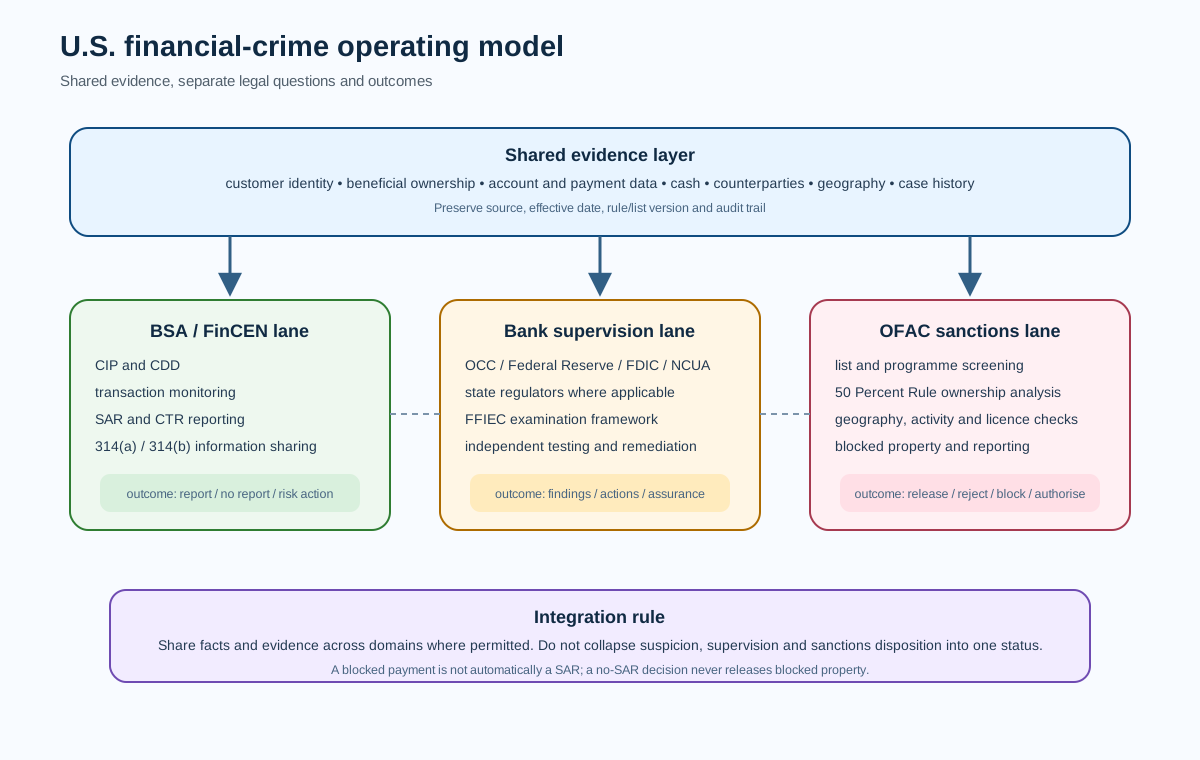
The United States financial-crime framework is easier to understand when two connected but legally distinct control systems are kept separate. The first is the Bank Secrecy Act (BSA) and its implementing regulations, administered by the Financial Crimes Enforcement Network, or FinCEN. That framework creates anti-money-laundering programme, customer identification, recordkeeping, reporting and information-sharing obligations for covered financial institutions. The second is the economic and trade sanctions framework administered by the Office of Foreign Assets Control, or OFAC. OFAC rules can require property to be blocked, transactions to be rejected, reports to be filed and prohibited dealings to be avoided.
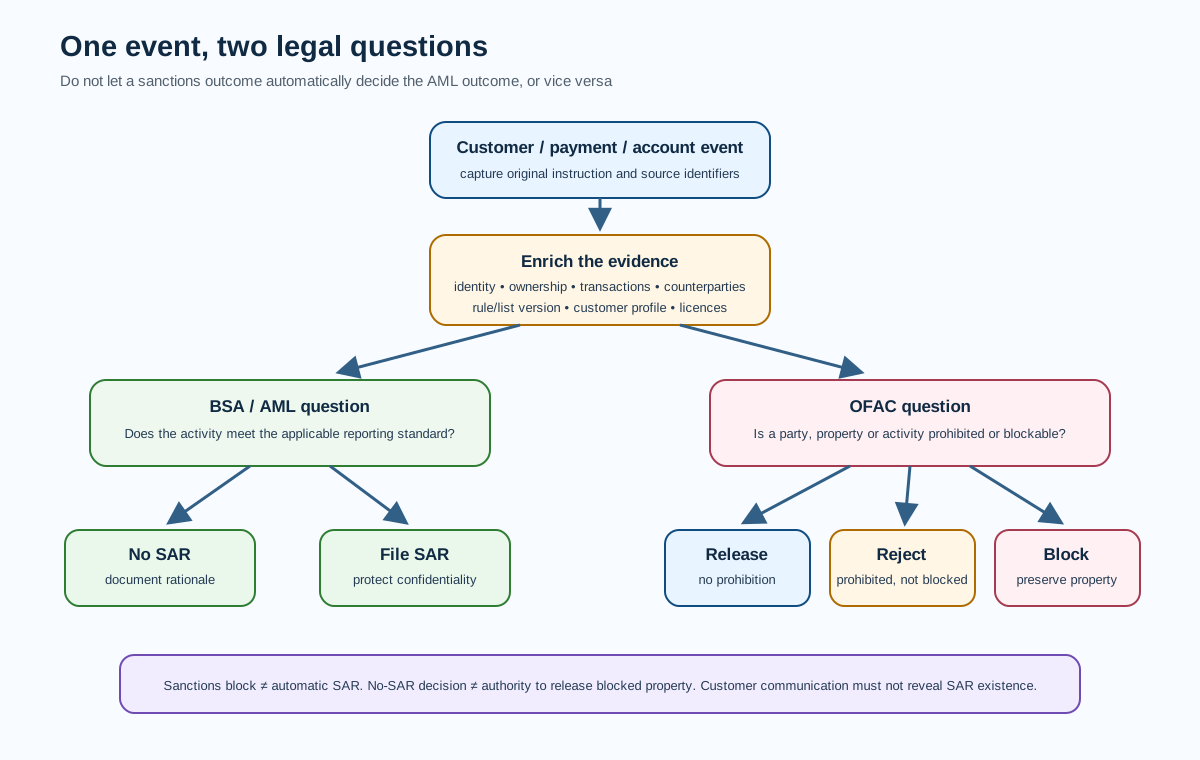
Banks normally operate these controls together because the same customer or payment can trigger both, but one regime does not replace the other. Filing a Suspicious Activity Report with FinCEN does not satisfy an OFAC blocking obligation. A transaction blocked under an OFAC programme is not automatically suspicious for BSA purposes merely because it was blocked. A customer can be high risk under the bank's AML programme without being sanctioned. An OFAC issue can require an immediate legal disposition even when the customer's AML rating is low.
The practical mental model is identify the legal perimeter, understand the customer and activity, detect reportable or prohibited events, make the correct legal disposition, and preserve evidence. The perimeter matters because BSA rules differ across types of financial institutions, banking supervisors have their own examination responsibilities, state requirements may also apply, and OFAC consequences depend on the person, property, programme and transaction.
The legal map
The Bank Secrecy Act is the name commonly used for a body of statutes beginning with the Currency and Foreign Transactions Reporting Act of 1970 and later amendments. It authorises Treasury to impose reporting, recordkeeping and other requirements intended to help detect and prevent money laundering and other financial crime. FinCEN administers the BSA regulations in 31 CFR Chapter X. For banks, important requirements sit in Part 1010 and the institution-specific rules in Part 1020, alongside related banking-agency regulations.
FinCEN is also the U.S. financial intelligence unit. It receives and analyses BSA reports, issues rules, advisories and guidance, administers information-sharing mechanisms and supports law enforcement and national-security agencies. It is not the only body that examines a bank's BSA/AML programme. The Office of the Comptroller of the Currency, Federal Reserve, Federal Deposit Insurance Corporation and National Credit Union Administration supervise institutions within their respective remits, and state regulators may also be relevant. The applicable supervisory map depends on charter and legal entity.
The FFIEC BSA/AML Examination Manual provides a common examination framework. It is extremely useful for understanding how examiners assess risk, programme components, suspicious activity reporting, CDD, technology, products and services. It should not be confused with the underlying statute or regulation. A requirement should be traceable to its legal source, with examination guidance used to understand supervisory practice.
OFAC is another Treasury office, but it administers economic and trade sanctions under different legal authorities. Sanctions can target named persons and entities, governments, regions, sectors, activities, services or property. Some programmes impose blocking; some impose narrower restrictions. A bank therefore cannot reduce OFAC compliance to “screen the SDN list.” It needs to understand programme scope, ownership, geography, activity restrictions, licences, exemptions and reporting duties.
For implementation teams, this means regulatory authority should be stored as data. A payment should not have only a generic financialCrimeStatus. Useful attributes include control regime, legal entity, rule or sanctions programme, source date, evidence, disposition, reporting requirement, approver, decision time and any licence or exemption relied on.
The BSA/AML programme and the 2026 reform proposal
A U.S. bank's BSA/AML programme is not simply a collection of forms. Its purpose is to establish and maintain controls reasonably designed to comply with the BSA and identify activity that should be reported or otherwise managed. The traditional core includes internal controls, independent testing, a designated BSA compliance officer and appropriate training. Customer identification and customer due diligence sit alongside those programme elements.
The bank's risk assessment gives the controls context. Products, services, customers, delivery channels and geographies create different exposure. Retail deposits do not present the same risk as correspondent banking, cash-intensive businesses, private banking, money-service-business customers, virtual-asset exposure or trade finance. A mature programme connects inherent risk, control strength and residual risk rather than applying uniform friction.
FinCEN's 2021 national AML/CFT priorities identify corruption, cybercrime, domestic and international terrorist financing, fraud, transnational criminal organisations, drug trafficking organisations, human trafficking and human smuggling, and proliferation financing. Treasury's 2024 national risk assessments and National Illicit Finance Strategy provide additional threat context.
A critical 2026 accuracy point is that the programme framework is in transition. On 7 April 2026, FinCEN issued a new proposed rule intended to reform financial institutions' AML/CFT programmes and withdrew the 2024 programme proposal. The 2026 proposal would emphasise effectiveness, risk-based design, higher-risk activity, risk assessment and greater supervisory consistency. Federal banking agencies issued aligned proposals. As of 21 September 2026, these are proposals, not a final rule. A bank can perform change-impact analysis but should not present proposed text as already binding.
Requirements repositories should therefore distinguish effective, proposed, final-not-yet-effective, superseded and withdrawn. That simple status prevents teams from building a proposal as law or missing an effective change.
CIP, CDD and beneficial ownership
The Customer Identification Program, or CIP, is the minimum identity foundation for opening an account. At a high level, a bank needs a written programme appropriate to its business that enables it to form a reasonable belief that it knows each customer's true identity. The rule addresses identifying information, verification, recordkeeping, customer notice and procedures for cases where identity cannot be adequately verified.
Verification can use documentary and non-documentary methods appropriate to risk. A digital bank may combine government credentials, authoritative data, device signals and fraud controls. The objective is not maximum document collection; it is a defensible identity conclusion with appropriate evidence.
On 8 September 2026, FinCEN and the federal banking agencies issued FAQs clarifying how state-issued mobile driver's licences and other government-issued verifiable digital credentials can be used under the CIP rule. This shows why a control should specify the regulatory outcome rather than hard-code “photocopy a plastic card.” Identity architecture should allow approved credential types and versioned verification methods.
CDD goes further than CIP. FinCEN's CDD Rule requires covered institutions, within its scope, to understand customer relationships, develop risk profiles, identify and verify relevant beneficial owners of legal-entity customers and conduct ongoing monitoring for suspicious activity and risk-based customer-information updates.
In February 2026, FinCEN granted exceptive relief from the requirement to identify and verify beneficial owners of the same legal-entity customer each time that customer opens a new account. The relief does not abolish beneficial-ownership due diligence. Banks still need controlled logic for when existing information can be relied upon, when it has changed, and when risk requires refresh.
The Corporate Transparency Act BOI regime is separate. FinCEN issued a final rule on 11 August 2026, effective 14 August 2026, permanently exempting U.S. companies from BOI reporting and removing BOI reporting duties for U.S. persons. Certain foreign entities registered to do business in the United States remain in scope. A domestic company being exempt from CTA reporting does not mean a bank can switch off separate CDD obligations. Systems should never use one beneficial_ownership_required flag for both regimes.
SAR: suspicion, decision and confidentiality
Banks must report certain suspicious activity under applicable federal rules. Monitoring can receive signals from transactions, customer behaviour, fraud, branches, sanctions cases, cyber events, law-enforcement information and manual referrals. The alert is only a signal; it is not the legal conclusion.
For banks, the SAR framework includes insider abuse involving any amount, specified criminal-violation thresholds, and transactions conducted or attempted by, at or through the bank that aggregate at least $5,000 where the bank knows, suspects or has reason to suspect that activity may involve money laundering or other illegal activity, is designed to evade the BSA, or lacks an apparent lawful purpose for which no reasonable explanation is identified after examining the facts. The exact rule should be taken from the applicable regulation for the institution rather than generalised from another sector's threshold.
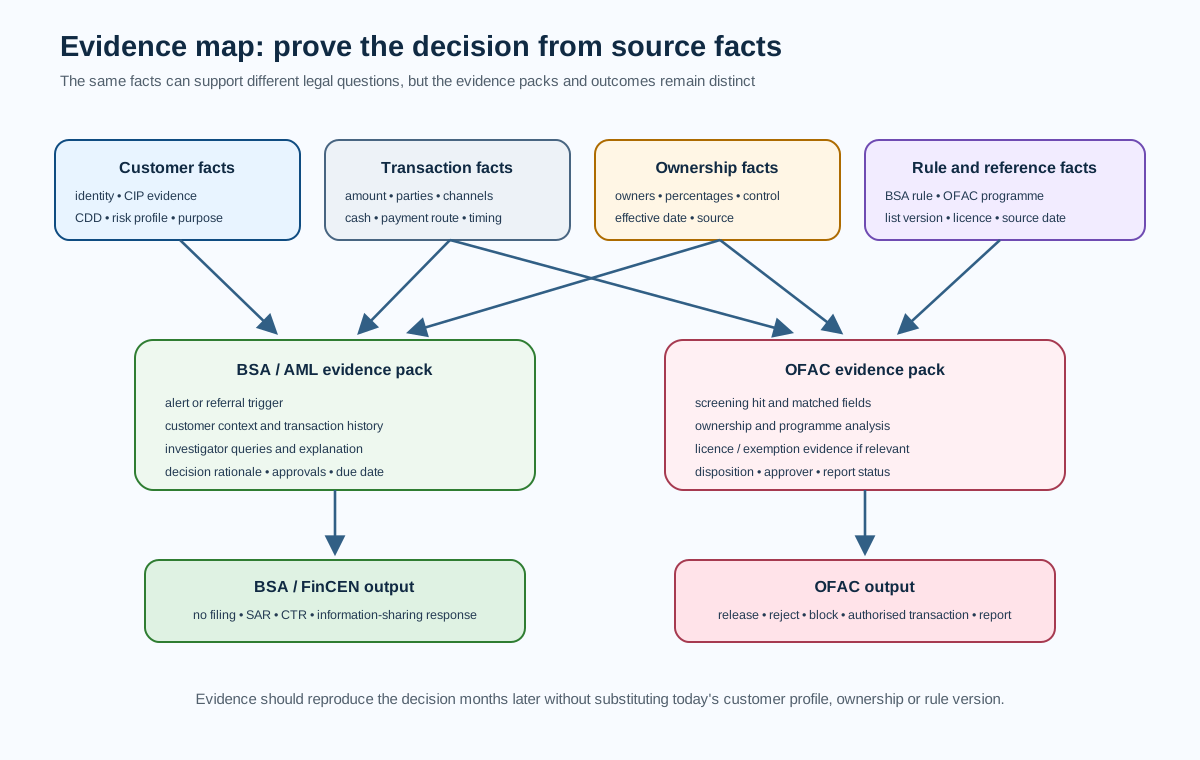
The operating process should separate detection, triage, investigation and SAR decisioning. A defensible case preserves the trigger, relevant transactions, parties, customer profile, linked accounts, investigator research, rationale, approvals and filing or no-filing outcome. Data lineage matters because a strong narrative cannot compensate for missing transactions caused by an upstream feed failure.
A SAR generally must be filed no later than 30 calendar days after initial detection of facts that may constitute a basis for filing, with limited additional time where no suspect is identified. The bank therefore needs a controlled definition of initial detection and workflow alerts based on regulatory due date, not only an internal service-level target.
SAR confidentiality prohibits disclosure of a SAR or information that would reveal its existence. It does not require silence toward customers. On 2 September 2026, FinCEN and the banking agencies clarified that banks can communicate with customers about potentially fraudulent transactions, suspicious activity or account closures when the communication does not reveal the SAR. Case systems should therefore separate customer-facing reason codes from restricted sar_status metadata.
CTR and section 314 information sharing
A Currency Transaction Report is required for reportable transactions in currency exceeding $10,000 in one business day, including aggregation where the institution knows multiple cash-in or cash-out transactions are by or on behalf of the same person and exceed the threshold. Cash-in and cash-out are aggregated separately rather than netted. Exemption rules exist for qualifying customers.
The threshold is simple; implementation is not. Aggregation can span branches, accounts, teller platforms and channels. Enterprise data needs to identify that multiple transactions belong to the same person or are conducted on the person's behalf. Test cases should cover split transactions, multiple accounts, cash-in versus cash-out, exemptions, late-arriving data, duplicate events and structuring below the threshold.
CTR filing does not replace suspicious-activity monitoring. Legitimate cash-intensive customers can generate CTRs without suspicion, while repeated sub-threshold structuring may create suspicion.
Section 314(a) supports law-enforcement information sharing through FinCEN to financial institutions. A 314(a) match is not a sanctions match, an account-closure order or proof of criminal conduct. Institutions follow the programme's search, response and confidentiality procedures.
Section 314(b) provides a statutory safe harbour for eligible participating financial institutions that voluntarily share information for permitted purposes and comply with the conditions. On 12 June 2026, FinCEN issued updated guidance clarifying fraud-related sharing where activity may involve possible money laundering or terrorist activity. Strong implementation verifies participant status, permitted purpose, secure channel, safeguards and what was shared.
FinCEN's September 2025 cross-border information-sharing guidance also explains that underlying investigative information may generally be shared appropriately across borders even though SARs and information revealing their existence remain protected. A global bank should classify fields rather than give every investigator access to the U.S. SAR object.
OFAC: a separate legal decision path
OFAC sanctions controls prevent prohibited dealings and handle blocked property under the applicable programme. A mature control looks beyond name lists to ownership, geography, sectors, services, transaction purpose, property, licences and programme-specific restrictions.
The SDN List is important, but not all restrictions are list based and not every OFAC list creates the same legal result. Some entities are blocked because of ownership even though their names do not appear on the SDN list. Under OFAC's 50 Percent Rule, an entity is treated as blocked when one or more blocked persons directly or indirectly own 50 percent or more in the aggregate. Control alone, without qualifying ownership, does not automatically block the entity under that rule, although it can still create risk and the entity could be separately designated.
Disposition matters. Where there is a blockable interest, property may need to be blocked and reported. In other cases a transaction can be prohibited without containing a blockable interest, leading to rejection rather than blocking. The system should therefore support distinct hold, block, reject, release and authorised/licensed outcomes.
An OFAC licence is an authorisation to engage in activity that would otherwise be prohibited. A general licence covers a category of transactions and is public and self-executing when its conditions are met. A specific licence is issued to a particular applicant. Neither is a permanent whitelist. Systems should store programme, scope, parties, dates, conditions and evidence and test the current transaction against them.
OFAC's Framework for Compliance Commitments describes management commitment, risk assessment, internal controls, testing/auditing and training as core components of a sanctions compliance programme. The sanctions risk assessment should reflect customers, products, services, geographies, counterparties and transactions.
One data model, separate legal outcomes
BSA/AML and sanctions often use the same customer, ownership and payment facts, so shared data and relationship views are valuable. But a graph link does not automatically transfer legal status. A customer who paid an SDN is not automatically an SDN. A counterparty mentioned in a SAR is not automatically a suspicious customer. A company linked to a blocked owner is automatically blocked under the 50 Percent Rule only when the ownership test is satisfied.
The data model should distinguish natural persons, legal entities, accounts, products, beneficial owners, controllers, counterparties, transactions, payment parties, financial institutions, addresses, countries, alerts, cases, regulatory reports, sanctions targets and authorisations. Effective dates matter because an investigator may need to know who owned an entity when the transaction occurred.
Source-to-target reconciliation is itself a control. Monitoring should reconcile transaction feeds; sanctions platforms should reconcile list ingestion; filing systems should reconcile approved reports through transmission and acceptance. A model dashboard cannot compensate for a missing source population.
The remainder of this chapter deepens the end-to-end operating model, control architecture, testing approach and practical case analysis.
Operational deep dive: how BSA/AML and OFAC controls meet in a bank
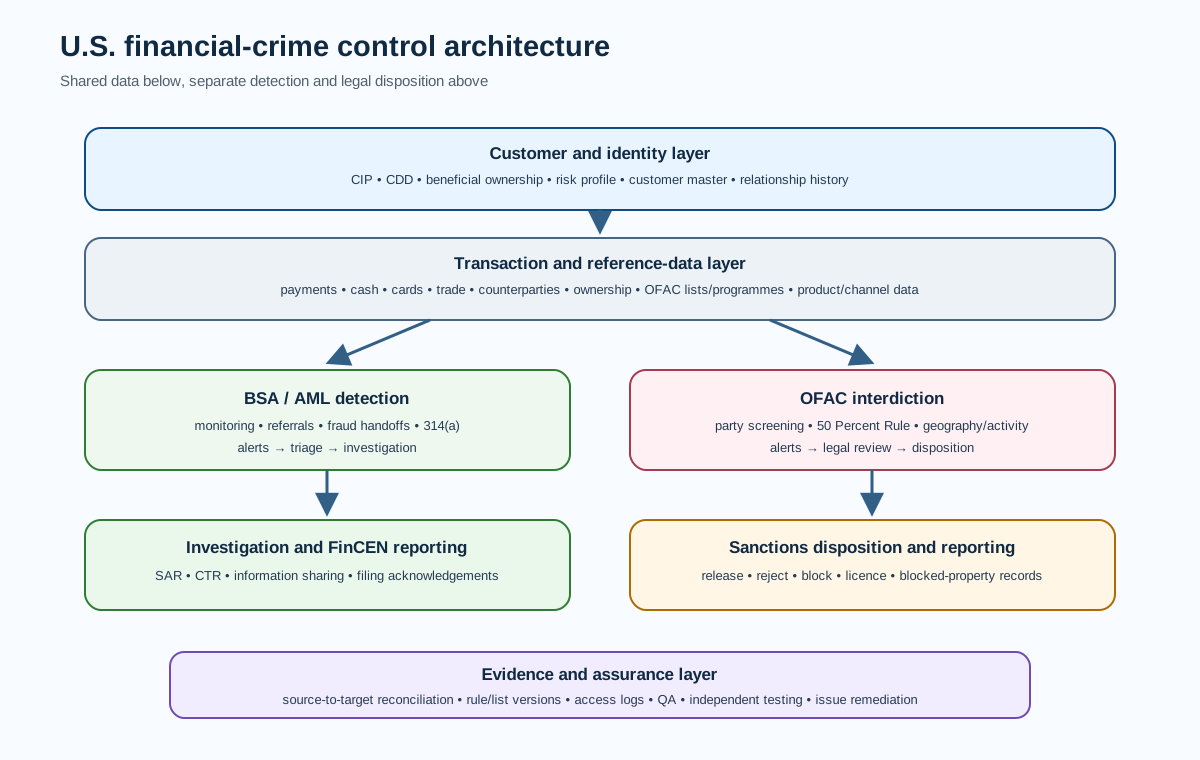
The base chapter separates BSA/AML from sanctions legally. Operations has to join them safely. The same payment can pass through customer due diligence, transaction monitoring, fraud controls and sanctions screening within seconds, while the resulting cases may be investigated over very different timescales. A good operating model therefore shares facts but does not merge legal conclusions.
Build one event timeline, not one legal status
Suppose a wire is stopped because the beneficiary name resembles an OFAC target. The payment system should record the original instruction, parsed party data, screening timestamp, list version, match score and hold reason. If the alert is cleared, the release decision and rationale should be attached to the same event. If the payment is blocked or rejected, the sanctions case should record the applicable programme, ownership or list evidence, disposition and reporting workflow.
If transaction monitoring also creates an AML alert, the AML investigator should be able to see the underlying payment facts and sanctions disposition where access is permitted. The investigator should not inherit a pre-populated conclusion that the activity is suspicious merely because OFAC was involved. Conversely, an AML case closure should never release funds that remain legally blocked. Separate status domains prevent one team's action from cancelling another team's legal control.
This is why event-driven architecture is useful. A payment.screening.held event can trigger sanctions workflow. A sanctions.disposition.blocked event can inform AML monitoring and relationship management. A sar.filed event should be tightly access-controlled and should not be broadcast to general customer-service systems. The technical event catalogue should reflect confidentiality, not only business convenience.
The initial-detection clock needs an explicit control
SAR timeliness failures often begin before the investigator receives the case. A fraud team may identify suspicious conduct, an operations employee may escalate unusual activity, or a monitoring alert may sit in a queue awaiting triage. The regulatory concept of initial detection is not identical to the date on which a case was finally assigned.
Banks therefore need policy and system rules defining how potentially reportable information moves into the SAR decision process and how the relevant detection date is captured. The workflow should flag approaching deadlines, prevent silent date changes and record any authorised correction with an audit trail. Queue-management MI should show cases by regulatory due date, not only by internal service-level target.
A testing team should seed events through every referral channel: automated monitoring, fraud, branch referral, sanctions, law-enforcement request, cybersecurity, customer complaint and manual escalation. The test is not complete until the event reaches the responsible decision maker with the correct source evidence and date.
Customer communication should use facts, not SAR metadata
The September 2026 interagency statement on SAR confidentiality is particularly useful for designing customer-service controls. A bank can speak to a customer about a transaction under review, suspected fraud, documentation needed, an account restriction or closure where the communication does not reveal that a SAR has been prepared or filed.
That means customer communication should be generated from ordinary business facts and approved reason codes. “We need additional information about these transfers” can be grounded in the transaction review. A screen that says “SAR filed — tell customer account under review” creates avoidable confidentiality risk because the customer-service action is directly driven by protected metadata.
A strong design keeps the SAR object in a restricted case domain and publishes only the operational action that other teams need: request information, maintain restriction, decline transaction, continue relationship, or exit. Legal and compliance teams should review reason-code wording and escalation paths.
314(b) works best when requests are structured
Voluntary information sharing under section 314(b) is most useful when an institution can ask precise questions rather than sending a narrative dump. A mule-network case, for example, may need confirmation that a counterparty account received related victim payments, whether the account was recently opened, or whether the receiving institution has observed connected entities.
The sending institution should verify participation and permitted purpose, minimise the information to what is useful, use an approved secure channel and preserve a record of what was shared. The receiving institution should route the information into its own investigative process without assuming another bank's suspicion is proof.
For architecture, a 314(b) exchange can be represented as a controlled case object with participant identifier, purpose, subject entities, request, response, source case, access restrictions and retention metadata. It should not be stored as an unstructured email attachment that becomes impossible to govern.
Blocked property needs its own lifecycle
When property is blocked under OFAC rules, it can remain blocked long after the customer relationship or original payment case has ended. The bank must preserve the property status, accounting treatment, reporting history and any later licence or unblocking authorisation.
A useful lifecycle is: identify potential blockable interest; hold while facts are resolved; determine legal disposition; move blocked funds to the required account structure; report; monitor relevant licences or designation changes; process authorised debits or release only where permitted; retain historical evidence. That lifecycle should survive core-system migrations and account closure.
The key control is that a relationship manager cannot “return the money and close the customer” if the property remains blocked. The property object needs a legal restriction independent of the customer-account commercial status.
Reconciliation is part of compliance
Regulatory reporting should be reconciled like a financial process. For SARs, the bank should know which approved filing decisions produced a submission, whether FinCEN accepted it and whether filing metadata is stored. For CTRs, reportable cash events should reconcile to filed forms and exemptions. For OFAC, block and reject dispositions should reconcile to required reports.
Exception queues need owners and ageing. A transmission failure at 11:55 p.m. is not cured by the fact that an investigator completed the case on time. End-to-end evidence should include form generation, transmission, acknowledgement, correction where required and final status.
The same principle applies to list ingestion. A sanctions platform should reconcile source files from OFAC against loaded records, detect malformed or missing entries, prove successful deployment to screening engines and record the time at which the new list became effective in production. “Vendor feed active” is not sufficient control evidence.
Turn OFAC disposition into a controlled reporting and evidence lifecycle
An OFAC disposition is not finished when a payment is stopped. The bank must carry the legal outcome into reporting, accounting, recordkeeping and later change events. Under 31 C.F.R. Part 501, an initial report of blocked property and a report of a rejected transaction generally must be submitted to OFAC within 10 business days of the action. Where blocked property is later unblocked or transferred, the 2024 amendments to Part 501 require a report within 10 business days of that event. Holders of blocked property also have an annual reporting obligation covering property held as of 30 June, with the annual report due by 30 September. These are separate obligations and should be represented as separate workflow tasks rather than one generic ofac_reported flag.
The operational consequence is that a sanctions case needs dates that are legally meaningful. The screening timestamp is useful, but it is not enough. The case should capture when the bank actually blocked or rejected, the property or transaction affected, the sanctions authority or target relied upon, the original payment or transfer instructions, the reporting due date, submission timestamp, acknowledgement or filing evidence, and any later licence, unblocking or transfer event. A manual spreadsheet maintained outside the case platform can easily lose this chain when a case is reopened months later.
Blocked property accounting also needs reconciliation to the sanctions record. The amount and currency held on the blocked account should reconcile to the case disposition and to the annual blocked-property population. If interest, fees, permitted service charges or authorised movements occur, the accounting system and sanctions record must remain consistent with the applicable authorisation. A difference between the blocked-property ledger and the annual-report extract is not merely a finance break; it can indicate that property was moved without the sanctions workflow being updated, or that the regulatory report is incomplete.
Rejected transactions create a different control problem because no blocked asset remains on the bank's books. Evidence therefore depends heavily on preserving the original instruction and the reason the transaction was prohibited. A rejected payment should remain traceable even after the payment engine has purged operational message data. Retention design should ensure that investigators and compliance can reproduce the parties, routing, amount, programme logic, decision, report and source message without depending on a short-lived payment-screening cache.
Licences and later sanctions changes add another layer. A general licence may authorise a category of activity while a specific licence applies to a particular applicant and facts. Neither should be implemented as a permanent bypass. The bank should store the licence identifier, scope, effective dates, conditions and evidence used for the transaction. When OFAC amends a programme, removes a person from a list or issues an unblocking authorisation, the bank needs a controlled path to reassess affected property rather than automatically releasing everything associated with the historical alert.
Testing should therefore go beyond “did the screening engine stop the payment?” A complete test starts with a blockable or rejectable transaction, verifies the correct disposition, checks the 10-business-day reporting clock, confirms required transaction evidence is retained, reconciles blocked funds where relevant, and then exercises a later licence or unblocking event. For annual blocked-property reporting, testers should compare the June 30 holdings population against the sanctions subledger and filing extract. This end-to-end test demonstrates that screening, legal decisioning, operations, finance and regulatory reporting operate as one controlled lifecycle rather than five disconnected tasks.
Independent testing should challenge the seams
Financial-crime failures often occur between systems or teams rather than inside the individual control. Independent testing should therefore examine seams: onboarding to CDD, customer master to monitoring, payment parsing to screening, sanctions case to blocked-funds accounting, investigation to regulatory filing, fraud to AML referral, and regulatory change to production deployment.
A sample can be technically correct at each screen but still fail end to end because one field changed meaning between systems. Testers should trace source values, transformations and decision outcomes across the full lifecycle.
A mature programme can demonstrate not only that controls exist but that they remain effective when data is late, a service is unavailable, a customer opens multiple products, ownership changes, a list updates, a queue grows or an employee follows the wrong path. Resilience and exception handling are part of financial-crime control design.
Advanced practice: requirements and testing for the 2026 U.S. change agenda
The United States is a useful case study in regulatory change because several material developments can affect the same customer journey without having the same legal status. A disciplined bank separates effective requirements from proposals and supervisory direction and then maps each change to controls.
Change-impact matrix
| 2026 development | Status at 21 Sep 2026 | Primary impact | What a bank should do now |
|---|---|---|---|
| FinCEN AML/CFT programme reform NPRM, 7 Apr 2026 | Proposed | Programme design, risk assessment, supervision | Track and assess; do not describe proposed text as current final law |
| CDD exceptive relief, 13 Feb 2026 | Effective relief | Repeat beneficial-owner collection at new account opening | Update procedure/rules where the bank chooses to rely on relief; preserve risk-based refresh |
| CTA BOI final rule, 11 Aug 2026, effective 14 Aug | Effective | Public BOI reporting perimeter | Separate CTA registry obligations from the bank's CDD obligations |
| Updated section 314(b) guidance, 12 Jun 2026 | Current guidance | Voluntary interbank information sharing | Review participant verification, permitted purpose, fraud use cases and safeguards |
| SAR confidentiality customer-communication statement, 2 Sep 2026 | Current interagency statement | Customer communication | Remove unnecessarily restrictive scripts while preventing disclosure of SAR existence |
| CIP verifiable digital credential FAQs, 8 Sep 2026 | Current guidance | Identity verification | Assess mobile driver's licence and other government VDC support under controlled verification methods |
The matrix should exist in the bank's regulatory-change repository with source links, accountable owner and implementation evidence. The table above is educational; the institution's legal team must determine applicability to its charter, products and facts.
Acceptance criteria that expose real defects
For CDD beneficial ownership, a useful acceptance criterion is not “system supports relief.” It is: when an existing legal-entity customer opens another covered account, the workflow can identify previously verified beneficial-owner information, determine whether policy permits reliance, ask whether information has changed, trigger refresh where risk or facts require it, and preserve the source and date of the decision. A negative test changes ownership between accounts and confirms that stale information is not silently reused.
For CTA separation, configure a domestic U.S. company as exempt from CTA BOI reporting but still subject to bank CDD. The onboarding journey must not use CTA_exempt = true to bypass the CDD beneficial-owner step. This single test catches an architecture error that can arise when teams reuse one “beneficial ownership required” flag for two separate legal regimes.
For SAR confidentiality, give a customer-service user access to payment and fraud facts but no SAR object. The user should be able to explain that a transaction is being reviewed, request evidence or communicate a closure decision under approved rules without seeing whether a SAR exists. Attempted direct access to the SAR route should be denied and logged.
For OFAC ownership, test a non-listed company owned 25 percent by Blocked Person A and 25 percent by Blocked Person B where the ownership is direct or otherwise qualifies under the 50 Percent Rule. The legal engine should aggregate blocked ownership correctly. Then test control without qualifying 50 percent ownership and verify that the system does not automatically mark the entity blocked solely because a blocked person controls it; it should route the risk according to policy and applicable programme guidance.
For block versus reject, test one transaction with a blockable interest and another prohibited transaction without a blockable interest. The system must produce different dispositions and reporting paths. This proves the team understands the legal outcome rather than simply stopping both payments.
For CTR aggregation, split cash activity across branches and accounts. The bank should aggregate same-business-day cash-in or cash-out where it has the required knowledge and should not net cash-in against cash-out. Reprocess a duplicate event and verify that reporting is not double-counted.
Architecture decisions worth documenting
The most important design decision is whether BSA/AML and sanctions share one case platform. Either approach can work. If they share a platform, legal status, entitlements, report types and disposition logic must remain separate. If they use separate platforms, the bank needs controlled event exchange so sanctions facts can inform AML investigation and customer restrictions without leaking SAR-protected data.
The second decision is where regulatory rules live. Thresholds, list versions, country restrictions, programme applicability and effective dates should not be buried in application code where business users cannot see or version them. A governed rules layer with change approval and test evidence is safer.
The third is how evidence is retained. A case should reference immutable or historically reproducible source data. Investigators should not be forced to rely on today's customer profile when explaining a decision made a year earlier.
The fourth is how outages are handled. If sanctions screening is unavailable, the payment service needs an approved contingency; “send now and screen later” may be unacceptable for flows where processing could breach a prohibition. Monitoring outages create different risks and may allow controlled backlog processing. The business-continuity plan should distinguish them.
Management information that tells management something useful
Useful BSA/AML MI includes alert and case ageing by regulatory deadline, SAR filings and late filings, decision quality, continuing-activity reviews, CTR exceptions, data-feed completeness, scenario coverage, high-risk customer trends, 314(a) response timeliness, 314(b) usage, independent-test findings and remediation.
Useful OFAC MI includes list-update timeliness, screening coverage, alert ageing, true and false matches, ownership escalations, blocked and rejected transactions, blocked-property balances, licence usage, overdue reports, system exceptions and repeat root causes.
Volume alone is weak evidence. A falling alert count could mean tuning improved or a source feed broke. A low sanctions false-positive rate could mean matching improved or the algorithm became dangerously insensitive. MI should therefore pair operational measures with coverage, quality and control-health indicators.
Final review questions
Before approving a U.S. financial-crime change, ask: is the source binding, proposed or guidance; which legal entity and product does it affect; are FinCEN and OFAC consequences separated; are customer and transaction data complete; are regulatory deadlines represented explicitly; can the decision be reproduced; are SAR confidentiality and customer communication both protected; have failure modes been tested; and can an examiner follow the trace from source rule to production evidence?
Those questions turn regulatory interpretation into delivery discipline. They are also the difference between a policy that sounds correct and a control that works.
Practice close: operating controls, failure modes and delivery checklist
The final step is to translate the U.S. framework into controls that can survive production incidents, audits and regulatory change. This section is deliberately operational: it asks what the bank should be able to prove rather than what its policy says.
Control inventory by lifecycle
At onboarding, the bank should be able to prove which CIP and CDD rule applies, what identity evidence was used, how verification was performed, how beneficial ownership was handled, what customer risk factors were considered and which sanctions checks were completed. If the customer opens another account, the 2026 CDD exceptive relief should be reflected only where the bank has decided it can rely on existing information under its policy and the facts support that reliance.
At payment initiation, required party fields should be captured before sanctions screening. Mapping from channel formats into the screening payload must preserve names, addresses, account identifiers, financial institutions, country data and other relevant fields. A parser that drops information can create a compliance defect even when the screening engine itself performs perfectly.
At transaction monitoring, all in-scope source populations should reconcile to the monitoring environment. Scenario logic should be versioned. Alerts should preserve the data and rule context that produced them. Referral channels from fraud, branches, cybersecurity, sanctions and operations should feed the same controlled investigative framework where appropriate.
At investigation, the reviewer should have enough context to distinguish unusual from suspicious activity. The case should record searches, linked accounts, customer profile, explanations, external information, uncertainty, decision rationale and approvals. A reviewer should not be forced to reconstruct important reasoning from chat messages or personal spreadsheets.
At regulatory reporting, the bank should reconcile decisions to actual submissions and acknowledgements. A SAR, CTR and OFAC report each needs its own report type, access model, data mapping, filing status and error handling.
At relationship management, customer restriction or exit decisions should identify whether the action is legally mandatory or a discretionary risk decision. Blocked property should not be released merely because an account is being closed.
Failure mode 1: the sanctions list update is late
OFAC publishes a list change during the business day. The vendor feed receives it, but an internal deployment job fails. Payment screening continues for forty minutes on the previous list.
A weak control discovers the failure from a customer complaint or later audit. A mature control reconciles the source list version to the version deployed in every screening engine, raises an exception automatically, determines the affected transaction population and initiates retrospective review where needed. Management information records the exposure window, root cause and remediation.
The lesson is that list ingestion is part of sanctions compliance, not a vendor-management footnote.
Failure mode 2: the monitoring platform misses a new payment rail
The bank launches an instant-payment product. Product testing proves payment execution, fraud controls and customer notifications, but the monitoring feed is accidentally scoped only to existing ACH and wire sources.
For three weeks the new rail is absent from AML monitoring. Alert statistics look normal, perhaps even better. This shows why alert volume cannot prove control effectiveness.
The control should include a product-launch gate requiring financial-crime data mapping, source-to-target reconciliation and post-release validation. The monitoring inventory should connect each product and transaction type to an expected feed. Reconciliation should make an absent source visible quickly.
Failure mode 3: SAR confidentiality is protected too aggressively
A customer is the victim of an authorised-payment scam. Fraud investigators need to ask about calls, devices and beneficiary instructions. Staff refuse to communicate because a SAR may be filed.
That approach can harm the customer and weaken the investigation. The September 2026 statement clarifies that underlying facts and transactions can be discussed without revealing a SAR. The bank should use approved customer-communication guidance, keep SAR metadata restricted and allow ordinary fraud investigation to continue.
Testing should include role-based access and script behaviour. The customer-service user can see the transaction and approved action but not the SAR object.
Failure mode 4: CTA exemption disables bank CDD
A development team receives a change request after the August 2026 CTA final rule: “U.S. companies no longer require BOI.” The team interprets it as “do not collect beneficial ownership for domestic companies” and removes the onboarding step.
This is a classic requirement error. The CTA reporting perimeter and the bank CDD Rule are separate. The change request should have identified the exact FinCEN rule, affected process and non-affected CDD control. Regression tests should prove that CTA exemption does not bypass bank CDD where CDD remains required.
Failure mode 5: one disposition code for every sanctions stop
The payment hub supports only PASS and FAIL. When sanctions screening finds a true hit, all failed payments are returned to originator.
That design cannot distinguish blocked property from a prohibited transaction that should be rejected. Returning blockable funds can create a serious legal problem. The payment domain should support a richer disposition model and prevent operations from changing legal status without authorised workflow.
A useful minimum is pending_review, false_positive_release, blocked, rejected, authorised, and cancelled_for_non-sanctions_reason, with effective rule and approver evidence.
Failure mode 6: a licence becomes a permanent whitelist
A customer receives an OFAC specific licence covering a defined transaction. Operations attaches “licensed” to the customer profile. Future transactions bypass screening.
The flaw is that licences have scope, terms and sometimes expiry or reporting conditions. The authorisation should be evaluated at transaction level against the relevant parties and activity. General licences also change over time. The rules layer needs effective dates and source versioning.
Failure mode 7: a deadline is measured from the wrong event
An alert remains in a triage queue for two weeks. When escalated, the case system sets the SAR clock from case creation rather than the bank's initial detection of facts that may constitute a basis for filing.
This can turn an apparently on-time investigation into a late filing. Policy should define detection and the workflow should capture the relevant date from all referral paths. Changes to that date should be controlled and auditable.
BA requirement patterns
Good requirements use observable behaviour. For example:
| Weak requirement | Stronger requirement pattern |
|---|---|
| “Comply with CTR rules” | Aggregate qualifying same-business-day cash-in and cash-out separately across included channels where the bank has knowledge transactions are by or on behalf of the same person, and produce an auditable reportable event above the applicable threshold |
| “Screen customers for OFAC” | Screen configured customer and connected-party fields against current applicable sanctions data, evaluate relevant ownership rules, route potential matches for review and preserve list/rule version and disposition |
| “Protect SAR data” | Restrict SAR existence/status to authorised roles while allowing permitted users to access underlying ordinary-course transaction evidence and approved customer actions |
| “Support beneficial ownership” | Maintain separate rule logic for bank CDD beneficial ownership and CTA BOI reporting status, with effective dates and source references |
| “Meet reporting deadlines” | Calculate due dates from defined regulatory trigger dates, warn and escalate before expiry, and reconcile approved filing decisions through submission acknowledgement |
The exact technical design will vary, but requirements should identify trigger, scope, required data, decision, owner, timing, evidence and exception.
Test pack for a bank release
A strong release test includes identity verification with conventional and approved digital credentials; new-account CDD with both refreshed and reused beneficial ownership; domestic CTA-exempt companies that still receive CDD; cash aggregation across accounts and branches; suspicious-activity alerts from automated and manual referrals; SAR confidentiality access tests; customer communication that uses underlying facts without exposing filing status; 314(a) and 314(b) workflow controls; sanctions fuzzy-match clearing; direct and indirect 50 Percent Rule ownership; control without qualifying ownership; block versus reject; general and specific licence conditions; list-update deployment; regulatory-report submission failure; and blocked-property accounting.
Tests should include both positive cases that must trigger a control and negative cases that must not. A sanctions matching engine that catches every target but also stops thousands of unrelated customers can be operationally unsafe. An AML model that generates many alerts but misses an entire high-risk product is equally weak.
Governance evidence
Board and senior management reporting should connect risk to control health. Useful measures include high-risk customer exposure, monitoring coverage, data exceptions, alert and case ageing, SAR timeliness, CTR exceptions, 314(a) response status, quality-assurance findings, sanctions list update timeliness, true matches, ownership escalations, blocked and rejected transaction volumes, blocked property, licence use, regulatory-report errors, independent-testing findings and remediation.
Metrics need interpretation. A reduction in alerts may reflect better tuning or missing data. A fall in false positives may reflect better matching or an over-tight threshold. Every important metric should have context, tolerance and an owner.
Independent testing should challenge the full chain, not only policy text. It should trace sample transactions and cases through source data, rule execution, investigator decisions, reports and evidence. Where automated controls are important, testers should understand configuration, model governance and data lineage well enough to challenge them.
Final learner checklist
A practitioner should be able to answer these questions before saying the U.S. control is ready:
- Which legal entity and financial-institution rule apply?
- Is the source effective law, proposed rule, guidance or bank policy?
- Are BSA/AML and OFAC outcomes represented separately?
- Can customer identity, ownership and transaction data be traced to source?
- Are CTA BOI status and bank CDD beneficial ownership separate?
- Are SAR trigger dates, filing deadlines and confidentiality controls explicit?
- Are CTR aggregation and exemptions implemented across the full cash population?
- Are 314(a) and 314(b) handled as distinct information-sharing mechanisms?
- Can screening evaluate ownership, programme restrictions and licences rather than names alone?
- Can the system distinguish hold, block, reject, release and authorised transactions?
- Are regulatory reports reconciled from decision to acknowledgement?
- Do customer communications protect SAR confidentiality without creating unnecessary silence?
- Have outages, missing feeds, stale ownership, list-update failures and backlog conditions been tested?
- Can management see control health rather than only work volumes?
- Can an examiner or auditor reconstruct why the bank made the decision using the evidence retained?
If those answers are clear and reproducible, the programme is operating as a bank control rather than existing only as policy.
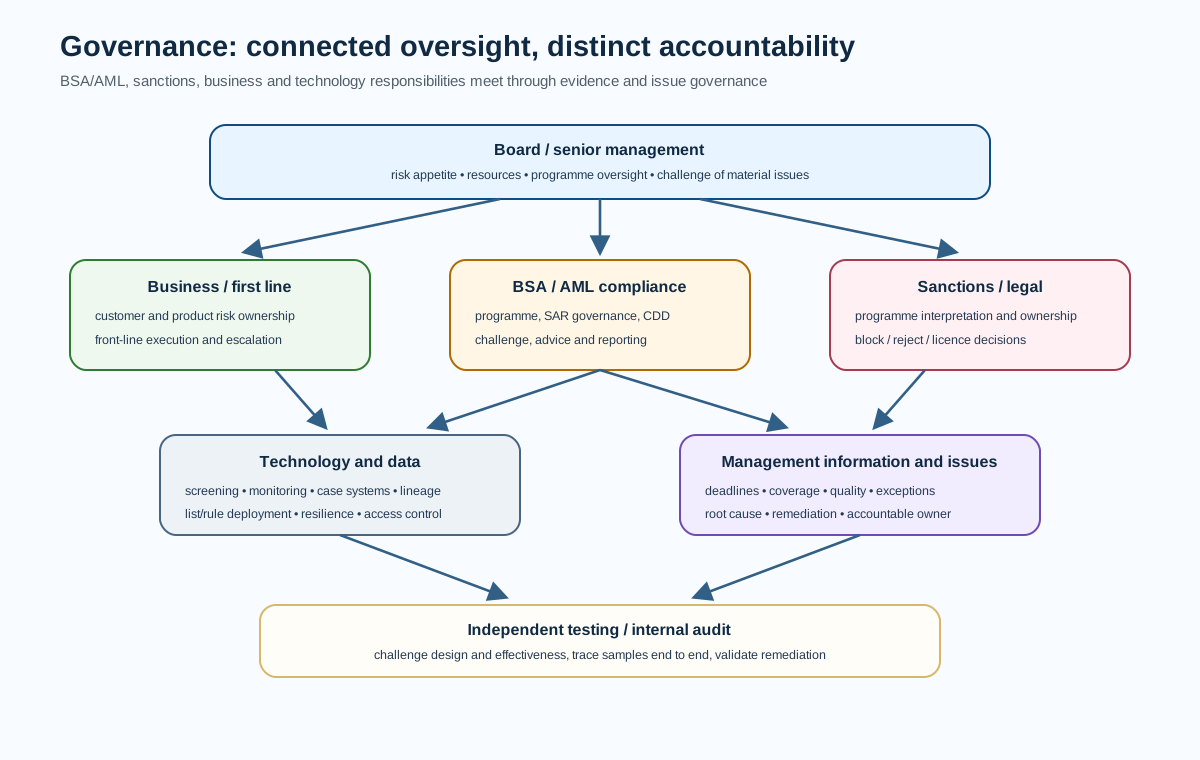
Key takeaway
The U.S. framework is demanding because it combines BSA programme and reporting duties, multiple supervisors, a changing beneficial-ownership environment, extensive information sharing and a separate sanctions regime. The complexity becomes manageable when the bank separates legal questions, shares reliable facts, preserves deadlines and evidence, and tests the seams between systems.
The objective is not to build the largest compliance machine. It is to make correct, timely and explainable decisions under the rule that actually applies.
Masterclass: one U.S. customer, three different legal decisions
This case is fictional but built from ordinary bank control patterns. The purpose is to show why BSA/AML, FinCEN reporting and OFAC sanctions need shared evidence without being collapsed into one decision.
Onboarding North River Components
A U.S. commercial bank onboards North River Components LLC, a domestic manufacturer that imports specialised industrial parts and sells finished assemblies to U.S. customers. The bank collects formation documents, tax information, authorised-signer identity evidence, business purpose, expected turnover, main suppliers, expected payment corridors and beneficial-ownership information required by its CDD process.
Because North River is a U.S. domestic company, it is exempt from Corporate Transparency Act BOI reporting under FinCEN's August 2026 final rule. The onboarding analyst correctly records that this public-reporting exemption does not remove the bank's separate CDD obligations. The customer's beneficial-ownership evidence therefore remains in the bank's KYC record.
North River expects approximately 150 incoming domestic credits each month and six to ten outgoing international wires, mainly to suppliers in two countries. The bank rates the relationship medium risk. Nothing in the profile creates a reason to refuse the customer, but the transaction baseline matters later.
First payment: a name alert that is not a legal match
Six months later, North River sends a USD wire to “Atlas Precision Industrial Co.” The payment screening engine produces a high-scoring name match against an OFAC-listed entity with a similar name. The payment is held before release.
A weak process would treat the score as the decision. A stronger sanctions analyst compares the full record: legal name, address, country, registration number, bank, website, directors and any available ownership data. The listed entity operates in another jurisdiction and has different identifiers. The analyst concludes the beneficiary is not the listed target.
The payment is released. The case records the list version, data compared, disambiguating identifiers and reviewer approval. This is an OFAC false positive. It is not a SAR decision. Transaction monitoring may still use the payment as part of future behavioural analysis, but the sanctions clearance should not create a hidden assumption that the payment was suspicious.
Second payment: ownership changes the outcome
Three weeks later, the bank receives updated ownership intelligence on Atlas Precision. The supplier itself still does not appear by name on the SDN List. However, reliable evidence now shows that two blocked persons each own 25 percent directly, producing 50 percent aggregate blocked ownership.
The sanctions team must analyse the ownership under OFAC's 50 Percent Rule and the relevant sanctions programme. If the facts establish qualifying ownership by blocked persons, the non-listed entity is itself treated as blocked. This demonstrates why list-only screening is incomplete: the legal status can arise from ownership even when the company name is absent from the list.
A new North River payment to Atlas is placed on hold. The sanctions case links the ownership evidence, identifies the applicable programme and determines that the payment involves blockable property. The bank follows its blocked-property procedure and required reporting process. It does not simply return the funds because “screening failed.”
At the architecture level, the sanctions service publishes a restricted disposition event to the payment hub and customer-risk environment. The event says that the transaction is blocked and cannot be released without authorised change. It does not publish an AML conclusion.
The AML pattern emerges
At roughly the same time, transaction monitoring identifies behaviour that does not fit North River's expected profile. The company has begun receiving large incoming credits from unrelated third parties, including businesses that appear unrelated to manufacturing. Funds are then moved quickly to multiple overseas industrial suppliers. Total international turnover has increased sharply without a corresponding change recorded in the customer's business profile.
The monitoring alert is assigned to an AML investigator. The investigator reviews the customer file, beneficial owners, expected activity, transaction history, counterparties, payment references, prior alerts, sanctions-event facts, available invoices and public information. The investigator also asks the relationship team whether the business model has changed and obtains customer explanations and supporting documents where appropriate.
The sanctions event is relevant evidence, but it is not enough by itself to justify a SAR. The AML decision turns on the wider facts: unexplained third-party funding, rapid onward movement, counterparties outside the expected profile, weak economic explanation and inconsistencies in documents. Taken together, the bank determines that the activity meets its SAR filing standard under the applicable bank rule.
The SAR case captures the initial-detection date, investigative steps, rationale, approval and filing deadline. The regulatory filing is made through the bank's controlled FinCEN process. The SAR record remains access-restricted. The OFAC block report remains a separate regulatory record.
What the customer can be told
North River's finance director calls the relationship manager asking why the international payment has not reached the supplier and why the bank is requesting additional information about other transactions.
The bank should protect SAR confidentiality, but the September 2026 interagency statement does not require it to refuse all communication. The relationship team can discuss underlying transaction facts, request invoices, explain that a payment is unavailable or under compliance review using approved language, and communicate a later relationship decision without revealing that a SAR exists.
The customer-service platform therefore receives operational actions rather than SAR metadata. It can show request supporting documents or transaction unavailable pending compliance review. It does not show SAR filed.
For the blocked transaction, the bank also must avoid misleading the customer about the status of funds. The customer communication follows the bank's sanctions/legal procedure. If a specific licence or other authorisation later permits release, the sanctions team must validate the authorisation and update the property status before the payment system acts.
Relationship exit is a separate decision
Senior management and compliance now assess whether North River remains within risk appetite. The bank could decide to retain the relationship with enhanced controls, restrict certain services, or exit. The SAR filing does not mechanically require closure.
Suppose the bank decides to terminate the commercial relationship because the unexplained activity persists and risk cannot be managed within appetite. Account closure still does not authorise the bank to return blocked funds. The blocked-property object has its own legal lifecycle and remains restricted until OFAC rules permit another disposition.
This is why a customer record needs more than active/closed. The relationship status, payment status, sanctions-property status and AML-case status are different dimensions.
A fourth event: law-enforcement information sharing
Several months later the bank receives a 314(a) request containing one of North River's overseas counterparties. The bank searches the required records and follows the 314(a) response procedure. The request does not retrospectively prove that every North River transaction was criminal, and it is not an OFAC designation.
Separately, if the bank is appropriately registered for 314(b) information sharing and the permitted purpose is met, it may choose to contact another participating financial institution about related activity. The information shared should be governed, secure and limited to the permitted purpose. Another institution's response becomes investigative information; it does not substitute for this bank's own decision.
Why the sanctions alert and AML alert should not share one score
It is tempting to create a single enterprise financial-crime score that combines sanctions, AML, fraud and customer-risk signals. A consolidated risk view can be useful for prioritisation, but it must not replace the legal decision engines.
In the North River case, the first sanctions alert is cleared because the beneficiary is not the listed person. That clearance does not reduce the importance of the later transaction-monitoring pattern. The second sanctions event produces a block because qualifying ownership changes the legal treatment of the supplier. That block does not automatically determine whether North River itself is suspicious, whether the customer should be exited or whether every earlier payment was prohibited.
A useful enterprise score can therefore answer “where should we look first?” It should not answer “what legal disposition applies?” Legal disposition still comes from the relevant rule, evidence and accountable decision maker.
For data teams this means features can be reused, but labels must be controlled. A sanctions true match should not become a generic positive label for an AML model. A SAR filing should not be fed into customer sanctions status. Fraud-confirmed victimisation should not automatically increase customer culpability. Poor label hygiene can train models to reproduce category errors at scale.
The better architecture lets domains exchange facts such as linked parties, transaction patterns, device signals, ownership and prior control events while each domain applies its own legal standard. That makes cross-domain intelligence stronger without making the bank's legal reasoning opaque.
What every role should learn from the case
A compliance professional should see four different legal questions: CDD, SAR, sanctions disposition and information sharing. A payment operations analyst should understand that a hold reason does not itself determine block versus reject. A business analyst should map separate statuses, deadlines and reporting objects. An architect should preserve data lineage and confidentiality between domains. A developer should not create a single boolean called financial_crime_failed. A tester should prove each outcome independently. A product owner should understand customer friction and operational latency. An auditor should be able to reconstruct every decision from source fact to final disposition.
Case evidence pack
A defensible evidence pack would contain the onboarding profile and beneficial-ownership record; the CTA-rule interpretation showing why public BOI reporting and bank CDD were treated separately; sanctions screening alerts and list versions; ownership evidence supporting the 50 Percent Rule decision; the block disposition and OFAC reporting evidence; transaction-monitoring data lineage; AML investigation notes; SAR decision and filing acknowledgement under restricted access; approved customer communications; relationship-risk decision; and any 314(a) or 314(b) records subject to their access rules.
The point is not to maximise documentation. It is to preserve the specific evidence needed to show that each legal question was asked and answered under the right rule.
Lessons from the masterclass
The same customer can be legitimately onboarded, generate a false-positive sanctions alert, later become connected to blocked property through ownership, trigger a separate AML investigation, become the subject of regulatory information sharing and ultimately leave the bank. None of those events should automatically decide the others.
The U.S. operating model works when shared facts move across the bank but legal conclusions remain controlled. That is the practical meaning of integrating BSA/AML, FinCEN and OFAC without confusing them.
Accuracy boundary
This chapter describes the U.S. framework for banks and uses current federal sources reviewed on 21 September 2026. It does not treat one bank regulator's rule as universally applicable to every financial institution. FinCEN's 7 April 2026 AML/CFT programme rule is a proposal, not a final effective rule at the review date. The February 2026 CDD action is exceptive relief from a specific repeated beneficial-owner collection requirement, not repeal of the CDD Rule. FinCEN's August 2026 Corporate Transparency Act BOI final rule narrows the public BOI reporting regime; it does not by itself eliminate a bank's separate CDD obligations. OFAC sanctions obligations depend on the applicable programme, jurisdiction, ownership, activity, licences and facts.
References and further reading
The following public, authoritative sources were used to validate this chapter.
- FinCEN, The Bank Secrecy Act: https://www.fincen.gov/resources/statutes-and-regulations/bank-secrecy-act
- FinCEN, CDD Final Rule and current exceptive relief materials: https://www.fincen.gov/resources/statutes-and-regulations/cdd-final-rule
- FinCEN, Exceptive Relief from Requirement to Identify and Verify Beneficial Owners at Each Account Opening, 13 February 2026: https://www.fincen.gov/news/news-releases/fincen-issues-exceptive-relief-streamline-customer-due-diligence-requirements
- FinCEN, Beneficial Ownership Information Reporting, including the August 2026 final rule position: https://www.fincen.gov/boi
- FinCEN, Permanently Ends Beneficial Ownership Reporting Requirements for Millions of Small Business Owners, 11 August 2026: https://www.fincen.gov/news/news-releases/fincen-permanently-ends-beneficial-ownership-reporting-requirements-millions
- FinCEN, Proposed Rule to Fundamentally Reform Financial Institution Programs Designed to Fight Illicit Finance, 7 April 2026: https://www.fincen.gov/news/news-releases/fincen-proposes-rule-fundamentally-reform-financial-institution-programs
- OCC, Anti-Money Laundering and Countering the Financing of Terrorism Program Requirements: Notice of Proposed Rulemaking, 7 April 2026: https://www.occ.treas.gov/news-issuances/bulletins/2026/bulletin-2026-11.html
- FinCEN, First National AML/CFT Priorities, 30 June 2021: https://www.fincen.gov/news/news-releases/fincen-issues-first-national-amlcft-priorities-and-accompanying-statements
- U.S. Treasury, 2024 National Risk Assessments for Money Laundering, Terrorist Financing, and Proliferation Financing, 7 February 2024: https://home.treasury.gov/news/press-releases/jy2080
- U.S. Treasury, 2024 National Strategy for Combatting Terrorist and Other Illicit Financing, 16 May 2024: https://home.treasury.gov/news/press-releases/jy2346
- FFIEC, BSA/AML Examination Manual — Suspicious Activity Reporting: https://bsaaml.ffiec.gov/manual/AssessingComplianceWithBSARegulatoryRequirements/04
- FFIEC, BSA/AML Examination Manual — Independent Testing: https://bsaaml.ffiec.gov/manual/AssessingTheBSAAMLComplianceProgram/03
- FinCEN, Frequently Asked Questions Regarding the Currency Transaction Report: https://www.fincen.gov/resources/frequently-asked-questions-regarding-fincen-currency-transaction-report-ctr
- FinCEN, Section 314(a): https://www.fincen.gov/resources/section-314a
- FinCEN, Information Sharing Under Section 314(b), including the 12 June 2026 fact sheet: https://www.fincen.gov/resources/section-314b
- FinCEN, Guidance to Help Financial Institutions Eliminate Fraud Through Information Sharing, 12 June 2026: https://www.fincen.gov/news/news-releases/fincen-issues-guidance-help-financial-institutions-eliminate-fraud-through
- FinCEN, Guidance to Financial Institutions on Cross-Border Information Sharing, 5 September 2025: https://www.fincen.gov/news/news-releases/fincen-issues-guidance-financial-institutions-cross-border-information-sharing
- FinCEN, Joint Statement on SAR Confidentiality Considerations Regarding Communications with Customers, 2 September 2026: https://www.fincen.gov/system/files/2026-09/Joint-Statement-on-SAR-Confidentiality.pdf
- FinCEN, FAQs Regarding Treatment of Verifiable Digital Credentials Under the Customer Identification Program Rule, 8 September 2026: https://www.fincen.gov/resources/statutes-regulations/guidance/frequently-asked-questions-regarding-treatment-verifiable
- OFAC, Frequently Asked Questions, including FAQ 5, FAQ 36, FAQ 74 and the 50 Percent Rule FAQs: https://ofac.treasury.gov/faqs
- OFAC, FAQ 401 — 50 Percent Rule and indirect ownership: https://ofac.treasury.gov/faqs/401
- OFAC, FAQ 398 — control without 50 percent ownership: https://ofac.treasury.gov/faqs/398
- OFAC, FAQ 36 — blocking versus rejecting transactions: https://ofac.treasury.gov/faqs/36
- OFAC, Filing Reports with OFAC, including blocked-property, rejected-transaction and annual blocked-property reporting deadlines: https://ofac.treasury.gov/faqs/topic/1606
- OFAC, Framework for OFAC Compliance Commitments, published 2 May 2019: https://ofac.treasury.gov/recent-actions/20190502_33
- OFAC, Amendment of the Reporting, Procedures and Penalties Regulations, 8 May 2024: https://ofac.treasury.gov/recent-actions/20240508