Sectoral Sanctions Handling
Sectoral sanctions are among the easiest sanctions controls to misunderstand because they do not always operate like an asset freeze. A person or entity can be subject to a sectoral restriction while many transactions with that person remain lawful. The prohibition may apply only to specific financing, debt or equity instruments, services, technologies, sectors, new investment, energy activity or other defined conduct. The bank therefore needs to understand exactly what activity is restricted, not simply whether a counterparty appears on a sanctions-related list.
This is especially important in U.S. Russia-related sectoral sanctions. OFAC’s Sectoral Sanctions Identifications List, or SSI List, identifies persons subject to particular directives. OFAC has repeatedly explained that these directives are not the same as blocking actions unless the person is separately blocked under another authority. The legal restriction can depend on the type of instrument, issuance date, tenor, sector and other facts. A bank that automatically freezes all property of an SSI entity because the name appears on a sanctions list would be applying the wrong legal consequence.
The same broader principle applies beyond OFAC. The European Union, United Kingdom and other jurisdictions use activity-based and sectoral restrictive measures covering areas such as finance, securities, energy, technology, investment, professional services and trade. Their legal tests differ. A global bank therefore needs a structured obligation model that can represent an entity-level designation, a sector-level prohibition and an activity-level restriction without collapsing them into one “sanctioned” status.
Sectoral sanctions are a test of whether the institution truly understands sanctions law as rules about people, property and activity, rather than just lists of names.
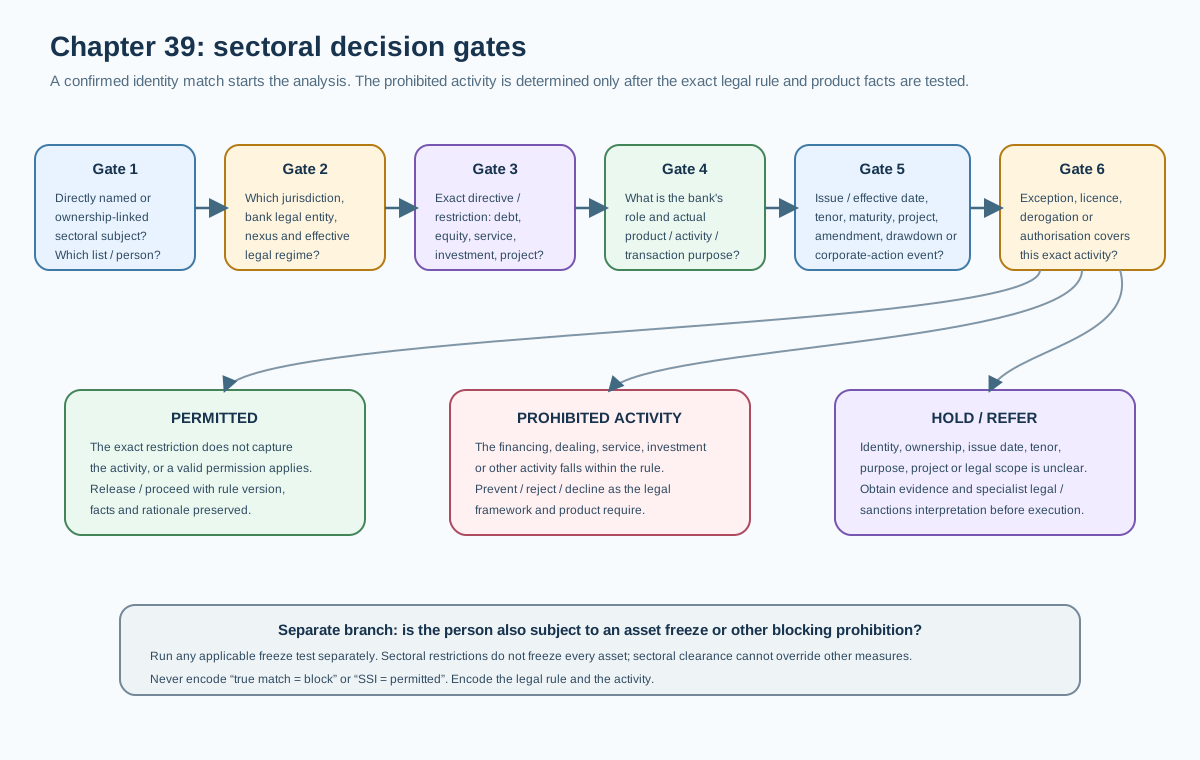
Asset freeze versus sectoral restriction
An asset-freeze regime generally restricts dealing with funds or economic resources of designated persons and can require freezing property without delay, subject to the applicable law. Sectoral sanctions can instead prohibit a specified category of transactions while leaving other dealings permitted.
This distinction changes every operational step. Under an asset freeze, the bank may need to block or freeze relevant funds or assets. Under a sectoral restriction, the bank may need to reject or refuse a prohibited financing transaction but may be able to process a permitted payment for ordinary goods or services. The exact action depends on the law and payment facts.
Case systems should therefore not use TRUE_MATCH = BLOCK. A true identity match answers only who the party is. The next question is what sanctions measure applies. The third question is whether the actual transaction falls within the prohibited activity.
This three-stage logic dramatically reduces legal and operational errors.
OFAC’s SSI framework
OFAC maintains the SSI List for persons operating in specified sectors of the Russian economy that are subject to directives issued under relevant authorities. Each directive describes the prohibited activity. A person can appear on the SSI List and not be blocked under the SDN framework.
For analysts, the important question is which directive or directives apply. Historically, different directives have addressed new debt and equity, energy projects and other sector-specific activities. The precise current legal text and effective dates should be obtained from OFAC.
The SSI List is therefore not interchangeable with the SDN List. A screening platform that displays both as “sanctions hit” without programme and directive details forces the analyst to reconstruct the legal distinction manually.
The data feed should preserve list type, programme tag, directive, effective date and source.
New debt and equity
Sectoral financial sanctions can restrict dealing in certain new debt or equity of specified persons. This requires the bank to understand the financial instrument, issuer, issuance date and sometimes tenor.
The word “new” is legal, not colloquial. A debt instrument issued before a sanctions effective date can be treated differently from one issued after. Secondary-market trading can have different consequences depending on the rule. Rollovers, amendments, extensions and refinancing can change the legal analysis.
The system therefore needs instrument-level data. A party screen alone cannot determine whether a bond, loan, commercial paper, deposit, credit line or other arrangement falls within the restriction.
Product teams must know which booking systems carry issuance date, maturity and issuer data and whether sanctions controls can access them.
Tenor
Some sectoral debt restrictions use maturity or tenor thresholds. The applicable threshold can differ by directive and date. A generic rule such as “debt over 30 days prohibited” is unsafe because historical thresholds and different legal measures can vary.
The control should store the specific legal threshold as effective-dated rule data. It should calculate tenor according to the legal interpretation approved for the instrument type.
Extensions can matter. A permitted short-term debt can become problematic if amended to extend maturity beyond the allowed tenor.
Testing should include exact boundary dates and maturities.
Loans and credit facilities
A loan can create direct sectoral exposure. Questions include borrower, lender, guarantor, maturity, drawdown date, amendment, syndication, participation and whether the transaction constitutes new debt under the applicable rule.
A bank participating in a syndicated facility needs to understand whether a restricted entity is borrower, guarantor, lender or another party and whether the bank’s activity is prohibited.
Existing facilities can create questions when they are amended, increased or extended after sanctions take effect.
Legal interpretation should define which events require rescreening and re-assessment.
Deposits
Deposits can be treated differently across sanctions regimes. Some measures can restrict accepting deposits above thresholds from specified persons or residents, while others focus on securities or financing.
The bank should not assume that “deposit” is outside sectoral sanctions because it is a routine banking product.
Product classification matters. A deposit, certificate of deposit, cash account and money-market instrument can have different legal treatment.
The sanctions rule should map to product taxonomy precisely.
Securities
Securities restrictions can apply to purchase, sale, investment services, dealing, underwriting, issuance assistance or other financial services. The affected instruments may include transferable securities, money-market instruments, equity or debt defined by the relevant law.
A securities transaction has several roles: issuer, seller, buyer, broker, custodian, settlement agent, beneficial owner and clearing system. The prohibited party may appear in any of them.
The bank should map the restricted activity to its own role. Custody may be treated differently from purchasing new securities.
The legal decision should be recorded at instrument and transaction level, not merely customer level.
Primary versus secondary market
Sectoral restrictions can distinguish issuance from subsequent trading. A prohibition on new debt or equity is not automatically a ban on every secondary-market transaction in older instruments.
Analysts and systems need issue date and instrument identity. A bond purchased today may have been issued years before the sanctions measure.
Corporate actions can complicate matters because exchanges, conversions or restructurings may create a new instrument.
The bank should have legal rules for these lifecycle events.
New investment restrictions
Some sanctions regimes restrict new investment in particular jurisdictions or sectors. “Investment” can cover more than buying shares and may include capital contributions, joint ventures, lending, expansion or other economic participation depending on the legal text.
A payment cannot always reveal whether it is an investment. Customer purpose, contract and underlying transaction may be needed.
A bank should therefore route relevant corporate-finance, project-finance and treasury transactions to sanctions review where the business activity triggers the rule.
The control should not rely only on beneficiary country.
Energy-sector restrictions
Energy sanctions can target exploration, production, transport, refining, liquefied natural gas, oil services, specific projects, technologies or financing. The scope can be highly technical and change over time.
A customer described as “energy company” is not automatically prohibited. The key is the activity and legal rule.
Trade and project-finance teams may need specialist information such as project location, resource type, equipment, counterparties and contract date.
A sanctions engine should be able to refer the case rather than force an inaccurate automated decision.
Technology and services
Sectoral measures can restrict providing technical assistance, professional services, software, technology, engineering, consulting or other support to specified sectors or jurisdictions.
For a bank, the customer may be the service provider rather than the restricted-sector company itself. Payments can therefore finance the prohibited service.
Customer industry, invoice purpose and counterparty can help identify risk. A generic narrative like “consulting fee” may be insufficient.
Where the law restricts service provision, the bank may need additional context before processing.
Professional services
Modern sanctions packages have increasingly used restrictions on accounting, trust and company services, business and management consulting, architecture, engineering, legal or other professional services in certain contexts.
The exact scope and exceptions differ significantly across jurisdictions. A bank should not create a universal banned-services catalogue and assume legal equivalence.
Customer onboarding should capture enough business activity to recognise when a professional-services company begins serving restricted sectors or jurisdictions.
Licences and exemptions can also apply.
Transaction bans
Some sanctions measures prohibit transactions with specified entities or categories of entities rather than freezing all property. A transaction ban can be broader than a narrow debt restriction but still legally distinct from an asset freeze.
The operational outcome can be refusal or rejection rather than freezing property, depending on the regime.
The sanctions platform should therefore support rule types such as ASSET_FREEZE, TRANSACTION_BAN, NEW_DEBT_RESTRICTION, NEW_EQUITY_RESTRICTION, SERVICES_BAN, INVESTMENT_BAN and other categories.
These are examples of data modelling, not universal legal labels.
State-owned enterprises and government-related entities
Sectoral sanctions can target important state-owned or state-related companies without imposing comprehensive asset freezes. Corporate ownership can therefore matter even when the entity name itself is not on a list.
The applicable ownership rule should be applied. A subsidiary can be in scope through ownership depending on the jurisdiction and measure.
Banks should not assume every state-owned enterprise in a sanctioned country is prohibited.
Legal basis must be identified.
Ownership and aggregation
Ownership rules create complexity when several sanctioned or sectorally restricted persons hold interests in one entity. OFAC’s 50 Percent Rule and UK/EU ownership/control frameworks differ in legal formulation and should not be collapsed into one global percentage.
For sectoral restrictions, OFAC guidance can extend applicable directive prohibitions to entities owned 50 percent or more directly or indirectly by one or more persons subject to the same relevant directive, subject to official guidance and the facts.
Systems need to know which owner carries which directive or programme. Aggregating owners subject to different sanctions measures can require careful legal analysis.
The ownership graph should preserve percentages, effective dates and sanctions attributes.
Counterparty roles
A restricted entity can appear as borrower, issuer, guarantor, seller, buyer, underwriter, lender, project sponsor, service recipient or beneficiary. The legal consequence depends on the rule and role.
A payment-screening system often sees only debtor and creditor. It may not know that the creditor is receiving proceeds of a prohibited new-debt issuance.
This is why sectoral controls must reach capital-markets, lending, trade and product systems rather than sit only in the payments hub.
The bank’s product inventory should map sanctions obligations to transaction roles.
Currency and clearing nexus
Currency can create sanctions nexus, particularly where payment clearing involves a jurisdiction’s financial system. But currency is not a substitute for full legal analysis.
A non-U.S. bank should not describe every USD transaction as automatically subject to all OFAC rules in every respect without considering the relevant U.S. nexus and legal obligations. At the same time, U.S. clearing can create real exposure.
The bank should map payment route and correspondent banks.
Global policy can be more restrictive than legal minimums but should be labelled as policy.
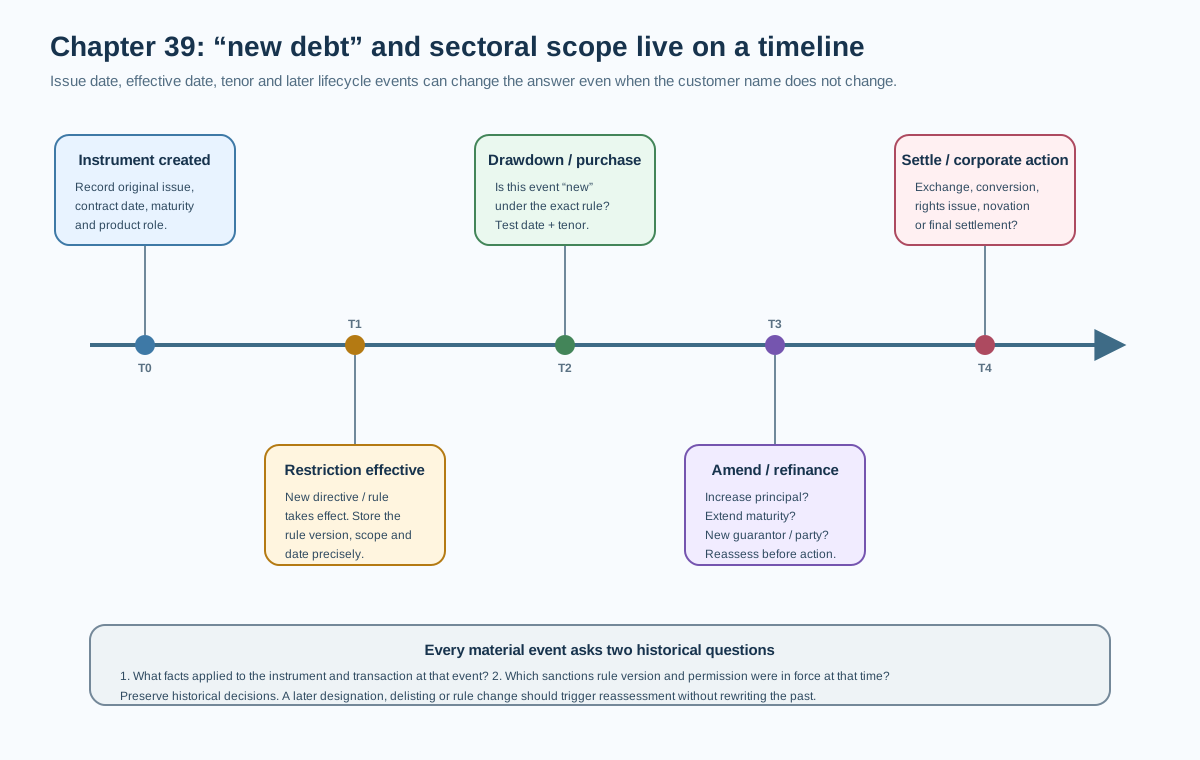
Timing and effective dates
Sectoral sanctions are highly date-dependent. A loan made before a restriction can be treated differently from a new loan after the effective date. An instrument issued before a cutoff can differ from a later issuance. A contract can predate a service ban but performance can continue afterward.
Systems therefore need legal effective date, transaction date, issue date, maturity, amendment date and sometimes settlement date.
Historical reconstruction is essential.
A sanctions rule without effective dating is incomplete.
Amendments and refinancing
A pre-existing loan may be amended after sanctions take effect. Increasing principal, extending maturity, changing borrower or adding guarantees can affect whether the transaction constitutes prohibited new debt or financing.
The bank needs event-driven sanctions review when material terms change.
The loan system should send amendments to sanctions controls, not only initial origination.
Legal teams should define which changes are relevant under each rule.
Revolving credit
Revolving facilities create further complexity. Drawdowns, repayments and re-borrowings can occur after the original agreement date.
Whether a later drawdown is new debt depends on the applicable rule and facts. Operations should not infer the answer from the facility-signing date alone.
The data model should capture facility, tranche, drawdown and maturity separately.
This is a good example of why sectoral sanctions need product knowledge.
Guarantees and letters of credit
Guarantees and documentary credits can create financing or contingent exposure. A restricted entity can be applicant, beneficiary, issuing bank, confirming bank or guarantor.
Sectoral measures can apply differently to these roles.
The trade-finance case should be rescreened at issuance, amendment and drawing where relevant.
A guarantee that extends a prohibited financing relationship should be escalated to specialists.
Derivatives
Derivatives can create exposure to restricted debt, equity, commodities or entities. The legal analysis can be complex and depends on product and rule.
A derivatives platform should preserve reference asset, counterparty, maturity and settlement terms for sanctions assessment.
Do not assume that an instrument is permitted merely because there is no cash principal exchange.
Specialist legal and markets-sanctions expertise is often needed.
Structured products
A structured note or fund can provide indirect economic exposure to a restricted issuer or sector. The bank may need to assess whether the applicable sanctions rule captures the activity.
Look-through requirements vary. Sanctions law, product regulation and internal risk appetite can interact.
The platform should distinguish direct legal prohibition from policy restrictions on indirect exposure.
Customer disclosures and portfolio systems may be relevant evidence.
Funds and asset management
Investment funds can hold securities of sectorally restricted entities. New subscriptions, purchases, index rebalances and passive holdings can create different questions.
Asset managers need sanctions controls at security and issuer level, not only investor screening.
Corporate actions can create new securities or rights.
The legal analysis should be embedded in investment compliance and pre-trade controls where appropriate.
Corporate actions
Dividends, rights issues, conversions, tender offers, maturities and restructurings can change an instrument or create new economic rights.
A security that was permissible when acquired can later generate a transaction that falls within a restriction.
Sanctions controls should therefore cover the asset lifecycle.
The bank should not assume historical clearance remains valid forever.
Settlement and custody
Custodians and settlement agents may handle restricted securities without being the investment decision-maker. Their obligations can still be material.
Settlement messages should carry enough instrument and party data for applicable controls.
A blocked or prohibited security should have system restrictions preventing unauthorised movement.
Asset state and legal basis should be clear.
Payment processing for sectorally restricted entities
An ordinary commercial payment to an SSI entity may be permitted if it does not involve prohibited debt, equity or another restricted activity and no other sanctions apply. This is precisely why payment teams need directive information.
A bank that rejects every payment to an SSI entity can create unnecessary de-risking and customer harm. A bank that processes every payment because “SSI is not blocked” can also fail if the payment finances prohibited activity.
Purpose and product context matter.
Escalation should focus on activity rather than list-name alone.
Screening data design
Sanctions master data should preserve list type and restriction metadata. SDN, SSI, NS-MBS, CAPTA or other OFAC lists have different consequences. UK and EU measures use different structures.
The UI should display the relevant programme and restriction. Analysts should not have to search the internet to understand what list generated the alert.
Data ingestion should support amendments and removals.
Testing should verify that list attributes survive transformations.
Rule engine design
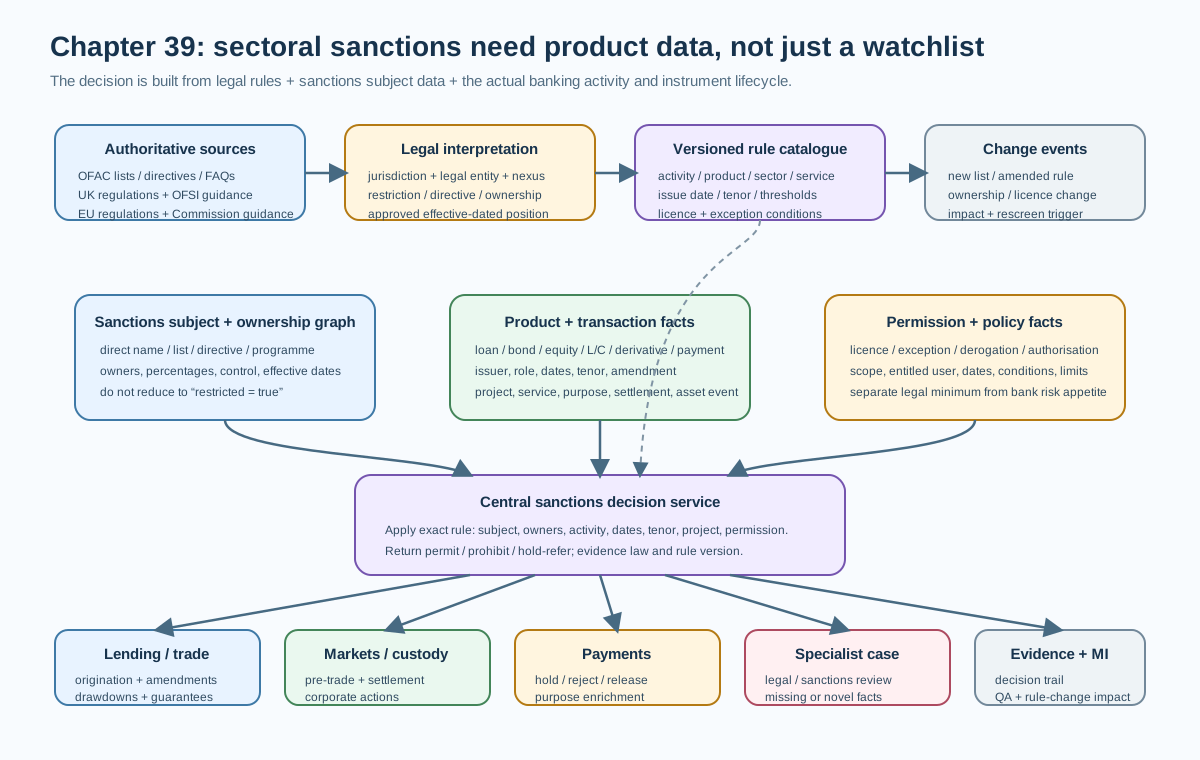
Sectoral rules are often better represented as decision tables than simple watchlists. Inputs can include jurisdiction, legal entity, counterparty, ownership, directive, instrument type, issue date, tenor, transaction type, sector, project, service, currency and licence.
The output should be PERMITTED, PROHIBITED, REFER_FOR_LEGAL_REVIEW or another controlled status defined by policy, with the legal basis.
Rules should be effective-dated and versioned.
Manual override should require reason and authority.
A sectoral decision table
A useful decision table begins with identity. Is the relevant entity subject to a sectoral measure directly or through ownership/control? Next identify which measure or directive applies. Then classify the activity: ordinary goods payment, loan, new security, secondary-market trade, service, investment or other product. Apply dates and thresholds. Check licence or exception. Then determine the operational action.
This sequence prevents the list hit from becoming the conclusion.
The legal text should map to explicit conditions.
A rule should be testable with examples and boundary cases.
EU sectoral measures
EU restrictive measures relating to Russia and other regimes include a wide range of sectoral restrictions on finance, trade, technology, services, investment, energy and transactions with specified entities. The details have evolved through successive sanctions packages.
A bank should therefore use current EU regulations and Commission/Council guidance rather than rely on an old simplified summary.
The EU framework also illustrates why “sectoral” can mean much more than debt and equity.
Different Member State competent authorities can be relevant for authorisation and enforcement.
UK sectoral measures
UK sanctions regulations also include activity-based restrictions across finance, investment, trade and services. The UK framework is legally separate from the EU framework after Brexit even where policy objectives overlap.
A global bank should not reuse EU rule IDs for UK entities merely because the practical outcome appears similar.
UK restrictions can have different definitions, ownership/control concepts, licensing grounds and reporting requirements.
OFSI and other UK authorities should be used as current official sources.
U.S. sectoral measures beyond SSI
The United States uses several types of non-blocking sanctions restrictions beyond the SSI framework, including directives, investment restrictions, correspondent-account restrictions and other targeted measures.
A bank should therefore avoid using SSI as a synonym for all non-blocking U.S. sanctions.
The sanctions master should classify the precise list or directive.
Operational teams need training on the difference.
Sector versus country
A sectoral restriction can apply to entities in a particular sector without banning all business with the country. Geography alone is not enough.
Conversely, a country programme can include broad restrictions that operate alongside sectoral measures.
The rule engine should consider country and sector separately.
This reduces both underblocking and overblocking.
Sector classification
Customer sector data can be messy. Industry codes can be stale or overly broad. A diversified group can operate in several sectors.
A sanctions control should not rely solely on one KYC industry code to determine legal sector exposure.
External business descriptions, ownership, contract purpose and product data can supplement the analysis.
Where classification is uncertain, refer rather than guess.
Project-level restrictions
Some sanctions target specific projects or activities rather than entire industries. Energy-project restrictions are a classic example.
The bank may need project name, location, ownership and technical scope.
A customer-level decision cannot capture every project variation.
Project finance and trade systems should be able to link the transaction to the relevant project.
Scenario: SSI commercial payment
A corporate customer sends payment for ordinary office services to an entity on the OFAC SSI List. The entity is subject to a directive restricting certain new debt and equity but is not separately blocked.
The payment is not automatically prohibited merely because of the SSI match. The bank should confirm which directive applies and whether the payment creates or deals in prohibited debt/equity or another restricted activity.
If it is an ordinary permitted goods or services payment and no other sanctions apply, the payment may be processed under the approved legal interpretation.
The case should retain the SSI match and rationale.
Scenario: prohibited new debt
A bank is invited to participate in a new loan to an SSI entity. The proposed maturity exceeds the current permitted tenor under the applicable directive.
The sectoral analysis is direct: identity, directive, debt type, issue date and tenor are all relevant. The bank should not process the financing if prohibited and no licence applies.
The operational action is not necessarily to freeze the borrower’s unrelated funds.
The legal distinction should be clear in the case.
Scenario: old bond
An investment desk wants to purchase a bond issued before the effective date of a new-equity/new-debt restriction. The issuer is sectorally restricted but not blocked.
The bank should assess the applicable directive and secondary-market rules. The mere fact that the purchase occurs today does not make the instrument “new.”
If permitted, the security can still require ongoing monitoring for later sanctions changes.
Issue date is therefore a critical attribute.
Scenario: refinancing
A corporate loan predates sanctions but the borrower requests an extension and additional principal.
The amendment can create new financing exposure. Legal analysis should determine whether the extension or increased amount constitutes prohibited new debt.
The loan system should trigger sanctions review before amendment execution.
Historical approval should not suppress the new event.
Scenario: mixed restricted owners
A company is 30% owned by one person subject to Directive A and 25% by another person subject to Directive B. The applicable aggregation and legal consequence may not be straightforward.
The analyst should not simply add percentages and apply both directives without approved legal guidance.
Ownership rules and directive scope must be interpreted correctly.
Complex cases should be escalated.
Scenario: service ban
A consulting customer receives payment from a company in a restricted sector for a service that may be prohibited under an applicable sanctions measure.
Name screening alone may not identify the issue because neither party is listed.
The bank needs customer sector, payment purpose and jurisdiction context to recognise the potential service restriction.
This illustrates why sectoral sanctions require activity-based controls.
Scenario: multiple jurisdictions
A financing involves a UK bank entity, an EU borrower subsidiary, a Russian parent, USD funding and U.S. investors.
Several sanctions regimes can be relevant and their sectoral rules may differ.
The group should map each legal entity and transaction leg rather than choose one global answer.
The final structure may require separate legal conclusions for each participant.
Scenario: entity later becomes SDN
A company originally subject only to sectoral restrictions is later added to an asset-freeze list.
The legal consequence changes materially. Existing payments, accounts, securities and contracts may require immediate reassessment.
The list-update process should trigger rescreening and asset review.
Do not continue using the old “SSI only” decision after the new designation.
Scenario: entity removed from SSI
Removal from a sectoral list should update future controls, but historical transactions should retain the legal state that existed when they occurred.
The bank should also determine whether other restrictions remain.
Delisting does not mean every related risk disappears.
Audit history should remain intact.
Relationship with licences
Sectoral restrictions can have general or specific licences, exceptions or authorisations. Licence scope should be evaluated after identifying the underlying prohibition.
A licence can cover one type of financing and not another.
The licence-management chapter’s lifecycle controls apply: authority, scope, parties, conditions, date, reporting and expiry.
Never use a permanent whitelist for a temporary sectoral licence.
Relationship with AML
Sectoral-sanctions exposure is a legal sanctions issue, not automatically AML suspicion. A customer can lawfully transact with a sectorally restricted entity in activity outside the prohibition.
Evasion behaviour, false documentation or concealed ownership can separately create AML or sanctions-evasion concerns.
The evidence can be shared but the outcomes should remain distinct.
A sanctions rejection is not a substitute for SAR/STR decisioning.
Relationship with export controls
Sectoral sanctions can restrict technologies or services that also fall within export-control regimes. These rules overlap but are not identical.
A sanctions permission does not necessarily authorise export of controlled technology.
Specialist trade/export review may be needed.
Systems should preserve separate legal bases.
Correspondent banking
Correspondent banks may process payments for sectorally restricted entities without seeing the underlying financing structure. Payment purpose can be critical.
Where the payment looks like loan principal, interest, securities settlement or another restricted activity, the correspondent can seek clarification.
The respondent’s sanctions controls are part of correspondent due diligence.
Repeated ambiguous financing traffic can influence risk assessment.
Payment narratives
Terms such as “interest,” “loan,” “bond,” “coupon,” “subscription,” “capital contribution” or “investment” can be useful indicators, but free-text keyword screening is noisy.
An ordinary invoice can contain “interest” in an unrelated context. A prohibited financing transaction can have a vague narrative.
Structured product data is more reliable.
Narratives should supplement, not replace, transaction context.
Data lineage
Sectoral controls depend on attributes from many systems: sanctions lists, KYC ownership, loan systems, securities masters, trade systems, payment messages and licences.
Each critical field should have source and freshness information.
A missing issue date can make an automated decision unsafe.
The system should route to review rather than invent a default.
Control failures
Common failures include treating all sectoral matches as blocked persons, failing to capture directive metadata, applying outdated tenor thresholds, not rescreening amendments, ignoring ownership, relying on customer sector code alone and letting temporary licences become permanent whitelists.
Another failure is applying one jurisdiction’s sectoral rule globally.
Root-cause analysis should distinguish legal-rule error, data error, system error and analyst error.
Remediation should address the systemic cause.
Quality assurance
QA should sample permitted and prohibited cases. It should verify list type, directive, ownership, activity classification, instrument attributes, dates, licence and final action.
A case that simply says “sanctions match — cleared” is weak.
The rationale should explain why the sectoral restriction did or did not capture the transaction.
QA should also assess customer impact from overblocking.
Metrics
Useful metrics include sectoral-alert volume, percentage resolved as ordinary permitted activity, time to product/legal review, aged cases, missing instrument data, rule changes, licence usage, overblocking complaints and QA findings.
Metrics should separate SSI or other sectoral alerts from asset-freeze alerts.
Management should know whether noise is caused by payment screening being used for product-level decisions it cannot make.
That can guide architecture investment.
BA data model
Model SanctionsSubject, Restriction, Directive, LegalBasis, OwnershipRelationship, Instrument, Issue, Transaction, Product, Tenor, Sector, Project, Service, Licence, Decision and Evidence separately.
Restriction should have effective dates and jurisdiction.
An entity can have several restrictions simultaneously.
A transaction can require several rules to be evaluated.
BA acceptance criteria
Test sectoral-only entity, entity also on SDN list, old bond, new bond, short tenor debt, long tenor debt, refinancing, revolving drawdown, ownership change, mixed directive owners, licence, expired licence, service ban, project restriction, secondary market, corporate action and multi-jurisdiction processing.
Expected results should include legal basis and operational action.
Boundary dates and exact tenor limits require dedicated tests.
Negative tests should prove ordinary permitted payments are not frozen.
Developer view
Implement restriction metadata as data, not hard-coded UI text. The rules engine should support effective-dated thresholds and product attributes.
Sanctions list ingestion should preserve programme and directive tags.
Ownership services should return the chain used in the decision.
Every automated outcome should be explainable.
Architecture view
Sectoral sanctions are a strong argument for a central sanctions-decision service integrated with product systems rather than one universal payment-screening engine.
The product system contributes instrument and transaction attributes; the sanctions service contributes subject/restriction data; ownership service contributes relationships; licence service contributes permissions.
The combined decision can then return legal outcome and evidence reference.
This architecture scales better across lending, securities and trade.
Internal audit view
Audit should assess whether the institution can demonstrate that sectoral restrictions are implemented according to current law and whether list matches translate to the correct activity rules.
Sampling should include transactions that were permitted despite a sectoral match to test rationale.
Audit should also inspect amendments and rule-change implementation.
A bank can fail sectoral sanctions through both underblocking and overblocking.
Final learning test
A learner should be able to explain why an SSI match is not automatically an asset freeze, why directive metadata matters, how new debt and equity can depend on issue date and tenor, why loan amendments and corporate actions require rescreening, how EU/UK sectoral measures differ from U.S. SSI logic, and why product data is essential.
They should be able to take a sectorally restricted entity and determine whether an ordinary commercial payment, a new loan, a pre-existing bond, a securities purchase or a professional service falls within the relevant prohibition.
They should also be able to explain the difference between identity match, legal restriction, product classification, licence and operational action.
A strong practitioner leaves the chapter understanding that sectoral sanctions are activity rules attached to legal subjects and sectors, not a simplified list of people whose money must always be frozen.
Authoritative references
- OFAC — Additional Sanctions Lists / SSI List: https://ofac.treasury.gov/other-ofac-sanctions-lists
- OFAC FAQ 370 — Sectoral sanctions Directives 1 and 2 are not blocking actions: https://ofac.treasury.gov/faqs/370
- OFAC — Consolidated FAQs, Ukraine-/Russia-related sanctions: https://ofac.treasury.gov/faqs/all-faqs
- UK OFSI — UK financial sanctions general guidance: https://www.gov.uk/government/publications/financial-sanctions-general-guidance/uk-financial-sanctions-general-guidance
- European Commission — EU sanctions and restrictive measures: https://finance.ec.europa.eu/eu-and-world/sanctions-restrictive-measures_en
- Council of the EU — EU sanctions against Russia explained: https://www.consilium.europa.eu/en/policies/sanctions-against-russia-explained/
Educational note: sectoral restrictions, instrument definitions, tenor thresholds, service bans and licensing provisions are highly jurisdiction- and date-specific. Apply current legal text and competent-authority guidance to live transactions.
Advanced practice: sectoral sanctions across lending, securities, trade and payments
Sectoral sanctions expose a weakness in organisations that think sanctions compliance begins and ends with list screening. The bank can identify the right person and still make the wrong legal decision if it does not know the product, instrument, date, tenor, project, service or transaction role. This section develops the product-level reasoning needed for a mature operating model.
Build the sanctions subject correctly
The first task is to identify whether the entity is directly named under the sectoral measure or brought into scope through an applicable ownership/control rule. That determination should retain the exact restriction or directive attached to the subject.
A sanctions master that stores only restricted=true destroys essential information. Two entities can both be sanctions-relevant but subject to completely different restrictions. One can be blocked; another can only be restricted from certain new debt; a third can be subject to a transaction ban; another can face service or investment restrictions.
The subject record therefore needs legal measure, programme, jurisdiction, effective dates and restriction attributes.
Lending lifecycle
Lending controls should operate at more than origination. Initial approval can become stale if borrower ownership changes, sanctions rules change, the loan is amended or a later drawdown creates new exposure.
The sanctions event model can include facility creation, commitment, drawdown, increase, maturity extension, refinancing, guarantee addition, borrower substitution, syndication transfer and repayment. Legal teams should identify which events are relevant under each sectoral rule.
The system should route relevant events before contractual commitment where possible. Discovering a prohibition only after the bank is legally committed creates avoidable operational and legal complexity.
Tenor calculation
Tenor sounds simple but can be operationally difficult. The legal rule can define maturity based on issue date, original contractual maturity, payment terms or another concept. Holidays, extensions, grace periods and amendments can create edge cases.
The bank should document how tenor is calculated for each product. One implementation reused across loans, letters of credit and trade payables may be wrong.
Boundary tests should include one day below, exactly at and one day above the threshold applicable under the effective rule.
Trade credit
Commercial payment terms can themselves constitute debt or extension of credit under some sectoral sanctions frameworks. A sale of goods on 90-day terms can therefore raise a financing question even though no formal loan exists.
Trade-finance and corporate-banking teams should understand when ordinary commercial credit requires sanctions review. Payment processing alone may not see invoice date or agreed payment terms.
The control needs upstream commercial or trade data where the rule makes it material.
Letters of credit
Letters of credit can create extensions of credit depending on applicant, issuer, confirming bank, reimbursement terms and the applicable directive. OFAC’s sectoral-sanctions FAQs have historically provided examples demonstrating that the term of an L/C can matter when an SSI entity is the applicant.
The bank should model issuance date, applicant, tenor, reimbursement and amendments. Documentary compliance does not answer the sanctions question.
A later extension of the L/C can require new assessment.
Guarantees
Guarantees can create contingent obligations that later become funded. The legal analysis should consider guarantor, beneficiary, underlying debtor, issue date, expiry and amendment.
A guarantee issued before a sanctions effective date can still be amended afterward. A demand under the guarantee can create a payment event requiring fresh screening.
Product lifecycle and sanctions lifecycle must therefore be connected.
Syndicated lending
A syndicated facility can involve multiple lenders, agent bank, borrower, guarantors and participants. One institution’s legal restrictions may differ from another’s.
The bank should understand its role: arranger, agent, lender, participant or payment bank. Transfers of participation can also create new counterparties.
Sanctions controls should not assume that the facility agent’s clearance replaces each bank’s obligations.
Securities issuance
For securities restrictions, primary issuance requires issuer identity, issue date, instrument type and applicable rule. Underwriting, placement, advisory and settlement services can each be relevant.
A bank can be prohibited from participating in issuance even if buying an older instrument by the same issuer would be permitted under the relevant sectoral rule. The system should therefore classify the transaction role.
Issuer master data and sanctions master data must join reliably.
Secondary-market trading
Secondary trading often creates confusion because the trade occurs after sanctions but the instrument can predate them. The applicable rule and official guidance determine whether secondary-market dealings are permitted.
The sanctions control should therefore preserve original issue date and security identifier. A trade date alone is not enough.
A data-quality defect in issue date can create both false blocks and prohibited trades.
Corporate actions
Corporate actions can transform an old permitted instrument into new securities or value. Exchanges, conversions, rights issues, tender offers and restructurings may create new legal events.
Investment-compliance systems should treat relevant corporate actions as sanctions triggers. Operations teams should not assume a passive corporate action is outside sanctions controls.
Where shareholders have no choice, legal analysis may differ from voluntary participation. The system should record event type.
Index and passive investment
Passive funds can acquire exposure because an index includes a sectorally restricted issuer. Whether investment is permitted depends on the precise restriction, instrument and jurisdiction.
Asset managers can use pre-trade restrictions and security-level sanctions attributes. A general country-risk score is insufficient.
If an index rebalance would create prohibited exposure, the fund may need an approved handling process consistent with legal and fiduciary obligations.
Deposits and treasury products
Some sanctions frameworks restrict accepting deposits from specified persons or above defined thresholds. Others do not. Treasury products can also create money-market instruments or lending exposure.
The bank’s product taxonomy should map legal definitions to actual products. A business label such as “cash management” can contain several different legal instruments.
Sanctions requirements need product-level interpretation, not only customer-level risk classification.
Derivatives and reference exposure
Derivatives can reference restricted securities, commodities or entities. A cash-settled derivative may still fall within an investment or securities restriction depending on the rule.
The relevant data can include underlying reference, counterparty, settlement form, trade date, maturity and economic exposure. These fields usually live in markets systems rather than payments.
Specialist sanctions/legal expertise is often necessary; an automated payment rule should not pretend to determine the full derivatives analysis.
Energy-project restrictions
Sectoral measures can target specific energy projects or categories of exploration and production. A large energy company can conduct both restricted and permitted activity.
The bank should therefore understand project and service, not only customer industry. A project-finance facility should link to project location, resource and counterparties where required by the legal rule.
The control should allow ordinary permitted business with the same customer when law permits it.
Professional-services restrictions
Service bans can apply without a listed counterparty. A consulting, engineering, architecture, IT, legal, accounting or trust service can be restricted based on recipient, sector, geography or purpose.
Payment data may contain little service information. Customer KYC, invoice or product data can therefore be important.
A risk-based referral is often more accurate than a hard free-text keyword block.
Sector classification quality
Industry codes can be too broad, outdated or inconsistent across systems. A diversified conglomerate can operate in several sectors.
The bank should treat sector classification as evidence with provenance. High-risk legal decisions may require current business information rather than a five-year-old onboarding code.
Event-driven KYC updates can improve both sanctions and AML controls.
Ownership changes
A previously unlisted subsidiary can move into sectoral scope after acquisition by a restricted parent. Conversely, a genuine divestment can remove an ownership-based restriction depending on the law.
Ownership changes should trigger rescreening and product impact analysis. The bank needs to identify open loans, securities, guarantees, payments and contracts linked to the entity.
Historical ownership remains relevant for older transactions.
Cross-directive ownership
An entity can be owned by several restricted persons subject to different directives or measures. This is not a case for a simplistic percentage calculator.
The bank should preserve each owner’s sanctions attributes and apply approved legal logic for aggregation and scope. If the answer is uncertain, route to legal review rather than inventing a combined directive.
This is a useful test of whether the data model can support legal nuance.
Licence interaction
A licence can permit a particular sectoral transaction, but it should be tested against the exact prohibited activity. A licence authorising certain debt payments does not necessarily permit new investment or services.
Sectoral sanctions decisioning should call the same governed permission service used elsewhere in the sanctions programme.
The case should retain both the sectoral restriction and licence basis.
Operational states
Sectoral restrictions often lead to stop/reject/referral rather than legal freezing of unrelated property. Payment and product systems therefore need accurate states.
A loan application can be DECLINED_SANCTIONS_RESTRICTION; a securities order can be prevented pre-trade; a payment can be rejected or held pending review. These should not all be recorded as FROZEN.
Precise operational vocabulary improves audit and customer communication.
Rule-version governance
Sectoral rules can change with sanctions packages. Thresholds, covered sectors, entities and services can be amended. The bank should maintain rule versions and effective dates.
When a threshold changes, impact assessment should identify open instruments and scheduled transactions. Historical transactions should continue to show the rule in force when they occurred.
Testing should compare old and new rule outcomes on the same sample population.
Product inventory exercise
Create a product inventory covering corporate loans, revolving facilities, L/Cs, guarantees, bonds, equities, derivatives, deposits, custody, asset management, project finance and ordinary payments. For each product identify the sectoral-sanctions attributes required and the event that triggers review.
This exposes controls that currently depend on data the sanctions platform does not receive.
The output should become a roadmap for integration rather than a theoretical matrix.
Data lineage exercise
Choose one security trade and trace issuer, issue date, instrument type, ownership, sanctions subject, directive, licence and final decision from source systems to the sanctions service. Confirm that transformations do not drop the original issue date or directive tag.
A one-character mapping error in a date or security identifier can materially change the outcome.
Lineage evidence should be available to testing and audit.
Scenario tuning
Sectoral-sanctions alerts should be evaluated for precision. If ordinary invoice payments to SSI entities repeatedly route to expensive manual review but the bank already has reliable product-purpose data showing they are not financing transactions, the control can be improved.
Tuning should not suppress the identity information. It should use context to route only transactions that can actually fall within the restriction.
This is better than either blanket blocking or blanket whitelisting.
Management and governance
Management information should show which product areas generate the most sectoral referrals, where required instrument data is missing, how often legal review is needed, how quickly rule changes are deployed and whether customer complaints reflect overblocking.
Governance should involve sanctions legal/policy, product owners, operations, technology, data and QA. Sectoral sanctions are inherently cross-functional because no single system contains all required facts.
Practitioner conclusion
A mature sectoral-sanctions programme is an activity-control system informed by sanctions subject data. It knows the difference between a blocked person and a restricted financing counterparty; it understands product lifecycles; it effective-dates rules; and it can explain why one transaction with the same entity is prohibited while another is permitted. That is the level of precision expected from a strong banking learning product.
60-minute mastery extension: sectoral sanctions handling
The key to sectoral sanctions is to stop thinking in binary list terms. Use roughly 30 minutes for the core chapter and diagrams, 15 minutes for the instrument/activity cases, 10 minutes for decision-table design and 5 minutes for the final test.
The essential comparison
A person subject to an asset freeze can trigger restrictions on funds or economic resources. A person subject only to a sectoral restriction can remain eligible for many ordinary transactions while specified financing, securities, investment, services or sector activities are prohibited. The identity match is therefore only the first stage.
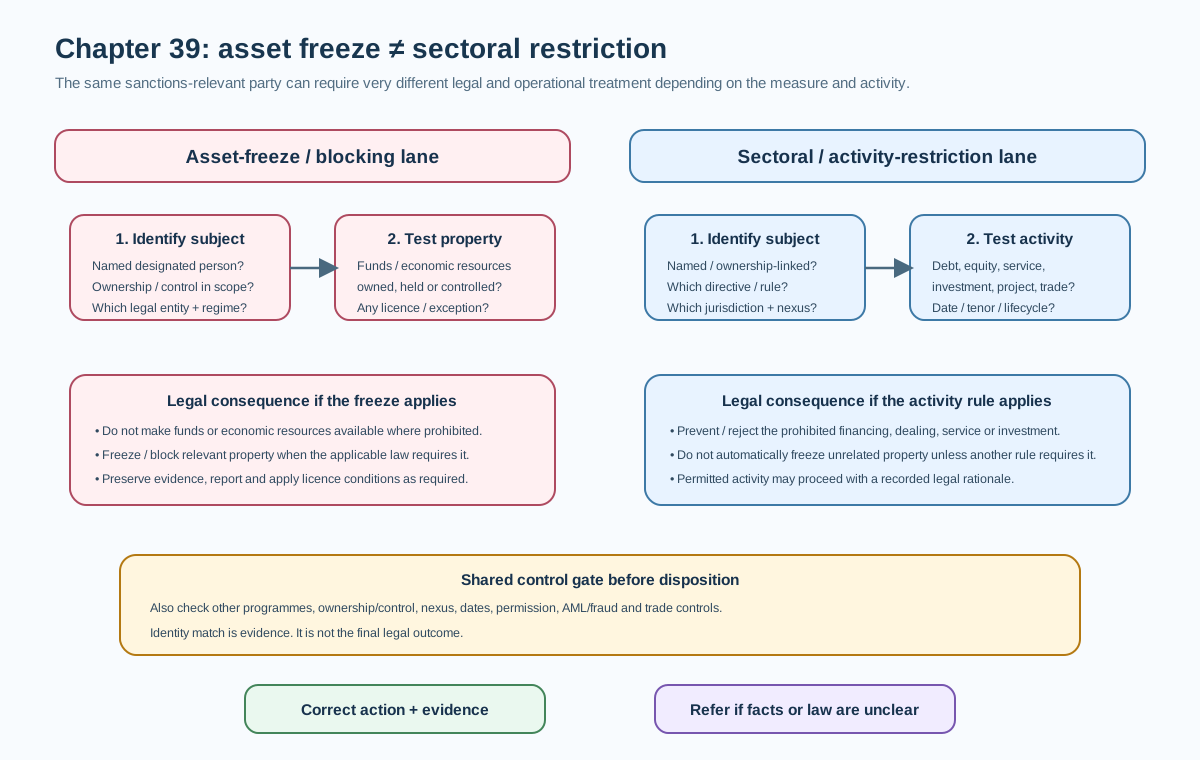
The learner should be able to explain why freezing an SSI entity’s unrelated payment merely because it appears on the SSI List can be legally wrong, and why simply releasing every SSI payment because the entity is “not blocked” can also be wrong.
Case 1 — ordinary invoice payment
A customer pays an entity subject to a sectoral debt/equity directive for ordinary office services. No other sanctions apply. Determine whether the payment itself creates, deals in or extends prohibited financing. If not, the activity may be permitted under the applicable rule.
Document the directive and activity analysis. “SSI hit cleared” is too weak because it does not explain why the transaction was outside the prohibition.
Case 2 — new loan and tenor
The bank is invited to lend to a sectorally restricted borrower. The proposed facility is issued after the restriction’s effective date and has maturity beyond the applicable tenor limit. Identify borrower, directive, debt definition, issue date, tenor, ownership and licence.
Now shorten the tenor to the exact legal boundary and test the calculation. Boundary conditions belong in system testing because one-day errors can create legal breaches.
Case 3 — old security bought today
A bond was issued before the relevant restriction. The investment desk wants to buy it in the secondary market today. The transaction date is current, but the instrument is not necessarily “new debt.” Apply the current directive and official guidance rather than assuming any purchase today is new issuance.
Then add a later exchange offer that replaces the old bond with a newly issued instrument. Corporate lifecycle events can change the answer.
Case 4 — loan amendment
A facility predates sanctions. The borrower asks to increase principal and extend maturity. The original agreement date does not automatically protect the amendment. The bank should reassess whether the amended terms create new prohibited financing.
The lesson for BAs is event-driven control: origination approval is not permanent sanctions clearance.
Case 5 — mixed owners
An unlisted company has several owners subject to different sanctions restrictions. Do not mechanically aggregate all percentages and apply every restriction. The ownership/control and aggregation rules need regime- and directive-specific legal interpretation.
Represent each owner, percentage, effective date and applicable restriction separately. The legal service can then evaluate the correct rule.
Case 6 — service restriction without list hit
A consulting company in a permitted jurisdiction receives payment for a professional service supplied to a restricted sector or jurisdiction. Neither immediate party is listed. Name screening is clean.
This case proves why sectoral/activity sanctions need purpose, customer business and service context. The control should identify a potential prohibited service even without a sanctions-list match.
Case 7 — sectoral person later becomes blocked
An entity previously subject only to a sectoral restriction is added to an asset-freeze list. The bank must rescreen customers, accounts, securities and open transactions and change the legal treatment from activity-specific analysis to the new restrictions where applicable.
Historical sectoral decisions remain valid evidence for the time they were made. Do not overwrite them with the new status.
Instrument-data exercise
Build a minimum instrument record containing issuer, guarantor, security identifier, instrument type, issue date, maturity, tenor, currency, principal, amendment history, market type and sanctions attributes. Identify which fields are mandatory for automated sectoral decisioning.
If issue date or maturity is missing, the system should route the transaction appropriately rather than invent a permissive default.
Decision-table exercise
Create a table with columns: legal entity, sanctions regime, subject identity, ownership result, directive/restriction, activity type, instrument type, issue date, tenor, sector/project, licence, legal outcome and operational action.
Use the table to test ordinary commercial payment, new loan, old bond, new bond, service contract, investment and corporate action. The table should visibly separate identity confirmed from activity prohibited.
Product-control architecture
Map sanctions controls into lending, securities, trade, payments and asset management. Payment screening alone cannot know every instrument or service attribute. A central sanctions-decision service can consume product data, ownership data, sanctions rule data and licences, then return a reasoned result.
The learner should identify which product owns each fact. The sanctions system should not become an unreliable duplicate securities master.
QA challenge
Review ten sectoral cases. Look for: asset freeze applied to non-blocked sectoral entity; stale tenor threshold; missing issue date; failure to rescreen amendment; incorrect aggregation of owners; legal rule from wrong jurisdiction; payment purpose inferred from a weak narrative; and licence treated as permanent customer clearance.
QA should also look for overblocking, because unnecessary rejection is a control-quality issue as well as a customer problem.
Final practitioner test
The learner should be able to explain the SSI-versus-SDN distinction, why sectoral restrictions are attached to defined activities or instruments, why issue date and tenor can matter, why product events such as amendment or corporate action trigger reassessment, and why EU/UK activity restrictions cannot simply be implemented as copies of U.S. SSI directives.
Final scenario: “Sectorally restricted issuer, bond issued before sanctions, purchased today, later exchanged into a new note, licence expires before settlement.” A correct answer walks through each event and legal rule rather than applying one static list status.
Derivatives under sectoral restrictions
Derivatives referencing sectorally restricted entities or underlying restricted instruments require analysis distinguishing the derivative contract from its underlier: prohibitions on new debt and equity do not automatically prohibit all derivatives, but specific programmes restrict defined derivative activities and the economic equivalence of certain structures to prohibited financing demands careful assessment. Credit-default swaps referencing restricted borrowers, total-return swaps replicating restricted-entity exposure, and structured notes embedding restricted instruments each require programme-specific analysis rather than generic derivatives treatment. The trading desk needs restriction-flag integration at pre-trade stage with instrument-level granularity, since post-trade detection of prohibited derivatives creates unwind complexity and potential breach exposure.
Ongoing lifecycle events in existing derivatives books, coupons, resets, exercises, assignments and novations, need restriction assessment where the underlying entity's status changes or programme rules evolve. Novation and assignment deserve particular attention as potential new-activity triggers: transferring restricted-entity exposure to a new counterparty may constitute prohibited dealing even where the original contract predates restrictions. Collateral arrangements referencing restricted securities require the same custody-and-corporate-action discipline as direct holdings. Documentation standards, ISDA protocols and definitions interacting with sanctions provisions, should be reviewed with legal input to ensure contractual mechanics support compliant treatment across the book's lifecycle events.
Revolving facilities and the new-debt boundary
Revolving credit facilities to sectorally restricted borrowers concentrate the new-debt boundary problem in recurring drawdown decisions: each drawing potentially constitutes new debt subject to maturity and date restrictions, while the facility agreement itself may predate the measures. Drawdown-review procedures must assess each drawing against current programme rules with tenor calculation from drawing terms, purpose verification against restricted-activity definitions, and legal confirmation for boundary cases rather than operations-only processing. Automatic or notice-based drawing mechanics require particular attention: facilities permitting borrower-initiated drawings without lender review create structural exposure where prohibited drawings execute before assessment, and facility amendments introducing lender consent rights for restricted borrowers may be necessary remediation.
Commitment-increase, extension and waiver requests each require new-activity analysis equivalent to new lending decisions: consenting to maturity extension may create prohibited new debt where the extension crosses maturity thresholds, fee and margin amendments may constitute prohibited dealing depending on programme mechanics, and waivers of restrictive covenants may enable restricted activity the covenants previously constrained. The credit-administration function needs sectoral-restriction awareness sufficient to route all restricted-borrower facility events to specialist review rather than processing amendments as routine administration. Facility documentation for new lending to potentially affected sectors should incorporate sanctions-flexibility provisions, mandatory-prepayment triggers, drawdown conditions and information undertakings, drafted with legal input to support compliant management if restrictions later apply.
EU-US divergence in practice: a decision framework
EU and US sectoral measures overlap substantially while differing in scope, thresholds, definitions and licensing, and transactions touching both jurisdictions require divergence analysis rather than single-framework assessment. Common divergence points include maturity thresholds differing between corresponding measures, entity-list composition differences where one regime designates entities the other does not, service-prohibition scope variations, and licensing availability where one authority permits activity the other prohibits. The decision framework sequences the analysis: determine each regime's applicability through entity, nexus and transaction assessment; evaluate the transaction under each applicable regime independently with specialist input; apply the most restrictive applicable outcome to the bank's action; and document the multi-regime reasoning to a standard supporting the disposition.
Standing divergence positions for recurring transaction types, documented with legal approval and scheduled review, prevent repeated bespoke analysis while ensuring consistency. Positions must specify their scope boundaries precisely, since small factual variations can change the applicable outcome, and must carry review triggers tied to programme developments in either regime. Escalation paths for novel divergences must reach multi-jurisdiction sanctions expertise within commercial timeframes, with interim transaction treatment defaulting to protection. Training for staff handling cross-jurisdiction business should build divergence awareness sufficient to recognise when single-framework analysis is inadequate and specialist assessment is required, since the characteristic failure is confident single-regime clearance of multi-regime transactions.
Insurance and reinsurance under sectoral measures
Sectoral restrictions increasingly capture insurance and reinsurance services for restricted activities, creating obligations for banks' insurance operations, bancassurance partnerships and trade-finance insurance components. Coverage analysis tests each policy against sectoral scope: marine cargo insurance for restricted commodity shipments, political-risk insurance covering restricted investments, and reinsurance treaties including restricted exposures each require programme-specific assessment rather than generic insurance treatment. Underwriting controls must embed sectoral screening at quotation stage with restriction flags flowing into policy administration, claims handling and reinsurance placement, since post-bind discovery creates the choice between breach and disorderly exit that pre-bind screening avoids.
Claims-handling under sectoral measures needs defined procedures distinguishing payable claims on permitted activity from prohibited claims payments connected to restricted activity, with legal input for boundary cases and licence assessment where payment prohibitions engage. Reinsurance recoverables from or ceded to restricted-connected counterparties require the same counterparty screening as direct business, since reinsurance chains transmit exposure opaquely. Portfolio monitoring aggregates sectoral touchpoints across underwriting books identifying concentrations that individual policy decisions miss, with risk-appetite statements for insurance operations reflecting sectoral-sanctions exposure explicitly rather than assuming banking-focused restrictions suffice.
Trust services under sectoral measures
Trust-formation, administration and related fiduciary services for sectorally restricted persons and entities face programme-specific prohibitions that have expanded in recent practice, requiring banks' trust and fiduciary businesses to screen service provision with the same rigour as financial transactions. Service-acceptance screening tests prospective trust business against sectoral scope: settlor, beneficiary and protector identities, asset origins, and the trust's intended activities each assessed before engagement. Ongoing administration monitoring watches for scope-creep where existing trusts develop restricted connections through beneficiary changes, asset additions or activity shifts, triggering reassessment rather than grandfathered continuation.
Termination and exit mechanics for prohibited trust services need defined procedures balancing legal compliance with fiduciary duties to non-restricted parties: court-direction applications where duties conflict, asset-distribution treatment preserving frozen value, and record-retention supporting subsequent examination. Staff in fiduciary businesses need sectoral-sanctions literacy equivalent to their banking colleagues, since the historical separation of trust administration from sanctions screening created the coverage gap these measures now address. Governance should consolidate fiduciary-services sanctions oversight with the bank's central sanctions function rather than permitting boutique independence that fragments control standards.
Correspondent services for sectorally restricted clients
Correspondent banks serving respondent institutions with sectorally restricted customer bases face nested-exposure decisions paralleling the MSB nested-risk logic: the respondent's restricted-sector business flows through correspondent accounts with limited underlying-party visibility, and the correspondent must assess the respondent's sectoral-controls capability rather than attempting transaction-level assessment of opaque flows. Respondent assessment examines the respondent's sectoral-customer identification, restriction-flag propagation through its processing, licensing handling for authorised activity, and incident history with remediation quality. Message-quality measurement for sectoral indicators, restricted-entity identifiers, sector-descriptive narratives, tenor and date fields supporting maturity analysis, provides empirical grounding for the assessment beyond policy review.
Volume-tolerance frameworks define acceptable nested sectoral-flow parameters with triggers for enhanced inquiry: growth beyond agreed profiles, new restricted-sector customer segments at the respondent, and deterioration in message-quality metrics each activate defined review with deadlines. Relationship agreements should specify sectoral-control expectations, information-sharing commitments for investigation support, and audit rights with exercised verification rather than paper provisions. Exit planning for respondent relationships that fail sectoral-control standards follows the managed-exit discipline balancing risk removal against legitimate-flow disruption, with transition timelines and alternative-arrangement support where the respondent serves communities dependent on the corridor. Sectoral-nested-exposure reporting should quantify the respondent-attributable restricted-sector volumes with assessment conclusions and remediation tracking, giving governance the visibility to judge whether nested correspondent business remains within appetite or requires strategic withdrawal. Tolerance thresholds for nested sectoral exposure should be set explicitly with breach consequences defined in advance, since undefined tolerance drifts upward under commercial pressure until the next incident resets it painfully. Threshold breaches should trigger the same enhanced-inquiry workflow as direct-customer alerts, ensuring nested exposure receives investigation rigour proportionate to its opacity rather than being discounted for indirectness.
Authoritative anchors
OFAC additional sanctions lists / SSI: https://ofac.treasury.gov/other-ofac-sanctions-lists
OFAC FAQ 370: https://ofac.treasury.gov/faqs/370
UK OFSI general guidance: https://www.gov.uk/government/publications/financial-sanctions-general-guidance/uk-financial-sanctions-general-guidance
European Commission restrictive measures: https://finance.ec.europa.eu/eu-and-world/sanctions-restrictive-measures_en
World-class practitioner layer: sectoral sanctions as rule-based activity control
Sectoral sanctions require the bank to separate identity from legal consequence. A customer, issuer or counterparty can be correctly identified as subject to a sectoral measure while only a defined set of financing, investment, securities, services or other activities is restricted. The control therefore cannot stop at MATCH = SANCTIONED. It must determine which directive or legal instrument applies, which activity is prohibited, which dates or tenors matter, whether ownership rules extend the restriction, and whether another blocking authority independently applies.
OFAC’s SSI framework remains a strong example. OFAC states that the SSI List is distinct from the SDN List and that the relevant directives describe the prohibitions applicable to listed persons. Some Russia-related sectoral restrictions depend on the type of debt or equity, issuance date and tenor. A transaction involving an SSI entity may therefore be lawful or prohibited depending on instrument facts. Conversely, an entity may also be separately blocked under another authority, in which case the blocking rule cannot be ignored merely because the analyst first encountered the SSI record.
Case: ordinary trade payment versus prohibited financing
Assume a bank customer purchases ordinary industrial goods from an entity subject to a financing restriction. A short-term commercial payment for delivered goods may not be the same legal activity as purchasing prohibited new debt or extending credit beyond a permitted tenor. The analyst must identify the economic substance and legal instrument. A payment message alone may show amount, currency, parties and remittance information but may not reveal whether the underlying arrangement is a loan, deferred-payment facility, bond purchase, letter of credit, receivable financing or ordinary settlement.
This is why sectoral sanctions control must connect payments data with product systems. Trade finance, lending, securities, treasury and payments may each hold different facts that are legally relevant. A screening engine that only sees names cannot reliably determine whether a tenor-based financing prohibition is triggered.
Instrument attributes are control data
Where a restriction depends on financial-instrument characteristics, the bank should model attributes such as issuer, obligor, issue date, maturity date, original tenor, remaining tenor where legally relevant, instrument type, currency, transaction date, settlement date, ownership chain and product role. These attributes should come from controlled source systems rather than analyst re-keying where possible.
A rule should preserve the reason for its result. For example: party = SSI entity, directive = applicable directive, instrument = new debt, issue date = after effective date, tenor = above permitted maximum, bank entity = U.S. person, result = prohibited. That is far more defensible than a generic alert labelled “sectoral sanctions hit.”
Letters of credit and hidden extensions of credit
Trade instruments illustrate the complexity. OFAC has explained in its Ukraine/Russia-related FAQs that a letter of credit can constitute prohibited debt depending on when it was issued, the applicable directive and the tenor. A bank acting as issuing, confirming, advising, negotiating or reimbursement bank may therefore need to understand not only payment execution but also the credit exposure created by the instrument.
A mature control maps the product role to the legal activity. Confirmation can create an exposure different from simple message transmission. Deferred payment can change tenor. Amendments can extend maturity. A sanctions check at initial issuance is not enough if a later amendment changes the legally relevant facts.
Ownership and indirect exposure
Sectoral restrictions may extend to entities owned by listed persons under the applicable jurisdiction’s rule. Ownership logic therefore needs to feed sectoral decisioning, but the exact aggregation and control rules must remain jurisdiction-specific. The bank should not import a blocking-rule conclusion from one regime into another without legal basis.
The case record should distinguish: directly listed; indirectly owned; controlled but not automatically covered under the particular rule; related by management only; or insufficient evidence. These are different states and may drive different actions.
Change management and effective dates
Sectoral regimes are particularly sensitive to dates. Changes can alter permitted tenor, covered sectors, prohibited services, designated entities or grandfathering. Rule engines should therefore be effective-dated and versioned. Historical transactions must be judged under the rule that applied at the time, not today’s configuration.
When a directive changes, impact analysis should identify open facilities, undrawn commitments, securities holdings, scheduled payments, outstanding trade instruments, future settlements and contracts that may become restricted. Legal interpretation must then decide whether wind-down or grandfathering provisions exist and how they apply.
False positives and over-compliance
The main operational failure is often over-blocking rather than under-screening. A bank that rejects every payment involving an SSI entity may deny lawful activity, damage customers and obscure the real distinction between blocking sanctions and activity restrictions. Conversely, an under-specified rule can miss prohibited financing because the payment looks like an ordinary transfer.
Controls should therefore support a transparent sequence: identity → legal regime → activity/instrument → effective date → ownership → permission/exemption → disposition. Human review should focus on missing or ambiguous facts, not re-perform deterministic calculations that systems can evidence reliably.
BA and architecture view
Requirements should identify the product systems that hold tenor, issue date, security identifier, facility type and trade-instrument data; the ownership service; the sanctions-rule service; case-management handoffs; and the actual action in execution systems. Testing should include permitted and prohibited boundary cases one day either side of effective dates, tenor exactly at the threshold, amendments that extend tenor, a party on both SSI and SDN lists, indirect ownership, and missing instrument data.
The architecture should avoid encoding sectoral rules in screening aliases or static country tables. These are legal obligations with structured conditions and should be managed as version-controlled policy rules linked to authoritative sources.
Knowledge check
- Why does an SSI identity match not automatically mean the bank must block property?
- Which transaction attributes can be critical in a tenor-based restriction?
- Why can a letter of credit create sectoral-sanctions exposure even when the final payment amount is ordinary?
- What should happen if the same entity is also separately blocked under another authority?
- Why are effective dates and rule versions essential for historical review?
- What is the principal risk of implementing sectoral sanctions as a static blacklist?
Answer guide
The SSI list identifies persons subject to specified directives rather than automatically imposing SDN-style blocking. Relevant attributes can include instrument type, issue date, maturity/tenor, transaction date and product role. Trade instruments can themselves create or extend credit. Separate blocking authority must be analysed independently. Effective dating preserves the legal rule that applied when the transaction occurred. Static blacklists create both false prohibitions and missed activity-based restrictions.
Glossary
SSI List — OFAC’s Sectoral Sanctions Identifications List identifying persons subject to specified directives.
Sectoral restriction — Sanctions measure limiting defined activity involving a sector, person, instrument or service without necessarily imposing a full asset freeze.
Tenor — Length of a debt or credit exposure as defined for the relevant legal rule.
New debt — Debt created after the legally specified effective date; exact meaning depends on the applicable directive or regulation.
Grandfathering — Legal treatment preserving some pre-existing activity despite a later restriction, when the legal instrument provides for it.
Instrument attribute — Fact such as issue date, maturity, issuer or security type needed to evaluate a sectoral restriction.
Over-compliance — Applying a broader restriction than law or approved policy requires, potentially rejecting lawful activity.
References and further reading
- OFAC Additional Sanctions Lists / SSI List: https://ofac.treasury.gov/other-ofac-sanctions-lists
- OFAC Consolidated FAQs, Ukraine-/Russia-related sectoral sanctions: https://ofac.treasury.gov/faqs/all-faqs
- OFAC Russia-related programme information: https://ofac.treasury.gov/sanctions-programs-and-country-information/russian-harmful-foreign-activities-sanctions
- EU restrictive measures overview: https://finance.ec.europa.eu/eu-and-world/sanctions-restrictive-measures_en
- UK sanctions guidance: https://www.gov.uk/guidance/uk-sanctions
Knowledge check
-
Why is a true match to a sectorally restricted entity not automatically the same as an asset-freeze decision?
-
Which transaction and instrument attributes can be essential when assessing a restriction on new debt or equity?
-
Why is a universal rule such as “all debt longer than 30 days is prohibited” unsafe for sectoral sanctions?
-
A loan predates a restriction but is later amended to extend maturity and increase principal. Why should sanctions review be triggered again?
-
How should a bank distinguish direct legal prohibition from a stricter internal policy restriction on indirect exposure?
-
Why do payment-screening systems alone have limited ability to decide sectoral sanctions cases?
-
How can ownership aggregation affect sectoral restrictions, and why must the bank avoid applying one jurisdiction’s ownership/control test globally?
-
What should an auditable sectoral-sanctions rule engine preserve for historical reconstruction?
Answer guide
A sectoral designation may restrict only defined financing, investment, securities, services, technology or other activity; it does not necessarily freeze all property. Debt/equity analysis can depend on issuer or borrower, instrument type, issue or drawdown date, maturity or tenor, amendment history, transaction date, role and the exact applicable directive or regulation. Thresholds and effective dates vary across authorities and measures, so they must be effective-dated rule data rather than universal constants. Amendments can create new financing or extend prohibited economic exposure and therefore require re-assessment. Internal policy may legitimately be stricter than legal minimums but should be labelled as policy so reporting, customer treatment and audit remain accurate. Payment messages often lack issue date, tenor, security identifier, project, service or underlying financing purpose, requiring data from lending, markets, trade or customer systems. Ownership rules differ by regime; the bank must apply the relevant legal formulation and preserve percentages, paths, directive attributes and effective dates. Historical reconstruction should retain legal source/version, parties and roles, ownership facts, instrument attributes, dates, thresholds, product context, permission analysis, decision, approver and final action.
Glossary
Sectoral sanction — A restriction targeting specified sectors, financing, instruments, services, investment or other activity without necessarily imposing a full asset freeze on every affected entity.
Asset freeze — A legal restriction on dealing with funds or economic resources of a designated or otherwise covered person under the applicable regime.
Directive / measure — The specific legal or regulatory instrument describing the restricted activity and its conditions.
New debt — Debt treated as new under the applicable legal measure. The definition depends on the authority, effective date, instrument and transaction facts.
Tenor / maturity — The duration or maturity characteristic of a financial obligation. Where sanctions use a tenor threshold, the exact legal rule and effective date control.
Issue date — The date an instrument was issued; this can be decisive where sanctions distinguish pre-existing from new securities.
Drawdown — Use of an agreed credit facility. A later drawdown can require separate sanctions analysis even when the facility was signed earlier.
Refinancing — Replacement or restructuring of financing; sanctions analysis may need to determine whether it creates prohibited new debt or another restricted transaction.
Transaction ban — A prohibition on specified dealings with a person or category of persons that is legally distinct from a full asset freeze unless the applicable law provides otherwise.
New investment restriction — A prohibition or limitation on creating specified new economic participation or capital exposure under the applicable sanctions measure.
Instrument-level control — A sanctions control using security, loan or product attributes rather than relying only on customer or counterparty names.
Effective-dated rule — A rule stored with the period in which a particular legal version, threshold or prohibition was in force.
Policy restriction — A bank-imposed risk rule that may be stricter than the legal minimum but should not be misrepresented as a statutory prohibition.
Legal consequence — The action required or prohibited by the governing sanctions rule after identity, applicability and activity have been established.
References and further reading
Sectoral and activity-based sanctions are unusually dependent on the exact legal instrument, jurisdiction, effective date, transaction role and product facts. The references below were rechecked against primary authorities on 17 September 2026. They are learning sources, not a substitute for the current legal text and competent-authority guidance applicable to a live transaction.
-
U.S. Treasury / OFAC — Additional Sanctions Lists: Sectoral Sanctions Identifications (SSI) List. OFAC states that the SSI List identifies persons operating in specified sectors of the Russian economy and that the directives attached to the list describe the relevant prohibitions. OFAC also expressly distinguishes the SSI List from the SDN List. The SSI List page was last updated 14 September 2026.
https://ofac.treasury.gov/other-ofac-sanctions-lists -
U.S. Treasury / OFAC — FAQ 370: Directives 1 and 2. Explains that the sectoral measures are not blocking actions, describes the new-debt/new-equity concept and states that prohibited transactions under Directives 1 and 2 are rejected rather than automatically blocked, subject to applicable reporting requirements.
https://ofac.treasury.gov/faqs/370 -
U.S. Treasury / OFAC — Ukraine-/Russia-related sanctions FAQs. The programme FAQ collection contains the current and historical directive guidance needed to interpret issue dates, tenor, financing, equity, services and other sectoral questions. Historical tenor examples should never be turned into one universal rule.
https://ofac.treasury.gov/faqs/topic/1576 -
U.S. Treasury / OFAC — FAQ 373: ownership under the Directives. Confirms that the relevant directive prohibitions extend to entities owned 50 percent or more by one or more persons identified under those directives, while Directive 4 contains additional project-specific concepts that must not be confused with ordinary entity ownership analysis.
https://ofac.treasury.gov/faqs/373 -
UK Government / OFSI — Russia: persons named in relation to financial and investment restrictions. The page, last updated 24 February 2026, explains that UK sectoral financial and investment restrictions cover specified activities including transferable securities, money-market instruments and loans or credit, and identifies the persons subject to those restrictions.
https://www.gov.uk/guidance/russia-list-of-persons-named-in-relation-to-financial-and-investment-restrictions -
UK Office of Financial Sanctions Implementation — Financial sanctions guidance for Russia. Current Russia-specific financial-sanctions guidance explaining the wider financial and investment restrictions that sit alongside asset-freeze controls.
https://www.gov.uk/government/publications/financial-sanctions-guidance-for-russia/financial-sanctions-guidance-for-russia -
UK Office of Financial Sanctions Implementation — UK financial sanctions general guidance. Updated 12 May 2026. OFSI explains that UK financial sanctions include targeted asset freezes as well as restrictions on financial markets, services, investment and banking activity. The guidance also stresses that the up-to-date legislation must be checked for the specific case.
https://www.gov.uk/government/publications/financial-sanctions-general-guidance/uk-financial-sanctions-general-guidance -
European Commission — Consolidated FAQs on sanctions against Russia and Belarus. Updated 24 August 2026. This is the Commission's current implementation guidance across financial, investment, services, trade and other restrictions. It should be used with the operative EU regulations and the relevant national competent authority.
https://finance.ec.europa.eu/publications/consolidated-version_en -
EUR-Lex — Council Regulation (EU) No 833/2014 concerning restrictive measures in view of Russia's actions destabilising the situation in Ukraine. Official EU legal text covering a wide range of activity-based restrictions, including financial-market, transaction, investment, services and trade measures. Use the version in force for the relevant transaction date.
https://eur-lex.europa.eu/eli/reg/2014/833/oj/eng -
European Commission — EU sanctions and restrictive measures. Official entry point to EU sanctions policy, implementation material and programme-specific resources.
https://finance.ec.europa.eu/eu-and-world/sanctions-restrictive-measures_en
Accuracy note
A sectoral-list or sector-related match is not automatically an asset-freeze decision. The correct outcome depends on the applicable jurisdiction and legal entity, the exact restriction or directive, direct or ownership-linked scope, the bank's role, the product and activity, instrument or project attributes, issue and effective dates, tenor where relevant, lifecycle events, and any applicable exception, licence, derogation or authorisation. A bank may lawfully process one activity involving a sectorally restricted person while being prohibited from another activity involving the same person. Current legal text and approved legal interpretation must therefore drive the live decision.