Business Purpose and Expected Account Use
Knowing who a customer is does not tell a bank why the relationship exists. A verified company can still use an account for activity that bears little relationship to its stated business. A correctly identified individual can still begin using a personal account as a collection account for a business, a conduit for third parties or a temporary pass-through account. The purpose and intended nature of the relationship gives the bank the context needed to understand what it is being asked to provide and what kind of activity would be reasonably consistent with that relationship.
At the global-standard level, FATF Recommendation 10 requires customer due diligence to include understanding and, as appropriate, obtaining information on the purpose and intended nature of the business relationship. FATF also requires ongoing due diligence, including scrutiny of transactions to ensure that they are consistent with the institution's knowledge of the customer, the customer's business and risk profile, including the source of funds where necessary. Those principles are implemented through national and regional frameworks, so the precise information a bank must collect, the point at which it must verify that information, and the review or escalation triggers are jurisdiction-specific.
That distinction matters because expected account use is a control design, not a universal global form with mandatory fields for every customer. Some relationships are sufficiently simple that their purpose may be largely self-evident. Others require detailed information about products, services, counterparties, geographies, transaction volumes or funding patterns. In the United States, for example, FinCEN's current CDD FAQs state that institutions should understand the nature and purpose of customer relationships on a risk basis and explicitly say that collecting expected activity for every customer is not a universal CDD Rule requirement. In the United Kingdom and Australia, current supervisory guidance gives more detailed examples of information that may be needed to understand expected activity, again within a risk-based framework.
The practical objective is therefore not to predict every future transaction. It is to establish a sufficiently reliable baseline so that the bank can distinguish three very different situations: activity that is consistent with what is known; activity that is unusual but has a credible and evidenced explanation; and activity that cannot be reconciled with the customer's stated purpose and may require enhanced due diligence, restriction, investigation or suspicious-activity assessment under the applicable framework.
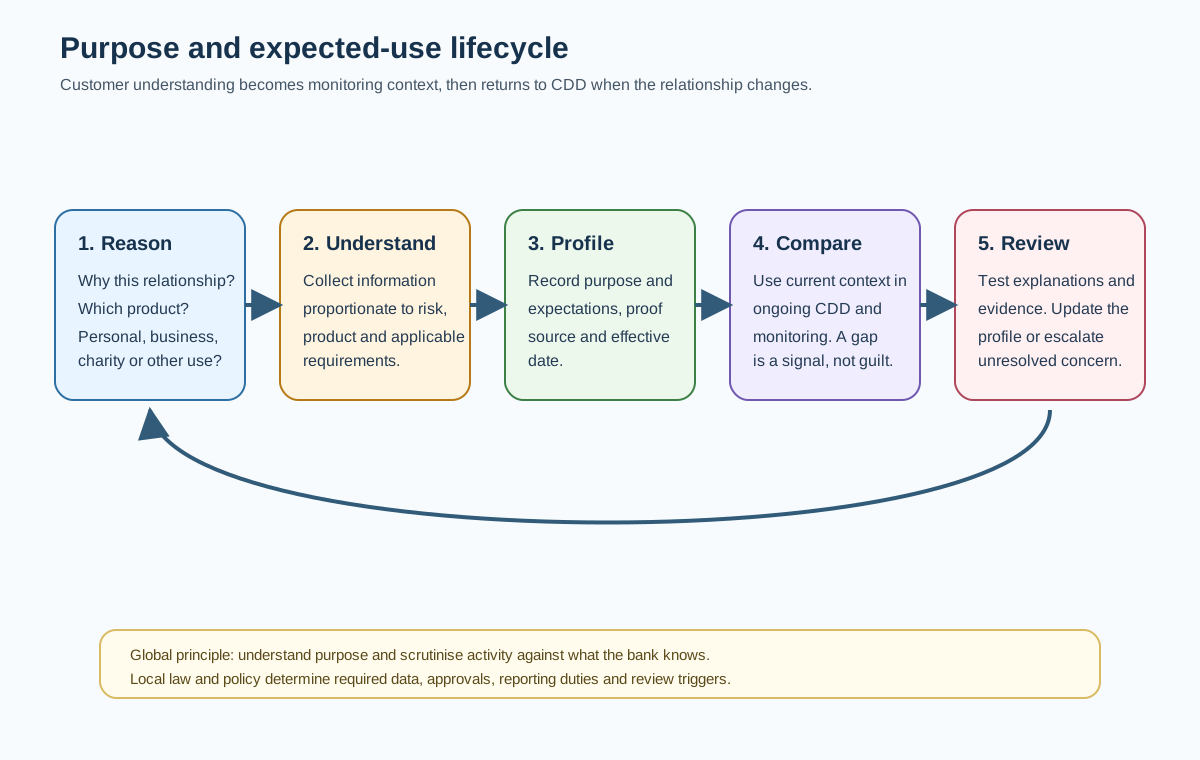
The simplest mental model: reason, shape, evidence and change
A useful way to analyse purpose is through four questions.
Reason: Why does the customer want this relationship, account, product or service? A corporate treasurer may need operating accounts for collections and supplier payments. A retailer may need merchant acquiring. An individual may want a salary account, savings product or investment service. A charity may need donation collection and grant disbursement. The answer should make commercial or personal sense for the product being requested.
Shape: What broad characteristics should the relationship have if that explanation is true? Depending on risk and product, this could include likely transaction types, approximate value or volume ranges, important geographies, customer or supplier categories, currencies, cash intensity, expected funding sources, use of payment channels or the distinction between personal and business activity. Not every relationship needs every data point.
Evidence: What supports the explanation? For a straightforward low-risk relationship, the product and customer type may provide much of the answer. For a more complex relationship, the bank may use company information, business records, contracts, financial statements, public information, previous account history or other reliable evidence. The need to corroborate or verify purpose information should follow applicable law, policy and the risk presented by the relationship.
Change: What should happen when the customer's activity or circumstances change? The bank should not assume that a different pattern means criminality. Businesses expand, individuals change jobs, customers inherit money, companies enter new markets and seasonal businesses have peaks. The control question is whether the change is understood and sufficiently supported, whether the risk profile must be updated, and whether any unresolved features create suspicion or another legal or policy consequence.
This four-part model avoids two common errors. The first is collecting a generic narrative such as “general trading” and treating it as meaningful CDD. The second is over-engineering a supposedly precise forecast that creates false certainty and unnecessary alerts when ordinary life differs from a number entered years earlier.
Purpose is related to, but different from, identity, source of funds and risk rating
Purpose sits inside CDD but should not be confused with neighbouring questions. Identity asks who the customer is. Beneficial ownership asks who ultimately owns or controls a legal person or arrangement under the applicable framework. Source of funds concerns the origin of particular funds or activity under review. Source of wealth, where relevant, concerns how a person accumulated their overall wealth. Risk rating combines multiple risk factors into an institution's assessment methodology. Purpose asks why the relationship exists and how the customer expects to use it.
These dimensions interact. If a new company says it needs an account to import medical devices, identity and beneficial ownership establish who is behind the company. Purpose analysis examines the business model and why the account is needed. Expected-use information may describe supplier countries, likely payment values and currencies. Source-of-funds work may examine the capital or revenues funding purchases. Screening checks relevant parties against applicable lists. Monitoring then uses the combined customer picture, not purpose data alone.
A good data model keeps these concepts separate. If a system stores “expected turnover,” “source of funds,” “business purpose” and “customer risk rating” in one free-text field, downstream controls cannot reliably distinguish what changed or why. For business analysts and architects, purpose quality is partly a data-design problem.
What a bank may need to understand at onboarding
The depth of inquiry should be proportionate to the customer, product, delivery channel, geography and other risk factors. A bank should be able to explain why it collected the information it did and why it did not require more.
For an individual using a conventional retail account, relevant information may be limited to the reason for the account, employment or occupation where useful, likely funding sources and whether the account is for personal or business use. A student account, pension-receipt account and high-value private-banking relationship do not need identical questioning.
For a legal entity, the bank normally needs a stronger picture of what the business actually does. A description such as “consultancy” is not enough if the relationship is high value or cross-border. Useful information can include the customer's products and services, principal markets, expected customers and suppliers, operating locations, reason for the requested banking products, likely transaction types and the way funds are generated and used. The precise information required depends on risk and applicable rules.
For charities, trusts, clubs and other non-commercial structures, “business activity” may not be the right concept. The bank may need to understand the entity's purpose, beneficiaries or community served, expected sources of receipts, intended use of funds and relevant operating geographies. The analysis should not force a commercial-company template onto a different legal or social purpose.
For financial institutions, payment firms, marketplaces, platforms and other intermediated models, the important question may be whose activity will ultimately pass through the relationship. The bank may need to understand the customer's own business model, customer types, underlying payment flows, settlement structure, geographic footprint and the visibility the bank will receive into underlying activity. The exact obligations differ by product and jurisdiction, especially for correspondent, omnibus and nested relationships.
Turning understanding into useful expectations
A strong purpose profile does not need to predict exact numbers. It needs enough structure to support risk-based comparison between what the bank understood and what actually happens.
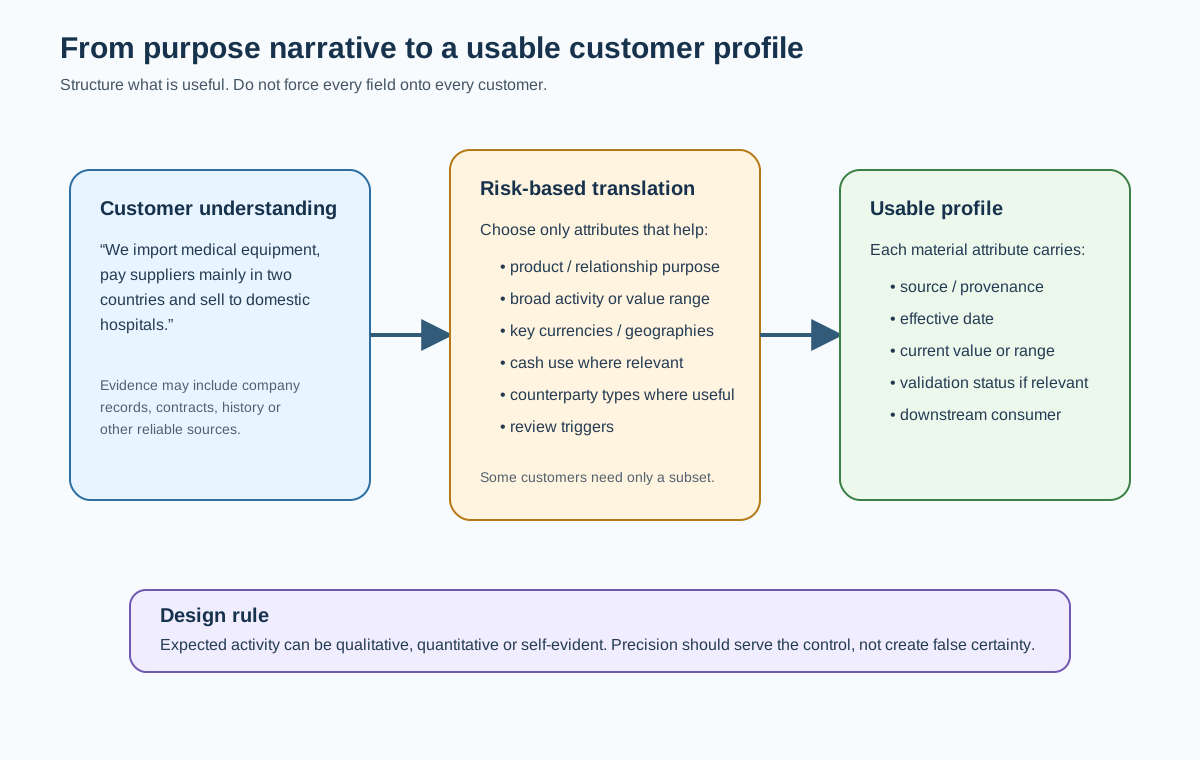
A bank may express expectations qualitatively, quantitatively or through a mixture of both. For some customers, a simple statement may be enough: salary credits, household spending and occasional domestic transfers. For a cash-intensive business, the bank may need expected cash volumes and locations. For an international corporate, the profile may include approximate monthly turnover, payment-value ranges, key currencies, expected cross-border corridors and major counterparty types. For a marketplace or payment company, the profile may need settlement flows, sub-merchant categories and payout structures.
Where the bank chooses to use numerical expectations, ranges are usually more useful than false precision. An expected monthly turnover of exactly 500,000 creates an artificial boundary. A supported range, seasonality assumption or material-change trigger may better represent the business. The bank should also distinguish customer-supplied forecasts from observed historical behaviour and from internally calculated peer information. Each has a different evidential quality.
Expected counterparties should be handled carefully. Some businesses have stable counterparties; others naturally transact with thousands of changing customers. A bank should not create a “known counterparty universe” requirement for a business model where constant change is normal. Instead, it may capture counterparty categories, concentration patterns, major strategic counterparties or expected types of beneficiaries and originators.
Geography requires similar care. A company may have core markets but still legitimately transact outside them. The control should identify materially different geographic exposure without treating nationality or a new country as suspicious by itself. Current FATF increased-monitoring status is a risk input, not an automatic instruction to apply enhanced due diligence to every transaction involving a listed jurisdiction. A FATF call for action can create stronger expectations, while actual legal restrictions and sanctions consequences depend on applicable law and programme scope.
Business purpose in the payment lifecycle
Purpose information becomes especially valuable when money starts moving. Payment monitoring often has only a short decision window and limited message data. Customer context helps the bank interpret that data more intelligently.
Consider a corporate customer profiled as a domestic wholesaler. A high-value international payment to a new industrial supplier is not suspicious merely because it is new. But the combination of a new cross-border corridor, a different product sector, third-party funding and an unusual payment route may indicate that the relationship has changed enough to warrant review. The right response depends on the total facts: the customer explanation, supporting commercial evidence, sanctions or export-control considerations, transaction timing and the bank's policy.
Conversely, a transaction can sit within expected values and still be suspicious. Criminal activity can imitate normal patterns deliberately. An expected-use profile should therefore support monitoring, not replace typology detection, sanctions controls, fraud controls or investigator judgement. “Within profile” is not a safe-harbour decision.
The same is true for instant payments. Real-time rails compress the time available to act, but purpose data may still enrich pre-transaction or post-transaction controls. A newly opened personal account receiving multiple unrelated credits followed by immediate onward payments may conflict with the stated purpose even if each payment is individually small. The control value comes from combining purpose, transaction sequence, beneficiary information, device or fraud intelligence and broader account behaviour.
Monitoring: compare, do not convict
Ongoing monitoring should use what the bank knows about the customer to identify activity that deserves attention. The purpose profile is one source of context. It should not become an automated verdict.
A deviation can have several explanations. It may be normal variability. It may be a permanent business change. It may reflect inaccurate onboarding information. It may indicate product misuse, fraud, laundering, sanctions evasion or another risk. Investigation should test these alternatives rather than equate “outside expectation” with “suspicious.”
The distinction between unusual and suspicious is critical. Unusual activity is a trigger for understanding. Suspicion is a conclusion reached under the applicable legal and policy framework after considering available facts. Some jurisdictions prescribe specific reporting thresholds, timelines or confidentiality rules; those requirements should be handled in the relevant suspicious-activity reporting process rather than embedded as universal rules in a purpose profile.
A practical alert should show the analyst what expectation was exceeded, how material the deviation is, how current the profile is, what the customer previously disclosed and what other risk signals are present. An alert that merely says “expected turnover exceeded” without the underlying profile date, amount range or customer context creates investigation work rather than reducing it.
Profile maintenance and event-driven review
Purpose is not static. A customer's relationship can change because of growth, acquisition, new ownership, relocation, new products, new geographies, economic shocks or simple life events. A good framework combines whatever periodic review is required by local law or policy with event-driven updates when relevant information becomes known.
Useful triggers can include a material and sustained change in activity, a new business line, significant ownership or control change, a new high-risk product, a major geographic shift, credible adverse information, repeated monitoring alerts explained by the same permanent change, or information received directly from the customer. The bank should define triggers according to its risk appetite and regulatory obligations rather than assume one global schedule.
This is also where monitoring feedback matters. If analysts repeatedly close alerts because a customer's legitimate business has grown beyond its old expected turnover, the bank should consider whether the profile is stale. Repeatedly clearing the same benign deviation without updating the underlying profile wastes capacity and can hide genuinely different behaviour among the noise.
Profile changes need an audit trail. The system should preserve the previous value, new value, effective date, reason, evidence and approval where required. Investigators may need to know what the bank believed at the time of a historical transaction, not what the customer's profile says today.
Seasonal, startup and rapidly changing businesses
Some customers cannot be described well by a stable monthly average. Agriculture, tourism, education, construction and retail can be seasonal. Startups may have no transaction history. Scale-ups can double volumes quickly. Crisis periods can alter otherwise stable behaviour across an entire portfolio.
For these customers, the bank should build expectations that reflect the business model. A seasonal company may be better described by expected peak periods and off-season activity. A startup may require milestone-based assumptions with closer early monitoring rather than a supposedly precise twelve-month forecast. A rapidly growing platform may need volume projections combined with controls over the changing underlying customer base.
The control should remain explainable. If an algorithm continually changes expected values without preserving why the baseline changed, an investigator cannot distinguish legitimate model adaptation from a profile that simply learns to accept whatever activity occurs. Dynamic profiling therefore needs governance, versioning and challenge just like manually maintained profiles.
Customer experience and financial inclusion
Purpose inquiry can create unnecessary friction if every customer is asked the same detailed questions regardless of risk. It can also exclude people whose financial activity does not fit conventional assumptions. Informal workers, migrants, students, carers, small entrepreneurs and people with irregular income may have legitimate patterns that do not look like salaried retail banking.
Risk-based design should therefore ask only what is needed and provide routes for customers to explain unusual circumstances. A customer who begins a legitimate side business should not automatically be treated as a criminal because personal-account activity changed. The bank may need to explain product terms, move the customer to an appropriate account, collect additional information or reassess risk. Restriction or exit should follow law, policy and the actual facts, not an inflexible profile mismatch.
The same principle applies to humanitarian and non-profit activity. Geographic exposure or irregular funding patterns can increase risk, but broad de-risking can damage legitimate activity. FATF has repeatedly emphasised proportionality and the avoidance of unintended consequences. Purpose understanding should improve differentiation between legitimate and higher-risk activity rather than become a reason to exclude entire categories.
Data and system architecture
Purpose becomes operational only if downstream systems can use it. A practical architecture separates free-text narrative from structured fields. The narrative explains the relationship in human terms. Structured data supports monitoring and reporting.
Useful structured elements may include relationship-purpose category, business activity, personal or business use, expected transaction-type categories, approximate value or volume bands where relevant, cash usage, key currencies, geographic exposure, major counterparty categories, source-of-funds category, review triggers, profile effective date, evidence provenance and confidence or verification status. Not all fields should be mandatory for all customers.
The data lineage should show where each field came from, who entered or approved it, when it became effective and which systems consume it. If transaction monitoring receives an “expected monthly value” field, the monitoring team should know whether it came from the customer's forecast, historical behaviour or an internal model. Treating these sources as equivalent can distort alert logic.
APIs and event streams should carry changes to consuming systems reliably. A profile update that remains in the KYC platform while transaction monitoring continues to use an old value is a control failure. Integration requirements should cover effective dating, replay, reconciliation, data-quality checks, exception handling and failure alerts. The business requirement is not merely “send KYC data to monitoring”; it is “ensure the monitoring decision uses the correct version of the relevant customer expectation.”
Roles and governance
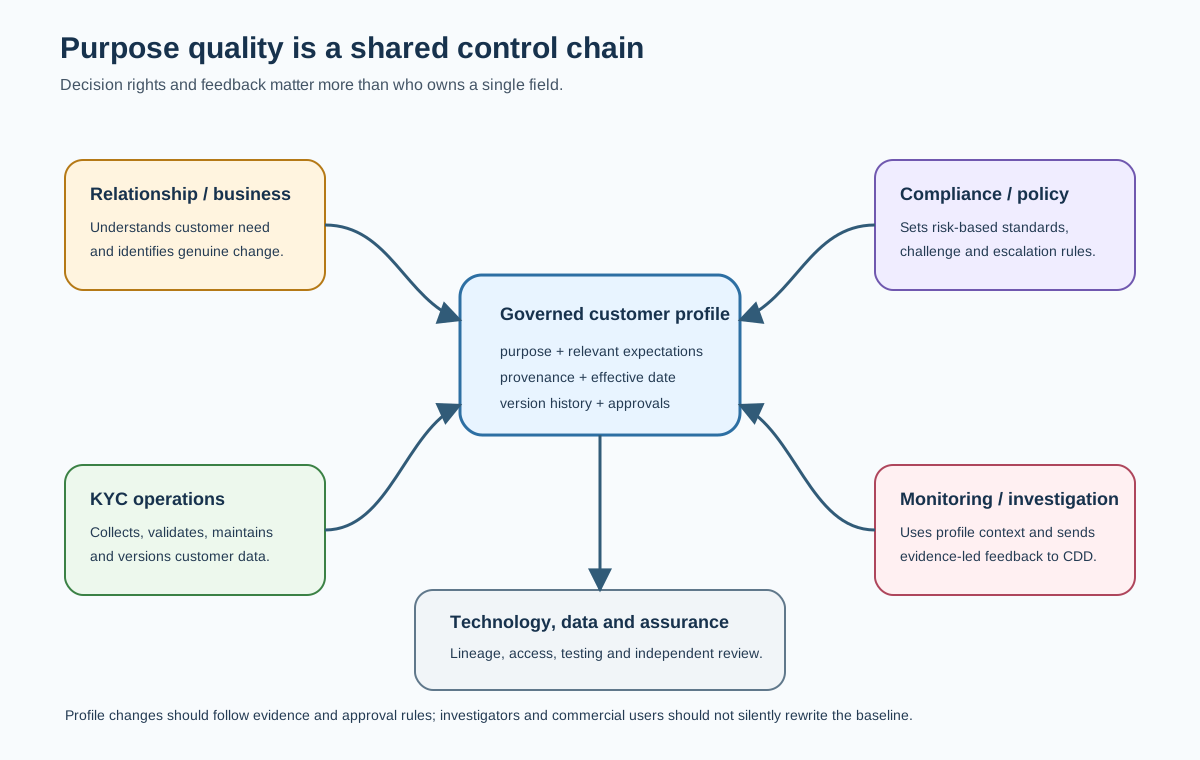
Relationship teams often know the customer's business best, but they can also face commercial pressure. KYC operations can collect and validate information but may not understand sector-specific economics deeply. Financial crime compliance sets standards and provides challenge. Monitoring teams consume the profile and generate feedback. Investigators test explanations. Technology teams maintain the data and decisioning infrastructure. Internal audit provides independent assurance.
The control works only when these roles connect. A relationship manager should not be able to widen expected turnover simply to stop alerts without evidence and required approval. Equally, a monitoring analyst should not permanently treat a documented business expansion as suspicious because the KYC system has not yet been updated. Governance should define who can change which fields, what evidence is needed, what changes require approval and how disagreements are escalated.
Business analyst, architecture and testing considerations
For a business analyst, the most important requirement is to convert a policy phrase such as “understand expected account activity” into precise, testable behaviour. Start by identifying which customer segments need which data elements. Define mandatory versus conditional fields. Define provenance, effective dates and allowed values. Specify how profile changes are approved and propagated. Define what happens when required data is missing, stale or contradictory.
Avoid requirements such as “the system shall identify unusual activity” without defining the inputs, comparison logic and downstream action. A better requirement might state that where a monitored attribute is configured for a customer segment, the monitoring service must receive the current effective profile value and profile timestamp, compare it with observed activity according to the approved scenario, and include the comparison result in any generated alert. The exact threshold belongs to configuration and governance, not hard-coded prose.
Testing should include ordinary customers as well as high-risk edge cases. Positive tests verify that a material mismatch generates the intended review. Negative tests verify that legitimate seasonal variation, documented growth and one-off life events do not generate inappropriate adverse outcomes. Data-lineage tests confirm that the correct profile version reaches monitoring. Failure-mode tests cover delayed KYC updates, unavailable external data, duplicate events and conflicting source systems. Regression tests confirm that a profile change affects only the intended scenarios and customer population.
A strong test pack also checks customer impact. If an expectation breach causes a payment hold, testers need to verify the hold reason, status propagation, operational queue, customer communication rules and release path. Financial-crime logic does not exist separately from payment processing and servicing.
Mini case study: a distributor enters a new market
A medium-sized distributor has banked for three years. Its profile describes domestic sales, purchases from two neighbouring countries and monthly turnover in a broad range supported by historical activity. Over six weeks it begins sending larger payments to suppliers in a new region and receives credits from customers in another jurisdiction. The monitoring system flags the sustained geographic and value change.
The alert is not a conclusion. The relationship team explains that the company acquired distribution rights for a new product line. The bank obtains the agreement, checks the new suppliers and buyers using its normal risk-based procedures, reviews whether sanctions or trade restrictions are relevant, and confirms that the projected payment pattern is commercially coherent. No contradictory evidence is found.
The appropriate outcome in this example is a documented profile update with an effective date and proportionate monitoring of the new activity. If the agreement could not be verified, counterparties lacked credible business substance, payments came from unrelated third parties or the customer provided contradictory explanations, the same initial deviation could justify enhanced investigation and a different outcome.
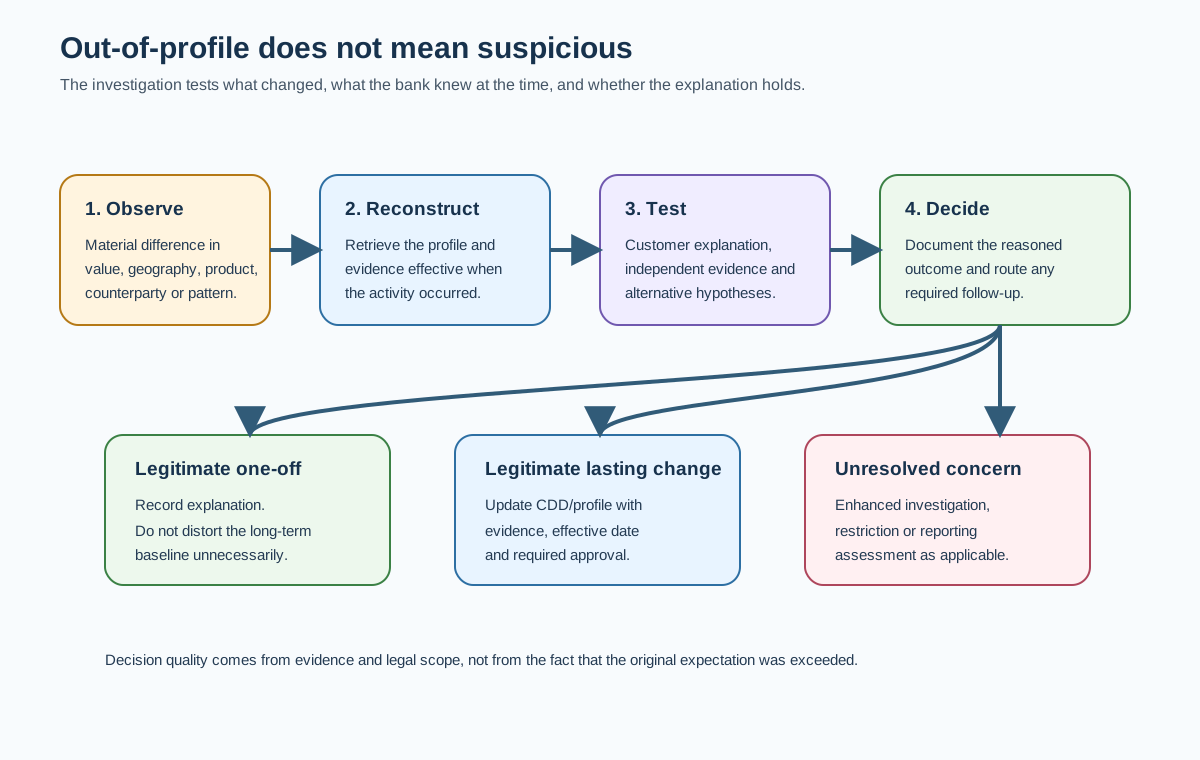
The case shows why purpose information is valuable only when it supports reasoning. A profile is neither a licence to ignore activity that falls inside it nor a rule that condemns activity outside it. It is a baseline that helps the bank ask better questions.
Key takeaways
Purpose and intended nature are core parts of CDD, but implementation is risk-based and jurisdiction-specific. Expected-activity data should be collected and structured where it materially improves customer understanding, monitoring or legal compliance; it is not a globally mandatory numerical forecast for every customer. Purpose should be kept distinct from identity, source of funds, source of wealth and risk rating while remaining connected to all of them.
Good profiles describe the relationship well enough to support ongoing due diligence without pretending to predict normal life exactly. Monitoring uses those profiles to identify activity requiring explanation, not to automate suspicion. Legitimate change should update the profile; unresolved or contradictory change may require enhanced review. Every material update should be traceable and reach the systems that depend on it.
For practitioners, the standard is simple to state and hard to execute: understand why the customer is here, record enough of that understanding to make later activity intelligible, keep the understanding current, and preserve the evidence and reasoning behind every material decision.
Operational deep dive: turning customer purpose into usable monitoring context
The base chapter established the central idea: purpose and expected use are not forecasts that criminalise every deviation. They are risk-based context that helps a bank understand what a relationship is for, what broad patterns are plausible, and when change deserves explanation. This deep dive focuses on how that context can be engineered into monitoring and investigation without inventing a universal requirement for every bank to collect the same numerical fields from every customer.
Profile design: structured enough to use, flexible enough to remain true
A customer profile normally contains a mixture of facts, customer statements, externally corroborated information and internally derived attributes. Those categories should remain distinguishable. A customer saying that annual turnover may reach a certain range is not the same as verified historical turnover. A relationship manager's description of the main markets is not the same as an automated analysis of actual payment destinations. A system that collapses both into a single field creates false confidence and makes later challenge difficult.
A practical profile model therefore records provenance. An expected value can be tagged as customer-declared, documentary, observed, calculated or externally sourced. It should carry an effective date and, where relevant, a confidence or verification status. Monitoring then knows whether it is comparing observed behaviour against a firm historical baseline, a forward-looking estimate or a broad narrative expectation. Investigators can also see whether the underlying information was current when the transaction occurred.
Not every segment needs numerical thresholds. A salary account may be understood through employment and funding source with a broad personal-use expectation. A large cash-intensive retailer may need cash-volume ranges, store locations and seasonal context. A multinational corporate may need expected currencies, payment types and core geographies. A payment institution may need a view of underlying customer types and settlement flows. The profile should be proportionate to the risk and the product, not built from a global checklist applied identically to everyone.
Where numerical expectations are useful, ranges and material-change triggers usually make more sense than single-point predictions. Calibration should account for known seasonality, growth, customer maturity and product characteristics. Internal analytics can use historical distributions or peer comparisons, but those methods are model choices that require governance. They are not requirements created by FATF simply because ongoing monitoring must be consistent with the bank's knowledge of the customer.
Geography and corridor analysis without turning country risk into a verdict
Geographic information can materially improve customer understanding, particularly for cross-border businesses, remittance firms, trade customers and payment intermediaries. But geographic risk needs disciplined interpretation. Country exposure can reflect sanctions, terrorism financing, corruption, organised crime, weak supervision, conflict, tax or fraud considerations, and each produces different control questions.
FATF public statements are one input. A jurisdiction under increased monitoring has committed to an action plan and is subject to increased monitoring by FATF. FATF does not call for automatic enhanced due diligence on every relationship or transaction involving such jurisdictions; institutions should apply their risk-based approach. Jurisdictions subject to a FATF call for action require a different level of attention, but the actual legal consequences for a bank still depend on the applicable national or regional framework and any sanctions or other restrictions in force.
A bank should therefore avoid hard-coding a rule such as grey-listed country = EDD. A better design uses country status as one risk factor within a wider assessment. The customer purpose, product, counterparties, transaction route, sanctions exposure, business rationale and applicable law all matter. A legitimate exporter entering a new market may need updated CDD and closer review without the geography itself proving suspicious activity.
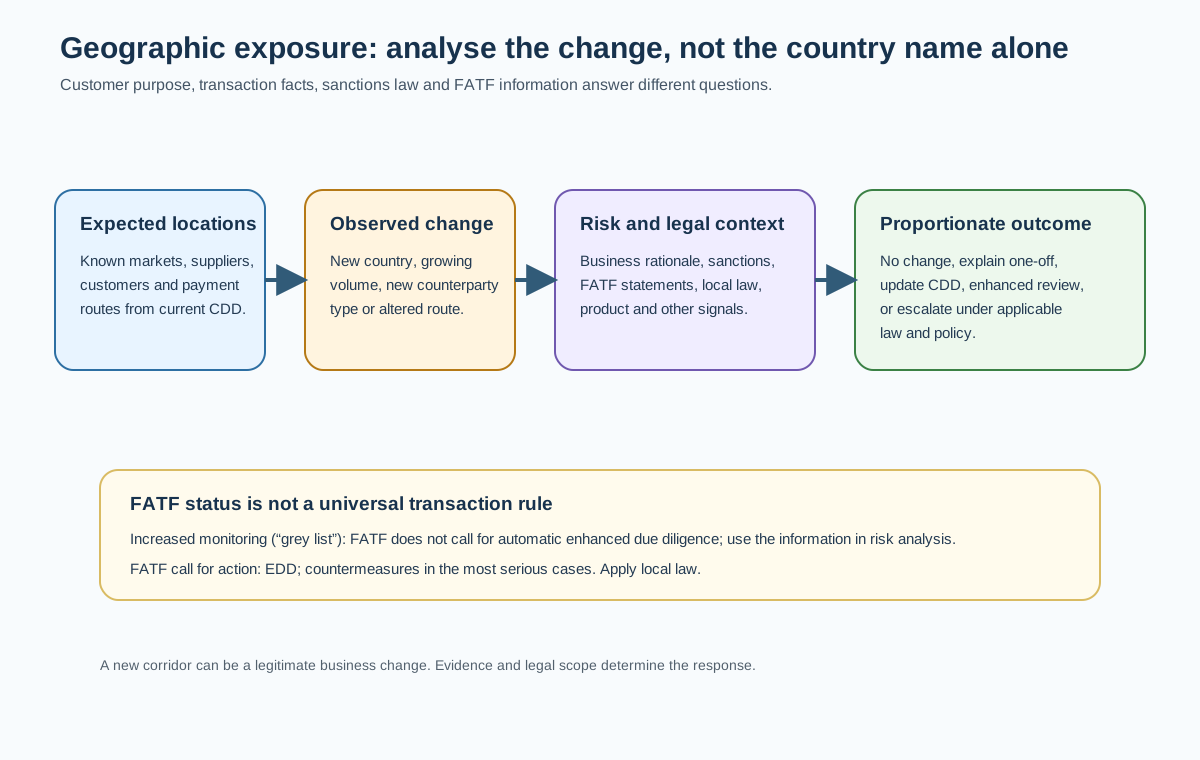
Materiality also matters. A single small payment outside the normal geography may have an obvious explanation. A sustained shift into new countries can indicate a genuine business expansion or a material change to the risk profile. Monitoring should distinguish an isolated exception from a structural change rather than generate identical outcomes for both.
Event-driven maintenance and historical reconstruction
Profiles become dangerous when they are treated as immutable onboarding records. A bank needs a way to update them when relevant information changes, while preserving the prior state for audit and investigation.
An event-driven review trigger may come from the customer, relationship manager, monitoring team, sanctions team, fraud team, adverse-media process or an external data source. Examples include a new product line, significant ownership change, a material increase in transaction activity, a new operating geography or repeated alerts explained by the same legitimate business change. The trigger should initiate the amount of review required by policy and applicable law; it need not always recreate the entire onboarding process.
Versioning is essential. Each material profile change should preserve the old value, new value, date of effect, reason, source and approval where required. This enables investigators to reconstruct what the bank knew at the relevant time. Without versioning, a profile updated today can make yesterday's transaction look normal even though the bank had no such expectation when the transaction occurred.
Historical reconstruction is particularly important in lookbacks. Suppose a customer expands into a new country in March, the relationship manager updates the profile in May, and an investigation begins in September. The system should allow the investigator to see the March profile, the evidence obtained in May and the effective date assigned to the change. Merely showing the current profile destroys the chronology that an investigation needs.
Monitoring consumption: what the alert should actually show
A monitoring alert should not force an analyst to search across five systems to discover what the customer was expected to do. If purpose or expected-use data contributed to the alert, the alert should present the relevant context directly.
Useful context can include the attribute compared, the current effective profile value, the date and provenance of that value, the observed activity, the degree and duration of the difference, previous similar alerts and other risk indicators. This does not mean the alert needs every KYC field. It means the analyst should have enough information to understand why the system considered the activity noteworthy.
A good design also distinguishes a profile mismatch from a suspicion conclusion. The former is an analytical signal. The latter requires the applicable investigative and reporting process. This separation matters in workflow status, case data and user-interface language. A status called suspected money laundering should not be populated automatically merely because activity exceeded an expected range.
For payment products, the monitoring service may consume selected customer context in real time or near real time. For slower periodic monitoring, the profile snapshot can be joined during scenario execution. In both cases, data lineage should prove which version was used. Reconciliation should identify customers for whom monitoring did not receive an expected update, because a successful KYC change that never reaches monitoring leaves the control operating on stale assumptions.
Feedback from investigation to KYC
The flow must work in both directions. KYC supplies context to monitoring; monitoring and investigation supply evidence back to KYC.
If an alert establishes a legitimate permanent change, the case outcome should be capable of triggering a profile-review task. If an investigation reveals that the customer misrepresented the purpose of the relationship, that information should reach the customer-risk process. If repeated alerts reveal that a field is not useful for a particular segment, monitoring governance may need to change the way the field is consumed rather than continuously burden investigators.
Feedback should be governed. An investigator should not directly rewrite customer data simply to close a case. The finding should pass through the process responsible for validating and approving profile changes. This preserves separation between observed behaviour, investigative interpretation and the customer record.
A useful management view can measure how many alerts are attributable to stale profiles, how long profile-update tasks remain open and whether the same benign mismatch repeatedly reappears. Such measures are internal control choices, not universal regulatory metrics, but they can reveal whether the customer-understanding process is actually supporting monitoring.
Peer information and dynamic profiles
Banks increasingly use analytics to supplement customer-provided expectations. Peer-group behaviour can help identify whether a new customer's activity is unusual relative to similar customers when the bank has little history. Dynamic models can identify drift even where no single threshold is crossed.
These methods can be valuable, but they create additional governance questions. The bank must know how peer groups are defined, whether the comparison is fair and meaningful, how frequently they change, what data is included, and how analysts are expected to use the result. A peer difference is not proof of suspicious activity. A small importer compared with a large multinational in the same industry code may look anomalous simply because the peer design is poor.
Dynamic baselines also need guardrails against learning criminal behaviour as normal. If a customer's illicit pattern begins soon after onboarding and the model automatically adapts to it, the profile may become increasingly tolerant of the very activity it should help identify. Model design should therefore distinguish between observed behaviour and validated legitimate change. Material baseline changes may require review or approval before they replace customer-understanding data.
Explainability matters. An investigator should be able to understand whether an alert arose because of a customer-declared expectation, an observed baseline, peer divergence or a model-derived change signal. The bank need not expose proprietary model mathematics to every user, but the control rationale must be understandable enough to support challenge and audit.
Failure modes worth testing
Several failures recur in purpose and expected-use implementations.
One is false precision: the customer provides a rough forecast and the system treats it as a hard limit. The result is unnecessary alerting and customer friction.
Another is stale context: KYC updates the profile but monitoring continues to use an earlier version because the interface failed or a batch job missed the record.
A third is automatic suspicion: the system assigns an adverse outcome merely because activity sits outside an expected range.
A fourth is country-rule oversimplification: a FATF or internal country-risk status is translated into automatic EDD, rejection or exit without considering the actual legal framework and the customer's facts.
A fifth is silent model adaptation: a behavioural baseline changes without review, versioning or explanation, so investigators cannot tell whether the bank validated a legitimate change or simply learned it statistically.
Testing should deliberately exercise these conditions. Expected results should include the correct review trigger, versioned data, workflow ownership, customer-impact behaviour and escalation route. The objective is to prove that purpose information supports judgement rather than replacing it.
Practitioner checkpoint
A practitioner should be able to explain which expected-use attributes are genuinely useful for a given customer segment, which are optional internal controls rather than legal absolutes, how geographic changes should be interpreted, how profile versions are preserved, how monitoring consumes them and how investigation results flow back into customer due diligence.
The central control principle is simple: use customer purpose to make activity intelligible, not to turn normal variation into guilt. The better the bank can show where the context came from, how current it was and how it influenced a decision, the more defensible both its monitoring and its customer outcomes become.
Advanced practice: worked purpose and expected-use cases
The cases below are fictional and use illustrative facts. They are designed to show how a bank can use purpose and expected-use information without treating deviation as automatic suspicion. The legal outcome in a real case depends on the bank's jurisdiction, product, policies, evidence and any applicable reporting, sanctions or customer-protection rules.
Case 1: the distributor that expands into a new product line
A long-standing corporate customer imports household goods from two neighbouring countries and distributes them domestically. The KYC profile describes those products, approximate annual turnover, the main supplier countries and the reason for the operating account. Over two months, monitoring identifies several high-value payments to industrial-equipment suppliers in a new region, followed by incoming payments from commercial buyers the bank has not previously seen.
The activity is materially different from the existing profile, but that is only the starting point. The relationship manager explains that the customer acquired rights to distribute commercial refrigeration equipment. The bank obtains the distribution agreement, reviews the new counterparties through its ordinary risk-based processes, checks whether the goods or jurisdictions raise sanctions or trade-control questions, and compares the projected flows with the financing and logistics of the existing business.
The explanation is coherent. Supplier websites, registration data and commercial documents support real operating businesses. The new transaction values are larger than the previous consumer-goods flows but align with the higher unit value of the new products. The customer has also increased working-capital facilities, which helps explain the funding pattern.
The appropriate outcome in this example is not a suspicious-activity conclusion. It is a profile update recording the new product line, relevant geographies and expected scale, with whatever enhanced review or monitoring the bank considers proportionate. If the evidence had shown newly incorporated intermediaries with no business substance, unrelated third-party payers or contradictory explanations, the same deviation would justify deeper investigation and possible reporting assessment under applicable law.
The control lesson is that history should not create a “trust exemption,” but nor should legitimate growth be punished for being new. Expected-use data should make the change visible and give the bank a disciplined reason to ask questions.
Case 2: the personal account that becomes a small business account
An individual has received a monthly salary into a current account for several years. The account then begins receiving many small transfers from unrelated individuals, followed by payments to a food wholesaler and delivery-service providers. The customer explains that she has started a home-catering business alongside her employment.
The bank needs to separate three issues. First, is the explanation credible? Second, is the account being used in a way permitted by the product terms? Third, does the change alter the customer's financial-crime risk or due-diligence information?
Basic evidence supports a genuine business: customer orders, supplier invoices, social-media advertising and delivery activity. There is no separate evidence of laundering or fraud. The commercial activity, however, has become material enough that the personal-account product may no longer be appropriate.
A proportionate outcome may be to update the customer information and guide the customer toward a suitable business product if policy requires it. Depending on local law and the bank's obligations, additional business or tax-registration information may be relevant, but the bank should not invent a universal duty to report informal entrepreneurship to tax authorities or treat the product mismatch as suspicious by itself.
If the claimed catering business could not explain the transaction pattern—for example, credits arrived from unrelated companies in several countries, cash was immediately withdrawn, or the customer repeatedly gave contradictory explanations—the case would move from product-use remediation toward enhanced investigation.
The control lesson is that a purpose mismatch can represent legitimate economic change. The bank needs a route to correct the relationship rather than forcing every mismatch into an enforcement-style outcome.
Case 3: the charity with a new commercial revenue stream
A charity operates community centres and is profiled for donations, grants and programme expenditure. It begins receiving significantly larger credits described as wholesale sales, followed by payments to suppliers and logistics firms. Management explains that donated surplus goods are being sold to retailers to raise funds for charitable programmes.
The bank should not assume that commercial activity is illegitimate merely because the organisation is a charity. It should understand whether the activity is permitted within the entity's legal and governance framework, whether counterparties are credible, how proceeds are expected to support the stated purpose and whether related-party relationships create additional risk.
The review finds that one supplier is controlled by a trustee's family member and that the relationship was not disclosed in the charity's information previously held by the bank. That fact is relevant but still not a final conclusion. The bank seeks an explanation and supporting governance records. Independent records confirm that the charity's governing body approved the arrangement after a conflict process, pricing appears commercially reasonable and proceeds are reflected in programme spending.
In this version of the case, the bank updates its understanding and records the related-party relationship and new revenue stream. In a different version, undisclosed self-dealing, circular payments, fabricated invoices or diversion of charitable funds could create suspicion and require escalation under the applicable framework.
The control lesson is that purpose analysis should surface governance and economic-substance questions without equating a non-standard activity with criminality.
Case 4: the dormant account and the inheritance
A savings account has had little activity for several years. It receives a large domestic credit from a law firm's client account, followed by instructions to transfer portions of the money to family members in several countries. Monitoring flags the abrupt change from the historical pattern.
The customer explains that the credit is an inheritance. The bank reviews the available estate documentation and the law firm's involvement, confirms that the customer is a beneficiary and checks the proposed international beneficiaries using its normal controls. The amount and distribution broadly match the estate documents.
The activity is unusual relative to the account's history but readily explainable as a legitimate life event. The bank records the explanation and processes the activity subject to normal payment, sanctions and fraud controls. There may be no reason to permanently redefine the account's expected use if the event is genuinely one-off.
Had the inheritance documents been inconsistent, the originating party unrelated to the estate, the customer unable to explain the beneficiaries, or payments structured in a way that contradicted the stated distribution, further investigation would be warranted.
The control lesson is that expected-use models need a way to handle one-off events. A baseline that treats every material exception as a permanent change is as weak as one that ignores all change.
Case 5: the payment platform entering new corridors
A regulated payment-company customer primarily settles European e-commerce transactions through the bank. Over one quarter, settlement volumes rise substantially and new payout corridors appear in several countries outside the previous operating footprint. The customer attributes the change to a large marketplace partnership.
The bank's task is not simply to compare the countries with a “high-risk” list. It should understand the new business model, the marketplace relationship, the underlying customer or merchant population to the extent required by the relationship, the payment flow, settlement mechanics and any changes to the customer's own regulatory permissions or controls. Country risk, sanctions programmes and FATF public statements are relevant inputs, but none substitutes for the actual legal and risk analysis.
The marketplace contract supports the projected volumes. Sampling of underlying merchants is broadly consistent with genuine e-commerce, although one new corridor has weaker merchant transparency than the bank's risk appetite permits. The bank agrees a remediation plan and temporarily limits that corridor while allowing well-understood activity to continue.
This outcome illustrates differentiated control. The bank does not need to reject the entire relationship because one part of the expansion creates uncertainty. Equally, the customer's regulatory status does not remove the bank's need to understand how its own account is being used.
If the new flows instead showed unexplained third-party settlement, shell merchants, circular funding or sanctions-evasion indicators, the bank would escalate the relevant activity and assess reporting or restriction obligations under applicable law and policy.
The control lesson is that platform customers need purpose information at more than one level: the customer's own business purpose and enough understanding of underlying activity to assess how the bank's service is actually being used.
Case 6: the trader that enters controlled-adjacent goods
A general-trading company has historically imported ordinary consumer products. It begins paying suppliers for specialised industrial components and describes the activity as opportunistic brokering to new buyers abroad. Some goods descriptions are technical and may have dual-use relevance.
The expected-use deviation is valuable because it identifies a material change in sector and geography. But the KYC team should not make an export-control classification merely from keywords in a payment message. The bank gathers fuller goods descriptions, invoices, counterparties and end-use information to the extent available and required, and routes the matter to the appropriate trade, sanctions or export-control specialists where the bank's framework calls for that expertise.
The customer provides a credible manufacturer, verifiable end user and evidence of the relevant authorisation where applicable. The bank's specialist review determines that the transaction can proceed under the legal framework applying to the bank and transaction. The purpose profile is then updated to reflect the new line of business, with proportionate ongoing controls.
A different evidence set—opaque intermediaries, inconsistent end-use statements, altered documents, a restricted party or an inability to establish whether required authorisation exists—could result in a hold, rejection, reporting assessment or other legal action depending on jurisdiction and programme.
The control lesson is that purpose monitoring can identify a change requiring specialist review, but it should not convert a customer-profile difference into a technical legal conclusion that the profile data cannot support.
What these cases have in common
Across all six cases, the control sequence is consistent even though the outcomes differ. The bank first reconstructs what it understood about the relationship. It identifies the material difference between that understanding and current activity. It tests plausible explanations using evidence proportionate to risk. It considers applicable legal and policy requirements separately from internal risk appetite. It then either records a legitimate change, takes a product or CDD action, or escalates unresolved concern to investigation and possible reporting.
This sequence protects both sides of the control. It reduces the chance that genuinely suspicious activity is dismissed as “business growth,” and it reduces the chance that legitimate customers are restricted merely because their lives or businesses changed.
For analysts and testers, the important design point is that the same trigger can produce different valid outcomes depending on evidence. Test scenarios should therefore validate decision pathways, required evidence, data updates and escalation rules rather than assume that every threshold breach has one predetermined answer.
Practice close: turning policy into a usable purpose-control workflow
Purpose and expected-use controls fail when policy language is translated into forms rather than decisions. The practical workflow should help the bank understand the relationship, preserve the evidence behind that understanding, recognise material change and route unresolved concerns to the right control process without making every customer complete an unnecessarily detailed forecast.
A practical inquiry sequence
Start with the customer's reason for the relationship and the product requested. Ask enough to understand how the product fits the customer's personal or business activity. For a straightforward retail account, that may be a short conversation. For a complex corporate, payment firm, charity or trade customer, it may require structured questions about business model, counterparties, geographies and funding.
Next decide which facts need corroboration. The risk level, product and applicable legal requirements should drive the evidence burden. Customer statements are information; independently supported information has a different evidential weight. The bank should record both without pretending they are the same.
Then translate the understanding into whatever structured attributes the bank genuinely needs for risk assessment and ongoing monitoring. Do not collect an expected-volume number merely because the field exists. A field should have a defined purpose, consumer and maintenance owner. If no downstream control uses it and policy does not require it, collecting it creates customer friction and stale data without control value.
Finally, define how change will be recognised. A profile needs an effective date, review triggers and a way to update downstream systems. Material changes should be documented with evidence and approval where required. One-off events should be recorded without automatically converting them into permanent expectations.
Customer communication
Good inquiry explains why information is needed in language the customer can understand. Generic messages such as “compliance requires further documents” often produce poor evidence and unnecessary frustration. Where disclosure is permitted, a more useful request explains the business question: the bank needs to understand the reason for a new payment corridor, the source of a large one-off receipt, or the relationship between a company and an unfamiliar payer.
The bank must still protect confidential investigative methods, suspicious-activity reporting restrictions and other legal constraints. Customer transparency does not mean revealing alert logic or whether a suspicious-activity report is being considered. Communication templates should therefore be reviewed with legal and compliance functions and adapted to the relevant jurisdiction.
Quality assurance
Purpose-file quality cannot be measured only by whether mandatory fields are populated. QA should test whether the relationship can actually be understood from the record and whether important conclusions are supported.
A useful review asks whether the stated purpose fits the product, whether the depth of information is proportionate to risk, whether material assertions have appropriate evidence, whether structured expectations are intelligible, whether the profile is current, and whether downstream monitoring receives the relevant data. Reviewers should also identify over-collection. A file containing dozens of unused data points can still be poorly designed.
Sampling can focus more heavily on complex or higher-risk relationships while still testing lower-risk populations for consistency and customer impact. QA findings should feed procedure design, training and system changes rather than remain isolated file corrections.
Business requirements and acceptance criteria
For business analysts, requirements should specify behaviour rather than copy policy wording. Useful acceptance criteria include:
- the customer segment determines which expected-use fields are required, optional or not applicable;
- every material profile field stores provenance and effective date where needed for downstream decisions;
- historical versions remain retrievable for investigation and audit;
- approved profile changes are delivered to consuming monitoring systems and reconciled;
- a profile mismatch creates the configured review or alert outcome, not an automatic suspicion conclusion;
- one-off events can be recorded without permanently changing the baseline unless the bank decides the relationship has genuinely changed;
- jurisdiction-specific obligations can be configured without hard-coding one country's rules as a global standard;
- users can distinguish customer-declared expectations from observed or model-derived attributes.
These criteria can be tested with concrete scenarios. A new corporate should reach monitoring with the correct effective profile. A later verified expansion should create a new version while preserving the old one. A failed interface should produce a reconciliation exception. An analyst should be able to see which version was used in an alert.
Failure-mode testing
Testing should include more than successful journeys. Delayed KYC-to-monitoring updates, duplicate events, missing provenance, contradictory source systems, stale external data and rollback after an incorrect update should all be exercised. If the system uses country-risk feeds, tests should confirm that a change in FATF or sanctions status triggers the intended risk process and does not automatically create actions that the legal framework does not require.
Customer-impact testing matters as much as technical accuracy. Where a profile mismatch can contribute to a payment hold or account restriction, the test should verify status propagation, operational ownership, service-level handling, customer communication and release or appeal paths where applicable. A technically correct alert can still produce a poor control if nobody owns the operational outcome.
Review questions for practitioners
Before accepting a purpose profile, ask: could another analyst understand why this relationship exists without speaking to the original onboarding officer? Can the bank tell which information came from the customer and which was independently supported? Do the structured attributes reflect the actual risk and product, or are they generic fields populated for completeness? Can monitoring identify which version it used? Does the process allow legitimate change without weakening escalation for unresolved concern?
If the answer to those questions is yes, purpose data is doing useful control work. If the answer is no, adding more mandatory fields will rarely solve the underlying problem. The remedy is clearer decision design, better evidence discipline, stronger data lineage and a closed feedback loop between customer due diligence and ongoing monitoring.
Masterclass: governing purpose and expected-use quality across a bank
Purpose quality is a cross-functional control. Relationship teams collect and interpret customer information, KYC operations maintain the record, compliance defines standards and challenge, monitoring consumes profile data, investigators test deviations, technology moves the data between systems and assurance functions test whether the whole chain works. Weakness at any handoff can turn good customer information into ineffective monitoring or poor customer outcomes.
Ownership without creating a fictional universal operating model
There is no single globally mandated organisational chart for purpose controls. Banks should assign ownership in a way that fits their legal obligations, products and governance. What matters is that responsibilities are explicit.
The relationship or business owner often understands the commercial reason for the relationship and is well placed to identify genuine business change. KYC operations can ensure required information and evidence are recorded consistently. Financial crime compliance can define risk-based standards, challenge higher-risk cases and interpret regulatory expectations. Monitoring teams decide how profile attributes are used in detection. Investigators determine what additional explanation or evidence is needed when observed activity diverges from the profile. Technology and data teams maintain lineage, versioning and interfaces. Internal audit or another independent assurance function tests whether the framework is designed and operating effectively.
These roles need decision rights. A commercial user should not be able to widen an expected-activity range simply to reduce alerts without the evidence and approval required by policy. A monitoring analyst should not silently rewrite CDD data from an alert disposition. Conversely, a legitimate documented change should not remain trapped in an investigation case while monitoring continues to use stale information.
The most important governance question is therefore not “who owns the field?” but “who owns the decision, who can challenge it, and who ensures the result reaches every control that depends on it?”
Change governance
Profile changes need proportionate controls. A minor correction such as fixing a spelling error should not require the same approval as adding a new high-risk business line or changing the customer's principal operating geography. Banks can define materiality categories with different evidence and approval requirements.
A change record should explain what changed, why it changed, the evidence considered, the effective date and the person or function responsible for the decision. If a profile update follows an alert investigation, the record should preserve the link to the case without importing confidential investigative material into systems or users that should not see it.
Change governance should also address rejection. A customer request to update expected activity does not oblige the bank to accept the new explanation. Where the information is inconsistent, unsupported or outside risk appetite, the bank may need enhanced due diligence, product restriction, senior approval or relationship review under its own framework and applicable law.
Management information that reveals control health
Senior management does not need a dashboard of every expected-use field. It needs information showing whether the control works. Useful internal measures may include profile staleness, overdue review tasks, frequency of repeated benign alerts linked to outdated customer information, failed data propagation to monitoring, profile changes made without required evidence, and customer restrictions caused by incorrect or stale data.
These are examples, not regulatory metrics. A bank should choose measures that reflect its risks and operating model. The danger is metric theatre: counting completed reviews without testing whether the resulting profiles are meaningful, or celebrating reduced alert volumes when the reduction actually reflects overly broad expectation ranges.
Outcome testing can be more informative. Sample cases where profiles were updated after investigation and ask whether the change was justified. Review cases where monitoring missed activity that later proved important and determine whether poor customer-understanding data contributed. Examine customer complaints or payment disruptions linked to expectation mismatches. These tests connect purpose quality to real control and customer outcomes.
Technology governance
Purpose infrastructure should support human judgement, not hide it. Structured fields, dynamic baselines, peer analytics and machine-learning signals can all improve monitoring, but each needs transparent governance.
A structured field should have a definition, source, owner, allowed values, effective date rules and downstream consumers. A behavioural model should have documented inputs, validation, change control and an explanation of how its output affects decisions. External country-risk, company-data or adverse-information feeds need source governance and update monitoring. Vendor products do not transfer responsibility for the bank's decisions.
Build-versus-buy choices should consider explainability and portability as well as functionality. If a vendor provides an “expected activity score” that analysts cannot interpret or the bank cannot reproduce after exit, the apparent convenience may create control and audit weaknesses. Data ownership, retention and exit arrangements are therefore part of financial-crime architecture, not merely procurement concerns.
Independent assurance
Assurance should test substance rather than file completeness. A sample can ask whether the customer's purpose is understandable, whether the depth of inquiry matches risk, whether material information is supported, whether profile updates are timely, whether monitoring receives the correct version and whether alert outcomes feed back into CDD appropriately.
Testing should include both false-positive and false-negative risks. An overly narrow profile may produce unnecessary alerts and customer friction. An overly broad profile may make almost any activity appear normal. Assurance should challenge both extremes.
Cross-border banks also need to examine local variation. Group policy may set minimum principles while local entities apply additional legal requirements. A central system should allow those differences without implying that one jurisdiction's fields, thresholds or review cycles are universal. Where customer data is shared across entities, applicable privacy, secrecy and localisation rules must also be respected.
Connecting purpose quality to neighbouring controls
Purpose information does not stand alone. Identity and beneficial-ownership chapters establish who the customer and controlling persons are. Source-of-funds and source-of-wealth work explains the origin and economic capacity behind relevant activity. Customer-risk rating combines multiple risk dimensions. Transaction monitoring uses the resulting context. Sanctions and fraud controls apply their own decision logic. Suspicious-activity reporting follows the applicable legal framework.
The governance objective is to keep these concepts connected without collapsing them. A verified identity does not prove a legitimate purpose. A high-risk rating does not make every transaction suspicious. A profile-consistent payment can still raise sanctions or fraud concerns. An out-of-profile payment can still be legitimate.
A mature bank can reconstruct how these separate controls informed a decision at a particular point in time. That traceability is more valuable than a single composite flag that hides the reasoning underneath.
Masterclass conclusion
The strongest purpose framework is not the one with the most fields. It is the one in which information is proportionate, evidence has clear provenance, change is governed, downstream systems use the correct version, investigators can challenge explanations, legitimate customers can evolve without being misclassified, and unresolved concerns reach the appropriate escalation and reporting process.
That is the standard senior governance should demand: not perfect prediction of customer behaviour, but a defensible chain from customer understanding to monitored activity and documented decisions.
Knowledge checks with explained answers
1. FATF requires a bank to understand the purpose and intended nature of a business relationship. Does that mean every customer must provide a numerical forecast of future account activity?
No. FATF Recommendation 10 establishes the global CDD principle of understanding the purpose and intended nature of the relationship and conducting ongoing due diligence so transactions are consistent with the institution's knowledge of the customer, business and risk profile. It does not prescribe one universal set of expected-activity fields for every customer. National law, supervisory expectations, the bank's policy, product and risk determine the depth of information needed. Current U.S. FinCEN CDD FAQs expressly state that expected-activity information is not a universal requirement for every customer under the U.S. CDD Rule, even though it may be useful or necessary on a risk basis.
2. A customer's activity exceeds an expected turnover range. Is that automatically suspicious activity?
No. A mismatch is a reason to understand the activity, not a conclusion. The customer may have grown, received a one-off payment, entered a new market or provided an inaccurate forecast at onboarding. The bank should evaluate the materiality and duration of the change, the customer's explanation, available evidence and other risk signals. Suspicion is determined through the applicable investigative and reporting framework, not by a single profile breach.
3. Why should a bank distinguish customer-declared expectations from observed or model-derived expectations?
Because they have different evidential meanings. A customer forecast is forward-looking information. Observed history describes what actually happened. A model-derived baseline is an analytical output. If all three are stored as one number, users cannot understand where the value came from or how much reliance to place on it. Provenance, effective date and versioning make monitoring and investigation decisions explainable.
4. A jurisdiction is placed by FATF under increased monitoring. Must every customer with exposure to that jurisdiction automatically receive enhanced due diligence?
No. FATF states that jurisdictions under increased monitoring are working with FATF on agreed action plans and FATF does not call for automatic enhanced due diligence merely because of that status. Institutions should apply their risk-based approach. A jurisdiction subject to a FATF call for action requires stronger attention, but the bank's actual legal obligations still depend on applicable national or regional law, sanctions programmes and the facts of the relationship. Country status is an important risk input, not a substitute for legal analysis.
5. What is the difference between a one-off event and a permanent profile change?
A one-off event is unusual relative to the baseline but does not necessarily alter the ongoing purpose of the relationship, such as an inheritance or sale of a property. A permanent change alters how the relationship is expected to operate, such as a company entering a new line of business or a customer beginning sustained commercial activity. The bank should record the explanation for the one-off event without automatically rebuilding the long-term baseline, while a verified permanent change should normally lead to an appropriately governed profile update.
6. Why is historical versioning important?
Investigators and auditors may need to know what the bank understood at the time a transaction occurred. If the current profile overwrites all earlier values, a later legitimate update can make earlier activity appear retrospectively expected even though the bank did not know that at the time. Versioning preserves the old value, new value, reason, source, effective date and approval where relevant.
7. Can a transaction be suspicious even if it falls inside the customer's expected profile?
Yes. Criminal behaviour can be designed to imitate legitimate activity. Expected-use information is context, not a safe harbour. Sanctions matches, fraud indicators, unusual transaction sequences, deceptive documentation or other evidence can require investigation even when value and geography appear normal for the customer.
8. A monitoring analyst repeatedly closes the same alert because the customer has legitimately grown. What should happen?
The repeated closure should trigger consideration of whether the customer profile is stale. The investigation outcome can be routed to the function responsible for validating and updating CDD information. The monitoring analyst should not necessarily rewrite customer data directly, but the control should close the feedback loop so the bank does not continue generating noise from information it already knows is obsolete.
9. What is wrong with using the same mandatory expected-use fields for every customer?
It can create both over-collection and weak risk understanding. A low-risk personal account may not need detailed counterparty or corridor forecasts, while a complex payment firm may require significantly more information. Risk-based design collects what is needed for the customer, product and applicable obligations. Uniform forms can produce false precision, stale data and customer friction without improving control effectiveness.
10. What should a tester verify when a profile update feeds transaction monitoring?
The tester should verify that the approved update is delivered to the monitoring system, the correct effective version is used, historical versions remain available, failed or duplicated messages are handled, reconciliation identifies missed updates, and any alert created from the profile shows the relevant context. Testing should also confirm that a mismatch creates the configured review pathway rather than an automatic suspicion outcome unless a separate rule genuinely requires that result.
Glossary of working terms
Purpose and intended nature: the reason the customer needs the relationship or product and the way the relationship is expected to function. FATF treats understanding this as part of customer due diligence, with implementation through national frameworks.
Expected use: risk-based information describing how the bank reasonably expects a relationship or product to be used. It can be qualitative, quantitative or both. It is not a universal requirement for an identical numerical forecast from every customer.
Customer-declared expectation: information provided by the customer about anticipated activity, such as likely turnover, countries or transaction types. It should not be confused with observed historical behaviour.
Observed baseline: a description or analytical summary of actual historical activity. It can help contextualise monitoring but should not automatically replace validated customer information.
Profile mismatch: a material difference between observed activity and the bank's recorded understanding of the customer. It is a review signal, not by itself a suspicious-activity conclusion.
Event-driven review: review initiated by a relevant change or new information rather than solely by a calendar date. Triggers and scope depend on law, policy and risk.
Profile provenance: information showing where a customer-profile attribute came from, such as customer statement, document, external source, historical observation or internal model.
Effective dating: recording when a profile value became applicable so monitoring and investigation can reconstruct the correct customer context for a historical transaction.
FATF increased monitoring: FATF's public process for jurisdictions working to address strategic AML/CFT deficiencies under agreed action plans. It is a risk consideration and does not by itself require automatic enhanced due diligence on every exposed customer.
Call for action: FATF designation for high-risk jurisdictions where FATF calls on members and urges jurisdictions to apply enhanced due diligence and, in the most serious cases, countermeasures. The practical legal obligations for a bank still arise through the applicable domestic or regional framework.
One-off event: a legitimate or potentially legitimate transaction or episode that differs from normal behaviour without necessarily changing the relationship's long-term purpose.
Feedback loop: the controlled route by which monitoring or investigation findings lead to review of customer information, control tuning or other appropriate action.
References and further reading
The chapter uses global standards for the core principles and jurisdiction-specific official material only as labelled examples. Purpose, expected-use, review and reporting requirements must always be checked against the legal framework applying to the bank, legal entity, customer and product.
Global standard
- Financial Action Task Force (FATF), The FATF Recommendations, current version amended June 2026: https://www.fatf-gafi.org/en/publications/Fatfrecommendations/Fatf-recommendations.html
- FATF, Jurisdictions under Increased Monitoring — 19 June 2026. FATF expressly states that it does not call for automatic enhanced due diligence merely because a jurisdiction is under increased monitoring: https://www.fatf-gafi.org/en/publications/High-risk-and-other-monitored-jurisdictions/increased-monitoring-june-2026.html
- FATF, High-Risk Jurisdictions subject to a Call for Action — 19 June 2026: https://www.fatf-gafi.org/en/publications/High-risk-and-other-monitored-jurisdictions/call-for-action-june-2026.html
United States
- Financial Crimes Enforcement Network (FinCEN), CDD Rule FAQs, reissued and updated 6 May 2026. Section F covers nature and purpose, customer risk profiles, expected activity and ongoing monitoring: https://www.fincen.gov/resources/statutes-and-regulations/cdd-rule-faqs
- FinCEN, Customer Due Diligence Requirements for Financial Institutions: https://www.fincen.gov/resources/statutes-and-regulations/cdd-final-rule
United Kingdom
- Financial Conduct Authority (FCA), Financial Crime Guide, FCG 3: Money laundering and terrorist financing, including sections 3.2.4 and 3.2.5 on purpose, intended nature and ongoing monitoring: https://handbook.fca.org.uk/handbook/FCG/3/
- HM Revenue & Customs, Economic Crime Supervision Handbook — purpose and intended nature of the business relationship: https://www.gov.uk/hmrc-internal-manuals/economic-crime-supervision-handbook/ecsh33327
- HM Revenue & Customs, Anti-money laundering guidance for supervised businesses, current guidance updated in 2026: https://www.gov.uk/hmrc-internal-manuals/anti-money-laundering-guidance-for-supervised-businesses
Australia
- AUSTRAC, Overview of initial customer due diligence, including development of a baseline of normal or expected activity and risk-based information collection: https://www.austrac.gov.au/industry-and-business/obligations-and-guidance/your-amlctf-program/customer-due-diligence/initial-customer-due-diligence/overview-initial-customer-due-diligence
- AUSTRAC, Customer due diligence guidance hub: https://www.austrac.gov.au/industry-and-business/obligations-and-guidance/your-amlctf-program/customer-due-diligence
European Union
- European Banking Authority (EBA), Revised Guidelines on ML/TF risk factors, published 2021 and used as EU supervisory risk-factor guidance: https://www.eba.europa.eu/publications-and-media/press-releases/eba-publishes-final-revised-guidelines-money-laundering-and
- EUR-Lex, Regulation (EU) 2024/1624 (AMLR): https://eur-lex.europa.eu/eli/reg/2024/1624/oj
Timing note on the EU AMLR: Regulation (EU) 2024/1624 entered into force in 2024 but, under Article 90, generally applies from 10 July 2027, with specified categories applying later. As of 17 September 2026 it must therefore not be described as the generally applicable current operating rule for EU obliged entities.
Accuracy note — reviewed 17 September 2026: the chapter deliberately separates global FATF principles from national implementation. It does not state that every customer must have numerical expected-activity fields, that every profile deviation is suspicious, or that FATF increased-monitoring status automatically requires enhanced due diligence. Current legal obligations, reporting duties, review triggers and sanctions consequences must be confirmed for the relevant jurisdiction and transaction.